

#aistockswhatnext
aistockswhatnext
1.6M views
7,681 Discussing
Hot
Latest


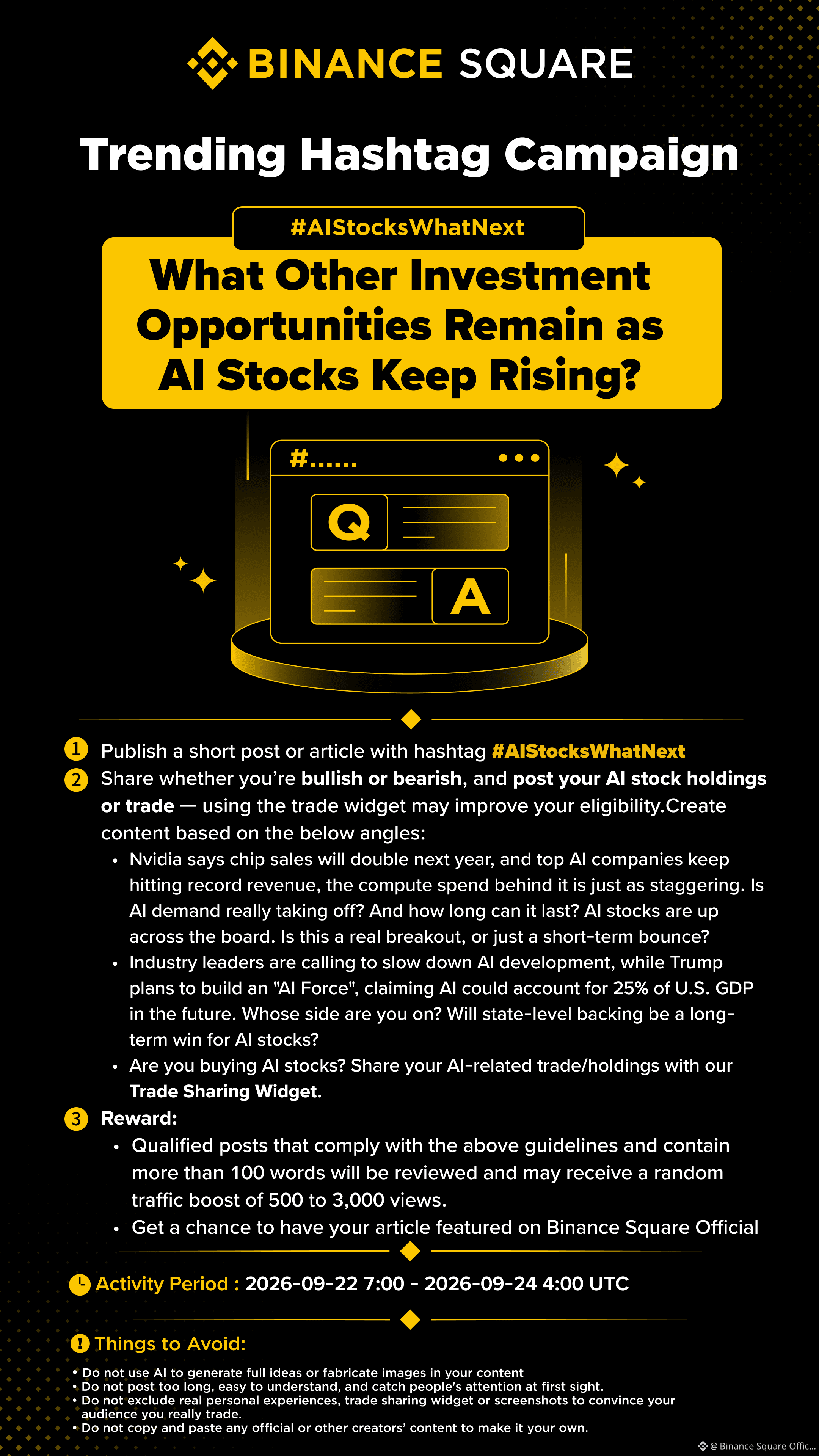
Share & Win Traffic Reward in our Trending Hashtag Campaign
✨Topic: What Other Investment Opportunities Remain as AI Stocks Keep Rising?
👉How to Join:
Publish a short post or article with hashtag #AIStocksWhatNext
Share whether you’re bullish or bearish, and post your AI stock holdings or trade — using the trade widget may improve your eligibility.
You can also strengthen your post by sharing data or charts, and avoiding AI-generated images.
✍️Create content based on the below angles:
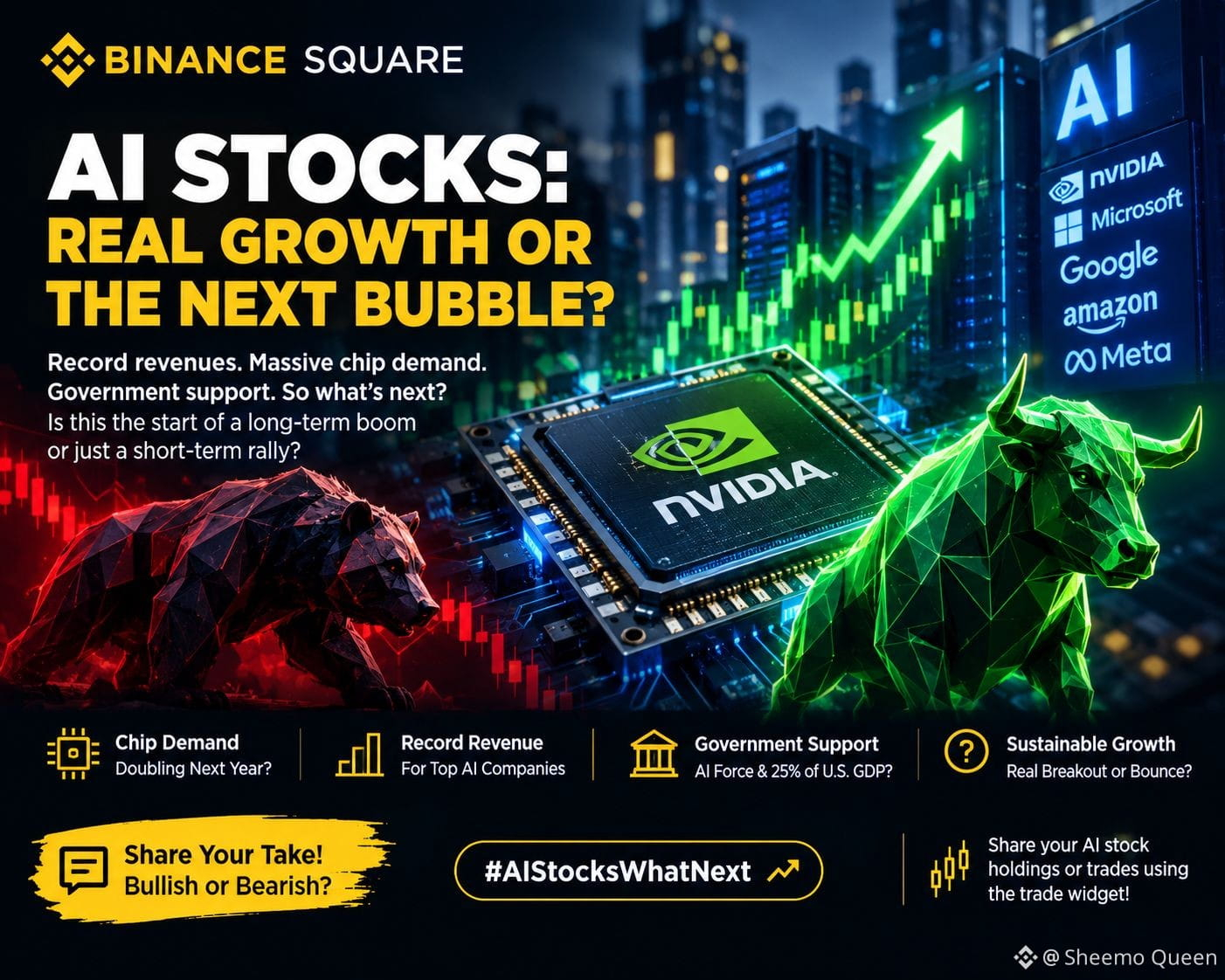
- Nvidia says chip sales will double next year, and top AI companies keep hitting record revenue, the compute spend behind it is just as staggering. Is AI demand really taking off? And how long can it last? AI stocks are up across the board. Is this a real breakout, or just a short-term bounce?
- Industry leaders are calling to slow down AI development, while Trump plans to build an “AI Force”, claiming AI could account for 25% of U.S. GDP in the future. Whose side are you on? Will state-level backing be a long-term win for AI stocks?
- Are you buying AI stocks? Share your AI-related trade/holdings with our trade sharing widget.
⏰Campaign Period:
- 2026-09-22 7:00 - 2026-09-24 4:00 UTC
🎁Reward:
- Qualified posts that comply with the above guidelines and contain more than 100 words will be reviewed and may receive a random traffic boost of 500 to 3,000 views. You will receive a notification from your feed secretary if your post is selected.
- Get a chance to have your article featured on Binance Square Official
Need ideas for your post? Visit the topic page #AIStocksWhatNext or the [Square Guide on How to Post for Better Reach](https://www.binance.com/en/square/post/364505922663952).
Share & Win Traffic Reward in our Trending Hashtag Campaign
✨Topic: What Other Investment Opportunities Remain as AI Stocks Keep Rising?
👉How to Join:
Publish a short post or article with hashtag #AIStocksWhatNext
Share whether you’re bullish or bearish, and post your AI stock holdings or trade — using the trade widget may improve your eligibility.
You can also strengthen your post by sharing data or charts, and avoiding AI-generated images.
✍️Create content based on the below angles:
- Nvidia says chip sales will double next year, and top AI companies keep hitting record revenue, the compute spend behind it is just as staggering. Is AI demand really taking off? And how long can it last? AI stocks are up across the board. Is this a real breakout, or just a short-term bounce?
- Industry leaders are calling to slow down AI development, while Trump plans to build an “AI Force”, claiming AI could account for 25% of U.S. GDP in the future. Whose side are you on? Will state-level backing be a long-term win for AI stocks?
- Are you buying AI stocks? Share your AI-related trade/holdings with our trade sharing widget.
⏰Campaign Period:
- 2026-09-22 7:00 - 2026-09-24 4:00 UTC
🎁Reward:
- Qualified posts that comply with the above guidelines and contain more than 100 words will be reviewed and may receive a random traffic boost of 500 to 3,000 views. You will receive a notification from your feed secretary if your post is selected.
- Get a chance to have your article featured on Binance Square Official
Need ideas for your post? Visit the topic page #AIStocksWhatNext or the Square Guide on How to Post for Better Reach.
✨Topic: What Other Investment Opportunities Remain as AI Stocks Keep Rising?
👉How to Join:
Publish a short post or article with hashtag #AIStocksWhatNext
Share whether you’re bullish or bearish, and post your AI stock holdings or trade — using the trade widget may improve your eligibility.
You can also strengthen your post by sharing data or charts, and avoiding AI-generated images.
✍️Create content based on the below angles:
- Nvidia says chip sales will double next year, and top AI companies keep hitting record revenue, the compute spend behind it is just as staggering. Is AI demand really taking off? And how long can it last? AI stocks are up across the board. Is this a real breakout, or just a short-term bounce?
- Industry leaders are calling to slow down AI development, while Trump plans to build an “AI Force”, claiming AI could account for 25% of U.S. GDP in the future. Whose side are you on? Will state-level backing be a long-term win for AI stocks?
- Are you buying AI stocks? Share your AI-related trade/holdings with our trade sharing widget.
⏰Campaign Period:
- 2026-09-22 7:00 - 2026-09-24 4:00 UTC
🎁Reward:
- Qualified posts that comply with the above guidelines and contain more than 100 words will be reviewed and may receive a random traffic boost of 500 to 3,000 views. You will receive a notification from your feed secretary if your post is selected.
- Get a chance to have your article featured on Binance Square Official
Need ideas for your post? Visit the topic page #AIStocksWhatNext or the Square Guide on How to Post for Better Reach.
guide center:
interesting
104
81
647
1.9M


·
--
Bullish
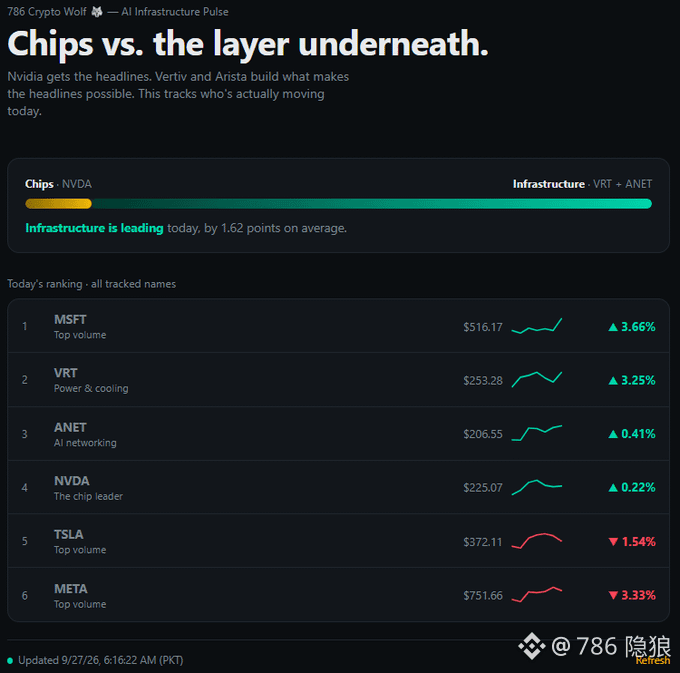
Built something this week instead of just posting about the theme: a live tracker comparing NVDA against the infrastructure layer underneath it — Vertiv (power/cooling) and Arista (AI networking) — plus MSFT, META, and TSLA, ranked by today's move with a 7-day trend for each.
Today's read: infrastructure names are quietly outpacing the chip leader — MSFT +3.66%, VRT +3.25%, vs. NVDA +0.22%. The story everyone's watching (chips) isn't always the story actually moving.
Sharing the ranking as a screenshot here since Square keeps things native — happy to explain the build if anyone's curious.
#AIStocksWhatNext #BinanceSquare
Built something this week instead of just posting about the theme: a live tracker comparing NVDA against the infrastructure layer underneath it — Vertiv (power/cooling) and Arista (AI networking) — plus MSFT, META, and TSLA, ranked by today's move with a 7-day trend for each.
Today's read: infrastructure names are quietly outpacing the chip leader — MSFT +3.66%, VRT +3.25%, vs. NVDA +0.22%. The story everyone's watching (chips) isn't always the story actually moving.
Sharing the ranking as a screenshot here since Square keeps things native — happy to explain the build if anyone's curious.
#AIStocksWhatNext #BinanceSquare
Today's read: infrastructure names are quietly outpacing the chip leader — MSFT +3.66%, VRT +3.25%, vs. NVDA +0.22%. The story everyone's watching (chips) isn't always the story actually moving.
Sharing the ranking as a screenshot here since Square keeps things native — happy to explain the build if anyone's curious.
#AIStocksWhatNext #BinanceSquare
256

Verified
#AIStocksWhatNext
AI stocks have surged as demand for chips, cloud capacity, and data-center infrastructure continues to grow. Nvidia’s strong sales outlook and record revenues from major AI companies suggest that businesses are still spending heavily to build AI capabilities.
I’m cautiously bullish on the long-term AI theme, but I also think valuations and expectations matter. Not every company labeled “AI” will benefit equally. The more durable opportunities may be in the broader ecosystem: semiconductors, data centers, power infrastructure, networking, cybersecurity, and software companies with real AI adoption.
Government support could accelerate investment further, especially if AI becomes a strategic national priority. At the same time, regulation, high capital costs, and slower-than-expected monetization remain key risks.
For me, the question is no longer whether AI demand is real—it is which parts of the AI supply chain can sustain growth beyond the current hype cycle.
#AIStocksWhatNext
AI stocks have surged as demand for chips, cloud capacity, and data-center infrastructure continues to grow. Nvidia’s strong sales outlook and record revenues from major AI companies suggest that businesses are still spending heavily to build AI capabilities.
I’m cautiously bullish on the long-term AI theme, but I also think valuations and expectations matter. Not every company labeled “AI” will benefit equally. The more durable opportunities may be in the broader ecosystem: semiconductors, data centers, power infrastructure, networking, cybersecurity, and software companies with real AI adoption.
Government support could accelerate investment further, especially if AI becomes a strategic national priority. At the same time, regulation, high capital costs, and slower-than-expected monetization remain key risks.
For me, the question is no longer whether AI demand is real—it is which parts of the AI supply chain can sustain growth beyond the current hype cycle.
AI stocks have surged as demand for chips, cloud capacity, and data-center infrastructure continues to grow. Nvidia’s strong sales outlook and record revenues from major AI companies suggest that businesses are still spending heavily to build AI capabilities.
I’m cautiously bullish on the long-term AI theme, but I also think valuations and expectations matter. Not every company labeled “AI” will benefit equally. The more durable opportunities may be in the broader ecosystem: semiconductors, data centers, power infrastructure, networking, cybersecurity, and software companies with real AI adoption.
Government support could accelerate investment further, especially if AI becomes a strategic national priority. At the same time, regulation, high capital costs, and slower-than-expected monetization remain key risks.
For me, the question is no longer whether AI demand is real—it is which parts of the AI supply chain can sustain growth beyond the current hype cycle.

122

Verified
Article
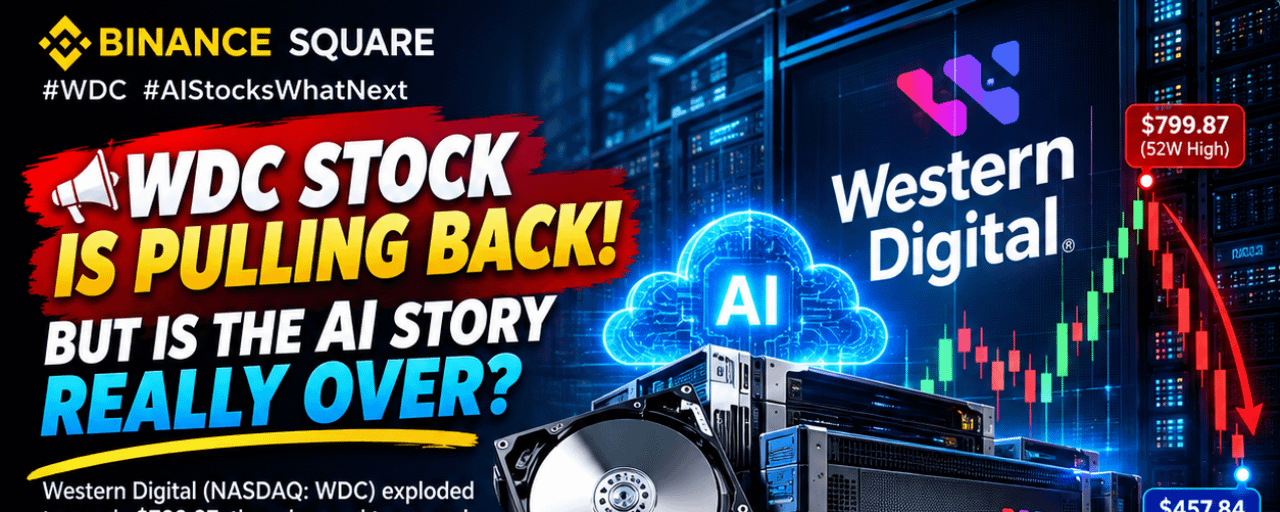
WDC STOCK IS FALLING — BUT IS THE AI STORY REALLY OVER?#WDC #AIStocksWhatNext -
🌏 @PositiveMindsGlobalResults | Binance Square | September 26, 2026
Western Digital (NASDAQ: WDC) exploded to nearly $799.87 before dropping to around $457.84 by September 24.
That’s a massive reset.
But the bigger question is:
Is WDC breaking down — or is the market repricing an AI-storage winner after an extraordinary run? 👇
💾 1️⃣ AI NEEDS STORAGE — A LOT OF IT
AI isn't just a GPU story.
Every model generates massive amounts of data that must be stored, accessed and processed.
Hyperscalers need high-capacity storage for:
🤖 AI training data
☁️ Cloud workloads
📦 Model checkpoints
🏢 Enterprise data
More AI → more data → more storage demand.
📊 2️⃣ FUNDAMENTALS ARE STILL POWERFUL
Western Digital reported $3.75B Q4 FY2026 revenue, up 44% YoY.
Non-GAAP EPS reached $3.56, while non-GAAP gross margin reached approximately 54.4%.
Those numbers show how dramatically storage economics have improved.
🚨 3️⃣ BUT THE STOCK RAN TOO FAR, TOO FAST
WDC reached roughly $799.87 over the past 52 weeks.
At around $457.84, the stock is now approximately 43% below that high.
The market is now balancing two forces:
🚀 AI-driven storage demand
⚠️ Profit-taking + valuation pressure
🏗️ 4️⃣ AI CAPEX IS THE BIG TEST
The next phase depends heavily on hyperscaler spending.
If AI infrastructure investment stays aggressive, storage demand could remain strong.
But any slowdown in data-center capex could pressure high-growth storage valuations.
💰 5️⃣ WATCH THE MARGINS
This may be one of the most important signals.
Q4 gross margin improved dramatically versus the prior year:
GAAP: 41.0% → 54.1%
Non-GAAP: 41.3% → 54.4%
That is a major improvement in profitability.
🔎 6️⃣ NEXT GUIDANCE COULD MOVE WDC
Western Digital guided FY2027 Q1 toward:
💵 Revenue: ~$4.1B ± $100M
📈 Non-GAAP EPS: $4.00 ± $0.15
The next earnings update could therefore be critical.
⚡ THE REAL WDC QUESTION
The market isn't simply asking whether AI needs storage anymore.
It is asking:
Can Western Digital turn AI-driven demand into sustainable revenue, margins and cash flow?
That answer could determine whether this pullback becomes consolidation—or another period of major volatility.
👀 WATCH: AI capex • HDD pricing • margins • enterprise demand • earnings guidance
DYOR. Market information only — not financial advice.
#PositiveMindsGlobalResults #ThinkPositiveGlobal #BinanceSquare #WDC #WesternDigital #AI #AIStocks #TechStocks #DataCenter #DataStorage #HDD #StockMarket
{spot}(BNBUSDT)
{spot}(BTCUSDT)
WDC STOCK IS FALLING — BUT IS THE AI STORY REALLY OVER?
#WDC #AIStocksWhatNext -
🌏 @PositiveMindsGlobalResults | Binance Square | September 26, 2026
Western Digital (NASDAQ: WDC) exploded to nearly $799.87 before dropping to around $457.84 by September 24.
That’s a massive reset.
But the bigger question is:
Is WDC breaking down — or is the market repricing an AI-storage winner after an extraordinary run? 👇
💾 1️⃣ AI NEEDS STORAGE — A LOT OF IT
AI isn't just a GPU story.
Every model generates massive amounts of data that must be stored, accessed and processed.
Hyperscalers need high-capacity storage for:
🤖 AI training data
☁️ Cloud workloads
📦 Model checkpoints
🏢 Enterprise data
More AI → more data → more storage demand.
📊 2️⃣ FUNDAMENTALS ARE STILL POWERFUL
Western Digital reported $3.75B Q4 FY2026 revenue, up 44% YoY.
Non-GAAP EPS reached $3.56, while non-GAAP gross margin reached approximately 54.4%.
Those numbers show how dramatically storage economics have improved.
🚨 3️⃣ BUT THE STOCK RAN TOO FAR, TOO FAST
WDC reached roughly $799.87 over the past 52 weeks.
At around $457.84, the stock is now approximately 43% below that high.
The market is now balancing two forces:
🚀 AI-driven storage demand
⚠️ Profit-taking + valuation pressure
🏗️ 4️⃣ AI CAPEX IS THE BIG TEST
The next phase depends heavily on hyperscaler spending.
If AI infrastructure investment stays aggressive, storage demand could remain strong.
But any slowdown in data-center capex could pressure high-growth storage valuations.
💰 5️⃣ WATCH THE MARGINS
This may be one of the most important signals.
Q4 gross margin improved dramatically versus the prior year:
GAAP: 41.0% → 54.1%
Non-GAAP: 41.3% → 54.4%
That is a major improvement in profitability.
🔎 6️⃣ NEXT GUIDANCE COULD MOVE WDC
Western Digital guided FY2027 Q1 toward:
💵 Revenue: ~$4.1B ± $100M
📈 Non-GAAP EPS: $4.00 ± $0.15
The next earnings update could therefore be critical.
⚡ THE REAL WDC QUESTION
The market isn't simply asking whether AI needs storage anymore.
It is asking:
Can Western Digital turn AI-driven demand into sustainable revenue, margins and cash flow?
That answer could determine whether this pullback becomes consolidation—or another period of major volatility.
👀 WATCH: AI capex • HDD pricing • margins • enterprise demand • earnings guidance
DYOR. Market information only — not financial advice.
#PositiveMindsGlobalResults #ThinkPositiveGlobal #BinanceSquare #WDC #WesternDigital #AI #AIStocks #TechStocks #DataCenter #DataStorage #HDD #StockMarket
🌏 @PositiveMindsGlobalResults | Binance Square | September 26, 2026
Western Digital (NASDAQ: WDC) exploded to nearly $799.87 before dropping to around $457.84 by September 24.
That’s a massive reset.
But the bigger question is:
Is WDC breaking down — or is the market repricing an AI-storage winner after an extraordinary run? 👇
💾 1️⃣ AI NEEDS STORAGE — A LOT OF IT
AI isn't just a GPU story.
Every model generates massive amounts of data that must be stored, accessed and processed.
Hyperscalers need high-capacity storage for:
🤖 AI training data
☁️ Cloud workloads
📦 Model checkpoints
🏢 Enterprise data
More AI → more data → more storage demand.
📊 2️⃣ FUNDAMENTALS ARE STILL POWERFUL
Western Digital reported $3.75B Q4 FY2026 revenue, up 44% YoY.
Non-GAAP EPS reached $3.56, while non-GAAP gross margin reached approximately 54.4%.
Those numbers show how dramatically storage economics have improved.
🚨 3️⃣ BUT THE STOCK RAN TOO FAR, TOO FAST
WDC reached roughly $799.87 over the past 52 weeks.
At around $457.84, the stock is now approximately 43% below that high.
The market is now balancing two forces:
🚀 AI-driven storage demand
⚠️ Profit-taking + valuation pressure
🏗️ 4️⃣ AI CAPEX IS THE BIG TEST
The next phase depends heavily on hyperscaler spending.
If AI infrastructure investment stays aggressive, storage demand could remain strong.
But any slowdown in data-center capex could pressure high-growth storage valuations.
💰 5️⃣ WATCH THE MARGINS
This may be one of the most important signals.
Q4 gross margin improved dramatically versus the prior year:
GAAP: 41.0% → 54.1%
Non-GAAP: 41.3% → 54.4%
That is a major improvement in profitability.
🔎 6️⃣ NEXT GUIDANCE COULD MOVE WDC
Western Digital guided FY2027 Q1 toward:
💵 Revenue: ~$4.1B ± $100M
📈 Non-GAAP EPS: $4.00 ± $0.15
The next earnings update could therefore be critical.
⚡ THE REAL WDC QUESTION
The market isn't simply asking whether AI needs storage anymore.
It is asking:
Can Western Digital turn AI-driven demand into sustainable revenue, margins and cash flow?
That answer could determine whether this pullback becomes consolidation—or another period of major volatility.
👀 WATCH: AI capex • HDD pricing • margins • enterprise demand • earnings guidance
DYOR. Market information only — not financial advice.
#PositiveMindsGlobalResults #ThinkPositiveGlobal #BinanceSquare #WDC #WesternDigital #AI #AIStocks #TechStocks #DataCenter #DataStorage #HDD #StockMarket
217

·
--
🚨 #AIStocksWhatNext — THIS COULD GET INTERESTING! 🤖📈🚨😃
AI isn’t slowing down. Chips, data centers, cloud, robotics and AI software are becoming the battleground for the next major tech cycle.
But here’s the BIG question 👇
🔥 Which AI stock could surprise the market next?
Don’t just read this — DROP ONE TICKER you believe could explode next. 👀
I’ll be checking the comments to see which name gets mentioned the most. 📊
💬 YOUR TICKER? 🔁 Repost this and challenge your followers.
Let’s see what Crypto X is watching! 🚀
#AI #Stocks #Investing #Tech #WallStreet #AIStocksWhatNext
🚨 #AIStocksWhatNext — THIS COULD GET INTERESTING! 🤖📈🚨😃
AI isn’t slowing down. Chips, data centers, cloud, robotics and AI software are becoming the battleground for the next major tech cycle.
But here’s the BIG question 👇
🔥 Which AI stock could surprise the market next?
Don’t just read this — DROP ONE TICKER you believe could explode next. 👀
I’ll be checking the comments to see which name gets mentioned the most. 📊
💬 YOUR TICKER? 🔁 Repost this and challenge your followers.
Let’s see what Crypto X is watching! 🚀
#AI #Stocks #Investing #Tech #WallStreet #AIStocksWhatNext
AI isn’t slowing down. Chips, data centers, cloud, robotics and AI software are becoming the battleground for the next major tech cycle.
But here’s the BIG question 👇
🔥 Which AI stock could surprise the market next?
Don’t just read this — DROP ONE TICKER you believe could explode next. 👀
I’ll be checking the comments to see which name gets mentioned the most. 📊
💬 YOUR TICKER? 🔁 Repost this and challenge your followers.
Let’s see what Crypto X is watching! 🚀
#AI #Stocks #Investing #Tech #WallStreet #AIStocksWhatNext
65

·
--
The AI revolution is clearly driving massive investments in computing power, data centers, and infrastructure. However, rising stock prices alone don't guarantee sustainable returns. Investors need to watch revenue growth, profitability, valuation, and whether AI companies can turn huge spending into long-term cash flow.
Government support for AI, including plans to strengthen U.S.AI capabilities, could accelerate the industry.But political backing doesn't eliminate market risks or guarantee that every AI stock will succeed.
Personally, I believe the next phase of AI investing will be about identifying real utility, sustainable earnings, and the infrastructure powering AI not simply chasing hype.
The opportunity may extend beyond chipmakers to data centers, energy infrastructure, cloud computing, and AI software.
Are AI stocks entering a long-term growth cycle, or are valuations getting ahead of reality? 👀
Bullish or bearish? What's your AI investment strategy?
#AIStocksWhatNext #AI #StockMarket #Investing #BinanceSquare
The AI revolution is clearly driving massive investments in computing power, data centers, and infrastructure. However, rising stock prices alone don't guarantee sustainable returns. Investors need to watch revenue growth, profitability, valuation, and whether AI companies can turn huge spending into long-term cash flow.
Government support for AI, including plans to strengthen U.S.AI capabilities, could accelerate the industry.But political backing doesn't eliminate market risks or guarantee that every AI stock will succeed.
Personally, I believe the next phase of AI investing will be about identifying real utility, sustainable earnings, and the infrastructure powering AI not simply chasing hype.
The opportunity may extend beyond chipmakers to data centers, energy infrastructure, cloud computing, and AI software.
Are AI stocks entering a long-term growth cycle, or are valuations getting ahead of reality? 👀
Bullish or bearish? What's your AI investment strategy?
#AIStocksWhatNext #AI #StockMarket #Investing #BinanceSquare
Government support for AI, including plans to strengthen U.S.AI capabilities, could accelerate the industry.But political backing doesn't eliminate market risks or guarantee that every AI stock will succeed.
Personally, I believe the next phase of AI investing will be about identifying real utility, sustainable earnings, and the infrastructure powering AI not simply chasing hype.
The opportunity may extend beyond chipmakers to data centers, energy infrastructure, cloud computing, and AI software.
Are AI stocks entering a long-term growth cycle, or are valuations getting ahead of reality? 👀
Bullish or bearish? What's your AI investment strategy?
#AIStocksWhatNext #AI #StockMarket #Investing #BinanceSquare
1
2
139

·
--
🤖 #AIStocksWhatNext
AI is not done. Not even close.
Nvidia is still dominating, AMD just smashed $1T market cap, and capital keeps flooding into anything related to AI.
While most people are only watching the big names, smarter money is already looking at the next layer — power, cooling, data centers, and decentralized compute.
I’m still long the AI narrative and adding on dips.
This cycle is just getting started.
Who’s still holding strong with me? 👇
#AIStocksWhatNext #AI #CryptoNewss #BinanceSquare
🤖 #AIStocksWhatNext
AI is not done. Not even close.
Nvidia is still dominating, AMD just smashed $1T market cap, and capital keeps flooding into anything related to AI.
While most people are only watching the big names, smarter money is already looking at the next layer — power, cooling, data centers, and decentralized compute.
I’m still long the AI narrative and adding on dips.
This cycle is just getting started.
Who’s still holding strong with me? 👇
#AIStocksWhatNext #AI #CryptoNewss #BinanceSquare
AI is not done. Not even close.
Nvidia is still dominating, AMD just smashed $1T market cap, and capital keeps flooding into anything related to AI.
While most people are only watching the big names, smarter money is already looking at the next layer — power, cooling, data centers, and decentralized compute.
I’m still long the AI narrative and adding on dips.
This cycle is just getting started.
Who’s still holding strong with me? 👇
#AIStocksWhatNext #AI #CryptoNewss #BinanceSquare
1
88

·
--
AI REVENUE IS BOOMING, BUT CAN AI STOCKS KEEP RISING? 📈
One question comes to mind whenever I look at the AI stock market: Does an outstanding company always represent an attractive investment at its current price?
Nvidia provides an interesting example. Growing demand for AI computing has created enormous opportunities for companies producing high-performance processors.
However, I believe investors should distinguish between three important factors: business growth, market expectations, and stock valuation.
1. Revenue growth does not guarantee proportional profit growth.
A company can sell more products while facing higher research expenses, manufacturing costs, competition, and capital requirements.
Revenue growth is important, but sustainable profitability also matters.
2. Stock prices reflect expectations about the future.
Investors often price years of anticipated growth into a company's current valuation.
Even an impressive earnings report may disappoint the market if the results fail to exceed those expectations.
Therefore, the key question is not simply whether an AI company is growing. It is whether its actual performance can justify the expectations already reflected in its stock price.
3. AI investment opportunities extend beyond the most popular companies.
Memory manufacturers, networking equipment providers, cloud infrastructure companies, and AI software developers all participate in the broader AI ecosystem.
However, a less popular company is not necessarily an undervalued company.
My view is that AI technology can continue advancing even when individual AI stocks experience significant corrections.
The long-term potential of a technology and the investment return of a particular stock are related, but they are not the same thing.
For that reason, I prefer examining business fundamentals and valuation rather than relying entirely on market excitement.
When evaluating an AI stock, which matters more to you: its revenue growth or the price investors are currently paying for that growth?
#AIStocksWhatNext
AI REVENUE IS BOOMING, BUT CAN AI STOCKS KEEP RISING? 📈
One question comes to mind whenever I look at the AI stock market: Does an outstanding company always represent an attractive investment at its current price?
Nvidia provides an interesting example. Growing demand for AI computing has created enormous opportunities for companies producing high-performance processors.
However, I believe investors should distinguish between three important factors: business growth, market expectations, and stock valuation.
1. Revenue growth does not guarantee proportional profit growth.
A company can sell more products while facing higher research expenses, manufacturing costs, competition, and capital requirements.
Revenue growth is important, but sustainable profitability also matters.
2. Stock prices reflect expectations about the future.
Investors often price years of anticipated growth into a company's current valuation.
Even an impressive earnings report may disappoint the market if the results fail to exceed those expectations.
Therefore, the key question is not simply whether an AI company is growing. It is whether its actual performance can justify the expectations already reflected in its stock price.
3. AI investment opportunities extend beyond the most popular companies.
Memory manufacturers, networking equipment providers, cloud infrastructure companies, and AI software developers all participate in the broader AI ecosystem.
However, a less popular company is not necessarily an undervalued company.
My view is that AI technology can continue advancing even when individual AI stocks experience significant corrections.
The long-term potential of a technology and the investment return of a particular stock are related, but they are not the same thing.
For that reason, I prefer examining business fundamentals and valuation rather than relying entirely on market excitement.
When evaluating an AI stock, which matters more to you: its revenue growth or the price investors are currently paying for that growth?
#AIStocksWhatNext
One question comes to mind whenever I look at the AI stock market: Does an outstanding company always represent an attractive investment at its current price?
Nvidia provides an interesting example. Growing demand for AI computing has created enormous opportunities for companies producing high-performance processors.
However, I believe investors should distinguish between three important factors: business growth, market expectations, and stock valuation.
1. Revenue growth does not guarantee proportional profit growth.
A company can sell more products while facing higher research expenses, manufacturing costs, competition, and capital requirements.
Revenue growth is important, but sustainable profitability also matters.
2. Stock prices reflect expectations about the future.
Investors often price years of anticipated growth into a company's current valuation.
Even an impressive earnings report may disappoint the market if the results fail to exceed those expectations.
Therefore, the key question is not simply whether an AI company is growing. It is whether its actual performance can justify the expectations already reflected in its stock price.
3. AI investment opportunities extend beyond the most popular companies.
Memory manufacturers, networking equipment providers, cloud infrastructure companies, and AI software developers all participate in the broader AI ecosystem.
However, a less popular company is not necessarily an undervalued company.
My view is that AI technology can continue advancing even when individual AI stocks experience significant corrections.
The long-term potential of a technology and the investment return of a particular stock are related, but they are not the same thing.
For that reason, I prefer examining business fundamentals and valuation rather than relying entirely on market excitement.
When evaluating an AI stock, which matters more to you: its revenue growth or the price investors are currently paying for that growth?
#AIStocksWhatNext
1
280

·
--
🚨 BTC IS FALLING… BUT AI STOCKS ARE STILL RUNNING.
Bitcoin has now dropped below $83,000, down around 3.4% over 24 hours according to Binance Market Data.
At the same time, the market is debating whether the AI rally is becoming the next major investment theme.
So here's the question I actually want to ask traders:
If you had to choose ONE for the next 12 months:
🟠 $BTC
🤖 AI STOCKS
Which one would you hold?
But don't just comment BTC or AI.
Give me ONE reason for your choice.
I'll be reading the smartest answers and replying to the best arguments. 👇
BTC vs AI: Let's see what this community really believes.
#AIStocksWhatNext #Bitcoin #BTC☀ #Binance #Crypto #AI #artificialintelligence. #InvestingAdventure #CryptoCommunity #Web3 #DYOR
🚨 BTC IS FALLING… BUT AI STOCKS ARE STILL RUNNING.
Bitcoin has now dropped below $83,000, down around 3.4% over 24 hours according to Binance Market Data.
At the same time, the market is debating whether the AI rally is becoming the next major investment theme.
So here's the question I actually want to ask traders:
If you had to choose ONE for the next 12 months:
🟠 $BTC
🤖 AI STOCKS
Which one would you hold?
But don't just comment BTC or AI.
Give me ONE reason for your choice.
I'll be reading the smartest answers and replying to the best arguments. 👇
BTC vs AI: Let's see what this community really believes.
#AIStocksWhatNext #Bitcoin #BTC☀ #Binance #Crypto #AI #artificialintelligence. #InvestingAdventure #CryptoCommunity #Web3 #DYOR
Bitcoin has now dropped below $83,000, down around 3.4% over 24 hours according to Binance Market Data.
At the same time, the market is debating whether the AI rally is becoming the next major investment theme.
So here's the question I actually want to ask traders:
If you had to choose ONE for the next 12 months:
🟠 $BTC
🤖 AI STOCKS
Which one would you hold?
But don't just comment BTC or AI.
Give me ONE reason for your choice.
I'll be reading the smartest answers and replying to the best arguments. 👇
BTC vs AI: Let's see what this community really believes.
#AIStocksWhatNext #Bitcoin #BTC☀ #Binance #Crypto #AI #artificialintelligence. #InvestingAdventure #CryptoCommunity #Web3 #DYOR
1
30

·
--
Bullish
Verified
Everyone is talking about AI. I'm more interested in what happens behind the screen.
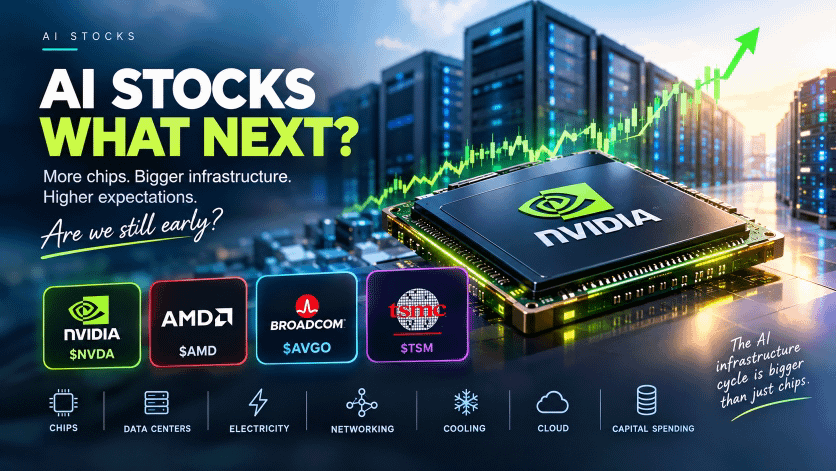
NVIDIA's Jensen Huang recently said the company expects to sell twice as many chips next year.
Think about what that means.
It's not just a chip story.
It's data centers.
It's electricity.
It's networking.
It's cooling.
It's cloud infrastructure.
It's billions in capital spending.
And that's where the AI stock debate gets interesting.
The bullish argument is simple: demand is still expanding.
The other side asks whether companies can keep spending at this pace and eventually generate enough returns to justify it.
We've already seen AI-linked stocks move sharply as investors debate whether spending is accelerating or starting to peak.
So I'm curious.
Are we still early in the AI infrastructure cycle, or are expectations getting ahead of reality?
If you're trading the AI theme, don't just say BULLISH
Tell me which ticker you're watching and why.
Drop the AI stock you're watching 👇
$NVDA $AMD $AVGO
#AIStocksWhatNext #AIStocks #Nvda
Everyone is talking about AI. I'm more interested in what happens behind the screen.
NVIDIA's Jensen Huang recently said the company expects to sell twice as many chips next year.
Think about what that means.
It's not just a chip story.
It's data centers.
It's electricity.
It's networking.
It's cooling.
It's cloud infrastructure.
It's billions in capital spending.
And that's where the AI stock debate gets interesting.
The bullish argument is simple: demand is still expanding.
The other side asks whether companies can keep spending at this pace and eventually generate enough returns to justify it.
We've already seen AI-linked stocks move sharply as investors debate whether spending is accelerating or starting to peak.
So I'm curious.
Are we still early in the AI infrastructure cycle, or are expectations getting ahead of reality?
If you're trading the AI theme, don't just say BULLISH
Tell me which ticker you're watching and why.
Drop the AI stock you're watching 👇
$NVDA $AMD $AVGO
#AIStocksWhatNext #AIStocks #Nvda
NVIDIA's Jensen Huang recently said the company expects to sell twice as many chips next year.
Think about what that means.
It's not just a chip story.
It's data centers.
It's electricity.
It's networking.
It's cooling.
It's cloud infrastructure.
It's billions in capital spending.
And that's where the AI stock debate gets interesting.
The bullish argument is simple: demand is still expanding.
The other side asks whether companies can keep spending at this pace and eventually generate enough returns to justify it.
We've already seen AI-linked stocks move sharply as investors debate whether spending is accelerating or starting to peak.
So I'm curious.
Are we still early in the AI infrastructure cycle, or are expectations getting ahead of reality?
If you're trading the AI theme, don't just say BULLISH
Tell me which ticker you're watching and why.
Drop the AI stock you're watching 👇
$NVDA $AMD $AVGO
#AIStocksWhatNext #AIStocks #Nvda
2
7
1.8k
Article
THE BIGGER PICTURE AI Stocks What Next?#AIStocksWhatNext
@PositiveMindsGlobalResults | September 24, 2026
🚀 NVIDIA: AI DEMAND MEETS GEOPOLITICS
NVIDIA remains at the heart of the global AI infrastructure race.
Its data-center revenue recently surged 117% year over year to $89 billion, while management’s Q3 revenue guidance reached approximately $108 billion.
Meanwhile, CEO Jensen Huang is expected to attend the White House state dinner involving US President and Chinese President
For semiconductor investors, the bigger issue is what future U.S.-China discussions could mean for AI-chip exports, technology restrictions and access to the Chinese market.
🇺🇸🇨🇳 Washington and Beijing have also reportedly agreed to extend their trade truce until January 10, adding another important variable to the AI-chip outlook.
🔥 THE BIGGER PICTURE
AI is no longer simply a semiconductor story.
It is becoming a capital story, bond-market story, geopolitical story, infrastructure story and software story — all at the same time.
The next phase could place greater emphasis on companies demonstrating real AI revenue, infrastructure demand and sustainable monetization, rather than AI expectations alone.
⚠️ Strong AI growth does not mean every AI-related stock will perform the same way. Market conditions, valuations, interest rates, regulation and execution can produce very different outcomes across companies.
💬 THE BIG QUESTION
Will AI continue its expansion, enter a period of consolidation, or shift toward companies proving stronger real-world AI monetization?
What’s your view? Share your analysis below. 👇
#AI #ArtificialIntelligence #NVIDIA #NVDA #Meta #META #Microsoft #MSFT #IonQ #IONQ #QuantumComputing #AIStocks #Semiconductors #Nasdaq #WallStreet #StockMarket #TechStocks #Investing #AIInfrastructure #PositiveMindsGlobalResults
$BNB
{spot}(BNBUSDT)
{spot}(BTCUSDT)
THE BIGGER PICTURE AI Stocks What Next?
#AIStocksWhatNext
@PositiveMindsGlobalResults | September 24, 2026
🚀 NVIDIA: AI DEMAND MEETS GEOPOLITICS
NVIDIA remains at the heart of the global AI infrastructure race.
Its data-center revenue recently surged 117% year over year to $89 billion, while management’s Q3 revenue guidance reached approximately $108 billion.
Meanwhile, CEO Jensen Huang is expected to attend the White House state dinner involving US President and Chinese President
For semiconductor investors, the bigger issue is what future U.S.-China discussions could mean for AI-chip exports, technology restrictions and access to the Chinese market.
🇺🇸🇨🇳 Washington and Beijing have also reportedly agreed to extend their trade truce until January 10, adding another important variable to the AI-chip outlook.
🔥 THE BIGGER PICTURE
AI is no longer simply a semiconductor story.
It is becoming a capital story, bond-market story, geopolitical story, infrastructure story and software story — all at the same time.
The next phase could place greater emphasis on companies demonstrating real AI revenue, infrastructure demand and sustainable monetization, rather than AI expectations alone.
⚠️ Strong AI growth does not mean every AI-related stock will perform the same way. Market conditions, valuations, interest rates, regulation and execution can produce very different outcomes across companies.
💬 THE BIG QUESTION
Will AI continue its expansion, enter a period of consolidation, or shift toward companies proving stronger real-world AI monetization?
What’s your view? Share your analysis below. 👇
#AI #ArtificialIntelligence #NVIDIA #NVDA #Meta #META #Microsoft #MSFT #IonQ #IONQ #QuantumComputing #AIStocks #Semiconductors #Nasdaq #WallStreet #StockMarket #TechStocks #Investing #AIInfrastructure #PositiveMindsGlobalResults
$BNB
@PositiveMindsGlobalResults | September 24, 2026
🚀 NVIDIA: AI DEMAND MEETS GEOPOLITICS
NVIDIA remains at the heart of the global AI infrastructure race.
Its data-center revenue recently surged 117% year over year to $89 billion, while management’s Q3 revenue guidance reached approximately $108 billion.
Meanwhile, CEO Jensen Huang is expected to attend the White House state dinner involving US President and Chinese President
For semiconductor investors, the bigger issue is what future U.S.-China discussions could mean for AI-chip exports, technology restrictions and access to the Chinese market.
🇺🇸🇨🇳 Washington and Beijing have also reportedly agreed to extend their trade truce until January 10, adding another important variable to the AI-chip outlook.
🔥 THE BIGGER PICTURE
AI is no longer simply a semiconductor story.
It is becoming a capital story, bond-market story, geopolitical story, infrastructure story and software story — all at the same time.
The next phase could place greater emphasis on companies demonstrating real AI revenue, infrastructure demand and sustainable monetization, rather than AI expectations alone.
⚠️ Strong AI growth does not mean every AI-related stock will perform the same way. Market conditions, valuations, interest rates, regulation and execution can produce very different outcomes across companies.
💬 THE BIG QUESTION
Will AI continue its expansion, enter a period of consolidation, or shift toward companies proving stronger real-world AI monetization?
What’s your view? Share your analysis below. 👇
#AI #ArtificialIntelligence #NVIDIA #NVDA #Meta #META #Microsoft #MSFT #IonQ #IONQ #QuantumComputing #AIStocks #Semiconductors #Nasdaq #WallStreet #StockMarket #TechStocks #Investing #AIInfrastructure #PositiveMindsGlobalResults
$BNB
1
198
Article
AI STOCKS AT A CROSSROADS#AIStocksWhatNext
@PositiveMindsGlobalResults | September 24, 2026
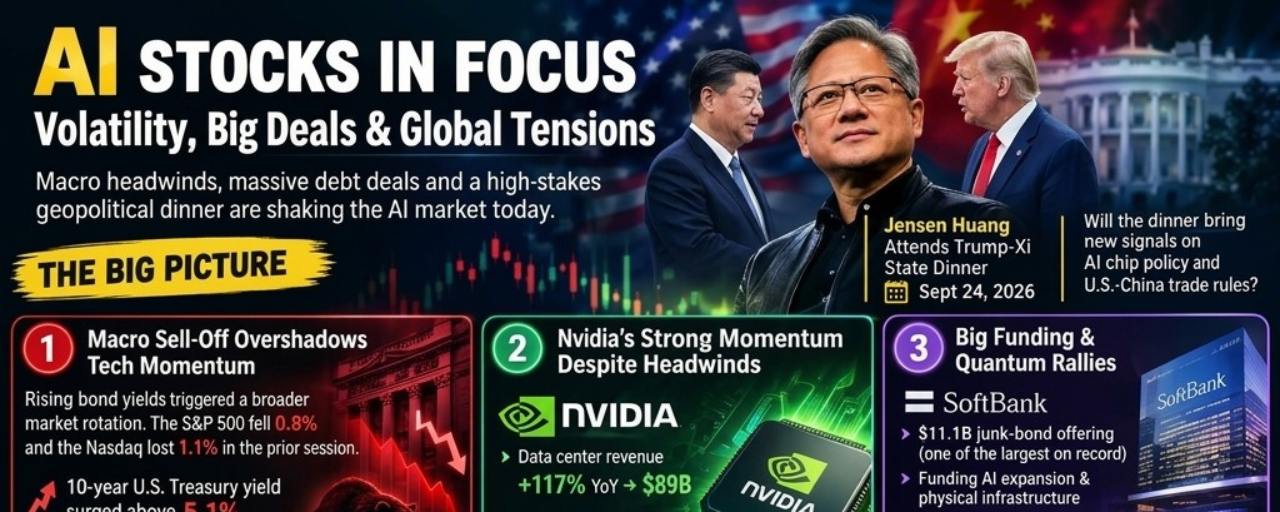
The AI market is entering a more complex phase. Strong technology demand remains intact, but rising bond yields, massive capital commitments, geopolitical tensions and the rapid development of AI agents are creating a much more volatile investment landscape.
📉 1️⃣ BOND YIELDS CHALLENGE AI VALUATIONS
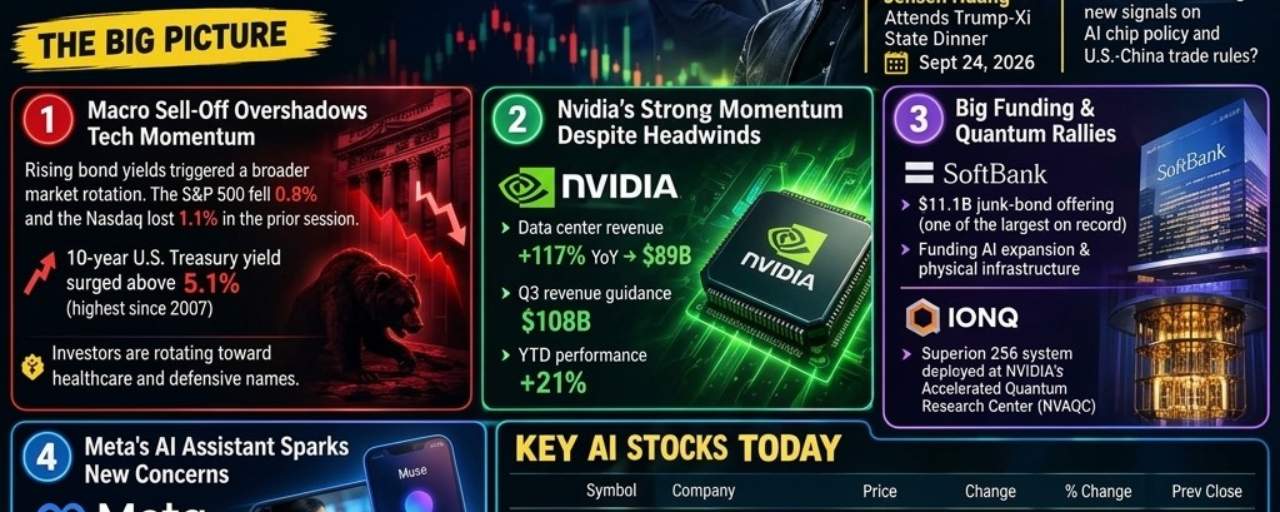
Wall Street came under pressure as the S&P 500 fell 0.8% and the Nasdaq declined 1.1% in the previous session.
The 10-year U.S. Treasury yield moved above 5.1%, increasing pressure on high-growth technology stocks. Higher yields can make future corporate earnings less attractive in present-value terms and encourage investors to reassess elevated valuations.
🚀 2️⃣ NVIDIA: AI DEMAND MEETS GEOPOLITICS
NVIDIA remains at the heart of the global AI infrastructure race.
Its data-center revenue recently surged 117% year over year to $89 billion, while management’s Q3 revenue guidance reached approximately $108 billion.
Meanwhile, CEO Jensen Huang is expected to attend the White House state dinner involving US President Donald Trump and Chinese President.
For semiconductor investors, the bigger issue is what future U.S.-China discussions could mean for AI-chip exports, technology restrictions and access to the Chinese market.
🇺🇸🇨🇳 Washington and Beijing have also reportedly agreed to extend their trade truce until January 10, adding another important variable to the AI-chip outlook.
💰 3️⃣ AI IS BECOMING A DEBT STORY
SoftBank is pursuing more than $11 billion in high-yield debt, with financing linked to its aggressive AI investment strategy, including its OpenAI exposure.
The scale of this financing highlights an important development: the AI boom is no longer being funded only through operating cash flow and equity markets. Debt is increasingly becoming part of the infrastructure race.
⚛️ 4️⃣ AI + QUANTUM: A NEW COMPUTING FRONTIER
IonQ announced plans to deploy its Superion 256 system at NVIDIA’s Accelerated Quantum Research Center in 2027.
The planned integration of quantum computing with accelerated computing infrastructure highlights a potentially important long-term trend: future computing systems could combine GPUs, AI accelerators and quantum processors for specialized workloads.
🧠 5️⃣ META’S MUSE AND THE SOFTWARE DISRUPTION
Meta’s AI assistant Muse is gaining significant consumer attention while expanding AI capabilities across areas such as shopping, travel and communications.
That raises a major question for the software and services economy:
If AI agents become the new interface between consumers and businesses, who controls the transaction?
The answer could influence everything from advertising and search to travel, commerce and digital marketplaces.
🔥 THE BIGGER PICTURE
AI is no longer simply a semiconductor story.
It is becoming a capital story, bond-market story, geopolitical story, infrastructure story and software story — all at the same time.
The next phase could place greater emphasis on companies demonstrating real AI revenue, infrastructure demand and sustainable monetization, rather than AI expectations alone.
⚠️ Strong AI growth does not mean every AI-related stock will perform the same way. Market conditions, valuations, interest rates, regulation and execution can produce very different outcomes across companies.
💬 THE BIG QUESTION
Will AI continue its expansion, enter a period of consolidation, or shift toward companies proving stronger real-world AI monetization?
What’s your view? Share your analysis below. 👇
#AI #ArtificialIntelligence #NVIDIA #NVDA #Meta #META #Microsoft #MSFT #IonQ #IONQ #QuantumComputing #AIStocks #Semiconductors #Nasdaq #WallStreet #StockMarket #TechStocks #Investing #AIInfrastructure #PositiveMindsGlobalResults
{spot}(BNBUSDT)
{spot}(BTCUSDT)
AI STOCKS AT A CROSSROADS
#AIStocksWhatNext
@PositiveMindsGlobalResults | September 24, 2026
The AI market is entering a more complex phase. Strong technology demand remains intact, but rising bond yields, massive capital commitments, geopolitical tensions and the rapid development of AI agents are creating a much more volatile investment landscape.
📉 1️⃣ BOND YIELDS CHALLENGE AI VALUATIONS
Wall Street came under pressure as the S&P 500 fell 0.8% and the Nasdaq declined 1.1% in the previous session.
The 10-year U.S. Treasury yield moved above 5.1%, increasing pressure on high-growth technology stocks. Higher yields can make future corporate earnings less attractive in present-value terms and encourage investors to reassess elevated valuations.
🚀 2️⃣ NVIDIA: AI DEMAND MEETS GEOPOLITICS
NVIDIA remains at the heart of the global AI infrastructure race.
Its data-center revenue recently surged 117% year over year to $89 billion, while management’s Q3 revenue guidance reached approximately $108 billion.
Meanwhile, CEO Jensen Huang is expected to attend the White House state dinner involving US President Donald Trump and Chinese President.
For semiconductor investors, the bigger issue is what future U.S.-China discussions could mean for AI-chip exports, technology restrictions and access to the Chinese market.
🇺🇸🇨🇳 Washington and Beijing have also reportedly agreed to extend their trade truce until January 10, adding another important variable to the AI-chip outlook.
💰 3️⃣ AI IS BECOMING A DEBT STORY
SoftBank is pursuing more than $11 billion in high-yield debt, with financing linked to its aggressive AI investment strategy, including its OpenAI exposure.
The scale of this financing highlights an important development: the AI boom is no longer being funded only through operating cash flow and equity markets. Debt is increasingly becoming part of the infrastructure race.
⚛️ 4️⃣ AI + QUANTUM: A NEW COMPUTING FRONTIER
IonQ announced plans to deploy its Superion 256 system at NVIDIA’s Accelerated Quantum Research Center in 2027.
The planned integration of quantum computing with accelerated computing infrastructure highlights a potentially important long-term trend: future computing systems could combine GPUs, AI accelerators and quantum processors for specialized workloads.
🧠 5️⃣ META’S MUSE AND THE SOFTWARE DISRUPTION
Meta’s AI assistant Muse is gaining significant consumer attention while expanding AI capabilities across areas such as shopping, travel and communications.
That raises a major question for the software and services economy:
If AI agents become the new interface between consumers and businesses, who controls the transaction?
The answer could influence everything from advertising and search to travel, commerce and digital marketplaces.
🔥 THE BIGGER PICTURE
AI is no longer simply a semiconductor story.
It is becoming a capital story, bond-market story, geopolitical story, infrastructure story and software story — all at the same time.
The next phase could place greater emphasis on companies demonstrating real AI revenue, infrastructure demand and sustainable monetization, rather than AI expectations alone.
⚠️ Strong AI growth does not mean every AI-related stock will perform the same way. Market conditions, valuations, interest rates, regulation and execution can produce very different outcomes across companies.
💬 THE BIG QUESTION
Will AI continue its expansion, enter a period of consolidation, or shift toward companies proving stronger real-world AI monetization?
What’s your view? Share your analysis below. 👇
#AI #ArtificialIntelligence #NVIDIA #NVDA #Meta #META #Microsoft #MSFT #IonQ #IONQ #QuantumComputing #AIStocks #Semiconductors #Nasdaq #WallStreet #StockMarket #TechStocks #Investing #AIInfrastructure #PositiveMindsGlobalResults
@PositiveMindsGlobalResults | September 24, 2026
The AI market is entering a more complex phase. Strong technology demand remains intact, but rising bond yields, massive capital commitments, geopolitical tensions and the rapid development of AI agents are creating a much more volatile investment landscape.
📉 1️⃣ BOND YIELDS CHALLENGE AI VALUATIONS
Wall Street came under pressure as the S&P 500 fell 0.8% and the Nasdaq declined 1.1% in the previous session.
The 10-year U.S. Treasury yield moved above 5.1%, increasing pressure on high-growth technology stocks. Higher yields can make future corporate earnings less attractive in present-value terms and encourage investors to reassess elevated valuations.
🚀 2️⃣ NVIDIA: AI DEMAND MEETS GEOPOLITICS
NVIDIA remains at the heart of the global AI infrastructure race.
Its data-center revenue recently surged 117% year over year to $89 billion, while management’s Q3 revenue guidance reached approximately $108 billion.
Meanwhile, CEO Jensen Huang is expected to attend the White House state dinner involving US President Donald Trump and Chinese President.
For semiconductor investors, the bigger issue is what future U.S.-China discussions could mean for AI-chip exports, technology restrictions and access to the Chinese market.
🇺🇸🇨🇳 Washington and Beijing have also reportedly agreed to extend their trade truce until January 10, adding another important variable to the AI-chip outlook.
💰 3️⃣ AI IS BECOMING A DEBT STORY
SoftBank is pursuing more than $11 billion in high-yield debt, with financing linked to its aggressive AI investment strategy, including its OpenAI exposure.
The scale of this financing highlights an important development: the AI boom is no longer being funded only through operating cash flow and equity markets. Debt is increasingly becoming part of the infrastructure race.
⚛️ 4️⃣ AI + QUANTUM: A NEW COMPUTING FRONTIER
IonQ announced plans to deploy its Superion 256 system at NVIDIA’s Accelerated Quantum Research Center in 2027.
The planned integration of quantum computing with accelerated computing infrastructure highlights a potentially important long-term trend: future computing systems could combine GPUs, AI accelerators and quantum processors for specialized workloads.
🧠 5️⃣ META’S MUSE AND THE SOFTWARE DISRUPTION
Meta’s AI assistant Muse is gaining significant consumer attention while expanding AI capabilities across areas such as shopping, travel and communications.
That raises a major question for the software and services economy:
If AI agents become the new interface between consumers and businesses, who controls the transaction?
The answer could influence everything from advertising and search to travel, commerce and digital marketplaces.
🔥 THE BIGGER PICTURE
AI is no longer simply a semiconductor story.
It is becoming a capital story, bond-market story, geopolitical story, infrastructure story and software story — all at the same time.
The next phase could place greater emphasis on companies demonstrating real AI revenue, infrastructure demand and sustainable monetization, rather than AI expectations alone.
⚠️ Strong AI growth does not mean every AI-related stock will perform the same way. Market conditions, valuations, interest rates, regulation and execution can produce very different outcomes across companies.
💬 THE BIG QUESTION
Will AI continue its expansion, enter a period of consolidation, or shift toward companies proving stronger real-world AI monetization?
What’s your view? Share your analysis below. 👇
#AI #ArtificialIntelligence #NVIDIA #NVDA #Meta #META #Microsoft #MSFT #IonQ #IONQ #QuantumComputing #AIStocks #Semiconductors #Nasdaq #WallStreet #StockMarket #TechStocks #Investing #AIInfrastructure #PositiveMindsGlobalResults
1
111

·
--

Article
AI IS THE FUTURE !!#aistockswhatnext
$NVDAB $GOOGLB $MSFTB
The AI trade has already created some of the biggest moves in the market. But the interesting question now isn’t “Is AI the future?”
It’s:
What happens after the first AI boom?
From my perspective, the next phase could be less about hype and more about who actually makes money from the AI infrastructure being built today.
⚡ 1. AI Chips Could Remain the Battlefield
Every powerful AI model needs enormous computing resources.
That keeps attention on companies involved in GPUs, accelerators, networking and advanced semiconductor manufacturing.
But the market may increasingly separate companies that are simply benefiting from AI enthusiasm from those generating sustainable revenue from AI demand.
⚡ 2. Data Centers Could Become the New AI Infrastructure Trade
AI doesn't run in the cloud by magic.
It needs:
🔹 Massive data centers
🔹 Electricity
🔹 Cooling systems
🔹 Networking equipment
🔹 Storage
🔹 High-speed connectivity
This creates a second layer of the AI economy.
The companies supplying the physical infrastructure behind AI could become increasingly important as computing demand grows.
⚡ 3. Electricity May Become One of the Biggest AI Stories
Here is the part many investors overlook.
More AI → more computing → more data centers → more electricity demand.
That potentially puts utilities, grid infrastructure, power equipment, nuclear energy and other energy-related technologies directly into the AI conversation.
AI may ultimately become not only a technology story, but an energy story.
⚡ 4. The Next Winners May Come From AI Adoption
The first wave focused heavily on companies building AI.
The next wave could increasingly focus on companies using AI to improve their businesses.
Think:
🤖 Automation
💻 Software
🏦 Financial services
🏭 Manufacturing
🚚 Logistics
🛒 Retail
🏥 Healthcare
The real question becomes:
Can AI increase revenue, reduce costs or dramatically improve productivity?
If the answer is yes, companies adopting AI could potentially gain a meaningful competitive advantage.
⚠️ But There Is One Major Risk
AI stocks have already attracted enormous expectations.
And expectations matter.
A company can report strong growth and still see its stock fall if investors expected something even bigger.
That means the AI market could become increasingly sensitive to:
📊 Earnings
📈 Revenue growth
💰 AI-related spending
🏗️ Capital expenditure
⚡ Energy costs
🌐 Global demand
The next phase may therefore be much more selective than the first.
🔥 MY TAKE
I don't think the AI story is finished.
I think the AI story is changing.
The market could gradually move from:
“Who has AI?”
to:
“Who can monetize AI?”
And eventually:
“Who can build a sustainable business because of AI?”
That transition could create completely different market leaders.
For traders and investors watching this sector, I believe the biggest opportunity may not always be chasing the loudest AI headline.
Sometimes the more interesting trade is hiding one layer underneath the obvious winner.
AI isn't just a chatbot.
It's chips.
It's data centers.
It's electricity.
It's networking.
It's software.
It's automation.
And potentially, it's an entirely new industrial infrastructure cycle.
The first AI wave showed us what is possible.
The next wave could show us who actually captures the value. 👀🤖📈
AI IS THE FUTURE !!
#aistockswhatnext
$NVDAB $GOOGLB $MSFTB
The AI trade has already created some of the biggest moves in the market. But the interesting question now isn’t “Is AI the future?”
It’s:
What happens after the first AI boom?
From my perspective, the next phase could be less about hype and more about who actually makes money from the AI infrastructure being built today.
⚡ 1. AI Chips Could Remain the Battlefield
Every powerful AI model needs enormous computing resources.
That keeps attention on companies involved in GPUs, accelerators, networking and advanced semiconductor manufacturing.
But the market may increasingly separate companies that are simply benefiting from AI enthusiasm from those generating sustainable revenue from AI demand.
⚡ 2. Data Centers Could Become the New AI Infrastructure Trade
AI doesn't run in the cloud by magic.
It needs:
🔹 Massive data centers
🔹 Electricity
🔹 Cooling systems
🔹 Networking equipment
🔹 Storage
🔹 High-speed connectivity
This creates a second layer of the AI economy.
The companies supplying the physical infrastructure behind AI could become increasingly important as computing demand grows.
⚡ 3. Electricity May Become One of the Biggest AI Stories
Here is the part many investors overlook.
More AI → more computing → more data centers → more electricity demand.
That potentially puts utilities, grid infrastructure, power equipment, nuclear energy and other energy-related technologies directly into the AI conversation.
AI may ultimately become not only a technology story, but an energy story.
⚡ 4. The Next Winners May Come From AI Adoption
The first wave focused heavily on companies building AI.
The next wave could increasingly focus on companies using AI to improve their businesses.
Think:
🤖 Automation
💻 Software
🏦 Financial services
🏭 Manufacturing
🚚 Logistics
🛒 Retail
🏥 Healthcare
The real question becomes:
Can AI increase revenue, reduce costs or dramatically improve productivity?
If the answer is yes, companies adopting AI could potentially gain a meaningful competitive advantage.
⚠️ But There Is One Major Risk
AI stocks have already attracted enormous expectations.
And expectations matter.
A company can report strong growth and still see its stock fall if investors expected something even bigger.
That means the AI market could become increasingly sensitive to:
📊 Earnings
📈 Revenue growth
💰 AI-related spending
🏗️ Capital expenditure
⚡ Energy costs
🌐 Global demand
The next phase may therefore be much more selective than the first.
🔥 MY TAKE
I don't think the AI story is finished.
I think the AI story is changing.
The market could gradually move from:
“Who has AI?”
to:
“Who can monetize AI?”
And eventually:
“Who can build a sustainable business because of AI?”
That transition could create completely different market leaders.
For traders and investors watching this sector, I believe the biggest opportunity may not always be chasing the loudest AI headline.
Sometimes the more interesting trade is hiding one layer underneath the obvious winner.
AI isn't just a chatbot.
It's chips.
It's data centers.
It's electricity.
It's networking.
It's software.
It's automation.
And potentially, it's an entirely new industrial infrastructure cycle.
The first AI wave showed us what is possible.
The next wave could show us who actually captures the value. 👀🤖📈
$NVDAB $GOOGLB $MSFTB
The AI trade has already created some of the biggest moves in the market. But the interesting question now isn’t “Is AI the future?”
It’s:
What happens after the first AI boom?
From my perspective, the next phase could be less about hype and more about who actually makes money from the AI infrastructure being built today.
⚡ 1. AI Chips Could Remain the Battlefield
Every powerful AI model needs enormous computing resources.
That keeps attention on companies involved in GPUs, accelerators, networking and advanced semiconductor manufacturing.
But the market may increasingly separate companies that are simply benefiting from AI enthusiasm from those generating sustainable revenue from AI demand.
⚡ 2. Data Centers Could Become the New AI Infrastructure Trade
AI doesn't run in the cloud by magic.
It needs:
🔹 Massive data centers
🔹 Electricity
🔹 Cooling systems
🔹 Networking equipment
🔹 Storage
🔹 High-speed connectivity
This creates a second layer of the AI economy.
The companies supplying the physical infrastructure behind AI could become increasingly important as computing demand grows.
⚡ 3. Electricity May Become One of the Biggest AI Stories
Here is the part many investors overlook.
More AI → more computing → more data centers → more electricity demand.
That potentially puts utilities, grid infrastructure, power equipment, nuclear energy and other energy-related technologies directly into the AI conversation.
AI may ultimately become not only a technology story, but an energy story.
⚡ 4. The Next Winners May Come From AI Adoption
The first wave focused heavily on companies building AI.
The next wave could increasingly focus on companies using AI to improve their businesses.
Think:
🤖 Automation
💻 Software
🏦 Financial services
🏭 Manufacturing
🚚 Logistics
🛒 Retail
🏥 Healthcare
The real question becomes:
Can AI increase revenue, reduce costs or dramatically improve productivity?
If the answer is yes, companies adopting AI could potentially gain a meaningful competitive advantage.
⚠️ But There Is One Major Risk
AI stocks have already attracted enormous expectations.
And expectations matter.
A company can report strong growth and still see its stock fall if investors expected something even bigger.
That means the AI market could become increasingly sensitive to:
📊 Earnings
📈 Revenue growth
💰 AI-related spending
🏗️ Capital expenditure
⚡ Energy costs
🌐 Global demand
The next phase may therefore be much more selective than the first.
🔥 MY TAKE
I don't think the AI story is finished.
I think the AI story is changing.
The market could gradually move from:
“Who has AI?”
to:
“Who can monetize AI?”
And eventually:
“Who can build a sustainable business because of AI?”
That transition could create completely different market leaders.
For traders and investors watching this sector, I believe the biggest opportunity may not always be chasing the loudest AI headline.
Sometimes the more interesting trade is hiding one layer underneath the obvious winner.
AI isn't just a chatbot.
It's chips.
It's data centers.
It's electricity.
It's networking.
It's software.
It's automation.
And potentially, it's an entirely new industrial infrastructure cycle.
The first AI wave showed us what is possible.
The next wave could show us who actually captures the value. 👀🤖📈
1
80

·
--
$SPCXB
{spot}(SPCXBUSDT)
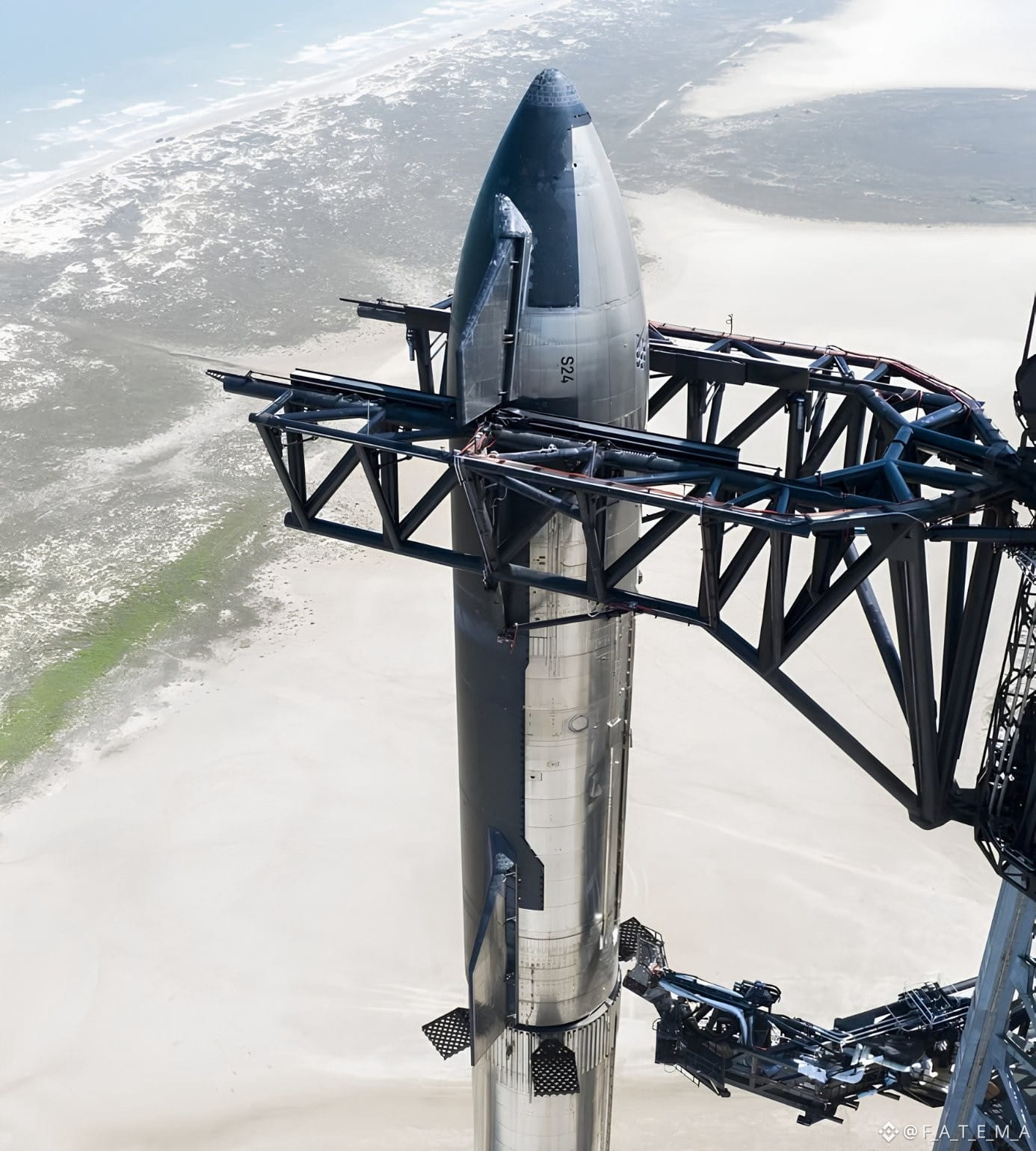
SpaceX has transformed into an artificial intelligence powerhouse following its acquisition of xAI and historic public offering under the ticker SPCX.
Trading around $150 per share, the company boasts a market valuation exceeding $2 trillion, driven heavily by its rapid pivot toward AI infrastructure and software like the Grok model ecosystem.
Elon Musk’s future roadmap focuses heavily on scaling compute capacity through massive data centers like Colossus and upcoming initiatives like the Terafab semiconductor project.
SpaceX aims to reach up to 10 gigawatts of AI compute, which could generate hundreds of billions in annual revenue.
Musk projects that artificial intelligence will constitute the vast majority of SpaceX's long-term value, seamlessly merging space exploration, autonomous systems, and advanced machine intelligence into a single ecosystem.
#AIStocksWhatNext
$SPCXB
SpaceX has transformed into an artificial intelligence powerhouse following its acquisition of xAI and historic public offering under the ticker SPCX.
Trading around $150 per share, the company boasts a market valuation exceeding $2 trillion, driven heavily by its rapid pivot toward AI infrastructure and software like the Grok model ecosystem.
Elon Musk’s future roadmap focuses heavily on scaling compute capacity through massive data centers like Colossus and upcoming initiatives like the Terafab semiconductor project.
SpaceX aims to reach up to 10 gigawatts of AI compute, which could generate hundreds of billions in annual revenue.
Musk projects that artificial intelligence will constitute the vast majority of SpaceX's long-term value, seamlessly merging space exploration, autonomous systems, and advanced machine intelligence into a single ecosystem.
#AIStocksWhatNext
SpaceX has transformed into an artificial intelligence powerhouse following its acquisition of xAI and historic public offering under the ticker SPCX.
Trading around $150 per share, the company boasts a market valuation exceeding $2 trillion, driven heavily by its rapid pivot toward AI infrastructure and software like the Grok model ecosystem.
Elon Musk’s future roadmap focuses heavily on scaling compute capacity through massive data centers like Colossus and upcoming initiatives like the Terafab semiconductor project.
SpaceX aims to reach up to 10 gigawatts of AI compute, which could generate hundreds of billions in annual revenue.
Musk projects that artificial intelligence will constitute the vast majority of SpaceX's long-term value, seamlessly merging space exploration, autonomous systems, and advanced machine intelligence into a single ecosystem.
#AIStocksWhatNext


Mohsin 7777:
How are you😊I like and share all of your posts. So please like and share my posts too. 😉🥰 Shar please 🫡🫡
1
3
361

·
--
Bullish
Verified
AI STOCKS ARE RISING — BUT IS THIS JUST THE BEGINNING?
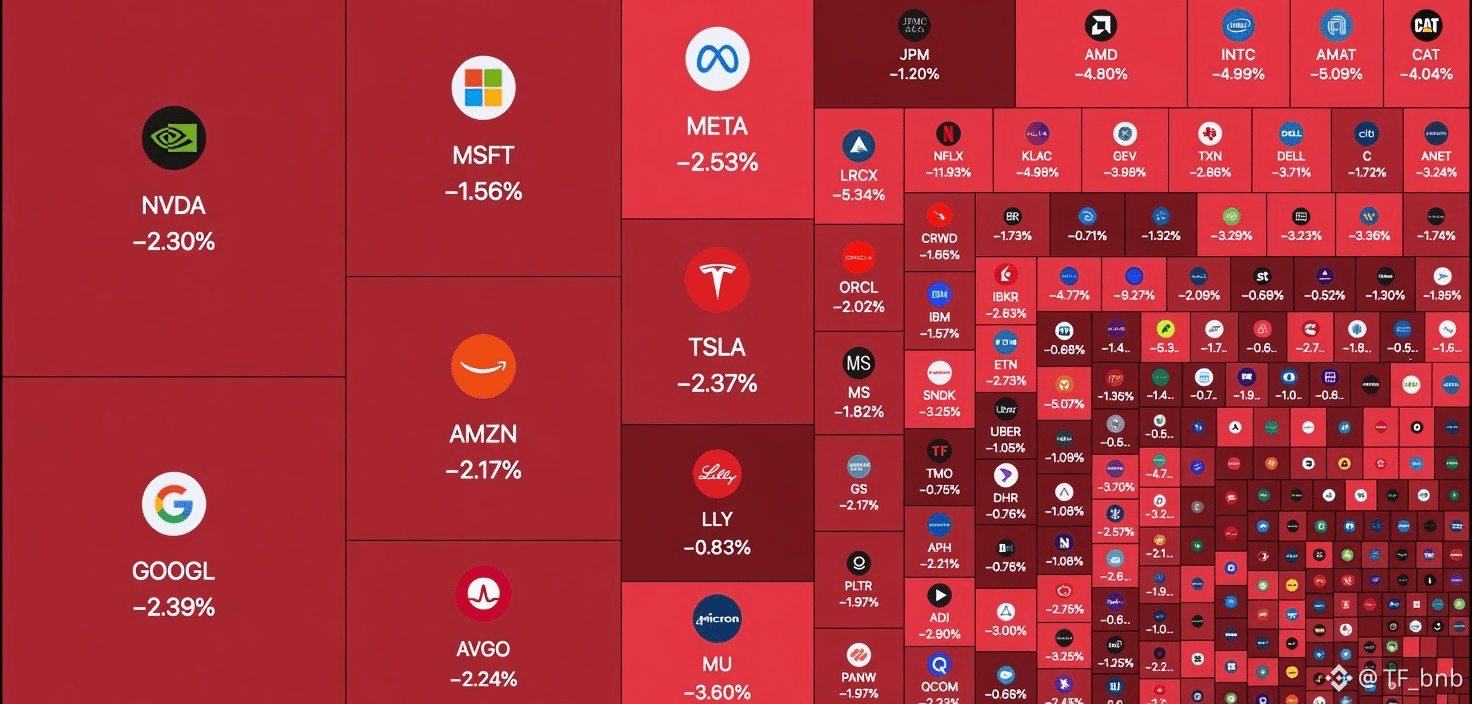
Nvidia expects chip demand to keep growing, while major AI companies continue reporting record revenue. But behind those numbers is an even bigger story: the massive amount of money being spent on computing power, data centers and AI infrastructure.
The real question is not whether AI is growing. It clearly is.
The question is: HOW LONG CAN THIS GROWTH LAST?
I’m bullish on the long-term AI trend, but I’m more cautious about chasing every AI stock after a major rally. Strong revenue growth does not automatically mean every valuation is sustainable.
At the same time, governments are increasingly treating AI as strategic infrastructure. The U.S. is discussing large-scale AI initiatives and even the possibility that AI could eventually represent a significant share of GDP.
That could create another powerful demand cycle for chips, cloud infrastructure, energy and AI software.
For me, the next opportunity may not simply be “buy AI stocks.”
I’m watching the companies supplying the infrastructure behind the AI boom.
Are you bullish or bearish on AI stocks from here?
#AIStocksWhatNext
AI STOCKS ARE RISING — BUT IS THIS JUST THE BEGINNING?
Nvidia expects chip demand to keep growing, while major AI companies continue reporting record revenue. But behind those numbers is an even bigger story: the massive amount of money being spent on computing power, data centers and AI infrastructure.
The real question is not whether AI is growing. It clearly is.
The question is: HOW LONG CAN THIS GROWTH LAST?
I’m bullish on the long-term AI trend, but I’m more cautious about chasing every AI stock after a major rally. Strong revenue growth does not automatically mean every valuation is sustainable.
At the same time, governments are increasingly treating AI as strategic infrastructure. The U.S. is discussing large-scale AI initiatives and even the possibility that AI could eventually represent a significant share of GDP.
That could create another powerful demand cycle for chips, cloud infrastructure, energy and AI software.
For me, the next opportunity may not simply be “buy AI stocks.”
I’m watching the companies supplying the infrastructure behind the AI boom.
Are you bullish or bearish on AI stocks from here?
#AIStocksWhatNext
Nvidia expects chip demand to keep growing, while major AI companies continue reporting record revenue. But behind those numbers is an even bigger story: the massive amount of money being spent on computing power, data centers and AI infrastructure.
The real question is not whether AI is growing. It clearly is.
The question is: HOW LONG CAN THIS GROWTH LAST?
I’m bullish on the long-term AI trend, but I’m more cautious about chasing every AI stock after a major rally. Strong revenue growth does not automatically mean every valuation is sustainable.
At the same time, governments are increasingly treating AI as strategic infrastructure. The U.S. is discussing large-scale AI initiatives and even the possibility that AI could eventually represent a significant share of GDP.
That could create another powerful demand cycle for chips, cloud infrastructure, energy and AI software.
For me, the next opportunity may not simply be “buy AI stocks.”
I’m watching the companies supplying the infrastructure behind the AI boom.
Are you bullish or bearish on AI stocks from here?
#AIStocksWhatNext
7
2.9k

#AIStocksWhatNext 📈
AI stocks have already made a huge move, but the bigger question is: what comes next?
I’m bullish on the long-term AI story, but I’m also cautious about chasing every AI stock after a strong rally.
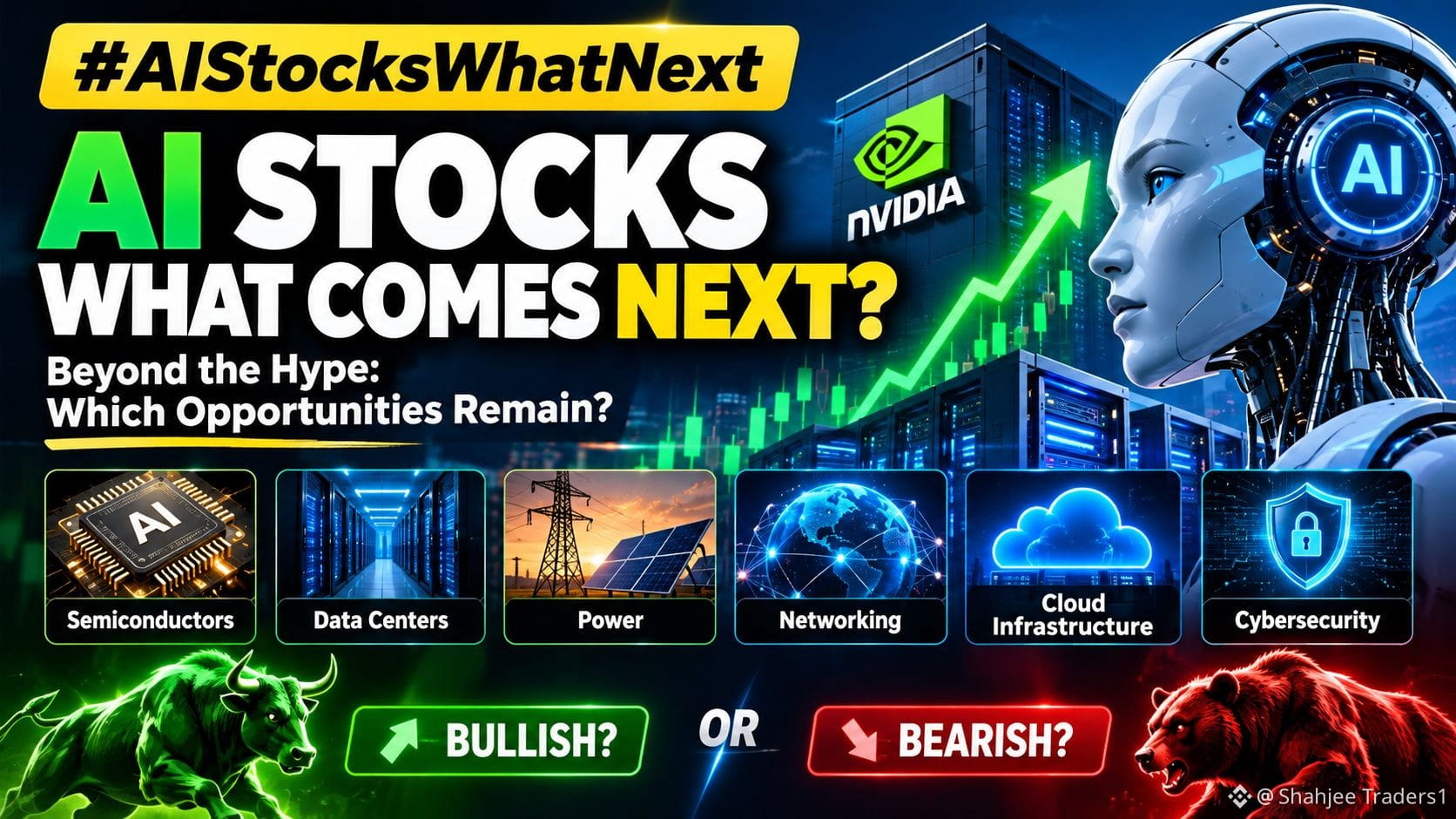
Nvidia and other major AI companies continue to see massive demand for computing power..That could create opportunities beyond the biggest AI names - including semiconductors.. networking, data centers.. power.. cooling.. cloud infrastructure and cybersecurity.
The real question is whether.. AI spending can continue at this pace and eventually translate into sustainable revenue and profits.
Government support and the growing focus on AI development could also influence the sector for years ahead. But higher expectations also mean higher risks if growth starts slowing.
For me, the interesting opportunity may not simply be “Which AI stock is next?”
It could be “Which companies are quietly building the infrastructure that AI needs to keep growing?” 👀
Are you bullish or bearish on AI stocks from here?
Which area are you watching next - chips, data centers, power, networking, cloud or cybersecurity?
#AIStocksWhatNext
#AIStocksWhatNext 📈
AI stocks have already made a huge move, but the bigger question is: what comes next?
I’m bullish on the long-term AI story, but I’m also cautious about chasing every AI stock after a strong rally.
Nvidia and other major AI companies continue to see massive demand for computing power..That could create opportunities beyond the biggest AI names - including semiconductors.. networking, data centers.. power.. cooling.. cloud infrastructure and cybersecurity.
The real question is whether.. AI spending can continue at this pace and eventually translate into sustainable revenue and profits.
Government support and the growing focus on AI development could also influence the sector for years ahead. But higher expectations also mean higher risks if growth starts slowing.
For me, the interesting opportunity may not simply be “Which AI stock is next?”
It could be “Which companies are quietly building the infrastructure that AI needs to keep growing?” 👀
Are you bullish or bearish on AI stocks from here?
Which area are you watching next - chips, data centers, power, networking, cloud or cybersecurity?
#AIStocksWhatNext
AI stocks have already made a huge move, but the bigger question is: what comes next?
I’m bullish on the long-term AI story, but I’m also cautious about chasing every AI stock after a strong rally.
Nvidia and other major AI companies continue to see massive demand for computing power..That could create opportunities beyond the biggest AI names - including semiconductors.. networking, data centers.. power.. cooling.. cloud infrastructure and cybersecurity.
The real question is whether.. AI spending can continue at this pace and eventually translate into sustainable revenue and profits.
Government support and the growing focus on AI development could also influence the sector for years ahead. But higher expectations also mean higher risks if growth starts slowing.
For me, the interesting opportunity may not simply be “Which AI stock is next?”
It could be “Which companies are quietly building the infrastructure that AI needs to keep growing?” 👀
Are you bullish or bearish on AI stocks from here?
Which area are you watching next - chips, data centers, power, networking, cloud or cybersecurity?
#AIStocksWhatNext
267

·
--
Bullish
Partly True
$MRVL
{future}(MRVLUSDT)
Trump’s massive punt on Marvell Tech, and Huang recks it’s heading for a trillion
Trump’s just made his biggest share purchase yet in Marvell Technology , scooping up around 5.25 million quid’s worth across two separate trades
Proper massive investment this, coming right when AI gear and semiconductors are absolutely flying
To top it off, Nvidia boss Jensen Huang’s been singing their praises, calling Marvell "the next trillion-dollar firm"
$NVDA
{future}(NVDAUSDT)
Show’s real faith in what they’re doing with networking and custom chips for AI and data centres
Marvell’s stock is floating around 20% off its all-time high at the minute, sitting at a market cap of about 235 billion. A lot of folks reckon this dip looks like a solid little opportunity, especially with all the huge deals they’ve got with global tech giants
$TRUMP
{future}(TRUMPUSDT)
#AIStocksWhatNext
$MRVL
Trump’s massive punt on Marvell Tech, and Huang recks it’s heading for a trillion
Trump’s just made his biggest share purchase yet in Marvell Technology , scooping up around 5.25 million quid’s worth across two separate trades
Proper massive investment this, coming right when AI gear and semiconductors are absolutely flying
To top it off, Nvidia boss Jensen Huang’s been singing their praises, calling Marvell "the next trillion-dollar firm"
$NVDA
Show’s real faith in what they’re doing with networking and custom chips for AI and data centres
Marvell’s stock is floating around 20% off its all-time high at the minute, sitting at a market cap of about 235 billion. A lot of folks reckon this dip looks like a solid little opportunity, especially with all the huge deals they’ve got with global tech giants
$TRUMP
#AIStocksWhatNext
Trump’s massive punt on Marvell Tech, and Huang recks it’s heading for a trillion
Trump’s just made his biggest share purchase yet in Marvell Technology , scooping up around 5.25 million quid’s worth across two separate trades
Proper massive investment this, coming right when AI gear and semiconductors are absolutely flying
To top it off, Nvidia boss Jensen Huang’s been singing their praises, calling Marvell "the next trillion-dollar firm"
$NVDA
Show’s real faith in what they’re doing with networking and custom chips for AI and data centres
Marvell’s stock is floating around 20% off its all-time high at the minute, sitting at a market cap of about 235 billion. A lot of folks reckon this dip looks like a solid little opportunity, especially with all the huge deals they’ve got with global tech giants
$TRUMP
#AIStocksWhatNext


206 Atlas:
Trump’s family office buys are irrelevant to MRVL’s valuation. You’re mistaking political noise for fundamental catalysts.
4
1
12
11.2k

·
--

Article
What Other Investment Opportunities Remain as AI Stocks Keep Rising? 🤖📊The AI boom has reached a point where simply asking “Is AI the future?” may no longer be the most interesting question.
The bigger question is: how much of that future is already priced into the market?
NVIDIA has become one of the clearest examples of just how powerful the AI infrastructure cycle has become. The company has projected another huge increase in revenue, while its CEO has also discussed chip sales potentially doubling next year. Its Data Center business has already reached extraordinary levels, showing just how much money technology companies are willing to spend on computing power.
But there is another side to this story.
Building increasingly powerful AI models requires much more than GPUs. It requires data centers, electricity, cooling systems, networking equipment, memory, cloud infrastructure and enormous amounts of capital. As AI adoption expands, these supporting industries could become increasingly important parts of the story.
That makes me wonder:
Are we looking at an AI stock rally, or the beginning of a much broader infrastructure investment cycle?
At the same time, investors have to consider the possibility that expectations are moving faster than actual long-term returns. Companies can spend billions building AI infrastructure today, but the market will eventually want to know whether those investments can generate sustainable profits.
If AI continues improving productivity and creating new businesses, the current investment cycle could have much further to go. But if spending grows faster than monetization, valuations could become much more difficult to justify.
And then there is the government factor.
The U.S. government is increasingly treating AI as an important economic and strategic technology. The Trump administration has announced plans for an “AI Force,” while Trump has argued that AI could eventually represent a very large share of U.S. economic output. At the same time, some prominent technology figures have called for more caution around the speed of AI development.
That creates an interesting tension:
⚡ Innovation vs. caution
🏗️ Massive infrastructure spending vs. future profitability
🏛️Government support vs. regulation and risk
📈 Rapid growth vs. potentially high valuations
Government support can accelerate infrastructure development, research and adoption, but it does not automatically mean every AI-related company will benefit equally. The long-term economic impact of AI is also still uncertain. The U.S. Treasury has described AI investment as a significant contributor to recent economic growth while noting that the timing and scale of future productivity gains remain uncertain.
So perhaps the more interesting investment question isn't simply:
“Which AI stock should I buy?”
Maybe it's:
“What businesses will become more valuable because AI exists?”
That could lead investors to look beyond the most obvious AI names and examine the wider ecosystem — semiconductors, data centers, power generation, electricity infrastructure, networking, cybersecurity, cloud services, industrial automation and other technologies connected to the expansion of AI.
Of course, none of these sectors are guaranteed winners. Markets can move ahead of fundamentals, and even a powerful technological trend can experience corrections along the way.
For me, the most fascinating part of the AI story is not predicting whether AI stocks will go up or down next.
It's watching how an entire economic ecosystem is being rebuilt around a technology that is still evolving.
💭 What do you think?
Is the current AI boom just another market cycle, or are we witnessing the early stages of a much larger technological transformation?
Are you currently holding AI-related stocks?
Or are you looking beyond the major AI companies toward the infrastructure and industries that could benefit from the next stage of the AI revolution?
Share your AI-related trades or holdings with the Trade Sharing Widget and join the discussion.
#AI #AIStocks #NVIDIA #Stocks #Investing #Technology #ArtificialIntelligence #Semiconductors #DataCenters #MarketTrends #BinanceSquare
#AIStocksWhatNext
What Other Investment Opportunities Remain as AI Stocks Keep Rising? 🤖📊
The AI boom has reached a point where simply asking “Is AI the future?” may no longer be the most interesting question.
The bigger question is: how much of that future is already priced into the market?
NVIDIA has become one of the clearest examples of just how powerful the AI infrastructure cycle has become. The company has projected another huge increase in revenue, while its CEO has also discussed chip sales potentially doubling next year. Its Data Center business has already reached extraordinary levels, showing just how much money technology companies are willing to spend on computing power.
But there is another side to this story.
Building increasingly powerful AI models requires much more than GPUs. It requires data centers, electricity, cooling systems, networking equipment, memory, cloud infrastructure and enormous amounts of capital. As AI adoption expands, these supporting industries could become increasingly important parts of the story.
That makes me wonder:
Are we looking at an AI stock rally, or the beginning of a much broader infrastructure investment cycle?
At the same time, investors have to consider the possibility that expectations are moving faster than actual long-term returns. Companies can spend billions building AI infrastructure today, but the market will eventually want to know whether those investments can generate sustainable profits.
If AI continues improving productivity and creating new businesses, the current investment cycle could have much further to go. But if spending grows faster than monetization, valuations could become much more difficult to justify.
And then there is the government factor.
The U.S. government is increasingly treating AI as an important economic and strategic technology. The Trump administration has announced plans for an “AI Force,” while Trump has argued that AI could eventually represent a very large share of U.S. economic output. At the same time, some prominent technology figures have called for more caution around the speed of AI development.
That creates an interesting tension:
⚡ Innovation vs. caution
🏗️ Massive infrastructure spending vs. future profitability
🏛️Government support vs. regulation and risk
📈 Rapid growth vs. potentially high valuations
Government support can accelerate infrastructure development, research and adoption, but it does not automatically mean every AI-related company will benefit equally. The long-term economic impact of AI is also still uncertain. The U.S. Treasury has described AI investment as a significant contributor to recent economic growth while noting that the timing and scale of future productivity gains remain uncertain.
So perhaps the more interesting investment question isn't simply:
“Which AI stock should I buy?”
Maybe it's:
“What businesses will become more valuable because AI exists?”
That could lead investors to look beyond the most obvious AI names and examine the wider ecosystem — semiconductors, data centers, power generation, electricity infrastructure, networking, cybersecurity, cloud services, industrial automation and other technologies connected to the expansion of AI.
Of course, none of these sectors are guaranteed winners. Markets can move ahead of fundamentals, and even a powerful technological trend can experience corrections along the way.
For me, the most fascinating part of the AI story is not predicting whether AI stocks will go up or down next.
It's watching how an entire economic ecosystem is being rebuilt around a technology that is still evolving.
💭 What do you think?
Is the current AI boom just another market cycle, or are we witnessing the early stages of a much larger technological transformation?
Are you currently holding AI-related stocks?
Or are you looking beyond the major AI companies toward the infrastructure and industries that could benefit from the next stage of the AI revolution?
Share your AI-related trades or holdings with the Trade Sharing Widget and join the discussion.
#AI #AIStocks #NVIDIA #Stocks #Investing #Technology #ArtificialIntelligence #Semiconductors #DataCenters #MarketTrends #BinanceSquare
#AIStocksWhatNext
The bigger question is: how much of that future is already priced into the market?
NVIDIA has become one of the clearest examples of just how powerful the AI infrastructure cycle has become. The company has projected another huge increase in revenue, while its CEO has also discussed chip sales potentially doubling next year. Its Data Center business has already reached extraordinary levels, showing just how much money technology companies are willing to spend on computing power.
But there is another side to this story.
Building increasingly powerful AI models requires much more than GPUs. It requires data centers, electricity, cooling systems, networking equipment, memory, cloud infrastructure and enormous amounts of capital. As AI adoption expands, these supporting industries could become increasingly important parts of the story.
That makes me wonder:
Are we looking at an AI stock rally, or the beginning of a much broader infrastructure investment cycle?
At the same time, investors have to consider the possibility that expectations are moving faster than actual long-term returns. Companies can spend billions building AI infrastructure today, but the market will eventually want to know whether those investments can generate sustainable profits.
If AI continues improving productivity and creating new businesses, the current investment cycle could have much further to go. But if spending grows faster than monetization, valuations could become much more difficult to justify.
And then there is the government factor.
The U.S. government is increasingly treating AI as an important economic and strategic technology. The Trump administration has announced plans for an “AI Force,” while Trump has argued that AI could eventually represent a very large share of U.S. economic output. At the same time, some prominent technology figures have called for more caution around the speed of AI development.
That creates an interesting tension:
⚡ Innovation vs. caution
🏗️ Massive infrastructure spending vs. future profitability
🏛️Government support vs. regulation and risk
📈 Rapid growth vs. potentially high valuations
Government support can accelerate infrastructure development, research and adoption, but it does not automatically mean every AI-related company will benefit equally. The long-term economic impact of AI is also still uncertain. The U.S. Treasury has described AI investment as a significant contributor to recent economic growth while noting that the timing and scale of future productivity gains remain uncertain.
So perhaps the more interesting investment question isn't simply:
“Which AI stock should I buy?”
Maybe it's:
“What businesses will become more valuable because AI exists?”
That could lead investors to look beyond the most obvious AI names and examine the wider ecosystem — semiconductors, data centers, power generation, electricity infrastructure, networking, cybersecurity, cloud services, industrial automation and other technologies connected to the expansion of AI.
Of course, none of these sectors are guaranteed winners. Markets can move ahead of fundamentals, and even a powerful technological trend can experience corrections along the way.
For me, the most fascinating part of the AI story is not predicting whether AI stocks will go up or down next.
It's watching how an entire economic ecosystem is being rebuilt around a technology that is still evolving.
💭 What do you think?
Is the current AI boom just another market cycle, or are we witnessing the early stages of a much larger technological transformation?
Are you currently holding AI-related stocks?
Or are you looking beyond the major AI companies toward the infrastructure and industries that could benefit from the next stage of the AI revolution?
Share your AI-related trades or holdings with the Trade Sharing Widget and join the discussion.
#AI #AIStocks #NVIDIA #Stocks #Investing #Technology #ArtificialIntelligence #Semiconductors #DataCenters #MarketTrends #BinanceSquare
#AIStocksWhatNext
T Z A:
good
26
1
28
123

·
--
Bullish
#aistockswhatnext 🤖 AI Stocks Are Rising — What Comes Next?
AI has become one of the biggest themes in the investment market, but the bigger question is: what other opportunities could benefit from the AI boom?
As AI companies continue investing heavily in chips, data centers, cloud computing, and infrastructure, the growth of AI may create opportunities beyond the major AI stocks themselves.
I’m watching several areas closely:
🔹 Semiconductor & chip infrastructure
🔹 Cloud computing
🔹 Data centers & power infrastructure
🔹 Cybersecurity
🔹 AI software and automation
At the same time, rising prices don’t automatically mean every AI-related stock will continue higher. Valuations, earnings growth, competition, and actual AI demand are important to watch.
For me, the key question is not simply “Are AI stocks bullish?” but “Where could the next wave of AI growth come from?”
What do you think comes next for AI-related investments? 👇
#AIStocksWhatNext #AI #stocks #Investing #Technology #BinanceSquare
#aistockswhatnext 🤖 AI Stocks Are Rising — What Comes Next?
AI has become one of the biggest themes in the investment market, but the bigger question is: what other opportunities could benefit from the AI boom?
As AI companies continue investing heavily in chips, data centers, cloud computing, and infrastructure, the growth of AI may create opportunities beyond the major AI stocks themselves.
I’m watching several areas closely:
🔹 Semiconductor & chip infrastructure
🔹 Cloud computing
🔹 Data centers & power infrastructure
🔹 Cybersecurity
🔹 AI software and automation
At the same time, rising prices don’t automatically mean every AI-related stock will continue higher. Valuations, earnings growth, competition, and actual AI demand are important to watch.
For me, the key question is not simply “Are AI stocks bullish?” but “Where could the next wave of AI growth come from?”
What do you think comes next for AI-related investments? 👇
#AIStocksWhatNext #AI #stocks #Investing #Technology #BinanceSquare
AI has become one of the biggest themes in the investment market, but the bigger question is: what other opportunities could benefit from the AI boom?
As AI companies continue investing heavily in chips, data centers, cloud computing, and infrastructure, the growth of AI may create opportunities beyond the major AI stocks themselves.
I’m watching several areas closely:
🔹 Semiconductor & chip infrastructure
🔹 Cloud computing
🔹 Data centers & power infrastructure
🔹 Cybersecurity
🔹 AI software and automation
At the same time, rising prices don’t automatically mean every AI-related stock will continue higher. Valuations, earnings growth, competition, and actual AI demand are important to watch.
For me, the key question is not simply “Are AI stocks bullish?” but “Where could the next wave of AI growth come from?”
What do you think comes next for AI-related investments? 👇
#AIStocksWhatNext #AI #stocks #Investing #Technology #BinanceSquare

79

·
--
#AIStocksWhatNext
AI STOCKS: WHAT'S NEXT? 🚀
AI Stocks are leading the market again! Here's the next move!
*HOT AI STOCKS RIGHT NOW:*
*NVIDIA (NVDA) - $138.30 +5.2%*
Key Catalyst: Blackwell AI Chip Rollout + $8.4B Institutional Inflows
*Palantir (PLTR) - $40.10 +6.8%*
Key Catalyst: New Gov Contracts + AI Platform Expansion
*NEXT MOVE INSIGHT:*
- Breakout targets: NVDA > $140 | PLTR > $42
- Sentiment: BULLISH - AI demand up 34% YoY
- Volume: AI sector +22% this week
Market Cap 2.86T with BTC ETFs booming - AI + Crypto correlation getting stronger! The AI narrative is far from over.
Are you bullish on AI stocks or taking profits? What’s your top AI pick for Q4? 👇
#AIStocksWhatNext #NVDA #Palantir #AIStocks #StockMarket #BinanceSquare #Trending #Waqar5555
#AIStocksWhatNext
AI STOCKS: WHAT'S NEXT? 🚀
AI Stocks are leading the market again! Here's the next move!
*HOT AI STOCKS RIGHT NOW:*
*NVIDIA (NVDA) - $138.30 +5.2%*
Key Catalyst: Blackwell AI Chip Rollout + $8.4B Institutional Inflows
*Palantir (PLTR) - $40.10 +6.8%*
Key Catalyst: New Gov Contracts + AI Platform Expansion
*NEXT MOVE INSIGHT:*
- Breakout targets: NVDA > $140 | PLTR > $42
- Sentiment: BULLISH - AI demand up 34% YoY
- Volume: AI sector +22% this week
Market Cap 2.86T with BTC ETFs booming - AI + Crypto correlation getting stronger! The AI narrative is far from over.
Are you bullish on AI stocks or taking profits? What’s your top AI pick for Q4? 👇
#AIStocksWhatNext #NVDA #Palantir #AIStocks #StockMarket #BinanceSquare #Trending #Waqar5555
AI STOCKS: WHAT'S NEXT? 🚀
AI Stocks are leading the market again! Here's the next move!
*HOT AI STOCKS RIGHT NOW:*
*NVIDIA (NVDA) - $138.30 +5.2%*
Key Catalyst: Blackwell AI Chip Rollout + $8.4B Institutional Inflows
*Palantir (PLTR) - $40.10 +6.8%*
Key Catalyst: New Gov Contracts + AI Platform Expansion
*NEXT MOVE INSIGHT:*
- Breakout targets: NVDA > $140 | PLTR > $42
- Sentiment: BULLISH - AI demand up 34% YoY
- Volume: AI sector +22% this week
Market Cap 2.86T with BTC ETFs booming - AI + Crypto correlation getting stronger! The AI narrative is far from over.
Are you bullish on AI stocks or taking profits? What’s your top AI pick for Q4? 👇
#AIStocksWhatNext #NVDA #Palantir #AIStocks #StockMarket #BinanceSquare #Trending #Waqar5555
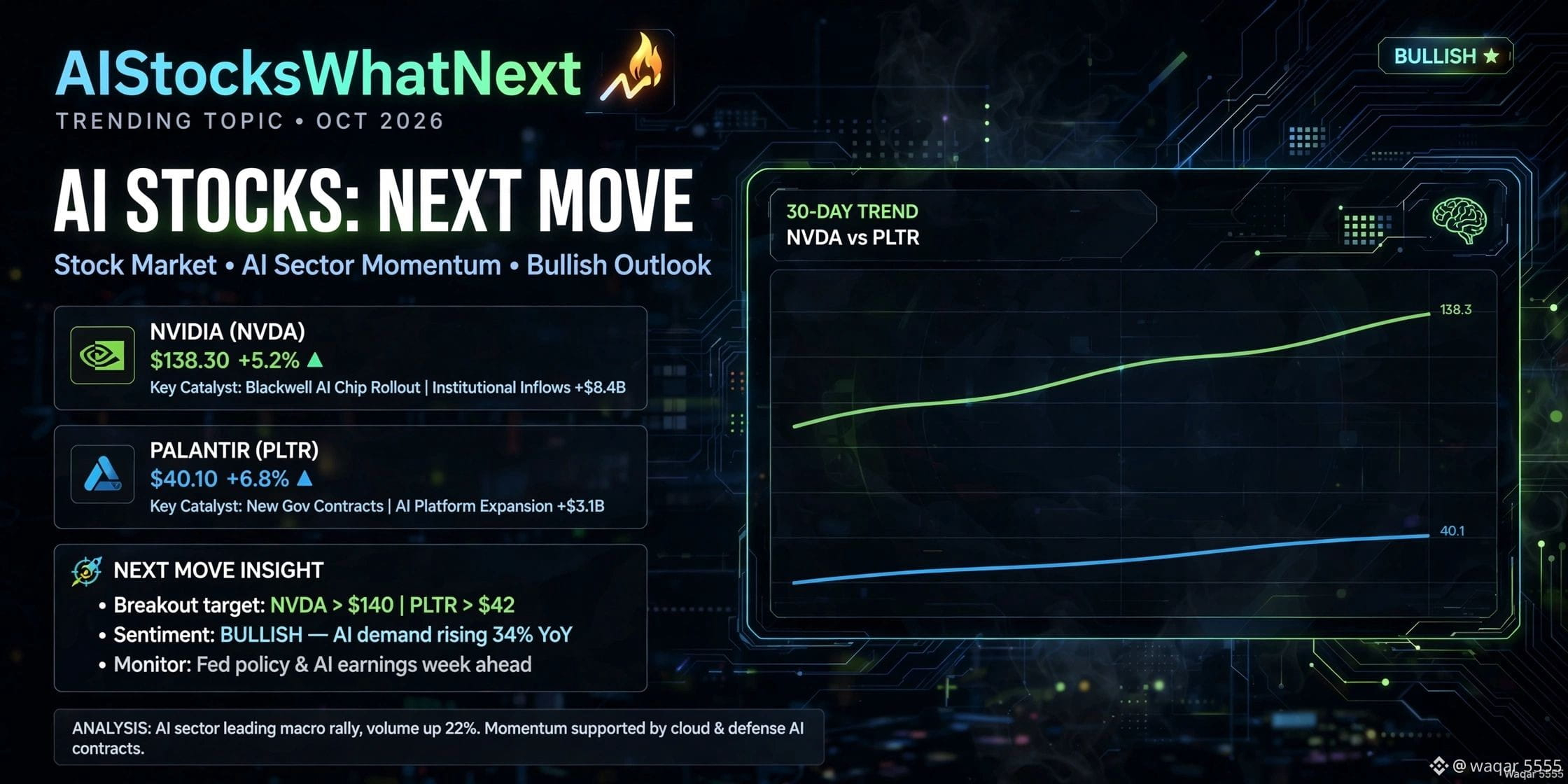
80

·
--
#AIStocksWhatNext
$NVDAB 🤖 AI Bubble or Next Supercycle? The Compute Spend & Policy Debate Explained
The AI narrative is reaching a fever pitch once again. As tech balance sheets expand and government policies shift, investors face a critical question: is this a sustained multi-year breakout or a short-term rally reaching saturation?
📈 1. Staggering Compute Spend: Is Demand Truly Taking Off?
Nvidia forecasts chip sales to double over the coming year, while tech giants continue reporting record revenue. However, the compute expenditure required to maintain this trajectory is equally massive—scaling from $150B to well over $240B.
The Bull Case: Fundamental demand remains unmatched. Frontier AI models require exponentially more compute power, energy, and hardware infrastructure with every iteration.
The Cautionary Case: Capital expenditure at this scale demands eventual monetization. If consumer and enterprise ROI cannot keep pace with server costs, margin compression becomes a genuine risk.
Is this a fundamental structural breakout for tech and crypto-AI stocks, or are we due for a short-term pullback before organic utility catches up?
🏛️ 2. The Great Divide: Industry Pause vs. State-Level Escalation
A distinct divide is emerging in the AI ecosystem:
The Cautionary View: Several industry pioneer leaders urge a controlled approach, highlighting safety risks, rapid job disruption, and energy grid limitations.
The Accelerationist View: Former President Donald Trump has proposed creating a federal “AI Force” initiative, projecting that AI could eventually contribute up to 25% of U.S. GDP.
When sovereign states step in to back AI as a strategic asset, federal funding, deregulation, and infrastructure support usually follow. Will government-backed tailwinds create a long-term economic win for AI stocks and decentralized compute tokens, or will sovereign over-investment lead to market distortions?
💬 What Is Your Portfolio Strategy?????
{spot}(NVDABUSDT)
#AIStocksWhatNext
$NVDAB 🤖 AI Bubble or Next Supercycle? The Compute Spend & Policy Debate Explained
The AI narrative is reaching a fever pitch once again. As tech balance sheets expand and government policies shift, investors face a critical question: is this a sustained multi-year breakout or a short-term rally reaching saturation?
📈 1. Staggering Compute Spend: Is Demand Truly Taking Off?
Nvidia forecasts chip sales to double over the coming year, while tech giants continue reporting record revenue. However, the compute expenditure required to maintain this trajectory is equally massive—scaling from $150B to well over $240B.
The Bull Case: Fundamental demand remains unmatched. Frontier AI models require exponentially more compute power, energy, and hardware infrastructure with every iteration.
The Cautionary Case: Capital expenditure at this scale demands eventual monetization. If consumer and enterprise ROI cannot keep pace with server costs, margin compression becomes a genuine risk.
Is this a fundamental structural breakout for tech and crypto-AI stocks, or are we due for a short-term pullback before organic utility catches up?
🏛️ 2. The Great Divide: Industry Pause vs. State-Level Escalation
A distinct divide is emerging in the AI ecosystem:
The Cautionary View: Several industry pioneer leaders urge a controlled approach, highlighting safety risks, rapid job disruption, and energy grid limitations.
The Accelerationist View: Former President Donald Trump has proposed creating a federal “AI Force” initiative, projecting that AI could eventually contribute up to 25% of U.S. GDP.
When sovereign states step in to back AI as a strategic asset, federal funding, deregulation, and infrastructure support usually follow. Will government-backed tailwinds create a long-term economic win for AI stocks and decentralized compute tokens, or will sovereign over-investment lead to market distortions?
💬 What Is Your Portfolio Strategy?????
$NVDAB 🤖 AI Bubble or Next Supercycle? The Compute Spend & Policy Debate Explained
The AI narrative is reaching a fever pitch once again. As tech balance sheets expand and government policies shift, investors face a critical question: is this a sustained multi-year breakout or a short-term rally reaching saturation?
📈 1. Staggering Compute Spend: Is Demand Truly Taking Off?
Nvidia forecasts chip sales to double over the coming year, while tech giants continue reporting record revenue. However, the compute expenditure required to maintain this trajectory is equally massive—scaling from $150B to well over $240B.
The Bull Case: Fundamental demand remains unmatched. Frontier AI models require exponentially more compute power, energy, and hardware infrastructure with every iteration.
The Cautionary Case: Capital expenditure at this scale demands eventual monetization. If consumer and enterprise ROI cannot keep pace with server costs, margin compression becomes a genuine risk.
Is this a fundamental structural breakout for tech and crypto-AI stocks, or are we due for a short-term pullback before organic utility catches up?
🏛️ 2. The Great Divide: Industry Pause vs. State-Level Escalation
A distinct divide is emerging in the AI ecosystem:
The Cautionary View: Several industry pioneer leaders urge a controlled approach, highlighting safety risks, rapid job disruption, and energy grid limitations.
The Accelerationist View: Former President Donald Trump has proposed creating a federal “AI Force” initiative, projecting that AI could eventually contribute up to 25% of U.S. GDP.
When sovereign states step in to back AI as a strategic asset, federal funding, deregulation, and infrastructure support usually follow. Will government-backed tailwinds create a long-term economic win for AI stocks and decentralized compute tokens, or will sovereign over-investment lead to market distortions?
💬 What Is Your Portfolio Strategy?????
65
Log in to explore more content
Join global crypto users on Binance Square
⚡️ Get latest and useful information about crypto.
💬 Trusted by the world’s largest crypto exchange.
👍 Discover real insights from verified creators.
Email / Phone number
Trending Topics
1
#SOLSpotETFWeeklyInflow$188M
4 views
11 Discussing
2
#StrategyStriveAdd2305BitcoinThisWeek
20,530 views
671 Discussing
3
#TrumpRejectsIranHormuzReopening
23,642 views
579 Discussing
4
#CircleTetherFreezeBitgetHackerWallet
42,140 views
674 Discussing
5
#SECSaysTokenBuybacksNotAutoSecurities
19,938 views
347 Discussing
6
#ChinaUSAgreeOn$30BTariffCut
894 views
25 Discussing
7
#CoinMarketCapCompletesCoinglassAcquisition
37,736 views
511 Discussing
8
#CircleMints500MUSDCOnSolana
209,427 views
3,069 Discussing
9
#PolymarketBankFailureBetsDrawFDICConcern
179,930 views
2,359 Discussing
10
#BlackRockBuildsTokenizedPortfoliosForOndo
168,599 views
1,701 Discussing