

#circletetherfreezebitgethackerwallet
circletetherfreezebitgethackerwallet
148,254 views
1,567 Discussing
Hot
Latest

·
--
Picture this: an exploiter drains millions from an exchange and attempts to wash the funds across DeFi protocols, only to find their wallets frozen mid-transit.
Most traders treat stablecoins as safe cash equivalents, forgetting that centralized asset issuers hold unilateral control over blacklist functions. When an exploit hits and emergency freezes ripple through liquidity pools, ordinary users frequently get caught in collateral freezes or sudden depeg panic.
The recent freeze of the Bitget hacker wallet by Circle and Tether demonstrates how swiftly centralized issuers can coordinate with law enforcement and exchanges. While this intervention protects stolen assets and prevents the attacker from dumping tokens into liquidity pools, it serves as a stark reminder of underlying counterparty risk.
On-chain transparency cuts both ways, and holding assets like $USDT means you are always operating within permissioned rails, regardless of overall market sentiment. Even as capital rotates across major networks like $NEAR, blacklisting capabilities remain the ultimate circuit breaker in centralized DeFi infrastructure.
How are you balancing asset safety and centralization risk in your portfolio management?
#CircleTetherFreezeBitgetHackerWallet #BitgetHackerMoves
Picture this: an exploiter drains millions from an exchange and attempts to wash the funds across DeFi protocols, only to find their wallets frozen mid-transit.
Most traders treat stablecoins as safe cash equivalents, forgetting that centralized asset issuers hold unilateral control over blacklist functions. When an exploit hits and emergency freezes ripple through liquidity pools, ordinary users frequently get caught in collateral freezes or sudden depeg panic.
The recent freeze of the Bitget hacker wallet by Circle and Tether demonstrates how swiftly centralized issuers can coordinate with law enforcement and exchanges. While this intervention protects stolen assets and prevents the attacker from dumping tokens into liquidity pools, it serves as a stark reminder of underlying counterparty risk.
On-chain transparency cuts both ways, and holding assets like $USDT means you are always operating within permissioned rails, regardless of overall market sentiment. Even as capital rotates across major networks like $NEAR , blacklisting capabilities remain the ultimate circuit breaker in centralized DeFi infrastructure.
How are you balancing asset safety and centralization risk in your portfolio management?
#CircleTetherFreezeBitgetHackerWallet #BitgetHackerMoves
Most traders treat stablecoins as safe cash equivalents, forgetting that centralized asset issuers hold unilateral control over blacklist functions. When an exploit hits and emergency freezes ripple through liquidity pools, ordinary users frequently get caught in collateral freezes or sudden depeg panic.
The recent freeze of the Bitget hacker wallet by Circle and Tether demonstrates how swiftly centralized issuers can coordinate with law enforcement and exchanges. While this intervention protects stolen assets and prevents the attacker from dumping tokens into liquidity pools, it serves as a stark reminder of underlying counterparty risk.
On-chain transparency cuts both ways, and holding assets like $USDT means you are always operating within permissioned rails, regardless of overall market sentiment. Even as capital rotates across major networks like $NEAR , blacklisting capabilities remain the ultimate circuit breaker in centralized DeFi infrastructure.
How are you balancing asset safety and centralization risk in your portfolio management?
#CircleTetherFreezeBitgetHackerWallet #BitgetHackerMoves
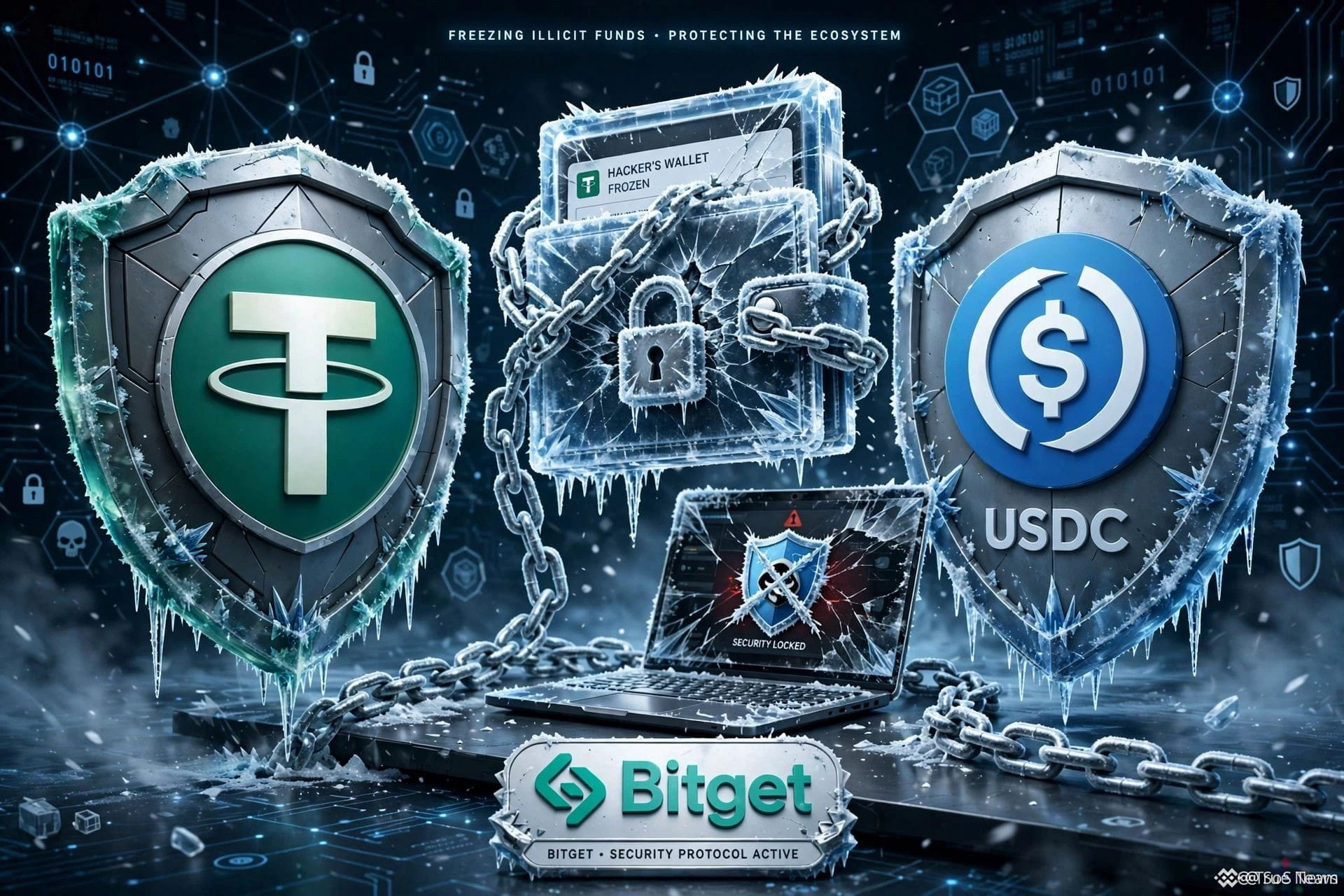
166

everyone thinks once a hacker drains a cex the coins are gone for good but actually this bitget situation is showing how fast the net is closing.
leaving size on an exchange while greed sits at 70 is how people keep getting wrecked. you dont even get a chance to hit withdraw when the drain happens overnight.
look at the bitget hacker moves as a live case study. they started shuffling funds and circle and tether froze the wallet almost immediately. any $USDT that touched those addresses is basically radioactive now.
ngl i keep seeing people still bridging and swapping without checking if theyre interacting with tainted liquidity. thats how you lose access to your own money ser. the freeze is a warning not a victory lap.
meanwhile the timeline is busy chasing $NEAR etf headlines and $POL rotations like none of this is happening. the risk is not the hack itself anymore. its complacency.
anyone else watching these wallets or are we just gonna pretend cexs are still the easy button?
#BitgetHackerMoves #CircleTetherFreezeBitgetHackerWallet #BitwiseFilesFinalNEARSpotETFProspectus
everyone thinks once a hacker drains a cex the coins are gone for good but actually this bitget situation is showing how fast the net is closing.
leaving size on an exchange while greed sits at 70 is how people keep getting wrecked. you dont even get a chance to hit withdraw when the drain happens overnight.
look at the bitget hacker moves as a live case study. they started shuffling funds and circle and tether froze the wallet almost immediately. any $USDT that touched those addresses is basically radioactive now.
ngl i keep seeing people still bridging and swapping without checking if theyre interacting with tainted liquidity. thats how you lose access to your own money ser. the freeze is a warning not a victory lap.
meanwhile the timeline is busy chasing $NEAR etf headlines and $POL rotations like none of this is happening. the risk is not the hack itself anymore. its complacency.
anyone else watching these wallets or are we just gonna pretend cexs are still the easy button?
#BitgetHackerMoves #CircleTetherFreezeBitgetHackerWallet #BitwiseFilesFinalNEARSpotETFProspectus
leaving size on an exchange while greed sits at 70 is how people keep getting wrecked. you dont even get a chance to hit withdraw when the drain happens overnight.
look at the bitget hacker moves as a live case study. they started shuffling funds and circle and tether froze the wallet almost immediately. any $USDT that touched those addresses is basically radioactive now.
ngl i keep seeing people still bridging and swapping without checking if theyre interacting with tainted liquidity. thats how you lose access to your own money ser. the freeze is a warning not a victory lap.
meanwhile the timeline is busy chasing $NEAR etf headlines and $POL rotations like none of this is happening. the risk is not the hack itself anymore. its complacency.
anyone else watching these wallets or are we just gonna pretend cexs are still the easy button?
#BitgetHackerMoves #CircleTetherFreezeBitgetHackerWallet #BitwiseFilesFinalNEARSpotETFProspectus
144


BITGET HACK · WHAT COULD BE FROZEN
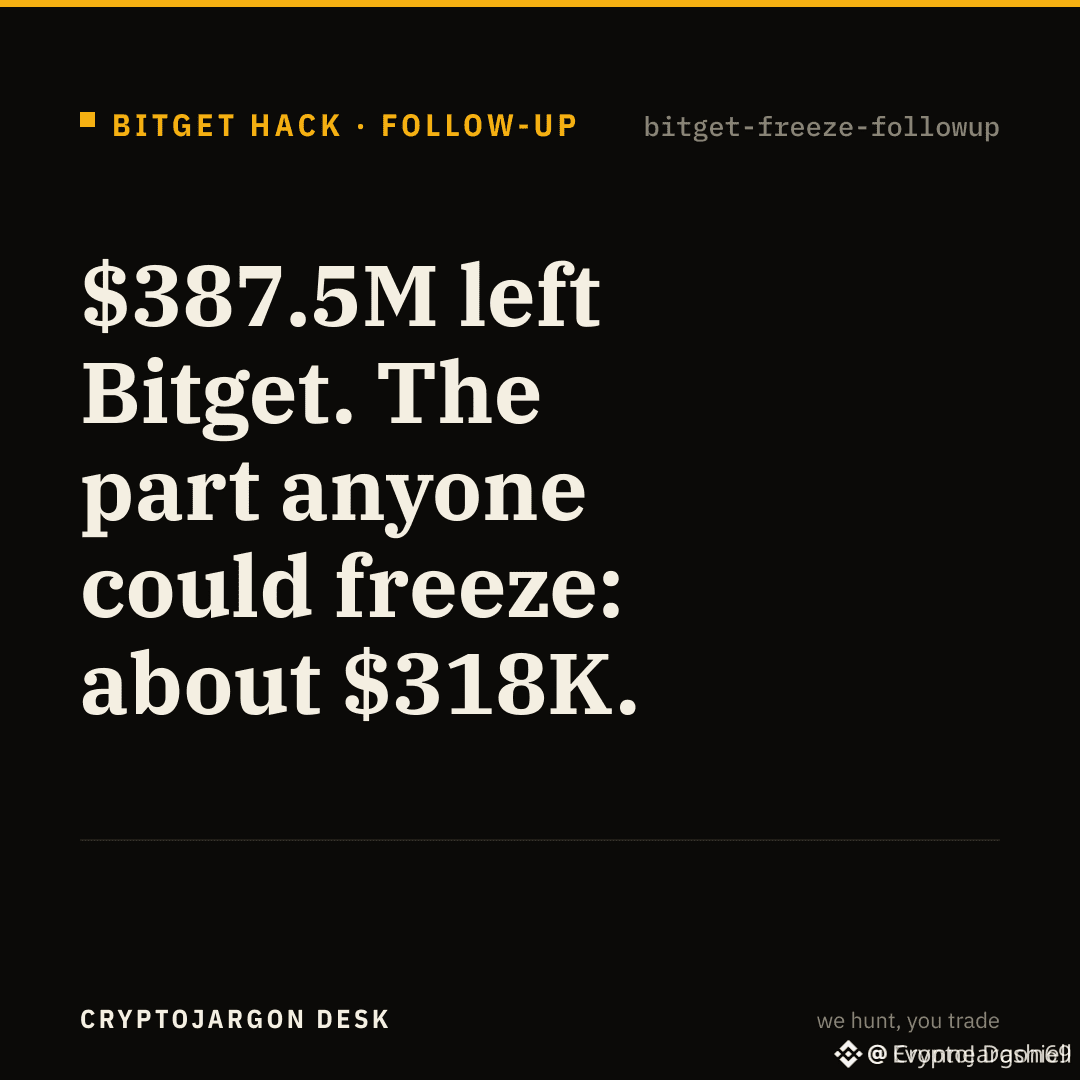
$387.5M left Bitget's hot wallets on 24 Sep. The part anyone could freeze: about $318K.
Circle and Tether blacklisted one exploiter wallet holding 218K USDT and 100K USDC. That is roughly 0.08% of the haul.
The rest sits where no issuer reaches: 63,000+ $ETH across other exploiter addresses, and 103M $XRP, of which 54M (about $83M) has already moved to fresh wallets. Native coins cannot be frozen at the protocol level. The one choke point left is an exchange deposit.
Bitget says cold wallets were untouched and its $464M protection fund covers the loss.
A freeze button on stablecoins: safety net, or a flaw in the model?
#CircleTetherFreezeBitgetHackerWallet #BitgetHackerMoves$83MStolenXRP $ETH $XRP
BITGET HACK · WHAT COULD BE FROZEN
$387.5M left Bitget's hot wallets on 24 Sep. The part anyone could freeze: about $318K.
Circle and Tether blacklisted one exploiter wallet holding 218K USDT and 100K USDC. That is roughly 0.08% of the haul.
The rest sits where no issuer reaches: 63,000+ $ETH across other exploiter addresses, and 103M $XRP , of which 54M (about $83M) has already moved to fresh wallets. Native coins cannot be frozen at the protocol level. The one choke point left is an exchange deposit.
Bitget says cold wallets were untouched and its $464M protection fund covers the loss.
A freeze button on stablecoins: safety net, or a flaw in the model?
#CircleTetherFreezeBitgetHackerWallet #BitgetHackerMoves$83MStolenXRP $ETH $XRP
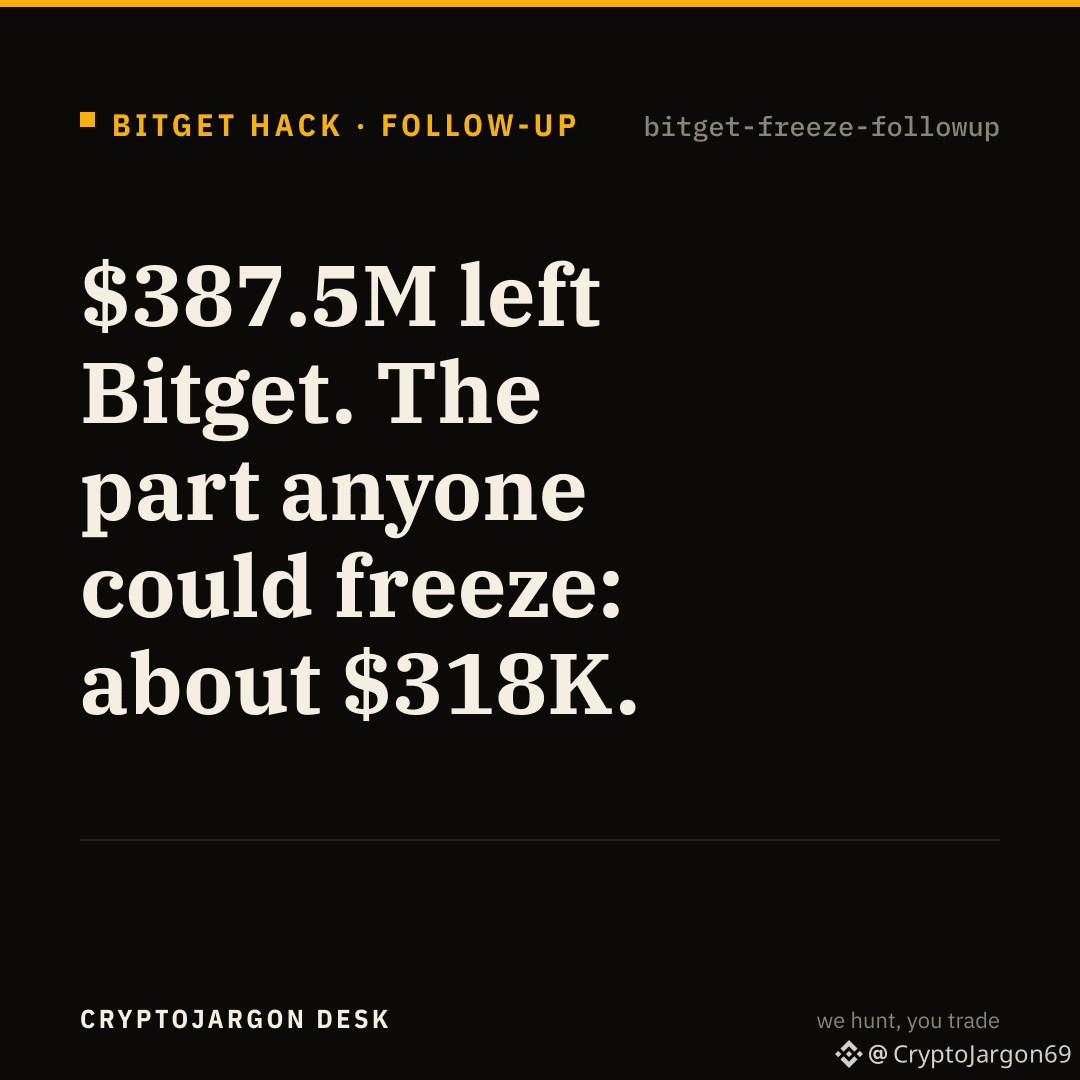
$387.5M left Bitget's hot wallets on 24 Sep. The part anyone could freeze: about $318K.
Circle and Tether blacklisted one exploiter wallet holding 218K USDT and 100K USDC. That is roughly 0.08% of the haul.
The rest sits where no issuer reaches: 63,000+ $ETH across other exploiter addresses, and 103M $XRP , of which 54M (about $83M) has already moved to fresh wallets. Native coins cannot be frozen at the protocol level. The one choke point left is an exchange deposit.
Bitget says cold wallets were untouched and its $464M protection fund covers the loss.
A freeze button on stablecoins: safety net, or a flaw in the model?
#CircleTetherFreezeBitgetHackerWallet #BitgetHackerMoves$83MStolenXRP $ETH $XRP
1
194

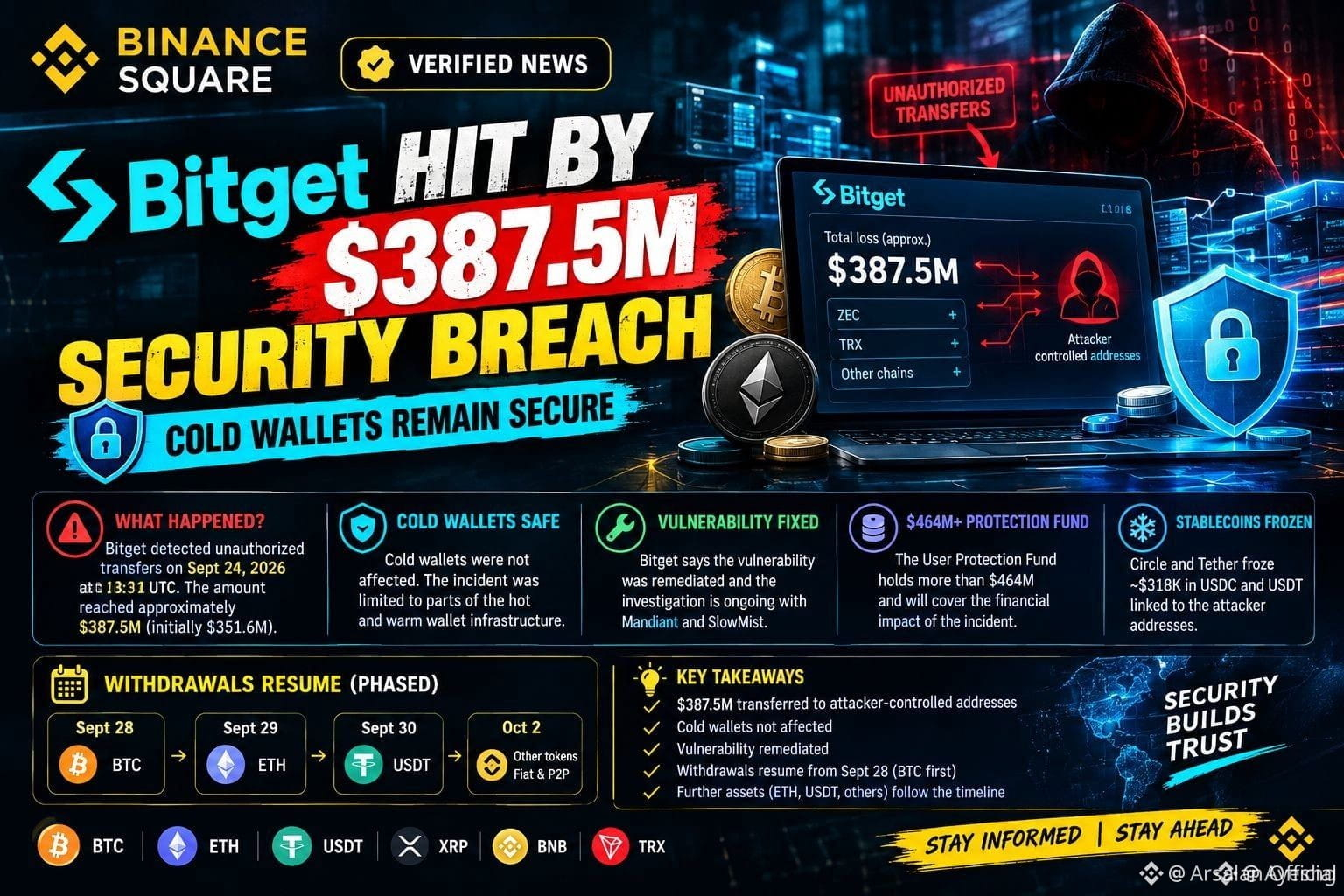
#CircleTetherFreezeBitgetHackerWallet Circle and Tether blacklisted a wallet linked to the Bitget exploit, freezing roughly $318,000 in USDC and USDT. The action came after the Bitget breach in which approximately $351.6 million in assets were affected.
However, most of the stolen funds remained outside the reach of stablecoin issuers, with more than 63,000 ETH reportedly still held across exploiter-linked wallets.
#Circle #Tether #USDC #USDT $USDC
{spot}(USDCUSDT)
$USDT $ETH
{spot}(ETHUSDT)
#CircleTetherFreezeBitgetHackerWallet Circle and Tether blacklisted a wallet linked to the Bitget exploit, freezing roughly $318,000 in USDC and USDT. The action came after the Bitget breach in which approximately $351.6 million in assets were affected.
However, most of the stolen funds remained outside the reach of stablecoin issuers, with more than 63,000 ETH reportedly still held across exploiter-linked wallets.
#Circle #Tether #USDC #USDT $USDC
$USDT $ETH
However, most of the stolen funds remained outside the reach of stablecoin issuers, with more than 63,000 ETH reportedly still held across exploiter-linked wallets.
#Circle #Tether #USDC #USDT $USDC
$USDT $ETH
1
47

·
--
Circle has frozen a Tether wallet linked to a Bitget hacker, marking a significant move in the ongoing battle against illicit activities in the crypto space. This action highlights the increasing collaboration between major players to enhance security and compliance. The market is watching closely to see how this impacts trust and regulatory scrutiny on stablecoins and exchanges. Such proactive measures, while potentially disruptive in the short term, are crucial for the long-term health and adoption of digital assets. The incident underscores the importance of robust security protocols for all participants in the ecosystem.
Disclaimer: This content is for informational purposes only and does not constitute investment advice.
#CircleTetherFreezeBitgetHackerWallet
Circle has frozen a Tether wallet linked to a Bitget hacker, marking a significant move in the ongoing battle against illicit activities in the crypto space. This action highlights the increasing collaboration between major players to enhance security and compliance. The market is watching closely to see how this impacts trust and regulatory scrutiny on stablecoins and exchanges. Such proactive measures, while potentially disruptive in the short term, are crucial for the long-term health and adoption of digital assets. The incident underscores the importance of robust security protocols for all participants in the ecosystem.
Disclaimer: This content is for informational purposes only and does not constitute investment advice.
#CircleTetherFreezeBitgetHackerWallet
Disclaimer: This content is for informational purposes only and does not constitute investment advice.
#CircleTetherFreezeBitgetHackerWallet
82

·
--
Bullish
#CircleTetherFreezeBitgetHackerWallet Circle and Tether froze about $318,000 in USDC and USDT linked to the Bitget hack. They were able to blacklist those stablecoins because the tokens have issuer-level freeze controls. �$NVDAB
#CircleTetherFreezeBitgetHackerWallet Circle and Tether froze about $318,000 in USDC and USDT linked to the Bitget hack. They were able to blacklist those stablecoins because the tokens have issuer-level freeze controls. �$NVDAB

1
20

Article
#circletetherfreezeBitgethackerwallet#CircleTetherFreezeBitgetHackerWallet
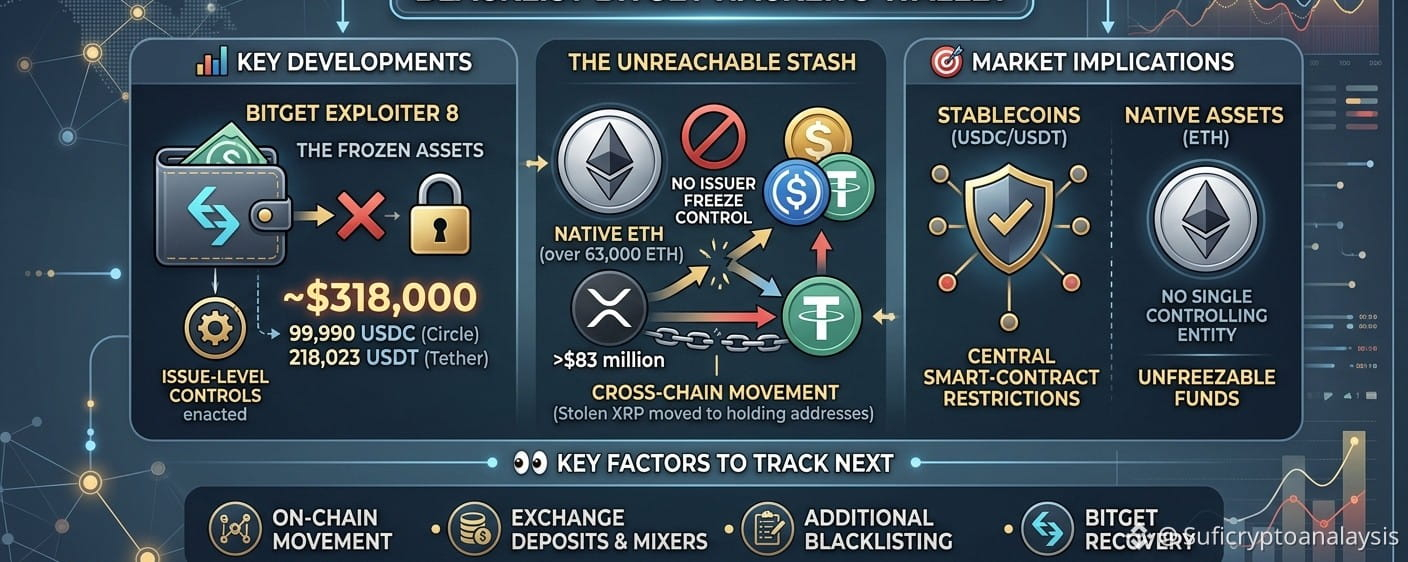
🌐 Asset Freeze: Circle & Tether Blacklist Bitget Hacker’s WalletIn a swift security response, major stablecoin issuers Circle and Tether have blacklisted a digital wallet directly tied to the recent security breach Bitget exchange. Together, the companies have successfully frozen roughly$318,000 worth of liquidity, showcasing the powerful clawback capabilities built into modern stablecoins.📊 Key DevelopmentsThe Frozen Assets: The blacklisted address (labeled "Bitget Exploiter 8" on Etherscan) contained 99,990 USDC and 218,023 USDT.Stablecoin Controls:Both Circle and Tether enacted their issuer-level controls to lock down these specific tokens, rendering them completely unmovable.The Unreachable Stash:Despite the freeze, the attacker still holds massive reserves beyond control, including over 63,000 native Ethereum (ETH).Cross-Chain Movement: Reports indicate the exploiter has also initiated massive movements of stolen XRP, shifting roughly $83 million across various holding addresses.🎯 Market ImplicationsThis incident highlights a fundamental structural difference in decentralized finance: stablecoins (USDC/USDT) possess central smart-contract restrictions allowing issuers to block wallets, whereas native assets like ETH do not have a single entity with the power to freeze funds. While the frozen amount is a small fraction of the total stolen bounty, it limits the attacker’s immediate off-ramp capabilities and underscores why hackers rapidly swap stablecoins into native assets or privacy coins.👀 Key Factors to Track NextOngoing on-chain movement of the stolen ETH and remaining XRP holdings.Potential hacker attempts to deposit funds into centralized exchanges using mixers.Additional blacklisting requests by law enforcement or cybersecurity firms.Official recovery timelines and system upgradeupdatesfromtheBitgetteam.How do you view this balance between centralization and decentralization? Is the ability to freeze assets a necessary security net, or does it go against the true ethos of crypto?
$SUPER $GRAM $PYTH
{spot}(PYTHUSDT)
{spot}(GRAMUSDT)
{spot}(SUPERUSDT)
#circletetherfreezeBitgethackerwallet
#CircleTetherFreezeBitgetHackerWallet
🌐 Asset Freeze: Circle & Tether Blacklist Bitget Hacker’s WalletIn a swift security response, major stablecoin issuers Circle and Tether have blacklisted a digital wallet directly tied to the recent security breach Bitget exchange. Together, the companies have successfully frozen roughly$318,000 worth of liquidity, showcasing the powerful clawback capabilities built into modern stablecoins.📊 Key DevelopmentsThe Frozen Assets: The blacklisted address (labeled "Bitget Exploiter 8" on Etherscan) contained 99,990 USDC and 218,023 USDT.Stablecoin Controls:Both Circle and Tether enacted their issuer-level controls to lock down these specific tokens, rendering them completely unmovable.The Unreachable Stash:Despite the freeze, the attacker still holds massive reserves beyond control, including over 63,000 native Ethereum (ETH).Cross-Chain Movement: Reports indicate the exploiter has also initiated massive movements of stolen XRP, shifting roughly $83 million across various holding addresses.🎯 Market ImplicationsThis incident highlights a fundamental structural difference in decentralized finance: stablecoins (USDC/USDT) possess central smart-contract restrictions allowing issuers to block wallets, whereas native assets like ETH do not have a single entity with the power to freeze funds. While the frozen amount is a small fraction of the total stolen bounty, it limits the attacker’s immediate off-ramp capabilities and underscores why hackers rapidly swap stablecoins into native assets or privacy coins.👀 Key Factors to Track NextOngoing on-chain movement of the stolen ETH and remaining XRP holdings.Potential hacker attempts to deposit funds into centralized exchanges using mixers.Additional blacklisting requests by law enforcement or cybersecurity firms.Official recovery timelines and system upgradeupdatesfromtheBitgetteam.How do you view this balance between centralization and decentralization? Is the ability to freeze assets a necessary security net, or does it go against the true ethos of crypto?
$SUPER $GRAM $PYTH
🌐 Asset Freeze: Circle & Tether Blacklist Bitget Hacker’s WalletIn a swift security response, major stablecoin issuers Circle and Tether have blacklisted a digital wallet directly tied to the recent security breach Bitget exchange. Together, the companies have successfully frozen roughly$318,000 worth of liquidity, showcasing the powerful clawback capabilities built into modern stablecoins.📊 Key DevelopmentsThe Frozen Assets: The blacklisted address (labeled "Bitget Exploiter 8" on Etherscan) contained 99,990 USDC and 218,023 USDT.Stablecoin Controls:Both Circle and Tether enacted their issuer-level controls to lock down these specific tokens, rendering them completely unmovable.The Unreachable Stash:Despite the freeze, the attacker still holds massive reserves beyond control, including over 63,000 native Ethereum (ETH).Cross-Chain Movement: Reports indicate the exploiter has also initiated massive movements of stolen XRP, shifting roughly $83 million across various holding addresses.🎯 Market ImplicationsThis incident highlights a fundamental structural difference in decentralized finance: stablecoins (USDC/USDT) possess central smart-contract restrictions allowing issuers to block wallets, whereas native assets like ETH do not have a single entity with the power to freeze funds. While the frozen amount is a small fraction of the total stolen bounty, it limits the attacker’s immediate off-ramp capabilities and underscores why hackers rapidly swap stablecoins into native assets or privacy coins.👀 Key Factors to Track NextOngoing on-chain movement of the stolen ETH and remaining XRP holdings.Potential hacker attempts to deposit funds into centralized exchanges using mixers.Additional blacklisting requests by law enforcement or cybersecurity firms.Official recovery timelines and system upgradeupdatesfromtheBitgetteam.How do you view this balance between centralization and decentralization? Is the ability to freeze assets a necessary security net, or does it go against the true ethos of crypto?
$SUPER $GRAM $PYTH
15


Article
Circle & Tether Freeze Wallet Linked to Bitget ExploitThe recent Bitget security incident has sparked another major discussion about crypto security and stablecoin control.
Circle and Tether reportedly blacklisted a wallet connected to the exploit, freezing approximately $318,000 worth of USDC and USDT.
However, this represents only a small portion of the affected assets. A significant amount was reportedly converted into ETH, which cannot be directly frozen by USDC or USDT issuers.
This creates an interesting contrast.
Stablecoins: issuers can intervene and freeze specific tokens.
Native crypto assets: assets such as ETH operate without a centralized issuer capable of freezing the coins themselves.
The incident therefore raises a broader question for the crypto industry:
Does the ability to freeze stolen stablecoins provide an important security layer, or does it introduce a trade-off with the permissionless nature of cryptocurrency?
The investigation and movement of the affected funds remain an evolving story.
What is your view?
$USDC $USDT
#CircleTetherFreezeBitgetHackerWallet #Bitget
Circle & Tether Freeze Wallet Linked to Bitget Exploit
The recent Bitget security incident has sparked another major discussion about crypto security and stablecoin control.
Circle and Tether reportedly blacklisted a wallet connected to the exploit, freezing approximately $318,000 worth of USDC and USDT.
However, this represents only a small portion of the affected assets. A significant amount was reportedly converted into ETH, which cannot be directly frozen by USDC or USDT issuers.
This creates an interesting contrast.
Stablecoins: issuers can intervene and freeze specific tokens.
Native crypto assets: assets such as ETH operate without a centralized issuer capable of freezing the coins themselves.
The incident therefore raises a broader question for the crypto industry:
Does the ability to freeze stolen stablecoins provide an important security layer, or does it introduce a trade-off with the permissionless nature of cryptocurrency?
The investigation and movement of the affected funds remain an evolving story.
What is your view?
$USDC $USDT
#CircleTetherFreezeBitgetHackerWallet #Bitget
Circle and Tether reportedly blacklisted a wallet connected to the exploit, freezing approximately $318,000 worth of USDC and USDT.
However, this represents only a small portion of the affected assets. A significant amount was reportedly converted into ETH, which cannot be directly frozen by USDC or USDT issuers.
This creates an interesting contrast.
Stablecoins: issuers can intervene and freeze specific tokens.
Native crypto assets: assets such as ETH operate without a centralized issuer capable of freezing the coins themselves.
The incident therefore raises a broader question for the crypto industry:
Does the ability to freeze stolen stablecoins provide an important security layer, or does it introduce a trade-off with the permissionless nature of cryptocurrency?
The investigation and movement of the affected funds remain an evolving story.
What is your view?
$USDC $USDT
#CircleTetherFreezeBitgetHackerWallet #Bitget
1
68
🚨 Circle & Tether Freeze Bitget-Linked Wallet
Circle and Tether have blacklisted a wallet linked to the recent Bitget exploit, freezing roughly $318,000 in USDC and USDT.
But here’s the interesting part: the majority of the stolen assets were reportedly moved into ETH, which cannot simply be frozen by a stablecoin issuer.
This incident highlights an important crypto-security question:
🔐 How should the industry balance asset recovery, security, and decentralization?
What do you think?
$USDC
{spot}(USDCUSDT)
$USDT
#CircleTetherFreezeBitgetHackerWallet #BinanceSquareTalks
🚨 Circle & Tether Freeze Bitget-Linked Wallet
Circle and Tether have blacklisted a wallet linked to the recent Bitget exploit, freezing roughly $318,000 in USDC and USDT.
But here’s the interesting part: the majority of the stolen assets were reportedly moved into ETH, which cannot simply be frozen by a stablecoin issuer.
This incident highlights an important crypto-security question:
🔐 How should the industry balance asset recovery, security, and decentralization?
What do you think?
$USDC
$USDT
#CircleTetherFreezeBitgetHackerWallet #BinanceSquareTalks
Circle and Tether have blacklisted a wallet linked to the recent Bitget exploit, freezing roughly $318,000 in USDC and USDT.
But here’s the interesting part: the majority of the stolen assets were reportedly moved into ETH, which cannot simply be frozen by a stablecoin issuer.
This incident highlights an important crypto-security question:
🔐 How should the industry balance asset recovery, security, and decentralization?
What do you think?
$USDC
$USDT
#CircleTetherFreezeBitgetHackerWallet #BinanceSquareTalks

94
*Bitget Hack Update — $XRP
{spot}(XRPUSDT)
#StrategyStriveAdd2305BitcoinThisWeek #DogecoinETFsPostBiggestWeekSinceLaunch #CircleTetherFreezeBitgetHackerWallet #SECSaysTokenBuybacksNotAutoSecurities The attacker has moved ∼$83M worth of stolen $XRP from 3 holding wallets.
Around 103M $XRpwas stolen in total — now ∼$75M still sits in wallets that _cannot be frozen_ under XRP Ledger rules. XRP is the native asset, so Ripple has no freeze button for it.
What _can_ be done:
- Exchanges can blacklist accounts that RECEIVE the stolen funds
- But they can't block the attacker's own wallets
For comparison: Circle and Tether already froze ∼$320K in related USDC/USDT — those tokens have blacklist controls.
Bitget says its protection fund will fully cover the $387.5M loss, customer balances are safe, and withdrawals will resume gradually Sept. 28 - Oct. 2.
Now the real question is: how much of this $XRP can be tracked / frozen when it hits CEXs? The on-chain chase is on. 7fa8
*Bitget Hack Update — $XRP
#StrategyStriveAdd2305BitcoinThisWeek #DogecoinETFsPostBiggestWeekSinceLaunch #CircleTetherFreezeBitgetHackerWallet #SECSaysTokenBuybacksNotAutoSecurities The attacker has moved ∼$83M worth of stolen $XRP from 3 holding wallets.
Around 103M $XRpwas stolen in total — now ∼$75M still sits in wallets that _cannot be frozen_ under XRP Ledger rules. XRP is the native asset, so Ripple has no freeze button for it.
What _can_ be done:
- Exchanges can blacklist accounts that RECEIVE the stolen funds
- But they can't block the attacker's own wallets
For comparison: Circle and Tether already froze ∼$320K in related USDC/USDT — those tokens have blacklist controls.
Bitget says its protection fund will fully cover the $387.5M loss, customer balances are safe, and withdrawals will resume gradually Sept. 28 - Oct. 2.
Now the real question is: how much of this $XRP can be tracked / frozen when it hits CEXs? The on-chain chase is on. 7fa8
#StrategyStriveAdd2305BitcoinThisWeek #DogecoinETFsPostBiggestWeekSinceLaunch #CircleTetherFreezeBitgetHackerWallet #SECSaysTokenBuybacksNotAutoSecurities The attacker has moved ∼$83M worth of stolen $XRP from 3 holding wallets.
Around 103M $XRpwas stolen in total — now ∼$75M still sits in wallets that _cannot be frozen_ under XRP Ledger rules. XRP is the native asset, so Ripple has no freeze button for it.
What _can_ be done:
- Exchanges can blacklist accounts that RECEIVE the stolen funds
- But they can't block the attacker's own wallets
For comparison: Circle and Tether already froze ∼$320K in related USDC/USDT — those tokens have blacklist controls.
Bitget says its protection fund will fully cover the $387.5M loss, customer balances are safe, and withdrawals will resume gradually Sept. 28 - Oct. 2.
Now the real question is: how much of this $XRP can be tracked / frozen when it hits CEXs? The on-chain chase is on. 7fa8
116

Bitget Security Incident Triggers Exchange Audit Focus
Exchange security became a major focus following a reported exploit on Bitget estimated between $351.6M and $387.5M. Bitget clarified that backend infrastructure was compromised while cold wallets and user funds remained safe, backed by their $464M protection fund. Tether and Circle quickly froze hacker-controlled funds, keeping market panic localized.
#StrategyStriveAdd2305BitcoinThisWeek #CircleTetherFreezeBitgetHackerWallet #SECSaysTokenBuybacksNotAutoSecurities
{spot}(BTCUSDT)
{spot}(ETHUSDT)
{spot}(BNBUSDT)
Bitget Security Incident Triggers Exchange Audit Focus
Exchange security became a major focus following a reported exploit on Bitget estimated between $351.6M and $387.5M. Bitget clarified that backend infrastructure was compromised while cold wallets and user funds remained safe, backed by their $464M protection fund. Tether and Circle quickly froze hacker-controlled funds, keeping market panic localized.
#StrategyStriveAdd2305BitcoinThisWeek #CircleTetherFreezeBitgetHackerWallet #SECSaysTokenBuybacksNotAutoSecurities
Exchange security became a major focus following a reported exploit on Bitget estimated between $351.6M and $387.5M. Bitget clarified that backend infrastructure was compromised while cold wallets and user funds remained safe, backed by their $464M protection fund. Tether and Circle quickly froze hacker-controlled funds, keeping market panic localized.
#StrategyStriveAdd2305BitcoinThisWeek #CircleTetherFreezeBitgetHackerWallet #SECSaysTokenBuybacksNotAutoSecurities
1
37

·
--
Bullish
#circletetherfreezebitgethackerwallet
🚨 CIRCLE & TETHER FREEZE STABLECOINS LINKED TO BITGET HACK
Circle and Tether have blacklisted a wallet linked to the recent Bitget security breach, freezing roughly $318,000 worth of USDC and USDT.
But the majority of the stolen assets remain outside the reach of stablecoin issuers.
📌 KEY DEVELOPMENTS
• Circle blacklisted a wallet identified as “Bitget Exploiter 8” on Etherscan.
• The wallet held approximately 99,990 USDC and 218,023 USDT.
• Tether subsequently blacklisted the same address.
• The frozen stablecoins are worth roughly $318,000.
• Other exploiter-linked wallets reportedly still hold more than 63,000 ETH.
• Stablecoin issuers can freeze their own tokens, but they cannot freeze native ETH held by an attacker.
⚠️ THE BIGGER STORY
The incident highlights an important difference between stablecoins and native crypto assets.
USDC and USDT include issuer-level controls that allow Circle and Tether to blacklist specific addresses.
ETH does not have an issuer with the same type of control.
Meanwhile, the Bitget attacker has also moved a significant amount of stolen XRP. CoinDesk reported that roughly $83 million in XRP had been moved from three original holding wallets, with about $75 million remaining across the original accounts at the time of its report.
🔎 WHAT TO WATCH
• Further movement of the stolen ETH and XRP
• Deposits into centralized exchanges
• Additional wallet blacklists
• Bitget's recovery and withdrawal updates
• On-chain tracking of the remaining assets
This is not just another exchange hack story. It shows how the ability to freeze assets can differ dramatically depending on the underlying blockchain and token design.
$SUPER $GRAM $PYTH
{future}(PYTHUSDT)
{future}(GRAMUSDT)
{future}(SUPERUSDT)
#circletetherfreezebitgethackerwallet
🚨 CIRCLE & TETHER FREEZE STABLECOINS LINKED TO BITGET HACK
Circle and Tether have blacklisted a wallet linked to the recent Bitget security breach, freezing roughly $318,000 worth of USDC and USDT.
But the majority of the stolen assets remain outside the reach of stablecoin issuers.
📌 KEY DEVELOPMENTS
• Circle blacklisted a wallet identified as “Bitget Exploiter 8” on Etherscan.
• The wallet held approximately 99,990 USDC and 218,023 USDT.
• Tether subsequently blacklisted the same address.
• The frozen stablecoins are worth roughly $318,000.
• Other exploiter-linked wallets reportedly still hold more than 63,000 ETH.
• Stablecoin issuers can freeze their own tokens, but they cannot freeze native ETH held by an attacker.
⚠️ THE BIGGER STORY
The incident highlights an important difference between stablecoins and native crypto assets.
USDC and USDT include issuer-level controls that allow Circle and Tether to blacklist specific addresses.
ETH does not have an issuer with the same type of control.
Meanwhile, the Bitget attacker has also moved a significant amount of stolen XRP. CoinDesk reported that roughly $83 million in XRP had been moved from three original holding wallets, with about $75 million remaining across the original accounts at the time of its report.
🔎 WHAT TO WATCH
• Further movement of the stolen ETH and XRP
• Deposits into centralized exchanges
• Additional wallet blacklists
• Bitget's recovery and withdrawal updates
• On-chain tracking of the remaining assets
This is not just another exchange hack story. It shows how the ability to freeze assets can differ dramatically depending on the underlying blockchain and token design.
$SUPER $GRAM $PYTH
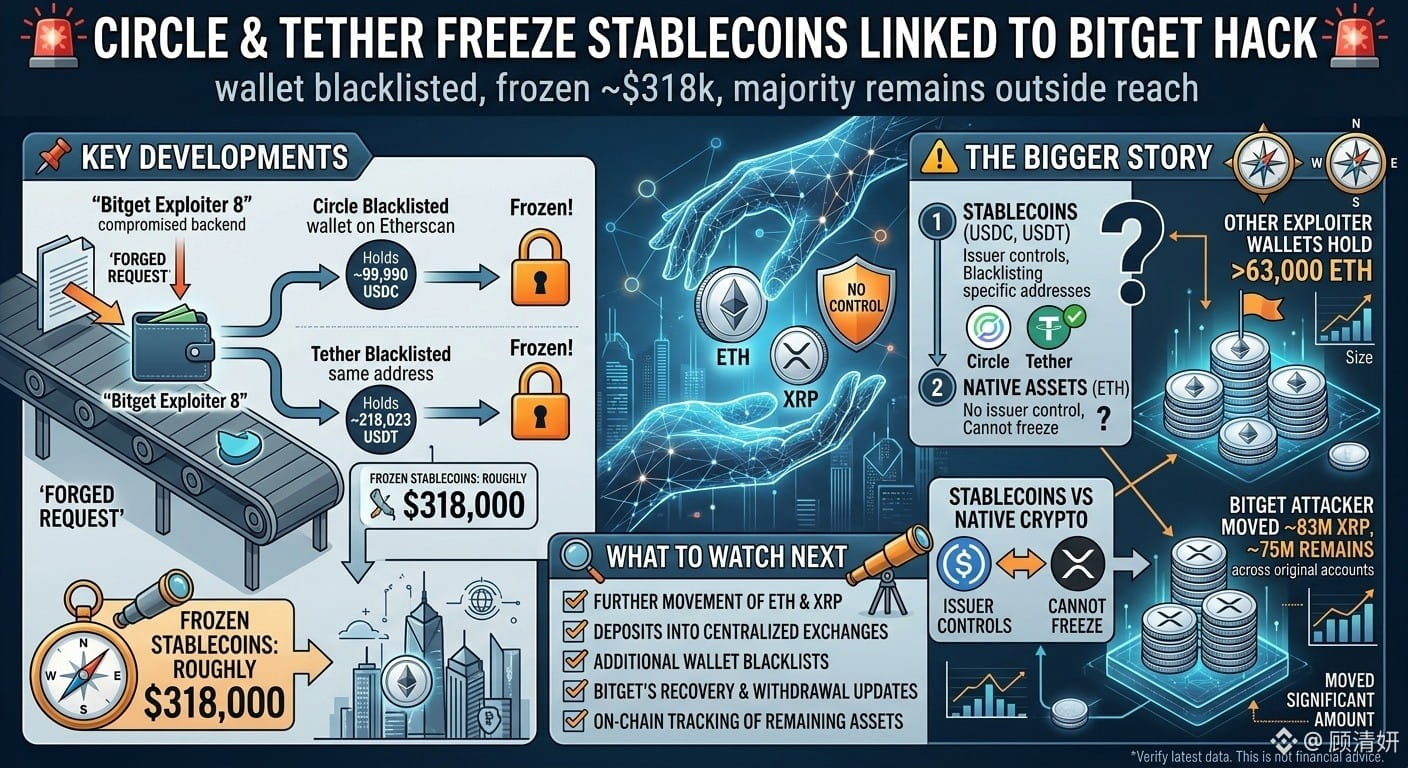
🚨 CIRCLE & TETHER FREEZE STABLECOINS LINKED TO BITGET HACK
Circle and Tether have blacklisted a wallet linked to the recent Bitget security breach, freezing roughly $318,000 worth of USDC and USDT.
But the majority of the stolen assets remain outside the reach of stablecoin issuers.
📌 KEY DEVELOPMENTS
• Circle blacklisted a wallet identified as “Bitget Exploiter 8” on Etherscan.
• The wallet held approximately 99,990 USDC and 218,023 USDT.
• Tether subsequently blacklisted the same address.
• The frozen stablecoins are worth roughly $318,000.
• Other exploiter-linked wallets reportedly still hold more than 63,000 ETH.
• Stablecoin issuers can freeze their own tokens, but they cannot freeze native ETH held by an attacker.
⚠️ THE BIGGER STORY
The incident highlights an important difference between stablecoins and native crypto assets.
USDC and USDT include issuer-level controls that allow Circle and Tether to blacklist specific addresses.
ETH does not have an issuer with the same type of control.
Meanwhile, the Bitget attacker has also moved a significant amount of stolen XRP. CoinDesk reported that roughly $83 million in XRP had been moved from three original holding wallets, with about $75 million remaining across the original accounts at the time of its report.
🔎 WHAT TO WATCH
• Further movement of the stolen ETH and XRP
• Deposits into centralized exchanges
• Additional wallet blacklists
• Bitget's recovery and withdrawal updates
• On-chain tracking of the remaining assets
This is not just another exchange hack story. It shows how the ability to freeze assets can differ dramatically depending on the underlying blockchain and token design.
$SUPER $GRAM $PYTH
206 Atlas:
Freezing $318k is negligible against $83M in XRP and 63k ETH. The real risk is OTC desks absorbing the illiquid assets before they hit exchanges.
5
13
14.1k

·
--
Article
📽️🍿 And the Media Circus 🎪 around the Bitget hack continues !What happened & timeline of events
🦹The Hacker has entered Bitget exchange draining it for $385M 💰 in various crypto currencies.
⏳The first "suspicious" transfer was noticed 3 HOURS BEFORE Bitget actualy reacted
They have been alerted more times during this 3 hours ,one time by Bubblemaps who saw huge amounts being drained to a new wallet and split into more places right after - which is well known tackics hackers use.
🤯 There was NO 🙂↔️ private keys exploit, the whole heist happened because Bitget's system itself ALLOWED it to happened.
👉 3hours later.... They finally reacted and stoped the withdrawals.
🔶Big exchanges reacted to the news and offered help, among them was our very own @CZ showing it's full support and offering help to Bitget in this troubled times . Other exchanges offered help also, showing sympathy and crypto communities standing together in the face of unfortunate events 🌪️
💱 Tether and Circle have jumped in to help, promising they I'll freeze the hackers known address stablecoins . Now this guest as noble as it looks opened a whole avalanche of questions
👉 It Tether and Circle can Freeze someone's address, what's stoping them from freezing our assets if some bank or organisation SKS them ? The very nature of crypto is being put under a big question ❓ Decentralisation or Not quite ?
This spiced up even more when Bitget's CEO Gracy Chan reached out to Thor Chain - the chain that stands by decentralisation stronger than many others Also, one of the most attacked and blamed for "not helping " in many cases like this one Thor Chain makes their point - we are truly decentralised, we can't just pause all withdrawals for all users cause it's convenient Also have you asked Bitcoin, Etherium , BNB CHAIN to stop their withdrawals too - cause most of the money is going through those chains?
Making a hard point on decentralisation and the nature of crypto , Thor Chain ⛓️ Takes their stand here. Users are devided - half say great for Thor, decentralisation should always be respected , that's why it exists , while the other half say
Thor Chain uses double standards - when they were hacked they did stoped withdrawals for 13h so it is possible.
Thor Chain ⛓️ sais - ask $BTC , $ETH and other chains to stop withdrawals, why are we always attacked ?
What is your take ?
Decentralisation on demand or always ?
#Hack
#CircleTetherFreezeBitgetHackerWallet
📽️🍿 And the Media Circus 🎪 around the Bitget hack continues !
What happened & timeline of events
🦹The Hacker has entered Bitget exchange draining it for $385M 💰 in various crypto currencies.
⏳The first "suspicious" transfer was noticed 3 HOURS BEFORE Bitget actualy reacted
They have been alerted more times during this 3 hours ,one time by Bubblemaps who saw huge amounts being drained to a new wallet and split into more places right after - which is well known tackics hackers use.
🤯 There was NO 🙂↔️ private keys exploit, the whole heist happened because Bitget's system itself ALLOWED it to happened.
👉 3hours later.... They finally reacted and stoped the withdrawals.
🔶Big exchanges reacted to the news and offered help, among them was our very own @CZ showing it's full support and offering help to Bitget in this troubled times . Other exchanges offered help also, showing sympathy and crypto communities standing together in the face of unfortunate events 🌪️
💱 Tether and Circle have jumped in to help, promising they I'll freeze the hackers known address stablecoins . Now this guest as noble as it looks opened a whole avalanche of questions
👉 It Tether and Circle can Freeze someone's address, what's stoping them from freezing our assets if some bank or organisation SKS them ? The very nature of crypto is being put under a big question ❓ Decentralisation or Not quite ?
This spiced up even more when Bitget's CEO Gracy Chan reached out to Thor Chain - the chain that stands by decentralisation stronger than many others Also, one of the most attacked and blamed for "not helping " in many cases like this one Thor Chain makes their point - we are truly decentralised, we can't just pause all withdrawals for all users cause it's convenient Also have you asked Bitcoin, Etherium , BNB CHAIN to stop their withdrawals too - cause most of the money is going through those chains?
Making a hard point on decentralisation and the nature of crypto , Thor Chain ⛓️ Takes their stand here. Users are devided - half say great for Thor, decentralisation should always be respected , that's why it exists , while the other half say
Thor Chain uses double standards - when they were hacked they did stoped withdrawals for 13h so it is possible.
Thor Chain ⛓️ sais - ask $BTC , $ETH and other chains to stop withdrawals, why are we always attacked ?
What is your take ?
Decentralisation on demand or always ?
#Hack
#CircleTetherFreezeBitgetHackerWallet
🦹The Hacker has entered Bitget exchange draining it for $385M 💰 in various crypto currencies.
⏳The first "suspicious" transfer was noticed 3 HOURS BEFORE Bitget actualy reacted
They have been alerted more times during this 3 hours ,one time by Bubblemaps who saw huge amounts being drained to a new wallet and split into more places right after - which is well known tackics hackers use.
🤯 There was NO 🙂↔️ private keys exploit, the whole heist happened because Bitget's system itself ALLOWED it to happened.
👉 3hours later.... They finally reacted and stoped the withdrawals.
🔶Big exchanges reacted to the news and offered help, among them was our very own @CZ showing it's full support and offering help to Bitget in this troubled times . Other exchanges offered help also, showing sympathy and crypto communities standing together in the face of unfortunate events 🌪️
💱 Tether and Circle have jumped in to help, promising they I'll freeze the hackers known address stablecoins . Now this guest as noble as it looks opened a whole avalanche of questions
👉 It Tether and Circle can Freeze someone's address, what's stoping them from freezing our assets if some bank or organisation SKS them ? The very nature of crypto is being put under a big question ❓ Decentralisation or Not quite ?
This spiced up even more when Bitget's CEO Gracy Chan reached out to Thor Chain - the chain that stands by decentralisation stronger than many others Also, one of the most attacked and blamed for "not helping " in many cases like this one Thor Chain makes their point - we are truly decentralised, we can't just pause all withdrawals for all users cause it's convenient Also have you asked Bitcoin, Etherium , BNB CHAIN to stop their withdrawals too - cause most of the money is going through those chains?
Making a hard point on decentralisation and the nature of crypto , Thor Chain ⛓️ Takes their stand here. Users are devided - half say great for Thor, decentralisation should always be respected , that's why it exists , while the other half say
Thor Chain uses double standards - when they were hacked they did stoped withdrawals for 13h so it is possible.
Thor Chain ⛓️ sais - ask $BTC , $ETH and other chains to stop withdrawals, why are we always attacked ?
What is your take ?
Decentralisation on demand or always ?
#Hack
#CircleTetherFreezeBitgetHackerWallet
3
2.4k

·
--
Bearish
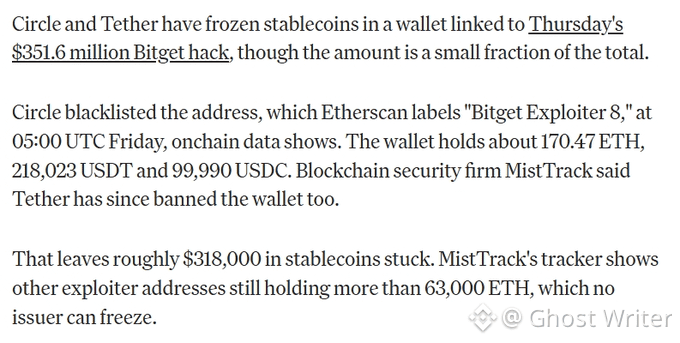
📌CIRCLE & TETHER FREEZE ONLY $318K - JUST A DROP IN THE BUCKET AGAINST BITGET'S $387M HACK
Attackers exploited a flaw in Bitget's wallet backend to drain ~$387.5 million on Sept 24, but managed to swap most of it into $ETH (unfreezable) before Circle and Tether could lock the wallet - leaving the two issuers able to block just $318,000, while Bitget has pledged to cover the full loss from its $464M user protection fund.
#BitgetHackerMoves$83MStolenXRP
#CircleTetherFreezeBitgetHackerWallet
📌CIRCLE & TETHER FREEZE ONLY $318K - JUST A DROP IN THE BUCKET AGAINST BITGET'S $387M HACK
Attackers exploited a flaw in Bitget's wallet backend to drain ~$387.5 million on Sept 24, but managed to swap most of it into $ETH (unfreezable) before Circle and Tether could lock the wallet - leaving the two issuers able to block just $318,000, while Bitget has pledged to cover the full loss from its $464M user protection fund.
#BitgetHackerMoves$83MStolenXRP
#CircleTetherFreezeBitgetHackerWallet
Attackers exploited a flaw in Bitget's wallet backend to drain ~$387.5 million on Sept 24, but managed to swap most of it into $ETH (unfreezable) before Circle and Tether could lock the wallet - leaving the two issuers able to block just $318,000, while Bitget has pledged to cover the full loss from its $464M user protection fund.
#BitgetHackerMoves$83MStolenXRP
#CircleTetherFreezeBitgetHackerWallet
3
873

·
--
Bullish
#circletetherfreezebitgethackerwallet
🚨 Security Alert: Circle & Tether Intercept Exploiter Address Following Bitget Breach 🛡️
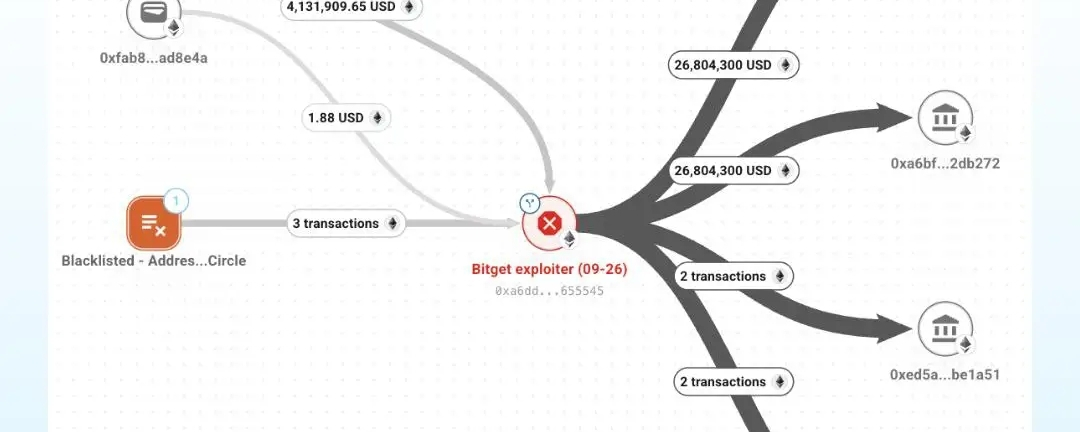
Rapid security coordination on-chain! Following a security incident where Bitget's backend wallet infrastructure was compromised, major stablecoin issuers Circle and Tether took swift action to blacklist and freeze an address labeled "Bitget Exploiter 8".
The joint response immobilized approximately $318,000 in stablecoins (99,990 USDC and 218,023 USDT) held in the targeted wallet, cutting off those specific assets from being laundered across secondary platforms.
$ZEC
{future}(ZECUSDT)
💡 Key Highlights:
🛑 Swift Blacklisting: Circle and Tether executed smart contract freezes within hours of security alerts from security firm MistTrack.
⚖️ Limits of On-Chain Freezes: While stablecoin issuers can freeze fiat-backed tokens (USDC/USDT), decentralized assets like Ethereum cannot be frozen. Trackers note that the attacker quickly converted a significant portion of stolen assets into ETH.
🛡️ Full Protection Covered: Bitget CEO Gracy Chen confirmed that private keys were not leaked and user assets are fully protected through Bitget's User Protection Fund (valued at over $400M).
What is your take on centralized stablecoin freezes—a vital safety net during exchange breaches or a reminder of central control in crypto? Share your view below! 👇
#CircleMints500MUSDCOnSolana #Bitget
#circletetherfreezebitgethackerwallet
🚨 Security Alert: Circle & Tether Intercept Exploiter Address Following Bitget Breach 🛡️
Rapid security coordination on-chain! Following a security incident where Bitget's backend wallet infrastructure was compromised, major stablecoin issuers Circle and Tether took swift action to blacklist and freeze an address labeled "Bitget Exploiter 8".
The joint response immobilized approximately $318,000 in stablecoins (99,990 USDC and 218,023 USDT) held in the targeted wallet, cutting off those specific assets from being laundered across secondary platforms.
$ZEC
💡 Key Highlights:
🛑 Swift Blacklisting: Circle and Tether executed smart contract freezes within hours of security alerts from security firm MistTrack.
⚖️ Limits of On-Chain Freezes: While stablecoin issuers can freeze fiat-backed tokens (USDC/USDT), decentralized assets like Ethereum cannot be frozen. Trackers note that the attacker quickly converted a significant portion of stolen assets into ETH.
🛡️ Full Protection Covered: Bitget CEO Gracy Chen confirmed that private keys were not leaked and user assets are fully protected through Bitget's User Protection Fund (valued at over $400M).
What is your take on centralized stablecoin freezes—a vital safety net during exchange breaches or a reminder of central control in crypto? Share your view below! 👇
#CircleMints500MUSDCOnSolana #Bitget
🚨 Security Alert: Circle & Tether Intercept Exploiter Address Following Bitget Breach 🛡️
Rapid security coordination on-chain! Following a security incident where Bitget's backend wallet infrastructure was compromised, major stablecoin issuers Circle and Tether took swift action to blacklist and freeze an address labeled "Bitget Exploiter 8".
The joint response immobilized approximately $318,000 in stablecoins (99,990 USDC and 218,023 USDT) held in the targeted wallet, cutting off those specific assets from being laundered across secondary platforms.
$ZEC
💡 Key Highlights:
🛑 Swift Blacklisting: Circle and Tether executed smart contract freezes within hours of security alerts from security firm MistTrack.
⚖️ Limits of On-Chain Freezes: While stablecoin issuers can freeze fiat-backed tokens (USDC/USDT), decentralized assets like Ethereum cannot be frozen. Trackers note that the attacker quickly converted a significant portion of stolen assets into ETH.
🛡️ Full Protection Covered: Bitget CEO Gracy Chen confirmed that private keys were not leaked and user assets are fully protected through Bitget's User Protection Fund (valued at over $400M).
What is your take on centralized stablecoin freezes—a vital safety net during exchange breaches or a reminder of central control in crypto? Share your view below! 👇
#CircleMints500MUSDCOnSolana #Bitget

1
2.4k

·
--
#CircleTetherFreezeBitgetHackerWallet
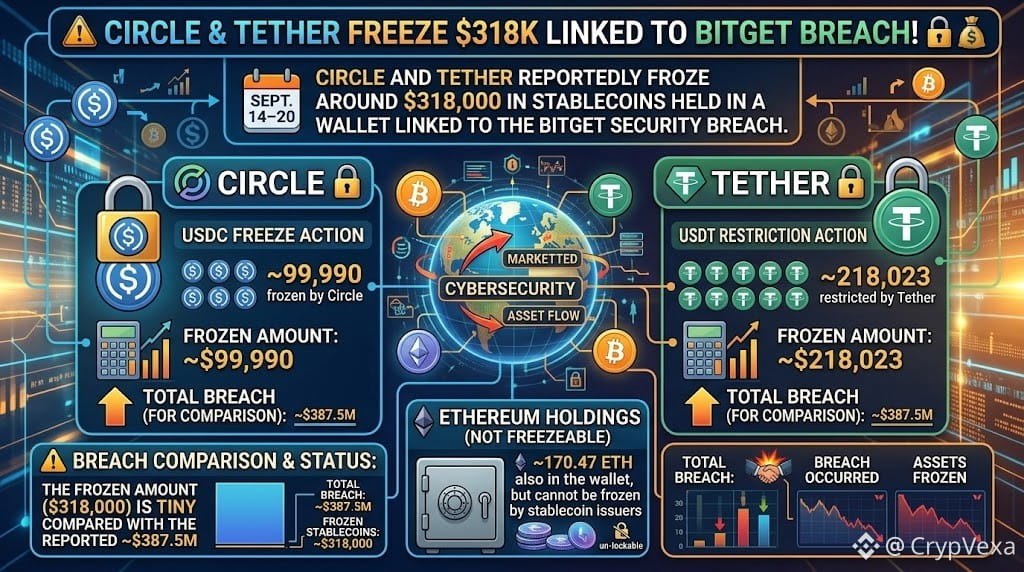
🚨 Circle & Tether Freeze $318K Linked to Bitget Breach! 🔒💰
Circle and Tether reportedly froze around $318,000 in stablecoins held in a wallet linked to the Bitget security breach.
🔵 USDC: ~99,990 frozen by Circle
🟢 USDT: ~218,023 restricted by Tether
⟠ ETH: ~170.47 ETH also in the wallet, but cannot be frozen by stablecoin issuers
📊 The frozen amount is tiny compared with the reported ~$387.5M breach.
⚠️ The key distinction: USDC and USDT issuers can blacklist their tokens, while native assets like ETH and XRP generally cannot be frozen at the token-contract level.
🔐 Bitget reportedly attributed the incident to compromised backend wallet infrastructure and manipulated transaction data, while stating its protection fund covers customer losses.
#Bitget #USDC #USDT #Ethereum
#CircleTetherFreezeBitgetHackerWallet
🚨 Circle & Tether Freeze $318K Linked to Bitget Breach! 🔒💰
Circle and Tether reportedly froze around $318,000 in stablecoins held in a wallet linked to the Bitget security breach.
🔵 USDC: ~99,990 frozen by Circle
🟢 USDT: ~218,023 restricted by Tether
⟠ ETH: ~170.47 ETH also in the wallet, but cannot be frozen by stablecoin issuers
📊 The frozen amount is tiny compared with the reported ~$387.5M breach.
⚠️ The key distinction: USDC and USDT issuers can blacklist their tokens, while native assets like ETH and XRP generally cannot be frozen at the token-contract level.
🔐 Bitget reportedly attributed the incident to compromised backend wallet infrastructure and manipulated transaction data, while stating its protection fund covers customer losses.
#Bitget #USDC #USDT #Ethereum
🚨 Circle & Tether Freeze $318K Linked to Bitget Breach! 🔒💰
Circle and Tether reportedly froze around $318,000 in stablecoins held in a wallet linked to the Bitget security breach.
🔵 USDC: ~99,990 frozen by Circle
🟢 USDT: ~218,023 restricted by Tether
⟠ ETH: ~170.47 ETH also in the wallet, but cannot be frozen by stablecoin issuers
📊 The frozen amount is tiny compared with the reported ~$387.5M breach.
⚠️ The key distinction: USDC and USDT issuers can blacklist their tokens, while native assets like ETH and XRP generally cannot be frozen at the token-contract level.
🔐 Bitget reportedly attributed the incident to compromised backend wallet infrastructure and manipulated transaction data, while stating its protection fund covers customer losses.
#Bitget #USDC #USDT #Ethereum
1
18

·
--
Bearish
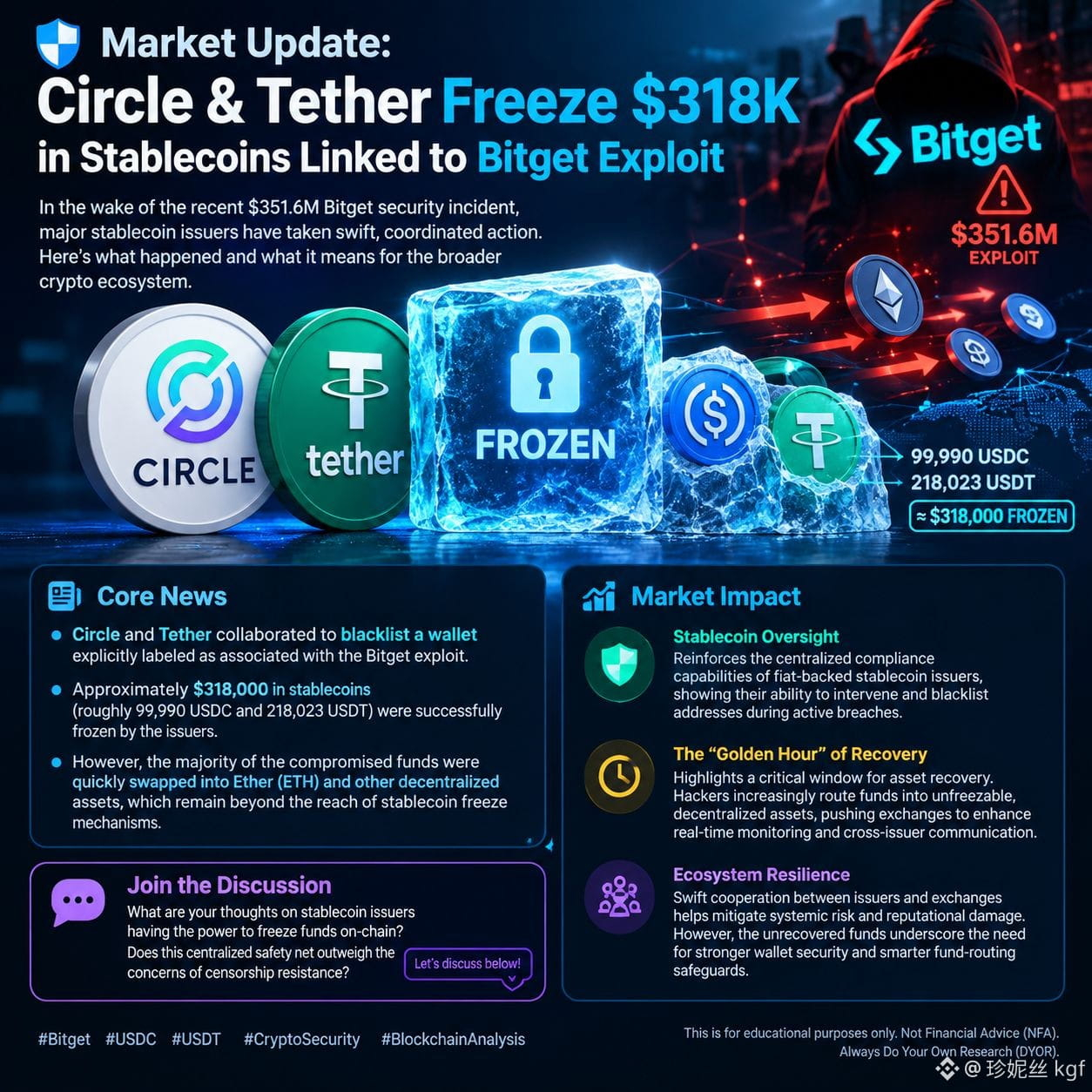
#circletetherfreezebitgethackerwallet 🛡️ Market Update: Circle & Tether Freeze $318K in Stablecoins Linked to Bitget Exploit
In the wake of the recent $351.6M Bitget security incident, major stablecoin issuers have taken swift, coordinated action. Here is a clear breakdown of what happened and what it means for the broader crypto ecosystem.
📰Core News
• Circle and Tether collaborated to blacklist a wallet explicitly labeled as associated with the Bitget exploit [[20]].
• Approximately $318,000 in stablecoins (roughly 99,990 USDC and 218,023 USDT) were successfully frozen by the issuers [[17]].
• However, the majority of the compromised funds were quickly swapped into Ether (ETH) and other decentralized assets, which remain beyond the reach of stablecoin freeze mechanisms [[11]].
📊 Market Impact
• Stablecoin Oversight This event reinforces the centralized compliance capabilities of fiat-backed stablecoin issuers, demonstrating their ability to intervene and blacklist addresses during active security breaches.
•The "Golden Hour" of Recovery It highlights a critical window for asset recovery. Hackers increasingly route stolen funds into unfreezable, decentralized assets to bypass blacklists, pushing exchanges to enhance real-time transaction monitoring and cross-issuer communication.
• Ecosystem Resilience Swift cooperation between major issuers and exchanges helps mitigate systemic risk and reputational damage. However the unrecovered portion of the funds underscores the ongoing industry-wide need for robust wallet security and smarter fund-routing safeguards.
💬 Join the Discussion
What are your thoughts on stablecoin issuers having the power to freeze funds on-chain? Does this centralized safety net outweigh the concerns of censorship resistance? Let’s discuss below! 👇
#Bitget #USDC #USDT #CryptoSecurity #BlockchainAnalysis
This is for educational purposes only. Not Financial Advice (NFA). Always Do Your Own Research (DYOR).
$ACE $2Z $PHA
{future}(PHAUSDT)
{future}(2ZUSDT)
{future}(ACEUSDT)
#circletetherfreezebitgethackerwallet 🛡️ Market Update: Circle & Tether Freeze $318K in Stablecoins Linked to Bitget Exploit
In the wake of the recent $351.6M Bitget security incident, major stablecoin issuers have taken swift, coordinated action. Here is a clear breakdown of what happened and what it means for the broader crypto ecosystem.
📰Core News
• Circle and Tether collaborated to blacklist a wallet explicitly labeled as associated with the Bitget exploit [[20]].
• Approximately $318,000 in stablecoins (roughly 99,990 USDC and 218,023 USDT) were successfully frozen by the issuers [[17]].
• However, the majority of the compromised funds were quickly swapped into Ether (ETH) and other decentralized assets, which remain beyond the reach of stablecoin freeze mechanisms [[11]].
📊 Market Impact
• Stablecoin Oversight This event reinforces the centralized compliance capabilities of fiat-backed stablecoin issuers, demonstrating their ability to intervene and blacklist addresses during active security breaches.
•The "Golden Hour" of Recovery It highlights a critical window for asset recovery. Hackers increasingly route stolen funds into unfreezable, decentralized assets to bypass blacklists, pushing exchanges to enhance real-time transaction monitoring and cross-issuer communication.
• Ecosystem Resilience Swift cooperation between major issuers and exchanges helps mitigate systemic risk and reputational damage. However the unrecovered portion of the funds underscores the ongoing industry-wide need for robust wallet security and smarter fund-routing safeguards.
💬 Join the Discussion
What are your thoughts on stablecoin issuers having the power to freeze funds on-chain? Does this centralized safety net outweigh the concerns of censorship resistance? Let’s discuss below! 👇
#Bitget #USDC #USDT #CryptoSecurity #BlockchainAnalysis
This is for educational purposes only. Not Financial Advice (NFA). Always Do Your Own Research (DYOR).
$ACE $2Z $PHA
In the wake of the recent $351.6M Bitget security incident, major stablecoin issuers have taken swift, coordinated action. Here is a clear breakdown of what happened and what it means for the broader crypto ecosystem.
📰Core News
• Circle and Tether collaborated to blacklist a wallet explicitly labeled as associated with the Bitget exploit [[20]].
• Approximately $318,000 in stablecoins (roughly 99,990 USDC and 218,023 USDT) were successfully frozen by the issuers [[17]].
• However, the majority of the compromised funds were quickly swapped into Ether (ETH) and other decentralized assets, which remain beyond the reach of stablecoin freeze mechanisms [[11]].
📊 Market Impact
• Stablecoin Oversight This event reinforces the centralized compliance capabilities of fiat-backed stablecoin issuers, demonstrating their ability to intervene and blacklist addresses during active security breaches.
•The "Golden Hour" of Recovery It highlights a critical window for asset recovery. Hackers increasingly route stolen funds into unfreezable, decentralized assets to bypass blacklists, pushing exchanges to enhance real-time transaction monitoring and cross-issuer communication.
• Ecosystem Resilience Swift cooperation between major issuers and exchanges helps mitigate systemic risk and reputational damage. However the unrecovered portion of the funds underscores the ongoing industry-wide need for robust wallet security and smarter fund-routing safeguards.
💬 Join the Discussion
What are your thoughts on stablecoin issuers having the power to freeze funds on-chain? Does this centralized safety net outweigh the concerns of censorship resistance? Let’s discuss below! 👇
#Bitget #USDC #USDT #CryptoSecurity #BlockchainAnalysis
This is for educational purposes only. Not Financial Advice (NFA). Always Do Your Own Research (DYOR).
$ACE $2Z $PHA
206 Atlas:
Freezing $318K while hackers swap the bulk into ETH proves stablecoin blacklists are mostly theater for PR, not actual recovery.
2
2
2.1k

·
--
Bullish
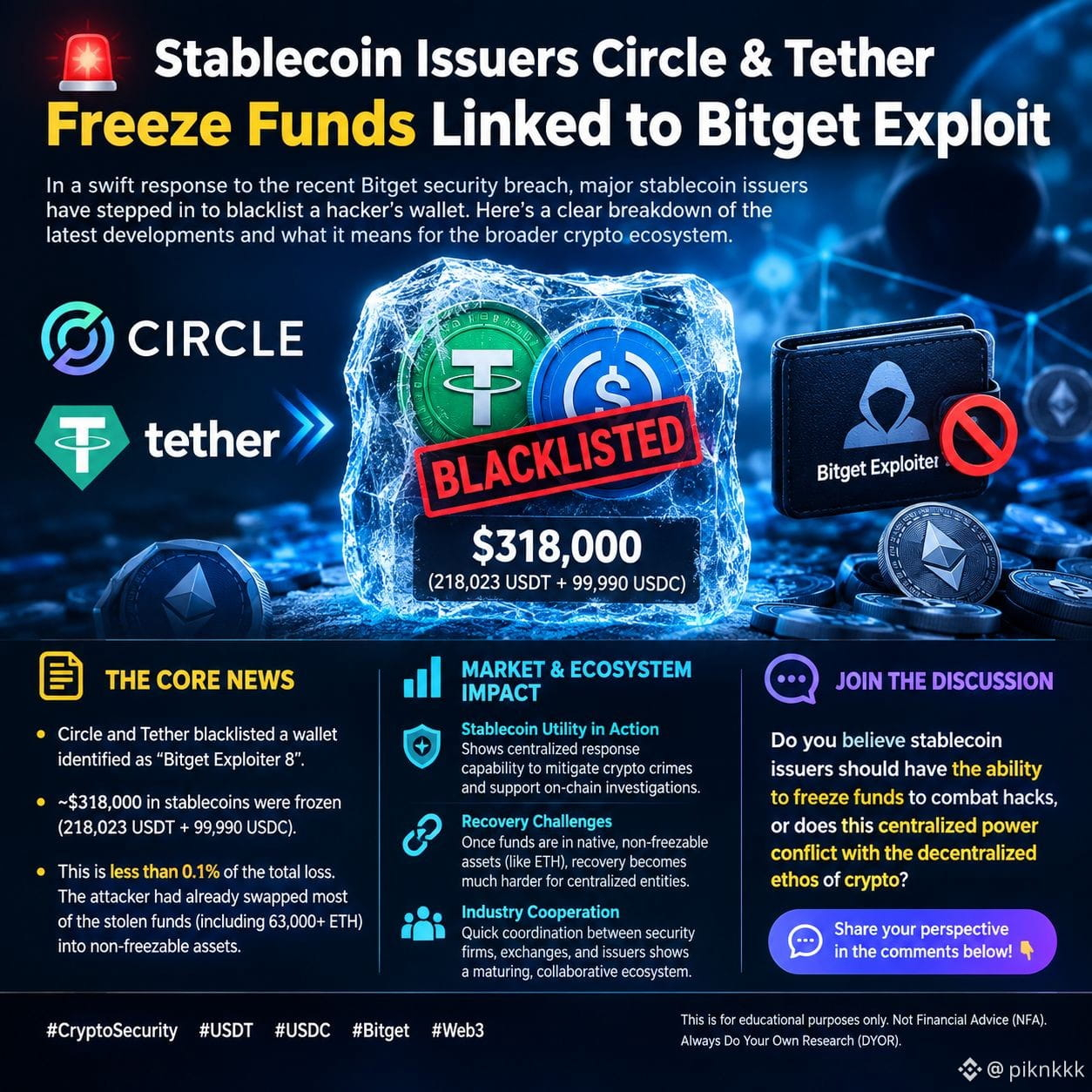
#circletetherfreezebitgethackerwallet 🚨 Stablecoin Issuers Circle & Tether Freeze Funds Linked to Bitget Exploit
In a swift response to the recent Bitget security breach, major stablecoin issuers have stepped in to blacklist a hacker’s wallet. Here is a clear breakdown of the latest developments and what it means for the broader crypto ecosystem.
📌 The Core News
• Circle and Tether have jointly blacklisted a wallet identified by security firms as "Bitget Exploiter 8" [[4]].
• This coordinated action successfully froze approximately $318,000 in stablecoins, consisting of roughly 218,023 USDT and 99,990 USDC [[13]].
• Notably, this frozen amount represents less than 0.1% of the total reported loss. The attacker had already swapped the majority of the stolen funds (including over 63,000 ETH) into decentralized, non-freezable assets before the blacklist was applied [[14]].
📊 Market & Ecosystem Impact
• Stablecoin Utility in Action This event highlights the centralized response capability of fiat-backed stablecoin issuers to actively mitigate crypto-related crimes and assist in on-chain investigations.
• Recovery Challenges It underscores a critical security reality: once funds are converted into native, non-freezable blockchain assets (like ETH), recovery becomes significantly more complex for centralized entities.
• Industry Cooperation The rapid coordination between blockchain security firms, exchanges, and stablecoin issuers demonstrates a maturing, collaborative ecosystem response to large-scale exploits.
💬 Join the Discussion
Do you believe stablecoin issuers should have the ability to freeze funds to combat hacks, or does this centralized power conflict with the decentralized ethos of crypto? Share your perspective in the comments below! 👇
🔖 Hashtags
#CryptoSecurity #USDT #USDC #Bitget #Web3
This is for educational purposes only. Not Financial Advice (NFA). Always Do Your Own Research (DYOR).
$RAY $SUPER $DASH
{future}(DASHUSDT)
{future}(SUPERUSDT)
{spot}(RAYUSDT)
#circletetherfreezebitgethackerwallet 🚨 Stablecoin Issuers Circle & Tether Freeze Funds Linked to Bitget Exploit
In a swift response to the recent Bitget security breach, major stablecoin issuers have stepped in to blacklist a hacker’s wallet. Here is a clear breakdown of the latest developments and what it means for the broader crypto ecosystem.
📌 The Core News
• Circle and Tether have jointly blacklisted a wallet identified by security firms as "Bitget Exploiter 8" [[4]].
• This coordinated action successfully froze approximately $318,000 in stablecoins, consisting of roughly 218,023 USDT and 99,990 USDC [[13]].
• Notably, this frozen amount represents less than 0.1% of the total reported loss. The attacker had already swapped the majority of the stolen funds (including over 63,000 ETH) into decentralized, non-freezable assets before the blacklist was applied [[14]].
📊 Market & Ecosystem Impact
• Stablecoin Utility in Action This event highlights the centralized response capability of fiat-backed stablecoin issuers to actively mitigate crypto-related crimes and assist in on-chain investigations.
• Recovery Challenges It underscores a critical security reality: once funds are converted into native, non-freezable blockchain assets (like ETH), recovery becomes significantly more complex for centralized entities.
• Industry Cooperation The rapid coordination between blockchain security firms, exchanges, and stablecoin issuers demonstrates a maturing, collaborative ecosystem response to large-scale exploits.
💬 Join the Discussion
Do you believe stablecoin issuers should have the ability to freeze funds to combat hacks, or does this centralized power conflict with the decentralized ethos of crypto? Share your perspective in the comments below! 👇
🔖 Hashtags
#CryptoSecurity #USDT #USDC #Bitget #Web3
This is for educational purposes only. Not Financial Advice (NFA). Always Do Your Own Research (DYOR).
$RAY $SUPER $DASH
In a swift response to the recent Bitget security breach, major stablecoin issuers have stepped in to blacklist a hacker’s wallet. Here is a clear breakdown of the latest developments and what it means for the broader crypto ecosystem.
📌 The Core News
• Circle and Tether have jointly blacklisted a wallet identified by security firms as "Bitget Exploiter 8" [[4]].
• This coordinated action successfully froze approximately $318,000 in stablecoins, consisting of roughly 218,023 USDT and 99,990 USDC [[13]].
• Notably, this frozen amount represents less than 0.1% of the total reported loss. The attacker had already swapped the majority of the stolen funds (including over 63,000 ETH) into decentralized, non-freezable assets before the blacklist was applied [[14]].
📊 Market & Ecosystem Impact
• Stablecoin Utility in Action This event highlights the centralized response capability of fiat-backed stablecoin issuers to actively mitigate crypto-related crimes and assist in on-chain investigations.
• Recovery Challenges It underscores a critical security reality: once funds are converted into native, non-freezable blockchain assets (like ETH), recovery becomes significantly more complex for centralized entities.
• Industry Cooperation The rapid coordination between blockchain security firms, exchanges, and stablecoin issuers demonstrates a maturing, collaborative ecosystem response to large-scale exploits.
💬 Join the Discussion
Do you believe stablecoin issuers should have the ability to freeze funds to combat hacks, or does this centralized power conflict with the decentralized ethos of crypto? Share your perspective in the comments below! 👇
🔖 Hashtags
#CryptoSecurity #USDT #USDC #Bitget #Web3
This is for educational purposes only. Not Financial Advice (NFA). Always Do Your Own Research (DYOR).
$RAY $SUPER $DASH
2.1k

📊 Bitget Hack: What Crypto Traders Should Watch
Bitget says the breach affected approximately $387.5M in assets, while its protection fund is intended to cover customer losses.
Circle and Tether have already frozen a small portion of the stolen stablecoins.
Now watch $ETH and $XRP wallet movements closely — on-chain data can reveal the next move before headlines do. 🔎
#circletetherfreezebitgethackerwallet
📊 Bitget Hack: What Crypto Traders Should Watch
Bitget says the breach affected approximately $387.5M in assets, while its protection fund is intended to cover customer losses.
Circle and Tether have already frozen a small portion of the stolen stablecoins.
Now watch $ETH and $XRP wallet movements closely — on-chain data can reveal the next move before headlines do. 🔎
#circletetherfreezebitgethackerwallet
Bitget says the breach affected approximately $387.5M in assets, while its protection fund is intended to cover customer losses.
Circle and Tether have already frozen a small portion of the stolen stablecoins.
Now watch $ETH and $XRP wallet movements closely — on-chain data can reveal the next move before headlines do. 🔎
#circletetherfreezebitgethackerwallet
3
2.1k

·
--
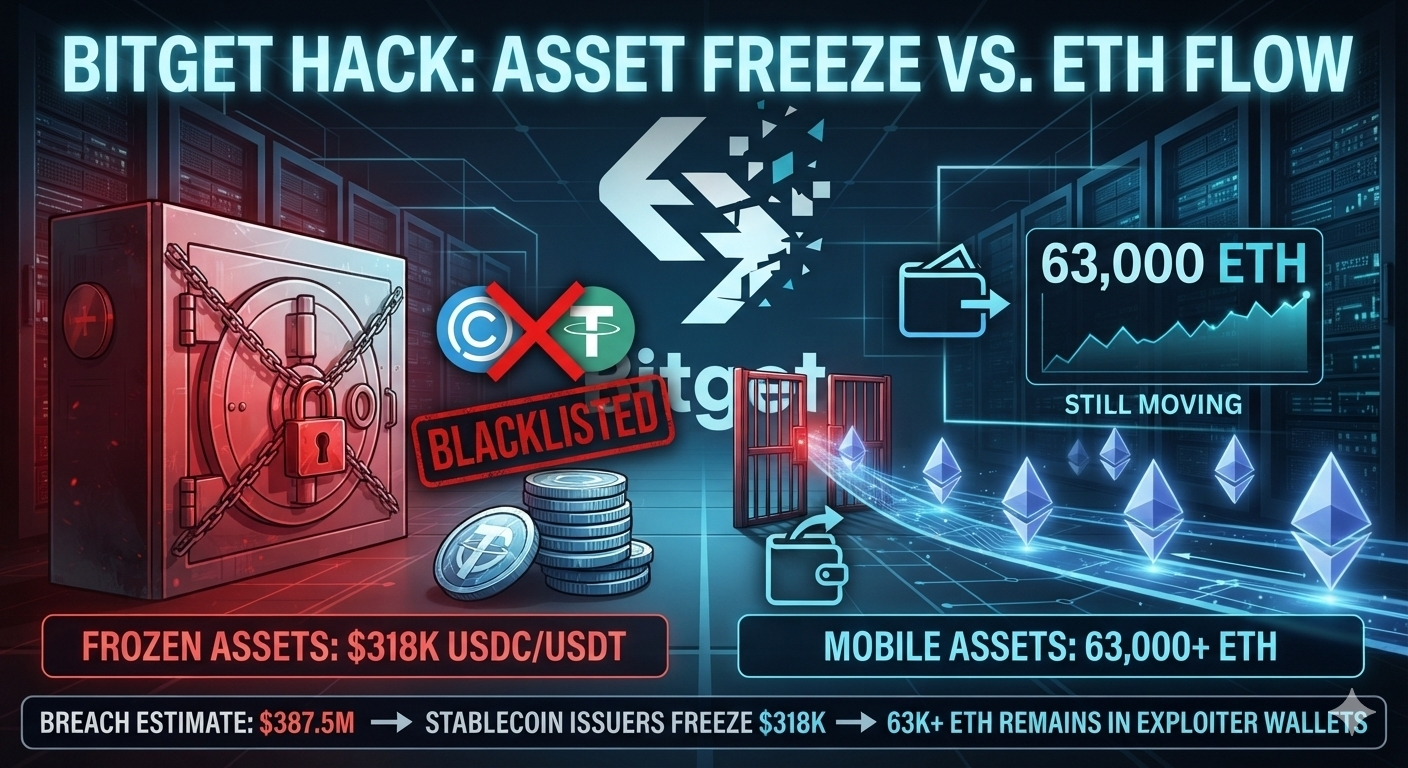
#circletetherfreezebitgethackerwallet 🚨 BITGET HACK: $318K FROZEN. BUT 63K+ ETH STILL MOVING
The Bitget exploit has shown one of crypto’s security realities.
Circle and Tether listed a hacker’s wallet as blacklisted, freezing about $318K in USDC and USDT.
But here is the story 👇
🔹 Bitget breach is now estimated at about $387.5M
🔹 More than 63,000 ETH remains in wallets linked to the exploiter
🔹 ETH cannot be frozen by stablecoin issuers
🔹 Bitget says the attack involved a compromise of backend infrastructure not a leak
🔹 Bitget says its protection fund of $464M+ covers user losses
📌 Trader takeaway: Watch the wallets and ETH/XRP movements closely. Large transfers, to exchanges could add selling pressure.
The real question: Will the hacker keep holding ETH or will the hacker start distributing ETH through wallets?
What are you watching. ETH flows or Bitget recovery updates? 👇
#crypto #Ethereum #Bitget #khan6
$ETH $BTC $SOL
{future}(SOLUSDT)
{future}(BTCUSDT)
{future}(ETHUSDT)
#circletetherfreezebitgethackerwallet 🚨 BITGET HACK: $318K FROZEN. BUT 63K+ ETH STILL MOVING
The Bitget exploit has shown one of crypto’s security realities.
Circle and Tether listed a hacker’s wallet as blacklisted, freezing about $318K in USDC and USDT.
But here is the story 👇
🔹 Bitget breach is now estimated at about $387.5M
🔹 More than 63,000 ETH remains in wallets linked to the exploiter
🔹 ETH cannot be frozen by stablecoin issuers
🔹 Bitget says the attack involved a compromise of backend infrastructure not a leak
🔹 Bitget says its protection fund of $464M+ covers user losses
📌 Trader takeaway: Watch the wallets and ETH/XRP movements closely. Large transfers, to exchanges could add selling pressure.
The real question: Will the hacker keep holding ETH or will the hacker start distributing ETH through wallets?
What are you watching. ETH flows or Bitget recovery updates? 👇
#crypto #Ethereum #Bitget #khan6
$ETH $BTC $SOL
The Bitget exploit has shown one of crypto’s security realities.
Circle and Tether listed a hacker’s wallet as blacklisted, freezing about $318K in USDC and USDT.
But here is the story 👇
🔹 Bitget breach is now estimated at about $387.5M
🔹 More than 63,000 ETH remains in wallets linked to the exploiter
🔹 ETH cannot be frozen by stablecoin issuers
🔹 Bitget says the attack involved a compromise of backend infrastructure not a leak
🔹 Bitget says its protection fund of $464M+ covers user losses
📌 Trader takeaway: Watch the wallets and ETH/XRP movements closely. Large transfers, to exchanges could add selling pressure.
The real question: Will the hacker keep holding ETH or will the hacker start distributing ETH through wallets?
What are you watching. ETH flows or Bitget recovery updates? 👇
#crypto #Ethereum #Bitget #khan6
$ETH $BTC $SOL
1
967
Log in to explore more content
Join global crypto users on Binance Square
⚡️ Get latest and useful information about crypto.
💬 Trusted by the world’s largest crypto exchange.
👍 Discover real insights from verified creators.
Email / Phone number
Trending Topics
1
#BitcoinClears$85200
1,656 views
89 Discussing
2
#AltcoinSeasonIndexHoldsAbove60For5Days
12,913 views
552 Discussing
3
#USADPAdds90000JobsInSeptember
3,875 views
273 Discussing
4
#USCorePCEEasesTo3%InAugust
3,602 views
235 Discussing
5
#KospiPostsWorstQuarterSince2020
3,785 views
274 Discussing
6
#SECToClarifyOnChainFundraisingRules
10,746 views
443 Discussing
7
#UKFCAOpensCryptoFirmAuthorization
14,280 views
429 Discussing
8
#JapanMOFStudyGroupOnTokenizedGovtBonds
12,352 views
342 Discussing
9
#QNTRises287%
58,736 views
762 Discussing
10
#TrumpRejectsAIRulesForVoluntaryAudits
36,964 views
674 Discussing