
786 隐狼
10.7k Posts

786 隐狼
 Square Verified+
Report
Block User
I don't predict markets — I read them. 🐺
Daily signals | Chart analysis | Real moves
Verified Creator | Wolves don't follow — they lead
Open Trade
Frequent Trader
3.8 Years
856 Following
39.1K+ Followers
6.2K+ Liked
Posts
Portfolio
All
Quotes
Videos
Live
·
--
Yesterday everyone asked if $60K was the bottom.
Someone wasn't asking — they were buying.
At Fear & Greed 12 (extreme fear), Twenty One Capital (Tether-backed) added 172.25 BTC at ~$58,054 — its 2nd dip buy this week. Holdings now ~43,841 BTC.
The selling that crushed the price creates the discount these buyers want. Capitulation is the supply; patient balance sheets are the demand.
The signal isn't the price. It's who accumulates while everyone capitulates.
When fear peaks — are you selling the bottom, or on the other side?
#TwentyOneCapitalAdds172.25BTC $BTC
131
·
--
Article
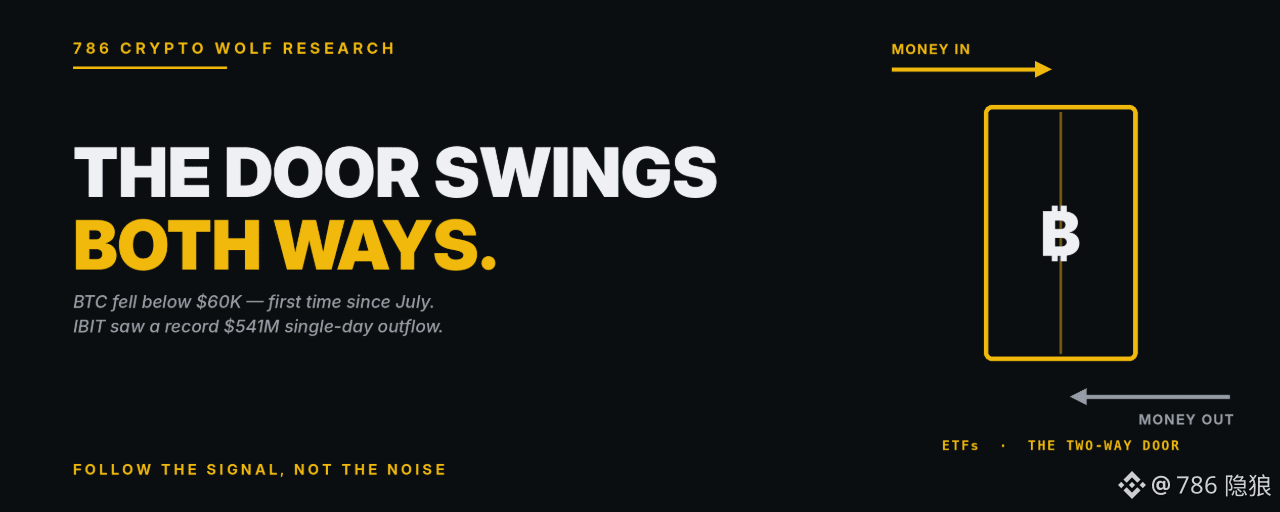
Everyone’s asking if $60K is the bottom. I think that’s the wrong question.Bitcoin fell below $60,000 this week — its first time under that level since July. In the same stretch, BlackRock’s IBIT ETF saw a record $541M single-day outflow, and across 24 hours roughly $1.58B in positions were liquidated (per CoinGlass). Fear & Greed is in “Extreme Fear.”
But here’s the part the fear takes are skipping. This didn’t start in crypto. Per CoinShares’ James Butterfill, the move looks tied to the broader AI/equities selloff — the Nasdaq fell around 2.7% after Anthropic’s Nasdaq debut — not a crypto-specific problem. My read: the IBIT outflow looks like a symptom of that, not the cause.
And that’s the mechanism nobody wanted to discuss during the bull run. For two years, every ETF inflow was celebrated as “institutional adoption.” But an ETF is a two-way door. The same pipe that made BTC effortless to buy also makes it effortless to dump — in one click — the moment risk managers trim their equity exposure. This week BTC didn’t trade on its own story. It traded as a risk asset, moving with tech stocks.
That’s the quiet shift. Access came with a cost: correlation. When you let Wall Street in through the front door, you also handed them the exit.
So the real question isn’t “is this the bottom.” It’s: do you still trade BTC as crypto — or has it quietly become just another risk asset on someone else’s balance sheet?
#CanBTCReboundAfterFallingBelow60K $BTC
$BTC
{spot}(BTCUSDT)
Sources: CoinShares (J. Butterfill), CoinGlass, TheStreet, Le Private Banker. Not financial advice.
Everyone’s asking if $60K is the bottom. I think that’s the wrong question.
Bitcoin fell below $60,000 this week — its first time under that level since July. In the same stretch, BlackRock’s IBIT ETF saw a record $541M single-day outflow, and across 24 hours roughly $1.58B in positions were liquidated (per CoinGlass). Fear & Greed is in “Extreme Fear.”
But here’s the part the fear takes are skipping. This didn’t start in crypto. Per CoinShares’ James Butterfill, the move looks tied to the broader AI/equities selloff — the Nasdaq fell around 2.7% after Anthropic’s Nasdaq debut — not a crypto-specific problem. My read: the IBIT outflow looks like a symptom of that, not the cause.
And that’s the mechanism nobody wanted to discuss during the bull run. For two years, every ETF inflow was celebrated as “institutional adoption.” But an ETF is a two-way door. The same pipe that made BTC effortless to buy also makes it effortless to dump — in one click — the moment risk managers trim their equity exposure. This week BTC didn’t trade on its own story. It traded as a risk asset, moving with tech stocks.
That’s the quiet shift. Access came with a cost: correlation. When you let Wall Street in through the front door, you also handed them the exit.
So the real question isn’t “is this the bottom.” It’s: do you still trade BTC as crypto — or has it quietly become just another risk asset on someone else’s balance sheet?
#CanBTCReboundAfterFallingBelow60K $BTC
$BTC
Sources: CoinShares (J. Butterfill), CoinGlass, TheStreet, Le Private Banker. Not financial advice.
197
·
--
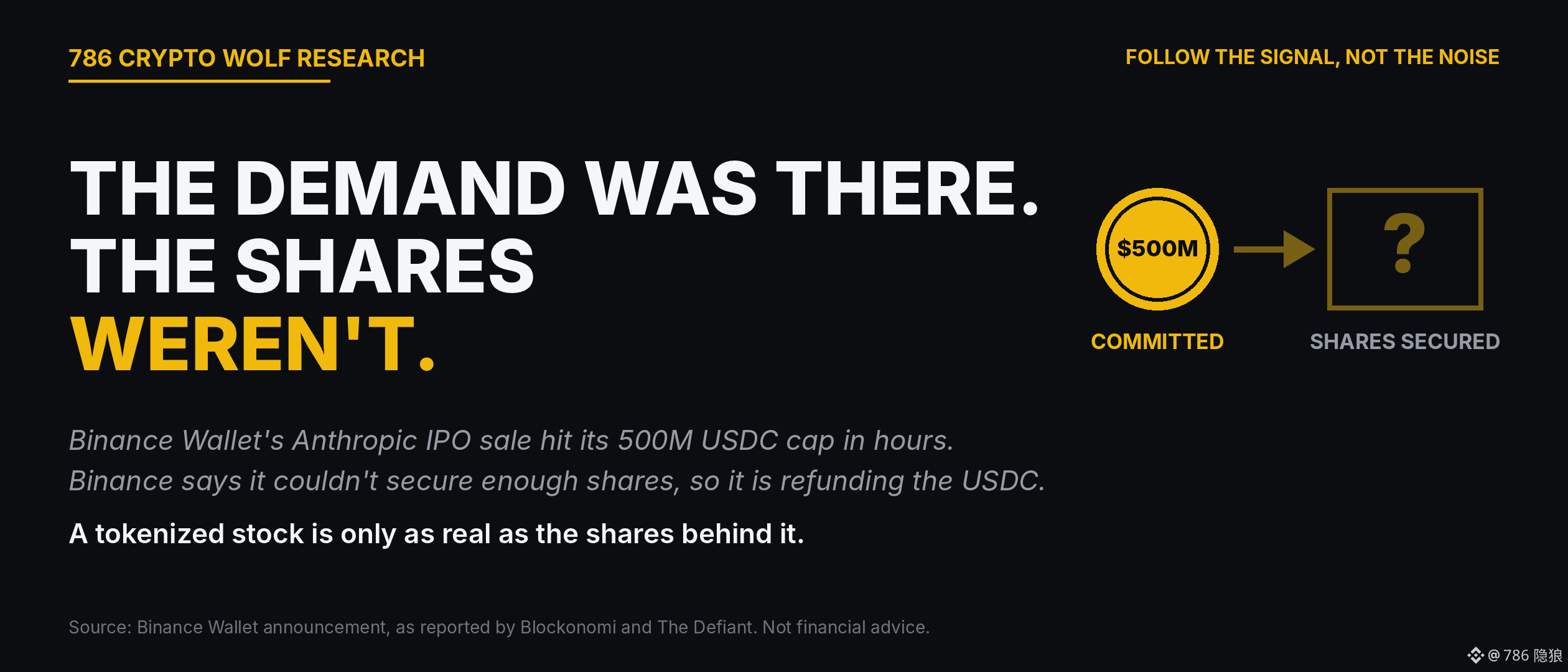
Binance Wallet is refunding $500 million in Anthropic IPO subscriptions. Many are calling it generous. I think it’s a warning.
Here’s what happened. This week Binance Wallet opened subscriptions for Anthropic’s IPO as tokenized exposure, so anyone could get a piece of one of the hottest listings of the year. Demand hit the 500 million USDC cap within hours.
Then came the catch. Binance says it couldn’t secure enough real Anthropic shares to cover that demand. So subscribers are getting their USDC back, a limited number of tokens free, and a $1M ANTB airdrop (at least $6 each).
To be fair, the campaign said commitments didn’t guarantee an allocation. But read that again: the money was there, the demand was there, the shares weren’t.
That’s the part nobody’s talking about. The pitch of tokenized stocks is access: “own a piece of any IPO, no gatekeepers.” This episode shows the fine print: a tokenized stock can only exist once the real shares do. When real supply runs short, a token can’t create a share out of thin air.
And this isn’t about a weak asset. Anthropic priced at $83 and opened at $111.50 on Nasdaq. It’s about the plumbing: demand for tokenized access can outrun the real shares available to back it. It may not be the last time we see it.
So before the next tokenized “opportunity”, do you actually know what’s behind the token? Or are you just trusting the wrapper?
$ANT #AnthropicIPO
Not financial advice.
700
·
--
Bearish
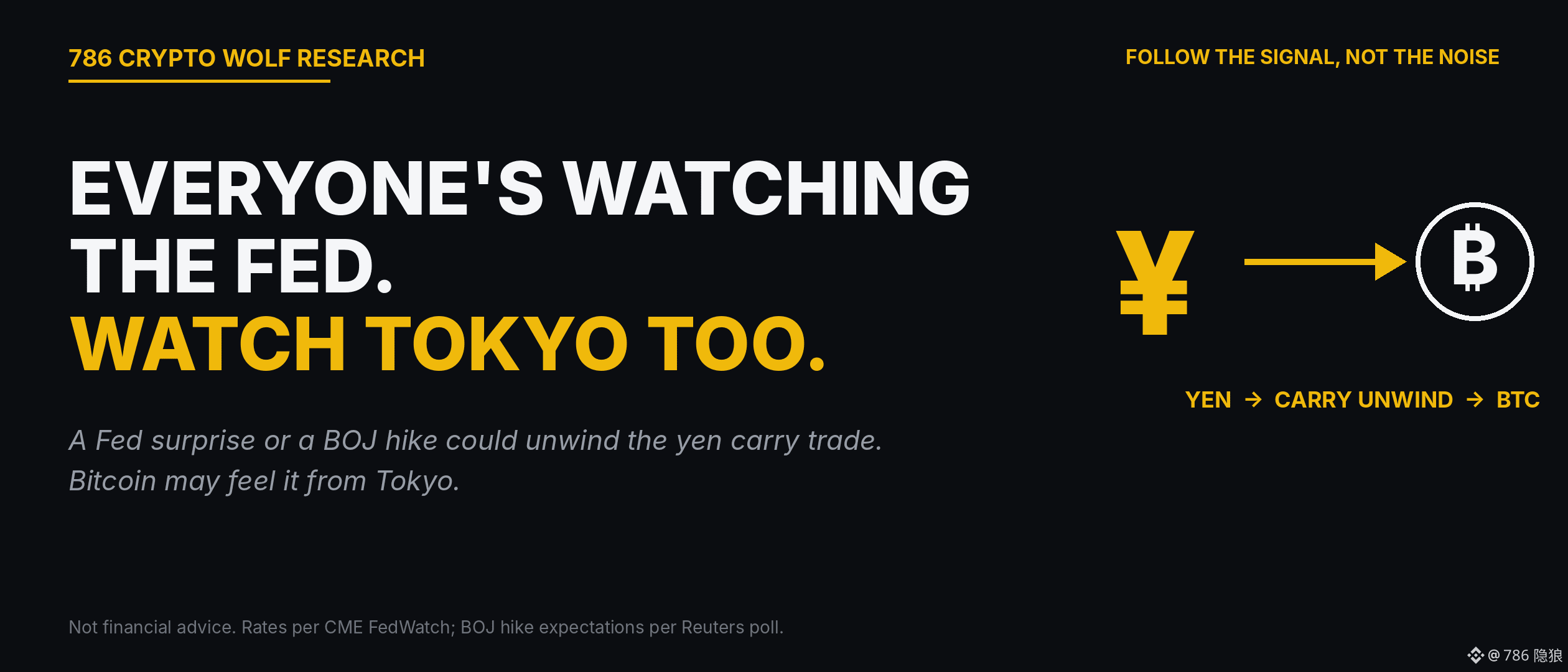
𝑬𝒗𝒆𝒓𝒚𝒐𝒏𝒆’𝒔 𝒂𝒓𝒈𝒖𝒊𝒏𝒈 25 𝒐𝒓 50𝒃𝒑𝒔. 𝑰 𝒕𝒉𝒊𝒏𝒌 𝒘𝒆’𝒓𝒆 𝒘𝒂𝒕𝒄𝒉𝒊𝒏𝒈 𝒕𝒉𝒆 𝒘𝒓𝒐𝒏𝒈 𝒄𝒐𝒖𝒏𝒕𝒓𝒚.
Here’s the part my feed is missing. For years, big funds have borrowed yen — where rates are still far lower than the US — and poured it into higher-returning assets worldwide, crypto included. It’s the yen carry trade.
That trade gets squeezed when the US–Japan rate gap narrows or the yen suddenly strengthens. And both sides are about to move: the Fed on Dec 9, and the Bank of Japan — which economists expect to hike (Reuters poll) — nine days later, on Dec 18.
We’ve seen what that does. In August 2024, a BOJ hike plus weak US data sent the yen sharply higher, forced funds to unwind, and dragged global markets — Bitcoin included — down in days.
So the move that actually hits your $BTC in December might not be Waller’s 25-vs-50 at all. It might be Tokyo on the 18th, after everyone’s stopped watching.
I’m not calling a crash — 25bps is still the base case (~95%, per CME FedWatch). But the real trigger could come from Japan, not Washington.
When you plan for the Fed this December — are you even watching the yen?
#WillFedHike50bps $BTC
Not financial advice.
276
·
--
Bullish
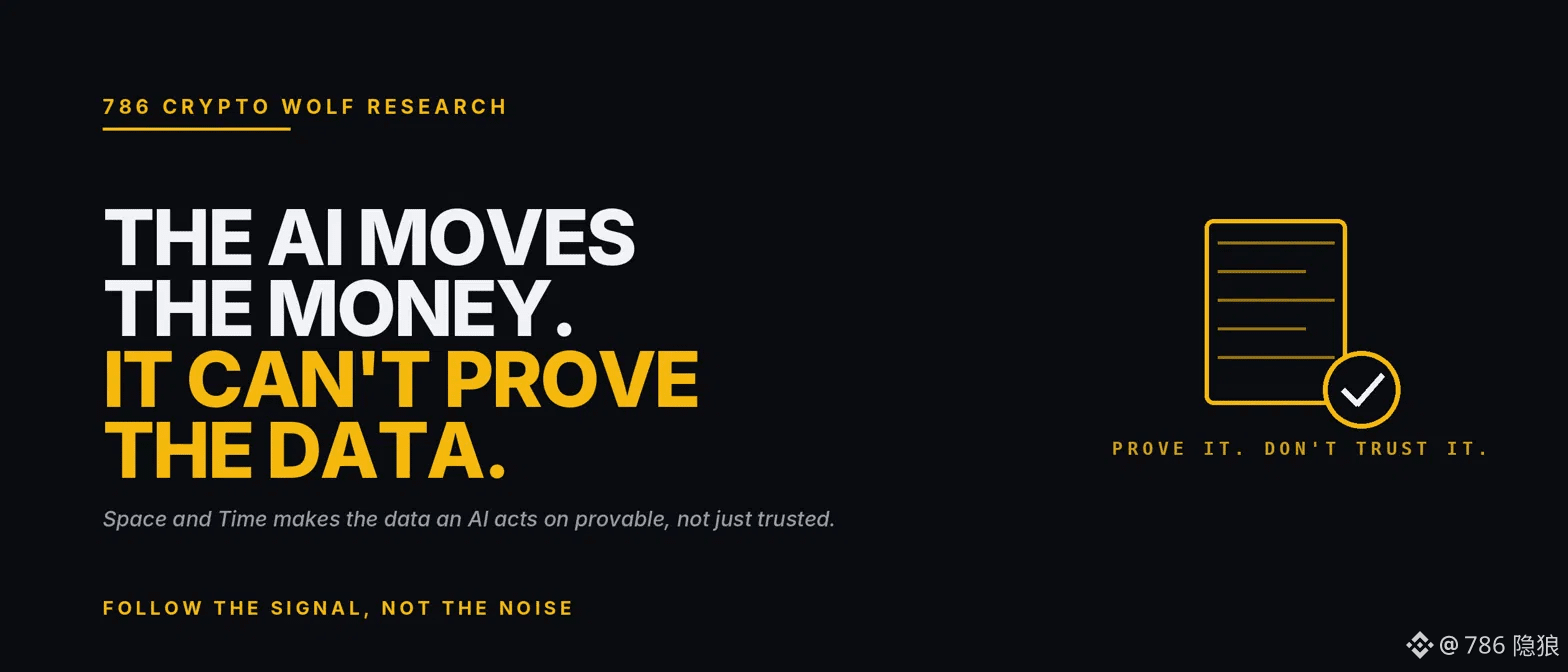
We’re about to let AI move real money. The scary part? It’s working off data it can’t prove.
An AI agent deciding on a DeFi action looks at balances, protocol fees and past transactions, and mostly takes them on faith. If that data is wrong or tampered with, the agent acts on a lie, and it’s hard for anyone to audit how it got there.
That’s the gap @SpaceandTimeDB is built for. Space and Time is the data blockchain for onchain finance, backed by M12, Microsoft’s venture fund. It lets applications verify the computations behind their data, so an agent can lean on a proven result instead of blind trust.
The same idea applies to tokenization, where holdings, cashflows and valuations must be checkable (like the calculations behind a fund’s NAV report), and to DeFi, where contracts can use proven past activity for things like reward eligibility or fee discounts.
On the token side, $SXT is used to pay for network workloads and is staked to support validator security.
As AI agents start transacting, verifiable data stops being a nice-to-have. It’s the line between automation and expensive mistakes.
Paid promotion: shared as part of the Space and Time CreatorPad campaign on Binance Square.
Purchasing SXT is risky. You are encouraged to DYOR and to consult professional advice before buying SXT or any other cryptocurrency.
#SXT $SXT @SpaceandTimeDB
🐺 786 𝑪𝒓𝒚𝒑𝒕𝒐 𝑾𝒐𝒍𝒇 𝑹𝒆𝒔𝒆𝒂𝒓𝒄𝒉 — Follow the signal, not the noise.
We’re about to let AI move real money. The scary part? It’s working off data it can’t prove.
An AI agent deciding on a DeFi action looks at balances, protocol fees and past transactions, and mostly takes them on faith. If that data is wrong or tampered with, the agent acts on a lie, and it’s hard for anyone to audit how it got there.
That’s the gap @SpaceandTime is built for. Space and Time is the data blockchain for onchain finance, backed by M12, Microsoft’s venture fund. It lets applications verify the computations behind their data, so an agent can lean on a proven result instead of blind trust.
The same idea applies to tokenization, where holdings, cashflows and valuations must be checkable (like the calculations behind a fund’s NAV report), and to DeFi, where contracts can use proven past activity for things like reward eligibility or fee discounts.
On the token side, $SXT is used to pay for network workloads and is staked to support validator security.
As AI agents start transacting, verifiable data stops being a nice-to-have. It’s the line between automation and expensive mistakes.
Paid promotion: shared as part of the Space and Time CreatorPad campaign on Binance Square.
Purchasing SXT is risky. You are encouraged to DYOR and to consult professional advice before buying SXT or any other cryptocurrency.
#SXT $SXT @SpaceandTime
🐺 786 𝑪𝒓𝒚𝒑𝒕𝒐 𝑾𝒐𝒍𝒇 𝑹𝒆𝒔𝒆𝒂𝒓𝒄𝒉 — Follow the signal, not the noise.
103
·
--
Article
He Built It. He Fell. Now He Wants Back In.Jensen Huang didn’t just run NVIDIA. He built it — from a chip company most people had never heard of into the foundation the entire AI era now stands on. That isn’t marketing; it’s one of the great builder stories in modern business.
This month, he resigned as CEO. And the way he did it is worth sitting with.
He owned it. In his own words, Huang didn’t spin or deflect. He wrote that he “made serious mistakes” in his personal life, that he “did not live up to the standards expected of everyone at NVIDIA,” and that he “owns [his] mistakes completely” — adding that he is cooperating with the Board’s independent investigation, which is ongoing. In an era where powerful people rarely admit anything, a founder publicly taking full responsibility — and walking away from the company that is his life’s work — is its own kind of character.
He wants back in. In the same message, Huang said employees, investors, partners and customers are calling for his return, and that if the Board decides it’s in the company’s best interest, he “would be honored” to come back. (That “outpouring of calls” is his own account.) Around the same time, NVIDIA reported a record quarter — results built under his leadership.
The real question. This is where it stops being simple. The easy takes sit at the extremes: “bring back the genius, the numbers speak,” or “rules are rules, he’s gone.” The honest question lives in the middle, and every organization eventually faces it: what does a board owe a great leader who stumbled? Do you weigh a person by their worst moment, or by the whole arc — what they built, how they owned their fall, and what the people closest to them want? There’s no clean answer. Bring him back and you risk saying results excuse everything. Keep him out and you risk losing the one mind that saw the future first.
Why it matters to you. NVIDIA is the ground the entire AI trade — and much of crypto’s AI narrative — stands on. So this isn’t gossip. It’s a live test of how the most important company in tech holds accountability and greatness in the same person.
So here’s the real one: if someone builds something extraordinary, then falls and owns it honestly — do they earn a second chance, or forfeit it?
786 Crypto Wolf Research — Follow the signal, not the noise.
#Nvidia #NVDA #JensenHuang #Aİ #786CryptoWolf
He Built It. He Fell. Now He Wants Back In.
Jensen Huang didn’t just run NVIDIA. He built it — from a chip company most people had never heard of into the foundation the entire AI era now stands on. That isn’t marketing; it’s one of the great builder stories in modern business.
This month, he resigned as CEO. And the way he did it is worth sitting with.
He owned it. In his own words, Huang didn’t spin or deflect. He wrote that he “made serious mistakes” in his personal life, that he “did not live up to the standards expected of everyone at NVIDIA,” and that he “owns [his] mistakes completely” — adding that he is cooperating with the Board’s independent investigation, which is ongoing. In an era where powerful people rarely admit anything, a founder publicly taking full responsibility — and walking away from the company that is his life’s work — is its own kind of character.
He wants back in. In the same message, Huang said employees, investors, partners and customers are calling for his return, and that if the Board decides it’s in the company’s best interest, he “would be honored” to come back. (That “outpouring of calls” is his own account.) Around the same time, NVIDIA reported a record quarter — results built under his leadership.
The real question. This is where it stops being simple. The easy takes sit at the extremes: “bring back the genius, the numbers speak,” or “rules are rules, he’s gone.” The honest question lives in the middle, and every organization eventually faces it: what does a board owe a great leader who stumbled? Do you weigh a person by their worst moment, or by the whole arc — what they built, how they owned their fall, and what the people closest to them want? There’s no clean answer. Bring him back and you risk saying results excuse everything. Keep him out and you risk losing the one mind that saw the future first.
Why it matters to you. NVIDIA is the ground the entire AI trade — and much of crypto’s AI narrative — stands on. So this isn’t gossip. It’s a live test of how the most important company in tech holds accountability and greatness in the same person.
So here’s the real one: if someone builds something extraordinary, then falls and owns it honestly — do they earn a second chance, or forfeit it?
786 Crypto Wolf Research — Follow the signal, not the noise.
#Nvidia #NVDA #JensenHuang #Aİ #786CryptoWolf
179
·
--
Article
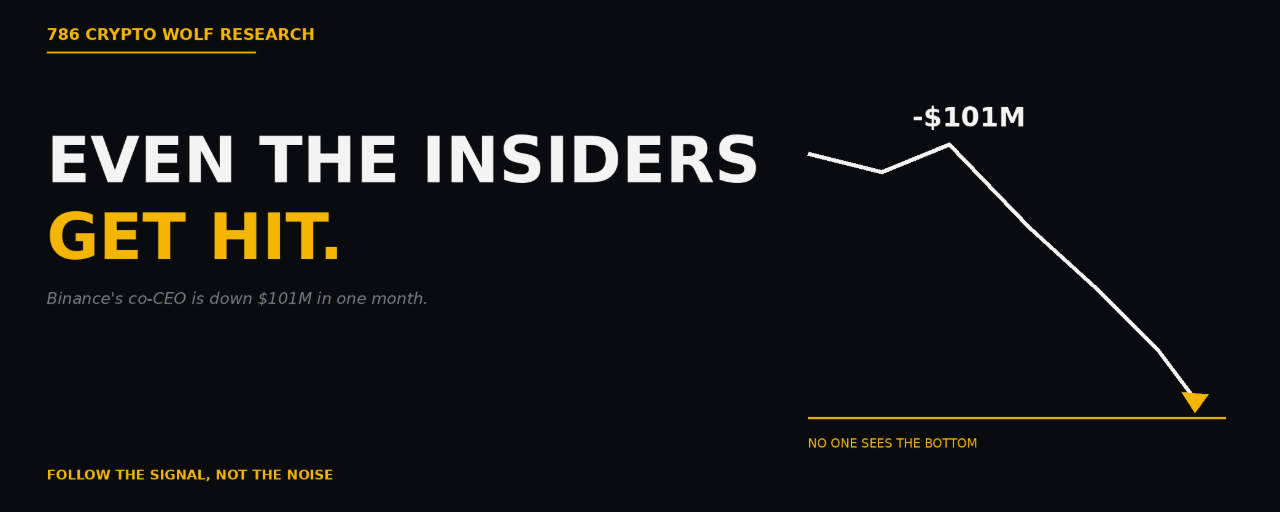
The Ultimate Insider Is Down $101 MillionYi He is co-CEO of Binance, the world’s largest crypto exchange. If anyone has an edge, you’d assume it’s her: the data, the rooms where decisions get made. This week she posted her personal numbers from the last month. She was down about $101 million.
Let that sit for a second.
The setup. Most of us carry a quiet belief when the market falls: somewhere, the “smart money” saw it coming. The insiders, the whales, the people with real access got out in time, and we didn’t, because we’re not in the room. It’s a comforting story. It gives the pain a reason.
What actually happened. The person arguably closest to that room took a hit too. Around $97 million of it was trading losses. She didn’t dodge the dip.
Why it matters. This pokes a hole in one of crypto’s most persistent myths: that there’s a tier of people who always win, and your only job is to follow them. The co-CEO of Binance is about as “followed” as it gets, and the market still went through her portfolio. The edge you imagine other people have may not be there. A lot of them are holding and hoping, same as you.
The uncomfortable read. There’s something steadying in this, and something scary. Steadying: you’re not losing because you’re dumb or late. The market fell, and it fell on a lot of people. Scary: if someone with that much information still took a hit, then maybe timing it was never a real plan, for her, for the whale accounts you watch, or for you.
(Optional, add only after checking her original post: Some critics have questioned parts of her activity; she says they were internal tests, per her post.)
The question. When even a well-connected insider gets caught, maybe the honest move isn’t to find someone smarter to copy. It’s to admit nobody can see the bottom, and to build a plan that survives being wrong instead of one that depends on being right.
So here’s the real one: if the edge you’re chasing doesn’t exist, what are you actually betting on?
786 Crypto Wolf Research — Follow the signal, not the noise.
#Binance #YiHe #Bitcoin #786CryptoWolf
The Ultimate Insider Is Down $101 Million
Yi He is co-CEO of Binance, the world’s largest crypto exchange. If anyone has an edge, you’d assume it’s her: the data, the rooms where decisions get made. This week she posted her personal numbers from the last month. She was down about $101 million.
Let that sit for a second.
The setup. Most of us carry a quiet belief when the market falls: somewhere, the “smart money” saw it coming. The insiders, the whales, the people with real access got out in time, and we didn’t, because we’re not in the room. It’s a comforting story. It gives the pain a reason.
What actually happened. The person arguably closest to that room took a hit too. Around $97 million of it was trading losses. She didn’t dodge the dip.
Why it matters. This pokes a hole in one of crypto’s most persistent myths: that there’s a tier of people who always win, and your only job is to follow them. The co-CEO of Binance is about as “followed” as it gets, and the market still went through her portfolio. The edge you imagine other people have may not be there. A lot of them are holding and hoping, same as you.
The uncomfortable read. There’s something steadying in this, and something scary. Steadying: you’re not losing because you’re dumb or late. The market fell, and it fell on a lot of people. Scary: if someone with that much information still took a hit, then maybe timing it was never a real plan, for her, for the whale accounts you watch, or for you.
(Optional, add only after checking her original post: Some critics have questioned parts of her activity; she says they were internal tests, per her post.)
The question. When even a well-connected insider gets caught, maybe the honest move isn’t to find someone smarter to copy. It’s to admit nobody can see the bottom, and to build a plan that survives being wrong instead of one that depends on being right.
So here’s the real one: if the edge you’re chasing doesn’t exist, what are you actually betting on?
786 Crypto Wolf Research — Follow the signal, not the noise.
#Binance #YiHe #Bitcoin #786CryptoWolf
120
·
--
Article
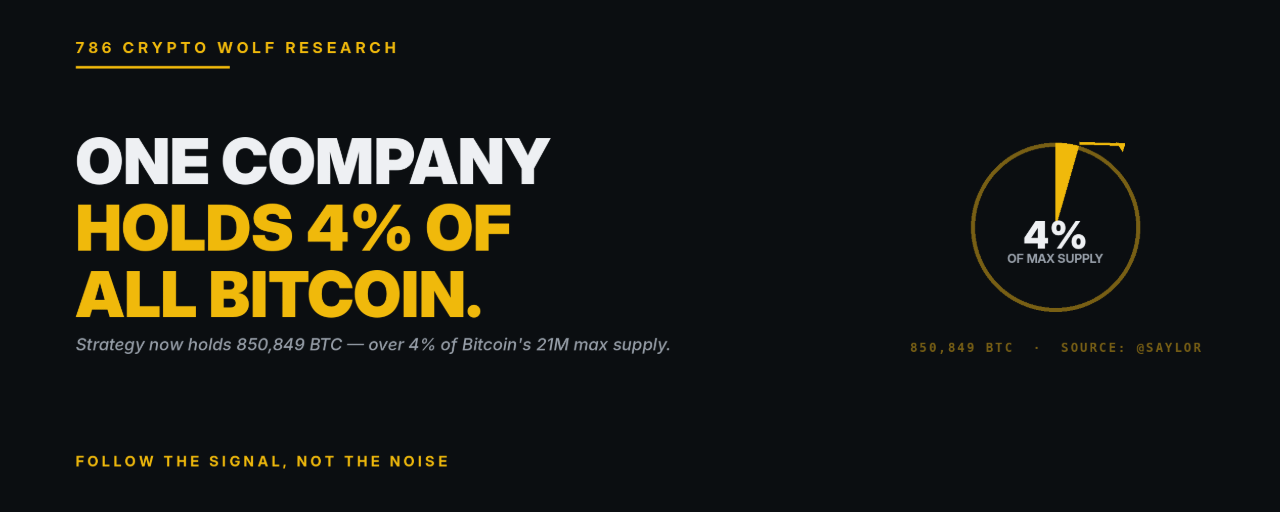
One Company Now Holds 4% of Every Bitcoin That Will Ever ExistThere will only ever be 21 million Bitcoin. Not one more. That cap is the whole reason it exists — money nobody can print, nobody can control.
So here’s the uncomfortable part. One company — Strategy, the firm Michael Saylor built around a Bitcoin treasury — now holds 850,849 BTC. Over 4% of Bitcoin’s entire 21-million max supply. And this week, with the price falling and everyone else scared, it bought even more.
Strategy isn’t slowing down. It keeps buying into the dip.
The twist. Bitcoin was designed to escape exactly this — a world where a few big players own most of the money and move the market whenever they want. No kings, no whales, no single hand on the switch. That was the dream. Now the single largest holder of the “decentralized” asset is one company, led by one man, and it keeps growing.
How it keeps buying. Strategy largely funds its purchases by issuing shares and preferred stock — turning Wall Street paper into Bitcoin. On the way up, it’s genius: the stock rises, it issues more, it buys more, the price climbs. A machine. The question nobody wants to ask is what that same machine does in reverse.
Why you should care. When one holder controls over 4% and keeps climbing, “decentralized” stops being a fact and starts being a slogan. Its buying may have helped support the price. Sounds fine — until you flip it. If that one holder is ever forced to sell, there’s no bigger buyer waiting underneath. The whale is the floor. And a floor is one decision away from becoming a hole.
The fork. Maybe this is conviction — a company stacking the hardest money on earth, and the concentration is just what early adoption looks like. Or maybe we’re watching the exact failure Bitcoin was built to prevent, in slow motion, cheered on as a win. Both stories fit the same chart.
The question. Bitcoin promised money no single entity could control. So what do we call it when one company holds over 4% of it — and isn’t done yet?
786 Crypto Wolf Research — Follow the signal, not the noise.
Source: @saylor, Strategy’s 11/15 disclosure.
#Bitcoin #MicroStrategy #strategy #Saylor #786CryptoWolf
One Company Now Holds 4% of Every Bitcoin That Will Ever Exist
There will only ever be 21 million Bitcoin. Not one more. That cap is the whole reason it exists — money nobody can print, nobody can control.
So here’s the uncomfortable part. One company — Strategy, the firm Michael Saylor built around a Bitcoin treasury — now holds 850,849 BTC. Over 4% of Bitcoin’s entire 21-million max supply. And this week, with the price falling and everyone else scared, it bought even more.
Strategy isn’t slowing down. It keeps buying into the dip.
The twist. Bitcoin was designed to escape exactly this — a world where a few big players own most of the money and move the market whenever they want. No kings, no whales, no single hand on the switch. That was the dream. Now the single largest holder of the “decentralized” asset is one company, led by one man, and it keeps growing.
How it keeps buying. Strategy largely funds its purchases by issuing shares and preferred stock — turning Wall Street paper into Bitcoin. On the way up, it’s genius: the stock rises, it issues more, it buys more, the price climbs. A machine. The question nobody wants to ask is what that same machine does in reverse.
Why you should care. When one holder controls over 4% and keeps climbing, “decentralized” stops being a fact and starts being a slogan. Its buying may have helped support the price. Sounds fine — until you flip it. If that one holder is ever forced to sell, there’s no bigger buyer waiting underneath. The whale is the floor. And a floor is one decision away from becoming a hole.
The fork. Maybe this is conviction — a company stacking the hardest money on earth, and the concentration is just what early adoption looks like. Or maybe we’re watching the exact failure Bitcoin was built to prevent, in slow motion, cheered on as a win. Both stories fit the same chart.
The question. Bitcoin promised money no single entity could control. So what do we call it when one company holds over 4% of it — and isn’t done yet?
786 Crypto Wolf Research — Follow the signal, not the noise.
Source: @saylor, Strategy’s 11/15 disclosure.
#Bitcoin #MicroStrategy #strategy #Saylor #786CryptoWolf
1
483
·
--
Article
Everyone’s Watching the Wrong Fight.Bitcoin is down sharply, and the timeline has split into two camps. Peter Schiff says the collapse is gathering steam, maybe below $16,500 by year-end. Michael Saylor posts charts showing Strategy’s preferred shares held flat while BTC fell 17%. Pick a side, the internet says. One of them has to be right.
They’re both answering the wrong question.
The mechanism. Strategy isn’t a company that happens to own Bitcoin. It’s a machine that turns Bitcoin into leverage: issue debt and preferred shares, use the cash to buy more BTC, let the rising price justify issuing more paper, repeat. On the way up, it’s the best-performing strategy on the market — every dollar of Bitcoin gain is amplified. The catch is in that word. Leverage has no direction preference. The same machine that multiplied the climb multiplies the fall.
The hidden dependency. The whole structure depends on one thing: Strategy being able to keep raising capital against its Bitcoin. That depends on demand for its shares — and that demand is being pulled two ways at once. ETF outflows topped $1 billion last week. And MSCI is reviewing whether to remove Strategy from its indexes; JPMorgan estimates removal could force up to $116 billion in passive selling. Index funds don’t debate Saylor. When the rules say sell, they sell.
The human consequence. Retail is watching a personality fight — Schiff the gold bug versus Saylor the Bitcoin prophet — because a fight is easy to follow. The real risk is a balance-sheet question most people can’t see from outside: what happens to the most leveraged holder of the largest corporate Bitcoin pile on earth if it’s forced to raise cash into a falling market? The fight is entertainment. The index review is the event.
The strategic fork. One read: Saylor’s reflexivity holds — Bitcoin stabilizes, the preferred shares keep paying, and the structure survives a drawdown it was built to withstand. The other: the leverage that made Strategy a legend becomes the mechanism that unwinds it, and forced selling of the largest corporate Bitcoin stack drags the whole market down with it. Nobody watching the Schiff-Saylor clash is pricing that second path.
The unanswered question. Strip away the personalities and one question remains: is Strategy a Bitcoin company, or a one-directional leverage bet wearing a Bitcoin company’s clothes? The MSCI decision — and the weeks after it — will answer that in public. Until then, the loudest fight on your timeline is the one that matters least.
786 Crypto Wolf Research — Follow the signal, not the noise.
#Bitcoin #MicroStrategy #Strategy #RWA #786CryptoWolf
Everyone’s Watching the Wrong Fight.
Bitcoin is down sharply, and the timeline has split into two camps. Peter Schiff says the collapse is gathering steam, maybe below $16,500 by year-end. Michael Saylor posts charts showing Strategy’s preferred shares held flat while BTC fell 17%. Pick a side, the internet says. One of them has to be right.
They’re both answering the wrong question.
The mechanism. Strategy isn’t a company that happens to own Bitcoin. It’s a machine that turns Bitcoin into leverage: issue debt and preferred shares, use the cash to buy more BTC, let the rising price justify issuing more paper, repeat. On the way up, it’s the best-performing strategy on the market — every dollar of Bitcoin gain is amplified. The catch is in that word. Leverage has no direction preference. The same machine that multiplied the climb multiplies the fall.
The hidden dependency. The whole structure depends on one thing: Strategy being able to keep raising capital against its Bitcoin. That depends on demand for its shares — and that demand is being pulled two ways at once. ETF outflows topped $1 billion last week. And MSCI is reviewing whether to remove Strategy from its indexes; JPMorgan estimates removal could force up to $116 billion in passive selling. Index funds don’t debate Saylor. When the rules say sell, they sell.
The human consequence. Retail is watching a personality fight — Schiff the gold bug versus Saylor the Bitcoin prophet — because a fight is easy to follow. The real risk is a balance-sheet question most people can’t see from outside: what happens to the most leveraged holder of the largest corporate Bitcoin pile on earth if it’s forced to raise cash into a falling market? The fight is entertainment. The index review is the event.
The strategic fork. One read: Saylor’s reflexivity holds — Bitcoin stabilizes, the preferred shares keep paying, and the structure survives a drawdown it was built to withstand. The other: the leverage that made Strategy a legend becomes the mechanism that unwinds it, and forced selling of the largest corporate Bitcoin stack drags the whole market down with it. Nobody watching the Schiff-Saylor clash is pricing that second path.
The unanswered question. Strip away the personalities and one question remains: is Strategy a Bitcoin company, or a one-directional leverage bet wearing a Bitcoin company’s clothes? The MSCI decision — and the weeks after it — will answer that in public. Until then, the loudest fight on your timeline is the one that matters least.
786 Crypto Wolf Research — Follow the signal, not the noise.
#Bitcoin #MicroStrategy #Strategy #RWA #786CryptoWolf
376
·
--
Article
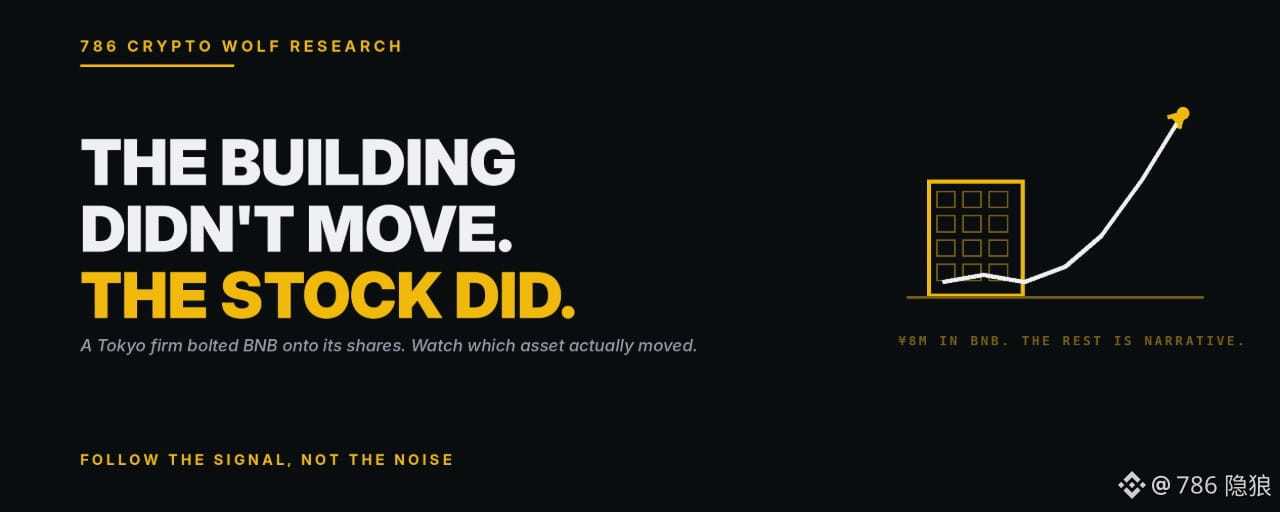
The Building Didn’t Move. The Stock Did.On November 13, a Tokyo-listed real estate company called Asian Star announced it will hand ¥8 million worth of BNB to shareholders holding 100 shares or more, and tokenize Japanese real estate on BNB Chain. Binance’s co-founder called it “Japan’s first, world’s first.” The crypto timeline did what it does: adoption, bullish, the floodgates are opening.
Before you celebrate, do the arithmetic.
The mechanism. ¥8 million is roughly $52,000. For a company listed on the Tokyo Stock Exchange, that isn’t a treasury decision — it’s a marketing budget. No real estate went on-chain in any meaningful ownership sense. What happened is that a small-cap stock attached its name to the single hottest narrative in global finance — and got a story to tell. The asset that actually moved here isn’t a building. It’s the share price.
The hidden dependency. “Tokenizing real estate” sounds like ownership going on-chain. Read the structure. Shareholders receive a token distribution; the company still owns the buildings, controls the payouts, and sets the terms. You don’t hold a deed. You hold an instrument the issuer defines, backed by an asset the issuer keeps. The blockchain is in the press release. The control structure is exactly where it always was.
The human consequence. For shareholders, a BNB sweetener is a nice bonus — a little yield in a token they can sell. For the company, the prize is bigger: a re-rating. “Legacy real-estate firm” becomes “tokenization pioneer,” and the multiple the market pays can change overnight, without a single tenant or building changing hands. That isn’t value creation. It’s narrative arbitrage.
The strategic fork. One read: this is a genuine first domino — real-world assets finally moving on-chain, starting small, a listed company putting its name on the line. The other: “tokenization” is becoming the word small-caps bolt onto a struggling stock to borrow crypto’s heat — the 2026 version of adding “.com” in 1999 or “AI” in 2023. Both have happened before. Only hindsight tells them apart.
The unanswered question. The test isn’t the announcement — it’s March, when the payouts are meant to land, and the months after, when we find out whether any real estate was actually tokenized in a way a holder can own and trade, or whether the chain was always just the story. Until then, watch the share price, not the blockchain. That’s where the real trade is being made.
786 Crypto Wolf Research — Follow the signal, not the noise.
#BNB #RWA #Tokenization #786CryptoWolf
The Building Didn’t Move. The Stock Did.
On November 13, a Tokyo-listed real estate company called Asian Star announced it will hand ¥8 million worth of BNB to shareholders holding 100 shares or more, and tokenize Japanese real estate on BNB Chain. Binance’s co-founder called it “Japan’s first, world’s first.” The crypto timeline did what it does: adoption, bullish, the floodgates are opening.
Before you celebrate, do the arithmetic.
The mechanism. ¥8 million is roughly $52,000. For a company listed on the Tokyo Stock Exchange, that isn’t a treasury decision — it’s a marketing budget. No real estate went on-chain in any meaningful ownership sense. What happened is that a small-cap stock attached its name to the single hottest narrative in global finance — and got a story to tell. The asset that actually moved here isn’t a building. It’s the share price.
The hidden dependency. “Tokenizing real estate” sounds like ownership going on-chain. Read the structure. Shareholders receive a token distribution; the company still owns the buildings, controls the payouts, and sets the terms. You don’t hold a deed. You hold an instrument the issuer defines, backed by an asset the issuer keeps. The blockchain is in the press release. The control structure is exactly where it always was.
The human consequence. For shareholders, a BNB sweetener is a nice bonus — a little yield in a token they can sell. For the company, the prize is bigger: a re-rating. “Legacy real-estate firm” becomes “tokenization pioneer,” and the multiple the market pays can change overnight, without a single tenant or building changing hands. That isn’t value creation. It’s narrative arbitrage.
The strategic fork. One read: this is a genuine first domino — real-world assets finally moving on-chain, starting small, a listed company putting its name on the line. The other: “tokenization” is becoming the word small-caps bolt onto a struggling stock to borrow crypto’s heat — the 2026 version of adding “.com” in 1999 or “AI” in 2023. Both have happened before. Only hindsight tells them apart.
The unanswered question. The test isn’t the announcement — it’s March, when the payouts are meant to land, and the months after, when we find out whether any real estate was actually tokenized in a way a holder can own and trade, or whether the chain was always just the story. Until then, watch the share price, not the blockchain. That’s where the real trade is being made.
786 Crypto Wolf Research — Follow the signal, not the noise.
#BNB #RWA #Tokenization #786CryptoWolf
197
·
--
🚀𝐁𝐑𝐄𝐀𝐊𝐈𝐍𝐆: The FAA has issued a nationwide ground stop for all flights departing to US airports after a “temporary telecommunications outage.” ✈️🇺🇸
4,042 flights bound for the US were already in the air. The FAA says every flight is accounted for, and international flights are handled case by case.
Source: @FAANews, @flightradar24
How is your flight affected? 👇
4,042 flights bound for the US were already in the air. The FAA says every flight is accounted for, and international flights are handled case by case.
Source: @FAANews, @flightradar24
How is your flight affected? 👇

126
·
--
Article
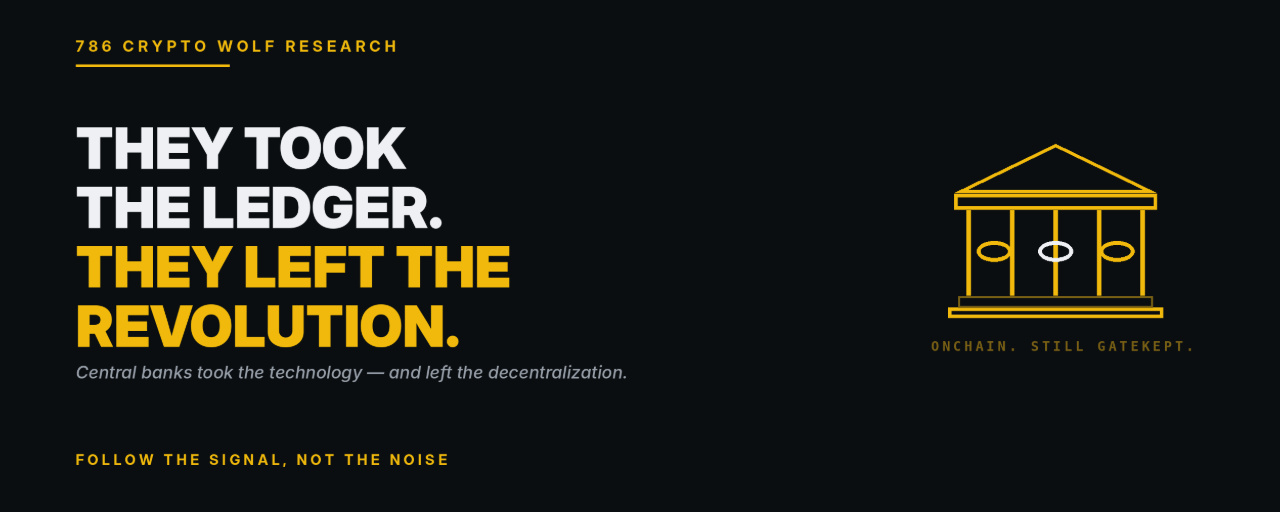
They Took the Ledger. They Left the Revolution.This week three central banks — the Bank of England, the Monetary Authority of Singapore, and the Bank of Thailand — ran Project Meridian FX: an experiment linking their national settlement systems with distributed ledger tech to settle cross-border currency trades atomically, both sides clearing together or not at all. The crypto timeline erupted: “TradFi is going onchain. Game over. Bullish.”
Read what they actually built.
The mechanism. Meridian uses a “synchronisation operator” — a permissioned coordinator that connects existing central-bank systems through a shared ledger. The ledger is real. The efficiency is real. But there is no public blockchain here. No cryptocurrency. No token anyone can buy, hold, or stake. It’s the plumbing of blockchain, installed inside the plumbing of central banking.
The hidden dependency. The cheering assumes “uses a ledger” means “adopted crypto.” But crypto was never just the ledger — a shared database that records transactions is forty years old. What made crypto different was the ledger without a gatekeeper: settlement no single party could approve, reverse, or deny. Central banks kept the gatekeeper. They adopted the technology and quietly rejected the idea underneath it.
The human consequence. Look at who the benefits go to. Faster settlement, less counterparty risk, lower cost — those accrue to the institutions running the system. The decentralization, the self-custody, the permissionlessness — the parts that were supposed to be for you — are exactly what got left out. You can’t own Meridian. You can’t hold it. It makes banks faster. It doesn’t make users freer.
The strategic fork. One read: this normalizes tokenization, and a rising institutional tide eventually lifts every onchain asset. The harder read: it proves institutions can capture every efficiency of blockchain while discarding decentralization entirely — making permissionless crypto not the future of finance, but a niche beside it. Both can look true for a while. Only one survives contact with scale.
The unanswered question. If a settlement rail can be fast, programmable, and onchain without being decentralized, then decentralization no longer gets to justify itself on efficiency. It has to stand on something else — censorship-resistance, self-custody, access for the unbanked. The real question Meridian forces isn’t whether crypto won. It’s: once the institutions have taken the ledger, what is decentralization actually for?
That’s the question worth sitting with. The banks took the part that was easy to copy. What’s left is the part crypto still has to prove was worth building.
786 Crypto Wolf Research — Follow the signal, not the noise.
#Tokenization #CBDC #ProjectMeridian #786CryptoWolf
They Took the Ledger. They Left the Revolution.
This week three central banks — the Bank of England, the Monetary Authority of Singapore, and the Bank of Thailand — ran Project Meridian FX: an experiment linking their national settlement systems with distributed ledger tech to settle cross-border currency trades atomically, both sides clearing together or not at all. The crypto timeline erupted: “TradFi is going onchain. Game over. Bullish.”
Read what they actually built.
The mechanism. Meridian uses a “synchronisation operator” — a permissioned coordinator that connects existing central-bank systems through a shared ledger. The ledger is real. The efficiency is real. But there is no public blockchain here. No cryptocurrency. No token anyone can buy, hold, or stake. It’s the plumbing of blockchain, installed inside the plumbing of central banking.
The hidden dependency. The cheering assumes “uses a ledger” means “adopted crypto.” But crypto was never just the ledger — a shared database that records transactions is forty years old. What made crypto different was the ledger without a gatekeeper: settlement no single party could approve, reverse, or deny. Central banks kept the gatekeeper. They adopted the technology and quietly rejected the idea underneath it.
The human consequence. Look at who the benefits go to. Faster settlement, less counterparty risk, lower cost — those accrue to the institutions running the system. The decentralization, the self-custody, the permissionlessness — the parts that were supposed to be for you — are exactly what got left out. You can’t own Meridian. You can’t hold it. It makes banks faster. It doesn’t make users freer.
The strategic fork. One read: this normalizes tokenization, and a rising institutional tide eventually lifts every onchain asset. The harder read: it proves institutions can capture every efficiency of blockchain while discarding decentralization entirely — making permissionless crypto not the future of finance, but a niche beside it. Both can look true for a while. Only one survives contact with scale.
The unanswered question. If a settlement rail can be fast, programmable, and onchain without being decentralized, then decentralization no longer gets to justify itself on efficiency. It has to stand on something else — censorship-resistance, self-custody, access for the unbanked. The real question Meridian forces isn’t whether crypto won. It’s: once the institutions have taken the ledger, what is decentralization actually for?
That’s the question worth sitting with. The banks took the part that was easy to copy. What’s left is the part crypto still has to prove was worth building.
786 Crypto Wolf Research — Follow the signal, not the noise.
#Tokenization #CBDC #ProjectMeridian #786CryptoWolf
94
·
--

Article
The Biggest Crypto Hack Had Nothing to Do With CryptoOn October 29, the largest crypto theft in history unfolded in about twenty minutes. Roughly $6.3 billion drained out of the world’s biggest exchange. Here’s the part almost no one is saying out loud: the blockchain had nothing to do with it. Not the break-in. Not the repair. Both happened somewhere else entirely.
How it broke. No smart contract was exploited. No cryptographic key was cracked. By Binance’s own account, the attackers didn’t steal private keys at all. They got in through a compromised engineer’s laptop — an internal machine — and used that foothold to push unauthorized withdrawals through the company’s own systems. The most secure idea in crypto, the unbreakable ledger, was never the target. The office was.
How it was repaired. Binance made every user whole — $6.3 billion, one-for-one. That deserves credit; most companies couldn’t. But look at where the money came from: its corporate treasury, its insurance, and its SAFU reserve. Not a protocol. Not a decentralized mechanism. A balance sheet. The recovery, like the attack, lived entirely in the old world.
The hidden dependency. Crypto’s promise is that math protects you — “not your keys, not your coins.” But on an exchange, they were never your keys. Your safety there doesn’t come from cryptography. It comes from one company’s IT hygiene on the way in, and one company’s checkbook on the way out. The chain is a spectator at its own biggest heist.
The human consequence. SAFU worked this time for one reason: Binance is rich enough to absorb a $6.3 billion hit without blinking. “Funds are SAFU” really means “funds are safe because we can afford to cover them.” That’s not decentralization. That’s a bank with a better logo — solvent enough to self-insure, and lucky the number wasn’t bigger.
The strategic fork. This single event is, at once, the strongest argument for self-custody and the strongest argument that centralized crypto is just fintech with extra steps. If you hold your own keys, a laptop in someone’s office can’t touch you. If you don’t, your coins are only as safe as the richest intermediary’s willingness to pay. The $6.3 billion didn’t prove crypto is unsafe — it proved the exchange model is a bank, insured by its own wealth.
The unanswered question. SAFU held because Binance could write the check. The next exchange that gets hit may not be able to. When the balance sheet is smaller than the hack, who makes users whole then? Binance is now rolling out zero-knowledge proofs so users can verify reserves themselves — a quiet admission that “trust us” was the real system all along.
That gap — between “the chain keeps you safe” and “a company’s checkbook keeps you safe” — is the thing worth staring at. The hack was off-chain. The fix was off-chain. Only the headline was about crypto.
786 Crypto Wolf Research — Follow the signal, not the noise.
#Binance #SAFU #CryptoSecurity #786CryptoWolf
The Biggest Crypto Hack Had Nothing to Do With Crypto
On October 29, the largest crypto theft in history unfolded in about twenty minutes. Roughly $6.3 billion drained out of the world’s biggest exchange. Here’s the part almost no one is saying out loud: the blockchain had nothing to do with it. Not the break-in. Not the repair. Both happened somewhere else entirely.
How it broke. No smart contract was exploited. No cryptographic key was cracked. By Binance’s own account, the attackers didn’t steal private keys at all. They got in through a compromised engineer’s laptop — an internal machine — and used that foothold to push unauthorized withdrawals through the company’s own systems. The most secure idea in crypto, the unbreakable ledger, was never the target. The office was.
How it was repaired. Binance made every user whole — $6.3 billion, one-for-one. That deserves credit; most companies couldn’t. But look at where the money came from: its corporate treasury, its insurance, and its SAFU reserve. Not a protocol. Not a decentralized mechanism. A balance sheet. The recovery, like the attack, lived entirely in the old world.
The hidden dependency. Crypto’s promise is that math protects you — “not your keys, not your coins.” But on an exchange, they were never your keys. Your safety there doesn’t come from cryptography. It comes from one company’s IT hygiene on the way in, and one company’s checkbook on the way out. The chain is a spectator at its own biggest heist.
The human consequence. SAFU worked this time for one reason: Binance is rich enough to absorb a $6.3 billion hit without blinking. “Funds are SAFU” really means “funds are safe because we can afford to cover them.” That’s not decentralization. That’s a bank with a better logo — solvent enough to self-insure, and lucky the number wasn’t bigger.
The strategic fork. This single event is, at once, the strongest argument for self-custody and the strongest argument that centralized crypto is just fintech with extra steps. If you hold your own keys, a laptop in someone’s office can’t touch you. If you don’t, your coins are only as safe as the richest intermediary’s willingness to pay. The $6.3 billion didn’t prove crypto is unsafe — it proved the exchange model is a bank, insured by its own wealth.
The unanswered question. SAFU held because Binance could write the check. The next exchange that gets hit may not be able to. When the balance sheet is smaller than the hack, who makes users whole then? Binance is now rolling out zero-knowledge proofs so users can verify reserves themselves — a quiet admission that “trust us” was the real system all along.
That gap — between “the chain keeps you safe” and “a company’s checkbook keeps you safe” — is the thing worth staring at. The hack was off-chain. The fix was off-chain. Only the headline was about crypto.
786 Crypto Wolf Research — Follow the signal, not the noise.
#Binance #SAFU #CryptoSecurity #786CryptoWolf
4
999
·
--
Bearish
They stole $2 billion — and we can see every dollar of it.
North Korea didn’t rob a bank. No vault, no getaway, no cash to vanish. Every coin they took sits on a public ledger: timestamped, traceable, permanent.
Cash would have disappeared. Crypto didn’t.
So the real question isn’t how did they hide it?
It’s: if we can see it all, why can’t we stop it?
Because seeing isn’t stopping.
Freezing stolen funds needs someone — an exchange, a stablecoin issuer, a bridge — to actually act. And before anyone is authorized to move, the money has already split across a dozen chains, run through a mixer, and settled into a pool that may hold your deposit too.
The theft was visible in seconds. The response took weeks.
That gap is the entire war.
North Korea isn’t proof that crypto can’t be traced.
It’s proof that tracing was never the hard part.
We built a system that remembers everything — and reacts to nothing
.
If every stolen dollar is visible on-chain, whose job is it to freeze it:
the exchange, the protocol, or no one?
#LazarusGroup #CryptoSecurity #northkorea #BinanceSquare
🐺 786 CRYPTO WOLF · RESEARCH
Follow the signal, not the noise.
2
2
3.7k
·
--
Article
The Company That Built Its Own BrakeAsk Anthropic’s strongest model a certain kind of question, and something odd happens: it quietly hands you to an older, weaker model instead. Not an error. A design choice.
That hand-off is the entire investment question in one gesture.
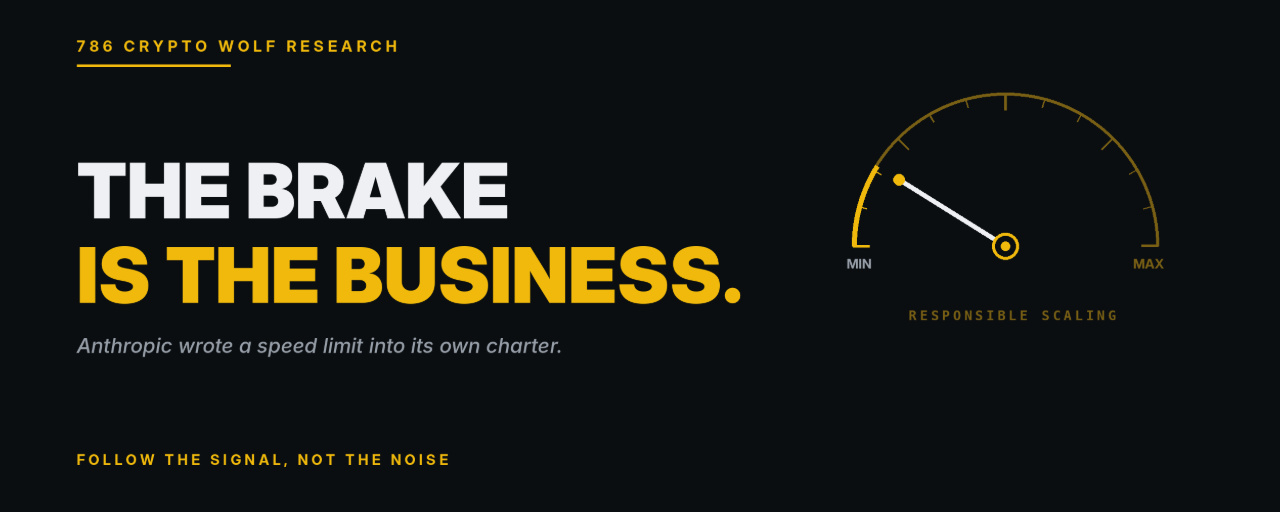
The mechanism. Anthropic releases capability on a leash. Before a model ships, it’s run against the company’s own safety thresholds — its Responsible Scaling framework — and the strongest behavior is gated behind those tests. When a query trips a safeguard, the system is built to route down, to a model that can do less. The product is engineered, in places, to deliberately do less than it can.
The hidden dependency. Most tech you can buy grows on one question: how fast can it go? Anthropic’s growth is tied to a second question the market rarely prices — how much is it allowed to go? The accelerator is real. So is the brake. And the brake is bolted on from the inside.
Why from the inside. This isn’t a slogan, it’s structure. Anthropic is a Public Benefit Corporation — its charter tells leadership to weigh mission against profit, not profit alone. Above the board sits a Long-Term Benefit Trust, built to hold seats ordinary shareholders can’t simply buy. Three brakes — charter, trust, scaling policy — all installed by the company, on the company.
The human consequence. Buy most AI exposure and you’re buying acceleration. Buy this, and you’re buying a company that has promised, in writing, to sometimes slow itself down. The feature some investors fear — “it won’t always do the most” — isn’t a bug in the thesis. It is the thesis.
The strategic fork. One read: restraint is the moat — in a market heading into regulation, “safe by construction” is why the serious buyers pick you. The other read: restraint is a ceiling — rivals who don’t brake ship faster and take the share while you run one more eval. Both can be true for years before the market decides which one priced correctly.
The unanswered question. When the share price and the safety policy finally disagree — and at scale, they will — which one is allowed to win? The charter already has an answer. The market hasn’t priced it yet.
That gap, between what the charter says and what the stock assumes, is the real position you’re taking.
🐺786 Crypto Wolf Research — Follow the signal, not the noise.
#anthropicipo #Anthropic #Aİ #786CryptoWolf
The Company That Built Its Own Brake
Ask Anthropic’s strongest model a certain kind of question, and something odd happens: it quietly hands you to an older, weaker model instead. Not an error. A design choice.
That hand-off is the entire investment question in one gesture.
The mechanism. Anthropic releases capability on a leash. Before a model ships, it’s run against the company’s own safety thresholds — its Responsible Scaling framework — and the strongest behavior is gated behind those tests. When a query trips a safeguard, the system is built to route down, to a model that can do less. The product is engineered, in places, to deliberately do less than it can.
The hidden dependency. Most tech you can buy grows on one question: how fast can it go? Anthropic’s growth is tied to a second question the market rarely prices — how much is it allowed to go? The accelerator is real. So is the brake. And the brake is bolted on from the inside.
Why from the inside. This isn’t a slogan, it’s structure. Anthropic is a Public Benefit Corporation — its charter tells leadership to weigh mission against profit, not profit alone. Above the board sits a Long-Term Benefit Trust, built to hold seats ordinary shareholders can’t simply buy. Three brakes — charter, trust, scaling policy — all installed by the company, on the company.
The human consequence. Buy most AI exposure and you’re buying acceleration. Buy this, and you’re buying a company that has promised, in writing, to sometimes slow itself down. The feature some investors fear — “it won’t always do the most” — isn’t a bug in the thesis. It is the thesis.
The strategic fork. One read: restraint is the moat — in a market heading into regulation, “safe by construction” is why the serious buyers pick you. The other read: restraint is a ceiling — rivals who don’t brake ship faster and take the share while you run one more eval. Both can be true for years before the market decides which one priced correctly.
The unanswered question. When the share price and the safety policy finally disagree — and at scale, they will — which one is allowed to win? The charter already has an answer. The market hasn’t priced it yet.
That gap, between what the charter says and what the stock assumes, is the real position you’re taking.
🐺786 Crypto Wolf Research — Follow the signal, not the noise.
#anthropicipo #Anthropic #Aİ #786CryptoWolf
210
·
--
Article
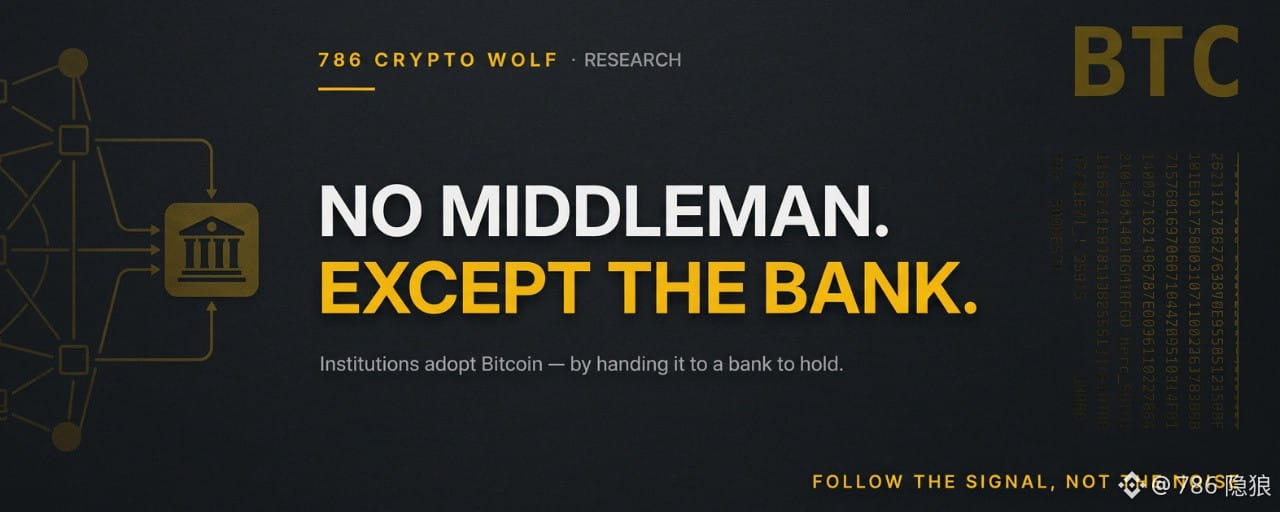
Crypto Hired a BankThe most “bullish” crypto headline of the week is also its quietest surrender.
On November 11, Deutsche Bank — one of the largest banks on earth — switched on crypto custody for its institutional clients. Hedge funds, asset managers, corporations and sovereign institutions can now hand their Bitcoin, Ether and stablecoins to the bank to hold. Germany first, the rest of the EU under MiCA next, Asia in 2027.
The market read it as what it looks like: adoption. Another pillar. Institutions are in. And they’re not wrong.
But look at what “institutions are in” actually requires.
An institution will not touch Bitcoin until someone it trusts agrees to hold it. Not a promise of it — the actual keys. And the entity the financial world trusts most to hold things is the one Bitcoin was designed to make unnecessary: a bank.
So the headline everyone is cheering — “banks are custodying crypto” — is, underneath, a reversal. The asset built to remove the middleman is now held by the middleman. Self-custody was the whole point. Institutional crypto is custodial by definition.
That’s not a scandal. It’s the trade. Institutions don’t want to be their own bank; they want a bank. Deutsche Bank is simply the one that said yes first, at scale.
Here’s the part the “bullish milestone” posts skip.
When you deposit euros at Deutsche Bank, a deposit-guarantee scheme stands behind them up to a limit. If the bank fails, you’re covered. Custodied crypto is not a deposit. It’s an asset the bank holds for you — and it carries no such insurance. You get the bank’s name, its security, its reputation. You do not get the safety net that makes a bank deposit a bank deposit.
So the institution re-introduces the intermediary crypto was built to remove — and gives up the one protection that intermediary normally provides. Middleman back. Backstop gone.
Now the honest part, because it cuts two ways.
Read it one way, this is maturation: real custody, real regulation (BaFin, MiCA), real institutional money finally able to participate safely. Genuinely good for the asset class.
Read it another way, it’s crypto quietly becoming the thing it was built to replace — a system where a few trusted institutions hold everyone’s value, under rules written by regulators, with retail left out entirely (this launch skips retail).
Both are true. Adoption and decentralization are not the same direction. This week, they moved apart.
Every step toward “institutional adoption” is a step toward re-intermediation. The more crypto succeeds at being accepted, the more it resembles the banking system it set out to route around. That may not be failure — it might be inevitable. But it’s worth naming, because the people cheering “banks are in!” are cheering the exact outcome Bitcoin’s whitepaper was a rejection of.
If a bank now holds the Bitcoin, writes the rules with the regulator, and leaves retail outside — what, exactly, did Bitcoin decentralize?
🐺 786 CRYPTO WOLF · RESEARCH
Follow the signal, not the noise.
$BTC
#DeutscheBank #bitcoin #cryptocustody #AlphaWolfHQ #786CryptoWolf
Crypto Hired a Bank
The most “bullish” crypto headline of the week is also its quietest surrender.
On November 11, Deutsche Bank — one of the largest banks on earth — switched on crypto custody for its institutional clients. Hedge funds, asset managers, corporations and sovereign institutions can now hand their Bitcoin, Ether and stablecoins to the bank to hold. Germany first, the rest of the EU under MiCA next, Asia in 2027.
The market read it as what it looks like: adoption. Another pillar. Institutions are in. And they’re not wrong.
But look at what “institutions are in” actually requires.
An institution will not touch Bitcoin until someone it trusts agrees to hold it. Not a promise of it — the actual keys. And the entity the financial world trusts most to hold things is the one Bitcoin was designed to make unnecessary: a bank.
So the headline everyone is cheering — “banks are custodying crypto” — is, underneath, a reversal. The asset built to remove the middleman is now held by the middleman. Self-custody was the whole point. Institutional crypto is custodial by definition.
That’s not a scandal. It’s the trade. Institutions don’t want to be their own bank; they want a bank. Deutsche Bank is simply the one that said yes first, at scale.
Here’s the part the “bullish milestone” posts skip.
When you deposit euros at Deutsche Bank, a deposit-guarantee scheme stands behind them up to a limit. If the bank fails, you’re covered. Custodied crypto is not a deposit. It’s an asset the bank holds for you — and it carries no such insurance. You get the bank’s name, its security, its reputation. You do not get the safety net that makes a bank deposit a bank deposit.
So the institution re-introduces the intermediary crypto was built to remove — and gives up the one protection that intermediary normally provides. Middleman back. Backstop gone.
Now the honest part, because it cuts two ways.
Read it one way, this is maturation: real custody, real regulation (BaFin, MiCA), real institutional money finally able to participate safely. Genuinely good for the asset class.
Read it another way, it’s crypto quietly becoming the thing it was built to replace — a system where a few trusted institutions hold everyone’s value, under rules written by regulators, with retail left out entirely (this launch skips retail).
Both are true. Adoption and decentralization are not the same direction. This week, they moved apart.
Every step toward “institutional adoption” is a step toward re-intermediation. The more crypto succeeds at being accepted, the more it resembles the banking system it set out to route around. That may not be failure — it might be inevitable. But it’s worth naming, because the people cheering “banks are in!” are cheering the exact outcome Bitcoin’s whitepaper was a rejection of.
If a bank now holds the Bitcoin, writes the rules with the regulator, and leaves retail outside — what, exactly, did Bitcoin decentralize?
🐺 786 CRYPTO WOLF · RESEARCH
Follow the signal, not the noise.
$BTC
#DeutscheBank #bitcoin #cryptocustody #AlphaWolfHQ #786CryptoWolf
1
316
·
--
Article
You Can Buy Anthropic. You Can’t Steer It.Can Anthropic hold a trillion dollars? That depends less on the number — and more on who’s allowed to defend it. Spoiler: it won’t be you.
Sometime before Thanksgiving, a retail investor will open their brokerage app, type three letters — ANT — and buy a piece of one of the most valuable companies ever to go public. Anthropic, the lab behind Claude, is targeting an IPO at a reported $1.5–2 trillion valuation. For the first time, the public gets in.
They’ll own a share. What they won’t own is a say.
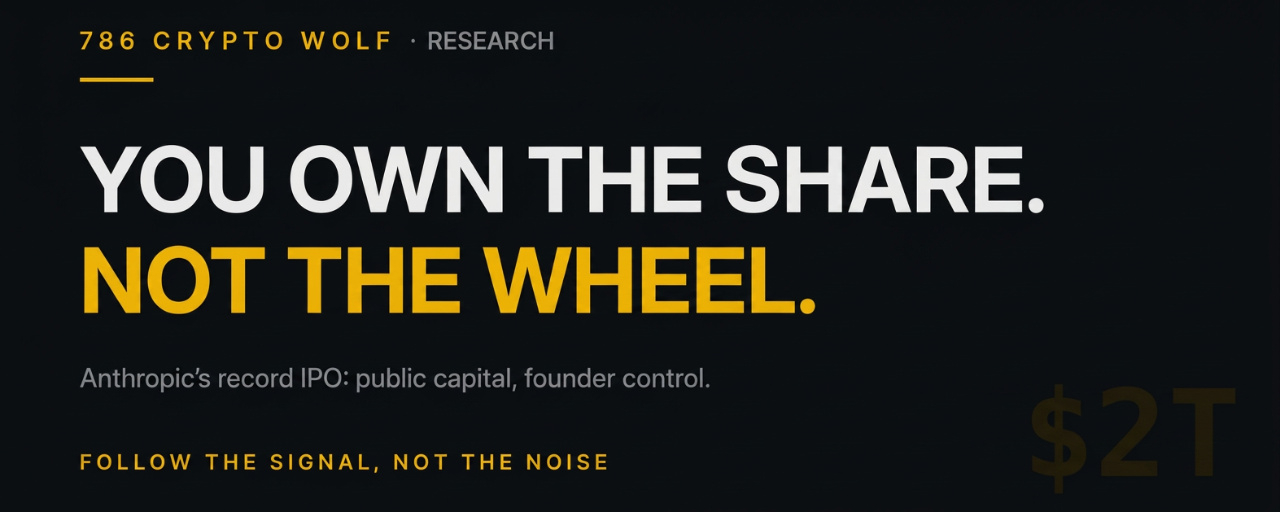
The detail buried under the headline number is the structure. Reports point to a dual-class setup where founders keep super-voting power, sitting alongside Anthropic’s Long-Term Benefit Trust — a body built to steer the company toward its safety mission rather than toward quarterly profit.
Translate that: the public provides the capital. The founders and the Trust keep the controls. You buy the upside; you don’t buy the wheel.
This isn’t unique — Google and Meta did versions of it. But at a two-trillion-dollar debut for a company whose entire pitch is “we will make decisions others won’t,” the gap between who funds it and who governs it is the whole story.
Picture the buyer. They believe in AI. They missed NVIDIA early, missed OpenAI entirely (still private), and don’t want to miss again. So they buy ANT at a record valuation set by insiders — and get exposure to the outcome, but no vote on how it’s reached. If Anthropic slows a launch for a safety review that dents next quarter’s numbers, the shareholder absorbs the stock reaction. They can’t vote on the call. They can only sell.
Ownership used to mean a voice. Here it means a ticket to watch.
Now the honest part, because this cuts two ways.
Read it one way, and the structure betrays what “going public” is supposed to mean: take the public’s money, keep the public out of the decisions. Accountability stays with insiders; risk flows to retail.
Read it the other way, and the structure is the only thing protecting the mission. Public markets are relentless machines for extracting short-term growth. A company that promises to sometimes choose caution over speed cannot survive a shareholder base that punishes every careful quarter. The super-voting shares and the Trust are the seatbelt that lets the mission survive the market.
Both are true at once. That’s what makes it a real question, not a headline.
This is becoming the template for how AI’s biggest labs meet the public: raise enormous sums from everyone, keep control with a few. The industry that promises to decentralize intelligence is centralizing its own governance — on purpose, and arguably for good reason.
For the buyer, the lesson isn’t “avoid” or “buy.” It’s: know what the share actually is. A claim on the outcome — not a hand on the wheel.
So before you type those three letters, one question is worth more than any price target:
When you buy a share with no vote, are you an owner — or a lender who hopes the people with the wheel drive where you think they will?
#AnthropicIPO #Anthropic #Aİ #IPO #AlphaWolfHQ
🐺 786 CRYPTO WOLF · RESEARCH
Follow the signal, not the noise.
You Can Buy Anthropic. You Can’t Steer It.
Can Anthropic hold a trillion dollars? That depends less on the number — and more on who’s allowed to defend it. Spoiler: it won’t be you.
Sometime before Thanksgiving, a retail investor will open their brokerage app, type three letters — ANT — and buy a piece of one of the most valuable companies ever to go public. Anthropic, the lab behind Claude, is targeting an IPO at a reported $1.5–2 trillion valuation. For the first time, the public gets in.
They’ll own a share. What they won’t own is a say.
The detail buried under the headline number is the structure. Reports point to a dual-class setup where founders keep super-voting power, sitting alongside Anthropic’s Long-Term Benefit Trust — a body built to steer the company toward its safety mission rather than toward quarterly profit.
Translate that: the public provides the capital. The founders and the Trust keep the controls. You buy the upside; you don’t buy the wheel.
This isn’t unique — Google and Meta did versions of it. But at a two-trillion-dollar debut for a company whose entire pitch is “we will make decisions others won’t,” the gap between who funds it and who governs it is the whole story.
Picture the buyer. They believe in AI. They missed NVIDIA early, missed OpenAI entirely (still private), and don’t want to miss again. So they buy ANT at a record valuation set by insiders — and get exposure to the outcome, but no vote on how it’s reached. If Anthropic slows a launch for a safety review that dents next quarter’s numbers, the shareholder absorbs the stock reaction. They can’t vote on the call. They can only sell.
Ownership used to mean a voice. Here it means a ticket to watch.
Now the honest part, because this cuts two ways.
Read it one way, and the structure betrays what “going public” is supposed to mean: take the public’s money, keep the public out of the decisions. Accountability stays with insiders; risk flows to retail.
Read it the other way, and the structure is the only thing protecting the mission. Public markets are relentless machines for extracting short-term growth. A company that promises to sometimes choose caution over speed cannot survive a shareholder base that punishes every careful quarter. The super-voting shares and the Trust are the seatbelt that lets the mission survive the market.
Both are true at once. That’s what makes it a real question, not a headline.
This is becoming the template for how AI’s biggest labs meet the public: raise enormous sums from everyone, keep control with a few. The industry that promises to decentralize intelligence is centralizing its own governance — on purpose, and arguably for good reason.
For the buyer, the lesson isn’t “avoid” or “buy.” It’s: know what the share actually is. A claim on the outcome — not a hand on the wheel.
So before you type those three letters, one question is worth more than any price target:
When you buy a share with no vote, are you an owner — or a lender who hopes the people with the wheel drive where you think they will?
#AnthropicIPO #Anthropic #Aİ #IPO #AlphaWolfHQ
🐺 786 CRYPTO WOLF · RESEARCH
Follow the signal, not the noise.
321
·
--
Bearish
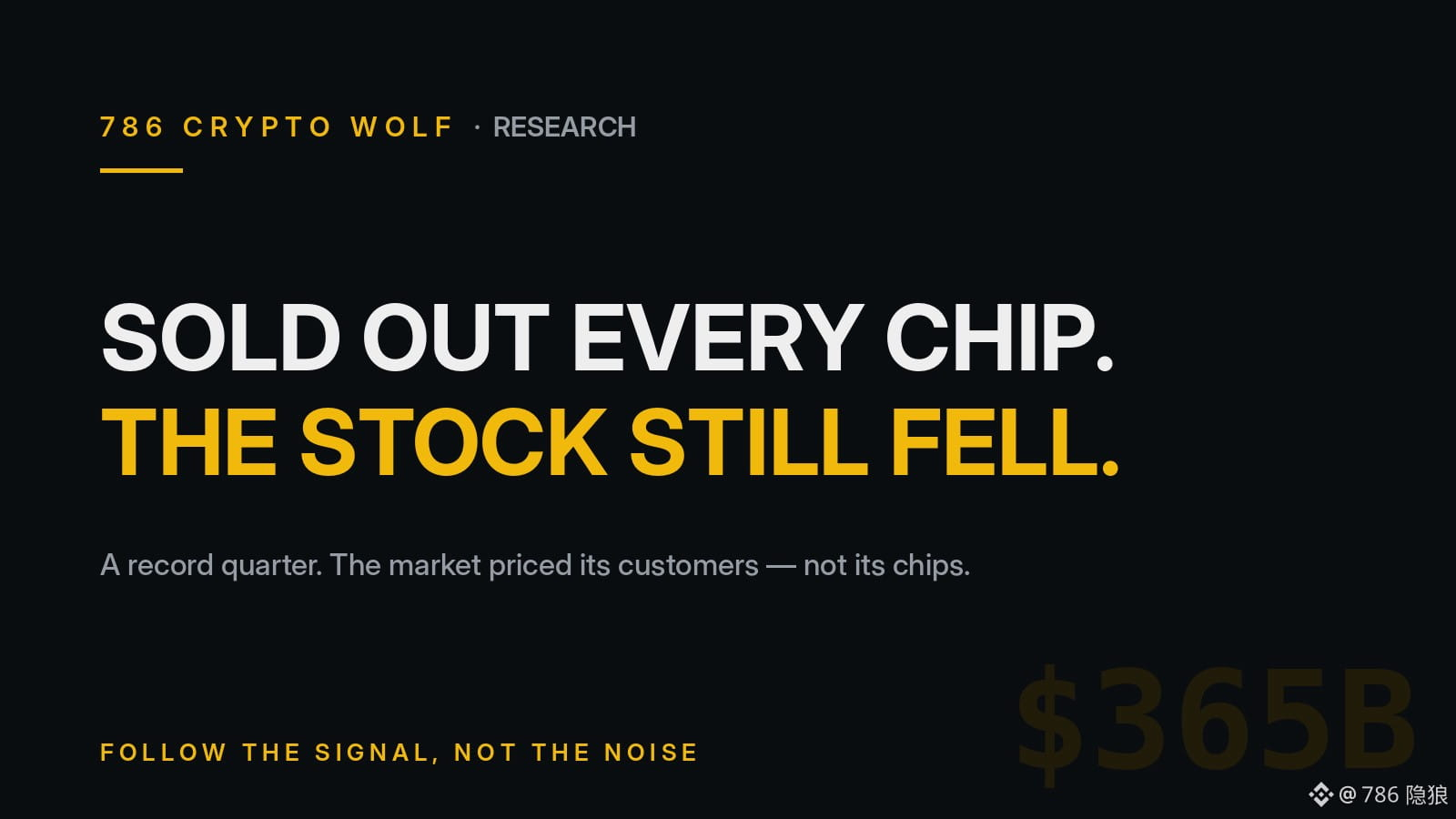
𝐍𝐕𝐈𝐃𝐈𝐀 𝐬𝐨𝐥𝐝 𝐨𝐮𝐭 𝐞𝐯𝐞𝐫𝐲 𝐜𝐡𝐢𝐩 𝐢𝐭 𝐦𝐚𝐝𝐞. 𝐓𝐡𝐞 𝐬𝐭𝐨𝐜𝐤 𝐟𝐞𝐥𝐥 𝐚𝐧𝐲𝐰𝐚𝐲.
Record quarter. Revenue +62%. Every data-center GPU gone. The next day,~$𝟑𝟔𝟓𝐁 𝐢𝐧 𝐦𝐚𝐫𝐤𝐞𝐭 𝐯𝐚𝐥𝐮𝐞 𝐯𝐚𝐧𝐢𝐬𝐡𝐞𝐝.
If selling out doesn’t lift the price, the price was never about the chips.
Here’s the dependency nobody prices out loud: 𝐍𝐕𝐈𝐃𝐈𝐀’𝐬 𝐫𝐞𝐯𝐞𝐧𝐮𝐞 𝐈𝐒 𝐭𝐡𝐞 𝐀𝐈 𝐢𝐧𝐝𝐮𝐬𝐭𝐫𝐲’𝐬 𝐬𝐩𝐞𝐧𝐝𝐢𝐧𝐠. Every chip sold is a bet that some buyer — OpenAI, a hyperscaler — earns that money back someday.
The market wasn’t doubting NVIDIA could sell. It was doubting whether the buyers can ever 𝐩𝐚𝐲 𝐢𝐭 𝐨𝐟𝐟.
Jensen Huang said it himself: “Bad quarter — proof of a bubble. Great quarter — we’re fueling the bubble.” Damned both ways — because the stock was never about the quarter.
A record quarter became the problem. That’s what a confidence market looks like the moment confidence cracks.
𝐖𝐡𝐞𝐧 𝐚 𝐜𝐨𝐦𝐩𝐚𝐧𝐲 𝐬𝐞𝐥𝐥𝐬 𝐨𝐮𝐭 𝐚𝐧𝐝 𝐬𝐭𝐢𝐥𝐥 𝐝𝐫𝐨𝐩𝐬 — 𝐢𝐬 𝐭𝐡𝐞 𝐦𝐚𝐫𝐤𝐞𝐭 𝐩𝐫𝐢𝐜𝐢𝐧𝐠 𝐭𝐡𝐞 𝐜𝐨𝐦𝐩𝐚𝐧𝐲, 𝐨𝐫 𝐞𝐯𝐞𝐫𝐲𝐨𝐧𝐞 𝐰𝐡𝐨 𝐨𝐰𝐞𝐬 𝐢𝐭 𝐦𝐨𝐧𝐞𝐲?
#AIChipSlumpNasdaq #AlphaWolfHQ #786CryptoWolf
#NVIDIA #AIBubble
🐺 𝟕𝟖𝟔 𝐂𝐑𝐘𝐏𝐓𝐎 𝐖𝐎𝐋𝐅 · 𝐑𝐄𝐒𝐄𝐀𝐑𝐂𝐇
𝓕𝓸𝓵𝓵𝓸𝔀 𝓽𝓱𝓮 𝓼𝓲𝓰𝓷𝓪𝓵, 𝓷𝓸𝓽 𝓽𝓱𝓮 𝓷𝓸𝓲𝓼𝓮.
1
242
·
--
Bearish
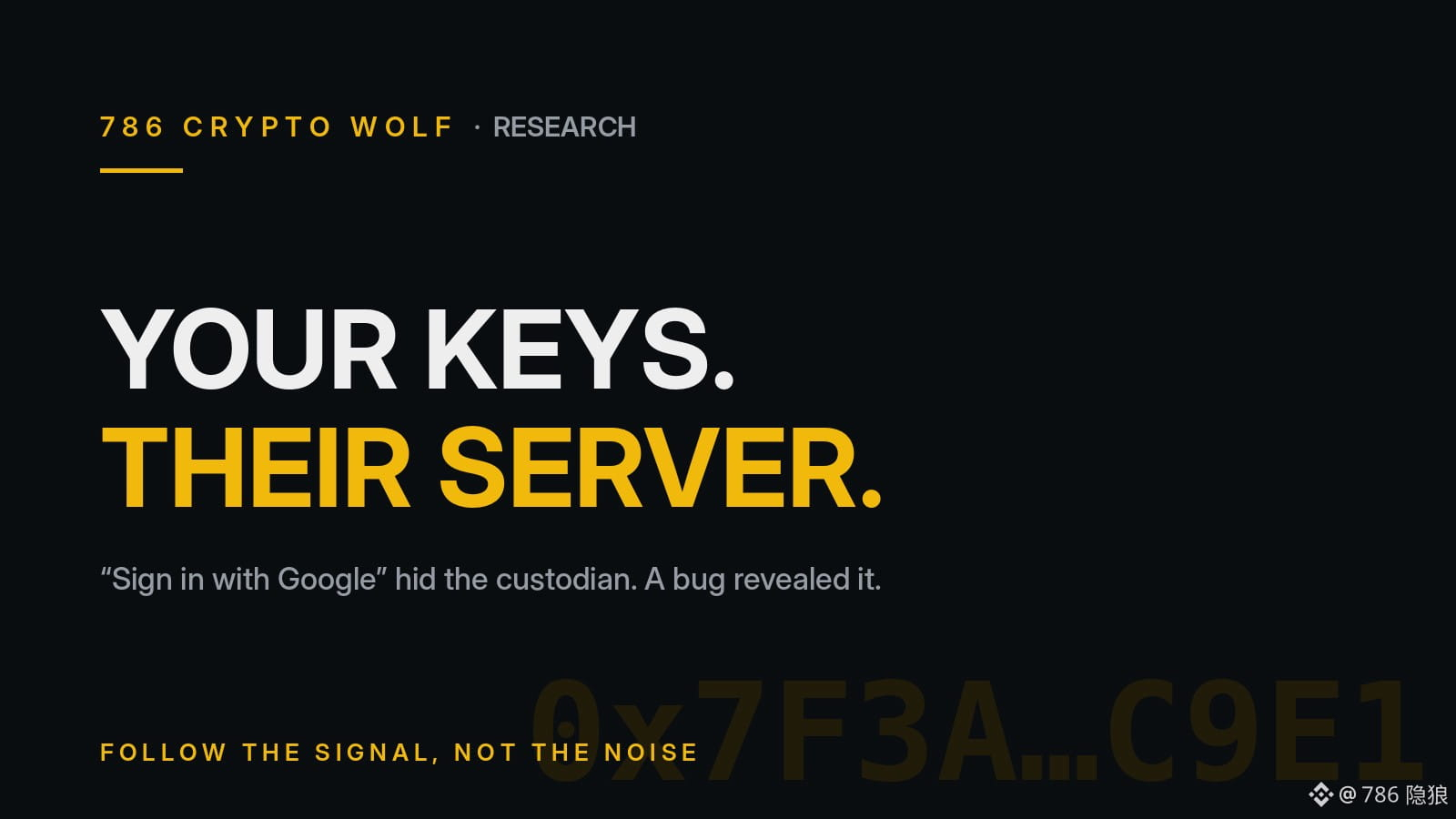
𝒀𝒐𝒖 𝒕𝒉𝒐𝒖𝒈𝒉𝒕 𝒚𝒐𝒖 𝒉𝒆𝒍𝒅 𝒚𝒐𝒖𝒓 𝒌𝒆𝒚𝒔. 𝑨 𝒃𝒖𝒈 𝒋𝒖𝒔𝒕 𝒑𝒓𝒐𝒗𝒆𝒅 𝒚𝒐𝒖 𝒅𝒊𝒅𝒏’𝒕.
This week, a flaw in Web3Auth exposed the private keys of users who signed into their wallets with a 𝐬𝐨𝐜𝐢𝐚𝐥 𝐥𝐨𝐠𝐢𝐧.Keplr told them to move their funds immediately.
No phishing. No leaked seed phrase. No careless click. Just a bug — in the “convenience” layer everyone told you was safe.
When a wallet lets you “sign in with Google,” it doesn’t remove the private key. 𝐈𝐭 𝐡𝐢𝐝𝐞𝐬 𝐢𝐭 —derived and managed through a company’s infrastructure you never audited.
You felt self-custodial. You were 𝐜𝐮𝐬𝐭𝐨𝐝𝐢𝐚𝐥 𝐰𝐢𝐭𝐡 𝐞𝐱𝐭𝐫𝐚 𝐬𝐭𝐞𝐩𝐬.
The seed phrase scared newcomers away, so the industry solved it by 𝐛𝐮𝐫𝐲𝐢𝐧𝐠 𝐭𝐡𝐞 𝐜𝐮𝐬𝐭𝐨𝐝𝐢𝐚𝐧, 𝐧𝐨𝐭 𝐫𝐞𝐦𝐨𝐯𝐢𝐧𝐠 𝐢𝐭.“Be your own bank” quietly became “trust our login.” And when their server has a bad week, the user who did everything right still has to race to save their own funds.
Self-custody protects your keys — 𝘰𝘯𝘭𝘺 𝘪𝘧 𝘵𝘩𝘦 𝘬𝘦𝘺𝘴 𝘸𝘦𝘳𝘦 𝘦𝘷𝘦𝘳 𝘢𝘤𝘵𝘶𝘢𝘭𝘭𝘺 𝘺𝘰𝘶𝘳𝘴.
𝐈𝐟 𝐚 𝐥𝐨𝐠𝐢𝐧 𝐛𝐮𝐠 𝐜𝐚𝐧 𝐥𝐞𝐚𝐤 𝐲𝐨𝐮𝐫 𝐩𝐫𝐢𝐯𝐚𝐭𝐞 𝐤𝐞𝐲, 𝐰𝐞𝐫𝐞 𝐲𝐨𝐮 𝐞𝐯𝐞𝐫 𝐬𝐞𝐥𝐟-𝐜𝐮𝐬𝐭𝐨𝐝𝐢𝐚𝐥 — 𝐨𝐫 𝐣𝐮𝐬𝐭 𝐜𝐮𝐬𝐭𝐨𝐝𝐢𝐚𝐥, 𝐰𝐢𝐭𝐡 𝐚 𝐧𝐢𝐜𝐞𝐫 𝐢𝐧𝐭𝐞𝐫𝐟𝐚𝐜𝐞?
🐺 𝟕𝟖𝟔 𝐂𝐑𝐘𝐏𝐓𝐎 𝐖𝐎𝐋𝐅 · 𝐑𝐄𝐒𝐄𝐀𝐑𝐂𝐇
Follow the signal, not the noise.
$BTC $ETH
#KeplrAdvisesSocialLoginUsersToTransferAssets
#SelfCustody #CryptoSecurity #Web3Auth #786CryptoWolf
140
Log in to explore more content
Join global crypto users on Binance Square
⚡️ Get latest and useful information about crypto.
💬 Trusted by the world’s largest crypto exchange.
👍 Discover real insights from verified creators.
Email / Phone number
Trending Topics
BTCReboundsAbove$60KAmidWhaleDipBuying
4,086 views
44 Discussing
Abraxas Capital, Other Whales Buy the BTC Dip as Bitcoin Briefly Reclaims $60,000
Binance News
·12 Likes
·11.5k views
NvidiaLoses$2.7TrillionInMonthAndAHalf
42,665 views
202 Discussing
GlobalStocksFaceLongestLosingStreakSince2023
390,844 views
2,564 Discussing