

PositiveMindsGlobalResults
459 Posts

PositiveMindsGlobalResults
Report
Block User
Positivity isn't a luxury. Pain exists everywhere, but so does resilience. Practicing positivity without borders proves empathy is universally understood.

BNB Holder
Occasional Trader
2.2 Years
2.5K+ Following
2.8K+ Followers
1.1K+ Liked
Posts
All
Quotes
Videos
Live
PINNED
#EarningsSeason Cybersecurity is not just about protecting passwords; it is about protecting trust. Even emails from familiar contacts can become dangerous when accounts are compromised. #CZ reminder highlights an essential lesson for everyone in the digital world: Think before you click, verify before you download, and never let familiarity replace caution. In crypto, one careless click can cost more than money — it can cost your entire digital security. 🔥🔐
🌍#PositiveMindsGlobalResults [ ](https://www.binance.com/square/hashtag/PositiveMindsGlobalResults)| Positivity Without Borders | Invest, Learn, Grow, Together | Binance Square
📅 October 30, 2026
#ThinkBeforeYouClickProtectYourCrypto #CyberSecurityAwareness #CZ #CryptoSecurity #PositiveMindsGlobalResults #BinanceSquare
{spot}(BNBUSDT)
#EarningsSeason Cybersecurity is not just about protecting passwords; it is about protecting trust. Even emails from familiar contacts can become dangerous when accounts are compromised. #CZ reminder highlights an essential lesson for everyone in the digital world: Think before you click, verify before you download, and never let familiarity replace caution. In crypto, one careless click can cost more than money — it can cost your entire digital security. 🔥🔐
🌍#PositiveMindsGlobalResults | Positivity Without Borders | Invest, Learn, Grow, Together | Binance Square
📅 October 30, 2026
#ThinkBeforeYouClickProtectYourCrypto #CyberSecurityAwareness #CZ #CryptoSecurity #PositiveMindsGlobalResults #BinanceSquare
🌍#PositiveMindsGlobalResults | Positivity Without Borders | Invest, Learn, Grow, Together | Binance Square
📅 October 30, 2026
#ThinkBeforeYouClickProtectYourCrypto #CyberSecurityAwareness #CZ #CryptoSecurity #PositiveMindsGlobalResults #BinanceSquare

33
·
--
Bearish
Cybersecurity is not just about protecting passwords; it is about protecting trust.
Even emails from familiar contacts can become dangerous when accounts are compromised. #CZ reminder highlights an essential lesson for everyone in the digital world: Think before you click, verify before you download, and never let familiarity replace caution. In crypto, one careless click can cost more than money — it can cost your entire digital security.
🌍#PositiveMindsGlobalResults [ ](https://www.binance.com/square/hashtag/PositiveMindsGlobalResults)| Positivity Without Borders | Invest, Learn, Grow, Together | Binance Square
📅 October 30, 2026
Cybersecurity is not just about protecting passwords; it is about protecting trust.
Even emails from familiar contacts can become dangerous when accounts are compromised. #CZ reminder highlights an essential lesson for everyone in the digital world: Think before you click, verify before you download, and never let familiarity replace caution. In crypto, one careless click can cost more than money — it can cost your entire digital security.
🌍#PositiveMindsGlobalResults | Positivity Without Borders | Invest, Learn, Grow, Together | Binance Square
📅 October 30, 2026


Crypto Ahmet
·
--
@CZ warned users not to click links in emails or download attachments, even from people they trust, as they could contain viruses. #ElonMusk reacted to CZ’s post with fire and laughing emojis.
$DOGE $BNB $BTC
#$1.5BInLeveragedCryptoBetsLiquidated #USMidtermElections #BinanceWillListPredictPREDICT #CZ
$DOGE $BNB $BTC
#$1.5BInLeveragedCryptoBetsLiquidated #USMidtermElections #BinanceWillListPredictPREDICT #CZ

1
31

Article
Bitcoin Under $78K: Binance’s $6.3B Security Crisis Shakes BTC, BNB & ETH#Bitcoin78KBinance63BSecurityCrisis 🌍#PositiveMindsGlobalResults [ ](https://www.binance.com/en/square/hashtag/PositiveMindsGlobalResults)| Positivity Without Borders | Invest, Learn, Grow, Together | Binance Square
📅 October 30, 2026
Market Outlook: Next 24 Hours
📉 Crypto Markets Face a Critical Confidence Test
The cryptocurrency market is experiencing renewed selling pressure as technology-sector weakness, concerns about exchange security, and leveraged liquidations combine to undermine investor confidence.
Bitcoin has dropped below the psychologically important $80,000 level, while Ethereum and BNB have also recorded substantial losses. The latest sell-off highlights how quickly market sentiment can deteriorate when financial-market uncertainty coincides with a major cryptocurrency security incident.
According to an October 30 report, approximately $356 million in crypto futures positions were liquidated over the previous 24 hours, including $205 million in liquidated long positions. Subsequent reports indicated that liquidations accelerated as security concerns intensified, with one report putting the rolling 24-hour total at $1.52 billion. These figures cover different reporting periods and should not be added together.
🔐 Binance Security Incident: What Has Been Confirmed?
On October 30, Binance published an official security update estimating the incident's total impact at approximately $6.3 billion.
The exchange reported the following:
Estimated total impact: Approximately $6.3 billion.Assets frozen on-chain: Approximately $3 billion, according to Binance.Initial suspected attack vector: A potentially compromised laptop belonging to a DevOps engineer, which may have enabled unauthorized withdrawal transactions through a service container.Wallet private keys: Binance said its initial investigation had found no evidence that wallet private keys were leaked.Customer losses: Binance stated that it would cover all losses using its Secure Asset Fund for Users (SAFU) and company funds.Investigation: The exchange said it was working with blockchain partners and law enforcement to trace and recover affected assets.
Binance also announced temporary suspensions of deposits and withdrawals while security checks were conducted. Its technical investigation was still ongoing when the announcement was published.
Important distinction: The $6.3 billion figure represents Binance' estimated total impact. It should not automatically be interpreted as a final, independently verified net loss. The ultimate amount lost, recovered, or otherwise affected requires further confirmation.
For traders, the immediate concern is whether confidence can stabilize and whether the incident creates additional uncertainty across the wider digital-asset market.
📊 BTC, BNB & ETH: Market Snapshot
A market-data snapshot published on October 30 reported the following indicative prices:
Cryptocurrency Reported Price24-Hour Change
₿ Bitcoin (BTC) $77,140.44 -4.82%🔶
BNB $696.46 -7.79%♦️
Ethereum (ETH) $2,221.13 -5.50%
₿ 1. Bitcoin (BTC): Can Buyers Defend $77,000?
Market bias: Cautious to bearish
Bitcoin's decline below $80,000 places greater importance on nearby support levels. A sustained recovery would require buyers to regain control and overcome resistance rather than relying on a brief rebound.
Key technical reference levels:
🟢 Immediate support: $77,000–$77,300🔵 Secondary support: $76,000–$76,950🔴 Immediate resistance: $79,000–$80,000🔴 Stronger resistance: $81,500–$82,000
Bullish scenario: If BTC holds its nearby support and reclaims $80,000, a recovery toward $81,500–$82,000 becomes a possibility. Stronger buying volume and improving market confidence would support this scenario.
Bearish scenario: A decisive break below $76,000 could expose BTC to additional downside, with the next areas of interest potentially around $74,000–$75,000.
What matters most: Watch whether Bitcoin can establish a stable base above $76,000–$77,000. A temporary bounce alone would not confirm that the downtrend has ended.
These levels are technical estimates informed by recent trading and liquidation references, not guaranteed price targets.
🔶 2. BNB: Exchange Concerns Keep Pressure Elevated
Market bias: Bearish until key resistance is recovered
BNB has faced considerable selling pressure alongside the wider market. Its connection to the Binance ecosystem makes developments surrounding the exchange particularly relevant to sentiment, although the token's price cannot be attributed to the security incident alone.
Key technical reference levels:
🟢 Potential support: $680–$690🔵 Secondary support: $650–$670🔴 Immediate resistance: $710–$720🔴 Stronger resistance: $730–$740
These are estimated monitoring zones based on the reported price and recent market conditions, rather than independently verified support and resistance levels.
Bullish scenario: A recovery above $720, followed by a sustained move toward $730–$740, could indicate improving momentum.
Bearish scenario: If BNB loses the $680 area decisively, further weakness toward $650–$670 becomes possible.
What matters most: Watch official Binance security updates, the status of deposits and withdrawals, trading volume, and BNB's relative performance against BTC and ETH.
The exchange's response may influence sentiment, but it does not guarantee a recovery in BNB's price.
♦️ 3. Ethereum (ETH): Can $2,200 Hold?
Market bias: Cautious to bearish
Ethereum has weakened alongside Bitcoin as investors reduce exposure to volatile assets. Its next move will depend on whether buyers defend nearby support and whether broader market conditions improve.
Key technical reference levels:
🟢 Immediate support: $2,180–$2,220🔵 Secondary support: $2,100–$2,150🔴 Immediate resistance: $2,280–$2,320🔴 Stronger resistance: $2,350–$2,400
These zones are estimates based on recent reported prices and trading conditions.
Bullish scenario: A sustained recovery above $2,320 could create an opportunity for ETH to test $2,350–$2,400.
Bearish scenario: A decisive move below $2,180 could expose the $2,100–$2,150 area. A further breakdown would increase downside risk.
What matters most: Look for improving spot demand, stronger trading volume, and confirmation that ETH can hold its support rather than simply following a short-lived Bitcoin rebound.
🌍 4. What Could Move Crypto Over the Next 24 Hours?
Four factors deserve close attention:
1. Binance's security investigation
Further verified information about the affected assets, recovery efforts, and the restoration of normal
exchange operations could influence confidence across the market.
2. Bitcoin's support levels
Bitcoin's ability to stabilize around $76,000–$77,000 could help determine whether the broader market consolidates or experiences another wave of selling.
3. Leveraged liquidations
Rapid price movements can trigger forced closures of leveraged positions, potentially amplifying volatility in either direction. Liquidation figures should always be interpreted with their reporting period in mind.
4. Global risk sentiment
Weakness in technology stocks, interest-rate expectations, bond yields, and broader investor risk appetite can influence demand for speculative assets. However, correlation does not prove that any single macroeconomic development caused a particular crypto move.
🔮 Next 24-Hour Outlook: Bullish, Neutral or Bearish?
My assessment: Cautious to bearish, with the possibility of a relief rebound.
Asset Bullish Confirmation Bearish Warning
BTC Sustained recovery above $80,000 Breakdown below $76,000
BNB Sustained recovery above $720–$740 Breakdown below $680
ETH Sustained recovery above $2,320–$2,350 Breakdown below $2,180
These are conditional scenarios, not predictions of guaranteed outcomes. A recovery through resistance could improve the outlook, while a breakdown through support could deepen losses.
If volatility remains elevated, avoiding premature directional assumptions may be more prudent than attempting to predict every short-term price movement.
🎯 Final Takeaway
The latest sell-off is a reminder that cryptocurrency markets remain sensitive to leverage, investor confidence, exchange security, and developments across global financial markets.
Binance has publicly acknowledged an incident with an estimated $6.3 billion impact, reported approximately $3 billion frozen on-chain, and stated that it will cover all losses. However, the investigation's final findings remain outstanding.
For BTC, BNB, and ETH, the immediate priority is to monitor support levels, recovery attempts, trading volume, and verified security updates.
A recovery is possible, but confirmation matters more than optimism. Protecting capital and understanding downside risk are essential when uncertainty is elevated.
⚠️ Disclaimer
This article is for educational and informational purposes only. The prices and technical levels are market references and estimates, not guaranteed forecasts or financial advice. Cryptocurrency markets are highly volatile, and you may lose some or all of your invested capital. Security-incident figures are based on publicly available reports and may change as investigations progress. Always verify information through official sources, conduct your own research (DYOR), and assess your personal risk tolerance before making financial decisions.
#Bitcoin #BNB #Ethereum #CryptoMarket #BinanceSecurity #CryptoNews #BitcoinPrice #MarketAnalysis #CryptoVolatility #PositiveMindsGlobalResults #BinanceSquare
🌍 PositiveMindsGlobalResults | Positivity Without Borders
Invest, Learn, Grow, Together.
BINANCE SQUARE
Bitcoin Under $78K: Binance’s $6.3B Security Crisis Shakes BTC, BNB & ETH
#Bitcoin78KBinance63BSecurityCrisis 🌍#PositiveMindsGlobalResults | Positivity Without Borders | Invest, Learn, Grow, Together | Binance Square
📅 October 30, 2026
Market Outlook: Next 24 Hours
📉 Crypto Markets Face a Critical Confidence Test
The cryptocurrency market is experiencing renewed selling pressure as technology-sector weakness, concerns about exchange security, and leveraged liquidations combine to undermine investor confidence.
Bitcoin has dropped below the psychologically important $80,000 level, while Ethereum and BNB have also recorded substantial losses. The latest sell-off highlights how quickly market sentiment can deteriorate when financial-market uncertainty coincides with a major cryptocurrency security incident.
According to an October 30 report, approximately $356 million in crypto futures positions were liquidated over the previous 24 hours, including $205 million in liquidated long positions. Subsequent reports indicated that liquidations accelerated as security concerns intensified, with one report putting the rolling 24-hour total at $1.52 billion. These figures cover different reporting periods and should not be added together.
🔐 Binance Security Incident: What Has Been Confirmed?
On October 30, Binance published an official security update estimating the incident's total impact at approximately $6.3 billion.
The exchange reported the following:
Estimated total impact: Approximately $6.3 billion.Assets frozen on-chain: Approximately $3 billion, according to Binance.Initial suspected attack vector: A potentially compromised laptop belonging to a DevOps engineer, which may have enabled unauthorized withdrawal transactions through a service container.Wallet private keys: Binance said its initial investigation had found no evidence that wallet private keys were leaked.Customer losses: Binance stated that it would cover all losses using its Secure Asset Fund for Users (SAFU) and company funds.Investigation: The exchange said it was working with blockchain partners and law enforcement to trace and recover affected assets.
Binance also announced temporary suspensions of deposits and withdrawals while security checks were conducted. Its technical investigation was still ongoing when the announcement was published.
Important distinction: The $6.3 billion figure represents Binance' estimated total impact. It should not automatically be interpreted as a final, independently verified net loss. The ultimate amount lost, recovered, or otherwise affected requires further confirmation.
For traders, the immediate concern is whether confidence can stabilize and whether the incident creates additional uncertainty across the wider digital-asset market.
📊 BTC, BNB & ETH: Market Snapshot
A market-data snapshot published on October 30 reported the following indicative prices:
Cryptocurrency Reported Price24-Hour Change
₿ Bitcoin (BTC) $77,140.44 -4.82%🔶
BNB $696.46 -7.79%♦️
Ethereum (ETH) $2,221.13 -5.50%
₿ 1. Bitcoin (BTC): Can Buyers Defend $77,000?
Market bias: Cautious to bearish
Bitcoin's decline below $80,000 places greater importance on nearby support levels. A sustained recovery would require buyers to regain control and overcome resistance rather than relying on a brief rebound.
Key technical reference levels:
🟢 Immediate support: $77,000–$77,300🔵 Secondary support: $76,000–$76,950🔴 Immediate resistance: $79,000–$80,000🔴 Stronger resistance: $81,500–$82,000
Bullish scenario: If BTC holds its nearby support and reclaims $80,000, a recovery toward $81,500–$82,000 becomes a possibility. Stronger buying volume and improving market confidence would support this scenario.
Bearish scenario: A decisive break below $76,000 could expose BTC to additional downside, with the next areas of interest potentially around $74,000–$75,000.
What matters most: Watch whether Bitcoin can establish a stable base above $76,000–$77,000. A temporary bounce alone would not confirm that the downtrend has ended.
These levels are technical estimates informed by recent trading and liquidation references, not guaranteed price targets.
🔶 2. BNB: Exchange Concerns Keep Pressure Elevated
Market bias: Bearish until key resistance is recovered
BNB has faced considerable selling pressure alongside the wider market. Its connection to the Binance ecosystem makes developments surrounding the exchange particularly relevant to sentiment, although the token's price cannot be attributed to the security incident alone.
Key technical reference levels:
🟢 Potential support: $680–$690🔵 Secondary support: $650–$670🔴 Immediate resistance: $710–$720🔴 Stronger resistance: $730–$740
These are estimated monitoring zones based on the reported price and recent market conditions, rather than independently verified support and resistance levels.
Bullish scenario: A recovery above $720, followed by a sustained move toward $730–$740, could indicate improving momentum.
Bearish scenario: If BNB loses the $680 area decisively, further weakness toward $650–$670 becomes possible.
What matters most: Watch official Binance security updates, the status of deposits and withdrawals, trading volume, and BNB's relative performance against BTC and ETH.
The exchange's response may influence sentiment, but it does not guarantee a recovery in BNB's price.
♦️ 3. Ethereum (ETH): Can $2,200 Hold?
Market bias: Cautious to bearish
Ethereum has weakened alongside Bitcoin as investors reduce exposure to volatile assets. Its next move will depend on whether buyers defend nearby support and whether broader market conditions improve.
Key technical reference levels:
🟢 Immediate support: $2,180–$2,220🔵 Secondary support: $2,100–$2,150🔴 Immediate resistance: $2,280–$2,320🔴 Stronger resistance: $2,350–$2,400
These zones are estimates based on recent reported prices and trading conditions.
Bullish scenario: A sustained recovery above $2,320 could create an opportunity for ETH to test $2,350–$2,400.
Bearish scenario: A decisive move below $2,180 could expose the $2,100–$2,150 area. A further breakdown would increase downside risk.
What matters most: Look for improving spot demand, stronger trading volume, and confirmation that ETH can hold its support rather than simply following a short-lived Bitcoin rebound.
🌍 4. What Could Move Crypto Over the Next 24 Hours?
Four factors deserve close attention:
1. Binance's security investigation
Further verified information about the affected assets, recovery efforts, and the restoration of normal
exchange operations could influence confidence across the market.
2. Bitcoin's support levels
Bitcoin's ability to stabilize around $76,000–$77,000 could help determine whether the broader market consolidates or experiences another wave of selling.
3. Leveraged liquidations
Rapid price movements can trigger forced closures of leveraged positions, potentially amplifying volatility in either direction. Liquidation figures should always be interpreted with their reporting period in mind.
4. Global risk sentiment
Weakness in technology stocks, interest-rate expectations, bond yields, and broader investor risk appetite can influence demand for speculative assets. However, correlation does not prove that any single macroeconomic development caused a particular crypto move.
🔮 Next 24-Hour Outlook: Bullish, Neutral or Bearish?
My assessment: Cautious to bearish, with the possibility of a relief rebound.
Asset Bullish Confirmation Bearish Warning
BTC Sustained recovery above $80,000 Breakdown below $76,000
BNB Sustained recovery above $720–$740 Breakdown below $680
ETH Sustained recovery above $2,320–$2,350 Breakdown below $2,180
These are conditional scenarios, not predictions of guaranteed outcomes. A recovery through resistance could improve the outlook, while a breakdown through support could deepen losses.
If volatility remains elevated, avoiding premature directional assumptions may be more prudent than attempting to predict every short-term price movement.
🎯 Final Takeaway
The latest sell-off is a reminder that cryptocurrency markets remain sensitive to leverage, investor confidence, exchange security, and developments across global financial markets.
Binance has publicly acknowledged an incident with an estimated $6.3 billion impact, reported approximately $3 billion frozen on-chain, and stated that it will cover all losses. However, the investigation's final findings remain outstanding.
For BTC, BNB, and ETH, the immediate priority is to monitor support levels, recovery attempts, trading volume, and verified security updates.
A recovery is possible, but confirmation matters more than optimism. Protecting capital and understanding downside risk are essential when uncertainty is elevated.
⚠️ Disclaimer
This article is for educational and informational purposes only. The prices and technical levels are market references and estimates, not guaranteed forecasts or financial advice. Cryptocurrency markets are highly volatile, and you may lose some or all of your invested capital. Security-incident figures are based on publicly available reports and may change as investigations progress. Always verify information through official sources, conduct your own research (DYOR), and assess your personal risk tolerance before making financial decisions.
#Bitcoin #BNB #Ethereum #CryptoMarket #BinanceSecurity #CryptoNews #BitcoinPrice #MarketAnalysis #CryptoVolatility #PositiveMindsGlobalResults #BinanceSquare
🌍 PositiveMindsGlobalResults | Positivity Without Borders
Invest, Learn, Grow, Together.
BINANCE SQUARE
75
#MarketSentimentToday BTC/USDT – Market Analysis
Bearish – Strong selling pressure
$77,060.96 -5.14%
24-hour change
1. Key market observations
Indicator Price Current price $77,060.96
24h high $81,971.00
24h low $76,855.52
Daily decline $4,175.15
Important observation: BTC is trading just $205 above its 24-hour low. This indicates significant selling pressure.
🌍 #PositiveMindsGlobalResults [ ](https://www.binance.com/square/hashtag/PositiveMindsGlobalResults)| Positivity Without Borders
Invest, Learn, Grow, Together | Binance Square
📅 October 30, 2026
#MarketSentimentToday BTC/USDT – Market Analysis
Bearish – Strong selling pressure
$77,060.96 -5.14%
24-hour change
1. Key market observations
Indicator Price Current price $77,060.96
24h high $81,971.00
24h low $76,855.52
Daily decline $4,175.15
Important observation: BTC is trading just $205 above its 24-hour low. This indicates significant selling pressure.
🌍 #PositiveMindsGlobalResults | Positivity Without Borders
Invest, Learn, Grow, Together | Binance Square
📅 October 30, 2026

141
The future is about collaboration, expansion, and building limitless opportunities. BNB is more than a coin — it's an ecosystem in motion! 💎🚀
#BNB #BNBChain #CZ #Binance #BlockchainInnovation #CryptoFuture #Web3 #PositiveMindsGlobalResults [ ](https://www.binance.com/en/square/hashtag/PositiveMindsGlobalResults)#BinanceSquare
The future is about collaboration, expansion, and building limitless opportunities. BNB is more than a coin — it's an ecosystem in motion! 💎🚀
#BNB #BNBChain #CZ #Binance #BlockchainInnovation #CryptoFuture #Web3 #PositiveMindsGlobalResults #BinanceSquare
#BNB #BNBChain #CZ #Binance #BlockchainInnovation #CryptoFuture #Web3 #PositiveMindsGlobalResults #BinanceSquare


Binance News
·
--
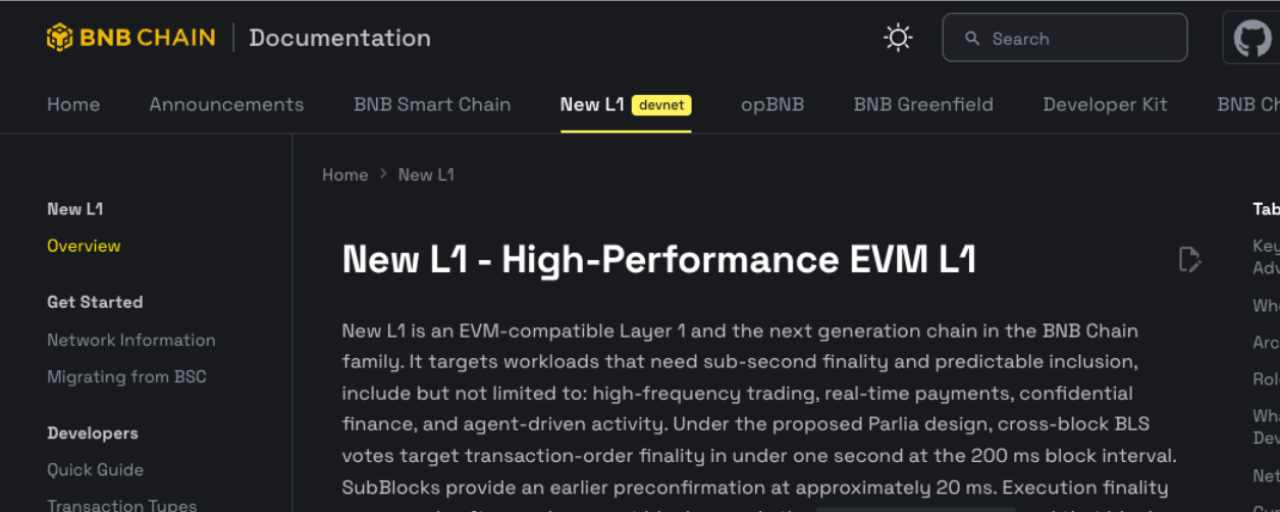
CZ Responds to BNB Chain's New L1 Plan: Multiple Chains, One Coin
Binance founder and former CEO Changpeng Zhao (CZ) reposted a user's post on X about BNB Chain's new Layer 1 plan, captioning it "Multiple chains, one coins."
According to BNB Chain's official documentation, the L1 is a high-performance, EVM-compatible chain built for latency-sensitive on-chain activity. Listed features include sub-second finality, native account abstraction, transaction pre-confirmation, Multi-Lane reserved capacity and an on-chain shielded (privacy) pool.
According to BNB Chain's official documentation, the L1 is a high-performance, EVM-compatible chain built for latency-sensitive on-chain activity. Listed features include sub-second finality, native account abstraction, transaction pre-confirmation, Multi-Lane reserved capacity and an on-chain shielded (privacy) pool.
89

Article
$78K BTC Under Pressure! BNB Shows Strength While ETH Faces a Critical Turning Point — What's Next?#EarningsSeason 🌍 #PositiveMindsGlobalResults | Positivity Without Borders
Invest, Learn, Grow, Together | Binance Square
📅 October 30, 2026
My current assessment is cautious to bearish in the short term unless buyers reclaim key resistance levels. Bitcoin's ability to hold $78,000 is particularly important, while BNB has recently shown greater relative strength than BTC and ETH.
The latest market reports show Bitcoin briefly fell below $80,000 before recovering, while Ethereum declined to around $2,321. A separate October 28 market snapshot recorded BTC at $81,254, BNB at $759, and ETH at $2,357. These are different snapshots, not guaranteed live prices.
1. Bitcoin (BTC): Critical $80,000 Battle
Short-term bias: Neutral to bearish below $81,700.
Bitcoin faces resistance after the Federal Reserve maintained interest rates at 3.75%–4.00% while leaving the possibility of further tightening open. Recent technical analysis identifies the $77,000–$80,000 region as an important support zone.
BTC scenario Next 48-hour levels
Support 1 $80,000
Support 2 $79,000
Major downside zone $77,000–$78,500
Resistance 1 $81,700
Resistance 2 $82,700
Stronger bullish target $83,100
Bullish scenario: If BTC holds $80,000 and breaks above $81,700 with strong buying volume, it could attempt a move toward $82,700–$83,100.
Bearish scenario: If BTC loses $79,000 decisively, the price could retest $77,000–$78,500. A sustained breakdown below that zone would increase downside risk.
My view: BTC needs to reclaim $79,700 to improve the bullish outlook. Until then, rallies could encounter selling pressure.
2. BNB: Can It Outperform Bitcoin?
Short-term bias: Neutral, with a potential recovery if support holds.
BNB closed around $759 in an October 28 market snapshot, outperforming BTC and ETH on that particular day. However, this historical reference is not a confirmed live price for October 30.
BNB scenario Important
levels Support 1 $750
Support 2 $740
Major downside zone $680–$730
Resistance 1 $760
Resistance 2 $767–$780
Bullish breakout target $790
Bullish scenario: If BNB holds $740–$750 and breaks through $767–$780 with convincing volume, a move toward $790 becomes possible.
Bearish scenario: A sustained break below $740 could expose the $680–$730 region.
My view: BNB could outperform BTC if it maintains relative strength and Bitcoin stabilizes. However, a sharp BTC sell-off could drag BNB lower.
These are conditional technical levels, not confirmed current support and resistance.
3. Ethereum (ETH): Recovery or Further Weakness?
Short-term bias: Cautious to bearish until resistance is reclaimed.
Ethereum has been struggling around its $2,280–$2,320 support zone, according to recent market analysis.
ETH scenario Next 48-hour levels
Support 1 $2,300
Support 2 $2,280
Major downside zone $2,120–$2,250
Resistance 1 $2,350
Resistance 2 $2,400
Bullish breakout target $2,450–$2,470
Bullish scenario: If ETH defends $2,280–$2,300 and reclaims $2,350, it could test $2,400 and potentially $2,450–$2,470.
Bearish scenario: A decisive break below $2,280 could expose $2,250 and potentially
My view: ETH needs a stronger recovery above $2,350–$2,400 to demonstrate improving momentum. Losing $2,280 would weaken its short-term outlook.
ETH levels are scenario estimates based on recent market structure, not verified live quotations.
4. What Could Move Crypto in the Next 48 Hours?
Three factors deserve particular attention.
1. Federal Reserve policy
The Fed's October 28 decision to hold rates, combined with the possibility of further tightening, creates uncertainty for risk assets. A stronger dollar and rising Treasury yields could pressure cryptocurrencies, while easing financial conditions could support a recovery.
2. Bitcoin's $80,000 support
Bitcoin remains the key market indicator. If BTC holds $80,000, BNB and ETH may have room to recover. If BTC breaks below $79,000, selling pressure could spread across the market.
3. Monthly candle close
The October monthly candle closes on October 31. Bitcoin's position around $80,000 at the close could influence sentiment entering November, although the monthly close alone cannot determine the next move.
5. My Final 48-Hour Forecast
Cryptocurrency Primary outlook Bullish confirmation Bearish warning
BTC Neutral to bearish Sustained move above Break below
$81,700 $77,000
BNB Neutral; recovery possible Break above Break below
$767–$780 $680 –$730
ETH Cautious to bearish Reclaim $2,400 Break below
$2,120 -$2,280
Which has the strongest opportunity?
BTC: The most important indicator for the broader crypto market.BNB: Potential relative-strength opportunity if buyers defend support.ETH: Recovery potential exists, but confirmation above resistance is important.
My overall assessment: The next 48 hours could bring sharp price swings in both directions. The bearish case remains relevant while key resistance levels hold, but a confirmed BTC recovery above $81,700 could improve the outlook for all three assets.
📌 Disclaimer: This article is for informational and educational purposes only. BTC, BNB, and ETH price levels and forecasts are estimates based on market analysis and possible scenarios, not guaranteed outcomes. Cryptocurrency markets are highly volatile, and prices can change rapidly. This is not financial or investment advice. Always conduct your own research (DYOR), manage risk carefully, and never invest more than you can afford to lose.
These are estimates, not guaranteed predictions or financial advice. Verify live prices before acting, and avoid excessive leverage during volatile conditions.
#BTC #BNB #ETH #CryptoForecast #BitcoinPricePrediction #CryptoMarketOutlook #Next48Hours #MarketAnalysis #CryptoTrading #PositiveMindsGlobalResults #BinanceSquare #DYOR
Positive Minds Global Results - Positivity without borders
INVEST, LEARN, GROW, TOGETHER
BINANCE SQUARE
$78K BTC Under Pressure! BNB Shows Strength While ETH Faces a Critical Turning Point — What's Next?
#EarningsSeason 🌍 #PositiveMindsGlobalResults | Positivity Without Borders
Invest, Learn, Grow, Together | Binance Square
📅 October 30, 2026
My current assessment is cautious to bearish in the short term unless buyers reclaim key resistance levels. Bitcoin's ability to hold $78,000 is particularly important, while BNB has recently shown greater relative strength than BTC and ETH.
The latest market reports show Bitcoin briefly fell below $80,000 before recovering, while Ethereum declined to around $2,321. A separate October 28 market snapshot recorded BTC at $81,254, BNB at $759, and ETH at $2,357. These are different snapshots, not guaranteed live prices.
1. Bitcoin (BTC): Critical $80,000 Battle
Short-term bias: Neutral to bearish below $81,700.
Bitcoin faces resistance after the Federal Reserve maintained interest rates at 3.75%–4.00% while leaving the possibility of further tightening open. Recent technical analysis identifies the $77,000–$80,000 region as an important support zone.
BTC scenario Next 48-hour levels
Support 1 $80,000
Support 2 $79,000
Major downside zone $77,000–$78,500
Resistance 1 $81,700
Resistance 2 $82,700
Stronger bullish target $83,100
Bullish scenario: If BTC holds $80,000 and breaks above $81,700 with strong buying volume, it could attempt a move toward $82,700–$83,100.
Bearish scenario: If BTC loses $79,000 decisively, the price could retest $77,000–$78,500. A sustained breakdown below that zone would increase downside risk.
My view: BTC needs to reclaim $79,700 to improve the bullish outlook. Until then, rallies could encounter selling pressure.
2. BNB: Can It Outperform Bitcoin?
Short-term bias: Neutral, with a potential recovery if support holds.
BNB closed around $759 in an October 28 market snapshot, outperforming BTC and ETH on that particular day. However, this historical reference is not a confirmed live price for October 30.
BNB scenario Important
levels Support 1 $750
Support 2 $740
Major downside zone $680–$730
Resistance 1 $760
Resistance 2 $767–$780
Bullish breakout target $790
Bullish scenario: If BNB holds $740–$750 and breaks through $767–$780 with convincing volume, a move toward $790 becomes possible.
Bearish scenario: A sustained break below $740 could expose the $680–$730 region.
My view: BNB could outperform BTC if it maintains relative strength and Bitcoin stabilizes. However, a sharp BTC sell-off could drag BNB lower.
These are conditional technical levels, not confirmed current support and resistance.
3. Ethereum (ETH): Recovery or Further Weakness?
Short-term bias: Cautious to bearish until resistance is reclaimed.
Ethereum has been struggling around its $2,280–$2,320 support zone, according to recent market analysis.
ETH scenario Next 48-hour levels
Support 1 $2,300
Support 2 $2,280
Major downside zone $2,120–$2,250
Resistance 1 $2,350
Resistance 2 $2,400
Bullish breakout target $2,450–$2,470
Bullish scenario: If ETH defends $2,280–$2,300 and reclaims $2,350, it could test $2,400 and potentially $2,450–$2,470.
Bearish scenario: A decisive break below $2,280 could expose $2,250 and potentially
My view: ETH needs a stronger recovery above $2,350–$2,400 to demonstrate improving momentum. Losing $2,280 would weaken its short-term outlook.
ETH levels are scenario estimates based on recent market structure, not verified live quotations.
4. What Could Move Crypto in the Next 48 Hours?
Three factors deserve particular attention.
1. Federal Reserve policy
The Fed's October 28 decision to hold rates, combined with the possibility of further tightening, creates uncertainty for risk assets. A stronger dollar and rising Treasury yields could pressure cryptocurrencies, while easing financial conditions could support a recovery.
2. Bitcoin's $80,000 support
Bitcoin remains the key market indicator. If BTC holds $80,000, BNB and ETH may have room to recover. If BTC breaks below $79,000, selling pressure could spread across the market.
3. Monthly candle close
The October monthly candle closes on October 31. Bitcoin's position around $80,000 at the close could influence sentiment entering November, although the monthly close alone cannot determine the next move.
5. My Final 48-Hour Forecast
Cryptocurrency Primary outlook Bullish confirmation Bearish warning
BTC Neutral to bearish Sustained move above Break below
$81,700 $77,000
BNB Neutral; recovery possible Break above Break below
$767–$780 $680 –$730
ETH Cautious to bearish Reclaim $2,400 Break below
$2,120 -$2,280
Which has the strongest opportunity?
BTC: The most important indicator for the broader crypto market.BNB: Potential relative-strength opportunity if buyers defend support.ETH: Recovery potential exists, but confirmation above resistance is important.
My overall assessment: The next 48 hours could bring sharp price swings in both directions. The bearish case remains relevant while key resistance levels hold, but a confirmed BTC recovery above $81,700 could improve the outlook for all three assets.
📌 Disclaimer: This article is for informational and educational purposes only. BTC, BNB, and ETH price levels and forecasts are estimates based on market analysis and possible scenarios, not guaranteed outcomes. Cryptocurrency markets are highly volatile, and prices can change rapidly. This is not financial or investment advice. Always conduct your own research (DYOR), manage risk carefully, and never invest more than you can afford to lose.
These are estimates, not guaranteed predictions or financial advice. Verify live prices before acting, and avoid excessive leverage during volatile conditions.
#BTC #BNB #ETH #CryptoForecast #BitcoinPricePrediction #CryptoMarketOutlook #Next48Hours #MarketAnalysis #CryptoTrading #PositiveMindsGlobalResults #BinanceSquare #DYOR
Positive Minds Global Results - Positivity without borders
INVEST, LEARN, GROW, TOGETHER
BINANCE SQUARE
111

Article
Russia Draws a New Line for Crypto: Self-Custody Restricted at Home, but International Settlements#RussiaCryptoWalletLimits 🌍 #PositiveMindsGlobalResults | Positivity Without Borders
Invest, Learn, Grow, Together | Binance Square
📅 October 30, 2026
🇷🇺 Russia’s Crypto Strategy: Control Domestic Investment, Preserve Cross-Border Trade
Russia is drawing a sharper distinction between how cryptocurrencies are used inside the country and how they can support international business.
On October 29, 2026, Vladimir Chistyukhin, First Deputy Governor of the Bank of Russia, clarified that restrictions on non-custodial cryptocurrency wallets under Russia’s regulatory framework would not apply to international settlements. The clarification matters because it distinguishes personal crypto investment from the use of digital assets in cross-border commercial transactions.
The message is significant: Russia wants stronger oversight of domestic cryptocurrency activity without closing the door on crypto-based international settlements.
But what does this mean for investors, businesses, and the wider digital asset industry?
🔐 1. What Is a Non-Custodial Wallet?
A non-custodial wallet, also called a self-custody wallet, allows users to control their own private keys rather than relying on an exchange or another service provider to hold them.
Examples include software wallets and hardware wallets that allow users to manage their cryptocurrency directly.
A custodial wallet works differently. A third-party provider, such as a cryptocurrency exchange or regulated custodian, controls the private keys on behalf of its customers.
The distinction is important:
Non-custodial wallets: Users control their private keys and transactions.Custodial wallets: A service provider holds or administers the assets on behalf of customers.Regulated intermediaries: These institutions can apply identification, transaction-monitoring, and compliance procedures.
Self-custody offers greater direct control over assets, but users also carry greater responsibility for protecting their recovery phrases, private keys, and funds.
For regulators, the challenge is ensuring compliance when transactions occur without a traditional financial intermediary.
⚖️ 2. Why Is Russia Restricting Domestic Self-Custody Transfers?
Russia’s Federal Law No. 282-FZ, adopted on August 4, 2026, established a new framework for digital currencies and digital rights. The law came into force on September 1, 2026.
Under the framework, the authorities are directing covered domestic cryptocurrency transactions toward supervised intermediaries.
The Bank of Russia’s October 12 guidance states that individuals cannot transfer cryptocurrency from a regulated digital account to their own non-custodial wallet under the relevant provisions of the law. It also sets restrictions on transfers between individuals through addresses administered by digital depositories.
The regulator’s stated concerns include:
Anti-money laundering: Authorities want greater visibility into cryptocurrency transactions and the movement of funds.
Investor protection: The central bank argues that direct investment through non-custodial wallets could expose investors to additional risks.
Regulatory oversight: Transactions conducted through approved intermediaries are easier to monitor under the domestic financial framework.
However, there is an important distinction between restricting certain transfers and declaring every personal wallet illegal. These are not the same thing.
Russia’s approach focuses on the permitted channels for conducting covered transactions, rather than simply eliminating the technology that allows individuals to control their own cryptocurrency.
🌍 3. The Major Exception: International Settlements
This is the central development.
According to the October 29 clarification, non-custodial wallets remain permissible for international settlements. The restrictions on domestic investment do not automatically extend to qualifying cross-border transactions.
The framework allows exporters and importers to use cryptocurrencies for international payments under the applicable foreign-trade rules.
The Bank of Russia has also explained that cryptocurrency can move from a custodial wallet within Russian infrastructure to a custodial wallet on foreign infrastructure and subsequently to a non-custodial wallet.
This distinction creates different pathways for different purposes:
Domestic investment: Subject to Russia’s regulated framework and restrictions on transfers to personal wallets.
International business settlements: Non-custodial wallets remain permissible within the stated cross-border exception.
Foreign cryptocurrency holdings: Reporting obligations may apply to Russian residents, depending on the applicable legal requirements.
The practical significance is clear: Russia is attempting to preserve cryptocurrency’s usefulness in international commerce while tightening its domestic financial controls.
The exception should not be interpreted as blanket permission for every international transfer. Businesses must still comply with applicable sanctions, anti-money laundering rules, tax obligations, and the laws of the relevant jurisdictions.
🏭 4. Why International Trade Matters to Russia
Cross-border payments can be complicated when businesses face restrictions on banking access, correspondent banking relationships, or international financial services.
Cryptocurrencies can offer an alternative settlement mechanism because transactions can be executed over blockchain networks without requiring every stage of the transfer to pass through traditional banking infrastructure.
For exporters and importers, potential advantages include:
Alternative settlement channels for international trade.Access to digital asset networks operating across national borders.Greater flexibility in choosing payment infrastructure.The possibility of reducing dependence on certain traditional financial intermediaries.
However, these advantages come with significant risks.
Cryptocurrency prices can fluctuate sharply. Transactions may be irreversible, blockchain networks can experience congestion, and businesses must consider liquidity, counterparty risk, wallet security, and compliance obligations.
Furthermore, blockchain transfers do not eliminate sanctions exposure or guarantee that a foreign bank, exchange, or commercial partner will accept the funds.
The key point: Cryptocurrency can expand payment options, but it does not remove the legal and operational risks of international trade.
📊 5. What the New Framework Means for Ordinary Crypto Investors
The consequences for individual investors are different from those for businesses conducting international settlements.
Under the framework announced by the Bank of Russia, non-qualified investors may purchase eligible cryptocurrencies up to ₽300,000 annually through each intermediary after passing the required assessment. Qualified investors must also pass the relevant test, but the framework permits them to buy and sell cryptocurrencies without that purchase-amount cap.
The restrictions on domestic self-custody transfers create another important consideration: buying cryptocurrency through a regulated service does not necessarily mean investors can freely transfer it to a personal wallet.
Investors should therefore understand the withdrawal rules, custody arrangements, and legal restrictions that apply to their accounts before purchasing digital assets.
For people who value self-custody, the distinction between owning cryptocurrency and having unrestricted control over how it can be transferred becomes particularly important.
This could influence how investors evaluate exchanges, custodians, and wallet services in Russia.
📈 6. Could This Influence Bitcoin, Ethereum, BNB, and the Wider Crypto Market?
Russia’s clarification is relevant to the global digital asset industry, but its market impact should be assessed carefully.
Bitcoin (BTC): The development highlights the continuing debate between financial oversight and individual control over digital assets. However, this announcement alone does not establish a bullish or bearish Bitcoin price signal.
Ethereum (ETH): Ethereum’s broader ecosystem includes self-custody wallets, decentralised applications, and smart-contract-based financial services. Rules affecting access to self-custody may influence how users in a particular jurisdiction interact with these services, but the direct market impact remains uncertain.
BNB: The development is relevant to the wider discussion about exchange-based custody and self-managed wallets. However, Russia’s announcement does not establish a direct change in BNB’s demand, network activity, or price outlook.
The broader crypto market: The longer-term significance lies in how major economies regulate custody, transfers, and the use of digital assets for international commerce.
If more jurisdictions adopt rules that distinguish domestic investment from international settlement, cryptocurrency businesses may need to develop different compliance arrangements for different markets.
Nevertheless, Russia’s policy announcement should not be confused with evidence of new institutional inflows or an immediate increase in global crypto adoption.
🔎 7. Three Developments Worth Watching Next
A. Implementation and enforcement
How will Russian authorities distinguish domestic investment activity from qualifying international settlements in practice?
The effectiveness and clarity of enforcement will be important for businesses, investors, and cryptocurrency service providers.
B. Growth of regulated infrastructure
The Bank of Russia announced on October 6 that the first five organisations had entered its digital depository register and four entities had entered its register for cryptocurrency exchange activities. These registrations mark an early step in building the regulated market infrastructure.
The number of approved providers, the services they offer, and their ability to support legitimate trading will be worth monitoring.
C. The July 2027 transition
Under the new framework, Russian residents who are not themselves market organisers will generally have to conduct covered cryptocurrency transactions through or with authorised market participants from July 1, 2027. The law also establishes a transition period for relevant market participants to bring their operations into compliance.
This transition could reshape the domestic market by increasing the role of regulated brokers, exchanges, and digital depositories.
🌐 8. The Bigger Picture: Regulation Versus Financial Freedom
Russia’s approach illustrates a broader challenge facing cryptocurrency markets worldwide.
Governments want to monitor financial flows, protect investors, and reduce illicit activity. At the same time, businesses want efficient cross-border payments, while cryptocurrency users value direct control over their digital assets.
These objectives do not always align.
A tightly controlled domestic system may improve transaction visibility, but it can also limit user choice and introduce greater dependence on approved intermediaries.
Preserving an international-settlement exception offers a compromise: authorities can tighten domestic investment channels while retaining flexibility for foreign trade.
Whether this model proves effective will depend on how clearly the rules are implemented, how businesses adapt, and whether legitimate users can operate without unnecessary friction.
🎯 Final Outlook: A Two-Track Crypto Strategy
Russia’s October 29 clarification delivers a meaningful regulatory message.
At home, the framework priorities regulated access and tighter oversight of cryptocurrency investment. Across borders, it preserves a route for international settlements using non-custodial wallets.
For investors, the main issue is understanding the restrictions that apply to custody and transfers. For businesses, the priority is determining whether their settlement arrangements qualify under the relevant rules and satisfy all applicable compliance requirements.
For the global cryptocurrency market, the development reinforces an important theme: governments may increasingly seek to control how digital assets move without abandoning their potential role in international commerce.
The next chapter will depend less on the announcement itself and more on how the rules work in practice.
What do you think?
Should governments allow individuals to control their own cryptocurrency while imposing stricter oversight on exchanges and financial institutions, or should most crypto transactions pass through regulated intermediaries?
Share your perspective in the comments.
📌 Disclaimer
This article is for educational and informational purposes only and is not financial, investment, legal, or tax advice. Regulatory developments may change, and the interpretation or implementation of Russian cryptocurrency rules may require further clarification. Readers should consult official sources and qualified professionals before making financial or business decisions. Cryptocurrency markets involve significant risks, and no outcome is guaranteed. Always conduct your own research (DYOR).
#RussiaCrypto #CryptoRegulation #NonCustodialWallets #SelfCustody #CrossBorderPayments #InternationalSettlements #Bitcoin #BTC #Ethereum #ETH #BNB #Blockchain #DigitalAssets #CryptoNews #GlobalMarkets #FinancialInnovation #AMLCompliance #PositiveMindsGlobalResults #BinanceSquare #DYOR
Russia Draws a New Line for Crypto: Self-Custody Restricted at Home, but International Settlements
#RussiaCryptoWalletLimits 🌍 #PositiveMindsGlobalResults | Positivity Without Borders
Invest, Learn, Grow, Together | Binance Square
📅 October 30, 2026
🇷🇺 Russia’s Crypto Strategy: Control Domestic Investment, Preserve Cross-Border Trade
Russia is drawing a sharper distinction between how cryptocurrencies are used inside the country and how they can support international business.
On October 29, 2026, Vladimir Chistyukhin, First Deputy Governor of the Bank of Russia, clarified that restrictions on non-custodial cryptocurrency wallets under Russia’s regulatory framework would not apply to international settlements. The clarification matters because it distinguishes personal crypto investment from the use of digital assets in cross-border commercial transactions.
The message is significant: Russia wants stronger oversight of domestic cryptocurrency activity without closing the door on crypto-based international settlements.
But what does this mean for investors, businesses, and the wider digital asset industry?
🔐 1. What Is a Non-Custodial Wallet?
A non-custodial wallet, also called a self-custody wallet, allows users to control their own private keys rather than relying on an exchange or another service provider to hold them.
Examples include software wallets and hardware wallets that allow users to manage their cryptocurrency directly.
A custodial wallet works differently. A third-party provider, such as a cryptocurrency exchange or regulated custodian, controls the private keys on behalf of its customers.
The distinction is important:
Non-custodial wallets: Users control their private keys and transactions.Custodial wallets: A service provider holds or administers the assets on behalf of customers.Regulated intermediaries: These institutions can apply identification, transaction-monitoring, and compliance procedures.
Self-custody offers greater direct control over assets, but users also carry greater responsibility for protecting their recovery phrases, private keys, and funds.
For regulators, the challenge is ensuring compliance when transactions occur without a traditional financial intermediary.
⚖️ 2. Why Is Russia Restricting Domestic Self-Custody Transfers?
Russia’s Federal Law No. 282-FZ, adopted on August 4, 2026, established a new framework for digital currencies and digital rights. The law came into force on September 1, 2026.
Under the framework, the authorities are directing covered domestic cryptocurrency transactions toward supervised intermediaries.
The Bank of Russia’s October 12 guidance states that individuals cannot transfer cryptocurrency from a regulated digital account to their own non-custodial wallet under the relevant provisions of the law. It also sets restrictions on transfers between individuals through addresses administered by digital depositories.
The regulator’s stated concerns include:
Anti-money laundering: Authorities want greater visibility into cryptocurrency transactions and the movement of funds.
Investor protection: The central bank argues that direct investment through non-custodial wallets could expose investors to additional risks.
Regulatory oversight: Transactions conducted through approved intermediaries are easier to monitor under the domestic financial framework.
However, there is an important distinction between restricting certain transfers and declaring every personal wallet illegal. These are not the same thing.
Russia’s approach focuses on the permitted channels for conducting covered transactions, rather than simply eliminating the technology that allows individuals to control their own cryptocurrency.
🌍 3. The Major Exception: International Settlements
This is the central development.
According to the October 29 clarification, non-custodial wallets remain permissible for international settlements. The restrictions on domestic investment do not automatically extend to qualifying cross-border transactions.
The framework allows exporters and importers to use cryptocurrencies for international payments under the applicable foreign-trade rules.
The Bank of Russia has also explained that cryptocurrency can move from a custodial wallet within Russian infrastructure to a custodial wallet on foreign infrastructure and subsequently to a non-custodial wallet.
This distinction creates different pathways for different purposes:
Domestic investment: Subject to Russia’s regulated framework and restrictions on transfers to personal wallets.
International business settlements: Non-custodial wallets remain permissible within the stated cross-border exception.
Foreign cryptocurrency holdings: Reporting obligations may apply to Russian residents, depending on the applicable legal requirements.
The practical significance is clear: Russia is attempting to preserve cryptocurrency’s usefulness in international commerce while tightening its domestic financial controls.
The exception should not be interpreted as blanket permission for every international transfer. Businesses must still comply with applicable sanctions, anti-money laundering rules, tax obligations, and the laws of the relevant jurisdictions.
🏭 4. Why International Trade Matters to Russia
Cross-border payments can be complicated when businesses face restrictions on banking access, correspondent banking relationships, or international financial services.
Cryptocurrencies can offer an alternative settlement mechanism because transactions can be executed over blockchain networks without requiring every stage of the transfer to pass through traditional banking infrastructure.
For exporters and importers, potential advantages include:
Alternative settlement channels for international trade.Access to digital asset networks operating across national borders.Greater flexibility in choosing payment infrastructure.The possibility of reducing dependence on certain traditional financial intermediaries.
However, these advantages come with significant risks.
Cryptocurrency prices can fluctuate sharply. Transactions may be irreversible, blockchain networks can experience congestion, and businesses must consider liquidity, counterparty risk, wallet security, and compliance obligations.
Furthermore, blockchain transfers do not eliminate sanctions exposure or guarantee that a foreign bank, exchange, or commercial partner will accept the funds.
The key point: Cryptocurrency can expand payment options, but it does not remove the legal and operational risks of international trade.
📊 5. What the New Framework Means for Ordinary Crypto Investors
The consequences for individual investors are different from those for businesses conducting international settlements.
Under the framework announced by the Bank of Russia, non-qualified investors may purchase eligible cryptocurrencies up to ₽300,000 annually through each intermediary after passing the required assessment. Qualified investors must also pass the relevant test, but the framework permits them to buy and sell cryptocurrencies without that purchase-amount cap.
The restrictions on domestic self-custody transfers create another important consideration: buying cryptocurrency through a regulated service does not necessarily mean investors can freely transfer it to a personal wallet.
Investors should therefore understand the withdrawal rules, custody arrangements, and legal restrictions that apply to their accounts before purchasing digital assets.
For people who value self-custody, the distinction between owning cryptocurrency and having unrestricted control over how it can be transferred becomes particularly important.
This could influence how investors evaluate exchanges, custodians, and wallet services in Russia.
📈 6. Could This Influence Bitcoin, Ethereum, BNB, and the Wider Crypto Market?
Russia’s clarification is relevant to the global digital asset industry, but its market impact should be assessed carefully.
Bitcoin (BTC): The development highlights the continuing debate between financial oversight and individual control over digital assets. However, this announcement alone does not establish a bullish or bearish Bitcoin price signal.
Ethereum (ETH): Ethereum’s broader ecosystem includes self-custody wallets, decentralised applications, and smart-contract-based financial services. Rules affecting access to self-custody may influence how users in a particular jurisdiction interact with these services, but the direct market impact remains uncertain.
BNB: The development is relevant to the wider discussion about exchange-based custody and self-managed wallets. However, Russia’s announcement does not establish a direct change in BNB’s demand, network activity, or price outlook.
The broader crypto market: The longer-term significance lies in how major economies regulate custody, transfers, and the use of digital assets for international commerce.
If more jurisdictions adopt rules that distinguish domestic investment from international settlement, cryptocurrency businesses may need to develop different compliance arrangements for different markets.
Nevertheless, Russia’s policy announcement should not be confused with evidence of new institutional inflows or an immediate increase in global crypto adoption.
🔎 7. Three Developments Worth Watching Next
A. Implementation and enforcement
How will Russian authorities distinguish domestic investment activity from qualifying international settlements in practice?
The effectiveness and clarity of enforcement will be important for businesses, investors, and cryptocurrency service providers.
B. Growth of regulated infrastructure
The Bank of Russia announced on October 6 that the first five organisations had entered its digital depository register and four entities had entered its register for cryptocurrency exchange activities. These registrations mark an early step in building the regulated market infrastructure.
The number of approved providers, the services they offer, and their ability to support legitimate trading will be worth monitoring.
C. The July 2027 transition
Under the new framework, Russian residents who are not themselves market organisers will generally have to conduct covered cryptocurrency transactions through or with authorised market participants from July 1, 2027. The law also establishes a transition period for relevant market participants to bring their operations into compliance.
This transition could reshape the domestic market by increasing the role of regulated brokers, exchanges, and digital depositories.
🌐 8. The Bigger Picture: Regulation Versus Financial Freedom
Russia’s approach illustrates a broader challenge facing cryptocurrency markets worldwide.
Governments want to monitor financial flows, protect investors, and reduce illicit activity. At the same time, businesses want efficient cross-border payments, while cryptocurrency users value direct control over their digital assets.
These objectives do not always align.
A tightly controlled domestic system may improve transaction visibility, but it can also limit user choice and introduce greater dependence on approved intermediaries.
Preserving an international-settlement exception offers a compromise: authorities can tighten domestic investment channels while retaining flexibility for foreign trade.
Whether this model proves effective will depend on how clearly the rules are implemented, how businesses adapt, and whether legitimate users can operate without unnecessary friction.
🎯 Final Outlook: A Two-Track Crypto Strategy
Russia’s October 29 clarification delivers a meaningful regulatory message.
At home, the framework priorities regulated access and tighter oversight of cryptocurrency investment. Across borders, it preserves a route for international settlements using non-custodial wallets.
For investors, the main issue is understanding the restrictions that apply to custody and transfers. For businesses, the priority is determining whether their settlement arrangements qualify under the relevant rules and satisfy all applicable compliance requirements.
For the global cryptocurrency market, the development reinforces an important theme: governments may increasingly seek to control how digital assets move without abandoning their potential role in international commerce.
The next chapter will depend less on the announcement itself and more on how the rules work in practice.
What do you think?
Should governments allow individuals to control their own cryptocurrency while imposing stricter oversight on exchanges and financial institutions, or should most crypto transactions pass through regulated intermediaries?
Share your perspective in the comments.
📌 Disclaimer
This article is for educational and informational purposes only and is not financial, investment, legal, or tax advice. Regulatory developments may change, and the interpretation or implementation of Russian cryptocurrency rules may require further clarification. Readers should consult official sources and qualified professionals before making financial or business decisions. Cryptocurrency markets involve significant risks, and no outcome is guaranteed. Always conduct your own research (DYOR).
#RussiaCrypto #CryptoRegulation #NonCustodialWallets #SelfCustody #CrossBorderPayments #InternationalSettlements #Bitcoin #BTC #Ethereum #ETH #BNB #Blockchain #DigitalAssets #CryptoNews #GlobalMarkets #FinancialInnovation #AMLCompliance #PositiveMindsGlobalResults #BinanceSquare #DYOR
175

Article
Fed Holds, AI Faces a Reality Check: BTC, BNB & ETH — Next 24-Hour Forecast#fedwatch 🌍 #PositiveMindsGlobalResults | Positivity Without Borders
INVEST, LEARN, GROW, TOGETHER | Binance Square
October 30, 2026
1. Wall Street rises, but the Fed's message is more complicated
US equities finished modestly higher on October 28 after the Federal Reserve kept interest rates unchanged. The Dow Jones gained approximately 0.19%, the S&P 500 rose 0.28%, and the Nasdaq advanced 0.27%. However, the rally did not eliminate concerns about inflation, borrowing costs, or the next policy decision.
The more consequential signal came from the Fed's assessment of the economy. Policymakers upgraded their description of economic activity from “solid” to “strong,” while continuing to acknowledge persistent inflation. Treasury investors were left debating whether rates would remain restrictive for longer or rise again. Longer-term Treasury yields faced additional pressure from inflation uncertainty, fiscal deficits, and government borrowing.
2. AI's next challenge: turning massive investment into profits
The AI boom remains one of the most important drivers of global markets, but investors are increasingly distinguishing between companies generating measurable returns and those spending aggressively in anticipation of future demand.
Amazon: cloud demand remains a competitive advantage
Amazon Web Services has reported strong demand for AI infrastructure, with CEO Andy Jassy saying that AWS capacity was largely sold out through 2027 and customer commitments extended into 2028. That supports the growth outlook, although capacity expansion still requires substantial investment.
Google: stronger cloud sales, a more complicated cash-flow picture
Google Cloud revenue more than doubled to $30.71 billion in the September quarter, supported by AI infrastructure demand. However, selling its own tensor processing unit (TPU) systems requires upfront hardware investment, tying up cash before customers pay. Revenue growth is impressive, but cash conversion remains important.
Nvidia: competitive and regulatory risks are growing
The US Department of Justice is reportedly asking questions about Nvidia's proposed $12.93 billion acquisition of Hugging Face, including whether the transaction could give Nvidia excessive influence over AI distribution. The inquiry is not proof of wrongdoing, and it does not establish that the acquisition will be blocked. Nevertheless, regulatory scrutiny adds uncertainty to an already competitive industry.
The broader issue is that AI spending can support semiconductor sales, cloud growth, and infrastructure demand while simultaneously putting pressure on corporate cash flow, borrowing costs, and valuations.
Crypto connection: AI-related stock weakness does not automatically cause a crypto sell-off. However, if investors reduce exposure to technology shares and other speculative assets at the same time, BTC and altcoins may face correlated selling pressure.
3. AI infrastructure meets resistance at the ballot box
The data-center expansion story now includes a political and community dimension. A Reuters report published October 29 described ballot initiatives across 10 US states addressing data-center development, with local proposals seeking delays, restrictions, or additional requirements.
The debate concerns electricity prices, power-grid capacity, environmental effects, local planning, and the benefits communities receive from new projects. US data-center capacity under construction increased 48% between December 2025 and June 2026, according to figures cited in the report.
This is not evidence that the AI buildout is stopping. It does, however, introduce potential delays, higher infrastructure costs, and uncertainty around project approvals.
For investors, the key question is whether AI demand can continue expanding fast enough to justify the cost of computing power, electricity, networking, and data-center construction.
For crypto, the direct impact is limited. The indirect effect could be more important: changes in investor confidence toward AI infrastructure may influence broader technology-sector sentiment and risk appetite.
4. Anthropic's IPO raises the stakes for AI valuations
Anthropic publicly filed its US IPO paperwork on October 26, moving closer to a potential stock-market debut before Thanksgiving, according to Reuters reporting. The prospectus provides investors with another opportunity to evaluate the economics of frontier AI businesses, including rapid growth, infrastructure costs, and the funding required to compete.
A successful listing could demonstrate strong investor demand for AI companies. But it could also expose how sensitive valuations are to financing costs, future revenue expectations, and the ability to generate sustainable profits.
President Donald Trump's reported preference for the term “super intelligence” rather than “artificial intelligence” adds a political communications dimension. For markets, however, the more important variables remain regulation, investment, commercialization, and financial performance.
5. Europe's monetary outlook: the ECB leadership question
European markets face their own uncertainty following Christine Lagarde's announcement that she will step down as European Central Bank president on February 7, 2027. The choice of successor could matter for the ECB's approach to financial-market stress, including the potential use of crisis-management tools when French debt comes under pressure.
The ECB also held rates steady on October 29, while warning about inflation risks from rising energy costs. That combination reinforces the possibility that central banks on both sides of the Atlantic could keep financial conditions restrictive for longer than investors would prefer.
For BTC, BNB, and ETH, this is an indirect but relevant influence: if major central banks remain cautious while inflation persists, a sustained easing in global financial conditions becomes harder to assume.
6. Fuel economy rules: a secondary market story
A separate US policy debate concerns fuel-economy standards and whether proposed changes could make it easier for automakers to bring back vehicles such as station wagons. The reported proposal would reduce required average fuel economy, potentially lowering some upfront vehicle costs while increasing fuel consumption and emissions over time.
Important date clarification: The station-wagon report located in this research was published on December 4, 2025. It is background policy context, not a newly confirmed October 2026 development.
This issue is not a direct crypto catalyst. Its potential relevance is through energy demand, inflation, consumer spending, and the wider policy environment—not an immediate reason to buy or sell digital assets.
7. BTC, BNB & ETH: the next 24-hour price forecast
Forecast window: October 30, 2026 · Indicative USD levels · Not guaranteed
The latest available reporting points to a more fragile crypto recovery. Bitcoin failed to hold its rebound near $81,700 and retreated toward $79,900, while Ethereum also weakened. This suggests that the Fed's decision to hold rates steady has not, by itself, produced a sustained bullish breakout.
The following are conditional technical scenarios, not live exchange quotes or guaranteed targets. The levels are based on recent reported trading ranges and technical analysis; they should be checked against current Binance prices before publication.
1. Bitcoin (BTC)
Cautious / bearish below resistance
Reference price: approximately $79,900 in the October 29 report.
Bullish scenario
Initial resistance: $80,500–$81,000Breakout confirmation: sustained move above $81,700Potential upside zone: $82,500–$83,500
Bearish scenario
Initial support: $79,600–$80,000A convincing breakdown could expose $78,500, followed by the $77,000–$75,000 region.
The recent retreat toward $79,900 and reported risk of a move toward $75,000 support a cautious short-term stance
2. BNB (BNB)
Neutral until breakout
Reference price: approximately $760 in the October 28 market close.
Bullish scenario
Initial support zone: $745–$750Resistance: $760–$765If price breaks and holds above resistance, a possible extension toward $770–$780.
Bearish scenario
A break below $745 could expose $735–$740.If selling accelerates, the $720–$730 region becomes a deeper downside scenario.
BNB gained about 2% on October 28, outperforming BTC and ETH that day. However, one session of relative strength is not enough to confirm a sustained uptrend.
3. Ethereum (ETH)
Fragile recovery
Reference price: approximately $2,318–$2,357 across recent reports and snapshots.
Bullish scenario
Initial support: $2,290–$2,320Resistance: $2,360–$2,410A confirmed breakout above $2,410 could open a move toward $2,450–$2,500.
Bearish scenario
A break below $2,290 could expose $2,240.Further weakness could bring the $2,200 area into view.
ETH's October 28 rebound came with lower reported trading turnover, a warning that buying conviction may be limited. The $2,291 area was identified as a key nearby support in a separate technical report.
The three most important price triggers
Asset Bullish confirmation Bearish warning
BTC Sustained break above $81,700 Breakdown below $79,600
BNB Sustained break above $765 Breakdown below $745
ETH Sustained break above $2,410 Breakdown below $2,290
These are monitoring thresholds, not signals that a breakout or breakdown has already occurred. Confirmation should include sustained price action, trading volume, and broader market conditions.
8. What could move crypto during the next 24 hours?
Bullish catalyst: yields ease and buyers return
If Treasury yields retreat, the US dollar weakens, and BTC reclaims resistance with stronger volume, risk appetite could improve. BNB may benefit from its recent relative strength, while ETH needs to recover its resistance zone to demonstrate stronger momentum.
Bearish catalyst: inflation keeps monetary policy restrictive
If economic data reinforces expectations of further tightening, yields rise, or technology shares sell off again, crypto could face renewed pressure. A BTC break below $79,600 would increase the risk of a deeper correction, with altcoins potentially experiencing larger percentage swings.
Neutral scenario: choppy consolidation
If yields, equities, and crypto flows send mixed signals, BTC may remain near the $79,600–$81,700 range, BNB around $745–$765, and ETH around $2,290–$2,410. These are conditional working ranges, not predictions of where the assets must close.
9. Final outlook: follow confirmation, not headlines
The central message for October 30 is that markets are entering a phase in which the cost of capital and the quality of earnings matter as much as the growth story itself.
BTC: The most important near-term test is whether buyers can defend $79,600–$80,000 and reclaim $81,700. Until then, downside risk remains material.BNB: Recent relative strength is encouraging, but $760–$765 is an important resistance area. A confirmed breakout would improve the short-term outlook.ETH: The $2,290–$2,320 zone is the key nearby support area, while $2,410 is an important recovery threshold.
My overall assessment is cautious rather than aggressively bullish. A Fed pause, strong cloud demand, and AI innovation can support markets, but persistent inflation, expensive financing, regulatory uncertainty, and weaker technology sentiment can offset those positives.
The next move will depend on whether buyers can turn temporary rebounds into sustained breakouts—or whether sellers regain control at resistance.
Disclaimer: This article is for informational and educational purposes only and does not constitute financial, investment, or trading advice. BTC, BNB, ETH price forecasts and market scenarios are estimates based on available information and technical analysis as of October 30, 2026. Actual market movements may differ significantly, and no outcome is guaranteed. Cryptocurrency and financial markets involve substantial risk, including the potential loss of capital. Always verify live market data, conduct your own research (DYOR), and consult a qualified financial professional before making investment decisions. Estimates, not guarantees. Invest responsibly.
#Bitcoin #BTC #BNB #Ethereum #ETH #CryptoForecast #CryptoMarket #Next24Hours #FederalReserve #TreasuryYields #WallStreet #AIMarket #GlobalMarkets #MarketAnalysis #RiskManagement #DYOR #EstimatesNotAdviceButHope #PositiveMindsGlobalResults #BinanceSquare #binancepick
Positive Minds Global Results - Positivity without borders
INVEST, LEARN, GROW, TOGETHER
BINANCE SQUARE
Fed Holds, AI Faces a Reality Check: BTC, BNB & ETH — Next 24-Hour Forecast
#fedwatch 🌍 #PositiveMindsGlobalResults | Positivity Without Borders
INVEST, LEARN, GROW, TOGETHER | Binance Square
October 30, 2026
1. Wall Street rises, but the Fed's message is more complicated
US equities finished modestly higher on October 28 after the Federal Reserve kept interest rates unchanged. The Dow Jones gained approximately 0.19%, the S&P 500 rose 0.28%, and the Nasdaq advanced 0.27%. However, the rally did not eliminate concerns about inflation, borrowing costs, or the next policy decision.
The more consequential signal came from the Fed's assessment of the economy. Policymakers upgraded their description of economic activity from “solid” to “strong,” while continuing to acknowledge persistent inflation. Treasury investors were left debating whether rates would remain restrictive for longer or rise again. Longer-term Treasury yields faced additional pressure from inflation uncertainty, fiscal deficits, and government borrowing.
2. AI's next challenge: turning massive investment into profits
The AI boom remains one of the most important drivers of global markets, but investors are increasingly distinguishing between companies generating measurable returns and those spending aggressively in anticipation of future demand.
Amazon: cloud demand remains a competitive advantage
Amazon Web Services has reported strong demand for AI infrastructure, with CEO Andy Jassy saying that AWS capacity was largely sold out through 2027 and customer commitments extended into 2028. That supports the growth outlook, although capacity expansion still requires substantial investment.
Google: stronger cloud sales, a more complicated cash-flow picture
Google Cloud revenue more than doubled to $30.71 billion in the September quarter, supported by AI infrastructure demand. However, selling its own tensor processing unit (TPU) systems requires upfront hardware investment, tying up cash before customers pay. Revenue growth is impressive, but cash conversion remains important.
Nvidia: competitive and regulatory risks are growing
The US Department of Justice is reportedly asking questions about Nvidia's proposed $12.93 billion acquisition of Hugging Face, including whether the transaction could give Nvidia excessive influence over AI distribution. The inquiry is not proof of wrongdoing, and it does not establish that the acquisition will be blocked. Nevertheless, regulatory scrutiny adds uncertainty to an already competitive industry.
The broader issue is that AI spending can support semiconductor sales, cloud growth, and infrastructure demand while simultaneously putting pressure on corporate cash flow, borrowing costs, and valuations.
Crypto connection: AI-related stock weakness does not automatically cause a crypto sell-off. However, if investors reduce exposure to technology shares and other speculative assets at the same time, BTC and altcoins may face correlated selling pressure.
3. AI infrastructure meets resistance at the ballot box
The data-center expansion story now includes a political and community dimension. A Reuters report published October 29 described ballot initiatives across 10 US states addressing data-center development, with local proposals seeking delays, restrictions, or additional requirements.
The debate concerns electricity prices, power-grid capacity, environmental effects, local planning, and the benefits communities receive from new projects. US data-center capacity under construction increased 48% between December 2025 and June 2026, according to figures cited in the report.
This is not evidence that the AI buildout is stopping. It does, however, introduce potential delays, higher infrastructure costs, and uncertainty around project approvals.
For investors, the key question is whether AI demand can continue expanding fast enough to justify the cost of computing power, electricity, networking, and data-center construction.
For crypto, the direct impact is limited. The indirect effect could be more important: changes in investor confidence toward AI infrastructure may influence broader technology-sector sentiment and risk appetite.
4. Anthropic's IPO raises the stakes for AI valuations
Anthropic publicly filed its US IPO paperwork on October 26, moving closer to a potential stock-market debut before Thanksgiving, according to Reuters reporting. The prospectus provides investors with another opportunity to evaluate the economics of frontier AI businesses, including rapid growth, infrastructure costs, and the funding required to compete.
A successful listing could demonstrate strong investor demand for AI companies. But it could also expose how sensitive valuations are to financing costs, future revenue expectations, and the ability to generate sustainable profits.
President Donald Trump's reported preference for the term “super intelligence” rather than “artificial intelligence” adds a political communications dimension. For markets, however, the more important variables remain regulation, investment, commercialization, and financial performance.
5. Europe's monetary outlook: the ECB leadership question
European markets face their own uncertainty following Christine Lagarde's announcement that she will step down as European Central Bank president on February 7, 2027. The choice of successor could matter for the ECB's approach to financial-market stress, including the potential use of crisis-management tools when French debt comes under pressure.
The ECB also held rates steady on October 29, while warning about inflation risks from rising energy costs. That combination reinforces the possibility that central banks on both sides of the Atlantic could keep financial conditions restrictive for longer than investors would prefer.
For BTC, BNB, and ETH, this is an indirect but relevant influence: if major central banks remain cautious while inflation persists, a sustained easing in global financial conditions becomes harder to assume.
6. Fuel economy rules: a secondary market story
A separate US policy debate concerns fuel-economy standards and whether proposed changes could make it easier for automakers to bring back vehicles such as station wagons. The reported proposal would reduce required average fuel economy, potentially lowering some upfront vehicle costs while increasing fuel consumption and emissions over time.
Important date clarification: The station-wagon report located in this research was published on December 4, 2025. It is background policy context, not a newly confirmed October 2026 development.
This issue is not a direct crypto catalyst. Its potential relevance is through energy demand, inflation, consumer spending, and the wider policy environment—not an immediate reason to buy or sell digital assets.
7. BTC, BNB & ETH: the next 24-hour price forecast
Forecast window: October 30, 2026 · Indicative USD levels · Not guaranteed
The latest available reporting points to a more fragile crypto recovery. Bitcoin failed to hold its rebound near $81,700 and retreated toward $79,900, while Ethereum also weakened. This suggests that the Fed's decision to hold rates steady has not, by itself, produced a sustained bullish breakout.
The following are conditional technical scenarios, not live exchange quotes or guaranteed targets. The levels are based on recent reported trading ranges and technical analysis; they should be checked against current Binance prices before publication.
1. Bitcoin (BTC)
Cautious / bearish below resistance
Reference price: approximately $79,900 in the October 29 report.
Bullish scenario
Initial resistance: $80,500–$81,000Breakout confirmation: sustained move above $81,700Potential upside zone: $82,500–$83,500
Bearish scenario
Initial support: $79,600–$80,000A convincing breakdown could expose $78,500, followed by the $77,000–$75,000 region.
The recent retreat toward $79,900 and reported risk of a move toward $75,000 support a cautious short-term stance
2. BNB (BNB)
Neutral until breakout
Reference price: approximately $760 in the October 28 market close.
Bullish scenario
Initial support zone: $745–$750Resistance: $760–$765If price breaks and holds above resistance, a possible extension toward $770–$780.
Bearish scenario
A break below $745 could expose $735–$740.If selling accelerates, the $720–$730 region becomes a deeper downside scenario.
BNB gained about 2% on October 28, outperforming BTC and ETH that day. However, one session of relative strength is not enough to confirm a sustained uptrend.
3. Ethereum (ETH)
Fragile recovery
Reference price: approximately $2,318–$2,357 across recent reports and snapshots.
Bullish scenario
Initial support: $2,290–$2,320Resistance: $2,360–$2,410A confirmed breakout above $2,410 could open a move toward $2,450–$2,500.
Bearish scenario
A break below $2,290 could expose $2,240.Further weakness could bring the $2,200 area into view.
ETH's October 28 rebound came with lower reported trading turnover, a warning that buying conviction may be limited. The $2,291 area was identified as a key nearby support in a separate technical report.
The three most important price triggers
Asset Bullish confirmation Bearish warning
BTC Sustained break above $81,700 Breakdown below $79,600
BNB Sustained break above $765 Breakdown below $745
ETH Sustained break above $2,410 Breakdown below $2,290
These are monitoring thresholds, not signals that a breakout or breakdown has already occurred. Confirmation should include sustained price action, trading volume, and broader market conditions.
8. What could move crypto during the next 24 hours?
Bullish catalyst: yields ease and buyers return
If Treasury yields retreat, the US dollar weakens, and BTC reclaims resistance with stronger volume, risk appetite could improve. BNB may benefit from its recent relative strength, while ETH needs to recover its resistance zone to demonstrate stronger momentum.
Bearish catalyst: inflation keeps monetary policy restrictive
If economic data reinforces expectations of further tightening, yields rise, or technology shares sell off again, crypto could face renewed pressure. A BTC break below $79,600 would increase the risk of a deeper correction, with altcoins potentially experiencing larger percentage swings.
Neutral scenario: choppy consolidation
If yields, equities, and crypto flows send mixed signals, BTC may remain near the $79,600–$81,700 range, BNB around $745–$765, and ETH around $2,290–$2,410. These are conditional working ranges, not predictions of where the assets must close.
9. Final outlook: follow confirmation, not headlines
The central message for October 30 is that markets are entering a phase in which the cost of capital and the quality of earnings matter as much as the growth story itself.
BTC: The most important near-term test is whether buyers can defend $79,600–$80,000 and reclaim $81,700. Until then, downside risk remains material.BNB: Recent relative strength is encouraging, but $760–$765 is an important resistance area. A confirmed breakout would improve the short-term outlook.ETH: The $2,290–$2,320 zone is the key nearby support area, while $2,410 is an important recovery threshold.
My overall assessment is cautious rather than aggressively bullish. A Fed pause, strong cloud demand, and AI innovation can support markets, but persistent inflation, expensive financing, regulatory uncertainty, and weaker technology sentiment can offset those positives.
The next move will depend on whether buyers can turn temporary rebounds into sustained breakouts—or whether sellers regain control at resistance.
Disclaimer: This article is for informational and educational purposes only and does not constitute financial, investment, or trading advice. BTC, BNB, ETH price forecasts and market scenarios are estimates based on available information and technical analysis as of October 30, 2026. Actual market movements may differ significantly, and no outcome is guaranteed. Cryptocurrency and financial markets involve substantial risk, including the potential loss of capital. Always verify live market data, conduct your own research (DYOR), and consult a qualified financial professional before making investment decisions. Estimates, not guarantees. Invest responsibly.
#Bitcoin #BTC #BNB #Ethereum #ETH #CryptoForecast #CryptoMarket #Next24Hours #FederalReserve #TreasuryYields #WallStreet #AIMarket #GlobalMarkets #MarketAnalysis #RiskManagement #DYOR #EstimatesNotAdviceButHope #PositiveMindsGlobalResults #BinanceSquare #binancepick
Positive Minds Global Results - Positivity without borders
INVEST, LEARN, GROW, TOGETHER
BINANCE SQUARE
61
Will update BNB next move always
Will update BNB next move always

Khushbakht786
·
--
Love your content! Always learn something new from your posts. Keep it up! 🔥
Very insightful! What do you think about $BNB next move?
This is why I follow you - simple and clear explanation!
Totally agree with you! $BTC movement is key for all altcoins.
Very insightful! What do you think about $BNB next move?
This is why I follow you - simple and clear explanation!
Totally agree with you! $BTC movement is key for all altcoins.
33
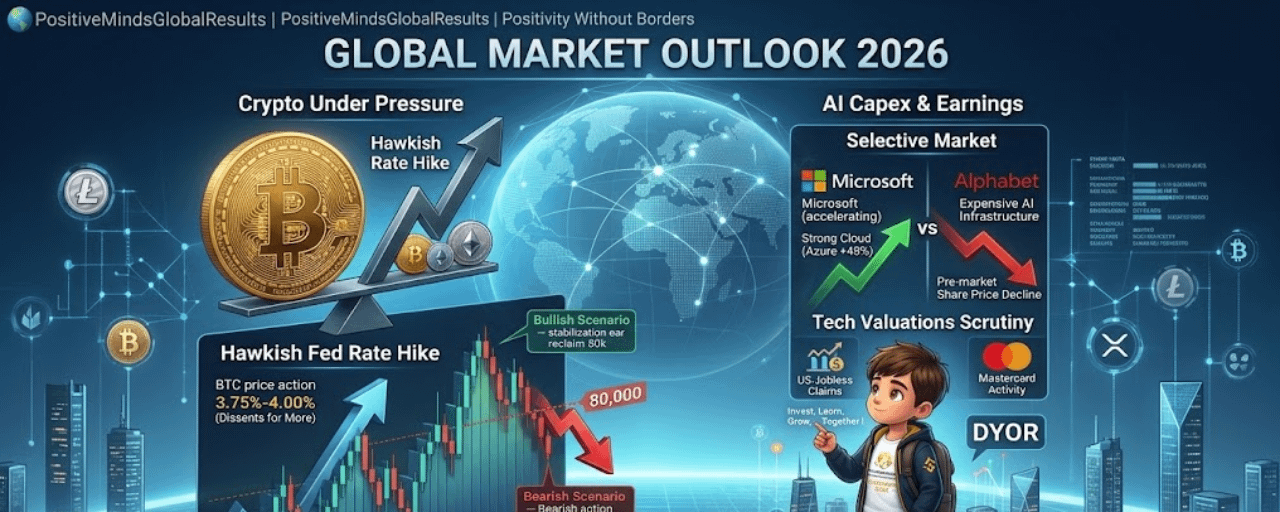
Article
Global Market Outlook: Fed Rate Hikes and AI Capex Scrutiny Squeeze Crypto and Tech Valuations#fedwatch 🌍#PositiveMindsGlobalResults | Positivity Without Borders
Invest, Learn, Grow, Together Binance Square
October 29, 2026
Global Market Outlook: Why Crypto is Under Pressure
The cryptocurrency market is facing a challenging combination of hawkish Federal Reserve signals, disappointing technology-sector earnings, and weakening investor risk appetite.
On October 28, the US Federal Reserve kept its benchmark interest rate at 3.75%–4.00%, but two policymakers dissented in favor of an immediate rate increase. This has intensified concerns about tighter monetary policy and its potential impact on risk-sensitive assets.
US Market Summary: October 29, 2026
The key story is that strong Microsoft cloud growth is clashing with concerns about Alphabet's earnings, expensive AI infrastructure, and a more hawkish Federal Reserve. The result is a more selective market in which investors are rewarding companies that demonstrate clear financial returns from AI rather than simply spending heavily on it.
1. What were Alphabet's revenue figures?
Alphabet reported third-quarter 2026 revenue of $127.6 billion, up 25% year-over-year. However, reports indicated that revenue disappointed market expectations, particularly around core search advertising, contributing to a sharp premarket share-price decline.
Key figures:
Total revenue: $127.6 billion, up 25%Google Services revenue: $96.3 billion, up 11%Google Cloud revenue: $30.7 billion, up 103%Operating margin: 31.8%
The important distinction is that Alphabet's overall business and cloud division continued to grow rapidly, even as investors questioned the profitability of its AI investments and the outlook for search advertising.
How much did Microsoft's cloud revenue grow?
Microsoft delivered a stronger earnings picture.
Microsoft Cloud revenue increased 30% year over year to $63.9 billion, accelerating from the previous quarter's reported growth rate of 27%. Azure's 48% growth further demonstrated demand for cloud computing and AI infrastructure.
Microsoft shares rose in premarket trading as investors responded positively to its results. However, continued spending requirements, infrastructure constraints and the cost of AI expansion remain important considerations.
2. What is the current performance of the S&P 500?
The S&P 500 closed Wednesday, October 28, at 7,743.98, up 0.28%. However, the market outlook weakened ahead of Thursday's session as investors reacted to disappointing Alphabet results.
Wednesday's gains came before the full market reaction to the latest technology earnings. Thursday's futures indicated renewed concerns about AI valuations and the profitability of large technology companies. These futures movements are not the same as confirmed changes in the indices during regular trading.
Market interpretation: The S&P 500 remains supported by corporate earnings and economic activity, but weakness in heavily weighted technology companies could limit further gains. Investors should distinguish between the index's headline performance and the performance of individual sectors.
3. How did other AI-related stocks respond to the earnings?
The response was mixed, highlighting a growing divide between companies benefiting from AI demand and companies facing questions about their spending and profitability.
The figures refer to different trading periods and should not be interpreted as simultaneous price changes.
What this means: AI demand remains substantial, particularly for cloud infrastructure and memory chips. However, investors are increasingly examining cash flow, capital expenditure and the commercial returns on AI spending. Strong revenue growth alone may not be enough to support a company's share price.
4. What do US jobless claims tell us?
The latest US labor-market data also deserve attention.
Initial jobless claims: 194,000, down from a revised 195,000.Market expectation: 198,000.Four-week moving average: 196,750, down 1,250.Continuing insured claims: 1.701 million, down 21,000.
The lower-than-expected initial claims figure suggests that layoffs remain limited and the labor market is resilient.
However, strong employment can complicate the Federal Reserve's efforts to bring inflation under control. If labor demand and wage pressures remain firm, policymakers may have less reason to lower interest rates.
The implications depend on the wider economic picture: resilient employment can support consumer spending and corporate earnings, but persistent inflation could keep borrowing costs elevated.
5. Why the Federal Reserve remains important
The Fed maintained its benchmark interest-rate range at 3.75%–4.00% on October 28, with a 10–2 vote. Two policymakers favored raising rates immediately.
This decision does not guarantee a December hike. The reported 85% probability of an increase should be treated as a market-implied estimate at the time of the report, not as a confirmed policy decision. Market expectations can change quickly as new inflation, employment and growth data emerge.
6. Mastercard: Another signal from the wider economy
Mastercard reported higher profit, supported by growth in its payments network and services business.
This is relevant because payment activity can provide insight into consumer spending and cross-border transactions. Strong payment-network results can indicate continued economic activity, although they do not by themselves prove that the entire economy is accelerating.
The broader market will need to balance this type of corporate strength against concerns about inflation, interest rates and technology-sector valuations.
Bitcoin (BTC), BNB and Ethereum (ETH): Crypto Market Outlook
Market date: October 29, 2026 | Short-term outlook: Cautious, with volatility risks
The latest cryptocurrency market action reflects the same uncertainty affecting US technology stocks. The Federal Reserve's hawkish hold, concerns about AI valuations and changing investor expectations are creating pressure across risk-sensitive assets.
Bitcoin fell below $80,000, while Ethereum weakened further. BNB showed relative resilience, demonstrating that major cryptocurrencies are not necessarily moving in the same direction.
Current crypto market snapshot
Prices and percentage changes are reported snapshots for October 29, not guaranteed live quotes. Figures may vary by exchange and timestamp.
A. Bitcoin (BTC): Can buyers reclaim $80,000?
Bitcoin's inability to hold above $80,000 is an important short-term warning. However, a move below a round-number level does not automatically mean that a deeper correction will follow.
Bullish scenario
BTC stabilizes around $79,000–$79,500 and attracts fresh buying.Buyers reclaim $80,000 and establish support above it.A break toward $81,300–$82,000 would strengthen the recovery case.Improving spot ETF inflows and easing bond yields could support renewed demand.
Bearish scenario
BTC fails to recover $80,000.Selling pushes the price below $79,000.Further weakness could expose the $78,600–$78,200 area.Persistent hawkish Fed expectations and declining risk appetite could increase downside pressure.
These levels are indicative technical reference points, not guaranteed targets. Recent technical analysis places nearby resistance around $81,350 and support around $79,030.
BTC outlook: Cautious while the price remains below $80,000–$81,350. A sustained recovery above resistance would improve the short-term picture.
B. BNB: Relative strength, but will it last?
BNB's positive daily performance contrasts with weakness in BTC and ETH. This relative strength is encouraging, but one positive session does not establish a lasting uptrend.
Bullish scenario
BNB holds above approximately $740–$745.Buyers push through $750 and maintain momentum.A sustained breakout could open the way toward $760–$770.
Bearish scenario
BNB fails to sustain its position above $750.The price falls below $740.A deeper pullback could bring $730–$725 into focus if broader crypto weakness intensifies.
These are scenario-based levels for monitoring, not verified exchange-specific support and resistance.
BNB outlook: Relatively resilient, but confirmation requires sustained buying and a clear breakout rather than a temporary price increase.
C. Ethereum (ETH): Can ETH defend $2,300?
Ethereum is facing additional pressure from reported withdrawals from US spot ETH exchange-traded funds. The price has fallen toward $2,300, while negative momentum suggests that buyers have yet to establish a convincing recovery.
Bullish scenario
ETH holds the $2,290–$2,300 support zone.Buyers recover $2,350 and then challenge $2,400.Improving ETF flows and stronger overall market sentiment support a rebound.
Bearish scenario
ETH breaks decisively below $2,290.Selling accelerates toward $2,250.If broader market conditions deteriorate further, the $2,200 region becomes a potential downside reference.
ETH outlook: Cautious while the price remains below $2,350–$2,400. A sustained break below $2,290 would increase downside risk.
7. How US Markets Could Influence BTC, BNB and ETH
These relationships are not automatic. Crypto prices can diverge from equities because of liquidity, leverage, regulatory developments, blockchain-specific news and institutional fund flows.
8. The Next 24 Hours: Three Scenarios
Scenario 1 — Bearish continuation
If the Fed's hawkish message continues to pressure risk assets and Bitcoin remains below $80,000, BTC could test lower support levels. ETH could remain vulnerable around $2,290–$2,300, while BNB could retreat if its relative strength fades.
Scenario 2 — Sideways consolidation
If investors wait for fresh economic data, BTC may fluctuate around $79,000–$80,500, ETH around $2,290–$2,350, and BNB around $740–$755. These are illustrative monitoring ranges, not statistical forecasts.
Scenario 3 — Relief rally
If Treasury yields ease, technology shares stabilize and crypto buyers return, BTC could recover above $80,000, ETH could challenge $2,350–$2,400, and BNB could attempt to sustain a move above $750.
Final Verdict
BTC: Cautious; monitor whether $80,000 can be reclaimed.BNB: Relatively resilient; watch whether$670 - $700 -$720–$750 holds.ETH: Cautious; $2,290–$2,300 is an important support zone.Overall crypto market: Volatile, with monetary policy, economic data and institutional flows likely to influence short-term direction.
Important upcoming catalysts: US economic releases, changes in Treasury yields, the US dollar, crypto ETF flows and any further reassessment of the Federal Reserve's December policy outlook.
The strongest confirmation will come from price action supported by trading volume and market flows—not headlines alone.
Final Outlook: What Investors Should Watch
The key takeaway for October 29 is that financial markets are becoming increasingly selective, with investors demanding stronger evidence of sustainable growth and profitability.
Three developments deserve particular attention:
AI Profitability: Can Alphabet, Microsoft, and other major technology companies turn their substantial investments in artificial intelligence (AI) into sustainable earnings and stronger cash flow?
Interest-Rate Expectations: Will upcoming inflation and economic data strengthen expectations of a potential December rate hike, or support the case for keeping interest rates unchanged?
Market Breadth: Can financial, industrial, and other sectors help support the broader market if major technology stocks come under further pressure?
For cryptocurrency and global financial markets, the implications are indirect but significant. A stronger US dollar, rising Treasury yields, or declining risk appetite could put pressure on Bitcoin and other cryptocurrencies. Conversely, easing interest-rate expectations and renewed confidence in growth assets could improve market sentiment.
Bottom Line: Microsoft's strong cloud performance highlights continued demand for AI-related services, while the negative market reaction to Alphabet's results underscores investors' growing focus on financial returns from AI investments.
The S&P 500's next move may depend not only on enthusiasm surrounding artificial intelligence but also on whether corporate earnings, cash flow, and monetary policy can justify current market valuations.
Disclaimer: This article is for educational and informational purposes only and does not constitute financial or investment advice. Market outlooks and price estimates are not guarantees of future performance. Cryptocurrency and stock markets involve risks, including the potential loss of capital. Conduct your own research (DYOR) and manage your risk carefully.
#PositiveMindsGlobalResults #BinanceSquare #binancepick #Bitcoin #BTC #BNB #Ethereum #ETH #CryptoMarket #CryptoForecast #Next24Hours #MarketOutlook #GlobalMarkets #USStockMarket #FederalReserve #FedRates #InterestRates #Inflation #TreasuryYields #AIStocks #ArtificialIntelligence #Alphabet #Google #Microsoft #TechEarnings #SP500 #MarketSentiment #CryptoAnalysis #BTCForecast #BNBForecast #ETHForecast #SupportAndResistance #BullishOrBearish #RiskManagement #DYOR #EstimatesNotAdvice #InvestLearnGrowTogether
Global Market Outlook: Fed Rate Hikes and AI Capex Scrutiny Squeeze Crypto and Tech Valuations
#fedwatch 🌍#PositiveMindsGlobalResults | Positivity Without Borders
Invest, Learn, Grow, Together Binance Square
October 29, 2026
Global Market Outlook: Why Crypto is Under Pressure
The cryptocurrency market is facing a challenging combination of hawkish Federal Reserve signals, disappointing technology-sector earnings, and weakening investor risk appetite.
On October 28, the US Federal Reserve kept its benchmark interest rate at 3.75%–4.00%, but two policymakers dissented in favor of an immediate rate increase. This has intensified concerns about tighter monetary policy and its potential impact on risk-sensitive assets.
US Market Summary: October 29, 2026
The key story is that strong Microsoft cloud growth is clashing with concerns about Alphabet's earnings, expensive AI infrastructure, and a more hawkish Federal Reserve. The result is a more selective market in which investors are rewarding companies that demonstrate clear financial returns from AI rather than simply spending heavily on it.
1. What were Alphabet's revenue figures?
Alphabet reported third-quarter 2026 revenue of $127.6 billion, up 25% year-over-year. However, reports indicated that revenue disappointed market expectations, particularly around core search advertising, contributing to a sharp premarket share-price decline.
Key figures:
Total revenue: $127.6 billion, up 25%Google Services revenue: $96.3 billion, up 11%Google Cloud revenue: $30.7 billion, up 103%Operating margin: 31.8%
The important distinction is that Alphabet's overall business and cloud division continued to grow rapidly, even as investors questioned the profitability of its AI investments and the outlook for search advertising.
How much did Microsoft's cloud revenue grow?
Microsoft delivered a stronger earnings picture.
Microsoft Cloud revenue increased 30% year over year to $63.9 billion, accelerating from the previous quarter's reported growth rate of 27%. Azure's 48% growth further demonstrated demand for cloud computing and AI infrastructure.
Microsoft shares rose in premarket trading as investors responded positively to its results. However, continued spending requirements, infrastructure constraints and the cost of AI expansion remain important considerations.
2. What is the current performance of the S&P 500?
The S&P 500 closed Wednesday, October 28, at 7,743.98, up 0.28%. However, the market outlook weakened ahead of Thursday's session as investors reacted to disappointing Alphabet results.
Wednesday's gains came before the full market reaction to the latest technology earnings. Thursday's futures indicated renewed concerns about AI valuations and the profitability of large technology companies. These futures movements are not the same as confirmed changes in the indices during regular trading.
Market interpretation: The S&P 500 remains supported by corporate earnings and economic activity, but weakness in heavily weighted technology companies could limit further gains. Investors should distinguish between the index's headline performance and the performance of individual sectors.
3. How did other AI-related stocks respond to the earnings?
The response was mixed, highlighting a growing divide between companies benefiting from AI demand and companies facing questions about their spending and profitability.
The figures refer to different trading periods and should not be interpreted as simultaneous price changes.
What this means: AI demand remains substantial, particularly for cloud infrastructure and memory chips. However, investors are increasingly examining cash flow, capital expenditure and the commercial returns on AI spending. Strong revenue growth alone may not be enough to support a company's share price.
4. What do US jobless claims tell us?
The latest US labor-market data also deserve attention.
Initial jobless claims: 194,000, down from a revised 195,000.Market expectation: 198,000.Four-week moving average: 196,750, down 1,250.Continuing insured claims: 1.701 million, down 21,000.
The lower-than-expected initial claims figure suggests that layoffs remain limited and the labor market is resilient.
However, strong employment can complicate the Federal Reserve's efforts to bring inflation under control. If labor demand and wage pressures remain firm, policymakers may have less reason to lower interest rates.
The implications depend on the wider economic picture: resilient employment can support consumer spending and corporate earnings, but persistent inflation could keep borrowing costs elevated.
5. Why the Federal Reserve remains important
The Fed maintained its benchmark interest-rate range at 3.75%–4.00% on October 28, with a 10–2 vote. Two policymakers favored raising rates immediately.
This decision does not guarantee a December hike. The reported 85% probability of an increase should be treated as a market-implied estimate at the time of the report, not as a confirmed policy decision. Market expectations can change quickly as new inflation, employment and growth data emerge.
6. Mastercard: Another signal from the wider economy
Mastercard reported higher profit, supported by growth in its payments network and services business.
This is relevant because payment activity can provide insight into consumer spending and cross-border transactions. Strong payment-network results can indicate continued economic activity, although they do not by themselves prove that the entire economy is accelerating.
The broader market will need to balance this type of corporate strength against concerns about inflation, interest rates and technology-sector valuations.
Bitcoin (BTC), BNB and Ethereum (ETH): Crypto Market Outlook
Market date: October 29, 2026 | Short-term outlook: Cautious, with volatility risks
The latest cryptocurrency market action reflects the same uncertainty affecting US technology stocks. The Federal Reserve's hawkish hold, concerns about AI valuations and changing investor expectations are creating pressure across risk-sensitive assets.
Bitcoin fell below $80,000, while Ethereum weakened further. BNB showed relative resilience, demonstrating that major cryptocurrencies are not necessarily moving in the same direction.
Current crypto market snapshot
Prices and percentage changes are reported snapshots for October 29, not guaranteed live quotes. Figures may vary by exchange and timestamp.
A. Bitcoin (BTC): Can buyers reclaim $80,000?
Bitcoin's inability to hold above $80,000 is an important short-term warning. However, a move below a round-number level does not automatically mean that a deeper correction will follow.
Bullish scenario
BTC stabilizes around $79,000–$79,500 and attracts fresh buying.Buyers reclaim $80,000 and establish support above it.A break toward $81,300–$82,000 would strengthen the recovery case.Improving spot ETF inflows and easing bond yields could support renewed demand.
Bearish scenario
BTC fails to recover $80,000.Selling pushes the price below $79,000.Further weakness could expose the $78,600–$78,200 area.Persistent hawkish Fed expectations and declining risk appetite could increase downside pressure.
These levels are indicative technical reference points, not guaranteed targets. Recent technical analysis places nearby resistance around $81,350 and support around $79,030.
BTC outlook: Cautious while the price remains below $80,000–$81,350. A sustained recovery above resistance would improve the short-term picture.
B. BNB: Relative strength, but will it last?
BNB's positive daily performance contrasts with weakness in BTC and ETH. This relative strength is encouraging, but one positive session does not establish a lasting uptrend.
Bullish scenario
BNB holds above approximately $740–$745.Buyers push through $750 and maintain momentum.A sustained breakout could open the way toward $760–$770.
Bearish scenario
BNB fails to sustain its position above $750.The price falls below $740.A deeper pullback could bring $730–$725 into focus if broader crypto weakness intensifies.
These are scenario-based levels for monitoring, not verified exchange-specific support and resistance.
BNB outlook: Relatively resilient, but confirmation requires sustained buying and a clear breakout rather than a temporary price increase.
C. Ethereum (ETH): Can ETH defend $2,300?
Ethereum is facing additional pressure from reported withdrawals from US spot ETH exchange-traded funds. The price has fallen toward $2,300, while negative momentum suggests that buyers have yet to establish a convincing recovery.
Bullish scenario
ETH holds the $2,290–$2,300 support zone.Buyers recover $2,350 and then challenge $2,400.Improving ETF flows and stronger overall market sentiment support a rebound.
Bearish scenario
ETH breaks decisively below $2,290.Selling accelerates toward $2,250.If broader market conditions deteriorate further, the $2,200 region becomes a potential downside reference.
ETH outlook: Cautious while the price remains below $2,350–$2,400. A sustained break below $2,290 would increase downside risk.
7. How US Markets Could Influence BTC, BNB and ETH
These relationships are not automatic. Crypto prices can diverge from equities because of liquidity, leverage, regulatory developments, blockchain-specific news and institutional fund flows.
8. The Next 24 Hours: Three Scenarios
Scenario 1 — Bearish continuation
If the Fed's hawkish message continues to pressure risk assets and Bitcoin remains below $80,000, BTC could test lower support levels. ETH could remain vulnerable around $2,290–$2,300, while BNB could retreat if its relative strength fades.
Scenario 2 — Sideways consolidation
If investors wait for fresh economic data, BTC may fluctuate around $79,000–$80,500, ETH around $2,290–$2,350, and BNB around $740–$755. These are illustrative monitoring ranges, not statistical forecasts.
Scenario 3 — Relief rally
If Treasury yields ease, technology shares stabilize and crypto buyers return, BTC could recover above $80,000, ETH could challenge $2,350–$2,400, and BNB could attempt to sustain a move above $750.
Final Verdict
BTC: Cautious; monitor whether $80,000 can be reclaimed.BNB: Relatively resilient; watch whether$670 - $700 -$720–$750 holds.ETH: Cautious; $2,290–$2,300 is an important support zone.Overall crypto market: Volatile, with monetary policy, economic data and institutional flows likely to influence short-term direction.
Important upcoming catalysts: US economic releases, changes in Treasury yields, the US dollar, crypto ETF flows and any further reassessment of the Federal Reserve's December policy outlook.
The strongest confirmation will come from price action supported by trading volume and market flows—not headlines alone.
Final Outlook: What Investors Should Watch
The key takeaway for October 29 is that financial markets are becoming increasingly selective, with investors demanding stronger evidence of sustainable growth and profitability.
Three developments deserve particular attention:
AI Profitability: Can Alphabet, Microsoft, and other major technology companies turn their substantial investments in artificial intelligence (AI) into sustainable earnings and stronger cash flow?
Interest-Rate Expectations: Will upcoming inflation and economic data strengthen expectations of a potential December rate hike, or support the case for keeping interest rates unchanged?
Market Breadth: Can financial, industrial, and other sectors help support the broader market if major technology stocks come under further pressure?
For cryptocurrency and global financial markets, the implications are indirect but significant. A stronger US dollar, rising Treasury yields, or declining risk appetite could put pressure on Bitcoin and other cryptocurrencies. Conversely, easing interest-rate expectations and renewed confidence in growth assets could improve market sentiment.
Bottom Line: Microsoft's strong cloud performance highlights continued demand for AI-related services, while the negative market reaction to Alphabet's results underscores investors' growing focus on financial returns from AI investments.
The S&P 500's next move may depend not only on enthusiasm surrounding artificial intelligence but also on whether corporate earnings, cash flow, and monetary policy can justify current market valuations.
Disclaimer: This article is for educational and informational purposes only and does not constitute financial or investment advice. Market outlooks and price estimates are not guarantees of future performance. Cryptocurrency and stock markets involve risks, including the potential loss of capital. Conduct your own research (DYOR) and manage your risk carefully.
#PositiveMindsGlobalResults #BinanceSquare #binancepick #Bitcoin #BTC #BNB #Ethereum #ETH #CryptoMarket #CryptoForecast #Next24Hours #MarketOutlook #GlobalMarkets #USStockMarket #FederalReserve #FedRates #InterestRates #Inflation #TreasuryYields #AIStocks #ArtificialIntelligence #Alphabet #Google #Microsoft #TechEarnings #SP500 #MarketSentiment #CryptoAnalysis #BTCForecast #BNBForecast #ETHForecast #SupportAndResistance #BullishOrBearish #RiskManagement #DYOR #EstimatesNotAdvice #InvestLearnGrowTogether
82

Article
Fed Holds Rates at 4%: Hawkish Warning for Bitcoin, Ethereum and Global Markets#fedwatch 🌍 #PositiveMindsGlobalResults | Positivity Without Borders
Invest, Learn, Grow, Together Binance Square
October 29, 2026
The Federal Reserve delivered a divided decision on October 28, 2026, voting 10–2 to maintain its benchmark interest rate at 3.75%–4.00%. However, the decision contained a warning for investors: inflation remains elevated, economic growth is strong, and two policymakers preferred an immediate rate hike.
What Changed?
Fed Chair Kevin Warsh's committee upgraded its economic assessment from "solid" to "strong." Governor Lisa Cook and Cleveland Fed President Beth Hammack dissented, favoring a 0.25-percentage-point increase.
The Fed also announced that one of its eight scheduled meetings in 2027 will focus exclusively on monetary policy strategy, without a rate decision or policy statement expected.
Why Markets Should Care
A rate hold does not automatically mean easier financial conditions. If inflation remains persistent, markets may have to reconsider expectations for future rate cuts and prepare for the possibility of further tightening.
Bitcoin, Ethereum and BNB could benefit if Treasury yields and the US dollar weaken and investors become more willing to take risks. Conversely, rising yields, a stronger dollar and renewed rate-hike expectations could pressure cryptocurrencies and technology stocks.
Bullish Scenario: Cooling inflation, easing bond yields and improving risk appetite could support a recovery across crypto markets.
Bearish Scenario: Persistent inflation, rising energy prices and expectations of another rate hike could increase volatility and trigger further selling.
What to Watch Next
Investors should monitor incoming US inflation and employment data, Treasury yields, dollar movements, institutional crypto fund flows and the Fed's December policy decision.
Fed Holds Rates at 4%: Hawkish Warning for Bitcoin, Ethereum and Global Markets - Positive Minds Global Results | Positivity Without Borders | Invest, Learn, Grow, Together
The Bottom Line
The Fed has paused, but it has not declared victory over inflation. Markets must balance resilient economic growth against the risk of tighter monetary policy. For Bitcoin, Ethereum, BNB and global equities, the next major move may depend more on incoming economic data than on the rate hold itself.
Disclaimer: This article is for educational and informational purposes only, not financial advice. Market scenarios are estimates, not guarantees. Always conduct your own research and assess your risk before making investment decisions.
#FederalReserve #FedRates #Bitcoin #BTC #Ethereum #ETH #BNB #CryptoMarket #GlobalMarkets #Inflation #TreasuryYields #PositiveMindsGlobalResults #BinanceSquare
PositiveMindsGlobalResults | Positivity Without Borders
INVEST, LEARN, GROW, TOGETHER
Binance Square
Fed Holds Rates at 4%: Hawkish Warning for Bitcoin, Ethereum and Global Markets
#fedwatch 🌍 #PositiveMindsGlobalResults | Positivity Without Borders
Invest, Learn, Grow, Together Binance Square
October 29, 2026
The Federal Reserve delivered a divided decision on October 28, 2026, voting 10–2 to maintain its benchmark interest rate at 3.75%–4.00%. However, the decision contained a warning for investors: inflation remains elevated, economic growth is strong, and two policymakers preferred an immediate rate hike.
What Changed?
Fed Chair Kevin Warsh's committee upgraded its economic assessment from "solid" to "strong." Governor Lisa Cook and Cleveland Fed President Beth Hammack dissented, favoring a 0.25-percentage-point increase.
The Fed also announced that one of its eight scheduled meetings in 2027 will focus exclusively on monetary policy strategy, without a rate decision or policy statement expected.
Why Markets Should Care
A rate hold does not automatically mean easier financial conditions. If inflation remains persistent, markets may have to reconsider expectations for future rate cuts and prepare for the possibility of further tightening.
Bitcoin, Ethereum and BNB could benefit if Treasury yields and the US dollar weaken and investors become more willing to take risks. Conversely, rising yields, a stronger dollar and renewed rate-hike expectations could pressure cryptocurrencies and technology stocks.
Bullish Scenario: Cooling inflation, easing bond yields and improving risk appetite could support a recovery across crypto markets.
Bearish Scenario: Persistent inflation, rising energy prices and expectations of another rate hike could increase volatility and trigger further selling.
What to Watch Next
Investors should monitor incoming US inflation and employment data, Treasury yields, dollar movements, institutional crypto fund flows and the Fed's December policy decision.
Fed Holds Rates at 4%: Hawkish Warning for Bitcoin, Ethereum and Global Markets - Positive Minds Global Results | Positivity Without Borders | Invest, Learn, Grow, Together
The Bottom Line
The Fed has paused, but it has not declared victory over inflation. Markets must balance resilient economic growth against the risk of tighter monetary policy. For Bitcoin, Ethereum, BNB and global equities, the next major move may depend more on incoming economic data than on the rate hold itself.
Disclaimer: This article is for educational and informational purposes only, not financial advice. Market scenarios are estimates, not guarantees. Always conduct your own research and assess your risk before making investment decisions.
#FederalReserve #FedRates #Bitcoin #BTC #Ethereum #ETH #BNB #CryptoMarket #GlobalMarkets #Inflation #TreasuryYields #PositiveMindsGlobalResults #BinanceSquare
PositiveMindsGlobalResults | Positivity Without Borders
INVEST, LEARN, GROW, TOGETHER
Binance Square
190

Article
Alphabet Stock Crash: AI Boom Meets a $9 Billion Cash-Flow Shock#cangoogledefinditscore 🌍#PositiveMindsGlobalResults | Positivity Without Borders
Binance Square | October 29, 2026
INVEST, LEARN, GROW, TOGETHER
Alphabet Stock Crash: AI Boom Meets a $9 Billion Cash-Flow Shock
Can Google Turn Record AI Demand Into Sustainable Profits?
Alphabet Inc. (NASDAQ: GOOG, GOOGL) has delivered a powerful warning to Wall Street: even 25% revenue growth may not be enough when profits disappoint and artificial intelligence investments consume billions in cash.
Following its Q3 2026 earnings release on October 28, Alphabet shares plunged more than 10% in after-hours trading. Revenue reached $127.6 billion, up 25% year over year, but earnings disappointed and free cash flow turned sharply negative.
The Numbers Behind the Sell-Off
Revenue: $127.6 billion, up 25% year over year.
Reported diluted EPS: $2.12, versus approximately $3.01 expected.
Free cash flow: Negative $9.07 billion, compared with negative $5.9 billion in the previous quarter.
Google Cloud revenue: $30.7 billion, up 103%.
Search and other advertising revenue: Approximately $63.3 billion, up 12%.
YouTube advertising revenue: Approximately $11.2 billion, up 9%.
The message is clear: Alphabet's AI expansion is generating substantial demand, but investors are questioning how much capital the company must spend before the returns justify the investment.
1. The AI Investment Dilemma
Alphabet is investing aggressively in data centers, computing infrastructure, AI models and cloud capacity.
These investments could strengthen its competitive position against Microsoft, Amazon and other AI leaders. However, the immediate financial burden is significant.
Negative free cash flow means capital expenditures and other investment-related cash requirements are outpacing the cash generated after operating expenses. It does not automatically mean the company is financially distressed, but repeated negative quarters deserve attention.
Management has also indicated that capital expenditure will increase significantly in 2027, keeping pressure on investors to evaluate the future return on these investments.
2. Why the Profit Miss Matters
Alphabet's reported diluted EPS of $2.12 fell well short of expectations. An approximately $8.7 billion loss on equity investments significantly affected earnings.
This investment loss is important because it should not be confused with a direct operating loss from Google's core search or cloud businesses.
Nevertheless, the result highlights a crucial distinction: strong operating performance does not guarantee equally strong net earnings when investment valuations and other non-operating items move against the company.
3. Google Cloud: The Hidden Opportunity
The strongest part of the report was Google Cloud, whose revenue more than doubled to approximately $30.7 billion.
Growth was driven by enterprise demand for AI infrastructure, cloud computing services, AI solutions and Google's own tensor processing unit systems.
Cloud operating income also increased, demonstrating that this expansion is producing more than revenue alone.
The opportunity is substantial: if AI demand continues and Alphabet converts infrastructure investments into recurring, profitable cloud services, today's spending could support future earnings growth.
The risk is equally important. Building capacity ahead of demand can create pressure on cash flow and margins, particularly if customer demand or AI monetization disappoints.
4. Is Google's Advertising Business Losing Momentum?
Search advertising increased 12%, while YouTube advertising rose 9%. Both businesses continued to grow, but investors were concerned that advertising performance did not meet expectations.
The bigger question is whether AI-powered search will strengthen Google's business model or gradually change how users discover information and interact with advertisements.
AI could create new commercial opportunities, improve search relevance and support new advertising formats. However, it could also increase computing costs or change the economics of traditional search.
For now, the figures indicate continued growth, not the collapse of Google's advertising business. The challenge is sustaining that growth while funding an expensive technological transition.
Bullish vs. Bearish Scenarios
The Bull Case
Google Cloud continues expanding through enterprise AI demand.AI products generate sustainable revenue and improve productivity.Search advertising remains resilient despite changing user behavior.Infrastructure investments eventually produce stronger free cash flow.
If these conditions materialize, the recent sell-off could create a longer-term opportunity for investors who believe in Alphabet's ability to monetize AI.
The Bear Case
Capital expenditure continues rising faster than cash generation.AI competition increases operating costs and threatens search economics.Advertising growth disappoints for several consecutive quarters.Cloud expansion produces weaker margins or lower returns than expected.
If these risks intensify, investors could continue demanding a lower valuation despite strong headline revenue growth.
What Investors Should Watch Next
The most important indicators are free cash flow, capital expenditure guidance, Google Cloud profitability, search advertising growth and evidence that AI products are generating returns on investment.
A single earnings report cannot establish whether Alphabet has reached a long-term turning point. Future results will reveal whether today's spending creates durable competitive advantages or becomes a prolonged financial burden.
Final Takeaway
Alphabet's Q3 report is not simply a story of a technology giant missing earnings expectations. It is a test of the economics of the AI revolution.
Google Cloud demonstrates the scale of the opportunity, while negative free cash flow and a substantial earnings shortfall reveal the cost of pursuing it.
The key question for 2027 is straightforward: Can Alphabet turn extraordinary AI demand into sustainable cash generation without weakening its advertising business?
That answer may matter more to long-term investors than revenue growth alone.
Disclaimer: This article is for educational and informational purposes only. It is not financial or investment advice. Market outcomes are uncertain, and investors should conduct their own research before making financial decisions.
#Alphabet #Google #ArtificialIntelligence #GoogleCloud #TechStocks #StockMarket #AIInvesting #AIBoom #CashFlowShock #AlphabetEarnings #BigTech #AIInfrastructure #PositiveMindsGlobalResults #BinanceSquare
Alphabet Stock Crash: AI Boom Meets a $9 Billion Cash-Flow Shock
#cangoogledefinditscore 🌍#PositiveMindsGlobalResults | Positivity Without Borders
Binance Square | October 29, 2026
INVEST, LEARN, GROW, TOGETHER
Alphabet Stock Crash: AI Boom Meets a $9 Billion Cash-Flow Shock
Can Google Turn Record AI Demand Into Sustainable Profits?
Alphabet Inc. (NASDAQ: GOOG, GOOGL) has delivered a powerful warning to Wall Street: even 25% revenue growth may not be enough when profits disappoint and artificial intelligence investments consume billions in cash.
Following its Q3 2026 earnings release on October 28, Alphabet shares plunged more than 10% in after-hours trading. Revenue reached $127.6 billion, up 25% year over year, but earnings disappointed and free cash flow turned sharply negative.
The Numbers Behind the Sell-Off
Revenue: $127.6 billion, up 25% year over year.
Reported diluted EPS: $2.12, versus approximately $3.01 expected.
Free cash flow: Negative $9.07 billion, compared with negative $5.9 billion in the previous quarter.
Google Cloud revenue: $30.7 billion, up 103%.
Search and other advertising revenue: Approximately $63.3 billion, up 12%.
YouTube advertising revenue: Approximately $11.2 billion, up 9%.
The message is clear: Alphabet's AI expansion is generating substantial demand, but investors are questioning how much capital the company must spend before the returns justify the investment.
1. The AI Investment Dilemma
Alphabet is investing aggressively in data centers, computing infrastructure, AI models and cloud capacity.
These investments could strengthen its competitive position against Microsoft, Amazon and other AI leaders. However, the immediate financial burden is significant.
Negative free cash flow means capital expenditures and other investment-related cash requirements are outpacing the cash generated after operating expenses. It does not automatically mean the company is financially distressed, but repeated negative quarters deserve attention.
Management has also indicated that capital expenditure will increase significantly in 2027, keeping pressure on investors to evaluate the future return on these investments.
2. Why the Profit Miss Matters
Alphabet's reported diluted EPS of $2.12 fell well short of expectations. An approximately $8.7 billion loss on equity investments significantly affected earnings.
This investment loss is important because it should not be confused with a direct operating loss from Google's core search or cloud businesses.
Nevertheless, the result highlights a crucial distinction: strong operating performance does not guarantee equally strong net earnings when investment valuations and other non-operating items move against the company.
3. Google Cloud: The Hidden Opportunity
The strongest part of the report was Google Cloud, whose revenue more than doubled to approximately $30.7 billion.
Growth was driven by enterprise demand for AI infrastructure, cloud computing services, AI solutions and Google's own tensor processing unit systems.
Cloud operating income also increased, demonstrating that this expansion is producing more than revenue alone.
The opportunity is substantial: if AI demand continues and Alphabet converts infrastructure investments into recurring, profitable cloud services, today's spending could support future earnings growth.
The risk is equally important. Building capacity ahead of demand can create pressure on cash flow and margins, particularly if customer demand or AI monetization disappoints.
4. Is Google's Advertising Business Losing Momentum?
Search advertising increased 12%, while YouTube advertising rose 9%. Both businesses continued to grow, but investors were concerned that advertising performance did not meet expectations.
The bigger question is whether AI-powered search will strengthen Google's business model or gradually change how users discover information and interact with advertisements.
AI could create new commercial opportunities, improve search relevance and support new advertising formats. However, it could also increase computing costs or change the economics of traditional search.
For now, the figures indicate continued growth, not the collapse of Google's advertising business. The challenge is sustaining that growth while funding an expensive technological transition.
Bullish vs. Bearish Scenarios
The Bull Case
Google Cloud continues expanding through enterprise AI demand.AI products generate sustainable revenue and improve productivity.Search advertising remains resilient despite changing user behavior.Infrastructure investments eventually produce stronger free cash flow.
If these conditions materialize, the recent sell-off could create a longer-term opportunity for investors who believe in Alphabet's ability to monetize AI.
The Bear Case
Capital expenditure continues rising faster than cash generation.AI competition increases operating costs and threatens search economics.Advertising growth disappoints for several consecutive quarters.Cloud expansion produces weaker margins or lower returns than expected.
If these risks intensify, investors could continue demanding a lower valuation despite strong headline revenue growth.
What Investors Should Watch Next
The most important indicators are free cash flow, capital expenditure guidance, Google Cloud profitability, search advertising growth and evidence that AI products are generating returns on investment.
A single earnings report cannot establish whether Alphabet has reached a long-term turning point. Future results will reveal whether today's spending creates durable competitive advantages or becomes a prolonged financial burden.
Final Takeaway
Alphabet's Q3 report is not simply a story of a technology giant missing earnings expectations. It is a test of the economics of the AI revolution.
Google Cloud demonstrates the scale of the opportunity, while negative free cash flow and a substantial earnings shortfall reveal the cost of pursuing it.
The key question for 2027 is straightforward: Can Alphabet turn extraordinary AI demand into sustainable cash generation without weakening its advertising business?
That answer may matter more to long-term investors than revenue growth alone.
Disclaimer: This article is for educational and informational purposes only. It is not financial or investment advice. Market outcomes are uncertain, and investors should conduct their own research before making financial decisions.
#Alphabet #Google #ArtificialIntelligence #GoogleCloud #TechStocks #StockMarket #AIInvesting #AIBoom #CashFlowShock #AlphabetEarnings #BigTech #AIInfrastructure #PositiveMindsGlobalResults #BinanceSquare
GOOGUS-0.95%
GOOGLB-2.70%
165

Article
Microsoft Beats Earnings Expectations, but the AI Spending Challenge Is Far From Over#canmicrosoftdeliveronai 🌍#PositiveMindsGlobalResults Binance Square | October 29, 2026
Azure Surges 48% as Microsoft Faces a Critical Question: Can AI Growth Deliver Long-Term Profits?
October 29, 2026 | Technology, AI and Global Markets
Microsoft has delivered a powerful message to global markets: demand for artificial intelligence is accelerating, and its cloud business is benefiting. But beneath the impressive earnings numbers lies a much bigger investment question. How much must Microsoft spend to maintain its AI leadership, and how quickly can those investments generate sustainable returns?
1. Microsoft's Latest Earnings: The Numbers That Matter
Microsoft reported its fiscal first-quarter 2027 results for the three months ended September 30, 2026, delivering strong year-over-year growth.
Key financial highlights:
Total revenue reached $92.28 billion, up 19% year over year.Operating income climbed 21% to $45.92 billion.GAAP net income increased 32% to $36.63 billion.GAAP diluted earnings per share reached $4.92, while adjusted non-GAAP EPS was $4.89.Microsoft Cloud revenue rose 30% to $63.9 billion.Azure revenue increased 48%, demonstrating substantial demand for cloud and AI infrastructure.
Revenue exceeded the approximately $90.74 billion consensus estimate cited in preliminary market data. However, investors should distinguish between GAAP and adjusted earnings rather than relying on incomplete early data.
2. Azure's 48% Growth: The Real AI Story
Azure is becoming one of Microsoft's most important growth engines.
The company also reported $677 billion in commercial remaining performance obligations, up 73% year over year. This represents contracted revenue that has not yet been recognized, providing visibility into future business demand.
However, contracted revenue is not the same as immediate cash flow. The timing of customer usage, contract delivery and revenue recognition still matters.
For investors, the key question is whether Azure can maintain strong growth while Microsoft expands its data centers, computing capacity and AI services.
If demand remains strong and infrastructure utilization improves, Microsoft could strengthen its competitive position. If capacity costs rise faster than customer revenue, profitability could come under pressure.
3. The $50 Billion Question: Can AI Pay for Itself?
Microsoft's AI ambitions require enormous investment in computing infrastructure, data centers, networking equipment and specialized chips.
Management had indicated that quarterly capital expenditure would exceed $50 billion. The scale of this spending makes capital efficiency a central issue for investors.
The bullish argument is straightforward: today's infrastructure investment could support years of cloud growth, enterprise AI adoption and recurring software revenue.
The bearish argument is equally important: infrastructure must generate sufficient revenue and cash flow to justify its cost. Rapid technological change, depreciation, energy requirements and competition could weaken returns.
Strong AI demand is encouraging, but demand alone does not guarantee attractive investment returns.
Investors should monitor capital expenditure, free cash flow, operating margins and evidence that customers are paying for AI products at a sustainable scale.
4. Microsoft's Workforce Strategy: Efficiency Under Pressure
Microsoft has also introduced a voluntary buyout program for approximately 60,000 eligible employees as it seeks to manage costs while expanding its AI capabilities.
This is a voluntary buyout initiative, not confirmation that all eligible employees will leave the company.
The broader issue is how Microsoft allocates resources between its existing workforce, traditional software operations and emerging AI opportunities.
Successful restructuring could improve efficiency. However, cost reductions must be balanced against employee expertise, product development and the ability to compete in a rapidly changing technology market.
5. A New Reporting Structure Changes the Investment Picture
Microsoft has introduced a revised financial reporting structure, including its new Agents and Infra and Devices and Consumer segments.
The change comes as AI becomes increasingly important across the company's business.
More detailed reporting can help investors understand how Microsoft's infrastructure and AI-related operations are developing. However, changes in segment definitions can make historical comparisons more complicated.
Investors should compare equivalent reporting categories and pay attention to how management explains growth across Azure, Microsoft 365 and other AI-related services.
6. Bullish vs. Bearish Scenarios for Microsoft
The Bullish Scenario
Azure maintains strong growth, enterprise customers increase AI spending, and Microsoft converts infrastructure investments into recurring revenue. Improving utilization and disciplined spending could support stronger long-term cash generation.
The Bearish Scenario
Capital expenditure continues rising, AI monetization disappoints, and competition pressures margins. If infrastructure spending grows faster than revenue and cash flow, investors could question whether Microsoft's AI expansion is generating sufficient returns.
The Key Indicator
Watch the relationship between Azure growth, capital expenditure and free cash flow. Strong revenue growth combined with improving cash generation would provide more convincing evidence of sustainable AI economics.
7. What This Means for Global Technology Markets
Microsoft's results matter beyond its own share price.
Cloud infrastructure providers, semiconductor manufacturers, data-center operators and enterprise software companies are all connected to the AI investment cycle.
Strong Azure growth could reinforce confidence in enterprise AI demand and infrastructure spending. Conversely, concerns about capital efficiency could increase scrutiny of technology companies investing heavily in AI.
The market's next major test is whether strong AI demand can translate into durable earnings and cash flow across the industry.
Final Verdict: AI Growth Is Real, but Returns Still Matter
Microsoft's latest results demonstrate strong revenue growth, accelerating Azure demand and substantial commercial commitments.
Yet the next stage of the AI boom will require more than impressive growth rates. Investors will increasingly evaluate how efficiently companies turn computing capacity and AI adoption into profits and cash flow.
Microsoft's opportunity is significant, but execution remains critical.
The big question for 2027 is not simply who spends the most on AI. It is who generates the strongest sustainable returns from that spending.
This distinction could become one of the defining investment themes for global technology markets.
Disclaimer: This article is for educational and informational purposes only. It is not financial or investment advice. Market outcomes are uncertain, and past performance does not guarantee future results. Always conduct your own research before making investment decisions.
#Microsoft #MSFT #Azure #ArtificialIntelligence #AIInfrastructure #TechStocks #CloudComputing #GlobalMarkets #EarningsSeason #PositiveMindsGlobalResults #BinanceSquare
Positive Minds Global Results - Positivity without borders
INVEST, LEARN, GROW, TOGETHER
BINANCE SQUARE
Microsoft Beats Earnings Expectations, but the AI Spending Challenge Is Far From Over
#canmicrosoftdeliveronai 🌍#PositiveMindsGlobalResults Binance Square | October 29, 2026
Azure Surges 48% as Microsoft Faces a Critical Question: Can AI Growth Deliver Long-Term Profits?
October 29, 2026 | Technology, AI and Global Markets
Microsoft has delivered a powerful message to global markets: demand for artificial intelligence is accelerating, and its cloud business is benefiting. But beneath the impressive earnings numbers lies a much bigger investment question. How much must Microsoft spend to maintain its AI leadership, and how quickly can those investments generate sustainable returns?
1. Microsoft's Latest Earnings: The Numbers That Matter
Microsoft reported its fiscal first-quarter 2027 results for the three months ended September 30, 2026, delivering strong year-over-year growth.
Key financial highlights:
Total revenue reached $92.28 billion, up 19% year over year.Operating income climbed 21% to $45.92 billion.GAAP net income increased 32% to $36.63 billion.GAAP diluted earnings per share reached $4.92, while adjusted non-GAAP EPS was $4.89.Microsoft Cloud revenue rose 30% to $63.9 billion.Azure revenue increased 48%, demonstrating substantial demand for cloud and AI infrastructure.
Revenue exceeded the approximately $90.74 billion consensus estimate cited in preliminary market data. However, investors should distinguish between GAAP and adjusted earnings rather than relying on incomplete early data.
2. Azure's 48% Growth: The Real AI Story
Azure is becoming one of Microsoft's most important growth engines.
The company also reported $677 billion in commercial remaining performance obligations, up 73% year over year. This represents contracted revenue that has not yet been recognized, providing visibility into future business demand.
However, contracted revenue is not the same as immediate cash flow. The timing of customer usage, contract delivery and revenue recognition still matters.
For investors, the key question is whether Azure can maintain strong growth while Microsoft expands its data centers, computing capacity and AI services.
If demand remains strong and infrastructure utilization improves, Microsoft could strengthen its competitive position. If capacity costs rise faster than customer revenue, profitability could come under pressure.
3. The $50 Billion Question: Can AI Pay for Itself?
Microsoft's AI ambitions require enormous investment in computing infrastructure, data centers, networking equipment and specialized chips.
Management had indicated that quarterly capital expenditure would exceed $50 billion. The scale of this spending makes capital efficiency a central issue for investors.
The bullish argument is straightforward: today's infrastructure investment could support years of cloud growth, enterprise AI adoption and recurring software revenue.
The bearish argument is equally important: infrastructure must generate sufficient revenue and cash flow to justify its cost. Rapid technological change, depreciation, energy requirements and competition could weaken returns.
Strong AI demand is encouraging, but demand alone does not guarantee attractive investment returns.
Investors should monitor capital expenditure, free cash flow, operating margins and evidence that customers are paying for AI products at a sustainable scale.
4. Microsoft's Workforce Strategy: Efficiency Under Pressure
Microsoft has also introduced a voluntary buyout program for approximately 60,000 eligible employees as it seeks to manage costs while expanding its AI capabilities.
This is a voluntary buyout initiative, not confirmation that all eligible employees will leave the company.
The broader issue is how Microsoft allocates resources between its existing workforce, traditional software operations and emerging AI opportunities.
Successful restructuring could improve efficiency. However, cost reductions must be balanced against employee expertise, product development and the ability to compete in a rapidly changing technology market.
5. A New Reporting Structure Changes the Investment Picture
Microsoft has introduced a revised financial reporting structure, including its new Agents and Infra and Devices and Consumer segments.
The change comes as AI becomes increasingly important across the company's business.
More detailed reporting can help investors understand how Microsoft's infrastructure and AI-related operations are developing. However, changes in segment definitions can make historical comparisons more complicated.
Investors should compare equivalent reporting categories and pay attention to how management explains growth across Azure, Microsoft 365 and other AI-related services.
6. Bullish vs. Bearish Scenarios for Microsoft
The Bullish Scenario
Azure maintains strong growth, enterprise customers increase AI spending, and Microsoft converts infrastructure investments into recurring revenue. Improving utilization and disciplined spending could support stronger long-term cash generation.
The Bearish Scenario
Capital expenditure continues rising, AI monetization disappoints, and competition pressures margins. If infrastructure spending grows faster than revenue and cash flow, investors could question whether Microsoft's AI expansion is generating sufficient returns.
The Key Indicator
Watch the relationship between Azure growth, capital expenditure and free cash flow. Strong revenue growth combined with improving cash generation would provide more convincing evidence of sustainable AI economics.
7. What This Means for Global Technology Markets
Microsoft's results matter beyond its own share price.
Cloud infrastructure providers, semiconductor manufacturers, data-center operators and enterprise software companies are all connected to the AI investment cycle.
Strong Azure growth could reinforce confidence in enterprise AI demand and infrastructure spending. Conversely, concerns about capital efficiency could increase scrutiny of technology companies investing heavily in AI.
The market's next major test is whether strong AI demand can translate into durable earnings and cash flow across the industry.
Final Verdict: AI Growth Is Real, but Returns Still Matter
Microsoft's latest results demonstrate strong revenue growth, accelerating Azure demand and substantial commercial commitments.
Yet the next stage of the AI boom will require more than impressive growth rates. Investors will increasingly evaluate how efficiently companies turn computing capacity and AI adoption into profits and cash flow.
Microsoft's opportunity is significant, but execution remains critical.
The big question for 2027 is not simply who spends the most on AI. It is who generates the strongest sustainable returns from that spending.
This distinction could become one of the defining investment themes for global technology markets.
Disclaimer: This article is for educational and informational purposes only. It is not financial or investment advice. Market outcomes are uncertain, and past performance does not guarantee future results. Always conduct your own research before making investment decisions.
#Microsoft #MSFT #Azure #ArtificialIntelligence #AIInfrastructure #TechStocks #CloudComputing #GlobalMarkets #EarningsSeason #PositiveMindsGlobalResults #BinanceSquare
Positive Minds Global Results - Positivity without borders
INVEST, LEARN, GROW, TOGETHER
BINANCE SQUARE
1
10
33.6k
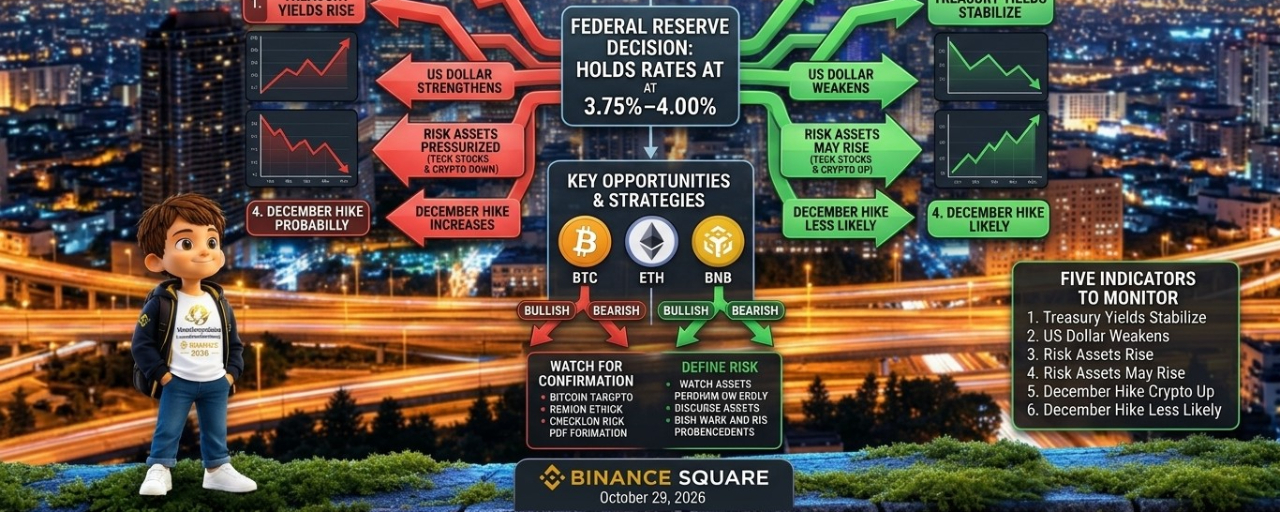
Article
Breaking News: Fed Holds Rates Steady, December Hike Risk Changes Market Opportunities#fomcwatch 🌍#PositiveMindsGlobalResults [ ](https://www.binance.com/en/square/hashtag/PositiveMindsGlobalResults)Binance Square | October 29, 2026
The Federal Reserve holding interest rates steady does not automatically mean markets will rise or fall. The key question is whether investors expected a pause or were surprised by the possibility of another rate hike in December.
If the Fed signals that another hike remains possible, markets may reassess inflation risks, Treasury yields, the US dollar, equities, gold, and cryptocurrencies.
For traders, this creates potential opportunities in both directions. The strongest approach is to watch how markets react to the Fed's message rather than trade on the headline alone.
1. What happened? The key facts
The Federal Reserve kept its federal funds target range at 3.75%–4.00% on October 28, 2026. The decision passed by a 10–2 vote, with two officials preferring a 0.25 percentage-point increase. The Fed said inflation remained elevated and left its next steps dependent on incoming information.
The decision matters for three reasons:
Inflation risk: Persistent inflation could keep interest rates higher for longer or encourage another increase.Treasury yields and the dollar: Rising yields and a stronger dollar can put pressure on risk assets, including technology stocks and cryptocurrencies.Market expectations: If a December rate hike is already priced in, markets may react less negatively than expected. If the Fed sounds more hawkish than investors anticipated, volatility could increase.
Important: A December hike is a possibility, not a confirmed decision. The Fed's official statement leaves the future policy path dependent on incoming data.
2. Where are the market opportunities?
Market opportunity overview
These are conditional scenarios, not guaranteed market outcomes. The dollar depends on relative interest rates and global risk sentiment, while gold can also rise during geopolitical stress—even when yields are high.
3. Bitcoin, Ethereum and BNB: Trading opportunities
For crypto traders, the central question is whether the Fed's message will encourage investors to take more risk or make them more defensive.
Recent reporting shows that the dollar and Treasury yields remained firm around the decision, while Bitcoin and Ether posted modest gains ahead of the announcement. This highlights why traders should watch actual price action instead of assuming that a rate pause automatically benefits crypto.
Bitcoin (BTC)
Bullish scenario
Treasury yields retreat and the dollar weakens.Bitcoin breaks above its recent resistance with strong trading volume.Buyers maintain control after a successful retest of the breakout level.
Bearish scenario
The market increasingly expects a December rate hike.The dollar and Treasury yields rise further.Bitcoin loses support, triggering stop-loss orders and potentially leveraged liquidations.
Opportunity: Wait for a confirmed breakout or breakdown. Avoid chasing a sudden price spike immediately after a Fed announcement.
Ethereum (ETH)
Bullish scenario: A broader crypto recovery, stronger ETH/BTC performance and improving risk appetite could support an Ethereum rebound.
Bearish scenario: If Bitcoin weakens and investors reduce exposure to riskier assets, ETH could face additional selling pressure.
Opportunity: Watch ETH/BTC alongside Ethereum's own support and resistance. A recovery in ETH/BTC can indicate improving relative strength, but it does not guarantee a price increase.
BNB
Bullish scenario: A Bitcoin-led recovery and stronger demand across major cryptocurrencies could help BNB rise.
Bearish scenario: A broad crypto sell-off could drag BNB lower, particularly if leveraged positions are unwound.
Opportunity: Look for confirmation from BNB's own price structure and trading volume rather than assuming it will follow Bitcoin point for point.
Important: I have not verified live BTC, ETH or BNB prices and technical levels in this analysis, so I would not treat any specific entry price or price target as confirmed.
4. Three scenarios to watch through December
The third scenario deserves particular attention. If inflation remains elevated while economic growth weakens, markets could struggle to price in the Fed's next move. Stocks, crypto and commodities might react in different directions.
Five indicators worth monitoring
US inflation: Does the next CPI report show that inflation is cooling or accelerating?Treasury yields: Do the 2-year and 10-year yields continue rising after the Fed decision?US dollar: Is the dollar strengthening against other major currencies?Bitcoin price structure: Are buyers defending support, or are rallies being sold?Technology earnings: Are major technology companies demonstrating that their AI investments are generating sustainable revenue?
These indicators help distinguish a temporary news-driven move from a broader market trend.
5. What is the best strategy right now?
My assessment is that capital preservation and confirmation are more attractive than making an aggressive directional bet before the market settles.
Consider three approaches:
Conservative: Keep sufficient cash available and wait for clearer price action. Cash is not risk-free, because inflation reduces purchasing power.Moderate: Consider staged entries only after confirming support, trend direction and a manageable risk-to-reward ratio.Active trading: Define your entry, invalidation level and maximum acceptable loss before entering. Avoid excessive leverage around major economic announcements.
For investors considering gold, short-term Treasuries or equities, compare expected returns with the relevant risks rather than assuming one asset will automatically outperform.
No strategy can guarantee a profit, and a widely anticipated rate hike can sometimes produce a market rally if the outcome is less hawkish than investors feared.
THE OPPORTUNITY
Watch Treasury yields, the US dollar, inflation data, technology earnings and key crypto support and resistance levels. Avoid chasing sudden price movements. Wait for confirmation and define your risk before entering a trade.
My outlook: The market faces two-way risk. The next major opportunity may come from the difference between what investors expect from the Fed and what incoming economic data actually reveals.
Disclaimer: This article is for educational and informational purposes only. Market scenarios are estimates, not guarantees or financial advice. Always conduct your own research and manage your risk.
#FederalReserve #Bitcoin #Ethereum #BNB #CryptoMarket #GlobalMarkets #MarketOutlook #Inflation #TreasuryYields #PositiveMindsGlobalResults #BinanceSquare
Positive Minds Global Results - Positivity without borders
INVEST, LEARN, GROW, TOGETHER
BINANCE SQUARE
Breaking News: Fed Holds Rates Steady, December Hike Risk Changes Market Opportunities
#fomcwatch 🌍#PositiveMindsGlobalResults Binance Square | October 29, 2026
The Federal Reserve holding interest rates steady does not automatically mean markets will rise or fall. The key question is whether investors expected a pause or were surprised by the possibility of another rate hike in December.
If the Fed signals that another hike remains possible, markets may reassess inflation risks, Treasury yields, the US dollar, equities, gold, and cryptocurrencies.
For traders, this creates potential opportunities in both directions. The strongest approach is to watch how markets react to the Fed's message rather than trade on the headline alone.
1. What happened? The key facts
The Federal Reserve kept its federal funds target range at 3.75%–4.00% on October 28, 2026. The decision passed by a 10–2 vote, with two officials preferring a 0.25 percentage-point increase. The Fed said inflation remained elevated and left its next steps dependent on incoming information.
The decision matters for three reasons:
Inflation risk: Persistent inflation could keep interest rates higher for longer or encourage another increase.Treasury yields and the dollar: Rising yields and a stronger dollar can put pressure on risk assets, including technology stocks and cryptocurrencies.Market expectations: If a December rate hike is already priced in, markets may react less negatively than expected. If the Fed sounds more hawkish than investors anticipated, volatility could increase.
Important: A December hike is a possibility, not a confirmed decision. The Fed's official statement leaves the future policy path dependent on incoming data.
2. Where are the market opportunities?
Market opportunity overview
These are conditional scenarios, not guaranteed market outcomes. The dollar depends on relative interest rates and global risk sentiment, while gold can also rise during geopolitical stress—even when yields are high.
3. Bitcoin, Ethereum and BNB: Trading opportunities
For crypto traders, the central question is whether the Fed's message will encourage investors to take more risk or make them more defensive.
Recent reporting shows that the dollar and Treasury yields remained firm around the decision, while Bitcoin and Ether posted modest gains ahead of the announcement. This highlights why traders should watch actual price action instead of assuming that a rate pause automatically benefits crypto.
Bitcoin (BTC)
Bullish scenario
Treasury yields retreat and the dollar weakens.Bitcoin breaks above its recent resistance with strong trading volume.Buyers maintain control after a successful retest of the breakout level.
Bearish scenario
The market increasingly expects a December rate hike.The dollar and Treasury yields rise further.Bitcoin loses support, triggering stop-loss orders and potentially leveraged liquidations.
Opportunity: Wait for a confirmed breakout or breakdown. Avoid chasing a sudden price spike immediately after a Fed announcement.
Ethereum (ETH)
Bullish scenario: A broader crypto recovery, stronger ETH/BTC performance and improving risk appetite could support an Ethereum rebound.
Bearish scenario: If Bitcoin weakens and investors reduce exposure to riskier assets, ETH could face additional selling pressure.
Opportunity: Watch ETH/BTC alongside Ethereum's own support and resistance. A recovery in ETH/BTC can indicate improving relative strength, but it does not guarantee a price increase.
BNB
Bullish scenario: A Bitcoin-led recovery and stronger demand across major cryptocurrencies could help BNB rise.
Bearish scenario: A broad crypto sell-off could drag BNB lower, particularly if leveraged positions are unwound.
Opportunity: Look for confirmation from BNB's own price structure and trading volume rather than assuming it will follow Bitcoin point for point.
Important: I have not verified live BTC, ETH or BNB prices and technical levels in this analysis, so I would not treat any specific entry price or price target as confirmed.
4. Three scenarios to watch through December
The third scenario deserves particular attention. If inflation remains elevated while economic growth weakens, markets could struggle to price in the Fed's next move. Stocks, crypto and commodities might react in different directions.
Five indicators worth monitoring
US inflation: Does the next CPI report show that inflation is cooling or accelerating?Treasury yields: Do the 2-year and 10-year yields continue rising after the Fed decision?US dollar: Is the dollar strengthening against other major currencies?Bitcoin price structure: Are buyers defending support, or are rallies being sold?Technology earnings: Are major technology companies demonstrating that their AI investments are generating sustainable revenue?
These indicators help distinguish a temporary news-driven move from a broader market trend.
5. What is the best strategy right now?
My assessment is that capital preservation and confirmation are more attractive than making an aggressive directional bet before the market settles.
Consider three approaches:
Conservative: Keep sufficient cash available and wait for clearer price action. Cash is not risk-free, because inflation reduces purchasing power.Moderate: Consider staged entries only after confirming support, trend direction and a manageable risk-to-reward ratio.Active trading: Define your entry, invalidation level and maximum acceptable loss before entering. Avoid excessive leverage around major economic announcements.
For investors considering gold, short-term Treasuries or equities, compare expected returns with the relevant risks rather than assuming one asset will automatically outperform.
No strategy can guarantee a profit, and a widely anticipated rate hike can sometimes produce a market rally if the outcome is less hawkish than investors feared.
THE OPPORTUNITY
Watch Treasury yields, the US dollar, inflation data, technology earnings and key crypto support and resistance levels. Avoid chasing sudden price movements. Wait for confirmation and define your risk before entering a trade.
My outlook: The market faces two-way risk. The next major opportunity may come from the difference between what investors expect from the Fed and what incoming economic data actually reveals.
Disclaimer: This article is for educational and informational purposes only. Market scenarios are estimates, not guarantees or financial advice. Always conduct your own research and manage your risk.
#FederalReserve #Bitcoin #Ethereum #BNB #CryptoMarket #GlobalMarkets #MarketOutlook #Inflation #TreasuryYields #PositiveMindsGlobalResults #BinanceSquare
Positive Minds Global Results - Positivity without borders
INVEST, LEARN, GROW, TOGETHER
BINANCE SQUARE
697

Article
BTC, BNB and ETH Forecast for the Next 24 Hours#BTCBNBETHNext24Hours |🌍#PositiveMindsGlobalResults [ ](https://www.binance.com/en/square/hashtag/PositiveMindsGlobalResults) Binance Square | October 28, 2026
BTC, BNB and ETH Bullish vs Bearish Scenarios Fed Decision in Focus
The cryptocurrency market is attempting to recover as investors await the Federal Reserve's latest policy decision. Bitcoin is trading around the $81,000 area, BNB is showing stronger short-term momentum, and Ethereum is trying to extend its recovery.
However, persistent inflation, elevated Treasury yields, geopolitical uncertainty and the possibility of a hawkish Federal Reserve outlook could limit further gains.
This forecast examines the potential direction of BTC, BNB and ETH over the next 24 hours, using current market observations, technical levels and macroeconomic scenarios.
BTC
Reference price: Approximately $81,300
Bitcoin has recovered from its recent decline toward $79,000, but its short-term recovery has not yet confirmed a sustained bullish reversal. The market is approaching an important resistance zone while traders monitor the Federal Reserve's decision and guidance.
Key technical levels:
Support: $80,400, $79,700 and $79,250
Resistance: $81,960, $82,380 and $82,800
Bullish Scenario:
If BTC maintains support above $80,400 and breaks through $81,960 with convincing buying volume, the next potential targets are $82,380 and $82,800.
A sustained move above $82,800 could strengthen recovery momentum and improve sentiment across the broader cryptocurrency market. However, a short-lived breakout without strong volume may reverse quickly.
Bearish Scenario:
If BTC loses $80,400, selling pressure could push the price toward $79,700 and $79,250.
A decisive breakdown below $79,250 would weaken the immediate recovery structure and increase the risk of a deeper correction. A sustained move back above $82,000 would be needed to improve the short-term technical picture.
24-hour outlook: Neutral to cautiously bullish while BTC holds above $80,400, but confirmation above $81,960 remains important.
BNB
Reference price: Approximately $751
BNB is demonstrating comparatively stronger technical momentum, with recent indicators showing positive momentum across several timeframes. Nevertheless, resistance near $755 to $767 could attract profit-taking.
Key technical levels:
Support: $739, $731 and $722
Resistance: $749, $756 and $767
Bullish Scenario:
If BNB holds above $739 and establishes sustained buying pressure above $749, the next potential targets are $756 and $767.
A convincing breakout above $767 could open the way for further recovery, provided trading volume and overall market sentiment remain supportive.
Continued strength in Bitcoin and a positive shift in broader risk appetite would improve the bullish case.
Bearish Scenario:
If BNB falls below $739, the price could retest $731 and then $722.
A breakdown below $722 would weaken the short-term structure and increase downside risk, particularly if Bitcoin also loses its support zone.
Traders should watch whether BNB continues to outperform BTC or begins to lose relative strength during market volatility.
24-hour outlook: Cautiously bullish above $739, with $756 and $767 as potential resistance targets. A break below $739 would weaken the outlook.
ETH
Reference price: Approximately $2,379
Ethereum is attempting to recover, but its technical signals remain mixed. Short-term buying interest has improved, while momentum indicators and resistance levels suggest that the broader recovery still requires confirmation.
Key technical levels:
Support: $2,326, $2,292 and $2,251
Resistance: $2,400, $2,466 and $2,537
Bullish Scenario:
If ETH holds above $2,326 and breaks through $2,400, the next potential resistance zone is around $2,466.
A sustained move above $2,466 could improve momentum and bring $2,537 into focus, provided Bitcoin remains stable and market liquidity supports further gains.
Stronger buying volume and improving market sentiment would help confirm that Ethereum's recovery is gaining traction.
Bearish Scenario:
If ETH fails to break above $2,400 and falls below $2,326, the next potential support levels are $2,292 and $2,251.
A sustained breakdown below $2,251 would indicate renewed selling pressure and could undermine the recovery attempt.
Ethereum's ability to maintain support while Bitcoin consolidates will be important in determining whether ETH can outperform the broader market.
24-hour outlook: Neutral to cautiously bullish above $2,326, but a sustained break above $2,400 is needed to strengthen the upside scenario.
FEDERAL RESERVE AND GLOBAL MARKET FACTORS
The Federal Reserve's October 28 policy decision is the most important scheduled macroeconomic catalyst for this forecast period. In Malaysia, the announcement is expected early on October 29.
Markets broadly anticipate unchanged interest rates, making the accompanying statement and the chair's comments especially important.
Potential bullish catalysts:
A less restrictive policy outlook could weaken the US dollar, ease Treasury yield pressure and improve appetite for risk-sensitive assets.
Continued strength in technology stocks, positive institutional crypto flows and stronger spot buying could also support BTC, BNB and ETH.
Potential bearish catalysts:
A hawkish policy message, renewed expectations of a December rate hike, persistent inflation or rising energy prices could strengthen the dollar and keep Treasury yields elevated.
Geopolitical tensions and higher oil prices could add to inflation concerns, potentially limiting the Federal Reserve's ability to ease monetary policy.
A stronger dollar and higher yields would create additional headwinds for cryptocurrencies, particularly if leveraged traders begin reducing their exposure.
WHAT TRADERS SHOULD WATCH
Bitcoin: Can BTC break above $81,960 and sustain momentum toward $82,800?
BNB: Can buyers defend $739 and establish a convincing breakout above $756?
Ethereum: Can ETH clear $2,400 and advance toward $2,466?
Macro conditions: Will the Federal Reserve communicate a more restrictive outlook, and how will the dollar and Treasury yields react?
Market confirmation: Are spot buying volume and institutional flows supporting the recovery, or is the market experiencing a temporary rebound?
FINAL MARKET OUTLOOK
BTC: Neutral to cautiously bullish above $80,400, with resistance between $81,960 and $82,800.
BNB: Cautiously bullish above $739, with potential upside targets at $756 and $767.
ETH: Neutral to cautiously bullish above $2,326, with resistance at $2,400 and $2,466.
The overall market bias is cautiously optimistic, but confidence remains limited ahead of the Federal Reserve's decision. BNB currently has the more constructive technical picture, while Bitcoin remains the key market benchmark and Ethereum needs a clearer breakout to confirm improving momentum.
These are conditional scenarios, not guaranteed price predictions. A hawkish Fed surprise or an unexpected geopolitical development could invalidate the bullish outlook for all three assets.
Disclaimer: This article is for informational and educational purposes only. Price levels are estimates based on market observations available on October 28, 2026, and may change rapidly. This is not financial advice or a guarantee of future performance. Always conduct your own research, manage risk carefully and never trade more than you can afford to lose.
#PositiveMindsGlobalResults #PositiveMindsGlobalResults #BitcoinForecast #CryptoMarket #BullishVsBearish #MarketSentimentToday #EstimatesNotAdviceButHope
{spot}(BNBUSDT)
BTC, BNB and ETH Forecast for the Next 24 Hours
#BTCBNBETHNext24Hours |🌍#PositiveMindsGlobalResults Binance Square | October 28, 2026
BTC, BNB and ETH Bullish vs Bearish Scenarios Fed Decision in Focus
The cryptocurrency market is attempting to recover as investors await the Federal Reserve's latest policy decision. Bitcoin is trading around the $81,000 area, BNB is showing stronger short-term momentum, and Ethereum is trying to extend its recovery.
However, persistent inflation, elevated Treasury yields, geopolitical uncertainty and the possibility of a hawkish Federal Reserve outlook could limit further gains.
This forecast examines the potential direction of BTC, BNB and ETH over the next 24 hours, using current market observations, technical levels and macroeconomic scenarios.
BTC
Reference price: Approximately $81,300
Bitcoin has recovered from its recent decline toward $79,000, but its short-term recovery has not yet confirmed a sustained bullish reversal. The market is approaching an important resistance zone while traders monitor the Federal Reserve's decision and guidance.
Key technical levels:
Support: $80,400, $79,700 and $79,250
Resistance: $81,960, $82,380 and $82,800
Bullish Scenario:
If BTC maintains support above $80,400 and breaks through $81,960 with convincing buying volume, the next potential targets are $82,380 and $82,800.
A sustained move above $82,800 could strengthen recovery momentum and improve sentiment across the broader cryptocurrency market. However, a short-lived breakout without strong volume may reverse quickly.
Bearish Scenario:
If BTC loses $80,400, selling pressure could push the price toward $79,700 and $79,250.
A decisive breakdown below $79,250 would weaken the immediate recovery structure and increase the risk of a deeper correction. A sustained move back above $82,000 would be needed to improve the short-term technical picture.
24-hour outlook: Neutral to cautiously bullish while BTC holds above $80,400, but confirmation above $81,960 remains important.
BNB
Reference price: Approximately $751
BNB is demonstrating comparatively stronger technical momentum, with recent indicators showing positive momentum across several timeframes. Nevertheless, resistance near $755 to $767 could attract profit-taking.
Key technical levels:
Support: $739, $731 and $722
Resistance: $749, $756 and $767
Bullish Scenario:
If BNB holds above $739 and establishes sustained buying pressure above $749, the next potential targets are $756 and $767.
A convincing breakout above $767 could open the way for further recovery, provided trading volume and overall market sentiment remain supportive.
Continued strength in Bitcoin and a positive shift in broader risk appetite would improve the bullish case.
Bearish Scenario:
If BNB falls below $739, the price could retest $731 and then $722.
A breakdown below $722 would weaken the short-term structure and increase downside risk, particularly if Bitcoin also loses its support zone.
Traders should watch whether BNB continues to outperform BTC or begins to lose relative strength during market volatility.
24-hour outlook: Cautiously bullish above $739, with $756 and $767 as potential resistance targets. A break below $739 would weaken the outlook.
ETH
Reference price: Approximately $2,379
Ethereum is attempting to recover, but its technical signals remain mixed. Short-term buying interest has improved, while momentum indicators and resistance levels suggest that the broader recovery still requires confirmation.
Key technical levels:
Support: $2,326, $2,292 and $2,251
Resistance: $2,400, $2,466 and $2,537
Bullish Scenario:
If ETH holds above $2,326 and breaks through $2,400, the next potential resistance zone is around $2,466.
A sustained move above $2,466 could improve momentum and bring $2,537 into focus, provided Bitcoin remains stable and market liquidity supports further gains.
Stronger buying volume and improving market sentiment would help confirm that Ethereum's recovery is gaining traction.
Bearish Scenario:
If ETH fails to break above $2,400 and falls below $2,326, the next potential support levels are $2,292 and $2,251.
A sustained breakdown below $2,251 would indicate renewed selling pressure and could undermine the recovery attempt.
Ethereum's ability to maintain support while Bitcoin consolidates will be important in determining whether ETH can outperform the broader market.
24-hour outlook: Neutral to cautiously bullish above $2,326, but a sustained break above $2,400 is needed to strengthen the upside scenario.
FEDERAL RESERVE AND GLOBAL MARKET FACTORS
The Federal Reserve's October 28 policy decision is the most important scheduled macroeconomic catalyst for this forecast period. In Malaysia, the announcement is expected early on October 29.
Markets broadly anticipate unchanged interest rates, making the accompanying statement and the chair's comments especially important.
Potential bullish catalysts:
A less restrictive policy outlook could weaken the US dollar, ease Treasury yield pressure and improve appetite for risk-sensitive assets.
Continued strength in technology stocks, positive institutional crypto flows and stronger spot buying could also support BTC, BNB and ETH.
Potential bearish catalysts:
A hawkish policy message, renewed expectations of a December rate hike, persistent inflation or rising energy prices could strengthen the dollar and keep Treasury yields elevated.
Geopolitical tensions and higher oil prices could add to inflation concerns, potentially limiting the Federal Reserve's ability to ease monetary policy.
A stronger dollar and higher yields would create additional headwinds for cryptocurrencies, particularly if leveraged traders begin reducing their exposure.
WHAT TRADERS SHOULD WATCH
Bitcoin: Can BTC break above $81,960 and sustain momentum toward $82,800?
BNB: Can buyers defend $739 and establish a convincing breakout above $756?
Ethereum: Can ETH clear $2,400 and advance toward $2,466?
Macro conditions: Will the Federal Reserve communicate a more restrictive outlook, and how will the dollar and Treasury yields react?
Market confirmation: Are spot buying volume and institutional flows supporting the recovery, or is the market experiencing a temporary rebound?
FINAL MARKET OUTLOOK
BTC: Neutral to cautiously bullish above $80,400, with resistance between $81,960 and $82,800.
BNB: Cautiously bullish above $739, with potential upside targets at $756 and $767.
ETH: Neutral to cautiously bullish above $2,326, with resistance at $2,400 and $2,466.
The overall market bias is cautiously optimistic, but confidence remains limited ahead of the Federal Reserve's decision. BNB currently has the more constructive technical picture, while Bitcoin remains the key market benchmark and Ethereum needs a clearer breakout to confirm improving momentum.
These are conditional scenarios, not guaranteed price predictions. A hawkish Fed surprise or an unexpected geopolitical development could invalidate the bullish outlook for all three assets.
Disclaimer: This article is for informational and educational purposes only. Price levels are estimates based on market observations available on October 28, 2026, and may change rapidly. This is not financial advice or a guarantee of future performance. Always conduct your own research, manage risk carefully and never trade more than you can afford to lose.
#PositiveMindsGlobalResults #PositiveMindsGlobalResults #BitcoinForecast #CryptoMarket #BullishVsBearish #MarketSentimentToday #EstimatesNotAdviceButHope
59
#OilMarket 🌍#PositiveMindsGlobalResults [ ](https://www.binance.com/en/square/hashtag/PositiveMindsGlobalResults)Binance Square | October 28, 2026
Oil Above $115: A New Risk for Global Markets and Crypto
Middle East tensions and reported Houthi attacks involving Saudi Arabia have heightened concerns about oil supply security. Brent crude rising above $115 per barrel could intensify inflation fears and increase market volatility.
Bullish Scenario for Oil: Prolonged supply disruptions could push crude prices higher, benefiting some energy producers.
Bearish Scenario for Global Markets: Expensive oil could raise business and consumer costs, complicate Federal Reserve rate decisions, and pressure stocks and cryptocurrencies.
Impact on BTC, BNB and ETH: Rising inflation concerns and higher Treasury yields could weaken risk appetite, adding short-term pressure to Bitcoin, BNB, and Ethereum. However, price direction also depends on Fed guidance, ETF flows, liquidity, and geopolitical developments.
Key Signals: Oil prices, Middle East developments, US Treasury yields, the US dollar, Fed policy, and crypto ETF flows.
Outlook: Expect potential volatility over the next 24 hours as markets assess geopolitical and inflation risks. No direction is guaranteed.
Disclaimer: Educational content only. Scenarios are estimates, not financial advice or guaranteed predictions. DYOR.
#PositiveMindsGlobalResults #BinanceSquare #OilShock #InflationWatch #GlobalMarkets #FederalReserve #Bitcoin #BNB #Ethereum #CryptoMarketOutlook
#OilMarket 🌍#PositiveMindsGlobalResults Binance Square | October 28, 2026
Oil Above $115: A New Risk for Global Markets and Crypto
Middle East tensions and reported Houthi attacks involving Saudi Arabia have heightened concerns about oil supply security. Brent crude rising above $115 per barrel could intensify inflation fears and increase market volatility.
Bullish Scenario for Oil: Prolonged supply disruptions could push crude prices higher, benefiting some energy producers.
Bearish Scenario for Global Markets: Expensive oil could raise business and consumer costs, complicate Federal Reserve rate decisions, and pressure stocks and cryptocurrencies.
Impact on BTC, BNB and ETH: Rising inflation concerns and higher Treasury yields could weaken risk appetite, adding short-term pressure to Bitcoin, BNB, and Ethereum. However, price direction also depends on Fed guidance, ETF flows, liquidity, and geopolitical developments.
Key Signals: Oil prices, Middle East developments, US Treasury yields, the US dollar, Fed policy, and crypto ETF flows.
Outlook: Expect potential volatility over the next 24 hours as markets assess geopolitical and inflation risks. No direction is guaranteed.
Disclaimer: Educational content only. Scenarios are estimates, not financial advice or guaranteed predictions. DYOR.
#PositiveMindsGlobalResults #BinanceSquare #OilShock #InflationWatch #GlobalMarkets #FederalReserve #Bitcoin #BNB #Ethereum #CryptoMarketOutlook

77
Verified

Article
Can Microsoft turn its AI ambition into sustainable profits#canmicrosoftdeliveronai 🌍#PositiveMindsGlobalResults Binance Square | October 28, 2026
Microsoft is approaching a critical earnings test. Investors are watching Azure cloud growth, Copilot adoption, and the cost of expanding AI infrastructure. Management previously guided for approximately 45 percent Azure growth in constant currency for the September quarter.
The Bull Case
Strong Azure demand, growing AI adoption, and rising enterprise spending could strengthen Microsoft's long-term growth story.
The Bear Case
Massive data center investment, rising operating costs, and slower than expected AI monetization could pressure profit margins and investor confidence.
Single Stock Futures Watch
Microsoft (MSFT) earnings could trigger significant price movements. The key question is whether its results and forward guidance exceed expectations. Strong growth may support bullish sentiment, while disappointing guidance could increase selling pressure.
My Take
The AI race is no longer just about who builds the smartest technology. It is about who can turn that technology into lasting profits.
Can Microsoft deliver? The numbers must speak.
Disclaimer: This is market commentary, not financial advice. Forecasts are uncertain, and losses are possible. Always do your own research before trading.
#Microsoft #MSFT #ArtificialIntelligence #Azure #Copilot #TechStocks #EarningsSeason #SingleStockFutures #PositiveMindsGlobalResults #BinanceSquare
Positive Minds Global Results - Positivity without borders
INVEST, LEARN, GROW, TOGETHER
BINANCE SQUARE
Can Microsoft turn its AI ambition into sustainable profits
#canmicrosoftdeliveronai 🌍#PositiveMindsGlobalResults Binance Square | October 28, 2026
Microsoft is approaching a critical earnings test. Investors are watching Azure cloud growth, Copilot adoption, and the cost of expanding AI infrastructure. Management previously guided for approximately 45 percent Azure growth in constant currency for the September quarter.
The Bull Case
Strong Azure demand, growing AI adoption, and rising enterprise spending could strengthen Microsoft's long-term growth story.
The Bear Case
Massive data center investment, rising operating costs, and slower than expected AI monetization could pressure profit margins and investor confidence.
Single Stock Futures Watch
Microsoft (MSFT) earnings could trigger significant price movements. The key question is whether its results and forward guidance exceed expectations. Strong growth may support bullish sentiment, while disappointing guidance could increase selling pressure.
My Take
The AI race is no longer just about who builds the smartest technology. It is about who can turn that technology into lasting profits.
Can Microsoft deliver? The numbers must speak.
Disclaimer: This is market commentary, not financial advice. Forecasts are uncertain, and losses are possible. Always do your own research before trading.
#Microsoft #MSFT #ArtificialIntelligence #Azure #Copilot #TechStocks #EarningsSeason #SingleStockFutures #PositiveMindsGlobalResults #BinanceSquare
Positive Minds Global Results - Positivity without borders
INVEST, LEARN, GROW, TOGETHER
BINANCE SQUARE
1
1
7
10.5k

Article
Google Q3 Earnings: AI Growth vs. Meta’s Muse Challenge.#cangoogledefinditscore 🌍#PositiveMindsGlobalResults Binance Square | October 28, 2026
🚀 The AI Race Faces a Critical Earnings Test
Investors are preparing for Alphabet’s third-quarter 2026 earnings report as attention shifts toward artificial intelligence (AI), cloud computing, advertising growth, and the enormous cost of building next-generation AI infrastructure.
Google’s results could offer important clues about whether AI investments are generating sustainable revenue—or whether rising spending is beginning to pressure profitability and cash flow.
Competition is also intensifying. Meta’s new Muse AI assistant is emerging as a potential long-term challenger to Google’s traditional search and digital advertising businesses.
According to analyst estimates reported by Yahoo Finance ahead of the announcement, Alphabet is expected to deliver approximately $127.8 billion in quarterly revenue and $3.01 in earnings per share (EPS). Google Cloud revenue is projected to reach approximately $28.9 billion, although these figures are forecasts, not confirmed results.
📊 Four Major Factors Investors Should Watch
1. Google Cloud: The AI Growth Engine
Google Cloud is one of Alphabet’s most important opportunities to monetize AI. Businesses increasingly need cloud infrastructure, AI models, data-processing capacity, and specialized computing chips.
Investors will look for strong cloud growth, improving profitability, and evidence that AI-related demand can support long-term returns.
2. Gemini and AI-Powered Search
Google faces a strategic challenge: it must develop conversational AI and AI agents without undermining the profitable search advertising model that supports much of its business.
The critical question is whether Gemini and AI-powered search can attract users, improve engagement, and generate additional revenue while protecting Google's existing advertising income.
3. Meta’s Muse AI: A Competitive Warning
Meta is expanding its AI ambitions through Muse and other AI products. Its strategy could eventually influence how consumers discover products, interact with businesses, and make purchasing decisions.
If users increasingly rely on AI assistants instead of traditional search engines, advertising budgets and digital commerce could shift. However, a growing Muse user base does not yet prove that Google’s market position is weakening.
4. AI Spending, Cash Flow, and Returns
Building AI infrastructure requires substantial investment in data centers, advanced chips, electricity, and computing capacity.
Investors are looking beyond revenue growth to determine whether these investments can generate sufficient returns. Meta’s recently announced capital-spending outlook of $135 billion–$145 billion for 2026 illustrates the scale of the AI investment race.
The challenge for Alphabet is to expand AI capabilities while maintaining financial discipline.
📈 Bullish vs. Bearish Scenarios
🟢 Bullish scenario: Alphabet could gain investor confidence if revenue exceeds expectations, Google Cloud accelerates, AI products demonstrate stronger monetization, and management provides a credible return-on-investment outlook.
🔴 Bearish scenario: Shares could face pressure if cloud growth disappoints, search advertising weakens, AI spending rises faster than revenue, or management signals that meaningful returns will take longer than expected.
⚠️ Important: Even a strong earnings report does not guarantee a share-price increase. Investors may sell after positive results if expectations were already too high.
🌎 Why This Matters for Global Markets
Alphabet’s earnings arrive during a critical period for the technology sector. Investors are assessing whether massive AI infrastructure investments can deliver sufficient revenue and profits to justify current valuations. Microsoft and Amazon results will provide additional evidence about demand for cloud computing and the economics of AI.
The results could influence sentiment across technology stocks, semiconductor companies, data-center infrastructure providers, and other AI-related investments.
For cryptocurrency markets, the relationship is indirect. Strong technology earnings may improve risk appetite, while disappointing results or concerns about excessive AI spending could increase volatility. Bitcoin and other cryptocurrencies will also remain sensitive to Federal Reserve policy, inflation, Treasury yields, liquidity, and geopolitical developments.
🎯 The Three Questions That Matter Most
Can Google turn AI adoption into sustainable revenue growth?Can Google Cloud and custom AI chips deliver attractive returns on investment?Can Alphabet defend its search and advertising business as AI assistants become more capable?
The answers may matter more to long-term investors than whether Alphabet beats a single quarterly earnings estimate.
Community Discussion
Is Google’s AI ecosystem strong enough to defend its search dominance against Meta’s Muse and other AI agents?
Will rising AI investment create a new era of sustainable growth—or increase the risk of an AI valuation bubble?
Share your analysis and explain which indicators you are watching.
Disclaimer: This article is for educational and informational purposes only, not financial or investment advice. Analyst estimates are not confirmed results, and market scenarios are not guaranteed. Conduct your own research and assess your risk tolerance before making investment decisions.
#Google #Alphabet #GOOGL #GoogleEarnings #Q3Earnings #ArtificialIntelligence #GoogleCloud #GeminiAI #MetaMuse #AICompetition #BigTech #StockMarket #GlobalMarkets #TechStocks #BinanceSquare
Google Q3 Earnings: AI Growth vs. Meta’s Muse Challenge.
#cangoogledefinditscore 🌍#PositiveMindsGlobalResults Binance Square | October 28, 2026
🚀 The AI Race Faces a Critical Earnings Test
Investors are preparing for Alphabet’s third-quarter 2026 earnings report as attention shifts toward artificial intelligence (AI), cloud computing, advertising growth, and the enormous cost of building next-generation AI infrastructure.
Google’s results could offer important clues about whether AI investments are generating sustainable revenue—or whether rising spending is beginning to pressure profitability and cash flow.
Competition is also intensifying. Meta’s new Muse AI assistant is emerging as a potential long-term challenger to Google’s traditional search and digital advertising businesses.
According to analyst estimates reported by Yahoo Finance ahead of the announcement, Alphabet is expected to deliver approximately $127.8 billion in quarterly revenue and $3.01 in earnings per share (EPS). Google Cloud revenue is projected to reach approximately $28.9 billion, although these figures are forecasts, not confirmed results.
📊 Four Major Factors Investors Should Watch
1. Google Cloud: The AI Growth Engine
Google Cloud is one of Alphabet’s most important opportunities to monetize AI. Businesses increasingly need cloud infrastructure, AI models, data-processing capacity, and specialized computing chips.
Investors will look for strong cloud growth, improving profitability, and evidence that AI-related demand can support long-term returns.
2. Gemini and AI-Powered Search
Google faces a strategic challenge: it must develop conversational AI and AI agents without undermining the profitable search advertising model that supports much of its business.
The critical question is whether Gemini and AI-powered search can attract users, improve engagement, and generate additional revenue while protecting Google's existing advertising income.
3. Meta’s Muse AI: A Competitive Warning
Meta is expanding its AI ambitions through Muse and other AI products. Its strategy could eventually influence how consumers discover products, interact with businesses, and make purchasing decisions.
If users increasingly rely on AI assistants instead of traditional search engines, advertising budgets and digital commerce could shift. However, a growing Muse user base does not yet prove that Google’s market position is weakening.
4. AI Spending, Cash Flow, and Returns
Building AI infrastructure requires substantial investment in data centers, advanced chips, electricity, and computing capacity.
Investors are looking beyond revenue growth to determine whether these investments can generate sufficient returns. Meta’s recently announced capital-spending outlook of $135 billion–$145 billion for 2026 illustrates the scale of the AI investment race.
The challenge for Alphabet is to expand AI capabilities while maintaining financial discipline.
📈 Bullish vs. Bearish Scenarios
🟢 Bullish scenario: Alphabet could gain investor confidence if revenue exceeds expectations, Google Cloud accelerates, AI products demonstrate stronger monetization, and management provides a credible return-on-investment outlook.
🔴 Bearish scenario: Shares could face pressure if cloud growth disappoints, search advertising weakens, AI spending rises faster than revenue, or management signals that meaningful returns will take longer than expected.
⚠️ Important: Even a strong earnings report does not guarantee a share-price increase. Investors may sell after positive results if expectations were already too high.
🌎 Why This Matters for Global Markets
Alphabet’s earnings arrive during a critical period for the technology sector. Investors are assessing whether massive AI infrastructure investments can deliver sufficient revenue and profits to justify current valuations. Microsoft and Amazon results will provide additional evidence about demand for cloud computing and the economics of AI.
The results could influence sentiment across technology stocks, semiconductor companies, data-center infrastructure providers, and other AI-related investments.
For cryptocurrency markets, the relationship is indirect. Strong technology earnings may improve risk appetite, while disappointing results or concerns about excessive AI spending could increase volatility. Bitcoin and other cryptocurrencies will also remain sensitive to Federal Reserve policy, inflation, Treasury yields, liquidity, and geopolitical developments.
🎯 The Three Questions That Matter Most
Can Google turn AI adoption into sustainable revenue growth?Can Google Cloud and custom AI chips deliver attractive returns on investment?Can Alphabet defend its search and advertising business as AI assistants become more capable?
The answers may matter more to long-term investors than whether Alphabet beats a single quarterly earnings estimate.
Community Discussion
Is Google’s AI ecosystem strong enough to defend its search dominance against Meta’s Muse and other AI agents?
Will rising AI investment create a new era of sustainable growth—or increase the risk of an AI valuation bubble?
Share your analysis and explain which indicators you are watching.
Disclaimer: This article is for educational and informational purposes only, not financial or investment advice. Analyst estimates are not confirmed results, and market scenarios are not guaranteed. Conduct your own research and assess your risk tolerance before making investment decisions.
#Google #Alphabet #GOOGL #GoogleEarnings #Q3Earnings #ArtificialIntelligence #GoogleCloud #GeminiAI #MetaMuse #AICompetition #BigTech #StockMarket #GlobalMarkets #TechStocks #BinanceSquare
1
79
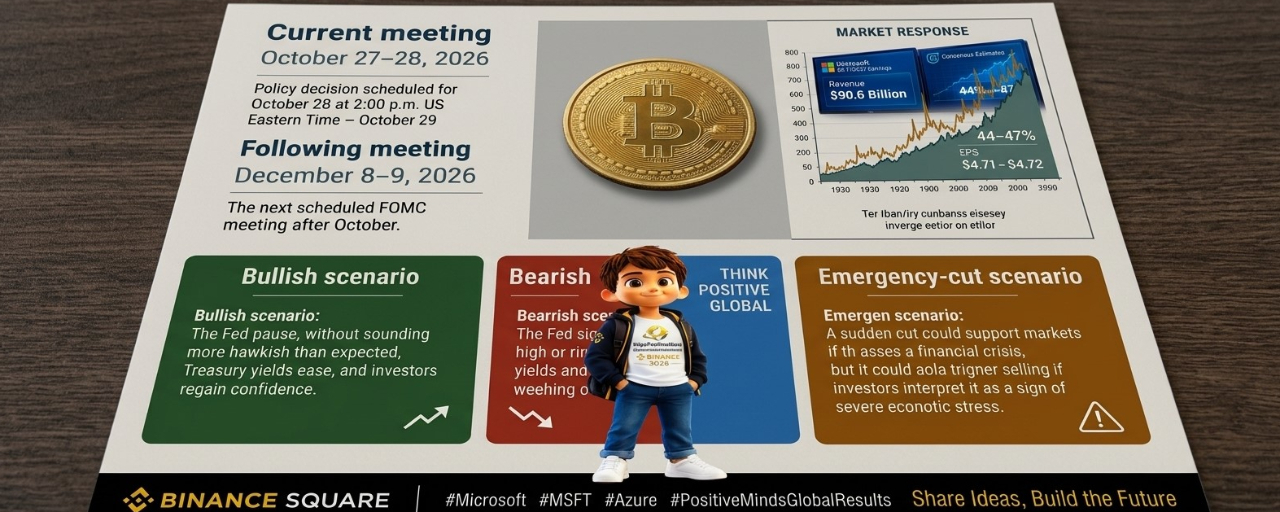
Article
Federal Reserve Emergency Rate Cut Before 2027: What Are the Chances?#fomcwatch 🌍 #PositiveMindsGlobalResults Binance Square | October 28, 2026
📊 97.8% ODDS AGAINST AN EMERGENCY FED RATE CUT BEFORE 2027?
Financial markets are focused on the US Federal Reserve's October 27–28 policy meeting, with investors watching for clues about inflation, borrowing costs, economic growth and the direction of global financial markets.
Based on the supplied market indicators, prediction markets assign approximately 97.8% probability to no emergency rate cut before 2027. This is a market-implied estimate, not a guarantee or an official Fed forecast.
1. Understanding the current indicators
Federal funds target range 3.75%–4.00%
Effective federal funds rate (EFFR) 3.88%
Market-implied chance of no emergency cut before 202797.8%
These are the figures in your supplied information, not independently verified live market readings.
A hawkish pause means the Fed leaves interest rates unchanged but signals that inflation remains a concern and that rate cuts may not happen soon.
A 97.8% probability of no emergency cut suggests markets see such a move as highly unlikely. However, prediction-market probabilities are not guarantees, and the result depends on the specific contract and its settlement rules.
2. How does an interest-rate pause impact the stock market?
A rate pause can support stock prices when investors expect future rate cuts. However, a hawkish pause can pressure stocks if markets fear interest rates will stay high for longer.
Market factor Potential impact
Technology and AI stocks Higher borrowing costs and discount rates can pressure
valuations.
Banks Lending margins may benefit, but credit risks can rise.
Bonds and Treasury yields Yields may rise if investors expect further tightening.
US dollar May strengthen if US rates remain relatively attractive.
Bitcoin and crypto May face pressure if liquidity tightens and investors reduce risk
exposure.
The actual reaction depends on whether the Fed's decision is more hawkish or dovish than markets have already priced in.
3. When is the next Federal Reserve meeting?
Current meeting
October 27–28, 2026
Policy decision scheduled for October 28 at 2:00 p.m. US Eastern Time — October 29
Following meeting
December 8–9, 2026
The next scheduled FOMC meeting after October.
4. What does this mean for Bitcoin and the wider market?
Bullish scenario: The Fed pauses without sounding more hawkish than expected, Treasury yields ease, and investors regain confidence.Bearish scenario: The Fed signals rates may stay high or rise again, pushing yields and the dollar higher and weighing on risk assets.Emergency-cut scenario: A sudden cut could support markets if it eases a financial crisis, but it could also trigger selling if investors interpret it as a sign of severe economic stress.
My conclusion: The supplied 97.8% figure indicates that an emergency rate cut is considered highly unlikely under that prediction-market contract. A regular policy decision, however, is not the same as an emergency cut. Current market data also indicate expectations of a rate hold at the October meeting, with a possible rate increase in December.
Based on the supplied market indicators, prediction markets assign approximately 97.8% probability to no emergency rate cut before 2027. This is a market-implied estimate, not a guarantee or an official Fed forecast.
The current federal funds target range is reported at 3.75%–4.00%, with the effective federal funds rate at 3.88%.
🇺🇸 5. WHAT SHOULD INVESTORS WATCH?
Markets widely expect the Fed to hold interest rates steady at this meeting. However, the bigger question is whether policymakers will signal that borrowing costs must remain elevated for longer or indicate that future rate adjustments remain possible.
A hawkish pause could mean:
Higher borrowing costs for longer.Continued pressure on expensive technology and growth-stock valuations.Support for the US dollar if Treasury yields rise.Tighter financial conditions that could weigh on speculative investments.
A more dovish message could ease bond yields, improve investor confidence and encourage renewed demand for risk assets.
The key is not simply whether the Fed holds rates. It is whether its decision and guidance are more hawkish or dovish than markets expect.
📈 6. US STOCKS & GLOBAL MARKETS
US stocks closed higher on October 27, with the S&P 500 rising 0.60%, the Nasdaq gaining 1.18%, and the Dow Jones Industrial Average advancing 0.03%, according to Reuters.
Technology shares and renewed enthusiasm around artificial intelligence supported the market ahead of the Fed announcement. Nevertheless, uncertainty surrounding borrowing costs, corporate earnings and AI investment spending remains important.
Across global markets, investors are also monitoring:
US Treasury yields and dollar strength.Inflation trends and central-bank policy.Oil prices and geopolitical risks.Corporate earnings and AI-related capital expenditure.Global liquidity and appetite for risk.
A hawkish surprise could trigger renewed volatility across stocks, bonds and cryptocurrencies. Conversely, a reassuring policy message could support a broader relief rally.
₿ 7. BITCOIN (BTC): LIQUIDITY REMAINS CRUCIAL
Bitcoin's near-term direction may depend on the relationship between Treasury yields, the US dollar, investor positioning and institutional demand.
Bullish scenario: The Fed holds rates and avoids stronger-than-expected hawkish guidance. If yields ease and risk appetite improves, Bitcoin could benefit from renewed buying pressure.
Bearish scenario: The Fed signals that rates may remain high or that further tightening could be necessary. A stronger dollar, rising yields and reduced risk appetite could put Bitcoin under pressure.
What to watch: Spot-market demand, ETF flows, trading volume, liquidation levels and whether Bitcoin breaks important technical resistance or support zones.
A rate pause alone does not guarantee a Bitcoin rally. Market expectations may already reflect the anticipated decision.
⟠ 8. ETHEREUM (ETH): WATCH RISK APPETITE
Ethereum may respond to the same macroeconomic pressures affecting Bitcoin, while also reflecting network activity, capital flows and demand for digital-asset applications.
A dovish surprise and improving liquidity could help ETH recover if buyers return. A hawkish policy signal could increase downside risks, especially if leveraged positions unwind.
Investors should monitor ETH's relative performance against BTC, spot demand and key technical levels rather than relying exclusively on the Fed announcement.
🟡9. BNB: SENTIMENT AND MARKET STRUCTURE MATTER
BNB could benefit from a broad cryptocurrency recovery if Bitcoin strengthens and investors become more comfortable taking risks.
However, if the Fed's guidance pushes yields and the dollar higher, BNB could face selling pressure alongside other crypto assets.
BNB's own ecosystem developments, token demand and market liquidity will also influence its performance.
Important: BTC, ETH and BNB may move in different directions over short periods. No single macroeconomic indicator determines their prices.
🔮 10. WHAT COULD HAPPEN NEXT?
Scenario A — Relief rally: The Fed holds rates, its guidance is less hawkish than feared, and Treasury yields decline. Stocks and cryptocurrencies could benefit.
Scenario B — Cautious consolidation: The decision matches expectations, leaving markets to react to the Fed's comments, economic data and earnings. BTC, ETH and BNB could trade unevenly.
Scenario C — Renewed selling pressure: Policymakers signal that inflation remains a serious concern and rates may need to stay high or rise further. Stocks and cryptocurrencies could face additional volatility.
These are conditional scenarios, not guaranteed predictions or precise price targets.
🌐 FINAL THOUGHTS: STAY INFORMED, NOT EMOTIONAL
The Federal Reserve's October decision could influence global markets, but the market reaction will depend on the difference between expectations and actual policy guidance.
A hawkish pause is not automatically bearish, and a dovish signal is not automatically bullish. Investors should assess Treasury yields, the dollar, market liquidity, institutional flows and technical conditions together.
For Bitcoin, Ethereum and BNB, disciplined risk management matters more than attempting to predict every short-term move.
🔎 COMMUNITY DISCUSSION
Do you expect the Fed to maintain a hawkish stance through the end of 2026, or could weakening economic data change the outlook?
Will Bitcoin, Ethereum and BNB benefit from the October decision, or will uncertainty about December policy keep pressure on crypto markets?
Share your analysis respectfully and support your views with evidence.
⚠️ DISCLAIMER
This article is for educational and informational purposes only and does not constitute financial or investment advice. Market probabilities, forecasts and scenarios are estimates that can change rapidly. No outcome or price target is guaranteed. Always conduct your own research (DYOR) and manage your risk responsibly.
#PositiveMindsGlobalResults #BinanceSquare #FederalReserve #FedRateDecision #MarketSentimentToday #Bitcoin #Ethereum #BNB #CryptoMarketAnalysis #USStockMarket #GlobalMarkets #Inflation #TreasuryYields #InterestRates #AIStocks #CryptoForecast #DYOR
Federal Reserve Emergency Rate Cut Before 2027: What Are the Chances?
#fomcwatch 🌍 #PositiveMindsGlobalResults Binance Square | October 28, 2026
📊 97.8% ODDS AGAINST AN EMERGENCY FED RATE CUT BEFORE 2027?
Financial markets are focused on the US Federal Reserve's October 27–28 policy meeting, with investors watching for clues about inflation, borrowing costs, economic growth and the direction of global financial markets.
Based on the supplied market indicators, prediction markets assign approximately 97.8% probability to no emergency rate cut before 2027. This is a market-implied estimate, not a guarantee or an official Fed forecast.
1. Understanding the current indicators
Federal funds target range 3.75%–4.00%
Effective federal funds rate (EFFR) 3.88%
Market-implied chance of no emergency cut before 202797.8%
These are the figures in your supplied information, not independently verified live market readings.
A hawkish pause means the Fed leaves interest rates unchanged but signals that inflation remains a concern and that rate cuts may not happen soon.
A 97.8% probability of no emergency cut suggests markets see such a move as highly unlikely. However, prediction-market probabilities are not guarantees, and the result depends on the specific contract and its settlement rules.
2. How does an interest-rate pause impact the stock market?
A rate pause can support stock prices when investors expect future rate cuts. However, a hawkish pause can pressure stocks if markets fear interest rates will stay high for longer.
Market factor Potential impact
Technology and AI stocks Higher borrowing costs and discount rates can pressure
valuations.
Banks Lending margins may benefit, but credit risks can rise.
Bonds and Treasury yields Yields may rise if investors expect further tightening.
US dollar May strengthen if US rates remain relatively attractive.
Bitcoin and crypto May face pressure if liquidity tightens and investors reduce risk
exposure.
The actual reaction depends on whether the Fed's decision is more hawkish or dovish than markets have already priced in.
3. When is the next Federal Reserve meeting?
Current meeting
October 27–28, 2026
Policy decision scheduled for October 28 at 2:00 p.m. US Eastern Time — October 29
Following meeting
December 8–9, 2026
The next scheduled FOMC meeting after October.
4. What does this mean for Bitcoin and the wider market?
Bullish scenario: The Fed pauses without sounding more hawkish than expected, Treasury yields ease, and investors regain confidence.Bearish scenario: The Fed signals rates may stay high or rise again, pushing yields and the dollar higher and weighing on risk assets.Emergency-cut scenario: A sudden cut could support markets if it eases a financial crisis, but it could also trigger selling if investors interpret it as a sign of severe economic stress.
My conclusion: The supplied 97.8% figure indicates that an emergency rate cut is considered highly unlikely under that prediction-market contract. A regular policy decision, however, is not the same as an emergency cut. Current market data also indicate expectations of a rate hold at the October meeting, with a possible rate increase in December.
Based on the supplied market indicators, prediction markets assign approximately 97.8% probability to no emergency rate cut before 2027. This is a market-implied estimate, not a guarantee or an official Fed forecast.
The current federal funds target range is reported at 3.75%–4.00%, with the effective federal funds rate at 3.88%.
🇺🇸 5. WHAT SHOULD INVESTORS WATCH?
Markets widely expect the Fed to hold interest rates steady at this meeting. However, the bigger question is whether policymakers will signal that borrowing costs must remain elevated for longer or indicate that future rate adjustments remain possible.
A hawkish pause could mean:
Higher borrowing costs for longer.Continued pressure on expensive technology and growth-stock valuations.Support for the US dollar if Treasury yields rise.Tighter financial conditions that could weigh on speculative investments.
A more dovish message could ease bond yields, improve investor confidence and encourage renewed demand for risk assets.
The key is not simply whether the Fed holds rates. It is whether its decision and guidance are more hawkish or dovish than markets expect.
📈 6. US STOCKS & GLOBAL MARKETS
US stocks closed higher on October 27, with the S&P 500 rising 0.60%, the Nasdaq gaining 1.18%, and the Dow Jones Industrial Average advancing 0.03%, according to Reuters.
Technology shares and renewed enthusiasm around artificial intelligence supported the market ahead of the Fed announcement. Nevertheless, uncertainty surrounding borrowing costs, corporate earnings and AI investment spending remains important.
Across global markets, investors are also monitoring:
US Treasury yields and dollar strength.Inflation trends and central-bank policy.Oil prices and geopolitical risks.Corporate earnings and AI-related capital expenditure.Global liquidity and appetite for risk.
A hawkish surprise could trigger renewed volatility across stocks, bonds and cryptocurrencies. Conversely, a reassuring policy message could support a broader relief rally.
₿ 7. BITCOIN (BTC): LIQUIDITY REMAINS CRUCIAL
Bitcoin's near-term direction may depend on the relationship between Treasury yields, the US dollar, investor positioning and institutional demand.
Bullish scenario: The Fed holds rates and avoids stronger-than-expected hawkish guidance. If yields ease and risk appetite improves, Bitcoin could benefit from renewed buying pressure.
Bearish scenario: The Fed signals that rates may remain high or that further tightening could be necessary. A stronger dollar, rising yields and reduced risk appetite could put Bitcoin under pressure.
What to watch: Spot-market demand, ETF flows, trading volume, liquidation levels and whether Bitcoin breaks important technical resistance or support zones.
A rate pause alone does not guarantee a Bitcoin rally. Market expectations may already reflect the anticipated decision.
⟠ 8. ETHEREUM (ETH): WATCH RISK APPETITE
Ethereum may respond to the same macroeconomic pressures affecting Bitcoin, while also reflecting network activity, capital flows and demand for digital-asset applications.
A dovish surprise and improving liquidity could help ETH recover if buyers return. A hawkish policy signal could increase downside risks, especially if leveraged positions unwind.
Investors should monitor ETH's relative performance against BTC, spot demand and key technical levels rather than relying exclusively on the Fed announcement.
🟡9. BNB: SENTIMENT AND MARKET STRUCTURE MATTER
BNB could benefit from a broad cryptocurrency recovery if Bitcoin strengthens and investors become more comfortable taking risks.
However, if the Fed's guidance pushes yields and the dollar higher, BNB could face selling pressure alongside other crypto assets.
BNB's own ecosystem developments, token demand and market liquidity will also influence its performance.
Important: BTC, ETH and BNB may move in different directions over short periods. No single macroeconomic indicator determines their prices.
🔮 10. WHAT COULD HAPPEN NEXT?
Scenario A — Relief rally: The Fed holds rates, its guidance is less hawkish than feared, and Treasury yields decline. Stocks and cryptocurrencies could benefit.
Scenario B — Cautious consolidation: The decision matches expectations, leaving markets to react to the Fed's comments, economic data and earnings. BTC, ETH and BNB could trade unevenly.
Scenario C — Renewed selling pressure: Policymakers signal that inflation remains a serious concern and rates may need to stay high or rise further. Stocks and cryptocurrencies could face additional volatility.
These are conditional scenarios, not guaranteed predictions or precise price targets.
🌐 FINAL THOUGHTS: STAY INFORMED, NOT EMOTIONAL
The Federal Reserve's October decision could influence global markets, but the market reaction will depend on the difference between expectations and actual policy guidance.
A hawkish pause is not automatically bearish, and a dovish signal is not automatically bullish. Investors should assess Treasury yields, the dollar, market liquidity, institutional flows and technical conditions together.
For Bitcoin, Ethereum and BNB, disciplined risk management matters more than attempting to predict every short-term move.
🔎 COMMUNITY DISCUSSION
Do you expect the Fed to maintain a hawkish stance through the end of 2026, or could weakening economic data change the outlook?
Will Bitcoin, Ethereum and BNB benefit from the October decision, or will uncertainty about December policy keep pressure on crypto markets?
Share your analysis respectfully and support your views with evidence.
⚠️ DISCLAIMER
This article is for educational and informational purposes only and does not constitute financial or investment advice. Market probabilities, forecasts and scenarios are estimates that can change rapidly. No outcome or price target is guaranteed. Always conduct your own research (DYOR) and manage your risk responsibly.
#PositiveMindsGlobalResults #BinanceSquare #FederalReserve #FedRateDecision #MarketSentimentToday #Bitcoin #Ethereum #BNB #CryptoMarketAnalysis #USStockMarket #GlobalMarkets #Inflation #TreasuryYields #InterestRates #AIStocks #CryptoForecast #DYOR
1
2
3.5k

Article
Microsoft Azure Growth Expectations for Q1 FY2027#canmicrosoftdeliveronai 🌍 #PositiveMindsGlobalResults Binance Square | October 28, 2026
Microsoft Azure Growth Expectations for Q1 FY2027
For Microsoft's earnings report scheduled for October 28, 2026, Azure's year-over-year revenue growth is one of the most important indicators investors will watch. The key question is whether Microsoft's cloud business can sustain strong growth while meeting rising demand for artificial intelligence (AI) infrastructure.
The figures you provided indicate Wall Street expects approximately $4.71–$4.72 in adjusted earnings per share (EPS) and $90.6 billion in quarterly revenue. These are consensus estimates ahead of the earnings announcement, not reported results.
What investors will watch for in Azure
Azure revenue growth: Investors will compare the reported growth rate with Microsoft's previous quarter and management's latest guidance.AI demand and monetization: Strong demand for AI services is positive, but investors also want evidence that AI infrastructure investments are translating into revenue.Cloud capacity: Data-center expansion, computing capacity, and access to advanced AI chips can affect how quickly Microsoft meets customer demand.Capital expenditure: Heavy spending on AI infrastructure may support future growth but can also pressure free cash flow and raise questions about returns on investment.Forward guidance: Microsoft's outlook for the next quarter may matter as much as, or more than, the headline earnings figures.
Expected Azure growth: 44%–47%
Analyst forecasts vary, but the main benchmark is clear:
Indicator Q1 FY2027 expectation
Azure growth guidance Approximately 44%–45% year over year, in
constant currency
Bank of America Azure forecast 44.8%
Morgan Stanley's expectation Approximately 47%
Bank of America Azure revenue estimate $32.3 billion
Microsoft adjusted EPS consensus $4.71–$4.72
Total Microsoft revenue consensus Approximately $90.6 billion
These are pre-earnings forecasts, not actual results. The Azure estimates from Bank of America and Morgan Stanley are reported in their respective earnings previews.
Why does this matter? Microsoft's previous quarter delivered 43% Azure growth. Management's subsequent guidance raised the bar to approximately 45% growth in constant currency. A result approaching 47% could strengthen the bullish case, while growth below guidance could disappoint investors even if Microsoft beats its overall earnings estimates.
Three possible market reactions
Bullish scenario: Azure growth exceeds expectations, AI services generate stronger revenue, and management provides an encouraging outlook. Microsoft shares could benefit.Neutral scenario: Azure meets guidance, but rising AI infrastructure costs limit enthusiasm. The stock reaction could depend on future guidance and cash flow.Bearish scenario: Azure misses expectations or management signals capacity constraints, slower demand, or weaker returns on AI spending. Shares could face selling pressure.
These are conditional scenarios, not guaranteed price predictions.
My assessment
The central question is no longer simply whether businesses want AI. Investors want evidence that Microsoft can turn that demand into sustainable revenue and profits.
Watch three figures particularly closely: Azure's actual growth rate, capital expenditure, and management's forward guidance. A strong Azure result accompanied by disciplined spending would provide a more convincing bullish signal than an earnings beat alone.
For the official announcement, consult Microsoft Investor Relations.
Important: Because the earnings announcement is scheduled for after the US market closes on October 28, these figures should be treated as expectations until Microsoft publishes its results.
⚠️ Disclaimer: This content is for informational and educational purposes only and does not constitute financial or investment advice. Market forecasts and analyst estimates are subject to change. Always conduct your own research (DYOR) and assess the risks before making investment decisions.
#Microsoft #MSFT #Azure #MicrosoftEarnings #EarningsSeason #AI #CloudComputing #WallStreet #StockMarket #TechStocks #Mag7 #InvestmentInsights #MarketOutlook #PositiveMindsGlobalResults #BinanceSquare
{spot}(BNBUSDT)
Microsoft Azure Growth Expectations for Q1 FY2027
#canmicrosoftdeliveronai 🌍 #PositiveMindsGlobalResults Binance Square | October 28, 2026
Microsoft Azure Growth Expectations for Q1 FY2027
For Microsoft's earnings report scheduled for October 28, 2026, Azure's year-over-year revenue growth is one of the most important indicators investors will watch. The key question is whether Microsoft's cloud business can sustain strong growth while meeting rising demand for artificial intelligence (AI) infrastructure.
The figures you provided indicate Wall Street expects approximately $4.71–$4.72 in adjusted earnings per share (EPS) and $90.6 billion in quarterly revenue. These are consensus estimates ahead of the earnings announcement, not reported results.
What investors will watch for in Azure
Azure revenue growth: Investors will compare the reported growth rate with Microsoft's previous quarter and management's latest guidance.AI demand and monetization: Strong demand for AI services is positive, but investors also want evidence that AI infrastructure investments are translating into revenue.Cloud capacity: Data-center expansion, computing capacity, and access to advanced AI chips can affect how quickly Microsoft meets customer demand.Capital expenditure: Heavy spending on AI infrastructure may support future growth but can also pressure free cash flow and raise questions about returns on investment.Forward guidance: Microsoft's outlook for the next quarter may matter as much as, or more than, the headline earnings figures.
Expected Azure growth: 44%–47%
Analyst forecasts vary, but the main benchmark is clear:
Indicator Q1 FY2027 expectation
Azure growth guidance Approximately 44%–45% year over year, in
constant currency
Bank of America Azure forecast 44.8%
Morgan Stanley's expectation Approximately 47%
Bank of America Azure revenue estimate $32.3 billion
Microsoft adjusted EPS consensus $4.71–$4.72
Total Microsoft revenue consensus Approximately $90.6 billion
These are pre-earnings forecasts, not actual results. The Azure estimates from Bank of America and Morgan Stanley are reported in their respective earnings previews.
Why does this matter? Microsoft's previous quarter delivered 43% Azure growth. Management's subsequent guidance raised the bar to approximately 45% growth in constant currency. A result approaching 47% could strengthen the bullish case, while growth below guidance could disappoint investors even if Microsoft beats its overall earnings estimates.
Three possible market reactions
Bullish scenario: Azure growth exceeds expectations, AI services generate stronger revenue, and management provides an encouraging outlook. Microsoft shares could benefit.Neutral scenario: Azure meets guidance, but rising AI infrastructure costs limit enthusiasm. The stock reaction could depend on future guidance and cash flow.Bearish scenario: Azure misses expectations or management signals capacity constraints, slower demand, or weaker returns on AI spending. Shares could face selling pressure.
These are conditional scenarios, not guaranteed price predictions.
My assessment
The central question is no longer simply whether businesses want AI. Investors want evidence that Microsoft can turn that demand into sustainable revenue and profits.
Watch three figures particularly closely: Azure's actual growth rate, capital expenditure, and management's forward guidance. A strong Azure result accompanied by disciplined spending would provide a more convincing bullish signal than an earnings beat alone.
For the official announcement, consult Microsoft Investor Relations.
Important: Because the earnings announcement is scheduled for after the US market closes on October 28, these figures should be treated as expectations until Microsoft publishes its results.
⚠️ Disclaimer: This content is for informational and educational purposes only and does not constitute financial or investment advice. Market forecasts and analyst estimates are subject to change. Always conduct your own research (DYOR) and assess the risks before making investment decisions.
#Microsoft #MSFT #Azure #MicrosoftEarnings #EarningsSeason #AI #CloudComputing #WallStreet #StockMarket #TechStocks #Mag7 #InvestmentInsights #MarketOutlook #PositiveMindsGlobalResults #BinanceSquare
1
662
Log in to explore more content
Join global crypto users on Binance Square
⚡️ Get latest and useful information about crypto.
💬 Trusted by the world’s largest crypto exchange.
👍 Discover real insights from verified creators.
Email / Phone number
Trending Topics
$1.5BInLeveragedCryptoBetsLiquidated
5,619 views
82 Discussing
#$1.5BInLeveragedCryptoBetsLiquidated
📉 When crypto prices fell, positions of those betting on a rise with leverage were automatically closed. A total of $1.53 billion in trades was liquidated in 24 hours; about 83.8% of these were “long” positions betting that prices would rise. This figure measures the total value of closed positions, not the cash taken out of investors’ pockets. 💸
⚙️ Leverage is like opening a larger trade with a small amount of money. When the price moves far enough in the opposite direction, the collateral is no longer sufficient and the exchange forcibly closes the position. These sales can accelerate the decline further. The report links the wave of selling to the aftermath of a security breach at Binance
🔄 When prices recovered, some “short” positions betting on a decline were liquidated in turn; buying to close them can fuel the rise.$LSK $IDOL $Q
Sat_Stacker
·0 Likes
·1k views
KOSPIFalls3.53%BackBelow6000
11,319 views
342 Discussing
AmazonSharesFallAbout7%InPremarketTrading
215 views
28 Discussing