
crypto100w
3.3k Posts

crypto100w
Report
Block User
同名加密分析网站,免费使用.

ENA Holder
High-Frequency Trader
5.6 Years
26 Following
133 Followers
149 Liked
Posts
All
Quotes
Videos
PINNED
·
--
If you've been trading recently, you must have this feeling:
There is more and more information, but it's getting harder to make judgments.
There are opinions every day in the group, and social media has daily "opportunities",
but at the moment you actually place an order, you still ask yourself:
Is this noise or signal?
We created this crypto100w platform to solve this issue.
It's not about giving you a bunch of analyses that "look impressive",
but rather providing you with three core functions that can directly improve decision quality.
If you've been trading recently, you must have this feeling:
There is more and more information, but it's getting harder to make judgments.
There are opinions every day in the group, and social media has daily "opportunities",
but at the moment you actually place an order, you still ask yourself:
Is this noise or signal?
We created this crypto100w platform to solve this issue.
It's not about giving you a bunch of analyses that "look impressive",
but rather providing you with three core functions that can directly improve decision quality.
There is more and more information, but it's getting harder to make judgments.
There are opinions every day in the group, and social media has daily "opportunities",
but at the moment you actually place an order, you still ask yourself:
Is this noise or signal?
We created this crypto100w platform to solve this issue.
It's not about giving you a bunch of analyses that "look impressive",
but rather providing you with three core functions that can directly improve decision quality.
3
32
PINNED
·
--
When market information is overwhelming and opportunities are fleeting, what you need is not just more data, but faster, more stable, and more interpretable decision-making basis. Welcome to Crypto 100W, a brand new platform that helps you capture market signals faster and make trading decisions more steadily.
Now, register immediately and enter the dashboard, add your watchlist, set alerts, and experience AI one-click interpretation. In the complex crypto market, use more professional tools to make more robust decisions. Thank you for watching. This platform is for research and education purposes only and does not constitute investment advice, please assess risks carefully.
When market information is overwhelming and opportunities are fleeting, what you need is not just more data, but faster, more stable, and more interpretable decision-making basis. Welcome to Crypto 100W, a brand new platform that helps you capture market signals faster and make trading decisions more steadily.
Now, register immediately and enter the dashboard, add your watchlist, set alerts, and experience AI one-click interpretation. In the complex crypto market, use more professional tools to make more robust decisions. Thank you for watching. This platform is for research and education purposes only and does not constitute investment advice, please assess risks carefully.
Now, register immediately and enter the dashboard, add your watchlist, set alerts, and experience AI one-click interpretation. In the complex crypto market, use more professional tools to make more robust decisions. Thank you for watching. This platform is for research and education purposes only and does not constitute investment advice, please assess risks carefully.
1
7
665
·
--
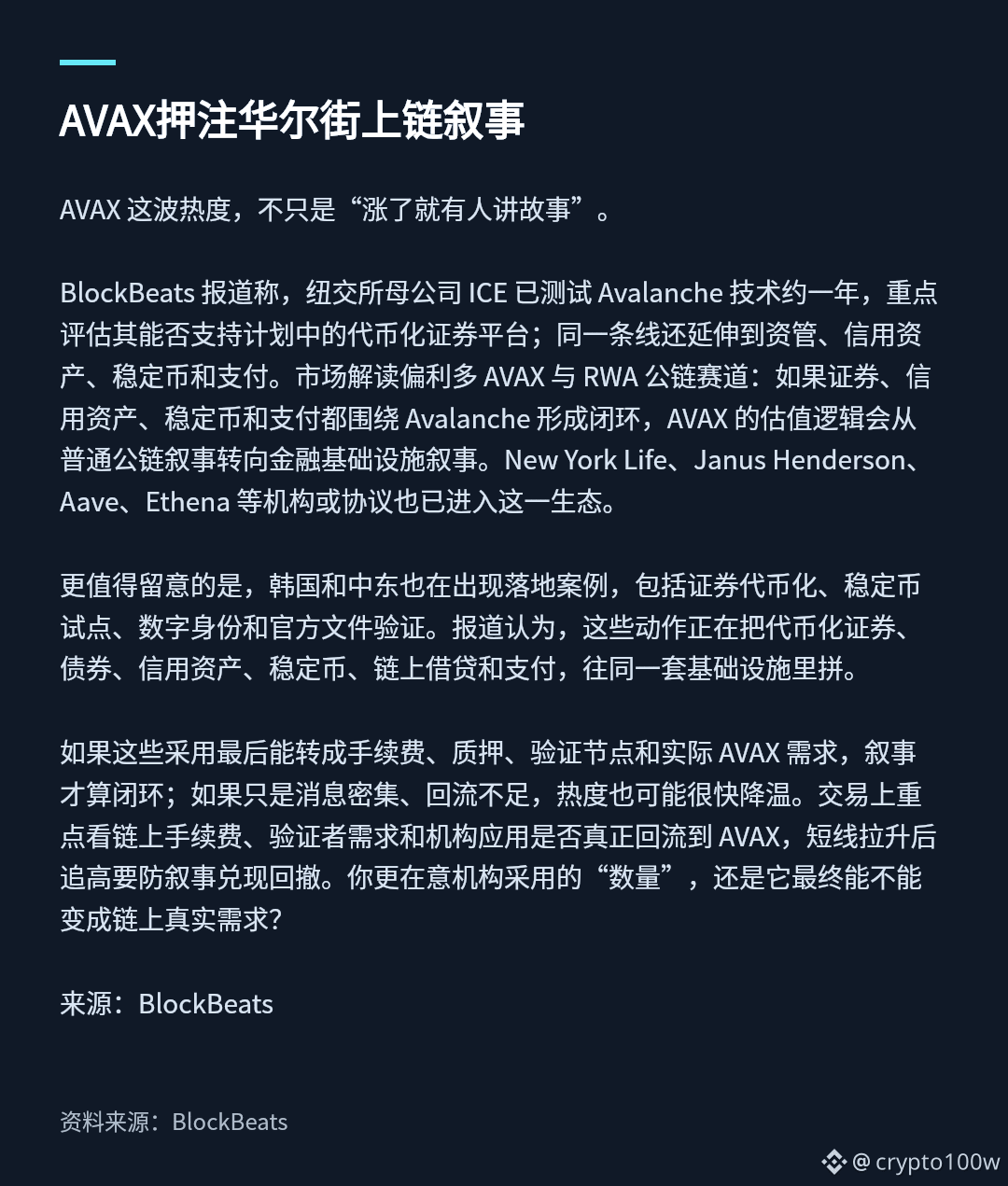
AVAX’s current hype isn’t just about “once it pumps, people start telling stories.”
BlockBeats reports that ICE—the parent company of the New York Stock Exchange—has been testing Avalanche technology for about a year, focusing on whether it can support a planned tokenized securities platform. The same thread extends to asset management, credit assets, stablecoins, and payments. Market interpretation is broadly bullish for the AVAX and RWA (real-world assets) blockchain track: if securities, credit assets, stablecoins, and payments all form a closed loop around Avalanche, AVAX’s valuation logic could shift from a typical L1 narrative to a financial infrastructure narrative. Institutions and protocols such as New York Life, Janus Henderson, Aave, Ethena, and others have also entered this ecosystem.
Even more noteworthy are the deployment cases emerging in South Korea and the Middle East, including security tokenization, stablecoin pilots, digital identity, and official document verification. The report believes these moves are assembling tokenized securities, bonds, credit assets, stablecoins, on-chain lending, and payments into the same underlying infrastructure.
Only if these adoptions ultimately translate into fees, staking, validator demand, and real AVAX needs does the narrative count as a closed loop. If it’s merely a high-density flow of news without sufficient capital returning, the hype may cool quickly as well. For trading, pay close attention to on-chain transaction fees, validator demand, and whether institutional applications truly flow back to AVAX. After a short-term spike, be cautious about chasing the move if the narrative unwinds. Do you care more about the “number” of institutional adoptions, or whether they can ultimately become real on-chain demand?
Source: BlockBeats
Image 1: AVAX bets on the on-chain narrative for Wall Street · Key information
Image source: https://www.theblockbeats.info/news/63769
AVAX’s current hype isn’t just about “once it pumps, people start telling stories.”
BlockBeats reports that ICE—the parent company of the New York Stock Exchange—has been testing Avalanche technology for about a year, focusing on whether it can support a planned tokenized securities platform. The same thread extends to asset management, credit assets, stablecoins, and payments. Market interpretation is broadly bullish for the AVAX and RWA (real-world assets) blockchain track: if securities, credit assets, stablecoins, and payments all form a closed loop around Avalanche, AVAX’s valuation logic could shift from a typical L1 narrative to a financial infrastructure narrative. Institutions and protocols such as New York Life, Janus Henderson, Aave, Ethena, and others have also entered this ecosystem.
Even more noteworthy are the deployment cases emerging in South Korea and the Middle East, including security tokenization, stablecoin pilots, digital identity, and official document verification. The report believes these moves are assembling tokenized securities, bonds, credit assets, stablecoins, on-chain lending, and payments into the same underlying infrastructure.
Only if these adoptions ultimately translate into fees, staking, validator demand, and real AVAX needs does the narrative count as a closed loop. If it’s merely a high-density flow of news without sufficient capital returning, the hype may cool quickly as well. For trading, pay close attention to on-chain transaction fees, validator demand, and whether institutional applications truly flow back to AVAX. After a short-term spike, be cautious about chasing the move if the narrative unwinds. Do you care more about the “number” of institutional adoptions, or whether they can ultimately become real on-chain demand?
Source: BlockBeats
Image 1: AVAX bets on the on-chain narrative for Wall Street · Key information
Image source: https://www.theblockbeats.info/news/63769
BlockBeats reports that ICE—the parent company of the New York Stock Exchange—has been testing Avalanche technology for about a year, focusing on whether it can support a planned tokenized securities platform. The same thread extends to asset management, credit assets, stablecoins, and payments. Market interpretation is broadly bullish for the AVAX and RWA (real-world assets) blockchain track: if securities, credit assets, stablecoins, and payments all form a closed loop around Avalanche, AVAX’s valuation logic could shift from a typical L1 narrative to a financial infrastructure narrative. Institutions and protocols such as New York Life, Janus Henderson, Aave, Ethena, and others have also entered this ecosystem.
Even more noteworthy are the deployment cases emerging in South Korea and the Middle East, including security tokenization, stablecoin pilots, digital identity, and official document verification. The report believes these moves are assembling tokenized securities, bonds, credit assets, stablecoins, on-chain lending, and payments into the same underlying infrastructure.
Only if these adoptions ultimately translate into fees, staking, validator demand, and real AVAX needs does the narrative count as a closed loop. If it’s merely a high-density flow of news without sufficient capital returning, the hype may cool quickly as well. For trading, pay close attention to on-chain transaction fees, validator demand, and whether institutional applications truly flow back to AVAX. After a short-term spike, be cautious about chasing the move if the narrative unwinds. Do you care more about the “number” of institutional adoptions, or whether they can ultimately become real on-chain demand?
Source: BlockBeats
Image 1: AVAX bets on the on-chain narrative for Wall Street · Key information
Image source: https://www.theblockbeats.info/news/63769
26
·
--
See translation
ETF 这波资金,还是在用真金白银说话。
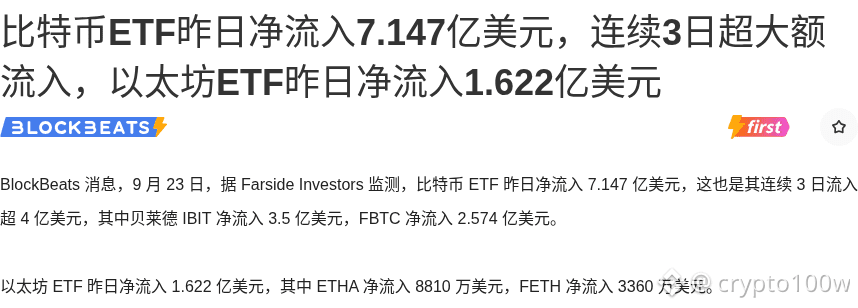
据 BlockBeats 消息,9 月 23 日,Farside Investors 监测显示,美国现货比特币 ETF 昨日净流入 7.147 亿美元,已连续 3 个交易日单日流入超过 4 亿美元;以太坊 ETF 同日净流入 1.622 亿美元。IBIT、FBTC、ETHA、FETH 仍是主要承接方。
这类数据至少说明两件事:一是机构现货买盘还在接力,二是 BTC 高位突破和 ETH 补涨都可能继续得到资金支撑。另一面也要看,若 ETF 买盘开始降温,而价格已经先行拉升,回踩波动往往会被放大。接下来更值得盯的是,流入能不能继续维持在高位。
你更关注 BTC 的高位突破,还是 ETH 的补涨延续?
配图1:BTC、ETH ETF延续大额净流入 · 来源页面局部截图
图片来源:https://www.theblockbeats.info/flash/368566
ETF 这波资金,还是在用真金白银说话。
据 BlockBeats 消息,9 月 23 日,Farside Investors 监测显示,美国现货比特币 ETF 昨日净流入 7.147 亿美元,已连续 3 个交易日单日流入超过 4 亿美元;以太坊 ETF 同日净流入 1.622 亿美元。IBIT、FBTC、ETHA、FETH 仍是主要承接方。
这类数据至少说明两件事:一是机构现货买盘还在接力,二是 BTC 高位突破和 ETH 补涨都可能继续得到资金支撑。另一面也要看,若 ETF 买盘开始降温,而价格已经先行拉升,回踩波动往往会被放大。接下来更值得盯的是,流入能不能继续维持在高位。
你更关注 BTC 的高位突破,还是 ETH 的补涨延续?
配图1:BTC、ETH ETF延续大额净流入 · 来源页面局部截图
图片来源:https://www.theblockbeats.info/flash/368566
据 BlockBeats 消息,9 月 23 日,Farside Investors 监测显示,美国现货比特币 ETF 昨日净流入 7.147 亿美元,已连续 3 个交易日单日流入超过 4 亿美元;以太坊 ETF 同日净流入 1.622 亿美元。IBIT、FBTC、ETHA、FETH 仍是主要承接方。
这类数据至少说明两件事:一是机构现货买盘还在接力,二是 BTC 高位突破和 ETH 补涨都可能继续得到资金支撑。另一面也要看,若 ETF 买盘开始降温,而价格已经先行拉升,回踩波动往往会被放大。接下来更值得盯的是,流入能不能继续维持在高位。
你更关注 BTC 的高位突破,还是 ETH 的补涨延续?
配图1:BTC、ETH ETF延续大额净流入 · 来源页面局部截图
图片来源:https://www.theblockbeats.info/flash/368566
IBITETF-0.07%
FETHETF-0.51%
ETHAETF-0.18%
·
--
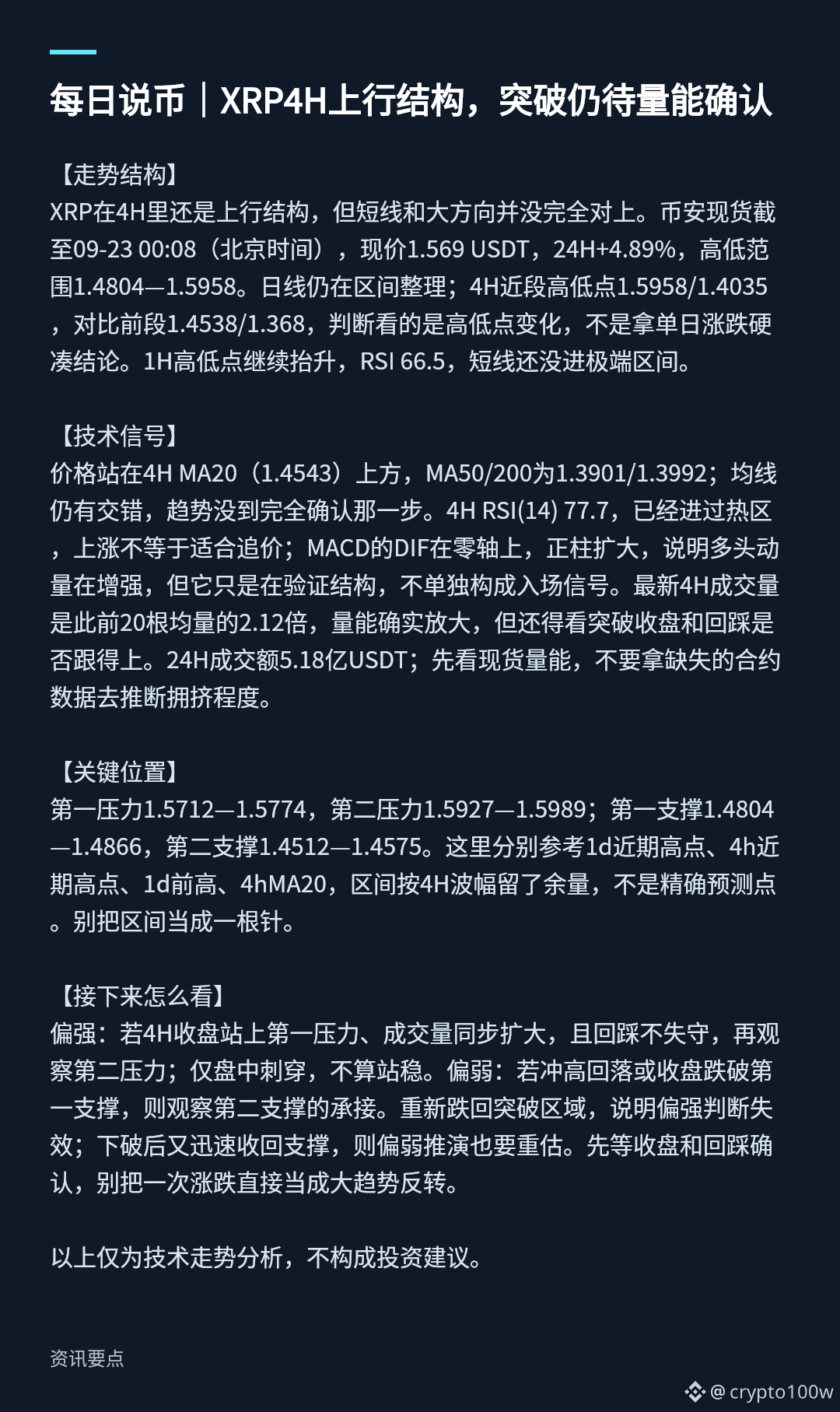
【Price Action Structure】
XRP is still in an upward structure on the 4H timeframe, but the short-term move and the bigger direction haven’t fully aligned yet. As of 09-23 00:08 (Beijing time), XRP spot on Binance is trading at 1.569 USDT, up +4.89% over the past 24H. The high-low range is 1.4804—1.5958. The daily chart is still consolidating within a range. On the 4H chart, the recent high/low points are 1.5958/1.4035; compared with the earlier segment’s 1.4538/1.368, the conclusion is based on changes in high/low points—not forcing a takeaway from a single day’s gain or loss.
On the 1H chart, the high/low points continue to rise. RSI is 66.5, and the short-term momentum hasn’t reached an extreme zone yet.
【Technical Signals】
Price is above the 4H MA20 (1.4543). MA50/200 are at 1.3901/1.3992. The moving averages are still intertwined, meaning the trend hasn’t been fully confirmed. 4H RSI (14) is 77.7, already into an overbought area; an up move doesn’t automatically mean it’s suitable to chase price. MACD’s DIF is around the zero line, and the positive histogram bars are expanding—this suggests increasing bullish momentum—but it only validates the structure; it doesn’t independently serve as an entry signal. The latest 4H trading volume is 2.12 times the average volume of the previous 20 bars. Volume has indeed expanded, but you still need to see whether the breakout’s close is solid and whether pullbacks are holding. 24H trading volume is 518 million USDT. First, focus on the spot volume; don’t infer “crowdedness” from missing derivatives/contract data.
【Key Levels】
First resistance: 1.5712—1.5774. Second resistance: 1.5927—1.5989. First support: 1.4804—1.4866. Second support: 1.4512—1.4575.
Here, you can reference the recent 1D high, the recent 4H high, the prior 1D high, and the 4H MA20. The ranges include a buffer based on the 4H swing amplitude, so they’re not precise forecast points. Don’t treat the range like a single needle-point.
【What to Watch Next】
More bullish: If the 4H closes above the first resistance with volume expanding in sync, and the pullback doesn’t break down, then watch the second resistance next. Intraday piercings alone don’t count as holding.
Less bullish: If it rallies then falls back, or the close breaks below the first support, then watch the second support for how it holds. If it drops back into the breakout zone, that means the bullish interpretation fails. If it then falls below and quickly reclaims the support, the bearish scenario also needs to be reassessed. Wait for the close and pullback confirmation first; don’t treat a single up/down move as an immediate large-scale trend reversal.
The above is only technical price-action analysis and does not constitute investment advice.
【Price Action Structure】
XRP is still in an upward structure on the 4H timeframe, but the short-term move and the bigger direction haven’t fully aligned yet. As of 09-23 00:08 (Beijing time), XRP spot on Binance is trading at 1.569 USDT, up +4.89% over the past 24H. The high-low range is 1.4804—1.5958. The daily chart is still consolidating within a range. On the 4H chart, the recent high/low points are 1.5958/1.4035; compared with the earlier segment’s 1.4538/1.368, the conclusion is based on changes in high/low points—not forcing a takeaway from a single day’s gain or loss.
On the 1H chart, the high/low points continue to rise. RSI is 66.5, and the short-term momentum hasn’t reached an extreme zone yet.
【Technical Signals】
Price is above the 4H MA20 (1.4543). MA50/200 are at 1.3901/1.3992. The moving averages are still intertwined, meaning the trend hasn’t been fully confirmed. 4H RSI (14) is 77.7, already into an overbought area; an up move doesn’t automatically mean it’s suitable to chase price. MACD’s DIF is around the zero line, and the positive histogram bars are expanding—this suggests increasing bullish momentum—but it only validates the structure; it doesn’t independently serve as an entry signal. The latest 4H trading volume is 2.12 times the average volume of the previous 20 bars. Volume has indeed expanded, but you still need to see whether the breakout’s close is solid and whether pullbacks are holding. 24H trading volume is 518 million USDT. First, focus on the spot volume; don’t infer “crowdedness” from missing derivatives/contract data.
【Key Levels】
First resistance: 1.5712—1.5774. Second resistance: 1.5927—1.5989. First support: 1.4804—1.4866. Second support: 1.4512—1.4575.
Here, you can reference the recent 1D high, the recent 4H high, the prior 1D high, and the 4H MA20. The ranges include a buffer based on the 4H swing amplitude, so they’re not precise forecast points. Don’t treat the range like a single needle-point.
【What to Watch Next】
More bullish: If the 4H closes above the first resistance with volume expanding in sync, and the pullback doesn’t break down, then watch the second resistance next. Intraday piercings alone don’t count as holding.
Less bullish: If it rallies then falls back, or the close breaks below the first support, then watch the second support for how it holds. If it drops back into the breakout zone, that means the bullish interpretation fails. If it then falls below and quickly reclaims the support, the bearish scenario also needs to be reassessed. Wait for the close and pullback confirmation first; don’t treat a single up/down move as an immediate large-scale trend reversal.
The above is only technical price-action analysis and does not constitute investment advice.
XRP is still in an upward structure on the 4H timeframe, but the short-term move and the bigger direction haven’t fully aligned yet. As of 09-23 00:08 (Beijing time), XRP spot on Binance is trading at 1.569 USDT, up +4.89% over the past 24H. The high-low range is 1.4804—1.5958. The daily chart is still consolidating within a range. On the 4H chart, the recent high/low points are 1.5958/1.4035; compared with the earlier segment’s 1.4538/1.368, the conclusion is based on changes in high/low points—not forcing a takeaway from a single day’s gain or loss.
On the 1H chart, the high/low points continue to rise. RSI is 66.5, and the short-term momentum hasn’t reached an extreme zone yet.
【Technical Signals】
Price is above the 4H MA20 (1.4543). MA50/200 are at 1.3901/1.3992. The moving averages are still intertwined, meaning the trend hasn’t been fully confirmed. 4H RSI (14) is 77.7, already into an overbought area; an up move doesn’t automatically mean it’s suitable to chase price. MACD’s DIF is around the zero line, and the positive histogram bars are expanding—this suggests increasing bullish momentum—but it only validates the structure; it doesn’t independently serve as an entry signal. The latest 4H trading volume is 2.12 times the average volume of the previous 20 bars. Volume has indeed expanded, but you still need to see whether the breakout’s close is solid and whether pullbacks are holding. 24H trading volume is 518 million USDT. First, focus on the spot volume; don’t infer “crowdedness” from missing derivatives/contract data.
【Key Levels】
First resistance: 1.5712—1.5774. Second resistance: 1.5927—1.5989. First support: 1.4804—1.4866. Second support: 1.4512—1.4575.
Here, you can reference the recent 1D high, the recent 4H high, the prior 1D high, and the 4H MA20. The ranges include a buffer based on the 4H swing amplitude, so they’re not precise forecast points. Don’t treat the range like a single needle-point.
【What to Watch Next】
More bullish: If the 4H closes above the first resistance with volume expanding in sync, and the pullback doesn’t break down, then watch the second resistance next. Intraday piercings alone don’t count as holding.
Less bullish: If it rallies then falls back, or the close breaks below the first support, then watch the second support for how it holds. If it drops back into the breakout zone, that means the bullish interpretation fails. If it then falls below and quickly reclaims the support, the bearish scenario also needs to be reassessed. Wait for the close and pullback confirmation first; don’t treat a single up/down move as an immediate large-scale trend reversal.
The above is only technical price-action analysis and does not constitute investment advice.
80
·
--
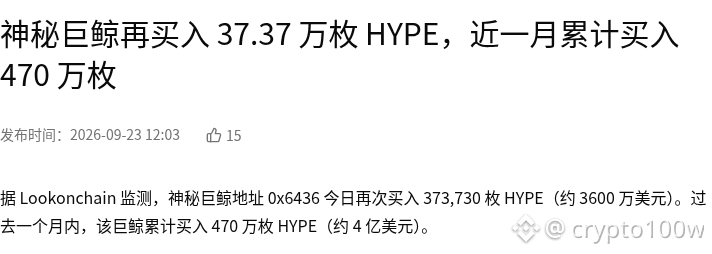
HYPE is back with another large buy on the chain. The ones in the market who are best at “voting with their feet” are often not retail investors.
According to Lookonchain monitoring, address 0x6436 bought another 373,700 HYPE today, worth about $36 million. In the past month, it accumulated about 4.7 million HYPE purchases, totaling roughly $400 million. Market interpretation is mostly bullish on HYPE.
This kind of continuous accumulation can indeed strengthen the bullish narrative for HYPE, but it also increases the risk of concentrated holdings. One observation is that if, after a subsequent volume expansion, the price can still hold steady at the pullback level, follower sentiment may be even stronger. Another observation is that if this address stops buying or starts transferring out, short-term capital may become more sensitive. Which are you paying more attention to: “continued accumulation” or the “risk of concentrated holdings”?
Source: Wu Shuo
#HYPE
Figure 1: A giant whale bought $400 million worth of HYPE in the past month · Source: partial screenshot of the page
Image source: https://www.wublock123.com/news/mystery-whale-buys-373700-hype-4700000-monthly-68860
HYPE is back with another large buy on the chain. The ones in the market who are best at “voting with their feet” are often not retail investors.
According to Lookonchain monitoring, address 0x6436 bought another 373,700 HYPE today, worth about $36 million. In the past month, it accumulated about 4.7 million HYPE purchases, totaling roughly $400 million. Market interpretation is mostly bullish on HYPE.
This kind of continuous accumulation can indeed strengthen the bullish narrative for HYPE, but it also increases the risk of concentrated holdings. One observation is that if, after a subsequent volume expansion, the price can still hold steady at the pullback level, follower sentiment may be even stronger. Another observation is that if this address stops buying or starts transferring out, short-term capital may become more sensitive. Which are you paying more attention to: “continued accumulation” or the “risk of concentrated holdings”?
Source: Wu Shuo
#HYPE
Figure 1: A giant whale bought $400 million worth of HYPE in the past month · Source: partial screenshot of the page
Image source: https://www.wublock123.com/news/mystery-whale-buys-373700-hype-4700000-monthly-68860
According to Lookonchain monitoring, address 0x6436 bought another 373,700 HYPE today, worth about $36 million. In the past month, it accumulated about 4.7 million HYPE purchases, totaling roughly $400 million. Market interpretation is mostly bullish on HYPE.
This kind of continuous accumulation can indeed strengthen the bullish narrative for HYPE, but it also increases the risk of concentrated holdings. One observation is that if, after a subsequent volume expansion, the price can still hold steady at the pullback level, follower sentiment may be even stronger. Another observation is that if this address stops buying or starts transferring out, short-term capital may become more sensitive. Which are you paying more attention to: “continued accumulation” or the “risk of concentrated holdings”?
Source: Wu Shuo
#HYPE
Figure 1: A giant whale bought $400 million worth of HYPE in the past month · Source: partial screenshot of the page
Image source: https://www.wublock123.com/news/mystery-whale-buys-373700-hype-4700000-monthly-68860
35
·
--
See translation
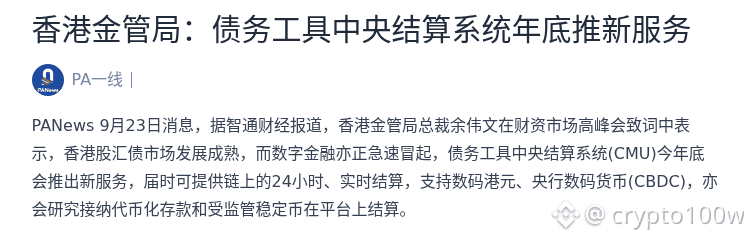
香港CMU年底要把结算搬上链,这事比“又出一个概念”更实。
据PANews援引智通财经,香港金管局总裁余伟文在财资市场高峰会致词中表示,债务工具中央结算系统(CMU)今年底会推出新服务,届时可提供链上的24小时、实时结算,支持数码港元、央行数码货币(CBDC),并研究接纳代币化存款和受监管稳定币在平台上结算。
看点很清楚:一边是传统债券结算基础设施,一边是链上支付工具;如果这类衔接推进顺利,机构对代币化资产和稳定币结算的接受度,可能会更高。另一个观察是,香港数字金融、RWA和合规稳定币叙事,可能会继续被市场反复讨论。
你更关注它对香港数字金融生态的推动,还是对RWA和合规稳定币叙事的带动?
配图1:香港CMU年底推链上实时结算 · 来源页面局部截图
图片来源:https://www.panewslab.com/zh/articles/01a0cc58-e8eb-71bc-a001-ef60a8e14207
香港CMU年底要把结算搬上链,这事比“又出一个概念”更实。
据PANews援引智通财经,香港金管局总裁余伟文在财资市场高峰会致词中表示,债务工具中央结算系统(CMU)今年底会推出新服务,届时可提供链上的24小时、实时结算,支持数码港元、央行数码货币(CBDC),并研究接纳代币化存款和受监管稳定币在平台上结算。
看点很清楚:一边是传统债券结算基础设施,一边是链上支付工具;如果这类衔接推进顺利,机构对代币化资产和稳定币结算的接受度,可能会更高。另一个观察是,香港数字金融、RWA和合规稳定币叙事,可能会继续被市场反复讨论。
你更关注它对香港数字金融生态的推动,还是对RWA和合规稳定币叙事的带动?
配图1:香港CMU年底推链上实时结算 · 来源页面局部截图
图片来源:https://www.panewslab.com/zh/articles/01a0cc58-e8eb-71bc-a001-ef60a8e14207
据PANews援引智通财经,香港金管局总裁余伟文在财资市场高峰会致词中表示,债务工具中央结算系统(CMU)今年底会推出新服务,届时可提供链上的24小时、实时结算,支持数码港元、央行数码货币(CBDC),并研究接纳代币化存款和受监管稳定币在平台上结算。
看点很清楚:一边是传统债券结算基础设施,一边是链上支付工具;如果这类衔接推进顺利,机构对代币化资产和稳定币结算的接受度,可能会更高。另一个观察是,香港数字金融、RWA和合规稳定币叙事,可能会继续被市场反复讨论。
你更关注它对香港数字金融生态的推动,还是对RWA和合规稳定币叙事的带动?
配图1:香港CMU年底推链上实时结算 · 来源页面局部截图
图片来源:https://www.panewslab.com/zh/articles/01a0cc58-e8eb-71bc-a001-ef60a8e14207
6
·
--
See translation
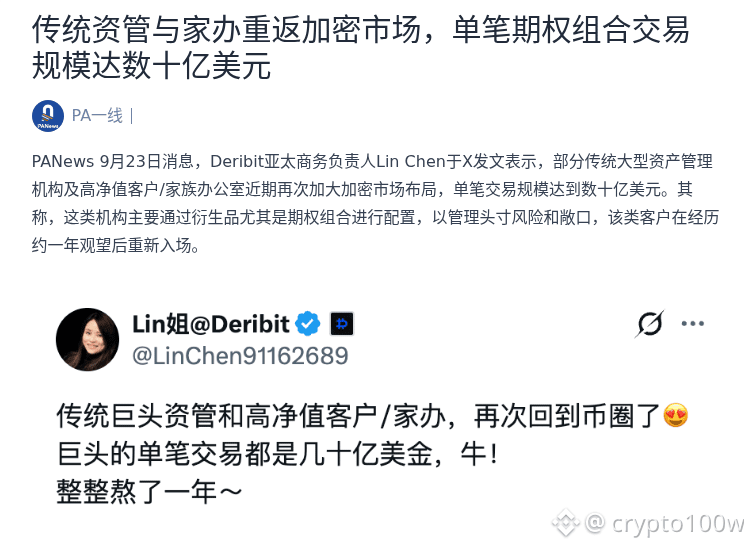
传统资管和家办,正在回到加密期权桌上。
PANews 9月23日消息,Deribit亚太商务负责人Lin Chen于X发文表示,部分传统大型资产管理机构及高净值客户/家族办公室近期再次加大加密市场布局,单笔交易规模达到数十亿美元。
这些机构主要通过衍生品,尤其是期权组合来配置,重点是管理头寸风险和敞口。一个观察是,资金回流的方式更偏结构化,而不是直接追现货;另一个观察是,若这类大宗成交延续,BTC、ETH相关期权隐含波动率和流动性可能更受关注。
你更关注机构回归带来的波动抬升,还是衍生品流动性改善?
配图1:传统资管与家办重返加密期权市场 · 来源页面局部截图
图片来源:https://www.panewslab.com/zh/articles/01a0cc5f-5180-76ca-9329-8e12860cf327
传统资管和家办,正在回到加密期权桌上。
PANews 9月23日消息,Deribit亚太商务负责人Lin Chen于X发文表示,部分传统大型资产管理机构及高净值客户/家族办公室近期再次加大加密市场布局,单笔交易规模达到数十亿美元。
这些机构主要通过衍生品,尤其是期权组合来配置,重点是管理头寸风险和敞口。一个观察是,资金回流的方式更偏结构化,而不是直接追现货;另一个观察是,若这类大宗成交延续,BTC、ETH相关期权隐含波动率和流动性可能更受关注。
你更关注机构回归带来的波动抬升,还是衍生品流动性改善?
配图1:传统资管与家办重返加密期权市场 · 来源页面局部截图
图片来源:https://www.panewslab.com/zh/articles/01a0cc5f-5180-76ca-9329-8e12860cf327
PANews 9月23日消息,Deribit亚太商务负责人Lin Chen于X发文表示,部分传统大型资产管理机构及高净值客户/家族办公室近期再次加大加密市场布局,单笔交易规模达到数十亿美元。
这些机构主要通过衍生品,尤其是期权组合来配置,重点是管理头寸风险和敞口。一个观察是,资金回流的方式更偏结构化,而不是直接追现货;另一个观察是,若这类大宗成交延续,BTC、ETH相关期权隐含波动率和流动性可能更受关注。
你更关注机构回归带来的波动抬升,还是衍生品流动性改善?
配图1:传统资管与家办重返加密期权市场 · 来源页面局部截图
图片来源:https://www.panewslab.com/zh/articles/01a0cc5f-5180-76ca-9329-8e12860cf327
2
·
--
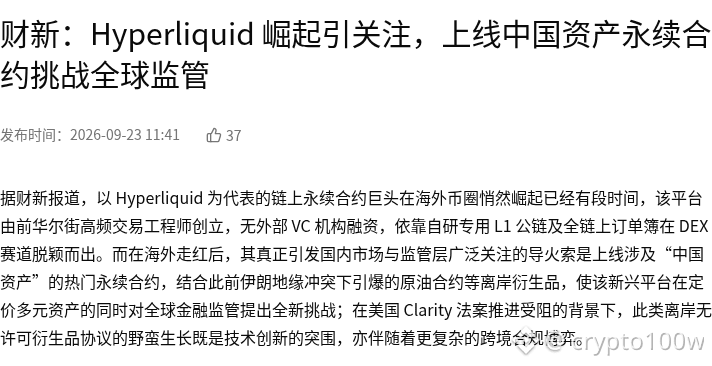
Hyperliquid has once again been pushed into the regulatory spotlight due to its listing involving Chinese assets—ChangXin Technology (CMXT)—perpetual contracts.
According to a Caixin report, this platform’s launch is not a routine “new listing.” Instead, on-chain unlicensed derivatives expand the pricing universe of crypto assets into stocks, pre-IPO offerings, and commodities—beginning to touch the regulatory boundaries for cross-border securities and futures. For HYPE and the on-chain perpetuals sector, product expansion and traffic spillover are positive signals; but as regulatory attention heats up, it may also dampen valuation upside expectations.
Two things to watch next: first, whether the platform’s trading volume can continue to grow; and second, whether any later developments include delistings, restrictions on access by region, or regulatory statements. Are you more concerned about the traffic gains brought by product expansion, or the uncertainty brought by rising regulatory scrutiny?
Source: Wu Shuo
#CMXT #HYPE
Figure 1: Hyperliquid China-asset contracts draw regulatory attention · Source: partial screenshot of the page
Image source: https://www.wublock123.com/news/hyperliquid-rise-china-asset-perpetuals-regulatory-challenge-68857
Hyperliquid has once again been pushed into the regulatory spotlight due to its listing involving Chinese assets—ChangXin Technology (CMXT)—perpetual contracts.
According to a Caixin report, this platform’s launch is not a routine “new listing.” Instead, on-chain unlicensed derivatives expand the pricing universe of crypto assets into stocks, pre-IPO offerings, and commodities—beginning to touch the regulatory boundaries for cross-border securities and futures. For HYPE and the on-chain perpetuals sector, product expansion and traffic spillover are positive signals; but as regulatory attention heats up, it may also dampen valuation upside expectations.
Two things to watch next: first, whether the platform’s trading volume can continue to grow; and second, whether any later developments include delistings, restrictions on access by region, or regulatory statements. Are you more concerned about the traffic gains brought by product expansion, or the uncertainty brought by rising regulatory scrutiny?
Source: Wu Shuo
#CMXT #HYPE
Figure 1: Hyperliquid China-asset contracts draw regulatory attention · Source: partial screenshot of the page
Image source: https://www.wublock123.com/news/hyperliquid-rise-china-asset-perpetuals-regulatory-challenge-68857
According to a Caixin report, this platform’s launch is not a routine “new listing.” Instead, on-chain unlicensed derivatives expand the pricing universe of crypto assets into stocks, pre-IPO offerings, and commodities—beginning to touch the regulatory boundaries for cross-border securities and futures. For HYPE and the on-chain perpetuals sector, product expansion and traffic spillover are positive signals; but as regulatory attention heats up, it may also dampen valuation upside expectations.
Two things to watch next: first, whether the platform’s trading volume can continue to grow; and second, whether any later developments include delistings, restrictions on access by region, or regulatory statements. Are you more concerned about the traffic gains brought by product expansion, or the uncertainty brought by rising regulatory scrutiny?
Source: Wu Shuo
#CMXT #HYPE
Figure 1: Hyperliquid China-asset contracts draw regulatory attention · Source: partial screenshot of the page
Image source: https://www.wublock123.com/news/hyperliquid-rise-china-asset-perpetuals-regulatory-challenge-68857
56
·
--
See translation
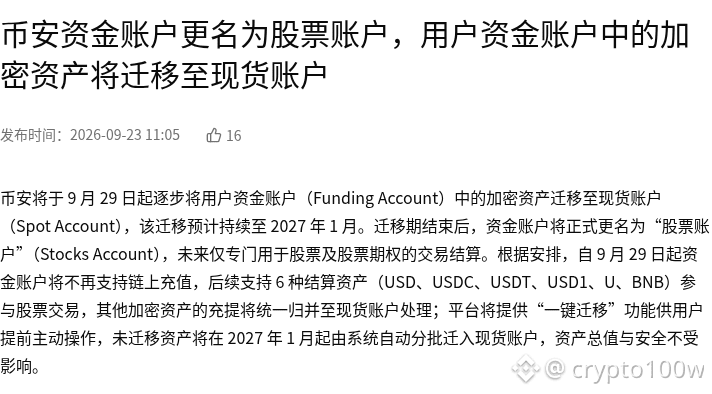
币安这次不是“下架”,更像是把账户分工重新摆了一遍。
据吴说,币安将于9月29日起,逐步把用户资金账户(Funding Account)中的加密资产迁移至现货账户(Spot Account),预计持续到2027年1月。迁移结束后,资金账户将更名为“股票账户”(Stocks Account),仅用于股票及股票期权交易结算。
这里真正需要盯住的,不是标题,而是操作路径:9月29日起资金账户不再支持链上充值,后续支持USD、USDC、USDT、USD1、U、BNB等6种结算资产参与股票交易;其他加密资产的充提将统一归并至现货账户处理。平台也会提供“一键迁移”,未迁移资产将于2027年1月起由系统自动分批迁入现货账户。
对普通用户来说,一种情况是账户里同时有加密资产和股票相关结算资产,需要先确认资金去向;另一种情况是依赖API、C2C、支付或定投流程的用户,更要检查引用路径,避免迁移期资金来源变化影响操作。你更在意账户名称变化,还是实际迁移流程?
配图1:币安资金账户将改为股票账户 · 来源页面局部截图
图片来源:https://www.wublock123.com/news/binance-funding-account-renamed-stock-account-crypto-assets-moved-to-spot-68853
币安这次不是“下架”,更像是把账户分工重新摆了一遍。
据吴说,币安将于9月29日起,逐步把用户资金账户(Funding Account)中的加密资产迁移至现货账户(Spot Account),预计持续到2027年1月。迁移结束后,资金账户将更名为“股票账户”(Stocks Account),仅用于股票及股票期权交易结算。
这里真正需要盯住的,不是标题,而是操作路径:9月29日起资金账户不再支持链上充值,后续支持USD、USDC、USDT、USD1、U、BNB等6种结算资产参与股票交易;其他加密资产的充提将统一归并至现货账户处理。平台也会提供“一键迁移”,未迁移资产将于2027年1月起由系统自动分批迁入现货账户。
对普通用户来说,一种情况是账户里同时有加密资产和股票相关结算资产,需要先确认资金去向;另一种情况是依赖API、C2C、支付或定投流程的用户,更要检查引用路径,避免迁移期资金来源变化影响操作。你更在意账户名称变化,还是实际迁移流程?
配图1:币安资金账户将改为股票账户 · 来源页面局部截图
图片来源:https://www.wublock123.com/news/binance-funding-account-renamed-stock-account-crypto-assets-moved-to-spot-68853
据吴说,币安将于9月29日起,逐步把用户资金账户(Funding Account)中的加密资产迁移至现货账户(Spot Account),预计持续到2027年1月。迁移结束后,资金账户将更名为“股票账户”(Stocks Account),仅用于股票及股票期权交易结算。
这里真正需要盯住的,不是标题,而是操作路径:9月29日起资金账户不再支持链上充值,后续支持USD、USDC、USDT、USD1、U、BNB等6种结算资产参与股票交易;其他加密资产的充提将统一归并至现货账户处理。平台也会提供“一键迁移”,未迁移资产将于2027年1月起由系统自动分批迁入现货账户。
对普通用户来说,一种情况是账户里同时有加密资产和股票相关结算资产,需要先确认资金去向;另一种情况是依赖API、C2C、支付或定投流程的用户,更要检查引用路径,避免迁移期资金来源变化影响操作。你更在意账户名称变化,还是实际迁移流程?
配图1:币安资金账户将改为股票账户 · 来源页面局部截图
图片来源:https://www.wublock123.com/news/binance-funding-account-renamed-stock-account-crypto-assets-moved-to-spot-68853
21
·
--
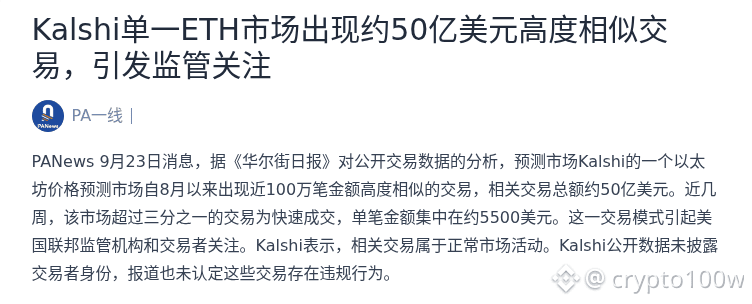
This ETH price prediction market on Kalshi has recently come under scrutiny.
According to an analysis of publicly traded data by The Wall Street Journal, since August this market has seen nearly 1 million transactions with highly similar amounts, totaling about $5 billion; in recent weeks, more than one-third of the transactions have been settled quickly, with each transaction amount often clustered around roughly $5,500. As a result, U.S. federal regulators and traders have begun paying attention. Kalshi’s response is that these transactions are normal market activity, and that since identities of the traders were not disclosed in public data, the report did not find that wrongdoing occurred.
Market interpretation points to two layers: first, whether Kalshi and the transparency of trading in prediction markets will continue to be scrutinized; second, the impact on ETH itself is currently somewhat neutral, with more focus on the quality of trading volume and the market-making mechanisms on regulated exchanges. If regulators get further involved later on, the growth narrative for prediction markets and crypto perpetual products will face pressure. Are you more concerned about trading transparency, or more worried about regulatory spillover?
Figure 1: Unusual trading in the Kalshi ETH market draws regulatory attention · Partial screenshot of the source page
Image source: https://www.panewslab.com/zh/articles/01a0cbe1-9999-7597-9ed4-3264097faef0
This ETH price prediction market on Kalshi has recently come under scrutiny.
According to an analysis of publicly traded data by The Wall Street Journal, since August this market has seen nearly 1 million transactions with highly similar amounts, totaling about $5 billion; in recent weeks, more than one-third of the transactions have been settled quickly, with each transaction amount often clustered around roughly $5,500. As a result, U.S. federal regulators and traders have begun paying attention. Kalshi’s response is that these transactions are normal market activity, and that since identities of the traders were not disclosed in public data, the report did not find that wrongdoing occurred.
Market interpretation points to two layers: first, whether Kalshi and the transparency of trading in prediction markets will continue to be scrutinized; second, the impact on ETH itself is currently somewhat neutral, with more focus on the quality of trading volume and the market-making mechanisms on regulated exchanges. If regulators get further involved later on, the growth narrative for prediction markets and crypto perpetual products will face pressure. Are you more concerned about trading transparency, or more worried about regulatory spillover?
Figure 1: Unusual trading in the Kalshi ETH market draws regulatory attention · Partial screenshot of the source page
Image source: https://www.panewslab.com/zh/articles/01a0cbe1-9999-7597-9ed4-3264097faef0
According to an analysis of publicly traded data by The Wall Street Journal, since August this market has seen nearly 1 million transactions with highly similar amounts, totaling about $5 billion; in recent weeks, more than one-third of the transactions have been settled quickly, with each transaction amount often clustered around roughly $5,500. As a result, U.S. federal regulators and traders have begun paying attention. Kalshi’s response is that these transactions are normal market activity, and that since identities of the traders were not disclosed in public data, the report did not find that wrongdoing occurred.
Market interpretation points to two layers: first, whether Kalshi and the transparency of trading in prediction markets will continue to be scrutinized; second, the impact on ETH itself is currently somewhat neutral, with more focus on the quality of trading volume and the market-making mechanisms on regulated exchanges. If regulators get further involved later on, the growth narrative for prediction markets and crypto perpetual products will face pressure. Are you more concerned about trading transparency, or more worried about regulatory spillover?
Figure 1: Unusual trading in the Kalshi ETH market draws regulatory attention · Partial screenshot of the source page
Image source: https://www.panewslab.com/zh/articles/01a0cbe1-9999-7597-9ed4-3264097faef0
96
·
--
See translation
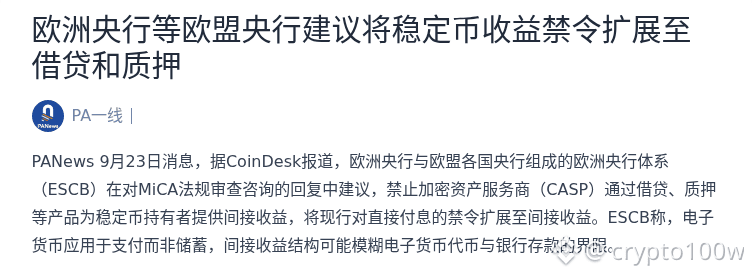
欧央行体系这次盯上的,不只是“直接付息”,连借贷、质押这类间接收益也想一起封住。
PANews 引述 CoinDesk 消息称,欧洲央行与欧盟各国央行组成的欧洲央行体系(ESCB),在对 MiCA 法规审查咨询的回复中建议:禁止加密资产服务商(CASP)通过借贷、质押等产品,为稳定币持有者提供间接收益。现行对直接付息的禁令,可能被扩展到间接收益。
它给出的理由也很直白:电子货币应主要用于支付,而不是储蓄;如果收益结构继续存在,电子货币代币和银行存款之间的边界会被进一步模糊。若这一建议被写入修法,稳定币“生息”叙事和欧盟 CASP 平台相关卖点,都会先承压。你更关注它对 USDC、USDT 的影响,还是对欧盟合规支付型稳定币的影响?
来源:PANews
配图1:欧央行体系拟封堵稳定币间接收益 · 来源页面局部截图
图片来源:https://www.panewslab.com/zh/articles/01a0cbe6-0640-748e-b5a0-23ad08e7400e
欧央行体系这次盯上的,不只是“直接付息”,连借贷、质押这类间接收益也想一起封住。
PANews 引述 CoinDesk 消息称,欧洲央行与欧盟各国央行组成的欧洲央行体系(ESCB),在对 MiCA 法规审查咨询的回复中建议:禁止加密资产服务商(CASP)通过借贷、质押等产品,为稳定币持有者提供间接收益。现行对直接付息的禁令,可能被扩展到间接收益。
它给出的理由也很直白:电子货币应主要用于支付,而不是储蓄;如果收益结构继续存在,电子货币代币和银行存款之间的边界会被进一步模糊。若这一建议被写入修法,稳定币“生息”叙事和欧盟 CASP 平台相关卖点,都会先承压。你更关注它对 USDC、USDT 的影响,还是对欧盟合规支付型稳定币的影响?
来源:PANews
配图1:欧央行体系拟封堵稳定币间接收益 · 来源页面局部截图
图片来源:https://www.panewslab.com/zh/articles/01a0cbe6-0640-748e-b5a0-23ad08e7400e
PANews 引述 CoinDesk 消息称,欧洲央行与欧盟各国央行组成的欧洲央行体系(ESCB),在对 MiCA 法规审查咨询的回复中建议:禁止加密资产服务商(CASP)通过借贷、质押等产品,为稳定币持有者提供间接收益。现行对直接付息的禁令,可能被扩展到间接收益。
它给出的理由也很直白:电子货币应主要用于支付,而不是储蓄;如果收益结构继续存在,电子货币代币和银行存款之间的边界会被进一步模糊。若这一建议被写入修法,稳定币“生息”叙事和欧盟 CASP 平台相关卖点,都会先承压。你更关注它对 USDC、USDT 的影响,还是对欧盟合规支付型稳定币的影响?
来源:PANews
配图1:欧央行体系拟封堵稳定币间接收益 · 来源页面局部截图
图片来源:https://www.panewslab.com/zh/articles/01a0cbe6-0640-748e-b5a0-23ad08e7400e
4
·
--
World Liberty is once again under the microscope.
PANews, citing Bloomberg, reported that the Trump family’s crypto project, World Liberty Financial, generated millions of dollars in gains through selling tokens. At the same time, after the project bought tokens such as LINK and AAVE to build a “strategic token reserve,” the relevant tokens were briefly pushed up by short-term funds. Trump’s financial disclosures also show that, last year, World Liberty increased its net worth by $594 million.
But even more striking is the other side: Bloomberg noted that partnerships previously announced by the project—such as Aave lending and the tokenization of U.S. Treasuries via Ondo tokens—had not materialized. Questions about potential conflicts of interest then emerged as well. For WLFI, the pressure on credibility is more immediate; for LINK, AAVE, and ONDO, the gap between short-term momentum and actual delivery of the partnerships may be the key issue to watch next.
One observation is that buy-side narratives can drive price sentiment, but if there is no real progress on partnerships, the sustainability often gets discounted. Another observation is that celebrity-backed projects come with built-in attention; however, once the execution timeline can’t keep up, the market often moves expectations back down.
Which do you value more: the short-term hype brought by the “strategic reserve,” or whether the partnerships have truly been delivered?
Figure 1: World Liberty’s earnings and partnership commitments face scrutiny · Source page partial screenshot
Image source: https://www.panewslab.com/zh/articles/01a0cbfd-c28d-7320-8fb0-e96e01012512
World Liberty is once again under the microscope.
PANews, citing Bloomberg, reported that the Trump family’s crypto project, World Liberty Financial, generated millions of dollars in gains through selling tokens. At the same time, after the project bought tokens such as LINK and AAVE to build a “strategic token reserve,” the relevant tokens were briefly pushed up by short-term funds. Trump’s financial disclosures also show that, last year, World Liberty increased its net worth by $594 million.
But even more striking is the other side: Bloomberg noted that partnerships previously announced by the project—such as Aave lending and the tokenization of U.S. Treasuries via Ondo tokens—had not materialized. Questions about potential conflicts of interest then emerged as well. For WLFI, the pressure on credibility is more immediate; for LINK, AAVE, and ONDO, the gap between short-term momentum and actual delivery of the partnerships may be the key issue to watch next.
One observation is that buy-side narratives can drive price sentiment, but if there is no real progress on partnerships, the sustainability often gets discounted. Another observation is that celebrity-backed projects come with built-in attention; however, once the execution timeline can’t keep up, the market often moves expectations back down.
Which do you value more: the short-term hype brought by the “strategic reserve,” or whether the partnerships have truly been delivered?
Figure 1: World Liberty’s earnings and partnership commitments face scrutiny · Source page partial screenshot
Image source: https://www.panewslab.com/zh/articles/01a0cbfd-c28d-7320-8fb0-e96e01012512
PANews, citing Bloomberg, reported that the Trump family’s crypto project, World Liberty Financial, generated millions of dollars in gains through selling tokens. At the same time, after the project bought tokens such as LINK and AAVE to build a “strategic token reserve,” the relevant tokens were briefly pushed up by short-term funds. Trump’s financial disclosures also show that, last year, World Liberty increased its net worth by $594 million.
But even more striking is the other side: Bloomberg noted that partnerships previously announced by the project—such as Aave lending and the tokenization of U.S. Treasuries via Ondo tokens—had not materialized. Questions about potential conflicts of interest then emerged as well. For WLFI, the pressure on credibility is more immediate; for LINK, AAVE, and ONDO, the gap between short-term momentum and actual delivery of the partnerships may be the key issue to watch next.
One observation is that buy-side narratives can drive price sentiment, but if there is no real progress on partnerships, the sustainability often gets discounted. Another observation is that celebrity-backed projects come with built-in attention; however, once the execution timeline can’t keep up, the market often moves expectations back down.
Which do you value more: the short-term hype brought by the “strategic reserve,” or whether the partnerships have truly been delivered?
Figure 1: World Liberty’s earnings and partnership commitments face scrutiny · Source page partial screenshot
Image source: https://www.panewslab.com/zh/articles/01a0cbfd-c28d-7320-8fb0-e96e01012512

22
·
--
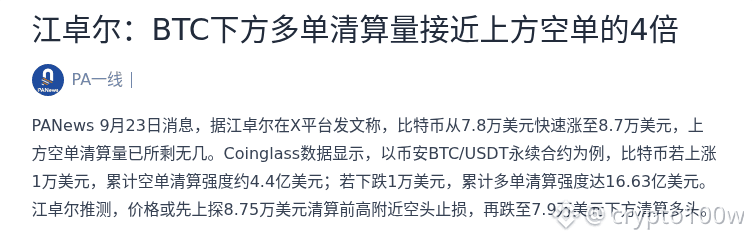
After this round of BTC surging from $78,000 to $87,000, the positioning of leveraged positions is already quite delicate.
According to PANews, citing data from Jiang Zhuoer and Coinglass, based on Binance BTC/USDT perpetual contracts: if BTC rises another $10,000, the cumulative liquidation strength of short positions is about $440 million; if BTC falls another $10,000, the cumulative liquidation strength of long positions reaches $1.663 billion. In other words, the room for shorts on the upside is narrowing, while longs on the downside are getting more crowded.
If the price continues to probe the $87,500 area, it may first trigger stop-losses for shorts around the prior high. But once it breaks below $79,000, the amplifying effect of a chain reaction of long stop-losses will be even more pronounced. Spot holders will be more focused on whether the level above $87,000 can see enough volume to hold, while derivatives traders will need to watch how the liquidation zones on both sides shift. Which would you be more concerned about: first driving up to $87,500, or first pulling back to $79,000?
Figure 1: BTC long liquidation pressure heats up · Source: partial screenshot of the page
Image source: https://www.panewslab.com/zh/articles/01a0cc11-d066-777a-a0d0-2f47a111d554
After this round of BTC surging from $78,000 to $87,000, the positioning of leveraged positions is already quite delicate.
According to PANews, citing data from Jiang Zhuoer and Coinglass, based on Binance BTC/USDT perpetual contracts: if BTC rises another $10,000, the cumulative liquidation strength of short positions is about $440 million; if BTC falls another $10,000, the cumulative liquidation strength of long positions reaches $1.663 billion. In other words, the room for shorts on the upside is narrowing, while longs on the downside are getting more crowded.
If the price continues to probe the $87,500 area, it may first trigger stop-losses for shorts around the prior high. But once it breaks below $79,000, the amplifying effect of a chain reaction of long stop-losses will be even more pronounced. Spot holders will be more focused on whether the level above $87,000 can see enough volume to hold, while derivatives traders will need to watch how the liquidation zones on both sides shift. Which would you be more concerned about: first driving up to $87,500, or first pulling back to $79,000?
Figure 1: BTC long liquidation pressure heats up · Source: partial screenshot of the page
Image source: https://www.panewslab.com/zh/articles/01a0cc11-d066-777a-a0d0-2f47a111d554
According to PANews, citing data from Jiang Zhuoer and Coinglass, based on Binance BTC/USDT perpetual contracts: if BTC rises another $10,000, the cumulative liquidation strength of short positions is about $440 million; if BTC falls another $10,000, the cumulative liquidation strength of long positions reaches $1.663 billion. In other words, the room for shorts on the upside is narrowing, while longs on the downside are getting more crowded.
If the price continues to probe the $87,500 area, it may first trigger stop-losses for shorts around the prior high. But once it breaks below $79,000, the amplifying effect of a chain reaction of long stop-losses will be even more pronounced. Spot holders will be more focused on whether the level above $87,000 can see enough volume to hold, while derivatives traders will need to watch how the liquidation zones on both sides shift. Which would you be more concerned about: first driving up to $87,500, or first pulling back to $79,000?
Figure 1: BTC long liquidation pressure heats up · Source: partial screenshot of the page
Image source: https://www.panewslab.com/zh/articles/01a0cc11-d066-777a-a0d0-2f47a111d554
16
·
--
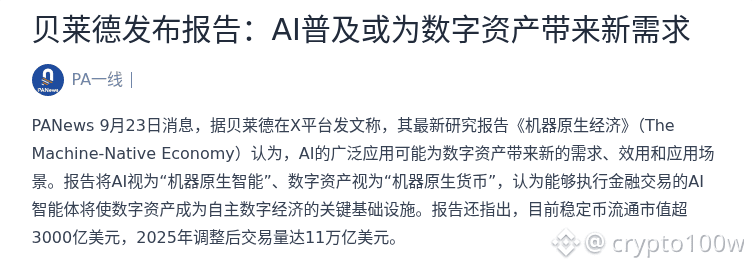
BlackRock isn’t talking about a new narrative this time—it’s placing AI and digital assets directly on the same industry chain.
According to PANews, citing a post by BlackRock on the X platform, its latest research report, <i>The Machine-Native Economy</i>, suggests that the widespread adoption of AI could bring new demand, utility, and application scenarios for digital assets. The report defines AI as “machine-native intelligence,” treats digital assets as “machine-native money,” and notes that AI agents capable of executing financial transactions would make digital assets a key piece of infrastructure for a self-governing digital economy.
What’s even more worth paying attention to here isn’t any single token, but where demand may go next. PANews also mentions that the current circulating market capitalization of stablecoins exceeds $300 billion, and after adjustments in 2025, trading volume reached $1.1 trillion. If the market continues to treat such statements as institutional-level signals, directions related to stablecoins, payments and settlement, and on-chain finance are more likely to see a reaction first. A more realistic question is: do you think stablecoin ecosystems will benefit first, or high-throughput L1/L2 chains will get noticed by capital first?
Image 1: BlackRock says it may open up new demand for digital assets · Source: partial screenshot of the page
Image source: https://www.panewslab.com/zh/articles/01a0cc1e-4d0c-70c4-91ad-c329524eedea
BlackRock isn’t talking about a new narrative this time—it’s placing AI and digital assets directly on the same industry chain.
According to PANews, citing a post by BlackRock on the X platform, its latest research report, <i>The Machine-Native Economy</i>, suggests that the widespread adoption of AI could bring new demand, utility, and application scenarios for digital assets. The report defines AI as “machine-native intelligence,” treats digital assets as “machine-native money,” and notes that AI agents capable of executing financial transactions would make digital assets a key piece of infrastructure for a self-governing digital economy.
What’s even more worth paying attention to here isn’t any single token, but where demand may go next. PANews also mentions that the current circulating market capitalization of stablecoins exceeds $300 billion, and after adjustments in 2025, trading volume reached $1.1 trillion. If the market continues to treat such statements as institutional-level signals, directions related to stablecoins, payments and settlement, and on-chain finance are more likely to see a reaction first. A more realistic question is: do you think stablecoin ecosystems will benefit first, or high-throughput L1/L2 chains will get noticed by capital first?
Image 1: BlackRock says it may open up new demand for digital assets · Source: partial screenshot of the page
Image source: https://www.panewslab.com/zh/articles/01a0cc1e-4d0c-70c4-91ad-c329524eedea
According to PANews, citing a post by BlackRock on the X platform, its latest research report, <i>The Machine-Native Economy</i>, suggests that the widespread adoption of AI could bring new demand, utility, and application scenarios for digital assets. The report defines AI as “machine-native intelligence,” treats digital assets as “machine-native money,” and notes that AI agents capable of executing financial transactions would make digital assets a key piece of infrastructure for a self-governing digital economy.
What’s even more worth paying attention to here isn’t any single token, but where demand may go next. PANews also mentions that the current circulating market capitalization of stablecoins exceeds $300 billion, and after adjustments in 2025, trading volume reached $1.1 trillion. If the market continues to treat such statements as institutional-level signals, directions related to stablecoins, payments and settlement, and on-chain finance are more likely to see a reaction first. A more realistic question is: do you think stablecoin ecosystems will benefit first, or high-throughput L1/L2 chains will get noticed by capital first?
Image 1: BlackRock says it may open up new demand for digital assets · Source: partial screenshot of the page
Image source: https://www.panewslab.com/zh/articles/01a0cc1e-4d0c-70c4-91ad-c329524eedea
4
·
--
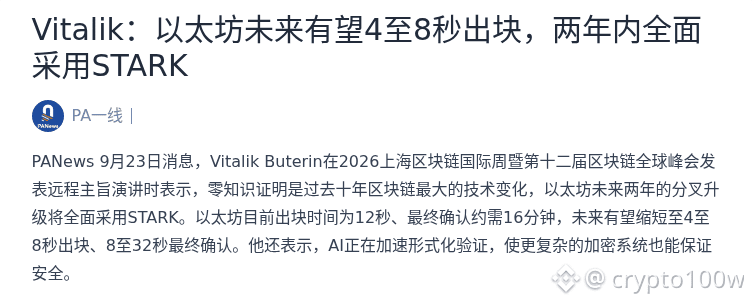
Vitalik once again framed Ethereum’s technical upgrade as a clearer acceleration signal.
In a remote keynote at the 2026 Shanghai Blockchain International Week and the 12th Global Blockchain Summit, he said that Ethereum’s fork upgrades over the next two years will fully adopt STARK. With the current 12-second block production and roughly 16 minutes for finality, it may be pushed to 4–8 seconds for block production and 8–32 seconds for finality in the future. PANews also noted that AI is accelerating formal verification, enabling even more complex cryptographic systems to maintain security.
The appeal of these remarks isn’t just “faster,” but also “a clearer roadmap.” For ETH, the ecosystem narrative, L2, and ZK could all become easier for the market to connect and associate; but when it comes down to the transaction layer, faster short-term finality doesn’t automatically mean immediate changes in capital flows. Whether it truly brings funds back will still depend on how subsequent ecosystem catalysts follow through.
One observation scenario is that when upgrade expectations are gradually absorbed, ETH is more likely to be used for valuation-repair purposes. Another scenario is that if the market treats it merely as a piece of technology news, the price reaction could fade quickly. Which do you care more about: the experience improvements brought by “faster finality,” or the boost to the ecosystem narrative from “full adoption of STARK”?
Source: PANews
Image 1: Vitalik said Ethereum will fully adopt STARK within two years · Source: partial screenshot of the page
Image source: https://www.panewslab.com/zh/articles/01a0cc20-b9e3-71f5-9723-c302f5c9699b
Vitalik once again framed Ethereum’s technical upgrade as a clearer acceleration signal.
In a remote keynote at the 2026 Shanghai Blockchain International Week and the 12th Global Blockchain Summit, he said that Ethereum’s fork upgrades over the next two years will fully adopt STARK. With the current 12-second block production and roughly 16 minutes for finality, it may be pushed to 4–8 seconds for block production and 8–32 seconds for finality in the future. PANews also noted that AI is accelerating formal verification, enabling even more complex cryptographic systems to maintain security.
The appeal of these remarks isn’t just “faster,” but also “a clearer roadmap.” For ETH, the ecosystem narrative, L2, and ZK could all become easier for the market to connect and associate; but when it comes down to the transaction layer, faster short-term finality doesn’t automatically mean immediate changes in capital flows. Whether it truly brings funds back will still depend on how subsequent ecosystem catalysts follow through.
One observation scenario is that when upgrade expectations are gradually absorbed, ETH is more likely to be used for valuation-repair purposes. Another scenario is that if the market treats it merely as a piece of technology news, the price reaction could fade quickly. Which do you care more about: the experience improvements brought by “faster finality,” or the boost to the ecosystem narrative from “full adoption of STARK”?
Source: PANews
Image 1: Vitalik said Ethereum will fully adopt STARK within two years · Source: partial screenshot of the page
Image source: https://www.panewslab.com/zh/articles/01a0cc20-b9e3-71f5-9723-c302f5c9699b
In a remote keynote at the 2026 Shanghai Blockchain International Week and the 12th Global Blockchain Summit, he said that Ethereum’s fork upgrades over the next two years will fully adopt STARK. With the current 12-second block production and roughly 16 minutes for finality, it may be pushed to 4–8 seconds for block production and 8–32 seconds for finality in the future. PANews also noted that AI is accelerating formal verification, enabling even more complex cryptographic systems to maintain security.
The appeal of these remarks isn’t just “faster,” but also “a clearer roadmap.” For ETH, the ecosystem narrative, L2, and ZK could all become easier for the market to connect and associate; but when it comes down to the transaction layer, faster short-term finality doesn’t automatically mean immediate changes in capital flows. Whether it truly brings funds back will still depend on how subsequent ecosystem catalysts follow through.
One observation scenario is that when upgrade expectations are gradually absorbed, ETH is more likely to be used for valuation-repair purposes. Another scenario is that if the market treats it merely as a piece of technology news, the price reaction could fade quickly. Which do you care more about: the experience improvements brought by “faster finality,” or the boost to the ecosystem narrative from “full adoption of STARK”?
Source: PANews
Image 1: Vitalik said Ethereum will fully adopt STARK within two years · Source: partial screenshot of the page
Image source: https://www.panewslab.com/zh/articles/01a0cc20-b9e3-71f5-9723-c302f5c9699b
133
·
--
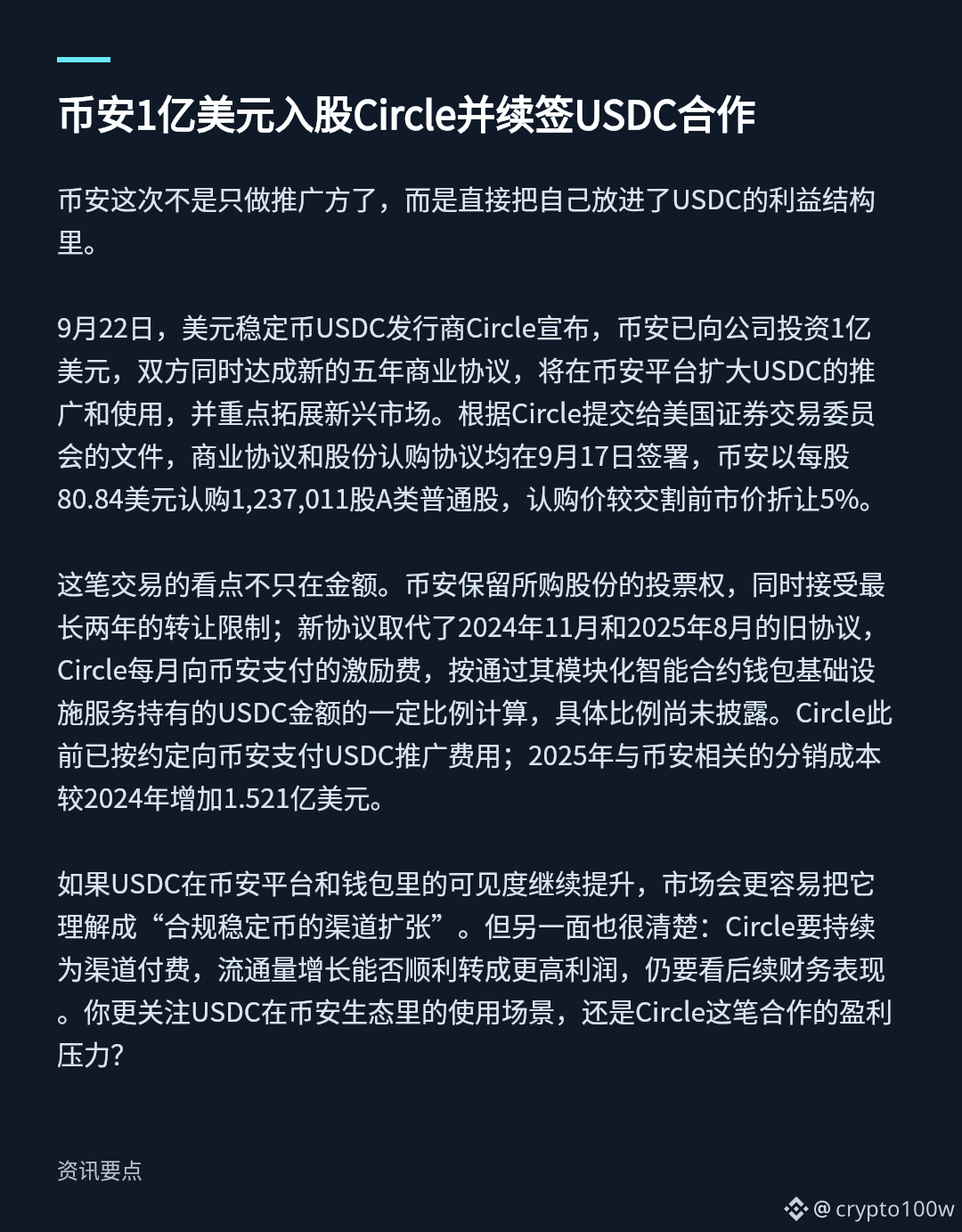
Binance isn’t just acting as a promotional partner this time—it’s effectively placing itself inside USDC’s profit structure.
On September 22, US dollar stablecoin issuer Circle announced that Binance has invested $100 million in the company. At the same time, both sides reached a new five-year commercial agreement under which Binance will expand the promotion and use of USDC on its platform, with a particular focus on developing emerging markets. According to documents filed by Circle with the U.S. Securities and Exchange Commission, both the commercial agreement and the share subscription agreement were signed on September 17. Binance subscribed for 1,237,011 shares of Class A common stock at $80.84 per share. The subscription price represents a 5% discount to the pre-closing market price.
The appeal of this deal isn’t just the amount. Binance retains voting rights for the shares it purchased and also accepts a transfer restriction of up to two years. The new agreement replaces the old deals from November 2024 and August 2025. The incentive fees Circle pays to Binance each month are calculated as a certain percentage of the amount of USDC held through its modular smart contract wallet infrastructure service; the exact percentage has not been disclosed. Previously, Circle had paid Binance USDC promotional fees as agreed. In 2025, distribution-related costs related to Binance increased by $152.1 million compared with 2024.
If USDC’s visibility on Binance’s platform and in its wallets continues to rise, the market may find it easier to understand this as a “compliant stablecoin channel expansion.” But on the other hand, it’s also clear that Circle has to keep paying for the channel. Whether growth in circulating supply can be smoothly converted into higher profits still depends on subsequent financial performance. Are you more focused on USDC’s use cases within the Binance ecosystem, or on the profitability pressure of Circle’s collaboration?
Figure 1: Binance invests $100 million in Circle and renews its USDC cooperation · Key highlights
Image source: https://www.odaily.news/zh-CN/post/5213110
Binance isn’t just acting as a promotional partner this time—it’s effectively placing itself inside USDC’s profit structure.
On September 22, US dollar stablecoin issuer Circle announced that Binance has invested $100 million in the company. At the same time, both sides reached a new five-year commercial agreement under which Binance will expand the promotion and use of USDC on its platform, with a particular focus on developing emerging markets. According to documents filed by Circle with the U.S. Securities and Exchange Commission, both the commercial agreement and the share subscription agreement were signed on September 17. Binance subscribed for 1,237,011 shares of Class A common stock at $80.84 per share. The subscription price represents a 5% discount to the pre-closing market price.
The appeal of this deal isn’t just the amount. Binance retains voting rights for the shares it purchased and also accepts a transfer restriction of up to two years. The new agreement replaces the old deals from November 2024 and August 2025. The incentive fees Circle pays to Binance each month are calculated as a certain percentage of the amount of USDC held through its modular smart contract wallet infrastructure service; the exact percentage has not been disclosed. Previously, Circle had paid Binance USDC promotional fees as agreed. In 2025, distribution-related costs related to Binance increased by $152.1 million compared with 2024.
If USDC’s visibility on Binance’s platform and in its wallets continues to rise, the market may find it easier to understand this as a “compliant stablecoin channel expansion.” But on the other hand, it’s also clear that Circle has to keep paying for the channel. Whether growth in circulating supply can be smoothly converted into higher profits still depends on subsequent financial performance. Are you more focused on USDC’s use cases within the Binance ecosystem, or on the profitability pressure of Circle’s collaboration?
Figure 1: Binance invests $100 million in Circle and renews its USDC cooperation · Key highlights
Image source: https://www.odaily.news/zh-CN/post/5213110
On September 22, US dollar stablecoin issuer Circle announced that Binance has invested $100 million in the company. At the same time, both sides reached a new five-year commercial agreement under which Binance will expand the promotion and use of USDC on its platform, with a particular focus on developing emerging markets. According to documents filed by Circle with the U.S. Securities and Exchange Commission, both the commercial agreement and the share subscription agreement were signed on September 17. Binance subscribed for 1,237,011 shares of Class A common stock at $80.84 per share. The subscription price represents a 5% discount to the pre-closing market price.
The appeal of this deal isn’t just the amount. Binance retains voting rights for the shares it purchased and also accepts a transfer restriction of up to two years. The new agreement replaces the old deals from November 2024 and August 2025. The incentive fees Circle pays to Binance each month are calculated as a certain percentage of the amount of USDC held through its modular smart contract wallet infrastructure service; the exact percentage has not been disclosed. Previously, Circle had paid Binance USDC promotional fees as agreed. In 2025, distribution-related costs related to Binance increased by $152.1 million compared with 2024.
If USDC’s visibility on Binance’s platform and in its wallets continues to rise, the market may find it easier to understand this as a “compliant stablecoin channel expansion.” But on the other hand, it’s also clear that Circle has to keep paying for the channel. Whether growth in circulating supply can be smoothly converted into higher profits still depends on subsequent financial performance. Are you more focused on USDC’s use cases within the Binance ecosystem, or on the profitability pressure of Circle’s collaboration?
Figure 1: Binance invests $100 million in Circle and renews its USDC cooperation · Key highlights
Image source: https://www.odaily.news/zh-CN/post/5213110
90
·
--
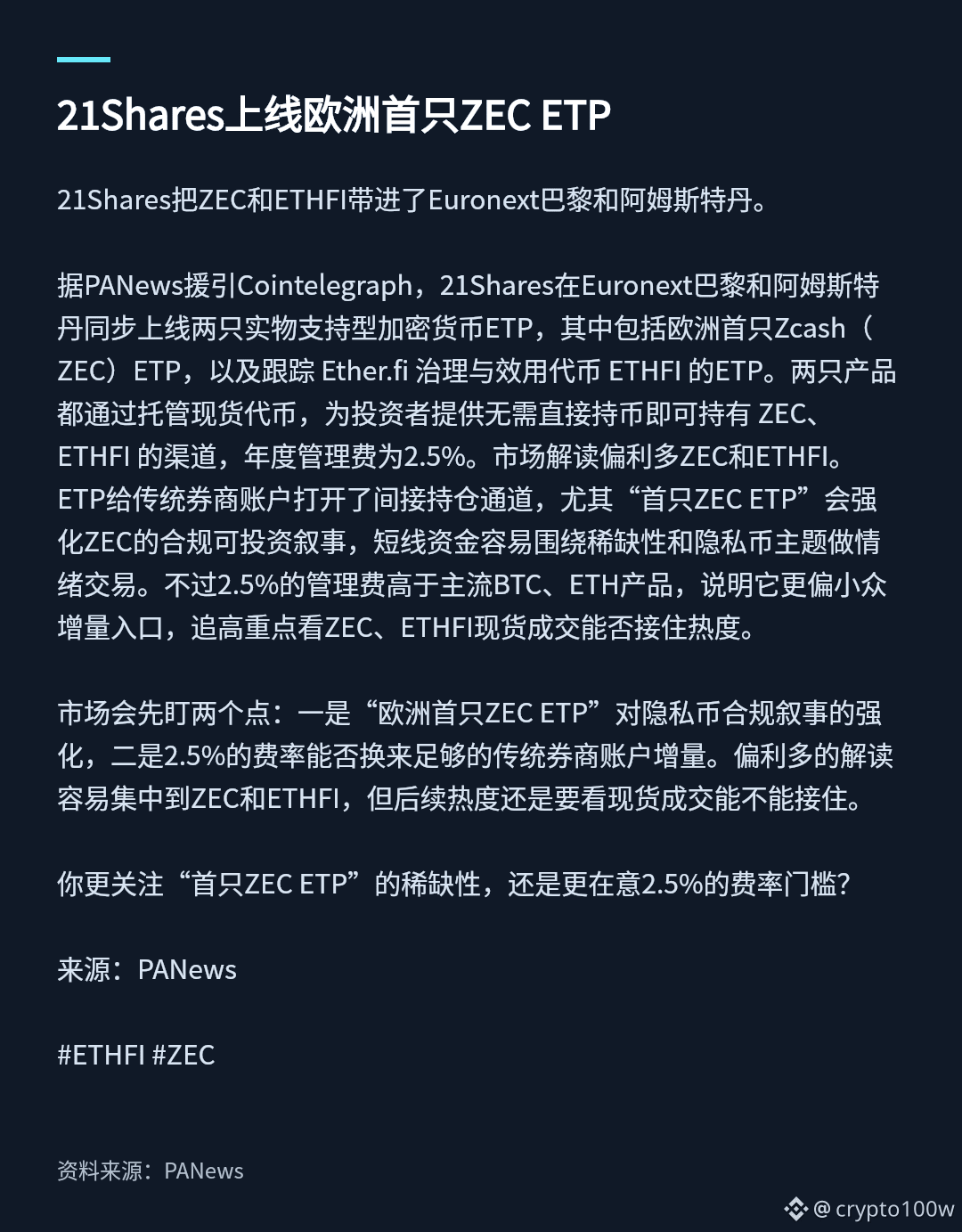
21Shares brought ZEC and ETHFI to Euronext Paris and Amsterdam.
According to PANews, citing Cointelegraph, 21Shares simultaneously listed two physically-backed cryptocurrency ETPs on Euronext Paris and Amsterdam. These include Europe’s first Zcash (ZEC) ETP, as well as an ETP tracking Ether.fi’s governance and utility token, ETHFI. Both products provide investors with a way to hold ZEC and ETHFI without directly holding the underlying tokens, using custodial spot crypto. The annual management fee is 2.5%. Market sentiment is broadly bullish on both ZEC and ETHFI. The ETPs open an indirect holding channel for traditional brokerage accounts. In particular, the “first ZEC ETP” could strengthen ZEC’s compliant and investable narrative, making it easier for short-term capital to drive emotional trading around themes such as scarcity and privacy coins. However, the 2.5% management fee is higher than that of mainstream BTC and ETH products, suggesting it is more of a niche incremental entry point. If investors chase the move, they should focus on whether spot trading volumes for ZEC and ETHFI can sustain the momentum.
The market will initially focus on two points: first, how much the “first ZEC ETP in Europe” strengthens the compliance narrative for privacy coins; second, whether the 2.5% fee rate can generate sufficient incremental demand from traditional brokerage accounts. A bullish interpretation may center on ZEC and ETHFI, but whether the interest can continue will ultimately depend on whether spot trading volumes can absorb and maintain the heat.
Which do you care more about: the scarcity of the “first ZEC ETP,” or the 2.5% fee-rate threshold?
Source: PANews
#ETHFI #ZEC
Figure 1: 21Shares launches Europe’s first ZEC ETP · Key information
Image source: https://www.panewslab.com/zh/articles/01a0cbc9-2ea7-771d-8048-6f4ef931fc52
21Shares brought ZEC and ETHFI to Euronext Paris and Amsterdam.
According to PANews, citing Cointelegraph, 21Shares simultaneously listed two physically-backed cryptocurrency ETPs on Euronext Paris and Amsterdam. These include Europe’s first Zcash (ZEC) ETP, as well as an ETP tracking Ether.fi’s governance and utility token, ETHFI. Both products provide investors with a way to hold ZEC and ETHFI without directly holding the underlying tokens, using custodial spot crypto. The annual management fee is 2.5%. Market sentiment is broadly bullish on both ZEC and ETHFI. The ETPs open an indirect holding channel for traditional brokerage accounts. In particular, the “first ZEC ETP” could strengthen ZEC’s compliant and investable narrative, making it easier for short-term capital to drive emotional trading around themes such as scarcity and privacy coins. However, the 2.5% management fee is higher than that of mainstream BTC and ETH products, suggesting it is more of a niche incremental entry point. If investors chase the move, they should focus on whether spot trading volumes for ZEC and ETHFI can sustain the momentum.
The market will initially focus on two points: first, how much the “first ZEC ETP in Europe” strengthens the compliance narrative for privacy coins; second, whether the 2.5% fee rate can generate sufficient incremental demand from traditional brokerage accounts. A bullish interpretation may center on ZEC and ETHFI, but whether the interest can continue will ultimately depend on whether spot trading volumes can absorb and maintain the heat.
Which do you care more about: the scarcity of the “first ZEC ETP,” or the 2.5% fee-rate threshold?
Source: PANews
#ETHFI #ZEC
Figure 1: 21Shares launches Europe’s first ZEC ETP · Key information
Image source: https://www.panewslab.com/zh/articles/01a0cbc9-2ea7-771d-8048-6f4ef931fc52
According to PANews, citing Cointelegraph, 21Shares simultaneously listed two physically-backed cryptocurrency ETPs on Euronext Paris and Amsterdam. These include Europe’s first Zcash (ZEC) ETP, as well as an ETP tracking Ether.fi’s governance and utility token, ETHFI. Both products provide investors with a way to hold ZEC and ETHFI without directly holding the underlying tokens, using custodial spot crypto. The annual management fee is 2.5%. Market sentiment is broadly bullish on both ZEC and ETHFI. The ETPs open an indirect holding channel for traditional brokerage accounts. In particular, the “first ZEC ETP” could strengthen ZEC’s compliant and investable narrative, making it easier for short-term capital to drive emotional trading around themes such as scarcity and privacy coins. However, the 2.5% management fee is higher than that of mainstream BTC and ETH products, suggesting it is more of a niche incremental entry point. If investors chase the move, they should focus on whether spot trading volumes for ZEC and ETHFI can sustain the momentum.
The market will initially focus on two points: first, how much the “first ZEC ETP in Europe” strengthens the compliance narrative for privacy coins; second, whether the 2.5% fee rate can generate sufficient incremental demand from traditional brokerage accounts. A bullish interpretation may center on ZEC and ETHFI, but whether the interest can continue will ultimately depend on whether spot trading volumes can absorb and maintain the heat.
Which do you care more about: the scarcity of the “first ZEC ETP,” or the 2.5% fee-rate threshold?
Source: PANews
#ETHFI #ZEC
Figure 1: 21Shares launches Europe’s first ZEC ETP · Key information
Image source: https://www.panewslab.com/zh/articles/01a0cbc9-2ea7-771d-8048-6f4ef931fc52
6
·
--
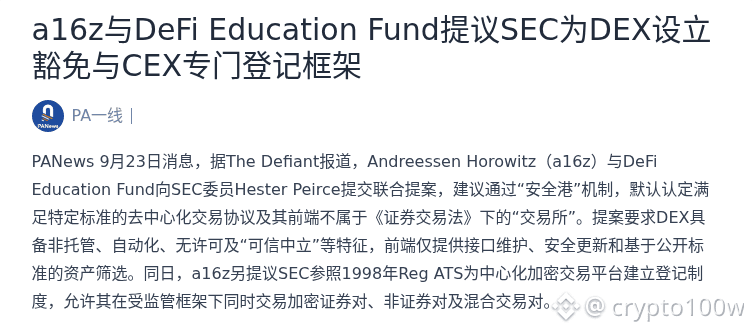
What a16z is focusing on this time isn’t a certain token price, but how a DEX can be “seen” by the SEC.
PANews, citing The Defiant, reports that Andreessen Horowitz (a16z) and the DeFi Education Fund have jointly submitted a proposal to SEC Commissioner Hester Peirce. The proposal suggests using a “safe harbor” mechanism to presumptively treat decentralized exchange protocols and their front ends—which meet conditions such as non-custodial, automated, permissionless, and “trusted neutrality”—as not being “exchanges” under the Securities Exchange Act. On the same day, a16z also proposed that the SEC establish a registration regime for centralized crypto trading platforms by referring to the 1998 Reg ATS.
If the SEC adopts the proposal, DEX software, front ends, and intermediary-style trading platforms would be regulated more clearly as separate categories, and compliance uncertainty may decrease. If it doesn’t, controversy will likely continue over the question of where the boundary is drawn. Are you more concerned about a DEX safe harbor, or about a dedicated registration framework for CEXs?
Image 1: a16z proposes a safe harbor for DEXs · Source page partial screenshot
Image source: https://www.panewslab.com/zh/articles/01a0cbcf-cc9d-7726-96cd-c111dfb576d3
What a16z is focusing on this time isn’t a certain token price, but how a DEX can be “seen” by the SEC.
PANews, citing The Defiant, reports that Andreessen Horowitz (a16z) and the DeFi Education Fund have jointly submitted a proposal to SEC Commissioner Hester Peirce. The proposal suggests using a “safe harbor” mechanism to presumptively treat decentralized exchange protocols and their front ends—which meet conditions such as non-custodial, automated, permissionless, and “trusted neutrality”—as not being “exchanges” under the Securities Exchange Act. On the same day, a16z also proposed that the SEC establish a registration regime for centralized crypto trading platforms by referring to the 1998 Reg ATS.
If the SEC adopts the proposal, DEX software, front ends, and intermediary-style trading platforms would be regulated more clearly as separate categories, and compliance uncertainty may decrease. If it doesn’t, controversy will likely continue over the question of where the boundary is drawn. Are you more concerned about a DEX safe harbor, or about a dedicated registration framework for CEXs?
Image 1: a16z proposes a safe harbor for DEXs · Source page partial screenshot
Image source: https://www.panewslab.com/zh/articles/01a0cbcf-cc9d-7726-96cd-c111dfb576d3
PANews, citing The Defiant, reports that Andreessen Horowitz (a16z) and the DeFi Education Fund have jointly submitted a proposal to SEC Commissioner Hester Peirce. The proposal suggests using a “safe harbor” mechanism to presumptively treat decentralized exchange protocols and their front ends—which meet conditions such as non-custodial, automated, permissionless, and “trusted neutrality”—as not being “exchanges” under the Securities Exchange Act. On the same day, a16z also proposed that the SEC establish a registration regime for centralized crypto trading platforms by referring to the 1998 Reg ATS.
If the SEC adopts the proposal, DEX software, front ends, and intermediary-style trading platforms would be regulated more clearly as separate categories, and compliance uncertainty may decrease. If it doesn’t, controversy will likely continue over the question of where the boundary is drawn. Are you more concerned about a DEX safe harbor, or about a dedicated registration framework for CEXs?
Image 1: a16z proposes a safe harbor for DEXs · Source page partial screenshot
Image source: https://www.panewslab.com/zh/articles/01a0cbcf-cc9d-7726-96cd-c111dfb576d3
·
--
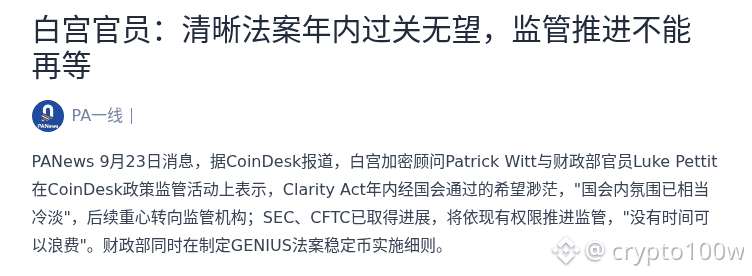
The expectation that the Clarity Act will pass within the year is clearly cooling off.
Citing a CoinDesk report, PANews says that at a CoinDesk policy and regulatory event, White House crypto adviser Patrick Witt and Treasury Department official Luke Pettit stated that the hope of getting this bill passed through Congress this year is “slim to none,” and that the atmosphere inside Congress is already quite frosty. The focus will shift next to regulatory agencies such as the SEC and the CFTC, while the Treasury Department is also drafting stablecoin implementation details for the GENIUS Act.
The direct impact of this news on the market is not just a matter of one token going up or down; rather, policy expectations continue to be weighed down. Scenario 1 to watch: in terms of the compliance boundaries for exchanges, token issuers, and DeFi, the picture will still rely more heavily on enforcement actions and agency rules to piece things together. Scenario 2 to watch: only if the SEC and CFTC can provide more actionable rules may the market’s risk appetite for BTC, ETH, and U.S.-compliant platforms begin to recover.
What matters more to you: regulatory agencies issuing detailed rules first, or Congress advancing further legislation afterward?
Figure 1: Hopes for the Clarity Act to pass within the year weaken · Source page partial screenshot
Image source: https://www.panewslab.com/zh/articles/01a0cbd7-8abf-72aa-9f7a-db853ff99ae6
The expectation that the Clarity Act will pass within the year is clearly cooling off.
Citing a CoinDesk report, PANews says that at a CoinDesk policy and regulatory event, White House crypto adviser Patrick Witt and Treasury Department official Luke Pettit stated that the hope of getting this bill passed through Congress this year is “slim to none,” and that the atmosphere inside Congress is already quite frosty. The focus will shift next to regulatory agencies such as the SEC and the CFTC, while the Treasury Department is also drafting stablecoin implementation details for the GENIUS Act.
The direct impact of this news on the market is not just a matter of one token going up or down; rather, policy expectations continue to be weighed down. Scenario 1 to watch: in terms of the compliance boundaries for exchanges, token issuers, and DeFi, the picture will still rely more heavily on enforcement actions and agency rules to piece things together. Scenario 2 to watch: only if the SEC and CFTC can provide more actionable rules may the market’s risk appetite for BTC, ETH, and U.S.-compliant platforms begin to recover.
What matters more to you: regulatory agencies issuing detailed rules first, or Congress advancing further legislation afterward?
Figure 1: Hopes for the Clarity Act to pass within the year weaken · Source page partial screenshot
Image source: https://www.panewslab.com/zh/articles/01a0cbd7-8abf-72aa-9f7a-db853ff99ae6
Citing a CoinDesk report, PANews says that at a CoinDesk policy and regulatory event, White House crypto adviser Patrick Witt and Treasury Department official Luke Pettit stated that the hope of getting this bill passed through Congress this year is “slim to none,” and that the atmosphere inside Congress is already quite frosty. The focus will shift next to regulatory agencies such as the SEC and the CFTC, while the Treasury Department is also drafting stablecoin implementation details for the GENIUS Act.
The direct impact of this news on the market is not just a matter of one token going up or down; rather, policy expectations continue to be weighed down. Scenario 1 to watch: in terms of the compliance boundaries for exchanges, token issuers, and DeFi, the picture will still rely more heavily on enforcement actions and agency rules to piece things together. Scenario 2 to watch: only if the SEC and CFTC can provide more actionable rules may the market’s risk appetite for BTC, ETH, and U.S.-compliant platforms begin to recover.
What matters more to you: regulatory agencies issuing detailed rules first, or Congress advancing further legislation afterward?
Figure 1: Hopes for the Clarity Act to pass within the year weaken · Source page partial screenshot
Image source: https://www.panewslab.com/zh/articles/01a0cbd7-8abf-72aa-9f7a-db853ff99ae6
272
Log in to explore more content
Join global crypto users on Binance Square
⚡️ Get latest and useful information about crypto.
💬 Trusted by the world’s largest crypto exchange.
👍 Discover real insights from verified creators.
Email / Phone number
Trending Topics
AIStocksWhatNext
569,913 views
4,259 Discussing
Share & Win Traffic Reward in our Trending Hashtag Campaign
✨Topic: What Other Investment Opportunities Remain as AI Stocks Keep Rising?
👉How to Join:
Publish a short post or article with hashtag #AIStocksWhatNext
Share whether you’re bullish or bearish, and post your AI stock holdings or trade — using the trade widget may improve your eligibility.
You can also strengthen your post by sharing data or charts, and avoiding AI-generated images.
✍️Create content based on the below angles:
- Nvidia says chip sales will double next year, and top AI companies keep hitting record revenue, the compute spend behind it is just as staggering. Is AI demand really taking off? And how long can it last? AI stocks are up across the board. Is this a real breakout, or just a short-term bounce?
- Industry leaders are calling to slow down AI development, while Trump plans to build an “AI Force”, claiming AI could account for 25% of U.S. GDP in the future. Whose side are you on? Will state-level backing be a long-term win for AI stocks?
- Are you buying AI stocks? Share your AI-related trade/holdings with our trade sharing widget.
⏰Campaign Period:
- 2026-09-22 7:00 - 2026-09-24 4:00 UTC
🎁Reward:
- Qualified posts that comply with the above guidelines and contain more than 100 words will be reviewed and may receive a random traffic boost of 500 to 3,000 views. You will receive a notification from your feed secretary if your post is selected.
- Get a chance to have your article featured on Binance Square Official
Need ideas for your post? Visit the topic page #AIStocksWhatNext or the Square Guide on How to Post for Better Reach.
Binance Square Official
·452 Likes
·1.2M views
21SharesLaunchesEuropesFirstZcashETP
1,573 views
99 Discussing
CardanoJoinsX402PaymentStandard
1,393 views
96 Discussing