
#aistockswhatnext
aistockswhatnext
Hot
Latest


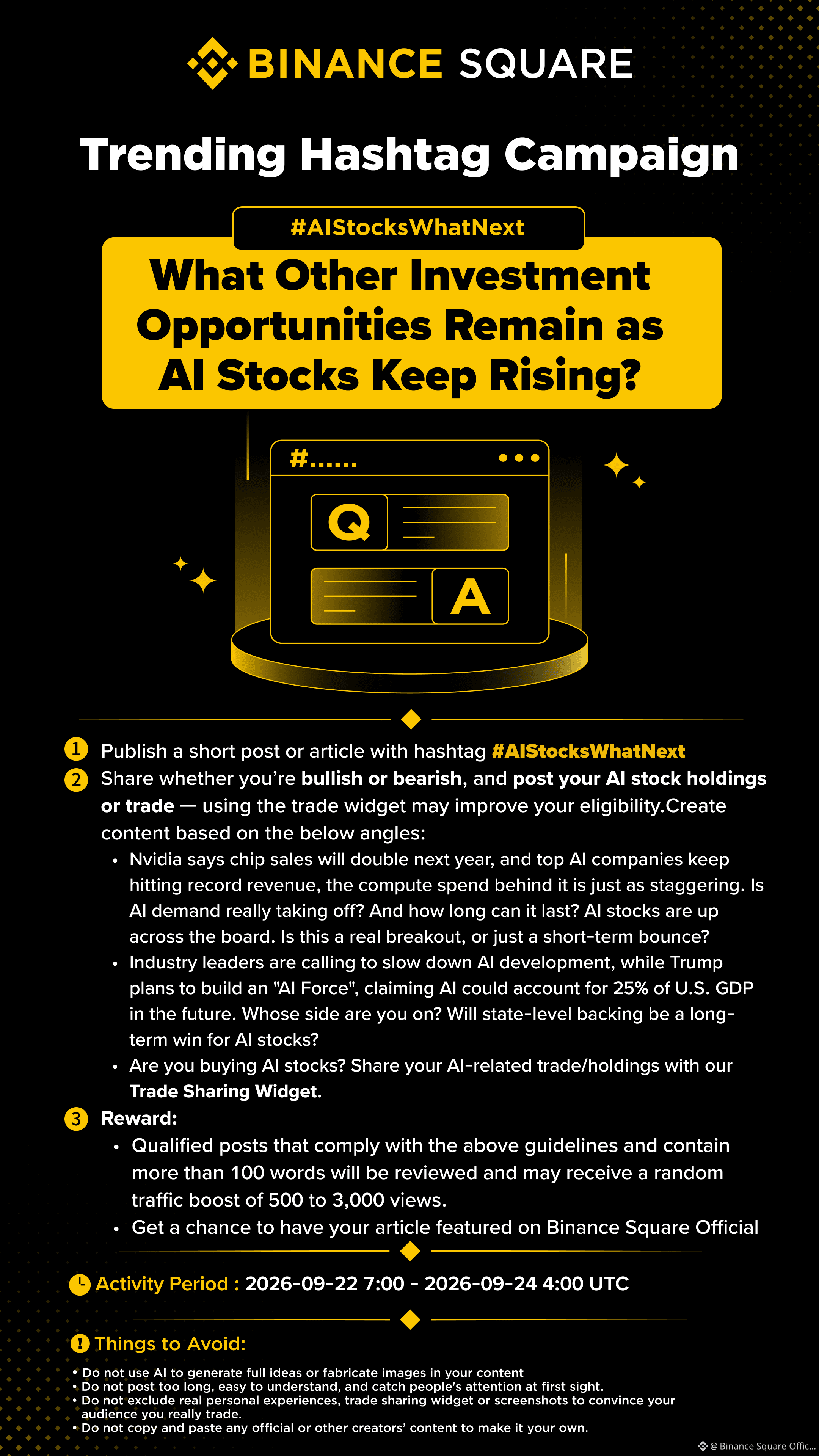
Share & Win Traffic Reward in our Trending Hashtag Campaign
✨Topic: What Other Investment Opportunities Remain as AI Stocks Keep Rising?
👉How to Join:
Publish a short post or article with hashtag #AIStocksWhatNext
Share whether you’re bullish or bearish, and post your AI stock holdings or trade — using the trade widget may improve your eligibility.
You can also strengthen your post by sharing data or charts, and avoiding AI-generated images.
✍️Create content based on the below angles:
- Nvidia says chip sales will double next year, and top AI companies keep hitting record revenue, the compute spend behind it is just as staggering. Is AI demand really taking off? And how long can it last? AI stocks are up across the board. Is this a real breakout, or just a short-term bounce?
- Industry leaders are calling to slow down AI development, while Trump plans to build an “AI Force”, claiming AI could account for 25% of U.S. GDP in the future. Whose side are you on? Will state-level backing be a long-term win for AI stocks?
- Are you buying AI stocks? Share your AI-related trade/holdings with our trade sharing widget.
⏰Campaign Period:
- 2026-09-22 7:00 - 2026-09-24 4:00 UTC
🎁Reward:
- Qualified posts that comply with the above guidelines and contain more than 100 words will be reviewed and may receive a random traffic boost of 500 to 3,000 views. You will receive a notification from your feed secretary if your post is selected.
- Get a chance to have your article featured on Binance Square Official
Need ideas for your post? Visit the topic page #AIStocksWhatNext or the [Square Guide on How to Post for Better Reach](https://www.binance.com/en/square/post/364505922663952).
Share & Win Traffic Reward in our Trending Hashtag Campaign
✨Topic: What Other Investment Opportunities Remain as AI Stocks Keep Rising?
👉How to Join:
Publish a short post or article with hashtag #AIStocksWhatNext
Share whether you’re bullish or bearish, and post your AI stock holdings or trade — using the trade widget may improve your eligibility.
You can also strengthen your post by sharing data or charts, and avoiding AI-generated images.
✍️Create content based on the below angles:
- Nvidia says chip sales will double next year, and top AI companies keep hitting record revenue, the compute spend behind it is just as staggering. Is AI demand really taking off? And how long can it last? AI stocks are up across the board. Is this a real breakout, or just a short-term bounce?
- Industry leaders are calling to slow down AI development, while Trump plans to build an “AI Force”, claiming AI could account for 25% of U.S. GDP in the future. Whose side are you on? Will state-level backing be a long-term win for AI stocks?
- Are you buying AI stocks? Share your AI-related trade/holdings with our trade sharing widget.
⏰Campaign Period:
- 2026-09-22 7:00 - 2026-09-24 4:00 UTC
🎁Reward:
- Qualified posts that comply with the above guidelines and contain more than 100 words will be reviewed and may receive a random traffic boost of 500 to 3,000 views. You will receive a notification from your feed secretary if your post is selected.
- Get a chance to have your article featured on Binance Square Official
Need ideas for your post? Visit the topic page #AIStocksWhatNext or the Square Guide on How to Post for Better Reach.
✨Topic: What Other Investment Opportunities Remain as AI Stocks Keep Rising?
👉How to Join:
Publish a short post or article with hashtag #AIStocksWhatNext
Share whether you’re bullish or bearish, and post your AI stock holdings or trade — using the trade widget may improve your eligibility.
You can also strengthen your post by sharing data or charts, and avoiding AI-generated images.
✍️Create content based on the below angles:
- Nvidia says chip sales will double next year, and top AI companies keep hitting record revenue, the compute spend behind it is just as staggering. Is AI demand really taking off? And how long can it last? AI stocks are up across the board. Is this a real breakout, or just a short-term bounce?
- Industry leaders are calling to slow down AI development, while Trump plans to build an “AI Force”, claiming AI could account for 25% of U.S. GDP in the future. Whose side are you on? Will state-level backing be a long-term win for AI stocks?
- Are you buying AI stocks? Share your AI-related trade/holdings with our trade sharing widget.
⏰Campaign Period:
- 2026-09-22 7:00 - 2026-09-24 4:00 UTC
🎁Reward:
- Qualified posts that comply with the above guidelines and contain more than 100 words will be reviewed and may receive a random traffic boost of 500 to 3,000 views. You will receive a notification from your feed secretary if your post is selected.
- Get a chance to have your article featured on Binance Square Official
Need ideas for your post? Visit the topic page #AIStocksWhatNext or the Square Guide on How to Post for Better Reach.
Aiman Malikk:
interesting
10
8
55
57.9k


·
--
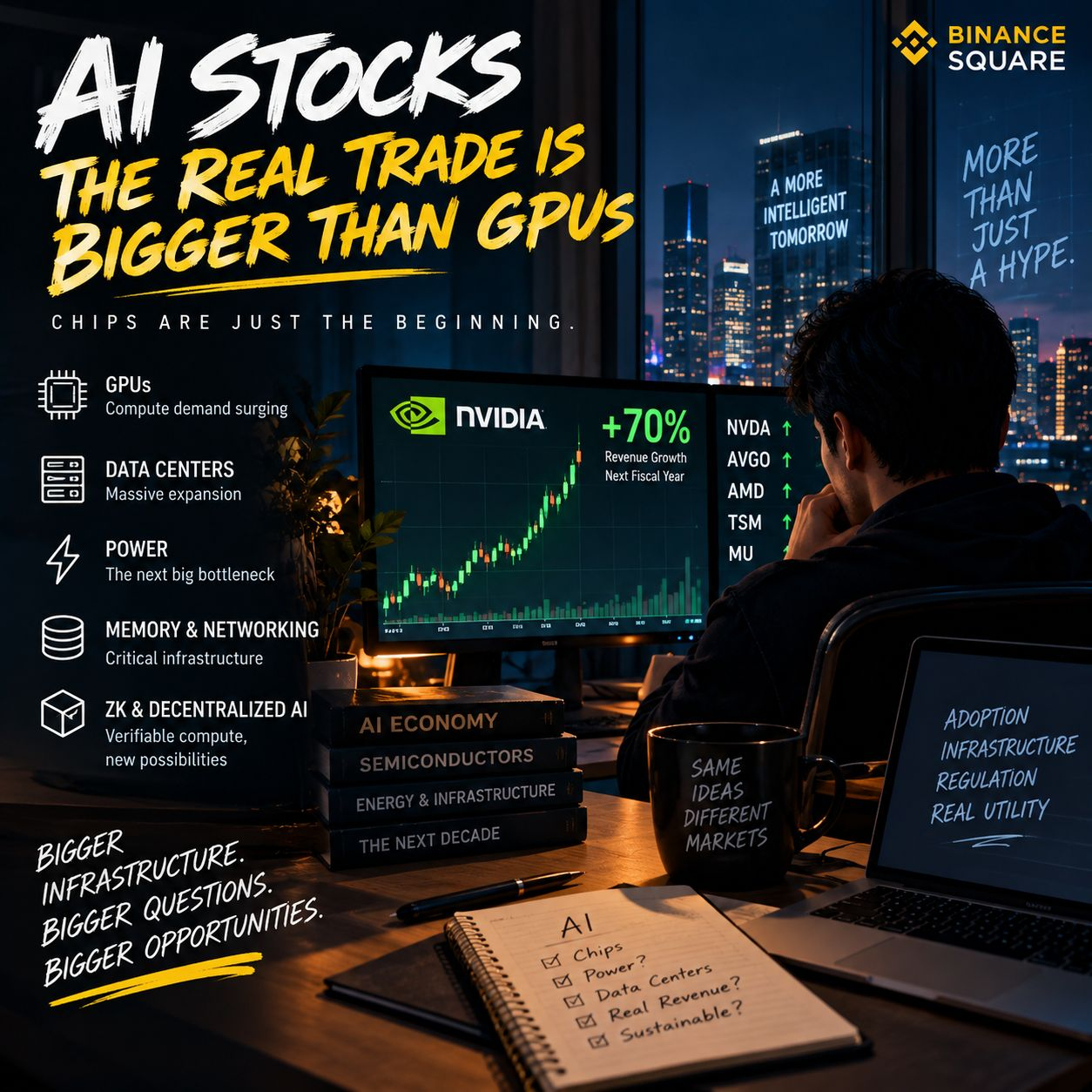
last night i was staring at AI stocks after a long day, and one thought kept bothering me — everyone keeps talking about GPUs, but almost nobody talks about what happens when the power runs out.
That’s the trade.
Nvidia's numbers are huge. Broadcom is seeing massive AI-chip demand too. Data centers are expanding fast. But the real bottleneck is getting uglier electricity, cooling, networking, HBM, grid capacity, construction.
AI demand looks real. No doubt.
But price isn't demand.
A stock can keep ripping while expectations get stretched. Then one slowdown in revenue growth, utilization, or free cash flow can change the whole setup.
tbh, i'm more interested in the infrastructure underneath AI than the hype around individual names.
And here's where crypto gets interesting.
ZK can prove that a computation followed predefined rules without exposing private inputs. smart contracts can enforce access, settlement and verification rules.
But they can't prove that an AI workload is actually valuable.
That's the catch.
AI adoption can keep growing while AI valuations still fall. Both can happen.
So i'm watching revenue, compute utilization, power availability and cash flow—not just charts.
#AIStocksWhatNext
last night i was staring at AI stocks after a long day, and one thought kept bothering me — everyone keeps talking about GPUs, but almost nobody talks about what happens when the power runs out.
That’s the trade.
Nvidia's numbers are huge. Broadcom is seeing massive AI-chip demand too. Data centers are expanding fast. But the real bottleneck is getting uglier electricity, cooling, networking, HBM, grid capacity, construction.
AI demand looks real. No doubt.
But price isn't demand.
A stock can keep ripping while expectations get stretched. Then one slowdown in revenue growth, utilization, or free cash flow can change the whole setup.
tbh, i'm more interested in the infrastructure underneath AI than the hype around individual names.
And here's where crypto gets interesting.
ZK can prove that a computation followed predefined rules without exposing private inputs. smart contracts can enforce access, settlement and verification rules.
But they can't prove that an AI workload is actually valuable.
That's the catch.
AI adoption can keep growing while AI valuations still fall. Both can happen.
So i'm watching revenue, compute utilization, power availability and cash flow—not just charts.
#AIStocksWhatNext
That’s the trade.
Nvidia's numbers are huge. Broadcom is seeing massive AI-chip demand too. Data centers are expanding fast. But the real bottleneck is getting uglier electricity, cooling, networking, HBM, grid capacity, construction.
AI demand looks real. No doubt.
But price isn't demand.
A stock can keep ripping while expectations get stretched. Then one slowdown in revenue growth, utilization, or free cash flow can change the whole setup.
tbh, i'm more interested in the infrastructure underneath AI than the hype around individual names.
And here's where crypto gets interesting.
ZK can prove that a computation followed predefined rules without exposing private inputs. smart contracts can enforce access, settlement and verification rules.
But they can't prove that an AI workload is actually valuable.
That's the catch.
AI adoption can keep growing while AI valuations still fall. Both can happen.
So i'm watching revenue, compute utilization, power availability and cash flow—not just charts.
#AIStocksWhatNext
1
104

Verified
Article
AI Stocks Are Rising Again: Is AI Demand Still Strong Enough to Justify the Spending?The AI trade is showing renewed strength, but I think the more important question is no longer simply whether AI demand exists.
The question is how long the extraordinary spending behind AI infrastructure can continue and whether the revenue generated from that spending can keep pace.
NVIDIA's latest results provide strong evidence that demand remains substantial. For its fiscal Q2 2027, NVIDIA reported $46.7 billion in Data Center revenue, up 8% sequentially and 70% year over year, while total revenue reached $96.2 billion, up 106% year over year. NVIDIA also guided for approximately $108 billion in Q3 revenue.
But there is an important distinction behind the “doubling” narrative.
On NVIDIA's earnings call, CFO Colette Kress discussed customers' forecasts and said their expected growth implies NVIDIA's growth could roughly double next year. That is not the same as NVIDIA saying chip sales themselves will double.
The spending required to support this growth is enormous. NVIDIA says frontier AI companies have exceptionally strong demand for training and inference compute, while their ability to expand is increasingly constrained by access to compute and infrastructure.
That creates both an opportunity and a risk for AI investors.
On one side, real revenue is being generated from AI infrastructure. On the other, the industry is committing huge amounts of capital before we know exactly how durable the eventual returns will be.
Reuters recently reported that major technology companies are increasingly using debt and equity financing to fund AI infrastructure, highlighting how capital-intensive the current expansion has become.
And the market itself is showing how quickly sentiment can change. On September 21, AMD crossed the $1 trillion market-capitalization mark for the first time, while the Nasdaq reached a record close as AI-related stocks rallied.
So I'm not looking at this as simply “AI stocks are going up, therefore buy.”
I'm watching whether the underlying numbers continue to justify the investment.
My view
I'm cautiously bullish on the AI industry, but selective on individual stocks.
The evidence for strong AI-compute demand is real. NVIDIA's revenue growth and Data Center performance demonstrate that.
But the sustainability question is still open.
If AI companies continue converting massive infrastructure spending into recurring revenue and productivity gains, the investment cycle could remain powerful.
If spending grows much faster than monetization, valuations and expectations could become a bigger risk.
For me, the next phase of the AI trade is about earnings, cash flow, compute demand and actual AI monetization not just headlines.
What is your view?
🟢 Bullish — AI demand still has room to grow
🔴 Bearish — expectations are getting ahead of fundamentals
⚖️ My view bullish on AI adoption, selective on AI stocks
If you're sharing an actual position, use the trade-sharing widget with your real entry and risk levels. $NVDAB
#AIStocksWhatNext
{spot}(NVDABUSDT)
AI Stocks Are Rising Again: Is AI Demand Still Strong Enough to Justify the Spending?
The AI trade is showing renewed strength, but I think the more important question is no longer simply whether AI demand exists.
The question is how long the extraordinary spending behind AI infrastructure can continue and whether the revenue generated from that spending can keep pace.
NVIDIA's latest results provide strong evidence that demand remains substantial. For its fiscal Q2 2027, NVIDIA reported $46.7 billion in Data Center revenue, up 8% sequentially and 70% year over year, while total revenue reached $96.2 billion, up 106% year over year. NVIDIA also guided for approximately $108 billion in Q3 revenue.
But there is an important distinction behind the “doubling” narrative.
On NVIDIA's earnings call, CFO Colette Kress discussed customers' forecasts and said their expected growth implies NVIDIA's growth could roughly double next year. That is not the same as NVIDIA saying chip sales themselves will double.
The spending required to support this growth is enormous. NVIDIA says frontier AI companies have exceptionally strong demand for training and inference compute, while their ability to expand is increasingly constrained by access to compute and infrastructure.
That creates both an opportunity and a risk for AI investors.
On one side, real revenue is being generated from AI infrastructure. On the other, the industry is committing huge amounts of capital before we know exactly how durable the eventual returns will be.
Reuters recently reported that major technology companies are increasingly using debt and equity financing to fund AI infrastructure, highlighting how capital-intensive the current expansion has become.
And the market itself is showing how quickly sentiment can change. On September 21, AMD crossed the $1 trillion market-capitalization mark for the first time, while the Nasdaq reached a record close as AI-related stocks rallied.
So I'm not looking at this as simply “AI stocks are going up, therefore buy.”
I'm watching whether the underlying numbers continue to justify the investment.
My view
I'm cautiously bullish on the AI industry, but selective on individual stocks.
The evidence for strong AI-compute demand is real. NVIDIA's revenue growth and Data Center performance demonstrate that.
But the sustainability question is still open.
If AI companies continue converting massive infrastructure spending into recurring revenue and productivity gains, the investment cycle could remain powerful.
If spending grows much faster than monetization, valuations and expectations could become a bigger risk.
For me, the next phase of the AI trade is about earnings, cash flow, compute demand and actual AI monetization not just headlines.
What is your view?
🟢 Bullish — AI demand still has room to grow
🔴 Bearish — expectations are getting ahead of fundamentals
⚖️ My view bullish on AI adoption, selective on AI stocks
If you're sharing an actual position, use the trade-sharing widget with your real entry and risk levels. $NVDAB
#AIStocksWhatNext
The question is how long the extraordinary spending behind AI infrastructure can continue and whether the revenue generated from that spending can keep pace.
NVIDIA's latest results provide strong evidence that demand remains substantial. For its fiscal Q2 2027, NVIDIA reported $46.7 billion in Data Center revenue, up 8% sequentially and 70% year over year, while total revenue reached $96.2 billion, up 106% year over year. NVIDIA also guided for approximately $108 billion in Q3 revenue.
But there is an important distinction behind the “doubling” narrative.
On NVIDIA's earnings call, CFO Colette Kress discussed customers' forecasts and said their expected growth implies NVIDIA's growth could roughly double next year. That is not the same as NVIDIA saying chip sales themselves will double.
The spending required to support this growth is enormous. NVIDIA says frontier AI companies have exceptionally strong demand for training and inference compute, while their ability to expand is increasingly constrained by access to compute and infrastructure.
That creates both an opportunity and a risk for AI investors.
On one side, real revenue is being generated from AI infrastructure. On the other, the industry is committing huge amounts of capital before we know exactly how durable the eventual returns will be.
Reuters recently reported that major technology companies are increasingly using debt and equity financing to fund AI infrastructure, highlighting how capital-intensive the current expansion has become.
And the market itself is showing how quickly sentiment can change. On September 21, AMD crossed the $1 trillion market-capitalization mark for the first time, while the Nasdaq reached a record close as AI-related stocks rallied.
So I'm not looking at this as simply “AI stocks are going up, therefore buy.”
I'm watching whether the underlying numbers continue to justify the investment.
My view
I'm cautiously bullish on the AI industry, but selective on individual stocks.
The evidence for strong AI-compute demand is real. NVIDIA's revenue growth and Data Center performance demonstrate that.
But the sustainability question is still open.
If AI companies continue converting massive infrastructure spending into recurring revenue and productivity gains, the investment cycle could remain powerful.
If spending grows much faster than monetization, valuations and expectations could become a bigger risk.
For me, the next phase of the AI trade is about earnings, cash flow, compute demand and actual AI monetization not just headlines.
What is your view?
🟢 Bullish — AI demand still has room to grow
🔴 Bearish — expectations are getting ahead of fundamentals
⚖️ My view bullish on AI adoption, selective on AI stocks
If you're sharing an actual position, use the trade-sharing widget with your real entry and risk levels. $NVDAB
#AIStocksWhatNext
1
105

·
--
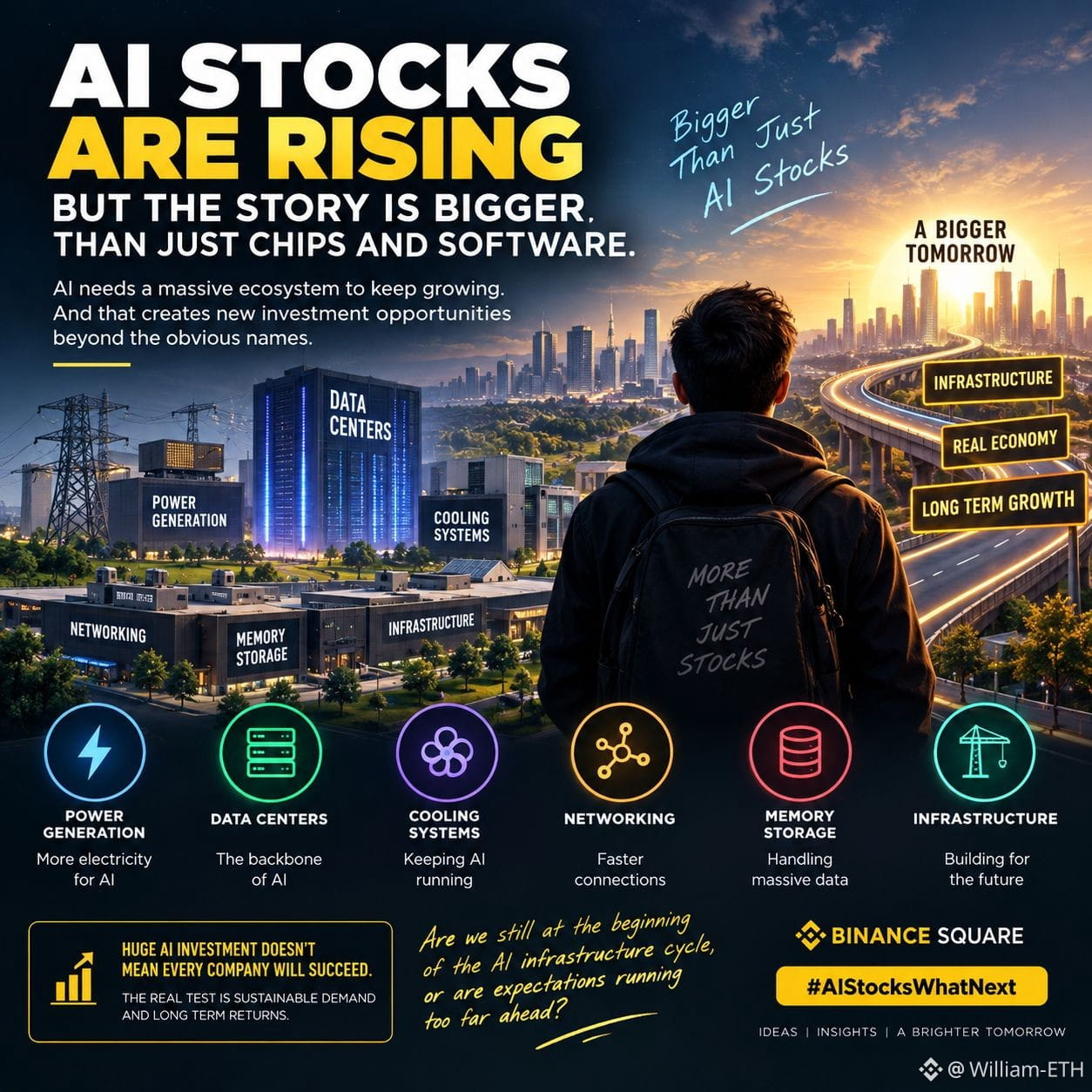
I’ve been thinking about what could come next as AI stocks keep climbing.
It feels like the opportunity is getting bigger than just chips and software. AI needs massive data centers, electricity, cooling, networking, memory and stronger infrastructure to keep everything running.
That part of the story is easy to overlook.
I’m watching the companies that support this AI expansion rather than only focusing on the names everyone already talks about.
But I also think it’s important to stay realistic. Huge AI spending doesn’t mean every related company will succeed. The real test will be whether this spending creates sustainable demand and long term returns.
For me, the interesting question is simple:
Are we still at the beginning of the AI infrastructure cycle, or are expectations already running too far ahead?
That’s the part I’ll be watching closely.
#AIStocksWhatNext
I’ve been thinking about what could come next as AI stocks keep climbing.
It feels like the opportunity is getting bigger than just chips and software. AI needs massive data centers, electricity, cooling, networking, memory and stronger infrastructure to keep everything running.
That part of the story is easy to overlook.
I’m watching the companies that support this AI expansion rather than only focusing on the names everyone already talks about.
But I also think it’s important to stay realistic. Huge AI spending doesn’t mean every related company will succeed. The real test will be whether this spending creates sustainable demand and long term returns.
For me, the interesting question is simple:
Are we still at the beginning of the AI infrastructure cycle, or are expectations already running too far ahead?
That’s the part I’ll be watching closely.
#AIStocksWhatNext
It feels like the opportunity is getting bigger than just chips and software. AI needs massive data centers, electricity, cooling, networking, memory and stronger infrastructure to keep everything running.
That part of the story is easy to overlook.
I’m watching the companies that support this AI expansion rather than only focusing on the names everyone already talks about.
But I also think it’s important to stay realistic. Huge AI spending doesn’t mean every related company will succeed. The real test will be whether this spending creates sustainable demand and long term returns.
For me, the interesting question is simple:
Are we still at the beginning of the AI infrastructure cycle, or are expectations already running too far ahead?
That’s the part I’ll be watching closely.
#AIStocksWhatNext
2
4
215

·
--
Bullish
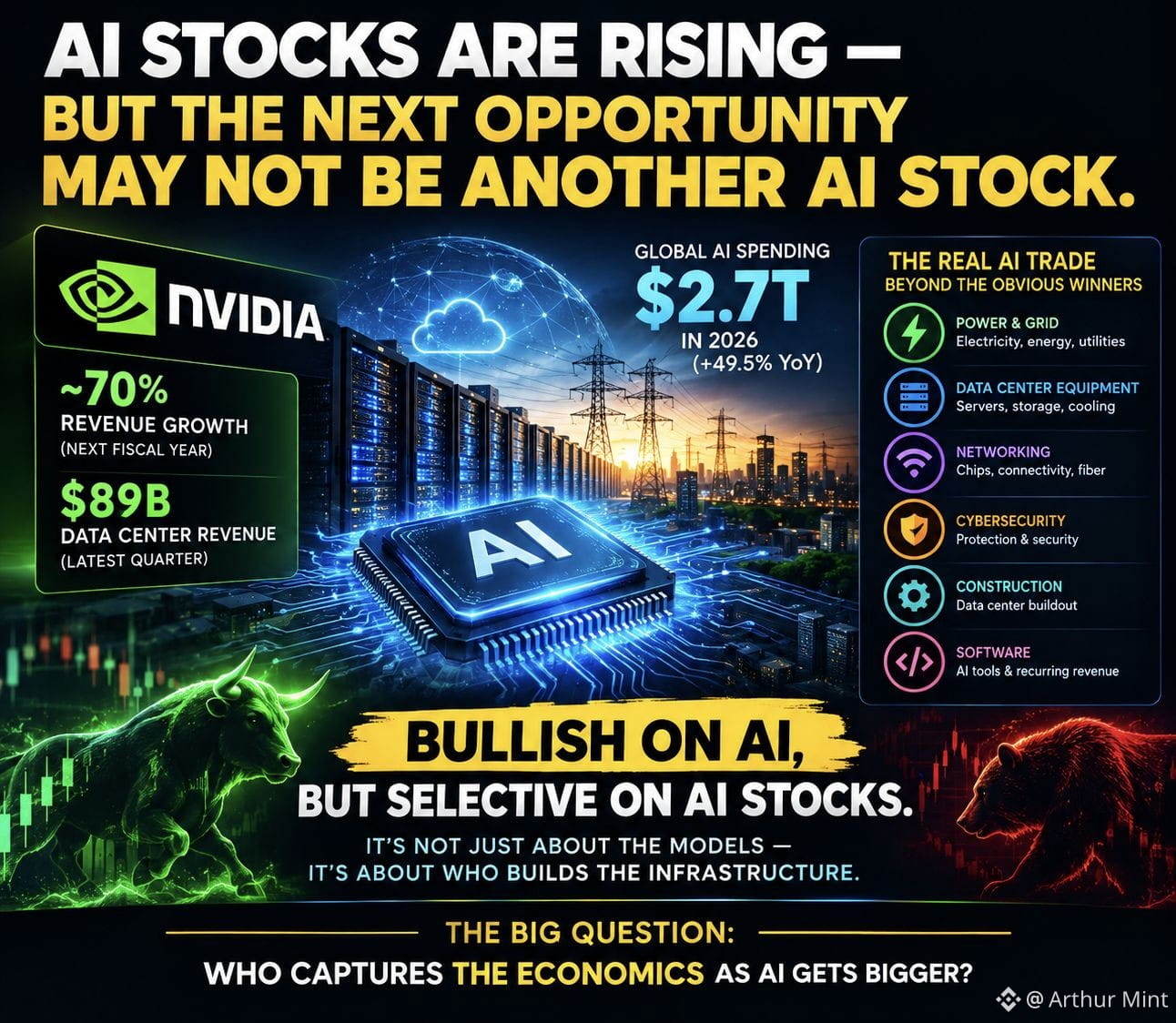
AI STOCKS ARE RISING — BUT THE NEXT OPPORTUNITY MAY NOT BE ANOTHER AI STOCK.
The AI rally is no longer just a semiconductor story.
Nvidia’s latest outlook points to another major leg of AI infrastructure demand. The company expects roughly 70% revenue growth for its next fiscal year, while its data-center business generated $89B in the latest quarter. Gartner estimates global AI spending could reach $2.7T in 2026, up 49.5% YoY.
So the bigger question is:
Where does the money go after the obvious AI winners?
Every AI data center needs much more than GPUs. It needs electricity, networking, servers, storage, cooling, construction and cybersecurity.
That means the next phase of the AI trade could spread into the companies building the infrastructure underneath the models.
Power is already becoming a key pressure point. Data-center expansion is forcing markets to focus on electricity supply and grid capacity.
Cybersecurity is another area to watch. As AI agents and autonomous systems expand, so does the potential attack surface. Gartner expects AI cybersecurity spending to grow sharply through 2027.
But there is another side to the trade.
AI infrastructure requires enormous capital spending. The key question is no longer simply “Is AI demand real?”
It is:
Can AI revenues grow fast enough to justify the cost of building all this capacity?
I’m bullish on the AI theme, but selective on AI stocks.
I would watch the broader ecosystem: power and grid infrastructure, data-center equipment, networking, cybersecurity and software that can turn AI adoption into recurring revenue.
The first phase of AI rewarded the companies selling the picks and shovels.
The next phase may reward the companies building the power, roads, security and infrastructure around the AI boom.
The real question isn’t whether AI is getting bigger.
It’s who captures the economics as the AI buildout gets bigger.
#AIStocksWhatNext
AI STOCKS ARE RISING — BUT THE NEXT OPPORTUNITY MAY NOT BE ANOTHER AI STOCK.
The AI rally is no longer just a semiconductor story.
Nvidia’s latest outlook points to another major leg of AI infrastructure demand. The company expects roughly 70% revenue growth for its next fiscal year, while its data-center business generated $89B in the latest quarter. Gartner estimates global AI spending could reach $2.7T in 2026, up 49.5% YoY.
So the bigger question is:
Where does the money go after the obvious AI winners?
Every AI data center needs much more than GPUs. It needs electricity, networking, servers, storage, cooling, construction and cybersecurity.
That means the next phase of the AI trade could spread into the companies building the infrastructure underneath the models.
Power is already becoming a key pressure point. Data-center expansion is forcing markets to focus on electricity supply and grid capacity.
Cybersecurity is another area to watch. As AI agents and autonomous systems expand, so does the potential attack surface. Gartner expects AI cybersecurity spending to grow sharply through 2027.
But there is another side to the trade.
AI infrastructure requires enormous capital spending. The key question is no longer simply “Is AI demand real?”
It is:
Can AI revenues grow fast enough to justify the cost of building all this capacity?
I’m bullish on the AI theme, but selective on AI stocks.
I would watch the broader ecosystem: power and grid infrastructure, data-center equipment, networking, cybersecurity and software that can turn AI adoption into recurring revenue.
The first phase of AI rewarded the companies selling the picks and shovels.
The next phase may reward the companies building the power, roads, security and infrastructure around the AI boom.
The real question isn’t whether AI is getting bigger.
It’s who captures the economics as the AI buildout gets bigger.
#AIStocksWhatNext
The AI rally is no longer just a semiconductor story.
Nvidia’s latest outlook points to another major leg of AI infrastructure demand. The company expects roughly 70% revenue growth for its next fiscal year, while its data-center business generated $89B in the latest quarter. Gartner estimates global AI spending could reach $2.7T in 2026, up 49.5% YoY.
So the bigger question is:
Where does the money go after the obvious AI winners?
Every AI data center needs much more than GPUs. It needs electricity, networking, servers, storage, cooling, construction and cybersecurity.
That means the next phase of the AI trade could spread into the companies building the infrastructure underneath the models.
Power is already becoming a key pressure point. Data-center expansion is forcing markets to focus on electricity supply and grid capacity.
Cybersecurity is another area to watch. As AI agents and autonomous systems expand, so does the potential attack surface. Gartner expects AI cybersecurity spending to grow sharply through 2027.
But there is another side to the trade.
AI infrastructure requires enormous capital spending. The key question is no longer simply “Is AI demand real?”
It is:
Can AI revenues grow fast enough to justify the cost of building all this capacity?
I’m bullish on the AI theme, but selective on AI stocks.
I would watch the broader ecosystem: power and grid infrastructure, data-center equipment, networking, cybersecurity and software that can turn AI adoption into recurring revenue.
The first phase of AI rewarded the companies selling the picks and shovels.
The next phase may reward the companies building the power, roads, security and infrastructure around the AI boom.
The real question isn’t whether AI is getting bigger.
It’s who captures the economics as the AI buildout gets bigger.
#AIStocksWhatNext
177

·
--
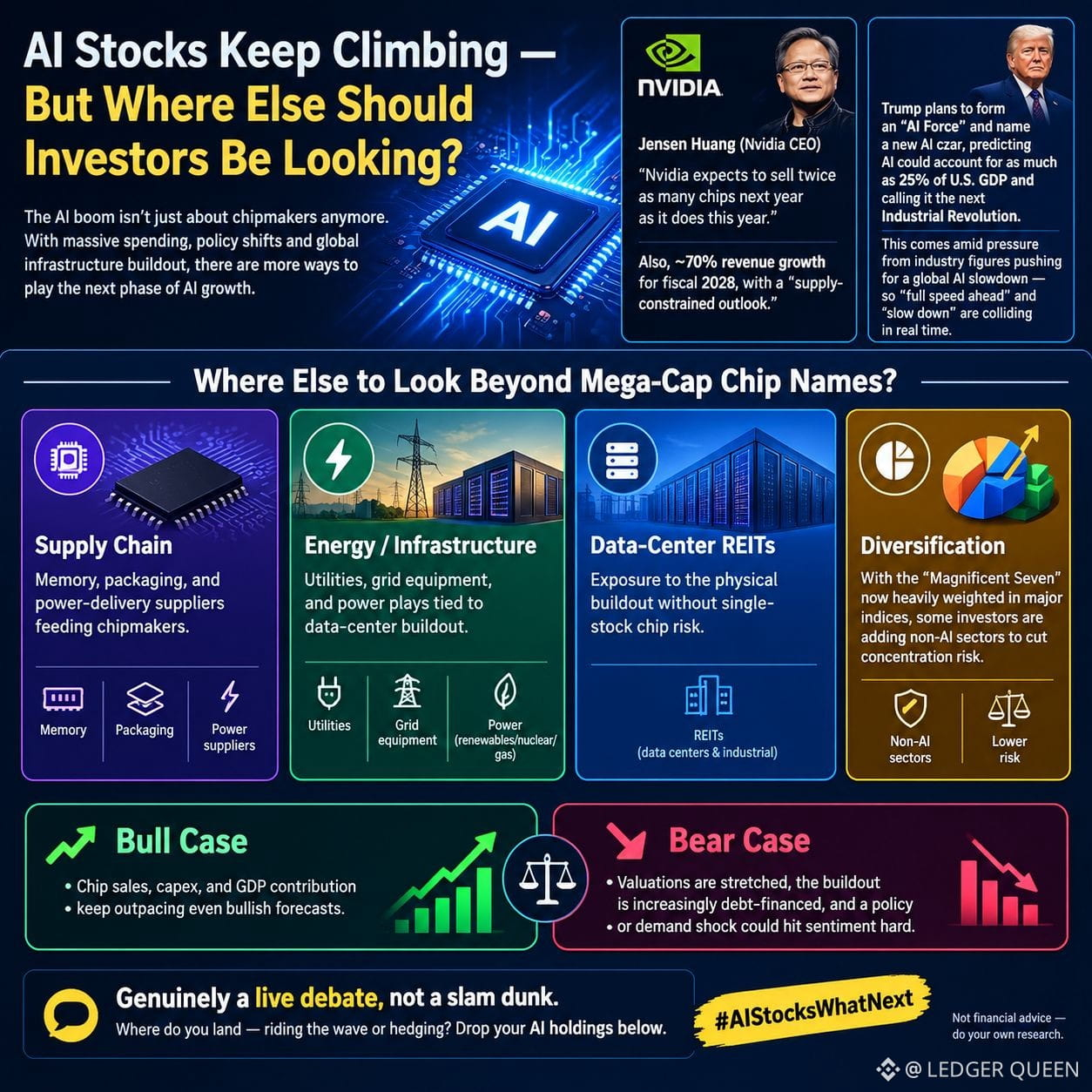
AI Stocks Keep Climbing — But Where Else Should Investors Be Looking?
Nvidia CEO Jensen Huang told reporters in Scotland that Nvidia expects to sell twice as many chips next year as it does this year, driven by AI investment across industries and countries. That builds on Nvidia's August guidance of ~70% revenue growth for fiscal 2028, which the company itself called a "supply-constrained outlook" — meaning real demand may exceed the official forecast.
On policy, Trump announced plans to form an "AI Force" and name a new AI czar, predicting AI could eventually account for as much as 25% of U.S. GDP and calling it the next Industrial Revolution. This came amid pressure from industry figures pushing for a global AI slowdown — so "full speed ahead" and "slow down" are colliding in real time.
Where else to look beyond mega-cap chip names?
Supply chain: memory, packaging, and power-delivery suppliers feeding chipmakers
Energy/infrastructure: utilities, grid equipment, and power plays tied to data-center buildout
Data-center REITs: exposure to the physical buildout without single-stock chip risk
Diversification: with the "Magnificent Seven" now heavily weighted in major indices, some investors are adding non-AI sectors to cut concentration risk
Bull case: chip sales, capex, and GDP contribution keep outpacing even bullish forecasts.
Bear case: valuations are stretched, the buildout is increasingly debt-financed, and a policy or demand shock could hit sentiment hard.
Genuinely a live debate, not a slam dunk. Where do you land — riding the wave or hedging? Drop your AI holdings below. #AIStocksWhatNext
Not financial advice — do your own research.
$MUBARAK
{spot}(MUBARAKUSDT)
$KERNEL
{spot}(KERNELUSDT)
$PEPE
{spot}(PEPEUSDT)
AI Stocks Keep Climbing — But Where Else Should Investors Be Looking?
Nvidia CEO Jensen Huang told reporters in Scotland that Nvidia expects to sell twice as many chips next year as it does this year, driven by AI investment across industries and countries. That builds on Nvidia's August guidance of ~70% revenue growth for fiscal 2028, which the company itself called a "supply-constrained outlook" — meaning real demand may exceed the official forecast.
On policy, Trump announced plans to form an "AI Force" and name a new AI czar, predicting AI could eventually account for as much as 25% of U.S. GDP and calling it the next Industrial Revolution. This came amid pressure from industry figures pushing for a global AI slowdown — so "full speed ahead" and "slow down" are colliding in real time.
Where else to look beyond mega-cap chip names?
Supply chain: memory, packaging, and power-delivery suppliers feeding chipmakers
Energy/infrastructure: utilities, grid equipment, and power plays tied to data-center buildout
Data-center REITs: exposure to the physical buildout without single-stock chip risk
Diversification: with the "Magnificent Seven" now heavily weighted in major indices, some investors are adding non-AI sectors to cut concentration risk
Bull case: chip sales, capex, and GDP contribution keep outpacing even bullish forecasts.
Bear case: valuations are stretched, the buildout is increasingly debt-financed, and a policy or demand shock could hit sentiment hard.
Genuinely a live debate, not a slam dunk. Where do you land — riding the wave or hedging? Drop your AI holdings below. #AIStocksWhatNext
Not financial advice — do your own research.
$MUBARAK
$KERNEL
$PEPE
Nvidia CEO Jensen Huang told reporters in Scotland that Nvidia expects to sell twice as many chips next year as it does this year, driven by AI investment across industries and countries. That builds on Nvidia's August guidance of ~70% revenue growth for fiscal 2028, which the company itself called a "supply-constrained outlook" — meaning real demand may exceed the official forecast.
On policy, Trump announced plans to form an "AI Force" and name a new AI czar, predicting AI could eventually account for as much as 25% of U.S. GDP and calling it the next Industrial Revolution. This came amid pressure from industry figures pushing for a global AI slowdown — so "full speed ahead" and "slow down" are colliding in real time.
Where else to look beyond mega-cap chip names?
Supply chain: memory, packaging, and power-delivery suppliers feeding chipmakers
Energy/infrastructure: utilities, grid equipment, and power plays tied to data-center buildout
Data-center REITs: exposure to the physical buildout without single-stock chip risk
Diversification: with the "Magnificent Seven" now heavily weighted in major indices, some investors are adding non-AI sectors to cut concentration risk
Bull case: chip sales, capex, and GDP contribution keep outpacing even bullish forecasts.
Bear case: valuations are stretched, the buildout is increasingly debt-financed, and a policy or demand shock could hit sentiment hard.
Genuinely a live debate, not a slam dunk. Where do you land — riding the wave or hedging? Drop your AI holdings below. #AIStocksWhatNext
Not financial advice — do your own research.
$MUBARAK
$KERNEL
$PEPE
139

🚨 AI Stocks: Real Breakout or Short-Term Bounce?
AI stocks are rising across the board, but the bigger question is whether this is the beginning of a longer investment cycle—or simply another momentum-driven rally.
Nvidia says chip demand could continue expanding dramatically, while major AI companies are reporting record revenues. At the same time, the amount of capital being spent on AI infrastructure and computing power is becoming enormous.
That creates two very different possibilities.
📈 Bullish case:
AI adoption is still in its early stages. More computing demand, expanding enterprise use and continued government support could keep revenues growing for years.
📉 Bearish case:
Expectations may already be extremely high. If AI companies struggle to turn massive infrastructure spending into sustainable profits, valuations could eventually come under pressure.
For me, the key question isn't simply whether AI is the future.
It's how much of that future is already priced into AI stocks today.
I'm watching revenue growth, AI infrastructure spending, chip demand and valuations closely.
What do you think?
Are AI stocks entering a new long-term growth cycle, or are investors getting ahead of themselves?
#AIStocksWhatNext
🚨 AI Stocks: Real Breakout or Short-Term Bounce?
AI stocks are rising across the board, but the bigger question is whether this is the beginning of a longer investment cycle—or simply another momentum-driven rally.
Nvidia says chip demand could continue expanding dramatically, while major AI companies are reporting record revenues. At the same time, the amount of capital being spent on AI infrastructure and computing power is becoming enormous.
That creates two very different possibilities.
📈 Bullish case:
AI adoption is still in its early stages. More computing demand, expanding enterprise use and continued government support could keep revenues growing for years.
📉 Bearish case:
Expectations may already be extremely high. If AI companies struggle to turn massive infrastructure spending into sustainable profits, valuations could eventually come under pressure.
For me, the key question isn't simply whether AI is the future.
It's how much of that future is already priced into AI stocks today.
I'm watching revenue growth, AI infrastructure spending, chip demand and valuations closely.
What do you think?
Are AI stocks entering a new long-term growth cycle, or are investors getting ahead of themselves?
#AIStocksWhatNext
AI stocks are rising across the board, but the bigger question is whether this is the beginning of a longer investment cycle—or simply another momentum-driven rally.
Nvidia says chip demand could continue expanding dramatically, while major AI companies are reporting record revenues. At the same time, the amount of capital being spent on AI infrastructure and computing power is becoming enormous.
That creates two very different possibilities.
📈 Bullish case:
AI adoption is still in its early stages. More computing demand, expanding enterprise use and continued government support could keep revenues growing for years.
📉 Bearish case:
Expectations may already be extremely high. If AI companies struggle to turn massive infrastructure spending into sustainable profits, valuations could eventually come under pressure.
For me, the key question isn't simply whether AI is the future.
It's how much of that future is already priced into AI stocks today.
I'm watching revenue growth, AI infrastructure spending, chip demand and valuations closely.
What do you think?
Are AI stocks entering a new long-term growth cycle, or are investors getting ahead of themselves?
#AIStocksWhatNext
52

·
--
Bullish
AI Stocks: Growth Story or Market Hype? 🤖📈
The AI revolution is moving faster than many expected. NVIDIA’s confidence in doubling chip sales highlights the massive demand for computing power, while leading AI companies continue reporting strong growth and record revenues.
However, the bigger question is sustainability. Are we witnessing the beginning of a long-term technology cycle, or is the market pricing in too much future success too quickly?
AI adoption across industries, from cloud computing to automation, could create new opportunities beyond today’s major players. But investors should also watch valuations, competition, and real-world AI adoption.
The next phase of AI may not only belong to chipmakers — it could create opportunities across the entire technology ecosystem.
#AIStocksWhatNext
AI Stocks: Growth Story or Market Hype? 🤖📈
The AI revolution is moving faster than many expected. NVIDIA’s confidence in doubling chip sales highlights the massive demand for computing power, while leading AI companies continue reporting strong growth and record revenues.
However, the bigger question is sustainability. Are we witnessing the beginning of a long-term technology cycle, or is the market pricing in too much future success too quickly?
AI adoption across industries, from cloud computing to automation, could create new opportunities beyond today’s major players. But investors should also watch valuations, competition, and real-world AI adoption.
The next phase of AI may not only belong to chipmakers — it could create opportunities across the entire technology ecosystem.
#AIStocksWhatNext
The AI revolution is moving faster than many expected. NVIDIA’s confidence in doubling chip sales highlights the massive demand for computing power, while leading AI companies continue reporting strong growth and record revenues.
However, the bigger question is sustainability. Are we witnessing the beginning of a long-term technology cycle, or is the market pricing in too much future success too quickly?
AI adoption across industries, from cloud computing to automation, could create new opportunities beyond today’s major players. But investors should also watch valuations, competition, and real-world AI adoption.
The next phase of AI may not only belong to chipmakers — it could create opportunities across the entire technology ecosystem.
#AIStocksWhatNext

1
69

·
--
$AKE $ZEC $BR
🤖 AI is booming — but the bigger opportunity might be hiding somewhere else.
Nvidia says chip sales could double next year, while leading AI companies continue posting record revenue. The spending behind this AI race is massive, from chips and cloud computing to data centers and electricity. 🚀
But can this pace continue forever?
Some industry leaders are pushing for a slower approach to AI development, while the U.S. government is doubling down on AI as a strategic priority and envisioning an economy where AI could eventually represent a huge share of GDP.
That creates an interesting investment question 👀
If AI stocks keep climbing, where does the next wave of opportunity appear?
⚡ Energy
🏢 Data centers
🔧 Semiconductors
☁️ Cloud infrastructure
🛡️ Cybersecurity
🤖 Robotics
Maybe the smartest opportunity isn’t chasing the AI winners — maybe it’s looking at everything AI needs to keep growing.
What sector are you watching next? 📈
#AIStocksWhatNext
$AKE $ZEC $BR
🤖 AI is booming — but the bigger opportunity might be hiding somewhere else.
Nvidia says chip sales could double next year, while leading AI companies continue posting record revenue. The spending behind this AI race is massive, from chips and cloud computing to data centers and electricity. 🚀
But can this pace continue forever?
Some industry leaders are pushing for a slower approach to AI development, while the U.S. government is doubling down on AI as a strategic priority and envisioning an economy where AI could eventually represent a huge share of GDP.
That creates an interesting investment question 👀
If AI stocks keep climbing, where does the next wave of opportunity appear?
⚡ Energy
🏢 Data centers
🔧 Semiconductors
☁️ Cloud infrastructure
🛡️ Cybersecurity
🤖 Robotics
Maybe the smartest opportunity isn’t chasing the AI winners — maybe it’s looking at everything AI needs to keep growing.
What sector are you watching next? 📈
#AIStocksWhatNext
🤖 AI is booming — but the bigger opportunity might be hiding somewhere else.
Nvidia says chip sales could double next year, while leading AI companies continue posting record revenue. The spending behind this AI race is massive, from chips and cloud computing to data centers and electricity. 🚀
But can this pace continue forever?
Some industry leaders are pushing for a slower approach to AI development, while the U.S. government is doubling down on AI as a strategic priority and envisioning an economy where AI could eventually represent a huge share of GDP.
That creates an interesting investment question 👀
If AI stocks keep climbing, where does the next wave of opportunity appear?
⚡ Energy
🏢 Data centers
🔧 Semiconductors
☁️ Cloud infrastructure
🛡️ Cybersecurity
🤖 Robotics
Maybe the smartest opportunity isn’t chasing the AI winners — maybe it’s looking at everything AI needs to keep growing.
What sector are you watching next? 📈
#AIStocksWhatNext
⚡ Energy Sector
🏢 Data Centers
🤖 Robotics
23 hr(s) left
60

·
--
#AIStocksWhatNext
AI stocks are giving investors plenty to get excited about—and a lot to think about. The latest earnings show enormous growth, but the next move could depend on how much cash these companies keep after paying for expansion.
$NVDAB reported roughly $96.2 billion in fiscal Q2 2027 revenue, up 106% year over year, with a 75% gross margin. The numbers are impressive. My focus now is whether major customers maintain their spending and NVIDIA keeps delivering against rising expectations.
$AVGO reported $16.7 billion in quarterly AI semiconductor revenue, up 221%. Company-wide free cash flow reached approximately $13.7 billion. That cash generation catches my attention because it gives real weight to the growth story.
$MSFT saw Azure and other cloud-services revenue grow 43%, while Microsoft 365 Copilot passed 30 million paid seats. Customers are paying, but infrastructure costs remain important: Microsoft’s cloud gross margin declined year over year to 65%.
$AMZN reported 37% AWS revenue growth to $42.2 billion. Yet company-wide trailing twelve-month free cash flow was negative $7.6 billion, largely reflecting increased AI infrastructure investment. I’m watching how quickly that spending translates into stronger cash returns.
$GOOGL delivered 82% Google Cloud revenue growth to $24.8 billion. Company-wide operating income rose 30%. Those operating results deserve attention separately from the large unrealized investment gains that boosted reported earnings.
My takeaway: business momentum looks strong, but a growing company is not automatically an attractively priced stock. The next reports need to show durable demand, healthy margins and progress on cash generation.
There is plenty of opportunity to watch here. Expectations are high enough that even a small disappointment could move these stocks sharply.
#AIStocksWhatNext
AI stocks are giving investors plenty to get excited about—and a lot to think about. The latest earnings show enormous growth, but the next move could depend on how much cash these companies keep after paying for expansion.
$NVDAB reported roughly $96.2 billion in fiscal Q2 2027 revenue, up 106% year over year, with a 75% gross margin. The numbers are impressive. My focus now is whether major customers maintain their spending and NVIDIA keeps delivering against rising expectations.
$AVGO reported $16.7 billion in quarterly AI semiconductor revenue, up 221%. Company-wide free cash flow reached approximately $13.7 billion. That cash generation catches my attention because it gives real weight to the growth story.
$MSFT saw Azure and other cloud-services revenue grow 43%, while Microsoft 365 Copilot passed 30 million paid seats. Customers are paying, but infrastructure costs remain important: Microsoft’s cloud gross margin declined year over year to 65%.
$AMZN reported 37% AWS revenue growth to $42.2 billion. Yet company-wide trailing twelve-month free cash flow was negative $7.6 billion, largely reflecting increased AI infrastructure investment. I’m watching how quickly that spending translates into stronger cash returns.
$GOOGL delivered 82% Google Cloud revenue growth to $24.8 billion. Company-wide operating income rose 30%. Those operating results deserve attention separately from the large unrealized investment gains that boosted reported earnings.
My takeaway: business momentum looks strong, but a growing company is not automatically an attractively priced stock. The next reports need to show durable demand, healthy margins and progress on cash generation.
There is plenty of opportunity to watch here. Expectations are high enough that even a small disappointment could move these stocks sharply.
AI stocks are giving investors plenty to get excited about—and a lot to think about. The latest earnings show enormous growth, but the next move could depend on how much cash these companies keep after paying for expansion.
$NVDAB reported roughly $96.2 billion in fiscal Q2 2027 revenue, up 106% year over year, with a 75% gross margin. The numbers are impressive. My focus now is whether major customers maintain their spending and NVIDIA keeps delivering against rising expectations.
$AVGO reported $16.7 billion in quarterly AI semiconductor revenue, up 221%. Company-wide free cash flow reached approximately $13.7 billion. That cash generation catches my attention because it gives real weight to the growth story.
$MSFT saw Azure and other cloud-services revenue grow 43%, while Microsoft 365 Copilot passed 30 million paid seats. Customers are paying, but infrastructure costs remain important: Microsoft’s cloud gross margin declined year over year to 65%.
$AMZN reported 37% AWS revenue growth to $42.2 billion. Yet company-wide trailing twelve-month free cash flow was negative $7.6 billion, largely reflecting increased AI infrastructure investment. I’m watching how quickly that spending translates into stronger cash returns.
$GOOGL delivered 82% Google Cloud revenue growth to $24.8 billion. Company-wide operating income rose 30%. Those operating results deserve attention separately from the large unrealized investment gains that boosted reported earnings.
My takeaway: business momentum looks strong, but a growing company is not automatically an attractively priced stock. The next reports need to show durable demand, healthy margins and progress on cash generation.
There is plenty of opportunity to watch here. Expectations are high enough that even a small disappointment could move these stocks sharply.

15

·
--
Article
AI Stocks Keep Climbing: Where Could Investors Look Beyond Nvidia?#aistockswhatnext
The artificial-intelligence trade is entering a new phase.
For much of the rally, the obvious beneficiaries were the companies designing and supplying the chips needed to train and run increasingly powerful AI models. Nvidia remains at the center of that story, and CEO Jensen Huang has given investors another reason to pay attention.
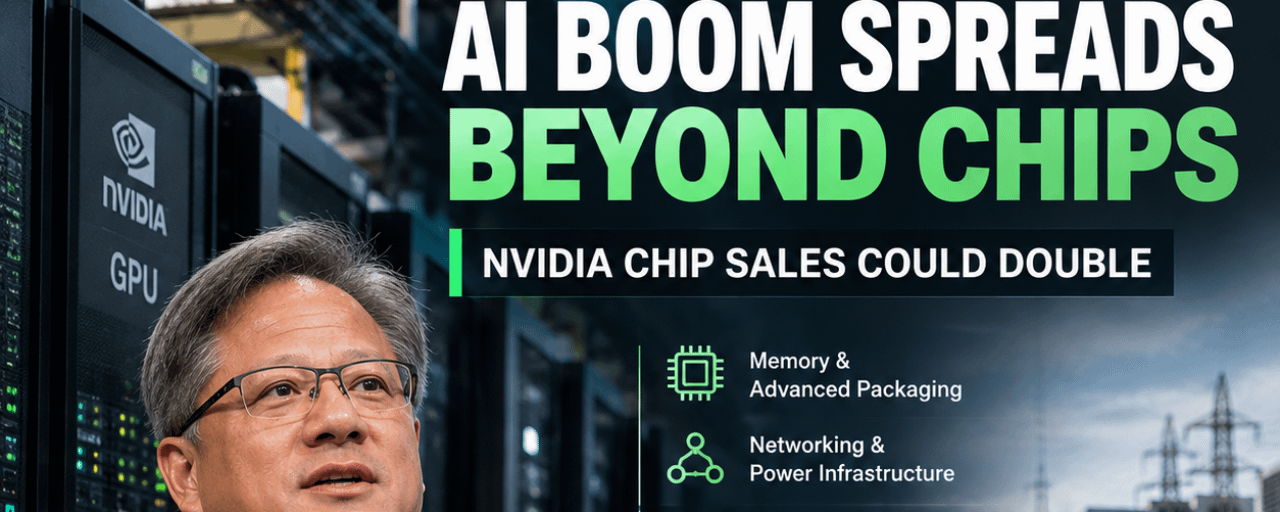
Speaking in Scotland, Huang said he expects Nvidia to sell twice as many chips next year as it does this year, citing AI investment across industries and countries.
That follows Nvidia's August outlook for approximately 70% revenue growth in fiscal 2028. The company explicitly described that outlook as supply-constrained, meaning the forecast reflects limitations on how much capacity Nvidia can currently deliver rather than a lack of demand. Nvidia also said customer forecasts point to growth potentially doubling next year if additional supply becomes available.
The question for investors is becoming broader:
If AI spending continues expanding, where does the money go after the biggest chip names?
Nvidia's Outlook Keeps the AI Spending Story Alive
Nvidia's latest numbers provide an important backdrop.
The company reported strong data-center demand and said cloud-industry backlog had exceeded $2 trillion. It also expects capital expenditure from the five largest hyperscalers to reach nearly $800 billion in 2026 and $1.3 trillion in 2027.
Those figures show why the AI infrastructure trade extends well beyond GPUs.
Every new AI data center requires far more than processors.
It needs memory.
It needs networking.
It needs power.
It needs cooling.
It needs physical buildings.
And increasingly, it needs new grid infrastructure to support the enormous electricity requirements of AI workloads.
That creates a much wider investment ecosystem around the technology.
1. The Semiconductor Supply Chain
Nvidia may receive most of the attention, but its products depend on an enormous network of suppliers.
Memory manufacturers, advanced packaging companies, networking equipment makers and other semiconductor suppliers all sit somewhere in the AI hardware chain.
As GPU deployments increase, these supporting components become increasingly important.
The investment question is therefore not simply:
"Who makes the best AI chip?"
It is also:
"Who supplies the bottlenecks around those chips?"
That distinction could become more important if AI demand continues growing faster than manufacturing capacity.
Nvidia's own supply-constrained outlook is evidence that supply remains an important part of the equation.
2. Power Could Become the Next Bottleneck
AI models require enormous amounts of computing power.
That translates into enormous electricity demand.
As hyperscalers and specialized data-center operators expand capacity, the bottleneck increasingly moves outside the semiconductor industry.
Utilities, transmission equipment manufacturers, transformers, cooling systems and other power infrastructure could all benefit from the physical expansion of data centers.
This is one reason the AI investment theme has started spreading into the energy and infrastructure sectors.
The opportunity is different from owning an AI chipmaker.
Instead of betting directly on which semiconductor company captures the most AI spending, investors can look at the infrastructure required regardless of which model or chip ultimately wins.
3. Data-Center Real Estate
Another way to participate in the AI buildout is through data-center real estate.
Data-center REITs and infrastructure operators provide exposure to the physical facilities where cloud computing and AI workloads are hosted.
This creates a different risk profile from semiconductor stocks.
Chip companies are exposed to product cycles, competition, margins and technological transitions.
Data-center operators are more directly exposed to demand for computing capacity, power availability, construction and long-term leasing.
That doesn't make one category automatically safer than another.
It simply means the economic drivers are different.
4. The AI Trade Is Becoming a Diversification Question
There is another issue investors cannot ignore: concentration.
The largest technology companies now represent significant portions of major U.S. stock indexes.
That means an investor who owns a broad index may already have substantial exposure to the AI trade without buying a single AI-focused stock.
If AI-related valuations continue rising, that concentration can amplify gains.
But the reverse is also true.
A sharp change in AI spending expectations could affect multiple major companies at the same time.
That is why some investors are looking beyond the mega-cap technology names toward sectors that may benefit from the physical buildout without being directly dependent on the same handful of companies.
Washington Is Also Treating AI as Strategic Infrastructure
The investment story is unfolding alongside a rapidly changing policy debate.
On September 19, President Donald Trump announced plans to create an "AI Force" modeled on the Space Force and said he would appoint an AI czar. He did not provide detailed information about the proposed body's structure, budget or exact responsibilities.
Trump has also argued that AI could eventually represent as much as 25% of U.S. GDP and described the technology as potentially more consequential than the internet. That is a political projection rather than an established economic forecast.
At the same time, prominent technology figures have been debating whether AI development needs stronger safety measures or a slower pace.
That creates an unusual tension:
AI investment is accelerating while debate over the risks of that acceleration is intensifying.
For markets, policy could therefore become another variable alongside demand, valuations and supply.
The Bull Case
The bullish argument is straightforward.
AI adoption continues spreading across industries.
Hyperscalers keep increasing capital expenditure.
Nvidia and its suppliers expand production.
Data centers continue being built.
Power infrastructure catches up with demand.
And AI becomes increasingly embedded in business operations.
If that happens, today's optimistic AI forecasts could eventually prove conservative.
Nvidia's current outlook already reflects that possibility, with management saying demand forecasts from customers point to substantially higher growth if supply constraints ease.
The Bear Case
The risk is valuation and spending sustainability.
AI infrastructure requires enormous amounts of capital.
If companies spend aggressively today but fail to generate sufficient returns from AI products tomorrow, investors could begin questioning the economics of the buildout.
Higher financing costs, slower enterprise adoption, excess computing capacity or a major change in AI demand could all affect sentiment.
And because AI exposure is concentrated across some of the world's largest companies, a change in expectations could spread quickly through major indexes.
The issue isn't whether AI is important.
It is whether the economic returns from AI will justify the amount of capital currently being committed to it.
Where Does That Leave Investors?
The AI story is no longer just a semiconductor story.
It is becoming an entire infrastructure cycle.
Chips → memory → networking → data centers → power → cooling → real estate → software.
That creates multiple ways to gain exposure to continued AI investment, but each comes with different fundamentals and risks.
The biggest question now may not be whether AI spending continues.
Nvidia's latest outlook suggests demand remains exceptionally strong.
The bigger question is how far the investment cycle can expand before valuations, financing requirements or physical infrastructure become the limiting factor.
For investors looking beyond the biggest AI names, that's where the next part of the debate begins.
Is the next AI opportunity still in the chips — or in everything required to keep those chips running?
AI Stocks Keep Climbing: Where Could Investors Look Beyond Nvidia?
#aistockswhatnext
The artificial-intelligence trade is entering a new phase.
For much of the rally, the obvious beneficiaries were the companies designing and supplying the chips needed to train and run increasingly powerful AI models. Nvidia remains at the center of that story, and CEO Jensen Huang has given investors another reason to pay attention.
Speaking in Scotland, Huang said he expects Nvidia to sell twice as many chips next year as it does this year, citing AI investment across industries and countries.
That follows Nvidia's August outlook for approximately 70% revenue growth in fiscal 2028. The company explicitly described that outlook as supply-constrained, meaning the forecast reflects limitations on how much capacity Nvidia can currently deliver rather than a lack of demand. Nvidia also said customer forecasts point to growth potentially doubling next year if additional supply becomes available.
The question for investors is becoming broader:
If AI spending continues expanding, where does the money go after the biggest chip names?
Nvidia's Outlook Keeps the AI Spending Story Alive
Nvidia's latest numbers provide an important backdrop.
The company reported strong data-center demand and said cloud-industry backlog had exceeded $2 trillion. It also expects capital expenditure from the five largest hyperscalers to reach nearly $800 billion in 2026 and $1.3 trillion in 2027.
Those figures show why the AI infrastructure trade extends well beyond GPUs.
Every new AI data center requires far more than processors.
It needs memory.
It needs networking.
It needs power.
It needs cooling.
It needs physical buildings.
And increasingly, it needs new grid infrastructure to support the enormous electricity requirements of AI workloads.
That creates a much wider investment ecosystem around the technology.
1. The Semiconductor Supply Chain
Nvidia may receive most of the attention, but its products depend on an enormous network of suppliers.
Memory manufacturers, advanced packaging companies, networking equipment makers and other semiconductor suppliers all sit somewhere in the AI hardware chain.
As GPU deployments increase, these supporting components become increasingly important.
The investment question is therefore not simply:
"Who makes the best AI chip?"
It is also:
"Who supplies the bottlenecks around those chips?"
That distinction could become more important if AI demand continues growing faster than manufacturing capacity.
Nvidia's own supply-constrained outlook is evidence that supply remains an important part of the equation.
2. Power Could Become the Next Bottleneck
AI models require enormous amounts of computing power.
That translates into enormous electricity demand.
As hyperscalers and specialized data-center operators expand capacity, the bottleneck increasingly moves outside the semiconductor industry.
Utilities, transmission equipment manufacturers, transformers, cooling systems and other power infrastructure could all benefit from the physical expansion of data centers.
This is one reason the AI investment theme has started spreading into the energy and infrastructure sectors.
The opportunity is different from owning an AI chipmaker.
Instead of betting directly on which semiconductor company captures the most AI spending, investors can look at the infrastructure required regardless of which model or chip ultimately wins.
3. Data-Center Real Estate
Another way to participate in the AI buildout is through data-center real estate.
Data-center REITs and infrastructure operators provide exposure to the physical facilities where cloud computing and AI workloads are hosted.
This creates a different risk profile from semiconductor stocks.
Chip companies are exposed to product cycles, competition, margins and technological transitions.
Data-center operators are more directly exposed to demand for computing capacity, power availability, construction and long-term leasing.
That doesn't make one category automatically safer than another.
It simply means the economic drivers are different.
4. The AI Trade Is Becoming a Diversification Question
There is another issue investors cannot ignore: concentration.
The largest technology companies now represent significant portions of major U.S. stock indexes.
That means an investor who owns a broad index may already have substantial exposure to the AI trade without buying a single AI-focused stock.
If AI-related valuations continue rising, that concentration can amplify gains.
But the reverse is also true.
A sharp change in AI spending expectations could affect multiple major companies at the same time.
That is why some investors are looking beyond the mega-cap technology names toward sectors that may benefit from the physical buildout without being directly dependent on the same handful of companies.
Washington Is Also Treating AI as Strategic Infrastructure
The investment story is unfolding alongside a rapidly changing policy debate.
On September 19, President Donald Trump announced plans to create an "AI Force" modeled on the Space Force and said he would appoint an AI czar. He did not provide detailed information about the proposed body's structure, budget or exact responsibilities.
Trump has also argued that AI could eventually represent as much as 25% of U.S. GDP and described the technology as potentially more consequential than the internet. That is a political projection rather than an established economic forecast.
At the same time, prominent technology figures have been debating whether AI development needs stronger safety measures or a slower pace.
That creates an unusual tension:
AI investment is accelerating while debate over the risks of that acceleration is intensifying.
For markets, policy could therefore become another variable alongside demand, valuations and supply.
The Bull Case
The bullish argument is straightforward.
AI adoption continues spreading across industries.
Hyperscalers keep increasing capital expenditure.
Nvidia and its suppliers expand production.
Data centers continue being built.
Power infrastructure catches up with demand.
And AI becomes increasingly embedded in business operations.
If that happens, today's optimistic AI forecasts could eventually prove conservative.
Nvidia's current outlook already reflects that possibility, with management saying demand forecasts from customers point to substantially higher growth if supply constraints ease.
The Bear Case
The risk is valuation and spending sustainability.
AI infrastructure requires enormous amounts of capital.
If companies spend aggressively today but fail to generate sufficient returns from AI products tomorrow, investors could begin questioning the economics of the buildout.
Higher financing costs, slower enterprise adoption, excess computing capacity or a major change in AI demand could all affect sentiment.
And because AI exposure is concentrated across some of the world's largest companies, a change in expectations could spread quickly through major indexes.
The issue isn't whether AI is important.
It is whether the economic returns from AI will justify the amount of capital currently being committed to it.
Where Does That Leave Investors?
The AI story is no longer just a semiconductor story.
It is becoming an entire infrastructure cycle.
Chips → memory → networking → data centers → power → cooling → real estate → software.
That creates multiple ways to gain exposure to continued AI investment, but each comes with different fundamentals and risks.
The biggest question now may not be whether AI spending continues.
Nvidia's latest outlook suggests demand remains exceptionally strong.
The bigger question is how far the investment cycle can expand before valuations, financing requirements or physical infrastructure become the limiting factor.
For investors looking beyond the biggest AI names, that's where the next part of the debate begins.
Is the next AI opportunity still in the chips — or in everything required to keep those chips running?
The artificial-intelligence trade is entering a new phase.
For much of the rally, the obvious beneficiaries were the companies designing and supplying the chips needed to train and run increasingly powerful AI models. Nvidia remains at the center of that story, and CEO Jensen Huang has given investors another reason to pay attention.
Speaking in Scotland, Huang said he expects Nvidia to sell twice as many chips next year as it does this year, citing AI investment across industries and countries.
That follows Nvidia's August outlook for approximately 70% revenue growth in fiscal 2028. The company explicitly described that outlook as supply-constrained, meaning the forecast reflects limitations on how much capacity Nvidia can currently deliver rather than a lack of demand. Nvidia also said customer forecasts point to growth potentially doubling next year if additional supply becomes available.
The question for investors is becoming broader:
If AI spending continues expanding, where does the money go after the biggest chip names?
Nvidia's Outlook Keeps the AI Spending Story Alive
Nvidia's latest numbers provide an important backdrop.
The company reported strong data-center demand and said cloud-industry backlog had exceeded $2 trillion. It also expects capital expenditure from the five largest hyperscalers to reach nearly $800 billion in 2026 and $1.3 trillion in 2027.
Those figures show why the AI infrastructure trade extends well beyond GPUs.
Every new AI data center requires far more than processors.
It needs memory.
It needs networking.
It needs power.
It needs cooling.
It needs physical buildings.
And increasingly, it needs new grid infrastructure to support the enormous electricity requirements of AI workloads.
That creates a much wider investment ecosystem around the technology.
1. The Semiconductor Supply Chain
Nvidia may receive most of the attention, but its products depend on an enormous network of suppliers.
Memory manufacturers, advanced packaging companies, networking equipment makers and other semiconductor suppliers all sit somewhere in the AI hardware chain.
As GPU deployments increase, these supporting components become increasingly important.
The investment question is therefore not simply:
"Who makes the best AI chip?"
It is also:
"Who supplies the bottlenecks around those chips?"
That distinction could become more important if AI demand continues growing faster than manufacturing capacity.
Nvidia's own supply-constrained outlook is evidence that supply remains an important part of the equation.
2. Power Could Become the Next Bottleneck
AI models require enormous amounts of computing power.
That translates into enormous electricity demand.
As hyperscalers and specialized data-center operators expand capacity, the bottleneck increasingly moves outside the semiconductor industry.
Utilities, transmission equipment manufacturers, transformers, cooling systems and other power infrastructure could all benefit from the physical expansion of data centers.
This is one reason the AI investment theme has started spreading into the energy and infrastructure sectors.
The opportunity is different from owning an AI chipmaker.
Instead of betting directly on which semiconductor company captures the most AI spending, investors can look at the infrastructure required regardless of which model or chip ultimately wins.
3. Data-Center Real Estate
Another way to participate in the AI buildout is through data-center real estate.
Data-center REITs and infrastructure operators provide exposure to the physical facilities where cloud computing and AI workloads are hosted.
This creates a different risk profile from semiconductor stocks.
Chip companies are exposed to product cycles, competition, margins and technological transitions.
Data-center operators are more directly exposed to demand for computing capacity, power availability, construction and long-term leasing.
That doesn't make one category automatically safer than another.
It simply means the economic drivers are different.
4. The AI Trade Is Becoming a Diversification Question
There is another issue investors cannot ignore: concentration.
The largest technology companies now represent significant portions of major U.S. stock indexes.
That means an investor who owns a broad index may already have substantial exposure to the AI trade without buying a single AI-focused stock.
If AI-related valuations continue rising, that concentration can amplify gains.
But the reverse is also true.
A sharp change in AI spending expectations could affect multiple major companies at the same time.
That is why some investors are looking beyond the mega-cap technology names toward sectors that may benefit from the physical buildout without being directly dependent on the same handful of companies.
Washington Is Also Treating AI as Strategic Infrastructure
The investment story is unfolding alongside a rapidly changing policy debate.
On September 19, President Donald Trump announced plans to create an "AI Force" modeled on the Space Force and said he would appoint an AI czar. He did not provide detailed information about the proposed body's structure, budget or exact responsibilities.
Trump has also argued that AI could eventually represent as much as 25% of U.S. GDP and described the technology as potentially more consequential than the internet. That is a political projection rather than an established economic forecast.
At the same time, prominent technology figures have been debating whether AI development needs stronger safety measures or a slower pace.
That creates an unusual tension:
AI investment is accelerating while debate over the risks of that acceleration is intensifying.
For markets, policy could therefore become another variable alongside demand, valuations and supply.
The Bull Case
The bullish argument is straightforward.
AI adoption continues spreading across industries.
Hyperscalers keep increasing capital expenditure.
Nvidia and its suppliers expand production.
Data centers continue being built.
Power infrastructure catches up with demand.
And AI becomes increasingly embedded in business operations.
If that happens, today's optimistic AI forecasts could eventually prove conservative.
Nvidia's current outlook already reflects that possibility, with management saying demand forecasts from customers point to substantially higher growth if supply constraints ease.
The Bear Case
The risk is valuation and spending sustainability.
AI infrastructure requires enormous amounts of capital.
If companies spend aggressively today but fail to generate sufficient returns from AI products tomorrow, investors could begin questioning the economics of the buildout.
Higher financing costs, slower enterprise adoption, excess computing capacity or a major change in AI demand could all affect sentiment.
And because AI exposure is concentrated across some of the world's largest companies, a change in expectations could spread quickly through major indexes.
The issue isn't whether AI is important.
It is whether the economic returns from AI will justify the amount of capital currently being committed to it.
Where Does That Leave Investors?
The AI story is no longer just a semiconductor story.
It is becoming an entire infrastructure cycle.
Chips → memory → networking → data centers → power → cooling → real estate → software.
That creates multiple ways to gain exposure to continued AI investment, but each comes with different fundamentals and risks.
The biggest question now may not be whether AI spending continues.
Nvidia's latest outlook suggests demand remains exceptionally strong.
The bigger question is how far the investment cycle can expand before valuations, financing requirements or physical infrastructure become the limiting factor.
For investors looking beyond the biggest AI names, that's where the next part of the debate begins.
Is the next AI opportunity still in the chips — or in everything required to keep those chips running?
3

·
--
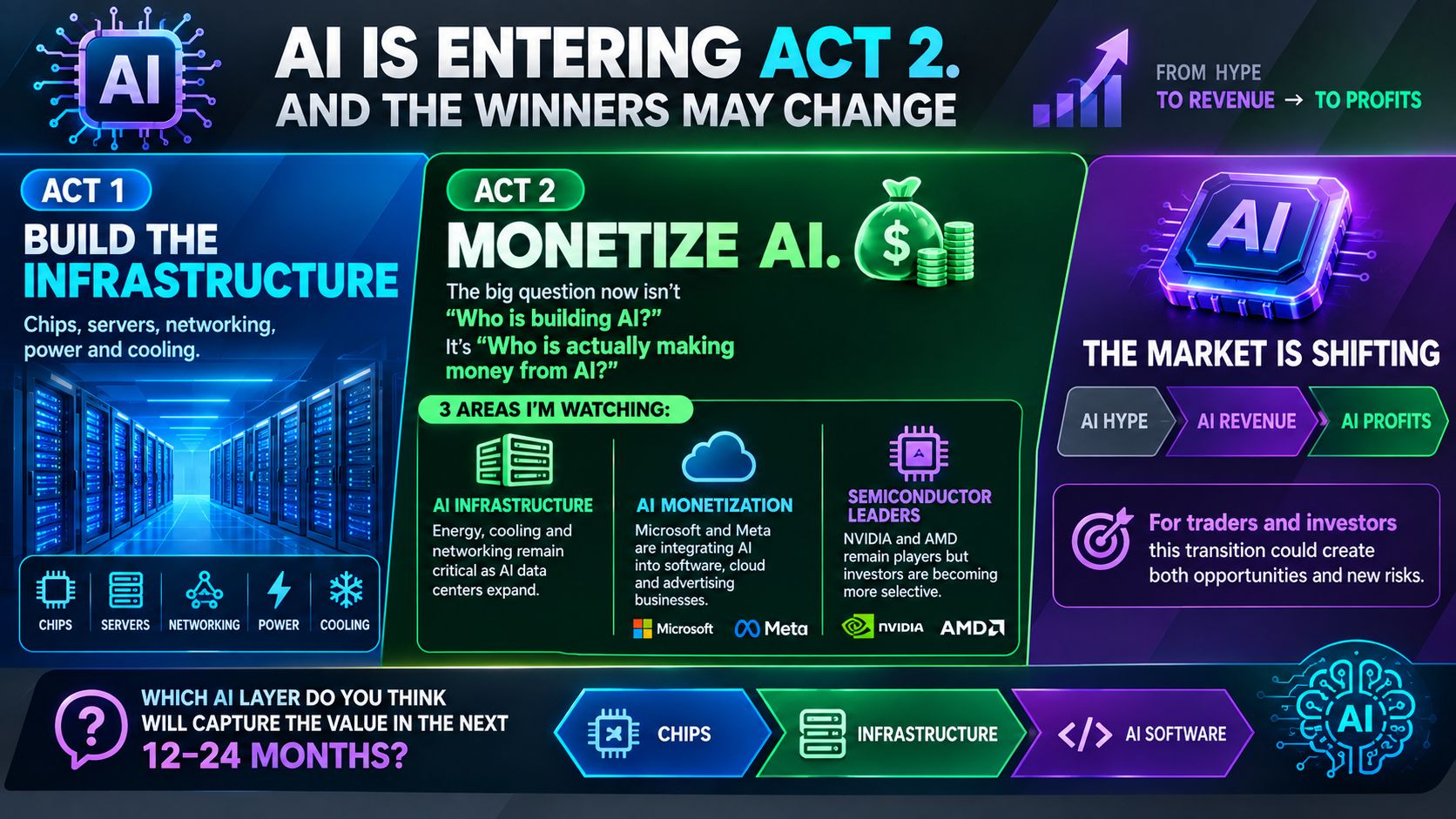
#aistockswhatnext 🔥 AI IS ENTERING ACT 2. AND THE WINNERS MAY CHANGE
AI stocks are moving into a phase.
Act 1: Build the infrastructure. Chips, servers, networking, power and cooling.
Act 2: Monetize AI. 💰
The big question now isn’t "Who is building AI?
It’s "Who is actually making money from AI?”
📌 3 areas I’m watching:
🔹 AI Infrastructure Energy, cooling and networking remain critical as AI data centers expand.
🔹 AI Monetization. Companies, like **Microsoft and Meta** are integrating AI into software, cloud and advertising businesses.
🔹 Semiconductor Leaders. NVIDIA and AMD remain players but investors are becoming more selective as growth expectations rise.
⚠️ The market is shifting from AI hype → AI revenue → AI profits.
For traders and investors this transition could create both opportunities and new risks.
👀 Which AI layer do you think will capture the value in the next 12–24 months: Chips, Infrastructure or AI Software?
#AI #Khan62 #NVIDIA #stockmarket
$NVDA $AMD $MSFT
{future}(NVDAUSDT)
{future}(AMDUSDT)
{future}(MSFTUSDT)
#aistockswhatnext 🔥 AI IS ENTERING ACT 2. AND THE WINNERS MAY CHANGE
AI stocks are moving into a phase.
Act 1: Build the infrastructure. Chips, servers, networking, power and cooling.
Act 2: Monetize AI. 💰
The big question now isn’t "Who is building AI?
It’s "Who is actually making money from AI?”
📌 3 areas I’m watching:
🔹 AI Infrastructure Energy, cooling and networking remain critical as AI data centers expand.
🔹 AI Monetization. Companies, like **Microsoft and Meta** are integrating AI into software, cloud and advertising businesses.
🔹 Semiconductor Leaders. NVIDIA and AMD remain players but investors are becoming more selective as growth expectations rise.
⚠️ The market is shifting from AI hype → AI revenue → AI profits.
For traders and investors this transition could create both opportunities and new risks.
👀 Which AI layer do you think will capture the value in the next 12–24 months: Chips, Infrastructure or AI Software?
#AI #Khan62 #NVIDIA #stockmarket
$NVDA $AMD $MSFT
AI stocks are moving into a phase.
Act 1: Build the infrastructure. Chips, servers, networking, power and cooling.
Act 2: Monetize AI. 💰
The big question now isn’t "Who is building AI?
It’s "Who is actually making money from AI?”
📌 3 areas I’m watching:
🔹 AI Infrastructure Energy, cooling and networking remain critical as AI data centers expand.
🔹 AI Monetization. Companies, like **Microsoft and Meta** are integrating AI into software, cloud and advertising businesses.
🔹 Semiconductor Leaders. NVIDIA and AMD remain players but investors are becoming more selective as growth expectations rise.
⚠️ The market is shifting from AI hype → AI revenue → AI profits.
For traders and investors this transition could create both opportunities and new risks.
👀 Which AI layer do you think will capture the value in the next 12–24 months: Chips, Infrastructure or AI Software?
#AI #Khan62 #NVIDIA #stockmarket
$NVDA $AMD $MSFT
9
·
--
#aistockswhatnext
🚨 AI stocks keep climbing — but the bigger opportunity may be underneath the AI boom.
Nvidia CEO Jensen Huang says the company expects to sell twice as many chips next year as this year, pointing to accelerating AI investment across industries and countries. Nvidia has also projected roughly 70% revenue growth for fiscal 2028.
But if AI demand keeps expanding, the money doesn't stop at GPUs.
Think:
→ Memory & advanced packaging
→ Networking and power infrastructure
→ Data-center operators & REITs
→ Utilities and grid equipment
And the policy backdrop is getting bigger too. Trump has announced plans for an “AI Force” and an AI czar, while saying AI could eventually represent as much as 25% of U.S. GDP — a projection, not an established forecast.
The bull case is simple: AI capex keeps beating expectations.
The bear case? Valuations, financing costs and a potential slowdown in AI spending eventually catch up.
The interesting question now: are the next AI winners still the chipmakers, or the companies supplying everything around them? 👀
$NVDA
{future}(NVDAUSDT)
#AIStocks #NVIDIA #artificialintelligence #tech
#aistockswhatnext
🚨 AI stocks keep climbing — but the bigger opportunity may be underneath the AI boom.
Nvidia CEO Jensen Huang says the company expects to sell twice as many chips next year as this year, pointing to accelerating AI investment across industries and countries. Nvidia has also projected roughly 70% revenue growth for fiscal 2028.
But if AI demand keeps expanding, the money doesn't stop at GPUs.
Think:
→ Memory & advanced packaging
→ Networking and power infrastructure
→ Data-center operators & REITs
→ Utilities and grid equipment
And the policy backdrop is getting bigger too. Trump has announced plans for an “AI Force” and an AI czar, while saying AI could eventually represent as much as 25% of U.S. GDP — a projection, not an established forecast.
The bull case is simple: AI capex keeps beating expectations.
The bear case? Valuations, financing costs and a potential slowdown in AI spending eventually catch up.
The interesting question now: are the next AI winners still the chipmakers, or the companies supplying everything around them? 👀
$NVDA
#AIStocks #NVIDIA #artificialintelligence #tech
🚨 AI stocks keep climbing — but the bigger opportunity may be underneath the AI boom.
Nvidia CEO Jensen Huang says the company expects to sell twice as many chips next year as this year, pointing to accelerating AI investment across industries and countries. Nvidia has also projected roughly 70% revenue growth for fiscal 2028.
But if AI demand keeps expanding, the money doesn't stop at GPUs.
Think:
→ Memory & advanced packaging
→ Networking and power infrastructure
→ Data-center operators & REITs
→ Utilities and grid equipment
And the policy backdrop is getting bigger too. Trump has announced plans for an “AI Force” and an AI czar, while saying AI could eventually represent as much as 25% of U.S. GDP — a projection, not an established forecast.
The bull case is simple: AI capex keeps beating expectations.
The bear case? Valuations, financing costs and a potential slowdown in AI spending eventually catch up.
The interesting question now: are the next AI winners still the chipmakers, or the companies supplying everything around them? 👀
$NVDA
#AIStocks #NVIDIA #artificialintelligence #tech
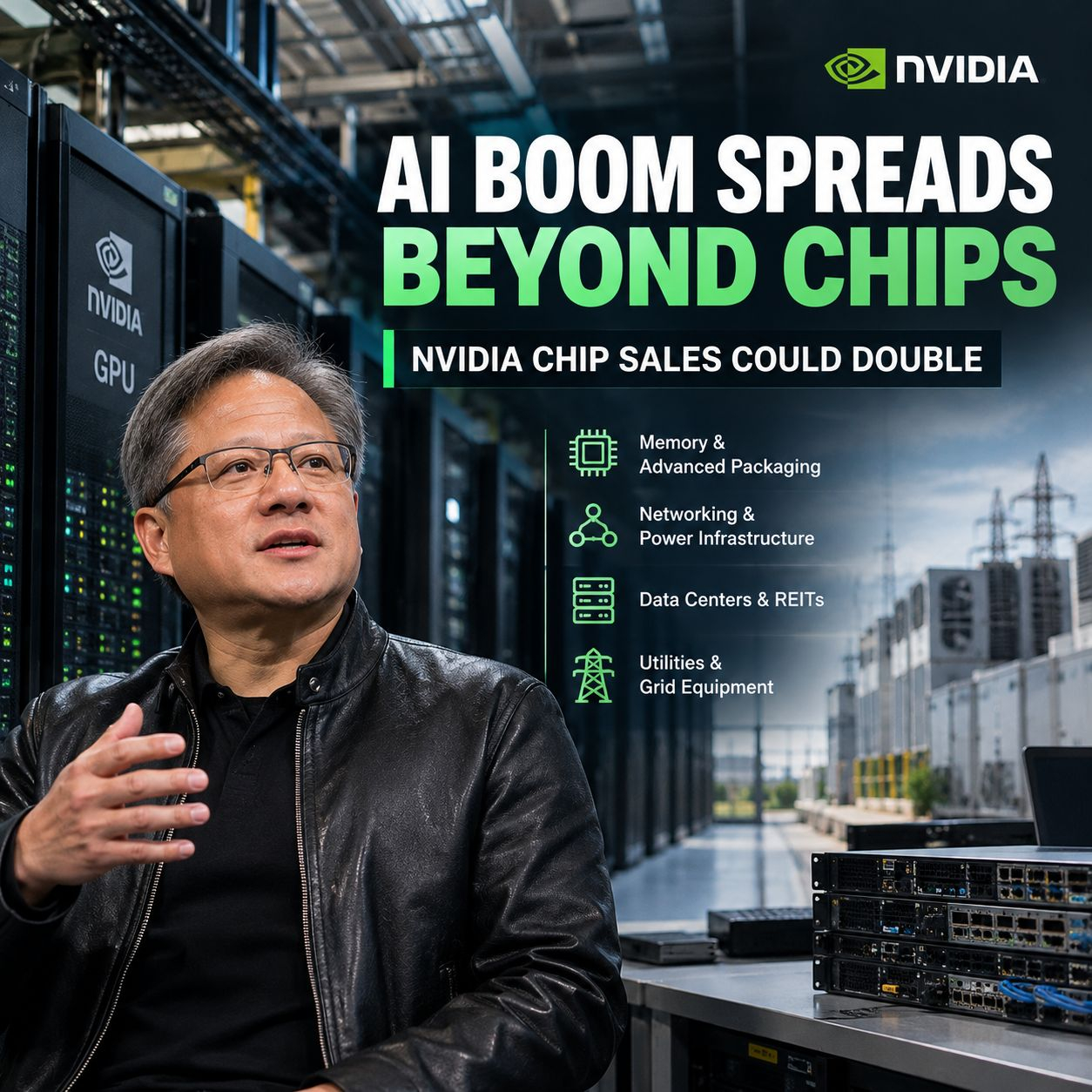
2

·
--
Bullish
🚨#aistockswhatnext — the easy AI trade may be over.
$NVDAB , $AMDB , $AVGO, $MU, $INTC have all benefited from the same massive theme: exploding demand for compute, memory and data-center infrastructure.
Now the question is different:
Can earnings keep up with the valuations?
If hyperscaler capex stays strong and AI revenue keeps accelerating, the breakout can continue.
If spending slows, the most crowded AI names could unwind fast.
The next phase won’t be about “AI hype.” It’ll be about who can actually monetize it. 👀
#CardanoAddedToX402KitForADAPayments #XRPRises8% #AMDHits$1TrillionMarketCap #NvidiaToBuyAnother$1.5BSBEnergySharesPreIPO
🚨#aistockswhatnext — the easy AI trade may be over.
$NVDAB , $AMDB , $AVGO, $MU, $INTC have all benefited from the same massive theme: exploding demand for compute, memory and data-center infrastructure.
Now the question is different:
Can earnings keep up with the valuations?
If hyperscaler capex stays strong and AI revenue keeps accelerating, the breakout can continue.
If spending slows, the most crowded AI names could unwind fast.
The next phase won’t be about “AI hype.” It’ll be about who can actually monetize it. 👀
#CardanoAddedToX402KitForADAPayments #XRPRises8% #AMDHits$1TrillionMarketCap #NvidiaToBuyAnother$1.5BSBEnergySharesPreIPO
$NVDAB , $AMDB , $AVGO, $MU, $INTC have all benefited from the same massive theme: exploding demand for compute, memory and data-center infrastructure.
Now the question is different:
Can earnings keep up with the valuations?
If hyperscaler capex stays strong and AI revenue keeps accelerating, the breakout can continue.
If spending slows, the most crowded AI names could unwind fast.
The next phase won’t be about “AI hype.” It’ll be about who can actually monetize it. 👀
#CardanoAddedToX402KitForADAPayments #XRPRises8% #AMDHits$1TrillionMarketCap #NvidiaToBuyAnother$1.5BSBEnergySharesPreIPO
5

·
--
Bullish
AI stocks are rising again, but the bigger question is whether the growth behind them can keep up with the expectations built into their prices.
Nvidia recently projected roughly 70% revenue growth for its next fiscal year, while CEO Jensen Huang said chip sales could double in 2027. Its latest quarter generated $96.2B in revenue, with data-center revenue more than doubling year over year. That tells us AI demand is not just a story — companies are spending enormous amounts to build the infrastructure behind it.
But there is another side to the trade. The world’s biggest AI companies are also discussing how quickly the technology should develop. Leaders including Dario Amodei, Sam Altman and Elon Musk have backed calls for a more controlled pace because of safety concerns.
At the same time, U.S. policy is pushing in the opposite direction. President Trump announced an “AI Force” and said AI could eventually represent as much as 25% of U.S. GDP.
So I’m watching more than just stock prices. The key signals for me are AI revenue growth, data-center spending, chip demand, energy capacity and whether companies can turn massive AI investment into sustainable profits.
If AI spending keeps producing real earnings, the opportunity may extend beyond the biggest chip names into networking, memory, power, cooling, data centers and software.
For now, I’m staying selective rather than assuming every AI-related stock will benefit equally.
#AIStocksWhatNext
$MUBARAK
{spot}(MUBARAKUSDT)
$RHEA
{alpha}(560x4c067de26475e1cefee8b8d1f6e2266b33a2372e)
$PEPE
{spot}(PEPEUSDT)
AI stocks are rising again, but the bigger question is whether the growth behind them can keep up with the expectations built into their prices.
Nvidia recently projected roughly 70% revenue growth for its next fiscal year, while CEO Jensen Huang said chip sales could double in 2027. Its latest quarter generated $96.2B in revenue, with data-center revenue more than doubling year over year. That tells us AI demand is not just a story — companies are spending enormous amounts to build the infrastructure behind it.
But there is another side to the trade. The world’s biggest AI companies are also discussing how quickly the technology should develop. Leaders including Dario Amodei, Sam Altman and Elon Musk have backed calls for a more controlled pace because of safety concerns.
At the same time, U.S. policy is pushing in the opposite direction. President Trump announced an “AI Force” and said AI could eventually represent as much as 25% of U.S. GDP.
So I’m watching more than just stock prices. The key signals for me are AI revenue growth, data-center spending, chip demand, energy capacity and whether companies can turn massive AI investment into sustainable profits.
If AI spending keeps producing real earnings, the opportunity may extend beyond the biggest chip names into networking, memory, power, cooling, data centers and software.
For now, I’m staying selective rather than assuming every AI-related stock will benefit equally.
#AIStocksWhatNext
$MUBARAK
$RHEA
$PEPE
Nvidia recently projected roughly 70% revenue growth for its next fiscal year, while CEO Jensen Huang said chip sales could double in 2027. Its latest quarter generated $96.2B in revenue, with data-center revenue more than doubling year over year. That tells us AI demand is not just a story — companies are spending enormous amounts to build the infrastructure behind it.
But there is another side to the trade. The world’s biggest AI companies are also discussing how quickly the technology should develop. Leaders including Dario Amodei, Sam Altman and Elon Musk have backed calls for a more controlled pace because of safety concerns.
At the same time, U.S. policy is pushing in the opposite direction. President Trump announced an “AI Force” and said AI could eventually represent as much as 25% of U.S. GDP.
So I’m watching more than just stock prices. The key signals for me are AI revenue growth, data-center spending, chip demand, energy capacity and whether companies can turn massive AI investment into sustainable profits.
If AI spending keeps producing real earnings, the opportunity may extend beyond the biggest chip names into networking, memory, power, cooling, data centers and software.
For now, I’m staying selective rather than assuming every AI-related stock will benefit equally.
#AIStocksWhatNext
$MUBARAK
$RHEA
$PEPE
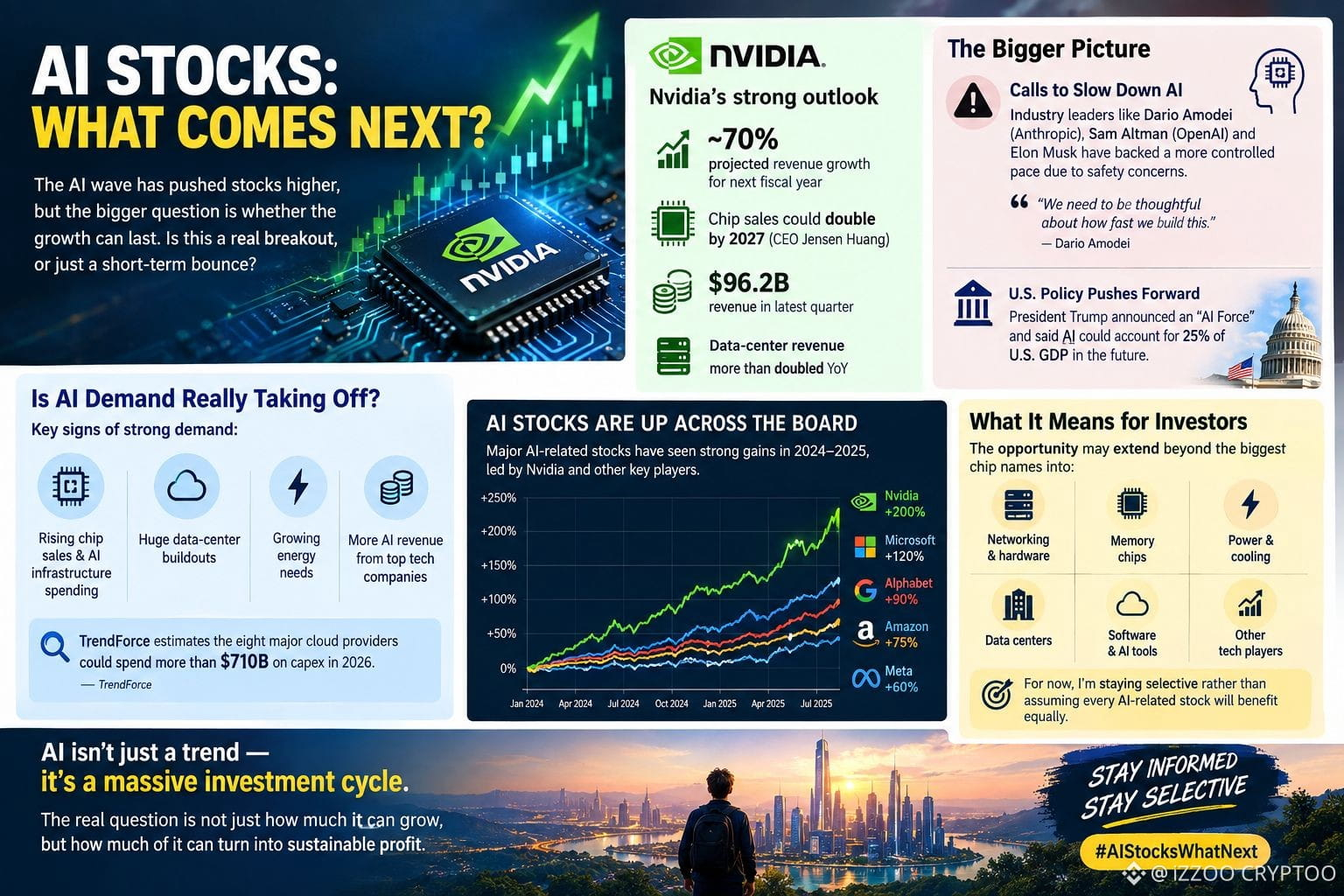
24

·
--
#AIStocksWhatNext
AI stocks have already made a big move and honestly I think the next opportunity could be outside the biggest names.
I’m still bullish on AI but I don’t want to chase a stock just because it has already pumped. The whole AI sector is much bigger than a few well known companies.
I’m watching areas like data centers power infrastructure semiconductors cloud platforms cybersecurity and companies building the tools that AI needs to keep growing.
What interests me most is the businesses working behind the scenes. If AI adoption keeps expanding they could benefit from the same trend without getting all the attention right now.
Of course there is always risk. If expectations become too high even strong companies can face a serious pullback.
For me the key question isn’t whether AI is still growing. It’s which parts of the AI ecosystem can keep growing with it.
That’s where I’m looking next.
#AIStocksWhatNext
AI stocks have already made a big move and honestly I think the next opportunity could be outside the biggest names.
I’m still bullish on AI but I don’t want to chase a stock just because it has already pumped. The whole AI sector is much bigger than a few well known companies.
I’m watching areas like data centers power infrastructure semiconductors cloud platforms cybersecurity and companies building the tools that AI needs to keep growing.
What interests me most is the businesses working behind the scenes. If AI adoption keeps expanding they could benefit from the same trend without getting all the attention right now.
Of course there is always risk. If expectations become too high even strong companies can face a serious pullback.
For me the key question isn’t whether AI is still growing. It’s which parts of the AI ecosystem can keep growing with it.
That’s where I’m looking next.
AI stocks have already made a big move and honestly I think the next opportunity could be outside the biggest names.
I’m still bullish on AI but I don’t want to chase a stock just because it has already pumped. The whole AI sector is much bigger than a few well known companies.
I’m watching areas like data centers power infrastructure semiconductors cloud platforms cybersecurity and companies building the tools that AI needs to keep growing.
What interests me most is the businesses working behind the scenes. If AI adoption keeps expanding they could benefit from the same trend without getting all the attention right now.
Of course there is always risk. If expectations become too high even strong companies can face a serious pullback.
For me the key question isn’t whether AI is still growing. It’s which parts of the AI ecosystem can keep growing with it.
That’s where I’m looking next.
63

·
--
#aistockswhatnext
🤖 AI Stocks Are Only One Piece of the AI Boom
AI stocks have been getting most of the attention lately.
NVIDIA, chipmakers, cloud companies — that’s where much of the conversation is happening.
But I keep coming back to a different question:
What happens to everything around AI if this spending continues to grow?
NVIDIA’s latest results give us an idea of the scale. The company reported $96.2 billion in quarterly revenue, while its Data Center business generated $89 billion, up 117% from a year earlier.
And GPUs don’t operate in isolation.
🔹 Power: AI data centers require enormous amounts of electricity.
🔹 Cooling: More computing means more heat, creating demand for cooling infrastructure.
🔹 Networking: Thousands of chips need to communicate quickly, putting more pressure on high-speed networking.
🔹 Semiconductor equipment: More advanced chips also require the machinery and infrastructure used to manufacture them.
That’s why I think the AI story is bigger than simply watching AI stocks.
There’s an entire ecosystem supporting the buildout — from electricity and cooling to networking and semiconductor manufacturing.
Of course, there’s another side to the story. AI infrastructure spending has been moving at a huge pace, and if companies eventually slow their spending, parts of that ecosystem could feel the impact.
So the question I’m watching is:
Does the AI boom keep spreading through the infrastructure chain, or does spending eventually start to cool?
Which part of the AI ecosystem are you watching?
#AIStocksWhatNext
Not financial advice. Do your own research before making investment decisions.
#aistockswhatnext
🤖 AI Stocks Are Only One Piece of the AI Boom
AI stocks have been getting most of the attention lately.
NVIDIA, chipmakers, cloud companies — that’s where much of the conversation is happening.
But I keep coming back to a different question:
What happens to everything around AI if this spending continues to grow?
NVIDIA’s latest results give us an idea of the scale. The company reported $96.2 billion in quarterly revenue, while its Data Center business generated $89 billion, up 117% from a year earlier.
And GPUs don’t operate in isolation.
🔹 Power: AI data centers require enormous amounts of electricity.
🔹 Cooling: More computing means more heat, creating demand for cooling infrastructure.
🔹 Networking: Thousands of chips need to communicate quickly, putting more pressure on high-speed networking.
🔹 Semiconductor equipment: More advanced chips also require the machinery and infrastructure used to manufacture them.
That’s why I think the AI story is bigger than simply watching AI stocks.
There’s an entire ecosystem supporting the buildout — from electricity and cooling to networking and semiconductor manufacturing.
Of course, there’s another side to the story. AI infrastructure spending has been moving at a huge pace, and if companies eventually slow their spending, parts of that ecosystem could feel the impact.
So the question I’m watching is:
Does the AI boom keep spreading through the infrastructure chain, or does spending eventually start to cool?
Which part of the AI ecosystem are you watching?
#AIStocksWhatNext
Not financial advice. Do your own research before making investment decisions.
🤖 AI Stocks Are Only One Piece of the AI Boom
AI stocks have been getting most of the attention lately.
NVIDIA, chipmakers, cloud companies — that’s where much of the conversation is happening.
But I keep coming back to a different question:
What happens to everything around AI if this spending continues to grow?
NVIDIA’s latest results give us an idea of the scale. The company reported $96.2 billion in quarterly revenue, while its Data Center business generated $89 billion, up 117% from a year earlier.
And GPUs don’t operate in isolation.
🔹 Power: AI data centers require enormous amounts of electricity.
🔹 Cooling: More computing means more heat, creating demand for cooling infrastructure.
🔹 Networking: Thousands of chips need to communicate quickly, putting more pressure on high-speed networking.
🔹 Semiconductor equipment: More advanced chips also require the machinery and infrastructure used to manufacture them.
That’s why I think the AI story is bigger than simply watching AI stocks.
There’s an entire ecosystem supporting the buildout — from electricity and cooling to networking and semiconductor manufacturing.
Of course, there’s another side to the story. AI infrastructure spending has been moving at a huge pace, and if companies eventually slow their spending, parts of that ecosystem could feel the impact.
So the question I’m watching is:
Does the AI boom keep spreading through the infrastructure chain, or does spending eventually start to cool?
Which part of the AI ecosystem are you watching?
#AIStocksWhatNext
Not financial advice. Do your own research before making investment decisions.
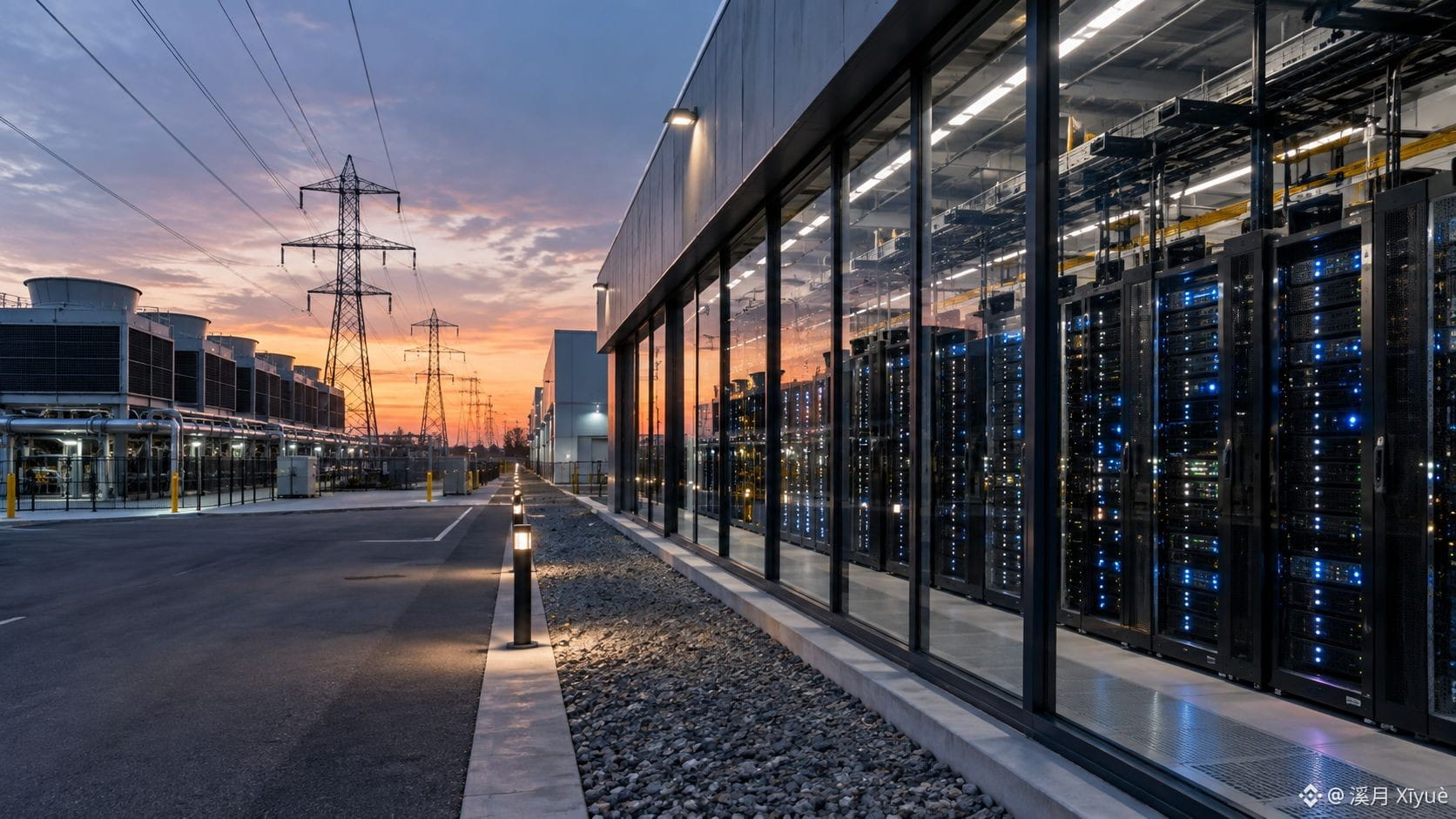
32

🇺🇸 AI Policy & the “AI Force”
The AI debate isn't just happening on trading charts anymore — it's happening in Washington. 🏛️ Industry leaders are openly calling for a slowdown, while there's talk of an "AI Force" and claims AI could eventually make up a quarter of U.S. GDP. Those two positions can't both be right, and the market is betting hard on one of them.
My take: state-level backing probably does extend this cycle — government spending has a way of smoothing out corrections that would otherwise hit hard. But it raises the stakes if sentiment ever turns, because now there's political capital tied to the narrative, not just capital.
Long-term, I want exposure to the compute buildout. 💻 Short-term, I treat anything justified mainly by "the government wants this to work" as a reason for caution, not comfort.
Not sharing a specific trade — still working out where I want in.
#AIStocksWhatNext
🇺🇸 AI Policy & the “AI Force”
The AI debate isn't just happening on trading charts anymore — it's happening in Washington. 🏛️ Industry leaders are openly calling for a slowdown, while there's talk of an "AI Force" and claims AI could eventually make up a quarter of U.S. GDP. Those two positions can't both be right, and the market is betting hard on one of them.
My take: state-level backing probably does extend this cycle — government spending has a way of smoothing out corrections that would otherwise hit hard. But it raises the stakes if sentiment ever turns, because now there's political capital tied to the narrative, not just capital.
Long-term, I want exposure to the compute buildout. 💻 Short-term, I treat anything justified mainly by "the government wants this to work" as a reason for caution, not comfort.
Not sharing a specific trade — still working out where I want in.
#AIStocksWhatNext
The AI debate isn't just happening on trading charts anymore — it's happening in Washington. 🏛️ Industry leaders are openly calling for a slowdown, while there's talk of an "AI Force" and claims AI could eventually make up a quarter of U.S. GDP. Those two positions can't both be right, and the market is betting hard on one of them.
My take: state-level backing probably does extend this cycle — government spending has a way of smoothing out corrections that would otherwise hit hard. But it raises the stakes if sentiment ever turns, because now there's political capital tied to the narrative, not just capital.
Long-term, I want exposure to the compute buildout. 💻 Short-term, I treat anything justified mainly by "the government wants this to work" as a reason for caution, not comfort.
Not sharing a specific trade — still working out where I want in.
#AIStocksWhatNext

3

·
--

Article
AI Is Still Spending Big — But I’m Starting to Watch What Happens After the SpendingThe AI story is still moving fast.
New chips are coming out, data centers are getting bigger, and companies are continuing to put huge amounts of money into computing capacity.
But lately, I’ve been thinking about a slightly different question.
What happens after all that money is spent?
There’s really no question that demand for AI computing is strong right now. NVIDIA’s latest numbers make that pretty clear. The company reported $96.2 billion in revenue for fiscal Q2 2027, while its Data Center business generated $89 billion, up 117% from a year earlier. NVIDIA is also expecting around $108 billion in revenue for the next quarter.
That is a remarkable level of growth.
But strong demand for chips is only one part of the story.
Someone has to pay for those chips.
Someone has to keep those data centers busy.
And eventually, the companies using all that computing power need to make enough money from AI to justify what they’re spending.
That’s the part I find more interesting now.
Take AI infrastructure companies.
Some of them are seeing very fast revenue growth, but the costs involved are enormous. Nscale, for example, reported $140.6 million in revenue during the first half of 2026, while also recording a net loss of roughly $1.02 billion.
I don’t think a large loss automatically means the business is a bad one.
Building AI infrastructure is expensive, and companies are clearly spending ahead of where they are today because they expect demand to keep growing.
Still, numbers like that make me stop and think.
If a company has to spend several dollars today to create one dollar of future revenue, how long can that model keep working?
Maybe the answer is that AI demand becomes so large that the economics improve with scale.
Maybe cheaper inference, better hardware utilization and more enterprise customers eventually change the equation.
Or maybe some of today’s spending will turn out to have been too aggressive.
We simply don’t know yet.
And I think that uncertainty is important.
The same thing is happening with the larger semiconductor companies.
AMD recently crossed the $1 trillion market-capitalization mark as AI-related stocks rallied. The excitement around AI infrastructure is clearly still strong.
But there’s an interesting difference between a company benefiting from a powerful industry trend and a stock being attractively priced.
Those are two separate questions.
A business can have excellent growth and still have a stock price that already assumes a lot of good news.
That’s why I’m paying more attention to earnings and cash flow than I was earlier in the AI cycle.
I want to see whether companies can turn all this demand into something that lasts.
Not just another quarter of strong orders.
Not just another big data-center announcement.
I mean actual customers, recurring revenue, improving margins and eventually stronger free cash flow.
There’s another side to this as well.
The amount of capital going into AI is becoming so large that financing itself is becoming part of the story. Reuters recently reported on major financing deals supporting AI infrastructure projects, including a $22 billion loan connected to Crux, a cloud venture involving Blackstone and Alphabet.
That doesn’t necessarily concern me by itself.
Large infrastructure projects have always required financing.
But when an industry starts needing enormous amounts of outside capital, I think it becomes even more important to understand the returns those investments are expected to produce.
That’s really where I am with AI right now.
I’m not questioning whether the technology has demand.
It obviously does.
I’m more curious about how much of today’s spending will eventually turn into durable profits.
Because if AI genuinely helps companies cut costs, create new products and increase productivity, then this investment cycle could continue for a long time.
But if infrastructure keeps expanding much faster than profitable AI applications, investors may eventually become more selective.
And that could change the market quite a bit.
My view
I’m still positive about the long-term growth of AI.
But I’m less interested in simply finding the next stock connected to the AI theme.
I’d rather understand the business behind it.
Who is paying?
How much are they paying?
How expensive is it to serve them?
And after all those costs, how much money is actually left?
Those questions aren’t as exciting as another record revenue headline.
But I think they may become much more important as the AI industry gets bigger.
For me, the next chapter of the AI story is going to be about economics, not excitement.
🟢 Bullish — AI adoption continues to spread and demand for computing keeps expanding
🔴 Bearish — Spending gets ahead of the revenue and profits needed to support it
⚖️ My view — Positive on AI adoption, but selective about the companies and valuations attached to it
The technology is moving quickly.
Now I’m watching to see whether the money can keep up with it.
#AIStocksWhatNext
$NVDAB
{spot}(NVDABUSDT)
$龙虾
{alpha}(560xeccbb861c0dda7efd964010085488b69317e4444)
$AKE
{future}(AKEUSDT)
AI Is Still Spending Big — But I’m Starting to Watch What Happens After the Spending
The AI story is still moving fast.
New chips are coming out, data centers are getting bigger, and companies are continuing to put huge amounts of money into computing capacity.
But lately, I’ve been thinking about a slightly different question.
What happens after all that money is spent?
There’s really no question that demand for AI computing is strong right now. NVIDIA’s latest numbers make that pretty clear. The company reported $96.2 billion in revenue for fiscal Q2 2027, while its Data Center business generated $89 billion, up 117% from a year earlier. NVIDIA is also expecting around $108 billion in revenue for the next quarter.
That is a remarkable level of growth.
But strong demand for chips is only one part of the story.
Someone has to pay for those chips.
Someone has to keep those data centers busy.
And eventually, the companies using all that computing power need to make enough money from AI to justify what they’re spending.
That’s the part I find more interesting now.
Take AI infrastructure companies.
Some of them are seeing very fast revenue growth, but the costs involved are enormous. Nscale, for example, reported $140.6 million in revenue during the first half of 2026, while also recording a net loss of roughly $1.02 billion.
I don’t think a large loss automatically means the business is a bad one.
Building AI infrastructure is expensive, and companies are clearly spending ahead of where they are today because they expect demand to keep growing.
Still, numbers like that make me stop and think.
If a company has to spend several dollars today to create one dollar of future revenue, how long can that model keep working?
Maybe the answer is that AI demand becomes so large that the economics improve with scale.
Maybe cheaper inference, better hardware utilization and more enterprise customers eventually change the equation.
Or maybe some of today’s spending will turn out to have been too aggressive.
We simply don’t know yet.
And I think that uncertainty is important.
The same thing is happening with the larger semiconductor companies.
AMD recently crossed the $1 trillion market-capitalization mark as AI-related stocks rallied. The excitement around AI infrastructure is clearly still strong.
But there’s an interesting difference between a company benefiting from a powerful industry trend and a stock being attractively priced.
Those are two separate questions.
A business can have excellent growth and still have a stock price that already assumes a lot of good news.
That’s why I’m paying more attention to earnings and cash flow than I was earlier in the AI cycle.
I want to see whether companies can turn all this demand into something that lasts.
Not just another quarter of strong orders.
Not just another big data-center announcement.
I mean actual customers, recurring revenue, improving margins and eventually stronger free cash flow.
There’s another side to this as well.
The amount of capital going into AI is becoming so large that financing itself is becoming part of the story. Reuters recently reported on major financing deals supporting AI infrastructure projects, including a $22 billion loan connected to Crux, a cloud venture involving Blackstone and Alphabet.
That doesn’t necessarily concern me by itself.
Large infrastructure projects have always required financing.
But when an industry starts needing enormous amounts of outside capital, I think it becomes even more important to understand the returns those investments are expected to produce.
That’s really where I am with AI right now.
I’m not questioning whether the technology has demand.
It obviously does.
I’m more curious about how much of today’s spending will eventually turn into durable profits.
Because if AI genuinely helps companies cut costs, create new products and increase productivity, then this investment cycle could continue for a long time.
But if infrastructure keeps expanding much faster than profitable AI applications, investors may eventually become more selective.
And that could change the market quite a bit.
My view
I’m still positive about the long-term growth of AI.
But I’m less interested in simply finding the next stock connected to the AI theme.
I’d rather understand the business behind it.
Who is paying?
How much are they paying?
How expensive is it to serve them?
And after all those costs, how much money is actually left?
Those questions aren’t as exciting as another record revenue headline.
But I think they may become much more important as the AI industry gets bigger.
For me, the next chapter of the AI story is going to be about economics, not excitement.
🟢 Bullish — AI adoption continues to spread and demand for computing keeps expanding
🔴 Bearish — Spending gets ahead of the revenue and profits needed to support it
⚖️ My view — Positive on AI adoption, but selective about the companies and valuations attached to it
The technology is moving quickly.
Now I’m watching to see whether the money can keep up with it.
#AIStocksWhatNext
$NVDAB
$龙虾
$AKE
New chips are coming out, data centers are getting bigger, and companies are continuing to put huge amounts of money into computing capacity.
But lately, I’ve been thinking about a slightly different question.
What happens after all that money is spent?
There’s really no question that demand for AI computing is strong right now. NVIDIA’s latest numbers make that pretty clear. The company reported $96.2 billion in revenue for fiscal Q2 2027, while its Data Center business generated $89 billion, up 117% from a year earlier. NVIDIA is also expecting around $108 billion in revenue for the next quarter.
That is a remarkable level of growth.
But strong demand for chips is only one part of the story.
Someone has to pay for those chips.
Someone has to keep those data centers busy.
And eventually, the companies using all that computing power need to make enough money from AI to justify what they’re spending.
That’s the part I find more interesting now.
Take AI infrastructure companies.
Some of them are seeing very fast revenue growth, but the costs involved are enormous. Nscale, for example, reported $140.6 million in revenue during the first half of 2026, while also recording a net loss of roughly $1.02 billion.
I don’t think a large loss automatically means the business is a bad one.
Building AI infrastructure is expensive, and companies are clearly spending ahead of where they are today because they expect demand to keep growing.
Still, numbers like that make me stop and think.
If a company has to spend several dollars today to create one dollar of future revenue, how long can that model keep working?
Maybe the answer is that AI demand becomes so large that the economics improve with scale.
Maybe cheaper inference, better hardware utilization and more enterprise customers eventually change the equation.
Or maybe some of today’s spending will turn out to have been too aggressive.
We simply don’t know yet.
And I think that uncertainty is important.
The same thing is happening with the larger semiconductor companies.
AMD recently crossed the $1 trillion market-capitalization mark as AI-related stocks rallied. The excitement around AI infrastructure is clearly still strong.
But there’s an interesting difference between a company benefiting from a powerful industry trend and a stock being attractively priced.
Those are two separate questions.
A business can have excellent growth and still have a stock price that already assumes a lot of good news.
That’s why I’m paying more attention to earnings and cash flow than I was earlier in the AI cycle.
I want to see whether companies can turn all this demand into something that lasts.
Not just another quarter of strong orders.
Not just another big data-center announcement.
I mean actual customers, recurring revenue, improving margins and eventually stronger free cash flow.
There’s another side to this as well.
The amount of capital going into AI is becoming so large that financing itself is becoming part of the story. Reuters recently reported on major financing deals supporting AI infrastructure projects, including a $22 billion loan connected to Crux, a cloud venture involving Blackstone and Alphabet.
That doesn’t necessarily concern me by itself.
Large infrastructure projects have always required financing.
But when an industry starts needing enormous amounts of outside capital, I think it becomes even more important to understand the returns those investments are expected to produce.
That’s really where I am with AI right now.
I’m not questioning whether the technology has demand.
It obviously does.
I’m more curious about how much of today’s spending will eventually turn into durable profits.
Because if AI genuinely helps companies cut costs, create new products and increase productivity, then this investment cycle could continue for a long time.
But if infrastructure keeps expanding much faster than profitable AI applications, investors may eventually become more selective.
And that could change the market quite a bit.
My view
I’m still positive about the long-term growth of AI.
But I’m less interested in simply finding the next stock connected to the AI theme.
I’d rather understand the business behind it.
Who is paying?
How much are they paying?
How expensive is it to serve them?
And after all those costs, how much money is actually left?
Those questions aren’t as exciting as another record revenue headline.
But I think they may become much more important as the AI industry gets bigger.
For me, the next chapter of the AI story is going to be about economics, not excitement.
🟢 Bullish — AI adoption continues to spread and demand for computing keeps expanding
🔴 Bearish — Spending gets ahead of the revenue and profits needed to support it
⚖️ My view — Positive on AI adoption, but selective about the companies and valuations attached to it
The technology is moving quickly.
Now I’m watching to see whether the money can keep up with it.
#AIStocksWhatNext
$NVDAB
$龙虾
$AKE
45

·
--
📈 Nvidia & the AI Compute Boom
Nvidia's guidance for chip sales to double next year is the number that matters here — not the daily green candles. 🚀 If that demand signal is real, and enterprise capex trends back it up, the AI trade isn't done. But "the trend is real" and "everything trading at these multiples deserves it" are two different claims, and right now the market is pricing both the same way.
I'm long-term bullish on the compute buildout itself — 🏗️ data centers, ⚡ power infrastructure, high-bandwidth memory, networking. That's the picks-and-shovels layer, and it doesn't need every AI startup to succeed to keep growing. Short-term, I'm more careful: when a rally goes from "select names with real earnings" to "anything with AI in the name," that's usually late-cycle behavior, not early.
📊 Real breakout in the underlying trend, overextended in a chunk of the names riding on it. Not trading this actively right now — watching for a better entry.
#AIStocksWhatNext
📈 Nvidia & the AI Compute Boom
Nvidia's guidance for chip sales to double next year is the number that matters here — not the daily green candles. 🚀 If that demand signal is real, and enterprise capex trends back it up, the AI trade isn't done. But "the trend is real" and "everything trading at these multiples deserves it" are two different claims, and right now the market is pricing both the same way.
I'm long-term bullish on the compute buildout itself — 🏗️ data centers, ⚡ power infrastructure, high-bandwidth memory, networking. That's the picks-and-shovels layer, and it doesn't need every AI startup to succeed to keep growing. Short-term, I'm more careful: when a rally goes from "select names with real earnings" to "anything with AI in the name," that's usually late-cycle behavior, not early.
📊 Real breakout in the underlying trend, overextended in a chunk of the names riding on it. Not trading this actively right now — watching for a better entry.
#AIStocksWhatNext
Nvidia's guidance for chip sales to double next year is the number that matters here — not the daily green candles. 🚀 If that demand signal is real, and enterprise capex trends back it up, the AI trade isn't done. But "the trend is real" and "everything trading at these multiples deserves it" are two different claims, and right now the market is pricing both the same way.
I'm long-term bullish on the compute buildout itself — 🏗️ data centers, ⚡ power infrastructure, high-bandwidth memory, networking. That's the picks-and-shovels layer, and it doesn't need every AI startup to succeed to keep growing. Short-term, I'm more careful: when a rally goes from "select names with real earnings" to "anything with AI in the name," that's usually late-cycle behavior, not early.
📊 Real breakout in the underlying trend, overextended in a chunk of the names riding on it. Not trading this actively right now — watching for a better entry.
#AIStocksWhatNext
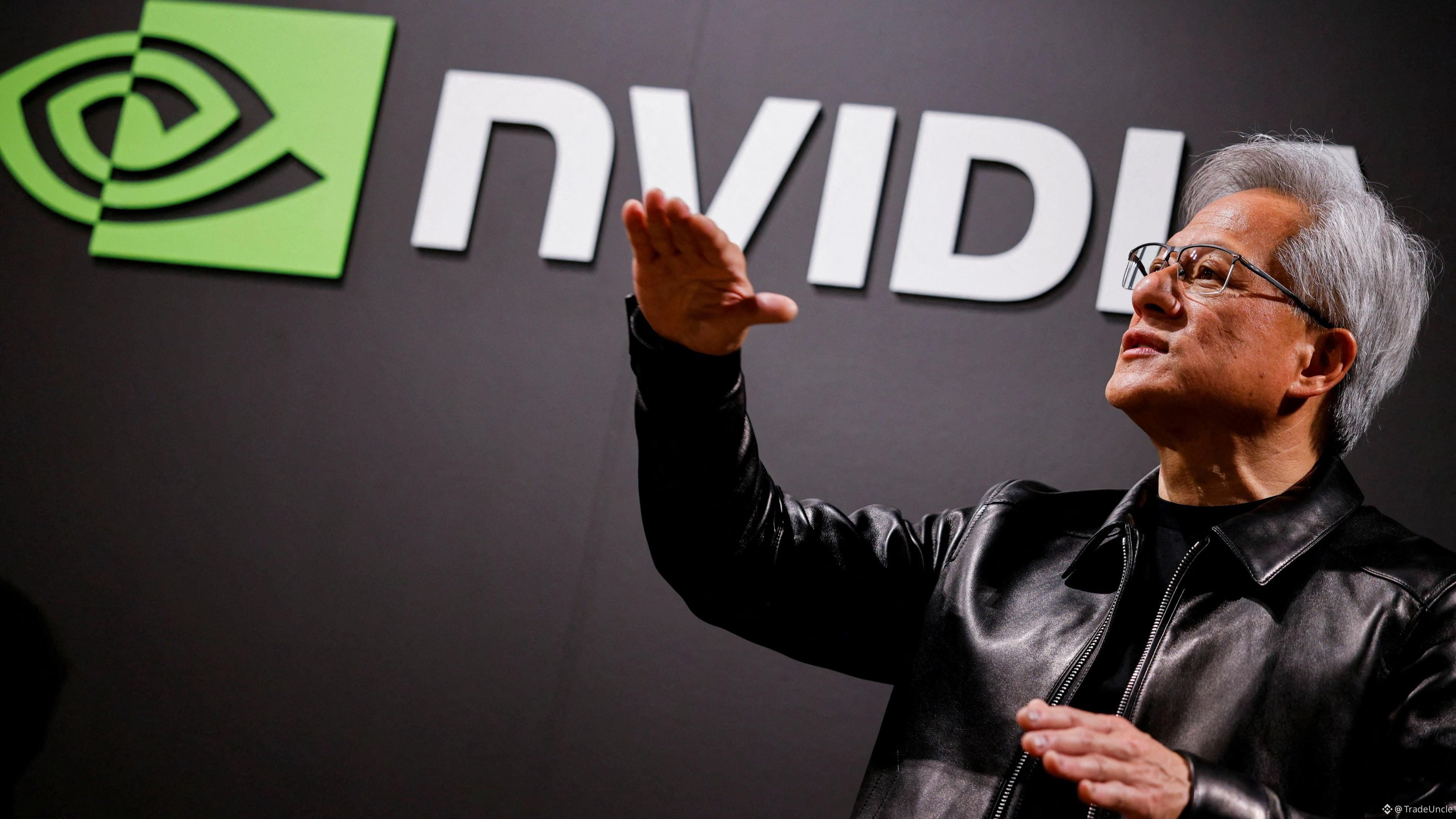
2

🤖 AI Stocks: What’s Next?
Everyone's staring at the same headlines right now — record AI revenue, guidance for chip demand to double, compute spend that keeps climbing. And yeah, the trend is real. 🚀 Enterprise AI adoption isn't slowing down, and the infrastructure build-out behind it (power, data centers, high-bandwidth memory) is still early.
But "real trend" and "good entry point" aren't the same thing. ⚠️ A lot of AI-exposed names have already priced in a lot of good news, and when everything from mega-cap tech to random small-caps rallies on the same theme, that's usually a sign to get pickier, not more aggressive.
Where I'm actually paying attention: 👀 the less obvious layers of the stack — power/grid capacity, cooling and thermal management, memory and networking hardware, and the enterprise software that turns raw compute into actual productivity gains. Those don't move as loudly as the headline names, but they're just as exposed to the same demand story, often at less stretched valuations.
Add the policy angle too — "AI Force" talk and 25%-of-GDP claims out of Washington cut both ways. 🇺🇸 State backing can extend a cycle, but it also means more scrutiny and more binary risk if sentiment turns.
Long-term, I think this is real. 📈 Short-term, I'm not chasing it — waiting for better entries rather than posting a trade I don't actually have on right now.
Curious where everyone else is looking beyond the obvious names. 👇 Follow along, I'll keep sharing as I build this out.
#AIStocksWhatNext
🤖 AI Stocks: What’s Next?
Everyone's staring at the same headlines right now — record AI revenue, guidance for chip demand to double, compute spend that keeps climbing. And yeah, the trend is real. 🚀 Enterprise AI adoption isn't slowing down, and the infrastructure build-out behind it (power, data centers, high-bandwidth memory) is still early.
But "real trend" and "good entry point" aren't the same thing. ⚠️ A lot of AI-exposed names have already priced in a lot of good news, and when everything from mega-cap tech to random small-caps rallies on the same theme, that's usually a sign to get pickier, not more aggressive.
Where I'm actually paying attention: 👀 the less obvious layers of the stack — power/grid capacity, cooling and thermal management, memory and networking hardware, and the enterprise software that turns raw compute into actual productivity gains. Those don't move as loudly as the headline names, but they're just as exposed to the same demand story, often at less stretched valuations.
Add the policy angle too — "AI Force" talk and 25%-of-GDP claims out of Washington cut both ways. 🇺🇸 State backing can extend a cycle, but it also means more scrutiny and more binary risk if sentiment turns.
Long-term, I think this is real. 📈 Short-term, I'm not chasing it — waiting for better entries rather than posting a trade I don't actually have on right now.
Curious where everyone else is looking beyond the obvious names. 👇 Follow along, I'll keep sharing as I build this out.
#AIStocksWhatNext
Everyone's staring at the same headlines right now — record AI revenue, guidance for chip demand to double, compute spend that keeps climbing. And yeah, the trend is real. 🚀 Enterprise AI adoption isn't slowing down, and the infrastructure build-out behind it (power, data centers, high-bandwidth memory) is still early.
But "real trend" and "good entry point" aren't the same thing. ⚠️ A lot of AI-exposed names have already priced in a lot of good news, and when everything from mega-cap tech to random small-caps rallies on the same theme, that's usually a sign to get pickier, not more aggressive.
Where I'm actually paying attention: 👀 the less obvious layers of the stack — power/grid capacity, cooling and thermal management, memory and networking hardware, and the enterprise software that turns raw compute into actual productivity gains. Those don't move as loudly as the headline names, but they're just as exposed to the same demand story, often at less stretched valuations.
Add the policy angle too — "AI Force" talk and 25%-of-GDP claims out of Washington cut both ways. 🇺🇸 State backing can extend a cycle, but it also means more scrutiny and more binary risk if sentiment turns.
Long-term, I think this is real. 📈 Short-term, I'm not chasing it — waiting for better entries rather than posting a trade I don't actually have on right now.
Curious where everyone else is looking beyond the obvious names. 👇 Follow along, I'll keep sharing as I build this out.
#AIStocksWhatNext

2
10
Log in to explore more content
Join global crypto users on Binance Square
⚡️ Get latest and useful information about crypto.
💬 Trusted by the world’s largest crypto exchange.
👍 Discover real insights from verified creators.
Email / Phone number
Trending Topics
1
#AIStocksWhatNext
7,389 views
23 Discussing
2
#CardanoAddedToX402KitForADAPayments
3,038 views
168 Discussing
3
#XRPRises8%
11,407 views
500 Discussing
4
#AMDHits$1TrillionMarketCap
311 views
24 Discussing
5
#BitcoinSpotETFs$999MNetInflow
827 views
39 Discussing
6
#AppleGoogleSeekStablecoinTokenizedDepositTalent
7,179 views
368 Discussing
7
#NvidiaToBuyAnother$1.5BSBEnergySharesPreIPO
1,371 views
33 Discussing
8
#AgoraGetsPreliminaryOCCApprovalForTrustBank
4,422 views
186 Discussing
9
#NEARRisesNearly80%InAWeek
76,468 views
1,338 Discussing
10
#MultiversXPlansHardForkRecovery
60,167 views
1,014 Discussing