What the European central banking system is targeting this time is not just “direct interest payments”—it also wants to block indirect earnings such as those generated through lending and collateralization.
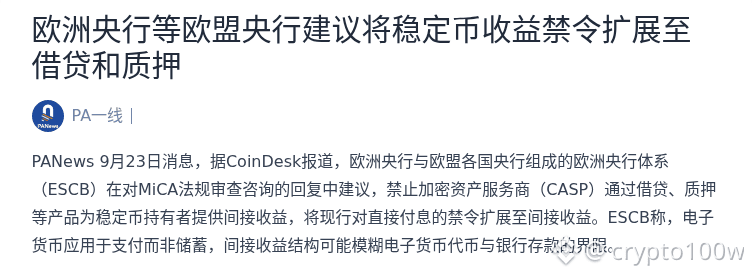
PANews, citing a CoinDesk report, says that the European Central Bank and the national central banks of EU member states—together forming the European System of Central Banks (ESCB)—in their responses to consultations on the MiCA regulatory framework, recommended that it be prohibited for crypto-asset service providers (CASPs) to provide holders of stablecoins with indirect gains via products like lending or staking/pledging. The existing ban on direct interest payments may be expanded to cover indirect earnings as well.
The rationale is also very straightforward: e-money should mainly be used for payments rather than as a way to save; if the interest-earning structure continues to exist, the boundary between e-money tokens and bank deposits would be further blurred. If this recommendation is written into the amendments, the “interest-bearing” narrative for stablecoins and the related selling points of EU CASP platforms will come under pressure first. Are you more concerned about how this affects USDC and USDT, or about its impact on payment-focused stablecoins that comply with EU rules?
Source: PANews
Image 1: The European central banking system plans to plug stablecoin indirect earnings · Source-page partial screenshot
Image source: https://www.panewslab.com/zh/articles/01a0cbe6-0640-748e-b5a0-23ad08e7400e
PANews, citing a CoinDesk report, says that the European Central Bank and the national central banks of EU member states—together forming the European System of Central Banks (ESCB)—in their responses to consultations on the MiCA regulatory framework, recommended that it be prohibited for crypto-asset service providers (CASPs) to provide holders of stablecoins with indirect gains via products like lending or staking/pledging. The existing ban on direct interest payments may be expanded to cover indirect earnings as well.
The rationale is also very straightforward: e-money should mainly be used for payments rather than as a way to save; if the interest-earning structure continues to exist, the boundary between e-money tokens and bank deposits would be further blurred. If this recommendation is written into the amendments, the “interest-bearing” narrative for stablecoins and the related selling points of EU CASP platforms will come under pressure first. Are you more concerned about how this affects USDC and USDT, or about its impact on payment-focused stablecoins that comply with EU rules?
Source: PANews
Image 1: The European central banking system plans to plug stablecoin indirect earnings · Source-page partial screenshot
Image source: https://www.panewslab.com/zh/articles/01a0cbe6-0640-748e-b5a0-23ad08e7400e