This ETH price prediction market on Kalshi has recently come under scrutiny.
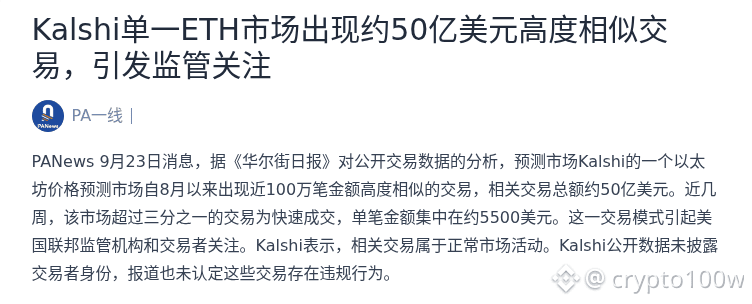
According to an analysis of publicly traded data by The Wall Street Journal, since August this market has seen nearly 1 million transactions with highly similar amounts, totaling about $5 billion; in recent weeks, more than one-third of the transactions have been settled quickly, with each transaction amount often clustered around roughly $5,500. As a result, U.S. federal regulators and traders have begun paying attention. Kalshi’s response is that these transactions are normal market activity, and that since identities of the traders were not disclosed in public data, the report did not find that wrongdoing occurred.
Market interpretation points to two layers: first, whether Kalshi and the transparency of trading in prediction markets will continue to be scrutinized; second, the impact on ETH itself is currently somewhat neutral, with more focus on the quality of trading volume and the market-making mechanisms on regulated exchanges. If regulators get further involved later on, the growth narrative for prediction markets and crypto perpetual products will face pressure. Are you more concerned about trading transparency, or more worried about regulatory spillover?
Figure 1: Unusual trading in the Kalshi ETH market draws regulatory attention · Partial screenshot of the source page
Image source: https://www.panewslab.com/zh/articles/01a0cbe1-9999-7597-9ed4-3264097faef0
According to an analysis of publicly traded data by The Wall Street Journal, since August this market has seen nearly 1 million transactions with highly similar amounts, totaling about $5 billion; in recent weeks, more than one-third of the transactions have been settled quickly, with each transaction amount often clustered around roughly $5,500. As a result, U.S. federal regulators and traders have begun paying attention. Kalshi’s response is that these transactions are normal market activity, and that since identities of the traders were not disclosed in public data, the report did not find that wrongdoing occurred.
Market interpretation points to two layers: first, whether Kalshi and the transparency of trading in prediction markets will continue to be scrutinized; second, the impact on ETH itself is currently somewhat neutral, with more focus on the quality of trading volume and the market-making mechanisms on regulated exchanges. If regulators get further involved later on, the growth narrative for prediction markets and crypto perpetual products will face pressure. Are you more concerned about trading transparency, or more worried about regulatory spillover?
Figure 1: Unusual trading in the Kalshi ETH market draws regulatory attention · Partial screenshot of the source page
Image source: https://www.panewslab.com/zh/articles/01a0cbe1-9999-7597-9ed4-3264097faef0