

ivanlabrie
30 Posts
ivanlabrie
Report
Block User
Time@Mode trend trader. Called Bitcoin cycle tops and bottoms in real time since 2015, public and timestamped. Crypto, stocks, macro: the levels and the why.
56 Following
6 Followers
1 Liked
Posts
PINNED
·
--
Bullish
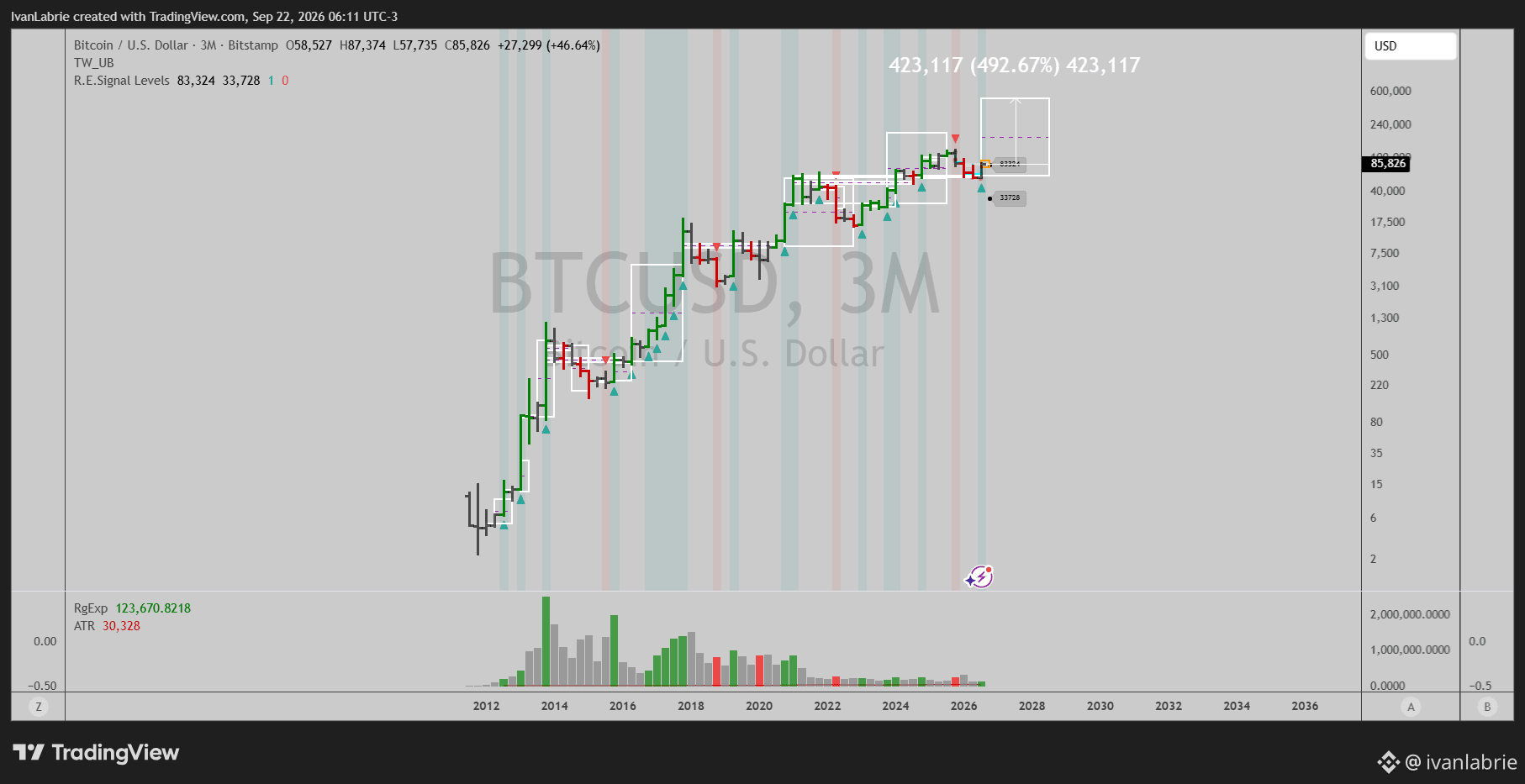
Bitcoin fired a quarterly trend signal this week when price traded through 83,324 on the three month Bitstamp bar. It was at 85,826 this morning, up 46.64% on the quarter.
The uptrend is active while above 56,500. The projection runs to 509,000 into October 2028.
I trust the date in that projection more than the number, and my public record is why. In February 2024 I published that the advance would run to roughly Q3 2025 and that returns would get worse after that. That is when it topped. In November 2023 I published that total crypto market cap would expand from 1.32 trillion to between 4.8 and 19.55 trillion. It peaked near 4.08 trillion, below even the low end of my own band.
So my timing held up and my price target came in low, and that has been the pattern for several cycles. I read 509,000 as the top of a range and let 56,500 do the risk work.
$BTC
{future}(BTCUSDT)
#Bitcoin #TrendFollowing #Quarterly #Macro
Bitcoin fired a quarterly trend signal this week when price traded through 83,324 on the three month Bitstamp bar. It was at 85,826 this morning, up 46.64% on the quarter.
The uptrend is active while above 56,500. The projection runs to 509,000 into October 2028.
I trust the date in that projection more than the number, and my public record is why. In February 2024 I published that the advance would run to roughly Q3 2025 and that returns would get worse after that. That is when it topped. In November 2023 I published that total crypto market cap would expand from 1.32 trillion to between 4.8 and 19.55 trillion. It peaked near 4.08 trillion, below even the low end of my own band.
So my timing held up and my price target came in low, and that has been the pattern for several cycles. I read 509,000 as the top of a range and let 56,500 do the risk work.
$BTC
#Bitcoin #TrendFollowing #Quarterly #Macro
The uptrend is active while above 56,500. The projection runs to 509,000 into October 2028.
I trust the date in that projection more than the number, and my public record is why. In February 2024 I published that the advance would run to roughly Q3 2025 and that returns would get worse after that. That is when it topped. In November 2023 I published that total crypto market cap would expand from 1.32 trillion to between 4.8 and 19.55 trillion. It peaked near 4.08 trillion, below even the low end of my own band.
So my timing held up and my price target came in low, and that has been the pattern for several cycles. I read 509,000 as the top of a range and let 56,500 do the risk work.
$BTC
#Bitcoin #TrendFollowing #Quarterly #Macro
172
·
--
I counted every Solana meme that graduated in January. One went 100xI got asked a simple question this week: if a Solana meme has already made it to around $700k market cap, what are the odds it goes 100x from there? Everyone in memes has a story about the one that did, but I couldn't find anyone with the base rate, so I went and counted.
The sample
I took every token that graduated from Pump.fun in January 2026, 14,496 of them. Graduating means it filled the bonding curve (around $69k market cap) and moved to a real pool, which only about 1 in 100 launches managed back then. I pulled them from on-chain data rather than a listing site, so the dead ones are in there too, and that matters a lot here. January was a hot month, about 468 graduates a day.
How many are still around
Three weeks after launch, 85 of the 14,496 were above $100k and 12 were above $1M. Eight months later it's 26 above $100k and 7 above $1M. Only 14 still trade more than $10k a day, and just 413 (2.8%) have a trading pair listed anywhere at all. So about 99.8% of tokens that already beat the graduation odds are worth less than $100k today.
The ones that reached $700k
171 of the January graduates touched $700k at some point, about 1.2%. This is how many went on to each multiple at their peak:
2x: 97
5x: 34
10x: 10
20x: 7
50x: 2
100x: 1
Starting the count at $1M or $1.3M barely changes it, the hit rate stays roughly flat across that band, so the hard part is getting to $700k in the first place.
Why the real odds are a bit worse
My price history only kept full records for tokens that still had some liquidity three weeks in, so the fastest rugs fell out of the count. Holder counts stay put after a token dies, which let me estimate the missing ones: roughly 25 to 45 more tokens touched $700k and then died, all of them failures. That puts the real count near 195 to 215, and the 100x rate at about 1 in 200 (0.5%).
Big caveat though, that's one token out of about 200. With a single success the honest range runs from about 0.01% to 3%, so I'd read it as an order of magnitude and nothing more precise. 10x is on firmer ground at about 1 in 20. Counted per launch instead, it's roughly 1 in 1.3 million, which in a hot month works out to about one 100x across the whole platform.
The one that did it
The single 100x was PENGUIN. It passed $700k on 23 January, peaked near $136M two days later, and it's around $0.77M today, so it went 100x and then gave back about 99% of it. The next best were Buttcoin, which peaked at $44M and sits around $15M now, and PsyopAnime, which peaked at $24M.
What I take from it
The tail is real, but it plays out in days and doesn't wait for anyone. Anyone who caught PENGUIN and held out for a round number gave nearly all of it back. In my own backtests on memes the exit rule decided the results far more than the entry did, and this looks like the same lesson at the extreme.
January's graduation rate was also about 4x June's, per the published figures. In a slower market the odds per token might hold up, but there are fewer tickets being drawn each month. The memes that make it to a big exchange listing, like $PNUT, $GOAT or $MOODENG, are the survivors of a pile like this one.
#Solana #Memecoins #PumpFun #Crypto
I counted every Solana meme that graduated in January. One went 100x
I got asked a simple question this week: if a Solana meme has already made it to around $700k market cap, what are the odds it goes 100x from there? Everyone in memes has a story about the one that did, but I couldn't find anyone with the base rate, so I went and counted.
The sample
I took every token that graduated from Pump.fun in January 2026, 14,496 of them. Graduating means it filled the bonding curve (around $69k market cap) and moved to a real pool, which only about 1 in 100 launches managed back then. I pulled them from on-chain data rather than a listing site, so the dead ones are in there too, and that matters a lot here. January was a hot month, about 468 graduates a day.
How many are still around
Three weeks after launch, 85 of the 14,496 were above $100k and 12 were above $1M. Eight months later it's 26 above $100k and 7 above $1M. Only 14 still trade more than $10k a day, and just 413 (2.8%) have a trading pair listed anywhere at all. So about 99.8% of tokens that already beat the graduation odds are worth less than $100k today.
The ones that reached $700k
171 of the January graduates touched $700k at some point, about 1.2%. This is how many went on to each multiple at their peak:
2x: 97
5x: 34
10x: 10
20x: 7
50x: 2
100x: 1
Starting the count at $1M or $1.3M barely changes it, the hit rate stays roughly flat across that band, so the hard part is getting to $700k in the first place.
Why the real odds are a bit worse
My price history only kept full records for tokens that still had some liquidity three weeks in, so the fastest rugs fell out of the count. Holder counts stay put after a token dies, which let me estimate the missing ones: roughly 25 to 45 more tokens touched $700k and then died, all of them failures. That puts the real count near 195 to 215, and the 100x rate at about 1 in 200 (0.5%).
Big caveat though, that's one token out of about 200. With a single success the honest range runs from about 0.01% to 3%, so I'd read it as an order of magnitude and nothing more precise. 10x is on firmer ground at about 1 in 20. Counted per launch instead, it's roughly 1 in 1.3 million, which in a hot month works out to about one 100x across the whole platform.
The one that did it
The single 100x was PENGUIN. It passed $700k on 23 January, peaked near $136M two days later, and it's around $0.77M today, so it went 100x and then gave back about 99% of it. The next best were Buttcoin, which peaked at $44M and sits around $15M now, and PsyopAnime, which peaked at $24M.
What I take from it
The tail is real, but it plays out in days and doesn't wait for anyone. Anyone who caught PENGUIN and held out for a round number gave nearly all of it back. In my own backtests on memes the exit rule decided the results far more than the entry did, and this looks like the same lesson at the extreme.
January's graduation rate was also about 4x June's, per the published figures. In a slower market the odds per token might hold up, but there are fewer tickets being drawn each month. The memes that make it to a big exchange listing, like $PNUT , $GOAT or $MOODENG , are the survivors of a pile like this one.
#Solana #Memecoins #PumpFun #Crypto
The sample
I took every token that graduated from Pump.fun in January 2026, 14,496 of them. Graduating means it filled the bonding curve (around $69k market cap) and moved to a real pool, which only about 1 in 100 launches managed back then. I pulled them from on-chain data rather than a listing site, so the dead ones are in there too, and that matters a lot here. January was a hot month, about 468 graduates a day.
How many are still around
Three weeks after launch, 85 of the 14,496 were above $100k and 12 were above $1M. Eight months later it's 26 above $100k and 7 above $1M. Only 14 still trade more than $10k a day, and just 413 (2.8%) have a trading pair listed anywhere at all. So about 99.8% of tokens that already beat the graduation odds are worth less than $100k today.
The ones that reached $700k
171 of the January graduates touched $700k at some point, about 1.2%. This is how many went on to each multiple at their peak:
2x: 97
5x: 34
10x: 10
20x: 7
50x: 2
100x: 1
Starting the count at $1M or $1.3M barely changes it, the hit rate stays roughly flat across that band, so the hard part is getting to $700k in the first place.
Why the real odds are a bit worse
My price history only kept full records for tokens that still had some liquidity three weeks in, so the fastest rugs fell out of the count. Holder counts stay put after a token dies, which let me estimate the missing ones: roughly 25 to 45 more tokens touched $700k and then died, all of them failures. That puts the real count near 195 to 215, and the 100x rate at about 1 in 200 (0.5%).
Big caveat though, that's one token out of about 200. With a single success the honest range runs from about 0.01% to 3%, so I'd read it as an order of magnitude and nothing more precise. 10x is on firmer ground at about 1 in 20. Counted per launch instead, it's roughly 1 in 1.3 million, which in a hot month works out to about one 100x across the whole platform.
The one that did it
The single 100x was PENGUIN. It passed $700k on 23 January, peaked near $136M two days later, and it's around $0.77M today, so it went 100x and then gave back about 99% of it. The next best were Buttcoin, which peaked at $44M and sits around $15M now, and PsyopAnime, which peaked at $24M.
What I take from it
The tail is real, but it plays out in days and doesn't wait for anyone. Anyone who caught PENGUIN and held out for a round number gave nearly all of it back. In my own backtests on memes the exit rule decided the results far more than the entry did, and this looks like the same lesson at the extreme.
January's graduation rate was also about 4x June's, per the published figures. In a slower market the odds per token might hold up, but there are fewer tickets being drawn each month. The memes that make it to a big exchange listing, like $PNUT , $GOAT or $MOODENG , are the survivors of a pile like this one.
#Solana #Memecoins #PumpFun #Crypto
46
·
--
Trade ideas, week to 9/25:
$TIA long from 9/22: open
Every idea is graded on the Binance perpetual against the levels in the original post.
#TradeIdea
Trade ideas, week to 9/25:
$TIA long from 9/22: open
Every idea is graded on the Binance perpetual against the levels in the original post.
#TradeIdea
$TIA long from 9/22: open
Every idea is graded on the Binance perpetual against the levels in the original post.
#TradeIdea
265
·
--
The CFTC staff added four new questions to its FAQ on 24 September, and one of them lets futures brokers and clearing houses put customer funds into tokenised versions of investments they can already hold... tokenised money market fund shares are the example, as long as the token carries the same legal and economic rights as the thing underneath.
So the wrapper stops disqualifying an asset that's already on the approved list. Customer funds at US futures brokers hit a record $442.7bn in February (FIA), and I think the demand that opens up goes to tokenised Treasury and money market issuers. The 20% capital charge on $BTC and $ETH positions has sat in the same FAQ since 20 March 2026, and I don't think this changes anything about who gets to own Bitcoin.
No broker has said it's using it yet. I'll be watching for the first one that does.
#CFTC #Tokenization #RWA #Crypto
The CFTC staff added four new questions to its FAQ on 24 September, and one of them lets futures brokers and clearing houses put customer funds into tokenised versions of investments they can already hold... tokenised money market fund shares are the example, as long as the token carries the same legal and economic rights as the thing underneath.
So the wrapper stops disqualifying an asset that's already on the approved list. Customer funds at US futures brokers hit a record $442.7bn in February (FIA), and I think the demand that opens up goes to tokenised Treasury and money market issuers. The 20% capital charge on $BTC and $ETH positions has sat in the same FAQ since 20 March 2026, and I don't think this changes anything about who gets to own Bitcoin.
No broker has said it's using it yet. I'll be watching for the first one that does.
#CFTC #Tokenization #RWA #Crypto
So the wrapper stops disqualifying an asset that's already on the approved list. Customer funds at US futures brokers hit a record $442.7bn in February (FIA), and I think the demand that opens up goes to tokenised Treasury and money market issuers. The 20% capital charge on $BTC and $ETH positions has sat in the same FAQ since 20 March 2026, and I don't think this changes anything about who gets to own Bitcoin.
No broker has said it's using it yet. I'll be watching for the first one that does.
#CFTC #Tokenization #RWA #Crypto
98
·
--
Korean retail has no tax reason to dump coins before the 22% crypto tax starts on 1 January 2027, and I expect the year-end selling story to get written anyway.
For anything held from before 2027, the cost basis is the greater of what you actually paid and the market price on 31 December 2026. So a holder sitting on a big gain in $BTC or $ETH gets that year-end mark as their basis automatically, sold or not... selling in December to beat the tax saves them nothing.
The start date is still open, though. On 22 September a lawmaker from the governing party argued the tax should wait until the Digital Asset Basic Act passes. The government says January as scheduled, but it's been pushed back before, and the December budget round will most likely settle it.
If the won market sells hard into year-end, I'd look for a reason other than the tax. I'll be watching that December round.
#CryptoTax #Korea #Bitcoin #Crypto
Korean retail has no tax reason to dump coins before the 22% crypto tax starts on 1 January 2027, and I expect the year-end selling story to get written anyway.
For anything held from before 2027, the cost basis is the greater of what you actually paid and the market price on 31 December 2026. So a holder sitting on a big gain in $BTC or $ETH gets that year-end mark as their basis automatically, sold or not... selling in December to beat the tax saves them nothing.
The start date is still open, though. On 22 September a lawmaker from the governing party argued the tax should wait until the Digital Asset Basic Act passes. The government says January as scheduled, but it's been pushed back before, and the December budget round will most likely settle it.
If the won market sells hard into year-end, I'd look for a reason other than the tax. I'll be watching that December round.
#CryptoTax #Korea #Bitcoin #Crypto
For anything held from before 2027, the cost basis is the greater of what you actually paid and the market price on 31 December 2026. So a holder sitting on a big gain in $BTC or $ETH gets that year-end mark as their basis automatically, sold or not... selling in December to beat the tax saves them nothing.
The start date is still open, though. On 22 September a lawmaker from the governing party argued the tax should wait until the Digital Asset Basic Act passes. The government says January as scheduled, but it's been pushed back before, and the December budget round will most likely settle it.
If the won market sells hard into year-end, I'd look for a reason other than the tax. I'll be watching that December round.
#CryptoTax #Korea #Bitcoin #Crypto
91
·
--
Are this week's Bitcoin ETF inflows new buyers or a hedged carry trade?US spot Bitcoin ETFs took $999M on Monday 21 September and another $714.7M on Tuesday 22 September, the fourth straight inflow session, with the four-day run reported above $2.3bn. The whole week before, ending 18 September, took $6.21M. I'd hold off on reading that as a wave of new believers until Friday though, because there's a report coming that can tell the two stories apart.
The other way to get an inflow
Cash-and-carry is the trade where a fund buys spot exposure, here the ETF, and shorts CME Bitcoin futures against it to collect the gap between the two. It's delta-neutral and carries no view on price at all, and in the flows table it looks exactly like someone buying Bitcoin because they want to own Bitcoin.
IOSG's weekly brief argues that roughly half of the variation in ETF flows tracks new short positions opened by leveraged funds, at a correlation of about 0.70. That's a crypto venture investor arguing against the industry's favourite bullish statistic, so I give it some weight.
If they're right, the $999M and $714.7M sessions could be leveraged funds putting a basis trade back on, and the comparison with that $6.21M week would be measuring a financing spread more than new demand. I've been reading these prints through eligibility, meaning each rule change decides who is able to buy. A basis trade sits outside that frame, all it needs is a spread wide enough to be worth collecting.
Where the hedge shows up
The short leg of that trade lands in the CFTC's Traders in Financial Futures report, under leveraged funds. Their aggregate Bitcoin futures net short was about 39,877 BTC-equivalent in the week ending Tuesday 8 September and about 32,602 in the week ending Tuesday 15 September, a narrowing of 7,275.
The report covering Tuesday 22 September publishes on Friday 25 September, and both big sessions sit inside that reporting week, $1.714bn between them.
What Friday can settle
If the leveraged-fund net short widens materially from the 32,602 base, the carry read gets real support, and a good part of that $1.714bn was probably hedged money with no opinion on where $BTC goes next. If it comes in flat or narrower in a week that took that much in creations, I think the arbitrage reading fails on its own instrument, and the demand reading survives.
One week isn't a trend though, and "leveraged funds" lumps hedge funds, CTAs and other managed money together, so it's a rough proxy for the arbitrage at best.
Somebody built a product for that hedge
KalshiEX self-certified a Bitcoin perpetual contract, BTCPERP, under CFTC Regulation 40.2(a) on 2 June 2026. The filing names who it's pitched at, including "ETP market makers and authorized participants carrying inventory", and argues a perp "eliminates roll cost and roll-date basis risk". That's exactly the crowd whose hedge shows up in the CFTC data as a futures short, and it tells me the hedge is big enough for someone to design a product around it.
Bitcoin made an eight-month high on 21 September with rates pointing the other way, and the flows are the easy explanation people reach for. I'll be reading Friday's leveraged-fund line before I make up my mind on Monday's print. Let's see how it comes in.
#Bitcoin #ETF #CFTC #Crypto #Macro
Are this week's Bitcoin ETF inflows new buyers or a hedged carry trade?
US spot Bitcoin ETFs took $999M on Monday 21 September and another $714.7M on Tuesday 22 September, the fourth straight inflow session, with the four-day run reported above $2.3bn. The whole week before, ending 18 September, took $6.21M. I'd hold off on reading that as a wave of new believers until Friday though, because there's a report coming that can tell the two stories apart.
The other way to get an inflow
Cash-and-carry is the trade where a fund buys spot exposure, here the ETF, and shorts CME Bitcoin futures against it to collect the gap between the two. It's delta-neutral and carries no view on price at all, and in the flows table it looks exactly like someone buying Bitcoin because they want to own Bitcoin.
IOSG's weekly brief argues that roughly half of the variation in ETF flows tracks new short positions opened by leveraged funds, at a correlation of about 0.70. That's a crypto venture investor arguing against the industry's favourite bullish statistic, so I give it some weight.
If they're right, the $999M and $714.7M sessions could be leveraged funds putting a basis trade back on, and the comparison with that $6.21M week would be measuring a financing spread more than new demand. I've been reading these prints through eligibility, meaning each rule change decides who is able to buy. A basis trade sits outside that frame, all it needs is a spread wide enough to be worth collecting.
Where the hedge shows up
The short leg of that trade lands in the CFTC's Traders in Financial Futures report, under leveraged funds. Their aggregate Bitcoin futures net short was about 39,877 BTC-equivalent in the week ending Tuesday 8 September and about 32,602 in the week ending Tuesday 15 September, a narrowing of 7,275.
The report covering Tuesday 22 September publishes on Friday 25 September, and both big sessions sit inside that reporting week, $1.714bn between them.
What Friday can settle
If the leveraged-fund net short widens materially from the 32,602 base, the carry read gets real support, and a good part of that $1.714bn was probably hedged money with no opinion on where $BTC goes next. If it comes in flat or narrower in a week that took that much in creations, I think the arbitrage reading fails on its own instrument, and the demand reading survives.
One week isn't a trend though, and "leveraged funds" lumps hedge funds, CTAs and other managed money together, so it's a rough proxy for the arbitrage at best.
Somebody built a product for that hedge
KalshiEX self-certified a Bitcoin perpetual contract, BTCPERP, under CFTC Regulation 40.2(a) on 2 June 2026. The filing names who it's pitched at, including "ETP market makers and authorized participants carrying inventory", and argues a perp "eliminates roll cost and roll-date basis risk". That's exactly the crowd whose hedge shows up in the CFTC data as a futures short, and it tells me the hedge is big enough for someone to design a product around it.
Bitcoin made an eight-month high on 21 September with rates pointing the other way, and the flows are the easy explanation people reach for. I'll be reading Friday's leveraged-fund line before I make up my mind on Monday's print. Let's see how it comes in.
#Bitcoin #ETF #CFTC #Crypto #Macro
The other way to get an inflow
Cash-and-carry is the trade where a fund buys spot exposure, here the ETF, and shorts CME Bitcoin futures against it to collect the gap between the two. It's delta-neutral and carries no view on price at all, and in the flows table it looks exactly like someone buying Bitcoin because they want to own Bitcoin.
IOSG's weekly brief argues that roughly half of the variation in ETF flows tracks new short positions opened by leveraged funds, at a correlation of about 0.70. That's a crypto venture investor arguing against the industry's favourite bullish statistic, so I give it some weight.
If they're right, the $999M and $714.7M sessions could be leveraged funds putting a basis trade back on, and the comparison with that $6.21M week would be measuring a financing spread more than new demand. I've been reading these prints through eligibility, meaning each rule change decides who is able to buy. A basis trade sits outside that frame, all it needs is a spread wide enough to be worth collecting.
Where the hedge shows up
The short leg of that trade lands in the CFTC's Traders in Financial Futures report, under leveraged funds. Their aggregate Bitcoin futures net short was about 39,877 BTC-equivalent in the week ending Tuesday 8 September and about 32,602 in the week ending Tuesday 15 September, a narrowing of 7,275.
The report covering Tuesday 22 September publishes on Friday 25 September, and both big sessions sit inside that reporting week, $1.714bn between them.
What Friday can settle
If the leveraged-fund net short widens materially from the 32,602 base, the carry read gets real support, and a good part of that $1.714bn was probably hedged money with no opinion on where $BTC goes next. If it comes in flat or narrower in a week that took that much in creations, I think the arbitrage reading fails on its own instrument, and the demand reading survives.
One week isn't a trend though, and "leveraged funds" lumps hedge funds, CTAs and other managed money together, so it's a rough proxy for the arbitrage at best.
Somebody built a product for that hedge
KalshiEX self-certified a Bitcoin perpetual contract, BTCPERP, under CFTC Regulation 40.2(a) on 2 June 2026. The filing names who it's pitched at, including "ETP market makers and authorized participants carrying inventory", and argues a perp "eliminates roll cost and roll-date basis risk". That's exactly the crowd whose hedge shows up in the CFTC data as a futures short, and it tells me the hedge is big enough for someone to design a product around it.
Bitcoin made an eight-month high on 21 September with rates pointing the other way, and the flows are the easy explanation people reach for. I'll be reading Friday's leveraged-fund line before I make up my mind on Monday's print. Let's see how it comes in.
#Bitcoin #ETF #CFTC #Crypto #Macro
80
·
--
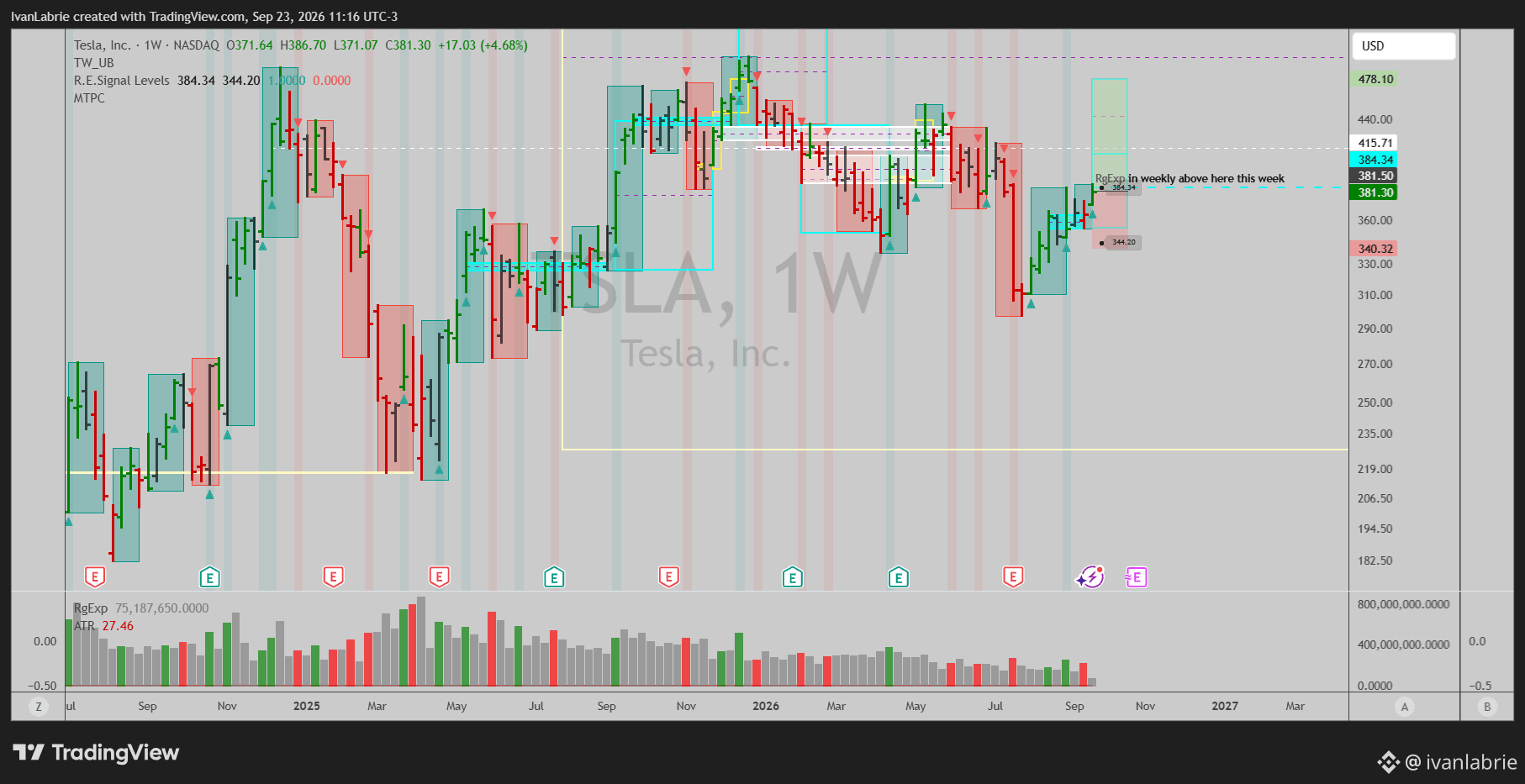
Long idea on TSLA here at 381.30, weekly chart.
The weekly signal fired this week: price traded through 384.34, with 344.20 as the lower level. It stays valid while the week holds above last week's close of 364.27, and a down close for the week would end it.
I'm treating it as a bottom-picking entry for the bigger picture. If it acts strongly over the next five weeks, a monthly or quarterly signal could form behind it.
Stop is 340.32, about 11% below here. I'd risk 1-2% of capital at the stop and size from that.
$TSLA
#TSLA #Tesla #TradeIdea
Long idea on TSLA here at 381.30, weekly chart.
The weekly signal fired this week: price traded through 384.34, with 344.20 as the lower level. It stays valid while the week holds above last week's close of 364.27, and a down close for the week would end it.
I'm treating it as a bottom-picking entry for the bigger picture. If it acts strongly over the next five weeks, a monthly or quarterly signal could form behind it.
Stop is 340.32, about 11% below here. I'd risk 1-2% of capital at the stop and size from that.
$TSLA
#TSLA #Tesla #TradeIdea
The weekly signal fired this week: price traded through 384.34, with 344.20 as the lower level. It stays valid while the week holds above last week's close of 364.27, and a down close for the week would end it.
I'm treating it as a bottom-picking entry for the bigger picture. If it acts strongly over the next five weeks, a monthly or quarterly signal could form behind it.
Stop is 340.32, about 11% below here. I'd risk 1-2% of capital at the stop and size from that.
$TSLA
#TSLA #Tesla #TradeIdea
90
·
--
Rate futures and the Fed's own dots are pricing the same hiking path into year-end.
Wednesday's pre-open FedWatch reading has a 53.1% chance of another hike on 28 October and 89.1% by 9 December, with no cut priced at any meeting through 27 October 2027. That lines up with the 16 September projections, where the median dot sits at 4.1% for both end-2026 and end-2027 (one more quarter point this year from 3.75-4.00%) and 16 of 18 officials see at least one more hike in 2026. The dots don't start cutting until 2028, at 3.9%, then 3.6% in 2029.
$XAU pays no cash flow, so its discount rate is the long real yield, and that's the same reason I treat $BTC as the purest duration asset of the lot. Gold fell on 1 September as yields rose on higher-for-longer, and the no-cash-flow stuff was the first to give on 15-16 September.
Next on the calendar is August PCE on 30 September. A hot print could push that December probability higher, and I'll be watching how gold trades it.
#Gold #Fed #Rates #Macro
Rate futures and the Fed's own dots are pricing the same hiking path into year-end.
Wednesday's pre-open FedWatch reading has a 53.1% chance of another hike on 28 October and 89.1% by 9 December, with no cut priced at any meeting through 27 October 2027. That lines up with the 16 September projections, where the median dot sits at 4.1% for both end-2026 and end-2027 (one more quarter point this year from 3.75-4.00%) and 16 of 18 officials see at least one more hike in 2026. The dots don't start cutting until 2028, at 3.9%, then 3.6% in 2029.
$XAU pays no cash flow, so its discount rate is the long real yield, and that's the same reason I treat $BTC as the purest duration asset of the lot. Gold fell on 1 September as yields rose on higher-for-longer, and the no-cash-flow stuff was the first to give on 15-16 September.
Next on the calendar is August PCE on 30 September. A hot print could push that December probability higher, and I'll be watching how gold trades it.
#Gold #Fed #Rates #Macro
Wednesday's pre-open FedWatch reading has a 53.1% chance of another hike on 28 October and 89.1% by 9 December, with no cut priced at any meeting through 27 October 2027. That lines up with the 16 September projections, where the median dot sits at 4.1% for both end-2026 and end-2027 (one more quarter point this year from 3.75-4.00%) and 16 of 18 officials see at least one more hike in 2026. The dots don't start cutting until 2028, at 3.9%, then 3.6% in 2029.
$XAU pays no cash flow, so its discount rate is the long real yield, and that's the same reason I treat $BTC as the purest duration asset of the lot. Gold fell on 1 September as yields rose on higher-for-longer, and the no-cash-flow stuff was the first to give on 15-16 September.
Next on the calendar is August PCE on 30 September. A hot print could push that December probability higher, and I'll be watching how gold trades it.
#Gold #Fed #Rates #Macro
165
·
--
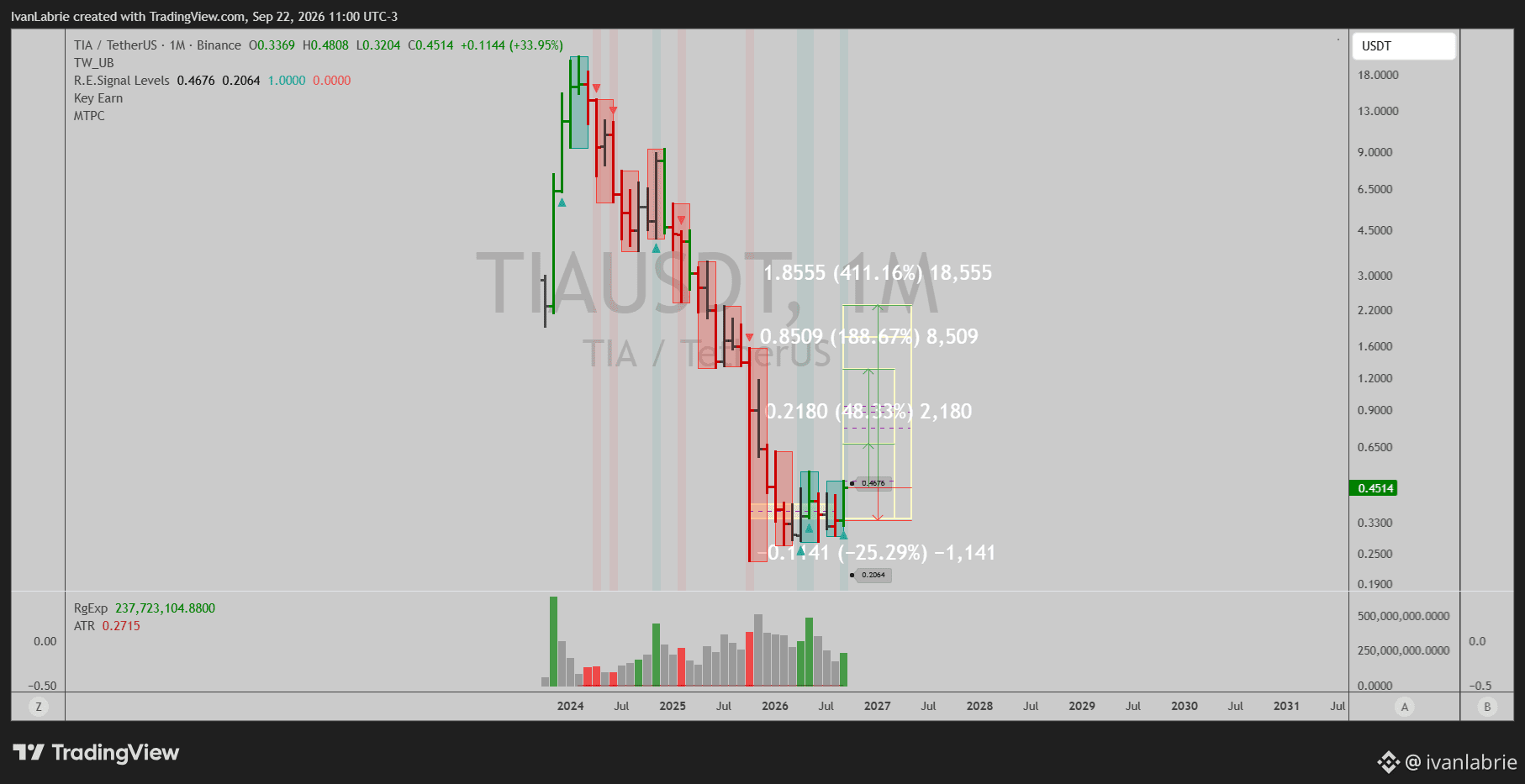
Going long TIA here at 0.4514 on the monthly chart.
The monthly signal level is 0.4676 with 0.2064 below it. The bar is up 33.95% and the month has not closed yet.
Stop is 0.3373, about 25% below here. That is a wide stop and it is meant to be, because the targets sit a long way above it: 0.6694 first, then 1.3023, and 2.3069 if the whole base plays out. I am giving it seven to nine months.
The spread in those targets is deliberate. I would rather publish the range than pick one number and pretend the precision is there.
$TIA
#TIA #Celestia #TradeIdea #Altcoins
Going long TIA here at 0.4514 on the monthly chart.
The monthly signal level is 0.4676 with 0.2064 below it. The bar is up 33.95% and the month has not closed yet.
Stop is 0.3373, about 25% below here. That is a wide stop and it is meant to be, because the targets sit a long way above it: 0.6694 first, then 1.3023, and 2.3069 if the whole base plays out. I am giving it seven to nine months.
The spread in those targets is deliberate. I would rather publish the range than pick one number and pretend the precision is there.
$TIA
#TIA #Celestia #TradeIdea #Altcoins
The monthly signal level is 0.4676 with 0.2064 below it. The bar is up 33.95% and the month has not closed yet.
Stop is 0.3373, about 25% below here. That is a wide stop and it is meant to be, because the targets sit a long way above it: 0.6694 first, then 1.3023, and 2.3069 if the whole base plays out. I am giving it seven to nine months.
The spread in those targets is deliberate. I would rather publish the range than pick one number and pretend the precision is there.
$TIA
#TIA #Celestia #TradeIdea #Altcoins
133
·
--
Partly True
Crude is giving ground on diplomacy headlines. The pump has not followed. The pump is what lands in an inflation print.
US retail diesel set a record $6.51 a gallon on 21 September (AAA), +3.58% in six days off the $6.285 print on 15 September. Pump gasoline is $4.48 against $4.319, +3.73%.
Refined product outran the barrel last week. Week of 11 to 18 September, matched October contracts: RBOB gasoline +6.66%, ULSD diesel +1.99%, $CL WTI +0.25%. $BZ Brent November fell 0.71%.
EIA data dated 17 September had distillate stocks up 1.6 million barrels to 107.9 million. Demand fell faster than supply. One week, stocks still below normal, but that is the first sign of high fuel prices eating the demand behind them.
Friday's final Michigan survey is the first dated test of whether the pump has reached inflation expectations.
#Oil #Diesel #Inflation #Macro
Crude is giving ground on diplomacy headlines. The pump has not followed. The pump is what lands in an inflation print.
US retail diesel set a record $6.51 a gallon on 21 September (AAA), +3.58% in six days off the $6.285 print on 15 September. Pump gasoline is $4.48 against $4.319, +3.73%.
Refined product outran the barrel last week. Week of 11 to 18 September, matched October contracts: RBOB gasoline +6.66%, ULSD diesel +1.99%, $CL WTI +0.25%. $BZ Brent November fell 0.71%.
EIA data dated 17 September had distillate stocks up 1.6 million barrels to 107.9 million. Demand fell faster than supply. One week, stocks still below normal, but that is the first sign of high fuel prices eating the demand behind them.
Friday's final Michigan survey is the first dated test of whether the pump has reached inflation expectations.
#Oil #Diesel #Inflation #Macro
US retail diesel set a record $6.51 a gallon on 21 September (AAA), +3.58% in six days off the $6.285 print on 15 September. Pump gasoline is $4.48 against $4.319, +3.73%.
Refined product outran the barrel last week. Week of 11 to 18 September, matched October contracts: RBOB gasoline +6.66%, ULSD diesel +1.99%, $CL WTI +0.25%. $BZ Brent November fell 0.71%.
EIA data dated 17 September had distillate stocks up 1.6 million barrels to 107.9 million. Demand fell faster than supply. One week, stocks still below normal, but that is the first sign of high fuel prices eating the demand behind them.
Friday's final Michigan survey is the first dated test of whether the pump has reached inflation expectations.
#Oil #Diesel #Inflation #Macro
219
·
--
Bullish
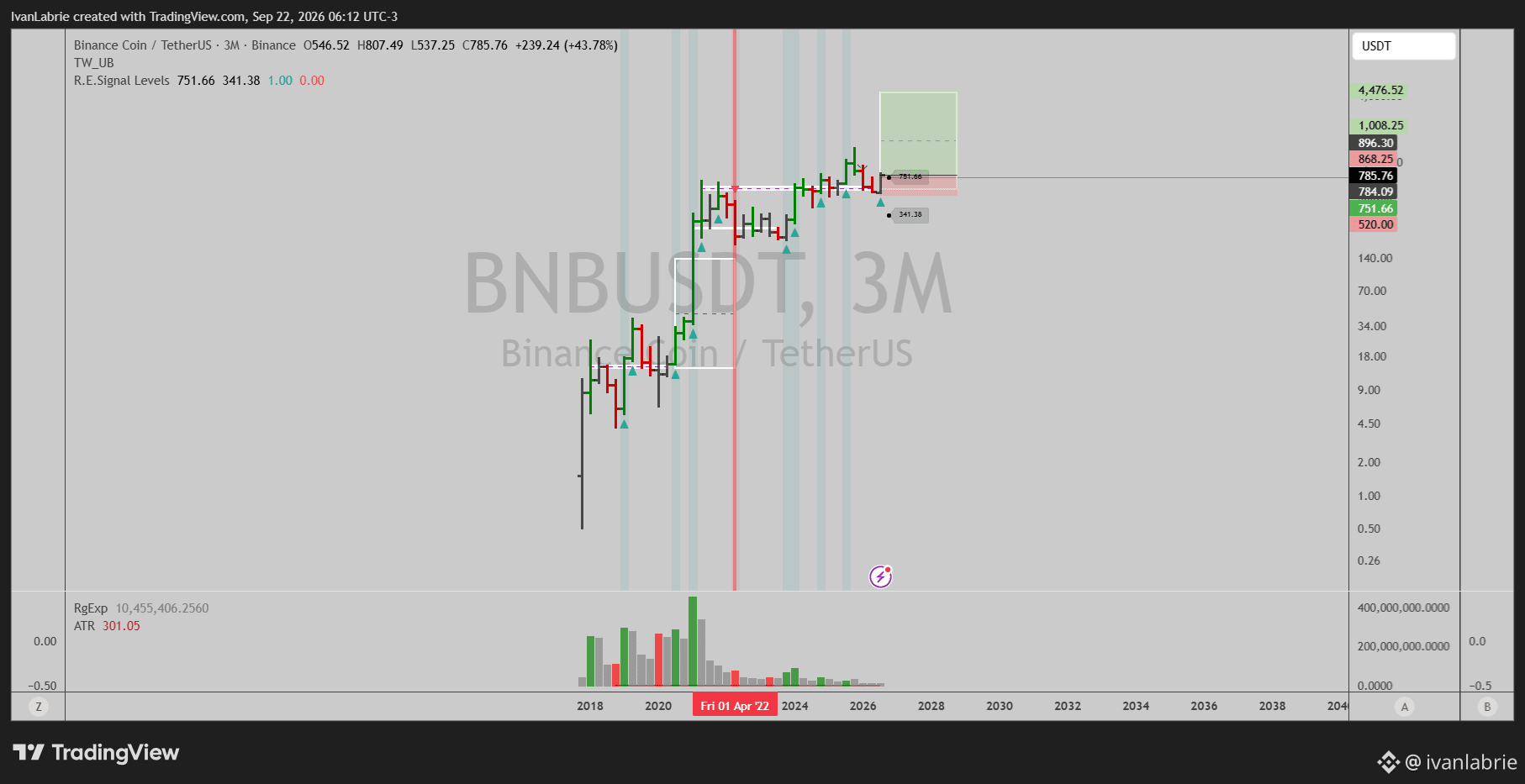
BNB fired a quarterly trend signal this week, trading through 751.66 on the three month Binance chart. Price was 785.76 this morning, up 43.78% on the quarter.
The uptrend is active while above 520, and the projection runs to 4,476.52.
Three quarterly signals fired within nine minutes of each other on Monday across the majors, BNB's and Bitcoin's among them. I'm paying more attention to that cluster than to any single chart.
$BNB
{future}(BNBUSDT)
#BNB #TrendFollowing #Quarterly #Macro
BNB fired a quarterly trend signal this week, trading through 751.66 on the three month Binance chart. Price was 785.76 this morning, up 43.78% on the quarter.
The uptrend is active while above 520, and the projection runs to 4,476.52.
Three quarterly signals fired within nine minutes of each other on Monday across the majors, BNB's and Bitcoin's among them. I'm paying more attention to that cluster than to any single chart.
$BNB
#BNB #TrendFollowing #Quarterly #Macro
The uptrend is active while above 520, and the projection runs to 4,476.52.
Three quarterly signals fired within nine minutes of each other on Monday across the majors, BNB's and Bitcoin's among them. I'm paying more attention to that cluster than to any single chart.
$BNB
#BNB #TrendFollowing #Quarterly #Macro
55
·
--
Bullish
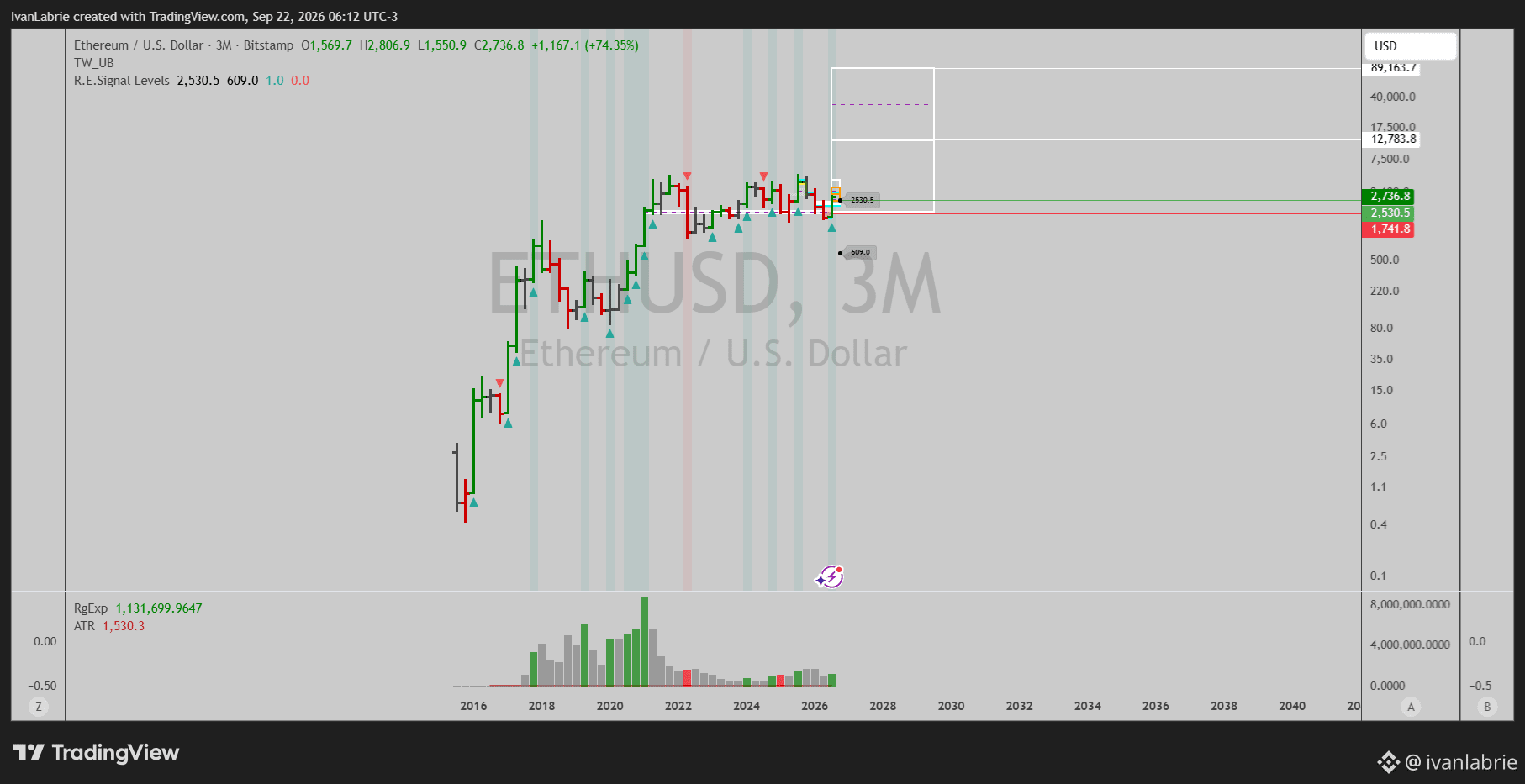
Ethereum's quarterly trend signal fired in August when price traded through 2,530.5 on the three month Bitstamp bar, weeks before Bitcoin's and BNB's this week. Price was 2,736.8 this morning, up 74.35% on the quarter.
The uptrend is active while above 1,741.8. I've published that number before and it hasn't changed. On a three month bar that level is my risk statement, and the swings above it don't change the read.
The projection runs to 12,783.8, with an extended band to 89,163.7. Those are multi-year numbers and I'm treating them that way.
$ETH
{future}(ETHUSDT)
#Ethereum #TrendFollowing #Altcoins #Macro
Ethereum's quarterly trend signal fired in August when price traded through 2,530.5 on the three month Bitstamp bar, weeks before Bitcoin's and BNB's this week. Price was 2,736.8 this morning, up 74.35% on the quarter.
The uptrend is active while above 1,741.8. I've published that number before and it hasn't changed. On a three month bar that level is my risk statement, and the swings above it don't change the read.
The projection runs to 12,783.8, with an extended band to 89,163.7. Those are multi-year numbers and I'm treating them that way.
$ETH
#Ethereum #TrendFollowing #Altcoins #Macro
The uptrend is active while above 1,741.8. I've published that number before and it hasn't changed. On a three month bar that level is my risk statement, and the swings above it don't change the read.
The projection runs to 12,783.8, with an extended band to 89,163.7. Those are multi-year numbers and I'm treating them that way.
$ETH
#Ethereum #TrendFollowing #Altcoins #Macro
428
·
--
Bullish
$BTC hit an eight-month high on Monday, +4.82% through $85,000, with an 85,248 print on Bitstamp in the 09:00 UTC hour. The session is still open, so I'm not calling that a close.
The figure everyone is quoting is $648M of short liquidations, more than $262M of them in a single hour approaching $84,000. Forced short covering adds fuel to a move that is already running, so I don't count it as the cause.
Rates don't explain it either. The Fed hiked 25bp to 3.75-4.00% on 16 September, unanimous, with the dots pencilling in no 2027 cut. On Friday the 2-year hit 4.744%, its highest intraday since July 2024, and the 10-year sat at 5.00-5.01%. That should have held Bitcoin down, and five sessions later it's at an eight-month high.
Fund flows are no better. The US spot Bitcoin ETFs took $6.21M of net inflows in total for the week ending 18 September, which one table calls the smallest weekly gain in 141 weeks. That's every week since they launched in January 2024.
Coverage points at falling oil. With rates and the funds ruled out, that's the one I'd check first.
#Bitcoin #Crypto #Rates #Macro
$BTC hit an eight-month high on Monday, +4.82% through $85,000, with an 85,248 print on Bitstamp in the 09:00 UTC hour. The session is still open, so I'm not calling that a close.
The figure everyone is quoting is $648M of short liquidations, more than $262M of them in a single hour approaching $84,000. Forced short covering adds fuel to a move that is already running, so I don't count it as the cause.
Rates don't explain it either. The Fed hiked 25bp to 3.75-4.00% on 16 September, unanimous, with the dots pencilling in no 2027 cut. On Friday the 2-year hit 4.744%, its highest intraday since July 2024, and the 10-year sat at 5.00-5.01%. That should have held Bitcoin down, and five sessions later it's at an eight-month high.
Fund flows are no better. The US spot Bitcoin ETFs took $6.21M of net inflows in total for the week ending 18 September, which one table calls the smallest weekly gain in 141 weeks. That's every week since they launched in January 2024.
Coverage points at falling oil. With rates and the funds ruled out, that's the one I'd check first.
#Bitcoin #Crypto #Rates #Macro
The figure everyone is quoting is $648M of short liquidations, more than $262M of them in a single hour approaching $84,000. Forced short covering adds fuel to a move that is already running, so I don't count it as the cause.
Rates don't explain it either. The Fed hiked 25bp to 3.75-4.00% on 16 September, unanimous, with the dots pencilling in no 2027 cut. On Friday the 2-year hit 4.744%, its highest intraday since July 2024, and the 10-year sat at 5.00-5.01%. That should have held Bitcoin down, and five sessions later it's at an eight-month high.
Fund flows are no better. The US spot Bitcoin ETFs took $6.21M of net inflows in total for the week ending 18 September, which one table calls the smallest weekly gain in 141 weeks. That's every week since they launched in January 2024.
Coverage points at falling oil. With rates and the funds ruled out, that's the one I'd check first.
#Bitcoin #Crypto #Rates #Macro
99
·
--
Trade ideas, week to 9/18:
$COIN short from 9/16: stopped (with a partial), +1.08% overall
Every idea is graded on the Binance perpetual against the levels in the original post.
#TradeIdea
Trade ideas, week to 9/18:
$COIN short from 9/16: stopped (with a partial), +1.08% overall
Every idea is graded on the Binance perpetual against the levels in the original post.
#TradeIdea
$COIN short from 9/16: stopped (with a partial), +1.08% overall
Every idea is graded on the Binance perpetual against the levels in the original post.
#TradeIdea
56
·
--
The SEC's tokenized-stock order, 34-106402 issued 17 September, is narrower than the headlines make it sound. Some crypto stocks rose on the news anyway.
It gives venues that trade tokenized US stocks through permissioned on-chain liquidity pools five years of conditional relief from registering as an exchange. Most coverage skips the second exemption: liquidity providers who fund those pools get a conditional exemption from broker-dealer registration, and that's where the capital would come from.
The limits are written into the order. Up to 75 Tier 1 symbols (S&P 500 and Russell 1000 names plus eligible ETPs) at 0.25% of average daily volume, and up to 250 Tier 2 symbols at 2.5%. No synthetic tokens, no margin, no primary issuance. The token has to carry the same rights as the share, dividends and voting included, and every trade goes public within 10 minutes.
With a volume ceiling that low I'm treating it as a pilot. No venue is confirmed operating under it yet, and nothing in it touches $BTC or $ETH. I'll start paying attention when a named firm says it will run a venue under this order.
#TokenizedStocks #SEC #RWA #Crypto
The SEC's tokenized-stock order, 34-106402 issued 17 September, is narrower than the headlines make it sound. Some crypto stocks rose on the news anyway.
It gives venues that trade tokenized US stocks through permissioned on-chain liquidity pools five years of conditional relief from registering as an exchange. Most coverage skips the second exemption: liquidity providers who fund those pools get a conditional exemption from broker-dealer registration, and that's where the capital would come from.
The limits are written into the order. Up to 75 Tier 1 symbols (S&P 500 and Russell 1000 names plus eligible ETPs) at 0.25% of average daily volume, and up to 250 Tier 2 symbols at 2.5%. No synthetic tokens, no margin, no primary issuance. The token has to carry the same rights as the share, dividends and voting included, and every trade goes public within 10 minutes.
With a volume ceiling that low I'm treating it as a pilot. No venue is confirmed operating under it yet, and nothing in it touches $BTC or $ETH. I'll start paying attention when a named firm says it will run a venue under this order.
#TokenizedStocks #SEC #RWA #Crypto
It gives venues that trade tokenized US stocks through permissioned on-chain liquidity pools five years of conditional relief from registering as an exchange. Most coverage skips the second exemption: liquidity providers who fund those pools get a conditional exemption from broker-dealer registration, and that's where the capital would come from.
The limits are written into the order. Up to 75 Tier 1 symbols (S&P 500 and Russell 1000 names plus eligible ETPs) at 0.25% of average daily volume, and up to 250 Tier 2 symbols at 2.5%. No synthetic tokens, no margin, no primary issuance. The token has to carry the same rights as the share, dividends and voting included, and every trade goes public within 10 minutes.
With a volume ceiling that low I'm treating it as a pilot. No venue is confirmed operating under it yet, and nothing in it touches $BTC or $ETH. I'll start paying attention when a named firm says it will run a venue under this order.
#TokenizedStocks #SEC #RWA #Crypto
73
·
--
$COIN short from 9/16: stopped at 172.11, +0.00% from the 172.11 entry. A quarter was taken at 164.68 (+4.32%). Overall: +1.08%.
Graded on the Binance COINUSDT perpetual.
#TradeIdea
$COIN short from 9/16: stopped at 172.11, +0.00% from the 172.11 entry. A quarter was taken at 164.68 (+4.32%). Overall: +1.08%.
Graded on the Binance COINUSDT perpetual.
#TradeIdea
Graded on the Binance COINUSDT perpetual.
#TradeIdea
77
·
--
Fed decision today, and most of the big banks agree on one thing: Warsh probably won't say what comes next.
If they hike, Citi, JPMorgan, Nomura and UBS all expect little forward guidance. Goldman thinks he may want several inflation reports before moving again. TD reads a hike today as more tightening in the pipeline.
The hard part is the message. BofA's point: hint at more hikes and markets start pricing 100bp+, sound soft and the 2% target loses credibility. Deutsche Bank frames the cycle as taking back last year's 75bp of risk-management cuts and returning policy to restrictive.
$BTC $ETH #Fed #FOMC #Warsh
Fed decision today, and most of the big banks agree on one thing: Warsh probably won't say what comes next.
If they hike, Citi, JPMorgan, Nomura and UBS all expect little forward guidance. Goldman thinks he may want several inflation reports before moving again. TD reads a hike today as more tightening in the pipeline.
The hard part is the message. BofA's point: hint at more hikes and markets start pricing 100bp+, sound soft and the 2% target loses credibility. Deutsche Bank frames the cycle as taking back last year's 75bp of risk-management cuts and returning policy to restrictive.
$BTC $ETH #Fed #FOMC #Warsh
If they hike, Citi, JPMorgan, Nomura and UBS all expect little forward guidance. Goldman thinks he may want several inflation reports before moving again. TD reads a hike today as more tightening in the pipeline.
The hard part is the message. BofA's point: hint at more hikes and markets start pricing 100bp+, sound soft and the 2% target loses credibility. Deutsche Bank frames the cycle as taking back last year's 75bp of risk-management cuts and returning policy to restrictive.
$BTC $ETH #Fed #FOMC #Warsh
51
·
--
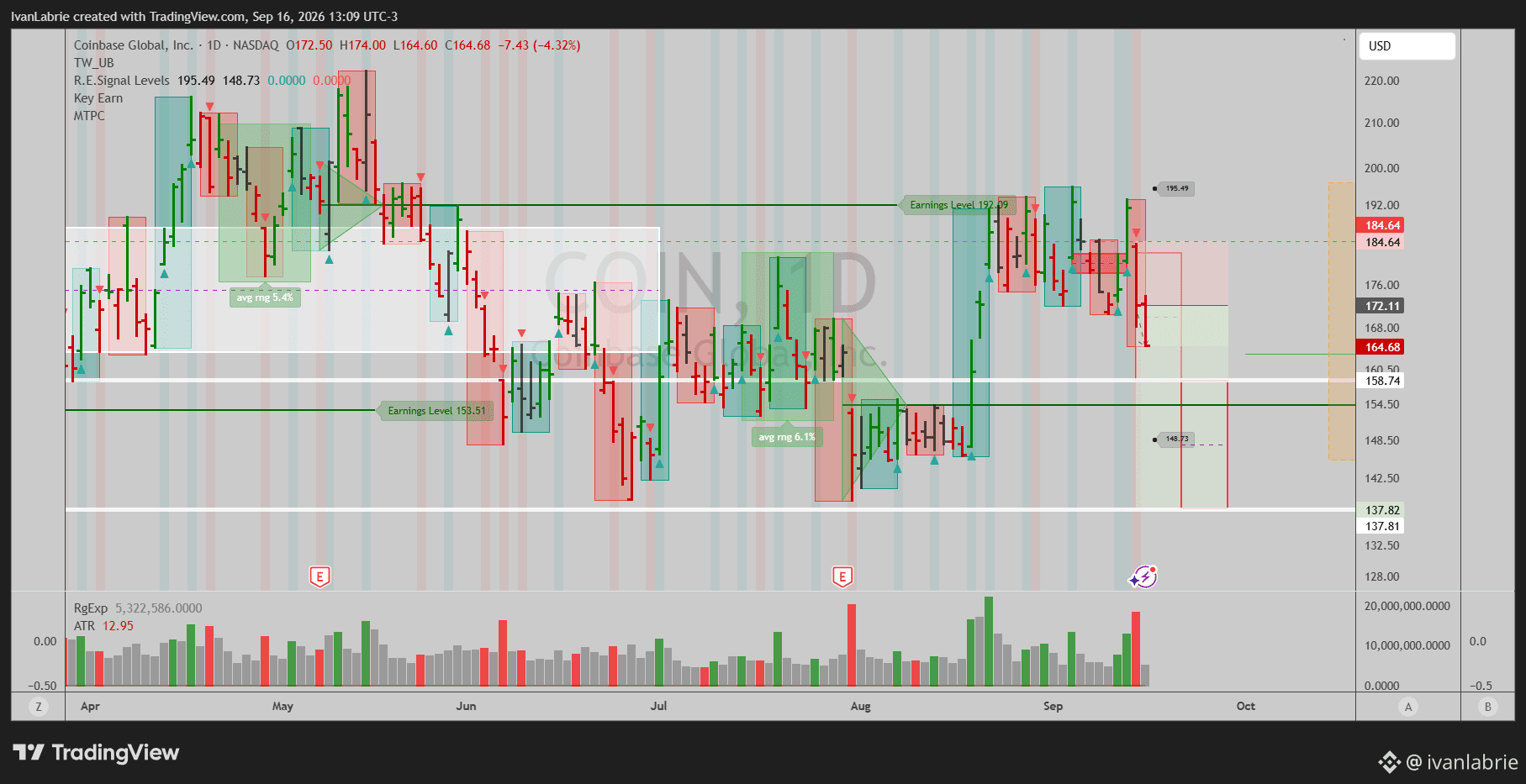
$COIN short update. Price hit 164.68 today, 4.3% below my 172.11 entry.
I'm taking a quarter off here to lock in part of the gain and moving my stop down to entry. The rest of the trade can't turn into a loss now unless price gaps through that level.
Targets stay at 158.74 and 137.81.
Not advice, just how I'm managing the idea.
$COIN #Coinbase #TradeIdea
$COIN short update. Price hit 164.68 today, 4.3% below my 172.11 entry.
I'm taking a quarter off here to lock in part of the gain and moving my stop down to entry. The rest of the trade can't turn into a loss now unless price gaps through that level.
Targets stay at 158.74 and 137.81.
Not advice, just how I'm managing the idea.
$COIN #Coinbase #TradeIdea
I'm taking a quarter off here to lock in part of the gain and moving my stop down to entry. The rest of the trade can't turn into a loss now unless price gaps through that level.
Targets stay at 158.74 and 137.81.
Not advice, just how I'm managing the idea.
$COIN #Coinbase #TradeIdea
70
·
--
The crypto selling started before Tuesday's Senate vote. Nobody knew the result yet.
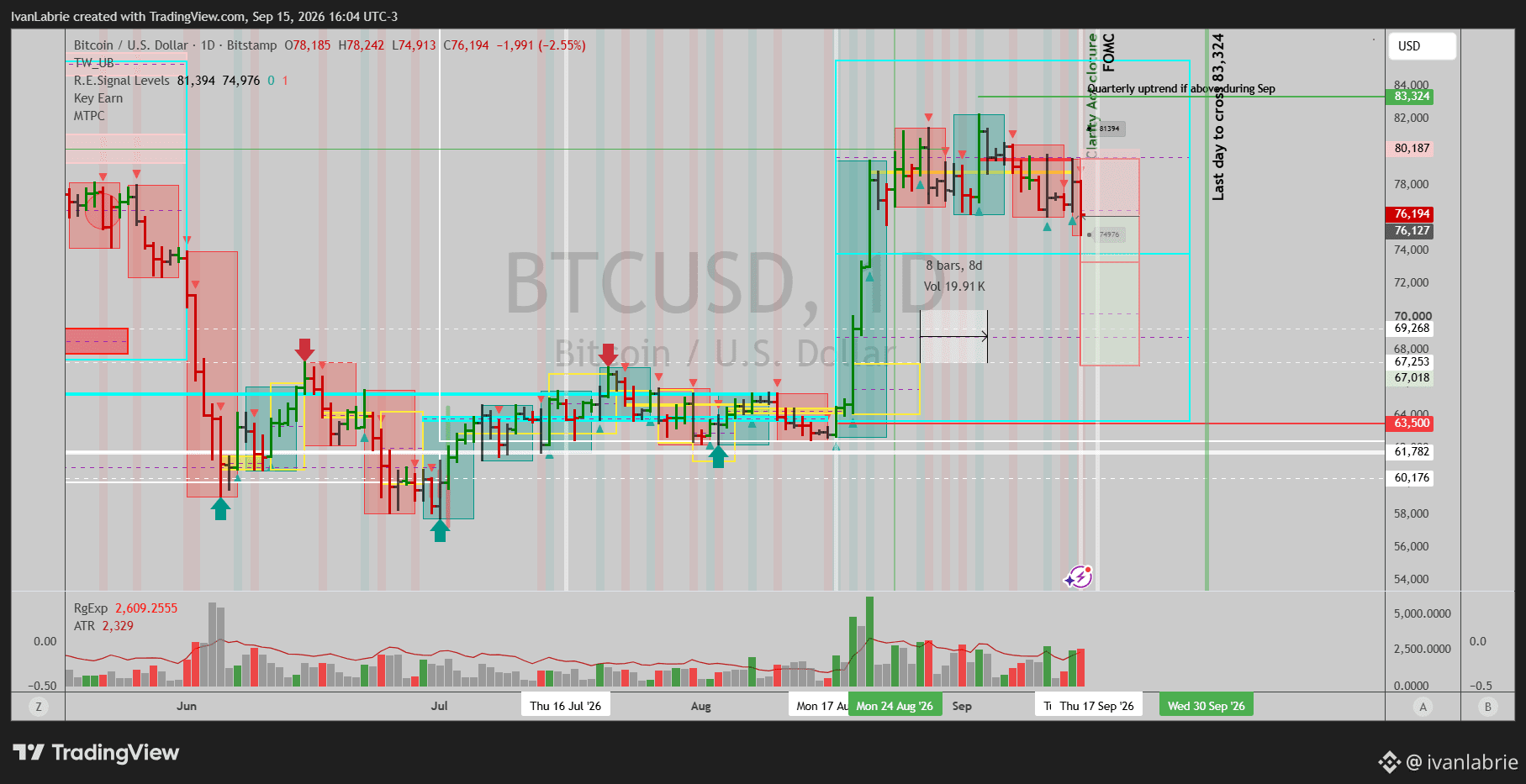
$BTC traded from $79,427 on Monday to $76,862 intraday Tuesday, and about $300 million of bullish crypto positions were liquidated in the final hour before the CLARITY cloture vote.
Then the bill failed to reach 60 and the move extended, down as much as 5.3% intraday to $74,910. Over the next 24 hours about $571M of bullish futures were liquidated, with $BTC and $ETH longs taking about $190M each.
Failure was the base case and had been priced for weeks. Crypto was trading with rates that day: the 20-year Treasury reopening tailed, clearing at 5.420% against a 5.400% when-issued yield. The vote only took away a possible offset to that rate move.
The bill is still alive. A motion to reconsider was entered, and the realistic next window is the lame duck, 9 Nov to 18 Dec.
#Bitcoin #Crypto #ClarityAct #Macro
The crypto selling started before Tuesday's Senate vote. Nobody knew the result yet.
$BTC traded from $79,427 on Monday to $76,862 intraday Tuesday, and about $300 million of bullish crypto positions were liquidated in the final hour before the CLARITY cloture vote.
Then the bill failed to reach 60 and the move extended, down as much as 5.3% intraday to $74,910. Over the next 24 hours about $571M of bullish futures were liquidated, with $BTC and $ETH longs taking about $190M each.
Failure was the base case and had been priced for weeks. Crypto was trading with rates that day: the 20-year Treasury reopening tailed, clearing at 5.420% against a 5.400% when-issued yield. The vote only took away a possible offset to that rate move.
The bill is still alive. A motion to reconsider was entered, and the realistic next window is the lame duck, 9 Nov to 18 Dec.
#Bitcoin #Crypto #ClarityAct #Macro
$BTC traded from $79,427 on Monday to $76,862 intraday Tuesday, and about $300 million of bullish crypto positions were liquidated in the final hour before the CLARITY cloture vote.
Then the bill failed to reach 60 and the move extended, down as much as 5.3% intraday to $74,910. Over the next 24 hours about $571M of bullish futures were liquidated, with $BTC and $ETH longs taking about $190M each.
Failure was the base case and had been priced for weeks. Crypto was trading with rates that day: the 20-year Treasury reopening tailed, clearing at 5.420% against a 5.400% when-issued yield. The vote only took away a possible offset to that rate move.
The bill is still alive. A motion to reconsider was entered, and the realistic next window is the lame duck, 9 Nov to 18 Dec.
#Bitcoin #Crypto #ClarityAct #Macro
89
·
--
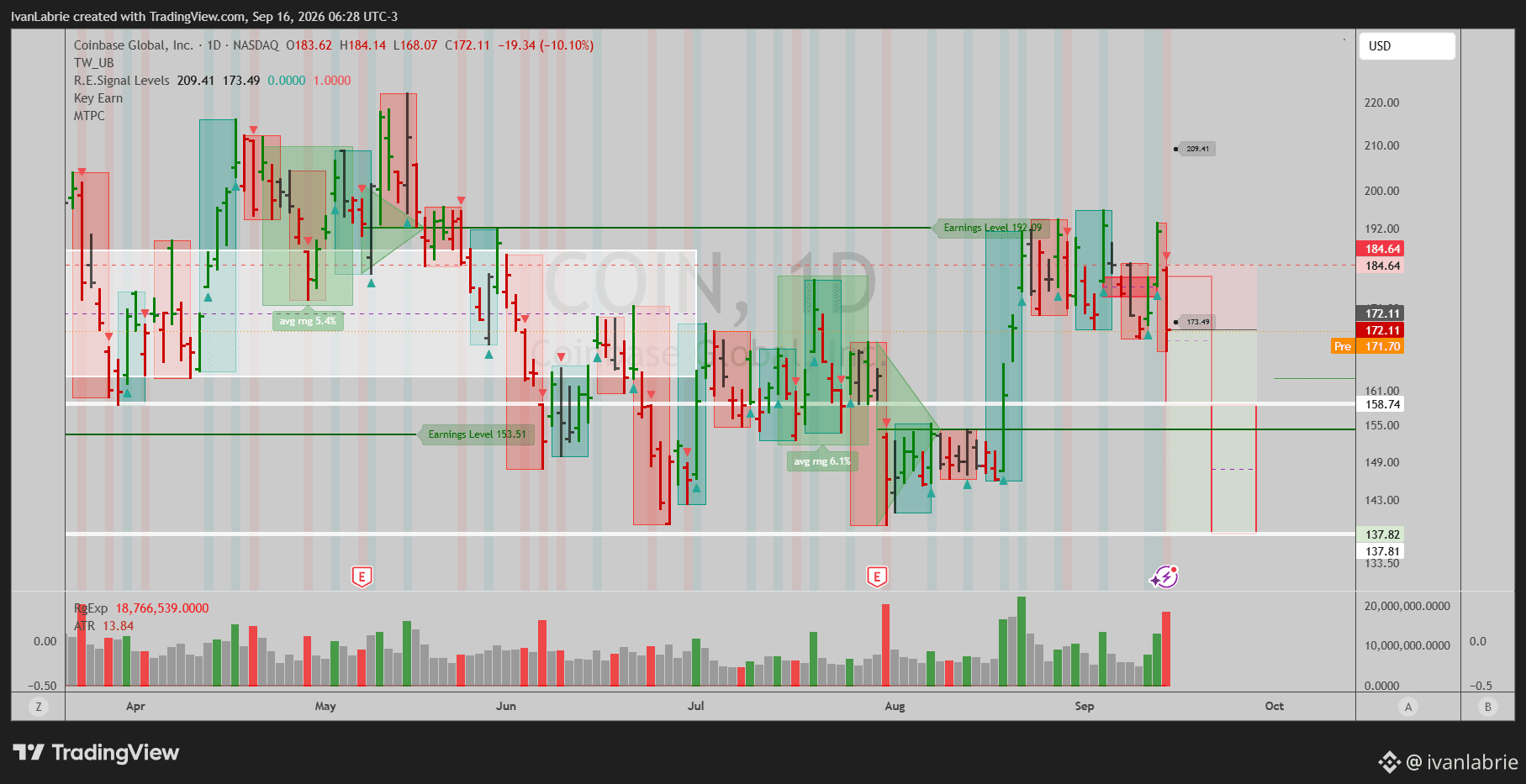
Short $COIN on the daily. This one's my own trade idea.
Coinbase dropped 10.1% yesterday and closed at 172.11, under the 173.49 level on my chart.
Entry: 172.11
Stop: 184.64
Target 1: 158.74
Target 2: 137.81
That's 7.3% of risk to the stop against 7.8% to the first target and 19.9% to the second. Above 184.64 the idea is dead.
Not advice, just how I'm reading the chart.
$COIN #Coinbase #COIN #TradFi #TradingIdea
Short $COIN on the daily. This one's my own trade idea.
Coinbase dropped 10.1% yesterday and closed at 172.11, under the 173.49 level on my chart.
Entry: 172.11
Stop: 184.64
Target 1: 158.74
Target 2: 137.81
That's 7.3% of risk to the stop against 7.8% to the first target and 19.9% to the second. Above 184.64 the idea is dead.
Not advice, just how I'm reading the chart.
$COIN #Coinbase #COIN #TradFi #TradingIdea
Coinbase dropped 10.1% yesterday and closed at 172.11, under the 173.49 level on my chart.
Entry: 172.11
Stop: 184.64
Target 1: 158.74
Target 2: 137.81
That's 7.3% of risk to the stop against 7.8% to the first target and 19.9% to the second. Above 184.64 the idea is dead.
Not advice, just how I'm reading the chart.
$COIN #Coinbase #COIN #TradFi #TradingIdea
212
Log in to explore more content
Join global crypto users on Binance Square
⚡️ Get latest and useful information about crypto.
💬 Trusted by the world’s largest crypto exchange.
👍 Discover real insights from verified creators.
Email / Phone number
Trending Topics
CircleTetherFreezeBitgetHackerWallet
17,999 views
193 Discussing
#circletetherfreezebitgethackerwallet 🚨 CIRCLE & TETHER FREEZE BITGET HACKER WALLET
A major crypto security incident has triggered another important debate around stablecoin controls.
Bitget reported a massive security breach on September 24, with the initial loss estimated at $351.6M. The exchange later revised the affected-asset estimate to approximately $387.5M, after accounting for additional assets including Zcash and TRON.
🔒 Circle & Tether Take Action
Circle blacklisted a wallet identified as “Bitget Exploiter 8”, while Tether subsequently blocked the same address.
The wallet contained approximately:
• 99,990 USDC
• 218,023 USDT
• 170.47 ETH
The freeze effectively locked around $318,000 worth of USDC and USDT.
⚠️ But there is a major limitation:
Stablecoin issuers can freeze their own tokens, but they cannot freeze native ETH. Reports indicate that other exploiter wallets still held more than 63,000 ETH.
Bitget CEO Gracy Chen said the attackers compromised a backend system in the exchange's wallet infrastructure and spoofed transaction data, rather than obtaining users' private keys. Bitget says its cold wallets were unaffected and its User Protection Fund holds more than $464M.
📌 The bigger takeaway:
This incident shows both the power and limits of centralized stablecoin controls. USDC and USDT can potentially be frozen at the token-contract level, while assets such as ETH cannot be frozen by stablecoin issuers.
👀 Assets to watch:
$BTC • $ETH • $XRP
#Bitget #CryptoSecurity #Circle #Tether #USDC #USDT #CryptoNews
Ayeshg
·2 Likes
·9.3k views
SECSaysTokenBuybacksNotAutoSecurities
1,635 views
71 Discussing
ChinaUSAgreeOn$30BTariffCut
154 views
3 Discussing