

#tradfi
tradfi
2.2M views
19,921 Discussing
Hot
Latest

Verified
Article
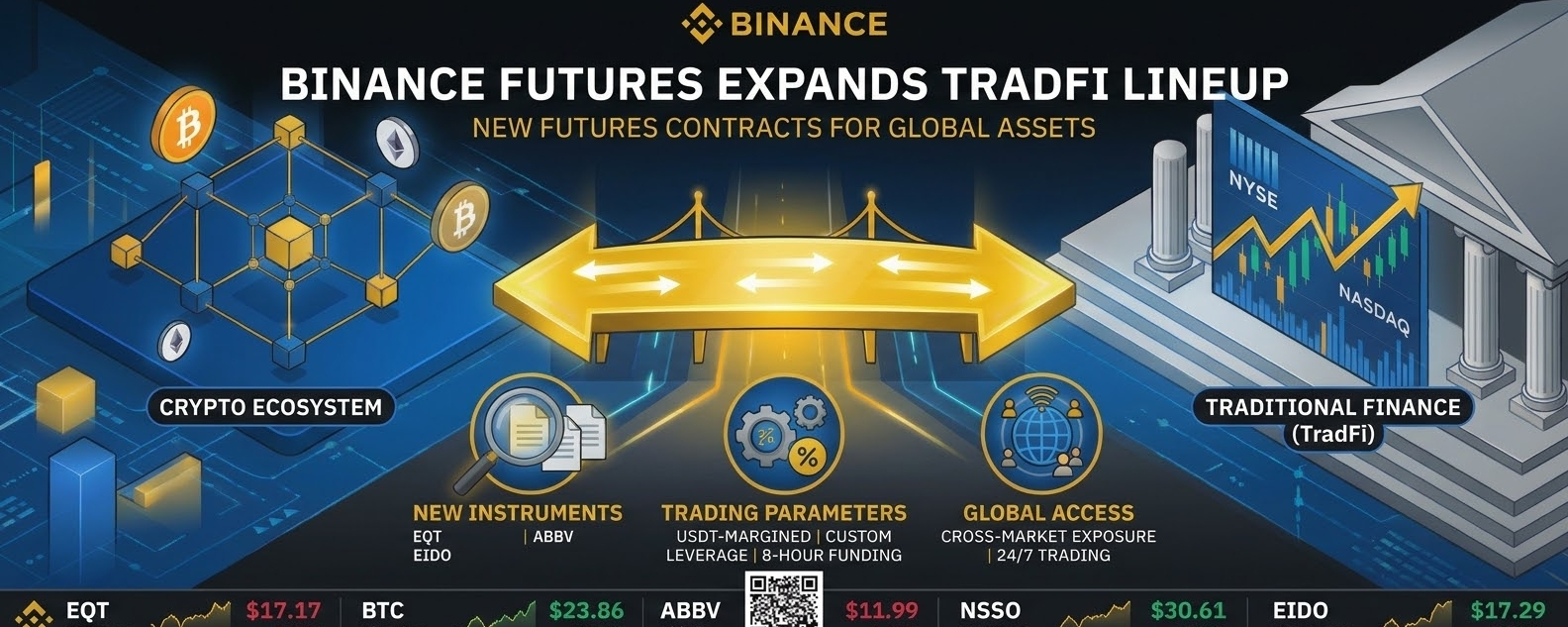
Binance Futures Expands TradFi Lineup.🚀 Binance Futures Expands TradFi Lineup: New Futures Contracts for Global Assets
Binance has officially announced an expansion of derivatives trading options for users, rolling out new USDT-margined perpetual futures contracts on traditional financial (TradFi) assets. This update allows traders to gain exposure to equity markets directly through the crypto platform.
Key details of the update:
- New Instruments: The platform has added perpetual contracts for major global equities and exchange-traded funds (ETFs), including EQT Corporation (EQT), AbbVie (ABBV), and the iShares MSCI Indonesia ETF (EIDO).
- Trading Parameters: These contracts feature customizable leverage with standard funding fee intervals settled every 8 hours.
- Market Trend: Binance continues to bridge the gap between traditional finance and the crypto ecosystem by bringing multi-asset derivatives under one roof.
$BNB
$ABBV
{future}(BNBUSDT)
#Binance #TradFi #cryptotrading
#BinanceSquare
{future}(ABBVUSDT)
$BTC
{future}(BTCUSDT)
Binance Futures Expands TradFi Lineup.
🚀 Binance Futures Expands TradFi Lineup: New Futures Contracts for Global Assets
Binance has officially announced an expansion of derivatives trading options for users, rolling out new USDT-margined perpetual futures contracts on traditional financial (TradFi) assets. This update allows traders to gain exposure to equity markets directly through the crypto platform.
Key details of the update:
- New Instruments: The platform has added perpetual contracts for major global equities and exchange-traded funds (ETFs), including EQT Corporation (EQT), AbbVie (ABBV), and the iShares MSCI Indonesia ETF (EIDO).
- Trading Parameters: These contracts feature customizable leverage with standard funding fee intervals settled every 8 hours.
- Market Trend: Binance continues to bridge the gap between traditional finance and the crypto ecosystem by bringing multi-asset derivatives under one roof.
$BNB
$ABBV
#Binance #TradFi #cryptotrading
#BinanceSquare
$BTC
Binance has officially announced an expansion of derivatives trading options for users, rolling out new USDT-margined perpetual futures contracts on traditional financial (TradFi) assets. This update allows traders to gain exposure to equity markets directly through the crypto platform.
Key details of the update:
- New Instruments: The platform has added perpetual contracts for major global equities and exchange-traded funds (ETFs), including EQT Corporation (EQT), AbbVie (ABBV), and the iShares MSCI Indonesia ETF (EIDO).
- Trading Parameters: These contracts feature customizable leverage with standard funding fee intervals settled every 8 hours.
- Market Trend: Binance continues to bridge the gap between traditional finance and the crypto ecosystem by bringing multi-asset derivatives under one roof.
$BNB
$ABBV
#Binance #TradFi #cryptotrading
#BinanceSquare
$BTC
2
209

·
--
Bullish
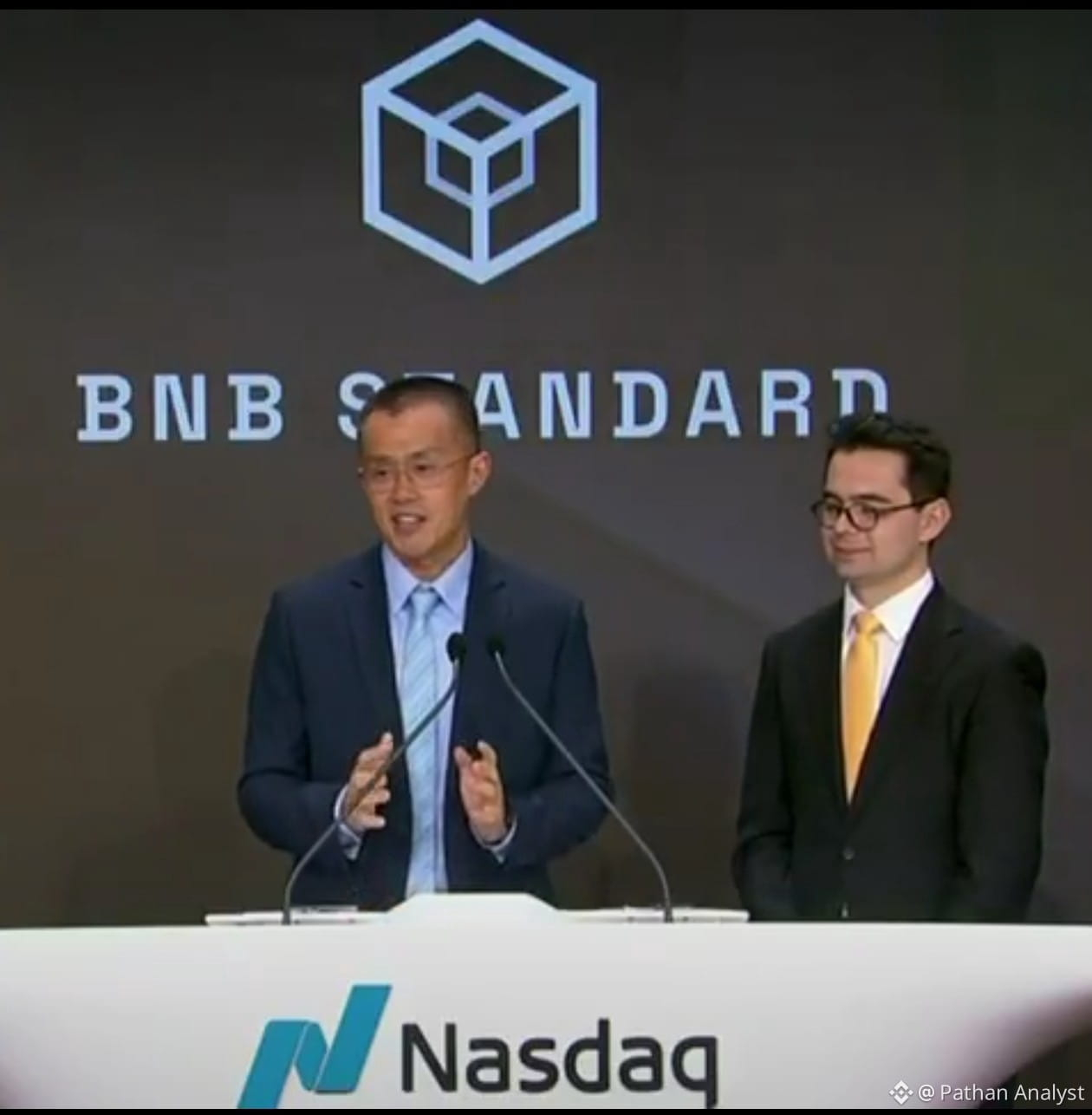
🚨 @CZ Highlights a Major Milestone for BNB on Wall Street!
When $BNB launched nine years ago, few could have imagined how far its ecosystem would go.
Today, CZ is highlighting a historic moment as BNB Standard Corporation rings the Nasdaq Opening Bell — a powerful symbol of the growing connection between crypto and traditional finance.
🔥 Why this matters:
- $BNB is gaining greater visibility in traditional financial markets.
- BNB Standard Corporation (NASDAQ: BNC) focuses on holding $BNB as a corporate treasury asset.
- The milestone highlights how blockchain assets are increasingly intersecting with public-market finance.
💡 From a blockchain token launched nine years ago to a treasury strategy represented on Nasdaq, the BNB journey reflects how much the crypto industry has evolved.
Is this another major step toward institutional adoption of $BNB?
#BNB #Binance #CZ #Crypto #TradFi
🚨 @CZ Highlights a Major Milestone for BNB on Wall Street!
When $BNB launched nine years ago, few could have imagined how far its ecosystem would go.
Today, CZ is highlighting a historic moment as BNB Standard Corporation rings the Nasdaq Opening Bell — a powerful symbol of the growing connection between crypto and traditional finance.
🔥 Why this matters:
- $BNB is gaining greater visibility in traditional financial markets.
- BNB Standard Corporation (NASDAQ: BNC) focuses on holding $BNB as a corporate treasury asset.
- The milestone highlights how blockchain assets are increasingly intersecting with public-market finance.
💡 From a blockchain token launched nine years ago to a treasury strategy represented on Nasdaq, the BNB journey reflects how much the crypto industry has evolved.
Is this another major step toward institutional adoption of $BNB ?
#BNB #Binance #CZ #Crypto #TradFi
When $BNB launched nine years ago, few could have imagined how far its ecosystem would go.
Today, CZ is highlighting a historic moment as BNB Standard Corporation rings the Nasdaq Opening Bell — a powerful symbol of the growing connection between crypto and traditional finance.
🔥 Why this matters:
- $BNB is gaining greater visibility in traditional financial markets.
- BNB Standard Corporation (NASDAQ: BNC) focuses on holding $BNB as a corporate treasury asset.
- The milestone highlights how blockchain assets are increasingly intersecting with public-market finance.
💡 From a blockchain token launched nine years ago to a treasury strategy represented on Nasdaq, the BNB journey reflects how much the crypto industry has evolved.
Is this another major step toward institutional adoption of $BNB ?
#BNB #Binance #CZ #Crypto #TradFi
1
212

·
--
Bullish
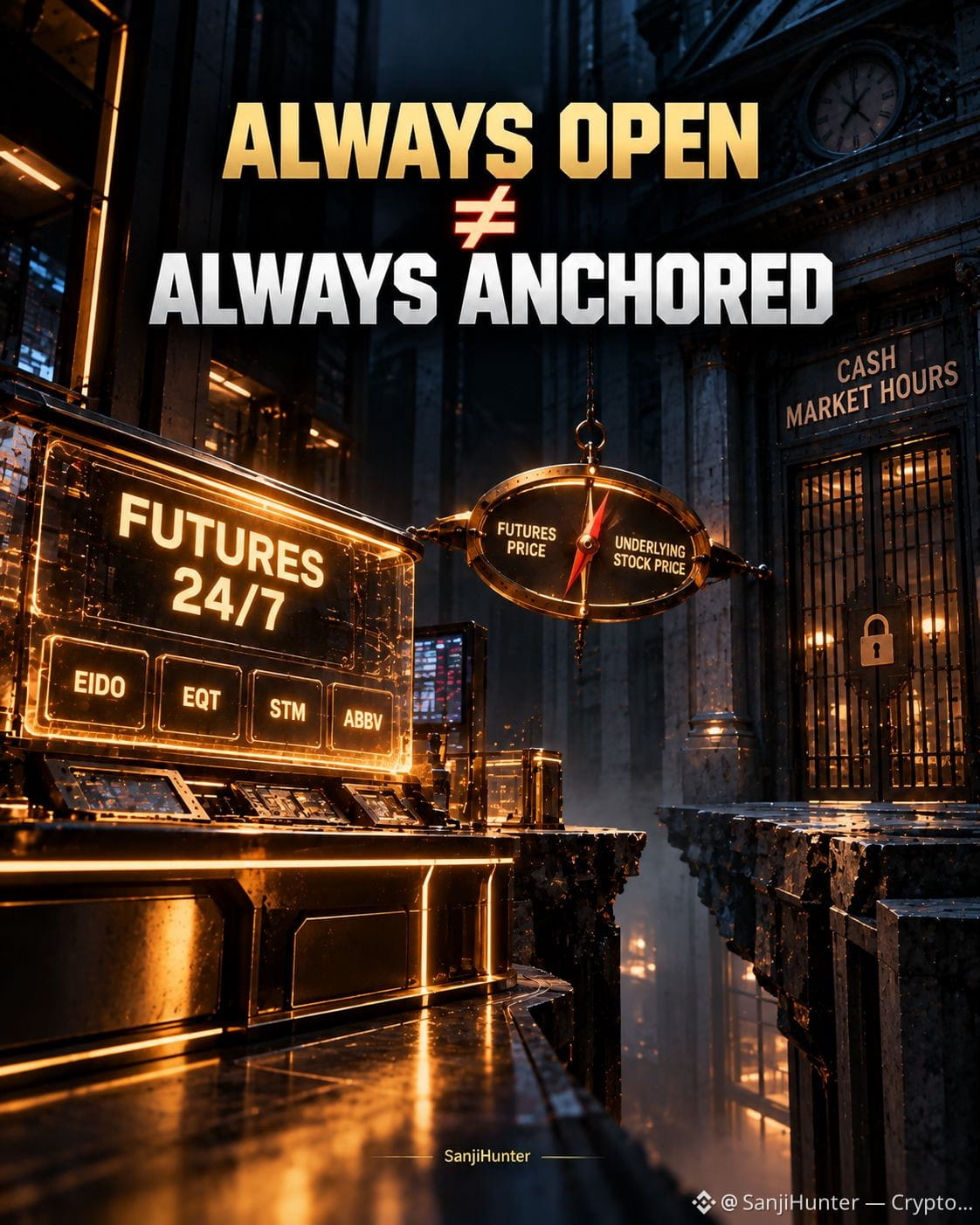
🚨 24/7 trading doesn't mean 24/7 price confirmation
Binance just launched four TradFi perpetuals — EIDO, EQT, STM and ABBV — with up to 20x leverage
Here's the catch 👇
$EIDO
{future}(EIDOUSDT)
These contracts keep trading even when the underlying stock markets are closed
And outside regular market hours, Binance uses different index and mark-price mechanisms to manage pricing risk
In the first hours after launch, all four contracts showed mark prices below their indices in Binance API data
$EQT
{future}(EQTUSDT)
⚠️ But a futures discount isn't automatically an arbitrage opportunity
The underlying market may not offer the same liquidity or trading access when you need to hedge
📌 Watch the spread, funding and market-session transition — not just the futures price
A market that's always open isn't necessarily a market that's always anchored
$STM
{future}(STMUSDT)
#TradFi #BİNANCEFUTURES
🚨 24/7 trading doesn't mean 24/7 price confirmation
Binance just launched four TradFi perpetuals — EIDO, EQT, STM and ABBV — with up to 20x leverage
Here's the catch 👇
$EIDO
These contracts keep trading even when the underlying stock markets are closed
And outside regular market hours, Binance uses different index and mark-price mechanisms to manage pricing risk
In the first hours after launch, all four contracts showed mark prices below their indices in Binance API data
$EQT
⚠️ But a futures discount isn't automatically an arbitrage opportunity
The underlying market may not offer the same liquidity or trading access when you need to hedge
📌 Watch the spread, funding and market-session transition — not just the futures price
A market that's always open isn't necessarily a market that's always anchored
$STM
#TradFi #BİNANCEFUTURES
Binance just launched four TradFi perpetuals — EIDO, EQT, STM and ABBV — with up to 20x leverage
Here's the catch 👇
$EIDO
These contracts keep trading even when the underlying stock markets are closed
And outside regular market hours, Binance uses different index and mark-price mechanisms to manage pricing risk
In the first hours after launch, all four contracts showed mark prices below their indices in Binance API data
$EQT
⚠️ But a futures discount isn't automatically an arbitrage opportunity
The underlying market may not offer the same liquidity or trading access when you need to hedge
📌 Watch the spread, funding and market-session transition — not just the futures price
A market that's always open isn't necessarily a market that's always anchored
$STM
#TradFi #BİNANCEFUTURES
199

·
--
Key Updates & Announcements📣
TradFi Perpetual Contracts: Binance Futures launched four new USDT-margined perpetual contracts (CEGUSDT, BACUSDT, IBKRUSDT, and MDTUSDT) with up to 20x leverage.
#BinancePick #TradFi #USDT。 #update #futures
Key Updates & Announcements📣
TradFi Perpetual Contracts: Binance Futures launched four new USDT-margined perpetual contracts (CEGUSDT, BACUSDT, IBKRUSDT, and MDTUSDT) with up to 20x leverage.
#BinancePick #TradFi #USDT。 #update #futures
TradFi Perpetual Contracts: Binance Futures launched four new USDT-margined perpetual contracts (CEGUSDT, BACUSDT, IBKRUSDT, and MDTUSDT) with up to 20x leverage.
#BinancePick #TradFi #USDT。 #update #futures

1
40

·
--
🚀🚀🚀 TradFi Focus 🚀🚀🚀
Spot shares represent ownership, while TradFi perpetuals provide leveraged price exposure without ownership. Funding and liquidation make their risk profile very different.
$TSLA $NVDA $MSTR
#TradFi #RWA #StockMarket #TokenizedStocks #BinanceFutures
🚀🚀🚀 TradFi Focus 🚀🚀🚀
Spot shares represent ownership, while TradFi perpetuals provide leveraged price exposure without ownership. Funding and liquidation make their risk profile very different.
$TSLA $NVDA $MSTR
#TradFi #RWA #StockMarket #TokenizedStocks #BinanceFutures
Spot shares represent ownership, while TradFi perpetuals provide leveraged price exposure without ownership. Funding and liquidation make their risk profile very different.
$TSLA $NVDA $MSTR
#TradFi #RWA #StockMarket #TokenizedStocks #BinanceFutures
109

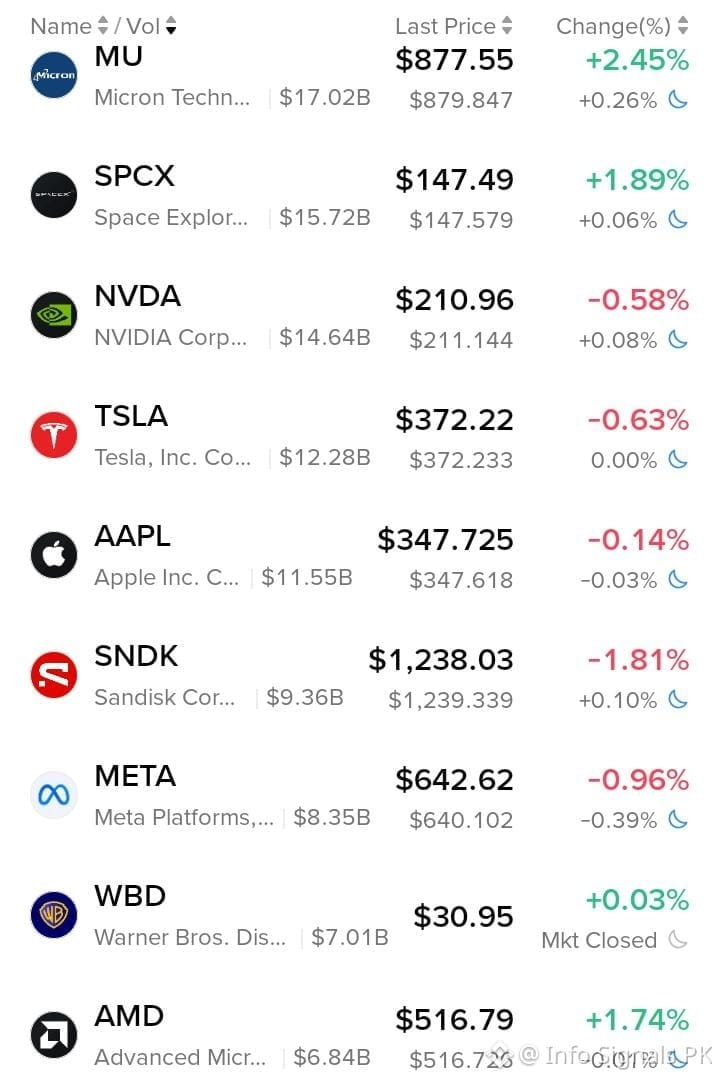
📊 US Stocks Snapshot
🟢 MU $877.55 (+2.45%), top gainer and highest volume
🟢 SPCX $147.49 (+1.89%)
🟢 AMD $516.79 (+1.74%)
🔴 SNDK $1,238.03 (−1.81%), biggest drop
🔴 META $642.62 (−0.96%)
🔴 TSLA $372.22 (−0.63%)
🔴 NVDA $210.96 (−0.58%)
Chips are mixed: memory names like MU lead while NVDA slips. Markets are closed, so after-hours moves are small.
*Not financial advice.
#Stocks #MU #NVDA #AMD #TradFi
📊 US Stocks Snapshot
🟢 MU $877.55 (+2.45%), top gainer and highest volume
🟢 SPCX $147.49 (+1.89%)
🟢 AMD $516.79 (+1.74%)
🔴 SNDK $1,238.03 (−1.81%), biggest drop
🔴 META $642.62 (−0.96%)
🔴 TSLA $372.22 (−0.63%)
🔴 NVDA $210.96 (−0.58%)
Chips are mixed: memory names like MU lead while NVDA slips. Markets are closed, so after-hours moves are small.
*Not financial advice.
#Stocks #MU #NVDA #AMD #TradFi
🟢 MU $877.55 (+2.45%), top gainer and highest volume
🟢 SPCX $147.49 (+1.89%)
🟢 AMD $516.79 (+1.74%)
🔴 SNDK $1,238.03 (−1.81%), biggest drop
🔴 META $642.62 (−0.96%)
🔴 TSLA $372.22 (−0.63%)
🔴 NVDA $210.96 (−0.58%)
Chips are mixed: memory names like MU lead while NVDA slips. Markets are closed, so after-hours moves are small.
*Not financial advice.
#Stocks #MU #NVDA #AMD #TradFi
1
258

·
--
Bullish
Good Morning Guys! ☀️
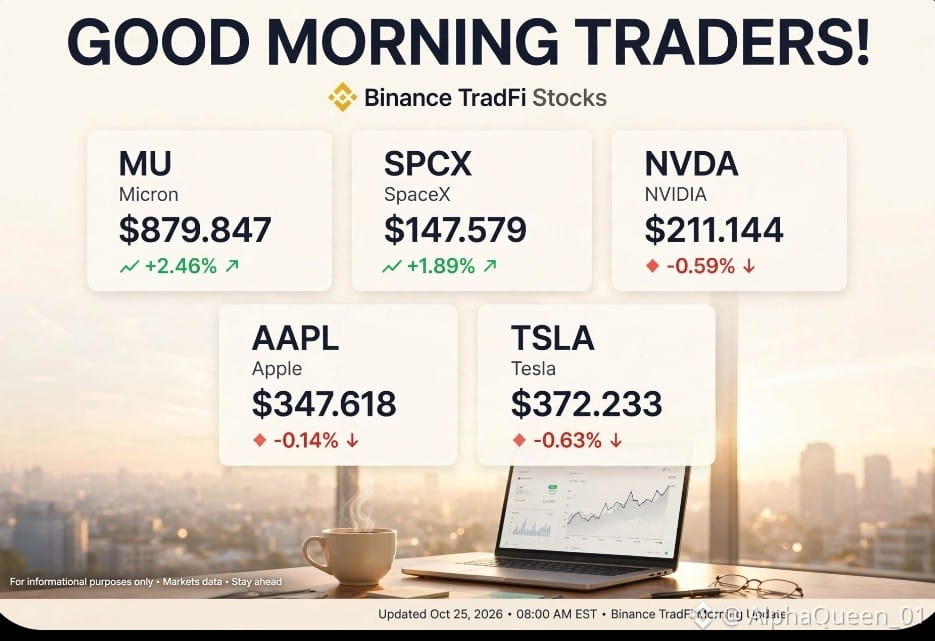
I just opened Binance and look what I saw in the TradFi section 👀
Stocks are also moving today:
🟢 $MU - Micron Technology: $879.847 (+2.46%) - Top gainer!
🟢 $SPCX - SpaceX: $147.579 (+1.89%) - Rocket mode 🚀
🔴 $NVDA - NVIDIA: $211.144 (-0.59%)
🔴 AAPL - Apple: $347.618 (-0.14%)
🔴 TSLA - Tesla: $372.233 (-0.63%)
So it's a mixed morning — Chip & Space stocks pumping, but Tech giants slightly red.
This is the beauty of Binance now, Crypto + Stocks in one app. No need to open different apps!
Which one are you watching today? MU or SPCX?
Comment me batao 👇
#GoodMorning #Binance #TradFi #Stocks #Crypto
{future}(NVDAUSDT)
{future}(MUUSDT)
{spot}(SPCXBUSDT)
Good Morning Guys! ☀️
I just opened Binance and look what I saw in the TradFi section 👀
Stocks are also moving today:
🟢 $MU - Micron Technology: $879.847 (+2.46%) - Top gainer!
🟢 $SPCX - SpaceX: $147.579 (+1.89%) - Rocket mode 🚀
🔴 $NVDA - NVIDIA: $211.144 (-0.59%)
🔴 AAPL - Apple: $347.618 (-0.14%)
🔴 TSLA - Tesla: $372.233 (-0.63%)
So it's a mixed morning — Chip & Space stocks pumping, but Tech giants slightly red.
This is the beauty of Binance now, Crypto + Stocks in one app. No need to open different apps!
Which one are you watching today? MU or SPCX?
Comment me batao 👇
#GoodMorning #Binance #TradFi #Stocks #Crypto
I just opened Binance and look what I saw in the TradFi section 👀
Stocks are also moving today:
🟢 $MU - Micron Technology: $879.847 (+2.46%) - Top gainer!
🟢 $SPCX - SpaceX: $147.579 (+1.89%) - Rocket mode 🚀
🔴 $NVDA - NVIDIA: $211.144 (-0.59%)
🔴 AAPL - Apple: $347.618 (-0.14%)
🔴 TSLA - Tesla: $372.233 (-0.63%)
So it's a mixed morning — Chip & Space stocks pumping, but Tech giants slightly red.
This is the beauty of Binance now, Crypto + Stocks in one app. No need to open different apps!
Which one are you watching today? MU or SPCX?
Comment me batao 👇
#GoodMorning #Binance #TradFi #Stocks #Crypto
HOLD bnb culture:
It feels like everything you touch comes to life... That’s the power of beauty😊
2
3
828
·
--
🚀🚀🚀 TradFi Focus 🚀🚀🚀
TradFi perpetuals connect crypto liquidity with global equity narratives. Earnings, rates and sector momentum can quickly change volatility across stock-linked contracts.
$TSLA $NVDA $MSTR
#TradFi #RWA #StockMarket #TokenizedStocks #BinanceFutures
🚀🚀🚀 TradFi Focus 🚀🚀🚀
TradFi perpetuals connect crypto liquidity with global equity narratives. Earnings, rates and sector momentum can quickly change volatility across stock-linked contracts.
$TSLA $NVDA $MSTR
#TradFi #RWA #StockMarket #TokenizedStocks #BinanceFutures
TradFi perpetuals connect crypto liquidity with global equity narratives. Earnings, rates and sector momentum can quickly change volatility across stock-linked contracts.
$TSLA $NVDA $MSTR
#TradFi #RWA #StockMarket #TokenizedStocks #BinanceFutures
195
·
--
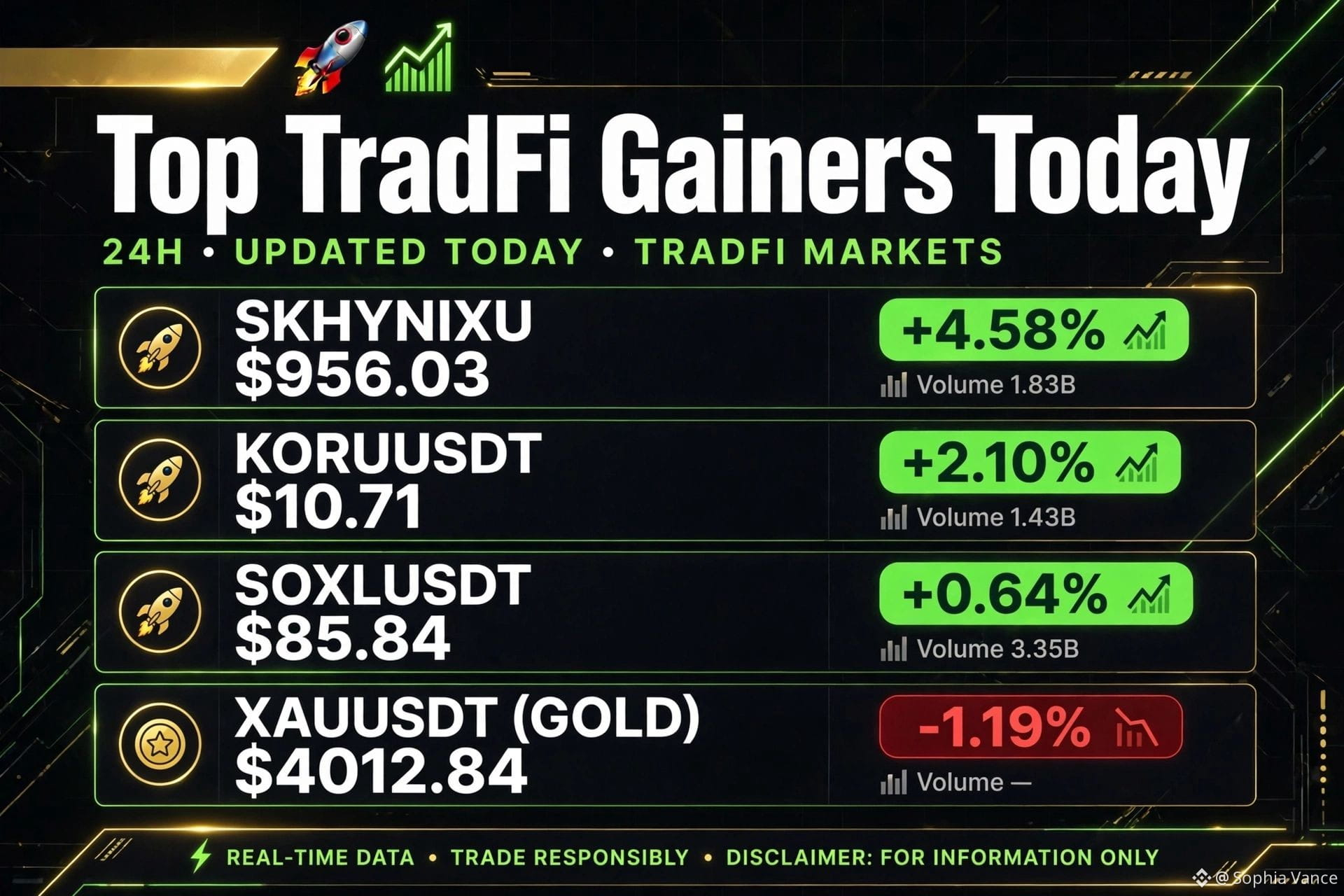
*🚀 TRADFI UPDATE - TODAY'S MARKET!*
*Listen Guys, TradFi is Leading Today!*
*🥇 SKHYNIXU $956.03 +4.58%*
Vol: 1.83B
*🥈 KORUUSDT $10.71 +2.10%*
Vol: 1.43B
*📊 SOXLUSDT $85.84 +0.64%*
Vol: 3.35B - Highest Volume Today!
*XAUUSDT
(GOLD) $4,012.84 -1.19%*
*What does it mean?*
Gold down = Risk ON
Money is moving from Gold to Tech/Chips.
Tech leading, gold sleeping. Perfect time for TradFi scalps!
Are you in TradFi today?
#TradFi #Binance #TopGainers #CryptoEducation
{future}(XAUUSDT)
{future}(SOXLUSDT)
*🚀 TRADFI UPDATE - TODAY'S MARKET!*
*Listen Guys, TradFi is Leading Today!*
*🥇 SKHYNIXU $956.03 +4.58%*
Vol: 1.83B
*🥈 KORUUSDT $10.71 +2.10%*
Vol: 1.43B
*📊 SOXLUSDT $85.84 +0.64%*
Vol: 3.35B - Highest Volume Today!
*XAUUSDT
(GOLD) $4,012.84 -1.19%*
*What does it mean?*
Gold down = Risk ON
Money is moving from Gold to Tech/Chips.
Tech leading, gold sleeping. Perfect time for TradFi scalps!
Are you in TradFi today?
#TradFi #Binance #TopGainers #CryptoEducation
*Listen Guys, TradFi is Leading Today!*
*🥇 SKHYNIXU $956.03 +4.58%*
Vol: 1.83B
*🥈 KORUUSDT $10.71 +2.10%*
Vol: 1.43B
*📊 SOXLUSDT $85.84 +0.64%*
Vol: 3.35B - Highest Volume Today!
*XAUUSDT
(GOLD) $4,012.84 -1.19%*
*What does it mean?*
Gold down = Risk ON
Money is moving from Gold to Tech/Chips.
Tech leading, gold sleeping. Perfect time for TradFi scalps!
Are you in TradFi today?
#TradFi #Binance #TopGainers #CryptoEducation
506


·
--
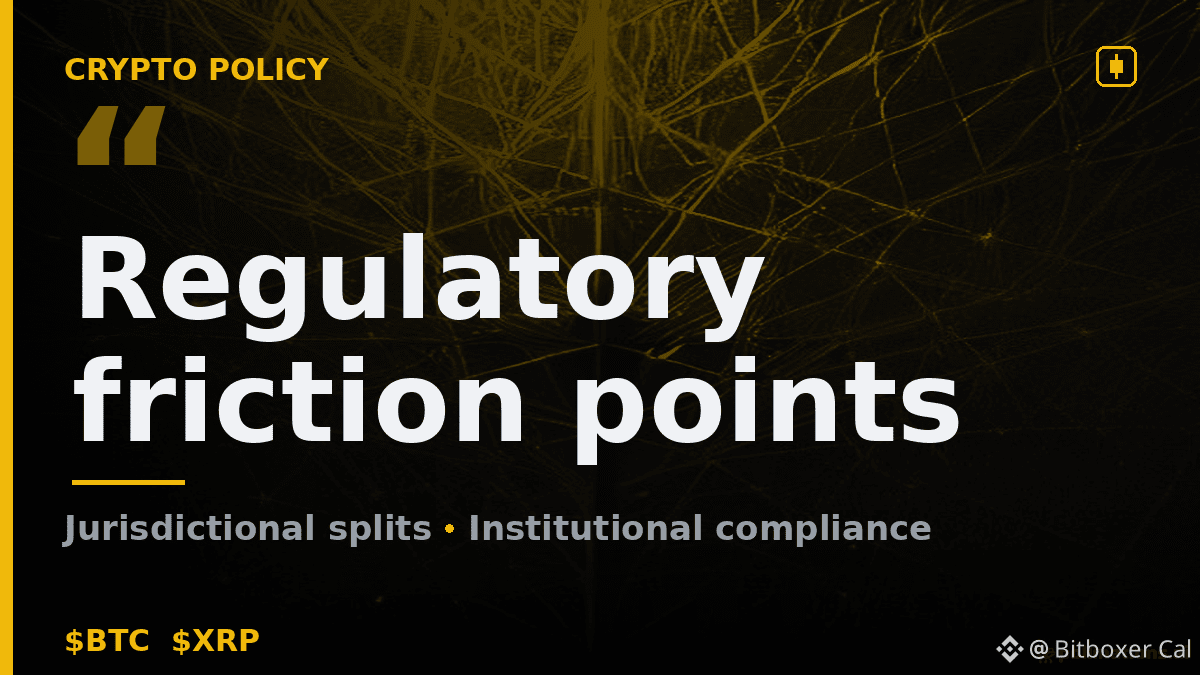
We spent a decade waiting for TradFi to adopt $BTC, but lawyers are more exhausting than developers.
The game has shifted from code to institutional friction. Jurisdictional red tape now dictates price action more than tech. Stop obsessing over daily outflows and watch for cross-border policy alignment. Global compliance standards are the new arbiter for $XRP and other large-cap assets.
$BTC #CryptoRegulation #TradFi #SEC
We spent a decade waiting for TradFi to adopt $BTC , but lawyers are more exhausting than developers.
The game has shifted from code to institutional friction. Jurisdictional red tape now dictates price action more than tech. Stop obsessing over daily outflows and watch for cross-border policy alignment. Global compliance standards are the new arbiter for $XRP and other large-cap assets.
$BTC #CryptoRegulation #TradFi #SEC
The game has shifted from code to institutional friction. Jurisdictional red tape now dictates price action more than tech. Stop obsessing over daily outflows and watch for cross-border policy alignment. Global compliance standards are the new arbiter for $XRP and other large-cap assets.
$BTC #CryptoRegulation #TradFi #SEC
135
·
--

Article
SNXX is up a little over 2%, but longs were liquidated for $260,000 versus just $12,000 in shortsSNXX is up a little over 2%, but nearly all TradFi liquidations over the past 24 hours hit longs—about $267,000 in longs versus just $12,000 in shorts, across 67 trades.
Reference prices: SNXX around 8.61 on Binance (+2.990%) and around 8.61 on OKX (+2.929%).
Prices are moving up, yet longs were liquidated for just over $260,000 while shorts were hit for only $12,000—a one-sided long wipeout.
#SNXX #TradFi #爆仓 #USStocks
Up a little over 2%, with $260,000 in long liquidations versus just $12,000 in shorts: would you read this as long positions getting picked off during a rebound, or just intraday noise with 60-plus trades?
View live: https://www.coinboss.com/tradfi-liquidations
SNXX is up a little over 2%, but longs were liquidated for $260,000 versus just $12,000 in shorts
SNXX is up a little over 2%, but nearly all TradFi liquidations over the past 24 hours hit longs—about $267,000 in longs versus just $12,000 in shorts, across 67 trades.
Reference prices: SNXX around 8.61 on Binance (+2.990%) and around 8.61 on OKX (+2.929%).
Prices are moving up, yet longs were liquidated for just over $260,000 while shorts were hit for only $12,000—a one-sided long wipeout.
#SNXX #TradFi #爆仓 #USStocks
Up a little over 2%, with $260,000 in long liquidations versus just $12,000 in shorts: would you read this as long positions getting picked off during a rebound, or just intraday noise with 60-plus trades?
View live: https://www.coinboss.com/tradfi-liquidations
Reference prices: SNXX around 8.61 on Binance (+2.990%) and around 8.61 on OKX (+2.929%).
Prices are moving up, yet longs were liquidated for just over $260,000 while shorts were hit for only $12,000—a one-sided long wipeout.
#SNXX #TradFi #爆仓 #USStocks
Up a little over 2%, with $260,000 in long liquidations versus just $12,000 in shorts: would you read this as long positions getting picked off during a rebound, or just intraday noise with 60-plus trades?
View live: https://www.coinboss.com/tradfi-liquidations
2
·
--
Article
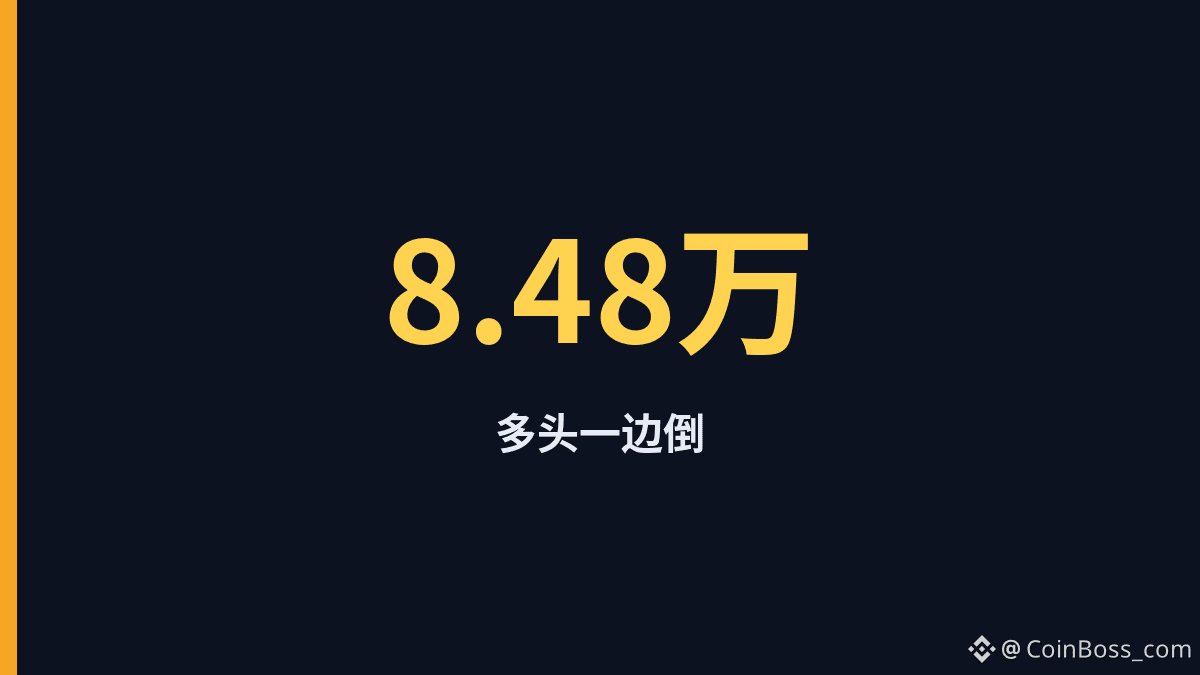
COIN dropped 3%, with $84,000 in long liquidations but just $111 in shortsCOIN dropped 3%, and nearly all TradFi liquidations over the past 24 hours hit longs—about $84,800 in longs versus $113 in shorts, across 52 trades total.
Price comparison: COIN at about 159.89 on Binance (−3.073%) and 159.88 on OKX (−3.103%); BTC at about 80032.3 on Binance (−0.764%) and 80036.7 on OKX (−0.773%).
Price is falling, yet longs were liquidated for $84,000 while shorts were just over $100—a one-sided long flush, with shorts barely taking a hit.
#COIN #TradFi #爆仓 #USStocks
COIN dropped 3%, with $84,000 in long liquidations versus $111 in shorts. Would you read this as longs getting flushed during the decline, or just intraday noise across 52 trades?
COIN dropped 3%, with $84,000 in long liquidations but just $111 in shorts
COIN dropped 3%, and nearly all TradFi liquidations over the past 24 hours hit longs—about $84,800 in longs versus $113 in shorts, across 52 trades total.
Price comparison: COIN at about 159.89 on Binance (−3.073%) and 159.88 on OKX (−3.103%); BTC at about 80032.3 on Binance (−0.764%) and 80036.7 on OKX (−0.773%).
Price is falling, yet longs were liquidated for $84,000 while shorts were just over $100—a one-sided long flush, with shorts barely taking a hit.
#COIN #TradFi #爆仓 #USStocks
COIN dropped 3%, with $84,000 in long liquidations versus $111 in shorts. Would you read this as longs getting flushed during the decline, or just intraday noise across 52 trades?
Price comparison: COIN at about 159.89 on Binance (−3.073%) and 159.88 on OKX (−3.103%); BTC at about 80032.3 on Binance (−0.764%) and 80036.7 on OKX (−0.773%).
Price is falling, yet longs were liquidated for $84,000 while shorts were just over $100—a one-sided long flush, with shorts barely taking a hit.
#COIN #TradFi #爆仓 #USStocks
COIN dropped 3%, with $84,000 in long liquidations versus $111 in shorts. Would you read this as longs getting flushed during the decline, or just intraday noise across 52 trades?
4
·
--
Article
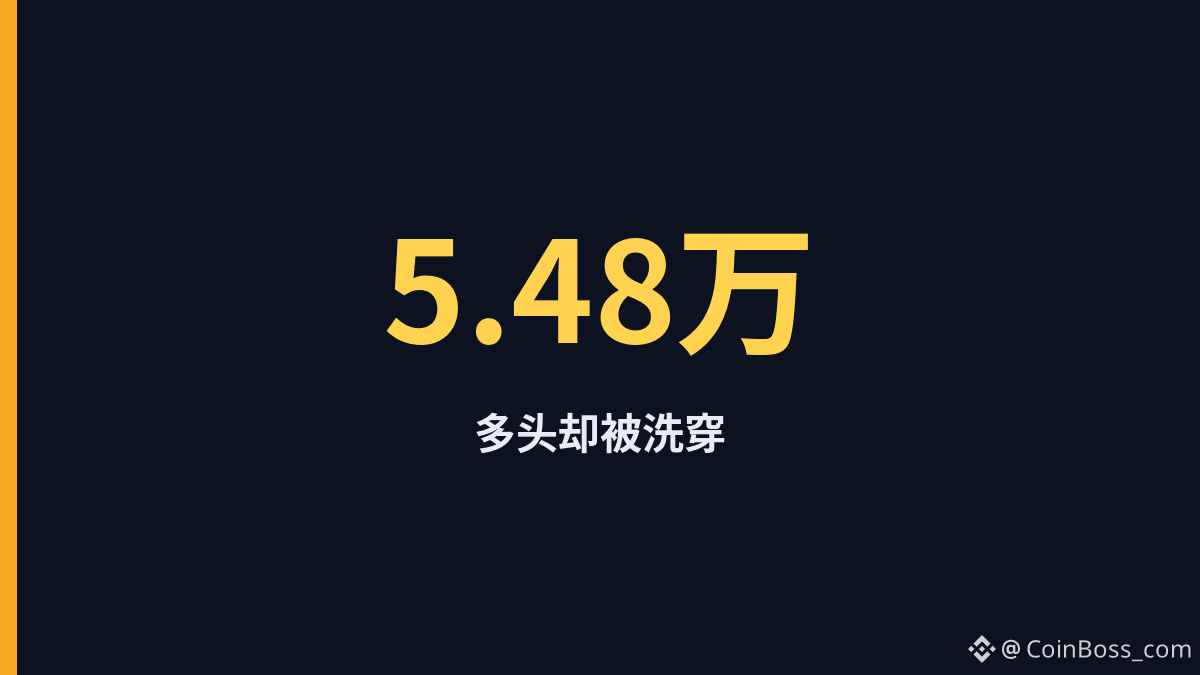
HOOD drops about 2.5%: $54K in longs liquidated, but virtually no shortsHOOD dropped about 2.5%, and almost all TradFi liquidations over the past 24 hours hit longs—about $54.8K in longs versus virtually zero in shorts, across 22 liquidations.
Prices: HOOD at about 93.34 on Binance (−2.415%) and 93.36 on OKX (−2.394%); BTC at about 79911.9 on Binance (−0.735%) and 79923.0 on OKX (−0.753%).
Prices are falling, yet $54K in longs were liquidated while shorts were almost untouched—a one-sided long wipeout.
#HOOD #TradFi #爆仓 #USStocks
HOOD dropped about 2.5%, with $54K in longs liquidated and virtually no shorts. Would you read this as longs getting singled out and flushed during the decline, or just intraday noise given there were only 22 liquidations?
HOOD drops about 2.5%: $54K in longs liquidated, but virtually no shorts
HOOD dropped about 2.5%, and almost all TradFi liquidations over the past 24 hours hit longs—about $54.8K in longs versus virtually zero in shorts, across 22 liquidations.
Prices: HOOD at about 93.34 on Binance (−2.415%) and 93.36 on OKX (−2.394%); BTC at about 79911.9 on Binance (−0.735%) and 79923.0 on OKX (−0.753%).
Prices are falling, yet $54K in longs were liquidated while shorts were almost untouched—a one-sided long wipeout.
#HOOD #TradFi #爆仓 #USStocks
HOOD dropped about 2.5%, with $54K in longs liquidated and virtually no shorts. Would you read this as longs getting singled out and flushed during the decline, or just intraday noise given there were only 22 liquidations?
Prices: HOOD at about 93.34 on Binance (−2.415%) and 93.36 on OKX (−2.394%); BTC at about 79911.9 on Binance (−0.735%) and 79923.0 on OKX (−0.753%).
Prices are falling, yet $54K in longs were liquidated while shorts were almost untouched—a one-sided long wipeout.
#HOOD #TradFi #爆仓 #USStocks
HOOD dropped about 2.5%, with $54K in longs liquidated and virtually no shorts. Would you read this as longs getting singled out and flushed during the decline, or just intraday noise given there were only 22 liquidations?
19
·
--
Article
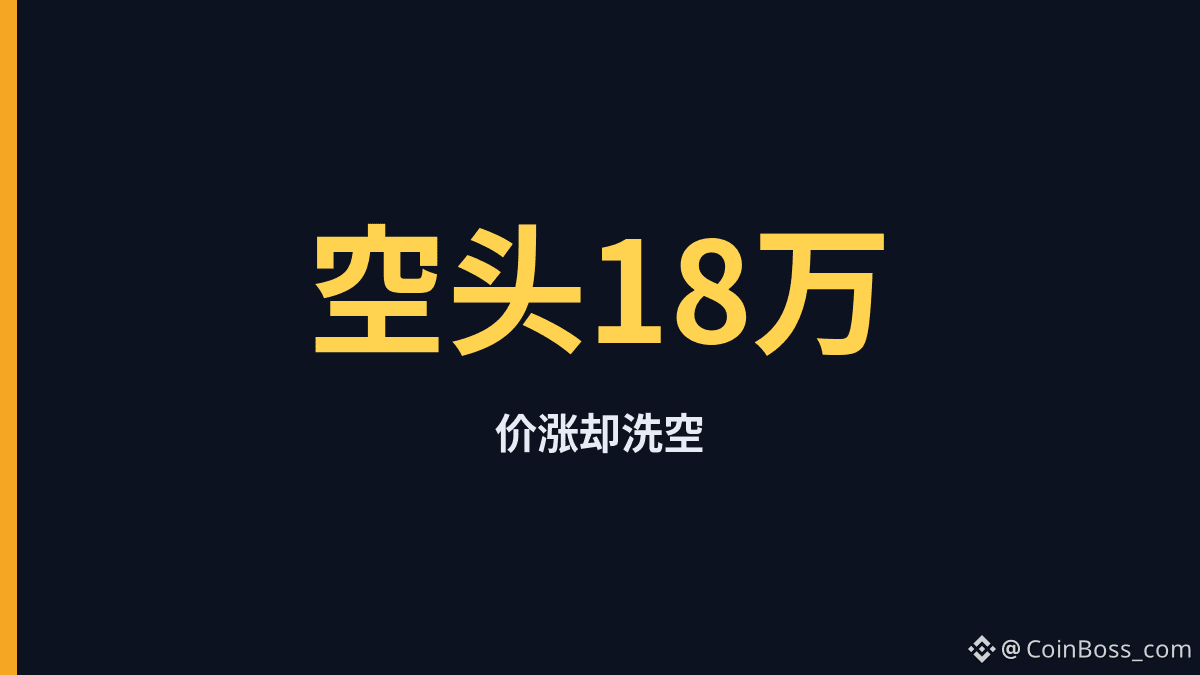
TSLA is up 6%, but shorts got liquidated for $180,000 while longs lost just $250TSLA is up nearly 6%, and over the past 24 hours, TradFi liquidations were almost entirely on the short side—about $182,000 in shorts versus just $300 in longs, across 139 liquidations.
Prices: TSLA at about 395.11 on Binance (+5.962%) and 394.94 on OKX (+5.905%); BTC at about 80346.0 on Binance (−0.280%) and 80355.1 on OKX (−0.224%).
Prices are rising, yet shorts have been liquidated for $180,000 while longs lost only $250—a one-sided short squeeze, with longs barely touched.
#TSLA #TradFi #爆仓 #USStocks
With the price up 6%, shorts at $180,000 versus longs at $250—is this shorts getting flushed out on the way up, or just intraday noise with barely over a hundred liquidations?
TSLA is up 6%, but shorts got liquidated for $180,000 while longs lost just $250
TSLA is up nearly 6%, and over the past 24 hours, TradFi liquidations were almost entirely on the short side—about $182,000 in shorts versus just $300 in longs, across 139 liquidations.
Prices: TSLA at about 395.11 on Binance (+5.962%) and 394.94 on OKX (+5.905%); BTC at about 80346.0 on Binance (−0.280%) and 80355.1 on OKX (−0.224%).
Prices are rising, yet shorts have been liquidated for $180,000 while longs lost only $250—a one-sided short squeeze, with longs barely touched.
#TSLA #TradFi #爆仓 #USStocks
With the price up 6%, shorts at $180,000 versus longs at $250—is this shorts getting flushed out on the way up, or just intraday noise with barely over a hundred liquidations?
Prices: TSLA at about 395.11 on Binance (+5.962%) and 394.94 on OKX (+5.905%); BTC at about 80346.0 on Binance (−0.280%) and 80355.1 on OKX (−0.224%).
Prices are rising, yet shorts have been liquidated for $180,000 while longs lost only $250—a one-sided short squeeze, with longs barely touched.
#TSLA #TradFi #爆仓 #USStocks
With the price up 6%, shorts at $180,000 versus longs at $250—is this shorts getting flushed out on the way up, or just intraday noise with barely over a hundred liquidations?
4
·
--
Article
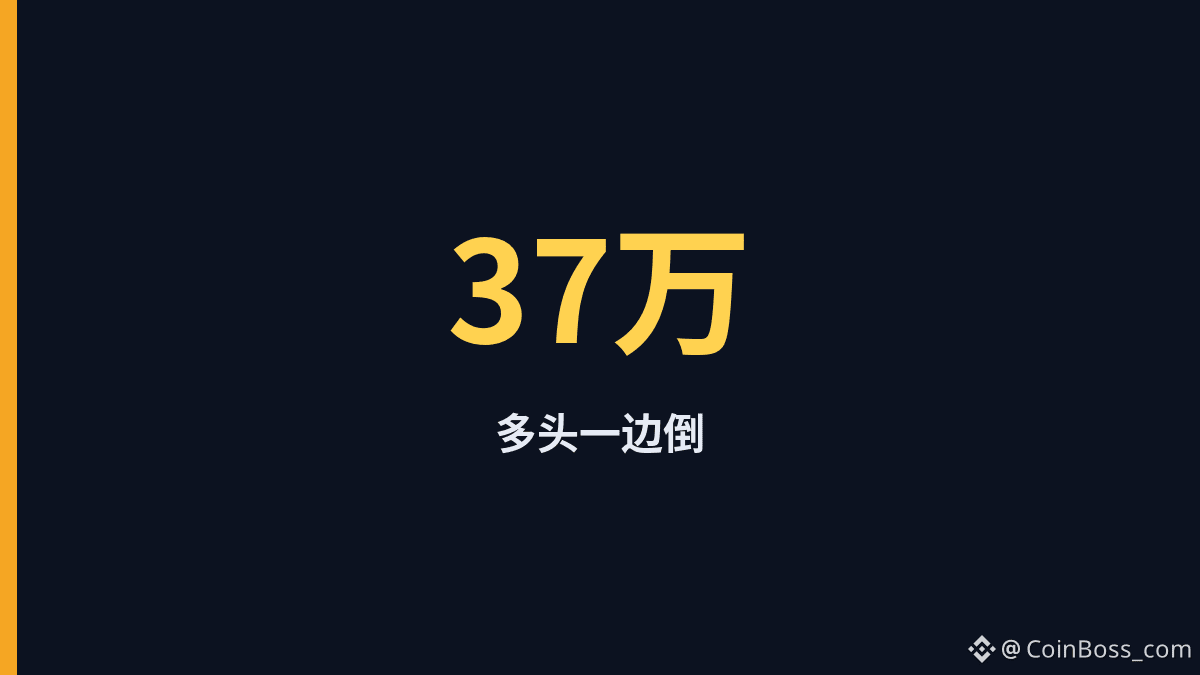
CRCL plunged five points: $370,000 in longs liquidated, versus just $1,500 in shortsCRCL plunged five points, and over the past 24 hours, nearly all TradFi liquidations hit longs—about $370,000 in longs versus just $1,500 in shorts, across 83 liquidations in total.
Prices: CRCL around 81.02 on Binance (−5.040%) and 80.99 on OKX (−5.075%); BTC around 80714.8 on Binance (+0.084%) and 80723.8 on OKX (+0.099%).
Price plunged five points, yet $370,000 in longs were liquidated versus just $1,500 in shorts—a one-sided long wipeout, with shorts barely touched.
#CRCL #TradFi #爆仓 #USStocks
With a five-point plunge and $370,000 in longs liquidated versus $1,500 in shorts, would you see this as long positions getting singled out and flushed during a decline, or just intraday noise with barely over 80 liquidations?
CRCL plunged five points: $370,000 in longs liquidated, versus just $1,500 in shorts
CRCL plunged five points, and over the past 24 hours, nearly all TradFi liquidations hit longs—about $370,000 in longs versus just $1,500 in shorts, across 83 liquidations in total.
Prices: CRCL around 81.02 on Binance (−5.040%) and 80.99 on OKX (−5.075%); BTC around 80714.8 on Binance (+0.084%) and 80723.8 on OKX (+0.099%).
Price plunged five points, yet $370,000 in longs were liquidated versus just $1,500 in shorts—a one-sided long wipeout, with shorts barely touched.
#CRCL #TradFi #爆仓 #USStocks
With a five-point plunge and $370,000 in longs liquidated versus $1,500 in shorts, would you see this as long positions getting singled out and flushed during a decline, or just intraday noise with barely over 80 liquidations?
Prices: CRCL around 81.02 on Binance (−5.040%) and 80.99 on OKX (−5.075%); BTC around 80714.8 on Binance (+0.084%) and 80723.8 on OKX (+0.099%).
Price plunged five points, yet $370,000 in longs were liquidated versus just $1,500 in shorts—a one-sided long wipeout, with shorts barely touched.
#CRCL #TradFi #爆仓 #USStocks
With a five-point plunge and $370,000 in longs liquidated versus $1,500 in shorts, would you see this as long positions getting singled out and flushed during a decline, or just intraday noise with barely over 80 liquidations?
18
·
--
Article
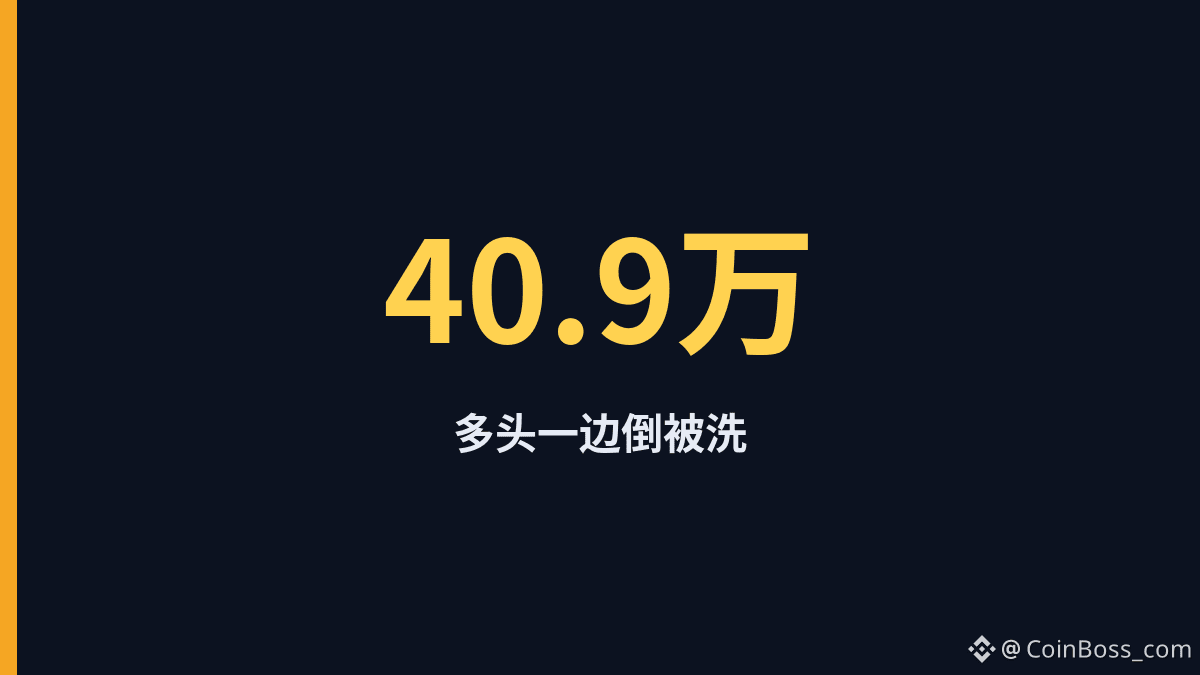
META is up half a percent, but longs lost $400,000 while shorts lost just $13,000META is up half a percent, but nearly all TradFi liquidations over the past 24 hours hit longs—about $409,000 in longs versus just $13,700 in shorts, across 56 trades.
Price comparison: META at around 645.66 on Binance (+0.473%) and 645.91 on OKX (+0.531%); BTC at around 80,596 on Binance (+0.011%) and 80,599 on OKX (+0.004%).
The price is still edging up half a percent, yet $400,000 in longs were liquidated compared with just $13,000 in shorts—a one-sided long wipeout, with shorts barely taking a hit.
#META #TradFi #爆仓 #USStocks
Up half a percent, with $400,000 in long liquidations versus $13,000 in shorts—would you read this as high-priced longs getting singled out for liquidation, or just intraday noise with only a little over 50 trades?
META is up half a percent, but longs lost $400,000 while shorts lost just $13,000
META is up half a percent, but nearly all TradFi liquidations over the past 24 hours hit longs—about $409,000 in longs versus just $13,700 in shorts, across 56 trades.
Price comparison: META at around 645.66 on Binance (+0.473%) and 645.91 on OKX (+0.531%); BTC at around 80,596 on Binance (+0.011%) and 80,599 on OKX (+0.004%).
The price is still edging up half a percent, yet $400,000 in longs were liquidated compared with just $13,000 in shorts—a one-sided long wipeout, with shorts barely taking a hit.
#META #TradFi #爆仓 #USStocks
Up half a percent, with $400,000 in long liquidations versus $13,000 in shorts—would you read this as high-priced longs getting singled out for liquidation, or just intraday noise with only a little over 50 trades?
Price comparison: META at around 645.66 on Binance (+0.473%) and 645.91 on OKX (+0.531%); BTC at around 80,596 on Binance (+0.011%) and 80,599 on OKX (+0.004%).
The price is still edging up half a percent, yet $400,000 in longs were liquidated compared with just $13,000 in shorts—a one-sided long wipeout, with shorts barely taking a hit.
#META #TradFi #爆仓 #USStocks
Up half a percent, with $400,000 in long liquidations versus $13,000 in shorts—would you read this as high-priced longs getting singled out for liquidation, or just intraday noise with only a little over 50 trades?
97
·
--
Article
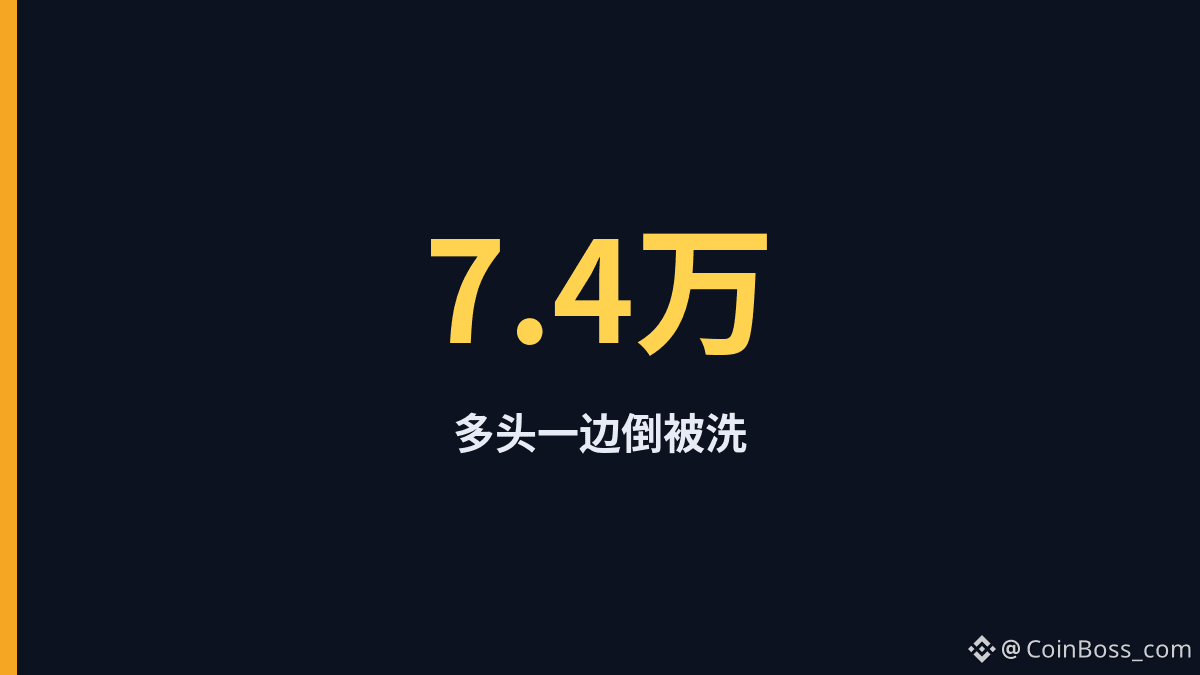
MSTR dumped 2%, with $74,000 in longs liquidated versus just $4,700 in shortsMSTR dumped about 2%, and nearly all TradFi liquidations over the past 24 hours hit longs—about $74,400 in longs versus just $4,800 in shorts, across roughly 46 liquidations.
Price comparison: MSTR at around 140.84 on Binance (−2.160%) and 140.85 on OKX (−2.154%); BTC at around 79,817 on Binance (−0.586%) and 79,830 on OKX (−0.590%).
Price was slammed down about 2%, yet $74,000 in longs were liquidated versus just $4,700 in shorts—a one-sided long flush, with shorts barely taking a hit.
#MSTR #TradFi #爆仓 #USStocks
After a 2% dump, $74,000 in longs were liquidated versus just $4,700 in shorts. Do you see it as overleveraged longs getting flushed during the downtrend, or as shorts barely having entered in the first place?
MSTR dumped 2%, with $74,000 in longs liquidated versus just $4,700 in shorts
MSTR dumped about 2%, and nearly all TradFi liquidations over the past 24 hours hit longs—about $74,400 in longs versus just $4,800 in shorts, across roughly 46 liquidations.
Price comparison: MSTR at around 140.84 on Binance (−2.160%) and 140.85 on OKX (−2.154%); BTC at around 79,817 on Binance (−0.586%) and 79,830 on OKX (−0.590%).
Price was slammed down about 2%, yet $74,000 in longs were liquidated versus just $4,700 in shorts—a one-sided long flush, with shorts barely taking a hit.
#MSTR #TradFi #爆仓 #USStocks
After a 2% dump, $74,000 in longs were liquidated versus just $4,700 in shorts. Do you see it as overleveraged longs getting flushed during the downtrend, or as shorts barely having entered in the first place?
Price comparison: MSTR at around 140.84 on Binance (−2.160%) and 140.85 on OKX (−2.154%); BTC at around 79,817 on Binance (−0.586%) and 79,830 on OKX (−0.590%).
Price was slammed down about 2%, yet $74,000 in longs were liquidated versus just $4,700 in shorts—a one-sided long flush, with shorts barely taking a hit.
#MSTR #TradFi #爆仓 #USStocks
After a 2% dump, $74,000 in longs were liquidated versus just $4,700 in shorts. Do you see it as overleveraged longs getting flushed during the downtrend, or as shorts barely having entered in the first place?
1
·
--
Article
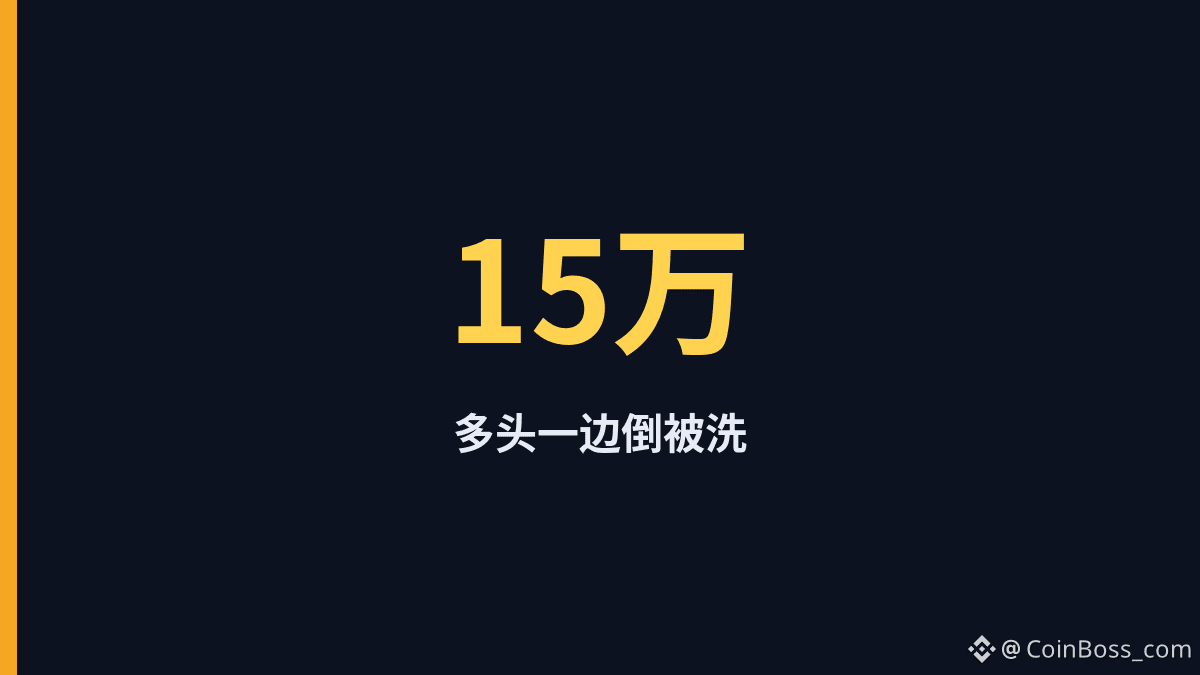
NVDA is up 1%, with $150,000 in longs liquidated versus just $9,000 in shortsNVDA is up 1%, but nearly all TradFi liquidations over the past 24 hours hit longs—about $150,800 in longs versus just $9,300 in shorts, across roughly 33 trades.
Prices: NVDA at about 215.05 on Binance (+1.133%) and 215.00 on OKX (+1.077%); BTC at about 79,923 on Binance (−0.520%) and 79,906 on OKX (−0.590%).
Prices are still up about 1%, yet $150,000 in longs were liquidated while shorts lost only $9,000—a one-sided long squeeze, with shorts barely taking a hit.
#NVDA #TradFi #爆仓 #USStocks
Up 1%, with $150,000 in longs liquidated versus just $9,000 in shorts—would you call this overleveraged longs getting flushed during a rebound, or were shorts barely in the market to begin with?
NVDA is up 1%, with $150,000 in longs liquidated versus just $9,000 in shorts
NVDA is up 1%, but nearly all TradFi liquidations over the past 24 hours hit longs—about $150,800 in longs versus just $9,300 in shorts, across roughly 33 trades.
Prices: NVDA at about 215.05 on Binance (+1.133%) and 215.00 on OKX (+1.077%); BTC at about 79,923 on Binance (−0.520%) and 79,906 on OKX (−0.590%).
Prices are still up about 1%, yet $150,000 in longs were liquidated while shorts lost only $9,000—a one-sided long squeeze, with shorts barely taking a hit.
#NVDA #TradFi #爆仓 #USStocks
Up 1%, with $150,000 in longs liquidated versus just $9,000 in shorts—would you call this overleveraged longs getting flushed during a rebound, or were shorts barely in the market to begin with?
Prices: NVDA at about 215.05 on Binance (+1.133%) and 215.00 on OKX (+1.077%); BTC at about 79,923 on Binance (−0.520%) and 79,906 on OKX (−0.590%).
Prices are still up about 1%, yet $150,000 in longs were liquidated while shorts lost only $9,000—a one-sided long squeeze, with shorts barely taking a hit.
#NVDA #TradFi #爆仓 #USStocks
Up 1%, with $150,000 in longs liquidated versus just $9,000 in shorts—would you call this overleveraged longs getting flushed during a rebound, or were shorts barely in the market to begin with?
92
·
--
Article
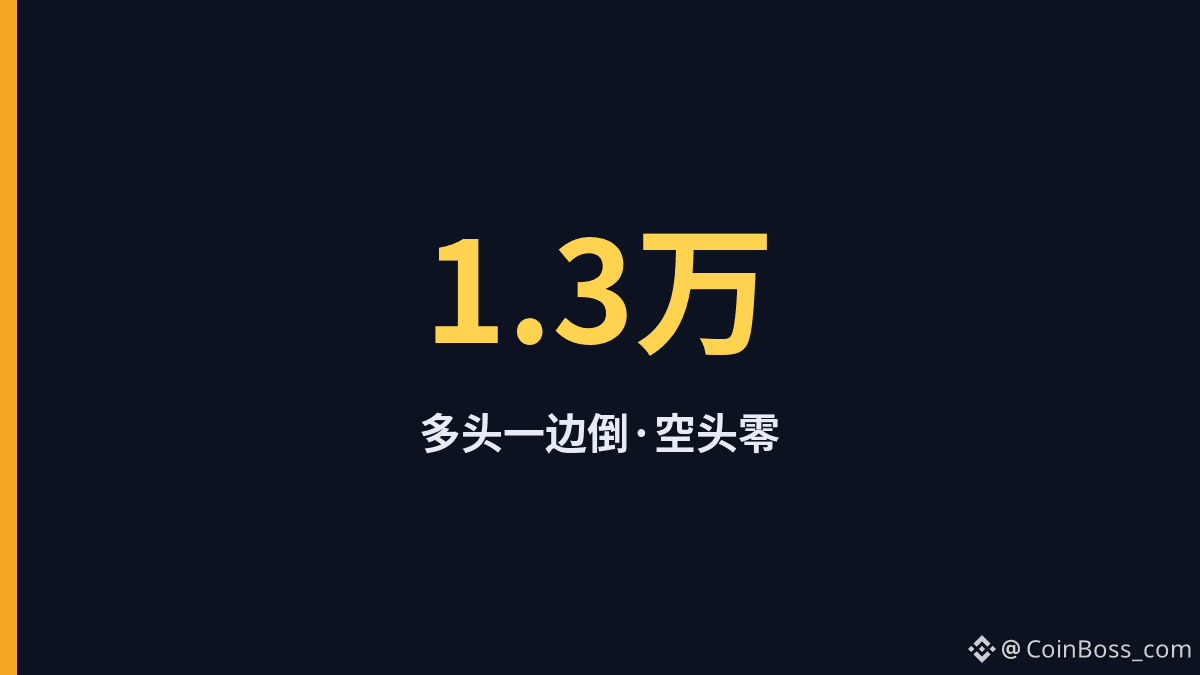
COIN dropped 2%—$13,000 in long liquidations, but none in shorts?COIN dropped 2%, and over the past 24 hours, TradFi liquidations were almost entirely longs—about $13,000 in longs and zero in shorts, across roughly 7 liquidations total.
Prices: COIN at around 160.39 on Binance (−2.153%) and 160.36 on OKX (−2.202%); BTC at around 80,208 on Binance (−0.223%) and 80,209 on OKX (−0.220%).
Down 2%, yet liquidations were completely one-sided—all longs, no shorts, with $13,000 in longs wiped out.
#COIN #TradFi #爆仓 #USStocks
Down 2%, with $13,000 in long liquidations and none in shorts. Do you see it as longs stubbornly holding on through the drop and getting flushed, or was nobody willing to short this move in the first place?
COIN dropped 2%—$13,000 in long liquidations, but none in shorts?
COIN dropped 2%, and over the past 24 hours, TradFi liquidations were almost entirely longs—about $13,000 in longs and zero in shorts, across roughly 7 liquidations total.
Prices: COIN at around 160.39 on Binance (−2.153%) and 160.36 on OKX (−2.202%); BTC at around 80,208 on Binance (−0.223%) and 80,209 on OKX (−0.220%).
Down 2%, yet liquidations were completely one-sided—all longs, no shorts, with $13,000 in longs wiped out.
#COIN #TradFi #爆仓 #USStocks
Down 2%, with $13,000 in long liquidations and none in shorts. Do you see it as longs stubbornly holding on through the drop and getting flushed, or was nobody willing to short this move in the first place?
Prices: COIN at around 160.39 on Binance (−2.153%) and 160.36 on OKX (−2.202%); BTC at around 80,208 on Binance (−0.223%) and 80,209 on OKX (−0.220%).
Down 2%, yet liquidations were completely one-sided—all longs, no shorts, with $13,000 in longs wiped out.
#COIN #TradFi #爆仓 #USStocks
Down 2%, with $13,000 in long liquidations and none in shorts. Do you see it as longs stubbornly holding on through the drop and getting flushed, or was nobody willing to short this move in the first place?
7
Log in to explore more content
Join global crypto users on Binance Square
⚡️ Get latest and useful information about crypto.
💬 Trusted by the world’s largest crypto exchange.
👍 Discover real insights from verified creators.
Email / Phone number
Trending Topics
1
#BinancePick
3.2M views
159,920 Discussing
2
#EarningsSeason
5.4M views
26,419 Discussing
3
#StrategySkipsBitcoinPurchasesSpends$205MOnSTRCBuybacks
0 views
0 Discussing
4
#BitmineAdds10452ETH
2,049 views
59 Discussing
5
#SouthKoreaConsidersEducationTaxOnCryptoExchanges
2,300 views
70 Discussing
6
#OCCUrgesCommunityBanksToEnterStablecoinPayments
1,654 views
48 Discussing
7
#RippleWinsFullApprovalAsNationalTrustBank
1,465 views
44 Discussing
8
#AkashSelectsSolanaAsMigrationTarget
620 views
13 Discussing
9
#OndoToOpenSubscriptionsForOpenAIPreIPOTokenizedNotes
57 views
4 Discussing
10
#AnthropicTTMRevenueGrewAbout1200%
48,291 views
526 Discussing