

#fedproposespaymentstablecoinrules
fedproposespaymentstablecoinrules
US Federal Reserve has released two proposed rules for payment stablecoins to implement the regulatory authority granted under the GENIUS Act. The proposals would move stablecoin issuance and bank-related crypto activities under formal rulemaking rather than prior enforcement guidance.
Hot
Latest

·
--
Bullish
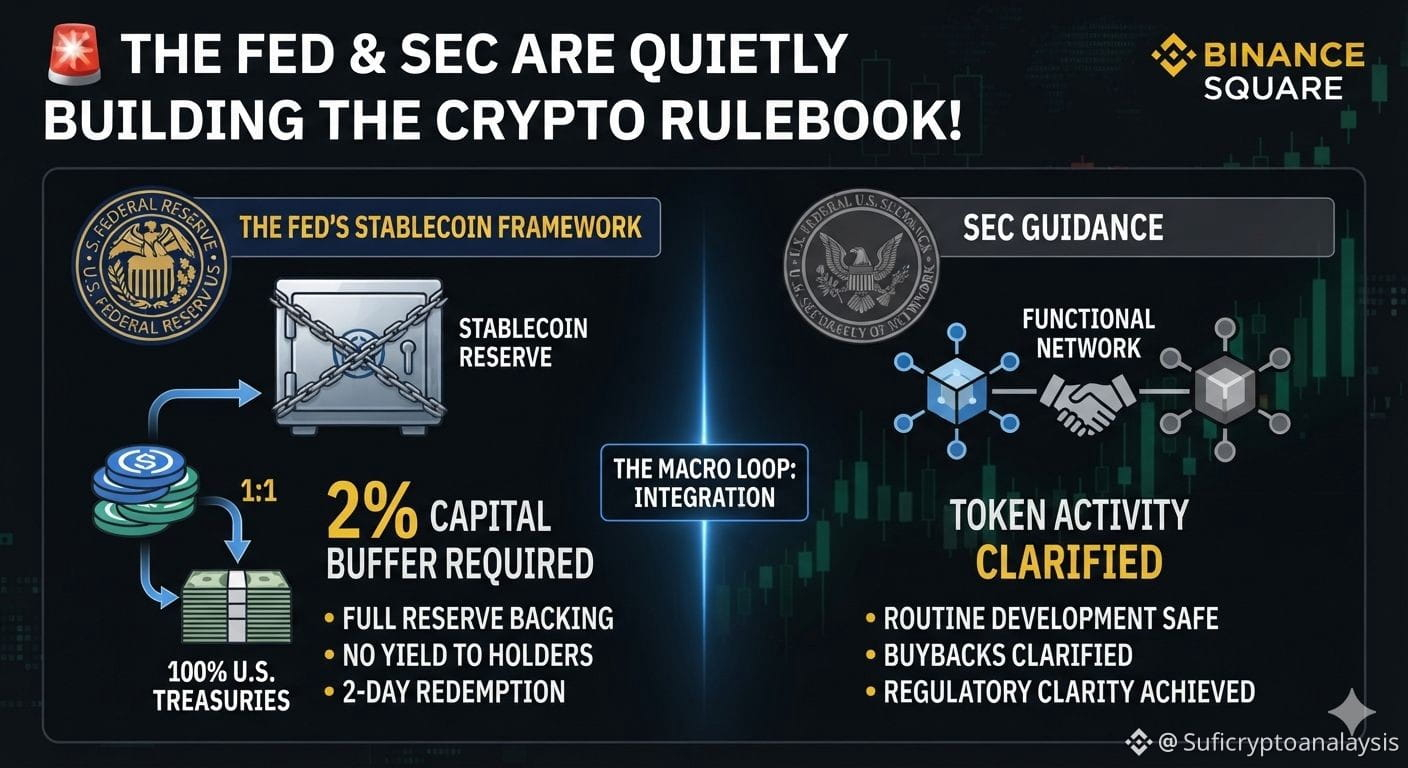
🚨 THE FED AND SEC ARE QUIETLY BUILDING THE RULEBOOK CRYPTO HAS BEEN WAITING FOR.
The Fed just proposed a formal framework for payment stablecoin issuers under the GENIUS Act, including 1:1 backing with high-quality liquid reserves such as short-term Treasuries, capital requirements, risk-management standards, custody rules, and a dedicated approval process for banks that want to issue stablecoins.
At almost the same time, SEC staff clarified that for functional crypto networks, things like token buybacks do not automatically create a securities contract by themselves. The SEC also stressed that this is staff guidance, not a binding new rule.
That combination matters.
Fed → clearer rules for digital dollars.
SEC → more clarity for functional crypto assets.
This is not deregulation.
It is something potentially more important:
Crypto is being pulled deeper into the regulated financial system instead of being pushed outside it.
For stablecoins, the direction is obvious: more reserves, more oversight, more bank participation.
And if that framework survives the comment process, the next phase of adoption may look less like “crypto vs banks”…
and more like banks issuing crypto-native money themselves. 👀
$USDC $CRCL $COIN $ETH
{future}(USDCUSDT)
{future}(CRCLUSDT)
{future}(COINUSDT)
#fedproposespaymentstablecoinrules #ChinaMayLetAlibabaByteDanceBuyNvidiaChips #USChinaRelease$30BTariffCutProductLists #SKoreaFSCConsidersVirtualAssetMarketMaker #ChinaIndustrialProfitGrowthSlowsFourthMonth
🚨 THE FED AND SEC ARE QUIETLY BUILDING THE RULEBOOK CRYPTO HAS BEEN WAITING FOR.
The Fed just proposed a formal framework for payment stablecoin issuers under the GENIUS Act, including 1:1 backing with high-quality liquid reserves such as short-term Treasuries, capital requirements, risk-management standards, custody rules, and a dedicated approval process for banks that want to issue stablecoins.
At almost the same time, SEC staff clarified that for functional crypto networks, things like token buybacks do not automatically create a securities contract by themselves. The SEC also stressed that this is staff guidance, not a binding new rule.
That combination matters.
Fed → clearer rules for digital dollars.
SEC → more clarity for functional crypto assets.
This is not deregulation.
It is something potentially more important:
Crypto is being pulled deeper into the regulated financial system instead of being pushed outside it.
For stablecoins, the direction is obvious: more reserves, more oversight, more bank participation.
And if that framework survives the comment process, the next phase of adoption may look less like “crypto vs banks”…
and more like banks issuing crypto-native money themselves. 👀
$USDC $CRCL $COIN $ETH
#fedproposespaymentstablecoinrules #ChinaMayLetAlibabaByteDanceBuyNvidiaChips #USChinaRelease$30BTariffCutProductLists #SKoreaFSCConsidersVirtualAssetMarketMaker #ChinaIndustrialProfitGrowthSlowsFourthMonth
The Fed just proposed a formal framework for payment stablecoin issuers under the GENIUS Act, including 1:1 backing with high-quality liquid reserves such as short-term Treasuries, capital requirements, risk-management standards, custody rules, and a dedicated approval process for banks that want to issue stablecoins.
At almost the same time, SEC staff clarified that for functional crypto networks, things like token buybacks do not automatically create a securities contract by themselves. The SEC also stressed that this is staff guidance, not a binding new rule.
That combination matters.
Fed → clearer rules for digital dollars.
SEC → more clarity for functional crypto assets.
This is not deregulation.
It is something potentially more important:
Crypto is being pulled deeper into the regulated financial system instead of being pushed outside it.
For stablecoins, the direction is obvious: more reserves, more oversight, more bank participation.
And if that framework survives the comment process, the next phase of adoption may look less like “crypto vs banks”…
and more like banks issuing crypto-native money themselves. 👀
$USDC $CRCL $COIN $ETH
#fedproposespaymentstablecoinrules #ChinaMayLetAlibabaByteDanceBuyNvidiaChips #USChinaRelease$30BTariffCutProductLists #SKoreaFSCConsidersVirtualAssetMarketMaker #ChinaIndustrialProfitGrowthSlowsFourthMonth
Bega1911:
https://app.binance.com/uni-qr/request-to-pay?billOrderId=456225039178694656&billType=request_a_payment
2
3
3.9k

·
--
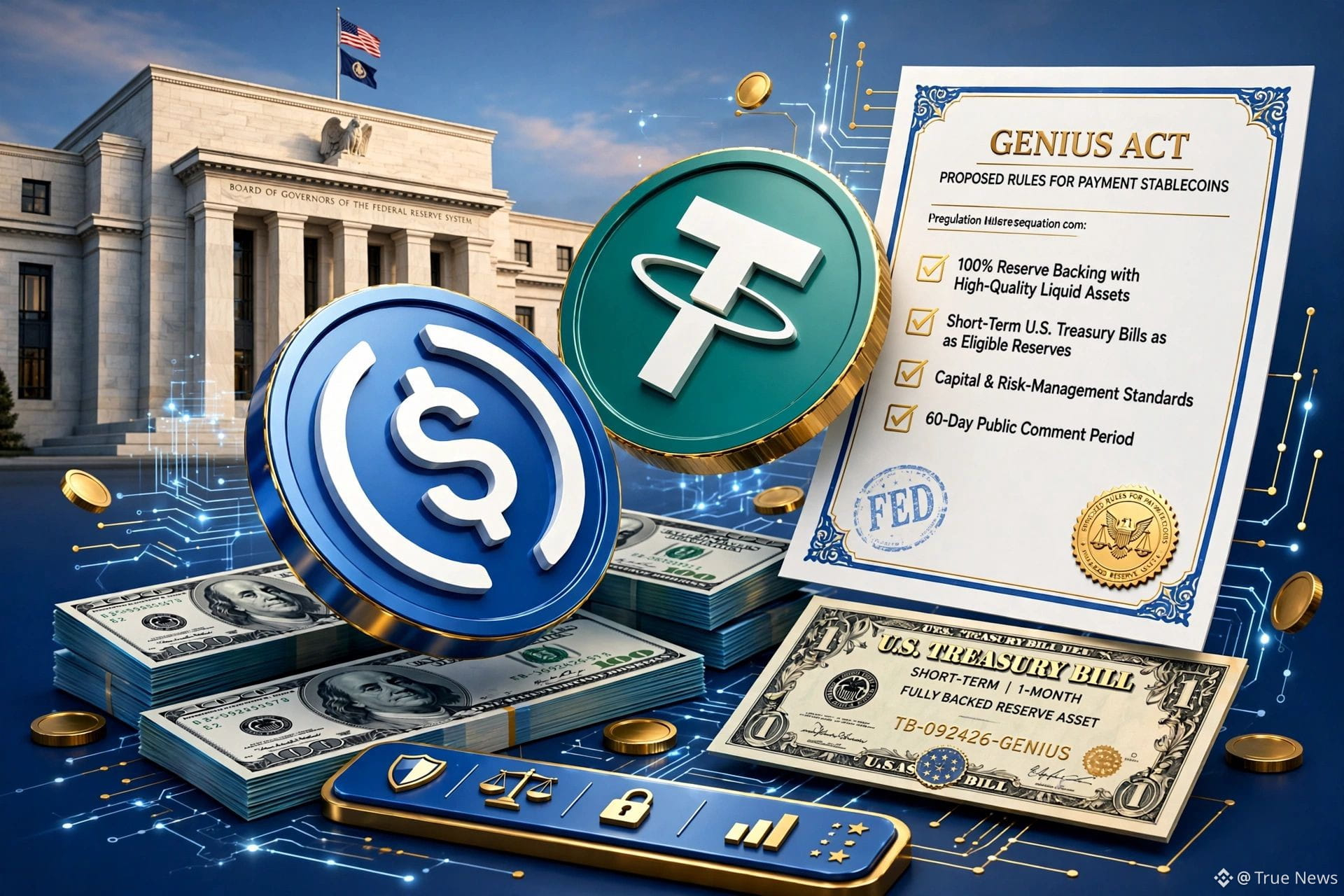
BREAKING: Federal Reserve Proposes Payment Stablecoin Rules! 🏦💵
On Sep 24, 2026, the Fed proposed 2 new rules to implement the GENIUS Act.
Key Highlights:
✅ 1:1 Backing Mandatory: Issuers must hold $1 in permitted reserves for every $1 stablecoin. Allowed reserves: cash, Fed balances, short-term T-Bills (≤93 days).
✅ 2-Day Redemption: Issuers must redeem tokens within two business days.
✅ Capital Rules: 2% on first $20B, 1% on amounts over $50B. If shortfall persists, forced liquidation & redemption.
✅ Bank Approval: 120-day Fed decision window, auto-approved if Fed is silent.
60-day public comment period is now open. This is the first concrete prudential framework for stablecoins in the US! Regulation = Mass Adoption?
What do you think, bullish for $USDT & $USDC?
#Stablecoin #Fed #GENIUSAct #CryptoRegulation #BinanceSquare #fedproposespaymentstablecoinrules
BREAKING: Federal Reserve Proposes Payment Stablecoin Rules! 🏦💵
On Sep 24, 2026, the Fed proposed 2 new rules to implement the GENIUS Act.
Key Highlights:
✅ 1:1 Backing Mandatory: Issuers must hold $1 in permitted reserves for every $1 stablecoin. Allowed reserves: cash, Fed balances, short-term T-Bills (≤93 days).
✅ 2-Day Redemption: Issuers must redeem tokens within two business days.
✅ Capital Rules: 2% on first $20B, 1% on amounts over $50B. If shortfall persists, forced liquidation & redemption.
✅ Bank Approval: 120-day Fed decision window, auto-approved if Fed is silent.
60-day public comment period is now open. This is the first concrete prudential framework for stablecoins in the US! Regulation = Mass Adoption?
What do you think, bullish for $USDT & $USDC?
#Stablecoin #Fed #GENIUSAct #CryptoRegulation #BinanceSquare #fedproposespaymentstablecoinrules
On Sep 24, 2026, the Fed proposed 2 new rules to implement the GENIUS Act.
Key Highlights:
✅ 1:1 Backing Mandatory: Issuers must hold $1 in permitted reserves for every $1 stablecoin. Allowed reserves: cash, Fed balances, short-term T-Bills (≤93 days).
✅ 2-Day Redemption: Issuers must redeem tokens within two business days.
✅ Capital Rules: 2% on first $20B, 1% on amounts over $50B. If shortfall persists, forced liquidation & redemption.
✅ Bank Approval: 120-day Fed decision window, auto-approved if Fed is silent.
60-day public comment period is now open. This is the first concrete prudential framework for stablecoins in the US! Regulation = Mass Adoption?
What do you think, bullish for $USDT & $USDC?
#Stablecoin #Fed #GENIUSAct #CryptoRegulation #BinanceSquare #fedproposespaymentstablecoinrules
1
3
391

🚨 BREAKING: FED PROPOSES 2% CAPITAL REQUIREMENT FOR STABLECOIN ISSUERS! 🇺🇸💵
🏦 The proposed framework would require a 2% capital buffer on the first $20 BILLION of token issuance for covered payment stablecoin issuers.
🚫 NO DIRECT YIELD: Payment stablecoin issuers would also be prohibited from paying interest or yield directly to token holders.
📋 The proposal is part of the Federal Reserve’s implementation of the GENIUS Act and includes additional capital and risk-management requirements.
🌐 Stablecoin regulation is entering a more defined phase in the U.S.
👀 Could tighter capital rules reshape the stablecoin market?
Follow for daily updates ⚡
$QNT $ONE $BTW
#FedProposesPaymentStablecoinRules
🚨 BREAKING: FED PROPOSES 2% CAPITAL REQUIREMENT FOR STABLECOIN ISSUERS! 🇺🇸💵
🏦 The proposed framework would require a 2% capital buffer on the first $20 BILLION of token issuance for covered payment stablecoin issuers.
🚫 NO DIRECT YIELD: Payment stablecoin issuers would also be prohibited from paying interest or yield directly to token holders.
📋 The proposal is part of the Federal Reserve’s implementation of the GENIUS Act and includes additional capital and risk-management requirements.
🌐 Stablecoin regulation is entering a more defined phase in the U.S.
👀 Could tighter capital rules reshape the stablecoin market?
Follow for daily updates ⚡
$QNT $ONE $BTW
#FedProposesPaymentStablecoinRules
🏦 The proposed framework would require a 2% capital buffer on the first $20 BILLION of token issuance for covered payment stablecoin issuers.
🚫 NO DIRECT YIELD: Payment stablecoin issuers would also be prohibited from paying interest or yield directly to token holders.
📋 The proposal is part of the Federal Reserve’s implementation of the GENIUS Act and includes additional capital and risk-management requirements.
🌐 Stablecoin regulation is entering a more defined phase in the U.S.
👀 Could tighter capital rules reshape the stablecoin market?
Follow for daily updates ⚡
$QNT $ONE $BTW
#FedProposesPaymentStablecoinRules
350

·
--
#fedproposespaymentstablecoinrules FED’S STABLECOIN RULES: A BIG CRYPTO SIGNAL
The Federal Reserve has announced two rulemaking packages to carry out the GENIUS Act placing payment stablecoins under rules.
Key points:
• 100 percent reserve backing with assets, such as short‑term Treasuries.
• Capital and risk controls.
• Redemption and reporting requirements.
• A dedicated approval process, for banks supervised by the Federal Reserve that want to issue stablecoins.
• Public comments will stay open for sixty days.
For traders this could be important because stablecoins link banking, dollar liquidity, exchanges and on‑chain payments.
Could stablecoin adoption speed up? What effect could this have on BTC. Altcoins? Share your view!..#stablecoin #crypto #cryptotrading #TradingSignals
$BTC $ETH $BNB
{future}(BTCUSDT)
{future}(ETHUSDT)
{future}(BNBUSDT)
#fedproposespaymentstablecoinrules FED’S STABLECOIN RULES: A BIG CRYPTO SIGNAL
The Federal Reserve has announced two rulemaking packages to carry out the GENIUS Act placing payment stablecoins under rules.
Key points:
• 100 percent reserve backing with assets, such as short‑term Treasuries.
• Capital and risk controls.
• Redemption and reporting requirements.
• A dedicated approval process, for banks supervised by the Federal Reserve that want to issue stablecoins.
• Public comments will stay open for sixty days.
For traders this could be important because stablecoins link banking, dollar liquidity, exchanges and on‑chain payments.
Could stablecoin adoption speed up? What effect could this have on BTC. Altcoins? Share your view!..#stablecoin #crypto #cryptotrading #TradingSignals
$BTC $ETH $BNB
The Federal Reserve has announced two rulemaking packages to carry out the GENIUS Act placing payment stablecoins under rules.
Key points:
• 100 percent reserve backing with assets, such as short‑term Treasuries.
• Capital and risk controls.
• Redemption and reporting requirements.
• A dedicated approval process, for banks supervised by the Federal Reserve that want to issue stablecoins.
• Public comments will stay open for sixty days.
For traders this could be important because stablecoins link banking, dollar liquidity, exchanges and on‑chain payments.
Could stablecoin adoption speed up? What effect could this have on BTC. Altcoins? Share your view!..#stablecoin #crypto #cryptotrading #TradingSignals
$BTC $ETH $BNB
418

#FedProposesPaymentStablecoinRules
🚨 THE FED & SEC ARE QUIETLY BUILDING THE CRYPTO RULEBOOK! 🇺🇸💵The U.S. regulatory landscape just shifted dramatically, pulling digital assets deeper into the traditional financial system rather than pushing them out. If you are trading or holding right now, these two parallel moves change the macro landscape entirely.🏛️ 1. The Fed's Strict Payment Stablecoin FrameworkUnder the GENIUS Act, the Federal Reserve proposed twin packages establishing comprehensive reserve, operational, and capital requirements:100% High-Quality Reserves: Tokens must be backed 1:1 by liquid assets like short-term U.S. Treasuries (93 days or less maturity).The 2% Capital Buffer: Issuers face a mandatory 2% capital requirement on the first $20 billion of token issuance to address operational and credit risks.Strict Yield Prohibition: Issuers are completely prohibited from paying interest or yield directly to token holders.Redemption Rules: Fulfilling cash/deposit redemptions must happen within two business days.⚖️ 2. The SEC & Coreen's Regulatory TakeSEC staff clarified that activities like token buybacks and active network development do not automatically trigger securities contracts on functional networks, offering builders more breathing room. Meanwhile, incorporating Coreen's market perspective highlights that these evolving frameworks demand tighter risk management across both decentralized and centralized portfolios.📊 Token Impact Analysis: What This Means For Your Bags$USDC & Stablecoins: Margin compression will favor fully compliant, bank-backed entities.$ETH & Layer 1s: Regulatory clarity serves as a long-term institutional catalyst as ETH eyes levels toward $3,050–$3,450.$SOL : Watching support at $113–$118 amid whale exchange transfers and ETF inflows.💡 The Macro Loop: The Real Winner?Integration over deregulation means stablecoins drive Treasury demand, cementing the digital dollar's reach.What is your take? Let me know below! 👇#FedProposesPaymentStablecoinRules #CryptoRegulation #Ethereum #Solana
#FedProposesPaymentStablecoinRules
🚨 THE FED & SEC ARE QUIETLY BUILDING THE CRYPTO RULEBOOK! 🇺🇸💵The U.S. regulatory landscape just shifted dramatically, pulling digital assets deeper into the traditional financial system rather than pushing them out. If you are trading or holding right now, these two parallel moves change the macro landscape entirely.🏛️ 1. The Fed's Strict Payment Stablecoin FrameworkUnder the GENIUS Act, the Federal Reserve proposed twin packages establishing comprehensive reserve, operational, and capital requirements:100% High-Quality Reserves: Tokens must be backed 1:1 by liquid assets like short-term U.S. Treasuries (93 days or less maturity).The 2% Capital Buffer: Issuers face a mandatory 2% capital requirement on the first $20 billion of token issuance to address operational and credit risks.Strict Yield Prohibition: Issuers are completely prohibited from paying interest or yield directly to token holders.Redemption Rules: Fulfilling cash/deposit redemptions must happen within two business days.⚖️ 2. The SEC & Coreen's Regulatory TakeSEC staff clarified that activities like token buybacks and active network development do not automatically trigger securities contracts on functional networks, offering builders more breathing room. Meanwhile, incorporating Coreen's market perspective highlights that these evolving frameworks demand tighter risk management across both decentralized and centralized portfolios.📊 Token Impact Analysis: What This Means For Your Bags$USDC & Stablecoins: Margin compression will favor fully compliant, bank-backed entities.$ETH & Layer 1s: Regulatory clarity serves as a long-term institutional catalyst as ETH eyes levels toward $3,050–$3,450.$SOL : Watching support at $113–$118 amid whale exchange transfers and ETF inflows.💡 The Macro Loop: The Real Winner?Integration over deregulation means stablecoins drive Treasury demand, cementing the digital dollar's reach.What is your take? Let me know below! 👇#FedProposesPaymentStablecoinRules #CryptoRegulation #Ethereum #Solana
🚨 THE FED & SEC ARE QUIETLY BUILDING THE CRYPTO RULEBOOK! 🇺🇸💵The U.S. regulatory landscape just shifted dramatically, pulling digital assets deeper into the traditional financial system rather than pushing them out. If you are trading or holding right now, these two parallel moves change the macro landscape entirely.🏛️ 1. The Fed's Strict Payment Stablecoin FrameworkUnder the GENIUS Act, the Federal Reserve proposed twin packages establishing comprehensive reserve, operational, and capital requirements:100% High-Quality Reserves: Tokens must be backed 1:1 by liquid assets like short-term U.S. Treasuries (93 days or less maturity).The 2% Capital Buffer: Issuers face a mandatory 2% capital requirement on the first $20 billion of token issuance to address operational and credit risks.Strict Yield Prohibition: Issuers are completely prohibited from paying interest or yield directly to token holders.Redemption Rules: Fulfilling cash/deposit redemptions must happen within two business days.⚖️ 2. The SEC & Coreen's Regulatory TakeSEC staff clarified that activities like token buybacks and active network development do not automatically trigger securities contracts on functional networks, offering builders more breathing room. Meanwhile, incorporating Coreen's market perspective highlights that these evolving frameworks demand tighter risk management across both decentralized and centralized portfolios.📊 Token Impact Analysis: What This Means For Your Bags$USDC & Stablecoins: Margin compression will favor fully compliant, bank-backed entities.$ETH & Layer 1s: Regulatory clarity serves as a long-term institutional catalyst as ETH eyes levels toward $3,050–$3,450.$SOL : Watching support at $113–$118 amid whale exchange transfers and ETF inflows.💡 The Macro Loop: The Real Winner?Integration over deregulation means stablecoins drive Treasury demand, cementing the digital dollar's reach.What is your take? Let me know below! 👇#FedProposesPaymentStablecoinRules #CryptoRegulation #Ethereum #Solana
36

·
--
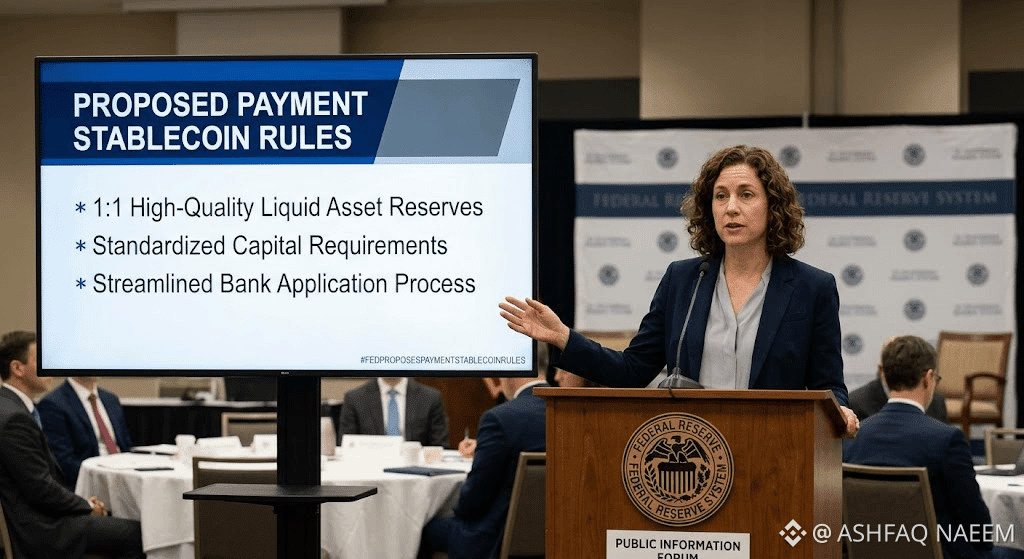
The Federal Reserve's proposed stablecoin rules under the GENIUS Act (issued September 24, 2026) focus on two main areas:
1:1 Reserve & Capital Standards: Supervised payment stablecoin issuers must fully back tokens with high-quality liquid assets (like short-term U.S. Treasuries) and maintain standardized capital buffers for operational and credit risk.
Bank Application Framework: Establishes a formal application, review, and appeals process for Fed-supervised banks seeking to create stablecoin-issuing subsidiaries.
The draft rules are open for a 60-day public comment period.
#fedproposespaymentstablecoinrules
#BTC $BTC #USDC✅ $USDC
{spot}(USDCUSDT)
{future}(BTCUSDT)
The Federal Reserve's proposed stablecoin rules under the GENIUS Act (issued September 24, 2026) focus on two main areas:
1:1 Reserve & Capital Standards: Supervised payment stablecoin issuers must fully back tokens with high-quality liquid assets (like short-term U.S. Treasuries) and maintain standardized capital buffers for operational and credit risk.
Bank Application Framework: Establishes a formal application, review, and appeals process for Fed-supervised banks seeking to create stablecoin-issuing subsidiaries.
The draft rules are open for a 60-day public comment period.
#fedproposespaymentstablecoinrules
#BTC $BTC #USDC✅ $USDC
1:1 Reserve & Capital Standards: Supervised payment stablecoin issuers must fully back tokens with high-quality liquid assets (like short-term U.S. Treasuries) and maintain standardized capital buffers for operational and credit risk.
Bank Application Framework: Establishes a formal application, review, and appeals process for Fed-supervised banks seeking to create stablecoin-issuing subsidiaries.
The draft rules are open for a 60-day public comment period.
#fedproposespaymentstablecoinrules
#BTC $BTC #USDC✅ $USDC
1
27

·
--
Article
The Federal Reserve Board proposed two draft rules#fedproposespaymentstablecoinrules
The Federal Reserve Board proposed two draft rules on September 24, 2026 to implement its part of the GENIUS Act, the federal stable coin law signed in July 2025. Public comment is open for 60 days after the proposals are published in the Federal Register.
Who it covers
The Fed proposed a rule setting requirements for authorized stable coin issuers under its purview, including state member banks and other state-chartered issuers. Under the act, the Fed oversees stable coin issuers that are subsidiaries of state member banks. It also oversees state-chartered institutions without federal deposit insurance that have $10 billion or more of stable coins.
Proposal 1: reserves, capital and risk management
Full backing: Every $1 of stable coins would need at least $1 of permissible reserve assets behind it. Reserves could include U.S. dollars, Fed balances, certain bank deposits, Treasuries with 93 days or less to maturity, qualifying repos, and eligible investment funds.Redemption: Issuers must fulfill redemption requests within two business days. If backing falls below 1:1, they must immediately notify the Fed. Capital: Standardized capital requirements would address credit and operational risks, alongside risk-management standards. An issuer that stays short of required capital long enough could be forced to liquidate all reserves and redeem every coin. Custody: The proposal adds rules for Fed-supervised firms that safekeep the assets backing stable coins. It also clarifies which stable coin activities are permissible for Fed-supervised banks.
Proposal 2: bank applications
Fed-supervised banks that want to issue stable coins would follow a tailored application process rather than the standard one. Applicants would submit a business plan and financial information. The draft also sets up a process for appeals, hearings and final determinations. The GENIUS Act gives the Fed 120 days to decide complete applications.
Reaction and context
Fed Governor Michael Barr called the proposal an important step but said more work is needed. He said stable coins "will only be stable if they can be reliably and promptly redeemed at par" in a range of conditions, including market stressThe OCC and NCUA proposed their rules in February, the FDIC in April, and Treasury in August. No agency has finalized rules yet. The agencies also missed the statutory July 18 implementation deadline.The OCC's chief has said its final rule will come out by November.
These are proposals, so details could change after comments. Only banks and issuers under the Fed's supervision are covered, so issuers regulated by the OCC, FDIC or states would follow their own rules.
The Federal Reserve Board proposed two draft rules
#fedproposespaymentstablecoinrules
The Federal Reserve Board proposed two draft rules on September 24, 2026 to implement its part of the GENIUS Act, the federal stable coin law signed in July 2025. Public comment is open for 60 days after the proposals are published in the Federal Register.
Who it covers
The Fed proposed a rule setting requirements for authorized stable coin issuers under its purview, including state member banks and other state-chartered issuers. Under the act, the Fed oversees stable coin issuers that are subsidiaries of state member banks. It also oversees state-chartered institutions without federal deposit insurance that have $10 billion or more of stable coins.
Proposal 1: reserves, capital and risk management
Full backing: Every $1 of stable coins would need at least $1 of permissible reserve assets behind it. Reserves could include U.S. dollars, Fed balances, certain bank deposits, Treasuries with 93 days or less to maturity, qualifying repos, and eligible investment funds.Redemption: Issuers must fulfill redemption requests within two business days. If backing falls below 1:1, they must immediately notify the Fed. Capital: Standardized capital requirements would address credit and operational risks, alongside risk-management standards. An issuer that stays short of required capital long enough could be forced to liquidate all reserves and redeem every coin. Custody: The proposal adds rules for Fed-supervised firms that safekeep the assets backing stable coins. It also clarifies which stable coin activities are permissible for Fed-supervised banks.
Proposal 2: bank applications
Fed-supervised banks that want to issue stable coins would follow a tailored application process rather than the standard one. Applicants would submit a business plan and financial information. The draft also sets up a process for appeals, hearings and final determinations. The GENIUS Act gives the Fed 120 days to decide complete applications.
Reaction and context
Fed Governor Michael Barr called the proposal an important step but said more work is needed. He said stable coins "will only be stable if they can be reliably and promptly redeemed at par" in a range of conditions, including market stressThe OCC and NCUA proposed their rules in February, the FDIC in April, and Treasury in August. No agency has finalized rules yet. The agencies also missed the statutory July 18 implementation deadline.The OCC's chief has said its final rule will come out by November.
These are proposals, so details could change after comments. Only banks and issuers under the Fed's supervision are covered, so issuers regulated by the OCC, FDIC or states would follow their own rules.
The Federal Reserve Board proposed two draft rules on September 24, 2026 to implement its part of the GENIUS Act, the federal stable coin law signed in July 2025. Public comment is open for 60 days after the proposals are published in the Federal Register.
Who it covers
The Fed proposed a rule setting requirements for authorized stable coin issuers under its purview, including state member banks and other state-chartered issuers. Under the act, the Fed oversees stable coin issuers that are subsidiaries of state member banks. It also oversees state-chartered institutions without federal deposit insurance that have $10 billion or more of stable coins.
Proposal 1: reserves, capital and risk management
Full backing: Every $1 of stable coins would need at least $1 of permissible reserve assets behind it. Reserves could include U.S. dollars, Fed balances, certain bank deposits, Treasuries with 93 days or less to maturity, qualifying repos, and eligible investment funds.Redemption: Issuers must fulfill redemption requests within two business days. If backing falls below 1:1, they must immediately notify the Fed. Capital: Standardized capital requirements would address credit and operational risks, alongside risk-management standards. An issuer that stays short of required capital long enough could be forced to liquidate all reserves and redeem every coin. Custody: The proposal adds rules for Fed-supervised firms that safekeep the assets backing stable coins. It also clarifies which stable coin activities are permissible for Fed-supervised banks.
Proposal 2: bank applications
Fed-supervised banks that want to issue stable coins would follow a tailored application process rather than the standard one. Applicants would submit a business plan and financial information. The draft also sets up a process for appeals, hearings and final determinations. The GENIUS Act gives the Fed 120 days to decide complete applications.
Reaction and context
Fed Governor Michael Barr called the proposal an important step but said more work is needed. He said stable coins "will only be stable if they can be reliably and promptly redeemed at par" in a range of conditions, including market stressThe OCC and NCUA proposed their rules in February, the FDIC in April, and Treasury in August. No agency has finalized rules yet. The agencies also missed the statutory July 18 implementation deadline.The OCC's chief has said its final rule will come out by November.
These are proposals, so details could change after comments. Only banks and issuers under the Fed's supervision are covered, so issuers regulated by the OCC, FDIC or states would follow their own rules.
43

·
--
#FedProposesPaymentStablecoinRules
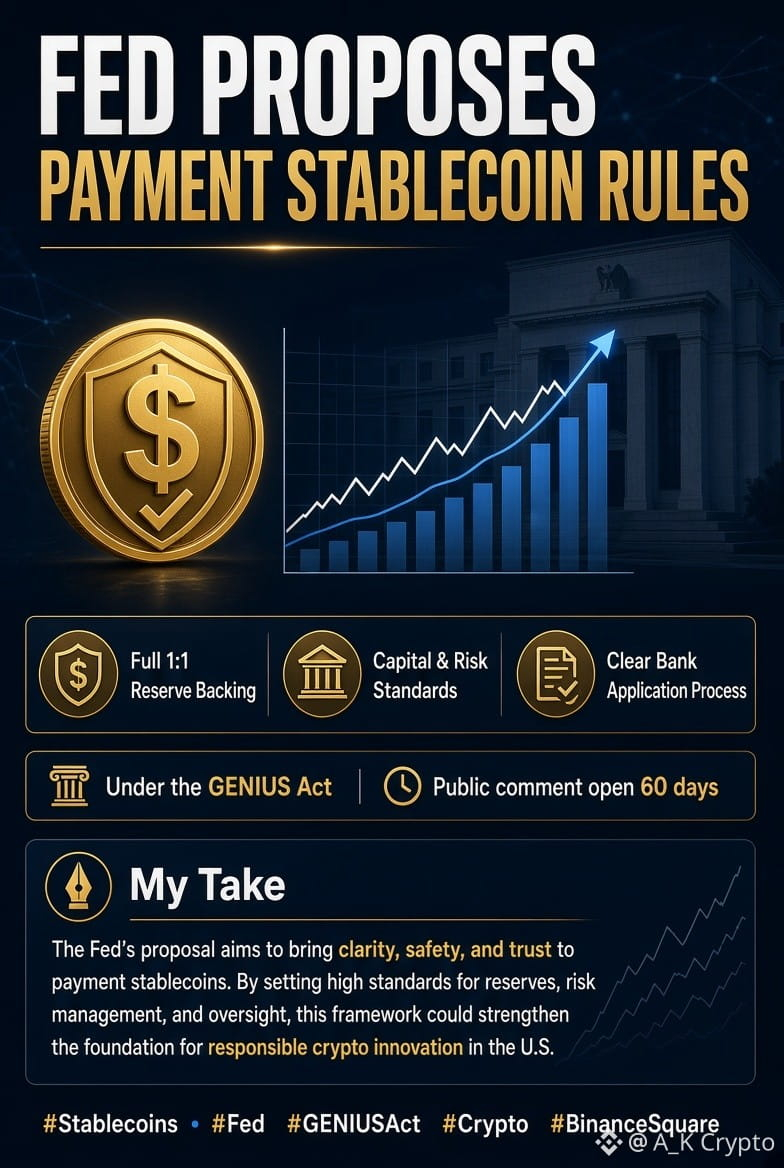
🚨 FED PROPOSES PAYMENT STABLECOIN RULES
The Federal Reserve just dropped two key proposals under the GENIUS Act for Board-supervised payment stablecoin issuers.
One requires full 1:1 backing with high-quality reserves like short-term Treasuries, plus standardized capital and risk management rules. The other sets out a clearer application process for banks wanting to issue stablecoins.
Public comment period is open for 60 days.
This is a solid step toward making dollar stablecoins safer and more reliable for everyday payments. Clear reserve rules and capital standards should build real confidence, but the final details on redemptions and risk will decide how useful these coins become. Watching closely as the framework takes shape.
#Stablecoins #Fed #GENIUSAct #Crypto #CryptoNews #BinanceSquare
#FedProposesPaymentStablecoinRules
🚨 FED PROPOSES PAYMENT STABLECOIN RULES
The Federal Reserve just dropped two key proposals under the GENIUS Act for Board-supervised payment stablecoin issuers.
One requires full 1:1 backing with high-quality reserves like short-term Treasuries, plus standardized capital and risk management rules. The other sets out a clearer application process for banks wanting to issue stablecoins.
Public comment period is open for 60 days.
This is a solid step toward making dollar stablecoins safer and more reliable for everyday payments. Clear reserve rules and capital standards should build real confidence, but the final details on redemptions and risk will decide how useful these coins become. Watching closely as the framework takes shape.
#Stablecoins #Fed #GENIUSAct #Crypto #CryptoNews #BinanceSquare
🚨 FED PROPOSES PAYMENT STABLECOIN RULES
The Federal Reserve just dropped two key proposals under the GENIUS Act for Board-supervised payment stablecoin issuers.
One requires full 1:1 backing with high-quality reserves like short-term Treasuries, plus standardized capital and risk management rules. The other sets out a clearer application process for banks wanting to issue stablecoins.
Public comment period is open for 60 days.
This is a solid step toward making dollar stablecoins safer and more reliable for everyday payments. Clear reserve rules and capital standards should build real confidence, but the final details on redemptions and risk will decide how useful these coins become. Watching closely as the framework takes shape.
#Stablecoins #Fed #GENIUSAct #Crypto #CryptoNews #BinanceSquare
1
34
·
--
🚨 THE UNDERRATED STABLECOIN TRADE ISN’T CRYPTO — IT’S U.S. TREASURIES.
The Fed’s proposed stablecoin framework would require regulated issuers to back payment stablecoins with high-quality liquid reserves, including short-term U.S. Treasury bills, while also setting capital and custody standards.
That creates a less obvious macro loop:
More stablecoin adoption → more reserve demand → more Treasury demand.
At the same time, SEC staff is giving functional crypto networks more room to operate, clarifying that activities like token buybacks or continued network development do not automatically create a securities contract.
Put those two together and the bigger story is not simply “crypto regulation.”
It’s this:
Washington may be turning stablecoins into a new distribution rail for dollar-denominated government debt — while simultaneously making the crypto layer easier to build on.
That could strengthen the dollar’s digital reach, increase demand for tokenized cash products, and make stablecoin issuers much more strategically important.
The hidden winner of the stablecoin boom may be the U.S. Treasury market itself. 👀
{stock_us}(COIN.US)
{future}(CRCLUSDT)
{future}(ETHUSDT)
$CRCL $COIN $USDC $ETH
#FedProposesPaymentStablecoinRules #ChinaMayLetAlibabaByteDanceBuyNvidiaChips #USChinaRelease$30BTariffCutProductLists #SKoreaFSCConsidersVirtualAssetMarketMaker #Fed
🚨 THE UNDERRATED STABLECOIN TRADE ISN’T CRYPTO — IT’S U.S. TREASURIES.
The Fed’s proposed stablecoin framework would require regulated issuers to back payment stablecoins with high-quality liquid reserves, including short-term U.S. Treasury bills, while also setting capital and custody standards.
That creates a less obvious macro loop:
More stablecoin adoption → more reserve demand → more Treasury demand.
At the same time, SEC staff is giving functional crypto networks more room to operate, clarifying that activities like token buybacks or continued network development do not automatically create a securities contract.
Put those two together and the bigger story is not simply “crypto regulation.”
It’s this:
Washington may be turning stablecoins into a new distribution rail for dollar-denominated government debt — while simultaneously making the crypto layer easier to build on.
That could strengthen the dollar’s digital reach, increase demand for tokenized cash products, and make stablecoin issuers much more strategically important.
The hidden winner of the stablecoin boom may be the U.S. Treasury market itself. 👀
$CRCL $COIN $USDC $ETH
#FedProposesPaymentStablecoinRules #ChinaMayLetAlibabaByteDanceBuyNvidiaChips #USChinaRelease$30BTariffCutProductLists #SKoreaFSCConsidersVirtualAssetMarketMaker #Fed
The Fed’s proposed stablecoin framework would require regulated issuers to back payment stablecoins with high-quality liquid reserves, including short-term U.S. Treasury bills, while also setting capital and custody standards.
That creates a less obvious macro loop:
More stablecoin adoption → more reserve demand → more Treasury demand.
At the same time, SEC staff is giving functional crypto networks more room to operate, clarifying that activities like token buybacks or continued network development do not automatically create a securities contract.
Put those two together and the bigger story is not simply “crypto regulation.”
It’s this:
Washington may be turning stablecoins into a new distribution rail for dollar-denominated government debt — while simultaneously making the crypto layer easier to build on.
That could strengthen the dollar’s digital reach, increase demand for tokenized cash products, and make stablecoin issuers much more strategically important.
The hidden winner of the stablecoin boom may be the U.S. Treasury market itself. 👀
$CRCL $COIN $USDC $ETH
#FedProposesPaymentStablecoinRules #ChinaMayLetAlibabaByteDanceBuyNvidiaChips #USChinaRelease$30BTariffCutProductLists #SKoreaFSCConsidersVirtualAssetMarketMaker #Fed

1
15

·
--
Bullish
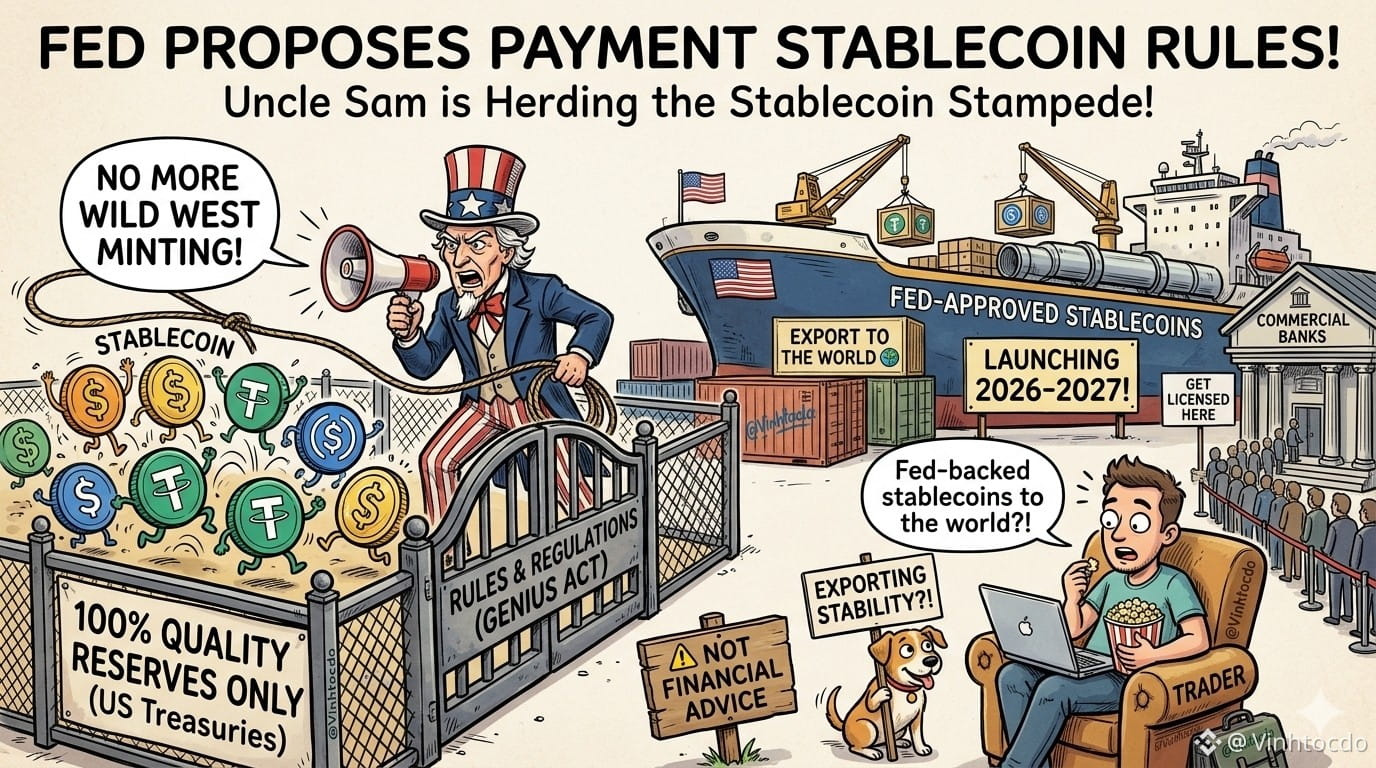
Uncle Sam wants to control the stablecoins! 🇺🇸 #fedproposespaymentstablecoinrules is officially live! The Federal Reserve just dropped new drafts to strictly regulate payment stablecoins under the GENIUS Act.
Are they preparing to export US-regulated stablecoins to the entire world? 🌍 Absolutely! They want 100% high-quality liquid reserves (hello, US Treasuries) and formal licenses for commercial banks by 2026-2027. No more Wild West minting!
What should traders do? Keep your eyes on top stablecoin projects, expect more institutional compliance, and manage your bags wisely!
⚠️ Not financial advice! New here? Use code VINHTOCDO or register via: [https://www.binance.com/register?ref=VINHTOCDO](https://www.binance.com/register?ref=VINHTOCDO)
👇 Click trade below to support me:
$BTC
{future}(BTCUSDT)
$BNB
{future}(BNBUSDT)
$ETH
{future}(ETHUSDT)
#Fed #stablecoin #CryptoNews #DeFi #USDC #VINHTOCDO
Uncle Sam wants to control the stablecoins! 🇺🇸 #fedproposespaymentstablecoinrules is officially live! The Federal Reserve just dropped new drafts to strictly regulate payment stablecoins under the GENIUS Act.
Are they preparing to export US-regulated stablecoins to the entire world? 🌍 Absolutely! They want 100% high-quality liquid reserves (hello, US Treasuries) and formal licenses for commercial banks by 2026-2027. No more Wild West minting!
What should traders do? Keep your eyes on top stablecoin projects, expect more institutional compliance, and manage your bags wisely!
⚠️ Not financial advice! New here? Use code VINHTOCDO or register via: https://www.binance.com/register?ref=VINHTOCDO
👇 Click trade below to support me:
$BTC
$BNB
$ETH
#Fed #stablecoin #CryptoNews #DeFi #USDC #VINHTOCDO
Are they preparing to export US-regulated stablecoins to the entire world? 🌍 Absolutely! They want 100% high-quality liquid reserves (hello, US Treasuries) and formal licenses for commercial banks by 2026-2027. No more Wild West minting!
What should traders do? Keep your eyes on top stablecoin projects, expect more institutional compliance, and manage your bags wisely!
⚠️ Not financial advice! New here? Use code VINHTOCDO or register via: https://www.binance.com/register?ref=VINHTOCDO
👇 Click trade below to support me:
$BTC
$BNB
$ETH
#Fed #stablecoin #CryptoNews #DeFi #USDC #VINHTOCDO
2
43

·
--
#FedProposesPaymentStablecoinRules
🚨 Fed proposes new payment stablecoin rules
The U.S. Federal Reserve has proposed rules under the GENIUS Act that would require Fed-supervised payment stablecoin issuers to fully back tokens with eligible reserves, including short-term U.S. Treasury bills. The proposal also includes capital and risk-management requirements and a dedicated process for supervised banks seeking to issue payment stablecoins. Public comments will be open for 60 days after Federal Register publication.
💬 What do you think?$BTC $BNB $ETH
Will clearer stablecoin rules accelerate institutional adoption?
#Stablecoin #BNB_Market_Update #CryptoRegulation #Fed
#FedProposesPaymentStablecoinRules
🚨 Fed proposes new payment stablecoin rules
The U.S. Federal Reserve has proposed rules under the GENIUS Act that would require Fed-supervised payment stablecoin issuers to fully back tokens with eligible reserves, including short-term U.S. Treasury bills. The proposal also includes capital and risk-management requirements and a dedicated process for supervised banks seeking to issue payment stablecoins. Public comments will be open for 60 days after Federal Register publication.
💬 What do you think?$BTC $BNB $ETH
Will clearer stablecoin rules accelerate institutional adoption?
#Stablecoin #BNB_Market_Update #CryptoRegulation #Fed
🚨 Fed proposes new payment stablecoin rules
The U.S. Federal Reserve has proposed rules under the GENIUS Act that would require Fed-supervised payment stablecoin issuers to fully back tokens with eligible reserves, including short-term U.S. Treasury bills. The proposal also includes capital and risk-management requirements and a dedicated process for supervised banks seeking to issue payment stablecoins. Public comments will be open for 60 days after Federal Register publication.
💬 What do you think?$BTC $BNB $ETH
Will clearer stablecoin rules accelerate institutional adoption?
#Stablecoin #BNB_Market_Update #CryptoRegulation #Fed
1
64
·
--
#FedProposesPaymentStablecoinRules
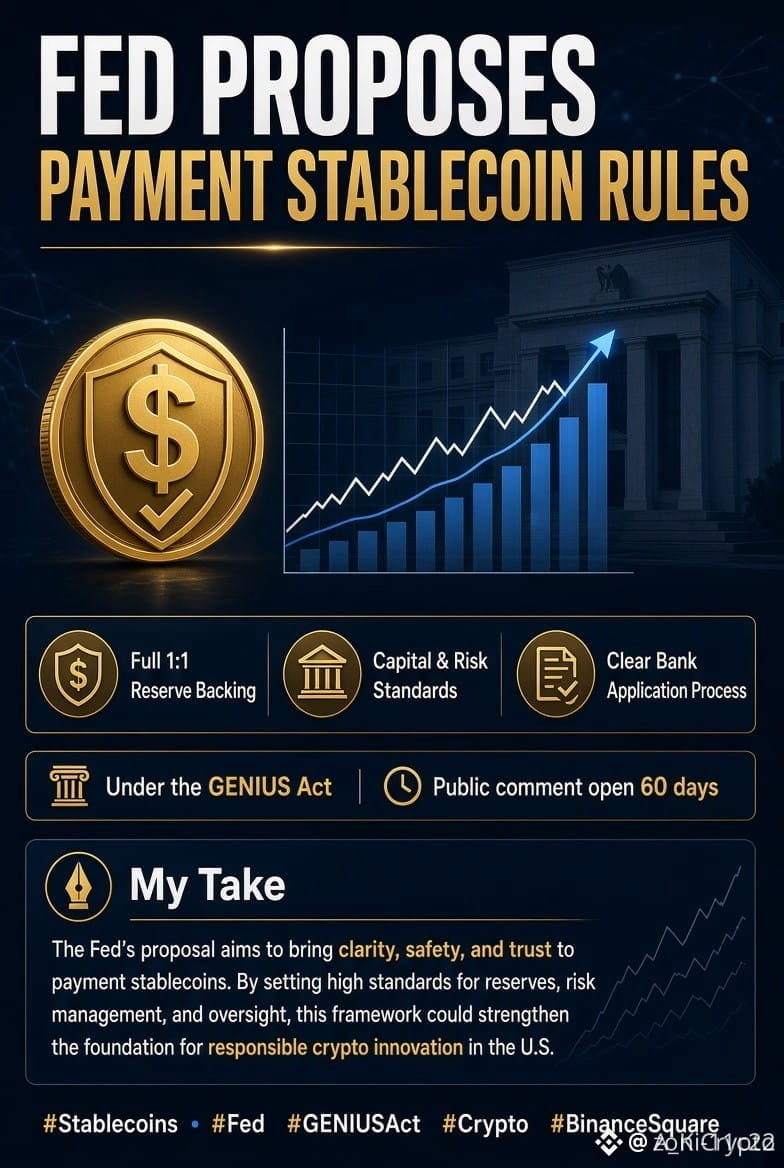
The Federal Reserve has proposed a landmark regulatory framework for payment stablecoin under the GENIUS Act, moving crypto assets deeper into the traditional $US
{alpha}(CT_7840xee962a61432231c2ede6946515beb02290cb516ad087bb06a731e922b2a5f57a::us::US)
financial system. Published on September 24, 2026, the twin proposals establish comprehensive reserve, operational, and capital requirements for stablecoin issuers. [1]
$BNB
{future}(BNBUSDT)
#FedProposesPaymentStablecoinRules
The Federal Reserve has proposed a landmark regulatory framework for payment stablecoin under the GENIUS Act, moving crypto assets deeper into the traditional $US
financial system. Published on September 24, 2026, the twin proposals establish comprehensive reserve, operational, and capital requirements for stablecoin issuers. [1]
$BNB
The Federal Reserve has proposed a landmark regulatory framework for payment stablecoin under the GENIUS Act, moving crypto assets deeper into the traditional $US
financial system. Published on September 24, 2026, the twin proposals establish comprehensive reserve, operational, and capital requirements for stablecoin issuers. [1]
$BNB

1
43

·
--
#fedproposespaymentstablecoinrules
FED PROPOSES PAYMENT STABLECOIN RULES
The wait is over.
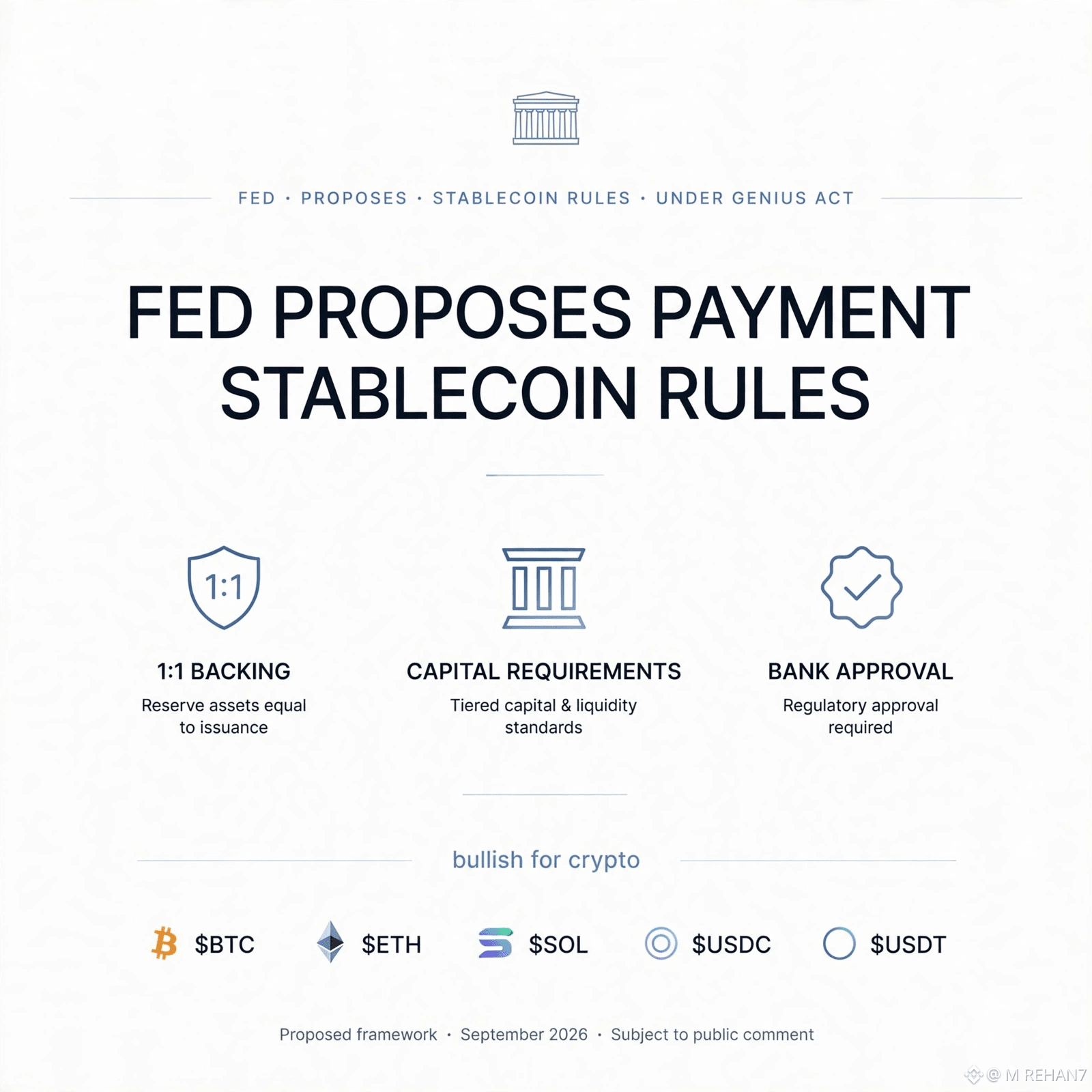
Fed Board — Sept 24, 2026 — proposed GENIUS Act framework:
• 1:1 BACKING: USDT USDC must be backed 100% by short-term Treasuries + Cash
• CAPITAL REQUIREMENTS: Tiered capital & liquidity standards mandatory
• BANK APPROVAL: Licensed pathway for banks to issue stablecoins by 2027
SEC also clarified: Token buybacks on functional networks ≠ securities.
This is not deregulation.
This is institutionalization.
Fed is pulling stablecoins INTO banking, not pushing them out.
Why it matters for us:
Trusted $USDC $USDT = Deeper $BTC $ETH $SOL liquidity
Bank-issued stablecoins = $170B market -> $300B+
Less FUD, more adoption
Biggest bullish signal for BTC $ETH $SOL since ETF approval.
Are you bullish or bearish on this?
I am BULLISH BTC $ETH $SOL USDC USDT
#fedproposespaymentstablecoinrules #BTC #ETH #SOL
#fedproposespaymentstablecoinrules
FED PROPOSES PAYMENT STABLECOIN RULES
The wait is over.
Fed Board — Sept 24, 2026 — proposed GENIUS Act framework:
• 1:1 BACKING: USDT USDC must be backed 100% by short-term Treasuries + Cash
• CAPITAL REQUIREMENTS: Tiered capital & liquidity standards mandatory
• BANK APPROVAL: Licensed pathway for banks to issue stablecoins by 2027
SEC also clarified: Token buybacks on functional networks ≠ securities.
This is not deregulation.
This is institutionalization.
Fed is pulling stablecoins INTO banking, not pushing them out.
Why it matters for us:
Trusted $USDC $USDT = Deeper $BTC $ETH $SOL liquidity
Bank-issued stablecoins = $170B market -> $300B+
Less FUD, more adoption
Biggest bullish signal for BTC $ETH $SOL since ETF approval.
Are you bullish or bearish on this?
I am BULLISH BTC $ETH $SOL USDC USDT
#fedproposespaymentstablecoinrules #BTC #ETH #SOL
FED PROPOSES PAYMENT STABLECOIN RULES
The wait is over.
Fed Board — Sept 24, 2026 — proposed GENIUS Act framework:
• 1:1 BACKING: USDT USDC must be backed 100% by short-term Treasuries + Cash
• CAPITAL REQUIREMENTS: Tiered capital & liquidity standards mandatory
• BANK APPROVAL: Licensed pathway for banks to issue stablecoins by 2027
SEC also clarified: Token buybacks on functional networks ≠ securities.
This is not deregulation.
This is institutionalization.
Fed is pulling stablecoins INTO banking, not pushing them out.
Why it matters for us:
Trusted $USDC $USDT = Deeper $BTC $ETH $SOL liquidity
Bank-issued stablecoins = $170B market -> $300B+
Less FUD, more adoption
Biggest bullish signal for BTC $ETH $SOL since ETF approval.
Are you bullish or bearish on this?
I am BULLISH BTC $ETH $SOL USDC USDT
#fedproposespaymentstablecoinrules #BTC #ETH #SOL
2
114


The Federal Reserve has proposed new rules for payment stablecoins, signaling a significant step towards regulating this burgeoning sector of the crypto market. This move reflects growing concerns about the stability and systemic risk associated with stablecoins, especially those used for payments. The proposed regulations are likely to focus on reserve requirements, transparency, and oversight, aiming to ensure these digital assets are as safe and reliable as traditional money. While the specifics are still under review, this initiative could lead to greater institutional adoption by providing a clearer regulatory framework, but it might also introduce compliance burdens for issuers. The market will be closely watching how these proposals evolve and impact the stablecoin landscape and the broader crypto ecosystem.
Disclaimer: This content is for informational purposes only and does not constitute financial advice.
#FedProposesPaymentStablecoinRules
The Federal Reserve has proposed new rules for payment stablecoins, signaling a significant step towards regulating this burgeoning sector of the crypto market. This move reflects growing concerns about the stability and systemic risk associated with stablecoins, especially those used for payments. The proposed regulations are likely to focus on reserve requirements, transparency, and oversight, aiming to ensure these digital assets are as safe and reliable as traditional money. While the specifics are still under review, this initiative could lead to greater institutional adoption by providing a clearer regulatory framework, but it might also introduce compliance burdens for issuers. The market will be closely watching how these proposals evolve and impact the stablecoin landscape and the broader crypto ecosystem.
Disclaimer: This content is for informational purposes only and does not constitute financial advice.
#FedProposesPaymentStablecoinRules
Disclaimer: This content is for informational purposes only and does not constitute financial advice.
#FedProposesPaymentStablecoinRules
2
33

·
--
Bullish
#fedproposespaymentstablecoinrules
🚨 THE FED IS BRINGING STABLECOINS CLOSER TO TRADITIONAL FINANCE.
The Federal Reserve has proposed new rules for payment stablecoin issuers under the GENIUS Act.
💵 Full backing with permitted reserve assets
🏦 Short-term U.S. Treasury bills could qualify as reserves
🛡️ New capital & risk-management requirements
🏛️ Fed-supervised banks could apply to issue payment stablecoins
⏳ Public comments open for 60 days
This could be another major step toward regulated stablecoins becoming part of the U.S. payments system.
👀 Stablecoins are getting serious attention from Wall Street.
#Fed #stablecoin #crypto
#fedproposespaymentstablecoinrules
🚨 THE FED IS BRINGING STABLECOINS CLOSER TO TRADITIONAL FINANCE.
The Federal Reserve has proposed new rules for payment stablecoin issuers under the GENIUS Act.
💵 Full backing with permitted reserve assets
🏦 Short-term U.S. Treasury bills could qualify as reserves
🛡️ New capital & risk-management requirements
🏛️ Fed-supervised banks could apply to issue payment stablecoins
⏳ Public comments open for 60 days
This could be another major step toward regulated stablecoins becoming part of the U.S. payments system.
👀 Stablecoins are getting serious attention from Wall Street.
#Fed #stablecoin #crypto
🚨 THE FED IS BRINGING STABLECOINS CLOSER TO TRADITIONAL FINANCE.
The Federal Reserve has proposed new rules for payment stablecoin issuers under the GENIUS Act.
💵 Full backing with permitted reserve assets
🏦 Short-term U.S. Treasury bills could qualify as reserves
🛡️ New capital & risk-management requirements
🏛️ Fed-supervised banks could apply to issue payment stablecoins
⏳ Public comments open for 60 days
This could be another major step toward regulated stablecoins becoming part of the U.S. payments system.
👀 Stablecoins are getting serious attention from Wall Street.
#Fed #stablecoin #crypto
1
140

·
--
Stablecoin Yield Boundaries Become a Regulatory Hot Topic|Issuer Interest Payments and Independent Rebates Cannot Be Netted|ZEC at $1,546—I'll wait
My stance is to first break down where the yield actually comes from, and not swap idle funds into ZEC just because of a regulatory headline. The front page of the forum still shows a topic about the Federal Reserve paying stablecoin proposals; this round’s page is a discussion among 50 people. That’s a snapshot of attention, not a flow of capital. I won’t repeat capital ratio arguments this time; I’m looking at a detail that directly relates to how money is parked: if the rule bans issuer-paid yield, does that mean all third-party incentives are automatically cut off?
The key facts: on September 24, the Federal Reserve released two public consultation proposals. In the attached draft formal document, proposed Section 247.10(c)(4) would prohibit, within its regulatory scope, a stablecoin issuer from paying interest or yield to holders solely because the issuer holds, uses, or retains stablecoins; the forms include cash, tokens, etc. This boundary aligns with Section 4(a)(11) of the already-published GENIUS bill. The new implementation proposal is still not a final rule already in effect, and it also cannot be written as a blanket “single shutdown” of global stablecoin products today.
What matters is that the proposal also discusses anti-circumvention arrangements: if there are agreements between an issuer and related parties or other relevant third parties, and those parties then pay yield to holders, it may trigger a rebuttable presumption of prohibition. On the other hand, the explanatory text clearly states that it does not intend to stop merchants from independently offering stablecoin payment discounts. So both “if a third party gives rewards, it must be legal” and “any discount is banned” are too crude. The specific product must be assessed based on the payment party, contractual relationships, and the terms of the incentive. I won’t here provide a compliance conclusion for any platform.
How does this affect the crypto market? Here’s my mechanism: if certain yield models need adjustment, capital may recompare the opportunity costs of holding stablecoins, bank deposits, short-term bonds, and risky assets. But “recomparing” doesn’t mean “capital has already flowed into privacy coins.” ZEC bears price volatility; restricting stablecoin yield payments does not turn it into a substitute for U.S. dollar deposits. And privacy features do not guarantee principal safety or fixed returns.
I will verify the source of yield and the redemption path: is it promised by the issuer, subsidized by the platform, or does it involve additional lending/borrowing risk? Different risks can’t be compared by just looking at an annualized number. Chaining a lock-up period and counterparty risk on top of each other for nominal yield doesn’t fit my discipline.
How has the market reacted? In this round, Kraken’s ZEC/USD is $1,545.52, with a 24-hour range of $1,536.24 to $1,678.70. The price is near the lower end, so it can’t be called a strong breakout after a regulatory positive. I don’t have event-window evidence to attribute this pullback to the proposal. In the short run, $1,565 is the repair/confirmation level; $1,580 and $1,600 are for whether it can hold and whether it exits; $1,530 is the cancellation line before entry.
If I were trading it myself: I’m not participating now, position is 0%, and I won’t short. Only if the 1-hour chart closes back above $1,565, then retests $1,558 to $1,565 and holds, and the spot quotes and deposit/withdrawal process are normal, would I use at most 0.3% of total capital for unleveraged spot long testing. Half off at $1,580, and close the remaining position at $1,600. Hard stop at $1,545; or if two consecutive hourly candles close below $1,558, exit everything. If it breaks below $1,530 before entry, I cancel the order and don’t add to the losing position. If the channel is abnormal or there’s a breakout without follow-through, the long thesis is invalidated. If it doesn’t trigger, there’s no trade—so I won’t write it as profit.
Source: [Federal Reserve](https://www.federalreserve.gov/newsevents/pressreleases/bcreg20260924a.htm), GENIUS bill; price action from Kraken.
#FedProposesPaymentStablecoinRules #ZEC
The above is only my personal market observation and does not constitute investment advice.
Stablecoin Yield Boundaries Become a Regulatory Hot Topic|Issuer Interest Payments and Independent Rebates Cannot Be Netted|ZEC at $1,546—I'll wait
My stance is to first break down where the yield actually comes from, and not swap idle funds into ZEC just because of a regulatory headline. The front page of the forum still shows a topic about the Federal Reserve paying stablecoin proposals; this round’s page is a discussion among 50 people. That’s a snapshot of attention, not a flow of capital. I won’t repeat capital ratio arguments this time; I’m looking at a detail that directly relates to how money is parked: if the rule bans issuer-paid yield, does that mean all third-party incentives are automatically cut off?
The key facts: on September 24, the Federal Reserve released two public consultation proposals. In the attached draft formal document, proposed Section 247.10(c)(4) would prohibit, within its regulatory scope, a stablecoin issuer from paying interest or yield to holders solely because the issuer holds, uses, or retains stablecoins; the forms include cash, tokens, etc. This boundary aligns with Section 4(a)(11) of the already-published GENIUS bill. The new implementation proposal is still not a final rule already in effect, and it also cannot be written as a blanket “single shutdown” of global stablecoin products today.
What matters is that the proposal also discusses anti-circumvention arrangements: if there are agreements between an issuer and related parties or other relevant third parties, and those parties then pay yield to holders, it may trigger a rebuttable presumption of prohibition. On the other hand, the explanatory text clearly states that it does not intend to stop merchants from independently offering stablecoin payment discounts. So both “if a third party gives rewards, it must be legal” and “any discount is banned” are too crude. The specific product must be assessed based on the payment party, contractual relationships, and the terms of the incentive. I won’t here provide a compliance conclusion for any platform.
How does this affect the crypto market? Here’s my mechanism: if certain yield models need adjustment, capital may recompare the opportunity costs of holding stablecoins, bank deposits, short-term bonds, and risky assets. But “recomparing” doesn’t mean “capital has already flowed into privacy coins.” ZEC bears price volatility; restricting stablecoin yield payments does not turn it into a substitute for U.S. dollar deposits. And privacy features do not guarantee principal safety or fixed returns.
I will verify the source of yield and the redemption path: is it promised by the issuer, subsidized by the platform, or does it involve additional lending/borrowing risk? Different risks can’t be compared by just looking at an annualized number. Chaining a lock-up period and counterparty risk on top of each other for nominal yield doesn’t fit my discipline.
How has the market reacted? In this round, Kraken’s ZEC/USD is $1,545.52, with a 24-hour range of $1,536.24 to $1,678.70. The price is near the lower end, so it can’t be called a strong breakout after a regulatory positive. I don’t have event-window evidence to attribute this pullback to the proposal. In the short run, $1,565 is the repair/confirmation level; $1,580 and $1,600 are for whether it can hold and whether it exits; $1,530 is the cancellation line before entry.
If I were trading it myself: I’m not participating now, position is 0%, and I won’t short. Only if the 1-hour chart closes back above $1,565, then retests $1,558 to $1,565 and holds, and the spot quotes and deposit/withdrawal process are normal, would I use at most 0.3% of total capital for unleveraged spot long testing. Half off at $1,580, and close the remaining position at $1,600. Hard stop at $1,545; or if two consecutive hourly candles close below $1,558, exit everything. If it breaks below $1,530 before entry, I cancel the order and don’t add to the losing position. If the channel is abnormal or there’s a breakout without follow-through, the long thesis is invalidated. If it doesn’t trigger, there’s no trade—so I won’t write it as profit.
Source: [Federal Reserve](https://www.federalreserve.gov/newsevents/pressreleases/bcreg20260924a.htm), GENIUS bill; price action from Kraken.
#FedProposesPaymentStablecoinRules #ZEC
The above is only my personal market observation and does not constitute investment advice.
My stance is to first break down where the yield actually comes from, and not swap idle funds into ZEC just because of a regulatory headline. The front page of the forum still shows a topic about the Federal Reserve paying stablecoin proposals; this round’s page is a discussion among 50 people. That’s a snapshot of attention, not a flow of capital. I won’t repeat capital ratio arguments this time; I’m looking at a detail that directly relates to how money is parked: if the rule bans issuer-paid yield, does that mean all third-party incentives are automatically cut off?
The key facts: on September 24, the Federal Reserve released two public consultation proposals. In the attached draft formal document, proposed Section 247.10(c)(4) would prohibit, within its regulatory scope, a stablecoin issuer from paying interest or yield to holders solely because the issuer holds, uses, or retains stablecoins; the forms include cash, tokens, etc. This boundary aligns with Section 4(a)(11) of the already-published GENIUS bill. The new implementation proposal is still not a final rule already in effect, and it also cannot be written as a blanket “single shutdown” of global stablecoin products today.
What matters is that the proposal also discusses anti-circumvention arrangements: if there are agreements between an issuer and related parties or other relevant third parties, and those parties then pay yield to holders, it may trigger a rebuttable presumption of prohibition. On the other hand, the explanatory text clearly states that it does not intend to stop merchants from independently offering stablecoin payment discounts. So both “if a third party gives rewards, it must be legal” and “any discount is banned” are too crude. The specific product must be assessed based on the payment party, contractual relationships, and the terms of the incentive. I won’t here provide a compliance conclusion for any platform.
How does this affect the crypto market? Here’s my mechanism: if certain yield models need adjustment, capital may recompare the opportunity costs of holding stablecoins, bank deposits, short-term bonds, and risky assets. But “recomparing” doesn’t mean “capital has already flowed into privacy coins.” ZEC bears price volatility; restricting stablecoin yield payments does not turn it into a substitute for U.S. dollar deposits. And privacy features do not guarantee principal safety or fixed returns.
I will verify the source of yield and the redemption path: is it promised by the issuer, subsidized by the platform, or does it involve additional lending/borrowing risk? Different risks can’t be compared by just looking at an annualized number. Chaining a lock-up period and counterparty risk on top of each other for nominal yield doesn’t fit my discipline.
How has the market reacted? In this round, Kraken’s ZEC/USD is $1,545.52, with a 24-hour range of $1,536.24 to $1,678.70. The price is near the lower end, so it can’t be called a strong breakout after a regulatory positive. I don’t have event-window evidence to attribute this pullback to the proposal. In the short run, $1,565 is the repair/confirmation level; $1,580 and $1,600 are for whether it can hold and whether it exits; $1,530 is the cancellation line before entry.
If I were trading it myself: I’m not participating now, position is 0%, and I won’t short. Only if the 1-hour chart closes back above $1,565, then retests $1,558 to $1,565 and holds, and the spot quotes and deposit/withdrawal process are normal, would I use at most 0.3% of total capital for unleveraged spot long testing. Half off at $1,580, and close the remaining position at $1,600. Hard stop at $1,545; or if two consecutive hourly candles close below $1,558, exit everything. If it breaks below $1,530 before entry, I cancel the order and don’t add to the losing position. If the channel is abnormal or there’s a breakout without follow-through, the long thesis is invalidated. If it doesn’t trigger, there’s no trade—so I won’t write it as profit.
Source: [Federal Reserve](https://www.federalreserve.gov/newsevents/pressreleases/bcreg20260924a.htm), GENIUS bill; price action from Kraken.
#FedProposesPaymentStablecoinRules #ZEC
The above is only my personal market observation and does not constitute investment advice.

29

·
--
#FedProposesPaymentStablecoinRules
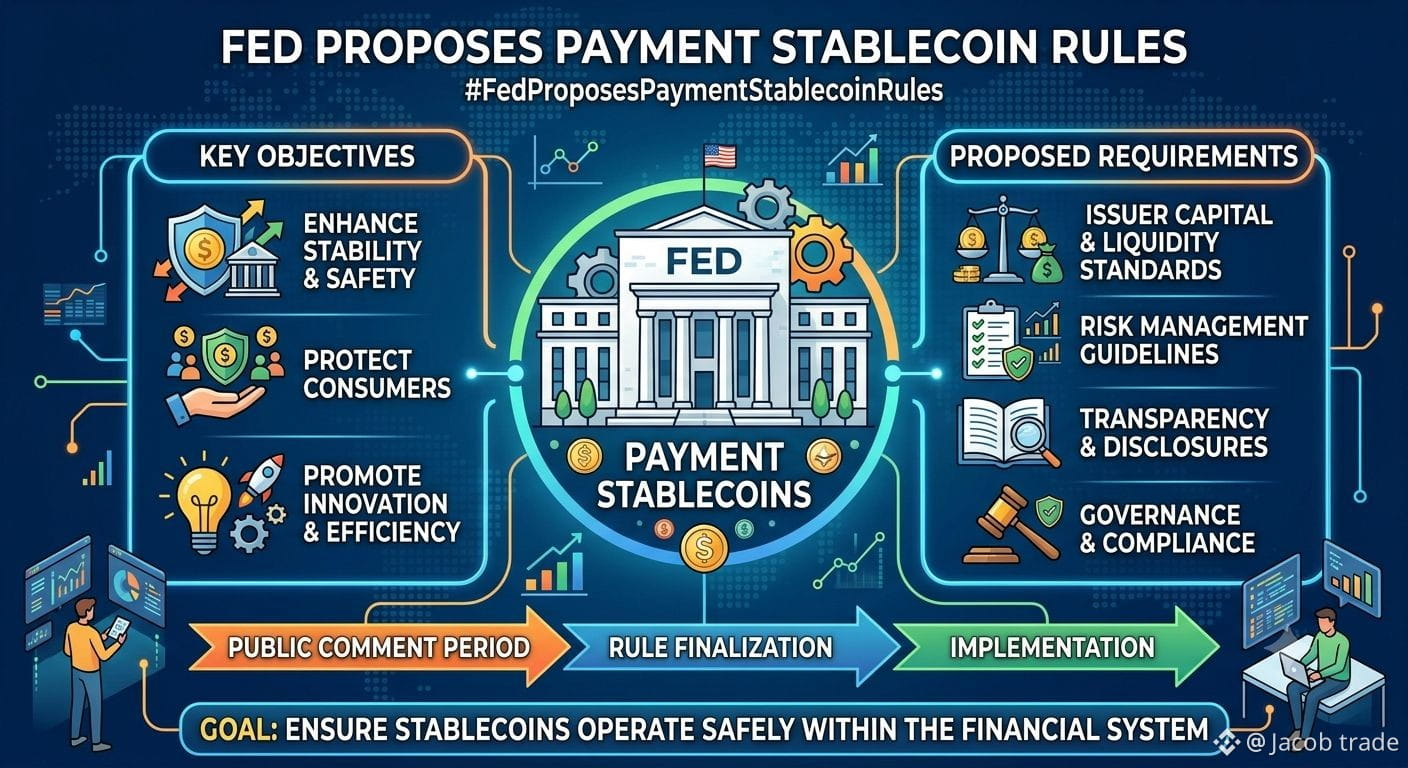
🚨 IMPORTANT INFORMATION: THE FEDERAL RESERVE PROPOSES A 2% CAPITAL REQUIREMENT FOR STABLECOIN ISSUERS! 🇺🇸💵
🏦 The proposed framework would require a 2% capital reserve on the first 20 BILLION dollars of token issuance for covered payment stablecoin issuers.
🚫 NO DIRECT YIELD: Payment stablecoin issuers would also be prohibited from paying interest or a return directly to token holders.
📋 The proposal is part of the implementation of the GENIUS Act by the Federal Reserve and includes additional capital and risk management requirements.
🌐 Stablecoin regulation is entering a more clearly defined phase in the United States.
👀 Could stricter capital rules reshape the stablecoin market?
#Fed #StablecoinNews #CryptoMarkets
$BTW
{future}(BTWUSDT)
$ONE
{future}(ONEUSDT)
$QNT
{future}(QNTUSDT)
#FedProposesPaymentStablecoinRules
🚨 IMPORTANT INFORMATION: THE FEDERAL RESERVE PROPOSES A 2% CAPITAL REQUIREMENT FOR STABLECOIN ISSUERS! 🇺🇸💵
🏦 The proposed framework would require a 2% capital reserve on the first 20 BILLION dollars of token issuance for covered payment stablecoin issuers.
🚫 NO DIRECT YIELD: Payment stablecoin issuers would also be prohibited from paying interest or a return directly to token holders.
📋 The proposal is part of the implementation of the GENIUS Act by the Federal Reserve and includes additional capital and risk management requirements.
🌐 Stablecoin regulation is entering a more clearly defined phase in the United States.
👀 Could stricter capital rules reshape the stablecoin market?
#Fed #StablecoinNews #CryptoMarkets
$BTW
$ONE
$QNT
🚨 IMPORTANT INFORMATION: THE FEDERAL RESERVE PROPOSES A 2% CAPITAL REQUIREMENT FOR STABLECOIN ISSUERS! 🇺🇸💵
🏦 The proposed framework would require a 2% capital reserve on the first 20 BILLION dollars of token issuance for covered payment stablecoin issuers.
🚫 NO DIRECT YIELD: Payment stablecoin issuers would also be prohibited from paying interest or a return directly to token holders.
📋 The proposal is part of the implementation of the GENIUS Act by the Federal Reserve and includes additional capital and risk management requirements.
🌐 Stablecoin regulation is entering a more clearly defined phase in the United States.
👀 Could stricter capital rules reshape the stablecoin market?
#Fed #StablecoinNews #CryptoMarkets
$BTW
$ONE
$QNT
65
·
--
Fed Stablecoin Proposal Sparks More Attention | 2% Is the Issuer’s Capital Measure | BTC at $831k I’m not chasing
My stance is: read the actual terms first, then discuss the upside. On the Fed Proposes Payment Stablecoin Rules featured on the front page this round, there are 50 people discussing it—more than the 14 people counted in the previous read. Different page snapshots may vary; I treat this only as rising discussion, not as buying pressure. In particular, you must not interpret the “2%” in the headline as the Fed’s rate cut magnitude, a stablecoin yield, or a target BTC price.
The facts come from the Federal Reserve’s September 24 announcement and the accompanying documents: both proposals are still open for public comment, with a deadline of sixty days after publication in the Federal Register. On page five of the capital memorandum checked in this round, the operational risk capital related to issuance size is calculated in segments: the first $200 billion at 2%, the next $300 billion at 1.5%, and any portion above $500 billion at 1%. The corresponding tables in the formal proposal are consistent; additionally, there are items like non-reserve business income and loss adjustments. So 2% is not a complete answer to all issuers’ capital requirements, and it’s not a single new fee rate that stablecoins will all apply uniformly today.
Why should BTC traders care? Stablecoins are a quoting and capital-turnover tool for many crypto trades. The issuer’s cost of capital may influence business choices, fee levels, and how quickly they expand. I think clearer rules could improve institutions’ assessment of counterparty risk, but higher compliance costs could also change competition among issuers. The final impact depends on the implemented version and real-world usage—you cannot directly convert the proposed capital buffer into net BTC inflows.
Separate reserves from capital: reserves support holders’ redemptions, while capital is meant to absorb specific risks. The proposal’s allowed reserves include high-quality liquid assets such as short-term U.S. Treasury securities, so you can’t claim that issuers must buy Bitcoin with this capital. Even if stablecoin issuance increases in the future, watch whether the new balances actually enter trading markets, rather than sitting in payment or other uses. There’s still a missing piece of evidence—an actual order—between “dollars on-chain” and “BTC being bought.”
How has the market reacted? In this round’s Kraken BTC/USD snapshot, it’s around $83,079.2, with the 24-hour range at $82,688.5 to $85,142.8—still not clearly leaving the lower part of the range. BTC is also showing up on the six-hour search rising list on the Plaza, but search activity isn’t the same as capital flow. I have no evidence that this price movement was caused by the stablecoin proposal. Also, the latest filing update for U.S. spot ETFs is completed through September 25—so I won’t pretend it’s something being submitted today.
If I were trading myself, I wouldn’t participate now, position 0%, and I wouldn’t short or use leverage. Only if the hourly closes are above $83,500, then pull back to $83,350–$83,500 and hold—assuming quotes and deposits/withdrawals are normal—would I consider going long spot using at most 0.3% of total funds. After the $84,000 halving event, I’d close the remaining position at $84,500. Hard stop-loss at $83,000, or if two consecutive hourly candles close below $83,350, exit entirely. Before entering, if $82,500 breaks, cancel the plan. If the stablecoin channel shows redemption pressure, and the breakout isn’t met with follow-through, I’d withdraw and revise the view. Plans that haven’t triggered don’t count as filled trades, and there’s no profit you can credibly claim.
Source: Federal Reserve press release and the attached capital memorandum, proposal: https://www.federalreserve.gov/newsevents/pressreleases/bcreg20260924a.htm ; Kraken ; Binance Plaza. #FedProposesPaymentStablecoinRules #BTC
The above is only my personal market observation and does not constitute investment advice.
Fed Stablecoin Proposal Sparks More Attention | 2% Is the Issuer’s Capital Measure | BTC at $831k I’m not chasing
My stance is: read the actual terms first, then discuss the upside. On the Fed Proposes Payment Stablecoin Rules featured on the front page this round, there are 50 people discussing it—more than the 14 people counted in the previous read. Different page snapshots may vary; I treat this only as rising discussion, not as buying pressure. In particular, you must not interpret the “2%” in the headline as the Fed’s rate cut magnitude, a stablecoin yield, or a target BTC price.
The facts come from the Federal Reserve’s September 24 announcement and the accompanying documents: both proposals are still open for public comment, with a deadline of sixty days after publication in the Federal Register. On page five of the capital memorandum checked in this round, the operational risk capital related to issuance size is calculated in segments: the first $200 billion at 2%, the next $300 billion at 1.5%, and any portion above $500 billion at 1%. The corresponding tables in the formal proposal are consistent; additionally, there are items like non-reserve business income and loss adjustments. So 2% is not a complete answer to all issuers’ capital requirements, and it’s not a single new fee rate that stablecoins will all apply uniformly today.
Why should BTC traders care? Stablecoins are a quoting and capital-turnover tool for many crypto trades. The issuer’s cost of capital may influence business choices, fee levels, and how quickly they expand. I think clearer rules could improve institutions’ assessment of counterparty risk, but higher compliance costs could also change competition among issuers. The final impact depends on the implemented version and real-world usage—you cannot directly convert the proposed capital buffer into net BTC inflows.
Separate reserves from capital: reserves support holders’ redemptions, while capital is meant to absorb specific risks. The proposal’s allowed reserves include high-quality liquid assets such as short-term U.S. Treasury securities, so you can’t claim that issuers must buy Bitcoin with this capital. Even if stablecoin issuance increases in the future, watch whether the new balances actually enter trading markets, rather than sitting in payment or other uses. There’s still a missing piece of evidence—an actual order—between “dollars on-chain” and “BTC being bought.”
How has the market reacted? In this round’s Kraken BTC/USD snapshot, it’s around $83,079.2, with the 24-hour range at $82,688.5 to $85,142.8—still not clearly leaving the lower part of the range. BTC is also showing up on the six-hour search rising list on the Plaza, but search activity isn’t the same as capital flow. I have no evidence that this price movement was caused by the stablecoin proposal. Also, the latest filing update for U.S. spot ETFs is completed through September 25—so I won’t pretend it’s something being submitted today.
If I were trading myself, I wouldn’t participate now, position 0%, and I wouldn’t short or use leverage. Only if the hourly closes are above $83,500, then pull back to $83,350–$83,500 and hold—assuming quotes and deposits/withdrawals are normal—would I consider going long spot using at most 0.3% of total funds. After the $84,000 halving event, I’d close the remaining position at $84,500. Hard stop-loss at $83,000, or if two consecutive hourly candles close below $83,350, exit entirely. Before entering, if $82,500 breaks, cancel the plan. If the stablecoin channel shows redemption pressure, and the breakout isn’t met with follow-through, I’d withdraw and revise the view. Plans that haven’t triggered don’t count as filled trades, and there’s no profit you can credibly claim.
Source: Federal Reserve press release and the attached capital memorandum, proposal: https://www.federalreserve.gov/newsevents/pressreleases/bcreg20260924a.htm ; Kraken ; Binance Plaza. #FedProposesPaymentStablecoinRules #BTC
The above is only my personal market observation and does not constitute investment advice.
My stance is: read the actual terms first, then discuss the upside. On the Fed Proposes Payment Stablecoin Rules featured on the front page this round, there are 50 people discussing it—more than the 14 people counted in the previous read. Different page snapshots may vary; I treat this only as rising discussion, not as buying pressure. In particular, you must not interpret the “2%” in the headline as the Fed’s rate cut magnitude, a stablecoin yield, or a target BTC price.
The facts come from the Federal Reserve’s September 24 announcement and the accompanying documents: both proposals are still open for public comment, with a deadline of sixty days after publication in the Federal Register. On page five of the capital memorandum checked in this round, the operational risk capital related to issuance size is calculated in segments: the first $200 billion at 2%, the next $300 billion at 1.5%, and any portion above $500 billion at 1%. The corresponding tables in the formal proposal are consistent; additionally, there are items like non-reserve business income and loss adjustments. So 2% is not a complete answer to all issuers’ capital requirements, and it’s not a single new fee rate that stablecoins will all apply uniformly today.
Why should BTC traders care? Stablecoins are a quoting and capital-turnover tool for many crypto trades. The issuer’s cost of capital may influence business choices, fee levels, and how quickly they expand. I think clearer rules could improve institutions’ assessment of counterparty risk, but higher compliance costs could also change competition among issuers. The final impact depends on the implemented version and real-world usage—you cannot directly convert the proposed capital buffer into net BTC inflows.
Separate reserves from capital: reserves support holders’ redemptions, while capital is meant to absorb specific risks. The proposal’s allowed reserves include high-quality liquid assets such as short-term U.S. Treasury securities, so you can’t claim that issuers must buy Bitcoin with this capital. Even if stablecoin issuance increases in the future, watch whether the new balances actually enter trading markets, rather than sitting in payment or other uses. There’s still a missing piece of evidence—an actual order—between “dollars on-chain” and “BTC being bought.”
How has the market reacted? In this round’s Kraken BTC/USD snapshot, it’s around $83,079.2, with the 24-hour range at $82,688.5 to $85,142.8—still not clearly leaving the lower part of the range. BTC is also showing up on the six-hour search rising list on the Plaza, but search activity isn’t the same as capital flow. I have no evidence that this price movement was caused by the stablecoin proposal. Also, the latest filing update for U.S. spot ETFs is completed through September 25—so I won’t pretend it’s something being submitted today.
If I were trading myself, I wouldn’t participate now, position 0%, and I wouldn’t short or use leverage. Only if the hourly closes are above $83,500, then pull back to $83,350–$83,500 and hold—assuming quotes and deposits/withdrawals are normal—would I consider going long spot using at most 0.3% of total funds. After the $84,000 halving event, I’d close the remaining position at $84,500. Hard stop-loss at $83,000, or if two consecutive hourly candles close below $83,350, exit entirely. Before entering, if $82,500 breaks, cancel the plan. If the stablecoin channel shows redemption pressure, and the breakout isn’t met with follow-through, I’d withdraw and revise the view. Plans that haven’t triggered don’t count as filled trades, and there’s no profit you can credibly claim.
Source: Federal Reserve press release and the attached capital memorandum, proposal: https://www.federalreserve.gov/newsevents/pressreleases/bcreg20260924a.htm ; Kraken ; Binance Plaza. #FedProposesPaymentStablecoinRules #BTC
The above is only my personal market observation and does not constitute investment advice.

127
·
--
Fed stablecoin proposal enters the buzz on the main square|Remittances depend on whether exchange-to-export is feasible|SOL at $119—I’ll wait
My stance is to hold cash first, not to chase payment narratives. As regulatory discussions heat up, it’s worth paying attention—but whether cross-border remittances are cheaper and whether users can smoothly convert to cost currency matters more than the on-chain speed touted in the promotion. I’m not participating in SOL right now.
In this round, a new topic about Fed payment stablecoin rules was added to the main square homepage. In continuous reads, the discussion count increased from 2 to 14. This reflects attention to changes in the topic; it doesn’t mean funds have already flowed in. Check the Fed notice from September 24: the two proposals relate to its regulatory scope, including reserves, capital, risk management, and the banking application process for issuers. The comment period is sixty days after publication in the Federal Register. Still, it’s a request for comments—not effective today, and not an endorsement for all stablecoins or for all public chains.
This time, I care more about the last mile of remittances. On September 8, the Solana Foundation published a remittance report introducing local exchange services, partners across different remittance corridors, and regulatory differences. These are project materials published earlier, not wrapped as a new deal signed today. After an on-chain transfer is completed, for the recipient to receive bank deposits or cash, there are still steps in between—quotes, compliance, local business hours, and payout capability.
My independent take: The issuing-side rules are clearer, which may reduce uncertainty for institutions when choosing payment tools. However, only if the export service is reliable can the on-chain low cost actually become the user’s real low cost. If instead, the price spread in local-currency conversion widens enough, it can wipe out the on-chain fee advantage. Payment growth also can’t be inferred into SOL buy demand based on the same dollar amounts: the remittance principal can remain in stablecoins, while the native asset only covers part of the network costs. These are transmission conditions—not confirmed capital flows that have already occurred.
Price hasn’t given me a reason to chase the move early. In this round, Kraken USD spot is around 118.75, with the 24-hour range at 118.10 to 124.91—still near the lower end. I don’t have evidence attributing the drop to the Fed proposal, and I haven’t verified any increase in new remittance volume, so I won’t write “institutions抢筹.” In the previous round’s confirmation conditions at 122, the current quote is still below it; I won’t describe waiting plans as an executed trade.
If I were trading it myself: my position is zero right now, and I’d only consider a low-leverage spot long. After an hour’s close, if it reclaims above 120.5, then a pullback to 120–120.5 holds—and the quotes and deposits/withdrawals are normal—then I would use at most 0.3% of total funds for a trial position. Reduce by half at 122, take profit on the remaining at 123; hard stop-loss at 119. If the two hourly candles close below 120, I’d close everything. If it breaks below 117.5 before entry, cancel the plan—I won’t chase or average down losses.
If exchange services worsen, actual usage doesn’t improve, or the price can’t hold the confirmation zone, I’ll withdraw the trading assumption that “payment adoption may improve.” Rule progress, business retention, and price follow-through must be verified separately at least three points; you can’t use one hot-list topic to substitute for three answers.
Source: Fed Sept 24 notice; Solana Foundation Sept 8 remittance report overview; Binance Square main page; Kraken market data.
#FedProposesPaymentStablecoinRules #SOL
The above is only personal market observation and does not constitute investment advice.
Fed stablecoin proposal enters the buzz on the main square|Remittances depend on whether exchange-to-export is feasible|SOL at $119—I’ll wait
My stance is to hold cash first, not to chase payment narratives. As regulatory discussions heat up, it’s worth paying attention—but whether cross-border remittances are cheaper and whether users can smoothly convert to cost currency matters more than the on-chain speed touted in the promotion. I’m not participating in SOL right now.
In this round, a new topic about Fed payment stablecoin rules was added to the main square homepage. In continuous reads, the discussion count increased from 2 to 14. This reflects attention to changes in the topic; it doesn’t mean funds have already flowed in. Check the Fed notice from September 24: the two proposals relate to its regulatory scope, including reserves, capital, risk management, and the banking application process for issuers. The comment period is sixty days after publication in the Federal Register. Still, it’s a request for comments—not effective today, and not an endorsement for all stablecoins or for all public chains.
This time, I care more about the last mile of remittances. On September 8, the Solana Foundation published a remittance report introducing local exchange services, partners across different remittance corridors, and regulatory differences. These are project materials published earlier, not wrapped as a new deal signed today. After an on-chain transfer is completed, for the recipient to receive bank deposits or cash, there are still steps in between—quotes, compliance, local business hours, and payout capability.
My independent take: The issuing-side rules are clearer, which may reduce uncertainty for institutions when choosing payment tools. However, only if the export service is reliable can the on-chain low cost actually become the user’s real low cost. If instead, the price spread in local-currency conversion widens enough, it can wipe out the on-chain fee advantage. Payment growth also can’t be inferred into SOL buy demand based on the same dollar amounts: the remittance principal can remain in stablecoins, while the native asset only covers part of the network costs. These are transmission conditions—not confirmed capital flows that have already occurred.
Price hasn’t given me a reason to chase the move early. In this round, Kraken USD spot is around 118.75, with the 24-hour range at 118.10 to 124.91—still near the lower end. I don’t have evidence attributing the drop to the Fed proposal, and I haven’t verified any increase in new remittance volume, so I won’t write “institutions抢筹.” In the previous round’s confirmation conditions at 122, the current quote is still below it; I won’t describe waiting plans as an executed trade.
If I were trading it myself: my position is zero right now, and I’d only consider a low-leverage spot long. After an hour’s close, if it reclaims above 120.5, then a pullback to 120–120.5 holds—and the quotes and deposits/withdrawals are normal—then I would use at most 0.3% of total funds for a trial position. Reduce by half at 122, take profit on the remaining at 123; hard stop-loss at 119. If the two hourly candles close below 120, I’d close everything. If it breaks below 117.5 before entry, cancel the plan—I won’t chase or average down losses.
If exchange services worsen, actual usage doesn’t improve, or the price can’t hold the confirmation zone, I’ll withdraw the trading assumption that “payment adoption may improve.” Rule progress, business retention, and price follow-through must be verified separately at least three points; you can’t use one hot-list topic to substitute for three answers.
Source: Fed Sept 24 notice; Solana Foundation Sept 8 remittance report overview; Binance Square main page; Kraken market data.
#FedProposesPaymentStablecoinRules #SOL
The above is only personal market observation and does not constitute investment advice.
My stance is to hold cash first, not to chase payment narratives. As regulatory discussions heat up, it’s worth paying attention—but whether cross-border remittances are cheaper and whether users can smoothly convert to cost currency matters more than the on-chain speed touted in the promotion. I’m not participating in SOL right now.
In this round, a new topic about Fed payment stablecoin rules was added to the main square homepage. In continuous reads, the discussion count increased from 2 to 14. This reflects attention to changes in the topic; it doesn’t mean funds have already flowed in. Check the Fed notice from September 24: the two proposals relate to its regulatory scope, including reserves, capital, risk management, and the banking application process for issuers. The comment period is sixty days after publication in the Federal Register. Still, it’s a request for comments—not effective today, and not an endorsement for all stablecoins or for all public chains.
This time, I care more about the last mile of remittances. On September 8, the Solana Foundation published a remittance report introducing local exchange services, partners across different remittance corridors, and regulatory differences. These are project materials published earlier, not wrapped as a new deal signed today. After an on-chain transfer is completed, for the recipient to receive bank deposits or cash, there are still steps in between—quotes, compliance, local business hours, and payout capability.
My independent take: The issuing-side rules are clearer, which may reduce uncertainty for institutions when choosing payment tools. However, only if the export service is reliable can the on-chain low cost actually become the user’s real low cost. If instead, the price spread in local-currency conversion widens enough, it can wipe out the on-chain fee advantage. Payment growth also can’t be inferred into SOL buy demand based on the same dollar amounts: the remittance principal can remain in stablecoins, while the native asset only covers part of the network costs. These are transmission conditions—not confirmed capital flows that have already occurred.
Price hasn’t given me a reason to chase the move early. In this round, Kraken USD spot is around 118.75, with the 24-hour range at 118.10 to 124.91—still near the lower end. I don’t have evidence attributing the drop to the Fed proposal, and I haven’t verified any increase in new remittance volume, so I won’t write “institutions抢筹.” In the previous round’s confirmation conditions at 122, the current quote is still below it; I won’t describe waiting plans as an executed trade.
If I were trading it myself: my position is zero right now, and I’d only consider a low-leverage spot long. After an hour’s close, if it reclaims above 120.5, then a pullback to 120–120.5 holds—and the quotes and deposits/withdrawals are normal—then I would use at most 0.3% of total funds for a trial position. Reduce by half at 122, take profit on the remaining at 123; hard stop-loss at 119. If the two hourly candles close below 120, I’d close everything. If it breaks below 117.5 before entry, cancel the plan—I won’t chase or average down losses.
If exchange services worsen, actual usage doesn’t improve, or the price can’t hold the confirmation zone, I’ll withdraw the trading assumption that “payment adoption may improve.” Rule progress, business retention, and price follow-through must be verified separately at least three points; you can’t use one hot-list topic to substitute for three answers.
Source: Fed Sept 24 notice; Solana Foundation Sept 8 remittance report overview; Binance Square main page; Kraken market data.
#FedProposesPaymentStablecoinRules #SOL
The above is only personal market observation and does not constitute investment advice.

72

#FedProposesPaymentStablecoinRules
🚨 Important Information: The Federal Reserve proposes requiring 2% capital for issuers of stablecoins! 🇺🇸💵
🏦 The proposed framework would require 2% capital reserve on the first $20 billion of token issuance for covered payment stablecoin issuers.
🚫 No direct yield: It would also prohibit covered payment stablecoin issuers from paying interest or direct yield to token holders.
📋 This proposal is part of the Federal Reserve’s implementation of the GENIUS law and includes additional capital and risk-management requirements.
🌐 Stablecoin regulations are entering a more defined phase in the United States.
👀 Could stricter capital rules reshape the stablecoin market?
Please follow up
#Fed #StablecoinNews #CryptoMarkets
$BTW
{alpha}(560x444045b0ee1ee319a660a5e3d604ca0ffa35acaa)
#FedProposesPaymentStablecoinRules
🚨 Important Information: The Federal Reserve proposes requiring 2% capital for issuers of stablecoins! 🇺🇸💵
🏦 The proposed framework would require 2% capital reserve on the first $20 billion of token issuance for covered payment stablecoin issuers.
🚫 No direct yield: It would also prohibit covered payment stablecoin issuers from paying interest or direct yield to token holders.
📋 This proposal is part of the Federal Reserve’s implementation of the GENIUS law and includes additional capital and risk-management requirements.
🌐 Stablecoin regulations are entering a more defined phase in the United States.
👀 Could stricter capital rules reshape the stablecoin market?
Please follow up
#Fed #StablecoinNews #CryptoMarkets
$BTW
🚨 Important Information: The Federal Reserve proposes requiring 2% capital for issuers of stablecoins! 🇺🇸💵
🏦 The proposed framework would require 2% capital reserve on the first $20 billion of token issuance for covered payment stablecoin issuers.
🚫 No direct yield: It would also prohibit covered payment stablecoin issuers from paying interest or direct yield to token holders.
📋 This proposal is part of the Federal Reserve’s implementation of the GENIUS law and includes additional capital and risk-management requirements.
🌐 Stablecoin regulations are entering a more defined phase in the United States.
👀 Could stricter capital rules reshape the stablecoin market?
Please follow up
#Fed #StablecoinNews #CryptoMarkets
$BTW
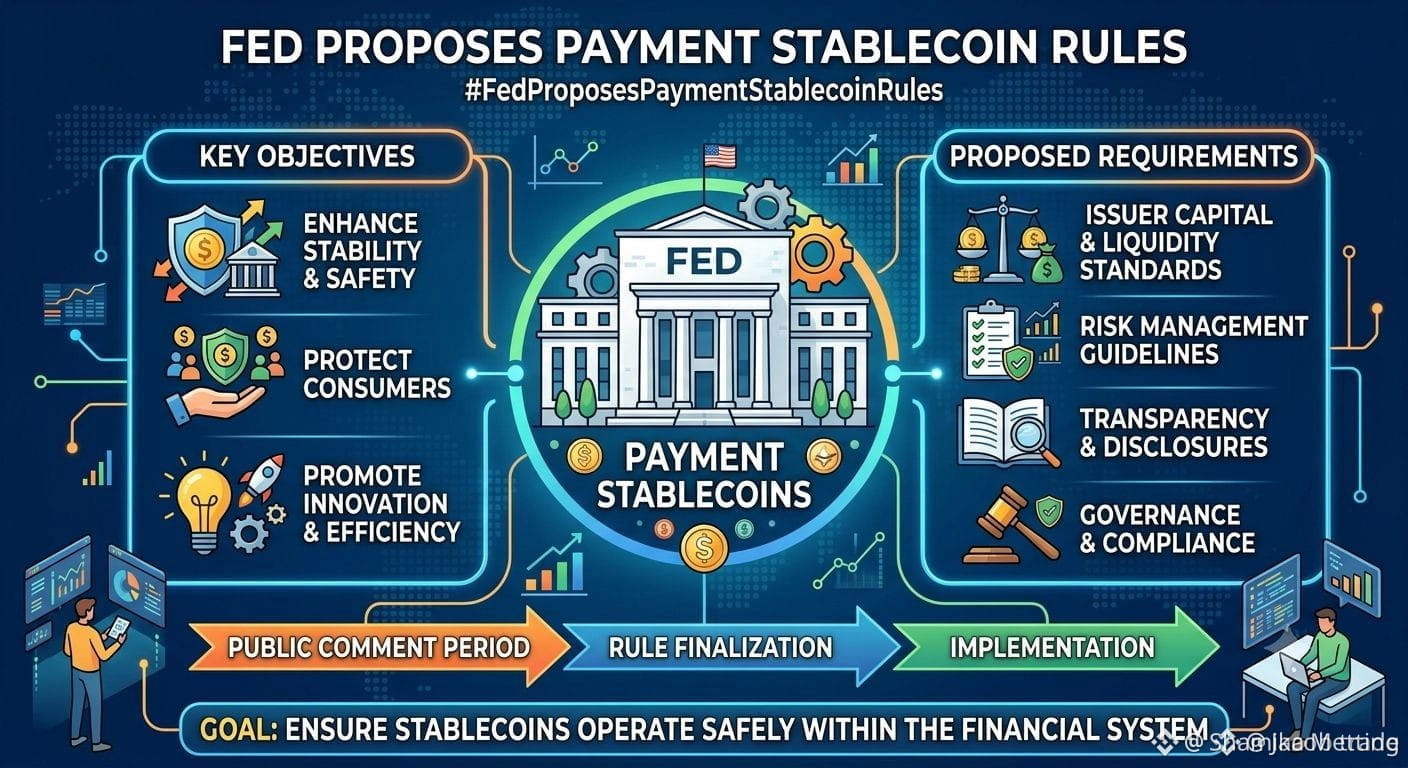
2
126
Log in to explore more content
Join global crypto users on Binance Square
⚡️ Get latest and useful information about crypto.
💬 Trusted by the world’s largest crypto exchange.
👍 Discover real insights from verified creators.
Email / Phone number
Trending Topics
1
#BTCFallsBelow$83000
30 views
30 Discussing
2
#FedProposesPaymentStablecoinRules
6,584 views
190 Discussing
3
#ChinaMayLetAlibabaByteDanceBuyNvidiaChips
9,116 views
272 Discussing
4
#USChinaRelease$30BTariffCutProductLists
1,698 views
31 Discussing
5
#SKoreaFSCConsidersVirtualAssetMarketMaker
8,325 views
225 Discussing
6
#ChinaIndustrialProfitGrowthSlowsFourthMonth
9,339 views
233 Discussing
7
#BitwiseFilesFinalNEARSpotETFProspectus
122,888 views
1,784 Discussing
8
#BitgetHackerMoves$83MStolenXRP
40,593 views
178 Discussing
9
#SOLSpotETFWeeklyInflow$188M
25,501 views
141 Discussing
10
#DogecoinETFsPostBiggestWeekSinceLaunch
69,912 views
1,137 Discussing