

#stablecoin
stablecoin
3.9M views
18,710 Discussing
Hot
Latest

·
--
📰 Canada opens 60-day stablecoin consultation while keeping yield ban
Canada has opened a 60-day consultation on proposed stablecoin regulations that retain its ban on issuer-paid yield and require reserves to be held with qualified Canadian financial institutions. The Department of Finance published the draft in the Canada Gazette on…
Source : Crypto News
Time : 2026-10-26 18:11:35
Credit : lawrence mondal
#stablecoin #news #canada
Share your opinion in the comment section below
1

🇯🇵 JUST IN: BlackRock officially signs on to explore linking tokenized funds with a yen stablecoin.
The $15.5 TRILLION asset manager is working with SBI and Startale, the companies behind JPYSC, a stablecoin tied to the Japanese yen.
They want to see if tokenized money market
#Crypto #Stablecoin
🇯🇵 JUST IN: BlackRock officially signs on to explore linking tokenized funds with a yen stablecoin.
The $15.5 TRILLION asset manager is working with SBI and Startale, the companies behind JPYSC, a stablecoin tied to the Japanese yen.
They want to see if tokenized money market
#Crypto #Stablecoin
The $15.5 TRILLION asset manager is working with SBI and Startale, the companies behind JPYSC, a stablecoin tied to the Japanese yen.
They want to see if tokenized money market
#Crypto #Stablecoin


10

·
--
🚨 $ZEC STABLECOIN REDEMPTION RULES SET TO REDEFINE RETAIL PROTECTION 🟢
Canada’s draft rule forces stablecoin issuers to honor redemptions within three business days, removing any minimum cash‑out floor. 🦈 The mandatory liquidity window guarantees that every token holder can exit on demand, a move that aligns with institutional liquidity hunting patterns.
A 1% fee ceiling caps redemption costs, turning the fee structure into a predictable data point for smart‑money models. 📊 With yields barred but usage rewards still alive, the market faces a clear risk‑reward matrix that traders can quantify. 💡
🤔 Will this liquidity‑first framework become the global benchmark for stablecoin design? 👇
⚠️ Not financial advice. Always manage your risk. 🛡️
🏷️ #ZEC #Regulation #Stablecoin #Liquidity #Crypto
🔥 💎
8


#CanadaProposesStablecoinRedemptionWithin3BusinessDays
🇨🇦 💵 Canada Proposes 3-Day Stablecoin Redemption: A Major Shift for Crypto Trust 💵 🇨🇦
Imagine holding a digital dollar when you suddenly need cash. You request redemption, but the real question is simple: how long should you have to wait for your own money?
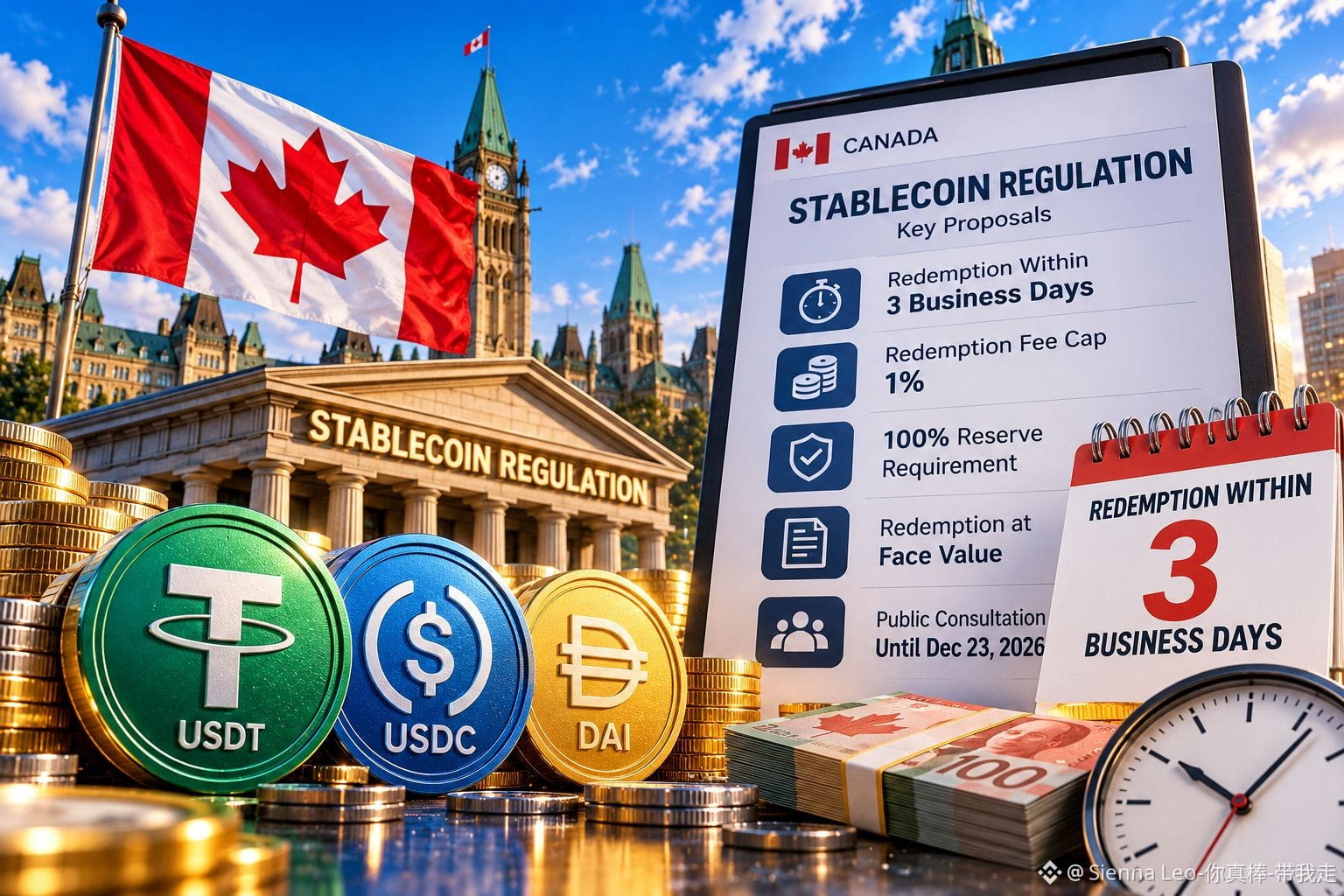
Canada is proposing a clearer answer. Draft stablecoin regulations published on October 24 would require covered issuers to redeem tokens within three business days of a request, with redemption fees capped at 1%. The rules are still under consultation, not yet in force.
The proposal goes beyond timing. Issuers would need reserves worth at least 100% of outstanding stablecoins, held in eligible assets, alongside redemption at face value in the currency the token tracks.
The real story is confidence. A stablecoin can trade close to Dolor 1 during normal conditions, but users need to know whether they can actually redeem it when markets become stressed.
The three-day deadline could strengthen accountability, while the 1% fee ceiling offers predictability. However, the draft allows daily redemption limits when reserve-market liquidity is insufficient to meet all requests. That exception matters most during periods of stress.
Public consultation runs until December 23, 2026, with implementation intended for fall 2027. Until then, these requirements remain proposals.
A stablecoin earns its name through reliable redemption, not merely a stable price.
Would a guaranteed redemption process make you more confident about holding stablecoins?
Disclaimer: Educational content only, not financial advice.
#Stablecoin #CryptoRegulation #GrowWithSAC $ERA $DODO $REZ
437

·
--
#CanadaProposesStablecoinRedemptionWithin3BusinessDays
🚨 Canada’s Proposed Stablecoin Rules: What 3-Day Redemptions Mean for Crypto Users
Canada is shaping the future of digital asset regulation with a newly proposed framework for fiat-backed stablecoins. While the goal is to enhance consumer protection, it introduces significant shifts that every crypto user and trader should keep on their radar.
📌 Key Highlights of the Proposal:
3-Business-Day Redemption: Covered issuers would be required to complete stablecoin redemptions within three business days of a valid request.
1:1 Reserve Backing: Issuers must maintain adequate reserve assets to cover outstanding tokens at par.
Fee Cap & Accessibility: Redemption fees would be capped at a maximum of $1\%$, with no minimum redemption amount required for holders.
Safeguards During Volatility: The proposal allows for daily redemption limits if illiquid reserve-asset markets prevent issuers from meeting sudden spikes in demand.
💡 Why It Matters:
While clear guidelines and reserve transparency help build long-term trust in digital payments, a 3-day turnaround window means traders will need to plan ahead during periods of high market volatility.
With public consultations underway and implementation targeted for 2027, how will these rules affect your strategy? Are fast redemptions and stronger reserves worth the wait? Let’s discuss below! 👇
#Stablecoin #CryptoRegulation #CanadaCrypto $BTC $BNB

36

·
--
$HSBC.US 🚨 HSBC LAUNCHES REDCOIN STABLECOIN IN HONG KONG
HSBC has launched RedCoin (RCHKD), its first Hong Kong dollar-denominated stablecoin, through its PayMe payment platform.
🔹 What’s new?
• Designed to be redeemable 1:1 for Hong Kong dollars
• Supports person-to-person transfers and payments to merchants
• More than 3.3 million PayMe users will be able to activate wallets in phases
• HSBC plans to expand into tokenised investment products
🌐 Why it matters: A major traditional bank is bringing regulated stablecoin technology closer to everyday payments.
📌 Important: The 3.3 million figure refers to potential PayMe users, not confirmed active RedCoin wallets.
🔗 Official source: https://www.about.hsbc.com.hk/news-and-media/hsbc-redcoin-launches-today
What impact could bank-issued stablecoins have on digital payments? 👇
#redcoin #stablecoin #blockchain #CryptoNews
{stock_us}(HSBC.US)
$HSBC.US 🚨 HSBC LAUNCHES REDCOIN STABLECOIN IN HONG KONG
HSBC has launched RedCoin (RCHKD), its first Hong Kong dollar-denominated stablecoin, through its PayMe payment platform.
🔹 What’s new?
• Designed to be redeemable 1:1 for Hong Kong dollars
• Supports person-to-person transfers and payments to merchants
• More than 3.3 million PayMe users will be able to activate wallets in phases
• HSBC plans to expand into tokenised investment products
🌐 Why it matters: A major traditional bank is bringing regulated stablecoin technology closer to everyday payments.
📌 Important: The 3.3 million figure refers to potential PayMe users, not confirmed active RedCoin wallets.
🔗 Official source: https://www.about.hsbc.com.hk/news-and-media/hsbc-redcoin-launches-today
What impact could bank-issued stablecoins have on digital payments? 👇
#redcoin #stablecoin #blockchain #CryptoNews

HSBCUS0.00%
52

·
--
🚨 $HSBC.US JUST ENTERED THE STABLECOIN SPOTLIGHT! 🌏
🏦 HSBC RedCoin: Traditional Banking Meets Digital Payments!
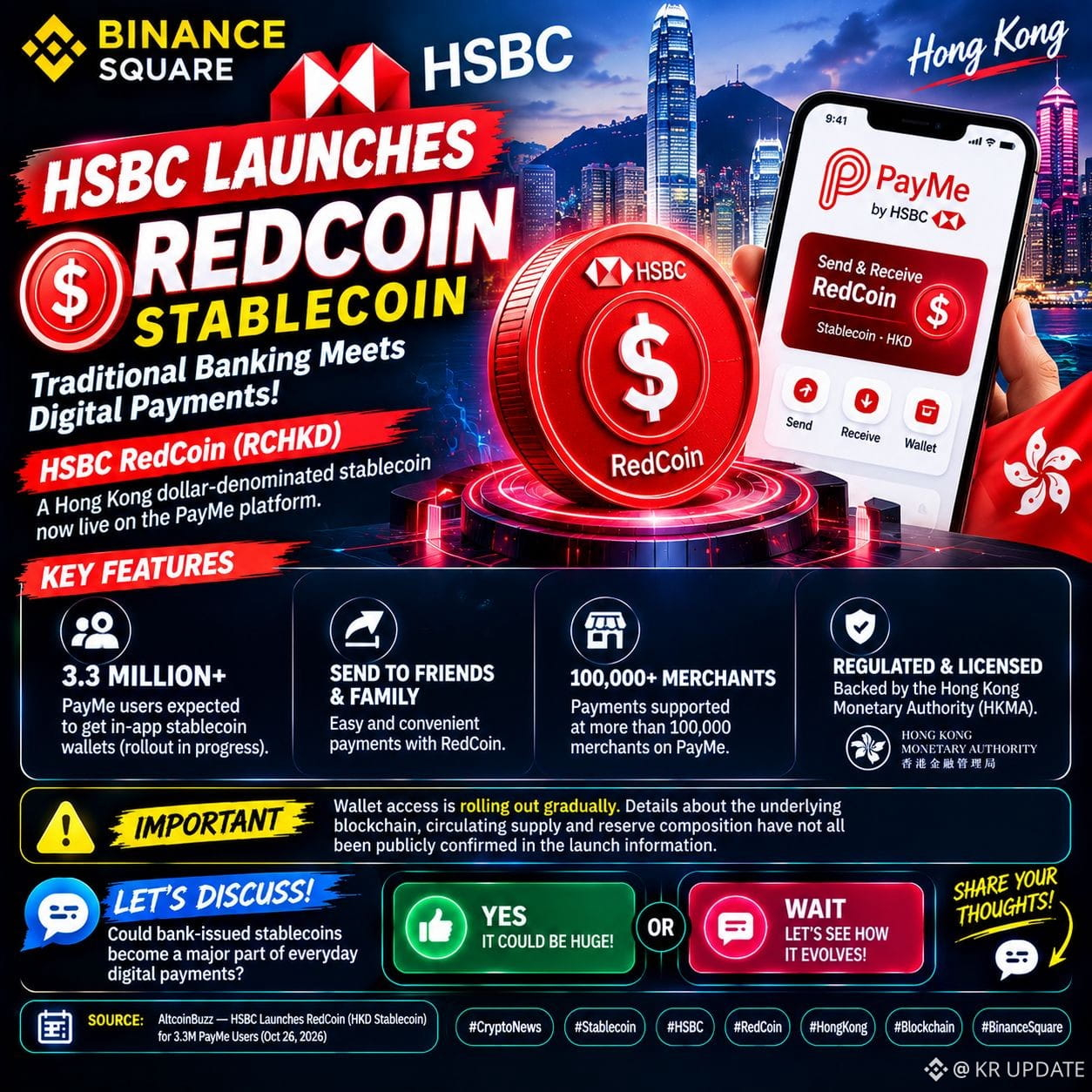
HSBC has launched RedCoin ($RCHKD), a Hong Kong dollar-denominated stablecoin, on its PayMe platform.
🔥 Why is this news important?
🔹 More than 3.3 million PayMe users are expected to gain access to in-app stablecoin wallets as the rollout progresses.
🔹 Users will be able to send RedCoin to friends and family.
🔹 HSBC says payments will be supported at more than 100,000 merchants on PayMe.
🔹 The stablecoin is licensed and regulated by the Hong Kong Monetary Authority.
⚠️ Important: Wallet access is rolling out gradually. Details about the underlying blockchain, circulating supply and reserve composition have not all been publicly confirmed in the launch information.
💬 DISCUSSION: Could bank-issued stablecoins become a major part of everyday digital payments?
Share your thoughts below! 👇
#CryptoNews #stablecoin #redcoin #HongKongFinance #BinanceSquare
HSBCUS0.00%
73
🚨 LATEST: Standard Chartered-led Anchorpoint says it’s planning a retail stablecoin on a public blockchain but won’t rush a launch, eyeing cross-border payments as a key use case.
#Crypto #Stablecoin
🚨 LATEST: Standard Chartered-led Anchorpoint says it’s planning a retail stablecoin on a public blockchain but won’t rush a launch, eyeing cross-border payments as a key use case.
#Crypto #Stablecoin
#Crypto #Stablecoin


1
42

·
--
🚀 $RCHKD UNVEILS HONG KONG'S FIRST REGULATED STABLECOIN 💎
HSBC just dropped $RCHKD into the market via PayMe, instantly unlocking a 3.3 million‑strong user base. 🦈 The HKD‑backed token gives smart money a regulated runway to swing liquidity across retail and merchant layers. ⚡
Instant P2P transfers and zero‑balance barriers mean volume can surge like a flash‑sale, while the HKMA license adds a safety net that could draw institutional appetite. 📊 Tokenized investment products are set to roll out, nudging the stablecoin ecosystem toward deeper depth. 💬 Will you stake $RCHKD now that it’s bank‑backed? 👇
⚠️ Not financial advice. Always manage your risk. 🛡️
🏷️ #RCHKD #Stablecoin #Crypto #Regulation
🦈 💎

3

·
--
📰 Crypto News Update
American Bankers Association accuses OCC of undermining Congress with final stablecoin rewards rule
Why it matters: This legal or regulatory development may influence market access, compliance, and investor sentiment.
Importance score: 6/10
Source: The Block
Read the original report: https://www.theblock.co/news/regulation/2026-10-21-american-bankers-association-accuses-occ-undermining-congress-stablecoin-rewards-rule-421629
#Stablecoin #CryptoNews #Cryptocurrency #Blockchain
1

·
--
What Is a Stablecoin? A Simple Guide for Beginners 💵
Have you ever wondered why some cryptocurrencies are designed to maintain a stable price?
Stablecoins are cryptocurrencies designed to maintain a relatively stable value. Many are linked to traditional currencies, such as the US dollar.
For example, USDT is designed to track the value of the US dollar. However, its price can sometimes move away from $1.
Why do people use stablecoins?
To transfer funds between crypto platforms.
To hold digital assets with less price volatility than Bitcoin.
To make certain crypto transactions easier.
Remember, stablecoins still carry risks. Always check the issuer, reserves, and platform before using one.
Do you use stablecoins? Why or why not? Share your thoughts below! 👇
#CryptoEducation #Stablecoin #USDT #CryptoBasics

90

Verified
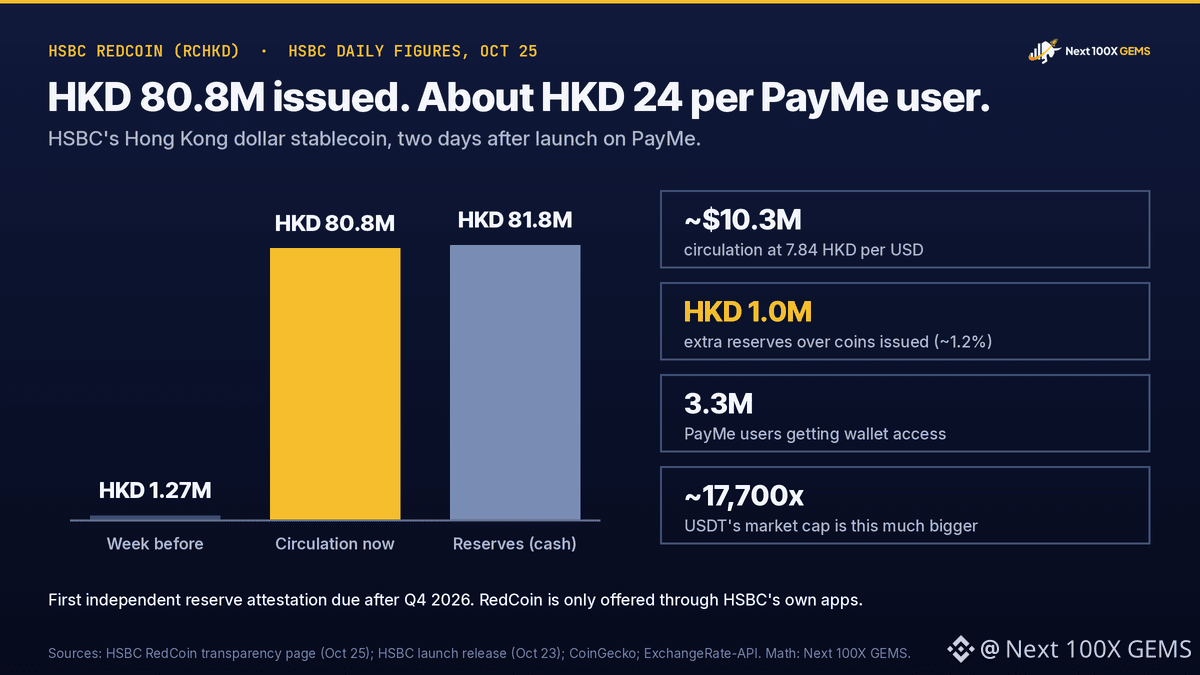
HSBC has HKD 80.8M of its new RedCoin stablecoin in circulation, about $10.3M. Averaged across PayMe's 3.3 million users, that's roughly HKD 24 each.
RedCoin (RCHKD) went live on PayMe on Friday under an HKMA stablecoin licence. HSBC posts circulation and reserves daily. Today's page shows a 7-day change of HKD +79.5M, which puts last week's figure near HKD 1.27M, from a staff pilot of nearly 100 users.
Reserves are HKD 81.8M, all in cash. That's exactly HKD 1M more than the coins issued, a buffer of about 1.2%.
It runs on HSBC's own ledger, not a public chain, and coins can't move between PayMe and the HSBC banking app. Wallet activation is rolling out "in the coming days", per HSBC. For scale, USDT's market cap is about $182B, around 17,700 times bigger.
The first independent attestation of the reserves is due after Q4 2026. HSBC says RedCoin is only offered through PayMe and, later, its own banking app, so any RCHKD token on a DEX or another platform isn't HSBC's.
#Stablecoin #HongKong
NFA. DYOR.
1.7k

·
--
OCC finalizes the GENIUS Act stablecoin rulebook – a watershed moment.
The OCC’s final rule sets requirements for permitted payment **stablecoin** issuers, foreign issuers under its jurisdiction, and certain custody activities supervised by the agency.
It outlines reserve backing, redemption and risk‑management standards, implementing the **GENIUS Act** signed in July 2025 and slated to take effect on January 18, 2027.
Treasury Secretary Scott Bessent likened the act to Lincoln’s 1863 National Currency Act, saying it creates a federal framework for payment **stablecoins** in the **digital assets** era.
The agency reviewed hundreds of comments from crypto firms, community banks, trade groups, academics and others. Issues such as the Bank Secrecy Act, anti‑money‑laundering and sanctions will be addressed in a separate rulemaking with the Treasury.
Do you think the January 2027 effective date gives the industry enough time to adapt?
#Stablecoin #DigitalAssets #FinTech #Regulation #Crypto

1
1
·
--
📰 Crypto News Update
Shinhan, SBI make Japan-Korea tourist spending a test case for yen stablecoins
Why it matters: This development may be relevant to crypto-market participants.
Importance score: 7/10
Source: Cointelegraph
Read the original report: https://cointelegraph.com/news/shinhan-sbi-japan-korea-travel-yen-stablecoin
#Stablecoin #CryptoNews #Cryptocurrency #Blockchain
2


Article
OCC Finalizes GENIUS Act Stablecoin Rule: Redemptions Due Within 2 Business DaysThe final rule drops the automatic seven-day extension and takes effect January 18, 2027. Here's what changes for stablecoin holders and issuers, and what doesn't.
🏦 Every stablecoin comes with one quiet promise: you can turn it back into dollars. A new US rule just put a clock on that promise.
The OCC issued its final GENIUS Act rule on October 21, covering payment stablecoin issuers under its oversight, and it takes effect on January 18, 2027. Nothing changes today, but the rules for who has to do what are now fixed.
⏱️ Here's the headline number: two business days.
Covered issuers must process a redemption within two business days after a qualifying request. The clock starts once the holder has been onboarded and the legal checks are done, and it stops when the issuer initiates the outgoing payment. Weekends and federal holidays don't count, so two business days is not the same as 48 hours.
✂️ And here's what got cut.
An earlier draft would have let redemption stretch automatically to seven calendar days if demand spiked. The final rule removed that. Instead, if requests for a single stablecoin exceed 10% of its outstanding supply within 24 hours, the issuer must notify the OCC within 24 hours and can ask for an extension. The regulator decides, and extensions are expected to be rare.
🧠 Why this matters more than it sounds.
Stablecoin trouble almost always starts with a rush to the exit. The automatic delay would have let a stressed issuer slow everyone down by default. Now the deadline holds unless a regulator approves otherwise, and issuers can't use onboarding problems as a reason to delay. Covered issuers also have to support retail holders, with policies that allow redeeming as little as one token, subject to legal checks.
📌 What stays the same.
Reserves must back the stablecoin 1 to 1 at all times, and the rule keeps monthly public disclosures of reserve composition plus quarterly financial reports. It's also worth noting what "timely" means here. It's measured by when the issuer sends the money, and a bank crediting your account afterward is a separate step.
⚠️ And the limits.
This is a US rule for issuers within the OCC's reach. It doesn't set one timetable for every stablecoin sale or every exchange withdrawal, and whether a specific token is covered depends on who issues it and where it's regulated. A holder using an exchange still follows that exchange's own process.
✅ What this means for you
If you trade stablecoins, nothing changes for your pairs today. The rule starts in January, and exchange withdrawal times stay in the exchange's hands.
If you're on the sidelines, this is a useful way to compare stablecoins. Redemption speed, reserve disclosures and who regulates the issuer are the things worth checking before you park money anywhere.
If you hold stablecoins as your safe spot, a hard redemption deadline and a run alert are good news for transparency. They don't remove risk, so keep reading reserve reports.
🟢 Bullish scenario
Clearer redemption rules build trust, regulated issuers gain more users and institutional partners, and the January start date passes smoothly.
🔴 Risk scenario
The rules raise costs for smaller issuers, regulators approve extensions during a real run, and stablecoins outside the framework see less trust or less access.
👀 Three things to watch
1️⃣ Which issuers fall inside the rule
Which stablecoins publish that they're covered, and which don't?
2️⃣ Issuer preparations
Do issuers publish their redemption policies and reserve reports ahead of January 18?
3️⃣ How extensions are handled
When the first real stress test comes, how does the OCC treat extension requests?
💡 The key takeaway
The OCC picked a hard two-business-day deadline over an automatic delay, so a stressed issuer can't quietly slow the exit. It's a US framework for covered issuers, with a January start.
The real question isn't whether stablecoins can be redeemed. It's whether issuers can keep that promise when everyone asks at once.
That is the part worth watching.
This post is for informational and educational purposes only and is not financial advice. Crypto markets are volatile. Always conduct your own research before making financial decisions. 👇
#BinanceSquare #Stablecoin #GENIUSAct #OCC #Crypto
{spot}(BTCUSDT)
OCC Finalizes GENIUS Act Stablecoin Rule: Redemptions Due Within 2 Business Days
The final rule drops the automatic seven-day extension and takes effect January 18, 2027. Here's what changes for stablecoin holders and issuers, and what doesn't.
🏦 Every stablecoin comes with one quiet promise: you can turn it back into dollars. A new US rule just put a clock on that promise.
The OCC issued its final GENIUS Act rule on October 21, covering payment stablecoin issuers under its oversight, and it takes effect on January 18, 2027. Nothing changes today, but the rules for who has to do what are now fixed.
⏱️ Here's the headline number: two business days.
Covered issuers must process a redemption within two business days after a qualifying request. The clock starts once the holder has been onboarded and the legal checks are done, and it stops when the issuer initiates the outgoing payment. Weekends and federal holidays don't count, so two business days is not the same as 48 hours.
✂️ And here's what got cut.
An earlier draft would have let redemption stretch automatically to seven calendar days if demand spiked. The final rule removed that. Instead, if requests for a single stablecoin exceed 10% of its outstanding supply within 24 hours, the issuer must notify the OCC within 24 hours and can ask for an extension. The regulator decides, and extensions are expected to be rare.
🧠 Why this matters more than it sounds.
Stablecoin trouble almost always starts with a rush to the exit. The automatic delay would have let a stressed issuer slow everyone down by default. Now the deadline holds unless a regulator approves otherwise, and issuers can't use onboarding problems as a reason to delay. Covered issuers also have to support retail holders, with policies that allow redeeming as little as one token, subject to legal checks.
📌 What stays the same.
Reserves must back the stablecoin 1 to 1 at all times, and the rule keeps monthly public disclosures of reserve composition plus quarterly financial reports. It's also worth noting what "timely" means here. It's measured by when the issuer sends the money, and a bank crediting your account afterward is a separate step.
⚠️ And the limits.
This is a US rule for issuers within the OCC's reach. It doesn't set one timetable for every stablecoin sale or every exchange withdrawal, and whether a specific token is covered depends on who issues it and where it's regulated. A holder using an exchange still follows that exchange's own process.
✅ What this means for you
If you trade stablecoins, nothing changes for your pairs today. The rule starts in January, and exchange withdrawal times stay in the exchange's hands.
If you're on the sidelines, this is a useful way to compare stablecoins. Redemption speed, reserve disclosures and who regulates the issuer are the things worth checking before you park money anywhere.
If you hold stablecoins as your safe spot, a hard redemption deadline and a run alert are good news for transparency. They don't remove risk, so keep reading reserve reports.
🟢 Bullish scenario
Clearer redemption rules build trust, regulated issuers gain more users and institutional partners, and the January start date passes smoothly.
🔴 Risk scenario
The rules raise costs for smaller issuers, regulators approve extensions during a real run, and stablecoins outside the framework see less trust or less access.
👀 Three things to watch
1️⃣ Which issuers fall inside the rule
Which stablecoins publish that they're covered, and which don't?
2️⃣ Issuer preparations
Do issuers publish their redemption policies and reserve reports ahead of January 18?
3️⃣ How extensions are handled
When the first real stress test comes, how does the OCC treat extension requests?
💡 The key takeaway
The OCC picked a hard two-business-day deadline over an automatic delay, so a stressed issuer can't quietly slow the exit. It's a US framework for covered issuers, with a January start.
The real question isn't whether stablecoins can be redeemed. It's whether issuers can keep that promise when everyone asks at once.
That is the part worth watching.
This post is for informational and educational purposes only and is not financial advice. Crypto markets are volatile. Always conduct your own research before making financial decisions. 👇
#BinanceSquare #Stablecoin #GENIUSAct #OCC #Crypto
1
1
42

·
--
🚀 $USDT BANKING RISK ALERT: 🦈💥
📊 The recent wave of account freezes has left many traders scrambling for liquidity. Top‑tier exchanges are seeing a surge in on‑chain deposits as users dodge the fiat chokehold. ⚡️ Smart money is already reallocating to stablecoins, turning the freeze into a catalyst for $USDT inflows.
💡 With regulators tightening the noose, the pressure cooker is heating up—expect heightened volatility on the bridge between banks and crypto. 📈 How are you shielding your capital from the next sweep? 💬
⚠️ Not financial advice. Always manage your risk. 🛡️
🏷️ #USDT #LiquidityShift #CryptoRisk #Stablecoin
🔥 🦈

9

·
--
HSBC Rolls Out RedCoin, a HK Dollar Stablecoin, to PayMe Users
• RedCoin (RCHKD) goes live on PayMe, which has 3.3M+ users, for peer-to-peer transfers and payments at 100,000+ merchants
• HSBC says it is fully backed by high-quality liquid assets held in segregated accounts
• Next: a wallet in HSBC's Hong Kong banking app for tokenized investments, plus wholesale use cases
A big bank pushing a stablecoin into a mass-market app is a real adoption test, though details like redemption terms were not disclosed. Not financial advice, DYOR.
#HSBC #Stablecoin

49
·
--
📰 Crypto News Update
OCC's final rule to start fresh in weighing stablecoin rewards against GENIUS Act ban
Why it matters: This legal or regulatory development may influence market access, compliance, and investor sentiment.
Importance score: 10/10
Source: CoinDesk
Read the original report: https://www.coindesk.com/policy/2026/10/21/occ-s-final-rule-to-start-fresh-in-weighing-stablecoin-rewards-against-genius-act-ban
#Stablecoin #CryptoNews #Cryptocurrency #Blockchain
39

·
--
Stablecoin Payments Firm RedotPay Eyes U.S. IPO by Year-End, as Funding Access May Shift from Institutions to Retail
One recent signal worth watching in the stablecoin funding narrative is coming from the payments sector. According to Bloomberg, as cited by Cointelegraph, stablecoin payments firm RedotPay is weighing a confidential filing for a U.S. listing before the end of the year. The company had previously publicly denied reports that its U.S. listing plans had been delayed.
The significance of this is not simply that another crypto-related company is going public, but rather *which* company is going public. In recent years, the stablecoin narrative has focused more on issuers and institutional capital—reserve assets, custody, and connections with traditional finance. Companies like RedotPay, by contrast, aim to extend the ability to hold stablecoins into real-world payment and retail settings. A payment-focused stablecoin company pursuing a U.S. IPO is, at its core, a funding-market signal that the stablecoin value chain is expanding from “issuance and reserves” to “payments and end users.”
From the perspective of capital flows, this could mean that funding access for stablecoins is gradually shifting from institutional players to retail users. As payment infrastructure matures and the user base grows, stablecoin use cases may expand from on-chain settlement and institutional allocations to everyday purchases and transfers. If this shift takes hold, it would bring a larger, more dispersed pool of end-user funds, rather than flows driven by a small number of large investors.
That said, it is important to keep a level head: this is still at an early stage. According to public information, the IPO filing is confidential, and neither the specific listing date nor the valuation has been determined. There had also been reports that the company’s listing timeline was delayed, so the eventual outcome remains uncertain. A confidential filing itself indicates that there is still some distance to go before the company enters the secondary market and investors can determine its value.
For the crypto market, the value of signals like this lies in observing structural changes in capital flows, rather than short-term price movements. In the long run, growth in stablecoin payments could be one sign of greater ecosystem activity, but the extent to which this will translate into overall liquidity remains to be seen.
What to watch next is whether the confidential filing is formally submitted, whether the listing proceeds on schedule, and whether the company can clearly demonstrate the scale of its payment operations and user growth. These will be key indicators in determining whether “funding access is really shifting downstream.”
#Stablecoin #RedotPay #CryptoIPO
The above is a compilation of information and personal analysis, and does not constitute investment advice.
Follow me for ongoing coverage of key market developments and data.
29
·
--
OCC Mobilizes Community Banks to Issue Payment Stablecoins, Bringing Stablecoin Funding Channels from Institutions to Retail
The U.S. Office of the Comptroller of the Currency (OCC) has formally called on community banks to become payment stablecoin issuers, following the regulator’s finalization of rules implementing the GENIUS Act. For those watching liquidity, the signal merits a closer look: stablecoin issuance is expanding beyond a handful of institutional players to reach more community-level banks.
According to Cointelegraph, this call to action came after the OCC finalized the GENIUS Act rules. The GENIUS Act is a stablecoin law, and its implementing rules have now been finalized. These rules give issuers a clear compliance framework. By turning its attention to community banks at this point, the OCC is broadening the range of potential issuers within that framework.
Why does this matter? Over the past two years, stablecoin supply growth has relied mainly on a small number of large issuers scaling up through reserve assets, leaving funding channels highly concentrated among institutional players. If community banks are brought into the issuer base, stablecoin funding channels could extend from institutions to the retail level. Banks already have access to substantial retail deposits and payment-settlement networks; if they begin issuing stablecoins, this could directly connect stablecoin supply with a broader base of bank deposits and payment networks.
From a liquidity perspective, expanding the pool of issuers could directly point to growth in stablecoin supply and liquidity. The more participants there are on the supply side, and the further their reach extends, the faster stablecoins may enter payment and trading use cases. Their marginal contribution to market liquidity warrants continued attention. With the rules finalized, policy uncertainty has been cleared; what remains is largely a matter of implementation pace.
Still, it is important to stay measured: a call to action does not mean issuance will begin immediately. The timing and scale of community banks’ actual entry into stablecoin issuance remain uncertain. This is a potential funding channel, not an immediate inflow of funds that has already occurred. There is still a gap between putting the framework in place and seeing funds actually flow in.
What should we watch next? First, community banks’ actual response and the number of issuances they announce. Second, changes in the composition and scale of reserve assets after the GENIUS Act rules are fully implemented. For trading, the more important thing is to wait for supply data to confirm the trend rather than price in the policy news prematurely.
#Stablecoin #GENIUSAct
The above is a compilation of information and personal analysis, and does not constitute investment advice.
I will continue to provide updates as further policy details become clear.
61
Log in to explore more content
Join global crypto users on Binance Square
⚡️ Get latest and useful information about crypto.
💬 Trusted by the world’s largest crypto exchange.
👍 Discover real insights from verified creators.
Email / Phone number
Trending Topics
1
#BitcoinSlipsBelow$80KAgain
264 views
17 Discussing
2
#ThailandLaunchesWORPTStablecoinToQRPaymentApp
50 views
28 Discussing
3
#StrategySkipsBitcoinPurchasesSpends$205MOnSTRCBuybacks
2,820 views
64 Discussing
4
#BitmineAdds10452ETH
27,464 views
487 Discussing
5
#SouthKoreaConsidersEducationTaxOnCryptoExchanges
17,095 views
390 Discussing
6
#OCCUrgesCommunityBanksToEnterStablecoinPayments
13,224 views
244 Discussing
7
#RippleWinsFullApprovalAsNationalTrustBank
16,329 views
253 Discussing
8
#AkashSelectsSolanaAsMigrationTarget
9,656 views
133 Discussing
9
#OndoToOpenSubscriptionsForOpenAIPreIPOTokenizedNotes
516 views
22 Discussing
10
#AnthropicTTMRevenueGrewAbout1200%
67,419 views
658 Discussing