
#usshorttermtreasuryyieldsjump
usshorttermtreasuryyieldsjump
86,573 views
1,198 Discussing
Hot
Latest

If you're still chasing risk assets every time yields spike, stop now.
This move can wreck traders who buy the first dip without asking what liquidity is doing underneath. One day the chart looks ready, the next day rising Treasury yields pull attention back to cash and force fast money to rethink entries.
The debate is simple: some say a jump in short-term yields is just noise, and crypto can ignore it if demand is strong enough. The other side thinks it is the market telling you that higher cash returns are competing with $BTC , $SOL , and even more speculative names.
I lean toward the second view. When yields jump, the first reaction is usually pressure on the trades that depend most on loose conditions, especially crowded momentum names. That does not mean every rally dies, but it does mean the market is asking for better entries and cleaner risk control instead of blind FOMO.
The interesting part is that sentiment is still greedy, which makes reactions sharper. In that kind of tape, people get punished for assuming every pullback is a gift and every breakout is confirmation. $BTC can hold up while weaker alts wobble, and that divergence says a lot about where real demand is versus where people are just reaching for beta.
What's your take on this, a warning for risk assets or just another macro headline that fades fast?
#USShortTermTreasuryYieldsJump #FedSeptRateHikeOddsRiseTo57 #BTCDrops3
This move can wreck traders who buy the first dip without asking what liquidity is doing underneath. One day the chart looks ready, the next day rising Treasury yields pull attention back to cash and force fast money to rethink entries.
The debate is simple: some say a jump in short-term yields is just noise, and crypto can ignore it if demand is strong enough. The other side thinks it is the market telling you that higher cash returns are competing with $BTC , $SOL , and even more speculative names.
I lean toward the second view. When yields jump, the first reaction is usually pressure on the trades that depend most on loose conditions, especially crowded momentum names. That does not mean every rally dies, but it does mean the market is asking for better entries and cleaner risk control instead of blind FOMO.
The interesting part is that sentiment is still greedy, which makes reactions sharper. In that kind of tape, people get punished for assuming every pullback is a gift and every breakout is confirmation. $BTC can hold up while weaker alts wobble, and that divergence says a lot about where real demand is versus where people are just reaching for beta.
What's your take on this, a warning for risk assets or just another macro headline that fades fast?
#USShortTermTreasuryYieldsJump #FedSeptRateHikeOddsRiseTo57 #BTCDrops3

Why is everyone treating a jump in short-term Treasury yields like a boring macro headline when it is usually the first thing that squeezes crypto risk appetite?
This is where traders get hurt. They see $BTC holding up for a few hours, assume the market is strong, and then buy the top because they confuse stability with demand. When yields rise fast, the cost of sitting in risk goes up, and the market starts punishing weak hands before the obvious chart break even shows up.
Look at how these moves usually play out in a real cycle: $BTC starts wobbling, alt liquidity thins, and the names people were chasing yesterday suddenly become exit liquidity today. That is why $USDT flows matter more than the hype thread. If money is moving into defense while narratives around $ONDO or other momentum names are still loud, the market is telling you what it thinks about conviction.
My take is simple: higher short-term yields are not just a macro backdrop, they are a filter. They expose who is trading price action and who is trading hope. In this kind of tape, patience beats FOMO almost every time.
Anyone else seeing the same shift?
#USShortTermTreasuryYieldsJump #BTCDrops3 #FedSeptRateHikeOddsRiseTo57
This is where traders get hurt. They see $BTC holding up for a few hours, assume the market is strong, and then buy the top because they confuse stability with demand. When yields rise fast, the cost of sitting in risk goes up, and the market starts punishing weak hands before the obvious chart break even shows up.
Look at how these moves usually play out in a real cycle: $BTC starts wobbling, alt liquidity thins, and the names people were chasing yesterday suddenly become exit liquidity today. That is why $USDT flows matter more than the hype thread. If money is moving into defense while narratives around $ONDO or other momentum names are still loud, the market is telling you what it thinks about conviction.
My take is simple: higher short-term yields are not just a macro backdrop, they are a filter. They expose who is trading price action and who is trading hope. In this kind of tape, patience beats FOMO almost every time.
Anyone else seeing the same shift?
#USShortTermTreasuryYieldsJump #BTCDrops3 #FedSeptRateHikeOddsRiseTo57

Short-term Treasury yields jumping can do more damage to crypto than a red candle, because they quietly raise the return on doing nothing.
That is the part most traders miss. When parking cash starts paying up, FOMO gets expensive fast, and the urge to chase every breakout can turn into a slow bleed when entries are late and exits are fuzzy.
When yields rise, money tends to get more selective. $BTC usually feels it first as risk appetite cools, then higher-beta names like $ETH and $ONDO can get hit harder because traders are suddenly comparing them against a cleaner, lower-risk return. It is not always an immediate dump, but it does change the tone of the market.
The real risk is thinking every dip is just a buy-the-news setup. Sometimes the market is telling you that capital wants a better yield, tighter positioning, and less narrative chasing. That is when leverage gets squeezed, weak hands sell, and the crowd learns the hard way that macro can matter even in crypto.
Anyone else watching how this changes the next trade?
#USShortTermTreasuryYieldsJump #BTCDrops3 #FedSeptRateHikeOddsRiseTo57
That is the part most traders miss. When parking cash starts paying up, FOMO gets expensive fast, and the urge to chase every breakout can turn into a slow bleed when entries are late and exits are fuzzy.
When yields rise, money tends to get more selective. $BTC usually feels it first as risk appetite cools, then higher-beta names like $ETH and $ONDO can get hit harder because traders are suddenly comparing them against a cleaner, lower-risk return. It is not always an immediate dump, but it does change the tone of the market.
The real risk is thinking every dip is just a buy-the-news setup. Sometimes the market is telling you that capital wants a better yield, tighter positioning, and less narrative chasing. That is when leverage gets squeezed, weak hands sell, and the crowd learns the hard way that macro can matter even in crypto.
Anyone else watching how this changes the next trade?
#USShortTermTreasuryYieldsJump #BTCDrops3 #FedSeptRateHikeOddsRiseTo57

#USShortTermTreasuryYieldsJump What Investors Are Watching After the Yield Spike
Following Friday’s rise in short-term Treasury yields, market participants are closely monitoring several developments.
First is any additional clarification from Federal Reserve officials on the policy path. Warsh’s comments raised the bar for confidence that inflation is sustainably returning to 2%, but the precise timing of any potential rate action remains data-dependent.
Second is incoming economic data, particularly inflation readings and labor market reports, which will shape whether the elevated September hike probability holds.
Third is the behavior of the yield curve. The relative outperformance of longer-term bonds after the speech suggested some restoration of confidence in the Fed’s inflation-fighting resolve, which could limit further upward pressure on long rates if sustained.
Finally, investors will watch for secondary effects on the dollar, equities, and credit markets. Higher short-term rates typically support the currency but can weigh on growth-sensitive assets if they signal tighter financial conditions.
The episode serves as a reminder that short-term Treasury yields remain one of the most direct barometers of shifting monetary policy expectations.$1000000BOB $DASH $OPG
Following Friday’s rise in short-term Treasury yields, market participants are closely monitoring several developments.
First is any additional clarification from Federal Reserve officials on the policy path. Warsh’s comments raised the bar for confidence that inflation is sustainably returning to 2%, but the precise timing of any potential rate action remains data-dependent.
Second is incoming economic data, particularly inflation readings and labor market reports, which will shape whether the elevated September hike probability holds.
Third is the behavior of the yield curve. The relative outperformance of longer-term bonds after the speech suggested some restoration of confidence in the Fed’s inflation-fighting resolve, which could limit further upward pressure on long rates if sustained.
Finally, investors will watch for secondary effects on the dollar, equities, and credit markets. Higher short-term rates typically support the currency but can weigh on growth-sensitive assets if they signal tighter financial conditions.
The episode serves as a reminder that short-term Treasury yields remain one of the most direct barometers of shifting monetary policy expectations.$1000000BOB $DASH $OPG
#USShortTermTreasuryYieldsJump Context: Short-Term Yields in a Higher-for-Longer Environment
The recent jump in short-term U.S. Treasury yields fits into a broader 2026 pattern of elevated and volatile front-end rates.
Earlier in the year, short-term yields had fluctuated with shifting expectations around Federal Reserve policy, economic data, and geopolitical developments. By late August, the 2-year yield had already moved higher from its earlier lows, reflecting persistent concerns that inflation was not declining fast enough to justify an easing cycle.
Warsh’s Jackson Hole remarks accelerated that trend. By stressing that the Fed still has work to do on prices, he reinforced the view that policy may remain restrictive—or even tighten further—rather than ease.
This environment has implications for money markets, short-duration bond funds, and borrowing costs tied to short-term rates. It also keeps pressure on expectations for the overall path of the federal funds rate through the remainder of 2026.
While long-term yields have been influenced by factors such as fiscal deficits, Treasury supply, and growth outlooks, short-term yields continue to be driven primarily by Fed policy pricing.$PUMP $LISTA $RIVER
The recent jump in short-term U.S. Treasury yields fits into a broader 2026 pattern of elevated and volatile front-end rates.
Earlier in the year, short-term yields had fluctuated with shifting expectations around Federal Reserve policy, economic data, and geopolitical developments. By late August, the 2-year yield had already moved higher from its earlier lows, reflecting persistent concerns that inflation was not declining fast enough to justify an easing cycle.
Warsh’s Jackson Hole remarks accelerated that trend. By stressing that the Fed still has work to do on prices, he reinforced the view that policy may remain restrictive—or even tighten further—rather than ease.
This environment has implications for money markets, short-duration bond funds, and borrowing costs tied to short-term rates. It also keeps pressure on expectations for the overall path of the federal funds rate through the remainder of 2026.
While long-term yields have been influenced by factors such as fiscal deficits, Treasury supply, and growth outlooks, short-term yields continue to be driven primarily by Fed policy pricing.$PUMP $LISTA $RIVER
#USShortTermTreasuryYieldsJump Market Impact: Higher Short-Term Yields and Shifting Rate Expectations
Friday’s jump in short-term U.S. Treasury yields reshaped near-term rate expectations and influenced broader market moves.
The 2-year yield’s rise of more than 12 basis points pushed it toward recent highs for the year. Odds of a quarter-point rate hike at the September Federal Open Market Committee meeting increased significantly, according to futures pricing.
The dollar strengthened against major currencies as higher short-term rates boosted the relative attractiveness of U.S. assets. Equity markets showed mixed reactions, with some pressure on rate-sensitive sectors.
Longer-term yields, including the 10-year and 30-year, posted smaller gains. This flattening of the yield curve suggested that markets viewed Warsh’s comments as strengthening Fed credibility on inflation, which can help contain term premia further out the curve.
Analysts noted that the move partially reversed earlier softness in short-term yields that had followed weaker economic data in prior weeks. The episode highlights the market’s focus on the Fed’s next policy steps amid still-elevated inflation readings.$BROCCOLIF3B $GRIFFAIN $SIREN
Friday’s jump in short-term U.S. Treasury yields reshaped near-term rate expectations and influenced broader market moves.
The 2-year yield’s rise of more than 12 basis points pushed it toward recent highs for the year. Odds of a quarter-point rate hike at the September Federal Open Market Committee meeting increased significantly, according to futures pricing.
The dollar strengthened against major currencies as higher short-term rates boosted the relative attractiveness of U.S. assets. Equity markets showed mixed reactions, with some pressure on rate-sensitive sectors.
Longer-term yields, including the 10-year and 30-year, posted smaller gains. This flattening of the yield curve suggested that markets viewed Warsh’s comments as strengthening Fed credibility on inflation, which can help contain term premia further out the curve.
Analysts noted that the move partially reversed earlier softness in short-term yields that had followed weaker economic data in prior weeks. The episode highlights the market’s focus on the Fed’s next policy steps amid still-elevated inflation readings.$BROCCOLIF3B $GRIFFAIN $SIREN
#USShortTermTreasuryYieldsJump Why Short-Term Yields Reacted Strongly to Warsh’s Remarks
The sharp rise in short-term U.S. Treasury yields on Friday was driven primarily by a hawkish interpretation of Federal Reserve Chair Kevin Warsh’s Jackson Hole speech.
Short-term yields, especially the 2-year note, closely track expectations for the federal funds rate over the next few years. When Warsh emphasized that inflation remains a concern and that the Fed may still need to act, markets priced in a higher chance of an earlier rate increase.
Key points from the speech included:
Acknowledgment that summer PCE and CPI data were better than expected, but underlying trends had not improved enough.
A reaffirmation of the 2% inflation target as a firm objective.
Comments suggesting current financial conditions may not be sufficiently restrictive.
As a result, the 2-year yield jumped roughly 10–13 basis points, while the yield curve flattened as longer-term yields rose less or held steady. This pattern typically occurs when markets anticipate near-term tightening that could eventually cool inflation and support longer-dated bonds.
The reaction underscores how sensitive the front end of the Treasury market remains to shifts in Fed communication.$USELESS $BROCCOLI714 $DOS
The sharp rise in short-term U.S. Treasury yields on Friday was driven primarily by a hawkish interpretation of Federal Reserve Chair Kevin Warsh’s Jackson Hole speech.
Short-term yields, especially the 2-year note, closely track expectations for the federal funds rate over the next few years. When Warsh emphasized that inflation remains a concern and that the Fed may still need to act, markets priced in a higher chance of an earlier rate increase.
Key points from the speech included:
Acknowledgment that summer PCE and CPI data were better than expected, but underlying trends had not improved enough.
A reaffirmation of the 2% inflation target as a firm objective.
Comments suggesting current financial conditions may not be sufficiently restrictive.
As a result, the 2-year yield jumped roughly 10–13 basis points, while the yield curve flattened as longer-term yields rose less or held steady. This pattern typically occurs when markets anticipate near-term tightening that could eventually cool inflation and support longer-dated bonds.
The reaction underscores how sensitive the front end of the Treasury market remains to shifts in Fed communication.$USELESS $BROCCOLI714 $DOS
#USShortTermTreasuryYieldsJump Short-Term U.S. Treasury Yields Jump After Fed Chair Warsh’s Jackson Hole Speech
U.S. short-term Treasury yields surged on Friday after Federal Reserve Chair Kevin Warsh signaled that the central bank may still need to tighten policy to bring inflation under control.
The 2-year Treasury yield, which is highly sensitive to near-term monetary policy expectations, climbed more than 12 basis points to around 4.35–4.36%. It marked one of the largest single-day moves in the front end of the curve in recent months. The 10-year yield rose more modestly, while longer-dated yields were relatively stable.
Warsh, speaking at the Fed’s annual Jackson Hole Economic Symposium, said recent inflation readings “do not tell me that underlying trends have meaningfully improved.” He added that if policymakers are not confident inflation is moving toward the 2% target “clearly and at sufficient speed,” the Fed “will have work to do.”
Traders quickly adjusted rate expectations. The probability of a September rate hike rose sharply, according to the CME FedWatch tool, climbing from roughly 35% the previous day to more than 55%.
The move reflected a reassessment of the Fed’s near-term path after a period of mixed signals on inflation and growth.$OPG $COOKIE $GIGGLE
U.S. short-term Treasury yields surged on Friday after Federal Reserve Chair Kevin Warsh signaled that the central bank may still need to tighten policy to bring inflation under control.
The 2-year Treasury yield, which is highly sensitive to near-term monetary policy expectations, climbed more than 12 basis points to around 4.35–4.36%. It marked one of the largest single-day moves in the front end of the curve in recent months. The 10-year yield rose more modestly, while longer-dated yields were relatively stable.
Warsh, speaking at the Fed’s annual Jackson Hole Economic Symposium, said recent inflation readings “do not tell me that underlying trends have meaningfully improved.” He added that if policymakers are not confident inflation is moving toward the 2% target “clearly and at sufficient speed,” the Fed “will have work to do.”
Traders quickly adjusted rate expectations. The probability of a September rate hike rose sharply, according to the CME FedWatch tool, climbing from roughly 35% the previous day to more than 55%.
The move reflected a reassessment of the Fed’s near-term path after a period of mixed signals on inflation and growth.$OPG $COOKIE $GIGGLE
#USShortTermTreasuryYieldsJump Treasury yields rise as Fed Chair Warsh vows to pull down inflation
Short-term US Treasury yields rose as Federal Reserve Chairman Kevin Warsh emphasized the central bank’s need to rein in consumer prices during a widely anticipated speech, easing some market worries about his inflation-fighting credibility.$SIGN $OPN $FORM
Short-term US Treasury yields rose as Federal Reserve Chairman Kevin Warsh emphasized the central bank’s need to rein in consumer prices during a widely anticipated speech, easing some market worries about his inflation-fighting credibility.$SIGN $OPN $FORM
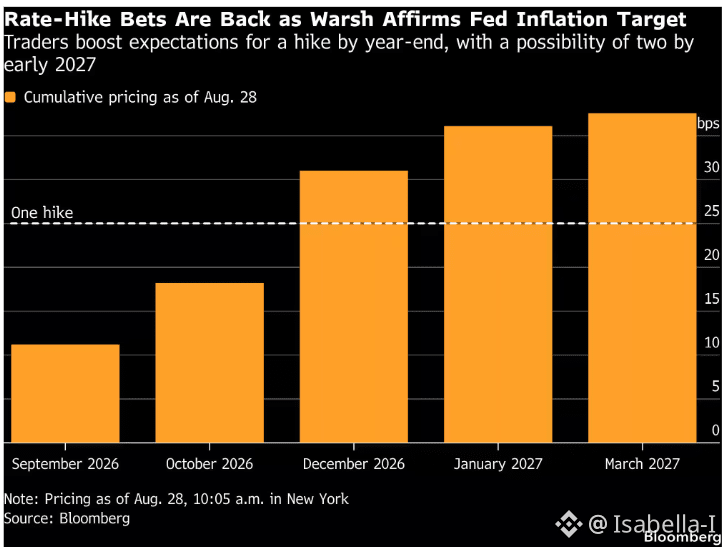
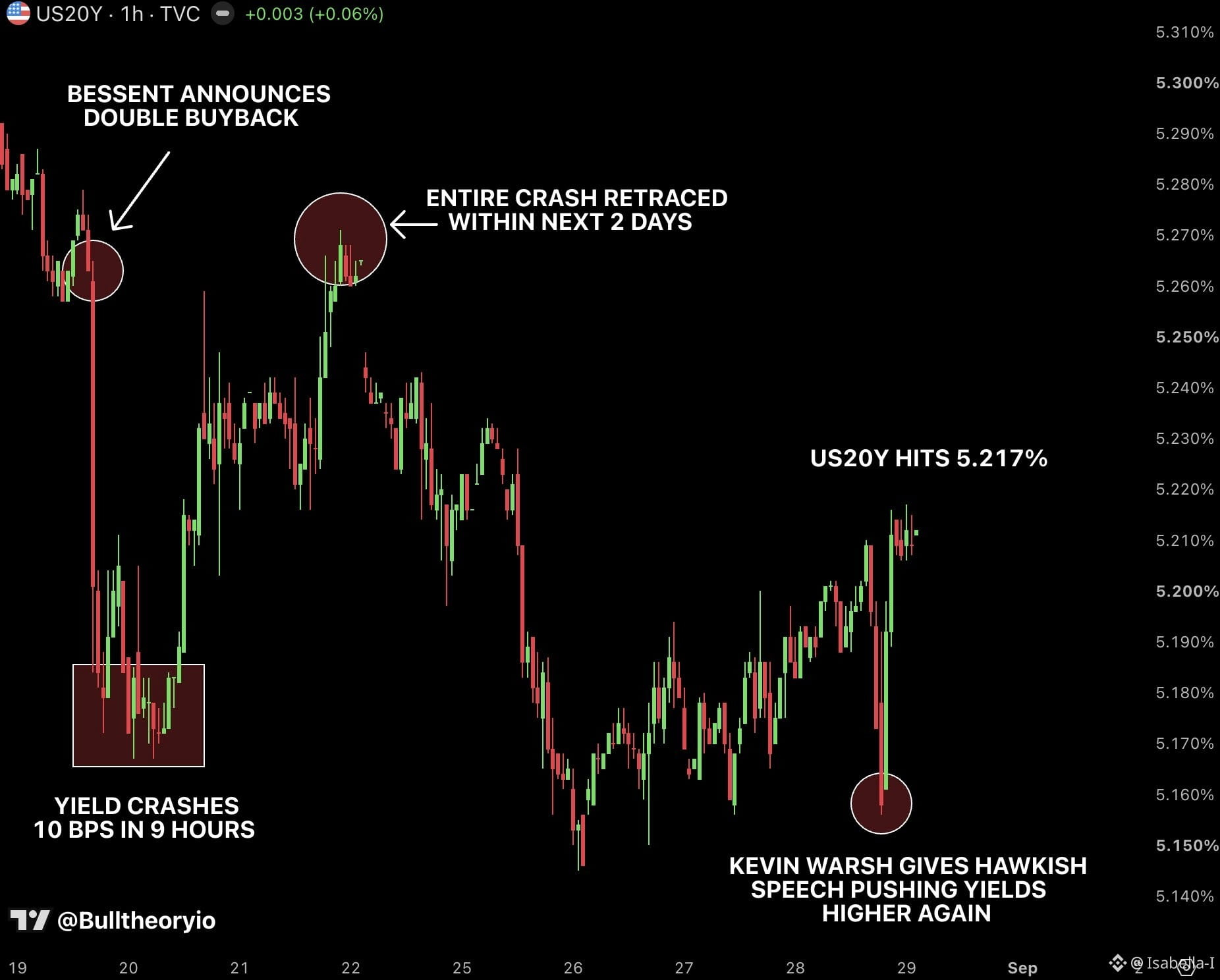
#USShortTermTreasuryYieldsJump THE US TREASURY AND THE FED ARE NOW AT WAR WITH EACH OTHER
Scott Bessent wants yields down. Kevin Warsh is pushing them up. Neither side is winning.
On August 19, Bessent doubled Treasury bond buybacks to $4 billion a week, aimed at the 10-year to 30-year part of the curve, specifically to force long term borrowing costs lower.
The move worked for a few hours. The 30-year yield dropped about 10 basis points right after the announcement.
By the next day, the entire move had reversed. The 10-year sat at 4.704% and the 30-year at 5.248%, both higher than before Bessent's announcement.
This isn't happening in a vacuum. US national debt just crossed $40 trillion, after adding $1 trillion in new debt in just a few months. The federal deficit is on pace for close to $1.9 trillion this fiscal year.
On top of that, tech companies are flooding the bond market with corporate debt to fund AI and data center buildouts, competing directly with Treasury issuance for the same pool of buyers.
That combination, more government debt, more corporate debt, and a Fed unwilling to ease, is the real reason yields keep grinding higher no matter what Bessent does.
Bessent responded by threatening even bigger buybacks, saying yields don't reflect fundamentals. Yields ignored him and kept climbing anyway.
Then on August 28, Warsh gave a hawkish Jackson Hole speech, locking in the 2% inflation target as "firm and fixed" and refusing to rule out a September hike. That pushed yields higher again, wiping out whatever ground Bessent had gained.
This same fight is already playing out in Japan, and it is not going well there.
The Bank of Japan has been hiking rates to defend the yen, and Japan's 2-year yield just hit 1.698%, a 31-year high. At the same time, Japan's government has spent a record 15.4 trillion yen, about $96.6 billion, in the last month alone trying to prop up the yen through direct intervention.
$YB $BAND $ICP
Scott Bessent wants yields down. Kevin Warsh is pushing them up. Neither side is winning.
On August 19, Bessent doubled Treasury bond buybacks to $4 billion a week, aimed at the 10-year to 30-year part of the curve, specifically to force long term borrowing costs lower.
The move worked for a few hours. The 30-year yield dropped about 10 basis points right after the announcement.
By the next day, the entire move had reversed. The 10-year sat at 4.704% and the 30-year at 5.248%, both higher than before Bessent's announcement.
This isn't happening in a vacuum. US national debt just crossed $40 trillion, after adding $1 trillion in new debt in just a few months. The federal deficit is on pace for close to $1.9 trillion this fiscal year.
On top of that, tech companies are flooding the bond market with corporate debt to fund AI and data center buildouts, competing directly with Treasury issuance for the same pool of buyers.
That combination, more government debt, more corporate debt, and a Fed unwilling to ease, is the real reason yields keep grinding higher no matter what Bessent does.
Bessent responded by threatening even bigger buybacks, saying yields don't reflect fundamentals. Yields ignored him and kept climbing anyway.
Then on August 28, Warsh gave a hawkish Jackson Hole speech, locking in the 2% inflation target as "firm and fixed" and refusing to rule out a September hike. That pushed yields higher again, wiping out whatever ground Bessent had gained.
This same fight is already playing out in Japan, and it is not going well there.
The Bank of Japan has been hiking rates to defend the yen, and Japan's 2-year yield just hit 1.698%, a 31-year high. At the same time, Japan's government has spent a record 15.4 trillion yen, about $96.6 billion, in the last month alone trying to prop up the yen through direct intervention.
$YB $BAND $ICP
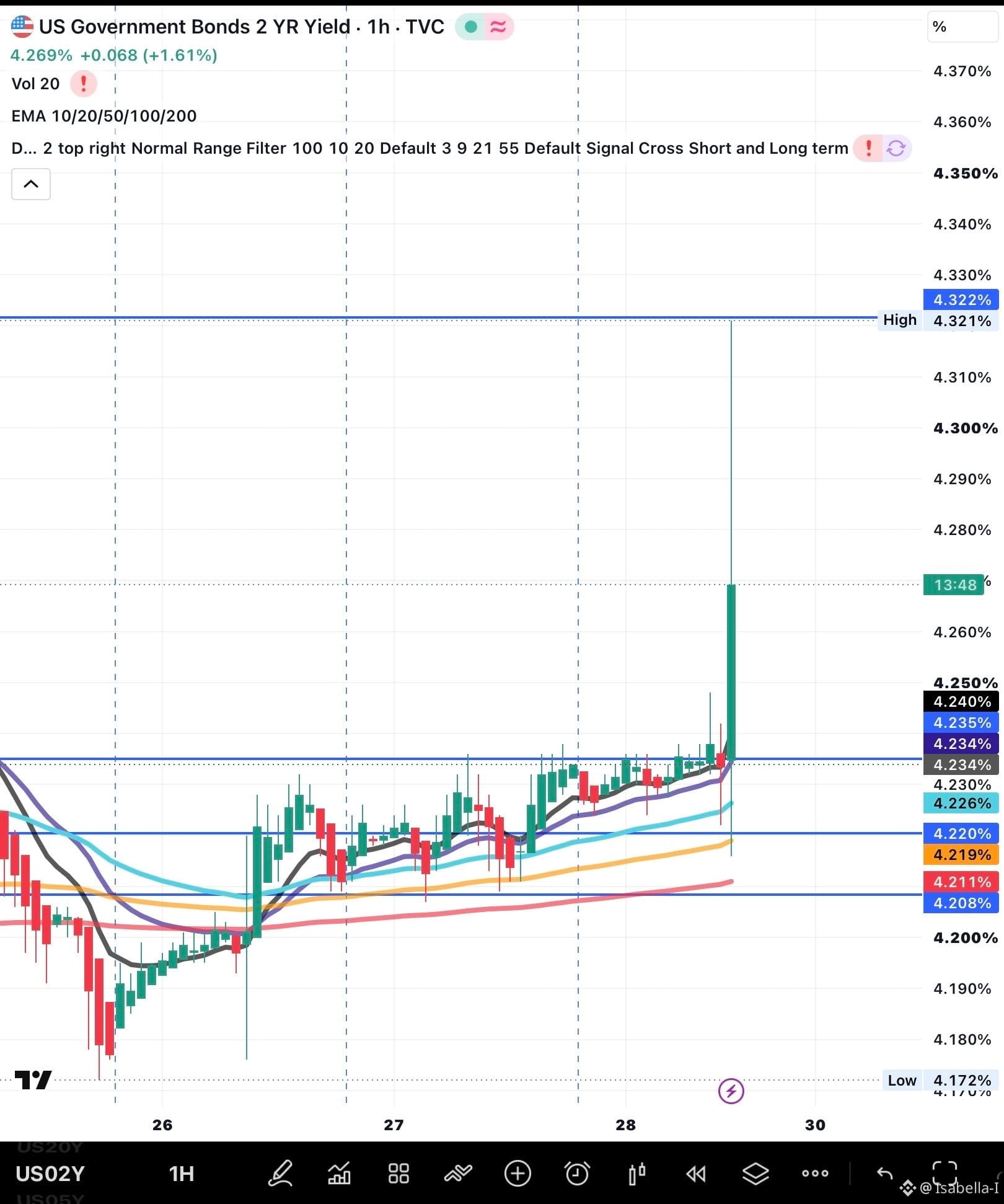
#USShortTermTreasuryYieldsJump US yields rise after comments from Fed's Warsh saying that US central bank will "have work to do" if policymakers are not confident that underlying inflation is returning to its 2% target.
US02Y, which is more sensitive to rate expectations , rose 5.66 basis points to 4.32%$LUMIA $SCR $HEI
US02Y, which is more sensitive to rate expectations , rose 5.66 basis points to 4.32%$LUMIA $SCR $HEI

Verified
#usshorttermtreasuryyieldsjump
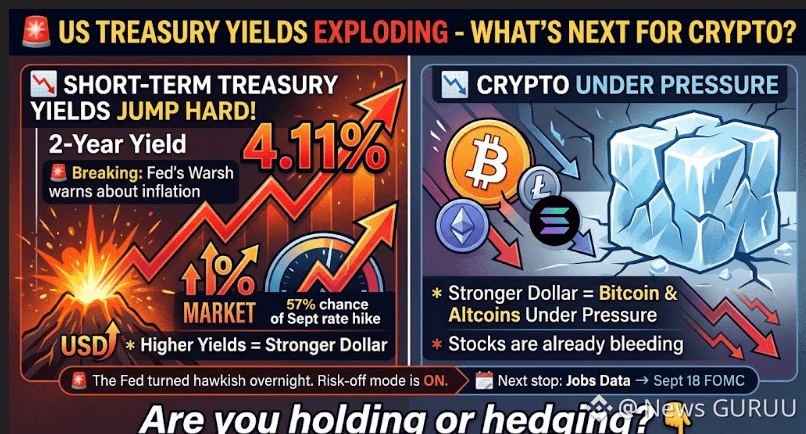
🚨 HAWKISH FED PUTS CRYPTO UNDER PRESSURE 📉
U.S. Treasury yields jumped after Fed Chair Kevin Warsh signaled that rate hikes could be needed if inflation fails to cool. Markets now price roughly a 57% chance of a September hike, up sharply from before his speech.
💥 Higher yields and a stronger dollar can weigh on Bitcoin and other risk assets, keeping pressure on crypto as traders await upcoming jobs and inflation data.
🎯 TRADING VIEW: SELL 📉
The current macro setup is bearish for crypto while hawkish Fed expectations remain elevated.
❓ Can BTC hold up against rising yields? "CLICK ON THE BELOW YELLOW COIN TAG TO GO TO DESIRED TRADING PAGE TO GET BENEFIT TRADE"$BTC
#bitcoin #Fed
🚨 HAWKISH FED PUTS CRYPTO UNDER PRESSURE 📉
U.S. Treasury yields jumped after Fed Chair Kevin Warsh signaled that rate hikes could be needed if inflation fails to cool. Markets now price roughly a 57% chance of a September hike, up sharply from before his speech.
💥 Higher yields and a stronger dollar can weigh on Bitcoin and other risk assets, keeping pressure on crypto as traders await upcoming jobs and inflation data.
🎯 TRADING VIEW: SELL 📉
The current macro setup is bearish for crypto while hawkish Fed expectations remain elevated.
❓ Can BTC hold up against rising yields? "CLICK ON THE BELOW YELLOW COIN TAG TO GO TO DESIRED TRADING PAGE TO GET BENEFIT TRADE"$BTC
#bitcoin #Fed

#USShortTermTreasuryYieldsJump
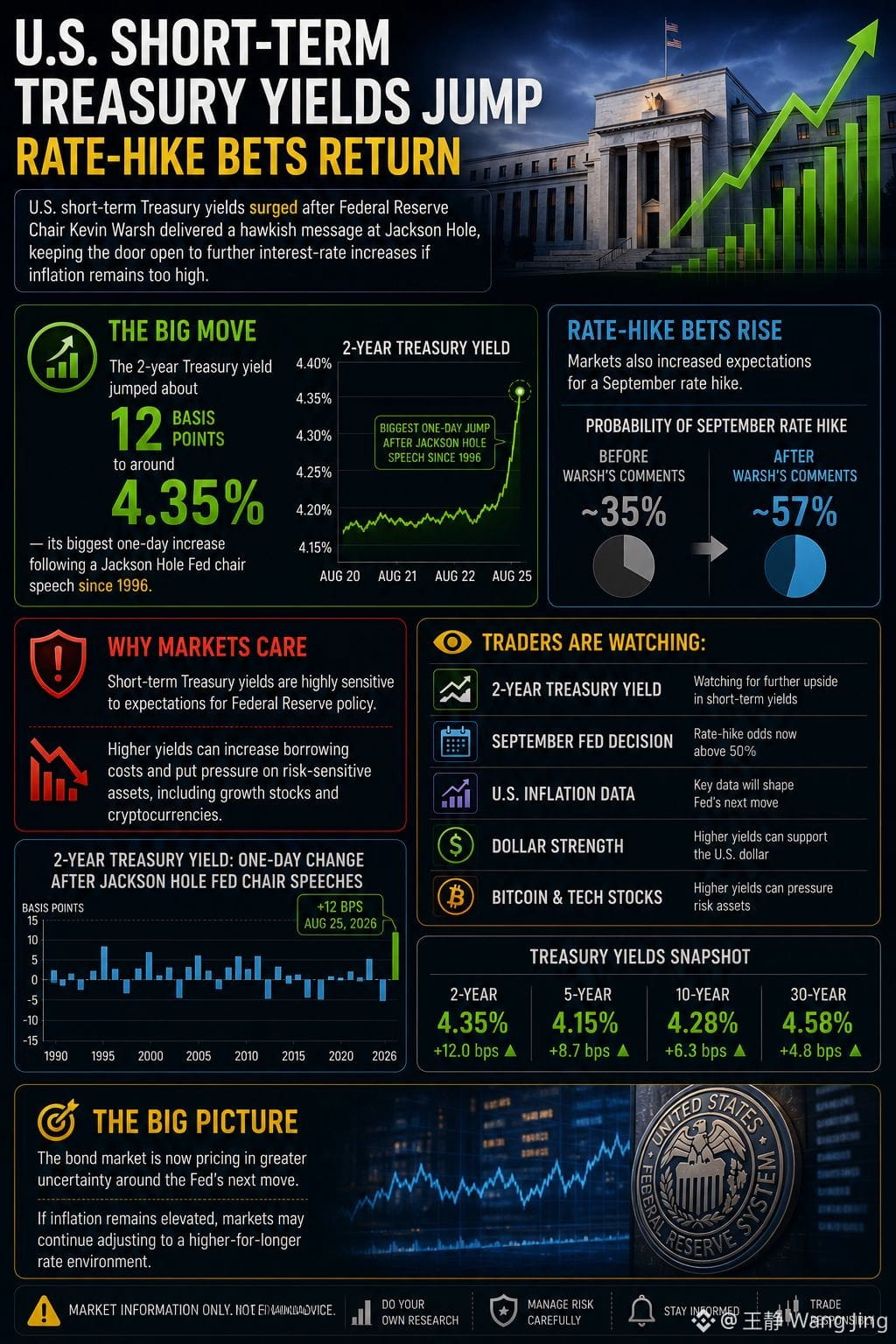
📈 U.S. SHORT-TERM TREASURY YIELDS JUMP — RATE-HIKE BETS RETURN
U.S. short-term Treasury yields surged after Federal Reserve Chair Kevin Warsh delivered a hawkish message at Jackson Hole, keeping the door open to further interest-rate increases if inflation remains too high.
🔥 THE BIG MOVE
The 2-year Treasury yield jumped about 12 basis points to around 4.35% — its biggest one-day increase following a Jackson Hole Fed chair speech since 1996.
Markets also increased expectations for a September rate hike, with the probability rising to roughly 57% after Warsh’s comments.
⚠️ WHY MARKETS CARE
Short-term Treasury yields are highly sensitive to expectations for Federal Reserve policy.
Higher yields can increase borrowing costs and put pressure on risk-sensitive assets, including growth stocks and cryptocurrencies.
👀 TRADERS ARE WATCHING:
• 2-year Treasury yield
• September Fed decision
• U.S. inflation data
• Dollar strength
• Bitcoin & tech stocks
📌 THE BIG PICTURE
The bond market is now pricing in greater uncertainty around the Fed’s next move.
If inflation remains elevated, markets may continue adjusting to a higher-for-longer rate environment.
$ZKP $NIL $GIGGLE
📈 U.S. SHORT-TERM TREASURY YIELDS JUMP — RATE-HIKE BETS RETURN
U.S. short-term Treasury yields surged after Federal Reserve Chair Kevin Warsh delivered a hawkish message at Jackson Hole, keeping the door open to further interest-rate increases if inflation remains too high.
🔥 THE BIG MOVE
The 2-year Treasury yield jumped about 12 basis points to around 4.35% — its biggest one-day increase following a Jackson Hole Fed chair speech since 1996.
Markets also increased expectations for a September rate hike, with the probability rising to roughly 57% after Warsh’s comments.
⚠️ WHY MARKETS CARE
Short-term Treasury yields are highly sensitive to expectations for Federal Reserve policy.
Higher yields can increase borrowing costs and put pressure on risk-sensitive assets, including growth stocks and cryptocurrencies.
👀 TRADERS ARE WATCHING:
• 2-year Treasury yield
• September Fed decision
• U.S. inflation data
• Dollar strength
• Bitcoin & tech stocks
📌 THE BIG PICTURE
The bond market is now pricing in greater uncertainty around the Fed’s next move.
If inflation remains elevated, markets may continue adjusting to a higher-for-longer rate environment.
$ZKP $NIL $GIGGLE

#USShortTermTreasuryYieldsJump The signal isn’t just “higher yields.” It’s a repricing of the Fed path.
The 3M Treasury yield climbed toward 3.83%, while the 2Y surged near 4.35% as markets reassessed the path for interest rates.
For crypto, this matters: higher front-end yields increase the opportunity cost of holding risk assets, strengthen the dollar, and can drain liquidity from speculative markets.
Watch the front end closely. It often moves before risk assets feel the full impact.😎
$BTC
The 3M Treasury yield climbed toward 3.83%, while the 2Y surged near 4.35% as markets reassessed the path for interest rates.
For crypto, this matters: higher front-end yields increase the opportunity cost of holding risk assets, strengthen the dollar, and can drain liquidity from speculative markets.
Watch the front end closely. It often moves before risk assets feel the full impact.😎
$BTC

#USShortTermTreasuryYieldsJump
🚨 U.S. Short-Term Treasury Yields Jump
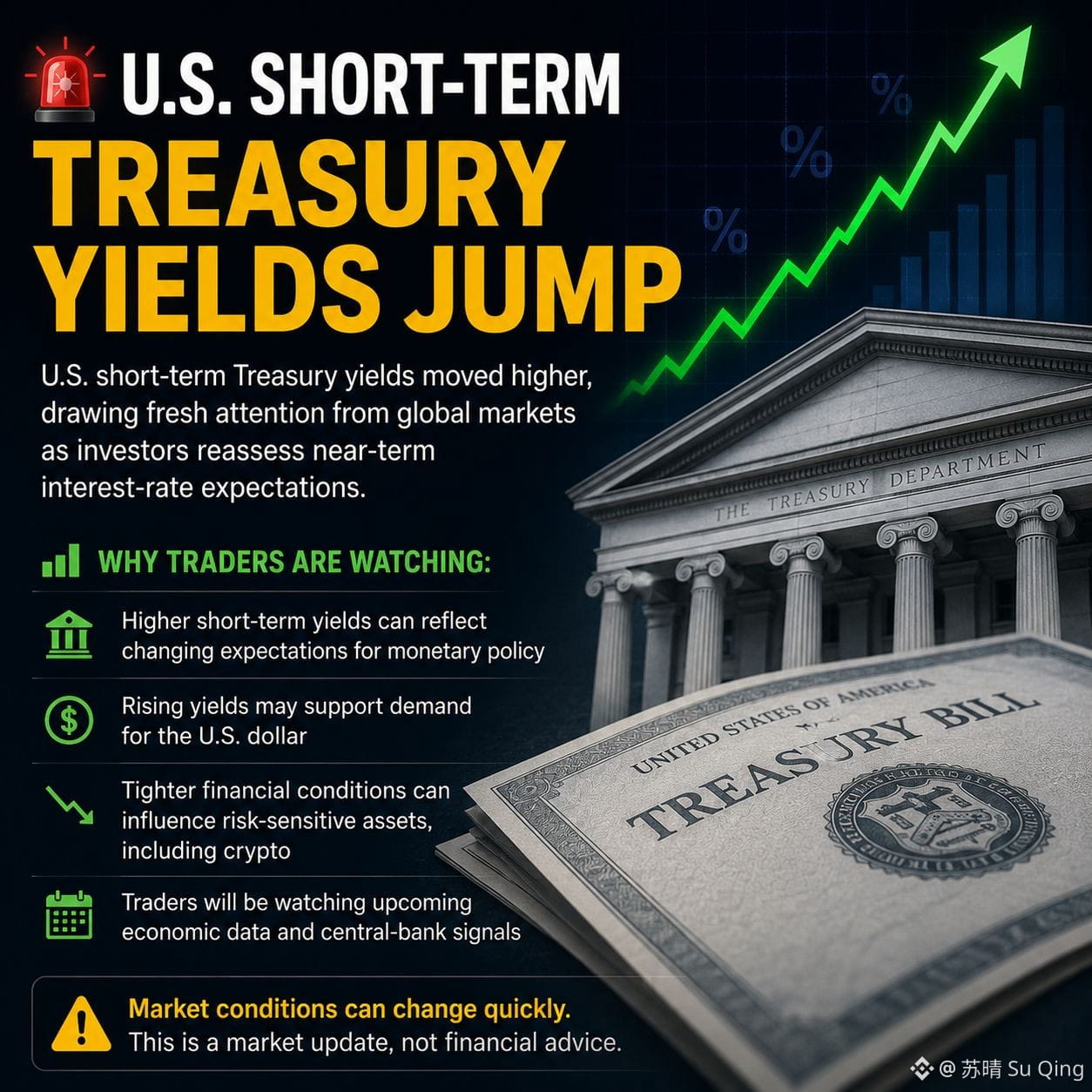
U.S. short-term Treasury yields moved higher, drawing fresh attention from global markets as investors reassess near-term interest-rate expectations.
📈 Why traders are watching:
• Higher short-term yields can reflect changing expectations for monetary policy
• Rising yields may support demand for the U.S. dollar
• Tighter financial conditions can influence risk-sensitive assets, including crypto
• Traders will be watching upcoming economic data and central-bank signals
⚠️ Market conditions can change quickly. This is a market update, not financial advice.
$SCRT
$BICO
$FET
🚨 U.S. Short-Term Treasury Yields Jump
U.S. short-term Treasury yields moved higher, drawing fresh attention from global markets as investors reassess near-term interest-rate expectations.
📈 Why traders are watching:
• Higher short-term yields can reflect changing expectations for monetary policy
• Rising yields may support demand for the U.S. dollar
• Tighter financial conditions can influence risk-sensitive assets, including crypto
• Traders will be watching upcoming economic data and central-bank signals
⚠️ Market conditions can change quickly. This is a market update, not financial advice.
$SCRT
$BICO
$FET

The Treasury Market Is Sending a Message
The move I’m watching today isn't only in crypto.
It’s in U.S. short-term Treasury yields.
The 2-year Treasury yield jumped to around 4.35% after Fed Chair Kevin Warsh's Jackson Hole remarks.
Why does crypto care?
Because short-term yields reflect expectations for Fed policy.
Higher yields can mean:
Higher opportunity cost for holding risk assets.
That can pressure:
$BTC
$ETH
Altcoins
Tech stocks
The interesting part is that markets are now pricing a much higher probability of a September rate hike.
So the crypto question becomes:
Can Bitcoin absorb tighter monetary expectations and still hold its key levels?
If yes, that's strength.
If no, macro may become the dominant narrative again.
This is why I keep watching Treasury yields alongside Bitcoin.
Sometimes the bond market speaks before crypto does.
#USShortTermTreasuryYieldsJump #BTC #Macro #Fed
$PROM
$TRX
$TUT
#usshorttermtreasuryyieldsjump
The move I’m watching today isn't only in crypto.
It’s in U.S. short-term Treasury yields.
The 2-year Treasury yield jumped to around 4.35% after Fed Chair Kevin Warsh's Jackson Hole remarks.
Why does crypto care?
Because short-term yields reflect expectations for Fed policy.
Higher yields can mean:
Higher opportunity cost for holding risk assets.
That can pressure:
$BTC
$ETH
Altcoins
Tech stocks
The interesting part is that markets are now pricing a much higher probability of a September rate hike.
So the crypto question becomes:
Can Bitcoin absorb tighter monetary expectations and still hold its key levels?
If yes, that's strength.
If no, macro may become the dominant narrative again.
This is why I keep watching Treasury yields alongside Bitcoin.
Sometimes the bond market speaks before crypto does.
#USShortTermTreasuryYieldsJump #BTC #Macro #Fed
$PROM
$TRX
$TUT
#usshorttermtreasuryyieldsjump

Everyone is celebrating the market greed at 76, but capital is quietly moving back into short-term US Treasury yields without most retail traders even noticing.
Most traders get wiped out because they only watch token charts, completely missing the macroeconomic drains pulling liquidity straight out of high-risk crypto assets.
When short-term Treasury yields jump, risk-free cash suddenly competes directly with on-chain yield farming and speculative altcoins. Institutional capital holding $USDT or seeking exposure in RWA protocols like $ONDO starts recalculating their risk curve, and money usually flows to where it gets paid with zero downside.
If this yield spike holds, tokens that rely heavily on speculative leverage like $ICP will likely face liquidity squeezes as capital rotates back into sovereign debt. The easy money phase dries up fast when bond yields offer safe returns.
Are you adjusting your altcoin exposure for macro yield moves or just riding out the volatility?
#USShortTermTreasuryYieldsJump #WarshSaysInflationIsFedTopFocus
Most traders get wiped out because they only watch token charts, completely missing the macroeconomic drains pulling liquidity straight out of high-risk crypto assets.
When short-term Treasury yields jump, risk-free cash suddenly competes directly with on-chain yield farming and speculative altcoins. Institutional capital holding $USDT or seeking exposure in RWA protocols like $ONDO starts recalculating their risk curve, and money usually flows to where it gets paid with zero downside.
If this yield spike holds, tokens that rely heavily on speculative leverage like $ICP will likely face liquidity squeezes as capital rotates back into sovereign debt. The easy money phase dries up fast when bond yields offer safe returns.
Are you adjusting your altcoin exposure for macro yield moves or just riding out the volatility?
#USShortTermTreasuryYieldsJump #WarshSaysInflationIsFedTopFocus


#usshorttermtreasuryyieldsjump
📈 Market Digest: US Short-Term Treasury Yields Jump
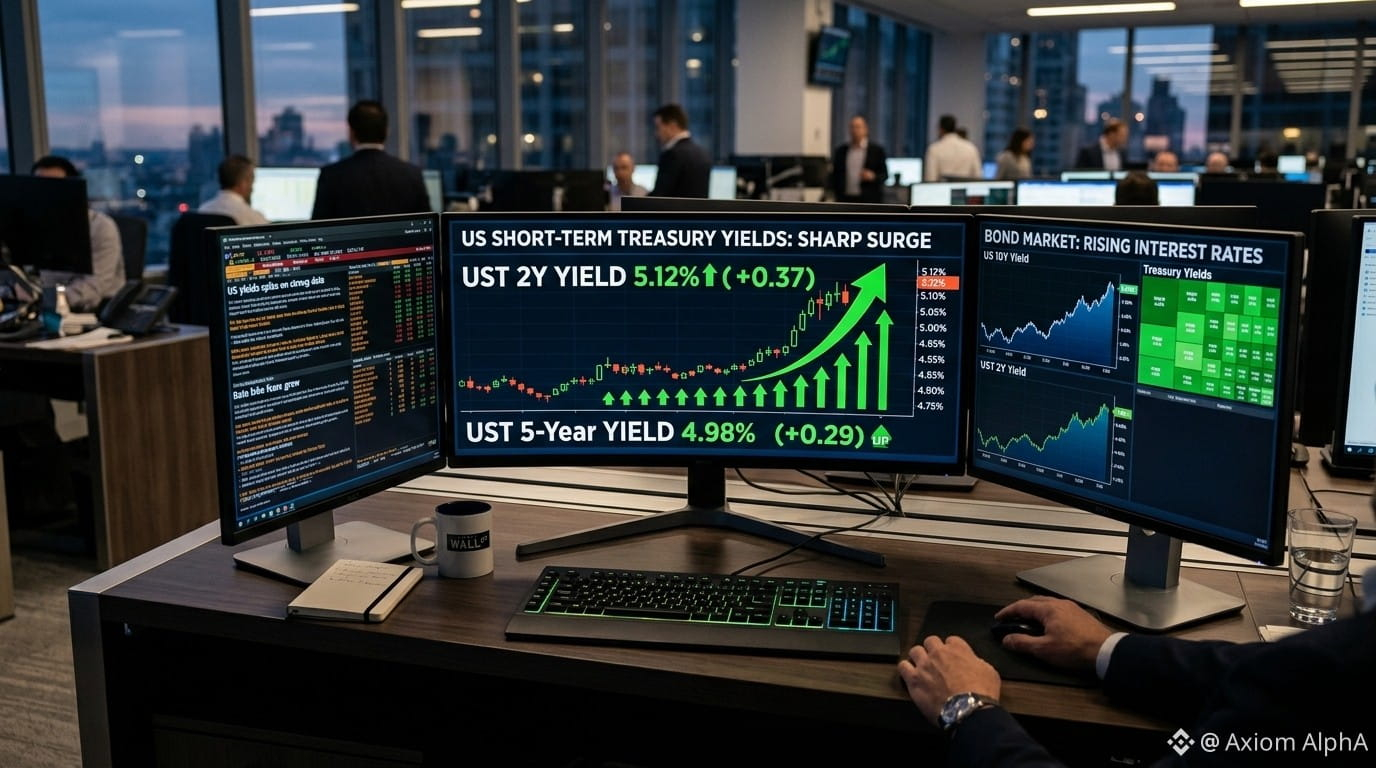
Short-dated US Treasury yields spiked as traders repriced near-term monetary policy following hawkish signals on sticky inflation from Federal Reserve leadership. The 2-year Treasury yield surged over 12 basis points to 4.36%, reflecting renewed uncertainty over future interest rate cuts.
Rising short-term yields increase risk-free return rates, often creating headwind pressures across risk-on assets such as equities and digital assets as capital adjusts to tighter monetary expectations.
Top 3 Tradeable Coins to Watch
Bitcoin ($BTC )
Macro Impact: Directly sensitive to US yield shifts; rising risk-free yields tend to constrain liquidity and trigger short-term market consolidation.
Key Level: Watching critical support around $77,000, with primary overhead resistance at $80,000.
Ethereum ($ETH )
Macro Impact: Highly sensitive to broader DeFi yields and macro interest rate expectations, leading to heightened volatility during Treasury yield spikes.
Key Level: Key structural support at $2,400–$2,450; clearing $2,700 is required to re-establish bullish momentum.
Solana ($SOL )
Macro Impact: Functions as a high-beta asset during macroeconomic swings, presenting sharp trading ranges during yield-driven market shifts.
Key Level: Demand holding around the $135 range; immediate upside targets sit near the $155 resistance level.
#BinanceSquare
📈 Market Digest: US Short-Term Treasury Yields Jump
Short-dated US Treasury yields spiked as traders repriced near-term monetary policy following hawkish signals on sticky inflation from Federal Reserve leadership. The 2-year Treasury yield surged over 12 basis points to 4.36%, reflecting renewed uncertainty over future interest rate cuts.
Rising short-term yields increase risk-free return rates, often creating headwind pressures across risk-on assets such as equities and digital assets as capital adjusts to tighter monetary expectations.
Top 3 Tradeable Coins to Watch
Bitcoin ($BTC )
Macro Impact: Directly sensitive to US yield shifts; rising risk-free yields tend to constrain liquidity and trigger short-term market consolidation.
Key Level: Watching critical support around $77,000, with primary overhead resistance at $80,000.
Ethereum ($ETH )
Macro Impact: Highly sensitive to broader DeFi yields and macro interest rate expectations, leading to heightened volatility during Treasury yield spikes.
Key Level: Key structural support at $2,400–$2,450; clearing $2,700 is required to re-establish bullish momentum.
Solana ($SOL )
Macro Impact: Functions as a high-beta asset during macroeconomic swings, presenting sharp trading ranges during yield-driven market shifts.
Key Level: Demand holding around the $135 range; immediate upside targets sit near the $155 resistance level.
#BinanceSquare
Crypto Horizon 24:
تابع التحليلات اليومية، والتداول الآمن، وأخبار العملات الرقمية. تابعني إن وجدت هذا مفيدًا؛ فهذا يحفزني على البحث ومشاركة المعلومات.

#USShortTermTreasuryYieldsJump
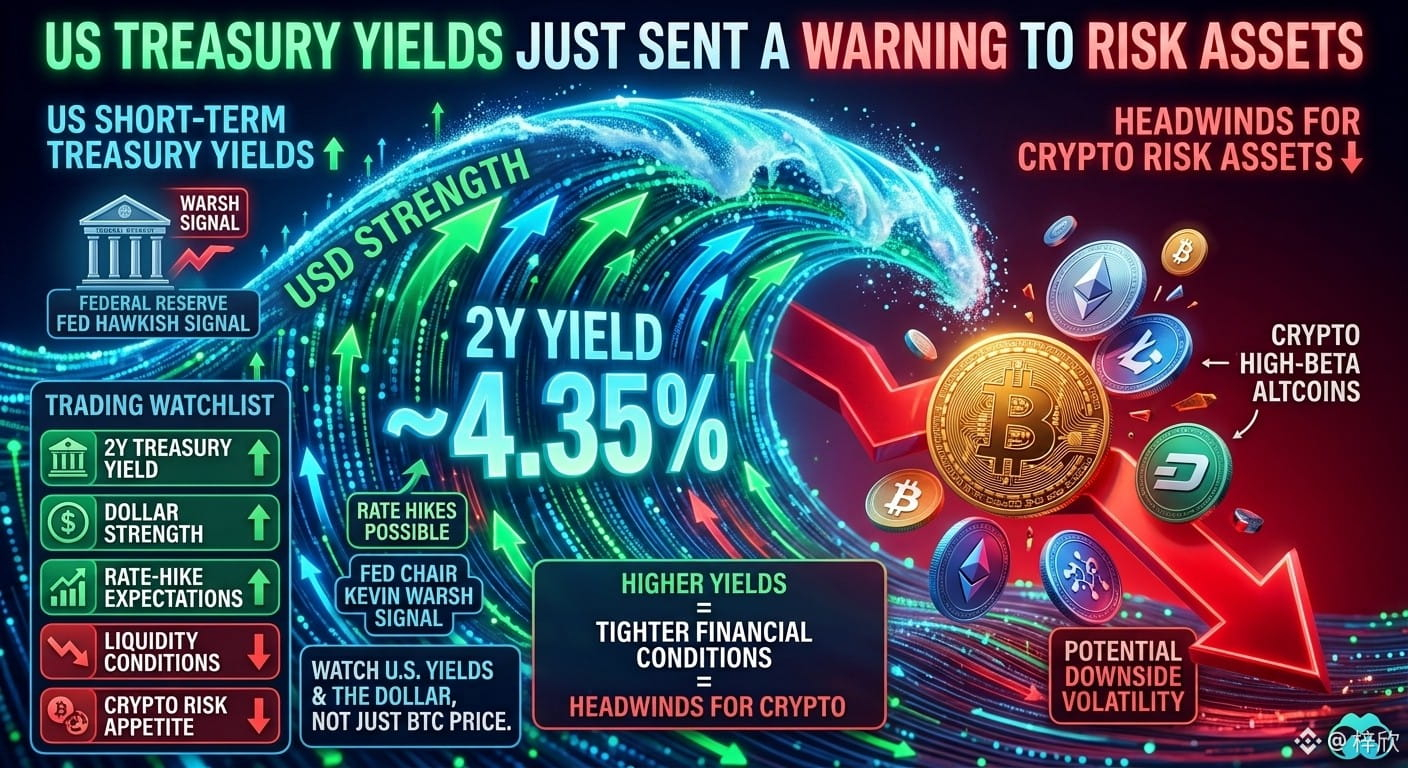
US SHORT-TERM TREASURY YIELDS JUST SENT A WARNING TO RISK ASSETS
U.S. short-term Treasury yields jumped sharply after Fed Chair Kevin Warsh signaled that further rate hikes could be necessary if inflation does not move convincingly toward the 2% target.
The 2-Year Treasury yield surged to around 4.35%, while markets significantly increased the probability of a September Fed rate hike.
Why should crypto traders care?
Higher short-term yields can mean tighter financial conditions and stronger demand for the U.S. dollar.
That creates potential headwinds for BTC, ETH and high-beta altcoins.
TRADING WATCHLIST:
2Y Treasury Yield ↑
Dollar Strength ↑
Rate-Hike Expectations ↑
Liquidity Conditions ↓
Crypto Risk Appetite ↓
The key level now is not simply Bitcoin's price.
Watch U.S. yields and the dollar.
If Treasury yields continue climbing while BTC struggles to reclaim resistance, downside volatility could accelerate across leveraged crypto markets.
But if yields cool and rate-hike expectations reverse, risk assets could quickly regain momentum.
This is a macro setup traders should NOT ignore.
$DEXE $ONG $NIL
US SHORT-TERM TREASURY YIELDS JUST SENT A WARNING TO RISK ASSETS
U.S. short-term Treasury yields jumped sharply after Fed Chair Kevin Warsh signaled that further rate hikes could be necessary if inflation does not move convincingly toward the 2% target.
The 2-Year Treasury yield surged to around 4.35%, while markets significantly increased the probability of a September Fed rate hike.
Why should crypto traders care?
Higher short-term yields can mean tighter financial conditions and stronger demand for the U.S. dollar.
That creates potential headwinds for BTC, ETH and high-beta altcoins.
TRADING WATCHLIST:
2Y Treasury Yield ↑
Dollar Strength ↑
Rate-Hike Expectations ↑
Liquidity Conditions ↓
Crypto Risk Appetite ↓
The key level now is not simply Bitcoin's price.
Watch U.S. yields and the dollar.
If Treasury yields continue climbing while BTC struggles to reclaim resistance, downside volatility could accelerate across leveraged crypto markets.
But if yields cool and rate-hike expectations reverse, risk assets could quickly regain momentum.
This is a macro setup traders should NOT ignore.
$DEXE $ONG $NIL

Verified
#usshorttermtreasuryyieldsjump
US 10-year Treasury yields
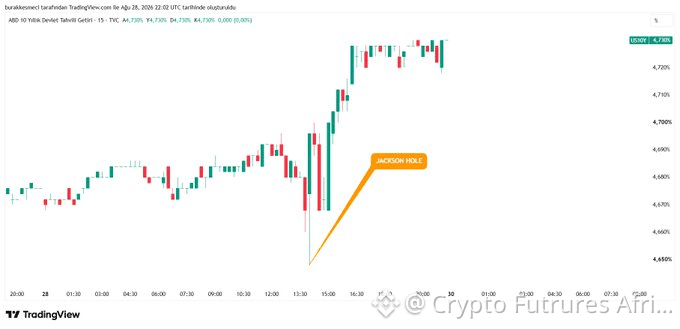
have rebounded to around 4.73% following Jackson Hole, while market pricing for a September rate hike has surged from 35% to 60%. This sharp shift in rate expectations signals renewed hawkish sentiment and tighter financial conditions ahead.
US 10-year Treasury yields
have rebounded to around 4.73% following Jackson Hole, while market pricing for a September rate hike has surged from 35% to 60%. This sharp shift in rate expectations signals renewed hawkish sentiment and tighter financial conditions ahead.
$AKE
$DEXE
$龙虾
US 10-year Treasury yields
have rebounded to around 4.73% following Jackson Hole, while market pricing for a September rate hike has surged from 35% to 60%. This sharp shift in rate expectations signals renewed hawkish sentiment and tighter financial conditions ahead.
US 10-year Treasury yields
have rebounded to around 4.73% following Jackson Hole, while market pricing for a September rate hike has surged from 35% to 60%. This sharp shift in rate expectations signals renewed hawkish sentiment and tighter financial conditions ahead.
$AKE
$DEXE
$龙虾
Crypto Horizon 24:
تابع التحليلات اليومية، والتداول الآمن، وأخبار العملات الرقمية. تابعني إن وجدت هذا مفيدًا؛ فهذا يحفزني على البحث ومشاركة المعلومات.
Log in to explore more content