

#macroeconomics
macroeconomics
858,143 views
3,964 Discussing
Hot
Latest

Australian Treasurer Jim Chalmers recently stated that the Reserve Bank of Australia's latest rate hike was entirely driven by the ongoing Middle East conflict. He warned that the war has turned into a disaster for the global economy, forcing workers to pay the price.
This highlights how geopolitical conflicts directly reignite global inflationary pressures. With markets betting on further rate hikes across major developed economies, expectations of widespread central bank easing are being delayed.
For broader financial markets, elevated rate expectations continue to support bond yields and safe-haven assets. Equities and broader risk assets face persistent valuation pressure from tighter liquidity conditions.
In crypto, prolonged hawkish policy may restrict institutional capital inflows in the near term. $BTC and the broader market could face extended consolidation until macro uncertainty subsides.
#MacroEconomics #InterestRates #Geopolitics
Australian Treasurer Jim Chalmers recently stated that the Reserve Bank of Australia's latest rate hike was entirely driven by the ongoing Middle East conflict. He warned that the war has turned into a disaster for the global economy, forcing workers to pay the price.
This highlights how geopolitical conflicts directly reignite global inflationary pressures. With markets betting on further rate hikes across major developed economies, expectations of widespread central bank easing are being delayed.
For broader financial markets, elevated rate expectations continue to support bond yields and safe-haven assets. Equities and broader risk assets face persistent valuation pressure from tighter liquidity conditions.
In crypto, prolonged hawkish policy may restrict institutional capital inflows in the near term. $BTC and the broader market could face extended consolidation until macro uncertainty subsides.
#MacroEconomics #InterestRates #Geopolitics
This highlights how geopolitical conflicts directly reignite global inflationary pressures. With markets betting on further rate hikes across major developed economies, expectations of widespread central bank easing are being delayed.
For broader financial markets, elevated rate expectations continue to support bond yields and safe-haven assets. Equities and broader risk assets face persistent valuation pressure from tighter liquidity conditions.
In crypto, prolonged hawkish policy may restrict institutional capital inflows in the near term. $BTC and the broader market could face extended consolidation until macro uncertainty subsides.
#MacroEconomics #InterestRates #Geopolitics
33
Brent crude oil prices saw a sharp surge today, climbing 1.00% to trade at $99.33 per barrel. The benchmark commodity is now knocking directly on the psychological $100 barrier amid tightening global energy dynamics.
This move is critical as oil nearing triple digits reignites widespread concerns over sticky headline inflation. Sustained energy price spikes complicate central bank easing roadmaps and disrupt previous disinflation projections across major economies.
In broader financial markets, elevated crude yields upward pressure on bond yields while reinforcing strength in the US Dollar Index. Equity indices face renewed valuation headwinds as fears of prolonged higher-for-longer interest rates damp consumer spending outlooks.
For digital assets like $BTC, rising energy prices squeeze macro liquidity and dampen institutional risk appetite in the immediate term. Until oil stabilizes, crypto markets may experience choppy range-bound action as capital adopts a defensive stance.
#CrudeOil #MacroEconomics #Inflation
Brent crude oil prices saw a sharp surge today, climbing 1.00% to trade at $99.33 per barrel. The benchmark commodity is now knocking directly on the psychological $100 barrier amid tightening global energy dynamics.
This move is critical as oil nearing triple digits reignites widespread concerns over sticky headline inflation. Sustained energy price spikes complicate central bank easing roadmaps and disrupt previous disinflation projections across major economies.
In broader financial markets, elevated crude yields upward pressure on bond yields while reinforcing strength in the US Dollar Index. Equity indices face renewed valuation headwinds as fears of prolonged higher-for-longer interest rates damp consumer spending outlooks.
For digital assets like $BTC , rising energy prices squeeze macro liquidity and dampen institutional risk appetite in the immediate term. Until oil stabilizes, crypto markets may experience choppy range-bound action as capital adopts a defensive stance.
#CrudeOil #MacroEconomics #Inflation
This move is critical as oil nearing triple digits reignites widespread concerns over sticky headline inflation. Sustained energy price spikes complicate central bank easing roadmaps and disrupt previous disinflation projections across major economies.
In broader financial markets, elevated crude yields upward pressure on bond yields while reinforcing strength in the US Dollar Index. Equity indices face renewed valuation headwinds as fears of prolonged higher-for-longer interest rates damp consumer spending outlooks.
For digital assets like $BTC , rising energy prices squeeze macro liquidity and dampen institutional risk appetite in the immediate term. Until oil stabilizes, crypto markets may experience choppy range-bound action as capital adopts a defensive stance.
#CrudeOil #MacroEconomics #Inflation
53
UK 10-year government bond yields surged to 5.441% today, marking their highest level since July 2007. This sharp spike reflects persistent inflation concerns across European debt markets and intensifying pressure on the Bank of England to maintain a restrictive policy stance.
This multi-year milestone is crucial because it shatters previous market expectations of a swift monetary easing cycle. Investors are increasingly demanding higher risk premiums on sovereign debt as fiscal expansion and sticky price pressures force bond prices down globally.
Across traditional finance, soaring sovereign yields tighten financial conditions and boost borrowing costs for corporations and consumers alike. Equity valuations are facing renewed valuation headwinds, while global capital rotates defensively toward risk-free government paper.
For crypto markets, elevated bond yields raise the global hurdle rate for speculative investments, tightening risk-on liquidity. $BTC and broader digital assets may see range-bound trading as institutional capital hesitates to deploy aggressively into high-beta assets until yields stabilize.
#BondYields #MacroEconomics #CryptoLiquidity
UK 10-year government bond yields surged to 5.441% today, marking their highest level since July 2007. This sharp spike reflects persistent inflation concerns across European debt markets and intensifying pressure on the Bank of England to maintain a restrictive policy stance.
This multi-year milestone is crucial because it shatters previous market expectations of a swift monetary easing cycle. Investors are increasingly demanding higher risk premiums on sovereign debt as fiscal expansion and sticky price pressures force bond prices down globally.
Across traditional finance, soaring sovereign yields tighten financial conditions and boost borrowing costs for corporations and consumers alike. Equity valuations are facing renewed valuation headwinds, while global capital rotates defensively toward risk-free government paper.
For crypto markets, elevated bond yields raise the global hurdle rate for speculative investments, tightening risk-on liquidity. $BTC and broader digital assets may see range-bound trading as institutional capital hesitates to deploy aggressively into high-beta assets until yields stabilize.
#BondYields #MacroEconomics #CryptoLiquidity
This multi-year milestone is crucial because it shatters previous market expectations of a swift monetary easing cycle. Investors are increasingly demanding higher risk premiums on sovereign debt as fiscal expansion and sticky price pressures force bond prices down globally.
Across traditional finance, soaring sovereign yields tighten financial conditions and boost borrowing costs for corporations and consumers alike. Equity valuations are facing renewed valuation headwinds, while global capital rotates defensively toward risk-free government paper.
For crypto markets, elevated bond yields raise the global hurdle rate for speculative investments, tightening risk-on liquidity. $BTC and broader digital assets may see range-bound trading as institutional capital hesitates to deploy aggressively into high-beta assets until yields stabilize.
#BondYields #MacroEconomics #CryptoLiquidity
25
Global energy markets saw a sharp escalation today as Brent crude surged 3.00% to trade at $100.31 per barrel, while WTI crude jumped 2.90% to surpass $94 per barrel.
Breaching the critical $100 threshold signals mounting supply-side stress and intensifies fears of persistent global inflation. This sharp price spike complicates central bank roadmaps, as rising energy costs directly threaten recent progress on headline CPI and dampen expectations for aggressive policy easing.
Across traditional finance, higher oil prices are driving US Treasury yields upward and lending fresh momentum to the US Dollar Index. Equity markets are increasingly pricing in tighter financial conditions and elevated input costs, which weigh heavily on broader corporate profit margins.
For crypto, this renewed inflationary pressure reinforces a defensive posture across risk assets. If sustained energy spikes delay interest rate cuts and tighten macro liquidity, $BTC and the broader market may face extended consolidation in the near term. 🛢️
#OilPrices #MacroEconomics #Inflation
Global energy markets saw a sharp escalation today as Brent crude surged 3.00% to trade at $100.31 per barrel, while WTI crude jumped 2.90% to surpass $94 per barrel.
Breaching the critical $100 threshold signals mounting supply-side stress and intensifies fears of persistent global inflation. This sharp price spike complicates central bank roadmaps, as rising energy costs directly threaten recent progress on headline CPI and dampen expectations for aggressive policy easing.
Across traditional finance, higher oil prices are driving US Treasury yields upward and lending fresh momentum to the US Dollar Index. Equity markets are increasingly pricing in tighter financial conditions and elevated input costs, which weigh heavily on broader corporate profit margins.
For crypto, this renewed inflationary pressure reinforces a defensive posture across risk assets. If sustained energy spikes delay interest rate cuts and tighten macro liquidity, $BTC and the broader market may face extended consolidation in the near term. 🛢️
#OilPrices #MacroEconomics #Inflation
Breaching the critical $100 threshold signals mounting supply-side stress and intensifies fears of persistent global inflation. This sharp price spike complicates central bank roadmaps, as rising energy costs directly threaten recent progress on headline CPI and dampen expectations for aggressive policy easing.
Across traditional finance, higher oil prices are driving US Treasury yields upward and lending fresh momentum to the US Dollar Index. Equity markets are increasingly pricing in tighter financial conditions and elevated input costs, which weigh heavily on broader corporate profit margins.
For crypto, this renewed inflationary pressure reinforces a defensive posture across risk assets. If sustained energy spikes delay interest rate cuts and tighten macro liquidity, $BTC and the broader market may face extended consolidation in the near term. 🛢️
#OilPrices #MacroEconomics #Inflation
227
Brent crude oil prices surged past the critical $100 per barrel mark today, posting a sharp gain of 2.70% in daily trading. This explosive move represents a major psychological breakout as global energy markets face severe supply tensions.
Energy costs remain the primary driver of headline inflation metrics worldwide. Oil sustaining levels above $100 complicates the disinflation narrative, directly challenging the timeline for central banks planning aggressive rate cuts.
Across traditional finance, soaring energy prices are pushing bond yields higher and boosting the US Dollar index as a safe-haven currency. Equities face margin compression from higher input costs, prompting broader risk-off behavior across global portfolios.
For crypto markets, this macroeconomic friction presents a challenging backdrop. Lingering inflation pressures could delay monetary easing, keeping liquidity tight for $BTC and the broader digital asset space. 🛢️
#BrentCrude #Inflation #MacroEconomics
Brent crude oil prices surged past the critical $100 per barrel mark today, posting a sharp gain of 2.70% in daily trading. This explosive move represents a major psychological breakout as global energy markets face severe supply tensions.
Energy costs remain the primary driver of headline inflation metrics worldwide. Oil sustaining levels above $100 complicates the disinflation narrative, directly challenging the timeline for central banks planning aggressive rate cuts.
Across traditional finance, soaring energy prices are pushing bond yields higher and boosting the US Dollar index as a safe-haven currency. Equities face margin compression from higher input costs, prompting broader risk-off behavior across global portfolios.
For crypto markets, this macroeconomic friction presents a challenging backdrop. Lingering inflation pressures could delay monetary easing, keeping liquidity tight for $BTC and the broader digital asset space. 🛢️
#BrentCrude #Inflation #MacroEconomics
Energy costs remain the primary driver of headline inflation metrics worldwide. Oil sustaining levels above $100 complicates the disinflation narrative, directly challenging the timeline for central banks planning aggressive rate cuts.
Across traditional finance, soaring energy prices are pushing bond yields higher and boosting the US Dollar index as a safe-haven currency. Equities face margin compression from higher input costs, prompting broader risk-off behavior across global portfolios.
For crypto markets, this macroeconomic friction presents a challenging backdrop. Lingering inflation pressures could delay monetary easing, keeping liquidity tight for $BTC and the broader digital asset space. 🛢️
#BrentCrude #Inflation #MacroEconomics
220
Crude oil markets opened sharply higher today, with WTI jumping 0.7% to $92 per barrel while Brent crude surged nearly 1% to reach $98.38 per barrel. This simultaneous push across major benchmarks signals renewed buying pressure in global energy markets.
Energy spikes of this magnitude directly threaten the global disinflation narrative that central banks have been relying on. When Brent approaches the triple-digit threshold, headline CPI expectations immediately adjust upward, forcing markets to price in higher-for-longer borrowing costs.
Across traditional finance, sustained oil rallies typically drive up US Treasury yields and lend support to the US dollar while pressuring risk-on equities. Elevated transport and input costs also raise stagflation concerns, dampening consumer sentiment and corporate margin forecasts.
For the crypto sector, tighter macro conditions and rising yield curves usually restrict liquidity inflows into speculative assets like $BTC. If elevated oil prices solidify hawkish central bank policies, digital assets will likely face short-term choppy price action and heightened macro-driven volatility. 🛢️
#CrudeOil #MacroEconomics #Inflation
Crude oil markets opened sharply higher today, with WTI jumping 0.7% to $92 per barrel while Brent crude surged nearly 1% to reach $98.38 per barrel. This simultaneous push across major benchmarks signals renewed buying pressure in global energy markets.
Energy spikes of this magnitude directly threaten the global disinflation narrative that central banks have been relying on. When Brent approaches the triple-digit threshold, headline CPI expectations immediately adjust upward, forcing markets to price in higher-for-longer borrowing costs.
Across traditional finance, sustained oil rallies typically drive up US Treasury yields and lend support to the US dollar while pressuring risk-on equities. Elevated transport and input costs also raise stagflation concerns, dampening consumer sentiment and corporate margin forecasts.
For the crypto sector, tighter macro conditions and rising yield curves usually restrict liquidity inflows into speculative assets like $BTC . If elevated oil prices solidify hawkish central bank policies, digital assets will likely face short-term choppy price action and heightened macro-driven volatility. 🛢️
#CrudeOil #MacroEconomics #Inflation
Energy spikes of this magnitude directly threaten the global disinflation narrative that central banks have been relying on. When Brent approaches the triple-digit threshold, headline CPI expectations immediately adjust upward, forcing markets to price in higher-for-longer borrowing costs.
Across traditional finance, sustained oil rallies typically drive up US Treasury yields and lend support to the US dollar while pressuring risk-on equities. Elevated transport and input costs also raise stagflation concerns, dampening consumer sentiment and corporate margin forecasts.
For the crypto sector, tighter macro conditions and rising yield curves usually restrict liquidity inflows into speculative assets like $BTC . If elevated oil prices solidify hawkish central bank policies, digital assets will likely face short-term choppy price action and heightened macro-driven volatility. 🛢️
#CrudeOil #MacroEconomics #Inflation
115

·
--
The UK government bond market has just seen sharp volatility as the average yield for the 10-year tenor reached 5.383%, the highest level since 1999. This development comes amid investors continuously repricing fiscal risk and persistent inflationary pressure in the land of fog.
The fact that the benchmark bond yield has hit a peak more than two decades high indicates that confidence in the United Kingdom’s fiscal stability is under heavy strain. Rising public debt pressure, along with prolonged monetary tightening policies, has pushed the borrowing costs of both the government and the private sector to record highs.
On the macroeconomic front, surging bond yields are often followed by a wave of selling in risk assets and a rise in the cost of capital worldwide. The British pound and other currency-priced assets face increased fluctuations, while capital tends to move toward safer assets with higher liquidity.
For the crypto market, the current environment of elevated interest rates and high risk-free yields will continue to weigh on overall liquidity. Speculative flows into $BTC and altcoins may become more cautious in the short term as the opportunity cost of holding non-yielding assets grows more expensive.
#UKGilts #BondYields #MacroEconomics
The UK government bond market has just seen sharp volatility as the average yield for the 10-year tenor reached 5.383%, the highest level since 1999. This development comes amid investors continuously repricing fiscal risk and persistent inflationary pressure in the land of fog.
The fact that the benchmark bond yield has hit a peak more than two decades high indicates that confidence in the United Kingdom’s fiscal stability is under heavy strain. Rising public debt pressure, along with prolonged monetary tightening policies, has pushed the borrowing costs of both the government and the private sector to record highs.
On the macroeconomic front, surging bond yields are often followed by a wave of selling in risk assets and a rise in the cost of capital worldwide. The British pound and other currency-priced assets face increased fluctuations, while capital tends to move toward safer assets with higher liquidity.
For the crypto market, the current environment of elevated interest rates and high risk-free yields will continue to weigh on overall liquidity. Speculative flows into $BTC and altcoins may become more cautious in the short term as the opportunity cost of holding non-yielding assets grows more expensive.
#UKGilts #BondYields #MacroEconomics
The fact that the benchmark bond yield has hit a peak more than two decades high indicates that confidence in the United Kingdom’s fiscal stability is under heavy strain. Rising public debt pressure, along with prolonged monetary tightening policies, has pushed the borrowing costs of both the government and the private sector to record highs.
On the macroeconomic front, surging bond yields are often followed by a wave of selling in risk assets and a rise in the cost of capital worldwide. The British pound and other currency-priced assets face increased fluctuations, while capital tends to move toward safer assets with higher liquidity.
For the crypto market, the current environment of elevated interest rates and high risk-free yields will continue to weigh on overall liquidity. Speculative flows into $BTC and altcoins may become more cautious in the short term as the opportunity cost of holding non-yielding assets grows more expensive.
#UKGilts #BondYields #MacroEconomics
BTC+1.18%
IEFETF+0.06%
12
·
--
During today’s trading session, Brent crude oil prices recorded a 1.00% gain for the day, officially nearing the important psychological level of 99.33 USD per barrel. This development reflects tightening supply pressures alongside returning geopolitical concerns that are once again influencing the global energy market.
Oil prices staying elevated and approaching the 100 USD per barrel mark is a particularly important macroeconomic variable at this time. Rising energy costs pose a direct threat to efforts to contain inflation, raising concerns that major central banks may need to keep monetary policy tighter for longer than previously expected.
For traditional financial markets, oil’s upward trend often pushes U.S. government bond yields higher and supports the strength of the U.S. dollar. This environment places significant pressure on risk-asset channels such as equities when the cost of capital continues to carry the burden of inflation.
As for the crypto market, increasing macro pressure may cause institutional capital inflows into $BTC trở to become more cautious in the short term. Investors should closely monitor the market’s reaction around the 100 USD oil-price level to anticipate possible next liquidity-volatility scenarios.
#CrudeOil #Inflation #MacroEconomics
During today’s trading session, Brent crude oil prices recorded a 1.00% gain for the day, officially nearing the important psychological level of 99.33 USD per barrel. This development reflects tightening supply pressures alongside returning geopolitical concerns that are once again influencing the global energy market.
Oil prices staying elevated and approaching the 100 USD per barrel mark is a particularly important macroeconomic variable at this time. Rising energy costs pose a direct threat to efforts to contain inflation, raising concerns that major central banks may need to keep monetary policy tighter for longer than previously expected.
For traditional financial markets, oil’s upward trend often pushes U.S. government bond yields higher and supports the strength of the U.S. dollar. This environment places significant pressure on risk-asset channels such as equities when the cost of capital continues to carry the burden of inflation.
As for the crypto market, increasing macro pressure may cause institutional capital inflows into $BTC trở to become more cautious in the short term. Investors should closely monitor the market’s reaction around the 100 USD oil-price level to anticipate possible next liquidity-volatility scenarios.
#CrudeOil #Inflation #MacroEconomics
Oil prices staying elevated and approaching the 100 USD per barrel mark is a particularly important macroeconomic variable at this time. Rising energy costs pose a direct threat to efforts to contain inflation, raising concerns that major central banks may need to keep monetary policy tighter for longer than previously expected.
For traditional financial markets, oil’s upward trend often pushes U.S. government bond yields higher and supports the strength of the U.S. dollar. This environment places significant pressure on risk-asset channels such as equities when the cost of capital continues to carry the burden of inflation.
As for the crypto market, increasing macro pressure may cause institutional capital inflows into $BTC trở to become more cautious in the short term. Investors should closely monitor the market’s reaction around the 100 USD oil-price level to anticipate possible next liquidity-volatility scenarios.
#CrudeOil #Inflation #MacroEconomics
219

Amid the latest global sell-off wave in sovereign debt, the yield on the UK 10-year government bonds has strongly broken through a key resistance level, reaching 5.441%—the highest level since July 2007. This technical breakout directly reflects the market’s re-pricing of Europe’s prolonged high interest-rate environment.
Technically, when yields touch near-17-year extremes, it often suggests that the release of bearish sentiment is nearing its end, with the curve showing a clear oversold bottoming pattern. Historical data show that when sovereign bond yields enter this late-stage surge, market liquidity stress often accelerates toward a peak, followed by mean reversion.
In traditional financial markets, this indicator’s spike can weigh on the pound and European assets in the short term, but it also prompts safe-haven capital to seek more structural “shelters.” As the pressure from government bond selling gradually gets absorbed, expectations for global asset discount rates are likely to undergo renewed adjustment from extreme levels.
For the crypto market, the extreme volatility in sovereign bonds once again highlights the hedging value of decentralized assets. If yields form a temporary top around 5.44% and then pull back, suppressed risk appetite is likely to rebound quickly, creating strong liquidity and inflow opportunities for high-volatility assets such as $BTC .
#UKGilts #BondYields #MacroEconomics
Amid the latest global sell-off wave in sovereign debt, the yield on the UK 10-year government bonds has strongly broken through a key resistance level, reaching 5.441%—the highest level since July 2007. This technical breakout directly reflects the market’s re-pricing of Europe’s prolonged high interest-rate environment.
Technically, when yields touch near-17-year extremes, it often suggests that the release of bearish sentiment is nearing its end, with the curve showing a clear oversold bottoming pattern. Historical data show that when sovereign bond yields enter this late-stage surge, market liquidity stress often accelerates toward a peak, followed by mean reversion.
In traditional financial markets, this indicator’s spike can weigh on the pound and European assets in the short term, but it also prompts safe-haven capital to seek more structural “shelters.” As the pressure from government bond selling gradually gets absorbed, expectations for global asset discount rates are likely to undergo renewed adjustment from extreme levels.
For the crypto market, the extreme volatility in sovereign bonds once again highlights the hedging value of decentralized assets. If yields form a temporary top around 5.44% and then pull back, suppressed risk appetite is likely to rebound quickly, creating strong liquidity and inflow opportunities for high-volatility assets such as $BTC .
#UKGilts #BondYields #MacroEconomics
Technically, when yields touch near-17-year extremes, it often suggests that the release of bearish sentiment is nearing its end, with the curve showing a clear oversold bottoming pattern. Historical data show that when sovereign bond yields enter this late-stage surge, market liquidity stress often accelerates toward a peak, followed by mean reversion.
In traditional financial markets, this indicator’s spike can weigh on the pound and European assets in the short term, but it also prompts safe-haven capital to seek more structural “shelters.” As the pressure from government bond selling gradually gets absorbed, expectations for global asset discount rates are likely to undergo renewed adjustment from extreme levels.
For the crypto market, the extreme volatility in sovereign bonds once again highlights the hedging value of decentralized assets. If yields form a temporary top around 5.44% and then pull back, suppressed risk appetite is likely to rebound quickly, creating strong liquidity and inflow opportunities for high-volatility assets such as $BTC .
#UKGilts #BondYields #MacroEconomics
189
According to the latest analysis report released by James Reilly, an economist at Capital Economics, the current sell-off in the U.S. Treasury market may already have been overdone. The benchmark 10-year U.S. Treasury yield is nearing the highest level since June 2007. Reilly noted that this round of sharp yield increases mainly reflects the rise in oil prices and the resilience of the U.S. economy, rather than market concerns about AI-related issuance pressure or fiscal deficit risks.
From both technical and macro expectations, the market’s pricing of an excessively tight stance by the Federal Reserve appears to be overly pessimistic. Reilly expects that, as the Fed’s actual policy will not tighten as much as investors are anticipating, the 10-year U.S. Treasury yield will fall sharply back to around 4.25% by the end of 2027. This adjustment process will provide strong mean-reversion momentum for fixed-income assets that have been under pressure.
When bond yields top out and then pull back at key resistance levels, it usually signals that the macro liquidity environment is turning incrementally more favorable. Potential declines in the U.S. Dollar Index and real yields would effectively ease the valuation discount pressure facing global risk assets. Liquidity is also expected to rotate away from excessively defensive cash positions and return toward high-beta assets.
For the crypto market, this is an extremely attractive macro-long signal. A peak in yields is typically a crucial technical forward-looking indicator for constructing long-term bottoms in crypto assets; $BTC and mainstream tokens are likely to experience a valuation repair rally under expectations of improving liquidity.📊
#BondYields #MacroEconomics #CryptoLiquidity
According to the latest analysis report released by James Reilly, an economist at Capital Economics, the current sell-off in the U.S. Treasury market may already have been overdone. The benchmark 10-year U.S. Treasury yield is nearing the highest level since June 2007. Reilly noted that this round of sharp yield increases mainly reflects the rise in oil prices and the resilience of the U.S. economy, rather than market concerns about AI-related issuance pressure or fiscal deficit risks.
From both technical and macro expectations, the market’s pricing of an excessively tight stance by the Federal Reserve appears to be overly pessimistic. Reilly expects that, as the Fed’s actual policy will not tighten as much as investors are anticipating, the 10-year U.S. Treasury yield will fall sharply back to around 4.25% by the end of 2027. This adjustment process will provide strong mean-reversion momentum for fixed-income assets that have been under pressure.
When bond yields top out and then pull back at key resistance levels, it usually signals that the macro liquidity environment is turning incrementally more favorable. Potential declines in the U.S. Dollar Index and real yields would effectively ease the valuation discount pressure facing global risk assets. Liquidity is also expected to rotate away from excessively defensive cash positions and return toward high-beta assets.
For the crypto market, this is an extremely attractive macro-long signal. A peak in yields is typically a crucial technical forward-looking indicator for constructing long-term bottoms in crypto assets; $BTC and mainstream tokens are likely to experience a valuation repair rally under expectations of improving liquidity.📊
#BondYields #MacroEconomics #CryptoLiquidity
From both technical and macro expectations, the market’s pricing of an excessively tight stance by the Federal Reserve appears to be overly pessimistic. Reilly expects that, as the Fed’s actual policy will not tighten as much as investors are anticipating, the 10-year U.S. Treasury yield will fall sharply back to around 4.25% by the end of 2027. This adjustment process will provide strong mean-reversion momentum for fixed-income assets that have been under pressure.
When bond yields top out and then pull back at key resistance levels, it usually signals that the macro liquidity environment is turning incrementally more favorable. Potential declines in the U.S. Dollar Index and real yields would effectively ease the valuation discount pressure facing global risk assets. Liquidity is also expected to rotate away from excessively defensive cash positions and return toward high-beta assets.
For the crypto market, this is an extremely attractive macro-long signal. A peak in yields is typically a crucial technical forward-looking indicator for constructing long-term bottoms in crypto assets; $BTC and mainstream tokens are likely to experience a valuation repair rally under expectations of improving liquidity.📊
#BondYields #MacroEconomics #CryptoLiquidity
BTC+1.18%
IEFETF+0.06%
189

#trumprejectsiranhormuzreopening
🔥 Macro Update: The Strait of Hormuz and Its Impact on Crypto Currencies 🔥
President Trump officially rejected Iran’s proposal for seven days to reopen the Strait of Hormuz, while maintaining the U.S. naval blockade [1]. As global energy prices rise, macroeconomic uncertainty directly affects digital asset flows. Here’s the technical and fundamental breakdown of the most prominent coins:
🟠 Bitcoin ($BTC ): Inflation waves resulting from energy price spikes test the Bitcoin narrative as “digital gold.” In uncertain times, liquidity often shifts to BTC as an extra-macro hedge, reinforcing strong support levels and creating new liquidity pools.
🔵 Ethereum ($ETH ): Geopolitical volatility drives major on-chain liquidity shifts. Increased DeFi activity raises gas consumption, which accelerates the ETH burn rate and strengthens its deflationary market structure.
🟡 Binance Coin ($BNB ): Market disruption generates massive trading volumes on exchanges. As traders aggressively reposition their wallets to manage risk, BNB benefits from increased utility and transaction demand across the Binance ecosystem.
Keep an eye on the broader macro structure; these geopolitical catalysts often push toward large-scale liquidity aggregation.
Please follow for updates
#OilSupply #Geopolitics #CryptoNews #MacroEconomics
#trumprejectsiranhormuzreopening
🔥 Macro Update: The Strait of Hormuz and Its Impact on Crypto Currencies 🔥
President Trump officially rejected Iran’s proposal for seven days to reopen the Strait of Hormuz, while maintaining the U.S. naval blockade [1]. As global energy prices rise, macroeconomic uncertainty directly affects digital asset flows. Here’s the technical and fundamental breakdown of the most prominent coins:
🟠 Bitcoin ($BTC ): Inflation waves resulting from energy price spikes test the Bitcoin narrative as “digital gold.” In uncertain times, liquidity often shifts to BTC as an extra-macro hedge, reinforcing strong support levels and creating new liquidity pools.
🔵 Ethereum ($ETH ): Geopolitical volatility drives major on-chain liquidity shifts. Increased DeFi activity raises gas consumption, which accelerates the ETH burn rate and strengthens its deflationary market structure.
🟡 Binance Coin ($BNB ): Market disruption generates massive trading volumes on exchanges. As traders aggressively reposition their wallets to manage risk, BNB benefits from increased utility and transaction demand across the Binance ecosystem.
Keep an eye on the broader macro structure; these geopolitical catalysts often push toward large-scale liquidity aggregation.
Please follow for updates
#OilSupply #Geopolitics #CryptoNews #MacroEconomics
🔥 Macro Update: The Strait of Hormuz and Its Impact on Crypto Currencies 🔥
President Trump officially rejected Iran’s proposal for seven days to reopen the Strait of Hormuz, while maintaining the U.S. naval blockade [1]. As global energy prices rise, macroeconomic uncertainty directly affects digital asset flows. Here’s the technical and fundamental breakdown of the most prominent coins:
🟠 Bitcoin ($BTC ): Inflation waves resulting from energy price spikes test the Bitcoin narrative as “digital gold.” In uncertain times, liquidity often shifts to BTC as an extra-macro hedge, reinforcing strong support levels and creating new liquidity pools.
🔵 Ethereum ($ETH ): Geopolitical volatility drives major on-chain liquidity shifts. Increased DeFi activity raises gas consumption, which accelerates the ETH burn rate and strengthens its deflationary market structure.
🟡 Binance Coin ($BNB ): Market disruption generates massive trading volumes on exchanges. As traders aggressively reposition their wallets to manage risk, BNB benefits from increased utility and transaction demand across the Binance ecosystem.
Keep an eye on the broader macro structure; these geopolitical catalysts often push toward large-scale liquidity aggregation.
Please follow for updates
#OilSupply #Geopolitics #CryptoNews #MacroEconomics

1
69

·
--
Bullish
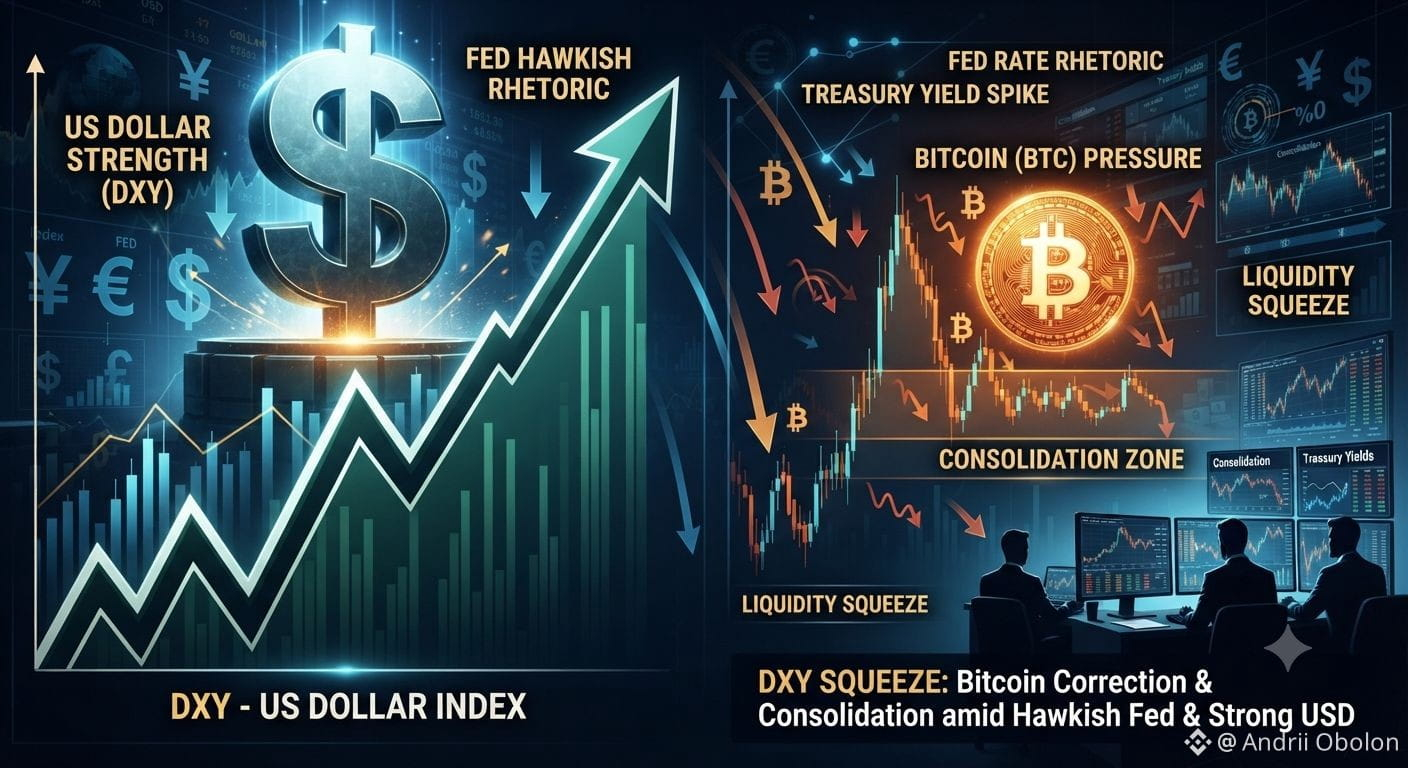
Macro Pressure on the Market: How DXY Strength is Restraining Crypto
While retail traders look for quick signals amid heavy price swings, the global market has found itself under pressure from a much larger player—the U.S. Dollar Index DXY.
What's Happening in the Market: The Dollar Index DXY sharply regained ground amid the Federal Reserve's hawkish rhetoric and a rise in two-year Treasury yields to cyclical highs. This has triggered an inevitable "squeeze" effect for all risk-on assets, including cryptocurrency.
Bitcoin and Liquidity Reaction: Against the backdrop of a strengthening dollar, the primary cryptocurrency corrected following a recent test of local highs, transitioning into a healthy consolidation zone. Institutional investors are closely monitoring this level, as such macroeconomic corrections often precede genuine accumulation phases by major capital.
Why It Matters for Traders: The combination of Fed rates, global central bank monetary policies, and macroeconomic metrics impacts liquidity far more than local news about individual summits. Understanding these fundamental connections protects traders from false hopes of "instant pumps" and helps build strategies based on real data.
#CryptoNews #Bitcoin #MarketAnalysis #Macroeconomics #DYOR
$BTC
{future}(BTCUSDT)
Macro Pressure on the Market: How DXY Strength is Restraining Crypto
While retail traders look for quick signals amid heavy price swings, the global market has found itself under pressure from a much larger player—the U.S. Dollar Index DXY.
What's Happening in the Market: The Dollar Index DXY sharply regained ground amid the Federal Reserve's hawkish rhetoric and a rise in two-year Treasury yields to cyclical highs. This has triggered an inevitable "squeeze" effect for all risk-on assets, including cryptocurrency.
Bitcoin and Liquidity Reaction: Against the backdrop of a strengthening dollar, the primary cryptocurrency corrected following a recent test of local highs, transitioning into a healthy consolidation zone. Institutional investors are closely monitoring this level, as such macroeconomic corrections often precede genuine accumulation phases by major capital.
Why It Matters for Traders: The combination of Fed rates, global central bank monetary policies, and macroeconomic metrics impacts liquidity far more than local news about individual summits. Understanding these fundamental connections protects traders from false hopes of "instant pumps" and helps build strategies based on real data.
#CryptoNews #Bitcoin #MarketAnalysis #Macroeconomics #DYOR
$BTC
While retail traders look for quick signals amid heavy price swings, the global market has found itself under pressure from a much larger player—the U.S. Dollar Index DXY.
What's Happening in the Market: The Dollar Index DXY sharply regained ground amid the Federal Reserve's hawkish rhetoric and a rise in two-year Treasury yields to cyclical highs. This has triggered an inevitable "squeeze" effect for all risk-on assets, including cryptocurrency.
Bitcoin and Liquidity Reaction: Against the backdrop of a strengthening dollar, the primary cryptocurrency corrected following a recent test of local highs, transitioning into a healthy consolidation zone. Institutional investors are closely monitoring this level, as such macroeconomic corrections often precede genuine accumulation phases by major capital.
Why It Matters for Traders: The combination of Fed rates, global central bank monetary policies, and macroeconomic metrics impacts liquidity far more than local news about individual summits. Understanding these fundamental connections protects traders from false hopes of "instant pumps" and helps build strategies based on real data.
#CryptoNews #Bitcoin #MarketAnalysis #Macroeconomics #DYOR
$BTC
1
2
78

·
--
On September 25 close, crude oil futures on the New York Mercantile Exchange saw a clear pullback. WTI light sweet crude oil futures for November delivery fell by $2.20 to close at $92.41 per barrel, down 2.33%. Brent crude oil futures for November delivery also dropped by $2.28, to $104.32 per barrel, a decline of 2.14%. At the same time, data released by the U.S. Commodity Futures Trading Commission (CFTC) showed that, as of the week of September 22, WTI crude oil net long positions actually increased by 8,952 lots to 148,467 lots, while natural gas net short positions fell sharply by 27,105 lots to 27,158 lots.
This more-than-2% daily pullback in oil prices has drawn market attention. Energy prices that had been trading at elevated levels have been a key variable weighing on inflation expectations. A brief cooling in oil prices has, to some extent, eased concerns in the market about a resurgence of “second-round” inflation. However, judging by the CFTC positioning data, long-side capital also added to positions on dips in the earlier period. This indicates that the divergence between bulls and bears at current levels remains significant. Whether the daily pullback marks a phase of topping or is simply a high-range consolidation and “washout” is still something the market is watching.
From the perspective of macro liquidity and traditional markets, sharp fluctuations in international crude oil prices are directly tied to inflation expectations and the trajectory of U.S. Treasury yields. If energy prices continue to slide, the window for the Federal Reserve to maintain high interest rates may not be extended further, and the pace of the U.S. dollar index’s push higher could also slow down. Conversely, if oil prices merely undergo a technical pullback and then continue to surge, the liquidity environment for global risk assets would still face significant headwinds.
For the crypto market, macro variables driven by oil prices also influence market sentiment toward $BTC and altcoins. If macro inflation pressures can ease temporarily as energy prices cool, crypto investors’ risk appetite often improves, and expectations of tightened liquidity outside the market may also be alleviated. But for now, the overall environment is still in a high-interest-rate contention phase. Whether funds will choose to substantially flow back into crypto assets during the consolidation period depends on a broader assessment alongside more upcoming macro data. ⛽
#CrudeOil #MacroEconomics #CFTC
On September 25 close, crude oil futures on the New York Mercantile Exchange saw a clear pullback. WTI light sweet crude oil futures for November delivery fell by $2.20 to close at $92.41 per barrel, down 2.33%. Brent crude oil futures for November delivery also dropped by $2.28, to $104.32 per barrel, a decline of 2.14%. At the same time, data released by the U.S. Commodity Futures Trading Commission (CFTC) showed that, as of the week of September 22, WTI crude oil net long positions actually increased by 8,952 lots to 148,467 lots, while natural gas net short positions fell sharply by 27,105 lots to 27,158 lots.
This more-than-2% daily pullback in oil prices has drawn market attention. Energy prices that had been trading at elevated levels have been a key variable weighing on inflation expectations. A brief cooling in oil prices has, to some extent, eased concerns in the market about a resurgence of “second-round” inflation. However, judging by the CFTC positioning data, long-side capital also added to positions on dips in the earlier period. This indicates that the divergence between bulls and bears at current levels remains significant. Whether the daily pullback marks a phase of topping or is simply a high-range consolidation and “washout” is still something the market is watching.
From the perspective of macro liquidity and traditional markets, sharp fluctuations in international crude oil prices are directly tied to inflation expectations and the trajectory of U.S. Treasury yields. If energy prices continue to slide, the window for the Federal Reserve to maintain high interest rates may not be extended further, and the pace of the U.S. dollar index’s push higher could also slow down. Conversely, if oil prices merely undergo a technical pullback and then continue to surge, the liquidity environment for global risk assets would still face significant headwinds.
For the crypto market, macro variables driven by oil prices also influence market sentiment toward $BTC and altcoins. If macro inflation pressures can ease temporarily as energy prices cool, crypto investors’ risk appetite often improves, and expectations of tightened liquidity outside the market may also be alleviated. But for now, the overall environment is still in a high-interest-rate contention phase. Whether funds will choose to substantially flow back into crypto assets during the consolidation period depends on a broader assessment alongside more upcoming macro data. ⛽
#CrudeOil #MacroEconomics #CFTC
This more-than-2% daily pullback in oil prices has drawn market attention. Energy prices that had been trading at elevated levels have been a key variable weighing on inflation expectations. A brief cooling in oil prices has, to some extent, eased concerns in the market about a resurgence of “second-round” inflation. However, judging by the CFTC positioning data, long-side capital also added to positions on dips in the earlier period. This indicates that the divergence between bulls and bears at current levels remains significant. Whether the daily pullback marks a phase of topping or is simply a high-range consolidation and “washout” is still something the market is watching.
From the perspective of macro liquidity and traditional markets, sharp fluctuations in international crude oil prices are directly tied to inflation expectations and the trajectory of U.S. Treasury yields. If energy prices continue to slide, the window for the Federal Reserve to maintain high interest rates may not be extended further, and the pace of the U.S. dollar index’s push higher could also slow down. Conversely, if oil prices merely undergo a technical pullback and then continue to surge, the liquidity environment for global risk assets would still face significant headwinds.
For the crypto market, macro variables driven by oil prices also influence market sentiment toward $BTC and altcoins. If macro inflation pressures can ease temporarily as energy prices cool, crypto investors’ risk appetite often improves, and expectations of tightened liquidity outside the market may also be alleviated. But for now, the overall environment is still in a high-interest-rate contention phase. Whether funds will choose to substantially flow back into crypto assets during the consolidation period depends on a broader assessment alongside more upcoming macro data. ⛽
#CrudeOil #MacroEconomics #CFTC
3
Federal Reserve Chair Jerome Powell signaled during his latest address that the central bank may need to deliver one more interest rate hike to fully rein in persistent inflationary pressures. This explicit stance reinforces the Fed's determination to bring inflation down to its target, pushing back against expectations of an immediate policy pivot.
This statement is crucial as it challenges the broader market consensus that the rate-hiking cycle had already concluded. Investors had been pricing in rate cuts or an extended pause, but Powell's openness to further tightening shows policymakers remain concerned about sticky core inflation and resilient economic activity.
Across traditional financial markets, this hawkish tone is likely to put upward pressure on U.S. Treasury yields and provide fresh momentum to the U.S. Dollar Index (DXY). Equities and precious metals may face near-term headwinds as higher borrowing costs diminish risk appetite and raise discount rates on future earnings.
For the cryptocurrency market, tighter monetary policy typically translates into constrained liquidity and cautious risk-taking. While $BTC has shown decoupling tendencies at times, another rate hike could weigh on overall crypto market momentum as capital stays parked in yielding traditional assets.
#Fed #InterestRates #MacroEconomics
Federal Reserve Chair Jerome Powell signaled during his latest address that the central bank may need to deliver one more interest rate hike to fully rein in persistent inflationary pressures. This explicit stance reinforces the Fed's determination to bring inflation down to its target, pushing back against expectations of an immediate policy pivot.
This statement is crucial as it challenges the broader market consensus that the rate-hiking cycle had already concluded. Investors had been pricing in rate cuts or an extended pause, but Powell's openness to further tightening shows policymakers remain concerned about sticky core inflation and resilient economic activity.
Across traditional financial markets, this hawkish tone is likely to put upward pressure on U.S. Treasury yields and provide fresh momentum to the U.S. Dollar Index (DXY). Equities and precious metals may face near-term headwinds as higher borrowing costs diminish risk appetite and raise discount rates on future earnings.
For the cryptocurrency market, tighter monetary policy typically translates into constrained liquidity and cautious risk-taking. While $BTC has shown decoupling tendencies at times, another rate hike could weigh on overall crypto market momentum as capital stays parked in yielding traditional assets.
#Fed #InterestRates #MacroEconomics
This statement is crucial as it challenges the broader market consensus that the rate-hiking cycle had already concluded. Investors had been pricing in rate cuts or an extended pause, but Powell's openness to further tightening shows policymakers remain concerned about sticky core inflation and resilient economic activity.
Across traditional financial markets, this hawkish tone is likely to put upward pressure on U.S. Treasury yields and provide fresh momentum to the U.S. Dollar Index (DXY). Equities and precious metals may face near-term headwinds as higher borrowing costs diminish risk appetite and raise discount rates on future earnings.
For the cryptocurrency market, tighter monetary policy typically translates into constrained liquidity and cautious risk-taking. While $BTC has shown decoupling tendencies at times, another rate hike could weigh on overall crypto market momentum as capital stays parked in yielding traditional assets.
#Fed #InterestRates #MacroEconomics
9
Against the backdrop of intensifying global macro liquidity games, the U.S. 10-year Treasury yield continued to climb on the latest trading day and broke above 5.23%, officially setting a new high since 2007. Judging from the price action, the selloff structure in long-end U.S. Treasuries shows strong momentum, indicating that the bond market is rapidly pricing in a higher neutral interest rate.
From both a technical and macro-cycle perspective, the yield breaking through 5.23%—a more-than-a-decade high—means the risk premium of traditional fixed-income assets has been pushed into an extreme zone. This kind of turning point is often not the start of a bear market, but rather a “final sprint” characteristic at the end of a liquidity-tightening cycle. When traditional bond markets over-price a high-yield environment, it usually signals that the upside space for interest rates has been severely compressed, with a technical topping or an imminent one likely.
In traditional financial markets, the 5.23% high yield within the near term has raised the cost of U.S. dollar liquidity, putting pressure on traditional equities and gold via period discount rates. However, as selling pressure concentrates and is released near key resistance levels, market panic gradually dissipates, and upward resistance for the U.S. Dollar Index also strengthens significantly. Meanwhile, capital markets are incubating momentum that will flow back toward risk assets.
For crypto assets, this kind of extreme macro selloff actually provides an excellent window to observe liquidity bottoming. $BTC and major tokens have shown strong on-chain support and price resilience during the period when Treasury yields hit multi-year highs; under extreme testing, there was no large-scale stampede. Once long-end yields top and start to fall from above 5.23%, the suppressed liquidity will quickly spill over, laying a solid technical and capital-flow foundation for crypto markets to launch a new round of strong rebound 📈
#BondYields #MacroEconomics #CryptoMarkets
Against the backdrop of intensifying global macro liquidity games, the U.S. 10-year Treasury yield continued to climb on the latest trading day and broke above 5.23%, officially setting a new high since 2007. Judging from the price action, the selloff structure in long-end U.S. Treasuries shows strong momentum, indicating that the bond market is rapidly pricing in a higher neutral interest rate.
From both a technical and macro-cycle perspective, the yield breaking through 5.23%—a more-than-a-decade high—means the risk premium of traditional fixed-income assets has been pushed into an extreme zone. This kind of turning point is often not the start of a bear market, but rather a “final sprint” characteristic at the end of a liquidity-tightening cycle. When traditional bond markets over-price a high-yield environment, it usually signals that the upside space for interest rates has been severely compressed, with a technical topping or an imminent one likely.
In traditional financial markets, the 5.23% high yield within the near term has raised the cost of U.S. dollar liquidity, putting pressure on traditional equities and gold via period discount rates. However, as selling pressure concentrates and is released near key resistance levels, market panic gradually dissipates, and upward resistance for the U.S. Dollar Index also strengthens significantly. Meanwhile, capital markets are incubating momentum that will flow back toward risk assets.
For crypto assets, this kind of extreme macro selloff actually provides an excellent window to observe liquidity bottoming. $BTC and major tokens have shown strong on-chain support and price resilience during the period when Treasury yields hit multi-year highs; under extreme testing, there was no large-scale stampede. Once long-end yields top and start to fall from above 5.23%, the suppressed liquidity will quickly spill over, laying a solid technical and capital-flow foundation for crypto markets to launch a new round of strong rebound 📈
#BondYields #MacroEconomics #CryptoMarkets
From both a technical and macro-cycle perspective, the yield breaking through 5.23%—a more-than-a-decade high—means the risk premium of traditional fixed-income assets has been pushed into an extreme zone. This kind of turning point is often not the start of a bear market, but rather a “final sprint” characteristic at the end of a liquidity-tightening cycle. When traditional bond markets over-price a high-yield environment, it usually signals that the upside space for interest rates has been severely compressed, with a technical topping or an imminent one likely.
In traditional financial markets, the 5.23% high yield within the near term has raised the cost of U.S. dollar liquidity, putting pressure on traditional equities and gold via period discount rates. However, as selling pressure concentrates and is released near key resistance levels, market panic gradually dissipates, and upward resistance for the U.S. Dollar Index also strengthens significantly. Meanwhile, capital markets are incubating momentum that will flow back toward risk assets.
For crypto assets, this kind of extreme macro selloff actually provides an excellent window to observe liquidity bottoming. $BTC and major tokens have shown strong on-chain support and price resilience during the period when Treasury yields hit multi-year highs; under extreme testing, there was no large-scale stampede. Once long-end yields top and start to fall from above 5.23%, the suppressed liquidity will quickly spill over, laying a solid technical and capital-flow foundation for crypto markets to launch a new round of strong rebound 📈
#BondYields #MacroEconomics #CryptoMarkets
6

🚨 THE HIGHEST-STAKES SUMMIT: A New Era for Global Liquidity or a Leverage Trap? 🚨
As the Chinese leadership moves into high-stakes White House bilateral meetings today with President Donald Trump, the digital asset market is bracing for massive macro volatility. Bitcoin is holding crucial support near the $83.8K–$84.5K range, shaking out weak hands and consolidating after its explosive 8-month price peak.
Beneath the surface of this localized market structure, two critical macro catalysts are developing:
1️⃣ The "Strategic Digital Dollar" Play: Capitalizing on the administration's mandate to combat national debt, U.S. officials are actively exploring public-private partnerships to aggressively scale dollar-backed stablecoins globally. Every dollar minted in $USDC or $USDT buys U.S. Treasury debt—turning crypto into a key weapon for American financial hegemony.
2️⃣ The Geopolitical Volatility Matrix: The bilateral discussions span AI safety, global trade tariffs extension, and technology supply chains. Historically, these major state visits spark intense short-term liquidity sweeps.
💼 Institutional Backing remains the baseline: Spot Bitcoin ETFs have clocked massive momentum this month. Wall Street isn't just dipping its toes; it is actively backing the U.S. push to remain the absolute global capital of digital assets.
⚠️ The Tactical Take: If you are running high leverage today, monitor your liquidation levels closely. If you are holding spot, the macro thesis remains undefeated. The temporary pullback is healthy market health before the next major macro expansion.
What is your play heading into today's White House updates? Spot accumulation or hedging? Let’s discuss below.👇
#bitcoin #CryptoMarket #MarketAnalysis #GlobalTradeSummit #MacroEconomics
{spot}(BTCUSDT)
🚨 THE HIGHEST-STAKES SUMMIT: A New Era for Global Liquidity or a Leverage Trap? 🚨
As the Chinese leadership moves into high-stakes White House bilateral meetings today with President Donald Trump, the digital asset market is bracing for massive macro volatility. Bitcoin is holding crucial support near the $83.8K–$84.5K range, shaking out weak hands and consolidating after its explosive 8-month price peak.
Beneath the surface of this localized market structure, two critical macro catalysts are developing:
1️⃣ The "Strategic Digital Dollar" Play: Capitalizing on the administration's mandate to combat national debt, U.S. officials are actively exploring public-private partnerships to aggressively scale dollar-backed stablecoins globally. Every dollar minted in $USDC or $USDT buys U.S. Treasury debt—turning crypto into a key weapon for American financial hegemony.
2️⃣ The Geopolitical Volatility Matrix: The bilateral discussions span AI safety, global trade tariffs extension, and technology supply chains. Historically, these major state visits spark intense short-term liquidity sweeps.
💼 Institutional Backing remains the baseline: Spot Bitcoin ETFs have clocked massive momentum this month. Wall Street isn't just dipping its toes; it is actively backing the U.S. push to remain the absolute global capital of digital assets.
⚠️ The Tactical Take: If you are running high leverage today, monitor your liquidation levels closely. If you are holding spot, the macro thesis remains undefeated. The temporary pullback is healthy market health before the next major macro expansion.
What is your play heading into today's White House updates? Spot accumulation or hedging? Let’s discuss below.👇
#bitcoin #CryptoMarket #MarketAnalysis #GlobalTradeSummit #MacroEconomics
As the Chinese leadership moves into high-stakes White House bilateral meetings today with President Donald Trump, the digital asset market is bracing for massive macro volatility. Bitcoin is holding crucial support near the $83.8K–$84.5K range, shaking out weak hands and consolidating after its explosive 8-month price peak.
Beneath the surface of this localized market structure, two critical macro catalysts are developing:
1️⃣ The "Strategic Digital Dollar" Play: Capitalizing on the administration's mandate to combat national debt, U.S. officials are actively exploring public-private partnerships to aggressively scale dollar-backed stablecoins globally. Every dollar minted in $USDC or $USDT buys U.S. Treasury debt—turning crypto into a key weapon for American financial hegemony.
2️⃣ The Geopolitical Volatility Matrix: The bilateral discussions span AI safety, global trade tariffs extension, and technology supply chains. Historically, these major state visits spark intense short-term liquidity sweeps.
💼 Institutional Backing remains the baseline: Spot Bitcoin ETFs have clocked massive momentum this month. Wall Street isn't just dipping its toes; it is actively backing the U.S. push to remain the absolute global capital of digital assets.
⚠️ The Tactical Take: If you are running high leverage today, monitor your liquidation levels closely. If you are holding spot, the macro thesis remains undefeated. The temporary pullback is healthy market health before the next major macro expansion.
What is your play heading into today's White House updates? Spot accumulation or hedging? Let’s discuss below.👇
#bitcoin #CryptoMarket #MarketAnalysis #GlobalTradeSummit #MacroEconomics
78
Japan’s 10-year government bond yield surged by 9 basis points to reach 3.065% during recent trading, marking a sharp jump in sovereign borrowing costs as market expectations around Bank of Japan policy adjustments intensify.
This move is critical because Japan has long anchored global ultra-loose monetary conditions. Climbing yields signal mounting pressure to normalize rates, threatening to unwind massive yen carry trades that have historically funneled cheap liquidity into international risk assets.
For broader financial markets, rising Japanese yields strengthen the Yen and exert upward pressure on global sovereign yields. Attractive domestic returns could incentivize Japanese institutional investors to repatriate capital from US Treasuries and foreign equities, tightening overall market liquidity.
In the crypto market, tighter global liquidity dynamics and carry trade unwinding pose short-term headwinds for assets like $BTC. Traders must watch whether persistent yield spikes trigger broader deleveraging across macro assets.
#BankOfJapan #BondYields #MacroEconomics
Japan’s 10-year government bond yield surged by 9 basis points to reach 3.065% during recent trading, marking a sharp jump in sovereign borrowing costs as market expectations around Bank of Japan policy adjustments intensify.
This move is critical because Japan has long anchored global ultra-loose monetary conditions. Climbing yields signal mounting pressure to normalize rates, threatening to unwind massive yen carry trades that have historically funneled cheap liquidity into international risk assets.
For broader financial markets, rising Japanese yields strengthen the Yen and exert upward pressure on global sovereign yields. Attractive domestic returns could incentivize Japanese institutional investors to repatriate capital from US Treasuries and foreign equities, tightening overall market liquidity.
In the crypto market, tighter global liquidity dynamics and carry trade unwinding pose short-term headwinds for assets like $BTC . Traders must watch whether persistent yield spikes trigger broader deleveraging across macro assets.
#BankOfJapan #BondYields #MacroEconomics
This move is critical because Japan has long anchored global ultra-loose monetary conditions. Climbing yields signal mounting pressure to normalize rates, threatening to unwind massive yen carry trades that have historically funneled cheap liquidity into international risk assets.
For broader financial markets, rising Japanese yields strengthen the Yen and exert upward pressure on global sovereign yields. Attractive domestic returns could incentivize Japanese institutional investors to repatriate capital from US Treasuries and foreign equities, tightening overall market liquidity.
In the crypto market, tighter global liquidity dynamics and carry trade unwinding pose short-term headwinds for assets like $BTC . Traders must watch whether persistent yield spikes trigger broader deleveraging across macro assets.
#BankOfJapan #BondYields #MacroEconomics
25
In today’s global commodity and bond markets, international crude oil prices saw a sharp drop. WTI U.S. crude recorded an intraday decline of 2.00%, trading at $91.94 per barrel; Brent crude fell in sync by about 1.8%, dropping to $98.90 per barrel. Meanwhile, in the Asia-Pacific bond market, activity turned erratic: Japan’s 30-year government bond yield rose by 5 basis points to the 4.210% level.
From a technical and macro chain perspective, the steep pullback in crude prices not only effectively eased the short-term supply-side speculation premium, but also, to a large extent, reduced expectations of a rise in global secondary inflation. The rapid cooling of energy prices directly weakened the core driving force for overseas major central banks to maintain an unexpectedly tight monetary tightening cycle, opening a key window for valuation repair across risk assets.
As commodity prices came under pressure and retreated, global inflation trades cooled, and cross-asset liquidity stress began to ease noticeably. Signs of marginal weakening emerged in the upward pressure from the U.S. Dollar Index and global long-term real yields. Traditional financial markets’ risk-off sentiment gradually shifted toward more constructive pricing for a liquidity-loosening cycle, and broad asset classes are moving toward a structural rebound in risk appetite.
For the crypto market, the significant easing of energy-linked inflation pressure is an extremely positive technical signal. Improvements in the macro liquidity environment will directly boost on-chain capital’s risk appetite, providing strong macro momentum to consolidate the bottom support at $BTC and break upward through key resistance levels. The overall long-biased structure is expected to further open up upside room for the rebound. 📈
#CrudeOil #MacroEconomics #CryptoMarket
In today’s global commodity and bond markets, international crude oil prices saw a sharp drop. WTI U.S. crude recorded an intraday decline of 2.00%, trading at $91.94 per barrel; Brent crude fell in sync by about 1.8%, dropping to $98.90 per barrel. Meanwhile, in the Asia-Pacific bond market, activity turned erratic: Japan’s 30-year government bond yield rose by 5 basis points to the 4.210% level.
From a technical and macro chain perspective, the steep pullback in crude prices not only effectively eased the short-term supply-side speculation premium, but also, to a large extent, reduced expectations of a rise in global secondary inflation. The rapid cooling of energy prices directly weakened the core driving force for overseas major central banks to maintain an unexpectedly tight monetary tightening cycle, opening a key window for valuation repair across risk assets.
As commodity prices came under pressure and retreated, global inflation trades cooled, and cross-asset liquidity stress began to ease noticeably. Signs of marginal weakening emerged in the upward pressure from the U.S. Dollar Index and global long-term real yields. Traditional financial markets’ risk-off sentiment gradually shifted toward more constructive pricing for a liquidity-loosening cycle, and broad asset classes are moving toward a structural rebound in risk appetite.
For the crypto market, the significant easing of energy-linked inflation pressure is an extremely positive technical signal. Improvements in the macro liquidity environment will directly boost on-chain capital’s risk appetite, providing strong macro momentum to consolidate the bottom support at $BTC and break upward through key resistance levels. The overall long-biased structure is expected to further open up upside room for the rebound. 📈
#CrudeOil #MacroEconomics #CryptoMarket
From a technical and macro chain perspective, the steep pullback in crude prices not only effectively eased the short-term supply-side speculation premium, but also, to a large extent, reduced expectations of a rise in global secondary inflation. The rapid cooling of energy prices directly weakened the core driving force for overseas major central banks to maintain an unexpectedly tight monetary tightening cycle, opening a key window for valuation repair across risk assets.
As commodity prices came under pressure and retreated, global inflation trades cooled, and cross-asset liquidity stress began to ease noticeably. Signs of marginal weakening emerged in the upward pressure from the U.S. Dollar Index and global long-term real yields. Traditional financial markets’ risk-off sentiment gradually shifted toward more constructive pricing for a liquidity-loosening cycle, and broad asset classes are moving toward a structural rebound in risk appetite.
For the crypto market, the significant easing of energy-linked inflation pressure is an extremely positive technical signal. Improvements in the macro liquidity environment will directly boost on-chain capital’s risk appetite, providing strong macro momentum to consolidate the bottom support at $BTC and break upward through key resistance levels. The overall long-biased structure is expected to further open up upside room for the rebound. 📈
#CrudeOil #MacroEconomics #CryptoMarket
352

·
--
Bullish
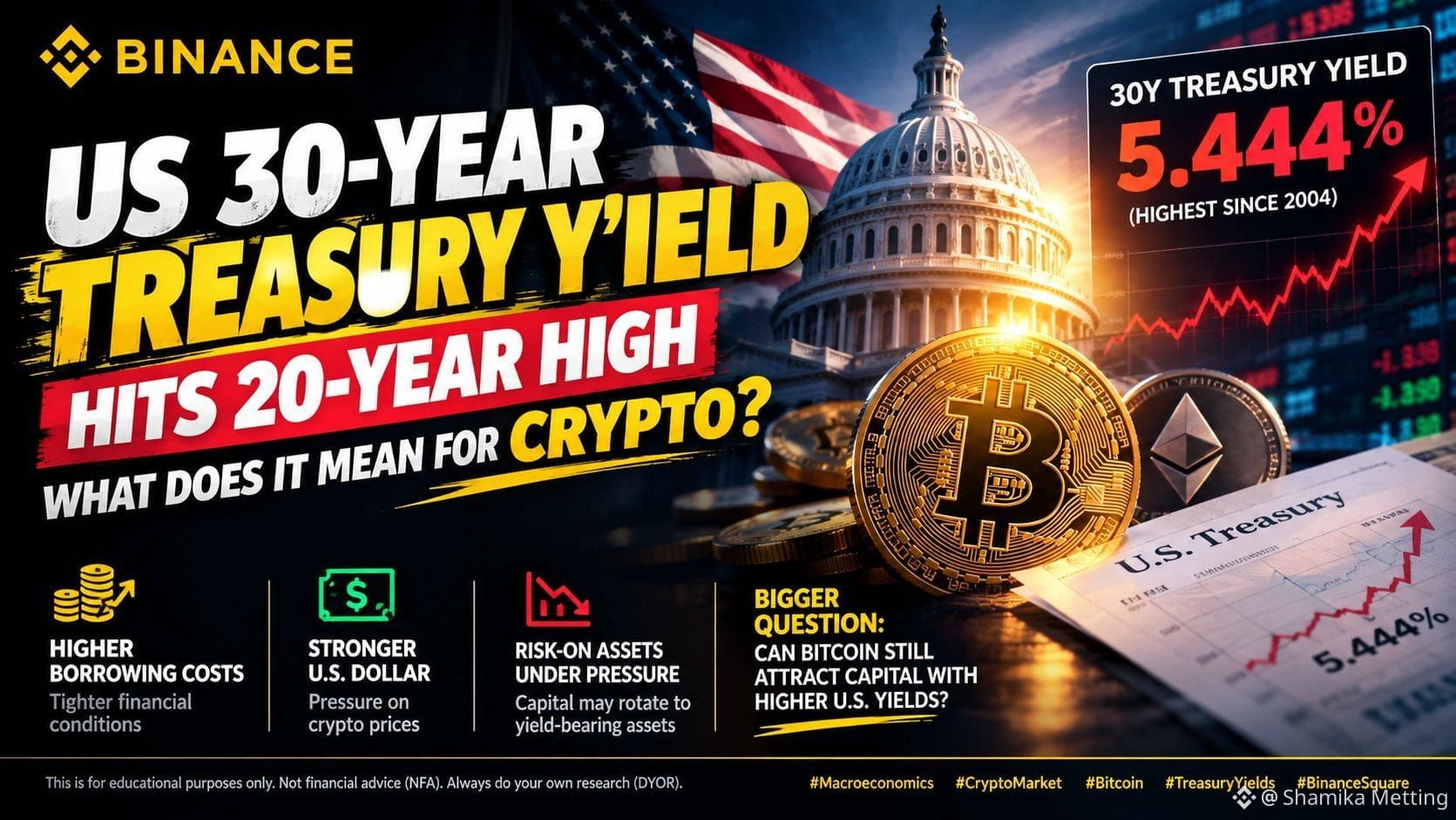
#us30yearyieldhighestsince2004 The yield on US 30-year Treasury bonds is at its highest level in 20 years — what does that mean for cryptocurrencies?
The US bond market is sending a key macro signal.
📊 Why are Treasury yields rising?
Recent market pressure is related to several factors, including:
🔹 Strong economic growth in the United States
Compelling economic data has reduced expectations of a quick drop in borrowing costs.
🔹 Inflation pressures
🔹 Government debt and financing needs
Investors demand greater compensation for holding US government debt over the longer term, which increases pressure on long-term yields.
₿ What could that mean for Bitcoin and cryptocurrencies?
1️⃣ Higher opportunity cost
When Treasury yields rise, investors can earn higher returns from traditional dollar-denominated assets. This could make speculative assets like cryptocurrencies less attractive to some institutional investors.
2️⃣ Tighter financial conditions
Higher long-term yields raise borrowing costs across the economy. Reuters notes that rising Treasury yields can tighten financial conditions globally.
Please follow me
#bitcoin #BTC #crypto #MacroEconomics #TreasuryYields #US30YearYield #CryptoMarket #FederalReserve #BinanceSquare
$METAB $EPIC $RONIN
#us30yearyieldhighestsince2004 The yield on US 30-year Treasury bonds is at its highest level in 20 years — what does that mean for cryptocurrencies?
The US bond market is sending a key macro signal.
📊 Why are Treasury yields rising?
Recent market pressure is related to several factors, including:
🔹 Strong economic growth in the United States
Compelling economic data has reduced expectations of a quick drop in borrowing costs.
🔹 Inflation pressures
🔹 Government debt and financing needs
Investors demand greater compensation for holding US government debt over the longer term, which increases pressure on long-term yields.
₿ What could that mean for Bitcoin and cryptocurrencies?
1️⃣ Higher opportunity cost
When Treasury yields rise, investors can earn higher returns from traditional dollar-denominated assets. This could make speculative assets like cryptocurrencies less attractive to some institutional investors.
2️⃣ Tighter financial conditions
Higher long-term yields raise borrowing costs across the economy. Reuters notes that rising Treasury yields can tighten financial conditions globally.
Please follow me
#bitcoin #BTC #crypto #MacroEconomics #TreasuryYields #US30YearYield #CryptoMarket #FederalReserve #BinanceSquare
$METAB $EPIC $RONIN
The US bond market is sending a key macro signal.
📊 Why are Treasury yields rising?
Recent market pressure is related to several factors, including:
🔹 Strong economic growth in the United States
Compelling economic data has reduced expectations of a quick drop in borrowing costs.
🔹 Inflation pressures
🔹 Government debt and financing needs
Investors demand greater compensation for holding US government debt over the longer term, which increases pressure on long-term yields.
₿ What could that mean for Bitcoin and cryptocurrencies?
1️⃣ Higher opportunity cost
When Treasury yields rise, investors can earn higher returns from traditional dollar-denominated assets. This could make speculative assets like cryptocurrencies less attractive to some institutional investors.
2️⃣ Tighter financial conditions
Higher long-term yields raise borrowing costs across the economy. Reuters notes that rising Treasury yields can tighten financial conditions globally.
Please follow me
#bitcoin #BTC #crypto #MacroEconomics #TreasuryYields #US30YearYield #CryptoMarket #FederalReserve #BinanceSquare
$METAB $EPIC $RONIN
36
Global energy markets saw a sharp upward surge on September 23, with benchmark crude futures rallying significantly in New York and international exchanges. November contracts for light crude oil jumped $1.64 to settle at $92.16 per barrel, a 1.81% increase, while Brent crude for November delivery surged $3.83, or 3.86%, to break past the critical $100 psychological threshold at $103.08 per barrel.
This aggressive rebound in oil prices reignites concerns over persistent supply-side inflation just as central banks worldwide attempt to finalize their easing cycles. A sustained move above $100 for Brent directly challenges market assumptions of cooling headline inflation, raising the risk that energy-driven cost pressures could stall further disinflation progress.
Across traditional financial markets, surging crude typically drives bond yields higher and strengthens the US dollar as traders price in prolonged restrictive monetary policy. Equity markets face immediate margin compression from elevated transportation and operational costs.
For the crypto market, higher energy prices pose a headwind to broader liquidity conditions. While $BTC often shows resilient long-term hedge characteristics, short-term risk appetite remains vulnerable if tightening macroeconomic liquidity delays expected capital inflows.
#CrudeOil #MacroEconomics #Inflation
Global energy markets saw a sharp upward surge on September 23, with benchmark crude futures rallying significantly in New York and international exchanges. November contracts for light crude oil jumped $1.64 to settle at $92.16 per barrel, a 1.81% increase, while Brent crude for November delivery surged $3.83, or 3.86%, to break past the critical $100 psychological threshold at $103.08 per barrel.
This aggressive rebound in oil prices reignites concerns over persistent supply-side inflation just as central banks worldwide attempt to finalize their easing cycles. A sustained move above $100 for Brent directly challenges market assumptions of cooling headline inflation, raising the risk that energy-driven cost pressures could stall further disinflation progress.
Across traditional financial markets, surging crude typically drives bond yields higher and strengthens the US dollar as traders price in prolonged restrictive monetary policy. Equity markets face immediate margin compression from elevated transportation and operational costs.
For the crypto market, higher energy prices pose a headwind to broader liquidity conditions. While $BTC often shows resilient long-term hedge characteristics, short-term risk appetite remains vulnerable if tightening macroeconomic liquidity delays expected capital inflows.
#CrudeOil #MacroEconomics #Inflation
This aggressive rebound in oil prices reignites concerns over persistent supply-side inflation just as central banks worldwide attempt to finalize their easing cycles. A sustained move above $100 for Brent directly challenges market assumptions of cooling headline inflation, raising the risk that energy-driven cost pressures could stall further disinflation progress.
Across traditional financial markets, surging crude typically drives bond yields higher and strengthens the US dollar as traders price in prolonged restrictive monetary policy. Equity markets face immediate margin compression from elevated transportation and operational costs.
For the crypto market, higher energy prices pose a headwind to broader liquidity conditions. While $BTC often shows resilient long-term hedge characteristics, short-term risk appetite remains vulnerable if tightening macroeconomic liquidity delays expected capital inflows.
#CrudeOil #MacroEconomics #Inflation
94
Log in to explore more content
Join global crypto users on Binance Square
⚡️ Get latest and useful information about crypto.
💬 Trusted by the world’s largest crypto exchange.
👍 Discover real insights from verified creators.
Email / Phone number
Trending Topics
1
#EarningsSeason
34,417 views
315 Discussing
2
#JapanFSABacksFourthStablecoinTradeSettlementPilot
3 views
6 Discussing
3
#BitgetHackerFailsToMoveStolenFunds
3,319 views
158 Discussing
4
#BitMineETHHoldingsTop6Million
6,368 views
320 Discussing
5
#StrategyAdds1666BTCHoldingsReach847666
5,762 views
250 Discussing
6
#NvidiaApproves$150BBuyback
2,839 views
58 Discussing
7
#OpenAIDelaysGPT6.1OverSafetyIssues
18,332 views
556 Discussing
8
#AMDToAcquireWorldLabsFor$8.2B
1,444 views
50 Discussing
9
#AnthropicIPOProspectusCouldValueItOver$2T
4,816 views
74 Discussing
10
#HackersDrainOver12.4MXRPFromDCENTWallets
33,545 views
645 Discussing