

#macroeconomics
macroeconomics
881,625 views
4,098 Discussing
Hot
Latest

#FedOctoberRateHikeOddsFallTo17%
🚨 Macro Alert: Fed October Rate Hike Odds Plunge! 🚨
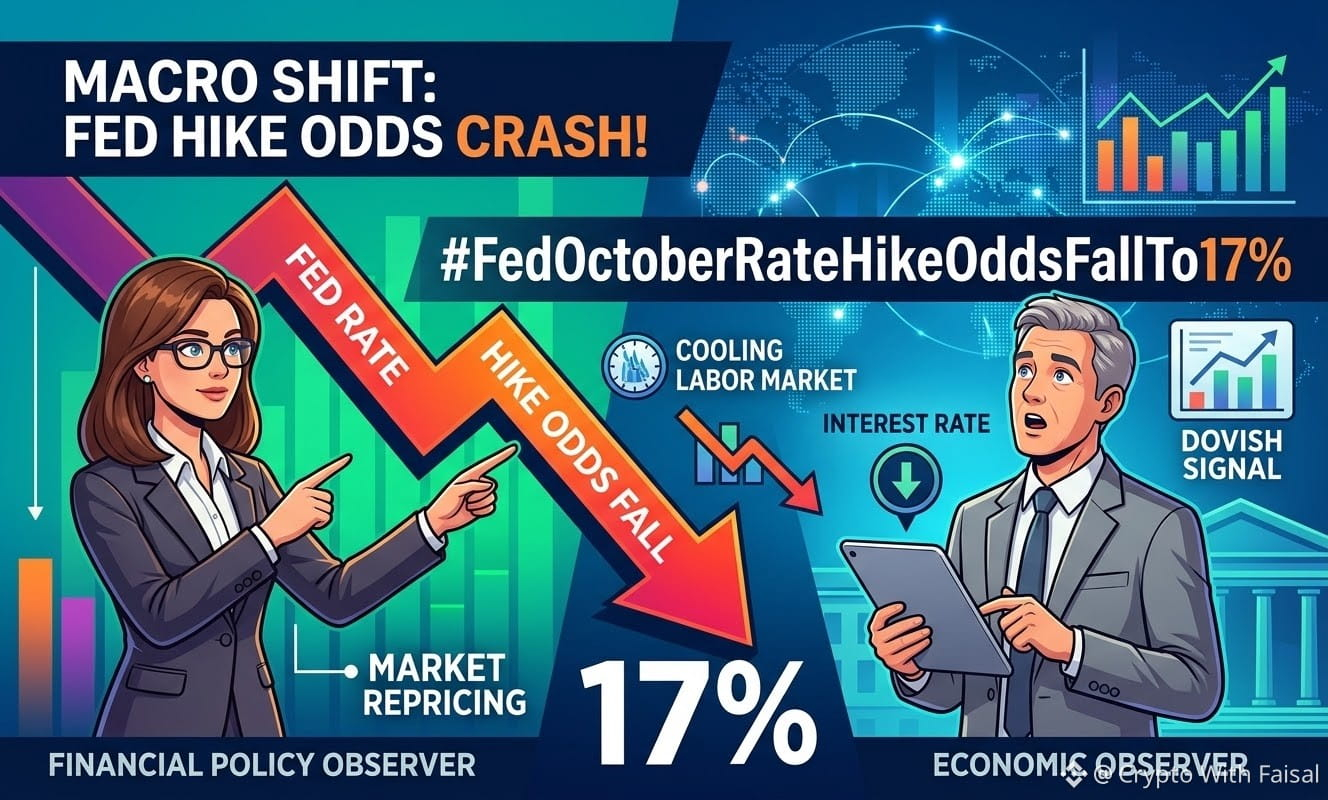
The macroeconomic landscape just shifted dramatically, and it’s massive news for crypto markets. The odds of a Federal Reserve rate hike in October have crashed to just 17%.
Here is the verified breakdown:
The Trigger: A surprisingly weak U.S. September jobs report severely reduced evidence of inflationary labor pressures.
The Numbers: CME's FedWatch tool and prediction markets now show an 83% probability that the Fed will hold rates steady, completely flipping the script from previous expectations.
Market Action: Over $23.1 million in volume rushed into Polymarket's "no change" contract as traders rapidly repriced their bets.
What does this mean for Crypto? 📉📈
When the probability of rate hikes falls, the opportunity cost of holding non-yielding risk assets like Bitcoin decreases. Tighter monetary policy is the primary macro headwind for crypto, so this sudden dovish shift often correlates with risk-on relief rallies.
With the labor market cooling, the Fed's primary justification for further tightening is fading fast.
🗣️ What is your strategy? Are you positioning for a bullish Q4, or playing it safe? Drop your thoughts below! 👇
#Crypto #MacroEconomics #BinanceSquare
$PUMPBTC
{future}(PUMPBTCUSDT)
$VELVET
{future}(VELVETUSDT)
$EVAA
{future}(EVAAUSDT)
#FedOctoberRateHikeOddsFallTo17%
🚨 Macro Alert: Fed October Rate Hike Odds Plunge! 🚨
The macroeconomic landscape just shifted dramatically, and it’s massive news for crypto markets. The odds of a Federal Reserve rate hike in October have crashed to just 17%.
Here is the verified breakdown:
The Trigger: A surprisingly weak U.S. September jobs report severely reduced evidence of inflationary labor pressures.
The Numbers: CME's FedWatch tool and prediction markets now show an 83% probability that the Fed will hold rates steady, completely flipping the script from previous expectations.
Market Action: Over $23.1 million in volume rushed into Polymarket's "no change" contract as traders rapidly repriced their bets.
What does this mean for Crypto? 📉📈
When the probability of rate hikes falls, the opportunity cost of holding non-yielding risk assets like Bitcoin decreases. Tighter monetary policy is the primary macro headwind for crypto, so this sudden dovish shift often correlates with risk-on relief rallies.
With the labor market cooling, the Fed's primary justification for further tightening is fading fast.
🗣️ What is your strategy? Are you positioning for a bullish Q4, or playing it safe? Drop your thoughts below! 👇
#Crypto #MacroEconomics #BinanceSquare
$PUMPBTC
$VELVET
$EVAA
🚨 Macro Alert: Fed October Rate Hike Odds Plunge! 🚨
The macroeconomic landscape just shifted dramatically, and it’s massive news for crypto markets. The odds of a Federal Reserve rate hike in October have crashed to just 17%.
Here is the verified breakdown:
The Trigger: A surprisingly weak U.S. September jobs report severely reduced evidence of inflationary labor pressures.
The Numbers: CME's FedWatch tool and prediction markets now show an 83% probability that the Fed will hold rates steady, completely flipping the script from previous expectations.
Market Action: Over $23.1 million in volume rushed into Polymarket's "no change" contract as traders rapidly repriced their bets.
What does this mean for Crypto? 📉📈
When the probability of rate hikes falls, the opportunity cost of holding non-yielding risk assets like Bitcoin decreases. Tighter monetary policy is the primary macro headwind for crypto, so this sudden dovish shift often correlates with risk-on relief rallies.
With the labor market cooling, the Fed's primary justification for further tightening is fading fast.
🗣️ What is your strategy? Are you positioning for a bullish Q4, or playing it safe? Drop your thoughts below! 👇
#Crypto #MacroEconomics #BinanceSquare
$PUMPBTC
$VELVET
$EVAA
427

Bad macroeconomic news is often the exact fuel that triggers the next parabolic crypto rally.
Most market participants panic the moment they see hiring slow down, selling their spot positions right before liquidity conditions ease and the real expansion begins. It is the classic mistake of confusing a cooling labor market with a dying market, leaving traders sidelined while smart money quietly accumulates the dip.
We just witnessed the US economy add a mere 29,000 jobs in September against the 90,000 forecast, with unemployment climbing to 4.2%. Even more revealing are the revisions, with August cut down to 133,000 and July plunging into negative territory with a net loss of 10,000 jobs. When jobs data deteriorates this fast, central banks lose their appetite for rate hikes and the narrative rapidly pivots toward rate cuts and monetary easing.
Having traded through multiple cycles since 2017, I have seen this exact macro setup play out before. When traditional economic growth stalls and rate hike odds collapse, capital naturally seeks asymmetric upside in assets like $BTC and high-beta plays like $ETH or $SOL as liquidity expectations shift.
How are you adjusting your spot exposure heading into the next policy decision?
#MacroEconomics #Bitcoin #CryptoMarket
Bad macroeconomic news is often the exact fuel that triggers the next parabolic crypto rally.
Most market participants panic the moment they see hiring slow down, selling their spot positions right before liquidity conditions ease and the real expansion begins. It is the classic mistake of confusing a cooling labor market with a dying market, leaving traders sidelined while smart money quietly accumulates the dip.
We just witnessed the US economy add a mere 29,000 jobs in September against the 90,000 forecast, with unemployment climbing to 4.2%. Even more revealing are the revisions, with August cut down to 133,000 and July plunging into negative territory with a net loss of 10,000 jobs. When jobs data deteriorates this fast, central banks lose their appetite for rate hikes and the narrative rapidly pivots toward rate cuts and monetary easing.
Having traded through multiple cycles since 2017, I have seen this exact macro setup play out before. When traditional economic growth stalls and rate hike odds collapse, capital naturally seeks asymmetric upside in assets like $BTC and high-beta plays like $ETH or $SOL as liquidity expectations shift.
How are you adjusting your spot exposure heading into the next policy decision?
#MacroEconomics #Bitcoin #CryptoMarket
Most market participants panic the moment they see hiring slow down, selling their spot positions right before liquidity conditions ease and the real expansion begins. It is the classic mistake of confusing a cooling labor market with a dying market, leaving traders sidelined while smart money quietly accumulates the dip.
We just witnessed the US economy add a mere 29,000 jobs in September against the 90,000 forecast, with unemployment climbing to 4.2%. Even more revealing are the revisions, with August cut down to 133,000 and July plunging into negative territory with a net loss of 10,000 jobs. When jobs data deteriorates this fast, central banks lose their appetite for rate hikes and the narrative rapidly pivots toward rate cuts and monetary easing.
Having traded through multiple cycles since 2017, I have seen this exact macro setup play out before. When traditional economic growth stalls and rate hike odds collapse, capital naturally seeks asymmetric upside in assets like $BTC and high-beta plays like $ETH or $SOL as liquidity expectations shift.
How are you adjusting your spot exposure heading into the next policy decision?
#MacroEconomics #Bitcoin #CryptoMarket

101

·
--
Article
#usseptemberpayrollsadd29kunemploymentrises4.2%#usseptemberpayrollsadd29kunemploymentrises4.2% 🚨 MACRO SHOCK: US September Nonfarm Payrolls Crash to 29K! 📉🛑
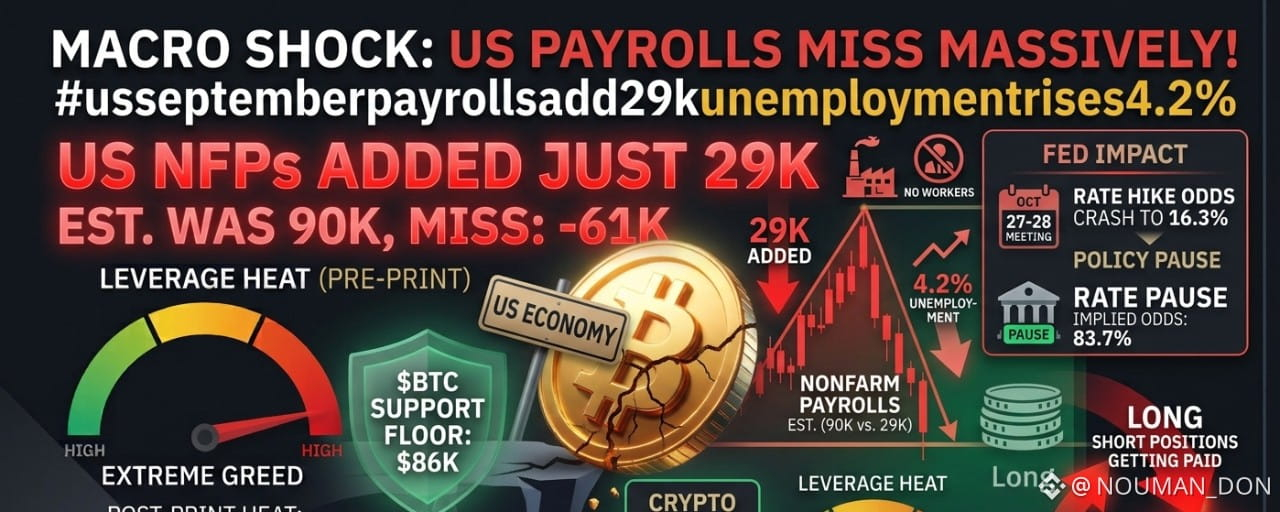
The economic radar just went completely haywire! The official US Nonfarm Payrolls added just 29,000 jobs in September, completely missing the 90,000 consensus estimate by an absolute mile Crypto News | September Payrolls Crash to 29,000 — Missing ... Jobs report September 2026:. Concurrently, the US unemployment rate ticked up to 4.2% September US Jobs Report: 29,000 Rise in Payrolls, Softer ....
This is the ultimate "low-hire, low-fire" scenario playing out in real-time US job growth slows sharply in September; unemployment rate rises to 4.2%. While companies aren't aggressively firing staff, they have essentially frozen major hiring expansions US job growth slows sharply in September; unemployment rate rises to 4.2%.
💸 The Fed Interest Rate Angle:
Before this release, the odds of another interest rate hike by the Federal Reserve at the upcoming October 27-28 meeting were sitting around 30% Crypto News | September Payrolls Crash to 29,000 — Missing ... Jobs report September 2026:. This 29,000 print effectively destroys the argument for any further rate tightening. In fact, market-implied odds immediately surged to 83.7% that the Fed will leave benchmark rates completely unchanged at 3.75%-4.00% Payrolls Add Just 29000 in September, Unemployment Hits ... Jobs report September 2026:.
⚡ Crypto Market Impact:
Instead of panicking over the weak employment print, the crypto markets are treating this as macro relief. Bitcoin ($BTC) is holding strong near $86,500 despite carrying an aggressive 10% annualized leverage funding rate into the print Crypto News | September Payrolls Crash to 29,000 — Missing .... Policy ease is historically rocket fuel for risk assets, but watch the leverage levels carefully! 🌪️
👇 Let’s look at the charts in the feed:
Does this data confirm the macro bottom is behind us, or will a cooling economy eventually drag down crypto?
🟢 BULLISH INTEREST RATE PAUSE | 🔴 BEARISH ECONOMIC SLOWDOWN
#usseptemberpayrollsadd29kunemploymentrises4.2% #MacroEconomics #FedRate #BinanceSquare
#usseptemberpayrollsadd29kunemploymentrises4.2%
#usseptemberpayrollsadd29kunemploymentrises4.2% 🚨 MACRO SHOCK: US September Nonfarm Payrolls Crash to 29K! 📉🛑
The economic radar just went completely haywire! The official US Nonfarm Payrolls added just 29,000 jobs in September, completely missing the 90,000 consensus estimate by an absolute mile Crypto News | September Payrolls Crash to 29,000 — Missing ... Jobs report September 2026:. Concurrently, the US unemployment rate ticked up to 4.2% September US Jobs Report: 29,000 Rise in Payrolls, Softer ....
This is the ultimate "low-hire, low-fire" scenario playing out in real-time US job growth slows sharply in September; unemployment rate rises to 4.2%. While companies aren't aggressively firing staff, they have essentially frozen major hiring expansions US job growth slows sharply in September; unemployment rate rises to 4.2%.
💸 The Fed Interest Rate Angle:
Before this release, the odds of another interest rate hike by the Federal Reserve at the upcoming October 27-28 meeting were sitting around 30% Crypto News | September Payrolls Crash to 29,000 — Missing ... Jobs report September 2026:. This 29,000 print effectively destroys the argument for any further rate tightening. In fact, market-implied odds immediately surged to 83.7% that the Fed will leave benchmark rates completely unchanged at 3.75%-4.00% Payrolls Add Just 29000 in September, Unemployment Hits ... Jobs report September 2026:.
⚡ Crypto Market Impact:
Instead of panicking over the weak employment print, the crypto markets are treating this as macro relief. Bitcoin ($BTC) is holding strong near $86,500 despite carrying an aggressive 10% annualized leverage funding rate into the print Crypto News | September Payrolls Crash to 29,000 — Missing .... Policy ease is historically rocket fuel for risk assets, but watch the leverage levels carefully! 🌪️
👇 Let’s look at the charts in the feed:
Does this data confirm the macro bottom is behind us, or will a cooling economy eventually drag down crypto?
🟢 BULLISH INTEREST RATE PAUSE | 🔴 BEARISH ECONOMIC SLOWDOWN
#usseptemberpayrollsadd29kunemploymentrises4.2% #MacroEconomics #FedRate #BinanceSquare
The economic radar just went completely haywire! The official US Nonfarm Payrolls added just 29,000 jobs in September, completely missing the 90,000 consensus estimate by an absolute mile Crypto News | September Payrolls Crash to 29,000 — Missing ... Jobs report September 2026:. Concurrently, the US unemployment rate ticked up to 4.2% September US Jobs Report: 29,000 Rise in Payrolls, Softer ....
This is the ultimate "low-hire, low-fire" scenario playing out in real-time US job growth slows sharply in September; unemployment rate rises to 4.2%. While companies aren't aggressively firing staff, they have essentially frozen major hiring expansions US job growth slows sharply in September; unemployment rate rises to 4.2%.
💸 The Fed Interest Rate Angle:
Before this release, the odds of another interest rate hike by the Federal Reserve at the upcoming October 27-28 meeting were sitting around 30% Crypto News | September Payrolls Crash to 29,000 — Missing ... Jobs report September 2026:. This 29,000 print effectively destroys the argument for any further rate tightening. In fact, market-implied odds immediately surged to 83.7% that the Fed will leave benchmark rates completely unchanged at 3.75%-4.00% Payrolls Add Just 29000 in September, Unemployment Hits ... Jobs report September 2026:.
⚡ Crypto Market Impact:
Instead of panicking over the weak employment print, the crypto markets are treating this as macro relief. Bitcoin ($BTC) is holding strong near $86,500 despite carrying an aggressive 10% annualized leverage funding rate into the print Crypto News | September Payrolls Crash to 29,000 — Missing .... Policy ease is historically rocket fuel for risk assets, but watch the leverage levels carefully! 🌪️
👇 Let’s look at the charts in the feed:
Does this data confirm the macro bottom is behind us, or will a cooling economy eventually drag down crypto?
🟢 BULLISH INTEREST RATE PAUSE | 🔴 BEARISH ECONOMIC SLOWDOWN
#usseptemberpayrollsadd29kunemploymentrises4.2% #MacroEconomics #FedRate #BinanceSquare
2
272

·
--
Most traders lose their entire stack right when macroeconomic data looks the absolute cleanest.
We have all felt that sickening urge to market-buy local tops because a single headline made the future feel guaranteed, only to watch liquidity dry up on the very next candle.
The US PCE inflation data just clocked in at 3.4% against the 3.7% market expectation, marking its lowest reading in six months. On paper, cooling core inflation gives the Federal Reserve breathing room, which historically breathes fresh life into macro assets like $BTC and $ETH. In past cycles, these macro pivots created the most profitable accumulation zones, but they rarely moved in a straight line.
What newer market participants often miss is how institutional order flow behaves around these prints. Whales frequently use the sudden wave of retail optimism to distribute into liquidity or hunt aggressive leverage before any sustainable trend takes hold. If you traded through the choppy rate cycles of 2022 and 2023, you know that patience during macro transitions pays far better than chasing the immediate reaction.
Are you positioning for a sustained macro expansion here, or waiting for the inevitable liquidity sweep first?
#Crypto #Inflation #Macroeconomics
Most traders lose their entire stack right when macroeconomic data looks the absolute cleanest.
We have all felt that sickening urge to market-buy local tops because a single headline made the future feel guaranteed, only to watch liquidity dry up on the very next candle.
The US PCE inflation data just clocked in at 3.4% against the 3.7% market expectation, marking its lowest reading in six months. On paper, cooling core inflation gives the Federal Reserve breathing room, which historically breathes fresh life into macro assets like $BTC and $ETH . In past cycles, these macro pivots created the most profitable accumulation zones, but they rarely moved in a straight line.
What newer market participants often miss is how institutional order flow behaves around these prints. Whales frequently use the sudden wave of retail optimism to distribute into liquidity or hunt aggressive leverage before any sustainable trend takes hold. If you traded through the choppy rate cycles of 2022 and 2023, you know that patience during macro transitions pays far better than chasing the immediate reaction.
Are you positioning for a sustained macro expansion here, or waiting for the inevitable liquidity sweep first?
#Crypto #Inflation #Macroeconomics
We have all felt that sickening urge to market-buy local tops because a single headline made the future feel guaranteed, only to watch liquidity dry up on the very next candle.
The US PCE inflation data just clocked in at 3.4% against the 3.7% market expectation, marking its lowest reading in six months. On paper, cooling core inflation gives the Federal Reserve breathing room, which historically breathes fresh life into macro assets like $BTC and $ETH . In past cycles, these macro pivots created the most profitable accumulation zones, but they rarely moved in a straight line.
What newer market participants often miss is how institutional order flow behaves around these prints. Whales frequently use the sudden wave of retail optimism to distribute into liquidity or hunt aggressive leverage before any sustainable trend takes hold. If you traded through the choppy rate cycles of 2022 and 2023, you know that patience during macro transitions pays far better than chasing the immediate reaction.
Are you positioning for a sustained macro expansion here, or waiting for the inevitable liquidity sweep first?
#Crypto #Inflation #Macroeconomics

20

🚨 US 10-Year Treasury Yield Nears 5.3%
📊 Global Market Alert | Macro Update
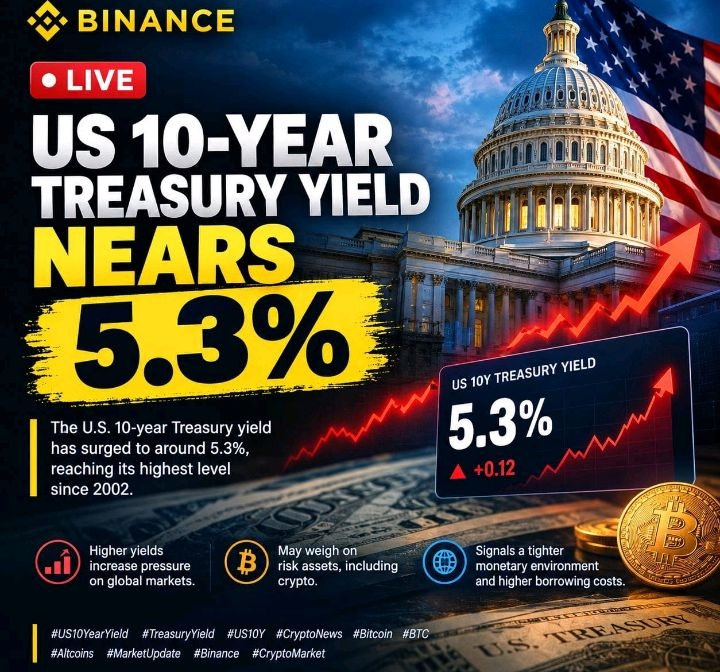
🇺🇸 The US 10-Year Treasury Yield is approaching the 5.3% level, a level not seen since 2002, according to the report.
🔍 Why Does This Matter?
When US Treasury yields rise, investors may find government bonds more attractive compared with riskier assets. This can put pressure on financial markets, including Bitcoin and other cryptocurrencies.
📉 Potential Impact on Crypto:
Increased pressure on BTC and altcoins.
Possible decline in risk appetite among investors.
Higher market volatility.
Traders may become more cautious.
⚠️ Trader’s Note: Rising Treasury yields do not guarantee that crypto prices will fall. Market direction also depends on the US dollar, Federal Reserve policy, inflation data, and overall investor sentiment.
🧠 Trade smart. Manage your risk. Never trade on headlines alone.
#US10YearYieldNears5.3% #Bitcoin❗ #CryptoNews🔒📰🚫 #BTC #MacroEconomics
🚨 US 10-Year Treasury Yield Nears 5.3%
📊 Global Market Alert | Macro Update
🇺🇸 The US 10-Year Treasury Yield is approaching the 5.3% level, a level not seen since 2002, according to the report.
🔍 Why Does This Matter?
When US Treasury yields rise, investors may find government bonds more attractive compared with riskier assets. This can put pressure on financial markets, including Bitcoin and other cryptocurrencies.
📉 Potential Impact on Crypto:
Increased pressure on BTC and altcoins.
Possible decline in risk appetite among investors.
Higher market volatility.
Traders may become more cautious.
⚠️ Trader’s Note: Rising Treasury yields do not guarantee that crypto prices will fall. Market direction also depends on the US dollar, Federal Reserve policy, inflation data, and overall investor sentiment.
🧠 Trade smart. Manage your risk. Never trade on headlines alone.
#US10YearYieldNears5.3% #Bitcoin❗ #CryptoNews🔒📰🚫 #BTC #MacroEconomics
📊 Global Market Alert | Macro Update
🇺🇸 The US 10-Year Treasury Yield is approaching the 5.3% level, a level not seen since 2002, according to the report.
🔍 Why Does This Matter?
When US Treasury yields rise, investors may find government bonds more attractive compared with riskier assets. This can put pressure on financial markets, including Bitcoin and other cryptocurrencies.
📉 Potential Impact on Crypto:
Increased pressure on BTC and altcoins.
Possible decline in risk appetite among investors.
Higher market volatility.
Traders may become more cautious.
⚠️ Trader’s Note: Rising Treasury yields do not guarantee that crypto prices will fall. Market direction also depends on the US dollar, Federal Reserve policy, inflation data, and overall investor sentiment.
🧠 Trade smart. Manage your risk. Never trade on headlines alone.
#US10YearYieldNears5.3% #Bitcoin❗ #CryptoNews🔒📰🚫 #BTC #MacroEconomics
128

Official data released this morning showed Tokyo's September headline CPI jumped to 2.7% YoY, topping the 2.5% forecast, while core CPI also surged to 2.7%. Meanwhile, nationwide unemployment for August edged up slightly to 2.5% with a stable jobs-to-applications ratio of 1.18.
This sharp acceleration in Tokyo inflation, a key leading indicator for Japan, amplifies pressure on the Bank of Japan to hike interest rates faster. Persistent price pressures suggest underlying domestic inflation is broadening well beyond initial expectations.
The data strengthens the Yen and lifts bond yields as markets price in tighter BOJ policy. A more hawkish stance threatens to unwind global Yen carry trades, potentially draining cross-border liquidity across major asset classes.
For crypto, rising Japanese yields and carry trade unwinding pose liquidity headwinds for risk assets like $BTC. Continued monetary tightening in Japan could trigger short-term market volatility before sentiment stabilizes.
#TokyoCPI #BOJ #MacroEconomics
Official data released this morning showed Tokyo's September headline CPI jumped to 2.7% YoY, topping the 2.5% forecast, while core CPI also surged to 2.7%. Meanwhile, nationwide unemployment for August edged up slightly to 2.5% with a stable jobs-to-applications ratio of 1.18.
This sharp acceleration in Tokyo inflation, a key leading indicator for Japan, amplifies pressure on the Bank of Japan to hike interest rates faster. Persistent price pressures suggest underlying domestic inflation is broadening well beyond initial expectations.
The data strengthens the Yen and lifts bond yields as markets price in tighter BOJ policy. A more hawkish stance threatens to unwind global Yen carry trades, potentially draining cross-border liquidity across major asset classes.
For crypto, rising Japanese yields and carry trade unwinding pose liquidity headwinds for risk assets like $BTC . Continued monetary tightening in Japan could trigger short-term market volatility before sentiment stabilizes.
#TokyoCPI #BOJ #MacroEconomics
This sharp acceleration in Tokyo inflation, a key leading indicator for Japan, amplifies pressure on the Bank of Japan to hike interest rates faster. Persistent price pressures suggest underlying domestic inflation is broadening well beyond initial expectations.
The data strengthens the Yen and lifts bond yields as markets price in tighter BOJ policy. A more hawkish stance threatens to unwind global Yen carry trades, potentially draining cross-border liquidity across major asset classes.
For crypto, rising Japanese yields and carry trade unwinding pose liquidity headwinds for risk assets like $BTC . Continued monetary tightening in Japan could trigger short-term market volatility before sentiment stabilizes.
#TokyoCPI #BOJ #MacroEconomics
22
U.S. President Donald Trump stated in a recent address that back in February 2026, Iran was merely three to four weeks away from developing a nuclear weapon, or possibly even sooner. This direct warning brings Middle Eastern nuclear risks back to the forefront of global macro discussions.
The urgency in Trump's remarks signals potential pre-emptive diplomatic or military actions, catching markets that had largely priced in a prolonged stalemate off guard. Escalating tensions around Iran directly threaten key shipping corridors and regional energy supply stability.
Traditional markets are reacting with classic risk-off positioning. Crude oil prices face renewed upward pressure, while safe-haven flows bolster gold and the U.S. dollar, dampening broader equity market sentiment.
For digital assets, heightened geopolitical instability often leads to short-term liquidity contraction and volatility across $BTC and altcoins. Investors should monitor whether crypto trades as a speculative risk asset or captures safe-haven capital in subsequent sessions.
#Geopolitics #Trump #MacroEconomics
U.S. President Donald Trump stated in a recent address that back in February 2026, Iran was merely three to four weeks away from developing a nuclear weapon, or possibly even sooner. This direct warning brings Middle Eastern nuclear risks back to the forefront of global macro discussions.
The urgency in Trump's remarks signals potential pre-emptive diplomatic or military actions, catching markets that had largely priced in a prolonged stalemate off guard. Escalating tensions around Iran directly threaten key shipping corridors and regional energy supply stability.
Traditional markets are reacting with classic risk-off positioning. Crude oil prices face renewed upward pressure, while safe-haven flows bolster gold and the U.S. dollar, dampening broader equity market sentiment.
For digital assets, heightened geopolitical instability often leads to short-term liquidity contraction and volatility across $BTC and altcoins. Investors should monitor whether crypto trades as a speculative risk asset or captures safe-haven capital in subsequent sessions.
#Geopolitics #Trump #MacroEconomics
The urgency in Trump's remarks signals potential pre-emptive diplomatic or military actions, catching markets that had largely priced in a prolonged stalemate off guard. Escalating tensions around Iran directly threaten key shipping corridors and regional energy supply stability.
Traditional markets are reacting with classic risk-off positioning. Crude oil prices face renewed upward pressure, while safe-haven flows bolster gold and the U.S. dollar, dampening broader equity market sentiment.
For digital assets, heightened geopolitical instability often leads to short-term liquidity contraction and volatility across $BTC and altcoins. Investors should monitor whether crypto trades as a speculative risk asset or captures safe-haven capital in subsequent sessions.
#Geopolitics #Trump #MacroEconomics
146

Verified
Article
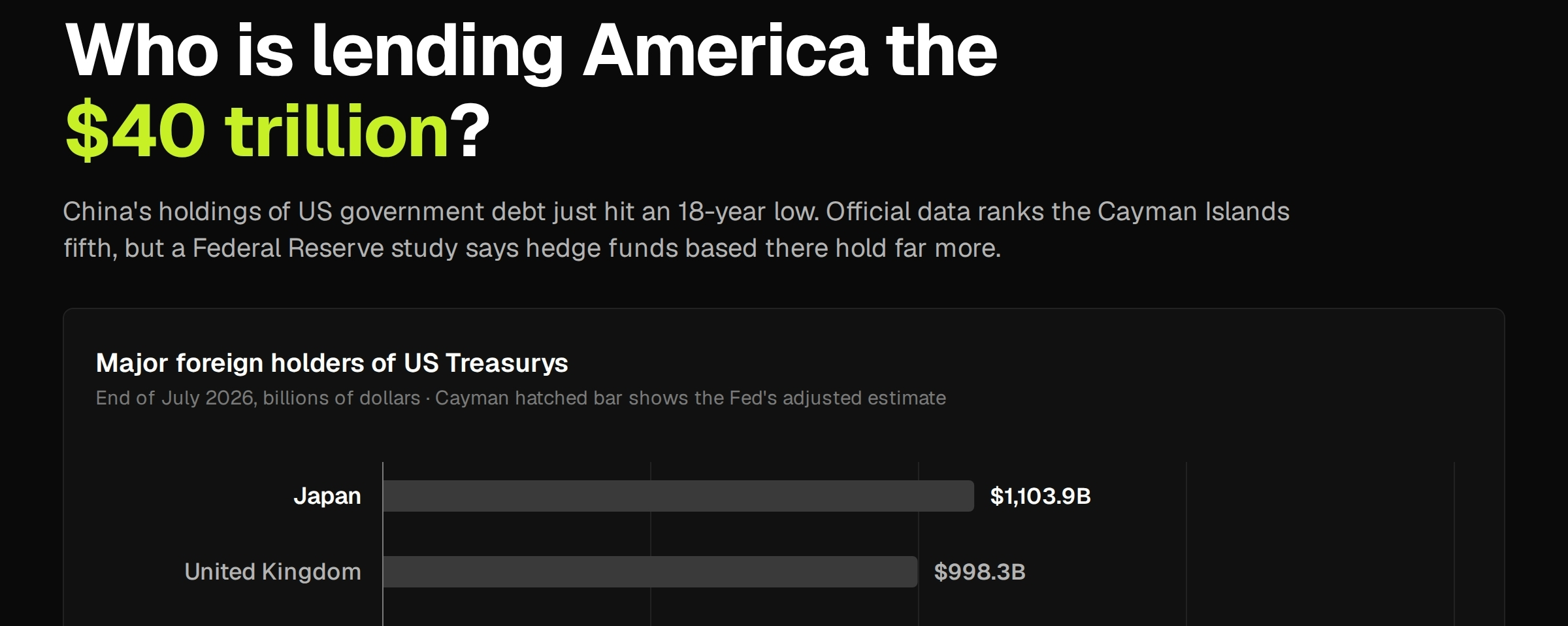
Can Inflation Shrink America’s $40 Trillion Debt? The Surprising Winner (and Loser)In a recent interview with TIME magazine, President Donald Trump sparked an intense macroeconomic debate by suggesting that "certain levels of inflation" could help pay off the $40 trillion U.S. national debt "very rapidly."
While everyday consumers look at inflation as a financial burden, governments see it through a completely different lens. The strategy is known as "inflating away the debt". But how does it work, and more importantly, who is actually financing this debt relief? Let’s break it down. 👇
1. The Math: How Inflation Alters the Debt
When a government borrows money, it issues bonds (Treasuries) at fixed nominal amounts. If it borrows $1 billion today, it owes exactly $1 billion in the future. Inflation changes the rules of the game:
Cheaper Repayment: Inflation dilutes the purchasing power of the fiat dollar. The government pays back its older, long-term bonds using "cheaper" dollars than those it originally borrowed.Surging Nominal Tax Revenues: As inflation pushes up consumer prices, nominal wages, and corporate profits, the government’s tax collection naturally rises. Because the face value of the existing debt stays the same, the debt becomes smaller relative to the size of the expanding nominal economy (the Debt-to-GDP ratio).
2. The Surprising Reality: Who is Financing It? 👥
The most critical part of this strategy isn't the economic math—it is who pays for it. When a government inflates away its debt, it implicitly transfers wealth from the creditors (lenders) to the debtor (the government).
The entities financing this implicit wealth transfer include:
Foreign Sovereigns: International lenders holding trillions in U.S. Treasuries receive lower real returns as the dollar devalues.Domestic Institutions: Retirement pension funds, insurance companies, and commercial banks absorb the economic loss on fixed-income assets.Everyday Citizens & Savers: Inflation acts as a "hidden tax." While it shrinks government liabilities on paper, it simultaneously eats away at the purchasing power of citizens' cash savings and outpaces real wage growth.
3. The Dangerous Side Effects ⚠️
While inflating debt sounds like an easy fix, it is a highly volatile strategy with long-term consequences:
Skyrocketing Interest Costs: Investors demand higher yields on new government debt to protect against inflation. With the national debt past $40 trillion, net interest servicing costs already exceed $1 trillion annually. Higher inflation forces borrowing costs to stay elevated, which ironically accelerates deficit spending.The Federal Reserve Dilemma: To curb inflation, the central bank usually raises interest rates—a move Trump has openly criticized, arguing that high rates hurt economic growth more than inflation itself.
💡 The Big Takeaway for Crypto Investors
For the digital asset ecosystem, this macroeconomic backdrop directly reinforces the utility of hard money. When global superpowers rely on monetary debasement to manage sovereign debt burdens, capital historically migrates toward decentralized, mathematically scarce assets like Bitcoin (BTC) as a hedge against inflation.
What do you think? Will inflating the debt save the fiat system, or will it accelerate the global rotation into Bitcoin?
#CryptoMarket #Bitcoin #MacroEconomics #FinanceNews #WriteToEarn
Can Inflation Shrink America’s $40 Trillion Debt? The Surprising Winner (and Loser)
In a recent interview with TIME magazine, President Donald Trump sparked an intense macroeconomic debate by suggesting that "certain levels of inflation" could help pay off the $40 trillion U.S. national debt "very rapidly."
While everyday consumers look at inflation as a financial burden, governments see it through a completely different lens. The strategy is known as "inflating away the debt". But how does it work, and more importantly, who is actually financing this debt relief? Let’s break it down. 👇
1. The Math: How Inflation Alters the Debt
When a government borrows money, it issues bonds (Treasuries) at fixed nominal amounts. If it borrows $1 billion today, it owes exactly $1 billion in the future. Inflation changes the rules of the game:
Cheaper Repayment: Inflation dilutes the purchasing power of the fiat dollar. The government pays back its older, long-term bonds using "cheaper" dollars than those it originally borrowed.Surging Nominal Tax Revenues: As inflation pushes up consumer prices, nominal wages, and corporate profits, the government’s tax collection naturally rises. Because the face value of the existing debt stays the same, the debt becomes smaller relative to the size of the expanding nominal economy (the Debt-to-GDP ratio).
2. The Surprising Reality: Who is Financing It? 👥
The most critical part of this strategy isn't the economic math—it is who pays for it. When a government inflates away its debt, it implicitly transfers wealth from the creditors (lenders) to the debtor (the government).
The entities financing this implicit wealth transfer include:
Foreign Sovereigns: International lenders holding trillions in U.S. Treasuries receive lower real returns as the dollar devalues.Domestic Institutions: Retirement pension funds, insurance companies, and commercial banks absorb the economic loss on fixed-income assets.Everyday Citizens & Savers: Inflation acts as a "hidden tax." While it shrinks government liabilities on paper, it simultaneously eats away at the purchasing power of citizens' cash savings and outpaces real wage growth.
3. The Dangerous Side Effects ⚠️
While inflating debt sounds like an easy fix, it is a highly volatile strategy with long-term consequences:
Skyrocketing Interest Costs: Investors demand higher yields on new government debt to protect against inflation. With the national debt past $40 trillion, net interest servicing costs already exceed $1 trillion annually. Higher inflation forces borrowing costs to stay elevated, which ironically accelerates deficit spending.The Federal Reserve Dilemma: To curb inflation, the central bank usually raises interest rates—a move Trump has openly criticized, arguing that high rates hurt economic growth more than inflation itself.
💡 The Big Takeaway for Crypto Investors
For the digital asset ecosystem, this macroeconomic backdrop directly reinforces the utility of hard money. When global superpowers rely on monetary debasement to manage sovereign debt burdens, capital historically migrates toward decentralized, mathematically scarce assets like Bitcoin (BTC) as a hedge against inflation.
What do you think? Will inflating the debt save the fiat system, or will it accelerate the global rotation into Bitcoin?
#CryptoMarket #Bitcoin #MacroEconomics #FinanceNews #WriteToEarn
While everyday consumers look at inflation as a financial burden, governments see it through a completely different lens. The strategy is known as "inflating away the debt". But how does it work, and more importantly, who is actually financing this debt relief? Let’s break it down. 👇
1. The Math: How Inflation Alters the Debt
When a government borrows money, it issues bonds (Treasuries) at fixed nominal amounts. If it borrows $1 billion today, it owes exactly $1 billion in the future. Inflation changes the rules of the game:
Cheaper Repayment: Inflation dilutes the purchasing power of the fiat dollar. The government pays back its older, long-term bonds using "cheaper" dollars than those it originally borrowed.Surging Nominal Tax Revenues: As inflation pushes up consumer prices, nominal wages, and corporate profits, the government’s tax collection naturally rises. Because the face value of the existing debt stays the same, the debt becomes smaller relative to the size of the expanding nominal economy (the Debt-to-GDP ratio).
2. The Surprising Reality: Who is Financing It? 👥
The most critical part of this strategy isn't the economic math—it is who pays for it. When a government inflates away its debt, it implicitly transfers wealth from the creditors (lenders) to the debtor (the government).
The entities financing this implicit wealth transfer include:
Foreign Sovereigns: International lenders holding trillions in U.S. Treasuries receive lower real returns as the dollar devalues.Domestic Institutions: Retirement pension funds, insurance companies, and commercial banks absorb the economic loss on fixed-income assets.Everyday Citizens & Savers: Inflation acts as a "hidden tax." While it shrinks government liabilities on paper, it simultaneously eats away at the purchasing power of citizens' cash savings and outpaces real wage growth.
3. The Dangerous Side Effects ⚠️
While inflating debt sounds like an easy fix, it is a highly volatile strategy with long-term consequences:
Skyrocketing Interest Costs: Investors demand higher yields on new government debt to protect against inflation. With the national debt past $40 trillion, net interest servicing costs already exceed $1 trillion annually. Higher inflation forces borrowing costs to stay elevated, which ironically accelerates deficit spending.The Federal Reserve Dilemma: To curb inflation, the central bank usually raises interest rates—a move Trump has openly criticized, arguing that high rates hurt economic growth more than inflation itself.
💡 The Big Takeaway for Crypto Investors
For the digital asset ecosystem, this macroeconomic backdrop directly reinforces the utility of hard money. When global superpowers rely on monetary debasement to manage sovereign debt burdens, capital historically migrates toward decentralized, mathematically scarce assets like Bitcoin (BTC) as a hedge against inflation.
What do you think? Will inflating the debt save the fiat system, or will it accelerate the global rotation into Bitcoin?
#CryptoMarket #Bitcoin #MacroEconomics #FinanceNews #WriteToEarn
2
274

·
--
#us10yearyieldnears5.3%
🚨 Fixed Income Alert: US 10-Year Treasury Yield Nears 5.3%!
The Market Update: Bond market pressures are escalating across global fixed income desks as the benchmark US 10-Year Treasury yield climbs close to the critical 5.3% threshold. As tracked by our macro bond trading dashboard, persistent inflation concerns and shifting fiscal expectations are pushing yields higher, creating intense cross-asset volatility between traditional debt instruments and risk-on equities. 📊
What This Means for Traders: Rising treasury yields increase the cost of capital and typically apply downward pressure on high-beta growth assets and tech sectors, while drawing institutional cash into fixed income. Market participants are monitoring capital flows, currency strength, and risk appetite as yields test multi-year resistance levels.
Highlighted Tradeable Coins to Watch (Macro-Sensitive & Layer-1 Sectors):
$BTC (Bitcoin): The primary digital liquidity anchor; tracking how elevated treasury yields and macro tightening impact institutional store-of-value demand.
$ETH (Ethereum): Leading smart-contract settlement layer; observing decentralized yield dynamics and capital rotation across staking protocols during fixed income shifts.
$SOL (Solana): High-throughput layer-1 network; monitoring network volume and high-beta asset behavior amidst shifting macroeconomic liquidity conditions.
How do you view the impact of surging US 10-year yields on risk-on capital and digital asset market momentum this quarter? Let's discuss your strategy in the comments below! 👇
{spot}(BTCUSDT)
{spot}(ETHUSDT)
{spot}(SOLUSDT)
#TreasuryYields #MacroEconomics #cryptotrading
#us10yearyieldnears5.3%
🚨 Fixed Income Alert: US 10-Year Treasury Yield Nears 5.3%!
The Market Update: Bond market pressures are escalating across global fixed income desks as the benchmark US 10-Year Treasury yield climbs close to the critical 5.3% threshold. As tracked by our macro bond trading dashboard, persistent inflation concerns and shifting fiscal expectations are pushing yields higher, creating intense cross-asset volatility between traditional debt instruments and risk-on equities. 📊
What This Means for Traders: Rising treasury yields increase the cost of capital and typically apply downward pressure on high-beta growth assets and tech sectors, while drawing institutional cash into fixed income. Market participants are monitoring capital flows, currency strength, and risk appetite as yields test multi-year resistance levels.
Highlighted Tradeable Coins to Watch (Macro-Sensitive & Layer-1 Sectors):
$BTC (Bitcoin): The primary digital liquidity anchor; tracking how elevated treasury yields and macro tightening impact institutional store-of-value demand.
$ETH (Ethereum): Leading smart-contract settlement layer; observing decentralized yield dynamics and capital rotation across staking protocols during fixed income shifts.
$SOL (Solana): High-throughput layer-1 network; monitoring network volume and high-beta asset behavior amidst shifting macroeconomic liquidity conditions.
How do you view the impact of surging US 10-year yields on risk-on capital and digital asset market momentum this quarter? Let's discuss your strategy in the comments below! 👇
#TreasuryYields #MacroEconomics #cryptotrading
🚨 Fixed Income Alert: US 10-Year Treasury Yield Nears 5.3%!
The Market Update: Bond market pressures are escalating across global fixed income desks as the benchmark US 10-Year Treasury yield climbs close to the critical 5.3% threshold. As tracked by our macro bond trading dashboard, persistent inflation concerns and shifting fiscal expectations are pushing yields higher, creating intense cross-asset volatility between traditional debt instruments and risk-on equities. 📊
What This Means for Traders: Rising treasury yields increase the cost of capital and typically apply downward pressure on high-beta growth assets and tech sectors, while drawing institutional cash into fixed income. Market participants are monitoring capital flows, currency strength, and risk appetite as yields test multi-year resistance levels.
Highlighted Tradeable Coins to Watch (Macro-Sensitive & Layer-1 Sectors):
$BTC (Bitcoin): The primary digital liquidity anchor; tracking how elevated treasury yields and macro tightening impact institutional store-of-value demand.
$ETH (Ethereum): Leading smart-contract settlement layer; observing decentralized yield dynamics and capital rotation across staking protocols during fixed income shifts.
$SOL (Solana): High-throughput layer-1 network; monitoring network volume and high-beta asset behavior amidst shifting macroeconomic liquidity conditions.
How do you view the impact of surging US 10-year yields on risk-on capital and digital asset market momentum this quarter? Let's discuss your strategy in the comments below! 👇
#TreasuryYields #MacroEconomics #cryptotrading

AngelOfCrypto_-:
nice
1
8
14.5k
The US Department of Labor released its weekly jobless claims report on September 26, showing initial filings held steady at 197,000. This came in lower than the consensus forecast of 200,000, while continuing claims fell to 1.701 million against expectations of 1.725 million.
These figures highlight persistent resilience in the US labor market despite ongoing macro tightening. By staying well below historical stress levels, the data signals that corporate layoffs remain muted and employment conditions are tighter than expected.
In broader financial markets, this strong labor print provides the Federal Reserve with additional headroom to maintain higher benchmark rates for longer. Treasury yields and the US Dollar Index often find solid support following such strong economic resilient data, dampening near-term rate cut hopes.
For the crypto ecosystem, tighter monetary conditions continue to constrain broad market liquidity and speculative appetite. While major digital assets like $BTC may experience localized volatility from dollar strength, long-term investors are monitoring whether sustained macro pressure eventually forces a shift in central bank policy.
#MacroEconomics #LaborMarket #CryptoMarket
The US Department of Labor released its weekly jobless claims report on September 26, showing initial filings held steady at 197,000. This came in lower than the consensus forecast of 200,000, while continuing claims fell to 1.701 million against expectations of 1.725 million.
These figures highlight persistent resilience in the US labor market despite ongoing macro tightening. By staying well below historical stress levels, the data signals that corporate layoffs remain muted and employment conditions are tighter than expected.
In broader financial markets, this strong labor print provides the Federal Reserve with additional headroom to maintain higher benchmark rates for longer. Treasury yields and the US Dollar Index often find solid support following such strong economic resilient data, dampening near-term rate cut hopes.
For the crypto ecosystem, tighter monetary conditions continue to constrain broad market liquidity and speculative appetite. While major digital assets like $BTC may experience localized volatility from dollar strength, long-term investors are monitoring whether sustained macro pressure eventually forces a shift in central bank policy.
#MacroEconomics #LaborMarket #CryptoMarket
These figures highlight persistent resilience in the US labor market despite ongoing macro tightening. By staying well below historical stress levels, the data signals that corporate layoffs remain muted and employment conditions are tighter than expected.
In broader financial markets, this strong labor print provides the Federal Reserve with additional headroom to maintain higher benchmark rates for longer. Treasury yields and the US Dollar Index often find solid support following such strong economic resilient data, dampening near-term rate cut hopes.
For the crypto ecosystem, tighter monetary conditions continue to constrain broad market liquidity and speculative appetite. While major digital assets like $BTC may experience localized volatility from dollar strength, long-term investors are monitoring whether sustained macro pressure eventually forces a shift in central bank policy.
#MacroEconomics #LaborMarket #CryptoMarket
5
In a recent interview published by Time magazine, US President Donald Trump publicly voiced strong opposition to monetary tightening, stating that continuing to raise interest rates is "very bad." This direct critique renews political scrutiny over central bank policy during a delicate macroeconomic juncture.
The statement carries significant weight as it highlights the intensifying debate between economic growth priorities and ongoing inflation controls. Rising borrowing costs increase debt servicing burdens across the economy, making aggressive rate trajectories a major concern for both policymakers and businesses.
Across traditional finance, such commentary injects fresh volatility into US Treasury yields and tests the strength of the US Dollar. While equity markets generally prefer a more dovish monetary path, political pressure on monetary policy often creates broader policy uncertainty.
For the crypto market, any narrative leaning toward capped interest rates supports global liquidity expansion and fuels risk-on sentiment. If central banks face rising resistance to monetary tightening, digital assets like $BTC could benefit from increased institutional capital flows.
#Trump #InterestRates #MacroEconomics
In a recent interview published by Time magazine, US President Donald Trump publicly voiced strong opposition to monetary tightening, stating that continuing to raise interest rates is "very bad." This direct critique renews political scrutiny over central bank policy during a delicate macroeconomic juncture.
The statement carries significant weight as it highlights the intensifying debate between economic growth priorities and ongoing inflation controls. Rising borrowing costs increase debt servicing burdens across the economy, making aggressive rate trajectories a major concern for both policymakers and businesses.
Across traditional finance, such commentary injects fresh volatility into US Treasury yields and tests the strength of the US Dollar. While equity markets generally prefer a more dovish monetary path, political pressure on monetary policy often creates broader policy uncertainty.
For the crypto market, any narrative leaning toward capped interest rates supports global liquidity expansion and fuels risk-on sentiment. If central banks face rising resistance to monetary tightening, digital assets like $BTC could benefit from increased institutional capital flows.
#Trump #InterestRates #MacroEconomics
The statement carries significant weight as it highlights the intensifying debate between economic growth priorities and ongoing inflation controls. Rising borrowing costs increase debt servicing burdens across the economy, making aggressive rate trajectories a major concern for both policymakers and businesses.
Across traditional finance, such commentary injects fresh volatility into US Treasury yields and tests the strength of the US Dollar. While equity markets generally prefer a more dovish monetary path, political pressure on monetary policy often creates broader policy uncertainty.
For the crypto market, any narrative leaning toward capped interest rates supports global liquidity expansion and fuels risk-on sentiment. If central banks face rising resistance to monetary tightening, digital assets like $BTC could benefit from increased institutional capital flows.
#Trump #InterestRates #MacroEconomics
5
The US Dollar Index (DXY) climbed to 101.62 today, marking its highest level in two months amid shifting global macroeconomic dynamics.
This rebound reflects resilient US economic indicators and recalibrated expectations around the Federal Reserve's policy path. Investors are actively adjusting their positioning as persistent strength in the greenback challenges broader easing narratives.
Across traditional financial markets, a strengthening dollar is putting noticeable pressure on major currencies, commodities, and risk assets. Rising yields combined with a dominant USD continue to weigh on assets like crude oil and gold in the near term.
For the crypto sector, sustained dollar strength typically constrains global stablecoin liquidity and dampens aggressive risk-on momentum. $BTC and the broader altcoin market may face range-bound consolidation until dollar dominance cools and capital flows rotate back into risk assets. #USD #DXY #MacroEconomics
The US Dollar Index (DXY) climbed to 101.62 today, marking its highest level in two months amid shifting global macroeconomic dynamics.
This rebound reflects resilient US economic indicators and recalibrated expectations around the Federal Reserve's policy path. Investors are actively adjusting their positioning as persistent strength in the greenback challenges broader easing narratives.
Across traditional financial markets, a strengthening dollar is putting noticeable pressure on major currencies, commodities, and risk assets. Rising yields combined with a dominant USD continue to weigh on assets like crude oil and gold in the near term.
For the crypto sector, sustained dollar strength typically constrains global stablecoin liquidity and dampens aggressive risk-on momentum. $BTC and the broader altcoin market may face range-bound consolidation until dollar dominance cools and capital flows rotate back into risk assets. #USD #DXY #MacroEconomics
This rebound reflects resilient US economic indicators and recalibrated expectations around the Federal Reserve's policy path. Investors are actively adjusting their positioning as persistent strength in the greenback challenges broader easing narratives.
Across traditional financial markets, a strengthening dollar is putting noticeable pressure on major currencies, commodities, and risk assets. Rising yields combined with a dominant USD continue to weigh on assets like crude oil and gold in the near term.
For the crypto sector, sustained dollar strength typically constrains global stablecoin liquidity and dampens aggressive risk-on momentum. $BTC and the broader altcoin market may face range-bound consolidation until dollar dominance cools and capital flows rotate back into risk assets. #USD #DXY #MacroEconomics
16

·
--
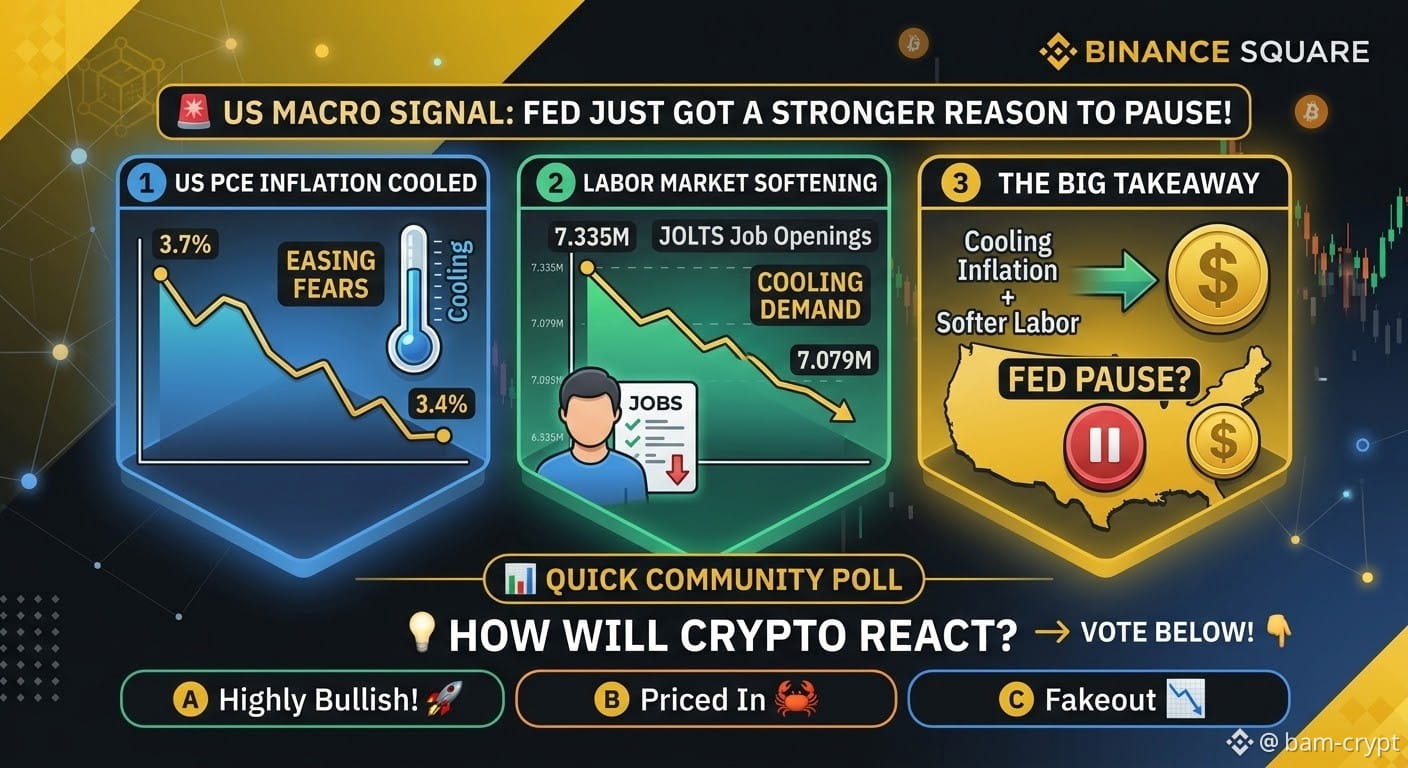
🚨 FED HAS A STRONGER REASON TO PAUSE: What This Means for Crypto!
The latest US macro data just dropped, and it’s sending a massive signal across all financial markets. Here is the quick breakdown of what happened:
📉 Inflation is Cooling Down:
US PCE inflation came in at 3.4% YoY (vs. 3.7% expected), officially easing fears that inflation was reaccelerating. Core PCE also printed softer than forecasts!
💼 Labor Market is Softening:
JOLTS Job Openings fell to 7.079M (vs. 7.230M expected), dropping further from the previous 7.335M.
💡 The Big Takeaway:
Cooling inflation + lower labor demand = More room for the Fed to pause rate hikes. A dovish macro environment typically boosts liquidity in high-risk assets like crypto!
📊 QUICK POLL FOR THE COMMUNITY:
How do you think Bitcoin & Alts will react to this macro signal over the coming weeks?
A) Highly Bullish! We are pumping from here
B) Priced In — Short-term volatility before a crab market
C) Fakeout — Still expecting a market dip
👇 Drop your pick (A, B, or C) in the comments and let's hear your predictions!
🔔 Follow for daily high-value market updates & crypto insights! Don't forget to Like, Share, and save this post.
#BİNANCESQUARE #CryptoMarketAlert #FedRateCutRisks #Inflation #MacroEconomics
🚨 FED HAS A STRONGER REASON TO PAUSE: What This Means for Crypto!
The latest US macro data just dropped, and it’s sending a massive signal across all financial markets. Here is the quick breakdown of what happened:
📉 Inflation is Cooling Down:
US PCE inflation came in at 3.4% YoY (vs. 3.7% expected), officially easing fears that inflation was reaccelerating. Core PCE also printed softer than forecasts!
💼 Labor Market is Softening:
JOLTS Job Openings fell to 7.079M (vs. 7.230M expected), dropping further from the previous 7.335M.
💡 The Big Takeaway:
Cooling inflation + lower labor demand = More room for the Fed to pause rate hikes. A dovish macro environment typically boosts liquidity in high-risk assets like crypto!
📊 QUICK POLL FOR THE COMMUNITY:
How do you think Bitcoin & Alts will react to this macro signal over the coming weeks?
A) Highly Bullish! We are pumping from here
B) Priced In — Short-term volatility before a crab market
C) Fakeout — Still expecting a market dip
👇 Drop your pick (A, B, or C) in the comments and let's hear your predictions!
🔔 Follow for daily high-value market updates & crypto insights! Don't forget to Like, Share, and save this post.
#BİNANCESQUARE #CryptoMarketAlert #FedRateCutRisks #Inflation #MacroEconomics
The latest US macro data just dropped, and it’s sending a massive signal across all financial markets. Here is the quick breakdown of what happened:
📉 Inflation is Cooling Down:
US PCE inflation came in at 3.4% YoY (vs. 3.7% expected), officially easing fears that inflation was reaccelerating. Core PCE also printed softer than forecasts!
💼 Labor Market is Softening:
JOLTS Job Openings fell to 7.079M (vs. 7.230M expected), dropping further from the previous 7.335M.
💡 The Big Takeaway:
Cooling inflation + lower labor demand = More room for the Fed to pause rate hikes. A dovish macro environment typically boosts liquidity in high-risk assets like crypto!
📊 QUICK POLL FOR THE COMMUNITY:
How do you think Bitcoin & Alts will react to this macro signal over the coming weeks?
A) Highly Bullish! We are pumping from here
B) Priced In — Short-term volatility before a crab market
C) Fakeout — Still expecting a market dip
👇 Drop your pick (A, B, or C) in the comments and let's hear your predictions!
🔔 Follow for daily high-value market updates & crypto insights! Don't forget to Like, Share, and save this post.
#BİNANCESQUARE #CryptoMarketAlert #FedRateCutRisks #Inflation #MacroEconomics
14

Holding Your Breath in Crypto Markets: What Does the Latest U.S. Jobs Report Mean for Investors?
All eyes are now on the macroeconomic indicators as the NFPWatch trend kicks off. The latest data showed the U.S. economy added new jobs during last September, reflecting strong resilience in the labor market and putting the Federal Reserve in front of critical choices regarding the pace of the upcoming rate cut.
📊🦅These economic Jobs Report releases don’t go unnoticed—they map out the movement of massive liquidity and help determine investors’ direction between safe havens and high-risk assets.
My question for you: Do you think the strength of the job market will make the Federal Reserve take a cautious approach to cutting rates, or has the market already absorbed the shock?
Share your expectations! 👇
#USSeptemberPayrolls
#JobsReport
#MacroEconomics
#BinanceSquare
#NFPWatch
Holding Your Breath in Crypto Markets: What Does the Latest U.S. Jobs Report Mean for Investors?
All eyes are now on the macroeconomic indicators as the NFPWatch trend kicks off. The latest data showed the U.S. economy added new jobs during last September, reflecting strong resilience in the labor market and putting the Federal Reserve in front of critical choices regarding the pace of the upcoming rate cut.
📊🦅These economic Jobs Report releases don’t go unnoticed—they map out the movement of massive liquidity and help determine investors’ direction between safe havens and high-risk assets.
My question for you: Do you think the strength of the job market will make the Federal Reserve take a cautious approach to cutting rates, or has the market already absorbed the shock?
Share your expectations! 👇
#USSeptemberPayrolls
#JobsReport
#MacroEconomics
#BinanceSquare
#NFPWatch
All eyes are now on the macroeconomic indicators as the NFPWatch trend kicks off. The latest data showed the U.S. economy added new jobs during last September, reflecting strong resilience in the labor market and putting the Federal Reserve in front of critical choices regarding the pace of the upcoming rate cut.
📊🦅These economic Jobs Report releases don’t go unnoticed—they map out the movement of massive liquidity and help determine investors’ direction between safe havens and high-risk assets.
My question for you: Do you think the strength of the job market will make the Federal Reserve take a cautious approach to cutting rates, or has the market already absorbed the shock?
Share your expectations! 👇
#USSeptemberPayrolls
#JobsReport
#MacroEconomics
#BinanceSquare
#NFPWatch
1
4

·
--
U.S. latest employment data released, with further signs of cooling in the labor market. The CME FedWatch tool shows that traders’ probability expectations for the Fed to keep interest rates unchanged in October rose from 72% before the data release to 83%, while the probability of continued rate hikes dropped rapidly from 28% to 17%.
The reason this data has sparked widespread discussion is that it directly weakens the market’s earlier concerns about the continued intensification of tightening policies. Current pricing in federal funds rate futures indicates that the market expects the cumulative amount of Fed rate hikes by the end of 2026 to be about 22.2 basis points, lower than the previously expected 25.5 basis points—signaling a clear shift in policy expectations toward a more moderate stance.
In macro financial markets, the cooling of rate-hike expectations has put pressure on U.S. Treasury yields and the U.S. dollar index, giving equity assets and commodities a temporary breathing space. Funds are re-evaluating the Fed’s pacing as it balances inflation against a slowing economy, and overall risk appetite remains neutral and on hold.
For the crypto market, the marginal easing of expectations for tighter macro liquidity provides some support, but concerns about a slowdown in the economic fundamentals still remain. In the short term, $BTC may continue to follow macro liquidity expectations as they swing within a wide range; both long and short sides are waiting for the next key catalyst.
#Fed #InterestRates #MacroEconomics
U.S. latest employment data released, with further signs of cooling in the labor market. The CME FedWatch tool shows that traders’ probability expectations for the Fed to keep interest rates unchanged in October rose from 72% before the data release to 83%, while the probability of continued rate hikes dropped rapidly from 28% to 17%.
The reason this data has sparked widespread discussion is that it directly weakens the market’s earlier concerns about the continued intensification of tightening policies. Current pricing in federal funds rate futures indicates that the market expects the cumulative amount of Fed rate hikes by the end of 2026 to be about 22.2 basis points, lower than the previously expected 25.5 basis points—signaling a clear shift in policy expectations toward a more moderate stance.
In macro financial markets, the cooling of rate-hike expectations has put pressure on U.S. Treasury yields and the U.S. dollar index, giving equity assets and commodities a temporary breathing space. Funds are re-evaluating the Fed’s pacing as it balances inflation against a slowing economy, and overall risk appetite remains neutral and on hold.
For the crypto market, the marginal easing of expectations for tighter macro liquidity provides some support, but concerns about a slowdown in the economic fundamentals still remain. In the short term, $BTC may continue to follow macro liquidity expectations as they swing within a wide range; both long and short sides are waiting for the next key catalyst.
#Fed #InterestRates #MacroEconomics
The reason this data has sparked widespread discussion is that it directly weakens the market’s earlier concerns about the continued intensification of tightening policies. Current pricing in federal funds rate futures indicates that the market expects the cumulative amount of Fed rate hikes by the end of 2026 to be about 22.2 basis points, lower than the previously expected 25.5 basis points—signaling a clear shift in policy expectations toward a more moderate stance.
In macro financial markets, the cooling of rate-hike expectations has put pressure on U.S. Treasury yields and the U.S. dollar index, giving equity assets and commodities a temporary breathing space. Funds are re-evaluating the Fed’s pacing as it balances inflation against a slowing economy, and overall risk appetite remains neutral and on hold.
For the crypto market, the marginal easing of expectations for tighter macro liquidity provides some support, but concerns about a slowdown in the economic fundamentals still remain. In the short term, $BTC may continue to follow macro liquidity expectations as they swing within a wide range; both long and short sides are waiting for the next key catalyst.
#Fed #InterestRates #MacroEconomics
25
On September 30, 2026, President Donald J. Trump demanded the immediate resignation of former Fed Chair Jerome Powell, directing AG Todd Blanche to investigate multi-billion-dollar cost overruns in the Federal Reserve's HQ renovation.
This aggressive push highlights severe political scrutiny over central bank governance. Trump's threats of legal action challenge institutional autonomy, introducing fresh uncertainty into long-term policy expectations.
Traditional markets turned cautious as crude oil gained over 1%, closing above $90 following broader geopolitical shifts, including the complete U.S. troop withdrawal from Iraq. Rising energy prices and political friction are sustaining upward pressure on yields.
For digital assets, friction around monetary leadership reinforces the case for decentralized alternatives. Amid lingering inflation risks and systemic friction, $BTC remains a hedge against macro instability. 🌐
#FederalReserve #MacroEconomics #Geopolitics
On September 30, 2026, President Donald J. Trump demanded the immediate resignation of former Fed Chair Jerome Powell, directing AG Todd Blanche to investigate multi-billion-dollar cost overruns in the Federal Reserve's HQ renovation.
This aggressive push highlights severe political scrutiny over central bank governance. Trump's threats of legal action challenge institutional autonomy, introducing fresh uncertainty into long-term policy expectations.
Traditional markets turned cautious as crude oil gained over 1%, closing above $90 following broader geopolitical shifts, including the complete U.S. troop withdrawal from Iraq. Rising energy prices and political friction are sustaining upward pressure on yields.
For digital assets, friction around monetary leadership reinforces the case for decentralized alternatives. Amid lingering inflation risks and systemic friction, $BTC remains a hedge against macro instability. 🌐
#FederalReserve #MacroEconomics #Geopolitics
This aggressive push highlights severe political scrutiny over central bank governance. Trump's threats of legal action challenge institutional autonomy, introducing fresh uncertainty into long-term policy expectations.
Traditional markets turned cautious as crude oil gained over 1%, closing above $90 following broader geopolitical shifts, including the complete U.S. troop withdrawal from Iraq. Rising energy prices and political friction are sustaining upward pressure on yields.
For digital assets, friction around monetary leadership reinforces the case for decentralized alternatives. Amid lingering inflation risks and systemic friction, $BTC remains a hedge against macro instability. 🌐
#FederalReserve #MacroEconomics #Geopolitics
97
·
--
Japan’s Ministry of Internal Affairs and Communications released the latest inflation data on Friday afternoon. Tokyo’s core CPI rose 2.7% year-on-year in September, which was not only well above the prior figure of 1.8%, but also above market expectations of 2.3%. As the effects of the government’s temporary subsidies fade, food processing and accommodation costs have clearly moved higher, and price pressures are rebounding across the board.
This data is highly critical for the Bank of Japan. As a leading indicator of nationwide inflation, Tokyo’s core CPI has resumed accelerating upward, confirming concerns that inflation may remain above the 2% target for longer. This undoubtedly puts additional pressure on the BOJ for further tightening—especially as it just completed a rate hike last month.
At the macro level, the Japan–US interest-rate differential and the global liquidity backdrop are undergoing subtle shifts. The warming of expectations for yen rate hikes may continue to suppress cross-currency arbitrage trades, while also driving correlated repricing in global bond yields.
For the crypto market, potential tightening of Japan’s monetary policy often affects the global liquidity “water tap.” In the short term, deleveraging risks and capital rebalancing coexist, and the broader market may maintain a choppy, range-bound trend amid a wait-and-see mood. $BTC
#BOJ #Inflation #MacroEconomics
Japan’s Ministry of Internal Affairs and Communications released the latest inflation data on Friday afternoon. Tokyo’s core CPI rose 2.7% year-on-year in September, which was not only well above the prior figure of 1.8%, but also above market expectations of 2.3%. As the effects of the government’s temporary subsidies fade, food processing and accommodation costs have clearly moved higher, and price pressures are rebounding across the board.
This data is highly critical for the Bank of Japan. As a leading indicator of nationwide inflation, Tokyo’s core CPI has resumed accelerating upward, confirming concerns that inflation may remain above the 2% target for longer. This undoubtedly puts additional pressure on the BOJ for further tightening—especially as it just completed a rate hike last month.
At the macro level, the Japan–US interest-rate differential and the global liquidity backdrop are undergoing subtle shifts. The warming of expectations for yen rate hikes may continue to suppress cross-currency arbitrage trades, while also driving correlated repricing in global bond yields.
For the crypto market, potential tightening of Japan’s monetary policy often affects the global liquidity “water tap.” In the short term, deleveraging risks and capital rebalancing coexist, and the broader market may maintain a choppy, range-bound trend amid a wait-and-see mood. $BTC
#BOJ #Inflation #MacroEconomics
This data is highly critical for the Bank of Japan. As a leading indicator of nationwide inflation, Tokyo’s core CPI has resumed accelerating upward, confirming concerns that inflation may remain above the 2% target for longer. This undoubtedly puts additional pressure on the BOJ for further tightening—especially as it just completed a rate hike last month.
At the macro level, the Japan–US interest-rate differential and the global liquidity backdrop are undergoing subtle shifts. The warming of expectations for yen rate hikes may continue to suppress cross-currency arbitrage trades, while also driving correlated repricing in global bond yields.
For the crypto market, potential tightening of Japan’s monetary policy often affects the global liquidity “water tap.” In the short term, deleveraging risks and capital rebalancing coexist, and the broader market may maintain a choppy, range-bound trend amid a wait-and-see mood. $BTC
#BOJ #Inflation #MacroEconomics
58

The Japanese Ministry of Internal Affairs and Communications latest data shows that Tokyo’s CPI year-on-year rose 2.7% in September, significantly exceeding market expectations of 2.5% and the prior reading of 1.9%. Core CPI was also recorded at 2.7%, far above the expected 2.3%. Meanwhile, Japan’s August unemployment rate came in at 2.5%, slightly higher than the expected 2.4%, while the job-to-applicant ratio remained unchanged at 1.18.
With Tokyo CPI—an early indicator of national inflation—making a sharp upside rebound above expectations, it suggests that price pressure in Japan has not eased; instead, there are risks that it may accelerate higher. Even if the labor market loosens somewhat, an inflation level that has remained above the 2% target for a sustained period will further strengthen market expectations that the Bank of Japan (BOJ) will continue tightening its policy.
Inflation resilience will directly push up Japanese government bond yields, narrow the US-Japan interest rate differential, and support the yen exchange rate. Against the backdrop of tighter global liquidity and the Federal Reserve maintaining high interest rates, ongoing normalization of the BOJ’s monetary policy will continue to drive faster unwinding of global carry trades, creating persistent pressure from liquidity withdrawal on global risk assets.
For the crypto market, the reverse unwinding of yen carry trades is a systemic macro risk that cannot be ignored. As yen liquidity tightens, risk assets represented by $BTC may face continued selling pressure and outflows in the near term. Investors should remain alert to the pullback risk stemming from tighter global liquidity. #JapanCPI #BOJ #MacroEconomics
The Japanese Ministry of Internal Affairs and Communications latest data shows that Tokyo’s CPI year-on-year rose 2.7% in September, significantly exceeding market expectations of 2.5% and the prior reading of 1.9%. Core CPI was also recorded at 2.7%, far above the expected 2.3%. Meanwhile, Japan’s August unemployment rate came in at 2.5%, slightly higher than the expected 2.4%, while the job-to-applicant ratio remained unchanged at 1.18.
With Tokyo CPI—an early indicator of national inflation—making a sharp upside rebound above expectations, it suggests that price pressure in Japan has not eased; instead, there are risks that it may accelerate higher. Even if the labor market loosens somewhat, an inflation level that has remained above the 2% target for a sustained period will further strengthen market expectations that the Bank of Japan (BOJ) will continue tightening its policy.
Inflation resilience will directly push up Japanese government bond yields, narrow the US-Japan interest rate differential, and support the yen exchange rate. Against the backdrop of tighter global liquidity and the Federal Reserve maintaining high interest rates, ongoing normalization of the BOJ’s monetary policy will continue to drive faster unwinding of global carry trades, creating persistent pressure from liquidity withdrawal on global risk assets.
For the crypto market, the reverse unwinding of yen carry trades is a systemic macro risk that cannot be ignored. As yen liquidity tightens, risk assets represented by $BTC may face continued selling pressure and outflows in the near term. Investors should remain alert to the pullback risk stemming from tighter global liquidity. #JapanCPI #BOJ #MacroEconomics
With Tokyo CPI—an early indicator of national inflation—making a sharp upside rebound above expectations, it suggests that price pressure in Japan has not eased; instead, there are risks that it may accelerate higher. Even if the labor market loosens somewhat, an inflation level that has remained above the 2% target for a sustained period will further strengthen market expectations that the Bank of Japan (BOJ) will continue tightening its policy.
Inflation resilience will directly push up Japanese government bond yields, narrow the US-Japan interest rate differential, and support the yen exchange rate. Against the backdrop of tighter global liquidity and the Federal Reserve maintaining high interest rates, ongoing normalization of the BOJ’s monetary policy will continue to drive faster unwinding of global carry trades, creating persistent pressure from liquidity withdrawal on global risk assets.
For the crypto market, the reverse unwinding of yen carry trades is a systemic macro risk that cannot be ignored. As yen liquidity tightens, risk assets represented by $BTC may face continued selling pressure and outflows in the near term. Investors should remain alert to the pullback risk stemming from tighter global liquidity. #JapanCPI #BOJ #MacroEconomics
11

US President Donald Trump has recently made a major statement, saying bluntly that the current high interest rates may weigh on the pace of economic growth. He emphasized that the core aim of policy is to fully boost economic expansion, and made it clear that solid growth will not directly trigger upward inflationary pressure. This stance indicates that the White House’s demand for monetary policy easing is rapidly gaining momentum.
From a macro game-theory perspective, this remarks sends a strong signal of a dovish policy bias. Against the backdrop of the market broadly focusing on economic momentum and the tightening cycle, the policy authorities’ confirmation that economic growth should be prioritized can help correct previously overly pessimistic expectations for tightening. This provides solid fundamental support for subsequent valuation recoveries in risk assets and for liquidity premium.
In traditional financial markets, an outlook that prioritizes growth typically suppresses the US Dollar Index’s sustained upward momentum and prompts the US Treasury yield curve to seek balance again. As expectations that the macro liquidity environment will become incrementally looser gradually take hold, global equity markets and high-beta risk assets often receive an opportunity for a technical-level bottom-divergence rebound.
For crypto assets, stabilizing liquidity expectations is a key catalyst for the continuation of the long structure. $BTC has shown strong buying/positioning support at a key support level. If rate cuts and easing expectations are further digested by the market, and if trading volume cooperates, there is a good chance of breaking through the overhead consolidation resistance range and entering a new upward channel.📈
#Trump #InterestRates #MacroEconomics
US President Donald Trump has recently made a major statement, saying bluntly that the current high interest rates may weigh on the pace of economic growth. He emphasized that the core aim of policy is to fully boost economic expansion, and made it clear that solid growth will not directly trigger upward inflationary pressure. This stance indicates that the White House’s demand for monetary policy easing is rapidly gaining momentum.
From a macro game-theory perspective, this remarks sends a strong signal of a dovish policy bias. Against the backdrop of the market broadly focusing on economic momentum and the tightening cycle, the policy authorities’ confirmation that economic growth should be prioritized can help correct previously overly pessimistic expectations for tightening. This provides solid fundamental support for subsequent valuation recoveries in risk assets and for liquidity premium.
In traditional financial markets, an outlook that prioritizes growth typically suppresses the US Dollar Index’s sustained upward momentum and prompts the US Treasury yield curve to seek balance again. As expectations that the macro liquidity environment will become incrementally looser gradually take hold, global equity markets and high-beta risk assets often receive an opportunity for a technical-level bottom-divergence rebound.
For crypto assets, stabilizing liquidity expectations is a key catalyst for the continuation of the long structure. $BTC has shown strong buying/positioning support at a key support level. If rate cuts and easing expectations are further digested by the market, and if trading volume cooperates, there is a good chance of breaking through the overhead consolidation resistance range and entering a new upward channel.📈
#Trump #InterestRates #MacroEconomics
From a macro game-theory perspective, this remarks sends a strong signal of a dovish policy bias. Against the backdrop of the market broadly focusing on economic momentum and the tightening cycle, the policy authorities’ confirmation that economic growth should be prioritized can help correct previously overly pessimistic expectations for tightening. This provides solid fundamental support for subsequent valuation recoveries in risk assets and for liquidity premium.
In traditional financial markets, an outlook that prioritizes growth typically suppresses the US Dollar Index’s sustained upward momentum and prompts the US Treasury yield curve to seek balance again. As expectations that the macro liquidity environment will become incrementally looser gradually take hold, global equity markets and high-beta risk assets often receive an opportunity for a technical-level bottom-divergence rebound.
For crypto assets, stabilizing liquidity expectations is a key catalyst for the continuation of the long structure. $BTC has shown strong buying/positioning support at a key support level. If rate cuts and easing expectations are further digested by the market, and if trading volume cooperates, there is a good chance of breaking through the overhead consolidation resistance range and entering a new upward channel.📈
#Trump #InterestRates #MacroEconomics
156
S&P Global’s latest release shows the final value of the U.S. manufacturing purchasing managers’ index (PMI) for September. The data indicates that the indicator ultimately came in at 55.9, which is not only below the prior reading of 57, but also reflects signs of a marginal slowdown in the expansion momentum of U.S. manufacturing.
Although the data remains in the expansion zone above the 50 break-even line, the sharp drop in the pace of expansion cannot be ignored. Against the backdrop of the Federal Reserve’s recent return to a tighter policy path, the cost and interest-rate pressures faced by real manufacturing are beginning to show up, and market assessments of economic growth resilience may need to be recalibrated.
The macro-financial markets have reacted in a defensive manner. Signals of slower economic growth may weigh on the U.S. dollar index in the near term, while fluctuations in the U.S. Treasury yield curve are in focus. If overall risk-off sentiment intensifies, it could also limit upside potential for commodities and traditional risk assets.
For the crypto market, weaker macro fundamentals are not simply a positive for rate cuts; they instead intensify concerns about stagflation during a period of liquidity contraction. In the absence of strong incremental capital inflows, core assets such as $BTC may face greater near-term volatility and adjustment pressure. Investors should be alert to downside risks stemming from a decline in sentiment.📉
#MacroEconomics #PMI #CryptoMarket
S&P Global’s latest release shows the final value of the U.S. manufacturing purchasing managers’ index (PMI) for September. The data indicates that the indicator ultimately came in at 55.9, which is not only below the prior reading of 57, but also reflects signs of a marginal slowdown in the expansion momentum of U.S. manufacturing.
Although the data remains in the expansion zone above the 50 break-even line, the sharp drop in the pace of expansion cannot be ignored. Against the backdrop of the Federal Reserve’s recent return to a tighter policy path, the cost and interest-rate pressures faced by real manufacturing are beginning to show up, and market assessments of economic growth resilience may need to be recalibrated.
The macro-financial markets have reacted in a defensive manner. Signals of slower economic growth may weigh on the U.S. dollar index in the near term, while fluctuations in the U.S. Treasury yield curve are in focus. If overall risk-off sentiment intensifies, it could also limit upside potential for commodities and traditional risk assets.
For the crypto market, weaker macro fundamentals are not simply a positive for rate cuts; they instead intensify concerns about stagflation during a period of liquidity contraction. In the absence of strong incremental capital inflows, core assets such as $BTC may face greater near-term volatility and adjustment pressure. Investors should be alert to downside risks stemming from a decline in sentiment.📉
#MacroEconomics #PMI #CryptoMarket
Although the data remains in the expansion zone above the 50 break-even line, the sharp drop in the pace of expansion cannot be ignored. Against the backdrop of the Federal Reserve’s recent return to a tighter policy path, the cost and interest-rate pressures faced by real manufacturing are beginning to show up, and market assessments of economic growth resilience may need to be recalibrated.
The macro-financial markets have reacted in a defensive manner. Signals of slower economic growth may weigh on the U.S. dollar index in the near term, while fluctuations in the U.S. Treasury yield curve are in focus. If overall risk-off sentiment intensifies, it could also limit upside potential for commodities and traditional risk assets.
For the crypto market, weaker macro fundamentals are not simply a positive for rate cuts; they instead intensify concerns about stagflation during a period of liquidity contraction. In the absence of strong incremental capital inflows, core assets such as $BTC may face greater near-term volatility and adjustment pressure. Investors should be alert to downside risks stemming from a decline in sentiment.📉
#MacroEconomics #PMI #CryptoMarket
95
Log in to explore more content
Join global crypto users on Binance Square
⚡️ Get latest and useful information about crypto.
💬 Trusted by the world’s largest crypto exchange.
👍 Discover real insights from verified creators.
Email / Phone number
Trending Topics
1
#BNBSurpasses$790
1,910 views
46 Discussing
2
#ZamaRises15.99%ToIntradayHigh$0.09
965 views
48 Discussing
3
#BitcoinSpotETFsDraw$6.34BInflowsInQ3
1,836 views
39 Discussing
4
#EthereumValidatorExitQueueJumps392%
33,525 views
385 Discussing
5
#IMFApprovesElSalvador$138MWithBitcoinWaiver
3,332 views
29 Discussing
6
#SECHaltsCryptoETFReviewsAmidFundingLapse
171,842 views
1,311 Discussing
7
#ZcashETFPostsFirstWeeklyOutflow$93.6M
80,446 views
239 Discussing
8
#GreekPoliceBustCryptoScamRingArrest17
301,046 views
2,005 Discussing
9
#BitcoinRejectedAt$87K
192,407 views
292 Discussing
10
#FedOctoberRateHikeOddsFallTo17%
301,260 views
2,151 Discussing