
#secsaystokenbuybacksnotautosecurities
secsaystokenbuybacksnotautosecurities
119,285 views
926 Discussing
Hot
Latest

·
--
Bearish
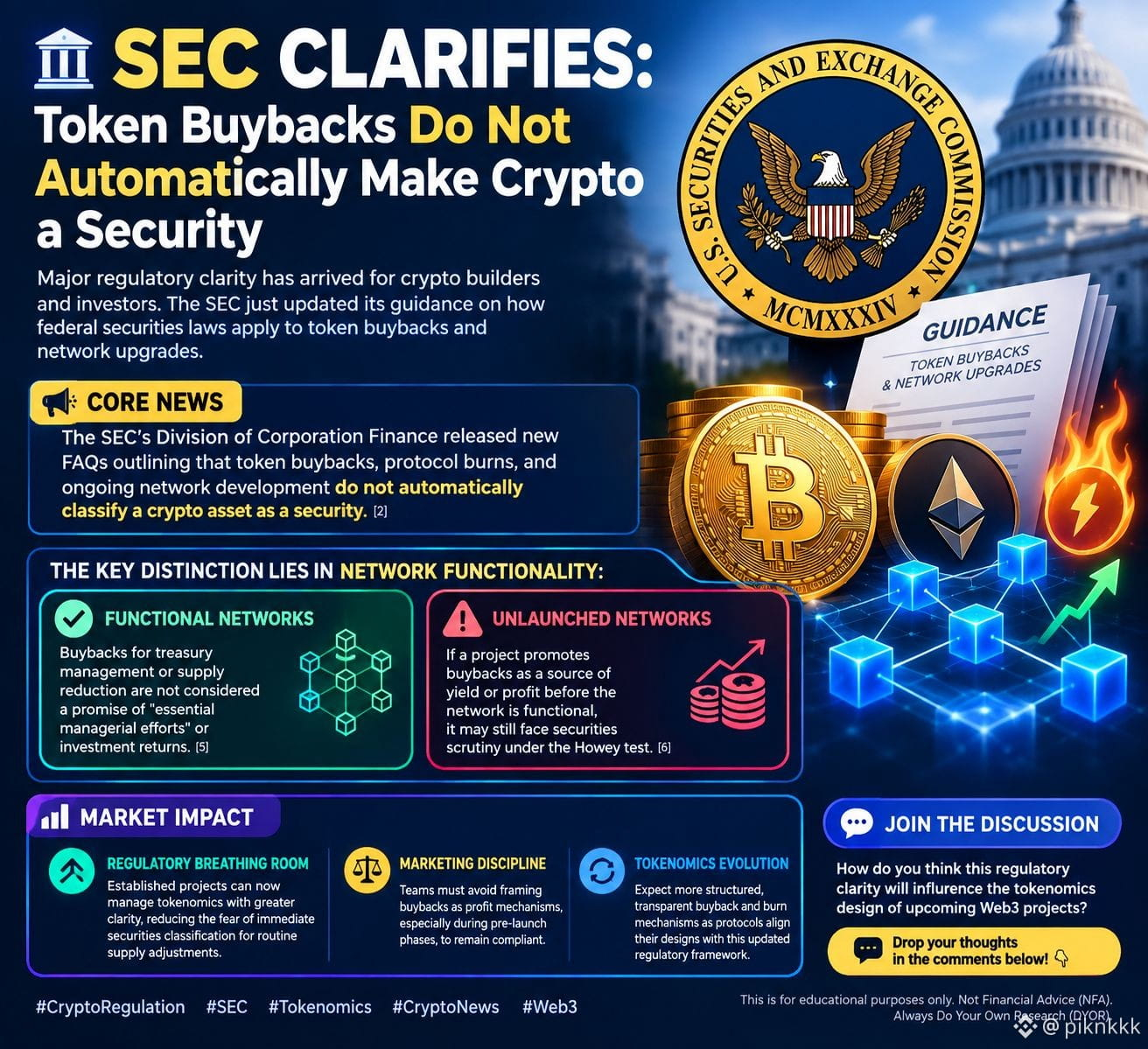
#secsaystokenbuybacksnotautosecurities 🏛️ SEC Clarifies Token Buybacks Do Not Automatically Make Crypto a Security
Major regulatory clarity has arrived for crypto builders and investors. The SEC just updated its guidance on how federal securities laws apply to token buybacks and network upgrades.
📰 Core News
The SEC’s Division of Corporation Finance released new FAQs outlining that token buybacks, protocol burns, and ongoing network development do not automatically classify a crypto asset as a security [[2]].
The key distinction lies in network functionality
• ✅ Functional Networks Buybacks for treasury management or supply reduction are not considered a promise of "essential managerial efforts" or investment returns [[5]].
•Unlaunched Networks If a project promotes buybacks as a source of yield or profit before the network is functional, it may still face securities scrutiny under the Howey test [[6]].
📊 Market Impact
• 📈 Regulatory Breathing Room Established projects can now manage tokenomics with greater clarity, reducing the fear of immediate securities classification for routine supply adjustments.
• ⚖️ Marketing Discipline Teams must avoid framing buybacks as profit mechanisms, especially during pre-launch phases, to remain compliant.
• 🔄 Tokenomics Evolution Expect more structured, transparent buyback and burn mechanisms as protocols align their designs with this updated regulatory framework.
💬 Join the Discussion
How do you think this regulatory clarity will influence the tokenomics design of upcoming Web3 projects? Drop your thoughts in the comments below! 👇
#CryptoRegulation #SEC #Tokenomics #CryptoNews #Web3
This is for educational purposes only. Not Financial Advice (NFA). Always Do Your Own Research (DYOR)
$SAGA $2Z $ONE
{future}(ONEUSDT)
{future}(2ZUSDT)
{future}(SAGAUSDT)
#secsaystokenbuybacksnotautosecurities 🏛️ SEC Clarifies Token Buybacks Do Not Automatically Make Crypto a Security
Major regulatory clarity has arrived for crypto builders and investors. The SEC just updated its guidance on how federal securities laws apply to token buybacks and network upgrades.
📰 Core News
The SEC’s Division of Corporation Finance released new FAQs outlining that token buybacks, protocol burns, and ongoing network development do not automatically classify a crypto asset as a security [[2]].
The key distinction lies in network functionality
• ✅ Functional Networks Buybacks for treasury management or supply reduction are not considered a promise of "essential managerial efforts" or investment returns [[5]].
•Unlaunched Networks If a project promotes buybacks as a source of yield or profit before the network is functional, it may still face securities scrutiny under the Howey test [[6]].
📊 Market Impact
• 📈 Regulatory Breathing Room Established projects can now manage tokenomics with greater clarity, reducing the fear of immediate securities classification for routine supply adjustments.
• ⚖️ Marketing Discipline Teams must avoid framing buybacks as profit mechanisms, especially during pre-launch phases, to remain compliant.
• 🔄 Tokenomics Evolution Expect more structured, transparent buyback and burn mechanisms as protocols align their designs with this updated regulatory framework.
💬 Join the Discussion
How do you think this regulatory clarity will influence the tokenomics design of upcoming Web3 projects? Drop your thoughts in the comments below! 👇
#CryptoRegulation #SEC #Tokenomics #CryptoNews #Web3
This is for educational purposes only. Not Financial Advice (NFA). Always Do Your Own Research (DYOR)
$SAGA $2Z $ONE
1
5
5.2k

·
--
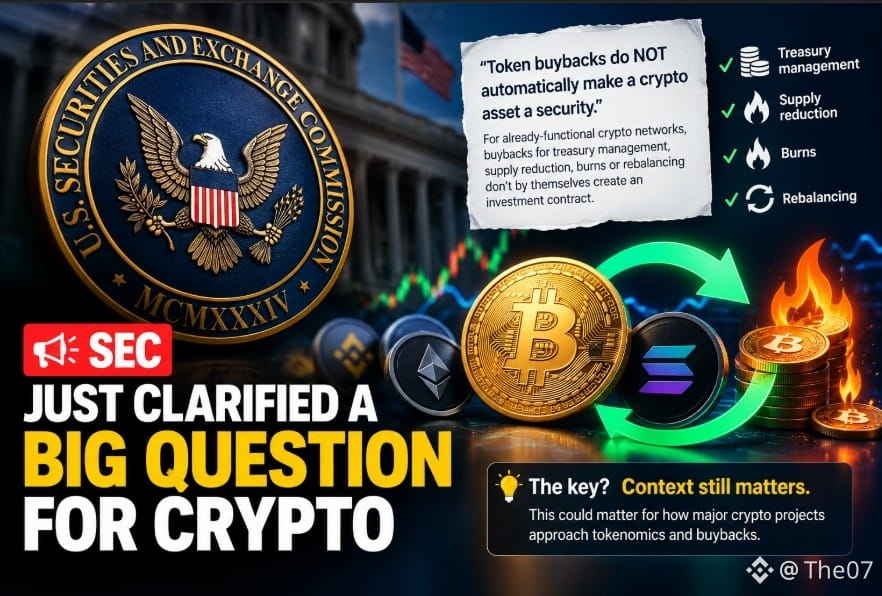
🚨 SEC JUST CLARIFIED A BIG QUESTION FOR CRYPTO
The SEC says token buybacks do NOT automatically make a crypto asset a security. 👀
For already-functional crypto networks, buybacks for treasury management, supply reduction, burns or rebalancing don’t by themselves create an investment contract.
🔥 This could matter for how major crypto projects approach tokenomics and buybacks.
The key? Context still matters.
What do you think this means for the crypto market? 👇
#crypto #bitcoin #altcoins #blockchain
#secsaystokenbuybacksnotautosecurities
2
2.8k

·
--
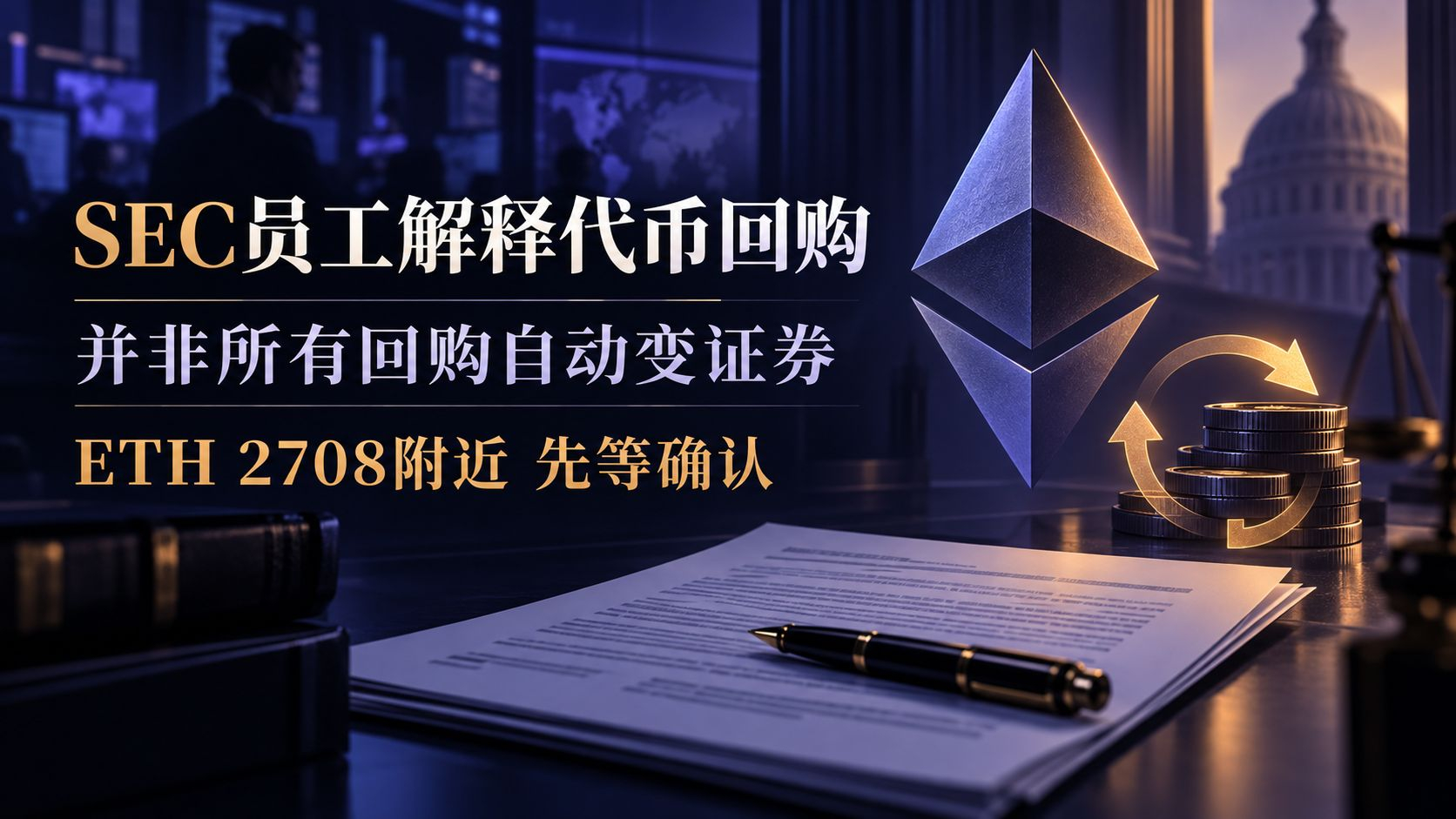
SEC staff explain token buybacks|Not all buybacks automatically become securities|ETH at 2708, I’ll wait to confirm
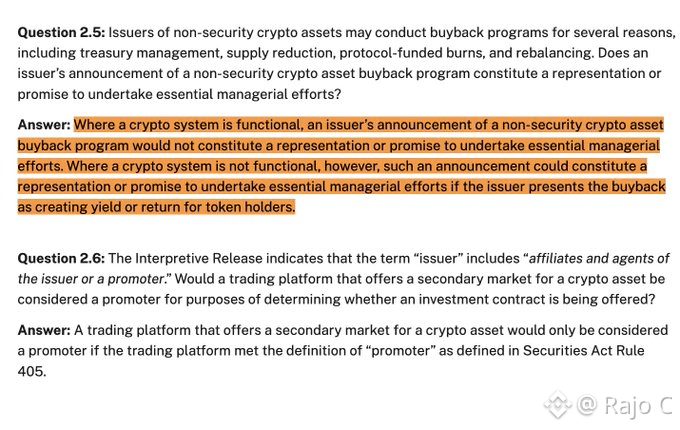
My stance is neutral to cautious: Binance Square’s hot榜 #SECSaysTokenBuybacksNotAutoSecurities highlights an important shift, but I won’t translate it as “Ethereum ecosystem tokens are broadly exempt from securities requirements,” and I won’t therefore rush to buy ETH directly. In Question 2.5 of the U.S. SEC’s September 25 staff-issued Crypto Assets Q&A, the discussion is about buyback plans of issuers of non-security crypto assets. In cases where the crypto system already has the relevant functionality, staff believe that simply announcing a buyback does not, on its own, constitute an undertaking to expend key managerial efforts. If the system is not yet functional and the issuer markets the buyback as creating returns for holders, the conclusion could be different. The document also states at the outset: these are employees’ views, not SEC rules, committee statements, and it has no new legal effect. The purpose of the buyback, whether the system has the functionality, and how it is marketed—those still need to be assessed fact by fact.
How does this relate to ETH? It’s indirect. On Ethereum there are many protocol tokens, and some projects do indeed embed fees, treasury management, or buyback-and-burn into their tokenomics. If the regulatory interpretation reduces blanket uncertainty, it may improve expectations for development teams and capital allocators; however, what’s being discussed are specific tokens and specific issuer behaviors—not an automatic additional cash inflow to the ETH mainnet, and certainly not that all projects’ buybacks will create spot-buy demand for ETH. Even if regulatory disputes for a project diminish, it may still fail to support its token price due to insufficient revenue, buybacks that are too small, unlock pressure, or opaque execution. I’d rather see projects publish verifiable revenue, the source of buyback funds, and on-chain execution—not just rely on the phrase “a regulatory positive.”
How has the market reacted? At the time of writing, Kraken’s ETH/USD is around $2707.60, with a 24-hour high of $2722.39 and a low of $2663.17, and an opening price of $2695.38. The current price is slightly above the open, but still within today’s range. This set of data can’t prove that ETH’s rise was caused by this Q&A, especially since weekend liquidity and other news are also present. First, watch whether $2722 to $2730 can hold steady. On the downside, look around $2695 and the intraday low near $2663. If there’s a spike then pullback and a continuous break below $2695, or if the market quickly misreads the regulatory interpretation as an official exemption and then corrects, I would overturn my mildly bullish observation. The boundaries in the regulatory text are more worth careful reading than the hot榜 headline.
If I were trading personally, I wouldn’t participate. The direction would only consider taking a small spot long position after conditions are met—no high leverage. I’d only place a trial trade with no more than 1% of total capital if ETH is effectively holding above $2730, then pulls back toward $2720 without breaking it, and related Ethereum ecosystem assets do not show clear, synchronized selloffs. First target: $2760—once reached, cut the position in half. The remaining position would look toward $2800, but if price falls back below $2730, I’ll tighten take-profit early. I’d set a hard stop-loss at $2690. If, before entering, price first breaks below $2663, I cancel the whole plan. If a later SEC document changes this wording or the project’s buyback disclosures are unclear, I would close the position even if the price never hits my trigger levels. Risk budget first, then views.
Source: SEC Division of Corporation Finance Crypto Assets Q&A, Question 2.5; Kraken ETH/USD行情. #SECSaysTokenBuybacksNotAutoSecurities #ETH
The above is only my personal market observation and does not constitute investment advice.
1
103

#secsaystokenbuybacksnotautosecurities
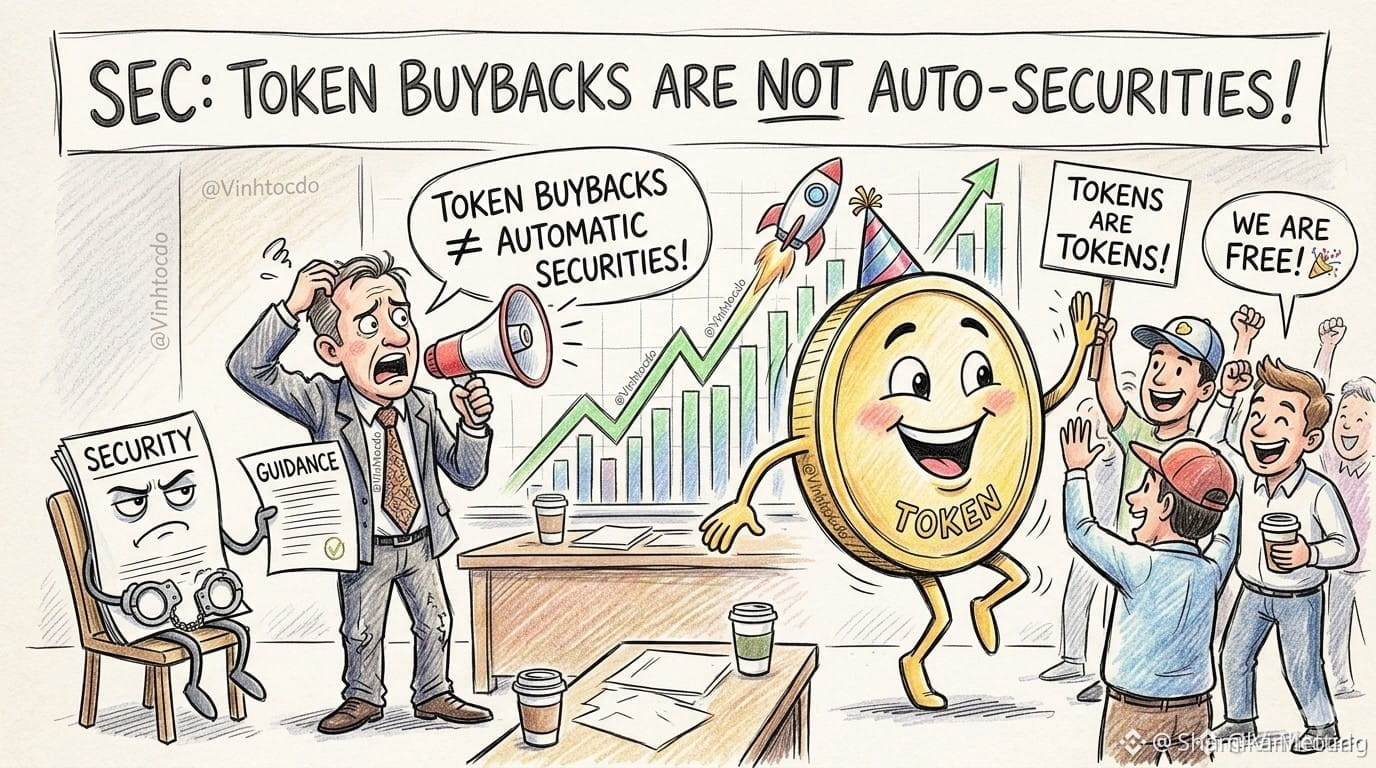
Finally, the U.S. Securities and Exchange Commission (SEC) said this: token buybacks don’t automatically make them a security! 🎉 So... tokens are tokens, and securities are securities, right, friends? Big win for clarification! What should traders do? Keep your eyes open, stay calm, and ride the upward momentum before the SEC changes its mind again! 📈
Not financial advice. Do your own research (DYOR)!
Follow-up, please
$BNB
{future}(BNBUSDT)
$ETH
{future}(ETHUSDT)
$SOL
{future}(SOLUSDT)
#secsaystokenbuybacksnotautosecurities #CryptoClarity #CryptoTrading #Binance
#secsaystokenbuybacksnotautosecurities
Finally, the U.S. Securities and Exchange Commission (SEC) said this: token buybacks don’t automatically make them a security! 🎉 So... tokens are tokens, and securities are securities, right, friends? Big win for clarification! What should traders do? Keep your eyes open, stay calm, and ride the upward momentum before the SEC changes its mind again! 📈
Not financial advice. Do your own research (DYOR)!
Follow-up, please
$BNB
$ETH
$SOL
#secsaystokenbuybacksnotautosecurities #CryptoClarity #CryptoTrading #Binance
3
3.5k

#SECSaysTokenBuybacksNotAutoSecurities
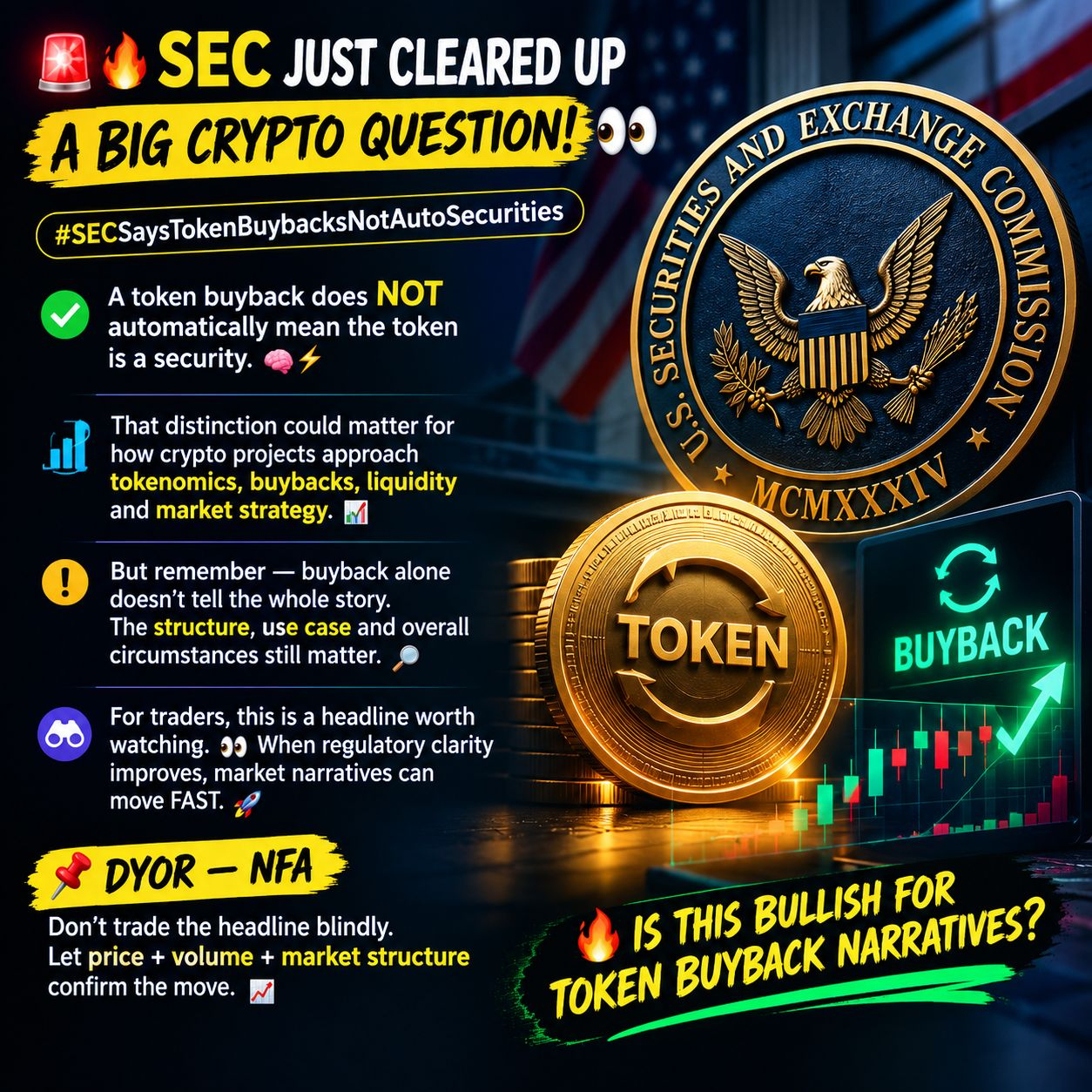
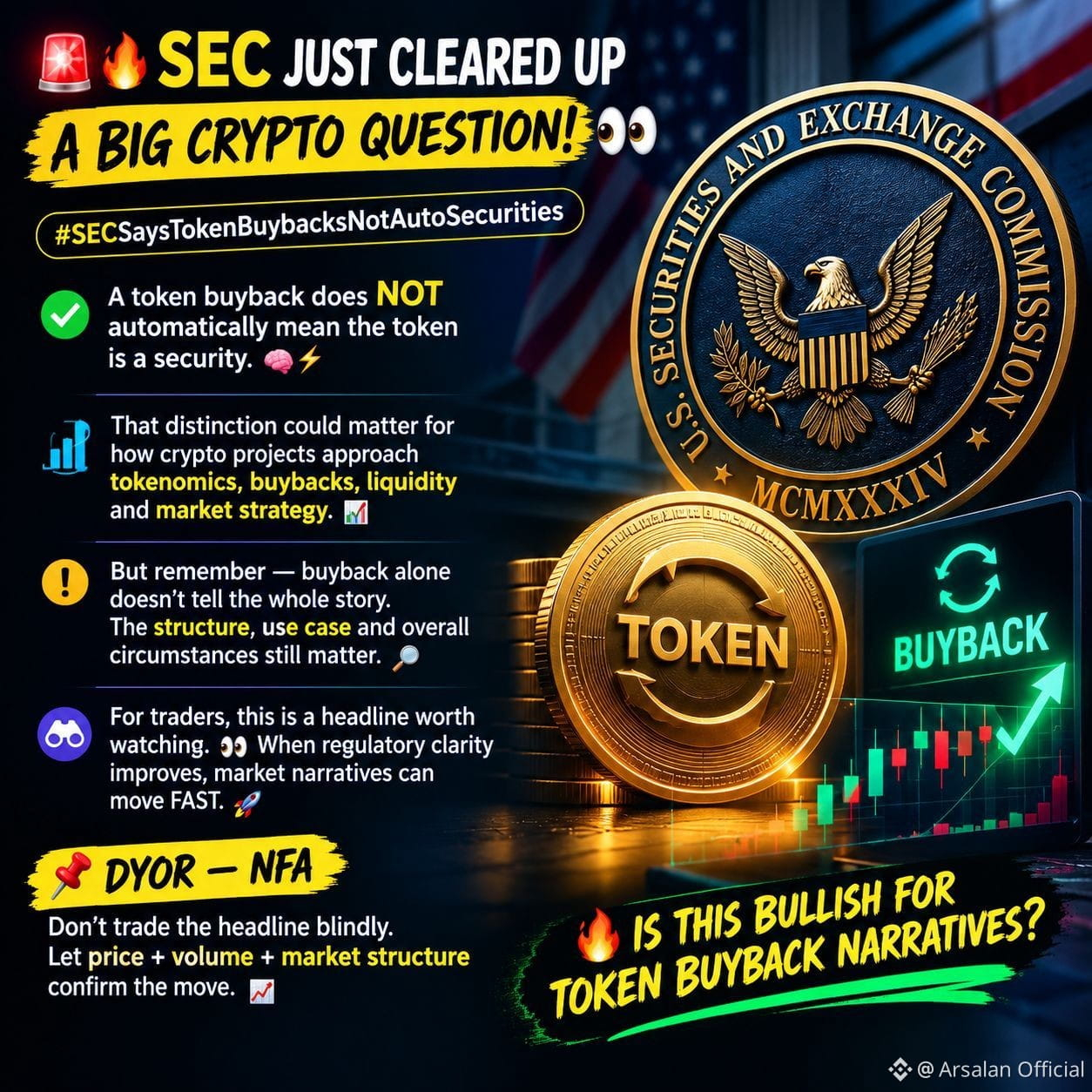
🚨🔥 SEC JUST CLEARED UP A BIG CRYPTO QUESTION! 👀
#SECSaysTokenBuybacksNotAutoSecurities
A token buyback does NOT automatically mean the token is a security. 🧠⚡
That distinction could matter for how crypto projects approach tokenomics, buybacks, liquidity and market strategy. 📊
But remember — buyback alone doesn’t tell the whole story.
The structure, use case and overall circumstances still matter. 🔍
For traders, this is a headline worth watching. 👀
When regulatory clarity improves, market narratives can move FAST. 🚀
📌 DYOR — NFA
Don’t trade the headline blindly. Let price + volume + market structure confirm the move.
🔥 Is this bullish for token buyback narratives?
$QNT
{future}(QNTUSDT)
$ZEC
{future}(ZECUSDT)
$BEAT
{future}(BEATUSDT)
#beat #zec #QNT #Binance
#SECSaysTokenBuybacksNotAutoSecurities
🚨🔥 SEC JUST CLEARED UP A BIG CRYPTO QUESTION! 👀
#SECSaysTokenBuybacksNotAutoSecurities
A token buyback does NOT automatically mean the token is a security. 🧠⚡
That distinction could matter for how crypto projects approach tokenomics, buybacks, liquidity and market strategy. 📊
But remember — buyback alone doesn’t tell the whole story.
The structure, use case and overall circumstances still matter. 🔍
For traders, this is a headline worth watching. 👀
When regulatory clarity improves, market narratives can move FAST. 🚀
📌 DYOR — NFA
Don’t trade the headline blindly. Let price + volume + market structure confirm the move.
🔥 Is this bullish for token buyback narratives?
$QNT
$ZEC
$BEAT
#beat #zec #QNT #Binance
1
1.4k

#SECSaysTokenBuybacksNotAutoSecurities
SEC Clarifies Crypto Token Guidelines 🚀
Big news for the crypto community! The SEC's Division of Corporation Finance has officially clarified that token buybacks, network upgrades, and routine marketing do not automatically classify crypto assets as securities.
According to the new guidance, announcing a buyback on an already functioning network doesn't instantly trigger investment contract status. However, context still matters—projects promoting unlaunched networks or advertising buybacks specifically as a source of direct financial yield will face tougher scrutiny.
This update offers a clearer regulatory path for operational blockchain projects! 🌐💼
What are your thoughts on this new regulatory stance?
#CircleMints500MUSDCOnSolana
#BitwiseFilesToListNEARETFOnNYSEArca
#CircleTetherFreezeBitgetHackerWallet
#Nadeemgujjar143
@Square-Creator-f3ffb6967ae3 @Helen_Alek @Square-Creator-331dbe6e47019
$BTC
{spot}(BTCUSDT)
$PEPE
{spot}(PEPEUSDT)
$SHOP
{future}(SHOPUSDT)
#SECSaysTokenBuybacksNotAutoSecurities
SEC Clarifies Crypto Token Guidelines 🚀
Big news for the crypto community! The SEC's Division of Corporation Finance has officially clarified that token buybacks, network upgrades, and routine marketing do not automatically classify crypto assets as securities.
According to the new guidance, announcing a buyback on an already functioning network doesn't instantly trigger investment contract status. However, context still matters—projects promoting unlaunched networks or advertising buybacks specifically as a source of direct financial yield will face tougher scrutiny.
This update offers a clearer regulatory path for operational blockchain projects! 🌐💼
What are your thoughts on this new regulatory stance?
#CircleMints500MUSDCOnSolana
#BitwiseFilesToListNEARETFOnNYSEArca
#CircleTetherFreezeBitgetHackerWallet
#Nadeemgujjar143
@aasho @HANI_Era @A N A
$BTC
$PEPE
$SHOP
1
2
233

·
--
THE SEC JUST REMOVED ONE OF CRYPTO’S BIGGEST BUYBACK FEARS. 🚨
New SEC staff guidance says token buybacks do NOT automatically turn a crypto asset into a security when the underlying network is already functional.
That matters because buybacks are becoming a much bigger part of tokenomics.
Projects can potentially use treasury funds to repurchase supply, burn tokens or rebalance ecosystems without the buyback itself automatically creating an investment contract.
But there’s a catch:
If a project markets buybacks as a promise of yield or future profit, especially before the network is functional, securities questions can still arise. And this is SEC staff guidance, not a new binding rule.
Still, the signal is clear:
Buybacks ≠ automatically securities.
Functional networks just got more regulatory breathing room. 👀
$XRP $ZEC $SPCX.US
{stock_us}(SPCX.US)
{spot}(ZECUSDT)
{spot}(XRPUSDT)
#TrumpRejectsIranHormuzReopening #CircleTetherFreezeBitgetHackerWallet #SECSaysTokenBuybacksNotAutoSecurities #ChinaUSAgreeOn$30BTariffCut #CoinMarketCapCompletesCoinglassAcquisition
THE SEC JUST REMOVED ONE OF CRYPTO’S BIGGEST BUYBACK FEARS. 🚨
New SEC staff guidance says token buybacks do NOT automatically turn a crypto asset into a security when the underlying network is already functional.
That matters because buybacks are becoming a much bigger part of tokenomics.
Projects can potentially use treasury funds to repurchase supply, burn tokens or rebalance ecosystems without the buyback itself automatically creating an investment contract.
But there’s a catch:
If a project markets buybacks as a promise of yield or future profit, especially before the network is functional, securities questions can still arise. And this is SEC staff guidance, not a new binding rule.
Still, the signal is clear:
Buybacks ≠ automatically securities.
Functional networks just got more regulatory breathing room. 👀
$XRP $ZEC $SPCX.US
#TrumpRejectsIranHormuzReopening #CircleTetherFreezeBitgetHackerWallet #SECSaysTokenBuybacksNotAutoSecurities #ChinaUSAgreeOn$30BTariffCut #CoinMarketCapCompletesCoinglassAcquisition
1
1
155

·
--
#secsaystokenbuybacksnotautosecurities LATEST:
🇺🇸
The SEC just clarified how U.S. securities
laws apply to crypto.
The key shift:
• A
token
can separate from the investment contract used to sell it
• Staking receipt tokens aren’t automatically
securities
• Functionality & decentralization matter
• Developers can maintain functional networks without automatically triggering Howey
• Token buybacks aren’t automatically securities transactions
• Secondary trading doesn’t automatically make exchanges promoters
The focus is increasingly on what the token represents, what was promised, and who controls the network.
These are NOT new SEC rules.$RARE $BEAT $BR
8
1
34
35.7k

·
--
Bearish
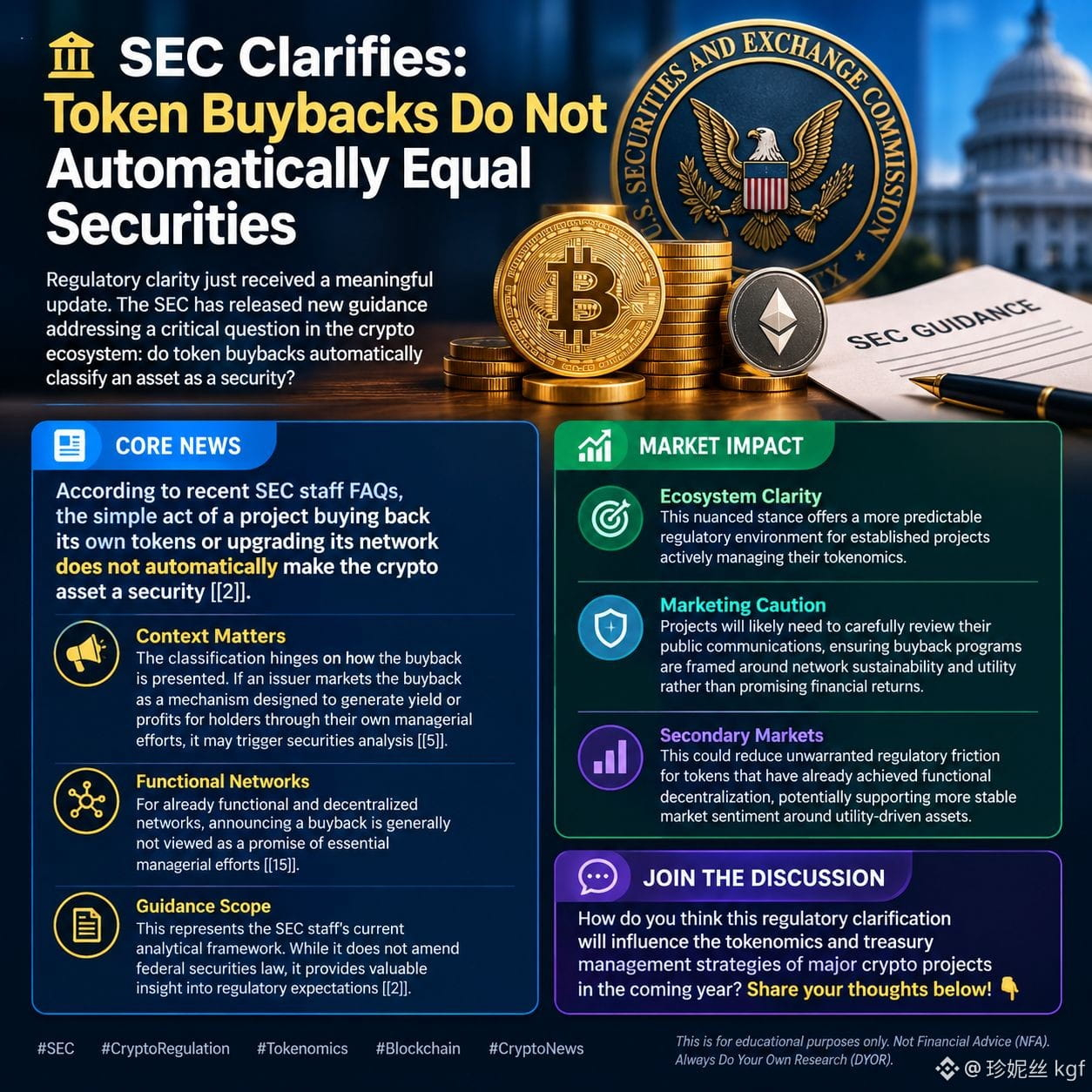
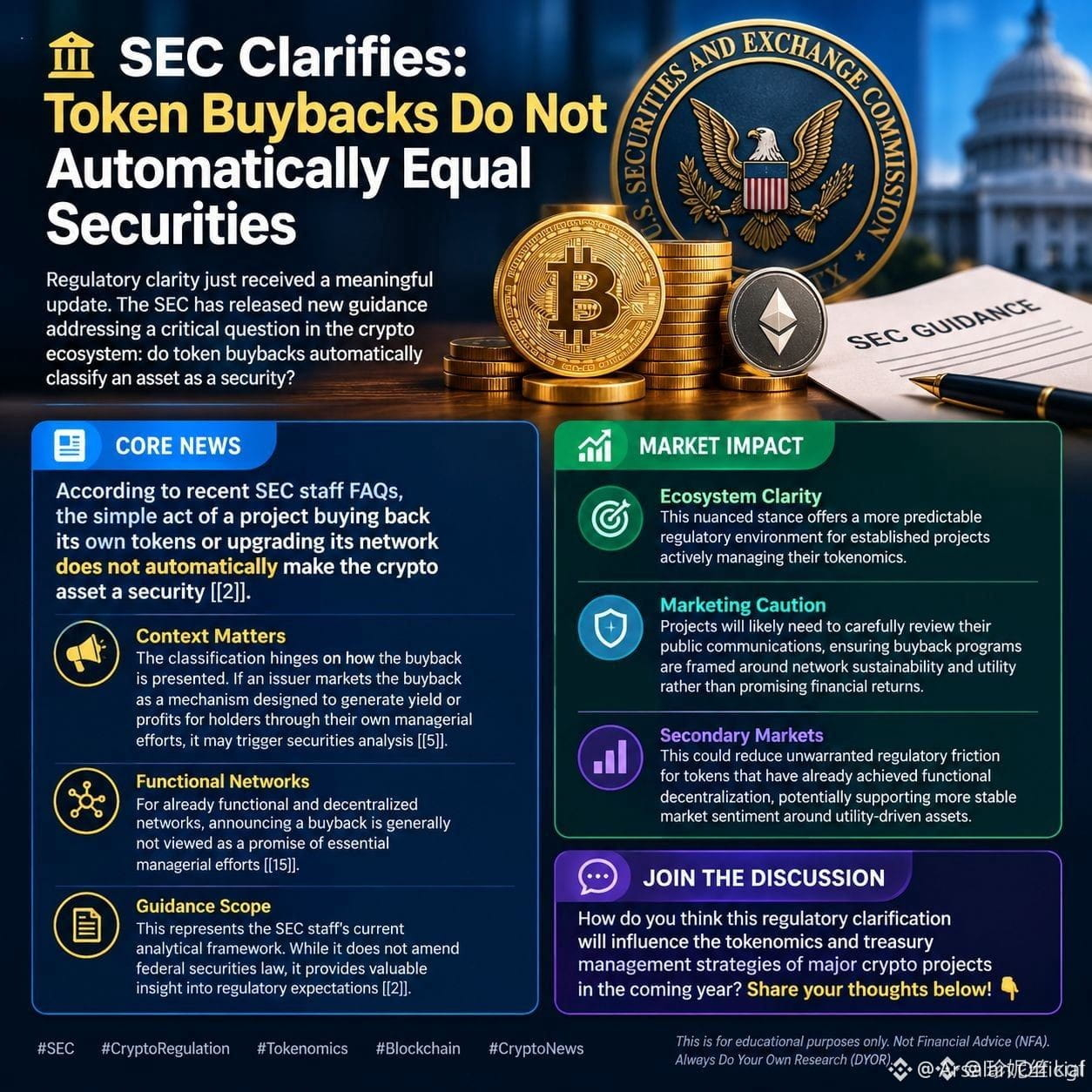
#secsaystokenbuybacksnotautosecurities 🏛️ SEC Clarifies: Token Buybacks ≠ Automatic Securities
Regulatory clarity just received a meaningful update. The SEC has released new guidance answering a critical crypto question: do token buybacks automatically classify an asset as a security?
📰 Core News
According to recent SEC staff FAQs, a project buying back its own tokens or upgrading its network does NOT automatically make the crypto asset a security.
• Context Matters: Classification hinges on presentation. If an issuer markets a buyback to generate yield or profits via managerial efforts, it may trigger securities analysis.
• Functional Networks: For already decentralized, functional networks, buybacks are generally not viewed as a promise of essential managerial efforts.
• Guidance Scope: This reflects the SEC staff’s current analytical framework, offering valuable regulatory insight without amending federal securities law.
📊 Market Impact
• Ecosystem Clarity: Provides a more predictable regulatory environment for established projects actively managing their tokenomics.
• Marketing Caution: Projects must carefully frame buybacks around network sustainability and utility, avoiding promised financial returns.
• Market Sentiment: Reduces regulatory friction for tokens that have achieved functional decentralization, supporting stability for utility-driven assets.
💬 Join the Discussion
How will this regulatory clarification influence the tokenomics and treasury management strategies of major crypto projects this year? Share your thoughts below! 👇
#SEC #CryptoRegulation #Tokenomics #Blockchain #CryptoNews
This is for educational purposes only. Not Financial Advice (NFA). Always Do Your Own Research (DYOR).
$TNSR $WAXP $QUICK
{spot}(QUICKUSDT)
{future}(WAXPUSDT)
{future}(TNSRUSDT)
#secsaystokenbuybacksnotautosecurities 🏛️ SEC Clarifies: Token Buybacks ≠ Automatic Securities
Regulatory clarity just received a meaningful update. The SEC has released new guidance answering a critical crypto question: do token buybacks automatically classify an asset as a security?
📰 Core News
According to recent SEC staff FAQs, a project buying back its own tokens or upgrading its network does NOT automatically make the crypto asset a security.
• Context Matters: Classification hinges on presentation. If an issuer markets a buyback to generate yield or profits via managerial efforts, it may trigger securities analysis.
• Functional Networks: For already decentralized, functional networks, buybacks are generally not viewed as a promise of essential managerial efforts.
• Guidance Scope: This reflects the SEC staff’s current analytical framework, offering valuable regulatory insight without amending federal securities law.
📊 Market Impact
• Ecosystem Clarity: Provides a more predictable regulatory environment for established projects actively managing their tokenomics.
• Marketing Caution: Projects must carefully frame buybacks around network sustainability and utility, avoiding promised financial returns.
• Market Sentiment: Reduces regulatory friction for tokens that have achieved functional decentralization, supporting stability for utility-driven assets.
💬 Join the Discussion
How will this regulatory clarification influence the tokenomics and treasury management strategies of major crypto projects this year? Share your thoughts below! 👇
#SEC #CryptoRegulation #Tokenomics #Blockchain #CryptoNews
This is for educational purposes only. Not Financial Advice (NFA). Always Do Your Own Research (DYOR).
$TNSR $WAXP $QUICK
1
3
1.9k

Have you noticed how quickly one SEC sentence turns into a buy signal around here?
The pain is always the same. Traders load the headline, skip the nuance, and then have no clean exit once the market realizes the ruling was narrower than the replies made it sound.
The SEC saying token buybacks are not automatically securities is being treated like a blanket exemption. It is not. This is a case study in selective hearing. Not automatically still means the facts matter. How the buyback is funded, whether it is tied to real activity, and what holders are actually being promised all stay on the table. In a greed tape like this, that distinction gets buried in about ten minutes.
Look at $BNB. The buyback and burn there has been tied to actual platform flow for years, which is a different setup from an altcoin draining treasury $USDT just to defend a level. $QNT sits closer to the utility side of that spectrum, which is why this headline should make you inspect the mechanism instead of the marketing. A protocol recycling fees is not the same as a team manufacturing bid with leftover raise money.
The projects that treat this as permission to run buyback theater will be the next ones people study. The ones with a working revenue loop just got a slightly clearer lane. That is the whole story.
Where do you think this leaves tokens that have been buying themselves back with no revenue behind them?
#SECSaysTokenBuybacksNotAutoSecurities #StrategyStriveAdd2305BitcoinThisWeek #CircleTetherFreezeBitgetHackerWallet
Have you noticed how quickly one SEC sentence turns into a buy signal around here?
The pain is always the same. Traders load the headline, skip the nuance, and then have no clean exit once the market realizes the ruling was narrower than the replies made it sound.
The SEC saying token buybacks are not automatically securities is being treated like a blanket exemption. It is not. This is a case study in selective hearing. Not automatically still means the facts matter. How the buyback is funded, whether it is tied to real activity, and what holders are actually being promised all stay on the table. In a greed tape like this, that distinction gets buried in about ten minutes.
Look at $BNB . The buyback and burn there has been tied to actual platform flow for years, which is a different setup from an altcoin draining treasury $USDT just to defend a level. $QNT sits closer to the utility side of that spectrum, which is why this headline should make you inspect the mechanism instead of the marketing. A protocol recycling fees is not the same as a team manufacturing bid with leftover raise money.
The projects that treat this as permission to run buyback theater will be the next ones people study. The ones with a working revenue loop just got a slightly clearer lane. That is the whole story.
Where do you think this leaves tokens that have been buying themselves back with no revenue behind them?
#SECSaysTokenBuybacksNotAutoSecurities #StrategyStriveAdd2305BitcoinThisWeek #CircleTetherFreezeBitgetHackerWallet
40
·
--
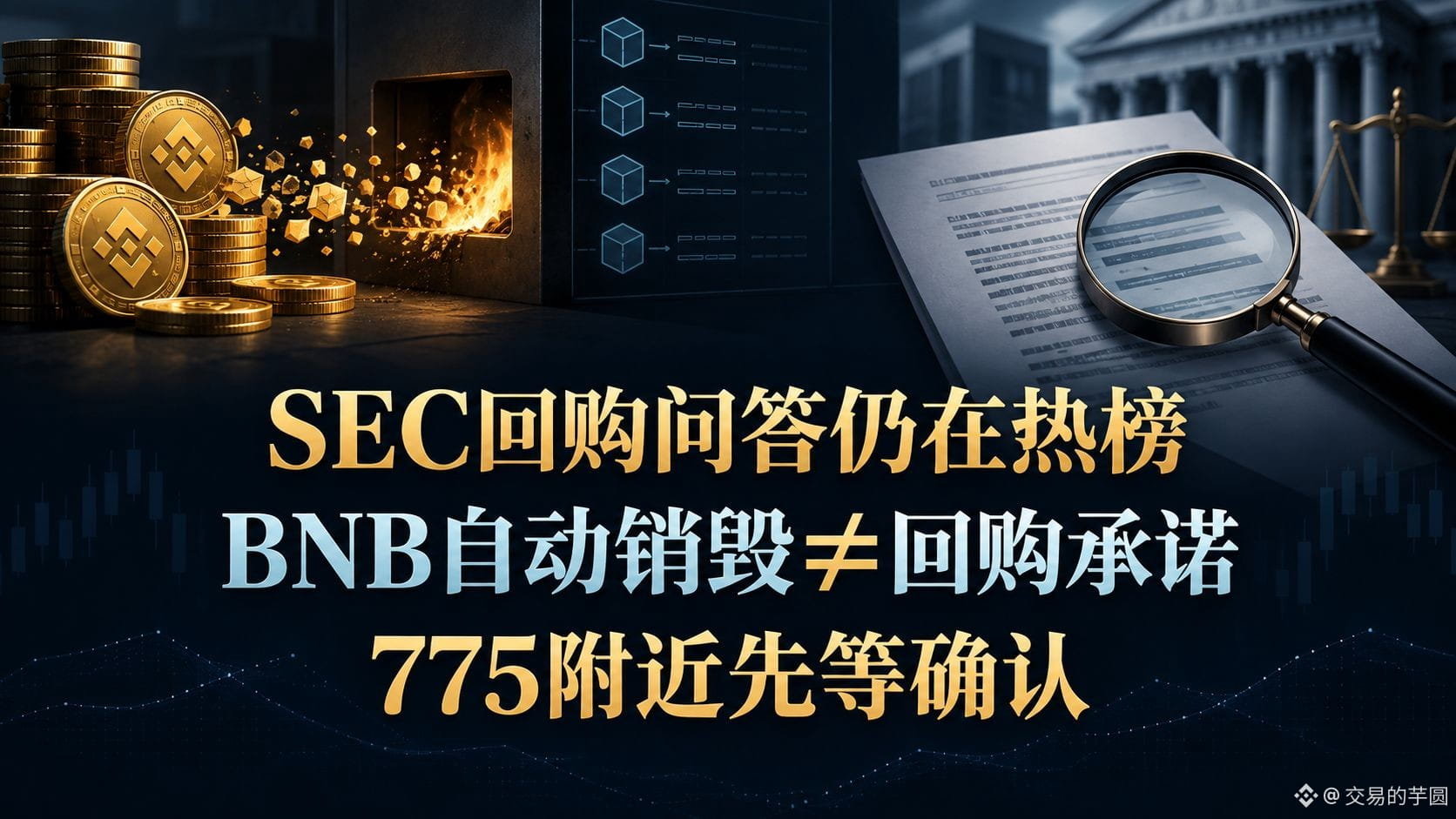
SEC share buyback Q&A is still trending|BNB automatic burns are not an issuer buyback commitment|Around 775 I’ll wait first
My view is to separate legal concepts from the token supply mechanism first, and then decide whether to touch BNB. Binance Square’s hot list currently still shows #SECSaysTokenBuybacksNotAutoSecurities, but if this headline is read as “all burns receive SEC approval,” it’s overstated. In a Sept 25 update to Item 2.5 of its staff Q&A, the U.S. SEC’s Office of the Chief Financial Officer discusses the relationship between crypto assets that were not securities in the first place, an issuer’s announcement of buybacks, and “key managerial efforts.” The outcome may differ between systems that are already functional versus systems that are not yet functional; if the latter wraps buybacks into a promise of holder-borne returns, the risk cannot be eliminated by the headline. The page makes clear this is the staff’s viewpoint, not an official SEC rule, and it also doesn’t make any case-specific determination about BNB.
Now look at BNB itself. On July 15, the BNB Foundation announced that the 36th quarterly burn was completed: about 1.6158 million BNB. At the time of the announcement, remaining supply was about 133.17 million BNB. This is a July historical event, not a new burn tonight. The official explanation is that Auto-Burn adjusts according to BNB’s price and the number of blocks in the quarter; the target total gradually steps down to one hundred million BNB, and the mechanism is independent of Binance’s centralized exchange. There is also real-time burning related to on-chain Gas fees. Neither of these mechanisms can simply be mapped to a stock buyback narrative of “the company using cash to sweep the market,” and you also can’t double-count already-burned tokens as added buy-side demand right now. The hot list is about legal Q&A, while BNB data is about the supply side—analyzing them together can be meaningful, but they don’t mutually certify each other.
What I care about is the transmission chain: whether actual network usage, fees, and supply changes can sustainably improve holders’ expectations; regulatory wording can only reduce some concept misreadings and can’t replace demand. Burns reduce supply, but price is still influenced by macro interest rates, risk appetite, exchange and ecosystem security, and the concentration level of holdings. On Sept 16, the U.S. Federal Reserve raised the federal funds target range to 3.75%–4%. The market reaction likewise didn’t provide any single-cause evidence: when I wrote this, Kraken’s BNB/USD was around $775.57; over the last 24 hours it ranged from a high of $782.96 to a low of $766.79, with an open at $773.39—just slightly above the open and below the high. You can’t say this volatility is driven by the SEC Q&A or the old burn.
For the key levels in the short term, I’m watching whether 778 to 783 can become support again; below that, first watch 772, then 766.8. If a one-hour period closes effectively above 783 and then retests without breaking it, along with verifiable real on-chain usage rather than repeatedly circulating the old burn, then my wait-and-see view could be overturned. If 766.8 breaks, it indicates short-term risk is ahead of the narrative. If the SEC or the BNB Foundation releases new official documents, I’ll update based on the text and won’t pre-assume the next burn amount or timing.
If I were trading myself: I wouldn’t participate now. The plan is conditional, unleveraged spot longs with position size at 0% of total capital. Only if there are two consecutive 15-minute closes above $783, followed by a pullback from 780 to 783 that holds, would I consider putting in at most 0.25% of total capital. First target: 788 (take half off). Second target: 798 (close the remaining position). After entry, if a 15-minute close returns below 780, I’d cut the position in half; if it falls to 774, I’d fully exit with a stop. If before entry it first breaks below 766.8, I’d cancel the buy plan directly. Even if the hotspot stays hot, I won’t use regulatory headlines as a substitute for an entry signal, nor will I write the plan as if the trade is already filled.
#SECSaysTokenBuybacksNotAutoSecurities #BNB
The above is only my personal market observation and does not constitute investment advice.
52

·
--
The SEC has stated that token buybacks are not automatically considered securities. This clarification is crucial for many projects in the crypto space that utilize buyback mechanisms. It suggests a more nuanced approach from regulators, potentially easing concerns for token issuers. However, the exact implementation and interpretation will likely depend on specific circumstances and ongoing regulatory developments. This ruling could impact how projects structure their tokenomics and treasury management moving forward, potentially fostering more innovation within compliant frameworks.
#SECSaysTokenBuybacksNotAutoSecurities
#SECSaysTokenBuybacksNotAutoSecurities
1
92

#SECSaysTokenBuybacksNotAutoSecurities Token buybacks, network upgrades, and routine product marketing do not automatically turn a crypto asset into a security.
The SEC Division of Corporation Finance's updated Crypto Asset FAQs outline how the Howey test applies to digital asset activities:
#SECSaysTokenBuybacksNotAutoSecurities Token buybacks, network upgrades, and routine product marketing do not automatically turn a crypto asset into a security.
The SEC Division of Corporation Finance's updated Crypto Asset FAQs outline how the Howey test applies to digital asset activities:
The SEC Division of Corporation Finance's updated Crypto Asset FAQs outline how the Howey test applies to digital asset activities:
1
107

#SECSaysTokenBuybacksNotAutoSecurities The SEC’s crypto guidance highlights that token buybacks or network upgrades do not automatically make a token a security—the specific facts and circumstances still matter.
#CryptoNews #SEC #CryptoRegulation #CryptoMarket $BTC
{spot}(BTCUSDT)
$ETH
{spot}(ETHUSDT)
#SECSaysTokenBuybacksNotAutoSecurities The SEC’s crypto guidance highlights that token buybacks or network upgrades do not automatically make a token a security—the specific facts and circumstances still matter.
#CryptoNews #SEC #CryptoRegulation #CryptoMarket $BTC
$ETH
#CryptoNews #SEC #CryptoRegulation #CryptoMarket $BTC
$ETH
1
68
SEC Clarifies Encryption Supervision Framework, Tokenized US Stocks Bring a Historic Opportunity
I. Regulatory Breakthrough: SEC and CFTC Join Forces to Draw New Boundaries for Crypto Assets
At the end of September 2026, the U.S. crypto market witnessed a landmark regulatory development. U.S. Securities and Exchange Commission (SEC) staff released new guidance, stating clearly that receipt tokens generated from staking Ethereum do not constitute securities when they operate solely as receipt functions. Meanwhile, the SEC also pointed out that token buybacks or network upgrades themselves will not automatically qualify the related assets as securities. This stance was widely interpreted by the market as a major positive catalyst, and the hashtag SECSaysTokenBuybacksNotAutoSecurities quickly climbed to the top of Binance Square’s trending topics.
Around the same time, the U.S. Commodity Futures Trading Commission (CFTC) also announced an expansion of its regulatory scope. It allows futures firms to hold tokenized assets for customers and use blockchain technology for ledger recordkeeping. This means that regulated traditional financial institutions have officially been granted access to decentralized finance (DeFi) infrastructure. With both regulators releasing goodwill at the same time, it marks a critical step in U.S. crypto oversight moving from ambiguity toward clarity.
II. Treasury Yields Soar—Traditional Assets Face Pressure, While Crypto Shows Resilience
At the same time, the U.S. macro environment is undergoing profound changes. The yield on the 10-year U.S. Treasury climbed to 5.23%, the highest level since 2007; the yield on the 30-year Treasury touched 5.49%, reaching a peak not seen since 2004. Factors driving yields higher include ongoing inflation pressure, a large wave of AI-driven investment fervor, and a sharp increase in Treasury issuance. Total U.S. Treasury debt has surpassed the $40 trillion mark, and the Congressional Budget Office warned that if yields remain 80 basis points above the benchmark level, annual interest costs by the end of this century could reach as much as $2.7 trillion.
Against the backdrop of pressure in traditional bond markets, the crypto market has displayed notable resilience. U.S. spot Bitcoin ETFs recorded net inflows of $2.39 billion this week, setting the largest single-week inflow record since 2026, and they have maintained net inflows for seven consecutive days. BlackRock’s IBIT fund attracted $97 million of capital on just September 25 alone. JPMorgan analysts noted that if ETF short positions are closed, Bitcoin could outperform gold. Bitcoin is currently trading near $84,000, with the RSI at 78.5, indicating the market is in an overbought state, but the inflow momentum remains strong.
III. Tokenized US Stock Ecosystem Accelerates Expansion—ENA’s Surge Confirms Market Confidence
Driven by both regulatory clarity and the influx of institutional capital, the tokenized US stock ecosystem is expanding rapidly. Ethena (ENA) and Binance stock perpetual futures have reached a deep collaboration, bringing tokenized stock receipts (bStocks) into the collateral framework of USDe. This move is seen as the most significant mechanism expansion for USDe since its launch. After the news was announced, ENA’s price surged 277% from its July low, reaching the 2026 high of $0.28. It added $90 million in staked capital and increased stablecoin market value by $35.8 million. Binance Wallet currently offers USDe the highest annualized yield of 4.75%.
According to data from Binance Square, BTC—with more than 23,000 mentions—steadily ranks first on the news heat chart, followed by SOL and BNB with 16,000 and 13,600 mentions respectively. In the tokenized US stock contract gainers-and-losers ranking, QNT led the pack with a 70.6% increase. Q and RARE rose by 44.4% and 35% respectively, showing that market enthusiasm for tokenized assets continues to heat up.
IV. Stablecoin Regulation Accelerates—Dollar Globalization Strategy Deepens
Under the GENIUS Act framework, the Federal Reserve released two regulatory proposals for payment-type stablecoins, requiring issuers to back tokens with full reserves comprised of short-term Treasury bills and high-quality liquid assets. The Trump administration is also considering promoting US dollar-supported stablecoins overseas through a combined government and private-sector approach. A series of moves like these indicates that dollar stablecoins are upgrading from mere tools within the crypto circle to a strategic vehicle for the globalization of U.S. money. Circle’s minting of 500 million USDC on the Solana chain also reflects the continued expansion of stablecoin infrastructure.
V. Outlook: Faster Integration Between Traditional Finance and the Crypto World
Overall, the current market’s core narrative is shaped by: SEC and CFTC regulatory clarity, the safe-haven effect of crypto assets amid high Treasury yields, mechanism innovation in tokenized US stocks, and the acceleration of stablecoin regulation. Barriers between traditional finance and the crypto world are dissolving at an unprecedented pace. For investors, staying alert to regulatory developments, grasping tokenization trends, and allocating assets rationally will be the most important tasks ahead.
#SECSaysTokenBuybacksNotAutoSecurities #CircleMints500MUSDCOnSolana #BTCETFRecordInflows
246
#SECSaysTokenBuybacksNotAutoSecurities The SEC’s Division of Corporation Finance issued new crypto FAQs clarifying that token buybacks and network upgrades do not automatically make a crypto asset a security. The guidance emphasizes that the legal analysis remains case-by-case, including how buybacks are presented to investors and whether they involve promises of profit.
The September 25 guidance is staff guidance, not a new SEC rule, but it provides additional clarity for crypto projects navigating U.S. securities laws.
#SEC #CryptoRegulation #TokenBuybacks #Crypto $BTC
{spot}(BTCUSDT)
#SECSaysTokenBuybacksNotAutoSecurities The SEC’s Division of Corporation Finance issued new crypto FAQs clarifying that token buybacks and network upgrades do not automatically make a crypto asset a security. The guidance emphasizes that the legal analysis remains case-by-case, including how buybacks are presented to investors and whether they involve promises of profit.
The September 25 guidance is staff guidance, not a new SEC rule, but it provides additional clarity for crypto projects navigating U.S. securities laws.
#SEC #CryptoRegulation #TokenBuybacks #Crypto $BTC
The September 25 guidance is staff guidance, not a new SEC rule, but it provides additional clarity for crypto projects navigating U.S. securities laws.
#SEC #CryptoRegulation #TokenBuybacks #Crypto $BTC
1
78
·
--
#secsaystokenbuybacksnotautosecurities According to the SEC
:
Buying tokens off the market to manage treasury, or reduce supply is treated as ordinary operations and is fine.
Marketing
buybacks as a profit mechanism can be treated as selling an "investment" and are not fine.$ACE $LYN $KMNO
#secsaystokenbuybacksnotautosecurities According to the SEC
:
Buying tokens off the market to manage treasury, or reduce supply is treated as ordinary operations and is fine.
Marketing
buybacks as a profit mechanism can be treated as selling an "investment" and are not fine.$ACE $LYN $KMNO
:
Buying tokens off the market to manage treasury, or reduce supply is treated as ordinary operations and is fine.
Marketing
buybacks as a profit mechanism can be treated as selling an "investment" and are not fine.$ACE $LYN $KMNO
3
7.5k

·
--
Token buybacks are getting more attention, but a buyback alone doesn’t automatically make a token a security.
The actual structure, rights, expectations, and how the asset is offered all matter.
#SECSaysTokenBuybacksNotAutoSecurities
Token buybacks are getting more attention, but a buyback alone doesn’t automatically make a token a security.
The actual structure, rights, expectations, and how the asset is offered all matter.
#SECSaysTokenBuybacksNotAutoSecurities
The actual structure, rights, expectations, and how the asset is offered all matter.
#SECSaysTokenBuybacksNotAutoSecurities
135

·
--
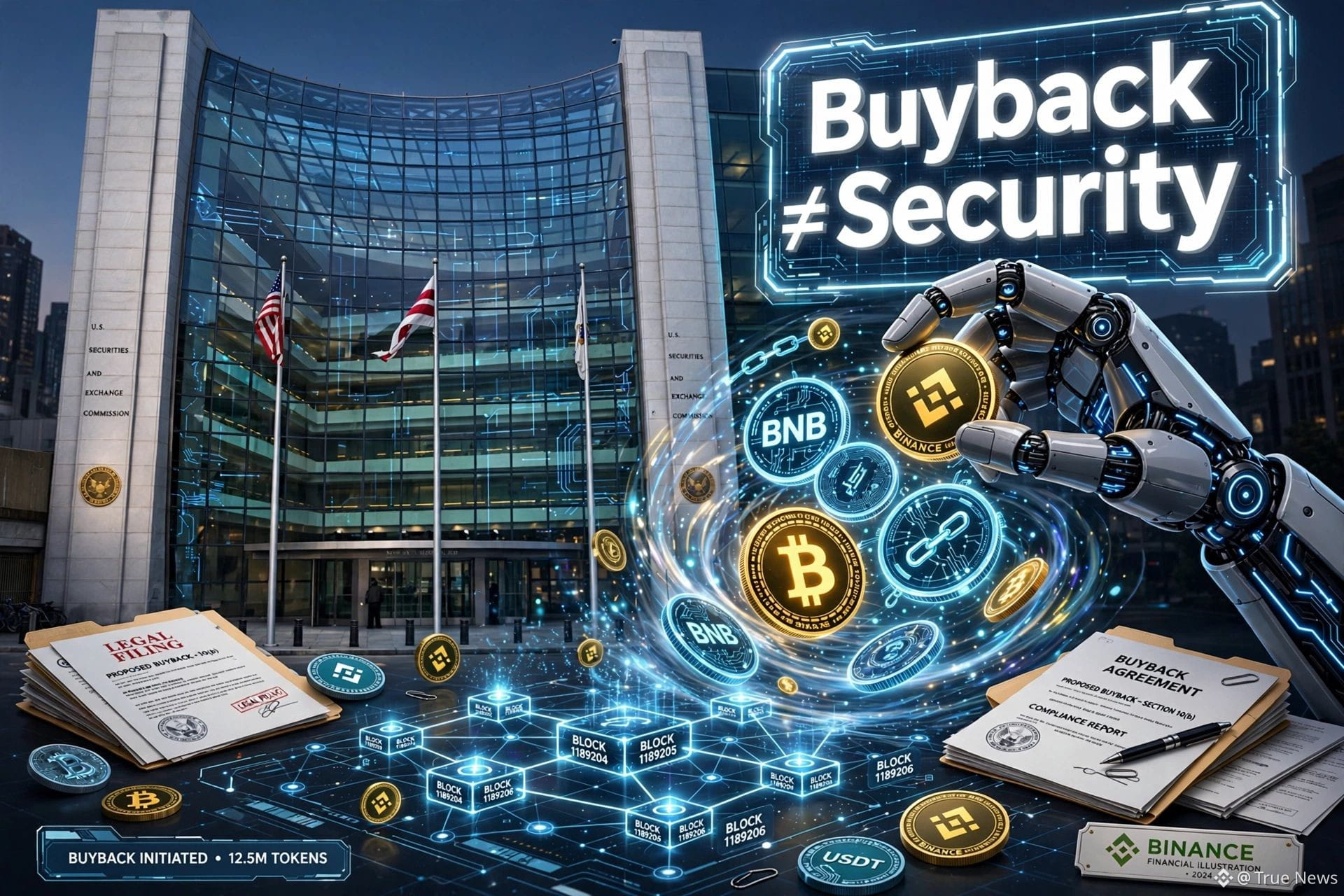
🔥 HUGE CLARITY: SEC Says Token Buybacks Are NOT Automatically Securities
Big win for crypto! The U.S. SEC has clarified that token buybacks by themselves do NOT make a token a security.
What this means:
Previously, many projects were scared that if they do buyback & burn, SEC will label them as securities. Now the SEC says:
Buyback ≠ Security. The Howey Test still applies fully.
Why this is bullish:
✅ Projects can now do buybacks confidently (like $BNB quarterly burn)
✅ More sustainable tokenomics
✅ Less regulatory fear for builders
✅ Paves way for more US-based token launches
This is a major step towards clear crypto regulation. Projects that use profits to buy back tokens from the market are showing strength, not selling securities.
Is this the regulatory green light we were waiting for?
$ONDO $SHIB
{spot}(SHIBUSDT)
{future}(ONDOUSDT)
#CryptoRegulation #BNB #Binance #NotASecurity #CryptoNews #Bullish#secsaystokenbuybacksnotautosecurities
🔥 HUGE CLARITY: SEC Says Token Buybacks Are NOT Automatically Securities
Big win for crypto! The U.S. SEC has clarified that token buybacks by themselves do NOT make a token a security.
What this means:
Previously, many projects were scared that if they do buyback & burn, SEC will label them as securities. Now the SEC says:
Buyback ≠ Security. The Howey Test still applies fully.
Why this is bullish:
✅ Projects can now do buybacks confidently (like $BNB quarterly burn)
✅ More sustainable tokenomics
✅ Less regulatory fear for builders
✅ Paves way for more US-based token launches
This is a major step towards clear crypto regulation. Projects that use profits to buy back tokens from the market are showing strength, not selling securities.
Is this the regulatory green light we were waiting for?
$ONDO $SHIB
#CryptoRegulation #BNB #Binance #NotASecurity #CryptoNews #Bullish#secsaystokenbuybacksnotautosecurities
1
1
31
28.6k
·
--
#secsaystokenbuybacksnotautosecurities BREAKING:
🇺🇸
SEC issues new guidance on when crypto assets are subject to securities
laws.
Key points include:
• Crypto assets can be subject to
securities
laws when they are offered and sold as part of an investment contract under the Howey test.
• Promises of profits from the issuer’s essential managerial efforts can create an investment contract.
• Current utility, features or indefinite future potential alone generally do not create an investment contract.
• Once a crypto system is functional and has no central party controlling its success or failure, issuer statements generally would not create a new investment contract.
• Buybacks of functional crypto assets generally do not constitute promises of essential managerial efforts.$STABLE $RECALL $DEEP
420
Log in to explore more content
Join global crypto users on Binance Square
⚡️ Get latest and useful information about crypto.
💬 Trusted by the world’s largest crypto exchange.
👍 Discover real insights from verified creators.
Email / Phone number
Trending Topics
1
#HotCPIDecemberHikePriced
136,031 views
1,539 Discussing
2
#AnthropicRejectsIPODelayValuationinQuestion
252,221 views
2,133 Discussing
3
#CanNvidiaEarningsEaseMarketConcerns?
49,238 views
708 Discussing
4
#BitcoinFiveWeeklyLosses
593,646 views
3,652 Discussing
5
#TrumpMediaAdds1510BTCInQ3
23,602 views
240 Discussing
6
#TradFiForBeginners
447,323 views
2,943 Discussing
7
#NvidiaInvestigatesAfterHuang’sAffairApology
552,743 views
3,324 Discussing
8
#ADPWeeklyEstimateShowsUSPrivatePayrollsUp19750
21,511 views
325 Discussing
9
#BitcoinSpotETFsPost$201MNetOutflowForThirdStraightDay
3,336 views
39 Discussing
10
#CryptoLiquidationsReach$1.16BIn24Hours
85,856 views
90 Discussing