
#polymarket
polymarket
3.5M views
6,776 Discussing
Hot
Latest

·
--
Verified
📢 Polymarket and Kalshi are betting on Democrats in 2026
Prediction markets are pricing a high chance that Democrats take both chambers of Congress in the 2026 midterms. Polymarket puts the probability at 78% with more than $58 million traded, while Kalshi has it at 74% with more than $100 million in volume.
Individual Senate markets point the same way: James Talarico in Texas is priced at 74–76%, Troy Jackson in Maine around 73%, and Abdul El-Sayed in Michigan around 78%. Traditional polls are also pointing to a possible blue wave.
Kalshi CEO Tarek Mansour called these the first elections where prediction-market betting volume has topped $1.4 billion. Those same platforms have been wrong before, though — they failed to call Lula da Silva’s runoff win in Brazil. The odds show where the money is going right now, not a guaranteed outcome.
#CRYPTO #POLYMARKET #KALSHI $USDC
{spot}(USDCUSDT)
📢 Polymarket and Kalshi are betting on Democrats in 2026
Prediction markets are pricing a high chance that Democrats take both chambers of Congress in the 2026 midterms. Polymarket puts the probability at 78% with more than $58 million traded, while Kalshi has it at 74% with more than $100 million in volume.
Individual Senate markets point the same way: James Talarico in Texas is priced at 74–76%, Troy Jackson in Maine around 73%, and Abdul El-Sayed in Michigan around 78%. Traditional polls are also pointing to a possible blue wave.
Kalshi CEO Tarek Mansour called these the first elections where prediction-market betting volume has topped $1.4 billion. Those same platforms have been wrong before, though — they failed to call Lula da Silva’s runoff win in Brazil. The odds show where the money is going right now, not a guaranteed outcome.
#CRYPTO #POLYMARKET #KALSHI $USDC
1.1k

·
--
Two big security scares in one week, and the cleanup is already underway.
Polymarket says 689 of 726 breached wallets are refunded in full, with the other 37 paid as each claim is verified. It is also paying $1.19 million to about 5,500 wallets hurt by its trading halt (Stocktwits). Meanwhile $BTC held near $78,000 over the weekend.
My take: fast, transparent compensation matters as much as the fix itself. Markets calmed because users saw money returned, not just promises.
Which matters more to you when picking a platform: compensation speed or proof-of-reserves transparency?
#Security #Polymarket #Bitcoin $BNB
19

·
--
Article
POLYMARKET HACK — IS DEFI REALLY SAFE?🚨 $2.6 MILLION EXPLOIT — ANOTHER WARNING FOR CRYPTO!
Polymarket faced a security incident involving more than $2.6 million in user funds.
The incident raises fresh questions about smart contracts, wallet security and decentralized platforms.
Crypto innovation is growing, but security must grow with it.
💬 Would you trust decentralized platforms with your money?
#defi #Polymarket #CryptoSecurity #blockchain
POLYMARKET HACK — IS DEFI REALLY SAFE?
🚨 $2.6 MILLION EXPLOIT — ANOTHER WARNING FOR CRYPTO!
Polymarket faced a security incident involving more than $2.6 million in user funds.
The incident raises fresh questions about smart contracts, wallet security and decentralized platforms.
Crypto innovation is growing, but security must grow with it.
💬 Would you trust decentralized platforms with your money?
#defi #Polymarket #CryptoSecurity #blockchain
1
2

·
--
【US midterm elections today! Prediction markets give Democrats a 95% chance of winning the House; Republicans have just a 6% chance of holding on to both chambers】
Voting in the US midterm elections takes place today (November 3). On Polymarket, Democrats have a 95% chance of winning the House and a 77% chance of winning the Senate, while their odds of sweeping both chambers are 76%. Republicans have just a 6% chance of holding on to both chambers. On Kalshi, the odds of Democrats winning the Senate have risen from around 63% to 74% in the past month. The first polling stations close at 7 a.m. Beijing time on November 4, with results coming in tonight and into tomorrow.
#美国中期选举 #Polymarket #PredictionMarkets
56

·
--
#asichasreceivednopredictionmarketapplications
🇦🇺 Zero applications. That's the real headline.
On Oct 29, ASIC Chair Sarah Court said no prediction market operator has applied to operate in Australia.
What the sources show:
• ASIC likens all-or-nothing event contracts to binary options, banned for Australian retail clients since 2021.
• ACMA ordered ISPs to block Polymarket in 2025; Kalshi geoblocks Australians.
• Offshore users get no local dispute resolution or consumer protection.
• FEX Global has voiced interest in a licence, but interest isn't an application.
My read: not a lack of demand, but a negative-EV bet. Heavy compliance costs meet a regulator doubting these are investment products at all. Some operators may wait for US and EU precedent, while Australians keep using offshore platforms.
Finance or gambling? That classification fight will shape every market. Will regulators license or block? 👇
$USDC $POL
{future}(POLUSDT)
$BTC
{future}(BTCUSDT)
#PredictionMarkets #CryptoRegulation #Polymarket
#asichasreceivednopredictionmarketapplications
🇦🇺 Zero applications. That's the real headline.
On Oct 29, ASIC Chair Sarah Court said no prediction market operator has applied to operate in Australia.
What the sources show:
• ASIC likens all-or-nothing event contracts to binary options, banned for Australian retail clients since 2021.
• ACMA ordered ISPs to block Polymarket in 2025; Kalshi geoblocks Australians.
• Offshore users get no local dispute resolution or consumer protection.
• FEX Global has voiced interest in a licence, but interest isn't an application.
My read: not a lack of demand, but a negative-EV bet. Heavy compliance costs meet a regulator doubting these are investment products at all. Some operators may wait for US and EU precedent, while Australians keep using offshore platforms.
Finance or gambling? That classification fight will shape every market. Will regulators license or block? 👇
$USDC $POL
$BTC
#PredictionMarkets #CryptoRegulation #Polymarket

151

Polymarket has launched a pre-IPO perpetual market for Anthropic, with 10x leverage, no closing time, and no expiration. Sounds pretty cool. I have just one question: where does the price come from?
Anthropic isn’t publicly listed yet, so there’s no public share price to anchor it to. Even @polytutor puts it bluntly: where this thing trades is entirely determined by the order book and funding rates. Put simply, you’re trading other people’s sentiment in the order book, not Anthropic’s stock price.
Here’s an even funnier bit. That “6% arbitrage” between Entropy and trade.xyz that people were hyping a couple of days ago? Someone broke down the numbers, and it turns out it was just based on different assumptions about the number of shares. At 16.94 billion shares, xyz is 4.23% more expensive; at 16.2 billion shares, it’s actually 0.30% cheaper—the sign flips completely. The so-called arbitrage is really just a bet on the final share count. Someone even wrote a long post about the oracle problem with pre-IPO perpetuals, using the SpaceX crash on ventuals as an example. That’s the real issue.
Now look at the incentive design: a $50,000 trading competition runs until November 16, Anthropic trades count triple, and the top 50 split the prizes. Translation: they’re encouraging you to rack up volume on a market with no anchor. The platform collects fees, market makers pocket the spread, and everyone knows who gets left holding the bag.
The official account’s post got around 109,000 views, and the replies were full of “now live.” Have fun, but don’t treat this like buying Anthropic stock early. Read the rules and check how the mark price will switch over on the day it lists before you turn on leverage.
#Polymarket #Anthropic
84
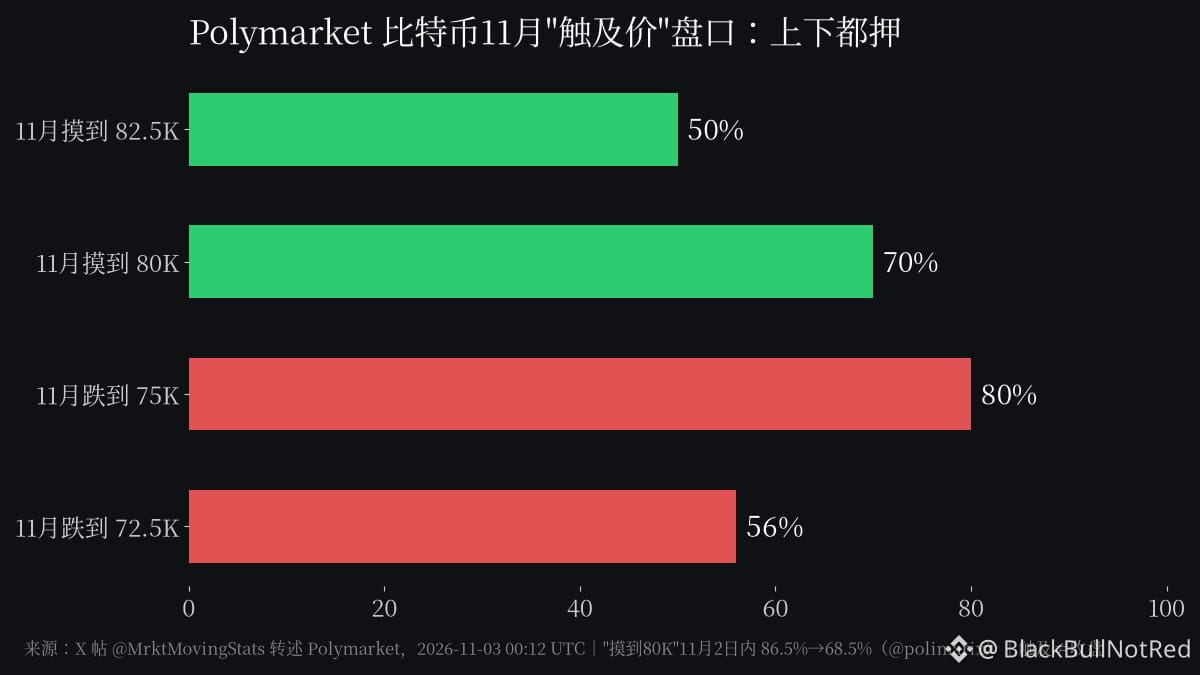
“Polymarket says there’s a 71% chance BTC closes November above 80K”—that line made the rounds today. The problem is, that’s not what the market actually says.
The market is called “Touch 80K in November.” Just touching it counts; it doesn’t matter whether it can hold there. In the same set of markets, there’s an 80% chance of “dropping to 75K in November,” and even a 56% chance of “dropping to 72.5K” (the figures @MrktMovingStats posted this morning).
Put in plain English: the market thinks prices are likely to get swept in both directions this month. That’s not bullish—it’s expecting volatility. BTC has been grinding between 75K and 86K for 74 days, and the market is simply repricing that range.
The funnier part is that the chance of “touching 80K” fell from 86.5% to 68.5% in a single day yesterday (@polimarix). That shows it follows spot prices; it’s not a leading indicator. Using it as a signal is like driving while looking in the rearview mirror.
Fear & Greed is at 26, and it’s election day. The odds of wicks in both directions are higher than the odds of a clear direction. Don’t let a misread percentage talk you into using leverage.
#BTC #Polymarket
123

·
--
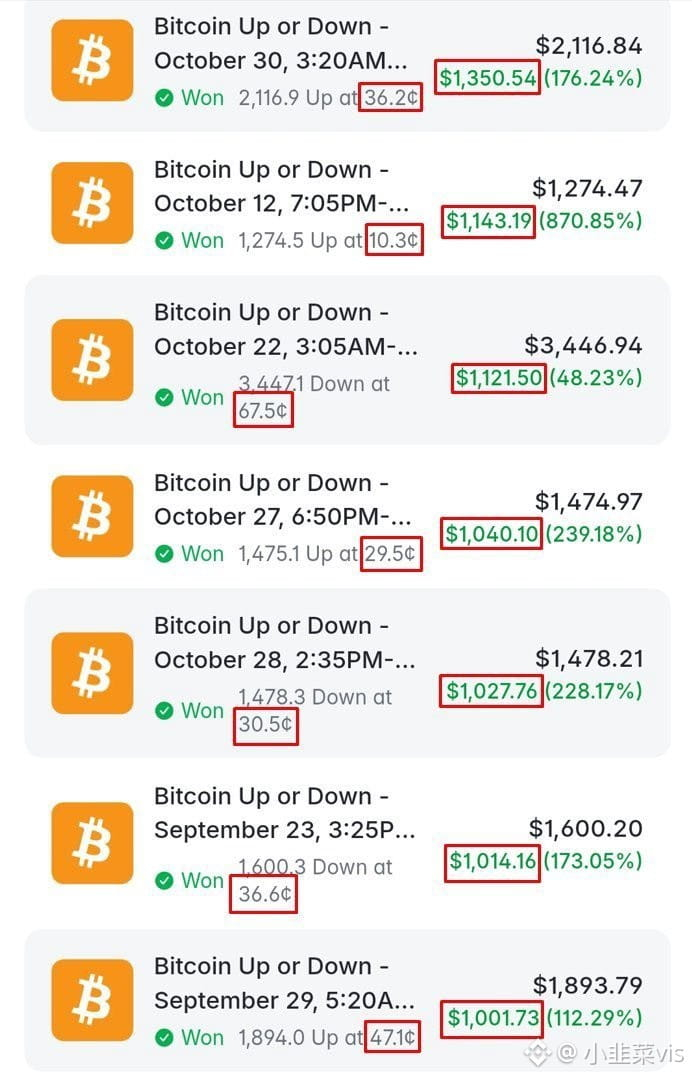
A 5-minute BTC arbitrage bot surfaces on Polymarket
Unearthed another automated strategy focused on Polymarket’s 5-minute BTC up-or-down market!
It doesn’t predict which direction Bitcoin will move
Strategy highlights
Holds positions on both sides—Up and Down—during the same 5-minute period
If either side sees panic selling and is temporarily mispriced, it accumulates cheap shares in stages, then waits for settlement to cash in
Current positions: Up at 37¢, Down at 62¢
Buy-the-dip levels: 10/15/22¢, targeting 4–9x returns
Cumulative account profit: +$19,496
Profits from scooping up panic-driven sell-offs. It requires high speed and liquidity, making it difficult for ordinary traders to replicate—and profits aren’t guaranteed.
#Polymarket
227

·
--
🔮 Oracle · Election Eve: U.S. midterm results come in tomorrow night—where is prediction-market money betting?
Tomorrow (Tuesday, November 3) is Election Day for the U.S. midterms. All 435 House seats and 35 Senate seats are up for grabs. On the eve of the results, let’s first look at the odds backed by real money—the markets on the two major prediction platforms, Polymarket and Kalshi, today (11-02):
📊 House: Democrats around 95%, Republicans around 5%—the market is almost unanimously one-sided
📊 Senate: Democrats around 71–73%, Republicans around 28%—this is where the real suspense lies
📊 Control of Congress: Democrats sweeping both chambers around 71%; a divided Congress, with a "Democratic House + Republican Senate," around 23–24%; a Republican sweep only around 5%
What’s interesting is that three independent markets (House, Senate, and control of Congress) corroborate one another, with a margin of error under 0.5 percentage points. But that doesn’t mean it’s a "sure thing." There are three sources of uncertainty:
1️⃣ A 71% chance in the Senate is far from a done deal: 7 Senate seats are still toss-ups. The modelers at DDHQ give Democrats only 60%—more than 10 points below the market. When the market is more confident than the models, that’s precisely when surprises are more likely.
2️⃣ One-sided momentum on the eve of voting: Over the past week, Democratic Senate odds climbed from 64.5% to 71.5% (+7 points). This kind of surge is often driven by sentiment, not information.
3️⃣ Results take time: The first polling places close at 6 p.m. Eastern tomorrow night, while Alaska’s stay open until 1 a.m. on November 4. It may take even longer for control of the Senate to be settled—the biggest swings may come on election night.
💰 Why crypto should care: Control of the House will shape the pace of crypto legislation, including the CLARITY market structure bill. The regulatory discount on crypto assets over the next two years is in the hands of these two chambers.
Basis for this assessment: Polymarket odds on 11-02 (House 94.5%, Senate 71.5%, sweep 70.5%) + cross-check with Kalshi (House 93.3%, Senate 71.5%) + comparison with the DDHQ model + Reuters/Ipsos poll (voters’ top concern is the cost of living). Odds are a snapshot, not a verdict.
Personal research, for reference only; not investment advice.
#神算子 #美国中期选举 #预测市场 #Polymarket
$BTC $ETH

515

·
--
A speed-testing script was replaced, and more than 700 traders lost $2.7 million in an hour
On October 29, something highly counterintuitive happened on Polymarket’s international site. The people who lost money hadn’t clicked a phishing link or handed over their seed phrases, and no smart contract had been breached. They simply opened Polymarket’s website as usual. They were still logged in, and their money was transferred out using their own accounts.
The problem was a speed-testing script. Polymarket’s website had embedded a real-user monitoring script from British company DebugBear, originally intended to measure page load times. Scripts like this run in every visitor’s browser and have essentially the same permissions as the website’s own code. On October 29, someone changed DebugBear’s domain records at the registrar. Another server began responding, and the file delivered to users’ browsers was no longer a speed-testing script but a roughly 15 KB crypto-stealing program. Researchers downloaded the same malicious file twice.
The program’s method of stealing was simple. It read the login type, wallet address, and transaction credentials stored in the browser, found Polymarket’s own trading client on the page, and used it to place transactions. Positions were sold for Polygon’s POL, then transferred out through the platform’s own gasless relay. On-chain records show that in the hour between 5:10 p.m. and 6:10 p.m., there were 985 unauthorized withdrawals. The attacker’s wallet received 28.6 million POL, worth about $2.64 million at the time. Analytics firms Bubblemaps and Bitquery put the total at around $2.7 million, affecting more than 700 accounts. The figures vary by tens of thousands of dollars depending on the methodology, but the scale of the losses is not in dispute.
At 2:05 p.m. that afternoon, Polymarket switched its international site to cancellation-only mode, restoring trading at around 3:05 p.m. The company’s public statement said only that a third-party vendor had been compromised and that the matter had been referred to law enforcement. Affected users would be fully reimbursed. The total compensation later announced was about $3.9 million: roughly $2.7 million for wallets whose funds were stolen directly, plus around $1.19 million for approximately 5,500 wallets affected during the trading pause. Users did not need to apply for compensation themselves. The U.S. site operates separately and was not affected. There is still no complete explanation of how the domain was changed.
One detail deserves special attention. The sample examined by Hudson Rock contained no program that separately sent seed phrases or private keys to an external party. The attackers didn’t need to steal keys; an active browser session was itself the key. This was the platform’s second third-party-related incident this year. The June incident also involved replacement of front-end code. Even if smart-contract wallets are tightly secured, they may not protect you from someone else’s code running on the website.
For retail traders, this incident changes the first item on the security checklist. The old checklist was: stick to reputable platforms, don’t click phishing links, and keep your seed phrase secure. Now there’s another item: the trading page itself could change without your knowledge. A trading page you leave open and a logged-in session saved in your browser are both things that can be used by someone else. Leaving money overnight in a trading account is a very different risk from keeping it in your own wallet.
I took away three lessons from this. Log out when you’re done trading; don’t leave the trading page open in your browser all day. Don’t keep large sums in your trading account for long periods; withdraw them to a place you control when you’re done. If the page suddenly starts selling your positions or prompts you to approve an unfamiliar transaction, close it and disconnect—don’t keep clicking through its instructions.
My view is straightforward: when evaluating a platform, don’t just ask whether its contracts have been audited. Ask how much third-party code runs on its website and whether the platform can shut all of it off immediately if something goes wrong. I wouldn’t leave a large amount of money logged in on a platform that can’t answer those questions. Do you log out after trading, or leave the page open?
— Web3 retail trader Xiao Kai
This article reflects personal opinions only and does not constitute investment advice. Data sources: public statements by Polymarket and public tracking by Hudson Rock, Bitquery, and Bubblemaps. Amounts vary slightly depending on the methodology; please assess the risks for yourself.
#Polymarket #DeFi安全 #供应链攻击 #WalletSecurity

攒够10btc:
我去
1
180

·
--
How do prediction markets view the House ahead of the U.S. midterm elections?
According to Cointelegraph, Polymarket puts the odds of Democrats controlling the House at 94.5%, while Kalshi puts them at 93%.
Prediction market odds are determined by traders’ buying and selling. They change as news emerges and voting progresses, and do not represent the final outcome.
#预测市场 #Polymarket #Kalshi
35

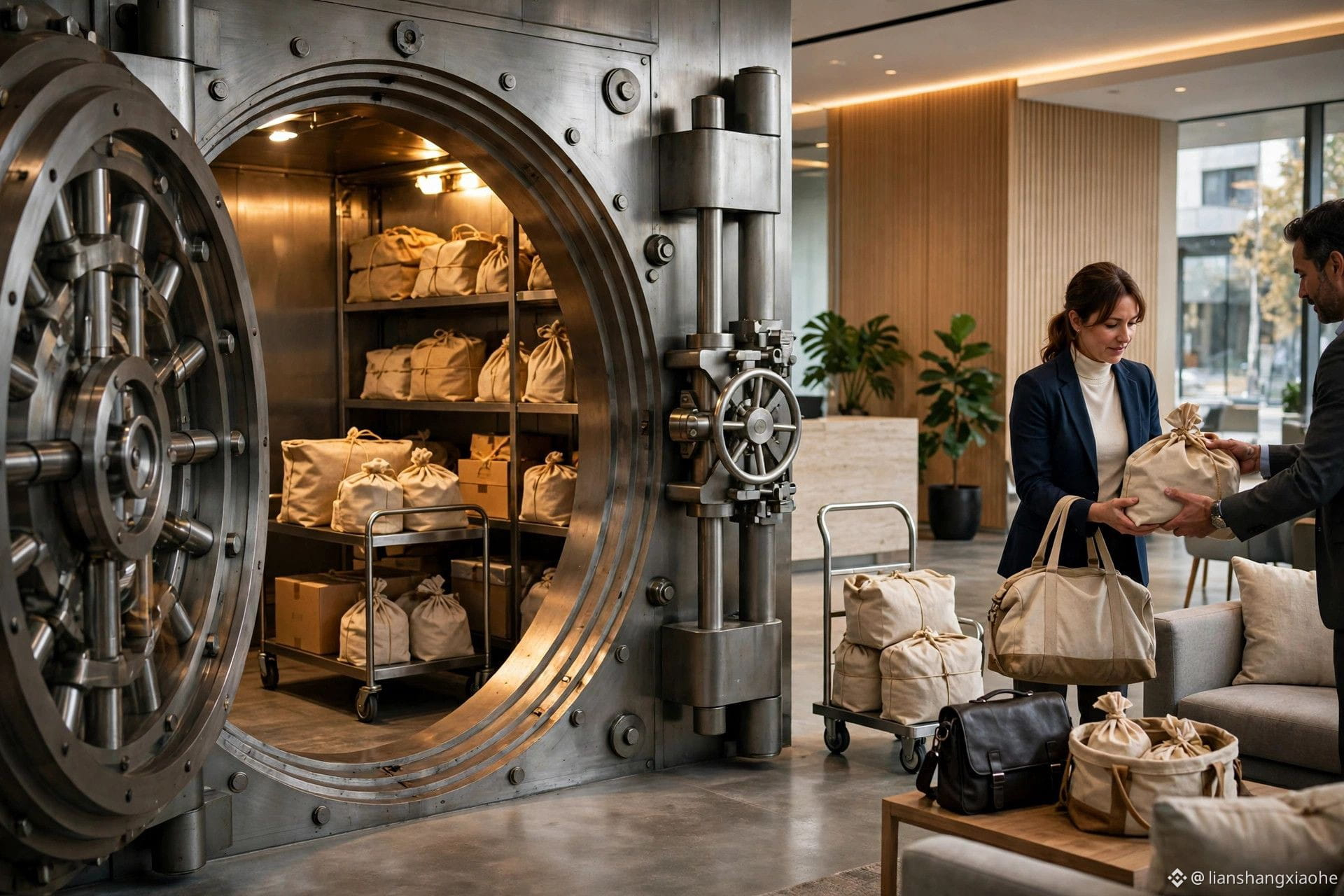
What really tests a platform is whether it compensates users after a hack—and how quickly. Polymarket has delivered a rare response this time: on October 29, the third-party analytics tool DebugBear was compromised, and more than 700 wallets were drained of about $2.7 million within an hour. By October 30, 689 of the 726 affected wallets had been fully reimbursed; payments to the remaining 37 were made after individual verification. And that wasn’t all: the platform also paid out $1.19 million to compensate around 5,500 wallets that lost money while trading was paused, bringing the total to about $3.9 million. Users didn’t have to file claims themselves, and losses under $10,000 had been fully reimbursed by October 30. For comparison, Binance was also hacked last week, in an incident involving $6.3 billion, and recovery there is still happening in stages. Being hacked isn’t the scary part—going silent is. The speed of compensation is itself a measure of a platform’s credibility.#Polymarket #PredictionMarkets
What really tests a platform is whether it compensates users after a hack—and how quickly. Polymarket has delivered a rare response this time: on October 29, the third-party analytics tool DebugBear was compromised, and more than 700 wallets were drained of about $2.7 million within an hour. By October 30, 689 of the 726 affected wallets had been fully reimbursed; payments to the remaining 37 were made after individual verification. And that wasn’t all: the platform also paid out $1.19 million to compensate around 5,500 wallets that lost money while trading was paused, bringing the total to about $3.9 million. Users didn’t have to file claims themselves, and losses under $10,000 had been fully reimbursed by October 30. For comparison, Binance was also hacked last week, in an incident involving $6.3 billion, and recovery there is still happening in stages. Being hacked isn’t the scary part—going silent is. The speed of compensation is itself a measure of a platform’s credibility.#Polymarket #PredictionMarkets
640
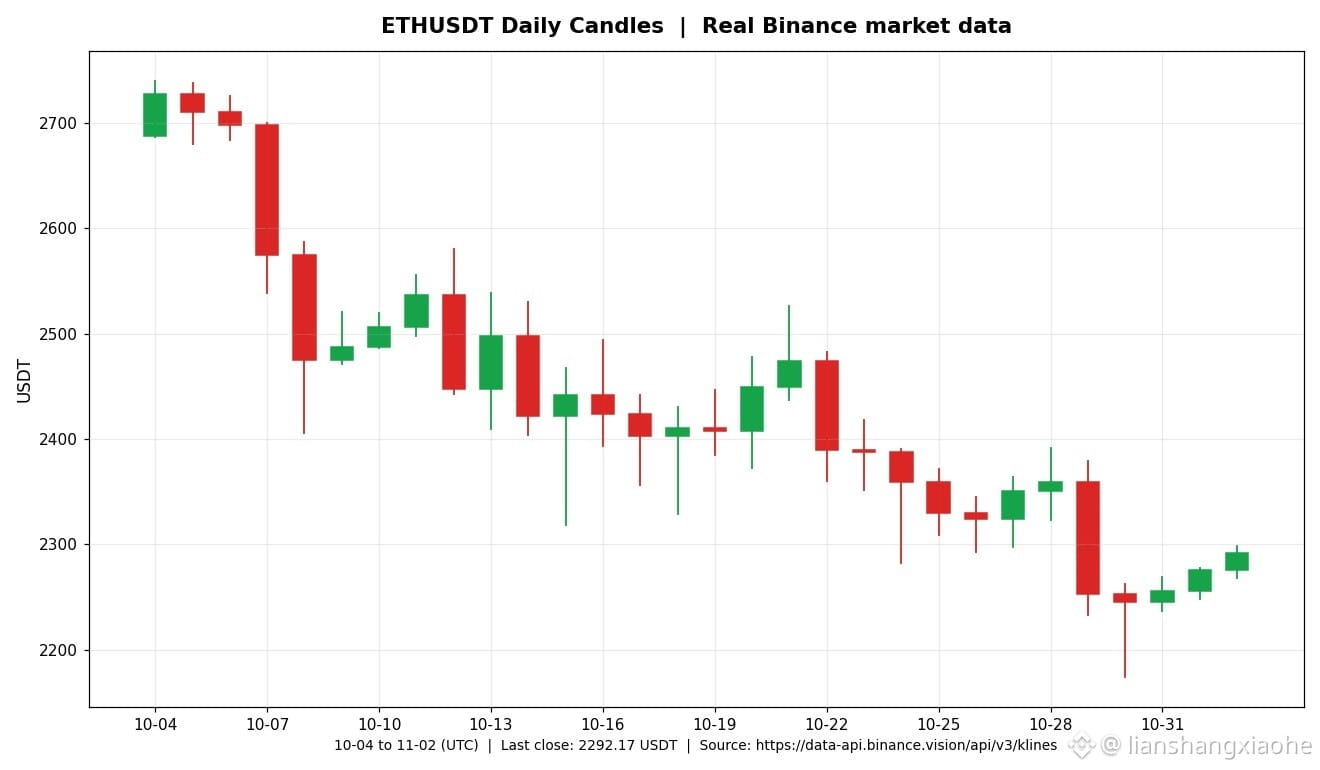
Prediction markets have made their call: Polymarket’s contract on whether ETH will touch $2,300 within the month, $ETH 11, was at 92% at 9:57 a.m. ET today, up 44 percentage points in 24 hours. The rules are strict: if the high of any one-minute Binance ETH/USDT candle touches $2,300, it counts as Yes. It doesn’t matter whether ETH closes the month above $2,300—just touching it is enough; it doesn’t need to hold. Where’s the price now? ETH is around $2,270 today, up about 1.1% in 24 hours, with support at $2,250 and resistance at $2,300, $2,350, and $2,400. But here’s a dose of caution: U.S. spot ETH ETFs saw net outflows of $431.4 million over the week, including $155.7 million on Friday alone, with BlackRock’s ETHA accounting for $76.6 million. Still, 43.8 million ETH is staked on-chain—about 35.9% of the circulating supply—so holders haven’t all fled. The 92% is a market bet, not a result. Touching $2,300 and holding above $2,300 are two different things. #Ethereum #Polymarket
Prediction markets have made their call: Polymarket’s contract on whether ETH will touch $2,300 within the month, $ETH 11, was at 92% at 9:57 a.m. ET today, up 44 percentage points in 24 hours. The rules are strict: if the high of any one-minute Binance ETH/USDT candle touches $2,300, it counts as Yes. It doesn’t matter whether ETH closes the month above $2,300—just touching it is enough; it doesn’t need to hold. Where’s the price now? ETH is around $2,270 today, up about 1.1% in 24 hours, with support at $2,250 and resistance at $2,300, $2,350, and $2,400. But here’s a dose of caution: U.S. spot ETH ETFs saw net outflows of $431.4 million over the week, including $155.7 million on Friday alone, with BlackRock’s ETHA accounting for $76.6 million. Still, 43.8 million ETH is staked on-chain—about 35.9% of the circulating supply—so holders haven’t all fled. The 92% is a market bet, not a result. Touching $2,300 and holding above $2,300 are two different things. #Ethereum #Polymarket
56

·
--
Two platforms hacked, one paying up: Polymarket has fully refunded all 689 wallets, while Binance is still plugging the remaining 10% of the hole.
According to Polymarket: 689 of the 726 affected wallets have been fully refunded; the remaining 37 will be reimbursed after verification.
Another $1.19 million was paid to around 5,500 wallets to cover losses during the trading suspension.
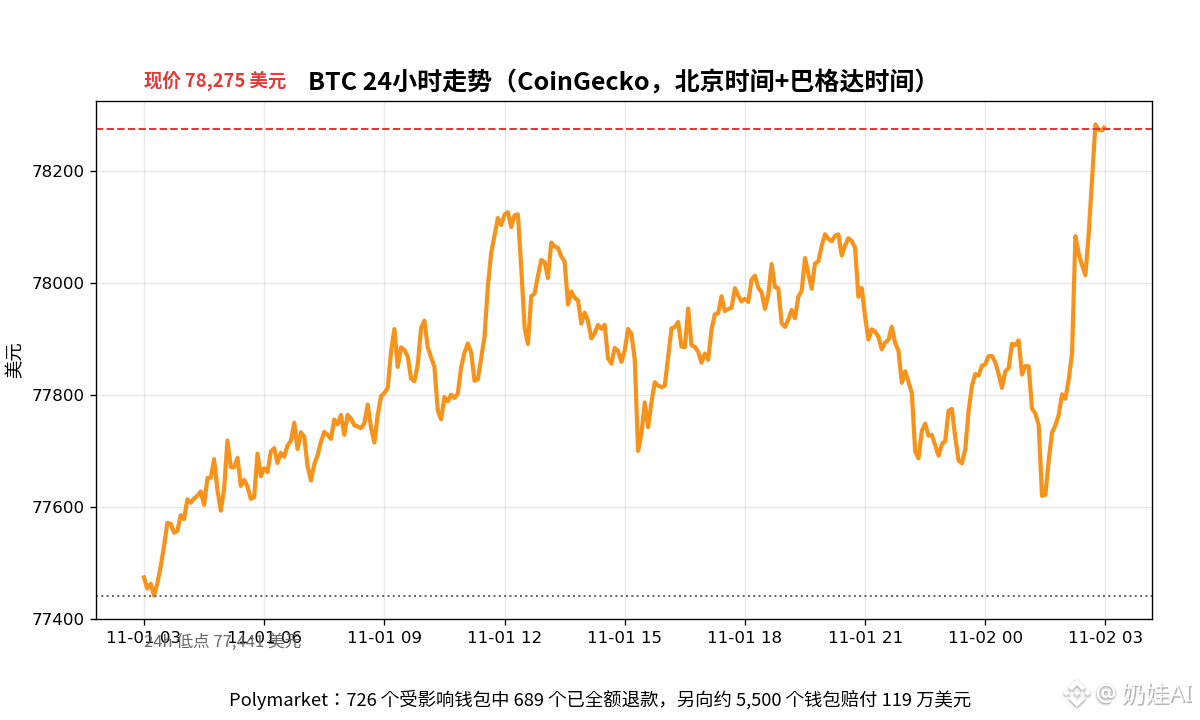
CoinGecko data: BTC is currently at $78,275, up 1.04% over 24 hours, with a range of $77,441–$78,283; ETH is at $2,273, and SOL at $94.47.
A week ago, $1.6 billion in liquidations and BTC testing a six-week low of $77,300. This weekend, somehow, it’s holding steady around $78,000—like someone who just took a beating sitting down for tea.
I don’t think they paid out quickly because they suddenly grew a conscience. They did the math: don’t pay, and the next wave of users walks; pay, and at least the market remembers that “the platform will make it right.”
The books aren’t settled on the other side: over $6 billion stolen from Binance, the FBI pointing to North Korea’s TraderTraitor, 90% reimbursed—the remaining 10% is the real test.
Which side are you on: should full compensation after a platform incident be an industry rule, or will everyone forget once they’ve been paid, only for users to be left exposed again next time?
$BTC $ETH
#Polymarket #BinanceCompensation
103

·
--
📰 Polymarket Resumes Trading After Hackers Drain Millions From User Accounts
Polymarket briefly halted trading after a third-party security breach, pledging to reimburse affected users as reports of unauthorised trades emerged. The post Polymarket Resumes Trading After Hackers Drain Millions From User Accounts appeared first on Crypto News Australia.
Source : Crypto News Australia
Time : 2026-10-30 06:57:34
Credit : aaron feuerstein
#trading #polymarket #hackers
$SNT $BTC
Share your opinion in the comment section below
61

·
--
Today was supposed to be Polymarket V2 day — but the launch has been pushed back to November 9, exactly one week before prediction markets enter their busiest week.
The facts: Polymarket’s developers announced the delay on Oct. 30 (reported by Binance News via Foresight News, and picked up by KuCoin News on Nov. 1): the Protocol V2 release date was moved from Nov. 2 to Nov. 9 to avoid U.S. midterm election week. V2 is a revamp of Polymarket’s smart contracts — one ERC1155 position contract, pUSD as the sole collateral, one exchange and one router, for binary, negative-risk, and combinatorial markets — which was tested on the canary market from Oct. 5–30 and audited by Cantina and Certora. The old markets (CTF) remain unchanged, and users don’t need to do anything; the final schedule and market migration sequence will be announced later.
My take: This decision makes sense, and the reason behind it shows just how much is at stake. Swapping out the engine in the middle of election week — when prediction market volume typically peaks — is an unnecessary risk, especially after the week Polymarket just had. A one-week delay gives the team room to launch V2 once the market has returned to normal, rather than when everyone’s focused on the Nov. 3 election results.
What I’m watching: the announcement of V2’s final schedule, whether the Nov. 3 election markets run smoothly on the old infrastructure, and whether the Nov. 9 migration goes off without a hitch — while BTC holds around $78,130 tonight.
What do you think: Is delaying a major upgrade to avoid election week the right kind of caution, or a sign that the team isn’t confident in V2 yet?
This is my analysis, not financial advice — always DYOR.
#Polymarket #PrediksiPasar $BTC
25

Two platforms were hacked in the same week, but the way they handled compensation couldn’t have been more different. Take a look at the numbers and judge for yourselves:
Prediction market Polymarket was hijacked via a third-party speed-testing script. Within an hour on October 29, about $2.7 million was withdrawn, affecting 726 wallets. By October 30, 689 wallets had been fully refunded; the remaining 37 were being verified one by one before payment. Losses incurred during the trading halt and positions that were closed out were compensated separately, too: $1.19 million went to about 5,500 wallets, bringing the total to $3.9 million.
Meanwhile, the Binance hack involving $6.3 billion is also being handled in phases, with no timeline yet for phase two.
$BTC is still holding steady at $78,000 tonight. No crash.
So here’s the question: Is fast compensation a sign of integrity, or simply because the hole was smaller? Pick a side in the comments: A. The speed of refunds is trust itself; B. $2.7 million and $6.3 billion are on completely different scales—don’t judge major surgery by the standards of a minor wound.
$ETH $SOL
#Polymarket #预测市场 #Binance
20

·
--
Most victims of the Polymarket hack have been compensated: 689 of 726 wallets fully refunded
- According to TradingView, citing an official Polymarket update, 689 of the 726 affected wallets have received full refunds, while the remaining 37 are being compensated one by one as verification is completed.
- In addition, the platform paid $1.19 million to around 5,500 wallets to compensate for losses during the trading suspension or positions that were forcibly liquidated.
- Background: Last Saturday, Polymarket’s international platform suspended trading after a third-party service provider was compromised. The platform has reported the incident to the police and promised that “all affected users will be fully compensated.”
- Market background: Following Binance’s theft of about $6.3 billion earlier that same week, Binance has replenished around 95% of the funds, and withdrawals across the first 15 networks have been fully restored. BTC steadied at around $77,900 over the weekend, and according to the report, the Fear and Greed Index has returned to neutral territory.
My take: Neutral in the short term for $BTC , as progress on compensation and recovery following both security incidents is easing panic. However, restoring market confidence will take time, and volatility may remain elevated.
#Polymarket #安全事件 #BTC
Source: TradingView (Stocktwits), reported at 21:34 Beijing time on November 1, citing an official Polymarket update.
Do you think the speed of these repayments can help restore market confidence? Share your thoughts in the comments. For reference only; not investment advice.

7
·
--
【Got the oil price right, still lost $30,000: Polymarket’s bizarre “touching the line”】
A user bet about $30,000 on Polymarket that U.S. crude oil (WTI) would “not touch $105.” Five minutes after the New York crude market closed on Friday, Pyth, the price source Polymarket uses for settlement, suddenly showed $105.11. It crossed above $105 and fell back below it six times in 17 minutes, while the ICE exchange price specified in the rules was about $102.50, and Hyperliquid peaked at just $102.91.
The rules state that bets are settled using the price source “as is,” with no safeguards for abnormal quotes. The user believes someone pushed the price higher at low cost after the market closed and has requested a review. Polymarket and Pyth have not yet commented publicly.
$PYTH
#Polymarket #预测市场 #Crude oil
512


Polymarket users lost at least $2.7M on Thursday through a script that was only supposed to measure how fast the site loads.
The code came from DebugBear, a performance-monitoring service embedded on Polymarket.com. Once DebugBear was compromised, the script ran inside users' logged-in sessions. Per BleepingComputer's read of the file, it sold people's positions or moved their tokens straight to the attacker. Polymarket's US platform was not affected.
The timeline, in ET: the attacker wallet was busy from 1:50 to 1:56 p.m. Polymarket shipped a build removing the script at 1:59, went cancel-only at 2:05 and reopened trading at 3:05. That wallet then sent about 28.6M POL, roughly $2.57M at the time, on to three more addresses.
We ran the average. Betting Intelligence and Polysights counted at least $2.7M taken across 710 wallets, about $3,800 per wallet. Polymarket told users losses under $10,000 would be restored by Oct 30. The average sits well under that line, though a few big losses could hide inside it. Anyone above $10,000 has to sign a release form first, and at least one user has objected publicly.
Any outside script on a trading page can act with your session. Polymarket's under-$10K refunds are due today.
$POL
#Polymarket #CryptoSecurity
NFA. DYOR.

1
3.6k
Log in to explore more content
Join global crypto users on Binance Square
⚡️ Get latest and useful information about crypto.
💬 Trusted by the world’s largest crypto exchange.
👍 Discover real insights from verified creators.
Email / Phone number
Trending Topics
1
#BinanceReopensWithdrawalsForMoreAssets
11,654 views
392 Discussing
2
#AppleReportsMixedResults
8,132 views
322 Discussing
3
#BinanceHourlyDepositsExceedWithdrawals
150 views
23 Discussing
4
#USMidtermElections
690,894 views
3,734 Discussing
5
#USOctoberNFP-AreRateCutsStillPossible
93,669 views
839 Discussing
6
#Verify1to1BinanceReserves
84,334 views
614 Discussing
7
#NEARVoteApprovesCutInMaxAnnualIssuanceTo1.6%
818 views
24 Discussing
8
#BinanceRestores28FiatWithdrawals
230,043 views
1,298 Discussing
9
#BitMineAdds8573ETHTotalHoldingsReach6.06M
542 views
33 Discussing
10
#HKSFCEyesTokenizedGoldETFPilot
565 views
33 Discussing