

#onchaineconomy
onchaineconomy
1,721 views
44 Discussing
Hot
Latest

·
--
DeFi's Yield Evolution: From Emissions to Revenue
The first era of DeFi was built on a lie we all agreed to believe. Protocols printed governance tokens, distributed them to liquidity providers, and called it "yield." It wasn't yield — it was dilution dressed up as income. The protocol was paying you in its own increasingly worthless tokens to compensate for the fact that the economics didn't actually work yet.
That era is ending, and the replacement is far more interesting.
Real yield changes everything. When a protocol distributes actual fee revenue to token stakers, the math has to close. You can't inflate your way to sustainability. Protocols either generate genuine economic activity or they don't. The market can now distinguish between a protocol earning $50M in fees and one distributing $50M in printed tokens.
This separation creates a new valuation framework. Fee-to-FDV becomes the P/E ratio of crypto. Protocols with real revenue trade at premiums. Protocols surviving on emissions trade at discounts. The market is finally pricing what matters — productive capacity, not narrative potential.
The implications compound. Institutional allocators who couldn't justify exposure to "yield farming" can underwrite fee-sharing models. Treasury allocations shift from speculative bets to income-generating positions. The entire risk-adjusted return calculation changes when yield comes from economic activity rather than token emission.
$ETH $SOL $BNB
#DeFi #RealYield #CryptoMarkets #OnchainEconomy
DeFi's Yield Evolution: From Emissions to Revenue
The first era of DeFi was built on a lie we all agreed to believe. Protocols printed governance tokens, distributed them to liquidity providers, and called it "yield." It wasn't yield — it was dilution dressed up as income. The protocol was paying you in its own increasingly worthless tokens to compensate for the fact that the economics didn't actually work yet.
That era is ending, and the replacement is far more interesting.
Real yield changes everything. When a protocol distributes actual fee revenue to token stakers, the math has to close. You can't inflate your way to sustainability. Protocols either generate genuine economic activity or they don't. The market can now distinguish between a protocol earning $50M in fees and one distributing $50M in printed tokens.
This separation creates a new valuation framework. Fee-to-FDV becomes the P/E ratio of crypto. Protocols with real revenue trade at premiums. Protocols surviving on emissions trade at discounts. The market is finally pricing what matters — productive capacity, not narrative potential.
The implications compound. Institutional allocators who couldn't justify exposure to "yield farming" can underwrite fee-sharing models. Treasury allocations shift from speculative bets to income-generating positions. The entire risk-adjusted return calculation changes when yield comes from economic activity rather than token emission.
$ETH $SOL $BNB
#DeFi #RealYield #CryptoMarkets #OnchainEconomy
The first era of DeFi was built on a lie we all agreed to believe. Protocols printed governance tokens, distributed them to liquidity providers, and called it "yield." It wasn't yield — it was dilution dressed up as income. The protocol was paying you in its own increasingly worthless tokens to compensate for the fact that the economics didn't actually work yet.
That era is ending, and the replacement is far more interesting.
Real yield changes everything. When a protocol distributes actual fee revenue to token stakers, the math has to close. You can't inflate your way to sustainability. Protocols either generate genuine economic activity or they don't. The market can now distinguish between a protocol earning $50M in fees and one distributing $50M in printed tokens.
This separation creates a new valuation framework. Fee-to-FDV becomes the P/E ratio of crypto. Protocols with real revenue trade at premiums. Protocols surviving on emissions trade at discounts. The market is finally pricing what matters — productive capacity, not narrative potential.
The implications compound. Institutional allocators who couldn't justify exposure to "yield farming" can underwrite fee-sharing models. Treasury allocations shift from speculative bets to income-generating positions. The entire risk-adjusted return calculation changes when yield comes from economic activity rather than token emission.
$ETH $SOL $BNB
#DeFi #RealYield #CryptoMarkets #OnchainEconomy
128
·
--
Bullish
🚨 BREAKING: Aave’s founder just threw down the gauntlet — V4 isn’t just another DeFi upgrade, it’s a frontal assault on TradFi’s last strongholds.
Stani Kulechov is eyeing the $12.6 TRILLION U.S. repo market** and the **$4.6 trillion securities lending arena — not to "integrate," but to replace. Think about that: the plumbing of global finance, built on collateralized debt and counterparty trust, vs. permissionless smart contracts running 24/7 with instant settlement.
Here’s the real question: Will TradFi resist, adopt, or get steamrolled?
If Aave V4 delivers even 1% penetration, that’s ~$170B in new onchain liquidity — bigger than most countries' GDP.
But can Ethereum L1/L2 handle the throughput, or will we see a liquidity fragmentation nightmare?
And what about regulators? The SEC and Fed won't watch $17T slip into code without a fight.
My take: This is either the greatest wealth transfer in history — or the most overhyped governance token pitch ever. There’s no middle ground.
You tell me: Is DeFi ready for prime time, or is this just another "blockchain not blockchain" vaporware? Drop your hottest take below — I’ll debate anyone. 👇
#DeFiVsTradFi #AaveV4 #OnchainEconomy
$AAVE
{future}(AAVEUSDT)
🚨 BREAKING: Aave’s founder just threw down the gauntlet — V4 isn’t just another DeFi upgrade, it’s a frontal assault on TradFi’s last strongholds.
Stani Kulechov is eyeing the $12.6 TRILLION U.S. repo market** and the **$4.6 trillion securities lending arena — not to "integrate," but to replace. Think about that: the plumbing of global finance, built on collateralized debt and counterparty trust, vs. permissionless smart contracts running 24/7 with instant settlement.
Here’s the real question: Will TradFi resist, adopt, or get steamrolled?
If Aave V4 delivers even 1% penetration, that’s ~$170B in new onchain liquidity — bigger than most countries' GDP.
But can Ethereum L1/L2 handle the throughput, or will we see a liquidity fragmentation nightmare?
And what about regulators? The SEC and Fed won't watch $17T slip into code without a fight.
My take: This is either the greatest wealth transfer in history — or the most overhyped governance token pitch ever. There’s no middle ground.
You tell me: Is DeFi ready for prime time, or is this just another "blockchain not blockchain" vaporware? Drop your hottest take below — I’ll debate anyone. 👇
#DeFiVsTradFi #AaveV4 #OnchainEconomy
$AAVE
Stani Kulechov is eyeing the $12.6 TRILLION U.S. repo market** and the **$4.6 trillion securities lending arena — not to "integrate," but to replace. Think about that: the plumbing of global finance, built on collateralized debt and counterparty trust, vs. permissionless smart contracts running 24/7 with instant settlement.
Here’s the real question: Will TradFi resist, adopt, or get steamrolled?
If Aave V4 delivers even 1% penetration, that’s ~$170B in new onchain liquidity — bigger than most countries' GDP.
But can Ethereum L1/L2 handle the throughput, or will we see a liquidity fragmentation nightmare?
And what about regulators? The SEC and Fed won't watch $17T slip into code without a fight.
My take: This is either the greatest wealth transfer in history — or the most overhyped governance token pitch ever. There’s no middle ground.
You tell me: Is DeFi ready for prime time, or is this just another "blockchain not blockchain" vaporware? Drop your hottest take below — I’ll debate anyone. 👇
#DeFiVsTradFi #AaveV4 #OnchainEconomy
$AAVE

52
·
--
AI agents don't have bank accounts. They have wallets.
That single difference is why the convergence of AI and crypto infrastructure is the most underpriced narrative of this cycle. When an AI agent needs to pay for compute, settle a micro-transaction, or escrow a service contract, it doesn't go through KYC at a bank — it routes through stablecoins, L1 gas markets, and on-chain payment rails.
The infrastructure being built right now — agent-key wallets, programmable payment streams, on-chain identity attestation — isn't a speculative thesis. It's the plumbing for an economy where machines are first-class financial participants.
$SOL is positioning as the high-throughput settlement layer for agent-to-agent micropayments. $ETH provides the smart contract trust layer where autonomous service agreements execute. $BTC remains the collateral backbone that agents reference for value density.
The projects building agent-native wallet infrastructure, intent-based routing, and decentralized compute marketplaces aren't racing toward a hypothetical future — they're solving a problem that traditional finance structurally cannot. You can't give SWIFT an API key.
The question isn't whether AI agents will transact on-chain. They already are. The question is which chains capture the volume.
#AIxCrypto #Web3Infrastructure #Stablecoins #CryptoAI #OnChainEconomy
AI agents don't have bank accounts. They have wallets.
That single difference is why the convergence of AI and crypto infrastructure is the most underpriced narrative of this cycle. When an AI agent needs to pay for compute, settle a micro-transaction, or escrow a service contract, it doesn't go through KYC at a bank — it routes through stablecoins, L1 gas markets, and on-chain payment rails.
The infrastructure being built right now — agent-key wallets, programmable payment streams, on-chain identity attestation — isn't a speculative thesis. It's the plumbing for an economy where machines are first-class financial participants.
$SOL is positioning as the high-throughput settlement layer for agent-to-agent micropayments. $ETH provides the smart contract trust layer where autonomous service agreements execute. $BTC remains the collateral backbone that agents reference for value density.
The projects building agent-native wallet infrastructure, intent-based routing, and decentralized compute marketplaces aren't racing toward a hypothetical future — they're solving a problem that traditional finance structurally cannot. You can't give SWIFT an API key.
The question isn't whether AI agents will transact on-chain. They already are. The question is which chains capture the volume.
#AIxCrypto #Web3Infrastructure #Stablecoins #CryptoAI #OnChainEconomy
That single difference is why the convergence of AI and crypto infrastructure is the most underpriced narrative of this cycle. When an AI agent needs to pay for compute, settle a micro-transaction, or escrow a service contract, it doesn't go through KYC at a bank — it routes through stablecoins, L1 gas markets, and on-chain payment rails.
The infrastructure being built right now — agent-key wallets, programmable payment streams, on-chain identity attestation — isn't a speculative thesis. It's the plumbing for an economy where machines are first-class financial participants.
$SOL is positioning as the high-throughput settlement layer for agent-to-agent micropayments. $ETH provides the smart contract trust layer where autonomous service agreements execute. $BTC remains the collateral backbone that agents reference for value density.
The projects building agent-native wallet infrastructure, intent-based routing, and decentralized compute marketplaces aren't racing toward a hypothetical future — they're solving a problem that traditional finance structurally cannot. You can't give SWIFT an API key.
The question isn't whether AI agents will transact on-chain. They already are. The question is which chains capture the volume.
#AIxCrypto #Web3Infrastructure #Stablecoins #CryptoAI #OnChainEconomy
57


·
--
The next on-chain economic entity might not be a person, but an algorithm.
In the past, on-chain economic entities were primarily people: traders, creators, users, liquidity providers.
But with the emergence of AI Agents, that boundary is shifting.
When an Agent can read data, call on tools, generate content, execute strategies, and pay fees, it’s no longer just 'software functionality'; it resembles a self-sustaining economic entity.
This raises some questions:
Who is the identity of the Agent?
Who manages the wallet?
How are task results recorded?
How are profits and costs settled?
Who is accountable for erroneous executions?
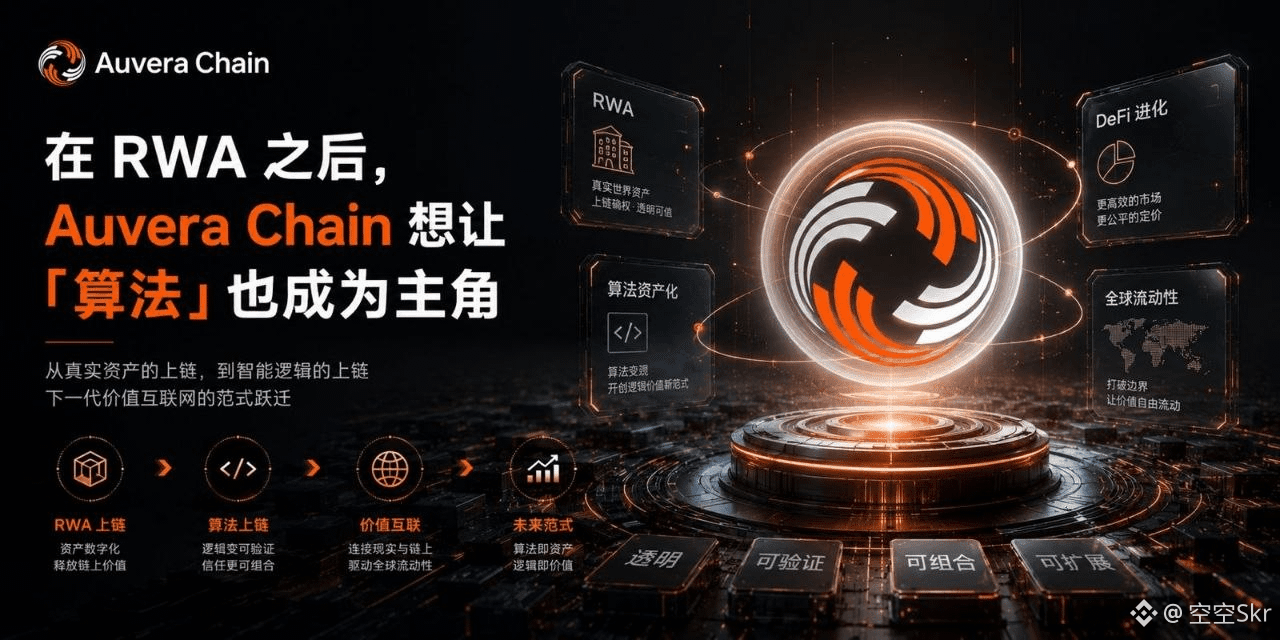
The long-term narrative of Auvera Chain is to understand both humans and Agents on the same chain. Today, we serve real users and applications, and tomorrow we’ll extend the same identity, account, payment, permission, and auditing capabilities to Agents.
A true AI public chain isn’t just about moving models onto the chain; it’s about making AI's economic actions recordable, quantifiable, and settleable.
Content is for track observation only and does not constitute investment advice.
#AIAgent #AuveraChain #AUV #OnchainEconomy #Aİ
The next on-chain economic entity might not be a person, but an algorithm.
In the past, on-chain economic entities were primarily people: traders, creators, users, liquidity providers.
But with the emergence of AI Agents, that boundary is shifting.
When an Agent can read data, call on tools, generate content, execute strategies, and pay fees, it’s no longer just 'software functionality'; it resembles a self-sustaining economic entity.
This raises some questions:
Who is the identity of the Agent?
Who manages the wallet?
How are task results recorded?
How are profits and costs settled?
Who is accountable for erroneous executions?
The long-term narrative of Auvera Chain is to understand both humans and Agents on the same chain. Today, we serve real users and applications, and tomorrow we’ll extend the same identity, account, payment, permission, and auditing capabilities to Agents.
A true AI public chain isn’t just about moving models onto the chain; it’s about making AI's economic actions recordable, quantifiable, and settleable.
Content is for track observation only and does not constitute investment advice.
#AIAgent #AuveraChain #AUV #OnchainEconomy #Aİ
In the past, on-chain economic entities were primarily people: traders, creators, users, liquidity providers.
But with the emergence of AI Agents, that boundary is shifting.
When an Agent can read data, call on tools, generate content, execute strategies, and pay fees, it’s no longer just 'software functionality'; it resembles a self-sustaining economic entity.
This raises some questions:
Who is the identity of the Agent?
Who manages the wallet?
How are task results recorded?
How are profits and costs settled?
Who is accountable for erroneous executions?
The long-term narrative of Auvera Chain is to understand both humans and Agents on the same chain. Today, we serve real users and applications, and tomorrow we’ll extend the same identity, account, payment, permission, and auditing capabilities to Agents.
A true AI public chain isn’t just about moving models onto the chain; it’s about making AI's economic actions recordable, quantifiable, and settleable.
Content is for track observation only and does not constitute investment advice.
#AIAgent #AuveraChain #AUV #OnchainEconomy #Aİ
240
{alpha}(560x7ec43cf65f1663f820427c62a5780b8f2e25593a)
Bermuda’s onchain pivot puts $ZEC, $IO and $LAB on watch 🚨
Bermuda’s plan to amend the Public Funds Act so it can allocate capital to digital assets and support a fully onchain economy is a meaningful policy signal. The market is likely to read this as a jurisdictional attempt to normalize crypto within a public-sector framework, with the main near-term implications centered on adoption optics, regulatory precedent, and the potential re-rating of assets tied to infrastructure, privacy, and decentralized applications. The headline is not about immediate flows. It is about legitimacy.
From an institutional lens, the more important variable is not the announcement itself but the structure of follow-through. If the amendment progresses cleanly, it may sharpen liquidity rotation toward assets that sit closest to real onchain utility and compliant market access. Retail will likely focus on the broad adoption narrative. The smarter read is that capital tends to favor policy-backed optionality when the market is searching for a new liquidity anchor. That makes this a sentiment catalyst first, and a positioning catalyst second. The next phase will depend on whether the market treats Bermuda as an isolated experiment or as an early template for broader public-sector allocation.
Not financial advice. Digital assets remain volatile and policy-sensitive, and any allocation should be assessed against risk tolerance and structural invalidation.
#CryptoMarket #DigitalAssets #OnChainEconomy #Regulation
{future}(IOTAUSDT)
{future}(ZECUSDT)
Bermuda’s onchain pivot puts $ZEC, $IO and $LAB on watch 🚨
Bermuda’s plan to amend the Public Funds Act so it can allocate capital to digital assets and support a fully onchain economy is a meaningful policy signal. The market is likely to read this as a jurisdictional attempt to normalize crypto within a public-sector framework, with the main near-term implications centered on adoption optics, regulatory precedent, and the potential re-rating of assets tied to infrastructure, privacy, and decentralized applications. The headline is not about immediate flows. It is about legitimacy.
From an institutional lens, the more important variable is not the announcement itself but the structure of follow-through. If the amendment progresses cleanly, it may sharpen liquidity rotation toward assets that sit closest to real onchain utility and compliant market access. Retail will likely focus on the broad adoption narrative. The smarter read is that capital tends to favor policy-backed optionality when the market is searching for a new liquidity anchor. That makes this a sentiment catalyst first, and a positioning catalyst second. The next phase will depend on whether the market treats Bermuda as an isolated experiment or as an early template for broader public-sector allocation.
Not financial advice. Digital assets remain volatile and policy-sensitive, and any allocation should be assessed against risk tolerance and structural invalidation.
#CryptoMarket #DigitalAssets #OnChainEconomy #Regulation
Bermuda’s plan to amend the Public Funds Act so it can allocate capital to digital assets and support a fully onchain economy is a meaningful policy signal. The market is likely to read this as a jurisdictional attempt to normalize crypto within a public-sector framework, with the main near-term implications centered on adoption optics, regulatory precedent, and the potential re-rating of assets tied to infrastructure, privacy, and decentralized applications. The headline is not about immediate flows. It is about legitimacy.
From an institutional lens, the more important variable is not the announcement itself but the structure of follow-through. If the amendment progresses cleanly, it may sharpen liquidity rotation toward assets that sit closest to real onchain utility and compliant market access. Retail will likely focus on the broad adoption narrative. The smarter read is that capital tends to favor policy-backed optionality when the market is searching for a new liquidity anchor. That makes this a sentiment catalyst first, and a positioning catalyst second. The next phase will depend on whether the market treats Bermuda as an isolated experiment or as an early template for broader public-sector allocation.
Not financial advice. Digital assets remain volatile and policy-sensitive, and any allocation should be assessed against risk tolerance and structural invalidation.
#CryptoMarket #DigitalAssets #OnChainEconomy #Regulation
354
Log in to explore more content
Join global crypto users on Binance Square
⚡️ Get latest and useful information about crypto.
💬 Trusted by the world’s largest crypto exchange.
👍 Discover real insights from verified creators.
Email / Phone number
Trending Topics
1
#BitgetHackerMoves$83MStolenXRP
8 views
8 Discussing
2
#SOLSpotETFWeeklyInflow$188M
97 views
24 Discussing
3
#StrategyStriveAdd2305BitcoinThisWeek
23,636 views
773 Discussing
4
#TrumpRejectsIranHormuzReopening
26,664 views
654 Discussing
5
#CircleTetherFreezeBitgetHackerWallet
45,146 views
719 Discussing
6
#SECSaysTokenBuybacksNotAutoSecurities
21,522 views
384 Discussing
7
#ChinaUSAgreeOn$30BTariffCut
967 views
27 Discussing
8
#CoinMarketCapCompletesCoinglassAcquisition
39,044 views
546 Discussing
9
#CircleMints500MUSDCOnSolana
212,848 views
3,106 Discussing
10
#PolymarketBankFailureBetsDrawFDICConcern
181,555 views
2,376 Discussing