

#treasuryletsstatesfilestablecoincertificationsearly
treasuryletsstatesfilestablecoincertificationsearly
Қызу саудада
Ең соңғы

#TreasuryLetsStatesFileStablecoinCertificationsEarly 🚨🇺🇸
عاجل: وزارة الخزانة الأمريكية تفتح الباب مبكراً للولايات لاعتماد العملات المستقرة!
خطوة تاريخية ستغير سوق الكريبتو كله 💥
⚡ إيش صار؟
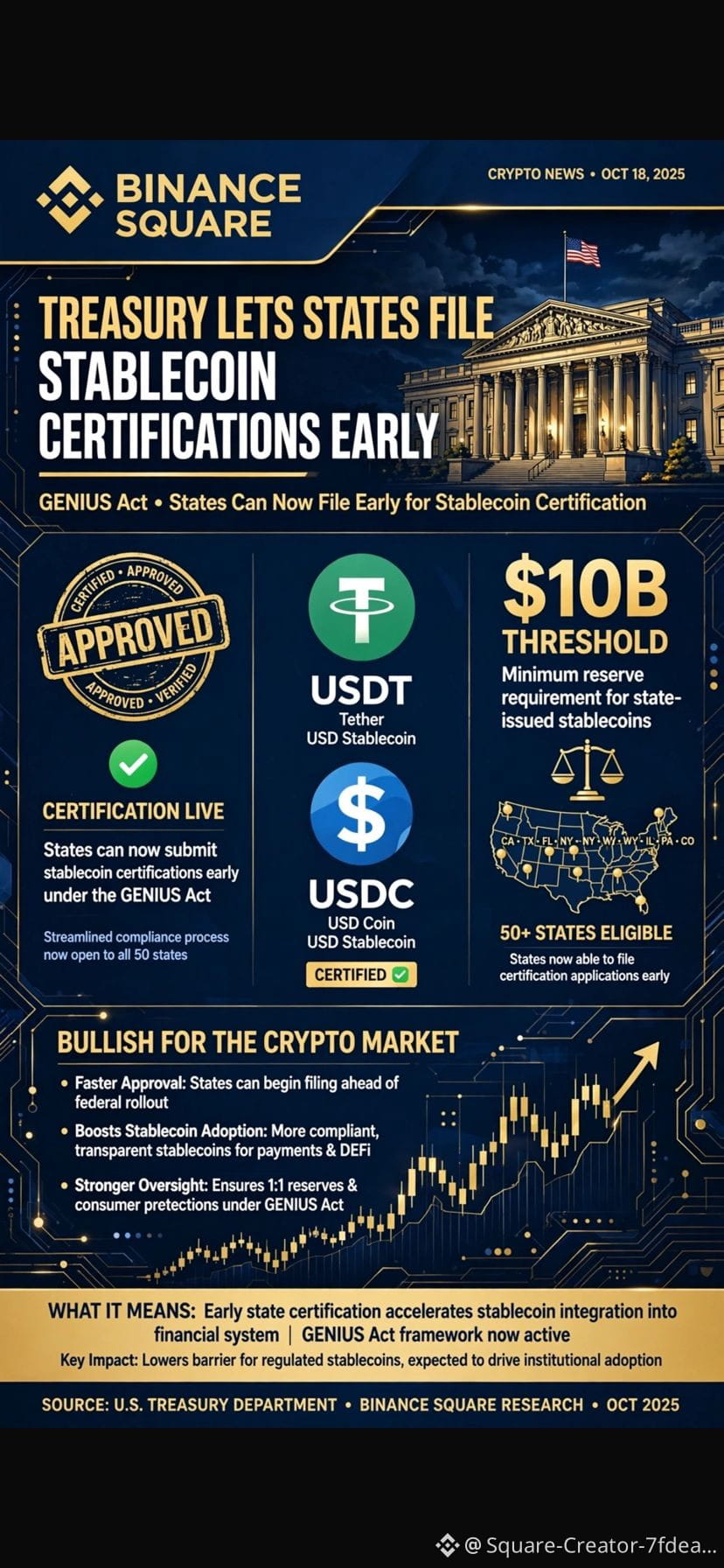
وزارة الخزانة أصدرت قانون نهائي مؤقت يوم 30 سبتمبر، يسمح للولايات الـ 50 بتقديم شهادات ترخيص العملات المستقرة مبكراً تحت قانون GENIUS Act الجديد.
القانون رقمه 2026-19966 ويدخل حيز التنفيذ فوراً!
📋 التفاصيل المهمة:
✅ الولايات تقدر تقدم الآن حتى لو ترخيصها غير مكتمل (يكفي نية العمل)
✅ الشركات اللي إصدارها أقل من 10 مليار دولار تقدر تختار ترخيص ولاية بدل الفيدرالي
✅ لجنة المراجعة مكونة من وزير الخزانة + رئيس الفيدرالي + رئيس FDIC
✅ الموعد النهائي للتقديم: 18 يناير 2028
💰 ليش هذا إيجابي جداً للسوق؟
1. تبني أسرع = سيولة أكبر تدخل السوق
2. ثقة مؤسساتية = بنوك وشركات كبيرة تدخل بعملات مستقرة مرخصة
3. عملات مثل USDT و USDC تصبح أكثر قانونية وأمان
4. هذا يمهد الطريق لصعود قوي لـ DeFi والمدفوعات بالكريبتو
📈 كيف تستفيد وتتداول؟
الخبر هذا صعودي للعملات المستقرة والمشاريع المرتبطة فيها:
- احتفظ بجزء USDT/USDC للفرص القادمة
- راقب عملات البنية التحتية للمدفوعات: $XRP $XLM $ALGO
- مشاريع DeFi اللي تعتمد على السيولة المستقرة راح تنفجر
#GENIUSAct #Stablecoin #USDT #USDC #CryptoNews #Bullish
#TreasuryLetsStatesFileStablecoinCertificationsEarly 🚨🇺🇸
عاجل: وزارة الخزانة الأمريكية تفتح الباب مبكراً للولايات لاعتماد العملات المستقرة!
خطوة تاريخية ستغير سوق الكريبتو كله 💥
⚡ إيش صار؟
وزارة الخزانة أصدرت قانون نهائي مؤقت يوم 30 سبتمبر، يسمح للولايات الـ 50 بتقديم شهادات ترخيص العملات المستقرة مبكراً تحت قانون GENIUS Act الجديد.
القانون رقمه 2026-19966 ويدخل حيز التنفيذ فوراً!
📋 التفاصيل المهمة:
✅ الولايات تقدر تقدم الآن حتى لو ترخيصها غير مكتمل (يكفي نية العمل)
✅ الشركات اللي إصدارها أقل من 10 مليار دولار تقدر تختار ترخيص ولاية بدل الفيدرالي
✅ لجنة المراجعة مكونة من وزير الخزانة + رئيس الفيدرالي + رئيس FDIC
✅ الموعد النهائي للتقديم: 18 يناير 2028
💰 ليش هذا إيجابي جداً للسوق؟
1. تبني أسرع = سيولة أكبر تدخل السوق
2. ثقة مؤسساتية = بنوك وشركات كبيرة تدخل بعملات مستقرة مرخصة
3. عملات مثل USDT و USDC تصبح أكثر قانونية وأمان
4. هذا يمهد الطريق لصعود قوي لـ DeFi والمدفوعات بالكريبتو
📈 كيف تستفيد وتتداول؟
الخبر هذا صعودي للعملات المستقرة والمشاريع المرتبطة فيها:
- احتفظ بجزء USDT/USDC للفرص القادمة
- راقب عملات البنية التحتية للمدفوعات: $XRP $XLM $ALGO
- مشاريع DeFi اللي تعتمد على السيولة المستقرة راح تنفجر
#GENIUSAct #Stablecoin #USDT #USDC #CryptoNews #Bullish
عاجل: وزارة الخزانة الأمريكية تفتح الباب مبكراً للولايات لاعتماد العملات المستقرة!
خطوة تاريخية ستغير سوق الكريبتو كله 💥
⚡ إيش صار؟
وزارة الخزانة أصدرت قانون نهائي مؤقت يوم 30 سبتمبر، يسمح للولايات الـ 50 بتقديم شهادات ترخيص العملات المستقرة مبكراً تحت قانون GENIUS Act الجديد.
القانون رقمه 2026-19966 ويدخل حيز التنفيذ فوراً!
📋 التفاصيل المهمة:
✅ الولايات تقدر تقدم الآن حتى لو ترخيصها غير مكتمل (يكفي نية العمل)
✅ الشركات اللي إصدارها أقل من 10 مليار دولار تقدر تختار ترخيص ولاية بدل الفيدرالي
✅ لجنة المراجعة مكونة من وزير الخزانة + رئيس الفيدرالي + رئيس FDIC
✅ الموعد النهائي للتقديم: 18 يناير 2028
💰 ليش هذا إيجابي جداً للسوق؟
1. تبني أسرع = سيولة أكبر تدخل السوق
2. ثقة مؤسساتية = بنوك وشركات كبيرة تدخل بعملات مستقرة مرخصة
3. عملات مثل USDT و USDC تصبح أكثر قانونية وأمان
4. هذا يمهد الطريق لصعود قوي لـ DeFi والمدفوعات بالكريبتو
📈 كيف تستفيد وتتداول؟
الخبر هذا صعودي للعملات المستقرة والمشاريع المرتبطة فيها:
- احتفظ بجزء USDT/USDC للفرص القادمة
- راقب عملات البنية التحتية للمدفوعات: $XRP $XLM $ALGO
- مشاريع DeFi اللي تعتمد على السيولة المستقرة راح تنفجر
#GENIUSAct #Stablecoin #USDT #USDC #CryptoNews #Bullish
MOURAD AZER:
هل USD0 عمله مستقره
2
4
774

$USDC #TreasuryLetsStatesFileStablecoinCertificationsEarly
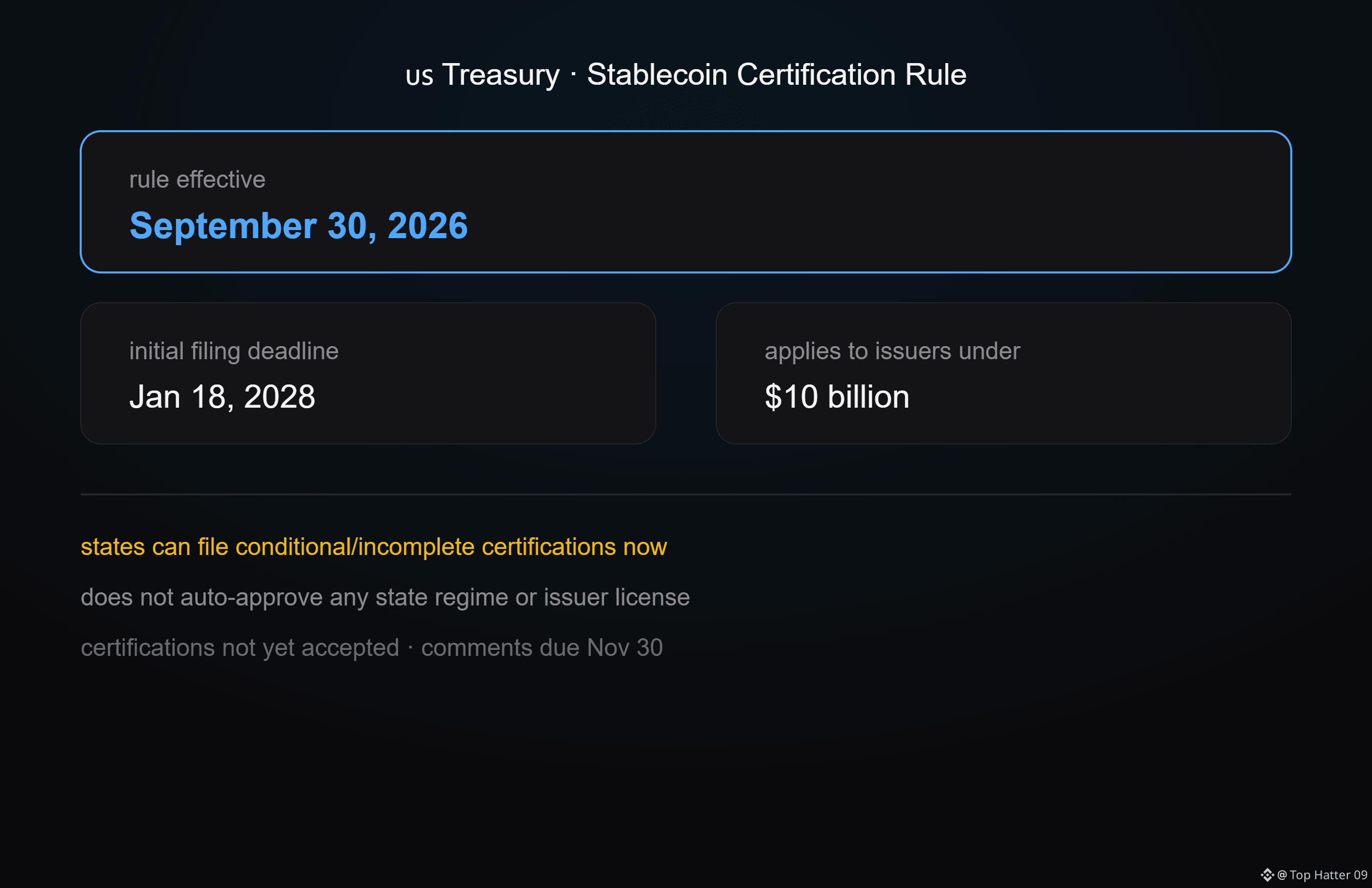
The US Treasury issued an interim final rule on September 30 that gives states more breathing room to file their stablecoin certifications, even if their own rules aren't finished yet. This is all part of the GENIUS Act, the law setting up the federal framework for stablecoin issuers.
Here's the simple version. States that want to regulate their own qualified stablecoin issuers directly, as long as those issuers have less than $10 billion in total issuance, need to file a "substantial similarity" certification with Treasury, basically proving their state rules match up with the federal ones. The deadline for that is January 18, 2028. What's new is that a state doesn't need to have everything finalized to meet that deadline, they can file a conditional or incomplete certification now and keep working on the details before the actual substantive review starts.
One thing to be clear on, this doesn't approve anything automatically. Filing just secures a spot in line, it doesn't hand out a license. And certifications aren't even being accepted yet, Treasury is still waiting on Paperwork Reduction Act approval before opening that door. Comments on the rule are open until November 30.
This is slow-moving news compared to a price pump, but it matters, it's the same kind of regulatory plumbing we've seen building with the CFTC's tokenized asset guidance, piece by piece.
$USDC #Stablecoins #Regulation
{future}(USDCUSDT)
$USDC #TreasuryLetsStatesFileStablecoinCertificationsEarly
The US Treasury issued an interim final rule on September 30 that gives states more breathing room to file their stablecoin certifications, even if their own rules aren't finished yet. This is all part of the GENIUS Act, the law setting up the federal framework for stablecoin issuers.
Here's the simple version. States that want to regulate their own qualified stablecoin issuers directly, as long as those issuers have less than $10 billion in total issuance, need to file a "substantial similarity" certification with Treasury, basically proving their state rules match up with the federal ones. The deadline for that is January 18, 2028. What's new is that a state doesn't need to have everything finalized to meet that deadline, they can file a conditional or incomplete certification now and keep working on the details before the actual substantive review starts.
One thing to be clear on, this doesn't approve anything automatically. Filing just secures a spot in line, it doesn't hand out a license. And certifications aren't even being accepted yet, Treasury is still waiting on Paperwork Reduction Act approval before opening that door. Comments on the rule are open until November 30.
This is slow-moving news compared to a price pump, but it matters, it's the same kind of regulatory plumbing we've seen building with the CFTC's tokenized asset guidance, piece by piece.
$USDC #Stablecoins #Regulation
The US Treasury issued an interim final rule on September 30 that gives states more breathing room to file their stablecoin certifications, even if their own rules aren't finished yet. This is all part of the GENIUS Act, the law setting up the federal framework for stablecoin issuers.
Here's the simple version. States that want to regulate their own qualified stablecoin issuers directly, as long as those issuers have less than $10 billion in total issuance, need to file a "substantial similarity" certification with Treasury, basically proving their state rules match up with the federal ones. The deadline for that is January 18, 2028. What's new is that a state doesn't need to have everything finalized to meet that deadline, they can file a conditional or incomplete certification now and keep working on the details before the actual substantive review starts.
One thing to be clear on, this doesn't approve anything automatically. Filing just secures a spot in line, it doesn't hand out a license. And certifications aren't even being accepted yet, Treasury is still waiting on Paperwork Reduction Act approval before opening that door. Comments on the rule are open until November 30.
This is slow-moving news compared to a price pump, but it matters, it's the same kind of regulatory plumbing we've seen building with the CFTC's tokenized asset guidance, piece by piece.
$USDC #Stablecoins #Regulation
46


The US Treasury is permitting states to begin filing for stablecoin certifications earlier than anticipated. This move signals a potential acceleration in the regulatory framework for stablecoins in the United States. Allowing early filings could streamline the process for issuers and provide greater clarity for the market. It suggests a proactive approach by regulators to integrate stablecoins into the existing financial system, potentially fostering innovation while aiming to mitigate risks. The market will be closely watching how these early certifications pave the way for broader stablecoin adoption and integration.
Disclaimer: This content is for informational purposes only and does not constitute investment advice.
#TreasuryLetsStatesFileStablecoinCertificationsEarly
The US Treasury is permitting states to begin filing for stablecoin certifications earlier than anticipated. This move signals a potential acceleration in the regulatory framework for stablecoins in the United States. Allowing early filings could streamline the process for issuers and provide greater clarity for the market. It suggests a proactive approach by regulators to integrate stablecoins into the existing financial system, potentially fostering innovation while aiming to mitigate risks. The market will be closely watching how these early certifications pave the way for broader stablecoin adoption and integration.
Disclaimer: This content is for informational purposes only and does not constitute investment advice.
#TreasuryLetsStatesFileStablecoinCertificationsEarly
Disclaimer: This content is for informational purposes only and does not constitute investment advice.
#TreasuryLetsStatesFileStablecoinCertificationsEarly
28

·
--
Жоғары (өспелі)
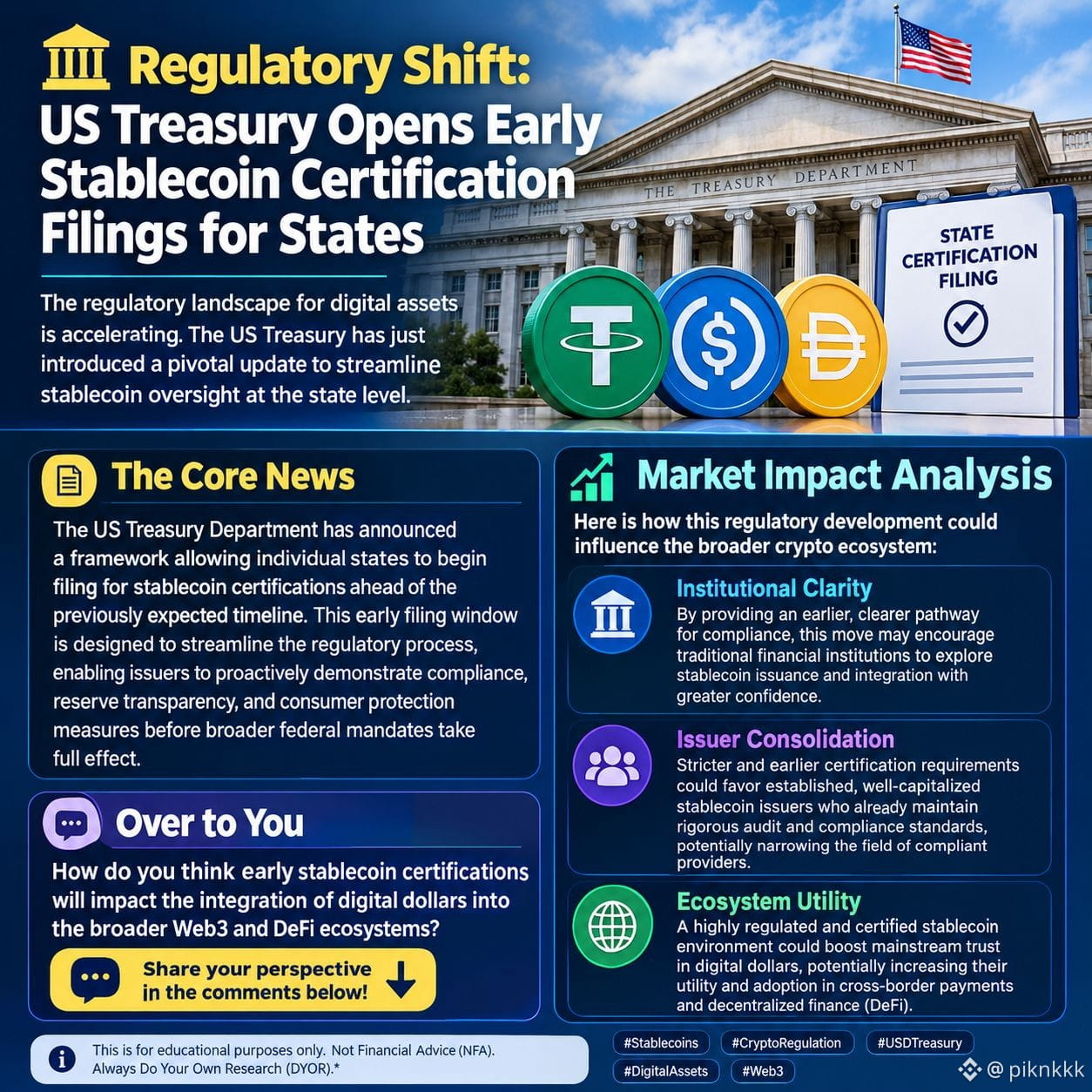
#TreasuryLetsStatesFileStablecoinCertificationsEarly 🏛️ Regulatory Shift US Treasury Opens Early Stablecoin Certification Filings for States
The regulatory landscape for digital assets is accelerating. The US Treasury has just introduced a pivotal update to streamline stablecoin oversight at the state level.
📜 The Core News
The US Treasury Department has announced a framework allowing individual states to begin filing for stablecoin certifications ahead of the previously expected timeline. This early filing window is designed to streamline the regulatory process, enabling issuers to proactively demonstrate compliance, reserve transparency, and consumer protection measures before broader federal mandates take full effect.
📊 Market Impact Analysis
Here is how this regulatory development could influence the broader crypto ecosystem
•Institutional Clarity By providing an earlier, clearer pathway for compliance, this move may encourage traditional financial institutions to explore stablecoin issuance and integration with greater confidence.
• **Issuer Consolidation:** Stricter and earlier certification requirements could favor established, well-capitalized stablecoin issuers who already maintain rigorous audit and compliance standards, potentially narrowing the field of compliant providers.
• Ecosystem Utility A highly regulated and certified stablecoin environment could boost mainstream trust in digital dollars, potentially increasing their utility and adoption in cross-border payments and decentralized finance (DeFi).
💬Over to You
How do you think early stablecoin certifications will impact the integration of digital dollars into the broader Web3 and DeFi ecosystems? Share your perspective in the comments below! 👇
#Stablecoins #CryptoRegulation #USDTreasury #DigitalAssets #web3
This is for educational purposes only. Not Financial Advice (NFA). Always Do Your Own Research (DYOR).
$SYN $NOM $OPN
{future}(OPNUSDT)
{future}(NOMUSDT)
{future}(SYNUSDT)
#TreasuryLetsStatesFileStablecoinCertificationsEarly 🏛️ Regulatory Shift US Treasury Opens Early Stablecoin Certification Filings for States
The regulatory landscape for digital assets is accelerating. The US Treasury has just introduced a pivotal update to streamline stablecoin oversight at the state level.
📜 The Core News
The US Treasury Department has announced a framework allowing individual states to begin filing for stablecoin certifications ahead of the previously expected timeline. This early filing window is designed to streamline the regulatory process, enabling issuers to proactively demonstrate compliance, reserve transparency, and consumer protection measures before broader federal mandates take full effect.
📊 Market Impact Analysis
Here is how this regulatory development could influence the broader crypto ecosystem
•Institutional Clarity By providing an earlier, clearer pathway for compliance, this move may encourage traditional financial institutions to explore stablecoin issuance and integration with greater confidence.
• **Issuer Consolidation:** Stricter and earlier certification requirements could favor established, well-capitalized stablecoin issuers who already maintain rigorous audit and compliance standards, potentially narrowing the field of compliant providers.
• Ecosystem Utility A highly regulated and certified stablecoin environment could boost mainstream trust in digital dollars, potentially increasing their utility and adoption in cross-border payments and decentralized finance (DeFi).
💬Over to You
How do you think early stablecoin certifications will impact the integration of digital dollars into the broader Web3 and DeFi ecosystems? Share your perspective in the comments below! 👇
#Stablecoins #CryptoRegulation #USDTreasury #DigitalAssets #web3
This is for educational purposes only. Not Financial Advice (NFA). Always Do Your Own Research (DYOR).
$SYN $NOM $OPN
The regulatory landscape for digital assets is accelerating. The US Treasury has just introduced a pivotal update to streamline stablecoin oversight at the state level.
📜 The Core News
The US Treasury Department has announced a framework allowing individual states to begin filing for stablecoin certifications ahead of the previously expected timeline. This early filing window is designed to streamline the regulatory process, enabling issuers to proactively demonstrate compliance, reserve transparency, and consumer protection measures before broader federal mandates take full effect.
📊 Market Impact Analysis
Here is how this regulatory development could influence the broader crypto ecosystem
•Institutional Clarity By providing an earlier, clearer pathway for compliance, this move may encourage traditional financial institutions to explore stablecoin issuance and integration with greater confidence.
• **Issuer Consolidation:** Stricter and earlier certification requirements could favor established, well-capitalized stablecoin issuers who already maintain rigorous audit and compliance standards, potentially narrowing the field of compliant providers.
• Ecosystem Utility A highly regulated and certified stablecoin environment could boost mainstream trust in digital dollars, potentially increasing their utility and adoption in cross-border payments and decentralized finance (DeFi).
💬Over to You
How do you think early stablecoin certifications will impact the integration of digital dollars into the broader Web3 and DeFi ecosystems? Share your perspective in the comments below! 👇
#Stablecoins #CryptoRegulation #USDTreasury #DigitalAssets #web3
This is for educational purposes only. Not Financial Advice (NFA). Always Do Your Own Research (DYOR).
$SYN $NOM $OPN
224

·
--
#TreasuryLetsStatesFileStablecoinCertificationsEarly 🚨 THE $10B STABLECOIN LINE IS NOW REAL. A new rule from the Treasury is creating a difference in the U.S. Stablecoin market. 👀
Under the GENIUS Act U.S. Stablecoin issuers that have up to $10 billion in coins can possibly use a state regulatory path. If the state system meets the federal requirement. Companies that are bigger than that must follow the regulatory system.
Why does this matter to people who trade crypto?
💵 USDC and USDT: these are already large so federal regulation is the main thing they need to worry about.
⚡ PYUSD, RLUSD and USDS: these smaller companies have an important point to reach as they grow.
🏦 Stablecoins are starting to be seen as financial tools, not just as something used for trading.
The big question in the market is whether clearer rules will help more institutions use stablecoins. And where that money goes next.
Will regulated stablecoins become the big source of money flow, in crypto? 👇 #crypto #BTC #Khan62 #USDT · $POL
{future}(POLUSDT)
{future}(ETHUSDT)
· $BTC
{future}(BTCUSDT)
· $ETH
#TreasuryLetsStatesFileStablecoinCertificationsEarly 🚨 THE $10B STABLECOIN LINE IS NOW REAL. A new rule from the Treasury is creating a difference in the U.S. Stablecoin market. 👀
Under the GENIUS Act U.S. Stablecoin issuers that have up to $10 billion in coins can possibly use a state regulatory path. If the state system meets the federal requirement. Companies that are bigger than that must follow the regulatory system.
Why does this matter to people who trade crypto?
💵 USDC and USDT: these are already large so federal regulation is the main thing they need to worry about.
⚡ PYUSD, RLUSD and USDS: these smaller companies have an important point to reach as they grow.
🏦 Stablecoins are starting to be seen as financial tools, not just as something used for trading.
The big question in the market is whether clearer rules will help more institutions use stablecoins. And where that money goes next.
Will regulated stablecoins become the big source of money flow, in crypto? 👇 #crypto #BTC #Khan62 #USDT · $POL
· $BTC
· $ETH
Under the GENIUS Act U.S. Stablecoin issuers that have up to $10 billion in coins can possibly use a state regulatory path. If the state system meets the federal requirement. Companies that are bigger than that must follow the regulatory system.
Why does this matter to people who trade crypto?
💵 USDC and USDT: these are already large so federal regulation is the main thing they need to worry about.
⚡ PYUSD, RLUSD and USDS: these smaller companies have an important point to reach as they grow.
🏦 Stablecoins are starting to be seen as financial tools, not just as something used for trading.
The big question in the market is whether clearer rules will help more institutions use stablecoins. And where that money goes next.
Will regulated stablecoins become the big source of money flow, in crypto? 👇 #crypto #BTC #Khan62 #USDT · $POL
· $BTC
· $ETH
98

·
--
#TreasuryLetsStatesFileStablecoinCertificationsEarly 🚨 Stablecoin Rules Are Moving Forward
A big change in regulation might soon affect how smaller stablecoin companies work in the U.S.
The Treasury’s GENIUS Act plan lets issuers with $10B or less in stablecoins out to possibly follow state-level rules.. Those state rules must be very similar, to the federal ones.
🔹 Some states can start setting up their rules now
🔹 The federal rules are still being built
🔹 The $10B limit is a cutoff point
🔹 Clear rules could shift how stablecoins grow and how the market is shaped
For people trading crypto this is something to keep an eye on.
💬 Will clearer rules help more people use crypto?
{future}(ETHUSDT)
{future}(AAVEUSDT)
#Khan62 #crypto #ETH #defi $ETH $AAVE $LINK
{future}(LINKUSDT)
#TreasuryLetsStatesFileStablecoinCertificationsEarly 🚨 Stablecoin Rules Are Moving Forward
A big change in regulation might soon affect how smaller stablecoin companies work in the U.S.
The Treasury’s GENIUS Act plan lets issuers with $10B or less in stablecoins out to possibly follow state-level rules.. Those state rules must be very similar, to the federal ones.
🔹 Some states can start setting up their rules now
🔹 The federal rules are still being built
🔹 The $10B limit is a cutoff point
🔹 Clear rules could shift how stablecoins grow and how the market is shaped
For people trading crypto this is something to keep an eye on.
💬 Will clearer rules help more people use crypto?
#Khan62 #crypto #ETH #defi $ETH $AAVE $LINK
A big change in regulation might soon affect how smaller stablecoin companies work in the U.S.
The Treasury’s GENIUS Act plan lets issuers with $10B or less in stablecoins out to possibly follow state-level rules.. Those state rules must be very similar, to the federal ones.
🔹 Some states can start setting up their rules now
🔹 The federal rules are still being built
🔹 The $10B limit is a cutoff point
🔹 Clear rules could shift how stablecoins grow and how the market is shaped
For people trading crypto this is something to keep an eye on.
💬 Will clearer rules help more people use crypto?
#Khan62 #crypto #ETH #defi $ETH $AAVE $LINK
46

·
--
Төмен (кемімелі)
#TreasuryLetsStatesFileStablecoinCertificationsEarly
⚡ Stablecoin Regulatory Sprint: U.S. Treasury Sets State-Level Approval Framework
The U.S. Department of the Treasury has officially published a major interim final rule establishing procedural guidelines and certification forms for state payment-stablecoin regulators under the GENIUS Act (Guiding and Establishing National Innovation for U.S. Stablecoins Act).
This decision introduces a crucial mechanism: states can submit early certifications for their regulatory regimes even while their local rulemaking processes are ongoing, preventing bureaucratic bottlenecks and ensuring state-qualified issuers stay on track.
🚨 JUST IN: U.S. TREASURY OPENS THE DOOR FOR STATES TO FILE STABLECOIN CERTIFICATIONS EARLY! ⚡️
📰 The Role of the Stablecoin Certification Review Committee (SCRC) 🏛️
The rule empowers the newly formed SCRC—composed of the Treasury Secretary, the Federal Reserve Chair, and the FDIC Chair—to review state regulatory frameworks. States must demonstrate that their oversight, examination, and reserve requirements are "substantially similar" to federal prudential standards.
State-Qualified Issuer Thresholds 🏦
Under the GENIUS Act framework, state-chartered issuers managing under $10 billion in outstanding market cap can operate under state oversight once their state regime receives SCRC certification. Issuers exceeding $10 billion will eventually transition into federal oversight frameworks.
$AAPL.US
{stock_us}(AAPL.US)
🌐 Accelerated Compliance for State-Regulated Issuers: State-chartered stablecoins now have a direct pathway toward gaining federal recognition, helping maintain market stability and safe-harbor compliance.
$XRP
{future}(XRPUSDT)
Institutional Liquidity & Banking Access: Certified payment stablecoins gain recognized legal status under federal law, facilitating smoother integration with U.S. banking infrastructure and institutional payment rails.
#US10YearYieldNears5.3% #KoreaProposesTokenizingStocksAndBonds #StablecoinRevolution
#TreasuryLetsStatesFileStablecoinCertificationsEarly
⚡ Stablecoin Regulatory Sprint: U.S. Treasury Sets State-Level Approval Framework
The U.S. Department of the Treasury has officially published a major interim final rule establishing procedural guidelines and certification forms for state payment-stablecoin regulators under the GENIUS Act (Guiding and Establishing National Innovation for U.S. Stablecoins Act).
This decision introduces a crucial mechanism: states can submit early certifications for their regulatory regimes even while their local rulemaking processes are ongoing, preventing bureaucratic bottlenecks and ensuring state-qualified issuers stay on track.
🚨 JUST IN: U.S. TREASURY OPENS THE DOOR FOR STATES TO FILE STABLECOIN CERTIFICATIONS EARLY! ⚡️
📰 The Role of the Stablecoin Certification Review Committee (SCRC) 🏛️
The rule empowers the newly formed SCRC—composed of the Treasury Secretary, the Federal Reserve Chair, and the FDIC Chair—to review state regulatory frameworks. States must demonstrate that their oversight, examination, and reserve requirements are "substantially similar" to federal prudential standards.
State-Qualified Issuer Thresholds 🏦
Under the GENIUS Act framework, state-chartered issuers managing under $10 billion in outstanding market cap can operate under state oversight once their state regime receives SCRC certification. Issuers exceeding $10 billion will eventually transition into federal oversight frameworks.
$AAPL.US
🌐 Accelerated Compliance for State-Regulated Issuers: State-chartered stablecoins now have a direct pathway toward gaining federal recognition, helping maintain market stability and safe-harbor compliance.
$XRP
Institutional Liquidity & Banking Access: Certified payment stablecoins gain recognized legal status under federal law, facilitating smoother integration with U.S. banking infrastructure and institutional payment rails.
#US10YearYieldNears5.3% #KoreaProposesTokenizingStocksAndBonds #StablecoinRevolution
⚡ Stablecoin Regulatory Sprint: U.S. Treasury Sets State-Level Approval Framework
The U.S. Department of the Treasury has officially published a major interim final rule establishing procedural guidelines and certification forms for state payment-stablecoin regulators under the GENIUS Act (Guiding and Establishing National Innovation for U.S. Stablecoins Act).
This decision introduces a crucial mechanism: states can submit early certifications for their regulatory regimes even while their local rulemaking processes are ongoing, preventing bureaucratic bottlenecks and ensuring state-qualified issuers stay on track.
🚨 JUST IN: U.S. TREASURY OPENS THE DOOR FOR STATES TO FILE STABLECOIN CERTIFICATIONS EARLY! ⚡️
📰 The Role of the Stablecoin Certification Review Committee (SCRC) 🏛️
The rule empowers the newly formed SCRC—composed of the Treasury Secretary, the Federal Reserve Chair, and the FDIC Chair—to review state regulatory frameworks. States must demonstrate that their oversight, examination, and reserve requirements are "substantially similar" to federal prudential standards.
State-Qualified Issuer Thresholds 🏦
Under the GENIUS Act framework, state-chartered issuers managing under $10 billion in outstanding market cap can operate under state oversight once their state regime receives SCRC certification. Issuers exceeding $10 billion will eventually transition into federal oversight frameworks.
$AAPL.US
🌐 Accelerated Compliance for State-Regulated Issuers: State-chartered stablecoins now have a direct pathway toward gaining federal recognition, helping maintain market stability and safe-harbor compliance.
$XRP
Institutional Liquidity & Banking Access: Certified payment stablecoins gain recognized legal status under federal law, facilitating smoother integration with U.S. banking infrastructure and institutional payment rails.
#US10YearYieldNears5.3% #KoreaProposesTokenizingStocksAndBonds #StablecoinRevolution

XRP+0,96%
AAPLUS+0,00%
1
716

·
--
Жоғары (өспелі)
#TreasuryLetsStatesFileStablecoinCertificationsEarly
🚨 JUST IN: 🇺🇸 TREASURY OPENS THE DOOR FOR STATES TO FILE STABLECOIN CERTIFICATIONS EARLY! ⚡️
Under new Treasury procedures, states can prepare and submit certifications for their payment-stablecoin regulatory frameworks under the GENIUS Act.
🔥 State-level stablecoin regulation gets a clearer pathway
🏦 States can seek approval for qualifying issuers
⚡️ Existing state regimes may receive expedited processing
🌐 Another step toward a US stablecoin framework
The race to build compliant stablecoin infrastructure is heating up. 👀
#Stablecoins #cryptouniverseofficial #RWA
#TreasuryLetsStatesFileStablecoinCertificationsEarly
🚨 JUST IN: 🇺🇸 TREASURY OPENS THE DOOR FOR STATES TO FILE STABLECOIN CERTIFICATIONS EARLY! ⚡️
Under new Treasury procedures, states can prepare and submit certifications for their payment-stablecoin regulatory frameworks under the GENIUS Act.
🔥 State-level stablecoin regulation gets a clearer pathway
🏦 States can seek approval for qualifying issuers
⚡️ Existing state regimes may receive expedited processing
🌐 Another step toward a US stablecoin framework
The race to build compliant stablecoin infrastructure is heating up. 👀
#Stablecoins #cryptouniverseofficial #RWA
🚨 JUST IN: 🇺🇸 TREASURY OPENS THE DOOR FOR STATES TO FILE STABLECOIN CERTIFICATIONS EARLY! ⚡️
Under new Treasury procedures, states can prepare and submit certifications for their payment-stablecoin regulatory frameworks under the GENIUS Act.
🔥 State-level stablecoin regulation gets a clearer pathway
🏦 States can seek approval for qualifying issuers
⚡️ Existing state regimes may receive expedited processing
🌐 Another step toward a US stablecoin framework
The race to build compliant stablecoin infrastructure is heating up. 👀
#Stablecoins #cryptouniverseofficial #RWA
45
币安广场深度报道:通胀降温叠加机构看多,加密市场迎来关键转折期
一、宏观面释放利好,美联储加息预期推迟
美国商务部最新公布的核心PCE物价指数数据显示,八月同比增速降至百分之三,低于市场预期的百分之三点三,创下六个月以来新低。这一数据直接缓解了市场对美联储在十月继续加息的担忧。高盛和摩根大通均将下一次加息的预测时间推迟至十二月,为风险资产提供了短暂的喘息窗口。
数据公布后,比特币一度冲高至约八万五千五百美元,随后回落至八万三千七百美元附近震荡。市场情绪虽然有所修复,但美国十年期国债收益率仍在百分之五点三附近高位运行,叠加近期ETF单日净流出约一点四九亿美元,短期波动风险依然不容忽视。
二、花旗大幅上调比特币目标价,机构信心增强
花旗集团近日将比特币十二个月目标价上调至十一万三千美元,同时将以太坊目标价上调至三千零二十八美元。这一判断基于第三季度ETF净流入高达六十三点四亿美元,以及比特币和以太坊分别从低点反弹了约百分之四十至百分之六十八的强劲表现。
机构资金的持续流入正在改变加密市场的定价逻辑。与传统投机驱动不同,当前行情的底层支撑更多来自资产配置需求和机构组合再平衡。不过,花旗也提示,国债收益率高企和ETF资金流的反复仍可能引发阶段性回调,投资者需要保持理性。
三、九月安全事件频发,行业风控面临严峻考验
与市场利好形成鲜明对比的是,二零二六年九月成为加密行业有史以来损失最惨重的月份之一。全月共发生五十五起重大安全事件,累计损失约七点六八亿美元,较八月暴增百分之四百六十二。其中Bitget遭遇的三点八七五亿美元漏洞攻击和Liquid Network的三点二亿美元被盗事件占据了绝大部分损失。第三季度累计损失更是突破十二点六亿美元,环比增长超过百分之五十三。
十月一日,NEAR Intents再次曝出约三百八十六万美元的热钱包被盗事件,攻击者通过KuCoin将资金桥接至比特币链。PeckShield和知名链上追踪员ZachXBT已将攻击地址与朝鲜Lazarus黑客组织关联。国家级黑客对加密行业的渗透正在加剧,交易所和协议的安全标准亟需全面升级。
四、代币化美股持续扩展,链上投资渠道日益丰富
在代币化领域,币安Web3平台上的美股代币产品持续扩容,目前已覆盖包括EEM、MRNA、LIN等多只代币化股票。投资者可以通过链上方式持有传统美股资产的代币化份额,降低了跨境投资的门槛。
从市场热度来看,永续合约市场中部分代币表现抢眼,龙虾代币单日涨幅超过百分之一百零二,MOVR上涨约百分之六十九,CAP上涨约百分之三十一,显示资金在特定板块中活跃度极高。但高波动也意味着高风险,投资者应谨慎评估自身的风险承受能力。
五、全球监管加速推进,合规成为行业主旋律
英国金融行为监管局于九月三十日正式开放加密授权申请通道,要求所有在英运营的加密企业在二零二七年二月二十八日前完成申请,二零二七年十月二十五日起无证经营将属违法。这标志着英国正式迈向银行级别的加密监管体系。
与此同时,美国财政部允许各州提前提交稳定币认证申请,为稳定币合规化铺路。币安支付也在日本与PayPay达成合作,在数百万商户接入加密支付,推动加密资产在消费场景中的实际落地。
综合来看,当前加密市场正处于宏观利好与安全风险并存的关键节点。机构看多情绪和通胀降温为市场提供了支撑,但安全事件的频发和监管趋严也提醒参与者必须更加注重风险管理和合规建设。在这个转折期,理性判断和稳健操作比盲目追涨更加重要。
#EtherGains70.9%InQ3 #TreasuryLetsStatesFileStablecoinCertificationsEarly #BTC
币安广场深度报道:通胀降温叠加机构看多,加密市场迎来关键转折期
一、宏观面释放利好,美联储加息预期推迟
美国商务部最新公布的核心PCE物价指数数据显示,八月同比增速降至百分之三,低于市场预期的百分之三点三,创下六个月以来新低。这一数据直接缓解了市场对美联储在十月继续加息的担忧。高盛和摩根大通均将下一次加息的预测时间推迟至十二月,为风险资产提供了短暂的喘息窗口。
数据公布后,比特币一度冲高至约八万五千五百美元,随后回落至八万三千七百美元附近震荡。市场情绪虽然有所修复,但美国十年期国债收益率仍在百分之五点三附近高位运行,叠加近期ETF单日净流出约一点四九亿美元,短期波动风险依然不容忽视。
二、花旗大幅上调比特币目标价,机构信心增强
花旗集团近日将比特币十二个月目标价上调至十一万三千美元,同时将以太坊目标价上调至三千零二十八美元。这一判断基于第三季度ETF净流入高达六十三点四亿美元,以及比特币和以太坊分别从低点反弹了约百分之四十至百分之六十八的强劲表现。
机构资金的持续流入正在改变加密市场的定价逻辑。与传统投机驱动不同,当前行情的底层支撑更多来自资产配置需求和机构组合再平衡。不过,花旗也提示,国债收益率高企和ETF资金流的反复仍可能引发阶段性回调,投资者需要保持理性。
三、九月安全事件频发,行业风控面临严峻考验
与市场利好形成鲜明对比的是,二零二六年九月成为加密行业有史以来损失最惨重的月份之一。全月共发生五十五起重大安全事件,累计损失约七点六八亿美元,较八月暴增百分之四百六十二。其中Bitget遭遇的三点八七五亿美元漏洞攻击和Liquid Network的三点二亿美元被盗事件占据了绝大部分损失。第三季度累计损失更是突破十二点六亿美元,环比增长超过百分之五十三。
十月一日,NEAR Intents再次曝出约三百八十六万美元的热钱包被盗事件,攻击者通过KuCoin将资金桥接至比特币链。PeckShield和知名链上追踪员ZachXBT已将攻击地址与朝鲜Lazarus黑客组织关联。国家级黑客对加密行业的渗透正在加剧,交易所和协议的安全标准亟需全面升级。
四、代币化美股持续扩展,链上投资渠道日益丰富
在代币化领域,币安Web3平台上的美股代币产品持续扩容,目前已覆盖包括EEM、MRNA、LIN等多只代币化股票。投资者可以通过链上方式持有传统美股资产的代币化份额,降低了跨境投资的门槛。
从市场热度来看,永续合约市场中部分代币表现抢眼,龙虾代币单日涨幅超过百分之一百零二,MOVR上涨约百分之六十九,CAP上涨约百分之三十一,显示资金在特定板块中活跃度极高。但高波动也意味着高风险,投资者应谨慎评估自身的风险承受能力。
五、全球监管加速推进,合规成为行业主旋律
英国金融行为监管局于九月三十日正式开放加密授权申请通道,要求所有在英运营的加密企业在二零二七年二月二十八日前完成申请,二零二七年十月二十五日起无证经营将属违法。这标志着英国正式迈向银行级别的加密监管体系。
与此同时,美国财政部允许各州提前提交稳定币认证申请,为稳定币合规化铺路。币安支付也在日本与PayPay达成合作,在数百万商户接入加密支付,推动加密资产在消费场景中的实际落地。
综合来看,当前加密市场正处于宏观利好与安全风险并存的关键节点。机构看多情绪和通胀降温为市场提供了支撑,但安全事件的频发和监管趋严也提醒参与者必须更加注重风险管理和合规建设。在这个转折期,理性判断和稳健操作比盲目追涨更加重要。
#EtherGains70.9%InQ3 #TreasuryLetsStatesFileStablecoinCertificationsEarly #BTC
一、宏观面释放利好,美联储加息预期推迟
美国商务部最新公布的核心PCE物价指数数据显示,八月同比增速降至百分之三,低于市场预期的百分之三点三,创下六个月以来新低。这一数据直接缓解了市场对美联储在十月继续加息的担忧。高盛和摩根大通均将下一次加息的预测时间推迟至十二月,为风险资产提供了短暂的喘息窗口。
数据公布后,比特币一度冲高至约八万五千五百美元,随后回落至八万三千七百美元附近震荡。市场情绪虽然有所修复,但美国十年期国债收益率仍在百分之五点三附近高位运行,叠加近期ETF单日净流出约一点四九亿美元,短期波动风险依然不容忽视。
二、花旗大幅上调比特币目标价,机构信心增强
花旗集团近日将比特币十二个月目标价上调至十一万三千美元,同时将以太坊目标价上调至三千零二十八美元。这一判断基于第三季度ETF净流入高达六十三点四亿美元,以及比特币和以太坊分别从低点反弹了约百分之四十至百分之六十八的强劲表现。
机构资金的持续流入正在改变加密市场的定价逻辑。与传统投机驱动不同,当前行情的底层支撑更多来自资产配置需求和机构组合再平衡。不过,花旗也提示,国债收益率高企和ETF资金流的反复仍可能引发阶段性回调,投资者需要保持理性。
三、九月安全事件频发,行业风控面临严峻考验
与市场利好形成鲜明对比的是,二零二六年九月成为加密行业有史以来损失最惨重的月份之一。全月共发生五十五起重大安全事件,累计损失约七点六八亿美元,较八月暴增百分之四百六十二。其中Bitget遭遇的三点八七五亿美元漏洞攻击和Liquid Network的三点二亿美元被盗事件占据了绝大部分损失。第三季度累计损失更是突破十二点六亿美元,环比增长超过百分之五十三。
十月一日,NEAR Intents再次曝出约三百八十六万美元的热钱包被盗事件,攻击者通过KuCoin将资金桥接至比特币链。PeckShield和知名链上追踪员ZachXBT已将攻击地址与朝鲜Lazarus黑客组织关联。国家级黑客对加密行业的渗透正在加剧,交易所和协议的安全标准亟需全面升级。
四、代币化美股持续扩展,链上投资渠道日益丰富
在代币化领域,币安Web3平台上的美股代币产品持续扩容,目前已覆盖包括EEM、MRNA、LIN等多只代币化股票。投资者可以通过链上方式持有传统美股资产的代币化份额,降低了跨境投资的门槛。
从市场热度来看,永续合约市场中部分代币表现抢眼,龙虾代币单日涨幅超过百分之一百零二,MOVR上涨约百分之六十九,CAP上涨约百分之三十一,显示资金在特定板块中活跃度极高。但高波动也意味着高风险,投资者应谨慎评估自身的风险承受能力。
五、全球监管加速推进,合规成为行业主旋律
英国金融行为监管局于九月三十日正式开放加密授权申请通道,要求所有在英运营的加密企业在二零二七年二月二十八日前完成申请,二零二七年十月二十五日起无证经营将属违法。这标志着英国正式迈向银行级别的加密监管体系。
与此同时,美国财政部允许各州提前提交稳定币认证申请,为稳定币合规化铺路。币安支付也在日本与PayPay达成合作,在数百万商户接入加密支付,推动加密资产在消费场景中的实际落地。
综合来看,当前加密市场正处于宏观利好与安全风险并存的关键节点。机构看多情绪和通胀降温为市场提供了支撑,但安全事件的频发和监管趋严也提醒参与者必须更加注重风险管理和合规建设。在这个转折期,理性判断和稳健操作比盲目追涨更加重要。
#EtherGains70.9%InQ3 #TreasuryLetsStatesFileStablecoinCertificationsEarly #BTC
232

Why It Matters
Earlier state certification could make the stablecoin regulatory process more structured and predictable.
The next phase: how states and issuers implement the framework.
$USDC $ETH $LINK #TreasuryLetsStatesFileStablecoinCertificationsEarly
Why It Matters
Earlier state certification could make the stablecoin regulatory process more structured and predictable.
The next phase: how states and issuers implement the framework.
$USDC $ETH $LINK #TreasuryLetsStatesFileStablecoinCertificationsEarly
Earlier state certification could make the stablecoin regulatory process more structured and predictable.
The next phase: how states and issuers implement the framework.
$USDC $ETH $LINK #TreasuryLetsStatesFileStablecoinCertificationsEarly
7
📜 Regulatory Shift
States may be able to submit stablecoin certifications ahead of schedule, adding another layer to the evolving regulatory framework.
$ETH $BTC $SOL #TreasuryLetsStatesFileStablecoinCertificationsEarly
📜 Regulatory Shift
States may be able to submit stablecoin certifications ahead of schedule, adding another layer to the evolving regulatory framework.
$ETH $BTC $SOL #TreasuryLetsStatesFileStablecoinCertificationsEarly
States may be able to submit stablecoin certifications ahead of schedule, adding another layer to the evolving regulatory framework.
$ETH $BTC $SOL #TreasuryLetsStatesFileStablecoinCertificationsEarly
3
🏦 Stablecoin Rules Move Forward
Earlier certification could give states a clearer path for stablecoin compliance and regulation.
A development worth watching for the digital-asset market. 👀
$USDC $ETH $BNB #TreasuryLetsStatesFileStablecoinCertificationsEarly
🏦 Stablecoin Rules Move Forward
Earlier certification could give states a clearer path for stablecoin compliance and regulation.
A development worth watching for the digital-asset market. 👀
$USDC $ETH $BNB #TreasuryLetsStatesFileStablecoinCertificationsEarly
Earlier certification could give states a clearer path for stablecoin compliance and regulation.
A development worth watching for the digital-asset market. 👀
$USDC $ETH $BNB #TreasuryLetsStatesFileStablecoinCertificationsEarly
1
⚡ Earlier Certification
U.S. Treasury moves toward letting states file stablecoin certifications earlier, potentially speeding up state-level oversight.
$USDC $USDT $ETH #TreasuryLetsStatesFileStablecoinCertificationsEarly
⚡ Earlier Certification
U.S. Treasury moves toward letting states file stablecoin certifications earlier, potentially speeding up state-level oversight.
$USDC $USDT $ETH #TreasuryLetsStatesFileStablecoinCertificationsEarly
U.S. Treasury moves toward letting states file stablecoin certifications earlier, potentially speeding up state-level oversight.
$USDC $USDT $ETH #TreasuryLetsStatesFileStablecoinCertificationsEarly
7

·
--
美国稳定币州认证登热榜|规则生效不等于现在就能申报|BNB在772附近我等验证
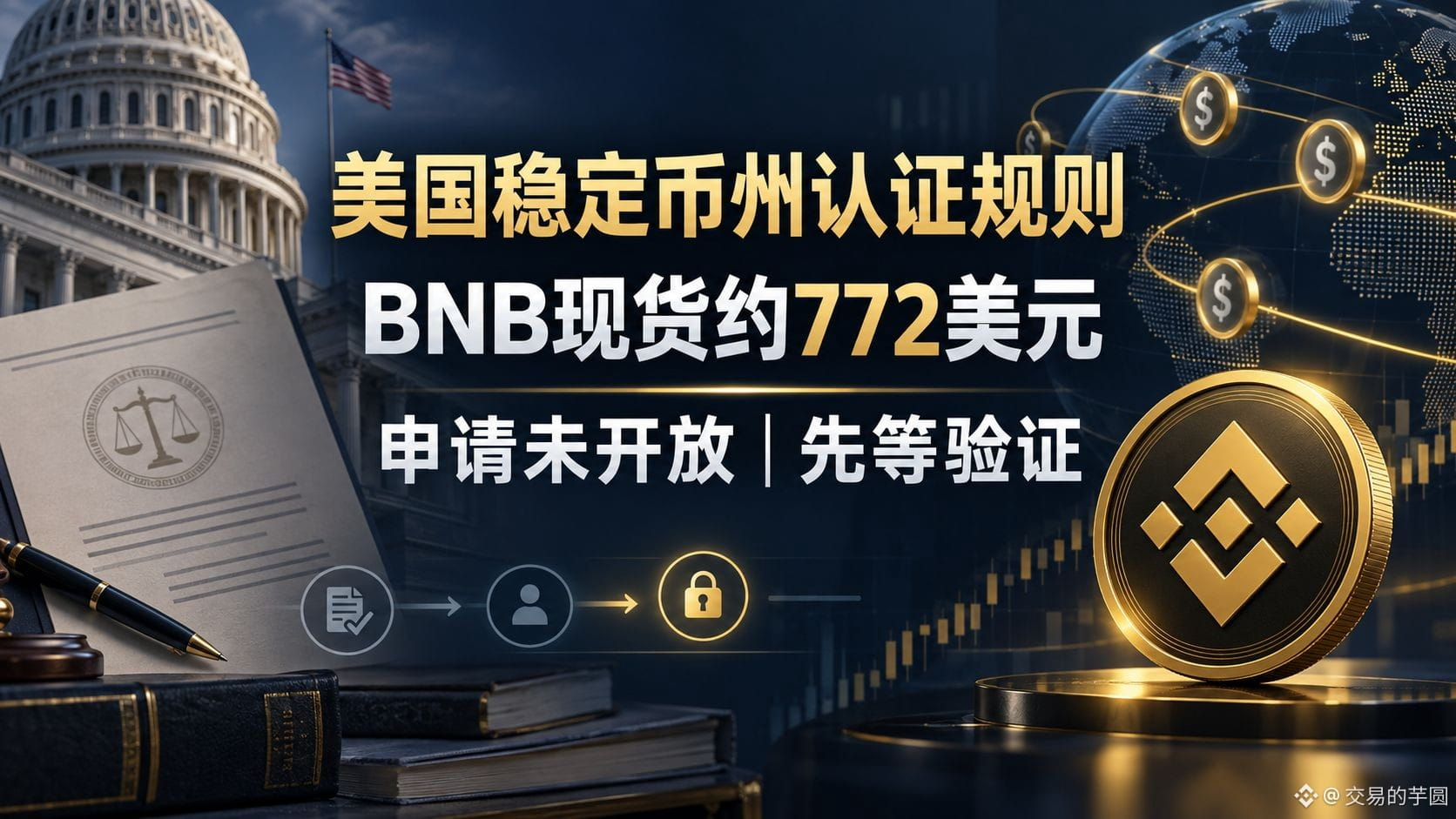
我的态度是谨慎偏多,但今天不因为一个监管标题追BNB。币安广场热榜正在讨论#TreasuryLetsStatesFileStablecoinCertificationsEarly。核对美国《联邦公报》9月30日刊登的财政部临时最终规则,确实已经把各州支付稳定币监管制度的认证表格和审查流程写出来,规则也从9月30日起生效;关键限制却在日期栏:认证申请须等《文书削减法》所涉信息收集获得批准后才会接收,财政部将另行通知开放时间。所以“允许州提前申报”如果被理解为今天已经开放窗口,就超出原文。州级制度获得委员会认可,与某家发行人获牌、某枚稳定币获得批准,又是不同层级的事。
这为何关系到加密市场?明确、可操作的监管路径有利于合规发行人规划储备、审计、赎回和渠道,长期可能影响稳定币在交易所和公链上的分布。BNB Chain官网列出USDC、USD1等稳定币及其支付、DeFi场景,因此有潜在生态关联;但美国的州级流程不是BNB Chain专属政策,更不是承诺新增资金流入BNB。尤其部分稳定币转账费用由活动补贴承担,链上稳定币供应增加也不能机械换算成BNB现货买盘。我更愿意跟踪实际申报开放、州制度获批、发行人选择哪条链、真实转账和BNB链费需求,而不是把流程文件当成已落地的采用数据。
市场已经怎么反应?截稿时币安BNBUSDT约772.4美元,滚动24小时高772.97、低763.02,变动约+0.54%。这是价格快照,不足以证明涨幅由财政部规则驱动。773是眼前的确认位,767与763是我看回撤承接的两层参考;若站上773却很快跌回767,突破判断就被推翻。若财政部后续说明延迟接收、州制度未获批准,或者稳定币活动未带来可核实链上使用,也要撤销“政策利好已经兑现”的叙事。
如果是我自己交易:目前不参与,方向只考虑无杠杆现货试多,不开空单。只有一小时收盘站稳773,随后回踩771—773仍守住,且交易与充提正常,我才用总资金最多2%分批入场;先看778,触及先减半,剩余看784,触及即平仓。入场后跌破767立即止损;即使没到止损,连续两根一小时K线收在771下方也平掉余仓。若未触发入场而先跌破763,原计划取消,继续空仓。目标价不是收益保证,滑点和消息突变要计入风险。
#TreasuryLetsStatesFileStablecoinCertificationsEarly #BNB
以上仅为个人市场观察,不构成投资建议。
美国稳定币州认证登热榜|规则生效不等于现在就能申报|BNB在772附近我等验证
我的态度是谨慎偏多,但今天不因为一个监管标题追BNB。币安广场热榜正在讨论#TreasuryLetsStatesFileStablecoinCertificationsEarly。核对美国《联邦公报》9月30日刊登的财政部临时最终规则,确实已经把各州支付稳定币监管制度的认证表格和审查流程写出来,规则也从9月30日起生效;关键限制却在日期栏:认证申请须等《文书削减法》所涉信息收集获得批准后才会接收,财政部将另行通知开放时间。所以“允许州提前申报”如果被理解为今天已经开放窗口,就超出原文。州级制度获得委员会认可,与某家发行人获牌、某枚稳定币获得批准,又是不同层级的事。
这为何关系到加密市场?明确、可操作的监管路径有利于合规发行人规划储备、审计、赎回和渠道,长期可能影响稳定币在交易所和公链上的分布。BNB Chain官网列出USDC、USD1等稳定币及其支付、DeFi场景,因此有潜在生态关联;但美国的州级流程不是BNB Chain专属政策,更不是承诺新增资金流入BNB。尤其部分稳定币转账费用由活动补贴承担,链上稳定币供应增加也不能机械换算成BNB现货买盘。我更愿意跟踪实际申报开放、州制度获批、发行人选择哪条链、真实转账和BNB链费需求,而不是把流程文件当成已落地的采用数据。
市场已经怎么反应?截稿时币安BNBUSDT约772.4美元,滚动24小时高772.97、低763.02,变动约+0.54%。这是价格快照,不足以证明涨幅由财政部规则驱动。773是眼前的确认位,767与763是我看回撤承接的两层参考;若站上773却很快跌回767,突破判断就被推翻。若财政部后续说明延迟接收、州制度未获批准,或者稳定币活动未带来可核实链上使用,也要撤销“政策利好已经兑现”的叙事。
如果是我自己交易:目前不参与,方向只考虑无杠杆现货试多,不开空单。只有一小时收盘站稳773,随后回踩771—773仍守住,且交易与充提正常,我才用总资金最多2%分批入场;先看778,触及先减半,剩余看784,触及即平仓。入场后跌破767立即止损;即使没到止损,连续两根一小时K线收在771下方也平掉余仓。若未触发入场而先跌破763,原计划取消,继续空仓。目标价不是收益保证,滑点和消息突变要计入风险。
#TreasuryLetsStatesFileStablecoinCertificationsEarly #BNB
以上仅为个人市场观察,不构成投资建议。
我的态度是谨慎偏多,但今天不因为一个监管标题追BNB。币安广场热榜正在讨论#TreasuryLetsStatesFileStablecoinCertificationsEarly。核对美国《联邦公报》9月30日刊登的财政部临时最终规则,确实已经把各州支付稳定币监管制度的认证表格和审查流程写出来,规则也从9月30日起生效;关键限制却在日期栏:认证申请须等《文书削减法》所涉信息收集获得批准后才会接收,财政部将另行通知开放时间。所以“允许州提前申报”如果被理解为今天已经开放窗口,就超出原文。州级制度获得委员会认可,与某家发行人获牌、某枚稳定币获得批准,又是不同层级的事。
这为何关系到加密市场?明确、可操作的监管路径有利于合规发行人规划储备、审计、赎回和渠道,长期可能影响稳定币在交易所和公链上的分布。BNB Chain官网列出USDC、USD1等稳定币及其支付、DeFi场景,因此有潜在生态关联;但美国的州级流程不是BNB Chain专属政策,更不是承诺新增资金流入BNB。尤其部分稳定币转账费用由活动补贴承担,链上稳定币供应增加也不能机械换算成BNB现货买盘。我更愿意跟踪实际申报开放、州制度获批、发行人选择哪条链、真实转账和BNB链费需求,而不是把流程文件当成已落地的采用数据。
市场已经怎么反应?截稿时币安BNBUSDT约772.4美元,滚动24小时高772.97、低763.02,变动约+0.54%。这是价格快照,不足以证明涨幅由财政部规则驱动。773是眼前的确认位,767与763是我看回撤承接的两层参考;若站上773却很快跌回767,突破判断就被推翻。若财政部后续说明延迟接收、州制度未获批准,或者稳定币活动未带来可核实链上使用,也要撤销“政策利好已经兑现”的叙事。
如果是我自己交易:目前不参与,方向只考虑无杠杆现货试多,不开空单。只有一小时收盘站稳773,随后回踩771—773仍守住,且交易与充提正常,我才用总资金最多2%分批入场;先看778,触及先减半,剩余看784,触及即平仓。入场后跌破767立即止损;即使没到止损,连续两根一小时K线收在771下方也平掉余仓。若未触发入场而先跌破763,原计划取消,继续空仓。目标价不是收益保证,滑点和消息突变要计入风险。
#TreasuryLetsStatesFileStablecoinCertificationsEarly #BNB
以上仅为个人市场观察,不构成投资建议。
15
代币化美股狂飙:2026年增长390%背后的结构性变革与投资机遇
一、代币化美股迎来爆发式增长
2026年第三季度即将收官,全球资本市场最引人注目的趋势之一,莫过于代币化美股的迅猛发展。币安首席执行官赵长鹏近日指出,代币化股票在2026年实现了390%的惊人增长,但即便如此,其市值仅占全球151.9万亿美元上市股票总量的0.0029%。这一数字既揭示了当前市场的渺小,更暗示了未来巨大的增长空间。
从链上交易数据来看,代币化股票在9月份已经占据了去中心化交易所交易量的11%,正在快速缩小与模因币17%份额之间的差距。这意味着一场从投机性资产向真实世界资产的结构性轮动正在链上悄然发生。对于传统美股投资者而言,这不再是遥远的概念,而是正在改变市场格局的现实力量。
二、宏观经济环境为风险资产提供支撑
代币化美股的爆发并非孤立现象,它与当前的宏观经济环境密切相关。美国8月核心PCE物价指数同比降至3.0%,低于市场预期的3.3%和美联储自身3.2%的估算,创下自今年2月以来的最低水平。这一数据大幅缓解了市场对美联储在10月加息的担忧。
高盛已将美联储加息预期从10月推迟至12月,比特币稳稳站在83000美元上方。分析人士普遍认为,更加宽松的利率环境有利于风险资产的表现。与此同时,美国现货比特币ETF在第三季度录得63.4亿美元的净流入,创下全年最强季度表现,BTC从上半年低点反弹近43%。机构资金的持续涌入,为整个加密生态和代币化资产提供了坚实的资金基础。
三、稳定币生态加速扩张,基础设施日趋完善
代币化美股的繁荣离不开稳定币基础设施的完善。由Stripe旗下Bridge发行、贝莱德和纽约梅隆银行托管的OUSD稳定币正式上线,支持在Base、以太坊、Solana等多链上进行1比1自由铸造和赎回。Coinbase、Visa、万事达卡均加入成为创始合作伙伴,Stripe更是将OUSD设为默认稳定币,Aave也提议将其整合至V3和V4核心市场。
稳定币生态的成熟直接降低了代币化美股的交易摩擦。投资者可以更方便地在链上买卖美股代币,无需传统券商的繁琐流程和高额手续费。这一趋势正在重塑散户参与美股市场的方式,尤其是在亚洲和新兴市场,代币化美股指日可待地降低了投资门槛。
四、监管框架逐步清晰,行业走向规范化
在监管层面,英国金融行为监管局于9月30日正式开放加密授权通道,要求相关企业必须在2027年2月28日前提交申请,未持牌活动将从2027年10月25日起被定性为非法。这标志着加密行业正从灰色地带走向银行级别的规范化监管。
美国财政部也允许各州提前提交稳定币认证申请,为稳定币的合规化铺平道路。监管的明确化不仅不会扼杀创新,反而为机构投资者入场扫清了障碍。当传统金融巨头如贝莱德、纽约梅隆银行深度参与代币化资产的基础设施建设时,这个市场的可信度和流动性都将获得质的飞跃。
五、风险提示与展望
当然,市场的高速增长也伴随着风险。9月份加密行业遭遇了7.68亿美元的黑客攻击损失,创下2026年单月最高纪录,季度安全损失总额突破12.6亿美元。这提醒投资者在拥抱创新的同时,必须重视资产安全和平台选择。
展望未来,代币化美股正处于从早期探索走向主流采用的关键转折点。当传统金融基础设施、监管框架和链上技术三者逐步融合,我们有理由相信,0.0029%的渗透率只是一个开始。对于投资者而言,关注这一赛道的头部平台和优质标的,将是把握下一轮结构性机遇的关键。
#EtherGains70.9%InQ3 #TreasuryLetsStatesFileStablecoinCertificationsEarly #TokenizedEquities
代币化美股狂飙:2026年增长390%背后的结构性变革与投资机遇
一、代币化美股迎来爆发式增长
2026年第三季度即将收官,全球资本市场最引人注目的趋势之一,莫过于代币化美股的迅猛发展。币安首席执行官赵长鹏近日指出,代币化股票在2026年实现了390%的惊人增长,但即便如此,其市值仅占全球151.9万亿美元上市股票总量的0.0029%。这一数字既揭示了当前市场的渺小,更暗示了未来巨大的增长空间。
从链上交易数据来看,代币化股票在9月份已经占据了去中心化交易所交易量的11%,正在快速缩小与模因币17%份额之间的差距。这意味着一场从投机性资产向真实世界资产的结构性轮动正在链上悄然发生。对于传统美股投资者而言,这不再是遥远的概念,而是正在改变市场格局的现实力量。
二、宏观经济环境为风险资产提供支撑
代币化美股的爆发并非孤立现象,它与当前的宏观经济环境密切相关。美国8月核心PCE物价指数同比降至3.0%,低于市场预期的3.3%和美联储自身3.2%的估算,创下自今年2月以来的最低水平。这一数据大幅缓解了市场对美联储在10月加息的担忧。
高盛已将美联储加息预期从10月推迟至12月,比特币稳稳站在83000美元上方。分析人士普遍认为,更加宽松的利率环境有利于风险资产的表现。与此同时,美国现货比特币ETF在第三季度录得63.4亿美元的净流入,创下全年最强季度表现,BTC从上半年低点反弹近43%。机构资金的持续涌入,为整个加密生态和代币化资产提供了坚实的资金基础。
三、稳定币生态加速扩张,基础设施日趋完善
代币化美股的繁荣离不开稳定币基础设施的完善。由Stripe旗下Bridge发行、贝莱德和纽约梅隆银行托管的OUSD稳定币正式上线,支持在Base、以太坊、Solana等多链上进行1比1自由铸造和赎回。Coinbase、Visa、万事达卡均加入成为创始合作伙伴,Stripe更是将OUSD设为默认稳定币,Aave也提议将其整合至V3和V4核心市场。
稳定币生态的成熟直接降低了代币化美股的交易摩擦。投资者可以更方便地在链上买卖美股代币,无需传统券商的繁琐流程和高额手续费。这一趋势正在重塑散户参与美股市场的方式,尤其是在亚洲和新兴市场,代币化美股指日可待地降低了投资门槛。
四、监管框架逐步清晰,行业走向规范化
在监管层面,英国金融行为监管局于9月30日正式开放加密授权通道,要求相关企业必须在2027年2月28日前提交申请,未持牌活动将从2027年10月25日起被定性为非法。这标志着加密行业正从灰色地带走向银行级别的规范化监管。
美国财政部也允许各州提前提交稳定币认证申请,为稳定币的合规化铺平道路。监管的明确化不仅不会扼杀创新,反而为机构投资者入场扫清了障碍。当传统金融巨头如贝莱德、纽约梅隆银行深度参与代币化资产的基础设施建设时,这个市场的可信度和流动性都将获得质的飞跃。
五、风险提示与展望
当然,市场的高速增长也伴随着风险。9月份加密行业遭遇了7.68亿美元的黑客攻击损失,创下2026年单月最高纪录,季度安全损失总额突破12.6亿美元。这提醒投资者在拥抱创新的同时,必须重视资产安全和平台选择。
展望未来,代币化美股正处于从早期探索走向主流采用的关键转折点。当传统金融基础设施、监管框架和链上技术三者逐步融合,我们有理由相信,0.0029%的渗透率只是一个开始。对于投资者而言,关注这一赛道的头部平台和优质标的,将是把握下一轮结构性机遇的关键。
#EtherGains70.9%InQ3 #TreasuryLetsStatesFileStablecoinCertificationsEarly #TokenizedEquities
一、代币化美股迎来爆发式增长
2026年第三季度即将收官,全球资本市场最引人注目的趋势之一,莫过于代币化美股的迅猛发展。币安首席执行官赵长鹏近日指出,代币化股票在2026年实现了390%的惊人增长,但即便如此,其市值仅占全球151.9万亿美元上市股票总量的0.0029%。这一数字既揭示了当前市场的渺小,更暗示了未来巨大的增长空间。
从链上交易数据来看,代币化股票在9月份已经占据了去中心化交易所交易量的11%,正在快速缩小与模因币17%份额之间的差距。这意味着一场从投机性资产向真实世界资产的结构性轮动正在链上悄然发生。对于传统美股投资者而言,这不再是遥远的概念,而是正在改变市场格局的现实力量。
二、宏观经济环境为风险资产提供支撑
代币化美股的爆发并非孤立现象,它与当前的宏观经济环境密切相关。美国8月核心PCE物价指数同比降至3.0%,低于市场预期的3.3%和美联储自身3.2%的估算,创下自今年2月以来的最低水平。这一数据大幅缓解了市场对美联储在10月加息的担忧。
高盛已将美联储加息预期从10月推迟至12月,比特币稳稳站在83000美元上方。分析人士普遍认为,更加宽松的利率环境有利于风险资产的表现。与此同时,美国现货比特币ETF在第三季度录得63.4亿美元的净流入,创下全年最强季度表现,BTC从上半年低点反弹近43%。机构资金的持续涌入,为整个加密生态和代币化资产提供了坚实的资金基础。
三、稳定币生态加速扩张,基础设施日趋完善
代币化美股的繁荣离不开稳定币基础设施的完善。由Stripe旗下Bridge发行、贝莱德和纽约梅隆银行托管的OUSD稳定币正式上线,支持在Base、以太坊、Solana等多链上进行1比1自由铸造和赎回。Coinbase、Visa、万事达卡均加入成为创始合作伙伴,Stripe更是将OUSD设为默认稳定币,Aave也提议将其整合至V3和V4核心市场。
稳定币生态的成熟直接降低了代币化美股的交易摩擦。投资者可以更方便地在链上买卖美股代币,无需传统券商的繁琐流程和高额手续费。这一趋势正在重塑散户参与美股市场的方式,尤其是在亚洲和新兴市场,代币化美股指日可待地降低了投资门槛。
四、监管框架逐步清晰,行业走向规范化
在监管层面,英国金融行为监管局于9月30日正式开放加密授权通道,要求相关企业必须在2027年2月28日前提交申请,未持牌活动将从2027年10月25日起被定性为非法。这标志着加密行业正从灰色地带走向银行级别的规范化监管。
美国财政部也允许各州提前提交稳定币认证申请,为稳定币的合规化铺平道路。监管的明确化不仅不会扼杀创新,反而为机构投资者入场扫清了障碍。当传统金融巨头如贝莱德、纽约梅隆银行深度参与代币化资产的基础设施建设时,这个市场的可信度和流动性都将获得质的飞跃。
五、风险提示与展望
当然,市场的高速增长也伴随着风险。9月份加密行业遭遇了7.68亿美元的黑客攻击损失,创下2026年单月最高纪录,季度安全损失总额突破12.6亿美元。这提醒投资者在拥抱创新的同时,必须重视资产安全和平台选择。
展望未来,代币化美股正处于从早期探索走向主流采用的关键转折点。当传统金融基础设施、监管框架和链上技术三者逐步融合,我们有理由相信,0.0029%的渗透率只是一个开始。对于投资者而言,关注这一赛道的头部平台和优质标的,将是把握下一轮结构性机遇的关键。
#EtherGains70.9%InQ3 #TreasuryLetsStatesFileStablecoinCertificationsEarly #TokenizedEquities
30

·
--
Мақала
🚨 VOCÊ AINDA ACHA QUE TOKENIZAÇÃO É SÓ “MODINHA DE CRIPTO”?Talvez seja hora de olhar os números.
As ações tokenizadas cresceram 390,4% em 2026.
E aqui está o mais impressionante:
Mesmo depois dessa explosão, elas representam apenas 0,0029% do mercado global de ações listadas, estimado em US$ 151,9 trilhões.
Ou seja:
Cresceu absurdamente
Está ganhando usuários
Está movimentando bilhões
mas ainda é praticamente um grão de areia perto do mercado tradicional.
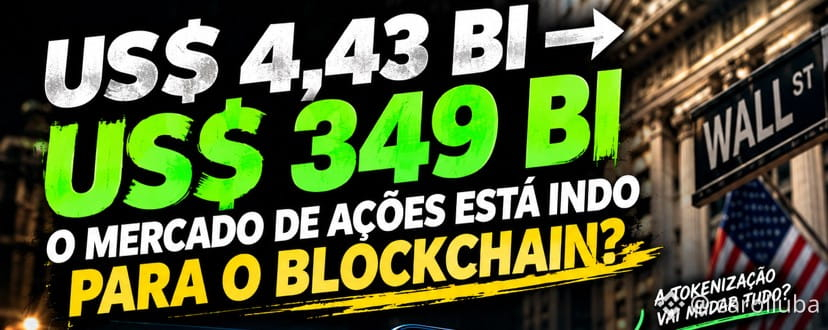
E a Binance Research coloca um cenário-base de aproximadamente US$ 349 bilhões em ações tokenizadas até 2030, contra cerca de US$ 4,43 bilhões no levantamento de setembro.
Agora vem a parte que realmente me chama atenção:
A tokenização não está tentando criar um novo mercado.
Ela está tentando colocar um mercado que já existe ações, ETFs e outros ativos dentro da infraestrutura do blockchain.
E isso muda muita coisa.
Imagine poder acessar determinados ativos 24 horas por dia, movimentá-los on-chain e, em alguns casos, utilizá-los dentro do próprio ecossistema DeFi.
Isso já começou.
No 3º trimestre de 2026, as transferências de ações tokenizadas ultrapassaram US$ 100 bilhões, contra aproximadamente US$ 6 bilhões no primeiro trimestre.
E tem outro detalhe:
A Binance vem ampliando o uso das ações tokenizadas como garantia em operações de margem, mostrando que o conceito está saindo da simples “representação de uma ação” e entrando na infraestrutura financeira on-chain.
Mas não confunda crescimento com garantia de sucesso.
Ainda existem desafios enormes:
regulamentação
custódia
liquidez
interoperabilidade
adoção institucional
Mesmo assim, é difícil ignorar uma mudança quando ela começa a aparecer nos bilhões.
US$ 4,43 bilhões hoje.
US$ 349 bilhões no cenário-base de 2030.
Não estou dizendo que essa projeção vai acontecer.
Estou dizendo que o mercado está começando a testar algo que pode mudar a forma como as pessoas acessam ativos financeiros.
E talvez a pergunta não seja:
“Blockchain vai substituir o mercado tradicional?”
Talvez seja:
“E se os dois mercados simplesmente começarem a funcionar juntos?” 👀
Se você ainda acha que RWA e tokenização são apenas narrativa…
talvez esteja olhando para o começo de uma mudança estrutural.
$BTC $NEAR $QNT
#EtherGains70.9%InQ3 #TreasuryLetsStatesFileStablecoinCertificationsEarly #BTC
{spot}(NEARUSDT)
{spot}(BTCUSDT)
{spot}(QNTUSDT)
🚨 VOCÊ AINDA ACHA QUE TOKENIZAÇÃO É SÓ “MODINHA DE CRIPTO”?
Talvez seja hora de olhar os números.
As ações tokenizadas cresceram 390,4% em 2026.
E aqui está o mais impressionante:
Mesmo depois dessa explosão, elas representam apenas 0,0029% do mercado global de ações listadas, estimado em US$ 151,9 trilhões.
Ou seja:
Cresceu absurdamente
Está ganhando usuários
Está movimentando bilhões
mas ainda é praticamente um grão de areia perto do mercado tradicional.
E a Binance Research coloca um cenário-base de aproximadamente US$ 349 bilhões em ações tokenizadas até 2030, contra cerca de US$ 4,43 bilhões no levantamento de setembro.
Agora vem a parte que realmente me chama atenção:
A tokenização não está tentando criar um novo mercado.
Ela está tentando colocar um mercado que já existe ações, ETFs e outros ativos dentro da infraestrutura do blockchain.
E isso muda muita coisa.
Imagine poder acessar determinados ativos 24 horas por dia, movimentá-los on-chain e, em alguns casos, utilizá-los dentro do próprio ecossistema DeFi.
Isso já começou.
No 3º trimestre de 2026, as transferências de ações tokenizadas ultrapassaram US$ 100 bilhões, contra aproximadamente US$ 6 bilhões no primeiro trimestre.
E tem outro detalhe:
A Binance vem ampliando o uso das ações tokenizadas como garantia em operações de margem, mostrando que o conceito está saindo da simples “representação de uma ação” e entrando na infraestrutura financeira on-chain.
Mas não confunda crescimento com garantia de sucesso.
Ainda existem desafios enormes:
regulamentação
custódia
liquidez
interoperabilidade
adoção institucional
Mesmo assim, é difícil ignorar uma mudança quando ela começa a aparecer nos bilhões.
US$ 4,43 bilhões hoje.
US$ 349 bilhões no cenário-base de 2030.
Não estou dizendo que essa projeção vai acontecer.
Estou dizendo que o mercado está começando a testar algo que pode mudar a forma como as pessoas acessam ativos financeiros.
E talvez a pergunta não seja:
“Blockchain vai substituir o mercado tradicional?”
Talvez seja:
“E se os dois mercados simplesmente começarem a funcionar juntos?” 👀
Se você ainda acha que RWA e tokenização são apenas narrativa…
talvez esteja olhando para o começo de uma mudança estrutural.
$BTC $NEAR $QNT
#EtherGains70.9%InQ3 #TreasuryLetsStatesFileStablecoinCertificationsEarly #BTC
As ações tokenizadas cresceram 390,4% em 2026.
E aqui está o mais impressionante:
Mesmo depois dessa explosão, elas representam apenas 0,0029% do mercado global de ações listadas, estimado em US$ 151,9 trilhões.
Ou seja:
Cresceu absurdamente
Está ganhando usuários
Está movimentando bilhões
mas ainda é praticamente um grão de areia perto do mercado tradicional.
E a Binance Research coloca um cenário-base de aproximadamente US$ 349 bilhões em ações tokenizadas até 2030, contra cerca de US$ 4,43 bilhões no levantamento de setembro.
Agora vem a parte que realmente me chama atenção:
A tokenização não está tentando criar um novo mercado.
Ela está tentando colocar um mercado que já existe ações, ETFs e outros ativos dentro da infraestrutura do blockchain.
E isso muda muita coisa.
Imagine poder acessar determinados ativos 24 horas por dia, movimentá-los on-chain e, em alguns casos, utilizá-los dentro do próprio ecossistema DeFi.
Isso já começou.
No 3º trimestre de 2026, as transferências de ações tokenizadas ultrapassaram US$ 100 bilhões, contra aproximadamente US$ 6 bilhões no primeiro trimestre.
E tem outro detalhe:
A Binance vem ampliando o uso das ações tokenizadas como garantia em operações de margem, mostrando que o conceito está saindo da simples “representação de uma ação” e entrando na infraestrutura financeira on-chain.
Mas não confunda crescimento com garantia de sucesso.
Ainda existem desafios enormes:
regulamentação
custódia
liquidez
interoperabilidade
adoção institucional
Mesmo assim, é difícil ignorar uma mudança quando ela começa a aparecer nos bilhões.
US$ 4,43 bilhões hoje.
US$ 349 bilhões no cenário-base de 2030.
Não estou dizendo que essa projeção vai acontecer.
Estou dizendo que o mercado está começando a testar algo que pode mudar a forma como as pessoas acessam ativos financeiros.
E talvez a pergunta não seja:
“Blockchain vai substituir o mercado tradicional?”
Talvez seja:
“E se os dois mercados simplesmente começarem a funcionar juntos?” 👀
Se você ainda acha que RWA e tokenização são apenas narrativa…
talvez esteja olhando para o começo de uma mudança estrutural.
$BTC $NEAR $QNT
#EtherGains70.9%InQ3 #TreasuryLetsStatesFileStablecoinCertificationsEarly #BTC
1
461

·
--
Жоғары (өспелі)
$TRUMP
$XAU
الأسواق الآن عند لحظة تاريخية.. لاعبون كبار يبيعون الأسهم اضطراريًا وتصفيات ضخمة
يشهد سوق سندات الخزانة الأمريكية حالياً أكبر قفزة في عائد العشر سنوات منذ الربع الثاني من 2009 — بينما ظلت الأسهم الأمريكية خلال الفترة نفسها معلّقة قرب ذروتها التاريخية. هذا التباين الحاد بين أداء الأصلين خلق اضطراباً هيكلياً في آلاف المحافظ الاستثمارية حول العالم، وأنتج قصتين منفصلتين تماماً في الآلية، لكنهما تتقاطعان عند نفس الجذر: من سيشتري السندات، ومن سيضطر لذلك؟#EtherGains70.9%InQ3 #TreasuryLetsStatesFileStablecoinCertificationsEarly #USWeeklyJoblessClaimsFallTo197000 #USWeeklyJoblessClaimsFallTo197000
$TRUMP
$XAU
الأسواق الآن عند لحظة تاريخية.. لاعبون كبار يبيعون الأسهم اضطراريًا وتصفيات ضخمة
يشهد سوق سندات الخزانة الأمريكية حالياً أكبر قفزة في عائد العشر سنوات منذ الربع الثاني من 2009 — بينما ظلت الأسهم الأمريكية خلال الفترة نفسها معلّقة قرب ذروتها التاريخية. هذا التباين الحاد بين أداء الأصلين خلق اضطراباً هيكلياً في آلاف المحافظ الاستثمارية حول العالم، وأنتج قصتين منفصلتين تماماً في الآلية، لكنهما تتقاطعان عند نفس الجذر: من سيشتري السندات، ومن سيضطر لذلك؟#EtherGains70.9%InQ3 #TreasuryLetsStatesFileStablecoinCertificationsEarly #USWeeklyJoblessClaimsFallTo197000 #USWeeklyJoblessClaimsFallTo197000
$XAU
الأسواق الآن عند لحظة تاريخية.. لاعبون كبار يبيعون الأسهم اضطراريًا وتصفيات ضخمة
يشهد سوق سندات الخزانة الأمريكية حالياً أكبر قفزة في عائد العشر سنوات منذ الربع الثاني من 2009 — بينما ظلت الأسهم الأمريكية خلال الفترة نفسها معلّقة قرب ذروتها التاريخية. هذا التباين الحاد بين أداء الأصلين خلق اضطراباً هيكلياً في آلاف المحافظ الاستثمارية حول العالم، وأنتج قصتين منفصلتين تماماً في الآلية، لكنهما تتقاطعان عند نفس الجذر: من سيشتري السندات، ومن سيضطر لذلك؟#EtherGains70.9%InQ3 #TreasuryLetsStatesFileStablecoinCertificationsEarly #USWeeklyJoblessClaimsFallTo197000 #USWeeklyJoblessClaimsFallTo197000

1
124
·
--
Жоғары (өспелі)
#metamaskexitslidovalidatorsaftersecurityincident \
🛡️ Security First: MetaMask Steps Back from Lido Validators Following Recent Incident 🛡️
The Ethereum liquid staking ecosystem is under close watch following a major infrastructure update. MetaMask has initiated a full exit of its operated Ethereum ($ETH) validators from the Lido Finance protocol as a precautionary measure following an infrastructure security incident.
While MetaMask and Lido have assured the public that no immediate risk or loss to user wallets has been identified, the event is causing a ripple effect across Ethereum’s validator queue and DeFi liquidity dynamics.
Infrastructure Containment & Complete Exit Timeline ⏳
MetaMask confirmed it is remediating an infrastructure breach and actively exiting affected node infrastructure to mitigate operational and network risks. Lido reported that all MetaMask-operated validators are scheduled to complete their exits by October 7.
Ethereum Exit Queue Spikes to 9-Month High 📈
With roughly 17,000 validators—holding over 500,000 $ETH—entering the exit process, Ethereum’s validator exit queue has surged to its highest level in nine months.
🔍 What This Means for DeFi & Liquid Staking
Client Diversity & Infrastructure Resilience: The rapid response highlights the necessity of non-custodial node segregation. By proactively offloading compromised validators, total risk is contained before slashing or pool-wide damage can occur.
Impact on Liquid Staking Tokens ($stETH): Despite the mass validator exits, Lido’s underlying smart contracts and $stETH peg remain stable, proving that liquid staking pools can digest high validator turnover without systemic failure.
Short-Term Liquidity Tensions: The 45-day cycle to re-deposit or redistribute the unwound ETH means stakers should expect minor fluctuations in yield until new validator sets are fully onboarded.
💬 What’s your takeaway? Drop your thoughts below! 👇
#TreasuryLetsStatesFileStablecoinCertificationsEarly #US10YearYieldNears5.3%
#metamaskexitslidovalidatorsaftersecurityincident \
🛡️ Security First: MetaMask Steps Back from Lido Validators Following Recent Incident 🛡️
The Ethereum liquid staking ecosystem is under close watch following a major infrastructure update. MetaMask has initiated a full exit of its operated Ethereum ($ETH) validators from the Lido Finance protocol as a precautionary measure following an infrastructure security incident.
While MetaMask and Lido have assured the public that no immediate risk or loss to user wallets has been identified, the event is causing a ripple effect across Ethereum’s validator queue and DeFi liquidity dynamics.
Infrastructure Containment & Complete Exit Timeline ⏳
MetaMask confirmed it is remediating an infrastructure breach and actively exiting affected node infrastructure to mitigate operational and network risks. Lido reported that all MetaMask-operated validators are scheduled to complete their exits by October 7.
Ethereum Exit Queue Spikes to 9-Month High 📈
With roughly 17,000 validators—holding over 500,000 $ETH—entering the exit process, Ethereum’s validator exit queue has surged to its highest level in nine months.
🔍 What This Means for DeFi & Liquid Staking
Client Diversity & Infrastructure Resilience: The rapid response highlights the necessity of non-custodial node segregation. By proactively offloading compromised validators, total risk is contained before slashing or pool-wide damage can occur.
Impact on Liquid Staking Tokens ($stETH): Despite the mass validator exits, Lido’s underlying smart contracts and $stETH peg remain stable, proving that liquid staking pools can digest high validator turnover without systemic failure.
Short-Term Liquidity Tensions: The 45-day cycle to re-deposit or redistribute the unwound ETH means stakers should expect minor fluctuations in yield until new validator sets are fully onboarded.
💬 What’s your takeaway? Drop your thoughts below! 👇
#TreasuryLetsStatesFileStablecoinCertificationsEarly #US10YearYieldNears5.3%
🛡️ Security First: MetaMask Steps Back from Lido Validators Following Recent Incident 🛡️
The Ethereum liquid staking ecosystem is under close watch following a major infrastructure update. MetaMask has initiated a full exit of its operated Ethereum ($ETH) validators from the Lido Finance protocol as a precautionary measure following an infrastructure security incident.
While MetaMask and Lido have assured the public that no immediate risk or loss to user wallets has been identified, the event is causing a ripple effect across Ethereum’s validator queue and DeFi liquidity dynamics.
Infrastructure Containment & Complete Exit Timeline ⏳
MetaMask confirmed it is remediating an infrastructure breach and actively exiting affected node infrastructure to mitigate operational and network risks. Lido reported that all MetaMask-operated validators are scheduled to complete their exits by October 7.
Ethereum Exit Queue Spikes to 9-Month High 📈
With roughly 17,000 validators—holding over 500,000 $ETH—entering the exit process, Ethereum’s validator exit queue has surged to its highest level in nine months.
🔍 What This Means for DeFi & Liquid Staking
Client Diversity & Infrastructure Resilience: The rapid response highlights the necessity of non-custodial node segregation. By proactively offloading compromised validators, total risk is contained before slashing or pool-wide damage can occur.
Impact on Liquid Staking Tokens ($stETH): Despite the mass validator exits, Lido’s underlying smart contracts and $stETH peg remain stable, proving that liquid staking pools can digest high validator turnover without systemic failure.
Short-Term Liquidity Tensions: The 45-day cycle to re-deposit or redistribute the unwound ETH means stakers should expect minor fluctuations in yield until new validator sets are fully onboarded.
💬 What’s your takeaway? Drop your thoughts below! 👇
#TreasuryLetsStatesFileStablecoinCertificationsEarly #US10YearYieldNears5.3%
3
3.5k
·
--
Төмен (кемімелі)
#usweeklyjoblessclaimsfallto197000
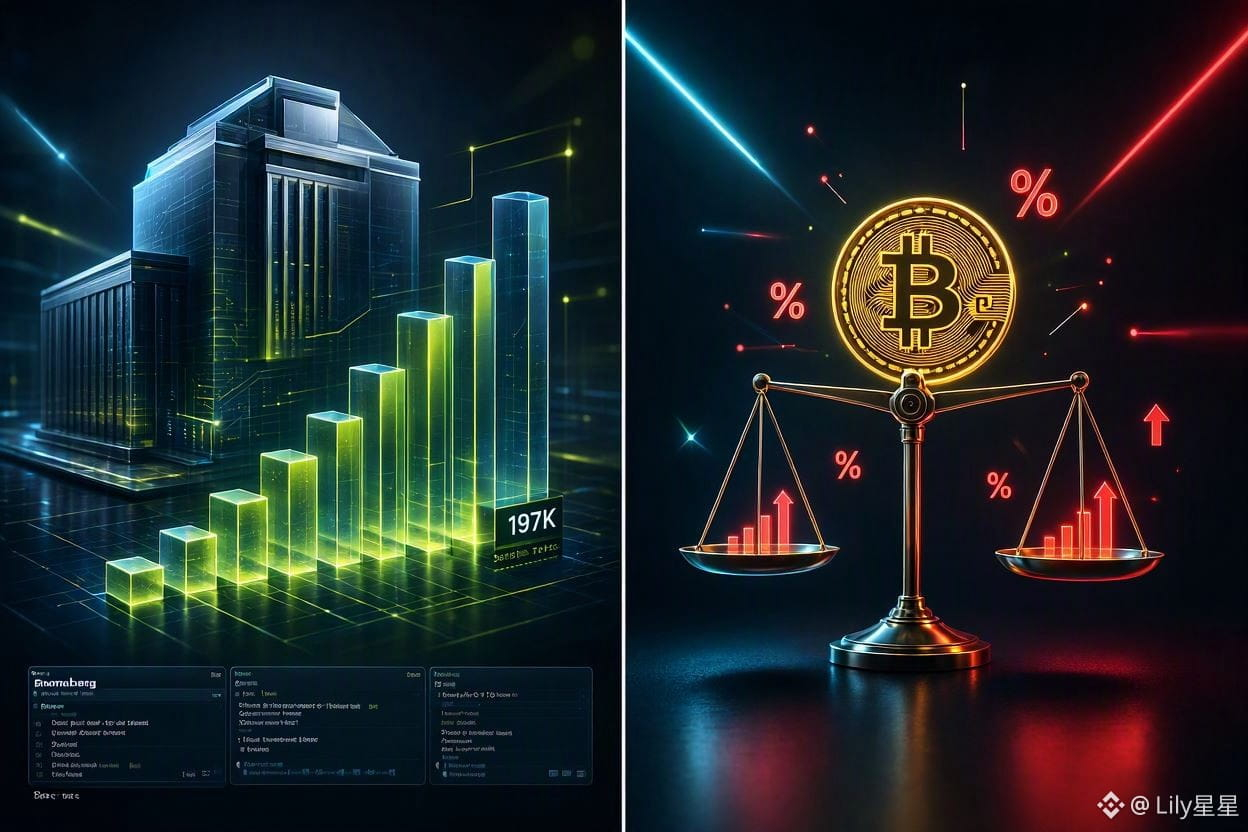
🚨 US Jobless Claims Drop to 197K: Does a Tight Labor Market Give the Fed Green Light for More Hikes? 🚨
The US labor market continues to demonstrate staggering strength. Fresh Department of Labor data shows weekly initial jobless claims fell to 197,000 (beating market expectations of 200,000), signaling that corporate layoffs remain near historic lows.
While low unemployment reflects economic resilience, for risk asset investors and the Federal Reserve, it presents a classic macroeconomic dilemma: a resilient economy keeps monetary policy tight.
$XRP
{future}(XRPUSDT)
📰 Layoffs Remain Rare 📉
Initial claims fell by 1,000 to hit 197K, while the 4-week moving average dropped to 200,000. Businesses continue to hold onto talent, demonstrating that the US real economy is absorbing elevated interest rates far better than forecasters predicted.
💵A tight labor market keeps upward pressure on wage growth. Because service-sector inflation is closely tied to payroll costs, Fed officials remain cautious about cutting interest rates too aggressively—or taking additional rate hikes completely off the table if inflation reignites.
$SOL
{future}(SOLUSDT)
⚡ How This Labor Resilience Impact Crypto
The "Good News is Bad News" Trap: Strong economic reports can temporarily pressure risk markets like Bitcoin ($BTC) and altcoins. When jobs data comes in hot, traders immediately delay their expectations for Federal Reserve rate cuts.
Higher Hurdle for Altseason: Persistent monetary hawkishness drives up the risk-free rate on US capital, tightening overall stablecoin liquidity and reducing high-leverage speculative flows into smaller-cap tokens.
Bitcoin’s Safe-Haven Pivot: If economic strength aligns with sticky inflation, institutional investors increasingly view Bitcoin as a long-term inflation and sovereign monetary hedge rather than just a high-beta tech stock.
#US10YearYieldNears5.3% #TreasuryLetsStatesFileStablecoinCertificationsEarly
#usweeklyjoblessclaimsfallto197000
🚨 US Jobless Claims Drop to 197K: Does a Tight Labor Market Give the Fed Green Light for More Hikes? 🚨
The US labor market continues to demonstrate staggering strength. Fresh Department of Labor data shows weekly initial jobless claims fell to 197,000 (beating market expectations of 200,000), signaling that corporate layoffs remain near historic lows.
While low unemployment reflects economic resilience, for risk asset investors and the Federal Reserve, it presents a classic macroeconomic dilemma: a resilient economy keeps monetary policy tight.
$XRP
📰 Layoffs Remain Rare 📉
Initial claims fell by 1,000 to hit 197K, while the 4-week moving average dropped to 200,000. Businesses continue to hold onto talent, demonstrating that the US real economy is absorbing elevated interest rates far better than forecasters predicted.
💵A tight labor market keeps upward pressure on wage growth. Because service-sector inflation is closely tied to payroll costs, Fed officials remain cautious about cutting interest rates too aggressively—or taking additional rate hikes completely off the table if inflation reignites.
$SOL
⚡ How This Labor Resilience Impact Crypto
The "Good News is Bad News" Trap: Strong economic reports can temporarily pressure risk markets like Bitcoin ($BTC) and altcoins. When jobs data comes in hot, traders immediately delay their expectations for Federal Reserve rate cuts.
Higher Hurdle for Altseason: Persistent monetary hawkishness drives up the risk-free rate on US capital, tightening overall stablecoin liquidity and reducing high-leverage speculative flows into smaller-cap tokens.
Bitcoin’s Safe-Haven Pivot: If economic strength aligns with sticky inflation, institutional investors increasingly view Bitcoin as a long-term inflation and sovereign monetary hedge rather than just a high-beta tech stock.
#US10YearYieldNears5.3% #TreasuryLetsStatesFileStablecoinCertificationsEarly
🚨 US Jobless Claims Drop to 197K: Does a Tight Labor Market Give the Fed Green Light for More Hikes? 🚨
The US labor market continues to demonstrate staggering strength. Fresh Department of Labor data shows weekly initial jobless claims fell to 197,000 (beating market expectations of 200,000), signaling that corporate layoffs remain near historic lows.
While low unemployment reflects economic resilience, for risk asset investors and the Federal Reserve, it presents a classic macroeconomic dilemma: a resilient economy keeps monetary policy tight.
$XRP
📰 Layoffs Remain Rare 📉
Initial claims fell by 1,000 to hit 197K, while the 4-week moving average dropped to 200,000. Businesses continue to hold onto talent, demonstrating that the US real economy is absorbing elevated interest rates far better than forecasters predicted.
💵A tight labor market keeps upward pressure on wage growth. Because service-sector inflation is closely tied to payroll costs, Fed officials remain cautious about cutting interest rates too aggressively—or taking additional rate hikes completely off the table if inflation reignites.
$SOL
⚡ How This Labor Resilience Impact Crypto
The "Good News is Bad News" Trap: Strong economic reports can temporarily pressure risk markets like Bitcoin ($BTC) and altcoins. When jobs data comes in hot, traders immediately delay their expectations for Federal Reserve rate cuts.
Higher Hurdle for Altseason: Persistent monetary hawkishness drives up the risk-free rate on US capital, tightening overall stablecoin liquidity and reducing high-leverage speculative flows into smaller-cap tokens.
Bitcoin’s Safe-Haven Pivot: If economic strength aligns with sticky inflation, institutional investors increasingly view Bitcoin as a long-term inflation and sovereign monetary hedge rather than just a high-beta tech stock.
#US10YearYieldNears5.3% #TreasuryLetsStatesFileStablecoinCertificationsEarly
5
4.8k

·
--
Мақала
🚨WHY BITCOIN NEEDS ITS OWN SEATDarius Dale just said Bitcoin deserves an allocation in your portfolio because it's a different exposure than stocks, and a different exposure than gold.
Not a new take from him. He's run a 60/30/10 model for a while now, 60% stocks, 30% gold, 10% Bitcoin, built on the idea that each piece moves for different reasons.
Ran the split on a $100k portfolio and that's $10k in Bitcoin sitting next to $30k in gold, not instead of it. That's the part people miss when they hear "Bitcoin vs gold" debates, his framework isn't choosing one, it's stacking two separate insurance policies against two different risks.
What's interesting is where each piece is actually supposed to do its job. Stocks cover growth. Gold covers currency debasement and crisis fear. Bitcoin's meant to cover something neither of those two fully reaches, monetary regime change, if the thesis holds.
Curious if you're running anything close to that split, or still parked in a traditional 60/40 with Bitcoin left out entirely.
$BTC
#EtherGains70.9%InQ3
#TreasuryLetsStatesFileStablecoinCertificationsEarly
#BitcoinETFsTake$6.34BillionInQ3
#KoreaProposesTokenizingStocksAndBonds
#CFTCSubmitsTwoEventContractRulesToWhiteHouse
🚨WHY BITCOIN NEEDS ITS OWN SEAT
Darius Dale just said Bitcoin deserves an allocation in your portfolio because it's a different exposure than stocks, and a different exposure than gold.
Not a new take from him. He's run a 60/30/10 model for a while now, 60% stocks, 30% gold, 10% Bitcoin, built on the idea that each piece moves for different reasons.
Ran the split on a $100k portfolio and that's $10k in Bitcoin sitting next to $30k in gold, not instead of it. That's the part people miss when they hear "Bitcoin vs gold" debates, his framework isn't choosing one, it's stacking two separate insurance policies against two different risks.
What's interesting is where each piece is actually supposed to do its job. Stocks cover growth. Gold covers currency debasement and crisis fear. Bitcoin's meant to cover something neither of those two fully reaches, monetary regime change, if the thesis holds.
Curious if you're running anything close to that split, or still parked in a traditional 60/40 with Bitcoin left out entirely.
$BTC
#EtherGains70.9%InQ3
#TreasuryLetsStatesFileStablecoinCertificationsEarly
#BitcoinETFsTake$6.34BillionInQ3
#KoreaProposesTokenizingStocksAndBonds
#CFTCSubmitsTwoEventContractRulesToWhiteHouse
Not a new take from him. He's run a 60/30/10 model for a while now, 60% stocks, 30% gold, 10% Bitcoin, built on the idea that each piece moves for different reasons.
Ran the split on a $100k portfolio and that's $10k in Bitcoin sitting next to $30k in gold, not instead of it. That's the part people miss when they hear "Bitcoin vs gold" debates, his framework isn't choosing one, it's stacking two separate insurance policies against two different risks.
What's interesting is where each piece is actually supposed to do its job. Stocks cover growth. Gold covers currency debasement and crisis fear. Bitcoin's meant to cover something neither of those two fully reaches, monetary regime change, if the thesis holds.
Curious if you're running anything close to that split, or still parked in a traditional 60/40 with Bitcoin left out entirely.
$BTC
#EtherGains70.9%InQ3
#TreasuryLetsStatesFileStablecoinCertificationsEarly
#BitcoinETFsTake$6.34BillionInQ3
#KoreaProposesTokenizingStocksAndBonds
#CFTCSubmitsTwoEventContractRulesToWhiteHouse
1
217
Көбірек контент көру үшін кіріңіз
Binance Square платформасында әлемдік криптоқоғамдастыққа қосылыңыз
⚡️ Криптовалюта туралы ең соңғы және пайдалы ақпаратты алыңыз.
💬 Әлемдегі ең ірі криптобиржаның сеніміне ие.
👍 Расталған авторлардың нақты пікірлерін табыңыз.
Электрондық пошта/телефон нөмірі
Трендтегі тақырыптар
1
#EtherGains70.9%InQ3
94,796 рет көрілді
923 адам талқылап жатыр
2
#TreasuryLetsStatesFileStablecoinCertificationsEarly
4,967 рет көрілді
57 адам талқылап жатыр
3
#US10YearYieldNears5.3%
121,088 рет көрілді
985 адам талқылап жатыр
4
#DollarIndexHitsHighestSinceMay2025
25,225 рет көрілді
516 адам талқылап жатыр
5
#USWeeklyJoblessClaimsFallTo197000
25,428 рет көрілді
430 адам талқылап жатыр
6
#BitcoinETFsTake$6.34BillionInQ3
7,830 рет көрілді
63 адам талқылап жатыр
7
#KoreaProposesTokenizingStocksAndBonds
61,040 рет көрілді
780 адам талқылап жатыр
8
#MetaMaskExitsLidoValidatorsAfterSecurityIncident
158,321 рет көрілді
1,493 адам талқылап жатыр
9
#MicronBeatsEarningsLiftsGuidance
79,539 рет көрілді
1,087 адам талқылап жатыр
10
#CFTCSubmitsTwoEventContractRulesToWhiteHouse
54,392 рет көрілді
814 адам талқылап жатыр