
#defi
defi
56.3M views
292,256 Discussing
Hot
Latest


·
--
$ARB Arbitrum's 7-day liquidity collapse: rTokens surge as Bitget Wallet adds Reality's 1.2B tokenized stocks
14:30 UTC, Sept 15. The Arbitrum sequencer's inbound queue hit 1,248 pending transactions, double the usual threshold, while Bitget Wallet's Reality rToken integration deployed its first batch of 10 tokenized U.S. stocks.
$ARB #ARB #DeFi #CryptoNews
$ARB Arbitrum's 7-day liquidity collapse: rTokens surge as Bitget Wallet adds Reality's 1.2B tokenized stocks
14:30 UTC, Sept 15. The Arbitrum sequencer's inbound queue hit 1,248 pending transactions, double the usual threshold, while Bitget Wallet's Reality rToken integration deployed its first batch of 10 tokenized U.S. stocks.
$ARB #ARB #DeFi #CryptoNews
14:30 UTC, Sept 15. The Arbitrum sequencer's inbound queue hit 1,248 pending transactions, double the usual threshold, while Bitget Wallet's Reality rToken integration deployed its first batch of 10 tokenized U.S. stocks.
$ARB #ARB #DeFi #CryptoNews
Kato Crypto:
those two lines are not really the same story 👀 a sequencer queue is a throughput reading and a tokenized stock listing is a distribution one, so folding them into a single liquidity headline makes both harder to verify 🙌
1
264

📊 $DEFI Update
Today's Clarity Act vote is the big catalyst — a "yes" could open the floodgates for institutional DeFi capital. 🌊
But a red flag: DeFi provisions in the latest bill draft got scaled back, worrying industry critics. ⚠️
#defi i #CLARITYAct #TVL
📊 $DEFI Update
Today's Clarity Act vote is the big catalyst — a "yes" could open the floodgates for institutional DeFi capital. 🌊
But a red flag: DeFi provisions in the latest bill draft got scaled back, worrying industry critics. ⚠️
#defi i #CLARITYAct #TVL
Today's Clarity Act vote is the big catalyst — a "yes" could open the floodgates for institutional DeFi capital. 🌊
But a red flag: DeFi provisions in the latest bill draft got scaled back, worrying industry critics. ⚠️
#defi i #CLARITYAct #TVL

$KNC — Kyber Network remains connected to decentralized liquidity, giving it exposure to renewed DEX-sector activity.
{spot}(KNCUSDT)
$BNT — Bancor remains an established DeFi liquidity project, with volume important when the sector begins moving again.
{spot}(BNTUSDT)
$REN — Ren remains a speculative infrastructure trade where liquidity can strongly influence short-term price action.
#KNC #BNT #REN #DeFi #CryptoTrading
$KNC — Kyber Network remains connected to decentralized liquidity, giving it exposure to renewed DEX-sector activity.
$BNT — Bancor remains an established DeFi liquidity project, with volume important when the sector begins moving again.
$REN — Ren remains a speculative infrastructure trade where liquidity can strongly influence short-term price action.
#KNC #BNT #REN #DeFi #CryptoTrading
$BNT — Bancor remains an established DeFi liquidity project, with volume important when the sector begins moving again.
$REN — Ren remains a speculative infrastructure trade where liquidity can strongly influence short-term price action.
#KNC #BNT #REN #DeFi #CryptoTrading

33

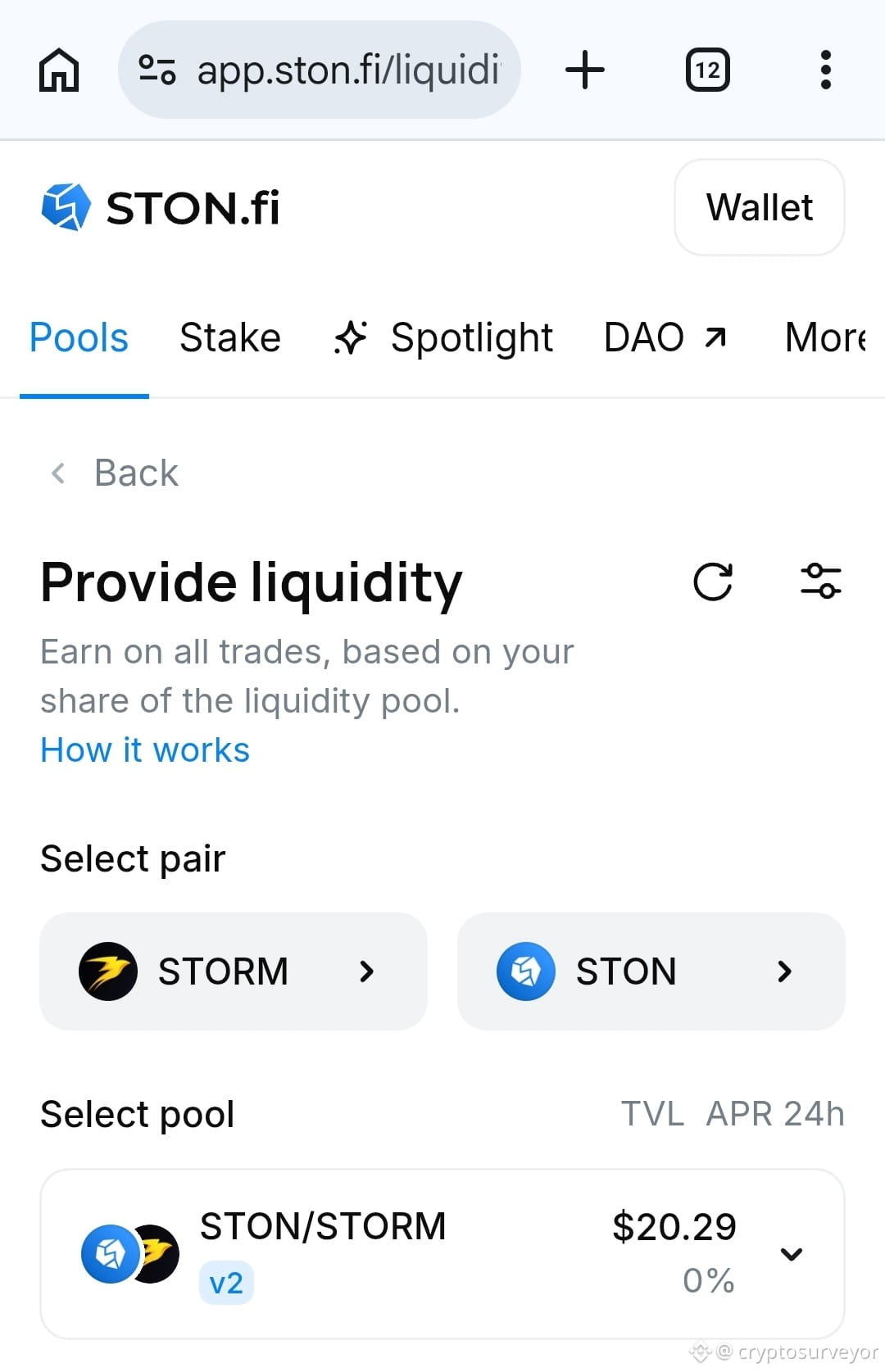
Why is STORM/STON one of the farming pools worth watching on STON.fi?
It’s not just about APR.
The pool combines:
• STORM + STON exposure
• Competitive farming rewards
• Stronger liquidity
• Flexible position management
• Potential 1.5x–2x farming boosts for eligible STON stakers
The real opportunity is the balance between yield, ecosystem exposure, and flexibility.
If you're already active in the STON.fi ecosystem and want to put your STON to work, STORM/STON is worth researching.
Don't just chase the highest APR.
Look at the token, liquidity, incentives, impermanent loss, and what happens when the rewards change.
Risk-adjusted yield > headline APR.
#TrendingTopic #defi
Why is STORM/STON one of the farming pools worth watching on STON.fi?
It’s not just about APR.
The pool combines:
• STORM + STON exposure
• Competitive farming rewards
• Stronger liquidity
• Flexible position management
• Potential 1.5x–2x farming boosts for eligible STON stakers
The real opportunity is the balance between yield, ecosystem exposure, and flexibility.
If you're already active in the STON.fi ecosystem and want to put your STON to work, STORM/STON is worth researching.
Don't just chase the highest APR.
Look at the token, liquidity, incentives, impermanent loss, and what happens when the rewards change.
Risk-adjusted yield > headline APR.
#TrendingTopic #defi
It’s not just about APR.
The pool combines:
• STORM + STON exposure
• Competitive farming rewards
• Stronger liquidity
• Flexible position management
• Potential 1.5x–2x farming boosts for eligible STON stakers
The real opportunity is the balance between yield, ecosystem exposure, and flexibility.
If you're already active in the STON.fi ecosystem and want to put your STON to work, STORM/STON is worth researching.
Don't just chase the highest APR.
Look at the token, liquidity, incentives, impermanent loss, and what happens when the rewards change.
Risk-adjusted yield > headline APR.
#TrendingTopic #defi
71

·
--
Sixteen vaults doesn't mean sixteen new strategies. That's the detail I noticed in Zama's announcement today.
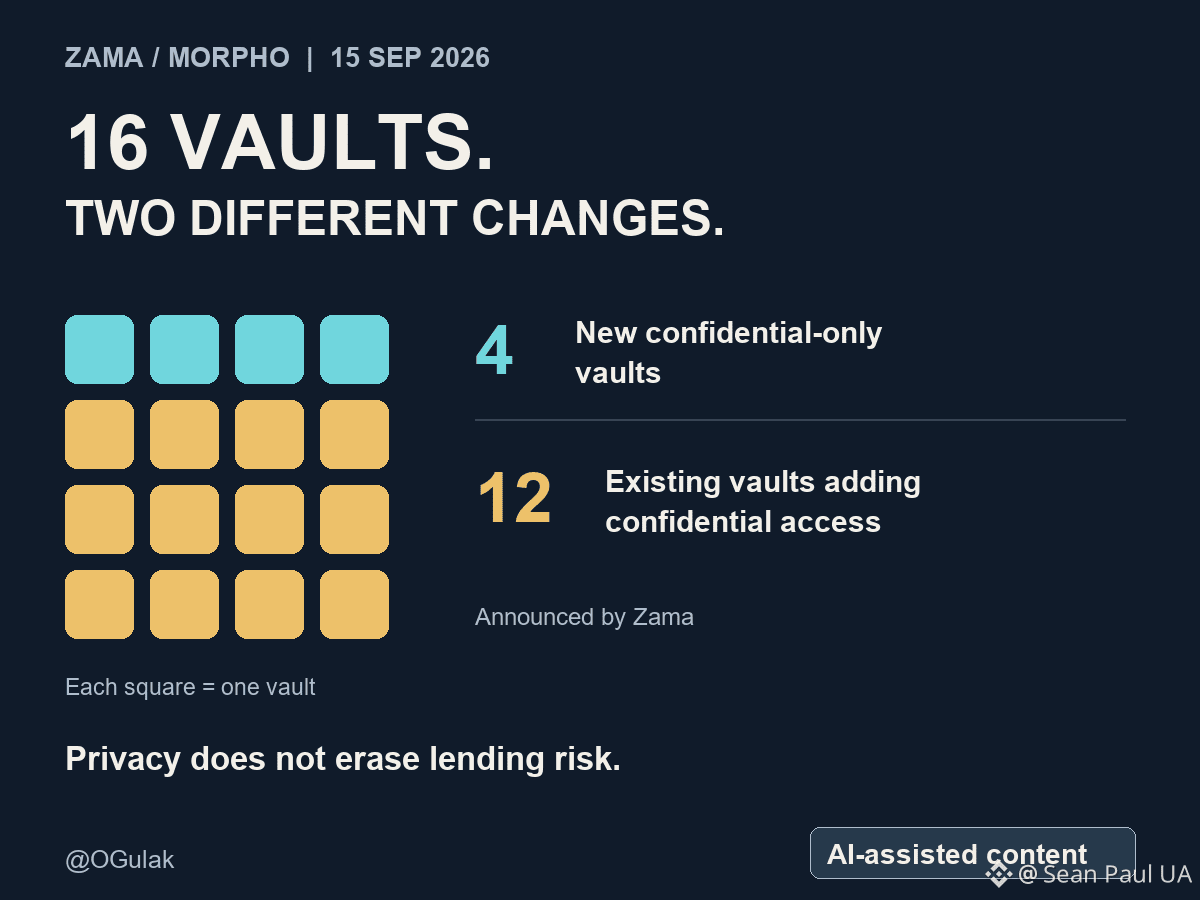
On September 15, Zama announced confidential access to 16 Morpho vaults: four new confidential-only products and 12 existing vaults adding confidential deposits.
The distinction matters. For those 12, the new feature is how users access the strategy. Zama says its confidentiality layer keeps amounts and balances encrypted while preserving public verifiability.
My read: protecting position size may remove one barrier for institutions. It doesn't remove smart-contract, lending or liquidity risk. Morpho's documentation warns that a shortage of liquidity can delay withdrawals.
I'd judge this launch by sustained use and how clearly those risks are explained, rather than the vault count alone. More product choice isn't evidence of more demand, and it isn't a price forecast for ZAMA or MORPHO.
Would private balances change your view of DeFi, or is reliable access to funds the bigger issue? Why?
#DeFi #Privacy
I may earn commissions from trades made through this post.
Sixteen vaults doesn't mean sixteen new strategies. That's the detail I noticed in Zama's announcement today.
On September 15, Zama announced confidential access to 16 Morpho vaults: four new confidential-only products and 12 existing vaults adding confidential deposits.
The distinction matters. For those 12, the new feature is how users access the strategy. Zama says its confidentiality layer keeps amounts and balances encrypted while preserving public verifiability.
My read: protecting position size may remove one barrier for institutions. It doesn't remove smart-contract, lending or liquidity risk. Morpho's documentation warns that a shortage of liquidity can delay withdrawals.
I'd judge this launch by sustained use and how clearly those risks are explained, rather than the vault count alone. More product choice isn't evidence of more demand, and it isn't a price forecast for ZAMA or MORPHO.
Would private balances change your view of DeFi, or is reliable access to funds the bigger issue? Why?
#DeFi #Privacy
I may earn commissions from trades made through this post.
On September 15, Zama announced confidential access to 16 Morpho vaults: four new confidential-only products and 12 existing vaults adding confidential deposits.
The distinction matters. For those 12, the new feature is how users access the strategy. Zama says its confidentiality layer keeps amounts and balances encrypted while preserving public verifiability.
My read: protecting position size may remove one barrier for institutions. It doesn't remove smart-contract, lending or liquidity risk. Morpho's documentation warns that a shortage of liquidity can delay withdrawals.
I'd judge this launch by sustained use and how clearly those risks are explained, rather than the vault count alone. More product choice isn't evidence of more demand, and it isn't a price forecast for ZAMA or MORPHO.
Would private balances change your view of DeFi, or is reliable access to funds the bigger issue? Why?
#DeFi #Privacy
I may earn commissions from trades made through this post.
1
99

·
--

Article
Solana Treasury Firm DeFi Dev Corp Rolls Out $300M CHAD to Buy More SOLIn a move that could reshape the Solana ecosystem, DeFi Development Corp (DDC) just added 55,491 $SOL to its treasury and launched a $300 million CHAD at-the-market program for its preferred stock—fueling a three‑week sprint of capital‑market activity that’s catching everyone’s eye.
## The Concept: What Is a CHAD Program and Why It Matters
A CHAD (Capital‑Market At‑Market Deal) is a way for companies to raise cash quickly by selling shares directly to the market at a fixed price, rather than waiting for a full public offering. Think of it as a “cash‑in‑a‑box” that lets the company grab liquidity fast, while investors get a chance to buy shares at a predictable price. For a DeFi firm like DDC, this means more capital to build protocols, pay developers, and, importantly, buy back $SOL to support the token’s price.
#DeFi #Solana
## Real‑World Example: DDC’s $300M CHAD in Action
Over the past three weeks, DDC has been a whirlwind of activity: announcing a new treasury strategy, adding a hefty $SOL stash, and now, with the CHAD, injecting fresh capital. The $300 million raised will be split between buying more $SOL and funding the development of next‑gen DeFi tools on Solana. By buying back $SOL, DDC can help tighten the supply curve, potentially boosting the token’s value—an attractive move for both the company and its community.
## Takeaway: How You Can Leverage This Momentum
1. **Watch the Treasury Moves** – DDC’s $SOL purchases can signal confidence in the token’s future.
2. **Consider DDC’s Preferred Stock** – If you’re a long‑term holder, the CHAD may offer a stable entry point.
3. **Stay Informed on Solana’s Ecosystem** – More capital means more projects, more liquidity, and a healthier network.
#BinanceSquare
What do you think—will DDC’s fresh capital and $SOL buy‑back push Solana’s price higher, or is it just a short‑term hype? Let us know in the comments!
Solana Treasury Firm DeFi Dev Corp Rolls Out $300M CHAD to Buy More SOL
In a move that could reshape the Solana ecosystem, DeFi Development Corp (DDC) just added 55,491 $SOL to its treasury and launched a $300 million CHAD at-the-market program for its preferred stock—fueling a three‑week sprint of capital‑market activity that’s catching everyone’s eye.
## The Concept: What Is a CHAD Program and Why It Matters
A CHAD (Capital‑Market At‑Market Deal) is a way for companies to raise cash quickly by selling shares directly to the market at a fixed price, rather than waiting for a full public offering. Think of it as a “cash‑in‑a‑box” that lets the company grab liquidity fast, while investors get a chance to buy shares at a predictable price. For a DeFi firm like DDC, this means more capital to build protocols, pay developers, and, importantly, buy back $SOL to support the token’s price.
#DeFi #Solana
## Real‑World Example: DDC’s $300M CHAD in Action
Over the past three weeks, DDC has been a whirlwind of activity: announcing a new treasury strategy, adding a hefty $SOL stash, and now, with the CHAD, injecting fresh capital. The $300 million raised will be split between buying more $SOL and funding the development of next‑gen DeFi tools on Solana. By buying back $SOL , DDC can help tighten the supply curve, potentially boosting the token’s value—an attractive move for both the company and its community.
## Takeaway: How You Can Leverage This Momentum
1. **Watch the Treasury Moves** – DDC’s $SOL purchases can signal confidence in the token’s future.
2. **Consider DDC’s Preferred Stock** – If you’re a long‑term holder, the CHAD may offer a stable entry point.
3. **Stay Informed on Solana’s Ecosystem** – More capital means more projects, more liquidity, and a healthier network.
#BinanceSquare
What do you think—will DDC’s fresh capital and $SOL buy‑back push Solana’s price higher, or is it just a short‑term hype? Let us know in the comments!
## The Concept: What Is a CHAD Program and Why It Matters
A CHAD (Capital‑Market At‑Market Deal) is a way for companies to raise cash quickly by selling shares directly to the market at a fixed price, rather than waiting for a full public offering. Think of it as a “cash‑in‑a‑box” that lets the company grab liquidity fast, while investors get a chance to buy shares at a predictable price. For a DeFi firm like DDC, this means more capital to build protocols, pay developers, and, importantly, buy back $SOL to support the token’s price.
#DeFi #Solana
## Real‑World Example: DDC’s $300M CHAD in Action
Over the past three weeks, DDC has been a whirlwind of activity: announcing a new treasury strategy, adding a hefty $SOL stash, and now, with the CHAD, injecting fresh capital. The $300 million raised will be split between buying more $SOL and funding the development of next‑gen DeFi tools on Solana. By buying back $SOL , DDC can help tighten the supply curve, potentially boosting the token’s value—an attractive move for both the company and its community.
## Takeaway: How You Can Leverage This Momentum
1. **Watch the Treasury Moves** – DDC’s $SOL purchases can signal confidence in the token’s future.
2. **Consider DDC’s Preferred Stock** – If you’re a long‑term holder, the CHAD may offer a stable entry point.
3. **Stay Informed on Solana’s Ecosystem** – More capital means more projects, more liquidity, and a healthier network.
#BinanceSquare
What do you think—will DDC’s fresh capital and $SOL buy‑back push Solana’s price higher, or is it just a short‑term hype? Let us know in the comments!
10

·
--
Bullish
#USDCOnChainVolumeTops$100Trillion #USDC
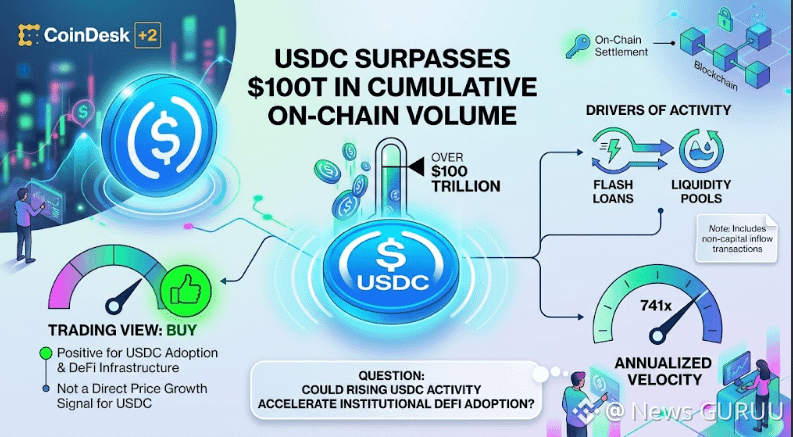
🚨 USDC Surpasses $100T in Cumulative On-Chain Volume
USDC has reportedly crossed $100T in lifetime on-chain transaction volume, highlighting its growing role in DeFi and digital-asset settlement. 🔐
However, much of this activity comes from flash loans and liquidity-pool operations, so it should not be treated as $100T of new capital inflows.
Trading View: BUY 🟢
Positive for USDC adoption and DeFi infrastructure, but not a direct price-growth signal for USDC.
Question: Could rising USDC activity accelerate institutional DeFi adoption? CLICK ON THE BELOW YELLOW COIN TAG TO GO TO DESIRED TRADING PAGE TO GET BENEFIT TRADE"$USDC
#defi
{spot}(USDCUSDT)
#USDCOnChainVolumeTops$100Trillion #USDC
🚨 USDC Surpasses $100T in Cumulative On-Chain Volume
USDC has reportedly crossed $100T in lifetime on-chain transaction volume, highlighting its growing role in DeFi and digital-asset settlement. 🔐
However, much of this activity comes from flash loans and liquidity-pool operations, so it should not be treated as $100T of new capital inflows.
Trading View: BUY 🟢
Positive for USDC adoption and DeFi infrastructure, but not a direct price-growth signal for USDC.
Question: Could rising USDC activity accelerate institutional DeFi adoption? CLICK ON THE BELOW YELLOW COIN TAG TO GO TO DESIRED TRADING PAGE TO GET BENEFIT TRADE"$USDC
#defi
🚨 USDC Surpasses $100T in Cumulative On-Chain Volume
USDC has reportedly crossed $100T in lifetime on-chain transaction volume, highlighting its growing role in DeFi and digital-asset settlement. 🔐
However, much of this activity comes from flash loans and liquidity-pool operations, so it should not be treated as $100T of new capital inflows.
Trading View: BUY 🟢
Positive for USDC adoption and DeFi infrastructure, but not a direct price-growth signal for USDC.
Question: Could rising USDC activity accelerate institutional DeFi adoption? CLICK ON THE BELOW YELLOW COIN TAG TO GO TO DESIRED TRADING PAGE TO GET BENEFIT TRADE"$USDC
#defi
ABO3ZAM:
تجاوز حجم المعاملات حاجز المئة تريليون مؤشر قوي على نضج البنية التحتية، لكنه لا يترجم مباشرة إلى حركة سعرية للعملة المستقرة. راقب تمركز الزخم في أصول التمويل اللامركزي المرتبطة، والتزم دائماً بتأمين الأرباح عند مناطق الرفض السعري لتجنب تقلبات السيولة المفاجئة.
3
1
52

·
--
Bullish
Aave Is Still One of DeFi’s Strongest Lending Bets
DeFi is not only about trading.
It is also about liquidity, borrowing, lending, collateral, and yield.
That is where Aave remains important.
#AAVE is a decentralized non-custodial liquidity protocol where users can supply assets or borrow against collateral.
$AAVE sits inside one of the clearest #defi use cases: open money markets.
This matters because crypto needs financial products that actually work onchain.
Users want to earn.
Borrowers want liquidity.
Builders need deep markets.
Of course, risks remain. DeFi lending depends on risk management, liquidity, collateral quality, and market conditions.
But the thesis is clear.
If onchain finance keeps growing, lending protocols will stay important.
And Aave is still one of the strongest names in that category.
Aave Is Still One of DeFi’s Strongest Lending Bets
DeFi is not only about trading.
It is also about liquidity, borrowing, lending, collateral, and yield.
That is where Aave remains important.
#AAVE is a decentralized non-custodial liquidity protocol where users can supply assets or borrow against collateral.
$AAVE sits inside one of the clearest #defi use cases: open money markets.
This matters because crypto needs financial products that actually work onchain.
Users want to earn.
Borrowers want liquidity.
Builders need deep markets.
Of course, risks remain. DeFi lending depends on risk management, liquidity, collateral quality, and market conditions.
But the thesis is clear.
If onchain finance keeps growing, lending protocols will stay important.
And Aave is still one of the strongest names in that category.
DeFi is not only about trading.
It is also about liquidity, borrowing, lending, collateral, and yield.
That is where Aave remains important.
#AAVE is a decentralized non-custodial liquidity protocol where users can supply assets or borrow against collateral.
$AAVE sits inside one of the clearest #defi use cases: open money markets.
This matters because crypto needs financial products that actually work onchain.
Users want to earn.
Borrowers want liquidity.
Builders need deep markets.
Of course, risks remain. DeFi lending depends on risk management, liquidity, collateral quality, and market conditions.
But the thesis is clear.
If onchain finance keeps growing, lending protocols will stay important.
And Aave is still one of the strongest names in that category.
1
123

{spot}(UNIUSDT)
$UNI Bulls Are Waking Up 👀🦄
UNI is showing a strong recovery setup on the 4H timeframe. Price is trading around $6.63, above the 7, 25 and 99 MA levels, keeping the short-term structure bullish. RSI near 66 confirms healthy momentum, although buyers should watch for overheating near resistance.
The key zone now is $6.80–$6.86. A strong 4H close above this area could push UNI toward $7.20, with the previous swing high around $7.48 becoming the bigger target.
If rejection appears, $6.31 is the first support to watch, while $6.07–$6.20 is the stronger demand area.
Fundamentally, Uniswap is also gaining attention as monthly trading volume recently exceeded $70B, while its fee-and-burn model strengthens the $UNI value-capture story.
Bullish above $6.86. Patience below it.
#UNI #Uniswap #DeFi #Crypto
$UNI Bulls Are Waking Up 👀🦄
UNI is showing a strong recovery setup on the 4H timeframe. Price is trading around $6.63, above the 7, 25 and 99 MA levels, keeping the short-term structure bullish. RSI near 66 confirms healthy momentum, although buyers should watch for overheating near resistance.
The key zone now is $6.80–$6.86. A strong 4H close above this area could push UNI toward $7.20, with the previous swing high around $7.48 becoming the bigger target.
If rejection appears, $6.31 is the first support to watch, while $6.07–$6.20 is the stronger demand area.
Fundamentally, Uniswap is also gaining attention as monthly trading volume recently exceeded $70B, while its fee-and-burn model strengthens the $UNI value-capture story.
Bullish above $6.86. Patience below it.
#UNI #Uniswap #DeFi #Crypto
UNI is showing a strong recovery setup on the 4H timeframe. Price is trading around $6.63, above the 7, 25 and 99 MA levels, keeping the short-term structure bullish. RSI near 66 confirms healthy momentum, although buyers should watch for overheating near resistance.
The key zone now is $6.80–$6.86. A strong 4H close above this area could push UNI toward $7.20, with the previous swing high around $7.48 becoming the bigger target.
If rejection appears, $6.31 is the first support to watch, while $6.07–$6.20 is the stronger demand area.
Fundamentally, Uniswap is also gaining attention as monthly trading volume recently exceeded $70B, while its fee-and-burn model strengthens the $UNI value-capture story.
Bullish above $6.86. Patience below it.
#UNI #Uniswap #DeFi #Crypto

49

·
--
🛡️ DeFi Resilience Upgrade: $AAVE Proposes "Umbrella" Bad Debt Shield! 🌐
Decentralized lending is strengthening its core safety nets! TokenLogic has officially submitted a landmark governance proposal introducing "Umbrella" protection for Aave V4’s flagship WETH, $USDC , and USDT pools. This new risk framework ensures the DAO directly absorbs initial systemic bad debt, with voluntary backstop insurers covering residual risk.
On-chain liquidity metrics show immediate positive sentiment following the news, as institutional traders increasingly prioritize smart contract safety alongside yield. As lending protocols mature into institutional-grade infrastructure, structural risk mitigation continues to set leaders apart from high-risk platforms.
Could this capital safety upgrade fuel the next major rally for $AAVE and broader DeFi blue-chips? Let us know what you think in the comments! 💬👇
#defi #AAVE #CryptoSafety #Ethereum #BinanceSquare
{future}(AAVEUSDT)
🛡️ DeFi Resilience Upgrade: $AAVE Proposes "Umbrella" Bad Debt Shield! 🌐
Decentralized lending is strengthening its core safety nets! TokenLogic has officially submitted a landmark governance proposal introducing "Umbrella" protection for Aave V4’s flagship WETH, $USDC , and USDT pools. This new risk framework ensures the DAO directly absorbs initial systemic bad debt, with voluntary backstop insurers covering residual risk.
On-chain liquidity metrics show immediate positive sentiment following the news, as institutional traders increasingly prioritize smart contract safety alongside yield. As lending protocols mature into institutional-grade infrastructure, structural risk mitigation continues to set leaders apart from high-risk platforms.
Could this capital safety upgrade fuel the next major rally for $AAVE and broader DeFi blue-chips? Let us know what you think in the comments! 💬👇
#defi #AAVE #CryptoSafety #Ethereum #BinanceSquare
Decentralized lending is strengthening its core safety nets! TokenLogic has officially submitted a landmark governance proposal introducing "Umbrella" protection for Aave V4’s flagship WETH, $USDC , and USDT pools. This new risk framework ensures the DAO directly absorbs initial systemic bad debt, with voluntary backstop insurers covering residual risk.
On-chain liquidity metrics show immediate positive sentiment following the news, as institutional traders increasingly prioritize smart contract safety alongside yield. As lending protocols mature into institutional-grade infrastructure, structural risk mitigation continues to set leaders apart from high-risk platforms.
Could this capital safety upgrade fuel the next major rally for $AAVE and broader DeFi blue-chips? Let us know what you think in the comments! 💬👇
#defi #AAVE #CryptoSafety #Ethereum #BinanceSquare
13

🚨 $UNI SAFETY ALERT: ONLY 19% HOOKS ARE CLEAN, 54% MALICIOUS! 🦈
📊 The latest BlockBeats dive into 84k Uniswap v4 Hooks shows a stark split: 19.4% safe, 54.2% outright malicious, 26.4% flagged as suspect. 🧩 This tells a story of hidden order‑flow traps where malicious code can slip through as long as the quote looks optimal.
🔍 Hayden Adams’ reminder to “not route to malicious Hooks” is a rallying cry for developers to lean on the Uniswap API—unlocking cleaner pricing, fee‑free liquidity access, and cross‑chain aggregation. 💡 Are you vetting your routing paths or leaving your capital exposed to silent siphons? 👇
⚠️ Not financial advice. Always manage your risk. 🛡️
🏷️ #UNI #HookSafety #DeFi #Crypto
🔥 💎
🚨 $UNI SAFETY ALERT: ONLY 19% HOOKS ARE CLEAN, 54% MALICIOUS! 🦈
📊 The latest BlockBeats dive into 84k Uniswap v4 Hooks shows a stark split: 19.4% safe, 54.2% outright malicious, 26.4% flagged as suspect. 🧩 This tells a story of hidden order‑flow traps where malicious code can slip through as long as the quote looks optimal.
🔍 Hayden Adams’ reminder to “not route to malicious Hooks” is a rallying cry for developers to lean on the Uniswap API—unlocking cleaner pricing, fee‑free liquidity access, and cross‑chain aggregation. 💡 Are you vetting your routing paths or leaving your capital exposed to silent siphons? 👇
⚠️ Not financial advice. Always manage your risk. 🛡️
🏷️ #UNI #HookSafety #DeFi #Crypto
🔥 💎
📊 The latest BlockBeats dive into 84k Uniswap v4 Hooks shows a stark split: 19.4% safe, 54.2% outright malicious, 26.4% flagged as suspect. 🧩 This tells a story of hidden order‑flow traps where malicious code can slip through as long as the quote looks optimal.
🔍 Hayden Adams’ reminder to “not route to malicious Hooks” is a rallying cry for developers to lean on the Uniswap API—unlocking cleaner pricing, fee‑free liquidity access, and cross‑chain aggregation. 💡 Are you vetting your routing paths or leaving your capital exposed to silent siphons? 👇
⚠️ Not financial advice. Always manage your risk. 🛡️
🏷️ #UNI #HookSafety #DeFi #Crypto
🔥 💎
25
$ETHFI — Ether.fi remains tied to Ethereum staking and DeFi activity, with momentum depending on broader ETH strength.
{spot}(ETHFIUSDT)
$EIGEN — EigenLayer’s ecosystem keeps EIGEN relevant as traders track restaking and Ethereum infrastructure narratives.
{spot}(EIGENUSDT)
$SAFE — Safe remains an important infrastructure token for wallet and account-abstraction discussions, with liquidity worth monitoring.
{future}(SAFEUSDT)
#ETHFI #EIGEN #SAFE #DeFi #CryptoMarket
$ETHFI — Ether.fi remains tied to Ethereum staking and DeFi activity, with momentum depending on broader ETH strength.
$EIGEN — EigenLayer’s ecosystem keeps EIGEN relevant as traders track restaking and Ethereum infrastructure narratives.
$SAFE — Safe remains an important infrastructure token for wallet and account-abstraction discussions, with liquidity worth monitoring.
#ETHFI #EIGEN #SAFE #DeFi #CryptoMarket
$EIGEN — EigenLayer’s ecosystem keeps EIGEN relevant as traders track restaking and Ethereum infrastructure narratives.
$SAFE — Safe remains an important infrastructure token for wallet and account-abstraction discussions, with liquidity worth monitoring.
#ETHFI #EIGEN #SAFE #DeFi #CryptoMarket

126
$GMX -- GMX remains one of the better-known decentralized derivatives tokens, keeping it active during high-volatility sessions.
{spot}(GMXUSDT)
$CAKE — PancakeSwap continues to benefit from BNB Chain activity, while traders watch volume for a possible momentum shift.
{spot}(CAKEUSDT)
$1INCH — 1inch remains linked to DEX liquidity and routing activity, giving traders another DeFi asset to monitor.
{spot}(1INCHUSDT)
#GMX #CAKE #1INCH #DeFi #Trading
$GMX -- GMX remains one of the better-known decentralized derivatives tokens, keeping it active during high-volatility sessions.
$CAKE — PancakeSwap continues to benefit from BNB Chain activity, while traders watch volume for a possible momentum shift.
$1INCH — 1inch remains linked to DEX liquidity and routing activity, giving traders another DeFi asset to monitor.
#GMX #CAKE #1INCH #DeFi #Trading
$CAKE — PancakeSwap continues to benefit from BNB Chain activity, while traders watch volume for a possible momentum shift.
$1INCH — 1inch remains linked to DEX liquidity and routing activity, giving traders another DeFi asset to monitor.
#GMX #CAKE #1INCH #DeFi #Trading

82
$PENDLE — Pendle remains a major yield-focused token, and rising DeFi activity could increase attention toward its price action.
{spot}(PENDLEUSDT)
$LDO — Lido remains one of the key Ethereum staking plays, keeping LDO relevant during periods of stronger ETH activity.
{spot}(LDOUSDT)
$CRV — Curve remains closely tied to DeFi liquidity, making volume changes important for traders looking for momentum.
{spot}(CRVUSDT)
#PENDLE #LDO #CRV #DeFi #CryptoMarket
$PENDLE — Pendle remains a major yield-focused token, and rising DeFi activity could increase attention toward its price action.
$LDO — Lido remains one of the key Ethereum staking plays, keeping LDO relevant during periods of stronger ETH activity.
$CRV — Curve remains closely tied to DeFi liquidity, making volume changes important for traders looking for momentum.
#PENDLE #LDO #CRV #DeFi #CryptoMarket
$LDO — Lido remains one of the key Ethereum staking plays, keeping LDO relevant during periods of stronger ETH activity.
$CRV — Curve remains closely tied to DeFi liquidity, making volume changes important for traders looking for momentum.
#PENDLE #LDO #CRV #DeFi #CryptoMarket

73
$ATOM — Cosmos is showing renewed attention as traders watch whether buyers can push price beyond its current resistance.
{spot}(ATOMUSDT)
$UNI — Uniswap remains closely linked to DeFi activity, keeping UNI relevant whenever decentralized-exchange volumes rise.
{spot}(UNIUSDT)
$AAVE — Aave continues to attract traders as DeFi sentiment improves, with momentum depending heavily on market-wide direction.
{spot}(AAVEUSDT)
#ATOM #UNI #AAVE #DeFi #CryptoTrading
$ATOM — Cosmos is showing renewed attention as traders watch whether buyers can push price beyond its current resistance.
$UNI — Uniswap remains closely linked to DeFi activity, keeping UNI relevant whenever decentralized-exchange volumes rise.
$AAVE — Aave continues to attract traders as DeFi sentiment improves, with momentum depending heavily on market-wide direction.
#ATOM #UNI #AAVE #DeFi #CryptoTrading
$UNI — Uniswap remains closely linked to DeFi activity, keeping UNI relevant whenever decentralized-exchange volumes rise.
$AAVE — Aave continues to attract traders as DeFi sentiment improves, with momentum depending heavily on market-wide direction.
#ATOM #UNI #AAVE #DeFi #CryptoTrading

34

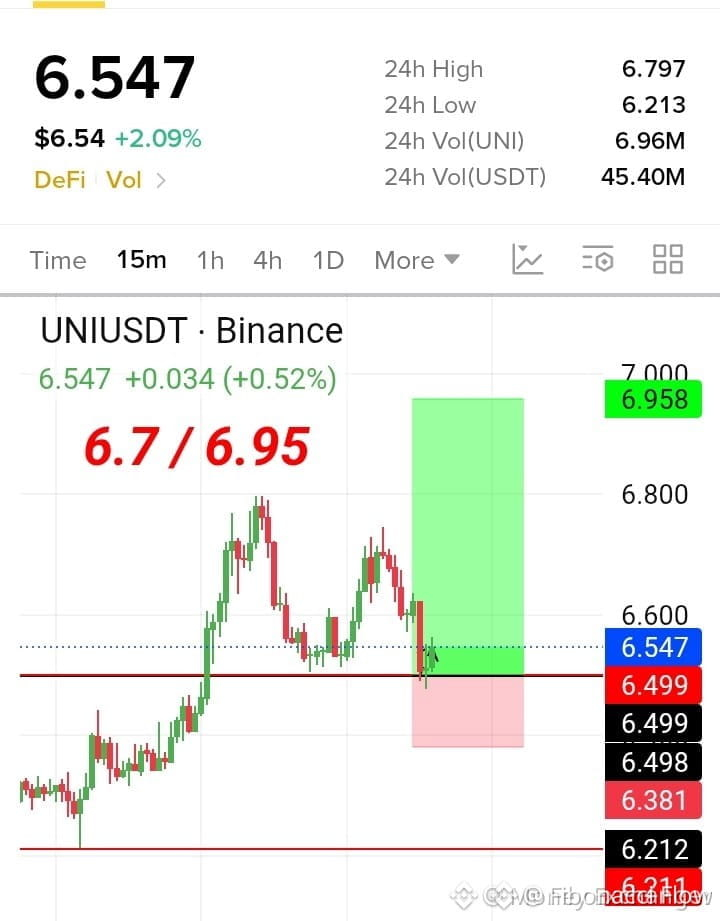
🚨 $UNI SURGES INTO ROUND 2 FOMO – BULLISH BREAKOUT ALERT! 📈
Entry: 6.543 ⚡
Target: 6.700 / 6.950 🚀
Stop Loss: 6.273 ⚠️
🦈 Liquidity is roaring back at $UNI as the second wave of FOMO ignites. The price is perched at 6.543, chewing through the last sell wall 📊.
⚡ Volume spikes on the 4H chart show smart money re‑entering, pushing the next resistance at 6.700 and a second ceiling near 6.950 📈. A clean 1:2.5 RRR makes this a prime swing play.
💬 Are you loading up now or waiting for the next liquidity sweep? 👇
⚠️ Not financial advice. Always manage your risk. 🛡️
🏷️ #UNI #LongSetup #DeFi #Breakout
🔥 💎
🚨 $UNI SURGES INTO ROUND 2 FOMO – BULLISH BREAKOUT ALERT! 📈
Entry: 6.543 ⚡
Target: 6.700 / 6.950 🚀
Stop Loss: 6.273 ⚠️
🦈 Liquidity is roaring back at $UNI as the second wave of FOMO ignites. The price is perched at 6.543, chewing through the last sell wall 📊.
⚡ Volume spikes on the 4H chart show smart money re‑entering, pushing the next resistance at 6.700 and a second ceiling near 6.950 📈. A clean 1:2.5 RRR makes this a prime swing play.
💬 Are you loading up now or waiting for the next liquidity sweep? 👇
⚠️ Not financial advice. Always manage your risk. 🛡️
🏷️ #UNI #LongSetup #DeFi #Breakout
🔥 💎
Entry: 6.543 ⚡
Target: 6.700 / 6.950 🚀
Stop Loss: 6.273 ⚠️
🦈 Liquidity is roaring back at $UNI as the second wave of FOMO ignites. The price is perched at 6.543, chewing through the last sell wall 📊.
⚡ Volume spikes on the 4H chart show smart money re‑entering, pushing the next resistance at 6.700 and a second ceiling near 6.950 📈. A clean 1:2.5 RRR makes this a prime swing play.
💬 Are you loading up now or waiting for the next liquidity sweep? 👇
⚠️ Not financial advice. Always manage your risk. 🛡️
🏷️ #UNI #LongSetup #DeFi #Breakout
🔥 💎
38

·
--
Bullish
Verified
#zamaopens16confidentialmorphovaults
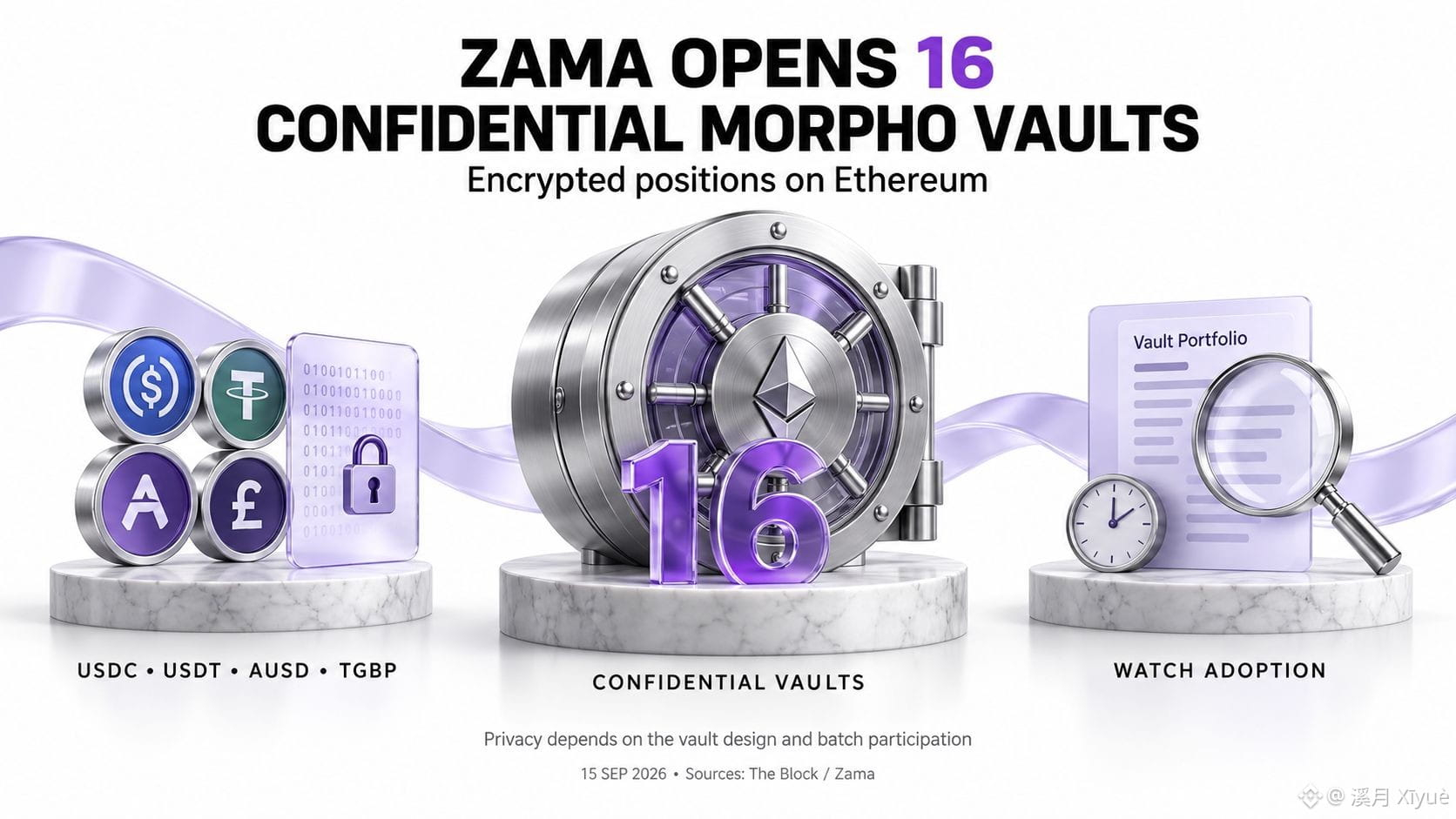
Zama Opens 16 Confidential Morpho Vaults on Ethereum
DeFi’s next adoption test may be whether users can earn yield without broadcasting their position sizes.
On September 15, Zama is opening deposits into 16 confidential Morpho vaults, covering assets including USDC, USDT, AUSD and TGBP. The lineup provides confidential access to 12 existing vaults, alongside four built specifically for confidential deposits. Access starts through Zama’s app.
What does “confidential” mean? Zama’s documented design encrypts individual deposit amounts and share balances while making aggregate batch totals public. Addresses joining a batch remain visible, and privacy depends on how many independent users participate.
My take: This could make DeFi more practical for treasuries and funds that want to manage cash without advertising every position size. A broader vault menu also gives users more choice across assets and curators.
The adoption test is whether users keep capital in these products and can deposit, report and withdraw reliably. Encryption protects information; underlying collateral quality, smart-contract exposure and available liquidity still matter. I’d watch sustained deposits and withdrawal performance before judging how much demand privacy actually creates.
Would confidential balances make you more comfortable using DeFi lending?
#ZamaOpens16ConfidentialMorphoVaults #defi #Morpho
$AKE $AIN
{future}(AINUSDT)
{future}(AKEUSDT)
#zamaopens16confidentialmorphovaults
Zama Opens 16 Confidential Morpho Vaults on Ethereum
DeFi’s next adoption test may be whether users can earn yield without broadcasting their position sizes.
On September 15, Zama is opening deposits into 16 confidential Morpho vaults, covering assets including USDC, USDT, AUSD and TGBP. The lineup provides confidential access to 12 existing vaults, alongside four built specifically for confidential deposits. Access starts through Zama’s app.
What does “confidential” mean? Zama’s documented design encrypts individual deposit amounts and share balances while making aggregate batch totals public. Addresses joining a batch remain visible, and privacy depends on how many independent users participate.
My take: This could make DeFi more practical for treasuries and funds that want to manage cash without advertising every position size. A broader vault menu also gives users more choice across assets and curators.
The adoption test is whether users keep capital in these products and can deposit, report and withdraw reliably. Encryption protects information; underlying collateral quality, smart-contract exposure and available liquidity still matter. I’d watch sustained deposits and withdrawal performance before judging how much demand privacy actually creates.
Would confidential balances make you more comfortable using DeFi lending?
#ZamaOpens16ConfidentialMorphoVaults #defi #Morpho
$AKE $AIN
Zama Opens 16 Confidential Morpho Vaults on Ethereum
DeFi’s next adoption test may be whether users can earn yield without broadcasting their position sizes.
On September 15, Zama is opening deposits into 16 confidential Morpho vaults, covering assets including USDC, USDT, AUSD and TGBP. The lineup provides confidential access to 12 existing vaults, alongside four built specifically for confidential deposits. Access starts through Zama’s app.
What does “confidential” mean? Zama’s documented design encrypts individual deposit amounts and share balances while making aggregate batch totals public. Addresses joining a batch remain visible, and privacy depends on how many independent users participate.
My take: This could make DeFi more practical for treasuries and funds that want to manage cash without advertising every position size. A broader vault menu also gives users more choice across assets and curators.
The adoption test is whether users keep capital in these products and can deposit, report and withdraw reliably. Encryption protects information; underlying collateral quality, smart-contract exposure and available liquidity still matter. I’d watch sustained deposits and withdrawal performance before judging how much demand privacy actually creates.
Would confidential balances make you more comfortable using DeFi lending?
#ZamaOpens16ConfidentialMorphoVaults #defi #Morpho
$AKE $AIN
ABO3ZAM:
الخصوصية في التمويل اللامركزي خطوة محورية لجذب السيولة المؤسسية، لكن يجب الحذر من تضخم الزخم اللحظي. راقب استمرارية تدفق السيولة وتأكيد الارتداد عند مناطق الرفض السعري. التزم بإدارة المخاطر الصارمة وتأمين الأرباح، فالسوق لا يرحم المندفعين خلف الأخبار دون رؤية فنية واضحة.
1
1
756

🚨 $BAL PROPOSES FULL PROTOCOL SHUTDOWN WITH $9M TREASURY PAYOUT TO HOLDERS! 🏦
DeFi pioneer $BAL is preparing for an orderly wind-down, with a Snapshot vote set for September 25 to liquidate protocol operations. 📊 The DAO treasury holds over $9 million in assets, which will be distributed proportionally to token holders who burn their $BAL .
Pausable pools flip to withdrawal-only on October 30 as protocol expansion freezes permanently. 🛡️ Smart capital is already calculating the arbitrage math on the treasury payout versus circulating valuation.
💬 Will you hold $BAL to claim the treasury liquidation, or dump on the governance news? 👇
⚠️ Not financial advice. Always manage your risk. 🛡️
🏷️ #BAL #DeFi #Crypto #Altcoins
⚖️ 📥
🚨 $BAL PROPOSES FULL PROTOCOL SHUTDOWN WITH $9M TREASURY PAYOUT TO HOLDERS! 🏦
DeFi pioneer $BAL is preparing for an orderly wind-down, with a Snapshot vote set for September 25 to liquidate protocol operations. 📊 The DAO treasury holds over $9 million in assets, which will be distributed proportionally to token holders who burn their $BAL .
Pausable pools flip to withdrawal-only on October 30 as protocol expansion freezes permanently. 🛡️ Smart capital is already calculating the arbitrage math on the treasury payout versus circulating valuation.
💬 Will you hold $BAL to claim the treasury liquidation, or dump on the governance news? 👇
⚠️ Not financial advice. Always manage your risk. 🛡️
🏷️ #BAL #DeFi #Crypto #Altcoins
⚖️ 📥
DeFi pioneer $BAL is preparing for an orderly wind-down, with a Snapshot vote set for September 25 to liquidate protocol operations. 📊 The DAO treasury holds over $9 million in assets, which will be distributed proportionally to token holders who burn their $BAL .
Pausable pools flip to withdrawal-only on October 30 as protocol expansion freezes permanently. 🛡️ Smart capital is already calculating the arbitrage math on the treasury payout versus circulating valuation.
💬 Will you hold $BAL to claim the treasury liquidation, or dump on the governance news? 👇
⚠️ Not financial advice. Always manage your risk. 🛡️
🏷️ #BAL #DeFi #Crypto #Altcoins
⚖️ 📥
8

🚨 PROPOSED $BAL WIND-DOWN PLAN UNVEILS PROTOCOL DISSOLUTION AND TREASURY LIQUIDATION ⚠️
Institutional governance shifts into finality as $BAL evaluates a complete protocol wind-down proposal ahead of the late September Snapshot vote. 📊 If approved, pausable pools transition to withdrawal-only mode by late October, effectively halting active liquidity expansion and zeroing protocol fees.
With treasury reserves estimated around $9 million, the DAO outlines a long-term liquidation framework distributing assets directly to $BAL holders via token burn mechanisms spanning into 2027. ⚖️ Smart money is already assessing whether the current market cap accurately reflects the net redeemable asset value post-exit budget.
💬 Will you hold $BAL for the treasury asset redemption or exit ahead of the governance vote? 👇
⚠️ Not financial advice. Always manage your risk. 🛡️
🏷️ #BAL #DeFi #Governance #Crypto
⚖️ 📌
🚨 PROPOSED $BAL WIND-DOWN PLAN UNVEILS PROTOCOL DISSOLUTION AND TREASURY LIQUIDATION ⚠️
Institutional governance shifts into finality as $BAL evaluates a complete protocol wind-down proposal ahead of the late September Snapshot vote. 📊 If approved, pausable pools transition to withdrawal-only mode by late October, effectively halting active liquidity expansion and zeroing protocol fees.
With treasury reserves estimated around $9 million, the DAO outlines a long-term liquidation framework distributing assets directly to $BAL holders via token burn mechanisms spanning into 2027. ⚖️ Smart money is already assessing whether the current market cap accurately reflects the net redeemable asset value post-exit budget.
💬 Will you hold $BAL for the treasury asset redemption or exit ahead of the governance vote? 👇
⚠️ Not financial advice. Always manage your risk. 🛡️
🏷️ #BAL #DeFi #Governance #Crypto
⚖️ 📌
Institutional governance shifts into finality as $BAL evaluates a complete protocol wind-down proposal ahead of the late September Snapshot vote. 📊 If approved, pausable pools transition to withdrawal-only mode by late October, effectively halting active liquidity expansion and zeroing protocol fees.
With treasury reserves estimated around $9 million, the DAO outlines a long-term liquidation framework distributing assets directly to $BAL holders via token burn mechanisms spanning into 2027. ⚖️ Smart money is already assessing whether the current market cap accurately reflects the net redeemable asset value post-exit budget.
💬 Will you hold $BAL for the treasury asset redemption or exit ahead of the governance vote? 👇
⚠️ Not financial advice. Always manage your risk. 🛡️
🏷️ #BAL #DeFi #Governance #Crypto
⚖️ 📌
6

·
--

Article
DeFi Solved Decentralized Money. Here's How Privana Solves Privacy.Crypto has made huge strides in decentralizing money — moving value without banks, borders, or permission. But beyond the basics, decentralized finance (#DeFI ) has its own set of challenges, frustrating many users and generally discouraging wider adoption.
Let me lay out the darkness in bare terms first. Then I'll show you the fix.
DeFi's dark side
#MEV , or maximal extractable value, has been a long-standing pain point in DeFi. In simple terms, it is an invisible tax that even veteran users struggle to escape, while inexperienced users exploring DeFi are easy prey. Some may oversimplify this as bad, but we must remember that the bots that can hurt us are the same ones that also keep DeFi functional. For example, bots get MEV incentives to liquidate bad debt and prevent insolvency of the protocol, or arbitrage bots constantly check and correct pricing across DEXs to prevent fragmented liquidity.
There are some common MEV exploits that every DeFi user needs to know and be wary of.
Sandwich attack - Bots identify a user awaiting a swap, buy the token, push the price up, execute the user’s trade at a lower price, and immediately sell. The user gets fewer tokens out of the deal, but the bot profits.Front-running - Bots identify a pending transaction, copy and submit the same trade with higher gas fees. The bot profits from this queue-jumping as the user misses out on the opportunity of a quick transaction at lower gas fees.Back-running - Bots identify a large trade and immediately execute transactions to take advantage of the favourable arbitrage of the aforementioned trade.
Protection against MEV is possible but optional in the current DeFi scenario. So, if you do not know how to sidestep the MEV minefield, the bots will profit at your expense. Public mempools and an utter lack of #privacy compound the problems in this space. Take the case of Base chain. It has significantly increased its throughput by being faster and cheaper, but bots consume the gas and profits, making it worse for users. Even if you don't use a decentralized exchange (DEX), you still bear the brunt due to higher fees and congested blocks.
Solution: private DeFi
A few protocols have dedicated themselves to solving the blockchain privacy paradox and making web3 a reality. #Oasis has been a pioneer in this regard, aiming for a smart blend of confidentiality and transparency by building an infrastructure that promotes privacy by design. With the confidential smart contract engine in Sapphire and the runtime off-chain logic (ROFL) framework, the protocol is primed to offer an alternative to traditional DeFi through a new application — Privana.
Privana combines Sapphire's production-ready confidential EVM setup and secure enclaves of the trusted execution environments (TEEs) with encrypted mempools, liquefaction, and key encumbrance. It is a consumer-facing, user-friendly private DeFi solution.
Let's look at some details of what Privana brings to the table from a user's point of view, which I think closes the gap that most DEXs leave open.
Unpacking Privana
Privana is not your traditional DEX but a DeFi application that offers private #Swaps , automated yields, and zero MEV for multi-chain operations on Ethereum, Base, and HyperEVM.
The USPs of Privana make it immediately worthy of attention - it is privacy-first, it integrates automation, it enables self-custody, and it is available multi-chain, not just limited to Oasis users.
Privacy-first — Your transactions are TEE-protected, which means they are secure and encrypted without exception. As the transactions never get in the public mempool, the bots cannot identify the trades and therefore cannot target them.Automation — Auto-mode does the execution for you once you set the rules. It involves 3 simple steps.
You send your tokens to the Privana vault, which is a secure enclave.You choose and save your preferences, such as swap conditions, yield settings, and app permissions.Once you approve, you do not need any more manual intervention that usually accompanies actions like swaps, yield allocation, and rebalancing. Since all these activities now run privately in the background, bots never get a chance to target them.
Self-custody — Key encumbrance is a crucial point of difference from others who offer self-custody. Here, your keys are non-extractable, so they cannot be moved outside the TEE protection or be accessed in any way. The policies are user-defined and managed only by you, which means that not even Privana developers can affect anything in the backend.Multi-chain — A recurring complaint among DeFi users is that either they are restricted to a single chain activity or must learn to move tokens across chains manually. This leads to inherent and sometimes unavoidable risks of cross-chain swapping with bridges. The proposed solution envisions a single interface with no bridges or wallet-switching, which makes the user experience easier and seamless.
Here's a quick overview of Privana’s capabilities and what other major protocols offer currently.
Why it matters
Let me make this clear: Privana makes no claim to be the first or only solution to address the long-standing DeFi pain points. Building on the previous graphic, let's compare Privana with some leading DeFi privacy tools like Flashbots, Near Intents, CoW Swap, and Railgun, where everyone offers MEV protection as a common denominator and needs a low- to medium-level of user proficiency.
MEV exploit risk is the bane of every DEX or DEX-like solution. Privana circumvents the problem of public mempools, where on-chain and public transactions are exposed to undercutting by malicious bots, by using encrypted mempools. Also, the problem of the full swap intent being revealed to the operators persists even when the transactions are hidden from the network. A centralized exchange (CEX) offers some respite with internal books, but the lack of self-custody is a huge potential problem there.
DEXes and CEXes only offer partial solutions with trade-offs. MEV protection does not preclude on-chain full transparency. Private swaps do not combine with self-custody and automation. As a result, you can either get cross-chain swaps or privacy-focused swaps, but not both at the same time. This is where Privana comes in. It is designed to be private by default and automated without giving up control, addressing exactly the points that users would like to have but usually miss out on from the prevailing solutions.
What more to expect
Privana's roadmap lays the groundwork for what to expect from this private DeFi solution.
As part of the new strategic direction at Oasis, this flagship dApps uses the protocol's underlying technology and architecture. Here is a first look at the Privana UI. With the closed beta expected soon, you can also enjoy some incentives as an early joiner, such as zero fees for 90 days, Founding Member status, and priority queue at launch.
What then is your take on Privana and private DeFi? What features excite you, and what others would you add to your wish list? Let's discuss in the comments.
DeFi Solved Decentralized Money. Here's How Privana Solves Privacy.
Crypto has made huge strides in decentralizing money — moving value without banks, borders, or permission. But beyond the basics, decentralized finance (#DeFI ) has its own set of challenges, frustrating many users and generally discouraging wider adoption.
Let me lay out the darkness in bare terms first. Then I'll show you the fix.
DeFi's dark side
#MEV , or maximal extractable value, has been a long-standing pain point in DeFi. In simple terms, it is an invisible tax that even veteran users struggle to escape, while inexperienced users exploring DeFi are easy prey. Some may oversimplify this as bad, but we must remember that the bots that can hurt us are the same ones that also keep DeFi functional. For example, bots get MEV incentives to liquidate bad debt and prevent insolvency of the protocol, or arbitrage bots constantly check and correct pricing across DEXs to prevent fragmented liquidity.
There are some common MEV exploits that every DeFi user needs to know and be wary of.
Sandwich attack - Bots identify a user awaiting a swap, buy the token, push the price up, execute the user’s trade at a lower price, and immediately sell. The user gets fewer tokens out of the deal, but the bot profits.Front-running - Bots identify a pending transaction, copy and submit the same trade with higher gas fees. The bot profits from this queue-jumping as the user misses out on the opportunity of a quick transaction at lower gas fees.Back-running - Bots identify a large trade and immediately execute transactions to take advantage of the favourable arbitrage of the aforementioned trade.
Protection against MEV is possible but optional in the current DeFi scenario. So, if you do not know how to sidestep the MEV minefield, the bots will profit at your expense. Public mempools and an utter lack of #privacy compound the problems in this space. Take the case of Base chain. It has significantly increased its throughput by being faster and cheaper, but bots consume the gas and profits, making it worse for users. Even if you don't use a decentralized exchange (DEX), you still bear the brunt due to higher fees and congested blocks.
Solution: private DeFi
A few protocols have dedicated themselves to solving the blockchain privacy paradox and making web3 a reality. #Oasis has been a pioneer in this regard, aiming for a smart blend of confidentiality and transparency by building an infrastructure that promotes privacy by design. With the confidential smart contract engine in Sapphire and the runtime off-chain logic (ROFL) framework, the protocol is primed to offer an alternative to traditional DeFi through a new application — Privana.
Privana combines Sapphire's production-ready confidential EVM setup and secure enclaves of the trusted execution environments (TEEs) with encrypted mempools, liquefaction, and key encumbrance. It is a consumer-facing, user-friendly private DeFi solution.
Let's look at some details of what Privana brings to the table from a user's point of view, which I think closes the gap that most DEXs leave open.
Unpacking Privana
Privana is not your traditional DEX but a DeFi application that offers private #Swaps , automated yields, and zero MEV for multi-chain operations on Ethereum, Base, and HyperEVM.
The USPs of Privana make it immediately worthy of attention - it is privacy-first, it integrates automation, it enables self-custody, and it is available multi-chain, not just limited to Oasis users.
Privacy-first — Your transactions are TEE-protected, which means they are secure and encrypted without exception. As the transactions never get in the public mempool, the bots cannot identify the trades and therefore cannot target them.Automation — Auto-mode does the execution for you once you set the rules. It involves 3 simple steps.
You send your tokens to the Privana vault, which is a secure enclave.You choose and save your preferences, such as swap conditions, yield settings, and app permissions.Once you approve, you do not need any more manual intervention that usually accompanies actions like swaps, yield allocation, and rebalancing. Since all these activities now run privately in the background, bots never get a chance to target them.
Self-custody — Key encumbrance is a crucial point of difference from others who offer self-custody. Here, your keys are non-extractable, so they cannot be moved outside the TEE protection or be accessed in any way. The policies are user-defined and managed only by you, which means that not even Privana developers can affect anything in the backend.Multi-chain — A recurring complaint among DeFi users is that either they are restricted to a single chain activity or must learn to move tokens across chains manually. This leads to inherent and sometimes unavoidable risks of cross-chain swapping with bridges. The proposed solution envisions a single interface with no bridges or wallet-switching, which makes the user experience easier and seamless.
Here's a quick overview of Privana’s capabilities and what other major protocols offer currently.
Why it matters
Let me make this clear: Privana makes no claim to be the first or only solution to address the long-standing DeFi pain points. Building on the previous graphic, let's compare Privana with some leading DeFi privacy tools like Flashbots, Near Intents, CoW Swap, and Railgun, where everyone offers MEV protection as a common denominator and needs a low- to medium-level of user proficiency.
MEV exploit risk is the bane of every DEX or DEX-like solution. Privana circumvents the problem of public mempools, where on-chain and public transactions are exposed to undercutting by malicious bots, by using encrypted mempools. Also, the problem of the full swap intent being revealed to the operators persists even when the transactions are hidden from the network. A centralized exchange (CEX) offers some respite with internal books, but the lack of self-custody is a huge potential problem there.
DEXes and CEXes only offer partial solutions with trade-offs. MEV protection does not preclude on-chain full transparency. Private swaps do not combine with self-custody and automation. As a result, you can either get cross-chain swaps or privacy-focused swaps, but not both at the same time. This is where Privana comes in. It is designed to be private by default and automated without giving up control, addressing exactly the points that users would like to have but usually miss out on from the prevailing solutions.
What more to expect
Privana's roadmap lays the groundwork for what to expect from this private DeFi solution.
As part of the new strategic direction at Oasis, this flagship dApps uses the protocol's underlying technology and architecture. Here is a first look at the Privana UI. With the closed beta expected soon, you can also enjoy some incentives as an early joiner, such as zero fees for 90 days, Founding Member status, and priority queue at launch.
What then is your take on Privana and private DeFi? What features excite you, and what others would you add to your wish list? Let's discuss in the comments.
Let me lay out the darkness in bare terms first. Then I'll show you the fix.
DeFi's dark side
#MEV , or maximal extractable value, has been a long-standing pain point in DeFi. In simple terms, it is an invisible tax that even veteran users struggle to escape, while inexperienced users exploring DeFi are easy prey. Some may oversimplify this as bad, but we must remember that the bots that can hurt us are the same ones that also keep DeFi functional. For example, bots get MEV incentives to liquidate bad debt and prevent insolvency of the protocol, or arbitrage bots constantly check and correct pricing across DEXs to prevent fragmented liquidity.
There are some common MEV exploits that every DeFi user needs to know and be wary of.
Sandwich attack - Bots identify a user awaiting a swap, buy the token, push the price up, execute the user’s trade at a lower price, and immediately sell. The user gets fewer tokens out of the deal, but the bot profits.Front-running - Bots identify a pending transaction, copy and submit the same trade with higher gas fees. The bot profits from this queue-jumping as the user misses out on the opportunity of a quick transaction at lower gas fees.Back-running - Bots identify a large trade and immediately execute transactions to take advantage of the favourable arbitrage of the aforementioned trade.
Protection against MEV is possible but optional in the current DeFi scenario. So, if you do not know how to sidestep the MEV minefield, the bots will profit at your expense. Public mempools and an utter lack of #privacy compound the problems in this space. Take the case of Base chain. It has significantly increased its throughput by being faster and cheaper, but bots consume the gas and profits, making it worse for users. Even if you don't use a decentralized exchange (DEX), you still bear the brunt due to higher fees and congested blocks.
Solution: private DeFi
A few protocols have dedicated themselves to solving the blockchain privacy paradox and making web3 a reality. #Oasis has been a pioneer in this regard, aiming for a smart blend of confidentiality and transparency by building an infrastructure that promotes privacy by design. With the confidential smart contract engine in Sapphire and the runtime off-chain logic (ROFL) framework, the protocol is primed to offer an alternative to traditional DeFi through a new application — Privana.
Privana combines Sapphire's production-ready confidential EVM setup and secure enclaves of the trusted execution environments (TEEs) with encrypted mempools, liquefaction, and key encumbrance. It is a consumer-facing, user-friendly private DeFi solution.
Let's look at some details of what Privana brings to the table from a user's point of view, which I think closes the gap that most DEXs leave open.
Unpacking Privana
Privana is not your traditional DEX but a DeFi application that offers private #Swaps , automated yields, and zero MEV for multi-chain operations on Ethereum, Base, and HyperEVM.
The USPs of Privana make it immediately worthy of attention - it is privacy-first, it integrates automation, it enables self-custody, and it is available multi-chain, not just limited to Oasis users.
Privacy-first — Your transactions are TEE-protected, which means they are secure and encrypted without exception. As the transactions never get in the public mempool, the bots cannot identify the trades and therefore cannot target them.Automation — Auto-mode does the execution for you once you set the rules. It involves 3 simple steps.
You send your tokens to the Privana vault, which is a secure enclave.You choose and save your preferences, such as swap conditions, yield settings, and app permissions.Once you approve, you do not need any more manual intervention that usually accompanies actions like swaps, yield allocation, and rebalancing. Since all these activities now run privately in the background, bots never get a chance to target them.
Self-custody — Key encumbrance is a crucial point of difference from others who offer self-custody. Here, your keys are non-extractable, so they cannot be moved outside the TEE protection or be accessed in any way. The policies are user-defined and managed only by you, which means that not even Privana developers can affect anything in the backend.Multi-chain — A recurring complaint among DeFi users is that either they are restricted to a single chain activity or must learn to move tokens across chains manually. This leads to inherent and sometimes unavoidable risks of cross-chain swapping with bridges. The proposed solution envisions a single interface with no bridges or wallet-switching, which makes the user experience easier and seamless.
Here's a quick overview of Privana’s capabilities and what other major protocols offer currently.
Why it matters
Let me make this clear: Privana makes no claim to be the first or only solution to address the long-standing DeFi pain points. Building on the previous graphic, let's compare Privana with some leading DeFi privacy tools like Flashbots, Near Intents, CoW Swap, and Railgun, where everyone offers MEV protection as a common denominator and needs a low- to medium-level of user proficiency.
MEV exploit risk is the bane of every DEX or DEX-like solution. Privana circumvents the problem of public mempools, where on-chain and public transactions are exposed to undercutting by malicious bots, by using encrypted mempools. Also, the problem of the full swap intent being revealed to the operators persists even when the transactions are hidden from the network. A centralized exchange (CEX) offers some respite with internal books, but the lack of self-custody is a huge potential problem there.
DEXes and CEXes only offer partial solutions with trade-offs. MEV protection does not preclude on-chain full transparency. Private swaps do not combine with self-custody and automation. As a result, you can either get cross-chain swaps or privacy-focused swaps, but not both at the same time. This is where Privana comes in. It is designed to be private by default and automated without giving up control, addressing exactly the points that users would like to have but usually miss out on from the prevailing solutions.
What more to expect
Privana's roadmap lays the groundwork for what to expect from this private DeFi solution.
As part of the new strategic direction at Oasis, this flagship dApps uses the protocol's underlying technology and architecture. Here is a first look at the Privana UI. With the closed beta expected soon, you can also enjoy some incentives as an early joiner, such as zero fees for 90 days, Founding Member status, and priority queue at launch.
What then is your take on Privana and private DeFi? What features excite you, and what others would you add to your wish list? Let's discuss in the comments.
275
Log in to explore more content
Join global crypto users on Binance Square
⚡️ Get latest and useful information about crypto.
💬 Trusted by the world’s largest crypto exchange.
👍 Discover real insights from verified creators.
Email / Phone number
Trending Topics
1
#FedRateWatch
261,422 views
1,666 Discussing
2
#BitcoinSlidesTo$76000
3,338 views
58 Discussing
3
#BitcoinReboundsTo$79K
49,550 views
360 Discussing
4
#StrategyMarketCapPassesFord
9,107 views
315 Discussing
5
#ClarityActOddsHalveOnPolymarket
6,639 views
247 Discussing
6
#US30YTreasuryYieldTops5.40%
9,600 views
211 Discussing
7
#BessentEndorsesFinalClarityActDraft
27,146 views
518 Discussing
8
#ZamaOpens16ConfidentialMorphoVaults
10,119 views
249 Discussing
9
#USDCOnChainVolumeTops$100Trillion
1,528 views
37 Discussing
10
#BitcoinSpotETFsNetInflow$160M
2,396 views
92 Discussing