

Pantherapardus
122 Publications

Pantherapardus
Signaler
Bloquer l’utilisateur
The Leopard Of The Blockchain: Wild Instincts: Sharp Insights: Tracking Trends: Predicting Moves: Crypto Insights Daily: Follow The $ Trail.
Ouvert au trading
Trade occasionnellement
4.3 an(s)
30 Suivis
64 Abonnés
238 J’aime
Publications
Portefeuille
Tous
Vidéos
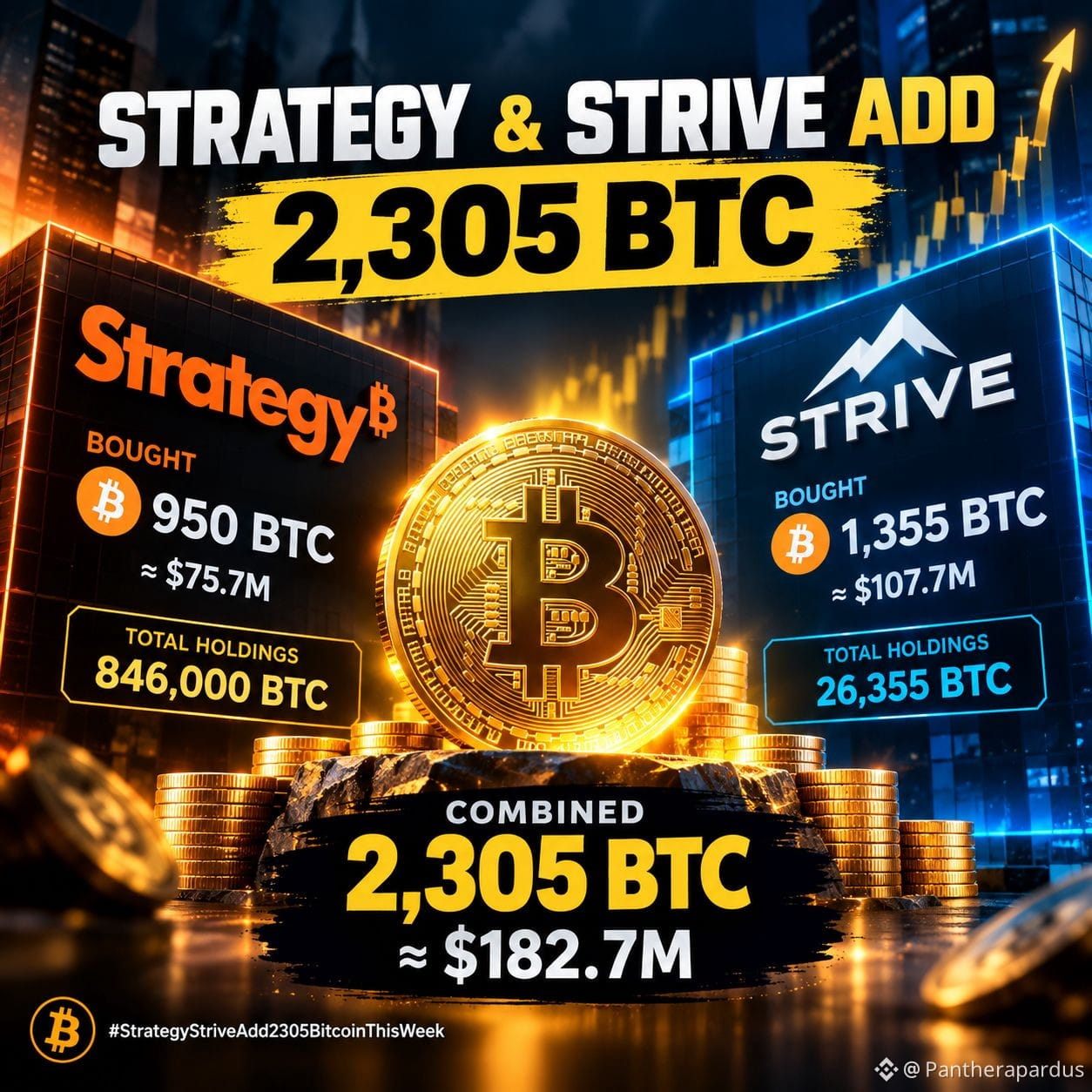
🚨 2,305 BTC Added by Strategy & Strive
Two corporate Bitcoin treasuries made a major move last week. 🟠
🔸 Strategy: +950 BTC for ~$75.7M
🔸 Strive: +1,355 BTC for ~$107.7M
💰 Combined: 2,305 BTC / ~$182.7M
Strategy's reported holdings reached 846,000 BTC, while Strive reached 26,355 BTC.
Corporate Bitcoin accumulation is once again in the spotlight. 👀
#StrategyStriveAdd2305BitcoinThisWeek #bitcoin #BinanceSquare
$BTC
{spot}(BTCUSDT)
🚨 2,305 BTC Added by Strategy & Strive
Two corporate Bitcoin treasuries made a major move last week. 🟠
🔸 Strategy: +950 BTC for ~$75.7M
🔸 Strive: +1,355 BTC for ~$107.7M
💰 Combined: 2,305 BTC / ~$182.7M
Strategy's reported holdings reached 846,000 BTC, while Strive reached 26,355 BTC.
Corporate Bitcoin accumulation is once again in the spotlight. 👀
#StrategyStriveAdd2305BitcoinThisWeek #bitcoin #BinanceSquare
$BTC
Two corporate Bitcoin treasuries made a major move last week. 🟠
🔸 Strategy: +950 BTC for ~$75.7M
🔸 Strive: +1,355 BTC for ~$107.7M
💰 Combined: 2,305 BTC / ~$182.7M
Strategy's reported holdings reached 846,000 BTC, while Strive reached 26,355 BTC.
Corporate Bitcoin accumulation is once again in the spotlight. 👀
#StrategyStriveAdd2305BitcoinThisWeek #bitcoin #BinanceSquare
$BTC
47
🚨 Circle & Tether Freeze Bitget-Linked Wallet
A Bitget-linked wallet reportedly had around $318K in USDC and USDT frozen by Circle and Tether. But much of the crypto reportedly moved into ETH — raising a bigger question about the balance between security and decentralization. 🔐⛓️
What’s your take?
#CircleTetherFreezeBitgetHackerWallet #Bitget #CryptoSecurity
$USDC
$USDT
🚨 Circle & Tether Freeze Bitget-Linked Wallet
A Bitget-linked wallet reportedly had around $318K in USDC and USDT frozen by Circle and Tether. But much of the crypto reportedly moved into ETH — raising a bigger question about the balance between security and decentralization. 🔐⛓️
What’s your take?
#CircleTetherFreezeBitgetHackerWallet #Bitget #CryptoSecurity
$USDC
$USDT
A Bitget-linked wallet reportedly had around $318K in USDC and USDT frozen by Circle and Tether. But much of the crypto reportedly moved into ETH — raising a bigger question about the balance between security and decentralization. 🔐⛓️
What’s your take?
#CircleTetherFreezeBitgetHackerWallet #Bitget #CryptoSecurity
$USDC
$USDT
1
1
381

Article
Circle & Tether Freeze Wallet Linked to Bitget ExploitThe recent Bitget security incident has sparked another major discussion about crypto security and stablecoin control.
Circle and Tether reportedly blacklisted a wallet connected to the exploit, freezing approximately $318,000 worth of USDC and USDT.
However, this represents only a small portion of the affected assets. A significant amount was reportedly converted into ETH, which cannot be directly frozen by USDC or USDT issuers.
This creates an interesting contrast.
Stablecoins: issuers can intervene and freeze specific tokens.
Native crypto assets: assets such as ETH operate without a centralized issuer capable of freezing the coins themselves.
The incident therefore raises a broader question for the crypto industry:
Does the ability to freeze stolen stablecoins provide an important security layer, or does it introduce a trade-off with the permissionless nature of cryptocurrency?
The investigation and movement of the affected funds remain an evolving story.
What is your view?
$USDC $USDT
#CircleTetherFreezeBitgetHackerWallet #Bitget
Circle & Tether Freeze Wallet Linked to Bitget Exploit
The recent Bitget security incident has sparked another major discussion about crypto security and stablecoin control.
Circle and Tether reportedly blacklisted a wallet connected to the exploit, freezing approximately $318,000 worth of USDC and USDT.
However, this represents only a small portion of the affected assets. A significant amount was reportedly converted into ETH, which cannot be directly frozen by USDC or USDT issuers.
This creates an interesting contrast.
Stablecoins: issuers can intervene and freeze specific tokens.
Native crypto assets: assets such as ETH operate without a centralized issuer capable of freezing the coins themselves.
The incident therefore raises a broader question for the crypto industry:
Does the ability to freeze stolen stablecoins provide an important security layer, or does it introduce a trade-off with the permissionless nature of cryptocurrency?
The investigation and movement of the affected funds remain an evolving story.
What is your view?
$USDC $USDT
#CircleTetherFreezeBitgetHackerWallet #Bitget
Circle and Tether reportedly blacklisted a wallet connected to the exploit, freezing approximately $318,000 worth of USDC and USDT.
However, this represents only a small portion of the affected assets. A significant amount was reportedly converted into ETH, which cannot be directly frozen by USDC or USDT issuers.
This creates an interesting contrast.
Stablecoins: issuers can intervene and freeze specific tokens.
Native crypto assets: assets such as ETH operate without a centralized issuer capable of freezing the coins themselves.
The incident therefore raises a broader question for the crypto industry:
Does the ability to freeze stolen stablecoins provide an important security layer, or does it introduce a trade-off with the permissionless nature of cryptocurrency?
The investigation and movement of the affected funds remain an evolving story.
What is your view?
$USDC $USDT
#CircleTetherFreezeBitgetHackerWallet #Bitget
1
72
🚨 Circle & Tether Freeze Bitget-Linked Wallet
Circle and Tether have blacklisted a wallet linked to the recent Bitget exploit, freezing roughly $318,000 in USDC and USDT.
But here’s the interesting part: the majority of the stolen assets were reportedly moved into ETH, which cannot simply be frozen by a stablecoin issuer.
This incident highlights an important crypto-security question:
🔐 How should the industry balance asset recovery, security, and decentralization?
What do you think?
$USDC
{spot}(USDCUSDT)
$USDT
#CircleTetherFreezeBitgetHackerWallet #BinanceSquareTalks
🚨 Circle & Tether Freeze Bitget-Linked Wallet
Circle and Tether have blacklisted a wallet linked to the recent Bitget exploit, freezing roughly $318,000 in USDC and USDT.
But here’s the interesting part: the majority of the stolen assets were reportedly moved into ETH, which cannot simply be frozen by a stablecoin issuer.
This incident highlights an important crypto-security question:
🔐 How should the industry balance asset recovery, security, and decentralization?
What do you think?
$USDC
$USDT
#CircleTetherFreezeBitgetHackerWallet #BinanceSquareTalks
Circle and Tether have blacklisted a wallet linked to the recent Bitget exploit, freezing roughly $318,000 in USDC and USDT.
But here’s the interesting part: the majority of the stolen assets were reportedly moved into ETH, which cannot simply be frozen by a stablecoin issuer.
This incident highlights an important crypto-security question:
🔐 How should the industry balance asset recovery, security, and decentralization?
What do you think?
$USDC
$USDT
#CircleTetherFreezeBitgetHackerWallet #BinanceSquareTalks

101
Article
AI Stocks: What Comes Next?Artificial intelligence is developing rapidly, and the investment story is expanding beyond the companies building popular AI applications.
AI chips, data centers, cloud infrastructure, robotics, automation, cybersecurity, and specialized software are all becoming important parts of the broader AI ecosystem.
The next stage could bring new opportunities—but also new risks. Competition is intense, technology changes quickly, and valuations can move significantly based on expectations about future growth.
That makes one question particularly interesting:
What comes next for AI?
The companies and technologies shaping the next phase may look very different from today's leaders.
For investors and technology enthusiasts, the key is to keep learning, track innovation, and understand the underlying technology rather than simply following hype.
The AI journey is still evolving.
#WhatNext #AI #Binance
$BNB
{spot}(BNBUSDT)
AI Stocks: What Comes Next?
Artificial intelligence is developing rapidly, and the investment story is expanding beyond the companies building popular AI applications.
AI chips, data centers, cloud infrastructure, robotics, automation, cybersecurity, and specialized software are all becoming important parts of the broader AI ecosystem.
The next stage could bring new opportunities—but also new risks. Competition is intense, technology changes quickly, and valuations can move significantly based on expectations about future growth.
That makes one question particularly interesting:
What comes next for AI?
The companies and technologies shaping the next phase may look very different from today's leaders.
For investors and technology enthusiasts, the key is to keep learning, track innovation, and understand the underlying technology rather than simply following hype.
The AI journey is still evolving.
#WhatNext #AI #Binance
$BNB
AI chips, data centers, cloud infrastructure, robotics, automation, cybersecurity, and specialized software are all becoming important parts of the broader AI ecosystem.
The next stage could bring new opportunities—but also new risks. Competition is intense, technology changes quickly, and valuations can move significantly based on expectations about future growth.
That makes one question particularly interesting:
What comes next for AI?
The companies and technologies shaping the next phase may look very different from today's leaders.
For investors and technology enthusiasts, the key is to keep learning, track innovation, and understand the underlying technology rather than simply following hype.
The AI journey is still evolving.
#WhatNext #AI #Binance
$BNB
1
67
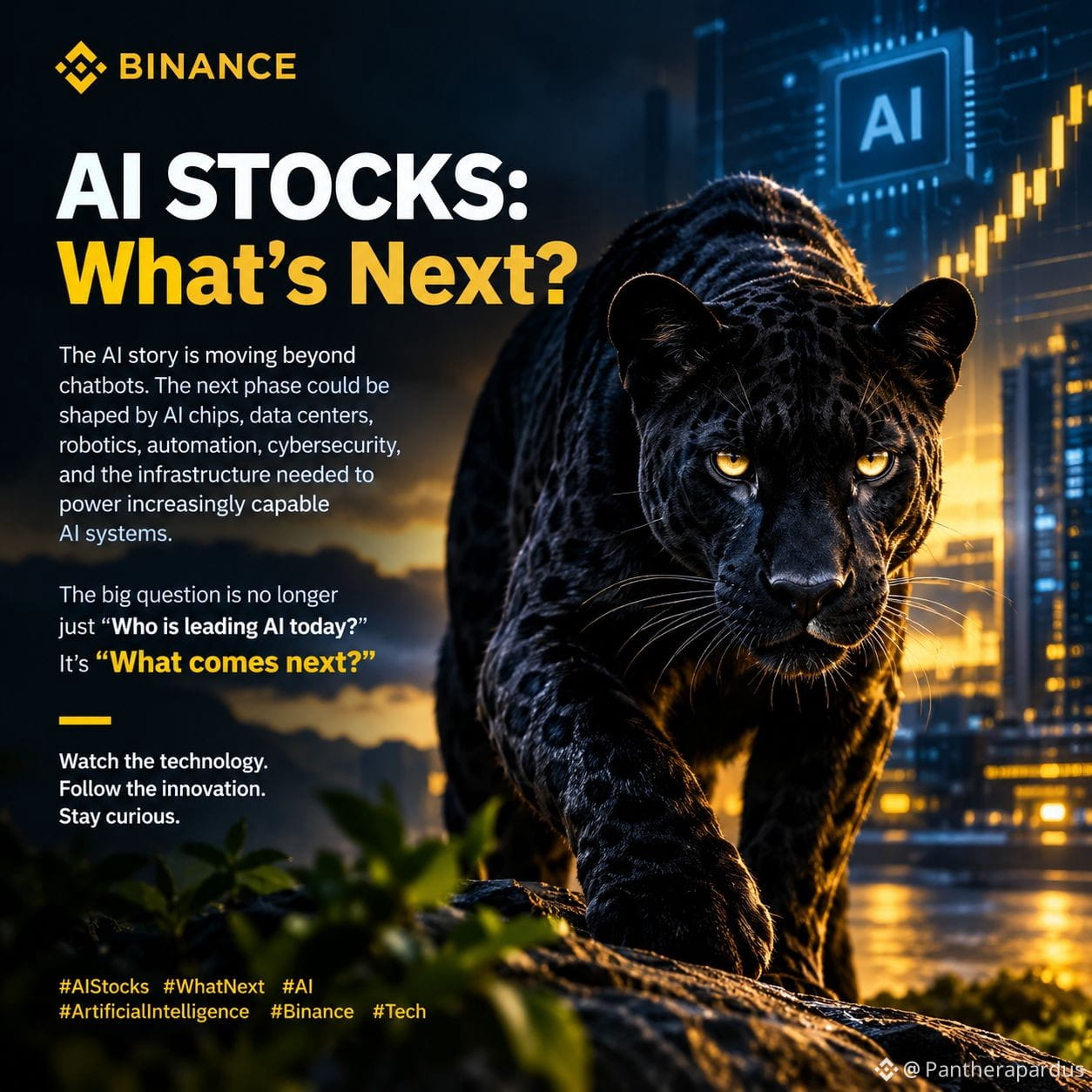
🤖 AI Stocks: What’s Next?
The AI story is moving beyond chatbots.
The next phase could be shaped by AI chips, data centers, robotics, automation, cybersecurity, and the infrastructure needed to power increasingly capable AI systems.
The big question is no longer just “Who is leading AI today?”
It’s “What comes next?”
Watch the technology. Follow the innovation. Stay curious.
#AI #AIStocksWhatNext #ArtificialInteligence
$BTC
{spot}(BTCUSDT)
🤖 AI Stocks: What’s Next?
The AI story is moving beyond chatbots.
The next phase could be shaped by AI chips, data centers, robotics, automation, cybersecurity, and the infrastructure needed to power increasingly capable AI systems.
The big question is no longer just “Who is leading AI today?”
It’s “What comes next?”
Watch the technology. Follow the innovation. Stay curious.
#AI #AIStocksWhatNext #ArtificialInteligence
$BTC
The AI story is moving beyond chatbots.
The next phase could be shaped by AI chips, data centers, robotics, automation, cybersecurity, and the infrastructure needed to power increasingly capable AI systems.
The big question is no longer just “Who is leading AI today?”
It’s “What comes next?”
Watch the technology. Follow the innovation. Stay curious.
#AI #AIStocksWhatNext #ArtificialInteligence
$BTC
98

Article
Anthropic CEO Calls for a Slowdown in AI DevelopmentThe rapid advancement of artificial intelligence is once again raising questions about how quickly the technology should develop.
Anthropic CEO Dario Amodei has argued for greater caution as AI systems become increasingly capable. His concerns center on the potential risks associated with highly advanced models, including cybersecurity threats, misuse, and the difficulty of ensuring that increasingly powerful AI remains safe and controllable.
The debate highlights a growing tension within the AI industry: companies are competing to develop more powerful models, while researchers and policymakers are also trying to understand and manage the risks that come with them.
A slower and more deliberate approach could give governments, researchers, and companies additional time to establish stronger safety measures and governance frameworks.
At the same time, critics of slowing AI development argue that excessive restrictions could hinder innovation and allow less-regulated competitors to move ahead.
The central question is becoming increasingly important: Should AI development prioritize speed, or safety first?
As AI capabilities continue to expand, finding the right balance may become just as important as the technology itself.
#artificialintelligence #BinanceSquare
#AnthropicCEOCallsForAISlowdown
$BNB
{spot}(BNBUSDT)
Anthropic CEO Calls for a Slowdown in AI Development
The rapid advancement of artificial intelligence is once again raising questions about how quickly the technology should develop.
Anthropic CEO Dario Amodei has argued for greater caution as AI systems become increasingly capable. His concerns center on the potential risks associated with highly advanced models, including cybersecurity threats, misuse, and the difficulty of ensuring that increasingly powerful AI remains safe and controllable.
The debate highlights a growing tension within the AI industry: companies are competing to develop more powerful models, while researchers and policymakers are also trying to understand and manage the risks that come with them.
A slower and more deliberate approach could give governments, researchers, and companies additional time to establish stronger safety measures and governance frameworks.
At the same time, critics of slowing AI development argue that excessive restrictions could hinder innovation and allow less-regulated competitors to move ahead.
The central question is becoming increasingly important: Should AI development prioritize speed, or safety first?
As AI capabilities continue to expand, finding the right balance may become just as important as the technology itself.
#artificialintelligence #BinanceSquare
#AnthropicCEOCallsForAISlowdown
$BNB
Anthropic CEO Dario Amodei has argued for greater caution as AI systems become increasingly capable. His concerns center on the potential risks associated with highly advanced models, including cybersecurity threats, misuse, and the difficulty of ensuring that increasingly powerful AI remains safe and controllable.
The debate highlights a growing tension within the AI industry: companies are competing to develop more powerful models, while researchers and policymakers are also trying to understand and manage the risks that come with them.
A slower and more deliberate approach could give governments, researchers, and companies additional time to establish stronger safety measures and governance frameworks.
At the same time, critics of slowing AI development argue that excessive restrictions could hinder innovation and allow less-regulated competitors to move ahead.
The central question is becoming increasingly important: Should AI development prioritize speed, or safety first?
As AI capabilities continue to expand, finding the right balance may become just as important as the technology itself.
#artificialintelligence #BinanceSquare
#AnthropicCEOCallsForAISlowdown
$BNB
1
79
#AnthropicCEOCallsForAISlowdown
Anthropic CEO Dario Amodei is calling for a more cautious approach to AI development as increasingly powerful models raise concerns around safety, security, and societal impact.
The AI race isn’t just about who moves fastest, it’s about whether we can build powerful systems responsibly. 🤖⚡
#AnthropicCEOCallsForAISlowdown
$BNB
{spot}(BNBUSDT)
#AnthropicCEOCallsForAISlowdown
Anthropic CEO Dario Amodei is calling for a more cautious approach to AI development as increasingly powerful models raise concerns around safety, security, and societal impact.
The AI race isn’t just about who moves fastest, it’s about whether we can build powerful systems responsibly. 🤖⚡
#AnthropicCEOCallsForAISlowdown
$BNB
Anthropic CEO Dario Amodei is calling for a more cautious approach to AI development as increasingly powerful models raise concerns around safety, security, and societal impact.
The AI race isn’t just about who moves fastest, it’s about whether we can build powerful systems responsibly. 🤖⚡
#AnthropicCEOCallsForAISlowdown
$BNB

1
98

Article
Brent Crude Breaks Above $100Brent crude has climbed back above the psychologically important $100 per barrel mark, adding fresh pressure to global energy markets.
The latest rally has been fueled by escalating U.S.–Iran hostilities and growing concerns that disruptions around the Strait of Hormuz could further restrict global oil supplies. Brent was trading around $101–102 on Thursday, extending a sharp advance from its early-August lows.
The Strait of Hormuz is particularly important because it historically carries roughly one-fifth of global oil and gas flows. Continued disruption could therefore keep supply concerns elevated and put further upward pressure on crude prices.
For markets, the key question is whether the $100 level becomes a new support zone or simply a temporary spike. Traders will be watching geopolitical developments, shipping activity and Chinese crude demand closely.
100$ Oil is back and volatility is rising.
#BrentCrudeTops$100
#volatility
$BTC
{spot}(BTCUSDT)
$ETH
{spot}(ETHUSDT)
Brent Crude Breaks Above $100
Brent crude has climbed back above the psychologically important $100 per barrel mark, adding fresh pressure to global energy markets.
The latest rally has been fueled by escalating U.S.–Iran hostilities and growing concerns that disruptions around the Strait of Hormuz could further restrict global oil supplies. Brent was trading around $101–102 on Thursday, extending a sharp advance from its early-August lows.
The Strait of Hormuz is particularly important because it historically carries roughly one-fifth of global oil and gas flows. Continued disruption could therefore keep supply concerns elevated and put further upward pressure on crude prices.
For markets, the key question is whether the $100 level becomes a new support zone or simply a temporary spike. Traders will be watching geopolitical developments, shipping activity and Chinese crude demand closely.
100$ Oil is back and volatility is rising.
#BrentCrudeTops$100
#volatility
$BTC
$ETH
The latest rally has been fueled by escalating U.S.–Iran hostilities and growing concerns that disruptions around the Strait of Hormuz could further restrict global oil supplies. Brent was trading around $101–102 on Thursday, extending a sharp advance from its early-August lows.
The Strait of Hormuz is particularly important because it historically carries roughly one-fifth of global oil and gas flows. Continued disruption could therefore keep supply concerns elevated and put further upward pressure on crude prices.
For markets, the key question is whether the $100 level becomes a new support zone or simply a temporary spike. Traders will be watching geopolitical developments, shipping activity and Chinese crude demand closely.
100$ Oil is back and volatility is rising.
#BrentCrudeTops$100
#volatility
$BTC
$ETH
110
Vérifié
🚨 #BrentCrudeTops$100
Brent crude has broken back above the $100/barrel level as geopolitical tensions intensify and fears of further supply disruptions grow.
With shipping through the Strait of Hormuz still heavily constrained, the oil market is watching every development closely. ⛽📈
Will Brent continue higher—or is $100 the start of a major resistance battle?
#BrentCrudeTops$100 #Oil #BinanceSquareTalks
$ETH
{spot}(ETHUSDT)
$BTC
{spot}(BTCUSDT)
🚨 #BrentCrudeTops$100
Brent crude has broken back above the $100/barrel level as geopolitical tensions intensify and fears of further supply disruptions grow.
With shipping through the Strait of Hormuz still heavily constrained, the oil market is watching every development closely. ⛽📈
Will Brent continue higher—or is $100 the start of a major resistance battle?
#BrentCrudeTops$100 #Oil #BinanceSquareTalks
$ETH
$BTC
Brent crude has broken back above the $100/barrel level as geopolitical tensions intensify and fears of further supply disruptions grow.
With shipping through the Strait of Hormuz still heavily constrained, the oil market is watching every development closely. ⛽📈
Will Brent continue higher—or is $100 the start of a major resistance battle?
#BrentCrudeTops$100 #Oil #BinanceSquareTalks
$ETH
$BTC

1
237

Article
U.S.-Iran Tanker Strikes Raise Global Market RisksThe latest exchange of attacks between the United States and Iran is putting global energy markets under renewed pressure.
U.S. forces recently struck three Iranian-linked oil tankers, while Iran retaliated with attacks on vessels it described as using unauthorized routes through the Strait of Hormuz.
The consequences are already visible in shipping markets. Traffic through the Strait of Hormuz has fallen sharply, raising concerns about disruptions to one of the world's most important energy routes.
Oil prices have responded to the growing risk. Brent crude recently approached $98 per barrel, reaching a six-week high before pulling back slightly.
For investors, the situation creates a complicated environment. Higher oil prices can increase inflationary pressure, while geopolitical uncertainty can trigger risk-off moves across stocks and crypto.
The longer tanker disruptions continue, the more important the next moves in oil and Bitcoin could become.
#USIranTradeTankerStrikesEscalate
#btc70k $BTC
{spot}(BTCUSDT)
U.S.-Iran Tanker Strikes Raise Global Market Risks
The latest exchange of attacks between the United States and Iran is putting global energy markets under renewed pressure.
U.S. forces recently struck three Iranian-linked oil tankers, while Iran retaliated with attacks on vessels it described as using unauthorized routes through the Strait of Hormuz.
The consequences are already visible in shipping markets. Traffic through the Strait of Hormuz has fallen sharply, raising concerns about disruptions to one of the world's most important energy routes.
Oil prices have responded to the growing risk. Brent crude recently approached $98 per barrel, reaching a six-week high before pulling back slightly.
For investors, the situation creates a complicated environment. Higher oil prices can increase inflationary pressure, while geopolitical uncertainty can trigger risk-off moves across stocks and crypto.
The longer tanker disruptions continue, the more important the next moves in oil and Bitcoin could become.
#USIranTradeTankerStrikesEscalate
#btc70k $BTC
U.S. forces recently struck three Iranian-linked oil tankers, while Iran retaliated with attacks on vessels it described as using unauthorized routes through the Strait of Hormuz.
The consequences are already visible in shipping markets. Traffic through the Strait of Hormuz has fallen sharply, raising concerns about disruptions to one of the world's most important energy routes.
Oil prices have responded to the growing risk. Brent crude recently approached $98 per barrel, reaching a six-week high before pulling back slightly.
For investors, the situation creates a complicated environment. Higher oil prices can increase inflationary pressure, while geopolitical uncertainty can trigger risk-off moves across stocks and crypto.
The longer tanker disruptions continue, the more important the next moves in oil and Bitcoin could become.
#USIranTradeTankerStrikesEscalate
#btc70k $BTC
80
#USIranTradeTankerStrikesEscalate
The U.S.-Iran conflict is entering a more dangerous phase as both sides trade strikes involving oil tankers and commercial vessels.
With traffic through the Strait of Hormuz falling sharply, markets are watching one key question: how much further can energy prices rise?
Brent crude has climbed toward six-week highs as traders price in the risk of prolonged supply disruptions.
For crypto, higher energy costs and rising geopolitical uncertainty could mean greater volatility ahead.
#bitcoin #oil #Geopolitics
$BTC
{spot}(BTCUSDT)
#USIranTradeTankerStrikesEscalate
The U.S.-Iran conflict is entering a more dangerous phase as both sides trade strikes involving oil tankers and commercial vessels.
With traffic through the Strait of Hormuz falling sharply, markets are watching one key question: how much further can energy prices rise?
Brent crude has climbed toward six-week highs as traders price in the risk of prolonged supply disruptions.
For crypto, higher energy costs and rising geopolitical uncertainty could mean greater volatility ahead.
#bitcoin #oil #Geopolitics
$BTC
The U.S.-Iran conflict is entering a more dangerous phase as both sides trade strikes involving oil tankers and commercial vessels.
With traffic through the Strait of Hormuz falling sharply, markets are watching one key question: how much further can energy prices rise?
Brent crude has climbed toward six-week highs as traders price in the risk of prolonged supply disruptions.
For crypto, higher energy costs and rising geopolitical uncertainty could mean greater volatility ahead.
#bitcoin #oil #Geopolitics
$BTC

1
86
Article
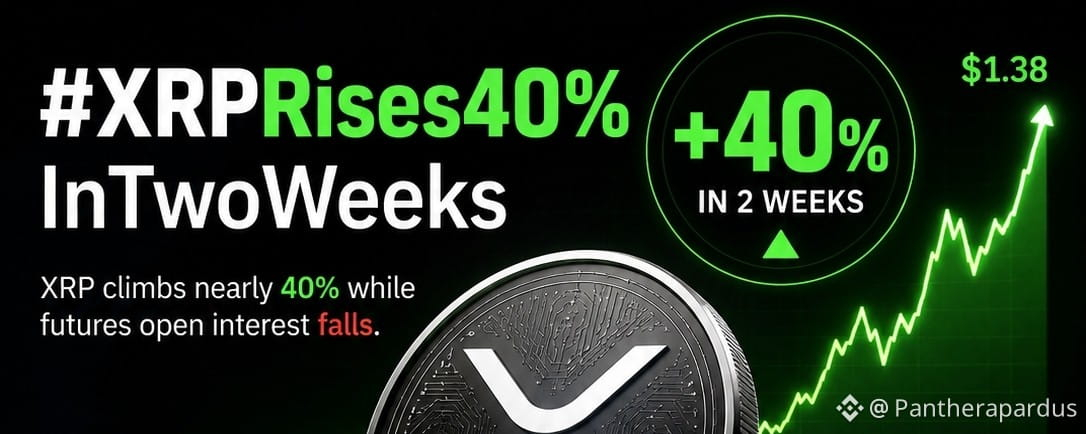
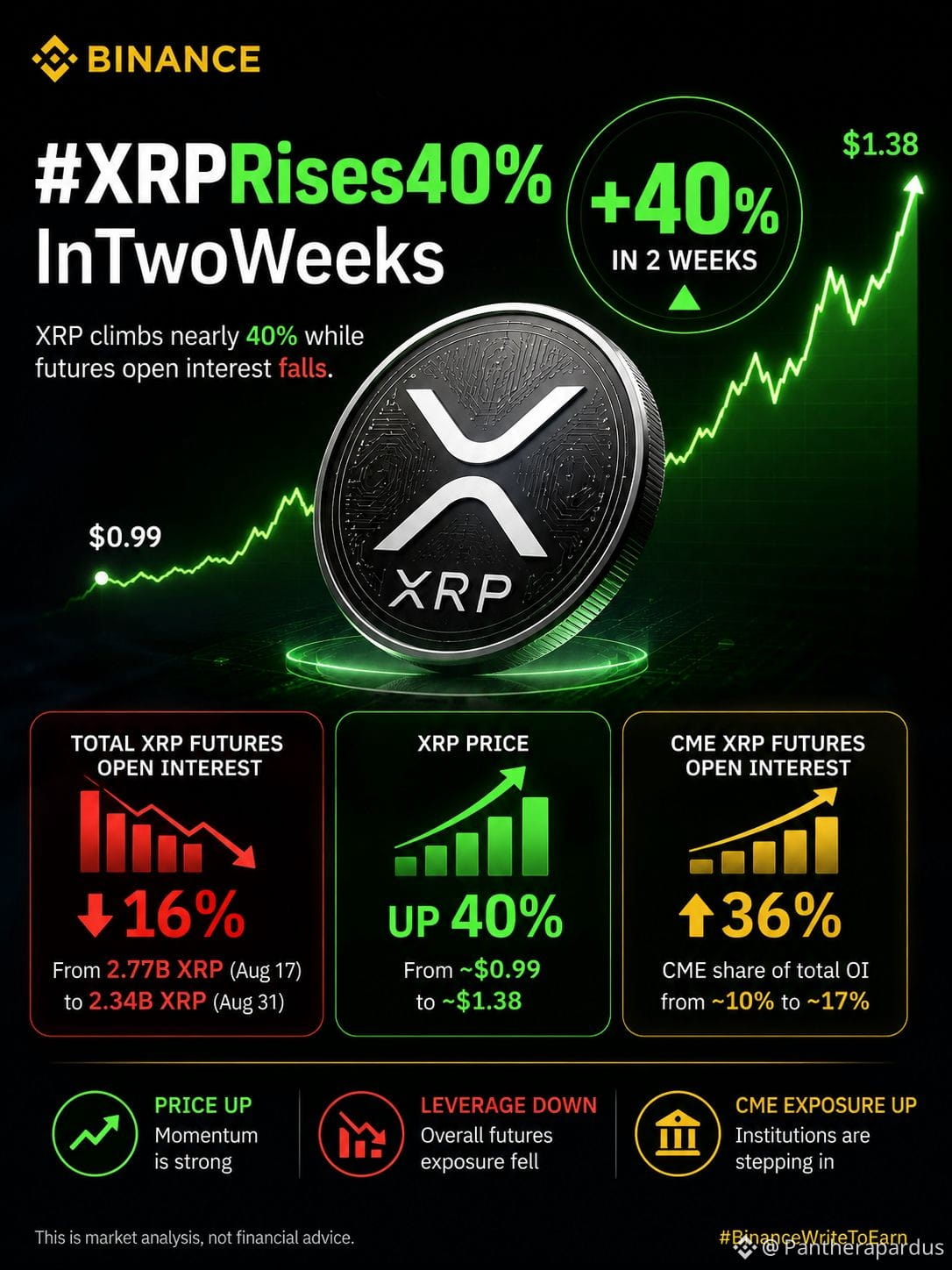
XRP Rises 40% as Futures Open Interest FallsXRP has made a strong move over the past two weeks, climbing from roughly $0.99 to $1.38 — an increase of nearly 40%.
What makes the rally particularly interesting is what happened in the futures market.
Total XRP futures open interest fell approximately 16%, from 2.77 billion XRP on August 17 to around 2.34 billion on August 31. In other words, XRP's price rose substantially while the amount of outstanding futures positions declined.
This can indicate that traders were reducing leverage during the rally rather than aggressively adding new leveraged positions.
However, CME moved in the opposite direction. XRP futures open interest on CME increased about 36%, raising CME's share of total XRP futures exposure from around 10% to approximately 17%.
The combination is worth watching: XRP is rising while broad futures leverage is declining, but exposure on a regulated institutional venue is increasing.
For traders, the key question now is whether XRP can maintain its momentum as market positioning continues to shift.
This is market analysis, not financial advice.
#XRPRises40%InTwoWeeksAsOpenInterestFalls #Xrp🔥🔥
$XRP
{spot}(XRPUSDT)
XRP Rises 40% as Futures Open Interest Falls
XRP has made a strong move over the past two weeks, climbing from roughly $0.99 to $1.38 — an increase of nearly 40%.
What makes the rally particularly interesting is what happened in the futures market.
Total XRP futures open interest fell approximately 16%, from 2.77 billion XRP on August 17 to around 2.34 billion on August 31. In other words, XRP's price rose substantially while the amount of outstanding futures positions declined.
This can indicate that traders were reducing leverage during the rally rather than aggressively adding new leveraged positions.
However, CME moved in the opposite direction. XRP futures open interest on CME increased about 36%, raising CME's share of total XRP futures exposure from around 10% to approximately 17%.
The combination is worth watching: XRP is rising while broad futures leverage is declining, but exposure on a regulated institutional venue is increasing.
For traders, the key question now is whether XRP can maintain its momentum as market positioning continues to shift.
This is market analysis, not financial advice.
#XRPRises40%InTwoWeeksAsOpenInterestFalls #Xrp🔥🔥
$XRP
What makes the rally particularly interesting is what happened in the futures market.
Total XRP futures open interest fell approximately 16%, from 2.77 billion XRP on August 17 to around 2.34 billion on August 31. In other words, XRP's price rose substantially while the amount of outstanding futures positions declined.
This can indicate that traders were reducing leverage during the rally rather than aggressively adding new leveraged positions.
However, CME moved in the opposite direction. XRP futures open interest on CME increased about 36%, raising CME's share of total XRP futures exposure from around 10% to approximately 17%.
The combination is worth watching: XRP is rising while broad futures leverage is declining, but exposure on a regulated institutional venue is increasing.
For traders, the key question now is whether XRP can maintain its momentum as market positioning continues to shift.
This is market analysis, not financial advice.
#XRPRises40%InTwoWeeksAsOpenInterestFalls #Xrp🔥🔥
$XRP
121
🚀 #XRPRises40%InTwoWeeksAsOpenInterestFalls
XRP has jumped nearly 40% in two weeks, moving from around $0.99 to $1.38.
But here's the interesting part: total XRP futures open interest fell 16% during the same period.
That means the rally happened while traders were reducing leveraged positions rather than simply piling into more futures exposure.
Meanwhile, CME’s XRP futures open interest increased about 36%, pushing its share of total XRP futures exposure from roughly 10% to 17%.
📊 Price up.
📉 Overall leverage down.
🏦 CME exposure up.
A very interesting shift in XRP market positioning.
#XRP #Ripple $XRP
{spot}(XRPUSDT)
🚀 #XRPRises40%InTwoWeeksAsOpenInterestFalls
XRP has jumped nearly 40% in two weeks, moving from around $0.99 to $1.38.
But here's the interesting part: total XRP futures open interest fell 16% during the same period.
That means the rally happened while traders were reducing leveraged positions rather than simply piling into more futures exposure.
Meanwhile, CME’s XRP futures open interest increased about 36%, pushing its share of total XRP futures exposure from roughly 10% to 17%.
📊 Price up.
📉 Overall leverage down.
🏦 CME exposure up.
A very interesting shift in XRP market positioning.
#XRP #Ripple $XRP
XRP has jumped nearly 40% in two weeks, moving from around $0.99 to $1.38.
But here's the interesting part: total XRP futures open interest fell 16% during the same period.
That means the rally happened while traders were reducing leveraged positions rather than simply piling into more futures exposure.
Meanwhile, CME’s XRP futures open interest increased about 36%, pushing its share of total XRP futures exposure from roughly 10% to 17%.
📊 Price up.
📉 Overall leverage down.
🏦 CME exposure up.
A very interesting shift in XRP market positioning.
#XRP #Ripple $XRP
1
416
Article
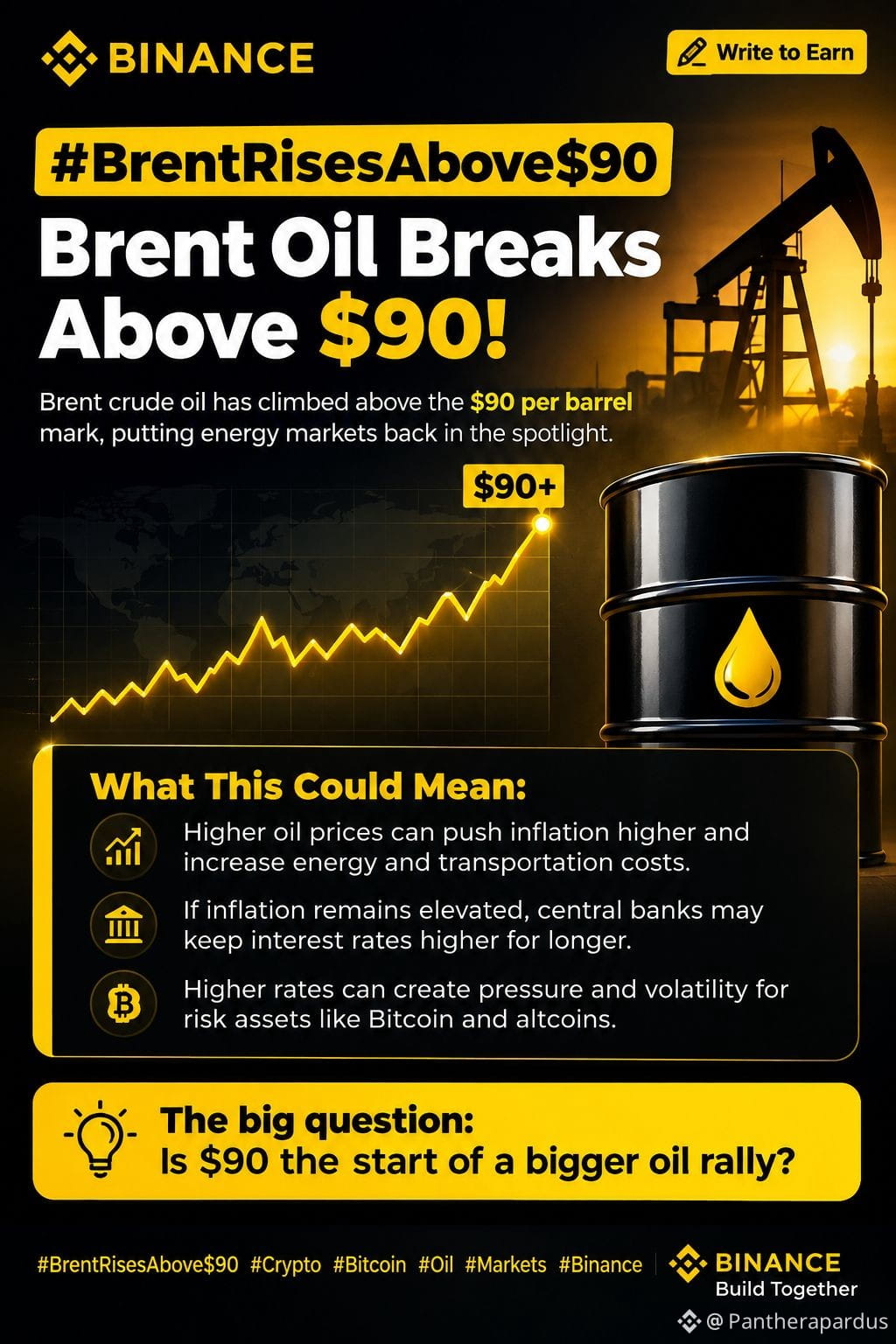
Brent Rises Above $90: What Could It Mean for Crypto?Brent crude oil has moved above $90 per barrel, putting energy prices back in the spotlight.
A sustained rise in oil prices can increase transportation and production costs, potentially adding to inflationary pressure. If inflation remains elevated, central banks may have less room to cut interest rates.
For crypto investors, this matters because higher interest rates can reduce demand for riskier assets such as Bitcoin and altcoins. On the other hand, if oil prices rise because of strong global demand rather than a supply shock, the broader economic picture could be different.
With Brent above $90, traders will be watching inflation data, central-bank decisions, the U.S. dollar, and Bitcoin's reaction closely.
🛢️ Oil moves markets — and crypto doesn't exist in isolation.
#BrentRisesAbove$90 #bitcoin #Oil #Binance
$BTC
{spot}(BTCUSDT)
Brent Rises Above $90: What Could It Mean for Crypto?
Brent crude oil has moved above $90 per barrel, putting energy prices back in the spotlight.
A sustained rise in oil prices can increase transportation and production costs, potentially adding to inflationary pressure. If inflation remains elevated, central banks may have less room to cut interest rates.
For crypto investors, this matters because higher interest rates can reduce demand for riskier assets such as Bitcoin and altcoins. On the other hand, if oil prices rise because of strong global demand rather than a supply shock, the broader economic picture could be different.
With Brent above $90, traders will be watching inflation data, central-bank decisions, the U.S. dollar, and Bitcoin's reaction closely.
🛢️ Oil moves markets — and crypto doesn't exist in isolation.
#BrentRisesAbove$90 #bitcoin #Oil #Binance
$BTC
A sustained rise in oil prices can increase transportation and production costs, potentially adding to inflationary pressure. If inflation remains elevated, central banks may have less room to cut interest rates.
For crypto investors, this matters because higher interest rates can reduce demand for riskier assets such as Bitcoin and altcoins. On the other hand, if oil prices rise because of strong global demand rather than a supply shock, the broader economic picture could be different.
With Brent above $90, traders will be watching inflation data, central-bank decisions, the U.S. dollar, and Bitcoin's reaction closely.
🛢️ Oil moves markets — and crypto doesn't exist in isolation.
#BrentRisesAbove$90 #bitcoin #Oil #Binance
$BTC
119
🛢️ Brent Crude Rises Above $90!
Brent oil breaking above $90 per barrel signals renewed pressure in global energy markets. Higher oil prices can push inflation higher and influence interest-rate expectations factors that can also impact crypto and risk assets.
📈 Oil up → inflation concerns
🏦 Rates may stay higher for longer
₿ Crypto markets could face volatility
The big question: Is $90 the start of a bigger oil rally?
#BrentRisesAbove$90 #Crypto #Bitcoin #oil #markets #Binance $BTC
{spot}(BTCUSDT)
🛢️ Brent Crude Rises Above $90!
Brent oil breaking above $90 per barrel signals renewed pressure in global energy markets. Higher oil prices can push inflation higher and influence interest-rate expectations factors that can also impact crypto and risk assets.
📈 Oil up → inflation concerns
🏦 Rates may stay higher for longer
₿ Crypto markets could face volatility
The big question: Is $90 the start of a bigger oil rally?
#BrentRisesAbove$90 #Crypto #Bitcoin #oil #markets #Binance $BTC
Brent oil breaking above $90 per barrel signals renewed pressure in global energy markets. Higher oil prices can push inflation higher and influence interest-rate expectations factors that can also impact crypto and risk assets.
📈 Oil up → inflation concerns
🏦 Rates may stay higher for longer
₿ Crypto markets could face volatility
The big question: Is $90 the start of a bigger oil rally?
#BrentRisesAbove$90 #Crypto #Bitcoin #oil #markets #Binance $BTC
1
119
KOSPI Falls as AI Trading Euphoria Cools
What Could It Mean for Crypto?
#KospiFallsAsAITradingEuphoriaCools
#bitcoin $BTC
KOSPI Falls as AI Trading Euphoria Cools
What Could It Mean for Crypto?
#KospiFallsAsAITradingEuphoriaCools
#bitcoin $BTC
What Could It Mean for Crypto?
#KospiFallsAsAITradingEuphoriaCools
#bitcoin $BTC
1
56

Article
KOSPI Falls as AI Trading Euphoria Cools What Could It Mean for Crypto?South Korea’s KOSPI is coming under pressure as the excitement surrounding AI-related stocks and trading begins to cool.
The move highlights a broader issue facing global markets: investor enthusiasm can push technology and AI assets to elevated valuations, but sentiment can change quickly when traders start taking profits.
For crypto investors, this matters because Bitcoin and other digital assets are often treated as risk assets alongside technology stocks. If investors become more defensive, capital can temporarily move away from speculative assets.
However, a stock-market pullback doesn't automatically mean a crypto crash is coming.
Instead, traders should watch several signals:
🔹 AI & semiconductor stocks — Continued weakness could indicate fading risk appetite.
🔹 Bitcoin price action — BTC's ability to hold important support levels could show whether crypto is absorbing the pressure.
🔹 Market liquidity — More liquidity can support risk assets, while tightening conditions can increase volatility.
🔹 Investor sentiment — Extreme optimism can reverse quickly.
The cooling of AI trading enthusiasm is therefore another reminder that markets move in cycles.
For crypto traders, the lesson is simple: don't confuse momentum with certainty. Manage risk, watch the bigger picture, and be prepared for volatility.
#KospiFallsAsAITradingEuphoriaCools #bearishmomentum $USDT
KOSPI Falls as AI Trading Euphoria Cools What Could It Mean for Crypto?
South Korea’s KOSPI is coming under pressure as the excitement surrounding AI-related stocks and trading begins to cool.
The move highlights a broader issue facing global markets: investor enthusiasm can push technology and AI assets to elevated valuations, but sentiment can change quickly when traders start taking profits.
For crypto investors, this matters because Bitcoin and other digital assets are often treated as risk assets alongside technology stocks. If investors become more defensive, capital can temporarily move away from speculative assets.
However, a stock-market pullback doesn't automatically mean a crypto crash is coming.
Instead, traders should watch several signals:
🔹 AI & semiconductor stocks — Continued weakness could indicate fading risk appetite.
🔹 Bitcoin price action — BTC's ability to hold important support levels could show whether crypto is absorbing the pressure.
🔹 Market liquidity — More liquidity can support risk assets, while tightening conditions can increase volatility.
🔹 Investor sentiment — Extreme optimism can reverse quickly.
The cooling of AI trading enthusiasm is therefore another reminder that markets move in cycles.
For crypto traders, the lesson is simple: don't confuse momentum with certainty. Manage risk, watch the bigger picture, and be prepared for volatility.
#KospiFallsAsAITradingEuphoriaCools #bearishmomentum $USDT
The move highlights a broader issue facing global markets: investor enthusiasm can push technology and AI assets to elevated valuations, but sentiment can change quickly when traders start taking profits.
For crypto investors, this matters because Bitcoin and other digital assets are often treated as risk assets alongside technology stocks. If investors become more defensive, capital can temporarily move away from speculative assets.
However, a stock-market pullback doesn't automatically mean a crypto crash is coming.
Instead, traders should watch several signals:
🔹 AI & semiconductor stocks — Continued weakness could indicate fading risk appetite.
🔹 Bitcoin price action — BTC's ability to hold important support levels could show whether crypto is absorbing the pressure.
🔹 Market liquidity — More liquidity can support risk assets, while tightening conditions can increase volatility.
🔹 Investor sentiment — Extreme optimism can reverse quickly.
The cooling of AI trading enthusiasm is therefore another reminder that markets move in cycles.
For crypto traders, the lesson is simple: don't confuse momentum with certainty. Manage risk, watch the bigger picture, and be prepared for volatility.
#KospiFallsAsAITradingEuphoriaCools #bearishmomentum $USDT
73
📉 KOSPI FALLS AS AI TRADING EUPHORIA COOLS
South Korea’s KOSPI is feeling the pressure as enthusiasm around AI-linked trading and tech stocks cools.
The bigger question for crypto: Is this just a stock-market pullback, or the start of a broader risk-off move?
When AI and tech sentiment weakens, investors may become more cautious across risk assets including crypto. But volatility can also create opportunities for traders who manage risk carefully.
👀 Watch AI stocks. Watch liquidity. Watch Bitcoin.
#KospiFallsAsAITradingEuphoriaCools #trading #KOSPI
$USDT
📉 KOSPI FALLS AS AI TRADING EUPHORIA COOLS
South Korea’s KOSPI is feeling the pressure as enthusiasm around AI-linked trading and tech stocks cools.
The bigger question for crypto: Is this just a stock-market pullback, or the start of a broader risk-off move?
When AI and tech sentiment weakens, investors may become more cautious across risk assets including crypto. But volatility can also create opportunities for traders who manage risk carefully.
👀 Watch AI stocks. Watch liquidity. Watch Bitcoin.
#KospiFallsAsAITradingEuphoriaCools #trading #KOSPI
$USDT
South Korea’s KOSPI is feeling the pressure as enthusiasm around AI-linked trading and tech stocks cools.
The bigger question for crypto: Is this just a stock-market pullback, or the start of a broader risk-off move?
When AI and tech sentiment weakens, investors may become more cautious across risk assets including crypto. But volatility can also create opportunities for traders who manage risk carefully.
👀 Watch AI stocks. Watch liquidity. Watch Bitcoin.
#KospiFallsAsAITradingEuphoriaCools #trading #KOSPI
$USDT

1
126
Connectez-vous pour découvrir plus de contenu
Rejoignez la communauté mondiale des adeptes de cryptomonnaies sur Binance Square
⚡️ Suviez les dernières informations importantes sur les cryptomonnaies.
💬 Jugé digne de confiance par la plus grande plateforme d’échange de cryptomonnaies au monde.
👍 Découvrez les connaissances que partagent les créateurs vérifiés.
Adresse e-mail/Nº de téléphone
Sujets d’actualité
KoreaProposesTokenizingStocksAndBonds
13,467 vues
268 mentions
#koreaproposestokenizingstocksandbonds 🇰🇷 South Korea Proposes Roadmap to Tokenize Stocks and Bonds by 2027
Traditional finance is meeting blockchain at a national level. South Korea has unveiled a comprehensive regulatory framework to bring traditional securities on-chain.
📌 Core News:
• The FSC announced a 3-phase plan to expand tokenized securities to include stocks, bonds, and investment funds.
• The legal framework is officially set to take effect on February 4, 2027.
• Phase 1 focuses on private funds, corporate bonds, and unlisted equities before expanding to public markets.
• For investor protection, retail participants face an annual net purchase limit of 100 million KRW (~$74K) per OTC platform.
📊 Market Impact:
• RWA Validation: This provides regulatory clarity for the Real-World Asset (RWA) narrative, proving institutional appetite for efficient on-chain settlement.
• Infrastructure Growth: Expect accelerated development in compliant blockchain infrastructure, digital custody, and identity verification solutions.
• Stablecoin Utility: Phase 3 explicitly mentions integrating on-chain payment systems, which could significantly boost the real-world utility of regulated stablecoins.
💬 Join the Discussion:
Do you think tokenized traditional securities will be the main catalyst for the next wave of institutional crypto adoption? Let’s discuss below! 👇
#RWA #Tokenization #SouthKorea #CryptoRegulation #Blockchain This is for educational purposes only. Not Financial Advice (NFA). Always Do Your Own Research (DYOR).
$NOM $MOVR $NIGHT
珍妮丝 kgf
·1 mentions J’aime
·4.6k vues
MetaMaskExitsLidoValidatorsAfterSecurityIncident
79,058 vues
993 mentions
MicronBeatsEarningsLiftsGuidance
46,377 vues
759 mentions