

Crypto Rakayet
335 Publications

Crypto Rakayet
Signaler
Bloquer l’utilisateur
Ouvert au trading
Trade régulièrement
2.7 an(s)
9 Suivis
15 Abonnés
39 J’aime
Publications
Portefeuille
PINNED
🐸 PEPE PROVED THAT MEMES AREN'T JUST ABOUT JOKES.
Many people dismissed meme coins from the beginning.
"No utility." "No future." "Just hype."
But crypto markets don't move on technology alone.
They also move on attention, culture, and community.
PEPE became one of the biggest examples of how a strong community can turn an internet meme into one of the most recognized digital assets in crypto.
That doesn't mean every meme coin will succeed.
Most won't.
But it reminds us of one important lesson:
📈 Markets reward attention. 👥 Communities create momentum. 💧 Liquidity keeps narratives alive.
In crypto, understanding human behavior can be just as important as understanding blockchain technology.
💬 Question:
What gives a meme coin long-term strength?
🔹 Community 🔹 Liquidity 🔹 Exchange Listings 🔹 Market Timing
👇 Share your opinion!
#PEPE #memecoin #Crypto #altcoins #BinanceSquare
{spot}(PEPEUSDT)
🐸 PEPE PROVED THAT MEMES AREN'T JUST ABOUT JOKES.
Many people dismissed meme coins from the beginning.
"No utility." "No future." "Just hype."
But crypto markets don't move on technology alone.
They also move on attention, culture, and community.
PEPE became one of the biggest examples of how a strong community can turn an internet meme into one of the most recognized digital assets in crypto.
That doesn't mean every meme coin will succeed.
Most won't.
But it reminds us of one important lesson:
📈 Markets reward attention. 👥 Communities create momentum. 💧 Liquidity keeps narratives alive.
In crypto, understanding human behavior can be just as important as understanding blockchain technology.
💬 Question:
What gives a meme coin long-term strength?
🔹 Community 🔹 Liquidity 🔹 Exchange Listings 🔹 Market Timing
👇 Share your opinion!
#PEPE #memecoin #Crypto #altcoins #BinanceSquare
Many people dismissed meme coins from the beginning.
"No utility." "No future." "Just hype."
But crypto markets don't move on technology alone.
They also move on attention, culture, and community.
PEPE became one of the biggest examples of how a strong community can turn an internet meme into one of the most recognized digital assets in crypto.
That doesn't mean every meme coin will succeed.
Most won't.
But it reminds us of one important lesson:
📈 Markets reward attention. 👥 Communities create momentum. 💧 Liquidity keeps narratives alive.
In crypto, understanding human behavior can be just as important as understanding blockchain technology.
💬 Question:
What gives a meme coin long-term strength?
🔹 Community 🔹 Liquidity 🔹 Exchange Listings 🔹 Market Timing
👇 Share your opinion!
#PEPE #memecoin #Crypto #altcoins #BinanceSquare

7
16
1.8k
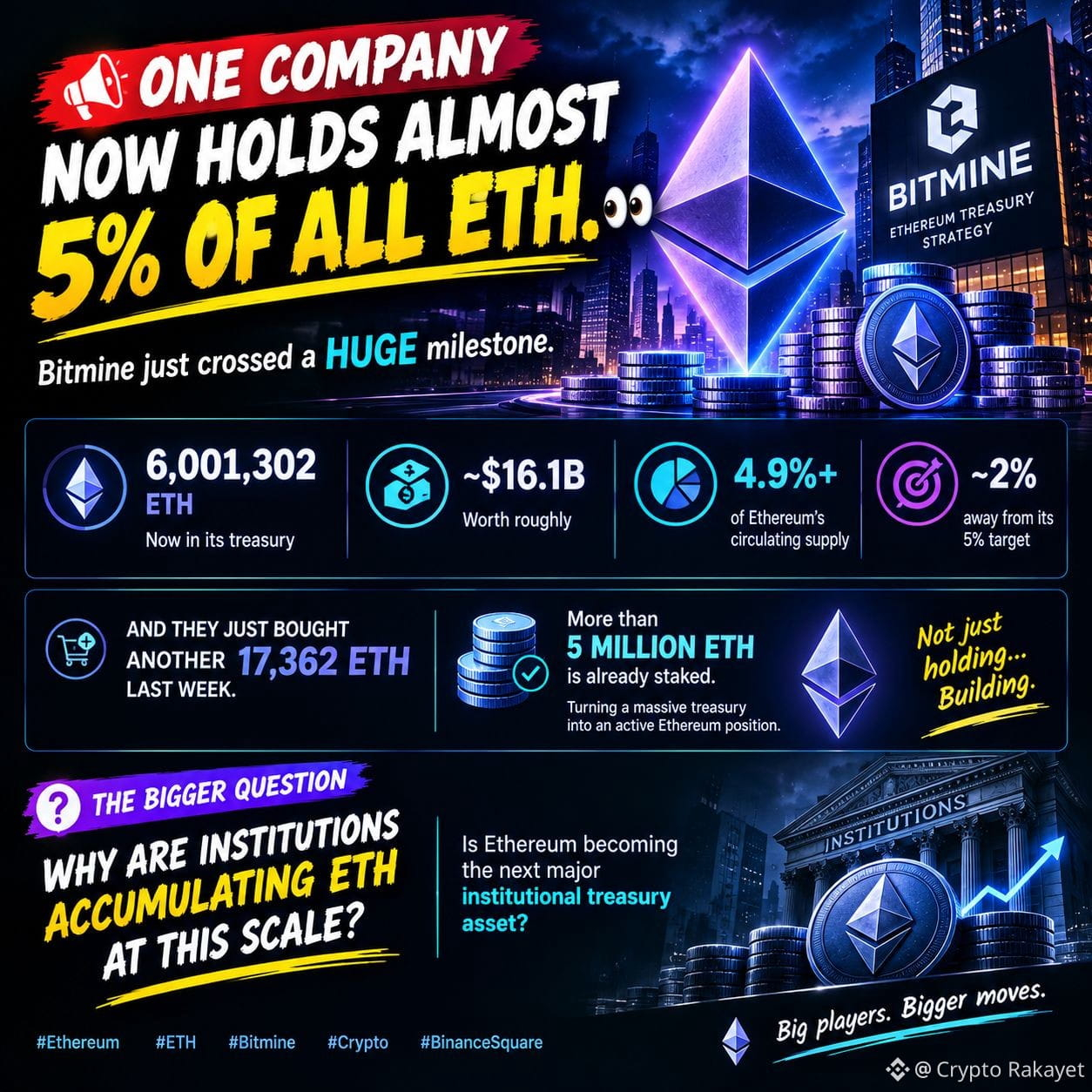
🚨 ONE COMPANY NOW HOLDS ALMOST 5% OF ALL ETH. 👀
Bitmine just crossed a HUGE milestone.
🏦 6,001,302 ETH now in its treasury
💰 Worth roughly $16.1B
📊 More than 4.9% of Ethereum’s circulating supply
🎯 Only ~2% away from its 5% target
And they just bought another 17,362 ETH last week. 🔥
What makes this interesting?
Bitmine isn’t simply holding ETH.
More than 5 million ETH is already staked, turning a massive treasury into an active Ethereum position.
The bigger question is:
Why are institutions accumulating ETH at this scale? 👀
Is Ethereum becoming the next major institutional treasury asset?
#Ethereum #ETH #Bitmine #crypto #BinanceSquare
🚨 ONE COMPANY NOW HOLDS ALMOST 5% OF ALL ETH. 👀
Bitmine just crossed a HUGE milestone.
🏦 6,001,302 ETH now in its treasury
💰 Worth roughly $16.1B
📊 More than 4.9% of Ethereum’s circulating supply
🎯 Only ~2% away from its 5% target
And they just bought another 17,362 ETH last week. 🔥
What makes this interesting?
Bitmine isn’t simply holding ETH.
More than 5 million ETH is already staked, turning a massive treasury into an active Ethereum position.
The bigger question is:
Why are institutions accumulating ETH at this scale? 👀
Is Ethereum becoming the next major institutional treasury asset?
#Ethereum #ETH #Bitmine #crypto #BinanceSquare
Bitmine just crossed a HUGE milestone.
🏦 6,001,302 ETH now in its treasury
💰 Worth roughly $16.1B
📊 More than 4.9% of Ethereum’s circulating supply
🎯 Only ~2% away from its 5% target
And they just bought another 17,362 ETH last week. 🔥
What makes this interesting?
Bitmine isn’t simply holding ETH.
More than 5 million ETH is already staked, turning a massive treasury into an active Ethereum position.
The bigger question is:
Why are institutions accumulating ETH at this scale? 👀
Is Ethereum becoming the next major institutional treasury asset?
#Ethereum #ETH #Bitmine #crypto #BinanceSquare
61
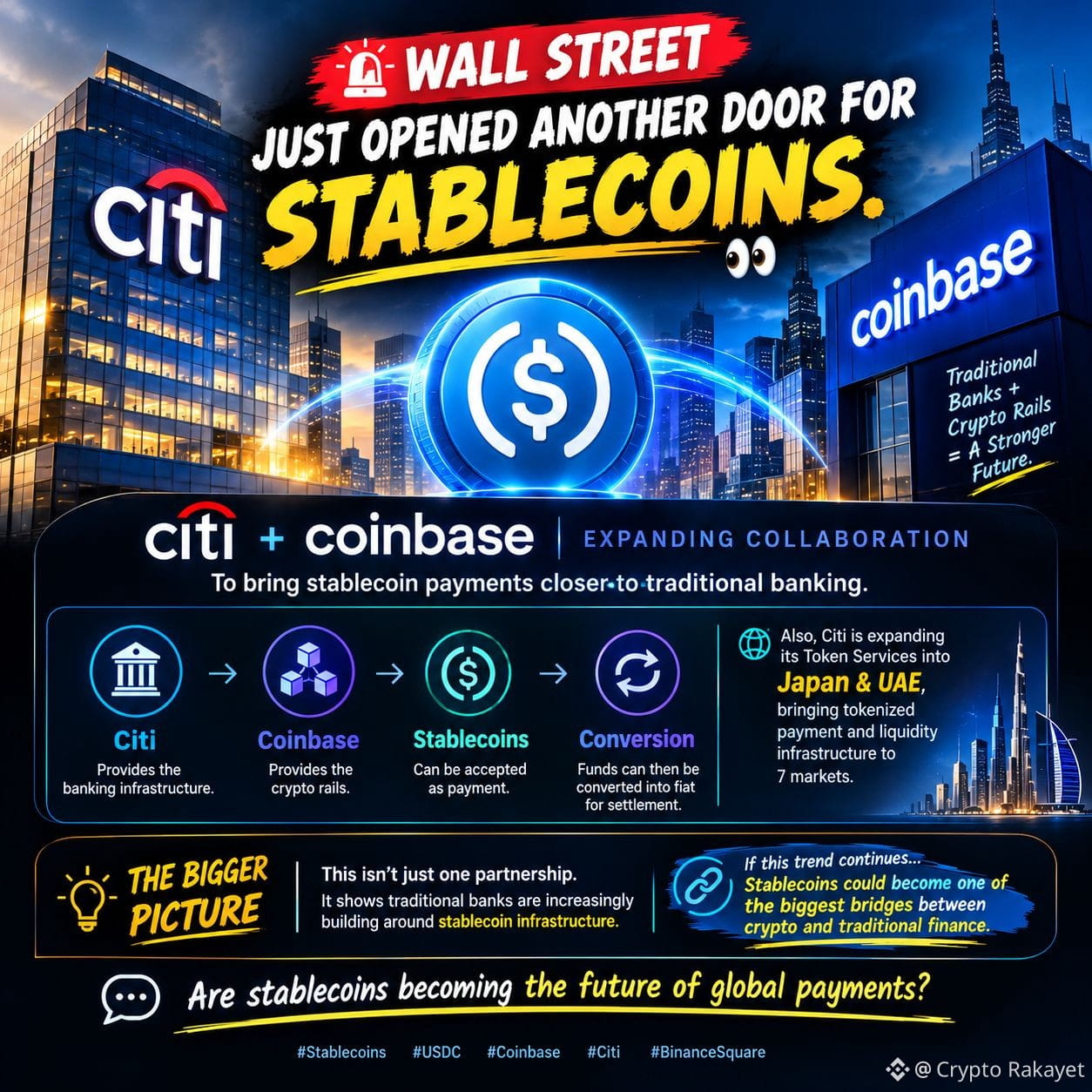
🚨 WALL STREET JUST OPENED ANOTHER DOOR FOR STABLECOINS. 👀💵
Citi + Coinbase are expanding their collaboration to bring stablecoin payments closer to traditional banking.
Here’s the interesting part:
🏦 Citi provides the banking infrastructure
🌐 Coinbase provides the crypto rails
💵 Stablecoins can be accepted as payment
🔄 The funds can then be converted into fiat for settlement
So businesses may not need to directly manage stablecoins to benefit from blockchain-based payments.
This is bigger than one partnership.
It shows traditional banks are increasingly building around stablecoin infrastructure.
And if this trend continues…
Stablecoins could become one of the biggest bridges between crypto and traditional finance. 🔥
Are stablecoins becoming the future of global payments?
#Stablecoins #USDC #coinbase #Citi #BinanceSquare
🚨 WALL STREET JUST OPENED ANOTHER DOOR FOR STABLECOINS. 👀💵
Citi + Coinbase are expanding their collaboration to bring stablecoin payments closer to traditional banking.
Here’s the interesting part:
🏦 Citi provides the banking infrastructure
🌐 Coinbase provides the crypto rails
💵 Stablecoins can be accepted as payment
🔄 The funds can then be converted into fiat for settlement
So businesses may not need to directly manage stablecoins to benefit from blockchain-based payments.
This is bigger than one partnership.
It shows traditional banks are increasingly building around stablecoin infrastructure.
And if this trend continues…
Stablecoins could become one of the biggest bridges between crypto and traditional finance. 🔥
Are stablecoins becoming the future of global payments?
#Stablecoins #USDC #coinbase #Citi #BinanceSquare
Citi + Coinbase are expanding their collaboration to bring stablecoin payments closer to traditional banking.
Here’s the interesting part:
🏦 Citi provides the banking infrastructure
🌐 Coinbase provides the crypto rails
💵 Stablecoins can be accepted as payment
🔄 The funds can then be converted into fiat for settlement
So businesses may not need to directly manage stablecoins to benefit from blockchain-based payments.
This is bigger than one partnership.
It shows traditional banks are increasingly building around stablecoin infrastructure.
And if this trend continues…
Stablecoins could become one of the biggest bridges between crypto and traditional finance. 🔥
Are stablecoins becoming the future of global payments?
#Stablecoins #USDC #coinbase #Citi #BinanceSquare
54
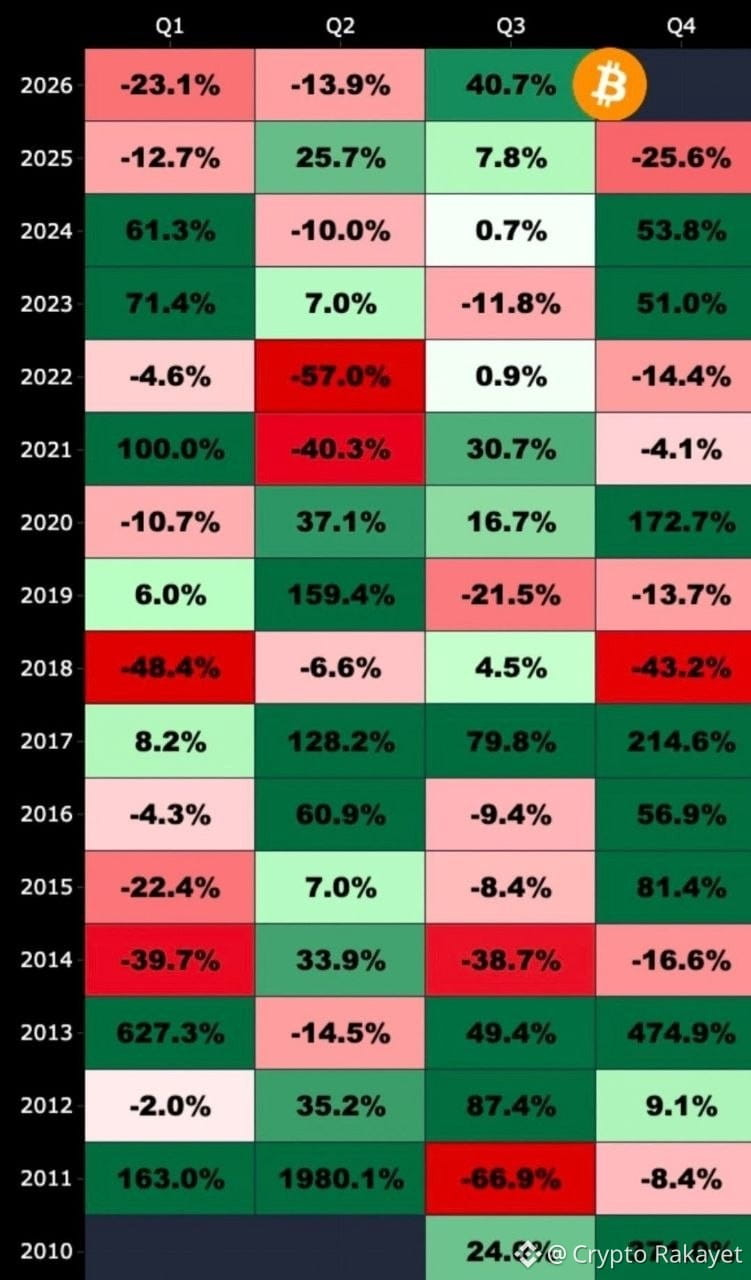
JUST IN: Bitcoin is on track to close its fourth best Q3 in history 🚀
@CZ @Binance_News @Binance_Announcement @richardteng
{spot}(BTCUSDT)
JUST IN: Bitcoin is on track to close its fourth best Q3 in history 🚀
@CZ @Binance News @Binance Announcement @Richard Teng
@CZ @Binance News @Binance Announcement @Richard Teng
78
·
--
Haussier
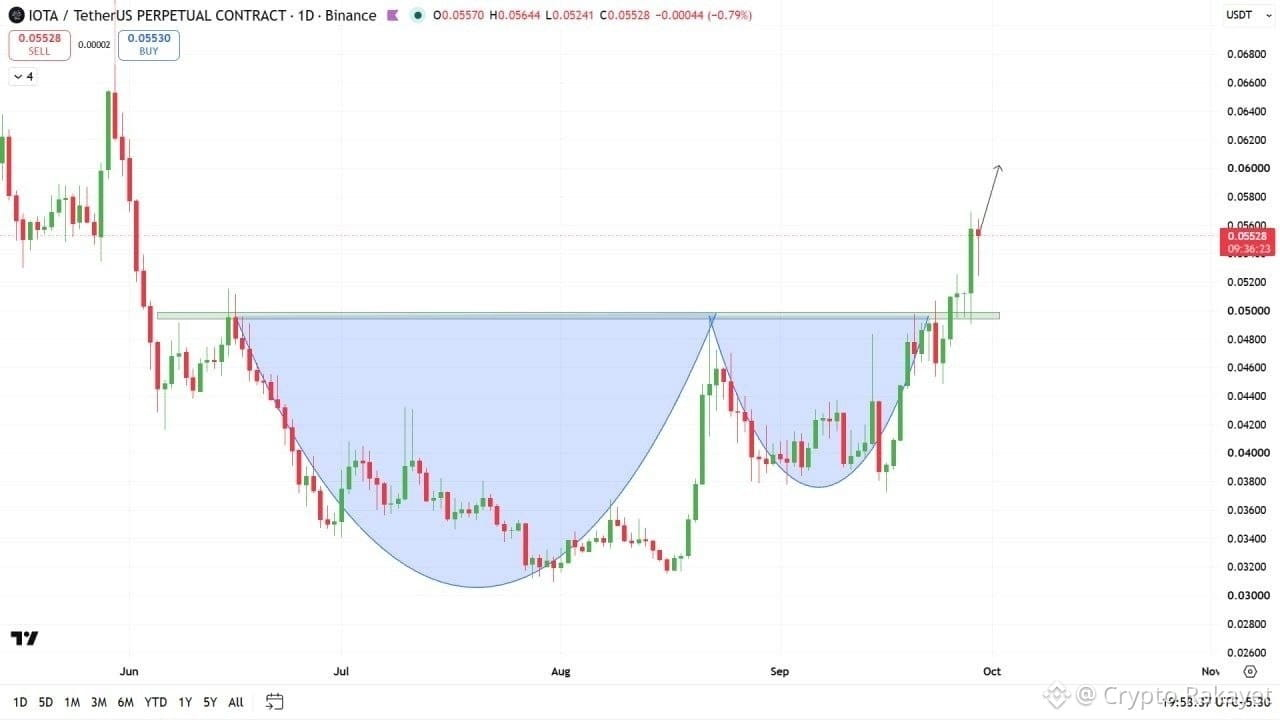
$IOTAUSDT is looking bullish after that breakout. We could see a pump coming, so keep an eye on it.
@Binance_News @CZ @Binance_Announcement @richardteng
{future}(IOTAUSDT)
$IOTAUSDT is looking bullish after that breakout. We could see a pump coming, so keep an eye on it.
@Binance News @CZ @Binance Announcement @Richard Teng
@Binance News @CZ @Binance Announcement @Richard Teng
189
·
--
Haussier
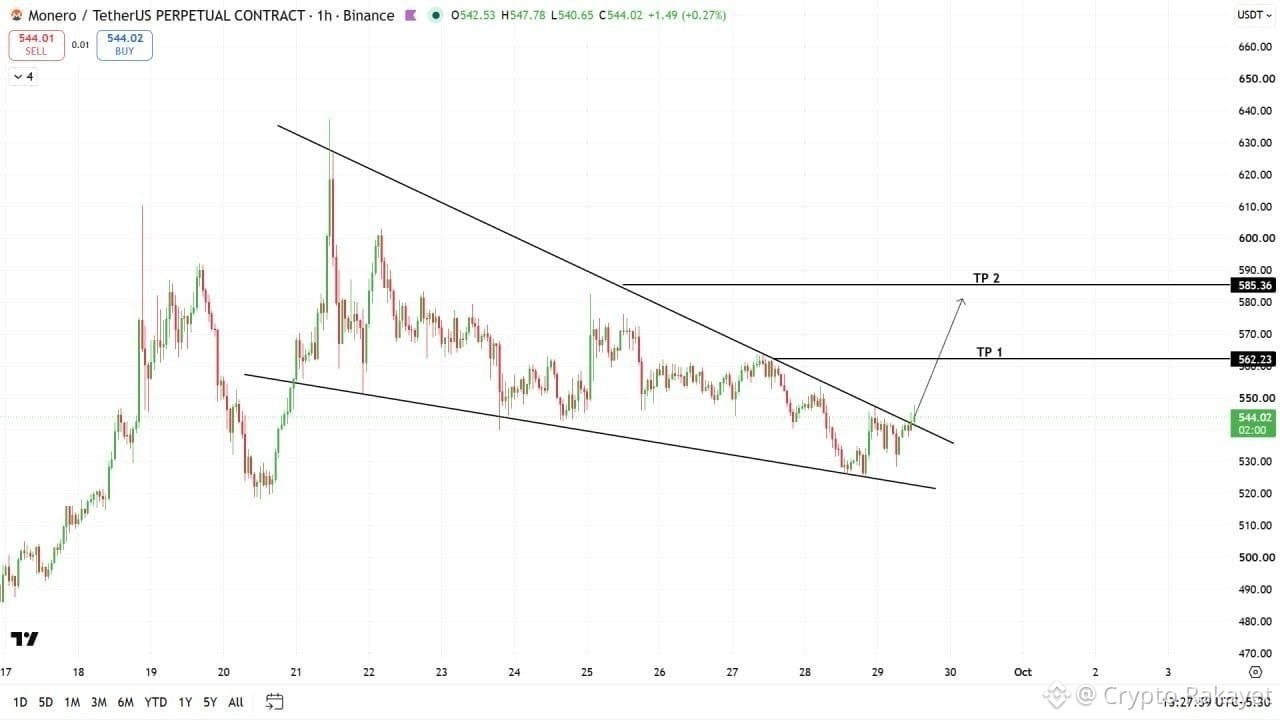
$XMRUSDT just broke out of that falling wedge and looks bullish, so it might hit those higher targets soon. Keep an eye on it.
@Binance_News @CZ @Binance_Announcement @richardteng
{future}(XMRUSDT)
$XMRUSDT just broke out of that falling wedge and looks bullish, so it might hit those higher targets soon. Keep an eye on it.
@Binance News @CZ @Binance Announcement @Richard Teng
@Binance News @CZ @Binance Announcement @Richard Teng
99
Article
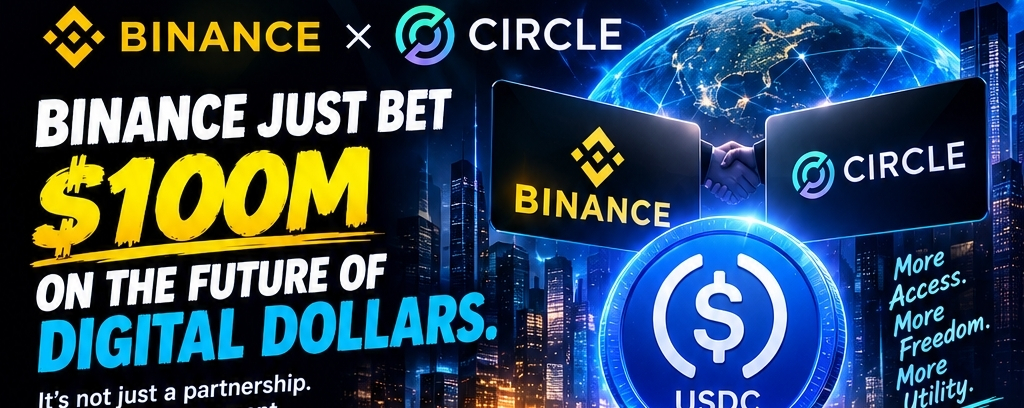
🚨 BINANCE JUST BET $100M ON THE FUTURE OF DIGITAL DOLLARS. 💵🌐Most people are watching Bitcoin.
But something much bigger may be happening underneath the market:
Stablecoins are becoming financial infrastructure.
On September 22, Binance announced a $100 million strategic equity investment in Circle, the company behind USDC.
At the same time, Binance and Circle renewed their commercial partnership for another five years, with a major focus on expanding USDC access across emerging markets.
And this is where the story gets interesting. 👇
💵 THIS ISN'T JUST ABOUT USDC
A stablecoin is basically a digital representation of fiat money that can move on blockchain rails.
No waiting for traditional banking hours.
No need to physically move money across borders.
Instead, dollars can exist as programmable digital assets and move through blockchain networks.
That's why stablecoins have become one of crypto's most important real-world use cases.
By September 2026, the total stablecoin market was around $305 BILLION according to industry data cited in recent market research.
That's no longer a tiny crypto experiment.
That's a financial market with hundreds of billions of dollars moving through digital-dollar infrastructure.
🏦 WHY BINANCE'S $100M MATTERS
The important part isn't simply the $100M.
It's the structure of the deal.
Binance is providing:
🔹 Massive distribution
🔹 Global user access
🔹 Exchange liquidity
🔹 A huge digital-asset ecosystem
Circle provides:
🔹 USDC infrastructure
🔹 Stablecoin technology
🔹 Payment infrastructure
🔹 Institutional digital-dollar rails
Put them together and you get something much bigger than a normal exchange partnership:
Distribution + infrastructure.
And the companies specifically highlighted emerging markets as a major focus.
🌍 THE EMERGING-MARKET ANGLE
This could be especially important in countries where access to global dollar liquidity is expensive, slow, or restricted.
A smartphone + internet connection + digital wallet can potentially provide access to dollar-denominated digital money without requiring the same traditional infrastructure.
That doesn't mean stablecoins automatically replace banks.
But it does mean the competition between:
Traditional banking rails 🏦
and
Blockchain-based financial rails 🌐
is becoming much more interesting.
🔥 AND HERE'S THE BIGGER PICTURE
Bitcoin introduced a scarce digital asset.
Ethereum introduced programmable blockchain applications.
Stablecoins are bringing something different:
Programmable digital dollars.
And now major crypto companies are investing heavily in the infrastructure required to distribute them globally.
That's why I think the stablecoin story deserves much more attention in 2026.
Not because USDC is guaranteed to win.
Not because stablecoins are risk-free.
But because hundreds of billions of dollars are already sitting inside this category—and major financial companies are building around it.
The next phase of crypto may not simply be:
“Bitcoin vs Altcoins.”
It could increasingly become:
“Who controls the rails of digital money?” 👀
What do you think?
💵 Will stablecoins become the main bridge between traditional finance and crypto?
OR
🏦 Will traditional banks build their own digital-dollar systems and compete directly?
#USDC #Stablecoins #Binance #crypto #BinanceSquare
🚨 BINANCE JUST BET $100M ON THE FUTURE OF DIGITAL DOLLARS. 💵🌐
Most people are watching Bitcoin.
But something much bigger may be happening underneath the market:
Stablecoins are becoming financial infrastructure.
On September 22, Binance announced a $100 million strategic equity investment in Circle, the company behind USDC.
At the same time, Binance and Circle renewed their commercial partnership for another five years, with a major focus on expanding USDC access across emerging markets.
And this is where the story gets interesting. 👇
💵 THIS ISN'T JUST ABOUT USDC
A stablecoin is basically a digital representation of fiat money that can move on blockchain rails.
No waiting for traditional banking hours.
No need to physically move money across borders.
Instead, dollars can exist as programmable digital assets and move through blockchain networks.
That's why stablecoins have become one of crypto's most important real-world use cases.
By September 2026, the total stablecoin market was around $305 BILLION according to industry data cited in recent market research.
That's no longer a tiny crypto experiment.
That's a financial market with hundreds of billions of dollars moving through digital-dollar infrastructure.
🏦 WHY BINANCE'S $100M MATTERS
The important part isn't simply the $100M.
It's the structure of the deal.
Binance is providing:
🔹 Massive distribution
🔹 Global user access
🔹 Exchange liquidity
🔹 A huge digital-asset ecosystem
Circle provides:
🔹 USDC infrastructure
🔹 Stablecoin technology
🔹 Payment infrastructure
🔹 Institutional digital-dollar rails
Put them together and you get something much bigger than a normal exchange partnership:
Distribution + infrastructure.
And the companies specifically highlighted emerging markets as a major focus.
🌍 THE EMERGING-MARKET ANGLE
This could be especially important in countries where access to global dollar liquidity is expensive, slow, or restricted.
A smartphone + internet connection + digital wallet can potentially provide access to dollar-denominated digital money without requiring the same traditional infrastructure.
That doesn't mean stablecoins automatically replace banks.
But it does mean the competition between:
Traditional banking rails 🏦
and
Blockchain-based financial rails 🌐
is becoming much more interesting.
🔥 AND HERE'S THE BIGGER PICTURE
Bitcoin introduced a scarce digital asset.
Ethereum introduced programmable blockchain applications.
Stablecoins are bringing something different:
Programmable digital dollars.
And now major crypto companies are investing heavily in the infrastructure required to distribute them globally.
That's why I think the stablecoin story deserves much more attention in 2026.
Not because USDC is guaranteed to win.
Not because stablecoins are risk-free.
But because hundreds of billions of dollars are already sitting inside this category—and major financial companies are building around it.
The next phase of crypto may not simply be:
“Bitcoin vs Altcoins.”
It could increasingly become:
“Who controls the rails of digital money?” 👀
What do you think?
💵 Will stablecoins become the main bridge between traditional finance and crypto?
OR
🏦 Will traditional banks build their own digital-dollar systems and compete directly?
#USDC #Stablecoins #Binance #crypto #BinanceSquare
But something much bigger may be happening underneath the market:
Stablecoins are becoming financial infrastructure.
On September 22, Binance announced a $100 million strategic equity investment in Circle, the company behind USDC.
At the same time, Binance and Circle renewed their commercial partnership for another five years, with a major focus on expanding USDC access across emerging markets.
And this is where the story gets interesting. 👇
💵 THIS ISN'T JUST ABOUT USDC
A stablecoin is basically a digital representation of fiat money that can move on blockchain rails.
No waiting for traditional banking hours.
No need to physically move money across borders.
Instead, dollars can exist as programmable digital assets and move through blockchain networks.
That's why stablecoins have become one of crypto's most important real-world use cases.
By September 2026, the total stablecoin market was around $305 BILLION according to industry data cited in recent market research.
That's no longer a tiny crypto experiment.
That's a financial market with hundreds of billions of dollars moving through digital-dollar infrastructure.
🏦 WHY BINANCE'S $100M MATTERS
The important part isn't simply the $100M.
It's the structure of the deal.
Binance is providing:
🔹 Massive distribution
🔹 Global user access
🔹 Exchange liquidity
🔹 A huge digital-asset ecosystem
Circle provides:
🔹 USDC infrastructure
🔹 Stablecoin technology
🔹 Payment infrastructure
🔹 Institutional digital-dollar rails
Put them together and you get something much bigger than a normal exchange partnership:
Distribution + infrastructure.
And the companies specifically highlighted emerging markets as a major focus.
🌍 THE EMERGING-MARKET ANGLE
This could be especially important in countries where access to global dollar liquidity is expensive, slow, or restricted.
A smartphone + internet connection + digital wallet can potentially provide access to dollar-denominated digital money without requiring the same traditional infrastructure.
That doesn't mean stablecoins automatically replace banks.
But it does mean the competition between:
Traditional banking rails 🏦
and
Blockchain-based financial rails 🌐
is becoming much more interesting.
🔥 AND HERE'S THE BIGGER PICTURE
Bitcoin introduced a scarce digital asset.
Ethereum introduced programmable blockchain applications.
Stablecoins are bringing something different:
Programmable digital dollars.
And now major crypto companies are investing heavily in the infrastructure required to distribute them globally.
That's why I think the stablecoin story deserves much more attention in 2026.
Not because USDC is guaranteed to win.
Not because stablecoins are risk-free.
But because hundreds of billions of dollars are already sitting inside this category—and major financial companies are building around it.
The next phase of crypto may not simply be:
“Bitcoin vs Altcoins.”
It could increasingly become:
“Who controls the rails of digital money?” 👀
What do you think?
💵 Will stablecoins become the main bridge between traditional finance and crypto?
OR
🏦 Will traditional banks build their own digital-dollar systems and compete directly?
#USDC #Stablecoins #Binance #crypto #BinanceSquare
188
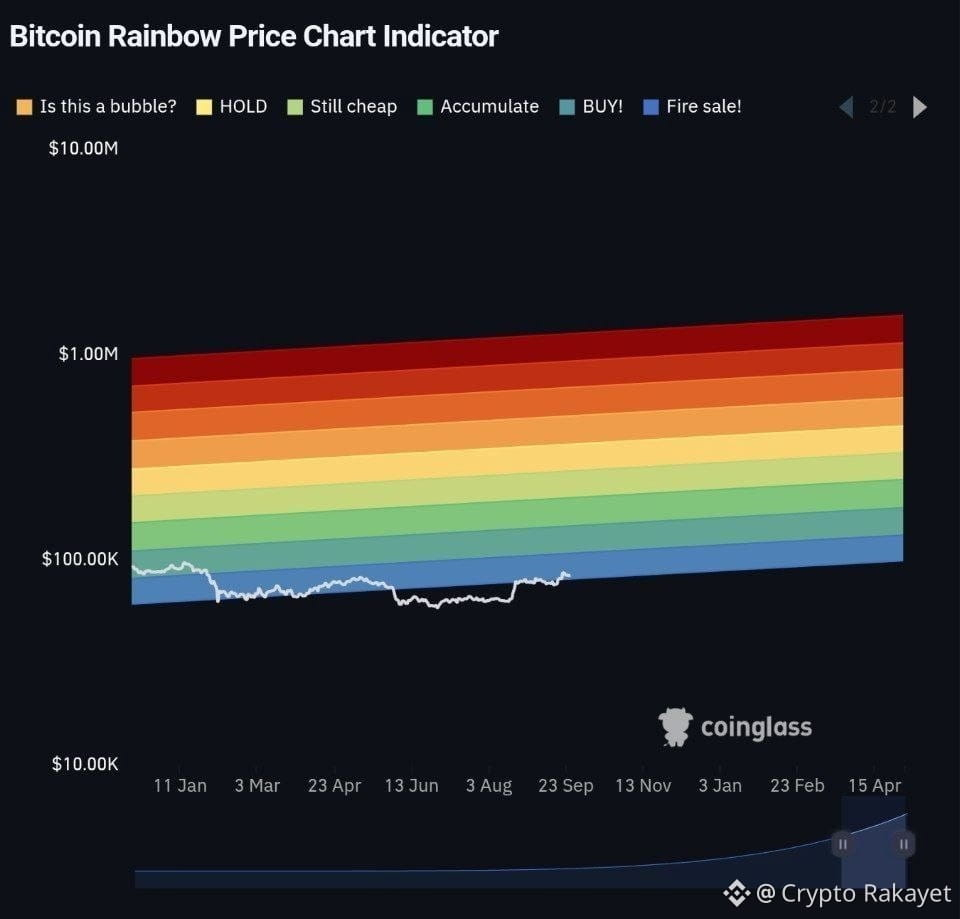
Bitcoin is still in a fire sale at $84.8K.
@Binance_News @heyi @CZ @Binance_Announcement @richardteng
{spot}(BTCUSDT)
Bitcoin is still in a fire sale at $84.8K.
@Binance News @Yi He @CZ @Binance Announcement @Richard Teng
@Binance News @Yi He @CZ @Binance Announcement @Richard Teng
45
🚨 FLOKI IS BACK ON THE RADAR. 🐕🔥
$FLOKI just showed why meme coins can’t be ignored when market momentum returns.
After a strong September recovery, FLOKI pushed toward the $0.00003 area, with trading activity surging alongside the move. 📈
Now the interesting part begins. 👀
FLOKI recently reached around $0.000030 before pulling back, and the latest market data shows it trading near $0.000027.
So the key question is NOT:
“Can FLOKI pump?”
The real question is:
👉 Can buyers reclaim the $0.00003 zone with strong volume?
If FLOKI breaks and holds above that psychological level, traders will likely be watching the next resistance zones closely.
But if price keeps getting rejected, another pullback could happen.
For me, volume + $0.00003 price action are the two things worth watching next. 👀
What do you think?
🐕 FLOKI BREAKOUT
or
📉 ANOTHER REJECTION?
#floki #FLOKIUSDT #memecoin #crypto #BinanceSquare
🚨 FLOKI IS BACK ON THE RADAR. 🐕🔥
$FLOKI just showed why meme coins can’t be ignored when market momentum returns.
After a strong September recovery, FLOKI pushed toward the $0.00003 area, with trading activity surging alongside the move. 📈
Now the interesting part begins. 👀
FLOKI recently reached around $0.000030 before pulling back, and the latest market data shows it trading near $0.000027.
So the key question is NOT:
“Can FLOKI pump?”
The real question is:
👉 Can buyers reclaim the $0.00003 zone with strong volume?
If FLOKI breaks and holds above that psychological level, traders will likely be watching the next resistance zones closely.
But if price keeps getting rejected, another pullback could happen.
For me, volume + $0.00003 price action are the two things worth watching next. 👀
What do you think?
🐕 FLOKI BREAKOUT
or
📉 ANOTHER REJECTION?
#floki #FLOKIUSDT #memecoin #crypto #BinanceSquare
$FLOKI just showed why meme coins can’t be ignored when market momentum returns.
After a strong September recovery, FLOKI pushed toward the $0.00003 area, with trading activity surging alongside the move. 📈
Now the interesting part begins. 👀
FLOKI recently reached around $0.000030 before pulling back, and the latest market data shows it trading near $0.000027.
So the key question is NOT:
“Can FLOKI pump?”
The real question is:
👉 Can buyers reclaim the $0.00003 zone with strong volume?
If FLOKI breaks and holds above that psychological level, traders will likely be watching the next resistance zones closely.
But if price keeps getting rejected, another pullback could happen.
For me, volume + $0.00003 price action are the two things worth watching next. 👀
What do you think?
🐕 FLOKI BREAKOUT
or
📉 ANOTHER REJECTION?
#floki #FLOKIUSDT #memecoin #crypto #BinanceSquare
176
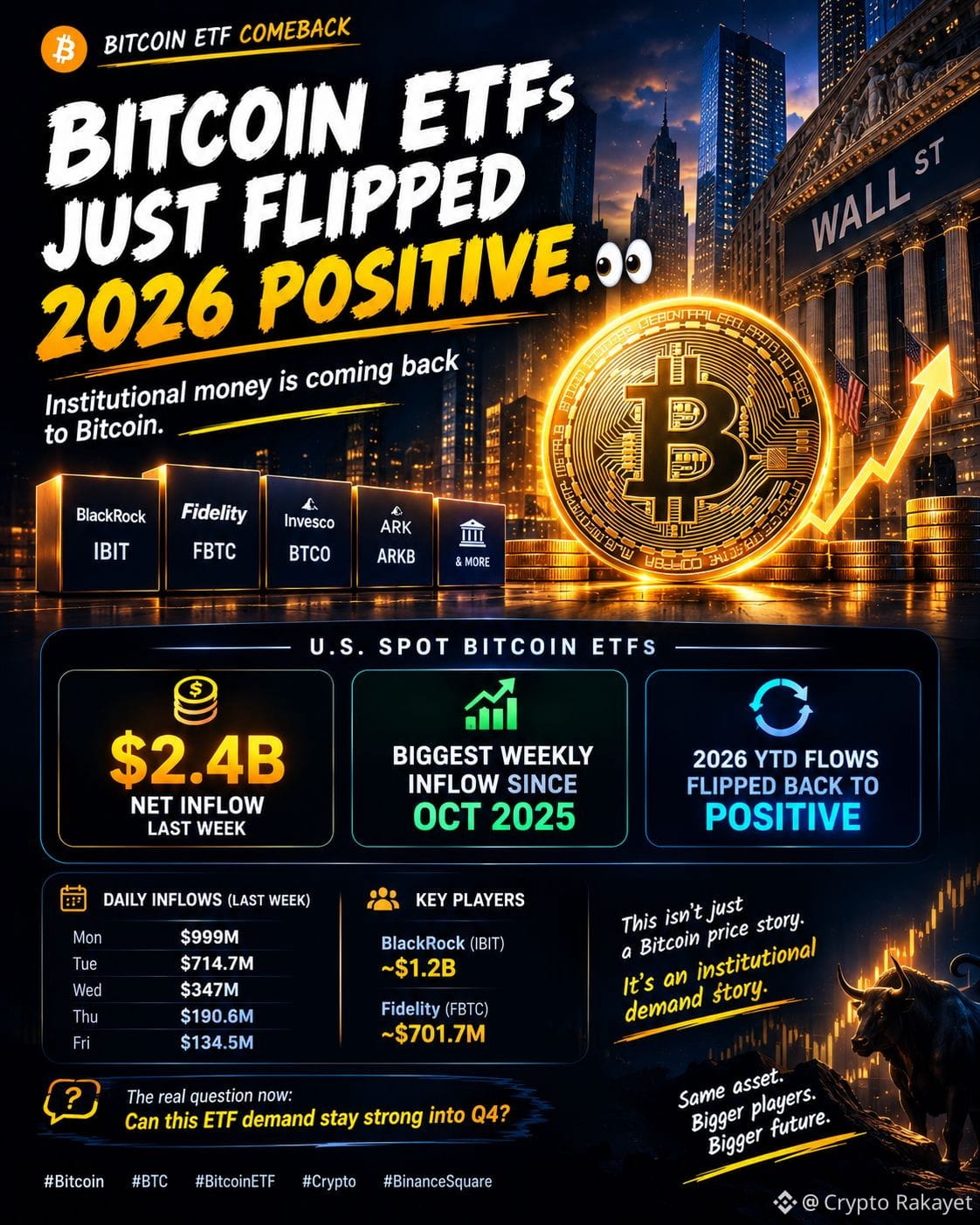
🚨 BITCOIN ETFs JUST FLIPPED 2026 POSITIVE. 👀
Institutional money is coming back to Bitcoin.
U.S. spot Bitcoin ETFs recorded around:
💰 $2.4 BILLION in net inflows last week
📈 Biggest weekly inflow since October 2025
🔄 2026 YTD ETF flows flipped back into positive territory
🏦 $57.6B+ cumulative net inflows since launch
And the daily numbers were massive:
🔥 Monday: $999M
🔥 Tuesday: $714.7M
🔥 Wednesday: $347M
🔥 Thursday: $190.6M
🔥 Friday: $134.5M
That's roughly $2.4B in just five trading sessions.
Even more interesting:
BlackRock's IBIT alone attracted about $1.2B during the week, while Fidelity's FBTC added around $701.7M.
This isn't just a Bitcoin price story.
It's an institutional demand story. 👀
But there's one thing I'm watching closely:
The daily inflows declined throughout the week.
So the real question isn't simply:
“Are institutions buying Bitcoin?”
The answer is clearly YES.
The bigger question is:
Can this ETF demand stay strong into Q4? 🔥
If the inflows continue, institutional demand could remain one of the most important forces shaping Bitcoin's next phase.
What are you watching more closely?
🏦 ETF FLOWS
or
📊 BTC PRICE ACTION?
#bitcoin #BTC #BitcoinETF #crypto #BinanceSquare
🚨 BITCOIN ETFs JUST FLIPPED 2026 POSITIVE. 👀
Institutional money is coming back to Bitcoin.
U.S. spot Bitcoin ETFs recorded around:
💰 $2.4 BILLION in net inflows last week
📈 Biggest weekly inflow since October 2025
🔄 2026 YTD ETF flows flipped back into positive territory
🏦 $57.6B+ cumulative net inflows since launch
And the daily numbers were massive:
🔥 Monday: $999M
🔥 Tuesday: $714.7M
🔥 Wednesday: $347M
🔥 Thursday: $190.6M
🔥 Friday: $134.5M
That's roughly $2.4B in just five trading sessions.
Even more interesting:
BlackRock's IBIT alone attracted about $1.2B during the week, while Fidelity's FBTC added around $701.7M.
This isn't just a Bitcoin price story.
It's an institutional demand story. 👀
But there's one thing I'm watching closely:
The daily inflows declined throughout the week.
So the real question isn't simply:
“Are institutions buying Bitcoin?”
The answer is clearly YES.
The bigger question is:
Can this ETF demand stay strong into Q4? 🔥
If the inflows continue, institutional demand could remain one of the most important forces shaping Bitcoin's next phase.
What are you watching more closely?
🏦 ETF FLOWS
or
📊 BTC PRICE ACTION?
#bitcoin #BTC #BitcoinETF #crypto #BinanceSquare
Institutional money is coming back to Bitcoin.
U.S. spot Bitcoin ETFs recorded around:
💰 $2.4 BILLION in net inflows last week
📈 Biggest weekly inflow since October 2025
🔄 2026 YTD ETF flows flipped back into positive territory
🏦 $57.6B+ cumulative net inflows since launch
And the daily numbers were massive:
🔥 Monday: $999M
🔥 Tuesday: $714.7M
🔥 Wednesday: $347M
🔥 Thursday: $190.6M
🔥 Friday: $134.5M
That's roughly $2.4B in just five trading sessions.
Even more interesting:
BlackRock's IBIT alone attracted about $1.2B during the week, while Fidelity's FBTC added around $701.7M.
This isn't just a Bitcoin price story.
It's an institutional demand story. 👀
But there's one thing I'm watching closely:
The daily inflows declined throughout the week.
So the real question isn't simply:
“Are institutions buying Bitcoin?”
The answer is clearly YES.
The bigger question is:
Can this ETF demand stay strong into Q4? 🔥
If the inflows continue, institutional demand could remain one of the most important forces shaping Bitcoin's next phase.
What are you watching more closely?
🏦 ETF FLOWS
or
📊 BTC PRICE ACTION?
#bitcoin #BTC #BitcoinETF #crypto #BinanceSquare
68
·
--
Haussier
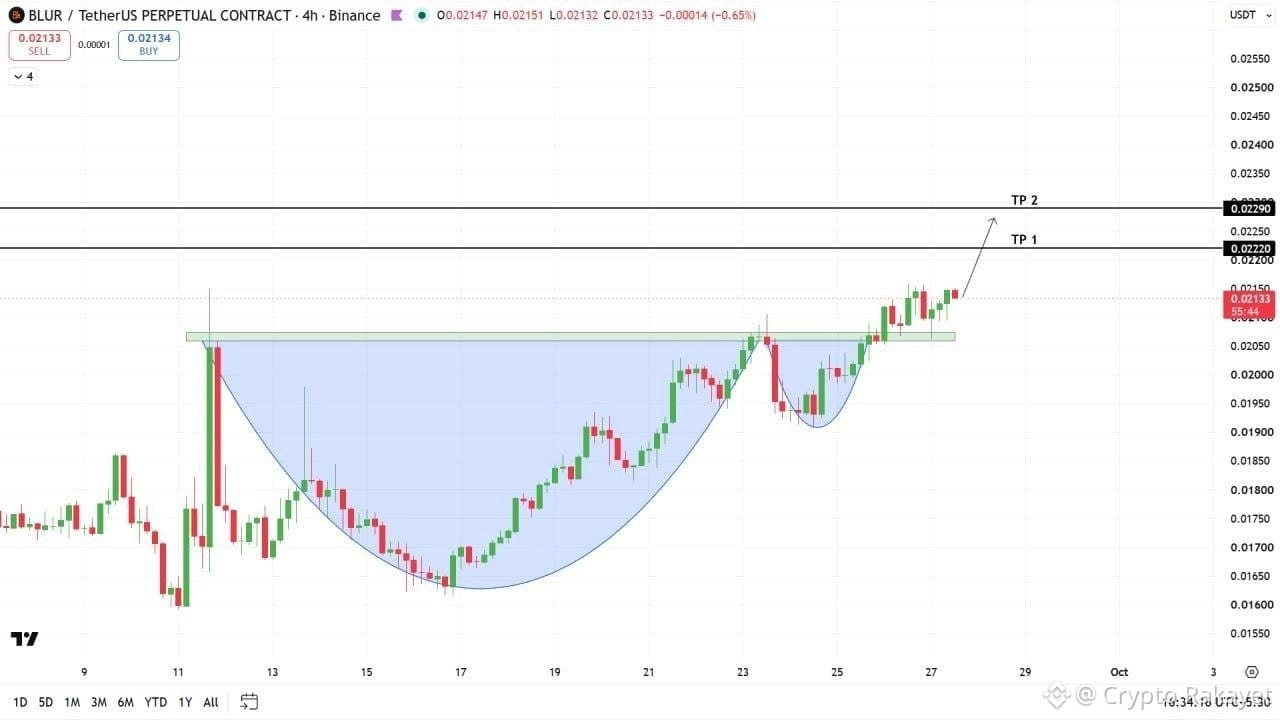
$BLURUSDT has already broken out. It might hit those upper targets soon, so keep an eye on it.
@CZ @Binance_News @Binance_Announcement @richardteng @heyi
{future}(BLURUSDT)
$BLURUSDT has already broken out. It might hit those upper targets soon, so keep an eye on it.
@CZ @Binance News @Binance Announcement @Richard Teng @Yi He
@CZ @Binance News @Binance Announcement @Richard Teng @Yi He
147
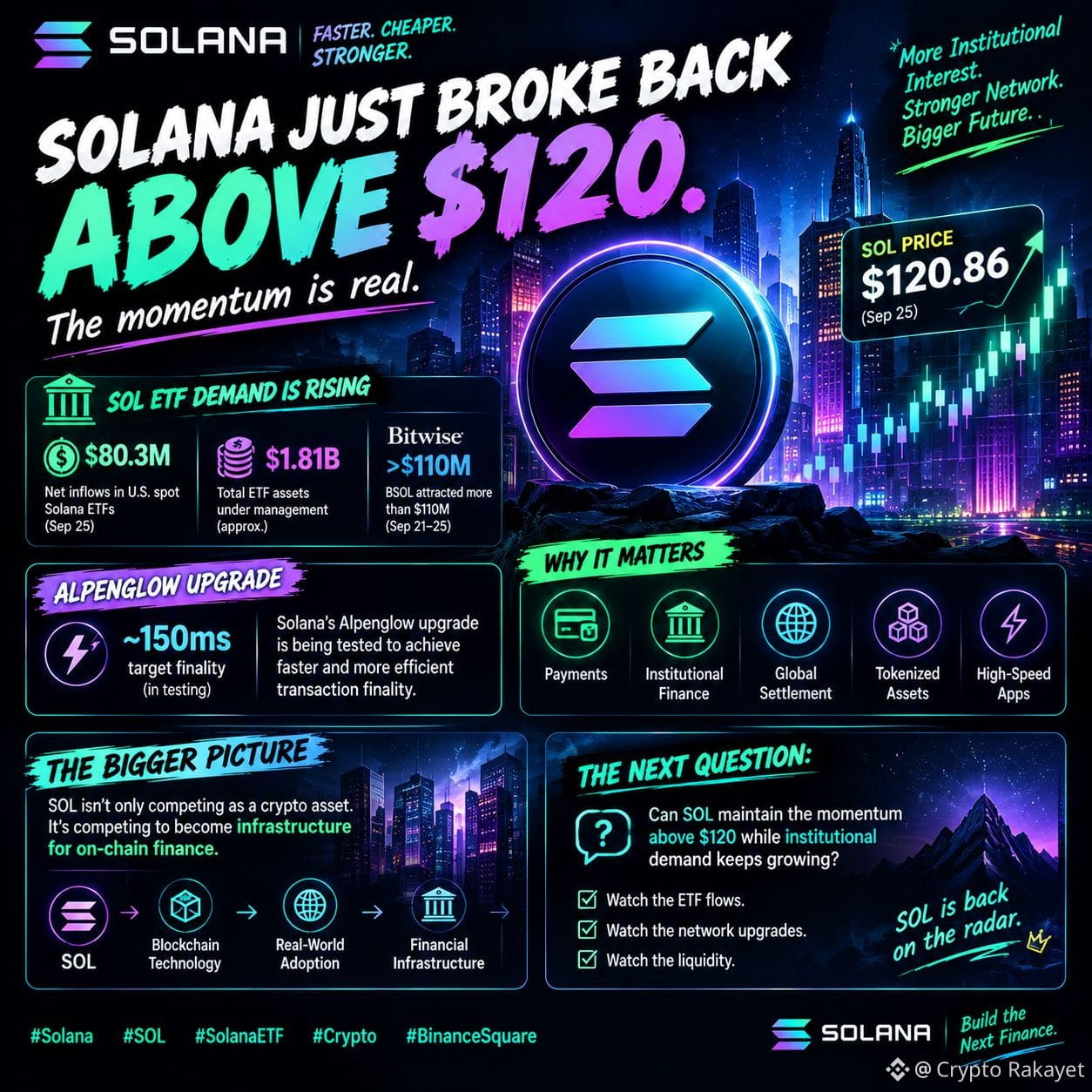
🚨 SOLANA JUST BROKE BACK ABOVE $120. 👀
SOL is getting interesting again.
After months of pressure, Solana pushed above the $120 level on September 25 — reaching around $120.86. 🔥
But the price isn't the only thing getting attention.
🏦 SOL ETF DEMAND IS RISING
U.S. spot Solana ETFs recorded around $80.3M in net inflows on September 25.
Total ETF assets are now around $1.81B.
And Bitwise's BSOL alone reportedly attracted more than $110M during the September 21–25 trading week.
That tells us something important:
Institutional interest in SOL isn't just a headline anymore.
⚡ THEN THERE'S ALPENGLOW
Solana's Alpenglow upgrade is being tested with a target of roughly 150ms transaction finality.
If successfully deployed, that could further strengthen Solana's position for:
💳 Payments
🏦 Institutional finance
🌎 Global settlement
⛓️ Tokenized assets
⚡ High-speed applications
And this connects with the bigger Solana story we've been watching:
SOL isn't only competing as a crypto asset.
It's competing to become infrastructure for on-chain finance.
The next question is simple:
👀 Can SOL maintain the momentum above $120 while institutional demand keeps growing?
Watch the ETF flows. Watch the network upgrades. Watch the liquidity.
SOL is back on the radar. 🔥
#Solana #SOL #SolanaETF #crypto #BinanceSquare
🚨 SOLANA JUST BROKE BACK ABOVE $120. 👀
SOL is getting interesting again.
After months of pressure, Solana pushed above the $120 level on September 25 — reaching around $120.86. 🔥
But the price isn't the only thing getting attention.
🏦 SOL ETF DEMAND IS RISING
U.S. spot Solana ETFs recorded around $80.3M in net inflows on September 25.
Total ETF assets are now around $1.81B.
And Bitwise's BSOL alone reportedly attracted more than $110M during the September 21–25 trading week.
That tells us something important:
Institutional interest in SOL isn't just a headline anymore.
⚡ THEN THERE'S ALPENGLOW
Solana's Alpenglow upgrade is being tested with a target of roughly 150ms transaction finality.
If successfully deployed, that could further strengthen Solana's position for:
💳 Payments
🏦 Institutional finance
🌎 Global settlement
⛓️ Tokenized assets
⚡ High-speed applications
And this connects with the bigger Solana story we've been watching:
SOL isn't only competing as a crypto asset.
It's competing to become infrastructure for on-chain finance.
The next question is simple:
👀 Can SOL maintain the momentum above $120 while institutional demand keeps growing?
Watch the ETF flows. Watch the network upgrades. Watch the liquidity.
SOL is back on the radar. 🔥
#Solana #SOL #SolanaETF #crypto #BinanceSquare
SOL is getting interesting again.
After months of pressure, Solana pushed above the $120 level on September 25 — reaching around $120.86. 🔥
But the price isn't the only thing getting attention.
🏦 SOL ETF DEMAND IS RISING
U.S. spot Solana ETFs recorded around $80.3M in net inflows on September 25.
Total ETF assets are now around $1.81B.
And Bitwise's BSOL alone reportedly attracted more than $110M during the September 21–25 trading week.
That tells us something important:
Institutional interest in SOL isn't just a headline anymore.
⚡ THEN THERE'S ALPENGLOW
Solana's Alpenglow upgrade is being tested with a target of roughly 150ms transaction finality.
If successfully deployed, that could further strengthen Solana's position for:
💳 Payments
🏦 Institutional finance
🌎 Global settlement
⛓️ Tokenized assets
⚡ High-speed applications
And this connects with the bigger Solana story we've been watching:
SOL isn't only competing as a crypto asset.
It's competing to become infrastructure for on-chain finance.
The next question is simple:
👀 Can SOL maintain the momentum above $120 while institutional demand keeps growing?
Watch the ETF flows. Watch the network upgrades. Watch the liquidity.
SOL is back on the radar. 🔥
#Solana #SOL #SolanaETF #crypto #BinanceSquare
83
🚨 TOKENIZED STOCKS JUST ENTERED DEFI. 👀
This is where the RWA story gets REALLY interesting. 🔥
Aave V4 on Base has launched an Equities Hub where eligible users outside the U.S. can use Coinbase tokenized stocks as collateral to borrow USDC.
The first 7 stocks are:
🍎 Apple
📦 Amazon
🔎 Alphabet
📱 Meta
💻 Microsoft
🟢 Nvidia
🚗 Tesla
But here's the important part:
These tokenized stocks aren't just something you can HOLD or TRADE anymore.
They can now become DEFI COLLATERAL. ⛓️
Imagine holding tokenized Nvidia…
Instead of selling your position to get liquidity, you can potentially use it as collateral and borrow USDC against it.
That's a major shift in the tokenization narrative.
🏦 Traditional assets
↓
⛓️ Tokenized on-chain
↓
💰 Used as collateral
↓
🌐 Connected to DeFi lending
And this is exactly where traditional finance and crypto start becoming more interconnected.
The initial market is still small, with limited collateral and borrowing caps, and access is restricted to eligible non-U.S. users in permitted jurisdictions.
But the direction is clear:
Stocks are moving from “assets on-chain” to “financial building blocks on-chain.” 👀
The bigger question:
🔥 What happens when stocks, bonds, real estate and other RWAs can all interact with DeFi?
Are we watching the beginning of a new financial system?
#Aave #RWA #Tokenization #defi #BinanceSquare
🚨 TOKENIZED STOCKS JUST ENTERED DEFI. 👀
This is where the RWA story gets REALLY interesting. 🔥
Aave V4 on Base has launched an Equities Hub where eligible users outside the U.S. can use Coinbase tokenized stocks as collateral to borrow USDC.
The first 7 stocks are:
🍎 Apple
📦 Amazon
🔎 Alphabet
📱 Meta
💻 Microsoft
🟢 Nvidia
🚗 Tesla
But here's the important part:
These tokenized stocks aren't just something you can HOLD or TRADE anymore.
They can now become DEFI COLLATERAL. ⛓️
Imagine holding tokenized Nvidia…
Instead of selling your position to get liquidity, you can potentially use it as collateral and borrow USDC against it.
That's a major shift in the tokenization narrative.
🏦 Traditional assets
↓
⛓️ Tokenized on-chain
↓
💰 Used as collateral
↓
🌐 Connected to DeFi lending
And this is exactly where traditional finance and crypto start becoming more interconnected.
The initial market is still small, with limited collateral and borrowing caps, and access is restricted to eligible non-U.S. users in permitted jurisdictions.
But the direction is clear:
Stocks are moving from “assets on-chain” to “financial building blocks on-chain.” 👀
The bigger question:
🔥 What happens when stocks, bonds, real estate and other RWAs can all interact with DeFi?
Are we watching the beginning of a new financial system?
#Aave #RWA #Tokenization #defi #BinanceSquare
This is where the RWA story gets REALLY interesting. 🔥
Aave V4 on Base has launched an Equities Hub where eligible users outside the U.S. can use Coinbase tokenized stocks as collateral to borrow USDC.
The first 7 stocks are:
🍎 Apple
📦 Amazon
🔎 Alphabet
📱 Meta
💻 Microsoft
🟢 Nvidia
🚗 Tesla
But here's the important part:
These tokenized stocks aren't just something you can HOLD or TRADE anymore.
They can now become DEFI COLLATERAL. ⛓️
Imagine holding tokenized Nvidia…
Instead of selling your position to get liquidity, you can potentially use it as collateral and borrow USDC against it.
That's a major shift in the tokenization narrative.
🏦 Traditional assets
↓
⛓️ Tokenized on-chain
↓
💰 Used as collateral
↓
🌐 Connected to DeFi lending
And this is exactly where traditional finance and crypto start becoming more interconnected.
The initial market is still small, with limited collateral and borrowing caps, and access is restricted to eligible non-U.S. users in permitted jurisdictions.
But the direction is clear:
Stocks are moving from “assets on-chain” to “financial building blocks on-chain.” 👀
The bigger question:
🔥 What happens when stocks, bonds, real estate and other RWAs can all interact with DeFi?
Are we watching the beginning of a new financial system?
#Aave #RWA #Tokenization #defi #BinanceSquare
64
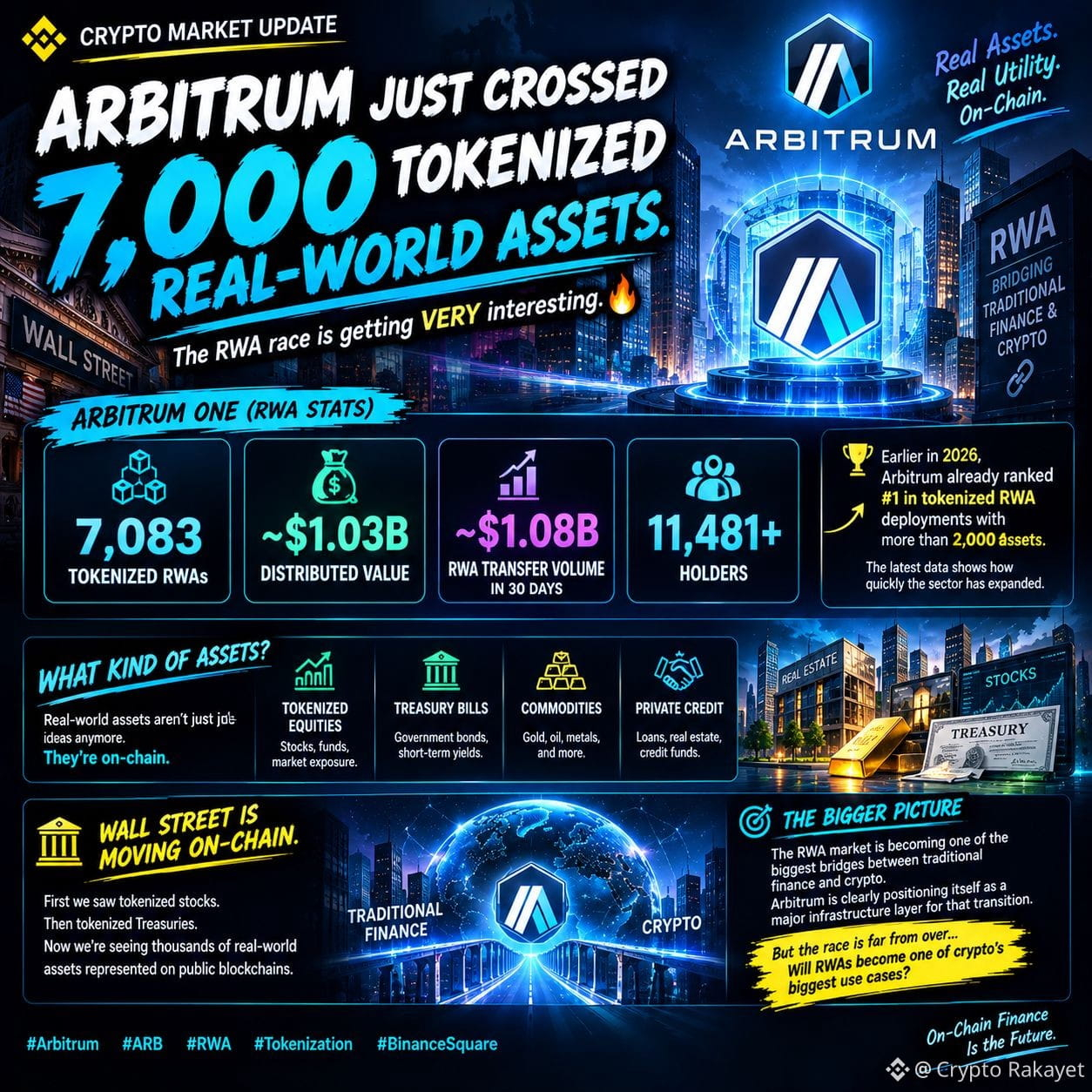
🚨 ARBITRUM JUST CROSSED 7,000 TOKENIZED REAL-WORLD ASSETS. 👀
The RWA race is getting VERY interesting. 🔥
Arbitrum One now hosts around:
🏦 7,083 TOKENIZED RWAs
💰 ~$1.03B IN DISTRIBUTED VALUE
📊 ~$1.08B RWA TRANSFER VOLUME IN 30 DAYS
👥 11,481+ HOLDERS
And these aren't just random crypto tokens.
We're talking about assets such as:
📈 Tokenized equities
🏛️ Treasury bills
🥇 Commodities
💳 Private credit
Arbitrum had already ranked first in tokenized RWA deployments earlier in 2026, with more than 2,000 assets at that time. The latest data shows how quickly the sector has expanded.
But here's the bigger picture:
WALL STREET IS MOVING ON-CHAIN. 🌐
First we saw tokenized stocks.
Then tokenized Treasuries.
Now we're seeing thousands of real-world assets represented on public blockchains.
The RWA market is becoming one of the biggest bridges between traditional finance and crypto.
Arbitrum is clearly positioning itself as a major infrastructure layer for that transition.
But the race is far from over. 👀
Will RWAs become one of crypto's biggest use cases?
#Arbitrum #ARB #RWA #Tokenization #BinanceSquare
🚨 ARBITRUM JUST CROSSED 7,000 TOKENIZED REAL-WORLD ASSETS. 👀
The RWA race is getting VERY interesting. 🔥
Arbitrum One now hosts around:
🏦 7,083 TOKENIZED RWAs
💰 ~$1.03B IN DISTRIBUTED VALUE
📊 ~$1.08B RWA TRANSFER VOLUME IN 30 DAYS
👥 11,481+ HOLDERS
And these aren't just random crypto tokens.
We're talking about assets such as:
📈 Tokenized equities
🏛️ Treasury bills
🥇 Commodities
💳 Private credit
Arbitrum had already ranked first in tokenized RWA deployments earlier in 2026, with more than 2,000 assets at that time. The latest data shows how quickly the sector has expanded.
But here's the bigger picture:
WALL STREET IS MOVING ON-CHAIN. 🌐
First we saw tokenized stocks.
Then tokenized Treasuries.
Now we're seeing thousands of real-world assets represented on public blockchains.
The RWA market is becoming one of the biggest bridges between traditional finance and crypto.
Arbitrum is clearly positioning itself as a major infrastructure layer for that transition.
But the race is far from over. 👀
Will RWAs become one of crypto's biggest use cases?
#Arbitrum #ARB #RWA #Tokenization #BinanceSquare
The RWA race is getting VERY interesting. 🔥
Arbitrum One now hosts around:
🏦 7,083 TOKENIZED RWAs
💰 ~$1.03B IN DISTRIBUTED VALUE
📊 ~$1.08B RWA TRANSFER VOLUME IN 30 DAYS
👥 11,481+ HOLDERS
And these aren't just random crypto tokens.
We're talking about assets such as:
📈 Tokenized equities
🏛️ Treasury bills
🥇 Commodities
💳 Private credit
Arbitrum had already ranked first in tokenized RWA deployments earlier in 2026, with more than 2,000 assets at that time. The latest data shows how quickly the sector has expanded.
But here's the bigger picture:
WALL STREET IS MOVING ON-CHAIN. 🌐
First we saw tokenized stocks.
Then tokenized Treasuries.
Now we're seeing thousands of real-world assets represented on public blockchains.
The RWA market is becoming one of the biggest bridges between traditional finance and crypto.
Arbitrum is clearly positioning itself as a major infrastructure layer for that transition.
But the race is far from over. 👀
Will RWAs become one of crypto's biggest use cases?
#Arbitrum #ARB #RWA #Tokenization #BinanceSquare
247
·
--
Haussier
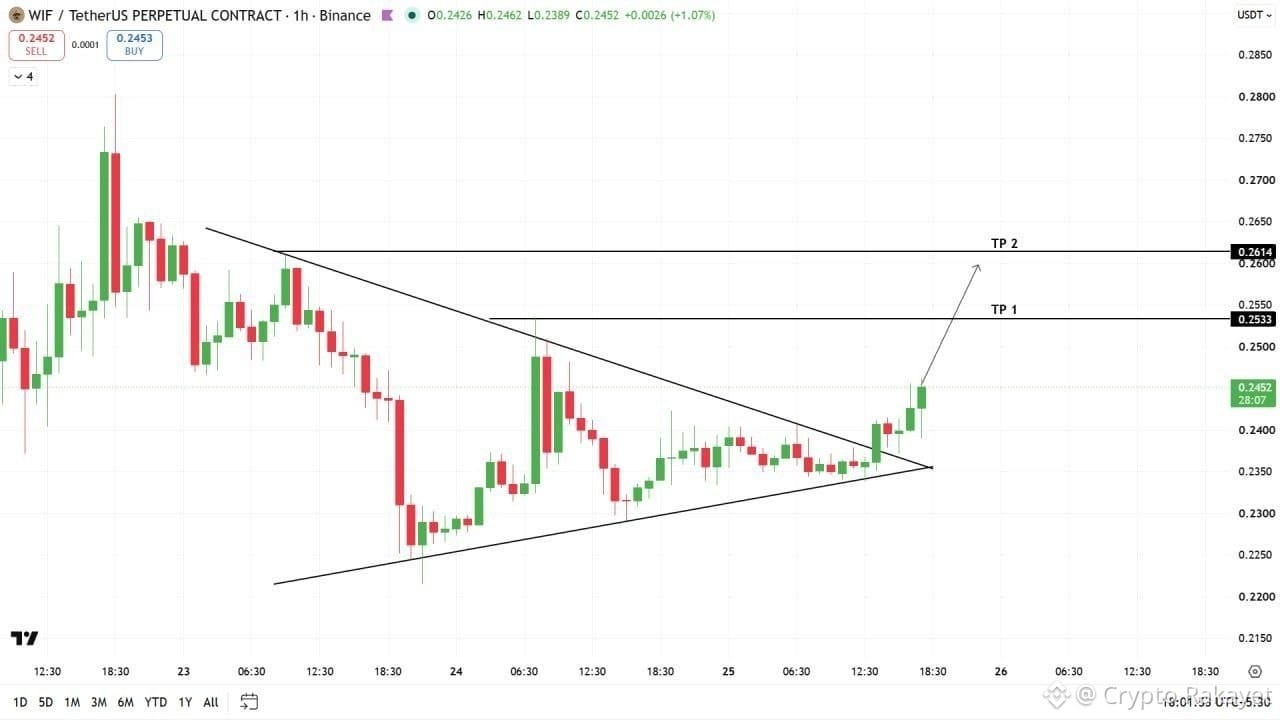
$WIFUSDT already broke out and might hit those upper targets soon. Keep an eye on it.
@CZ @heyi @Binance_News @Binance_Announcement @richardteng
{future}(WIFUSDT)
$WIFUSDT already broke out and might hit those upper targets soon. Keep an eye on it.
@CZ @Yi He @Binance News @Binance Announcement @Richard Teng
@CZ @Yi He @Binance News @Binance Announcement @Richard Teng
2
300
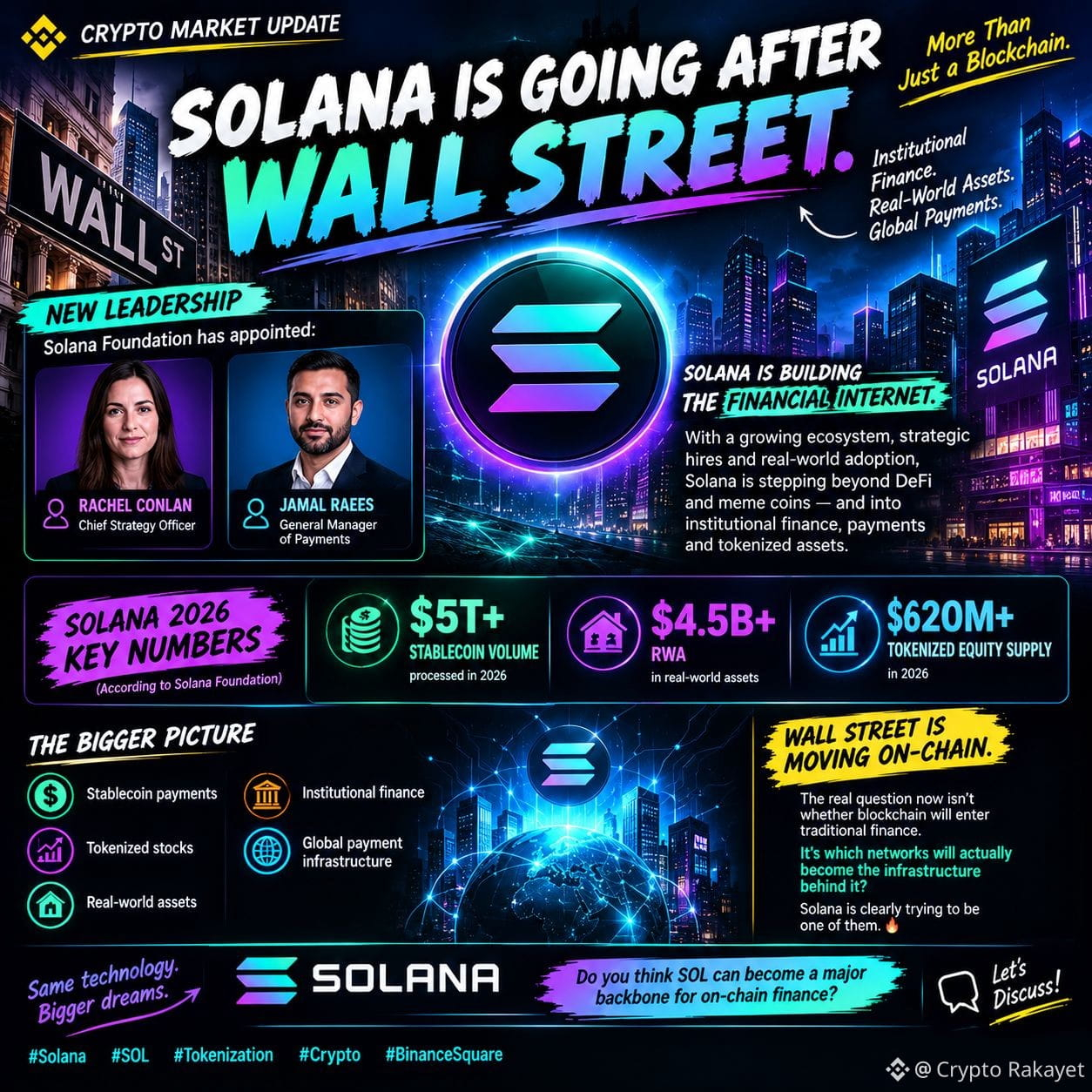
🚨 SOLANA IS GOING AFTER WALL STREET. 👀
Solana isn't just trying to be a faster blockchain anymore.
It's positioning itself as infrastructure for the next generation of finance. ⚡
The latest move?
Solana Foundation has appointed:
🏦 Rachel Conlan — Chief Strategy Officer
💳 Jamal Raees — General Manager of Payments
And the timing is interesting.
According to the Solana Foundation:
💵 $5T+ stablecoin volume processed in 2026
🌎 $4.5B+ in real-world assets
📈 $620M+ in tokenized equity supply
That's a very different Solana story.
It's no longer only about DeFi or meme coins.
We're seeing:
➡️ Stablecoin payments
➡️ Tokenized stocks
➡️ Real-world assets
➡️ Institutional finance
➡️ Global payment infrastructure
And this connects directly with the bigger trend we've been watching:
WALL STREET IS MOVING ON-CHAIN. 👀
The big question now isn't whether blockchain will enter traditional finance.
It's:
Which blockchain networks will actually become the infrastructure behind it?
Solana is clearly trying to be one of them. 🔥
Do you think SOL can become a major backbone for on-chain finance?
#Solana #SOL #Tokenization #crypto #BinanceSquare
🚨 SOLANA IS GOING AFTER WALL STREET. 👀
Solana isn't just trying to be a faster blockchain anymore.
It's positioning itself as infrastructure for the next generation of finance. ⚡
The latest move?
Solana Foundation has appointed:
🏦 Rachel Conlan — Chief Strategy Officer
💳 Jamal Raees — General Manager of Payments
And the timing is interesting.
According to the Solana Foundation:
💵 $5T+ stablecoin volume processed in 2026
🌎 $4.5B+ in real-world assets
📈 $620M+ in tokenized equity supply
That's a very different Solana story.
It's no longer only about DeFi or meme coins.
We're seeing:
➡️ Stablecoin payments
➡️ Tokenized stocks
➡️ Real-world assets
➡️ Institutional finance
➡️ Global payment infrastructure
And this connects directly with the bigger trend we've been watching:
WALL STREET IS MOVING ON-CHAIN. 👀
The big question now isn't whether blockchain will enter traditional finance.
It's:
Which blockchain networks will actually become the infrastructure behind it?
Solana is clearly trying to be one of them. 🔥
Do you think SOL can become a major backbone for on-chain finance?
#Solana #SOL #Tokenization #crypto #BinanceSquare
Solana isn't just trying to be a faster blockchain anymore.
It's positioning itself as infrastructure for the next generation of finance. ⚡
The latest move?
Solana Foundation has appointed:
🏦 Rachel Conlan — Chief Strategy Officer
💳 Jamal Raees — General Manager of Payments
And the timing is interesting.
According to the Solana Foundation:
💵 $5T+ stablecoin volume processed in 2026
🌎 $4.5B+ in real-world assets
📈 $620M+ in tokenized equity supply
That's a very different Solana story.
It's no longer only about DeFi or meme coins.
We're seeing:
➡️ Stablecoin payments
➡️ Tokenized stocks
➡️ Real-world assets
➡️ Institutional finance
➡️ Global payment infrastructure
And this connects directly with the bigger trend we've been watching:
WALL STREET IS MOVING ON-CHAIN. 👀
The big question now isn't whether blockchain will enter traditional finance.
It's:
Which blockchain networks will actually become the infrastructure behind it?
Solana is clearly trying to be one of them. 🔥
Do you think SOL can become a major backbone for on-chain finance?
#Solana #SOL #Tokenization #crypto #BinanceSquare
84
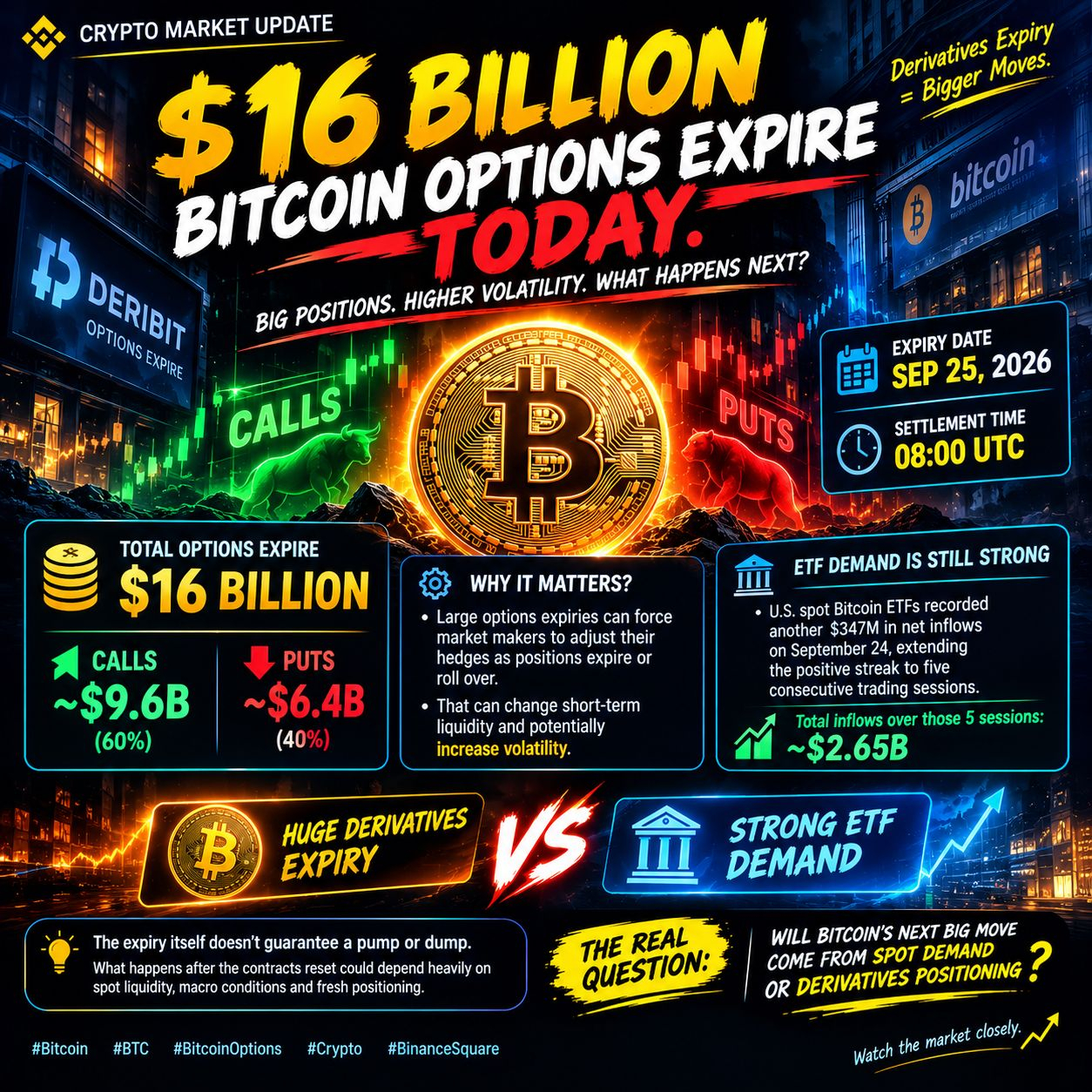
🚨 $16 BILLION OF BITCOIN OPTIONS EXPIRE TODAY. 👀
Bitcoin is facing one of the biggest derivatives events of the quarter.
Around $16 BILLION worth of BTC options are set to expire on Deribit today. 🔥
📊 ~$9.6B in Calls
📉 ~$6.4B in Puts
⏰ Settlement: 08:00 UTC
Why does this matter?
Large options expiries can force market makers to adjust their hedges as positions expire or roll over.
That can change short-term liquidity and potentially increase volatility.
But here’s the interesting part:
Bitcoin is entering the expiry with strong spot demand.
🇺🇸 U.S. spot Bitcoin ETFs recorded another $347M in net inflows on September 24, extending the positive streak to five consecutive trading sessions. Total inflows over those five sessions reached about $2.65B.
So we have an interesting battle:
⚡ HUGE DERIVATIVES EXPIRY
vs
🏦 STRONG ETF DEMAND
The expiry itself doesn't guarantee a pump or dump.
What happens after the contracts reset could depend heavily on spot liquidity, macro conditions and fresh positioning.
👀 The real question:
Will Bitcoin's next big move come from SPOT DEMAND or DERIVATIVES POSITIONING?
Watch the market closely. 🔥
#bitcoin #BTC #BitcoinOptions #crypto #BinanceSquare
🚨 $16 BILLION OF BITCOIN OPTIONS EXPIRE TODAY. 👀
Bitcoin is facing one of the biggest derivatives events of the quarter.
Around $16 BILLION worth of BTC options are set to expire on Deribit today. 🔥
📊 ~$9.6B in Calls
📉 ~$6.4B in Puts
⏰ Settlement: 08:00 UTC
Why does this matter?
Large options expiries can force market makers to adjust their hedges as positions expire or roll over.
That can change short-term liquidity and potentially increase volatility.
But here’s the interesting part:
Bitcoin is entering the expiry with strong spot demand.
🇺🇸 U.S. spot Bitcoin ETFs recorded another $347M in net inflows on September 24, extending the positive streak to five consecutive trading sessions. Total inflows over those five sessions reached about $2.65B.
So we have an interesting battle:
⚡ HUGE DERIVATIVES EXPIRY
vs
🏦 STRONG ETF DEMAND
The expiry itself doesn't guarantee a pump or dump.
What happens after the contracts reset could depend heavily on spot liquidity, macro conditions and fresh positioning.
👀 The real question:
Will Bitcoin's next big move come from SPOT DEMAND or DERIVATIVES POSITIONING?
Watch the market closely. 🔥
#bitcoin #BTC #BitcoinOptions #crypto #BinanceSquare
Bitcoin is facing one of the biggest derivatives events of the quarter.
Around $16 BILLION worth of BTC options are set to expire on Deribit today. 🔥
📊 ~$9.6B in Calls
📉 ~$6.4B in Puts
⏰ Settlement: 08:00 UTC
Why does this matter?
Large options expiries can force market makers to adjust their hedges as positions expire or roll over.
That can change short-term liquidity and potentially increase volatility.
But here’s the interesting part:
Bitcoin is entering the expiry with strong spot demand.
🇺🇸 U.S. spot Bitcoin ETFs recorded another $347M in net inflows on September 24, extending the positive streak to five consecutive trading sessions. Total inflows over those five sessions reached about $2.65B.
So we have an interesting battle:
⚡ HUGE DERIVATIVES EXPIRY
vs
🏦 STRONG ETF DEMAND
The expiry itself doesn't guarantee a pump or dump.
What happens after the contracts reset could depend heavily on spot liquidity, macro conditions and fresh positioning.
👀 The real question:
Will Bitcoin's next big move come from SPOT DEMAND or DERIVATIVES POSITIONING?
Watch the market closely. 🔥
#bitcoin #BTC #BitcoinOptions #crypto #BinanceSquare
86
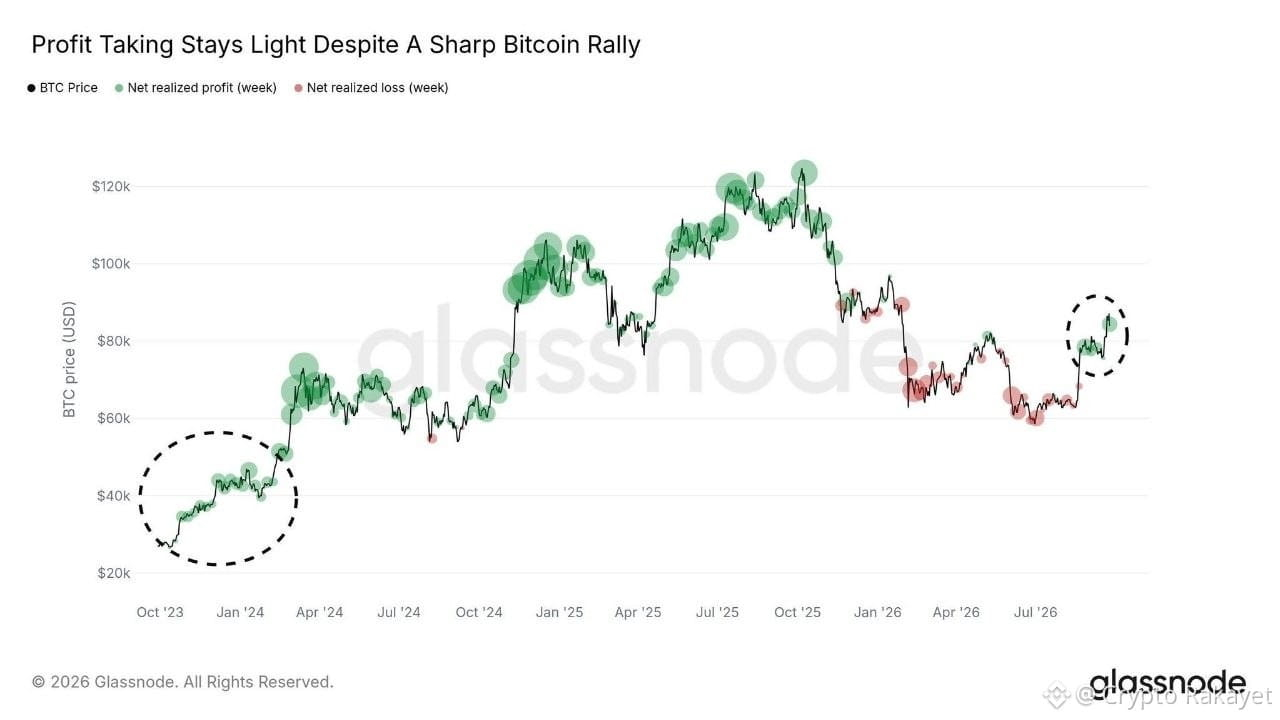
Bitcoin holders have locked in $5.1B in net profit over the past week, a modest level closer to late 2023 than to past market tops, per #Glassnode.
@CZ @Binance_News @heyi @Binance_Announcement @richardteng
{spot}(BTCUSDT)
Bitcoin holders have locked in $5.1B in net profit over the past week, a modest level closer to late 2023 than to past market tops, per #Glassnode.
@CZ @Binance News @Yi He @Binance Announcement @Richard Teng
@CZ @Binance News @Yi He @Binance Announcement @Richard Teng
29
🚨 WALL STREET IS GOING ON-CHAIN. 👀
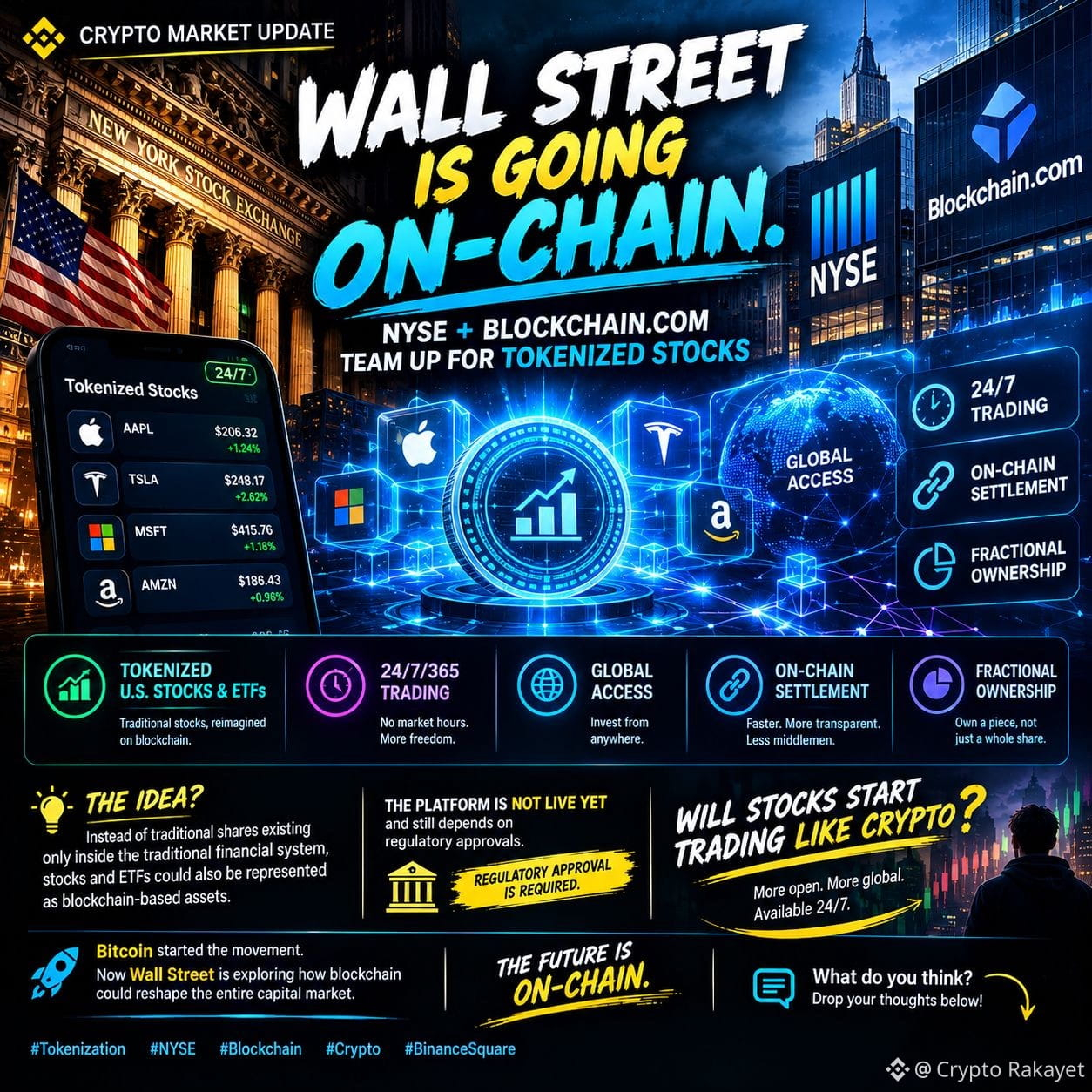
The New York Stock Exchange (NYSE) and Blockchain.com are teaming up to explore something that could change how people trade stocks.
📈 TOKENIZED U.S. STOCKS & ETFs
⏰ 24/7/365 TRADING
🌍 GLOBAL ACCESS
⛓️ ON-CHAIN SETTLEMENT
💰 FRACTIONAL OWNERSHIP
The idea is simple:
Instead of traditional shares existing only inside the traditional financial system, stocks and ETFs could also be represented as blockchain-based assets.
And this is where crypto infrastructure becomes interesting.
NYSE is planning a digital trading venue, while Blockchain.com could help connect crypto-native users to tokenized securities.
The platform is NOT live yet and still depends on regulatory approvals.
But the direction is clear:
Traditional finance is moving closer to blockchain.
Bitcoin started the movement.
Now Wall Street is exploring how blockchain could reshape the entire capital market. 👀
The bigger question:
Will the future of stock trading look more like crypto — open, global and available 24/7?
What do you think? 🔥
#Tokenization #NYSE #blockchain #Crypto #BinanceSquare
🚨 WALL STREET IS GOING ON-CHAIN. 👀
The New York Stock Exchange (NYSE) and Blockchain.com are teaming up to explore something that could change how people trade stocks.
📈 TOKENIZED U.S. STOCKS & ETFs
⏰ 24/7/365 TRADING
🌍 GLOBAL ACCESS
⛓️ ON-CHAIN SETTLEMENT
💰 FRACTIONAL OWNERSHIP
The idea is simple:
Instead of traditional shares existing only inside the traditional financial system, stocks and ETFs could also be represented as blockchain-based assets.
And this is where crypto infrastructure becomes interesting.
NYSE is planning a digital trading venue, while Blockchain.com could help connect crypto-native users to tokenized securities.
The platform is NOT live yet and still depends on regulatory approvals.
But the direction is clear:
Traditional finance is moving closer to blockchain.
Bitcoin started the movement.
Now Wall Street is exploring how blockchain could reshape the entire capital market. 👀
The bigger question:
Will the future of stock trading look more like crypto — open, global and available 24/7?
What do you think? 🔥
#Tokenization #NYSE #blockchain #Crypto #BinanceSquare
The New York Stock Exchange (NYSE) and Blockchain.com are teaming up to explore something that could change how people trade stocks.
📈 TOKENIZED U.S. STOCKS & ETFs
⏰ 24/7/365 TRADING
🌍 GLOBAL ACCESS
⛓️ ON-CHAIN SETTLEMENT
💰 FRACTIONAL OWNERSHIP
The idea is simple:
Instead of traditional shares existing only inside the traditional financial system, stocks and ETFs could also be represented as blockchain-based assets.
And this is where crypto infrastructure becomes interesting.
NYSE is planning a digital trading venue, while Blockchain.com could help connect crypto-native users to tokenized securities.
The platform is NOT live yet and still depends on regulatory approvals.
But the direction is clear:
Traditional finance is moving closer to blockchain.
Bitcoin started the movement.
Now Wall Street is exploring how blockchain could reshape the entire capital market. 👀
The bigger question:
Will the future of stock trading look more like crypto — open, global and available 24/7?
What do you think? 🔥
#Tokenization #NYSE #blockchain #Crypto #BinanceSquare
59
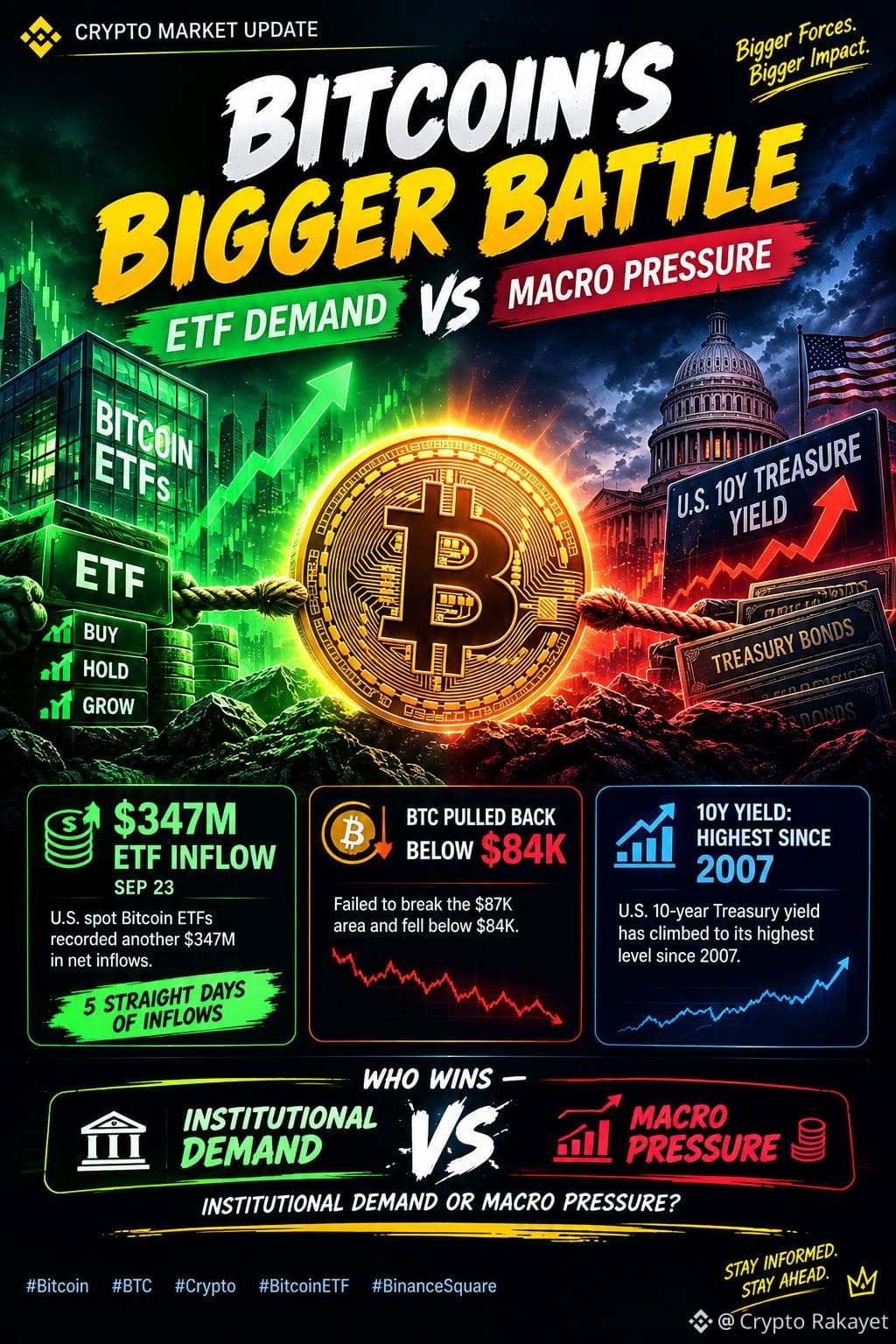
🚨 BITCOIN HAS A BIGGER BATTLE THAN $90K. 👀
Bitcoin is facing a strange situation right now.
📈 Institutional demand is still strong.
U.S. spot Bitcoin ETFs recorded another $347M in net inflows on September 23, extending the inflow streak to five consecutive trading days.
But at the same time…
⚠️ Macro pressure is getting stronger.
The U.S. 10-year Treasury yield has climbed to its highest level since 2007, while BTC has slipped below $85K after failing to break the $87K area.
So the market is caught between two forces:
🏦 Institutional buying
vs.
📉 Rising yields & tighter liquidity
This is why the next BTC move could be important.
If ETF demand continues while macro pressure eases, buyers could regain control.
But if yields keep climbing, even strong ETF inflows may struggle to push Bitcoin higher.
The real battle isn't just BTC vs $90K.
It's institutional demand vs macro pressure. ⚔️
What are you watching more closely right now — ETF flows or Treasury yields? 👇
#bitcoin #BTC #Crypto #BitcoinETF #BinanceSquare
🚨 BITCOIN HAS A BIGGER BATTLE THAN $90K. 👀
Bitcoin is facing a strange situation right now.
📈 Institutional demand is still strong.
U.S. spot Bitcoin ETFs recorded another $347M in net inflows on September 23, extending the inflow streak to five consecutive trading days.
But at the same time…
⚠️ Macro pressure is getting stronger.
The U.S. 10-year Treasury yield has climbed to its highest level since 2007, while BTC has slipped below $85K after failing to break the $87K area.
So the market is caught between two forces:
🏦 Institutional buying
vs.
📉 Rising yields & tighter liquidity
This is why the next BTC move could be important.
If ETF demand continues while macro pressure eases, buyers could regain control.
But if yields keep climbing, even strong ETF inflows may struggle to push Bitcoin higher.
The real battle isn't just BTC vs $90K.
It's institutional demand vs macro pressure. ⚔️
What are you watching more closely right now — ETF flows or Treasury yields? 👇
#bitcoin #BTC #Crypto #BitcoinETF #BinanceSquare
Bitcoin is facing a strange situation right now.
📈 Institutional demand is still strong.
U.S. spot Bitcoin ETFs recorded another $347M in net inflows on September 23, extending the inflow streak to five consecutive trading days.
But at the same time…
⚠️ Macro pressure is getting stronger.
The U.S. 10-year Treasury yield has climbed to its highest level since 2007, while BTC has slipped below $85K after failing to break the $87K area.
So the market is caught between two forces:
🏦 Institutional buying
vs.
📉 Rising yields & tighter liquidity
This is why the next BTC move could be important.
If ETF demand continues while macro pressure eases, buyers could regain control.
But if yields keep climbing, even strong ETF inflows may struggle to push Bitcoin higher.
The real battle isn't just BTC vs $90K.
It's institutional demand vs macro pressure. ⚔️
What are you watching more closely right now — ETF flows or Treasury yields? 👇
#bitcoin #BTC #Crypto #BitcoinETF #BinanceSquare
79
Connectez-vous pour découvrir plus de contenu
Rejoignez la communauté mondiale des adeptes de cryptomonnaies sur Binance Square
⚡️ Suviez les dernières informations importantes sur les cryptomonnaies.
💬 Jugé digne de confiance par la plus grande plateforme d’échange de cryptomonnaies au monde.
👍 Découvrez les connaissances que partagent les créateurs vérifiés.
Adresse e-mail/Nº de téléphone
Sujets d’actualité
BitcoinClears$85200
2,280 vues
102 mentions
We got the move, and $BTC is standing exactly where we were before the data. That’s what actual patience for a trade looks like.
The data came in mixed but with some important numbers. ADP Non-Farm Employment Change came at 90K vs 73K forecast, while Core PCE came in at 0.2% vs 0.3% expected. Final GDP was also stronger at 2.2% vs 1.5% forecast, while Personal Spending came in at 0.9% vs 0.8% expected. At the same time, Personal Income missed at 0.2% vs 0.5% forecast.
BTC initially surged to $85,600 and is now back where it needs to be. I’m still looking toward the lower ranges at $82,759 and the $80,000 liquidity, because the overhead liquidity is done and dusted.
We had a live session during the data, and during that session we saw the market at $83,800, then $85,600, and then back toward $83,000 and we still didn’t enter a trade.
That’s what patience is.
We can’t force an entry when the market has no clear direction. The same range is still in focus, and we’ll wait for the market to give us the setup.
Let me know, guys, how was the session? And should we have more regular sessions with our respected members so we can have proper discussions regarding the market?
#BitcoinClears$85200 #AltcoinSeasonIndexHoldsAbove60For5Days #USADPAdds90000JobsInSeptember #BitcoinSlipsBelow$84000 #SECToClarifyOnChainFundraisingRules
Crypto_LUX
·19 mentions J’aime
·5.9k vues
AltcoinSeasonIndexHoldsAbove60For5Days
16,326 vues
661 mentions
USADPAdds90000JobsInSeptember
5,310 vues
345 mentions