

Crypto心诚
2k Posts

Crypto心诚
Report
Block User
BTC/ETH行情技术分析与市场趋势研判,主做长期资产管理,点下方聊天框进入聊天室 永久20%返佣邀请码:DFUIJVHH

BTC Holder
Frequent Trader
5.5 Years
32 Following
3.9K+ Followers
3.4K+ Liked
Posts
All
Quotes
Videos
Live
PINNED
·
--

Article
The altcoins and U.S. stocks I like most in this cycleMany people in the livestream asked: In this cycle, which alternative coins do I think will do well? I personally have a group I’m keeping an eye on. I’ll screenshot it for everyone in a moment, and I’ll also explain my reasons!
👉 Here, please note that the content is for reference only and does not constitute investment advice
Crypto altcoins:
① SUI
Target price: $9
Reason: It uses the object model and the Move language to make native capabilities out of parallel execution, asset safety, and sub-second confirmations. Then it layers on stablecoin payments, institutional channels, and gaming/high-frequency application scenarios—making it closer than most other chains to being able to truly run large-scale on-chain applications for the next-gen L1.
The altcoins and U.S. stocks I like most in this cycle
Many people in the livestream asked: In this cycle, which alternative coins do I think will do well? I personally have a group I’m keeping an eye on. I’ll screenshot it for everyone in a moment, and I’ll also explain my reasons!
👉 Here, please note that the content is for reference only and does not constitute investment advice
Crypto altcoins:
① SUI
Target price: $9
Reason: It uses the object model and the Move language to make native capabilities out of parallel execution, asset safety, and sub-second confirmations. Then it layers on stablecoin payments, institutional channels, and gaming/high-frequency application scenarios—making it closer than most other chains to being able to truly run large-scale on-chain applications for the next-gen L1.
1
1
8
4k
PINNED
·
--
🚀 BTC Market Helper Group
Focused on real-time Bitcoin updates, market analysis, and trading ideas sharing!
From time to time, there are technical discussions, opportunity shares, and risk alerts here. Welcome to communicate rationally and learn from each other.
Permanent 20% off trading fees. Invitation code DFUIJVHH—saving enough in a year to cover a car
Wishing everyone smooth trading and continuous wealth ~
$BTC
{future}(BTCUSDT)
🚀 BTC Market Helper Group
Focused on real-time Bitcoin updates, market analysis, and trading ideas sharing!
From time to time, there are technical discussions, opportunity shares, and risk alerts here. Welcome to communicate rationally and learn from each other.
Permanent 20% off trading fees. Invitation code DFUIJVHH—saving enough in a year to cover a car
Wishing everyone smooth trading and continuous wealth ~
$BTC


3
119
·
--
China is now making a major push to implement the digital yuan. Many people think it’s just another payment tool, but in fact, it is the central bank’s legal tender.
For ordinary people: no withdrawal fees, offline payments supported. Cash will gradually fade out, but the digital yuan will not immediately replace WeChat Pay or Alipay.
For regulators: transactions can be traced, leaving less room for money laundering and gray-market transactions. Smart contracts can be used to target subsidies and loans, making monetary policy transmission more precise.
In the long run, it could facilitate cross-border yuan settlements and hedge against the risks posed by private cryptocurrencies.
A double-edged sword: the movement of funds becomes more transparent. This is a gradual shift in the underlying rules of money, not a simple short-term upgrade to payment systems. At the same time, it will cause a lot of money to flow out of mainland China.
#数字人民币 #宏观认知
$BTC
{future}(BTCUSDT)
China is now making a major push to implement the digital yuan. Many people think it’s just another payment tool, but in fact, it is the central bank’s legal tender.
For ordinary people: no withdrawal fees, offline payments supported. Cash will gradually fade out, but the digital yuan will not immediately replace WeChat Pay or Alipay.
For regulators: transactions can be traced, leaving less room for money laundering and gray-market transactions. Smart contracts can be used to target subsidies and loans, making monetary policy transmission more precise.
In the long run, it could facilitate cross-border yuan settlements and hedge against the risks posed by private cryptocurrencies.
A double-edged sword: the movement of funds becomes more transparent. This is a gradual shift in the underlying rules of money, not a simple short-term upgrade to payment systems. At the same time, it will cause a lot of money to flow out of mainland China.
#数字人民币 #宏观认知
$BTC

149
·
--
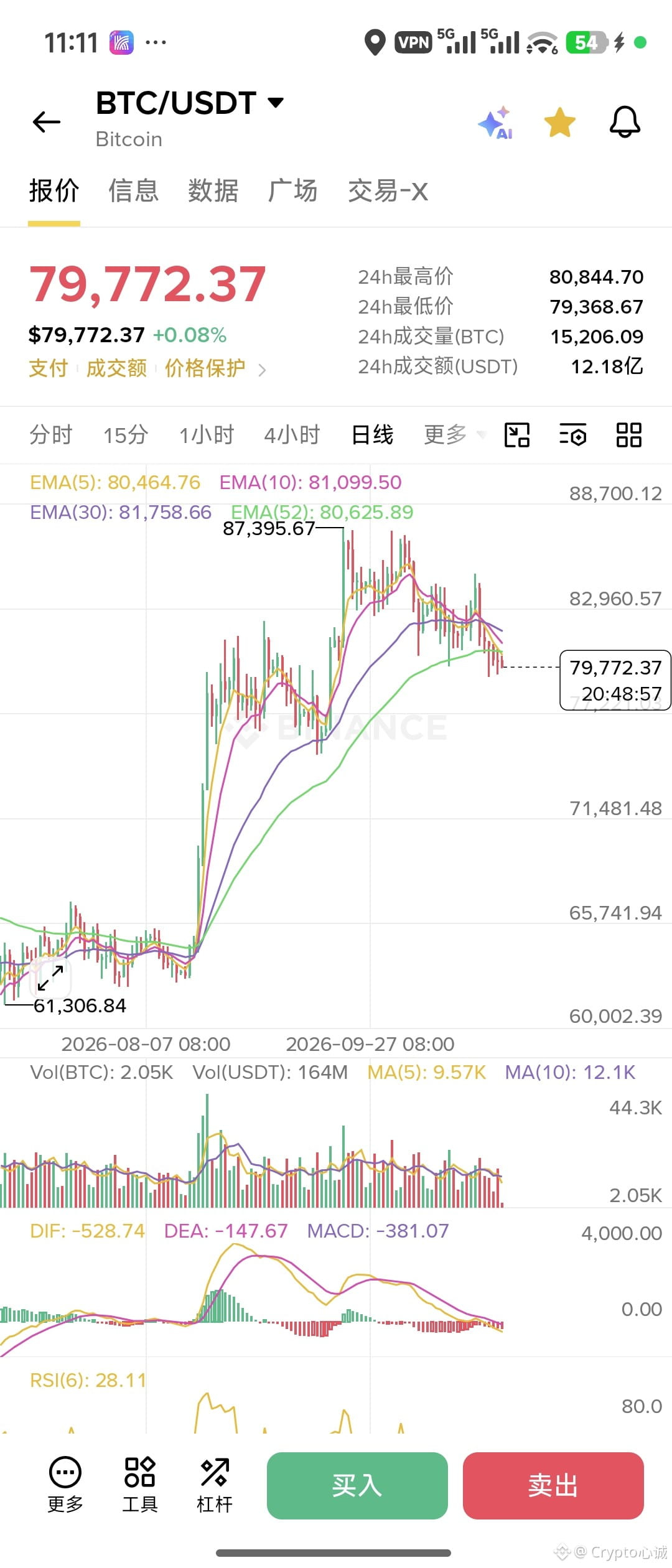
Based on the current trend of $BTC , I think it will spike down to around 77000 within the next day or two.
Here are the technical reasons:
① The daily MACD has broken below the zero line, and the highs are gradually getting lower—this is a precursor to a sharp wick down.
② The 4-hour chart’s center of gravity is gradually shifting lower.
③ On the 1-hour chart, price has been consistently capped by the EMA30. It’s now building momentum, waiting for an opportunity to sell off sharply.
Support below: 77000–75000
{future}(BTCUSDT)
Based on the current trend of $BTC , I think it will spike down to around 77000 within the next day or two.
Here are the technical reasons:
① The daily MACD has broken below the zero line, and the highs are gradually getting lower—this is a precursor to a sharp wick down.
② The 4-hour chart’s center of gravity is gradually shifting lower.
③ On the 1-hour chart, price has been consistently capped by the EMA30. It’s now building momentum, waiting for an opportunity to sell off sharply.
Support below: 77000–75000
320
·
--
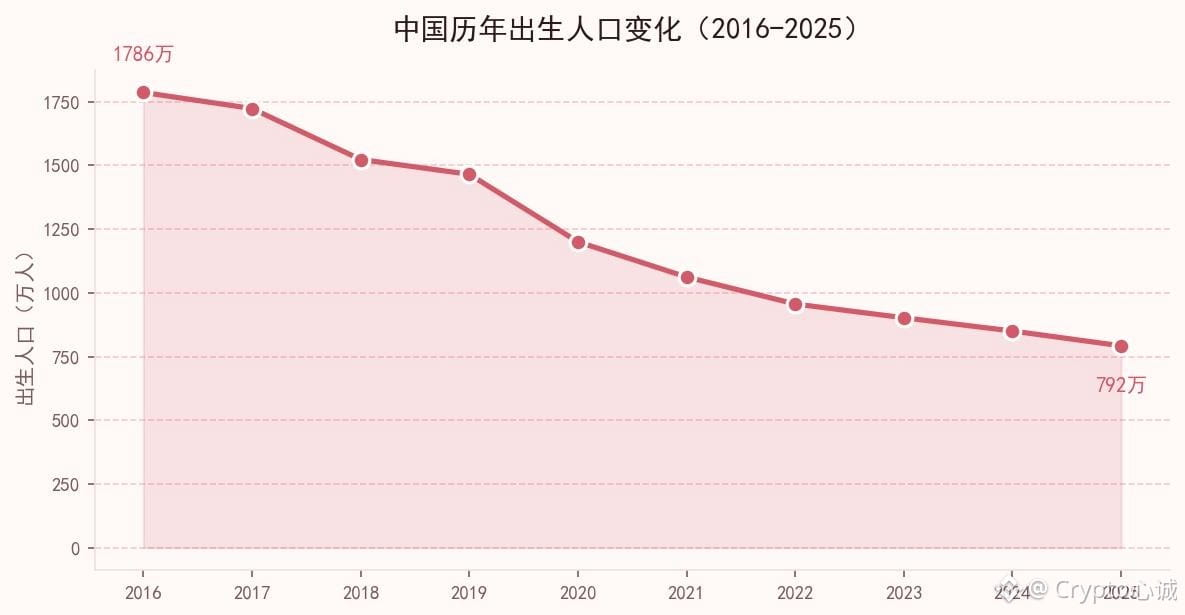
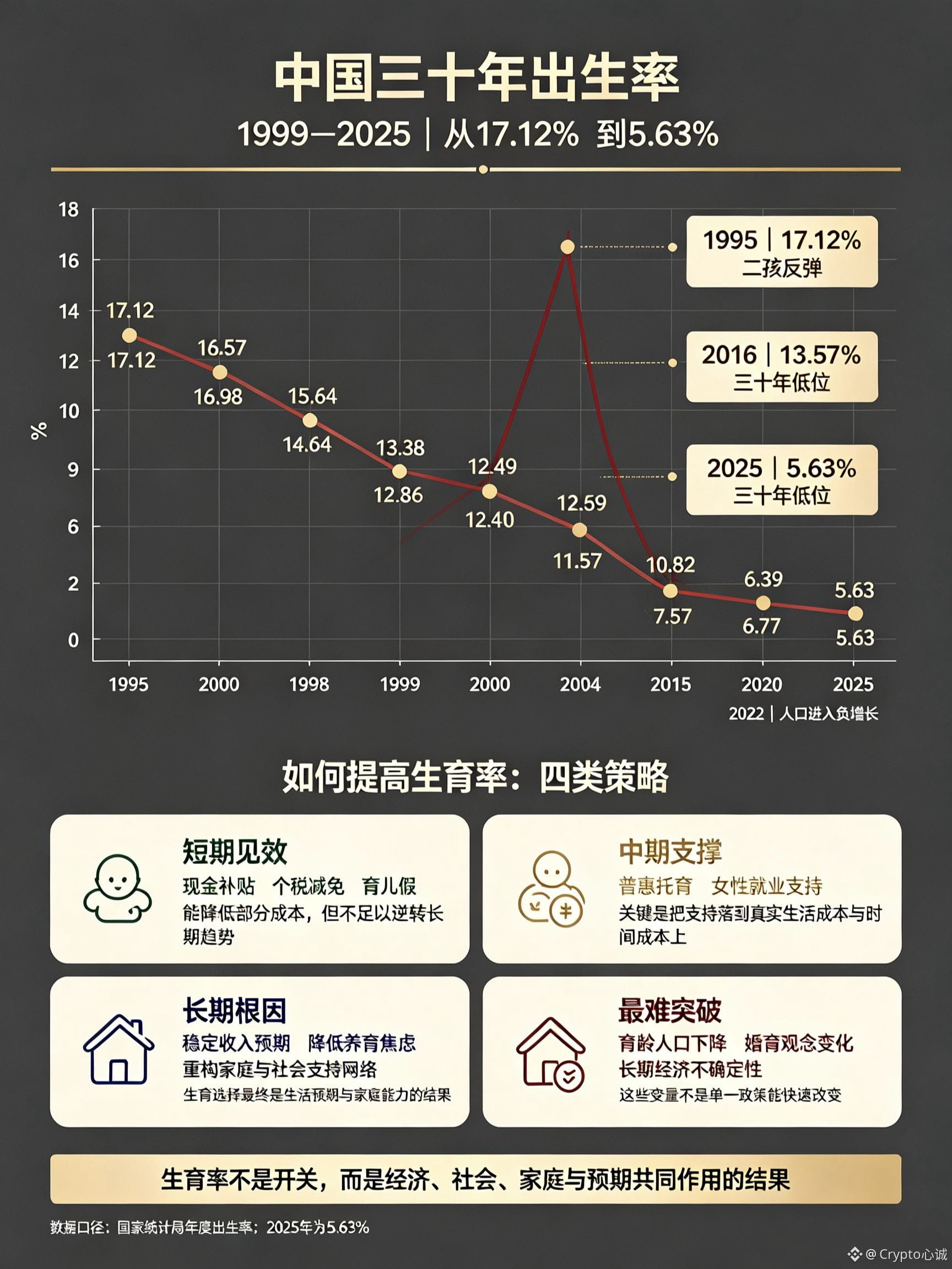
After looking at this birth-rate curve, my takeaway is this: having children has never been something a single policy can simply bring about.
The rebound after the universal two-child policy in 2016 showed us what happens—a brief spike, followed by an even faster decline.
At its core, young people aren’t unwilling to have children; they’re worried they can’t afford to raise them, have no one to help with childcare, and would have to sacrifice their own lives and careers.
Subsidies are just icing on the cake. Childcare places, affordable housing, more family-friendly workplaces, and easing the pressure of the education rat race—these are the foundations that really matter. Cash handouts alone are unlikely to change people’s choices.
This population trend is a fundamental factor shaping the economy, consumption, housing market, and retirement provision over the coming decades.
It is a slow-moving decline, and reversing it will take even longer. We can hardly expect to see a major turnaround in the short term.
For long-term investors, understanding this trend matters more than betting on policy stimulus.
$BTC
{future}(BTCUSDT)
After looking at this birth-rate curve, my takeaway is this: having children has never been something a single policy can simply bring about.
The rebound after the universal two-child policy in 2016 showed us what happens—a brief spike, followed by an even faster decline.
At its core, young people aren’t unwilling to have children; they’re worried they can’t afford to raise them, have no one to help with childcare, and would have to sacrifice their own lives and careers.
Subsidies are just icing on the cake. Childcare places, affordable housing, more family-friendly workplaces, and easing the pressure of the education rat race—these are the foundations that really matter. Cash handouts alone are unlikely to change people’s choices.
This population trend is a fundamental factor shaping the economy, consumption, housing market, and retirement provision over the coming decades.
It is a slow-moving decline, and reversing it will take even longer. We can hardly expect to see a major turnaround in the short term.
For long-term investors, understanding this trend matters more than betting on policy stimulus.
$BTC
3
5.1k
·
--
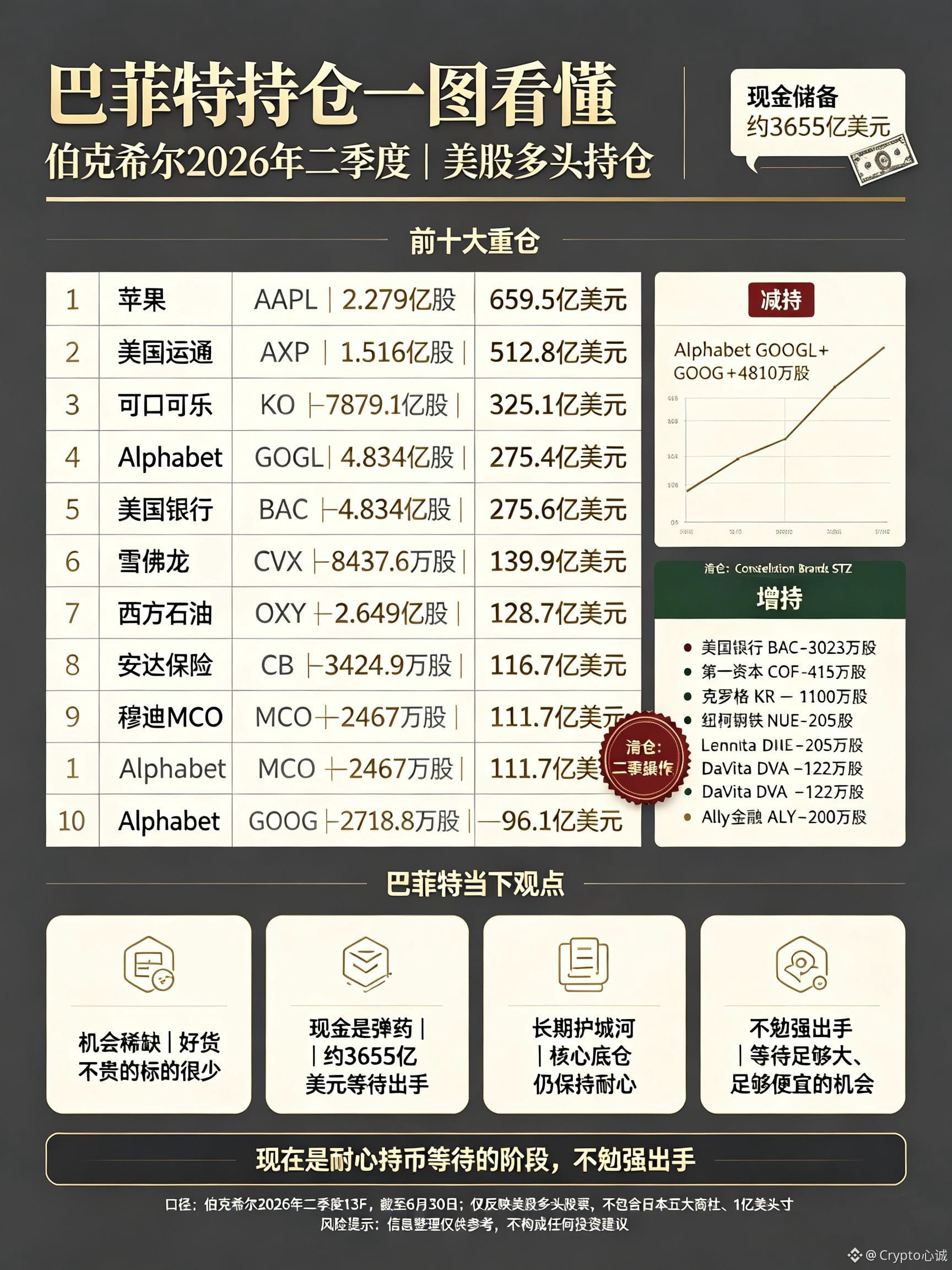
A lot of people keep asking what Buffett is buying and selling these days, so I’ve turned his latest Q2 holdings into a chart. No obscure jargon—just my take.
Here’s the quick summary:
Apple remains a cornerstone holding, unchanged this quarter. He made a big addition to Google. On the other hand, he has continued selling bank stocks and some cyclical stocks, and exited Constellation Brands. He also added again to distressed names like Delta Air Lines.
The most striking thing: he’s still sitting on $365.5 billion in cash.
The market is buzzing right now. Lots of people are jumping in to bet on the market and chase hot trends, but the big names aren’t in a rush to put their money to work.
Many people mistakenly think adding to Google means being wildly bullish on the AI hype. I don’t see it that way. They’re buying Google for its steady cash flow, its search moat, and the long-term value of its AI infrastructure—not just chasing a hot theme.
My take:
Top-tier investors aren’t always fully invested. When there are plenty of opportunities, they buy boldly. When they can’t find good assets at attractive prices, holding cash and waiting is an investment strategy in itself.
The easiest mistake for ordinary investors to make is seeing others make money and then rushing in for fear of missing out. Buffett’s approach has taught me this: if you don’t understand it or the price isn’t right, it’s better to sit it out and wait. Patience matters far more than constant trading.
$AAPLB
{spot}(AAPLBUSDT)
$BTC
{future}(BTCUSDT)
$MSFTB
{spot}(MSFTBUSDT)
A lot of people keep asking what Buffett is buying and selling these days, so I’ve turned his latest Q2 holdings into a chart. No obscure jargon—just my take.
Here’s the quick summary:
Apple remains a cornerstone holding, unchanged this quarter. He made a big addition to Google. On the other hand, he has continued selling bank stocks and some cyclical stocks, and exited Constellation Brands. He also added again to distressed names like Delta Air Lines.
The most striking thing: he’s still sitting on $365.5 billion in cash.
The market is buzzing right now. Lots of people are jumping in to bet on the market and chase hot trends, but the big names aren’t in a rush to put their money to work.
Many people mistakenly think adding to Google means being wildly bullish on the AI hype. I don’t see it that way. They’re buying Google for its steady cash flow, its search moat, and the long-term value of its AI infrastructure—not just chasing a hot theme.
My take:
Top-tier investors aren’t always fully invested. When there are plenty of opportunities, they buy boldly. When they can’t find good assets at attractive prices, holding cash and waiting is an investment strategy in itself.
The easiest mistake for ordinary investors to make is seeing others make money and then rushing in for fear of missing out. Buffett’s approach has taught me this: if you don’t understand it or the price isn’t right, it’s better to sit it out and wait. Patience matters far more than constant trading.
$AAPLB
$BTC
$MSFTB
228
·
--
$BTC
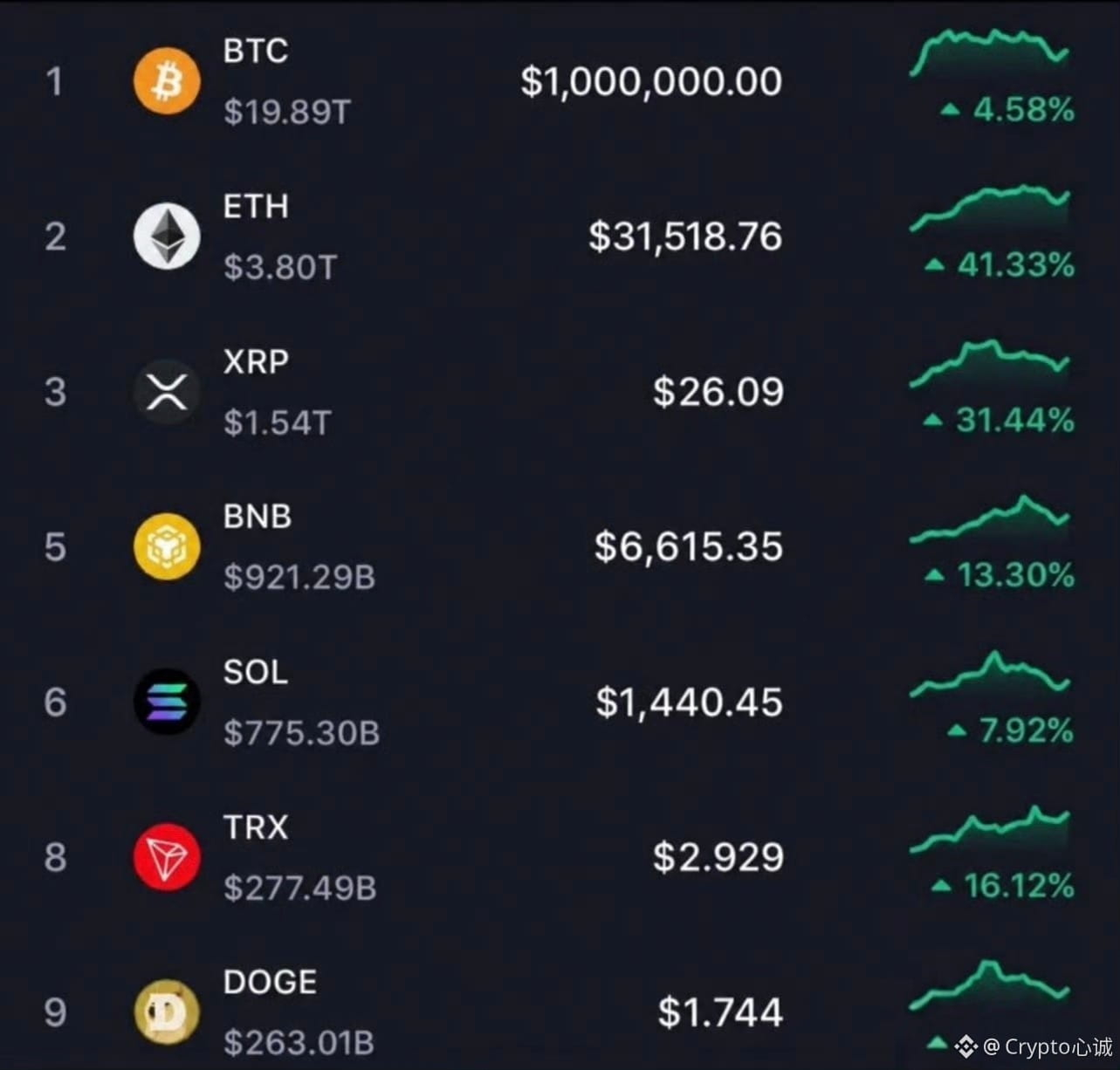
The price you'll see in 3–5 years
What would you go all-in on now?
$BTC
The price you'll see in 3–5 years
What would you go all-in on now?
The price you'll see in 3–5 years
What would you go all-in on now?
335
·
--
Oct 26 $BTC Comprehensive Market Analysis
💫 News:
Rising geopolitical risks: The U.S. has withdrawn personnel from some embassies in the Middle East, tensions related to Iran have escalated, oil prices have risen, risk appetite has declined, and concentrated selling occurred over the weekend.
Macroeconomic pressure: The market is focused on this week’s Federal Reserve meeting (October 27–28). High oil prices are intensifying inflation concerns, while expectations of rate hikes are weighing on risk assets.
Corporate developments: Some publicly listed companies continue to increase their Bitcoin holdings, but poor weekend liquidity amplified the decline.
💫 Fund flows:
Spot ETFs: Net inflows this week were approximately +$301 million, ending two consecutive weeks of outflows. However, flows weakened significantly in the second half of the week: $636 million flowed out on Thursday, followed by about $138 million on Friday, largely offsetting the strong inflows of the first three days.
Weekend liquidations: More than $800 million was liquidated across the crypto market within 24 hours, with long positions accounting for a very high share, indicating that leveraged longs were wiped out.
Overall assessment: Institutional demand has not disappeared, but its momentum has been disrupted by falling prices and macro sentiment. Investors are cautious.
💫 Technical analysis:
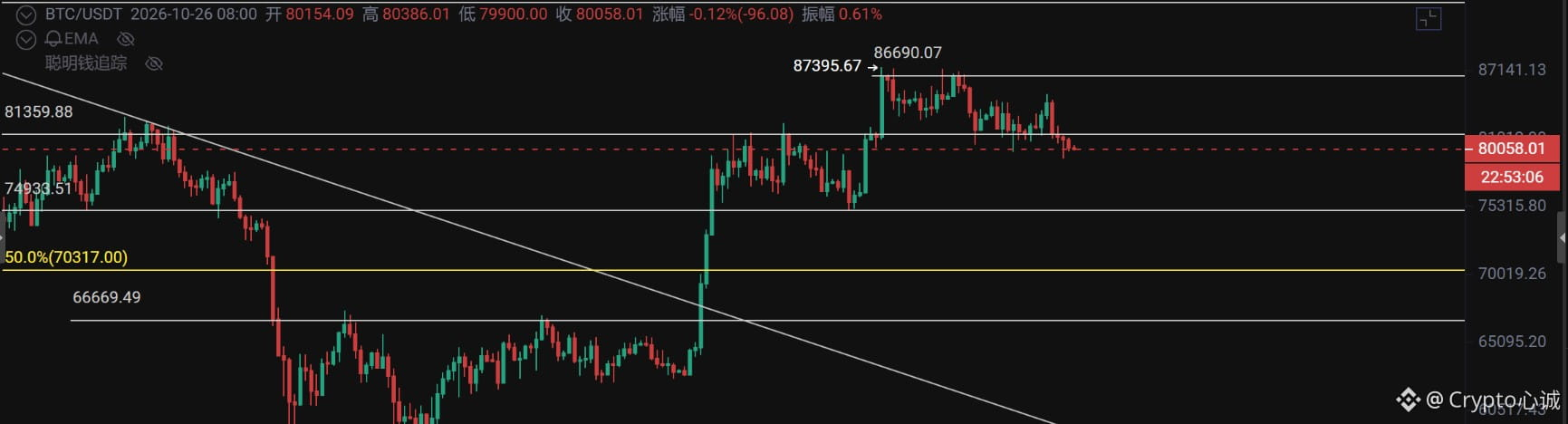
The technical outlook still points to range-bound trading. Unless the price holds above 81700 intraday, I still expect choppy downside movement. There is a lot of news this week, and I personally think there may be an opportunity for a sharp wick. Support is at 77500–75000. Keep a close eye on the daily chart for signs of a bottom. I’ll let everyone know when a signal appears.
{future}(BTCUSDT)
Oct 26 $BTC Comprehensive Market Analysis
💫 News:
Rising geopolitical risks: The U.S. has withdrawn personnel from some embassies in the Middle East, tensions related to Iran have escalated, oil prices have risen, risk appetite has declined, and concentrated selling occurred over the weekend.
Macroeconomic pressure: The market is focused on this week’s Federal Reserve meeting (October 27–28). High oil prices are intensifying inflation concerns, while expectations of rate hikes are weighing on risk assets.
Corporate developments: Some publicly listed companies continue to increase their Bitcoin holdings, but poor weekend liquidity amplified the decline.
💫 Fund flows:
Spot ETFs: Net inflows this week were approximately +$301 million, ending two consecutive weeks of outflows. However, flows weakened significantly in the second half of the week: $636 million flowed out on Thursday, followed by about $138 million on Friday, largely offsetting the strong inflows of the first three days.
Weekend liquidations: More than $800 million was liquidated across the crypto market within 24 hours, with long positions accounting for a very high share, indicating that leveraged longs were wiped out.
Overall assessment: Institutional demand has not disappeared, but its momentum has been disrupted by falling prices and macro sentiment. Investors are cautious.
💫 Technical analysis:
The technical outlook still points to range-bound trading. Unless the price holds above 81700 intraday, I still expect choppy downside movement. There is a lot of news this week, and I personally think there may be an opportunity for a sharp wick. Support is at 77500–75000. Keep a close eye on the daily chart for signs of a bottom. I’ll let everyone know when a signal appears.
403
·
--
$ETH Where would be a suitable level to buy back spot Ethereum?❓
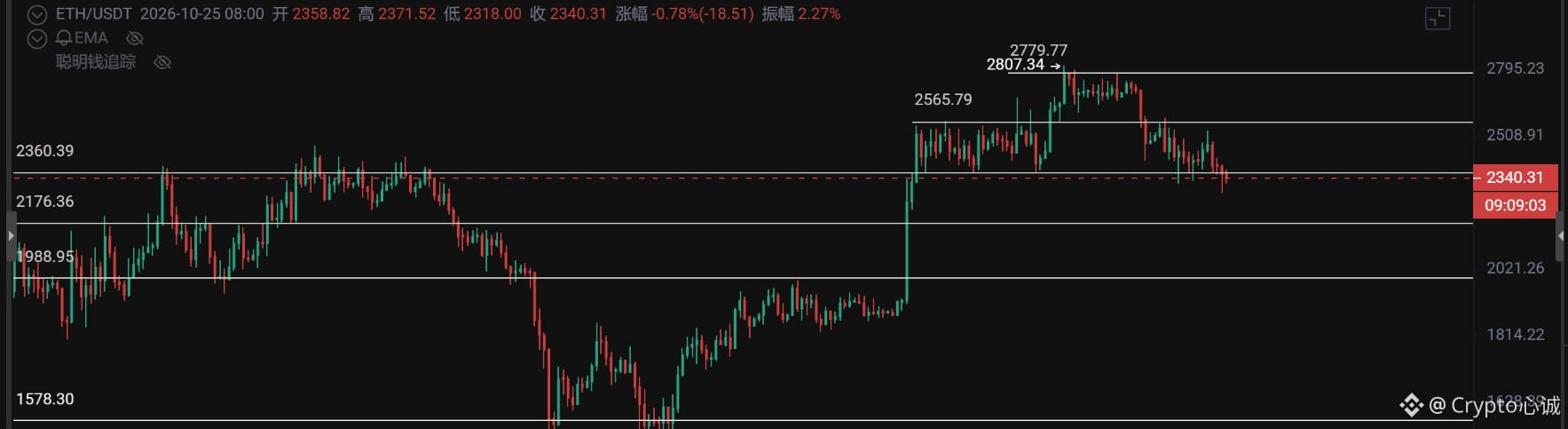
On September 25, Ethereum gave everyone a chance to reduce their positions on a rebound to 2,770. Since then, it has pulled back 17%, compared with Bitcoin's 9%. ETH's pullback is roughly twice as large as BTC's, which shows that ETH's price action is relatively weak.
Our previous expectation was to buy back at the weekly EMA30. BTC has only reached around 79K so far, still 5% above the EMA30 at 76,600. ETH, on the other hand, has already pulled back to its EMA30. So the conclusion is: if Bitcoin retests the 30-week line, ETH will inevitably break below its own and head toward around 2,150.
Personally, I think ETH's support below is around 2,180–2,000.
{future}(ETHUSDT)
$ETH Where would be a suitable level to buy back spot Ethereum?❓
On September 25, Ethereum gave everyone a chance to reduce their positions on a rebound to 2,770. Since then, it has pulled back 17%, compared with Bitcoin's 9%. ETH's pullback is roughly twice as large as BTC's, which shows that ETH's price action is relatively weak.
Our previous expectation was to buy back at the weekly EMA30. BTC has only reached around 79K so far, still 5% above the EMA30 at 76,600. ETH, on the other hand, has already pulled back to its EMA30. So the conclusion is: if Bitcoin retests the 30-week line, ETH will inevitably break below its own and head toward around 2,150.
Personally, I think ETH's support below is around 2,180–2,000.
536
·
--
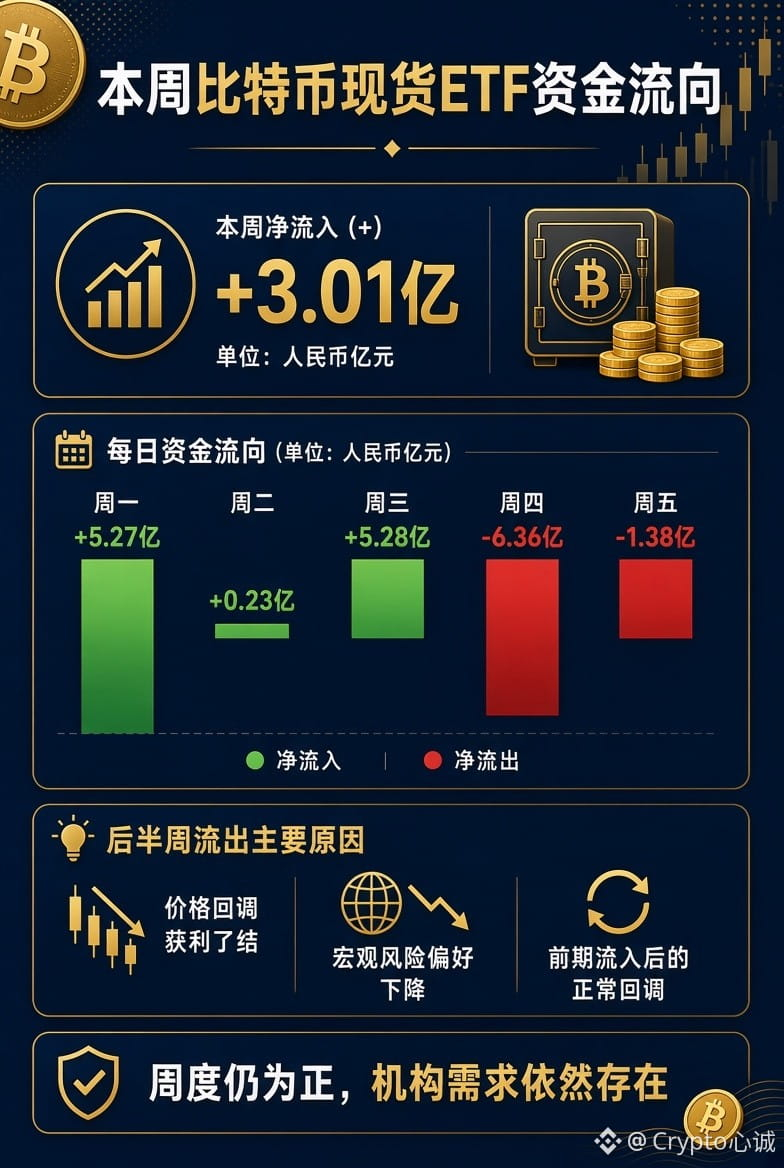
Bitcoin spot ETFs saw a net inflow of about 300 million this week, but there were suddenly large outflows in the second half of the week.
They bought more than 1 billion from Monday through Wednesday, then saw outflows of 636 million on Thursday alone and another 138 million on Friday. It looks alarming, but the reason is simple:
1. Bitcoin pulled back, prompting some investors to take profits;
2. Macroeconomic sentiment weakened, reducing risk appetite;
3. After heavy buying in the first three days, a normal pullback followed.
The key point is that weekly flows were still positive, which means institutions haven’t fled—the pace was simply interrupted. As long as prices regain their footing, the money will probably come back.
That’s the reality of ETFs: they don’t buy constantly; they move back and forth with sentiment and prices.
What do you make of these outflows? A short-term correction, or has the trend changed?
#比特币 #etf #加密货币
271
·
--
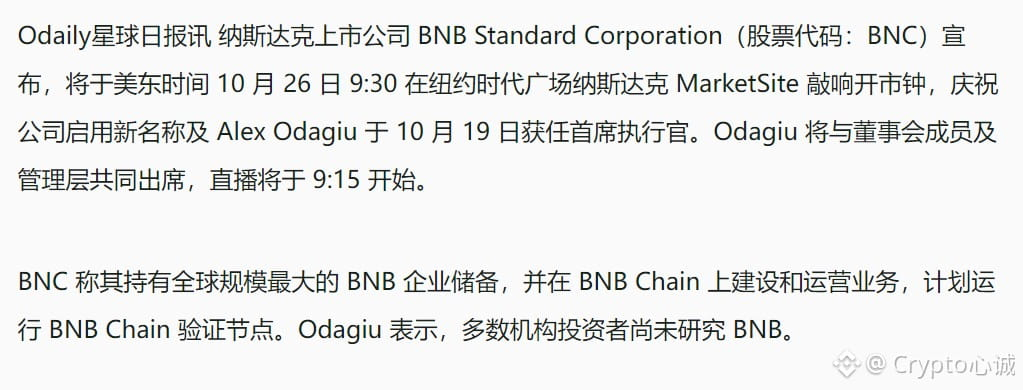
On 10/26, BNB Standard rang the Nasdaq bell, officially bringing the idea of the largest corporate treasury to the attention of traditional finance. Institutions haven’t seriously looked into BNB yet, so this kind of public exposure is worth more than another pretty candlestick chart.
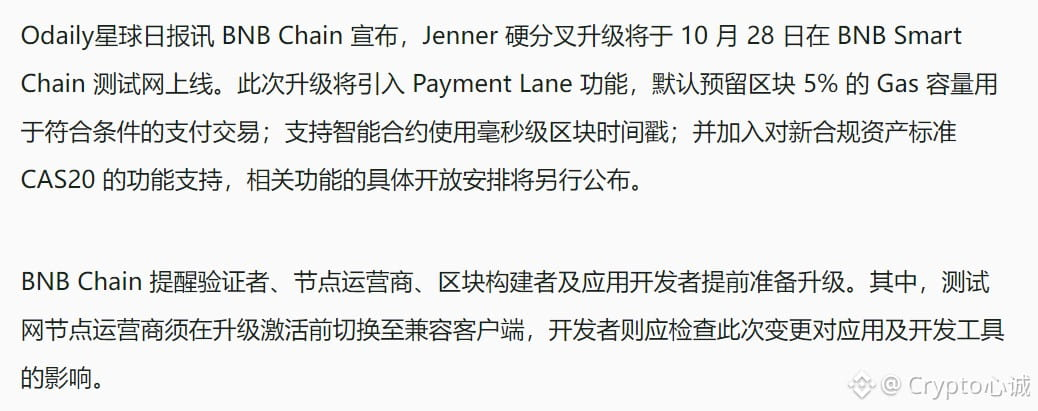
The 10/28 Jenner testnet is more substantive: prioritizing payments with Payment Lane, plus compliance tools through CAS20, addresses real-world adoption challenges rather than pushing another empty narrative.
My take: it may help sentiment in the short term, but the real upside is medium to long term—an institutional holding channel advancing alongside payment and RWA infrastructure. These are what will help BNB shed its “exchange token” label.#bnb
$BNB
{future}(BNBUSDT)
On 10/26, BNB Standard rang the Nasdaq bell, officially bringing the idea of the largest corporate treasury to the attention of traditional finance. Institutions haven’t seriously looked into BNB yet, so this kind of public exposure is worth more than another pretty candlestick chart.
The 10/28 Jenner testnet is more substantive: prioritizing payments with Payment Lane, plus compliance tools through CAS20, addresses real-world adoption challenges rather than pushing another empty narrative.
My take: it may help sentiment in the short term, but the real upside is medium to long term—an institutional holding channel advancing alongside payment and RWA infrastructure. These are what will help BNB shed its “exchange token” label.#bnb
$BNB
272
·
--
Major Web3 Events This Week (10.26–11.1)
October 26
Blast announces it is shutting down: its economic model is unsustainable, and users must withdraw their assets by October 26;
BNB Standard will ring the Nasdaq opening bell on October 26
Galxe reminds users to manage their G staking and Smart Savings balances, and complete unstaking and withdrawals by October 26
October 28
Strategy plans to change its preferred stock dividends to accrue daily, with a shareholder vote on October 28;
The US CFTC launches its Frontier Forums series, with the first session on October 28 focusing on AI and agentic finance
BNB Chain: The Jenner hard fork will launch on the testnet on October 28, introducing features including dedicated payment channels
October 29
The Federal Reserve will announce its latest interest rate decision at 2:00 on October 29;
The European Central Bank will announce its latest interest rate decision at 21:15 on October 29;
Strategy will report its third-quarter earnings after the US stock market closes on October 29;
The Unichain mainnet will migrate to OP Enterprise on October 29
October 30
The Bank of Japan will announce its interest rate decision on October 30;
The Balancer community has approved an orderly wind-down proposal; liquidity pools will remain operational until October 30;
Brazil's crypto market faces a licensing deadline: service providers must apply by October 30, 2026
After $23.75 million in losses, Ostium's Phase 2 compensation portal will go live on October 30
Stablecoin protocol Ebisu is winding down; its frontend will be discontinued on October 30
October 31
Polymarket: Trading fees waived across eight market categories, with the promotion running through the end of October;
Circle CCTP V1 will be deprecated starting October 31, with users moving to V2
ECX plans to launch its mainnet on October 31, with most Bitcoin holders eligible to receive ECX at a 1:1 ratio
MyNearWallet will cease operations on October 31; users need to migrate to another wallet
Cardano Card will discontinue its services on October 31 as Wirex transitions to a non-custodial model
Ronin Waypoint enters its final grace period and will shut down permanently on October 31
November 1
StandX: The DUSD airdrop will be open for claiming at 8:00 AM Beijing time on November 1;
Other (exact dates and times TBD)
OpenAI is reportedly set to complete a fundraising round of up to $30 billion, with the related agreements expected to be signed by the end of next week
Cysic plans to burn 7.2 million CYS by the end of October to offset the impact of unauthorized issuance
$BTC
{future}(BTCUSDT)
Major Web3 Events This Week (10.26–11.1)
October 26
Blast announces it is shutting down: its economic model is unsustainable, and users must withdraw their assets by October 26;
BNB Standard will ring the Nasdaq opening bell on October 26
Galxe reminds users to manage their G staking and Smart Savings balances, and complete unstaking and withdrawals by October 26
October 28
Strategy plans to change its preferred stock dividends to accrue daily, with a shareholder vote on October 28;
The US CFTC launches its Frontier Forums series, with the first session on October 28 focusing on AI and agentic finance
BNB Chain: The Jenner hard fork will launch on the testnet on October 28, introducing features including dedicated payment channels
October 29
The Federal Reserve will announce its latest interest rate decision at 2:00 on October 29;
The European Central Bank will announce its latest interest rate decision at 21:15 on October 29;
Strategy will report its third-quarter earnings after the US stock market closes on October 29;
The Unichain mainnet will migrate to OP Enterprise on October 29
October 30
The Bank of Japan will announce its interest rate decision on October 30;
The Balancer community has approved an orderly wind-down proposal; liquidity pools will remain operational until October 30;
Brazil's crypto market faces a licensing deadline: service providers must apply by October 30, 2026
After $23.75 million in losses, Ostium's Phase 2 compensation portal will go live on October 30
Stablecoin protocol Ebisu is winding down; its frontend will be discontinued on October 30
October 31
Polymarket: Trading fees waived across eight market categories, with the promotion running through the end of October;
Circle CCTP V1 will be deprecated starting October 31, with users moving to V2
ECX plans to launch its mainnet on October 31, with most Bitcoin holders eligible to receive ECX at a 1:1 ratio
MyNearWallet will cease operations on October 31; users need to migrate to another wallet
Cardano Card will discontinue its services on October 31 as Wirex transitions to a non-custodial model
Ronin Waypoint enters its final grace period and will shut down permanently on October 31
November 1
StandX: The DUSD airdrop will be open for claiming at 8:00 AM Beijing time on November 1;
Other (exact dates and times TBD)
OpenAI is reportedly set to complete a fundraising round of up to $30 billion, with the related agreements expected to be signed by the end of next week
Cysic plans to burn 7.2 million CYS by the end of October to offset the impact of unauthorized issuance
$BTC

179
·
--
$BTC
{future}(BTCUSDT)
$ETH
{future}(ETHUSDT)
$TRUMP
{future}(TRUMPUSDT)
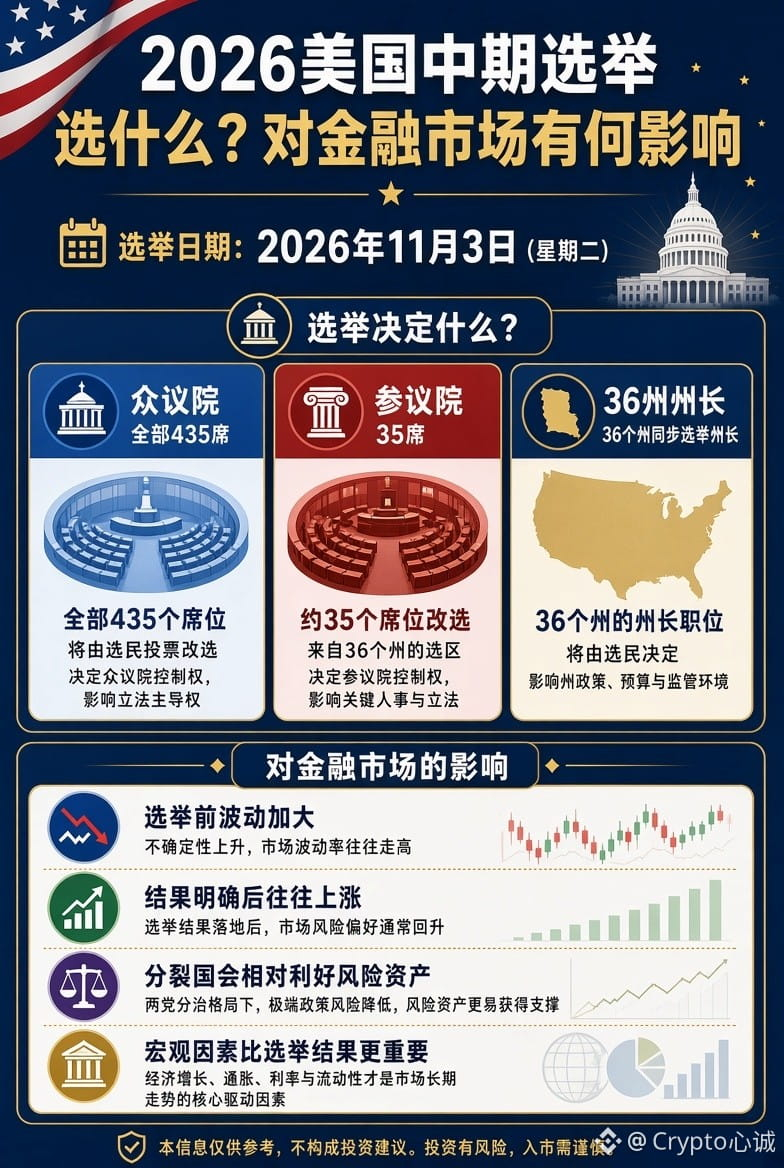
The 2026 U.S. midterm elections will be held on November 3. There won’t be a presidential election; the main races will be for all 435 House seats, 35 Senate seats, and governorships in 36 states. Republicans currently hold narrow majorities in both chambers, and Democrats would need to gain about four seats net to take control.
The impact on Trump will be fairly direct: if Republicans hold Congress, he’ll have a relatively clear path to advancing his agenda over the next two years. If Democrats take one or both chambers, he’ll become a lame duck, with legislation and budgets likely to be blocked and executive orders facing more constraints.
💫My take:
Midterm elections are essentially a performance review of the sitting president. Historically, it’s the norm for the president’s party to lose seats in the midterms. Markets care more about whether the outcome is clear than about who wins. Volatility tends to rise before the election, but once the results are in, uncertainty falls—which often ends up benefiting risk assets. For Trump, this election is the most important midterm test of his second term, and the result will directly affect how much room he has to maneuver over the next two years.
$BTC
$ETH
$TRUMP
The 2026 U.S. midterm elections will be held on November 3. There won’t be a presidential election; the main races will be for all 435 House seats, 35 Senate seats, and governorships in 36 states. Republicans currently hold narrow majorities in both chambers, and Democrats would need to gain about four seats net to take control.
The impact on Trump will be fairly direct: if Republicans hold Congress, he’ll have a relatively clear path to advancing his agenda over the next two years. If Democrats take one or both chambers, he’ll become a lame duck, with legislation and budgets likely to be blocked and executive orders facing more constraints.
💫My take:
Midterm elections are essentially a performance review of the sitting president. Historically, it’s the norm for the president’s party to lose seats in the midterms. Markets care more about whether the outcome is clear than about who wins. Volatility tends to rise before the election, but once the results are in, uncertainty falls—which often ends up benefiting risk assets. For Trump, this election is the most important midterm test of his second term, and the result will directly affect how much room he has to maneuver over the next two years.
1
1.8k
·
--
Is now a good time to buy the dip in crypto?❓
Personally, I think there’s no need to go all in just yet. You can build your position gradually in stages, using a pyramid approach. For now, start with a small position.
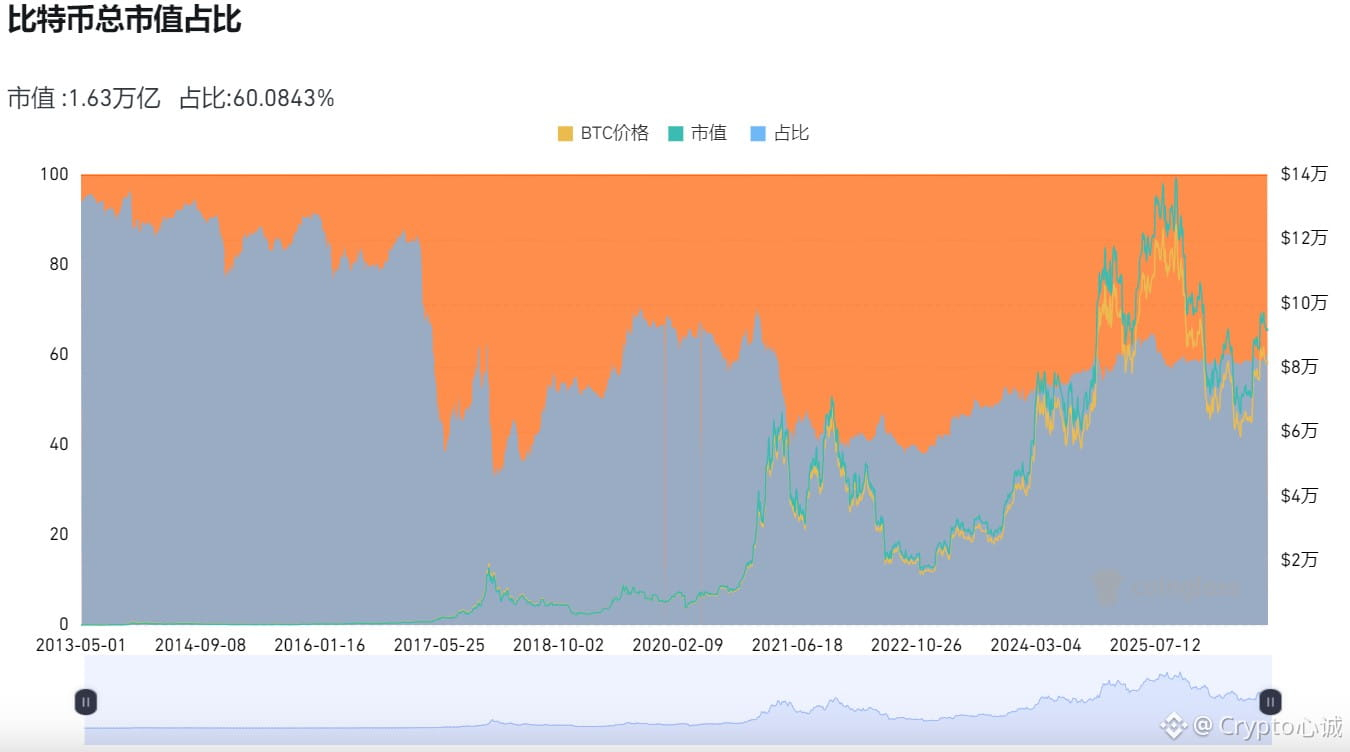
Bitcoin is down only 7–8% from its September high and is currently hovering around $80,000, still a fair distance from its all-time high. Altcoins have fallen further, and some projects with real revenue are relatively cheaper now.
But this looks more like a period of consolidation and correction than a clear bottom. ETF flows keep switching between inflows and outflows, and the Fed meeting is still ahead, so risk appetite is low. A steadier approach would be to buy Bitcoin and fundamentally sound altcoins in stages, while keeping some cash on hand. Don’t treat this as an opportunity to jump in because prices are about to take off.
Technical outlook: This pullback is happening on the weekly chart. Watch the support zone around 77,000–75,000 at the 30-week EMA.
$BTC
{future}(BTCUSDT)
Is now a good time to buy the dip in crypto?❓
Personally, I think there’s no need to go all in just yet. You can build your position gradually in stages, using a pyramid approach. For now, start with a small position.
Bitcoin is down only 7–8% from its September high and is currently hovering around $80,000, still a fair distance from its all-time high. Altcoins have fallen further, and some projects with real revenue are relatively cheaper now.
But this looks more like a period of consolidation and correction than a clear bottom. ETF flows keep switching between inflows and outflows, and the Fed meeting is still ahead, so risk appetite is low. A steadier approach would be to buy Bitcoin and fundamentally sound altcoins in stages, while keeping some cash on hand. Don’t treat this as an opportunity to jump in because prices are about to take off.
Technical outlook: This pullback is happening on the weekly chart. Watch the support zone around 77,000–75,000 at the 30-week EMA.
$BTC
1
1.6k
·
--
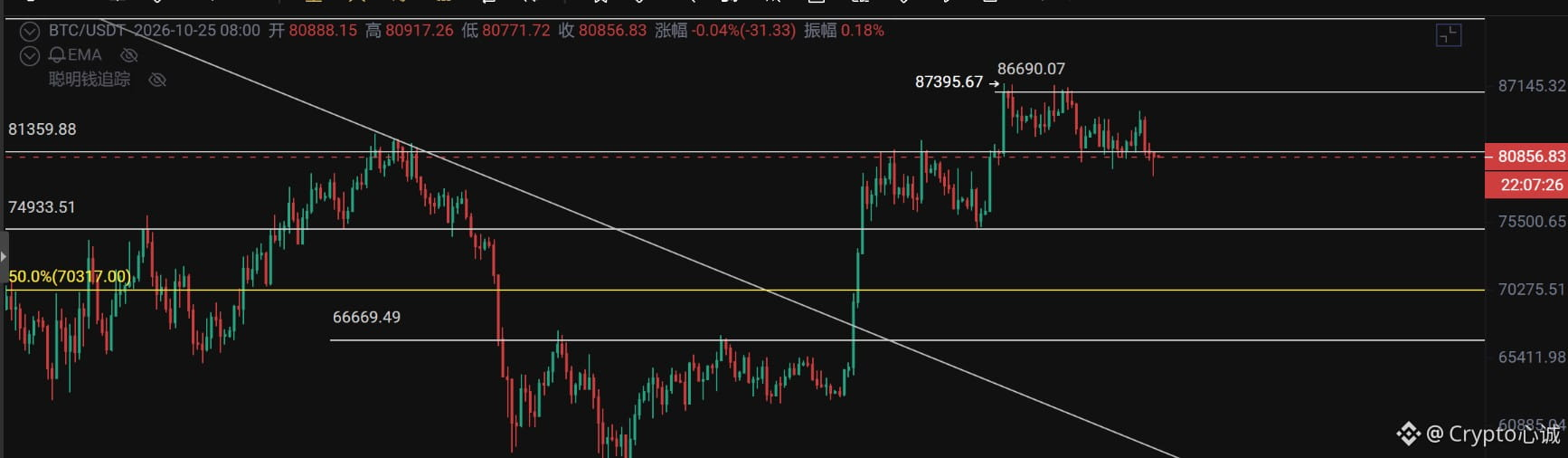
Oct 25 $BTC Market Analysis
💫 News:
Prices fell below $80k over the weekend, accompanied by large-scale long liquidations. Crypto liquidations exceeded $800 million in 24 hours.
Macro factors: Tech stock sell-offs and geopolitical risks (related to oil prices) continue to weigh on risk appetite. The market is watching the upcoming Federal Reserve meeting on October 28.
There have been no major unexpected positive catalysts. ETF outflows and leveraged liquidations are the main drivers of the decline. Some companies are still increasing their holdings, but overall sentiment remains cautious.
💫 Capital flows:
U.S. spot Bitcoin ETFs saw significant net outflows of around $635.6M on Thursday, followed by further net outflows of about $138M on Friday. Net inflows from the previous three days were largely erased, and October's cumulative flows turned negative again. Weaker institutional buying is putting pressure on prices.
💫 Technical analysis:
I've been reminding everyone for a while to be mindful of the risk of a pullback. However, at this point, I personally don't think the correction will be very deep; it may simply be a retest on the weekly timeframe. As for key support below, I believe the $72,000–$78,000 range is worth watching closely.
Yesterday, the price simply tested the $80,000 support level. There is indeed support at $80,000, but I don't think it's strong enough to establish a bottom here. So, in my view, the daily chart hasn't completed its correction yet, and the consolidation period may get longer. The upcoming interest rate decision and midterm elections could lead to significant market volatility.
Support: 76000–73000
Resistance: 82000–81500
{future}(BTCUSDT)
Oct 25 $BTC Market Analysis
💫 News:
Prices fell below $80k over the weekend, accompanied by large-scale long liquidations. Crypto liquidations exceeded $800 million in 24 hours.
Macro factors: Tech stock sell-offs and geopolitical risks (related to oil prices) continue to weigh on risk appetite. The market is watching the upcoming Federal Reserve meeting on October 28.
There have been no major unexpected positive catalysts. ETF outflows and leveraged liquidations are the main drivers of the decline. Some companies are still increasing their holdings, but overall sentiment remains cautious.
💫 Capital flows:
U.S. spot Bitcoin ETFs saw significant net outflows of around $635.6M on Thursday, followed by further net outflows of about $138M on Friday. Net inflows from the previous three days were largely erased, and October's cumulative flows turned negative again. Weaker institutional buying is putting pressure on prices.
💫 Technical analysis:
I've been reminding everyone for a while to be mindful of the risk of a pullback. However, at this point, I personally don't think the correction will be very deep; it may simply be a retest on the weekly timeframe. As for key support below, I believe the $72,000–$78,000 range is worth watching closely.
Yesterday, the price simply tested the $80,000 support level. There is indeed support at $80,000, but I don't think it's strong enough to establish a bottom here. So, in my view, the daily chart hasn't completed its correction yet, and the consolidation period may get longer. The upcoming interest rate decision and midterm elections could lead to significant market volatility.
Support: 76000–73000
Resistance: 82000–81500
1
448
·
--
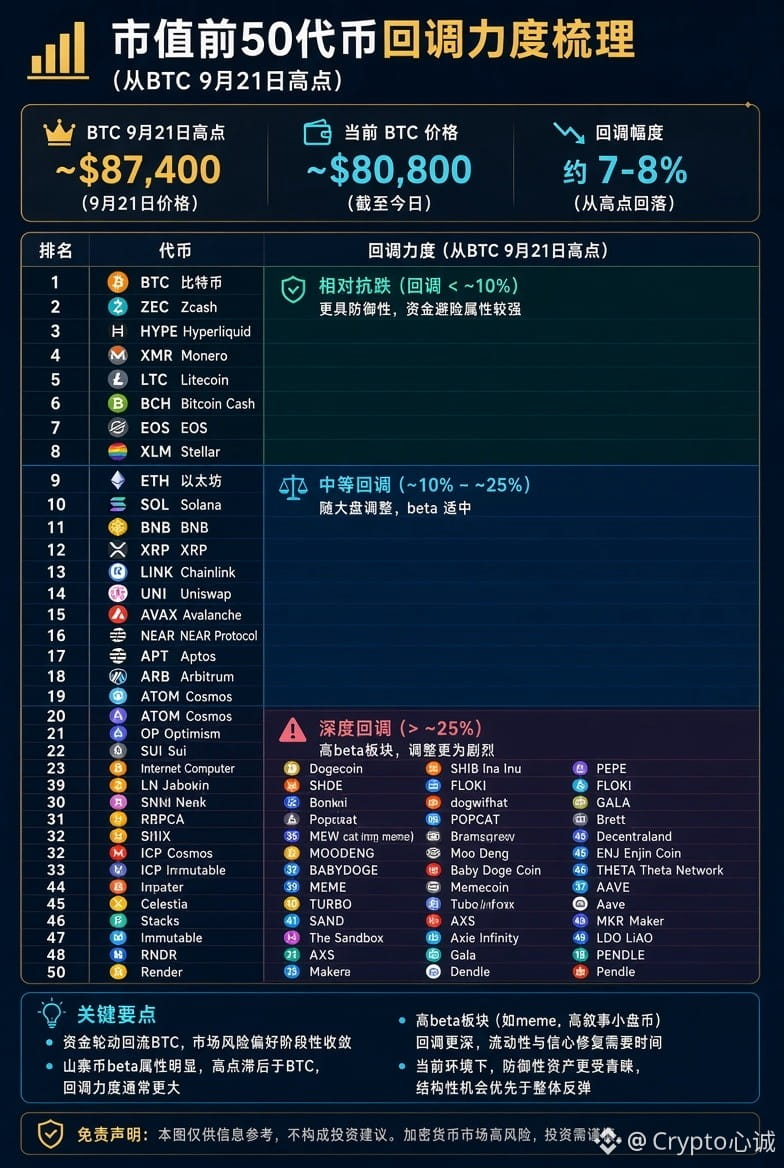
Since Bitcoin’s September 21 peak, BTC itself has fallen only about 7–8%, but the top 50 altcoins have fared noticeably worse overall.
The ones holding up relatively well are still those with real support: coins like ZEC, HYPE, and XMR, which have a narrative or revenue, have fallen less. Major coins like ETH, SOL, BNB, XRP, LINK, and UNI are mostly in the middle of the pack, with significantly higher beta than BTC. Further down the risk spectrum, highly leveraged and purely sentiment-driven altcoins have seen steeper pullbacks, often more than twice BTC’s decline.
My take:
This is a textbook case of declining risk appetite, with capital flowing back into Bitcoin. Altcoins can still rise, but leverage and excess froth need to be flushed out first. Projects with real revenue, buybacks, or strong fundamentals are relatively more resilient; those driven purely by narrative speculation are more likely to remain under pressure.
$BTC
{future}(BTCUSDT)
$ETH
{future}(ETHUSDT)
$PONS
{future}(PONSUSDT)
Since Bitcoin’s September 21 peak, BTC itself has fallen only about 7–8%, but the top 50 altcoins have fared noticeably worse overall.
The ones holding up relatively well are still those with real support: coins like ZEC, HYPE, and XMR, which have a narrative or revenue, have fallen less. Major coins like ETH, SOL, BNB, XRP, LINK, and UNI are mostly in the middle of the pack, with significantly higher beta than BTC. Further down the risk spectrum, highly leveraged and purely sentiment-driven altcoins have seen steeper pullbacks, often more than twice BTC’s decline.
My take:
This is a textbook case of declining risk appetite, with capital flowing back into Bitcoin. Altcoins can still rise, but leverage and excess froth need to be flushed out first. Projects with real revenue, buybacks, or strong fundamentals are relatively more resilient; those driven purely by narrative speculation are more likely to remain under pressure.
$BTC
$ETH
$PONS
1.3k
·
--
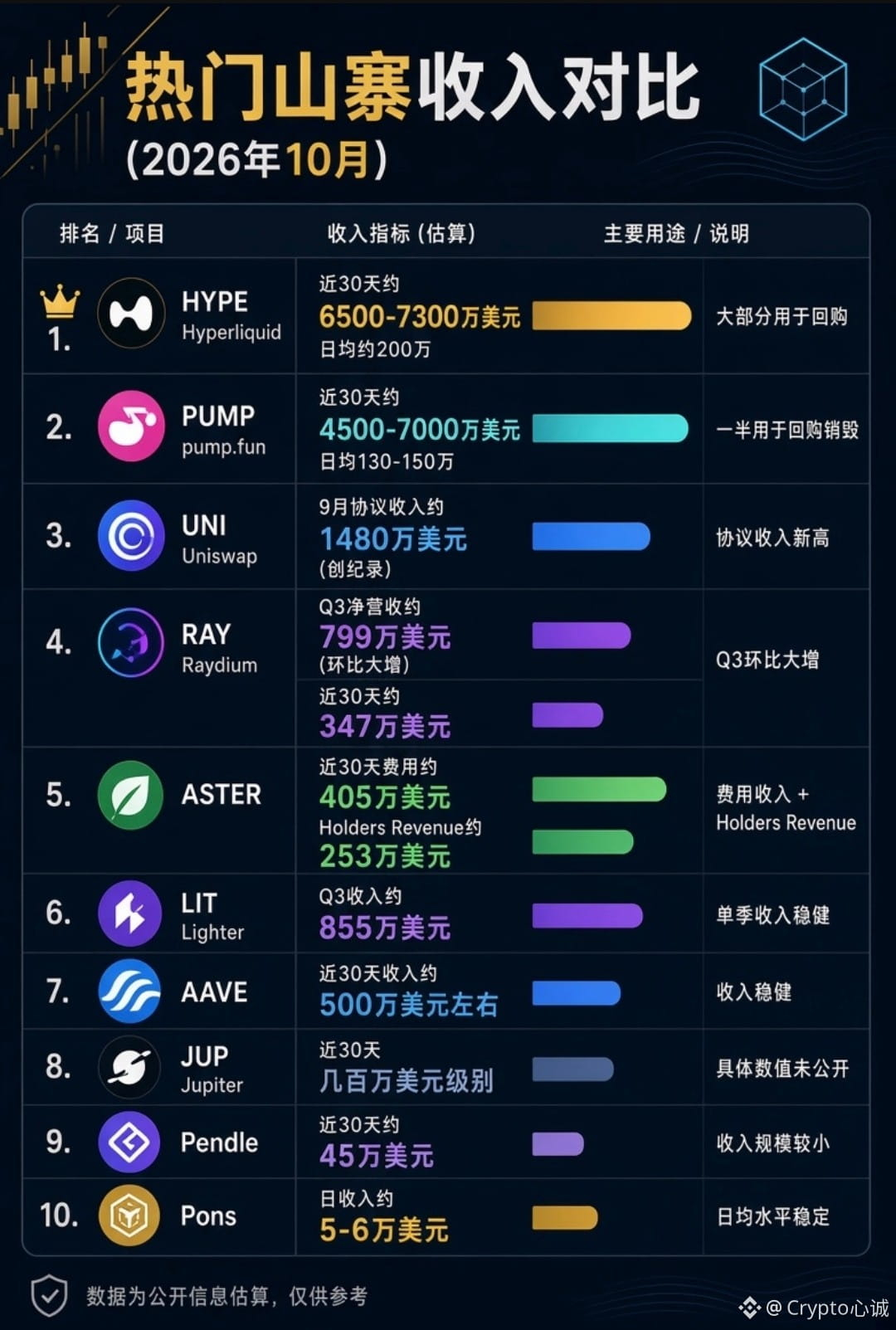
💥 A roundup of revenue among today’s popular altcoins:
HYPE and PUMP are still the heavy hitters when it comes to revenue ✊
HYPE generated around $65–73 million in revenue over the past 30 days, most of which went directly toward buybacks;
PUMP brought in around $45–70 million, with half used for buybacks and burns.
Mid-tier:
UNI set a record with around $14.8 million in protocol revenue in September; RAY had around $7.99 million in net revenue in Q3; ASTER generated around $4.05 million in fees over the past 30 days; LIT brought in around $8.55 million in Q3.
On the weaker side:
AAVE generated around $5 million in protocol revenue; JUP brought in a few million dollars; Pendle around $450,000; and Pons just $50,000–60,000 per day on average.
My take:
Right now, HYPE and PUMP are the only ones that can truly turn revenue into token value. The others are either making progress or have relatively small revenues.
So, which token are you more bullish on?❓
$HYPE
{future}(HYPEUSDT)
$UNI
{future}(UNIUSDT)
$PUMP
{future}(PUMPUSDT)
💥 A roundup of revenue among today’s popular altcoins:
HYPE and PUMP are still the heavy hitters when it comes to revenue ✊
HYPE generated around $65–73 million in revenue over the past 30 days, most of which went directly toward buybacks;
PUMP brought in around $45–70 million, with half used for buybacks and burns.
Mid-tier:
UNI set a record with around $14.8 million in protocol revenue in September; RAY had around $7.99 million in net revenue in Q3; ASTER generated around $4.05 million in fees over the past 30 days; LIT brought in around $8.55 million in Q3.
On the weaker side:
AAVE generated around $5 million in protocol revenue; JUP brought in a few million dollars; Pendle around $450,000; and Pons just $50,000–60,000 per day on average.
My take:
Right now, HYPE and PUMP are the only ones that can truly turn revenue into token value. The others are either making progress or have relatively small revenues.
So, which token are you more bullish on?❓
$HYPE
$UNI
$PUMP
1
2
8.3k
·
--
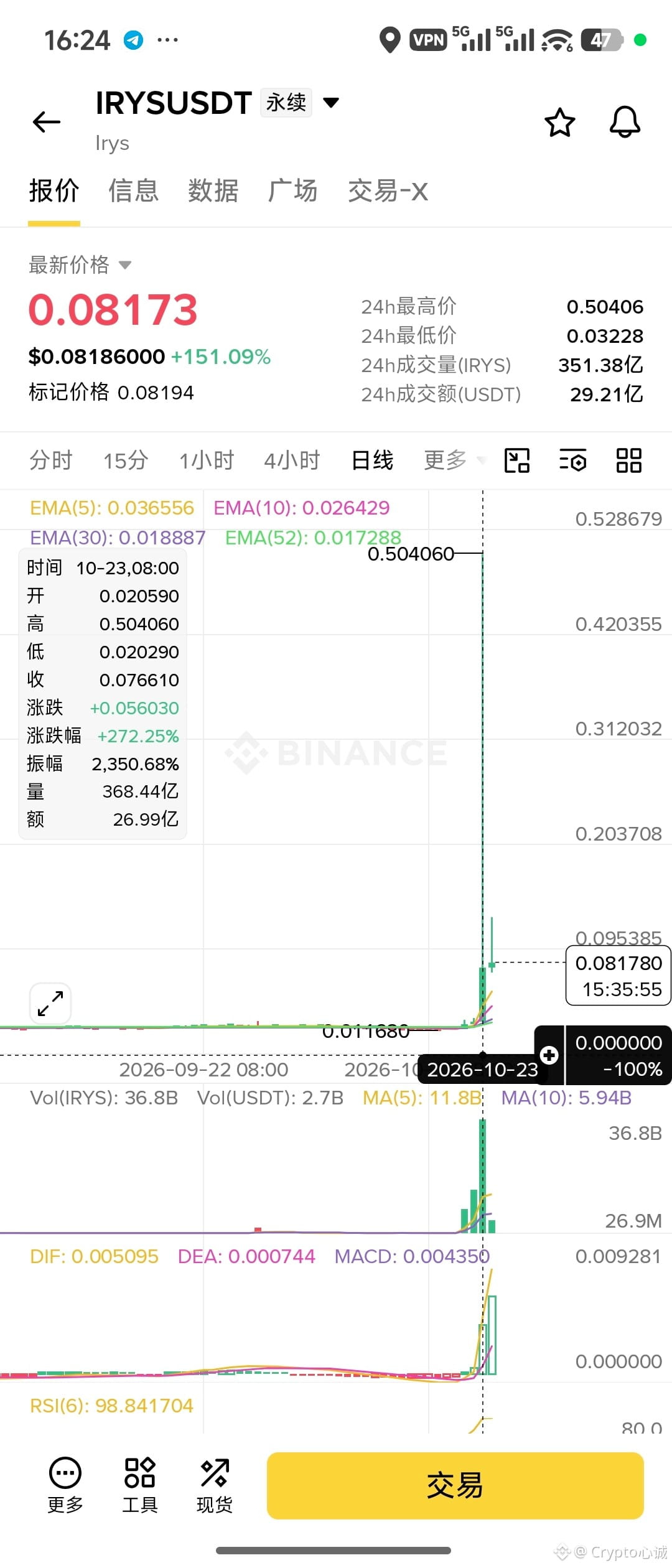
$IRYS I haven't seen this kind of antenna in ages. One antenna, 20x—did any of you lucky guys catch it? And how many of you are stuck at the top of the mountain?
{future}(IRYSUSDT)
$IRYS I haven't seen this kind of antenna in ages. One antenna, 20x—did any of you lucky guys catch it? And how many of you are stuck at the top of the mountain?
327
·
--
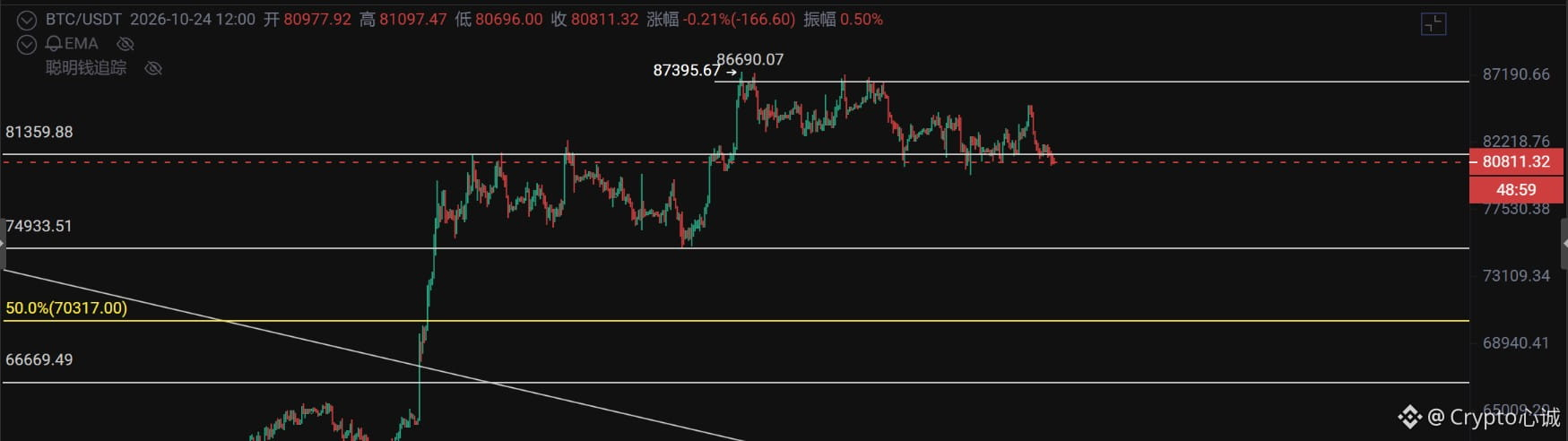
$BTC has continued to fluctuate around 80,000. I think it doesn't have much time left at this level, and a market reversal is imminent. I still think spot positions can be accumulated in batches within the 72,000–76,000 range below.
Next week, the main trend is likely to be volatile and downward. Pay particular attention to the risk of a rapid drop.
{future}(BTCUSDT)
$BTC has continued to fluctuate around 80,000. I think it doesn't have much time left at this level, and a market reversal is imminent. I still think spot positions can be accumulated in batches within the 72,000–76,000 range below.
Next week, the main trend is likely to be volatile and downward. Pay particular attention to the risk of a rapid drop.
Next week, the main trend is likely to be volatile and downward. Pay particular attention to the risk of a rapid drop.
1
864
·
--
Verified
$XAUT
{future}(XAUTUSDT)
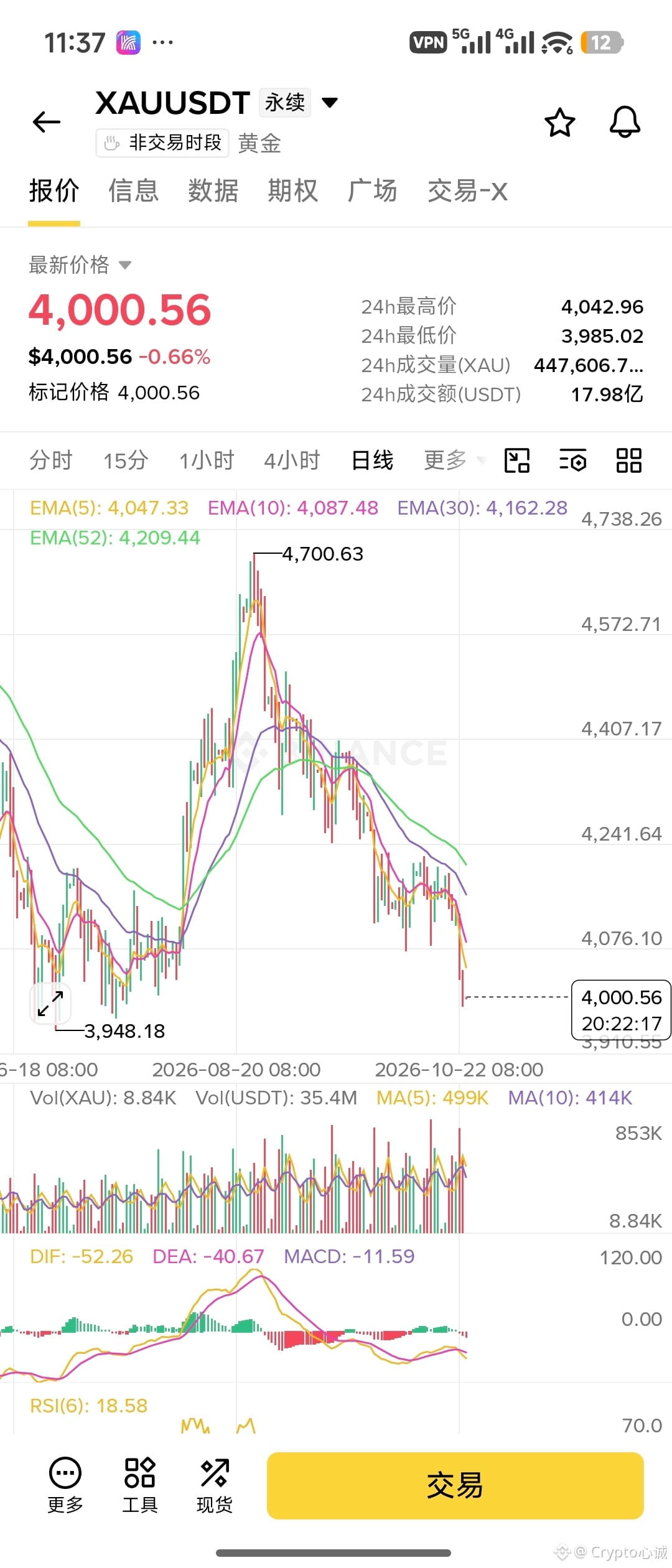
What does gold falling below $4,000 mean?
On October 23, spot gold briefly fell to around $3,986, its lowest level in three months. It was down about 4% for the week, its biggest weekly decline since June. The main reasons were surging oil prices amid tensions in the Middle East and rising inflation concerns, prompting markets to reprice expectations for “higher for longer” Fed rates, as well as liquidity pressures triggered by a stock market sell-off.
This doesn’t mean gold’s fundamentals have collapsed. Rather, in a high-interest-rate environment, its safe-haven appeal has temporarily faded. After the technical breakdown, short-term volatility is likely to increase, with the next support level at 3,950–3,970.
My view: $4,000 is an important psychological level. If it fails to hold, the correction could continue. But central-bank gold purchases and investment demand remain in place over the long term. Gold is better suited as a hedge than for chasing short-term gains or panic selling. This is a repricing, not the end of an era.
#黄金自7月以来首次跌破4000美元
$XAUT
What does gold falling below $4,000 mean?
On October 23, spot gold briefly fell to around $3,986, its lowest level in three months. It was down about 4% for the week, its biggest weekly decline since June. The main reasons were surging oil prices amid tensions in the Middle East and rising inflation concerns, prompting markets to reprice expectations for “higher for longer” Fed rates, as well as liquidity pressures triggered by a stock market sell-off.
This doesn’t mean gold’s fundamentals have collapsed. Rather, in a high-interest-rate environment, its safe-haven appeal has temporarily faded. After the technical breakdown, short-term volatility is likely to increase, with the next support level at 3,950–3,970.
My view: $4,000 is an important psychological level. If it fails to hold, the correction could continue. But central-bank gold purchases and investment demand remain in place over the long term. Gold is better suited as a hedge than for chasing short-term gains or panic selling. This is a repricing, not the end of an era.
#黄金自7月以来首次跌破4000美元
1
2
6.4k
Log in to explore more content
Join global crypto users on Binance Square
⚡️ Get latest and useful information about crypto.
💬 Trusted by the world’s largest crypto exchange.
👍 Discover real insights from verified creators.
Email / Phone number
Trending Topics
BinancePick
3.4M views
165,202 Discussing
Join #EarningsSeason: Predict Earnings on Binance Pick, Share Your Take on Binance Square!
Binance Square Official
·419 Likes
·345.5k views
EarningsSeason
5.5M views
26,948 Discussing
StrategySkipsBitcoinPurchasesSpends$205MOnSTRCBuybacks
930 views
30 Discussing