
Strange Mage
25 Posts

Strange Mage
Report
Block User
4 Following
2 Followers
2 Liked
Posts
·
--
What interested me most in bStocks wasn’t the stock tokenization itself, but what happens with dividends. There is no regular cash payout to your balance. For example, when a company pays a dividend, its net amount is reinvested back into the same bStock—meaning the number of economic exposures gradually increases. Binance has already separately announced such distributions for Qualcomm, PayPal, Alphabet, Corning, and Goldman Sachs.
For me, this is an interesting point because bStocks go beyond just a simple return based on a stock price increase. Something closer to automated income reinvestment is being formed here, but in a tokenized format.
Even more interesting is that Binance allows you to convert bStocks and the underlying shares in both directions, and the product itself has already surpassed $100 million in AUM.
So I would assess bStocks not by the number of new tickers, but by how well this model works for long-term accumulation. That, in my opinion, is where the real product test will happen.
#bStocksCIS #Binance #RWA #TradFi #Investing
What interested me most in bStocks wasn’t the stock tokenization itself, but what happens with dividends. There is no regular cash payout to your balance. For example, when a company pays a dividend, its net amount is reinvested back into the same bStock—meaning the number of economic exposures gradually increases. Binance has already separately announced such distributions for Qualcomm, PayPal, Alphabet, Corning, and Goldman Sachs.
For me, this is an interesting point because bStocks go beyond just a simple return based on a stock price increase. Something closer to automated income reinvestment is being formed here, but in a tokenized format.
Even more interesting is that Binance allows you to convert bStocks and the underlying shares in both directions, and the product itself has already surpassed $100 million in AUM.
So I would assess bStocks not by the number of new tickers, but by how well this model works for long-term accumulation. That, in my opinion, is where the real product test will happen.
#bStocksCIS #Binance #RWA #TradFi #Investing
For me, this is an interesting point because bStocks go beyond just a simple return based on a stock price increase. Something closer to automated income reinvestment is being formed here, but in a tokenized format.
Even more interesting is that Binance allows you to convert bStocks and the underlying shares in both directions, and the product itself has already surpassed $100 million in AUM.
So I would assess bStocks not by the number of new tickers, but by how well this model works for long-term accumulation. That, in my opinion, is where the real product test will happen.
#bStocksCIS #Binance #RWA #TradFi #Investing

59
·
--
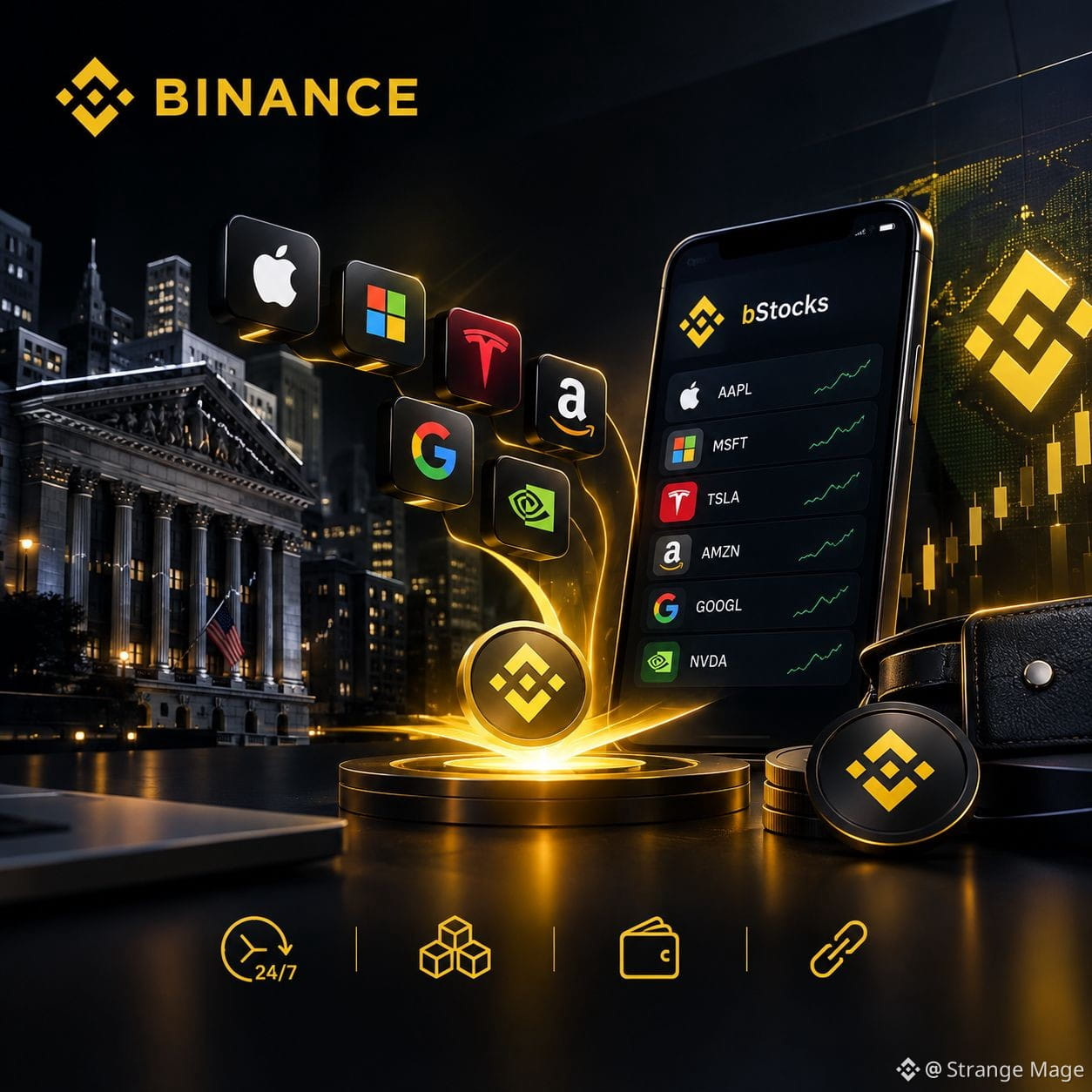
Recently, I’ve been looking at bStocks not just as “tokenized shares,” but as an experiment in how far it’s possible to blend TradFi and crypto. And the numbers here are interesting: bStocks were launched only in June 2026, and by September 2, Binance had already added four more instruments—CrowdStrike, Moderna, Seagate, and ProShares UltraPro Short QQQ. What’s more, they were integrated not only into Spot, but also into trading bots and Margin as collateral.
For me, this matters more than simply expanding the list of assets. bStocks are gradually turning into infrastructure where stocks gain crypto-like properties: 24/7 trading, transfers to a wallet, and use in an on-chain environment. At the same time, the backing is declared as 1:1 with real shares.
But there’s a crucial nuance: bStocks are not the shares themselves and do not grant voting rights or direct ownership of the company.
So, I see the main value of bStocks not in replacing the stock market, but in making it a part of the crypto ecosystem.
#bStocksCIS #Binance #RWA #TradFi #Crypto
Recently, I’ve been looking at bStocks not just as “tokenized shares,” but as an experiment in how far it’s possible to blend TradFi and crypto. And the numbers here are interesting: bStocks were launched only in June 2026, and by September 2, Binance had already added four more instruments—CrowdStrike, Moderna, Seagate, and ProShares UltraPro Short QQQ. What’s more, they were integrated not only into Spot, but also into trading bots and Margin as collateral.
For me, this matters more than simply expanding the list of assets. bStocks are gradually turning into infrastructure where stocks gain crypto-like properties: 24/7 trading, transfers to a wallet, and use in an on-chain environment. At the same time, the backing is declared as 1:1 with real shares.
But there’s a crucial nuance: bStocks are not the shares themselves and do not grant voting rights or direct ownership of the company.
So, I see the main value of bStocks not in replacing the stock market, but in making it a part of the crypto ecosystem.
#bStocksCIS #Binance #RWA #TradFi #Crypto
For me, this matters more than simply expanding the list of assets. bStocks are gradually turning into infrastructure where stocks gain crypto-like properties: 24/7 trading, transfers to a wallet, and use in an on-chain environment. At the same time, the backing is declared as 1:1 with real shares.
But there’s a crucial nuance: bStocks are not the shares themselves and do not grant voting rights or direct ownership of the company.
So, I see the main value of bStocks not in replacing the stock market, but in making it a part of the crypto ecosystem.
#bStocksCIS #Binance #RWA #TradFi #Crypto
103
·
--
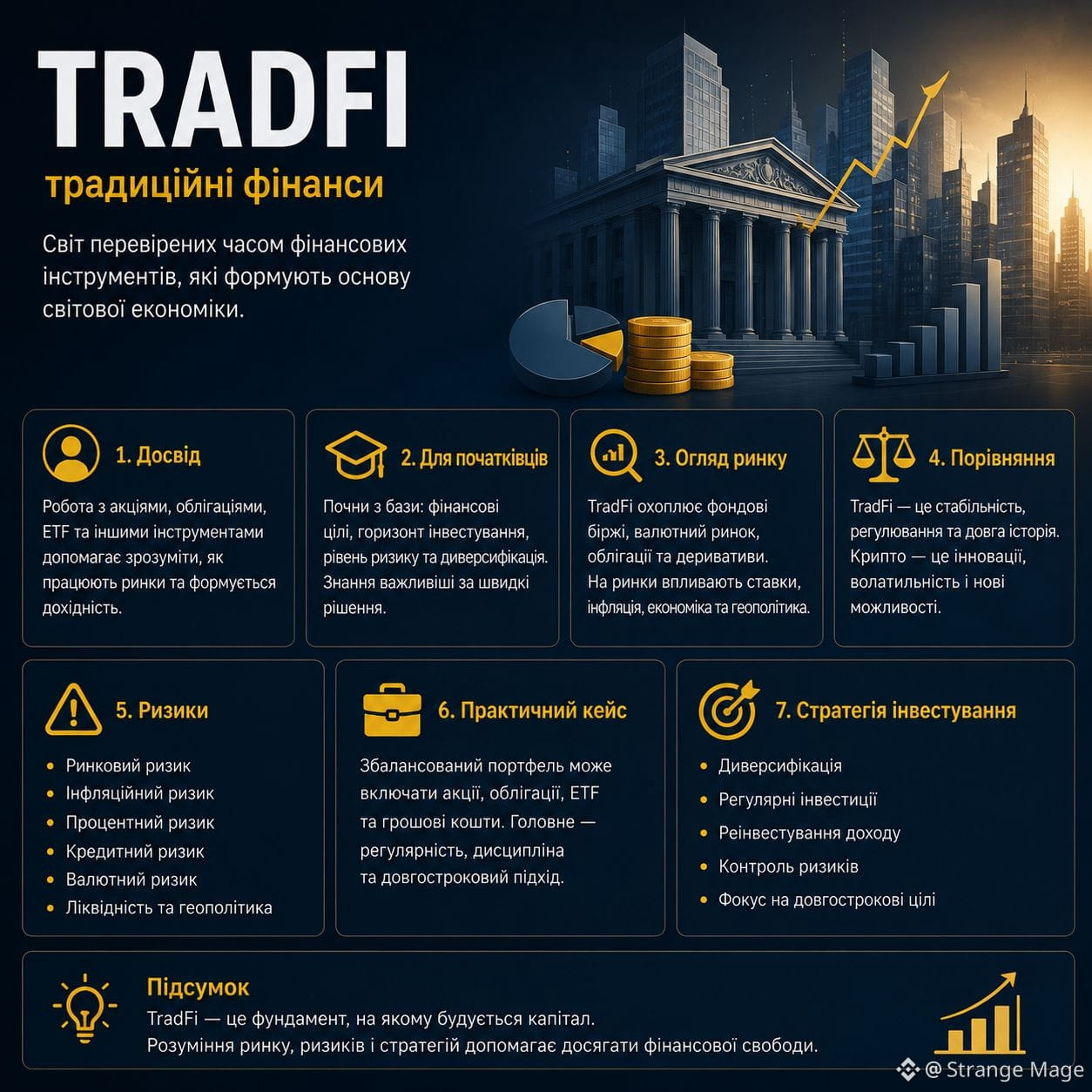
The more I understand TradFi, the more I realize it’s not just “old finance” that crypto is trying to replace. In reality, it’s a huge system with decades of history, where each instrument has its own role.
Personal experience. The most interesting to me are stocks, ETFs, and bonds. They offer different ways to work with capital, so there’s no point in judging TradFi only by potential returns.
For a beginner, I wouldn’t start by looking for the “best stock,” but by understanding your goals: the time horizon, acceptable risk, and required liquidity. Without that, even a good asset can easily turn into a bad investment.
If we look at the market, TradFi remains the foundation of the global economy. Interest rates, inflation, company reports, and central bank decisions directly affect the value of assets.
Risks don’t go away: market downturns, inflation, credit risk, changes in rates, and currency fluctuations can significantly impact the result.
My strategy is diversification, regular investing, and a long-term horizon. TradFi is interesting precisely when you use it not to guess the next pump, but to systematically build capital.
#TradFi #Investing #RWA #Binance #bStocksCIS
The more I understand TradFi, the more I realize it’s not just “old finance” that crypto is trying to replace. In reality, it’s a huge system with decades of history, where each instrument has its own role.
Personal experience. The most interesting to me are stocks, ETFs, and bonds. They offer different ways to work with capital, so there’s no point in judging TradFi only by potential returns.
For a beginner, I wouldn’t start by looking for the “best stock,” but by understanding your goals: the time horizon, acceptable risk, and required liquidity. Without that, even a good asset can easily turn into a bad investment.
If we look at the market, TradFi remains the foundation of the global economy. Interest rates, inflation, company reports, and central bank decisions directly affect the value of assets.
Risks don’t go away: market downturns, inflation, credit risk, changes in rates, and currency fluctuations can significantly impact the result.
My strategy is diversification, regular investing, and a long-term horizon. TradFi is interesting precisely when you use it not to guess the next pump, but to systematically build capital.
#TradFi #Investing #RWA #Binance #bStocksCIS
Personal experience. The most interesting to me are stocks, ETFs, and bonds. They offer different ways to work with capital, so there’s no point in judging TradFi only by potential returns.
For a beginner, I wouldn’t start by looking for the “best stock,” but by understanding your goals: the time horizon, acceptable risk, and required liquidity. Without that, even a good asset can easily turn into a bad investment.
If we look at the market, TradFi remains the foundation of the global economy. Interest rates, inflation, company reports, and central bank decisions directly affect the value of assets.
Risks don’t go away: market downturns, inflation, credit risk, changes in rates, and currency fluctuations can significantly impact the result.
My strategy is diversification, regular investing, and a long-term horizon. TradFi is interesting precisely when you use it not to guess the next pump, but to systematically build capital.
#TradFi #Investing #RWA #Binance #bStocksCIS
1
88
·
--
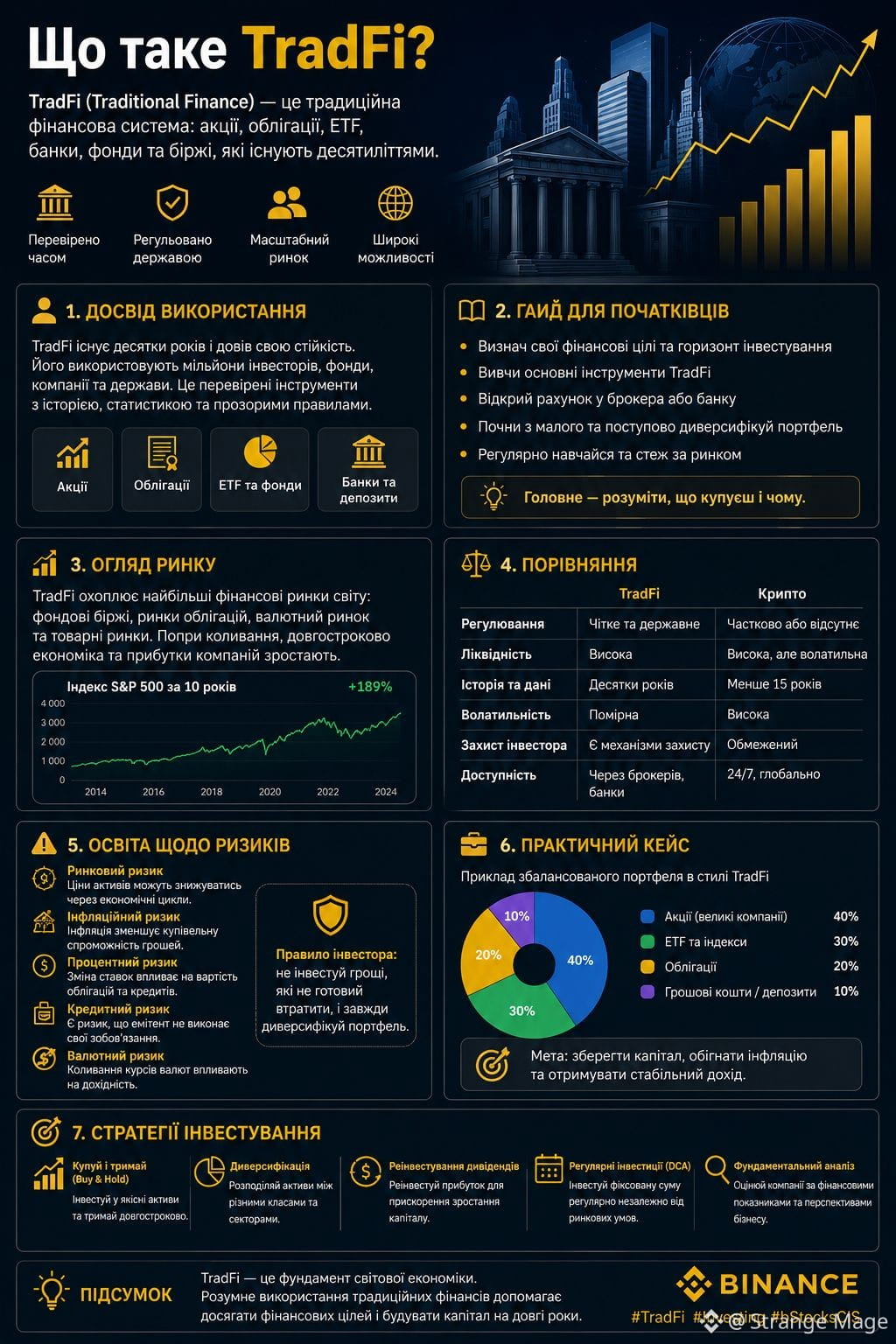
Lately, I decided to take a bit deeper look into TradFi specifically, because before I perceived traditional finance as something separate from crypto. But the more I look at the market, the more interesting their combination becomes.
To explain it simply, TradFi is the familiar financial world: stocks, bonds, ETFs, banks, and stock exchanges. For a beginner, the key is to first understand how each instrument works, and only then think about potential returns.
From the market perspective, it’s especially interesting right now to observe how TradFi is gradually interacting with blockchain and RWA. It no longer looks like two completely different worlds.
When comparing TradFi with crypto, what I like here is the more straightforward regulatory framework and the history of many assets. But that doesn’t mean there are no risks. Market risk, inflation, interest rates, currency fluctuations, and the risk specific to an individual company remain.
Practically speaking, I wouldn’t place all my bets on just one sector. For example, a portfolio can be diversified across stocks, ETFs, bonds, and a portion of cryptoassets.
Personally for me, TradFi is not an alternative to crypto, but another diversification tool. The main thing is to understand what exactly you’re buying and what risk you’re willing to take.
#TradFi #RWA #Investing #Binance #bStocksCIS
Lately, I decided to take a bit deeper look into TradFi specifically, because before I perceived traditional finance as something separate from crypto. But the more I look at the market, the more interesting their combination becomes.
To explain it simply, TradFi is the familiar financial world: stocks, bonds, ETFs, banks, and stock exchanges. For a beginner, the key is to first understand how each instrument works, and only then think about potential returns.
From the market perspective, it’s especially interesting right now to observe how TradFi is gradually interacting with blockchain and RWA. It no longer looks like two completely different worlds.
When comparing TradFi with crypto, what I like here is the more straightforward regulatory framework and the history of many assets. But that doesn’t mean there are no risks. Market risk, inflation, interest rates, currency fluctuations, and the risk specific to an individual company remain.
Practically speaking, I wouldn’t place all my bets on just one sector. For example, a portfolio can be diversified across stocks, ETFs, bonds, and a portion of cryptoassets.
Personally for me, TradFi is not an alternative to crypto, but another diversification tool. The main thing is to understand what exactly you’re buying and what risk you’re willing to take.
#TradFi #RWA #Investing #Binance #bStocksCIS
To explain it simply, TradFi is the familiar financial world: stocks, bonds, ETFs, banks, and stock exchanges. For a beginner, the key is to first understand how each instrument works, and only then think about potential returns.
From the market perspective, it’s especially interesting right now to observe how TradFi is gradually interacting with blockchain and RWA. It no longer looks like two completely different worlds.
When comparing TradFi with crypto, what I like here is the more straightforward regulatory framework and the history of many assets. But that doesn’t mean there are no risks. Market risk, inflation, interest rates, currency fluctuations, and the risk specific to an individual company remain.
Practically speaking, I wouldn’t place all my bets on just one sector. For example, a portfolio can be diversified across stocks, ETFs, bonds, and a portion of cryptoassets.
Personally for me, TradFi is not an alternative to crypto, but another diversification tool. The main thing is to understand what exactly you’re buying and what risk you’re willing to take.
#TradFi #RWA #Investing #Binance #bStocksCIS
77
·
--
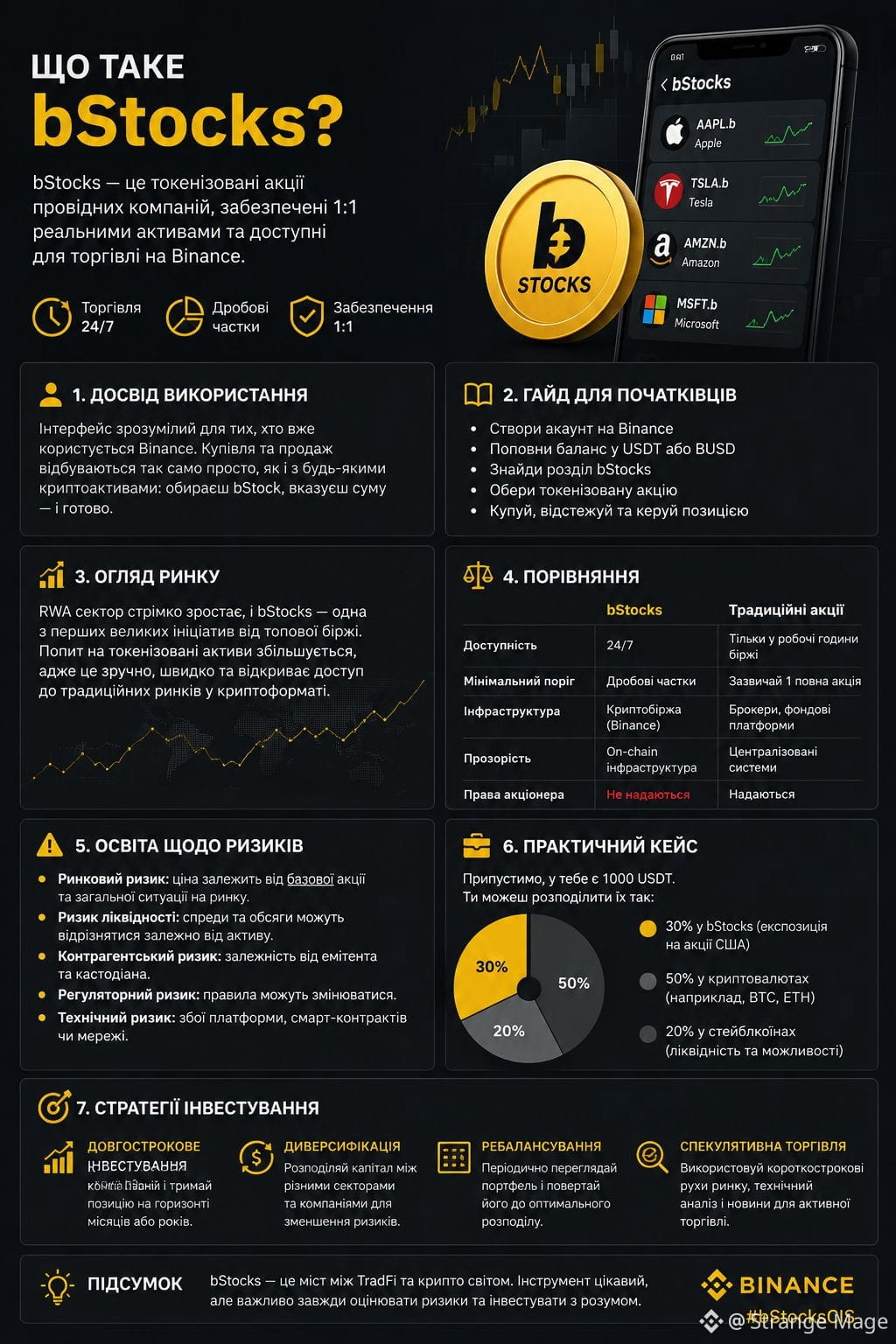
I decided to look at bStocks not as yet another “crypto fishy thing,” but as a tool that could potentially change the way we work with traditional assets.
I’ll start with my own impression: what I liked most was the ability to gain exposure to the stock market in a familiar crypto environment. For a beginner, the logic is also straightforward: you choose a tokenized asset, see which underlying asset it’s linked to, and only then evaluate the risks.
If you look at the market more broadly, RWA is actively developing right now, and bStocks fit well into this trend. Compared to regular stock trading, the main advantage for me is the flexibility of the crypto infrastructure. But that doesn’t mean there are no risks: the price still depends on the underlying asset, and there are also risks related to liquidity, the counterparty, regulation, and the platform itself.
A practical case is simple: instead of keeping all your capital only in crypto, you can use part of it to gain exposure to the traditional market through bStocks. I would consider them as an additional diversification element, not as a replacement for stocks or a guaranteed way to make money.
#bStocksCIS #Binance #RWA #TradFi
I decided to look at bStocks not as yet another “crypto fishy thing,” but as a tool that could potentially change the way we work with traditional assets.
I’ll start with my own impression: what I liked most was the ability to gain exposure to the stock market in a familiar crypto environment. For a beginner, the logic is also straightforward: you choose a tokenized asset, see which underlying asset it’s linked to, and only then evaluate the risks.
If you look at the market more broadly, RWA is actively developing right now, and bStocks fit well into this trend. Compared to regular stock trading, the main advantage for me is the flexibility of the crypto infrastructure. But that doesn’t mean there are no risks: the price still depends on the underlying asset, and there are also risks related to liquidity, the counterparty, regulation, and the platform itself.
A practical case is simple: instead of keeping all your capital only in crypto, you can use part of it to gain exposure to the traditional market through bStocks. I would consider them as an additional diversification element, not as a replacement for stocks or a guaranteed way to make money.
#bStocksCIS #Binance #RWA #TradFi
I’ll start with my own impression: what I liked most was the ability to gain exposure to the stock market in a familiar crypto environment. For a beginner, the logic is also straightforward: you choose a tokenized asset, see which underlying asset it’s linked to, and only then evaluate the risks.
If you look at the market more broadly, RWA is actively developing right now, and bStocks fit well into this trend. Compared to regular stock trading, the main advantage for me is the flexibility of the crypto infrastructure. But that doesn’t mean there are no risks: the price still depends on the underlying asset, and there are also risks related to liquidity, the counterparty, regulation, and the platform itself.
A practical case is simple: instead of keeping all your capital only in crypto, you can use part of it to gain exposure to the traditional market through bStocks. I would consider them as an additional diversification element, not as a replacement for stocks or a guaranteed way to make money.
#bStocksCIS #Binance #RWA #TradFi
72
·
--
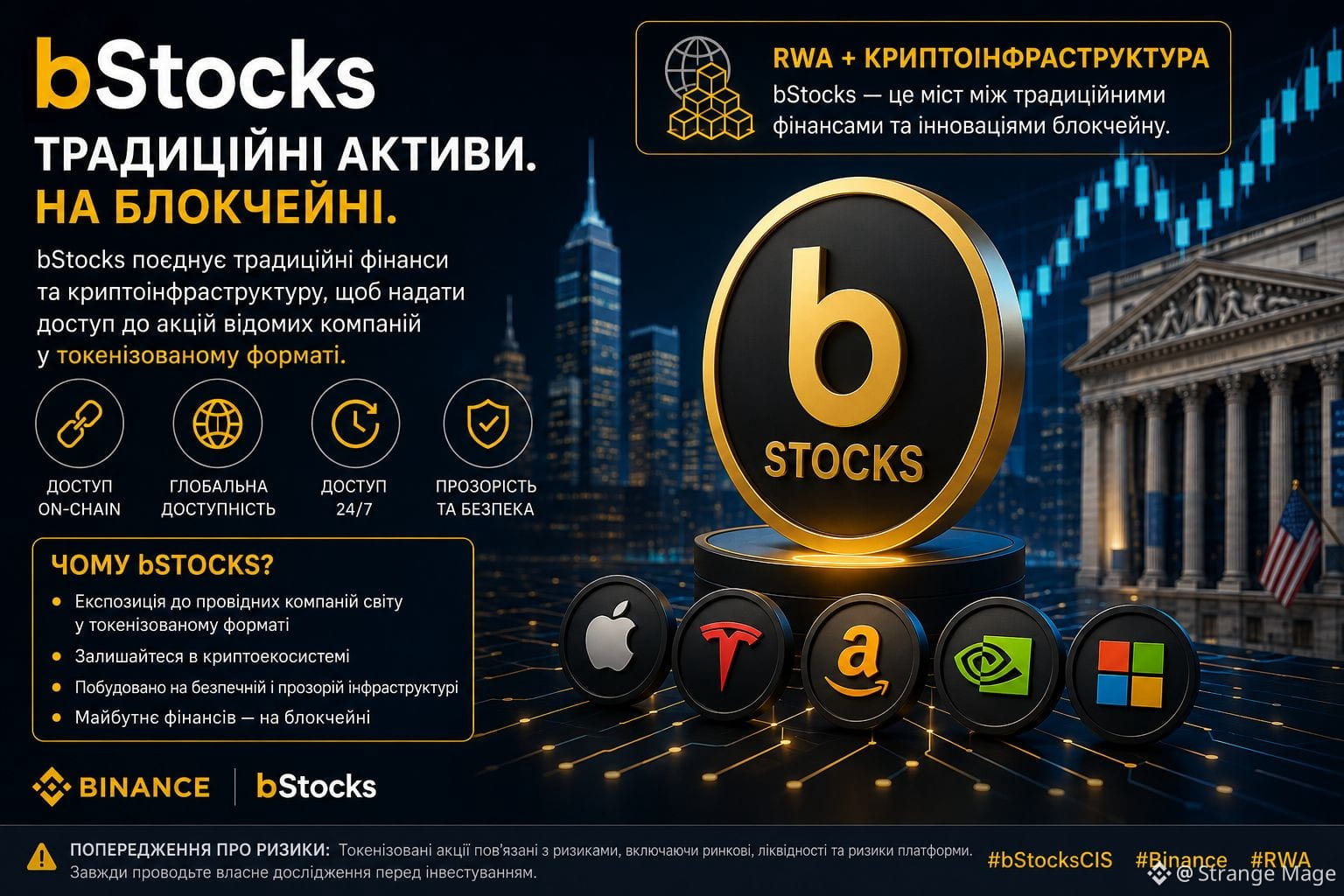
Recently, I’ve been looking more and more towards bStocks, because for me it’s one of the most interesting ways to combine traditional financial assets with crypto infrastructure.
If I explain it as simply as possible: the idea behind bStocks is to gain exposure to well-known companies through a tokenized format, without fully stepping outside the crypto market. For me, the main advantage here is convenience. You don’t have to constantly switch between different platforms if you’re already used to working with crypto assets.
But I wouldn’t see bStocks as an “easy way to make money.” Risks don’t disappear: the price of such an asset can fall along with the underlying market, there are liquidity risks, risks tied to the terms of a specific product, and the platform itself. That’s why, before buying, I would definitely look into what exactly stands behind a particular token and what conditions apply to its use.
Personally, I really like the very concept: RWA + crypto infrastructure. If the tokenization of traditional assets continues to develop, bStocks could very well become one of the interesting directions in this market.
#bStocksCIS #Binance #RWA
Recently, I’ve been looking more and more towards bStocks, because for me it’s one of the most interesting ways to combine traditional financial assets with crypto infrastructure.
If I explain it as simply as possible: the idea behind bStocks is to gain exposure to well-known companies through a tokenized format, without fully stepping outside the crypto market. For me, the main advantage here is convenience. You don’t have to constantly switch between different platforms if you’re already used to working with crypto assets.
But I wouldn’t see bStocks as an “easy way to make money.” Risks don’t disappear: the price of such an asset can fall along with the underlying market, there are liquidity risks, risks tied to the terms of a specific product, and the platform itself. That’s why, before buying, I would definitely look into what exactly stands behind a particular token and what conditions apply to its use.
Personally, I really like the very concept: RWA + crypto infrastructure. If the tokenization of traditional assets continues to develop, bStocks could very well become one of the interesting directions in this market.
#bStocksCIS #Binance #RWA
If I explain it as simply as possible: the idea behind bStocks is to gain exposure to well-known companies through a tokenized format, without fully stepping outside the crypto market. For me, the main advantage here is convenience. You don’t have to constantly switch between different platforms if you’re already used to working with crypto assets.
But I wouldn’t see bStocks as an “easy way to make money.” Risks don’t disappear: the price of such an asset can fall along with the underlying market, there are liquidity risks, risks tied to the terms of a specific product, and the platform itself. That’s why, before buying, I would definitely look into what exactly stands behind a particular token and what conditions apply to its use.
Personally, I really like the very concept: RWA + crypto infrastructure. If the tokenization of traditional assets continues to develop, bStocks could very well become one of the interesting directions in this market.
#bStocksCIS #Binance #RWA
98
·
--
The crypto market looks pretty interesting right now. BTC is holding around $78K, and after a strong August, the market has cooled off a bit. But institutional demand isn’t going anywhere. Spot BTC ETFs saw around $900M in inflows during the last week of August, while ETH continues to attract capital as well.
Personally, I think the main thing right now is not chasing every candle. The market is getting more mature, so I’m watching liquidity, ETF flows and macro conditions more than short-term price moves.
#btc $BTC
The crypto market looks pretty interesting right now. BTC is holding around $78K, and after a strong August, the market has cooled off a bit. But institutional demand isn’t going anywhere. Spot BTC ETFs saw around $900M in inflows during the last week of August, while ETH continues to attract capital as well.
Personally, I think the main thing right now is not chasing every candle. The market is getting more mature, so I’m watching liquidity, ETF flows and macro conditions more than short-term price moves.
#btc $BTC
Personally, I think the main thing right now is not chasing every candle. The market is getting more mature, so I’m watching liquidity, ETF flows and macro conditions more than short-term price moves.
#btc $BTC
84
·
--
I decided to look at @termmax not as another DeFi protocol, but through its actual economics.
Current TVL is around $32.1M, with $22.1M in active loans — roughly 69% of TVL is actively being borrowed. The protocol generated about $17K in fees over the last 30 days, while cumulative fees have passed $381K.
The main advantage is the fixed-rate model: borrowers know their capital cost in advance, which makes it much easier to calculate strategy returns. TermMax also combines this with one-click leverage and vaults, making more complex strategies easier to execute.
But there are weaknesses. Around 95% of TVL is still concentrated on Ethereum, so the protocol remains heavily dependent on one network. Leverage also doesn’t remove risk — it amplifies both profits and losses.
My conclusion: TermMax looks more interesting as infrastructure for calculated strategies than as a simple yield-farming platform. If liquidity continues expanding across chains, its fixed-rate model could become a much stronger niche in DeFi.
#termmax @termmax $BTC
What do you think about TermMax?
I decided to look at @TermMax not as another DeFi protocol, but through its actual economics.
Current TVL is around $32.1M, with $22.1M in active loans — roughly 69% of TVL is actively being borrowed. The protocol generated about $17K in fees over the last 30 days, while cumulative fees have passed $381K.
The main advantage is the fixed-rate model: borrowers know their capital cost in advance, which makes it much easier to calculate strategy returns. TermMax also combines this with one-click leverage and vaults, making more complex strategies easier to execute.
But there are weaknesses. Around 95% of TVL is still concentrated on Ethereum, so the protocol remains heavily dependent on one network. Leverage also doesn’t remove risk — it amplifies both profits and losses.
My conclusion: TermMax looks more interesting as infrastructure for calculated strategies than as a simple yield-farming platform. If liquidity continues expanding across chains, its fixed-rate model could become a much stronger niche in DeFi.
#termmax @TermMax $BTC
What do you think about TermMax?
Current TVL is around $32.1M, with $22.1M in active loans — roughly 69% of TVL is actively being borrowed. The protocol generated about $17K in fees over the last 30 days, while cumulative fees have passed $381K.
The main advantage is the fixed-rate model: borrowers know their capital cost in advance, which makes it much easier to calculate strategy returns. TermMax also combines this with one-click leverage and vaults, making more complex strategies easier to execute.
But there are weaknesses. Around 95% of TVL is still concentrated on Ethereum, so the protocol remains heavily dependent on one network. Leverage also doesn’t remove risk — it amplifies both profits and losses.
My conclusion: TermMax looks more interesting as infrastructure for calculated strategies than as a simple yield-farming platform. If liquidity continues expanding across chains, its fixed-rate model could become a much stronger niche in DeFi.
#termmax @TermMax $BTC
What do you think about TermMax?
🚀 Strong DeFi infrastructure
0%
📈 High-growth potential
100%
⚠️ Too much risk
0%
🤔 Need more data
0%
1 votes • Voting closed
81
·
--
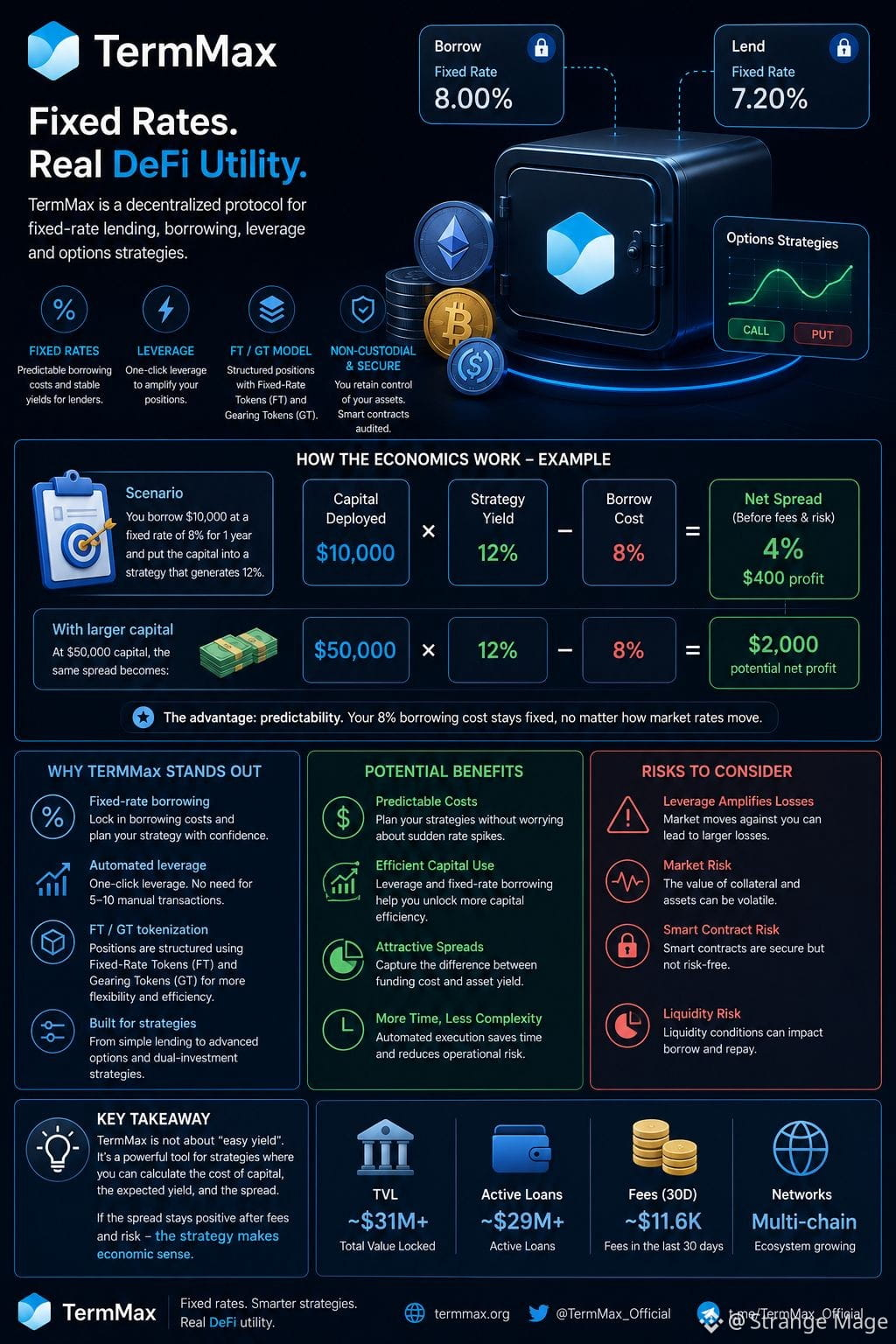
I’ve been digging deeper into @termmax , and the interesting part is how the economics work. Imagine borrowing $10,000 at a fixed 8% for one year and putting the capital into an asset strategy generating 12%. Gross yield would be $1,200, while borrowing costs are $800 — leaving $400, or 4% net, before fees and market risk. With $50,000, the same spread becomes $2,000.
The key advantage is predictability: the 8% borrowing cost does not suddenly jump with market rates. TermMax also automates leverage instead of requiring 5–10 manual transactions, while FT/GT tokens structure fixed-rate and leveraged positions.
The catch is obvious: leverage amplifies losses too. So I wouldn’t treat TermMax as “easy yield.” I see it as a tool for strategies where the spread between funding cost and asset yield is calculated in advance. If that spread remains positive after fees and risk, the model makes economic sense.
#termmax @termmax $BTC
I’ve been digging deeper into @TermMax , and the interesting part is how the economics work. Imagine borrowing $10,000 at a fixed 8% for one year and putting the capital into an asset strategy generating 12%. Gross yield would be $1,200, while borrowing costs are $800 — leaving $400, or 4% net, before fees and market risk. With $50,000, the same spread becomes $2,000.
The key advantage is predictability: the 8% borrowing cost does not suddenly jump with market rates. TermMax also automates leverage instead of requiring 5–10 manual transactions, while FT/GT tokens structure fixed-rate and leveraged positions.
The catch is obvious: leverage amplifies losses too. So I wouldn’t treat TermMax as “easy yield.” I see it as a tool for strategies where the spread between funding cost and asset yield is calculated in advance. If that spread remains positive after fees and risk, the model makes economic sense.
#termmax @TermMax $BTC
The key advantage is predictability: the 8% borrowing cost does not suddenly jump with market rates. TermMax also automates leverage instead of requiring 5–10 manual transactions, while FT/GT tokens structure fixed-rate and leveraged positions.
The catch is obvious: leverage amplifies losses too. So I wouldn’t treat TermMax as “easy yield.” I see it as a tool for strategies where the spread between funding cost and asset yield is calculated in advance. If that spread remains positive after fees and risk, the model makes economic sense.
#termmax @TermMax $BTC
99
·
--
I’ve been looking deeper into @termmax , and the numbers are starting to make the thesis more interesting.
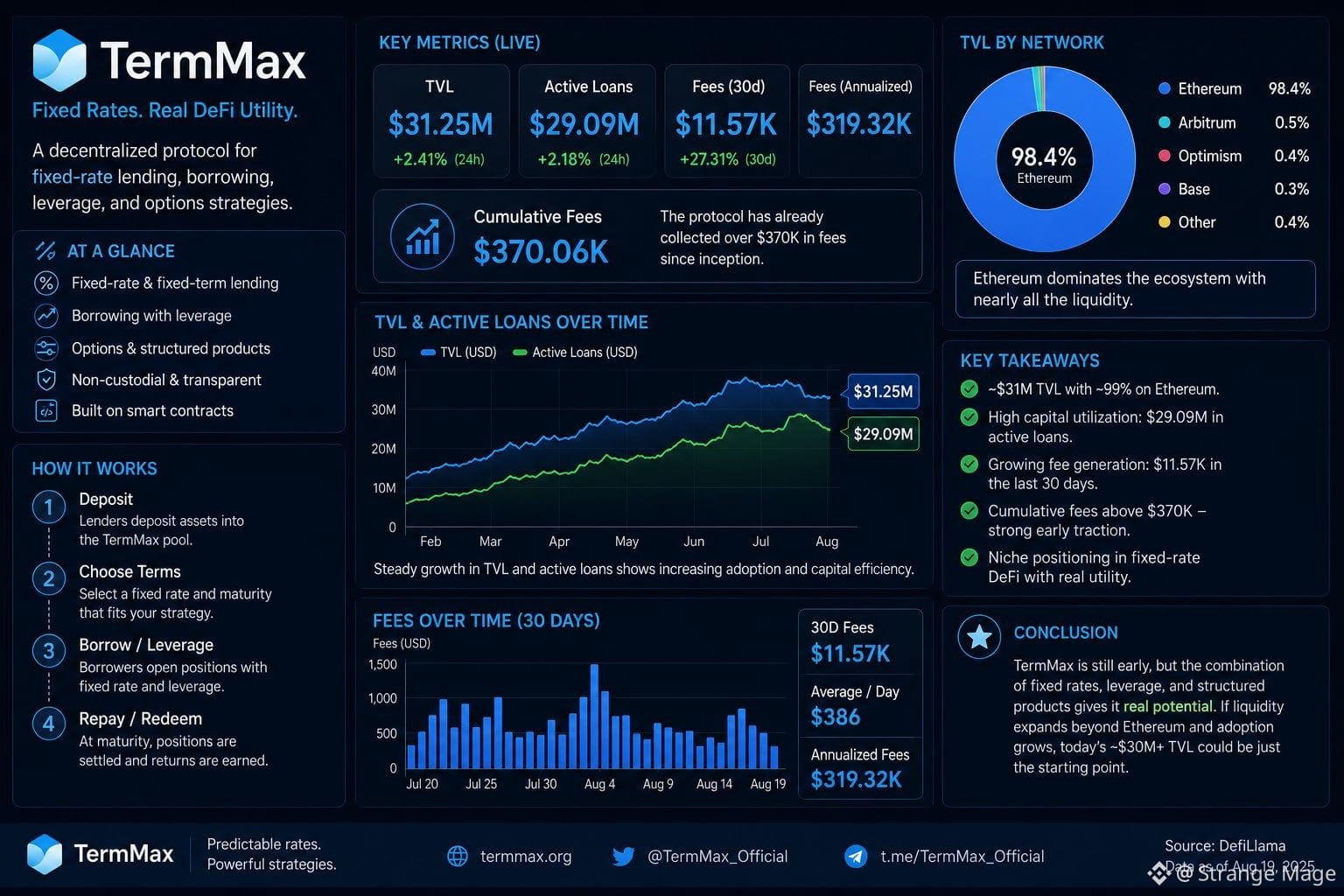
Current TVL is around $31.25M, while Ethereum accounts for about 98.4% of the capital. That concentration is both a strength and a risk: Ethereum provides deep liquidity, but future growth will depend on successful expansion across other networks. TermMax also generated roughly $11.6K in fees over 30 days, with annualized fees near $320K.
My takeaway: the protocol is still small, but the combination of fixed-rate lending, borrowing and leverage gives it a clear niche. If liquidity diversifies beyond Ethereum while fee generation keeps growing, the current scale could be an early stage rather than a limitation.
#termmax @termmax
I’ve been looking deeper into @TermMax , and the numbers are starting to make the thesis more interesting.
Current TVL is around $31.25M, while Ethereum accounts for about 98.4% of the capital. That concentration is both a strength and a risk: Ethereum provides deep liquidity, but future growth will depend on successful expansion across other networks. TermMax also generated roughly $11.6K in fees over 30 days, with annualized fees near $320K.
My takeaway: the protocol is still small, but the combination of fixed-rate lending, borrowing and leverage gives it a clear niche. If liquidity diversifies beyond Ethereum while fee generation keeps growing, the current scale could be an early stage rather than a limitation.
#termmax @TermMax
Current TVL is around $31.25M, while Ethereum accounts for about 98.4% of the capital. That concentration is both a strength and a risk: Ethereum provides deep liquidity, but future growth will depend on successful expansion across other networks. TermMax also generated roughly $11.6K in fees over 30 days, with annualized fees near $320K.
My takeaway: the protocol is still small, but the combination of fixed-rate lending, borrowing and leverage gives it a clear niche. If liquidity diversifies beyond Ethereum while fee generation keeps growing, the current scale could be an early stage rather than a limitation.
#termmax @TermMax
85
·
--
I’ve been watching SKHYB lately, and honestly, this is the kind of RWA I find much more interesting than another random crypto token.
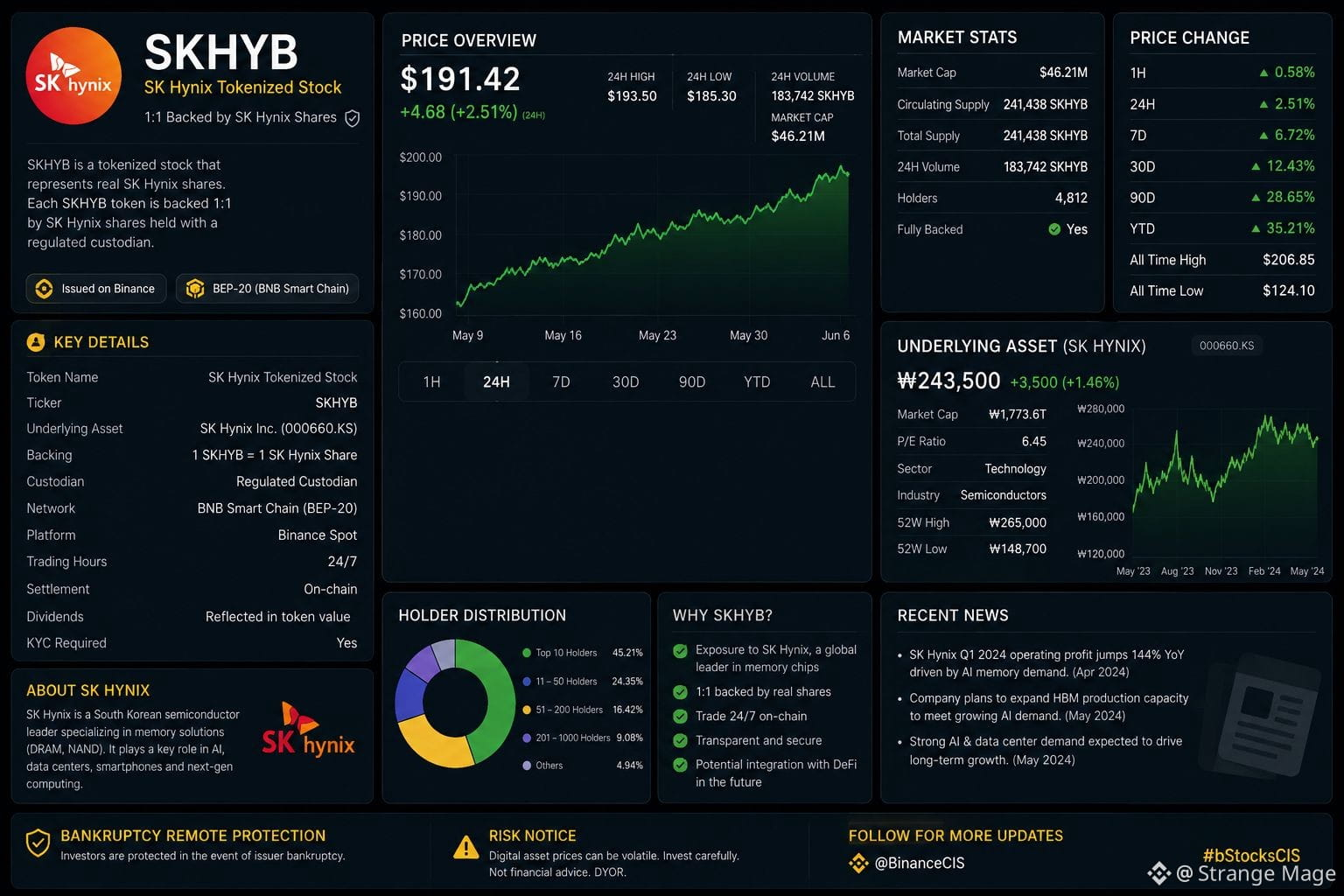
SKHYB gives exposure to SK Hynix through a tokenized security on Binance. What makes it interesting is that each token is backed 1:1 by real US-listed SK Hynix shares held with a regulated custodian. It trades 24/7 on Binance Spot, runs as a BEP-20 token on BNB Smart Chain, and can even be withdrawn to a compatible wallet.
For me, the bigger story is the combination of traditional equities and blockchain infrastructure. You get exposure to a company deeply connected to the AI and semiconductor boom, but through an on-chain format.
Of course, SKHYB isn’t the same as directly owning SK Hynix stock, and there are still regulatory, liquidity and smart-contract risks.
Still, this is exactly why I’m watching the RWA space more closely. Traditional assets are slowly becoming programmable.
@BinanceCIS #bStocksCİS $SKHYB
I’ve been watching SKHYB lately, and honestly, this is the kind of RWA I find much more interesting than another random crypto token.
SKHYB gives exposure to SK Hynix through a tokenized security on Binance. What makes it interesting is that each token is backed 1:1 by real US-listed SK Hynix shares held with a regulated custodian. It trades 24/7 on Binance Spot, runs as a BEP-20 token on BNB Smart Chain, and can even be withdrawn to a compatible wallet.
For me, the bigger story is the combination of traditional equities and blockchain infrastructure. You get exposure to a company deeply connected to the AI and semiconductor boom, but through an on-chain format.
Of course, SKHYB isn’t the same as directly owning SK Hynix stock, and there are still regulatory, liquidity and smart-contract risks.
Still, this is exactly why I’m watching the RWA space more closely. Traditional assets are slowly becoming programmable.
@BinanceCIS #bStocksCİS $SKHYB
SKHYB gives exposure to SK Hynix through a tokenized security on Binance. What makes it interesting is that each token is backed 1:1 by real US-listed SK Hynix shares held with a regulated custodian. It trades 24/7 on Binance Spot, runs as a BEP-20 token on BNB Smart Chain, and can even be withdrawn to a compatible wallet.
For me, the bigger story is the combination of traditional equities and blockchain infrastructure. You get exposure to a company deeply connected to the AI and semiconductor boom, but through an on-chain format.
Of course, SKHYB isn’t the same as directly owning SK Hynix stock, and there are still regulatory, liquidity and smart-contract risks.
Still, this is exactly why I’m watching the RWA space more closely. Traditional assets are slowly becoming programmable.
@BinanceCIS #bStocksCİS $SKHYB
1
99
·
--
I’ve been looking into @termmax more closely, and what I find interesting here is that the project is not trying to be just another lending protocol with a slightly different interface.
The main idea is simple but important: fixed-rate and fixed-term DeFi lending and borrowing. Instead of constantly dealing with floating rates, TermMax lets users know the borrowing cost or expected lending return upfront for a defined maturity. For me, this is one of the areas where DeFi still has a lot of room to evolve. Predictability matters when you are building a strategy rather than simply farming short-term yield.
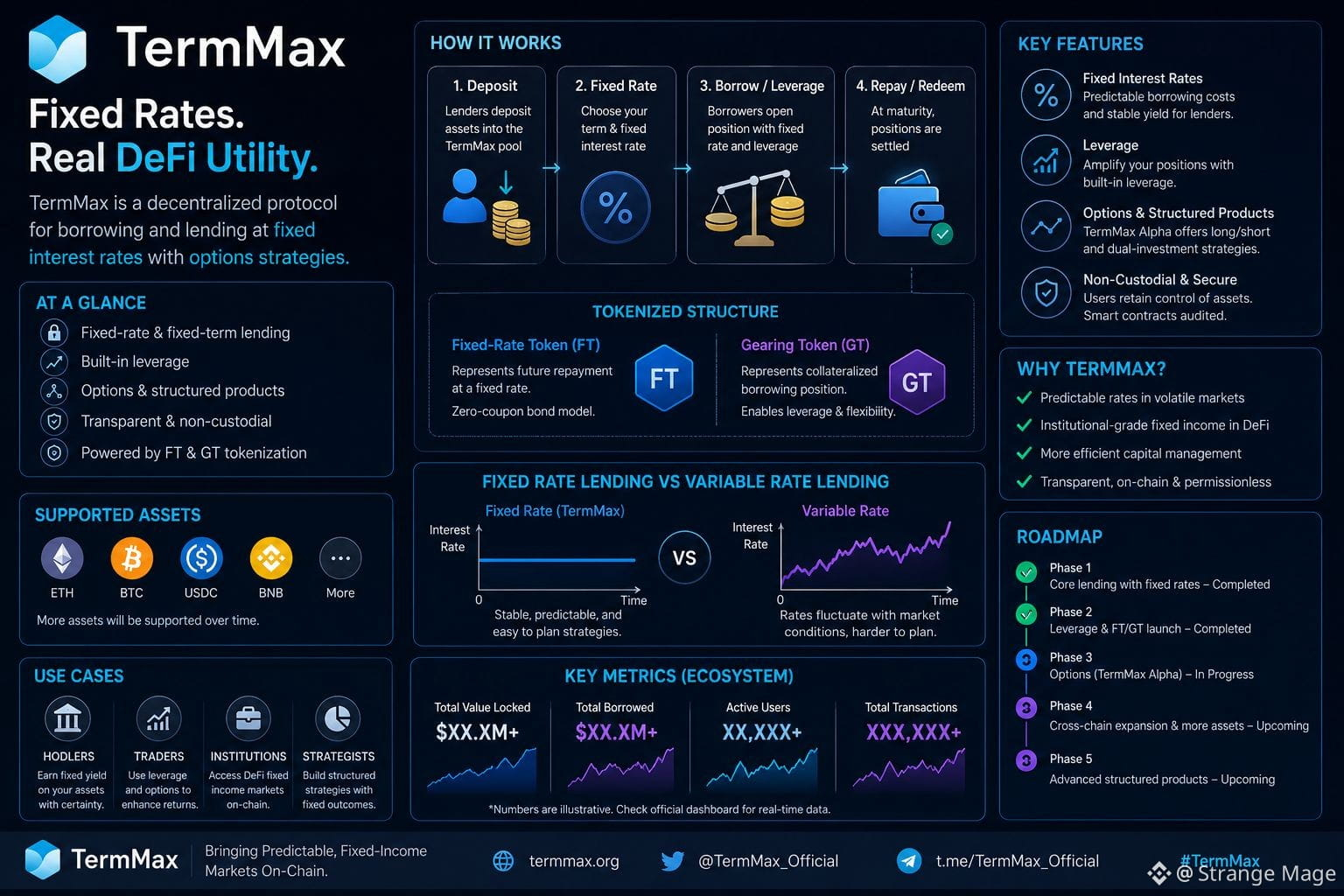
What I found particularly interesting while researching the protocol is its underlying token structure. TermMax uses Fixed-Rate Tokens (FTs) to represent future repayment obligations, while Gearing Tokens (GTs) represent individual collateralized borrowing positions. This is based on a zero-coupon bond model and creates a more flexible way to separate the principal and fixed return components of a position.
Another part that caught my attention is leverage. TermMax is designed to simplify strategies that would normally require multiple transactions across different DeFi protocols.
And then there is TermMax Alpha, which adds long/short products and dual-investment strategies. That makes the ecosystem more interesting because the protocol is moving beyond basic lending toward structured financial products and options-like exposure.
Of course, fixed rates don’t remove DeFi risk. Smart contracts, collateral volatility, liquidity and maturity conditions still matter. But I like the direction: bringing more predictable fixed-income mechanics into an on-chain environment.
The more I dig into TermMax, the more I see it as infrastructure for a different kind of DeFi — less focused on chasing constantly changing rates, and more focused on building structured, predictable financial markets.
#termmax @termmax
I’ve been looking into @TermMax more closely, and what I find interesting here is that the project is not trying to be just another lending protocol with a slightly different interface.
The main idea is simple but important: fixed-rate and fixed-term DeFi lending and borrowing. Instead of constantly dealing with floating rates, TermMax lets users know the borrowing cost or expected lending return upfront for a defined maturity. For me, this is one of the areas where DeFi still has a lot of room to evolve. Predictability matters when you are building a strategy rather than simply farming short-term yield.
What I found particularly interesting while researching the protocol is its underlying token structure. TermMax uses Fixed-Rate Tokens (FTs) to represent future repayment obligations, while Gearing Tokens (GTs) represent individual collateralized borrowing positions. This is based on a zero-coupon bond model and creates a more flexible way to separate the principal and fixed return components of a position.
Another part that caught my attention is leverage. TermMax is designed to simplify strategies that would normally require multiple transactions across different DeFi protocols.
And then there is TermMax Alpha, which adds long/short products and dual-investment strategies. That makes the ecosystem more interesting because the protocol is moving beyond basic lending toward structured financial products and options-like exposure.
Of course, fixed rates don’t remove DeFi risk. Smart contracts, collateral volatility, liquidity and maturity conditions still matter. But I like the direction: bringing more predictable fixed-income mechanics into an on-chain environment.
The more I dig into TermMax, the more I see it as infrastructure for a different kind of DeFi — less focused on chasing constantly changing rates, and more focused on building structured, predictable financial markets.
#termmax @TermMax
The main idea is simple but important: fixed-rate and fixed-term DeFi lending and borrowing. Instead of constantly dealing with floating rates, TermMax lets users know the borrowing cost or expected lending return upfront for a defined maturity. For me, this is one of the areas where DeFi still has a lot of room to evolve. Predictability matters when you are building a strategy rather than simply farming short-term yield.
What I found particularly interesting while researching the protocol is its underlying token structure. TermMax uses Fixed-Rate Tokens (FTs) to represent future repayment obligations, while Gearing Tokens (GTs) represent individual collateralized borrowing positions. This is based on a zero-coupon bond model and creates a more flexible way to separate the principal and fixed return components of a position.
Another part that caught my attention is leverage. TermMax is designed to simplify strategies that would normally require multiple transactions across different DeFi protocols.
And then there is TermMax Alpha, which adds long/short products and dual-investment strategies. That makes the ecosystem more interesting because the protocol is moving beyond basic lending toward structured financial products and options-like exposure.
Of course, fixed rates don’t remove DeFi risk. Smart contracts, collateral volatility, liquidity and maturity conditions still matter. But I like the direction: bringing more predictable fixed-income mechanics into an on-chain environment.
The more I dig into TermMax, the more I see it as infrastructure for a different kind of DeFi — less focused on chasing constantly changing rates, and more focused on building structured, predictable financial markets.
#termmax @TermMax
89
·
--
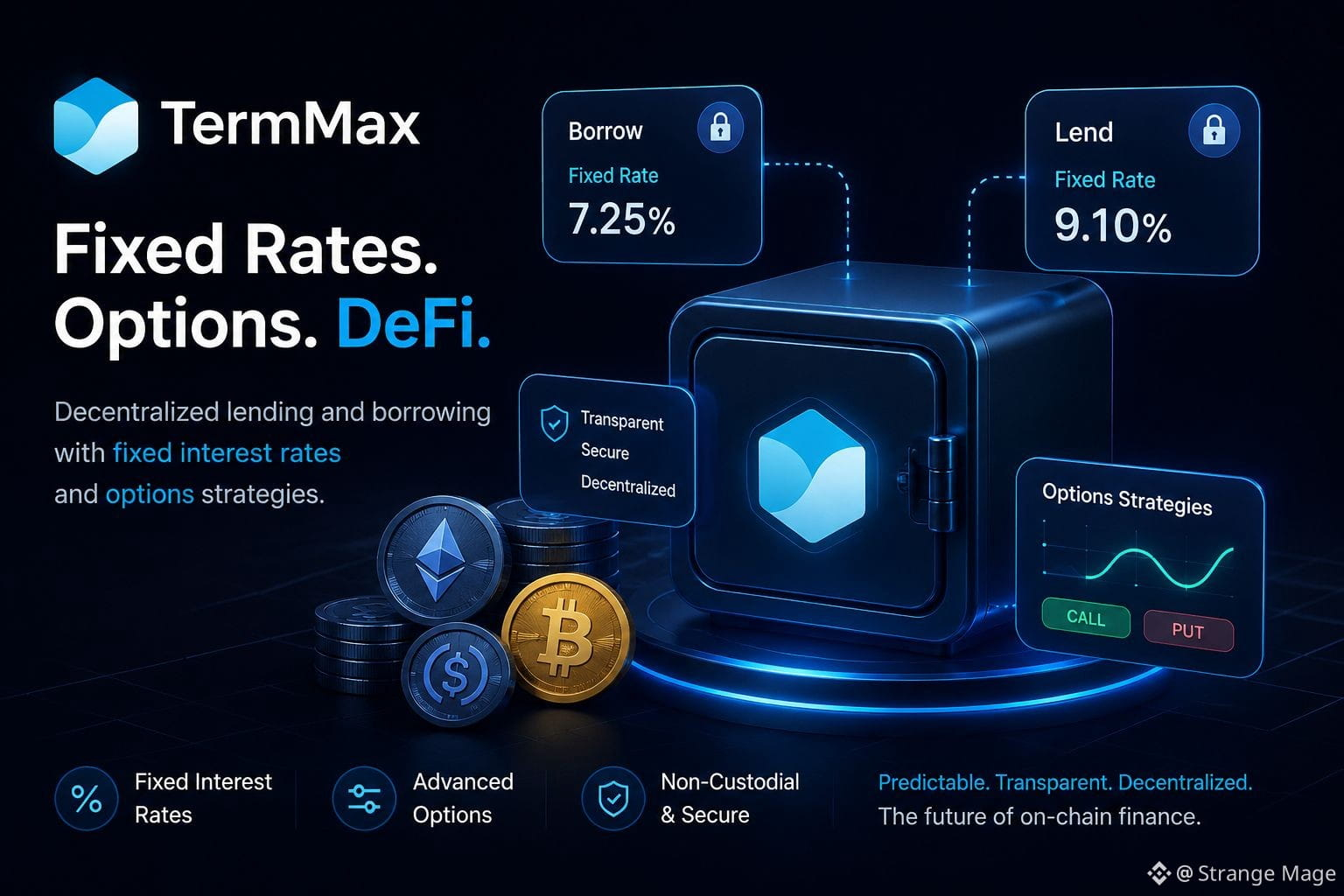
In crypto, most familiar lending and borrowing tools are closely connected to floating rates, changing borrowing costs, and high market volatility. That is why I find the concept behind TermMax interesting — a decentralized protocol focused on lending and borrowing at fixed interest rates, while also supporting options.
The core idea is quite straightforward: having predetermined terms can make financial strategies more predictable. If a user borrows assets, a fixed rate makes it possible to know the cost of borrowing in advance instead of being exposed to changes in market rates. For lenders, it can provide a clearer framework for estimating potential returns rather than constantly adjusting to changing conditions.
What makes TermMax particularly interesting is the combination of fixed-rate lending with options. Options can provide additional ways to manage risk and build strategies around potential price movements. This makes TermMax look like more than just another
DeFi lending protocol — it aims to bring several financial mechanisms together within one decentralized infrastructure.
In my view, predictability could become an increasingly important direction for DeFi. The more tools users have to plan the cost of capital, potential returns, and risk exposure in advance, the closer decentralized finance gets to supporting more sophisticated financial strategies traditionally found in conventional markets.
Of course, these products also come with risks. Crypto volatility, liquidations, smart-contract risks, and the complexity of options strategies all require careful consideration before using any protocol.
For me, the interesting part is not only the concept itself, but also watching how TermMax develops its infrastructure and real-world use cases over time.
I’ll definitely be keeping an eye on TermMax and exploring how fixed-rate lending and options can expand the possibilities within DeFi.
#termmax @termmax
In crypto, most familiar lending and borrowing tools are closely connected to floating rates, changing borrowing costs, and high market volatility. That is why I find the concept behind TermMax interesting — a decentralized protocol focused on lending and borrowing at fixed interest rates, while also supporting options.
The core idea is quite straightforward: having predetermined terms can make financial strategies more predictable. If a user borrows assets, a fixed rate makes it possible to know the cost of borrowing in advance instead of being exposed to changes in market rates. For lenders, it can provide a clearer framework for estimating potential returns rather than constantly adjusting to changing conditions.
What makes TermMax particularly interesting is the combination of fixed-rate lending with options. Options can provide additional ways to manage risk and build strategies around potential price movements. This makes TermMax look like more than just another
DeFi lending protocol — it aims to bring several financial mechanisms together within one decentralized infrastructure.
In my view, predictability could become an increasingly important direction for DeFi. The more tools users have to plan the cost of capital, potential returns, and risk exposure in advance, the closer decentralized finance gets to supporting more sophisticated financial strategies traditionally found in conventional markets.
Of course, these products also come with risks. Crypto volatility, liquidations, smart-contract risks, and the complexity of options strategies all require careful consideration before using any protocol.
For me, the interesting part is not only the concept itself, but also watching how TermMax develops its infrastructure and real-world use cases over time.
I’ll definitely be keeping an eye on TermMax and exploring how fixed-rate lending and options can expand the possibilities within DeFi.
#termmax @TermMax
The core idea is quite straightforward: having predetermined terms can make financial strategies more predictable. If a user borrows assets, a fixed rate makes it possible to know the cost of borrowing in advance instead of being exposed to changes in market rates. For lenders, it can provide a clearer framework for estimating potential returns rather than constantly adjusting to changing conditions.
What makes TermMax particularly interesting is the combination of fixed-rate lending with options. Options can provide additional ways to manage risk and build strategies around potential price movements. This makes TermMax look like more than just another
DeFi lending protocol — it aims to bring several financial mechanisms together within one decentralized infrastructure.
In my view, predictability could become an increasingly important direction for DeFi. The more tools users have to plan the cost of capital, potential returns, and risk exposure in advance, the closer decentralized finance gets to supporting more sophisticated financial strategies traditionally found in conventional markets.
Of course, these products also come with risks. Crypto volatility, liquidations, smart-contract risks, and the complexity of options strategies all require careful consideration before using any protocol.
For me, the interesting part is not only the concept itself, but also watching how TermMax develops its infrastructure and real-world use cases over time.
I’ll definitely be keeping an eye on TermMax and exploring how fixed-rate lending and options can expand the possibilities within DeFi.
#termmax @TermMax
75
·
--
This time I decided to take a closer look at $AMZNB — a tokenized asset linked to Amazon. The more I learn about bStocks, the more I like the idea itself: getting exposure to a major company while staying within the crypto infrastructure I'm already familiar with.
Amazon is obviously much more than just an online marketplace today.
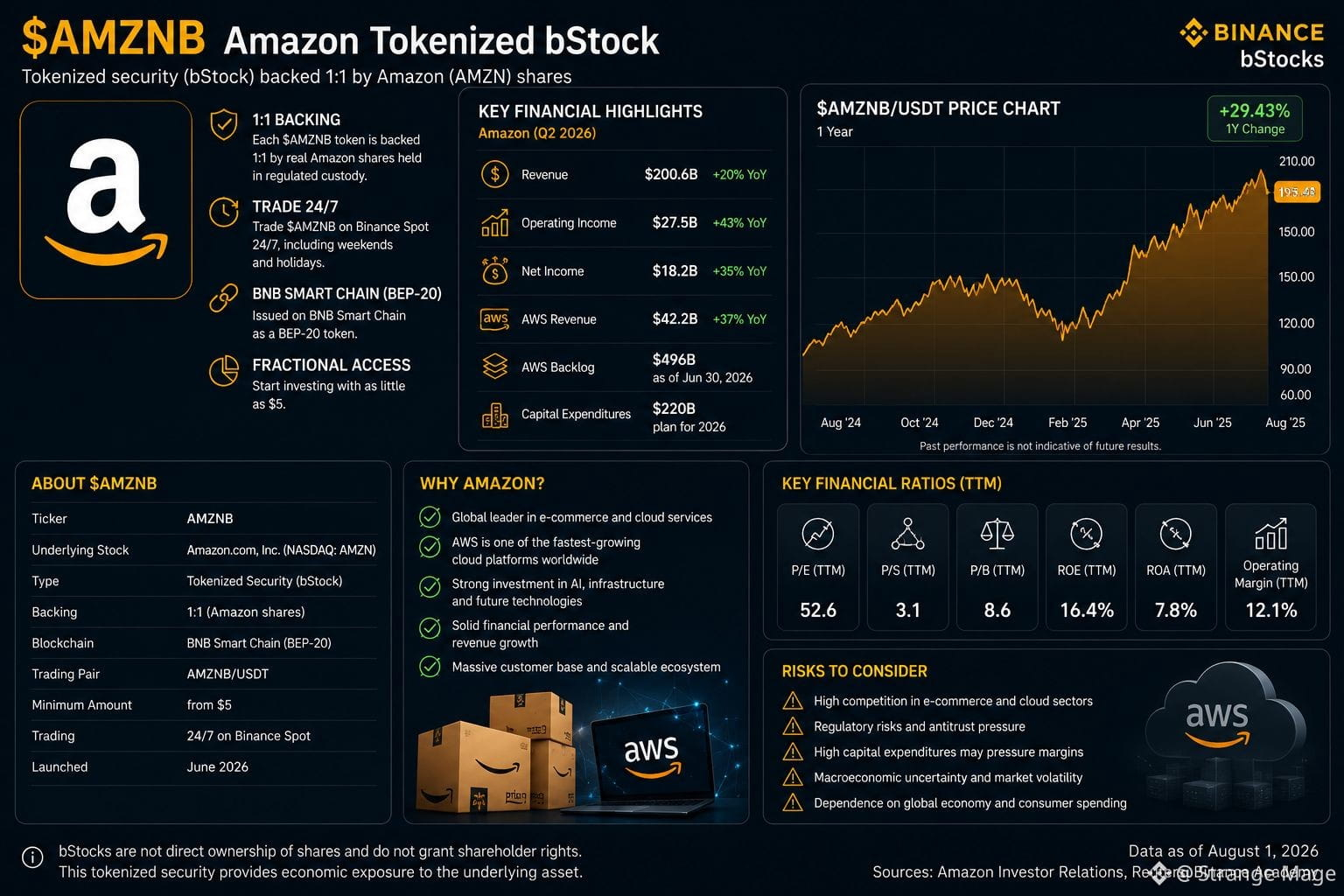
The company has several major business segments, including e-commerce, AWS, advertising, subscriptions, logistics, and now an increasingly strong focus on artificial intelligence. I was especially impressed by its latest results: in Q2 2026, Amazon increased revenue by 20% year over year to $200.6B, while operating income jumped 43% to $27.5B. At the same time, AWS revenue grew 37% to $42.2B.
And this is where AMZNB interesting to me as an RWA product. Instead of looking at Amazon purely as a traditional stock, you can get exposure to its performance through a tokenized format. bStocks trade on Binance Spot 24/7, are issued as BEP-20 tokens on BNB Smart Chain, and are backed 1:1 by the corresponding U.S. shares. Fractional access is also available starting from $5.
What I find especially interesting is that Amazon is investing huge amounts into AI infrastructure while AWS continues to show strong growth. The company has raised its 2026 capital expenditure plan to $220B, while its AWS backlog has reached $496B. This shows how serious Amazon's commitment to cloud and AI has become, although such massive spending can also put pressure on free cash flow.
That's why I look at $AMZNB not as "Amazon crypto", but as an interesting experiment at the intersection of traditional finance and Web3. If RWA continues developing at this pace, it's quite possible that in a few years, this kind of format won't seem unusual at all.
#bstockscis @BinanceCIS $AMZNB
This time I decided to take a closer look at $AMZNB — a tokenized asset linked to Amazon. The more I learn about bStocks, the more I like the idea itself: getting exposure to a major company while staying within the crypto infrastructure I'm already familiar with.
Amazon is obviously much more than just an online marketplace today.
The company has several major business segments, including e-commerce, AWS, advertising, subscriptions, logistics, and now an increasingly strong focus on artificial intelligence. I was especially impressed by its latest results: in Q2 2026, Amazon increased revenue by 20% year over year to $200.6B, while operating income jumped 43% to $27.5B. At the same time, AWS revenue grew 37% to $42.2B.
And this is where AMZNB interesting to me as an RWA product. Instead of looking at Amazon purely as a traditional stock, you can get exposure to its performance through a tokenized format. bStocks trade on Binance Spot 24/7, are issued as BEP-20 tokens on BNB Smart Chain, and are backed 1:1 by the corresponding U.S. shares. Fractional access is also available starting from $5.
What I find especially interesting is that Amazon is investing huge amounts into AI infrastructure while AWS continues to show strong growth. The company has raised its 2026 capital expenditure plan to $220B, while its AWS backlog has reached $496B. This shows how serious Amazon's commitment to cloud and AI has become, although such massive spending can also put pressure on free cash flow.
That's why I look at $AMZNB not as "Amazon crypto", but as an interesting experiment at the intersection of traditional finance and Web3. If RWA continues developing at this pace, it's quite possible that in a few years, this kind of format won't seem unusual at all.
#bstockscis @BinanceCIS $AMZNB
Amazon is obviously much more than just an online marketplace today.
The company has several major business segments, including e-commerce, AWS, advertising, subscriptions, logistics, and now an increasingly strong focus on artificial intelligence. I was especially impressed by its latest results: in Q2 2026, Amazon increased revenue by 20% year over year to $200.6B, while operating income jumped 43% to $27.5B. At the same time, AWS revenue grew 37% to $42.2B.
And this is where AMZNB interesting to me as an RWA product. Instead of looking at Amazon purely as a traditional stock, you can get exposure to its performance through a tokenized format. bStocks trade on Binance Spot 24/7, are issued as BEP-20 tokens on BNB Smart Chain, and are backed 1:1 by the corresponding U.S. shares. Fractional access is also available starting from $5.
What I find especially interesting is that Amazon is investing huge amounts into AI infrastructure while AWS continues to show strong growth. The company has raised its 2026 capital expenditure plan to $220B, while its AWS backlog has reached $496B. This shows how serious Amazon's commitment to cloud and AI has become, although such massive spending can also put pressure on free cash flow.
That's why I look at $AMZNB not as "Amazon crypto", but as an interesting experiment at the intersection of traditional finance and Web3. If RWA continues developing at this pace, it's quite possible that in a few years, this kind of format won't seem unusual at all.
#bstockscis @BinanceCIS $AMZNB
73
·
--
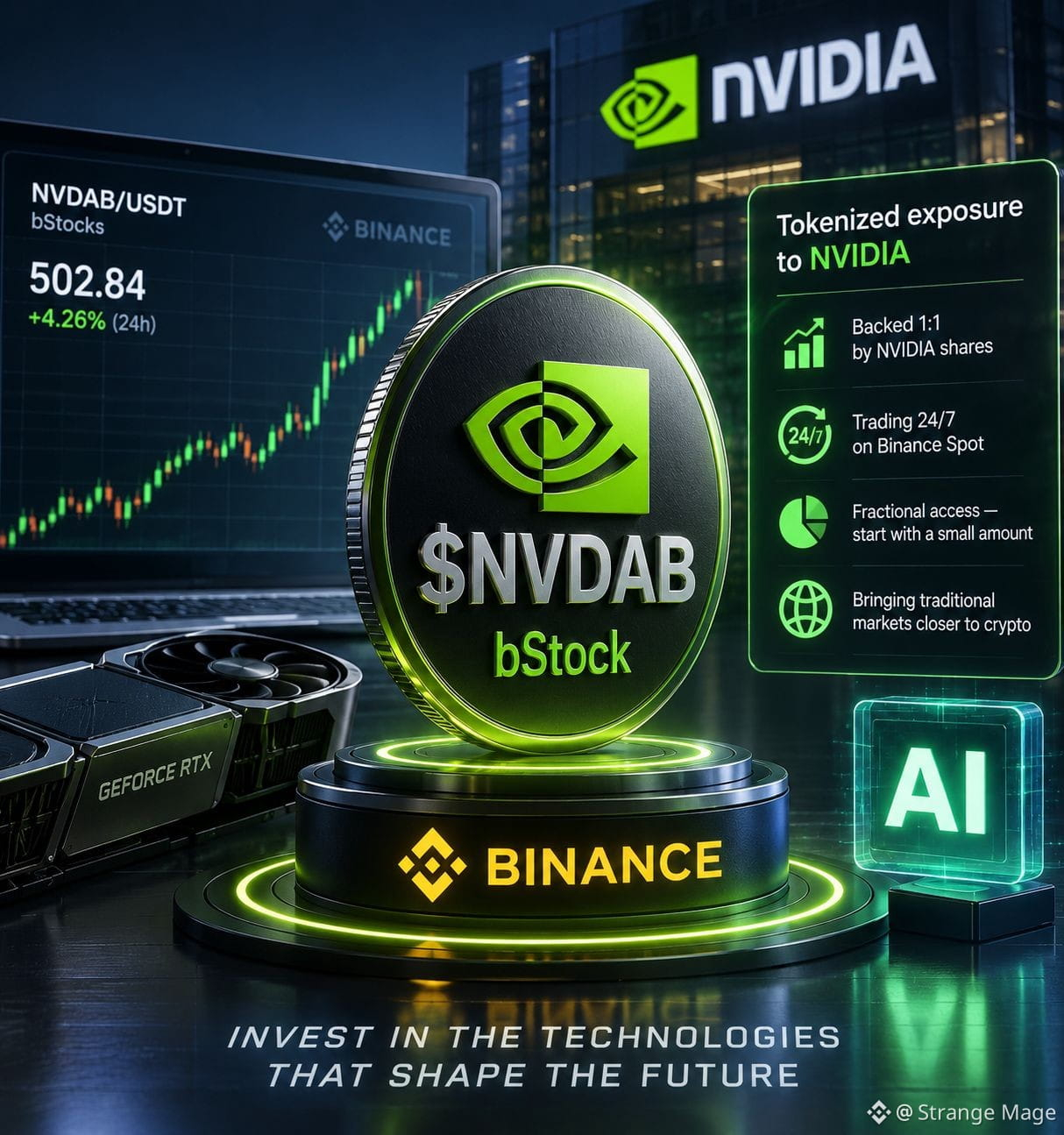
Over the last few months, I’ve shifted part of my crypto portfolio into RWA (Real-World Assets). I want to share my honest experience with $NVDAB — a tokenized version of NVIDIA shares.
Why does a crypto investor need NVIDIA stocks?
For a long time, taking profits out of stablecoins and putting them into the traditional AI sector was a major headache: bank transfers, fees, and waiting days for settlement. $NVDAB solves this completely.
Key perks for me:
24/7 Trading: Buy directly from a Web3 wallet without waiting for NASDAQ market hours.
Fractional Ownership: You can step into the asset with virtually any amount.
DeFi Integration: The token can be used as collateral in lending protocols or added to liquidity pools.
What to keep in mind
While NVDAB provides economic exposure to NVIDIA’s stock performance, it doesn't give you direct voting rights as a traditional shareholder. Smart contract and regulatory risks also apply.
Bottom line: It's an excellent bridge between the traditional stock market and the convenience of the crypto ecosystem.
#bstockscis @BinanceCIS $NVDAB
Over the last few months, I’ve shifted part of my crypto portfolio into RWA (Real-World Assets). I want to share my honest experience with $NVDAB — a tokenized version of NVIDIA shares.
Why does a crypto investor need NVIDIA stocks?
For a long time, taking profits out of stablecoins and putting them into the traditional AI sector was a major headache: bank transfers, fees, and waiting days for settlement. $NVDAB solves this completely.
Key perks for me:
24/7 Trading: Buy directly from a Web3 wallet without waiting for NASDAQ market hours.
Fractional Ownership: You can step into the asset with virtually any amount.
DeFi Integration: The token can be used as collateral in lending protocols or added to liquidity pools.
What to keep in mind
While NVDAB provides economic exposure to NVIDIA’s stock performance, it doesn't give you direct voting rights as a traditional shareholder. Smart contract and regulatory risks also apply.
Bottom line: It's an excellent bridge between the traditional stock market and the convenience of the crypto ecosystem.
#bstockscis @BinanceCIS $NVDAB
Why does a crypto investor need NVIDIA stocks?
For a long time, taking profits out of stablecoins and putting them into the traditional AI sector was a major headache: bank transfers, fees, and waiting days for settlement. $NVDAB solves this completely.
Key perks for me:
24/7 Trading: Buy directly from a Web3 wallet without waiting for NASDAQ market hours.
Fractional Ownership: You can step into the asset with virtually any amount.
DeFi Integration: The token can be used as collateral in lending protocols or added to liquidity pools.
What to keep in mind
While NVDAB provides economic exposure to NVIDIA’s stock performance, it doesn't give you direct voting rights as a traditional shareholder. Smart contract and regulatory risks also apply.
Bottom line: It's an excellent bridge between the traditional stock market and the convenience of the crypto ecosystem.
#bstockscis @BinanceCIS $NVDAB
1
87
·
--
The more I look into bStocks, the more I realize that the companies behind these assets can be just as interesting as the technology itself. This time I decided to take another look at $SKHYB and SK Hynix.
Honestly, I didn’t pay much attention to SK Hynix before. Most of the AI-related stock discussions usually focus on NVIDIA, AMD or other names that are more familiar to crypto users. But the more I read about the semiconductor industry, the harder it is to ignore companies like SK Hynix.
What makes $SKHYB interesting to me is its connection to the AI infrastructure story. SK Hynix is one of the major memory-chip manufacturers and a leading supplier of High Bandwidth Memory (HBM), which is an important component for AI accelerators. So instead of looking only at the companies designing AI chips, it’s interesting to also look at the companies supplying some of the hardware those systems depend on.
The bStocks format adds another interesting layer. SKHYB is a tokenized security that is backed 1:1 by real US-listed SK Hynix shares held with regulated custody. It trades on Binance Spot 24/7 and is issued as a BEP-20 token on BNB Smart Chain.
Of course, I wouldn’t treat SKHYB as just another crypto token. It gives economic exposure to the underlying stock, but it isn't direct ownership of SK Hynix shares and doesn't provide normal shareholder voting rights. That distinction is important.
For me, this is exactly why the RWA sector is worth watching. It’s not about replacing traditional stocks overnight. It’s about creating another way to interact with traditional assets using infrastructure that crypto users already understand.
@BinanceCIS #bstockscis $SKHYB
What do you think about SKHYB and the idea of getting exposure to semiconductor companies through bStocks?
The more I look into bStocks, the more I realize that the companies behind these assets can be just as interesting as the technology itself. This time I decided to take another look at $SKHYB and SK Hynix.
Honestly, I didn’t pay much attention to SK Hynix before. Most of the AI-related stock discussions usually focus on NVIDIA, AMD or other names that are more familiar to crypto users. But the more I read about the semiconductor industry, the harder it is to ignore companies like SK Hynix.
What makes $SKHYB interesting to me is its connection to the AI infrastructure story. SK Hynix is one of the major memory-chip manufacturers and a leading supplier of High Bandwidth Memory (HBM), which is an important component for AI accelerators. So instead of looking only at the companies designing AI chips, it’s interesting to also look at the companies supplying some of the hardware those systems depend on.
The bStocks format adds another interesting layer. SKHYB is a tokenized security that is backed 1:1 by real US-listed SK Hynix shares held with regulated custody. It trades on Binance Spot 24/7 and is issued as a BEP-20 token on BNB Smart Chain.
Of course, I wouldn’t treat SKHYB as just another crypto token. It gives economic exposure to the underlying stock, but it isn't direct ownership of SK Hynix shares and doesn't provide normal shareholder voting rights. That distinction is important.
For me, this is exactly why the RWA sector is worth watching. It’s not about replacing traditional stocks overnight. It’s about creating another way to interact with traditional assets using infrastructure that crypto users already understand.
@BinanceCIS #bstockscis $SKHYB
What do you think about SKHYB and the idea of getting exposure to semiconductor companies through bStocks?
Honestly, I didn’t pay much attention to SK Hynix before. Most of the AI-related stock discussions usually focus on NVIDIA, AMD or other names that are more familiar to crypto users. But the more I read about the semiconductor industry, the harder it is to ignore companies like SK Hynix.
What makes $SKHYB interesting to me is its connection to the AI infrastructure story. SK Hynix is one of the major memory-chip manufacturers and a leading supplier of High Bandwidth Memory (HBM), which is an important component for AI accelerators. So instead of looking only at the companies designing AI chips, it’s interesting to also look at the companies supplying some of the hardware those systems depend on.
The bStocks format adds another interesting layer. SKHYB is a tokenized security that is backed 1:1 by real US-listed SK Hynix shares held with regulated custody. It trades on Binance Spot 24/7 and is issued as a BEP-20 token on BNB Smart Chain.
Of course, I wouldn’t treat SKHYB as just another crypto token. It gives economic exposure to the underlying stock, but it isn't direct ownership of SK Hynix shares and doesn't provide normal shareholder voting rights. That distinction is important.
For me, this is exactly why the RWA sector is worth watching. It’s not about replacing traditional stocks overnight. It’s about creating another way to interact with traditional assets using infrastructure that crypto users already understand.
@BinanceCIS #bstockscis $SKHYB
What do you think about SKHYB and the idea of getting exposure to semiconductor companies through bStocks?
Already hold bStocks
67%
Want to try
33%
Just watching
0%
Prefer regular stocks
0%
3 votes • Voting closed
289
·
--
This time I decided to look at $CRCLB — a tokenized security linked to Circle Internet Group. Honestly, this one caught my attention because Circle sits right at the intersection of traditional finance and crypto.
Most people probably know Circle because of USDC. That makes $CRCLB a pretty interesting example of how a company from the crypto industry can also become part of the RWA story.
💡 What I like about the bStocks concept here is the format. Instead of dealing with a traditional brokerage setup, eligible users can get exposure to the underlying stock through a tokenized security and trade it on Binance Spot 24/7. bStocks are backed 1:1 by corresponding US shares held with a regulated custodian.
For someone who already spends most of their time in crypto, this setup feels pretty natural. You can have crypto assets and tokenized stock exposure in the same ecosystem instead of constantly switching between different platforms.
At the same time, I wouldn't treat CRCLB like a normal crypto token. It isn't USDC, and it isn't direct ownership of Circle shares either. It represents exposure to the underlying stock, so it's worth understanding the structure and risks before buying.
Personally, I think this is where RWA gets interesting. If more companies connected to crypto and traditional finance become available in tokenized form, the difference between the two markets could become much smaller.
$CRCLB #bStocksCİS @BinanceCIS
Would you actually consider adding CRCLB to your portfolio?
This time I decided to look at $CRCLB — a tokenized security linked to Circle Internet Group. Honestly, this one caught my attention because Circle sits right at the intersection of traditional finance and crypto.
Most people probably know Circle because of USDC. That makes $CRCLB a pretty interesting example of how a company from the crypto industry can also become part of the RWA story.
💡 What I like about the bStocks concept here is the format. Instead of dealing with a traditional brokerage setup, eligible users can get exposure to the underlying stock through a tokenized security and trade it on Binance Spot 24/7. bStocks are backed 1:1 by corresponding US shares held with a regulated custodian.
For someone who already spends most of their time in crypto, this setup feels pretty natural. You can have crypto assets and tokenized stock exposure in the same ecosystem instead of constantly switching between different platforms.
At the same time, I wouldn't treat CRCLB like a normal crypto token. It isn't USDC, and it isn't direct ownership of Circle shares either. It represents exposure to the underlying stock, so it's worth understanding the structure and risks before buying.
Personally, I think this is where RWA gets interesting. If more companies connected to crypto and traditional finance become available in tokenized form, the difference between the two markets could become much smaller.
$CRCLB #bStocksCİS @BinanceCIS
Would you actually consider adding CRCLB to your portfolio?
Most people probably know Circle because of USDC. That makes $CRCLB a pretty interesting example of how a company from the crypto industry can also become part of the RWA story.
💡 What I like about the bStocks concept here is the format. Instead of dealing with a traditional brokerage setup, eligible users can get exposure to the underlying stock through a tokenized security and trade it on Binance Spot 24/7. bStocks are backed 1:1 by corresponding US shares held with a regulated custodian.
For someone who already spends most of their time in crypto, this setup feels pretty natural. You can have crypto assets and tokenized stock exposure in the same ecosystem instead of constantly switching between different platforms.
At the same time, I wouldn't treat CRCLB like a normal crypto token. It isn't USDC, and it isn't direct ownership of Circle shares either. It represents exposure to the underlying stock, so it's worth understanding the structure and risks before buying.
Personally, I think this is where RWA gets interesting. If more companies connected to crypto and traditional finance become available in tokenized form, the difference between the two markets could become much smaller.
$CRCLB #bStocksCİS @BinanceCIS
Would you actually consider adding CRCLB to your portfolio?
Already use bStocks
100%
Want to try them
0%
Just watching
0%
Prefer regular stocks
0%
1 votes • Voting closed
315
·
--
After looking at $MUB, I wanted to check out something completely different, so this time I took a closer look at $SPCXB and the whole idea of getting SpaceX exposure through a tokenized format.
🚀 What caught my attention?
SpaceX is obviously one of those companies that almost everyone in crypto has heard about. Between rockets, Starlink and the whole space industry, there is a lot happening around the company. What I find interesting is how traditional equity exposure can now be connected with the infrastructure that crypto users are already familiar with.
⏰ The 24/7 part is probably what I find the most unusual compared with traditional stock trading.
In crypto, we're used to markets being open all the time. You don't have to wait for Monday morning or check whether the US market is currently open. Having tokenized securities available in a similar environment makes the whole concept feel much more natural for crypto users.
💰 I also like the fact that bStocks can provide fractional access, so you don't necessarily need to start with a huge position just to test how the format works.
Of course, there is an important distinction: a bStock is not the same thing as directly owning shares of the underlying company. Binance describes bStocks as tokenized securities backed 1:1 by the corresponding US shares, rather than direct share ownership.
For me, the bigger question is where RWA goes from here. If more major companies become available through tokenized securities, the line between traditional finance and Web3 could become much thinner.
@BinanceCIS #bStocksCIS $SPCXB
What do you think about $SPCXB and tokenized stocks in general?
After looking at $MUB, I wanted to check out something completely different, so this time I took a closer look at $SPCXB and the whole idea of getting SpaceX exposure through a tokenized format.
🚀 What caught my attention?
SpaceX is obviously one of those companies that almost everyone in crypto has heard about. Between rockets, Starlink and the whole space industry, there is a lot happening around the company. What I find interesting is how traditional equity exposure can now be connected with the infrastructure that crypto users are already familiar with.
⏰ The 24/7 part is probably what I find the most unusual compared with traditional stock trading.
In crypto, we're used to markets being open all the time. You don't have to wait for Monday morning or check whether the US market is currently open. Having tokenized securities available in a similar environment makes the whole concept feel much more natural for crypto users.
💰 I also like the fact that bStocks can provide fractional access, so you don't necessarily need to start with a huge position just to test how the format works.
Of course, there is an important distinction: a bStock is not the same thing as directly owning shares of the underlying company. Binance describes bStocks as tokenized securities backed 1:1 by the corresponding US shares, rather than direct share ownership.
For me, the bigger question is where RWA goes from here. If more major companies become available through tokenized securities, the line between traditional finance and Web3 could become much thinner.
@BinanceCIS #bStocksCIS $SPCXB
What do you think about $SPCXB and tokenized stocks in general?
🚀 What caught my attention?
SpaceX is obviously one of those companies that almost everyone in crypto has heard about. Between rockets, Starlink and the whole space industry, there is a lot happening around the company. What I find interesting is how traditional equity exposure can now be connected with the infrastructure that crypto users are already familiar with.
⏰ The 24/7 part is probably what I find the most unusual compared with traditional stock trading.
In crypto, we're used to markets being open all the time. You don't have to wait for Monday morning or check whether the US market is currently open. Having tokenized securities available in a similar environment makes the whole concept feel much more natural for crypto users.
💰 I also like the fact that bStocks can provide fractional access, so you don't necessarily need to start with a huge position just to test how the format works.
Of course, there is an important distinction: a bStock is not the same thing as directly owning shares of the underlying company. Binance describes bStocks as tokenized securities backed 1:1 by the corresponding US shares, rather than direct share ownership.
For me, the bigger question is where RWA goes from here. If more major companies become available through tokenized securities, the line between traditional finance and Web3 could become much thinner.
@BinanceCIS #bStocksCIS $SPCXB
What do you think about $SPCXB and tokenized stocks in general?
Already using bStocks
100%
Want to try them
0%
Just watching for now
0%
Not interested yet
0%
2 votes • Voting closed
384
·
--
This time I decided to look beyond Tesla and NVIDIA and check out MUB — a bStock linked to Micron. And honestly, this one caught my attention for a different reason.
🧠 Why MUB?
Micron is operating in a part of the semiconductor market that has become especially interesting with the growth of AI infrastructure. Memory chips are a pretty important piece of that whole story, so I was curious to see what it looks like to get exposure to a company like Micron through the bStocks format.
⏰ The 24/7 trading part is probably what feels the most unusual compared with traditional stocks.
With crypto, we're already used to markets being open all the time. You don't have to wait for Monday morning or worry about whether the US market is currently open. Having tokenized stock exposure work in a similar way actually makes a lot of sense, especially if you're not living in the US.
💰 Another thing I like is the fractional access. You don't necessarily need a huge amount of money just to get started and see how the whole thing works.
Of course, $MUB isn't just another crypto coin, and holding it isn't the same as directly owning Micron shares. bStocks are tokenized securities backed 1:1 by the underlying shares, so I think it's important to understand what you're actually buying before jumping in.
#bstockscis @BinanceCIS $MUB
I'm curious what you guys think:
Would you actually use $MUB or other bStocks as part of your portfolio?
This time I decided to look beyond Tesla and NVIDIA and check out MUB — a bStock linked to Micron. And honestly, this one caught my attention for a different reason.
🧠 Why MUB?
Micron is operating in a part of the semiconductor market that has become especially interesting with the growth of AI infrastructure. Memory chips are a pretty important piece of that whole story, so I was curious to see what it looks like to get exposure to a company like Micron through the bStocks format.
⏰ The 24/7 trading part is probably what feels the most unusual compared with traditional stocks.
With crypto, we're already used to markets being open all the time. You don't have to wait for Monday morning or worry about whether the US market is currently open. Having tokenized stock exposure work in a similar way actually makes a lot of sense, especially if you're not living in the US.
💰 Another thing I like is the fractional access. You don't necessarily need a huge amount of money just to get started and see how the whole thing works.
Of course, $MUB isn't just another crypto coin, and holding it isn't the same as directly owning Micron shares. bStocks are tokenized securities backed 1:1 by the underlying shares, so I think it's important to understand what you're actually buying before jumping in.
#bstockscis @BinanceCIS $MUB
I'm curious what you guys think:
Would you actually use $MUB or other bStocks as part of your portfolio?
🧠 Why MUB?
Micron is operating in a part of the semiconductor market that has become especially interesting with the growth of AI infrastructure. Memory chips are a pretty important piece of that whole story, so I was curious to see what it looks like to get exposure to a company like Micron through the bStocks format.
⏰ The 24/7 trading part is probably what feels the most unusual compared with traditional stocks.
With crypto, we're already used to markets being open all the time. You don't have to wait for Monday morning or worry about whether the US market is currently open. Having tokenized stock exposure work in a similar way actually makes a lot of sense, especially if you're not living in the US.
💰 Another thing I like is the fractional access. You don't necessarily need a huge amount of money just to get started and see how the whole thing works.
Of course, $MUB isn't just another crypto coin, and holding it isn't the same as directly owning Micron shares. bStocks are tokenized securities backed 1:1 by the underlying shares, so I think it's important to understand what you're actually buying before jumping in.
#bstockscis @BinanceCIS $MUB
I'm curious what you guys think:
Would you actually use $MUB or other bStocks as part of your portfolio?
Yes, I use bStocks
50%
Interested, but watching
50%
I prefer regular stocks
0%
Not interested yet
0%
4 votes • Voting closed
215
·
--
I honestly hadn’t paid much attention to SK Hynix before, but after seeing $SKHYB on Binance, I started looking into the company from a different angle.
SK Hynix is a major player in the semiconductor and memory market, especially with the growing demand for HBM chips used in AI infrastructure. What makes interesting to me is that it brings exposure to this traditional company into a format that crypto users already understand.
The 24/7 trading part is probably the thing I find most interesting. We’re used to crypto markets being open all the time, so having tokenized stock exposure work in a similar way feels pretty natural.
Of course, isn’t the same as directly owning SK Hynix shares and it doesn’t give you normal shareholder voting rights. It’s a tokenized security backed 1:1 by the underlying shares, so it’s worth understanding the structure before jumping in.
Personally, I think this is where RWA starts getting really interesting. If more companies from different industries become available in this format, the line between traditional markets and Web3 could become much thinner.
Do you think $SKHYB and similar bStocks can make tokenized stocks a normal part of the crypto ecosystem?
$SKHYB #bstockscis @BinanceCIS
I honestly hadn’t paid much attention to SK Hynix before, but after seeing $SKHYB on Binance, I started looking into the company from a different angle.
SK Hynix is a major player in the semiconductor and memory market, especially with the growing demand for HBM chips used in AI infrastructure. What makes interesting to me is that it brings exposure to this traditional company into a format that crypto users already understand.
The 24/7 trading part is probably the thing I find most interesting. We’re used to crypto markets being open all the time, so having tokenized stock exposure work in a similar way feels pretty natural.
Of course, isn’t the same as directly owning SK Hynix shares and it doesn’t give you normal shareholder voting rights. It’s a tokenized security backed 1:1 by the underlying shares, so it’s worth understanding the structure before jumping in.
Personally, I think this is where RWA starts getting really interesting. If more companies from different industries become available in this format, the line between traditional markets and Web3 could become much thinner.
Do you think $SKHYB and similar bStocks can make tokenized stocks a normal part of the crypto ecosystem?
$SKHYB #bstockscis @BinanceCIS
SK Hynix is a major player in the semiconductor and memory market, especially with the growing demand for HBM chips used in AI infrastructure. What makes interesting to me is that it brings exposure to this traditional company into a format that crypto users already understand.
The 24/7 trading part is probably the thing I find most interesting. We’re used to crypto markets being open all the time, so having tokenized stock exposure work in a similar way feels pretty natural.
Of course, isn’t the same as directly owning SK Hynix shares and it doesn’t give you normal shareholder voting rights. It’s a tokenized security backed 1:1 by the underlying shares, so it’s worth understanding the structure before jumping in.
Personally, I think this is where RWA starts getting really interesting. If more companies from different industries become available in this format, the line between traditional markets and Web3 could become much thinner.
Do you think $SKHYB and similar bStocks can make tokenized stocks a normal part of the crypto ecosystem?
$SKHYB #bstockscis @BinanceCIS
88
Log in to explore more content
Join global crypto users on Binance Square
⚡️ Get latest and useful information about crypto.
💬 Trusted by the world’s largest crypto exchange.
👍 Discover real insights from verified creators.
Email / Phone number
Trending Topics
BOJRaisesRatesTo31YearHigh
903 views
74 Discussing
🚨BOJ's Strange Rate Hike...
#bojraisesratesto31yearhigh
Japan just raised rates to a 31-year high. The yen still weakened.
That sounds contradictory — until you look at the carry trade.
The BOJ raised its policy rate 25 bps to 1.25%, the highest since 1995, in a 7–2 vote. It was also the second hike in only three months.
Yet USD/JPY jumped as high as 158.05 after the decision.
Why?
Markets focused on the two dissenting BOJ policymakers and judged the guidance less hawkish than expected.
That matters far beyond Japan.
The yen has been one of the world's major funding currencies for the carry trade — borrow cheaply in yen, deploy into higher-yielding assets elsewhere.
So the real chain is:
BOJ tightening → yen funding gets more expensive
but:
yen weakens → carry positions don't automatically get forced out
And Bitcoin's reaction makes the picture even more interesting.
BTC rebounded sharply after the BOJ decision, reaching around $81K according to Reuters.
So today's signal isn't simply:
“BOJ hikes = BTC bearish.”
The bigger question is whether Japan's tightening eventually produces a sustained yen appreciation strong enough to force a larger carry-trade unwind.
For now, the rate moved.
The yen didn't follow.
That's the part worth watching.
$BTC $XRP
#BoJ #BTCBreaks80K #BTC #JPY
Stink meaner
·1 Likes
·39 views
HKCompletesFirstHKDStablecoinUseCase
19,708 views
515 Discussing
VietnamPlansFirstCryptoLicensesIn2026
14,103 views
342 Discussing