

#termmax
termmax
2.1M views
58,834 Discussing
Hot
Latest


·
--
Verified
What stands out to me about TermMax is its focus on making borrowing costs more predictable in DeFi. Its fixed-rate borrowing model offers an alternative to the constantly changing interest rates found in many lending protocols.
Features such as one-click leverage and the planned Smart Unwind functionality also highlight an effort to simplify complex DeFi strategies. However, the redemption pool mechanics deserve attention, particularly how underlying assets and leftover collateral may affect FT holders when liquidations fail to recover the full loan.
From a research perspective, TermMax's long-term potential depends on risk management, liquidity, smart contract security and how effectively its features work under volatile market conditions.
$ENJ
{future}(ENJUSDT)
$INJ
{future}(INJUSDT)
$TMX
{alpha}(560x3c2f61f2e27c865981d2e7aaf6b2cdf823030039)
#TermMax
#TMX
#ENJ
#INJ
#NFPWatch
What do you think comes next?
What stands out to me about TermMax is its focus on making borrowing costs more predictable in DeFi. Its fixed-rate borrowing model offers an alternative to the constantly changing interest rates found in many lending protocols.
Features such as one-click leverage and the planned Smart Unwind functionality also highlight an effort to simplify complex DeFi strategies. However, the redemption pool mechanics deserve attention, particularly how underlying assets and leftover collateral may affect FT holders when liquidations fail to recover the full loan.
From a research perspective, TermMax's long-term potential depends on risk management, liquidity, smart contract security and how effectively its features work under volatile market conditions.
$ENJ
$INJ
$TMX
#TermMax
#TMX
#ENJ
#INJ
#NFPWatch
What do you think comes next?
Features such as one-click leverage and the planned Smart Unwind functionality also highlight an effort to simplify complex DeFi strategies. However, the redemption pool mechanics deserve attention, particularly how underlying assets and leftover collateral may affect FT holders when liquidations fail to recover the full loan.
From a research perspective, TermMax's long-term potential depends on risk management, liquidity, smart contract security and how effectively its features work under volatile market conditions.
$ENJ
$INJ
$TMX
#TermMax
#TMX
#ENJ
#INJ
#NFPWatch
What do you think comes next?
🟢 Buyers defend $0.011
🔴 Breakdown below $0.011
⚖️ Sideways consolidation
🚀 Rebound toward $0.013
7 hr(s) left
1
1.9k

·
--
Bullish
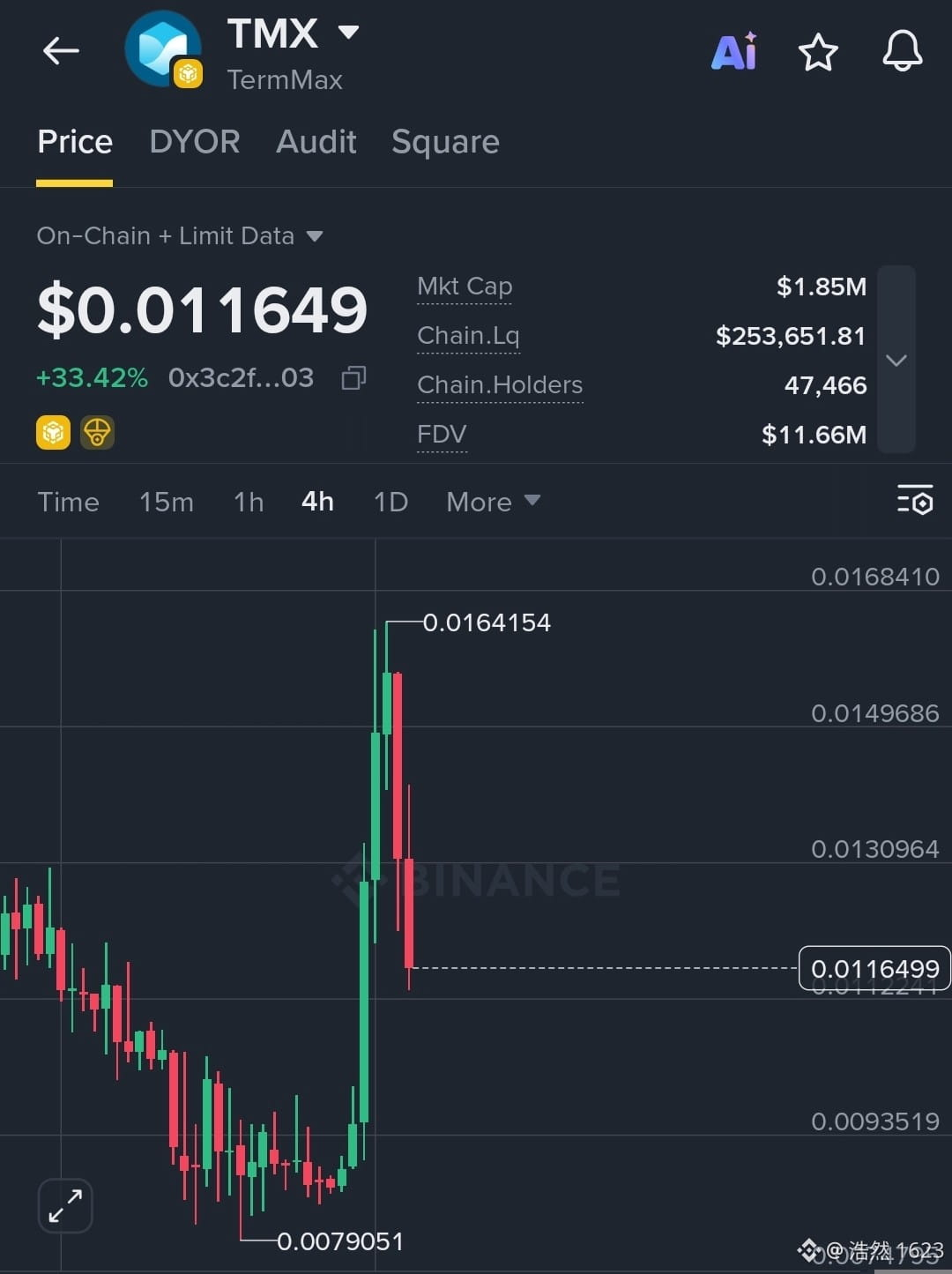
$TMX is showing extreme volatility after local peak around 0.0164, retracing sharply to test support near the 0.0116 level. If price consolidates above this key zone, buyers could attempt a quick recovery back toward previous highs.
Target 1: 0.01300 Target 2: 0.01490 Target 3: 0.01640
#TMX #TermMax #Crypto
$ZEC
{future}(ZECUSDT)
$MOVR
{future}(MOVRUSDT)
{alpha}(560x3c2f61f2e27c865981d2e7aaf6b2cdf823030039)
$TMX is showing extreme volatility after local peak around 0.0164, retracing sharply to test support near the 0.0116 level. If price consolidates above this key zone, buyers could attempt a quick recovery back toward previous highs.
Target 1: 0.01300 Target 2: 0.01490 Target 3: 0.01640
#TMX #TermMax #Crypto
$ZEC
$MOVR
Target 1: 0.01300 Target 2: 0.01490 Target 3: 0.01640
#TMX #TermMax #Crypto
$ZEC
$MOVR
212

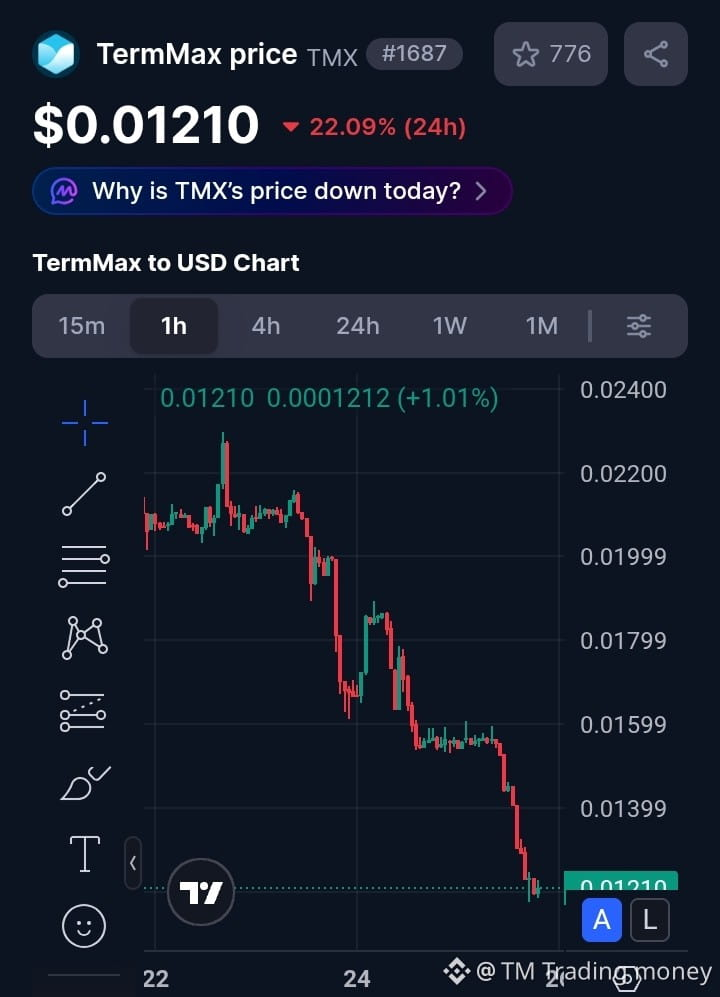
#TermMax TermMax is a decentralized finance (DeFi) platform focused on fixed-rate borrowing and lending. It allows users to lock borrowing costs and lending returns for a specific period, making financial planning more predictable. TermMax also offers one-click leveraged strategies and vaults designed to help users earn yield through curated strategies. Its technology uses customizable pricing curves inspired by Uniswap V3 to create flexible fixed-rate markets. The platform supports multiple blockchain networks and is designed to simplify complex DeFi strategies. However, like other DeFi protocols, TermMax involves risks such as smart-contract vulnerabilities, market volatility, liquidation, and potential loss of funds. Users should research the protocol, understand the terms, and assess their risk before
#TermMax TermMax is a decentralized finance (DeFi) platform focused on fixed-rate borrowing and lending. It allows users to lock borrowing costs and lending returns for a specific period, making financial planning more predictable. TermMax also offers one-click leveraged strategies and vaults designed to help users earn yield through curated strategies. Its technology uses customizable pricing curves inspired by Uniswap V3 to create flexible fixed-rate markets. The platform supports multiple blockchain networks and is designed to simplify complex DeFi strategies. However, like other DeFi protocols, TermMax involves risks such as smart-contract vulnerabilities, market volatility, liquidation, and potential loss of funds. Users should research the protocol, understand the terms, and assess their risk before

1
91


·
--
$TMX
🚀 TMX (TermMax) — Binance Update
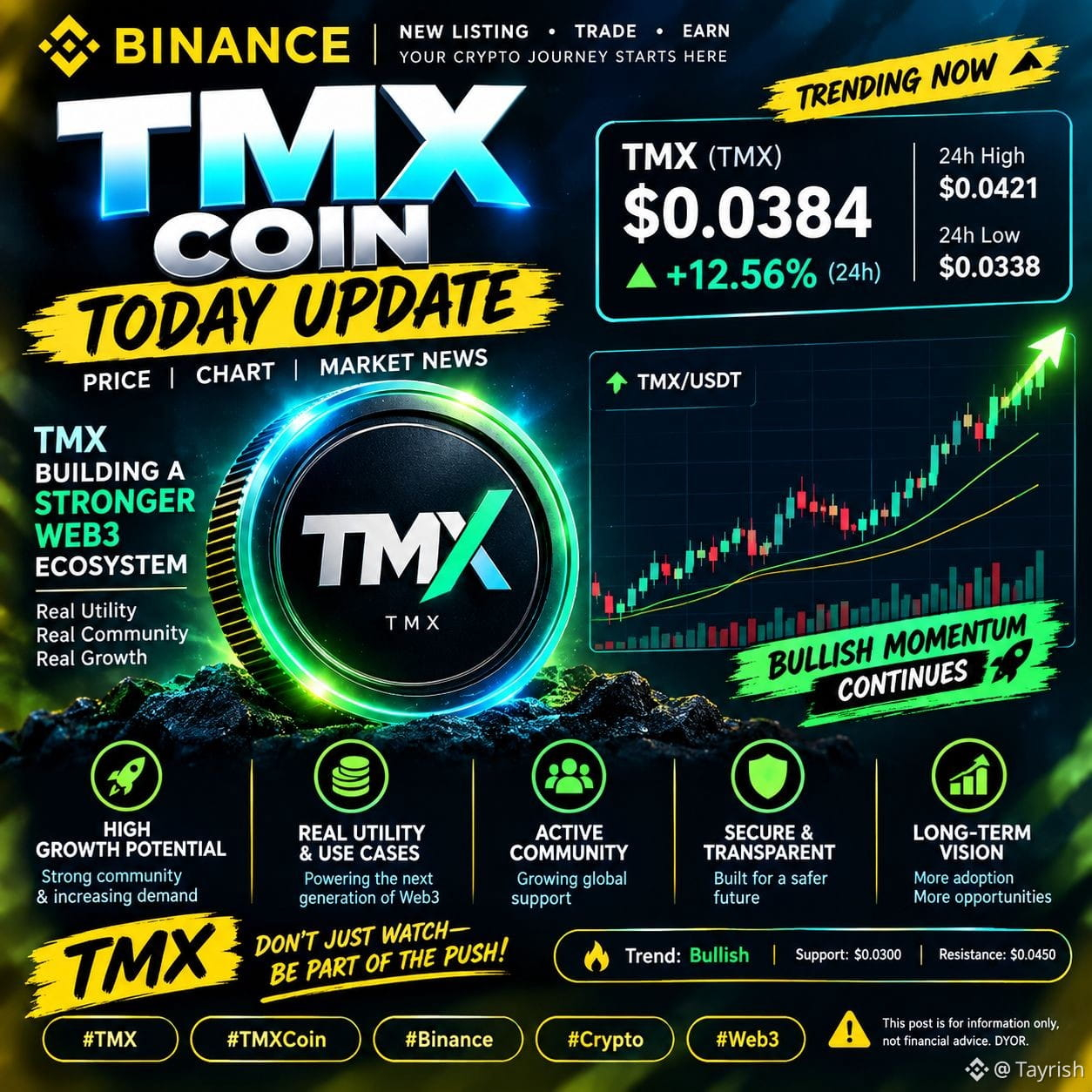
TMX is getting major attention today, with Binance Alpha activity helping drive visibility and trading interest. Binance’s latest data shows TermMax (TMX) around $0.037, with roughly +24% over 24 hours in the latest available reading. �
Binance
🔥 Key update: Binance Wallet launched a TMX trading competition, with the second phase running September 8–15, 2026. This is designed to increase trading activity and user engagement around TMX. �
Binance
📊 Short-term view: Bullish momentum, but HIGH risk.
TMX has experienced extreme volatility recently, so traders should watch volume, support near recent lows, and resistance around recent highs rather than chasing a sudden pump. �
$TMX
⚠️ Risk disclaimer: Crypto prices can change rapidly. This is market commentary for educational purposes, not financial advice. DYOR.
#TMX #TermMax #BinanceAlpha
{alpha}(560x3c2f61f2e27c865981d2e7aaf6b2cdf823030039)
$TMX
🚀 TMX (TermMax) — Binance Update
TMX is getting major attention today, with Binance Alpha activity helping drive visibility and trading interest. Binance’s latest data shows TermMax (TMX) around $0.037, with roughly +24% over 24 hours in the latest available reading. �
Binance
🔥 Key update: Binance Wallet launched a TMX trading competition, with the second phase running September 8–15, 2026. This is designed to increase trading activity and user engagement around TMX. �
Binance
📊 Short-term view: Bullish momentum, but HIGH risk.
TMX has experienced extreme volatility recently, so traders should watch volume, support near recent lows, and resistance around recent highs rather than chasing a sudden pump. �
$TMX
⚠️ Risk disclaimer: Crypto prices can change rapidly. This is market commentary for educational purposes, not financial advice. DYOR.
#TMX #TermMax #BinanceAlpha
🚀 TMX (TermMax) — Binance Update
TMX is getting major attention today, with Binance Alpha activity helping drive visibility and trading interest. Binance’s latest data shows TermMax (TMX) around $0.037, with roughly +24% over 24 hours in the latest available reading. �
Binance
🔥 Key update: Binance Wallet launched a TMX trading competition, with the second phase running September 8–15, 2026. This is designed to increase trading activity and user engagement around TMX. �
Binance
📊 Short-term view: Bullish momentum, but HIGH risk.
TMX has experienced extreme volatility recently, so traders should watch volume, support near recent lows, and resistance around recent highs rather than chasing a sudden pump. �
$TMX
⚠️ Risk disclaimer: Crypto prices can change rapidly. This is market commentary for educational purposes, not financial advice. DYOR.
#TMX #TermMax #BinanceAlpha
3
427
KII and TMX Market Overview: Tracking the Latest Price Action
Let’s check out the current on-chain and market data for KII and TMX to see how both assets are performing across the charts.
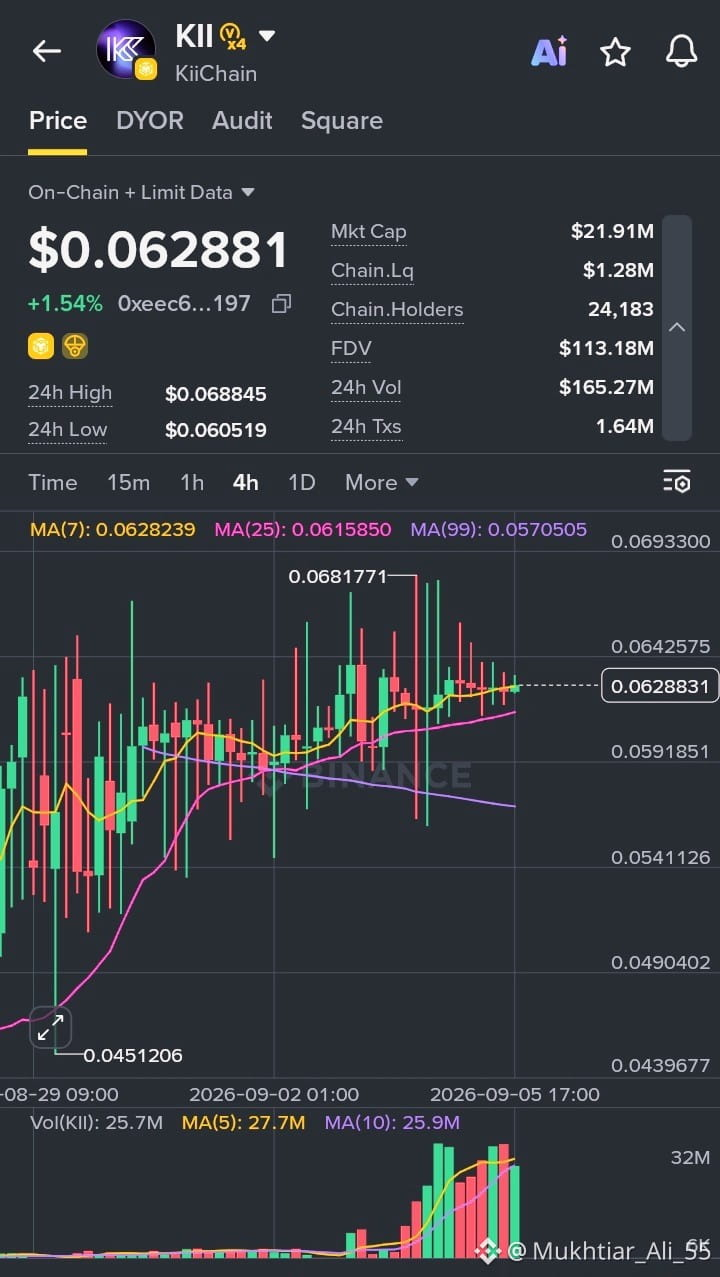
Starting with KII (KiiChain), the token is currently priced at $0.062881, showing a steady 24-hour gain of +1.54%. It holds a market cap of $21.91M with a fully diluted valuation (FDV) of $113.18M. Trading volume over the past 24 hours is robust at $165.27M, supported by chain liquidity of $1.28M and an active holder count of 24,183. Over the last day, it has traded between a low of $0.060519 and a high of $0.068845.
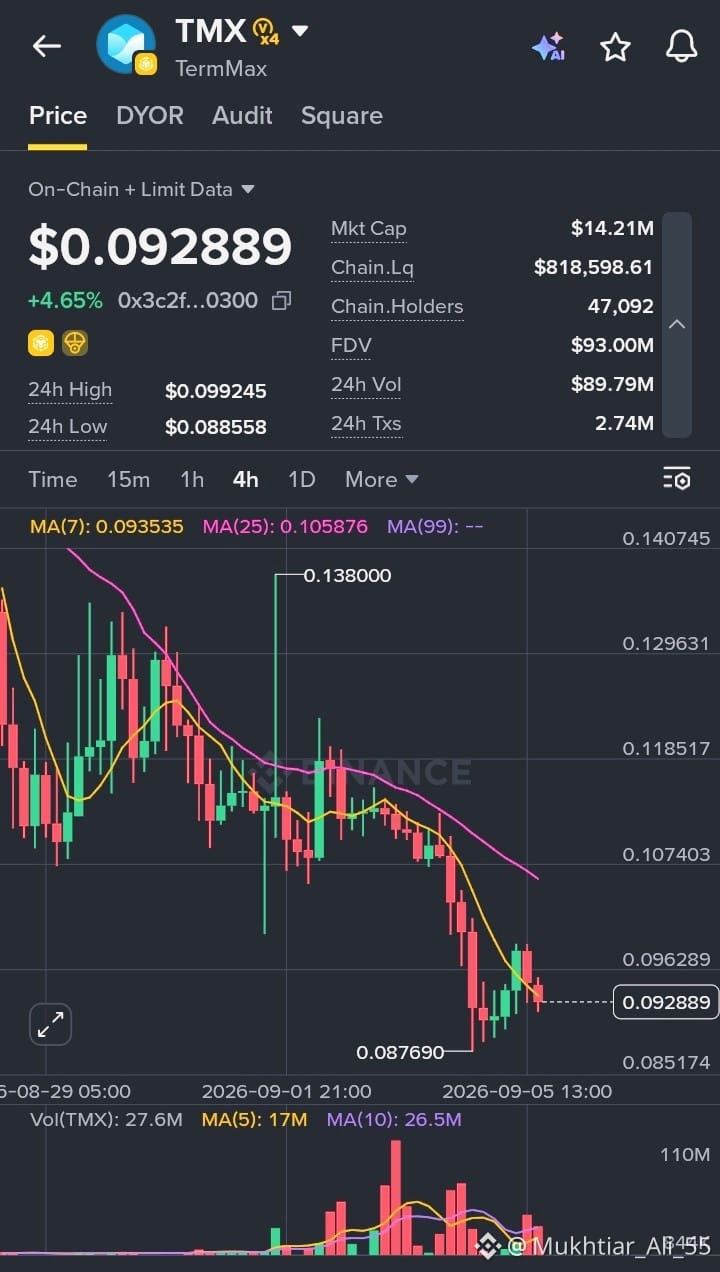
Moving over to TMX (TermMax), the token is trading at $0.092889, marking a positive 24-hour movement of +4.65%. Its market cap stands at $14.21M alongside an FDV of $93.00M. Trading activity shows a 24-hour volume of $89.79M, with chain liquidity recorded at $818,598.61 and a solid community of 47,092 holders. The price has fluctuated between a 24-hour low of $0.088558 and a high of $0.099245.
Both tokens are showing consistent market engagement as they trade through their current technical ranges.
#CryptoTrading #KiiChain #TermMax #Altcoins #MarketUpdate
$KII
{alpha}(560xeec6574eabba52bac3f0277f2cd5ac7e67197886)
$TMX
{alpha}(560x3c2f61f2e27c865981d2e7aaf6b2cdf823030039)
KII and TMX Market Overview: Tracking the Latest Price Action
Let’s check out the current on-chain and market data for KII and TMX to see how both assets are performing across the charts.
Starting with KII (KiiChain), the token is currently priced at $0.062881, showing a steady 24-hour gain of +1.54%. It holds a market cap of $21.91M with a fully diluted valuation (FDV) of $113.18M. Trading volume over the past 24 hours is robust at $165.27M, supported by chain liquidity of $1.28M and an active holder count of 24,183. Over the last day, it has traded between a low of $0.060519 and a high of $0.068845.
Moving over to TMX (TermMax), the token is trading at $0.092889, marking a positive 24-hour movement of +4.65%. Its market cap stands at $14.21M alongside an FDV of $93.00M. Trading activity shows a 24-hour volume of $89.79M, with chain liquidity recorded at $818,598.61 and a solid community of 47,092 holders. The price has fluctuated between a 24-hour low of $0.088558 and a high of $0.099245.
Both tokens are showing consistent market engagement as they trade through their current technical ranges.
#CryptoTrading #KiiChain #TermMax #Altcoins #MarketUpdate
$KII
$TMX
Let’s check out the current on-chain and market data for KII and TMX to see how both assets are performing across the charts.
Starting with KII (KiiChain), the token is currently priced at $0.062881, showing a steady 24-hour gain of +1.54%. It holds a market cap of $21.91M with a fully diluted valuation (FDV) of $113.18M. Trading volume over the past 24 hours is robust at $165.27M, supported by chain liquidity of $1.28M and an active holder count of 24,183. Over the last day, it has traded between a low of $0.060519 and a high of $0.068845.
Moving over to TMX (TermMax), the token is trading at $0.092889, marking a positive 24-hour movement of +4.65%. Its market cap stands at $14.21M alongside an FDV of $93.00M. Trading activity shows a 24-hour volume of $89.79M, with chain liquidity recorded at $818,598.61 and a solid community of 47,092 holders. The price has fluctuated between a 24-hour low of $0.088558 and a high of $0.099245.
Both tokens are showing consistent market engagement as they trade through their current technical ranges.
#CryptoTrading #KiiChain #TermMax #Altcoins #MarketUpdate
$KII
$TMX
700
·
--
🚀 TermMax (TMX): Volatility Could Be the Opportunity
TermMax (TMX) is trading around $0.104, with intraday volatility keeping traders on alert. Recent data shows TMX has pulled sharply lower from its $0.2043 all-time high, while trading activity remains elevated.
The key zone to watch is $0.105–$0.115. Holding $0.105 could give bulls a chance to reclaim $0.115, followed by $0.13–$0.14. A decisive break below $0.105 would weaken the setup and expose lower support.
With Binance recently highlighting TMX through a $200K trading competition, attention and liquidity could remain elevated.
TMX is volatile — but is this dip setting up the next move? 📈📉
$TMX
{alpha}(560x3c2f61f2e27c865981d2e7aaf6b2cdf823030039)
$ZEC
{future}(ZECUSDT)
$PROM
{future}(PROMUSDT)
#TermMax
#TMX
🗳️ TMX is around $0.104 — what does the chart do next?
🚀 TermMax (TMX): Volatility Could Be the Opportunity
TermMax (TMX) is trading around $0.104, with intraday volatility keeping traders on alert. Recent data shows TMX has pulled sharply lower from its $0.2043 all-time high, while trading activity remains elevated.
The key zone to watch is $0.105–$0.115. Holding $0.105 could give bulls a chance to reclaim $0.115, followed by $0.13–$0.14. A decisive break below $0.105 would weaken the setup and expose lower support.
With Binance recently highlighting TMX through a $200K trading competition, attention and liquidity could remain elevated.
TMX is volatile — but is this dip setting up the next move? 📈📉
$TMX
$ZEC
$PROM
#TermMax
#TMX
🗳️ TMX is around $0.104 — what does the chart do next?
TermMax (TMX) is trading around $0.104, with intraday volatility keeping traders on alert. Recent data shows TMX has pulled sharply lower from its $0.2043 all-time high, while trading activity remains elevated.
The key zone to watch is $0.105–$0.115. Holding $0.105 could give bulls a chance to reclaim $0.115, followed by $0.13–$0.14. A decisive break below $0.105 would weaken the setup and expose lower support.
With Binance recently highlighting TMX through a $200K trading competition, attention and liquidity could remain elevated.
TMX is volatile — but is this dip setting up the next move? 📈📉
$TMX
$ZEC
$PROM
#TermMax
#TMX
🗳️ TMX is around $0.104 — what does the chart do next?
🚀 Break $0.115 → breakout
45%
📈 Reclaim $0.110 → bullish
5%
🐻 Lose $0.101 → sell-off
27%
⚡ Sweep both → volatility
23%
22 votes • Voting closed
2
4.1k

·
--
I recently took another look at $TMX, and I feel that we’re actually in a stage that’s worth paying closer attention to now.
TermMax itself provides fixed-rate lending. In the CoinGecko Fixed Interest category, it’s ranked among the top positions. The protocol has been running for more than a year, with TVL exceeding $90 million, and it has been deployed across 10 EVM chains. Fundamentally, this isn’t something that was put together temporarily just to support a token launch.
Another aspect I care about is the token allocation structure. The team, advisors, and investors collectively hold 46% of the tokens, and all of that has a 12-month cliff. In the near term, what mainly needs to be faced is the linear unlock of the ecosystem portion.
So from the perspective of token price, I’d rather interpret $TMX like this: after the first round of emotion and sell-pressure has already been released, the next question is whether market funds are willing to reprice it based on fundamentals.
Also, TermMax has support from YZi Labs as a strategic investor, more than $90 million in TVL, and 1.5 million+ wallets as a foundation. If the protocol data keeps growing afterward, I think there’s still room for increased attention on $TMX.
Short-term volatility is completely normal. Personally, I’ll keep watching the trading volume and how well buy-side support sustains after $TMX.
⚠️ The above is for personal opinions and information sharing only and does not constitute investment advice. Crypto assets are highly volatile—please do your own research.
#TermMax #TMX #DeFi #Crypto
I recently took another look at $TMX, and I feel that we’re actually in a stage that’s worth paying closer attention to now.
TermMax itself provides fixed-rate lending. In the CoinGecko Fixed Interest category, it’s ranked among the top positions. The protocol has been running for more than a year, with TVL exceeding $90 million, and it has been deployed across 10 EVM chains. Fundamentally, this isn’t something that was put together temporarily just to support a token launch.
Another aspect I care about is the token allocation structure. The team, advisors, and investors collectively hold 46% of the tokens, and all of that has a 12-month cliff. In the near term, what mainly needs to be faced is the linear unlock of the ecosystem portion.
So from the perspective of token price, I’d rather interpret $TMX like this: after the first round of emotion and sell-pressure has already been released, the next question is whether market funds are willing to reprice it based on fundamentals.
Also, TermMax has support from YZi Labs as a strategic investor, more than $90 million in TVL, and 1.5 million+ wallets as a foundation. If the protocol data keeps growing afterward, I think there’s still room for increased attention on $TMX.
Short-term volatility is completely normal. Personally, I’ll keep watching the trading volume and how well buy-side support sustains after $TMX.
⚠️ The above is for personal opinions and information sharing only and does not constitute investment advice. Crypto assets are highly volatile—please do your own research.
#TermMax #TMX #DeFi #Crypto
TermMax itself provides fixed-rate lending. In the CoinGecko Fixed Interest category, it’s ranked among the top positions. The protocol has been running for more than a year, with TVL exceeding $90 million, and it has been deployed across 10 EVM chains. Fundamentally, this isn’t something that was put together temporarily just to support a token launch.
Another aspect I care about is the token allocation structure. The team, advisors, and investors collectively hold 46% of the tokens, and all of that has a 12-month cliff. In the near term, what mainly needs to be faced is the linear unlock of the ecosystem portion.
So from the perspective of token price, I’d rather interpret $TMX like this: after the first round of emotion and sell-pressure has already been released, the next question is whether market funds are willing to reprice it based on fundamentals.
Also, TermMax has support from YZi Labs as a strategic investor, more than $90 million in TVL, and 1.5 million+ wallets as a foundation. If the protocol data keeps growing afterward, I think there’s still room for increased attention on $TMX.
Short-term volatility is completely normal. Personally, I’ll keep watching the trading volume and how well buy-side support sustains after $TMX.
⚠️ The above is for personal opinions and information sharing only and does not constitute investment advice. Crypto assets are highly volatile—please do your own research.
#TermMax #TMX #DeFi #Crypto
1.1k
3
50
1.1k
·
--
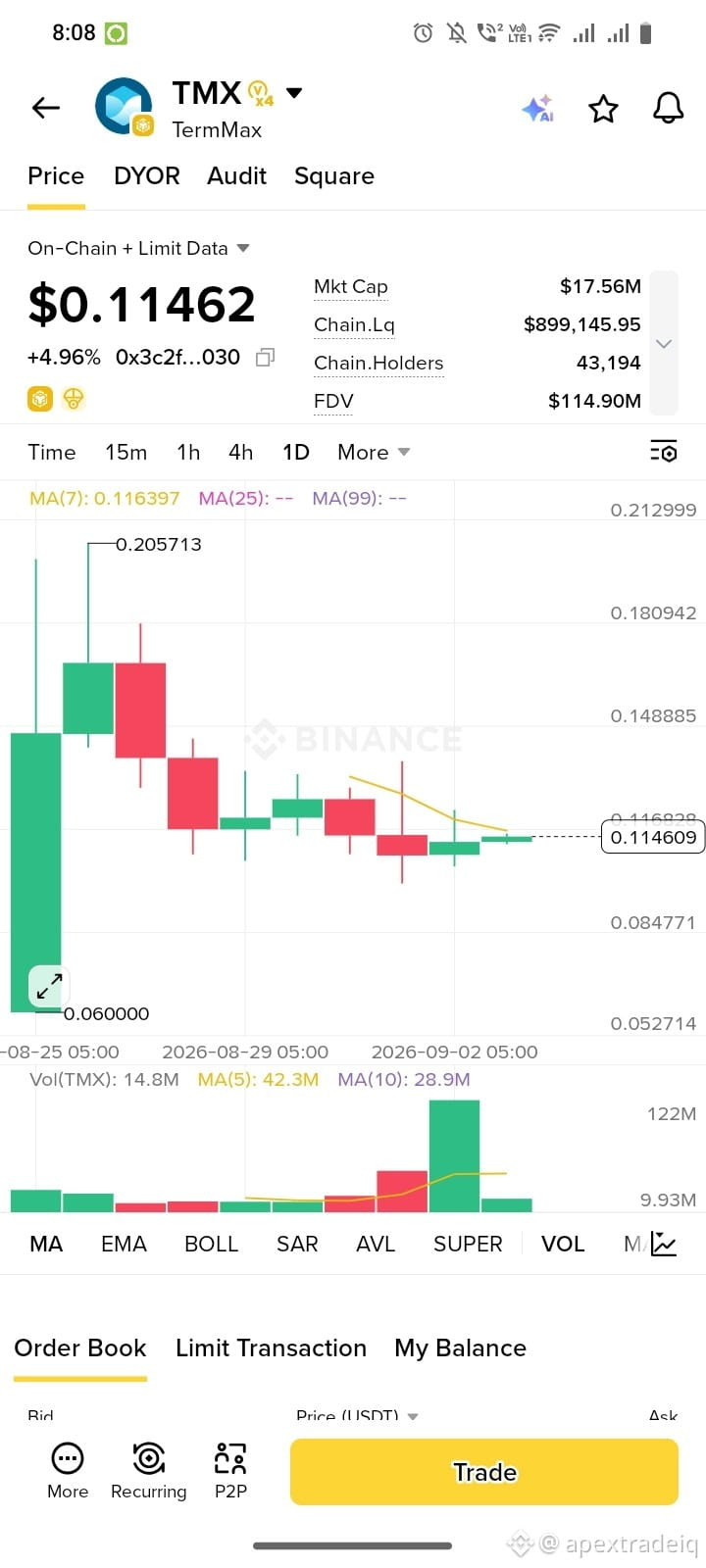
$TMX (TermMax) is quietly building momentum! 🚀 After previously spiking toward $0.2057, the price has consolidated around $0.11462 (+4.96%) with a notable surge in trading volume. Market cap currently stands at $17.56M with total holders reaching 43,194, indicating steady underlying accumulation during this range-bound phase.
With volume picking up and price stabilizing after the recent retracement, do you think $TMX is preparing for a breakout attempt toward $0.150+, or will it continue consolidating in this channel? Share your predictions below! ⁉️
#TMX #TermMax #CryptoTrading #PriceAnalysis #Altcoins #BinanceSquare
$TMX (TermMax) is quietly building momentum! 🚀 After previously spiking toward $0.2057, the price has consolidated around $0.11462 (+4.96%) with a notable surge in trading volume. Market cap currently stands at $17.56M with total holders reaching 43,194, indicating steady underlying accumulation during this range-bound phase.
With volume picking up and price stabilizing after the recent retracement, do you think $TMX is preparing for a breakout attempt toward $0.150+, or will it continue consolidating in this channel? Share your predictions below! ⁉️
#TMX #TermMax #CryptoTrading #PriceAnalysis #Altcoins #BinanceSquare
With volume picking up and price stabilizing after the recent retracement, do you think $TMX is preparing for a breakout attempt toward $0.150+, or will it continue consolidating in this channel? Share your predictions below! ⁉️
#TMX #TermMax #CryptoTrading #PriceAnalysis #Altcoins #BinanceSquare
1
1
38
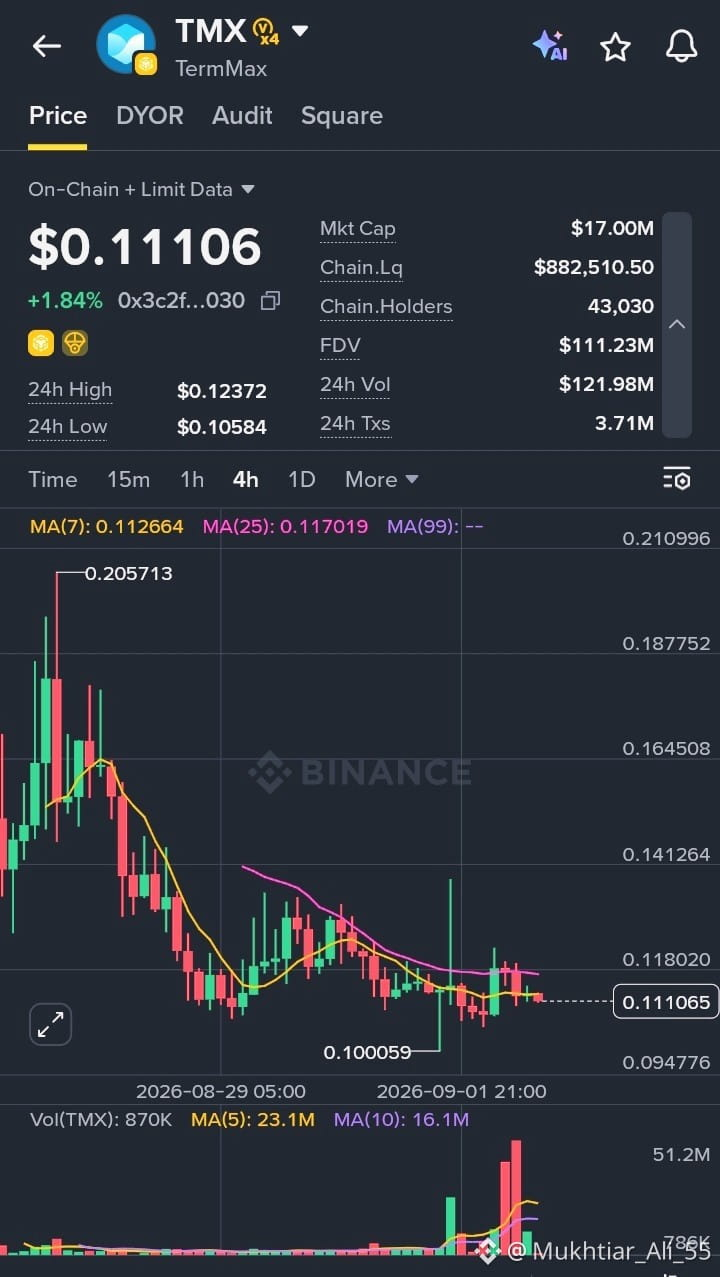
TMX Token On-Chain Review and Price Performance Update
Checking out the latest on-chain and market data for TMX (TermMax) to see how the token is holding up across the charts.
Here is a quick look at the core statistics from the dashboard:
Current Price: Trading at $0.11106, showing a mild gain of +1.84%.
24-Hour Range: Hit a low of $0.10584 and scaled up to a high of $0.12372.
Market Capitalization: Stands at $17.00M, with a Fully Diluted Valuation (FDV) of $111.23M.
Trading Volume & Activity: Recorded a strong 24-hour volume of $121.98M alongside 3.71M total transactions.
Holders & Liquidity: Chain holders currently count at 43,030 with chain liquidity resting at $882,510.50.
Observing how volume holds up around these moving average lines as trading progresses.
#CryptoTrading #Binance #TMX #TermMax #DeFi
$TMX
{alpha}(560x3c2f61f2e27c865981d2e7aaf6b2cdf823030039)
TMX Token On-Chain Review and Price Performance Update
Checking out the latest on-chain and market data for TMX (TermMax) to see how the token is holding up across the charts.
Here is a quick look at the core statistics from the dashboard:
Current Price: Trading at $0.11106, showing a mild gain of +1.84%.
24-Hour Range: Hit a low of $0.10584 and scaled up to a high of $0.12372.
Market Capitalization: Stands at $17.00M, with a Fully Diluted Valuation (FDV) of $111.23M.
Trading Volume & Activity: Recorded a strong 24-hour volume of $121.98M alongside 3.71M total transactions.
Holders & Liquidity: Chain holders currently count at 43,030 with chain liquidity resting at $882,510.50.
Observing how volume holds up around these moving average lines as trading progresses.
#CryptoTrading #Binance #TMX #TermMax #DeFi
$TMX
Checking out the latest on-chain and market data for TMX (TermMax) to see how the token is holding up across the charts.
Here is a quick look at the core statistics from the dashboard:
Current Price: Trading at $0.11106, showing a mild gain of +1.84%.
24-Hour Range: Hit a low of $0.10584 and scaled up to a high of $0.12372.
Market Capitalization: Stands at $17.00M, with a Fully Diluted Valuation (FDV) of $111.23M.
Trading Volume & Activity: Recorded a strong 24-hour volume of $121.98M alongside 3.71M total transactions.
Holders & Liquidity: Chain holders currently count at 43,030 with chain liquidity resting at $882,510.50.
Observing how volume holds up around these moving average lines as trading progresses.
#CryptoTrading #Binance #TMX #TermMax #DeFi
$TMX
260

·
--
Partly True
🔥Fellow members of the square, you’re in luck! $TMX is causing trouble again. Whether the order book is tidy or not aside, just take a careful look at the unlocks and the valuation—your heart should tell you something too.
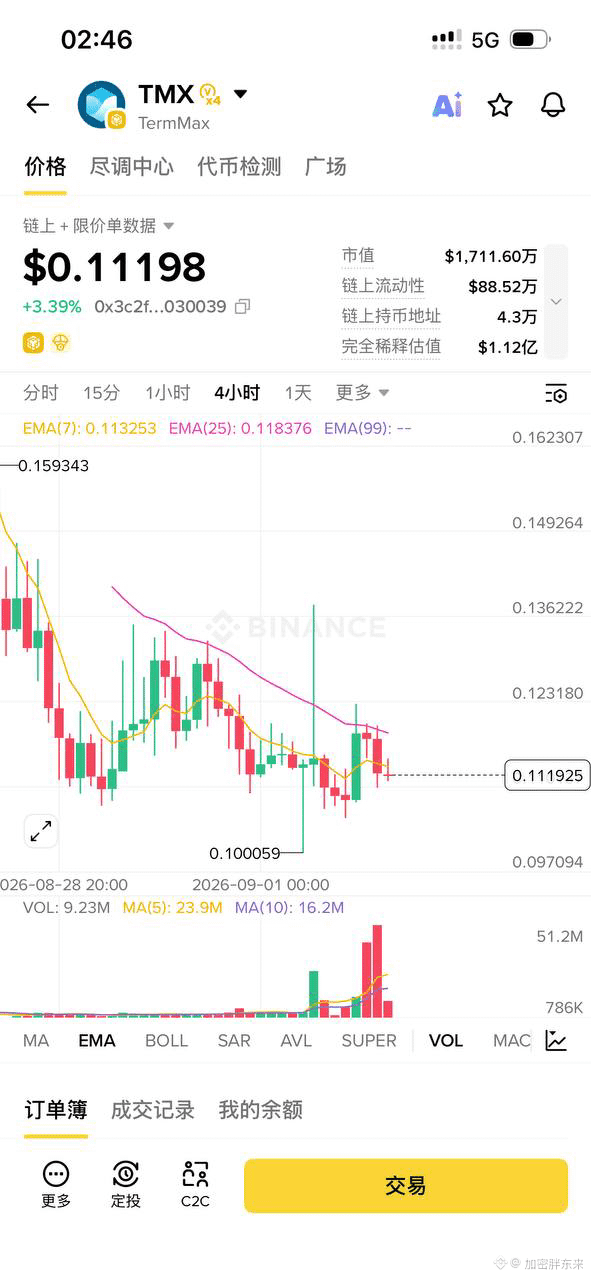
These past two days, public opinion across the whole internet has been one-sidedly blaming token unlocks. I casually checked the token chart— the sell-off logic simply doesn’t hold up.
The biggest portion of the sell pressure hasn’t even been unlocked. That 46% large share held by the team advisors and investors is all in a 12-month cliff period—no tokens can be withdrawn at all right now, and the earliest would be August 2027. What’s being released across the internet now is only ecosystem incentives—about 6.04 million tokens per month. Where would that huge selling pressure come from?
Valuation has been smashed into a deep pit: the fundamentals have basically been erased. TVL is $90 million, while the market cap is only $18 million. The ratio of market cap to TVL is just 0.20 (Pendle is 0.25). Take a good look and weigh it properly.
In the fixed-rate track, there are basically only two players: Pendle and TermMax. The biggest one has a market cap of $300 million. TMX holds a $90 million TVL, yet its market cap is only $18 million—its market cap/TVL has dropped to 0.20. This pricing is basically the same as not accounting for its fundamentals and backing. You tell me—doesn’t that sound harsh?
Mainnet launched in April 2025, spanning 10 chains—1.5 million wallets are using it. Market making and curation are supported by Keyrock and Edge Capital. Last month, YZi Labs even officially announced a strategic investment. No matter how you look at it, the foundation doesn’t look weak.
The market was driven off course by emotions and smashed into this pit—yet the fundamentals haven’t been repriced. What do you think about that?
#Termmax #Dell rises nearly 9% after hours in the US stock market, GitLab up 20%
🔥Fellow members of the square, you’re in luck! $TMX is causing trouble again. Whether the order book is tidy or not aside, just take a careful look at the unlocks and the valuation—your heart should tell you something too.
These past two days, public opinion across the whole internet has been one-sidedly blaming token unlocks. I casually checked the token chart— the sell-off logic simply doesn’t hold up.
The biggest portion of the sell pressure hasn’t even been unlocked. That 46% large share held by the team advisors and investors is all in a 12-month cliff period—no tokens can be withdrawn at all right now, and the earliest would be August 2027. What’s being released across the internet now is only ecosystem incentives—about 6.04 million tokens per month. Where would that huge selling pressure come from?
Valuation has been smashed into a deep pit: the fundamentals have basically been erased. TVL is $90 million, while the market cap is only $18 million. The ratio of market cap to TVL is just 0.20 (Pendle is 0.25). Take a good look and weigh it properly.
In the fixed-rate track, there are basically only two players: Pendle and TermMax. The biggest one has a market cap of $300 million. TMX holds a $90 million TVL, yet its market cap is only $18 million—its market cap/TVL has dropped to 0.20. This pricing is basically the same as not accounting for its fundamentals and backing. You tell me—doesn’t that sound harsh?
Mainnet launched in April 2025, spanning 10 chains—1.5 million wallets are using it. Market making and curation are supported by Keyrock and Edge Capital. Last month, YZi Labs even officially announced a strategic investment. No matter how you look at it, the foundation doesn’t look weak.
The market was driven off course by emotions and smashed into this pit—yet the fundamentals haven’t been repriced. What do you think about that?
#Termmax #Dell rises nearly 9% after hours in the US stock market, GitLab up 20%
These past two days, public opinion across the whole internet has been one-sidedly blaming token unlocks. I casually checked the token chart— the sell-off logic simply doesn’t hold up.
The biggest portion of the sell pressure hasn’t even been unlocked. That 46% large share held by the team advisors and investors is all in a 12-month cliff period—no tokens can be withdrawn at all right now, and the earliest would be August 2027. What’s being released across the internet now is only ecosystem incentives—about 6.04 million tokens per month. Where would that huge selling pressure come from?
Valuation has been smashed into a deep pit: the fundamentals have basically been erased. TVL is $90 million, while the market cap is only $18 million. The ratio of market cap to TVL is just 0.20 (Pendle is 0.25). Take a good look and weigh it properly.
In the fixed-rate track, there are basically only two players: Pendle and TermMax. The biggest one has a market cap of $300 million. TMX holds a $90 million TVL, yet its market cap is only $18 million—its market cap/TVL has dropped to 0.20. This pricing is basically the same as not accounting for its fundamentals and backing. You tell me—doesn’t that sound harsh?
Mainnet launched in April 2025, spanning 10 chains—1.5 million wallets are using it. Market making and curation are supported by Keyrock and Edge Capital. Last month, YZi Labs even officially announced a strategic investment. No matter how you look at it, the foundation doesn’t look weak.
The market was driven off course by emotions and smashed into this pit—yet the fundamentals haven’t been repriced. What do you think about that?
#Termmax #Dell rises nearly 9% after hours in the US stock market, GitLab up 20%
3
908

·
--
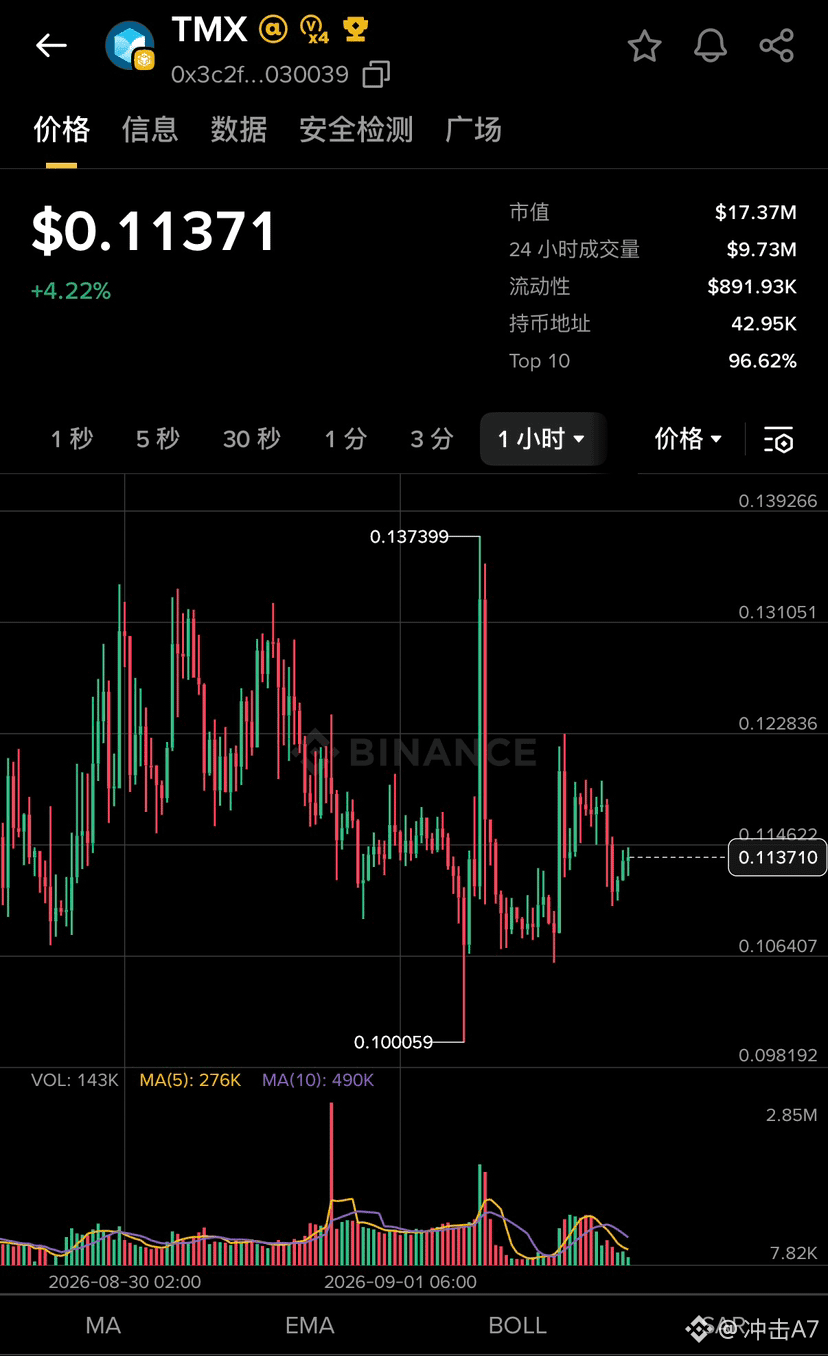
$TMX After this round of callbacks, I’ve become even more focused on its valuation correction opportunities.
As of September 3, the TMX price is about $0.114, with a circulating market cap of about $17.35 million—down roughly 44% from its historical peak.
TermMax offers fixed-rate, fixed-term lending and has already been deployed across multiple chains, including Ethereum, BNB Chain, Arbitrum, and Base.
I’m moderately positive on TMX mainly because the product is already live, and the combined team, advisors, and investors hold 46% of the tokens that are subject to an initial lock-up period—so near-term selling pressure from circulating supply is relatively limited.
However, the current FDV is about $114 million, and the circulating ratio is around 15%, so you can’t judge it as cheap based on circulating market cap alone.
Next, the most critical thing is:
Protocol growth → revenue growth → token demand growth
If this logic continues to be realized, this round of pullback might be the market’s start of repricing TMX.
#TermMax #TMX #DeFi
$TMX After this round of callbacks, I’ve become even more focused on its valuation correction opportunities.
As of September 3, the TMX price is about $0.114, with a circulating market cap of about $17.35 million—down roughly 44% from its historical peak.
TermMax offers fixed-rate, fixed-term lending and has already been deployed across multiple chains, including Ethereum, BNB Chain, Arbitrum, and Base.
I’m moderately positive on TMX mainly because the product is already live, and the combined team, advisors, and investors hold 46% of the tokens that are subject to an initial lock-up period—so near-term selling pressure from circulating supply is relatively limited.
However, the current FDV is about $114 million, and the circulating ratio is around 15%, so you can’t judge it as cheap based on circulating market cap alone.
Next, the most critical thing is:
Protocol growth → revenue growth → token demand growth
If this logic continues to be realized, this round of pullback might be the market’s start of repricing TMX.
#TermMax #TMX #DeFi
As of September 3, the TMX price is about $0.114, with a circulating market cap of about $17.35 million—down roughly 44% from its historical peak.
TermMax offers fixed-rate, fixed-term lending and has already been deployed across multiple chains, including Ethereum, BNB Chain, Arbitrum, and Base.
I’m moderately positive on TMX mainly because the product is already live, and the combined team, advisors, and investors hold 46% of the tokens that are subject to an initial lock-up period—so near-term selling pressure from circulating supply is relatively limited.
However, the current FDV is about $114 million, and the circulating ratio is around 15%, so you can’t judge it as cheap based on circulating market cap alone.
Next, the most critical thing is:
Protocol growth → revenue growth → token demand growth
If this logic continues to be realized, this round of pullback might be the market’s start of repricing TMX.
#TermMax #TMX #DeFi
1
1k

·
--
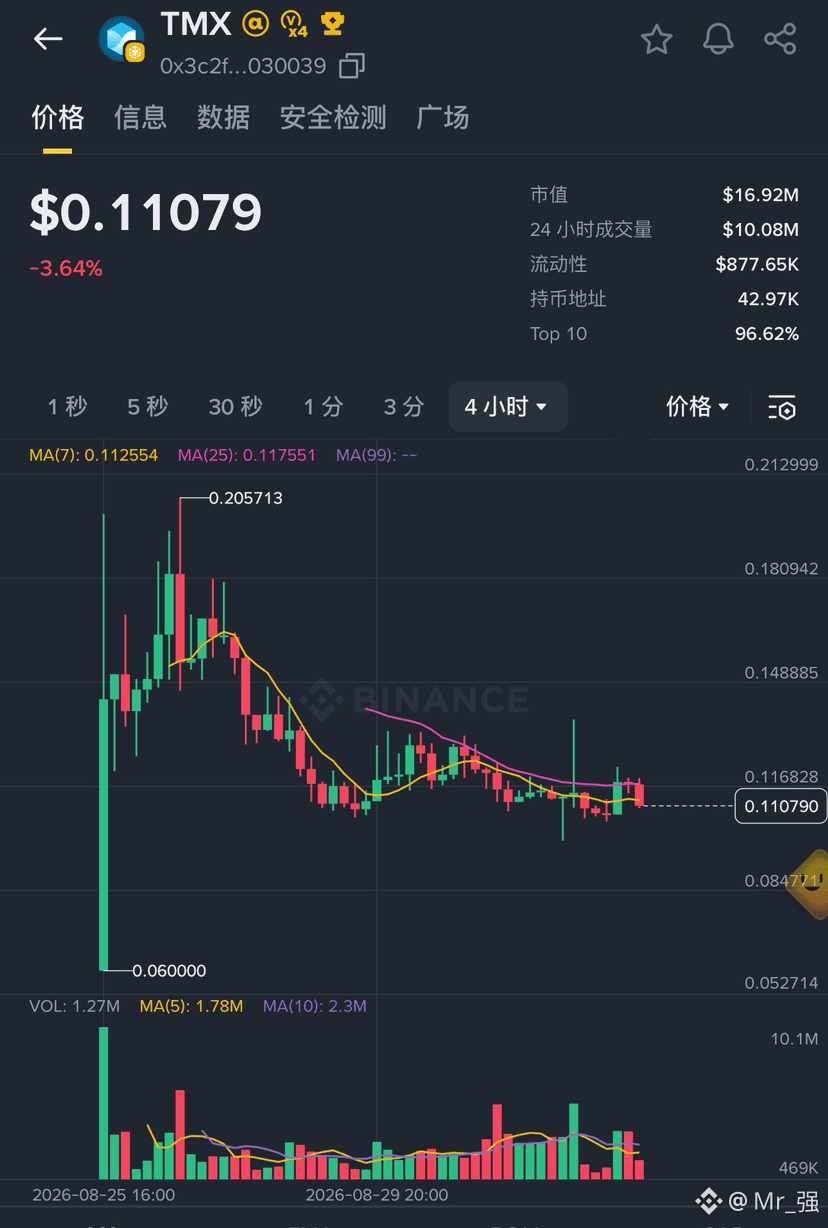
I’ve been looking at $TMX lately. What I care about isn’t the short-term price, but the gap between its current market cap and the protocol’s fundamentals.
Right now, #TMX has a market cap of about $18 million, TVL has already exceeded $90 million, and the market cap/TVL ratio is only 0.20.
If we look at it within the fixed-rate lending track, #TermMax is currently ranked second, just behind Pendle—yet its market cap is only about 6% of Pendle’s.
Of course, you can’t simply say that a low market cap means there will definitely be upside.
TMX’s circulating supply is only about 15%, and its FDV is about $118 million. The valuation issues caused by low circulating supply, along with the pressure from future unlocks, are things that need ongoing attention.
But in the long run, I still feel relatively optimistic about TermMax.
It already launched on the mainnet in 2025, is now live across 10 EVM chains, has TVL over $90 million, and continues building products such as fixed-rate, leverage, and yield management.
I’d rather think of it as a DeFi infrastructure project that’s still in the growth stage.
In the short term, it’s about price and sentiment; in the long term, it’s about whether TVL, real trading demand, and protocol revenue can keep growing.
If these metrics can continue to move upward, then at this size, it’s actually worth keeping track of continuously.
⚠️ This article is for personal research and information sharing only and does not constitute investment advice. Crypto assets are highly volatile—please do your own research (DYOR).
I’ve been looking at $TMX lately. What I care about isn’t the short-term price, but the gap between its current market cap and the protocol’s fundamentals.
Right now, #TMX has a market cap of about $18 million, TVL has already exceeded $90 million, and the market cap/TVL ratio is only 0.20.
If we look at it within the fixed-rate lending track, #TermMax is currently ranked second, just behind Pendle—yet its market cap is only about 6% of Pendle’s.
Of course, you can’t simply say that a low market cap means there will definitely be upside.
TMX’s circulating supply is only about 15%, and its FDV is about $118 million. The valuation issues caused by low circulating supply, along with the pressure from future unlocks, are things that need ongoing attention.
But in the long run, I still feel relatively optimistic about TermMax.
It already launched on the mainnet in 2025, is now live across 10 EVM chains, has TVL over $90 million, and continues building products such as fixed-rate, leverage, and yield management.
I’d rather think of it as a DeFi infrastructure project that’s still in the growth stage.
In the short term, it’s about price and sentiment; in the long term, it’s about whether TVL, real trading demand, and protocol revenue can keep growing.
If these metrics can continue to move upward, then at this size, it’s actually worth keeping track of continuously.
⚠️ This article is for personal research and information sharing only and does not constitute investment advice. Crypto assets are highly volatile—please do your own research (DYOR).
Right now, #TMX has a market cap of about $18 million, TVL has already exceeded $90 million, and the market cap/TVL ratio is only 0.20.
If we look at it within the fixed-rate lending track, #TermMax is currently ranked second, just behind Pendle—yet its market cap is only about 6% of Pendle’s.
Of course, you can’t simply say that a low market cap means there will definitely be upside.
TMX’s circulating supply is only about 15%, and its FDV is about $118 million. The valuation issues caused by low circulating supply, along with the pressure from future unlocks, are things that need ongoing attention.
But in the long run, I still feel relatively optimistic about TermMax.
It already launched on the mainnet in 2025, is now live across 10 EVM chains, has TVL over $90 million, and continues building products such as fixed-rate, leverage, and yield management.
I’d rather think of it as a DeFi infrastructure project that’s still in the growth stage.
In the short term, it’s about price and sentiment; in the long term, it’s about whether TVL, real trading demand, and protocol revenue can keep growing.
If these metrics can continue to move upward, then at this size, it’s actually worth keeping track of continuously.
⚠️ This article is for personal research and information sharing only and does not constitute investment advice. Crypto assets are highly volatile—please do your own research (DYOR).
420

·
--
#TermMax #TMX #沙特称伊朗在霍尔木兹袭击其船只
Recently, a lot of people have been talking about $TMX. I also took a look at TermMax’s product and token allocations while I was at it.
What’s most worth paying attention to isn’t just the “low circulating supply,” but what it did before issuing the tokens—and whether there’s real demand to absorb the chips that come out later.
TermMax focuses on fixed-rate lending. Most on-chain lending interest rates fluctuate with supply and demand, but it lets users lock in the interest rate and term upfront when they enter.
FT is used to buy at a discount and then redeem at face value at maturity; XT is used to lock in financing costs; GT packages collateral and debt into a single position, allowing loop leverage to be completed in one transaction.
The name sounds a bit complicated, but in practice it maps to three things: determine returns, fix borrowing costs, and improve capital efficiency.
As of August 26, according to TermMax’s public data, TVL has already exceeded $90 million, covering 10 EVM chains. There are 1.5M+ registered wallets, 90K+ daily active users, and partnerships with 20+ institutions.
Now looking at the tokens: $TMX total supply is 1 billion, with a fixed cap and no inflation. The combined team, advisors, and investors account for 46%, with a 12-month cliff period for them as well; after that, they release over 24 to 30 months.
That said, the short term isn’t completely without new supply. 29% of ecosystem allocation and 5% of the foundation allocation will be released over time according to their respective rules. For the exact unlock dates, you still need to refer to the official page.
So I’m not in a rush to guess the price of $TMX. The main thing to watch going forward is this: before the large allocations start to be released, can TermMax’s TVL, user base, and protocol revenue continue to grow?
Only if product demand can outpace token supply releases does this story truly hold up.
#TermMax #TMX #沙特称伊朗在霍尔木兹袭击其船只
Recently, a lot of people have been talking about $TMX. I also took a look at TermMax’s product and token allocations while I was at it.
What’s most worth paying attention to isn’t just the “low circulating supply,” but what it did before issuing the tokens—and whether there’s real demand to absorb the chips that come out later.
TermMax focuses on fixed-rate lending. Most on-chain lending interest rates fluctuate with supply and demand, but it lets users lock in the interest rate and term upfront when they enter.
FT is used to buy at a discount and then redeem at face value at maturity; XT is used to lock in financing costs; GT packages collateral and debt into a single position, allowing loop leverage to be completed in one transaction.
The name sounds a bit complicated, but in practice it maps to three things: determine returns, fix borrowing costs, and improve capital efficiency.
As of August 26, according to TermMax’s public data, TVL has already exceeded $90 million, covering 10 EVM chains. There are 1.5M+ registered wallets, 90K+ daily active users, and partnerships with 20+ institutions.
Now looking at the tokens: $TMX total supply is 1 billion, with a fixed cap and no inflation. The combined team, advisors, and investors account for 46%, with a 12-month cliff period for them as well; after that, they release over 24 to 30 months.
That said, the short term isn’t completely without new supply. 29% of ecosystem allocation and 5% of the foundation allocation will be released over time according to their respective rules. For the exact unlock dates, you still need to refer to the official page.
So I’m not in a rush to guess the price of $TMX. The main thing to watch going forward is this: before the large allocations start to be released, can TermMax’s TVL, user base, and protocol revenue continue to grow?
Only if product demand can outpace token supply releases does this story truly hold up.
Recently, a lot of people have been talking about $TMX. I also took a look at TermMax’s product and token allocations while I was at it.
What’s most worth paying attention to isn’t just the “low circulating supply,” but what it did before issuing the tokens—and whether there’s real demand to absorb the chips that come out later.
TermMax focuses on fixed-rate lending. Most on-chain lending interest rates fluctuate with supply and demand, but it lets users lock in the interest rate and term upfront when they enter.
FT is used to buy at a discount and then redeem at face value at maturity; XT is used to lock in financing costs; GT packages collateral and debt into a single position, allowing loop leverage to be completed in one transaction.
The name sounds a bit complicated, but in practice it maps to three things: determine returns, fix borrowing costs, and improve capital efficiency.
As of August 26, according to TermMax’s public data, TVL has already exceeded $90 million, covering 10 EVM chains. There are 1.5M+ registered wallets, 90K+ daily active users, and partnerships with 20+ institutions.
Now looking at the tokens: $TMX total supply is 1 billion, with a fixed cap and no inflation. The combined team, advisors, and investors account for 46%, with a 12-month cliff period for them as well; after that, they release over 24 to 30 months.
That said, the short term isn’t completely without new supply. 29% of ecosystem allocation and 5% of the foundation allocation will be released over time according to their respective rules. For the exact unlock dates, you still need to refer to the official page.
So I’m not in a rush to guess the price of $TMX. The main thing to watch going forward is this: before the large allocations start to be released, can TermMax’s TVL, user base, and protocol revenue continue to grow?
Only if product demand can outpace token supply releases does this story truly hold up.

42
3
6
1.2k

·
--
Bullish
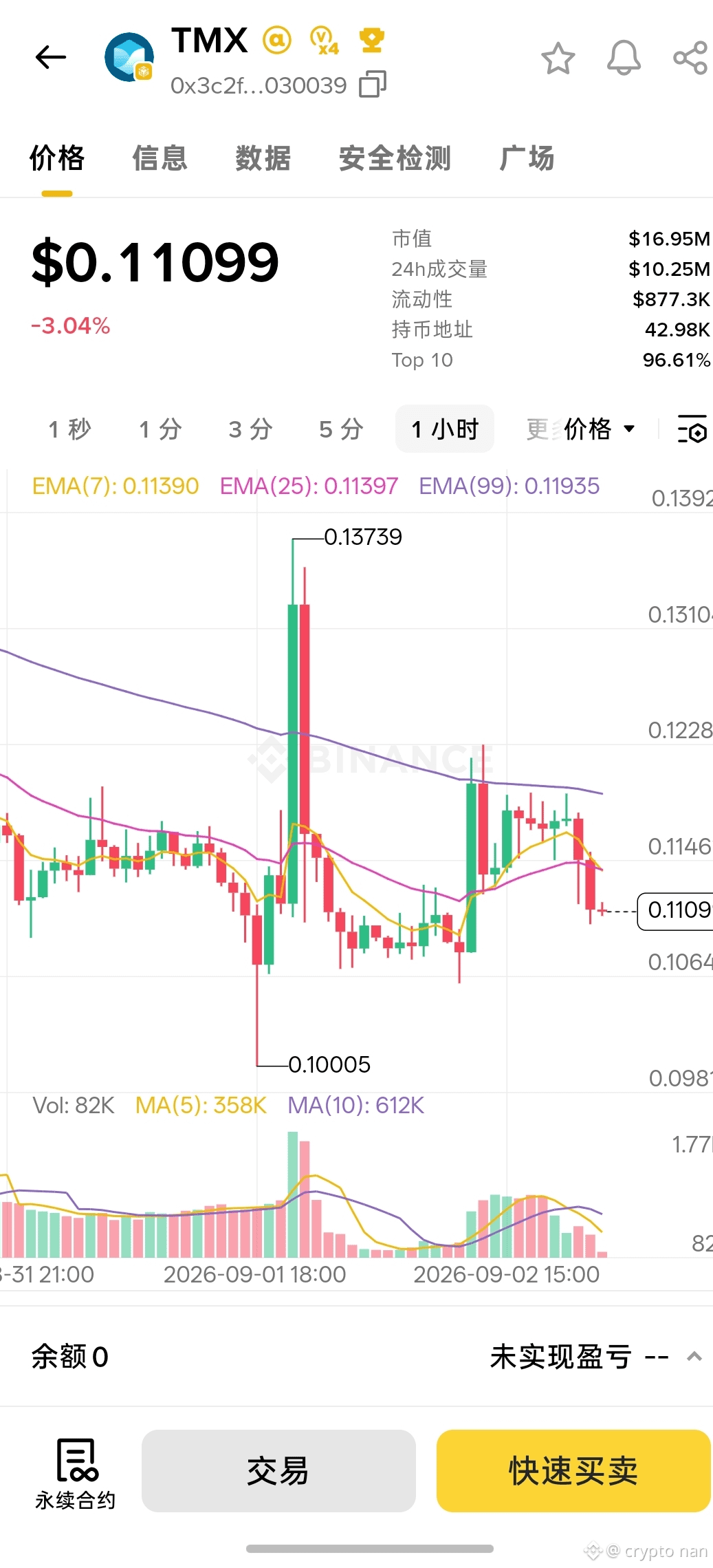
In this recent pullback ($TMX ), I’ve come across several bloggers who all seem to be conveniently blaming “token unlocks.” I went and dug into the full release schedule myself, and the conclusion is rather against common sense.
The team, advisors, and investors’ allocations—46% of the total—are all subject to a 12-month cliff lock, and not a single token has been unlocked yet. The earliest unlock date is at least August 2027.
Right now, the only tokens actually being released each month are the ecosystem allocation—about 6.04 million per month—which doesn’t match the market’s narrative about “large unlocks dumping on the market.” Pure emotion is running ahead of the fundamentals.
Speaking of the project itself: in the fixed-rate lending/borrowing track, there are really only two on-chain contenders—Pendle and TermMax.
On CoinGecko’s categorization, TMX ranks second, but its market cap is only $18 million. First place, Pendle, is $305 million—just 6%. Even if you compare against FDV, $117.8 million vs $499.5 million still shows a huge gap.
What’s even more interesting is the valuation: TVL has already surpassed $90 million, while the market cap is only $18 million—market cap/TVL is merely 0.20, which is even lower than Pendle’s 0.25.
That’s essentially the market pricing TermMax without really factoring in its business fundamentals.
Don’t think this is a hot project that was temporarily pieced together before TGE. They went live on the mainnet back in April 2025—over a year of real execution already:
10 EVM chain deployments, 1.5 million+ wallet addresses, 90,000+ daily active users, and 20+ partner institutions. Keyrock and Edge Capital are both early curators.
Last month, YZi Labs officially announced a strategic investment. On the very first day of TGE, it was immediately listed on five exchanges—Binance Alpha, Kraken, Bitget, MEXC, and KuCoin. The next day, Bybit listed it as well (perpetuals). This launch coverage is definitely top-tier among new tokens.
I believe this round of decline is mostly a case of mistaken selling driven by broader market sentiment, rather than any problem with the project’s fundamentals.
The fixed-rate track is still in an early stage, and the winner-takes-most effect will only get stronger. With the second-place project priced at this valuation level, the safety margin is actually quite high.
#TermMax #TMX #DeFi
In this recent pullback ($TMX ), I’ve come across several bloggers who all seem to be conveniently blaming “token unlocks.” I went and dug into the full release schedule myself, and the conclusion is rather against common sense.
The team, advisors, and investors’ allocations—46% of the total—are all subject to a 12-month cliff lock, and not a single token has been unlocked yet. The earliest unlock date is at least August 2027.
Right now, the only tokens actually being released each month are the ecosystem allocation—about 6.04 million per month—which doesn’t match the market’s narrative about “large unlocks dumping on the market.” Pure emotion is running ahead of the fundamentals.
Speaking of the project itself: in the fixed-rate lending/borrowing track, there are really only two on-chain contenders—Pendle and TermMax.
On CoinGecko’s categorization, TMX ranks second, but its market cap is only $18 million. First place, Pendle, is $305 million—just 6%. Even if you compare against FDV, $117.8 million vs $499.5 million still shows a huge gap.
What’s even more interesting is the valuation: TVL has already surpassed $90 million, while the market cap is only $18 million—market cap/TVL is merely 0.20, which is even lower than Pendle’s 0.25.
That’s essentially the market pricing TermMax without really factoring in its business fundamentals.
Don’t think this is a hot project that was temporarily pieced together before TGE. They went live on the mainnet back in April 2025—over a year of real execution already:
10 EVM chain deployments, 1.5 million+ wallet addresses, 90,000+ daily active users, and 20+ partner institutions. Keyrock and Edge Capital are both early curators.
Last month, YZi Labs officially announced a strategic investment. On the very first day of TGE, it was immediately listed on five exchanges—Binance Alpha, Kraken, Bitget, MEXC, and KuCoin. The next day, Bybit listed it as well (perpetuals). This launch coverage is definitely top-tier among new tokens.
I believe this round of decline is mostly a case of mistaken selling driven by broader market sentiment, rather than any problem with the project’s fundamentals.
The fixed-rate track is still in an early stage, and the winner-takes-most effect will only get stronger. With the second-place project priced at this valuation level, the safety margin is actually quite high.
#TermMax #TMX #DeFi
The team, advisors, and investors’ allocations—46% of the total—are all subject to a 12-month cliff lock, and not a single token has been unlocked yet. The earliest unlock date is at least August 2027.
Right now, the only tokens actually being released each month are the ecosystem allocation—about 6.04 million per month—which doesn’t match the market’s narrative about “large unlocks dumping on the market.” Pure emotion is running ahead of the fundamentals.
Speaking of the project itself: in the fixed-rate lending/borrowing track, there are really only two on-chain contenders—Pendle and TermMax.
On CoinGecko’s categorization, TMX ranks second, but its market cap is only $18 million. First place, Pendle, is $305 million—just 6%. Even if you compare against FDV, $117.8 million vs $499.5 million still shows a huge gap.
What’s even more interesting is the valuation: TVL has already surpassed $90 million, while the market cap is only $18 million—market cap/TVL is merely 0.20, which is even lower than Pendle’s 0.25.
That’s essentially the market pricing TermMax without really factoring in its business fundamentals.
Don’t think this is a hot project that was temporarily pieced together before TGE. They went live on the mainnet back in April 2025—over a year of real execution already:
10 EVM chain deployments, 1.5 million+ wallet addresses, 90,000+ daily active users, and 20+ partner institutions. Keyrock and Edge Capital are both early curators.
Last month, YZi Labs officially announced a strategic investment. On the very first day of TGE, it was immediately listed on five exchanges—Binance Alpha, Kraken, Bitget, MEXC, and KuCoin. The next day, Bybit listed it as well (perpetuals). This launch coverage is definitely top-tier among new tokens.
I believe this round of decline is mostly a case of mistaken selling driven by broader market sentiment, rather than any problem with the project’s fundamentals.
The fixed-rate track is still in an early stage, and the winner-takes-most effect will only get stronger. With the second-place project priced at this valuation level, the safety margin is actually quite high.
#TermMax #TMX #DeFi
27
5
1.2k

·
--
I’m taking a closer look at TermMax and $TMX, and the question I keep asking is simple: is this a buy, a sell, or a wait-and-see opportunity right now?
My view is that chasing $TMX after a strong move would be risky. I’d rather watch price action, volume, liquidity, and whether the project continues gaining real adoption before increasing exposure. For me, a pullback with strong support would offer a more attractive risk/reward setup than buying into short-term hype.
Looking toward the end of 2026, I’m particularly interested in whether @termmax can continue expanding its fixed-rate lending and borrowing ecosystem and attract more users to its DeFi infrastructure. If adoption and activity continue growing, I think $TMX could have an interesting second half of the year. But if momentum fades, capital preservation becomes more important than forcing a position.
My strategy: don’t FOMO into the market, scale entries instead of going all-in, and take partial profits if the price runs significantly.
What do you think — is $TMX a buy, sell, or hold heading into the end of 2026?
#TermMax
I’m taking a closer look at TermMax and $TMX , and the question I keep asking is simple: is this a buy, a sell, or a wait-and-see opportunity right now?
My view is that chasing $TMX after a strong move would be risky. I’d rather watch price action, volume, liquidity, and whether the project continues gaining real adoption before increasing exposure. For me, a pullback with strong support would offer a more attractive risk/reward setup than buying into short-term hype.
Looking toward the end of 2026, I’m particularly interested in whether @TermMax can continue expanding its fixed-rate lending and borrowing ecosystem and attract more users to its DeFi infrastructure. If adoption and activity continue growing, I think $TMX could have an interesting second half of the year. But if momentum fades, capital preservation becomes more important than forcing a position.
My strategy: don’t FOMO into the market, scale entries instead of going all-in, and take partial profits if the price runs significantly.
What do you think — is $TMX a buy, sell, or hold heading into the end of 2026?
#TermMax
My view is that chasing $TMX after a strong move would be risky. I’d rather watch price action, volume, liquidity, and whether the project continues gaining real adoption before increasing exposure. For me, a pullback with strong support would offer a more attractive risk/reward setup than buying into short-term hype.
Looking toward the end of 2026, I’m particularly interested in whether @TermMax can continue expanding its fixed-rate lending and borrowing ecosystem and attract more users to its DeFi infrastructure. If adoption and activity continue growing, I think $TMX could have an interesting second half of the year. But if momentum fades, capital preservation becomes more important than forcing a position.
My strategy: don’t FOMO into the market, scale entries instead of going all-in, and take partial profits if the price runs significantly.
What do you think — is $TMX a buy, sell, or hold heading into the end of 2026?
#TermMax
287

·
--
🚀 TermMax Trading Competition on Binance Alpha: Win Your Share of $200,000 in Rewards!🎯 A golden opportunity awaits you on the Binance Alpha platform! Binance Wallet has launched an exciting trading competition for the TermMax (TMX) code, with total prizes of $200,000, distributed across two consecutive rounds that will give traders double the chances to win
🔹 First round: from September 1, 2026 at 13:00 UTC to September 8, 2026 at 13:00
🚀 TermMax Trading Competition on Binance Alpha: Win Your Share of $200,000 in Rewards!
🎯 A golden opportunity awaits you on the Binance Alpha platform! Binance Wallet has launched an exciting trading competition for the TermMax (TMX) code, with total prizes of $200,000, distributed across two consecutive rounds that will give traders double the chances to win
🔹 First round: from September 1, 2026 at 13:00 UTC to September 8, 2026 at 13:00
🔹 First round: from September 1, 2026 at 13:00 UTC to September 8, 2026 at 13:00
34

🚀 A golden opportunity on Binance: trade TermMax (TMX) and win your share of $200,000!🎯 Crypto traders, get ready for the latest thrilling trading competitions on the Binance platform!
🔹 Binance Wallet announced the launch of the TermMax (TMX) trading competition on Binance Alpha, with total prizes of $200,000 distributed across two consecutive promotional phases.
⏰ Important dates:
🔹 Phase 1: from 1 September 2026 at 13:00 UTC until 8 September 2026 at 13:00 UTC
🚀 A golden opportunity on Binance: trade TermMax (TMX) and win your share of $200,000!
🎯 Crypto traders, get ready for the latest thrilling trading competitions on the Binance platform!
🔹 Binance Wallet announced the launch of the TermMax (TMX) trading competition on Binance Alpha, with total prizes of $200,000 distributed across two consecutive promotional phases.
⏰ Important dates:
🔹 Phase 1: from 1 September 2026 at 13:00 UTC until 8 September 2026 at 13:00 UTC
🔹 Binance Wallet announced the launch of the TermMax (TMX) trading competition on Binance Alpha, with total prizes of $200,000 distributed across two consecutive promotional phases.
⏰ Important dates:
🔹 Phase 1: from 1 September 2026 at 13:00 UTC until 8 September 2026 at 13:00 UTC
46

·
--
Bullish
#termmax @termmax
Why I Stopped Chasing High APYs in DeFi (And Changed My Yield Strategy)
For a long time, my DeFi routine was simple: deposit idle capital into a high-yielding pool and constantly monitor the APY every day. But if you’ve been in crypto long enough, you know fluctuating yields rarely stay high for long.
Recently, I shifted my focus towards Fixed-Income DeFi through protocols like TermMax, and it fundamentally changed how I view capital management.
Instead of constantly chasing shifting rates, fixed-term lending gives you something rare in crypto: Predictability.
What Makes Fixed Income Different?
Known Horizon: You know exact maturity dates and predetermined returns from day one.
No Daily APY Stress: You aren't constantly
moving funds between pools trying to optimize daily yield.
Institutional Mindset: It brings traditional bond-market structure into DeFi.
But Fixed Yield Doesn't Mean Zero Risk
High returns never come out of nowhere. Shifting to fixed rates comes with trade-offs:
Liquidity Risk: If you need to exit early, you depend on secondary market liquidity (which might lead to slippage).
Smart Contract Risk: Lock-up periods mean your assets remain exposed to protocol risk for the entire duration.
Underlying Asset Risk: A fixed rate won't protect you if the collateral/underlying token depegs or drops significantly.
:Final Thought
I don’t view protocols like TermMax as a tool to hunt the "highest APY." I view them as the maturation of DeFi—moving from dynamic yield farming to structured, predictable wealth management.
Real yield isn't about finding the biggest number; it's about understanding the balance between Risk and Predictability.
What's your preference—chasing dynamic APYs or locking in fixed yields? Let me know below! 👇
#DeFi #YieldFarming #CryptoInvesting @termmax
#termmax @TermMax
Why I Stopped Chasing High APYs in DeFi (And Changed My Yield Strategy)
For a long time, my DeFi routine was simple: deposit idle capital into a high-yielding pool and constantly monitor the APY every day. But if you’ve been in crypto long enough, you know fluctuating yields rarely stay high for long.
Recently, I shifted my focus towards Fixed-Income DeFi through protocols like TermMax, and it fundamentally changed how I view capital management.
Instead of constantly chasing shifting rates, fixed-term lending gives you something rare in crypto: Predictability.
What Makes Fixed Income Different?
Known Horizon: You know exact maturity dates and predetermined returns from day one.
No Daily APY Stress: You aren't constantly
moving funds between pools trying to optimize daily yield.
Institutional Mindset: It brings traditional bond-market structure into DeFi.
But Fixed Yield Doesn't Mean Zero Risk
High returns never come out of nowhere. Shifting to fixed rates comes with trade-offs:
Liquidity Risk: If you need to exit early, you depend on secondary market liquidity (which might lead to slippage).
Smart Contract Risk: Lock-up periods mean your assets remain exposed to protocol risk for the entire duration.
Underlying Asset Risk: A fixed rate won't protect you if the collateral/underlying token depegs or drops significantly.
:Final Thought
I don’t view protocols like TermMax as a tool to hunt the "highest APY." I view them as the maturation of DeFi—moving from dynamic yield farming to structured, predictable wealth management.
Real yield isn't about finding the biggest number; it's about understanding the balance between Risk and Predictability.
What's your preference—chasing dynamic APYs or locking in fixed yields? Let me know below! 👇
#DeFi #YieldFarming #CryptoInvesting @TermMax
Why I Stopped Chasing High APYs in DeFi (And Changed My Yield Strategy)
For a long time, my DeFi routine was simple: deposit idle capital into a high-yielding pool and constantly monitor the APY every day. But if you’ve been in crypto long enough, you know fluctuating yields rarely stay high for long.
Recently, I shifted my focus towards Fixed-Income DeFi through protocols like TermMax, and it fundamentally changed how I view capital management.
Instead of constantly chasing shifting rates, fixed-term lending gives you something rare in crypto: Predictability.
What Makes Fixed Income Different?
Known Horizon: You know exact maturity dates and predetermined returns from day one.
No Daily APY Stress: You aren't constantly
moving funds between pools trying to optimize daily yield.
Institutional Mindset: It brings traditional bond-market structure into DeFi.
But Fixed Yield Doesn't Mean Zero Risk
High returns never come out of nowhere. Shifting to fixed rates comes with trade-offs:
Liquidity Risk: If you need to exit early, you depend on secondary market liquidity (which might lead to slippage).
Smart Contract Risk: Lock-up periods mean your assets remain exposed to protocol risk for the entire duration.
Underlying Asset Risk: A fixed rate won't protect you if the collateral/underlying token depegs or drops significantly.
:Final Thought
I don’t view protocols like TermMax as a tool to hunt the "highest APY." I view them as the maturation of DeFi—moving from dynamic yield farming to structured, predictable wealth management.
Real yield isn't about finding the biggest number; it's about understanding the balance between Risk and Predictability.
What's your preference—chasing dynamic APYs or locking in fixed yields? Let me know below! 👇
#DeFi #YieldFarming #CryptoInvesting @TermMax
1
1
1
145

·
--
Maybe TVL is one of the most overvalued metrics in DeFi.
Especially for protocols like @TermMax.
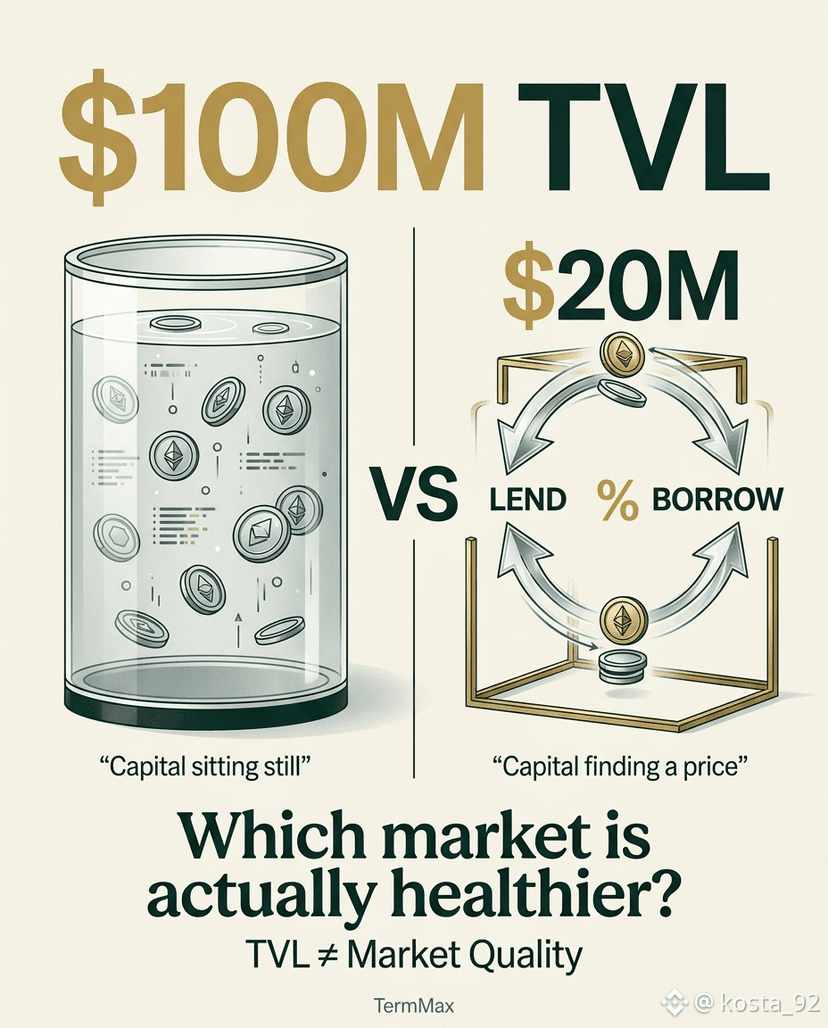
Imagine two markets:
A: $100M just sits in contracts.
B: $20M constantly moves between those who want to lock in yield and those who want to lock in the cost of borrowing.
Which market is actually more useful?
Earlier, I would’ve automatically picked the first.
Higher TVL = more trust = a stronger protocol.
But after looking into FT/XT, I’m not so sure anymore.
TermMax is trying to create an on-chain interest rate market. And a good market can’t be just about holding capital.
It needs participants with different expectations.
One locks in yield.
Another is willing to take risk.
The borrower locks in the price of money.
Someone is willing to give them that price.
So I’m more interested in not:
“How much money is in TermMax?”
But in:
“How well does @termmax match people with opposing expectations?”
$100M of passive capital looks great on a dashboard. But a functioning market for the price of money may be worth more.
And here’s the provocative conclusion:
if the main argument of a DeFi protocol is a high TVL, maybe it just doesn’t have a strong enough product.
Too harsh? 👀
@termmax #TermMax
Maybe TVL is one of the most overvalued metrics in DeFi.
Especially for protocols like @TermMax.
Imagine two markets:
A: $100M just sits in contracts.
B: $20M constantly moves between those who want to lock in yield and those who want to lock in the cost of borrowing.
Which market is actually more useful?
Earlier, I would’ve automatically picked the first.
Higher TVL = more trust = a stronger protocol.
But after looking into FT/XT, I’m not so sure anymore.
TermMax is trying to create an on-chain interest rate market. And a good market can’t be just about holding capital.
It needs participants with different expectations.
One locks in yield.
Another is willing to take risk.
The borrower locks in the price of money.
Someone is willing to give them that price.
So I’m more interested in not:
“How much money is in TermMax?”
But in:
“How well does @TermMax match people with opposing expectations?”
$100M of passive capital looks great on a dashboard. But a functioning market for the price of money may be worth more.
And here’s the provocative conclusion:
if the main argument of a DeFi protocol is a high TVL, maybe it just doesn’t have a strong enough product.
Too harsh? 👀
@TermMax #TermMax
Especially for protocols like @TermMax.
Imagine two markets:
A: $100M just sits in contracts.
B: $20M constantly moves between those who want to lock in yield and those who want to lock in the cost of borrowing.
Which market is actually more useful?
Earlier, I would’ve automatically picked the first.
Higher TVL = more trust = a stronger protocol.
But after looking into FT/XT, I’m not so sure anymore.
TermMax is trying to create an on-chain interest rate market. And a good market can’t be just about holding capital.
It needs participants with different expectations.
One locks in yield.
Another is willing to take risk.
The borrower locks in the price of money.
Someone is willing to give them that price.
So I’m more interested in not:
“How much money is in TermMax?”
But in:
“How well does @TermMax match people with opposing expectations?”
$100M of passive capital looks great on a dashboard. But a functioning market for the price of money may be worth more.
And here’s the provocative conclusion:
if the main argument of a DeFi protocol is a high TVL, maybe it just doesn’t have a strong enough product.
Too harsh? 👀
@TermMax #TermMax
1
278
Log in to explore more content
Join global crypto users on Binance Square
⚡️ Get latest and useful information about crypto.
💬 Trusted by the world’s largest crypto exchange.
👍 Discover real insights from verified creators.
Email / Phone number
Trending Topics
1
#BitcoinParesGainsAfterRallyTo$86.5K
6,051 views
51 Discussing
2
#CerebrasSinksNearly20%OnReportNvidiaToPowerOpenAI
14,903 views
230 Discussing
3
#SECProposesCryptoCustodyRules
39,179 views
389 Discussing
4
#SECApproves3xLongCryptoCommodityETPs
29,539 views
337 Discussing
5
#MASKHitsRecordMarketCapAbove$35M
31 views
22 Discussing
6
#G7PlansToReleaseUpTo100MBarrelsOilDiesel
28,931 views
354 Discussing
7
#ICBASuesOCCOverCryptoBankCharters
21,421 views
238 Discussing
8
#USStocksCloseHigherOnWeakJobsData
20,210 views
190 Discussing
9
#AnchorageReportedlyCuts17%Workforce
3,380 views
72 Discussing
10
#NFPWatch
11M views
19,708 Discussing