
#bojraisesratesto31yearhigh
bojraisesratesto31yearhigh
Hot
Latest

·
--
Bearish
#BOJRaisesRatesTo31YearHigh
#BOJRaisesRatesTo31YearHigh 🇯🇵📈
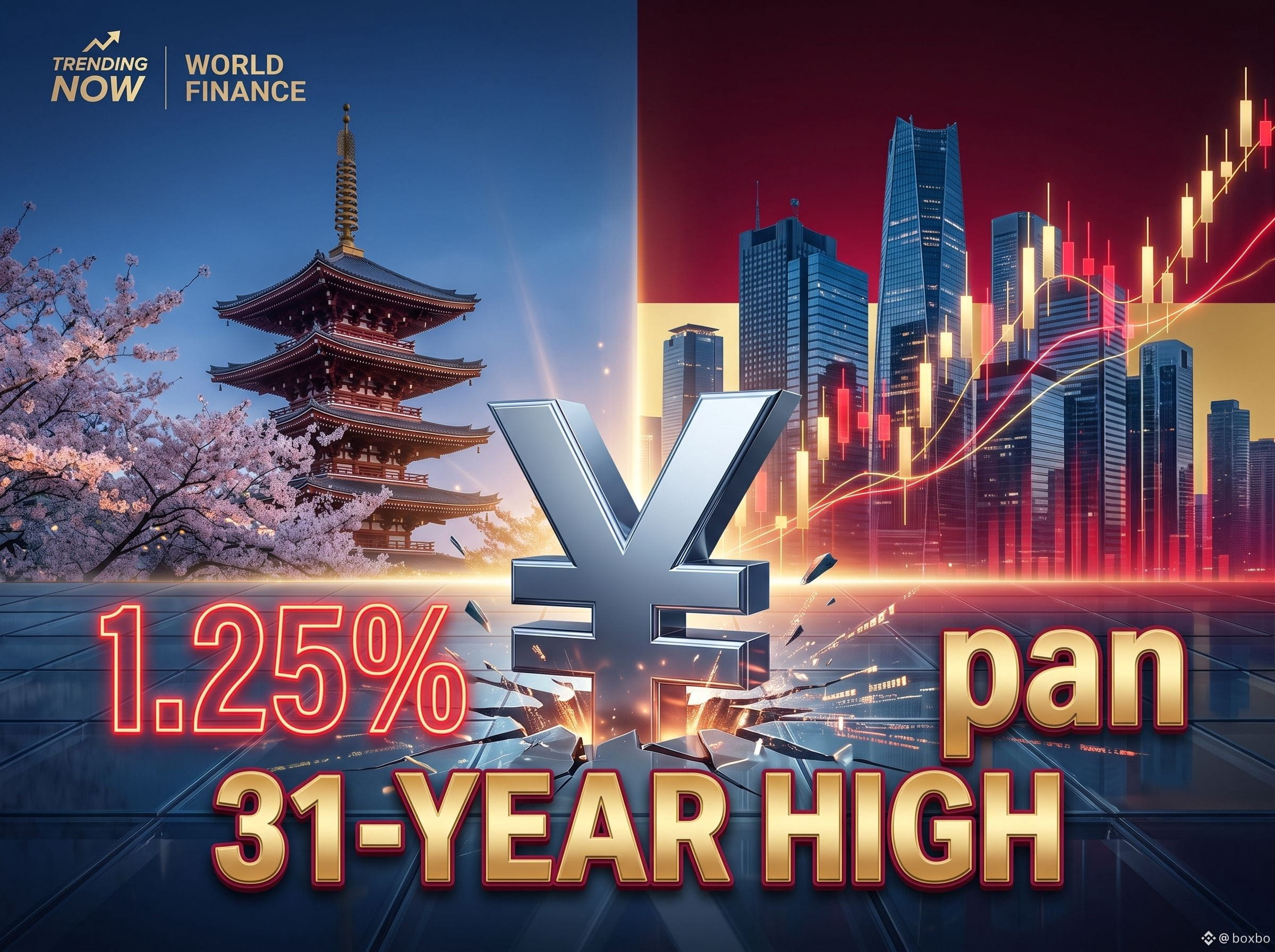
The Bank of Japan has taken another major step by raising interest rates to their highest level in 31 years, putting global markets on alert. The move signals a continued shift away from Japan’s long-standing ultra-loose monetary policy. Higher Japanese rates could strengthen the yen, influence global bond yields, and potentially impact capital flows across financial markets. Crypto and risk assets may also react as investors reassess liquidity and risk exposure. Traders are now watching the BOJ’s next statements closely for clues about future rate decisions. Volatility could increase as markets digest the policy change and its potential global impact. #BOJ #Japan #Crypto #Markets #InterestRates $NVDAB
#BOJRaisesRatesTo31YearHigh
#BOJRaisesRatesTo31YearHigh 🇯🇵📈
The Bank of Japan has taken another major step by raising interest rates to their highest level in 31 years, putting global markets on alert. The move signals a continued shift away from Japan’s long-standing ultra-loose monetary policy. Higher Japanese rates could strengthen the yen, influence global bond yields, and potentially impact capital flows across financial markets. Crypto and risk assets may also react as investors reassess liquidity and risk exposure. Traders are now watching the BOJ’s next statements closely for clues about future rate decisions. Volatility could increase as markets digest the policy change and its potential global impact. #BOJ #Japan #Crypto #Markets #InterestRates $NVDAB
#BOJRaisesRatesTo31YearHigh 🇯🇵📈
The Bank of Japan has taken another major step by raising interest rates to their highest level in 31 years, putting global markets on alert. The move signals a continued shift away from Japan’s long-standing ultra-loose monetary policy. Higher Japanese rates could strengthen the yen, influence global bond yields, and potentially impact capital flows across financial markets. Crypto and risk assets may also react as investors reassess liquidity and risk exposure. Traders are now watching the BOJ’s next statements closely for clues about future rate decisions. Volatility could increase as markets digest the policy change and its potential global impact. #BOJ #Japan #Crypto #Markets #InterestRates $NVDAB
1
1
245

·
--
Bullish
Verified
🚨 BOJ JUST FIRED A WARNING SHOT AT GLOBAL MARKETS! 🇯🇵🔥
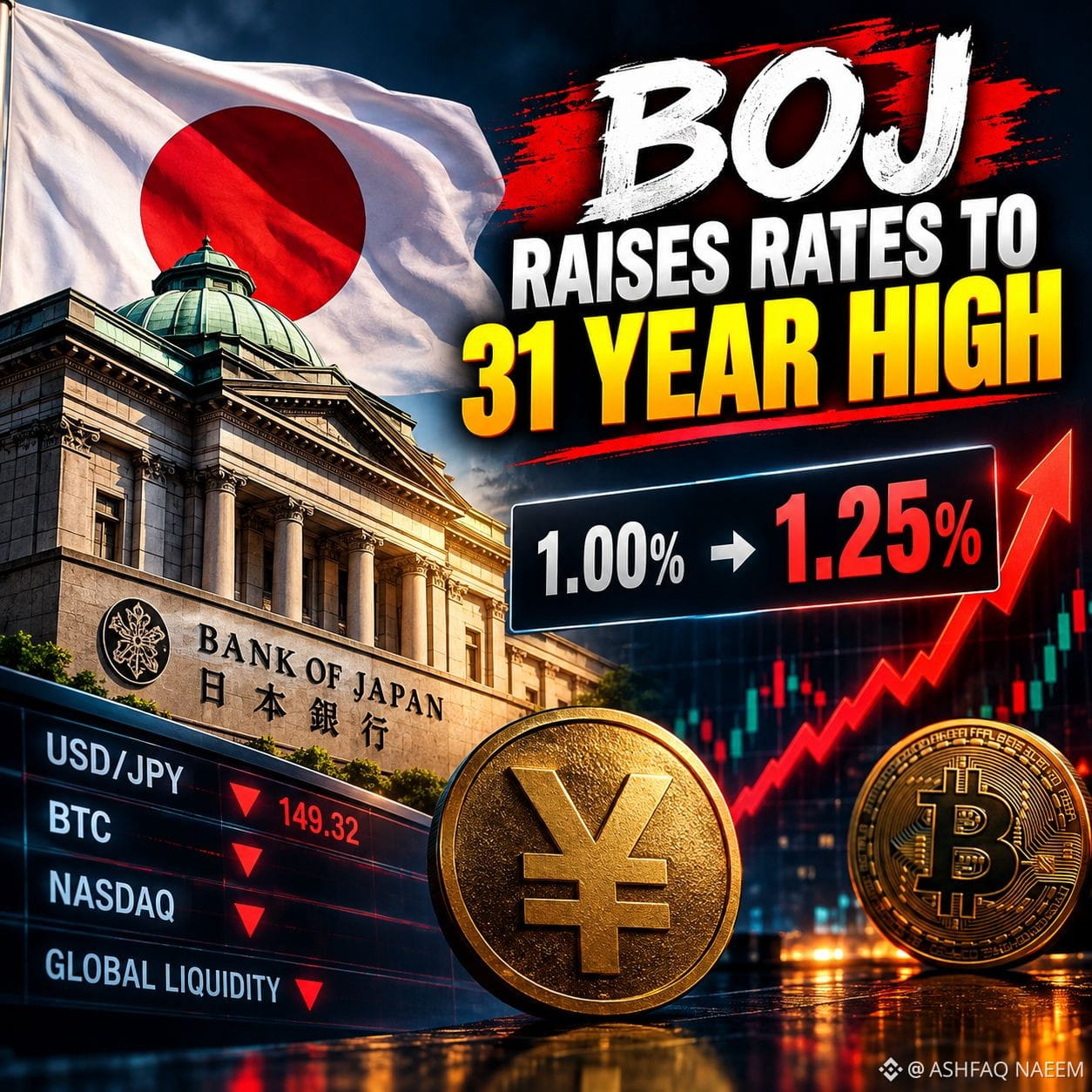
The Bank of Japan just raised rates from 1.00% → 1.25%, hitting the highest level in 31 YEARS! 📈
⚠️ Why traders should care:
• 💴 Yen funding conditions are changing
• 🏦 BOJ is moving further away from ultra-easy money
• 🌍 Global liquidity could face additional pressure
• 📊 Inflation is forcing central banks to stay restrictive
• 🔥 More BOJ hikes remain possible if inflation keeps rising
And here's the key detail:
The decision was 7–2, with two policymakers opposing the hike — meaning the path ahead could remain highly uncertain.
For crypto & risk assets, this is a macro signal traders cannot ignore.
👀 Watch the YEN + BTC + NASDAQ + global liquidity next.
BOJ tightening = potentially bigger volatility ahead.
#BoJ #Japan #bojraisesratesto31yearhigh
🚨 BOJ JUST FIRED A WARNING SHOT AT GLOBAL MARKETS! 🇯🇵🔥
The Bank of Japan just raised rates from 1.00% → 1.25%, hitting the highest level in 31 YEARS! 📈
⚠️ Why traders should care:
• 💴 Yen funding conditions are changing
• 🏦 BOJ is moving further away from ultra-easy money
• 🌍 Global liquidity could face additional pressure
• 📊 Inflation is forcing central banks to stay restrictive
• 🔥 More BOJ hikes remain possible if inflation keeps rising
And here's the key detail:
The decision was 7–2, with two policymakers opposing the hike — meaning the path ahead could remain highly uncertain.
For crypto & risk assets, this is a macro signal traders cannot ignore.
👀 Watch the YEN + BTC + NASDAQ + global liquidity next.
BOJ tightening = potentially bigger volatility ahead.
#BoJ #Japan #bojraisesratesto31yearhigh
The Bank of Japan just raised rates from 1.00% → 1.25%, hitting the highest level in 31 YEARS! 📈
⚠️ Why traders should care:
• 💴 Yen funding conditions are changing
• 🏦 BOJ is moving further away from ultra-easy money
• 🌍 Global liquidity could face additional pressure
• 📊 Inflation is forcing central banks to stay restrictive
• 🔥 More BOJ hikes remain possible if inflation keeps rising
And here's the key detail:
The decision was 7–2, with two policymakers opposing the hike — meaning the path ahead could remain highly uncertain.
For crypto & risk assets, this is a macro signal traders cannot ignore.
👀 Watch the YEN + BTC + NASDAQ + global liquidity next.
BOJ tightening = potentially bigger volatility ahead.
#BoJ #Japan #bojraisesratesto31yearhigh
10
5.6k

·
--
#bojraisesratesto31yearhigh
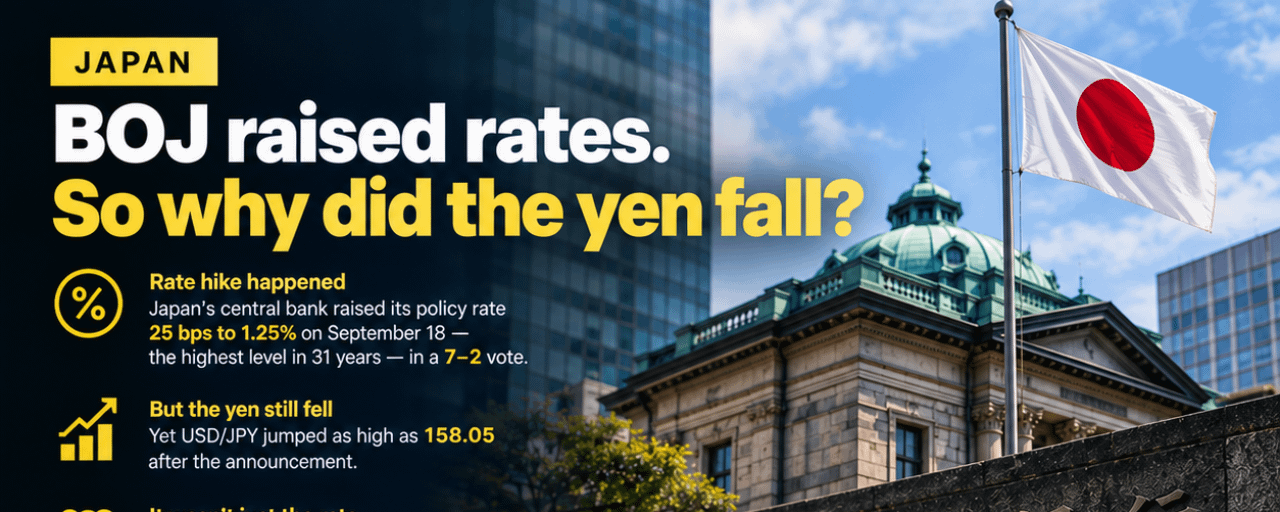
🇯🇵 BOJ Raised Rates. So Why Did the Yen FALL?
Imagine borrowing a currency whose central bank just raised rates…
…and that currency still gets weaker. 😂
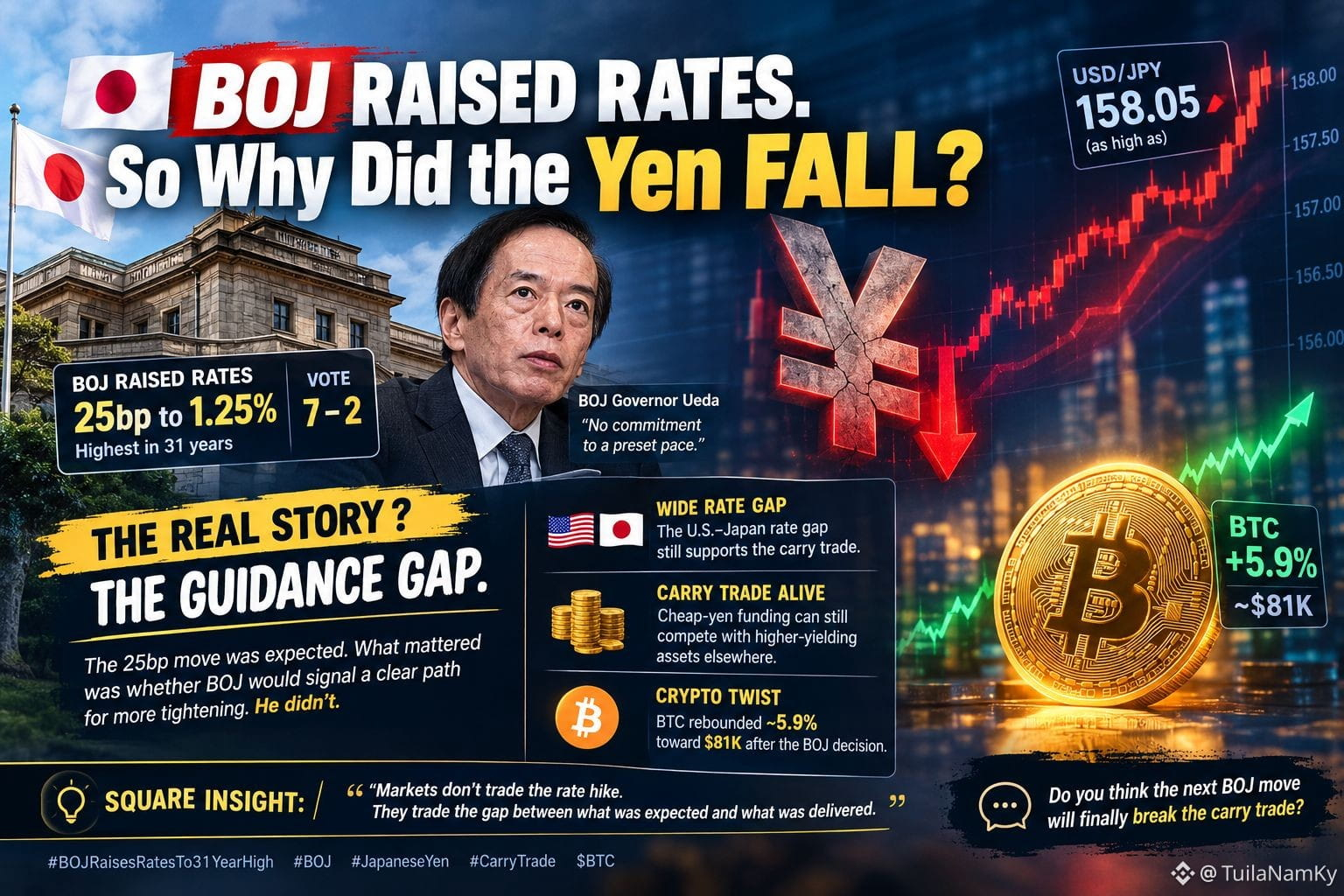
On Sept. 18, the BOJ raised rates 25bp to 1.25%, the highest level in 31 years.
The vote? 7–2.
But USD/JPY jumped as high as 158.05 as traders questioned how aggressive the next hikes will be.
BUT HERE’S WHAT MANY PEOPLE MISS 👀
The market wasn't simply trading the hike.
It was trading the guidance gap.
The 25bp move was widely expected. What mattered was whether BOJ Governor Ueda would signal a clear path for more tightening.
He didn't commit to a preset pace.
Meanwhile, the U.S.–Japan rate gap remains wide enough to keep the carry-trade story alive: cheap-yen funding can still compete with higher-yielding assets elsewhere.
And then came the crypto twist:
BTC rebounded ~5.9% toward $81K after the BOJ decision.
So:
BOJ tightening ≠ automatic crypto selloff.
But there is another risk.
If USD/JPY pushes higher, intervention concerns can intensify. If the yen suddenly strengthens, crowded carry positions could unwind quickly.
🧠 Square Insight:
Markets don't trade the rate hike. They trade the gap between what was expected and what was delivered.
Do you think the next BOJ move will finally break the carry trade?
Market commentary only. Not financial advice.
#BOJ #JapaneseYen #CarryTrade
$BTC
{future}(BTCUSDT)
#bojraisesratesto31yearhigh
🇯🇵 BOJ Raised Rates. So Why Did the Yen FALL?
Imagine borrowing a currency whose central bank just raised rates…
…and that currency still gets weaker. 😂
On Sept. 18, the BOJ raised rates 25bp to 1.25%, the highest level in 31 years.
The vote? 7–2.
But USD/JPY jumped as high as 158.05 as traders questioned how aggressive the next hikes will be.
BUT HERE’S WHAT MANY PEOPLE MISS 👀
The market wasn't simply trading the hike.
It was trading the guidance gap.
The 25bp move was widely expected. What mattered was whether BOJ Governor Ueda would signal a clear path for more tightening.
He didn't commit to a preset pace.
Meanwhile, the U.S.–Japan rate gap remains wide enough to keep the carry-trade story alive: cheap-yen funding can still compete with higher-yielding assets elsewhere.
And then came the crypto twist:
BTC rebounded ~5.9% toward $81K after the BOJ decision.
So:
BOJ tightening ≠ automatic crypto selloff.
But there is another risk.
If USD/JPY pushes higher, intervention concerns can intensify. If the yen suddenly strengthens, crowded carry positions could unwind quickly.
🧠 Square Insight:
Markets don't trade the rate hike. They trade the gap between what was expected and what was delivered.
Do you think the next BOJ move will finally break the carry trade?
Market commentary only. Not financial advice.
#BOJ #JapaneseYen #CarryTrade
$BTC
🇯🇵 BOJ Raised Rates. So Why Did the Yen FALL?
Imagine borrowing a currency whose central bank just raised rates…
…and that currency still gets weaker. 😂
On Sept. 18, the BOJ raised rates 25bp to 1.25%, the highest level in 31 years.
The vote? 7–2.
But USD/JPY jumped as high as 158.05 as traders questioned how aggressive the next hikes will be.
BUT HERE’S WHAT MANY PEOPLE MISS 👀
The market wasn't simply trading the hike.
It was trading the guidance gap.
The 25bp move was widely expected. What mattered was whether BOJ Governor Ueda would signal a clear path for more tightening.
He didn't commit to a preset pace.
Meanwhile, the U.S.–Japan rate gap remains wide enough to keep the carry-trade story alive: cheap-yen funding can still compete with higher-yielding assets elsewhere.
And then came the crypto twist:
BTC rebounded ~5.9% toward $81K after the BOJ decision.
So:
BOJ tightening ≠ automatic crypto selloff.
But there is another risk.
If USD/JPY pushes higher, intervention concerns can intensify. If the yen suddenly strengthens, crowded carry positions could unwind quickly.
🧠 Square Insight:
Markets don't trade the rate hike. They trade the gap between what was expected and what was delivered.
Do you think the next BOJ move will finally break the carry trade?
Market commentary only. Not financial advice.
#BOJ #JapaneseYen #CarryTrade
$BTC
1
6
6.7k

·
--
Verified
#bojraisesratesto31yearhigh
🚀 BOJ Raised Rates, But Japanese Yen Dropped! Here’s Why & What It Means for Crypto
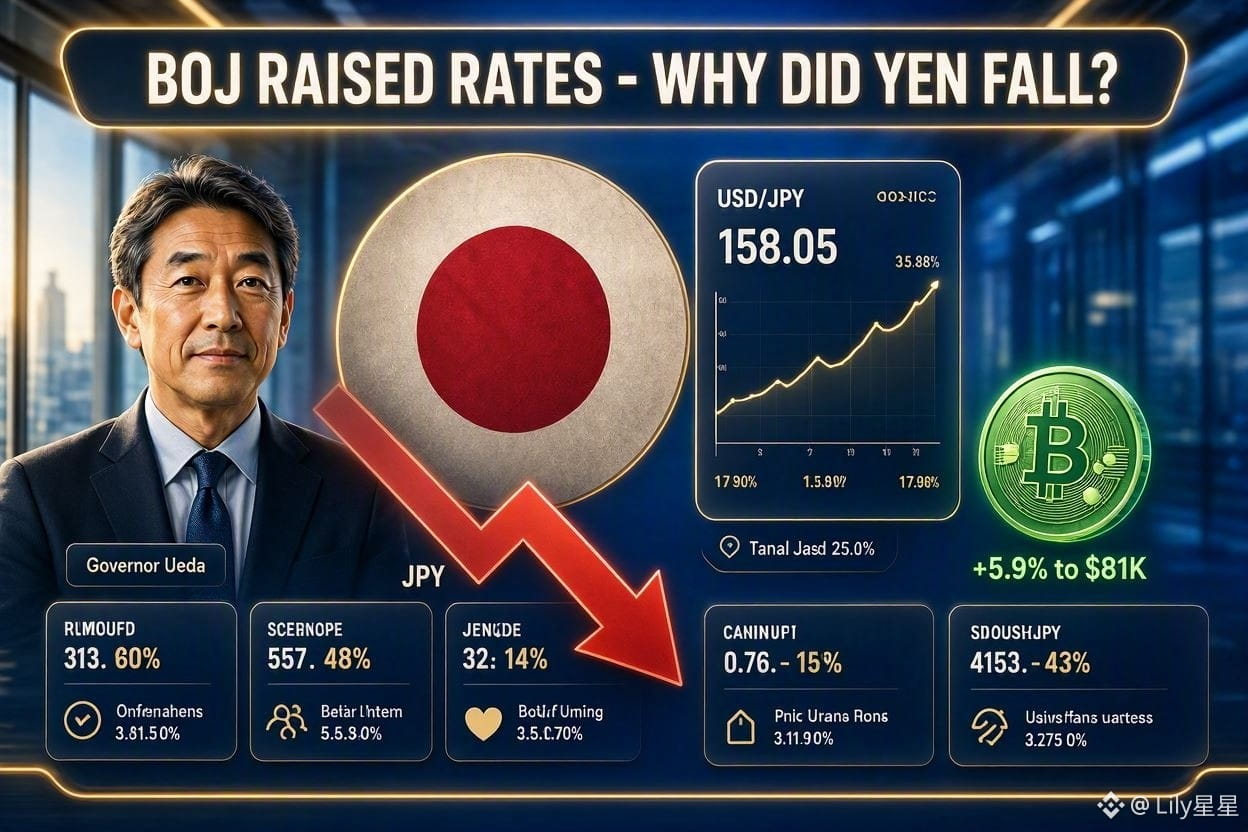
The Bank of Japan (BOJ) recently pushed interest rates up to 1.25%—their highest level in 31 years. Yet, instead of strengthening, the Japanese Yen (JPY) took a sharp dive against the USD. 📉
Why did a rate hike trigger a currency sell-off? Here is the breakdown of what really happened behind the scenes.
1. Markets Traded the "Guidance Gap," Not the Hike 🎯
The 25 basis point rate increase (passed in a 7–2 vote) was already priced in by global markets. The real focus was on BOJ Governor Kazuo Ueda's tone. Because he avoided committing to a clear schedule for future rate hikes, traders took the dovish guidance as a signal to sell JPY.
2. The U.S.–Japan Interest Rate Gap Remains Massive 💵/压
Even at 1.25%, Japanese rates lag far behind U.S. yields. This wide rate differential keeps the famous Yen Carry Trade lucrative. Investors continue borrowing cheap Yen to buy higher-yielding assets elsewhere, driving USD/JPY up toward the 158.05 level.
3. The Surprising Crypto Reaction 🪙
Despite central bank tightening, Bitcoin rallied ~5.9% back toward $81K. This proves that a BOJ rate hike doesn't immediately cause a market-wide crypto sell-off, provided global liquidity conditions stay resilient.
⚠️ Key Risk to Watch
If USD/JPY continues to climb, fears of intervention by Japanese authorities will grow. A sudden, sharp strengthening of the Yen could trigger a rapid unwind of crowded carry trades, bringing short-term volatility to global financial markets.
💡 Market Insight:
"Markets don't simply trade the rate decision—they trade the gap between what was expected and what was delivered."
💬 What do you think?
Will the BOJ's next move finally dismantle the Yen carry trade, or will the rate gap keep it alive? Let us know in the comments!
#HKCompletesFirstHKDStablecoinUseCase #BoJ #Japanese
#bojraisesratesto31yearhigh
🚀 BOJ Raised Rates, But Japanese Yen Dropped! Here’s Why & What It Means for Crypto
The Bank of Japan (BOJ) recently pushed interest rates up to 1.25%—their highest level in 31 years. Yet, instead of strengthening, the Japanese Yen (JPY) took a sharp dive against the USD. 📉
Why did a rate hike trigger a currency sell-off? Here is the breakdown of what really happened behind the scenes.
1. Markets Traded the "Guidance Gap," Not the Hike 🎯
The 25 basis point rate increase (passed in a 7–2 vote) was already priced in by global markets. The real focus was on BOJ Governor Kazuo Ueda's tone. Because he avoided committing to a clear schedule for future rate hikes, traders took the dovish guidance as a signal to sell JPY.
2. The U.S.–Japan Interest Rate Gap Remains Massive 💵/压
Even at 1.25%, Japanese rates lag far behind U.S. yields. This wide rate differential keeps the famous Yen Carry Trade lucrative. Investors continue borrowing cheap Yen to buy higher-yielding assets elsewhere, driving USD/JPY up toward the 158.05 level.
3. The Surprising Crypto Reaction 🪙
Despite central bank tightening, Bitcoin rallied ~5.9% back toward $81K. This proves that a BOJ rate hike doesn't immediately cause a market-wide crypto sell-off, provided global liquidity conditions stay resilient.
⚠️ Key Risk to Watch
If USD/JPY continues to climb, fears of intervention by Japanese authorities will grow. A sudden, sharp strengthening of the Yen could trigger a rapid unwind of crowded carry trades, bringing short-term volatility to global financial markets.
💡 Market Insight:
"Markets don't simply trade the rate decision—they trade the gap between what was expected and what was delivered."
💬 What do you think?
Will the BOJ's next move finally dismantle the Yen carry trade, or will the rate gap keep it alive? Let us know in the comments!
#HKCompletesFirstHKDStablecoinUseCase #BoJ #Japanese
🚀 BOJ Raised Rates, But Japanese Yen Dropped! Here’s Why & What It Means for Crypto
The Bank of Japan (BOJ) recently pushed interest rates up to 1.25%—their highest level in 31 years. Yet, instead of strengthening, the Japanese Yen (JPY) took a sharp dive against the USD. 📉
Why did a rate hike trigger a currency sell-off? Here is the breakdown of what really happened behind the scenes.
1. Markets Traded the "Guidance Gap," Not the Hike 🎯
The 25 basis point rate increase (passed in a 7–2 vote) was already priced in by global markets. The real focus was on BOJ Governor Kazuo Ueda's tone. Because he avoided committing to a clear schedule for future rate hikes, traders took the dovish guidance as a signal to sell JPY.
2. The U.S.–Japan Interest Rate Gap Remains Massive 💵/压
Even at 1.25%, Japanese rates lag far behind U.S. yields. This wide rate differential keeps the famous Yen Carry Trade lucrative. Investors continue borrowing cheap Yen to buy higher-yielding assets elsewhere, driving USD/JPY up toward the 158.05 level.
3. The Surprising Crypto Reaction 🪙
Despite central bank tightening, Bitcoin rallied ~5.9% back toward $81K. This proves that a BOJ rate hike doesn't immediately cause a market-wide crypto sell-off, provided global liquidity conditions stay resilient.
⚠️ Key Risk to Watch
If USD/JPY continues to climb, fears of intervention by Japanese authorities will grow. A sudden, sharp strengthening of the Yen could trigger a rapid unwind of crowded carry trades, bringing short-term volatility to global financial markets.
💡 Market Insight:
"Markets don't simply trade the rate decision—they trade the gap between what was expected and what was delivered."
💬 What do you think?
Will the BOJ's next move finally dismantle the Yen carry trade, or will the rate gap keep it alive? Let us know in the comments!
#HKCompletesFirstHKDStablecoinUseCase #BoJ #Japanese
1
1.8k

·
--
Bullish
#bojraisesratesto31yearhigh
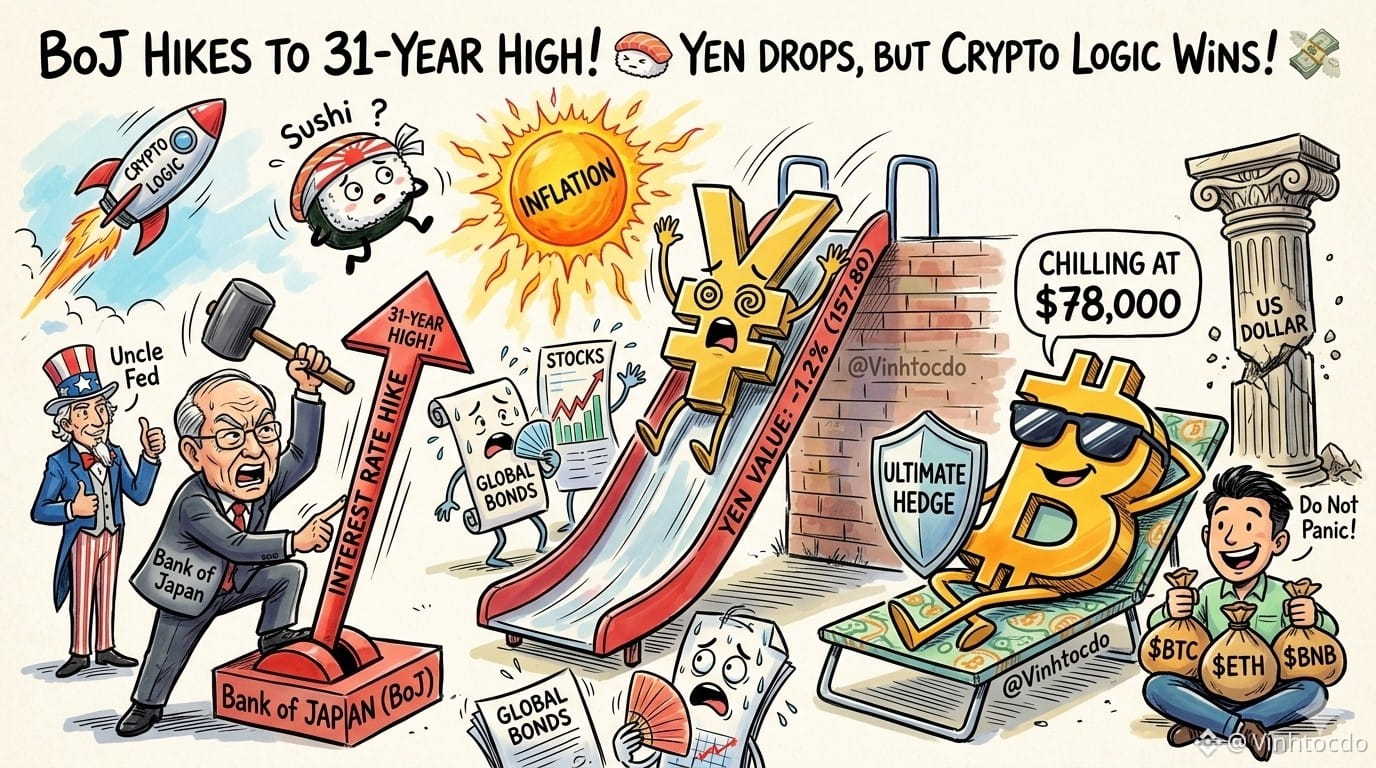
🍣 BoJ followed Uncle Fed and hiked rates to a 31-year high! 📈 But plot twist: the Yen actually dropped 1.2% to 157.80. Crypto logic has officially infected traditional fiat! 😹
While global bonds and stocks are sweating over inflation, crypto traders are just chilling. Why worry about inflation when we have crypto to save the day? 🛡️ Bitcoin is sitting comfy at $78K, breaking its old ties with the dying Dollar and proving it's the ultimate hedge! 🚀
What should traders do? 🛒
🇯🇵 Watch the Yen carry trade drama.
🧘 Don't panic about global rate hikes—let crypto handle the inflation.
💰 Keep stacking your favorite bags!
⚠️ Not financial advice (DYOR)!
👉 Sign up on Binance using code VINHTOCDO or link: https://www.binance.com/register?ref=VINHTOCDO to support me!
👇 Click & Trade below to support my work:
$BTC
{future}(BTCUSDT)
| $ETH
{future}(ETHUSDT)
| $BNB
{future}(BNBUSDT)
#bojraisesratesto31yearhigh #bitcoin #yen #VINHTOCDO #InflationHedge
#bojraisesratesto31yearhigh
🍣 BoJ followed Uncle Fed and hiked rates to a 31-year high! 📈 But plot twist: the Yen actually dropped 1.2% to 157.80. Crypto logic has officially infected traditional fiat! 😹
While global bonds and stocks are sweating over inflation, crypto traders are just chilling. Why worry about inflation when we have crypto to save the day? 🛡️ Bitcoin is sitting comfy at $78K, breaking its old ties with the dying Dollar and proving it's the ultimate hedge! 🚀
What should traders do? 🛒
🇯🇵 Watch the Yen carry trade drama.
🧘 Don't panic about global rate hikes—let crypto handle the inflation.
💰 Keep stacking your favorite bags!
⚠️ Not financial advice (DYOR)!
👉 Sign up on Binance using code VINHTOCDO or link: https://www.binance.com/register?ref=VINHTOCDO to support me!
👇 Click & Trade below to support my work:
$BTC
| $ETH
| $BNB
#bojraisesratesto31yearhigh #bitcoin #yen #VINHTOCDO #InflationHedge
🍣 BoJ followed Uncle Fed and hiked rates to a 31-year high! 📈 But plot twist: the Yen actually dropped 1.2% to 157.80. Crypto logic has officially infected traditional fiat! 😹
While global bonds and stocks are sweating over inflation, crypto traders are just chilling. Why worry about inflation when we have crypto to save the day? 🛡️ Bitcoin is sitting comfy at $78K, breaking its old ties with the dying Dollar and proving it's the ultimate hedge! 🚀
What should traders do? 🛒
🇯🇵 Watch the Yen carry trade drama.
🧘 Don't panic about global rate hikes—let crypto handle the inflation.
💰 Keep stacking your favorite bags!
⚠️ Not financial advice (DYOR)!
👉 Sign up on Binance using code VINHTOCDO or link: https://www.binance.com/register?ref=VINHTOCDO to support me!
👇 Click & Trade below to support my work:
$BTC
| $ETH
| $BNB
#bojraisesratesto31yearhigh #bitcoin #yen #VINHTOCDO #InflationHedge
5
547

·
--
Verified
Article
BOJ Raises Rates, But the Yen Falls: What Markets Are Actually Pricing#bojraisesratesto31yearhigh
The Bank of Japan just delivered another rate hike, but the yen moved in the opposite direction.
On September 18, the BOJ raised its policy rate by 25 basis points to 1.25%, the highest level in 31 years. The decision passed by a 7–2 vote, with two policymakers dissenting. The move itself was widely expected by markets.
So why did the yen weaken?
The answer lies in the difference between what happened and what markets expected to happen next.
The 25-basis-point increase wasn't a major surprise. What traders were looking for was stronger guidance about the BOJ's next moves.
Instead, Governor Kazuo Ueda avoided committing to a fixed pace of future tightening. He said the bank would assess conditions at each policy meeting and determine the appropriate policy response based on inflation, economic activity and financial conditions.
That created an important gap between the rate decision and expectations for the future.
The BOJ can raise rates today while still giving markets reasons to believe that future hikes won't necessarily come quickly.
The two dissenting votes also caught the market's attention. Two policymakers preferred to leave rates unchanged, adding uncertainty around how quickly the BOJ can continue tightening.
The result was striking: despite Japan's highest policy rate since 1995, the dollar rose as much as 1.2% against the yen to around ¥158.05.
This is why simply looking at the rate hike can miss the bigger market signal.
Japan has historically been a major funding market because borrowing costs were extremely low. The basic carry-trade structure is straightforward: borrow yen, convert into another currency, and invest in higher-yielding assets.
When Japanese rates rise and the yen strengthens, those positions can become less attractive. But a single rate hike doesn't automatically force the trade to unwind.
For that to become a larger market issue, investors would need to see a more sustained change in the relative attractiveness of yen funding and potentially stronger yen appreciation.
That is why USD/JPY remains an important macro indicator.
Bitcoin adds another layer.
Interestingly, Bitcoin moved higher after the BOJ decision. Reuters reported BTC rebounded roughly 6% toward $81,000 following the announcement.
That doesn't mean BOJ tightening is automatically bullish for Bitcoin.
It simply shows why the relationship isn't as simple as “BOJ hikes = BTC falls.”
Markets are constantly comparing the actual policy decision with what was already expected.
If the BOJ hikes but markets interpret the future path as relatively gradual, the immediate impact can look very different from what the headline rate decision suggests.
The bigger risk for global markets isn't necessarily the 25-basis-point hike itself. It's what happens if the yen eventually begins strengthening sharply.
A stronger yen could make existing carry positions less attractive. If positioning is crowded, a rapid currency move could create pressure to reduce those positions, potentially affecting other risk assets as capital is repositioned.
There is also a separate currency-policy issue. Japanese authorities conducted rate checks after the yen weakened, a step that markets often watch for potential intervention.
For traders, that makes USD/JPY more important than the BOJ headline alone.
The key questions are now: Does the BOJ continue tightening? Does the yen finally respond with sustained appreciation? Does the carry trade begin to unwind? And how do global risk assets, including Bitcoin, respond?
The September decision showed something important: markets don't trade the rate hike in isolation. They trade the gap between expectations and what policymakers actually deliver.
For now, Japan tightened policy, but the yen weakened.
That divergence is the part worth watching.
BOJ Raises Rates, But the Yen Falls: What Markets Are Actually Pricing
#bojraisesratesto31yearhigh
The Bank of Japan just delivered another rate hike, but the yen moved in the opposite direction.
On September 18, the BOJ raised its policy rate by 25 basis points to 1.25%, the highest level in 31 years. The decision passed by a 7–2 vote, with two policymakers dissenting. The move itself was widely expected by markets.
So why did the yen weaken?
The answer lies in the difference between what happened and what markets expected to happen next.
The 25-basis-point increase wasn't a major surprise. What traders were looking for was stronger guidance about the BOJ's next moves.
Instead, Governor Kazuo Ueda avoided committing to a fixed pace of future tightening. He said the bank would assess conditions at each policy meeting and determine the appropriate policy response based on inflation, economic activity and financial conditions.
That created an important gap between the rate decision and expectations for the future.
The BOJ can raise rates today while still giving markets reasons to believe that future hikes won't necessarily come quickly.
The two dissenting votes also caught the market's attention. Two policymakers preferred to leave rates unchanged, adding uncertainty around how quickly the BOJ can continue tightening.
The result was striking: despite Japan's highest policy rate since 1995, the dollar rose as much as 1.2% against the yen to around ¥158.05.
This is why simply looking at the rate hike can miss the bigger market signal.
Japan has historically been a major funding market because borrowing costs were extremely low. The basic carry-trade structure is straightforward: borrow yen, convert into another currency, and invest in higher-yielding assets.
When Japanese rates rise and the yen strengthens, those positions can become less attractive. But a single rate hike doesn't automatically force the trade to unwind.
For that to become a larger market issue, investors would need to see a more sustained change in the relative attractiveness of yen funding and potentially stronger yen appreciation.
That is why USD/JPY remains an important macro indicator.
Bitcoin adds another layer.
Interestingly, Bitcoin moved higher after the BOJ decision. Reuters reported BTC rebounded roughly 6% toward $81,000 following the announcement.
That doesn't mean BOJ tightening is automatically bullish for Bitcoin.
It simply shows why the relationship isn't as simple as “BOJ hikes = BTC falls.”
Markets are constantly comparing the actual policy decision with what was already expected.
If the BOJ hikes but markets interpret the future path as relatively gradual, the immediate impact can look very different from what the headline rate decision suggests.
The bigger risk for global markets isn't necessarily the 25-basis-point hike itself. It's what happens if the yen eventually begins strengthening sharply.
A stronger yen could make existing carry positions less attractive. If positioning is crowded, a rapid currency move could create pressure to reduce those positions, potentially affecting other risk assets as capital is repositioned.
There is also a separate currency-policy issue. Japanese authorities conducted rate checks after the yen weakened, a step that markets often watch for potential intervention.
For traders, that makes USD/JPY more important than the BOJ headline alone.
The key questions are now: Does the BOJ continue tightening? Does the yen finally respond with sustained appreciation? Does the carry trade begin to unwind? And how do global risk assets, including Bitcoin, respond?
The September decision showed something important: markets don't trade the rate hike in isolation. They trade the gap between expectations and what policymakers actually deliver.
For now, Japan tightened policy, but the yen weakened.
That divergence is the part worth watching.
The Bank of Japan just delivered another rate hike, but the yen moved in the opposite direction.
On September 18, the BOJ raised its policy rate by 25 basis points to 1.25%, the highest level in 31 years. The decision passed by a 7–2 vote, with two policymakers dissenting. The move itself was widely expected by markets.
So why did the yen weaken?
The answer lies in the difference between what happened and what markets expected to happen next.
The 25-basis-point increase wasn't a major surprise. What traders were looking for was stronger guidance about the BOJ's next moves.
Instead, Governor Kazuo Ueda avoided committing to a fixed pace of future tightening. He said the bank would assess conditions at each policy meeting and determine the appropriate policy response based on inflation, economic activity and financial conditions.
That created an important gap between the rate decision and expectations for the future.
The BOJ can raise rates today while still giving markets reasons to believe that future hikes won't necessarily come quickly.
The two dissenting votes also caught the market's attention. Two policymakers preferred to leave rates unchanged, adding uncertainty around how quickly the BOJ can continue tightening.
The result was striking: despite Japan's highest policy rate since 1995, the dollar rose as much as 1.2% against the yen to around ¥158.05.
This is why simply looking at the rate hike can miss the bigger market signal.
Japan has historically been a major funding market because borrowing costs were extremely low. The basic carry-trade structure is straightforward: borrow yen, convert into another currency, and invest in higher-yielding assets.
When Japanese rates rise and the yen strengthens, those positions can become less attractive. But a single rate hike doesn't automatically force the trade to unwind.
For that to become a larger market issue, investors would need to see a more sustained change in the relative attractiveness of yen funding and potentially stronger yen appreciation.
That is why USD/JPY remains an important macro indicator.
Bitcoin adds another layer.
Interestingly, Bitcoin moved higher after the BOJ decision. Reuters reported BTC rebounded roughly 6% toward $81,000 following the announcement.
That doesn't mean BOJ tightening is automatically bullish for Bitcoin.
It simply shows why the relationship isn't as simple as “BOJ hikes = BTC falls.”
Markets are constantly comparing the actual policy decision with what was already expected.
If the BOJ hikes but markets interpret the future path as relatively gradual, the immediate impact can look very different from what the headline rate decision suggests.
The bigger risk for global markets isn't necessarily the 25-basis-point hike itself. It's what happens if the yen eventually begins strengthening sharply.
A stronger yen could make existing carry positions less attractive. If positioning is crowded, a rapid currency move could create pressure to reduce those positions, potentially affecting other risk assets as capital is repositioned.
There is also a separate currency-policy issue. Japanese authorities conducted rate checks after the yen weakened, a step that markets often watch for potential intervention.
For traders, that makes USD/JPY more important than the BOJ headline alone.
The key questions are now: Does the BOJ continue tightening? Does the yen finally respond with sustained appreciation? Does the carry trade begin to unwind? And how do global risk assets, including Bitcoin, respond?
The September decision showed something important: markets don't trade the rate hike in isolation. They trade the gap between expectations and what policymakers actually deliver.
For now, Japan tightened policy, but the yen weakened.
That divergence is the part worth watching.
76

🚨 TRADERS: WATCH GLOBAL LIQUIDITY
Japan just pushed its policy rate to a 31-year high.
The BOJ's move could become another factor shaping global liquidity and investor risk appetite. 🌐
That doesn't guarantee a crypto dump or pump.
It means volatility can create both opportunities and traps.
Stay patient, focus on quality spot setups and keep your halal investing principles intact. ☪️📈
$BTC $ETH $BNB
#bojraisesratesto31yearhigh
🚨 TRADERS: WATCH GLOBAL LIQUIDITY
Japan just pushed its policy rate to a 31-year high.
The BOJ's move could become another factor shaping global liquidity and investor risk appetite. 🌐
That doesn't guarantee a crypto dump or pump.
It means volatility can create both opportunities and traps.
Stay patient, focus on quality spot setups and keep your halal investing principles intact. ☪️📈
$BTC $ETH $BNB
#bojraisesratesto31yearhigh
Japan just pushed its policy rate to a 31-year high.
The BOJ's move could become another factor shaping global liquidity and investor risk appetite. 🌐
That doesn't guarantee a crypto dump or pump.
It means volatility can create both opportunities and traps.
Stay patient, focus on quality spot setups and keep your halal investing principles intact. ☪️📈
$BTC $ETH $BNB
#bojraisesratesto31yearhigh
298

#bojraisesratesto31yearhigh
BREAKING:
🇯🇵
Bank of Japan raises interest rates by 25 BPS to 1.25%, highest level in 31
years.
And this matters far beyond Japan.
Higher
rates not only make borrowing more expensive in Japan but also put pressure on the yen carry trade, where investors borrow cheap yen to
invest in higher-returning assets.
If investors are forced to unwind these positions, this could accelerate a global sell-off which would also hurt crypto.
Even worse: the BOJ is not ruling out back-to-back rate hikes or moves larger than 25 BPS.
Furthermore, this marks the first time since 2006 that the BOJ, Fed and ECB all raised rates during the same period.
Global liquidity is tightening.
$FF
{future}(FFUSDT)
$DRIFT
{future}(DRIFTUSDT)
$AIN
{future}(AINUSDT)
#bojraisesratesto31yearhigh
BREAKING:
🇯🇵
Bank of Japan raises interest rates by 25 BPS to 1.25%, highest level in 31
years.
And this matters far beyond Japan.
Higher
rates not only make borrowing more expensive in Japan but also put pressure on the yen carry trade, where investors borrow cheap yen to
invest in higher-returning assets.
If investors are forced to unwind these positions, this could accelerate a global sell-off which would also hurt crypto.
Even worse: the BOJ is not ruling out back-to-back rate hikes or moves larger than 25 BPS.
Furthermore, this marks the first time since 2006 that the BOJ, Fed and ECB all raised rates during the same period.
Global liquidity is tightening.
$FF
$DRIFT
$AIN
BREAKING:
🇯🇵
Bank of Japan raises interest rates by 25 BPS to 1.25%, highest level in 31
years.
And this matters far beyond Japan.
Higher
rates not only make borrowing more expensive in Japan but also put pressure on the yen carry trade, where investors borrow cheap yen to
invest in higher-returning assets.
If investors are forced to unwind these positions, this could accelerate a global sell-off which would also hurt crypto.
Even worse: the BOJ is not ruling out back-to-back rate hikes or moves larger than 25 BPS.
Furthermore, this marks the first time since 2006 that the BOJ, Fed and ECB all raised rates during the same period.
Global liquidity is tightening.
$FF
$DRIFT
$AIN


184

🇯🇵 **BOJ JUST PUSHED RATES TO A 31-YEAR HIGH**
$ONE
{future}(ONEUSDT)
The Bank of Japan raised its benchmark rate from 1.00% to 1.25%, the highest level since 1995.
The bigger story isn't simply the hike.
Japan is moving further away from the ultra-low-rate regime that supported global carry trades for years. That matters because changes in Japanese funding conditions can spill into global FX, bonds and risk assets.
$CTSI
{future}(CTSIUSDT)
Two board members opposed the move, while inflation remains close to the BOJ's 2% target.
For crypto, the key variables to watch are:
• JPY funding conditions
• USD/JPY reaction
• Global liquidity
• Treasury yields
• BTC's response to tighter financial conditions
A rate hike is one data point.
The liquidity reaction is the signal.
$BTC
{future}(BTCUSDT)
#bojraisesratesto31yearhigh
🇯🇵 **BOJ JUST PUSHED RATES TO A 31-YEAR HIGH**
$ONE
The Bank of Japan raised its benchmark rate from 1.00% to 1.25%, the highest level since 1995.
The bigger story isn't simply the hike.
Japan is moving further away from the ultra-low-rate regime that supported global carry trades for years. That matters because changes in Japanese funding conditions can spill into global FX, bonds and risk assets.
$CTSI
Two board members opposed the move, while inflation remains close to the BOJ's 2% target.
For crypto, the key variables to watch are:
• JPY funding conditions
• USD/JPY reaction
• Global liquidity
• Treasury yields
• BTC's response to tighter financial conditions
A rate hike is one data point.
The liquidity reaction is the signal.
$BTC
#bojraisesratesto31yearhigh
$ONE
The Bank of Japan raised its benchmark rate from 1.00% to 1.25%, the highest level since 1995.
The bigger story isn't simply the hike.
Japan is moving further away from the ultra-low-rate regime that supported global carry trades for years. That matters because changes in Japanese funding conditions can spill into global FX, bonds and risk assets.
$CTSI
Two board members opposed the move, while inflation remains close to the BOJ's 2% target.
For crypto, the key variables to watch are:
• JPY funding conditions
• USD/JPY reaction
• Global liquidity
• Treasury yields
• BTC's response to tighter financial conditions
A rate hike is one data point.
The liquidity reaction is the signal.
$BTC
#bojraisesratesto31yearhigh
2
211

·
--
#bojraisesratesto31yearhigh
The Bank of Japan (BOJ) delivered a historic 7–2 vote to raise its benchmark policy rate to 1.25%, marking its highest interest rate level in 31 years as Governor Kazuo Ueda officially declared monetary policy has entered a "new phase". This rate hike—coming just three months after the prior increase—aims directly at curbing accelerating inflation driven by a weak yen, rising wages, and soaring energy import costs sparked by Middle East conflicts. Beyond controlling local price pass-throughs, the aggressive shift fundamentally unwinds decades of ultra-cheap global liquidity, unwinding carry trades and signaling that Japan's long-standing era of free borrowing costs has firmly ended. $BTC
{spot}(BTCUSDT)
#bojraisesratesto31yearhigh
The Bank of Japan (BOJ) delivered a historic 7–2 vote to raise its benchmark policy rate to 1.25%, marking its highest interest rate level in 31 years as Governor Kazuo Ueda officially declared monetary policy has entered a "new phase". This rate hike—coming just three months after the prior increase—aims directly at curbing accelerating inflation driven by a weak yen, rising wages, and soaring energy import costs sparked by Middle East conflicts. Beyond controlling local price pass-throughs, the aggressive shift fundamentally unwinds decades of ultra-cheap global liquidity, unwinding carry trades and signaling that Japan's long-standing era of free borrowing costs has firmly ended. $BTC
The Bank of Japan (BOJ) delivered a historic 7–2 vote to raise its benchmark policy rate to 1.25%, marking its highest interest rate level in 31 years as Governor Kazuo Ueda officially declared monetary policy has entered a "new phase". This rate hike—coming just three months after the prior increase—aims directly at curbing accelerating inflation driven by a weak yen, rising wages, and soaring energy import costs sparked by Middle East conflicts. Beyond controlling local price pass-throughs, the aggressive shift fundamentally unwinds decades of ultra-cheap global liquidity, unwinding carry trades and signaling that Japan's long-standing era of free borrowing costs has firmly ended. $BTC
·
--
what what everybody should know about about the trending #BOJRaisesRatesTo31YearHigh First, why this matters. Japan was one of the last major economies to keep interest rates very low for a very long time. When that starts changing, investors pay attention because Japanese capital has historically flowed into global bonds, equities, and other markets. If rates rise in Japan, some money may stay in yen assets instead of searching for returns elsewhere.
Second, what it can affect. A higher Japanese rate environment can support the yen, put pressure on global bond markets, and tighten overall financial conditions a bit. That does not automatically mean stocks or crypto must fall, but it can reduce the “easy liquidity” backdrop that usually helps risk assets.
Third, why crypto is mentioned. Crypto is highly sensitive to liquidity, sentiment, and global risk appetite. So when a major central bank turns less supportive, traders often become more cautious. The post is basically saying: expect sharper reactions, not certainty about direction.
Fourth, what traders will watch next. The most important part is not just this rate move, but the BOJ’s next guidance. Markets will focus on whether this is a one-step adjustment or part of a longer tightening path. Future language from the BOJ could matter as much as the hike itself.
Finally, about the $NVDAB tag. It looks like an added ticker-style tag for reach or visibility, but it is not really the core subject here. The real topic is Japan’s policy shift and how that may influence global liquidity, bonds, currencies, equities, and crypto.
If you want to post this, a clean professional takeaway would be:
Japan’s rate hike matters because it signals a deeper policy shift, not just a local banking decision. The main market impact is through yen strength, bond yield pressure, capital flow changes, and potentially higher volatility across risk assets including crypto.
$GOOGL.US $AAPL.US
what what everybody should know about about the trending #BOJRaisesRatesTo31YearHigh First, why this matters. Japan was one of the last major economies to keep interest rates very low for a very long time. When that starts changing, investors pay attention because Japanese capital has historically flowed into global bonds, equities, and other markets. If rates rise in Japan, some money may stay in yen assets instead of searching for returns elsewhere.
Second, what it can affect. A higher Japanese rate environment can support the yen, put pressure on global bond markets, and tighten overall financial conditions a bit. That does not automatically mean stocks or crypto must fall, but it can reduce the “easy liquidity” backdrop that usually helps risk assets.
Third, why crypto is mentioned. Crypto is highly sensitive to liquidity, sentiment, and global risk appetite. So when a major central bank turns less supportive, traders often become more cautious. The post is basically saying: expect sharper reactions, not certainty about direction.
Fourth, what traders will watch next. The most important part is not just this rate move, but the BOJ’s next guidance. Markets will focus on whether this is a one-step adjustment or part of a longer tightening path. Future language from the BOJ could matter as much as the hike itself.
Finally, about the $NVDAB tag. It looks like an added ticker-style tag for reach or visibility, but it is not really the core subject here. The real topic is Japan’s policy shift and how that may influence global liquidity, bonds, currencies, equities, and crypto.
If you want to post this, a clean professional takeaway would be:
Japan’s rate hike matters because it signals a deeper policy shift, not just a local banking decision. The main market impact is through yen strength, bond yield pressure, capital flow changes, and potentially higher volatility across risk assets including crypto.
$GOOGL.US $AAPL.US
Second, what it can affect. A higher Japanese rate environment can support the yen, put pressure on global bond markets, and tighten overall financial conditions a bit. That does not automatically mean stocks or crypto must fall, but it can reduce the “easy liquidity” backdrop that usually helps risk assets.
Third, why crypto is mentioned. Crypto is highly sensitive to liquidity, sentiment, and global risk appetite. So when a major central bank turns less supportive, traders often become more cautious. The post is basically saying: expect sharper reactions, not certainty about direction.
Fourth, what traders will watch next. The most important part is not just this rate move, but the BOJ’s next guidance. Markets will focus on whether this is a one-step adjustment or part of a longer tightening path. Future language from the BOJ could matter as much as the hike itself.
Finally, about the $NVDAB tag. It looks like an added ticker-style tag for reach or visibility, but it is not really the core subject here. The real topic is Japan’s policy shift and how that may influence global liquidity, bonds, currencies, equities, and crypto.
If you want to post this, a clean professional takeaway would be:
Japan’s rate hike matters because it signals a deeper policy shift, not just a local banking decision. The main market impact is through yen strength, bond yield pressure, capital flow changes, and potentially higher volatility across risk assets including crypto.
$GOOGL.US $AAPL.US

·
--
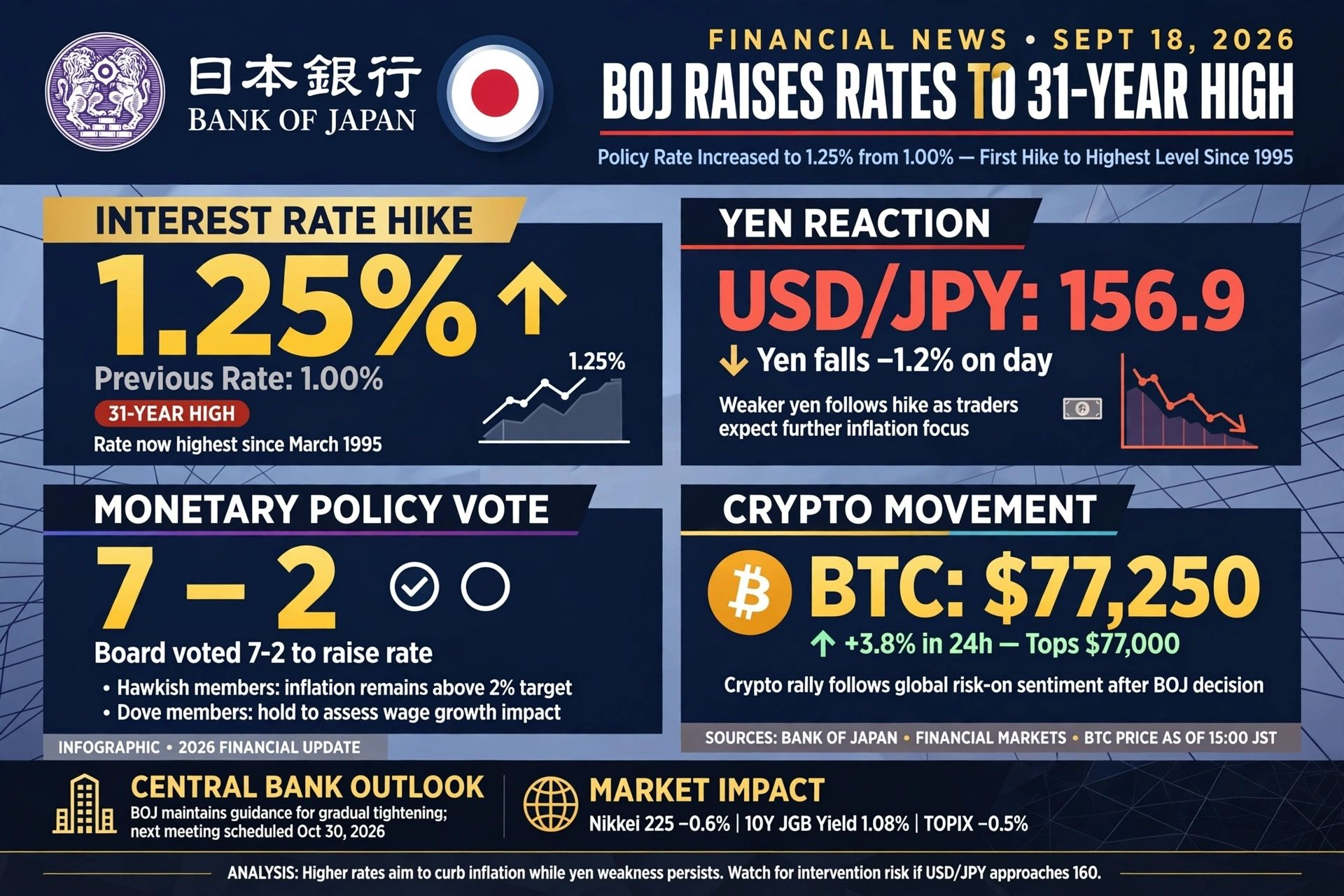
#BOJRaisesRatesTo31YearHigh 🇯🇵
BOJ just hiked rates to *1.25%* — highest since 1995!
- From 1.00% → 1.25% (+25bps)
- Vote: 7-2 (2 dovish dissenters)
- Reason: Iran war oil spike + inflation above 2% target
- Twist: Yen FELL to 156.9/$ despite hike
- BTC reacted: Topped $77,250 🚀
End of cheap yen era = carry trade risk for all markets.
Yen will keep falling or BOJ will intervene at 160?
#BOJ #Yen #BTC #Macro
#BOJRaisesRatesTo31YearHigh 🇯🇵
BOJ just hiked rates to *1.25%* — highest since 1995!
- From 1.00% → 1.25% (+25bps)
- Vote: 7-2 (2 dovish dissenters)
- Reason: Iran war oil spike + inflation above 2% target
- Twist: Yen FELL to 156.9/$ despite hike
- BTC reacted: Topped $77,250 🚀
End of cheap yen era = carry trade risk for all markets.
Yen will keep falling or BOJ will intervene at 160?
#BOJ #Yen #BTC #Macro
BOJ just hiked rates to *1.25%* — highest since 1995!
- From 1.00% → 1.25% (+25bps)
- Vote: 7-2 (2 dovish dissenters)
- Reason: Iran war oil spike + inflation above 2% target
- Twist: Yen FELL to 156.9/$ despite hike
- BTC reacted: Topped $77,250 🚀
End of cheap yen era = carry trade risk for all markets.
Yen will keep falling or BOJ will intervene at 160?
#BOJ #Yen #BTC #Macro
3

🇯🇵 BOJ Raises Rates to a 31-Year High
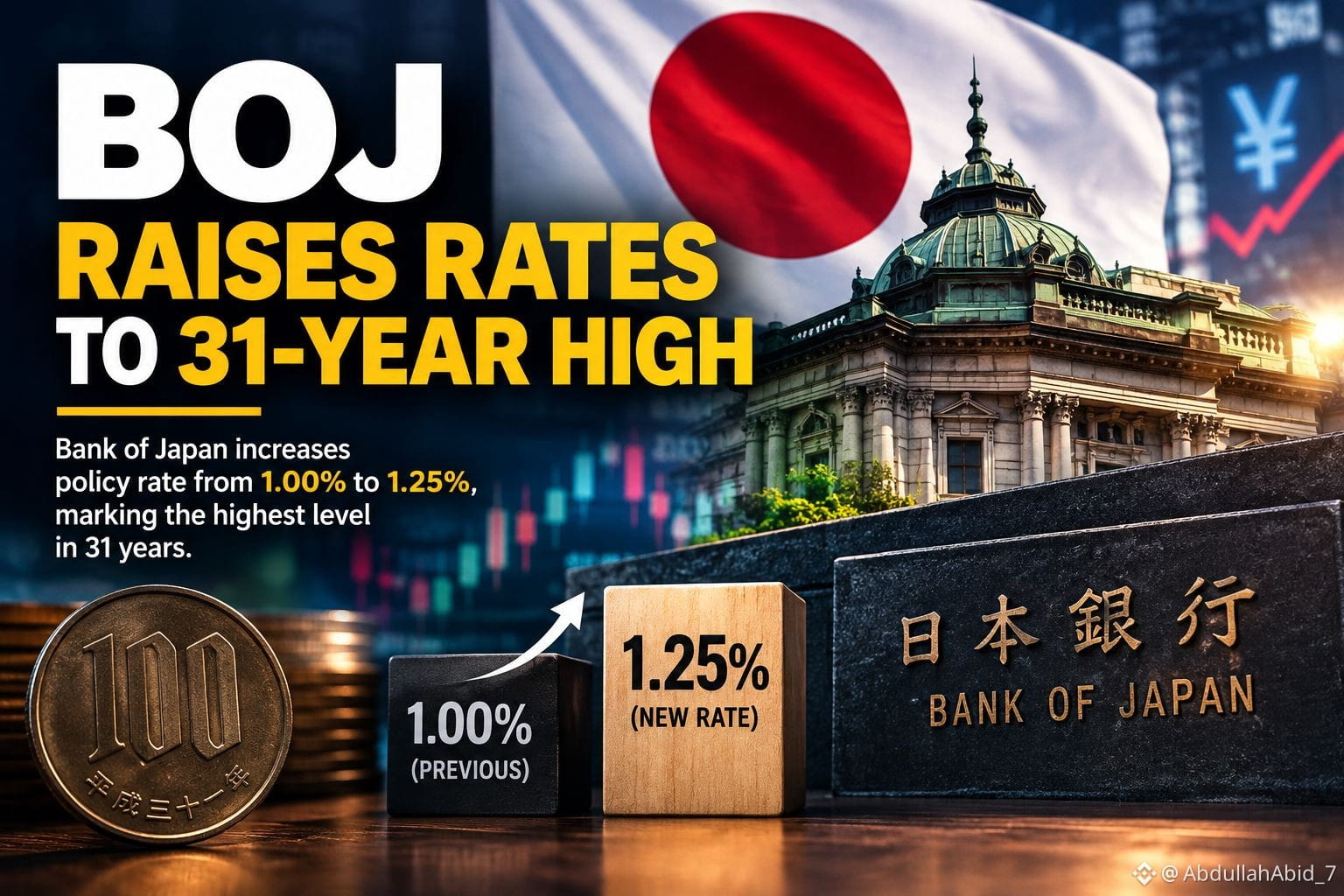
The Bank of Japan has raised its policy rate from 1.00% to 1.25%, marking the highest level in 31 years. The decision was approved by a 7–2 vote as the BOJ looks to prevent inflation from moving above its 2% target.
The move comes as Japan faces persistent price pressures, rising wages and higher energy costs. BOJ Governor Kazuo Ueda also signaled that further rate increases could remain on the table if inflation risks continue.
Interestingly, the yen weakened after the hike, showing that markets were focused not only on the rate increase but also on the BOJ's future policy path.
For crypto traders, Japan's tightening cycle matters because changes in Japanese rates can influence global liquidity, currency flows and risk assets.
The big question now: Will the BOJ continue tightening, or pause to assess the impact?
#BOJRaisesRatesTo31YearHigh #BOJ #Japan #BinanceSquare #Write2Earn $BTC $NVDA
🇯🇵 BOJ Raises Rates to a 31-Year High
The Bank of Japan has raised its policy rate from 1.00% to 1.25%, marking the highest level in 31 years. The decision was approved by a 7–2 vote as the BOJ looks to prevent inflation from moving above its 2% target.
The move comes as Japan faces persistent price pressures, rising wages and higher energy costs. BOJ Governor Kazuo Ueda also signaled that further rate increases could remain on the table if inflation risks continue.
Interestingly, the yen weakened after the hike, showing that markets were focused not only on the rate increase but also on the BOJ's future policy path.
For crypto traders, Japan's tightening cycle matters because changes in Japanese rates can influence global liquidity, currency flows and risk assets.
The big question now: Will the BOJ continue tightening, or pause to assess the impact?
#BOJRaisesRatesTo31YearHigh #BOJ #Japan #BinanceSquare #Write2Earn $BTC $NVDA
The Bank of Japan has raised its policy rate from 1.00% to 1.25%, marking the highest level in 31 years. The decision was approved by a 7–2 vote as the BOJ looks to prevent inflation from moving above its 2% target.
The move comes as Japan faces persistent price pressures, rising wages and higher energy costs. BOJ Governor Kazuo Ueda also signaled that further rate increases could remain on the table if inflation risks continue.
Interestingly, the yen weakened after the hike, showing that markets were focused not only on the rate increase but also on the BOJ's future policy path.
For crypto traders, Japan's tightening cycle matters because changes in Japanese rates can influence global liquidity, currency flows and risk assets.
The big question now: Will the BOJ continue tightening, or pause to assess the impact?
#BOJRaisesRatesTo31YearHigh #BOJ #Japan #BinanceSquare #Write2Earn $BTC $NVDA
18

·
--
Bullish
#bojraisesratesto31yearhigh
🇯🇵 BOJ Hiked Rates — But the Yen Still Fell
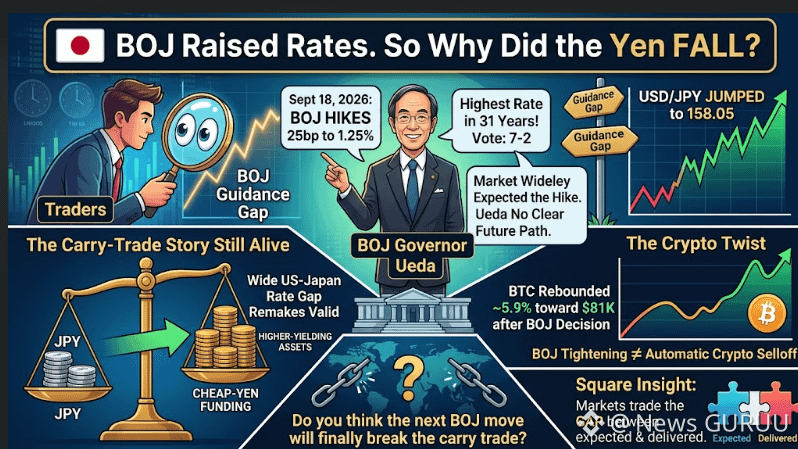
✅ BOJ raised rates 25bps to 1.25% with a 7–2 vote
✅ USD/JPY surged toward 158 as markets questioned future hikes
✅ BTC rebounded above $81K, showing the hike didn't trigger an immediate crypto selloff
📊 Momentum: Yen weakness remains linked to expectations for a slower BOJ tightening path, while BTC momentum turned positive after reclaiming $80K.
📈 Trading View: BUY
❓ Can BTC hold above $80K as the carry-trade risk remains? "CLICK ON THE BELOW YELLOW COIN TAG TO GO TO DESIRED TRADING PAGE TO GET BENEFIT TRADE"$BTC
{spot}(BTCUSDT)
#JapaneseYen #BoJ
#bojraisesratesto31yearhigh
🇯🇵 BOJ Hiked Rates — But the Yen Still Fell
✅ BOJ raised rates 25bps to 1.25% with a 7–2 vote
✅ USD/JPY surged toward 158 as markets questioned future hikes
✅ BTC rebounded above $81K, showing the hike didn't trigger an immediate crypto selloff
📊 Momentum: Yen weakness remains linked to expectations for a slower BOJ tightening path, while BTC momentum turned positive after reclaiming $80K.
📈 Trading View: BUY
❓ Can BTC hold above $80K as the carry-trade risk remains? "CLICK ON THE BELOW YELLOW COIN TAG TO GO TO DESIRED TRADING PAGE TO GET BENEFIT TRADE"$BTC
#JapaneseYen #BoJ
🇯🇵 BOJ Hiked Rates — But the Yen Still Fell
✅ BOJ raised rates 25bps to 1.25% with a 7–2 vote
✅ USD/JPY surged toward 158 as markets questioned future hikes
✅ BTC rebounded above $81K, showing the hike didn't trigger an immediate crypto selloff
📊 Momentum: Yen weakness remains linked to expectations for a slower BOJ tightening path, while BTC momentum turned positive after reclaiming $80K.
📈 Trading View: BUY
❓ Can BTC hold above $80K as the carry-trade risk remains? "CLICK ON THE BELOW YELLOW COIN TAG TO GO TO DESIRED TRADING PAGE TO GET BENEFIT TRADE"$BTC
#JapaneseYen #BoJ
13

#BOJRaisesRatesTo31YearHigh
🚨 MARKET ALERT: The Bank of Japan just shifted the global financial landscape. 🇯🇵📈
The BOJ has officially raised interest rates to 1.25%—their highest level in 31 years! This decisive move signals a clear departure from Japan's long-standing ultra-loose monetary policy.
What this means for global markets:
🔹 Yen Strength: The Japanese currency is poised for upward pressure after years of weakness.
🔹 Bond Yields: Global yields will feel the ripple effects as capital flows shift.
🔹 Risk Assets & Crypto: Expect increased volatility as investors reassess global liquidity and risk exposure. Watching assets like $NVDAB closely as the market digests this. 🌊
Traders are now laser-focused on the BOJ's next statements for clues on future rate decisions. The era of ultra-cheap Japanese capital is officially ending.
How are you positioning your portfolio for this volatility? Bullish or bracing for impact? Drop your thoughts below! 👇
#BOJRaisesRatesTo31YearHigh #BOJRaisesRatesTo31YearHigh 🇯🇵📈 #BOJ #Japan #Crypto #Markets #InterestRates #Trading
#BOJRaisesRatesTo31YearHigh
🚨 MARKET ALERT: The Bank of Japan just shifted the global financial landscape. 🇯🇵📈
The BOJ has officially raised interest rates to 1.25%—their highest level in 31 years! This decisive move signals a clear departure from Japan's long-standing ultra-loose monetary policy.
What this means for global markets:
🔹 Yen Strength: The Japanese currency is poised for upward pressure after years of weakness.
🔹 Bond Yields: Global yields will feel the ripple effects as capital flows shift.
🔹 Risk Assets & Crypto: Expect increased volatility as investors reassess global liquidity and risk exposure. Watching assets like $NVDAB closely as the market digests this. 🌊
Traders are now laser-focused on the BOJ's next statements for clues on future rate decisions. The era of ultra-cheap Japanese capital is officially ending.
How are you positioning your portfolio for this volatility? Bullish or bracing for impact? Drop your thoughts below! 👇
#BOJRaisesRatesTo31YearHigh #BOJRaisesRatesTo31YearHigh 🇯🇵📈 #BOJ #Japan #Crypto #Markets #InterestRates #Trading
🚨 MARKET ALERT: The Bank of Japan just shifted the global financial landscape. 🇯🇵📈
The BOJ has officially raised interest rates to 1.25%—their highest level in 31 years! This decisive move signals a clear departure from Japan's long-standing ultra-loose monetary policy.
What this means for global markets:
🔹 Yen Strength: The Japanese currency is poised for upward pressure after years of weakness.
🔹 Bond Yields: Global yields will feel the ripple effects as capital flows shift.
🔹 Risk Assets & Crypto: Expect increased volatility as investors reassess global liquidity and risk exposure. Watching assets like $NVDAB closely as the market digests this. 🌊
Traders are now laser-focused on the BOJ's next statements for clues on future rate decisions. The era of ultra-cheap Japanese capital is officially ending.
How are you positioning your portfolio for this volatility? Bullish or bracing for impact? Drop your thoughts below! 👇
#BOJRaisesRatesTo31YearHigh #BOJRaisesRatesTo31YearHigh 🇯🇵📈 #BOJ #Japan #Crypto #Markets #InterestRates #Trading
8

Article
Market Open: Cautious Sentiment Amid Rate Hike EffectsYesterday's trading session closed with a cautiously optimistic mood as $BTC managed to hold steady at $81,246.23, marking a slight increase of 0.42%. However, that optimism appears to be waning this morning as the market opens lower, with $BTC currently trading at $80,311.63, down 1.11%. This retracement suggests that traders are recalibrating their positions amid ongoing economic developments.
As it stands, the major cryptocurrencies are experiencing dips across the board. $ETH is down 2.55%, trading at $2,570.98, while BNB has also slipped by 2.12% to $749.02. SOL is feeling the pressure the hardest with a 3.21% drop to $108.03. This market movement may indicate a bearish shift as traders digest the implications of the Bank of Japan's recent rate hike, which has raised interest rates to a 31-year high, a significant economic shift that is reshaping investor sentiment.
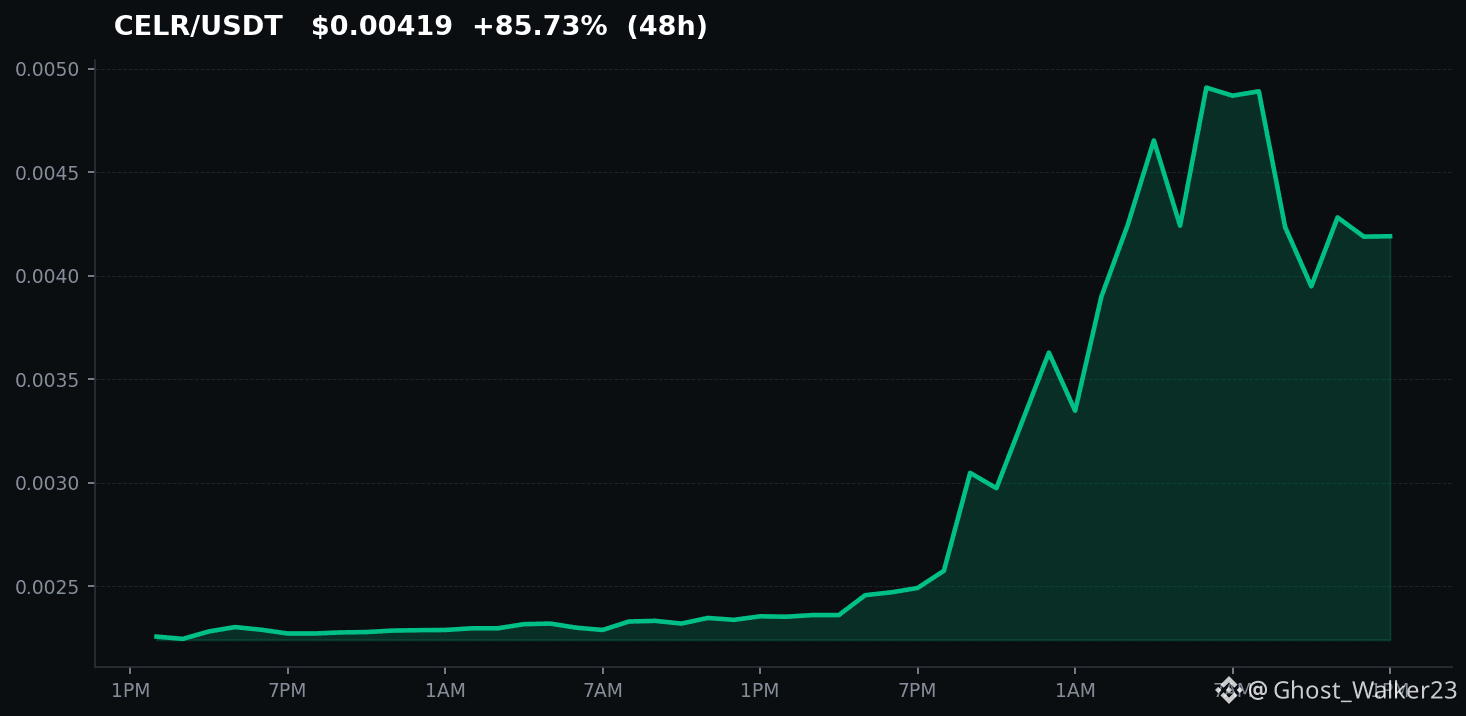
Today's early movers are particularly notable. While the major currencies are in the red, CELR stands out with a remarkable gain of 80.3%, while ONE continues to impress, up 50.5%. ZIL, ALLO, and BANK are also showing gains, but the overall atmosphere remains cautious. On the flip side, several coins are facing losses, with G and LSK both dropping over 17%, highlighting the mixed sentiment in the market.
The trending topic on Binance Square right now is #BOJRaisesRatesTo31YearHigh, reflecting how macroeconomic factors are influencing cryptocurrency markets. Traders are closely monitoring the impact of this rate hike on liquidity and investment behavior in the crypto space. As the market reacts, the volatility could present both risks and opportunities for savvy investors looking for short-term gains.
Looking ahead, one question arises: How will traders adjust their strategies in response to these rate changes and the current market conditions? Keeping an eye on further developments in the altcoin space, along with economic shifts, will be crucial for navigating today’s trading session.
🚀 Like + Follow si quieres más contenido como este!
Market Open: Cautious Sentiment Amid Rate Hike Effects
Yesterday's trading session closed with a cautiously optimistic mood as $BTC managed to hold steady at $81,246.23, marking a slight increase of 0.42%. However, that optimism appears to be waning this morning as the market opens lower, with $BTC currently trading at $80,311.63, down 1.11%. This retracement suggests that traders are recalibrating their positions amid ongoing economic developments.
As it stands, the major cryptocurrencies are experiencing dips across the board. $ETH is down 2.55%, trading at $2,570.98, while BNB has also slipped by 2.12% to $749.02. SOL is feeling the pressure the hardest with a 3.21% drop to $108.03. This market movement may indicate a bearish shift as traders digest the implications of the Bank of Japan's recent rate hike, which has raised interest rates to a 31-year high, a significant economic shift that is reshaping investor sentiment.
Today's early movers are particularly notable. While the major currencies are in the red, CELR stands out with a remarkable gain of 80.3%, while ONE continues to impress, up 50.5%. ZIL, ALLO, and BANK are also showing gains, but the overall atmosphere remains cautious. On the flip side, several coins are facing losses, with G and LSK both dropping over 17%, highlighting the mixed sentiment in the market.
The trending topic on Binance Square right now is #BOJRaisesRatesTo31YearHigh, reflecting how macroeconomic factors are influencing cryptocurrency markets. Traders are closely monitoring the impact of this rate hike on liquidity and investment behavior in the crypto space. As the market reacts, the volatility could present both risks and opportunities for savvy investors looking for short-term gains.
Looking ahead, one question arises: How will traders adjust their strategies in response to these rate changes and the current market conditions? Keeping an eye on further developments in the altcoin space, along with economic shifts, will be crucial for navigating today’s trading session.
🚀 Like + Follow si quieres más contenido como este!
As it stands, the major cryptocurrencies are experiencing dips across the board. $ETH is down 2.55%, trading at $2,570.98, while BNB has also slipped by 2.12% to $749.02. SOL is feeling the pressure the hardest with a 3.21% drop to $108.03. This market movement may indicate a bearish shift as traders digest the implications of the Bank of Japan's recent rate hike, which has raised interest rates to a 31-year high, a significant economic shift that is reshaping investor sentiment.
Today's early movers are particularly notable. While the major currencies are in the red, CELR stands out with a remarkable gain of 80.3%, while ONE continues to impress, up 50.5%. ZIL, ALLO, and BANK are also showing gains, but the overall atmosphere remains cautious. On the flip side, several coins are facing losses, with G and LSK both dropping over 17%, highlighting the mixed sentiment in the market.
The trending topic on Binance Square right now is #BOJRaisesRatesTo31YearHigh, reflecting how macroeconomic factors are influencing cryptocurrency markets. Traders are closely monitoring the impact of this rate hike on liquidity and investment behavior in the crypto space. As the market reacts, the volatility could present both risks and opportunities for savvy investors looking for short-term gains.
Looking ahead, one question arises: How will traders adjust their strategies in response to these rate changes and the current market conditions? Keeping an eye on further developments in the altcoin space, along with economic shifts, will be crucial for navigating today’s trading session.
🚀 Like + Follow si quieres más contenido como este!
68

·
--
#BOJRaisesRatesTo31YearHigh #BOJRaisesRatesTo31YearHigh
🇯🇵 1. BOJ raises rate to a 31-year high
The Bank of Japan raised its policy rate by 25 bps to 1.25%, the highest level since 1995.
Why does this matter for crypto?
Japan's monetary policy can affect the yen, global liquidity and risk appetite. That's why traders are watching how markets react after this move.
#BOJRaisesRatesTo31YearHigh #BOJRaisesRatesTo31YearHigh
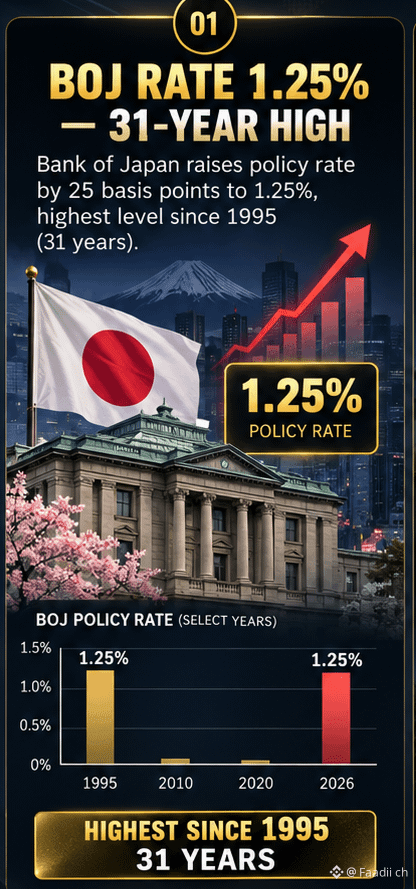
🇯🇵 1. BOJ raises rate to a 31-year high
The Bank of Japan raised its policy rate by 25 bps to 1.25%, the highest level since 1995.
Why does this matter for crypto?
Japan's monetary policy can affect the yen, global liquidity and risk appetite. That's why traders are watching how markets react after this move.
🇯🇵 1. BOJ raises rate to a 31-year high
The Bank of Japan raised its policy rate by 25 bps to 1.25%, the highest level since 1995.
Why does this matter for crypto?
Japan's monetary policy can affect the yen, global liquidity and risk appetite. That's why traders are watching how markets react after this move.
2

·
--
$NVDAB
#BOJRaisesRatesTo31YearHigh
🇯🇵 #BOJRaisesRatesTo31YearHigh
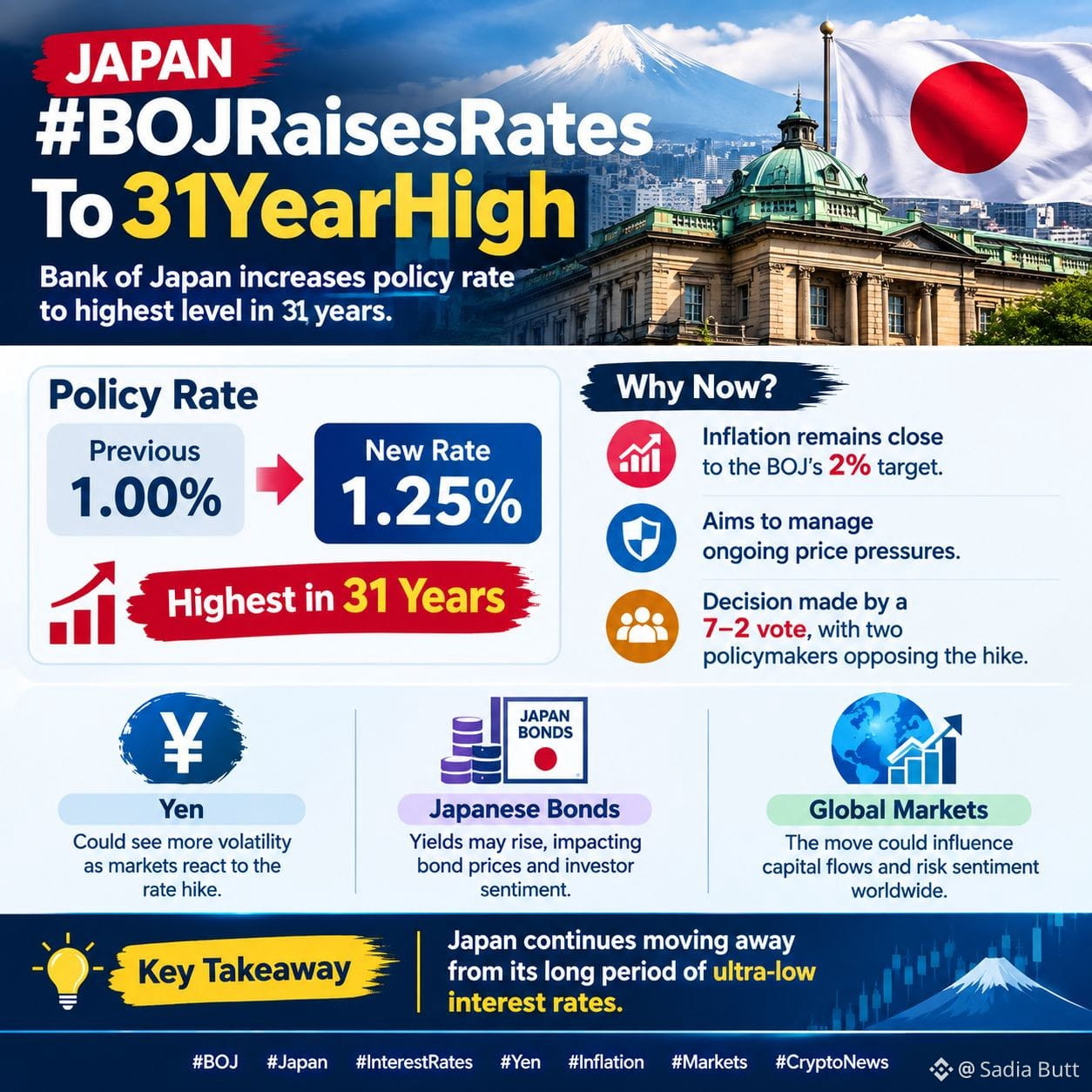
The Bank of Japan raised its policy rate from 1.00% to 1.25%, marking its highest level in 31 years. The 25-basis-point hike reflects the BOJ’s focus on managing inflation risks as price pressures remain close to its 2% target. (Reuters)
The decision was made by a 7–2 vote, with two policymakers opposing the increase. Markets are now watching closely for signals about the BOJ’s next moves and the impact on the yen, Japanese bonds, and global markets. (Investing.com)
📊 Key takeaway: Japan continues moving away from its long period of ultra-low interest rates.
#BOJ #Japan #InterestRates #Yen #Inflation #Markets #CryptoNews $NVDAB #BOJRaisesRatesTo31YearHigh
#HKCompletesFirstHKDStablecoinUseCase #BuffettStepsDownAsBerkshireChairman
$NVDAB
#BOJRaisesRatesTo31YearHigh
🇯🇵 #BOJRaisesRatesTo31YearHigh
The Bank of Japan raised its policy rate from 1.00% to 1.25%, marking its highest level in 31 years. The 25-basis-point hike reflects the BOJ’s focus on managing inflation risks as price pressures remain close to its 2% target. (Reuters)
The decision was made by a 7–2 vote, with two policymakers opposing the increase. Markets are now watching closely for signals about the BOJ’s next moves and the impact on the yen, Japanese bonds, and global markets. (Investing.com)
📊 Key takeaway: Japan continues moving away from its long period of ultra-low interest rates.
#BOJ #Japan #InterestRates #Yen #Inflation #Markets #CryptoNews $NVDAB #BOJRaisesRatesTo31YearHigh
#HKCompletesFirstHKDStablecoinUseCase #BuffettStepsDownAsBerkshireChairman
#BOJRaisesRatesTo31YearHigh
🇯🇵 #BOJRaisesRatesTo31YearHigh
The Bank of Japan raised its policy rate from 1.00% to 1.25%, marking its highest level in 31 years. The 25-basis-point hike reflects the BOJ’s focus on managing inflation risks as price pressures remain close to its 2% target. (Reuters)
The decision was made by a 7–2 vote, with two policymakers opposing the increase. Markets are now watching closely for signals about the BOJ’s next moves and the impact on the yen, Japanese bonds, and global markets. (Investing.com)
📊 Key takeaway: Japan continues moving away from its long period of ultra-low interest rates.
#BOJ #Japan #InterestRates #Yen #Inflation #Markets #CryptoNews $NVDAB #BOJRaisesRatesTo31YearHigh
#HKCompletesFirstHKDStablecoinUseCase #BuffettStepsDownAsBerkshireChairman
61

·
--
#BOJRaisesRatesTo31YearHigh
🚨 Bank of Japan makes a major move, raising rates to a 31-year high. 🇯🇵
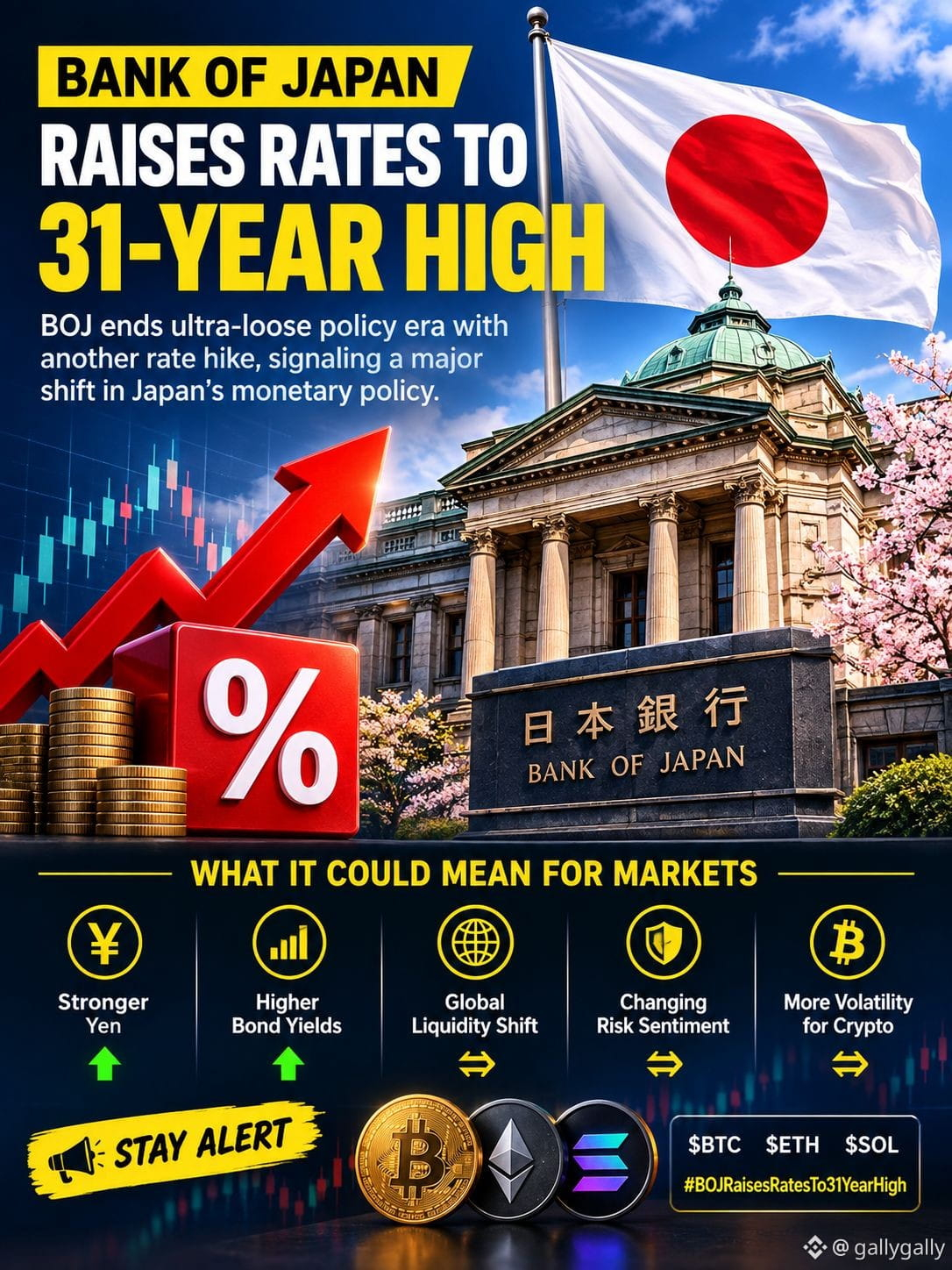
The decision highlights Japan’s changing monetary-policy landscape and could influence the yen, Japanese equities, global yields, and risk assets. Crypto traders should keep an eye on liquidity and market volatility.
$BTC $ETH $JPY.ETF
#BOJRaisesRatesTo31YearHigh #Bitcoin #Crypto #Markets
#BOJRaisesRatesTo31YearHigh
🚨 Bank of Japan makes a major move, raising rates to a 31-year high. 🇯🇵
The decision highlights Japan’s changing monetary-policy landscape and could influence the yen, Japanese equities, global yields, and risk assets. Crypto traders should keep an eye on liquidity and market volatility.
$BTC $ETH $JPY.ETF
#BOJRaisesRatesTo31YearHigh #Bitcoin #Crypto #Markets
🚨 Bank of Japan makes a major move, raising rates to a 31-year high. 🇯🇵
The decision highlights Japan’s changing monetary-policy landscape and could influence the yen, Japanese equities, global yields, and risk assets. Crypto traders should keep an eye on liquidity and market volatility.
$BTC $ETH $JPY.ETF
#BOJRaisesRatesTo31YearHigh #Bitcoin #Crypto #Markets
61

·
--
#BOJRaisesRatesTo31YearHigh The Bank of Japan (BoJ) raised its key policy interest rate by 25 basis points from 1.00% to **1.25%**, marking its highest benchmark level since April 1995 (a 31-year high).
### Key Details & Driver Highlights
* **Majority Decision:** The policy board passed the move in a **7–2 vote**.
* **Inflation Pressures:** The rate increase stems from persistent inflationary pressures, driven by rising energy costs, global supply constraints, and ongoing domestic wage increases.
* **Shift Away from Ultra-Loose Policy:** This step continues the BoJ’s steady shift away from decades of near-zero and negative interest rates, bringing real interest rates closer to neutral levels.
* **Yen & Market Reaction:** Despite the widely anticipated hike, the Japanese yen experienced immediate volatility due to broader global rate gaps and foreign exchange positioning. Governor Kazuo Ueda reiterated that future adjustments will remain data-dependent rather than following a preset timetable.
#BOJRaisesRatesTo31YearHigh The Bank of Japan (BoJ) raised its key policy interest rate by 25 basis points from 1.00% to **1.25%**, marking its highest benchmark level since April 1995 (a 31-year high).
### Key Details & Driver Highlights
* **Majority Decision:** The policy board passed the move in a **7–2 vote**.
* **Inflation Pressures:** The rate increase stems from persistent inflationary pressures, driven by rising energy costs, global supply constraints, and ongoing domestic wage increases.
* **Shift Away from Ultra-Loose Policy:** This step continues the BoJ’s steady shift away from decades of near-zero and negative interest rates, bringing real interest rates closer to neutral levels.
* **Yen & Market Reaction:** Despite the widely anticipated hike, the Japanese yen experienced immediate volatility due to broader global rate gaps and foreign exchange positioning. Governor Kazuo Ueda reiterated that future adjustments will remain data-dependent rather than following a preset timetable.
### Key Details & Driver Highlights
* **Majority Decision:** The policy board passed the move in a **7–2 vote**.
* **Inflation Pressures:** The rate increase stems from persistent inflationary pressures, driven by rising energy costs, global supply constraints, and ongoing domestic wage increases.
* **Shift Away from Ultra-Loose Policy:** This step continues the BoJ’s steady shift away from decades of near-zero and negative interest rates, bringing real interest rates closer to neutral levels.
* **Yen & Market Reaction:** Despite the widely anticipated hike, the Japanese yen experienced immediate volatility due to broader global rate gaps and foreign exchange positioning. Governor Kazuo Ueda reiterated that future adjustments will remain data-dependent rather than following a preset timetable.

1
109
Log in to explore more content
Join global crypto users on Binance Square
⚡️ Get latest and useful information about crypto.
💬 Trusted by the world’s largest crypto exchange.
👍 Discover real insights from verified creators.
Email / Phone number
Trending Topics
1
#BOJRaisesRatesTo31YearHigh
146,800 views
2,257 Discussing
2
#BuffettStepsDownAsBerkshireChairman
69,762 views
1,136 Discussing
3
#XRPExchangeReservesHitSevenYearLow
76,380 views
1,033 Discussing
4
#HKCompletesFirstHKDStablecoinUseCase
111,019 views
1,440 Discussing
5
#VietnamPlansFirstCryptoLicensesIn2026
68,295 views
1,002 Discussing
6
#BTCBreaks80K
436,735 views
5,116 Discussing
7
#BitcoinMarketCapTopsTesla
101,050 views
1,236 Discussing
8
#SOLJumpsAbout10%
103,406 views
1,126 Discussing
9
#EthereumReclaims$2600
8,975 views
121 Discussing
10
#LineraShutsDownAfterFundraisingFallsShort
30,789 views
335 Discussing