

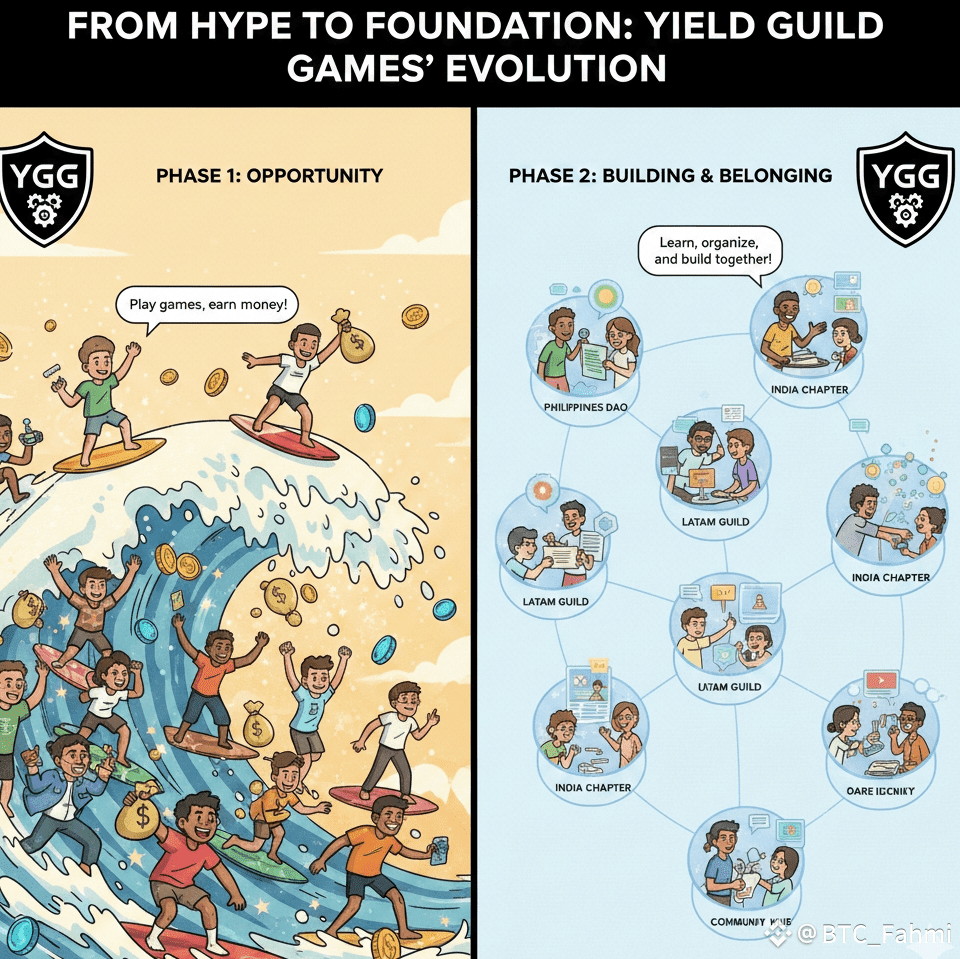
Yield Guild Games (YGG) once felt like a big wave that everyone wanted to ride. It wasn’t just another crypto or NFT project. For many people it was a hope the idea that normal gamers, without special connections or big money could earn real income by playing games. For a while this dream looked real. Play-to-earn games became popular prices went up, and whole communities formed around these games. In some places people even used game earnings to help with daily life. But like many things in crypto it didn’t stay hot forever. The market overheated. Token prices dropped. People who came only for fast money started leaving. Many gaming guilds became quiet or disappeared completely. The energy that once felt so strong began to fade. YGG did not die, though. Instead of giving up it changed how it worked. This change was not instant. It was slow sometimes uncomfortable and full of trial and error. But it was done on purpose with a clear goal survive beyond the hype. In the beginning, YGG acted a bit like a single global company. Most things were decided from the top and local communities followed along. Over time the DAO started to see that this was not the best way to grow. So YGG changed its structure. Instead of one big guild trying to manage everything . It became a network of many smaller local guilds. Places like the Philippines Latin America and India became important centers. These regions now run many things on their own. They can manage their own budgets choose which games to support and build partnerships that make sense for their players. Each region has its own culture, economic situation, and favorite games. So it makes sense for them to make decisions locally. These local guilds are not just branches of a big HQ. They are like small economies each with their own style and community leaders. Another important shift happened in how YGG uses its treasury money. In the early days the main goal was often to invest in game assets early. buy NFTs land or tokens before everyone else and hope their value grows. Now the goal is different. The treasury is used more to support people than to bet on prices. Some of the money goes into education. For example YGG runs workshops where people learn how to manage subDAO treasuries basically how to handle shared community funds in a safe and transparent way. Other workshops teach how to create and submit governance proposals. So more members can take part in deciding what the DAO does. There are also programs that help people learn how to run events like tournaments. That can cover their own costs through sponsorships entry fees or prizes. These activities may sound small compared to big token numbers but they are important because they teach skills. Over time this training builds “muscle memory” for the community habits and knowledge that stay even when markets are not exciting. Instead of just showing up to get rewards members learn how to organize lead and build. While this is happening, YGG is also working on something more technical but very powerful interoperability of player identity. Today in most games when you start a new game your history in other games does not matter. You start from zero every time. YGG is trying to help build a future where that is not true. Their idea is that a player’s identity including what they have done what they have earned what badges or achievements they hold and how they behave in the community should be able to move from one game to another like a digital passport. Imagine you played one game for a year were a good teammate won some tournament and helped run a guild. When you join a new game that reputation should come with you and be visible. You should not have to prove yourself from scratch every time. This kind of identity system is still early, but small signs of it are appearing. If it works it could become a key part of Web3 gaming in the future, where ownership and identity move with the player not just stay locked inside one game. The mood inside YGG has also changed over time. In the early play-to-earn days, many conversations were about returns ields and profit. Now calls and governance meetings feel more like community town halls. People argue and discuss where the DAO’s money should go. Should they support a new small guild? Should they fund a local event? Should they experiment with a new game or focus on tools and education? These talks are not always smooth. They can be slow and sometimes messy. People disagree. But this is normal in real communities. The important thing is that people feel. They have a voice and that they are part of something bigger than just a profit machine. Because of all these changes, YGG is starting to look less like a “gaming startup” and more like a kind of digital civic network. It is coordinating thousands of people in many countries not just to speculate on tokens but to do shared work in online worlds. This shared work includes organizing players building tools, running programs and trying to design a fair system for everyone who joins. This kind of work is not as flashy as headlines like “people earn $X per day playing games.” It doesn’t explode on social media in the same way. But it is more stable. It is the kind of foundation that can last when markets go up and down..If we think about YGG in two phases the difference becomes clear. In the first phase YGG was mostly about opportunity: “Come play these games and you might earn money.” That message brought a lot of people in. It opened the door. But it was heavily tied to market conditions and token prices. In the second phase, the focus is more on responsibility and long-term building. Now the message is closer to: “Let’s learn how to organize together manage resources, and create systems that keep working even after a specific game or trend fades.” YGG is no longer just “the guild that pays you to play.” It is slowly becoming “the guild that helps you learn how to build govern and belong to a lasting digital community.” In the end, that shiftfrom earning to organizing might be the most important thing YGG leaves behind. The money and hype were what attracted people at first. But the structure the local guilds the learning and the shared decision-making are what keep people around. That is how a short-term trend turns into something that can last.
@Yield Guild Games #YGGPlay $YGG
