

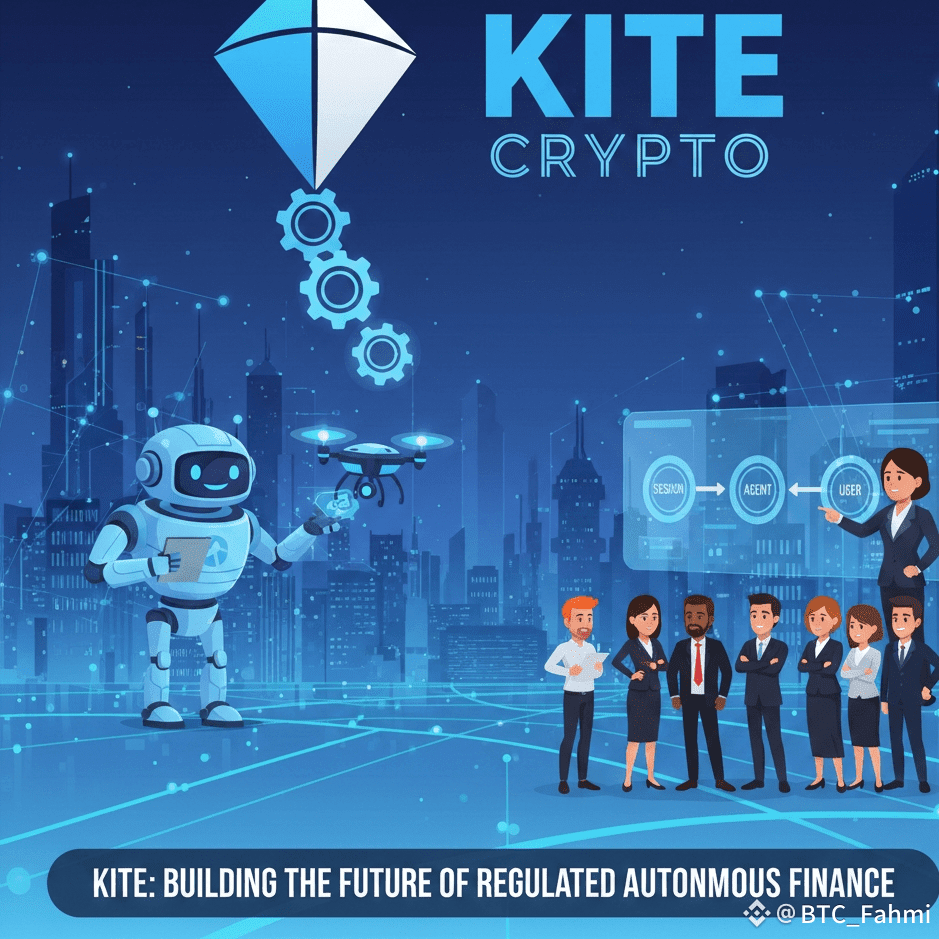
Kite is a crypto project that doesn’t treat regulation as an enemy. Instead of trying to avoid rules it’s built to work with them from the very beginning. Most crypto systems focus on being free and permissionless first and then worry about law and compliance later (if at all). Kite does the opposite. It’s designed so that things like accountability audit trails and “who is responsible for what” are built into how the network works. Kite doesn’t just think about human users. It’s built for agents pieces of software that can act on their own make payments sign contracts and interact with other systems. In the future these agents will need legal clarity just like humans and companies do. Regulators won’t just ask “What happened?” They’ll ask “Who is responsible when this happens?” Kite’s entire structure is shaped around answering that question clearly. To do this Kite separates identity on the network into three layers: the user the agent and the session. The user is the main responsible party. This can be a person, a company or even a DAO. The user is the one who creates or authorizes agents. The agent is a piece of code that can act semi independently on behalf of the user. You can think of it like a digital employee or assistant. It can take actions, handle transactions and interact with other systems but it still traces back to the user who owns or controls it. The session is a temporary context in which the agent operates. Each session has specific limits and permissions. It defines what the agent is allowed to do for a certain period or for a specific task. All of the agent’s actions in that time are tied to that session. Every transaction an agent makes is recorded inside a session. That session is connected to the agent and the agent is connected to the user. So any action always has a clear chain session., agent, user. Nothing is floating around without an owner or source. This creates a built-in audit trail by design not as an add-on. This structure has big advantages for regulators. Today with AI systems and autonomous code regulators often can’t see who is truly behind an action. They worry about “black boxes” and systems where no one wants to take responsibility. Kite gives them a way to see responsibility without needing to approve every move in real time. If something goes wrong or needs review, a regulator could trace a transaction back through the session and agent to the user who ultimately controls things. For companies this setup provides comfort and control. If every agent is always tied to a known user and every action is logged with clear context then compliance is not something they bolt on later. It is part of how the system works from the start. Oversight becomes a property of the network rather than an extra system they have to build themselves. Kite is also thinking ahead to how upcoming rules like the EU’s AI Act or new fintech regulations in Asia might apply to autonomous agents in finance. Instead of trying to escape these laws, Kite is designed in a way that can fit into them. The network gives a clear view of who delegated what, what limits were set and what actions were taken. That matches how many regulators already think in terms of control delegation and traceability. The KITE token is the economic glue that holds this together. Every kind of interaction on the network payments delegations of authority, or computation requires staking or spending KITE. This means every autonomous action has three things attached to it: a cost a unique on-chain record, and a source of truth tied to identities. You can’t quietly run an agent in the dark because its operations are linked to value movements and logged in a way that can be checked. This makes Kite a kind of bridge between developers and policymakers. Developers see it as infrastructure for building and running agents safely and flexibly. Policymakers can see it as a controlled environment where digital agents are free to act but never disappear into anonymity. It’s a place where experimentation with autonomous systems can happen while still keeping a clear line of responsibility. Another important aspect is tone and mindset. Many crypto projects position themselves against regulation with marketing that sounds hostile or defensive. Kite is different. Its documentation is written so both engineers and regulators can understand it. It focuses on clarity, verifiability and controlled flexibility. It’s not waiting to be “made compliant” someday. It is trying to be understandable and aligned with legal thinking right now. Kite is preparing for a world where machines can legally hold money make payments sign contracts and act as real economic actors. When regulators fully accept that this is happening, they will look for systems that already support their way of thinking about responsibility and control. Kite wants to be ready for that moment. Kite is not just trying to be another fast or cheap blockchain. It is trying to define the rules and structure for how autonomous code can operate in a legal accountable way. It shows that you can have freedom of action for agents while still keeping a clear map of who is responsible. That combination of autonomy and accountability is its core idea and its real innovation.

