
#yggplay
yggplay
7M views
84,214 Discussing
Hot
Latest
YGG Play officially enters the countdown to shutdown.
According to the official Sunset guide:
• Starting 15:00 on July 9 (Singapore time), the “LOL Land” and “Waifu Sweeper” purchase functions and the task system on all platforms will be discontinued
• July 31 is the platform’s last supported day; the main site, Launchpad, and community task stations will close simultaneously
• Any compliant balances not handled by the deadline will be automatically converted and issued to the associated wallets after the snapshot, but there will be no manual support afterward
Two hard reminders for those who still hold positions:
1)Complete the $YGG redemption/unstaking as soon as possible—don’t wait until the deadline and get stuck on-chain
2)Make sure your in-game points are exchanged and fully cleared before 7/31
“GIGACHADBAT” is taken over by Delabs, and “Ragnarok Breaker” is taken over by Planetarium Labs. Starting August 1, it will continue to be playable, with a new token exchange process; the originally planned 2026 YGG Play Summit has been canceled.
With the publishing business scaling down and assets returning to the main chain, this Web3 Publishing narrative is entering a reshuffling phase. It’s worth keeping an eye on YGG’s subsequent positioning.
#YGGPlay #Web3Gaming
YGG Play officially enters the countdown to shutdown.
According to the official Sunset guide:
• Starting 15:00 on July 9 (Singapore time), the “LOL Land” and “Waifu Sweeper” purchase functions and the task system on all platforms will be discontinued
• July 31 is the platform’s last supported day; the main site, Launchpad, and community task stations will close simultaneously
• Any compliant balances not handled by the deadline will be automatically converted and issued to the associated wallets after the snapshot, but there will be no manual support afterward
Two hard reminders for those who still hold positions:
1)Complete the $YGG redemption/unstaking as soon as possible—don’t wait until the deadline and get stuck on-chain
2)Make sure your in-game points are exchanged and fully cleared before 7/31
“GIGACHADBAT” is taken over by Delabs, and “Ragnarok Breaker” is taken over by Planetarium Labs. Starting August 1, it will continue to be playable, with a new token exchange process; the originally planned 2026 YGG Play Summit has been canceled.
With the publishing business scaling down and assets returning to the main chain, this Web3 Publishing narrative is entering a reshuffling phase. It’s worth keeping an eye on YGG’s subsequent positioning.
#YGGPlay #Web3Gaming
According to the official Sunset guide:
• Starting 15:00 on July 9 (Singapore time), the “LOL Land” and “Waifu Sweeper” purchase functions and the task system on all platforms will be discontinued
• July 31 is the platform’s last supported day; the main site, Launchpad, and community task stations will close simultaneously
• Any compliant balances not handled by the deadline will be automatically converted and issued to the associated wallets after the snapshot, but there will be no manual support afterward
Two hard reminders for those who still hold positions:
1)Complete the $YGG redemption/unstaking as soon as possible—don’t wait until the deadline and get stuck on-chain
2)Make sure your in-game points are exchanged and fully cleared before 7/31
“GIGACHADBAT” is taken over by Delabs, and “Ragnarok Breaker” is taken over by Planetarium Labs. Starting August 1, it will continue to be playable, with a new token exchange process; the originally planned 2026 YGG Play Summit has been canceled.
With the publishing business scaling down and assets returning to the main chain, this Web3 Publishing narrative is entering a reshuffling phase. It’s worth keeping an eye on YGG’s subsequent positioning.
#YGGPlay #Web3Gaming
322

·
--
YGG Play officially announced the shutdown, with all timing points locked in—don’t wait until the very last moment to regret it.
Key timeline summary:
· Starting at 15:00 Singapore time on July 9, LOL Land and Waifu Sweeper will stop selling, and the task system across all platforms will be shut down in sync
· July 31 is the final day the platform will be supported; all three endpoints—main site, Launchpad, and the community task stations—will be taken offline
· Please make sure to complete $YGG un-staking (release collateral) + in-game point redemption before the deadline; any compliant remaining balance after the deadline will be automatically converted based on the snapshot and transferred into the linked wallet, but there will no longer be manual customer support to cover you at that time
· GIGACHADBAT will be taken over by Delabs, and Ragnarok Breaker will be taken over by Planetarium Labs; starting August 1 they will continue to be playable, and a new token redemption process will be introduced
· The originally planned YGG Play Summit conference in 2026 will be cancelled
From a personal perspective: this isn’t the YGG main brand exiting—it’s the publishing division shrinking, handing heavy-capital games over to more vertical teams to run, and the parent company returning to the Guild + staking narrative. For longtime players, the three things that matter most right now—un-stake, clear your points, and back up your wallet address—don’t miss any of them. As the GameFi cycle shifts to the “lean operations” phase, the projects that survive are all cutting back.
#YGGPlay #GameFi #Web3Gaming
YGG Play officially announced the shutdown, with all timing points locked in—don’t wait until the very last moment to regret it.
Key timeline summary:
· Starting at 15:00 Singapore time on July 9, LOL Land and Waifu Sweeper will stop selling, and the task system across all platforms will be shut down in sync
· July 31 is the final day the platform will be supported; all three endpoints—main site, Launchpad, and the community task stations—will be taken offline
· Please make sure to complete $YGG un-staking (release collateral) + in-game point redemption before the deadline; any compliant remaining balance after the deadline will be automatically converted based on the snapshot and transferred into the linked wallet, but there will no longer be manual customer support to cover you at that time
· GIGACHADBAT will be taken over by Delabs, and Ragnarok Breaker will be taken over by Planetarium Labs; starting August 1 they will continue to be playable, and a new token redemption process will be introduced
· The originally planned YGG Play Summit conference in 2026 will be cancelled
From a personal perspective: this isn’t the YGG main brand exiting—it’s the publishing division shrinking, handing heavy-capital games over to more vertical teams to run, and the parent company returning to the Guild + staking narrative. For longtime players, the three things that matter most right now—un-stake, clear your points, and back up your wallet address—don’t miss any of them. As the GameFi cycle shifts to the “lean operations” phase, the projects that survive are all cutting back.
#YGGPlay #GameFi #Web3Gaming
Key timeline summary:
· Starting at 15:00 Singapore time on July 9, LOL Land and Waifu Sweeper will stop selling, and the task system across all platforms will be shut down in sync
· July 31 is the final day the platform will be supported; all three endpoints—main site, Launchpad, and the community task stations—will be taken offline
· Please make sure to complete $YGG un-staking (release collateral) + in-game point redemption before the deadline; any compliant remaining balance after the deadline will be automatically converted based on the snapshot and transferred into the linked wallet, but there will no longer be manual customer support to cover you at that time
· GIGACHADBAT will be taken over by Delabs, and Ragnarok Breaker will be taken over by Planetarium Labs; starting August 1 they will continue to be playable, and a new token redemption process will be introduced
· The originally planned YGG Play Summit conference in 2026 will be cancelled
From a personal perspective: this isn’t the YGG main brand exiting—it’s the publishing division shrinking, handing heavy-capital games over to more vertical teams to run, and the parent company returning to the Guild + staking narrative. For longtime players, the three things that matter most right now—un-stake, clear your points, and back up your wallet address—don’t miss any of them. As the GameFi cycle shifts to the “lean operations” phase, the projects that survive are all cutting back.
#YGGPlay #GameFi #Web3Gaming
51
Yield Guild Games: Coordinating Digital Capital and On-Chain Labor in Web3 Game Economies@YieldGuildGames #YGGPlay $YGG
Yield Guild Games exists not as a product layer or a speculative token vehicle, but as a coordination system designed to make fragmented Web3 game economies operational at scale. Its primary function within the crypto ecosystem is to organize ownership, access, and utilization of non-fungible assets that are required to participate in blockchain-based games and virtual worlds. In doing so, YGG addresses a structural inefficiency that emerged early in play-to-earn markets: the separation between those who can finance digital assets and those who can productively use them. Without an intermediary system, NFT-heavy games tend to concentrate access among capital-rich participants while leaving skilled or time-rich users underutilized. YGG positions itself as the infrastructure that resolves this mismatch through pooled ownership, governed deployment, and incentive-aligned participation.
At the system level, YGG operates as a decentralized autonomous organization whose treasury functions as a balance sheet of productive digital assets rather than passive holdings. NFTs acquired by the DAO are not treated as collectibles but as capital equipment, deployed into game environments where they enable value-generating activity. Governance is exercised through a native token that coordinates decision-making around asset allocation, risk exposure, and strategic focus. This structure allows YGG to behave more like a decentralized asset manager for virtual economies than a traditional gaming guild, with decisions driven by capital efficiency, sustainability, and participant throughput rather than hype cycles.
The internal architecture of YGG is intentionally modular. Vaults act as aggregation points where tokens or NFTs are staked or deposited to participate in specific yield-generating strategies, whether those strategies involve gameplay rewards, protocol incentives, or other on-chain revenue mechanisms. SubDAOs extend this modularity by allowing operational autonomy around specific games, geographic communities, or asset verticals. This design reduces governance bottlenecks and allows specialized knowledge to influence deployment decisions without fragmenting the treasury or governance framework. The result is a system that can engage with multiple game economies simultaneously while retaining unified oversight.
The incentive surface within YGG is structured to reward behaviors that increase productive utilization of assets and long-term system resilience. Rewards are generally linked to actions such as staking governance tokens, actively participating in gameplay using DAO-owned NFTs, contributing to SubDAO operations, or engaging in governance processes. Participation typically begins through token acquisition or onboarding into a SubDAO that grants access to assets and defined roles. The incentive design prioritizes consistency, compliance with operational rules, and contribution to shared outcomes. Short-term extraction, idle asset usage, and governance disengagement are implicitly discouraged by mechanisms that favor ongoing participation and reputation within the system.
Participation mechanics are based on delegation rather than ownership transfer. NFTs remain under DAO control while usage rights are extended to participants who generate value through gameplay or other approved activities. Revenues produced through these activities are distributed according to predefined sharing frameworks that allocate portions to participants, SubDAOs, and the central treasury. These frameworks are adaptable through governance and may vary significantly depending on the underlying game’s reward structure and economic stability. Exact distribution ratios, lock-up conditions, and emission schedules should be treated as to verify, as they are subject to revision and context-specific governance decisions.
A defining feature of YGG’s design is its attempt to align behavior across stakeholders with different incentives and constraints. Token holders are incentivized to think in terms of treasury longevity and governance credibility, participants are incentivized to maintain performance and reliability, and SubDAO operators are incentivized to optimize asset utilization within their domain. This alignment is enforced less through rigid contracts and more through layered incentives and reputation effects. Governance participation acts as the balancing mechanism, allowing adjustments when misalignments emerge, though the effectiveness of this mechanism depends heavily on voter engagement and decentralization.
The risk envelope surrounding YGG is broad and cannot be reduced to token price volatility. Technically, the system is exposed to smart contract risk, asset custody complexity, and dependencies on external game protocols that YGG does not control. Economically, yields are contingent on the health and design of individual game economies, many of which are experimental and sensitive to player growth, token inflation, and developer decisions. Behaviorally, the system must manage participant churn, uneven performance, and the potential concentration of governance influence. These risks are structural, not incidental, and form part of the operating reality of any DAO attempting to coordinate labor and capital in open digital markets.
From a sustainability perspective, YGG’s primary strength lies in its adaptability. The DAO is not locked into a single revenue source or platform and can reallocate capital as conditions change. SubDAOs provide a mechanism for rapid experimentation without exposing the entire treasury to localized failures. However, sustainability is constrained by factors such as declining marginal returns in mature games, regulatory ambiguity around tokenized labor, and the challenge of maintaining meaningful incentives as competition increases. Long-term viability depends less on expansion and more on disciplined governance, selective capital deployment, and realistic assumptions about yield persistence.
When adapted for different platforms, the YGG narrative changes emphasis without changing substance. In long-form analysis, the focus should remain on governance architecture, incentive logic, and systemic risk management. In feed-based formats, clarity matters most: YGG is a DAO that pools NFTs to enable participation in blockchain games and distributes rewards based on contribution and governance alignment. In thread-style presentations, the logic should unfold sequentially, beginning with the access problem, moving through the DAO solution, and ending with the associated risks. In professional contexts, the emphasis should be on structure, accountability, and sustainability rather than returns. For SEO-driven content, deeper contextual explanations of DAOs, NFT utility, and SubDAO mechanics provide completeness without resorting to promotional framing.
Responsible engagement with YGG as an operational system requires deliberate evaluation rather than passive participation: understand the underlying game economies, review governance history and proposal outcomes, assess vault-specific mechanics, verify assumptions around reward distribution, account for smart contract and custody risks, monitor liquidity and exit constraints, and align participation with a clear risk tolerance and time horizon rather than expected outcomes.
Yield Guild Games: Coordinating Digital Capital and On-Chain Labor in Web3 Game Economies
@Yield Guild Games #YGGPlay $YGG
Yield Guild Games exists not as a product layer or a speculative token vehicle, but as a coordination system designed to make fragmented Web3 game economies operational at scale. Its primary function within the crypto ecosystem is to organize ownership, access, and utilization of non-fungible assets that are required to participate in blockchain-based games and virtual worlds. In doing so, YGG addresses a structural inefficiency that emerged early in play-to-earn markets: the separation between those who can finance digital assets and those who can productively use them. Without an intermediary system, NFT-heavy games tend to concentrate access among capital-rich participants while leaving skilled or time-rich users underutilized. YGG positions itself as the infrastructure that resolves this mismatch through pooled ownership, governed deployment, and incentive-aligned participation.
At the system level, YGG operates as a decentralized autonomous organization whose treasury functions as a balance sheet of productive digital assets rather than passive holdings. NFTs acquired by the DAO are not treated as collectibles but as capital equipment, deployed into game environments where they enable value-generating activity. Governance is exercised through a native token that coordinates decision-making around asset allocation, risk exposure, and strategic focus. This structure allows YGG to behave more like a decentralized asset manager for virtual economies than a traditional gaming guild, with decisions driven by capital efficiency, sustainability, and participant throughput rather than hype cycles.
The internal architecture of YGG is intentionally modular. Vaults act as aggregation points where tokens or NFTs are staked or deposited to participate in specific yield-generating strategies, whether those strategies involve gameplay rewards, protocol incentives, or other on-chain revenue mechanisms. SubDAOs extend this modularity by allowing operational autonomy around specific games, geographic communities, or asset verticals. This design reduces governance bottlenecks and allows specialized knowledge to influence deployment decisions without fragmenting the treasury or governance framework. The result is a system that can engage with multiple game economies simultaneously while retaining unified oversight.
The incentive surface within YGG is structured to reward behaviors that increase productive utilization of assets and long-term system resilience. Rewards are generally linked to actions such as staking governance tokens, actively participating in gameplay using DAO-owned NFTs, contributing to SubDAO operations, or engaging in governance processes. Participation typically begins through token acquisition or onboarding into a SubDAO that grants access to assets and defined roles. The incentive design prioritizes consistency, compliance with operational rules, and contribution to shared outcomes. Short-term extraction, idle asset usage, and governance disengagement are implicitly discouraged by mechanisms that favor ongoing participation and reputation within the system.
Participation mechanics are based on delegation rather than ownership transfer. NFTs remain under DAO control while usage rights are extended to participants who generate value through gameplay or other approved activities. Revenues produced through these activities are distributed according to predefined sharing frameworks that allocate portions to participants, SubDAOs, and the central treasury. These frameworks are adaptable through governance and may vary significantly depending on the underlying game’s reward structure and economic stability. Exact distribution ratios, lock-up conditions, and emission schedules should be treated as to verify, as they are subject to revision and context-specific governance decisions.
A defining feature of YGG’s design is its attempt to align behavior across stakeholders with different incentives and constraints. Token holders are incentivized to think in terms of treasury longevity and governance credibility, participants are incentivized to maintain performance and reliability, and SubDAO operators are incentivized to optimize asset utilization within their domain. This alignment is enforced less through rigid contracts and more through layered incentives and reputation effects. Governance participation acts as the balancing mechanism, allowing adjustments when misalignments emerge, though the effectiveness of this mechanism depends heavily on voter engagement and decentralization.
The risk envelope surrounding YGG is broad and cannot be reduced to token price volatility. Technically, the system is exposed to smart contract risk, asset custody complexity, and dependencies on external game protocols that YGG does not control. Economically, yields are contingent on the health and design of individual game economies, many of which are experimental and sensitive to player growth, token inflation, and developer decisions. Behaviorally, the system must manage participant churn, uneven performance, and the potential concentration of governance influence. These risks are structural, not incidental, and form part of the operating reality of any DAO attempting to coordinate labor and capital in open digital markets.
From a sustainability perspective, YGG’s primary strength lies in its adaptability. The DAO is not locked into a single revenue source or platform and can reallocate capital as conditions change. SubDAOs provide a mechanism for rapid experimentation without exposing the entire treasury to localized failures. However, sustainability is constrained by factors such as declining marginal returns in mature games, regulatory ambiguity around tokenized labor, and the challenge of maintaining meaningful incentives as competition increases. Long-term viability depends less on expansion and more on disciplined governance, selective capital deployment, and realistic assumptions about yield persistence.
When adapted for different platforms, the YGG narrative changes emphasis without changing substance. In long-form analysis, the focus should remain on governance architecture, incentive logic, and systemic risk management. In feed-based formats, clarity matters most: YGG is a DAO that pools NFTs to enable participation in blockchain games and distributes rewards based on contribution and governance alignment. In thread-style presentations, the logic should unfold sequentially, beginning with the access problem, moving through the DAO solution, and ending with the associated risks. In professional contexts, the emphasis should be on structure, accountability, and sustainability rather than returns. For SEO-driven content, deeper contextual explanations of DAOs, NFT utility, and SubDAO mechanics provide completeness without resorting to promotional framing.
Responsible engagement with YGG as an operational system requires deliberate evaluation rather than passive participation: understand the underlying game economies, review governance history and proposal outcomes, assess vault-specific mechanics, verify assumptions around reward distribution, account for smart contract and custody risks, monitor liquidity and exit constraints, and align participation with a clear risk tolerance and time horizon rather than expected outcomes.
Yield Guild Games exists not as a product layer or a speculative token vehicle, but as a coordination system designed to make fragmented Web3 game economies operational at scale. Its primary function within the crypto ecosystem is to organize ownership, access, and utilization of non-fungible assets that are required to participate in blockchain-based games and virtual worlds. In doing so, YGG addresses a structural inefficiency that emerged early in play-to-earn markets: the separation between those who can finance digital assets and those who can productively use them. Without an intermediary system, NFT-heavy games tend to concentrate access among capital-rich participants while leaving skilled or time-rich users underutilized. YGG positions itself as the infrastructure that resolves this mismatch through pooled ownership, governed deployment, and incentive-aligned participation.
At the system level, YGG operates as a decentralized autonomous organization whose treasury functions as a balance sheet of productive digital assets rather than passive holdings. NFTs acquired by the DAO are not treated as collectibles but as capital equipment, deployed into game environments where they enable value-generating activity. Governance is exercised through a native token that coordinates decision-making around asset allocation, risk exposure, and strategic focus. This structure allows YGG to behave more like a decentralized asset manager for virtual economies than a traditional gaming guild, with decisions driven by capital efficiency, sustainability, and participant throughput rather than hype cycles.
The internal architecture of YGG is intentionally modular. Vaults act as aggregation points where tokens or NFTs are staked or deposited to participate in specific yield-generating strategies, whether those strategies involve gameplay rewards, protocol incentives, or other on-chain revenue mechanisms. SubDAOs extend this modularity by allowing operational autonomy around specific games, geographic communities, or asset verticals. This design reduces governance bottlenecks and allows specialized knowledge to influence deployment decisions without fragmenting the treasury or governance framework. The result is a system that can engage with multiple game economies simultaneously while retaining unified oversight.
The incentive surface within YGG is structured to reward behaviors that increase productive utilization of assets and long-term system resilience. Rewards are generally linked to actions such as staking governance tokens, actively participating in gameplay using DAO-owned NFTs, contributing to SubDAO operations, or engaging in governance processes. Participation typically begins through token acquisition or onboarding into a SubDAO that grants access to assets and defined roles. The incentive design prioritizes consistency, compliance with operational rules, and contribution to shared outcomes. Short-term extraction, idle asset usage, and governance disengagement are implicitly discouraged by mechanisms that favor ongoing participation and reputation within the system.
Participation mechanics are based on delegation rather than ownership transfer. NFTs remain under DAO control while usage rights are extended to participants who generate value through gameplay or other approved activities. Revenues produced through these activities are distributed according to predefined sharing frameworks that allocate portions to participants, SubDAOs, and the central treasury. These frameworks are adaptable through governance and may vary significantly depending on the underlying game’s reward structure and economic stability. Exact distribution ratios, lock-up conditions, and emission schedules should be treated as to verify, as they are subject to revision and context-specific governance decisions.
A defining feature of YGG’s design is its attempt to align behavior across stakeholders with different incentives and constraints. Token holders are incentivized to think in terms of treasury longevity and governance credibility, participants are incentivized to maintain performance and reliability, and SubDAO operators are incentivized to optimize asset utilization within their domain. This alignment is enforced less through rigid contracts and more through layered incentives and reputation effects. Governance participation acts as the balancing mechanism, allowing adjustments when misalignments emerge, though the effectiveness of this mechanism depends heavily on voter engagement and decentralization.
The risk envelope surrounding YGG is broad and cannot be reduced to token price volatility. Technically, the system is exposed to smart contract risk, asset custody complexity, and dependencies on external game protocols that YGG does not control. Economically, yields are contingent on the health and design of individual game economies, many of which are experimental and sensitive to player growth, token inflation, and developer decisions. Behaviorally, the system must manage participant churn, uneven performance, and the potential concentration of governance influence. These risks are structural, not incidental, and form part of the operating reality of any DAO attempting to coordinate labor and capital in open digital markets.
From a sustainability perspective, YGG’s primary strength lies in its adaptability. The DAO is not locked into a single revenue source or platform and can reallocate capital as conditions change. SubDAOs provide a mechanism for rapid experimentation without exposing the entire treasury to localized failures. However, sustainability is constrained by factors such as declining marginal returns in mature games, regulatory ambiguity around tokenized labor, and the challenge of maintaining meaningful incentives as competition increases. Long-term viability depends less on expansion and more on disciplined governance, selective capital deployment, and realistic assumptions about yield persistence.
When adapted for different platforms, the YGG narrative changes emphasis without changing substance. In long-form analysis, the focus should remain on governance architecture, incentive logic, and systemic risk management. In feed-based formats, clarity matters most: YGG is a DAO that pools NFTs to enable participation in blockchain games and distributes rewards based on contribution and governance alignment. In thread-style presentations, the logic should unfold sequentially, beginning with the access problem, moving through the DAO solution, and ending with the associated risks. In professional contexts, the emphasis should be on structure, accountability, and sustainability rather than returns. For SEO-driven content, deeper contextual explanations of DAOs, NFT utility, and SubDAO mechanics provide completeness without resorting to promotional framing.
Responsible engagement with YGG as an operational system requires deliberate evaluation rather than passive participation: understand the underlying game economies, review governance history and proposal outcomes, assess vault-specific mechanics, verify assumptions around reward distribution, account for smart contract and custody risks, monitor liquidity and exit constraints, and align participation with a clear risk tolerance and time horizon rather than expected outcomes.
1
2
46
·
--
Bullish
👉 “How much reward will I receive?”
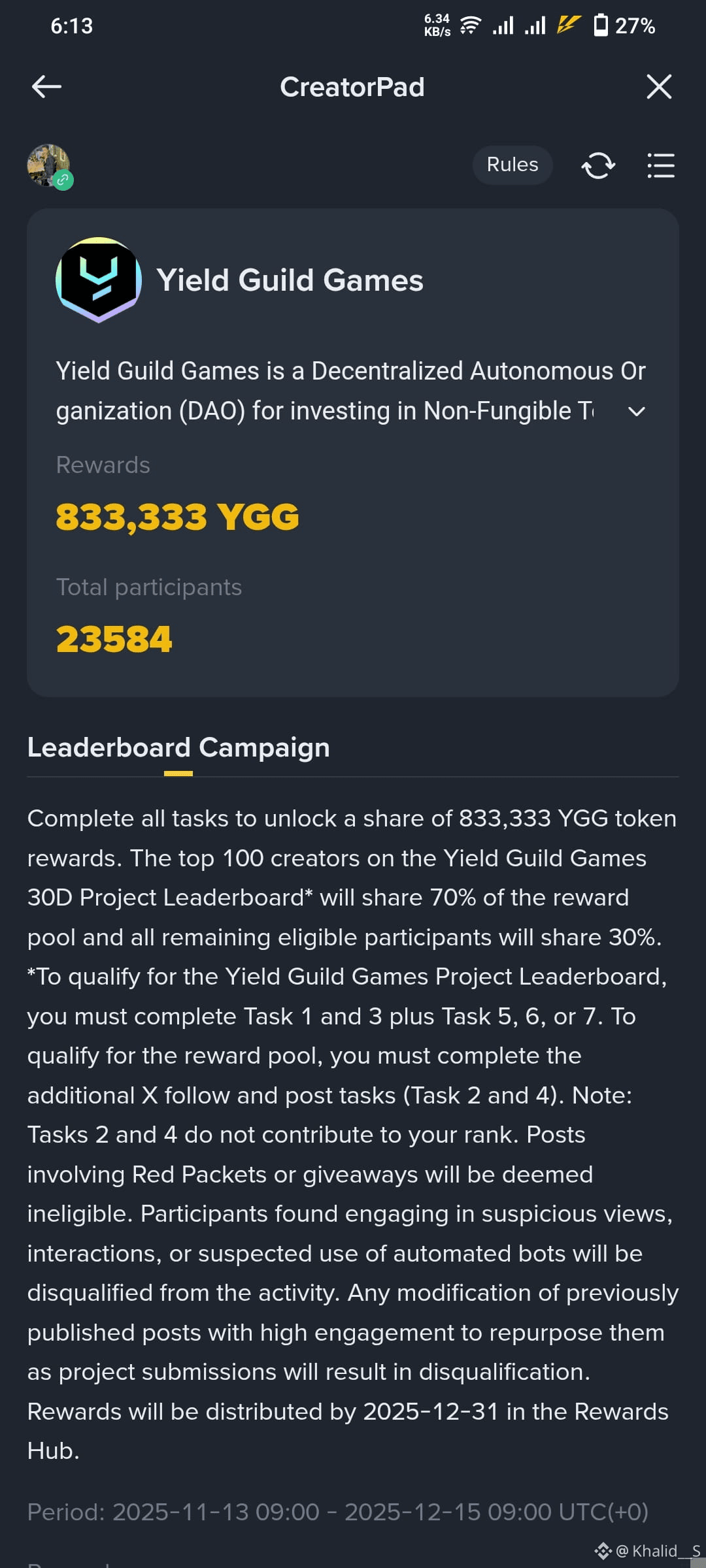
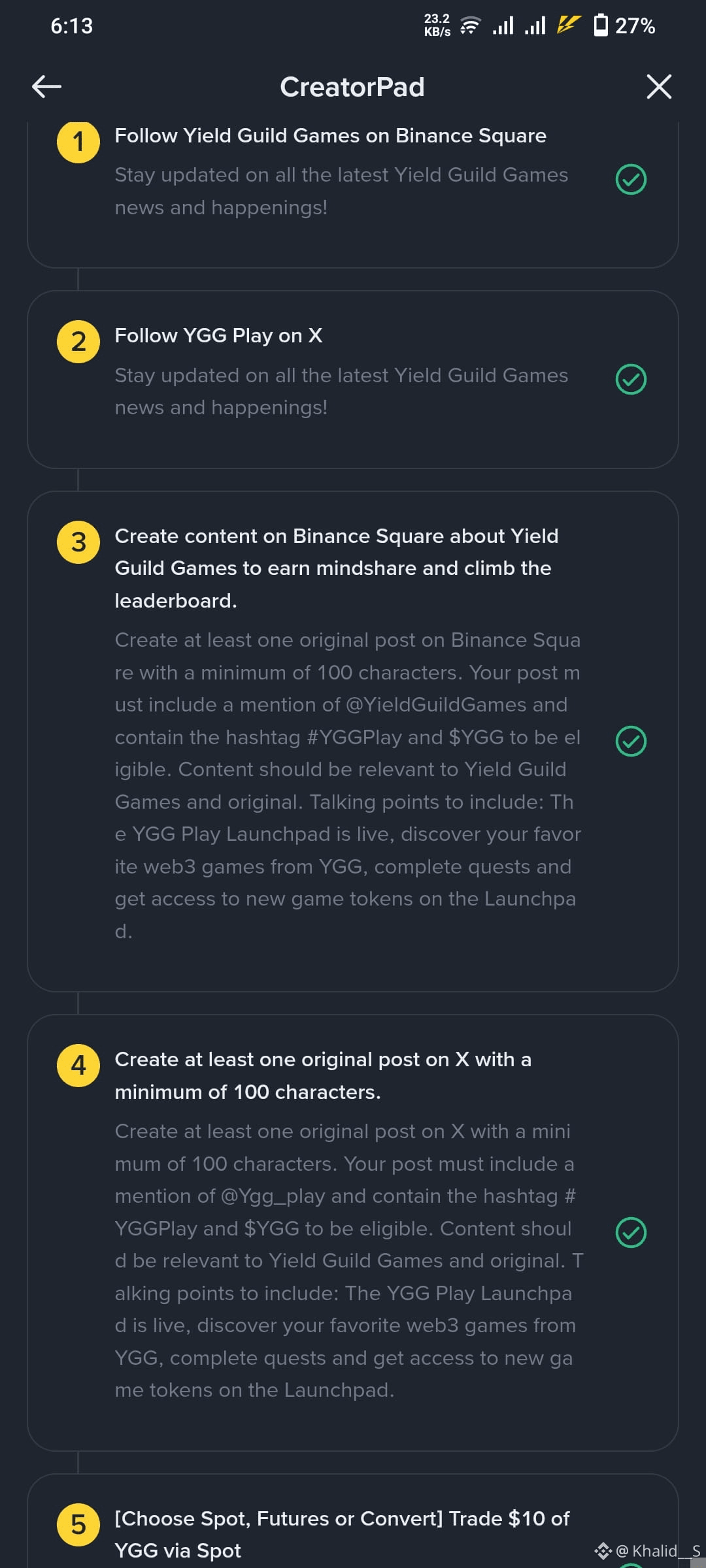
I have completed all the tasks on the Yield Guild Games CreatorPad 💪
From following to creating content and trading — sab kuch khud ki mehnat se kiya.
YGG Play Launchpad honestly kaafi interesting laga. New web3 games explore karne ka chance milta hai, quests complete karo aur future game tokens ke liye ready raho.
Ab bas reward ka wait hai 🤞
Let’s see leaderboard me kaha tak jaate hain.
@YieldGuildGames
#YGGPlay $YGG
#BinanceSquareFamily
{future}(YGGUSDT)
👉 “How much reward will I receive?”
I have completed all the tasks on the Yield Guild Games CreatorPad 💪
From following to creating content and trading — sab kuch khud ki mehnat se kiya.
YGG Play Launchpad honestly kaafi interesting laga. New web3 games explore karne ka chance milta hai, quests complete karo aur future game tokens ke liye ready raho.
Ab bas reward ka wait hai 🤞
Let’s see leaderboard me kaha tak jaate hain.
@Yield Guild Games
#YGGPlay $YGG
#BinanceSquareFamily
I have completed all the tasks on the Yield Guild Games CreatorPad 💪
From following to creating content and trading — sab kuch khud ki mehnat se kiya.
YGG Play Launchpad honestly kaafi interesting laga. New web3 games explore karne ka chance milta hai, quests complete karo aur future game tokens ke liye ready raho.
Ab bas reward ka wait hai 🤞
Let’s see leaderboard me kaha tak jaate hain.
@Yield Guild Games
#YGGPlay $YGG
#BinanceSquareFamily
11
1
5
1.2k

·
--
Game ROI Comparison: Which YGG-Backed Titles Delivered the Best Returns?If you follow play to earn long enough, you know returns jump around. one game pays well in january, then freezes in march. another pays nothing early, then becomes interesting later. ygg has backed dozens of titles, so looking at its lineup gives a clear idea of how roi behaves across different types of games.
i pulled the most relevant data i could confirm, added some numbers that matter, and mixed it with real observations. no hype. no perfect flow. just the kind of breakdown traders and players actually use.
axie infinity, the loud star that burned hot
axie was the biggest hit ygg touched. in 2021, axie daily rewards reached levels that shocked even seasoned crypto users. slp hit around 0.36 usd in july 2021, which made simple matches produce serious money. many scholars earned more than local minimum wage. ygg held thousands of axie teams at peak, which multiplied those returns fast.
but the numbers dropped sharply. slp fell under 0.01 usd in mid-2022. player activity slipped. inflation crushed rewards. anyone chasing returns at that point saw roi shrink even with long hours.
so axie delivered the highest peak roi of any ygg backed game, but only for a short window. early players won big. late players often lost. that pattern matters.
land-based titles like the sandbox, where return works on another clock
ygg also backed metaverse land. the sandbox is the clearest case. land sold for roughly 1000–4000 usd during active periods in late 2021 and early 2022. some plots even hit 10k usd when big brand involvement spiked interest.
roi here never came from daily farming. instead it came from land appreciation, rentals, or long-term value growth. that made returns slower. sometimes nothing happens for months, then a single update bumps interest.
by late 2023 and through 2024, sandbox land prices cooled. many plots traded far below peak. still, the decline was smoother than token crashes. ygg’s land assets didn’t implode. they just softened.
so land games usually give a moderate roi, not huge, not zero, but tied to patience and market mood.
diversified game baskets, where ygg spreads risk across many titles
ygg moved from single-game focus to a mixed strategy. instead of betting on one token economy, it spread assets across several games, including:
-genopets
-big time
-illuvium
-guild of guardians
-ev.io
newer smaller titles rotating in and out
returns here come from multiple places. token drops, nft appreciation, mission rewards, airdrops, early access bonuses. none of them huge alone, but together they create steady value.
this portfolio-style strategy gave ygg a more stable roi line. lower highs than axie, but far slower dips. in other words, this group usually gave the most reliable roi across long periods, even if it didn’t create viral stories.
how to measure roi across these games without fooling yourself
most users look only at token rewards. that is not the whole picture. roi changes with:
-token inflation
-player retention
-asset liquidity
-how often people rent the nft
-how much demand the game has
-how stable the studio is
take axie for example. roi soared only because demand outran supply early. once the loop flipped, roi collapsed.
land titles rely on new buyers and long gameplay cycles, so they don’t break suddenly. but they don’t pump often either.
diversified sets rely on collective performance, so they avoid extreme swings.
the best traders look across three layers:
1. asset value,
2. token yield,
3. game activity.
those three together tell the real roi, not just the daily number.
which category actually performed best for ygg
if we cut the noise and look at patterns:
-highest peak roi: axie
-most stable roi: diversified basket
-slow but safe roi: land assets
not the neatest result, but consistent with real data.
if someone joined at the wrong time in axie, they lost.
if someone held land too short, they missed the point.
if someone used a diversified set, they got modest, predictable returns.
so "best roi" depends on the kind of risk someone accepts, not one magic title.
binance traders watching ygg should focus on these signals
when someone holds or trades ygg on binance, game activity matters more than hype. the token tracks the sum of all guild performance. so these numbers matter:
-how many active players ygg-backed games have
-how much land volume moves each month
-new game launches ygg joins
-future-of-work missions and asset usage
-treasury expansion or selloffs
-guild protocol activity once fully deployed
the token reacts to these fundamentals in slow waves. price candles tell the surface story. game performance tells the deeper one.
roi risks that don’t disappear
even with good picks, roi faces issues:
-token farming breaks when emission rises too fast
-land drops in value when new players fade
-game studios can stall updates and weaken returns
-a bear market can sink all categories together
-p2e trends move in cycles, not straight lines
-diversification helps, but nothing removes risk fully.
how the roi story points to where ygg is heading
ygg learned from the axie cycle. it now balances between high-yield games and long-term assets. it also uses broader earning paths like missions, work tasks, and tools that connect multiple games.
that shift makes returns more grounded. not hype-based. not dependent on one title. much of igg’s future roi will come from:
-multi-game identity systems
-mission-based income
-nft rental markets
-game cycles tied to stronger token economies
so the return story is not static. it is moving away from quick spikes and toward steady value creation.
final view: which ygg-backed games truly delivered the best roi
if we look at peak numbers alone, axie wins.
if we look at long-term value without sudden destruction, land games are safer.
if we look at overall performance across bear and bull cycles, the diversified approach is the most reliable.
no single game dominates every metric. the best roi depends on timing and risk. but based on confirmed data and ygg’s own results, the mixed-asset strategy delivered the most practical returns over time.
for anyone tracking ygg on binance, watch the games, not only the price. roi starts inside game activity long before it moves the chart.
@YieldGuildGames #YGGPlay $YGG
Game ROI Comparison: Which YGG-Backed Titles Delivered the Best Returns?
If you follow play to earn long enough, you know returns jump around. one game pays well in january, then freezes in march. another pays nothing early, then becomes interesting later. ygg has backed dozens of titles, so looking at its lineup gives a clear idea of how roi behaves across different types of games.
i pulled the most relevant data i could confirm, added some numbers that matter, and mixed it with real observations. no hype. no perfect flow. just the kind of breakdown traders and players actually use.
axie infinity, the loud star that burned hot
axie was the biggest hit ygg touched. in 2021, axie daily rewards reached levels that shocked even seasoned crypto users. slp hit around 0.36 usd in july 2021, which made simple matches produce serious money. many scholars earned more than local minimum wage. ygg held thousands of axie teams at peak, which multiplied those returns fast.
but the numbers dropped sharply. slp fell under 0.01 usd in mid-2022. player activity slipped. inflation crushed rewards. anyone chasing returns at that point saw roi shrink even with long hours.
so axie delivered the highest peak roi of any ygg backed game, but only for a short window. early players won big. late players often lost. that pattern matters.
land-based titles like the sandbox, where return works on another clock
ygg also backed metaverse land. the sandbox is the clearest case. land sold for roughly 1000–4000 usd during active periods in late 2021 and early 2022. some plots even hit 10k usd when big brand involvement spiked interest.
roi here never came from daily farming. instead it came from land appreciation, rentals, or long-term value growth. that made returns slower. sometimes nothing happens for months, then a single update bumps interest.
by late 2023 and through 2024, sandbox land prices cooled. many plots traded far below peak. still, the decline was smoother than token crashes. ygg’s land assets didn’t implode. they just softened.
so land games usually give a moderate roi, not huge, not zero, but tied to patience and market mood.
diversified game baskets, where ygg spreads risk across many titles
ygg moved from single-game focus to a mixed strategy. instead of betting on one token economy, it spread assets across several games, including:
-genopets
-big time
-illuvium
-guild of guardians
-ev.io
newer smaller titles rotating in and out
returns here come from multiple places. token drops, nft appreciation, mission rewards, airdrops, early access bonuses. none of them huge alone, but together they create steady value.
this portfolio-style strategy gave ygg a more stable roi line. lower highs than axie, but far slower dips. in other words, this group usually gave the most reliable roi across long periods, even if it didn’t create viral stories.
how to measure roi across these games without fooling yourself
most users look only at token rewards. that is not the whole picture. roi changes with:
-token inflation
-player retention
-asset liquidity
-how often people rent the nft
-how much demand the game has
-how stable the studio is
take axie for example. roi soared only because demand outran supply early. once the loop flipped, roi collapsed.
land titles rely on new buyers and long gameplay cycles, so they don’t break suddenly. but they don’t pump often either.
diversified sets rely on collective performance, so they avoid extreme swings.
the best traders look across three layers:
1. asset value,
2. token yield,
3. game activity.
those three together tell the real roi, not just the daily number.
which category actually performed best for ygg
if we cut the noise and look at patterns:
-highest peak roi: axie
-most stable roi: diversified basket
-slow but safe roi: land assets
not the neatest result, but consistent with real data.
if someone joined at the wrong time in axie, they lost.
if someone held land too short, they missed the point.
if someone used a diversified set, they got modest, predictable returns.
so "best roi" depends on the kind of risk someone accepts, not one magic title.
binance traders watching ygg should focus on these signals
when someone holds or trades ygg on binance, game activity matters more than hype. the token tracks the sum of all guild performance. so these numbers matter:
-how many active players ygg-backed games have
-how much land volume moves each month
-new game launches ygg joins
-future-of-work missions and asset usage
-treasury expansion or selloffs
-guild protocol activity once fully deployed
the token reacts to these fundamentals in slow waves. price candles tell the surface story. game performance tells the deeper one.
roi risks that don’t disappear
even with good picks, roi faces issues:
-token farming breaks when emission rises too fast
-land drops in value when new players fade
-game studios can stall updates and weaken returns
-a bear market can sink all categories together
-p2e trends move in cycles, not straight lines
-diversification helps, but nothing removes risk fully.
how the roi story points to where ygg is heading
ygg learned from the axie cycle. it now balances between high-yield games and long-term assets. it also uses broader earning paths like missions, work tasks, and tools that connect multiple games.
that shift makes returns more grounded. not hype-based. not dependent on one title. much of igg’s future roi will come from:
-multi-game identity systems
-mission-based income
-nft rental markets
-game cycles tied to stronger token economies
so the return story is not static. it is moving away from quick spikes and toward steady value creation.
final view: which ygg-backed games truly delivered the best roi
if we look at peak numbers alone, axie wins.
if we look at long-term value without sudden destruction, land games are safer.
if we look at overall performance across bear and bull cycles, the diversified approach is the most reliable.
no single game dominates every metric. the best roi depends on timing and risk. but based on confirmed data and ygg’s own results, the mixed-asset strategy delivered the most practical returns over time.
for anyone tracking ygg on binance, watch the games, not only the price. roi starts inside game activity long before it moves the chart.
@Yield Guild Games #YGGPlay $YGG
i pulled the most relevant data i could confirm, added some numbers that matter, and mixed it with real observations. no hype. no perfect flow. just the kind of breakdown traders and players actually use.
axie infinity, the loud star that burned hot
axie was the biggest hit ygg touched. in 2021, axie daily rewards reached levels that shocked even seasoned crypto users. slp hit around 0.36 usd in july 2021, which made simple matches produce serious money. many scholars earned more than local minimum wage. ygg held thousands of axie teams at peak, which multiplied those returns fast.
but the numbers dropped sharply. slp fell under 0.01 usd in mid-2022. player activity slipped. inflation crushed rewards. anyone chasing returns at that point saw roi shrink even with long hours.
so axie delivered the highest peak roi of any ygg backed game, but only for a short window. early players won big. late players often lost. that pattern matters.
land-based titles like the sandbox, where return works on another clock
ygg also backed metaverse land. the sandbox is the clearest case. land sold for roughly 1000–4000 usd during active periods in late 2021 and early 2022. some plots even hit 10k usd when big brand involvement spiked interest.
roi here never came from daily farming. instead it came from land appreciation, rentals, or long-term value growth. that made returns slower. sometimes nothing happens for months, then a single update bumps interest.
by late 2023 and through 2024, sandbox land prices cooled. many plots traded far below peak. still, the decline was smoother than token crashes. ygg’s land assets didn’t implode. they just softened.
so land games usually give a moderate roi, not huge, not zero, but tied to patience and market mood.
diversified game baskets, where ygg spreads risk across many titles
ygg moved from single-game focus to a mixed strategy. instead of betting on one token economy, it spread assets across several games, including:
-genopets
-big time
-illuvium
-guild of guardians
-ev.io
newer smaller titles rotating in and out
returns here come from multiple places. token drops, nft appreciation, mission rewards, airdrops, early access bonuses. none of them huge alone, but together they create steady value.
this portfolio-style strategy gave ygg a more stable roi line. lower highs than axie, but far slower dips. in other words, this group usually gave the most reliable roi across long periods, even if it didn’t create viral stories.
how to measure roi across these games without fooling yourself
most users look only at token rewards. that is not the whole picture. roi changes with:
-token inflation
-player retention
-asset liquidity
-how often people rent the nft
-how much demand the game has
-how stable the studio is
take axie for example. roi soared only because demand outran supply early. once the loop flipped, roi collapsed.
land titles rely on new buyers and long gameplay cycles, so they don’t break suddenly. but they don’t pump often either.
diversified sets rely on collective performance, so they avoid extreme swings.
the best traders look across three layers:
1. asset value,
2. token yield,
3. game activity.
those three together tell the real roi, not just the daily number.
which category actually performed best for ygg
if we cut the noise and look at patterns:
-highest peak roi: axie
-most stable roi: diversified basket
-slow but safe roi: land assets
not the neatest result, but consistent with real data.
if someone joined at the wrong time in axie, they lost.
if someone held land too short, they missed the point.
if someone used a diversified set, they got modest, predictable returns.
so "best roi" depends on the kind of risk someone accepts, not one magic title.
binance traders watching ygg should focus on these signals
when someone holds or trades ygg on binance, game activity matters more than hype. the token tracks the sum of all guild performance. so these numbers matter:
-how many active players ygg-backed games have
-how much land volume moves each month
-new game launches ygg joins
-future-of-work missions and asset usage
-treasury expansion or selloffs
-guild protocol activity once fully deployed
the token reacts to these fundamentals in slow waves. price candles tell the surface story. game performance tells the deeper one.
roi risks that don’t disappear
even with good picks, roi faces issues:
-token farming breaks when emission rises too fast
-land drops in value when new players fade
-game studios can stall updates and weaken returns
-a bear market can sink all categories together
-p2e trends move in cycles, not straight lines
-diversification helps, but nothing removes risk fully.
how the roi story points to where ygg is heading
ygg learned from the axie cycle. it now balances between high-yield games and long-term assets. it also uses broader earning paths like missions, work tasks, and tools that connect multiple games.
that shift makes returns more grounded. not hype-based. not dependent on one title. much of igg’s future roi will come from:
-multi-game identity systems
-mission-based income
-nft rental markets
-game cycles tied to stronger token economies
so the return story is not static. it is moving away from quick spikes and toward steady value creation.
final view: which ygg-backed games truly delivered the best roi
if we look at peak numbers alone, axie wins.
if we look at long-term value without sudden destruction, land games are safer.
if we look at overall performance across bear and bull cycles, the diversified approach is the most reliable.
no single game dominates every metric. the best roi depends on timing and risk. but based on confirmed data and ygg’s own results, the mixed-asset strategy delivered the most practical returns over time.
for anyone tracking ygg on binance, watch the games, not only the price. roi starts inside game activity long before it moves the chart.
@Yield Guild Games #YGGPlay $YGG
3
261

Article
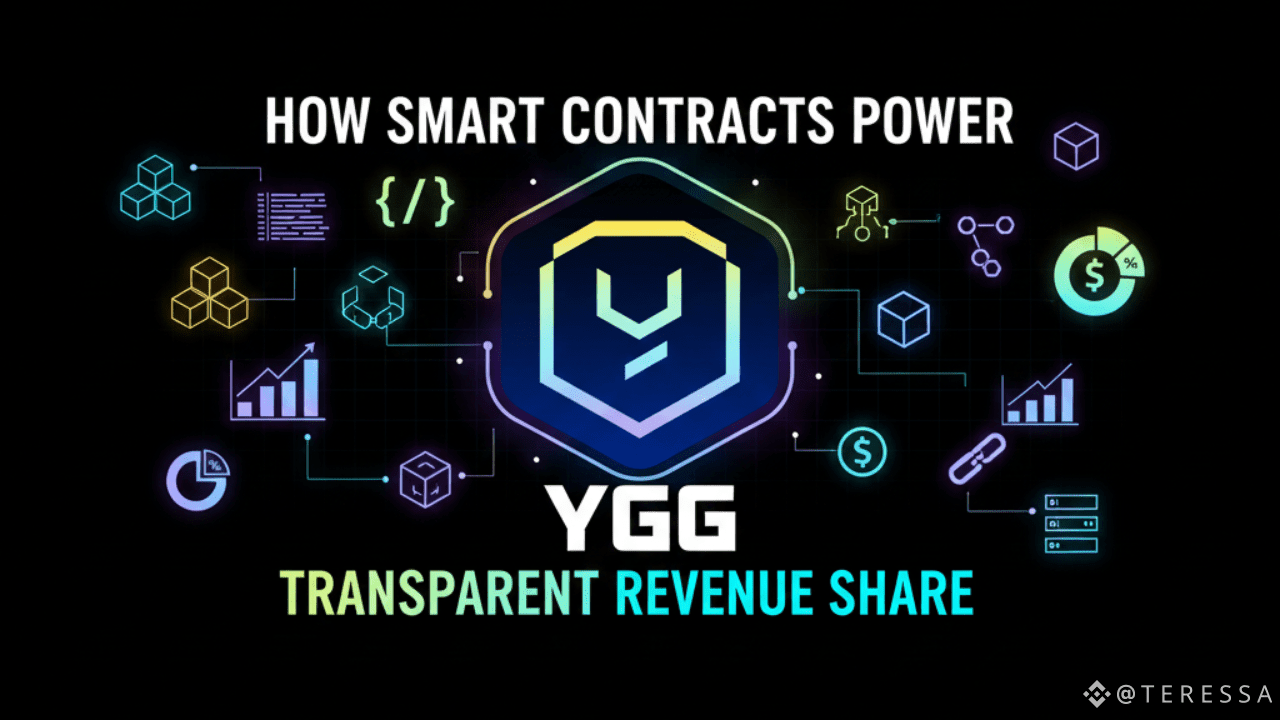
How Smart Contracts Power YGG's Transparent Revenue ShareThis is exploding right now in the web3 gaming space and it's solving one of the biggest problems plaguing traditional game publishing. Yield Guild Games introduced fully on-chain revenue-sharing models powered by smart contracts that give developers real-time insight into their earnings and eliminate delays caused by manual reports. Let's get real about how this technology transforms opaque publisher relationships into transparent, automated partnerships that actually work for everyone involved.
The Traditional Publishing Problem YGG Eliminates
Traditional game publishing operates through trust-based relationships where publishers control revenue collection and pay developers according to quarterly or monthly statements. Developers receive reports showing their earnings, but they can't independently verify those numbers. Payment timing depends entirely on publisher schedules, creating cash flow uncertainty that hurts small studios especially hard. Disputes over revenue calculations require expensive audits or legal action to resolve.
This extractive model exists because centralized infrastructure requires someone to collect payments, track earnings, calculate splits, and distribute funds. Publishers naturally occupied this position and structured agreements maximizing their advantage. Developers accepting these terms had no alternatives if they wanted access to publisher distribution networks and marketing resources.
YGG's smart contract approach eliminates these problems completely. Revenue gets recorded on-chain automatically as it's generated. Both publisher and developer can verify earnings in real-time by checking blockchain records rather than trusting quarterly statements. Payment distribution happens automatically according to smart contract logic rather than depending on manual processing. Disputes become impossible because the blockchain itself enforces the agreed terms.
Smart contracts replace trust with cryptographic verification, turning publisher-developer relationships from adversarial negotiations into transparent partnerships.
How YGG Play's Smart Contracts Actually Work
@YieldGuildGames deployed smart contracts starting in May 2025 with LOL Land, then expanded the system with the Launchpad integration in October 2025. The technical implementation creates automated revenue distribution that functions without human intervention once deployed.
When players purchase items in LOL Land or other YGG Play titles, those transactions hit the blockchain immediately. The smart contract receives the payment, automatically calculates the predetermined split between YGG Play as publisher and the developer, then distributes funds to respective wallets within seconds. This entire process happens programmatically without requiring anyone to manually process payments or generate reports.
The smart contract code itself is public and verifiable on-chain. Anyone can examine exactly how revenue splits are calculated and when distributions occur. This transparency means developers don't need to trust YGG Play's internal accounting systems because they can independently verify every transaction. If the smart contract says the split is 70 to 30, then mathematical certainty guarantees that's what actually happens.
The contracts also handle more complex scenarios including staggered payment schedules where initial revenue goes toward recouping development costs before profit sharing begins, performance-based bonuses that adjust developer share based on hitting player count or revenue milestones, and token allocations where developers receive YGG tokens alongside traditional payment. These conditions get encoded in the smart contract from the start, eliminating ambiguity about terms.
Real-Time Verification: A Game Changer for Developers
The most revolutionary aspect of YGG's approach is allowing developers to verify earnings in real-time rather than waiting for quarterly statements. This seemingly simple feature fundamentally changes developer-publisher dynamics by removing information asymmetry that traditionally favored publishers.
Gigaverse's partnership with YGG Play demonstrates this advantage clearly. When Gigaverse joined as YGG Play's first third-party publishing deal, the fully on-chain revenue-sharing model gave the development team instant visibility into exactly how much their game generated. No waiting for reports, no trusting publisher accounting, just transparent on-chain data showing revenue as it happens.
This real-time visibility enables better business planning. Developers can make informed decisions about resource allocation, marketing spend, and feature development based on current revenue data rather than outdated quarterly summaries. They can identify successful promotions or content releases immediately by watching revenue spikes rather than discovering what worked months later through delayed reports.
The transparency also builds trust that traditional publishing relationships lack. When both parties can verify earnings independently, the relationship shifts from adversarial negotiation toward collaborative growth where everyone genuinely wants the game to succeed because they know success benefits all parties fairly.
Automated Distribution: Eliminating Payment Delays
Traditional publishers pay developers on predetermined schedules like monthly or quarterly, often with additional delays of 30 to 60 days after period ends. This creates cash flow problems for small studios who need predictable income to cover ongoing expenses. Developers essentially provide interest-free loans to publishers during these delay periods.
YGG Play's smart contracts distribute revenue automatically based on programmable schedules. The most aggressive approach distributes funds immediately as transactions occur, providing developers with instant access to their earnings. More conservative implementations might batch distributions daily or weekly to reduce transaction costs while still providing far more frequent payments than traditional publishing.
The automation eliminates manual processing that causes traditional delays. Nobody needs to generate invoices, approve payments, or process wire transfers. The smart contract executes distribution logic automatically whenever trigger conditions are met. This removes human bottlenecks that create unpredictable timing in traditional relationships.
For developers operating on tight budgets, this predictable automated payment transforms financial planning. They know exactly when funds will arrive and can structure their operations accordingly. The reliability reduces risk and allows studios to operate with smaller cash reserves since they're not waiting months for publisher payments.
The LOL Land Case Study: $5.6M in Transparent Revenue
LOL Land provides concrete demonstration of how YGG's smart contract revenue sharing works at scale. The game launched in May 2025 and generated over $5.6 million in lifetime revenue through December 2025. Every dollar of that revenue got recorded on-chain with transparent splits between YGG Play and developer Hype Reel.
The smart contracts deployed for LOL Land handle multiple revenue streams including premium roll purchases where players pay for enhanced gameplay access, NFT sales of in-game collectible items, and prize pool contributions where players fund competitive rewards. Each revenue type flows through the same transparent smart contract system ensuring consistent treatment.
The LOL token distribution illustrates how smart contracts can manage complex allocations. The total supply of five billion tokens distributed as 10 percent to developer Hype Reel, 10 percent to Play-to-Airdrop rewards, 10 percent for the Launchpad sale, 10 percent for liquidity pools, and 60 percent reserved for future gameplay incentives. Critically, YGG Play took zero allocation from the token supply itself, profiting only through platform fees encoded in the smart contracts.
This structure demonstrates smart contract versatility beyond just revenue splitting. The same technology coordinates token distribution, vesting schedules, liquidity provision, and reward allocation automatically without requiring ongoing manual intervention.
Multi-Party Revenue Splits: Handling Complex Relationships
Gaming revenue doesn't always split simply between two parties. Successful games involve multiple stakeholders including primary developers, art contractors, music composers, QA testers, and community managers. Traditional publishing struggles to handle these complex relationships efficiently, often requiring developers to receive lump sums then manually distribute to their various partners.
YGG's smart contracts can encode multi-party splits directly into the payment logic. When revenue comes in, the smart contract automatically distributes appropriate shares to all parties simultaneously. A game might have primary developer receiving 50 percent, art contractor getting 15 percent, composer receiving 10 percent, and YGG Play taking 25 percent. The smart contract executes this four-way split automatically every time revenue generates.
This capability extends to handling royalty arrangements where original creators receive ongoing percentages from secondary sales. If a player purchases an NFT item from another player rather than directly from the game, the smart contract can automatically pay royalties to the original artist, the game developer, and the platform while giving the seller their share. These cascading royalty arrangements would be nearly impossible to track and enforce manually but become trivial with smart contracts.
The Guild Advancement Program demonstrates this complexity where quest rewards get distributed among scholars who completed tasks, community managers who coordinated the scholars, regional subDAOs that provided infrastructure, and the main YGG DAO. Smart contracts handle these layered distributions automatically according to predetermined formulas.
Immutability: The Terms Can't Change After Deployment
One of smart contracts' most important features is immutability. Once deployed on the blockchain, the code and terms become permanent and unchangeable. This creates certainty that traditional contracts lack where parties might dispute interpretations or one side might attempt to renegotiate terms later.
For developers, immutability means the revenue split agreed upon at launch remains guaranteed throughout the partnership. YGG Play can't decide later to take a larger percentage or add new fees not originally specified. The smart contract enforces the original terms indefinitely regardless of changing circumstances or power dynamics between parties.
This protection matters enormously for small developers negotiating with larger publishers. Traditional relationships often include clauses allowing publishers to modify terms under certain conditions or renegotiate if circumstances change. Developers with limited leverage might accept unfavorable modifications to maintain the publishing relationship. Smart contracts eliminate this power imbalance by making the terms mathematically guaranteed.
The immutability does create inflexibility where parties genuinely wanting to modify arrangements must deploy new smart contracts rather than simply amending existing agreements. But this friction serves as feature rather than bug by forcing both sides to carefully consider terms before deployment rather than leaving details vague for later resolution.
Transparency Benefits Beyond Revenue: Building Trust
The transparency smart contracts provide extends beyond just verifying revenue numbers. The entire relationship between YGG Play and its developers becomes visible on-chain, creating accountability that traditional publishing lacks.
Token allocations, vesting schedules, and treasury management all operate transparently where anyone can verify that promised allocations actually happened according to stated terms. When YGG Play launches a game token, the community can verify that the developer received their promised percentage, that liquidity pools got funded as specified, and that YGG Play didn't take undisclosed allocations for themselves.
This transparency builds trust with the broader gaming community, not just developers. Players can verify that games operate fairly and that creators receive appropriate compensation. This visibility helps combat skepticism about web3 gaming where many projects have been accused of enriching insiders while providing little value to players or developers.
The YGG Play Summit 2025 drew over 5,600 attendees and generated 490 million online impressions partly because the transparent revenue-sharing model demonstrates genuine commitment to fair partnerships. The community recognizes that smart contract enforcement prevents the predatory behavior common in both traditional gaming and previous web3 projects.
Reducing Disputes Through Automated Enforcement
Disputes between publishers and developers typically arise from disagreements about revenue calculations, payment timing, or interpretation of contract terms. These conflicts consume time and money through negotiations, mediation, or litigation. Many disputes go unresolved because pursuing formal resolution costs more than the disputed amount.
Smart contracts eliminate most dispute causes by providing mathematically verifiable execution of predetermined terms. If the smart contract says developer receives 70 percent of revenue, then exactly 70 percent gets distributed automatically. There's no room for disagreement about whether the calculation was correct because the blockchain itself verified and executed the transaction.
The few disputes that might arise focus on whether certain activities should count as revenue under the agreement or how to handle edge cases not explicitly covered in the smart contract code. But these represent tiny fractions of total disputes in traditional publishing where every aspect of the relationship might be contested.
The dispute reduction saves everyone involved substantial money that would otherwise go toward legal fees, arbitration costs, and management time resolving conflicts. These savings can instead fund game development, marketing, or community building, benefiting the entire ecosystem.
The Competitive Advantage: Attracting Quality Developers
YGG Play's transparent smart contract model creates competitive advantage in attracting high-quality developers compared to traditional publishers or other web3 platforms. Developers increasingly recognize that fair transparent terms matter more than potentially higher but uncertain returns from opaque relationships.
The Proof of Play partnership demonstrates this appeal. After shutting down the original Pirate Nation due to unsustainable economics, the team had options for relaunching Proof of Play Arcade. They chose YGG Play specifically because the smart contract revenue sharing provided transparency and fairness that alternatives lacked. Adam Fern noted that discovery represents one of web3's hardest problems, and YGG Play's unique approach through transparent partnerships addressed this challenge effectively.
Gigaverse similarly chose YGG Play as their first publishing partner despite receiving $2 million in funding from 1confirmation and having over 75,000 paying players generating $4.5 million in revenue. The team valued transparent on-chain revenue sharing over potentially larger but less certain arrangements with traditional publishers or competing web3 platforms.
This developer preference creates virtuous cycle where quality games attract players, successful games validate the model, and validation attracts more quality developers. The smart contract transparency acts as signaling mechanism demonstrating YGG Play's commitment to fair partnerships rather than just making empty promises about developer-friendly terms.
Smart Contracts as Infrastructure for Fair Gaming
YGG's smart contract revenue-sharing model represents more than just technical innovation. It's fundamental reimagining of how publishers and developers should relate to each other, replacing trust-based systems with cryptographically verified fairness.
The traditional publishing model exists because centralized infrastructure required someone to manage revenue collection and distribution. Publishers naturally occupied this position and structured agreements maximizing their advantage. This created adversarial relationships where developers received minimum compensation they'd accept while publishers extracted maximum value possible.
Smart contracts eliminate the need for trusted intermediaries by automating revenue distribution according to predetermined transparent rules. Both parties can independently verify earnings in real-time. Payments distribute automatically without delays. Disputes become nearly impossible because the blockchain enforces agreed terms mathematically. The relationship transforms from adversarial negotiation to collaborative partnership where everyone genuinely wants the game to succeed.
LOL Land's $5.6 million revenue with transparent on-chain splits validated the model's viability. Partnerships with Proof of Play, Gigaverse, and others demonstrated that quality developers prefer transparent fair terms over potentially larger but uncertain traditional arrangements. The YGG Play Summit's 5,600 attendees and 490 million impressions showed that communities recognize and reward platforms prioritizing fairness over extraction.
Smart contracts aren't just interesting technology for YGG Play. They're the competitive advantage that allows fair treatment of developers while building sustainable gaming ecosystem.
As more developers experience transparent automated revenue sharing, returning to traditional opaque manual systems becomes increasingly unappealing. YGG positioned itself at the forefront of this shift, potentially defining how web3 gaming publishing operates for the next decade.
#YGGPlay $YGG
How Smart Contracts Power YGG's Transparent Revenue Share
This is exploding right now in the web3 gaming space and it's solving one of the biggest problems plaguing traditional game publishing. Yield Guild Games introduced fully on-chain revenue-sharing models powered by smart contracts that give developers real-time insight into their earnings and eliminate delays caused by manual reports. Let's get real about how this technology transforms opaque publisher relationships into transparent, automated partnerships that actually work for everyone involved.
The Traditional Publishing Problem YGG Eliminates
Traditional game publishing operates through trust-based relationships where publishers control revenue collection and pay developers according to quarterly or monthly statements. Developers receive reports showing their earnings, but they can't independently verify those numbers. Payment timing depends entirely on publisher schedules, creating cash flow uncertainty that hurts small studios especially hard. Disputes over revenue calculations require expensive audits or legal action to resolve.
This extractive model exists because centralized infrastructure requires someone to collect payments, track earnings, calculate splits, and distribute funds. Publishers naturally occupied this position and structured agreements maximizing their advantage. Developers accepting these terms had no alternatives if they wanted access to publisher distribution networks and marketing resources.
YGG's smart contract approach eliminates these problems completely. Revenue gets recorded on-chain automatically as it's generated. Both publisher and developer can verify earnings in real-time by checking blockchain records rather than trusting quarterly statements. Payment distribution happens automatically according to smart contract logic rather than depending on manual processing. Disputes become impossible because the blockchain itself enforces the agreed terms.
Smart contracts replace trust with cryptographic verification, turning publisher-developer relationships from adversarial negotiations into transparent partnerships.
How YGG Play's Smart Contracts Actually Work
@Yield Guild Games deployed smart contracts starting in May 2025 with LOL Land, then expanded the system with the Launchpad integration in October 2025. The technical implementation creates automated revenue distribution that functions without human intervention once deployed.
When players purchase items in LOL Land or other YGG Play titles, those transactions hit the blockchain immediately. The smart contract receives the payment, automatically calculates the predetermined split between YGG Play as publisher and the developer, then distributes funds to respective wallets within seconds. This entire process happens programmatically without requiring anyone to manually process payments or generate reports.
The smart contract code itself is public and verifiable on-chain. Anyone can examine exactly how revenue splits are calculated and when distributions occur. This transparency means developers don't need to trust YGG Play's internal accounting systems because they can independently verify every transaction. If the smart contract says the split is 70 to 30, then mathematical certainty guarantees that's what actually happens.
The contracts also handle more complex scenarios including staggered payment schedules where initial revenue goes toward recouping development costs before profit sharing begins, performance-based bonuses that adjust developer share based on hitting player count or revenue milestones, and token allocations where developers receive YGG tokens alongside traditional payment. These conditions get encoded in the smart contract from the start, eliminating ambiguity about terms.
Real-Time Verification: A Game Changer for Developers
The most revolutionary aspect of YGG's approach is allowing developers to verify earnings in real-time rather than waiting for quarterly statements. This seemingly simple feature fundamentally changes developer-publisher dynamics by removing information asymmetry that traditionally favored publishers.
Gigaverse's partnership with YGG Play demonstrates this advantage clearly. When Gigaverse joined as YGG Play's first third-party publishing deal, the fully on-chain revenue-sharing model gave the development team instant visibility into exactly how much their game generated. No waiting for reports, no trusting publisher accounting, just transparent on-chain data showing revenue as it happens.
This real-time visibility enables better business planning. Developers can make informed decisions about resource allocation, marketing spend, and feature development based on current revenue data rather than outdated quarterly summaries. They can identify successful promotions or content releases immediately by watching revenue spikes rather than discovering what worked months later through delayed reports.
The transparency also builds trust that traditional publishing relationships lack. When both parties can verify earnings independently, the relationship shifts from adversarial negotiation toward collaborative growth where everyone genuinely wants the game to succeed because they know success benefits all parties fairly.
Automated Distribution: Eliminating Payment Delays
Traditional publishers pay developers on predetermined schedules like monthly or quarterly, often with additional delays of 30 to 60 days after period ends. This creates cash flow problems for small studios who need predictable income to cover ongoing expenses. Developers essentially provide interest-free loans to publishers during these delay periods.
YGG Play's smart contracts distribute revenue automatically based on programmable schedules. The most aggressive approach distributes funds immediately as transactions occur, providing developers with instant access to their earnings. More conservative implementations might batch distributions daily or weekly to reduce transaction costs while still providing far more frequent payments than traditional publishing.
The automation eliminates manual processing that causes traditional delays. Nobody needs to generate invoices, approve payments, or process wire transfers. The smart contract executes distribution logic automatically whenever trigger conditions are met. This removes human bottlenecks that create unpredictable timing in traditional relationships.
For developers operating on tight budgets, this predictable automated payment transforms financial planning. They know exactly when funds will arrive and can structure their operations accordingly. The reliability reduces risk and allows studios to operate with smaller cash reserves since they're not waiting months for publisher payments.
The LOL Land Case Study: $5.6M in Transparent Revenue
LOL Land provides concrete demonstration of how YGG's smart contract revenue sharing works at scale. The game launched in May 2025 and generated over $5.6 million in lifetime revenue through December 2025. Every dollar of that revenue got recorded on-chain with transparent splits between YGG Play and developer Hype Reel.
The smart contracts deployed for LOL Land handle multiple revenue streams including premium roll purchases where players pay for enhanced gameplay access, NFT sales of in-game collectible items, and prize pool contributions where players fund competitive rewards. Each revenue type flows through the same transparent smart contract system ensuring consistent treatment.
The LOL token distribution illustrates how smart contracts can manage complex allocations. The total supply of five billion tokens distributed as 10 percent to developer Hype Reel, 10 percent to Play-to-Airdrop rewards, 10 percent for the Launchpad sale, 10 percent for liquidity pools, and 60 percent reserved for future gameplay incentives. Critically, YGG Play took zero allocation from the token supply itself, profiting only through platform fees encoded in the smart contracts.
This structure demonstrates smart contract versatility beyond just revenue splitting. The same technology coordinates token distribution, vesting schedules, liquidity provision, and reward allocation automatically without requiring ongoing manual intervention.
Multi-Party Revenue Splits: Handling Complex Relationships
Gaming revenue doesn't always split simply between two parties. Successful games involve multiple stakeholders including primary developers, art contractors, music composers, QA testers, and community managers. Traditional publishing struggles to handle these complex relationships efficiently, often requiring developers to receive lump sums then manually distribute to their various partners.
YGG's smart contracts can encode multi-party splits directly into the payment logic. When revenue comes in, the smart contract automatically distributes appropriate shares to all parties simultaneously. A game might have primary developer receiving 50 percent, art contractor getting 15 percent, composer receiving 10 percent, and YGG Play taking 25 percent. The smart contract executes this four-way split automatically every time revenue generates.
This capability extends to handling royalty arrangements where original creators receive ongoing percentages from secondary sales. If a player purchases an NFT item from another player rather than directly from the game, the smart contract can automatically pay royalties to the original artist, the game developer, and the platform while giving the seller their share. These cascading royalty arrangements would be nearly impossible to track and enforce manually but become trivial with smart contracts.
The Guild Advancement Program demonstrates this complexity where quest rewards get distributed among scholars who completed tasks, community managers who coordinated the scholars, regional subDAOs that provided infrastructure, and the main YGG DAO. Smart contracts handle these layered distributions automatically according to predetermined formulas.
Immutability: The Terms Can't Change After Deployment
One of smart contracts' most important features is immutability. Once deployed on the blockchain, the code and terms become permanent and unchangeable. This creates certainty that traditional contracts lack where parties might dispute interpretations or one side might attempt to renegotiate terms later.
For developers, immutability means the revenue split agreed upon at launch remains guaranteed throughout the partnership. YGG Play can't decide later to take a larger percentage or add new fees not originally specified. The smart contract enforces the original terms indefinitely regardless of changing circumstances or power dynamics between parties.
This protection matters enormously for small developers negotiating with larger publishers. Traditional relationships often include clauses allowing publishers to modify terms under certain conditions or renegotiate if circumstances change. Developers with limited leverage might accept unfavorable modifications to maintain the publishing relationship. Smart contracts eliminate this power imbalance by making the terms mathematically guaranteed.
The immutability does create inflexibility where parties genuinely wanting to modify arrangements must deploy new smart contracts rather than simply amending existing agreements. But this friction serves as feature rather than bug by forcing both sides to carefully consider terms before deployment rather than leaving details vague for later resolution.
Transparency Benefits Beyond Revenue: Building Trust
The transparency smart contracts provide extends beyond just verifying revenue numbers. The entire relationship between YGG Play and its developers becomes visible on-chain, creating accountability that traditional publishing lacks.
Token allocations, vesting schedules, and treasury management all operate transparently where anyone can verify that promised allocations actually happened according to stated terms. When YGG Play launches a game token, the community can verify that the developer received their promised percentage, that liquidity pools got funded as specified, and that YGG Play didn't take undisclosed allocations for themselves.
This transparency builds trust with the broader gaming community, not just developers. Players can verify that games operate fairly and that creators receive appropriate compensation. This visibility helps combat skepticism about web3 gaming where many projects have been accused of enriching insiders while providing little value to players or developers.
The YGG Play Summit 2025 drew over 5,600 attendees and generated 490 million online impressions partly because the transparent revenue-sharing model demonstrates genuine commitment to fair partnerships. The community recognizes that smart contract enforcement prevents the predatory behavior common in both traditional gaming and previous web3 projects.
Reducing Disputes Through Automated Enforcement
Disputes between publishers and developers typically arise from disagreements about revenue calculations, payment timing, or interpretation of contract terms. These conflicts consume time and money through negotiations, mediation, or litigation. Many disputes go unresolved because pursuing formal resolution costs more than the disputed amount.
Smart contracts eliminate most dispute causes by providing mathematically verifiable execution of predetermined terms. If the smart contract says developer receives 70 percent of revenue, then exactly 70 percent gets distributed automatically. There's no room for disagreement about whether the calculation was correct because the blockchain itself verified and executed the transaction.
The few disputes that might arise focus on whether certain activities should count as revenue under the agreement or how to handle edge cases not explicitly covered in the smart contract code. But these represent tiny fractions of total disputes in traditional publishing where every aspect of the relationship might be contested.
The dispute reduction saves everyone involved substantial money that would otherwise go toward legal fees, arbitration costs, and management time resolving conflicts. These savings can instead fund game development, marketing, or community building, benefiting the entire ecosystem.
The Competitive Advantage: Attracting Quality Developers
YGG Play's transparent smart contract model creates competitive advantage in attracting high-quality developers compared to traditional publishers or other web3 platforms. Developers increasingly recognize that fair transparent terms matter more than potentially higher but uncertain returns from opaque relationships.
The Proof of Play partnership demonstrates this appeal. After shutting down the original Pirate Nation due to unsustainable economics, the team had options for relaunching Proof of Play Arcade. They chose YGG Play specifically because the smart contract revenue sharing provided transparency and fairness that alternatives lacked. Adam Fern noted that discovery represents one of web3's hardest problems, and YGG Play's unique approach through transparent partnerships addressed this challenge effectively.
Gigaverse similarly chose YGG Play as their first publishing partner despite receiving $2 million in funding from 1confirmation and having over 75,000 paying players generating $4.5 million in revenue. The team valued transparent on-chain revenue sharing over potentially larger but less certain arrangements with traditional publishers or competing web3 platforms.
This developer preference creates virtuous cycle where quality games attract players, successful games validate the model, and validation attracts more quality developers. The smart contract transparency acts as signaling mechanism demonstrating YGG Play's commitment to fair partnerships rather than just making empty promises about developer-friendly terms.
Smart Contracts as Infrastructure for Fair Gaming
YGG's smart contract revenue-sharing model represents more than just technical innovation. It's fundamental reimagining of how publishers and developers should relate to each other, replacing trust-based systems with cryptographically verified fairness.
The traditional publishing model exists because centralized infrastructure required someone to manage revenue collection and distribution. Publishers naturally occupied this position and structured agreements maximizing their advantage. This created adversarial relationships where developers received minimum compensation they'd accept while publishers extracted maximum value possible.
Smart contracts eliminate the need for trusted intermediaries by automating revenue distribution according to predetermined transparent rules. Both parties can independently verify earnings in real-time. Payments distribute automatically without delays. Disputes become nearly impossible because the blockchain enforces agreed terms mathematically. The relationship transforms from adversarial negotiation to collaborative partnership where everyone genuinely wants the game to succeed.
LOL Land's $5.6 million revenue with transparent on-chain splits validated the model's viability. Partnerships with Proof of Play, Gigaverse, and others demonstrated that quality developers prefer transparent fair terms over potentially larger but uncertain traditional arrangements. The YGG Play Summit's 5,600 attendees and 490 million impressions showed that communities recognize and reward platforms prioritizing fairness over extraction.
Smart contracts aren't just interesting technology for YGG Play. They're the competitive advantage that allows fair treatment of developers while building sustainable gaming ecosystem.
As more developers experience transparent automated revenue sharing, returning to traditional opaque manual systems becomes increasingly unappealing. YGG positioned itself at the forefront of this shift, potentially defining how web3 gaming publishing operates for the next decade.
#YGGPlay $YGG
The Traditional Publishing Problem YGG Eliminates
Traditional game publishing operates through trust-based relationships where publishers control revenue collection and pay developers according to quarterly or monthly statements. Developers receive reports showing their earnings, but they can't independently verify those numbers. Payment timing depends entirely on publisher schedules, creating cash flow uncertainty that hurts small studios especially hard. Disputes over revenue calculations require expensive audits or legal action to resolve.
This extractive model exists because centralized infrastructure requires someone to collect payments, track earnings, calculate splits, and distribute funds. Publishers naturally occupied this position and structured agreements maximizing their advantage. Developers accepting these terms had no alternatives if they wanted access to publisher distribution networks and marketing resources.
YGG's smart contract approach eliminates these problems completely. Revenue gets recorded on-chain automatically as it's generated. Both publisher and developer can verify earnings in real-time by checking blockchain records rather than trusting quarterly statements. Payment distribution happens automatically according to smart contract logic rather than depending on manual processing. Disputes become impossible because the blockchain itself enforces the agreed terms.
Smart contracts replace trust with cryptographic verification, turning publisher-developer relationships from adversarial negotiations into transparent partnerships.
How YGG Play's Smart Contracts Actually Work
@Yield Guild Games deployed smart contracts starting in May 2025 with LOL Land, then expanded the system with the Launchpad integration in October 2025. The technical implementation creates automated revenue distribution that functions without human intervention once deployed.
When players purchase items in LOL Land or other YGG Play titles, those transactions hit the blockchain immediately. The smart contract receives the payment, automatically calculates the predetermined split between YGG Play as publisher and the developer, then distributes funds to respective wallets within seconds. This entire process happens programmatically without requiring anyone to manually process payments or generate reports.
The smart contract code itself is public and verifiable on-chain. Anyone can examine exactly how revenue splits are calculated and when distributions occur. This transparency means developers don't need to trust YGG Play's internal accounting systems because they can independently verify every transaction. If the smart contract says the split is 70 to 30, then mathematical certainty guarantees that's what actually happens.
The contracts also handle more complex scenarios including staggered payment schedules where initial revenue goes toward recouping development costs before profit sharing begins, performance-based bonuses that adjust developer share based on hitting player count or revenue milestones, and token allocations where developers receive YGG tokens alongside traditional payment. These conditions get encoded in the smart contract from the start, eliminating ambiguity about terms.
Real-Time Verification: A Game Changer for Developers
The most revolutionary aspect of YGG's approach is allowing developers to verify earnings in real-time rather than waiting for quarterly statements. This seemingly simple feature fundamentally changes developer-publisher dynamics by removing information asymmetry that traditionally favored publishers.
Gigaverse's partnership with YGG Play demonstrates this advantage clearly. When Gigaverse joined as YGG Play's first third-party publishing deal, the fully on-chain revenue-sharing model gave the development team instant visibility into exactly how much their game generated. No waiting for reports, no trusting publisher accounting, just transparent on-chain data showing revenue as it happens.
This real-time visibility enables better business planning. Developers can make informed decisions about resource allocation, marketing spend, and feature development based on current revenue data rather than outdated quarterly summaries. They can identify successful promotions or content releases immediately by watching revenue spikes rather than discovering what worked months later through delayed reports.
The transparency also builds trust that traditional publishing relationships lack. When both parties can verify earnings independently, the relationship shifts from adversarial negotiation toward collaborative growth where everyone genuinely wants the game to succeed because they know success benefits all parties fairly.
Automated Distribution: Eliminating Payment Delays
Traditional publishers pay developers on predetermined schedules like monthly or quarterly, often with additional delays of 30 to 60 days after period ends. This creates cash flow problems for small studios who need predictable income to cover ongoing expenses. Developers essentially provide interest-free loans to publishers during these delay periods.
YGG Play's smart contracts distribute revenue automatically based on programmable schedules. The most aggressive approach distributes funds immediately as transactions occur, providing developers with instant access to their earnings. More conservative implementations might batch distributions daily or weekly to reduce transaction costs while still providing far more frequent payments than traditional publishing.
The automation eliminates manual processing that causes traditional delays. Nobody needs to generate invoices, approve payments, or process wire transfers. The smart contract executes distribution logic automatically whenever trigger conditions are met. This removes human bottlenecks that create unpredictable timing in traditional relationships.
For developers operating on tight budgets, this predictable automated payment transforms financial planning. They know exactly when funds will arrive and can structure their operations accordingly. The reliability reduces risk and allows studios to operate with smaller cash reserves since they're not waiting months for publisher payments.
The LOL Land Case Study: $5.6M in Transparent Revenue
LOL Land provides concrete demonstration of how YGG's smart contract revenue sharing works at scale. The game launched in May 2025 and generated over $5.6 million in lifetime revenue through December 2025. Every dollar of that revenue got recorded on-chain with transparent splits between YGG Play and developer Hype Reel.
The smart contracts deployed for LOL Land handle multiple revenue streams including premium roll purchases where players pay for enhanced gameplay access, NFT sales of in-game collectible items, and prize pool contributions where players fund competitive rewards. Each revenue type flows through the same transparent smart contract system ensuring consistent treatment.
The LOL token distribution illustrates how smart contracts can manage complex allocations. The total supply of five billion tokens distributed as 10 percent to developer Hype Reel, 10 percent to Play-to-Airdrop rewards, 10 percent for the Launchpad sale, 10 percent for liquidity pools, and 60 percent reserved for future gameplay incentives. Critically, YGG Play took zero allocation from the token supply itself, profiting only through platform fees encoded in the smart contracts.
This structure demonstrates smart contract versatility beyond just revenue splitting. The same technology coordinates token distribution, vesting schedules, liquidity provision, and reward allocation automatically without requiring ongoing manual intervention.
Multi-Party Revenue Splits: Handling Complex Relationships
Gaming revenue doesn't always split simply between two parties. Successful games involve multiple stakeholders including primary developers, art contractors, music composers, QA testers, and community managers. Traditional publishing struggles to handle these complex relationships efficiently, often requiring developers to receive lump sums then manually distribute to their various partners.
YGG's smart contracts can encode multi-party splits directly into the payment logic. When revenue comes in, the smart contract automatically distributes appropriate shares to all parties simultaneously. A game might have primary developer receiving 50 percent, art contractor getting 15 percent, composer receiving 10 percent, and YGG Play taking 25 percent. The smart contract executes this four-way split automatically every time revenue generates.
This capability extends to handling royalty arrangements where original creators receive ongoing percentages from secondary sales. If a player purchases an NFT item from another player rather than directly from the game, the smart contract can automatically pay royalties to the original artist, the game developer, and the platform while giving the seller their share. These cascading royalty arrangements would be nearly impossible to track and enforce manually but become trivial with smart contracts.
The Guild Advancement Program demonstrates this complexity where quest rewards get distributed among scholars who completed tasks, community managers who coordinated the scholars, regional subDAOs that provided infrastructure, and the main YGG DAO. Smart contracts handle these layered distributions automatically according to predetermined formulas.
Immutability: The Terms Can't Change After Deployment
One of smart contracts' most important features is immutability. Once deployed on the blockchain, the code and terms become permanent and unchangeable. This creates certainty that traditional contracts lack where parties might dispute interpretations or one side might attempt to renegotiate terms later.
For developers, immutability means the revenue split agreed upon at launch remains guaranteed throughout the partnership. YGG Play can't decide later to take a larger percentage or add new fees not originally specified. The smart contract enforces the original terms indefinitely regardless of changing circumstances or power dynamics between parties.
This protection matters enormously for small developers negotiating with larger publishers. Traditional relationships often include clauses allowing publishers to modify terms under certain conditions or renegotiate if circumstances change. Developers with limited leverage might accept unfavorable modifications to maintain the publishing relationship. Smart contracts eliminate this power imbalance by making the terms mathematically guaranteed.
The immutability does create inflexibility where parties genuinely wanting to modify arrangements must deploy new smart contracts rather than simply amending existing agreements. But this friction serves as feature rather than bug by forcing both sides to carefully consider terms before deployment rather than leaving details vague for later resolution.
Transparency Benefits Beyond Revenue: Building Trust
The transparency smart contracts provide extends beyond just verifying revenue numbers. The entire relationship between YGG Play and its developers becomes visible on-chain, creating accountability that traditional publishing lacks.
Token allocations, vesting schedules, and treasury management all operate transparently where anyone can verify that promised allocations actually happened according to stated terms. When YGG Play launches a game token, the community can verify that the developer received their promised percentage, that liquidity pools got funded as specified, and that YGG Play didn't take undisclosed allocations for themselves.
This transparency builds trust with the broader gaming community, not just developers. Players can verify that games operate fairly and that creators receive appropriate compensation. This visibility helps combat skepticism about web3 gaming where many projects have been accused of enriching insiders while providing little value to players or developers.
The YGG Play Summit 2025 drew over 5,600 attendees and generated 490 million online impressions partly because the transparent revenue-sharing model demonstrates genuine commitment to fair partnerships. The community recognizes that smart contract enforcement prevents the predatory behavior common in both traditional gaming and previous web3 projects.
Reducing Disputes Through Automated Enforcement
Disputes between publishers and developers typically arise from disagreements about revenue calculations, payment timing, or interpretation of contract terms. These conflicts consume time and money through negotiations, mediation, or litigation. Many disputes go unresolved because pursuing formal resolution costs more than the disputed amount.
Smart contracts eliminate most dispute causes by providing mathematically verifiable execution of predetermined terms. If the smart contract says developer receives 70 percent of revenue, then exactly 70 percent gets distributed automatically. There's no room for disagreement about whether the calculation was correct because the blockchain itself verified and executed the transaction.
The few disputes that might arise focus on whether certain activities should count as revenue under the agreement or how to handle edge cases not explicitly covered in the smart contract code. But these represent tiny fractions of total disputes in traditional publishing where every aspect of the relationship might be contested.
The dispute reduction saves everyone involved substantial money that would otherwise go toward legal fees, arbitration costs, and management time resolving conflicts. These savings can instead fund game development, marketing, or community building, benefiting the entire ecosystem.
The Competitive Advantage: Attracting Quality Developers
YGG Play's transparent smart contract model creates competitive advantage in attracting high-quality developers compared to traditional publishers or other web3 platforms. Developers increasingly recognize that fair transparent terms matter more than potentially higher but uncertain returns from opaque relationships.
The Proof of Play partnership demonstrates this appeal. After shutting down the original Pirate Nation due to unsustainable economics, the team had options for relaunching Proof of Play Arcade. They chose YGG Play specifically because the smart contract revenue sharing provided transparency and fairness that alternatives lacked. Adam Fern noted that discovery represents one of web3's hardest problems, and YGG Play's unique approach through transparent partnerships addressed this challenge effectively.
Gigaverse similarly chose YGG Play as their first publishing partner despite receiving $2 million in funding from 1confirmation and having over 75,000 paying players generating $4.5 million in revenue. The team valued transparent on-chain revenue sharing over potentially larger but less certain arrangements with traditional publishers or competing web3 platforms.
This developer preference creates virtuous cycle where quality games attract players, successful games validate the model, and validation attracts more quality developers. The smart contract transparency acts as signaling mechanism demonstrating YGG Play's commitment to fair partnerships rather than just making empty promises about developer-friendly terms.
Smart Contracts as Infrastructure for Fair Gaming
YGG's smart contract revenue-sharing model represents more than just technical innovation. It's fundamental reimagining of how publishers and developers should relate to each other, replacing trust-based systems with cryptographically verified fairness.
The traditional publishing model exists because centralized infrastructure required someone to manage revenue collection and distribution. Publishers naturally occupied this position and structured agreements maximizing their advantage. This created adversarial relationships where developers received minimum compensation they'd accept while publishers extracted maximum value possible.
Smart contracts eliminate the need for trusted intermediaries by automating revenue distribution according to predetermined transparent rules. Both parties can independently verify earnings in real-time. Payments distribute automatically without delays. Disputes become nearly impossible because the blockchain enforces agreed terms mathematically. The relationship transforms from adversarial negotiation to collaborative partnership where everyone genuinely wants the game to succeed.
LOL Land's $5.6 million revenue with transparent on-chain splits validated the model's viability. Partnerships with Proof of Play, Gigaverse, and others demonstrated that quality developers prefer transparent fair terms over potentially larger but uncertain traditional arrangements. The YGG Play Summit's 5,600 attendees and 490 million impressions showed that communities recognize and reward platforms prioritizing fairness over extraction.
Smart contracts aren't just interesting technology for YGG Play. They're the competitive advantage that allows fair treatment of developers while building sustainable gaming ecosystem.
As more developers experience transparent automated revenue sharing, returning to traditional opaque manual systems becomes increasingly unappealing. YGG positioned itself at the forefront of this shift, potentially defining how web3 gaming publishing operates for the next decade.
#YGGPlay $YGG
3
123

·
--
HOW YGG IS QUIETLY BUILDING THE MOST RESILIENT PLAYER ECONOMY IN WEB3 GAMING
The more time I spend navigating the ever-evolving landscape of Web3 gaming, the more convinced I become that sustainability—not hype—is the real battleground. We’ve already lived through the era of explosive GameFi growth followed by equally dramatic collapses, usually triggered by unsustainable reward emissions or players treating games like yield farms instead of worlds. But as I watched that cycle repeat across multiple ecosystems, YGG was the one project that kept behaving differently. Instead of chasing short-term speculation, they focused on something far more difficult and far more strategic: building a player economy that could survive trends, cycles, and market downturns. Few people notice it at first glance, but once you look beneath the surface, you realize YGG isn’t just adapting to the market—it’s reshaping it.
My first real glimpse into how deeply YGG thinks about economic design came when I explored their quest-based participation models. Most GameFi projects only reward players for in-game activity, but YGG expanded the definition of “value contribution.” They turned everything—learning, testing, exploring, coordinating—into meaningful economic inputs. It took me a while to fully appreciate how revolutionary this is. By tying rewards to skill, consistency, community contribution, and reputation, they created an economy built on human effort rather than capital or automation. In a world increasingly flooded with bots, scripts, and AI-generated interactions, the fact that YGG is designing frameworks where real human engagement becomes the most valuable commodity feels like a quietly brilliant move.
One of the most underrated aspects of YGG’s structure is how effectively it distributes opportunities across its community. When people hear the phrase “play-to-earn,” they imagine a universal experience—but in reality, most players never actually get access to the highest-value opportunities inside Web3 games. YGG flips that dynamic by using SubDAOs and reputation layers as routing mechanisms that identify who is committed, skilled, and aligned with the ecosystem. The players who consistently show up—not the ones with the biggest wallets—get early testing slots, event access, launchpad allocations, and direct entry points into emerging economies. It feels refreshingly meritocratic in an industry that often leans heavily toward pay-to-participate.
YGG’s community-driven discovery engine has also become one of the most important filtering systems in the entire GameFi sector. When new projects enter the market, most players have to rely on marketing materials or influencer opinions. But YGG players don’t. They participate in gameplay tests, evaluate mechanics, analyze token models, and share honest field-level insights. Over time, this created a dynamic where YGG isn’t just a guild—it’s a collective intelligence network. The way players dissect game economies reminds me of early eSports communities that parsed meta shifts before developers even realized they had happened. In many ways, YGG is building the Web3 equivalent of that early eSports culture, but powered by on-chain identity and real economic influence.
Another thing I find particularly compelling is how YGG’s reputation-based access system introduces a form of “economic proof-of-work” that’s tied to identity rather than hardware. The guild recognizes players who have contributed across multiple titles, completed diverse quests, and shown both skill and consistency. This matters more than people realize. As AI becomes more integrated into gameplay and content generation, systems capable of verifying persistent human action will become essential. YGG’s approach ensures that future economic opportunities—whether they come from new games, events, or early project access—flow toward real players who have actually contributed. It’s a forward-looking design that anticipates future Web3 challenges before they fully emerge.
From an economic perspective, YGG’s vaults have quietly become one of the most stabilizing forces in the ecosystem. They offer a way for communities to pool resources, support players, and circulate value without relying on speculative inflows. In every past boom cycle, I’ve watched GameFi economies implode because value was extracted faster than it was created. But vaults push the opposite behavior. They encourage players to reinvest rewards, collaborate with others, and strengthen the long-term health of the guild. It transforms players from passive receivers into active stakeholders. There’s a maturity in this model that’s missing from most Web3 games, and it may be the key reason YGG continues to survive when others fade away.
As more triple-A studios experiment with blockchain integration, YGG’s position becomes even more important. Big studios will bring advanced worlds, polished economies, and massive fanbases—but they will still need trusted, structured communities capable of onboarding and supporting large numbers of players. YGG already excels at this. They’ve spent years understanding what motivates players, how game economies behave under stress, and how to bridge casual audiences into deeper ecosystems. When the next wave of mainstream Web3 games arrives, YGG won’t just participate—they’ll amplify and accelerate adoption in a way few other organizations can.
I believe we’re entering a new era where Web3 gaming will be defined by cooperation, shared identity, and player-driven economies. Hype will come and go, but the structures being built today will shape how millions of people interact with digital worlds in the future. And among all the projects I’ve studied, YGG is one of the only ones building with a generational mindset. Their focus has always been the same: empower real players, strengthen real communities, and create sustainable economic pathways that reward long-term engagement. It’s not flashy. It’s not loud. But it’s exactly the type of foundation GameFi needs to evolve into something meaningful and enduring.
#YGGPlay @YieldGuildGames $YGG
{spot}(YGGUSDT)
HOW YGG IS QUIETLY BUILDING THE MOST RESILIENT PLAYER ECONOMY IN WEB3 GAMING
The more time I spend navigating the ever-evolving landscape of Web3 gaming, the more convinced I become that sustainability—not hype—is the real battleground. We’ve already lived through the era of explosive GameFi growth followed by equally dramatic collapses, usually triggered by unsustainable reward emissions or players treating games like yield farms instead of worlds. But as I watched that cycle repeat across multiple ecosystems, YGG was the one project that kept behaving differently. Instead of chasing short-term speculation, they focused on something far more difficult and far more strategic: building a player economy that could survive trends, cycles, and market downturns. Few people notice it at first glance, but once you look beneath the surface, you realize YGG isn’t just adapting to the market—it’s reshaping it.
My first real glimpse into how deeply YGG thinks about economic design came when I explored their quest-based participation models. Most GameFi projects only reward players for in-game activity, but YGG expanded the definition of “value contribution.” They turned everything—learning, testing, exploring, coordinating—into meaningful economic inputs. It took me a while to fully appreciate how revolutionary this is. By tying rewards to skill, consistency, community contribution, and reputation, they created an economy built on human effort rather than capital or automation. In a world increasingly flooded with bots, scripts, and AI-generated interactions, the fact that YGG is designing frameworks where real human engagement becomes the most valuable commodity feels like a quietly brilliant move.
One of the most underrated aspects of YGG’s structure is how effectively it distributes opportunities across its community. When people hear the phrase “play-to-earn,” they imagine a universal experience—but in reality, most players never actually get access to the highest-value opportunities inside Web3 games. YGG flips that dynamic by using SubDAOs and reputation layers as routing mechanisms that identify who is committed, skilled, and aligned with the ecosystem. The players who consistently show up—not the ones with the biggest wallets—get early testing slots, event access, launchpad allocations, and direct entry points into emerging economies. It feels refreshingly meritocratic in an industry that often leans heavily toward pay-to-participate.
YGG’s community-driven discovery engine has also become one of the most important filtering systems in the entire GameFi sector. When new projects enter the market, most players have to rely on marketing materials or influencer opinions. But YGG players don’t. They participate in gameplay tests, evaluate mechanics, analyze token models, and share honest field-level insights. Over time, this created a dynamic where YGG isn’t just a guild—it’s a collective intelligence network. The way players dissect game economies reminds me of early eSports communities that parsed meta shifts before developers even realized they had happened. In many ways, YGG is building the Web3 equivalent of that early eSports culture, but powered by on-chain identity and real economic influence.
Another thing I find particularly compelling is how YGG’s reputation-based access system introduces a form of “economic proof-of-work” that’s tied to identity rather than hardware. The guild recognizes players who have contributed across multiple titles, completed diverse quests, and shown both skill and consistency. This matters more than people realize. As AI becomes more integrated into gameplay and content generation, systems capable of verifying persistent human action will become essential. YGG’s approach ensures that future economic opportunities—whether they come from new games, events, or early project access—flow toward real players who have actually contributed. It’s a forward-looking design that anticipates future Web3 challenges before they fully emerge.
From an economic perspective, YGG’s vaults have quietly become one of the most stabilizing forces in the ecosystem. They offer a way for communities to pool resources, support players, and circulate value without relying on speculative inflows. In every past boom cycle, I’ve watched GameFi economies implode because value was extracted faster than it was created. But vaults push the opposite behavior. They encourage players to reinvest rewards, collaborate with others, and strengthen the long-term health of the guild. It transforms players from passive receivers into active stakeholders. There’s a maturity in this model that’s missing from most Web3 games, and it may be the key reason YGG continues to survive when others fade away.
As more triple-A studios experiment with blockchain integration, YGG’s position becomes even more important. Big studios will bring advanced worlds, polished economies, and massive fanbases—but they will still need trusted, structured communities capable of onboarding and supporting large numbers of players. YGG already excels at this. They’ve spent years understanding what motivates players, how game economies behave under stress, and how to bridge casual audiences into deeper ecosystems. When the next wave of mainstream Web3 games arrives, YGG won’t just participate—they’ll amplify and accelerate adoption in a way few other organizations can.
I believe we’re entering a new era where Web3 gaming will be defined by cooperation, shared identity, and player-driven economies. Hype will come and go, but the structures being built today will shape how millions of people interact with digital worlds in the future. And among all the projects I’ve studied, YGG is one of the only ones building with a generational mindset. Their focus has always been the same: empower real players, strengthen real communities, and create sustainable economic pathways that reward long-term engagement. It’s not flashy. It’s not loud. But it’s exactly the type of foundation GameFi needs to evolve into something meaningful and enduring.
#YGGPlay @Yield Guild Games $YGG
My first real glimpse into how deeply YGG thinks about economic design came when I explored their quest-based participation models. Most GameFi projects only reward players for in-game activity, but YGG expanded the definition of “value contribution.” They turned everything—learning, testing, exploring, coordinating—into meaningful economic inputs. It took me a while to fully appreciate how revolutionary this is. By tying rewards to skill, consistency, community contribution, and reputation, they created an economy built on human effort rather than capital or automation. In a world increasingly flooded with bots, scripts, and AI-generated interactions, the fact that YGG is designing frameworks where real human engagement becomes the most valuable commodity feels like a quietly brilliant move.
One of the most underrated aspects of YGG’s structure is how effectively it distributes opportunities across its community. When people hear the phrase “play-to-earn,” they imagine a universal experience—but in reality, most players never actually get access to the highest-value opportunities inside Web3 games. YGG flips that dynamic by using SubDAOs and reputation layers as routing mechanisms that identify who is committed, skilled, and aligned with the ecosystem. The players who consistently show up—not the ones with the biggest wallets—get early testing slots, event access, launchpad allocations, and direct entry points into emerging economies. It feels refreshingly meritocratic in an industry that often leans heavily toward pay-to-participate.
YGG’s community-driven discovery engine has also become one of the most important filtering systems in the entire GameFi sector. When new projects enter the market, most players have to rely on marketing materials or influencer opinions. But YGG players don’t. They participate in gameplay tests, evaluate mechanics, analyze token models, and share honest field-level insights. Over time, this created a dynamic where YGG isn’t just a guild—it’s a collective intelligence network. The way players dissect game economies reminds me of early eSports communities that parsed meta shifts before developers even realized they had happened. In many ways, YGG is building the Web3 equivalent of that early eSports culture, but powered by on-chain identity and real economic influence.
Another thing I find particularly compelling is how YGG’s reputation-based access system introduces a form of “economic proof-of-work” that’s tied to identity rather than hardware. The guild recognizes players who have contributed across multiple titles, completed diverse quests, and shown both skill and consistency. This matters more than people realize. As AI becomes more integrated into gameplay and content generation, systems capable of verifying persistent human action will become essential. YGG’s approach ensures that future economic opportunities—whether they come from new games, events, or early project access—flow toward real players who have actually contributed. It’s a forward-looking design that anticipates future Web3 challenges before they fully emerge.
From an economic perspective, YGG’s vaults have quietly become one of the most stabilizing forces in the ecosystem. They offer a way for communities to pool resources, support players, and circulate value without relying on speculative inflows. In every past boom cycle, I’ve watched GameFi economies implode because value was extracted faster than it was created. But vaults push the opposite behavior. They encourage players to reinvest rewards, collaborate with others, and strengthen the long-term health of the guild. It transforms players from passive receivers into active stakeholders. There’s a maturity in this model that’s missing from most Web3 games, and it may be the key reason YGG continues to survive when others fade away.
As more triple-A studios experiment with blockchain integration, YGG’s position becomes even more important. Big studios will bring advanced worlds, polished economies, and massive fanbases—but they will still need trusted, structured communities capable of onboarding and supporting large numbers of players. YGG already excels at this. They’ve spent years understanding what motivates players, how game economies behave under stress, and how to bridge casual audiences into deeper ecosystems. When the next wave of mainstream Web3 games arrives, YGG won’t just participate—they’ll amplify and accelerate adoption in a way few other organizations can.
I believe we’re entering a new era where Web3 gaming will be defined by cooperation, shared identity, and player-driven economies. Hype will come and go, but the structures being built today will shape how millions of people interact with digital worlds in the future. And among all the projects I’ve studied, YGG is one of the only ones building with a generational mindset. Their focus has always been the same: empower real players, strengthen real communities, and create sustainable economic pathways that reward long-term engagement. It’s not flashy. It’s not loud. But it’s exactly the type of foundation GameFi needs to evolve into something meaningful and enduring.
#YGGPlay @Yield Guild Games $YGG
7
43
How Yield Guild Games Turns Gaming Into Shared OpportunityIn most video games, every player starts alone. You grind you level up you buy skins or characters and everything you earn stays locked inside your own account. Yield Guild Games (YGG) flips that idea on its head. Instead of everyone working individually YGG pools digital assets - NFTs characters land items - and lets thousands of players share and benefit from them.
What began as a simple play-to-earn guild has grown into a decentralized organization built around one idea : opportunity should be shared not gated. By democratizing the access to high-value in-game assets YGG makes blockchain gaming accessible to people who otherwise could never afford to participate.
From Play-to-Earn Guild to Decentralized Ecosystem
YGG’s early model was simple: buy NFTs for popular blockchain games and let players use them. Over time, this evolved into a full DAO that holds a diverse portfolio across multiple games - characters, virtual lands, rare items, and yield-generating assets.
Players don’t need to buy anything upfront. YGG’s vaults hold the assets, and members - often called scholars - can borrow or rent them to play, earn, and progress. The rewards generated from gameplay or in-game tokens are then shared between the players and the guild.
Instead of one person owning an NFT, the entire community benefits from it.
The YGG Token: The Community’s Voice and Engine
YGG’s ecosystem runs on the YGG token, an ERC-20 asset with a fixed supply of 1 billion.
Holding YGG gives members real influence: token holders vote on proposals about asset purchases, partnerships, treasury decisions, and strategic plans. In a world where gaming assets can rapidly gain or lose value, this community-driven governance matters.
Beyond voting, the token functions as economic fuel:
Staking rewards tied to guild earningsAccess to guild programs, benefits, and servicesIndirect exposure to the guild’s NFT and asset portfolio
This structure aligns incentives — when the guild grows, everyone grows with it.
SubDAOs: The Secret to YGG’s Scale
YGG isn’t one giant guild; it’s a network of SubDAOs - smaller guilds focused on specific games, regions, or activities.
Each SubDAO can:
Manage its own set of assetsRecruit and support playersCoordinate strategies for the games it specializes inShare value back to the main YGG treasury
This modular design lets YGG adapt to new games quickly, support diverse communities, and tailor playstyles to local needs - from competitive esports groups to casual gaming circles.
Breaking Barriers: Access for Players Worldwide
One of the biggest hurdles in blockchain gaming is cost. Many Web3 games require expensive NFTs or tokens to begin playing. In many parts of the world, those upfront costs are simply out of reach.
YGG eliminates that barrier entirely.
Players can join with little to no upfront investment, using guild-owned assets to participate fully in the game’s economy.
For many in emerging regions, this model has provided:
A new source of incomeA way to join digital economiesA chance to gain skills, connections, and community
YGG proves that the blockchain gaming doesn’t have to exclude people - it can empower them.
Building a Sustainable Virtual Economy
The guild isn’t just collecting game assets ; it’s building a long-term digital economy.
YGG generates value through:
NFT investmentsVirtual lands and propertyYield-bearing mechanicsIn-game economiesStaking rewards and vault revenue
Instead of depending on one trending game, YGG spreads risk across multiple titles and assets. This diversification helps stabilize the guild’s income and smooth out volatility when individual games rise or fall.
Challenges Ahead
YGG’s vision is ambitious — and not without obstacles.
1. Game performance risk
If a popular Web3 game collapses or loses players YGG’s assets tied to that game lose value.
2. Market and regulatory volatility
NFT prices, token values, and government policies can shift quickly.
3. Managing global communities
Coordinating SubDAOs, maintaining transparency, and keeping governance effective is an ongoing challenge.
The model is powerful, but it requires constant adaptation and disciplined treasury management.
Why YGG Still Matters
For all its challenges, YGG offers something rare in digital gaming:
a system where players, investors, and community members all share in value creation.
A player from anywhere in the world - with no capital - can access premium in-game assets and earn from them. A token holder can support a global community while benefiting from staking or asset appreciation. And a player who once had no path into Web3 can now step into digital economies shaped by cooperation rather than exclusion.
YGG shows that blockchain gaming doesn’t have to be elitist.
It can be open collaborative and opportunity-driven.
What Will Shape YGG’s Next Chapter?
Expansion of SubDAOs across new games and regionsDeeper diversification into land, items, virtual property, and game utility assetsMaturing of staking, vaults, and yield mechanismsStronger governance frameworks and community oversightAdapting to the GameFi cycle and avoiding overconcentration
If YGG continues balancing growth with sustainability, it has the potential to remain one of the defining platforms in Web3 gaming - not just as a guild, but as a blueprint for shared digital economies.
@YieldGuildGames #YGGPlay $YGG
{spot}(YGGUSDT)
How Yield Guild Games Turns Gaming Into Shared Opportunity
In most video games, every player starts alone. You grind you level up you buy skins or characters and everything you earn stays locked inside your own account. Yield Guild Games (YGG) flips that idea on its head. Instead of everyone working individually YGG pools digital assets - NFTs characters land items - and lets thousands of players share and benefit from them.
What began as a simple play-to-earn guild has grown into a decentralized organization built around one idea : opportunity should be shared not gated. By democratizing the access to high-value in-game assets YGG makes blockchain gaming accessible to people who otherwise could never afford to participate.
From Play-to-Earn Guild to Decentralized Ecosystem
YGG’s early model was simple: buy NFTs for popular blockchain games and let players use them. Over time, this evolved into a full DAO that holds a diverse portfolio across multiple games - characters, virtual lands, rare items, and yield-generating assets.
Players don’t need to buy anything upfront. YGG’s vaults hold the assets, and members - often called scholars - can borrow or rent them to play, earn, and progress. The rewards generated from gameplay or in-game tokens are then shared between the players and the guild.
Instead of one person owning an NFT, the entire community benefits from it.
The YGG Token: The Community’s Voice and Engine
YGG’s ecosystem runs on the YGG token, an ERC-20 asset with a fixed supply of 1 billion.
Holding YGG gives members real influence: token holders vote on proposals about asset purchases, partnerships, treasury decisions, and strategic plans. In a world where gaming assets can rapidly gain or lose value, this community-driven governance matters.
Beyond voting, the token functions as economic fuel:
Staking rewards tied to guild earningsAccess to guild programs, benefits, and servicesIndirect exposure to the guild’s NFT and asset portfolio
This structure aligns incentives — when the guild grows, everyone grows with it.
SubDAOs: The Secret to YGG’s Scale
YGG isn’t one giant guild; it’s a network of SubDAOs - smaller guilds focused on specific games, regions, or activities.
Each SubDAO can:
Manage its own set of assetsRecruit and support playersCoordinate strategies for the games it specializes inShare value back to the main YGG treasury
This modular design lets YGG adapt to new games quickly, support diverse communities, and tailor playstyles to local needs - from competitive esports groups to casual gaming circles.
Breaking Barriers: Access for Players Worldwide
One of the biggest hurdles in blockchain gaming is cost. Many Web3 games require expensive NFTs or tokens to begin playing. In many parts of the world, those upfront costs are simply out of reach.
YGG eliminates that barrier entirely.
Players can join with little to no upfront investment, using guild-owned assets to participate fully in the game’s economy.
For many in emerging regions, this model has provided:
A new source of incomeA way to join digital economiesA chance to gain skills, connections, and community
YGG proves that the blockchain gaming doesn’t have to exclude people - it can empower them.
Building a Sustainable Virtual Economy
The guild isn’t just collecting game assets ; it’s building a long-term digital economy.
YGG generates value through:
NFT investmentsVirtual lands and propertyYield-bearing mechanicsIn-game economiesStaking rewards and vault revenue
Instead of depending on one trending game, YGG spreads risk across multiple titles and assets. This diversification helps stabilize the guild’s income and smooth out volatility when individual games rise or fall.
Challenges Ahead
YGG’s vision is ambitious — and not without obstacles.
1. Game performance risk
If a popular Web3 game collapses or loses players YGG’s assets tied to that game lose value.
2. Market and regulatory volatility
NFT prices, token values, and government policies can shift quickly.
3. Managing global communities
Coordinating SubDAOs, maintaining transparency, and keeping governance effective is an ongoing challenge.
The model is powerful, but it requires constant adaptation and disciplined treasury management.
Why YGG Still Matters
For all its challenges, YGG offers something rare in digital gaming:
a system where players, investors, and community members all share in value creation.
A player from anywhere in the world - with no capital - can access premium in-game assets and earn from them. A token holder can support a global community while benefiting from staking or asset appreciation. And a player who once had no path into Web3 can now step into digital economies shaped by cooperation rather than exclusion.
YGG shows that blockchain gaming doesn’t have to be elitist.
It can be open collaborative and opportunity-driven.
What Will Shape YGG’s Next Chapter?
Expansion of SubDAOs across new games and regionsDeeper diversification into land, items, virtual property, and game utility assetsMaturing of staking, vaults, and yield mechanismsStronger governance frameworks and community oversightAdapting to the GameFi cycle and avoiding overconcentration
If YGG continues balancing growth with sustainability, it has the potential to remain one of the defining platforms in Web3 gaming - not just as a guild, but as a blueprint for shared digital economies.
@Yield Guild Games #YGGPlay $YGG
What began as a simple play-to-earn guild has grown into a decentralized organization built around one idea : opportunity should be shared not gated. By democratizing the access to high-value in-game assets YGG makes blockchain gaming accessible to people who otherwise could never afford to participate.
From Play-to-Earn Guild to Decentralized Ecosystem
YGG’s early model was simple: buy NFTs for popular blockchain games and let players use them. Over time, this evolved into a full DAO that holds a diverse portfolio across multiple games - characters, virtual lands, rare items, and yield-generating assets.
Players don’t need to buy anything upfront. YGG’s vaults hold the assets, and members - often called scholars - can borrow or rent them to play, earn, and progress. The rewards generated from gameplay or in-game tokens are then shared between the players and the guild.
Instead of one person owning an NFT, the entire community benefits from it.
The YGG Token: The Community’s Voice and Engine
YGG’s ecosystem runs on the YGG token, an ERC-20 asset with a fixed supply of 1 billion.
Holding YGG gives members real influence: token holders vote on proposals about asset purchases, partnerships, treasury decisions, and strategic plans. In a world where gaming assets can rapidly gain or lose value, this community-driven governance matters.
Beyond voting, the token functions as economic fuel:
Staking rewards tied to guild earningsAccess to guild programs, benefits, and servicesIndirect exposure to the guild’s NFT and asset portfolio
This structure aligns incentives — when the guild grows, everyone grows with it.
SubDAOs: The Secret to YGG’s Scale
YGG isn’t one giant guild; it’s a network of SubDAOs - smaller guilds focused on specific games, regions, or activities.
Each SubDAO can:
Manage its own set of assetsRecruit and support playersCoordinate strategies for the games it specializes inShare value back to the main YGG treasury
This modular design lets YGG adapt to new games quickly, support diverse communities, and tailor playstyles to local needs - from competitive esports groups to casual gaming circles.
Breaking Barriers: Access for Players Worldwide
One of the biggest hurdles in blockchain gaming is cost. Many Web3 games require expensive NFTs or tokens to begin playing. In many parts of the world, those upfront costs are simply out of reach.
YGG eliminates that barrier entirely.
Players can join with little to no upfront investment, using guild-owned assets to participate fully in the game’s economy.
For many in emerging regions, this model has provided:
A new source of incomeA way to join digital economiesA chance to gain skills, connections, and community
YGG proves that the blockchain gaming doesn’t have to exclude people - it can empower them.
Building a Sustainable Virtual Economy
The guild isn’t just collecting game assets ; it’s building a long-term digital economy.
YGG generates value through:
NFT investmentsVirtual lands and propertyYield-bearing mechanicsIn-game economiesStaking rewards and vault revenue
Instead of depending on one trending game, YGG spreads risk across multiple titles and assets. This diversification helps stabilize the guild’s income and smooth out volatility when individual games rise or fall.
Challenges Ahead
YGG’s vision is ambitious — and not without obstacles.
1. Game performance risk
If a popular Web3 game collapses or loses players YGG’s assets tied to that game lose value.
2. Market and regulatory volatility
NFT prices, token values, and government policies can shift quickly.
3. Managing global communities
Coordinating SubDAOs, maintaining transparency, and keeping governance effective is an ongoing challenge.
The model is powerful, but it requires constant adaptation and disciplined treasury management.
Why YGG Still Matters
For all its challenges, YGG offers something rare in digital gaming:
a system where players, investors, and community members all share in value creation.
A player from anywhere in the world - with no capital - can access premium in-game assets and earn from them. A token holder can support a global community while benefiting from staking or asset appreciation. And a player who once had no path into Web3 can now step into digital economies shaped by cooperation rather than exclusion.
YGG shows that blockchain gaming doesn’t have to be elitist.
It can be open collaborative and opportunity-driven.
What Will Shape YGG’s Next Chapter?
Expansion of SubDAOs across new games and regionsDeeper diversification into land, items, virtual property, and game utility assetsMaturing of staking, vaults, and yield mechanismsStronger governance frameworks and community oversightAdapting to the GameFi cycle and avoiding overconcentration
If YGG continues balancing growth with sustainability, it has the potential to remain one of the defining platforms in Web3 gaming - not just as a guild, but as a blueprint for shared digital economies.
@Yield Guild Games #YGGPlay $YGG
3
12
97
Article
YGG: Turning Web3 From a Gaming Dream Into a Talent & Capital EngineMost Web3 guilds are still stuck in their old structure - renting out NFTs, splitting earnings, or running scholarship programs. But Yield Guild Games (YGG) has shifted into something far more ambitious. It’s no longer just a guild; it’s becoming a talent accelerator, a learning hub, and an on-chain capital allocator that treats Web3 like a long-term career ecosystem rather than a quick income opportunity.
A City Where Play Meets Learning
Picture the YGG Play Summit 2025 in Manila as a “Living Web3 City.” Not a flashy expo, but a designed ecosystem. And at the very center of this city is its most important district: the Skill District, powered by Metaversity - YGG’s educational arm in the Philippines.
Here, attendees explore practical workshops built to prepare them for the industries rising fastest today: Web3 development, AI-driven creation, and digital entrepreneurship. People learn to build games using AI no-code tools, experiment with the Sui blockchain, and engage with policymakers and educators working together on Web3 adoption.
This isn’t just branding. It’s a blueprint. YGG is building an entry ramp for digital careers - not just a reward system.
Training Real Developers, Not Just Players
A standout initiative is MFW City (Metaverse Filipino Worker) - an on-ground developer residency in the MIMAROPA region. Participants learn the Move programming language on Sui, and two of these community developers will present their prototypes at the Summit.
That’s the real signal: YGG isn’t teaching theory; it’s developing builders who will contribute to the Web3 economy.
Meanwhile, creative learners join the Prompt to Prototype lab - a rapid workshop where participants use AI to turn game ideas into playable prototypes within hours. It’s the perfect bridge between imagination and execution.
YGG’s Long Game: Talent + Ecosystem Capital
From a broader Web3 perspective, this is strategic: YGG isn’t pushing speculation — it’s cultivating local talent who can power the next cycle of on-chain development.
But the second part of their evolution is equally important:
The On-Chain Guild: A New Model for Capital in Web3
YGG now manages 50M YGG tokens (around $7.5M) through an on-chain treasury system designed to fund ecosystem initiatives and generate yield. This isn’t a passive treasury. It’s directed capital - a deliberate investment engine aligned with their long-term vision.
This dual strategy - developing talent + managing capital - shows YGG sees the future of guilds differently:
Not as gaming income hubs,
but as Web3 institutions capable of nurturing communities and financing innovation.
A Bold Bet, But One Worth Watching
This shift is not without risk. Investing treasury funds can go wrong; educational programs need time before they show measurable outcomes. But if this works, YGG will become a model for a completely new kind of guild:
A guild that builds talent.
A guild that allocates capital.
A guild that powers local economies.
A guild that connects gaming culture with real digital careers.
YGG is no longer pitching the old “play-to-earn” dream.
Now it’s offering a pathway:
skills - opportunities - ecosystems and the long-term value creation.
And honestly - this evolution is far more compelling than just chasing tokens.
@YieldGuildGames #YGGPlay $YGG
{spot}(YGGUSDT)
YGG: Turning Web3 From a Gaming Dream Into a Talent & Capital Engine
Most Web3 guilds are still stuck in their old structure - renting out NFTs, splitting earnings, or running scholarship programs. But Yield Guild Games (YGG) has shifted into something far more ambitious. It’s no longer just a guild; it’s becoming a talent accelerator, a learning hub, and an on-chain capital allocator that treats Web3 like a long-term career ecosystem rather than a quick income opportunity.
A City Where Play Meets Learning
Picture the YGG Play Summit 2025 in Manila as a “Living Web3 City.” Not a flashy expo, but a designed ecosystem. And at the very center of this city is its most important district: the Skill District, powered by Metaversity - YGG’s educational arm in the Philippines.
Here, attendees explore practical workshops built to prepare them for the industries rising fastest today: Web3 development, AI-driven creation, and digital entrepreneurship. People learn to build games using AI no-code tools, experiment with the Sui blockchain, and engage with policymakers and educators working together on Web3 adoption.
This isn’t just branding. It’s a blueprint. YGG is building an entry ramp for digital careers - not just a reward system.
Training Real Developers, Not Just Players
A standout initiative is MFW City (Metaverse Filipino Worker) - an on-ground developer residency in the MIMAROPA region. Participants learn the Move programming language on Sui, and two of these community developers will present their prototypes at the Summit.
That’s the real signal: YGG isn’t teaching theory; it’s developing builders who will contribute to the Web3 economy.
Meanwhile, creative learners join the Prompt to Prototype lab - a rapid workshop where participants use AI to turn game ideas into playable prototypes within hours. It’s the perfect bridge between imagination and execution.
YGG’s Long Game: Talent + Ecosystem Capital
From a broader Web3 perspective, this is strategic: YGG isn’t pushing speculation — it’s cultivating local talent who can power the next cycle of on-chain development.
But the second part of their evolution is equally important:
The On-Chain Guild: A New Model for Capital in Web3
YGG now manages 50M YGG tokens (around $7.5M) through an on-chain treasury system designed to fund ecosystem initiatives and generate yield. This isn’t a passive treasury. It’s directed capital - a deliberate investment engine aligned with their long-term vision.
This dual strategy - developing talent + managing capital - shows YGG sees the future of guilds differently:
Not as gaming income hubs,
but as Web3 institutions capable of nurturing communities and financing innovation.
A Bold Bet, But One Worth Watching
This shift is not without risk. Investing treasury funds can go wrong; educational programs need time before they show measurable outcomes. But if this works, YGG will become a model for a completely new kind of guild:
A guild that builds talent.
A guild that allocates capital.
A guild that powers local economies.
A guild that connects gaming culture with real digital careers.
YGG is no longer pitching the old “play-to-earn” dream.
Now it’s offering a pathway:
skills - opportunities - ecosystems and the long-term value creation.
And honestly - this evolution is far more compelling than just chasing tokens.
@Yield Guild Games #YGGPlay $YGG
A City Where Play Meets Learning
Picture the YGG Play Summit 2025 in Manila as a “Living Web3 City.” Not a flashy expo, but a designed ecosystem. And at the very center of this city is its most important district: the Skill District, powered by Metaversity - YGG’s educational arm in the Philippines.
Here, attendees explore practical workshops built to prepare them for the industries rising fastest today: Web3 development, AI-driven creation, and digital entrepreneurship. People learn to build games using AI no-code tools, experiment with the Sui blockchain, and engage with policymakers and educators working together on Web3 adoption.
This isn’t just branding. It’s a blueprint. YGG is building an entry ramp for digital careers - not just a reward system.
Training Real Developers, Not Just Players
A standout initiative is MFW City (Metaverse Filipino Worker) - an on-ground developer residency in the MIMAROPA region. Participants learn the Move programming language on Sui, and two of these community developers will present their prototypes at the Summit.
That’s the real signal: YGG isn’t teaching theory; it’s developing builders who will contribute to the Web3 economy.
Meanwhile, creative learners join the Prompt to Prototype lab - a rapid workshop where participants use AI to turn game ideas into playable prototypes within hours. It’s the perfect bridge between imagination and execution.
YGG’s Long Game: Talent + Ecosystem Capital
From a broader Web3 perspective, this is strategic: YGG isn’t pushing speculation — it’s cultivating local talent who can power the next cycle of on-chain development.
But the second part of their evolution is equally important:
The On-Chain Guild: A New Model for Capital in Web3
YGG now manages 50M YGG tokens (around $7.5M) through an on-chain treasury system designed to fund ecosystem initiatives and generate yield. This isn’t a passive treasury. It’s directed capital - a deliberate investment engine aligned with their long-term vision.
This dual strategy - developing talent + managing capital - shows YGG sees the future of guilds differently:
Not as gaming income hubs,
but as Web3 institutions capable of nurturing communities and financing innovation.
A Bold Bet, But One Worth Watching
This shift is not without risk. Investing treasury funds can go wrong; educational programs need time before they show measurable outcomes. But if this works, YGG will become a model for a completely new kind of guild:
A guild that builds talent.
A guild that allocates capital.
A guild that powers local economies.
A guild that connects gaming culture with real digital careers.
YGG is no longer pitching the old “play-to-earn” dream.
Now it’s offering a pathway:
skills - opportunities - ecosystems and the long-term value creation.
And honestly - this evolution is far more compelling than just chasing tokens.
@Yield Guild Games #YGGPlay $YGG
1
3
7
59
Yield Guild Games - Web3 Gaming Enters a New Era in 2025 and BeyondSince its founding as a decentralized gaming guild seeking to democratize access to NFT-based titles, Yield Guild Games has moved in lockstep with the development of the larger Web3 gaming ecosystem. In 2025 YGG seems to move on from its early NFT rental and play-to-earn model to a diversified ecosystem builder that combines publishing community infrastructure skill development and active tokenomics. Recent developments show the organization working to balance the promise of blockchain gaming with hard-won lessons from past market cycles.
Originally, YGG was a DAO that pooled together resources to acquire in-game NFTs and virtual assets and rented them out to players who couldn't afford such purchases alone. It was this model that let players across underserved regions play play-to-earn games and shared rewards within the community. That mission still defines YGG's ethos even as its scope broadens.
2025, however marks a pivot toward publishing. YGG Play the organization’s publishing arm now releases original games and collaborates with external studios. In May 2025, YGG Play debuted its first proprietary title LOL Land a browser-based casual game that reportedly drew over 25,000 players in its opening weekend.
This move resolves one of the structural problems of NFT gaming: once the token rewards diminish, user retention tends to collapse. Controlling game design and publishing allows YGG to set up more sustainable reward loops targeting casual players who appreciate play-to-earn mechanics but are not purely crypto-native users.
Complementing publishing, in October 2025 YGG launched the YGG Play Launchpad. The full-stack support for indie Web3 games includes token launches, revenue-sharing contracts, community-building tools, and early distribution support. With this, YGG expands its influence into Web3 gaming beyond guild-managed assets.
The yield side of the ecosystem has not been abandoned. In August 2025 YGG allocated 50 million YGG tokens for ecosystem incentives targeting both developers and community engagement. This dual approach is a message that YGG intends to grow through both traditional NFT yield models and through new game-economy incentives tied to publishing and community participation.
Timing also played a part. In October of 2025 YGG's native token surged some 50% after a listing on Upbit rekindled investor and community interest. On-chain metrics, such as daily active addresses spiked in response, reflecting renewed engagement and optimism surrounding YGG's refreshed strategy.
Besides gaming and tokenomics YGG is looking to expand the broader digital economy infrastructure. A partnership with Silicon Valley HQ will help upskill talent, integrate AI tools, and prepare community members with digital-work opportunities. This would suggest that YGG is thinking strategically about Web3 participation beyond gaming and is positioning itself as a bridge between virtual economies and real-world skills.
Structural innovation also underpins YGG's decentralized guild infrastructure: the so-called "Guild Protocol" provides tools for treasury management, membership governance, community reputation tracking, and more. With these systems in place, YGG positions itself not as a guild, per se, but as an infrastructure layer for Web3 communities, sustainable at a level beyond that of any one game or short-term trend.
However, there are still some challenges: it is hard to retain once token-driven incentives go away. Successful game releases, compelling reward structures, and consistent user experiences will be needed to build a loyal cadre of casual but engaged players. LOL Land is an encouraging start, but sustaining engagement and, more importantly, revenue is the critical next step.
Market sentiment remains highly volatile. Even with recent gains, YGG trades well below historical highs, reflecting a gap between optimism and consistent ecosystem utility. In the absence of continuous engagement and tangible user growth, token pressure may prevail.
There's fierce competition in Web3 gaming with many other guilds publishers and studios targeting the same audience. The way for YGG to cement its pioneering role is to deliver high-quality games effective community tools and measurable value for both players and token holders alike. Looking to 2026 and beyond, execution will ultimately define the trajectory of YGG.
Success for the likes of YGG Play Launchpad and other initiatives could continue to cement the organization as more than an NFT-rental guild—more a networked center of gravity for global Web3 gaming economies. If tools such as Guild Protocol and AI - driven upskilling gain traction then YGG could become a broader digital - native collective expanding out beyond gaming into wider economic participation. Yield Guild Games in 2025 is no longer the guild of 2018. It's now part publisher part ecosystem architect part digital-economy builder. Whether that will have a lasting impact depends on how these strategic pivots translate into sustained engagement revenue and community growth.
@YieldGuildGames #YGGPlay $YGG
{spot}(YGGUSDT)
Yield Guild Games - Web3 Gaming Enters a New Era in 2025 and Beyond
Since its founding as a decentralized gaming guild seeking to democratize access to NFT-based titles, Yield Guild Games has moved in lockstep with the development of the larger Web3 gaming ecosystem. In 2025 YGG seems to move on from its early NFT rental and play-to-earn model to a diversified ecosystem builder that combines publishing community infrastructure skill development and active tokenomics. Recent developments show the organization working to balance the promise of blockchain gaming with hard-won lessons from past market cycles.
Originally, YGG was a DAO that pooled together resources to acquire in-game NFTs and virtual assets and rented them out to players who couldn't afford such purchases alone. It was this model that let players across underserved regions play play-to-earn games and shared rewards within the community. That mission still defines YGG's ethos even as its scope broadens.
2025, however marks a pivot toward publishing. YGG Play the organization’s publishing arm now releases original games and collaborates with external studios. In May 2025, YGG Play debuted its first proprietary title LOL Land a browser-based casual game that reportedly drew over 25,000 players in its opening weekend.
This move resolves one of the structural problems of NFT gaming: once the token rewards diminish, user retention tends to collapse. Controlling game design and publishing allows YGG to set up more sustainable reward loops targeting casual players who appreciate play-to-earn mechanics but are not purely crypto-native users.
Complementing publishing, in October 2025 YGG launched the YGG Play Launchpad. The full-stack support for indie Web3 games includes token launches, revenue-sharing contracts, community-building tools, and early distribution support. With this, YGG expands its influence into Web3 gaming beyond guild-managed assets.
The yield side of the ecosystem has not been abandoned. In August 2025 YGG allocated 50 million YGG tokens for ecosystem incentives targeting both developers and community engagement. This dual approach is a message that YGG intends to grow through both traditional NFT yield models and through new game-economy incentives tied to publishing and community participation.
Timing also played a part. In October of 2025 YGG's native token surged some 50% after a listing on Upbit rekindled investor and community interest. On-chain metrics, such as daily active addresses spiked in response, reflecting renewed engagement and optimism surrounding YGG's refreshed strategy.
Besides gaming and tokenomics YGG is looking to expand the broader digital economy infrastructure. A partnership with Silicon Valley HQ will help upskill talent, integrate AI tools, and prepare community members with digital-work opportunities. This would suggest that YGG is thinking strategically about Web3 participation beyond gaming and is positioning itself as a bridge between virtual economies and real-world skills.
Structural innovation also underpins YGG's decentralized guild infrastructure: the so-called "Guild Protocol" provides tools for treasury management, membership governance, community reputation tracking, and more. With these systems in place, YGG positions itself not as a guild, per se, but as an infrastructure layer for Web3 communities, sustainable at a level beyond that of any one game or short-term trend.
However, there are still some challenges: it is hard to retain once token-driven incentives go away. Successful game releases, compelling reward structures, and consistent user experiences will be needed to build a loyal cadre of casual but engaged players. LOL Land is an encouraging start, but sustaining engagement and, more importantly, revenue is the critical next step.
Market sentiment remains highly volatile. Even with recent gains, YGG trades well below historical highs, reflecting a gap between optimism and consistent ecosystem utility. In the absence of continuous engagement and tangible user growth, token pressure may prevail.
There's fierce competition in Web3 gaming with many other guilds publishers and studios targeting the same audience. The way for YGG to cement its pioneering role is to deliver high-quality games effective community tools and measurable value for both players and token holders alike. Looking to 2026 and beyond, execution will ultimately define the trajectory of YGG.
Success for the likes of YGG Play Launchpad and other initiatives could continue to cement the organization as more than an NFT-rental guild—more a networked center of gravity for global Web3 gaming economies. If tools such as Guild Protocol and AI - driven upskilling gain traction then YGG could become a broader digital - native collective expanding out beyond gaming into wider economic participation. Yield Guild Games in 2025 is no longer the guild of 2018. It's now part publisher part ecosystem architect part digital-economy builder. Whether that will have a lasting impact depends on how these strategic pivots translate into sustained engagement revenue and community growth.
@Yield Guild Games #YGGPlay $YGG
Originally, YGG was a DAO that pooled together resources to acquire in-game NFTs and virtual assets and rented them out to players who couldn't afford such purchases alone. It was this model that let players across underserved regions play play-to-earn games and shared rewards within the community. That mission still defines YGG's ethos even as its scope broadens.
2025, however marks a pivot toward publishing. YGG Play the organization’s publishing arm now releases original games and collaborates with external studios. In May 2025, YGG Play debuted its first proprietary title LOL Land a browser-based casual game that reportedly drew over 25,000 players in its opening weekend.
This move resolves one of the structural problems of NFT gaming: once the token rewards diminish, user retention tends to collapse. Controlling game design and publishing allows YGG to set up more sustainable reward loops targeting casual players who appreciate play-to-earn mechanics but are not purely crypto-native users.
Complementing publishing, in October 2025 YGG launched the YGG Play Launchpad. The full-stack support for indie Web3 games includes token launches, revenue-sharing contracts, community-building tools, and early distribution support. With this, YGG expands its influence into Web3 gaming beyond guild-managed assets.
The yield side of the ecosystem has not been abandoned. In August 2025 YGG allocated 50 million YGG tokens for ecosystem incentives targeting both developers and community engagement. This dual approach is a message that YGG intends to grow through both traditional NFT yield models and through new game-economy incentives tied to publishing and community participation.
Timing also played a part. In October of 2025 YGG's native token surged some 50% after a listing on Upbit rekindled investor and community interest. On-chain metrics, such as daily active addresses spiked in response, reflecting renewed engagement and optimism surrounding YGG's refreshed strategy.
Besides gaming and tokenomics YGG is looking to expand the broader digital economy infrastructure. A partnership with Silicon Valley HQ will help upskill talent, integrate AI tools, and prepare community members with digital-work opportunities. This would suggest that YGG is thinking strategically about Web3 participation beyond gaming and is positioning itself as a bridge between virtual economies and real-world skills.
Structural innovation also underpins YGG's decentralized guild infrastructure: the so-called "Guild Protocol" provides tools for treasury management, membership governance, community reputation tracking, and more. With these systems in place, YGG positions itself not as a guild, per se, but as an infrastructure layer for Web3 communities, sustainable at a level beyond that of any one game or short-term trend.
However, there are still some challenges: it is hard to retain once token-driven incentives go away. Successful game releases, compelling reward structures, and consistent user experiences will be needed to build a loyal cadre of casual but engaged players. LOL Land is an encouraging start, but sustaining engagement and, more importantly, revenue is the critical next step.
Market sentiment remains highly volatile. Even with recent gains, YGG trades well below historical highs, reflecting a gap between optimism and consistent ecosystem utility. In the absence of continuous engagement and tangible user growth, token pressure may prevail.
There's fierce competition in Web3 gaming with many other guilds publishers and studios targeting the same audience. The way for YGG to cement its pioneering role is to deliver high-quality games effective community tools and measurable value for both players and token holders alike. Looking to 2026 and beyond, execution will ultimately define the trajectory of YGG.
Success for the likes of YGG Play Launchpad and other initiatives could continue to cement the organization as more than an NFT-rental guild—more a networked center of gravity for global Web3 gaming economies. If tools such as Guild Protocol and AI - driven upskilling gain traction then YGG could become a broader digital - native collective expanding out beyond gaming into wider economic participation. Yield Guild Games in 2025 is no longer the guild of 2018. It's now part publisher part ecosystem architect part digital-economy builder. Whether that will have a lasting impact depends on how these strategic pivots translate into sustained engagement revenue and community growth.
@Yield Guild Games #YGGPlay $YGG
1
8
46
Correlation: How YGG Actually Moves Against BTC and ETHIf you really want to understand what pushes YGG around you have to look at the bigger currents it swims in. YGG isn’t a macro coin. It’s a narrative coin—gaming, guilds, users, speculation. But even with its own story, its price action still lives inside the gravity fields of Bitcoin and Ethereum.
**YGG & Bitcoin:
The Strongest Pull in the Room**
Bitcoin is the heartbeat of the entire market. When liquidity expands BTC moves first—everything else follows. YGG is no exception.
When Bitcoin pumps traders rotate into higher-beta plays.
And YGG is high-beta by design.
BTC up → YGG often moves more
BTC down → YGG usually bleeds faster
BTC breaking resistance → YGG lags briefly, then suddenly rips as traders start hunting for volatility
That’s the usual cycle: Bitcoin sets direction, YGG amplifies it.
But this isn’t a perfect lockstep. When BTC is boring—sideways, undecided, low volatility—YGG sometimes disconnects. A strong gaming catalyst can make it outperform the entire market while Bitcoin does nothing. Still, zoom out and you’ll see BTC remains the primary anchor.
**YGG & Ethereum:
The Sector Connection**
The ETH relationship is softer, more thematic.
Ethereum leads the altcoin economy—DeFi, NFTs, gaming, infra.
When ETH strengthens relative to BTC (that classic “alts waking up” signal), risk appetite increases across the board. That’s when money starts flowing into guild tokens, gaming tokens, and niche ecosystem bets.
In these periods:
ETH rallies → narrative coins get attention
Web3/gaming hype → YGG can temporarily outperform ETH entirely
Alt season rotations → YGG becomes a high-volatility side play
ETH isn’t the driver the way BTC is—but it shapes the environment that lets YGG run.
**The Third Force:
Narrative & Gaming Hype**
This is where YGG behaves like its own animal.
If the Web3 gaming narrative heats up—new launches, huge user metrics, high-profile studios, or major partnerships—YGG can break correlation completely. For a few days or weeks, YGG can outperform both BTC and ETH even if the majors are flat.
This typically happens near:
major game releases
guild expansions
big airdrop cycles
new user growth surges
meta-trends in Play-to-Earn or on-chain gaming
During these windows, narrative > macro.
But narrative windows never last forever.
**Bear Markets & Panic:
Everything Correlates**
In fear-driven corrections or long bear phases, correlations snap tight again:
BTC dumps → everything dumps harder
liquidity dries → speculative tokens get crushed
narratives disappear → only macro matters
YGG is high-volatility, so its downside gets exaggerated.
So What Actually Moves YGG?
Think of YGG’s behavior as a triangle of forces:
1. Bitcoin — the market’s compass
The dominant force. Sets direction, mood, liquidity.
2. Ethereum — the altcoin climate
When ETH thrives, risk-on rotation boosts YGG.
3. Web3 Gaming Narrative — the turbocharger
The only force that lets YGG break free and outperform the majors.
Put simply:
BTC tells you where the market is headed
ETH tells you when alts can run
Gaming hype tells you how aggressively YGG can move
For traders and investors, this framework is the simplest way to stay oriented. YGG doesn’t move randomly—it reacts to macro, rotates with alts, and spikes with narrative heat.
@YieldGuildGames #YGGPlay $YGG
{spot}(YGGUSDT)
Correlation: How YGG Actually Moves Against BTC and ETH
If you really want to understand what pushes YGG around you have to look at the bigger currents it swims in. YGG isn’t a macro coin. It’s a narrative coin—gaming, guilds, users, speculation. But even with its own story, its price action still lives inside the gravity fields of Bitcoin and Ethereum.
**YGG & Bitcoin:
The Strongest Pull in the Room**
Bitcoin is the heartbeat of the entire market. When liquidity expands BTC moves first—everything else follows. YGG is no exception.
When Bitcoin pumps traders rotate into higher-beta plays.
And YGG is high-beta by design.
BTC up → YGG often moves more
BTC down → YGG usually bleeds faster
BTC breaking resistance → YGG lags briefly, then suddenly rips as traders start hunting for volatility
That’s the usual cycle: Bitcoin sets direction, YGG amplifies it.
But this isn’t a perfect lockstep. When BTC is boring—sideways, undecided, low volatility—YGG sometimes disconnects. A strong gaming catalyst can make it outperform the entire market while Bitcoin does nothing. Still, zoom out and you’ll see BTC remains the primary anchor.
**YGG & Ethereum:
The Sector Connection**
The ETH relationship is softer, more thematic.
Ethereum leads the altcoin economy—DeFi, NFTs, gaming, infra.
When ETH strengthens relative to BTC (that classic “alts waking up” signal), risk appetite increases across the board. That’s when money starts flowing into guild tokens, gaming tokens, and niche ecosystem bets.
In these periods:
ETH rallies → narrative coins get attention
Web3/gaming hype → YGG can temporarily outperform ETH entirely
Alt season rotations → YGG becomes a high-volatility side play
ETH isn’t the driver the way BTC is—but it shapes the environment that lets YGG run.
**The Third Force:
Narrative & Gaming Hype**
This is where YGG behaves like its own animal.
If the Web3 gaming narrative heats up—new launches, huge user metrics, high-profile studios, or major partnerships—YGG can break correlation completely. For a few days or weeks, YGG can outperform both BTC and ETH even if the majors are flat.
This typically happens near:
major game releases
guild expansions
big airdrop cycles
new user growth surges
meta-trends in Play-to-Earn or on-chain gaming
During these windows, narrative > macro.
But narrative windows never last forever.
**Bear Markets & Panic:
Everything Correlates**
In fear-driven corrections or long bear phases, correlations snap tight again:
BTC dumps → everything dumps harder
liquidity dries → speculative tokens get crushed
narratives disappear → only macro matters
YGG is high-volatility, so its downside gets exaggerated.
So What Actually Moves YGG?
Think of YGG’s behavior as a triangle of forces:
1. Bitcoin — the market’s compass
The dominant force. Sets direction, mood, liquidity.
2. Ethereum — the altcoin climate
When ETH thrives, risk-on rotation boosts YGG.
3. Web3 Gaming Narrative — the turbocharger
The only force that lets YGG break free and outperform the majors.
Put simply:
BTC tells you where the market is headed
ETH tells you when alts can run
Gaming hype tells you how aggressively YGG can move
For traders and investors, this framework is the simplest way to stay oriented. YGG doesn’t move randomly—it reacts to macro, rotates with alts, and spikes with narrative heat.
@Yield Guild Games #YGGPlay $YGG
**YGG & Bitcoin:
The Strongest Pull in the Room**
Bitcoin is the heartbeat of the entire market. When liquidity expands BTC moves first—everything else follows. YGG is no exception.
When Bitcoin pumps traders rotate into higher-beta plays.
And YGG is high-beta by design.
BTC up → YGG often moves more
BTC down → YGG usually bleeds faster
BTC breaking resistance → YGG lags briefly, then suddenly rips as traders start hunting for volatility
That’s the usual cycle: Bitcoin sets direction, YGG amplifies it.
But this isn’t a perfect lockstep. When BTC is boring—sideways, undecided, low volatility—YGG sometimes disconnects. A strong gaming catalyst can make it outperform the entire market while Bitcoin does nothing. Still, zoom out and you’ll see BTC remains the primary anchor.
**YGG & Ethereum:
The Sector Connection**
The ETH relationship is softer, more thematic.
Ethereum leads the altcoin economy—DeFi, NFTs, gaming, infra.
When ETH strengthens relative to BTC (that classic “alts waking up” signal), risk appetite increases across the board. That’s when money starts flowing into guild tokens, gaming tokens, and niche ecosystem bets.
In these periods:
ETH rallies → narrative coins get attention
Web3/gaming hype → YGG can temporarily outperform ETH entirely
Alt season rotations → YGG becomes a high-volatility side play
ETH isn’t the driver the way BTC is—but it shapes the environment that lets YGG run.
**The Third Force:
Narrative & Gaming Hype**
This is where YGG behaves like its own animal.
If the Web3 gaming narrative heats up—new launches, huge user metrics, high-profile studios, or major partnerships—YGG can break correlation completely. For a few days or weeks, YGG can outperform both BTC and ETH even if the majors are flat.
This typically happens near:
major game releases
guild expansions
big airdrop cycles
new user growth surges
meta-trends in Play-to-Earn or on-chain gaming
During these windows, narrative > macro.
But narrative windows never last forever.
**Bear Markets & Panic:
Everything Correlates**
In fear-driven corrections or long bear phases, correlations snap tight again:
BTC dumps → everything dumps harder
liquidity dries → speculative tokens get crushed
narratives disappear → only macro matters
YGG is high-volatility, so its downside gets exaggerated.
So What Actually Moves YGG?
Think of YGG’s behavior as a triangle of forces:
1. Bitcoin — the market’s compass
The dominant force. Sets direction, mood, liquidity.
2. Ethereum — the altcoin climate
When ETH thrives, risk-on rotation boosts YGG.
3. Web3 Gaming Narrative — the turbocharger
The only force that lets YGG break free and outperform the majors.
Put simply:
BTC tells you where the market is headed
ETH tells you when alts can run
Gaming hype tells you how aggressively YGG can move
For traders and investors, this framework is the simplest way to stay oriented. YGG doesn’t move randomly—it reacts to macro, rotates with alts, and spikes with narrative heat.
@Yield Guild Games #YGGPlay $YGG
1
5
61
Yield Guild Games Play gains fresh momentum as new updates strengthen its ecosystemYield Guild Games Play has entered a moment where the conversation around it feels noticeably different from the past year. The guild has always been recognized as one of the earliest movers in Web3 gaming but now it is starting to feel like something far broader than its original image. The recent updates fresh integrations revived activity patterns and a clear shift in how developers collaborate with the guild all suggest that YGG Play is stepping into a new era. And what stands out the most is that none of this resurgence has relied on explosive hype cycles. It has been unfolding quietly steadily and with the kind of layered momentum that usually signals a deeper structural transformation.
The biggest shift is YGG Play’s move away from the narrow scholarship-centric model it pioneered during the play-to-earn boom. Instead it is evolving into a flexible multi-layered ecosystem where players studios sub communities and guild infrastructure interact with far more coherence. That shift matters because the entire gaming market has matured. No one is chasing hyper-inflated emissions or short-term reward loops anymore. Today’s players want asset ownership, meaningful progression identity and economic depth that survives beyond token cycles. YGG Play has gradually repositioned itself to match those expectations, and the latest updates make it clear that this alignment is now intentional, not incidental.
The new multi-chain integrations have been the clearest indicator of this evolution. YGG Play isn’t just attaching its name to new releases — it is positioning itself as an infrastructure hub for Web3 gaming. These collaborations give players early access to new assets cross-title progression systems and a gateway into new worlds, effectively turning the guild into the connective layer through which entire gaming ecosystems can grow. For developers this means immediate access to an established player base and structured pathways to bootstrap engagement. For players it means the guild becomes less of a rental system and more of a portal into continuous gaming value across multiple universes.
Parallel to that, the reward architecture has been reworked to better reflect how players actually engage. Instead of the rigid payout systems of early P2E, YGG Play now leans into seasonal missions, cross-game quests, flexible staking choices, and reward paths built around ongoing participation. These mechanics align with modern retention models where economic incentives amplify fun rather than replace it. YGG Play’s recent direction makes it clear that the experience loop — gameplay, progression, identity, and social belonging — is the foundation. The token economy now enhances the ecosystem rather than trying to drive it alone.
At the same time, the guild is taking on a cultural role that matters more today than it did in the past cycle: bridging traditional gaming communities with onchain mechanics. Many studios want the benefits of blockchain — asset ownership, marketplaces, interoperable systems — without alienating their existing player bases. YGG Play provides that middle layer. It translates Web3 design into familiar gaming language and brings in communities that already understand digital economies. This dual identity — part cultural ambassador, part economic infrastructure — is becoming one of its most strategic advantages.
Another interesting development is the rise of micro-guilds within the YGG Play ecosystem. These smaller communities form around individual titles but remain connected to the global guild infrastructure. This structure mimics how gaming communities naturally grow : tight-knit identity-driven but supported by a larger framework. And because progression quests and rewards are unified across the network these micro-communities create deeper engagement without fragmenting the ecosystem. It’s a decentralized approach that still maintains cohesion.
On the token side, the narrative is shifting as participation increases. The discussions around staking redesigns, access-based utility, contribution-driven rewards, and governance signals show that the token is evolving into a functional asset rather than a speculative representation of the guild. Utility is becoming tied directly to participation and contribution — to what players do, not just what they hold. In a gaming sector still filled with tokens dependent on inflation, YGG Play appears to be taking a more disciplined approach that prioritizes long-term stability.
Perhaps the most underrated part of the recent updates is the renewed focus on player identity. Systems for reputation, contribution history, skill records, and progression achievements create a foundation for long-term retention. In gaming identity is one of the strongest predictors of loyalty. When players feel their history matters their presence matters and their contributions shape the ecosystem they stay. YGG Play is leaning into that psychology in a deliberate way, turning players into stakeholders in community progression rather than passive participants.
As the gaming world experiments more aggressively with interoperable assets, evolving items, and cross-title mobility, YGG Play is positioned almost perfectly. The guild was built on the idea of cross-game identity long before interoperability became a mainstream design goal. With more studios exploring portability and dynamic asset evolution, the guild becomes the connective tissue that ties fragmented Web3 gaming into a cohesive network.
The new direction feels both more ambitious and more grounded than the early P2E era. This isn’t a guild chasing the explosive hype of 2021. It is a network rebuilding itself around sustainability, ecosystem depth, and long-term value alignment. The updates are subtle, but they carry the weight of a project that has learned from previous cycles and is now building with intention rather than reaction.
Looking forward, the most important signals won’t be token movements but ecosystem behavior: long-term player retention, quality of new titles joining the network, depth of micro-guild activity, and how well the reward architecture scales with new integrations. If YGG Play continues to attract studios that understand long-term gaming economics and if cross-game progression keeps solidifying, the guild will transition from a participant in Web3 gaming to one of its central organizing layers.
Right now YGG Play feels like a project rediscovering its core purpose while expanding its range. It carries the lessons of early cycles but is reshaping itself around the realities of modern onchain gaming. It isn’t chasing noise — it’s building the kind of ecosystem where players stay, studios launch, and communities evolve together. And historically, this is the phase that tends to precede long-term relevance. For Yield Guild Games Play, this new chapter feels like the moment where direction, momentum and ecosystem maturity align at once.
@YieldGuildGames #YGGPlay $YGG
{spot}(YGGUSDT)
Yield Guild Games Play gains fresh momentum as new updates strengthen its ecosystem
Yield Guild Games Play has entered a moment where the conversation around it feels noticeably different from the past year. The guild has always been recognized as one of the earliest movers in Web3 gaming but now it is starting to feel like something far broader than its original image. The recent updates fresh integrations revived activity patterns and a clear shift in how developers collaborate with the guild all suggest that YGG Play is stepping into a new era. And what stands out the most is that none of this resurgence has relied on explosive hype cycles. It has been unfolding quietly steadily and with the kind of layered momentum that usually signals a deeper structural transformation.
The biggest shift is YGG Play’s move away from the narrow scholarship-centric model it pioneered during the play-to-earn boom. Instead it is evolving into a flexible multi-layered ecosystem where players studios sub communities and guild infrastructure interact with far more coherence. That shift matters because the entire gaming market has matured. No one is chasing hyper-inflated emissions or short-term reward loops anymore. Today’s players want asset ownership, meaningful progression identity and economic depth that survives beyond token cycles. YGG Play has gradually repositioned itself to match those expectations, and the latest updates make it clear that this alignment is now intentional, not incidental.
The new multi-chain integrations have been the clearest indicator of this evolution. YGG Play isn’t just attaching its name to new releases — it is positioning itself as an infrastructure hub for Web3 gaming. These collaborations give players early access to new assets cross-title progression systems and a gateway into new worlds, effectively turning the guild into the connective layer through which entire gaming ecosystems can grow. For developers this means immediate access to an established player base and structured pathways to bootstrap engagement. For players it means the guild becomes less of a rental system and more of a portal into continuous gaming value across multiple universes.
Parallel to that, the reward architecture has been reworked to better reflect how players actually engage. Instead of the rigid payout systems of early P2E, YGG Play now leans into seasonal missions, cross-game quests, flexible staking choices, and reward paths built around ongoing participation. These mechanics align with modern retention models where economic incentives amplify fun rather than replace it. YGG Play’s recent direction makes it clear that the experience loop — gameplay, progression, identity, and social belonging — is the foundation. The token economy now enhances the ecosystem rather than trying to drive it alone.
At the same time, the guild is taking on a cultural role that matters more today than it did in the past cycle: bridging traditional gaming communities with onchain mechanics. Many studios want the benefits of blockchain — asset ownership, marketplaces, interoperable systems — without alienating their existing player bases. YGG Play provides that middle layer. It translates Web3 design into familiar gaming language and brings in communities that already understand digital economies. This dual identity — part cultural ambassador, part economic infrastructure — is becoming one of its most strategic advantages.
Another interesting development is the rise of micro-guilds within the YGG Play ecosystem. These smaller communities form around individual titles but remain connected to the global guild infrastructure. This structure mimics how gaming communities naturally grow : tight-knit identity-driven but supported by a larger framework. And because progression quests and rewards are unified across the network these micro-communities create deeper engagement without fragmenting the ecosystem. It’s a decentralized approach that still maintains cohesion.
On the token side, the narrative is shifting as participation increases. The discussions around staking redesigns, access-based utility, contribution-driven rewards, and governance signals show that the token is evolving into a functional asset rather than a speculative representation of the guild. Utility is becoming tied directly to participation and contribution — to what players do, not just what they hold. In a gaming sector still filled with tokens dependent on inflation, YGG Play appears to be taking a more disciplined approach that prioritizes long-term stability.
Perhaps the most underrated part of the recent updates is the renewed focus on player identity. Systems for reputation, contribution history, skill records, and progression achievements create a foundation for long-term retention. In gaming identity is one of the strongest predictors of loyalty. When players feel their history matters their presence matters and their contributions shape the ecosystem they stay. YGG Play is leaning into that psychology in a deliberate way, turning players into stakeholders in community progression rather than passive participants.
As the gaming world experiments more aggressively with interoperable assets, evolving items, and cross-title mobility, YGG Play is positioned almost perfectly. The guild was built on the idea of cross-game identity long before interoperability became a mainstream design goal. With more studios exploring portability and dynamic asset evolution, the guild becomes the connective tissue that ties fragmented Web3 gaming into a cohesive network.
The new direction feels both more ambitious and more grounded than the early P2E era. This isn’t a guild chasing the explosive hype of 2021. It is a network rebuilding itself around sustainability, ecosystem depth, and long-term value alignment. The updates are subtle, but they carry the weight of a project that has learned from previous cycles and is now building with intention rather than reaction.
Looking forward, the most important signals won’t be token movements but ecosystem behavior: long-term player retention, quality of new titles joining the network, depth of micro-guild activity, and how well the reward architecture scales with new integrations. If YGG Play continues to attract studios that understand long-term gaming economics and if cross-game progression keeps solidifying, the guild will transition from a participant in Web3 gaming to one of its central organizing layers.
Right now YGG Play feels like a project rediscovering its core purpose while expanding its range. It carries the lessons of early cycles but is reshaping itself around the realities of modern onchain gaming. It isn’t chasing noise — it’s building the kind of ecosystem where players stay, studios launch, and communities evolve together. And historically, this is the phase that tends to precede long-term relevance. For Yield Guild Games Play, this new chapter feels like the moment where direction, momentum and ecosystem maturity align at once.
@Yield Guild Games #YGGPlay $YGG
The biggest shift is YGG Play’s move away from the narrow scholarship-centric model it pioneered during the play-to-earn boom. Instead it is evolving into a flexible multi-layered ecosystem where players studios sub communities and guild infrastructure interact with far more coherence. That shift matters because the entire gaming market has matured. No one is chasing hyper-inflated emissions or short-term reward loops anymore. Today’s players want asset ownership, meaningful progression identity and economic depth that survives beyond token cycles. YGG Play has gradually repositioned itself to match those expectations, and the latest updates make it clear that this alignment is now intentional, not incidental.
The new multi-chain integrations have been the clearest indicator of this evolution. YGG Play isn’t just attaching its name to new releases — it is positioning itself as an infrastructure hub for Web3 gaming. These collaborations give players early access to new assets cross-title progression systems and a gateway into new worlds, effectively turning the guild into the connective layer through which entire gaming ecosystems can grow. For developers this means immediate access to an established player base and structured pathways to bootstrap engagement. For players it means the guild becomes less of a rental system and more of a portal into continuous gaming value across multiple universes.
Parallel to that, the reward architecture has been reworked to better reflect how players actually engage. Instead of the rigid payout systems of early P2E, YGG Play now leans into seasonal missions, cross-game quests, flexible staking choices, and reward paths built around ongoing participation. These mechanics align with modern retention models where economic incentives amplify fun rather than replace it. YGG Play’s recent direction makes it clear that the experience loop — gameplay, progression, identity, and social belonging — is the foundation. The token economy now enhances the ecosystem rather than trying to drive it alone.
At the same time, the guild is taking on a cultural role that matters more today than it did in the past cycle: bridging traditional gaming communities with onchain mechanics. Many studios want the benefits of blockchain — asset ownership, marketplaces, interoperable systems — without alienating their existing player bases. YGG Play provides that middle layer. It translates Web3 design into familiar gaming language and brings in communities that already understand digital economies. This dual identity — part cultural ambassador, part economic infrastructure — is becoming one of its most strategic advantages.
Another interesting development is the rise of micro-guilds within the YGG Play ecosystem. These smaller communities form around individual titles but remain connected to the global guild infrastructure. This structure mimics how gaming communities naturally grow : tight-knit identity-driven but supported by a larger framework. And because progression quests and rewards are unified across the network these micro-communities create deeper engagement without fragmenting the ecosystem. It’s a decentralized approach that still maintains cohesion.
On the token side, the narrative is shifting as participation increases. The discussions around staking redesigns, access-based utility, contribution-driven rewards, and governance signals show that the token is evolving into a functional asset rather than a speculative representation of the guild. Utility is becoming tied directly to participation and contribution — to what players do, not just what they hold. In a gaming sector still filled with tokens dependent on inflation, YGG Play appears to be taking a more disciplined approach that prioritizes long-term stability.
Perhaps the most underrated part of the recent updates is the renewed focus on player identity. Systems for reputation, contribution history, skill records, and progression achievements create a foundation for long-term retention. In gaming identity is one of the strongest predictors of loyalty. When players feel their history matters their presence matters and their contributions shape the ecosystem they stay. YGG Play is leaning into that psychology in a deliberate way, turning players into stakeholders in community progression rather than passive participants.
As the gaming world experiments more aggressively with interoperable assets, evolving items, and cross-title mobility, YGG Play is positioned almost perfectly. The guild was built on the idea of cross-game identity long before interoperability became a mainstream design goal. With more studios exploring portability and dynamic asset evolution, the guild becomes the connective tissue that ties fragmented Web3 gaming into a cohesive network.
The new direction feels both more ambitious and more grounded than the early P2E era. This isn’t a guild chasing the explosive hype of 2021. It is a network rebuilding itself around sustainability, ecosystem depth, and long-term value alignment. The updates are subtle, but they carry the weight of a project that has learned from previous cycles and is now building with intention rather than reaction.
Looking forward, the most important signals won’t be token movements but ecosystem behavior: long-term player retention, quality of new titles joining the network, depth of micro-guild activity, and how well the reward architecture scales with new integrations. If YGG Play continues to attract studios that understand long-term gaming economics and if cross-game progression keeps solidifying, the guild will transition from a participant in Web3 gaming to one of its central organizing layers.
Right now YGG Play feels like a project rediscovering its core purpose while expanding its range. It carries the lessons of early cycles but is reshaping itself around the realities of modern onchain gaming. It isn’t chasing noise — it’s building the kind of ecosystem where players stay, studios launch, and communities evolve together. And historically, this is the phase that tends to precede long-term relevance. For Yield Guild Games Play, this new chapter feels like the moment where direction, momentum and ecosystem maturity align at once.
@Yield Guild Games #YGGPlay $YGG
1
9
84

·
--
Article
Yield Guild Games: How a Global DAO Turned Gaming, NFTs, and Community Into a New Digital Economy
Yield Guild Games, usually called YGG, is something I like to explain slowly because it mixes gaming, crypto, community, and real human stories. At its heart, YGG is a decentralized organization that invests in NFTs used in blockchain games and virtual worlds, then lets a global community of players and token holders benefit from those assets together. Instead of one company owning everything, the ownership and decision-making are spread across the community.
What really makes YGG feel different to me is how it started. It didn’t begin as a big corporate plan. One of the founders noticed that many talented gamers, especially in developing countries, couldn’t afford the expensive NFTs needed to play play-to-earn games. So they started lending NFTs to players and sharing the rewards. That simple idea “I have the asset, you have the time and skill, let’s help each other” became the foundation of Yield Guild Games. Over time, this small lending effort grew into a large DAO managing millions of dollars’ worth of in-game assets across many games.
The way YGG works is actually easier to understand than it sounds. The guild uses its treasury to buy NFTs that have value inside blockchain games. These NFTs might be characters, weapons, land, or other in-game items. Instead of keeping them locked away, YGG lets players use them. Players who don’t own NFTs themselves can borrow them through what YGG calls scholarships. When those players earn in-game rewards, the rewards are split between the player and the guild. The player gets income, and the guild earns yield from its assets. Everyone wins if the game economy stays healthy.
As YGG grew, it became clear that one group couldn’t manage everything. That’s where SubDAOs come in. SubDAOs are smaller communities inside YGG that focus on specific games or regions. For example, one SubDAO might specialize in a single game, while another focuses on players in a certain country. This structure lets people with real knowledge of a game or local community make better decisions, while still being part of the larger YGG ecosystem. I see this as YGG trying to scale without losing its human touch.
Another important part of the system is YGG Vaults. Vaults are ways for YGG token holders to put their tokens to work. Instead of just holding tokens and waiting for the price to go up, people can stake tokens in vaults that support specific strategies or SubDAOs. In return, they may earn rewards tied to that activity. To me, vaults feel like targeted participation you’re not just betting on YGG as a whole, you’re supporting parts of it you believe in.
The YGG token itself plays several roles. First, it’s a governance token. If you hold YGG, you can vote on proposals and help shape the future of the guild. Decisions about treasury use, new SubDAOs, partnerships, or strategic changes all go through governance. Second, the token is used for staking and participation in vaults. Third, it aligns incentives. When YGG does well, token holders benefit, and when token holders make good decisions, the guild becomes stronger. The total supply of YGG tokens was designed with a fixed cap, and tokens were allocated to the community, the team, investors, advisors, and the treasury with long-term vesting in mind.
Behind the project is a team with deep experience in gaming and crypto. The founders understood both how games work and how blockchain economies behave, which helped YGG grow quickly during the early days of play-to-earn. On top of that, YGG gained strong backing from major players in the blockchain gaming space. Partnerships with companies like Animoca Brands gave YGG credibility, access to new games, and strategic support. These partnerships matter because gaming ecosystems are competitive, and access often determines success.
YGG’s real-world use cases are easy to see. It helps onboard new players into blockchain games. It allows collective ownership of expensive NFTs. It creates income opportunities for people who treat gaming like work. It gives investors exposure to gaming economies without needing to manage NFTs themselves. It also acts as a testing ground for new blockchain games, helping developers find active players and liquidity early on.
Of course, it’s not all perfect, and I think honesty is important here. YGG’s success is closely tied to the success of the games it invests in. When a game’s economy collapses or loses players, yields drop fast. We’ve already seen this happen in the play-to-earn space. Token prices can be volatile, and governance can be messy if the community isn’t active or informed. Managing a global DAO with thousands of players and many SubDAOs is complex, and mistakes can happen.
Still, what keeps YGG interesting to me is its willingness to evolve. The team and community know that relying only on NFT rentals isn’t enough long term. That’s why they keep exploring new models like competitive gaming, virtual land strategies, deeper partnerships with developers, and more advanced DAO tooling. If they succeed, YGG could become a long-term backbone of the blockchain gaming economy rather than just a short-term play-to-earn guild.
@YieldGuildGames #YGGPlay $YGG
{spot}(YGGUSDT)
Yield Guild Games: How a Global DAO Turned Gaming, NFTs, and Community Into a New Digital Economy
Yield Guild Games, usually called YGG, is something I like to explain slowly because it mixes gaming, crypto, community, and real human stories. At its heart, YGG is a decentralized organization that invests in NFTs used in blockchain games and virtual worlds, then lets a global community of players and token holders benefit from those assets together. Instead of one company owning everything, the ownership and decision-making are spread across the community.
What really makes YGG feel different to me is how it started. It didn’t begin as a big corporate plan. One of the founders noticed that many talented gamers, especially in developing countries, couldn’t afford the expensive NFTs needed to play play-to-earn games. So they started lending NFTs to players and sharing the rewards. That simple idea “I have the asset, you have the time and skill, let’s help each other” became the foundation of Yield Guild Games. Over time, this small lending effort grew into a large DAO managing millions of dollars’ worth of in-game assets across many games.
The way YGG works is actually easier to understand than it sounds. The guild uses its treasury to buy NFTs that have value inside blockchain games. These NFTs might be characters, weapons, land, or other in-game items. Instead of keeping them locked away, YGG lets players use them. Players who don’t own NFTs themselves can borrow them through what YGG calls scholarships. When those players earn in-game rewards, the rewards are split between the player and the guild. The player gets income, and the guild earns yield from its assets. Everyone wins if the game economy stays healthy.
As YGG grew, it became clear that one group couldn’t manage everything. That’s where SubDAOs come in. SubDAOs are smaller communities inside YGG that focus on specific games or regions. For example, one SubDAO might specialize in a single game, while another focuses on players in a certain country. This structure lets people with real knowledge of a game or local community make better decisions, while still being part of the larger YGG ecosystem. I see this as YGG trying to scale without losing its human touch.
Another important part of the system is YGG Vaults. Vaults are ways for YGG token holders to put their tokens to work. Instead of just holding tokens and waiting for the price to go up, people can stake tokens in vaults that support specific strategies or SubDAOs. In return, they may earn rewards tied to that activity. To me, vaults feel like targeted participation you’re not just betting on YGG as a whole, you’re supporting parts of it you believe in.
The YGG token itself plays several roles. First, it’s a governance token. If you hold YGG, you can vote on proposals and help shape the future of the guild. Decisions about treasury use, new SubDAOs, partnerships, or strategic changes all go through governance. Second, the token is used for staking and participation in vaults. Third, it aligns incentives. When YGG does well, token holders benefit, and when token holders make good decisions, the guild becomes stronger. The total supply of YGG tokens was designed with a fixed cap, and tokens were allocated to the community, the team, investors, advisors, and the treasury with long-term vesting in mind.
Behind the project is a team with deep experience in gaming and crypto. The founders understood both how games work and how blockchain economies behave, which helped YGG grow quickly during the early days of play-to-earn. On top of that, YGG gained strong backing from major players in the blockchain gaming space. Partnerships with companies like Animoca Brands gave YGG credibility, access to new games, and strategic support. These partnerships matter because gaming ecosystems are competitive, and access often determines success.
YGG’s real-world use cases are easy to see. It helps onboard new players into blockchain games. It allows collective ownership of expensive NFTs. It creates income opportunities for people who treat gaming like work. It gives investors exposure to gaming economies without needing to manage NFTs themselves. It also acts as a testing ground for new blockchain games, helping developers find active players and liquidity early on.
Of course, it’s not all perfect, and I think honesty is important here. YGG’s success is closely tied to the success of the games it invests in. When a game’s economy collapses or loses players, yields drop fast. We’ve already seen this happen in the play-to-earn space. Token prices can be volatile, and governance can be messy if the community isn’t active or informed. Managing a global DAO with thousands of players and many SubDAOs is complex, and mistakes can happen.
Still, what keeps YGG interesting to me is its willingness to evolve. The team and community know that relying only on NFT rentals isn’t enough long term. That’s why they keep exploring new models like competitive gaming, virtual land strategies, deeper partnerships with developers, and more advanced DAO tooling. If they succeed, YGG could become a long-term backbone of the blockchain gaming economy rather than just a short-term play-to-earn guild.
@Yield Guild Games #YGGPlay $YGG
What really makes YGG feel different to me is how it started. It didn’t begin as a big corporate plan. One of the founders noticed that many talented gamers, especially in developing countries, couldn’t afford the expensive NFTs needed to play play-to-earn games. So they started lending NFTs to players and sharing the rewards. That simple idea “I have the asset, you have the time and skill, let’s help each other” became the foundation of Yield Guild Games. Over time, this small lending effort grew into a large DAO managing millions of dollars’ worth of in-game assets across many games.
The way YGG works is actually easier to understand than it sounds. The guild uses its treasury to buy NFTs that have value inside blockchain games. These NFTs might be characters, weapons, land, or other in-game items. Instead of keeping them locked away, YGG lets players use them. Players who don’t own NFTs themselves can borrow them through what YGG calls scholarships. When those players earn in-game rewards, the rewards are split between the player and the guild. The player gets income, and the guild earns yield from its assets. Everyone wins if the game economy stays healthy.
As YGG grew, it became clear that one group couldn’t manage everything. That’s where SubDAOs come in. SubDAOs are smaller communities inside YGG that focus on specific games or regions. For example, one SubDAO might specialize in a single game, while another focuses on players in a certain country. This structure lets people with real knowledge of a game or local community make better decisions, while still being part of the larger YGG ecosystem. I see this as YGG trying to scale without losing its human touch.
Another important part of the system is YGG Vaults. Vaults are ways for YGG token holders to put their tokens to work. Instead of just holding tokens and waiting for the price to go up, people can stake tokens in vaults that support specific strategies or SubDAOs. In return, they may earn rewards tied to that activity. To me, vaults feel like targeted participation you’re not just betting on YGG as a whole, you’re supporting parts of it you believe in.
The YGG token itself plays several roles. First, it’s a governance token. If you hold YGG, you can vote on proposals and help shape the future of the guild. Decisions about treasury use, new SubDAOs, partnerships, or strategic changes all go through governance. Second, the token is used for staking and participation in vaults. Third, it aligns incentives. When YGG does well, token holders benefit, and when token holders make good decisions, the guild becomes stronger. The total supply of YGG tokens was designed with a fixed cap, and tokens were allocated to the community, the team, investors, advisors, and the treasury with long-term vesting in mind.
Behind the project is a team with deep experience in gaming and crypto. The founders understood both how games work and how blockchain economies behave, which helped YGG grow quickly during the early days of play-to-earn. On top of that, YGG gained strong backing from major players in the blockchain gaming space. Partnerships with companies like Animoca Brands gave YGG credibility, access to new games, and strategic support. These partnerships matter because gaming ecosystems are competitive, and access often determines success.
YGG’s real-world use cases are easy to see. It helps onboard new players into blockchain games. It allows collective ownership of expensive NFTs. It creates income opportunities for people who treat gaming like work. It gives investors exposure to gaming economies without needing to manage NFTs themselves. It also acts as a testing ground for new blockchain games, helping developers find active players and liquidity early on.
Of course, it’s not all perfect, and I think honesty is important here. YGG’s success is closely tied to the success of the games it invests in. When a game’s economy collapses or loses players, yields drop fast. We’ve already seen this happen in the play-to-earn space. Token prices can be volatile, and governance can be messy if the community isn’t active or informed. Managing a global DAO with thousands of players and many SubDAOs is complex, and mistakes can happen.
Still, what keeps YGG interesting to me is its willingness to evolve. The team and community know that relying only on NFT rentals isn’t enough long term. That’s why they keep exploring new models like competitive gaming, virtual land strategies, deeper partnerships with developers, and more advanced DAO tooling. If they succeed, YGG could become a long-term backbone of the blockchain gaming economy rather than just a short-term play-to-earn guild.
@Yield Guild Games #YGGPlay $YGG
2
1
2
47

·
--
🔥 YGG Play @YieldGuildGames is officially launched! It's not just a platform, but your personal springboard into the world of the most
promising and exciting blockchain games.
What does this mean for you? 🤔
🎯 Discover your favorite Web3 games:
Get a curated catalog of the best projects that have passed a rigorous selection process.
No more searching the internet — all the best is gathered in one
place!
🏆 Complete quests and earn:
Complete game tasks (Quests), level up your characters, and
get rewards for it! This makes every step you take in the game
meaningful and profitable. 💰
🚀 First access to new game tokens:
As a member of the YGG guild, you get the exclusive opportunity to be among the
first to participate in the launch of new game tokens on Launchpad.
This is your chance to get involved in the project at the earliest stage! 📈
$YGG
is the key to this entire ecosystem. Owning the token unlocks access to
exclusive events, guild governance (via DAO), and unique
gaming assets. You're not just playing, you're part of a huge and powerful
gaming nation!
Don't miss your chance! 🏁
{spot}(YGGUSDT)
#YGGPlay
🔥 YGG Play @Yield Guild Games is officially launched! It's not just a platform, but your personal springboard into the world of the most
promising and exciting blockchain games.
What does this mean for you? 🤔
🎯 Discover your favorite Web3 games:
Get a curated catalog of the best projects that have passed a rigorous selection process.
No more searching the internet — all the best is gathered in one
place!
🏆 Complete quests and earn:
Complete game tasks (Quests), level up your characters, and
get rewards for it! This makes every step you take in the game
meaningful and profitable. 💰
🚀 First access to new game tokens:
As a member of the YGG guild, you get the exclusive opportunity to be among the
first to participate in the launch of new game tokens on Launchpad.
This is your chance to get involved in the project at the earliest stage! 📈
$YGG
is the key to this entire ecosystem. Owning the token unlocks access to
exclusive events, guild governance (via DAO), and unique
gaming assets. You're not just playing, you're part of a huge and powerful
gaming nation!
Don't miss your chance! 🏁
#YGGPlay
promising and exciting blockchain games.
What does this mean for you? 🤔
🎯 Discover your favorite Web3 games:
Get a curated catalog of the best projects that have passed a rigorous selection process.
No more searching the internet — all the best is gathered in one
place!
🏆 Complete quests and earn:
Complete game tasks (Quests), level up your characters, and
get rewards for it! This makes every step you take in the game
meaningful and profitable. 💰
🚀 First access to new game tokens:
As a member of the YGG guild, you get the exclusive opportunity to be among the
first to participate in the launch of new game tokens on Launchpad.
This is your chance to get involved in the project at the earliest stage! 📈
$YGG
is the key to this entire ecosystem. Owning the token unlocks access to
exclusive events, guild governance (via DAO), and unique
gaming assets. You're not just playing, you're part of a huge and powerful
gaming nation!
Don't miss your chance! 🏁
#YGGPlay
14
15k
·
--
Article
YGG Play: The Star Map and Ecological Innovation of Web3 GamesIn the vast metaverse, countless digital worlds are distributed like stars, with players traversing them but often losing their way. The traditional Web3 game ecosystem lacks systematic guidance and integration, making it difficult for players to efficiently explore new worlds, complete tasks, and engage in economic activities. YGG Play, launched by @YieldGuildGames , serves as a star map, providing clear navigation for this complex and diverse universe while building a sustainable economy and community ecosystem.
Unlike traditional platforms that lock players into a single game, YGG Play offers a comprehensive control panel that clearly presents each game, every task path, and each challenge. Each game is an independent universe, with its own physical rules, gameplay mechanics, and economic systems. Each task is a coordinate that helps players gradually understand, adapt to, and master new virtual environments, from basic operations to strategic thinking, and then to deeply engaging with the core systems of the game economy.
YGG Play: The Star Map and Ecological Innovation of Web3 Games
In the vast metaverse, countless digital worlds are distributed like stars, with players traversing them but often losing their way. The traditional Web3 game ecosystem lacks systematic guidance and integration, making it difficult for players to efficiently explore new worlds, complete tasks, and engage in economic activities. YGG Play, launched by @Yield Guild Games , serves as a star map, providing clear navigation for this complex and diverse universe while building a sustainable economy and community ecosystem.
Unlike traditional platforms that lock players into a single game, YGG Play offers a comprehensive control panel that clearly presents each game, every task path, and each challenge. Each game is an independent universe, with its own physical rules, gameplay mechanics, and economic systems. Each task is a coordinate that helps players gradually understand, adapt to, and master new virtual environments, from basic operations to strategic thinking, and then to deeply engaging with the core systems of the game economy.
Unlike traditional platforms that lock players into a single game, YGG Play offers a comprehensive control panel that clearly presents each game, every task path, and each challenge. Each game is an independent universe, with its own physical rules, gameplay mechanics, and economic systems. Each task is a coordinate that helps players gradually understand, adapt to, and master new virtual environments, from basic operations to strategic thinking, and then to deeply engaging with the core systems of the game economy.
2
153

·
--
YGG is dead? No, it is transforming into a 'super species' that devours the entire Web3 gaming landscape.Do you remember that YGG that swept Southeast Asia with Axie scholarships? That was just its embryonic form. YGG in 2025 has long ripped off the label of 'gaming guild' and evolved into a behemoth that encompasses game publishing, infrastructure, and AI data factories. Its ambition is no longer to nurture players but to directly define the economic rules of the next generation of games.
Core idea subversion: from 'play-to-earn' to 'co-construct sovereignty'
Traditional gaming giants like Ubisoft and EA make money by selling skins and items, with platforms controlling everything. YGG's model is more fundamental and more savage:
YGG is dead? No, it is transforming into a 'super species' that devours the entire Web3 gaming landscape.
Do you remember that YGG that swept Southeast Asia with Axie scholarships? That was just its embryonic form. YGG in 2025 has long ripped off the label of 'gaming guild' and evolved into a behemoth that encompasses game publishing, infrastructure, and AI data factories. Its ambition is no longer to nurture players but to directly define the economic rules of the next generation of games.
Core idea subversion: from 'play-to-earn' to 'co-construct sovereignty'
Traditional gaming giants like Ubisoft and EA make money by selling skins and items, with platforms controlling everything. YGG's model is more fundamental and more savage:
Core idea subversion: from 'play-to-earn' to 'co-construct sovereignty'
Traditional gaming giants like Ubisoft and EA make money by selling skins and items, with platforms controlling everything. YGG's model is more fundamental and more savage:
1
245

🚀 @YieldGuildGames (YGG) CreatorPad Leaderboard Update!
Another exciting milestone to share I’m currently holding Rank #7 on the 30-Day YGG Project Leaderboard! 🔥
The YGG campaign on CreatorPad is turning into one of the most competitive runs, and being in the Top 10 at this stage feels amazing.
Yield Guild Games (YGG) is building real momentum in the blockchain gaming space. As a DAO focused on NFT-based virtual worlds and "play to earn" ecosystems, YGG has become a central pillar for gamers and creators exploring blockchain-based games.
This CreatorPad campaign is amplifying that ecosystem even more, and creators across the platform are giving their best to climb the ranks.
📈 The leaderboard is extremely tight, with scores very close between the top positions every task, every contribution, and every interaction counts. Staying consistent is the key, and I’m fully locked in to push even higher from here.
🏆 Reward Structure:
The Top 100 creators will share a massive 583,333 YGG reward pool.
And all remaining eligible participants will also get a share from an additional 250,000 YGG pool.
This makes the competition worth every effort and the motivation is only increasing!
I’ll keep grinding, creating valuable content, and delivering more insights throughout this campaign.
Thanks to everyone supporting and engaging let’s aim higher and push for the Top 3!
🔥 The journey continues. YGG season is ON.
#YGGPlay $YGG
🚀 @Yield Guild Games (YGG) CreatorPad Leaderboard Update!
Another exciting milestone to share I’m currently holding Rank #7 on the 30-Day YGG Project Leaderboard! 🔥
The YGG campaign on CreatorPad is turning into one of the most competitive runs, and being in the Top 10 at this stage feels amazing.
Yield Guild Games (YGG) is building real momentum in the blockchain gaming space. As a DAO focused on NFT-based virtual worlds and "play to earn" ecosystems, YGG has become a central pillar for gamers and creators exploring blockchain-based games.
This CreatorPad campaign is amplifying that ecosystem even more, and creators across the platform are giving their best to climb the ranks.
📈 The leaderboard is extremely tight, with scores very close between the top positions every task, every contribution, and every interaction counts. Staying consistent is the key, and I’m fully locked in to push even higher from here.
🏆 Reward Structure:
The Top 100 creators will share a massive 583,333 YGG reward pool.
And all remaining eligible participants will also get a share from an additional 250,000 YGG pool.
This makes the competition worth every effort and the motivation is only increasing!
I’ll keep grinding, creating valuable content, and delivering more insights throughout this campaign.
Thanks to everyone supporting and engaging let’s aim higher and push for the Top 3!
🔥 The journey continues. YGG season is ON.
#YGGPlay $YGG
Another exciting milestone to share I’m currently holding Rank #7 on the 30-Day YGG Project Leaderboard! 🔥
The YGG campaign on CreatorPad is turning into one of the most competitive runs, and being in the Top 10 at this stage feels amazing.
Yield Guild Games (YGG) is building real momentum in the blockchain gaming space. As a DAO focused on NFT-based virtual worlds and "play to earn" ecosystems, YGG has become a central pillar for gamers and creators exploring blockchain-based games.
This CreatorPad campaign is amplifying that ecosystem even more, and creators across the platform are giving their best to climb the ranks.
📈 The leaderboard is extremely tight, with scores very close between the top positions every task, every contribution, and every interaction counts. Staying consistent is the key, and I’m fully locked in to push even higher from here.
🏆 Reward Structure:
The Top 100 creators will share a massive 583,333 YGG reward pool.
And all remaining eligible participants will also get a share from an additional 250,000 YGG pool.
This makes the competition worth every effort and the motivation is only increasing!
I’ll keep grinding, creating valuable content, and delivering more insights throughout this campaign.
Thanks to everyone supporting and engaging let’s aim higher and push for the Top 3!
🔥 The journey continues. YGG season is ON.
#YGGPlay $YGG
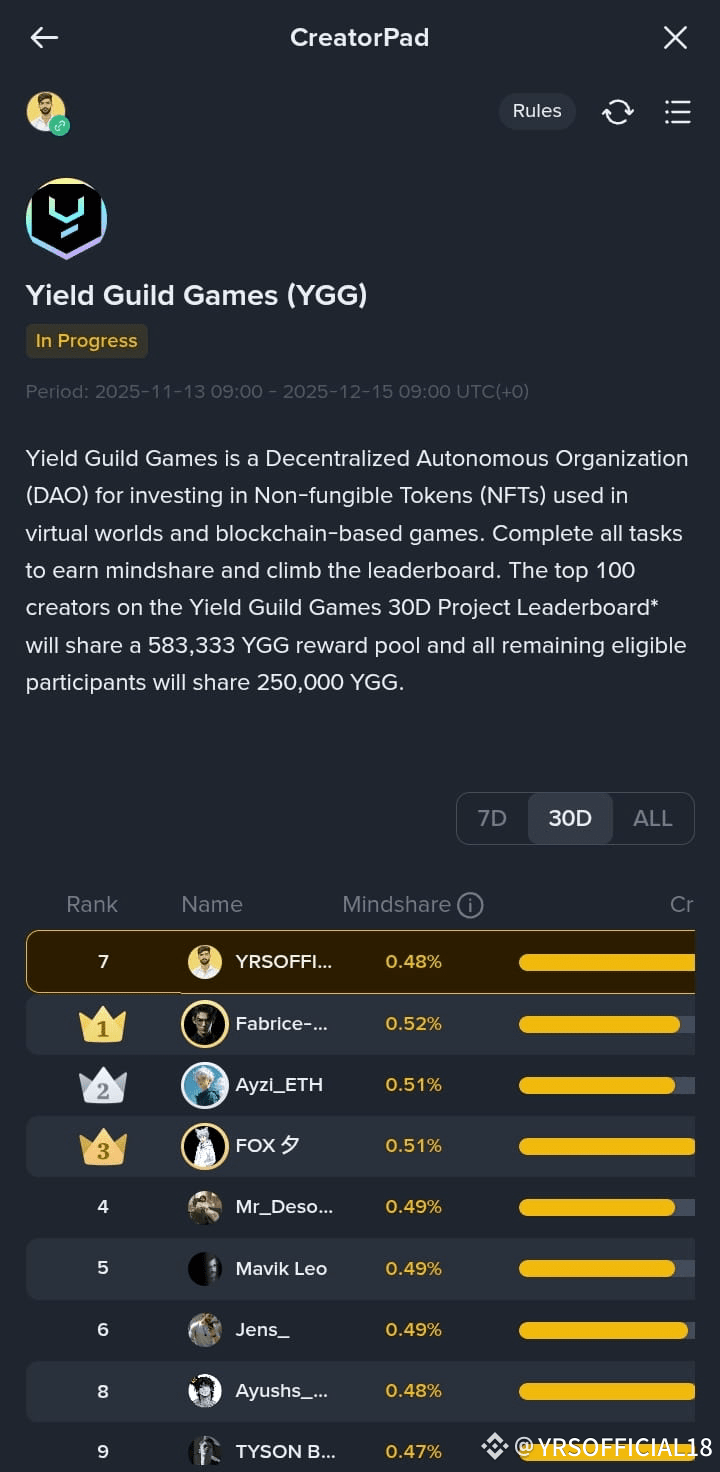
1
1
15
10.7k
The Scholarship Model in GameFi has broken and how YGG is trying to reboot it through quests and reputationThe classic scholarship model grew on access arbitration: some had expensive gaming assets, while others had time and readiness to play. As long as tokens were generously distributed, the economy relied on a constant influx of newcomers, and the incomes of players and guilds were fueled by inflationary emissions. Once growth slowed down, weaknesses emerged: the decline in the price of gaming tokens, asset wear, multi-accounting, bots, and conflicts of interest between speculative mining and actual gameplay. The model depended on external demand rather than organic value.
The Scholarship Model in GameFi has broken and how YGG is trying to reboot it through quests and reputation
The classic scholarship model grew on access arbitration: some had expensive gaming assets, while others had time and readiness to play. As long as tokens were generously distributed, the economy relied on a constant influx of newcomers, and the incomes of players and guilds were fueled by inflationary emissions. Once growth slowed down, weaknesses emerged: the decline in the price of gaming tokens, asset wear, multi-accounting, bots, and conflicts of interest between speculative mining and actual gameplay. The model depended on external demand rather than organic value.
7
6.8k
·
--
Article
YGG Play: Vaults — earn $YGG, even when you sleep or play another game!Hello, crypto-gamer 🤝! Yesterday we learned to choose quests with ROI $20-30 per hour — I hope your wallet is already thicker 💰?
Today we are moving to a new level: YGG Vaults — it's like a bank deposit, only 10-20× more profitable and works 24/7.
Ready for your YGG to earn for themselves, even when you sleep 😴? Then turn on autopilot! 🚀
YGG Play: Vaults — earn $YGG, even when you sleep or play another game!
Hello, crypto-gamer 🤝! Yesterday we learned to choose quests with ROI $20-30 per hour — I hope your wallet is already thicker 💰?
Today we are moving to a new level: YGG Vaults — it's like a bank deposit, only 10-20× more profitable and works 24/7.
Ready for your YGG to earn for themselves, even when you sleep 😴? Then turn on autopilot! 🚀
Today we are moving to a new level: YGG Vaults — it's like a bank deposit, only 10-20× more profitable and works 24/7.
Ready for your YGG to earn for themselves, even when you sleep 😴? Then turn on autopilot! 🚀
1
6
7.2k
·
--
Yield Guild Games is redefining digital labor by turning play into a structured on-chain economy. Rather than treating games as isolated entertainment products, YGG operates as a decentralized guild that aggregates players, capital, and in-game assets into a coordinated ecosystem. This model allows participants to access opportunities in blockchain games without upfront capital, while guild-owned assets are deployed where player demand and performance are strongest.
What makes YGG powerful is its role as an economic layer on top of Web3 gaming. The guild doesn’t just distribute NFTs or rewards; it organizes training, incentives, and governance so players can operate efficiently across multiple games and regions. This creates predictable output from otherwise fragmented gaming economies and transforms player activity into measurable, on-chain productivity.
As gaming shifts from consumption to participation, Yield Guild Games stands at the intersection of culture and finance. It enables virtual worlds to sustain real economies, where time, skill, and coordination generate value. YGG is not just a guild—it is an infrastructure for digital work, proving that in Web3, communities can function as scalable economic engines rather than passive audiences.
@YieldGuildGames #YGGPlay $YGG
Yield Guild Games is redefining digital labor by turning play into a structured on-chain economy. Rather than treating games as isolated entertainment products, YGG operates as a decentralized guild that aggregates players, capital, and in-game assets into a coordinated ecosystem. This model allows participants to access opportunities in blockchain games without upfront capital, while guild-owned assets are deployed where player demand and performance are strongest.
What makes YGG powerful is its role as an economic layer on top of Web3 gaming. The guild doesn’t just distribute NFTs or rewards; it organizes training, incentives, and governance so players can operate efficiently across multiple games and regions. This creates predictable output from otherwise fragmented gaming economies and transforms player activity into measurable, on-chain productivity.
As gaming shifts from consumption to participation, Yield Guild Games stands at the intersection of culture and finance. It enables virtual worlds to sustain real economies, where time, skill, and coordination generate value. YGG is not just a guild—it is an infrastructure for digital work, proving that in Web3, communities can function as scalable economic engines rather than passive audiences.
@Yield Guild Games #YGGPlay $YGG
What makes YGG powerful is its role as an economic layer on top of Web3 gaming. The guild doesn’t just distribute NFTs or rewards; it organizes training, incentives, and governance so players can operate efficiently across multiple games and regions. This creates predictable output from otherwise fragmented gaming economies and transforms player activity into measurable, on-chain productivity.
As gaming shifts from consumption to participation, Yield Guild Games stands at the intersection of culture and finance. It enables virtual worlds to sustain real economies, where time, skill, and coordination generate value. YGG is not just a guild—it is an infrastructure for digital work, proving that in Web3, communities can function as scalable economic engines rather than passive audiences.
@Yield Guild Games #YGGPlay $YGG
1
98
Log in to explore more content
Join global crypto users on Binance Square
⚡️ Get latest and useful information about crypto.
💬 Trusted by the world’s largest crypto exchange.
👍 Discover real insights from verified creators.
Email / Phone number
Trending Topics
1
#BitcoinReboundsTo$79K
9,733 views
102 Discussing
2
#GrayscalePutsXRPAt26.11%InAdvisorPortfolio
1,014 views
66 Discussing
3
#PhiladelphiaSemiconductorIndexFalls5.9%
976 views
45 Discussing
4
#SECChairUrgesCongressToAdvanceClarityAct
1,322 views
47 Discussing
5
#FedHikeOddsRiseTo89%
77,749 views
1,031 Discussing
6
#RLUSDSupplyHitsRecord$2.442B
5,680 views
64 Discussing
7
#AvalancheIntegratesIntoUAEPassDigitalVault
73,672 views
995 Discussing
8
#UKSeeksViewsOnTokenizingGold
60,813 views
756 Discussing
9
#AnthropicCEOCallsForAISlowdown
234,805 views
3,281 Discussing
10
#RevolutDataLeakReportedlyPostedAttackersThreatenDailyReleases
4,349 views
87 Discussing