

DevRajCrypto
614 Posts

DevRajCrypto
Report
Block User
🚀 Crypto Educator | Market Intelligence & On-Chain Insights |
📊 BTC • Altcoins • Crypto Trends | Making the market easier to understand |
Open Trade
Occasional Trader
3.4 Years
18 Following
4.4K+ Followers
4.6K+ Liked
Posts
Portfolio
All
Quotes
Videos
PINNED
·
--
Verified
#binancelaunchesbinanceintelligence
Binance just made one shift that I think traders should pay attention to. 👀
I’ve spent a lot of time watching how people trade on Binance. The biggest problem for most retail traders usually isn’t a lack of charts. It’s the gap between information, interpretation and action.
That’s why Binance Intelligence is interesting to me.
Binance has now brought Binance AI, AI Pro and Agent OS under one AI layer. Binance AI is designed to personalize market information, while AI Pro can turn plain-language ideas into visual trading workflows. Agent OS takes it further by giving developers infrastructure to build agents around Binance capabilities.
But here’s my bigger takeaway:
The real competition may no longer be between exchanges. It may be between trading interfaces.
Today, traders open charts → search for information → form a thesis → build a strategy → monitor it.
Tomorrow, the interface could become:
Idea → AI → strategy → execution → monitoring.
That is a much bigger shift than simply putting a chatbot inside an exchange.
And there’s already a signal worth watching: Binance says Agent OS has surpassed 280,000 daily calls since its August launch.
But I’m not automatically bullish on $BNB because of this.
The real test is adoption.
If millions of users start using AI to research, build and monitor trades, Binance could potentially capture much more activity inside its ecosystem.
If AI simply becomes another unused feature, the narrative means very little.
My question: will AI become the new trading interface, or will experienced traders still prefer to make the final call themselves? 👇
$BNB #BinanceIntelligence #AI #crypto #BinanceSquare
#binancelaunchesbinanceintelligence
Binance just made one shift that I think traders should pay attention to. 👀
I’ve spent a lot of time watching how people trade on Binance. The biggest problem for most retail traders usually isn’t a lack of charts. It’s the gap between information, interpretation and action.
That’s why Binance Intelligence is interesting to me.
Binance has now brought Binance AI, AI Pro and Agent OS under one AI layer. Binance AI is designed to personalize market information, while AI Pro can turn plain-language ideas into visual trading workflows. Agent OS takes it further by giving developers infrastructure to build agents around Binance capabilities.
But here’s my bigger takeaway:
The real competition may no longer be between exchanges. It may be between trading interfaces.
Today, traders open charts → search for information → form a thesis → build a strategy → monitor it.
Tomorrow, the interface could become:
Idea → AI → strategy → execution → monitoring.
That is a much bigger shift than simply putting a chatbot inside an exchange.
And there’s already a signal worth watching: Binance says Agent OS has surpassed 280,000 daily calls since its August launch.
But I’m not automatically bullish on $BNB because of this.
The real test is adoption.
If millions of users start using AI to research, build and monitor trades, Binance could potentially capture much more activity inside its ecosystem.
If AI simply becomes another unused feature, the narrative means very little.
My question: will AI become the new trading interface, or will experienced traders still prefer to make the final call themselves? 👇
$BNB #BinanceIntelligence #AI #crypto #BinanceSquare
Binance just made one shift that I think traders should pay attention to. 👀
I’ve spent a lot of time watching how people trade on Binance. The biggest problem for most retail traders usually isn’t a lack of charts. It’s the gap between information, interpretation and action.
That’s why Binance Intelligence is interesting to me.
Binance has now brought Binance AI, AI Pro and Agent OS under one AI layer. Binance AI is designed to personalize market information, while AI Pro can turn plain-language ideas into visual trading workflows. Agent OS takes it further by giving developers infrastructure to build agents around Binance capabilities.
But here’s my bigger takeaway:
The real competition may no longer be between exchanges. It may be between trading interfaces.
Today, traders open charts → search for information → form a thesis → build a strategy → monitor it.
Tomorrow, the interface could become:
Idea → AI → strategy → execution → monitoring.
That is a much bigger shift than simply putting a chatbot inside an exchange.
And there’s already a signal worth watching: Binance says Agent OS has surpassed 280,000 daily calls since its August launch.
But I’m not automatically bullish on $BNB because of this.
The real test is adoption.
If millions of users start using AI to research, build and monitor trades, Binance could potentially capture much more activity inside its ecosystem.
If AI simply becomes another unused feature, the narrative means very little.
My question: will AI become the new trading interface, or will experienced traders still prefer to make the final call themselves? 👇
$BNB #BinanceIntelligence #AI #crypto #BinanceSquare

8
2
40
44.2k
PINNED
·
--
#drifthackvictimsbeginclaims
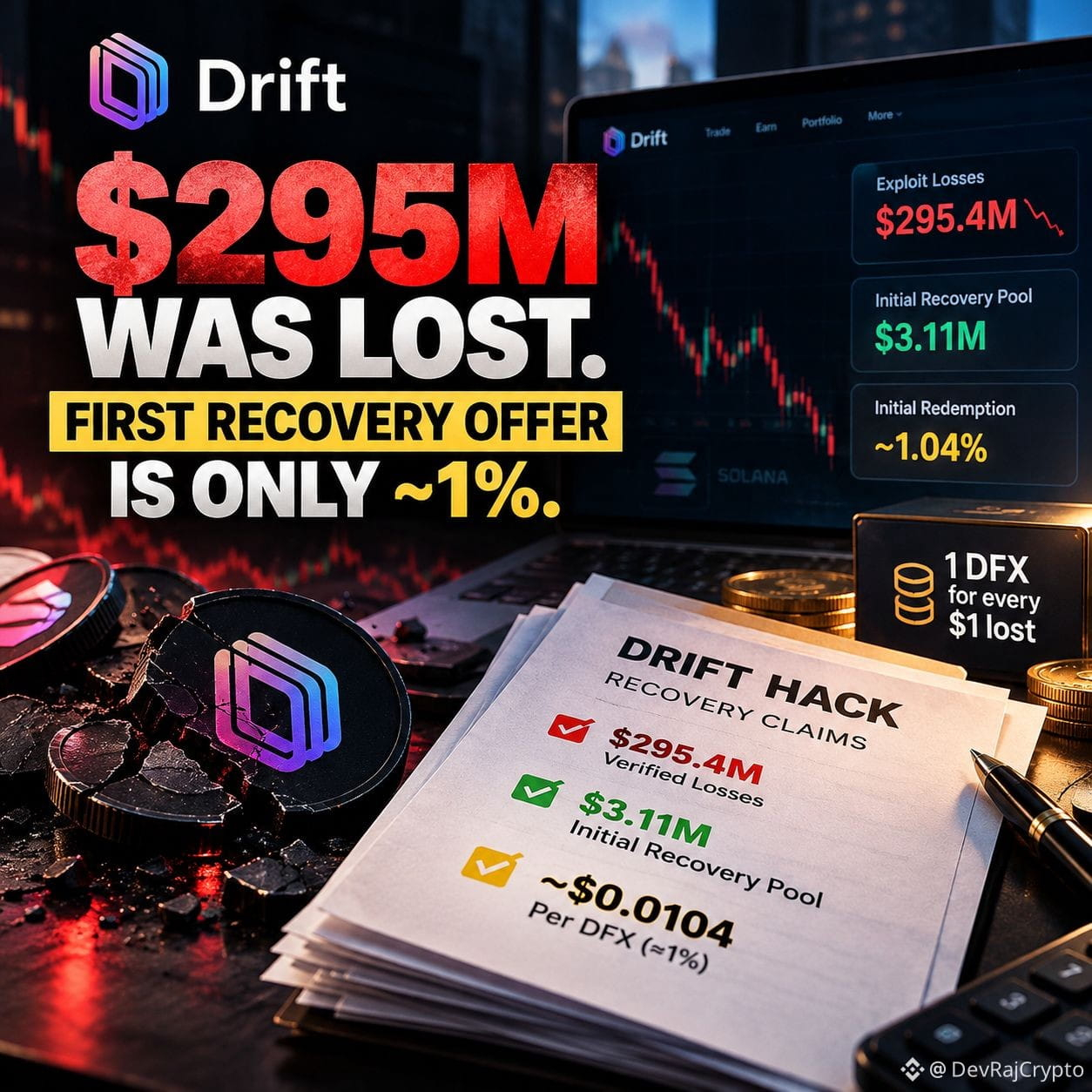
$295M was lost. The first recovery offer is only ~1%.
This is the part of the Drift hack story I’m paying attention to.
Victims of the April 1 exploit can now claim DFX recovery tokens. The allocation is 1 DFX for every $1 of verified loss.
Sounds like recovery. But look at the numbers:
Verified losses: ~$295.4M Initial recovery pool: ~$3.11M Initial redemption: ~$0.0104 per DFX
So a victim with a verified $100,000 loss could initially redeem roughly $1,040.
That changes how I look at the whole mechanism.
This isn't a $295M reimbursement sitting somewhere waiting to be distributed. It is a future-recovery system whose value depends on what happens next: protocol revenue, recovered assets, partner commitments and additional funds entering the pool.
And there is an important trade-off:
Redeeming DFX burns the tokens. The redemption is irreversible. Victims give up the future recovery attached to those tokens.
So victims aren't simply choosing between “claim” and “don't claim.”
They're choosing between liquidity today vs. potential recovery later.
That is the part most headlines miss.
The real question isn't:
“How much can victims recover today?”
It's:
“Can this recovery mechanism generate enough future cash flow to meaningfully close a $295M hole?”
That's a much harder question.
And that's what I'll be watching.
Would you take the ~1% now, or hold DFX for potential future recovery? 👇
#DriftHackVictimsBeginClaims #DRIFT #defi #crypto
#drifthackvictimsbeginclaims
$295M was lost. The first recovery offer is only ~1%.
This is the part of the Drift hack story I’m paying attention to.
Victims of the April 1 exploit can now claim DFX recovery tokens. The allocation is 1 DFX for every $1 of verified loss.
Sounds like recovery. But look at the numbers:
Verified losses: ~$295.4M Initial recovery pool: ~$3.11M Initial redemption: ~$0.0104 per DFX
So a victim with a verified $100,000 loss could initially redeem roughly $1 ,040.
That changes how I look at the whole mechanism.
This isn't a $295M reimbursement sitting somewhere waiting to be distributed. It is a future-recovery system whose value depends on what happens next: protocol revenue, recovered assets, partner commitments and additional funds entering the pool.
And there is an important trade-off:
Redeeming DFX burns the tokens. The redemption is irreversible. Victims give up the future recovery attached to those tokens.
So victims aren't simply choosing between “claim” and “don't claim.”
They're choosing between liquidity today vs. potential recovery later.
That is the part most headlines miss.
The real question isn't:
“How much can victims recover today?”
It's:
“Can this recovery mechanism generate enough future cash flow to meaningfully close a $295M hole?”
That's a much harder question.
And that's what I'll be watching.
Would you take the ~1% now, or hold DFX for potential future recovery? 👇
#DriftHackVictimsBeginClaims #DRIFT #defi #crypto
$295M was lost. The first recovery offer is only ~1%.
This is the part of the Drift hack story I’m paying attention to.
Victims of the April 1 exploit can now claim DFX recovery tokens. The allocation is 1 DFX for every $1 of verified loss.
Sounds like recovery. But look at the numbers:
Verified losses: ~$295.4M Initial recovery pool: ~$3.11M Initial redemption: ~$0.0104 per DFX
So a victim with a verified $100,000 loss could initially redeem roughly $1 ,040.
That changes how I look at the whole mechanism.
This isn't a $295M reimbursement sitting somewhere waiting to be distributed. It is a future-recovery system whose value depends on what happens next: protocol revenue, recovered assets, partner commitments and additional funds entering the pool.
And there is an important trade-off:
Redeeming DFX burns the tokens. The redemption is irreversible. Victims give up the future recovery attached to those tokens.
So victims aren't simply choosing between “claim” and “don't claim.”
They're choosing between liquidity today vs. potential recovery later.
That is the part most headlines miss.
The real question isn't:
“How much can victims recover today?”
It's:
“Can this recovery mechanism generate enough future cash flow to meaningfully close a $295M hole?”
That's a much harder question.
And that's what I'll be watching.
Would you take the ~1% now, or hold DFX for potential future recovery? 👇
#DriftHackVictimsBeginClaims #DRIFT #defi #crypto
2
1
11
8.8k
·
--
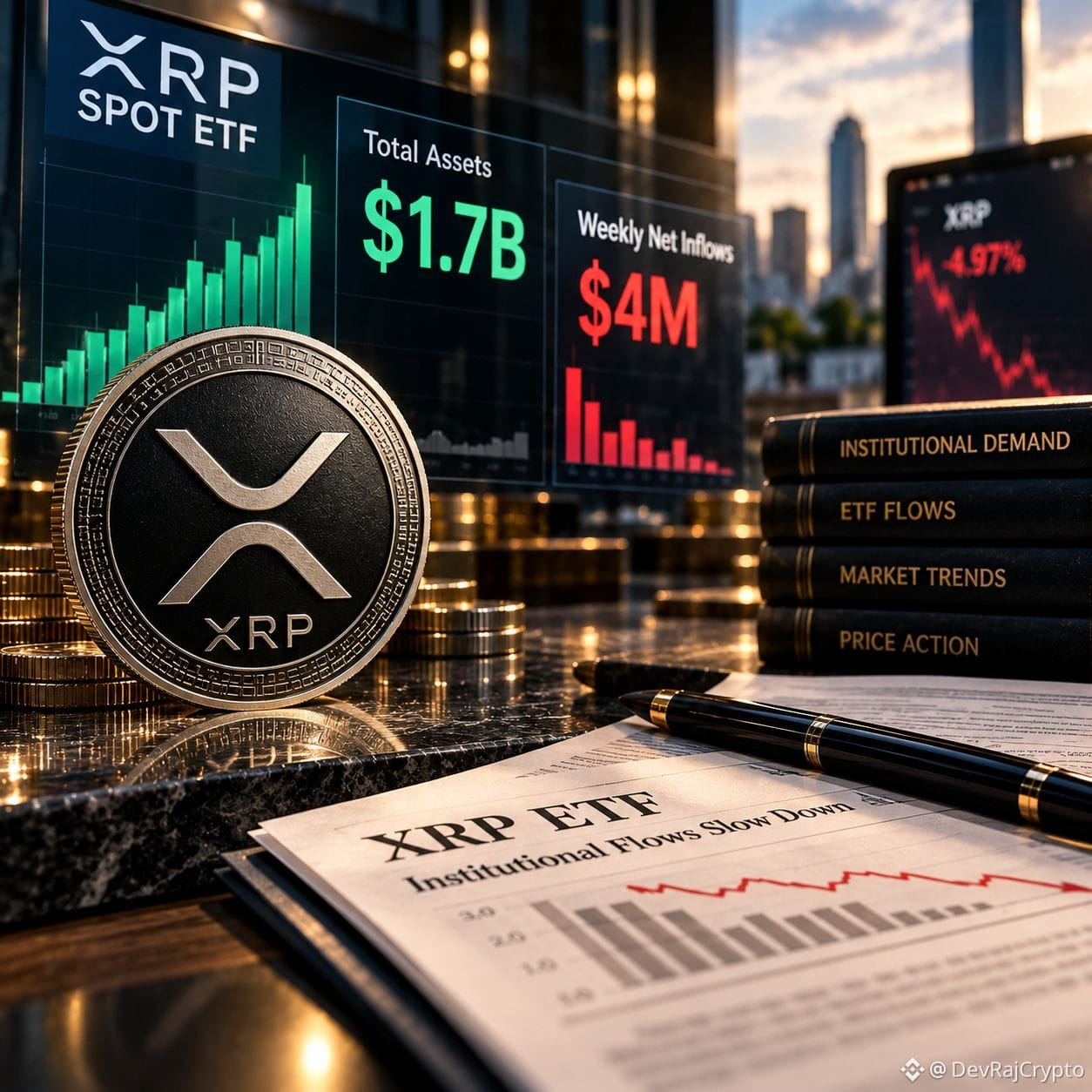
$1.7B is sitting in $XRP ETFs.
But honestly, that’s not the number making me bullish.
The number I’m watching is the ~$4M of fresh weekly inflows.
Why? Because $1.7B tells me institutions have already built exposure. The ~$4M tells me whether they are still willing to add aggressively at current prices.
That difference matters.
Right now, I see a market where institutional exposure is large, but the marginal demand looks much weaker:
• ~$1.7B in ETF assets
• Only ~$4M in latest weekly inflows
• XRP recently down around 5%
My read is slightly different from the usual “$1.7B ETF inflows = bullish XRP” narrative.
I think XRP needs to prove that the next wave of institutional money is still coming. If inflows accelerate while price holds, I’d become much more constructive.
If inflows remain this weak and XRP keeps losing strength, I think the market could start treating the $1.7B as old demand rather than a new catalyst.
My prediction: I wouldn’t be surprised to see XRP remain under pressure first, then react sharply if weekly ETF inflows suddenly accelerate. That change in flow could matter more than another bullish headline.
So I’m watching the money coming in, not just the money already sitting there.
What’s your view?
Is ~$4M a temporary slowdown before another institutional wave, or is XRP demand starting to lose momentum? 👇
#xrp #xrpetf #BinanceSquare #XRPSpotETFsHold$1.7BWeeklyInflowsSlow $XRP
{spot}(XRPUSDT)
$1.7B is sitting in $XRP ETFs.
But honestly, that’s not the number making me bullish.
The number I’m watching is the ~$4M of fresh weekly inflows.
Why? Because $1.7B tells me institutions have already built exposure. The ~$4M tells me whether they are still willing to add aggressively at current prices.
That difference matters.
Right now, I see a market where institutional exposure is large, but the marginal demand looks much weaker:
• ~$1.7B in ETF assets
• Only ~$4M in latest weekly inflows
• XRP recently down around 5%
My read is slightly different from the usual “$1.7B ETF inflows = bullish XRP” narrative.
I think XRP needs to prove that the next wave of institutional money is still coming. If inflows accelerate while price holds, I’d become much more constructive.
If inflows remain this weak and XRP keeps losing strength, I think the market could start treating the $1.7B as old demand rather than a new catalyst.
My prediction: I wouldn’t be surprised to see XRP remain under pressure first, then react sharply if weekly ETF inflows suddenly accelerate. That change in flow could matter more than another bullish headline.
So I’m watching the money coming in, not just the money already sitting there.
What’s your view?
Is ~$4M a temporary slowdown before another institutional wave, or is XRP demand starting to lose momentum? 👇
#xrp #xrpetf #BinanceSquare #XRPSpotETFsHold$1.7BWeeklyInflowsSlow $XRP
But honestly, that’s not the number making me bullish.
The number I’m watching is the ~$4M of fresh weekly inflows.
Why? Because $1.7B tells me institutions have already built exposure. The ~$4M tells me whether they are still willing to add aggressively at current prices.
That difference matters.
Right now, I see a market where institutional exposure is large, but the marginal demand looks much weaker:
• ~$1.7B in ETF assets
• Only ~$4M in latest weekly inflows
• XRP recently down around 5%
My read is slightly different from the usual “$1.7B ETF inflows = bullish XRP” narrative.
I think XRP needs to prove that the next wave of institutional money is still coming. If inflows accelerate while price holds, I’d become much more constructive.
If inflows remain this weak and XRP keeps losing strength, I think the market could start treating the $1.7B as old demand rather than a new catalyst.
My prediction: I wouldn’t be surprised to see XRP remain under pressure first, then react sharply if weekly ETF inflows suddenly accelerate. That change in flow could matter more than another bullish headline.
So I’m watching the money coming in, not just the money already sitting there.
What’s your view?
Is ~$4M a temporary slowdown before another institutional wave, or is XRP demand starting to lose momentum? 👇
#xrp #xrpetf #BinanceSquare #XRPSpotETFsHold$1.7BWeeklyInflowsSlow $XRP
1
143
·
--
#imfgrantswaiverforelsalvadorbitcoinbreach
Did the IMF just accept Bitcoin, or did El Salvador accept the rules around Bitcoin? 👀
Most people are reading this as: “IMF waived the Bitcoin breach = bullish for BTC.”
I think the more interesting story is what happened underneath the headline.
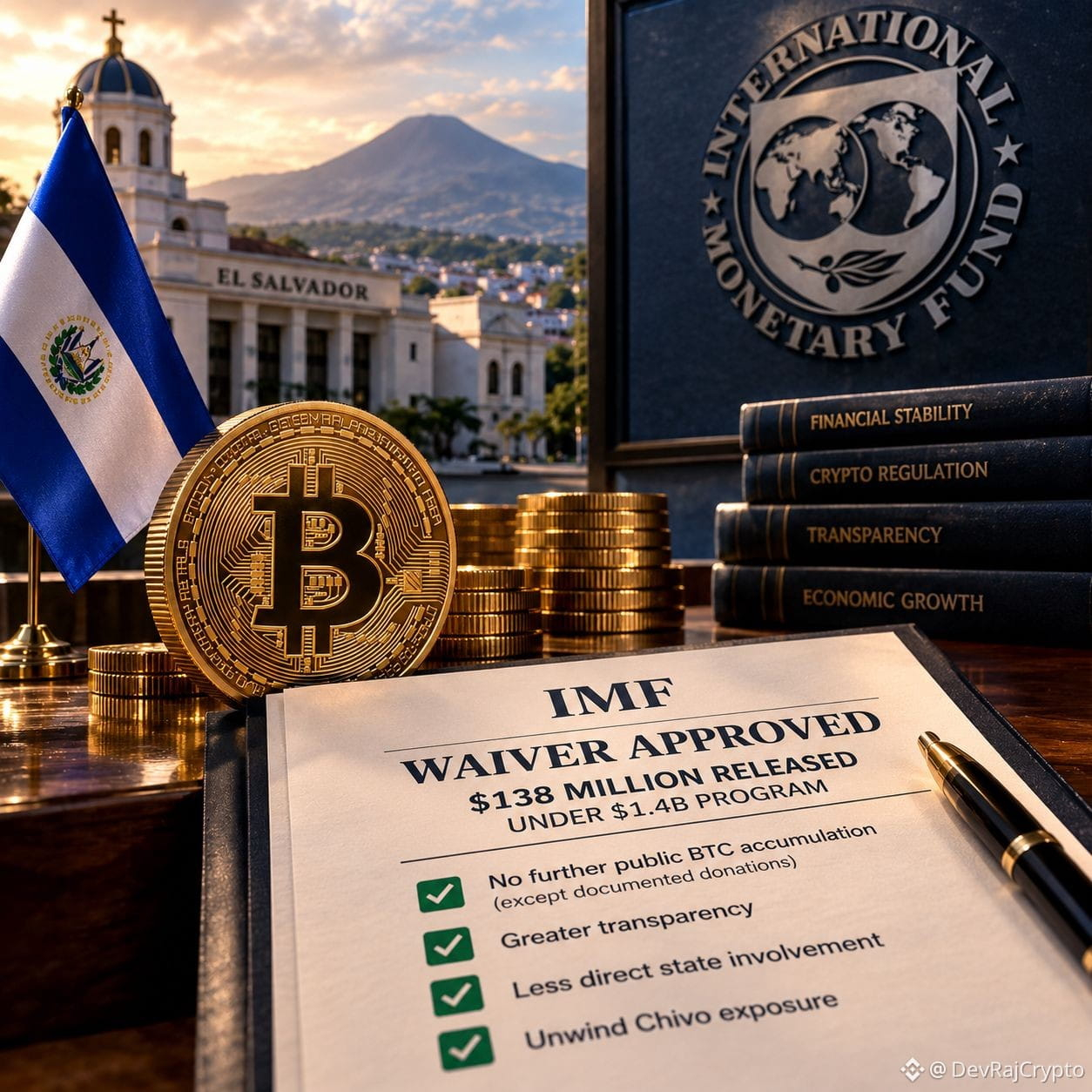
The IMF granted El Salvador a waiver and unlocked about $138M under its $1.4B financing program. But the agreement also comes with tighter conditions.
• No further public BTC accumulation expected, except documented donations
• Greater transparency around government crypto holdings
• Less direct state involvement in Bitcoin
• Remaining public exposure to Chivo expected to be unwound
That changes how I read the news.
This isn’t simply “Bitcoin won against the IMF.”
To me, it looks more like conditional coexistence.
One thing I’ve learned from following crypto is that the headline is often less important than what actually changes underneath it.
The headline says:
“Bitcoin breach waived.”
The mechanism says:
“Bitcoin can stay, but government exposure gets tighter.”
That distinction matters for the long-term Bitcoin adoption story.
I’m not looking at this as simply bullish or bearish.
My question is:
Does this make El Salvador’s Bitcoin experiment more credible, or simply more constrained?
What’s your read? 👇
$BTC #bitcoin #ElSalvador #IMF #crypto
#imfgrantswaiverforelsalvadorbitcoinbreach
Did the IMF just accept Bitcoin, or did El Salvador accept the rules around Bitcoin? 👀
Most people are reading this as: “IMF waived the Bitcoin breach = bullish for BTC.”
I think the more interesting story is what happened underneath the headline.
The IMF granted El Salvador a waiver and unlocked about $138M under its $1.4B financing program. But the agreement also comes with tighter conditions.
• No further public BTC accumulation expected, except documented donations
• Greater transparency around government crypto holdings
• Less direct state involvement in Bitcoin
• Remaining public exposure to Chivo expected to be unwound
That changes how I read the news.
This isn’t simply “Bitcoin won against the IMF.”
To me, it looks more like conditional coexistence.
One thing I’ve learned from following crypto is that the headline is often less important than what actually changes underneath it.
The headline says:
“Bitcoin breach waived.”
The mechanism says:
“Bitcoin can stay, but government exposure gets tighter.”
That distinction matters for the long-term Bitcoin adoption story.
I’m not looking at this as simply bullish or bearish.
My question is:
Does this make El Salvador’s Bitcoin experiment more credible, or simply more constrained?
What’s your read? 👇
$BTC #bitcoin #ElSalvador #IMF #crypto
Did the IMF just accept Bitcoin, or did El Salvador accept the rules around Bitcoin? 👀
Most people are reading this as: “IMF waived the Bitcoin breach = bullish for BTC.”
I think the more interesting story is what happened underneath the headline.
The IMF granted El Salvador a waiver and unlocked about $138M under its $1.4B financing program. But the agreement also comes with tighter conditions.
• No further public BTC accumulation expected, except documented donations
• Greater transparency around government crypto holdings
• Less direct state involvement in Bitcoin
• Remaining public exposure to Chivo expected to be unwound
That changes how I read the news.
This isn’t simply “Bitcoin won against the IMF.”
To me, it looks more like conditional coexistence.
One thing I’ve learned from following crypto is that the headline is often less important than what actually changes underneath it.
The headline says:
“Bitcoin breach waived.”
The mechanism says:
“Bitcoin can stay, but government exposure gets tighter.”
That distinction matters for the long-term Bitcoin adoption story.
I’m not looking at this as simply bullish or bearish.
My question is:
Does this make El Salvador’s Bitcoin experiment more credible, or simply more constrained?
What’s your read? 👇
$BTC #bitcoin #ElSalvador #IMF #crypto
2
2.7k
·
--
Verified
#fedminutesfocusonoctoberpause
Is a Fed pause really bullish for Bitcoin, or are traders focusing on the wrong part of the story? 👀
One thing I’ve learned from watching crypto through different market cycles: the first candle usually trades the headline. The next move tells you whether the market actually believed it.
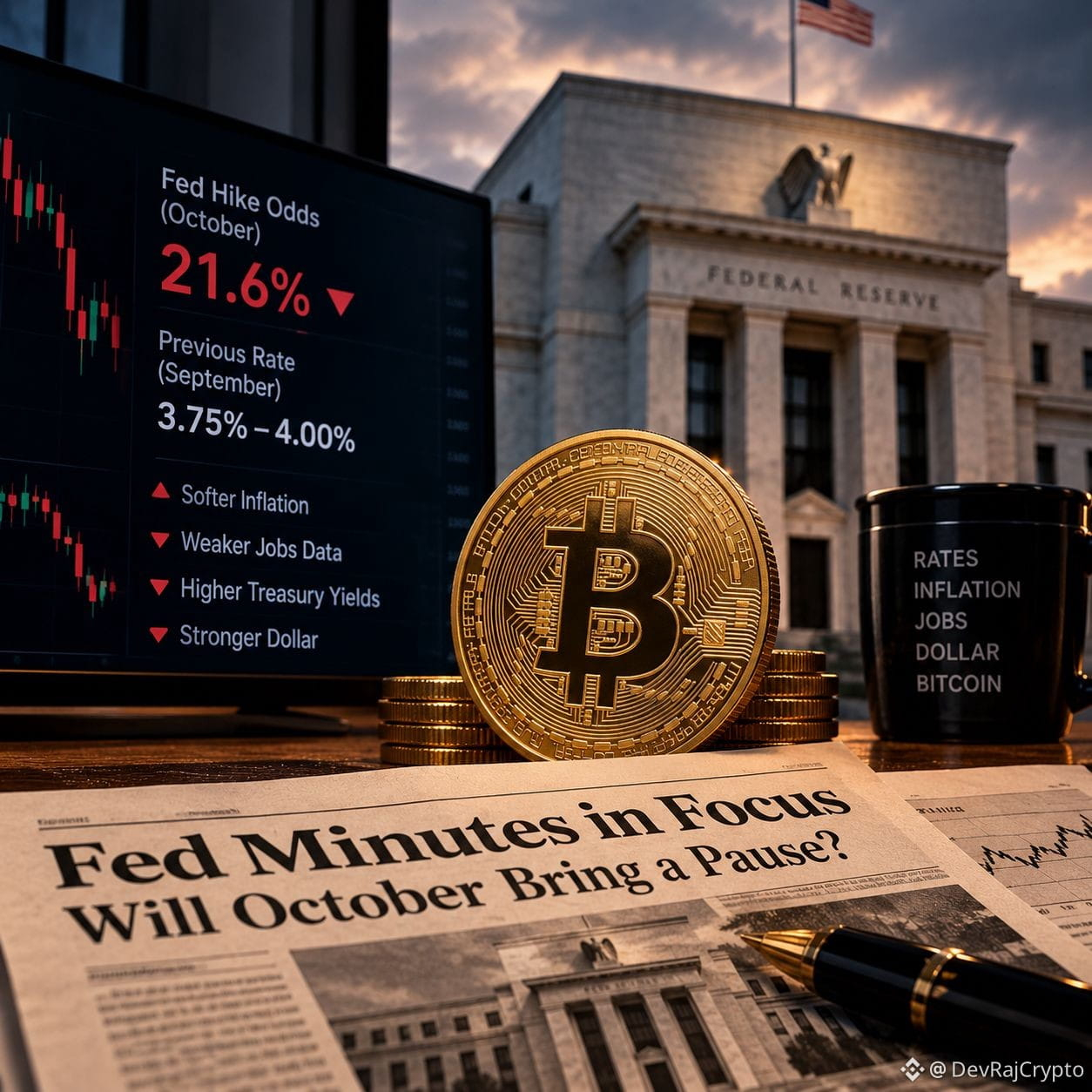
Markets now put October 25 bps hike odds around 21.6%, after the Fed raised rates to 3.75%–4.00% in September. Softer inflation and weaker jobs data have pushed expectations toward a pause.
But here’s where I think the real trade is:
Why is the Fed pausing?
If inflation is cooling, a pause can support risk appetite.
If growth and employment are weakening enough to force caution, the same pause can tell a very different story.
That’s why I’m not trading the word “pause.”
I’m watching the reaction:
Fed tone → Treasury yields → DXY → BTC
My view: the first BTC move could easily be a trap. I want to see yields and the dollar confirm the direction before calling it a real trend move.
If the Fed pauses, what matters more: the decision or the reason behind it? 👇
$BTC #bitcoin #Fed #FederalReserve #crypto
#fedminutesfocusonoctoberpause
Is a Fed pause really bullish for Bitcoin, or are traders focusing on the wrong part of the story? 👀
One thing I’ve learned from watching crypto through different market cycles: the first candle usually trades the headline. The next move tells you whether the market actually believed it.
Markets now put October 25 bps hike odds around 21.6%, after the Fed raised rates to 3.75%–4.00% in September. Softer inflation and weaker jobs data have pushed expectations toward a pause.
But here’s where I think the real trade is:
Why is the Fed pausing?
If inflation is cooling, a pause can support risk appetite.
If growth and employment are weakening enough to force caution, the same pause can tell a very different story.
That’s why I’m not trading the word “pause.”
I’m watching the reaction:
Fed tone → Treasury yields → DXY → BTC
My view: the first BTC move could easily be a trap. I want to see yields and the dollar confirm the direction before calling it a real trend move.
If the Fed pauses, what matters more: the decision or the reason behind it? 👇
$BTC #bitcoin #Fed #FederalReserve #crypto
Is a Fed pause really bullish for Bitcoin, or are traders focusing on the wrong part of the story? 👀
One thing I’ve learned from watching crypto through different market cycles: the first candle usually trades the headline. The next move tells you whether the market actually believed it.
Markets now put October 25 bps hike odds around 21.6%, after the Fed raised rates to 3.75%–4.00% in September. Softer inflation and weaker jobs data have pushed expectations toward a pause.
But here’s where I think the real trade is:
Why is the Fed pausing?
If inflation is cooling, a pause can support risk appetite.
If growth and employment are weakening enough to force caution, the same pause can tell a very different story.
That’s why I’m not trading the word “pause.”
I’m watching the reaction:
Fed tone → Treasury yields → DXY → BTC
My view: the first BTC move could easily be a trap. I want to see yields and the dollar confirm the direction before calling it a real trend move.
If the Fed pauses, what matters more: the decision or the reason behind it? 👇
$BTC #bitcoin #Fed #FederalReserve #crypto
1
2
480
·
--
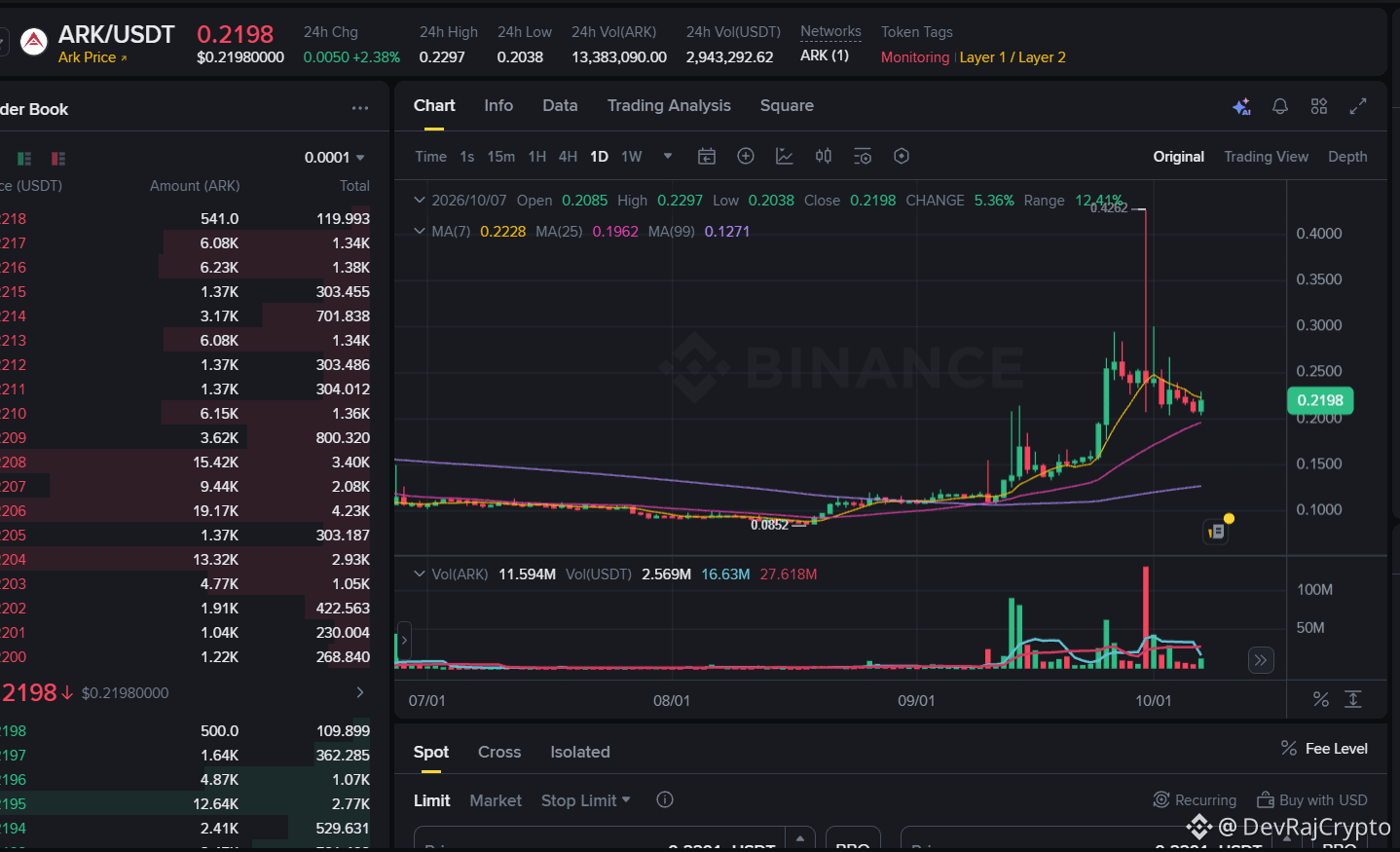
Can $ARK hold above $0.20, or is this just the cooling-off phase after a huge move? 👀
I’ve learned not to judge a coin by the size of its green candles. The real information usually comes after the excitement fades.
$ARK moved from roughly $0.085 to around $0.30 before pulling back toward $0.20. Now it’s trading near $0.2198.
What I’m watching:
• $0.20: key area buyers need to defend
• $0.2228: 7D MA, currently close to price
• $0.1962: 25D MA and deeper support
• $0.25-$0.30: area where sellers previously appeared
The interesting part is that price is still above the 25D MA despite the pullback.
That tells me the bigger move hasn’t completely broken down yet.
But I wouldn’t chase ARK here.
One thing years of watching crypto has taught me: after a coin moves this fast, I’d rather see buyers prove they can defend the pullback than buy because the chart looks exciting.
My view: $0.20 is the line I care about. Hold it and ARK could attempt another move toward $0.25-$0.30. Lose it decisively, and I’d expect a deeper reset.
Would you buy ARK around $0.22, or wait for confirmation? 👇
$ARK #ARK #crypto #BinanceSquare #altcoins
Can $ARK hold above $0.20, or is this just the cooling-off phase after a huge move? 👀
I’ve learned not to judge a coin by the size of its green candles. The real information usually comes after the excitement fades.
$ARK moved from roughly $0.085 to around $0.30 before pulling back toward $0.20. Now it’s trading near $0.2198.
What I’m watching:
• $0.20: key area buyers need to defend
• $0.2228: 7D MA, currently close to price
• $0.1962: 25D MA and deeper support
• $0.25-$0.30: area where sellers previously appeared
The interesting part is that price is still above the 25D MA despite the pullback.
That tells me the bigger move hasn’t completely broken down yet.
But I wouldn’t chase ARK here.
One thing years of watching crypto has taught me: after a coin moves this fast, I’d rather see buyers prove they can defend the pullback than buy because the chart looks exciting.
My view: $0.20 is the line I care about. Hold it and ARK could attempt another move toward $0.25-$0.30. Lose it decisively, and I’d expect a deeper reset.
Would you buy ARK around $0.22, or wait for confirmation? 👇
$ARK #ARK #crypto #BinanceSquare #altcoins
I’ve learned not to judge a coin by the size of its green candles. The real information usually comes after the excitement fades.
$ARK moved from roughly $0.085 to around $0.30 before pulling back toward $0.20. Now it’s trading near $0.2198.
What I’m watching:
• $0.20: key area buyers need to defend
• $0.2228: 7D MA, currently close to price
• $0.1962: 25D MA and deeper support
• $0.25-$0.30: area where sellers previously appeared
The interesting part is that price is still above the 25D MA despite the pullback.
That tells me the bigger move hasn’t completely broken down yet.
But I wouldn’t chase ARK here.
One thing years of watching crypto has taught me: after a coin moves this fast, I’d rather see buyers prove they can defend the pullback than buy because the chart looks exciting.
My view: $0.20 is the line I care about. Hold it and ARK could attempt another move toward $0.25-$0.30. Lose it decisively, and I’d expect a deeper reset.
Would you buy ARK around $0.22, or wait for confirmation? 👇
$ARK #ARK #crypto #BinanceSquare #altcoins
176
·
--
Earn Your First Bitcoin fast my friends absolutely freeee freee !!!!
Link - [Free BTC](https://www.binance.com/en/academy/bitcoin)
Earn Your First Bitcoin fast my friends absolutely freeee freee !!!!
Link - Free BTC
Link - Free BTC
1
60
·
--
DevRajCrypto
·
--
#binancelaunchesbinanceintelligence
Binance just made one shift that I think traders should pay attention to. 👀
I’ve spent a lot of time watching how people trade on Binance. The biggest problem for most retail traders usually isn’t a lack of charts. It’s the gap between information, interpretation and action.
That’s why Binance Intelligence is interesting to me.
Binance has now brought Binance AI, AI Pro and Agent OS under one AI layer. Binance AI is designed to personalize market information, while AI Pro can turn plain-language ideas into visual trading workflows. Agent OS takes it further by giving developers infrastructure to build agents around Binance capabilities.
But here’s my bigger takeaway:
The real competition may no longer be between exchanges. It may be between trading interfaces.
Today, traders open charts → search for information → form a thesis → build a strategy → monitor it.
Tomorrow, the interface could become:
Idea → AI → strategy → execution → monitoring.
That is a much bigger shift than simply putting a chatbot inside an exchange.
And there’s already a signal worth watching: Binance says Agent OS has surpassed 280,000 daily calls since its August launch.
But I’m not automatically bullish on $BNB because of this.
The real test is adoption.
If millions of users start using AI to research, build and monitor trades, Binance could potentially capture much more activity inside its ecosystem.
If AI simply becomes another unused feature, the narrative means very little.
My question: will AI become the new trading interface, or will experienced traders still prefer to make the final call themselves? 👇
$BNB #BinanceIntelligence #AI #crypto #BinanceSquare
Binance just made one shift that I think traders should pay attention to. 👀
I’ve spent a lot of time watching how people trade on Binance. The biggest problem for most retail traders usually isn’t a lack of charts. It’s the gap between information, interpretation and action.
That’s why Binance Intelligence is interesting to me.
Binance has now brought Binance AI, AI Pro and Agent OS under one AI layer. Binance AI is designed to personalize market information, while AI Pro can turn plain-language ideas into visual trading workflows. Agent OS takes it further by giving developers infrastructure to build agents around Binance capabilities.
But here’s my bigger takeaway:
The real competition may no longer be between exchanges. It may be between trading interfaces.
Today, traders open charts → search for information → form a thesis → build a strategy → monitor it.
Tomorrow, the interface could become:
Idea → AI → strategy → execution → monitoring.
That is a much bigger shift than simply putting a chatbot inside an exchange.
And there’s already a signal worth watching: Binance says Agent OS has surpassed 280,000 daily calls since its August launch.
But I’m not automatically bullish on $BNB because of this.
The real test is adoption.
If millions of users start using AI to research, build and monitor trades, Binance could potentially capture much more activity inside its ecosystem.
If AI simply becomes another unused feature, the narrative means very little.
My question: will AI become the new trading interface, or will experienced traders still prefer to make the final call themselves? 👇
$BNB #BinanceIntelligence #AI #crypto #BinanceSquare

1
14
·
--
93,843 $PEPE What should I do next ???
{spot}(PEPEUSDT)
93,843 $PEPE What should I do next ???
DevRajCrypto
·
--
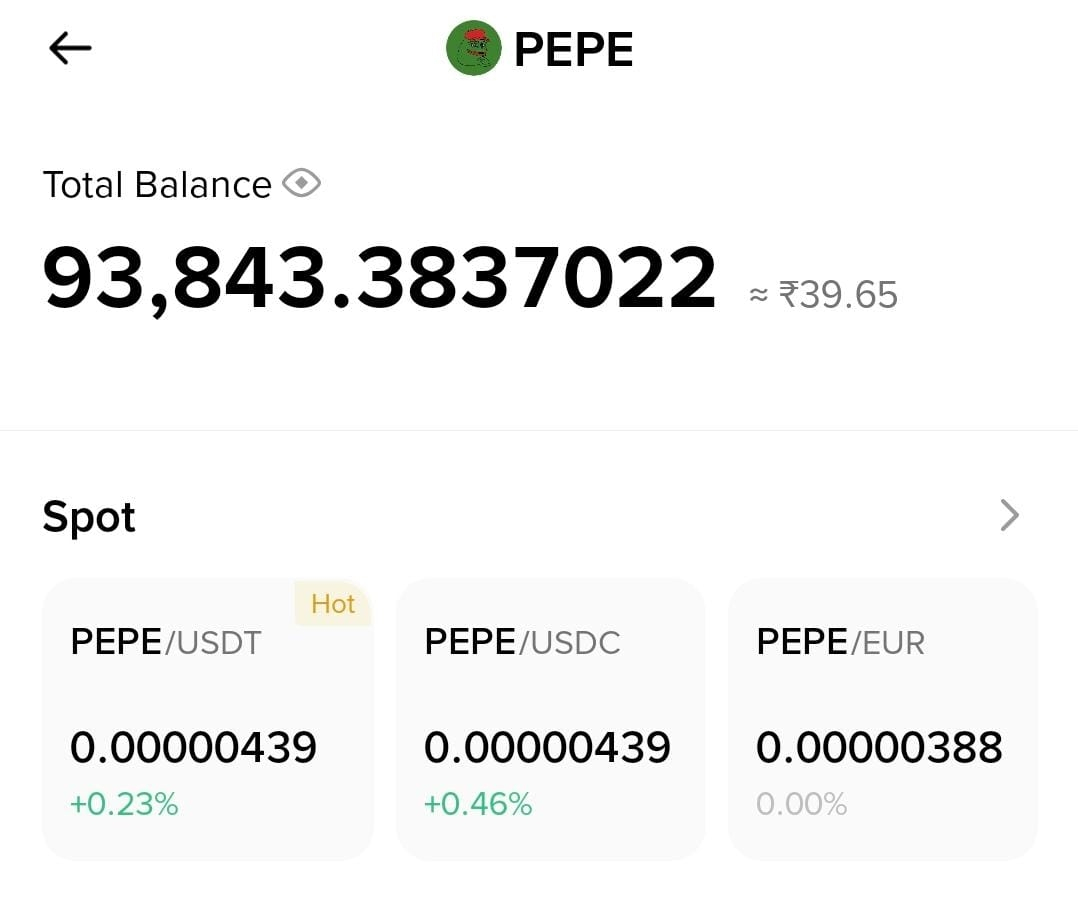
I have 93,843 PEPE sitting in my wallet.
Right now, they’re worth only about ₹39.65. 😂
But one question keeps coming to my mind:
What if this tiny bag looks very different 5 years from now?
I’m not saying PEPE will become the next Bitcoin. That would be a huge assumption.
But I’m curious to see how far a meme coin can actually go when community, liquidity and narrative all come together.
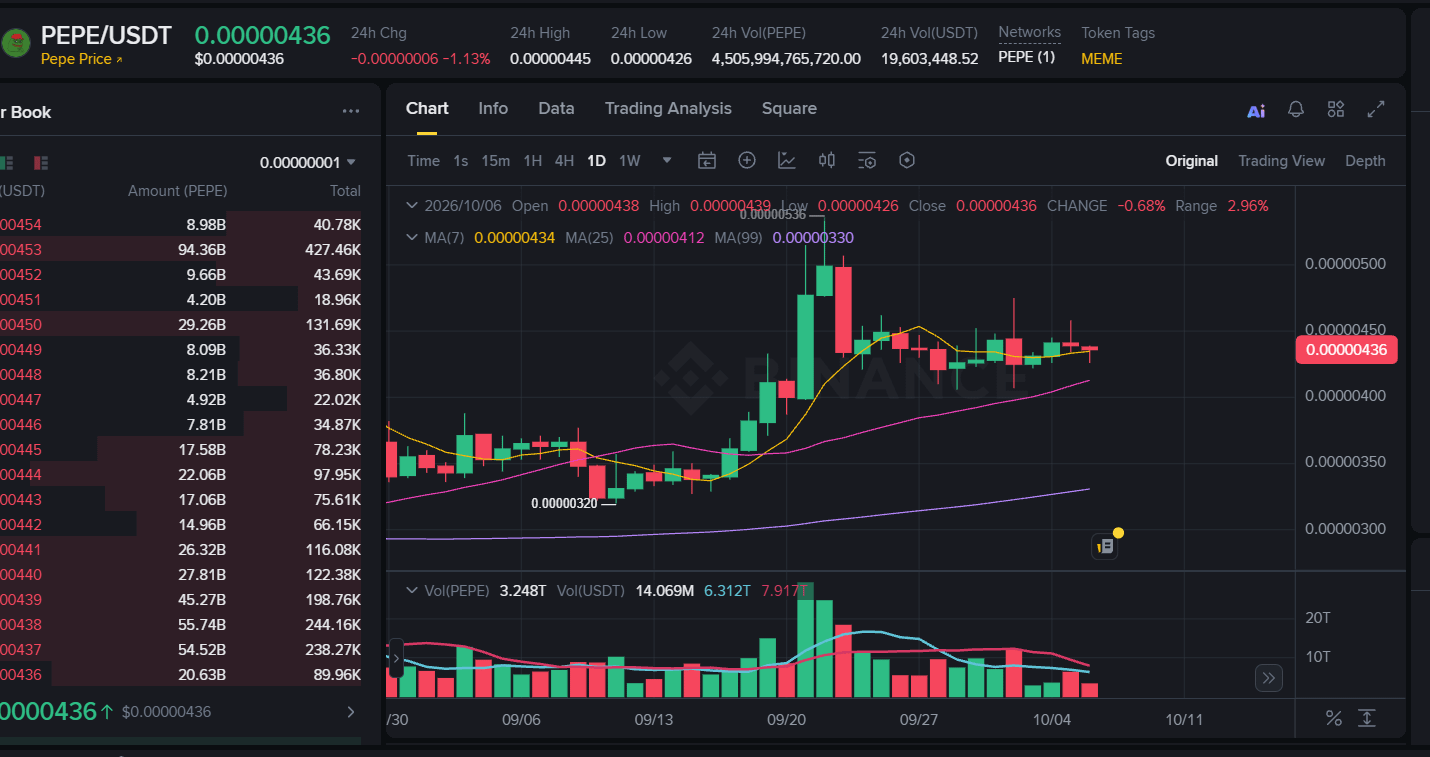
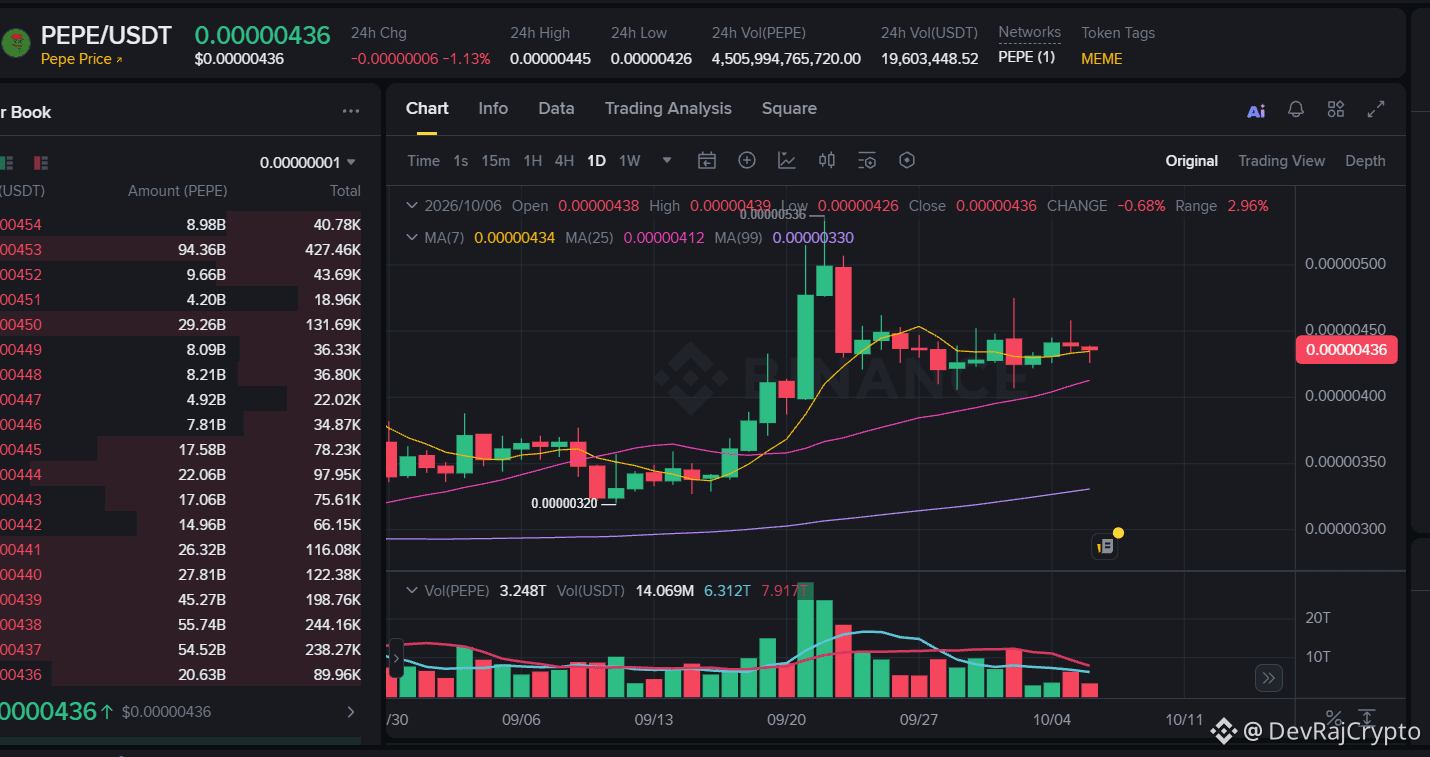
PEPE is currently around $0.00000436, after moving from roughly $0.00000320 to $0.00000500 before cooling down.
For now, I’m keeping this as a small experiment.
Maybe ₹40 stays ₹40.
Or maybe one day I’ll look back and laugh at how small this bag was. 😂
So let me ask you:
Could PEPE ever reach anything close to Bitcoin’s valuation?
Or is that simply unrealistic?
What do you think 93,843 PEPE could be worth in 5 years?
$PEPE $BTC #pepe #bitcoin #crypto
Right now, they’re worth only about ₹39.65. 😂
But one question keeps coming to my mind:
What if this tiny bag looks very different 5 years from now?
I’m not saying PEPE will become the next Bitcoin. That would be a huge assumption.
But I’m curious to see how far a meme coin can actually go when community, liquidity and narrative all come together.
PEPE is currently around $0.00000436, after moving from roughly $0.00000320 to $0.00000500 before cooling down.
For now, I’m keeping this as a small experiment.
Maybe ₹40 stays ₹40.
Or maybe one day I’ll look back and laugh at how small this bag was. 😂
So let me ask you:
Could PEPE ever reach anything close to Bitcoin’s valuation?
Or is that simply unrealistic?
What do you think 93,843 PEPE could be worth in 5 years?
$PEPE $BTC #pepe #bitcoin #crypto
2
165
·
--
Verified
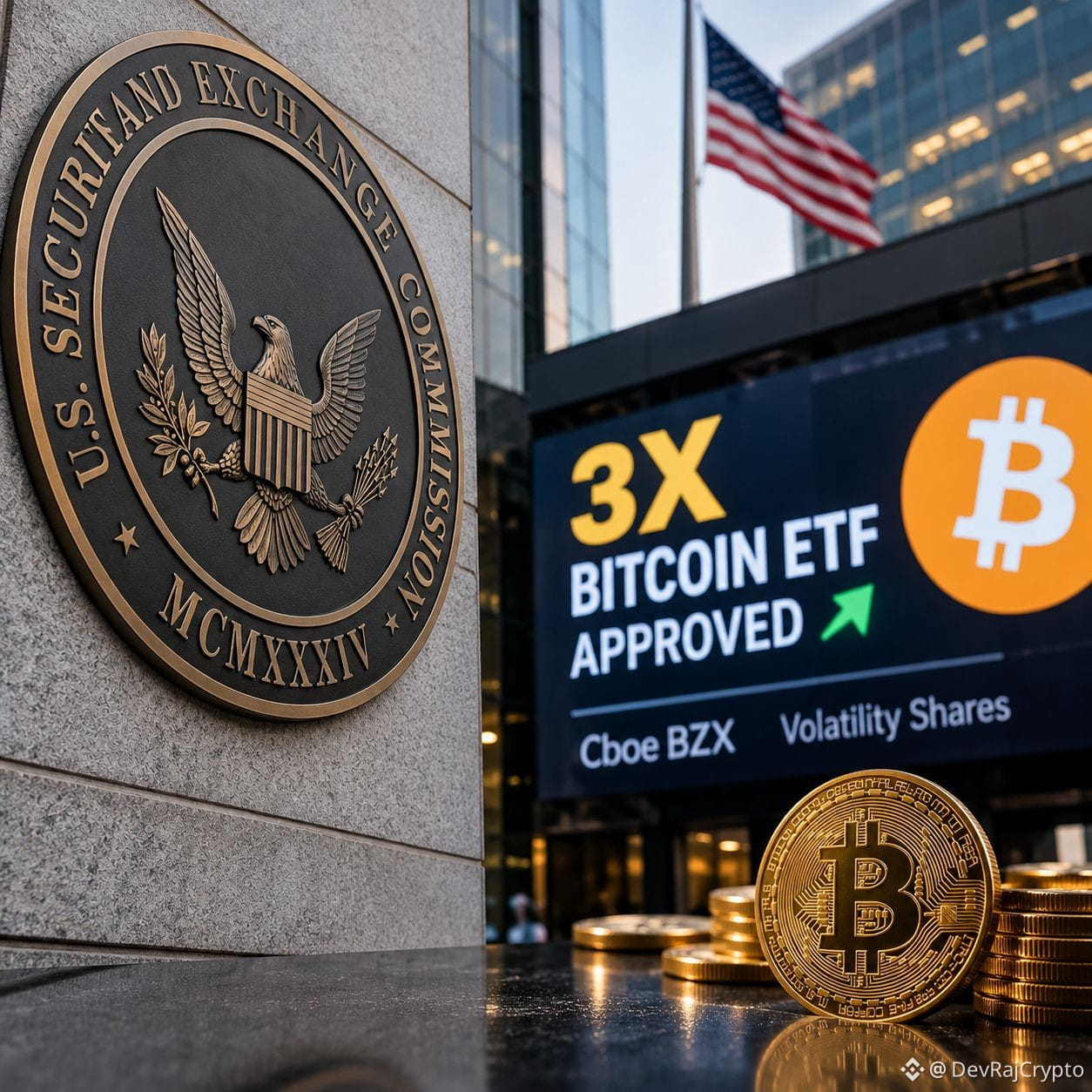
#secapproves3xbitcoinetf
Will a 3X Bitcoin ETF bring more buyers to BTC, or just more ways to get the trade wrong? 👀
I’ve watched crypto traders for years, and one pattern keeps repeating:
When leverage becomes easier, people usually focus on the upside first.
That’s why I’m less interested in the “3X” headline and more interested in what happens when BTC moves against crowded positions.
The SEC’s approval covers a product targeting 3X the DAILY performance of a Bitcoin futures benchmark. That distinction matters.
A few things I’d keep in mind:
• 3X daily ≠ 3X BTC returns over time
• Daily resets can hurt in a choppy market
• Futures exposure ≠ direct spot BTC buying
• Approval alone doesn’t prove new BTC demand
My biggest takeaway:
Crypto doesn’t need more leverage to create volatility.
It needs more traders who understand what they’re actually buying.
If BTC stays around $84K-$87K, I’ll be watching whether this new product creates real positioning or simply gives traders another instrument to express the same old bets.
Would you actually use 3X BTC exposure, or is spot BTC still the cleaner trade? 👇
$BTC #bitcoin #crypto #etf
#secapproves3xbitcoinetf
Will a 3X Bitcoin ETF bring more buyers to BTC, or just more ways to get the trade wrong? 👀
I’ve watched crypto traders for years, and one pattern keeps repeating:
When leverage becomes easier, people usually focus on the upside first.
That’s why I’m less interested in the “3X” headline and more interested in what happens when BTC moves against crowded positions.
The SEC’s approval covers a product targeting 3X the DAILY performance of a Bitcoin futures benchmark. That distinction matters.
A few things I’d keep in mind:
• 3X daily ≠ 3X BTC returns over time
• Daily resets can hurt in a choppy market
• Futures exposure ≠ direct spot BTC buying
• Approval alone doesn’t prove new BTC demand
My biggest takeaway:
Crypto doesn’t need more leverage to create volatility.
It needs more traders who understand what they’re actually buying.
If BTC stays around $84K-$87K, I’ll be watching whether this new product creates real positioning or simply gives traders another instrument to express the same old bets.
Would you actually use 3X BTC exposure, or is spot BTC still the cleaner trade? 👇
$BTC #bitcoin #crypto #etf
Will a 3X Bitcoin ETF bring more buyers to BTC, or just more ways to get the trade wrong? 👀
I’ve watched crypto traders for years, and one pattern keeps repeating:
When leverage becomes easier, people usually focus on the upside first.
That’s why I’m less interested in the “3X” headline and more interested in what happens when BTC moves against crowded positions.
The SEC’s approval covers a product targeting 3X the DAILY performance of a Bitcoin futures benchmark. That distinction matters.
A few things I’d keep in mind:
• 3X daily ≠ 3X BTC returns over time
• Daily resets can hurt in a choppy market
• Futures exposure ≠ direct spot BTC buying
• Approval alone doesn’t prove new BTC demand
My biggest takeaway:
Crypto doesn’t need more leverage to create volatility.
It needs more traders who understand what they’re actually buying.
If BTC stays around $84K-$87K, I’ll be watching whether this new product creates real positioning or simply gives traders another instrument to express the same old bets.
Would you actually use 3X BTC exposure, or is spot BTC still the cleaner trade? 👇
$BTC #bitcoin #crypto #etf
1
6.3k
·
--
#dubaivaraissuesreserveassetauditcircular
Could Dubai’s new crypto reserve rules make centralized platforms safer? 🇦🇪
Dubai’s VARA issued a Reserve Assets Audit Circular on October 6, and I think the interesting part is not the headline. It’s the level of verification behind the reserves.
VARA is reinforcing that VASPs must:
• Maintain 100% reserves against client liabilities
• Hold the same asset 1:1
• Reconcile reserves daily
• Get independent audits at least every 6 months
• Cover hot, warm, cold and third-party wallets
• Prevent client reserves from being improperly reused or rehypothecated
But here’s the part many headlines are missing:
This is not a new 100% reserve ratio. That requirement already existed.
The change is mainly about making proof of reserves more rigorous, consistent and independently verifiable.
My take?
This may not move BTC tomorrow.
But over time, crypto needs exactly this kind of infrastructure if institutions are going to trust centralized platforms with serious capital.
Less “trust us.”
More “prove it.”
Do you see stricter reserve audits as bullish for crypto adoption, or just another compliance burden? 👇
$BTC $ETH $BNB #Dubai #VARA #CryptoRegulation #BinanceSquare
Source: Dubai VARA, Circular: Reserve Assets Audit Report, October 6, 2026.
#dubaivaraissuesreserveassetauditcircular
Could Dubai’s new crypto reserve rules make centralized platforms safer? 🇦🇪
Dubai’s VARA issued a Reserve Assets Audit Circular on October 6, and I think the interesting part is not the headline. It’s the level of verification behind the reserves.
VARA is reinforcing that VASPs must:
• Maintain 100% reserves against client liabilities
• Hold the same asset 1:1
• Reconcile reserves daily
• Get independent audits at least every 6 months
• Cover hot, warm, cold and third-party wallets
• Prevent client reserves from being improperly reused or rehypothecated
But here’s the part many headlines are missing:
This is not a new 100% reserve ratio. That requirement already existed.
The change is mainly about making proof of reserves more rigorous, consistent and independently verifiable.
My take?
This may not move BTC tomorrow.
But over time, crypto needs exactly this kind of infrastructure if institutions are going to trust centralized platforms with serious capital.
Less “trust us.”
More “prove it.”
Do you see stricter reserve audits as bullish for crypto adoption, or just another compliance burden? 👇
$BTC $ETH $BNB #Dubai #VARA #CryptoRegulation #BinanceSquare
Source: Dubai VARA, Circular: Reserve Assets Audit Report, October 6, 2026.
Could Dubai’s new crypto reserve rules make centralized platforms safer? 🇦🇪
Dubai’s VARA issued a Reserve Assets Audit Circular on October 6, and I think the interesting part is not the headline. It’s the level of verification behind the reserves.
VARA is reinforcing that VASPs must:
• Maintain 100% reserves against client liabilities
• Hold the same asset 1:1
• Reconcile reserves daily
• Get independent audits at least every 6 months
• Cover hot, warm, cold and third-party wallets
• Prevent client reserves from being improperly reused or rehypothecated
But here’s the part many headlines are missing:
This is not a new 100% reserve ratio. That requirement already existed.
The change is mainly about making proof of reserves more rigorous, consistent and independently verifiable.
My take?
This may not move BTC tomorrow.
But over time, crypto needs exactly this kind of infrastructure if institutions are going to trust centralized platforms with serious capital.
Less “trust us.”
More “prove it.”
Do you see stricter reserve audits as bullish for crypto adoption, or just another compliance burden? 👇
$BTC $ETH $BNB #Dubai #VARA #CryptoRegulation #BinanceSquare
Source: Dubai VARA, Circular: Reserve Assets Audit Report, October 6, 2026.

4
4.2k
·
--
#BTCFallsBelow$84K
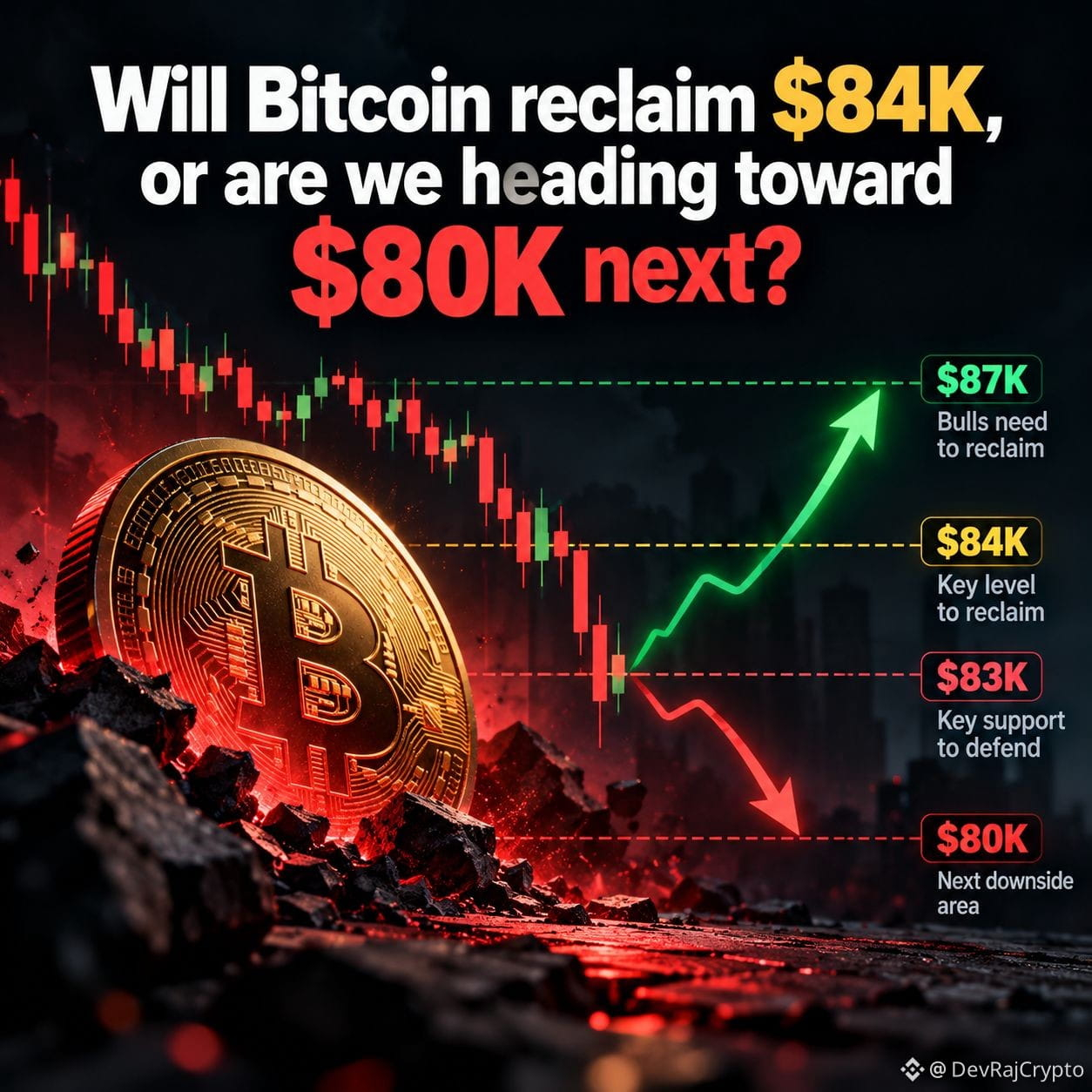
Will Bitcoin reclaim $84K, or are we heading toward $80K next? 👀
BTC just broke below $84K, with more than $400M in leveraged longs reportedly liquidated during the move.
For me, the liquidation is not the biggest signal. The reaction is.
• $84K: reclaim it and bulls get some breathing room
• $83K: key area to defend
• $80K: next zone if $83K fails
• $87K: reclaiming this would change the short-term picture
After years of watching crypto, I’ve learned not to call every sharp drop a trend reversal. Sometimes leverage gets flushed and the market simply resets.
My view: I wouldn’t be surprised if BTC first reclaims $84K and squeezes some late shorts. But if $83K breaks decisively, $80K could come much faster than people expect.
So what do you think?
$84K reclaim or $80K next? 👇
#bitcoin #crypto $BTC
{spot}(BTCUSDT)
#BTCFallsBelow$84K
Will Bitcoin reclaim $84K, or are we heading toward $80K next? 👀
BTC just broke below $84K, with more than $400M in leveraged longs reportedly liquidated during the move.
For me, the liquidation is not the biggest signal. The reaction is.
• $84K: reclaim it and bulls get some breathing room
• $83K: key area to defend
• $80K: next zone if $83K fails
• $87K: reclaiming this would change the short-term picture
After years of watching crypto, I’ve learned not to call every sharp drop a trend reversal. Sometimes leverage gets flushed and the market simply resets.
My view: I wouldn’t be surprised if BTC first reclaims $84K and squeezes some late shorts. But if $83K breaks decisively, $80K could come much faster than people expect.
So what do you think?
$84K reclaim or $80K next? 👇
#bitcoin #crypto $BTC
Will Bitcoin reclaim $84K, or are we heading toward $80K next? 👀
BTC just broke below $84K, with more than $400M in leveraged longs reportedly liquidated during the move.
For me, the liquidation is not the biggest signal. The reaction is.
• $84K: reclaim it and bulls get some breathing room
• $83K: key area to defend
• $80K: next zone if $83K fails
• $87K: reclaiming this would change the short-term picture
After years of watching crypto, I’ve learned not to call every sharp drop a trend reversal. Sometimes leverage gets flushed and the market simply resets.
My view: I wouldn’t be surprised if BTC first reclaims $84K and squeezes some late shorts. But if $83K breaks decisively, $80K could come much faster than people expect.
So what do you think?
$84K reclaim or $80K next? 👇
#bitcoin #crypto $BTC
1
184
·
--
Verified
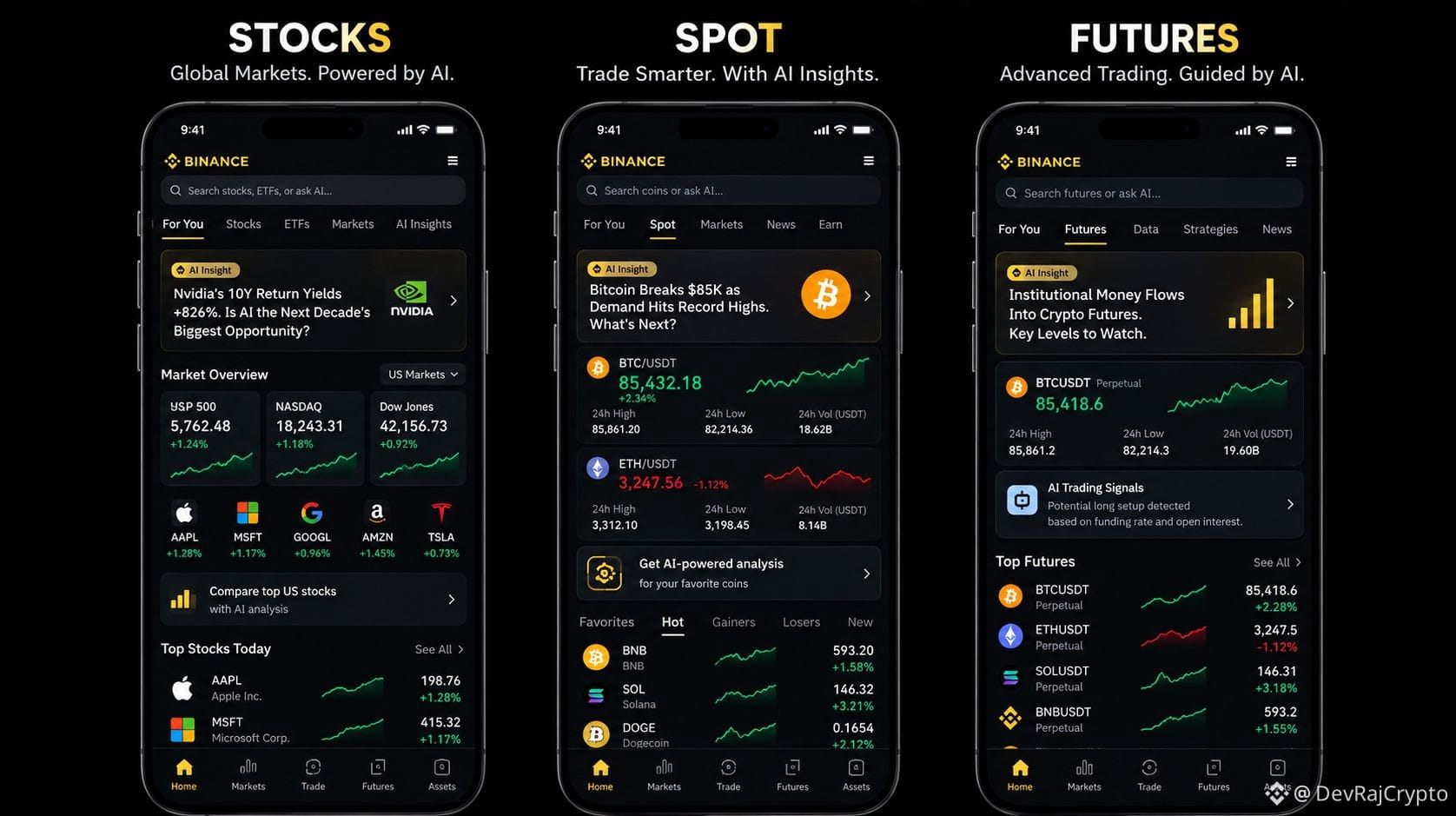
Binance is making a bet that could change how people trade crypto.
I’ve watched traders spend hours moving between charts, news, funding rates and on-chain data just to answer one question: “What should I do next?” Now Binance is trying to compress that whole process into AI.
Binance AI can personalize market information, AI Pro is moving toward natural-language strategy building, and Agent OS takes it further by connecting AI agents with Binance infrastructure.
But here’s my take:
The next trading advantage may not be who knows the most indicators.
It may be who knows how to:
• Ask better questions
• Give AI better context
• Set better risk limits
That sounds powerful, but it also worries me a little.
If AI makes execution easier, it can remove friction from good decisions. It can also remove friction from bad ones.
And that’s the part I’ll be watching.
Will AI actually make people better traders?
Or will it simply make average traders faster at making mistakes?
What’s your view? 👇
$BNB $BTC $ETH #BİNANCE #AI
#BinanceLaunchesBinanceIntelligence
Binance is making a bet that could change how people trade crypto.
I’ve watched traders spend hours moving between charts, news, funding rates and on-chain data just to answer one question: “What should I do next?” Now Binance is trying to compress that whole process into AI.
Binance AI can personalize market information, AI Pro is moving toward natural-language strategy building, and Agent OS takes it further by connecting AI agents with Binance infrastructure.
But here’s my take:
The next trading advantage may not be who knows the most indicators.
It may be who knows how to:
• Ask better questions
• Give AI better context
• Set better risk limits
That sounds powerful, but it also worries me a little.
If AI makes execution easier, it can remove friction from good decisions. It can also remove friction from bad ones.
And that’s the part I’ll be watching.
Will AI actually make people better traders?
Or will it simply make average traders faster at making mistakes?
What’s your view? 👇
$BNB $BTC $ETH #BİNANCE #AI
#BinanceLaunchesBinanceIntelligence
I’ve watched traders spend hours moving between charts, news, funding rates and on-chain data just to answer one question: “What should I do next?” Now Binance is trying to compress that whole process into AI.
Binance AI can personalize market information, AI Pro is moving toward natural-language strategy building, and Agent OS takes it further by connecting AI agents with Binance infrastructure.
But here’s my take:
The next trading advantage may not be who knows the most indicators.
It may be who knows how to:
• Ask better questions
• Give AI better context
• Set better risk limits
That sounds powerful, but it also worries me a little.
If AI makes execution easier, it can remove friction from good decisions. It can also remove friction from bad ones.
And that’s the part I’ll be watching.
Will AI actually make people better traders?
Or will it simply make average traders faster at making mistakes?
What’s your view? 👇
$BNB $BTC $ETH #BİNANCE #AI
#BinanceLaunchesBinanceIntelligence
4
805
·
--
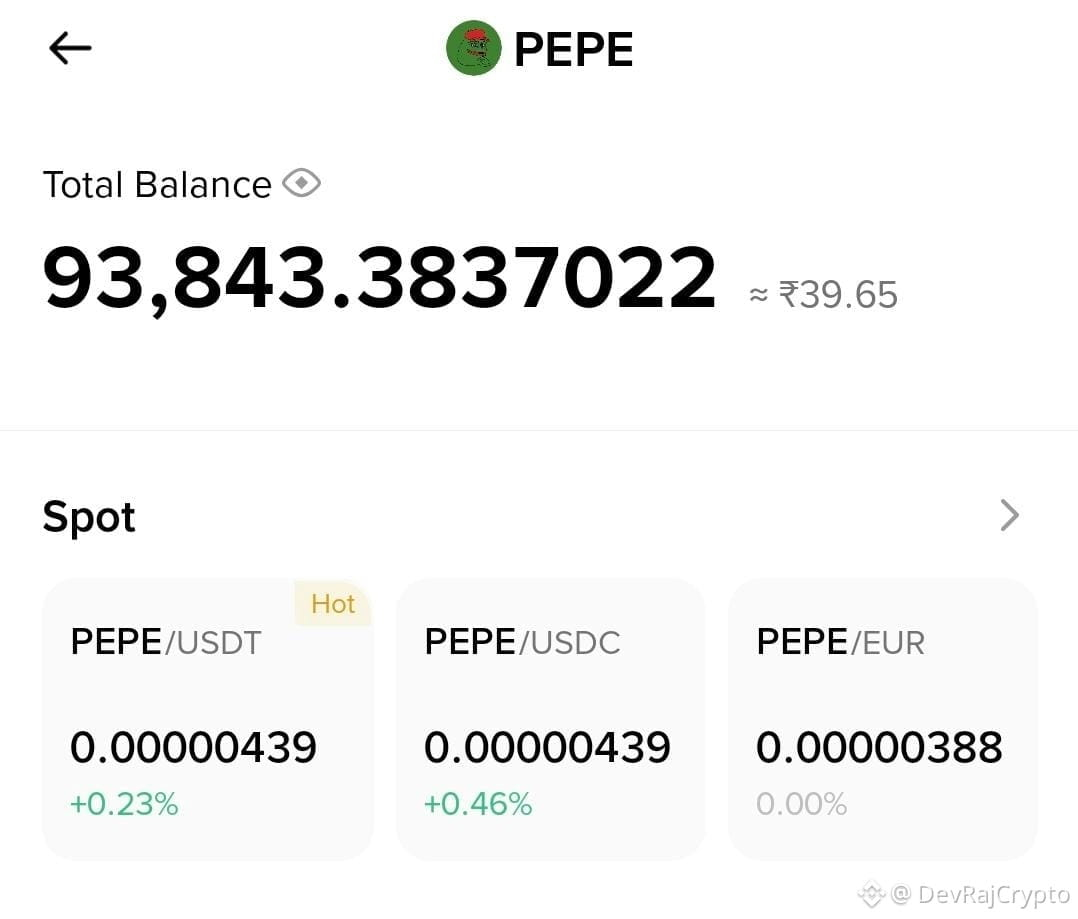
I have 93,843 PEPE sitting in my wallet.
Right now, they’re worth only about ₹39.65. 😂
But one question keeps coming to my mind:
What if this tiny bag looks very different 5 years from now?
I’m not saying PEPE will become the next Bitcoin. That would be a huge assumption.
But I’m curious to see how far a meme coin can actually go when community, liquidity and narrative all come together.
PEPE is currently around $0.00000436, after moving from roughly $0.00000320 to $0.00000500 before cooling down.
For now, I’m keeping this as a small experiment.
Maybe ₹40 stays ₹40.
Or maybe one day I’ll look back and laugh at how small this bag was. 😂
So let me ask you:
Could PEPE ever reach anything close to Bitcoin’s valuation?
Or is that simply unrealistic?
What do you think 93,843 PEPE could be worth in 5 years?
$PEPE $BTC #pepe #bitcoin #crypto
I have 93,843 PEPE sitting in my wallet.
Right now, they’re worth only about ₹39.65. 😂
But one question keeps coming to my mind:
What if this tiny bag looks very different 5 years from now?
I’m not saying PEPE will become the next Bitcoin. That would be a huge assumption.
But I’m curious to see how far a meme coin can actually go when community, liquidity and narrative all come together.
PEPE is currently around $0.00000436, after moving from roughly $0.00000320 to $0.00000500 before cooling down.
For now, I’m keeping this as a small experiment.
Maybe ₹40 stays ₹40.
Or maybe one day I’ll look back and laugh at how small this bag was. 😂
So let me ask you:
Could PEPE ever reach anything close to Bitcoin’s valuation?
Or is that simply unrealistic?
What do you think 93,843 PEPE could be worth in 5 years?
$PEPE $BTC #pepe #bitcoin #crypto
Right now, they’re worth only about ₹39.65. 😂
But one question keeps coming to my mind:
What if this tiny bag looks very different 5 years from now?
I’m not saying PEPE will become the next Bitcoin. That would be a huge assumption.
But I’m curious to see how far a meme coin can actually go when community, liquidity and narrative all come together.
PEPE is currently around $0.00000436, after moving from roughly $0.00000320 to $0.00000500 before cooling down.
For now, I’m keeping this as a small experiment.
Maybe ₹40 stays ₹40.
Or maybe one day I’ll look back and laugh at how small this bag was. 😂
So let me ask you:
Could PEPE ever reach anything close to Bitcoin’s valuation?
Or is that simply unrealistic?
What do you think 93,843 PEPE could be worth in 5 years?
$PEPE $BTC #pepe #bitcoin #crypto
5
1
4
3.4k
·
--
🚨 $1.946B from the Fed today. But is this actually “money printing”?
I’d be careful with that headline.
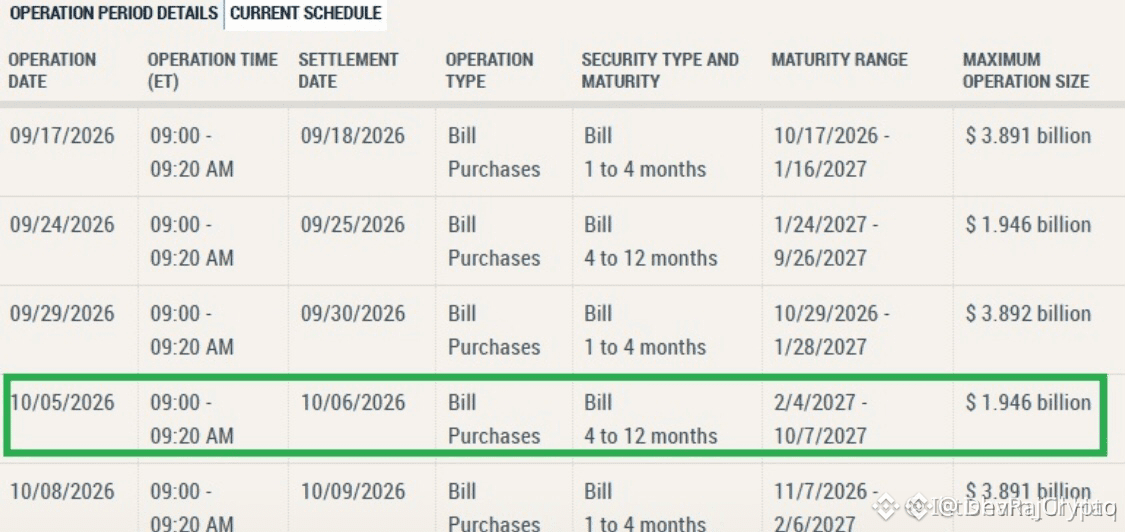
The New York Fed’s schedule shows a $1.946B Treasury bill purchase today, with settlement on Oct. 6.
But this isn’t the same thing as QE.
These purchases are part of the Fed’s reserve-management operations, designed to keep bank reserves ample and maintain control of short-term rates.
Still, I’m watching the liquidity angle closely.
Because in crypto, liquidity matters.
The interesting question isn’t simply “Did the Fed inject $1.946B?”
It’s:
Does this become part of a broader liquidity trend, or is it just routine reserve management?
That difference matters for BTC.
$BTC #bitcoin #Fed #crypto
🚨 $1.946B from the Fed today. But is this actually “money printing”?
I’d be careful with that headline.
The New York Fed’s schedule shows a $1.946B Treasury bill purchase today, with settlement on Oct. 6.
But this isn’t the same thing as QE.
These purchases are part of the Fed’s reserve-management operations, designed to keep bank reserves ample and maintain control of short-term rates.
Still, I’m watching the liquidity angle closely.
Because in crypto, liquidity matters.
The interesting question isn’t simply “Did the Fed inject $1.946B?”
It’s:
Does this become part of a broader liquidity trend, or is it just routine reserve management?
That difference matters for BTC.
$BTC #bitcoin #Fed #crypto
I’d be careful with that headline.
The New York Fed’s schedule shows a $1.946B Treasury bill purchase today, with settlement on Oct. 6.
But this isn’t the same thing as QE.
These purchases are part of the Fed’s reserve-management operations, designed to keep bank reserves ample and maintain control of short-term rates.
Still, I’m watching the liquidity angle closely.
Because in crypto, liquidity matters.
The interesting question isn’t simply “Did the Fed inject $1.946B?”
It’s:
Does this become part of a broader liquidity trend, or is it just routine reserve management?
That difference matters for BTC.
$BTC #bitcoin #Fed #crypto
2
2
170
·
--
$DASH is showing me something I’ve learned the hard way in crypto: a strong move doesn’t automatically mean the next move is up.
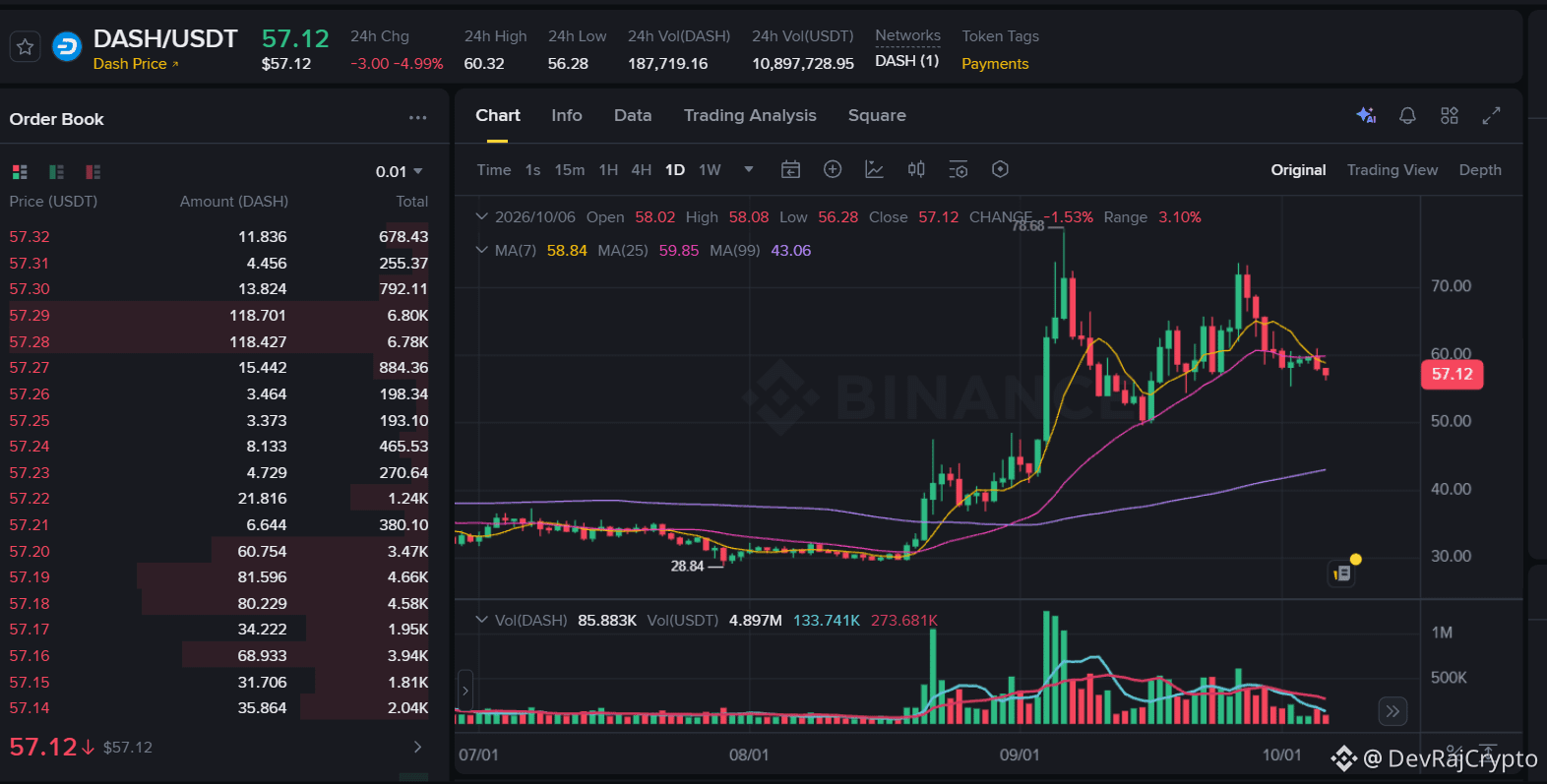
DASH went from around $29 to above $70, but now it’s back near $57.
What catches my attention is what happened after the pump.
Price tried to reclaim $60, failed, and is now sitting below both the 7D MA (~$58.84) and 25D MA (~$59.85).
For me, $60 is the level that matters now.
If buyers reclaim and hold it, the recent weakness could simply be a reset.
If $60 keeps rejecting, I’d rather wait than chase a coin just because it already had a big move.
One thing crypto has taught me: after a big pump, protecting your entry matters more than predicting the top.
Would you buy DASH around $57, or wait for $60 to be reclaimed? 👇
$DASH
{spot}(DASHUSDT)
$DASH is showing me something I’ve learned the hard way in crypto: a strong move doesn’t automatically mean the next move is up.
DASH went from around $29 to above $70, but now it’s back near $57.
What catches my attention is what happened after the pump.
Price tried to reclaim $60, failed, and is now sitting below both the 7D MA (~$58.84) and 25D MA (~$59.85).
For me, $60 is the level that matters now.
If buyers reclaim and hold it, the recent weakness could simply be a reset.
If $60 keeps rejecting, I’d rather wait than chase a coin just because it already had a big move.
One thing crypto has taught me: after a big pump, protecting your entry matters more than predicting the top.
Would you buy DASH around $57, or wait for $60 to be reclaimed? 👇
$DASH
DASH went from around $29 to above $70, but now it’s back near $57.
What catches my attention is what happened after the pump.
Price tried to reclaim $60, failed, and is now sitting below both the 7D MA (~$58.84) and 25D MA (~$59.85).
For me, $60 is the level that matters now.
If buyers reclaim and hold it, the recent weakness could simply be a reset.
If $60 keeps rejecting, I’d rather wait than chase a coin just because it already had a big move.
One thing crypto has taught me: after a big pump, protecting your entry matters more than predicting the top.
Would you buy DASH around $57, or wait for $60 to be reclaimed? 👇
$DASH
1
3
1.4k
·
--
Verified
#StriveBuys2000BTCFor$169M
Why would Strive spend another $169M on $BTC at $84.4K? 👀
Strive bought 2,000 BTC between Sept. 28 and Oct. 2 at an average of ~$84,422, taking its treasury to 29,462 BTC.
After watching crypto for years, this is what catches my attention:
When most traders are waiting for confirmation, some companies are already making their bet.
Strive is clearly still comfortable accumulating BTC around these levels.
But I wouldn’t call it automatically bullish.
The bigger question is whether Strive can keep growing its BTC exposure without the financing and dilution becoming too expensive for common shareholders.
And now I’m watching one level closely:
~$84.4K.
That’s roughly where Strive bought.
If BTC revisits that area, we’ll get a much better test of the decision.
Did Strive buy the dip?
Or did it simply buy before another market test?
What do you think? 👇
$ASST.US $BTC
{spot}(BTCUSDT)
{stock_us}(ASST.US)
#bitcoin #StriveToWin #crypto
#StriveBuys2000BTCFor$169M
Why would Strive spend another $169M on $BTC at $84.4K? 👀
Strive bought 2,000 BTC between Sept. 28 and Oct. 2 at an average of ~$84,422, taking its treasury to 29,462 BTC.
After watching crypto for years, this is what catches my attention:
When most traders are waiting for confirmation, some companies are already making their bet.
Strive is clearly still comfortable accumulating BTC around these levels.
But I wouldn’t call it automatically bullish.
The bigger question is whether Strive can keep growing its BTC exposure without the financing and dilution becoming too expensive for common shareholders.
And now I’m watching one level closely:
~$84.4K.
That’s roughly where Strive bought.
If BTC revisits that area, we’ll get a much better test of the decision.
Did Strive buy the dip?
Or did it simply buy before another market test?
What do you think? 👇
$ASST.US $BTC
#bitcoin #StriveToWin #crypto
Why would Strive spend another $169M on $BTC at $84.4K? 👀
Strive bought 2,000 BTC between Sept. 28 and Oct. 2 at an average of ~$84,422, taking its treasury to 29,462 BTC.
After watching crypto for years, this is what catches my attention:
When most traders are waiting for confirmation, some companies are already making their bet.
Strive is clearly still comfortable accumulating BTC around these levels.
But I wouldn’t call it automatically bullish.
The bigger question is whether Strive can keep growing its BTC exposure without the financing and dilution becoming too expensive for common shareholders.
And now I’m watching one level closely:
~$84.4K.
That’s roughly where Strive bought.
If BTC revisits that area, we’ll get a much better test of the decision.
Did Strive buy the dip?
Or did it simply buy before another market test?
What do you think? 👇
$ASST.US $BTC
#bitcoin #StriveToWin #crypto

BTC-1.34%
ASSTUS-0.30%
2
3
879
·
--
Verified
#evernorthxrptreasurycompletesspacmerger
The headline is bullish. But the part I find more interesting is what it doesn’t mean.
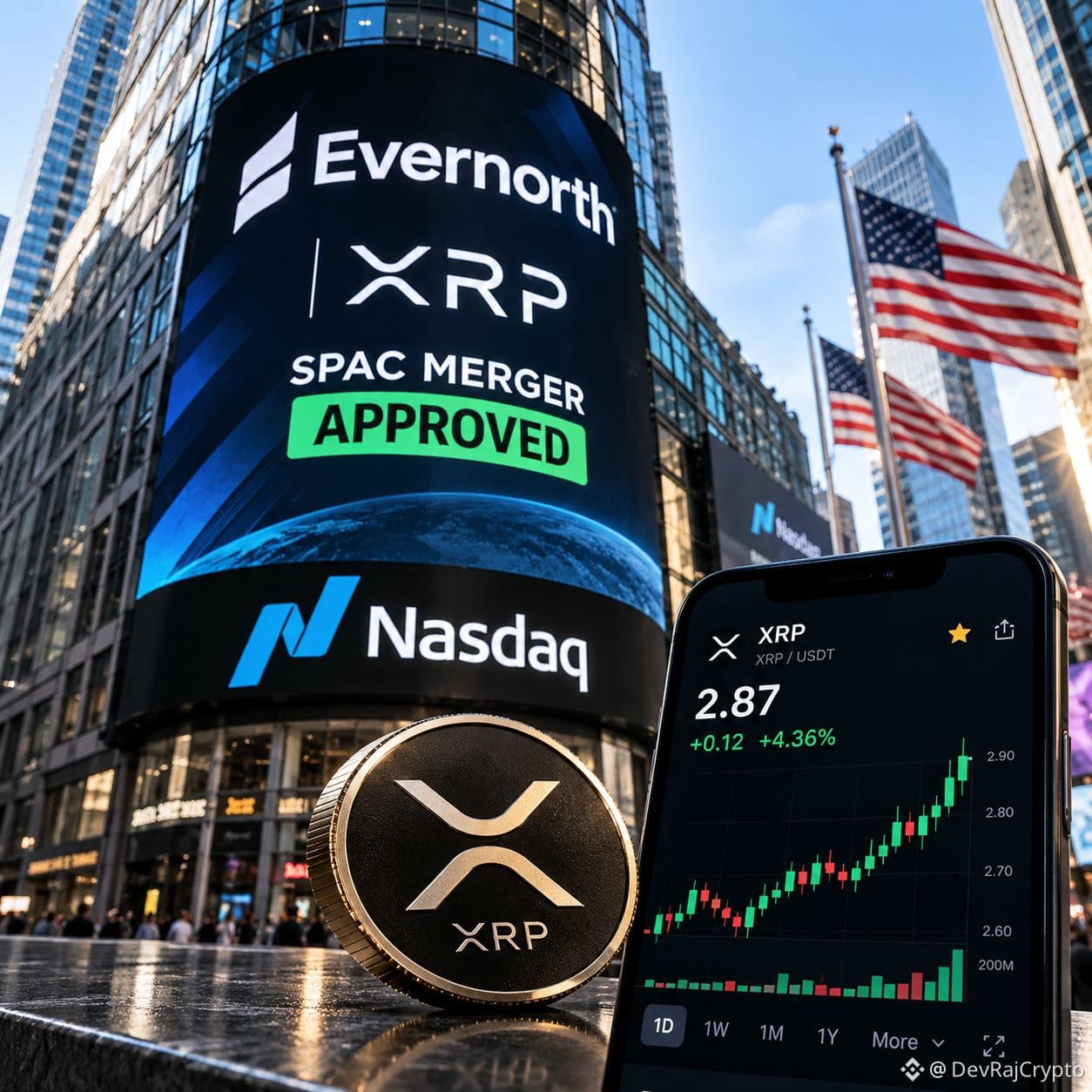
Evernorth shareholders approved the SPAC merger with Armada Acquisition Corp. II. Closing is expected October 7, with Nasdaq trading under XRPN expected October 8. If completed, Evernorth expects roughly 473M XRP and about $300M in gross cash proceeds.
I’ve learned not to trade the headline before understanding the mechanism.
473M XRP sounds like massive new buying, but it doesn’t automatically mean 473M XRP is being purchased from the open market. A significant portion is expected through in-kind contributions and previously arranged funding.
So I’m watching what happens after XRPN starts trading:
• Does XRPN attract sustained capital?
• Does Evernorth raise more money and buy additional XRP?
• Does XRPN trade at a premium or discount to its XRP holdings?
The listing could give traditional investors another route to XRP exposure.
But I’m not calling it an automatic XRP pump.
The headline creates the setup.
Post-listing capital flows will tell us whether the thesis is real.
XRP has the headline. Now I want to see the money.
Would XRPN create fresh demand for XRP, or is the bullish narrative already priced in? 👇
$XRP $XRPN.US
{stock_us}(XRPN.US)
#xrp #Evernorth #Crypto #BinanceSquare
#evernorthxrptreasurycompletesspacmerger
The headline is bullish. But the part I find more interesting is what it doesn’t mean.
Evernorth shareholders approved the SPAC merger with Armada Acquisition Corp. II. Closing is expected October 7, with Nasdaq trading under XRPN expected October 8. If completed, Evernorth expects roughly 473M XRP and about $300M in gross cash proceeds.
I’ve learned not to trade the headline before understanding the mechanism.
473M XRP sounds like massive new buying, but it doesn’t automatically mean 473M XRP is being purchased from the open market. A significant portion is expected through in-kind contributions and previously arranged funding.
So I’m watching what happens after XRPN starts trading:
• Does XRPN attract sustained capital?
• Does Evernorth raise more money and buy additional XRP?
• Does XRPN trade at a premium or discount to its XRP holdings?
The listing could give traditional investors another route to XRP exposure.
But I’m not calling it an automatic XRP pump.
The headline creates the setup.
Post-listing capital flows will tell us whether the thesis is real.
XRP has the headline. Now I want to see the money.
Would XRPN create fresh demand for XRP, or is the bullish narrative already priced in? 👇
$XRP $XRPN.US
#xrp #Evernorth #Crypto #BinanceSquare
The headline is bullish. But the part I find more interesting is what it doesn’t mean.
Evernorth shareholders approved the SPAC merger with Armada Acquisition Corp. II. Closing is expected October 7, with Nasdaq trading under XRPN expected October 8. If completed, Evernorth expects roughly 473M XRP and about $300M in gross cash proceeds.
I’ve learned not to trade the headline before understanding the mechanism.
473M XRP sounds like massive new buying, but it doesn’t automatically mean 473M XRP is being purchased from the open market. A significant portion is expected through in-kind contributions and previously arranged funding.
So I’m watching what happens after XRPN starts trading:
• Does XRPN attract sustained capital?
• Does Evernorth raise more money and buy additional XRP?
• Does XRPN trade at a premium or discount to its XRP holdings?
The listing could give traditional investors another route to XRP exposure.
But I’m not calling it an automatic XRP pump.
The headline creates the setup.
Post-listing capital flows will tell us whether the thesis is real.
XRP has the headline. Now I want to see the money.
Would XRPN create fresh demand for XRP, or is the bullish narrative already priced in? 👇
$XRP $XRPN.US
#xrp #Evernorth #Crypto #BinanceSquare
XRP-4.07%
XRPNUS+9.82%
3
1k
·
--
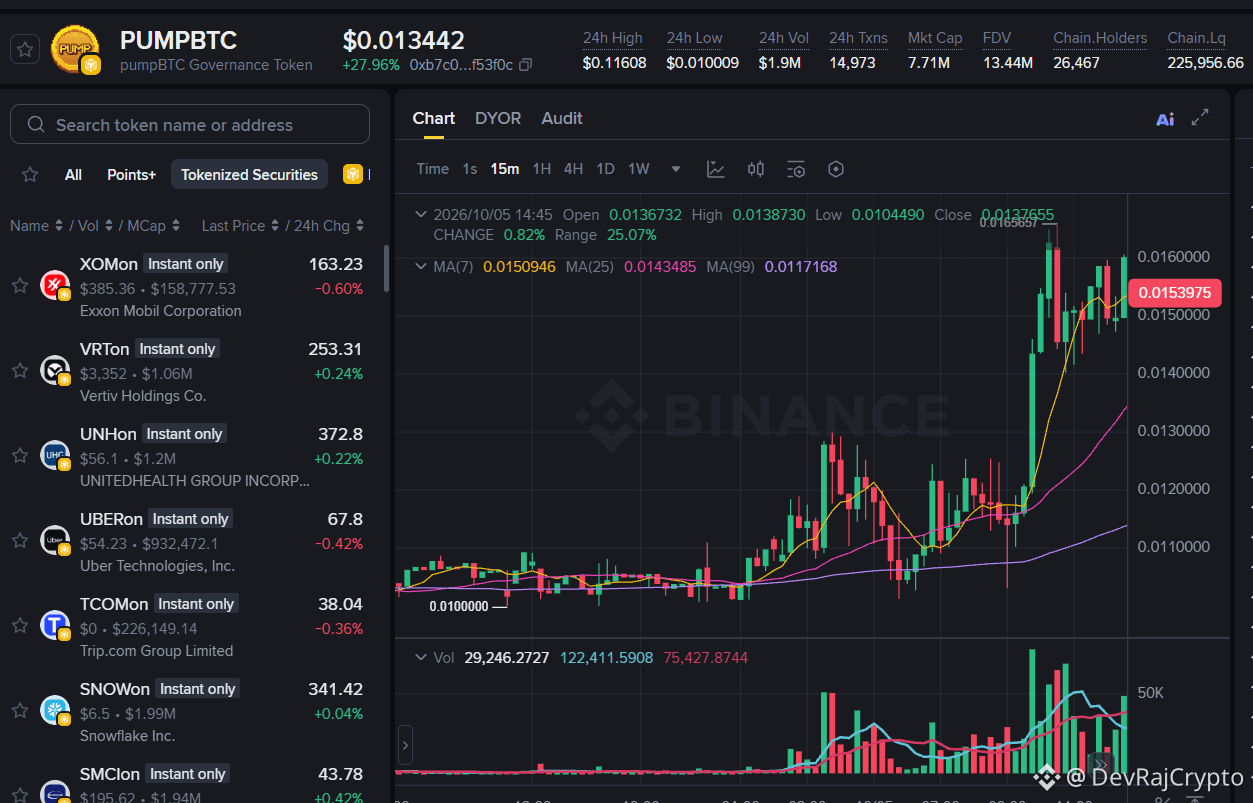
$PUMPBTC is exactly where I’d start looking for a short setup. 🚨
The interesting part isn’t that it pumped. It’s how fast the market repriced it.
From roughly $0.010 to ~$0.0165, price moved vertically and volume expanded sharply. After that kind of move, I’m less interested in predicting the top and more interested in finding the first sign that late buyers are trapped.
My short thesis:
• $0.016–$0.0165: rejection zone
• $0.015: first confirmation level
• $0.0135: potential downside target
• Above the recent high: short thesis weakens
My prediction: if $0.015 breaks after another rejection near the highs, I expect the unwind to be much faster than the move up.
That’s the asymmetric setup I’m watching.
But I wouldn’t blindly short a vertical chart. Let the market prove that buyers are trapped first.
🔥 Would you short the rejection, or wait for $0.015 to break?
#pumpbtc #crypto #BinanceSquare $PUMPBTC
{alpha}(560xb7c0007ab75350c582d5eab1862b872b5cf53f0c)
$PUMPBTC is exactly where I’d start looking for a short setup. 🚨
The interesting part isn’t that it pumped. It’s how fast the market repriced it.
From roughly $0.010 to ~$0.0165, price moved vertically and volume expanded sharply. After that kind of move, I’m less interested in predicting the top and more interested in finding the first sign that late buyers are trapped.
My short thesis:
• $0.016–$0.0165: rejection zone
• $0.015: first confirmation level
• $0.0135: potential downside target
• Above the recent high: short thesis weakens
My prediction: if $0.015 breaks after another rejection near the highs, I expect the unwind to be much faster than the move up.
That’s the asymmetric setup I’m watching.
But I wouldn’t blindly short a vertical chart. Let the market prove that buyers are trapped first.
🔥 Would you short the rejection, or wait for $0.015 to break?
#pumpbtc #crypto #BinanceSquare $PUMPBTC
The interesting part isn’t that it pumped. It’s how fast the market repriced it.
From roughly $0.010 to ~$0.0165, price moved vertically and volume expanded sharply. After that kind of move, I’m less interested in predicting the top and more interested in finding the first sign that late buyers are trapped.
My short thesis:
• $0.016–$0.0165: rejection zone
• $0.015: first confirmation level
• $0.0135: potential downside target
• Above the recent high: short thesis weakens
My prediction: if $0.015 breaks after another rejection near the highs, I expect the unwind to be much faster than the move up.
That’s the asymmetric setup I’m watching.
But I wouldn’t blindly short a vertical chart. Let the market prove that buyers are trapped first.
🔥 Would you short the rejection, or wait for $0.015 to break?
#pumpbtc #crypto #BinanceSquare $PUMPBTC
2
3
517
Log in to explore more content
Join global crypto users on Binance Square
⚡️ Get latest and useful information about crypto.
💬 Trusted by the world’s largest crypto exchange.
👍 Discover real insights from verified creators.
Email / Phone number
Trending Topics
FedMinutesFocusOnOctoberPause
369,179 views
2,286 Discussing
🚨 THE FED JUST DROPPED A HUGE HINT — OCTOBER PAUSE INCOMING?
Wall Street is betting the Fed will HIT THE BRAKES in October. And crypto traders are watching closely. 👀
The latest FOMC minutes have shifted attention toward a potential pause at the October 27–28 meeting.
📊 The market setup:
🔥 October rate hold: approximately 82.8% in the latest previously reported pricing.
🔥 Rate hike probability: approximately 17.2%.
🔥 Weakening labor-market data is making an immediate hike harder to justify.
But here's the twist.
A PAUSE IS NOT A RATE CUT.
The Fed could hold in October while keeping the door open for additional tightening later.
For $BTC, $ ETH and $XAU, that distinction matters.
A pause could ease immediate pressure on risk assets. But persistent inflation and elevated Treasury yields could still crush bullish momentum.
⚠️ THE BIG QUESTION:
Is Wall Street positioning for a crypto breakout — or setting up another massive bull trap before the next Fed decision?
$BTC $ETH $BNB $SOL $XAU
#fedminutesfocusonoctoberpause #BinanceLaunchesBinanceIntelligence #EvernorthDelaysNasdaqDebutToOct12 #RobinhoodAdds$25MInBitcoinToBalanceSheet #SP500AndNasdaqHitRecordHighs
KimHotbae
·27 Likes
·32.4k views
VitalikWarnsAICouldWeakenCryptographySecurity
777 views
83 Discussing
XRPSpotETFsHold$1.7BWeeklyInflowsSlow
267 views
19 Discussing