News


·
--
BNB Drops Below 770 USDT with a 0.24% Decrease in 24 HoursOn Sep 28, 2026, 03:29 AM(UTC). According to Binance Market Data, BNB has dropped below 770 USDT and is now trading at 769.900024 USDT, with a narrowed 0.24% decrease in 24 hours.
BNB Drops Below 770 USDT with a 0.24% Decrease in 24 Hours
On Sep 28, 2026, 03:29 AM(UTC). According to Binance Market Data, BNB has dropped below 770 USDT and is now trading at 769.900024 USDT, with a narrowed 0.24% decrease in 24 hours.
17
24
28
28
·
--
Strategy Adds 1,666 Bitcoin, Holdings Reach 847,666Strategy increased its Bitcoin holdings by 1,666 last week, bringing its total to 847,666. According to Foresight News, the purchase was reported by unfolded.
Strategy Adds 1,666 Bitcoin, Holdings Reach 847,666
Strategy increased its Bitcoin holdings by 1,666 last week, bringing its total to 847,666. According to Foresight News, the purchase was reported by unfolded.
11
14
45
45
·
--
Article
Micron Heads Into Fiscal Q4 Earnings With the Bar—and the Stock—Already HighMicron Technology (Nasdaq: MU) $MUB reports fiscal fourth-quarter results after the market close on Sept. 30, closing out a fiscal year in which the stock has surged. The question for investors is no longer whether the memory maker can beat estimates. It is whether the results, and especially the guidance, can justify a valuation that has run well ahead of the sector.
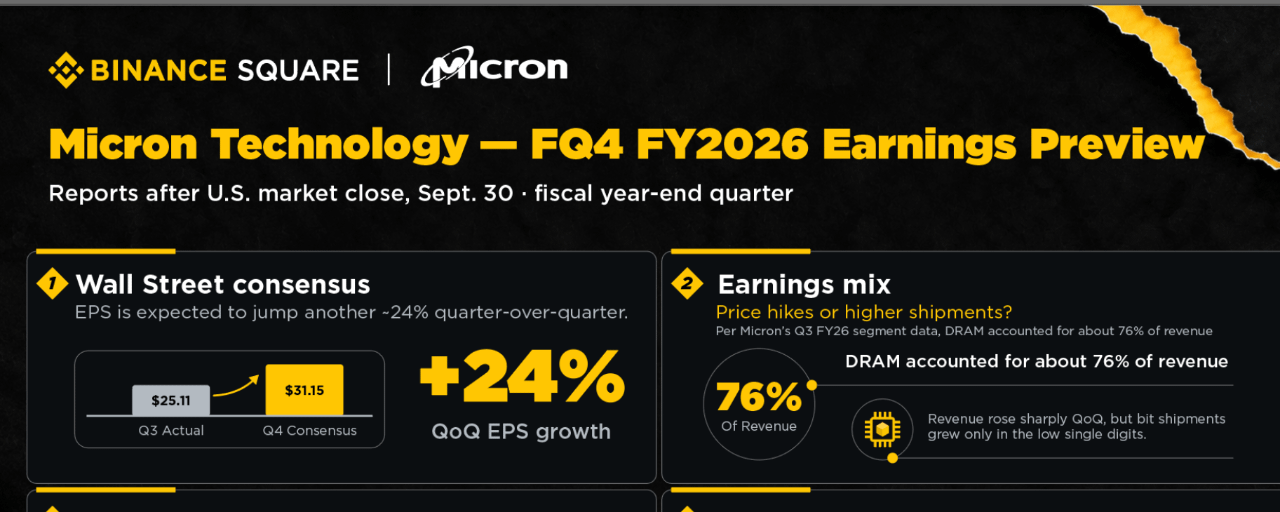
For the August quarter, Micron guided to revenue of 1 billion; non-GAAP earnings of 1; GAAP diluted earnings of 1; and gross margin of roughly 86%. Wall Street sits at or slightly above the midpoint of that range. According to TipRanks, the sell-side consensus calls for revenue of about 50.6 billion and adjusted earnings near 31.16. A quarter ago, in fiscal Q3, Micron earned $25.11 a share as revenue jumped about 346% from a year earlier. Hitting consensus would mean another roughly 24% sequential jump in earnings—a steep step-up for any chipmaker.
The earnings are coming from price, not volume
Most analysts trace this quarter's profit swing to tight supply and rising prices in high-bandwidth memory and AI-related DRAM, rather than to a surge in units shipped.
The mix in fiscal Q3 makes the point. DRAM accounted for about 76% of revenue, and while that revenue climbed sharply from the prior quarter, bit shipments rose only in the low single digits. The gains came from higher average selling prices; incremental volume contributed little.
What separates this cycle from earlier ones is the role of long-term supply agreements. On its earnings call, management said demand from some key customers now runs about 50% above the volume Micron can commit to supply. As of last quarter the company had signed 16 strategic customer agreements covering roughly 20% of its DRAM bits and about 30% of its NAND bits, tied to some 22 billion in customer cash deposits and commitments.
Analysts lean bullish, but price targets are all over the map
TipRanks data as of Sept. 24 shows 29 analysts rating the stock over the prior three months, with a consensus of Strong Buy—28 buys, one hold and no sells. The average price target is about 2,200 and a low of $1,100. That spread reflects a real disagreement about where the cycle stands.
Stifel rates Micron a buy with a $1,500 target and expects both the Q4 results and the guidance to top consensus, though it sees the upside as more measured than in recent quarters, given supply agreements with banded pricing and near-term limits on bit shipments. The firm also expects HBM4 pricing per bit to roughly double, with 2027 negotiations near a close.
TD Cowen analyst Krish Sankar carries a buy rating and a $1,600 target, and frames the case as a re-rating rather than an earnings story: Micron is about 80% of the way through an 18-month stretch of margin expansion, but growing confidence in the cycle's durability could still push the multiple higher.
Citi is bullish as well, arguing that AI demand can keep the memory market undersupplied through 2031.
Melius Research analyst Ben Reitzes holds the Street's highest target at $2,200, citing years of sold-out HBM capacity and the revenue visibility that comes with locked-in long-term contracts.
The cautious camp worries about normalization and valuation
The counterargument, from several named institutions and investors, centers less on any collapse in AI demand than on high margins reverting to normal and a stock that has already priced in a lot.
Goldman Sachs analyst James Schneider is the most cautious of the three major banks, with a neutral rating and a 62 in earnings. Even so, Goldman's own forecast for the quarter sits a few percent above consensus—32.54—and it looks for low-double-digit sequential revenue growth in fiscal Q1, flagging long-run capacity additions from Chinese producers as the main risk. In other words, Goldman's neutral stance rests on valuation, not on any doubt about the fundamentals.
Morningstar analyst William Kerwin rates the shares two stars, calls the business no-moat and assigns it "Very High" uncertainty. After the June quarter he raised his fair value to 455, yet still views the stock as expensive. His bearishness comes down to cyclicality: Kerwin sees memory as a fundamentally cyclical business and expects a wave of new capacity in 2028 and 2029 to create oversupply and pull prices down. Long-term agreements soften the blow, in his view, but do not prevent the downturn, since the revenue genuinely locked in by customer contracts covers only a fraction of the total.
Michael Burry, the "Big Short" investor and founder of Scion Asset Management, has added to bearish bets against Micron. According to Yahoo Finance, he is short the shares along with the iShares Semiconductor ETF. His fundamental case leans on industry signals: he has cited Acer's chairman describing a DDR4 market with more sellers than buyers, and he is watching China's CXMT, whose progress on DDR5 yields and volume production could add supply and cap any durable rise in memory prices.
The bull-bear split on supply ultimately turns on timing. The bulls—Stifel and Citi among them—see the shortage lasting into 2027 and even 2031. Morningstar counters that the capacity coming online in 2028 and 2029 will return memory to its commodity roots and drag prices back down.
Other variables worth watching
Tariffs. Investing.com reports that the Trump administration is weighing broader semiconductor tariffs that would reach servers and laptops, a move the industry fears could slow the pace of AI infrastructure spending.
Patent litigation. Netlist has filed a complaint against Micron's DDR5 memory with the U.S. International Trade Commission, and Micron recently lost a patent appeal against the company. An exclusion order looks unlikely in the near term but would be a material risk.
Capital returns. Per CNBC, Micron's roughly $6.165 billion in direct CHIPS Act funding, awarded in December 2024, came with guardrails restricting large-scale buybacks and dividends for recipients. Those company-specific restrictions expire after Dec. 9 this year. Chief Financial Officer Mark Murphy has said the company intends to step up capital returns after that date, with a long-term plan to return 100% of excess cash flow to shareholders. With rivals such as SK Hynix already announcing multibillion-dollar buybacks, investors will listen for any commitment on the call.
R&D. Micron plans to invest $10 billion over the next decade in a Boise, Idaho research center called Micron Research Labs.
What matters most on Sept. 30
The consensus view is that next quarter's guidance will count for more than the current quarter's numbers.
Fiscal Q1 guidance is the key read on where the cycle stands. TipRanks puts the sell-side consensus for the November quarter at about 46.9 billion to 31.49 in earnings (35.11); Goldman's own model for the quarter runs to about $57.7 billion, above the market figure it cites.HBM4 and HBM4E progress, and whether Micron can hold or grow its roughly 20% share of the HBM market.New strategic customer agreements, and their volume and pricing terms—particularly progress toward locking in half of revenue.Whether gross margin holds near its 86% high, and whether the pace of price increases is starting to flatten.Management's language on the durability of supply and demand. Any softening on HBM pricing or demand could trigger a sell-the-news reaction, even on a beat.
{spot}(MUBUSDT)
Micron Heads Into Fiscal Q4 Earnings With the Bar—and the Stock—Already High
Micron Technology (Nasdaq: MU) $MUB reports fiscal fourth-quarter results after the market close on Sept. 30, closing out a fiscal year in which the stock has surged. The question for investors is no longer whether the memory maker can beat estimates. It is whether the results, and especially the guidance, can justify a valuation that has run well ahead of the sector.
For the August quarter, Micron guided to revenue of 1 billion; non-GAAP earnings of 1; GAAP diluted earnings of 1; and gross margin of roughly 86%. Wall Street sits at or slightly above the midpoint of that range. According to TipRanks, the sell-side consensus calls for revenue of about 50.6 billion and adjusted earnings near 31.16. A quarter ago, in fiscal Q3, Micron earned $25.11 a share as revenue jumped about 346% from a year earlier. Hitting consensus would mean another roughly 24% sequential jump in earnings—a steep step-up for any chipmaker.
The earnings are coming from price, not volume
Most analysts trace this quarter's profit swing to tight supply and rising prices in high-bandwidth memory and AI-related DRAM, rather than to a surge in units shipped.
The mix in fiscal Q3 makes the point. DRAM accounted for about 76% of revenue, and while that revenue climbed sharply from the prior quarter, bit shipments rose only in the low single digits. The gains came from higher average selling prices; incremental volume contributed little.
What separates this cycle from earlier ones is the role of long-term supply agreements. On its earnings call, management said demand from some key customers now runs about 50% above the volume Micron can commit to supply. As of last quarter the company had signed 16 strategic customer agreements covering roughly 20% of its DRAM bits and about 30% of its NAND bits, tied to some 22 billion in customer cash deposits and commitments.
Analysts lean bullish, but price targets are all over the map
TipRanks data as of Sept. 24 shows 29 analysts rating the stock over the prior three months, with a consensus of Strong Buy—28 buys, one hold and no sells. The average price target is about 2,200 and a low of $1,100. That spread reflects a real disagreement about where the cycle stands.
Stifel rates Micron a buy with a $1,500 target and expects both the Q4 results and the guidance to top consensus, though it sees the upside as more measured than in recent quarters, given supply agreements with banded pricing and near-term limits on bit shipments. The firm also expects HBM4 pricing per bit to roughly double, with 2027 negotiations near a close.
TD Cowen analyst Krish Sankar carries a buy rating and a $1,600 target, and frames the case as a re-rating rather than an earnings story: Micron is about 80% of the way through an 18-month stretch of margin expansion, but growing confidence in the cycle's durability could still push the multiple higher.
Citi is bullish as well, arguing that AI demand can keep the memory market undersupplied through 2031.
Melius Research analyst Ben Reitzes holds the Street's highest target at $2,200, citing years of sold-out HBM capacity and the revenue visibility that comes with locked-in long-term contracts.
The cautious camp worries about normalization and valuation
The counterargument, from several named institutions and investors, centers less on any collapse in AI demand than on high margins reverting to normal and a stock that has already priced in a lot.
Goldman Sachs analyst James Schneider is the most cautious of the three major banks, with a neutral rating and a 62 in earnings. Even so, Goldman's own forecast for the quarter sits a few percent above consensus—32.54—and it looks for low-double-digit sequential revenue growth in fiscal Q1, flagging long-run capacity additions from Chinese producers as the main risk. In other words, Goldman's neutral stance rests on valuation, not on any doubt about the fundamentals.
Morningstar analyst William Kerwin rates the shares two stars, calls the business no-moat and assigns it "Very High" uncertainty. After the June quarter he raised his fair value to 455, yet still views the stock as expensive. His bearishness comes down to cyclicality: Kerwin sees memory as a fundamentally cyclical business and expects a wave of new capacity in 2028 and 2029 to create oversupply and pull prices down. Long-term agreements soften the blow, in his view, but do not prevent the downturn, since the revenue genuinely locked in by customer contracts covers only a fraction of the total.
Michael Burry, the "Big Short" investor and founder of Scion Asset Management, has added to bearish bets against Micron. According to Yahoo Finance, he is short the shares along with the iShares Semiconductor ETF. His fundamental case leans on industry signals: he has cited Acer's chairman describing a DDR4 market with more sellers than buyers, and he is watching China's CXMT, whose progress on DDR5 yields and volume production could add supply and cap any durable rise in memory prices.
The bull-bear split on supply ultimately turns on timing. The bulls—Stifel and Citi among them—see the shortage lasting into 2027 and even 2031. Morningstar counters that the capacity coming online in 2028 and 2029 will return memory to its commodity roots and drag prices back down.
Other variables worth watching
Tariffs. Investing.com reports that the Trump administration is weighing broader semiconductor tariffs that would reach servers and laptops, a move the industry fears could slow the pace of AI infrastructure spending.
Patent litigation. Netlist has filed a complaint against Micron's DDR5 memory with the U.S. International Trade Commission, and Micron recently lost a patent appeal against the company. An exclusion order looks unlikely in the near term but would be a material risk.
Capital returns. Per CNBC, Micron's roughly $6.165 billion in direct CHIPS Act funding, awarded in December 2024, came with guardrails restricting large-scale buybacks and dividends for recipients. Those company-specific restrictions expire after Dec. 9 this year. Chief Financial Officer Mark Murphy has said the company intends to step up capital returns after that date, with a long-term plan to return 100% of excess cash flow to shareholders. With rivals such as SK Hynix already announcing multibillion-dollar buybacks, investors will listen for any commitment on the call.
R&D. Micron plans to invest $10 billion over the next decade in a Boise, Idaho research center called Micron Research Labs.
What matters most on Sept. 30
The consensus view is that next quarter's guidance will count for more than the current quarter's numbers.
Fiscal Q1 guidance is the key read on where the cycle stands. TipRanks puts the sell-side consensus for the November quarter at about 46.9 billion to 31.49 in earnings (35.11); Goldman's own model for the quarter runs to about $57.7 billion, above the market figure it cites.HBM4 and HBM4E progress, and whether Micron can hold or grow its roughly 20% share of the HBM market.New strategic customer agreements, and their volume and pricing terms—particularly progress toward locking in half of revenue.Whether gross margin holds near its 86% high, and whether the pace of price increases is starting to flatten.Management's language on the durability of supply and demand. Any softening on HBM pricing or demand could trigger a sell-the-news reaction, even on a beat.
For the August quarter, Micron guided to revenue of 1 billion; non-GAAP earnings of 1; GAAP diluted earnings of 1; and gross margin of roughly 86%. Wall Street sits at or slightly above the midpoint of that range. According to TipRanks, the sell-side consensus calls for revenue of about 50.6 billion and adjusted earnings near 31.16. A quarter ago, in fiscal Q3, Micron earned $25.11 a share as revenue jumped about 346% from a year earlier. Hitting consensus would mean another roughly 24% sequential jump in earnings—a steep step-up for any chipmaker.
The earnings are coming from price, not volume
Most analysts trace this quarter's profit swing to tight supply and rising prices in high-bandwidth memory and AI-related DRAM, rather than to a surge in units shipped.
The mix in fiscal Q3 makes the point. DRAM accounted for about 76% of revenue, and while that revenue climbed sharply from the prior quarter, bit shipments rose only in the low single digits. The gains came from higher average selling prices; incremental volume contributed little.
What separates this cycle from earlier ones is the role of long-term supply agreements. On its earnings call, management said demand from some key customers now runs about 50% above the volume Micron can commit to supply. As of last quarter the company had signed 16 strategic customer agreements covering roughly 20% of its DRAM bits and about 30% of its NAND bits, tied to some 22 billion in customer cash deposits and commitments.
Analysts lean bullish, but price targets are all over the map
TipRanks data as of Sept. 24 shows 29 analysts rating the stock over the prior three months, with a consensus of Strong Buy—28 buys, one hold and no sells. The average price target is about 2,200 and a low of $1,100. That spread reflects a real disagreement about where the cycle stands.
Stifel rates Micron a buy with a $1,500 target and expects both the Q4 results and the guidance to top consensus, though it sees the upside as more measured than in recent quarters, given supply agreements with banded pricing and near-term limits on bit shipments. The firm also expects HBM4 pricing per bit to roughly double, with 2027 negotiations near a close.
TD Cowen analyst Krish Sankar carries a buy rating and a $1,600 target, and frames the case as a re-rating rather than an earnings story: Micron is about 80% of the way through an 18-month stretch of margin expansion, but growing confidence in the cycle's durability could still push the multiple higher.
Citi is bullish as well, arguing that AI demand can keep the memory market undersupplied through 2031.
Melius Research analyst Ben Reitzes holds the Street's highest target at $2,200, citing years of sold-out HBM capacity and the revenue visibility that comes with locked-in long-term contracts.
The cautious camp worries about normalization and valuation
The counterargument, from several named institutions and investors, centers less on any collapse in AI demand than on high margins reverting to normal and a stock that has already priced in a lot.
Goldman Sachs analyst James Schneider is the most cautious of the three major banks, with a neutral rating and a 62 in earnings. Even so, Goldman's own forecast for the quarter sits a few percent above consensus—32.54—and it looks for low-double-digit sequential revenue growth in fiscal Q1, flagging long-run capacity additions from Chinese producers as the main risk. In other words, Goldman's neutral stance rests on valuation, not on any doubt about the fundamentals.
Morningstar analyst William Kerwin rates the shares two stars, calls the business no-moat and assigns it "Very High" uncertainty. After the June quarter he raised his fair value to 455, yet still views the stock as expensive. His bearishness comes down to cyclicality: Kerwin sees memory as a fundamentally cyclical business and expects a wave of new capacity in 2028 and 2029 to create oversupply and pull prices down. Long-term agreements soften the blow, in his view, but do not prevent the downturn, since the revenue genuinely locked in by customer contracts covers only a fraction of the total.
Michael Burry, the "Big Short" investor and founder of Scion Asset Management, has added to bearish bets against Micron. According to Yahoo Finance, he is short the shares along with the iShares Semiconductor ETF. His fundamental case leans on industry signals: he has cited Acer's chairman describing a DDR4 market with more sellers than buyers, and he is watching China's CXMT, whose progress on DDR5 yields and volume production could add supply and cap any durable rise in memory prices.
The bull-bear split on supply ultimately turns on timing. The bulls—Stifel and Citi among them—see the shortage lasting into 2027 and even 2031. Morningstar counters that the capacity coming online in 2028 and 2029 will return memory to its commodity roots and drag prices back down.
Other variables worth watching
Tariffs. Investing.com reports that the Trump administration is weighing broader semiconductor tariffs that would reach servers and laptops, a move the industry fears could slow the pace of AI infrastructure spending.
Patent litigation. Netlist has filed a complaint against Micron's DDR5 memory with the U.S. International Trade Commission, and Micron recently lost a patent appeal against the company. An exclusion order looks unlikely in the near term but would be a material risk.
Capital returns. Per CNBC, Micron's roughly $6.165 billion in direct CHIPS Act funding, awarded in December 2024, came with guardrails restricting large-scale buybacks and dividends for recipients. Those company-specific restrictions expire after Dec. 9 this year. Chief Financial Officer Mark Murphy has said the company intends to step up capital returns after that date, with a long-term plan to return 100% of excess cash flow to shareholders. With rivals such as SK Hynix already announcing multibillion-dollar buybacks, investors will listen for any commitment on the call.
R&D. Micron plans to invest $10 billion over the next decade in a Boise, Idaho research center called Micron Research Labs.
What matters most on Sept. 30
The consensus view is that next quarter's guidance will count for more than the current quarter's numbers.
Fiscal Q1 guidance is the key read on where the cycle stands. TipRanks puts the sell-side consensus for the November quarter at about 46.9 billion to 31.49 in earnings (35.11); Goldman's own model for the quarter runs to about $57.7 billion, above the market figure it cites.HBM4 and HBM4E progress, and whether Micron can hold or grow its roughly 20% share of the HBM market.New strategic customer agreements, and their volume and pricing terms—particularly progress toward locking in half of revenue.Whether gross margin holds near its 86% high, and whether the pace of price increases is starting to flatten.Management's language on the durability of supply and demand. Any softening on HBM pricing or demand could trigger a sell-the-news reaction, even on a beat.
50
17
137
137
·
--
THORChain Says Network Outages Are Emergency Security Measures, Not Selective FreezesTHORChain said network outages are emergency security measures intended to protect protocol security, not selective freezes of specific funds or individual swaps. According to Odaily, $10.7 million was stolen from liquidity pools in a security incident in May 2026, and the attacker address was not blacklisted at the time, allowing transactions to continue on THORChain. The platform said it is a permissionless blockchain designed to avoid censorship, and it has refused to block activity, citing its decentralized and permissionless structure.
THORChain Says Network Outages Are Emergency Security Measures, Not Selective Freezes
THORChain said network outages are emergency security measures intended to protect protocol security, not selective freezes of specific funds or individual swaps. According to Odaily, $10.7 million was stolen from liquidity pools in a security incident in May 2026, and the attacker address was not blacklisted at the time, allowing transactions to continue on THORChain. The platform said it is a permissionless blockchain designed to avoid censorship, and it has refused to block activity, citing its decentralized and permissionless structure.
3
2
4
4
·
--
Hackers Drain More Than 12.4 Million XRP From D'CENT Wallets in Second-Largest Theft This YearHackers drained more than 12.4 million XRP from more than 7,000 D'CENT wallets in the year's second-largest XRP theft. According to NS3.AI, D'CENT users also lost assets on blockchains beyond XRP, and a Stellar user lost XLM in the incident.
IoTrust confirmed at least 110 reports of abnormal transfers, including cases involving non-XRP assets, according to ZDNet Korea.
Hackers Drain More Than 12.4 Million XRP From D'CENT Wallets in Second-Largest Theft This Year
Hackers drained more than 12.4 million XRP from more than 7,000 D'CENT wallets in the year's second-largest XRP theft. According to NS3.AI, D'CENT users also lost assets on blockchains beyond XRP, and a Stellar user lost XLM in the incident.
IoTrust confirmed at least 110 reports of abnormal transfers, including cases involving non-XRP assets, according to ZDNet Korea.
IoTrust confirmed at least 110 reports of abnormal transfers, including cases involving non-XRP assets, according to ZDNet Korea.
3
18
18
·
--
Binance Wallet Warns of Lookalike USDT Scam RisksBinance Wallet announced on X that users should be cautious when receiving payments labeled as USDT after selling goods or assets. The post said a wallet may display “USDT,” but the token could be a lookalike asset created by scammers and may not be the same as legitimate USDT. According to the announcement, this can lead users to hand over goods without checking the payment more carefully. The warning focused on the risk that such tokens may be worth far less than expected when users later try to cash out. Binance Wallet did not provide additional details in the post beyond explaining how the scam works and urging users to be aware of the possibility of deceptive token names.
Binance Wallet Warns of Lookalike USDT Scam Risks
Binance Wallet announced on X that users should be cautious when receiving payments labeled as USDT after selling goods or assets. The post said a wallet may display “USDT,” but the token could be a lookalike asset created by scammers and may not be the same as legitimate USDT. According to the announcement, this can lead users to hand over goods without checking the payment more carefully. The warning focused on the risk that such tokens may be worth far less than expected when users later try to cash out. Binance Wallet did not provide additional details in the post beyond explaining how the scam works and urging users to be aware of the possibility of deceptive token names.
3
6
33
33
·
--
ETH Breaks Above 2,700 USDT, Rises 0.52% in 24 HoursETH rose above 2,700 USDT and was last reported at 2,702.76 USDT. According to Odaily, the token gained 0.52% over the past 24 hours.
ETH Breaks Above 2,700 USDT, Rises 0.52% in 24 Hours
ETH rose above 2,700 USDT and was last reported at 2,702.76 USDT. According to Odaily, the token gained 0.52% over the past 24 hours.
6
9
16
16
·
--
Binance Alpha Airdrop Claim and Trading Set for 14:30 (UTC)Binance Wallet announced on X that users should get ready to claim the Binance Alpha airdrop and trade today at 14:30 (UTC). Users with at least 230 Binance Alpha Points can claim the token on a first-come, first-served basis until the airdrop pool is fully distributed or the airdrop event expires. Further details will be announced soon. The announcement did not specify the airdrop token. No additional details were provided in the notice.
Binance Alpha Airdrop Claim and Trading Set for 14:30 (UTC)
Binance Wallet announced on X that users should get ready to claim the Binance Alpha airdrop and trade today at 14:30 (UTC). Users with at least 230 Binance Alpha Points can claim the token on a first-come, first-served basis until the airdrop pool is fully distributed or the airdrop event expires. Further details will be announced soon. The announcement did not specify the airdrop token. No additional details were provided in the notice.
2
1
21
21
·
--
Chainlink Launches CCIP 2 With Optional Enterprise Verification ChecksChainlink launched CCIP 2 on Monday, a major upgrade to its cross-chain interoperability and bridge infrastructure. According to ChainCatcher, the new version lets enterprises add their own security verification checks on top of Chainlink’s default network of 16 independent node operators, with companies able to run their own validators or hire outside providers such as Infosys and Nethermind.
The upgrade comes about five months after Kelp DAO was hacked in April. Attackers allegedly linked to North Korea’s Lazarus group tricked a single validator used by Kelp’s cross-chain bridge and stole about $292 million worth of rsETH from a bridge running on LayerZero. LayerZero blamed Kelp for using only one validator, while Kelp said LayerZero staff had reviewed its setup and raised no objections. Kelp later said it would migrate rsETH to Chainlink.
Chainlink also changed a safeguard it had previously promoted heavily. Its risk management network will no longer operate as a separate review node, and those independent checks will now be handled by optional validators. That means users who add no validators now rely on one verification network instead of two. Existing Chainlink users have already been migrated to the new version, but the company has not disclosed which institutions are using the new validators. It said Aave and Maple have begun using other features of the upgrade.
Chainlink Launches CCIP 2 With Optional Enterprise Verification Checks
Chainlink launched CCIP 2 on Monday, a major upgrade to its cross-chain interoperability and bridge infrastructure. According to ChainCatcher, the new version lets enterprises add their own security verification checks on top of Chainlink’s default network of 16 independent node operators, with companies able to run their own validators or hire outside providers such as Infosys and Nethermind.
The upgrade comes about five months after Kelp DAO was hacked in April. Attackers allegedly linked to North Korea’s Lazarus group tricked a single validator used by Kelp’s cross-chain bridge and stole about $292 million worth of rsETH from a bridge running on LayerZero. LayerZero blamed Kelp for using only one validator, while Kelp said LayerZero staff had reviewed its setup and raised no objections. Kelp later said it would migrate rsETH to Chainlink.
Chainlink also changed a safeguard it had previously promoted heavily. Its risk management network will no longer operate as a separate review node, and those independent checks will now be handled by optional validators. That means users who add no validators now rely on one verification network instead of two. Existing Chainlink users have already been migrated to the new version, but the company has not disclosed which institutions are using the new validators. It said Aave and Maple have begun using other features of the upgrade.
The upgrade comes about five months after Kelp DAO was hacked in April. Attackers allegedly linked to North Korea’s Lazarus group tricked a single validator used by Kelp’s cross-chain bridge and stole about $292 million worth of rsETH from a bridge running on LayerZero. LayerZero blamed Kelp for using only one validator, while Kelp said LayerZero staff had reviewed its setup and raised no objections. Kelp later said it would migrate rsETH to Chainlink.
Chainlink also changed a safeguard it had previously promoted heavily. Its risk management network will no longer operate as a separate review node, and those independent checks will now be handled by optional validators. That means users who add no validators now rely on one verification network instead of two. Existing Chainlink users have already been migrated to the new version, but the company has not disclosed which institutions are using the new validators. It said Aave and Maple have begun using other features of the upgrade.
2
1
16
16
·
--
Bitget CEO Says Unauthorized Transfers Hit Hot and Warm Wallet InfrastructureBitget CEO Gracy Chen said during a livestream reviewing the exchange's incident that at 2:31 AM on September 25, unauthorized transfers occurred across multiple chains involving some assets in Bitget's hot wallet and warm wallet infrastructure. According to Foresight News, investigators found that the attacker exploited a vulnerability in a third-party security product to steal internal network credential access, forged withdrawal instructions to the wallet system, and bypassed risk controls.
Chen said the private keys were not leaked and cold wallets were not affected. The attack path has been identified, the vulnerability has been fixed, and the incident is now fully under control. The transferred assets were confirmed at about $388 million, and the attacker addresses and on-chain tracking data have been publicly released.
Chen said the loss will be covered entirely by the user protection fund. Bitget will replenish the protection fund to at least $300 million within one week after the fund is used. The company has also launched an asset recovery plan, will share the confirmed vulnerability and attack details with industry partners, and will continue to publish updates on asset tracing progress.
Bitget CEO Says Unauthorized Transfers Hit Hot and Warm Wallet Infrastructure
Bitget CEO Gracy Chen said during a livestream reviewing the exchange's incident that at 2:31 AM on September 25, unauthorized transfers occurred across multiple chains involving some assets in Bitget's hot wallet and warm wallet infrastructure. According to Foresight News, investigators found that the attacker exploited a vulnerability in a third-party security product to steal internal network credential access, forged withdrawal instructions to the wallet system, and bypassed risk controls.
Chen said the private keys were not leaked and cold wallets were not affected. The attack path has been identified, the vulnerability has been fixed, and the incident is now fully under control. The transferred assets were confirmed at about $388 million, and the attacker addresses and on-chain tracking data have been publicly released.
Chen said the loss will be covered entirely by the user protection fund. Bitget will replenish the protection fund to at least $300 million within one week after the fund is used. The company has also launched an asset recovery plan, will share the confirmed vulnerability and attack details with industry partners, and will continue to publish updates on asset tracing progress.
Chen said the private keys were not leaked and cold wallets were not affected. The attack path has been identified, the vulnerability has been fixed, and the incident is now fully under control. The transferred assets were confirmed at about $388 million, and the attacker addresses and on-chain tracking data have been publicly released.
Chen said the loss will be covered entirely by the user protection fund. Bitget will replenish the protection fund to at least $300 million within one week after the fund is used. The company has also launched an asset recovery plan, will share the confirmed vulnerability and attack details with industry partners, and will continue to publish updates on asset tracing progress.
5
2
9
9
·
--
Russia Opens Official Register Applications for Crypto Exchanges and Digital DepositoriesCrypto exchange operators and digital depositories in Russia can begin applying for entry into an official register starting October 5. According to NS3.AI, the Bank of Russia will have 30 working days to decide on exchange-operator applications, while digital depository applications will be reviewed within 60 working days.
A separate draft list for retail trading had included Bitcoin, but the October admission rules do not finalize that list.
Russia Opens Official Register Applications for Crypto Exchanges and Digital Depositories
Crypto exchange operators and digital depositories in Russia can begin applying for entry into an official register starting October 5. According to NS3.AI, the Bank of Russia will have 30 working days to decide on exchange-operator applications, while digital depository applications will be reviewed within 60 working days.
A separate draft list for retail trading had included Bitcoin, but the October admission rules do not finalize that list.
A separate draft list for retail trading had included Bitcoin, but the October admission rules do not finalize that list.
8
8
·
--
Whale Sells 15,000 ZEC on Hyperliquid at a Discounted Limit PriceA whale identified as Lee Goon Wang recently sold 15,000 ZEC on Hyperliquid through a limit sell order. According to BlockBeats On-chain Detection, the order was priced about $30 below the market price at the time, representing a discount of roughly 2%.
The sale was reported on September 28 and involved ZEC worth about $23 million.
Whale Sells 15,000 ZEC on Hyperliquid at a Discounted Limit Price
A whale identified as Lee Goon Wang recently sold 15,000 ZEC on Hyperliquid through a limit sell order. According to BlockBeats On-chain Detection, the order was priced about $30 below the market price at the time, representing a discount of roughly 2%.
The sale was reported on September 28 and involved ZEC worth about $23 million.
The sale was reported on September 28 and involved ZEC worth about $23 million.
3
11
11
·
--
Article
Altcoin News | QNT Falls Over 40% From Its Morning High, Briefly Breaking Below 200 USDTQNT briefly fell below 200 USDT and now trades at 203, down more than 40% from its high earlier in the session.The token had gained as much as 103% in morning trading, reaching $304, before the reversal.The Round Trip Is Now CompleteThis is no longer a pullback from an extended level.Through the afternoon QNT had held a 59% gain at $278, which still left it far ahead on the day. At 203 USDT it has given back the bulk of a move that briefly doubled the token.A 103% gain to a $304 high implies a starting point near $150. QNT remains above that, but the distance has narrowed from roughly $154 at the peak to around $53.The break below 200 matters as a level. Round numbers concentrate stop-loss orders, and a token that trades through one on the way down tends to accelerate as those trigger.The Fade Pattern Held All DayQNT was the extreme case in a session where the biggest gainers surrendered the most.JASMY's gain narrowed from 16% to 4% and IMX's from 17% to 6%. ORCA, NMR, ONDO and NIGHT each rose about 10% in early trading before falling to single digits. W, CETUS, JUP, SUI, MET, WOO and CVX gave back their 24-hour gains entirely.The consistency points to momentum buying rather than accumulation. Traders chasing an intraday move exit when it stalls, and because everyone in the trade shares the same short horizon, the exits compound.QNT simply had the most gain to give back.
Altcoin News | QNT Falls Over 40% From Its Morning High, Briefly Breaking Below 200 USDT
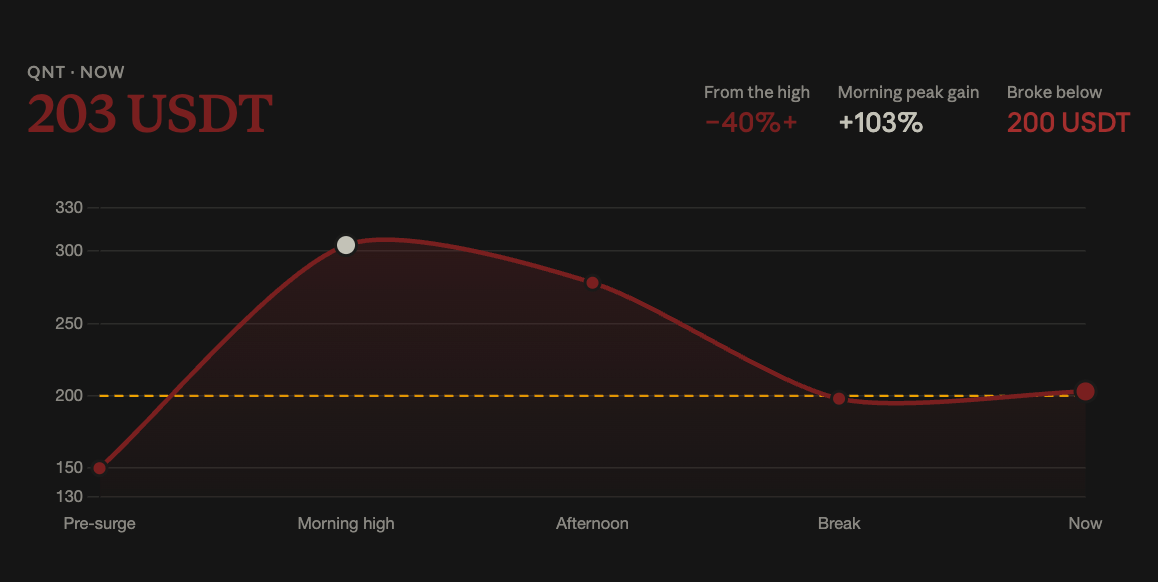
QNT briefly fell below 200 USDT and now trades at 203, down more than 40% from its high earlier in the session.The token had gained as much as 103% in morning trading, reaching $304, before the reversal.The Round Trip Is Now CompleteThis is no longer a pullback from an extended level.Through the afternoon QNT had held a 59% gain at $278, which still left it far ahead on the day. At 203 USDT it has given back the bulk of a move that briefly doubled the token.A 103% gain to a $304 high implies a starting point near $150. QNT remains above that, but the distance has narrowed from roughly $154 at the peak to around $53.The break below 200 matters as a level. Round numbers concentrate stop-loss orders, and a token that trades through one on the way down tends to accelerate as those trigger.The Fade Pattern Held All DayQNT was the extreme case in a session where the biggest gainers surrendered the most.JASMY's gain narrowed from 16% to 4% and IMX's from 17% to 6%. ORCA, NMR, ONDO and NIGHT each rose about 10% in early trading before falling to single digits. W, CETUS, JUP, SUI, MET, WOO and CVX gave back their 24-hour gains entirely.The consistency points to momentum buying rather than accumulation. Traders chasing an intraday move exit when it stalls, and because everyone in the trade shares the same short horizon, the exits compound.QNT simply had the most gain to give back.
6
3
27
27
·
--
Binance to Support SPCXB and QQQB Airdrops for MARSCOIN and 牛来 HoldersAccording to the [announcement](https://www.binance.com/en/support/announcement/detail/1ea1d5c29a0a4c2c8c7f4c4e947c07f2) from Binance, the exchange will support the SpaceX (SPCXB) airdrop for MarsCoin (MARSCOIN) holders and the Invesco QQQ Trust (QQQB) airdrop for 牛来 holders. The distribution includes two reward components. First, Binance will distribute the SPCXB and QQQB tokens allocated on-chain by the respective projects to eligible MARSCOIN and 牛来 holders. Second, Binance will allocate 30% of MARSCOIN and 牛来 spot trading fees as additional rewards, to be distributed in the form of SPCXB and QQQB respectively until further notice. Both reward components will use the same valid holding calculation method. Binance said it will take one random snapshot per day of users’ MARSCOIN and 牛来 holdings throughout each calendar month, and only daily holdings exceeding 10,000 tokens will count as valid holdings for each token. Monthly valid holdings will be calculated as the sum of each user’s valid daily holdings during the month, and rewards will be distributed based on each user’s share of total valid holdings among eligible users. MARSCOIN and 牛来 holdings will be calculated separately.
Binance said snapshots will include MARSCOIN and 牛来 holdings and liabilities in Spot Accounts, Funding Accounts, Margin Accounts and Simple Earn Flexible Accounts. Undistributed interest payments will not be included, and tokens pending deposit or withdrawal at the time of the snapshot will not count toward a user’s balance. MARSCOIN and 牛来 liabilities from Margin or Crypto Loans will not be eligible for the airdrop, and users with net liabilities will need to return the equivalent amount of SPCXB or QQQB airdropped. Holdings on Binance Alpha will not be included in the snapshot. Eligible holdings will be calculated starting from September 2026, with the first distribution in early October 2026. Both reward components will follow the same monthly cycle and will be fully distributed by the beginning of the following month. Binance said deposits and withdrawals of MARSCOIN and 牛来 will not be impacted, and Spot, Margin, Futures trading and Binance Earn services will continue without interruption during the airdrop. Users must complete account verification and be from an eligible jurisdiction to qualify, and reward eligibility remains subject to applicable product and jurisdictional restrictions.
Binance to Support SPCXB and QQQB Airdrops for MARSCOIN and 牛来 Holders
According to the announcement from Binance, the exchange will support the SpaceX (SPCXB) airdrop for MarsCoin (MARSCOIN) holders and the Invesco QQQ Trust (QQQB) airdrop for 牛来 holders. The distribution includes two reward components. First, Binance will distribute the SPCXB and QQQB tokens allocated on-chain by the respective projects to eligible MARSCOIN and 牛来 holders. Second, Binance will allocate 30% of MARSCOIN and 牛来 spot trading fees as additional rewards, to be distributed in the form of SPCXB and QQQB respectively until further notice. Both reward components will use the same valid holding calculation method. Binance said it will take one random snapshot per day of users’ MARSCOIN and 牛来 holdings throughout each calendar month, and only daily holdings exceeding 10,000 tokens will count as valid holdings for each token. Monthly valid holdings will be calculated as the sum of each user’s valid daily holdings during the month, and rewards will be distributed based on each user’s share of total valid holdings among eligible users. MARSCOIN and 牛来 holdings will be calculated separately.
Binance said snapshots will include MARSCOIN and 牛来 holdings and liabilities in Spot Accounts, Funding Accounts, Margin Accounts and Simple Earn Flexible Accounts. Undistributed interest payments will not be included, and tokens pending deposit or withdrawal at the time of the snapshot will not count toward a user’s balance. MARSCOIN and 牛来 liabilities from Margin or Crypto Loans will not be eligible for the airdrop, and users with net liabilities will need to return the equivalent amount of SPCXB or QQQB airdropped. Holdings on Binance Alpha will not be included in the snapshot. Eligible holdings will be calculated starting from September 2026, with the first distribution in early October 2026. Both reward components will follow the same monthly cycle and will be fully distributed by the beginning of the following month. Binance said deposits and withdrawals of MARSCOIN and 牛来 will not be impacted, and Spot, Margin, Futures trading and Binance Earn services will continue without interruption during the airdrop. Users must complete account verification and be from an eligible jurisdiction to qualify, and reward eligibility remains subject to applicable product and jurisdictional restrictions.
Binance said snapshots will include MARSCOIN and 牛来 holdings and liabilities in Spot Accounts, Funding Accounts, Margin Accounts and Simple Earn Flexible Accounts. Undistributed interest payments will not be included, and tokens pending deposit or withdrawal at the time of the snapshot will not count toward a user’s balance. MARSCOIN and 牛来 liabilities from Margin or Crypto Loans will not be eligible for the airdrop, and users with net liabilities will need to return the equivalent amount of SPCXB or QQQB airdropped. Holdings on Binance Alpha will not be included in the snapshot. Eligible holdings will be calculated starting from September 2026, with the first distribution in early October 2026. Both reward components will follow the same monthly cycle and will be fully distributed by the beginning of the following month. Binance said deposits and withdrawals of MARSCOIN and 牛来 will not be impacted, and Spot, Margin, Futures trading and Binance Earn services will continue without interruption during the airdrop. Users must complete account verification and be from an eligible jurisdiction to qualify, and reward eligibility remains subject to applicable product and jurisdictional restrictions.
4
8
35
35
·
--
BNB Chain Appoints Thomas Chen as Chief Business OfficerBNB Chain has appointed Thomas Chen as chief business officer (CBO). According to Odaily, Chen has 15 years of industry experience, including more than seven years focused on digital asset infrastructure.
He previously worked in capital markets, custody, trading, and business growth. At BNB Chain, he will focus on institutional and capital onchain adoption, liquidity, trading volume, and long-term ecosystem value.
BNB Chain Appoints Thomas Chen as Chief Business Officer
BNB Chain has appointed Thomas Chen as chief business officer (CBO). According to Odaily, Chen has 15 years of industry experience, including more than seven years focused on digital asset infrastructure.
He previously worked in capital markets, custody, trading, and business growth. At BNB Chain, he will focus on institutional and capital onchain adoption, liquidity, trading volume, and long-term ecosystem value.
He previously worked in capital markets, custody, trading, and business growth. At BNB Chain, he will focus on institutional and capital onchain adoption, liquidity, trading volume, and long-term ecosystem value.
5
5
·
--
Evernorth Plans Nasdaq Listing Under XRPN as Shareholders Set September 30 Merger VoteEvernorth, an XRP treasury company, plans to list on Nasdaq under the ticker XRPN. According to Odaily, Armada Acquisition Corp. II shareholders will vote on the business combination on September 30, and approval would remove the last major obstacle to Evernorth’s public trading.
Evernorth plans to deploy XRP for yield strategies, infrastructure participation, and capital markets activities. The company holds about 473 million XRP and is one of the largest identifiable corporate holders. Evernorth has also agreed to refinance $30 million through 4% convertible preferred PIK notes, but the funds can only be used after the business combination is approved.
Evernorth Plans Nasdaq Listing Under XRPN as Shareholders Set September 30 Merger Vote
Evernorth, an XRP treasury company, plans to list on Nasdaq under the ticker XRPN. According to Odaily, Armada Acquisition Corp. II shareholders will vote on the business combination on September 30, and approval would remove the last major obstacle to Evernorth’s public trading.
Evernorth plans to deploy XRP for yield strategies, infrastructure participation, and capital markets activities. The company holds about 473 million XRP and is one of the largest identifiable corporate holders. Evernorth has also agreed to refinance $30 million through 4% convertible preferred PIK notes, but the funds can only be used after the business combination is approved.
Evernorth plans to deploy XRP for yield strategies, infrastructure participation, and capital markets activities. The company holds about 473 million XRP and is one of the largest identifiable corporate holders. Evernorth has also agreed to refinance $30 million through 4% convertible preferred PIK notes, but the funds can only be used after the business combination is approved.
1
1
8
8
·
--
BitMine's Ethereum Holdings Top 6 Million as Tom Lee Sees More Institutional BuyingBitMine added 17,362 ether last week, lifting its total Ethereum holdings above 6 million for the first time. According to Foresight News, as of September 27, 2026, the company held 6,001,302 ether, or about 4.9% of Ethereum's total supply, and has been adding weekly without interruption since launching its ETH treasury strategy on June 30, 2025.
BitMine said its crypto, cash, and other investment assets were worth about $17.2 billion, including $672 million in cash and marketable securities, 213 bitcoin, $180 million in Beast Industries equity assets, and a $115 million investment in Eightco Holdings (ORBS). Its staked ether remained at 5,067,309, equal to 84% of total holdings, with a value of about $13.7 billion and an annualized staking yield of about $358 million.
In the company's weekly update, Tom Lee said ether has outperformed the S&P 500 by more than 6,728 basis points so far in the third quarter, making it the world's best macro asset. He said the crypto bull market began in late June, that institutions remain underweight crypto assets, and that they are expected to increase holdings sharply in the last few months of 2026. Lee is also scheduled to deliver a keynote speech at Korea Blockchain Week (KBW) in Seoul on September 30.
BitMine's Ethereum Holdings Top 6 Million as Tom Lee Sees More Institutional Buying
BitMine added 17,362 ether last week, lifting its total Ethereum holdings above 6 million for the first time. According to Foresight News, as of September 27, 2026, the company held 6,001,302 ether, or about 4.9% of Ethereum's total supply, and has been adding weekly without interruption since launching its ETH treasury strategy on June 30, 2025.
BitMine said its crypto, cash, and other investment assets were worth about $17.2 billion, including $672 million in cash and marketable securities, 213 bitcoin, $180 million in Beast Industries equity assets, and a $115 million investment in Eightco Holdings (ORBS). Its staked ether remained at 5,067,309, equal to 84% of total holdings, with a value of about $13.7 billion and an annualized staking yield of about $358 million.
In the company's weekly update, Tom Lee said ether has outperformed the S&P 500 by more than 6,728 basis points so far in the third quarter, making it the world's best macro asset. He said the crypto bull market began in late June, that institutions remain underweight crypto assets, and that they are expected to increase holdings sharply in the last few months of 2026. Lee is also scheduled to deliver a keynote speech at Korea Blockchain Week (KBW) in Seoul on September 30.
BitMine said its crypto, cash, and other investment assets were worth about $17.2 billion, including $672 million in cash and marketable securities, 213 bitcoin, $180 million in Beast Industries equity assets, and a $115 million investment in Eightco Holdings (ORBS). Its staked ether remained at 5,067,309, equal to 84% of total holdings, with a value of about $13.7 billion and an annualized staking yield of about $358 million.
In the company's weekly update, Tom Lee said ether has outperformed the S&P 500 by more than 6,728 basis points so far in the third quarter, making it the world's best macro asset. He said the crypto bull market began in late June, that institutions remain underweight crypto assets, and that they are expected to increase holdings sharply in the last few months of 2026. Lee is also scheduled to deliver a keynote speech at Korea Blockchain Week (KBW) in Seoul on September 30.
1
14
14
·
--
Bitget Details Security Incident Timeline, Formal Report Due This WeekBitget has released a detailed timeline of a security incident, and its formal investigation report is expected to be published this week. Bitget CEO Gracy Chen shared the timeline during a livestream reviewing the incident.
On September 25 at 2:31, hackers made small transfers of 0.84 ETH and 93 TRX from Ethereum and Tron hot wallets, respectively. The amounts were below the risk-control threshold, so no alert was triggered. From 2:58 to 4:09, the attackers carried out 17 large transfers across XRP, ZEC, BSC, Base, Arbitrum, Optimism and other chains, with a combined value of about $360 million.
At 3:05, the platform's reconciliation system detected a large discrepancy, and the risk-control system automatically blocked user withdrawal requests. A P0-level emergency response was launched at 3:14, and the technical team took loss-limiting measures at 3:40. At 4:40, because the risk of private key theft could not yet be ruled out, the wallet team began moving funds to cold wallets. Between 4:55 and 5:13, hackers launched a second wave of seven transfers on Avalanche and other chains, worth about $28 million. At 5:44, the technical team stopped wallet withdrawal services, including signing machines, and isolated inbound and outbound transfers. The platform began issuing public statements between about 5:00 and 6:00.
At 4:43 PM that day, the security team identified the root cause of the incident, and at 9:42 PM the legal team filed a report with authorities in the jurisdiction where the entity is based. Around noon on September 26, the platform reopened deposits after completing vulnerability fixes, service isolation and security checks.
The platform said BTC withdrawals will open today, while ETH, USDT and other tokens, as well as fiat services, will be restored gradually over the next few days.
According to the security team's root-cause analysis, the attacker exploited a zero-day vulnerability in a third-party security product to steal internal network credentials and entered key internal management systems using a valid identity. The attacker then accessed wallet-related backend services, wrote forged withdrawal instructions directly, bypassed risk checks before withdrawal records were generated, transferred funds from warm and hot wallets, and deleted traces after each transfer. Bitget said no common virus or malware was used in the attack, which it described as a highly targeted operation. It added that private keys were not leaked and that the possibility of insider involvement has been preliminarily ruled out. The company said it will not speculate on the hacker's identity before the formal report is released.
Bitget Details Security Incident Timeline, Formal Report Due This Week
Bitget has released a detailed timeline of a security incident, and its formal investigation report is expected to be published this week. Bitget CEO Gracy Chen shared the timeline during a livestream reviewing the incident.
On September 25 at 2:31, hackers made small transfers of 0.84 ETH and 93 TRX from Ethereum and Tron hot wallets, respectively. The amounts were below the risk-control threshold, so no alert was triggered. From 2:58 to 4:09, the attackers carried out 17 large transfers across XRP, ZEC, BSC, Base, Arbitrum, Optimism and other chains, with a combined value of about $360 million.
At 3:05, the platform's reconciliation system detected a large discrepancy, and the risk-control system automatically blocked user withdrawal requests. A P0-level emergency response was launched at 3:14, and the technical team took loss-limiting measures at 3:40. At 4:40, because the risk of private key theft could not yet be ruled out, the wallet team began moving funds to cold wallets. Between 4:55 and 5:13, hackers launched a second wave of seven transfers on Avalanche and other chains, worth about $28 million. At 5:44, the technical team stopped wallet withdrawal services, including signing machines, and isolated inbound and outbound transfers. The platform began issuing public statements between about 5:00 and 6:00.
At 4:43 PM that day, the security team identified the root cause of the incident, and at 9:42 PM the legal team filed a report with authorities in the jurisdiction where the entity is based. Around noon on September 26, the platform reopened deposits after completing vulnerability fixes, service isolation and security checks.
The platform said BTC withdrawals will open today, while ETH, USDT and other tokens, as well as fiat services, will be restored gradually over the next few days.
According to the security team's root-cause analysis, the attacker exploited a zero-day vulnerability in a third-party security product to steal internal network credentials and entered key internal management systems using a valid identity. The attacker then accessed wallet-related backend services, wrote forged withdrawal instructions directly, bypassed risk checks before withdrawal records were generated, transferred funds from warm and hot wallets, and deleted traces after each transfer. Bitget said no common virus or malware was used in the attack, which it described as a highly targeted operation. It added that private keys were not leaked and that the possibility of insider involvement has been preliminarily ruled out. The company said it will not speculate on the hacker's identity before the formal report is released.
On September 25 at 2:31, hackers made small transfers of 0.84 ETH and 93 TRX from Ethereum and Tron hot wallets, respectively. The amounts were below the risk-control threshold, so no alert was triggered. From 2:58 to 4:09, the attackers carried out 17 large transfers across XRP, ZEC, BSC, Base, Arbitrum, Optimism and other chains, with a combined value of about $360 million.
At 3:05, the platform's reconciliation system detected a large discrepancy, and the risk-control system automatically blocked user withdrawal requests. A P0-level emergency response was launched at 3:14, and the technical team took loss-limiting measures at 3:40. At 4:40, because the risk of private key theft could not yet be ruled out, the wallet team began moving funds to cold wallets. Between 4:55 and 5:13, hackers launched a second wave of seven transfers on Avalanche and other chains, worth about $28 million. At 5:44, the technical team stopped wallet withdrawal services, including signing machines, and isolated inbound and outbound transfers. The platform began issuing public statements between about 5:00 and 6:00.
At 4:43 PM that day, the security team identified the root cause of the incident, and at 9:42 PM the legal team filed a report with authorities in the jurisdiction where the entity is based. Around noon on September 26, the platform reopened deposits after completing vulnerability fixes, service isolation and security checks.
The platform said BTC withdrawals will open today, while ETH, USDT and other tokens, as well as fiat services, will be restored gradually over the next few days.
According to the security team's root-cause analysis, the attacker exploited a zero-day vulnerability in a third-party security product to steal internal network credentials and entered key internal management systems using a valid identity. The attacker then accessed wallet-related backend services, wrote forged withdrawal instructions directly, bypassed risk checks before withdrawal records were generated, transferred funds from warm and hot wallets, and deleted traces after each transfer. Bitget said no common virus or malware was used in the attack, which it described as a highly targeted operation. It added that private keys were not leaked and that the possibility of insider involvement has been preliminarily ruled out. The company said it will not speculate on the hacker's identity before the formal report is released.
1
3
17
17
·
--
QNT, BTW And SUI Rank Among Top Seven-Day GainersQuant (QNT), Bitway (BTW) and Sui (SUI) are among the top seven-day altcoin gainers, with QNT up 300%, BTW up 78% and SUI up 30%. According to BeInCrypto, all three charts remain bullish, but overbought readings and fading volume suggest the first week of October may test support.
QNT surged after The Clearing House selected Quant on September 24 for tokenized deposit settlement across 25 major US banks, while BTW and SUI also showed bullish setups with near-term pullback risks.
QNT, BTW And SUI Rank Among Top Seven-Day Gainers
Quant (QNT), Bitway (BTW) and Sui (SUI) are among the top seven-day altcoin gainers, with QNT up 300%, BTW up 78% and SUI up 30%. According to BeInCrypto, all three charts remain bullish, but overbought readings and fading volume suggest the first week of October may test support.
QNT surged after The Clearing House selected Quant on September 24 for tokenized deposit settlement across 25 major US banks, while BTW and SUI also showed bullish setups with near-term pullback risks.
QNT surged after The Clearing House selected Quant on September 24 for tokenized deposit settlement across 25 major US banks, while BTW and SUI also showed bullish setups with near-term pullback risks.
1
15
15
·
--
Nvidia Approves Record $150 Billion Buyback as Oil RisesOil surged after US President Donald Trump rejected Iran’s Hormuz proposal, while Nvidia approved a record $150 billion share buyback, according to Bloomberg.
The briefing also included Akamai Chief Executive Tom Leighton on a $12 billion Anthropic deal, LPL Financial Chief Executive Rich Steinmeier on why AI will not replace financial advisers, and SpaceX’s Starship returning to the skies.
Nvidia Approves Record $150 Billion Buyback as Oil Rises
Oil surged after US President Donald Trump rejected Iran’s Hormuz proposal, while Nvidia approved a record $150 billion share buyback, according to Bloomberg.
The briefing also included Akamai Chief Executive Tom Leighton on a $12 billion Anthropic deal, LPL Financial Chief Executive Rich Steinmeier on why AI will not replace financial advisers, and SpaceX’s Starship returning to the skies.
The briefing also included Akamai Chief Executive Tom Leighton on a $12 billion Anthropic deal, LPL Financial Chief Executive Rich Steinmeier on why AI will not replace financial advisers, and SpaceX’s Starship returning to the skies.
2
8
8
·
--
USDT Adds 845,900 Holders Over Past 7 DaysUSDT added 845,900 holders over the past 7 days, while USDC added 390,800, EURC added 69,800, USDG added 23,300, and CASH added 18,600. According to Odaily, the figures cover the same 7-day period.
USDT Adds 845,900 Holders Over Past 7 Days
USDT added 845,900 holders over the past 7 days, while USDC added 390,800, EURC added 69,800, USDG added 23,300, and CASH added 18,600. According to Odaily, the figures cover the same 7-day period.
9
15
32
32
·
--
Article
Market News | Gold Drops to $4,144 as Brent Clears $100 on Fading Peace HopesPrecious metals extended their decline on Monday, with spot gold falling about 3.3% to roughly $4,144 a troy ounce and silver plunging 5%.Both crude benchmarks moved the other way. Brent, the international marker that prices most globally traded crude, cleared $100, while US benchmark WTI rose about 3.4% to $95.60. Fading peace hopes and renewed Middle East geopolitical risk drove the move.Comex gold futures traded near $4,176.The Benchmark Spread Points to an Export ProblemThe gap between the two contracts carries information the headline prices do not.Brent above $100 against WTI at $95.60 is a spread of roughly $5, wider than the usual $2 to $4. Brent prices North Sea crude and serves as the benchmark for around two-thirds of globally traded oil. WTI prices light sweet crude delivered at Cushing, Oklahoma.A widening spread in Brent's favour is consistent with a seaborne export constraint rather than a global demand shock. Saudi barrels that cannot clear the Strait of Hormuz or the Red Sea port of Yanbu affect internationally traded cargoes directly, but reach US inventories only indirectly.That distinction matters for what would reverse it. A demand-driven rally fades when growth slows. An export bottleneck fades only when a route reopens.The Peace Trade Has UnwoundLast week crude was falling on the prospect of a settlement. WTI reached $89, roughly 15% below its September high of $106, after reports that Iran could reopen Hormuz within seven days if the US eased its port blockade.That prospect has faded, and WTI has recovered more than $6 from the low.The physical constraint was never resolved by the talks. Saudi Arabia's East-West pipeline, which runs to Yanbu specifically to bypass Hormuz, remained shut throughout, holding production at 6.238 million barrels per day — the lowest since 1990.Diplomacy only ever removed the risk premium. With the premium restored, the shortage is priced again.Refined Products Are What Reach InflationCrude benchmarks are not what consumers pay, and the distinction matters for the rate argument.Diesel, gasoline and jet fuel feed through to transport and logistics costs, and crack spreads — the margin between crude and refined products — can widen independently of the barrel. Diesel has been running near record highs, roughly 90% above pre-war levels.That is the channel by which a crude move becomes a PCE print.Gold Has Given Up Its September FloorAt $4,144, gold sits below the $4,296 it held on September 14 and roughly 26% under its January record of $5,600.The tension in its position has defined the month. Bullion is held as protection against rising prices, but higher interest rates — the policy response to those prices — reduce its appeal directly, because gold pays no yield while competing risk-free returns climb.Both forces run at once, and the rate response keeps winning. Gold falls on an energy shock that should support it.Its 90-day correlation with the 10-year Treasury yield has run at −0.41, which is why rate repricing hits gold harder than most assets.Silver Fell Nearly Twice as HardSilver's 5% decline against gold's 3.3% is roughly the ratio their relationship usually produces.Silver carries both monetary and industrial demand, giving it higher beta to gold in either direction.The ordering points to a rates-driven move rather than a growth scare. A session pricing weaker demand would show different damage across the complex, and would not lift crude at the same time.Four Data Points This WeekInvestors face job openings, the ADP employment report, the PCE inflation report and nonfarm payrolls.KCM Trade chief market analyst Tim Waterer set out the risk: "If inflation or employment data comes in stronger than expected, it could continue to push bond yields higher and further weigh on gold prices."He described the current pressure the same way. "The combination of high bond yields and elevated oil prices continues to weigh on gold. With uncertainty surrounding the oil supply outlook, crude prices have risen, bringing inflation back into the spotlight for investors."PCE carries particular weight. Chair Kevin Warsh built his Jackson Hole case around it rather than CPI, citing a hotter six-month rate against the 12-month figure and arguing the recent trend was the operative one.The Fed raised rates 25 basis points to 3.75%-4.00% on September 16, its first increase since July 2023, with a dot plot median pointing to one more move in 2026 — below what markets had priced going in. A hot PCE print would test that projection directly.The Crypto Read-ThroughBitcoin sits on the other side of the correlation gap punishing gold.At −0.17 against the 10-year, it absorbs rate moves with roughly half the sensitivity. Through mid-September it repeatedly rose on days gold fell, and the two assets' own correlation collapsed to 0.28 from 0.69 over 30 days.That decoupling holds only while the rate channel dominates. If this week's data pushes yields sharply higher, a competing risk-free rate weighs on everything that pays no yield — the setup QCP Capital described as a competing 5% rate without the growth impulse that usually accompanies it.
Market News | Gold Drops to $4,144 as Brent Clears $100 on Fading Peace Hopes
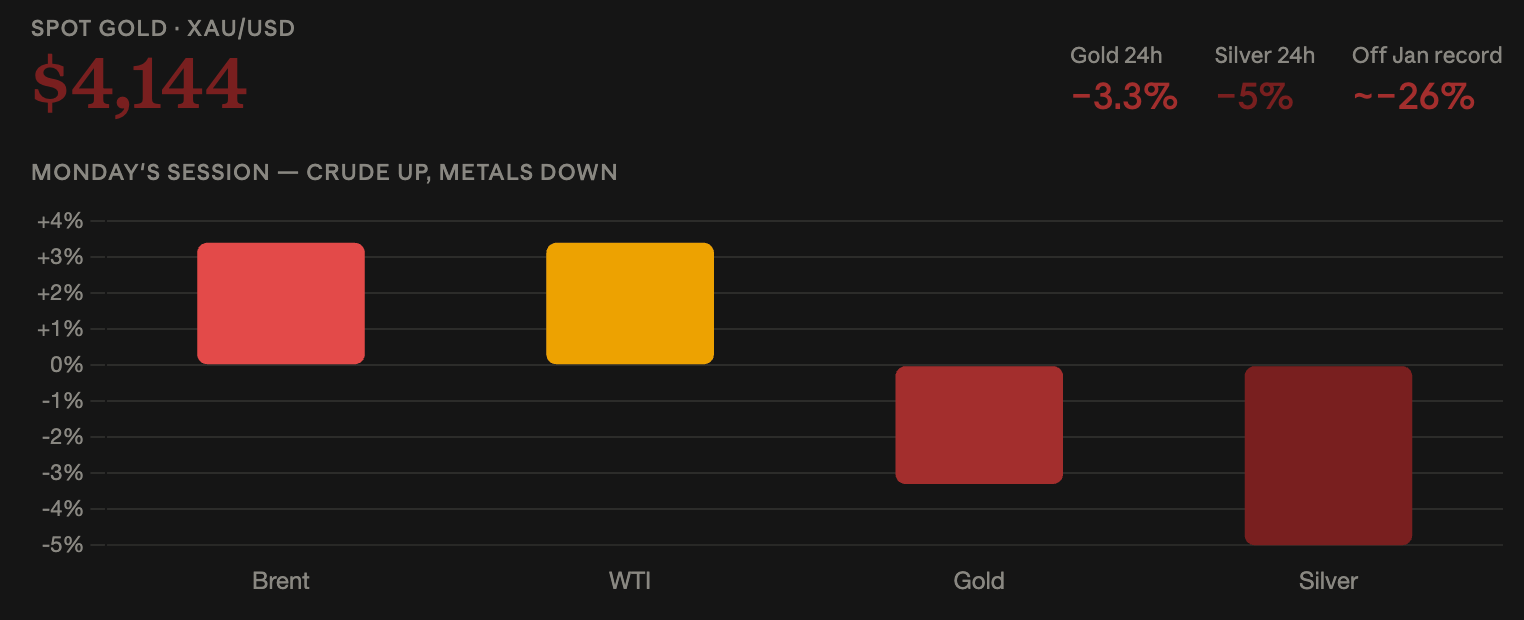
Precious metals extended their decline on Monday, with spot gold falling about 3.3% to roughly $4,144 a troy ounce and silver plunging 5%.Both crude benchmarks moved the other way. Brent, the international marker that prices most globally traded crude, cleared $100, while US benchmark WTI rose about 3.4% to $95.60. Fading peace hopes and renewed Middle East geopolitical risk drove the move.Comex gold futures traded near $4,176.The Benchmark Spread Points to an Export ProblemThe gap between the two contracts carries information the headline prices do not.Brent above $100 against WTI at $95.60 is a spread of roughly $5, wider than the usual $2 to $4. Brent prices North Sea crude and serves as the benchmark for around two-thirds of globally traded oil. WTI prices light sweet crude delivered at Cushing, Oklahoma.A widening spread in Brent's favour is consistent with a seaborne export constraint rather than a global demand shock. Saudi barrels that cannot clear the Strait of Hormuz or the Red Sea port of Yanbu affect internationally traded cargoes directly, but reach US inventories only indirectly.That distinction matters for what would reverse it. A demand-driven rally fades when growth slows. An export bottleneck fades only when a route reopens.The Peace Trade Has UnwoundLast week crude was falling on the prospect of a settlement. WTI reached $89, roughly 15% below its September high of $106, after reports that Iran could reopen Hormuz within seven days if the US eased its port blockade.That prospect has faded, and WTI has recovered more than $6 from the low.The physical constraint was never resolved by the talks. Saudi Arabia's East-West pipeline, which runs to Yanbu specifically to bypass Hormuz, remained shut throughout, holding production at 6.238 million barrels per day — the lowest since 1990.Diplomacy only ever removed the risk premium. With the premium restored, the shortage is priced again.Refined Products Are What Reach InflationCrude benchmarks are not what consumers pay, and the distinction matters for the rate argument.Diesel, gasoline and jet fuel feed through to transport and logistics costs, and crack spreads — the margin between crude and refined products — can widen independently of the barrel. Diesel has been running near record highs, roughly 90% above pre-war levels.That is the channel by which a crude move becomes a PCE print.Gold Has Given Up Its September FloorAt $4,144, gold sits below the $4,296 it held on September 14 and roughly 26% under its January record of $5,600.The tension in its position has defined the month. Bullion is held as protection against rising prices, but higher interest rates — the policy response to those prices — reduce its appeal directly, because gold pays no yield while competing risk-free returns climb.Both forces run at once, and the rate response keeps winning. Gold falls on an energy shock that should support it.Its 90-day correlation with the 10-year Treasury yield has run at −0.41, which is why rate repricing hits gold harder than most assets.Silver Fell Nearly Twice as HardSilver's 5% decline against gold's 3.3% is roughly the ratio their relationship usually produces.Silver carries both monetary and industrial demand, giving it higher beta to gold in either direction.The ordering points to a rates-driven move rather than a growth scare. A session pricing weaker demand would show different damage across the complex, and would not lift crude at the same time.Four Data Points This WeekInvestors face job openings, the ADP employment report, the PCE inflation report and nonfarm payrolls.KCM Trade chief market analyst Tim Waterer set out the risk: "If inflation or employment data comes in stronger than expected, it could continue to push bond yields higher and further weigh on gold prices."He described the current pressure the same way. "The combination of high bond yields and elevated oil prices continues to weigh on gold. With uncertainty surrounding the oil supply outlook, crude prices have risen, bringing inflation back into the spotlight for investors."PCE carries particular weight. Chair Kevin Warsh built his Jackson Hole case around it rather than CPI, citing a hotter six-month rate against the 12-month figure and arguing the recent trend was the operative one.The Fed raised rates 25 basis points to 3.75%-4.00% on September 16, its first increase since July 2023, with a dot plot median pointing to one more move in 2026 — below what markets had priced going in. A hot PCE print would test that projection directly.The Crypto Read-ThroughBitcoin sits on the other side of the correlation gap punishing gold.At −0.17 against the 10-year, it absorbs rate moves with roughly half the sensitivity. Through mid-September it repeatedly rose on days gold fell, and the two assets' own correlation collapsed to 0.28 from 0.69 over 30 days.That decoupling holds only while the rate channel dominates. If this week's data pushes yields sharply higher, a competing risk-free rate weighs on everything that pays no yield — the setup QCP Capital described as a competing 5% rate without the growth impulse that usually accompanies it.
3
1
19
19
·
--
Bitget Protection Fund Moves 2,042.28 BTC to Hot Wallets After Withdrawal Portal OpensOn September 28, on-chain analyst Ai Yi (@ai_9684xtpa) monitored that after Bitget opened its BTC withdrawal portal, part of a 5,500 BTC protection fund was transferred in batches to Bitget hot wallets to prepare for withdrawals. According to BlockBeats On-chain Detection, 2,042.28 BTC have been moved so far, while 3,457.72 BTC remain on-chain.
The analyst said the tokens were transferred in advance and should not be equated with the actual amount withdrawn.
Bitget Protection Fund Moves 2,042.28 BTC to Hot Wallets After Withdrawal Portal Opens
On September 28, on-chain analyst Ai Yi (@ai_9684xtpa) monitored that after Bitget opened its BTC withdrawal portal, part of a 5,500 BTC protection fund was transferred in batches to Bitget hot wallets to prepare for withdrawals. According to BlockBeats On-chain Detection, 2,042.28 BTC have been moved so far, while 3,457.72 BTC remain on-chain.
The analyst said the tokens were transferred in advance and should not be equated with the actual amount withdrawn.
The analyst said the tokens were transferred in advance and should not be equated with the actual amount withdrawn.
3
1
13
13
·
--
STOCKS | DeFi Development Corp. Increases SOL Holdings by 47,706 Tokens in September 21-25DeFi Development Corp. said in an 8-K filing with the U.S. SEC that it increased its holdings by 47,706 SOL and SOL equivalents from September 21 to 25, 2026. According to Foresight News, the company’s total SOL and SOL equivalent holdings reached 2,538,010 tokens as of September 25, up about 2% from the previous week.
STOCKS | DeFi Development Corp. Increases SOL Holdings by 47,706 Tokens in September 21-25
DeFi Development Corp. said in an 8-K filing with the U.S. SEC that it increased its holdings by 47,706 SOL and SOL equivalents from September 21 to 25, 2026. According to Foresight News, the company’s total SOL and SOL equivalent holdings reached 2,538,010 tokens as of September 25, up about 2% from the previous week.
4
4
9
9
·
--
NEAR Address Liquidates 748,100 Tokens as Price FallsAn address had 748,100 NEAR liquidated as the token fell, with the position valued at $3.67 million. According to Odaily, the liquidation was tracked by Lookonchain.
NEAR Address Liquidates 748,100 Tokens as Price Falls
An address had 748,100 NEAR liquidated as the token fell, with the position valued at $3.67 million. According to Odaily, the liquidation was tracked by Lookonchain.
1
5
5
·
--
Peter Brandt Says XRP Charts Alone Justify Buying As ETF Inflows BuildPeter Brandt said XRP holders do not need “certified cult membership” to justify owning the token, arguing the charts alone are enough reason to buy. According to BeInCrypto, his comments came as bullish technical patterns, whale accumulation and steady ETF inflows supported a constructive setup for XRP.
Brandt’s long-term chart points to upside near $5.40, while XRP traded around $1.52. Analysts also cited an inverse head-and-shoulders pattern with a neckline near $1.55, and said a breakout could lift XRP toward $2.
Peter Brandt Says XRP Charts Alone Justify Buying As ETF Inflows Build
Peter Brandt said XRP holders do not need “certified cult membership” to justify owning the token, arguing the charts alone are enough reason to buy. According to BeInCrypto, his comments came as bullish technical patterns, whale accumulation and steady ETF inflows supported a constructive setup for XRP.
Brandt’s long-term chart points to upside near $5.40, while XRP traded around $1.52. Analysts also cited an inverse head-and-shoulders pattern with a neckline near $1.55, and said a breakout could lift XRP toward $2.
Brandt’s long-term chart points to upside near $5.40, while XRP traded around $1.52. Analysts also cited an inverse head-and-shoulders pattern with a neckline near $1.55, and said a breakout could lift XRP toward $2.
2
17
17
·
--

Article
US and China Release Product Lists for $30 Billion Tariff DealThe US and China detailed a plan to cut tariffs on about $30 billion of imports from each country, as the rivals move to steady ties following a summit between Donald Trump and Xi Jinping, according to Bloomberg. Documents published by both governments show the list for goods entering the US contains 77 entries, including fireworks, household products, sporting equipment and toys, while 1,619 goods are set to potentially enter China, such as meat, seafood, dairy, grains, coal, timber and medical equipment. The expected relief for $60 billion in bilateral trade was among the most tangible outcomes of Xi's state visit to Washington last week, though it is a fraction of the $415 billion in total goods the world's two largest economies exchanged last year. The two sides extended their trade truce until January and are pursuing a broader deal ahead of two more expected Trump-Xi meetings this year.
Shares of some Chinese appliance makers rose after the details emerged, with Joyoung jumping by its 10% daily limit in Shenzhen and Bear Electric Appliance climbing as much as 9.5%. China said the reductions would take effect simultaneously after domestic legal procedures, and its Commerce Ministry said the arrangement "will help to further stabilize China-US economic and trade relations and create favorable conditions for China's exports of relevant products to the US." About 90% of the covered products would have tariffs cut to most-favored-nation rates. US Trade Representative Jamieson Greer called the selected items non-sensitive goods, saying "President Trump is unlocking improved market access for about 30 percent of US exports to China, while benefiting consumers with imports from China of household goods, toys, and other products that the United States generally does not import from other countries."
Beijing said tariffs on US coal would be included, supporting purchases in 2027 and 2028, after the White House said China agreed to import at least 10 million metric tons of US coal next year and again in 2028. Key grains including wheat, corn and sorghum are among the agricultural exports set for a tariff cut, which could help China progress toward a goal of buying at least $17 billion in US farm products annually through 2028, on top of a commitment to purchase 25 million tons of soybeans a year. Progress toward the $17 billion target has been slow since the Trump administration announced it after May's leaders' summit, with traders eyeing the cuts to spark new buying. A new Agricultural Working Group will be established, with an inaugural meeting set by the end of 2026.
US and China Release Product Lists for $30 Billion Tariff Deal
The US and China detailed a plan to cut tariffs on about $30 billion of imports from each country, as the rivals move to steady ties following a summit between Donald Trump and Xi Jinping, according to Bloomberg. Documents published by both governments show the list for goods entering the US contains 77 entries, including fireworks, household products, sporting equipment and toys, while 1,619 goods are set to potentially enter China, such as meat, seafood, dairy, grains, coal, timber and medical equipment. The expected relief for $60 billion in bilateral trade was among the most tangible outcomes of Xi's state visit to Washington last week, though it is a fraction of the $415 billion in total goods the world's two largest economies exchanged last year. The two sides extended their trade truce until January and are pursuing a broader deal ahead of two more expected Trump-Xi meetings this year.
Shares of some Chinese appliance makers rose after the details emerged, with Joyoung jumping by its 10% daily limit in Shenzhen and Bear Electric Appliance climbing as much as 9.5%. China said the reductions would take effect simultaneously after domestic legal procedures, and its Commerce Ministry said the arrangement "will help to further stabilize China-US economic and trade relations and create favorable conditions for China's exports of relevant products to the US." About 90% of the covered products would have tariffs cut to most-favored-nation rates. US Trade Representative Jamieson Greer called the selected items non-sensitive goods, saying "President Trump is unlocking improved market access for about 30 percent of US exports to China, while benefiting consumers with imports from China of household goods, toys, and other products that the United States generally does not import from other countries."
Beijing said tariffs on US coal would be included, supporting purchases in 2027 and 2028, after the White House said China agreed to import at least 10 million metric tons of US coal next year and again in 2028. Key grains including wheat, corn and sorghum are among the agricultural exports set for a tariff cut, which could help China progress toward a goal of buying at least $17 billion in US farm products annually through 2028, on top of a commitment to purchase 25 million tons of soybeans a year. Progress toward the $17 billion target has been slow since the Trump administration announced it after May's leaders' summit, with traders eyeing the cuts to spark new buying. A new Agricultural Working Group will be established, with an inaugural meeting set by the end of 2026.
Shares of some Chinese appliance makers rose after the details emerged, with Joyoung jumping by its 10% daily limit in Shenzhen and Bear Electric Appliance climbing as much as 9.5%. China said the reductions would take effect simultaneously after domestic legal procedures, and its Commerce Ministry said the arrangement "will help to further stabilize China-US economic and trade relations and create favorable conditions for China's exports of relevant products to the US." About 90% of the covered products would have tariffs cut to most-favored-nation rates. US Trade Representative Jamieson Greer called the selected items non-sensitive goods, saying "President Trump is unlocking improved market access for about 30 percent of US exports to China, while benefiting consumers with imports from China of household goods, toys, and other products that the United States generally does not import from other countries."
Beijing said tariffs on US coal would be included, supporting purchases in 2027 and 2028, after the White House said China agreed to import at least 10 million metric tons of US coal next year and again in 2028. Key grains including wheat, corn and sorghum are among the agricultural exports set for a tariff cut, which could help China progress toward a goal of buying at least $17 billion in US farm products annually through 2028, on top of a commitment to purchase 25 million tons of soybeans a year. Progress toward the $17 billion target has been slow since the Trump administration announced it after May's leaders' summit, with traders eyeing the cuts to spark new buying. A new Agricultural Working Group will be established, with an inaugural meeting set by the end of 2026.
1
2
25
25
·
--
North Korea Reportedly Laundering Funds Across Multiple Blockchains, Opening Perpetual Positions on dYdXAccording to on-chain analyst Specter, North Korea is laundering funds across multiple blockchains, including underlying chains such as dYdX, Noble, and Osmosis. According to ChainCatcher, the activity also includes opening perpetual contract positions on dYdX.
North Korea Reportedly Laundering Funds Across Multiple Blockchains, Opening Perpetual Positions on dYdX
According to on-chain analyst Specter, North Korea is laundering funds across multiple blockchains, including underlying chains such as dYdX, Noble, and Osmosis. According to ChainCatcher, the activity also includes opening perpetual contract positions on dYdX.
1
4
4
·
--
Bitcoin(BTC) Surpasses 84,000 USDT with a Narrowed 0.63% Decrease in 24 HoursOn Sep 28, 2026, 16:27 PM(UTC). According to Binance Market Data, Bitcoin has crossed the 84,000 USDT benchmark and is now trading at 84,064.007813 USDT, with a narrowed narrowed 0.63% decrease in 24 hours.
Bitcoin(BTC) Surpasses 84,000 USDT with a Narrowed 0.63% Decrease in 24 Hours
On Sep 28, 2026, 16:27 PM(UTC). According to Binance Market Data, Bitcoin has crossed the 84,000 USDT benchmark and is now trading at 84,064.007813 USDT, with a narrowed narrowed 0.63% decrease in 24 hours.
4
2
10
10
·
--
Sei Network Says REX Shares and Osprey Funds Update Staked SEI ETF FilingSei Network said on X that REX Shares and Osprey Funds have updated their staked SEI ETF filing with the U.S. Securities and Exchange Commission and set October 23 as the effective date. According to Odaily, the ETF is intended to provide spot SEI exposure and support staking yield. REX Shares and Osprey Funds previously filed similar ETF applications for NEAR, HYPE, SUI, and AVAX.
Sei Network Says REX Shares and Osprey Funds Update Staked SEI ETF Filing
Sei Network said on X that REX Shares and Osprey Funds have updated their staked SEI ETF filing with the U.S. Securities and Exchange Commission and set October 23 as the effective date. According to Odaily, the ETF is intended to provide spot SEI exposure and support staking yield. REX Shares and Osprey Funds previously filed similar ETF applications for NEAR, HYPE, SUI, and AVAX.
4
4
·
--
Wintermute Holds $126 Million in Short Positions on HyperliquidWintermute holds short positions worth $126 million on Hyperliquid, including $46.92 million in ETH shorts, $11.3 million in SOL shorts, and $10.03 million in HYPE shorts. According to Odaily, the positions are currently up about $963,600, with cumulative profit of $197 million.
Wintermute Holds $126 Million in Short Positions on Hyperliquid
Wintermute holds short positions worth $126 million on Hyperliquid, including $46.92 million in ETH shorts, $11.3 million in SOL shorts, and $10.03 million in HYPE shorts. According to Odaily, the positions are currently up about $963,600, with cumulative profit of $197 million.
2
1
2
·
--
ESMA to Focus 2027 Crypto Supervision on MiCA ImplementationESMA said it will center its coordination of national crypto supervision in 2027 on MiCA implementation, with operational resilience among its priorities. According to NS3.AI, the regulator plans to harmonize CASP reporting to national authorities and promote common risk indicators and supervisory dashboards.
ESMA also expects the first phase of its MIDAS surveillance system to be fully operational in 2027.
ESMA to Focus 2027 Crypto Supervision on MiCA Implementation
ESMA said it will center its coordination of national crypto supervision in 2027 on MiCA implementation, with operational resilience among its priorities. According to NS3.AI, the regulator plans to harmonize CASP reporting to national authorities and promote common risk indicators and supervisory dashboards.
ESMA also expects the first phase of its MIDAS surveillance system to be fully operational in 2027.
ESMA also expects the first phase of its MIDAS surveillance system to be fully operational in 2027.
1
1
·
--

Article
South Korea's FSC Considers Market Maker Rules for Virtual Asset MarketSouth Korea's Financial Services Commission is considering introducing a market maker system for the virtual asset market to improve efficiency and stability, according to Digital Asset. According to ChainCatcher, FSC digital finance policy official Ryu Young-jun said the proposal would be revisited in the second phase of the legislative process, even though the current Virtual Asset User Protection Act prohibits market making.
Ryu also said exchanges would need sufficient capital and operating capacity, and core functions such as execution, trading support, and abnormal trading monitoring could shift from self-regulation to public regulation. He added that governance rules for major shareholders and management may be strengthened, while the law's implementation could support business diversification, a more trustworthy trading environment, a digital asset issuance and disclosure framework, Korean won stablecoins, and stronger user protection.
South Korea's FSC Considers Market Maker Rules for Virtual Asset Market
South Korea's Financial Services Commission is considering introducing a market maker system for the virtual asset market to improve efficiency and stability, according to Digital Asset. According to ChainCatcher, FSC digital finance policy official Ryu Young-jun said the proposal would be revisited in the second phase of the legislative process, even though the current Virtual Asset User Protection Act prohibits market making.
Ryu also said exchanges would need sufficient capital and operating capacity, and core functions such as execution, trading support, and abnormal trading monitoring could shift from self-regulation to public regulation. He added that governance rules for major shareholders and management may be strengthened, while the law's implementation could support business diversification, a more trustworthy trading environment, a digital asset issuance and disclosure framework, Korean won stablecoins, and stronger user protection.
Ryu also said exchanges would need sufficient capital and operating capacity, and core functions such as execution, trading support, and abnormal trading monitoring could shift from self-regulation to public regulation. He added that governance rules for major shareholders and management may be strengthened, while the law's implementation could support business diversification, a more trustworthy trading environment, a digital asset issuance and disclosure framework, Korean won stablecoins, and stronger user protection.
1
14
14
·
--
Senate Fails to Advance CLARITY Act After 50-49 VoteThe Senate failed to advance the CLARITY Act this month after the bill received 50 votes in favor and 49 against. According to NS3.AI, the measure needed 60 votes to invoke cloture.
Section 404 of the bill would have barred covered digital-asset service providers and their affiliates from paying U.S. customers passive, deposit-like yield on payment-stablecoin balances.
Senate Fails to Advance CLARITY Act After 50-49 Vote
The Senate failed to advance the CLARITY Act this month after the bill received 50 votes in favor and 49 against. According to NS3.AI, the measure needed 60 votes to invoke cloture.
Section 404 of the bill would have barred covered digital-asset service providers and their affiliates from paying U.S. customers passive, deposit-like yield on payment-stablecoin balances.
Section 404 of the bill would have barred covered digital-asset service providers and their affiliates from paying U.S. customers passive, deposit-like yield on payment-stablecoin balances.
1
4
4
·
--
Bitcoin(BTC) Drops Below 83,000 USDT with a 2.11% Decrease in 24 HoursOn Sep 28, 2026, 14:43 PM(UTC). According to Binance Market Data, Bitcoin has dropped below 83,000 USDT and is now trading at 82,985.007813 USDT, with a narrowed 2.11% decrease in 24 hours.
Bitcoin(BTC) Drops Below 83,000 USDT with a 2.11% Decrease in 24 Hours
On Sep 28, 2026, 14:43 PM(UTC). According to Binance Market Data, Bitcoin has dropped below 83,000 USDT and is now trading at 82,985.007813 USDT, with a narrowed 2.11% decrease in 24 hours.
1
3
3
·
--
QNT Briefly Falls Below $200, Down More Than 40% From Morning HighQNT briefly fell below $200 and was last reported at $203. According to Odaily, it is down more than 40% from its morning high.
QNT Briefly Falls Below $200, Down More Than 40% From Morning High
QNT briefly fell below $200 and was last reported at $203. According to Odaily, it is down more than 40% from its morning high.
1
4
4
·
--
Solana Lowers Target Slot Time to 250 ms, Cautions on Further ReductionSolana said it has gradually reduced its target slot time from 400 ms to 250 ms while keeping the network skip rate stable and shortening downtime caused by consecutive skipped blocks. According to ChainCatcher, the shorter slot time has also increased voting latency, with nodes in Asia and South America affected most, so further lowering the target to 200 ms before Alpenglow goes live should be approached cautiously.
Solana Lowers Target Slot Time to 250 ms, Cautions on Further Reduction
Solana said it has gradually reduced its target slot time from 400 ms to 250 ms while keeping the network skip rate stable and shortening downtime caused by consecutive skipped blocks. According to ChainCatcher, the shorter slot time has also increased voting latency, with nodes in Asia and South America affected most, so further lowering the target to 200 ms before Alpenglow goes live should be approached cautiously.
5
5
·
--
ETH Forms Bullish Pattern as $2,640 Support Holds, Ali SaysCrypto analyst Ali said on X that ETH appears to be forming a bullish setup on lower time frames. According to Odaily, Ali said the pattern remains bullish as long as $2,640 continues to act as support.
Ali added that the $2,700 level is now in focus. He said an hourly close above $2,700 could confirm an upside breakout and open room for a further move toward $3,000.
ETH Forms Bullish Pattern as $2,640 Support Holds, Ali Says
Crypto analyst Ali said on X that ETH appears to be forming a bullish setup on lower time frames. According to Odaily, Ali said the pattern remains bullish as long as $2,640 continues to act as support.
Ali added that the $2,700 level is now in focus. He said an hourly close above $2,700 could confirm an upside breakout and open room for a further move toward $3,000.
Ali added that the $2,700 level is now in focus. He said an hourly close above $2,700 could confirm an upside breakout and open room for a further move toward $3,000.
2
10
10
·
--
Address Buys 8,017 ZEC as Long Position Grows to 18,400 CoinsAn address bought 8,017 ZEC during a pullback, with the transaction totaling about $12.62 million. According to Odaily, the address increased its ZEC long position to about 18,400 coins, while the overall position showed a loss of about $1.31 million. The address began building the position on September 27, with an average purchase price of about $1,659. After adding to the position, the average holding cost fell to about $1,622.
Address Buys 8,017 ZEC as Long Position Grows to 18,400 Coins
An address bought 8,017 ZEC during a pullback, with the transaction totaling about $12.62 million. According to Odaily, the address increased its ZEC long position to about 18,400 coins, while the overall position showed a loss of about $1.31 million. The address began building the position on September 27, with an average purchase price of about $1,659. After adding to the position, the average holding cost fell to about $1,622.
3
2
3
·
--
Aave Founder Stani Kulechov Says Protocol Will Expand Into Solar, Batteries, GPUs, Robots, and Space InfrastructureAave founder and CEO Stani Kulechov said the size of Aave's potential market should be measured by the universe of assets that can be used as collateral, arguing that a broader collateral base creates more room for lending. According to Foresight News, he said Aave's future business will extend to abundant assets including solar, batteries, GPUs, robots, and space infrastructure.
He said the transition will continue through 2050, and that Aave's goal is to advance the process by about 10 years by financing related assets.
Aave Founder Stani Kulechov Says Protocol Will Expand Into Solar, Batteries, GPUs, Robots, and Space Infrastructure
Aave founder and CEO Stani Kulechov said the size of Aave's potential market should be measured by the universe of assets that can be used as collateral, arguing that a broader collateral base creates more room for lending. According to Foresight News, he said Aave's future business will extend to abundant assets including solar, batteries, GPUs, robots, and space infrastructure.
He said the transition will continue through 2050, and that Aave's goal is to advance the process by about 10 years by financing related assets.
He said the transition will continue through 2050, and that Aave's goal is to advance the process by about 10 years by financing related assets.
9
9
Filter
Most Searched (6H)
USDT