

#fedproposespaymentstablecoinrules
fedproposespaymentstablecoinrules
106,801 views
856 Discussing
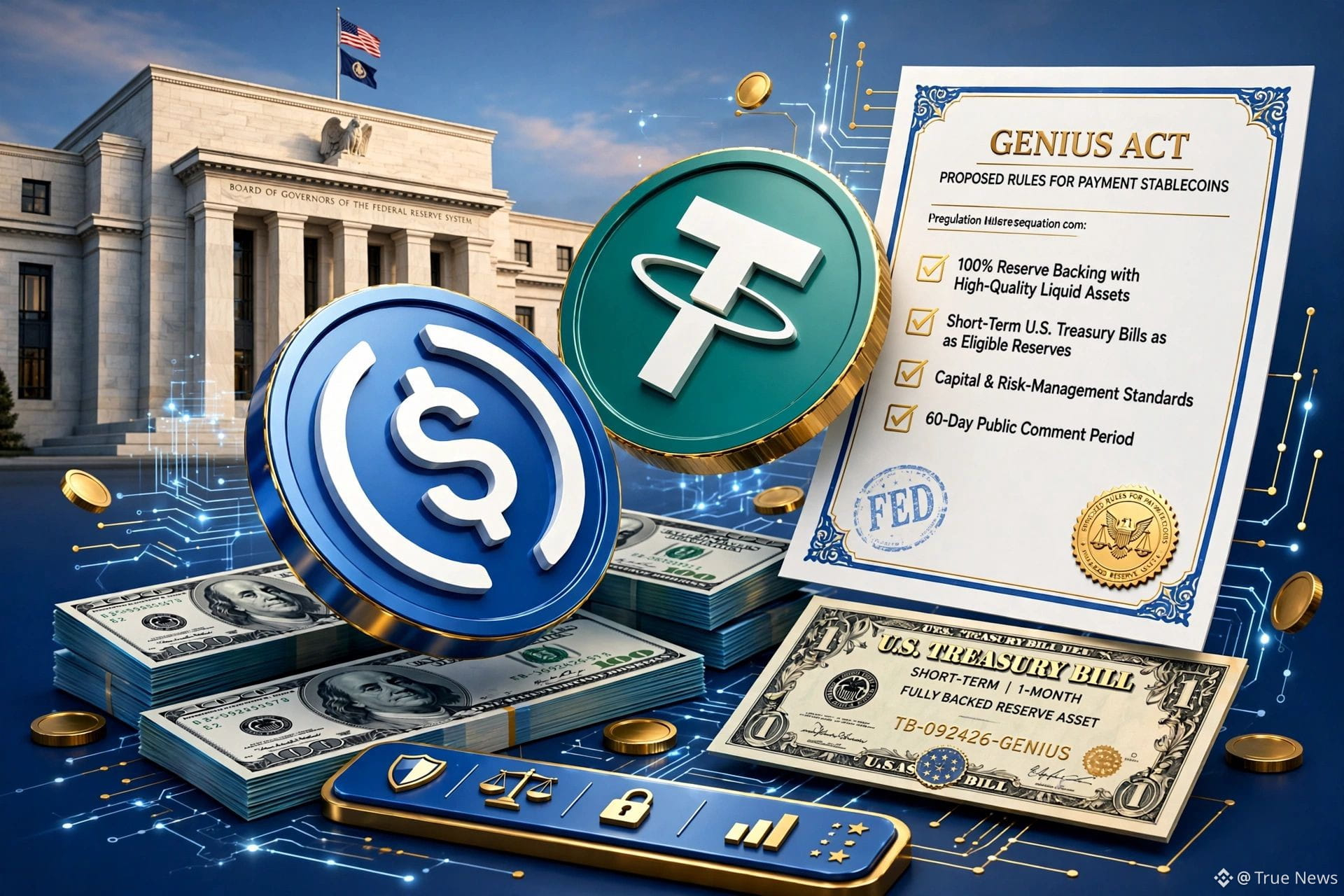
US Federal Reserve has released two proposed rules for payment stablecoins to implement the regulatory authority granted under the GENIUS Act. The proposals would move stablecoin issuance and bank-related crypto activities under formal rulemaking rather than prior enforcement guidance.
Hot
Latest


·
--
Bullish
$WLD
{spot}(WLDUSDT)
Stablecoin Rules Will Impact Long-Term Structure Far More Than Meme Coin Bans
Banning politicians from issuing tokens is merely political theatre; the Federal Reserve laying down reserve requirements and capital buffers is actually rewriting the plumbing
The dollar-backed stablecoins that manage to survive will need to behave increasingly like money market funds
$MELANIA
{future}(MELANIAUSDT)
Yields will thin out, and running off with the funds will become far more difficult. For any yield-bearing stablecoins you're holding right now, it's time to ask: is that yield coming from short-dated treasuries, or is it just high-risk strategies wrapped up in a tidy package? The slicker the wrapper, the steeper the drop when liquidity gets pulled
$TRUMP
{spot}(TRUMPUSDT)
#FedProposesPaymentStablecoinRules
$WLD
Stablecoin Rules Will Impact Long-Term Structure Far More Than Meme Coin Bans
Banning politicians from issuing tokens is merely political theatre; the Federal Reserve laying down reserve requirements and capital buffers is actually rewriting the plumbing
The dollar-backed stablecoins that manage to survive will need to behave increasingly like money market funds
$MELANIA
Yields will thin out, and running off with the funds will become far more difficult. For any yield-bearing stablecoins you're holding right now, it's time to ask: is that yield coming from short-dated treasuries, or is it just high-risk strategies wrapped up in a tidy package? The slicker the wrapper, the steeper the drop when liquidity gets pulled
$TRUMP
#FedProposesPaymentStablecoinRules
Stablecoin Rules Will Impact Long-Term Structure Far More Than Meme Coin Bans
Banning politicians from issuing tokens is merely political theatre; the Federal Reserve laying down reserve requirements and capital buffers is actually rewriting the plumbing
The dollar-backed stablecoins that manage to survive will need to behave increasingly like money market funds
$MELANIA
Yields will thin out, and running off with the funds will become far more difficult. For any yield-bearing stablecoins you're holding right now, it's time to ask: is that yield coming from short-dated treasuries, or is it just high-risk strategies wrapped up in a tidy package? The slicker the wrapper, the steeper the drop when liquidity gets pulled
$TRUMP
#FedProposesPaymentStablecoinRules

2.1k

·
--
BREAKING: Federal Reserve Proposes Payment Stablecoin Rules! 🏦💵
On Sep 24, 2026, the Fed proposed 2 new rules to implement the GENIUS Act.
Key Highlights:
✅ 1:1 Backing Mandatory: Issuers must hold $1 in permitted reserves for every $1 stablecoin. Allowed reserves: cash, Fed balances, short-term T-Bills (≤93 days).
✅ 2-Day Redemption: Issuers must redeem tokens within two business days.
✅ Capital Rules: 2% on first $20B, 1% on amounts over $50B. If shortfall persists, forced liquidation & redemption.
✅ Bank Approval: 120-day Fed decision window, auto-approved if Fed is silent.
60-day public comment period is now open. This is the first concrete prudential framework for stablecoins in the US! Regulation = Mass Adoption?
What do you think, bullish for $USDT & $USDC?
#Stablecoin #Fed #GENIUSAct #CryptoRegulation #BinanceSquare #fedproposespaymentstablecoinrules
BREAKING: Federal Reserve Proposes Payment Stablecoin Rules! 🏦💵
On Sep 24, 2026, the Fed proposed 2 new rules to implement the GENIUS Act.
Key Highlights:
✅ 1:1 Backing Mandatory: Issuers must hold $1 in permitted reserves for every $1 stablecoin. Allowed reserves: cash, Fed balances, short-term T-Bills (≤93 days).
✅ 2-Day Redemption: Issuers must redeem tokens within two business days.
✅ Capital Rules: 2% on first $20B, 1% on amounts over $50B. If shortfall persists, forced liquidation & redemption.
✅ Bank Approval: 120-day Fed decision window, auto-approved if Fed is silent.
60-day public comment period is now open. This is the first concrete prudential framework for stablecoins in the US! Regulation = Mass Adoption?
What do you think, bullish for $USDT & $USDC?
#Stablecoin #Fed #GENIUSAct #CryptoRegulation #BinanceSquare #fedproposespaymentstablecoinrules
On Sep 24, 2026, the Fed proposed 2 new rules to implement the GENIUS Act.
Key Highlights:
✅ 1:1 Backing Mandatory: Issuers must hold $1 in permitted reserves for every $1 stablecoin. Allowed reserves: cash, Fed balances, short-term T-Bills (≤93 days).
✅ 2-Day Redemption: Issuers must redeem tokens within two business days.
✅ Capital Rules: 2% on first $20B, 1% on amounts over $50B. If shortfall persists, forced liquidation & redemption.
✅ Bank Approval: 120-day Fed decision window, auto-approved if Fed is silent.
60-day public comment period is now open. This is the first concrete prudential framework for stablecoins in the US! Regulation = Mass Adoption?
What do you think, bullish for $USDT & $USDC?
#Stablecoin #Fed #GENIUSAct #CryptoRegulation #BinanceSquare #fedproposespaymentstablecoinrules
2xnmore:
Crypto will get rules one way or another.
5
2
18
12.6k

·
--
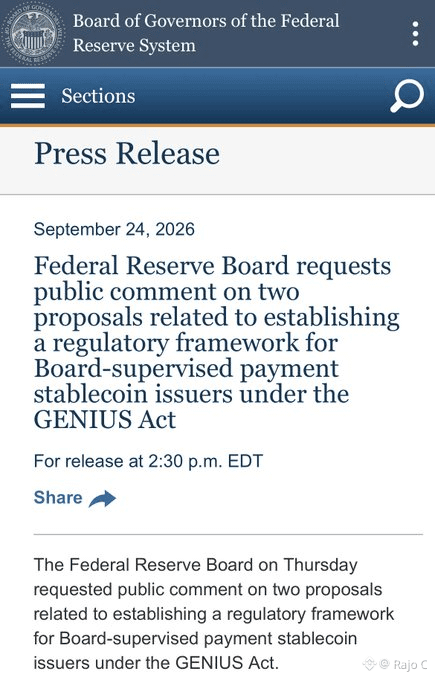
#fedproposespaymentstablecoinrules JUST IN: Fed proposes new capital, redemption rules for stablecoin issuers, including capital requirements, a two-day redemption window, and enhanced reserve disclosures under GENIUS Act. This would raise issuer compliance pressure and potentially affect stablecoin liquidity d...$ARIA $TST $OM
#fedproposespaymentstablecoinrules JUST IN: Fed proposes new capital, redemption rules for stablecoin issuers, including capital requirements, a two-day redemption window, and enhanced reserve disclosures under GENIUS Act. This would raise issuer compliance pressure and potentially affect stablecoin liquidity d...$ARIA $TST $OM

369
·
--
#fedproposespaymentstablecoinrules 🇺🇸
MASSIVE NEWS: THE FED HAST JUST PROPOSED RULES THAT WOULD ALLOW BANKS TO ISSUE THEIR OWN CRYPTO STABLECOINS!
🏦
IT‘S FINALLY HAPPENING!!!
💥🚀$BROCCOLI714 $SKUU $CSOPSKHYNIX2L
#fedproposespaymentstablecoinrules 🇺🇸
MASSIVE NEWS: THE FED HAST JUST PROPOSED RULES THAT WOULD ALLOW BANKS TO ISSUE THEIR OWN CRYPTO STABLECOINS!
🏦
IT‘S FINALLY HAPPENING!!!
💥🚀$BROCCOLI714 $SKUU $CSOPSKHYNIX2L
MASSIVE NEWS: THE FED HAST JUST PROPOSED RULES THAT WOULD ALLOW BANKS TO ISSUE THEIR OWN CRYPTO STABLECOINS!
🏦
IT‘S FINALLY HAPPENING!!!
💥🚀$BROCCOLI714 $SKUU $CSOPSKHYNIX2L
408
·
--
#fedproposespaymentstablecoinrules The Fed's two proposals would require full reserve backing for payment stablecoins and create an application process for banks issuing them through subsidiaries.$OG $RAM $BILL
#fedproposespaymentstablecoinrules The Fed's two proposals would require full reserve backing for payment stablecoins and create an application process for banks issuing them through subsidiaries.$OG $RAM $BILL

1
669
·
--
#fedproposespaymentstablecoinrules 💥
BOOM!
🚨
It's official:
🇺🇸
The Federal Reserve is proposing a new regulatory framework for stablecoin
issuers under the GENIUS Act.
The U.S. Senate has passed the GENIUS Act, which President Trump has signed into law!
🔥$SKY $Q $MDB
#fedproposespaymentstablecoinrules 💥
BOOM!
🚨
It's official:
🇺🇸
The Federal Reserve is proposing a new regulatory framework for stablecoin
issuers under the GENIUS Act.
The U.S. Senate has passed the GENIUS Act, which President Trump has signed into law!
🔥$SKY $Q $MDB
BOOM!
🚨
It's official:
🇺🇸
The Federal Reserve is proposing a new regulatory framework for stablecoin
issuers under the GENIUS Act.
The U.S. Senate has passed the GENIUS Act, which President Trump has signed into law!
🔥$SKY $Q $MDB
661
·
--
#fedproposespaymentstablecoinrules 🚨
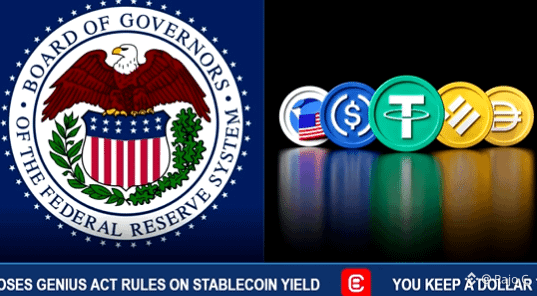
FED PROPOSES GENIUS ACT RULES ON STABLECOIN
YIELD!
The Federal Reserve put out draft
rules for payment stablecoin
issuers it supervises.
Tokens would have to stay fully backed by allowed reserves such as short-term Treasuries.
The draft also bans paying yield just for holding the stablecoin, and treats some third-party reward setups as off-limits.
That means you keep a dollar token, the issuer keeps the Treasury interest.
$FARTCOIN $AR $RAVE
#fedproposespaymentstablecoinrules 🚨
FED PROPOSES GENIUS ACT RULES ON STABLECOIN
YIELD!
The Federal Reserve put out draft
rules for payment stablecoin
issuers it supervises.
Tokens would have to stay fully backed by allowed reserves such as short-term Treasuries.
The draft also bans paying yield just for holding the stablecoin, and treats some third-party reward setups as off-limits.
That means you keep a dollar token, the issuer keeps the Treasury interest.
$FARTCOIN $AR $RAVE
FED PROPOSES GENIUS ACT RULES ON STABLECOIN
YIELD!
The Federal Reserve put out draft
rules for payment stablecoin
issuers it supervises.
Tokens would have to stay fully backed by allowed reserves such as short-term Treasuries.
The draft also bans paying yield just for holding the stablecoin, and treats some third-party reward setups as off-limits.
That means you keep a dollar token, the issuer keeps the Treasury interest.
$FARTCOIN $AR $RAVE
1
1k
·
--
#fedproposespaymentstablecoinrules 🇺🇸🚨
FED PROPOSES GENIUS ACT IMPLEMENTATION RULES FOR PAYMENT STABLECOIN
ISSUERS!
THE PROPOSALS COVER RESERVE ASSET REQUIREMENTS, CAPITAL AND RISK MANAGEMENT STANDARDS, CUSTODY OF RESERVE ASSETS, AND ISSUER APPLICATION PROCEDURES.$PHA $USELESS $CSOPSAMSUNG2L
#fedproposespaymentstablecoinrules 🇺🇸🚨
FED PROPOSES GENIUS ACT IMPLEMENTATION RULES FOR PAYMENT STABLECOIN
ISSUERS!
THE PROPOSALS COVER RESERVE ASSET REQUIREMENTS, CAPITAL AND RISK MANAGEMENT STANDARDS, CUSTODY OF RESERVE ASSETS, AND ISSUER APPLICATION PROCEDURES.$PHA $USELESS $CSOPSAMSUNG2L
FED PROPOSES GENIUS ACT IMPLEMENTATION RULES FOR PAYMENT STABLECOIN
ISSUERS!
THE PROPOSALS COVER RESERVE ASSET REQUIREMENTS, CAPITAL AND RISK MANAGEMENT STANDARDS, CUSTODY OF RESERVE ASSETS, AND ISSUER APPLICATION PROCEDURES.$PHA $USELESS $CSOPSAMSUNG2L
658

#FedProposesPaymentStablecoinRules
The Federal Reserve’s payment-stablecoin proposal, the key announcement was on September 24, 2026, not today (Sept. 28). The Fed proposed two rules under the GENIUS Act for payment stablecoin issuers.
Federal Reserve
What the Fed proposed
1:1 reserve backing with permitted assets, including short-term U.S. Treasuries and other high-quality liquid assets.
Capital requirements and risk-management standards for supervised stablecoin issuers.
Rules for firms that custody the reserves backing stablecoins.
A framework allowing certain Fed-supervised banks to apply to issue payment stablecoins.
60-day public comment period after Federal Register publication.
Federal Reserve +1
🟢 Why crypto markets care
This is potentially significant for USDC/USDT and the broader stablecoin/payment infrastructure because it moves stablecoins further into the regulated U.S. financial system.
For altcoins, the direct effect is not automatically bullish. The important potential positive is that clearer regulation could facilitate institutional/stablecoin payment adoption; the proposed reserve and capital rules could also increase compliance costs for issuers.
If you're asking because of today's crypto move, I can check BTC + ETH + XRP + SOL + QNT + stablecoin flows and explain whether this Fed news is likely contributing to the move.
#FedProposesPaymentStablecoinRules
The Federal Reserve’s payment-stablecoin proposal, the key announcement was on September 24, 2026, not today (Sept. 28). The Fed proposed two rules under the GENIUS Act for payment stablecoin issuers.
Federal Reserve
What the Fed proposed
1:1 reserve backing with permitted assets, including short-term U.S. Treasuries and other high-quality liquid assets.
Capital requirements and risk-management standards for supervised stablecoin issuers.
Rules for firms that custody the reserves backing stablecoins.
A framework allowing certain Fed-supervised banks to apply to issue payment stablecoins.
60-day public comment period after Federal Register publication.
Federal Reserve +1
🟢 Why crypto markets care
This is potentially significant for USDC/USDT and the broader stablecoin/payment infrastructure because it moves stablecoins further into the regulated U.S. financial system.
For altcoins, the direct effect is not automatically bullish. The important potential positive is that clearer regulation could facilitate institutional/stablecoin payment adoption; the proposed reserve and capital rules could also increase compliance costs for issuers.
If you're asking because of today's crypto move, I can check BTC + ETH + XRP + SOL + QNT + stablecoin flows and explain whether this Fed news is likely contributing to the move.
The Federal Reserve’s payment-stablecoin proposal, the key announcement was on September 24, 2026, not today (Sept. 28). The Fed proposed two rules under the GENIUS Act for payment stablecoin issuers.
Federal Reserve
What the Fed proposed
1:1 reserve backing with permitted assets, including short-term U.S. Treasuries and other high-quality liquid assets.
Capital requirements and risk-management standards for supervised stablecoin issuers.
Rules for firms that custody the reserves backing stablecoins.
A framework allowing certain Fed-supervised banks to apply to issue payment stablecoins.
60-day public comment period after Federal Register publication.
Federal Reserve +1
🟢 Why crypto markets care
This is potentially significant for USDC/USDT and the broader stablecoin/payment infrastructure because it moves stablecoins further into the regulated U.S. financial system.
For altcoins, the direct effect is not automatically bullish. The important potential positive is that clearer regulation could facilitate institutional/stablecoin payment adoption; the proposed reserve and capital rules could also increase compliance costs for issuers.
If you're asking because of today's crypto move, I can check BTC + ETH + XRP + SOL + QNT + stablecoin flows and explain whether this Fed news is likely contributing to the move.
1
60

·
--
#FedProposesPaymentStablecoinRules
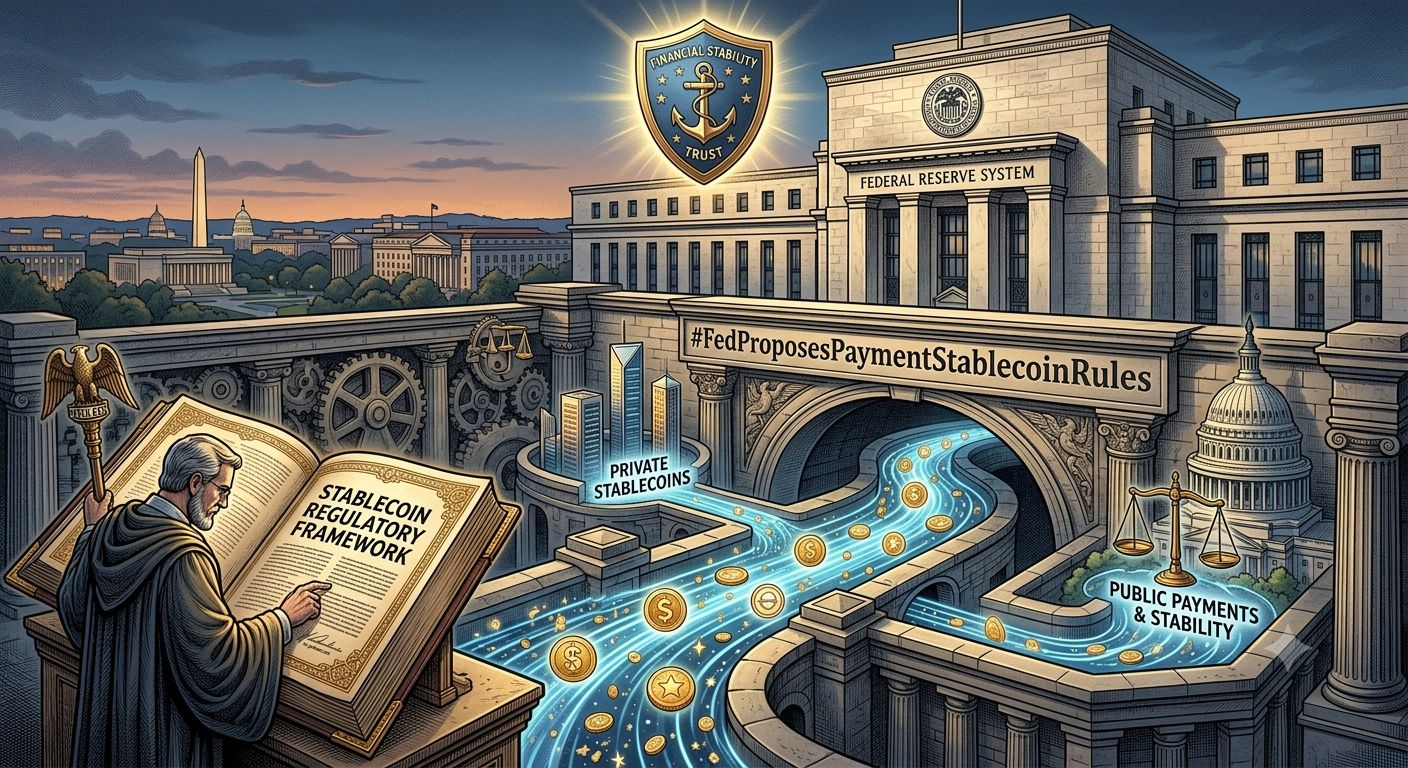
The Fed just dropped proposed rules for Payment Stablecoins, and it’s a game-changer. 🚨
Here is what you need to know:
TradFi Integration: Regulators are officially trying to bring stablecoins into the mainstream banking framework.
Bullish or Bearish? Clear rules bring massive institutional capital, but heavier compliance could squeeze yield and privacy.
Market Impact: DeFi vs. Centralized Stablecoins ($USDT / $USDC)—who wins the long game?
What’s your take? Is this the regulatory clarity crypto needs to go parabolic, or too much government control?
Let us know your thoughts in the comments! 👇
$HBAR
{future}(HBARUSDT)
$QNT
{future}(QNTUSDT)
$AIOT
{future}(AIOTUSDT)
#Fed #StablecoinNews #CryptoMarkets #BinanceSquare
#FedProposesPaymentStablecoinRules
The Fed just dropped proposed rules for Payment Stablecoins, and it’s a game-changer. 🚨
Here is what you need to know:
TradFi Integration: Regulators are officially trying to bring stablecoins into the mainstream banking framework.
Bullish or Bearish? Clear rules bring massive institutional capital, but heavier compliance could squeeze yield and privacy.
Market Impact: DeFi vs. Centralized Stablecoins ($USDT / $USDC)—who wins the long game?
What’s your take? Is this the regulatory clarity crypto needs to go parabolic, or too much government control?
Let us know your thoughts in the comments! 👇
$HBAR
$QNT
$AIOT
#Fed #StablecoinNews #CryptoMarkets #BinanceSquare
The Fed just dropped proposed rules for Payment Stablecoins, and it’s a game-changer. 🚨
Here is what you need to know:
TradFi Integration: Regulators are officially trying to bring stablecoins into the mainstream banking framework.
Bullish or Bearish? Clear rules bring massive institutional capital, but heavier compliance could squeeze yield and privacy.
Market Impact: DeFi vs. Centralized Stablecoins ($USDT / $USDC)—who wins the long game?
What’s your take? Is this the regulatory clarity crypto needs to go parabolic, or too much government control?
Let us know your thoughts in the comments! 👇
$HBAR
$QNT
$AIOT
#Fed #StablecoinNews #CryptoMarkets #BinanceSquare
1
323

·
--
Bullish
🚨 THE FED AND SEC ARE QUIETLY BUILDING THE RULEBOOK CRYPTO HAS BEEN WAITING FOR.
The Fed just proposed a formal framework for payment stablecoin issuers under the GENIUS Act, including 1:1 backing with high-quality liquid reserves such as short-term Treasuries, capital requirements, risk-management standards, custody rules, and a dedicated approval process for banks that want to issue stablecoins.
At almost the same time, SEC staff clarified that for functional crypto networks, things like token buybacks do not automatically create a securities contract by themselves. The SEC also stressed that this is staff guidance, not a binding new rule.
That combination matters.
Fed → clearer rules for digital dollars.
SEC → more clarity for functional crypto assets.
This is not deregulation.
It is something potentially more important:
Crypto is being pulled deeper into the regulated financial system instead of being pushed outside it.
For stablecoins, the direction is obvious: more reserves, more oversight, more bank participation.
And if that framework survives the comment process, the next phase of adoption may look less like “crypto vs banks”…
and more like banks issuing crypto-native money themselves. 👀
$USDC $CRCL $COIN $ETH
{future}(USDCUSDT)
{future}(CRCLUSDT)
{future}(COINUSDT)
#fedproposespaymentstablecoinrules #ChinaMayLetAlibabaByteDanceBuyNvidiaChips #USChinaRelease$30BTariffCutProductLists #SKoreaFSCConsidersVirtualAssetMarketMaker #ChinaIndustrialProfitGrowthSlowsFourthMonth
🚨 THE FED AND SEC ARE QUIETLY BUILDING THE RULEBOOK CRYPTO HAS BEEN WAITING FOR.
The Fed just proposed a formal framework for payment stablecoin issuers under the GENIUS Act, including 1:1 backing with high-quality liquid reserves such as short-term Treasuries, capital requirements, risk-management standards, custody rules, and a dedicated approval process for banks that want to issue stablecoins.
At almost the same time, SEC staff clarified that for functional crypto networks, things like token buybacks do not automatically create a securities contract by themselves. The SEC also stressed that this is staff guidance, not a binding new rule.
That combination matters.
Fed → clearer rules for digital dollars.
SEC → more clarity for functional crypto assets.
This is not deregulation.
It is something potentially more important:
Crypto is being pulled deeper into the regulated financial system instead of being pushed outside it.
For stablecoins, the direction is obvious: more reserves, more oversight, more bank participation.
And if that framework survives the comment process, the next phase of adoption may look less like “crypto vs banks”…
and more like banks issuing crypto-native money themselves. 👀
$USDC $CRCL $COIN $ETH
#fedproposespaymentstablecoinrules #ChinaMayLetAlibabaByteDanceBuyNvidiaChips #USChinaRelease$30BTariffCutProductLists #SKoreaFSCConsidersVirtualAssetMarketMaker #ChinaIndustrialProfitGrowthSlowsFourthMonth
The Fed just proposed a formal framework for payment stablecoin issuers under the GENIUS Act, including 1:1 backing with high-quality liquid reserves such as short-term Treasuries, capital requirements, risk-management standards, custody rules, and a dedicated approval process for banks that want to issue stablecoins.
At almost the same time, SEC staff clarified that for functional crypto networks, things like token buybacks do not automatically create a securities contract by themselves. The SEC also stressed that this is staff guidance, not a binding new rule.
That combination matters.
Fed → clearer rules for digital dollars.
SEC → more clarity for functional crypto assets.
This is not deregulation.
It is something potentially more important:
Crypto is being pulled deeper into the regulated financial system instead of being pushed outside it.
For stablecoins, the direction is obvious: more reserves, more oversight, more bank participation.
And if that framework survives the comment process, the next phase of adoption may look less like “crypto vs banks”…
and more like banks issuing crypto-native money themselves. 👀
$USDC $CRCL $COIN $ETH
#fedproposespaymentstablecoinrules #ChinaMayLetAlibabaByteDanceBuyNvidiaChips #USChinaRelease$30BTariffCutProductLists #SKoreaFSCConsidersVirtualAssetMarketMaker #ChinaIndustrialProfitGrowthSlowsFourthMonth
Bega1911:
https://app.binance.com/uni-qr/request-to-pay?billOrderId=456225039178694656&billType=request_a_payment
2
4
4.7k

#FedProposesPaymentStablecoinRules
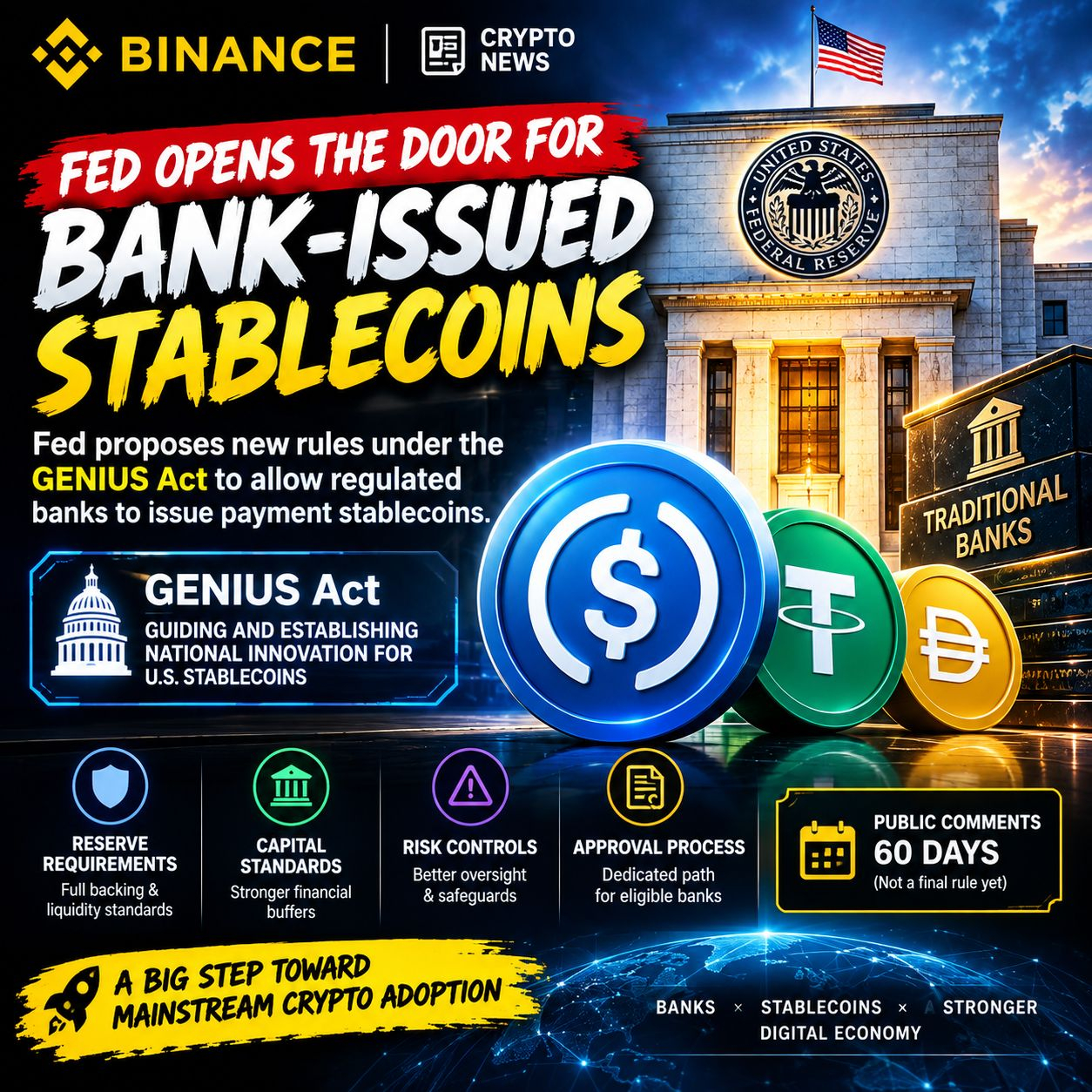
🚨 FED OPENS THE DOOR FOR BANK-ISSUED STABLECOINS
The Federal Reserve has proposed new rules under the GENIUS Act that would allow Fed-supervised banks to apply to issue payment stablecoins.
The proposal includes reserve requirements, capital standards, risk controls, and a dedicated approval process for banks entering the stablecoin market.
This could mark another major step toward bringing traditional banking deeper into the digital-asset ecosystem. 🏦💵
#Stablecoins #Crypto #Bitcoin #Ethereum #GENIUSAct #FederalReserve #Blockchain #CryptoNews
#FedProposesPaymentStablecoinRules
🚨 FED OPENS THE DOOR FOR BANK-ISSUED STABLECOINS
The Federal Reserve has proposed new rules under the GENIUS Act that would allow Fed-supervised banks to apply to issue payment stablecoins.
The proposal includes reserve requirements, capital standards, risk controls, and a dedicated approval process for banks entering the stablecoin market.
This could mark another major step toward bringing traditional banking deeper into the digital-asset ecosystem. 🏦💵
#Stablecoins #Crypto #Bitcoin #Ethereum #GENIUSAct #FederalReserve #Blockchain #CryptoNews
🚨 FED OPENS THE DOOR FOR BANK-ISSUED STABLECOINS
The Federal Reserve has proposed new rules under the GENIUS Act that would allow Fed-supervised banks to apply to issue payment stablecoins.
The proposal includes reserve requirements, capital standards, risk controls, and a dedicated approval process for banks entering the stablecoin market.
This could mark another major step toward bringing traditional banking deeper into the digital-asset ecosystem. 🏦💵
#Stablecoins #Crypto #Bitcoin #Ethereum #GENIUSAct #FederalReserve #Blockchain #CryptoNews
12

·
--
💵 The Fed's new stablecoin rules are really a stress test disguised as a rulebook...
#fedproposespaymentstablecoinrules
The Federal Reserve has proposed rules under the GENIUS Act requiring Board-supervised payment-stablecoin issuers to fully back tokens with permitted reserves such as short-term Treasury bills, alongside capital and risk-management requirements. It also proposes a process for supervised banks seeking approval to issue payment stablecoins.
But the most revealing line came from Governor Michael Barr:
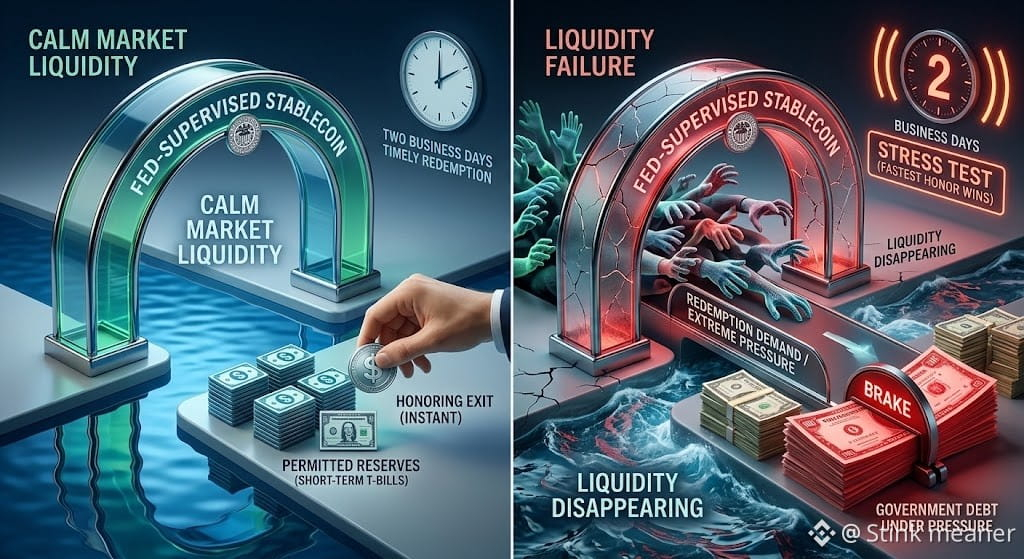
A stablecoin is only genuinely stable if it can be redeemed at par promptly under stress — including when even normally liquid government debt is under pressure.
That's a much harder test than “does it stay at $1 today?”
Because the real system looks like:
stablecoin → reserve assets → redemption demand → liquidity
In calm markets, the structure can look almost boring.
The real test arrives when redemptions surge and everyone wants liquidity simultaneously.
The Fed's own research notes that its proposal defines timely redemption at two business days, while other GENIUS implementation proposals contemplate longer timing under extreme redemption pressure.
That's the fascinating part:
The future stablecoin race may be decided less by who can issue the most tokens — and more by who can honor the exit fastest when liquidity disappears.
DYOR: These are proposed rules, not final requirements, and they apply specifically to the issuers/entities within the relevant federal regulatory perimeter.
$USDC $ONE $QNT
{future}(QNTUSDT)
{future}(ONEUSDT)
{future}(USDCUSDT)
#FedProposesPaymentStablecoinRules #Stablecoins #USDC #CryptoRegulation
💵 The Fed's new stablecoin rules are really a stress test disguised as a rulebook...
#fedproposespaymentstablecoinrules
The Federal Reserve has proposed rules under the GENIUS Act requiring Board-supervised payment-stablecoin issuers to fully back tokens with permitted reserves such as short-term Treasury bills, alongside capital and risk-management requirements. It also proposes a process for supervised banks seeking approval to issue payment stablecoins.
But the most revealing line came from Governor Michael Barr:
A stablecoin is only genuinely stable if it can be redeemed at par promptly under stress — including when even normally liquid government debt is under pressure.
That's a much harder test than “does it stay at $1 today?”
Because the real system looks like:
stablecoin → reserve assets → redemption demand → liquidity
In calm markets, the structure can look almost boring.
The real test arrives when redemptions surge and everyone wants liquidity simultaneously.
The Fed's own research notes that its proposal defines timely redemption at two business days, while other GENIUS implementation proposals contemplate longer timing under extreme redemption pressure.
That's the fascinating part:
The future stablecoin race may be decided less by who can issue the most tokens — and more by who can honor the exit fastest when liquidity disappears.
DYOR: These are proposed rules, not final requirements, and they apply specifically to the issuers/entities within the relevant federal regulatory perimeter.
$USDC $ONE $QNT
#FedProposesPaymentStablecoinRules #Stablecoins #USDC #CryptoRegulation
#fedproposespaymentstablecoinrules
The Federal Reserve has proposed rules under the GENIUS Act requiring Board-supervised payment-stablecoin issuers to fully back tokens with permitted reserves such as short-term Treasury bills, alongside capital and risk-management requirements. It also proposes a process for supervised banks seeking approval to issue payment stablecoins.
But the most revealing line came from Governor Michael Barr:
A stablecoin is only genuinely stable if it can be redeemed at par promptly under stress — including when even normally liquid government debt is under pressure.
That's a much harder test than “does it stay at $1 today?”
Because the real system looks like:
stablecoin → reserve assets → redemption demand → liquidity
In calm markets, the structure can look almost boring.
The real test arrives when redemptions surge and everyone wants liquidity simultaneously.
The Fed's own research notes that its proposal defines timely redemption at two business days, while other GENIUS implementation proposals contemplate longer timing under extreme redemption pressure.
That's the fascinating part:
The future stablecoin race may be decided less by who can issue the most tokens — and more by who can honor the exit fastest when liquidity disappears.
DYOR: These are proposed rules, not final requirements, and they apply specifically to the issuers/entities within the relevant federal regulatory perimeter.
$USDC $ONE $QNT
#FedProposesPaymentStablecoinRules #Stablecoins #USDC #CryptoRegulation
phu chanhluu 98:
follow me
2
6
10.9k

#FedProposesPaymentStablecoinRules
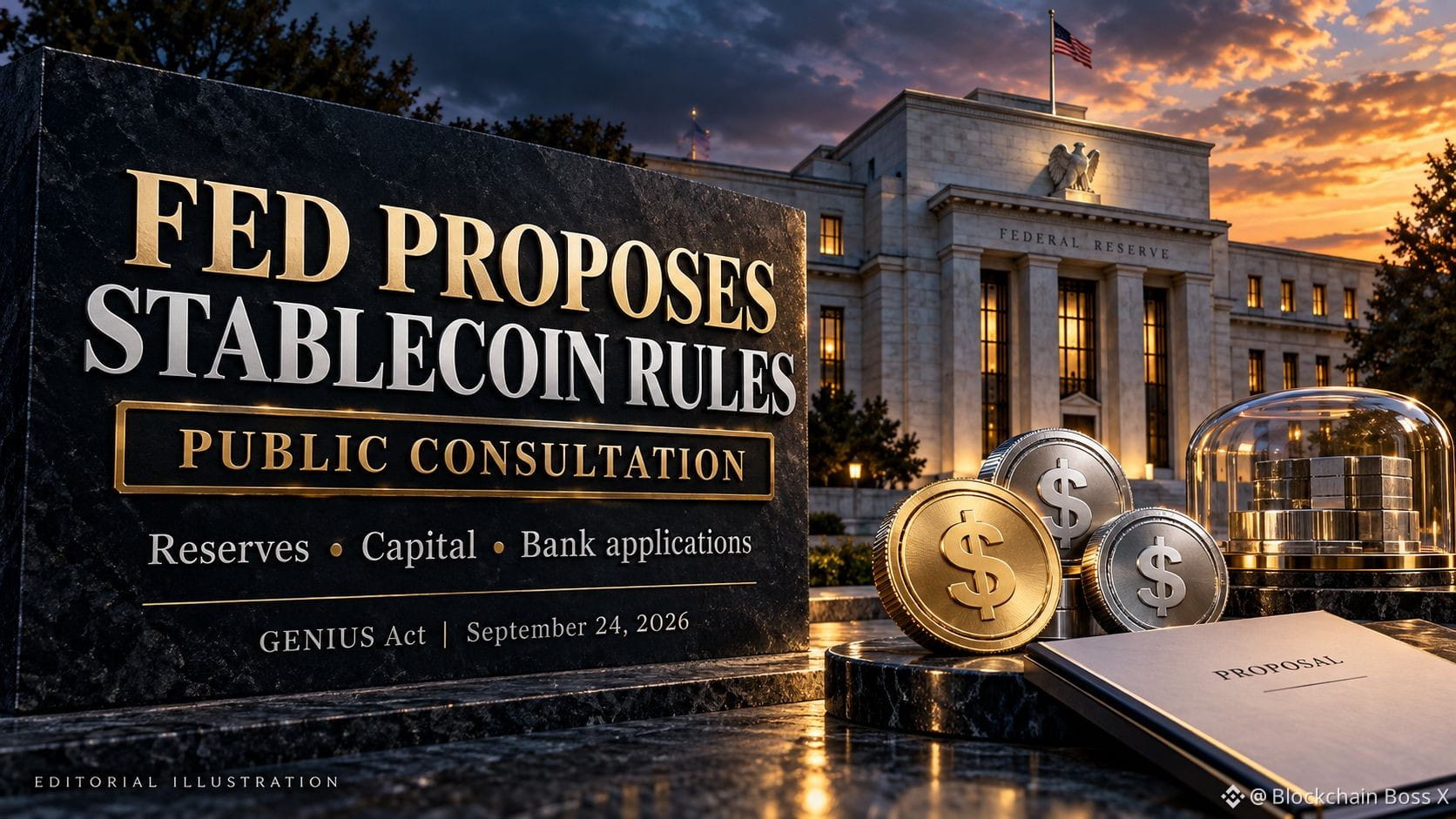
On September 24, 2026, the U.S. Federal Reserve issued two comprehensive rulemaking proposals under the Guiding and Establishing National Innovation for U.S. Stablecoins (GENIUS) Act to establish a federal regulatory framework for payment stablecoins. The proposals transition stablecoin oversight from standard enforcement guidance to formal, structured rulemaking for all Board-supervised issuers.
#FedProposesPaymentStablecoinRules
On September 24, 2026, the U.S. Federal Reserve issued two comprehensive rulemaking proposals under the Guiding and Establishing National Innovation for U.S. Stablecoins (GENIUS) Act to establish a federal regulatory framework for payment stablecoins. The proposals transition stablecoin oversight from standard enforcement guidance to formal, structured rulemaking for all Board-supervised issuers.
On September 24, 2026, the U.S. Federal Reserve issued two comprehensive rulemaking proposals under the Guiding and Establishing National Innovation for U.S. Stablecoins (GENIUS) Act to establish a federal regulatory framework for payment stablecoins. The proposals transition stablecoin oversight from standard enforcement guidance to formal, structured rulemaking for all Board-supervised issuers.
1
33

·
--
Bullish
#FedProposesPaymentStablecoinRules
The Fed Just Told Stablecoin Issuers They Can Earn Interest on Treasuries but You Cannot Earn Interest on Their Tokens 🏛️😂
September 24. The Federal Reserve Board asked the public to weigh in on two draft rules implementing the GENIUS Act. The first says stablecoin issuers under Fed supervision must back every token at all times with permitted reserves, mainly short term Treasury bills and other high quality liquid assets, plus standardized capital and risk management rules. The second sets an application path for banks that want to issue stablecoins through a subsidiary. Comments stay open for 60 days after Federal Register publication. 📊
Here is the line that quietly matters most 🧠
Issuers are barred from paying interest or yield solely for holding a payment stablecoin. Read that twice. The reserves behind the token can sit in Treasuries earning real interest, while the person holding the token gets nothing for it. That is the exact fight the Bank Policy Institute has been waging, the same banks that built their own tokenized deposits. CoinDesk notes the GENIUS Act is now the main law on stablecoin rewards because the CLARITY Act revision failed. 😂
The scoreboard nobody wanted 🎯
The law's deadline for rules was July 18. Agencies missed it. The OCC now targets November, and full enforcement is still planned for January 18, 2027. US Bank tested its Stellar stablecoin inside its own walls in the meantime. Regulators are writing the rulebook while banks are already playing. 💡
Governor Barr put it plainly, further work will undoubtedly be required if stablecoins are to be reliable payment instruments. 🚀
$USDC
{spot}(USDCUSDT)
#FedProposesPaymentStablecoinRules
The Fed Just Told Stablecoin Issuers They Can Earn Interest on Treasuries but You Cannot Earn Interest on Their Tokens 🏛️😂
September 24. The Federal Reserve Board asked the public to weigh in on two draft rules implementing the GENIUS Act. The first says stablecoin issuers under Fed supervision must back every token at all times with permitted reserves, mainly short term Treasury bills and other high quality liquid assets, plus standardized capital and risk management rules. The second sets an application path for banks that want to issue stablecoins through a subsidiary. Comments stay open for 60 days after Federal Register publication. 📊
Here is the line that quietly matters most 🧠
Issuers are barred from paying interest or yield solely for holding a payment stablecoin. Read that twice. The reserves behind the token can sit in Treasuries earning real interest, while the person holding the token gets nothing for it. That is the exact fight the Bank Policy Institute has been waging, the same banks that built their own tokenized deposits. CoinDesk notes the GENIUS Act is now the main law on stablecoin rewards because the CLARITY Act revision failed. 😂
The scoreboard nobody wanted 🎯
The law's deadline for rules was July 18. Agencies missed it. The OCC now targets November, and full enforcement is still planned for January 18, 2027. US Bank tested its Stellar stablecoin inside its own walls in the meantime. Regulators are writing the rulebook while banks are already playing. 💡
Governor Barr put it plainly, further work will undoubtedly be required if stablecoins are to be reliable payment instruments. 🚀
$USDC
The Fed Just Told Stablecoin Issuers They Can Earn Interest on Treasuries but You Cannot Earn Interest on Their Tokens 🏛️😂
September 24. The Federal Reserve Board asked the public to weigh in on two draft rules implementing the GENIUS Act. The first says stablecoin issuers under Fed supervision must back every token at all times with permitted reserves, mainly short term Treasury bills and other high quality liquid assets, plus standardized capital and risk management rules. The second sets an application path for banks that want to issue stablecoins through a subsidiary. Comments stay open for 60 days after Federal Register publication. 📊
Here is the line that quietly matters most 🧠
Issuers are barred from paying interest or yield solely for holding a payment stablecoin. Read that twice. The reserves behind the token can sit in Treasuries earning real interest, while the person holding the token gets nothing for it. That is the exact fight the Bank Policy Institute has been waging, the same banks that built their own tokenized deposits. CoinDesk notes the GENIUS Act is now the main law on stablecoin rewards because the CLARITY Act revision failed. 😂
The scoreboard nobody wanted 🎯
The law's deadline for rules was July 18. Agencies missed it. The OCC now targets November, and full enforcement is still planned for January 18, 2027. US Bank tested its Stellar stablecoin inside its own walls in the meantime. Regulators are writing the rulebook while banks are already playing. 💡
Governor Barr put it plainly, further work will undoubtedly be required if stablecoins are to be reliable payment instruments. 🚀
$USDC

76

·
--
Bullish
#fedproposespaymentstablecoinrules
Fed Proposes Payment Stablecoin Rules: What Would Change for Issuers?
Stablecoin adoption depends partly on confidence in the assets and systems behind each token.
On September 24, 2026, the Federal Reserve requested public feedback on two proposals under the GENIUS Act, addressing payment stablecoin issuers under its supervision and related banking activities.
The first would require full backing with eligible reserve assets, including short-term Treasury bills. It also addresses capital requirements, risk management and the safekeeping of assets backing stablecoins.
The second would establish an application process for Fed-supervised banks seeking approval for stablecoin issuance, requiring business plans, financial information and supporting documents.
These remain proposals. The comment period closes 60 days after publication in the Federal Register, and the final requirements may change.
My take: Clearer reserve and operating requirements could help banks and businesses assess stablecoin issuers more consistently. Compliance also costs money, so the final design could influence which firms can compete and how services are priced.
For users, the practical questions remain straightforward: how accessible is redemption, who safeguards the reserves, and how reliably do operations function during stress?
I would watch whether the final framework combines stronger protections with workable entry requirements. That balance could shape competition and the usefulness of payment stablecoins.
Which matters most to you: reserve transparency, reliable redemption or greater issuer competition?
#FedProposesPaymentStablecoinRules #Stablecoins #GENIUSAct
$QNT $BTW $ONE
{future}(ONEUSDT)
{future}(BTWUSDT)
{future}(QNTUSDT)
#fedproposespaymentstablecoinrules
Fed Proposes Payment Stablecoin Rules: What Would Change for Issuers?
Stablecoin adoption depends partly on confidence in the assets and systems behind each token.
On September 24, 2026, the Federal Reserve requested public feedback on two proposals under the GENIUS Act, addressing payment stablecoin issuers under its supervision and related banking activities.
The first would require full backing with eligible reserve assets, including short-term Treasury bills. It also addresses capital requirements, risk management and the safekeeping of assets backing stablecoins.
The second would establish an application process for Fed-supervised banks seeking approval for stablecoin issuance, requiring business plans, financial information and supporting documents.
These remain proposals. The comment period closes 60 days after publication in the Federal Register, and the final requirements may change.
My take: Clearer reserve and operating requirements could help banks and businesses assess stablecoin issuers more consistently. Compliance also costs money, so the final design could influence which firms can compete and how services are priced.
For users, the practical questions remain straightforward: how accessible is redemption, who safeguards the reserves, and how reliably do operations function during stress?
I would watch whether the final framework combines stronger protections with workable entry requirements. That balance could shape competition and the usefulness of payment stablecoins.
Which matters most to you: reserve transparency, reliable redemption or greater issuer competition?
#FedProposesPaymentStablecoinRules #Stablecoins #GENIUSAct
$QNT $BTW $ONE
Fed Proposes Payment Stablecoin Rules: What Would Change for Issuers?
Stablecoin adoption depends partly on confidence in the assets and systems behind each token.
On September 24, 2026, the Federal Reserve requested public feedback on two proposals under the GENIUS Act, addressing payment stablecoin issuers under its supervision and related banking activities.
The first would require full backing with eligible reserve assets, including short-term Treasury bills. It also addresses capital requirements, risk management and the safekeeping of assets backing stablecoins.
The second would establish an application process for Fed-supervised banks seeking approval for stablecoin issuance, requiring business plans, financial information and supporting documents.
These remain proposals. The comment period closes 60 days after publication in the Federal Register, and the final requirements may change.
My take: Clearer reserve and operating requirements could help banks and businesses assess stablecoin issuers more consistently. Compliance also costs money, so the final design could influence which firms can compete and how services are priced.
For users, the practical questions remain straightforward: how accessible is redemption, who safeguards the reserves, and how reliably do operations function during stress?
I would watch whether the final framework combines stronger protections with workable entry requirements. That balance could shape competition and the usefulness of payment stablecoins.
Which matters most to you: reserve transparency, reliable redemption or greater issuer competition?
#FedProposesPaymentStablecoinRules #Stablecoins #GENIUSAct
$QNT $BTW $ONE
2
1.9k

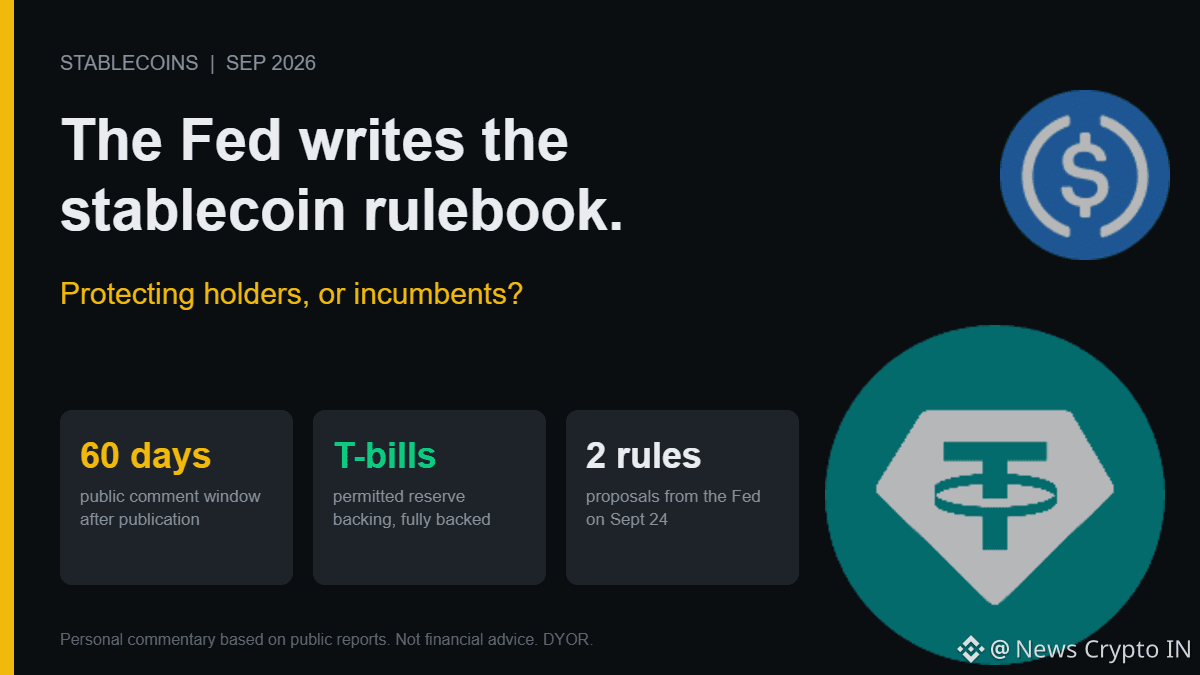
The Fed just put the first real GENIUS Act rule text on the table for stablecoin issuers, and it reads like a banking rulebook, not a crypto one.
Two proposals, announced Sept 24:
1. Reserves and capital: issuers must fully back tokens with permitted assets like short-term Treasury bills and other high-quality liquid assets, plus standardized capital requirements for credit and operational risk.
2. Applications: banks that want to issue must submit a business plan and financial information, with a formal process for appeals, hearings and final determinations.
The FDIC issued its own proposal for the institutions it supervises. Comments are open for 60 days after Federal Register publication.
Why this matters: yesterday I wrote about how fixed compliance costs favor big issuers. These proposals are what turns that forecast into rule text. Capital buffers and application dossiers are cheap for a bank with a compliance department and expensive for a crypto-native startup.
The upside is real: full T-bill backing and capital buffers make a stablecoin run less likely, and that's good for anyone parking money in one.
The open question is who ends up issuing the dollars. If the winners are bank-affiliated, "permissionless dollars" become "permitted dollars."
Are these rules protecting holders, or protecting incumbents? Both can be true.
#FedProposesPaymentStablecoinRules #GENIUSAct
The Fed just put the first real GENIUS Act rule text on the table for stablecoin issuers, and it reads like a banking rulebook, not a crypto one.
Two proposals, announced Sept 24:
1. Reserves and capital: issuers must fully back tokens with permitted assets like short-term Treasury bills and other high-quality liquid assets, plus standardized capital requirements for credit and operational risk.
2. Applications: banks that want to issue must submit a business plan and financial information, with a formal process for appeals, hearings and final determinations.
The FDIC issued its own proposal for the institutions it supervises. Comments are open for 60 days after Federal Register publication.
Why this matters: yesterday I wrote about how fixed compliance costs favor big issuers. These proposals are what turns that forecast into rule text. Capital buffers and application dossiers are cheap for a bank with a compliance department and expensive for a crypto-native startup.
The upside is real: full T-bill backing and capital buffers make a stablecoin run less likely, and that's good for anyone parking money in one.
The open question is who ends up issuing the dollars. If the winners are bank-affiliated, "permissionless dollars" become "permitted dollars."
Are these rules protecting holders, or protecting incumbents? Both can be true.
#FedProposesPaymentStablecoinRules #GENIUSAct
Two proposals, announced Sept 24:
1. Reserves and capital: issuers must fully back tokens with permitted assets like short-term Treasury bills and other high-quality liquid assets, plus standardized capital requirements for credit and operational risk.
2. Applications: banks that want to issue must submit a business plan and financial information, with a formal process for appeals, hearings and final determinations.
The FDIC issued its own proposal for the institutions it supervises. Comments are open for 60 days after Federal Register publication.
Why this matters: yesterday I wrote about how fixed compliance costs favor big issuers. These proposals are what turns that forecast into rule text. Capital buffers and application dossiers are cheap for a bank with a compliance department and expensive for a crypto-native startup.
The upside is real: full T-bill backing and capital buffers make a stablecoin run less likely, and that's good for anyone parking money in one.
The open question is who ends up issuing the dollars. If the winners are bank-affiliated, "permissionless dollars" become "permitted dollars."
Are these rules protecting holders, or protecting incumbents? Both can be true.
#FedProposesPaymentStablecoinRules #GENIUSAct
1
92

·
--
Bullish
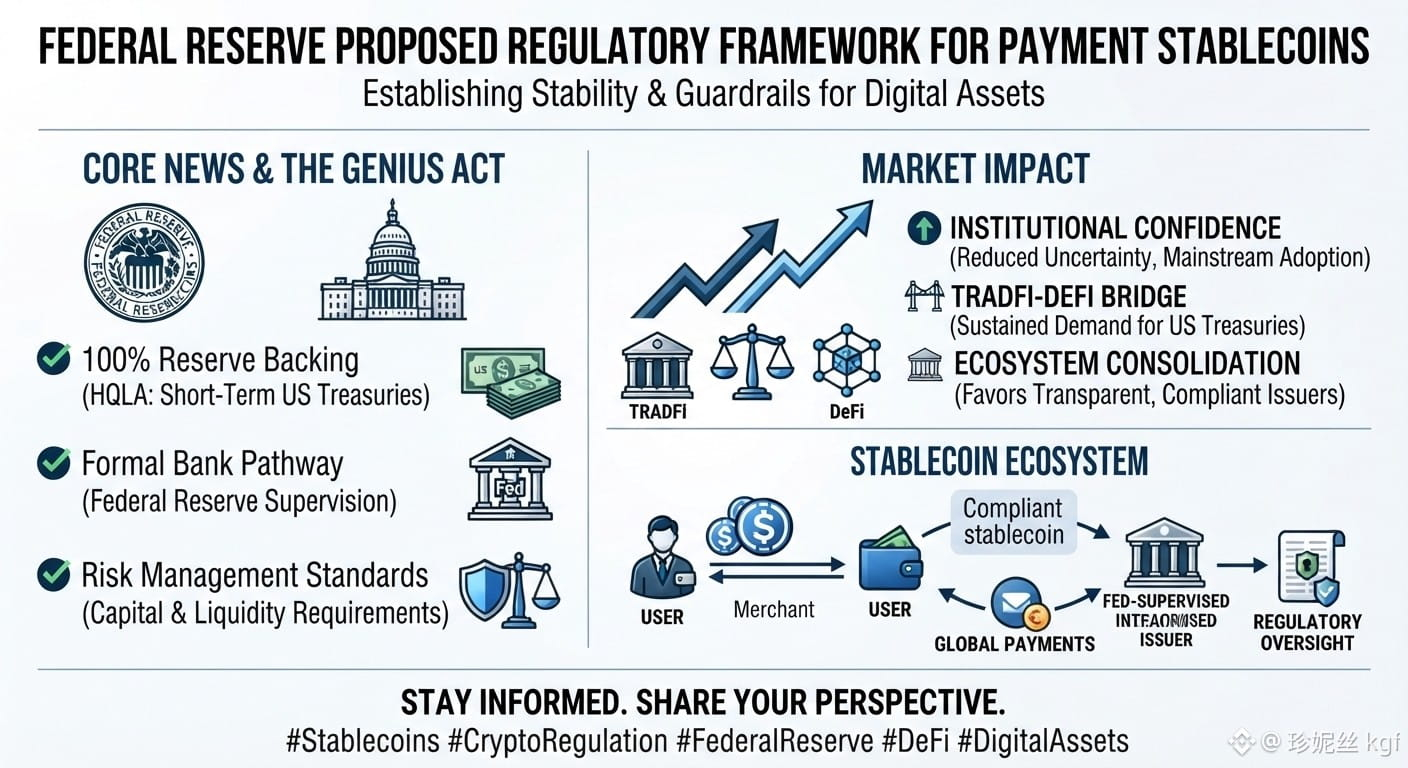
#fedproposespaymentstablecoinrules 🏛️ Federal Reserve Proposes New Regulatory Framework for Payment Stablecoins
The regulatory landscape for digital assets is evolving. The Federal Reserve has just unveiled a comprehensive proposal to establish clear, formal guardrails for payment stablecoin issuers.
📰 Core News
Under the newly proposed rules tied to the GENIUS Act, the Federal Reserve aims to ensure stability and consumer protection in the digital payments space. Key highlights include:
• 💵 100% Reserve Backing Issuers must fully back stablecoins with high-quality, liquid assets (HQLA), such as short-term U.S. Treasury bills.
• 🏦 Formal Bank Pathway A tailored application process for Federal Reserve-supervised banks seeking to issue payment stablecoins.
• 🛡️ Risk Management Standards Standardized capital requirements to address credit and operational risks, ensuring stablecoins can be reliably redeemed at par, even during periods of market stress.
📊 Market Impact
• lnstitutional Confidence Clear regulatory frameworks reduce uncertainty, which could accelerate mainstream and institutional adoption of compliant, fiat-backed stablecoins.
• TradFi-DeFi Bridge Mandating HQLA reserves may drive sustained institutional demand for short-term U.S. Treasuries, further integrating traditional finance with blockchain-based payment rails.
• Ecosystem Consolidation Higher compliance and capital barriers are likely to favor well-established, transparent issuers while raising the entry bar for smaller or non-compliant models.
💬 Join the Discussion
How do you think this new regulatory clarity will shape the future of stablecoin adoption in everyday global payments? Share your perspective in the comments below! 👇
#Stablecoins #CryptoRegulation #FederalReserve #DeFi #DigitalAssets
This is for educational purposes only. Not Financial Advice (NFA). Always Do Your Own Research (DYOR).
$ALGO $AUDIO $GRT
{future}(GRTUSDT)
{spot}(AUDIOUSDT)
{future}(ALGOUSDT)
#fedproposespaymentstablecoinrules 🏛️ Federal Reserve Proposes New Regulatory Framework for Payment Stablecoins
The regulatory landscape for digital assets is evolving. The Federal Reserve has just unveiled a comprehensive proposal to establish clear, formal guardrails for payment stablecoin issuers.
📰 Core News
Under the newly proposed rules tied to the GENIUS Act, the Federal Reserve aims to ensure stability and consumer protection in the digital payments space. Key highlights include:
• 💵 100% Reserve Backing Issuers must fully back stablecoins with high-quality, liquid assets (HQLA), such as short-term U.S. Treasury bills.
• 🏦 Formal Bank Pathway A tailored application process for Federal Reserve-supervised banks seeking to issue payment stablecoins.
• 🛡️ Risk Management Standards Standardized capital requirements to address credit and operational risks, ensuring stablecoins can be reliably redeemed at par, even during periods of market stress.
📊 Market Impact
• lnstitutional Confidence Clear regulatory frameworks reduce uncertainty, which could accelerate mainstream and institutional adoption of compliant, fiat-backed stablecoins.
• TradFi-DeFi Bridge Mandating HQLA reserves may drive sustained institutional demand for short-term U.S. Treasuries, further integrating traditional finance with blockchain-based payment rails.
• Ecosystem Consolidation Higher compliance and capital barriers are likely to favor well-established, transparent issuers while raising the entry bar for smaller or non-compliant models.
💬 Join the Discussion
How do you think this new regulatory clarity will shape the future of stablecoin adoption in everyday global payments? Share your perspective in the comments below! 👇
#Stablecoins #CryptoRegulation #FederalReserve #DeFi #DigitalAssets
This is for educational purposes only. Not Financial Advice (NFA). Always Do Your Own Research (DYOR).
$ALGO $AUDIO $GRT
The regulatory landscape for digital assets is evolving. The Federal Reserve has just unveiled a comprehensive proposal to establish clear, formal guardrails for payment stablecoin issuers.
📰 Core News
Under the newly proposed rules tied to the GENIUS Act, the Federal Reserve aims to ensure stability and consumer protection in the digital payments space. Key highlights include:
• 💵 100% Reserve Backing Issuers must fully back stablecoins with high-quality, liquid assets (HQLA), such as short-term U.S. Treasury bills.
• 🏦 Formal Bank Pathway A tailored application process for Federal Reserve-supervised banks seeking to issue payment stablecoins.
• 🛡️ Risk Management Standards Standardized capital requirements to address credit and operational risks, ensuring stablecoins can be reliably redeemed at par, even during periods of market stress.
📊 Market Impact
• lnstitutional Confidence Clear regulatory frameworks reduce uncertainty, which could accelerate mainstream and institutional adoption of compliant, fiat-backed stablecoins.
• TradFi-DeFi Bridge Mandating HQLA reserves may drive sustained institutional demand for short-term U.S. Treasuries, further integrating traditional finance with blockchain-based payment rails.
• Ecosystem Consolidation Higher compliance and capital barriers are likely to favor well-established, transparent issuers while raising the entry bar for smaller or non-compliant models.
💬 Join the Discussion
How do you think this new regulatory clarity will shape the future of stablecoin adoption in everyday global payments? Share your perspective in the comments below! 👇
#Stablecoins #CryptoRegulation #FederalReserve #DeFi #DigitalAssets
This is for educational purposes only. Not Financial Advice (NFA). Always Do Your Own Research (DYOR).
$ALGO $AUDIO $GRT
FEDAT - sport digital assets marketplace:
Я предполагаю,что регулирование — это не смерть криптоиндустрии, а ее взросление. 100% резервы и банковский надзор превращают стейблкоины из нишевого крипто-инструмента в легитимный слой глобальных расчетов. Ждем притока традиционных банков в этот сектор! 💪🤝👍
1
3
1.9k

$USDC #fedproposespaymentstablecoinrules
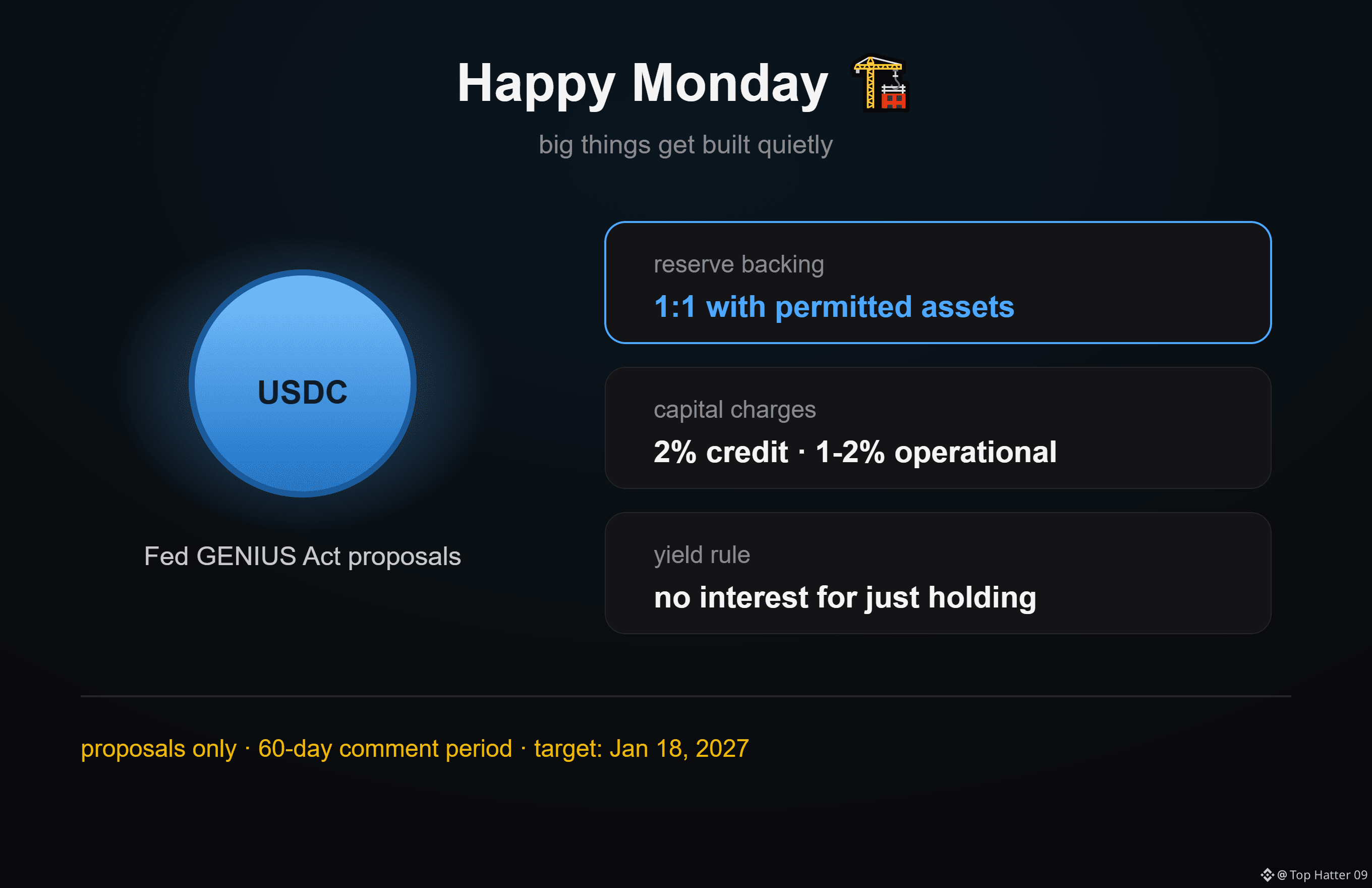
Here's one story a lot of people scroll past because there's no price drama in it. On September 24, the Federal Reserve put out two proposals for stablecoin issuers it supervises, under the GENIUS Act.
First: issuers would have to back their stablecoins one-to-one with permitted assets, things like US dollars, balances at the Fed, insured deposits, and short-term Treasury bills. Second: there are capital requirements too, a 2% charge for credit risk and 1% to 2% for operational risk depending on the issuer's size. Issuers also can't pay interest or yield just for holding a stablecoin, which was a big worry for the banking industry. And banks that want to launch their own stablecoin would follow a separate application process.
These aren't final rules yet. Public comments stay open for 60 days, with full enforcement targeted for January 18, 2027.
Monday thought: big things get built quietly. The foundation goes in slowly, and the people who are ready when it's finished are usually the ones who benefit most.
Have a strong week.
$USDC #Stablecoins #HappyMonday
{future}(USDCUSDT)
$USDC #fedproposespaymentstablecoinrules
Here's one story a lot of people scroll past because there's no price drama in it. On September 24, the Federal Reserve put out two proposals for stablecoin issuers it supervises, under the GENIUS Act.
First: issuers would have to back their stablecoins one-to-one with permitted assets, things like US dollars, balances at the Fed, insured deposits, and short-term Treasury bills. Second: there are capital requirements too, a 2% charge for credit risk and 1% to 2% for operational risk depending on the issuer's size. Issuers also can't pay interest or yield just for holding a stablecoin, which was a big worry for the banking industry. And banks that want to launch their own stablecoin would follow a separate application process.
These aren't final rules yet. Public comments stay open for 60 days, with full enforcement targeted for January 18, 2027.
Monday thought: big things get built quietly. The foundation goes in slowly, and the people who are ready when it's finished are usually the ones who benefit most.
Have a strong week.
$USDC #Stablecoins #HappyMonday
Here's one story a lot of people scroll past because there's no price drama in it. On September 24, the Federal Reserve put out two proposals for stablecoin issuers it supervises, under the GENIUS Act.
First: issuers would have to back their stablecoins one-to-one with permitted assets, things like US dollars, balances at the Fed, insured deposits, and short-term Treasury bills. Second: there are capital requirements too, a 2% charge for credit risk and 1% to 2% for operational risk depending on the issuer's size. Issuers also can't pay interest or yield just for holding a stablecoin, which was a big worry for the banking industry. And banks that want to launch their own stablecoin would follow a separate application process.
These aren't final rules yet. Public comments stay open for 60 days, with full enforcement targeted for January 18, 2027.
Monday thought: big things get built quietly. The foundation goes in slowly, and the people who are ready when it's finished are usually the ones who benefit most.
Have a strong week.
$USDC #Stablecoins #HappyMonday
1
2.4k
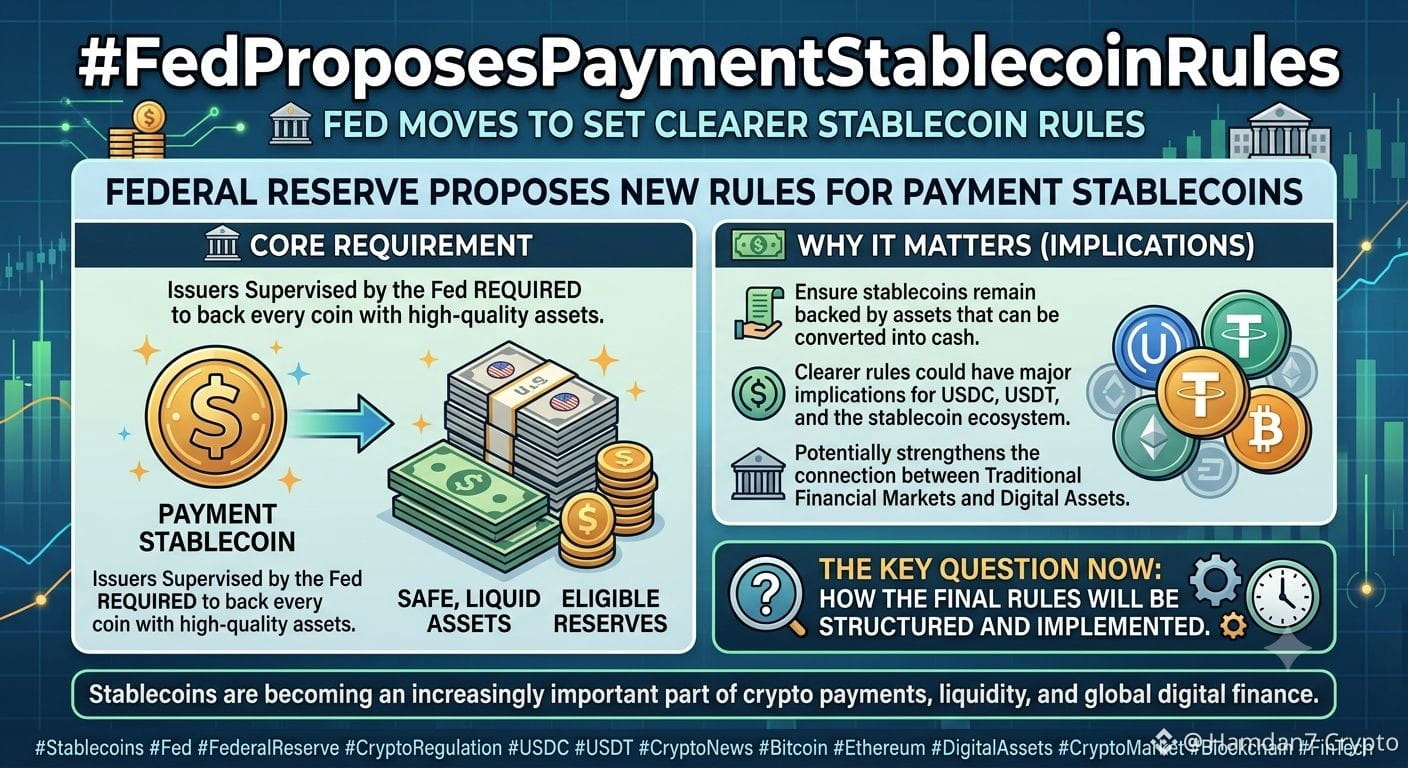
#FedProposesPaymentStablecoinRules
🏦 FED MOVES TO SET CLEARER STABLECOIN RULES
The U.S. Federal Reserve has proposed new rules for payment stablecoins, marking another major step toward establishing a clearer regulatory framework for the rapidly growing stablecoin market.
Under the proposal, stablecoin issuers supervised by the Fed would be required to back every coin with high-quality, safe and liquid assets, including U.S. Treasury bills and other eligible reserves.
💵 Why it matters:
Strong reserve requirements are designed to ensure that stablecoins remain backed by assets that can be converted into cash when needed.
For the crypto market, clearer rules could have major implications for USDC, USDT and the broader stablecoin ecosystem, while potentially strengthening the connection between traditional financial markets and digital assets.
🔎 The key question now is how the final rules will be structured and implemented.
Stablecoins are becoming an increasingly important part of crypto payments, liquidity and global digital finance.
#Stablecoins #Fed #FederalReserve #CryptoRegulation #USDC #USDT #CryptoNews #Bitcoin #Ethereum #DigitalAssets #CryptoMarket #Blockchain #FinTech
#FedProposesPaymentStablecoinRules
🏦 FED MOVES TO SET CLEARER STABLECOIN RULES
The U.S. Federal Reserve has proposed new rules for payment stablecoins, marking another major step toward establishing a clearer regulatory framework for the rapidly growing stablecoin market.
Under the proposal, stablecoin issuers supervised by the Fed would be required to back every coin with high-quality, safe and liquid assets, including U.S. Treasury bills and other eligible reserves.
💵 Why it matters:
Strong reserve requirements are designed to ensure that stablecoins remain backed by assets that can be converted into cash when needed.
For the crypto market, clearer rules could have major implications for USDC, USDT and the broader stablecoin ecosystem, while potentially strengthening the connection between traditional financial markets and digital assets.
🔎 The key question now is how the final rules will be structured and implemented.
Stablecoins are becoming an increasingly important part of crypto payments, liquidity and global digital finance.
#Stablecoins #Fed #FederalReserve #CryptoRegulation #USDC #USDT #CryptoNews #Bitcoin #Ethereum #DigitalAssets #CryptoMarket #Blockchain #FinTech
🏦 FED MOVES TO SET CLEARER STABLECOIN RULES
The U.S. Federal Reserve has proposed new rules for payment stablecoins, marking another major step toward establishing a clearer regulatory framework for the rapidly growing stablecoin market.
Under the proposal, stablecoin issuers supervised by the Fed would be required to back every coin with high-quality, safe and liquid assets, including U.S. Treasury bills and other eligible reserves.
💵 Why it matters:
Strong reserve requirements are designed to ensure that stablecoins remain backed by assets that can be converted into cash when needed.
For the crypto market, clearer rules could have major implications for USDC, USDT and the broader stablecoin ecosystem, while potentially strengthening the connection between traditional financial markets and digital assets.
🔎 The key question now is how the final rules will be structured and implemented.
Stablecoins are becoming an increasingly important part of crypto payments, liquidity and global digital finance.
#Stablecoins #Fed #FederalReserve #CryptoRegulation #USDC #USDT #CryptoNews #Bitcoin #Ethereum #DigitalAssets #CryptoMarket #Blockchain #FinTech
7
Log in to explore more content
Join global crypto users on Binance Square
⚡️ Get latest and useful information about crypto.
💬 Trusted by the world’s largest crypto exchange.
👍 Discover real insights from verified creators.
Email / Phone number
Trending Topics
1
#BitcoinClears$85200
0 views
13 Discussing
2
#AltcoinSeasonIndexHoldsAbove60For5Days
311 views
118 Discussing
3
#BitcoinSlipsBelow$84000
691 views
52 Discussing
4
#BankOfKoreaToBuy1TonGoldInDecember
0 views
4 Discussing
5
#USADPAdds90000JobsInSeptember
0 views
5 Discussing
6
#USCorePCEEasesTo3%InAugust
0 views
3 Discussing
7
#KospiPostsWorstQuarterSince2020
179 views
77 Discussing
8
#SECToClarifyOnChainFundraisingRules
4,460 views
267 Discussing
9
#UKFCAOpensCryptoFirmAuthorization
7,847 views
255 Discussing
10
#JapanMOFStudyGroupOnTokenizedGovtBonds
6,699 views
248 Discussing