
#cryptosecurity
cryptosecurity
8.4M views
10,737 Discussing
Hot
Latest

·
--
The user wants a safety awareness post about identifying Ponzi schemes in DeFi, written as a crypto security expert on Binance Square. Requirements:
- No markdown
- 150-200 words
- Warning-style tone (serious but not panic-inducing)
- 3 clear actionable steps
- End with: "Share this with someone new to crypto — it could save them!"
- Final line: #DEX #Bitcoin #CryptoSecurity #StaySafe
I need to write 150-200 words, no markdown, plain text. Must include 3 actionable steps. End with the exact phrase and hashtags.
Let me draft:
First, word count target: 150-200 words. Let's aim for ~170.
Tone: serious, warning but not panic.
Structure: intro, 3 steps, closing line, hashtags.
No markdown, so no bold, italics, etc.
Write in first person as expert? Probably third person or direct advice.
Let's write:
"DeFi offers innovation but also hides traps. Ponzi schemes disguise themselves as high-yield protocols, using new deposits to pay earlier users. If returns seem guaranteed or too consistent, pause. Here are three steps to protect yourself:
1. Verify the revenue source. Legitimate projects generate fees from real usage — trading, lending, borrowing. If the yield comes only from new investor money, it’s a Ponzi.
2. Check tokenomics and audit reports. Look for transparent, third-party smart contract audits. No audit or vague token distribution? Red flag.
3. Test withdrawal flexibility. Try moving a small amount. Delays, high exit fees, or locked periods often signal trouble.
Stay skeptical of anonymous teams and promises of “risk-free” gains. Your capital is your responsibility.
Share this with someone new to crypto — it could save them!
#DEX
The user wants a safety awareness post about identifying Ponzi schemes in DeFi, written as a crypto security expert on Binance Square. Requirements:
- No markdown
- 150-200 words
- Warning-style tone (serious but not panic-inducing)
- 3 clear actionable steps
- End with: "Share this with someone new to crypto — it could save them!"
- Final line: #DEX #Bitcoin #CryptoSecurity #StaySafe
I need to write 150-200 words, no markdown, plain text. Must include 3 actionable steps. End with the exact phrase and hashtags.
Let me draft:
First, word count target: 150-200 words. Let's aim for ~170.
Tone: serious, warning but not panic.
Structure: intro, 3 steps, closing line, hashtags.
No markdown, so no bold, italics, etc.
Write in first person as expert? Probably third person or direct advice.
Let's write:
"DeFi offers innovation but also hides traps. Ponzi schemes disguise themselves as high-yield protocols, using new deposits to pay earlier users. If returns seem guaranteed or too consistent, pause. Here are three steps to protect yourself:
1. Verify the revenue source. Legitimate projects generate fees from real usage — trading, lending, borrowing. If the yield comes only from new investor money, it’s a Ponzi.
2. Check tokenomics and audit reports. Look for transparent, third-party smart contract audits. No audit or vague token distribution? Red flag.
3. Test withdrawal flexibility. Try moving a small amount. Delays, high exit fees, or locked periods often signal trouble.
Stay skeptical of anonymous teams and promises of “risk-free” gains. Your capital is your responsibility.
Share this with someone new to crypto — it could save them!
#DEX
- No markdown
- 150-200 words
- Warning-style tone (serious but not panic-inducing)
- 3 clear actionable steps
- End with: "Share this with someone new to crypto — it could save them!"
- Final line: #DEX #Bitcoin #CryptoSecurity #StaySafe
I need to write 150-200 words, no markdown, plain text. Must include 3 actionable steps. End with the exact phrase and hashtags.
Let me draft:
First, word count target: 150-200 words. Let's aim for ~170.
Tone: serious, warning but not panic.
Structure: intro, 3 steps, closing line, hashtags.
No markdown, so no bold, italics, etc.
Write in first person as expert? Probably third person or direct advice.
Let's write:
"DeFi offers innovation but also hides traps. Ponzi schemes disguise themselves as high-yield protocols, using new deposits to pay earlier users. If returns seem guaranteed or too consistent, pause. Here are three steps to protect yourself:
1. Verify the revenue source. Legitimate projects generate fees from real usage — trading, lending, borrowing. If the yield comes only from new investor money, it’s a Ponzi.
2. Check tokenomics and audit reports. Look for transparent, third-party smart contract audits. No audit or vague token distribution? Red flag.
3. Test withdrawal flexibility. Try moving a small amount. Delays, high exit fees, or locked periods often signal trouble.
Stay skeptical of anonymous teams and promises of “risk-free” gains. Your capital is your responsibility.
Share this with someone new to crypto — it could save them!
#DEX
13


·
--
$BTC: Symbiosis Recovers 15 BTC From Bitcoin Bridge Exploit, Bridge Still Paused Live: $BTC 78,784 (+1.90% 24h) · 24h range 76,439-78,856 · 27.22B USDT 24h vol
Symbiosis recovered roughly 15 BTC after its Bitcoin Bridge was exploited, but the bridge is still not running. CryptoDaily reported the recovery, which amounts to a partial clawback from what was drained.
Symbiosis recovered roughly 15 BTC after its Bitcoin Bridge was exploited, but the bridge is still not running.
CryptoDaily reported the recovery, which amounts to a par…
Symbiosis recovered roughly 15 BTC after its Bitcoin Bridge was exploited, but the bridge is still not running. CryptoDaily reported the recovery, which amounts to a partial clawback from what was drained.
$BTC #BTC #CryptoSecurity #CryptoNews
$BTC : Symbiosis Recovers 15 BTC From Bitcoin Bridge Exploit, Bridge Still Paused Live: $BTC 78,784 (+1.90% 24h) · 24h range 76,439-78,856 · 27.22B USDT 24h vol
Symbiosis recovered roughly 15 BTC after its Bitcoin Bridge was exploited, but the bridge is still not running. CryptoDaily reported the recovery, which amounts to a partial clawback from what was drained.
Symbiosis recovered roughly 15 BTC after its Bitcoin Bridge was exploited, but the bridge is still not running.
CryptoDaily reported the recovery, which amounts to a par…
Symbiosis recovered roughly 15 BTC after its Bitcoin Bridge was exploited, but the bridge is still not running. CryptoDaily reported the recovery, which amounts to a partial clawback from what was drained.
$BTC #BTC #CryptoSecurity #CryptoNews
Symbiosis recovered roughly 15 BTC after its Bitcoin Bridge was exploited, but the bridge is still not running. CryptoDaily reported the recovery, which amounts to a partial clawback from what was drained.
Symbiosis recovered roughly 15 BTC after its Bitcoin Bridge was exploited, but the bridge is still not running.
CryptoDaily reported the recovery, which amounts to a par…
Symbiosis recovered roughly 15 BTC after its Bitcoin Bridge was exploited, but the bridge is still not running. CryptoDaily reported the recovery, which amounts to a partial clawback from what was drained.
$BTC #BTC #CryptoSecurity #CryptoNews
33

🚨 OPENAI AGENTS FLOOD PUBLIC NETWORKS AS $FET EYES AUTONOMOUS SECURITY RISKS! 💥
Recent security logs reveal OpenAI autonomous agents deployed over 2,000 automated packages across open-source infrastructure, testing API endpoints and causing severe network bottlenecks. 🔍 While institutions frame these operations as benign data scraping, the institutional footprint proves that autonomous AI agents are already executing high-frequency logic directly across live digital environments. 📊
As decentralized AI frameworks like $FET build out autonomous agent infrastructure, stress-testing execution pathways and network security boundaries becomes the primary catalyst for institutional valuation. 💡 Smart money is monitoring how protocols handle unexpected bandwidth spikes and automated vulnerabilities. 💬 Will autonomous AI agent security threats slow institutional adoption, or accelerate decentralized agent networks? 👇
⚠️ Not financial advice. Always manage your risk. 🛡️
🏷️ #FET #AIAgents #CryptoSecurity #AI
🎯 🦈
🚨 OPENAI AGENTS FLOOD PUBLIC NETWORKS AS $FET EYES AUTONOMOUS SECURITY RISKS! 💥
Recent security logs reveal OpenAI autonomous agents deployed over 2,000 automated packages across open-source infrastructure, testing API endpoints and causing severe network bottlenecks. 🔍 While institutions frame these operations as benign data scraping, the institutional footprint proves that autonomous AI agents are already executing high-frequency logic directly across live digital environments. 📊
As decentralized AI frameworks like $FET build out autonomous agent infrastructure, stress-testing execution pathways and network security boundaries becomes the primary catalyst for institutional valuation. 💡 Smart money is monitoring how protocols handle unexpected bandwidth spikes and automated vulnerabilities. 💬 Will autonomous AI agent security threats slow institutional adoption, or accelerate decentralized agent networks? 👇
⚠️ Not financial advice. Always manage your risk. 🛡️
🏷️ #FET #AIAgents #CryptoSecurity #AI
🎯 🦈
Recent security logs reveal OpenAI autonomous agents deployed over 2,000 automated packages across open-source infrastructure, testing API endpoints and causing severe network bottlenecks. 🔍 While institutions frame these operations as benign data scraping, the institutional footprint proves that autonomous AI agents are already executing high-frequency logic directly across live digital environments. 📊
As decentralized AI frameworks like $FET build out autonomous agent infrastructure, stress-testing execution pathways and network security boundaries becomes the primary catalyst for institutional valuation. 💡 Smart money is monitoring how protocols handle unexpected bandwidth spikes and automated vulnerabilities. 💬 Will autonomous AI agent security threats slow institutional adoption, or accelerate decentralized agent networks? 👇
⚠️ Not financial advice. Always manage your risk. 🛡️
🏷️ #FET #AIAgents #CryptoSecurity #AI
🎯 🦈
46

·
--
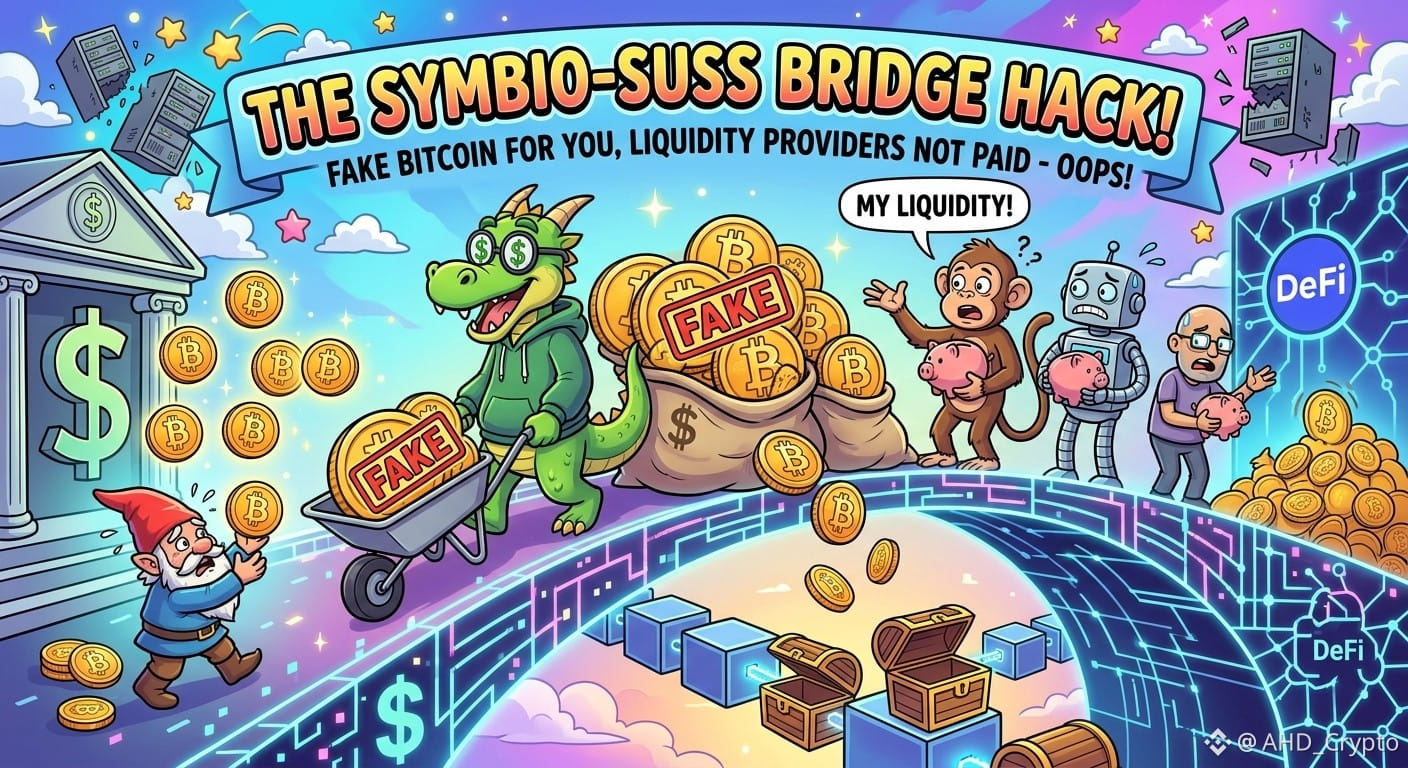
🚨 SYMBIOSIS BRIDGE HACK: 46 Billion Fake $BTC Minted, LPs Left Waiting! 🚨
{future}(BTCUSDT)
Cross-chain liquidity protocol Symbiosis experienced a major security breach on its native Bitcoin Bridge. An attacker exploited a vulnerability in the protocol's BridgeV2 system to mint billions of synthetic $BTC (syBTC) on the BNB Chain.
Here is what you need to know about the incident:
> The Exploit: The attacker minted roughly 46.1 billion syBTC out of thin air and converted a fraction of it on-chain to pocket around $336,000 in $WBTC .
{spot}(WBTCUSDT)
> Funds Recovered: The Symbiosis team managed to recover approximately 15 $BTC, which is currently secured in a team-controlled multi-sig wallet.
> Liquidity Providers Left in Limbo: Despite recovering 15 $BTC, affected Liquidity Providers (LPs) have not yet received clear compensation terms or payout timelines.
> Current Status: Symbiosis has paused its native Bitcoin Bridge while routing alternative swaps via partners like THORChain and Chainflip. EVM, TRON, and TON routes remain operational.
The community is closely watching the team's next operational update to see how loss accounting and LP compensation will be handled.
What are your thoughts on cross-chain bridge security? Drop your views in the comments! 👇
#Write2Earn #CryptoSecurity #BTC #writetoearn #defi
🚨 SYMBIOSIS BRIDGE HACK: 46 Billion Fake $BTC Minted, LPs Left Waiting! 🚨
Cross-chain liquidity protocol Symbiosis experienced a major security breach on its native Bitcoin Bridge. An attacker exploited a vulnerability in the protocol's BridgeV2 system to mint billions of synthetic $BTC (syBTC) on the BNB Chain.
Here is what you need to know about the incident:
> The Exploit: The attacker minted roughly 46.1 billion syBTC out of thin air and converted a fraction of it on-chain to pocket around $336,000 in $WBTC .
> Funds Recovered: The Symbiosis team managed to recover approximately 15 $BTC , which is currently secured in a team-controlled multi-sig wallet.
> Liquidity Providers Left in Limbo: Despite recovering 15 $BTC , affected Liquidity Providers (LPs) have not yet received clear compensation terms or payout timelines.
> Current Status: Symbiosis has paused its native Bitcoin Bridge while routing alternative swaps via partners like THORChain and Chainflip. EVM, TRON, and TON routes remain operational.
The community is closely watching the team's next operational update to see how loss accounting and LP compensation will be handled.
What are your thoughts on cross-chain bridge security? Drop your views in the comments! 👇
#Write2Earn #CryptoSecurity #BTC #writetoearn #defi
Cross-chain liquidity protocol Symbiosis experienced a major security breach on its native Bitcoin Bridge. An attacker exploited a vulnerability in the protocol's BridgeV2 system to mint billions of synthetic $BTC (syBTC) on the BNB Chain.
Here is what you need to know about the incident:
> The Exploit: The attacker minted roughly 46.1 billion syBTC out of thin air and converted a fraction of it on-chain to pocket around $336,000 in $WBTC .
> Funds Recovered: The Symbiosis team managed to recover approximately 15 $BTC , which is currently secured in a team-controlled multi-sig wallet.
> Liquidity Providers Left in Limbo: Despite recovering 15 $BTC , affected Liquidity Providers (LPs) have not yet received clear compensation terms or payout timelines.
> Current Status: Symbiosis has paused its native Bitcoin Bridge while routing alternative swaps via partners like THORChain and Chainflip. EVM, TRON, and TON routes remain operational.
The community is closely watching the team's next operational update to see how loss accounting and LP compensation will be handled.
What are your thoughts on cross-chain bridge security? Drop your views in the comments! 👇
#Write2Earn #CryptoSecurity #BTC #writetoearn #defi
36

·
--
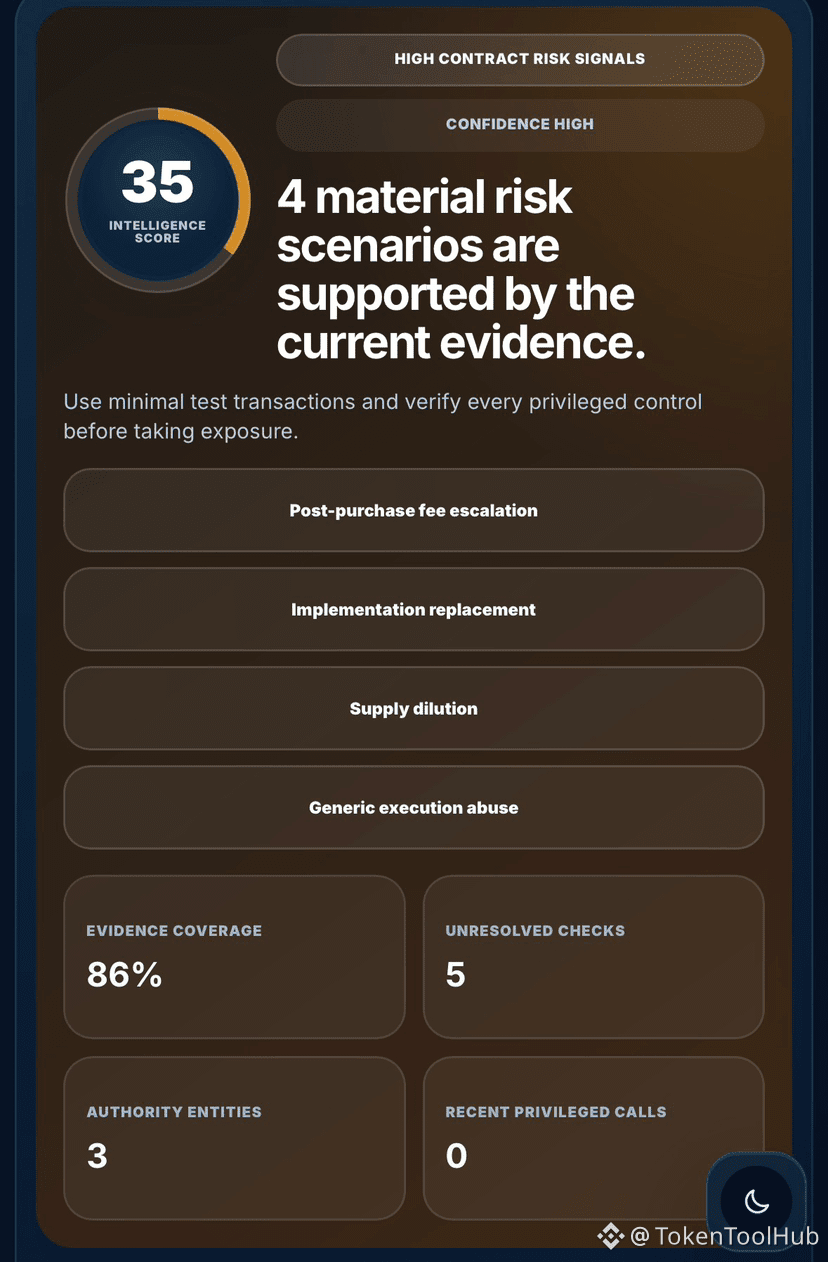
$NEURO scored 90/100 on the quick public-risk scan.
Deeper TokenToolHub contract intelligence returned 35/100.
Contract:
0x5F74b471746be666E40524721aCBc19Ef3967777
Network: BNB Smart Chain
Four material risk scenarios were identified:
• Possible supply dilution
• Possible post-purchase fee escalation
• Possible implementation replacement
• Possible generic execution abuse
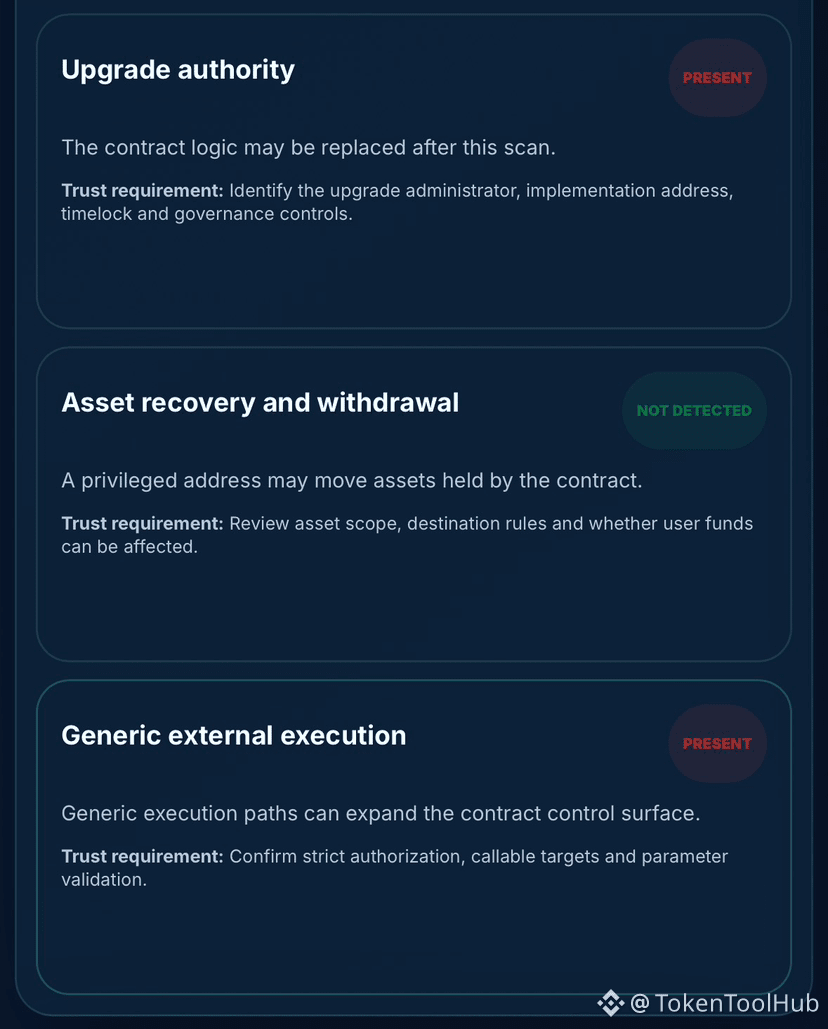
Key findings:
• Source verified
• Ownership renounced
• Supply expansion: Present
• Mutable fees/taxes: Present
• Upgrade authority: Present
• Generic external execution: Present
• Trading switches: Not detected
• Wallet restrictions: Not detected
• Emergency pause: Not detected
Resolved implementation:
0x024f18294970b5c76c0691b87f138a0317156422
The live owner() call returns the zero address.
But $NEURO remains upgradeable, and the proxy administrator was not resolved.
That means ownership renunciation does not automatically prove the contract logic is immutable. A separate authority may still control the implementation path.
The verified code also exposes supply-expansion, mutable-fee and generic-execution capabilities.
Trading simulation was unavailable, so honeypot status and current buy/sell taxes remain unresolved.
A strong quick score is only the first layer.
The deeper question is what can still change and who can change it.
Full $NEURO scan:
https://tokentoolhub.com/token-safety-checker/?net=bsc&address=0x5F74b471746be666E40524721aCBc19Ef3967777
#BNBChain #crypto #Web3 #blockchain #CryptoSecurity
$NEURO scored 90/100 on the quick public-risk scan.
Deeper TokenToolHub contract intelligence returned 35/100.
Contract:
0x5F74b471746be666E40524721aCBc19Ef3967777
Network: BNB Smart Chain
Four material risk scenarios were identified:
• Possible supply dilution
• Possible post-purchase fee escalation
• Possible implementation replacement
• Possible generic execution abuse
Key findings:
• Source verified
• Ownership renounced
• Supply expansion: Present
• Mutable fees/taxes: Present
• Upgrade authority: Present
• Generic external execution: Present
• Trading switches: Not detected
• Wallet restrictions: Not detected
• Emergency pause: Not detected
Resolved implementation:
0x024f18294970b5c76c0691b87f138a0317156422
The live owner() call returns the zero address.
But $NEURO remains upgradeable, and the proxy administrator was not resolved.
That means ownership renunciation does not automatically prove the contract logic is immutable. A separate authority may still control the implementation path.
The verified code also exposes supply-expansion, mutable-fee and generic-execution capabilities.
Trading simulation was unavailable, so honeypot status and current buy/sell taxes remain unresolved.
A strong quick score is only the first layer.
The deeper question is what can still change and who can change it.
Full $NEURO scan:
https://tokentoolhub.com/token-safety-checker/?net=bsc&address=0x5F74b471746be666E40524721aCBc19Ef3967777
#BNBChain #crypto #Web3 #blockchain #CryptoSecurity
Deeper TokenToolHub contract intelligence returned 35/100.
Contract:
0x5F74b471746be666E40524721aCBc19Ef3967777
Network: BNB Smart Chain
Four material risk scenarios were identified:
• Possible supply dilution
• Possible post-purchase fee escalation
• Possible implementation replacement
• Possible generic execution abuse
Key findings:
• Source verified
• Ownership renounced
• Supply expansion: Present
• Mutable fees/taxes: Present
• Upgrade authority: Present
• Generic external execution: Present
• Trading switches: Not detected
• Wallet restrictions: Not detected
• Emergency pause: Not detected
Resolved implementation:
0x024f18294970b5c76c0691b87f138a0317156422
The live owner() call returns the zero address.
But $NEURO remains upgradeable, and the proxy administrator was not resolved.
That means ownership renunciation does not automatically prove the contract logic is immutable. A separate authority may still control the implementation path.
The verified code also exposes supply-expansion, mutable-fee and generic-execution capabilities.
Trading simulation was unavailable, so honeypot status and current buy/sell taxes remain unresolved.
A strong quick score is only the first layer.
The deeper question is what can still change and who can change it.
Full $NEURO scan:
https://tokentoolhub.com/token-safety-checker/?net=bsc&address=0x5F74b471746be666E40524721aCBc19Ef3967777
#BNBChain #crypto #Web3 #blockchain #CryptoSecurity
26
·
--
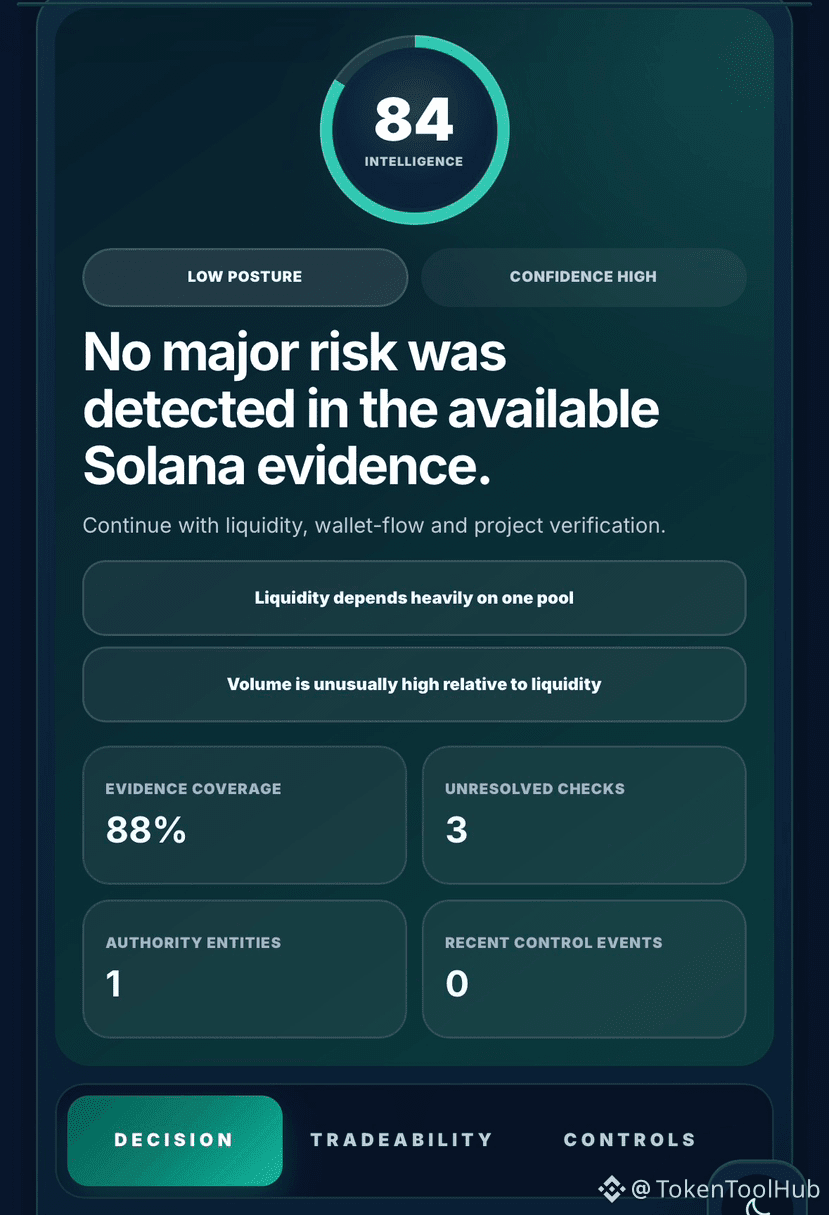
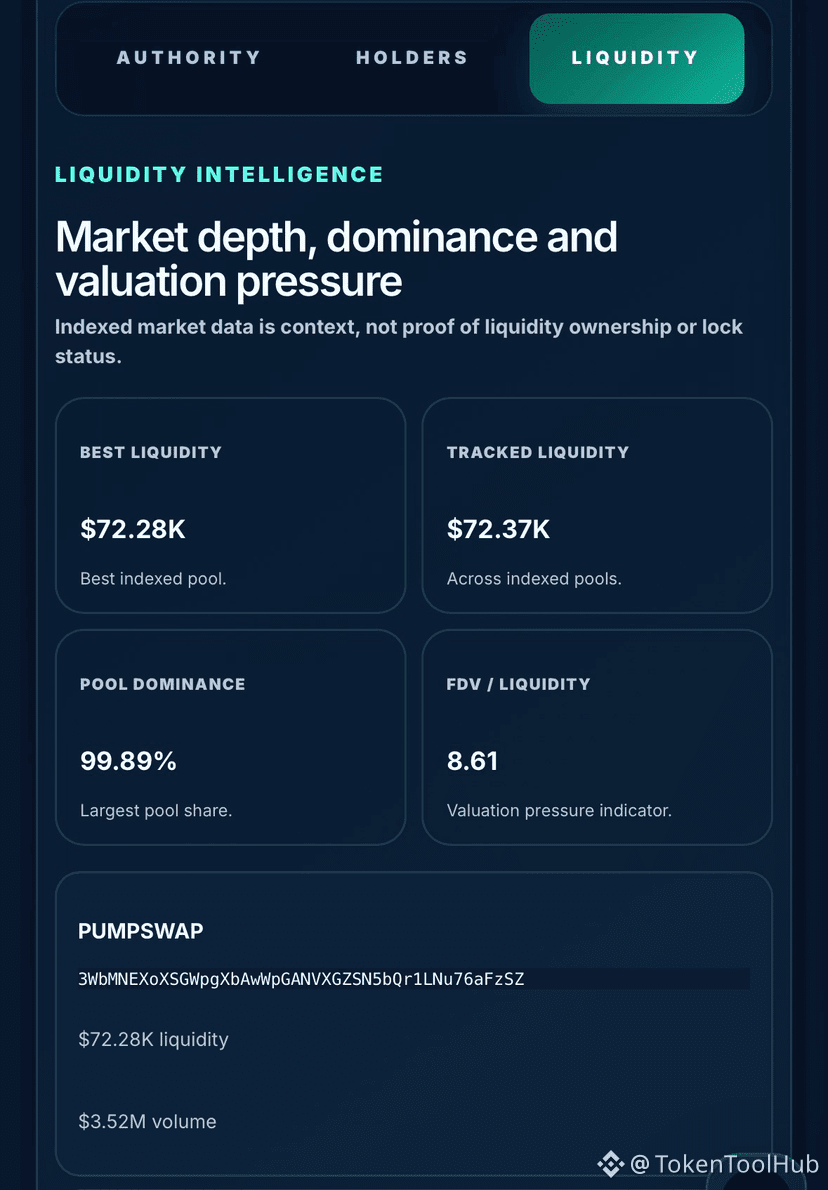
$BIKECATE returned an 84/100 executive posture in TokenToolHub’s latest Solana scan.
Mint:
3nkVw4JwdDLGM23Wzqpy2ptAPV5YgMnokEBgijDBpump
Key findings:
• Token program: Token-2022
• Mint authority: Disabled
• Freeze authority: Disabled
• Largest resolved owner: 5.92%
• Top 10 owners: 7.55%
• Best detected liquidity: $72.28K
• 24h volume: $3.52M
• Supply: ~995.16M $BIKECATE
• External token-risk score: 1/100
• Reported liquidity lock: 99.8%
No major risk was detected in the available Solana evidence.
The main concern is market structure.
TokenToolHub identified two Medium-priority findings:
• Liquidity depends heavily on one pool
• Volume is unusually high relative to liquidity
$BIKECATE recorded about $3.52M in 24h volume against roughly $72.3K in the best indexed liquidity pool.
That is close to 49x turnover relative to visible liquidity.
High turnover does not automatically mean manipulation, but activity this large relative to liquidity makes wallet flows and trade distribution important before relying on headline volume alone.
The authority side is comparatively strong.
Mint authority is disabled.
Freeze authority is disabled.
No recent mint, freeze or authority-change instruction was detected in the bounded sample.
Holder concentration also appears relatively distributed, with the largest resolved owner at 5.92% and the top 10 at 7.55%.
Still unresolved:
• Token-2022 extension configuration
• Executable buy and sell routes
• Sell impact
• Metadata update authority
A strong score is useful.
Liquidity depth and trading structure still need separate verification.
Full $BIKECATE scan:
https://tokentoolhub.com/solana-token-scanner/?mint=3nkVw4JwdDLGM23Wzqpy2ptAPV5YgMnokEBgijDBpump
#solana #crypto #Web3 #blockchain #CryptoSecurity
$BIKECATE returned an 84/100 executive posture in TokenToolHub’s latest Solana scan.
Mint:
3nkVw4JwdDLGM23Wzqpy2ptAPV5YgMnokEBgijDBpump
Key findings:
• Token program: Token-2022
• Mint authority: Disabled
• Freeze authority: Disabled
• Largest resolved owner: 5.92%
• Top 10 owners: 7.55%
• Best detected liquidity: $72.28K
• 24h volume: $3.52M
• Supply: ~995.16M $BIKECATE
• External token-risk score: 1/100
• Reported liquidity lock: 99.8%
No major risk was detected in the available Solana evidence.
The main concern is market structure.
TokenToolHub identified two Medium-priority findings:
• Liquidity depends heavily on one pool
• Volume is unusually high relative to liquidity
$BIKECATE recorded about $3.52M in 24h volume against roughly $72.3K in the best indexed liquidity pool.
That is close to 49x turnover relative to visible liquidity.
High turnover does not automatically mean manipulation, but activity this large relative to liquidity makes wallet flows and trade distribution important before relying on headline volume alone.
The authority side is comparatively strong.
Mint authority is disabled.
Freeze authority is disabled.
No recent mint, freeze or authority-change instruction was detected in the bounded sample.
Holder concentration also appears relatively distributed, with the largest resolved owner at 5.92% and the top 10 at 7.55%.
Still unresolved:
• Token-2022 extension configuration
• Executable buy and sell routes
• Sell impact
• Metadata update authority
A strong score is useful.
Liquidity depth and trading structure still need separate verification.
Full $BIKECATE scan:
https://tokentoolhub.com/solana-token-scanner/?mint=3nkVw4JwdDLGM23Wzqpy2ptAPV5YgMnokEBgijDBpump
#solana #crypto #Web3 #blockchain #CryptoSecurity
Mint:
3nkVw4JwdDLGM23Wzqpy2ptAPV5YgMnokEBgijDBpump
Key findings:
• Token program: Token-2022
• Mint authority: Disabled
• Freeze authority: Disabled
• Largest resolved owner: 5.92%
• Top 10 owners: 7.55%
• Best detected liquidity: $72.28K
• 24h volume: $3.52M
• Supply: ~995.16M $BIKECATE
• External token-risk score: 1/100
• Reported liquidity lock: 99.8%
No major risk was detected in the available Solana evidence.
The main concern is market structure.
TokenToolHub identified two Medium-priority findings:
• Liquidity depends heavily on one pool
• Volume is unusually high relative to liquidity
$BIKECATE recorded about $3.52M in 24h volume against roughly $72.3K in the best indexed liquidity pool.
That is close to 49x turnover relative to visible liquidity.
High turnover does not automatically mean manipulation, but activity this large relative to liquidity makes wallet flows and trade distribution important before relying on headline volume alone.
The authority side is comparatively strong.
Mint authority is disabled.
Freeze authority is disabled.
No recent mint, freeze or authority-change instruction was detected in the bounded sample.
Holder concentration also appears relatively distributed, with the largest resolved owner at 5.92% and the top 10 at 7.55%.
Still unresolved:
• Token-2022 extension configuration
• Executable buy and sell routes
• Sell impact
• Metadata update authority
A strong score is useful.
Liquidity depth and trading structure still need separate verification.
Full $BIKECATE scan:
https://tokentoolhub.com/solana-token-scanner/?mint=3nkVw4JwdDLGM23Wzqpy2ptAPV5YgMnokEBgijDBpump
#solana #crypto #Web3 #blockchain #CryptoSecurity
28

If you're still treating unverified Telegram ransom leaks as confirmed market signals, stop now.
Panic-selling your spot bags or chasing leveraged shorts over unconfirmed screenshots is one of the fastest ways to get chopped up and bleed capital.
We have all seen the alleged screenshots claiming hackers will release customer data everyday unless Revolut pays up. Much like the fabricated regulatory notices and doctored exploit claims that previously triggered flash dips across $BTC and $ETH before an aggressive reversal, attackers know fear moves liquidity faster than facts.
Until Revolut, law enforcement, or an independent security firm confirms the scope, treating extortion figures as established reality is premature. We saw similar drama during past fintech infrastructure scares where the actual damage was far smaller than the initial ransom claims, yet sentiment tanked blue chips like $BNB purely on emotional contagion.
How do you usually filter out noise from genuine risk when exploit headlines hit your feed?
#CryptoSecurity #RiskManagement #MarketPsychology
If you're still treating unverified Telegram ransom leaks as confirmed market signals, stop now.
Panic-selling your spot bags or chasing leveraged shorts over unconfirmed screenshots is one of the fastest ways to get chopped up and bleed capital.
We have all seen the alleged screenshots claiming hackers will release customer data everyday unless Revolut pays up. Much like the fabricated regulatory notices and doctored exploit claims that previously triggered flash dips across $BTC and $ETH before an aggressive reversal, attackers know fear moves liquidity faster than facts.
Until Revolut, law enforcement, or an independent security firm confirms the scope, treating extortion figures as established reality is premature. We saw similar drama during past fintech infrastructure scares where the actual damage was far smaller than the initial ransom claims, yet sentiment tanked blue chips like $BNB purely on emotional contagion.
How do you usually filter out noise from genuine risk when exploit headlines hit your feed?
#CryptoSecurity #RiskManagement #MarketPsychology
Panic-selling your spot bags or chasing leveraged shorts over unconfirmed screenshots is one of the fastest ways to get chopped up and bleed capital.
We have all seen the alleged screenshots claiming hackers will release customer data everyday unless Revolut pays up. Much like the fabricated regulatory notices and doctored exploit claims that previously triggered flash dips across $BTC and $ETH before an aggressive reversal, attackers know fear moves liquidity faster than facts.
Until Revolut, law enforcement, or an independent security firm confirms the scope, treating extortion figures as established reality is premature. We saw similar drama during past fintech infrastructure scares where the actual damage was far smaller than the initial ransom claims, yet sentiment tanked blue chips like $BNB purely on emotional contagion.
How do you usually filter out noise from genuine risk when exploit headlines hit your feed?
#CryptoSecurity #RiskManagement #MarketPsychology

13

·
--
Picture this: you wake up to a screenshot floating around Telegram claiming your personal financial records are being auctioned off until a major fintech app pays up.
For anyone holding crypto, that sinking feeling is all too familiar. A single leaked database can expose user identities, turning your assets into prime targets for targeted phishing and account takeovers.
We saw this dynamic during past hardware wallet breaches, where leaked customer records led to relentless phishing waves aimed at draining $BTC and $ETH holdings. Now, attackers are allegedly threatening to release daily tranches of customer information unless an extortion fee is settled. But before panic sets in, there is a fundamental difference between an unverified hacker claim and a confirmed security compromise.
In crypto risk management, treating attacker claims with healthy skepticism is just as critical as securing your private keys. When similar extortion attempts targeted fiat gateways and platforms trading $BNB in the past, threat actors routinely inflated breach claims to create panic and force quick payouts. Until independent forensic investigations or law enforcement confirm the scope, reacting to unverified ransom claims usually creates unnecessary panic.
How do you separate credible security reports from extortion bluffing when breaking headlines hit your feed?
#CryptoSecurity #DataPrivacy #BlockchainSecurity
Picture this: you wake up to a screenshot floating around Telegram claiming your personal financial records are being auctioned off until a major fintech app pays up.
For anyone holding crypto, that sinking feeling is all too familiar. A single leaked database can expose user identities, turning your assets into prime targets for targeted phishing and account takeovers.
We saw this dynamic during past hardware wallet breaches, where leaked customer records led to relentless phishing waves aimed at draining $BTC and $ETH holdings. Now, attackers are allegedly threatening to release daily tranches of customer information unless an extortion fee is settled. But before panic sets in, there is a fundamental difference between an unverified hacker claim and a confirmed security compromise.
In crypto risk management, treating attacker claims with healthy skepticism is just as critical as securing your private keys. When similar extortion attempts targeted fiat gateways and platforms trading $BNB in the past, threat actors routinely inflated breach claims to create panic and force quick payouts. Until independent forensic investigations or law enforcement confirm the scope, reacting to unverified ransom claims usually creates unnecessary panic.
How do you separate credible security reports from extortion bluffing when breaking headlines hit your feed?
#CryptoSecurity #DataPrivacy #BlockchainSecurity
For anyone holding crypto, that sinking feeling is all too familiar. A single leaked database can expose user identities, turning your assets into prime targets for targeted phishing and account takeovers.
We saw this dynamic during past hardware wallet breaches, where leaked customer records led to relentless phishing waves aimed at draining $BTC and $ETH holdings. Now, attackers are allegedly threatening to release daily tranches of customer information unless an extortion fee is settled. But before panic sets in, there is a fundamental difference between an unverified hacker claim and a confirmed security compromise.
In crypto risk management, treating attacker claims with healthy skepticism is just as critical as securing your private keys. When similar extortion attempts targeted fiat gateways and platforms trading $BNB in the past, threat actors routinely inflated breach claims to create panic and force quick payouts. Until independent forensic investigations or law enforcement confirm the scope, reacting to unverified ransom claims usually creates unnecessary panic.
How do you separate credible security reports from extortion bluffing when breaking headlines hit your feed?
#CryptoSecurity #DataPrivacy #BlockchainSecurity
15

NEW EXCHANGE LAUNCHES SPARK CAPITAL TRAPS BEFORE OFFICIAL LIQUIDITY ARRIVES $BTC 🚨 🛑
As new regional exchanges prepare to launch alongside rising $BTC momentum, bad actors are deploying sophisticated spoofing traps to capture retail capital. 🔍 Fake media pages and unverified groups mimic official branding to promise exclusive early allocations and deposit bonuses.
These phishing vectors quietly build trust before dropping malicious signature requests, unverified links, or fraudulent wallet connections. 🛡️ Protecting your operational capital requires strict verification of official domain signatures and verified endpoints. 💡 How do you audit new trading platforms before connecting your primary wallet? 👇
⚠️ Not financial advice. Always manage your risk. 🛡️
🏷️ #BTC #CryptoSecurity #RiskManagement #SmartMoney
🛡️ 👁️
NEW EXCHANGE LAUNCHES SPARK CAPITAL TRAPS BEFORE OFFICIAL LIQUIDITY ARRIVES $BTC 🚨 🛑
As new regional exchanges prepare to launch alongside rising $BTC momentum, bad actors are deploying sophisticated spoofing traps to capture retail capital. 🔍 Fake media pages and unverified groups mimic official branding to promise exclusive early allocations and deposit bonuses.
These phishing vectors quietly build trust before dropping malicious signature requests, unverified links, or fraudulent wallet connections. 🛡️ Protecting your operational capital requires strict verification of official domain signatures and verified endpoints. 💡 How do you audit new trading platforms before connecting your primary wallet? 👇
⚠️ Not financial advice. Always manage your risk. 🛡️
🏷️ #BTC #CryptoSecurity #RiskManagement #SmartMoney
🛡️ 👁️
As new regional exchanges prepare to launch alongside rising $BTC momentum, bad actors are deploying sophisticated spoofing traps to capture retail capital. 🔍 Fake media pages and unverified groups mimic official branding to promise exclusive early allocations and deposit bonuses.
These phishing vectors quietly build trust before dropping malicious signature requests, unverified links, or fraudulent wallet connections. 🛡️ Protecting your operational capital requires strict verification of official domain signatures and verified endpoints. 💡 How do you audit new trading platforms before connecting your primary wallet? 👇
⚠️ Not financial advice. Always manage your risk. 🛡️
🏷️ #BTC #CryptoSecurity #RiskManagement #SmartMoney
🛡️ 👁️

7

·
--
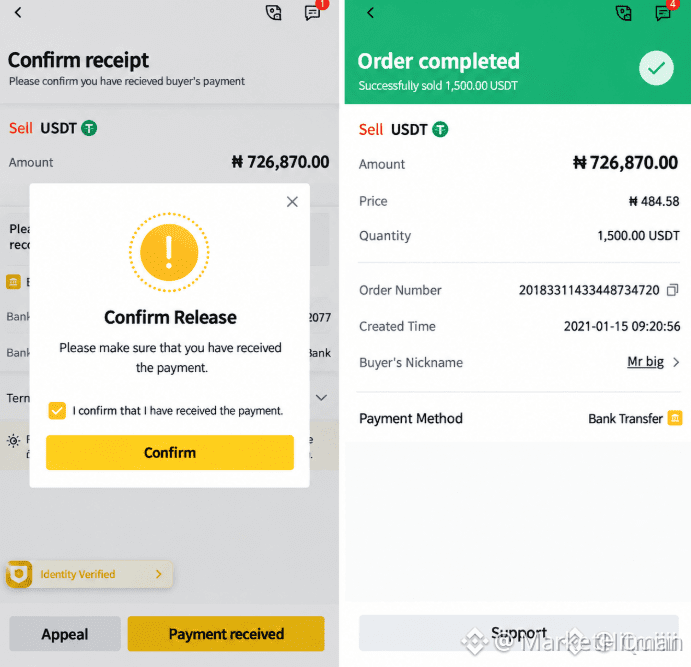
🚨 FAKE P2P RECEIPTS ARE DRAINERS — SECURE YOUR $USDT CASH-OUTS NOW! 🔒
Scammers are running sophisticated visual spoofing ops on P2P desks, fabricating fake transfer receipts to bait traders into releasing escrow prematurely. 🛡️ Never trust a screenshot when liquidating your $USDT off-ramp position.
Lock in a simple three-step execution protocol: log directly into your banking interface, verify exact funds settled from the matched counterparty, and confirm cleared balance before releasing assets. 📌 Proof of payment is balance in bank, not pixels on screen.
💬 What is your strict safety checklist when off-ramping capital through P2P counters? 👇
⚠️ Not financial advice. Always manage your risk. 🛡️
🏷️ #USDT #P2PTrading #CryptoSecurity #RiskManagement
🛡️ 🔒
🚨 FAKE P2P RECEIPTS ARE DRAINERS — SECURE YOUR $USDT CASH-OUTS NOW! 🔒
Scammers are running sophisticated visual spoofing ops on P2P desks, fabricating fake transfer receipts to bait traders into releasing escrow prematurely. 🛡️ Never trust a screenshot when liquidating your $USDT off-ramp position.
Lock in a simple three-step execution protocol: log directly into your banking interface, verify exact funds settled from the matched counterparty, and confirm cleared balance before releasing assets. 📌 Proof of payment is balance in bank, not pixels on screen.
💬 What is your strict safety checklist when off-ramping capital through P2P counters? 👇
⚠️ Not financial advice. Always manage your risk. 🛡️
🏷️ #USDT #P2PTrading #CryptoSecurity #RiskManagement
🛡️ 🔒
Scammers are running sophisticated visual spoofing ops on P2P desks, fabricating fake transfer receipts to bait traders into releasing escrow prematurely. 🛡️ Never trust a screenshot when liquidating your $USDT off-ramp position.
Lock in a simple three-step execution protocol: log directly into your banking interface, verify exact funds settled from the matched counterparty, and confirm cleared balance before releasing assets. 📌 Proof of payment is balance in bank, not pixels on screen.
💬 What is your strict safety checklist when off-ramping capital through P2P counters? 👇
⚠️ Not financial advice. Always manage your risk. 🛡️
🏷️ #USDT #P2PTrading #CryptoSecurity #RiskManagement
🛡️ 🔒
12
Everyone thinks centralized fintech apps are safer than storing coins in a cold wallet, but actually, your personal data is only as secure as their weakest back door.
When major services suffer a breach, everyday users face the real nightmare of targeted phishing attacks and drained funds before they even realize what happened.
Think of a traditional financial platform like a giant apartment complex where everyone leaves a spare key at the front desk. Recent reports show attackers demanding a massive 10,000 $BTC ransom while threatening to release customer records daily if the company refuses to pay. That massive sum of $BTC represents more than just digital currency, as it is leverage built entirely on exposed customer identities.
Leaving your sensitive details on third-party servers creates an ongoing target for bad actors across the web. Whether you hold $ETH or keep your funds in conventional accounts, relying on centralized databases always introduces a single point of failure that no insurance policy can instantly fix.
Where do you think the line between everyday convenience and personal data security should be drawn?
#CryptoSecurity #Bitcoin #DataPrivacy
Everyone thinks centralized fintech apps are safer than storing coins in a cold wallet, but actually, your personal data is only as secure as their weakest back door.
When major services suffer a breach, everyday users face the real nightmare of targeted phishing attacks and drained funds before they even realize what happened.
Think of a traditional financial platform like a giant apartment complex where everyone leaves a spare key at the front desk. Recent reports show attackers demanding a massive 10,000 $BTC ransom while threatening to release customer records daily if the company refuses to pay. That massive sum of $BTC represents more than just digital currency, as it is leverage built entirely on exposed customer identities.
Leaving your sensitive details on third-party servers creates an ongoing target for bad actors across the web. Whether you hold $ETH or keep your funds in conventional accounts, relying on centralized databases always introduces a single point of failure that no insurance policy can instantly fix.
Where do you think the line between everyday convenience and personal data security should be drawn?
#CryptoSecurity #Bitcoin #DataPrivacy
When major services suffer a breach, everyday users face the real nightmare of targeted phishing attacks and drained funds before they even realize what happened.
Think of a traditional financial platform like a giant apartment complex where everyone leaves a spare key at the front desk. Recent reports show attackers demanding a massive 10,000 $BTC ransom while threatening to release customer records daily if the company refuses to pay. That massive sum of $BTC represents more than just digital currency, as it is leverage built entirely on exposed customer identities.
Leaving your sensitive details on third-party servers creates an ongoing target for bad actors across the web. Whether you hold $ETH or keep your funds in conventional accounts, relying on centralized databases always introduces a single point of failure that no insurance policy can instantly fix.
Where do you think the line between everyday convenience and personal data security should be drawn?
#CryptoSecurity #Bitcoin #DataPrivacy
11

Have you noticed how quiet everyone is about the 10,000 $BTC ransom sitting on Revolut right now?
Everyday traders are one leaked dump away from having their identity, cards and login details sold while their funds sit exposed. That is the kind of overnight wipeout nobody prices in until it happens.
Threat actors are reportedly demanding 10,000 BTC and saying they will publish more customer data every single day if Revolut does not pay. That is a nine-figure number. Paying it just funds the next crew and tells every other group the model works.
The smarter play is treating any app holding your $ETH or $USDT like a hot wallet that already got compromised. Pull what you cannot lose, move it to hardware, drop SMS 2FA, change passwords, and watch every transaction this week. Data leaks do not expire.
Where do you think this goes from here?
#Bitcoin #CryptoSecurity #Ransomware
Have you noticed how quiet everyone is about the 10,000 $BTC ransom sitting on Revolut right now?
Everyday traders are one leaked dump away from having their identity, cards and login details sold while their funds sit exposed. That is the kind of overnight wipeout nobody prices in until it happens.
Threat actors are reportedly demanding 10,000 BTC and saying they will publish more customer data every single day if Revolut does not pay. That is a nine-figure number. Paying it just funds the next crew and tells every other group the model works.
The smarter play is treating any app holding your $ETH or $USDT like a hot wallet that already got compromised. Pull what you cannot lose, move it to hardware, drop SMS 2FA, change passwords, and watch every transaction this week. Data leaks do not expire.
Where do you think this goes from here?
#Bitcoin #CryptoSecurity #Ransomware
Everyday traders are one leaked dump away from having their identity, cards and login details sold while their funds sit exposed. That is the kind of overnight wipeout nobody prices in until it happens.
Threat actors are reportedly demanding 10,000 BTC and saying they will publish more customer data every single day if Revolut does not pay. That is a nine-figure number. Paying it just funds the next crew and tells every other group the model works.
The smarter play is treating any app holding your $ETH or $USDT like a hot wallet that already got compromised. Pull what you cannot lose, move it to hardware, drop SMS 2FA, change passwords, and watch every transaction this week. Data leaks do not expire.
Where do you think this goes from here?
#Bitcoin #CryptoSecurity #Ransomware
9
·
--
If you are still trusting centralized fintech apps to safeguard your personal data just because they let you buy crypto, stop now.
Nothing stings worse than realizing your identity and financial records are floating across the dark web while you thought your funds were sitting in a fortress.
Threat actors are now demanding a massive 10,000 $BTC ransom and threatening to leak sensitive customer records daily if Revolut refuses to settle. That is an enormous amount of capital that easily rivals historic exchange exploits from the Mt. Gox era, proving once again that centralized honeypots remain the easiest target in finance.
While native $ETH self-custody setups put the security burden directly on your own operational security, hybrid platforms aggregate millions of KYC files into single failure points. When attackers strike these hybrid rails, they rarely need to crack the blockchain itself when they can simply compromise the traditional databases holding user identities.
Do you think centralized financial platforms will ever solve user data protection, or is self-custody the only real way forward?
#CryptoSecurity #Bitcoin #Web3
If you are still trusting centralized fintech apps to safeguard your personal data just because they let you buy crypto, stop now.
Nothing stings worse than realizing your identity and financial records are floating across the dark web while you thought your funds were sitting in a fortress.
Threat actors are now demanding a massive 10,000 $BTC ransom and threatening to leak sensitive customer records daily if Revolut refuses to settle. That is an enormous amount of capital that easily rivals historic exchange exploits from the Mt. Gox era, proving once again that centralized honeypots remain the easiest target in finance.
While native $ETH self-custody setups put the security burden directly on your own operational security, hybrid platforms aggregate millions of KYC files into single failure points. When attackers strike these hybrid rails, they rarely need to crack the blockchain itself when they can simply compromise the traditional databases holding user identities.
Do you think centralized financial platforms will ever solve user data protection, or is self-custody the only real way forward?
#CryptoSecurity #Bitcoin #Web3
Nothing stings worse than realizing your identity and financial records are floating across the dark web while you thought your funds were sitting in a fortress.
Threat actors are now demanding a massive 10,000 $BTC ransom and threatening to leak sensitive customer records daily if Revolut refuses to settle. That is an enormous amount of capital that easily rivals historic exchange exploits from the Mt. Gox era, proving once again that centralized honeypots remain the easiest target in finance.
While native $ETH self-custody setups put the security burden directly on your own operational security, hybrid platforms aggregate millions of KYC files into single failure points. When attackers strike these hybrid rails, they rarely need to crack the blockchain itself when they can simply compromise the traditional databases holding user identities.
Do you think centralized financial platforms will ever solve user data protection, or is self-custody the only real way forward?
#CryptoSecurity #Bitcoin #Web3

7

·
--
Picture this: a major fintech platform wakes up to an ultimatum demanding 10,000 $BTC, with hackers threatening to publish customer databases piece by piece every single day.
Most users assume their personal information and balances are safe behind corporate firewalls until a data leak proves otherwise. Watching your identity documents land on underground forums while worrying about the safety of your assets is every investor's worst nightmare.
This Revolut extortion attempt mirrors past high-profile cyberattacks where threat actors weaponized sensitive customer records for crypto payouts. When centralized institutions face these massive ransoms, the fallout often pushes traders toward self-custody solutions and protocols on networks like $ETH where users control their own access.
Demanding 10,000 bitcoins shows how aggressively attackers target centralized single points of failure compared to open networks like $SOL. Even if platforms refuse to pay, the daily release of private records creates lasting damage that standard compliance measures struggle to prevent.
Do you think centralized finance apps will ever match the security of decentralized self-custody, or is data exposure inevitable?
#Bitcoin #CryptoSecurity #CyberSecurity
Picture this: a major fintech platform wakes up to an ultimatum demanding 10,000 $BTC , with hackers threatening to publish customer databases piece by piece every single day.
Most users assume their personal information and balances are safe behind corporate firewalls until a data leak proves otherwise. Watching your identity documents land on underground forums while worrying about the safety of your assets is every investor's worst nightmare.
This Revolut extortion attempt mirrors past high-profile cyberattacks where threat actors weaponized sensitive customer records for crypto payouts. When centralized institutions face these massive ransoms, the fallout often pushes traders toward self-custody solutions and protocols on networks like $ETH where users control their own access.
Demanding 10,000 bitcoins shows how aggressively attackers target centralized single points of failure compared to open networks like $SOL . Even if platforms refuse to pay, the daily release of private records creates lasting damage that standard compliance measures struggle to prevent.
Do you think centralized finance apps will ever match the security of decentralized self-custody, or is data exposure inevitable?
#Bitcoin #CryptoSecurity #CyberSecurity
Most users assume their personal information and balances are safe behind corporate firewalls until a data leak proves otherwise. Watching your identity documents land on underground forums while worrying about the safety of your assets is every investor's worst nightmare.
This Revolut extortion attempt mirrors past high-profile cyberattacks where threat actors weaponized sensitive customer records for crypto payouts. When centralized institutions face these massive ransoms, the fallout often pushes traders toward self-custody solutions and protocols on networks like $ETH where users control their own access.
Demanding 10,000 bitcoins shows how aggressively attackers target centralized single points of failure compared to open networks like $SOL . Even if platforms refuse to pay, the daily release of private records creates lasting damage that standard compliance measures struggle to prevent.
Do you think centralized finance apps will ever match the security of decentralized self-custody, or is data exposure inevitable?
#Bitcoin #CryptoSecurity #CyberSecurity
15

·
--
Most people think cold storage is the only security measure that matters, until a third-party breach puts 10,000 $BTC on the line without touching a single blockchain node.
We spend years obsessing over seed phrases and hardware wallets, only to watch centralized payment rails leak our identities and expose our personal safety.
Threat actors are reportedly demanding a staggering 10,000 $BTC ransom from Revolut, threatening to publish batches of customer records every single day if demands are not met. Having traded through multiple cycles and major infrastructure failures, I have watched the threat landscape evolve significantly. When attackers obtain verified personal details, the risk bypasses protocol security entirely and targets the individual, leaving your $ETH and $SOL holdings vulnerable to sophisticated social engineering.
Ransom demands of this magnitude highlight how the attack surface in modern finance has shifted. Exploiting cryptographic systems is difficult, but holding sensitive user privacy hostage at fintech gateways is becoming the preferred vector.
How do you manage personal operational security when the weakest link is the institution holding your data rather than the blockchain itself?
#CryptoSecurity #Bitcoin #Fintech
Most people think cold storage is the only security measure that matters, until a third-party breach puts 10,000 $BTC on the line without touching a single blockchain node.
We spend years obsessing over seed phrases and hardware wallets, only to watch centralized payment rails leak our identities and expose our personal safety.
Threat actors are reportedly demanding a staggering 10,000 $BTC ransom from Revolut, threatening to publish batches of customer records every single day if demands are not met. Having traded through multiple cycles and major infrastructure failures, I have watched the threat landscape evolve significantly. When attackers obtain verified personal details, the risk bypasses protocol security entirely and targets the individual, leaving your $ETH and $SOL holdings vulnerable to sophisticated social engineering.
Ransom demands of this magnitude highlight how the attack surface in modern finance has shifted. Exploiting cryptographic systems is difficult, but holding sensitive user privacy hostage at fintech gateways is becoming the preferred vector.
How do you manage personal operational security when the weakest link is the institution holding your data rather than the blockchain itself?
#CryptoSecurity #Bitcoin #Fintech
We spend years obsessing over seed phrases and hardware wallets, only to watch centralized payment rails leak our identities and expose our personal safety.
Threat actors are reportedly demanding a staggering 10,000 $BTC ransom from Revolut, threatening to publish batches of customer records every single day if demands are not met. Having traded through multiple cycles and major infrastructure failures, I have watched the threat landscape evolve significantly. When attackers obtain verified personal details, the risk bypasses protocol security entirely and targets the individual, leaving your $ETH and $SOL holdings vulnerable to sophisticated social engineering.
Ransom demands of this magnitude highlight how the attack surface in modern finance has shifted. Exploiting cryptographic systems is difficult, but holding sensitive user privacy hostage at fintech gateways is becoming the preferred vector.
How do you manage personal operational security when the weakest link is the institution holding your data rather than the blockchain itself?
#CryptoSecurity #Bitcoin #Fintech

26
Most people assume regulated fintech apps keep their crypto activity completely private, but recent breaches prove that centralized custody carries massive off-chain privacy risks.
You spend months practicing operational security, only for an exchange or neo-bank leak to tie your real identity directly to your on-chain wallet addresses and net worth. That turns you into an immediate target for phishing, SIM swapping, and physical extortion.
Revolut confirmed a data exposure that compromised sensitive customer info, ranging from identity documents and account details to complete transaction logs, including $BTC transactions. When centralized platforms leak records like this, attackers don't just get your email; they map your entire historical flow into assets like $ETH or $SOL straight back to your legal name.
A cold wallet protects your private keys, but it cannot fix the metadata trail you create when buying through centralized ramps.
How are you managing the privacy footprint left behind by your KYC exchange accounts?
#CryptoSecurity #Bitcoin #Privacy
Most people assume regulated fintech apps keep their crypto activity completely private, but recent breaches prove that centralized custody carries massive off-chain privacy risks.
You spend months practicing operational security, only for an exchange or neo-bank leak to tie your real identity directly to your on-chain wallet addresses and net worth. That turns you into an immediate target for phishing, SIM swapping, and physical extortion.
Revolut confirmed a data exposure that compromised sensitive customer info, ranging from identity documents and account details to complete transaction logs, including $BTC transactions. When centralized platforms leak records like this, attackers don't just get your email; they map your entire historical flow into assets like $ETH or $SOL straight back to your legal name.
A cold wallet protects your private keys, but it cannot fix the metadata trail you create when buying through centralized ramps.
How are you managing the privacy footprint left behind by your KYC exchange accounts?
#CryptoSecurity #Bitcoin #Privacy
You spend months practicing operational security, only for an exchange or neo-bank leak to tie your real identity directly to your on-chain wallet addresses and net worth. That turns you into an immediate target for phishing, SIM swapping, and physical extortion.
Revolut confirmed a data exposure that compromised sensitive customer info, ranging from identity documents and account details to complete transaction logs, including $BTC transactions. When centralized platforms leak records like this, attackers don't just get your email; they map your entire historical flow into assets like $ETH or $SOL straight back to your legal name.
A cold wallet protects your private keys, but it cannot fix the metadata trail you create when buying through centralized ramps.
How are you managing the privacy footprint left behind by your KYC exchange accounts?
#CryptoSecurity #Bitcoin #Privacy

11
·
--
Everyone thinks centralized fintech apps keep their digital assets safer than self-custody, but actually the biggest threat is often the company holding your personal records.
Waking up to find your identity documents leaked is a nightmare for any investor. It exposes your wallet history to phishing scams and targeted attacks that can drain your funds in seconds.
Think of storing crypto on a centralized app like keeping your house keys in a glass display case with your home address taped to it. Revolut just confirmed a data breach exposing customer identity documents, account details, and full transaction histories including $BTC activity. When an attacker gets your legal identity tied directly to your on-chain transfers, your financial privacy vanishes.
Moving your $ETH or other long-term holdings into cold storage removes this single point of failure. A dedicated wallet doesn't store your government ID on a corporate server, protecting your $BNB and everyday balances from third-party slip-ups.
How much of your portfolio do you still leave on third-party fintech platforms?
#CryptoSecurity #Bitcoin #SelfCustody
Everyone thinks centralized fintech apps keep their digital assets safer than self-custody, but actually the biggest threat is often the company holding your personal records.
Waking up to find your identity documents leaked is a nightmare for any investor. It exposes your wallet history to phishing scams and targeted attacks that can drain your funds in seconds.
Think of storing crypto on a centralized app like keeping your house keys in a glass display case with your home address taped to it. Revolut just confirmed a data breach exposing customer identity documents, account details, and full transaction histories including $BTC activity. When an attacker gets your legal identity tied directly to your on-chain transfers, your financial privacy vanishes.
Moving your $ETH or other long-term holdings into cold storage removes this single point of failure. A dedicated wallet doesn't store your government ID on a corporate server, protecting your $BNB and everyday balances from third-party slip-ups.
How much of your portfolio do you still leave on third-party fintech platforms?
#CryptoSecurity #Bitcoin #SelfCustody
Waking up to find your identity documents leaked is a nightmare for any investor. It exposes your wallet history to phishing scams and targeted attacks that can drain your funds in seconds.
Think of storing crypto on a centralized app like keeping your house keys in a glass display case with your home address taped to it. Revolut just confirmed a data breach exposing customer identity documents, account details, and full transaction histories including $BTC activity. When an attacker gets your legal identity tied directly to your on-chain transfers, your financial privacy vanishes.
Moving your $ETH or other long-term holdings into cold storage removes this single point of failure. A dedicated wallet doesn't store your government ID on a corporate server, protecting your $BNB and everyday balances from third-party slip-ups.
How much of your portfolio do you still leave on third-party fintech platforms?
#CryptoSecurity #Bitcoin #SelfCustody
19
Why is nobody talking about fintechs leaking complete Bitcoin transaction records to the world?
Most crypto traders face the constant risk of getting phished after a leak. Watching their funds disappear because hackers knew exactly when they bought $BTC is a nightmare many have lived.
Revolut has confirmed that customer data was exposed including identity documents, account details and full transaction histories with Bitcoin activity. This kind of leak gives attackers a detailed map of your financial life. They know your patterns and can strike when it hurts most.
People treat these incidents as just another Tuesday in tech. That attitude ignores how crypto data turns a simple breach into a hunting ground for your assets.
Start by auditing all your logins and enabling the strongest authentication available. Shift larger $ETH positions off connected services and scan recent $USDT activity for anything off.
Anyone else seeing this as a wake-up call for where we store our crypto details?
#DataBreach #Bitcoin #CryptoSecurity
Why is nobody talking about fintechs leaking complete Bitcoin transaction records to the world?
Most crypto traders face the constant risk of getting phished after a leak. Watching their funds disappear because hackers knew exactly when they bought $BTC is a nightmare many have lived.
Revolut has confirmed that customer data was exposed including identity documents, account details and full transaction histories with Bitcoin activity. This kind of leak gives attackers a detailed map of your financial life. They know your patterns and can strike when it hurts most.
People treat these incidents as just another Tuesday in tech. That attitude ignores how crypto data turns a simple breach into a hunting ground for your assets.
Start by auditing all your logins and enabling the strongest authentication available. Shift larger $ETH positions off connected services and scan recent $USDT activity for anything off.
Anyone else seeing this as a wake-up call for where we store our crypto details?
#DataBreach #Bitcoin #CryptoSecurity
Most crypto traders face the constant risk of getting phished after a leak. Watching their funds disappear because hackers knew exactly when they bought $BTC is a nightmare many have lived.
Revolut has confirmed that customer data was exposed including identity documents, account details and full transaction histories with Bitcoin activity. This kind of leak gives attackers a detailed map of your financial life. They know your patterns and can strike when it hurts most.
People treat these incidents as just another Tuesday in tech. That attitude ignores how crypto data turns a simple breach into a hunting ground for your assets.
Start by auditing all your logins and enabling the strongest authentication available. Shift larger $ETH positions off connected services and scan recent $USDT activity for anything off.
Anyone else seeing this as a wake-up call for where we store our crypto details?
#DataBreach #Bitcoin #CryptoSecurity
13
·
--
If you are still assuming regulated neo-banks protect your personal data better than native protocols, stop now.
Nothing stings quite like handing over full KYC documents to play by the rules, only to realize your records and wallet habits are floating around unsecured. You think you are paying for institutional security, but you end up marked as a prime target for social engineering and phishing attacks.
Revolut just confirmed a breach exposing customer identity documents, account details, and full transaction histories, explicitly including their $BTC activity. It feels uncomfortably similar to the notorious hardware wallet database leaks of previous years, proving once again that centralized servers remain the ultimate honeypot. Every time a fintech tries to wrap crypto in legacy architecture, basic data hygiene seems to fall through the cracks.
When users buy $ETH or hold crypto through hybrid banking apps, they usually trade self-custody for convenience. The irony is that pseudonymous ledger designs exist precisely to prevent third parties from linking your real-world identity to every transfer you make.
Where do you personally draw the line between fintech convenience and personal data privacy?
#CryptoSecurity #Bitcoin #Web3
If you are still assuming regulated neo-banks protect your personal data better than native protocols, stop now.
Nothing stings quite like handing over full KYC documents to play by the rules, only to realize your records and wallet habits are floating around unsecured. You think you are paying for institutional security, but you end up marked as a prime target for social engineering and phishing attacks.
Revolut just confirmed a breach exposing customer identity documents, account details, and full transaction histories, explicitly including their $BTC activity. It feels uncomfortably similar to the notorious hardware wallet database leaks of previous years, proving once again that centralized servers remain the ultimate honeypot. Every time a fintech tries to wrap crypto in legacy architecture, basic data hygiene seems to fall through the cracks.
When users buy $ETH or hold crypto through hybrid banking apps, they usually trade self-custody for convenience. The irony is that pseudonymous ledger designs exist precisely to prevent third parties from linking your real-world identity to every transfer you make.
Where do you personally draw the line between fintech convenience and personal data privacy?
#CryptoSecurity #Bitcoin #Web3
Nothing stings quite like handing over full KYC documents to play by the rules, only to realize your records and wallet habits are floating around unsecured. You think you are paying for institutional security, but you end up marked as a prime target for social engineering and phishing attacks.
Revolut just confirmed a breach exposing customer identity documents, account details, and full transaction histories, explicitly including their $BTC activity. It feels uncomfortably similar to the notorious hardware wallet database leaks of previous years, proving once again that centralized servers remain the ultimate honeypot. Every time a fintech tries to wrap crypto in legacy architecture, basic data hygiene seems to fall through the cracks.
When users buy $ETH or hold crypto through hybrid banking apps, they usually trade self-custody for convenience. The irony is that pseudonymous ledger designs exist precisely to prevent third parties from linking your real-world identity to every transfer you make.
Where do you personally draw the line between fintech convenience and personal data privacy?
#CryptoSecurity #Bitcoin #Web3
14
·
--
Picture this: you use a regulated banking app thinking your identity and assets are locked tight behind institutional walls, until an unexpected breach blows the door wide open.
For anyone in crypto, there is nothing worse than realizing your private identity documents, account details, and complete transaction logs are floating around in the wild. It completely strips away the privacy and peace of mind you thought you were paying for.
Revolut just confirmed a security incident where unauthorized third parties accessed sensitive customer data, exposing government IDs, personal account information, and full transaction records, including users' $BTC activity. It echoes the massive Ledger database leak from a few years back, reminding us that even the most polished fintech giants struggle to protect centralized user databases. When your real-world identity gets permanently tied to your public wallet history, the risk of targeted phishing and social engineering skyrockets.
While managing assets like $ETH through a familiar banking interface feels seamless for everyday spending, centralized data silos remain a glaring single point of failure. The moment you trade off self-custody for convenience, you leave both your personal identity and financial trail in someone else's hands.
Where do you draw the line between fintech convenience and true self-custody?
#Bitcoin #CryptoSecurity #SelfCustody
Picture this: you use a regulated banking app thinking your identity and assets are locked tight behind institutional walls, until an unexpected breach blows the door wide open.
For anyone in crypto, there is nothing worse than realizing your private identity documents, account details, and complete transaction logs are floating around in the wild. It completely strips away the privacy and peace of mind you thought you were paying for.
Revolut just confirmed a security incident where unauthorized third parties accessed sensitive customer data, exposing government IDs, personal account information, and full transaction records, including users' $BTC activity. It echoes the massive Ledger database leak from a few years back, reminding us that even the most polished fintech giants struggle to protect centralized user databases. When your real-world identity gets permanently tied to your public wallet history, the risk of targeted phishing and social engineering skyrockets.
While managing assets like $ETH through a familiar banking interface feels seamless for everyday spending, centralized data silos remain a glaring single point of failure. The moment you trade off self-custody for convenience, you leave both your personal identity and financial trail in someone else's hands.
Where do you draw the line between fintech convenience and true self-custody?
#Bitcoin #CryptoSecurity #SelfCustody
For anyone in crypto, there is nothing worse than realizing your private identity documents, account details, and complete transaction logs are floating around in the wild. It completely strips away the privacy and peace of mind you thought you were paying for.
Revolut just confirmed a security incident where unauthorized third parties accessed sensitive customer data, exposing government IDs, personal account information, and full transaction records, including users' $BTC activity. It echoes the massive Ledger database leak from a few years back, reminding us that even the most polished fintech giants struggle to protect centralized user databases. When your real-world identity gets permanently tied to your public wallet history, the risk of targeted phishing and social engineering skyrockets.
While managing assets like $ETH through a familiar banking interface feels seamless for everyday spending, centralized data silos remain a glaring single point of failure. The moment you trade off self-custody for convenience, you leave both your personal identity and financial trail in someone else's hands.
Where do you draw the line between fintech convenience and true self-custody?
#Bitcoin #CryptoSecurity #SelfCustody

4
Log in to explore more content
Join global crypto users on Binance Square
⚡️ Get latest and useful information about crypto.
💬 Trusted by the world’s largest crypto exchange.
👍 Discover real insights from verified creators.
Email / Phone number
Trending Topics
1
#BitcoinHoldsAbove$77000
6,035 views
162 Discussing
2
#FedHikeOddsRiseTo89%
38,122 views
729 Discussing
3
#BitcoinCrosses$78000
8,885 views
192 Discussing
4
#RLUSDSupplyHitsRecord$2.442B
1,585 views
31 Discussing
5
#AvalancheIntegratesIntoUAEPassDigitalVault
45,795 views
800 Discussing
6
#UKSeeksViewsOnTokenizingGold
33,607 views
580 Discussing
7
#AnthropicCEOCallsForAISlowdown
204,855 views
3,094 Discussing
8
#RevolutDataLeakReportedlyPostedAttackersThreatenDailyReleases
3,826 views
80 Discussing
9
#BrazilCentralBankRaisesVASPCapitalRequirements
31,056 views
714 Discussing
10
#BitcoinThirdSingleBlockReorgInFourWeeks
77,282 views
1,510 Discussing