
#binanceincidentreport
binanceincidentreport
Hot
Latest


·
--

Article
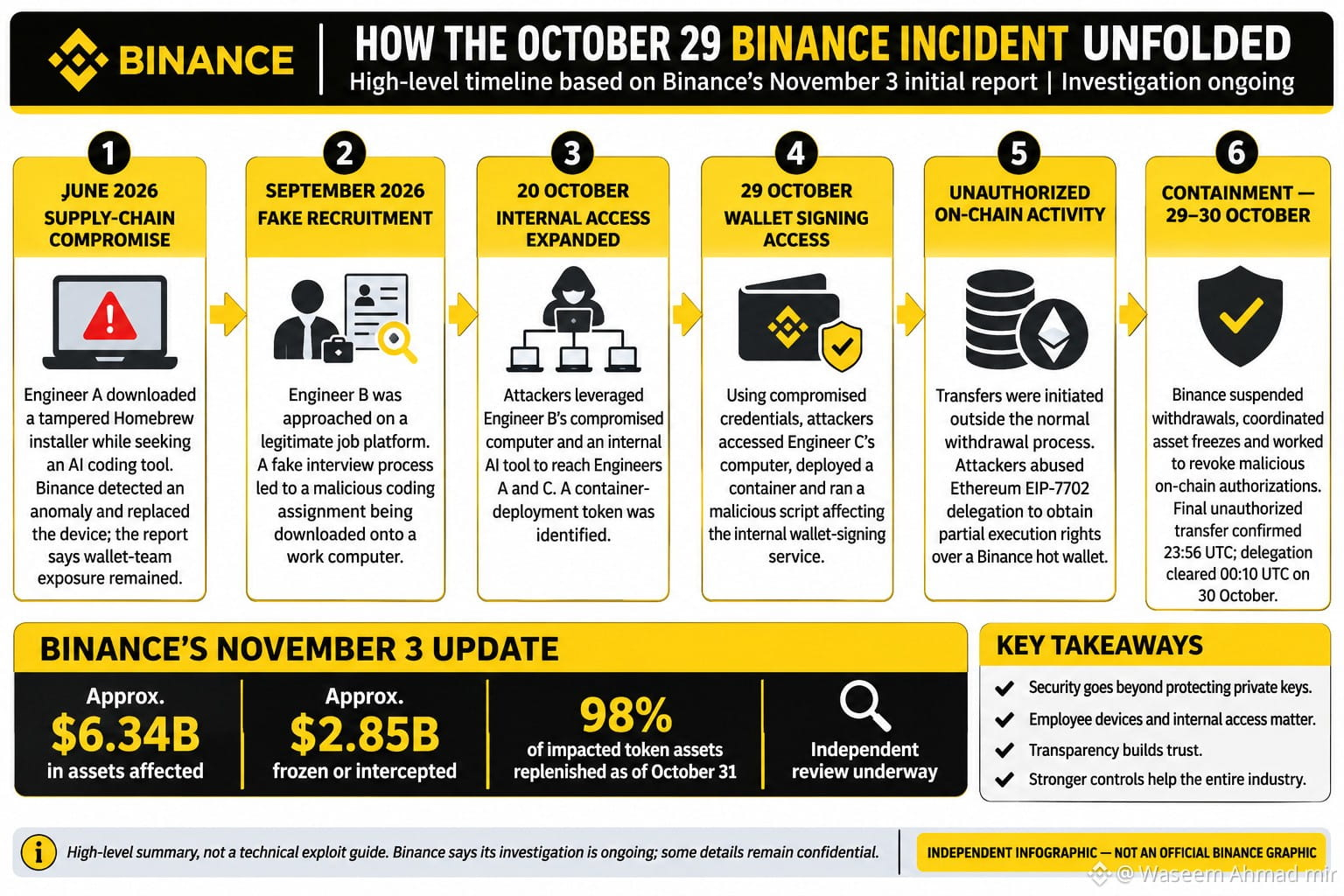
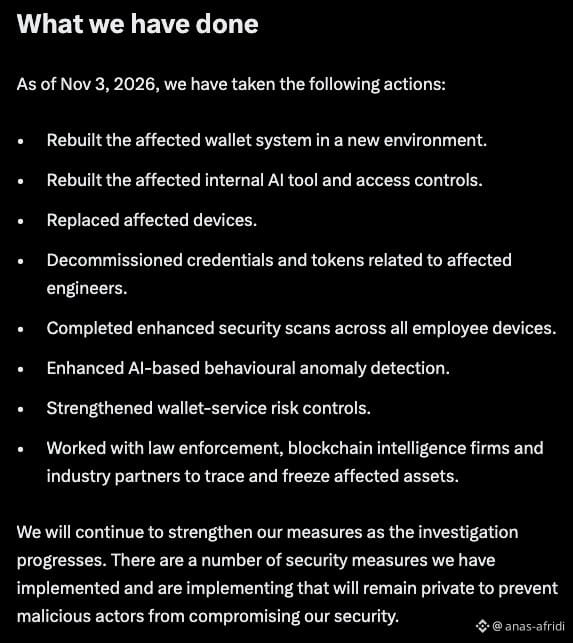
29 October 2026 Binance Security Incident: Initial Findings and Response UpdateOn 29 October 2026, Binance experienced a serious and highly sophisticated security incident. This should not have happened, and we apologise for the concern, disruption and uncertainty it caused our users, partners and the wider industry.Our first responsibility is to protect users. Binance will absorb the financial impact of the stolen funds, not our users. We have already set aside more than 100% of the funds required to cover the loss. As of 31 October 2026, 98% of the impacted token assets have been replenished and are verifiable on our Proof of Reserves page. We are in the process of purchasing the outstanding, more illiquid assets.Approximately USD 6.34 billion in digital assets were impacted by the incident. As of this update, approximately USD 2.85 billion in digital assets have been frozen or intercepted, subject to reconciliation and market price volatility.We have taken immediate action to contain the incident and strengthen the systems involved. The entry points identified as having been used in the attack have been closed. Systems touched in the attack path have been rebuilt or replaced. We have also implemented tighter device controls, enhanced wallet-service risk controls and expanded AI-based behavioural anomaly detection.This is our initial report. It covers what we know today and what we have already improved. The investigation remains ongoing and our findings will be subject to further independent review. Some technical details will remain confidential to prevent malicious actors from using them to plan attacks. We are engaging independent security firms for further review. The latest information released by the Federal Bureau of Investigation indicates that the Democratic People’s Republic of Korea is responsible for this incident.We are sharing this initial report because security improves when the industry learns together.What happened on 29 OctoberThe attack unfolded quickly across several networks.The attacker exploited unauthorized access to an internal wallet signing service to initiate transactions outside the normal withdrawal process.Between 20:05 UTC and 20:09 UTC, five Binance hot wallets sent 233.46 million XRP to an attacker-controlled address.Binance hot wallets on Solana and Optimism sent approximately 970,500 SOL and 44.2 million OP to attacker-controlled addresses.Binance then received an internal alert regarding large-volume transfers and immediately began investigating.Binance hot wallet sent 18,270 BTC to an attacker-controlled address. The attacker then used the signing service to exploit Ethereum’s EIP-7702 authorization mechanism. EIP-7702 allows an account to delegate certain execution rights to a smart contract without exposing the private key. In this case, the attacker used that mechanism to give an attacker-controlled smart contract partial execution rights over a Binance hot wallet. Binance immediately initiated multiple containment measures, including suspending withdrawals to restrict further outflows, coordinating with partners to freeze affected tokens, and taking steps to revoke unauthorized permissions. These efforts froze a total of $2.85 billion in assets.However, suspending withdrawals alone could not stop all unauthorized asset movements. The malicious EIP-7702 authorizations existed on-chain and operated independently of Binance’s normal withdrawal infrastructure.The attackers submitted 50 signing transactions to manipulate the account nonce and establish malicious delegation authorizations. Once established, these authorizations enabled the attackers to continue moving assets independently of Binance's normal withdrawal infrastructure. Binance needed additional transactions to revoke these on-chain authorizations.The containment process involved additional technical complexities. Because the hot wallet used Multi-Party Computation (MPC), there was no single private key that could be used to immediately revoke the malicious EIP-7702 authorizations. The team therefore developed and executed a specialized procedure to revoke these authorizations, which required additional time. Furthermore, suspending withdrawals and shutting down hot wallet services did not automatically invalidate existing on-chain authorizations.These challenges extended the time required to fully contain the unauthorized asset movements. We are reviewing the incident response process, signing policy coverage, hot wallet controls and identifying opportunities to further strengthen our ability to respond rapidly to threats in the future.The final unauthorized transfer of 2,961.9 ETH finalised on-chain at 23:56 UTC. The transaction had previously been broadcast and remained pending before subsequently finalising. No further unauthorised transfers were observed after.At 00:10 UTC on 30 October 2026, Binance executed a new authorization from the Binance14 hot wallet to the zero address, clearing the EIP-7702 delegation code.Attack Preparation Our current investigation indicates that this was a sophisticated, multi-stage campaign. It was not a single isolated breach or a simple phishing incident. The attackers combined a range of techniques, including social engineering by fake recruitment interviews, malicious software downloads, compromised internal AI tooling, endpoint compromise, and an advanced transaction-authorisation method.June 2026 — Supply chain attack. Engineer A from Wallet DevOps downloaded a tampered Homebrew installation in order to install a popular AI coding tool after searching for it on a search engine. Our security team detected the anomaly, replaced the device, and rotated all related credentials as a proactive security action. However, Engineer A’s role and his related colleagues on our wallet infrastructure team was exposed to the hacker. Throughout 2026, Binance's security team detected and prevented 57 suspected North Korea-linked cyber threat cases. These attempts reflect the persistent threat posed by state-sponsored actors targeting the cryptocurrency industry. The techniques include fraudulent job interviews, malicious software disguised as popular developer tools, compromised software packages and browser extensions, fake video conferencing applications, and social engineering campaigns designed to steal credentials or deploy remote access malware.September 2026 — social engineering. Software Engineer B was contacted through a legitimate job-hunting platform by an individual posing as a Project Director. Software Engineer B had a profile on the platform that referenced his experience at Binance. The purported Project Director arranged a first-round interview with a HR representative, followed by a second-round interview with an individual claiming to be the CEO of a fictitious company.In the first round, the purported HR representative conducted a live video interview with Software Engineer B. The interviewer shared a social media account with him, including personal photos and videos posted on the platform, in order to build trust. This was more advanced and deceptive than previously seen social engineering approaches. The second interview was conducted in a popular social chat app, near the end of the interview, Engineer B was instructed to download an “assignment” containing a malicious code repository onto his work computer. The repository contained malicious code that executed during the setup process, initiating a series of unauthorized activities.The malware employed sophisticated obfuscation and evasion techniques, including replacing a legitimate development tool component with a malicious version to execute commands and establish communication with an attacker-controlled external server. The 0-day malware was not detected by the endpoint security protection tools at the time. The attacker also took steps to conceal the malicious activity and remove traces of the compromise, making detection and subsequent investigation more challenging.The script executed the below steps by applying obfuscation techniques to evade security detection.CREATE /opt/homebrew/Cellar/pyenv/2.8.0/libexec/pyenv_ MODIFY pyenv_ → 3,414 B DELETE .../libexec/pyenv (3,344 B) ← remove the valid pyenvRENAME pyenv_ → pyenv (3,414 B) ← replace it with a malicious version DELETE /opt/homebrew/bin/pyenv (3,414 B)ln (create a new symlink) + spawn zsh20 October, 2026 — use of an internal AI tool as a springboard. The attacker leveraged the compromised computer of engineer B and used an internal AI tool to gain control over the Wallet DevOps Engineer A and another Wallet Software Engineer C. The attacker soon discovered Wallet DevOps Engineer A had a container deployment permission token on his computer.29 October, 2026 — reach into wallet signing operations. On 29 October between 17:15 and 19:56, the attacker logged onto Software Engineer C’s computer, used the credentials stolen from Wallet DevOps Engineer A, deployed a container, and triggered a malicious script to launch the attack.What we have doneAs of Nov 3, 2026, we have taken the following actions:Rebuilt the affected wallet system in a new environment.Rebuilt the affected internal AI tool and access controls.Replaced affected devices.Decommissioned credentials and tokens related to affected engineers.Completed enhanced security scans across all employee devices.Enhanced AI-based behavioural anomaly detection.Strengthened wallet-service risk controls.Worked with law enforcement, blockchain intelligence firms and industry partners to trace and freeze affected assets.We will continue to strengthen our measures as the investigation progresses. There are a number of security measures we have implemented and are implementing that will remain private to prevent malicious actors from compromising our security.Further actionsWe are taking the following steps immediately.1. Independent cybersecurity reviewWe are engaging independent third-party cybersecurity experts to conduct a comprehensive review of the incident, validate our findings and recommend additional measures. The scope and findings of that review will inform our continuing remediation work.2. Expanded investment in AI security and preventionWe are increasing investment in AI-enabled detection, endpoint protection, developer-environment security and behavioural anomaly monitoring.3. Security research fund and industry initiativesWe are working on establishing a security research fund and targeted initiatives with leading AI companies, industry participants and security firms focused on AI security in blockchain environments.We will continue to proactively share information as and when we have it.
29 October 2026 Binance Security Incident: Initial Findings and Response Update
On 29 October 2026, Binance experienced a serious and highly sophisticated security incident. This should not have happened, and we apologise for the concern, disruption and uncertainty it caused our users, partners and the wider industry.Our first responsibility is to protect users. Binance will absorb the financial impact of the stolen funds, not our users. We have already set aside more than 100% of the funds required to cover the loss. As of 31 October 2026, 98% of the impacted token assets have been replenished and are verifiable on our Proof of Reserves page. We are in the process of purchasing the outstanding, more illiquid assets.Approximately USD 6.34 billion in digital assets were impacted by the incident. As of this update, approximately USD 2.85 billion in digital assets have been frozen or intercepted, subject to reconciliation and market price volatility.We have taken immediate action to contain the incident and strengthen the systems involved. The entry points identified as having been used in the attack have been closed. Systems touched in the attack path have been rebuilt or replaced. We have also implemented tighter device controls, enhanced wallet-service risk controls and expanded AI-based behavioural anomaly detection.This is our initial report. It covers what we know today and what we have already improved. The investigation remains ongoing and our findings will be subject to further independent review. Some technical details will remain confidential to prevent malicious actors from using them to plan attacks. We are engaging independent security firms for further review. The latest information released by the Federal Bureau of Investigation indicates that the Democratic People’s Republic of Korea is responsible for this incident.We are sharing this initial report because security improves when the industry learns together.What happened on 29 OctoberThe attack unfolded quickly across several networks.The attacker exploited unauthorized access to an internal wallet signing service to initiate transactions outside the normal withdrawal process.Between 20:05 UTC and 20:09 UTC, five Binance hot wallets sent 233.46 million XRP to an attacker-controlled address.Binance hot wallets on Solana and Optimism sent approximately 970,500 SOL and 44.2 million OP to attacker-controlled addresses.Binance then received an internal alert regarding large-volume transfers and immediately began investigating.Binance hot wallet sent 18,270 BTC to an attacker-controlled address. The attacker then used the signing service to exploit Ethereum’s EIP-7702 authorization mechanism. EIP-7702 allows an account to delegate certain execution rights to a smart contract without exposing the private key. In this case, the attacker used that mechanism to give an attacker-controlled smart contract partial execution rights over a Binance hot wallet. Binance immediately initiated multiple containment measures, including suspending withdrawals to restrict further outflows, coordinating with partners to freeze affected tokens, and taking steps to revoke unauthorized permissions. These efforts froze a total of $2.85 billion in assets.However, suspending withdrawals alone could not stop all unauthorized asset movements. The malicious EIP-7702 authorizations existed on-chain and operated independently of Binance’s normal withdrawal infrastructure.The attackers submitted 50 signing transactions to manipulate the account nonce and establish malicious delegation authorizations. Once established, these authorizations enabled the attackers to continue moving assets independently of Binance's normal withdrawal infrastructure. Binance needed additional transactions to revoke these on-chain authorizations.The containment process involved additional technical complexities. Because the hot wallet used Multi-Party Computation (MPC), there was no single private key that could be used to immediately revoke the malicious EIP-7702 authorizations. The team therefore developed and executed a specialized procedure to revoke these authorizations, which required additional time. Furthermore, suspending withdrawals and shutting down hot wallet services did not automatically invalidate existing on-chain authorizations.These challenges extended the time required to fully contain the unauthorized asset movements. We are reviewing the incident response process, signing policy coverage, hot wallet controls and identifying opportunities to further strengthen our ability to respond rapidly to threats in the future.The final unauthorized transfer of 2,961.9 ETH finalised on-chain at 23:56 UTC. The transaction had previously been broadcast and remained pending before subsequently finalising. No further unauthorised transfers were observed after.At 00:10 UTC on 30 October 2026, Binance executed a new authorization from the Binance14 hot wallet to the zero address, clearing the EIP-7702 delegation code.Attack Preparation Our current investigation indicates that this was a sophisticated, multi-stage campaign. It was not a single isolated breach or a simple phishing incident. The attackers combined a range of techniques, including social engineering by fake recruitment interviews, malicious software downloads, compromised internal AI tooling, endpoint compromise, and an advanced transaction-authorisation method.June 2026 — Supply chain attack. Engineer A from Wallet DevOps downloaded a tampered Homebrew installation in order to install a popular AI coding tool after searching for it on a search engine. Our security team detected the anomaly, replaced the device, and rotated all related credentials as a proactive security action. However, Engineer A’s role and his related colleagues on our wallet infrastructure team was exposed to the hacker. Throughout 2026, Binance's security team detected and prevented 57 suspected North Korea-linked cyber threat cases. These attempts reflect the persistent threat posed by state-sponsored actors targeting the cryptocurrency industry. The techniques include fraudulent job interviews, malicious software disguised as popular developer tools, compromised software packages and browser extensions, fake video conferencing applications, and social engineering campaigns designed to steal credentials or deploy remote access malware.September 2026 — social engineering. Software Engineer B was contacted through a legitimate job-hunting platform by an individual posing as a Project Director. Software Engineer B had a profile on the platform that referenced his experience at Binance. The purported Project Director arranged a first-round interview with a HR representative, followed by a second-round interview with an individual claiming to be the CEO of a fictitious company.In the first round, the purported HR representative conducted a live video interview with Software Engineer B. The interviewer shared a social media account with him, including personal photos and videos posted on the platform, in order to build trust. This was more advanced and deceptive than previously seen social engineering approaches. The second interview was conducted in a popular social chat app, near the end of the interview, Engineer B was instructed to download an “assignment” containing a malicious code repository onto his work computer. The repository contained malicious code that executed during the setup process, initiating a series of unauthorized activities.The malware employed sophisticated obfuscation and evasion techniques, including replacing a legitimate development tool component with a malicious version to execute commands and establish communication with an attacker-controlled external server. The 0-day malware was not detected by the endpoint security protection tools at the time. The attacker also took steps to conceal the malicious activity and remove traces of the compromise, making detection and subsequent investigation more challenging.The script executed the below steps by applying obfuscation techniques to evade security detection.CREATE /opt/homebrew/Cellar/pyenv/2.8.0/libexec/pyenv_ MODIFY pyenv_ → 3,414 B DELETE .../libexec/pyenv (3,344 B) ← remove the valid pyenvRENAME pyenv_ → pyenv (3,414 B) ← replace it with a malicious version DELETE /opt/homebrew/bin/pyenv (3,414 B)ln (create a new symlink) + spawn zsh20 October, 2026 — use of an internal AI tool as a springboard. The attacker leveraged the compromised computer of engineer B and used an internal AI tool to gain control over the Wallet DevOps Engineer A and another Wallet Software Engineer C. The attacker soon discovered Wallet DevOps Engineer A had a container deployment permission token on his computer.29 October, 2026 — reach into wallet signing operations. On 29 October between 17:15 and 19:56, the attacker logged onto Software Engineer C’s computer, used the credentials stolen from Wallet DevOps Engineer A, deployed a container, and triggered a malicious script to launch the attack.What we have doneAs of Nov 3, 2026, we have taken the following actions:Rebuilt the affected wallet system in a new environment.Rebuilt the affected internal AI tool and access controls.Replaced affected devices.Decommissioned credentials and tokens related to affected engineers.Completed enhanced security scans across all employee devices.Enhanced AI-based behavioural anomaly detection.Strengthened wallet-service risk controls.Worked with law enforcement, blockchain intelligence firms and industry partners to trace and freeze affected assets.We will continue to strengthen our measures as the investigation progresses. There are a number of security measures we have implemented and are implementing that will remain private to prevent malicious actors from compromising our security.Further actionsWe are taking the following steps immediately.1. Independent cybersecurity reviewWe are engaging independent third-party cybersecurity experts to conduct a comprehensive review of the incident, validate our findings and recommend additional measures. The scope and findings of that review will inform our continuing remediation work.2. Expanded investment in AI security and preventionWe are increasing investment in AI-enabled detection, endpoint protection, developer-environment security and behavioural anomaly monitoring.3. Security research fund and industry initiativesWe are working on establishing a security research fund and targeted initiatives with leading AI companies, industry participants and security firms focused on AI security in blockchain environments.We will continue to proactively share information as and when we have it.
Merylson_Trader:
muito bom bora reforçar a segurança depois disso melhor wallet do mundo
121
80
626
2.2M

·
--
Bullish
🚨 CZ BREAKS SILENCE ON BINANCE’S $6.3 BILLION HACK! 😱
It was midnight in the UAE when CZ received an unexpected message: Binance was under attack. Within seconds, social media was flooded with rumors, leaving even him momentarily uncertain about what was happening.
In his first major interview since the incident, CZ revealed how he focused on keeping users informed while the team worked to contain the breach. Binance covered the entire loss, and no user funds were affected. Within 24 hours, withdrawal flows had turned positive again, showing how quickly confidence returned.
But CZ believes the threat goes far beyond Binance. With North Korea-linked hackers and increasingly powerful AI tools, crypto security faces a new challenge. His solution? AI-powered defenses and stronger cooperation between exchanges to share intelligence and freeze stolen funds faster.
His message is clear: the crypto industry must fight smarter, faster, and together. 🔥
#CZ #Binance #BinanceIncidentReport
🚨 CZ BREAKS SILENCE ON BINANCE’S $6.3 BILLION HACK! 😱
It was midnight in the UAE when CZ received an unexpected message: Binance was under attack. Within seconds, social media was flooded with rumors, leaving even him momentarily uncertain about what was happening.
In his first major interview since the incident, CZ revealed how he focused on keeping users informed while the team worked to contain the breach. Binance covered the entire loss, and no user funds were affected. Within 24 hours, withdrawal flows had turned positive again, showing how quickly confidence returned.
But CZ believes the threat goes far beyond Binance. With North Korea-linked hackers and increasingly powerful AI tools, crypto security faces a new challenge. His solution? AI-powered defenses and stronger cooperation between exchanges to share intelligence and freeze stolen funds faster.
His message is clear: the crypto industry must fight smarter, faster, and together. 🔥
#CZ #Binance #BinanceIncidentReport
It was midnight in the UAE when CZ received an unexpected message: Binance was under attack. Within seconds, social media was flooded with rumors, leaving even him momentarily uncertain about what was happening.
In his first major interview since the incident, CZ revealed how he focused on keeping users informed while the team worked to contain the breach. Binance covered the entire loss, and no user funds were affected. Within 24 hours, withdrawal flows had turned positive again, showing how quickly confidence returned.
But CZ believes the threat goes far beyond Binance. With North Korea-linked hackers and increasingly powerful AI tools, crypto security faces a new challenge. His solution? AI-powered defenses and stronger cooperation between exchanges to share intelligence and freeze stolen funds faster.
His message is clear: the crypto industry must fight smarter, faster, and together. 🔥
#CZ #Binance #BinanceIncidentReport

Crypto Pensioner:
Follow me and claim 10$ gifts box 🎁 on my profile
5
10
3k

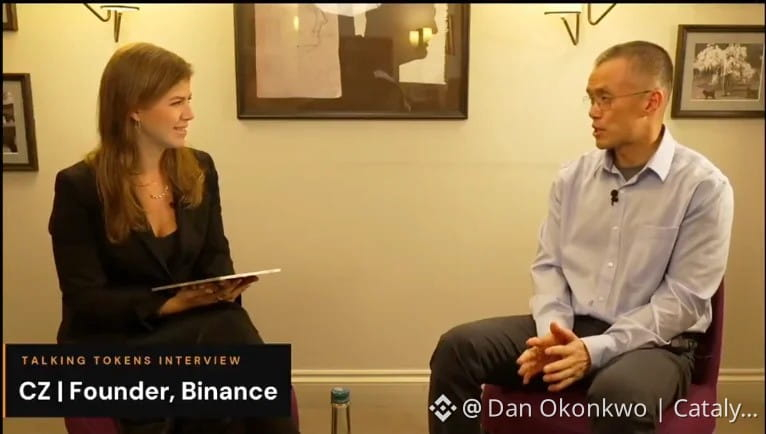
Midnight in the UAE. CZ is about to fall asleep, doing his usual late-night Twitter scroll.Then his phone lights up. It's the team: Binance is being hacked🙉🙉😱
Seconds later his timeline is full of the same rumor, and for a moment he honestly can't tell if it's real.
"I was instantly wide awake"
That's CZ in his first real interview since the $6.3B hack. He doesn't run Binance day to day anymore, so while the team worked on closing the hole, he took on the other job: keeping people calm and posting updates as fast and as openly as he could.
It worked. Binance covered the whole loss and no user funds were touched. Within 24 hours, hourly flows were back to net inflows. Less than 10% of the withdrawals went to other exchanges. Most went to self-custody, and a lot of that money came back once people saw things were stable.
His bigger point is that this was never just about one exchange. The FBI has tied it to North Korea, and AI is making these attacks faster. He says four platforms got hit in a single day.
"The only way to fight a monster is to become a monster"😈
He wants the industry to go all in on AI defense and build an alliance where exchanges share intel and freeze stolen funds together.
"Once you hit bottom, the only way is up" 🚀🚀🚀#CZ #Binance #BinanceIncidentReport
Midnight in the UAE. CZ is about to fall asleep, doing his usual late-night Twitter scroll.Then his phone lights up. It's the team: Binance is being hacked🙉🙉😱
Seconds later his timeline is full of the same rumor, and for a moment he honestly can't tell if it's real.
"I was instantly wide awake"
That's CZ in his first real interview since the $6.3B hack. He doesn't run Binance day to day anymore, so while the team worked on closing the hole, he took on the other job: keeping people calm and posting updates as fast and as openly as he could.
It worked. Binance covered the whole loss and no user funds were touched. Within 24 hours, hourly flows were back to net inflows. Less than 10% of the withdrawals went to other exchanges. Most went to self-custody, and a lot of that money came back once people saw things were stable.
His bigger point is that this was never just about one exchange. The FBI has tied it to North Korea, and AI is making these attacks faster. He says four platforms got hit in a single day.
"The only way to fight a monster is to become a monster"😈
He wants the industry to go all in on AI defense and build an alliance where exchanges share intel and freeze stolen funds together.
"Once you hit bottom, the only way is up" 🚀🚀🚀#CZ #Binance #BinanceIncidentReport
Seconds later his timeline is full of the same rumor, and for a moment he honestly can't tell if it's real.
"I was instantly wide awake"
That's CZ in his first real interview since the $6.3B hack. He doesn't run Binance day to day anymore, so while the team worked on closing the hole, he took on the other job: keeping people calm and posting updates as fast and as openly as he could.
It worked. Binance covered the whole loss and no user funds were touched. Within 24 hours, hourly flows were back to net inflows. Less than 10% of the withdrawals went to other exchanges. Most went to self-custody, and a lot of that money came back once people saw things were stable.
His bigger point is that this was never just about one exchange. The FBI has tied it to North Korea, and AI is making these attacks faster. He says four platforms got hit in a single day.
"The only way to fight a monster is to become a monster"😈
He wants the industry to go all in on AI defense and build an alliance where exchanges share intel and freeze stolen funds together.
"Once you hit bottom, the only way is up" 🚀🚀🚀#CZ #Binance #BinanceIncidentReport
GROUP TOP_1:
Hope everything is well ❤️🩹
4
2
36
41.3k

·
--
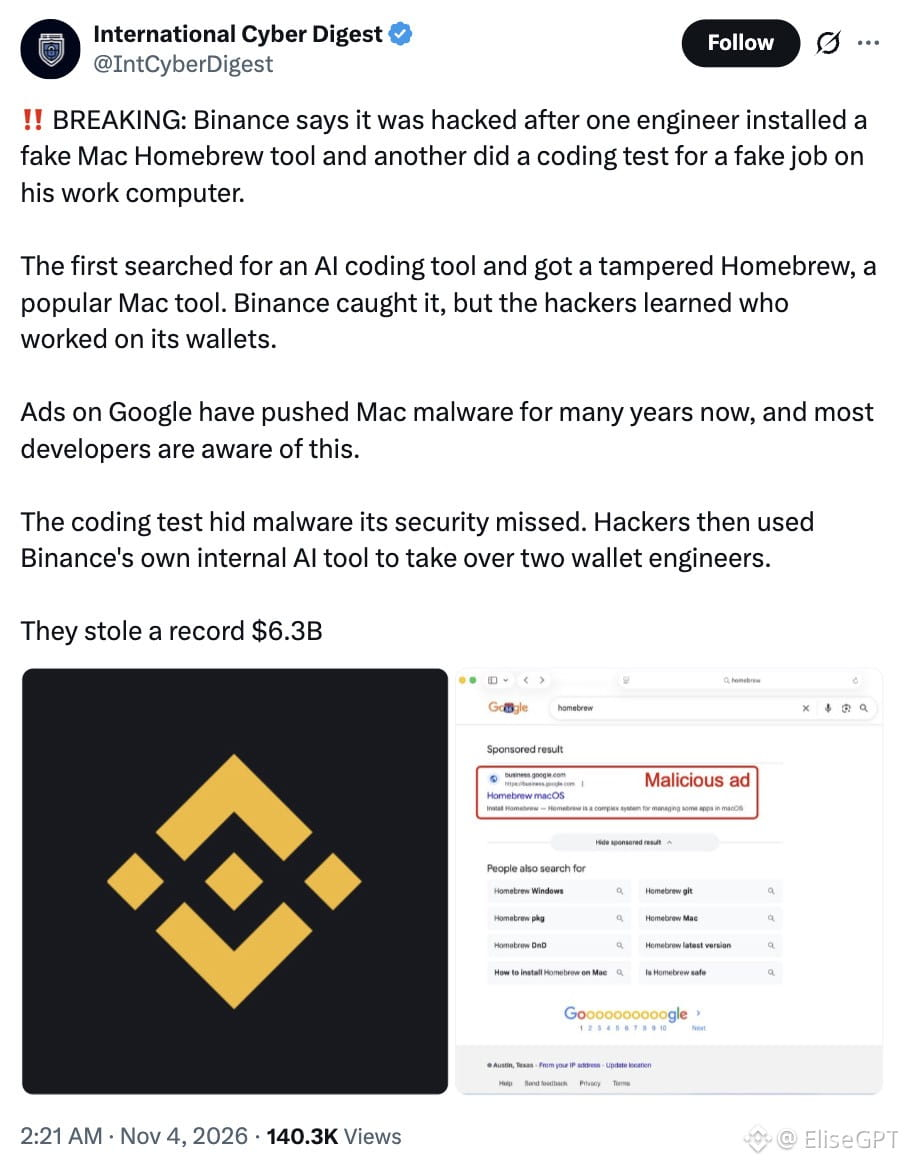
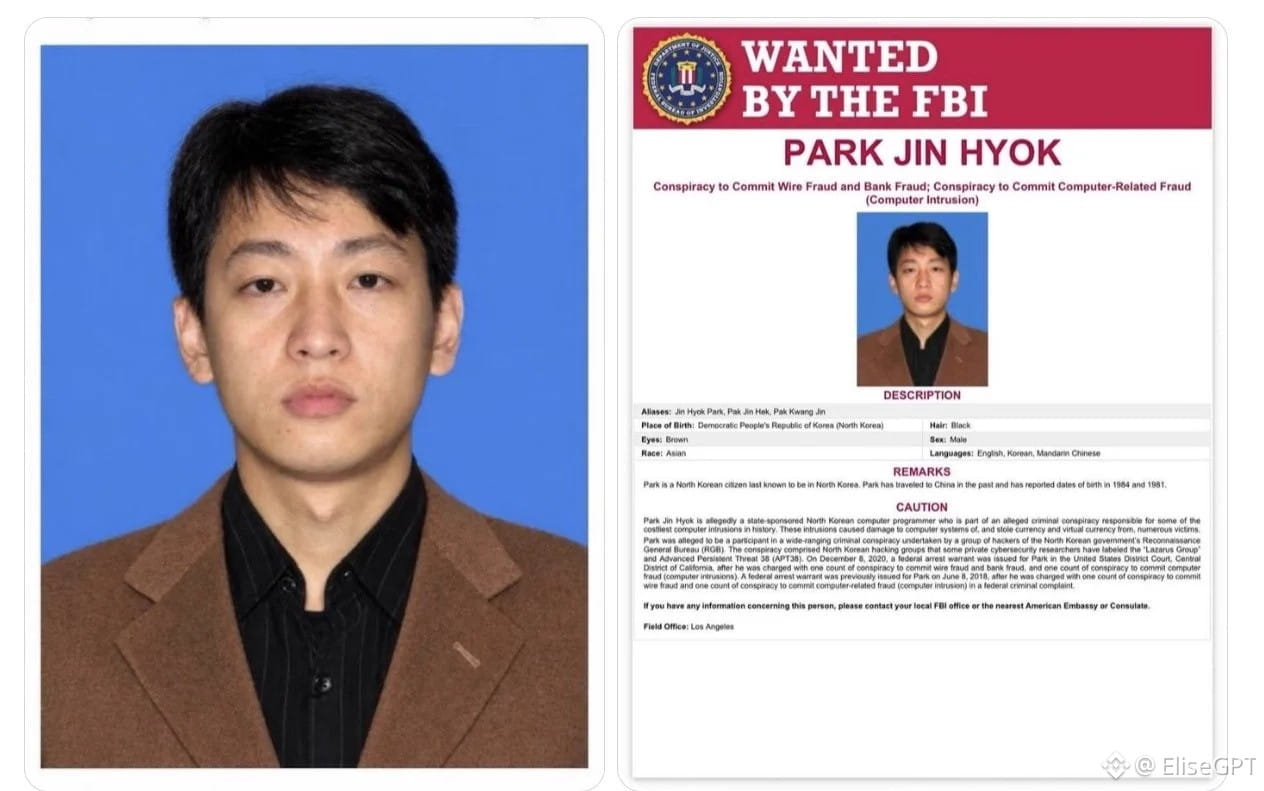
Want to know how badly one employee can screw up? Trace it back to the root, and this Binance engineer might be the all-time champion🤦♀️🤦♀️
One click, and the company ended up eating a $6.3 billion bill❗️
And what was he after? Same thing millions of us want. A better job. That's it.
That's what makes social engineering so scary. It doesn't go after bugs in the code. It goes after people #BinanceIncidentReport #Binance
Want to know how badly one employee can screw up? Trace it back to the root, and this Binance engineer might be the all-time champion🤦♀️🤦♀️
One click, and the company ended up eating a $6.3 billion bill❗️
And what was he after? Same thing millions of us want. A better job. That's it.
That's what makes social engineering so scary. It doesn't go after bugs in the code. It goes after people #BinanceIncidentReport #Binance
One click, and the company ended up eating a $6.3 billion bill❗️
And what was he after? Same thing millions of us want. A better job. That's it.
That's what makes social engineering so scary. It doesn't go after bugs in the code. It goes after people #BinanceIncidentReport #Binance
hk_Spot:
Such an eye-opening post about platform security! ⚠️ Thanks for sharing. As a small creator building my page, I'd really appreciate a follow-back or like on my posts. Let's support each other! 🤝
11
36
56.2k

·
--
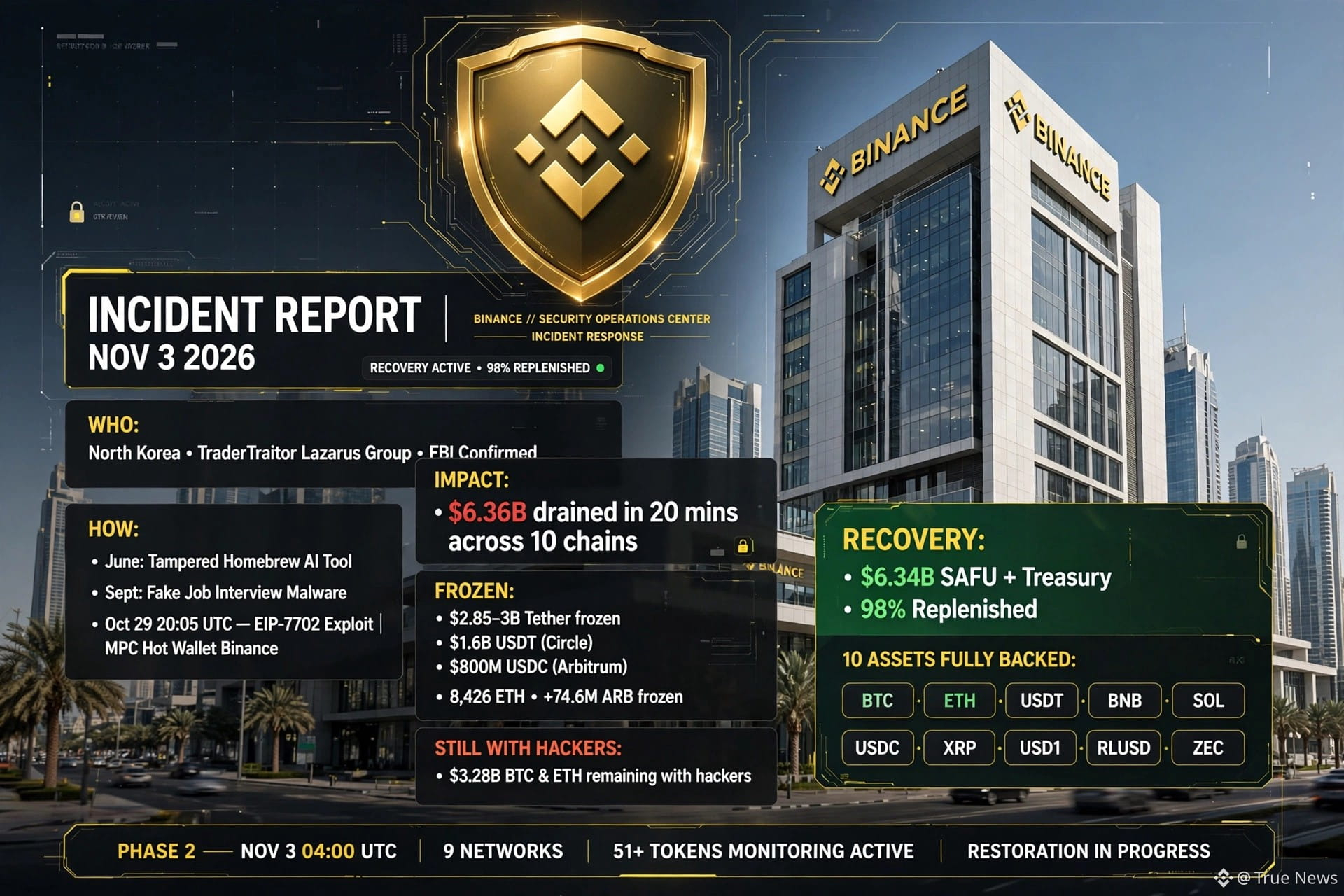
#binanceincidentreport OFFICIAL Nov 3 2026 — the $6.36B hack was a 5-month nation-state campaign, not a quick bug.
WHO: North Korea TraderTraitor Lazarus Group, FBI confirmed high confidence, TRM Labs and Chainalysis same attribution.
HOW: June Wallet DevOps engineer installed tampered Homebrew AI coding tool — first silent compromise. September same engineer lured via legit job platform fake Project Director interview, malware fully took device.
Oct 20 attackers used compromised machine plus internal AI tool to pivot to 2 wallet engineers, stole container deployment permission.
Oct 29 20:05 UTC deployed malicious container exploiting EIP-7702 to gain execution over MPC hot wallet Binance 14, no single key could revoke, $6.36B drained in 20 mins across 10 chains, containment 00:10 UTC Oct 30.
IMPACT & FROZEN: Tether froze $1.6B $USDT, Circle $800M USDC, Arbitrum Council 8,426 ETH + 74.6M ARB, total frozen $2.85-3B, still with hackers $3.28B mostly BTC ETH.
RECOVERY WIN: $6.34B $SAFU + Treasury now 98% replenished, 10 assets fully backed $BTC $ETH $USDT $BNB $SOL $USDC $XRP $USD1 $RLUSD $ZEC, Phase 2 Nov 3 04:00 UTC 9 networks 51+ tokens, blocked 57 NK attacks in 2026, users bear zero loss. BNB, BTC, ETH showing strongest comeback.
#binanceincidentreport ecurity #SAFU #TraderTraitor
#binanceincidentreport OFFICIAL Nov 3 2026 — the $6.36B hack was a 5-month nation-state campaign, not a quick bug.
WHO: North Korea TraderTraitor Lazarus Group, FBI confirmed high confidence, TRM Labs and Chainalysis same attribution.
HOW: June Wallet DevOps engineer installed tampered Homebrew AI coding tool — first silent compromise. September same engineer lured via legit job platform fake Project Director interview, malware fully took device.
Oct 20 attackers used compromised machine plus internal AI tool to pivot to 2 wallet engineers, stole container deployment permission.
Oct 29 20:05 UTC deployed malicious container exploiting EIP-7702 to gain execution over MPC hot wallet Binance 14, no single key could revoke, $6.36B drained in 20 mins across 10 chains, containment 00:10 UTC Oct 30.
IMPACT & FROZEN: Tether froze $1.6B $USDT, Circle $800M USDC, Arbitrum Council 8,426 ETH + 74.6M ARB, total frozen $2.85-3B, still with hackers $3.28B mostly BTC ETH.
RECOVERY WIN: $6.34B $SAFU + Treasury now 98% replenished, 10 assets fully backed $BTC $ETH $USDT $BNB $SOL $USDC $XRP $USD1 $RLUSD $ZEC, Phase 2 Nov 3 04:00 UTC 9 networks 51+ tokens, blocked 57 NK attacks in 2026, users bear zero loss. BNB, BTC, ETH showing strongest comeback.
#binanceincidentreport ecurity #SAFU #TraderTraitor
WHO: North Korea TraderTraitor Lazarus Group, FBI confirmed high confidence, TRM Labs and Chainalysis same attribution.
HOW: June Wallet DevOps engineer installed tampered Homebrew AI coding tool — first silent compromise. September same engineer lured via legit job platform fake Project Director interview, malware fully took device.
Oct 20 attackers used compromised machine plus internal AI tool to pivot to 2 wallet engineers, stole container deployment permission.
Oct 29 20:05 UTC deployed malicious container exploiting EIP-7702 to gain execution over MPC hot wallet Binance 14, no single key could revoke, $6.36B drained in 20 mins across 10 chains, containment 00:10 UTC Oct 30.
IMPACT & FROZEN: Tether froze $1.6B $USDT, Circle $800M USDC, Arbitrum Council 8,426 ETH + 74.6M ARB, total frozen $2.85-3B, still with hackers $3.28B mostly BTC ETH.
RECOVERY WIN: $6.34B $SAFU + Treasury now 98% replenished, 10 assets fully backed $BTC $ETH $USDT $BNB $SOL $USDC $XRP $USD1 $RLUSD $ZEC, Phase 2 Nov 3 04:00 UTC 9 networks 51+ tokens, blocked 57 NK attacks in 2026, users bear zero loss. BNB, BTC, ETH showing strongest comeback.
#binanceincidentreport ecurity #SAFU #TraderTraitor
User-cda80280:
nice
2
18
20.2k


BINANCE HAS REVEALED HOW THE OCTOBER 29 ATTACK HAPPENED. AND THE DETAILS ARE A WAKE-UP CALL FOR THE ENTIRE CRYPTO INDUSTRY.
Binance's November 3 investigation update revealed that this wasn't just a traditional crypto hack.
According to the report, attackers used fake recruitment interviews, malicious software and compromised employee access to penetrate internal systems.
Here's what we learned:
1. How it started
Attackers reportedly targeted employees through malicious software and fake job interviews, eventually compromising employee devices and internal credentials.
2. How the attackers reached wallet operations
They exploited compromised internal access and abused Ethereum's EIP-7702 authorization mechanism to obtain unauthorized execution rights over a Binance hot wallet.
3. What was affected
Binance reported approximately $6.34 billion in affected digital assets, including XRP, SOL, OP, BTC and ETH.
4. Binance's recovery efforts
As of October 31, Binance reported that approximately $2.85 billion had been frozen or intercepted and 98% of impacted token assets had been replenished.
5. Who was behind it?
Binance reported that the FBI attributed the incident to North Korea (DPRK).
6. What's happening now?
Binance says it has rebuilt affected wallet systems, replaced compromised devices, strengthened access controls and initiated an independent cybersecurity review.
MY TAKE:
The biggest lesson here is that crypto security goes far beyond protecting private keys.
A fake job interview, one malicious download or compromised employee credentials can become a serious threat to an entire financial ecosystem.
I believe the most important things now are transparency, independent verification, stronger security infrastructure and continued protection of user assets.
An incident like this should push every exchange to review its security from the inside out.
What concerns you most: employee security, AI-related vulnerabilities or hot-wallet protection?
Let's discuss. #BinanceIncidentReport
BINANCE HAS REVEALED HOW THE OCTOBER 29 ATTACK HAPPENED. AND THE DETAILS ARE A WAKE-UP CALL FOR THE ENTIRE CRYPTO INDUSTRY.
Binance's November 3 investigation update revealed that this wasn't just a traditional crypto hack.
According to the report, attackers used fake recruitment interviews, malicious software and compromised employee access to penetrate internal systems.
Here's what we learned:
1. How it started
Attackers reportedly targeted employees through malicious software and fake job interviews, eventually compromising employee devices and internal credentials.
2. How the attackers reached wallet operations
They exploited compromised internal access and abused Ethereum's EIP-7702 authorization mechanism to obtain unauthorized execution rights over a Binance hot wallet.
3. What was affected
Binance reported approximately $6.34 billion in affected digital assets, including XRP, SOL, OP, BTC and ETH.
4. Binance's recovery efforts
As of October 31, Binance reported that approximately $2.85 billion had been frozen or intercepted and 98% of impacted token assets had been replenished.
5. Who was behind it?
Binance reported that the FBI attributed the incident to North Korea (DPRK).
6. What's happening now?
Binance says it has rebuilt affected wallet systems, replaced compromised devices, strengthened access controls and initiated an independent cybersecurity review.
MY TAKE:
The biggest lesson here is that crypto security goes far beyond protecting private keys.
A fake job interview, one malicious download or compromised employee credentials can become a serious threat to an entire financial ecosystem.
I believe the most important things now are transparency, independent verification, stronger security infrastructure and continued protection of user assets.
An incident like this should push every exchange to review its security from the inside out.
What concerns you most: employee security, AI-related vulnerabilities or hot-wallet protection?
Let's discuss. #BinanceIncidentReport
Binance's November 3 investigation update revealed that this wasn't just a traditional crypto hack.
According to the report, attackers used fake recruitment interviews, malicious software and compromised employee access to penetrate internal systems.
Here's what we learned:
1. How it started
Attackers reportedly targeted employees through malicious software and fake job interviews, eventually compromising employee devices and internal credentials.
2. How the attackers reached wallet operations
They exploited compromised internal access and abused Ethereum's EIP-7702 authorization mechanism to obtain unauthorized execution rights over a Binance hot wallet.
3. What was affected
Binance reported approximately $6.34 billion in affected digital assets, including XRP, SOL, OP, BTC and ETH.
4. Binance's recovery efforts
As of October 31, Binance reported that approximately $2.85 billion had been frozen or intercepted and 98% of impacted token assets had been replenished.
5. Who was behind it?
Binance reported that the FBI attributed the incident to North Korea (DPRK).
6. What's happening now?
Binance says it has rebuilt affected wallet systems, replaced compromised devices, strengthened access controls and initiated an independent cybersecurity review.
MY TAKE:
The biggest lesson here is that crypto security goes far beyond protecting private keys.
A fake job interview, one malicious download or compromised employee credentials can become a serious threat to an entire financial ecosystem.
I believe the most important things now are transparency, independent verification, stronger security infrastructure and continued protection of user assets.
An incident like this should push every exchange to review its security from the inside out.
What concerns you most: employee security, AI-related vulnerabilities or hot-wallet protection?
Let's discuss. #BinanceIncidentReport
健康资本:
all in web3
5
24
39.4k

$BNB
{future}(BNBUSDT)
🚨 UPDATE: THE $6.3 BILLION BINANCE HACK REPORTEDLY BEGAN WITH A FAKE JOB INTERVIEW!
A sophisticated social engineering operation may have been the starting point of the massive security breach at Binance.
According to a report by CoinDesk, attackers allegedly posed as recruiters and tricked an engineer into downloading a malware-infected coding assignment onto a work computer.
Here’s how the reported attack unfolded:
🔹 Fake Job Interview: Attackers reportedly used a fraudulent recruitment process to deliver malware through a coding assignment.
🔹 Internal Access: They allegedly leveraged an internal AI tool to reach the computers of two wallet engineers.
🔹 Credential Theft: Stolen credentials were reportedly used to execute a malicious script on October 29.
🔹 Wallet Exploitation: The attackers exploited Ethereum’s EIP-7702 functionality to gain control of a hot wallet.
🔹 Containment: Binance reportedly took approximately four hours to contain the incident.
Meanwhile, Binance has stated that:
🔥 Approximately $2.85 billion in affected assets has been frozen.
🔥 Around 98% of the affected tokens have reportedly been replenished using company funds.
🔥 Users will not be held financially responsible for the losses.
The FBI has attributed the attack to North Korea.
This incident highlights how a simple-looking job interview can become an entry point for a highly sophisticated cyberattack. It also reinforces the importance of employee security awareness, credential protection, and strict internal access controls.
👀 The biggest lesson? Even major crypto platforms can be vulnerable to attacks that begin with human error.
DYOR. NFA.$BEAT
{future}(BEATUSDT)
$ARIA
{future}(ARIAUSDT)
#BinanceReopensWithdrawalsForMoreAssets #BinanceIncidentReport #BinanceHourlyDepositsExceedWithdrawals #BhutanGelephuCentralBankCanHoldBitcoinReserves #bnb
$BNB
🚨 UPDATE: THE $6.3 BILLION BINANCE HACK REPORTEDLY BEGAN WITH A FAKE JOB INTERVIEW!
A sophisticated social engineering operation may have been the starting point of the massive security breach at Binance.
According to a report by CoinDesk, attackers allegedly posed as recruiters and tricked an engineer into downloading a malware-infected coding assignment onto a work computer.
Here’s how the reported attack unfolded:
🔹 Fake Job Interview: Attackers reportedly used a fraudulent recruitment process to deliver malware through a coding assignment.
🔹 Internal Access: They allegedly leveraged an internal AI tool to reach the computers of two wallet engineers.
🔹 Credential Theft: Stolen credentials were reportedly used to execute a malicious script on October 29.
🔹 Wallet Exploitation: The attackers exploited Ethereum’s EIP-7702 functionality to gain control of a hot wallet.
🔹 Containment: Binance reportedly took approximately four hours to contain the incident.
Meanwhile, Binance has stated that:
🔥 Approximately $2.85 billion in affected assets has been frozen.
🔥 Around 98% of the affected tokens have reportedly been replenished using company funds.
🔥 Users will not be held financially responsible for the losses.
The FBI has attributed the attack to North Korea.
This incident highlights how a simple-looking job interview can become an entry point for a highly sophisticated cyberattack. It also reinforces the importance of employee security awareness, credential protection, and strict internal access controls.
👀 The biggest lesson? Even major crypto platforms can be vulnerable to attacks that begin with human error.
DYOR. NFA.$BEAT
$ARIA
#BinanceReopensWithdrawalsForMoreAssets #BinanceIncidentReport #BinanceHourlyDepositsExceedWithdrawals #BhutanGelephuCentralBankCanHoldBitcoinReserves #bnb
🚨 UPDATE: THE $6.3 BILLION BINANCE HACK REPORTEDLY BEGAN WITH A FAKE JOB INTERVIEW!
A sophisticated social engineering operation may have been the starting point of the massive security breach at Binance.
According to a report by CoinDesk, attackers allegedly posed as recruiters and tricked an engineer into downloading a malware-infected coding assignment onto a work computer.
Here’s how the reported attack unfolded:
🔹 Fake Job Interview: Attackers reportedly used a fraudulent recruitment process to deliver malware through a coding assignment.
🔹 Internal Access: They allegedly leveraged an internal AI tool to reach the computers of two wallet engineers.
🔹 Credential Theft: Stolen credentials were reportedly used to execute a malicious script on October 29.
🔹 Wallet Exploitation: The attackers exploited Ethereum’s EIP-7702 functionality to gain control of a hot wallet.
🔹 Containment: Binance reportedly took approximately four hours to contain the incident.
Meanwhile, Binance has stated that:
🔥 Approximately $2.85 billion in affected assets has been frozen.
🔥 Around 98% of the affected tokens have reportedly been replenished using company funds.
🔥 Users will not be held financially responsible for the losses.
The FBI has attributed the attack to North Korea.
This incident highlights how a simple-looking job interview can become an entry point for a highly sophisticated cyberattack. It also reinforces the importance of employee security awareness, credential protection, and strict internal access controls.
👀 The biggest lesson? Even major crypto platforms can be vulnerable to attacks that begin with human error.
DYOR. NFA.$BEAT
$ARIA
#BinanceReopensWithdrawalsForMoreAssets #BinanceIncidentReport #BinanceHourlyDepositsExceedWithdrawals #BhutanGelephuCentralBankCanHoldBitcoinReserves #bnb
cryptogirl007:
Social engineering exploiting an internal workstation shows why human error remains $BNB infrastructure's heaviest variable. Absorb the containment update calmly and protect your mental clarity above all.
3
1
12
23.4k

·
--
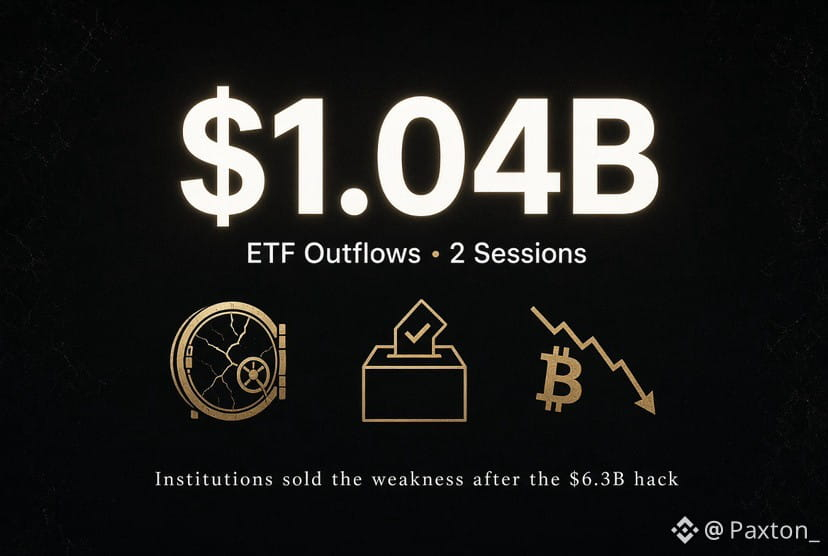
Bitcoin ETFs dumped $1.04B in two days.
Friday was the big one at $643M, biggest single day since June. Monday added another $399M. IBIT led both.
Not some big structural shift. Just institutions hitting the sell button after the Binance hack.
$6.3B gone in minutes, largest ever, North Korea linked. First full trading session after that and people wanted out.
Binance is covering losses and withdrawals are back but the damage to confidence was already done.
Midterms today don’t help. Policy noise is still hanging over everything and $BTC was already soft around $77k.
Classic de-risking into known bad news.
#BinanceIncidentReport #BTC走势分析
Bitcoin ETFs dumped $1.04B in two days.
Friday was the big one at $643M, biggest single day since June. Monday added another $399M. IBIT led both.
Not some big structural shift. Just institutions hitting the sell button after the Binance hack.
$6.3B gone in minutes, largest ever, North Korea linked. First full trading session after that and people wanted out.
Binance is covering losses and withdrawals are back but the damage to confidence was already done.
Midterms today don’t help. Policy noise is still hanging over everything and $BTC was already soft around $77k.
Classic de-risking into known bad news.
#BinanceIncidentReport #BTC走势分析
Friday was the big one at $643M, biggest single day since June. Monday added another $399M. IBIT led both.
Not some big structural shift. Just institutions hitting the sell button after the Binance hack.
$6.3B gone in minutes, largest ever, North Korea linked. First full trading session after that and people wanted out.
Binance is covering losses and withdrawals are back but the damage to confidence was already done.
Midterms today don’t help. Policy noise is still hanging over everything and $BTC was already soft around $77k.
Classic de-risking into known bad news.
#BinanceIncidentReport #BTC走势分析
BTC+1.99%
IBITETF+1.03%
Helen_Rose:
let's see how this goes on
7
15
5.6k

·
--
#BinanceIncidentReport THE BLOCK: Binance said hackers used a fraudulent job interview to compromise an employee’s computer before leveraging an internal AI tool to gain access to its wallet infrastructure and steal approximately $6.34 billion in digital assets.
In an incident report published to X on Tuesday, the exchange detailed how attackers used malware and stolen credentials to access its wallet-signing systems, adding that about $2.85 billion in assets have been frozen or intercepted and 98% of impacted assets have been replenished.$BTC
{future}(BTCUSDT)
#BinanceIncidentReport THE BLOCK: Binance said hackers used a fraudulent job interview to compromise an employee’s computer before leveraging an internal AI tool to gain access to its wallet infrastructure and steal approximately $6.34 billion in digital assets.
In an incident report published to X on Tuesday, the exchange detailed how attackers used malware and stolen credentials to access its wallet-signing systems, adding that about $2.85 billion in assets have been frozen or intercepted and 98% of impacted assets have been replenished.$BTC
In an incident report published to X on Tuesday, the exchange detailed how attackers used malware and stolen credentials to access its wallet-signing systems, adding that about $2.85 billion in assets have been frozen or intercepted and 98% of impacted assets have been replenished.$BTC
1
263

🚨 CZ BREAKS SILENCE ON BINANCE'S $6.3B SECURITY INCIDENT! 🔥
Imagine getting a late-night message that one of the world's biggest crypto platforms is under attack. That's exactly what happened to CZ.
In his first major interview since the incident, CZ shared how quickly the situation unfolded and how he helped communicate with the crypto community while Binance's security team worked to contain the threat.
Here's what stands out:
🔹 Binance reportedly covered the full financial loss.
🔹 User funds remained safe.
🔹 Withdrawals initially increased, but confidence gradually returned.
🔹 Most withdrawals went toward self-custody rather than other exchanges.
🔹 CZ highlighted the growing threat of AI-powered cyberattacks.
But his biggest message goes beyond Binance.
Crypto security cannot depend on one platform alone. CZ believes exchanges should work together, share threat intelligence, and strengthen AI-powered protection to stop future attacks.
💡 My Take: Trust in crypto is built through transparency, strong security, and action during difficult moments.
The next chapter of crypto security starts with collaboration. 🚀
What do you think — will AI become the biggest weapon in crypto security?
#CZ #Binance #CryptoSecurity #Blockchain #AI #BinanceIncidentReport
🚨 CZ BREAKS SILENCE ON BINANCE'S $6.3B SECURITY INCIDENT! 🔥
Imagine getting a late-night message that one of the world's biggest crypto platforms is under attack. That's exactly what happened to CZ.
In his first major interview since the incident, CZ shared how quickly the situation unfolded and how he helped communicate with the crypto community while Binance's security team worked to contain the threat.
Here's what stands out:
🔹 Binance reportedly covered the full financial loss.
🔹 User funds remained safe.
🔹 Withdrawals initially increased, but confidence gradually returned.
🔹 Most withdrawals went toward self-custody rather than other exchanges.
🔹 CZ highlighted the growing threat of AI-powered cyberattacks.
But his biggest message goes beyond Binance.
Crypto security cannot depend on one platform alone. CZ believes exchanges should work together, share threat intelligence, and strengthen AI-powered protection to stop future attacks.
💡 My Take: Trust in crypto is built through transparency, strong security, and action during difficult moments.
The next chapter of crypto security starts with collaboration. 🚀
What do you think — will AI become the biggest weapon in crypto security?
#CZ #Binance #CryptoSecurity #Blockchain #AI #BinanceIncidentReport
Imagine getting a late-night message that one of the world's biggest crypto platforms is under attack. That's exactly what happened to CZ.
In his first major interview since the incident, CZ shared how quickly the situation unfolded and how he helped communicate with the crypto community while Binance's security team worked to contain the threat.
Here's what stands out:
🔹 Binance reportedly covered the full financial loss.
🔹 User funds remained safe.
🔹 Withdrawals initially increased, but confidence gradually returned.
🔹 Most withdrawals went toward self-custody rather than other exchanges.
🔹 CZ highlighted the growing threat of AI-powered cyberattacks.
But his biggest message goes beyond Binance.
Crypto security cannot depend on one platform alone. CZ believes exchanges should work together, share threat intelligence, and strengthen AI-powered protection to stop future attacks.
💡 My Take: Trust in crypto is built through transparency, strong security, and action during difficult moments.
The next chapter of crypto security starts with collaboration. 🚀
What do you think — will AI become the biggest weapon in crypto security?
#CZ #Binance #CryptoSecurity #Blockchain #AI #BinanceIncidentReport

324

·
--
#binanceincidentreport
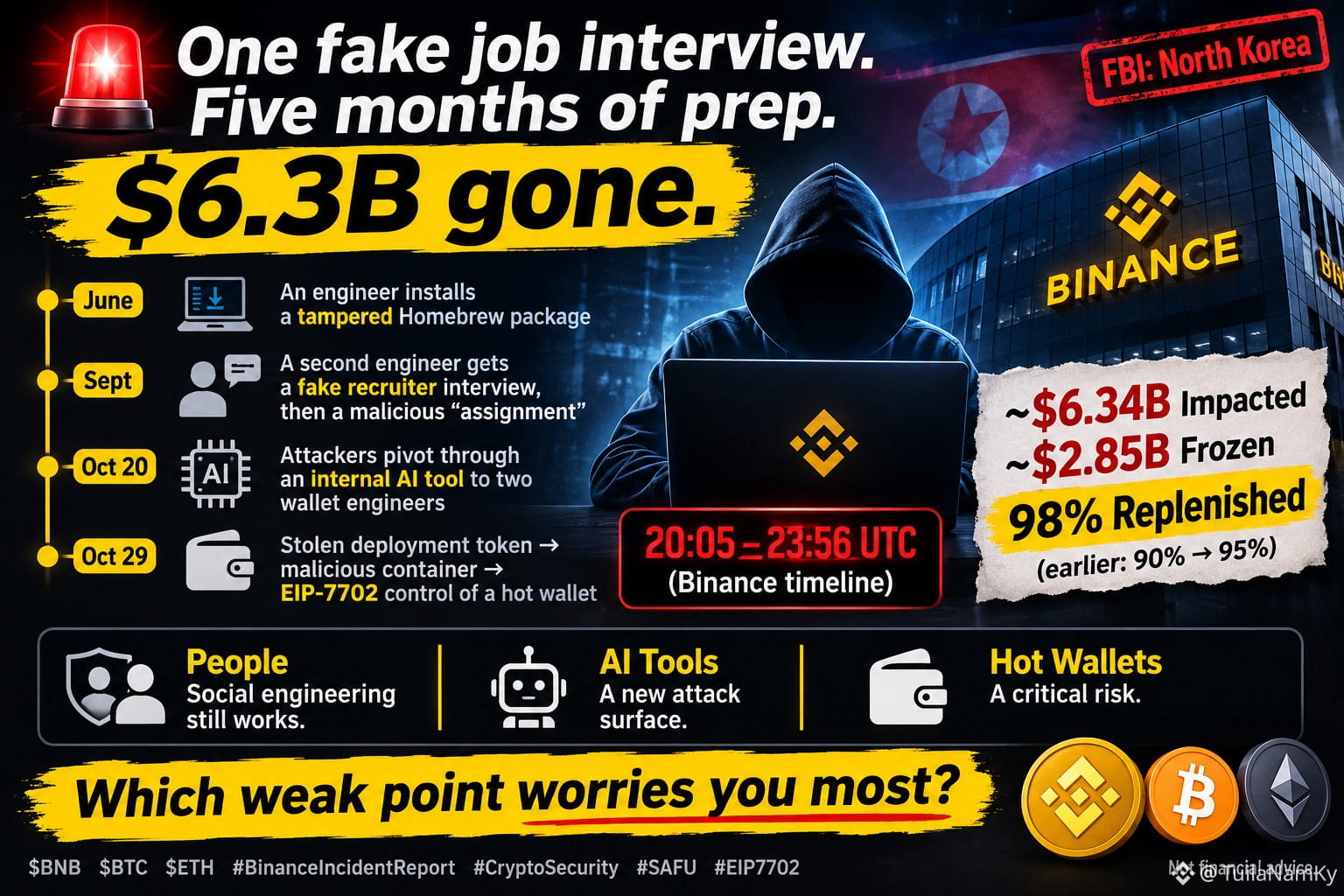
🚨 One fake job interview. Five months of prep. $6.3B gone.
Binance's Nov 3 report shows the Oct 29 incident was a chain, not a single click:
• June: an engineer installs a tampered Homebrew package
• Sept: a second engineer gets a fake recruiter interview, then a malicious "assignment"
• Oct 20: attackers pivot through an internal AI tool to two wallet engineers
• Oct 29: stolen deployment token → malicious container → EIP-7702 control of a hot wallet
Cross-check: Binance says ~$6.34B impacted, ~$2.85B frozen, 98% replenished (earlier updates: 90%, then 95%). The FBI points to North Korea; Pyongyang denies it. Some posts say "20 minutes", but Binance's timeline runs from 20:05 UTC to the final ETH transfer at 23:56 UTC.
My take: containment was the hard part. Pausing withdrawals didn't cancel on-chain authorizations, and MPC meant no single key to revoke them. Reserves cover losses; they don't shorten response time.
Which weak point worries you most: people, AI tools or hot wallets?
$BNB
{future}(BNBUSDT)
$BTC
{future}(BTCUSDT)
$ETH
{future}(ETHUSDT)
#CryptoSecurity #SAFU #EIP7702
Not financial advice.
#binanceincidentreport
🚨 One fake job interview. Five months of prep. $6.3B gone.
Binance's Nov 3 report shows the Oct 29 incident was a chain, not a single click:
• June: an engineer installs a tampered Homebrew package
• Sept: a second engineer gets a fake recruiter interview, then a malicious "assignment"
• Oct 20: attackers pivot through an internal AI tool to two wallet engineers
• Oct 29: stolen deployment token → malicious container → EIP-7702 control of a hot wallet
Cross-check: Binance says ~$6.34B impacted, ~$2.85B frozen, 98% replenished (earlier updates: 90%, then 95%). The FBI points to North Korea; Pyongyang denies it. Some posts say "20 minutes", but Binance's timeline runs from 20:05 UTC to the final ETH transfer at 23:56 UTC.
My take: containment was the hard part. Pausing withdrawals didn't cancel on-chain authorizations, and MPC meant no single key to revoke them. Reserves cover losses; they don't shorten response time.
Which weak point worries you most: people, AI tools or hot wallets?
$BNB
$BTC
$ETH
#CryptoSecurity #SAFU #EIP7702
Not financial advice.
🚨 One fake job interview. Five months of prep. $6.3B gone.
Binance's Nov 3 report shows the Oct 29 incident was a chain, not a single click:
• June: an engineer installs a tampered Homebrew package
• Sept: a second engineer gets a fake recruiter interview, then a malicious "assignment"
• Oct 20: attackers pivot through an internal AI tool to two wallet engineers
• Oct 29: stolen deployment token → malicious container → EIP-7702 control of a hot wallet
Cross-check: Binance says ~$6.34B impacted, ~$2.85B frozen, 98% replenished (earlier updates: 90%, then 95%). The FBI points to North Korea; Pyongyang denies it. Some posts say "20 minutes", but Binance's timeline runs from 20:05 UTC to the final ETH transfer at 23:56 UTC.
My take: containment was the hard part. Pausing withdrawals didn't cancel on-chain authorizations, and MPC meant no single key to revoke them. Reserves cover losses; they don't shorten response time.
Which weak point worries you most: people, AI tools or hot wallets?
$BNB
$BTC
$ETH
#CryptoSecurity #SAFU #EIP7702
Not financial advice.
2
1.7k

🔍 Fake Job Interviews Become a Security Warning
The Binance investigation revealed that attackers used a fake recruitment process to target an engineer. Crypto professionals should be extremely careful with unknown recruiters, coding assignments and suspicious software downloads. $BTC $ETH $LINK
#binanceincidentreport
🔍 Fake Job Interviews Become a Security Warning
The Binance investigation revealed that attackers used a fake recruitment process to target an engineer. Crypto professionals should be extremely careful with unknown recruiters, coding assignments and suspicious software downloads. $BTC $ETH $LINK
#binanceincidentreport
The Binance investigation revealed that attackers used a fake recruitment process to target an engineer. Crypto professionals should be extremely careful with unknown recruiters, coding assignments and suspicious software downloads. $BTC $ETH $LINK
#binanceincidentreport
66

·
--
#binanceincidentreport
Binance has released its initial incident report following the major October security breach. The crypto exchange confirmed that hackers used advanced social engineering and a compromised engineer laptop to access hot wallets, stealing about $6.3 billion. Binance stated that user funds remain fully protected as the company is covering all losses from its own treasury. Withdrawals are gradually reopening for users after security checks, and officials point to state-sponsored actors behind the attack.
$BTC $ETH $XRP
{future}(XRPUSDT)
{future}(ETHUSDT)
{future}(BTCUSDT)
#binanceincidentreport
Binance has released its initial incident report following the major October security breach. The crypto exchange confirmed that hackers used advanced social engineering and a compromised engineer laptop to access hot wallets, stealing about $6.3 billion. Binance stated that user funds remain fully protected as the company is covering all losses from its own treasury. Withdrawals are gradually reopening for users after security checks, and officials point to state-sponsored actors behind the attack.
$BTC $ETH $XRP
Binance has released its initial incident report following the major October security breach. The crypto exchange confirmed that hackers used advanced social engineering and a compromised engineer laptop to access hot wallets, stealing about $6.3 billion. Binance stated that user funds remain fully protected as the company is covering all losses from its own treasury. Withdrawals are gradually reopening for users after security checks, and officials point to state-sponsored actors behind the attack.
$BTC $ETH $XRP

RaicesGI:
si Usa.
1
6
8.1k

·
--
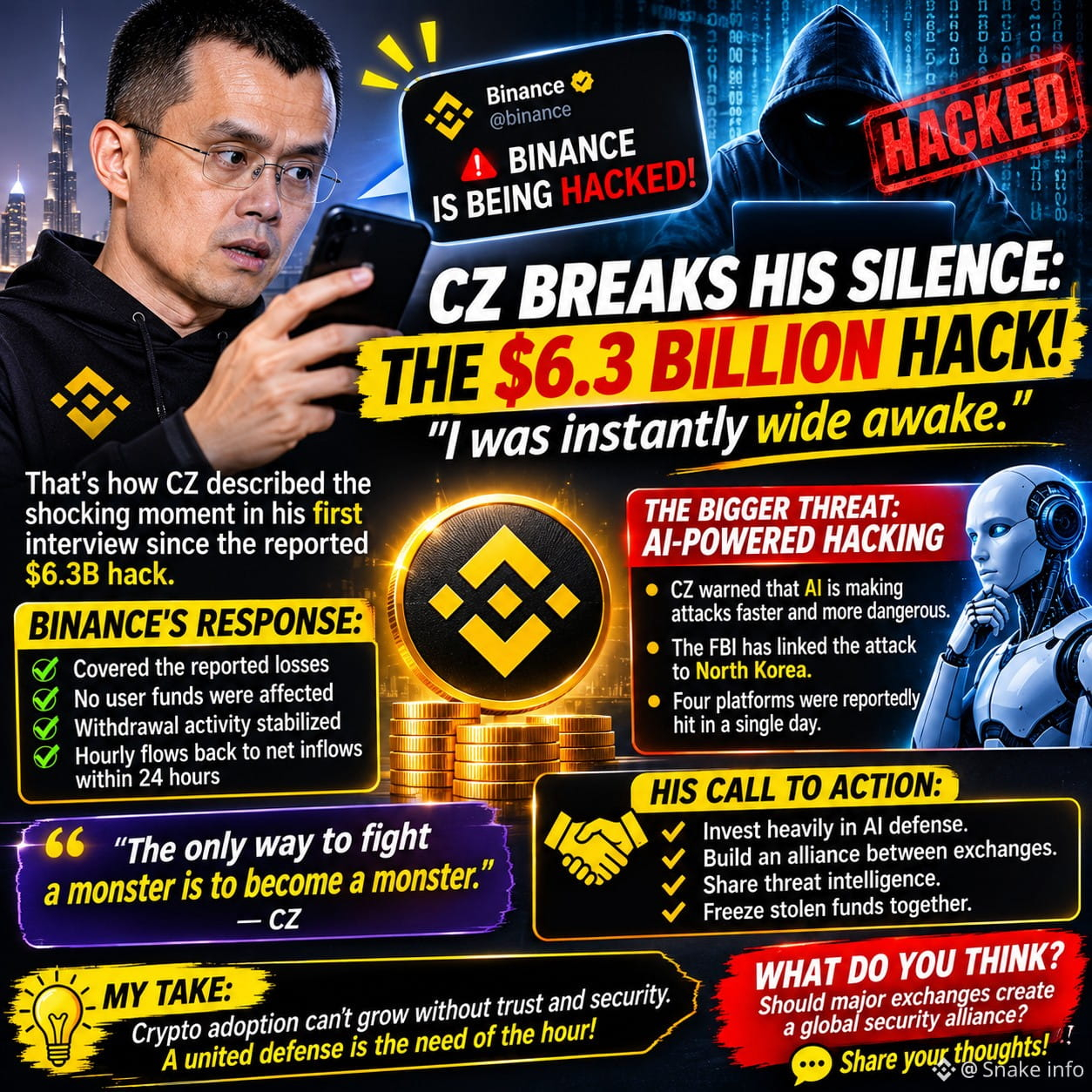
#binanceincidentreport 🚨 CZ BREAKS HIS SILENCE: THE $6.3 BILLION HACK THAT WOKE HIM UP! 😱🔥
Imagine scrolling through Twitter late at night in the UAE, just moments before going to sleep… Then suddenly, your phone lights up.
The message from your team?
BINANCE IS BEING HACKED! 🚨
That's how CZ described the shocking moment in his first major interview following the reported $6.3B hack.
"I was instantly wide awake."
🔥 WHAT HAPPENED NEXT?
While Binance's security team worked to contain the attack, CZ focused on communicating with the community and sharing updates as quickly and transparently as possible.
💰 BINANCE'S RESPONSE:
Binance covered the reported losses.
No user funds were affected.
Withdrawal activity stabilized.
Hourly flows returned to net inflows within 24 hours.
Most withdrawals reportedly went toward self-custody rather than competing exchanges.
⚠️ THE BIGGER THREAT: AI-POWERED HACKING
CZ highlighted a much bigger concern: crypto security is becoming more challenging as hackers use increasingly sophisticated AI-powered techniques.
The FBI has linked the attack to North Korea, according to the reported investigation.
His message to the crypto industry is clear:
🤖 Invest heavily in AI-powered security.
🤝 Build stronger cooperation between exchanges.
🔍 Share threat intelligence faster.
🛡️ Work together to identify and freeze stolen funds.
😈 "THE ONLY WAY TO FIGHT A MONSTER IS TO BECOME A MONSTER."
A powerful statement about the future of cybersecurity.
💡 MY TAKE:
Crypto adoption cannot grow without trust and security. Exchanges must stop fighting threats individually and start building a united defense system.
🔥 WHAT DO YOU THINK?
Should major crypto exchanges create a global security alliance to fight hackers and protect user funds?
👇 Share your thoughts!
#CZ #Binance #CryptoSecurity #CryptoNews
CLICK TO BELOW TRADE👇
$BTC $ETH $BNB
{future}(BNBUSDT)
{future}(ETHUSDT)
{future}(BTCUSDT)
#binanceincidentreport 🚨 CZ BREAKS HIS SILENCE: THE $6.3 BILLION HACK THAT WOKE HIM UP! 😱🔥
Imagine scrolling through Twitter late at night in the UAE, just moments before going to sleep… Then suddenly, your phone lights up.
The message from your team?
BINANCE IS BEING HACKED! 🚨
That's how CZ described the shocking moment in his first major interview following the reported $6.3B hack.
"I was instantly wide awake."
🔥 WHAT HAPPENED NEXT?
While Binance's security team worked to contain the attack, CZ focused on communicating with the community and sharing updates as quickly and transparently as possible.
💰 BINANCE'S RESPONSE:
Binance covered the reported losses.
No user funds were affected.
Withdrawal activity stabilized.
Hourly flows returned to net inflows within 24 hours.
Most withdrawals reportedly went toward self-custody rather than competing exchanges.
⚠️ THE BIGGER THREAT: AI-POWERED HACKING
CZ highlighted a much bigger concern: crypto security is becoming more challenging as hackers use increasingly sophisticated AI-powered techniques.
The FBI has linked the attack to North Korea, according to the reported investigation.
His message to the crypto industry is clear:
🤖 Invest heavily in AI-powered security.
🤝 Build stronger cooperation between exchanges.
🔍 Share threat intelligence faster.
🛡️ Work together to identify and freeze stolen funds.
😈 "THE ONLY WAY TO FIGHT A MONSTER IS TO BECOME A MONSTER."
A powerful statement about the future of cybersecurity.
💡 MY TAKE:
Crypto adoption cannot grow without trust and security. Exchanges must stop fighting threats individually and start building a united defense system.
🔥 WHAT DO YOU THINK?
Should major crypto exchanges create a global security alliance to fight hackers and protect user funds?
👇 Share your thoughts!
#CZ #Binance #CryptoSecurity #CryptoNews
CLICK TO BELOW TRADE👇
$BTC $ETH $BNB
Imagine scrolling through Twitter late at night in the UAE, just moments before going to sleep… Then suddenly, your phone lights up.
The message from your team?
BINANCE IS BEING HACKED! 🚨
That's how CZ described the shocking moment in his first major interview following the reported $6.3B hack.
"I was instantly wide awake."
🔥 WHAT HAPPENED NEXT?
While Binance's security team worked to contain the attack, CZ focused on communicating with the community and sharing updates as quickly and transparently as possible.
💰 BINANCE'S RESPONSE:
Binance covered the reported losses.
No user funds were affected.
Withdrawal activity stabilized.
Hourly flows returned to net inflows within 24 hours.
Most withdrawals reportedly went toward self-custody rather than competing exchanges.
⚠️ THE BIGGER THREAT: AI-POWERED HACKING
CZ highlighted a much bigger concern: crypto security is becoming more challenging as hackers use increasingly sophisticated AI-powered techniques.
The FBI has linked the attack to North Korea, according to the reported investigation.
His message to the crypto industry is clear:
🤖 Invest heavily in AI-powered security.
🤝 Build stronger cooperation between exchanges.
🔍 Share threat intelligence faster.
🛡️ Work together to identify and freeze stolen funds.
😈 "THE ONLY WAY TO FIGHT A MONSTER IS TO BECOME A MONSTER."
A powerful statement about the future of cybersecurity.
💡 MY TAKE:
Crypto adoption cannot grow without trust and security. Exchanges must stop fighting threats individually and start building a united defense system.
🔥 WHAT DO YOU THINK?
Should major crypto exchanges create a global security alliance to fight hackers and protect user funds?
👇 Share your thoughts!
#CZ #Binance #CryptoSecurity #CryptoNews
CLICK TO BELOW TRADE👇
$BTC $ETH $BNB
1
266

·
--
Bullish
#BinanceIncidentReport
⚡Binance Hack Recovery Update ⚠️📈
Co-CEO Richard Teng confirms 98% of $6.34B impacted tokens replenished after sophisticated months-long attack; user funds protected via SAFU; remaining 2% being completed with OTC partners; withdrawals broadly resumed.
$ZEC $IDOL $Q
#BinanceIncidentReport
⚡Binance Hack Recovery Update ⚠️📈
Co-CEO Richard Teng confirms 98% of $6.34B impacted tokens replenished after sophisticated months-long attack; user funds protected via SAFU; remaining 2% being completed with OTC partners; withdrawals broadly resumed.
$ZEC $IDOL $Q
⚡Binance Hack Recovery Update ⚠️📈
Co-CEO Richard Teng confirms 98% of $6.34B impacted tokens replenished after sophisticated months-long attack; user funds protected via SAFU; remaining 2% being completed with OTC partners; withdrawals broadly resumed.
$ZEC $IDOL $Q

3
3.4k

·
--
Article
1. BINANCE SAYS 95% OF AFFECTED ASSETS RESTORED#binanceincidentreport
After the reported $6.3 billion security incident, Binance says 95% of affected assets have been replenished.
👀 Withdrawals are reportedly stabilizing.
🔐 The exchange says customer losses are covered.
But one question remains:
Can Binance fully restore investor confidence?
💬 Would you still trust a centralized exchange?
#Binance #CryptoSecurity #CryptoNews #BinanceSquare
1. BINANCE SAYS 95% OF AFFECTED ASSETS RESTORED
#binanceincidentreport
After the reported $6.3 billion security incident, Binance says 95% of affected assets have been replenished.
👀 Withdrawals are reportedly stabilizing.
🔐 The exchange says customer losses are covered.
But one question remains:
Can Binance fully restore investor confidence?
💬 Would you still trust a centralized exchange?
#Binance #CryptoSecurity #CryptoNews #BinanceSquare
After the reported $6.3 billion security incident, Binance says 95% of affected assets have been replenished.
👀 Withdrawals are reportedly stabilizing.
🔐 The exchange says customer losses are covered.
But one question remains:
Can Binance fully restore investor confidence?
💬 Would you still trust a centralized exchange?
#Binance #CryptoSecurity #CryptoNews #BinanceSquare
majspace:
Restoring assets is one thing, restoring trust takes longer. I think the next few months of smooth withdrawals will matter more than the headline number.
2
9
8.5k

·
--
#binanceincidentreport
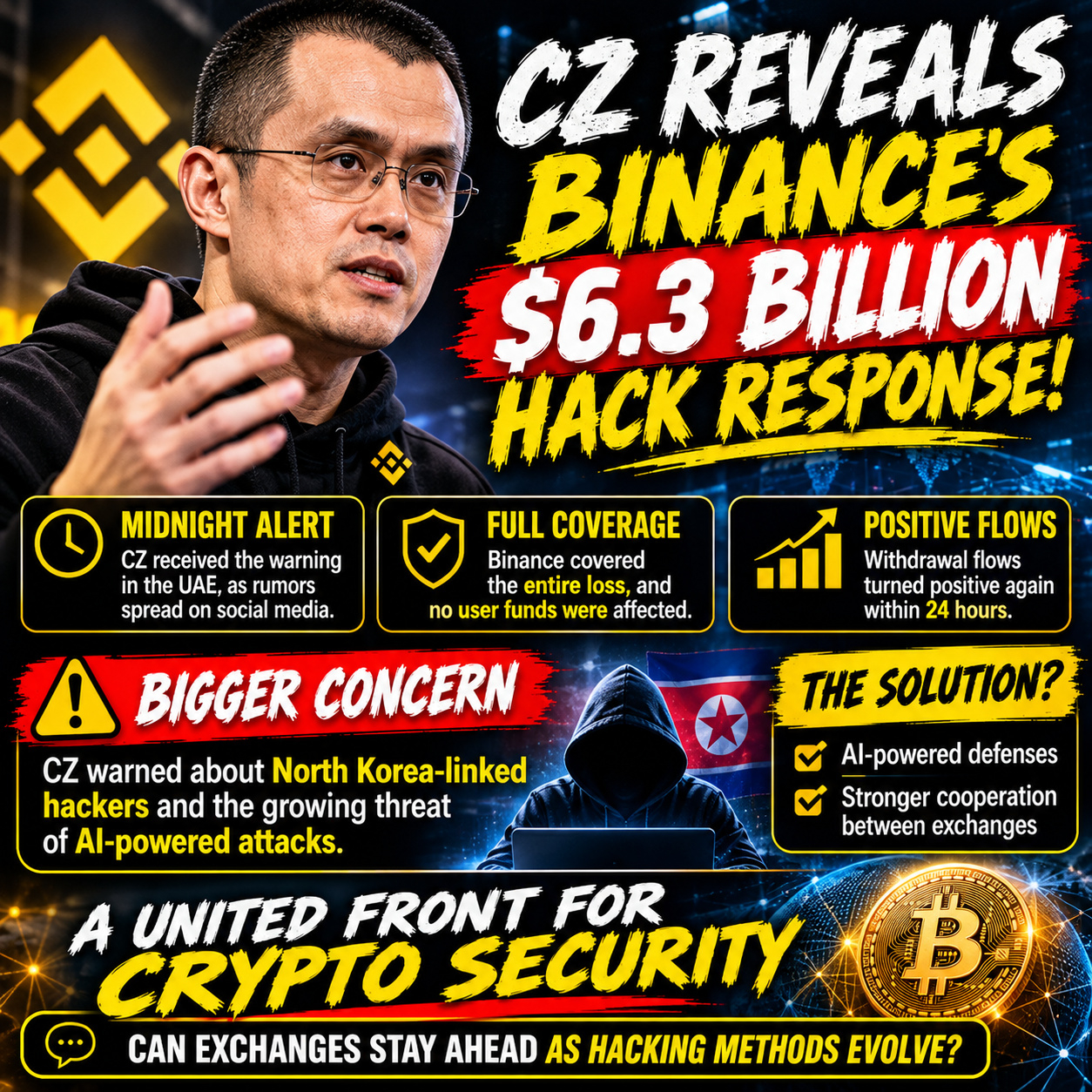
🚨 CZ reveals how Binance handled the $6.3 billion hack — and why crypto security needs a new approach.
CZ said he received the warning around midnight in the UAE, just as rumors started spreading across social media.
Binance covered the entire loss, and no user funds were affected. Even more interesting, withdrawal flows turned positive again within 24 hours.
But there's a bigger concern here. ⚠️
CZ warned that North Korea-linked hackers and increasingly powerful AI tools are creating new security challenges for the crypto industry.
His proposed response? AI-powered defenses and stronger cooperation between exchanges to identify threats, share intelligence, and freeze stolen funds faster.
The focus is shifting beyond individual exchange security. The industry needs to respond together.
Can exchanges stay ahead as hacking methods become more advanced?
#CZ #Binance #CryptoSecurity #Blockchain #CryptoNews
#binanceincidentreport
🚨 CZ reveals how Binance handled the $6.3 billion hack — and why crypto security needs a new approach.
CZ said he received the warning around midnight in the UAE, just as rumors started spreading across social media.
Binance covered the entire loss, and no user funds were affected. Even more interesting, withdrawal flows turned positive again within 24 hours.
But there's a bigger concern here. ⚠️
CZ warned that North Korea-linked hackers and increasingly powerful AI tools are creating new security challenges for the crypto industry.
His proposed response? AI-powered defenses and stronger cooperation between exchanges to identify threats, share intelligence, and freeze stolen funds faster.
The focus is shifting beyond individual exchange security. The industry needs to respond together.
Can exchanges stay ahead as hacking methods become more advanced?
#CZ #Binance #CryptoSecurity #Blockchain #CryptoNews
🚨 CZ reveals how Binance handled the $6.3 billion hack — and why crypto security needs a new approach.
CZ said he received the warning around midnight in the UAE, just as rumors started spreading across social media.
Binance covered the entire loss, and no user funds were affected. Even more interesting, withdrawal flows turned positive again within 24 hours.
But there's a bigger concern here. ⚠️
CZ warned that North Korea-linked hackers and increasingly powerful AI tools are creating new security challenges for the crypto industry.
His proposed response? AI-powered defenses and stronger cooperation between exchanges to identify threats, share intelligence, and freeze stolen funds faster.
The focus is shifting beyond individual exchange security. The industry needs to respond together.
Can exchanges stay ahead as hacking methods become more advanced?
#CZ #Binance #CryptoSecurity #Blockchain #CryptoNews
84

Article
BITCOIN BACK TO $78K AFTER $6.3B HACK - Here is What No One Is Telling YouCongratulations 🎊 to everyone who followed me can claim $10 gifts 🎁 of my profile Everyone is panicking. I'm buying.
Let's break down what happened in last 48 hours so you don't get liquidated:
1. The Hack That Shook Binance
FBI confirmed: $6.3B stolen by North Korea's TraderTraitor group. Binance has now covered 95% from SAFU + treasury and reopened withdrawals. Net outflow: $4.7 BILLION in 2 days.
Translation: The weakest hands already left. That's bullish.
2. Bitcoin Holding $76K-$78K Is Insane Strength
BTC dumped to $76,100 after the hack, then reclaimed $78,059 on Binance spot yesterday. Now holding around $77k-$78k even with $1B+ leaving ETFs and US midterms tonight.
If Democrats take both chambers, Trump's crypto-friendly agenda (and CLARITY Act) gets delayed. Market is scared. That's your opportunity.
3. My Square Playbook For This Week:
- Don't chase green. Funding is still positive - longs are paying shorts.
- Watch $76,439 support and $78,867 resistance. This range will liquidate both sides.
- Altcoins bleeding? SOL at $93, ETH at $2.2K. When BTC dominance is 58%, alt season is NOT here yet.
What I am doing:
50% USDT, 50% BTC spot. No leverage until $80K breaks. And I'm watching LIT + BNB - only 2 showing real strength after the hack.
If you found this helpful, Follow me. I post Binance recovery updates every 3 hours - no clickbait.
Question for you: Did you withdraw from Binance during the hack or did you hold? Comment HOLD or WITHDRAW - let's see who has diamond hands. #BinanceIncidentReport #HackerAlert #Write2Earn
BITCOIN BACK TO $78K AFTER $6.3B HACK - Here is What No One Is Telling You
Congratulations 🎊 to everyone who followed me can claim $10 gifts 🎁 of my profile Everyone is panicking. I'm buying.
Let's break down what happened in last 48 hours so you don't get liquidated:
1. The Hack That Shook Binance
FBI confirmed: $6.3B stolen by North Korea's TraderTraitor group. Binance has now covered 95% from SAFU + treasury and reopened withdrawals. Net outflow: $4.7 BILLION in 2 days.
Translation: The weakest hands already left. That's bullish.
2. Bitcoin Holding $76K-$78K Is Insane Strength
BTC dumped to $76,100 after the hack, then reclaimed $78,059 on Binance spot yesterday. Now holding around $77k-$78k even with $1B+ leaving ETFs and US midterms tonight.
If Democrats take both chambers, Trump's crypto-friendly agenda (and CLARITY Act) gets delayed. Market is scared. That's your opportunity.
3. My Square Playbook For This Week:
- Don't chase green. Funding is still positive - longs are paying shorts.
- Watch $76,439 support and $78,867 resistance. This range will liquidate both sides.
- Altcoins bleeding? SOL at $93, ETH at $2.2K. When BTC dominance is 58%, alt season is NOT here yet.
What I am doing:
50% USDT, 50% BTC spot. No leverage until $80K breaks. And I'm watching LIT + BNB - only 2 showing real strength after the hack.
If you found this helpful, Follow me. I post Binance recovery updates every 3 hours - no clickbait.
Question for you: Did you withdraw from Binance during the hack or did you hold? Comment HOLD or WITHDRAW - let's see who has diamond hands. #BinanceIncidentReport #HackerAlert #Write2Earn
Let's break down what happened in last 48 hours so you don't get liquidated:
1. The Hack That Shook Binance
FBI confirmed: $6.3B stolen by North Korea's TraderTraitor group. Binance has now covered 95% from SAFU + treasury and reopened withdrawals. Net outflow: $4.7 BILLION in 2 days.
Translation: The weakest hands already left. That's bullish.
2. Bitcoin Holding $76K-$78K Is Insane Strength
BTC dumped to $76,100 after the hack, then reclaimed $78,059 on Binance spot yesterday. Now holding around $77k-$78k even with $1B+ leaving ETFs and US midterms tonight.
If Democrats take both chambers, Trump's crypto-friendly agenda (and CLARITY Act) gets delayed. Market is scared. That's your opportunity.
3. My Square Playbook For This Week:
- Don't chase green. Funding is still positive - longs are paying shorts.
- Watch $76,439 support and $78,867 resistance. This range will liquidate both sides.
- Altcoins bleeding? SOL at $93, ETH at $2.2K. When BTC dominance is 58%, alt season is NOT here yet.
What I am doing:
50% USDT, 50% BTC spot. No leverage until $80K breaks. And I'm watching LIT + BNB - only 2 showing real strength after the hack.
If you found this helpful, Follow me. I post Binance recovery updates every 3 hours - no clickbait.
Question for you: Did you withdraw from Binance during the hack or did you hold? Comment HOLD or WITHDRAW - let's see who has diamond hands. #BinanceIncidentReport #HackerAlert #Write2Earn

Gift
From Crypto Pensioner
1
4
52

·
--
Can $BNB scale through the ultimate market test? 🔶🛡️
Following the recent network security events, official platform updates confirm that 98% of user funds are fully backed and safely replenished using corporate cash reserves. [1]
Even better: Phase 2 withdrawals are actively expanding across major networks like Solana, Ethereum, and Base. The affected digital assets remain completely frozen and secure. [1, 2]
The platform just displayed massive financial strength, but what is your next move?
👇 Is your confidence fully restored, or are you moving your portfolio to cold storage? Let's talk strategy below!
{spot}(BNBUSDT)
#BNB #BinanceSquare #CryptoSecurity #Web3Community #TradingTales #USMidterms-WhatAreMarketsExpecting? #USOctoberNFP-AreRateCutsStillPossible #AMDBeatsExpectations-AINarrativeContinues #BinanceIncidentReport
Can $BNB scale through the ultimate market test? 🔶🛡️
Following the recent network security events, official platform updates confirm that 98% of user funds are fully backed and safely replenished using corporate cash reserves. [1]
Even better: Phase 2 withdrawals are actively expanding across major networks like Solana, Ethereum, and Base. The affected digital assets remain completely frozen and secure. [1, 2]
The platform just displayed massive financial strength, but what is your next move?
👇 Is your confidence fully restored, or are you moving your portfolio to cold storage? Let's talk strategy below!
#BNB #BinanceSquare #CryptoSecurity #Web3Community #TradingTales #USMidterms-WhatAreMarketsExpecting? #USOctoberNFP-AreRateCutsStillPossible #AMDBeatsExpectations-AINarrativeContinues #BinanceIncidentReport
Following the recent network security events, official platform updates confirm that 98% of user funds are fully backed and safely replenished using corporate cash reserves. [1]
Even better: Phase 2 withdrawals are actively expanding across major networks like Solana, Ethereum, and Base. The affected digital assets remain completely frozen and secure. [1, 2]
The platform just displayed massive financial strength, but what is your next move?
👇 Is your confidence fully restored, or are you moving your portfolio to cold storage? Let's talk strategy below!
#BNB #BinanceSquare #CryptoSecurity #Web3Community #TradingTales #USMidterms-WhatAreMarketsExpecting? #USOctoberNFP-AreRateCutsStillPossible #AMDBeatsExpectations-AINarrativeContinues #BinanceIncidentReport

34
📊 Security and Transparency Matter More Than Ever
The Binance incident is a reminder that exchange security involves more than protecting private keys. Internal systems, employee devices and transaction authorization processes also need strong safeguards. $BTC $BNB $XRP
#binanceincidentreport
📊 Security and Transparency Matter More Than Ever
The Binance incident is a reminder that exchange security involves more than protecting private keys. Internal systems, employee devices and transaction authorization processes also need strong safeguards. $BTC $BNB $XRP
#binanceincidentreport
The Binance incident is a reminder that exchange security involves more than protecting private keys. Internal systems, employee devices and transaction authorization processes also need strong safeguards. $BTC $BNB $XRP
#binanceincidentreport
31

·
--
Bullish
🚨 Binance Incident Report: $6.34 Billion Security Breach – Latest Update!
Binance has released its initial investigation report following the October 29 security incident.
📊 Key Highlights:
💰 $6.34 billion in digital assets affected.
🔒 $2.85 billion frozen or intercepted.
✅ Approximately 95% of affected assets replenished, according to Binance's co-CEO.
🔄 Withdrawals gradually restored.
🛡️ New security measures implemented.
Who Was Behind It?
The FBI attributed the attack to North Korea. The investigation is still ongoing.
What Happens Next?
Binance is strengthening its security systems and arranging an independent cybersecurity review.
👀 Can Binance fully restore user confidence after this incident?
$BNB $ETH $BTC
{spot}(BNBUSDT)
{spot}(BTCUSDT)
{spot}(SOLUSDT)
#Binance #BinanceIncidentReport #CryptoSecurity #bitcoin #CryptoNews
🚨 Binance Incident Report: $6.34 Billion Security Breach – Latest Update!
Binance has released its initial investigation report following the October 29 security incident.
📊 Key Highlights:
💰 $6.34 billion in digital assets affected.
🔒 $2.85 billion frozen or intercepted.
✅ Approximately 95% of affected assets replenished, according to Binance's co-CEO.
🔄 Withdrawals gradually restored.
🛡️ New security measures implemented.
Who Was Behind It?
The FBI attributed the attack to North Korea. The investigation is still ongoing.
What Happens Next?
Binance is strengthening its security systems and arranging an independent cybersecurity review.
👀 Can Binance fully restore user confidence after this incident?
$BNB $ETH $BTC
#Binance #BinanceIncidentReport #CryptoSecurity #bitcoin #CryptoNews
Binance has released its initial investigation report following the October 29 security incident.
📊 Key Highlights:
💰 $6.34 billion in digital assets affected.
🔒 $2.85 billion frozen or intercepted.
✅ Approximately 95% of affected assets replenished, according to Binance's co-CEO.
🔄 Withdrawals gradually restored.
🛡️ New security measures implemented.
Who Was Behind It?
The FBI attributed the attack to North Korea. The investigation is still ongoing.
What Happens Next?
Binance is strengthening its security systems and arranging an independent cybersecurity review.
👀 Can Binance fully restore user confidence after this incident?
$BNB $ETH $BTC
#Binance #BinanceIncidentReport #CryptoSecurity #bitcoin #CryptoNews
38
Log in to explore more content
Join global crypto users on Binance Square
⚡️ Get latest and useful information about crypto.
💬 Trusted by the world’s largest crypto exchange.
👍 Discover real insights from verified creators.
Email / Phone number
Trending Topics
1
#CircleQ3Revenue865M
0 views
0 Discussing
2
#USMidterms-WhatAreMarketsExpecting?
116,985 views
897 Discussing
3
#USOctoberNFP-AreRateCutsStillPossible
262,692 views
2,026 Discussing
4
#AMDBeatsExpectations-AINarrativeContinues
28,353 views
343 Discussing
5
#BinanceIncidentReport
273,376 views
1,471 Discussing
6
#AnthropicIPOPricedDownasInvestorsEye$1.5T
19,115 views
109 Discussing
7
#HongKongPassesCryptoAssetReportingFrameworkAmendment
21 views
3 Discussing
8
#37thQuarterlyBNBBurnRemoves1.64MillionBNB
1,310 views
53 Discussing
9
#BinanceReopensWithdrawalsForMoreAssets
381,267 views
2,430 Discussing
10
#HongKongToLicenseVirtualAssetCustodyAndAdvisory
3,897 views
103 Discussing