
#visa
visa
561,879 views
1,256 Discussing
Hot
Latest

🔥 THE STABLECOIN TSUNAMI just hit Visa's blockchain playground — and nobody saw this coming!
📊 Visa just slashed its pilot to nine blockchains, adding #Polygon and #Base alongside #Visa's existing lineup, while stablecoin settlement volume surged to a $7 B run‑rate. The market is buzzing: Greed sentiment 63/100, BNB up 1.95% to $736 and ETH flashing bullish MACD crossovers, signaling institutional money is already lining up.
💡 This could unleash a wave of on‑chain payments that rockets #crypto adoption and fuels the next price breakout for BTC and ETH.
❓ Drop a 🔥 if you think the payment flood has started — or tell me which chain will ride the biggest wave?
🔥 THE STABLECOIN TSUNAMI just hit Visa's blockchain playground — and nobody saw this coming!
📊 Visa just slashed its pilot to nine blockchains, adding #Polygon and #Base alongside #Visa's existing lineup, while stablecoin settlement volume surged to a $7 B run‑rate. The market is buzzing: Greed sentiment 63/100, BNB up 1.95% to $736 and ETH flashing bullish MACD crossovers, signaling institutional money is already lining up.
💡 This could unleash a wave of on‑chain payments that rockets #crypto adoption and fuels the next price breakout for BTC and ETH.
❓ Drop a 🔥 if you think the payment flood has started — or tell me which chain will ride the biggest wave?
📊 Visa just slashed its pilot to nine blockchains, adding #Polygon and #Base alongside #Visa's existing lineup, while stablecoin settlement volume surged to a $7 B run‑rate. The market is buzzing: Greed sentiment 63/100, BNB up 1.95% to $736 and ETH flashing bullish MACD crossovers, signaling institutional money is already lining up.
💡 This could unleash a wave of on‑chain payments that rockets #crypto adoption and fuels the next price breakout for BTC and ETH.
❓ Drop a 🔥 if you think the payment flood has started — or tell me which chain will ride the biggest wave?
44

·
--
MoneyGram has launched its first stablecoin-backed Visa card, initially available in Colombia. Eligible customers can hold a stable-dollar balance (starting with USDC), spend it wherever Visa is accepted, or convert to local currency at MoneyGram locations. The company plans to expand to more markets and add support for its own MGUSD stablecoin.
$USDC $USD1 $USDT #NewNews #CoinVahini #MoneyGram #Stablecoins #Visa
MoneyGram has launched its first stablecoin-backed Visa card, initially available in Colombia. Eligible customers can hold a stable-dollar balance (starting with USDC), spend it wherever Visa is accepted, or convert to local currency at MoneyGram locations. The company plans to expand to more markets and add support for its own MGUSD stablecoin.
$USDC $USD1 $USDT #NewNews #CoinVahini #MoneyGram #Stablecoins #Visa
$USDC $USD1 $USDT #NewNews #CoinVahini #MoneyGram #Stablecoins #Visa
1
10

Breaking: MoneyGram just dropped a massive adoption bomb in Latin America. 💸
They just launched their very first stablecoin-backed Visa card in Colombia, partnering with fintech company Rain.
Here is what you need to know:
🚀 First-ever stablecoin card by MoneyGram
🇨🇴 Initially launching in Colombia
💳 Powered by Visa and developed with Rain
This is huge for bringing stablecoins like $USDC and $USDT into daily real-world purchases. Keep an eye on LATAM crypto adoption, it is moving incredibly fast.
#Stablecoins #Visa #Adoption #Write2Earn
Breaking: MoneyGram just dropped a massive adoption bomb in Latin America. 💸
They just launched their very first stablecoin-backed Visa card in Colombia, partnering with fintech company Rain.
Here is what you need to know:
🚀 First-ever stablecoin card by MoneyGram
🇨🇴 Initially launching in Colombia
💳 Powered by Visa and developed with Rain
This is huge for bringing stablecoins like $USDC and $USDT into daily real-world purchases. Keep an eye on LATAM crypto adoption, it is moving incredibly fast.
#Stablecoins #Visa #Adoption #Write2Earn
They just launched their very first stablecoin-backed Visa card in Colombia, partnering with fintech company Rain.
Here is what you need to know:
🚀 First-ever stablecoin card by MoneyGram
🇨🇴 Initially launching in Colombia
💳 Powered by Visa and developed with Rain
This is huge for bringing stablecoins like $USDC and $USDT into daily real-world purchases. Keep an eye on LATAM crypto adoption, it is moving incredibly fast.
#Stablecoins #Visa #Adoption #Write2Earn
53

·
--
📰 Visa has taken on on-chain lending this time and directly plugged it into the settlement flow of stablecoin credit cards.
Credit card issuers often have to pay Visa day by day first, but cardholders’ money only arrives later—creating repeated funding gaps in between. Credit Coop provides revolving credit lines in stablecoins: the institution borrows funds to complete same-day settlement first, and then repayments automatically flow back to cover the loan.
🔥 This design is a bit like moving receivables financing onto the blockchain. Drawdowns, fund flows, and repayments are handled by smart contracts. The money the cardholder pays back is used first to cover interest, replenish the credit capacity, and only the remainder goes to the borrower’s account. The collateral isn’t overcollateralized crypto assets—it’s the future settlement receivables.
Visa says that since 2023, this model has provided financing for settlement volume totaling more than $2.5 billion, has processed over 3,000 loans and 9,000 repayments, and has had zero defaults. But these figures come from materials provided by the project team. The same pool of funds can be borrowed and repaid repeatedly, so they can’t be directly equated with outstanding principal or real profit.
👀 What’s even more worth thinking about is that stablecoin-linked credit card projects already exceeded 160 in Q2 of fiscal year 2026. Payment volume year over year is up nearly 200%, and annualized stablecoin settlement amounts come to over $20 billion. Demand is certainly growing—but the currently disclosed credit limits, current exposure, lender concentration, and loss-sharing arrangements are still incomplete.
Rain accounts for most of the disclosed activity, with cumulative payments of about $2 billion in settlement value; Karta is described by Visa as first using on-chain credit lines to kick things off, and later obtaining $140 million in institutional financing. Honestly, on-chain lending feels more like a transitional tool for smaller projects to build operating records. Whether it can withstand defaults and insufficient receivables is the real question.
🤔 Do you think this “borrow against future receivables” model will become a standard financing approach for stablecoin payment projects?
#Visa #稳定币 #链上借贷 #CreditCoop
📰 Visa has taken on on-chain lending this time and directly plugged it into the settlement flow of stablecoin credit cards.
Credit card issuers often have to pay Visa day by day first, but cardholders’ money only arrives later—creating repeated funding gaps in between. Credit Coop provides revolving credit lines in stablecoins: the institution borrows funds to complete same-day settlement first, and then repayments automatically flow back to cover the loan.
🔥 This design is a bit like moving receivables financing onto the blockchain. Drawdowns, fund flows, and repayments are handled by smart contracts. The money the cardholder pays back is used first to cover interest, replenish the credit capacity, and only the remainder goes to the borrower’s account. The collateral isn’t overcollateralized crypto assets—it’s the future settlement receivables.
Visa says that since 2023, this model has provided financing for settlement volume totaling more than $2.5 billion, has processed over 3,000 loans and 9,000 repayments, and has had zero defaults. But these figures come from materials provided by the project team. The same pool of funds can be borrowed and repaid repeatedly, so they can’t be directly equated with outstanding principal or real profit.
👀 What’s even more worth thinking about is that stablecoin-linked credit card projects already exceeded 160 in Q2 of fiscal year 2026. Payment volume year over year is up nearly 200%, and annualized stablecoin settlement amounts come to over $20 billion. Demand is certainly growing—but the currently disclosed credit limits, current exposure, lender concentration, and loss-sharing arrangements are still incomplete.
Rain accounts for most of the disclosed activity, with cumulative payments of about $2 billion in settlement value; Karta is described by Visa as first using on-chain credit lines to kick things off, and later obtaining $140 million in institutional financing. Honestly, on-chain lending feels more like a transitional tool for smaller projects to build operating records. Whether it can withstand defaults and insufficient receivables is the real question.
🤔 Do you think this “borrow against future receivables” model will become a standard financing approach for stablecoin payment projects?
#Visa #稳定币 #链上借贷 #CreditCoop
Credit card issuers often have to pay Visa day by day first, but cardholders’ money only arrives later—creating repeated funding gaps in between. Credit Coop provides revolving credit lines in stablecoins: the institution borrows funds to complete same-day settlement first, and then repayments automatically flow back to cover the loan.
🔥 This design is a bit like moving receivables financing onto the blockchain. Drawdowns, fund flows, and repayments are handled by smart contracts. The money the cardholder pays back is used first to cover interest, replenish the credit capacity, and only the remainder goes to the borrower’s account. The collateral isn’t overcollateralized crypto assets—it’s the future settlement receivables.
Visa says that since 2023, this model has provided financing for settlement volume totaling more than $2.5 billion, has processed over 3,000 loans and 9,000 repayments, and has had zero defaults. But these figures come from materials provided by the project team. The same pool of funds can be borrowed and repaid repeatedly, so they can’t be directly equated with outstanding principal or real profit.
👀 What’s even more worth thinking about is that stablecoin-linked credit card projects already exceeded 160 in Q2 of fiscal year 2026. Payment volume year over year is up nearly 200%, and annualized stablecoin settlement amounts come to over $20 billion. Demand is certainly growing—but the currently disclosed credit limits, current exposure, lender concentration, and loss-sharing arrangements are still incomplete.
Rain accounts for most of the disclosed activity, with cumulative payments of about $2 billion in settlement value; Karta is described by Visa as first using on-chain credit lines to kick things off, and later obtaining $140 million in institutional financing. Honestly, on-chain lending feels more like a transitional tool for smaller projects to build operating records. Whether it can withstand defaults and insufficient receivables is the real question.
🤔 Do you think this “borrow against future receivables” model will become a standard financing approach for stablecoin payment projects?
#Visa #稳定币 #链上借贷 #CreditCoop


23
🔥 THE STABLECOIN FRENZY just hit a $7 B run‑rate — NOBODY SAW THIS COMING.
📊 Visa just plugged Stripe’s Tempo, Circle’s Arc, Coinbase’s Base, Polygon and Canton Network into its settlement rails, unlocking instant crypto payments for millions. #Visa #Stablecoin #CryptoPayments now power a flow that dwarfs daily #DeFi swaps, and with BTC at $76,924 (RSI 29.9, oversold) and ETH OI at $5.73 B with 73.9% longs, the market is primed to ride the surge.
💡 This leap means fiat‑to‑crypto bridges will flood traditional merchants, pushing #Adoption rates skyward and forcing legacy finance to scramble for relevance.
❓ Are you positioned to cash in before the flood hits the mainstream?
🔥 THE STABLECOIN FRENZY just hit a $7 B run‑rate — NOBODY SAW THIS COMING.
📊 Visa just plugged Stripe’s Tempo, Circle’s Arc, Coinbase’s Base, Polygon and Canton Network into its settlement rails, unlocking instant crypto payments for millions. #Visa #Stablecoin #CryptoPayments now power a flow that dwarfs daily #DeFi swaps, and with BTC at $76,924 (RSI 29.9, oversold) and ETH OI at $5.73 B with 73.9% longs, the market is primed to ride the surge.
💡 This leap means fiat‑to‑crypto bridges will flood traditional merchants, pushing #Adoption rates skyward and forcing legacy finance to scramble for relevance.
❓ Are you positioned to cash in before the flood hits the mainstream?
📊 Visa just plugged Stripe’s Tempo, Circle’s Arc, Coinbase’s Base, Polygon and Canton Network into its settlement rails, unlocking instant crypto payments for millions. #Visa #Stablecoin #CryptoPayments now power a flow that dwarfs daily #DeFi swaps, and with BTC at $76,924 (RSI 29.9, oversold) and ETH OI at $5.73 B with 73.9% longs, the market is primed to ride the surge.
💡 This leap means fiat‑to‑crypto bridges will flood traditional merchants, pushing #Adoption rates skyward and forcing legacy finance to scramble for relevance.
❓ Are you positioned to cash in before the flood hits the mainstream?
62
🔥 Visa adding Base, Polygon, Canton, Arc and Tempo to its stablecoin settlement program shatters the myth that big‑payroll players only experiment with Bitcoin.
📊 This move lands as #Visa expands its pilot with five new networks, and the market is already buzzing #Stablecoins; BTC trades at $79,499 (+1.25%) with a bullish MACD crossover, while ETH is up to $2,512 (+1.51%) and rides a strong RSI.
💡 In a #CryptoAdoption cycle, infrastructure upgrades like this turn speculative hype into durable demand—BTC futures OI sits at $8.33 B and funding is +0.0044% (longs paying), while smart wallets are aggressively buying Solana (+6.9% on the tip wallet), underscoring capital flowing toward scalable chains.
🛠️ Practical step: allocate a slice of your stablecoin exposure to the native tokens of these networks (MATIC, BASE, ARB, etc.) or route USDC through them to capture lower fees and early‑adopter incentives.
❓ How will you position your stablecoins now that Visa is cementing blockchain as a settlement layer?
🔥 Visa adding Base, Polygon, Canton, Arc and Tempo to its stablecoin settlement program shatters the myth that big‑payroll players only experiment with Bitcoin.
📊 This move lands as #Visa expands its pilot with five new networks, and the market is already buzzing #Stablecoins; BTC trades at $79,499 (+1.25%) with a bullish MACD crossover, while ETH is up to $2,512 (+1.51%) and rides a strong RSI.
💡 In a #CryptoAdoption cycle, infrastructure upgrades like this turn speculative hype into durable demand—BTC futures OI sits at $8.33 B and funding is +0.0044% (longs paying), while smart wallets are aggressively buying Solana (+6.9% on the tip wallet), underscoring capital flowing toward scalable chains.
🛠️ Practical step: allocate a slice of your stablecoin exposure to the native tokens of these networks (MATIC, BASE, ARB, etc.) or route USDC through them to capture lower fees and early‑adopter incentives.
❓ How will you position your stablecoins now that Visa is cementing blockchain as a settlement layer?
📊 This move lands as #Visa expands its pilot with five new networks, and the market is already buzzing #Stablecoins; BTC trades at $79,499 (+1.25%) with a bullish MACD crossover, while ETH is up to $2,512 (+1.51%) and rides a strong RSI.
💡 In a #CryptoAdoption cycle, infrastructure upgrades like this turn speculative hype into durable demand—BTC futures OI sits at $8.33 B and funding is +0.0044% (longs paying), while smart wallets are aggressively buying Solana (+6.9% on the tip wallet), underscoring capital flowing toward scalable chains.
🛠️ Practical step: allocate a slice of your stablecoin exposure to the native tokens of these networks (MATIC, BASE, ARB, etc.) or route USDC through them to capture lower fees and early‑adopter incentives.
❓ How will you position your stablecoins now that Visa is cementing blockchain as a settlement layer?
17

·
--
Visa Stablecoin Settlement Annualized Scale Crosses About US$20 Billion—Up More Than 15 Times Year over Year.
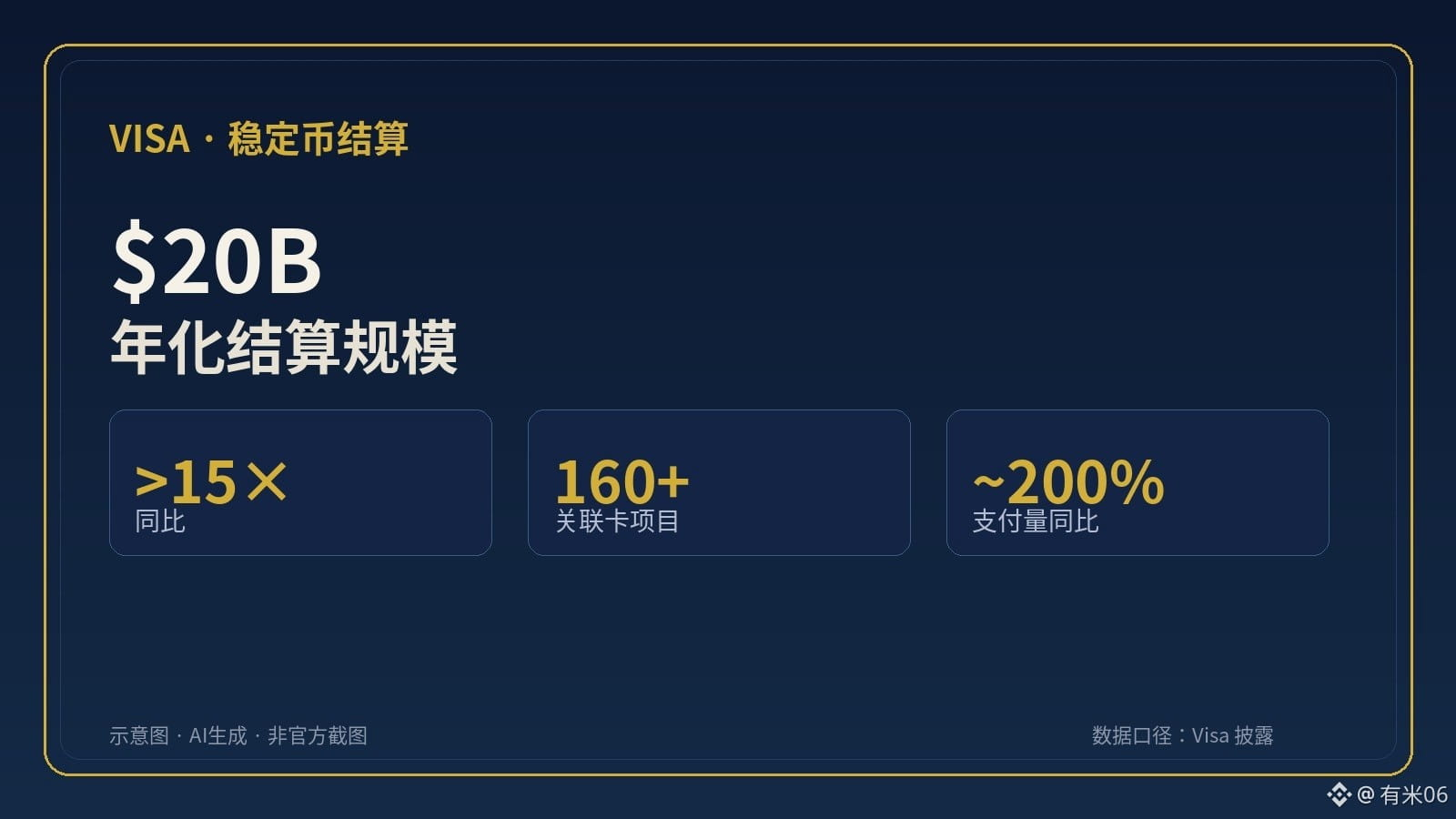
Per Visa press release (PR Newswire, 2026-09-09) and contemporaneous coverage: the stablecoin settlement volume has surpassed an annualized level of US$20 billion, up more than 15x versus a year earlier. Online, there are already over 160 stablecoin-linked card program initiatives, with related payment volume up nearly 200% year over year. Key definitional focus: card programs must complete daily settlement before cardholders make repayments. Some early projects do not have large working-capital needs, but their cycles are short—every day—so traditional financing may not fit well. Visa discloses that it is combining VisaNet settlement data with on-chain credit, partnering with entities such as Credit Coop, and using stablecoin-denominated revolving credit tools to support settlement turnover. The press-release wording claims that cumulative financing under this model exceeds about US$2.5 billion, with on-chain borrowing and repayment numbering in the thousands, and it states that participating facilities had zero defaults. Company-stated data suggests that financing costs for some participating projects can be reduced by up to approximately 30%.
Independent review: The Block (2026-09-08) reiterates the same core figures (US$20 billion annualized, more than 15x, 160+ projects, payment volume near 200%); Odaily, PANews, and ChainCatcher also reported on the same figures with consistent wording.
Data as of: Visa press release 2026-09-09; The Block report 2026-09-08.
For information sharing only and does not constitute investment advice.
#Visa #stablecoin
Visa Stablecoin Settlement Annualized Scale Crosses About US$20 Billion—Up More Than 15 Times Year over Year.
Per Visa press release (PR Newswire, 2026-09-09) and contemporaneous coverage: the stablecoin settlement volume has surpassed an annualized level of US$20 billion, up more than 15x versus a year earlier. Online, there are already over 160 stablecoin-linked card program initiatives, with related payment volume up nearly 200% year over year. Key definitional focus: card programs must complete daily settlement before cardholders make repayments. Some early projects do not have large working-capital needs, but their cycles are short—every day—so traditional financing may not fit well. Visa discloses that it is combining VisaNet settlement data with on-chain credit, partnering with entities such as Credit Coop, and using stablecoin-denominated revolving credit tools to support settlement turnover. The press-release wording claims that cumulative financing under this model exceeds about US$2.5 billion, with on-chain borrowing and repayment numbering in the thousands, and it states that participating facilities had zero defaults. Company-stated data suggests that financing costs for some participating projects can be reduced by up to approximately 30%.
Independent review: The Block (2026-09-08) reiterates the same core figures (US$20 billion annualized, more than 15x, 160+ projects, payment volume near 200%); Odaily, PANews, and ChainCatcher also reported on the same figures with consistent wording.
Data as of: Visa press release 2026-09-09; The Block report 2026-09-08.
For information sharing only and does not constitute investment advice.
#Visa #stablecoin
Per Visa press release (PR Newswire, 2026-09-09) and contemporaneous coverage: the stablecoin settlement volume has surpassed an annualized level of US$20 billion, up more than 15x versus a year earlier. Online, there are already over 160 stablecoin-linked card program initiatives, with related payment volume up nearly 200% year over year. Key definitional focus: card programs must complete daily settlement before cardholders make repayments. Some early projects do not have large working-capital needs, but their cycles are short—every day—so traditional financing may not fit well. Visa discloses that it is combining VisaNet settlement data with on-chain credit, partnering with entities such as Credit Coop, and using stablecoin-denominated revolving credit tools to support settlement turnover. The press-release wording claims that cumulative financing under this model exceeds about US$2.5 billion, with on-chain borrowing and repayment numbering in the thousands, and it states that participating facilities had zero defaults. Company-stated data suggests that financing costs for some participating projects can be reduced by up to approximately 30%.
Independent review: The Block (2026-09-08) reiterates the same core figures (US$20 billion annualized, more than 15x, 160+ projects, payment volume near 200%); Odaily, PANews, and ChainCatcher also reported on the same figures with consistent wording.
Data as of: Visa press release 2026-09-09; The Block report 2026-09-08.
For information sharing only and does not constitute investment advice.
#Visa #stablecoin
VUS+0.06%
39

·
--
Visa is merging VisaNet data with on-chain lending to turbocharge working capital for stablecoin cards. With stablecoin settlement volume at a $20B annualized run rate, up 15x YoY, Visa now invites blockchain lenders to use that data to extend credit to the issuers fueling this growth. Could unlock fresh liquidity for $USDC-backed card programs. #DeFi #Stablecoins #Visa
Visa is merging VisaNet data with on-chain lending to turbocharge working capital for stablecoin cards. With stablecoin settlement volume at a $20B annualized run rate, up 15x YoY, Visa now invites blockchain lenders to use that data to extend credit to the issuers fueling this growth. Could unlock fresh liquidity for $USDC -backed card programs. #DeFi #Stablecoins #Visa

2
·
--
📰 Visa disclosures: the annualized settlement volume of stablecoins has already surpassed $20 billion, up more than 15 times year over year. This number is a bit wild—it indicates that stablecoins are shifting from on-chain transfers into bank-card payments and everyday clearing.
🔥 In the second quarter, more than 160 stablecoin-linked card projects were live on the Visa network, with related payment volume up nearly 200% year over year. Honestly, this says more than just debating stablecoin issuance volumes: it’s starting to be used to complete real payments.
💡 Visa is also partnering with Credit Coop to provide early stablecoin-linked card projects with stablecoin-denominated revolving credit lines, used to cover daily Visa clearing funds. In simple terms, it first solves the cash-flow needs during daily card clearing.
Credit Coop uses Spigot smart contracts to lock receivables and handle automatic repayments, then combines Visa’s daily clearing data for credit approval and risk control. To date, it has executed more than 9,000 on-chain repayments, with total financing exceeding $2.5 billion, and there have been no defaults.
👀 Card projects like Rain, Karta, Moto, Xplace, and others have already secured clearing turnover funds through this model, while also building credit records for future institutional financing. If stablecoins keep moving into payments, credit, and clearing, people’s understanding of them may really change. Where do you think stablecoin cards will truly become mainstream first?
#稳定币 #Visa #链上支付 #Crypto payments
📰 Visa disclosures: the annualized settlement volume of stablecoins has already surpassed $20 billion, up more than 15 times year over year. This number is a bit wild—it indicates that stablecoins are shifting from on-chain transfers into bank-card payments and everyday clearing.
🔥 In the second quarter, more than 160 stablecoin-linked card projects were live on the Visa network, with related payment volume up nearly 200% year over year. Honestly, this says more than just debating stablecoin issuance volumes: it’s starting to be used to complete real payments.
💡 Visa is also partnering with Credit Coop to provide early stablecoin-linked card projects with stablecoin-denominated revolving credit lines, used to cover daily Visa clearing funds. In simple terms, it first solves the cash-flow needs during daily card clearing.
Credit Coop uses Spigot smart contracts to lock receivables and handle automatic repayments, then combines Visa’s daily clearing data for credit approval and risk control. To date, it has executed more than 9,000 on-chain repayments, with total financing exceeding $2.5 billion, and there have been no defaults.
👀 Card projects like Rain, Karta, Moto, Xplace, and others have already secured clearing turnover funds through this model, while also building credit records for future institutional financing. If stablecoins keep moving into payments, credit, and clearing, people’s understanding of them may really change. Where do you think stablecoin cards will truly become mainstream first?
#稳定币 #Visa #链上支付 #Crypto payments
🔥 In the second quarter, more than 160 stablecoin-linked card projects were live on the Visa network, with related payment volume up nearly 200% year over year. Honestly, this says more than just debating stablecoin issuance volumes: it’s starting to be used to complete real payments.
💡 Visa is also partnering with Credit Coop to provide early stablecoin-linked card projects with stablecoin-denominated revolving credit lines, used to cover daily Visa clearing funds. In simple terms, it first solves the cash-flow needs during daily card clearing.
Credit Coop uses Spigot smart contracts to lock receivables and handle automatic repayments, then combines Visa’s daily clearing data for credit approval and risk control. To date, it has executed more than 9,000 on-chain repayments, with total financing exceeding $2.5 billion, and there have been no defaults.
👀 Card projects like Rain, Karta, Moto, Xplace, and others have already secured clearing turnover funds through this model, while also building credit records for future institutional financing. If stablecoins keep moving into payments, credit, and clearing, people’s understanding of them may really change. Where do you think stablecoin cards will truly become mainstream first?
#稳定币 #Visa #链上支付 #Crypto payments

5

·
--
Bullish
🔥🔥🚨🚨 🚀🚀 NEW:#Visa Visa’s stablecoin settlement volume has exceeded an annualized rate of $20 billion, up 15-fold year over year.#VisaCards
#StablecoinRevolution News | Markets | YouTubeVisa is actively developing its ecosystem with more than 160 card programs tied to stablecoins and the rollout of the Visa Stablecoin Platform to simplify cryptocurrency settlements.$USDT
Key figures and adoption160 active programs: More than 160 card programs linked to stablecoins are running on the Visa network.
Volume growth: Payment volumes are seeing strong year-over-year growth.
Direct settlement: Visa allows some issuers to settle their transactions directly in stablecoins (such as USDC) seven days a week.
🔥🔥🚨🚨 🚀🚀 NEW:#Visa Visa’s stablecoin settlement volume has exceeded an annualized rate of $20 billion, up 15-fold year over year.#VisaCards
#StablecoinRevolution News | Markets | YouTubeVisa is actively developing its ecosystem with more than 160 card programs tied to stablecoins and the rollout of the Visa Stablecoin Platform to simplify cryptocurrency settlements.$USDT
Key figures and adoption160 active programs: More than 160 card programs linked to stablecoins are running on the Visa network.
Volume growth: Payment volumes are seeing strong year-over-year growth.
Direct settlement: Visa allows some issuers to settle their transactions directly in stablecoins (such as USDC) seven days a week.
#StablecoinRevolution News | Markets | YouTubeVisa is actively developing its ecosystem with more than 160 card programs tied to stablecoins and the rollout of the Visa Stablecoin Platform to simplify cryptocurrency settlements.$USDT
Key figures and adoption160 active programs: More than 160 card programs linked to stablecoins are running on the Visa network.
Volume growth: Payment volumes are seeing strong year-over-year growth.
Direct settlement: Visa allows some issuers to settle their transactions directly in stablecoins (such as USDC) seven days a week.


1
185

·
--
Visa moved more than $20 billion in stablecoins this year.
This is a 15-fold increase compared to the previous year.
Now they want blockchain lenders to use this data to provide credit.
The idea is to finance the working capital of the issuers driving this growth.
It’s interesting to see how they connect their traditional networks with on-chain lending.
What do you think about Visa’s move?
#Stablecoins #Visa $BTC
Visa moved more than $20 billion in stablecoins this year.
This is a 15-fold increase compared to the previous year.
Now they want blockchain lenders to use this data to provide credit.
The idea is to finance the working capital of the issuers driving this growth.
It’s interesting to see how they connect their traditional networks with on-chain lending.
What do you think about Visa’s move?
#Stablecoins #Visa $BTC
This is a 15-fold increase compared to the previous year.
Now they want blockchain lenders to use this data to provide credit.
The idea is to finance the working capital of the issuers driving this growth.
It’s interesting to see how they connect their traditional networks with on-chain lending.
What do you think about Visa’s move?
#Stablecoins #Visa $BTC
228

Expanded credit on-chain visa for stablecoin payment cards
- Visa combines VisaNet payment data with blockchain lending to provide on-chain credit services.
- The volume of stablecoin transactions through the Visa network increased by nearly 200% year over year.
- This move aims to expand Visa’s stablecoin payment card services.
#BinanceSquare #CryptoNews #Visa #Stablecoin
$btc $eth
#vlikevn Titanbot
Source: CoinTelegraph
Expanded credit on-chain visa for stablecoin payment cards
- Visa combines VisaNet payment data with blockchain lending to provide on-chain credit services.
- The volume of stablecoin transactions through the Visa network increased by nearly 200% year over year.
- This move aims to expand Visa’s stablecoin payment card services.
#BinanceSquare #CryptoNews #Visa #Stablecoin
$btc $eth
#vlikevn Titanbot
Source: CoinTelegraph
- Visa combines VisaNet payment data with blockchain lending to provide on-chain credit services.
- The volume of stablecoin transactions through the Visa network increased by nearly 200% year over year.
- This move aims to expand Visa’s stablecoin payment card services.
#BinanceSquare #CryptoNews #Visa #Stablecoin
$btc $eth
#vlikevn Titanbot
Source: CoinTelegraph
213
·
--
📰 Visa’s official blog reveals that in the second fiscal quarter, more than 160 stablecoin-linked card projects have already gone live worldwide. Put in the context of payment scenarios, this number is indeed more impactful than merely discussing on-chain transactions.
🔥 Even more importantly, the related payment volume year over year has grown by nearly 200%, and the annualized settlement rate exceeds $20 billion—more than a 15-fold increase year over year. To be honest, once stablecoins started being integrated into bank cards and payment tools, their use is no longer limited to on-chain transfers.
💡 Visa also mentioned that, in collaboration with Credit Coop, a stablecoin revolving credit tool can provide daily settlement funds for early stablecoin card projects. The borrowing costs for some participating projects have already dropped by over 30%, which means less pressure for projects just starting to build stablecoin payment solutions.
The most valuable thing to look at in these data is not how much a particular coin has risen, but the fact that traditional payment networks are connecting stablecoins to more concrete consumer and settlement workflows. As the number of projects, payment volume, and settlement scale all grow at the same time, it at least suggests that these kinds of products are being continuously put into use.
🤔 Do you think stablecoins are more likely to become popular first in everyday spending, or to break through first in cross-border settlement?
#稳定币 #Visa #加密支付 #Web3
📰 Visa’s official blog reveals that in the second fiscal quarter, more than 160 stablecoin-linked card projects have already gone live worldwide. Put in the context of payment scenarios, this number is indeed more impactful than merely discussing on-chain transactions.
🔥 Even more importantly, the related payment volume year over year has grown by nearly 200%, and the annualized settlement rate exceeds $20 billion—more than a 15-fold increase year over year. To be honest, once stablecoins started being integrated into bank cards and payment tools, their use is no longer limited to on-chain transfers.
💡 Visa also mentioned that, in collaboration with Credit Coop, a stablecoin revolving credit tool can provide daily settlement funds for early stablecoin card projects. The borrowing costs for some participating projects have already dropped by over 30%, which means less pressure for projects just starting to build stablecoin payment solutions.
The most valuable thing to look at in these data is not how much a particular coin has risen, but the fact that traditional payment networks are connecting stablecoins to more concrete consumer and settlement workflows. As the number of projects, payment volume, and settlement scale all grow at the same time, it at least suggests that these kinds of products are being continuously put into use.
🤔 Do you think stablecoins are more likely to become popular first in everyday spending, or to break through first in cross-border settlement?
#稳定币 #Visa #加密支付 #Web3
🔥 Even more importantly, the related payment volume year over year has grown by nearly 200%, and the annualized settlement rate exceeds $20 billion—more than a 15-fold increase year over year. To be honest, once stablecoins started being integrated into bank cards and payment tools, their use is no longer limited to on-chain transfers.
💡 Visa also mentioned that, in collaboration with Credit Coop, a stablecoin revolving credit tool can provide daily settlement funds for early stablecoin card projects. The borrowing costs for some participating projects have already dropped by over 30%, which means less pressure for projects just starting to build stablecoin payment solutions.
The most valuable thing to look at in these data is not how much a particular coin has risen, but the fact that traditional payment networks are connecting stablecoins to more concrete consumer and settlement workflows. As the number of projects, payment volume, and settlement scale all grow at the same time, it at least suggests that these kinds of products are being continuously put into use.
🤔 Do you think stablecoins are more likely to become popular first in everyday spending, or to break through first in cross-border settlement?
#稳定币 #Visa #加密支付 #Web3

VZUS+0.38%
11

Visa Reportedly Exploring New Stablecoin Partnerships 🤝🔍
Following the BVNK stake sale, reports suggest Visa is in discussions with multiple stablecoin issuers for settlement solutions. No official deal announced yet.
What to watch: Potential announcements at upcoming fintech conferences.
#Visa #Stablecoin #CryptoNews
Visa Reportedly Exploring New Stablecoin Partnerships 🤝🔍
Following the BVNK stake sale, reports suggest Visa is in discussions with multiple stablecoin issuers for settlement solutions. No official deal announced yet.
What to watch: Potential announcements at upcoming fintech conferences.
#Visa #Stablecoin #CryptoNews
Following the BVNK stake sale, reports suggest Visa is in discussions with multiple stablecoin issuers for settlement solutions. No official deal announced yet.
What to watch: Potential announcements at upcoming fintech conferences.
#Visa #Stablecoin #CryptoNews

67

The parent company behind the South Korean cryptocurrency exchange Upb1t, Dunamu, and Visa signed a collaboration agreement to explore the integration of payments with stablecoins and artificial intelligence in the global payments infrastructure. The main axes of the alliance are agentic commerce, with the development of a system where autonomous AI agents can search for products, compare options, and make purchases or payments on the user’s behalf.
The companies are analyzing various stablecoins, including options in development such as Open USD backed by the Open Standard initiative, to connect traditional banking with the crypto economy. This initiative combines Visa’s global financial network with Dunamu’s operational leadership in digital assets.
#OpenUSDT #Visa #AI #Dunamu #OPENUSD $V
{web3_wallet_create}(10x2a8e1e676ec238d8a992307b495b45b3feaa5e86)
The parent company behind the South Korean cryptocurrency exchange Upb1t, Dunamu, and Visa signed a collaboration agreement to explore the integration of payments with stablecoins and artificial intelligence in the global payments infrastructure. The main axes of the alliance are agentic commerce, with the development of a system where autonomous AI agents can search for products, compare options, and make purchases or payments on the user’s behalf.
The companies are analyzing various stablecoins, including options in development such as Open USD backed by the Open Standard initiative, to connect traditional banking with the crypto economy. This initiative combines Visa’s global financial network with Dunamu’s operational leadership in digital assets.
#OpenUSDT #Visa #AI #Dunamu #OPENUSD $V
The companies are analyzing various stablecoins, including options in development such as Open USD backed by the Open Standard initiative, to connect traditional banking with the crypto economy. This initiative combines Visa’s global financial network with Dunamu’s operational leadership in digital assets.
#OpenUSDT #Visa #AI #Dunamu #OPENUSD $V


41


Dunamu unveils a partnership with Visa
#Dunamu , the parent company of South Korean crypto exchange #Upbit, has partnered with #Visa to develop innovative financial services powered by stablecoins and #AI . The partnership will combine Dunamu’s digital asset expertise with Visa’s global payments network to develop stablecoin payments, cross-border remittance solutions, and AI-powered financial services.
The partnership will focus on compliant stablecoin integration with global payment infrastructure and AI-powered agentic commerce. Dunamu said the partnership will also explore the potential use of Open Standard’s Open USD $OUSD in future collaborations.
👉 theblock.co/news/business/2026-08-28-dunamu-visa-partner-stablecoin-ai-ousd-412988
Dunamu unveils a partnership with Visa
#Dunamu , the parent company of South Korean crypto exchange #Upbit, has partnered with #Visa to develop innovative financial services powered by stablecoins and #AI . The partnership will combine Dunamu’s digital asset expertise with Visa’s global payments network to develop stablecoin payments, cross-border remittance solutions, and AI-powered financial services.
The partnership will focus on compliant stablecoin integration with global payment infrastructure and AI-powered agentic commerce. Dunamu said the partnership will also explore the potential use of Open Standard’s Open USD $OUSD in future collaborations.
👉 theblock.co/news/business/2026-08-28-dunamu-visa-partner-stablecoin-ai-ousd-412988
#Dunamu , the parent company of South Korean crypto exchange #Upbit, has partnered with #Visa to develop innovative financial services powered by stablecoins and #AI . The partnership will combine Dunamu’s digital asset expertise with Visa’s global payments network to develop stablecoin payments, cross-border remittance solutions, and AI-powered financial services.
The partnership will focus on compliant stablecoin integration with global payment infrastructure and AI-powered agentic commerce. Dunamu said the partnership will also explore the potential use of Open Standard’s Open USD $OUSD in future collaborations.
👉 theblock.co/news/business/2026-08-28-dunamu-visa-partner-stablecoin-ai-ousd-412988

120
·
--
Visa doubles down on South Korea with Upbit operator Dunamu on stablecoin payments. Following a deal with Shinhan Financial, the global payments giant is widening its footprint in Asia’s major crypto hub through Korea’s largest exchange. #Visa #CryptoPayments $USDT
Visa doubles down on South Korea with Upbit operator Dunamu on stablecoin payments. Following a deal with Shinhan Financial, the global payments giant is widening its footprint in Asia’s major crypto hub through Korea’s largest exchange. #Visa #CryptoPayments $USDT

11

Visa moves deeper into stablecoins
Dunamu and Visa are partnering to explore stablecoin and AI business ventures. The collaboration will also look into the potential usage of Open Standard's OUSD in future projects.
#Stablecoins #Visa
Visa moves deeper into stablecoins
Dunamu and Visa are partnering to explore stablecoin and AI business ventures. The collaboration will also look into the potential usage of Open Standard's OUSD in future projects.
#Stablecoins #Visa
Dunamu and Visa are partnering to explore stablecoin and AI business ventures. The collaboration will also look into the potential usage of Open Standard's OUSD in future projects.
#Stablecoins #Visa

1
83

·
--

Article
🚨 South Korea’s Shinhan Financial Teams Up with Visa for Stablecoin Infrastructure! 💳🇰🇷South Korea’s banking powerhouse, Shinhan Financial Group, has officially partnered with Visa to co-develop an end-to-end stablecoin settlement and issuance ecosystem.
#Visa
TradFi and Web3 are colliding faster than expected, and this move shows exactly where global retail payments are heading.
What is happening?
Full-Cycle Infrastructure: The partnership covers everything from stablecoin issuance and transfers to day-to-day card settlements and redemption.
Instant Card Settlement: Instead of waiting days for cross-border or traditional card settlements to clear, the duo is testing stablecoin rails to make settlement instantaneous.
$BEAMX
Massive Reach: This isn't just a small pilot, it taps into Shinhan Bank and Shinhan Card (boasting over 28 million cardholders), along with Jeju Bank.
Regulatory Alignment: The move positions Shinhan ahead of the curve as South Korea refines its Digital Asset Basic Act framework.
Why this matters:
South Korea is already one of the most active crypto markets globally. Having a tier-one financial institution manage over $100B in assets partner with a global network like Visa sends a clear signal: stablecoins are moving from pure crypto trading pairs into the backbone of real-world retail banking.
Are bank-backed stablecoins the catalyst that finally brings billions of everyday users into Web3 rails or will users stick to native crypto assets like USDT and USDC?
#Stablecoins
🚨 South Korea’s Shinhan Financial Teams Up with Visa for Stablecoin Infrastructure! 💳🇰🇷
South Korea’s banking powerhouse, Shinhan Financial Group, has officially partnered with Visa to co-develop an end-to-end stablecoin settlement and issuance ecosystem.
#Visa
TradFi and Web3 are colliding faster than expected, and this move shows exactly where global retail payments are heading.
What is happening?
Full-Cycle Infrastructure: The partnership covers everything from stablecoin issuance and transfers to day-to-day card settlements and redemption.
Instant Card Settlement: Instead of waiting days for cross-border or traditional card settlements to clear, the duo is testing stablecoin rails to make settlement instantaneous.
$BEAMX
Massive Reach: This isn't just a small pilot, it taps into Shinhan Bank and Shinhan Card (boasting over 28 million cardholders), along with Jeju Bank.
Regulatory Alignment: The move positions Shinhan ahead of the curve as South Korea refines its Digital Asset Basic Act framework.
Why this matters:
South Korea is already one of the most active crypto markets globally. Having a tier-one financial institution manage over $100B in assets partner with a global network like Visa sends a clear signal: stablecoins are moving from pure crypto trading pairs into the backbone of real-world retail banking.
Are bank-backed stablecoins the catalyst that finally brings billions of everyday users into Web3 rails or will users stick to native crypto assets like USDT and USDC?
#Stablecoins
#Visa
TradFi and Web3 are colliding faster than expected, and this move shows exactly where global retail payments are heading.
What is happening?
Full-Cycle Infrastructure: The partnership covers everything from stablecoin issuance and transfers to day-to-day card settlements and redemption.
Instant Card Settlement: Instead of waiting days for cross-border or traditional card settlements to clear, the duo is testing stablecoin rails to make settlement instantaneous.
$BEAMX
Massive Reach: This isn't just a small pilot, it taps into Shinhan Bank and Shinhan Card (boasting over 28 million cardholders), along with Jeju Bank.
Regulatory Alignment: The move positions Shinhan ahead of the curve as South Korea refines its Digital Asset Basic Act framework.
Why this matters:
South Korea is already one of the most active crypto markets globally. Having a tier-one financial institution manage over $100B in assets partner with a global network like Visa sends a clear signal: stablecoins are moving from pure crypto trading pairs into the backbone of real-world retail banking.
Are bank-backed stablecoins the catalyst that finally brings billions of everyday users into Web3 rails or will users stick to native crypto assets like USDT and USDC?
#Stablecoins
2
3
289
·
--
Shinhan Financial Group joins Visa to test stablecoin payments.
The Korean financial giant wants to use Visa’s infrastructure to issue, send, and redeem stablecoins.
They also want to integrate AI-based payment models into their B2B operations.
It’s interesting to see a traditional bank directly trialing this technology.
Do you think traditional banks will end up adopting stablecoins soon?
$BTC #Stablecoins #Visa
Shinhan Financial Group joins Visa to test stablecoin payments.
The Korean financial giant wants to use Visa’s infrastructure to issue, send, and redeem stablecoins.
They also want to integrate AI-based payment models into their B2B operations.
It’s interesting to see a traditional bank directly trialing this technology.
Do you think traditional banks will end up adopting stablecoins soon?
$BTC #Stablecoins #Visa
The Korean financial giant wants to use Visa’s infrastructure to issue, send, and redeem stablecoins.
They also want to integrate AI-based payment models into their B2B operations.
It’s interesting to see a traditional bank directly trialing this technology.
Do you think traditional banks will end up adopting stablecoins soon?
$BTC #Stablecoins #Visa
340
Log in to explore more content
Join global crypto users on Binance Square
⚡️ Get latest and useful information about crypto.
💬 Trusted by the world’s largest crypto exchange.
👍 Discover real insights from verified creators.
Email / Phone number
Trending Topics
1
#BitcoinReboundsTo$79K
2,793 views
60 Discussing
2
#FedHikeOddsRiseTo89%
55,542 views
897 Discussing
3
#RLUSDSupplyHitsRecord$2.442B
2,873 views
52 Discussing
4
#AvalancheIntegratesIntoUAEPassDigitalVault
59,179 views
910 Discussing
5
#UKSeeksViewsOnTokenizingGold
45,244 views
679 Discussing
6
#AnthropicCEOCallsForAISlowdown
218,744 views
3,196 Discussing
7
#RevolutDataLeakReportedlyPostedAttackersThreatenDailyReleases
4,099 views
84 Discussing
8
#BrazilCentralBankRaisesVASPCapitalRequirements
36,141 views
768 Discussing
9
#BitcoinThirdSingleBlockReorgInFourWeeks
87,157 views
1,587 Discussing
10
#EthereumFallsBelow$2500
6,915 views
95 Discussing