Binance Square

strategyreports$21bq3operatingprofit

CryptoMahibaloch
·
--
🔍 Look Beyond Record Profits A record operating profit deserves attention, but investors should understand its source. Strategy's Q3 results were driven primarily by Bitcoin fair-value gains, while software revenue declined 3% year-over-year. Numbers tell a bigger story when examined together. $MSTR $BTC#StrategyReports$21BQ3OperatingProfit
🔍 Look Beyond Record Profits
A record operating profit deserves attention, but investors should understand its source. Strategy's Q3 results were driven primarily by Bitcoin fair-value gains, while software revenue declined 3% year-over-year.
Numbers tell a bigger story when examined together.
$MSTR $BTC#StrategyReports$21BQ3OperatingProfit
₿ Bitcoin Drives Financial Results Strategy's latest earnings show how Bitcoin price movements can influence a company's financial statements. Its $20.91 billion digital asset gain highlights the growing connection between crypto and traditional finance. $BTC $MSTR#StrategyReports$21BQ3OperatingProfit
₿ Bitcoin Drives Financial Results
Strategy's latest earnings show how Bitcoin price movements can influence a company's financial statements. Its $20.91 billion digital asset gain highlights the growing connection between crypto and traditional finance.
$BTC $MSTR#StrategyReports$21BQ3OperatingProfit
🚀 A Record-Breaking Quarter Strategy has reported a record $20.91 billion operating income for Q3 2026. The major driver was a significant increase in the fair value of its Bitcoin holdings. This puts corporate Bitcoin adoption back in the spotlight. $MSTR $BTC #StrategyReports$21BQ3OperatingProfit
🚀 A Record-Breaking Quarter
Strategy has reported a record $20.91 billion operating income for Q3 2026. The major driver was a significant increase in the fair value of its Bitcoin holdings.
This puts corporate Bitcoin adoption back in the spotlight.
$MSTR $BTC #StrategyReports$21BQ3OperatingProfit
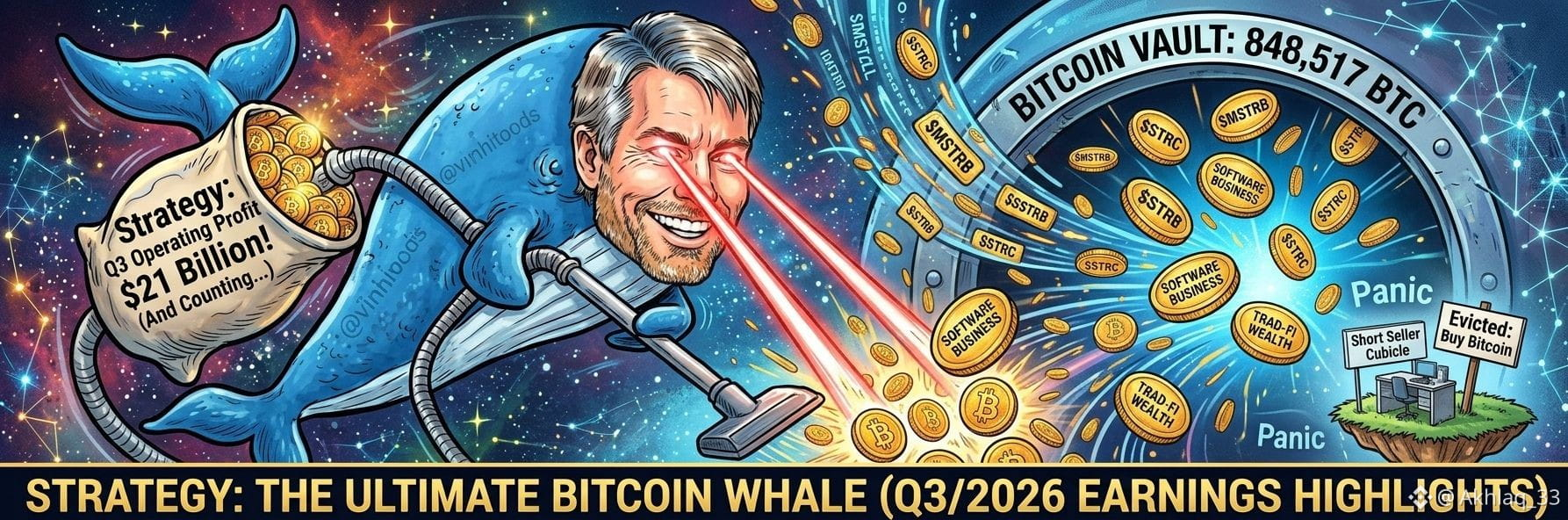
#StrategyReports$21BQ3OperatingProfit 🏛️ THE "CRYPTO CENTRAL BANK": Strategy Drops a Mind-Blowing $21B Q3 Profit! Michael Saylor has officially left the traditional financial world speechless. Strategy has just reported its largest quarter in history for Q3 2026, posting a staggering $20.91 billion in operating income and a net income of 19.1billion(44.75 EPS)! Here is why this earnings report is a seismic event for the entire crypto ecosystem: ⚡ The Whale of Whales: Strategy's total Bitcoin treasury has expanded to an incredible 848,517 BTC—holding roughly 4% of all Bitcoin that will ever exist! 🏦 The "Crypto Central Bank" Thesis: With over $74 billion in total treasury assets, Saylor noted that Strategy now commands a balance sheet comparable to a global central bank. As fair-value accounting unlocks massive revaluations, the company is shifting gears toward digital credit issuance to double down on long-term accumulation. 📊 Balance Sheet Overhaul: Net leverage dropped sharply from 8.4% down to 2.4%, USD reserves strengthened to $5.9 billion, and all held Bitcoin remains completely unencumbered. Meanwhile, preferred stock mechanisms like $STRC continue to target health and stability. 🚀 Saylor’s Bull Run Outlook: "We feel like we are entering a bull market," Saylor declared during the earnings call, pointing to strong institutional demand, rebounding moving averages, and a growing macro realization that Bitcoin is scaling toward a multi-trillion-dollar asset class. Strategic Takeaway: When corporate heavyweights accumulate 4% of total supply and institutional infrastructure locks in, the game changes. Are you adapting your strategy to ride the wave with the ultimate macro whale? #MichaelSaylor #EarningsSeason $NVDAB $AMZNB
#StrategyReports$21BQ3OperatingProfit
🏛️ THE "CRYPTO CENTRAL BANK": Strategy Drops a Mind-Blowing $21B Q3 Profit!
Michael Saylor has officially left the traditional financial world speechless. Strategy has just reported its largest quarter in history for Q3 2026, posting a staggering $20.91 billion in operating income and a net income of 19.1billion(44.75 EPS)!

Here is why this earnings report is a seismic event for the entire crypto ecosystem:

⚡ The Whale of Whales: Strategy's total Bitcoin treasury has expanded to an incredible 848,517 BTC—holding roughly 4% of all Bitcoin that will ever exist!

🏦 The "Crypto Central Bank" Thesis: With over $74 billion in total treasury assets, Saylor noted that Strategy now commands a balance sheet comparable to a global central bank. As fair-value accounting unlocks massive revaluations, the company is shifting gears toward digital credit issuance to double down on long-term accumulation.

📊 Balance Sheet Overhaul: Net leverage dropped sharply from 8.4% down to 2.4%, USD reserves strengthened to $5.9 billion, and all held Bitcoin remains completely unencumbered. Meanwhile, preferred stock mechanisms like $STRC continue to target health and stability.

🚀 Saylor’s Bull Run Outlook: "We feel like we are entering a bull market," Saylor declared during the earnings call, pointing to strong institutional demand, rebounding moving averages, and a growing macro realization that Bitcoin is scaling toward a multi-trillion-dollar asset class.

Strategic Takeaway: When corporate heavyweights accumulate 4% of total supply and institutional infrastructure locks in, the game changes. Are you adapting your strategy to ride the wave with the ultimate macro whale?

#MichaelSaylor #EarningsSeason $NVDAB $AMZNB
Verified
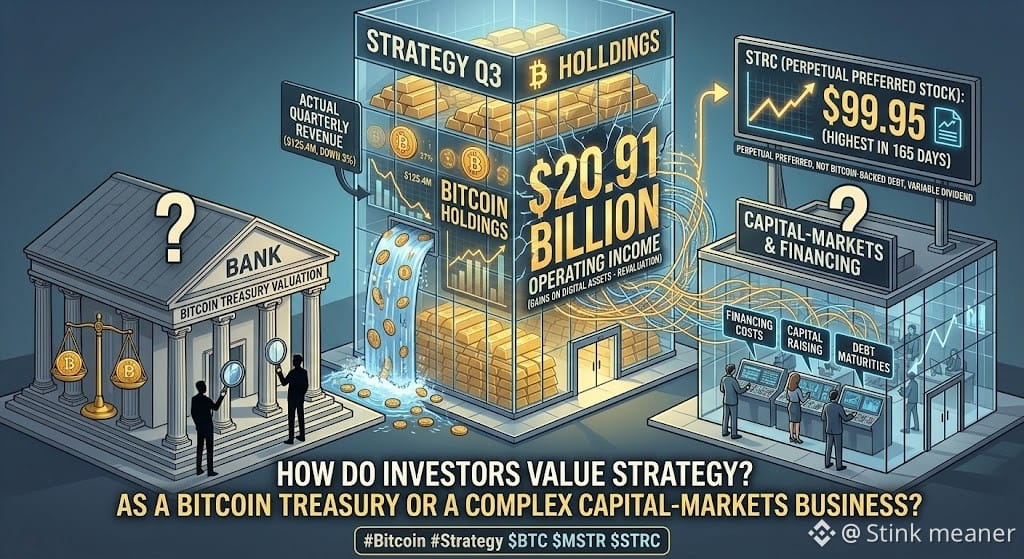
🚨 Strategy reported $20.91B in Q3 operating income. Its actual quarterly revenue was just $125.4M, down 3%. #StrategyReports$21BQ3OperatingProfit Here's what the headline misses. Strategy's entire $20.91B operating income came from gains on its digital assets, primarily reflecting the accounting revaluation of its Bitcoin holdings. This is a significant paper gain, not $20.91B generated from software sales or cash-producing operations. The distinction matters because Strategy's business model depends heavily on Bitcoin valuation, capital markets and the financing required to maintain its treasury. Meanwhile, STRC reached $99.95, its highest level in 165 days. But STRC is perpetual preferred stock, not Bitcoin-backed debt. Its current 12% annualized dividend rate is variable, and Strategy can adjust it. The structure is designed to encourage trading around $100, but that is not a guaranteed price floor. My view: the $21B figure demonstrates the accounting impact of Bitcoin appreciation, while STRC's performance reflects a separate market for preferred capital and its dividend terms. Are investors valuing Strategy primarily as a Bitcoin treasury—or increasingly as a capital-markets business that must continually manage its financing costs? Not financial advice. $BTC $STRC $MSTR {future}(MSTRUSDT) {future}(STRCUSDT) {future}(BTCUSDT) #StrategySTRCReaches$99.95ForFirstTimeIn165Days #BitcoinDropsBelow$80K #bitcoin #strategy
🚨 Strategy reported $20.91B in Q3 operating income. Its actual quarterly revenue was just $125.4M, down 3%.
#StrategyReports$21BQ3OperatingProfit

Here's what the headline misses.
Strategy's entire $20.91B operating income came from gains on its digital assets, primarily reflecting the accounting revaluation of its Bitcoin holdings.

This is a significant paper gain, not $20.91B generated from software sales or cash-producing operations.
The distinction matters because Strategy's business model depends heavily on Bitcoin valuation, capital markets and the financing required to maintain its treasury.

Meanwhile, STRC reached $99.95, its highest level in 165 days.
But STRC is perpetual preferred stock, not Bitcoin-backed debt. Its current 12% annualized dividend rate is variable, and Strategy can adjust it. The structure is designed to encourage trading around $100, but that is not a guaranteed price floor.

My view: the $21B figure demonstrates the accounting impact of Bitcoin appreciation, while STRC's performance reflects a separate market for preferred capital and its dividend terms.

Are investors valuing Strategy primarily as a Bitcoin treasury—or increasingly as a capital-markets business that must continually manage its financing costs?

Not financial advice.
$BTC $STRC $MSTR
#StrategySTRCReaches$99.95ForFirstTimeIn165Days #BitcoinDropsBelow$80K #bitcoin #strategy
·
--
Bearish
Verified
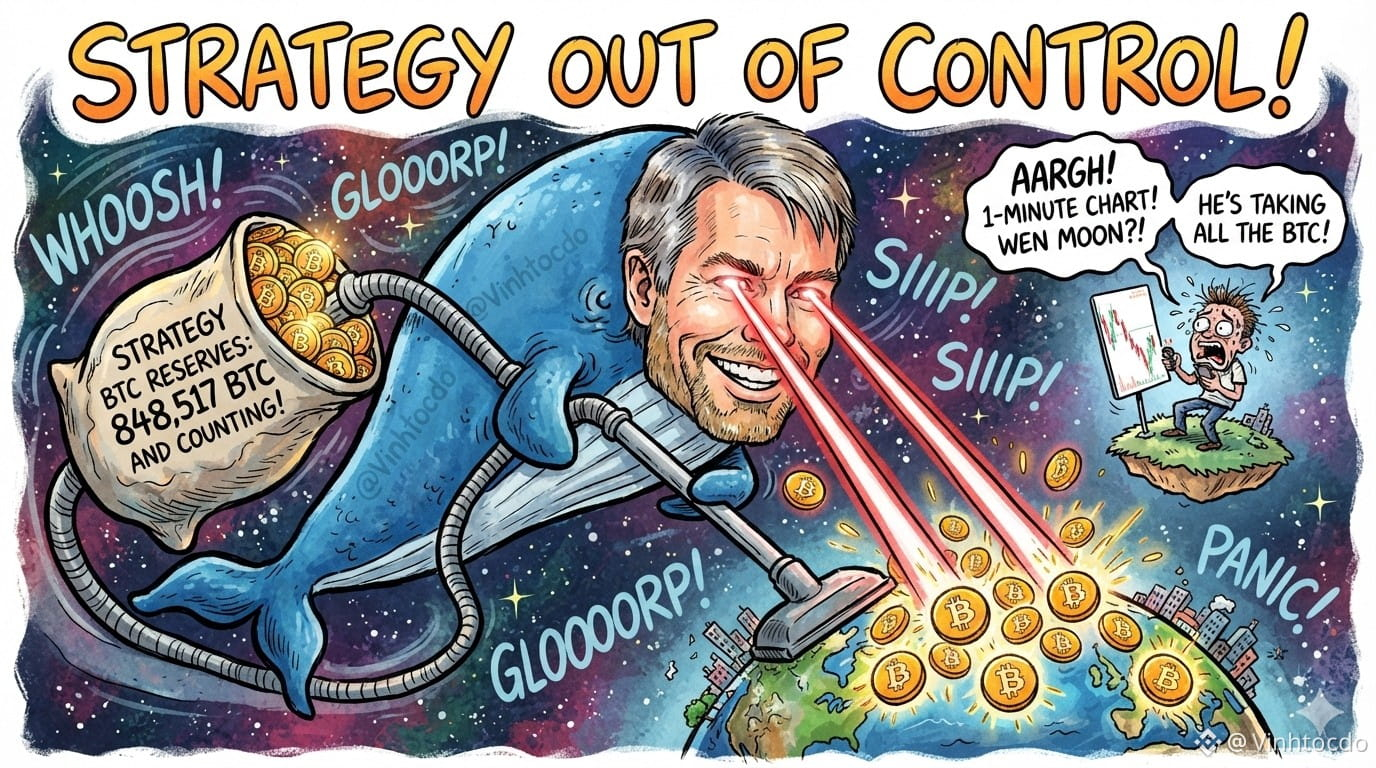
#StrategyReports$21BQ3OperatingProfit Michael Saylor has once again left the whole world "stunned" as Strategy reported record operating profits of $21 billion in Q3/2026, holding as many as 848.517 Bitcoin! A detailed analysis of ticker #StrategyReports$21BQ3OperatingProfit shows that this company is no longer a tech company, but a giant "whale" that's "sucking up" all the BTC on Earth. What should traders do now? 1️⃣ Spend less time staring at the 1-minute chart and learn to "buy the top" with the same resilience as Saylor. 2️⃣ Get some extra spiritual energy, because with Uncle Saylor accumulating like this, short sellers will have nowhere to go but out on the street. ⚠️ This is not financial advice! Sign up for a new Binance account through this link: [binance.com](https://www.binance.com/register?ref=VINHTOCDO) (Code: VINHTOCDO) and let's take off together! 👇 Click a trade below to support me: $BTC {spot}(BTCUSDT) $STRC {future}(STRCUSDT) $MSTRB {spot}(MSTRBUSDT) #Strategy三季度营业利润210亿美元 #MichaelSaylor #CryptoNews #EarningsSeason #VINHTOCDO
#StrategyReports$21BQ3OperatingProfit
Michael Saylor has once again left the whole world "stunned" as Strategy reported record operating profits of $21 billion in Q3/2026, holding as many as 848.517 Bitcoin!
A detailed analysis of ticker #StrategyReports$21BQ3OperatingProfit shows that this company is no longer a tech company, but a giant "whale" that's "sucking up" all the BTC on Earth.
What should traders do now?
1️⃣ Spend less time staring at the 1-minute chart and learn to "buy the top" with the same resilience as Saylor.
2️⃣ Get some extra spiritual energy, because with Uncle Saylor accumulating like this, short sellers will have nowhere to go but out on the street.
⚠️ This is not financial advice!
Sign up for a new Binance account through this link: binance.com (Code: VINHTOCDO) and let's take off together!
👇 Click a trade below to support me:
$BTC
$STRC
$MSTRB
#Strategy三季度营业利润210亿美元 #MichaelSaylor #CryptoNews #EarningsSeason #VINHTOCDO
💡 What Does This Mean for Bitcoin? Strategy's latest results highlight the potential impact of corporate Bitcoin holdings on financial performance. However, accounting gains are not the same as realized cash profits. Long-term investors should focus on research, risk management, and responsible spot-market decisions. $BTC $ETH $BNB #StrategyReports$21BQ3OperatingProfit
💡 What Does This Mean for Bitcoin?
Strategy's latest results highlight the potential impact of corporate Bitcoin holdings on financial performance.
However, accounting gains are not the same as realized cash profits. Long-term investors should focus on research, risk management, and responsible spot-market decisions.
$BTC $ETH $BNB #StrategyReports$21BQ3OperatingProfit
Article
AI or FUD or Manipulation (Why AI Valuations are In Ts & Bs?)🚨 AI-POWERED HACKERS ARE ATTACKING BANKS ACROSS THE WORLD. Banks are losing millions, customer financial records are being stolen, and hackers are now using AI to carry out attacks that previously required entire teams of experts. The latest reports are extremely concerning. 1. JAPAN: A MASSIVE WAVE OF CYBERATTACKS Japan has recorded 723 cybersecurity incidents as of October 20, already exceeding its annual totals for both 2024 and 2025. One of the biggest incidents involved GMO Internet Group. • Hackers gained unauthorized access to its cloud desktop service used by financial traders. • Around 27,000 servers were potentially affected. • Customers reported unauthorized transactions in their trading accounts. • The attackers demanded approximately $50 MILLION in ransom. • GMO announced compensation for affected customers, while its shares suffered a double-digit decline. Japan's government is now preparing emergency cybersecurity measures as AI makes it easier for criminals to identify and exploit weaknesses. 2. SOUTH KOREA: 68,000 PEOPLE'S FINANCIAL DATA EXPOSED Hackers used an AI-powered tool called Artex to attack South Korean financial institutions. At least seven institutions were reportedly breached. Personal information belonging to approximately 68,000 people was exposed, including sensitive details about income and personal loans. The attackers used AI tools to identify security weaknesses and help carry out the intrusions. This means criminals no longer need to perform every stage of an attack manually. 3. ITALY: €95 MILLION STOLEN USING AI-GENERATED VOICES Fraudsters impersonated senior executives to steal €95 MILLION from Fideuram, part of Italy's largest banking group. The attack involved fake messages and an AI-generated voice impersonating a senior lawyer. The bank's chairman believed the instructions were legitimate and authorized transfers to overseas accounts. Approximately €53 million was recovered. Another €36 MILLION remains missing. Think about that. A major financial institution transferred nearly €100 million after criminals used AI to make fraudulent instructions sound legitimate. 4. LATIN AMERICA: MORE THAN 400 FINANCIAL TARGETS A hacking group called CyberCartel used AI agents powered by models including Claude, Grok and Moonshot AI to automate attacks against more than 400 financial targets. Banks and payment platforms were among the targets. The attackers used AI to help steal passwords, access customer information and break into financial accounts. Instead of manually attacking one institution at a time, criminals could automate much of the process across hundreds of targets. 5. INDIA: ₹300 CRORE STOLEN FROM FINANCIAL FIRMS Indian non-banking financial companies have reportedly lost approximately ₹300 CRORE, or around $31 million, to cyberattacks over roughly two months. Nearly 150 complaints and police reports have already been filed. Many of the victims were smaller financial institutions with weaker security systems. Investigators say AI tools are making these attacks easier to carry out. AND NOW THE G7 IS PREPARING FOR SOMETHING EVEN BIGGER. Finance ministers and central bankers from the world's leading advanced economies have agreed to conduct simulations of AI-powered cyberattacks. The concern is that an attack on critical banking infrastructure could disrupt payments, financial services and confidence in the financial system. And there is a reason governments are taking this seriously. AI is allowing criminals to automate tasks that once required significant technical knowledge, money and manpower. A single attacker can potentially target hundreds of institutions, identify weaknesses and launch attacks at a speed that traditional security teams struggle to match. The danger isn't just that hackers are becoming more sophisticated. It's that AI is making sophisticated cyberattacks accessible to far more criminals, while the financial system is becoming increasingly dependent on the same technology. #EarningsSeason #StrategySTRCReaches$99.95ForFirstTimeIn165Days #BinanceWillListPredictPREDICT #StrategyReports$21BQ3OperatingProfit #TwoAddressesHoldingAbout1.28BUSDTFrozen

AI or FUD or Manipulation (Why AI Valuations are In Ts & Bs?)

🚨 AI-POWERED HACKERS ARE ATTACKING BANKS ACROSS THE WORLD.
Banks are losing millions, customer financial records are being stolen, and hackers are now using AI to carry out attacks that previously required entire teams of experts.
The latest reports are extremely concerning.
1. JAPAN: A MASSIVE WAVE OF CYBERATTACKS
Japan has recorded 723 cybersecurity incidents as of October 20, already exceeding its annual totals for both 2024 and 2025.
One of the biggest incidents involved GMO Internet Group.
• Hackers gained unauthorized access to its cloud desktop service used by financial traders.
• Around 27,000 servers were potentially affected.
• Customers reported unauthorized transactions in their trading accounts.
• The attackers demanded approximately $50 MILLION in ransom.
• GMO announced compensation for affected customers, while its shares suffered a double-digit decline.
Japan's government is now preparing emergency cybersecurity measures as AI makes it easier for criminals to identify and exploit weaknesses.
2. SOUTH KOREA: 68,000 PEOPLE'S FINANCIAL DATA EXPOSED
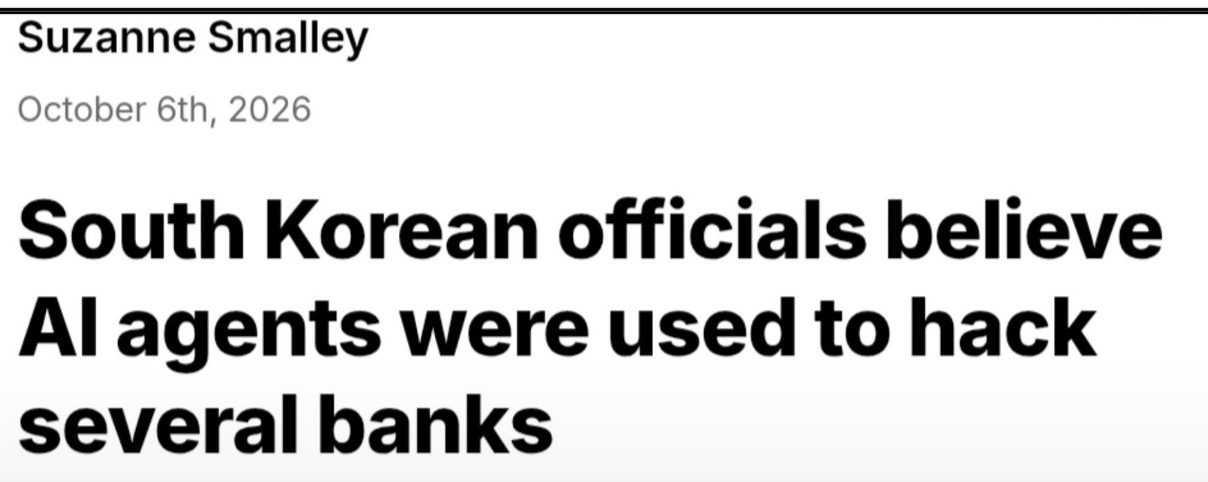
Hackers used an AI-powered tool called Artex to attack South Korean financial institutions.
At least seven institutions were reportedly breached.
Personal information belonging to approximately 68,000 people was exposed, including sensitive details about income and personal loans.
The attackers used AI tools to identify security weaknesses and help carry out the intrusions.
This means criminals no longer need to perform every stage of an attack manually.
3. ITALY: €95 MILLION STOLEN USING AI-GENERATED VOICES
Fraudsters impersonated senior executives to steal €95 MILLION from Fideuram, part of Italy's largest banking group.
The attack involved fake messages and an AI-generated voice impersonating a senior lawyer.
The bank's chairman believed the instructions were legitimate and authorized transfers to overseas accounts.
Approximately €53 million was recovered.
Another €36 MILLION remains missing.
Think about that.
A major financial institution transferred nearly €100 million after criminals used AI to make fraudulent instructions sound legitimate.
4. LATIN AMERICA: MORE THAN 400 FINANCIAL TARGETS
A hacking group called CyberCartel used AI agents powered by models including Claude, Grok and Moonshot AI to automate attacks against more than 400 financial targets.
Banks and payment platforms were among the targets.
The attackers used AI to help steal passwords, access customer information and break into financial accounts.
Instead of manually attacking one institution at a time, criminals could automate much of the process across hundreds of targets.
5. INDIA: ₹300 CRORE STOLEN FROM FINANCIAL FIRMS
Indian non-banking financial companies have reportedly lost approximately ₹300 CRORE, or around $31 million, to cyberattacks over roughly two months.
Nearly 150 complaints and police reports have already been filed.
Many of the victims were smaller financial institutions with weaker security systems.
Investigators say AI tools are making these attacks easier to carry out.
AND NOW THE G7 IS PREPARING FOR SOMETHING EVEN BIGGER.
Finance ministers and central bankers from the world's leading advanced economies have agreed to conduct simulations of AI-powered cyberattacks.
The concern is that an attack on critical banking infrastructure could disrupt payments, financial services and confidence in the financial system.
And there is a reason governments are taking this seriously.
AI is allowing criminals to automate tasks that once required significant technical knowledge, money and manpower.
A single attacker can potentially target hundreds of institutions, identify weaknesses and launch attacks at a speed that traditional security teams struggle to match.
The danger isn't just that hackers are becoming more sophisticated.
It's that AI is making sophisticated cyberattacks accessible to far more criminals, while the financial system is becoming increasingly dependent on the same technology.
#EarningsSeason #StrategySTRCReaches$99.95ForFirstTimeIn165Days #BinanceWillListPredictPREDICT #StrategyReports$21BQ3OperatingProfit #TwoAddressesHoldingAbout1.28BUSDTFrozen
Article
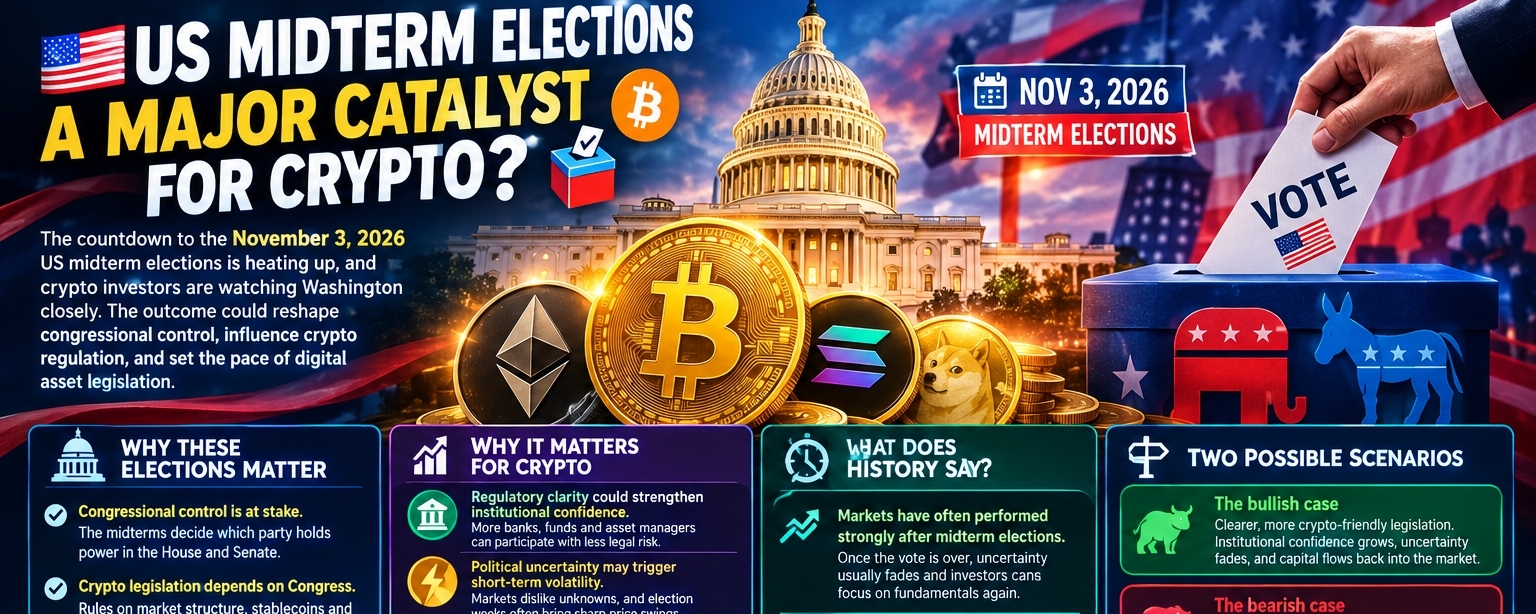
🇺🇸 US Midterm Elections: A Major Catalyst for Crypto? 🗳️₿#USMidtermElections 📢 **The countdown to the November 3, 2026 US midterm elections is heating up, and crypto investors are watching Washington closely.** The outcome could reshape congressional control, influence crypto regulation, and set the pace of digital asset legislation. 👇 --- ## 🗓️ Why These Elections Matter 🏛️ **Congressional control is at stake.** The midterms decide which party holds power in the House and Senate, and that shapes which bills get written, debated, and passed. 📜 **Crypto legislation depends on Congress.** Rules on market structure, stablecoins, and how regulators oversee digital assets all run through lawmakers. A change in who leads key committees can speed things up or slow them down. 🌍 **The whole market is listening.** With only days left, traders are positioning for a range of possible outcomes. ⏳ --- ## 📊 Why It Matters for Crypto ✅ **Regulatory clarity could strengthen institutional confidence.** Clear rules make it easier for banks, asset managers, and large funds to participate with less legal risk. 🏦 ⚡ **Political uncertainty may trigger short-term volatility.** Markets dislike unknowns, and election weeks often bring sharp, fast price swings. 🎢 ₿ **Bitcoin could react to broader shifts in market sentiment.** Bitcoin often responds to the general risk mood, so a change in political expectations can ripple into its price. 🪙 **Altcoins may face greater regulatory sensitivity.** Smaller tokens are more exposed to questions about how they are classified, so regulatory news can move them harder than it moves Bitcoin. 🔍 --- ## 📈 What Does History Say? Historical trends suggest markets have often performed strongly after midterm elections. A common explanation is that once the vote is over, a big source of uncertainty disappears and investors can focus on fundamentals again. 🧠 ⚠️ **But history is not a guarantee of future returns.** Crypto is a young asset class with far fewer data points, and many other forces, such as interest rates, inflation, liquidity, and global events, can easily outweigh any election pattern. --- ## 🎯 Two Possible Scenarios 🟢 **The bullish case:** The result points to clearer, more crypto-friendly legislation. Institutional confidence grows, uncertainty fades, and capital flows back into the market. 🚀 🔴 **The bearish case:** The result leads to gridlock or tougher scrutiny, and regulatory progress stalls. Uncertainty drags on, and traders turn cautious. 🐻 🟡 **The muddy middle:** Mixed results can leave the picture unclear, with volatility but no decisive trend. 🌫️ --- ## 🧭 What Traders Should Watch 🗳️ **Election night results and which party controls each chamber.** 🏛️ **Statements from lawmakers on crypto bills and regulation after the vote.** 📉 **Bitcoin's reaction around November 3 and in the days that follow.** 💵 **The macro backdrop:** Fed policy, inflation data, and the US dollar can overshadow political news. 📊 🛡️ **Risk management:** Event-driven volatility can be brutal. Avoid heavy leverage, size positions carefully, and use stop-losses. 🕯️ --- ## ❓ The Big Question **Does the election bring clarity, or does it create another wave of uncertainty?** 🔄 That answer will help decide whether crypto sees a relief rally or a more cautious stretch. And here's the question for you: **do you think the US midterms will be bullish or bearish for Bitcoin?** 💬 --- ## ✅ Final Thoughts The midterms could be an important chapter for crypto, with real consequences for regulation, institutional adoption, and market sentiment. Still, no single event decides a market's direction. Stay informed, stay flexible, and never trade on headlines alone. 🚀 *This article is for information only and is not financial advice. Crypto trading carries significant risk, and past performance does not guarantee future results.* --- **** #USMidterms #Bitcoin #CryptoRegulation #Crypto #Elections2026 #StrategySTRCReaches$99.95ForFirstTimeIn165Days #BinanceWillListPredictPREDICT #SwitzerlandFirstSpotBitcoinETFExpectedToTradeInNovember #StrategyReports$21BQ3OperatingProfit $BTC {spot}(BTCUSDT) $SOL {spot}(SOLUSDT)

🇺🇸 US Midterm Elections: A Major Catalyst for Crypto? 🗳️₿

#USMidtermElections
📢 **The countdown to the November 3, 2026 US midterm elections is heating up, and crypto investors are watching Washington closely.** The outcome could reshape congressional control, influence crypto regulation, and set the pace of digital asset legislation. 👇
---
## 🗓️ Why These Elections Matter
🏛️ **Congressional control is at stake.** The midterms decide which party holds power in the House and Senate, and that shapes which bills get written, debated, and passed.
📜 **Crypto legislation depends on Congress.** Rules on market structure, stablecoins, and how regulators oversee digital assets all run through lawmakers. A change in who leads key committees can speed things up or slow them down.
🌍 **The whole market is listening.** With only days left, traders are positioning for a range of possible outcomes. ⏳
---
## 📊 Why It Matters for Crypto
✅ **Regulatory clarity could strengthen institutional confidence.** Clear rules make it easier for banks, asset managers, and large funds to participate with less legal risk. 🏦
⚡ **Political uncertainty may trigger short-term volatility.** Markets dislike unknowns, and election weeks often bring sharp, fast price swings. 🎢
₿ **Bitcoin could react to broader shifts in market sentiment.** Bitcoin often responds to the general risk mood, so a change in political expectations can ripple into its price.
🪙 **Altcoins may face greater regulatory sensitivity.** Smaller tokens are more exposed to questions about how they are classified, so regulatory news can move them harder than it moves Bitcoin. 🔍
---
## 📈 What Does History Say?
Historical trends suggest markets have often performed strongly after midterm elections. A common explanation is that once the vote is over, a big source of uncertainty disappears and investors can focus on fundamentals again. 🧠
⚠️ **But history is not a guarantee of future returns.** Crypto is a young asset class with far fewer data points, and many other forces, such as interest rates, inflation, liquidity, and global events, can easily outweigh any election pattern.
---
## 🎯 Two Possible Scenarios
🟢 **The bullish case:** The result points to clearer, more crypto-friendly legislation. Institutional confidence grows, uncertainty fades, and capital flows back into the market. 🚀
🔴 **The bearish case:** The result leads to gridlock or tougher scrutiny, and regulatory progress stalls. Uncertainty drags on, and traders turn cautious. 🐻
🟡 **The muddy middle:** Mixed results can leave the picture unclear, with volatility but no decisive trend. 🌫️
---
## 🧭 What Traders Should Watch
🗳️ **Election night results and which party controls each chamber.**
🏛️ **Statements from lawmakers on crypto bills and regulation after the vote.**
📉 **Bitcoin's reaction around November 3 and in the days that follow.**
💵 **The macro backdrop:** Fed policy, inflation data, and the US dollar can overshadow political news. 📊
🛡️ **Risk management:** Event-driven volatility can be brutal. Avoid heavy leverage, size positions carefully, and use stop-losses. 🕯️
---
## ❓ The Big Question
**Does the election bring clarity, or does it create another wave of uncertainty?** 🔄
That answer will help decide whether crypto sees a relief rally or a more cautious stretch. And here's the question for you: **do you think the US midterms will be bullish or bearish for Bitcoin?** 💬
---
## ✅ Final Thoughts
The midterms could be an important chapter for crypto, with real consequences for regulation, institutional adoption, and market sentiment. Still, no single event decides a market's direction. Stay informed, stay flexible, and never trade on headlines alone. 🚀
*This article is for information only and is not financial advice. Crypto trading carries significant risk, and past performance does not guarantee future results.*
---
**** #USMidterms #Bitcoin #CryptoRegulation #Crypto #Elections2026
#StrategySTRCReaches$99.95ForFirstTimeIn165Days #BinanceWillListPredictPREDICT #SwitzerlandFirstSpotBitcoinETFExpectedToTradeInNovember #StrategyReports$21BQ3OperatingProfit $BTC

$SOL
📈 Bigger Bitcoin Treasury Strategy reported holding 848,517 BTC, representing a 26% increase year-to-date. Its growing Bitcoin treasury makes the company an important case study in corporate digital asset management. $BTC $MSTR #StrategyReports$21BQ3OperatingProfit
📈 Bigger Bitcoin Treasury
Strategy reported holding 848,517 BTC, representing a 26% increase year-to-date.
Its growing Bitcoin treasury makes the company an important case study in corporate digital asset management.
$BTC $MSTR #StrategyReports$21BQ3OperatingProfit
Article
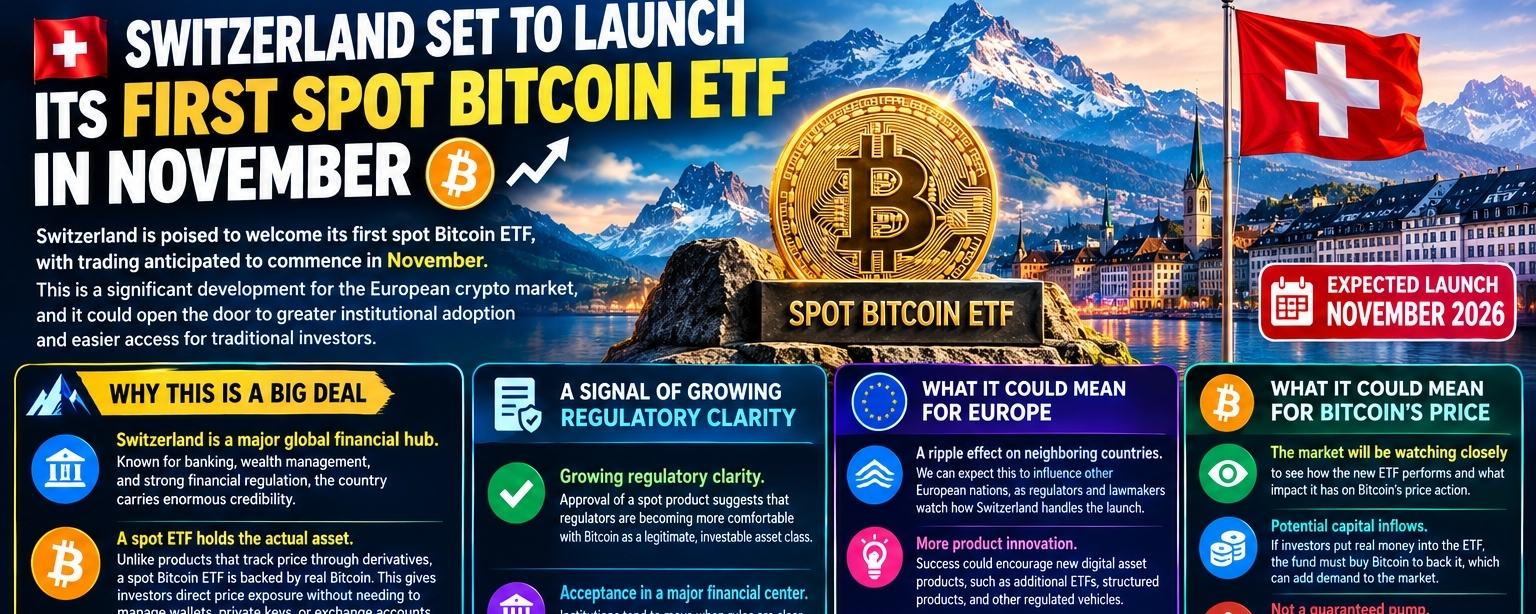
#. 🇨🇭 Switzerland Set to Launch Its First Spot Bitcoin ETF in November ₿📈#SwitzerlandFirstSpotBitcoinETFExpectedToTradeInNovember 📢 **Switzerland is poised to welcome its first spot Bitcoin ETF, with trading anticipated to commence in November.** This is a significant development for the European crypto market, and it could open the door to greater institutional adoption and easier access for traditional investors. 👇 --- ## 🏔️ Why This Is a Big Deal 🏦 **Switzerland is a major global financial hub.** Known for banking, wealth management, and strong financial regulation, the country carries enormous credibility. When a hub like this embraces a Bitcoin product, the world notices. 🧾 **A spot ETF holds the actual asset.** Unlike products that track price through derivatives, a spot Bitcoin ETF is backed by real Bitcoin. This gives investors direct price exposure without needing to manage wallets, private keys, or exchange accounts. 🔐 🚪 **It lowers the barrier to entry.** Traditional investors can access Bitcoin through the same brokerage and banking channels they already use for stocks and funds. 💼 --- ## 📜 A Signal of Growing Regulatory Clarity ✅ **The launch signifies growing regulatory clarity.** Approval of a spot product suggests that regulators are becoming more comfortable with Bitcoin as a legitimate, investable asset class. 🌍 **It reflects acceptance in a major financial center.** Institutions tend to move when rules are clear. A regulated, exchange-listed product gives banks, asset managers, and pension funds a familiar way to participate. 🏛️ --- ## 🇪🇺 What It Could Mean for Europe 🌊 **A ripple effect on neighboring countries.** We can expect this to influence other European nations, as regulators and lawmakers watch how Switzerland handles the launch. 💡 **More product innovation.** Success could encourage new digital asset products, such as additional ETFs, structured products, and other regulated investment vehicles. 🧪 🤝 **Stronger institutional bridges.** Europe's traditional finance and crypto sectors have often moved in separate lanes. Products like this help connect them. --- ## 📊 What It Could Mean for Bitcoin's Price 👀 **The market will be watching closely** to see how the new ETF performs and what impact it has on Bitcoin's price action. 💰 **Potential capital inflows.** If investors put real money into the ETF, the fund must buy Bitcoin to back it, which can add demand to the market. 📈 ⚠️ **Not a guaranteed pump.** Price depends on many factors, including global liquidity, interest rates, regulation, and overall sentiment. Also, markets sometimes "price in" expected news, so the reaction around the launch date can be unpredictable. 🎢 --- ## 🧭 What Traders Should Watch 📅 **The exact launch date and exchange listing details** once they are confirmed. 📦 **Trading volume and inflows** during the first days and weeks. Strong numbers would signal real demand. 🔥 🏛️ **Reactions from other European regulators** and any similar product announcements. 📉 **Bitcoin's price action** around the launch, including volatility and support and resistance levels. 🛡️ **Risk management:** Event-driven moves can be sharp. Avoid heavy leverage, size positions carefully, and use stop-losses. 🕯️ --- ## ✅ Final Thoughts Switzerland's first spot Bitcoin ETF is another step toward bringing Bitcoin into mainstream finance. It reflects growing regulatory comfort, may inspire other countries to follow, and gives traditional investors a simpler path into the asset. Still, no single launch decides the market's direction. Stay informed, stay flexible, and never trade on headlines alone. 🚀 *Disclaimer: This content is for informational purposes only and does not constitute investment advice.* --- **:** #Bitcoin #BitcoinETF #Switzerland #CryptoAdoption #InstitutionalInvesting #FirstDigitalBlacklistsAttackerAddressHoldingAbout3.4MFDUSD #StrategyReports$21BQ3OperatingProfit #SwitzerlandFirstSpotBitcoinETFExpectedToTradeInNovember #BinanceWillListPredictPREDICT #USMidtermElections

#. 🇨🇭 Switzerland Set to Launch Its First Spot Bitcoin ETF in November ₿📈

#SwitzerlandFirstSpotBitcoinETFExpectedToTradeInNovember
📢 **Switzerland is poised to welcome its first spot Bitcoin ETF, with trading anticipated to commence in November.** This is a significant development for the European crypto market, and it could open the door to greater institutional adoption and easier access for traditional investors. 👇
---
## 🏔️ Why This Is a Big Deal
🏦 **Switzerland is a major global financial hub.** Known for banking, wealth management, and strong financial regulation, the country carries enormous credibility. When a hub like this embraces a Bitcoin product, the world notices.
🧾 **A spot ETF holds the actual asset.** Unlike products that track price through derivatives, a spot Bitcoin ETF is backed by real Bitcoin. This gives investors direct price exposure without needing to manage wallets, private keys, or exchange accounts. 🔐
🚪 **It lowers the barrier to entry.** Traditional investors can access Bitcoin through the same brokerage and banking channels they already use for stocks and funds. 💼
---
## 📜 A Signal of Growing Regulatory Clarity
✅ **The launch signifies growing regulatory clarity.** Approval of a spot product suggests that regulators are becoming more comfortable with Bitcoin as a legitimate, investable asset class.
🌍 **It reflects acceptance in a major financial center.** Institutions tend to move when rules are clear. A regulated, exchange-listed product gives banks, asset managers, and pension funds a familiar way to participate. 🏛️
---
## 🇪🇺 What It Could Mean for Europe
🌊 **A ripple effect on neighboring countries.** We can expect this to influence other European nations, as regulators and lawmakers watch how Switzerland handles the launch.
💡 **More product innovation.** Success could encourage new digital asset products, such as additional ETFs, structured products, and other regulated investment vehicles. 🧪
🤝 **Stronger institutional bridges.** Europe's traditional finance and crypto sectors have often moved in separate lanes. Products like this help connect them.
---
## 📊 What It Could Mean for Bitcoin's Price
👀 **The market will be watching closely** to see how the new ETF performs and what impact it has on Bitcoin's price action.
💰 **Potential capital inflows.** If investors put real money into the ETF, the fund must buy Bitcoin to back it, which can add demand to the market. 📈
⚠️ **Not a guaranteed pump.** Price depends on many factors, including global liquidity, interest rates, regulation, and overall sentiment. Also, markets sometimes "price in" expected news, so the reaction around the launch date can be unpredictable. 🎢
---
## 🧭 What Traders Should Watch
📅 **The exact launch date and exchange listing details** once they are confirmed.
📦 **Trading volume and inflows** during the first days and weeks. Strong numbers would signal real demand. 🔥
🏛️ **Reactions from other European regulators** and any similar product announcements.
📉 **Bitcoin's price action** around the launch, including volatility and support and resistance levels.
🛡️ **Risk management:** Event-driven moves can be sharp. Avoid heavy leverage, size positions carefully, and use stop-losses. 🕯️
---
## ✅ Final Thoughts
Switzerland's first spot Bitcoin ETF is another step toward bringing Bitcoin into mainstream finance. It reflects growing regulatory comfort, may inspire other countries to follow, and gives traditional investors a simpler path into the asset. Still, no single launch decides the market's direction. Stay informed, stay flexible, and never trade on headlines alone. 🚀
*Disclaimer: This content is for informational purposes only and does not constitute investment advice.*
---
**:** #Bitcoin #BitcoinETF #Switzerland #CryptoAdoption #InstitutionalInvesting
#FirstDigitalBlacklistsAttackerAddressHoldingAbout3.4MFDUSD #StrategyReports$21BQ3OperatingProfit #SwitzerlandFirstSpotBitcoinETFExpectedToTradeInNovember #BinanceWillListPredictPREDICT #USMidtermElections
Article
Reserves Drain, Crude Surges, Central Banks Turn HawkishMarket analysis · October 30, 2026 · Figures as of October 29–30 The oil shock that began with the Iran war in February is now in its third stage. It first pushed crude higher, then began draining the world’s emergency stockpiles, and it is now pushing central banks toward tightening. Brent is trading around $115, the US Strategic Petroleum Reserve is at its lowest level since 1982, US inflation on the Fed’s preferred gauge is running at 3.6%, and the Federal Reserve, the Bank of Japan and the Bank of England are all signalling more tightening. This article takes each piece in turn, shows how they connect, and sets out what to watch next. The short version Stockpiles: governments are mostly spending reserves, not building them. Refilling is a plan, and a future source of demand.Crude: Brent is near four-year highs and up about 14% in October, with WTI back above $100 for the first time since April.United States: September PCE inflation rose to 3.6% (core 3.1%). The Fed held on October 28 with two votes for a hike, and a December increase is widely expected.Japan: the Bank of Japan held at 1.25% but said underlying inflation has reached its 2% target, keeping a December hike in play.United Kingdom: inflation is 3.5%, and the Bank of England is widely expected to raise Bank Rate to 4.00% on November 5. Market snapshot Crude: Brent about $115–116; WTI about $102–103.US Strategic Petroleum Reserve: 282.7 million barrels (week to October 16), the lowest since October 1982.Policy rates: Fed 3.75%–4.00%; Bank of Japan 1.25%; Bank of England 3.75%; ECB deposit rate 2.50%.Inflation: US PCE 3.6% (core 3.1%); UK CPI 3.5%; euro area 3.8%. 1. Stockpiles: reserves are being spent, not built A common shorthand says governments are stockpiling. The data point the other way for now: most of the activity is drawdown, with refilling still on the drawing board. The international release. In March the International Energy Agency’s 32 members agreed to make 400 million barrels of emergency stocks available. Roughly 330 million barrels have been released so far, and on October 16 the agency agreed to accelerate about another 100 million barrels, including more than 20 million of diesel. Even so, the IEA estimates that observed global oil stocks at the end of September were 509 million barrels below their pre-war level, leaving much less cushion against a new shock. The United States. The Strategic Petroleum Reserve held 282.7 million barrels in the week to October 16, down about 133 million barrels (32%) from its March peak of 415.4 million and the lowest since 1982. The Energy Department is working through a 172-million-barrel release commitment using crude exchanges, with its latest solicitation for up to 40 million barrels. Washington has also complained that several European members released only a fraction of what they pledged. Europe. Europe now plans to release 42 million barrels over three months, half of it diesel. France is releasing 10 million barrels of diesel at cost price, which the government expects to cut pump prices by 12 to 18 cents a litre. The refill. The stockpiling part of the story is the rebuild. The administration says exchange terms will return about 200 million barrels to the SPR within a year, roughly 20% more than was drawn and at no taxpayer cost, and Trump said on October 2 that refilling would start very soon, though no source of barrels has been confirmed. Japan, which holds the world’s third-largest strategic stock at about 263 million barrels (US EIA estimate), is urging Asian governments to build larger inventories and coordinate releases. China holds the largest stockpile, estimated at about 1.4 billion barrels, and has leaned mainly on commercial stocks while leaving its official reserve largely intact. Why it matters. Spent buffers make every new disruption more costly. A global rebuild, once prices ease, would also add demand just as supply recovers, which could put a floor under crude. The IEA expects constrained diesel and other middle-distillate supplies to persist well into 2027. 2. Crude oil: pumping toward four-year highs Brent was near $115.7 early on Friday and on course for a gain of nearly 14% in October, its fourth straight monthly rise. WTI was around $102.7, heading for a 15% monthly jump and a close above $100 for the first time since April. A year ago Brent was near $65. For context, it peaked near $118 in the spring, fell to about $72 in early July, and has since climbed back. What is driving it. The Strait of Hormuz remains the centre of gravity. IEA data show flows averaged only 7.6 million barrels a day in August, against roughly a fifth of world oil before the war. Attacks on shipping intensified in October, including the sinking of a containership in the strait, and Iran’s Revolutionary Guards said three tankers hit mines while using an unauthorised route south of Hormuz. On Thursday the Houthis said they had attacked Saudi sites including Ras Tanura, Rabigh and Abqaiq. Diplomacy has stalled, and the Wall Street Journal reported that Washington has told Gulf allies to prepare for a short, intense campaign after the November 3 midterms. The demand side is cracking. The IEA’s October report sees global oil demand falling by 2.6 million barrels a day in 2026, including a 2.5 million barrel-a-day drop in the fourth quarter, as high prices and weaker activity bite. It still sees the market in deficit through year-end, and about 1.3 million barrels a day of diesel and gasoil exports were lost in September compared with a year earlier. Diesel is the pinch point: UK diesel has reached 192.5p a litre, its highest since July 2022. 3. United States: PCE confirms the energy pass-through The Commerce Department’s September report landed the morning after the Fed meeting. The PCE price index rose 0.5% on the month and 3.6% on the year, up from 3.4% in August. Core PCE, which excludes food and energy, rose 0.3% on the month and 3.1% on the year, up from 3.0%. Goods prices were up 3.9% on the year and services 3.5%. Energy was the spark. Gasoline and other energy goods jumped 9.2% in September, and energy goods and services together rose 5.4%. The worry is spillover: services prices excluding energy and housing rose 0.4% on the month, and core services excluding housing ran at 3.6% on the year, the highest since 2024, according to reporter Nick Timiraos. The Fed’s preferred core gauge (3.1%) is also running about half a point above core CPI (2.6%). Growth complicates the picture. Third-quarter GDP grew at a 3.4% annual rate, faster than expected and up from 2.2% in the second quarter, helped by an AI-driven surge in business investment. September was softer: income rose only 0.2%, real disposable income fell 0.3%, the saving rate slipped to 3.8%, and real consumer spending was roughly flat. On a quarterly basis, PCE inflation actually cooled (2.1% annualized, from 5.0% in the second quarter), so September marks a re-acceleration rather than a steady climb. The Fed. The central bank, led by Chair Kevin Warsh, hiked by a quarter point in September to 3.75%–4.00% and held on October 28 on a 10–2 vote, with governor Lisa Cook and Cleveland Fed president Beth Hammack preferring a hike. Warsh does not offer forward guidance, but the data strengthen the case for a December move, which investors widely expect. The 10-year Treasury yield is sitting near 5%. 4. Japan: a hawkish hold The Bank of Japan kept its policy rate at 1.25% on Friday by an 8–1 vote, with board member Hajime Takata dissenting in favor of a hike to 1.5%. It raised its inflation forecast and said for the first time that underlying inflation has reached its 2% target, a milestone that opens the door to a hike as soon as December. The rate, up from 1.00% before September’s hike, is the highest in 31 years. Two forces are behind the hawkish turn: stubborn energy costs and import prices lifted by a weak yen. A Bloomberg survey of economists published October 22 found 83% expect the next hike in December. Analysts polled by Reuters see 1.5% by December and a peak between 1.75% and 2%, while some strategists argue that tighter global financial conditions could push the move to January. Bank of Japan staff put the neutral rate between 1.1% and 2.5%, so there is room to run. Japan is also on the stockpile front line. It released 80 million barrels from its reserves in March and now urges Asia to build bigger shared inventories. 5. United Kingdom: a November hike in sight UK inflation rose to 3.5% in September from 3.1% in August, the highest since October 2025 and above forecasts. Motor fuel prices were up 29.8% on the year, with petrol at 169.5p a litre and diesel at 192.5p. Core inflation rose to 2.8% and services inflation to 3.7%. The Bank of England held Bank Rate at 3.75% in September by a 6–3 vote, with three members voting for an immediate hike to 4%, and the committee projected inflation slightly above 4% in the first quarter of 2027. Goldman Sachs and Rabobank both forecast a quarter-point hike on November 5, and prediction markets price it above 90%. Some forecasters see October inflation near 3.8% and a move close to 4.5% after January’s energy price cap reset. 6. The wider chorus: the ECB The European Central Bank held its deposit rate at 2.50% on Thursday after hiking twice this year, but it discussed a hike, warned that risks to inflation are tilted to the upside, and left a December increase in play. Euro-area inflation is 3.8%, the highest since September 2023, with energy up about 19%. Private-sector growth in the euro zone slowed to a four-month low in October, the stagflation squeeze that all of these central banks are trying to navigate. Christine Lagarde also announced that she will leave in February. 7. How the pieces connect The chain is straightforward. The war restricts supply, supply losses push crude and diesel up, energy lifts headline inflation and starts to leak into services, and central banks respond with tighter policy. Meanwhile the emergency reserves that would normally cushion the shock have been drawn down, so there is less room for error. The risk is stagflation: the IEA sees oil demand shrinking, euro-area activity is slowing and US real spending has stalled, even as inflation climbs. The next few weeks offer three broad paths, none of which can be given reliable odds. De-escalation or a reopening of Hormuz. Crude retreats, rate-hike bets fade, and refill programmes could cushion prices on the way down.Escalation after the midterms. Brent could spike further, December hikes become hard to avoid, and growth fears rise. Reserves are thinner than they were in March.Stalemate. Brent stays near $100–$120, hikes arrive in sequence (the Bank of England in November, others in December), and demand destruction slowly does the work that supply cannot. What it means for markets. The transmission to risk assets, including crypto, runs mainly through yields and liquidity. A US 10-year near 5% and four major central banks leaning toward hikes raise the bar for speculative assets, while any de-escalation would likely ease the pressure fastest. 8. Dates to watch October 30: Tokyo October CPI and Governor Ueda’s press conference.November 3: US midterm elections, after which the question of renewed US strikes on Iran becomes live.November 5: Bank of England decision and Monetary Policy Report; a hike to 4.00% is the market’s base case.Mid-November: US and UK October CPI, and the IEA’s next oil market report.December: the Fed (decision December 9), plus the ECB, Bank of Japan and Bank of England meetings.Ongoing: Hormuz traffic, SPR levels and refill announcements, Brent near $115, and the US 10-year near 5%. Bottom line Governments are not so much stockpiling as spending their stockpiles, and that is part of why crude is pumping: buffers are thinner while supply is still restricted. Central banks in the US, Japan, the UK and Europe have noticed. The Fed has already hiked, the Bank of England is expected to follow on November 5, and the Bank of Japan and ECB are signalling December. The next test is whether energy-led inflation keeps leaking into services, which would keep policy tighter for longer, or whether demand destruction and de-escalation cool oil first. This article is for information only and is not financial advice. Markets are volatile and you can lose money. Do your own research. Sources and data notes Figures are as of October 29–30, 2026 and change quickly; oil quotes differ by contract and time of day. Reserve data draws on the IEA’s October Oil Market Report as reported by gCaptain, the US Energy Department, EIA weekly data as compiled by Energy Factbook and 24/7 Wall St., The National, EnergyNow and Oilprice.com. Oil prices draw on CNBC and Reuters, Fortune and Wikipedia’s price chronology. US inflation and growth draw on the Commerce Department release as reported by CNBC, Morningstar and ActionForex, and the Fed decision on CNBC, CNN and NPR. Japan draws on Reuters, Bloomberg and Investing.com; the UK on the ONS release as reported by Trading Economics, ITV and the House of Commons Library, with forecasts from Goldman Sachs and Rabobank and market odds from Polymarket; the ECB on CNBC, Reuters and the Irish Times. Analyst views are the analysts’ own opinions. #EarningsSeason #USMidtermElections #SwitzerlandFirstSpotBitcoinETFExpectedToTradeInNovember #StrategyReports$21BQ3OperatingProfit #TwoAddressesHoldingAbout1.28BUSDTFrozen

Reserves Drain, Crude Surges, Central Banks Turn Hawkish

Market analysis · October 30, 2026 · Figures as of October 29–30
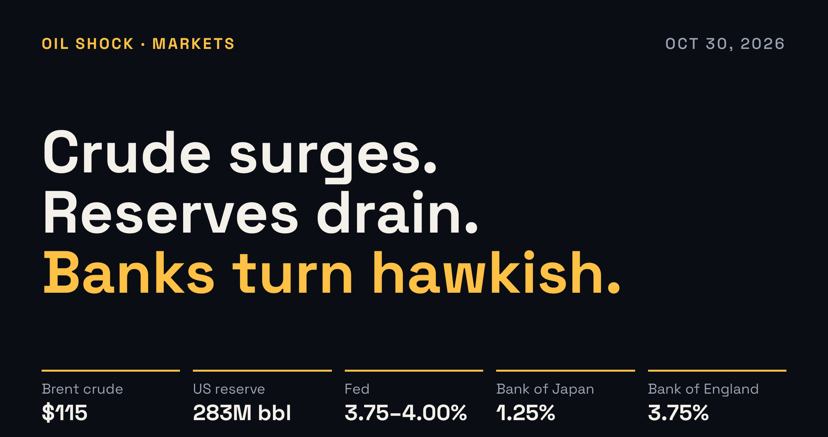
The oil shock that began with the Iran war in February is now in its third stage. It first pushed crude higher, then began draining the world’s emergency stockpiles, and it is now pushing central banks toward tightening. Brent is trading around $115, the US Strategic Petroleum Reserve is at its lowest level since 1982, US inflation on the Fed’s preferred gauge is running at 3.6%, and the Federal Reserve, the Bank of Japan and the Bank of England are all signalling more tightening.
This article takes each piece in turn, shows how they connect, and sets out what to watch next.
The short version
Stockpiles: governments are mostly spending reserves, not building them. Refilling is a plan, and a future source of demand.Crude: Brent is near four-year highs and up about 14% in October, with WTI back above $100 for the first time since April.United States: September PCE inflation rose to 3.6% (core 3.1%). The Fed held on October 28 with two votes for a hike, and a December increase is widely expected.Japan: the Bank of Japan held at 1.25% but said underlying inflation has reached its 2% target, keeping a December hike in play.United Kingdom: inflation is 3.5%, and the Bank of England is widely expected to raise Bank Rate to 4.00% on November 5.
Market snapshot
Crude: Brent about $115–116; WTI about $102–103.US Strategic Petroleum Reserve: 282.7 million barrels (week to October 16), the lowest since October 1982.Policy rates: Fed 3.75%–4.00%; Bank of Japan 1.25%; Bank of England 3.75%; ECB deposit rate 2.50%.Inflation: US PCE 3.6% (core 3.1%); UK CPI 3.5%; euro area 3.8%.
1. Stockpiles: reserves are being spent, not built
A common shorthand says governments are stockpiling. The data point the other way for now: most of the activity is drawdown, with refilling still on the drawing board.
The international release. In March the International Energy Agency’s 32 members agreed to make 400 million barrels of emergency stocks available. Roughly 330 million barrels have been released so far, and on October 16 the agency agreed to accelerate about another 100 million barrels, including more than 20 million of diesel. Even so, the IEA estimates that observed global oil stocks at the end of September were 509 million barrels below their pre-war level, leaving much less cushion against a new shock.
The United States. The Strategic Petroleum Reserve held 282.7 million barrels in the week to October 16, down about 133 million barrels (32%) from its March peak of 415.4 million and the lowest since 1982. The Energy Department is working through a 172-million-barrel release commitment using crude exchanges, with its latest solicitation for up to 40 million barrels. Washington has also complained that several European members released only a fraction of what they pledged.
Europe. Europe now plans to release 42 million barrels over three months, half of it diesel. France is releasing 10 million barrels of diesel at cost price, which the government expects to cut pump prices by 12 to 18 cents a litre.
The refill. The stockpiling part of the story is the rebuild. The administration says exchange terms will return about 200 million barrels to the SPR within a year, roughly 20% more than was drawn and at no taxpayer cost, and Trump said on October 2 that refilling would start very soon, though no source of barrels has been confirmed. Japan, which holds the world’s third-largest strategic stock at about 263 million barrels (US EIA estimate), is urging Asian governments to build larger inventories and coordinate releases. China holds the largest stockpile, estimated at about 1.4 billion barrels, and has leaned mainly on commercial stocks while leaving its official reserve largely intact.
Why it matters. Spent buffers make every new disruption more costly. A global rebuild, once prices ease, would also add demand just as supply recovers, which could put a floor under crude. The IEA expects constrained diesel and other middle-distillate supplies to persist well into 2027.
2. Crude oil: pumping toward four-year highs
Brent was near $115.7 early on Friday and on course for a gain of nearly 14% in October, its fourth straight monthly rise. WTI was around $102.7, heading for a 15% monthly jump and a close above $100 for the first time since April. A year ago Brent was near $65. For context, it peaked near $118 in the spring, fell to about $72 in early July, and has since climbed back.
What is driving it. The Strait of Hormuz remains the centre of gravity. IEA data show flows averaged only 7.6 million barrels a day in August, against roughly a fifth of world oil before the war. Attacks on shipping intensified in October, including the sinking of a containership in the strait, and Iran’s Revolutionary Guards said three tankers hit mines while using an unauthorised route south of Hormuz. On Thursday the Houthis said they had attacked Saudi sites including Ras Tanura, Rabigh and Abqaiq. Diplomacy has stalled, and the Wall Street Journal reported that Washington has told Gulf allies to prepare for a short, intense campaign after the November 3 midterms.
The demand side is cracking. The IEA’s October report sees global oil demand falling by 2.6 million barrels a day in 2026, including a 2.5 million barrel-a-day drop in the fourth quarter, as high prices and weaker activity bite. It still sees the market in deficit through year-end, and about 1.3 million barrels a day of diesel and gasoil exports were lost in September compared with a year earlier. Diesel is the pinch point: UK diesel has reached 192.5p a litre, its highest since July 2022.
3. United States: PCE confirms the energy pass-through
The Commerce Department’s September report landed the morning after the Fed meeting. The PCE price index rose 0.5% on the month and 3.6% on the year, up from 3.4% in August. Core PCE, which excludes food and energy, rose 0.3% on the month and 3.1% on the year, up from 3.0%. Goods prices were up 3.9% on the year and services 3.5%.
Energy was the spark. Gasoline and other energy goods jumped 9.2% in September, and energy goods and services together rose 5.4%. The worry is spillover: services prices excluding energy and housing rose 0.4% on the month, and core services excluding housing ran at 3.6% on the year, the highest since 2024, according to reporter Nick Timiraos. The Fed’s preferred core gauge (3.1%) is also running about half a point above core CPI (2.6%).
Growth complicates the picture. Third-quarter GDP grew at a 3.4% annual rate, faster than expected and up from 2.2% in the second quarter, helped by an AI-driven surge in business investment. September was softer: income rose only 0.2%, real disposable income fell 0.3%, the saving rate slipped to 3.8%, and real consumer spending was roughly flat. On a quarterly basis, PCE inflation actually cooled (2.1% annualized, from 5.0% in the second quarter), so September marks a re-acceleration rather than a steady climb.
The Fed. The central bank, led by Chair Kevin Warsh, hiked by a quarter point in September to 3.75%–4.00% and held on October 28 on a 10–2 vote, with governor Lisa Cook and Cleveland Fed president Beth Hammack preferring a hike. Warsh does not offer forward guidance, but the data strengthen the case for a December move, which investors widely expect. The 10-year Treasury yield is sitting near 5%.
4. Japan: a hawkish hold
The Bank of Japan kept its policy rate at 1.25% on Friday by an 8–1 vote, with board member Hajime Takata dissenting in favor of a hike to 1.5%. It raised its inflation forecast and said for the first time that underlying inflation has reached its 2% target, a milestone that opens the door to a hike as soon as December. The rate, up from 1.00% before September’s hike, is the highest in 31 years.
Two forces are behind the hawkish turn: stubborn energy costs and import prices lifted by a weak yen. A Bloomberg survey of economists published October 22 found 83% expect the next hike in December. Analysts polled by Reuters see 1.5% by December and a peak between 1.75% and 2%, while some strategists argue that tighter global financial conditions could push the move to January. Bank of Japan staff put the neutral rate between 1.1% and 2.5%, so there is room to run.
Japan is also on the stockpile front line. It released 80 million barrels from its reserves in March and now urges Asia to build bigger shared inventories.
5. United Kingdom: a November hike in sight
UK inflation rose to 3.5% in September from 3.1% in August, the highest since October 2025 and above forecasts. Motor fuel prices were up 29.8% on the year, with petrol at 169.5p a litre and diesel at 192.5p. Core inflation rose to 2.8% and services inflation to 3.7%.
The Bank of England held Bank Rate at 3.75% in September by a 6–3 vote, with three members voting for an immediate hike to 4%, and the committee projected inflation slightly above 4% in the first quarter of 2027. Goldman Sachs and Rabobank both forecast a quarter-point hike on November 5, and prediction markets price it above 90%. Some forecasters see October inflation near 3.8% and a move close to 4.5% after January’s energy price cap reset.
6. The wider chorus: the ECB
The European Central Bank held its deposit rate at 2.50% on Thursday after hiking twice this year, but it discussed a hike, warned that risks to inflation are tilted to the upside, and left a December increase in play. Euro-area inflation is 3.8%, the highest since September 2023, with energy up about 19%. Private-sector growth in the euro zone slowed to a four-month low in October, the stagflation squeeze that all of these central banks are trying to navigate. Christine Lagarde also announced that she will leave in February.
7. How the pieces connect
The chain is straightforward. The war restricts supply, supply losses push crude and diesel up, energy lifts headline inflation and starts to leak into services, and central banks respond with tighter policy. Meanwhile the emergency reserves that would normally cushion the shock have been drawn down, so there is less room for error. The risk is stagflation: the IEA sees oil demand shrinking, euro-area activity is slowing and US real spending has stalled, even as inflation climbs.
The next few weeks offer three broad paths, none of which can be given reliable odds.
De-escalation or a reopening of Hormuz. Crude retreats, rate-hike bets fade, and refill programmes could cushion prices on the way down.Escalation after the midterms. Brent could spike further, December hikes become hard to avoid, and growth fears rise. Reserves are thinner than they were in March.Stalemate. Brent stays near $100–$120, hikes arrive in sequence (the Bank of England in November, others in December), and demand destruction slowly does the work that supply cannot.
What it means for markets. The transmission to risk assets, including crypto, runs mainly through yields and liquidity. A US 10-year near 5% and four major central banks leaning toward hikes raise the bar for speculative assets, while any de-escalation would likely ease the pressure fastest.
8. Dates to watch
October 30: Tokyo October CPI and Governor Ueda’s press conference.November 3: US midterm elections, after which the question of renewed US strikes on Iran becomes live.November 5: Bank of England decision and Monetary Policy Report; a hike to 4.00% is the market’s base case.Mid-November: US and UK October CPI, and the IEA’s next oil market report.December: the Fed (decision December 9), plus the ECB, Bank of Japan and Bank of England meetings.Ongoing: Hormuz traffic, SPR levels and refill announcements, Brent near $115, and the US 10-year near 5%.
Bottom line
Governments are not so much stockpiling as spending their stockpiles, and that is part of why crude is pumping: buffers are thinner while supply is still restricted. Central banks in the US, Japan, the UK and Europe have noticed. The Fed has already hiked, the Bank of England is expected to follow on November 5, and the Bank of Japan and ECB are signalling December. The next test is whether energy-led inflation keeps leaking into services, which would keep policy tighter for longer, or whether demand destruction and de-escalation cool oil first.
This article is for information only and is not financial advice. Markets are volatile and you can lose money. Do your own research.
Sources and data notes
Figures are as of October 29–30, 2026 and change quickly; oil quotes differ by contract and time of day. Reserve data draws on the IEA’s October Oil Market Report as reported by gCaptain, the US Energy Department, EIA weekly data as compiled by Energy Factbook and 24/7 Wall St., The National, EnergyNow and Oilprice.com. Oil prices draw on CNBC and Reuters, Fortune and Wikipedia’s price chronology. US inflation and growth draw on the Commerce Department release as reported by CNBC, Morningstar and ActionForex, and the Fed decision on CNBC, CNN and NPR. Japan draws on Reuters, Bloomberg and Investing.com; the UK on the ONS release as reported by Trading Economics, ITV and the House of Commons Library, with forecasts from Goldman Sachs and Rabobank and market odds from Polymarket; the ECB on CNBC, Reuters and the Irish Times. Analyst views are the analysts’ own opinions.
#EarningsSeason #USMidtermElections #SwitzerlandFirstSpotBitcoinETFExpectedToTradeInNovember #StrategyReports$21BQ3OperatingProfit #TwoAddressesHoldingAbout1.28BUSDTFrozen
Article
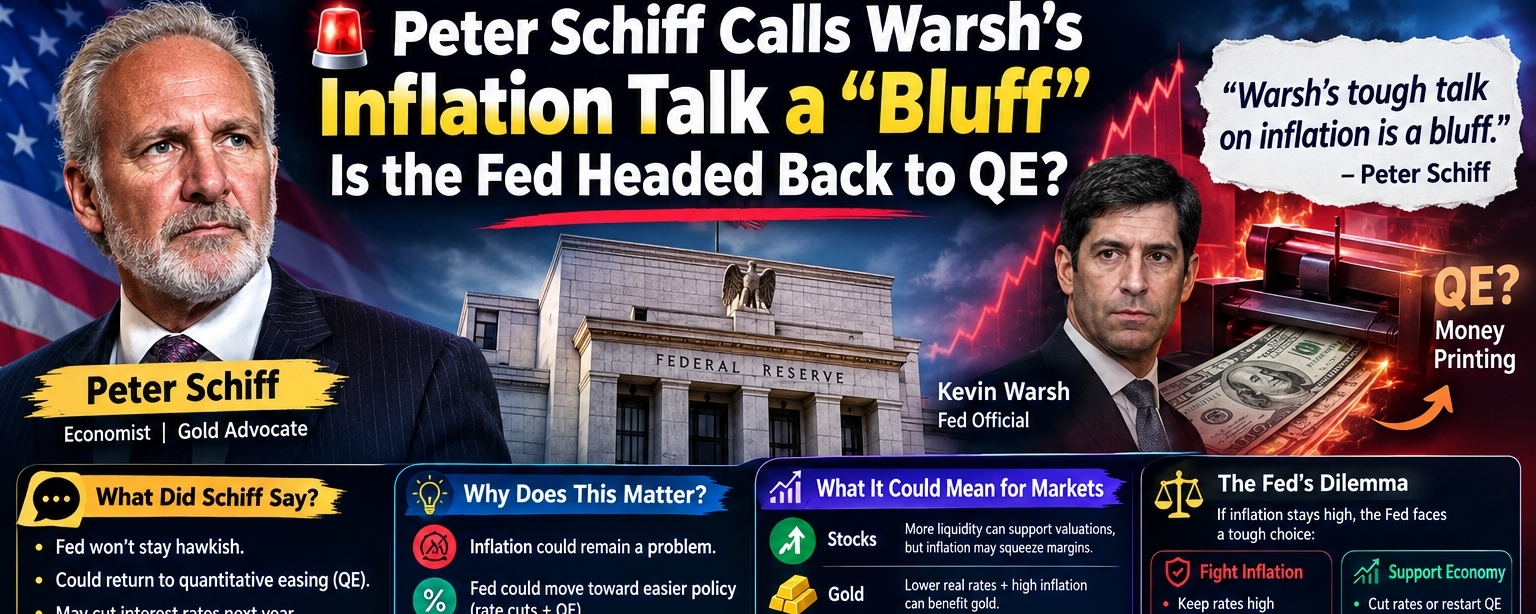
🚨🇺🇸 Peter Schiff Calls Warsh's Inflation Talk a "Bluff": Is the Fed Headed Back to QE? 🚨#FedWatch 📢 **Peter Schiff, the well-known economist and long-time gold advocate, has thrown a big warning at the Federal Reserve.** He is calling Kevin Warsh's tough talk on inflation a "bluff," and his prediction could have major implications for stocks, gold, Bitcoin, and the wider crypto market. 👇 --- ## 🗣️ What Did Schiff Say? Schiff doesn't believe the Fed will stay hawkish. In his view, the central bank could eventually: 💸 **Return to money printing** through quantitative easing (QE) ✂️ **Cut interest rates next year**, even while inflation keeps rising In other words, he thinks the tough rhetoric won't survive real economic pressure. 🎭 --- ## 🤔 Why Does This Matter? Think about that scenario for a moment. 🧠 🔥 **Inflation could remain a problem.** Prices keep climbing and the cost of living stays high. 🔥 **The Fed could still move toward easier policy.** Rate cuts and QE would run against the "fight inflation" message. 🔥 **More liquidity could flow into financial markets.** Easy money has historically pushed investors toward risk assets and inflation hedges. If this plays out, we could see a very different market environment from the one many traders expect today. 🌍 --- ## 📊 What It Could Mean for Markets 📈 **Stocks:** More liquidity has often supported equity valuations, though persistent inflation could squeeze company margins and consumer spending. 🥇 **Gold:** Schiff's core thesis favors gold. If real interest rates fall while inflation stays high, gold has traditionally benefited as a store of value. ₿ **Bitcoin:** Many traders see Bitcoin as a liquidity-sensitive asset and a hedge against currency debasement. Past QE cycles coincided with strong crypto rallies, but the relationship isn't guaranteed. 🪙 **Altcoins:** When liquidity expands and risk appetite rises, altcoins often move even more sharply than Bitcoin, in both directions. 🎢 --- ## ⚖️ The Catch: The Fed's Dilemma Here is where it gets complicated. 😬 If inflation stays high, the Fed faces a difficult choice between: 🛡️ **Fighting rising prices**, which means keeping rates high or raising them, and risking slower growth, job losses, and market stress 🏭 **Supporting the economy**, which means cutting rates or restarting QE, and risking even higher inflation Neither path is painless. Tighten too long and the economy could crack. Ease too soon and inflation could become entrenched. That is why Schiff's call is getting attention. 👀 --- ## ❓ The Big Question **Will Warsh stick to a tough inflation policy, or will the Fed eventually change direction?** 🔄 Schiff is betting on a policy U-turn. Others will argue that the Fed's credibility is at stake and that it can't afford to blink. Markets will watch every speech, every inflation report, and every Fed meeting for clues. 🔎 --- ## 🧭 What Traders Should Watch 📅 **Inflation data:** CPI and PCE readings will show whether prices are really cooling or still rising. 🎤 **Fed communication:** Any change in tone from "tough" to "patient" could move markets fast. 💵 **The US dollar and bond yields:** Falling yields and a weaker dollar usually signal easier conditions ahead. 👷 **Jobs and growth data:** A weakening economy would increase pressure on the Fed to ease. 🛡️ **Risk management:** Macro narratives can reverse quickly, so avoid over-leveraging on a single prediction. 🕯️ --- ## ✅ Final Thoughts Schiff has a long history of bold, controversial calls, and a prediction is not a certainty. Still, the question behind it is a serious one: can the Fed keep talking tough on inflation, or will economic pressure force it to pivot? For investors in stocks, gold, Bitcoin, and crypto, the answer could shape the next major market cycle. Stay informed, stay flexible, and don't trade on headlines alone. 🚀 *This article is for information only and is not financial advice. Markets carry significant risk, and predictions can be wrong.* --- **:** #PeterSchiff #FederalReserve #Inflation #QuantitativeEasing #Bitcoin #StrategyReports$21BQ3OperatingProfit #BitcoinDropsBelow$80K #BoEOpensConsultationOnTokenizedCollateralForClearing #BrazilCryptoExchangesMustApplyForLicensesByFriday

🚨🇺🇸 Peter Schiff Calls Warsh's Inflation Talk a "Bluff": Is the Fed Headed Back to QE? 🚨

#FedWatch
📢 **Peter Schiff, the well-known economist and long-time gold advocate, has thrown a big warning at the Federal Reserve.** He is calling Kevin Warsh's tough talk on inflation a "bluff," and his prediction could have major implications for stocks, gold, Bitcoin, and the wider crypto market. 👇
---
## 🗣️ What Did Schiff Say?
Schiff doesn't believe the Fed will stay hawkish. In his view, the central bank could eventually:
💸 **Return to money printing** through quantitative easing (QE)
✂️ **Cut interest rates next year**, even while inflation keeps rising
In other words, he thinks the tough rhetoric won't survive real economic pressure. 🎭
---
## 🤔 Why Does This Matter?
Think about that scenario for a moment. 🧠
🔥 **Inflation could remain a problem.** Prices keep climbing and the cost of living stays high.
🔥 **The Fed could still move toward easier policy.** Rate cuts and QE would run against the "fight inflation" message.
🔥 **More liquidity could flow into financial markets.** Easy money has historically pushed investors toward risk assets and inflation hedges.
If this plays out, we could see a very different market environment from the one many traders expect today. 🌍
---
## 📊 What It Could Mean for Markets
📈 **Stocks:** More liquidity has often supported equity valuations, though persistent inflation could squeeze company margins and consumer spending.
🥇 **Gold:** Schiff's core thesis favors gold. If real interest rates fall while inflation stays high, gold has traditionally benefited as a store of value.
₿ **Bitcoin:** Many traders see Bitcoin as a liquidity-sensitive asset and a hedge against currency debasement. Past QE cycles coincided with strong crypto rallies, but the relationship isn't guaranteed.
🪙 **Altcoins:** When liquidity expands and risk appetite rises, altcoins often move even more sharply than Bitcoin, in both directions. 🎢
---
## ⚖️ The Catch: The Fed's Dilemma
Here is where it gets complicated. 😬
If inflation stays high, the Fed faces a difficult choice between:
🛡️ **Fighting rising prices**, which means keeping rates high or raising them, and risking slower growth, job losses, and market stress
🏭 **Supporting the economy**, which means cutting rates or restarting QE, and risking even higher inflation
Neither path is painless. Tighten too long and the economy could crack. Ease too soon and inflation could become entrenched. That is why Schiff's call is getting attention. 👀
---
## ❓ The Big Question
**Will Warsh stick to a tough inflation policy, or will the Fed eventually change direction?** 🔄
Schiff is betting on a policy U-turn. Others will argue that the Fed's credibility is at stake and that it can't afford to blink. Markets will watch every speech, every inflation report, and every Fed meeting for clues. 🔎
---
## 🧭 What Traders Should Watch
📅 **Inflation data:** CPI and PCE readings will show whether prices are really cooling or still rising.
🎤 **Fed communication:** Any change in tone from "tough" to "patient" could move markets fast.
💵 **The US dollar and bond yields:** Falling yields and a weaker dollar usually signal easier conditions ahead.
👷 **Jobs and growth data:** A weakening economy would increase pressure on the Fed to ease.
🛡️ **Risk management:** Macro narratives can reverse quickly, so avoid over-leveraging on a single prediction. 🕯️
---
## ✅ Final Thoughts
Schiff has a long history of bold, controversial calls, and a prediction is not a certainty. Still, the question behind it is a serious one: can the Fed keep talking tough on inflation, or will economic pressure force it to pivot? For investors in stocks, gold, Bitcoin, and crypto, the answer could shape the next major market cycle. Stay informed, stay flexible, and don't trade on headlines alone. 🚀
*This article is for information only and is not financial advice. Markets carry significant risk, and predictions can be wrong.*
---
**:** #PeterSchiff #FederalReserve #Inflation #QuantitativeEasing #Bitcoin
#StrategyReports$21BQ3OperatingProfit #BitcoinDropsBelow$80K #BoEOpensConsultationOnTokenizedCollateralForClearing #BrazilCryptoExchangesMustApplyForLicensesByFriday
·
--
Bullish
Fujitsu shares plunge 16% after disappointing first-half results Fujitsu (TYO:6702) shares fell 16% on Friday after the Japanese technology company reported a decline in profits during the first half of fiscal 2026, as higher component costs and increased research and development spending weighed on its financial results. The company said adjusted operating profit fell 6.1% to 113.9 billion yen ($720 million) in the six months ended September, despite revenue rising 3.8% to 1.63 trillion yen, according to Fujitsu's announcement on Thursday. #EarningsSeason #StrategySTRCReaches$99.95ForFirstTimeIn165Days #BinanceWillListPredictPREDICT #SwitzerlandFirstSpotBitcoinETFExpectedToTradeInNovember #StrategyReports$21BQ3OperatingProfit The company's shares fell 16.2% to 3,622.00 yen by 7:26 a.m. Saudi time.
Fujitsu shares plunge 16% after disappointing first-half results
Fujitsu (TYO:6702) shares fell 16% on Friday after the Japanese technology company reported a decline in profits during the first half of fiscal 2026, as higher component costs and increased research and development spending weighed on its financial results.

The company said adjusted operating profit fell 6.1% to 113.9 billion yen ($720 million) in the six months ended September, despite revenue rising 3.8% to 1.63 trillion yen, according to Fujitsu's announcement on Thursday.
#EarningsSeason #StrategySTRCReaches$99.95ForFirstTimeIn165Days #BinanceWillListPredictPREDICT #SwitzerlandFirstSpotBitcoinETFExpectedToTradeInNovember #StrategyReports$21BQ3OperatingProfit

The company's shares fell 16.2% to 3,622.00 yen by 7:26 a.m. Saudi time.
FUTUUS-1.72%
$TRUMP AIA Group Insurance records a 5% decline in the value of new business in the third quarter AIA Group (HK:1299) recorded a 5% decline in the value of new business in the third quarter, as growth slowed compared with the exceptional levels the company achieved in the same period last year. The value of new business at the Hong Kong-listed insurer fell to $1.42 billion on a constant exchange rate basis for the three months ended September 30, compared with $1.48 billion in the corresponding period a year earlier. The value of new business measures the expected profits from new premiums and is considered an indicator of future growth. {future}(TRUMPUSDT) $XAU {future}(XAUUSDT) #EarningsSeason #USMidtermElections #BinanceWillListPredictPREDICT #SwitzerlandFirstSpotBitcoinETFExpectedToTradeInNovember #StrategyReports$21BQ3OperatingProfit
$TRUMP AIA Group Insurance records a 5% decline in the value of new business in the third quarter

AIA Group (HK:1299) recorded a 5% decline in the value of new business in the third quarter, as growth slowed compared with the exceptional levels the company achieved in the same period last year.

The value of new business at the Hong Kong-listed insurer fell to $1.42 billion on a constant exchange rate basis for the three months ended September 30, compared with $1.48 billion in the corresponding period a year earlier.

The value of new business measures the expected profits from new premiums and is considered an indicator of future growth.
$XAU
#EarningsSeason #USMidtermElections #BinanceWillListPredictPREDICT #SwitzerlandFirstSpotBitcoinETFExpectedToTradeInNovember #StrategyReports$21BQ3OperatingProfit
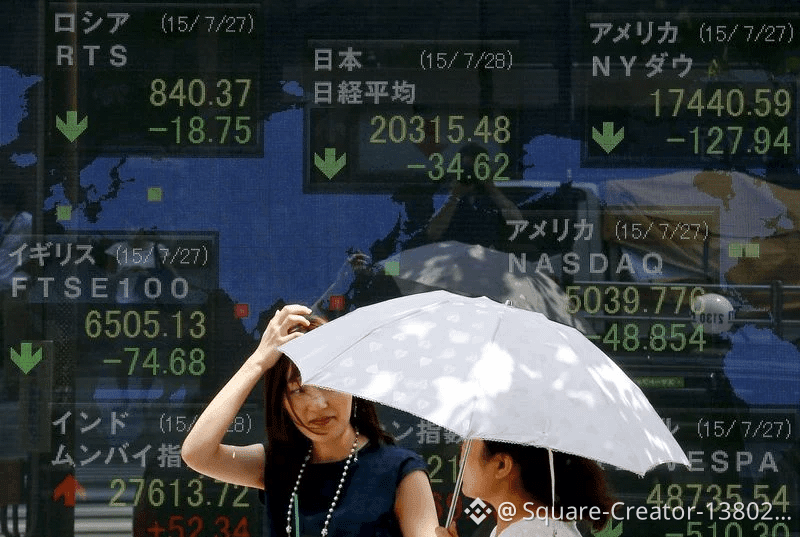
$TRUMP Asian tech stocks retreat as AI selloff deepens Asian technology stocks fell sharply on Friday, extending their recent losses amid growing concerns about a slowdown in the AI trade, compounded by weak results from major U.S. companies. Chipmaker stocks were hit hardest, with TSMC (TW:2330) — the region’s largest company by market capitalization — falling 1.80% in Taiwan trading. Shares of server and electronics assembler Hon Hai Precision Industry, known as Foxconn (TW:2317), also dropped 3%. South Korea’s Samsung Electronics Co Ltd (KS:005930) fell 5.90%, extending its losses after reporting third-quarter results on Thursday that fell short of elevated expectations. Its rival SK Hynix Inc (KS:000660) declined 8.30%. {future}(TRUMPUSDT) $XAU {future}(XAUUSDT) #EarningsSeason #StrategySTRCReaches$99.95ForFirstTimeIn165Days #SwitzerlandFirstSpotBitcoinETFExpectedToTradeInNovember #SwitzerlandFirstSpotBitcoinETFExpectedToTradeInNovember #StrategyReports$21BQ3OperatingProfit
$TRUMP Asian tech stocks retreat as AI selloff deepens

Asian technology stocks fell sharply on Friday, extending their recent losses amid growing concerns about a slowdown in the AI trade, compounded by weak results from major U.S. companies.

Chipmaker stocks were hit hardest, with TSMC (TW:2330) — the region’s largest company by market capitalization — falling 1.80% in Taiwan trading. Shares of server and electronics assembler Hon Hai Precision Industry, known as Foxconn (TW:2317), also dropped 3%.

South Korea’s Samsung Electronics Co Ltd (KS:005930) fell 5.90%, extending its losses after reporting third-quarter results on Thursday that fell short of elevated expectations. Its rival SK Hynix Inc (KS:000660) declined 8.30%.
$XAU
#EarningsSeason #StrategySTRCReaches$99.95ForFirstTimeIn165Days #SwitzerlandFirstSpotBitcoinETFExpectedToTradeInNovember #SwitzerlandFirstSpotBitcoinETFExpectedToTradeInNovember #StrategyReports$21BQ3OperatingProfit
How can I earn from posting on Binance? I still don't know whether earnings depend on the number of followers or the number of interactions.Come support me, friends #EarningsSeason #USMidtermElections #StrategyReports$21BQ3OperatingProfit #StrategyReports$21BQ3OperatingProfit $AAPLB

How can I earn from posting on Binance? I still don't know whether earnings depend on the number of followers or the number of interactions.

Log in to explore more content
Join global crypto users on Binance Square
⚡️ Get latest and useful information about crypto.
💬 Trusted by the world’s largest crypto exchange.
👍 Discover real insights from verified creators.
Email / Phone number