
#privacy
privacy
1.8M views
9,772 Discussing
Hot
Latest


·
--
Verified
#nearrisesnearly80%inaweek
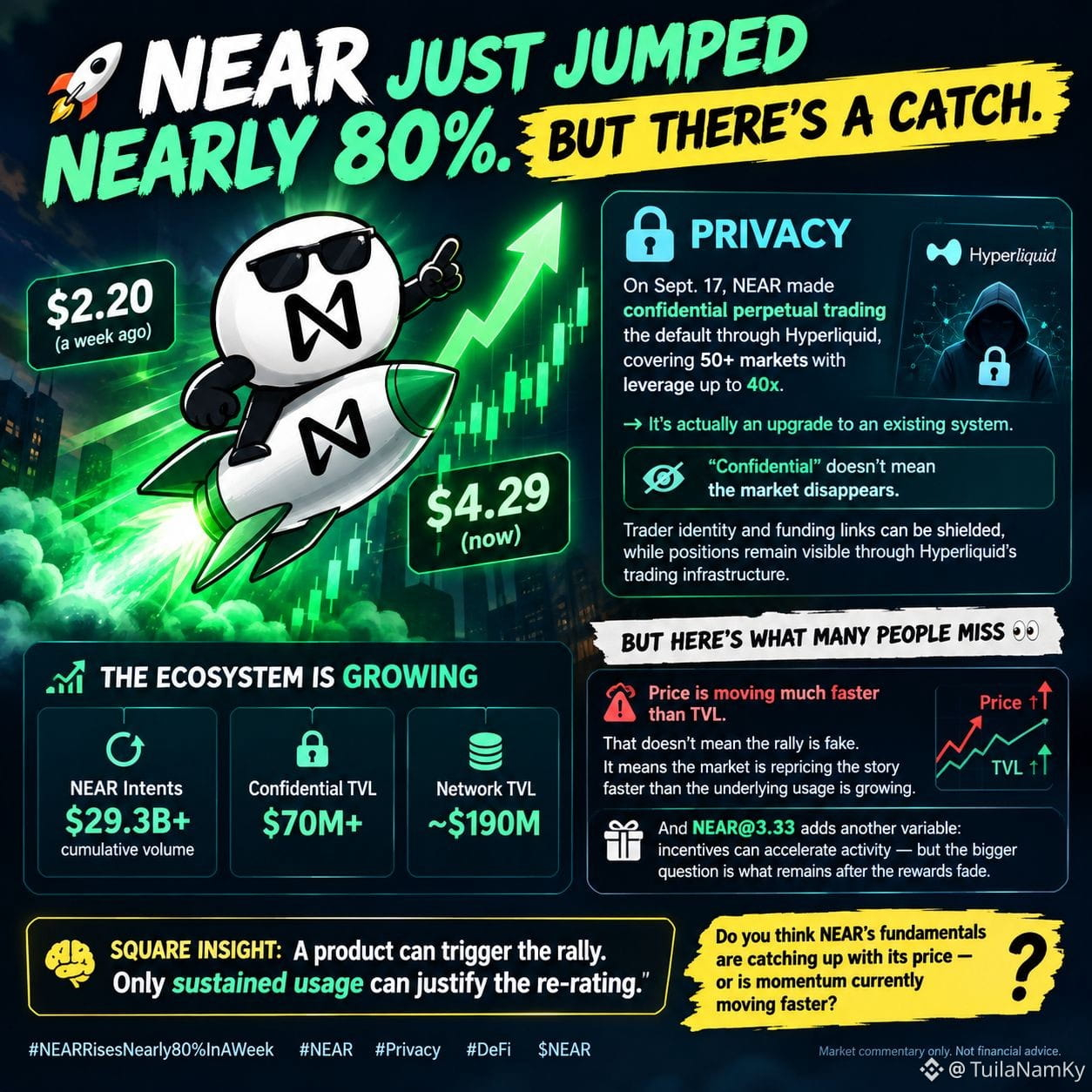
🚀 NEAR Just Jumped Nearly 80%. But There’s a Catch.
NEAR went from roughly $2.20 to $4.29 in a week.
Naturally, everyone started talking about one thing:
🔐 Privacy.
On Sept. 17, NEAR made confidential perpetual trading the default through Hyperliquid, covering 50+ markets with leverage up to 40x.
Sounds like a new product.
But it’s actually an upgrade to an existing system.
And “confidential” doesn’t mean the market disappears. 👀
Trader identity and funding links can be shielded, while positions remain visible through Hyperliquid’s trading infrastructure.
Meanwhile, the underlying ecosystem numbers are growing:
📊 NEAR Intents: $29.3B+ cumulative volume
🔐 Confidential TVL: $70M+
💰 Network TVL: ~$190M
BUT HERE’S WHAT MANY PEOPLE MISS 👀
Price is moving much faster than TVL.
That doesn’t automatically mean the rally is fake.
It means the market is repricing the story faster than the underlying usage is growing.
And NEAR@3.33 adds another variable: incentives can accelerate activity — but the bigger question is what remains after the rewards fade.
So the real test isn't:
“Can NEAR keep pumping?”
It’s:
“Can actual usage catch up with the re-rating?”
🧠 Square Insight:
A product can trigger the rally. Only sustained usage can justify the re-rating.
Do you think NEAR’s fundamentals are catching up with its price — or is momentum currently moving faster?
#NEAR #Privacy #DeFi $NEAR
{future}(NEARUSDT)
Market commentary only. Not financial advice.
#nearrisesnearly80%inaweek
🚀 NEAR Just Jumped Nearly 80%. But There’s a Catch.
NEAR went from roughly $2.20 to $4.29 in a week.
Naturally, everyone started talking about one thing:
🔐 Privacy.
On Sept. 17, NEAR made confidential perpetual trading the default through Hyperliquid, covering 50+ markets with leverage up to 40x.
Sounds like a new product.
But it’s actually an upgrade to an existing system.
And “confidential” doesn’t mean the market disappears. 👀
Trader identity and funding links can be shielded, while positions remain visible through Hyperliquid’s trading infrastructure.
Meanwhile, the underlying ecosystem numbers are growing:
📊 NEAR Intents: $29.3B+ cumulative volume
🔐 Confidential TVL: $70M+
💰 Network TVL: ~$190M
BUT HERE’S WHAT MANY PEOPLE MISS 👀
Price is moving much faster than TVL.
That doesn’t automatically mean the rally is fake.
It means the market is repricing the story faster than the underlying usage is growing.
And NEAR@3.33 adds another variable: incentives can accelerate activity — but the bigger question is what remains after the rewards fade.
So the real test isn't:
“Can NEAR keep pumping?”
It’s:
“Can actual usage catch up with the re-rating?”
🧠 Square Insight:
A product can trigger the rally. Only sustained usage can justify the re-rating.
Do you think NEAR’s fundamentals are catching up with its price — or is momentum currently moving faster?
#NEAR #Privacy #DeFi $NEAR
Market commentary only. Not financial advice.
🚀 NEAR Just Jumped Nearly 80%. But There’s a Catch.
NEAR went from roughly $2.20 to $4.29 in a week.
Naturally, everyone started talking about one thing:
🔐 Privacy.
On Sept. 17, NEAR made confidential perpetual trading the default through Hyperliquid, covering 50+ markets with leverage up to 40x.
Sounds like a new product.
But it’s actually an upgrade to an existing system.
And “confidential” doesn’t mean the market disappears. 👀
Trader identity and funding links can be shielded, while positions remain visible through Hyperliquid’s trading infrastructure.
Meanwhile, the underlying ecosystem numbers are growing:
📊 NEAR Intents: $29.3B+ cumulative volume
🔐 Confidential TVL: $70M+
💰 Network TVL: ~$190M
BUT HERE’S WHAT MANY PEOPLE MISS 👀
Price is moving much faster than TVL.
That doesn’t automatically mean the rally is fake.
It means the market is repricing the story faster than the underlying usage is growing.
And NEAR@3.33 adds another variable: incentives can accelerate activity — but the bigger question is what remains after the rewards fade.
So the real test isn't:
“Can NEAR keep pumping?”
It’s:
“Can actual usage catch up with the re-rating?”
🧠 Square Insight:
A product can trigger the rally. Only sustained usage can justify the re-rating.
Do you think NEAR’s fundamentals are catching up with its price — or is momentum currently moving faster?
#NEAR #Privacy #DeFi $NEAR
Market commentary only. Not financial advice.
1
3.1k

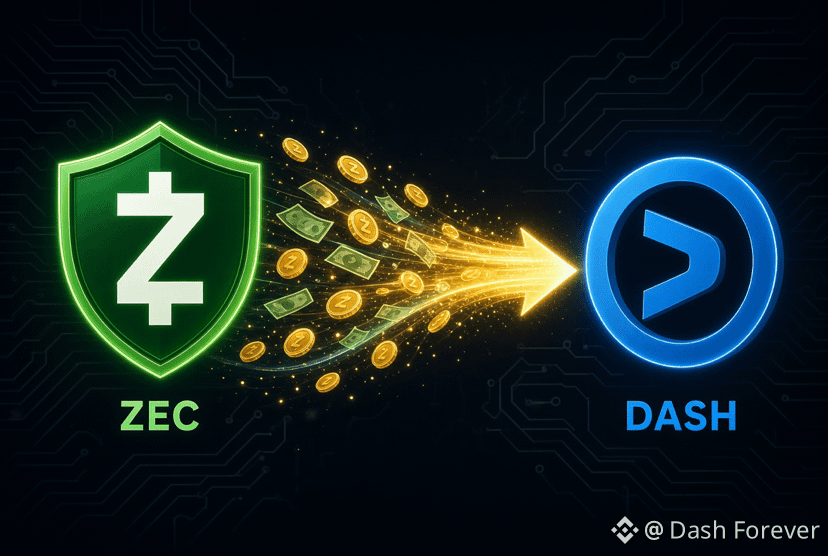
1. $ZEC The real question after the rally
$ZEC just showed why privacy can suddenly become a market narrative.
After reaching the $1,500 area, the question is no longer whether the move is strong.
It’s whether adoption can justify the attention.
Privacy is becoming a bigger sector again but price discovery and fundamental adoption are two different things.
The next phase may reveal which one is driving ZEC.
ZEC recently reached the $1,500 area before pulling back, while the broader privacy sector has expanded significantly over the past year.
#ZEC #zcash #Privacy #Crypto
{spot}(ZECUSDT)
1. $ZEC The real question after the rally
$ZEC just showed why privacy can suddenly become a market narrative.
After reaching the $1,500 area, the question is no longer whether the move is strong.
It’s whether adoption can justify the attention.
Privacy is becoming a bigger sector again but price discovery and fundamental adoption are two different things.
The next phase may reveal which one is driving ZEC.
ZEC recently reached the $1,500 area before pulling back, while the broader privacy sector has expanded significantly over the past year.
#ZEC #zcash #Privacy #Crypto
$ZEC just showed why privacy can suddenly become a market narrative.
After reaching the $1,500 area, the question is no longer whether the move is strong.
It’s whether adoption can justify the attention.
Privacy is becoming a bigger sector again but price discovery and fundamental adoption are two different things.
The next phase may reveal which one is driving ZEC.
ZEC recently reached the $1,500 area before pulling back, while the broader privacy sector has expanded significantly over the past year.
#ZEC #zcash #Privacy #Crypto
224

·
--
If you are still executing on-chain trades without privacy layers, you are actively giving away your edge to front-runners.
Every transaction you broadcast exposes your positioning, liquidation thresholds, and wallet history to MEV bots and copy-traders waiting to exploit your entries.
$NEAR is quietly overhauling trading infrastructure by rolling out private deposits and withdrawals, integrating directly with $HYPE to enable private perpetuals, and scaling cross-chain Intents. Some purists argue that total on-chain transparency is the bedrock of DeFi security, claiming obfuscation invites regulatory friction. But in reality, high-volume traders simply cannot survive in a transparent environment where predatory algorithms front-run every significant size order.
Infrastructure like this bridges the gap between decentralized custody and institutional-grade execution. As cross-chain intents expand, privacy stops being an optional luxury for retail and becomes fundamental execution defense.
Will integrated privacy on perpetuals finally push institutional volume entirely on-chain, or will regulatory pushback slow adoption?
#DeFi #CryptoTrading #Privacy
If you are still executing on-chain trades without privacy layers, you are actively giving away your edge to front-runners.
Every transaction you broadcast exposes your positioning, liquidation thresholds, and wallet history to MEV bots and copy-traders waiting to exploit your entries.
$NEAR is quietly overhauling trading infrastructure by rolling out private deposits and withdrawals, integrating directly with $HYPE to enable private perpetuals, and scaling cross-chain Intents. Some purists argue that total on-chain transparency is the bedrock of DeFi security, claiming obfuscation invites regulatory friction. But in reality, high-volume traders simply cannot survive in a transparent environment where predatory algorithms front-run every significant size order.
Infrastructure like this bridges the gap between decentralized custody and institutional-grade execution. As cross-chain intents expand, privacy stops being an optional luxury for retail and becomes fundamental execution defense.
Will integrated privacy on perpetuals finally push institutional volume entirely on-chain, or will regulatory pushback slow adoption?
#DeFi #CryptoTrading #Privacy
Every transaction you broadcast exposes your positioning, liquidation thresholds, and wallet history to MEV bots and copy-traders waiting to exploit your entries.
$NEAR is quietly overhauling trading infrastructure by rolling out private deposits and withdrawals, integrating directly with $HYPE to enable private perpetuals, and scaling cross-chain Intents. Some purists argue that total on-chain transparency is the bedrock of DeFi security, claiming obfuscation invites regulatory friction. But in reality, high-volume traders simply cannot survive in a transparent environment where predatory algorithms front-run every significant size order.
Infrastructure like this bridges the gap between decentralized custody and institutional-grade execution. As cross-chain intents expand, privacy stops being an optional luxury for retail and becomes fundamental execution defense.
Will integrated privacy on perpetuals finally push institutional volume entirely on-chain, or will regulatory pushback slow adoption?
#DeFi #CryptoTrading #Privacy

92

·
--
Privacy used to be something only whales could afford with mixers and OTC desks. Now the entire trading stack is getting it, and most retail still trades like it's 2021.
You've watched winning setups get copied the second they hit the chain, or felt that pit in your stomach when a liquidation cascade starts because everyone can see your size. After three cycles that transparency has cost more than any bad call I ever made.
NEAR is baking privacy directly into trading infrastructure so deposits and withdrawals stay off the public radar. Their Hyperliquid integration lets you run private perpetuals on $HYPE without broadcasting entries, while expanding cross-chain Intents on $NEAR means you can move size across $ETH and other chains without the usual MEV tax that wrecked so many in 2022. This is the kind of shift that separates the next cycle from the last one, where skill finally has a chance against surveillance.
Where do you think this privacy layer takes the market from here?
#NEAR #Privacy #DeFiTrading
Privacy used to be something only whales could afford with mixers and OTC desks. Now the entire trading stack is getting it, and most retail still trades like it's 2021.
You've watched winning setups get copied the second they hit the chain, or felt that pit in your stomach when a liquidation cascade starts because everyone can see your size. After three cycles that transparency has cost more than any bad call I ever made.
NEAR is baking privacy directly into trading infrastructure so deposits and withdrawals stay off the public radar. Their Hyperliquid integration lets you run private perpetuals on $HYPE without broadcasting entries, while expanding cross-chain Intents on $NEAR means you can move size across $ETH and other chains without the usual MEV tax that wrecked so many in 2022. This is the kind of shift that separates the next cycle from the last one, where skill finally has a chance against surveillance.
Where do you think this privacy layer takes the market from here?
#NEAR #Privacy #DeFiTrading
You've watched winning setups get copied the second they hit the chain, or felt that pit in your stomach when a liquidation cascade starts because everyone can see your size. After three cycles that transparency has cost more than any bad call I ever made.
NEAR is baking privacy directly into trading infrastructure so deposits and withdrawals stay off the public radar. Their Hyperliquid integration lets you run private perpetuals on $HYPE without broadcasting entries, while expanding cross-chain Intents on $NEAR means you can move size across $ETH and other chains without the usual MEV tax that wrecked so many in 2022. This is the kind of shift that separates the next cycle from the last one, where skill finally has a chance against surveillance.
Where do you think this privacy layer takes the market from here?
#NEAR #Privacy #DeFiTrading

141

If you're still broadcasting every move on public chains, stop now.
Watching your alpha get copied and sandwiched in real time is a special kind of pain. Traders have lost millions to MEV bots and copycats simply because everything sits in the open.
The narrative is shifting toward private trading, cross-chain settlement and confidential DeFi. We saw a similar rush into privacy coins like $ZEC back in 2017, but it mostly stayed theoretical while public chains exploded. This time $NEAR is actually shipping cross-chain tools that keep things quieter, and $ZAMA is building the confidential computing stack that could make DeFi private without breaking it.
It's the same cycle we always get. First everyone loves transparency until the exploits and the tracking start hurting. Then the smart ones look for the next layer of protection.
What's your take on whether this privacy push actually sticks this time?
#Crypto #DeFi #Privacy
If you're still broadcasting every move on public chains, stop now.
Watching your alpha get copied and sandwiched in real time is a special kind of pain. Traders have lost millions to MEV bots and copycats simply because everything sits in the open.
The narrative is shifting toward private trading, cross-chain settlement and confidential DeFi. We saw a similar rush into privacy coins like $ZEC back in 2017, but it mostly stayed theoretical while public chains exploded. This time $NEAR is actually shipping cross-chain tools that keep things quieter, and $ZAMA is building the confidential computing stack that could make DeFi private without breaking it.
It's the same cycle we always get. First everyone loves transparency until the exploits and the tracking start hurting. Then the smart ones look for the next layer of protection.
What's your take on whether this privacy push actually sticks this time?
#Crypto #DeFi #Privacy
Watching your alpha get copied and sandwiched in real time is a special kind of pain. Traders have lost millions to MEV bots and copycats simply because everything sits in the open.
The narrative is shifting toward private trading, cross-chain settlement and confidential DeFi. We saw a similar rush into privacy coins like $ZEC back in 2017, but it mostly stayed theoretical while public chains exploded. This time $NEAR is actually shipping cross-chain tools that keep things quieter, and $ZAMA is building the confidential computing stack that could make DeFi private without breaking it.
It's the same cycle we always get. First everyone loves transparency until the exploits and the tracking start hurting. Then the smart ones look for the next layer of protection.
What's your take on whether this privacy push actually sticks this time?
#Crypto #DeFi #Privacy

270
·
--
Here's what happened when the last privacy cycle collapsed and everyone wrote the whole category off as uninvestable.
Every on-chain trader I know has been copied, sandwiched, or watched their wallet become a public scoreboard. You either accept that or you sit out of DeFi entirely.
The 2017 privacy wave was $ZEC and a handful of mixers competing on who could hide a balance better, and that version died because it never plugged into real trading or settlement. What is forming now is a different stack built around private trading, cross-chain settlement, and confidential DeFi. $ZEC still owns the shielded transaction layer while $NEAR is pushing chain abstraction so value can move without every hop landing on a fully transparent ledger.
$ZAMA is taking a third path with fully homomorphic encryption, letting contracts compute on encrypted data instead of relying on the zero-knowledge proofs most privacy projects already tried. The comparison that actually matters is not Zcash versus Monero. It is public DeFi versus a confidential layer that can settle and compose. Last time privacy was a coin. This time it is trying to become infrastructure.
Where do you think this goes from here?
#ConfidentialDeFi #Privacy #CryptoNarrative
Here's what happened when the last privacy cycle collapsed and everyone wrote the whole category off as uninvestable.
Every on-chain trader I know has been copied, sandwiched, or watched their wallet become a public scoreboard. You either accept that or you sit out of DeFi entirely.
The 2017 privacy wave was $ZEC and a handful of mixers competing on who could hide a balance better, and that version died because it never plugged into real trading or settlement. What is forming now is a different stack built around private trading, cross-chain settlement, and confidential DeFi. $ZEC still owns the shielded transaction layer while $NEAR is pushing chain abstraction so value can move without every hop landing on a fully transparent ledger.
$ZAMA is taking a third path with fully homomorphic encryption, letting contracts compute on encrypted data instead of relying on the zero-knowledge proofs most privacy projects already tried. The comparison that actually matters is not Zcash versus Monero. It is public DeFi versus a confidential layer that can settle and compose. Last time privacy was a coin. This time it is trying to become infrastructure.
Where do you think this goes from here?
#ConfidentialDeFi #Privacy #CryptoNarrative
Every on-chain trader I know has been copied, sandwiched, or watched their wallet become a public scoreboard. You either accept that or you sit out of DeFi entirely.
The 2017 privacy wave was $ZEC and a handful of mixers competing on who could hide a balance better, and that version died because it never plugged into real trading or settlement. What is forming now is a different stack built around private trading, cross-chain settlement, and confidential DeFi. $ZEC still owns the shielded transaction layer while $NEAR is pushing chain abstraction so value can move without every hop landing on a fully transparent ledger.
$ZAMA is taking a third path with fully homomorphic encryption, letting contracts compute on encrypted data instead of relying on the zero-knowledge proofs most privacy projects already tried. The comparison that actually matters is not Zcash versus Monero. It is public DeFi versus a confidential layer that can settle and compose. Last time privacy was a coin. This time it is trying to become infrastructure.
Where do you think this goes from here?
#ConfidentialDeFi #Privacy #CryptoNarrative
296

·
--
Most traders still believe their on-chain activity stays private, yet analytics firms reconstruct over 90% of Bitcoin and Ethereum transaction graphs within minutes.
That public transparency you celebrate is the same thing that lets bots front-run your entries and copy your positions. I have watched too many traders lose sleep and capital because their entire history sat exposed on a ledger anyone could scrape.
The market is quietly rotating toward private trading, cross-chain settlement, and confidential DeFi. We saw this movie in 2017 when privacy coins like $ZEC exploded because people needed to move size without a spotlight. Then it faded as DeFi went fully transparent and MEV extracted billions.
Now the infrastructure is catching up. $NEAR is building the rails for scalable, low-leakage cross-chain flows while $ZAMA is pushing fully homomorphic encryption so smart contracts can run on encrypted data without ever seeing your balances or trades.
I sat through the last two cycles watching privacy get dismissed as a dead narrative. It never was. It was just waiting for the tools to match the demand. This time the combination of proven shielded transactions, better bridging, and real confidential computation actually exists.
Anyone else seeing capital start to flow into these privacy layers, or do you think the market still prefers the casino of public ledgers?
#Privacy #DeFi #CrossChain
Most traders still believe their on-chain activity stays private, yet analytics firms reconstruct over 90% of Bitcoin and Ethereum transaction graphs within minutes.
That public transparency you celebrate is the same thing that lets bots front-run your entries and copy your positions. I have watched too many traders lose sleep and capital because their entire history sat exposed on a ledger anyone could scrape.
The market is quietly rotating toward private trading, cross-chain settlement, and confidential DeFi. We saw this movie in 2017 when privacy coins like $ZEC exploded because people needed to move size without a spotlight. Then it faded as DeFi went fully transparent and MEV extracted billions.
Now the infrastructure is catching up. $NEAR is building the rails for scalable, low-leakage cross-chain flows while $ZAMA is pushing fully homomorphic encryption so smart contracts can run on encrypted data without ever seeing your balances or trades.
I sat through the last two cycles watching privacy get dismissed as a dead narrative. It never was. It was just waiting for the tools to match the demand. This time the combination of proven shielded transactions, better bridging, and real confidential computation actually exists.
Anyone else seeing capital start to flow into these privacy layers, or do you think the market still prefers the casino of public ledgers?
#Privacy #DeFi #CrossChain
That public transparency you celebrate is the same thing that lets bots front-run your entries and copy your positions. I have watched too many traders lose sleep and capital because their entire history sat exposed on a ledger anyone could scrape.
The market is quietly rotating toward private trading, cross-chain settlement, and confidential DeFi. We saw this movie in 2017 when privacy coins like $ZEC exploded because people needed to move size without a spotlight. Then it faded as DeFi went fully transparent and MEV extracted billions.
Now the infrastructure is catching up. $NEAR is building the rails for scalable, low-leakage cross-chain flows while $ZAMA is pushing fully homomorphic encryption so smart contracts can run on encrypted data without ever seeing your balances or trades.
I sat through the last two cycles watching privacy get dismissed as a dead narrative. It never was. It was just waiting for the tools to match the demand. This time the combination of proven shielded transactions, better bridging, and real confidential computation actually exists.
Anyone else seeing capital start to flow into these privacy layers, or do you think the market still prefers the casino of public ledgers?
#Privacy #DeFi #CrossChain

279

everyone thinks on-chain transparency is a feature but actually it's becoming a trap for anyone trying to size up.
ngl you've felt this ser. you enter a position, wallet trackers clock you, copytraders pile in, and you become exit liquidity. that's the real tax of public defi right now.
the shift toward private trading, cross-chain settlement and confidential defi is already underway and $ZEC is the clearest case study. people wrote it off for years and now privacy rails are suddenly relevant again.
$NEAR is handling the cross-chain settlement side with chain abstraction so you can move value without broadcasting every hop. zama is building confidential defi with fully homomorphic encryption so contracts compute without exposing your bags. this isn't three random names. it's where the narrative is actually rotating.
most people will keep farming the same transparent chains until this is already crowded. then they'll fomo the top like always.
anyone else seeing this rotation?
#privacy #DeFi #CrossChain
everyone thinks on-chain transparency is a feature but actually it's becoming a trap for anyone trying to size up.
ngl you've felt this ser. you enter a position, wallet trackers clock you, copytraders pile in, and you become exit liquidity. that's the real tax of public defi right now.
the shift toward private trading, cross-chain settlement and confidential defi is already underway and $ZEC is the clearest case study. people wrote it off for years and now privacy rails are suddenly relevant again.
$NEAR is handling the cross-chain settlement side with chain abstraction so you can move value without broadcasting every hop. zama is building confidential defi with fully homomorphic encryption so contracts compute without exposing your bags. this isn't three random names. it's where the narrative is actually rotating.
most people will keep farming the same transparent chains until this is already crowded. then they'll fomo the top like always.
anyone else seeing this rotation?
#privacy #DeFi #CrossChain
ngl you've felt this ser. you enter a position, wallet trackers clock you, copytraders pile in, and you become exit liquidity. that's the real tax of public defi right now.
the shift toward private trading, cross-chain settlement and confidential defi is already underway and $ZEC is the clearest case study. people wrote it off for years and now privacy rails are suddenly relevant again.
$NEAR is handling the cross-chain settlement side with chain abstraction so you can move value without broadcasting every hop. zama is building confidential defi with fully homomorphic encryption so contracts compute without exposing your bags. this isn't three random names. it's where the narrative is actually rotating.
most people will keep farming the same transparent chains until this is already crowded. then they'll fomo the top like always.
anyone else seeing this rotation?
#privacy #DeFi #CrossChain
237
·
--
Why is nobody talking about the quiet pivot toward private trading right now?
Most traders are still getting wrecked by MEV, front-running and transparent positions that get copied the second they hit the chain. You never really know when to exit because everyone can see your moves.
The mainstream keeps selling fully public chains as the only future. The real-world case study unfolding instead is private trading, cross-chain settlement and confidential DeFi.
$ZEC has delivered actual privacy through shielded transactions for years. $NEAR is building the rails for settlements that do not leak every detail across chains. $ZAMA is making confidential computation practical with fully homomorphic encryption.
That is the shift happening while the rest of the market still chases the same public hype cycles.
Where do you think this goes from here?
#Privacy #ConfidentialDeFi #Crypto
Why is nobody talking about the quiet pivot toward private trading right now?
Most traders are still getting wrecked by MEV, front-running and transparent positions that get copied the second they hit the chain. You never really know when to exit because everyone can see your moves.
The mainstream keeps selling fully public chains as the only future. The real-world case study unfolding instead is private trading, cross-chain settlement and confidential DeFi.
$ZEC has delivered actual privacy through shielded transactions for years. $NEAR is building the rails for settlements that do not leak every detail across chains. $ZAMA is making confidential computation practical with fully homomorphic encryption.
That is the shift happening while the rest of the market still chases the same public hype cycles.
Where do you think this goes from here?
#Privacy #ConfidentialDeFi #Crypto
Most traders are still getting wrecked by MEV, front-running and transparent positions that get copied the second they hit the chain. You never really know when to exit because everyone can see your moves.
The mainstream keeps selling fully public chains as the only future. The real-world case study unfolding instead is private trading, cross-chain settlement and confidential DeFi.
$ZEC has delivered actual privacy through shielded transactions for years. $NEAR is building the rails for settlements that do not leak every detail across chains. $ZAMA is making confidential computation practical with fully homomorphic encryption.
That is the shift happening while the rest of the market still chases the same public hype cycles.
Where do you think this goes from here?
#Privacy #ConfidentialDeFi #Crypto

251
·
--
Most traders still treat privacy as a 2017 leftover, yet the sector has quietly tripled in value while the rest of crypto chopped sideways.
You know that sinking feeling when a whale copies your exact wallet activity and front-runs every move, or when sandwich bots eat your lunch on a public DEX. That's the tax you pay for living on fully transparent chains.
I remember 2017 when $XMR was the only name that mattered. It was all about untraceable payments and that was the entire pitch. The market treated it as a one-trick pony that would fade once regulators got serious.
The game has changed completely. $ZEC is now shipping full shielded DeFi and $SCRT already runs private smart contracts that hide both balances and logic. We went from hiding who sent what to hiding what you even own and what your contracts are doing. Last cycle this whole space sat around a couple billion. This time zk-proofs plus regulatory pressure are pulling in real size.
I've watched this sector get written off after every crash. Same story in 2018 and 2022. The ones who understood it was bigger than mixing coins made the real money when the narrative flipped.
Where do you think this actually sits in the current cycle?
#Privacy #ZKProofs #Crypto
Most traders still treat privacy as a 2017 leftover, yet the sector has quietly tripled in value while the rest of crypto chopped sideways.
You know that sinking feeling when a whale copies your exact wallet activity and front-runs every move, or when sandwich bots eat your lunch on a public DEX. That's the tax you pay for living on fully transparent chains.
I remember 2017 when $XMR was the only name that mattered. It was all about untraceable payments and that was the entire pitch. The market treated it as a one-trick pony that would fade once regulators got serious.
The game has changed completely. $ZEC is now shipping full shielded DeFi and $SCRT already runs private smart contracts that hide both balances and logic. We went from hiding who sent what to hiding what you even own and what your contracts are doing. Last cycle this whole space sat around a couple billion. This time zk-proofs plus regulatory pressure are pulling in real size.
I've watched this sector get written off after every crash. Same story in 2018 and 2022. The ones who understood it was bigger than mixing coins made the real money when the narrative flipped.
Where do you think this actually sits in the current cycle?
#Privacy #ZKProofs #Crypto
You know that sinking feeling when a whale copies your exact wallet activity and front-runs every move, or when sandwich bots eat your lunch on a public DEX. That's the tax you pay for living on fully transparent chains.
I remember 2017 when $XMR was the only name that mattered. It was all about untraceable payments and that was the entire pitch. The market treated it as a one-trick pony that would fade once regulators got serious.
The game has changed completely. $ZEC is now shipping full shielded DeFi and $SCRT already runs private smart contracts that hide both balances and logic. We went from hiding who sent what to hiding what you even own and what your contracts are doing. Last cycle this whole space sat around a couple billion. This time zk-proofs plus regulatory pressure are pulling in real size.
I've watched this sector get written off after every crash. Same story in 2018 and 2022. The ones who understood it was bigger than mixing coins made the real money when the narrative flipped.
Where do you think this actually sits in the current cycle?
#Privacy #ZKProofs #Crypto

123
Have you noticed how most traders still treat privacy tokens like relics built solely for illicit transactions?
Most investors keep missing major structural shifts because they buy into outdated narratives, watching their capital sit idle while real technological utility quietly evolves elsewhere.
Take a closer look at what is happening across modern privacy ecosystems right now. The early era of simple shielded transfers is no longer the main thesis. Instead, networks like $ROSE and $SCRT are re-engineering the sector around confidential smart contracts, encrypted computation, and verifiable enterprise data layers.
When privacy becomes an infrastructure requirement rather than just a stealth payment feature, the entire valuation framework changes. Developers are now using these networks to eliminate front-running and MEV exploitation in decentralized finance, expanding the sector far beyond what older payment assets like $ZEC originally targeted.
Where do you see the privacy narrative heading once institutional adoption demands data confidentiality?
#Privacy #Crypto #DeFi
Have you noticed how most traders still treat privacy tokens like relics built solely for illicit transactions?
Most investors keep missing major structural shifts because they buy into outdated narratives, watching their capital sit idle while real technological utility quietly evolves elsewhere.
Take a closer look at what is happening across modern privacy ecosystems right now. The early era of simple shielded transfers is no longer the main thesis. Instead, networks like $ROSE and $SCRT are re-engineering the sector around confidential smart contracts, encrypted computation, and verifiable enterprise data layers.
When privacy becomes an infrastructure requirement rather than just a stealth payment feature, the entire valuation framework changes. Developers are now using these networks to eliminate front-running and MEV exploitation in decentralized finance, expanding the sector far beyond what older payment assets like $ZEC originally targeted.
Where do you see the privacy narrative heading once institutional adoption demands data confidentiality?
#Privacy #Crypto #DeFi
Most investors keep missing major structural shifts because they buy into outdated narratives, watching their capital sit idle while real technological utility quietly evolves elsewhere.
Take a closer look at what is happening across modern privacy ecosystems right now. The early era of simple shielded transfers is no longer the main thesis. Instead, networks like $ROSE and $SCRT are re-engineering the sector around confidential smart contracts, encrypted computation, and verifiable enterprise data layers.
When privacy becomes an infrastructure requirement rather than just a stealth payment feature, the entire valuation framework changes. Developers are now using these networks to eliminate front-running and MEV exploitation in decentralized finance, expanding the sector far beyond what older payment assets like $ZEC originally targeted.
Where do you see the privacy narrative heading once institutional adoption demands data confidentiality?
#Privacy #Crypto #DeFi
181
·
--
Have you noticed how most of us celebrate every green candle while quietly surrendering the core ethos that brought us here in the first place?
Most traders spend years chasing rallies, only to realize they have locked their capital into centralized systems that monitor every move and can freeze access at any moment.
Watching $BTC push back toward $86K makes it clear that decentralization has largely become a convenient marketing term. Real decentralization comes down to a simple reality: whether everyday participants can communicate and transact without handing over sensitive personal data to central gatekeepers.
To protect yourself, start evaluating projects by their architectural privacy rather than pure market hype. Look beyond basic custody by shifting your focus toward privacy-first networks like $XMR and emerging infrastructures like Liberdus that enforce permissionless access directly at the base layer.
Are we actually building financial sovereignty, or just recreating the traditional banking system on new rails?
#Bitcoin #Privacy #Crypto
Have you noticed how most of us celebrate every green candle while quietly surrendering the core ethos that brought us here in the first place?
Most traders spend years chasing rallies, only to realize they have locked their capital into centralized systems that monitor every move and can freeze access at any moment.
Watching $BTC push back toward $86K makes it clear that decentralization has largely become a convenient marketing term. Real decentralization comes down to a simple reality: whether everyday participants can communicate and transact without handing over sensitive personal data to central gatekeepers.
To protect yourself, start evaluating projects by their architectural privacy rather than pure market hype. Look beyond basic custody by shifting your focus toward privacy-first networks like $XMR and emerging infrastructures like Liberdus that enforce permissionless access directly at the base layer.
Are we actually building financial sovereignty, or just recreating the traditional banking system on new rails?
#Bitcoin #Privacy #Crypto
Most traders spend years chasing rallies, only to realize they have locked their capital into centralized systems that monitor every move and can freeze access at any moment.
Watching $BTC push back toward $86K makes it clear that decentralization has largely become a convenient marketing term. Real decentralization comes down to a simple reality: whether everyday participants can communicate and transact without handing over sensitive personal data to central gatekeepers.
To protect yourself, start evaluating projects by their architectural privacy rather than pure market hype. Look beyond basic custody by shifting your focus toward privacy-first networks like $XMR and emerging infrastructures like Liberdus that enforce permissionless access directly at the base layer.
Are we actually building financial sovereignty, or just recreating the traditional banking system on new rails?
#Bitcoin #Privacy #Crypto
253
·
--
If you are measuring crypto success purely by price pumps while ignoring real decentralization, you are making a dangerous mistake.
Most traders get blinded by short-term rallies, only to realize later that they handed over full control of their transactions and personal identity to centralized intermediaries.
Watching $BTC push back toward $86K today highlights an unresolved debate across the market. On one side, mainstream liquidity and institutional capital continue flooding into major assets like $ETH, but on the other, the concept of decentralization has slowly been watered down into a convenient marketing label.
The original standard for this space was simple: enabling people to participate and communicate without surrendering personal information or answering to central gatekeepers. While many modern networks compromise on user privacy to chase quick adoption, protocols like Liberdus demonstrate why open, censorship-resistant infrastructure remains the actual foundation of sovereign finance.
Are we genuinely building an open financial future, or just rebuilding the traditional banking model on a ledger?
#Bitcoin #Crypto #Privacy
If you are measuring crypto success purely by price pumps while ignoring real decentralization, you are making a dangerous mistake.
Most traders get blinded by short-term rallies, only to realize later that they handed over full control of their transactions and personal identity to centralized intermediaries.
Watching $BTC push back toward $86K today highlights an unresolved debate across the market. On one side, mainstream liquidity and institutional capital continue flooding into major assets like $ETH , but on the other, the concept of decentralization has slowly been watered down into a convenient marketing label.
The original standard for this space was simple: enabling people to participate and communicate without surrendering personal information or answering to central gatekeepers. While many modern networks compromise on user privacy to chase quick adoption, protocols like Liberdus demonstrate why open, censorship-resistant infrastructure remains the actual foundation of sovereign finance.
Are we genuinely building an open financial future, or just rebuilding the traditional banking model on a ledger?
#Bitcoin #Crypto #Privacy
Most traders get blinded by short-term rallies, only to realize later that they handed over full control of their transactions and personal identity to centralized intermediaries.
Watching $BTC push back toward $86K today highlights an unresolved debate across the market. On one side, mainstream liquidity and institutional capital continue flooding into major assets like $ETH , but on the other, the concept of decentralization has slowly been watered down into a convenient marketing label.
The original standard for this space was simple: enabling people to participate and communicate without surrendering personal information or answering to central gatekeepers. While many modern networks compromise on user privacy to chase quick adoption, protocols like Liberdus demonstrate why open, censorship-resistant infrastructure remains the actual foundation of sovereign finance.
Are we genuinely building an open financial future, or just rebuilding the traditional banking model on a ledger?
#Bitcoin #Crypto #Privacy
11
·
--
Here's what happened when $BTC pushed toward $86K last week and it exposed how little most people remember about crypto's original purpose.
Crypto traders keep losing money to rugs and hacks because they rely on centralized gatekeepers that demand personal data. One leak and the damage is already done.
Decentralized became just another marketing term along the way. The real test was always whether people can participate without giving away unnecessary information or depending on a central party.
Most missed this while $BTC recovered. $LIBERDUS is building an open network focused on privacy that actually tries to solve it. The risk if this does not catch on is more users getting burned by the same old centralized failures.
$XMR showed what privacy can look like in practice. Ignoring that lesson now means repeating the same mistakes at larger scale.
Anyone else seeing this gap between the $BTC price action and the actual infrastructure we need?
#Bitcoin #Privacy #Decentralization
Here's what happened when $BTC pushed toward $86K last week and it exposed how little most people remember about crypto's original purpose.
Crypto traders keep losing money to rugs and hacks because they rely on centralized gatekeepers that demand personal data. One leak and the damage is already done.
Decentralized became just another marketing term along the way. The real test was always whether people can participate without giving away unnecessary information or depending on a central party.
Most missed this while $BTC recovered. $LIBERDUS is building an open network focused on privacy that actually tries to solve it. The risk if this does not catch on is more users getting burned by the same old centralized failures.
$XMR showed what privacy can look like in practice. Ignoring that lesson now means repeating the same mistakes at larger scale.
Anyone else seeing this gap between the $BTC price action and the actual infrastructure we need?
#Bitcoin #Privacy #Decentralization
Crypto traders keep losing money to rugs and hacks because they rely on centralized gatekeepers that demand personal data. One leak and the damage is already done.
Decentralized became just another marketing term along the way. The real test was always whether people can participate without giving away unnecessary information or depending on a central party.
Most missed this while $BTC recovered. $LIBERDUS is building an open network focused on privacy that actually tries to solve it. The risk if this does not catch on is more users getting burned by the same old centralized failures.
$XMR showed what privacy can look like in practice. Ignoring that lesson now means repeating the same mistakes at larger scale.
Anyone else seeing this gap between the $BTC price action and the actual infrastructure we need?
#Bitcoin #Privacy #Decentralization
72
Everyone cheering $BTC at $86K is missing how much personal data still leaks with every on-chain move.
Traders keep getting wrecked by hacks and targeted rugs because they have to trust a company or share extra details just to participate.
Decentralized turned into marketing years ago. The real test is whether you can actually use a network and communicate without handing over unnecessary personal information or waiting on a central gatekeeper. Most activity on $ETH and $SOL still fails that test in practice.
That's why Liberdus stands out right now. They're building an open network focused on privacy so people can stay in control instead of doxxing themselves. If this kind of approach doesn't catch on the next leak or shutdown will keep costing people funds they thought were safe.
What's your take on whether true permissionless privacy is even realistic at this point?
#Bitcoin #Privacy #Decentralization
Everyone cheering $BTC at $86K is missing how much personal data still leaks with every on-chain move.
Traders keep getting wrecked by hacks and targeted rugs because they have to trust a company or share extra details just to participate.
Decentralized turned into marketing years ago. The real test is whether you can actually use a network and communicate without handing over unnecessary personal information or waiting on a central gatekeeper. Most activity on $ETH and $SOL still fails that test in practice.
That's why Liberdus stands out right now. They're building an open network focused on privacy so people can stay in control instead of doxxing themselves. If this kind of approach doesn't catch on the next leak or shutdown will keep costing people funds they thought were safe.
What's your take on whether true permissionless privacy is even realistic at this point?
#Bitcoin #Privacy #Decentralization
Traders keep getting wrecked by hacks and targeted rugs because they have to trust a company or share extra details just to participate.
Decentralized turned into marketing years ago. The real test is whether you can actually use a network and communicate without handing over unnecessary personal information or waiting on a central gatekeeper. Most activity on $ETH and $SOL still fails that test in practice.
That's why Liberdus stands out right now. They're building an open network focused on privacy so people can stay in control instead of doxxing themselves. If this kind of approach doesn't catch on the next leak or shutdown will keep costing people funds they thought were safe.
What's your take on whether true permissionless privacy is even realistic at this point?
#Bitcoin #Privacy #Decentralization
17

·
--
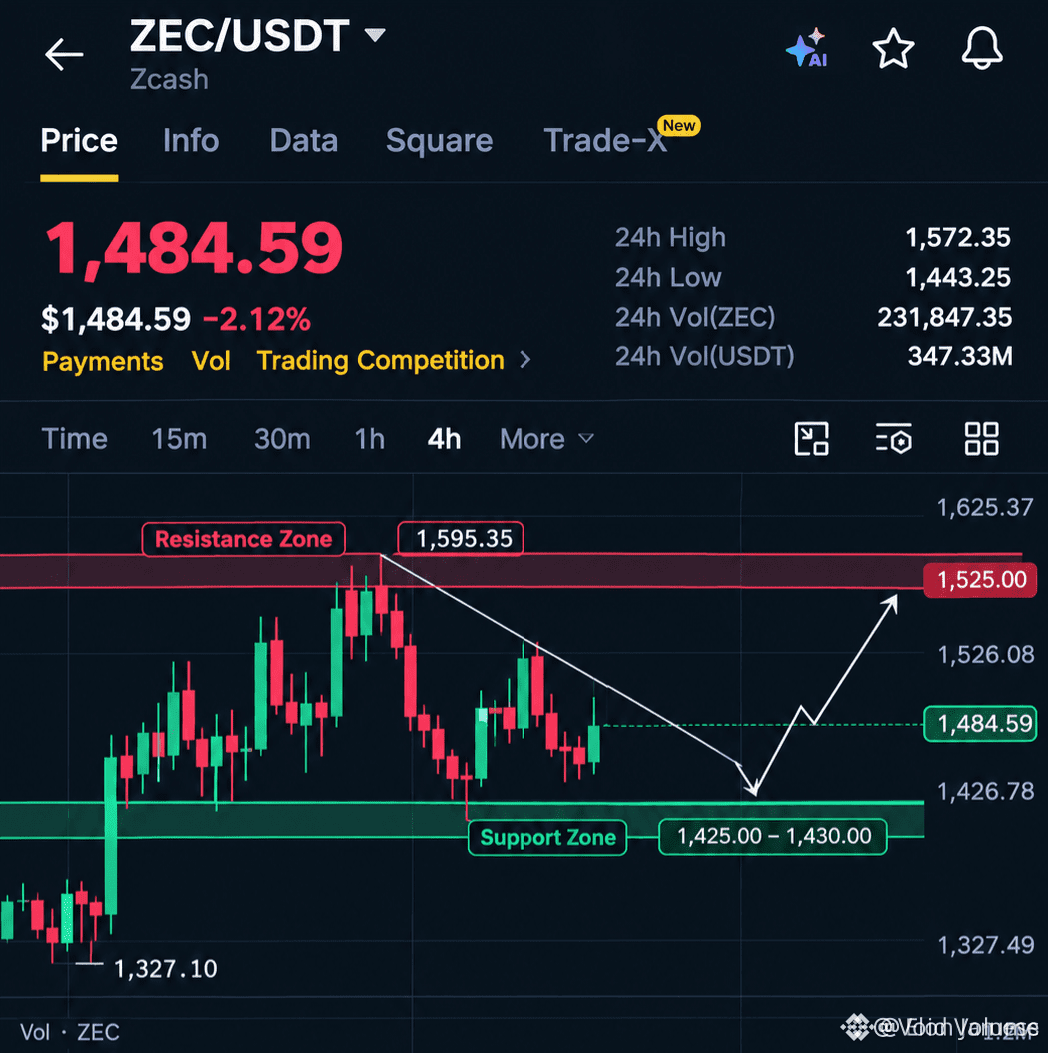
🚨 $ZEC TESTS CRITICAL DEMAND ZONE AS PRIVACY SECTOR LIQUIDITY BUILDS ⚡
Entry: 1,425 - 1,430 ⚡
Target: 1,595 🚀
After sweeping local highs near $1,595, $ZEC pulled back to stabilize around $1,480 as order flow gradually rotates across the privacy sector. 🌊 The primary structural demand block between $1,425 and $1,430 remains the critical floor where buyers must step in to defend the macro recovery framework.
📌 A decisive reclaim above the $1,525 structural pivot will confirm buyer absorption and open the runway toward high-timeframe liquidity. 💡 With capital flowing into sector peers like $XMR , watching price behavior around this demand boundary is essential. 💬 Will $ZEC defend this demand zone for a structural continuation or are we due for a deeper sweep? 👇
⚠️ Not financial advice. Always manage your risk. 🛡️
🏷️ #ZEC #Privacy #MarketStructure #Crypto
🔥 💎
🚨 $ZEC TESTS CRITICAL DEMAND ZONE AS PRIVACY SECTOR LIQUIDITY BUILDS ⚡
Entry: 1,425 - 1,430 ⚡
Target: 1,595 🚀
After sweeping local highs near $1,595, $ZEC pulled back to stabilize around $1,480 as order flow gradually rotates across the privacy sector. 🌊 The primary structural demand block between $1,425 and $1,430 remains the critical floor where buyers must step in to defend the macro recovery framework.
📌 A decisive reclaim above the $1,525 structural pivot will confirm buyer absorption and open the runway toward high-timeframe liquidity. 💡 With capital flowing into sector peers like $XMR , watching price behavior around this demand boundary is essential. 💬 Will $ZEC defend this demand zone for a structural continuation or are we due for a deeper sweep? 👇
⚠️ Not financial advice. Always manage your risk. 🛡️
🏷️ #ZEC #Privacy #MarketStructure #Crypto
🔥 💎
Entry: 1,425 - 1,430 ⚡
Target: 1,595 🚀
After sweeping local highs near $1,595, $ZEC pulled back to stabilize around $1,480 as order flow gradually rotates across the privacy sector. 🌊 The primary structural demand block between $1,425 and $1,430 remains the critical floor where buyers must step in to defend the macro recovery framework.
📌 A decisive reclaim above the $1,525 structural pivot will confirm buyer absorption and open the runway toward high-timeframe liquidity. 💡 With capital flowing into sector peers like $XMR , watching price behavior around this demand boundary is essential. 💬 Will $ZEC defend this demand zone for a structural continuation or are we due for a deeper sweep? 👇
⚠️ Not financial advice. Always manage your risk. 🛡️
🏷️ #ZEC #Privacy #MarketStructure #Crypto
🔥 💎
178

$ZEC is trading around $1,500, and it's up roughly 168% over the past month.
Zcash's privacy-coin rally has been driven by a coinholder vote to keep Bitcoin-style halvings, a Grayscale ETF nearing $890M in assets, and a planned NU7 upgrade set for September 30 that would cut block times from 75 to 25 seconds.
Fast triple-digit monthly moves usually cool off eventually. I'm watching whether the ETF inflows keep pace after the upgrade lands.
Do you think privacy coins keep leading, or is $ZEC due for a breather?
#zcash #zec #Privacy #CryptoNews #BinanceSquare
{future}(ZECUSDT)
$ZEC is trading around $1,500, and it's up roughly 168% over the past month.
Zcash's privacy-coin rally has been driven by a coinholder vote to keep Bitcoin-style halvings, a Grayscale ETF nearing $890M in assets, and a planned NU7 upgrade set for September 30 that would cut block times from 75 to 25 seconds.
Fast triple-digit monthly moves usually cool off eventually. I'm watching whether the ETF inflows keep pace after the upgrade lands.
Do you think privacy coins keep leading, or is $ZEC due for a breather?
#zcash #zec #Privacy #CryptoNews #BinanceSquare
Zcash's privacy-coin rally has been driven by a coinholder vote to keep Bitcoin-style halvings, a Grayscale ETF nearing $890M in assets, and a planned NU7 upgrade set for September 30 that would cut block times from 75 to 25 seconds.
Fast triple-digit monthly moves usually cool off eventually. I'm watching whether the ETF inflows keep pace after the upgrade lands.
Do you think privacy coins keep leading, or is $ZEC due for a breather?
#zcash #zec #Privacy #CryptoNews #BinanceSquare

136

·
--
🚀 $ZEC — PRIVACY IS A FEATURE, NOT A LUXURY 🔐
In a world where blockchain transactions can often be publicly tracked, takes a different approach.
🛡️ What makes interesting?
Zcash is a privacy-focused cryptocurrency designed to give users the option of making transactions with enhanced financial privacy.
🔹 Shielded Transactions — Designed to protect transaction details using zero-knowledge cryptography.
🔹 Halo Technology — Zcash uses the Halo proving system, enabling advanced zero-knowledge proofs without a trusted setup.
🔹 Privacy by Default — Supporting wallets can provide shielded-by-default experiences.
🔹 Decentralized Network — $ZEC operates on the Zcash blockchain with privacy and user control at its core.
🔹 Growing Ecosystem — Development continues around wallets, usability, cross-chain payments and protocol improvements.
⚡ Why watch $ZEC?
Privacy remains an important topic in the crypto industry, and Zcash continues to build technology focused on private digital payments.
The combination of zero-knowledge cryptography + shielded transactions + user-controlled privacy makes $ZEC a project worth keeping on the radar.
📊 Not financial advice.
Always do your own research and understand the risks before trading.
💬 What do you think about the future of privacy-focused cryptocurrencies?
👇 Share your thoughts on $ZEC!
#ZEC #Zcash #Crypto #Binance #Privacy #Blockchain #Web3 #ZeroKnowledge #CryptoCommunity
🚀 $ZEC — PRIVACY IS A FEATURE, NOT A LUXURY 🔐
In a world where blockchain transactions can often be publicly tracked, takes a different approach.
🛡️ What makes interesting?
Zcash is a privacy-focused cryptocurrency designed to give users the option of making transactions with enhanced financial privacy.
🔹 Shielded Transactions — Designed to protect transaction details using zero-knowledge cryptography.
🔹 Halo Technology — Zcash uses the Halo proving system, enabling advanced zero-knowledge proofs without a trusted setup.
🔹 Privacy by Default — Supporting wallets can provide shielded-by-default experiences.
🔹 Decentralized Network — $ZEC operates on the Zcash blockchain with privacy and user control at its core.
🔹 Growing Ecosystem — Development continues around wallets, usability, cross-chain payments and protocol improvements.
⚡ Why watch $ZEC ?
Privacy remains an important topic in the crypto industry, and Zcash continues to build technology focused on private digital payments.
The combination of zero-knowledge cryptography + shielded transactions + user-controlled privacy makes $ZEC a project worth keeping on the radar.
📊 Not financial advice.
Always do your own research and understand the risks before trading.
💬 What do you think about the future of privacy-focused cryptocurrencies?
👇 Share your thoughts on $ZEC !
#ZEC #Zcash #Crypto #Binance #Privacy #Blockchain #Web3 #ZeroKnowledge #CryptoCommunity
In a world where blockchain transactions can often be publicly tracked, takes a different approach.
🛡️ What makes interesting?
Zcash is a privacy-focused cryptocurrency designed to give users the option of making transactions with enhanced financial privacy.
🔹 Shielded Transactions — Designed to protect transaction details using zero-knowledge cryptography.
🔹 Halo Technology — Zcash uses the Halo proving system, enabling advanced zero-knowledge proofs without a trusted setup.
🔹 Privacy by Default — Supporting wallets can provide shielded-by-default experiences.
🔹 Decentralized Network — $ZEC operates on the Zcash blockchain with privacy and user control at its core.
🔹 Growing Ecosystem — Development continues around wallets, usability, cross-chain payments and protocol improvements.
⚡ Why watch $ZEC ?
Privacy remains an important topic in the crypto industry, and Zcash continues to build technology focused on private digital payments.
The combination of zero-knowledge cryptography + shielded transactions + user-controlled privacy makes $ZEC a project worth keeping on the radar.
📊 Not financial advice.
Always do your own research and understand the risks before trading.
💬 What do you think about the future of privacy-focused cryptocurrencies?
👇 Share your thoughts on $ZEC !
#ZEC #Zcash #Crypto #Binance #Privacy #Blockchain #Web3 #ZeroKnowledge #CryptoCommunity

196

Venice token is turning heads after an explosive rally to $34, driven by a relentless focus on total privacy. Unlike mainstream AI models that monetize your data, VVV offers a clean slate the second you close the tab. This zero-retention approach is striking a chord as surveillance fatigue grows. While hyper-growth assets carry massive volatility, the shift toward privacy-first infrastructure might just be getting started. Keep an eye on how this narrative plays out. $VVV #CryptoNews #AI #Privacy
Venice token is turning heads after an explosive rally to $34, driven by a relentless focus on total privacy. Unlike mainstream AI models that monetize your data, VVV offers a clean slate the second you close the tab. This zero-retention approach is striking a chord as surveillance fatigue grows. While hyper-growth assets carry massive volatility, the shift toward privacy-first infrastructure might just be getting started. Keep an eye on how this narrative plays out. $VVV #CryptoNews #AI #Privacy
159
Log in to explore more content
Join global crypto users on Binance Square
⚡️ Get latest and useful information about crypto.
💬 Trusted by the world’s largest crypto exchange.
👍 Discover real insights from verified creators.
Email / Phone number
Trending Topics
1
#AIStocksWhatNext
373,395 views
2,996 Discussing
2
#BitcoinBreaksAboveMayHighNears$86K
15,017 views
192 Discussing
3
#DogecoinRises15%
48,017 views
995 Discussing
4
#$14BBitcoinOptionsExpireFriday
3,898 views
89 Discussing
5
#BNBMarketCapPassesBNYMellon
30,273 views
711 Discussing
6
#CryptoMarketCapReclaims$3Trillion
5,166 views
82 Discussing
7
#MuseOvertakesChatGPTAsTopFreeIOSApp
17,850 views
534 Discussing
8
#TokenizedStockPlatformsCouldLaunchNextQuarter
28,268 views
588 Discussing
9
#StrategyAdds950Bitcoin
35,325 views
685 Discussing
10
#CardanoAddedToX402KitForADAPayments
30,021 views
658 Discussing