
#malwarealert
malwarealert
5,810 views
40 Discussing
Hot
Latest

🚨 2,000 WORDPRESS SITES HAVE JUST BECOME MALWARE DISTRIBUTION CENTERS 💀
Check Point Research has found that the StopAndProtect ransomware campaign leveraged nearly 2,000 compromised WordPress websites to spread malware, steal data, and deploy ransomware.
A few noteworthy figures:
→ ~2,000 WordPress sites were exploited
→ 6,000+ IP addresses were targeted
→ US: 1,852 IPs
→ Russia: 630
→ India: 630
→ 31,000+ screenshots collected
→ 700+ compressed data packages taken
The attack method is also pretty “shady”:
Victims encounter a fake CAPTCHA → are lured into running PowerShell → malware steals credentials, the crypto wallet seed phrase/mnemonic → then attempts to spread to the network and USB devices.
More notably, the hacked WordPress websites aren’t just used as a “front.”
They’re also used to:
host malware → send commands → store stolen data → store screenshots → store activity logs.
A normal WordPress website:
“Welcome to my blog.”
Hacker:
“Welcome to my malware infrastructure.” 💀
And there’s a detail that’s both funny and terrifying:
Researchers believe the attackers may have accidentally infected their own systems.
Bro deployed malware and forgot to uninstall the malware. 💀
⚠️ If you’re managing WordPress: update the core/plugins/themes, enable MFA, review admin accounts, and above all, don’t run PowerShell commands just because a CAPTCHA tells you to.
Guys using WordPress, remember to recheck your site.
#BrainrotCrypto #MalwareAlert
🚨 2,000 WORDPRESS SITES HAVE JUST BECOME MALWARE DISTRIBUTION CENTERS 💀
Check Point Research has found that the StopAndProtect ransomware campaign leveraged nearly 2,000 compromised WordPress websites to spread malware, steal data, and deploy ransomware.
A few noteworthy figures:
→ ~2,000 WordPress sites were exploited
→ 6,000+ IP addresses were targeted
→ US: 1,852 IPs
→ Russia: 630
→ India: 630
→ 31,000+ screenshots collected
→ 700+ compressed data packages taken
The attack method is also pretty “shady”:
Victims encounter a fake CAPTCHA → are lured into running PowerShell → malware steals credentials, the crypto wallet seed phrase/mnemonic → then attempts to spread to the network and USB devices.
More notably, the hacked WordPress websites aren’t just used as a “front.”
They’re also used to:
host malware → send commands → store stolen data → store screenshots → store activity logs.
A normal WordPress website:
“Welcome to my blog.”
Hacker:
“Welcome to my malware infrastructure.” 💀
And there’s a detail that’s both funny and terrifying:
Researchers believe the attackers may have accidentally infected their own systems.
Bro deployed malware and forgot to uninstall the malware. 💀
⚠️ If you’re managing WordPress: update the core/plugins/themes, enable MFA, review admin accounts, and above all, don’t run PowerShell commands just because a CAPTCHA tells you to.
Guys using WordPress, remember to recheck your site.
#BrainrotCrypto #MalwareAlert
Check Point Research has found that the StopAndProtect ransomware campaign leveraged nearly 2,000 compromised WordPress websites to spread malware, steal data, and deploy ransomware.
A few noteworthy figures:
→ ~2,000 WordPress sites were exploited
→ 6,000+ IP addresses were targeted
→ US: 1,852 IPs
→ Russia: 630
→ India: 630
→ 31,000+ screenshots collected
→ 700+ compressed data packages taken
The attack method is also pretty “shady”:
Victims encounter a fake CAPTCHA → are lured into running PowerShell → malware steals credentials, the crypto wallet seed phrase/mnemonic → then attempts to spread to the network and USB devices.
More notably, the hacked WordPress websites aren’t just used as a “front.”
They’re also used to:
host malware → send commands → store stolen data → store screenshots → store activity logs.
A normal WordPress website:
“Welcome to my blog.”
Hacker:
“Welcome to my malware infrastructure.” 💀
And there’s a detail that’s both funny and terrifying:
Researchers believe the attackers may have accidentally infected their own systems.
Bro deployed malware and forgot to uninstall the malware. 💀
⚠️ If you’re managing WordPress: update the core/plugins/themes, enable MFA, review admin accounts, and above all, don’t run PowerShell commands just because a CAPTCHA tells you to.
Guys using WordPress, remember to recheck your site.
#BrainrotCrypto #MalwareAlert

1
214

·
--
Hackers are using Google's ad systems to distribute malware, bypassing most security tools.
• Malicious actors are leveraging Google's advertising infrastructure to spread malware
• Most current security tools are failing to detect this threat
• Users are advised to exercise caution with online advertisements
#CryptoSecurity #CryptoNews #BinanceSquare #MalwareAlert #OnlineSafety
Hackers are using Google's ad systems to distribute malware, bypassing most security tools.
• Malicious actors are leveraging Google's advertising infrastructure to spread malware
• Most current security tools are failing to detect this threat
• Users are advised to exercise caution with online advertisements
#CryptoSecurity #CryptoNews #BinanceSquare #MalwareAlert #OnlineSafety
• Malicious actors are leveraging Google's advertising infrastructure to spread malware
• Most current security tools are failing to detect this threat
• Users are advised to exercise caution with online advertisements
#CryptoSecurity #CryptoNews #BinanceSquare #MalwareAlert #OnlineSafety
17

Article
Microsoft Warns of New Crypto Malware: How To Protect Your WalletMicrosoft has uncovered a crypto-stealing malware campaign that skips the blockchain entirely and goes straight for the user's device, lifting seed phrases, private keys, and quietly swapping wallet addresses.
Key Takeaways
Microsoft flagged a Windows crypto clipper malware active since February 2026.It spreads through malicious shortcut files on USB drives.The malware steals seed phrases and swaps copied wallet addresses.It hides its command server inside the Tor network.Microsoft Defender detects it as Trojan:Win32/CryptoBandits.A.It attacks the device, not the blockchain or the exchange.Attacks on individual wallets are a fast-growing share of crypto theft.
Microsoft has uncovered a crypto-stealing malware campaign that skips the blockchain entirely and goes straight for the user's device, lifting seed phrases, private keys, and quietly swapping the wallet addresses people copy and paste.
What Microsoft Found
Microsoft Threat Intelligence disclosed a Windows-based cryptocurrency clipper campaign that has been running since February 2026. The malware spreads through malicious shortcut, or .lnk, files planted on USB storage devices. When a victim opens what looks like an ordinary file shortcut, the payload quietly installs two parts: a worm that copies itself to other removable drives, and a clipper module built to harvest crypto credentials.
Once active, it runs several high-value operations at once. It scans for seed phrases and private keys, captures screenshots, monitors the clipboard, replaces copied wallet addresses with attacker-controlled ones, and keeps a remote connection open through Tor. Microsoft Defender detects it as Trojan:Win32/CryptoBandits.A.
Why It Attacks the Device, Not the Chain
The most concerning part is the target. Rather than breaching an exchange or exploiting a smart contract, this malware compromises the entire ownership process at its weakest link: the computer itself. Most users concentrate their security thinking on exchange accounts, hardware wallets, and contract risk. This campaign sidesteps all of that.
The logic is simple and unforgiving. If an attacker obtains a 12 or 24-word seed phrase, a private key, or substitutes the address a user is about to send to, the blockchain's security becomes irrelevant, because the compromise happened before the transaction was ever signed. No amount of on-chain security helps when the theft occurs on the device.
How the Clipboard Attack Works
The malware continuously scans clipboard contents roughly every 500 milliseconds, hunting for seed phrases, private keys, and wallet addresses across multiple chains, with support for Bitcoin (including legacy, P2SH, Taproot, and Bech32 formats), Tron, and Monero addresses. When it detects a copied address, it can silently replace it with the attacker's address before the user pastes it into a wallet or withdrawal form. To avoid suspicion, the substitute addresses are chosen to resemble parts of the original, making a quick visual check unreliable. Captured data is then sent out through Tor, where it is far harder to trace.
The Tor Component That Makes It Hard to Stop
Rather than relying on conventional command-and-control servers, the campaign bundles its own Tor client, routes traffic through a local SOCKS5 proxy on localhost:9050, and communicates with hidden .onion services. It also supports remote code execution, running attacker-supplied code on command. Because it leans on built-in Windows scripting tools instead of a large, detectable installer, it slips past simple file-based scanning and conventional network monitoring.
Signs Your Device May Be Compromised
Because this malware avoids a bulky installer and runs through legitimate Windows tools, it leaves subtle traces rather than obvious ones here are several behaviors worth watching for:
Files on a USB drive turned into shortcuts. The worm hides your real files and replaces them with look-alike .lnk shortcuts carrying the same names, a hallmark of the infection.Unexpected scripting activity. Additional red flags are wscript.exe or cscript.exe running from user folders or removable drives, and PowerShell launching screen captures.An unfamiliar process or proxy. The malware runs a bundled Tor client (observed as a renamed binary) and opens a local proxy on port 9050, activity that does not belong on most personal machines.A pasted address that does not match. If a wallet address you paste differs from the one you copied, even slightly, treat it as a serious warning sign and stop.
Microsoft recommends prioritizing behavior-based detection over simple file scanning, since the campaign is built specifically to evade the latter.
How to Protect Your Crypto From This Kind of Malware
The encouraging news is that the defenses are practical, and most trace directly to Microsoft's own recommendations. Because the attack begins at the device, that is where protection has to start.
Treat USB drives as untrusted. The campaign spreads through removable media, so Microsoft advises disabling autorun and autoplay and blocking the execution of .lnk shortcut files from USB drives. Avoid plugging in unknown drives entirely.Always verify the full address. Since the clipper swaps copied addresses, check every character of a pasted address against the intended one, not just the first and last few. Sending a small test transaction first is a sound habit for large transfers.Use a hardware wallet and confirm on-device. A hardware wallet keeps private keys offline and lets you verify the destination address on the device's own screen, which defeats clipboard substitution because you confirm the real address independently of the infected computer.Never store your seed phrase digitally. The malware specifically hunts for seed phrases in clipboard and files. Keep recovery phrases offline and physical, never typed, copied, or saved on a connected device.Keep endpoint protection current. Microsoft Defender already detects this family, so keeping Windows and antivirus updated, and running real-time protection, closes the door on known variants.
One hard truth underpins all of this: blockchain transactions are irreversible. If funds are sent to an attacker's substituted address and confirmed on-chain, there is generally no way to claw them back, no bank to call and no transaction to reverse. That permanence is exactly why prevention, not recovery, is where the effort has to go.
The Bigger Picture for Crypto Security
This campaign reinforces a lesson that keeps getting sharper: the weakest point in crypto security is often no longer the blockchain, the exchange, or the wallet provider, but the endpoint device used to access them. The data backs that shift. Blockchain analytics firm Chainalysis reported that more than $2.17 billion was stolen from crypto services in the first half of 2025, already surpassing all of 2024, with losses on pace to top $4 billion by year-end. The same report found that attacks on individuals had grown to roughly 23% of all stolen-fund activity, a share driven in part by more sophisticated individual-targeting techniques.
That is the trend CryptoBandits fits into. As attackers lean further into clipboard theft, seed-phrase extraction, and device compromise, the economics favor going after individuals directly rather than breaching hardened exchange infrastructure. Protecting the computer itself is becoming just as important as protecting the assets held on it.
#MalwareAlert
Microsoft Warns of New Crypto Malware: How To Protect Your Wallet
Microsoft has uncovered a crypto-stealing malware campaign that skips the blockchain entirely and goes straight for the user's device, lifting seed phrases, private keys, and quietly swapping wallet addresses.
Key Takeaways
Microsoft flagged a Windows crypto clipper malware active since February 2026.It spreads through malicious shortcut files on USB drives.The malware steals seed phrases and swaps copied wallet addresses.It hides its command server inside the Tor network.Microsoft Defender detects it as Trojan:Win32/CryptoBandits.A.It attacks the device, not the blockchain or the exchange.Attacks on individual wallets are a fast-growing share of crypto theft.
Microsoft has uncovered a crypto-stealing malware campaign that skips the blockchain entirely and goes straight for the user's device, lifting seed phrases, private keys, and quietly swapping the wallet addresses people copy and paste.
What Microsoft Found
Microsoft Threat Intelligence disclosed a Windows-based cryptocurrency clipper campaign that has been running since February 2026. The malware spreads through malicious shortcut, or .lnk, files planted on USB storage devices. When a victim opens what looks like an ordinary file shortcut, the payload quietly installs two parts: a worm that copies itself to other removable drives, and a clipper module built to harvest crypto credentials.
Once active, it runs several high-value operations at once. It scans for seed phrases and private keys, captures screenshots, monitors the clipboard, replaces copied wallet addresses with attacker-controlled ones, and keeps a remote connection open through Tor. Microsoft Defender detects it as Trojan:Win32/CryptoBandits.A.
Why It Attacks the Device, Not the Chain
The most concerning part is the target. Rather than breaching an exchange or exploiting a smart contract, this malware compromises the entire ownership process at its weakest link: the computer itself. Most users concentrate their security thinking on exchange accounts, hardware wallets, and contract risk. This campaign sidesteps all of that.
The logic is simple and unforgiving. If an attacker obtains a 12 or 24-word seed phrase, a private key, or substitutes the address a user is about to send to, the blockchain's security becomes irrelevant, because the compromise happened before the transaction was ever signed. No amount of on-chain security helps when the theft occurs on the device.
How the Clipboard Attack Works
The malware continuously scans clipboard contents roughly every 500 milliseconds, hunting for seed phrases, private keys, and wallet addresses across multiple chains, with support for Bitcoin (including legacy, P2SH, Taproot, and Bech32 formats), Tron, and Monero addresses. When it detects a copied address, it can silently replace it with the attacker's address before the user pastes it into a wallet or withdrawal form. To avoid suspicion, the substitute addresses are chosen to resemble parts of the original, making a quick visual check unreliable. Captured data is then sent out through Tor, where it is far harder to trace.
The Tor Component That Makes It Hard to Stop
Rather than relying on conventional command-and-control servers, the campaign bundles its own Tor client, routes traffic through a local SOCKS5 proxy on localhost:9050, and communicates with hidden .onion services. It also supports remote code execution, running attacker-supplied code on command. Because it leans on built-in Windows scripting tools instead of a large, detectable installer, it slips past simple file-based scanning and conventional network monitoring.
Signs Your Device May Be Compromised
Because this malware avoids a bulky installer and runs through legitimate Windows tools, it leaves subtle traces rather than obvious ones here are several behaviors worth watching for:
Files on a USB drive turned into shortcuts. The worm hides your real files and replaces them with look-alike .lnk shortcuts carrying the same names, a hallmark of the infection.Unexpected scripting activity. Additional red flags are wscript.exe or cscript.exe running from user folders or removable drives, and PowerShell launching screen captures.An unfamiliar process or proxy. The malware runs a bundled Tor client (observed as a renamed binary) and opens a local proxy on port 9050, activity that does not belong on most personal machines.A pasted address that does not match. If a wallet address you paste differs from the one you copied, even slightly, treat it as a serious warning sign and stop.
Microsoft recommends prioritizing behavior-based detection over simple file scanning, since the campaign is built specifically to evade the latter.
How to Protect Your Crypto From This Kind of Malware
The encouraging news is that the defenses are practical, and most trace directly to Microsoft's own recommendations. Because the attack begins at the device, that is where protection has to start.
Treat USB drives as untrusted. The campaign spreads through removable media, so Microsoft advises disabling autorun and autoplay and blocking the execution of .lnk shortcut files from USB drives. Avoid plugging in unknown drives entirely.Always verify the full address. Since the clipper swaps copied addresses, check every character of a pasted address against the intended one, not just the first and last few. Sending a small test transaction first is a sound habit for large transfers.Use a hardware wallet and confirm on-device. A hardware wallet keeps private keys offline and lets you verify the destination address on the device's own screen, which defeats clipboard substitution because you confirm the real address independently of the infected computer.Never store your seed phrase digitally. The malware specifically hunts for seed phrases in clipboard and files. Keep recovery phrases offline and physical, never typed, copied, or saved on a connected device.Keep endpoint protection current. Microsoft Defender already detects this family, so keeping Windows and antivirus updated, and running real-time protection, closes the door on known variants.
One hard truth underpins all of this: blockchain transactions are irreversible. If funds are sent to an attacker's substituted address and confirmed on-chain, there is generally no way to claw them back, no bank to call and no transaction to reverse. That permanence is exactly why prevention, not recovery, is where the effort has to go.
The Bigger Picture for Crypto Security
This campaign reinforces a lesson that keeps getting sharper: the weakest point in crypto security is often no longer the blockchain, the exchange, or the wallet provider, but the endpoint device used to access them. The data backs that shift. Blockchain analytics firm Chainalysis reported that more than $2.17 billion was stolen from crypto services in the first half of 2025, already surpassing all of 2024, with losses on pace to top $4 billion by year-end. The same report found that attacks on individuals had grown to roughly 23% of all stolen-fund activity, a share driven in part by more sophisticated individual-targeting techniques.
That is the trend CryptoBandits fits into. As attackers lean further into clipboard theft, seed-phrase extraction, and device compromise, the economics favor going after individuals directly rather than breaching hardened exchange infrastructure. Protecting the computer itself is becoming just as important as protecting the assets held on it.
#MalwareAlert
Key Takeaways
Microsoft flagged a Windows crypto clipper malware active since February 2026.It spreads through malicious shortcut files on USB drives.The malware steals seed phrases and swaps copied wallet addresses.It hides its command server inside the Tor network.Microsoft Defender detects it as Trojan:Win32/CryptoBandits.A.It attacks the device, not the blockchain or the exchange.Attacks on individual wallets are a fast-growing share of crypto theft.
Microsoft has uncovered a crypto-stealing malware campaign that skips the blockchain entirely and goes straight for the user's device, lifting seed phrases, private keys, and quietly swapping the wallet addresses people copy and paste.
What Microsoft Found
Microsoft Threat Intelligence disclosed a Windows-based cryptocurrency clipper campaign that has been running since February 2026. The malware spreads through malicious shortcut, or .lnk, files planted on USB storage devices. When a victim opens what looks like an ordinary file shortcut, the payload quietly installs two parts: a worm that copies itself to other removable drives, and a clipper module built to harvest crypto credentials.
Once active, it runs several high-value operations at once. It scans for seed phrases and private keys, captures screenshots, monitors the clipboard, replaces copied wallet addresses with attacker-controlled ones, and keeps a remote connection open through Tor. Microsoft Defender detects it as Trojan:Win32/CryptoBandits.A.
Why It Attacks the Device, Not the Chain
The most concerning part is the target. Rather than breaching an exchange or exploiting a smart contract, this malware compromises the entire ownership process at its weakest link: the computer itself. Most users concentrate their security thinking on exchange accounts, hardware wallets, and contract risk. This campaign sidesteps all of that.
The logic is simple and unforgiving. If an attacker obtains a 12 or 24-word seed phrase, a private key, or substitutes the address a user is about to send to, the blockchain's security becomes irrelevant, because the compromise happened before the transaction was ever signed. No amount of on-chain security helps when the theft occurs on the device.
How the Clipboard Attack Works
The malware continuously scans clipboard contents roughly every 500 milliseconds, hunting for seed phrases, private keys, and wallet addresses across multiple chains, with support for Bitcoin (including legacy, P2SH, Taproot, and Bech32 formats), Tron, and Monero addresses. When it detects a copied address, it can silently replace it with the attacker's address before the user pastes it into a wallet or withdrawal form. To avoid suspicion, the substitute addresses are chosen to resemble parts of the original, making a quick visual check unreliable. Captured data is then sent out through Tor, where it is far harder to trace.
The Tor Component That Makes It Hard to Stop
Rather than relying on conventional command-and-control servers, the campaign bundles its own Tor client, routes traffic through a local SOCKS5 proxy on localhost:9050, and communicates with hidden .onion services. It also supports remote code execution, running attacker-supplied code on command. Because it leans on built-in Windows scripting tools instead of a large, detectable installer, it slips past simple file-based scanning and conventional network monitoring.
Signs Your Device May Be Compromised
Because this malware avoids a bulky installer and runs through legitimate Windows tools, it leaves subtle traces rather than obvious ones here are several behaviors worth watching for:
Files on a USB drive turned into shortcuts. The worm hides your real files and replaces them with look-alike .lnk shortcuts carrying the same names, a hallmark of the infection.Unexpected scripting activity. Additional red flags are wscript.exe or cscript.exe running from user folders or removable drives, and PowerShell launching screen captures.An unfamiliar process or proxy. The malware runs a bundled Tor client (observed as a renamed binary) and opens a local proxy on port 9050, activity that does not belong on most personal machines.A pasted address that does not match. If a wallet address you paste differs from the one you copied, even slightly, treat it as a serious warning sign and stop.
Microsoft recommends prioritizing behavior-based detection over simple file scanning, since the campaign is built specifically to evade the latter.
How to Protect Your Crypto From This Kind of Malware
The encouraging news is that the defenses are practical, and most trace directly to Microsoft's own recommendations. Because the attack begins at the device, that is where protection has to start.
Treat USB drives as untrusted. The campaign spreads through removable media, so Microsoft advises disabling autorun and autoplay and blocking the execution of .lnk shortcut files from USB drives. Avoid plugging in unknown drives entirely.Always verify the full address. Since the clipper swaps copied addresses, check every character of a pasted address against the intended one, not just the first and last few. Sending a small test transaction first is a sound habit for large transfers.Use a hardware wallet and confirm on-device. A hardware wallet keeps private keys offline and lets you verify the destination address on the device's own screen, which defeats clipboard substitution because you confirm the real address independently of the infected computer.Never store your seed phrase digitally. The malware specifically hunts for seed phrases in clipboard and files. Keep recovery phrases offline and physical, never typed, copied, or saved on a connected device.Keep endpoint protection current. Microsoft Defender already detects this family, so keeping Windows and antivirus updated, and running real-time protection, closes the door on known variants.
One hard truth underpins all of this: blockchain transactions are irreversible. If funds are sent to an attacker's substituted address and confirmed on-chain, there is generally no way to claw them back, no bank to call and no transaction to reverse. That permanence is exactly why prevention, not recovery, is where the effort has to go.
The Bigger Picture for Crypto Security
This campaign reinforces a lesson that keeps getting sharper: the weakest point in crypto security is often no longer the blockchain, the exchange, or the wallet provider, but the endpoint device used to access them. The data backs that shift. Blockchain analytics firm Chainalysis reported that more than $2.17 billion was stolen from crypto services in the first half of 2025, already surpassing all of 2024, with losses on pace to top $4 billion by year-end. The same report found that attacks on individuals had grown to roughly 23% of all stolen-fund activity, a share driven in part by more sophisticated individual-targeting techniques.
That is the trend CryptoBandits fits into. As attackers lean further into clipboard theft, seed-phrase extraction, and device compromise, the economics favor going after individuals directly rather than breaching hardened exchange infrastructure. Protecting the computer itself is becoming just as important as protecting the assets held on it.
#MalwareAlert
134

New malware alert impacts $BTC users 💡
Entry:
Target:
Stop Loss:
This malware, known as Crypto Clipper, has been active since February 2026 and mainly targets Windows users through malicious .lnk shortcuts via USB devices. It's essential to take precautions to protect your cryptocurrency assets.
Not financial advice. Manage your risk.
#Cryptosecurity #MalwareAlert #BTC
🚀
New malware alert impacts $BTC users 💡
Entry:
Target:
Stop Loss:
This malware, known as Crypto Clipper, has been active since February 2026 and mainly targets Windows users through malicious .lnk shortcuts via USB devices. It's essential to take precautions to protect your cryptocurrency assets.
Not financial advice. Manage your risk.
#Cryptosecurity #MalwareAlert #BTC
🚀
Entry:
Target:
Stop Loss:
This malware, known as Crypto Clipper, has been active since February 2026 and mainly targets Windows users through malicious .lnk shortcuts via USB devices. It's essential to take precautions to protect your cryptocurrency assets.
Not financial advice. Manage your risk.
#Cryptosecurity #MalwareAlert #BTC
🚀
17

$BTC 21-YEAR-OLD CHARGED FOR STEALING $220K VIA MALWARE GAMES 💀
A Florida man allegedly infected 8,000 devices through games like BlockBlasters and DashFPS, draining 80 wallets. The FBI traced him via on-chain flow and gift card purchases on Bitrefill.
This is a reminder that even on trusted platforms, malicious code gets through. Over $220k lost because someone downloaded a bad game. Are you checking the origins of every app you run?
Not financial advice. Always manage your risk.
#BTC #CryptoSafety #MalwareAlert #Security
⚡
$BTC 21-YEAR-OLD CHARGED FOR STEALING $220K VIA MALWARE GAMES 💀
A Florida man allegedly infected 8,000 devices through games like BlockBlasters and DashFPS, draining 80 wallets. The FBI traced him via on-chain flow and gift card purchases on Bitrefill.
This is a reminder that even on trusted platforms, malicious code gets through. Over $220k lost because someone downloaded a bad game. Are you checking the origins of every app you run?
Not financial advice. Always manage your risk.
#BTC #CryptoSafety #MalwareAlert #Security
⚡
A Florida man allegedly infected 8,000 devices through games like BlockBlasters and DashFPS, draining 80 wallets. The FBI traced him via on-chain flow and gift card purchases on Bitrefill.
This is a reminder that even on trusted platforms, malicious code gets through. Over $220k lost because someone downloaded a bad game. Are you checking the origins of every app you run?
Not financial advice. Always manage your risk.
#BTC #CryptoSafety #MalwareAlert #Security
⚡
7

⚠️ Warning: Fake Claude app spreading malicious software to steal digital currencies
A security report revealed that there is a fake desktop application named Claude Opus 5 that distributes malicious software known as RevStealer. These programs target more than 50 cryptocurrency wallets, as well as sensitive data such as passwords and browser and messaging applications information, posing a security threat to users.
━━━━━━━━━━━━━━
📊 Impact: 📈 High
🏷️ OTHER
#CryptoSecurity #CyberThreat #MalwareAlert #DigitalSafety #ScamWarning
📰 Source: cointelegraph.com
⚠️ Warning: Fake Claude app spreading malicious software to steal digital currencies
A security report revealed that there is a fake desktop application named Claude Opus 5 that distributes malicious software known as RevStealer. These programs target more than 50 cryptocurrency wallets, as well as sensitive data such as passwords and browser and messaging applications information, posing a security threat to users.
━━━━━━━━━━━━━━
📊 Impact: 📈 High
🏷️ OTHER
#CryptoSecurity #CyberThreat #MalwareAlert #DigitalSafety #ScamWarning
📰 Source: cointelegraph.com
A security report revealed that there is a fake desktop application named Claude Opus 5 that distributes malicious software known as RevStealer. These programs target more than 50 cryptocurrency wallets, as well as sensitive data such as passwords and browser and messaging applications information, posing a security threat to users.
━━━━━━━━━━━━━━
📊 Impact: 📈 High
🏷️ OTHER
#CryptoSecurity #CyberThreat #MalwareAlert #DigitalSafety #ScamWarning
📰 Source: cointelegraph.com
31

·
--
🚨 FAKE CLAUDE AI APP TARGETS 50+ CRYPTO WALLETS HOLDING $BTC AND ALTCOINS! 🚨
Sophisticated threat actors are executing illicit liquidity sweeps by spoofing Anthropic's Claude desktop application to distribute the RevStealer malware. 🔍 This malicious vector specifically targets critical security footprints, extracting credentials, private data, and key configurations across more than 50 cryptocurrency wallets.
📌 Advanced anti-analysis routines allow the malware to evade detection, systematically hunting user environments before executing payload routines. 💡 Institutional security requires absolute hygiene—never download cracked software or unofficial AI builds claiming premium access. 💬 How are you auditing your local hot wallet security protocols against vector threats like this? 👇
⚠️ Not financial advice. Always manage your risk. 🛡️
🏷️ #BTC #CryptoSecurity #MalwareAlert #CyberSecurity #Web3
🛡️ 🔍
🚨 FAKE CLAUDE AI APP TARGETS 50+ CRYPTO WALLETS HOLDING $BTC AND ALTCOINS! 🚨
Sophisticated threat actors are executing illicit liquidity sweeps by spoofing Anthropic's Claude desktop application to distribute the RevStealer malware. 🔍 This malicious vector specifically targets critical security footprints, extracting credentials, private data, and key configurations across more than 50 cryptocurrency wallets.
📌 Advanced anti-analysis routines allow the malware to evade detection, systematically hunting user environments before executing payload routines. 💡 Institutional security requires absolute hygiene—never download cracked software or unofficial AI builds claiming premium access. 💬 How are you auditing your local hot wallet security protocols against vector threats like this? 👇
⚠️ Not financial advice. Always manage your risk. 🛡️
🏷️ #BTC #CryptoSecurity #MalwareAlert #CyberSecurity #Web3
🛡️ 🔍
Sophisticated threat actors are executing illicit liquidity sweeps by spoofing Anthropic's Claude desktop application to distribute the RevStealer malware. 🔍 This malicious vector specifically targets critical security footprints, extracting credentials, private data, and key configurations across more than 50 cryptocurrency wallets.
📌 Advanced anti-analysis routines allow the malware to evade detection, systematically hunting user environments before executing payload routines. 💡 Institutional security requires absolute hygiene—never download cracked software or unofficial AI builds claiming premium access. 💬 How are you auditing your local hot wallet security protocols against vector threats like this? 👇
⚠️ Not financial advice. Always manage your risk. 🛡️
🏷️ #BTC #CryptoSecurity #MalwareAlert #CyberSecurity #Web3
🛡️ 🔍
17

·
--
If you hold your crypto in desktop wallets, pay close attention to this. Microsoft’s threat intelligence team just dropped a critical warning regarding a new Trojan dubbed "CryptoBandits" (or Crypto Clipper).
This highly sophisticated malware spreads physically via infected USB drives using malicious shortcut files. Once inside your Windows system, it intercepts your clipboard data and silently swaps out your copied crypto wallet addresses with the attacker's address right before you hit send. Even worse, it uses a built-in Tor client to mask its network traffic, making it invisible to standard security tools.
This is a massive reminder of why relying strictly on software wallets can be a hazard.
👇 How do you secure your assets? Are you 100% on a hardware cold wallet, or do you trust exchange security like Binance? Stay safe!
#CryptoSecurity #MalwareAlert #CryptoSafety #Web3 #WalletDrainer #Binance $BNB $BTC
If you hold your crypto in desktop wallets, pay close attention to this. Microsoft’s threat intelligence team just dropped a critical warning regarding a new Trojan dubbed "CryptoBandits" (or Crypto Clipper).
This highly sophisticated malware spreads physically via infected USB drives using malicious shortcut files. Once inside your Windows system, it intercepts your clipboard data and silently swaps out your copied crypto wallet addresses with the attacker's address right before you hit send. Even worse, it uses a built-in Tor client to mask its network traffic, making it invisible to standard security tools.
This is a massive reminder of why relying strictly on software wallets can be a hazard.
👇 How do you secure your assets? Are you 100% on a hardware cold wallet, or do you trust exchange security like Binance? Stay safe!
#CryptoSecurity #MalwareAlert #CryptoSafety #Web3 #WalletDrainer #Binance $BNB $BTC
This highly sophisticated malware spreads physically via infected USB drives using malicious shortcut files. Once inside your Windows system, it intercepts your clipboard data and silently swaps out your copied crypto wallet addresses with the attacker's address right before you hit send. Even worse, it uses a built-in Tor client to mask its network traffic, making it invisible to standard security tools.
This is a massive reminder of why relying strictly on software wallets can be a hazard.
👇 How do you secure your assets? Are you 100% on a hardware cold wallet, or do you trust exchange security like Binance? Stay safe!
#CryptoSecurity #MalwareAlert #CryptoSafety #Web3 #WalletDrainer #Binance $BNB $BTC
1
70
·
--
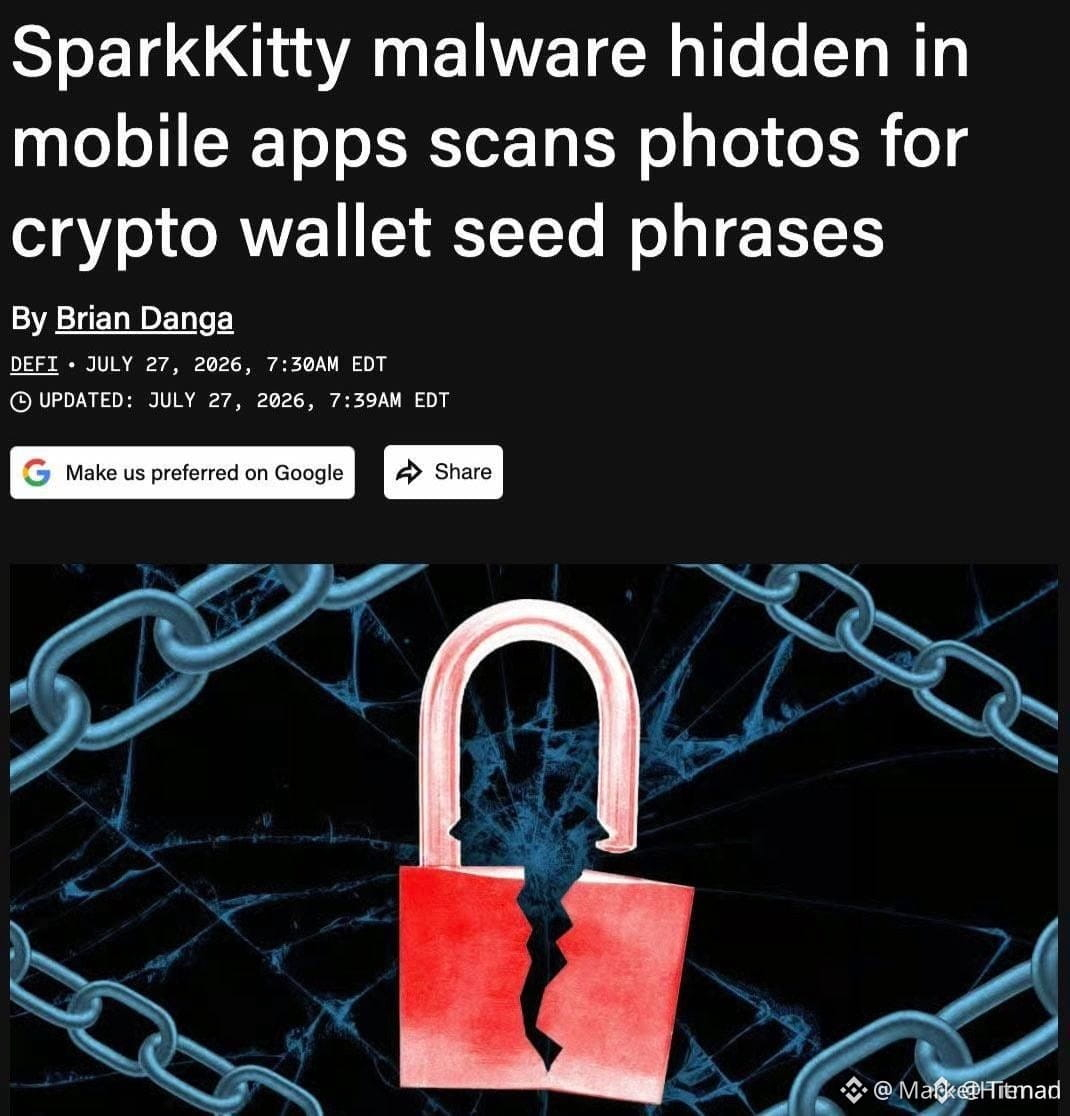
🚨 $BTC USERS TARGETED BY NEW SEED-PHRASE STEALING MALWARE! 🛡️
📱 A dangerous new mobile malware called SparkKitty is actively stealing crypto wallets. It hides inside fake trading and price tracker apps on both Google Play and Apple App Store. Once granted photo library access, it uses OCR to scan images for seed phrases and QR codes, then sends them to attackers.
💀 If you've ever screenshotted or saved your seed phrase on your phone, your funds are at risk. The safest move: delete all seed phrase images immediately (including recently deleted folder), revoke unnecessary photo access from all apps, and never store seed phrases digitally.
💬 Have you ever saved your seed phrase as a screenshot? Comment "DELETED" if you just cleaned your phone, or share your security habits below! 👇
⚠️ Not financial advice. Always manage your risk. 🛡️
🏷️ #CryptoSecurity #BTC #MalwareAlert #SeedPhrase #Safety
🦈 🔒
🚨 $BTC USERS TARGETED BY NEW SEED-PHRASE STEALING MALWARE! 🛡️
📱 A dangerous new mobile malware called SparkKitty is actively stealing crypto wallets. It hides inside fake trading and price tracker apps on both Google Play and Apple App Store. Once granted photo library access, it uses OCR to scan images for seed phrases and QR codes, then sends them to attackers.
💀 If you've ever screenshotted or saved your seed phrase on your phone, your funds are at risk. The safest move: delete all seed phrase images immediately (including recently deleted folder), revoke unnecessary photo access from all apps, and never store seed phrases digitally.
💬 Have you ever saved your seed phrase as a screenshot? Comment "DELETED" if you just cleaned your phone, or share your security habits below! 👇
⚠️ Not financial advice. Always manage your risk. 🛡️
🏷️ #CryptoSecurity #BTC #MalwareAlert #SeedPhrase #Safety
🦈 🔒
📱 A dangerous new mobile malware called SparkKitty is actively stealing crypto wallets. It hides inside fake trading and price tracker apps on both Google Play and Apple App Store. Once granted photo library access, it uses OCR to scan images for seed phrases and QR codes, then sends them to attackers.
💀 If you've ever screenshotted or saved your seed phrase on your phone, your funds are at risk. The safest move: delete all seed phrase images immediately (including recently deleted folder), revoke unnecessary photo access from all apps, and never store seed phrases digitally.
💬 Have you ever saved your seed phrase as a screenshot? Comment "DELETED" if you just cleaned your phone, or share your security habits below! 👇
⚠️ Not financial advice. Always manage your risk. 🛡️
🏷️ #CryptoSecurity #BTC #MalwareAlert #SeedPhrase #Safety
🦈 🔒
39

$TLM AND $NFP ON ALERT: NEW MACOS INFOSTEALER COULD SPOOK THE MARKET ⚡
A Rust-based malware disguised as the Maccy clipboard manager is being pushed through malicious ads. This kind of threat erodes user trust in the broader crypto ecosystem—especially when it targets Mac users, a core demographic for altcoins like $TLM and $NFP . Fear-driven selling can hit low-liquidity pairs faster than you'd expect.
The ads are live on multiple platforms right now, meaning the exposure window is open. If mainstream tech outlets pick this up, expect a knee-jerk reaction before any actual damage is done. Are you scaling back your altcoin exposure until the dust settles?
Not financial advice. Always manage your risk.
#TLM #NFP #MalwareAlert #Security #Crypto
⚡
$TLM AND $NFP ON ALERT: NEW MACOS INFOSTEALER COULD SPOOK THE MARKET ⚡
A Rust-based malware disguised as the Maccy clipboard manager is being pushed through malicious ads. This kind of threat erodes user trust in the broader crypto ecosystem—especially when it targets Mac users, a core demographic for altcoins like $TLM and $NFP . Fear-driven selling can hit low-liquidity pairs faster than you'd expect.
The ads are live on multiple platforms right now, meaning the exposure window is open. If mainstream tech outlets pick this up, expect a knee-jerk reaction before any actual damage is done. Are you scaling back your altcoin exposure until the dust settles?
Not financial advice. Always manage your risk.
#TLM #NFP #MalwareAlert #Security #Crypto
⚡
A Rust-based malware disguised as the Maccy clipboard manager is being pushed through malicious ads. This kind of threat erodes user trust in the broader crypto ecosystem—especially when it targets Mac users, a core demographic for altcoins like $TLM and $NFP . Fear-driven selling can hit low-liquidity pairs faster than you'd expect.
The ads are live on multiple platforms right now, meaning the exposure window is open. If mainstream tech outlets pick this up, expect a knee-jerk reaction before any actual damage is done. Are you scaling back your altcoin exposure until the dust settles?
Not financial advice. Always manage your risk.
#TLM #NFP #MalwareAlert #Security #Crypto
⚡


163

·
--
NEW MALWARE TARGETS $BANK AND $SYN VIA FAKE GITHUB APPS 🚨
Body paragraph 1: Kaspersky just flagged a new wave of GitHub-hosted apps designed to drain wallets from $BANK and $SYN holders. Social engineering is the entry vector — fake repos that look legitimate but silently deploy keyloggers and clipboard hijackers.
Body paragraph 2: This isn't speculative. The malware is live and actively spreading through developer communities. Anyone who installed a suspicious GitHub tool in the last 48 hours should revoke wallet permissions immediately.
What are you doing to verify the apps you use on GitHub?
Not financial advice. Always manage your risk.
#BANK #SYN #SecurityAlert #CryptoNews #MalwareAlert
⚡
NEW MALWARE TARGETS $BANK AND $SYN VIA FAKE GITHUB APPS 🚨
Body paragraph 1: Kaspersky just flagged a new wave of GitHub-hosted apps designed to drain wallets from $BANK and $SYN holders. Social engineering is the entry vector — fake repos that look legitimate but silently deploy keyloggers and clipboard hijackers.
Body paragraph 2: This isn't speculative. The malware is live and actively spreading through developer communities. Anyone who installed a suspicious GitHub tool in the last 48 hours should revoke wallet permissions immediately.
What are you doing to verify the apps you use on GitHub?
Not financial advice. Always manage your risk.
#BANK #SYN #SecurityAlert #CryptoNews #MalwareAlert
⚡
Body paragraph 1: Kaspersky just flagged a new wave of GitHub-hosted apps designed to drain wallets from $BANK and $SYN holders. Social engineering is the entry vector — fake repos that look legitimate but silently deploy keyloggers and clipboard hijackers.
Body paragraph 2: This isn't speculative. The malware is live and actively spreading through developer communities. Anyone who installed a suspicious GitHub tool in the last 48 hours should revoke wallet permissions immediately.
What are you doing to verify the apps you use on GitHub?
Not financial advice. Always manage your risk.
#BANK #SYN #SecurityAlert #CryptoNews #MalwareAlert
⚡
44

·
--
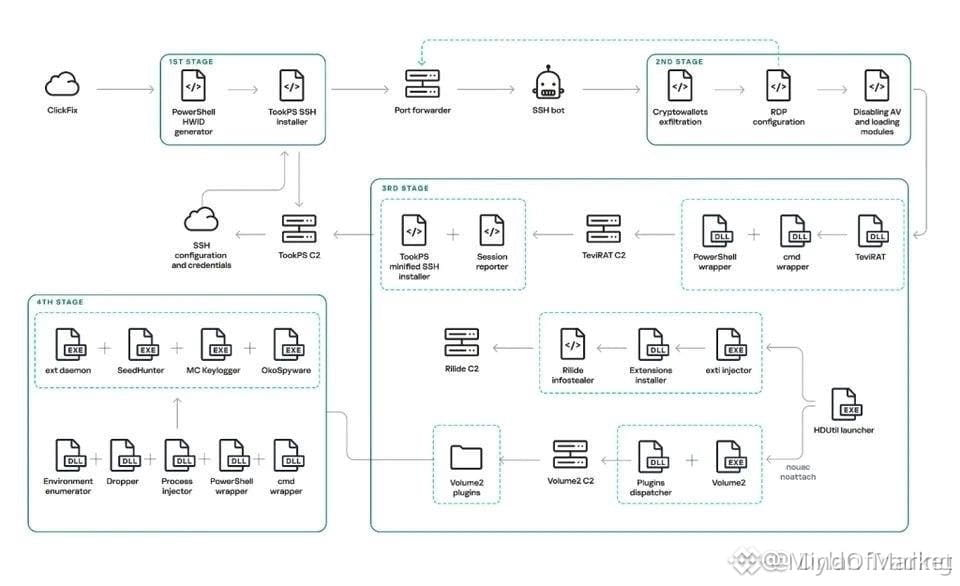
$BTC WALLETS TARGETED BY MAC MALWARE THAT HIJACKS TELEGRAM SESSIONS 🚨
SlowMist has documented a macOS malware that steals wallet databases, Keychain data, and Telegram session files. Attackers can hijack your Telegram Desktop session without your credentials — they reuse an already authenticated local session, then offline-decrypt wallet databases and replace Ledger/Trezor apps with fake versions.
This attack chain has been reproduced in an isolated environment by SlowMist, confirming the threat is operational now. Over a dozen popular wallets including Exodus, Atomic, and Electrum are in the crosshairs.
Have you checked your active Telegram sessions and wallet security today?
Not financial advice. Always manage your risk.
#BTC #MalwareAlert #CyberSecurity #CryptoWallet #Security
🔥
$BTC WALLETS TARGETED BY MAC MALWARE THAT HIJACKS TELEGRAM SESSIONS 🚨
SlowMist has documented a macOS malware that steals wallet databases, Keychain data, and Telegram session files. Attackers can hijack your Telegram Desktop session without your credentials — they reuse an already authenticated local session, then offline-decrypt wallet databases and replace Ledger/Trezor apps with fake versions.
This attack chain has been reproduced in an isolated environment by SlowMist, confirming the threat is operational now. Over a dozen popular wallets including Exodus, Atomic, and Electrum are in the crosshairs.
Have you checked your active Telegram sessions and wallet security today?
Not financial advice. Always manage your risk.
#BTC #MalwareAlert #CyberSecurity #CryptoWallet #Security
🔥
SlowMist has documented a macOS malware that steals wallet databases, Keychain data, and Telegram session files. Attackers can hijack your Telegram Desktop session without your credentials — they reuse an already authenticated local session, then offline-decrypt wallet databases and replace Ledger/Trezor apps with fake versions.
This attack chain has been reproduced in an isolated environment by SlowMist, confirming the threat is operational now. Over a dozen popular wallets including Exodus, Atomic, and Electrum are in the crosshairs.
Have you checked your active Telegram sessions and wallet security today?
Not financial advice. Always manage your risk.
#BTC #MalwareAlert #CyberSecurity #CryptoWallet #Security
🔥
38

·
--
🔴 $BTC HOLDERS BEWARE – A NEW MALWARE IS STEALING YOUR SEED PHRASES RIGHT FROM YOUR PHOTO ALBUM 🦈
📌 A cross-platform threat named **SparkKitty** has slipped past Apple’s review and Google Play’s filters. It uses OCR tech to scan your saved screenshots for wallet mnemonics, passwords, and QR codes. Once it finds them, your funds are gone.
💡 This isn’t just a theory – 10,000+ downloads on one infected app alone. The malware hides inside crypto tools, messaging apps, even modded TikTok. On iOS, it posed as a “Coin” app. On Android, “SOEX” was the trojan horse.
🔍 Here’s the hard truth: if you keep your seed phrase as a screenshot, you’ve already handed the keys to an attacker. 🛡️ Security experts say store mnemonics offline – paper or hardware wallet – and never grant photo library access to random apps.
💬 How do you store your recovery phrases – digital or cold storage? 👇
⚠️ Not financial advice. Always manage your risk. 🛡️
🏷️ #BTC #CryptoSecurity #MalwareAlert #WalletSafety #CyberThreat
🛡️ 🔴
🔴 $BTC HOLDERS BEWARE – A NEW MALWARE IS STEALING YOUR SEED PHRASES RIGHT FROM YOUR PHOTO ALBUM 🦈
📌 A cross-platform threat named **SparkKitty** has slipped past Apple’s review and Google Play’s filters. It uses OCR tech to scan your saved screenshots for wallet mnemonics, passwords, and QR codes. Once it finds them, your funds are gone.
💡 This isn’t just a theory – 10,000+ downloads on one infected app alone. The malware hides inside crypto tools, messaging apps, even modded TikTok. On iOS, it posed as a “Coin” app. On Android, “SOEX” was the trojan horse.
🔍 Here’s the hard truth: if you keep your seed phrase as a screenshot, you’ve already handed the keys to an attacker. 🛡️ Security experts say store mnemonics offline – paper or hardware wallet – and never grant photo library access to random apps.
💬 How do you store your recovery phrases – digital or cold storage? 👇
⚠️ Not financial advice. Always manage your risk. 🛡️
🏷️ #BTC #CryptoSecurity #MalwareAlert #WalletSafety #CyberThreat
🛡️ 🔴
📌 A cross-platform threat named **SparkKitty** has slipped past Apple’s review and Google Play’s filters. It uses OCR tech to scan your saved screenshots for wallet mnemonics, passwords, and QR codes. Once it finds them, your funds are gone.
💡 This isn’t just a theory – 10,000+ downloads on one infected app alone. The malware hides inside crypto tools, messaging apps, even modded TikTok. On iOS, it posed as a “Coin” app. On Android, “SOEX” was the trojan horse.
🔍 Here’s the hard truth: if you keep your seed phrase as a screenshot, you’ve already handed the keys to an attacker. 🛡️ Security experts say store mnemonics offline – paper or hardware wallet – and never grant photo library access to random apps.
💬 How do you store your recovery phrases – digital or cold storage? 👇
⚠️ Not financial advice. Always manage your risk. 🛡️
🏷️ #BTC #CryptoSecurity #MalwareAlert #WalletSafety #CyberThreat
🛡️ 🔴
14
·
--
🚨 $COTI AND $DEXE COMMUNITY ON HIGH ALERT AS SEED-PHRASE STEALING MALWARE SPREADS! 🛡️
📱 The SparkKitty malware has been flagged by security researchers, actively stealing seed phrases via infected apps on both iOS and Android. Once it gains gallery access, it exfiltrates sensitive photos to attacker servers. This isn't just a scare — it's a live threat to anyone holding assets on mobile wallets. 🔍
🔒 Smart money moves into cold storage during fear waves. The market may see short-term sentiment drag, but institutional accumulation often accelerates after security scares. The real story is how the community adapts. 💡 Are you keeping your seed phrase offline, or relying on hot wallet convenience? 👇
⚠️ Not financial advice. Always manage your risk. 🛡️
🏷️ #COTI #DEXE #Crypto #Security #MalwareAlert
🛡️ 🔒
🚨 $COTI AND $DEXE COMMUNITY ON HIGH ALERT AS SEED-PHRASE STEALING MALWARE SPREADS! 🛡️
📱 The SparkKitty malware has been flagged by security researchers, actively stealing seed phrases via infected apps on both iOS and Android. Once it gains gallery access, it exfiltrates sensitive photos to attacker servers. This isn't just a scare — it's a live threat to anyone holding assets on mobile wallets. 🔍
🔒 Smart money moves into cold storage during fear waves. The market may see short-term sentiment drag, but institutional accumulation often accelerates after security scares. The real story is how the community adapts. 💡 Are you keeping your seed phrase offline, or relying on hot wallet convenience? 👇
⚠️ Not financial advice. Always manage your risk. 🛡️
🏷️ #COTI #DEXE #Crypto #Security #MalwareAlert
🛡️ 🔒
📱 The SparkKitty malware has been flagged by security researchers, actively stealing seed phrases via infected apps on both iOS and Android. Once it gains gallery access, it exfiltrates sensitive photos to attacker servers. This isn't just a scare — it's a live threat to anyone holding assets on mobile wallets. 🔍
🔒 Smart money moves into cold storage during fear waves. The market may see short-term sentiment drag, but institutional accumulation often accelerates after security scares. The real story is how the community adapts. 💡 Are you keeping your seed phrase offline, or relying on hot wallet convenience? 👇
⚠️ Not financial advice. Always manage your risk. 🛡️
🏷️ #COTI #DEXE #Crypto #Security #MalwareAlert
🛡️ 🔒
150

·
--
USB plug it in once, wallet gets drained once? Microsoft’s latest warning
Microsoft recently disclosed a crypto clipboard hijacking malware (CryptoBandits) that has been quietly operating since February 2026. Its scheme is straightforward: you insert an infected USB, open what seems like a normal file, but it’s actually a malicious shortcut. It replaces your wallet address with that of the attacker’s—only changing the last character, making it look identical. Even more outrageous, it has built-in Tor anonymous communication, can execute code remotely, and takes screenshots every 10 seconds.
Check Point also reported another independent family, hiding 15,500 attacker wallet addresses within a single program, disguised as "sniper bots" and "prediction tools" for distribution.
Key reminder: Hardware wallets can protect your private keys, but they can’t stop you from signing a transaction to the wrong address. Always verify the address completely on a trusted device before each transfer. Don’t plug in unknown USBs, don’t run unknown exe files.
#CryptoSecurity #Web3Safety #MalwareAlert #HotWallet #Bitcoin
USB plug it in once, wallet gets drained once? Microsoft’s latest warning
Microsoft recently disclosed a crypto clipboard hijacking malware (CryptoBandits) that has been quietly operating since February 2026. Its scheme is straightforward: you insert an infected USB, open what seems like a normal file, but it’s actually a malicious shortcut. It replaces your wallet address with that of the attacker’s—only changing the last character, making it look identical. Even more outrageous, it has built-in Tor anonymous communication, can execute code remotely, and takes screenshots every 10 seconds.
Check Point also reported another independent family, hiding 15,500 attacker wallet addresses within a single program, disguised as "sniper bots" and "prediction tools" for distribution.
Key reminder: Hardware wallets can protect your private keys, but they can’t stop you from signing a transaction to the wrong address. Always verify the address completely on a trusted device before each transfer. Don’t plug in unknown USBs, don’t run unknown exe files.
#CryptoSecurity #Web3Safety #MalwareAlert #HotWallet #Bitcoin
Microsoft recently disclosed a crypto clipboard hijacking malware (CryptoBandits) that has been quietly operating since February 2026. Its scheme is straightforward: you insert an infected USB, open what seems like a normal file, but it’s actually a malicious shortcut. It replaces your wallet address with that of the attacker’s—only changing the last character, making it look identical. Even more outrageous, it has built-in Tor anonymous communication, can execute code remotely, and takes screenshots every 10 seconds.
Check Point also reported another independent family, hiding 15,500 attacker wallet addresses within a single program, disguised as "sniper bots" and "prediction tools" for distribution.
Key reminder: Hardware wallets can protect your private keys, but they can’t stop you from signing a transaction to the wrong address. Always verify the address completely on a trusted device before each transfer. Don’t plug in unknown USBs, don’t run unknown exe files.
#CryptoSecurity #Web3Safety #MalwareAlert #HotWallet #Bitcoin
1
61
·
--
🚨 $BNB SMART CONTRACTS WEAPONIZED IN NEW MALWARE CAMPAIGN 🦈
🦠 Microsoft threat hunters just exposed a nasty twist: attackers are hiding malicious instructions inside BNB Smart Chain contracts, using the RPC gateway as a launchpad for ClickFix and TerminalFix redirection attacks. 💥
🔍 The malware lives on-chain, so only the deploying wallet can edit it — traditional takedowns bounce right off. This is a living-off-the-land nightmare, weaponizing PowerShell, curl, and WebDAV to slip past defenses. 📊 Thousands of enterprises and devices are getting hit daily, with info-stealers like Lumma and AsyncRAT in the wild.
💡 For crypto users, this is a stark reminder: the same chain powering DeFi is now a command-and-control highway. Verify every CAPTCHA and never paste unknown commands into your terminal. 💬 Are you checking wallet interactions on BNB more carefully after this disclosure? 👇
⚠️ Not financial advice. Always manage your risk. 🛡️
🏷️ #BNB #CryptoSecurity #MalwareAlert #BNBChain #Crypto
🦈 🔍
🚨 $BNB SMART CONTRACTS WEAPONIZED IN NEW MALWARE CAMPAIGN 🦈
🦠 Microsoft threat hunters just exposed a nasty twist: attackers are hiding malicious instructions inside BNB Smart Chain contracts, using the RPC gateway as a launchpad for ClickFix and TerminalFix redirection attacks. 💥
🔍 The malware lives on-chain, so only the deploying wallet can edit it — traditional takedowns bounce right off. This is a living-off-the-land nightmare, weaponizing PowerShell, curl, and WebDAV to slip past defenses. 📊 Thousands of enterprises and devices are getting hit daily, with info-stealers like Lumma and AsyncRAT in the wild.
💡 For crypto users, this is a stark reminder: the same chain powering DeFi is now a command-and-control highway. Verify every CAPTCHA and never paste unknown commands into your terminal. 💬 Are you checking wallet interactions on BNB more carefully after this disclosure? 👇
⚠️ Not financial advice. Always manage your risk. 🛡️
🏷️ #BNB #CryptoSecurity #MalwareAlert #BNBChain #Crypto
🦈 🔍
🦠 Microsoft threat hunters just exposed a nasty twist: attackers are hiding malicious instructions inside BNB Smart Chain contracts, using the RPC gateway as a launchpad for ClickFix and TerminalFix redirection attacks. 💥
🔍 The malware lives on-chain, so only the deploying wallet can edit it — traditional takedowns bounce right off. This is a living-off-the-land nightmare, weaponizing PowerShell, curl, and WebDAV to slip past defenses. 📊 Thousands of enterprises and devices are getting hit daily, with info-stealers like Lumma and AsyncRAT in the wild.
💡 For crypto users, this is a stark reminder: the same chain powering DeFi is now a command-and-control highway. Verify every CAPTCHA and never paste unknown commands into your terminal. 💬 Are you checking wallet interactions on BNB more carefully after this disclosure? 👇
⚠️ Not financial advice. Always manage your risk. 🛡️
🏷️ #BNB #CryptoSecurity #MalwareAlert #BNBChain #Crypto
🦈 🔍
11
Log in to explore more content
Join global crypto users on Binance Square
⚡️ Get latest and useful information about crypto.
💬 Trusted by the world’s largest crypto exchange.
👍 Discover real insights from verified creators.
Email / Phone number
Trending Topics
1
#FedRateWatch
294,660 views
1,841 Discussing
2
#BitcoinSlidesTo$76000
4,884 views
64 Discussing
3
#BitcoinReboundsTo$79K
51,928 views
366 Discussing
4
#StrategyMarketCapPassesFord
12,051 views
366 Discussing
5
#ClarityActOddsHalveOnPolymarket
9,233 views
284 Discussing
6
#US30YTreasuryYieldTops5.40%
11,418 views
240 Discussing
7
#BessentEndorsesFinalClarityActDraft
30,231 views
558 Discussing
8
#ZamaOpens16ConfidentialMorphoVaults
11,200 views
268 Discussing
9
#USDCOnChainVolumeTops$100Trillion
1,664 views
40 Discussing
10
#BitcoinSpotETFsNetInflow$160M
2,505 views
92 Discussing