

#kospi
kospi
378,737 views
1,629 Discussing
Hot
Latest

·
--
SOUTH KOREA'S STOCK MARKET FACES A SHARP DROP!
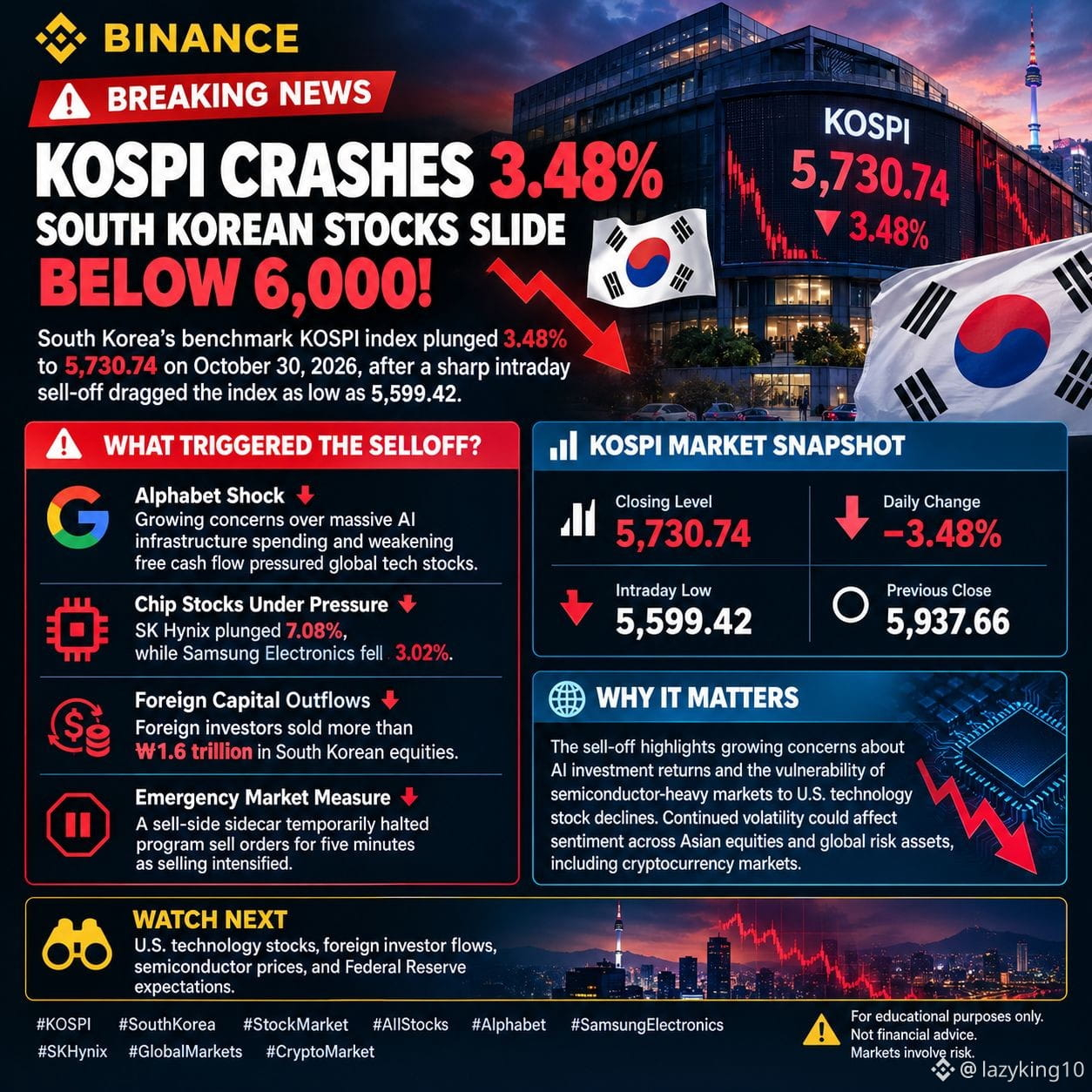
The South Korean KOSPI index fell 3.48% on October 30, closing at 5,730.74 and moving below the important 6,000 level.
Several factors contributed to the decline. Concerns about Google's AI spending affected tech stocks, while Samsung and SK Hynix also suffered losses. Foreign investors sold more than ₩1.6 trillion in South Korean shares, adding further pressure.
Why should investors care?
South Korea has a major technology and semiconductor industry. When these companies fall, it can affect investor confidence across global markets.
Crypto traders should also watch the situation, as weaker market sentiment can sometimes put pressure on Bitcoin and other cryptocurrencies.
What's next? Investors will be watching technology stocks, AI spending, and global market sentiment.
Do you think this is a short-term correction or the start of a bigger market decline?
#KOSPI #SouthKorea #stockmarket #bitcoin #CryptoMarket #BinanceSquare
DYOR | NFA
68

🚨 ASIAN STOCK MARKET UNDER PRESSURE: KOSPI FALLS 3.5% BELOW 6,000!
South Korea's stock market just faced another major setback, raising fresh concerns about global technology stocks and overall market sentiment.
📉 WHAT HAPPENED?
The KOSPI dropped approximately 3.5% on October 30, closing around 5,731 and moving further below the psychological 6,000 mark.
But the biggest pressure came from semiconductor giants.
🔻 TECH STOCKS TAKE A HIT
• SK Hynix fell around 7.08%.
• Samsung Electronics declined approximately 3.02%.
• Foreign investors sold a net 1.62 trillion won worth of shares.
🤖 WHY ARE MARKETS WORRIED?
Growing concerns about AI investment costs and the time needed to generate returns are putting pressure on technology stocks.
When major semiconductor companies struggle, investor confidence across the wider technology sector can also weaken.
🌍 WHY DOES THIS MATTER FOR CRYPTO?
South Korea is an important market for global technology and semiconductor activity.
A broader risk-off mood can influence investor appetite for higher-risk assets, including cryptocurrencies.
However, falling Asian stocks do not automatically mean Bitcoin or other cryptocurrencies must decline.
📊 MY MARKET TAKE
The KOSPI correction is a reminder that even strong technology rallies can face sudden profit-taking.
For now, investors should monitor global tech earnings, foreign capital flows, and Bitcoin's price action.
The next move could depend on whether this is simply a healthy correction or the beginning of a wider risk-off phase.
💬 YOUR TURN:
Do you think this Asian market sell-off will put more pressure on crypto, or could digital assets move independently?
Share your thoughts below! 👇
#KOSPI #SouthKorea #CryptoMarket #Bitcoin #StockMarket
Not financial advice. Always do your own research (DYOR).
{future}(BTCUSDT)
🚨 ASIAN STOCK MARKET UNDER PRESSURE: KOSPI FALLS 3.5% BELOW 6,000!
South Korea's stock market just faced another major setback, raising fresh concerns about global technology stocks and overall market sentiment.
📉 WHAT HAPPENED?
The KOSPI dropped approximately 3.5% on October 30, closing around 5,731 and moving further below the psychological 6,000 mark.
But the biggest pressure came from semiconductor giants.
🔻 TECH STOCKS TAKE A HIT
• SK Hynix fell around 7.08%.
• Samsung Electronics declined approximately 3.02%.
• Foreign investors sold a net 1.62 trillion won worth of shares.
🤖 WHY ARE MARKETS WORRIED?
Growing concerns about AI investment costs and the time needed to generate returns are putting pressure on technology stocks.
When major semiconductor companies struggle, investor confidence across the wider technology sector can also weaken.
🌍 WHY DOES THIS MATTER FOR CRYPTO?
South Korea is an important market for global technology and semiconductor activity.
A broader risk-off mood can influence investor appetite for higher-risk assets, including cryptocurrencies.
However, falling Asian stocks do not automatically mean Bitcoin or other cryptocurrencies must decline.
📊 MY MARKET TAKE
The KOSPI correction is a reminder that even strong technology rallies can face sudden profit-taking.
For now, investors should monitor global tech earnings, foreign capital flows, and Bitcoin's price action.
The next move could depend on whether this is simply a healthy correction or the beginning of a wider risk-off phase.
💬 YOUR TURN:
Do you think this Asian market sell-off will put more pressure on crypto, or could digital assets move independently?
Share your thoughts below! 👇
#KOSPI #SouthKorea #CryptoMarket #Bitcoin #StockMarket
Not financial advice. Always do your own research (DYOR).
112


·
--
#KOSPIFalls3.53%BackBelow6000
KOSPI Drops About 3.5% as AI Doubts Hit Chip Stocks: Is Korea Signaling Risk-Off?
South Korea's KOSPI fell about 3.5% on October 30, closing near 5,730 after touching an intraday low of 5,599. The drop triggered a sell-side sidecar that briefly halted program selling. SK Hynix lost roughly 7% and Samsung Electronics about 3%, as renewed doubts about AI investment returns and weak earnings fed a technology sell-off, and Japan's Nikkei also fell about 2.1%. The slide comes just two days after SK Hynix's record profit and shareholder-return plan lifted its shares by more than 7%.
My take: the speed of that reversal shows how fragile sentiment around the AI trade has become, since even record results could not hold the rally for more than a couple of sessions. Foreign investors have net sold roughly 200 trillion won of KOSPI shares this year, concentrated in Samsung and SK Hynix, and the market is short of fresh buyers to absorb that selling. The 6,000 level, first broken intraday on October 13, now looks like resistance rather than support. I'm treating this as a risk-sentiment signal rather than a direct crypto catalyst, and I'm watching whether foreign selling eases and whether chip stocks stabilize before reading the move as a bottom.
Is this a healthy reset in the AI trade, or the start of a deeper correction? Let me know below 👇
This is my analysis, not financial advice.
Follow me for more trading content and market updates.
#KOSPI #CryptoNews #BinanceSquare
2
307

·
--
#KOSPIFalls3.53%BackBelow6000
📉 KOSPI Drops About 3.5%, Back Below 6,000
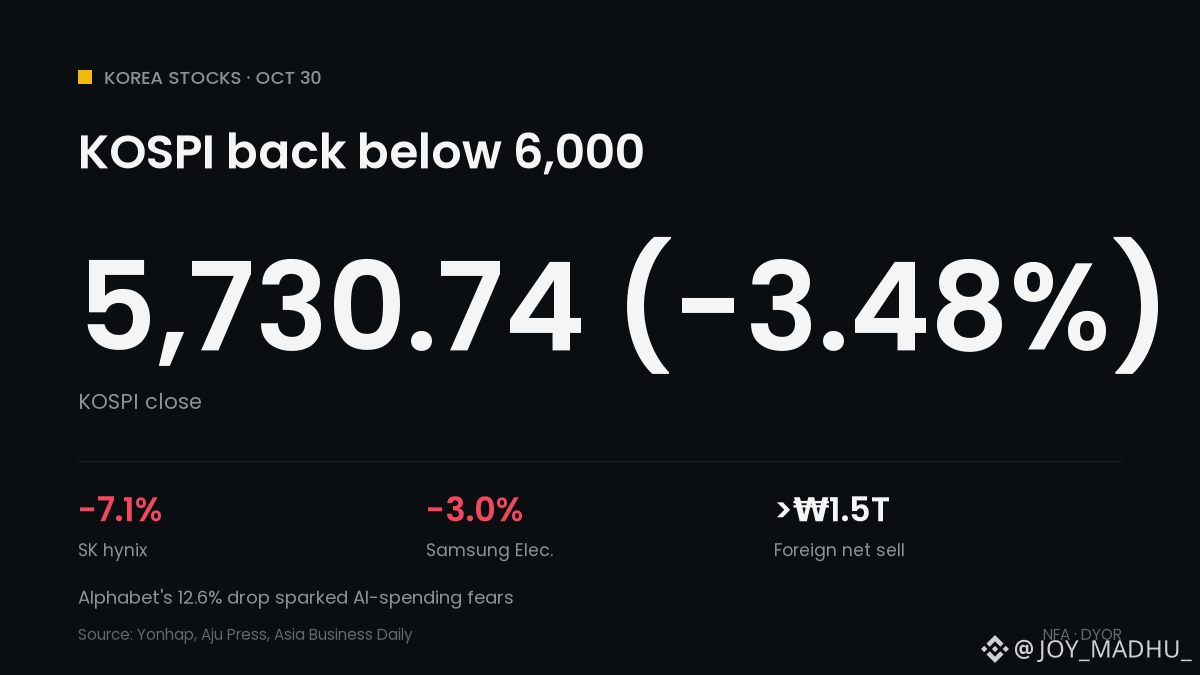
📊 Korea's KOSPI closed at 5,730.74 on Friday, down 206.92 points (3.48% on the official close)
⚠️ It hit 5,599 intraday, and a sell-side sidecar paused program selling for five minutes
💾 SK hynix fell about 7% and Samsung Electronics about 3%
🌍 Foreign investors net sold more than ₩1.5T of KOSPI shares, ending a three-day buying streak
🇺🇸 The trigger was Alphabet's 12.6% drop in New York, as AI spending fears hit chip suppliers
🇯🇵 Japan's Nikkei 225 fell 2.1%, and KOSPI ends October down 16.2%
What it means for crypto: AI-capex worries are hitting risk assets across Asia, and Bitcoin is already under pressure. Crypto may keep trading with tech sentiment until big-tech spending fears ease.
Do you watch Asian stock markets when trading crypto? 👇
$BTC
#CryptoNews #KOSPI #Stocks #KOSPIFalls3.53%BackBelow6000

·
--
Bearish
🚨 **KOSPI CRASHES 3.53% — FALLS BACK BELOW 6,000!**
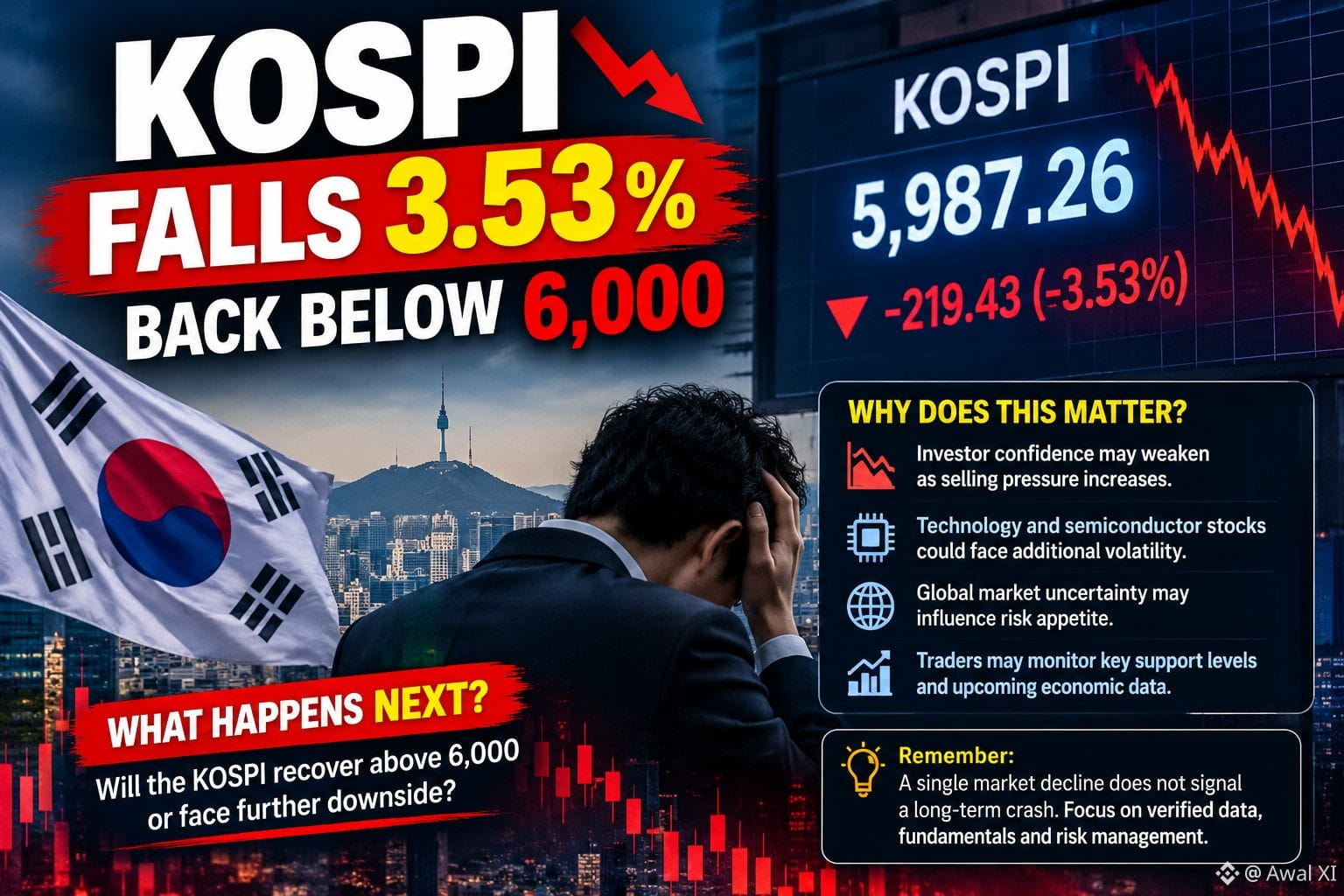
South Korea’s stock market is facing significant selling pressure as the KOSPI index drops 3.53%, slipping back below the psychologically important 6,000 level.
📉 This sharp decline highlights growing uncertainty among investors and raises questions about the market’s short-term direction.
The KOSPI is closely watched by global investors because South Korea plays a major role in the global technology, semiconductor, and export industries. When the index experiences a sudden decline, it can reflect concerns about economic growth, corporate earnings, global demand, and broader market sentiment.
⚠️ **Why does this matter?**
• Investor confidence may weaken as selling pressure increases.
• Technology and semiconductor stocks could face additional volatility.
• Global market uncertainty may influence risk appetite.
• Traders may closely monitor key support levels and upcoming economic data.
📊 **What happens next?**
Investors will be watching whether the KOSPI can recover above 6,000 or whether further downside pressure develops.
One important reminder: a single market decline does not automatically signal a long-term crash. Investors should avoid emotional decisions and focus on verified data, market fundamentals, and risk management.
**The big question: Is this a temporary correction or the beginning of a deeper market pullback?**
#KOSPI #stockmarket #MarketCrash #GlobalMarkets #Finance $BTC $ETH $AMZNB
112

·
--
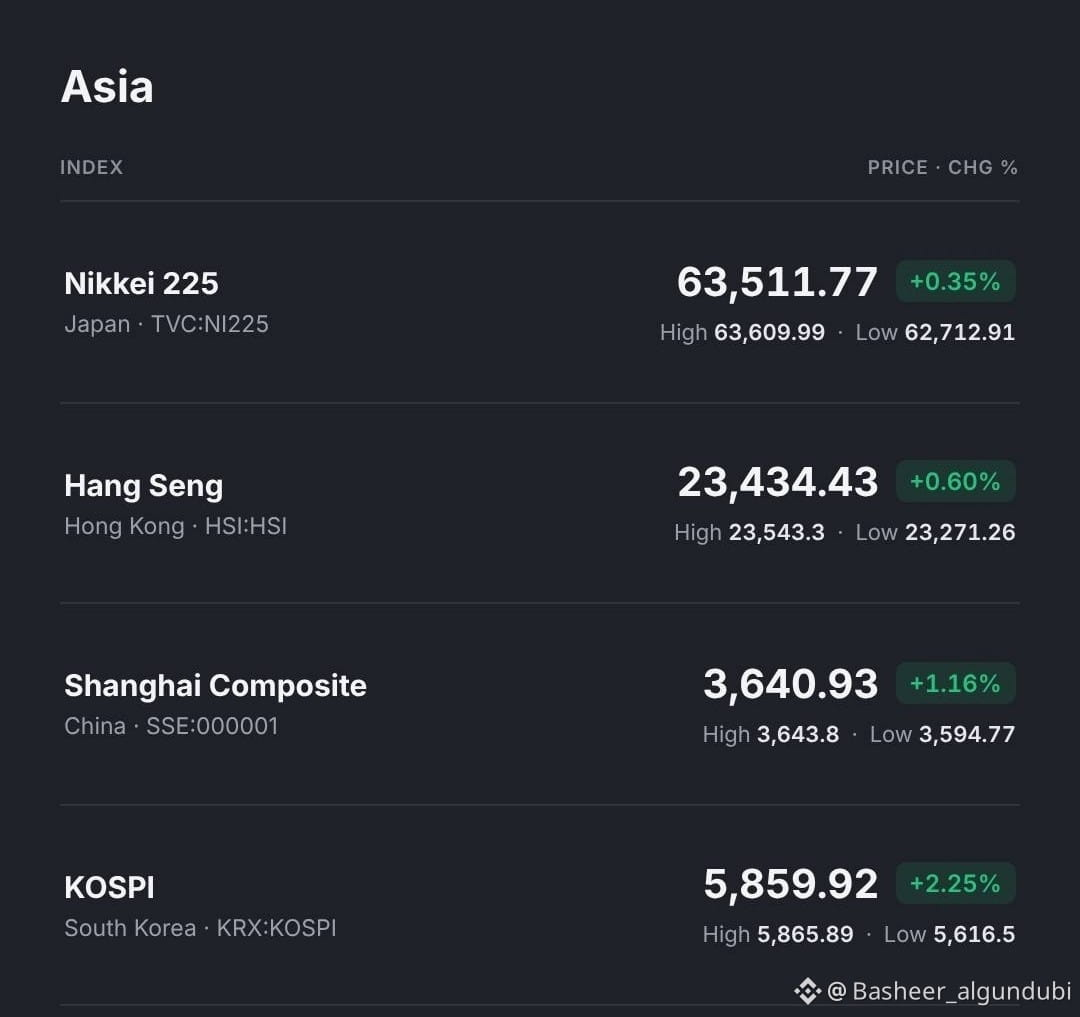
Asian markets: Asia shrugs off Wall Street's chip slump and trades in the green. 📈
🇰🇷 KOSPI: +2.25%
🇨🇳 Shanghai: +1.16%
🇭🇰 Hang Seng: +0.60%
🇯🇵 Nikkei 225: +0.35%
The #KOSPI index opened down 1.6%, then reversed course to gain 2%+ as SK #Hynix rose on demand for AI memory. 🔥
#BinanceUpdatesProofofReservesAddresses
$NVDAB
{spot}(NVDABUSDT)
$AMZNB
{spot}(AMZNBUSDT)
Asian markets: Asia shrugs off Wall Street's chip slump and trades in the green. 📈
🇰🇷 KOSPI: +2.25%
🇨🇳 Shanghai: +1.16%
🇭🇰 Hang Seng: +0.60%
🇯🇵 Nikkei 225: +0.35%
The #KOSPI index opened down 1.6%, then reversed course to gain 2%+ as SK #Hynix rose on demand for AI memory. 🔥
#BinanceUpdatesProofofReservesAddresses
$NVDAB
$AMZNB
🇰🇷 KOSPI: +2.25%
🇨🇳 Shanghai: +1.16%
🇭🇰 Hang Seng: +0.60%
🇯🇵 Nikkei 225: +0.35%
The #KOSPI index opened down 1.6%, then reversed course to gain 2%+ as SK #Hynix rose on demand for AI memory. 🔥
#BinanceUpdatesProofofReservesAddresses
$NVDAB
$AMZNB
1
1
95
·
--
📈 South Korea’s KOSPI index recently reversed course and began rising after falling by more than 1.5%. If the index continues to recover, it could help improve overall market sentiment; however, if losses widen again, there is still a risk of a pullback. Current data from Gate shows SK Hynix up slightly by 0.7%, while Samsung Electronics is down 1%. 📰
- **Structure**: The index has turned positive, while individual stocks show mixed performance;
- **Conditional scenarios**: If external factors (such as global demand for chips) remain stable, the index may continue to climb; if a negative macroeconomic shock occurs, the decline could resume.
- **Evidence**: Real-time market data provided by Gate shows the gains and losses mentioned above;
- **Invalidation**: There is currently no clear information indicating policy or capital-flow support, so the possibility of short-term volatility cannot be ruled out.
This fluctuation is a reminder that market sentiment remains sensitive, especially since the performance of leading chip stocks can have an amplified effect on the index. 🤔 What do you think about the KOSPI’s prospects, driven by chip stocks?
This is not investment advice.
#KOSPI #SK海力士 #三星电子 #Write2Earn
71

#kospifalls3.53%backbelow6000
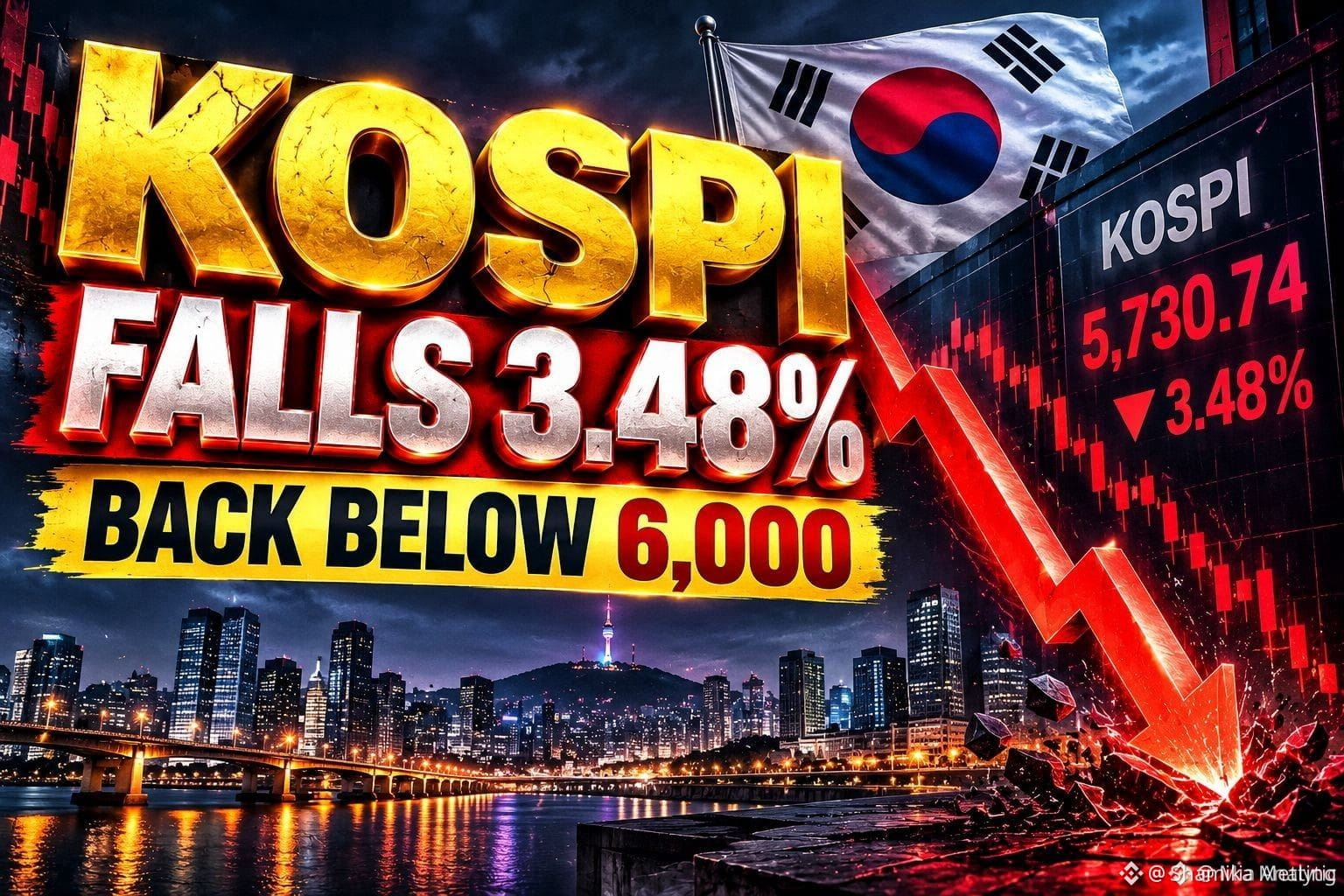
📉 KOSPI falls 3.48%, dropping below 6,000 as AI concerns trigger global sell-off in tech stocks
South Korea’s benchmark KOSPI index plunged on October 30, falling 3.48% to close at 5,730.74, well below the psychologically important 6,000 mark.
The sell-off was largely driven by renewed concerns about the profitability of massive investments in artificial intelligence. Weak earnings forecasts from major U.S. tech companies, including Alphabet, added pressure on global tech stocks and semiconductor makers.
South Korea’s major chipmakers were hit hard:
SK Hynix: down 7.08%
Samsung Electronics: down 3.02%
Foreign investors also sold approximately 1.62 trillion won worth of KOSPI shares, adding to the pressure on the market.
What does this mean for cryptocurrencies?
The decline highlights growing caution toward investments related to technology and AI. If risk aversion spreads to global financial markets, cryptocurrencies could also face selling pressure as investors reduce their exposure to volatile assets.
However, a stock market correction does not automatically mean that Bitcoin or the broader cryptocurrency market will follow the same direction.
Please follow us
#KOSPI #MarketAnalysis
$PYTH $SPORTFUN
1
51
·
--
#KOSPISurges6.63%BackAbove6000
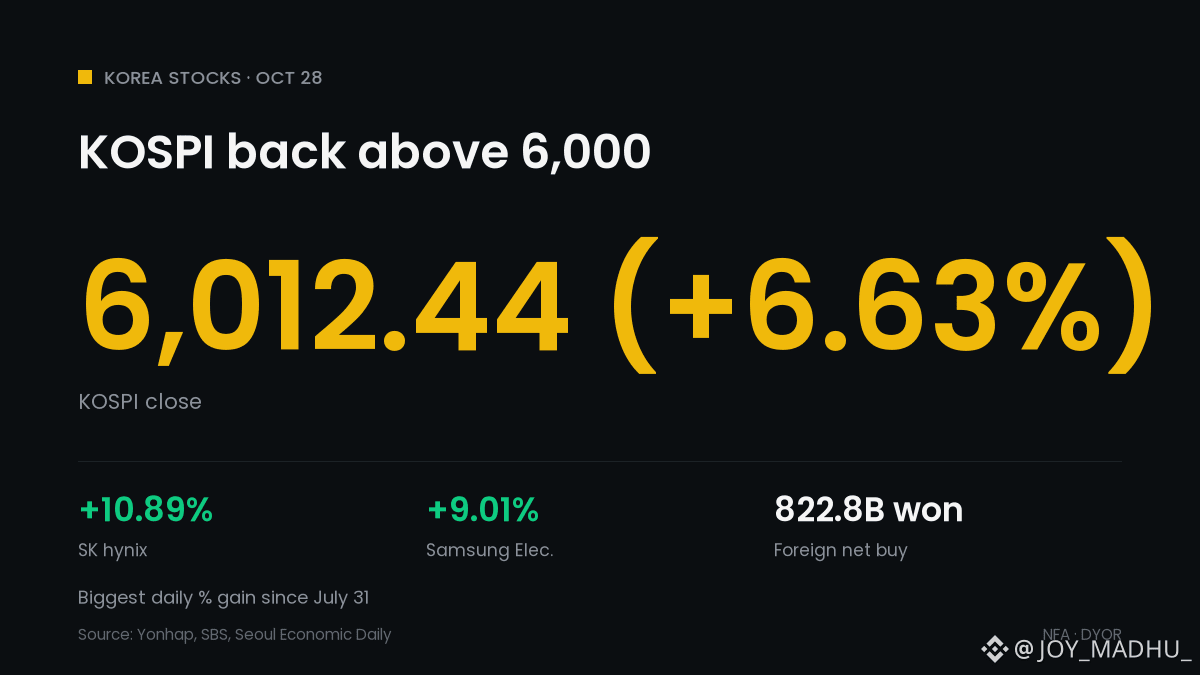
🇰🇷 KOSPI Rips 6.63% and Reclaims 6,000
📊 Close Oct 28: 6,012.44, up 374.10 points
📈 Biggest daily % gain since July 31, first close above 6,000 in 10 sessions
💾 Chips led: SK hynix +10.89%, Samsung Electronics +9.01%
🌍 Foreigners bought 822.8B won, institutions 960.7B won; retail sold 1.8T won
⚠️ Buy-side sidecar triggered for a second straight day
📅 Drivers: SK hynix Q3 beat plus 60T won returns, and Anthropic's IPO push easing AI-spend worries
What it means for crypto: Korea is one of crypto's biggest retail markets, and a risk-on Seoul tape usually helps sentiment. BTC is near $81.5K, up about 2% in 24h. But the Fed decision lands tonight, and analysts say this rally still needs earnings and foreign flows to hold.
Does a hot KOSPI pull Korean money into crypto or away from it? 👇
$BTC
#CryptoNews #KOSPI #Korea #KOSPISurges6.63%BackAbove6000
13

·
--
Bullish
Verified
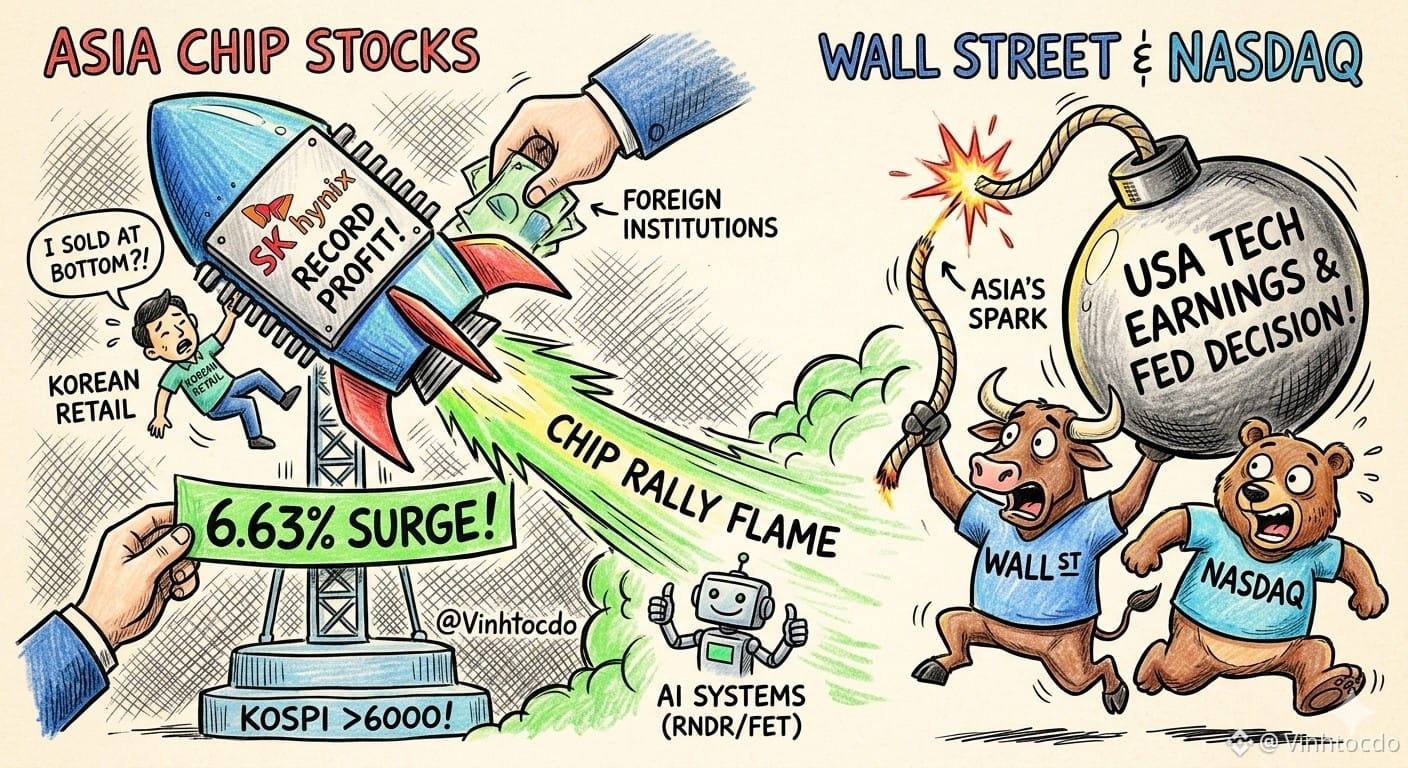
Asia’s semiconductor stocks are surging! Thanks to SK Hynix reporting record profits, South Korea’s KOSPI soared 6.63%, breaking above 6,000 and triggering an automatic market-wide circuit breaker. Foreign investors are buying like crazy, while retail traders are scrambling to sell at the bottom. Could Wall Street and NASDAQ take off tonight? Asia has lit the fuse; now we just need the U.S. tech giants to report earnings and the Fed to make its move to set off this euphoria bomb!
What should traders do right now?
1️⃣ Close the app and stop watching short-term candles: Learn from South Korean retail investors who lost 1.8 trillion won by selling at the bottom—and let your profits run.
2️⃣ Accumulate AI/semiconductor plays: Money is pouring into AI hardware, so pick top tokens in this ecosystem and get on board.
3️⃣ Manage your capital: Don’t FOMO in with everything before the U.S. market opens—always leave yourself an exit!
⚠️ This is not financial advice!
Sign up for Binance and ride the big waves with me:
Referral code: VINHTOCDO
Link: [https://www.binance.com/register?ref=VINHTOCDO](https://www.binance.com/register?ref=VINHTOCDO)
👇 Click below to trade and support me:
$MSFTB
{spot}(MSFTBUSDT)
$AMZNB
{spot}(AMZNBUSDT)
$GOOGLB
{spot}(GOOGLBUSDT)
#EarningsSeason #Kospi #Wallstreet #NASDAQ #ChipRally #VINHTOCDO
Asia’s semiconductor stocks are surging! Thanks to SK Hynix reporting record profits, South Korea’s KOSPI soared 6.63%, breaking above 6,000 and triggering an automatic market-wide circuit breaker. Foreign investors are buying like crazy, while retail traders are scrambling to sell at the bottom. Could Wall Street and NASDAQ take off tonight? Asia has lit the fuse; now we just need the U.S. tech giants to report earnings and the Fed to make its move to set off this euphoria bomb!
What should traders do right now?
1️⃣ Close the app and stop watching short-term candles: Learn from South Korean retail investors who lost 1.8 trillion won by selling at the bottom—and let your profits run.
2️⃣ Accumulate AI/semiconductor plays: Money is pouring into AI hardware, so pick top tokens in this ecosystem and get on board.
3️⃣ Manage your capital: Don’t FOMO in with everything before the U.S. market opens—always leave yourself an exit!
⚠️ This is not financial advice!
Sign up for Binance and ride the big waves with me:
Referral code: VINHTOCDO
Link: https://www.binance.com/register?ref=VINHTOCDO
👇 Click below to trade and support me:
$MSFTB
$AMZNB
$GOOGLB
#EarningsSeason #Kospi #Wallstreet #NASDAQ #ChipRally #VINHTOCDO
2
63

🔴 SOUTH KOREA TECH GIANTS BLEED AS $KOSPI DROPS 1% SPARKING MACRO PRESSURE! 📉
Asian tech heavyweights are taking a clean punch to the jaw today. Semiconductor titans $SKHYNIX and $SAMSUNG dropped 2.36% and 1.80% respectively, dragging the broader $KOSPI down by a full percentage point. 📊
Leveraged positions took the real hit as double-long instruments crushed over-eager bulls, sinking 5.75% on SK Hynix and 4.51% on Samsung. 📉 When institutional tech engines stumble like this, macro liquidity sweeps often ripple straight into risk-on assets. ⚠️
Smart money watches these traditional tech order flows for early clues on global liquidity appetite. 💬 Are you hedging your risk assets here or waiting for Asia to signal a clear bottom? 👇
⚠️ Not financial advice. Always manage your risk. 🛡️
🏷️ #KOSPI #Macro #TradFi #Markets #Crypto
📉 👁️
16

·
--
Verified
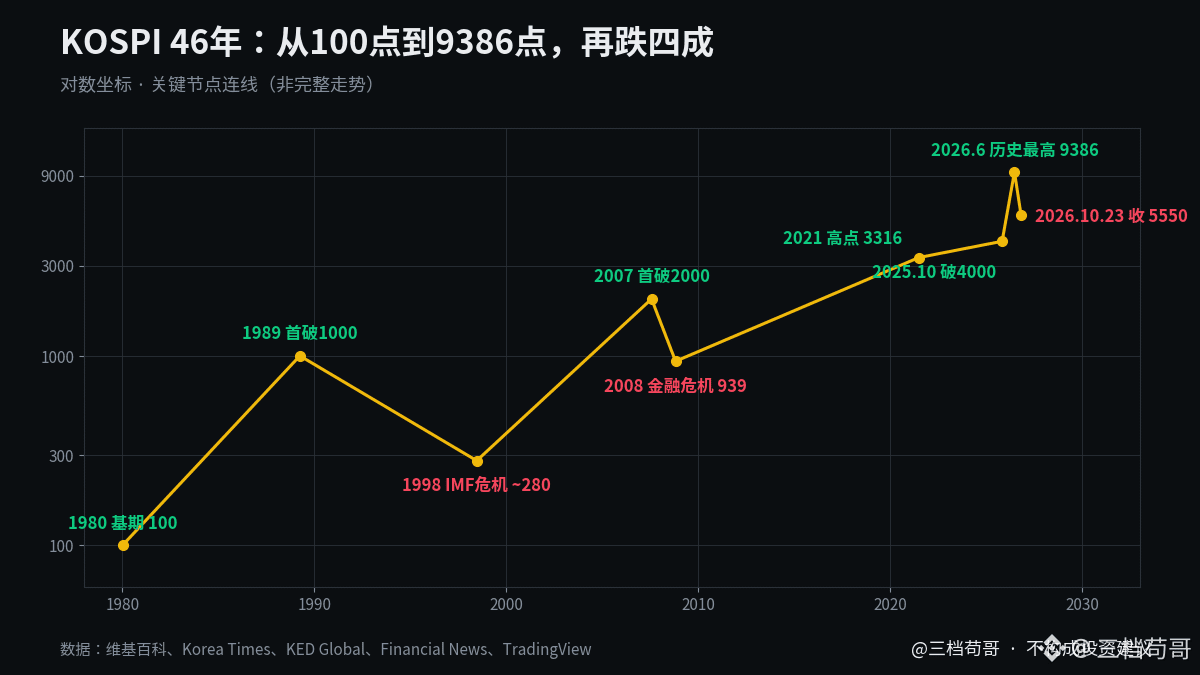
【46 Years of Korean Stocks】From 100 to 9,386 Points, Then Down 40%: KOSPI’s Wild Swings
Over 46 years, an index rose from 100 points to 9,386, only to lose 40% in four months. The history of Korean stocks is, in essence, a history of “foreign capital + concentration + leverage.”
I. 1980–1989: From 100 to 1,000 Points
KOSPI uses January 4, 1980 as its base date, with a starting value of 100 points.
On March 31, 1989, it closed above 1,000 points for the first time (1,003.31). Foreign investors still couldn’t enter the market back then: a plan to internationalize the capital market was announced in 1981, but foreign investors weren’t allowed to buy shares directly until January 1992, and the foreign ownership limit for any single company was just 10%.
II. The 1990s: Opening Up, Then Crushed by the IMF Crisis
Over the following decade, the index touched 1,000 points three times, only to fall back below it (in 1989, 1994, and 2000).
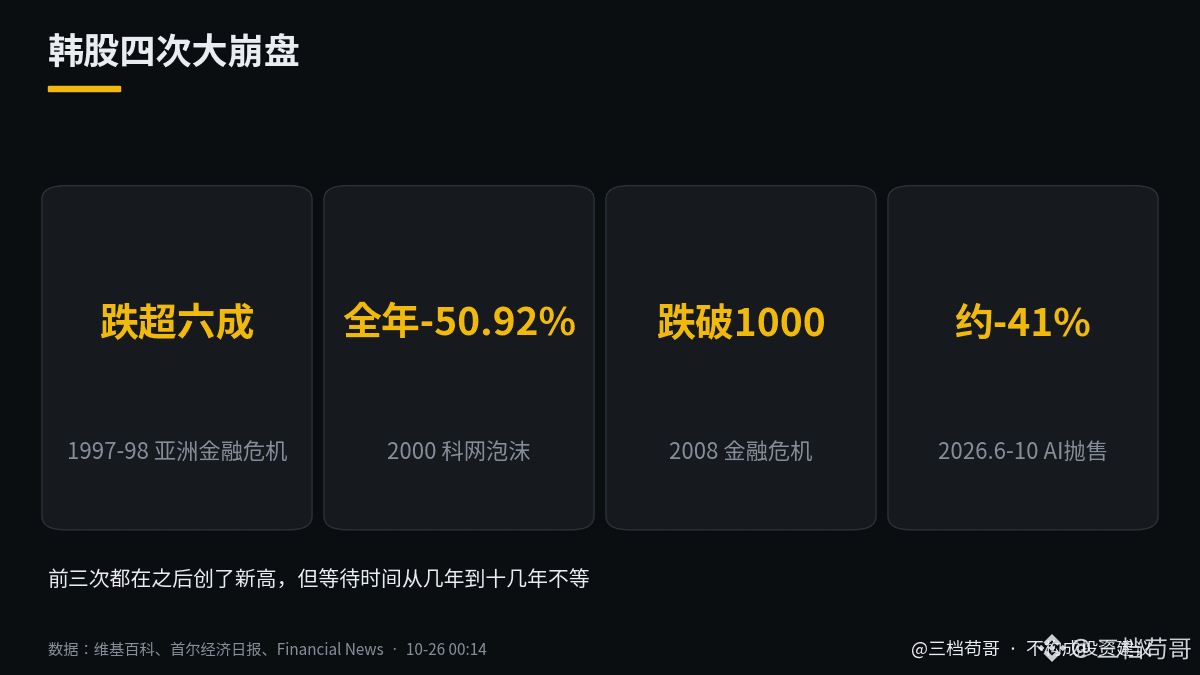
During the 1997 Asian financial crisis, KOSPI fell 42.21% over the year. By mid-June 1998, it had dropped to around 280 points—more than 60% below its peak.
The crisis forced the market to open up: the foreign ownership limit was abolished in May 1998, and foreign investors became one of the most important forces determining Korean stock prices.
III. 2000–2008: Two 50% Plunges
The dot-com bubble burst in 2000, and the index fell 50.92% that year. On September 12, 2001—the day after 9/11—it plunged 12.02% in a single day.
On July 25, 2007, it closed above 2,000 points for the first time. But the financial crisis hit the following year: on October 24, 2008, it fell 10.57% in a single day, closing at 938.75 points.
A full 18 years passed between the first time it rose above 1,000 points in 1989 and the first time it closed above 1,500 points in 2007.
IV. 2011–2024: A Decade of “Box-pi”
After the financial crisis, KOSPI spent a long time moving back and forth between roughly 1,800 and 2,500 points, earning the nickname “Box-pi.” After touching 3,316 points intraday in June 2021, it retreated.
The “Korea discount,” attributed to chaebol governance and low dividend payouts, was the most frequently cited explanation during that decade.
V. 2025–2026: An Epic Surge
In 2025, the government of Lee Jae-myung pushed through amendments to the Commercial Act, strengthening protections for minority shareholders. On September 10, KOSPI closed at 3,314.53 points, breaking its 2021 record; on October 27, it closed above 4,000 points.
In 2026, it broke 5,000 in January and 6,000 in February, then closed above 9,000 on June 18 and reached an intraday high of around 9,386 on June 19. The supercycle in memory chips was the main engine. On June 22, SK Hynix’s market capitalization surpassed Samsung’s—the first time in more than two decades that a company had knocked Samsung from the top spot.
VI. Then Came the Sharp Drop
On June 23, the index fell nearly 10% in a single day, and entered a technical bear market in July. On July 31, it surged 17.91% in a single day—the biggest gain in its history. Volatility reached unprecedented levels.
During the week of October 13, it fell another 14.46%. On October 23, it closed at 5,550.30 points, down around 41% from its June peak.
VII. What Can 46 Years of History Tell Us?
① Big drops often coincide with concentrated foreign investor outflows: this happened in 1997 and 2008, and foreign investors were also aggressively net selling this October.
② The index is highly concentrated: Samsung and SK Hynix now account for more than half of KOSPI’s weight, meaning these two stocks can determine the direction of the broader market.
③ After each of the previous major crashes, the index went on to reach new highs—but the wait ranged from a few years to more than a decade.
As of October 23, no one can confirm where the bottom is. Triple-leveraged ETFs like KORU and perpetual contracts amplify every swing. If you’re trying to buy the dip, keep your position small and set a stop-loss first. If foreign investors continue to be net sellers and the index falls below the 5,100-point area cited by brokerages, the recovery thesis will have to be pushed back.
Do you think this time is more like the bursting of the 2000 bubble, or a sharp 2008-style drop followed by a recovery?
Sources: Wikipedia, Korea Times, KED Global, Financial News, Seoul Economic Daily, TradingView
#韩股 #KOSPI
📈 Top Three Contract Gainers (00:07): $APR +61.93%|$CAP +42.62%|$SKYAI +20.64%
#BinanceSquare
⚠️ The above is a compilation of information and personal opinions, and does not constitute investment advice. DYOR.
2
1k

·
--
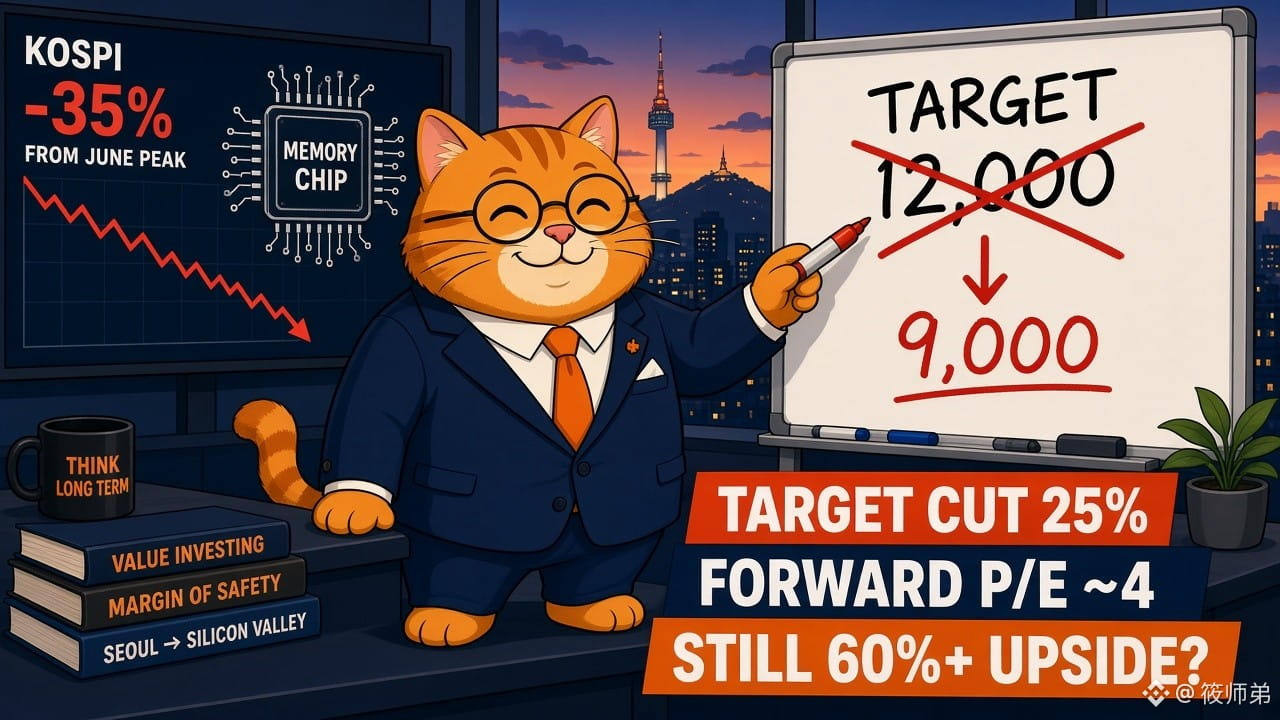
Goldman cuts KOSPI target by 25%: 12,000→9,000, but still calls it “severely undervalued”
📰 According to an Investing.com report on 10/25, Goldman Sachs strategist Timothy Moe’s team cut its 12-month target for South Korea’s KOSPI from 12,000 to 9,000, citing growing concerns about AI investment and more conservative valuation assumptions.
📰 The KOSPI has fallen more than 35% from its June peak; the new target still implies over 60% upside from current levels.
📰 Goldman says the KOSPI’s forward P/E is around 4x, a low not seen in 18 major markets since 2006. Current chip-stock valuations imply a 65% decline in industry earnings by 2027, which Goldman considers overly pessimistic. Companies outside the memory sector, which account for about half the index, have a forward P/E of around 7.6x.
【Viewpoint】
South Korean stocks are an “AI memory sentiment index” dominated by Samsung and SK Hynix. This downgrade isn’t bearish; it acknowledges the reality of higher financing costs for AI capex and uncertain returns, then resets the valuation anchor more conservatively. A 4x P/E suggests the market is pricing in an “AI cycle peak.” This week’s earnings reports from Microsoft, Alphabet, and Amazon will directly test that view.
【Opportunities/Risks】
✅ If hyperscalers maintain or raise their capex guidance, memory stocks could see a valuation recovery, with AI computing and rendering narratives potentially rebounding as well
✅ Goldman still favors power, industrials, corporate governance reform, a domestic-demand recovery, and Korean Wave-related sectors
⚠️ If capex guidance is cut and AI credit pressures continue to spread, “cheap” could get even cheaper
⚠️ The 10/28 FOMC meeting and expectations of a rate hike in December continue to weigh on risk assets; crypto markets are unlikely to be spared either
Do you think Korean stocks at 4x P/E are a value opportunity or a value trap signaling an AI cycle peak?
#KOSPI #AI #美股财报 #宏观 #BinanceSquare
$BTC $FET
For reference only; this is not investment advice
287

·
--
🚨 $KOSPI SLIDES BELOW 5× P/E – VALUATION GAP CALLING FOR REBOUND? 🟢
📊 Bloomberg shows the forward 12‑month P/E at 4.2×, a historic trough for the trillion‑dollar KOSPI. 🦈 Smart money eyes the discount as chip giants like SK Hynix and Samsung still chew through demand, while the AI hype cools and tech stocks bleed. ⚡ The gap between earnings and price is widening, setting the stage for a potential upside swing if sentiment flips.
💡 With exports marching toward $1 trillion, the market’s hesitation could be a temporary liquidity vacuum. 🤔 Will buyers step in now or wait for the next catalyst? 👇
⚠️ Not financial advice. Always manage your risk. 🛡️
🏷️ #KOSPI #ValuationPlay #Rebound #Stocks #Crypto
🔥 💎
2

·
--
🦈 $KOSPI SLIDES TO 4.2× P/E – VALUATION DISCOUNT ALERT 📊
📊 Bloomberg’s forward 12‑month P/E for the KOSPI has plunged to 4.2, the first sub‑5 multiple for a trillion‑dollar market since 2006. 🌊 The AI‑driven chip demand from SK Hynix and Samsung remains robust, yet the broader tech sell‑off is throttling sentiment, keeping investors on the sidelines.
🔍 This extreme discount could seed a smart‑money accumulation phase, but the timing of any valuation repair is still clouded by global risk‑off dynamics. 💡 Keep an eye on liquidity sweeps around the 4‑5× corridor as potential entry bands.
💬 Do you see this as a low‑risk entry point for a rebound or a signal to stay on the sidelines? 👇
⚠️ Not financial advice. Always manage your risk. 🛡️
🏷️ #KOSPI #Valuation #Rebound #AsianMarkets #SmartMoney
🚀 💎
3

·
--
🎯 Korean stocks’ P/E has fallen to 4x, making them half as expensive as Indonesian stocks
📰 After tech stocks were hammered, the Kospi’s dynamic P/E dropped to 4x, turning it from the strongest market this year into the cheapest in the world. It’s down 40% since June, while earnings estimates have actually been revised up 22%.
💬 I was stunned for a couple of seconds after reading that. Risk appetite is shrinking both inside and outside the market. This crypto slump is just another side of the same story—don’t rush to buy the dip.
🏷️ #韩股 #Kospi #风险偏好 #CapitalOutflows
4

·
--
KOSPI Under Pressure:Is This a Warning for Global Markets?
When a major stock index experiences a sharp decline, investors should look beyond the percentage drop.
The KOSPI trend in Binance's screenshot highlights market fear and volatility. But one red session does not automatically mean a long-term bear market has begun.
What Could Drive the Next Move?
Three factors deserve attention:
- Foreign investor flows: Persistent selling can increase downside pressure.
- Semiconductor stocks: Their performance can heavily influence sentiment.
- Global tech sentiment: US earnings, AI spending, and interest-rate expectations can affect Asian markets.
Bullish vs. Bearish Outlook
A recovery supported by real buying demand may indicate stabilization.
However, a weak rebound followed by renewed selling could signal that investors remain cautious.
My Take
Don't trade a headline. Watch index support, market breadth, and institutional flows before drawing conclusions.
Can the KOSPI recover, or is more volatility ahead?
#KOSPI #SouthKorean #stockmarket #MarketAnalysis"
KOSPI Under Pressure:
Is This a Warning for Global Markets?
When a major stock index experiences a sharp decline, investors should look beyond the percentage drop.
The KOSPI trend in Binance's screenshot highlights market fear and volatility. But one red session does not automatically mean a long-term bear market has begun.
What Could Drive the Next Move?
Three factors deserve attention:
- Foreign investor flows: Persistent selling can increase downside pressure.
- Semiconductor stocks: Their performance can heavily influence sentiment.
- Global tech sentiment: US earnings, AI spending, and interest-rate expectations can affect Asian markets.
Bullish vs. Bearish Outlook
A recovery supported by real buying demand may indicate stabilization.
However, a weak rebound followed by renewed selling could signal that investors remain cautious.
My Take
Don't trade a headline. Watch index support, market breadth, and institutional flows before drawing conclusions.
Can the KOSPI recover, or is more volatility ahead?
#KOSPI #SouthKorean #stockmarket #MarketAnalysis"
13

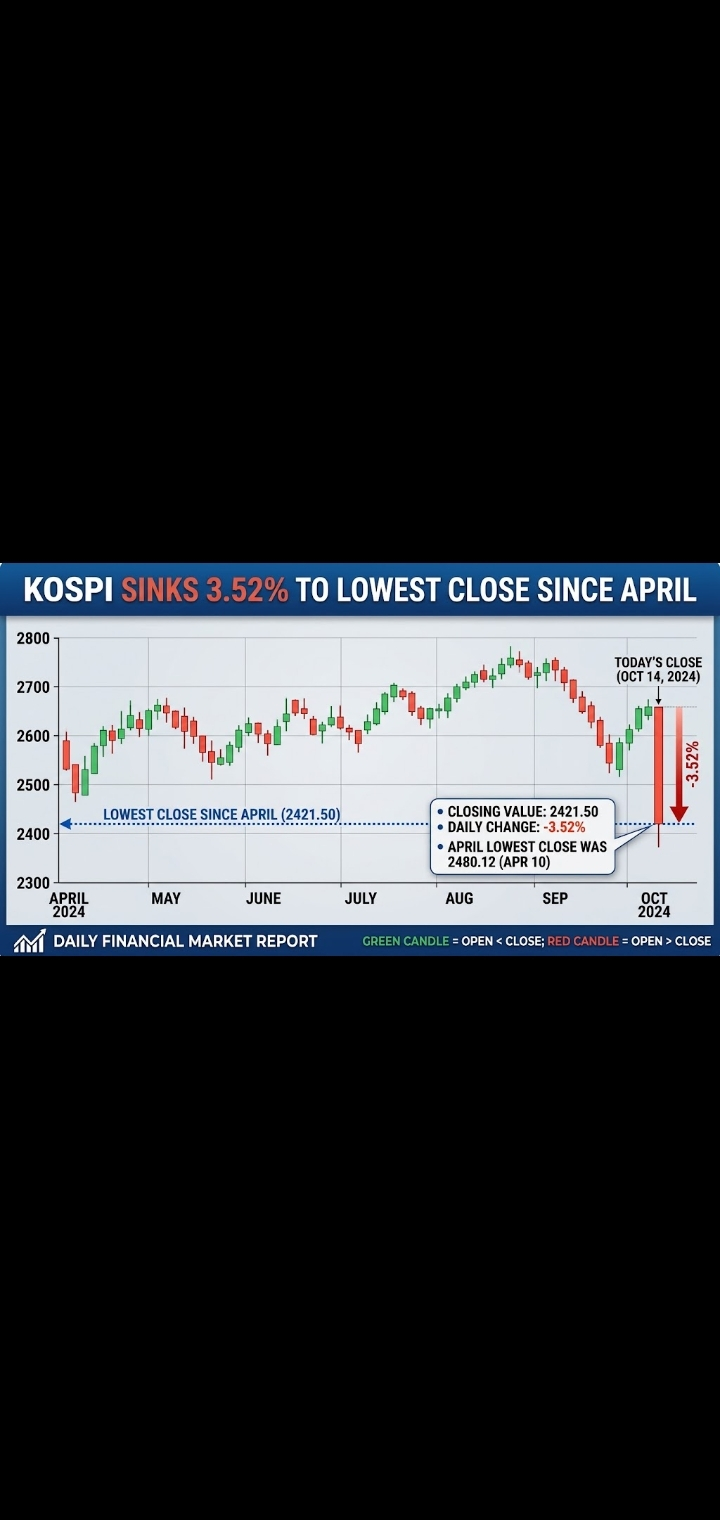
📉 $KOSPI Plunges 3.52%! Hit Lowest Close Since April 🚨
Asian markets are seeing major waves as South Korea's benchmark KOSPI index suffered a sharp 3.52% drop, marking its lowest closing level since April.
🔍 What's driving the sell-off?
Heightened macroeconomic pressures and regional volatility.
Spillover effects hitting global sentiment and risk-on assets.
Investors locking in caution as traditional markets face heavy headwinds.
Are you shifting your portfolio strategy amid these global market dips, or buying the discount? Let's discuss below! 👇
#KOSPI #stockmarket #GlobalMarkets #MarketUpdate #TradingInsights
1
45

South Korea’s KOSPI Drops 3.52% — Lowest Close Since April!
South Korea’s stock market is facing renewed selling pressure as the KOSPI plunges 3.52%, marking its lowest closing level since April. 🇰🇷
🔍 What Could This Mean for Investors?
📉 Market Pressure: A sharp decline may signal growing caution among investors.
🌏 Global Impact: Weakness in a major Asian market can influence sentiment across other markets.
Key Levels to Watch: Traders will be watching whether buyers step in or selling pressure continues.
💡 My Take: One rough session doesn’t determine the market’s long-term direction, but a drop this large deserves attention. Investors should stay calm, manage risk, and avoid emotional decisions.
🐂 Will the KOSPI recover soon?
🐻 Or could more downside be ahead?
Share your thoughts in the comments! 👇
Market commentary only, not financial advice. Always do your own research.
#KOSPI #SouthKorea #StockMarke #AsianMarkets #Investing
57
·
--
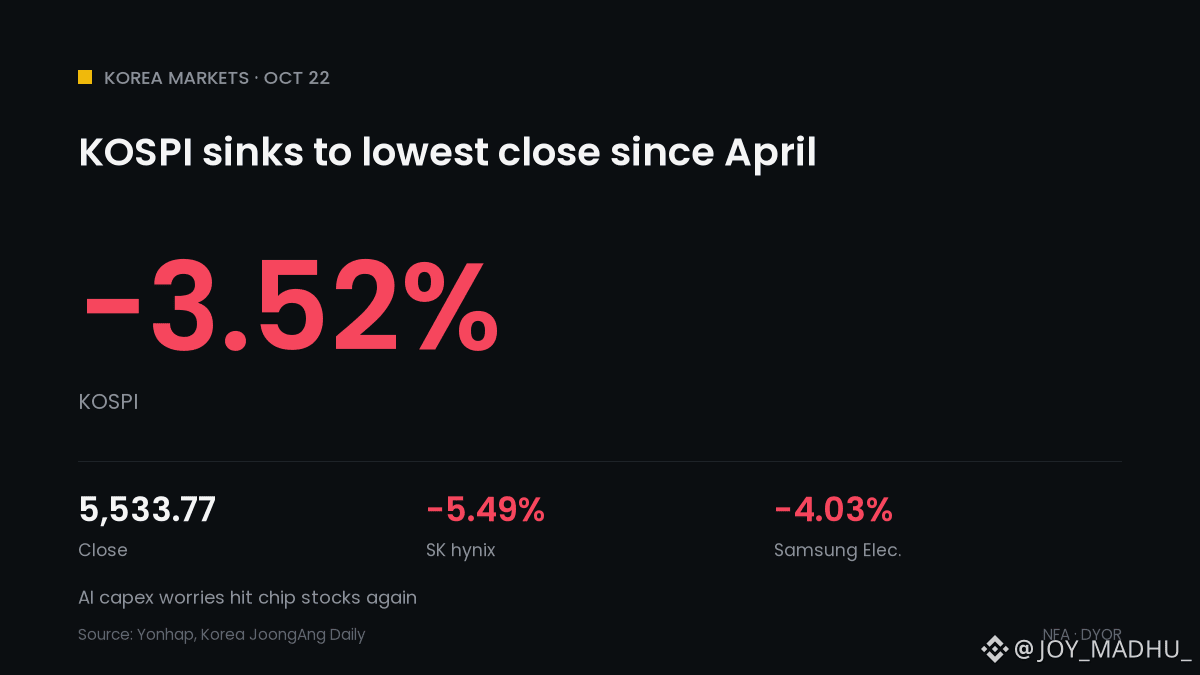
#KOSPISinks3.52%ToLowestCloseSinceApril
🇰🇷 KOSPI Sinks 3.52% to Its Lowest Close Since April
📉 Closed at 5,533.77, down 201.89 points, wiping out the prior day's 3.29% rebound
⚠️ Intraday low 5,485.98, a drop of as much as 4.35%
💾 Samsung Electronics -4.03%, SK hynix -5.49%
🏦 Institutions sold a net 462B won; retail bought 380B won
📊 KOSDAQ -3.62% to 764.10; Nikkei -2.65%, Taiwan -1.73%
🤖 Trigger: Meta and Tesla beat, but worries about AI capex payoffs returned
📅 KOSPI now sits ~41% below its 52-week high
What it means for crypto: The same AI and tech risk-off is weighing on $BTC, down ~1.9% in 24h near $81.9K. If Asian chip selling keeps spreading, crypto may stay under pressure until macro data eases inflation fears.
Is Asia's chip sell-off a warning for Bitcoin? 👇
$BTC $ETH
#CryptoNews #KOSPISinks3.52%ToLowestCloseSinceApril #KOSPI #AsiaMarkets
#KOSPISinks3.52%ToLowestCloseSinceApril
🇰🇷 KOSPI Sinks 3.52% to Its Lowest Close Since April
📉 Closed at 5,533.77, down 201.89 points, wiping out the prior day's 3.29% rebound
⚠️ Intraday low 5,485.98, a drop of as much as 4.35%
💾 Samsung Electronics -4.03%, SK hynix -5.49%
🏦 Institutions sold a net 462B won; retail bought 380B won
📊 KOSDAQ -3.62% to 764.10; Nikkei -2.65%, Taiwan -1.73%
🤖 Trigger: Meta and Tesla beat, but worries about AI capex payoffs returned
📅 KOSPI now sits ~41% below its 52-week high
What it means for crypto: The same AI and tech risk-off is weighing on $BTC , down ~1.9% in 24h near $81.9K. If Asian chip selling keeps spreading, crypto may stay under pressure until macro data eases inflation fears.
Is Asia's chip sell-off a warning for Bitcoin? 👇
$BTC $ETH
#CryptoNews #KOSPISinks3.52%ToLowestCloseSinceApril #KOSPI #AsiaMarkets
14
Log in to explore more content
Join global crypto users on Binance Square
⚡️ Get latest and useful information about crypto.
💬 Trusted by the world’s largest crypto exchange.
👍 Discover real insights from verified creators.
Email / Phone number
Trending Topics
1
#BinanceRestores28FiatWithdrawals
335 views
47 Discussing
2
#BinanceProcesses$4.65BWithdrawals
59,361 views
257 Discussing
3
#BitcoinDropsBelow$78K
415 views
22 Discussing
4
#EthereumSurpasses$2300
3,488 views
60 Discussing
5
#BitcoinSpotETFsPost$203MWeeklyOutflow
4,212 views
39 Discussing
6
#SouthKoreanLawmakerProposesReviewOfAllListedDigitalAssets
1,623 views
41 Discussing
7
#SolanaMobileRemovesMaliciousSKRClaimApp
207 views
30 Discussing
8
#BrazilVirtualAssetLicenseDeadlineDrawsAbout40Firms
27,110 views
472 Discussing
9
#BTCPayServerUrgesOperatorsToShutDownInstances
20,873 views
382 Discussing
10
#BankOfKoreaSurveysFinancialFirmsOnVirtualAssetRisks
672 views
22 Discussing