

#jpmorganpredictsbitcoinbestperformingassetovernextdecade
jpmorganpredictsbitcoinbestperformingassetovernextdecade
44,453 views
150 Discussing
Hot
Latest

·
--
$BTC | JPMorgan says Bitcoin will be the best performing asset over the next decade. Square is lit up with it. On the desk, a decade-long call never told us anything about tomorrow's position size. Right now the SatoshiMacro Model, 48 signals across six tiers, reads 40.8, flat Neutral. Compare that to 91.4 at the 2021-11 top. A bullish decade thesis and a mid-cycle reading answer different questions. My read: size, do not chase. Honest caveat: that 7-of-7 zone accuracy is calibrated in-sample, only 4-of-7 raw. On an ASIC account the 2:1 crypto CFD cap already limits how hard a decade call can hurt you short term.
https://satoshimacro.com/tools/crypto/satoshimacro-model/?utm_source=binance_square&utm_medium=social&utm_campaign=autopilot_short-2
#SatoshiMacro #JPMorganPredictsBitcoinBestPerformingAssetOverNextDecade #BitcoinCycle #Bitcoin
https://satoshimacro.com/tools/crypto/satoshimacro-model/?utm_source=binance_square&utm_medium=social&utm_campaign=autopilot_short-2
#SatoshiMacro #JPMorganPredictsBitcoinBestPerformingAssetOverNextDecade #BitcoinCycle #Bitcoin
239

·
--
Bullish
#JPMorganPredictsBitcoinBestPerformingAssetOverNextDecade
JPMorgan Adds Bitcoin to Its 10-Year Forecast, and It Tops the Chart
For the first time, Bitcoin has a seat at one of Wall Street’s most-watched planning tables. J.P. Morgan Asset Management forecast a 10% compounded annual return for bitcoin, its first long-term call on the cryptocurrency.
The numbers
Bitcoin’s 10% tops the bank’s 7.5% for U.S. large-cap stocks and 5.5% for gold. The projection comes from the firm’s 2027 Long-Term Capital Market Assumptions report, which covers more than 200 asset classes over a 10 to 15 year horizon. A traditional 60/40 portfolio is projected at about 7% annually.
Where the “best-performing asset” line comes from
The framing went viral after Bitwise CIO Matt Hougan wrote that JPMorgan had predicted Bitcoin would be the best-performing asset of the decade. On the report’s headline return figures, Bitcoin does rank first among the major asset classes shown.
The fine print matters
JPMorgan is far from a Bitcoin cheerleader here. The bank puts bitcoin’s volatility at 55% and says unstable correlations keep it out of most portfolios. It does not recommend Bitcoin as a diversification asset, and instead views it as a speculative asset and a hedge against monetary easing. The forecasts are meant for long-term allocation, not next year’s market.
Why it still matters
Bitcoin is no longer treated simply as an outside speculative asset, but as something worthy of a formal long-term return assumption alongside stocks, bonds and gold. Institutional demand is showing up too: BlackRock’s spot bitcoin ETF, IBIT, attracted $665 million in inflows on Monday, its largest single-day inflow since October 2025.
Bottom line
A 10% expected annual return with 55% volatility is a very different promise from “Bitcoin will outperform everything.” It is a long-term base case with a wide range of outcomes, not a price target.
$BTC $ETH $BNB
{future}(BNBUSDT)
{future}(ETHUSDT)
{future}(BTCUSDT)
#JPMorganPredictsBitcoinBestPerformingAssetOverNextDecade
JPMorgan Adds Bitcoin to Its 10-Year Forecast, and It Tops the Chart
For the first time, Bitcoin has a seat at one of Wall Street’s most-watched planning tables. J.P. Morgan Asset Management forecast a 10% compounded annual return for bitcoin, its first long-term call on the cryptocurrency.
The numbers
Bitcoin’s 10% tops the bank’s 7.5% for U.S. large-cap stocks and 5.5% for gold. The projection comes from the firm’s 2027 Long-Term Capital Market Assumptions report, which covers more than 200 asset classes over a 10 to 15 year horizon. A traditional 60/40 portfolio is projected at about 7% annually.
Where the “best-performing asset” line comes from
The framing went viral after Bitwise CIO Matt Hougan wrote that JPMorgan had predicted Bitcoin would be the best-performing asset of the decade. On the report’s headline return figures, Bitcoin does rank first among the major asset classes shown.
The fine print matters
JPMorgan is far from a Bitcoin cheerleader here. The bank puts bitcoin’s volatility at 55% and says unstable correlations keep it out of most portfolios. It does not recommend Bitcoin as a diversification asset, and instead views it as a speculative asset and a hedge against monetary easing. The forecasts are meant for long-term allocation, not next year’s market.
Why it still matters
Bitcoin is no longer treated simply as an outside speculative asset, but as something worthy of a formal long-term return assumption alongside stocks, bonds and gold. Institutional demand is showing up too: BlackRock’s spot bitcoin ETF, IBIT, attracted $665 million in inflows on Monday, its largest single-day inflow since October 2025.
Bottom line
A 10% expected annual return with 55% volatility is a very different promise from “Bitcoin will outperform everything.” It is a long-term base case with a wide range of outcomes, not a price target.
$BTC $ETH $BNB
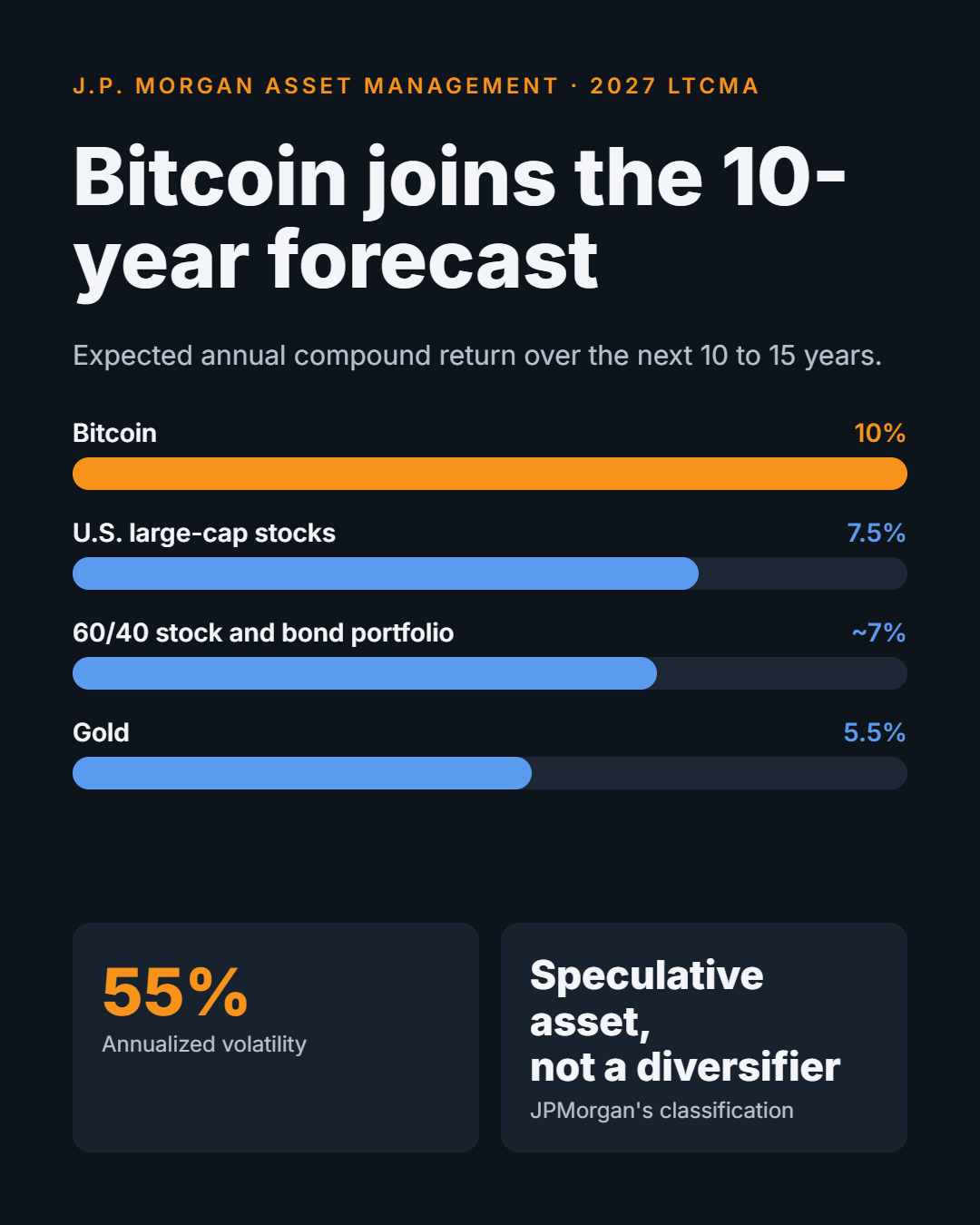
191


Article
🚨 THE WALL STREET EQUATION: JPMORGAN'S BTC BET 🚨#JPMorganPredictsBitcoinBestPerformingAssetOverNextDecade
A banking giant just flipped bullish! Let’s break down JPMorgan's new 10-year outlook using pure math 🧮👇
(10% Annual Return) > (Stocks & Gold) = Best Asset of the Decade 🚀
Here is the formula driving their 2027 projections:
The Return Variables:
(Bitcoin: 10.0%) > (US Large Caps: 7.5%) > (Gold: 5.5%) 📈
The Bull Case Output:
(16.6% Annual Growth) = Modeled $385,500 target.
The Breakdown:
JPMorgan Asset Management released its 2027 Long-Term Capital Market Assumptions. The result? Bitcoin is projected to outperform every major asset class over the next 10 to 15 years.
However, with 55% annualized volatility, the bank still excludes BTC from core portfolios, labeling it a "speculative asset and a hedge against monetary easing" rather than a stable diversifier.
Bitwise CIO Matt Hougan nailed the irony: "First they ignore you, then they laugh at you... then they predict you'll be the best-performing asset of the next decade."
Will Bitcoin hit that $385K bull target? Let's debate! 👇💬
$BTC $DOOD $JCT
{future}(JCTUSDT)
{future}(BTCUSDT)
{future}(DOODUSDT)
#Bitcoin #BTC #MacroEconomics #CryptoNews
🚨 THE WALL STREET EQUATION: JPMORGAN'S BTC BET 🚨
#JPMorganPredictsBitcoinBestPerformingAssetOverNextDecade
A banking giant just flipped bullish! Let’s break down JPMorgan's new 10-year outlook using pure math 🧮👇
(10% Annual Return) > (Stocks & Gold) = Best Asset of the Decade 🚀
Here is the formula driving their 2027 projections:
The Return Variables:
(Bitcoin: 10.0%) > (US Large Caps: 7.5%) > (Gold: 5.5%) 📈
The Bull Case Output:
(16.6% Annual Growth) = Modeled $385,500 target.
The Breakdown:
JPMorgan Asset Management released its 2027 Long-Term Capital Market Assumptions. The result? Bitcoin is projected to outperform every major asset class over the next 10 to 15 years.
However, with 55% annualized volatility, the bank still excludes BTC from core portfolios, labeling it a "speculative asset and a hedge against monetary easing" rather than a stable diversifier.
Bitwise CIO Matt Hougan nailed the irony: "First they ignore you, then they laugh at you... then they predict you'll be the best-performing asset of the next decade."
Will Bitcoin hit that $385K bull target? Let's debate! 👇💬
$BTC $DOOD $JCT
#Bitcoin #BTC #MacroEconomics #CryptoNews
2
488

·
--
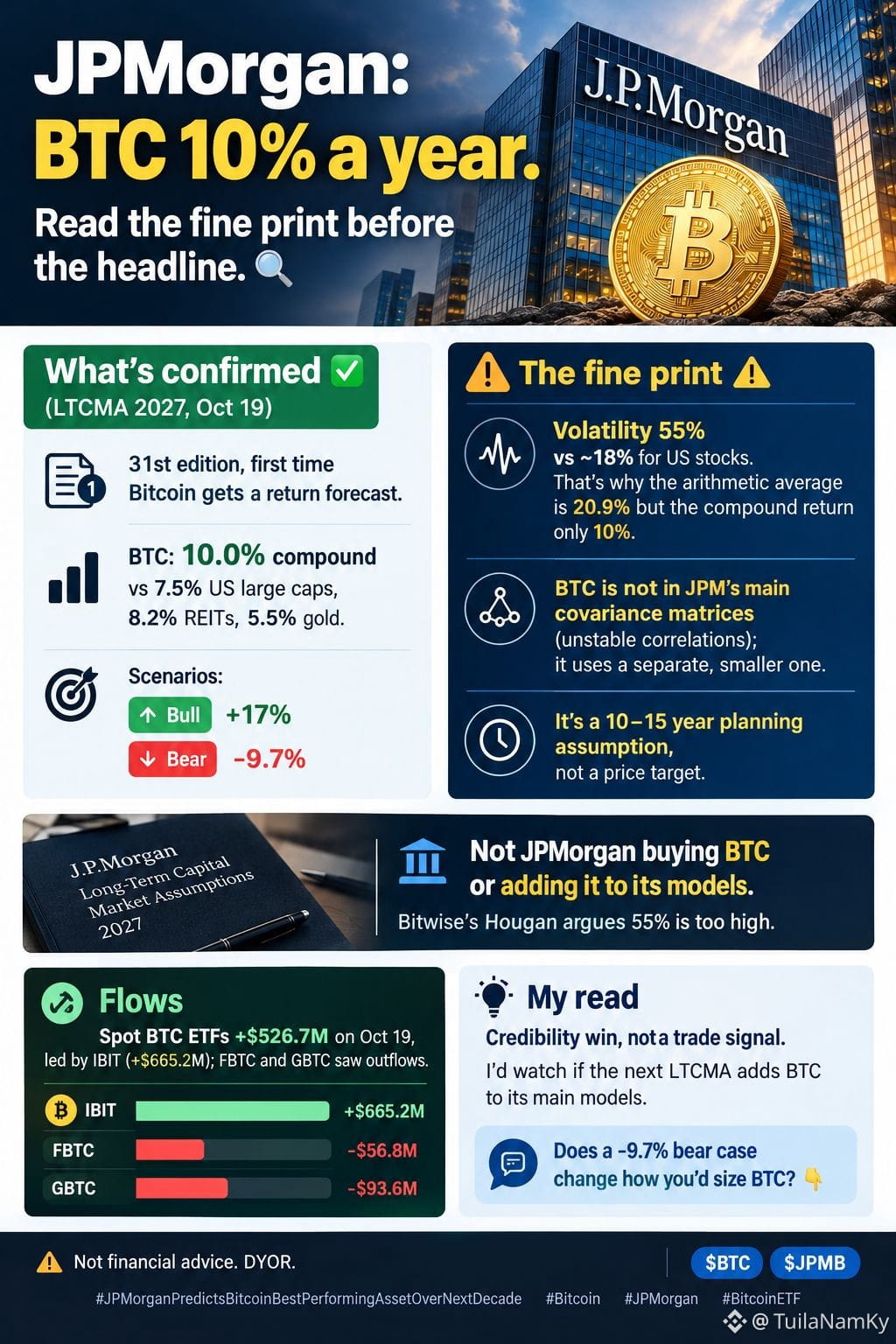
JPMorgan: BTC 10% a year. Read the fine print before the headline. 🔍
What’s confirmed ✅ (LTCMA 2027, Oct 19)
• 31st edition, first time Bitcoin gets a return forecast
• BTC: 10.0% compound vs 7.5% US large caps, 8.2% REITs, 5.5% gold
• Scenarios: bull +17%, bear -9.7%
The fine print ⚠️
• Volatility 55% vs ~18% for US stocks. That’s why the arithmetic average is 20.9% but the compound return only 10%
• BTC is not in JPM’s main covariance matrices (unstable correlations); it uses a separate, smaller one
• It’s a 10–15 year planning assumption, not a price target
Not JPMorgan buying BTC or adding it to its models. Bitwise’s Hougan argues 55% is too high.
Flows: spot BTC ETFs +$526.7M on Oct 19, led by IBIT (+$665.2M); FBTC and GBTC saw outflows.
My read: credibility win, not a trade signal. I’d watch if the next LTCMA adds BTC to its main models.
Does a -9.7% bear case change how you’d size BTC? 👇
Not financial advice. DYOR.
$BTC
{future}(BTCUSDT)
$JPMB
{spot}(JPMBUSDT)
#JPMorganPredictsBitcoinBestPerformingAssetOverNextDecade #Bitcoin #JPMorgan #BitcoinETF
JPMorgan: BTC 10% a year. Read the fine print before the headline. 🔍
What’s confirmed ✅ (LTCMA 2027, Oct 19)
• 31st edition, first time Bitcoin gets a return forecast
• BTC: 10.0% compound vs 7.5% US large caps, 8.2% REITs, 5.5% gold
• Scenarios: bull +17%, bear -9.7%
The fine print ⚠️
• Volatility 55% vs ~18% for US stocks. That’s why the arithmetic average is 20.9% but the compound return only 10%
• BTC is not in JPM’s main covariance matrices (unstable correlations); it uses a separate, smaller one
• It’s a 10–15 year planning assumption, not a price target
Not JPMorgan buying BTC or adding it to its models. Bitwise’s Hougan argues 55% is too high.
Flows: spot BTC ETFs +$526.7M on Oct 19, led by IBIT (+$665.2M); FBTC and GBTC saw outflows.
My read: credibility win, not a trade signal. I’d watch if the next LTCMA adds BTC to its main models.
Does a -9.7% bear case change how you’d size BTC? 👇
Not financial advice. DYOR.
$BTC
$JPMB
#JPMorganPredictsBitcoinBestPerformingAssetOverNextDecade #Bitcoin #JPMorgan #BitcoinETF
165

·
--
From Skepticism to Projection: Why JPMorgan Calls Bitcoin the Best-Performing Asset of the Next DecKey Takeaway
In a massive shift for traditional finance, JPMorgan’s latest long-term report projects Bitcoin to outperform US large-cap stocks and gold over the next decade. Combined with Switzerland approving its first retail Bitcoin ETF, institutional adoption is hitting a completely new gear.
What’s Changing the Narrative?
The Wall Street Shift: JPMorgan’s Long-Term Capital Market Assumptions report forecasts a 10% annualized return for Bitcoin, beating traditional equities (7.5%) and gold (5.5%).Global Regulatory Milestones: Switzerland’s FINMA Just approved its first direct retail Bitcoin ETF, breaking down barriers for everyday European capital to flow safely into the asset.
Technical & Market Impact
📈 Macro Outlook: Institutional forecasting changes long-term capital allocation. When major banks model Bitcoin into their 10-year outlooks, "smart money" accumulation follows.📉 Volatility Reality: JPMorgan pegs BTC volatility around 55%, reminding traders that corrections and macro sweep zones are part of the game.
Trading Tip: Long-term institutional tailwinds are bullish, but short-term leverage can get wiped out quickly. Look for structured spot accumulation or careful risk parameters on futures.
Levels & Metrics to Watch
Current Trend: Reclaiming higher macro baselines following recent market tests.Adoption Milestone: Expanding institutional wrappers globally (US ETFs + Swiss retail access).
👇 Are traditional banking forecasts finally opening the floodgates for retail, or is it just noise? Drop your thoughts below!
#JPMorganPredictsBitcoinBestPerformingAssetOverNextDecade
#SwitzerlandApprovesFirstBitcoinETF
From Skepticism to Projection: Why JPMorgan Calls Bitcoin the Best-Performing Asset of the Next Dec
Key Takeaway
In a massive shift for traditional finance, JPMorgan’s latest long-term report projects Bitcoin to outperform US large-cap stocks and gold over the next decade. Combined with Switzerland approving its first retail Bitcoin ETF, institutional adoption is hitting a completely new gear.
What’s Changing the Narrative?
The Wall Street Shift: JPMorgan’s Long-Term Capital Market Assumptions report forecasts a 10% annualized return for Bitcoin, beating traditional equities (7.5%) and gold (5.5%).Global Regulatory Milestones: Switzerland’s FINMA Just approved its first direct retail Bitcoin ETF, breaking down barriers for everyday European capital to flow safely into the asset.
Technical & Market Impact
📈 Macro Outlook: Institutional forecasting changes long-term capital allocation. When major banks model Bitcoin into their 10-year outlooks, "smart money" accumulation follows.📉 Volatility Reality: JPMorgan pegs BTC volatility around 55%, reminding traders that corrections and macro sweep zones are part of the game.
Trading Tip: Long-term institutional tailwinds are bullish, but short-term leverage can get wiped out quickly. Look for structured spot accumulation or careful risk parameters on futures.
Levels & Metrics to Watch
Current Trend: Reclaiming higher macro baselines following recent market tests.Adoption Milestone: Expanding institutional wrappers globally (US ETFs + Swiss retail access).
👇 Are traditional banking forecasts finally opening the floodgates for retail, or is it just noise? Drop your thoughts below!
#JPMorganPredictsBitcoinBestPerformingAssetOverNextDecade
#SwitzerlandApprovesFirstBitcoinETF
2
157

·
--
#JPMorganPredictsBitcoinBestPerformingAssetOverNextDecade
JPMorgan Forecasts 10% Annual Bitcoin Returns Over the Next Decade
JPMorgan Asset Management has included Bitcoin in its long-term investment forecasts for the first time, projecting an annualized return of 10% over the next 10 years.
📈 The forecast puts $BTC ahead of US large-cap stocks, projected at 7.5% annually, and gold at 5.5%. In a bullish scenario, Bitcoin could deliver annual returns of up to 17%.
⚠️ However, JPMorgan estimates Bitcoin’s annualized volatility at 55% and warns that unpredictable price movements remain a major risk. The projection is a long-term estimate, not a guarantee, and the firm has not added Bitcoin to its core portfolio models.
This marks a significant development in Wall Street’s assessment of Bitcoin as a long-term investment asset.
#bitcoin #BTC #JPMorgan #CryptoNewss

1
203

JPMorgan Thinks Bitcoin Could Outperform Stocks and Gold Over the Next Decade.
This is an interesting shift in how major financial institutions are looking at Bitcoin.
JPMorgan Asset Management has included BTC in its long-term return forecasts, with a base-case projection of around 10% annually.
That's higher than its forecasts for US stocks and gold.
But there's another number traders shouldn't ignore.
JPMorgan also estimates Bitcoin's annual volatility at roughly 55%.
That's a reminder that strong long-term return potential can come with painful short-term declines.
And the bank's forecasts include both bullish and bearish scenarios.
For me, the bigger story isn't a guaranteed 10% return.
It's that Bitcoin is increasingly being evaluated alongside traditional investment assets.
Long-term recognition is growing. Short-term risk hasn't disappeared.
$BTC
{future}(BTCUSDT)
#JPMorganPredictsBitcoinBestPerformingAssetOverNextDecade #Bitcoin #InstitutionalAdoption #CryptoMarket #BTCAnalysis
JPMorgan Thinks Bitcoin Could Outperform Stocks and Gold Over the Next Decade.
This is an interesting shift in how major financial institutions are looking at Bitcoin.
JPMorgan Asset Management has included BTC in its long-term return forecasts, with a base-case projection of around 10% annually.
That's higher than its forecasts for US stocks and gold.
But there's another number traders shouldn't ignore.
JPMorgan also estimates Bitcoin's annual volatility at roughly 55%.
That's a reminder that strong long-term return potential can come with painful short-term declines.
And the bank's forecasts include both bullish and bearish scenarios.
For me, the bigger story isn't a guaranteed 10% return.
It's that Bitcoin is increasingly being evaluated alongside traditional investment assets.
Long-term recognition is growing. Short-term risk hasn't disappeared.
$BTC
#JPMorganPredictsBitcoinBestPerformingAssetOverNextDecade #Bitcoin #InstitutionalAdoption #CryptoMarket #BTCAnalysis
158


Verified
JPMorgan, a leading financial institution, has made a bold prediction: Bitcoin is poised to become the best-performing asset class over the next decade. This forecast from a traditional finance giant signals a growing acceptance and recognition of digital assets within mainstream financial circles.
The implications of this prediction are significant. It suggests a potential for substantial growth and adoption of $BTC, moving beyond its current speculative nature to become a recognized store of value and investment vehicle. Investors may start to view Bitcoin not just as a volatile digital currency, but as a strategic long-term asset. This shift in perception could attract more institutional capital, further driving demand and potentially stabilizing its price action over the long run. The narrative around Bitcoin as 'digital gold' gains further credence with such endorsements.
This outlook from JPMorgan could encourage a broader market re-evaluation of cryptocurrencies and their potential role in diversified investment portfolios. As the decade unfolds, all eyes will be on whether Bitcoin lives up to this high expectation, potentially reshaping the future of asset performance and investment strategies.
#JPMorganPredictsBitcoinBestPerformingAssetOverNextDecade $BTC
JPMorgan, a leading financial institution, has made a bold prediction: Bitcoin is poised to become the best-performing asset class over the next decade. This forecast from a traditional finance giant signals a growing acceptance and recognition of digital assets within mainstream financial circles.
The implications of this prediction are significant. It suggests a potential for substantial growth and adoption of $BTC , moving beyond its current speculative nature to become a recognized store of value and investment vehicle. Investors may start to view Bitcoin not just as a volatile digital currency, but as a strategic long-term asset. This shift in perception could attract more institutional capital, further driving demand and potentially stabilizing its price action over the long run. The narrative around Bitcoin as 'digital gold' gains further credence with such endorsements.
This outlook from JPMorgan could encourage a broader market re-evaluation of cryptocurrencies and their potential role in diversified investment portfolios. As the decade unfolds, all eyes will be on whether Bitcoin lives up to this high expectation, potentially reshaping the future of asset performance and investment strategies.
#JPMorganPredictsBitcoinBestPerformingAssetOverNextDecade $BTC
1
7
15.2k

#JPMorganPredictsBitcoinBestPerformingAssetOverNextDecade
₿📈 JPMorgan Predicts $BITCOIN Could Be the Best-Performing Asset Over the Next Decade 📈₿
Imagine sitting down to build a portfolio for the next ten years. Stocks look familiar, gold feels dependable, but one digital asset suddenly enters the conversation with the highest projected return. That is the shift investors are watching.
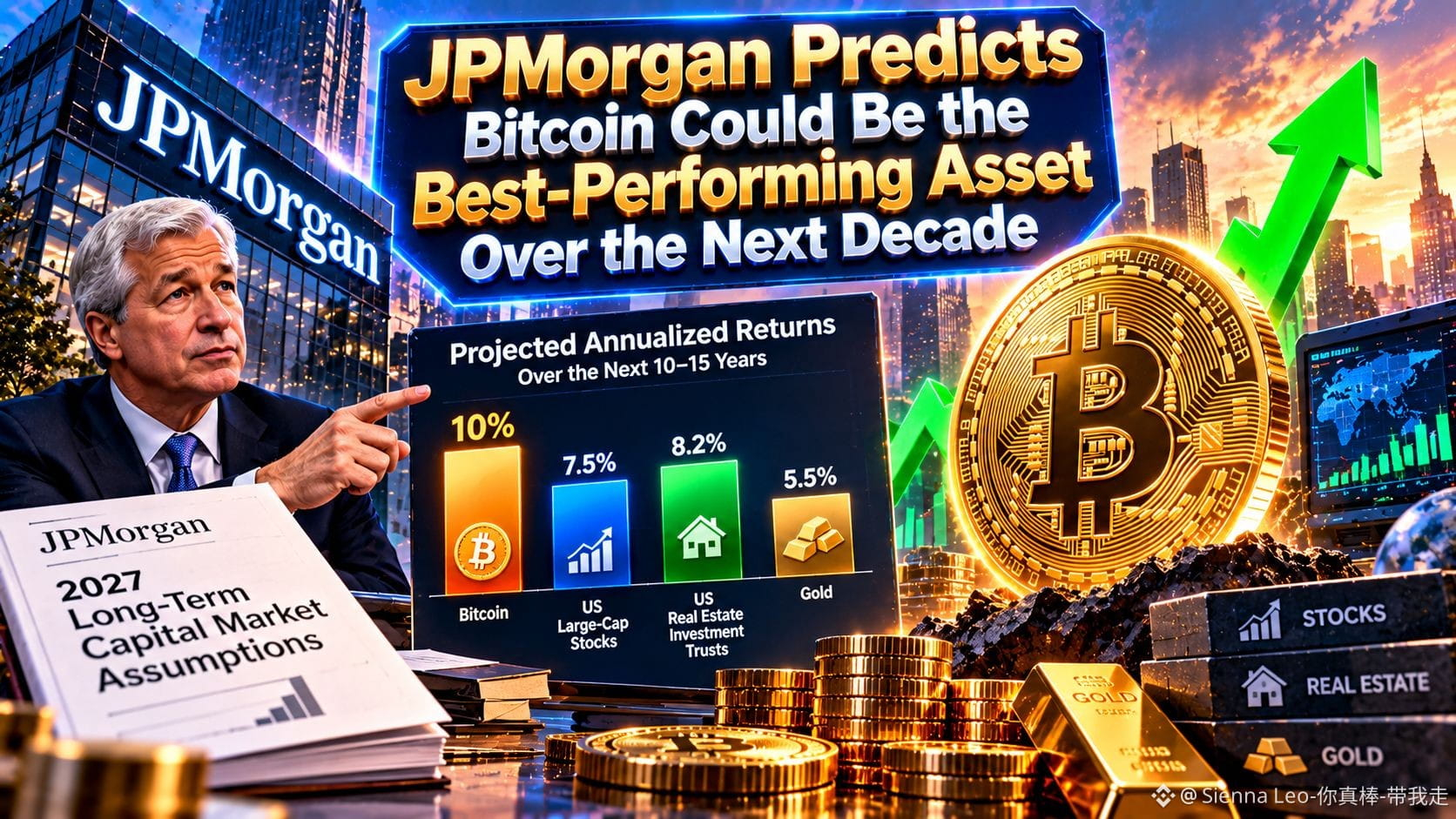
On October 19, JPMorgan Asset Management released its 2027 Long-Term Capital Market Assumptions, assigning Bitcoin a projected 10% annualized compound return over the next 10 to 15 years.
The comparison is striking: the report projects 7.5% for US large-cap stocks, 8.2% for US real estate investment trusts, and 5.5% for gold. Bitcoin leads the forecast, but the numbers represent estimates, not guaranteed outcomes.
Here is the important catch: JPMorgan also estimates Bitcoin's annualized volatility at around 55%. Higher potential returns come with a much rougher ride, including the possibility of substantial losses.
My take: Bitcoin entering a major institution's long-term return model is meaningful because it reflects growing recognition of the asset as an investment category. However, a favorable forecast does not mean JPMorgan considers Bitcoin a safe replacement for traditional portfolio holdings.
The real test is whether investors can tolerate Bitcoin's volatility long enough to benefit from any long-term growth. Position sizing, diversification, and time horizon still matter.
A strong forecast can change expectations, but only actual performance can validate it.
Would you allocate more to BTC based on JPMorgan's outlook, or does its volatility outweigh the projected return?
Disclaimer: For educational purposes only. Not financial advice.
#CryptoMarket #GrowWithSAC #EarningsSeason $BTC $WLD
2
849

#JPMorganPredictsBitcoinBestPerformingAssetOverNextDecade
🚀₿ JPMorgan’s Bold $BITCOIN Forecast: Could $BTC Become the Decade’s Best-Performing Asset? ₿🚀
Some financial revolutions arrive quietly. Others begin when Wall Street starts looking at an asset differently.
JPMorgan Asset Management has included Bitcoin in its latest long-term capital market assumptions for the first time, projecting an annualized return of around 10% over the next decade. Its forecast places BTC ahead of major US stocks and bonds in its base-case outlook.
The report also highlights the uncertainty behind that projection. Bitcoin’s estimated returns vary significantly across bullish and bearish scenarios, reminding investors that a long-term forecast is not a guaranteed outcome.
Why does this matter? When a major traditional financial institution incorporates Bitcoin into its long-range investment models, it signals that the asset is increasingly being evaluated within mainstream portfolio research.
My Take: The real story is not the 10% figure itself. It is Bitcoin’s growing recognition as a legitimate asset for long-term capital allocation.
Potential drivers include institutional participation, limited supply, broader investment access, and the possibility of continued adoption. However, these factors do not guarantee rising prices, and changing market conditions can alter the outlook dramatically.
There is an important catch: JPMorgan still warns that Bitcoin’s volatility and unstable correlations with other assets complicate its role in diversified portfolios.
A decade-long forecast can shape expectations, but only actual market performance can validate it.
Would you hold Bitcoin for the next 10 years based on this outlook, or do its volatility risks outweigh the potential reward?
Disclaimer: This content is for educational purposes only, not financial advice. Always conduct your own research.
#Bitcoin #CryptoNews #GrowWithSAC #EarningsSeason $WLD

1
268

·
--
Bullish
Verified
🚀 JPMorgan’s Bitcoin Outlook: The Next Decade Could Change Everything!
#bitcoin is gaining attention as a potential long-term investment powerhouse. If JPMorgan’s outlook that BTC could become the best-performing asset over the next decade proves correct, it could reshape how investors think about digital assets.
🔥 Why Bitcoin matters:
📈 Growing institutional adoption
🌍 Limited supply of 21 million BTC
🏦 Increasing interest from major financial institutions
💎 Potential long-term value as digital scarcity attracts capital
⚠️ The key takeaway: Bitcoin’s long-term opportunity is compelling, but volatility, regulation, and market cycles remain major risks. A bullish forecast is not a guarantee.
The real question is: Will Bitcoin outperform traditional assets by 2036? 👀
#JPMorganPredictsBitcoinBestPerformingAssetOverNextDecade
$BTC
{spot}(BTCUSDT)
🚀 JPMorgan’s Bitcoin Outlook: The Next Decade Could Change Everything!
#bitcoin is gaining attention as a potential long-term investment powerhouse. If JPMorgan’s outlook that BTC could become the best-performing asset over the next decade proves correct, it could reshape how investors think about digital assets.
🔥 Why Bitcoin matters:
📈 Growing institutional adoption
🌍 Limited supply of 21 million BTC
🏦 Increasing interest from major financial institutions
💎 Potential long-term value as digital scarcity attracts capital
⚠️ The key takeaway: Bitcoin’s long-term opportunity is compelling, but volatility, regulation, and market cycles remain major risks. A bullish forecast is not a guarantee.
The real question is: Will Bitcoin outperform traditional assets by 2036? 👀
#JPMorganPredictsBitcoinBestPerformingAssetOverNextDecade
$BTC
3
97

·
--
#JPMorganPredictsBitcoinBestPerformingAssetOverNextDecade
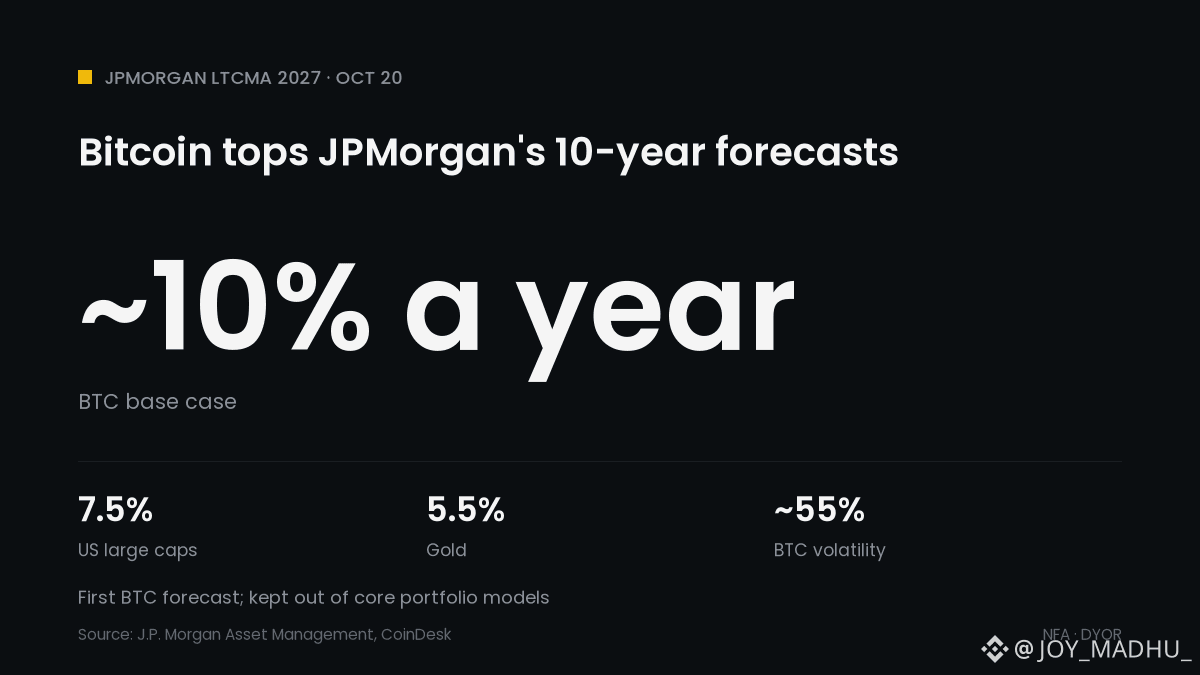
🏦 JPMorgan: Bitcoin Tops Its 10-Year Return Forecasts
📊 JPMorgan Asset Management's 2027 long-term outlook forecasts Bitcoin returns for the first time
📈 Base case: ~10% a year for $BTC, top of its forecasts
🇺🇸 US large caps 7.5% | Gold 5.5%
⚠️ It also assumes ~55% annual volatility, about 3x US stocks
🔍 BTC stays out of its main portfolio models due to unstable correlations
💬 JPMorgan calls it "a speculative asset and a hedge against monetary easing"
What it means for crypto: a first forecast from a Wall Street giant adds credibility, but the bank flags the risk and keeps BTC out of core allocations. BTC trades near $82.4K.
Does this change how you view BTC? 👇
$BTC
#JPMorganPredictsBitcoinBestPerformingAssetOverNextDecade #CryptoNews #Bitcoin #JPMorgan
#JPMorganPredictsBitcoinBestPerformingAssetOverNextDecade
🏦 JPMorgan: Bitcoin Tops Its 10-Year Return Forecasts
📊 JPMorgan Asset Management's 2027 long-term outlook forecasts Bitcoin returns for the first time
📈 Base case: ~10% a year for $BTC , top of its forecasts
🇺🇸 US large caps 7.5% | Gold 5.5%
⚠️ It also assumes ~55% annual volatility, about 3x US stocks
🔍 BTC stays out of its main portfolio models due to unstable correlations
💬 JPMorgan calls it "a speculative asset and a hedge against monetary easing"
What it means for crypto: a first forecast from a Wall Street giant adds credibility, but the bank flags the risk and keeps BTC out of core allocations. BTC trades near $82.4K.
Does this change how you view BTC? 👇
$BTC
#JPMorganPredictsBitcoinBestPerformingAssetOverNextDecade #CryptoNews #Bitcoin #JPMorgan
2
58

·
--
Bullish
#JPMorganPredictsBitcoinBestPerformingAssetOverNextDecade
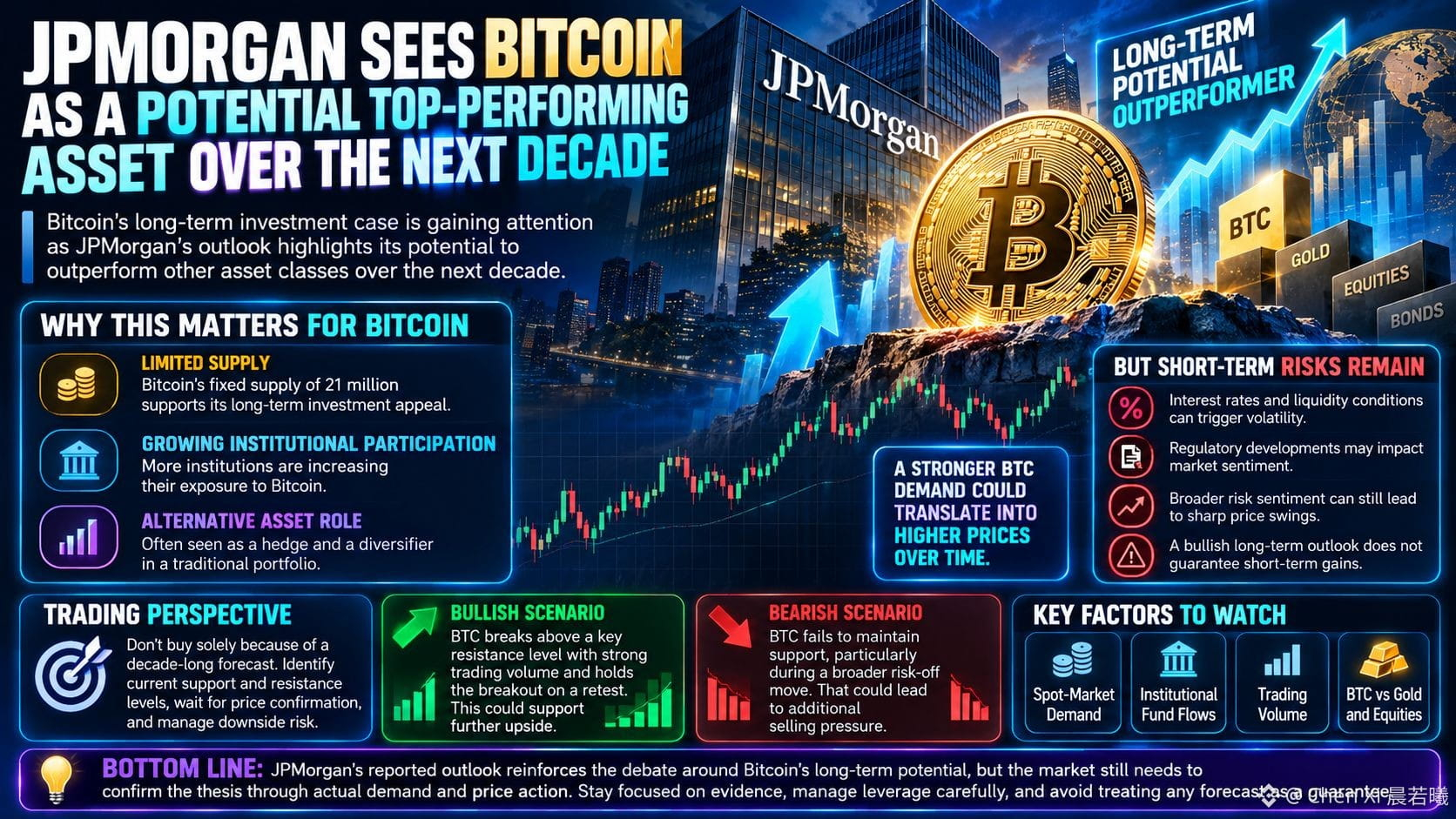
JPMorgan Sees Bitcoin as a Potential Top-Performing Asset Over the Next Decade 📈
Bitcoin’s long-term investment case is gaining attention as JPMorgan’s outlook highlights its potential to outperform other asset classes over the next decade. For crypto traders, the key question is whether this long-term thesis can translate into sustained buying pressure in the market.
Why This Matters for Bitcoin
Bitcoin’s investment appeal is often linked to its limited supply, growing institutional participation, and potential role as an alternative asset. If long-term investors continue increasing their exposure, BTC could benefit from stronger demand over time.
However, a bullish long-term outlook does not guarantee short-term gains. Interest rates, liquidity conditions, regulatory developments, and broader risk sentiment can still trigger significant volatility.
What Traders Should Watch
Bullish scenario: BTC breaks above a key resistance level with strong trading volume and holds the breakout on a retest. This could support further upside.
Bearish scenario: Bitcoin fails to maintain support, particularly during a broader risk-off move. That could lead to additional selling pressure.
Confirmation matters: Monitor spot-market demand, institutional fund flows, trading volume, and Bitcoin’s performance relative to gold and equities.
Trading Perspective
Rather than buying solely because of a decade-long forecast, traders should identify current support and resistance levels, wait for price confirmation, and manage downside risk. Long-term conviction and short-term market timing are two different strategies.
Bottom Line: JPMorgan’s reported outlook reinforces the debate around Bitcoin’s long-term potential, but the market still needs to confirm the thesis through actual demand and price action.
#Bitcoin #CryptoMarket #JPMorgan #CryptoTrading
$APR $ARIA $JCT
{future}(JCTUSDT)
{future}(ARIAUSDT)
{future}(APRUSDT)
#JPMorganPredictsBitcoinBestPerformingAssetOverNextDecade
JPMorgan Sees Bitcoin as a Potential Top-Performing Asset Over the Next Decade 📈
Bitcoin’s long-term investment case is gaining attention as JPMorgan’s outlook highlights its potential to outperform other asset classes over the next decade. For crypto traders, the key question is whether this long-term thesis can translate into sustained buying pressure in the market.
Why This Matters for Bitcoin
Bitcoin’s investment appeal is often linked to its limited supply, growing institutional participation, and potential role as an alternative asset. If long-term investors continue increasing their exposure, BTC could benefit from stronger demand over time.
However, a bullish long-term outlook does not guarantee short-term gains. Interest rates, liquidity conditions, regulatory developments, and broader risk sentiment can still trigger significant volatility.
What Traders Should Watch
Bullish scenario: BTC breaks above a key resistance level with strong trading volume and holds the breakout on a retest. This could support further upside.
Bearish scenario: Bitcoin fails to maintain support, particularly during a broader risk-off move. That could lead to additional selling pressure.
Confirmation matters: Monitor spot-market demand, institutional fund flows, trading volume, and Bitcoin’s performance relative to gold and equities.
Trading Perspective
Rather than buying solely because of a decade-long forecast, traders should identify current support and resistance levels, wait for price confirmation, and manage downside risk. Long-term conviction and short-term market timing are two different strategies.
Bottom Line: JPMorgan’s reported outlook reinforces the debate around Bitcoin’s long-term potential, but the market still needs to confirm the thesis through actual demand and price action.
#Bitcoin #CryptoMarket #JPMorgan #CryptoTrading
$APR $ARIA $JCT
97

·
--
Bullish
Verified
#JPMorganPredictsBitcoinBestPerformingAssetOverNextDecade 🚀🚀🚀🚀🚀🚀🚀🚀🚀🚀JPMorgan Predicts Bitcoin as the Best-Performing Asset Over the Next Decade!
In a historic shift, Wall Street giant JPMorgan has officially included Bitcoin (BTC) in its long-term Capital Market Assumptions for the very first time. The verdict? They expect cryptocurrency to outpace every major traditional asset class over the next 10 to 15 years.
According to JPMorgan’s ‘2027 Long-Term Capital Market Assumptions’ report, Bitcoin is projected to deliver the highest returns over the next decade.
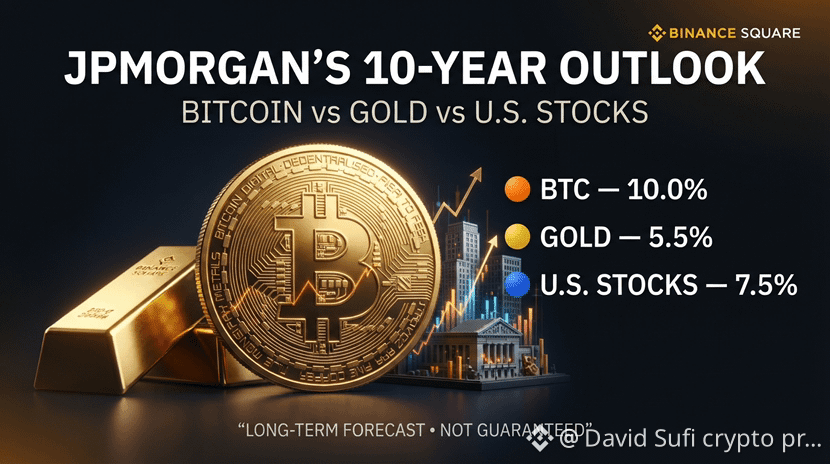
📊 JPMorgan’s 10-Year Annualized Return Forecast:
• 🪙 Bitcoin (BTC): 10.0% expected annualized return (CAGR)
• 🏢 U.S. REITs (Real Estate): 8.2%
• 📈 U.S. Large-Cap Stocks: 7.5%
• 🟡 Gold: 5.5%
⚠️ The Catch:
While Bitcoin leads in potential gains, JPMorgan notes its annualized volatility remains extremely high at 55% (roughly three times more volatile than traditional equities). Because of this extreme risk profile, they are not yet integrating BTC into their core, diversified multi-asset portfolios. However, they outlined an aggressive Bull Case of 17.0% annual returns, and a Bear Case of -9.7%.
Seeing a major institution that once dismissed crypto now crown Bitcoin as a potential decade-long leader is a massive validation for institutional crypto adoption!
What is your take on this? Will Bitcoin truly outperform Gold and Stocks over the next 10 years? Let me know your thoughts in the comments below! 👇
$BTC $ETH $SOL
#JPMorganPredictsBitcoinBestPerformingAssetOverNextDecade #Bitcoin #BTC #CryptoNews #BinanceSquare #WallStreet
{future}(SOLUSDT)
{future}(ETHUSDT)
{future}(BTCUSDT)
#JPMorganPredictsBitcoinBestPerformingAssetOverNextDecade 🚀🚀🚀🚀🚀🚀🚀🚀🚀🚀JPMorgan Predicts Bitcoin as the Best-Performing Asset Over the Next Decade!
In a historic shift, Wall Street giant JPMorgan has officially included Bitcoin (BTC) in its long-term Capital Market Assumptions for the very first time. The verdict? They expect cryptocurrency to outpace every major traditional asset class over the next 10 to 15 years.
According to JPMorgan’s ‘2027 Long-Term Capital Market Assumptions’ report, Bitcoin is projected to deliver the highest returns over the next decade.
📊 JPMorgan’s 10-Year Annualized Return Forecast:
• 🪙 Bitcoin (BTC): 10.0% expected annualized return (CAGR)
• 🏢 U.S. REITs (Real Estate): 8.2%
• 📈 U.S. Large-Cap Stocks: 7.5%
• 🟡 Gold: 5.5%
⚠️ The Catch:
While Bitcoin leads in potential gains, JPMorgan notes its annualized volatility remains extremely high at 55% (roughly three times more volatile than traditional equities). Because of this extreme risk profile, they are not yet integrating BTC into their core, diversified multi-asset portfolios. However, they outlined an aggressive Bull Case of 17.0% annual returns, and a Bear Case of -9.7%.
Seeing a major institution that once dismissed crypto now crown Bitcoin as a potential decade-long leader is a massive validation for institutional crypto adoption!
What is your take on this? Will Bitcoin truly outperform Gold and Stocks over the next 10 years? Let me know your thoughts in the comments below! 👇
$BTC $ETH $SOL
#JPMorganPredictsBitcoinBestPerformingAssetOverNextDecade #Bitcoin #BTC #CryptoNews #BinanceSquare #WallStreet
49

JPMorgan predicts $BTC will be the best-performing asset of the next decade, even though the bank’s chief once called it a scam.
JPMorgan has included Bitcoin in its long-term capital market assumptions report, forecasting average annual returns of around 10% over the next 10 years—outperforming both U.S. stocks and gold.
Several financial news outlets have confirmed this is the first time JPMorgan has officially classified Bitcoin as a long-term asset in an internal report, rather than treating it solely as a derivative product sold to clients.
The report doesn’t say which way BTC will move in the short term, and the bank has maintained its usual warnings about price volatility.
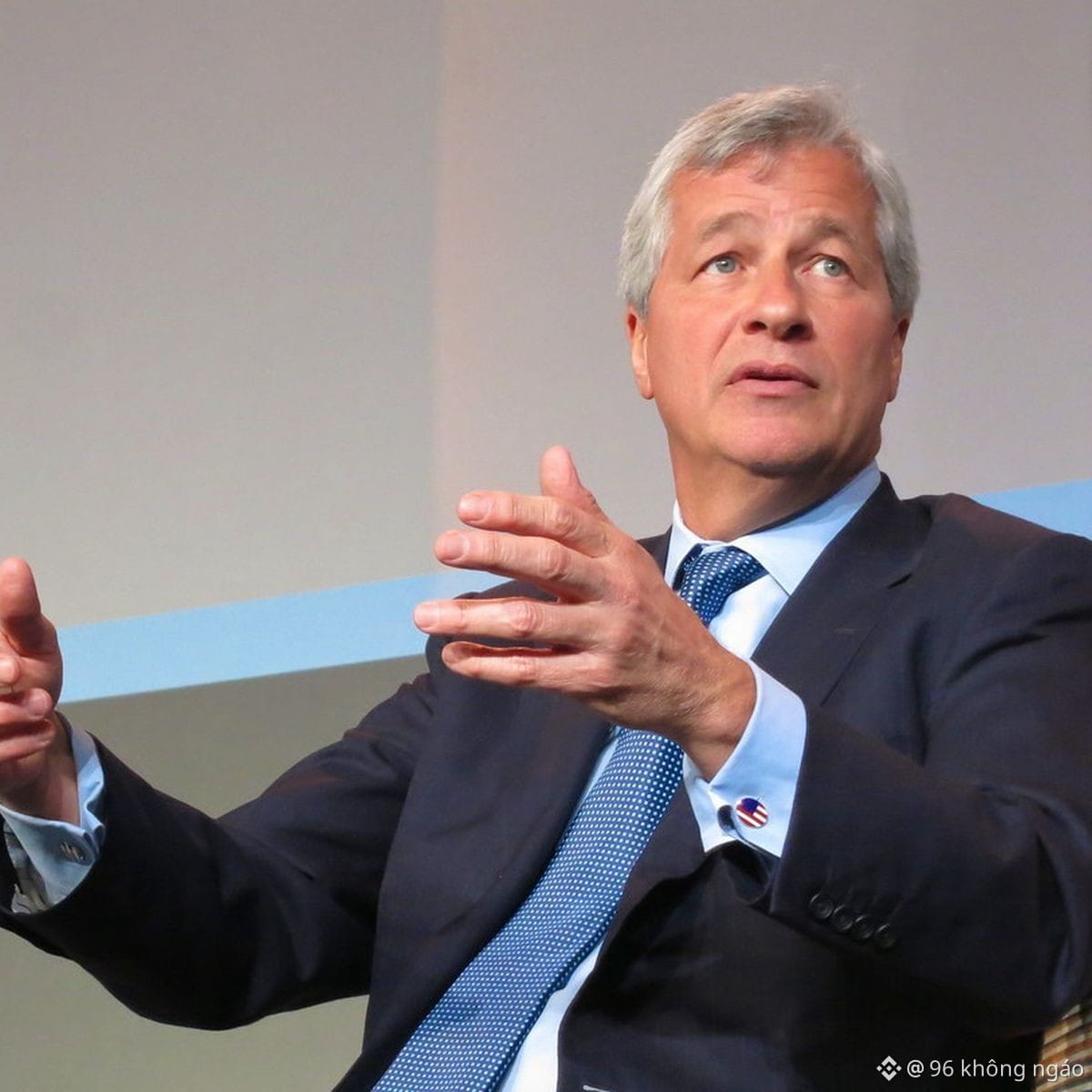
The ironic detail: JPMorgan CEO Jamie Dimon once called Bitcoin a scam, not so long ago.
At the time of writing, $BTC is trading around $83,000, up slightly over the past 24 hours. I’ll be watching to see whether institutional money actually follows this forecast.
Personal observations, not investment advice.
#JPMorganPredictsBitcoinBestPerformingAssetOverNextDecade #TinFed #BTC
124

·
--
JPMorgan predicts Bitcoin will be the best-performing asset over the next decade. Given Bitcoin’s decentralized and inflation-resistant nature, this prediction isn’t unreasonable. So, do you think Bitcoin can truly outperform traditional assets and become the investment king of the next decade? #JPMorganPredictsBitcoinBestPerformingAssetOverNextDecade
#BTC $BTC
#BTC $BTC
1
148
Wall Street Giants Make Their Move: JPMorgan’s Double Blow Shakes Markets as BlackRock Bets on a New Bitcoin ETF
I. JPMorgan Makes History: JPM Coin Goes Live on Ethereum Mainnet
On October 19, JPMorgan’s Kinexys division officially deployed its dollar deposit token, JPMD, to the Ethereum mainnet—a major expansion following its launch on the Base network. JPMD had already reached an average daily transaction volume of $7 billion. Bringing it on-chain means JPMorgan’s institutional-grade settlement capabilities can operate around the clock, no longer limited by traditional banking hours.
The deeper significance of this move is that one of Wall Street’s top banks is treating Ethereum as institutional-grade financial infrastructure. Ethereum is no longer just a playground for crypto-native projects; it is becoming a foundational settlement layer for traditional finance. JPMorgan’s entry, together with its partnerships with Coinbase and Thunes, signals that bank-issued deposit tokens are emerging as serious competitors to traditional stablecoins.
II. First Time in 31 Years: JPMorgan Predicts Bitcoin Will Outperform U.S. Stocks and Gold
Even more market-shaking, JPMorgan Asset Management included Bitcoin in its asset-allocation model for the first time in its 31-year history of publishing its Long-Term Capital Market Assumptions. The report forecasts that Bitcoin will deliver a 10% annualized compound return over the next decade, outperforming the 7.5% forecast for the U.S. stock market, 8.2% for real estate investment trusts, and 5.5% for gold.
This marks a fundamental shift in how mainstream Wall Street institutions view Bitcoin. In the past, major banks tended to take a cautious, wait-and-see approach. This time, JPMorgan not only acknowledged Bitcoin’s long-term return potential, but also ranked it above traditional asset classes. The report did note that Bitcoin’s high volatility continues to limit its usefulness for portfolio diversification in the short term, but the forecast itself is a landmark signal.
III. BlackRock Follows Suit: Launching a Protected Bitcoin ETF
On the same day JPMorgan released its forecast, BlackRock, the world’s largest asset manager, filed an application with the U.S. Securities and Exchange Commission for the iShares Bitcoin Managed Protection ETF, ticker PBIT. The product uses an IBIT options spread strategy to provide approximately 10% downside protection, in exchange for capping potential upside gains.
The cleverness of this product design lies in its target audience: conservative investors who are optimistic about Bitcoin’s long-term prospects but put off by its volatility. BlackRock’s IBIT attracted $665 million in inflows on October 19 alone, while spot Bitcoin ETFs collectively recorded net inflows of $526.7 million that day. Institutional appetite for Bitcoin has not faded; it is accelerating.
IV. Stablecoin Transfer Volumes Surge Fourfold as On-Chain Payment Infrastructure Takes Shape
Meanwhile, adjusted stablecoin transfer volume reached $891 billion in the third quarter, more than four times the level at the start of 2023, with over $400 million moving on-chain every hour. U.S. banks are rapidly integrating stablecoin infrastructure. From JPMorgan’s JPMD to the Coinbase–Thunes partnership, institutional-grade on-chain payments are moving from concept to reality.
As the implementing rules for the U.S. GENIUS Act become clearer, greater clarity around compliance boundaries will further encourage traditional financial institutions to embrace on-chain payments.
V. Market Outlook: The Institutional Era Begins
From JPMorgan bringing JPM Coin on-chain and Bitcoin entering its 30-year asset-allocation model for the first time, to BlackRock’s protected ETF and the explosive growth in stablecoin transfer volumes, October 2026 is becoming a watershed moment in the institutionalization of the crypto market. Wall Street is no longer just watching from the sidelines; it is becoming a deeply engaged participant in on-chain finance. For everyday investors, following institutional moves, understanding product innovation, and keeping up with regulatory trends will be key priorities in the next phase.
#EarningsSeason #JPMorganPredictsBitcoinBestPerformingAssetOverNextDecade #BitcoinETF
263

·
--
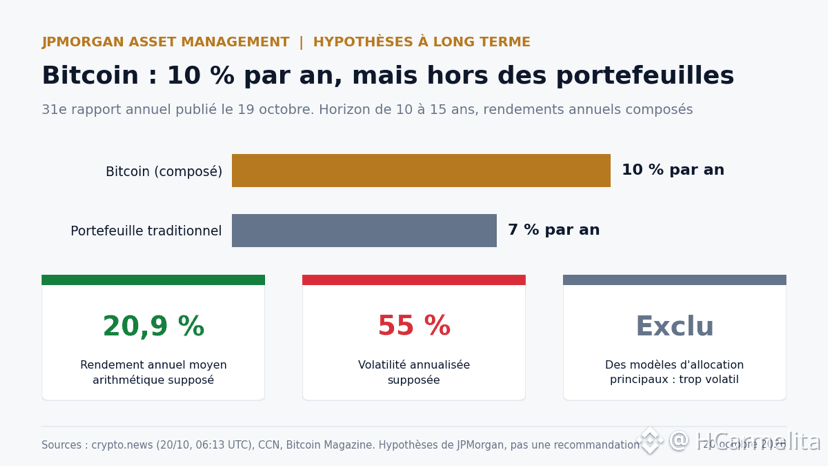
JPMorgan adds Bitcoin to its long-term forecasts: 10% a year, but not in its portfolios
In its 31st annual report on long-term market assumptions, published on October 19, JPMorgan Asset Management includes Bitcoin. On the morning of October 20, the news spread widely, notably shared by Matt Hougan, chief investment officer at Bitwise (crypto.news).
The figures
→ Bitcoin’s compound annual return over 10 to 15 years: 10%, ahead of U.S. stocks and gold, according to JPMorgan
→ Average arithmetic annual return: 20.9%, with assumed annualized volatility of 55%
→ Traditional portfolio: around 7% a year
The point that is often overlooked: JPMorgan does not include Bitcoin in its main allocation models and still considers it too volatile to recommend to strategic investors. This is a research assumption, not portfolio advice.
Why two figures: an average return of 20.9% with 55% volatility results in a much lower compound return—10% in this case. The difference is mainly due to volatility. This is my explanation, not a detail published by JPMorgan.
The context: the bank’s CEO, Jamie Dimon, has long been skeptical of Bitcoin, even though the bank has allowed its clients to buy it since May 2025 (CCN).
My analysis: these assumptions lend credibility to Bitcoin as an asset class, without saying that people should hold it. This is an assumption, not a forecast.
This is not investment advice.
Is an expected return of 10% a year with 55% volatility enough to justify allocating to Bitcoin?
#JPMorganPredictsBitcoinBestPerformingAssetOverNextDecade
2
699

·
--
JPMorgan includes BTC in its long-term forecast for the first time|Headlines can be easily misread|I don’t take it as a signal to chase the rally
My stance is cautiously bullish, but I’m waiting for price confirmation first. The topic #JPMorganPredictsBitcoinBestPerformingAssetOverNextDecade is currently trending on Binance Square, but traders shouldn’t focus only on the words “best over the next decade.” J.P. Morgan Asset Management’s 2027 Long-Term Capital Market Assumptions set a projected return range for Bitcoin for the first time. The same official statement also makes clear that Bitcoin’s correlations are unstable and that it has not yet been included in the firm’s main covariance matrix. These assumptions are intended for strategic allocation over a 10- to 15-year horizon, not for short-term market timing. This means BTC is beginning to be covered by a research framework—not that an institution has announced it is buying today, and certainly not a promise of returns.
Why is this worth watching? When a major asset manager includes BTC in the range of long-term returns under consideration, it may influence how investment committees compare risk assets. But whether that leads to actual allocations will still depend on volatility, custody, regulation, and portfolio correlations. The official page presents a standalone forecast for Bitcoin while also warning that its unstable correlations hinder strategic allocation. That second point is precisely what the market is most likely to overlook. Saying “the fund has increased its holdings” when the fact is only “the research now covers it,” or treating a model’s long-term average as next week’s potential gain, confuses facts with inferences.
Another useful cross-check is fund flows, not slogans. Farside’s table of U.S. spot BTC funds shows total net inflows of about $526.7 million on October 19, driven mainly by $665.2 million in inflows to IBIT, while FBTC and GBTC saw outflows of about $83.6 million and $54.9 million, respectively. This points to a positive overall flow direction, but not synchronized buying across all products. The individual fund entries for October 20 are still shown as dashes at the time of writing; the automatically calculated total of 0.0 should not be interpreted as confirmed zero inflows for that day. Research reports, fund flows, and spot prices are different layers of evidence. None should be used on its own to conclude that prices must rise.
At the time of writing, Kraken BTC/USD was around $82,725, with an opening price near $81,843, a 24-hour low around $81,100, and a high around $83,339. The price is above the daily open but still below the 24-hour high; it would be wrong to say this price movement was caused by JPMorgan’s view. I’m watching to see whether price can decisively break above the $83,340 area and whether it continues to hold near $81,100. If price breaks out and quickly falls back, or drops below $81,100 and fails to recover on a rebound, my short-term bullish view is invalidated. If the official model’s methodology is later revised or ETF data is updated, I’ll revise my view too rather than cling to a compelling narrative.
If I were trading this myself, I wouldn’t chase the price. I’d only consider a small, conditional spot long. I’d enter a test position using about 2% of total capital only if price moves above $83,340, retests that level and holds, and trading volume does not contract significantly. I’d take half off at the first target of $85,000, then close the rest in stages at the second target of $86,500. I’d place the stop below the retest low, with a maximum account risk of 0.3% per trade. If price falls back below $82,000 after entry and cannot quickly reclaim it, I’d close the position proactively. If it first loses $81,100, the original plan is canceled and I’ll wait for a new setup. If none of these conditions are met, I stay out of the market; I won’t present an unfilled plan as a profitable trade recap.
Sources: J.P. Morgan Asset Management’s official 2027 Long-Term Capital Market Assumptions page; Farside’s U.S. spot BTC fund flows by fund; live Kraken BTC/USD quote. #JPMorganPredictsBitcoinBestPerformingAssetOverNextDecade #BTC
The above is solely my personal market commentary and does not constitute investment advice.

3
81
Wall Street Giants Enter en Masse, and the Boundary Between Traditional Finance and Crypto Markets Is Disappearing
I. JPMorgan Makes a Two-Pronged Push as Wall Street Embraces On-Chain Settlement
On October 19, JPMorgan officially deployed its dollar deposit token, JPMD, to the Ethereum mainnet, marking another major expansion following its launch on the Base network. Data shows that Kinexys, JPMorgan’s platform, processes approximately $7 billion in transactions per day, while BlackRock’s on-chain dollar token, BUIDL, is also operating on Ethereum. This means that Wall Street’s top financial institutions are using Ethereum as next-generation settlement infrastructure, rather than simply watching from the sidelines.
At the same time, JPMorgan Asset Management released a landmark report on long-term capital market assumptions, including Bitcoin for the first time in 31 years. The report forecasts a compound annualized return of 10% for Bitcoin over the next decade, exceeding the 7.5% forecast for large-cap U.S. stocks, 8.2% for real estate investment trusts, and 5.5% for gold. However, the report also acknowledged that Bitcoin’s high volatility means it is still unsuitable as a diversification tool for traditional portfolios.
II. Bitcoin ETF Buying Frenzy as Institutional Demand Continues to Surge
On the same day JPMorgan released its report, spot Bitcoin ETFs recorded net inflows of $527 million. BlackRock’s IBIT attracted $665 million in a single day, reaching a recent high. Heavy buying pushed Bitcoin’s price from a low of $81,487 to as high as $83,277. The MACD indicator turned positive, and whale wallets accumulated approximately 89,000 Bitcoin over the past month.
From a fund-flow perspective, institutions’ appetite for Bitcoin allocations is shifting from exploratory to strategic. BlackRock also filed an application for a buffered Bitcoin ETF, PBIT, which uses options strategies to provide approximately 10% downside protection in exchange for capped upside returns. This structured product targets risk-averse investors and could expand the audience for Bitcoin ETFs beyond crypto-native users to a broader pool of traditional investors.
III. Tokenized U.S. Stocks Gain Momentum, Ushering in a New Era of On-Chain Trading
Against the backdrop of Wall Street embracing blockchain, the development of tokenized U.S. stocks is also attracting attention. Tokens representing several U.S. stocks, including Moderna and Li Ning, are now available on BNB Chain and Ethereum, allowing investors to trade traditional equity assets on-chain around the clock. This trend follows the same logic as JPMorgan bringing JPM Coin to the Ethereum mainnet, and points in the same direction: traditional financial assets are moving on-chain at an accelerating pace.
The significance of tokenized U.S. stocks lies in removing traditional trading-hour and geographic restrictions, allowing investors around the world to participate in the U.S. stock market with lower barriers and greater speed. As more financial institutions and asset managers enter this space, on-chain stock trading could become a key part of the financial market infrastructure of the future.
IV. Market Outlook and Risk Warning
In the current market environment, institutional participation is reshaping the underlying dynamics of the crypto market. Bitcoin is no longer merely a speculative instrument for retail investors; it is gradually becoming part of institutional asset allocation. However, it is worth noting that the RSI has pulled back after touching the upper Bollinger Band, while spot-market demand remains relatively weak. Bitcoin may consolidate in the $81,000–$83,000 range in the short term.
In addition, the Drift Protocol hacker recently transferred approximately $61 million worth of Ethereum through Tornado Cash and still holds around $194 million in stolen assets. This incident is another reminder that the security risks of decentralized finance should not be overlooked.
Investors should monitor institutional fund flows and policy changes at this stage, take a measured view of market volatility, and manage risk while keeping track of broader trends.
#EarningsSeason #JPMorganPredictsBitcoinBestPerformingAssetOverNextDecade #TokenizedStocks
2
516
Log in to explore more content
Join global crypto users on Binance Square
⚡️ Get latest and useful information about crypto.
💬 Trusted by the world’s largest crypto exchange.
👍 Discover real insights from verified creators.
Email / Phone number
Trending Topics
1
#OpenAICutsFundraisingTargetBy$10B
25 views
22 Discussing
2
#ASICHasReceivedNoPredictionMarketApplications
1,489 views
91 Discussing
3
#RecallAnnouncesLiquidationPlansToBurn35.86%OfSupply
149 views
3 Discussing
4
#TetherReports$191.5BInQ3Reserves
65 views
4 Discussing
5
#UniswapA16zSeekDeFiExemptionFromIllinoisCryptoTax
51,722 views
1,057 Discussing
6
#HKDollarStablecoinHKDAPToLaunchOnSolana
37,273 views
678 Discussing
7
#$1.5BInLeveragedCryptoBetsLiquidated
70,902 views
283 Discussing
8
#TrezorSaysCryptoBilisSoldWalletMayContainMaliciousComponents
6,061 views
94 Discussing
9
#KOSPIFalls3.53%BackBelow6000
84,905 views
1,268 Discussing
10
#AmazonSharesFallAbout7%InPremarketTrading
44,792 views
716 Discussing