
#binancep2pantoan
binancep2pantoan
1.8M views
8,344 Discussing
Hot
Latest

·
--
Article
7 "Blood and Sweat" Rules for Safe Binance P2P Trading and Never Losing MoneyP2P (Peer-to-Peer) trading on Binance is currently the most popular and convenient channel for depositing/withdrawing fiat currency (VND). However, convenience also comes with many risks, such as getting involved with "dirty money," which can lead to bank account freezes, or being scammed by malicious opponents.
Whether you are a newbie or a long-time investor, mastering the safety rules when trading P2P is a must to protect your own assets.
7 "Blood and Sweat" Rules for Safe Binance P2P Trading and Never Losing Money
P2P (Peer-to-Peer) trading on Binance is currently the most popular and convenient channel for depositing/withdrawing fiat currency (VND). However, convenience also comes with many risks, such as getting involved with "dirty money," which can lead to bank account freezes, or being scammed by malicious opponents.
Whether you are a newbie or a long-time investor, mastering the safety rules when trading P2P is a must to protect your own assets.
Whether you are a newbie or a long-time investor, mastering the safety rules when trading P2P is a must to protect your own assets.
1
149

💡 Dealing with Binance P2P Transaction Issues: What Should You Do?
When trading P2P, if you encounter unexpected situations, stay calm and handle them according to the safe instructions below:
❓ Situation 1: The buyer has clicked “Paid”, but your bank hasn’t reported receiving the funds?
👉 How to handle: Under no circumstances should you release the coins. Message the buyer to request a screenshot of the transaction receipt. Check your banking app carefully. If the countdown time passes and you still haven’t received the money, click Appeal and submit evidence for Binance to investigate.
❓ Situation 2: You transferred too much/too little, or you entered the transfer content incorrectly?
👉 How to handle: Message your counterparty directly through the chat box in the Binance app to agree on a solution. If the counterparty doesn’t cooperate for a refund or doesn’t release the coins, click Appeal and upload the bank transfer invoice.
🔒 Always trade 100% on the Binance app and follow the safety guidelines from @Bi
#BinanceP2PAnToan
@Binance_Vietnam
💡 Dealing with Binance P2P Transaction Issues: What Should You Do?
When trading P2P, if you encounter unexpected situations, stay calm and handle them according to the safe instructions below:
❓ Situation 1: The buyer has clicked “Paid”, but your bank hasn’t reported receiving the funds?
👉 How to handle: Under no circumstances should you release the coins. Message the buyer to request a screenshot of the transaction receipt. Check your banking app carefully. If the countdown time passes and you still haven’t received the money, click Appeal and submit evidence for Binance to investigate.
❓ Situation 2: You transferred too much/too little, or you entered the transfer content incorrectly?
👉 How to handle: Message your counterparty directly through the chat box in the Binance app to agree on a solution. If the counterparty doesn’t cooperate for a refund or doesn’t release the coins, click Appeal and upload the bank transfer invoice.
🔒 Always trade 100% on the Binance app and follow the safety guidelines from @Bi
#BinanceP2PAnToan
@Binance Vietnam
When trading P2P, if you encounter unexpected situations, stay calm and handle them according to the safe instructions below:
❓ Situation 1: The buyer has clicked “Paid”, but your bank hasn’t reported receiving the funds?
👉 How to handle: Under no circumstances should you release the coins. Message the buyer to request a screenshot of the transaction receipt. Check your banking app carefully. If the countdown time passes and you still haven’t received the money, click Appeal and submit evidence for Binance to investigate.
❓ Situation 2: You transferred too much/too little, or you entered the transfer content incorrectly?
👉 How to handle: Message your counterparty directly through the chat box in the Binance app to agree on a solution. If the counterparty doesn’t cooperate for a refund or doesn’t release the coins, click Appeal and upload the bank transfer invoice.
🔒 Always trade 100% on the Binance app and follow the safety guidelines from @Bi
#BinanceP2PAnToan
@Binance Vietnam
106

·
--
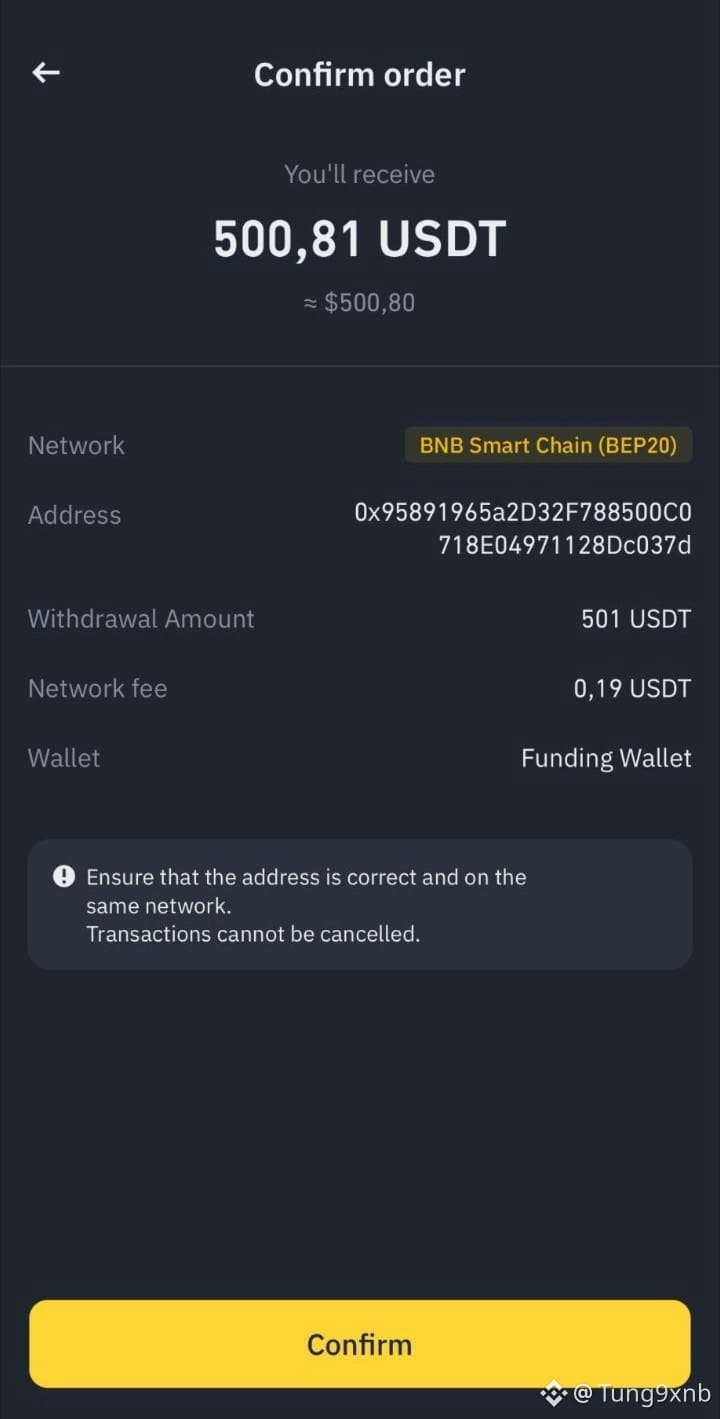
A few days ago, I came across a P2P case that looked almost finished.
The order was for 500 USDT.
The seller was expecting the payment, and the money arrived in the bank account.
So far, everything seemed fine.
Then one detail changed the situation.
The payment came from a name that didn't match the payment account shown in the Binance P2P order.
The buyer explained that they had used someone else's account to make the transfer.
That explanation might be genuine.
But at this point, I wouldn't release the crypto just because the money had arrived.
The important question is no longer only:
"Did I receive the money?"
It's also:
"Does this payment match the transaction I'm actually completing?"
This is where checking the payment details before releasing crypto becomes especially important.
If the information doesn't line up, I wouldn't try to solve it by accepting a new payment, sending money somewhere else, or making a separate arrangement with the buyer.
I'd keep everything inside the order and ask for clarification.
And if the situation still couldn't be resolved, I'd use the official appeal process rather than making a decision based on assumptions.
What I like about this approach is that it doesn't require me to decide whether the other person is trustworthy.
I only need to recognize that something doesn't match.
The money being in your account is one piece of information.
The payment matching the order is another.
When those two don't line up, that's the moment to stop.
$BNB
{spot}(BNBUSDT)
#binancep2pantoan @Binance_Vietnam
A few days ago, I came across a P2P case that looked almost finished.
The order was for 500 USDT.
The seller was expecting the payment, and the money arrived in the bank account.
So far, everything seemed fine.
Then one detail changed the situation.
The payment came from a name that didn't match the payment account shown in the Binance P2P order.
The buyer explained that they had used someone else's account to make the transfer.
That explanation might be genuine.
But at this point, I wouldn't release the crypto just because the money had arrived.
The important question is no longer only:
"Did I receive the money?"
It's also:
"Does this payment match the transaction I'm actually completing?"
This is where checking the payment details before releasing crypto becomes especially important.
If the information doesn't line up, I wouldn't try to solve it by accepting a new payment, sending money somewhere else, or making a separate arrangement with the buyer.
I'd keep everything inside the order and ask for clarification.
And if the situation still couldn't be resolved, I'd use the official appeal process rather than making a decision based on assumptions.
What I like about this approach is that it doesn't require me to decide whether the other person is trustworthy.
I only need to recognize that something doesn't match.
The money being in your account is one piece of information.
The payment matching the order is another.
When those two don't line up, that's the moment to stop.
$BNB
#binancep2pantoan @Binance Vietnam
The order was for 500 USDT.
The seller was expecting the payment, and the money arrived in the bank account.
So far, everything seemed fine.
Then one detail changed the situation.
The payment came from a name that didn't match the payment account shown in the Binance P2P order.
The buyer explained that they had used someone else's account to make the transfer.
That explanation might be genuine.
But at this point, I wouldn't release the crypto just because the money had arrived.
The important question is no longer only:
"Did I receive the money?"
It's also:
"Does this payment match the transaction I'm actually completing?"
This is where checking the payment details before releasing crypto becomes especially important.
If the information doesn't line up, I wouldn't try to solve it by accepting a new payment, sending money somewhere else, or making a separate arrangement with the buyer.
I'd keep everything inside the order and ask for clarification.
And if the situation still couldn't be resolved, I'd use the official appeal process rather than making a decision based on assumptions.
What I like about this approach is that it doesn't require me to decide whether the other person is trustworthy.
I only need to recognize that something doesn't match.
The money being in your account is one piece of information.
The payment matching the order is another.
When those two don't line up, that's the moment to stop.
$BNB
#binancep2pantoan @Binance Vietnam
19
1
46
86.8k

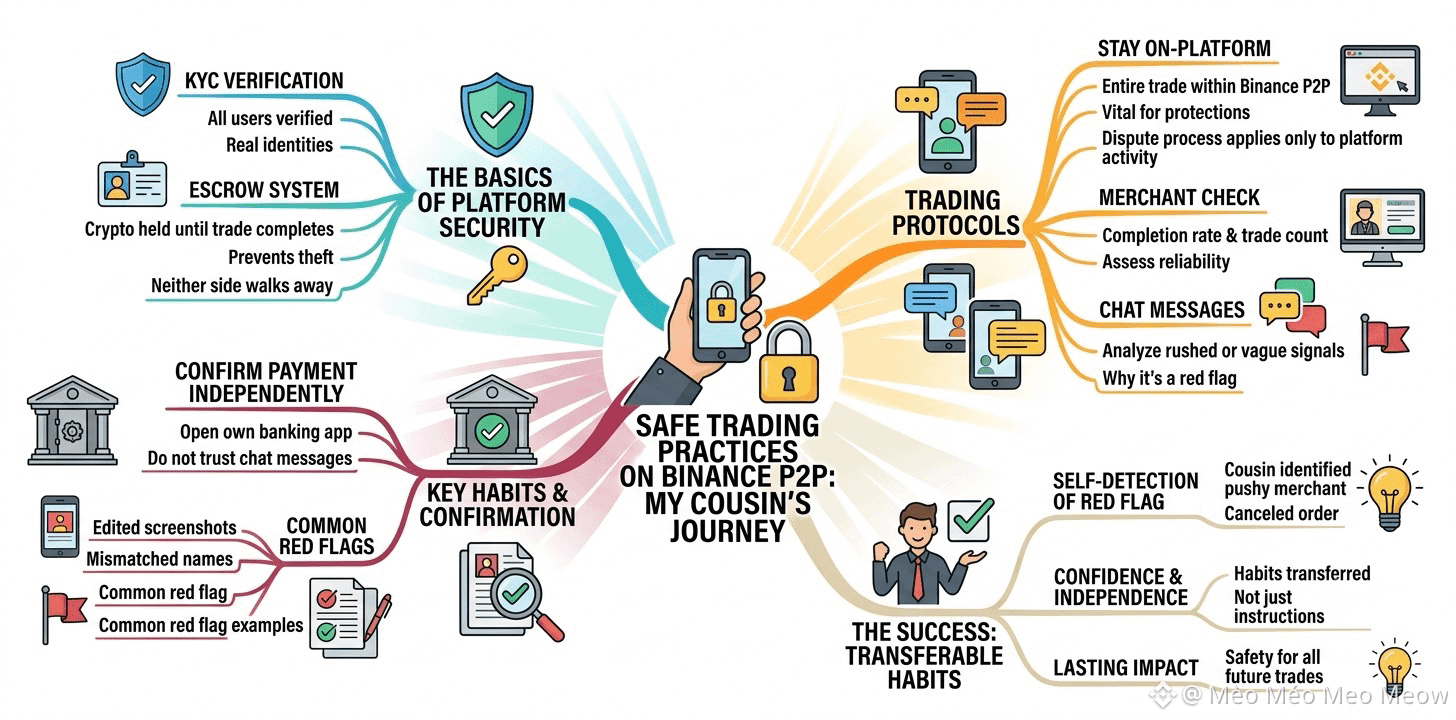
My cousin asked me to walk her through her first trade on Binance P2P, and explaining it out loud actually helped me realize how many small habits I had built up without noticing. I started with the basics: every account completes KYC before trading, so real identities sit behind each profile, and the crypto asset in any order sits in escrow until both sides confirm the trade is finished, which means neither side can simply walk away with the other's funds.
From there, I explained why the entire trade needs to happen inside Binance P2P, from the first message to the final confirmation, since every protection Binance offers, including the dispute appeal process, only applies to activity that stays on the platform. I showed her how to check a merchant's completion rate and trade count before accepting an order, and we talked through what a rushed or vague message in chat might actually signal, rather than just telling her to be careful without explaining why.
The most important habit I passed on was confirming payment independently. I had her open her own banking app during a practice conversation, rather than trusting anything sent through chat, and we talked through a few common red flags together, like edited screenshots or names that do not match. Watching her complete her first real trade carefully, checking each step instead of rushing, was a good reminder that none of this is complicated once someone actually explains it clearly.
A few weeks later, she told me she had caught a red flag on her own, a merchant whose message pushed her to skip a verification step, and she had canceled the order without needing to ask me first. That moment mattered more to me than watching her complete the first trade successfully, because it meant the habits had actually transferred, not just the instructions, and she would carry them into every future trade on Binance P2P.
@Binance_Vietnam #BinanceP2PAnToan $RICE $BTW
My cousin asked me to walk her through her first trade on Binance P2P, and explaining it out loud actually helped me realize how many small habits I had built up without noticing. I started with the basics: every account completes KYC before trading, so real identities sit behind each profile, and the crypto asset in any order sits in escrow until both sides confirm the trade is finished, which means neither side can simply walk away with the other's funds.
From there, I explained why the entire trade needs to happen inside Binance P2P, from the first message to the final confirmation, since every protection Binance offers, including the dispute appeal process, only applies to activity that stays on the platform. I showed her how to check a merchant's completion rate and trade count before accepting an order, and we talked through what a rushed or vague message in chat might actually signal, rather than just telling her to be careful without explaining why.
The most important habit I passed on was confirming payment independently. I had her open her own banking app during a practice conversation, rather than trusting anything sent through chat, and we talked through a few common red flags together, like edited screenshots or names that do not match. Watching her complete her first real trade carefully, checking each step instead of rushing, was a good reminder that none of this is complicated once someone actually explains it clearly.
A few weeks later, she told me she had caught a red flag on her own, a merchant whose message pushed her to skip a verification step, and she had canceled the order without needing to ask me first. That moment mattered more to me than watching her complete the first trade successfully, because it meant the habits had actually transferred, not just the instructions, and she would carry them into every future trade on Binance P2P.
@Binance Vietnam #BinanceP2PAnToan $RICE $BTW
From there, I explained why the entire trade needs to happen inside Binance P2P, from the first message to the final confirmation, since every protection Binance offers, including the dispute appeal process, only applies to activity that stays on the platform. I showed her how to check a merchant's completion rate and trade count before accepting an order, and we talked through what a rushed or vague message in chat might actually signal, rather than just telling her to be careful without explaining why.
The most important habit I passed on was confirming payment independently. I had her open her own banking app during a practice conversation, rather than trusting anything sent through chat, and we talked through a few common red flags together, like edited screenshots or names that do not match. Watching her complete her first real trade carefully, checking each step instead of rushing, was a good reminder that none of this is complicated once someone actually explains it clearly.
A few weeks later, she told me she had caught a red flag on her own, a merchant whose message pushed her to skip a verification step, and she had canceled the order without needing to ask me first. That moment mattered more to me than watching her complete the first trade successfully, because it meant the habits had actually transferred, not just the instructions, and she would carry them into every future trade on Binance P2P.
@Binance Vietnam #BinanceP2PAnToan $RICE $BTW
315

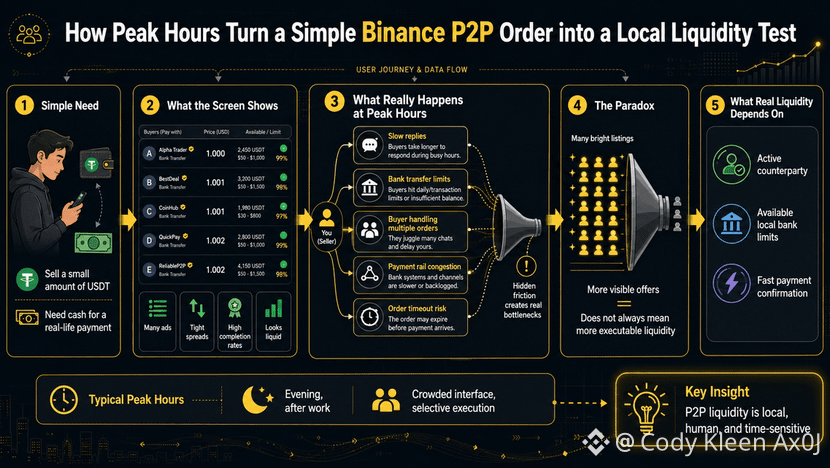
After work, the small amount of USDT I planned to convert into bank money suddenly no longer felt small. Binance P2P showed a fairly crowded list of buyers, clean looking prices, and processing times that did not seem bad. Yet the more I clicked into each order, the thinner that initial feeling of ease became.
Peak hours create a pleasant illusion. The screen has many choices, orders seem to move constantly, profiles look fine, but real liquidity does not sit in that crowd. It sits with the person who is actually online, the account that still has transfer limits left, and the bank that does not slow down the payment.
Users often equate many ads with many chances to exit an order. Binance P2P makes that feeling stronger, because everything is neatly arranged, with price, time, and completion rate. But when one side stays silent, another asks for a few more minutes, and another says their limit is full, we begin to see that the market is not as flat as the interface.
The paradox is that the smaller the order, the easier it is for people to underestimate timing risk. A small amount of money can still get stuck exactly when it is needed, because fiat flow does not move at the speed of coins.
I do not deny that Binance P2P has value. It solves a real need, when users need a bridge between digital assets and daily life. But a useful tool does not mean liquidity is always deep, and it definitely does not mean everyone online is ready to process immediately.
After running into peak hours a few times, I stopped looking at price first. I look at timing, transfer limits, the counterparty bank, and response speed. Binance P2P then is no longer just a price board, but a test of whether local liquidity is truly standing there when I need it.
@Binance_Vietnam #BinanceP2PAnToan
After work, the small amount of USDT I planned to convert into bank money suddenly no longer felt small. Binance P2P showed a fairly crowded list of buyers, clean looking prices, and processing times that did not seem bad. Yet the more I clicked into each order, the thinner that initial feeling of ease became.
Peak hours create a pleasant illusion. The screen has many choices, orders seem to move constantly, profiles look fine, but real liquidity does not sit in that crowd. It sits with the person who is actually online, the account that still has transfer limits left, and the bank that does not slow down the payment.
Users often equate many ads with many chances to exit an order. Binance P2P makes that feeling stronger, because everything is neatly arranged, with price, time, and completion rate. But when one side stays silent, another asks for a few more minutes, and another says their limit is full, we begin to see that the market is not as flat as the interface.
The paradox is that the smaller the order, the easier it is for people to underestimate timing risk. A small amount of money can still get stuck exactly when it is needed, because fiat flow does not move at the speed of coins.
I do not deny that Binance P2P has value. It solves a real need, when users need a bridge between digital assets and daily life. But a useful tool does not mean liquidity is always deep, and it definitely does not mean everyone online is ready to process immediately.
After running into peak hours a few times, I stopped looking at price first. I look at timing, transfer limits, the counterparty bank, and response speed. Binance P2P then is no longer just a price board, but a test of whether local liquidity is truly standing there when I need it.
@Binance Vietnam #BinanceP2PAnToan
Peak hours create a pleasant illusion. The screen has many choices, orders seem to move constantly, profiles look fine, but real liquidity does not sit in that crowd. It sits with the person who is actually online, the account that still has transfer limits left, and the bank that does not slow down the payment.
Users often equate many ads with many chances to exit an order. Binance P2P makes that feeling stronger, because everything is neatly arranged, with price, time, and completion rate. But when one side stays silent, another asks for a few more minutes, and another says their limit is full, we begin to see that the market is not as flat as the interface.
The paradox is that the smaller the order, the easier it is for people to underestimate timing risk. A small amount of money can still get stuck exactly when it is needed, because fiat flow does not move at the speed of coins.
I do not deny that Binance P2P has value. It solves a real need, when users need a bridge between digital assets and daily life. But a useful tool does not mean liquidity is always deep, and it definitely does not mean everyone online is ready to process immediately.
After running into peak hours a few times, I stopped looking at price first. I look at timing, transfer limits, the counterparty bank, and response speed. Binance P2P then is no longer just a price board, but a test of whether local liquidity is truly standing there when I need it.
@Binance Vietnam #BinanceP2PAnToan
2
123

·
--
#binancep2pantoan @Binance_Vietnam
Some P2P orders look perfectly harmless at first glance—until the buyer clicks “Paid,” but your bank account is still silent.
That day, I sold 500 USDT. The buyer messaged me pretty quickly: “I’ve transferred it, brother. Please help me release it.”
I opened my banking app to check. Nothing.
Then they wrote: “The funds are pending—maybe the bank is processing slowly.” After that, they immediately sent a photo of the transaction receipt, showing the status as “Successful.”
The screenshot looked quite convincing. But the problem was that my account still hadn’t received the money.
At that point, I kept it simple: P2P doesn’t mean that once there’s a transfer photo, you can just release. Once USDT is released, it’s very hard to get it back if the actual payment never really existed.
I continued checking my balance and transaction history instead of relying on a screenshot or the other person’s urging. An hour passed, then two hours—still no money in my account, so I didn’t release.
The bank might really be processing slowly. Or the receipt might be fake. Either way, that’s something that needs verification—not something I should gamble 500 USDT on.
Later on, I realized a memorable principle for P2P trading:
“Paid” is only a status reported on the order. What truly matters is whether the money has actually arrived in the seller’s account—and that’s what the seller needs to confirm. In this case, the transfer image could be fake, so everyone has to be careful and not release prematurely.
A little delay is better than releasing by mistake and then having to wait around for an Appeal.
#binancep2pantoan @Binance Vietnam
Some P2P orders look perfectly harmless at first glance—until the buyer clicks “Paid,” but your bank account is still silent.
That day, I sold 500 USDT. The buyer messaged me pretty quickly: “I’ve transferred it, brother. Please help me release it.”
I opened my banking app to check. Nothing.
Then they wrote: “The funds are pending—maybe the bank is processing slowly.” After that, they immediately sent a photo of the transaction receipt, showing the status as “Successful.”
The screenshot looked quite convincing. But the problem was that my account still hadn’t received the money.
At that point, I kept it simple: P2P doesn’t mean that once there’s a transfer photo, you can just release. Once USDT is released, it’s very hard to get it back if the actual payment never really existed.
I continued checking my balance and transaction history instead of relying on a screenshot or the other person’s urging. An hour passed, then two hours—still no money in my account, so I didn’t release.
The bank might really be processing slowly. Or the receipt might be fake. Either way, that’s something that needs verification—not something I should gamble 500 USDT on.
Later on, I realized a memorable principle for P2P trading:
“Paid” is only a status reported on the order. What truly matters is whether the money has actually arrived in the seller’s account—and that’s what the seller needs to confirm. In this case, the transfer image could be fake, so everyone has to be careful and not release prematurely.
A little delay is better than releasing by mistake and then having to wait around for an Appeal.
Some P2P orders look perfectly harmless at first glance—until the buyer clicks “Paid,” but your bank account is still silent.
That day, I sold 500 USDT. The buyer messaged me pretty quickly: “I’ve transferred it, brother. Please help me release it.”
I opened my banking app to check. Nothing.
Then they wrote: “The funds are pending—maybe the bank is processing slowly.” After that, they immediately sent a photo of the transaction receipt, showing the status as “Successful.”
The screenshot looked quite convincing. But the problem was that my account still hadn’t received the money.
At that point, I kept it simple: P2P doesn’t mean that once there’s a transfer photo, you can just release. Once USDT is released, it’s very hard to get it back if the actual payment never really existed.
I continued checking my balance and transaction history instead of relying on a screenshot or the other person’s urging. An hour passed, then two hours—still no money in my account, so I didn’t release.
The bank might really be processing slowly. Or the receipt might be fake. Either way, that’s something that needs verification—not something I should gamble 500 USDT on.
Later on, I realized a memorable principle for P2P trading:
“Paid” is only a status reported on the order. What truly matters is whether the money has actually arrived in the seller’s account—and that’s what the seller needs to confirm. In this case, the transfer image could be fake, so everyone has to be careful and not release prematurely.
A little delay is better than releasing by mistake and then having to wait around for an Appeal.
3
860

#binancep2pantoan @Binance_Vietnam
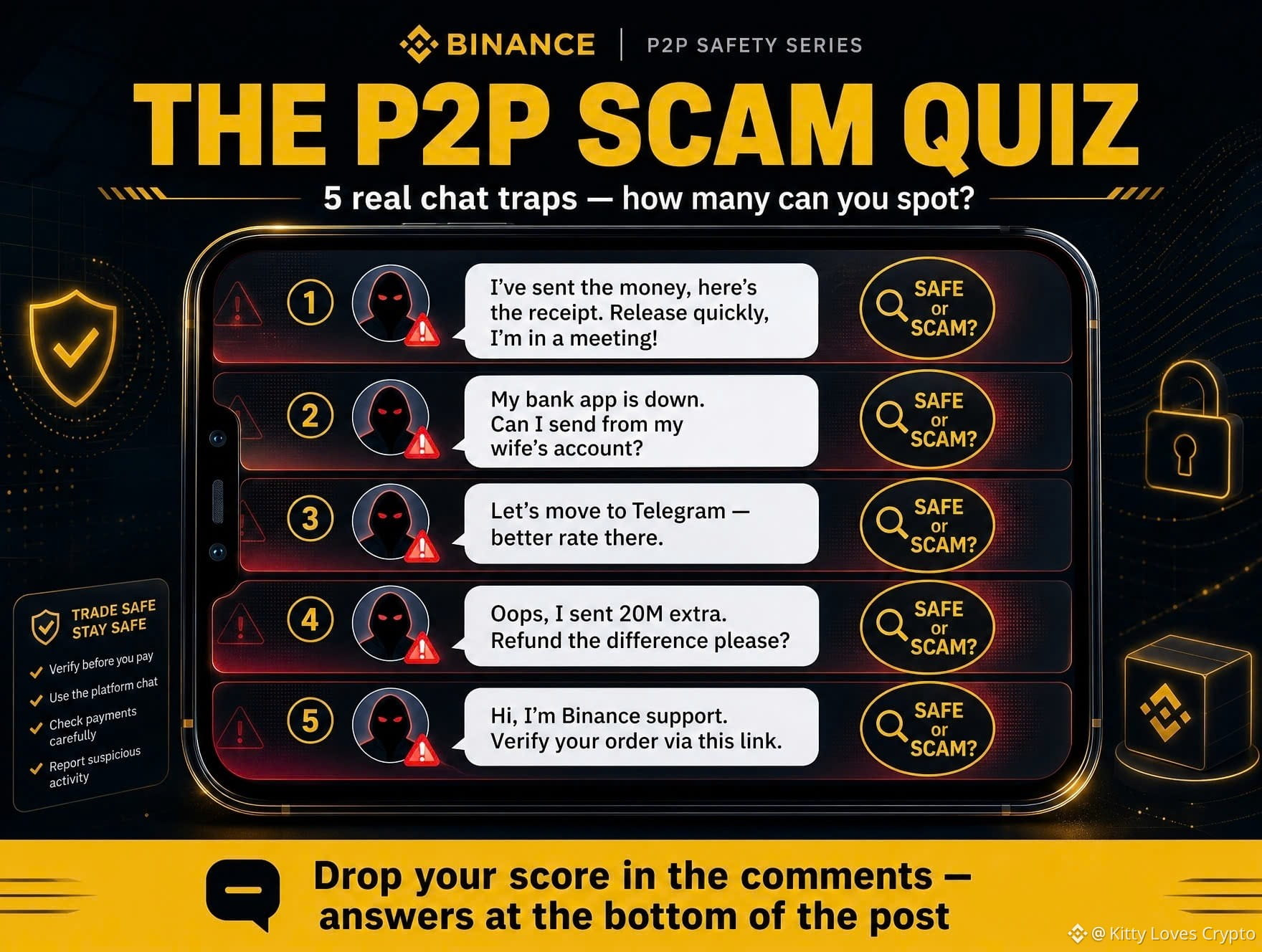
Spot the Scam: 5 Real P2P Chat Traps — How Many Would You Catch?
Twelve days of theory are over. Today we test your instincts with 5 real messages pulled straight from actual P2P scam cases (details anonymized). Read each one and decide: SAFE or SCAM? Drop your score in the comments — answers at the bottom.
💬 Trap #1: "I've sent the money, here's the receipt. Release quickly, I'm in a meeting!"
💬 Trap #2: "My bank app is down. Can I send from my wife's account instead?"
💬 Trap #3: "Let's move to Telegram — I can give you a better rate there."
💬 Trap #4: "Oops, I sent 20M extra by mistake. Please refund the difference to my other account."
💬 Trap #5: "Hi, I'm Binance support. Your order is flagged — verify via this link."
Take 30 seconds. Lock in your answers.
✅ THE ANSWERS:
#1 — SCAM. Classic fake receipt + time pressure combo. Your only source of truth is your own banking app. Real balance up? Then release. Not up? Not releasing. (Lesson from Day 4)
#2 — SCAM. Third-party payment. The name doesn't match, and the "wife's account" money could be stolen funds that later freeze YOUR bank account. Cancel and appeal. (Days 3 & 11)
#3 — SCAM. Leaving the platform kills your escrow protection AND deletes your evidence trail. 90% of P2P losses start with this exact sentence. (Day 2)
#4 — SCAM. The "accidental overpayment" trap of 2026. The original transfer is dirty money. Never refund directly — report to Binance AND your bank. (Day 10)
#5 — SCAM. Binance staff NEVER message you inside a P2P order or send links. Block and report immediately. (Day 5)
How'd you score? 5/5 — you're officially scam-proof 🛡️ 3–4 — solid, review the days you missed 0–2 — re-read this series before your next trade
Golden rule #13: Scammers don't hack platforms — they hack your urgency. Pause is your superpower.
📌 Tomorrow (20/08): Graduation Day — the 12 Golden Rules in one screenshot-worthy checklist.
👉 Comment your score below. Tag a friend who'd fall for Trap #4.
#binancep2pantoan @Binance Vietnam
Spot the Scam: 5 Real P2P Chat Traps — How Many Would You Catch?
Twelve days of theory are over. Today we test your instincts with 5 real messages pulled straight from actual P2P scam cases (details anonymized). Read each one and decide: SAFE or SCAM? Drop your score in the comments — answers at the bottom.
💬 Trap #1: "I've sent the money, here's the receipt. Release quickly, I'm in a meeting!"
💬 Trap #2: "My bank app is down. Can I send from my wife's account instead?"
💬 Trap #3: "Let's move to Telegram — I can give you a better rate there."
💬 Trap #4: "Oops, I sent 20M extra by mistake. Please refund the difference to my other account."
💬 Trap #5: "Hi, I'm Binance support. Your order is flagged — verify via this link."
Take 30 seconds. Lock in your answers.
✅ THE ANSWERS:
#1 — SCAM. Classic fake receipt + time pressure combo. Your only source of truth is your own banking app. Real balance up? Then release. Not up? Not releasing. (Lesson from Day 4)
#2 — SCAM. Third-party payment. The name doesn't match, and the "wife's account" money could be stolen funds that later freeze YOUR bank account. Cancel and appeal. (Days 3 & 11)
#3 — SCAM. Leaving the platform kills your escrow protection AND deletes your evidence trail. 90% of P2P losses start with this exact sentence. (Day 2)
#4 — SCAM. The "accidental overpayment" trap of 2026. The original transfer is dirty money. Never refund directly — report to Binance AND your bank. (Day 10)
#5 — SCAM. Binance staff NEVER message you inside a P2P order or send links. Block and report immediately. (Day 5)
How'd you score? 5/5 — you're officially scam-proof 🛡️ 3–4 — solid, review the days you missed 0–2 — re-read this series before your next trade
Golden rule #13: Scammers don't hack platforms — they hack your urgency. Pause is your superpower.
📌 Tomorrow (20/08): Graduation Day — the 12 Golden Rules in one screenshot-worthy checklist.
👉 Comment your score below. Tag a friend who'd fall for Trap #4.
Spot the Scam: 5 Real P2P Chat Traps — How Many Would You Catch?
Twelve days of theory are over. Today we test your instincts with 5 real messages pulled straight from actual P2P scam cases (details anonymized). Read each one and decide: SAFE or SCAM? Drop your score in the comments — answers at the bottom.
💬 Trap #1: "I've sent the money, here's the receipt. Release quickly, I'm in a meeting!"
💬 Trap #2: "My bank app is down. Can I send from my wife's account instead?"
💬 Trap #3: "Let's move to Telegram — I can give you a better rate there."
💬 Trap #4: "Oops, I sent 20M extra by mistake. Please refund the difference to my other account."
💬 Trap #5: "Hi, I'm Binance support. Your order is flagged — verify via this link."
Take 30 seconds. Lock in your answers.
✅ THE ANSWERS:
#1 — SCAM. Classic fake receipt + time pressure combo. Your only source of truth is your own banking app. Real balance up? Then release. Not up? Not releasing. (Lesson from Day 4)
#2 — SCAM. Third-party payment. The name doesn't match, and the "wife's account" money could be stolen funds that later freeze YOUR bank account. Cancel and appeal. (Days 3 & 11)
#3 — SCAM. Leaving the platform kills your escrow protection AND deletes your evidence trail. 90% of P2P losses start with this exact sentence. (Day 2)
#4 — SCAM. The "accidental overpayment" trap of 2026. The original transfer is dirty money. Never refund directly — report to Binance AND your bank. (Day 10)
#5 — SCAM. Binance staff NEVER message you inside a P2P order or send links. Block and report immediately. (Day 5)
How'd you score? 5/5 — you're officially scam-proof 🛡️ 3–4 — solid, review the days you missed 0–2 — re-read this series before your next trade
Golden rule #13: Scammers don't hack platforms — they hack your urgency. Pause is your superpower.
📌 Tomorrow (20/08): Graduation Day — the 12 Golden Rules in one screenshot-worthy checklist.
👉 Comment your score below. Tag a friend who'd fall for Trap #4.
109

#binancep2pantoan
Lure into the "Bank Maintenance" trap: A scheme to force cancellations and steal Fiat!
Many Vietnamese traders lose money on P2P not because they were hacked, but because they fell into a psychological manipulation trap right within the exchange’s Chat interface.
Case Study: You successfully transferred Fiat, but the Merchant intentionally refuses to release USDT. They keep messaging with excuses like "The bank is under maintenance; the money hasn’t been credited to the app yet" and pressure you to click the Cancel Order button so they can get you to transfer the money back. The moment you hit Cancel, the Escrow immediately releases the USDT to the Merchant’s wallet. On the other side, they block communication and disappear with your funds.
Checklist to avoid the Escrow removal trap:
Absolutely DO NOT CANCEL AN ORDER: Once your Fiat has left your bank account, NEVER press the Cancel Order button for any reason.
Open a Dispute immediately: After the waiting period ends, click the Dispute (Claim) button. Upload the correct Transaction History/Transfer Bill so Binance customer support can intervene and force the release of the coins.
Will you patiently open a Dispute and wait for CSKH to handle it, or believe the stranger Merchant’s promise to refund you off-platform?
Tag: @Binance_Vietnam
#binancep2pantoan
Lure into the "Bank Maintenance" trap: A scheme to force cancellations and steal Fiat!
Many Vietnamese traders lose money on P2P not because they were hacked, but because they fell into a psychological manipulation trap right within the exchange’s Chat interface.
Case Study: You successfully transferred Fiat, but the Merchant intentionally refuses to release USDT. They keep messaging with excuses like "The bank is under maintenance; the money hasn’t been credited to the app yet" and pressure you to click the Cancel Order button so they can get you to transfer the money back. The moment you hit Cancel, the Escrow immediately releases the USDT to the Merchant’s wallet. On the other side, they block communication and disappear with your funds.
Checklist to avoid the Escrow removal trap:
Absolutely DO NOT CANCEL AN ORDER: Once your Fiat has left your bank account, NEVER press the Cancel Order button for any reason.
Open a Dispute immediately: After the waiting period ends, click the Dispute (Claim) button. Upload the correct Transaction History/Transfer Bill so Binance customer support can intervene and force the release of the coins.
Will you patiently open a Dispute and wait for CSKH to handle it, or believe the stranger Merchant’s promise to refund you off-platform?
Tag: @Binance Vietnam
Lure into the "Bank Maintenance" trap: A scheme to force cancellations and steal Fiat!
Many Vietnamese traders lose money on P2P not because they were hacked, but because they fell into a psychological manipulation trap right within the exchange’s Chat interface.
Case Study: You successfully transferred Fiat, but the Merchant intentionally refuses to release USDT. They keep messaging with excuses like "The bank is under maintenance; the money hasn’t been credited to the app yet" and pressure you to click the Cancel Order button so they can get you to transfer the money back. The moment you hit Cancel, the Escrow immediately releases the USDT to the Merchant’s wallet. On the other side, they block communication and disappear with your funds.
Checklist to avoid the Escrow removal trap:
Absolutely DO NOT CANCEL AN ORDER: Once your Fiat has left your bank account, NEVER press the Cancel Order button for any reason.
Open a Dispute immediately: After the waiting period ends, click the Dispute (Claim) button. Upload the correct Transaction History/Transfer Bill so Binance customer support can intervene and force the release of the coins.
Will you patiently open a Dispute and wait for CSKH to handle it, or believe the stranger Merchant’s promise to refund you off-platform?
Tag: @Binance Vietnam
74

·
--
#binancep2pantoan
Check before making a P2P transaction: Always choose a reputable seller/buyer, carefully verify the recipient account name, and only confirm once the transaction has been completed. Do not transfer money according to requests outside the platform and absolutely do not share your OTP code or any of your sensitive/security information.
@Binance Vietnam
#binancep2pantoan
Check before making a P2P transaction: Always choose a reputable seller/buyer, carefully verify the recipient account name, and only confirm once the transaction has been completed. Do not transfer money according to requests outside the platform and absolutely do not share your OTP code or any of your sensitive/security information.
@Binance Vietnam
Check before making a P2P transaction: Always choose a reputable seller/buyer, carefully verify the recipient account name, and only confirm once the transaction has been completed. Do not transfer money according to requests outside the platform and absolutely do not share your OTP code or any of your sensitive/security information.
@Binance Vietnam
68

·
--
#binancep2pantoan @Binance_Vietnam P2P is an excellent feature on Binance that allows buyers and sellers to trade directly with one another. With clearly defined "Buy" and "Sell" sections, users can choose the option that best suits their specific needs. Merchants list their prices and transaction limits clearly, making it easy for users to select the best match for their requirements. The buying and selling process is fast and convenient.
#binancep2pantoan @Binance Vietnam P2P is an excellent feature on Binance that allows buyers and sellers to trade directly with one another. With clearly defined "Buy" and "Sell" sections, users can choose the option that best suits their specific needs. Merchants list their prices and transaction limits clearly, making it easy for users to select the best match for their requirements. The buying and selling process is fast and convenient.
74
#binancep2pantoan @Binance_Vietnam
🔥 P2P: DON’T LOSE MONEY JUST BECAUSE OF ONE CLICK!
P2P traders remember 3 principles:
✅ Check the recipient name
✅ Confirm that the money has arrived in the account
✅ Only release crypto after the real money has truly been received.
Fast doesn’t always mean winning. Safety is where long-term profit comes from. 🚀
#binancep2pantoan @Binance Vietnam
🔥 P2P: DON’T LOSE MONEY JUST BECAUSE OF ONE CLICK!
P2P traders remember 3 principles:
✅ Check the recipient name
✅ Confirm that the money has arrived in the account
✅ Only release crypto after the real money has truly been received.
Fast doesn’t always mean winning. Safety is where long-term profit comes from. 🚀
🔥 P2P: DON’T LOSE MONEY JUST BECAUSE OF ONE CLICK!
P2P traders remember 3 principles:
✅ Check the recipient name
✅ Confirm that the money has arrived in the account
✅ Only release crypto after the real money has truly been received.
Fast doesn’t always mean winning. Safety is where long-term profit comes from. 🚀
2

·
--
#binancep2pantoan @Binance_Vietnam
Safe Binance P2P trading tips for beginners:
Always verify that the money has actually arrived in your bank account before clicking “Payment received”.
Never trust screenshots of the buyer’s transfer.
The bank account name must match exactly the name verified on Binance.
Absolutely do not include keywords related to Crypto/Bitcoin in the transfer content.
Wishing everyone safe trading! @Binance_Vietnam #BinanceP2PAnToan
#binancep2pantoan @Binance Vietnam
Safe Binance P2P trading tips for beginners:
Always verify that the money has actually arrived in your bank account before clicking “Payment received”.
Never trust screenshots of the buyer’s transfer.
The bank account name must match exactly the name verified on Binance.
Absolutely do not include keywords related to Crypto/Bitcoin in the transfer content.
Wishing everyone safe trading! @Binance Vietnam #BinanceP2PAnToan
Safe Binance P2P trading tips for beginners:
Always verify that the money has actually arrived in your bank account before clicking “Payment received”.
Never trust screenshots of the buyer’s transfer.
The bank account name must match exactly the name verified on Binance.
Absolutely do not include keywords related to Crypto/Bitcoin in the transfer content.
Wishing everyone safe trading! @Binance Vietnam #BinanceP2PAnToan
77

·
--
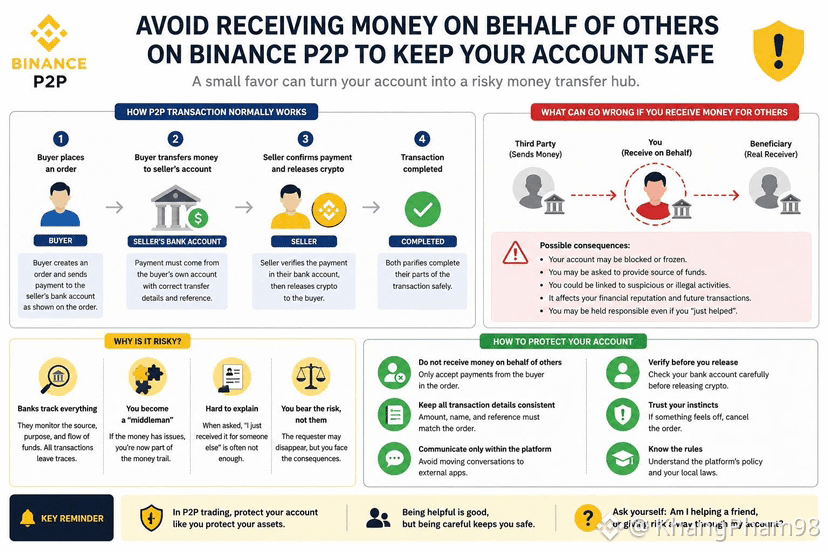
An afternoon at a drink shop near the office, a conversation about selling USDT through Binance P2P suddenly turned into an uncomfortable request. An acquaintance asked me to receive money from his buyer, then transfer it to another bank account. The reason sounded soft enough, his banking app was having issues. I listened, then refused.
The trap of receiving money on someone else’s behalf is that it looks too much like a kind favor. You are not holding cash, not signing any document, just letting a stream of money pass through your account. But banks do not read goodwill, banks read traces.
Binance P2P makes the transaction look cleaner, so many people forget that the messy part sits outside the exchange screen. The bank transfer is still real money, the sender is still a real person, and the banking history remains there. If the source of funds has a problem, familiarity will not pull you out of the chain.
The usual psychology is the fear of saying no. The person asking makes it sound light, we are friends, just help me a bit. The person being asked may also think that because they make no profit, it should be fine. That exact lack of profit can be dangerous, because you carry the trace without knowing the full story.
The paradox is that people enter crypto talking about control over their own assets, yet when receiving money for someone else through Binance P2P, they lend out the name on their bank account. I do not want to turn every request for help into a conspiracy. Some people really do have banking app errors, transfer limits, or simply lack experience.
But someone else’s inconvenience should not be solved by dragging your account into a gray area. Binance P2P can be convenient, but convenience does not mean standing in as the named receiver for another person’s money. The remaining question is whether you are helping an acquaintance, or renting your bank account as a road for risk to pass through.
@Binance_Vietnam #BinanceP2PAnToan
An afternoon at a drink shop near the office, a conversation about selling USDT through Binance P2P suddenly turned into an uncomfortable request. An acquaintance asked me to receive money from his buyer, then transfer it to another bank account. The reason sounded soft enough, his banking app was having issues. I listened, then refused.
The trap of receiving money on someone else’s behalf is that it looks too much like a kind favor. You are not holding cash, not signing any document, just letting a stream of money pass through your account. But banks do not read goodwill, banks read traces.
Binance P2P makes the transaction look cleaner, so many people forget that the messy part sits outside the exchange screen. The bank transfer is still real money, the sender is still a real person, and the banking history remains there. If the source of funds has a problem, familiarity will not pull you out of the chain.
The usual psychology is the fear of saying no. The person asking makes it sound light, we are friends, just help me a bit. The person being asked may also think that because they make no profit, it should be fine. That exact lack of profit can be dangerous, because you carry the trace without knowing the full story.
The paradox is that people enter crypto talking about control over their own assets, yet when receiving money for someone else through Binance P2P, they lend out the name on their bank account. I do not want to turn every request for help into a conspiracy. Some people really do have banking app errors, transfer limits, or simply lack experience.
But someone else’s inconvenience should not be solved by dragging your account into a gray area. Binance P2P can be convenient, but convenience does not mean standing in as the named receiver for another person’s money. The remaining question is whether you are helping an acquaintance, or renting your bank account as a road for risk to pass through.
@Binance Vietnam #BinanceP2PAnToan
The trap of receiving money on someone else’s behalf is that it looks too much like a kind favor. You are not holding cash, not signing any document, just letting a stream of money pass through your account. But banks do not read goodwill, banks read traces.
Binance P2P makes the transaction look cleaner, so many people forget that the messy part sits outside the exchange screen. The bank transfer is still real money, the sender is still a real person, and the banking history remains there. If the source of funds has a problem, familiarity will not pull you out of the chain.
The usual psychology is the fear of saying no. The person asking makes it sound light, we are friends, just help me a bit. The person being asked may also think that because they make no profit, it should be fine. That exact lack of profit can be dangerous, because you carry the trace without knowing the full story.
The paradox is that people enter crypto talking about control over their own assets, yet when receiving money for someone else through Binance P2P, they lend out the name on their bank account. I do not want to turn every request for help into a conspiracy. Some people really do have banking app errors, transfer limits, or simply lack experience.
But someone else’s inconvenience should not be solved by dragging your account into a gray area. Binance P2P can be convenient, but convenience does not mean standing in as the named receiver for another person’s money. The remaining question is whether you are helping an acquaintance, or renting your bank account as a road for risk to pass through.
@Binance Vietnam #BinanceP2PAnToan
75
#binancep2pantoan @Binance_Vietnam
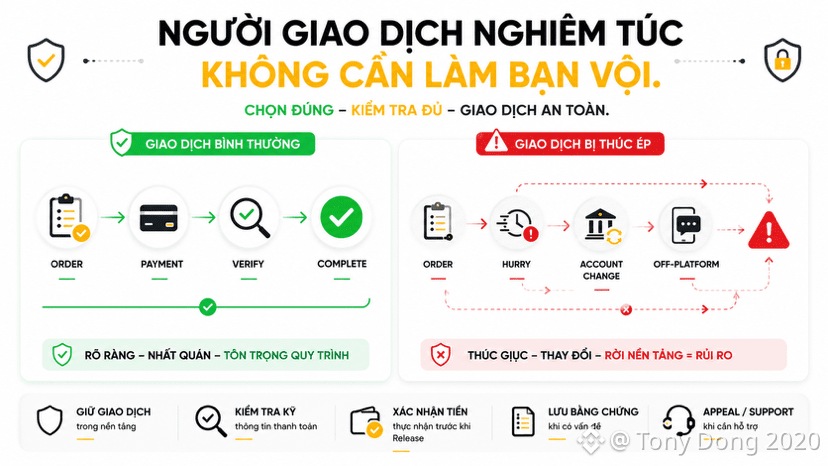
IDENTIFY A “REAL” P2P TRADER
A truly reputable real P2P trader usually doesn’t try to confuse you.
I noticed this after many transactions. A genuine trader is often… quite ordinary and careful. They pay attention and they also have rules for safe trading when handling Orders. They care about payment methods, understand and comply with the payment amount.
They observe whether the trade has been matched, whether there’s any delay or unusual activity. They don’t need to talk too much.
There’s also no need to constantly create emotions for you:
“Hurry up, bro.”
“Release help me.”
“Transfer to this account for convenience.”
“Go outside and talk so it’s faster.”
“Bring up excuses like account error, bank error…”
What I observe isn’t just a sentence. It’s a series of behaviors. A more trustworthy counterparty often makes the process simpler:
Order → Payment → Verification → Completion.
No account suddenly appears.
No payment method changes out of nowhere.
No “separate procedure built from trading experience” suddenly shows up.
Binance recommends that users check transaction information and keep the trade within the platform; when problems occur, an Appeal and transaction evidence can be used for Support to review.
So if someone makes me have to keep asking:
“Why change the payment method?”
“Why switch to here?”
“Why does it have to be released right away?”
I don’t conclude that they’re bad. I just slow down and follow the general rules. With P2P, that’s enough.
DISCLAIMER: The information provided in this article is personal experience shared and is not investment advice.
#binancep2pantoan @Binance Vietnam
IDENTIFY A “REAL” P2P TRADER
A truly reputable real P2P trader usually doesn’t try to confuse you.
I noticed this after many transactions. A genuine trader is often… quite ordinary and careful. They pay attention and they also have rules for safe trading when handling Orders. They care about payment methods, understand and comply with the payment amount.
They observe whether the trade has been matched, whether there’s any delay or unusual activity. They don’t need to talk too much.
There’s also no need to constantly create emotions for you:
“Hurry up, bro.”
“Release help me.”
“Transfer to this account for convenience.”
“Go outside and talk so it’s faster.”
“Bring up excuses like account error, bank error…”
What I observe isn’t just a sentence. It’s a series of behaviors. A more trustworthy counterparty often makes the process simpler:
Order → Payment → Verification → Completion.
No account suddenly appears.
No payment method changes out of nowhere.
No “separate procedure built from trading experience” suddenly shows up.
Binance recommends that users check transaction information and keep the trade within the platform; when problems occur, an Appeal and transaction evidence can be used for Support to review.
So if someone makes me have to keep asking:
“Why change the payment method?”
“Why switch to here?”
“Why does it have to be released right away?”
I don’t conclude that they’re bad. I just slow down and follow the general rules. With P2P, that’s enough.
DISCLAIMER: The information provided in this article is personal experience shared and is not investment advice.
IDENTIFY A “REAL” P2P TRADER
A truly reputable real P2P trader usually doesn’t try to confuse you.
I noticed this after many transactions. A genuine trader is often… quite ordinary and careful. They pay attention and they also have rules for safe trading when handling Orders. They care about payment methods, understand and comply with the payment amount.
They observe whether the trade has been matched, whether there’s any delay or unusual activity. They don’t need to talk too much.
There’s also no need to constantly create emotions for you:
“Hurry up, bro.”
“Release help me.”
“Transfer to this account for convenience.”
“Go outside and talk so it’s faster.”
“Bring up excuses like account error, bank error…”
What I observe isn’t just a sentence. It’s a series of behaviors. A more trustworthy counterparty often makes the process simpler:
Order → Payment → Verification → Completion.
No account suddenly appears.
No payment method changes out of nowhere.
No “separate procedure built from trading experience” suddenly shows up.
Binance recommends that users check transaction information and keep the trade within the platform; when problems occur, an Appeal and transaction evidence can be used for Support to review.
So if someone makes me have to keep asking:
“Why change the payment method?”
“Why switch to here?”
“Why does it have to be released right away?”
I don’t conclude that they’re bad. I just slow down and follow the general rules. With P2P, that’s enough.
DISCLAIMER: The information provided in this article is personal experience shared and is not investment advice.
79
·
--
#binancep2pantoan @Binance_Vietnam
🔐 P2P safety starts from very small things
Binance P2P trading is not just about buying or selling crypto. More importantly, it’s about ensuring that each transaction is transparent and secure.
A few simple habits, but extremely valuable:
✅ Only trade directly on Binance P2P.
✅ Double-check the recipient’s name/payment details and the amount before confirming.
✅ Don’t trust screenshots or promises of “payment completed” if the money hasn’t actually arrived in your account.
✅ Never share passwords, OTP codes, or any security information with anyone.
✅ Always read the terms carefully and use Binance’s dispute/support features when there’s a problem.
A good P2P experience is not about trading as fast as possible, but about **trading correctly and managing risk**. One minute of checking can help you avoid a lot of trouble.
Make “safety first, trading second” a habit every time you participate in P2P.
@Binance_Vietnam
#BinanceP2PAnToan #BinanceP2P #CryptoSafety
#binancep2pantoan @Binance Vietnam
🔐 P2P safety starts from very small things
Binance P2P trading is not just about buying or selling crypto. More importantly, it’s about ensuring that each transaction is transparent and secure.
A few simple habits, but extremely valuable:
✅ Only trade directly on Binance P2P.
✅ Double-check the recipient’s name/payment details and the amount before confirming.
✅ Don’t trust screenshots or promises of “payment completed” if the money hasn’t actually arrived in your account.
✅ Never share passwords, OTP codes, or any security information with anyone.
✅ Always read the terms carefully and use Binance’s dispute/support features when there’s a problem.
A good P2P experience is not about trading as fast as possible, but about **trading correctly and managing risk**. One minute of checking can help you avoid a lot of trouble.
Make “safety first, trading second” a habit every time you participate in P2P.
@Binance Vietnam
#BinanceP2PAnToan #BinanceP2P #CryptoSafety
🔐 P2P safety starts from very small things
Binance P2P trading is not just about buying or selling crypto. More importantly, it’s about ensuring that each transaction is transparent and secure.
A few simple habits, but extremely valuable:
✅ Only trade directly on Binance P2P.
✅ Double-check the recipient’s name/payment details and the amount before confirming.
✅ Don’t trust screenshots or promises of “payment completed” if the money hasn’t actually arrived in your account.
✅ Never share passwords, OTP codes, or any security information with anyone.
✅ Always read the terms carefully and use Binance’s dispute/support features when there’s a problem.
A good P2P experience is not about trading as fast as possible, but about **trading correctly and managing risk**. One minute of checking can help you avoid a lot of trouble.
Make “safety first, trading second” a habit every time you participate in P2P.
@Binance Vietnam
#BinanceP2PAnToan #BinanceP2P #CryptoSafety
60

#binancep2pantoan @Binance_Vietnam
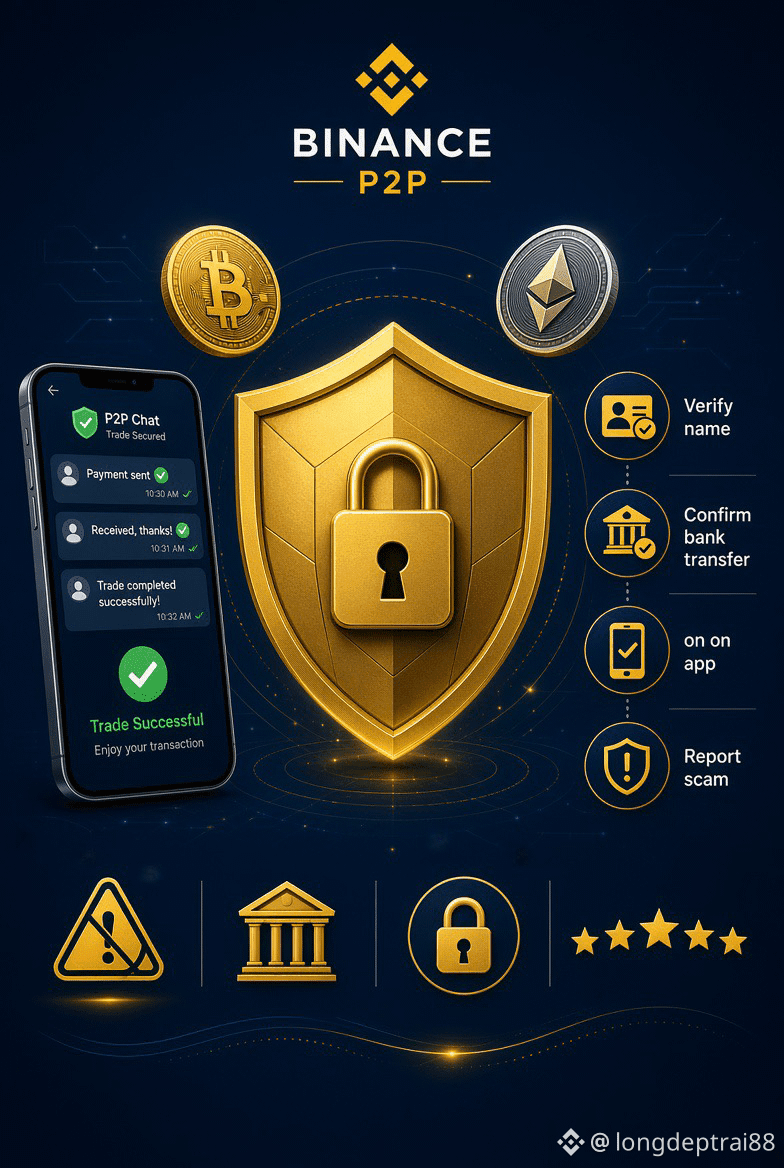
How to trade P2P safely on Binance (Part 12)
5 next important points:
61. Never use someone else’s bank account to trade P2P—this can easily lead to account lockouts or disputes.
62. When selling coins, wait for the money to actually arrive in your account and check carefully before releasing. Don’t rely on empty words.
63. Prioritize partners who have many positive ratings in the most recent 30 days, instead of only looking at the total number of old orders.
64. If the order is delayed unusually or the other party stays silent for too long, proactively cancel and find someone else.
65. Always maintain a reasonable level of vigilance. Trust the Binance system, but don’t blindly trust strangers.
Safety comes first!
#binancep2pantoan @Binance Vietnam
How to trade P2P safely on Binance (Part 12)
5 next important points:
61. Never use someone else’s bank account to trade P2P—this can easily lead to account lockouts or disputes.
62. When selling coins, wait for the money to actually arrive in your account and check carefully before releasing. Don’t rely on empty words.
63. Prioritize partners who have many positive ratings in the most recent 30 days, instead of only looking at the total number of old orders.
64. If the order is delayed unusually or the other party stays silent for too long, proactively cancel and find someone else.
65. Always maintain a reasonable level of vigilance. Trust the Binance system, but don’t blindly trust strangers.
Safety comes first!
How to trade P2P safely on Binance (Part 12)
5 next important points:
61. Never use someone else’s bank account to trade P2P—this can easily lead to account lockouts or disputes.
62. When selling coins, wait for the money to actually arrive in your account and check carefully before releasing. Don’t rely on empty words.
63. Prioritize partners who have many positive ratings in the most recent 30 days, instead of only looking at the total number of old orders.
64. If the order is delayed unusually or the other party stays silent for too long, proactively cancel and find someone else.
65. Always maintain a reasonable level of vigilance. Trust the Binance system, but don’t blindly trust strangers.
Safety comes first!
65

·
--
Safety on Binance P2P: Core rules for every transaction 🛡️
P2P trading on Binance offers outstanding convenience and speed, but to protect your assets from sophisticated scams, you always need solid layers of defense. Here are the most important safety principles:
Absolutely do not leave the platform: All exchanges, agreements, and chat history must be kept intact within Binance’s official chat window. Scammers often lure you to use external apps to make it easier to trick you.
Verify account holder name (KYC): The name on the bank account used to receive or transfer money must match 100% with the name verified on the exchange. Absolutely do not accept money from a third party (triangular transaction trap).
Trust only real balance changes: Never rush to unlock (release) coins just because you see a screenshot of a transfer receipt or a message saying "Paid" from the buyer. Check directly in your banking app.
Use the Escrow & Appeal mechanism: If there are any signs of abnormality, suspicion, or if the counterparty urges or threatens you, absolutely do not release your assets. Stay calm, keep the chat context unchanged, and immediately click the Appeal button so the exchange’s arbitration team can protect your rights.
Combining Binance’s swift liquidity, decisive Escrow mechanism, and your own vigilance is the key to staying safe in every trading session! 💡
We sincerely thank @Binance_Vietnam and #BinanceP2PAnToan for bringing the square event to help the trading community become safer!!
Safety on Binance P2P: Core rules for every transaction 🛡️
P2P trading on Binance offers outstanding convenience and speed, but to protect your assets from sophisticated scams, you always need solid layers of defense. Here are the most important safety principles:
Absolutely do not leave the platform: All exchanges, agreements, and chat history must be kept intact within Binance’s official chat window. Scammers often lure you to use external apps to make it easier to trick you.
Verify account holder name (KYC): The name on the bank account used to receive or transfer money must match 100% with the name verified on the exchange. Absolutely do not accept money from a third party (triangular transaction trap).
Trust only real balance changes: Never rush to unlock (release) coins just because you see a screenshot of a transfer receipt or a message saying "Paid" from the buyer. Check directly in your banking app.
Use the Escrow & Appeal mechanism: If there are any signs of abnormality, suspicion, or if the counterparty urges or threatens you, absolutely do not release your assets. Stay calm, keep the chat context unchanged, and immediately click the Appeal button so the exchange’s arbitration team can protect your rights.
Combining Binance’s swift liquidity, decisive Escrow mechanism, and your own vigilance is the key to staying safe in every trading session! 💡
We sincerely thank @Binance Vietnam and #BinanceP2PAnToan for bringing the square event to help the trading community become safer!!
P2P trading on Binance offers outstanding convenience and speed, but to protect your assets from sophisticated scams, you always need solid layers of defense. Here are the most important safety principles:
Absolutely do not leave the platform: All exchanges, agreements, and chat history must be kept intact within Binance’s official chat window. Scammers often lure you to use external apps to make it easier to trick you.
Verify account holder name (KYC): The name on the bank account used to receive or transfer money must match 100% with the name verified on the exchange. Absolutely do not accept money from a third party (triangular transaction trap).
Trust only real balance changes: Never rush to unlock (release) coins just because you see a screenshot of a transfer receipt or a message saying "Paid" from the buyer. Check directly in your banking app.
Use the Escrow & Appeal mechanism: If there are any signs of abnormality, suspicion, or if the counterparty urges or threatens you, absolutely do not release your assets. Stay calm, keep the chat context unchanged, and immediately click the Appeal button so the exchange’s arbitration team can protect your rights.
Combining Binance’s swift liquidity, decisive Escrow mechanism, and your own vigilance is the key to staying safe in every trading session! 💡
We sincerely thank @Binance Vietnam and #BinanceP2PAnToan for bringing the square event to help the trading community become safer!!
70
·
--
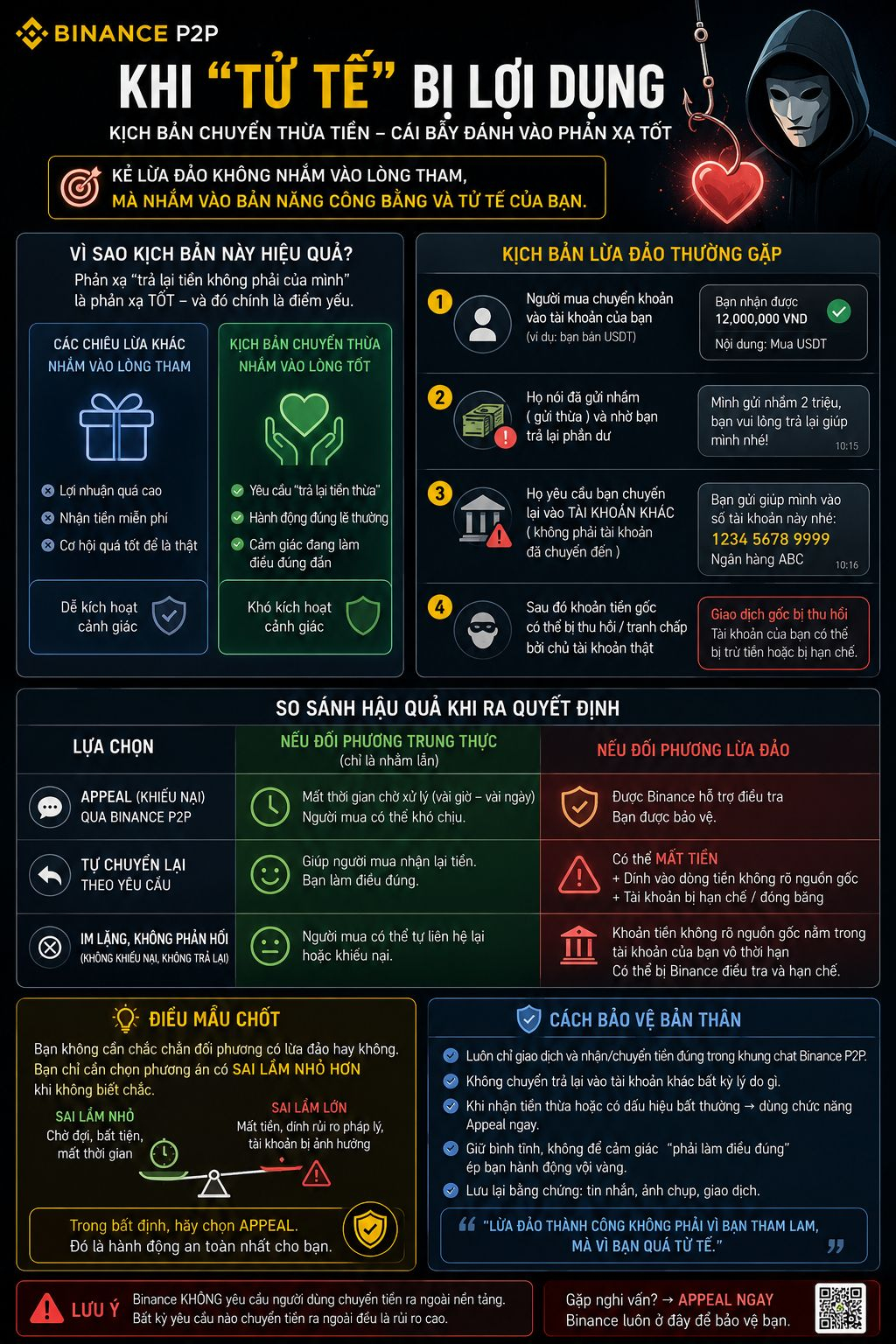
I notice a psychologically noteworthy detail in the context of transferring funds scams on Binance P2P: the scammer doesn’t prey on greed, but on the seller’s own instincts to be fair and kind—this is why this scenario is far more effective than scam tactics based on enticing offers of benefits.
With most other scams, people are taught to be vigilant when they see opportunities that are “too good to be true”—getting extra free money, abnormal profits. But here, the seller is not asked to keep the extra funds—instead, they’re instructed to return them. Their actions are completely consistent with common sense. Precisely because the reflex to “return money that isn’t yours” is a good one, this situation is easier to get past the psychological defenses that people often use to protect themselves from scams.
There are scams that exploit the very instinct to be kind, making the targeted person feel like they are doing the right thing while, in reality, they are being led into risky actions. The request to transfer to a different account—rather than refunding to the exact account the payment was sent to—is a small detail, but it’s the key deciding factor.
Self-reflection: recognizing this psychological mechanism doesn’t automatically make you immune to it in real life—knowing the theory and responding correctly under pressure are two different things, especially when the person making the request acts in a hurry or creates a sense of urgency.
I’m waiting to see whether Binance P2P will provide a specific warning for this kind of scam that takes advantage of the “kindness reflex,” because it is different enough that it may require its own explanation rather than relying on standard scam warnings.
#binancep2pantoan @Binance_Vietnam $BTC
I notice a psychologically noteworthy detail in the context of transferring funds scams on Binance P2P: the scammer doesn’t prey on greed, but on the seller’s own instincts to be fair and kind—this is why this scenario is far more effective than scam tactics based on enticing offers of benefits.
With most other scams, people are taught to be vigilant when they see opportunities that are “too good to be true”—getting extra free money, abnormal profits. But here, the seller is not asked to keep the extra funds—instead, they’re instructed to return them. Their actions are completely consistent with common sense. Precisely because the reflex to “return money that isn’t yours” is a good one, this situation is easier to get past the psychological defenses that people often use to protect themselves from scams.
There are scams that exploit the very instinct to be kind, making the targeted person feel like they are doing the right thing while, in reality, they are being led into risky actions. The request to transfer to a different account—rather than refunding to the exact account the payment was sent to—is a small detail, but it’s the key deciding factor.
Self-reflection: recognizing this psychological mechanism doesn’t automatically make you immune to it in real life—knowing the theory and responding correctly under pressure are two different things, especially when the person making the request acts in a hurry or creates a sense of urgency.
I’m waiting to see whether Binance P2P will provide a specific warning for this kind of scam that takes advantage of the “kindness reflex,” because it is different enough that it may require its own explanation rather than relying on standard scam warnings.
#binancep2pantoan @Binance Vietnam $BTC
With most other scams, people are taught to be vigilant when they see opportunities that are “too good to be true”—getting extra free money, abnormal profits. But here, the seller is not asked to keep the extra funds—instead, they’re instructed to return them. Their actions are completely consistent with common sense. Precisely because the reflex to “return money that isn’t yours” is a good one, this situation is easier to get past the psychological defenses that people often use to protect themselves from scams.
There are scams that exploit the very instinct to be kind, making the targeted person feel like they are doing the right thing while, in reality, they are being led into risky actions. The request to transfer to a different account—rather than refunding to the exact account the payment was sent to—is a small detail, but it’s the key deciding factor.
Self-reflection: recognizing this psychological mechanism doesn’t automatically make you immune to it in real life—knowing the theory and responding correctly under pressure are two different things, especially when the person making the request acts in a hurry or creates a sense of urgency.
I’m waiting to see whether Binance P2P will provide a specific warning for this kind of scam that takes advantage of the “kindness reflex,” because it is different enough that it may require its own explanation rather than relying on standard scam warnings.
#binancep2pantoan @Binance Vietnam $BTC
78

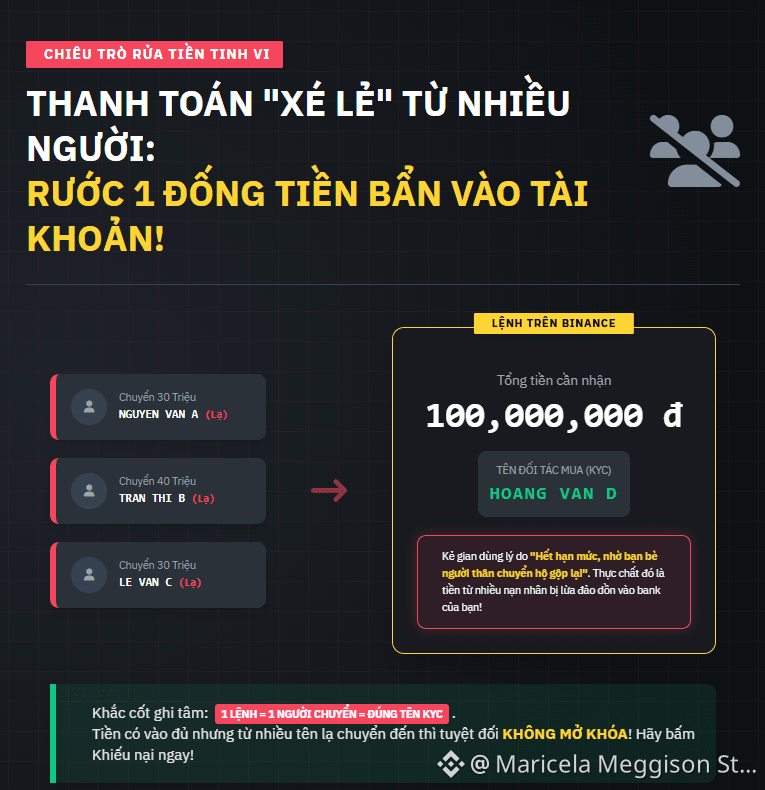
🚨 P2P Scam Trap: “Split-Payment” Transfers - Get Dirty Money Into Your Bank!
Hey everyone, you finally cashed out on a big BTC, ETH, or BNB order (tens or even hundreds of millions) — everyone’s happy. But be careful if the money lands in your account in the form of “split payments”!
🔴 The scam script:
You SELL 100 million worth of BTC to a counterparty with the KYC name: HOANG VAN D.
Suddenly your bank account makes a “ting ting” alert 3 times: 30 million (from NGUYEN VAN A), 40 million (from TRAN THI B), 30 million (from LE VAN C).
D messages: “My bank has run out of transfer limits. Ask the three people in my family to transfer the combined amount so we reach 100 million—please release the coins!”
💔 THE HARSH TRUTH:
D is the scammer. A, B, and C are not “family members”—they are three victims he tricked into buying goods online. He gets these three people to transfer money directly into YOUR bank account.
👉 Consequence: When the 3 victims report it, the bank will IMMEDIATELY FREEZE your account for receiving funds from the scam transaction. The criminal takes the coins and disappears—leaving you as a “money-laundering station”!
🟢 Life-or-death rules:
❌ DO NOT accept payments from multiple accounts with different KYC names.
❌ DO NOT believe excuses like “transfer limit exceeded, ask your wife/husband/relative to do it for you.”
✅ THE TRUTH: 1 Order = 1 Transfer Person = 100% matching KYC name.
If you notice signs of “split payments” from unfamiliar names, immediately keep the order, and click APPEAL so Binance customer support can help with a safe refund.
Protect your funds above all—don’t be too nice, everyone!
#binancep2pantoan @Binance_Vietnam
🚨 P2P Scam Trap: “Split-Payment” Transfers - Get Dirty Money Into Your Bank!
Hey everyone, you finally cashed out on a big BTC, ETH, or BNB order (tens or even hundreds of millions) — everyone’s happy. But be careful if the money lands in your account in the form of “split payments”!
🔴 The scam script:
You SELL 100 million worth of BTC to a counterparty with the KYC name: HOANG VAN D.
Suddenly your bank account makes a “ting ting” alert 3 times: 30 million (from NGUYEN VAN A), 40 million (from TRAN THI B), 30 million (from LE VAN C).
D messages: “My bank has run out of transfer limits. Ask the three people in my family to transfer the combined amount so we reach 100 million—please release the coins!”
💔 THE HARSH TRUTH:
D is the scammer. A, B, and C are not “family members”—they are three victims he tricked into buying goods online. He gets these three people to transfer money directly into YOUR bank account.
👉 Consequence: When the 3 victims report it, the bank will IMMEDIATELY FREEZE your account for receiving funds from the scam transaction. The criminal takes the coins and disappears—leaving you as a “money-laundering station”!
🟢 Life-or-death rules:
❌ DO NOT accept payments from multiple accounts with different KYC names.
❌ DO NOT believe excuses like “transfer limit exceeded, ask your wife/husband/relative to do it for you.”
✅ THE TRUTH: 1 Order = 1 Transfer Person = 100% matching KYC name.
If you notice signs of “split payments” from unfamiliar names, immediately keep the order, and click APPEAL so Binance customer support can help with a safe refund.
Protect your funds above all—don’t be too nice, everyone!
#binancep2pantoan @Binance Vietnam
Hey everyone, you finally cashed out on a big BTC, ETH, or BNB order (tens or even hundreds of millions) — everyone’s happy. But be careful if the money lands in your account in the form of “split payments”!
🔴 The scam script:
You SELL 100 million worth of BTC to a counterparty with the KYC name: HOANG VAN D.
Suddenly your bank account makes a “ting ting” alert 3 times: 30 million (from NGUYEN VAN A), 40 million (from TRAN THI B), 30 million (from LE VAN C).
D messages: “My bank has run out of transfer limits. Ask the three people in my family to transfer the combined amount so we reach 100 million—please release the coins!”
💔 THE HARSH TRUTH:
D is the scammer. A, B, and C are not “family members”—they are three victims he tricked into buying goods online. He gets these three people to transfer money directly into YOUR bank account.
👉 Consequence: When the 3 victims report it, the bank will IMMEDIATELY FREEZE your account for receiving funds from the scam transaction. The criminal takes the coins and disappears—leaving you as a “money-laundering station”!
🟢 Life-or-death rules:
❌ DO NOT accept payments from multiple accounts with different KYC names.
❌ DO NOT believe excuses like “transfer limit exceeded, ask your wife/husband/relative to do it for you.”
✅ THE TRUTH: 1 Order = 1 Transfer Person = 100% matching KYC name.
If you notice signs of “split payments” from unfamiliar names, immediately keep the order, and click APPEAL so Binance customer support can help with a safe refund.
Protect your funds above all—don’t be too nice, everyone!
#binancep2pantoan @Binance Vietnam
1
48

·
--
#binancep2pantoan 🛡️ Safety checklist before confirming a Binance P2P transaction
P2P transactions aren’t difficult, but there’s one rule I always put first: don’t let a few minutes of rush turn into the wrong transaction.
Before completing a P2P order, I usually check the following steps:
✅ 1. Check the trading partner’s information
Look at the number of orders completed, the completion rate, and the activity history. A good price is a factor, but reliability is just as important.
✅ 2. Don’t move the transaction off the platform
If the other party asks you to switch to Telegram, Zalo, or another channel to “handle it faster,” I won’t follow. Using Binance for communication helps keep the necessary information in case of disputes.
✅ 3. For crypto buyers: verify the correct details before sending money
Match the recipient name, account number, amount, and any payment requirements shown in the order before making the transfer.
✅ 4. For crypto sellers: you must check that the money has actually arrived in your account
Don’t rely only on a screenshot of the transfer, an SMS, or a message saying “I already sent it.” Only release the crypto after you personally verify your account and are certain the money has truly been credited.
✅ 5. Don’t rush when something seems abnormal
If the payment information doesn’t match, the other party keeps pressuring you, or there’s an issue with the transaction, stop confirming and use the Appeal/Dispute feature on Binance when needed.
#BinanceP2PAnToanToan
#binancep2pantoan 🛡️ Safety checklist before confirming a Binance P2P transaction
P2P transactions aren’t difficult, but there’s one rule I always put first: don’t let a few minutes of rush turn into the wrong transaction.
Before completing a P2P order, I usually check the following steps:
✅ 1. Check the trading partner’s information
Look at the number of orders completed, the completion rate, and the activity history. A good price is a factor, but reliability is just as important.
✅ 2. Don’t move the transaction off the platform
If the other party asks you to switch to Telegram, Zalo, or another channel to “handle it faster,” I won’t follow. Using Binance for communication helps keep the necessary information in case of disputes.
✅ 3. For crypto buyers: verify the correct details before sending money
Match the recipient name, account number, amount, and any payment requirements shown in the order before making the transfer.
✅ 4. For crypto sellers: you must check that the money has actually arrived in your account
Don’t rely only on a screenshot of the transfer, an SMS, or a message saying “I already sent it.” Only release the crypto after you personally verify your account and are certain the money has truly been credited.
✅ 5. Don’t rush when something seems abnormal
If the payment information doesn’t match, the other party keeps pressuring you, or there’s an issue with the transaction, stop confirming and use the Appeal/Dispute feature on Binance when needed.
#BinanceP2PAnToanToan
P2P transactions aren’t difficult, but there’s one rule I always put first: don’t let a few minutes of rush turn into the wrong transaction.
Before completing a P2P order, I usually check the following steps:
✅ 1. Check the trading partner’s information
Look at the number of orders completed, the completion rate, and the activity history. A good price is a factor, but reliability is just as important.
✅ 2. Don’t move the transaction off the platform
If the other party asks you to switch to Telegram, Zalo, or another channel to “handle it faster,” I won’t follow. Using Binance for communication helps keep the necessary information in case of disputes.
✅ 3. For crypto buyers: verify the correct details before sending money
Match the recipient name, account number, amount, and any payment requirements shown in the order before making the transfer.
✅ 4. For crypto sellers: you must check that the money has actually arrived in your account
Don’t rely only on a screenshot of the transfer, an SMS, or a message saying “I already sent it.” Only release the crypto after you personally verify your account and are certain the money has truly been credited.
✅ 5. Don’t rush when something seems abnormal
If the payment information doesn’t match, the other party keeps pressuring you, or there’s an issue with the transaction, stop confirming and use the Appeal/Dispute feature on Binance when needed.
#BinanceP2PAnToanToan
72
Log in to explore more content
Join global crypto users on Binance Square
⚡️ Get latest and useful information about crypto.
💬 Trusted by the world’s largest crypto exchange.
👍 Discover real insights from verified creators.
Email / Phone number
Trending Topics
1
#AIStocksWhatNext
628,702 views
4,720 Discussing
2
#21SharesLaunchesEuropesFirstZcashETP
8,341 views
343 Discussing
3
#CardanoJoinsX402PaymentStandard
6,105 views
267 Discussing
4
#BitcoinTops$87KAtEightMonthHigh
6,449 views
75 Discussing
5
#ZECBreaksAbove$1600AtRecordHigh
3,519 views
62 Discussing
6
#BitwiseNEARStakingETPAssetsTop$100M
26,145 views
78 Discussing
7
#BitcoinBreaksAboveMayHighNears$86K
27,412 views
258 Discussing
8
#DogecoinRises15%
100,713 views
1,685 Discussing
9
#$14BBitcoinOptionsExpireFriday
7,819 views
109 Discussing
10
#BNBMarketCapPassesBNYMellon
63,102 views
1,354 Discussing