
#binancep2pantoan
binancep2pantoan
1.8M views
8,344 Discussing
Hot
Latest

·
--
Article
7 "Blood and Sweat" Rules for Safe Binance P2P Trading and Never Losing MoneyP2P (Peer-to-Peer) trading on Binance is currently the most popular and convenient channel for depositing/withdrawing fiat currency (VND). However, convenience also comes with many risks, such as getting involved with "dirty money," which can lead to bank account freezes, or being scammed by malicious opponents.
Whether you are a newbie or a long-time investor, mastering the safety rules when trading P2P is a must to protect your own assets.
7 "Blood and Sweat" Rules for Safe Binance P2P Trading and Never Losing Money
P2P (Peer-to-Peer) trading on Binance is currently the most popular and convenient channel for depositing/withdrawing fiat currency (VND). However, convenience also comes with many risks, such as getting involved with "dirty money," which can lead to bank account freezes, or being scammed by malicious opponents.
Whether you are a newbie or a long-time investor, mastering the safety rules when trading P2P is a must to protect your own assets.
Whether you are a newbie or a long-time investor, mastering the safety rules when trading P2P is a must to protect your own assets.
1
146

💡 Dealing with Binance P2P Transaction Issues: What Should You Do?
When trading P2P, if you encounter unexpected situations, stay calm and handle them according to the safe instructions below:
❓ Situation 1: The buyer has clicked “Paid”, but your bank hasn’t reported receiving the funds?
👉 How to handle: Under no circumstances should you release the coins. Message the buyer to request a screenshot of the transaction receipt. Check your banking app carefully. If the countdown time passes and you still haven’t received the money, click Appeal and submit evidence for Binance to investigate.
❓ Situation 2: You transferred too much/too little, or you entered the transfer content incorrectly?
👉 How to handle: Message your counterparty directly through the chat box in the Binance app to agree on a solution. If the counterparty doesn’t cooperate for a refund or doesn’t release the coins, click Appeal and upload the bank transfer invoice.
🔒 Always trade 100% on the Binance app and follow the safety guidelines from @Bi
#BinanceP2PAnToan
@Binance_Vietnam
💡 Dealing with Binance P2P Transaction Issues: What Should You Do?
When trading P2P, if you encounter unexpected situations, stay calm and handle them according to the safe instructions below:
❓ Situation 1: The buyer has clicked “Paid”, but your bank hasn’t reported receiving the funds?
👉 How to handle: Under no circumstances should you release the coins. Message the buyer to request a screenshot of the transaction receipt. Check your banking app carefully. If the countdown time passes and you still haven’t received the money, click Appeal and submit evidence for Binance to investigate.
❓ Situation 2: You transferred too much/too little, or you entered the transfer content incorrectly?
👉 How to handle: Message your counterparty directly through the chat box in the Binance app to agree on a solution. If the counterparty doesn’t cooperate for a refund or doesn’t release the coins, click Appeal and upload the bank transfer invoice.
🔒 Always trade 100% on the Binance app and follow the safety guidelines from @Bi
#BinanceP2PAnToan
@Binance Vietnam
When trading P2P, if you encounter unexpected situations, stay calm and handle them according to the safe instructions below:
❓ Situation 1: The buyer has clicked “Paid”, but your bank hasn’t reported receiving the funds?
👉 How to handle: Under no circumstances should you release the coins. Message the buyer to request a screenshot of the transaction receipt. Check your banking app carefully. If the countdown time passes and you still haven’t received the money, click Appeal and submit evidence for Binance to investigate.
❓ Situation 2: You transferred too much/too little, or you entered the transfer content incorrectly?
👉 How to handle: Message your counterparty directly through the chat box in the Binance app to agree on a solution. If the counterparty doesn’t cooperate for a refund or doesn’t release the coins, click Appeal and upload the bank transfer invoice.
🔒 Always trade 100% on the Binance app and follow the safety guidelines from @Bi
#BinanceP2PAnToan
@Binance Vietnam
101

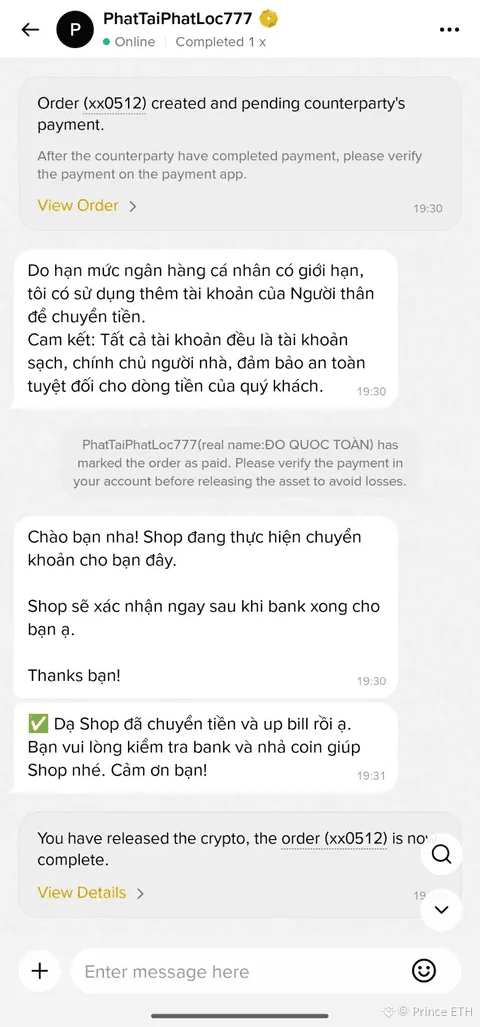
🧘♂️ P2P TRADING: STEEL DISCIPLINE MAKES SUCCESS 🧘♂️
Thieves often take advantage of our psychology of haste, impatience, or our reluctance to say no to push us to unlock crypto funds. Don’t let emotions take control! No matter how urgently the counterparty claims they need it, you must maintain "steel discipline": Log in to your banking app yourself to check your balance and ensure the sender/recipient names match the names that were verified (KYC) on the exchange. If the counterparty shows signs of scam, stay calm, click Appeal (Dispute) and wait for the support team to resolve the issue. Your money, your decision!#BinanceP2PAnToan @Binance_Vietnam
🧘♂️ P2P TRADING: STEEL DISCIPLINE MAKES SUCCESS 🧘♂️
Thieves often take advantage of our psychology of haste, impatience, or our reluctance to say no to push us to unlock crypto funds. Don’t let emotions take control! No matter how urgently the counterparty claims they need it, you must maintain "steel discipline": Log in to your banking app yourself to check your balance and ensure the sender/recipient names match the names that were verified (KYC) on the exchange. If the counterparty shows signs of scam, stay calm, click Appeal (Dispute) and wait for the support team to resolve the issue. Your money, your decision!#BinanceP2PAnToan @Binance Vietnam
Thieves often take advantage of our psychology of haste, impatience, or our reluctance to say no to push us to unlock crypto funds. Don’t let emotions take control! No matter how urgently the counterparty claims they need it, you must maintain "steel discipline": Log in to your banking app yourself to check your balance and ensure the sender/recipient names match the names that were verified (KYC) on the exchange. If the counterparty shows signs of scam, stay calm, click Appeal (Dispute) and wait for the support team to resolve the issue. Your money, your decision!#BinanceP2PAnToan @Binance Vietnam
1
110

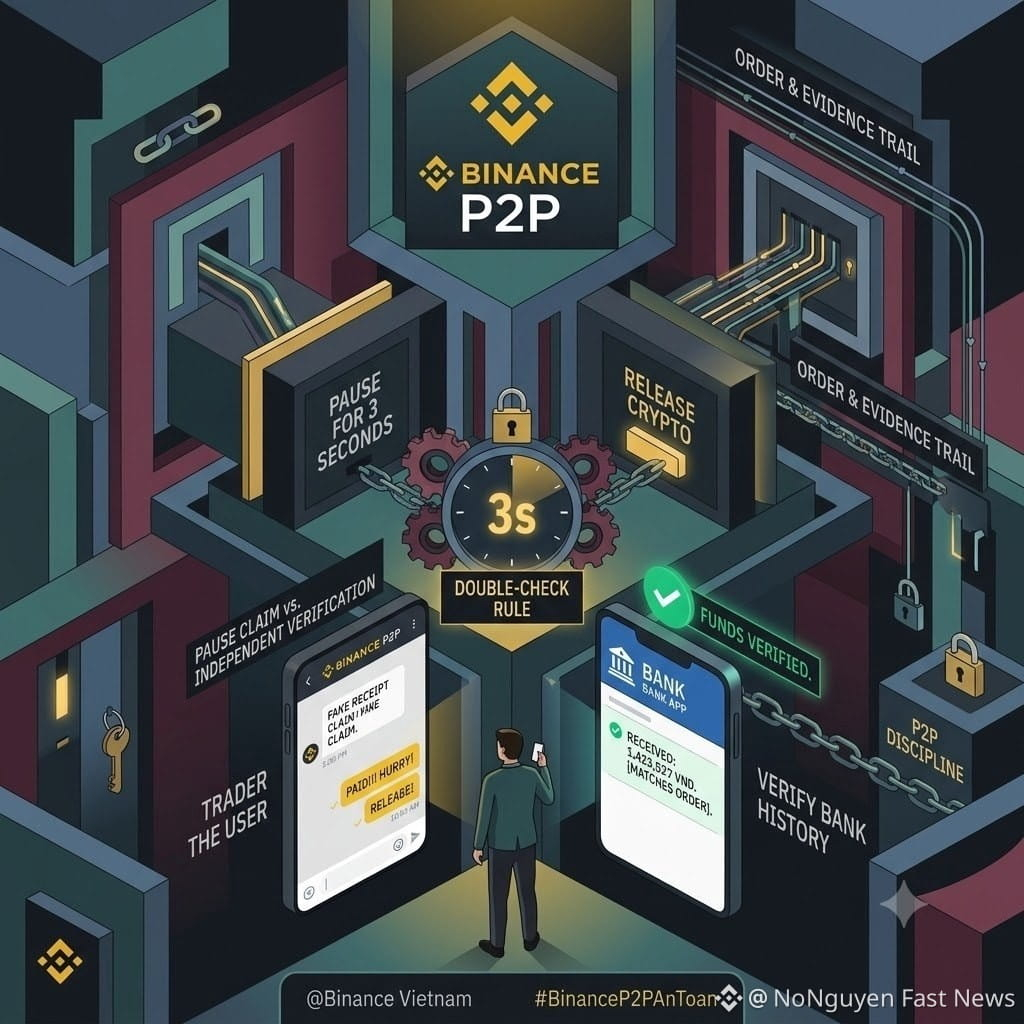
In February 2025, I sold 56 USDT in a hurry for 1,423,527 VND. The buyer sent a fake transfer receipt and kept pushing me in chat. Because the amount was small, I lowered my guard and almost released the crypto without opening my banking app to verify the payment
That mistake changed one part of my P2P routine. After reviewing Binance P2P guidance and discussing the process with Binance Support, I learned to separate a payment claim from a payment I can independently verify. “Payment Completed” on the other side is not the same as “Funds Received” in my own bank account. Escrow protects the crypto during the order, but it does not replace my final payment check
That became my Double-Check 3-Second Rule
When a buyer says “I’ve paid”, even if they spam the chat or push for speed, I pause for three seconds. One breath. Then I open my banking app and check the transaction history. I verify that the actual funds arrived, the amount matches the order, and the payment details make sense. Only then do I tap Release Crypto
The three seconds are not about trading slowly. They create a deliberate pause between a payment claim and an irreversible action. A screenshot is evidence supplied by the counterparty. My bank transaction is independent evidence that the money actually reached me. That distinction is small, but it changes the decision
I also keep the Binance P2P order and chat history intact. If a dispute happens, the order record, conversation and payment evidence help establish the timeline for an Appeal. Staying inside the platform also preserves that evidence trail instead of moving the conversation somewhere harder to document
I no longer treat speed as the goal. I release only when the evidence is complete. That 56 USDT trade taught me that P2P discipline is not about trusting faster; it is about knowing exactly when to slow down
@Binance_Vietnam #BinanceP2PAnToan
In February 2025, I sold 56 USDT in a hurry for 1,423,527 VND. The buyer sent a fake transfer receipt and kept pushing me in chat. Because the amount was small, I lowered my guard and almost released the crypto without opening my banking app to verify the payment
That mistake changed one part of my P2P routine. After reviewing Binance P2P guidance and discussing the process with Binance Support, I learned to separate a payment claim from a payment I can independently verify. “Payment Completed” on the other side is not the same as “Funds Received” in my own bank account. Escrow protects the crypto during the order, but it does not replace my final payment check
That became my Double-Check 3-Second Rule
When a buyer says “I’ve paid”, even if they spam the chat or push for speed, I pause for three seconds. One breath. Then I open my banking app and check the transaction history. I verify that the actual funds arrived, the amount matches the order, and the payment details make sense. Only then do I tap Release Crypto
The three seconds are not about trading slowly. They create a deliberate pause between a payment claim and an irreversible action. A screenshot is evidence supplied by the counterparty. My bank transaction is independent evidence that the money actually reached me. That distinction is small, but it changes the decision
I also keep the Binance P2P order and chat history intact. If a dispute happens, the order record, conversation and payment evidence help establish the timeline for an Appeal. Staying inside the platform also preserves that evidence trail instead of moving the conversation somewhere harder to document
I no longer treat speed as the goal. I release only when the evidence is complete. That 56 USDT trade taught me that P2P discipline is not about trusting faster; it is about knowing exactly when to slow down
@Binance Vietnam #BinanceP2PAnToan
That mistake changed one part of my P2P routine. After reviewing Binance P2P guidance and discussing the process with Binance Support, I learned to separate a payment claim from a payment I can independently verify. “Payment Completed” on the other side is not the same as “Funds Received” in my own bank account. Escrow protects the crypto during the order, but it does not replace my final payment check
That became my Double-Check 3-Second Rule
When a buyer says “I’ve paid”, even if they spam the chat or push for speed, I pause for three seconds. One breath. Then I open my banking app and check the transaction history. I verify that the actual funds arrived, the amount matches the order, and the payment details make sense. Only then do I tap Release Crypto
The three seconds are not about trading slowly. They create a deliberate pause between a payment claim and an irreversible action. A screenshot is evidence supplied by the counterparty. My bank transaction is independent evidence that the money actually reached me. That distinction is small, but it changes the decision
I also keep the Binance P2P order and chat history intact. If a dispute happens, the order record, conversation and payment evidence help establish the timeline for an Appeal. Staying inside the platform also preserves that evidence trail instead of moving the conversation somewhere harder to document
I no longer treat speed as the goal. I release only when the evidence is complete. That 56 USDT trade taught me that P2P discipline is not about trusting faster; it is about knowing exactly when to slow down
@Binance Vietnam #BinanceP2PAnToan
2
1
706

·
--
The 1-Minute Safety Ritual Before I Click: How This Holder DCA’s Without P2P Stress
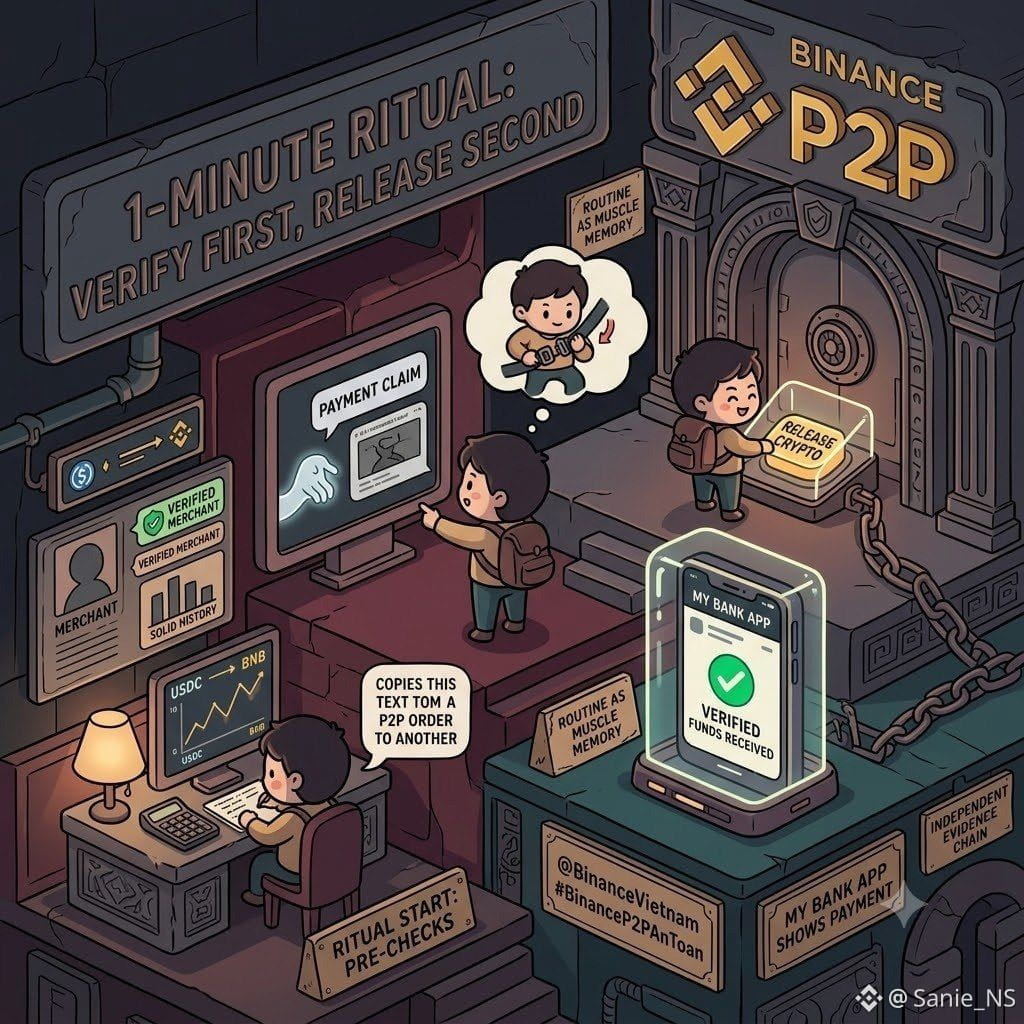
Every month, when my salary lands, I set aside 150 USDC to buy BNB through DCA. I have repeated this routine so many times that I eventually noticed something: the stressful part was rarely the purchase itself. It was the few seconds before clicking Release Crypto
That led me to build a small 1-minute ritual. Before taking a P2P order, I prefer a merchant with the yellow Verified Merchant badge and a solid completion history. It does not make a trade risk-free. It simply gives me a better starting point when evaluating the counterparty
Then I copy the bank account details directly from the P2P order, rather than typing them manually. I also keep the transfer description clean and avoid unnecessary sensitive terms. These are tiny steps, but removing avoidable mistakes matters when the same process is repeated month after month
The step I never skip comes when the other side says, “Payment completed.” A message, screenshot, or payment claim is not the same thing as money actually arriving in my account. I open my own banking app and verify the incoming payment independently before I release
This changed my view of P2P safety. I do not need to decide whether I trust the person enough to release. I only need to verify whether the condition for release has actually been met
That distinction matters because Escrow protects the crypto within the P2P order, but it does not replace my responsibility to verify the payment before releasing. If something does not match, I keep the conversation inside Binance P2P, preserve the Order ID and relevant evidence, and use Appeal or Binance Support when appropriate
After enough repetitions, the ritual stopped feeling like extra work. It became muscle memory, like fastening a seat belt before driving. For a long-term DCA holder, safety does not have to create more stress. It can become one simple reflex: verify first, release second
@Binance_Vietnam #BinanceP2PAnToan
The 1-Minute Safety Ritual Before I Click: How This Holder DCA’s Without P2P Stress
Every month, when my salary lands, I set aside 150 USDC to buy BNB through DCA. I have repeated this routine so many times that I eventually noticed something: the stressful part was rarely the purchase itself. It was the few seconds before clicking Release Crypto
That led me to build a small 1-minute ritual. Before taking a P2P order, I prefer a merchant with the yellow Verified Merchant badge and a solid completion history. It does not make a trade risk-free. It simply gives me a better starting point when evaluating the counterparty
Then I copy the bank account details directly from the P2P order, rather than typing them manually. I also keep the transfer description clean and avoid unnecessary sensitive terms. These are tiny steps, but removing avoidable mistakes matters when the same process is repeated month after month
The step I never skip comes when the other side says, “Payment completed.” A message, screenshot, or payment claim is not the same thing as money actually arriving in my account. I open my own banking app and verify the incoming payment independently before I release
This changed my view of P2P safety. I do not need to decide whether I trust the person enough to release. I only need to verify whether the condition for release has actually been met
That distinction matters because Escrow protects the crypto within the P2P order, but it does not replace my responsibility to verify the payment before releasing. If something does not match, I keep the conversation inside Binance P2P, preserve the Order ID and relevant evidence, and use Appeal or Binance Support when appropriate
After enough repetitions, the ritual stopped feeling like extra work. It became muscle memory, like fastening a seat belt before driving. For a long-term DCA holder, safety does not have to create more stress. It can become one simple reflex: verify first, release second
@Binance Vietnam #BinanceP2PAnToan
Every month, when my salary lands, I set aside 150 USDC to buy BNB through DCA. I have repeated this routine so many times that I eventually noticed something: the stressful part was rarely the purchase itself. It was the few seconds before clicking Release Crypto
That led me to build a small 1-minute ritual. Before taking a P2P order, I prefer a merchant with the yellow Verified Merchant badge and a solid completion history. It does not make a trade risk-free. It simply gives me a better starting point when evaluating the counterparty
Then I copy the bank account details directly from the P2P order, rather than typing them manually. I also keep the transfer description clean and avoid unnecessary sensitive terms. These are tiny steps, but removing avoidable mistakes matters when the same process is repeated month after month
The step I never skip comes when the other side says, “Payment completed.” A message, screenshot, or payment claim is not the same thing as money actually arriving in my account. I open my own banking app and verify the incoming payment independently before I release
This changed my view of P2P safety. I do not need to decide whether I trust the person enough to release. I only need to verify whether the condition for release has actually been met
That distinction matters because Escrow protects the crypto within the P2P order, but it does not replace my responsibility to verify the payment before releasing. If something does not match, I keep the conversation inside Binance P2P, preserve the Order ID and relevant evidence, and use Appeal or Binance Support when appropriate
After enough repetitions, the ritual stopped feeling like extra work. It became muscle memory, like fastening a seat belt before driving. For a long-term DCA holder, safety does not have to create more stress. It can become one simple reflex: verify first, release second
@Binance Vietnam #BinanceP2PAnToan
2
2
628
·
--
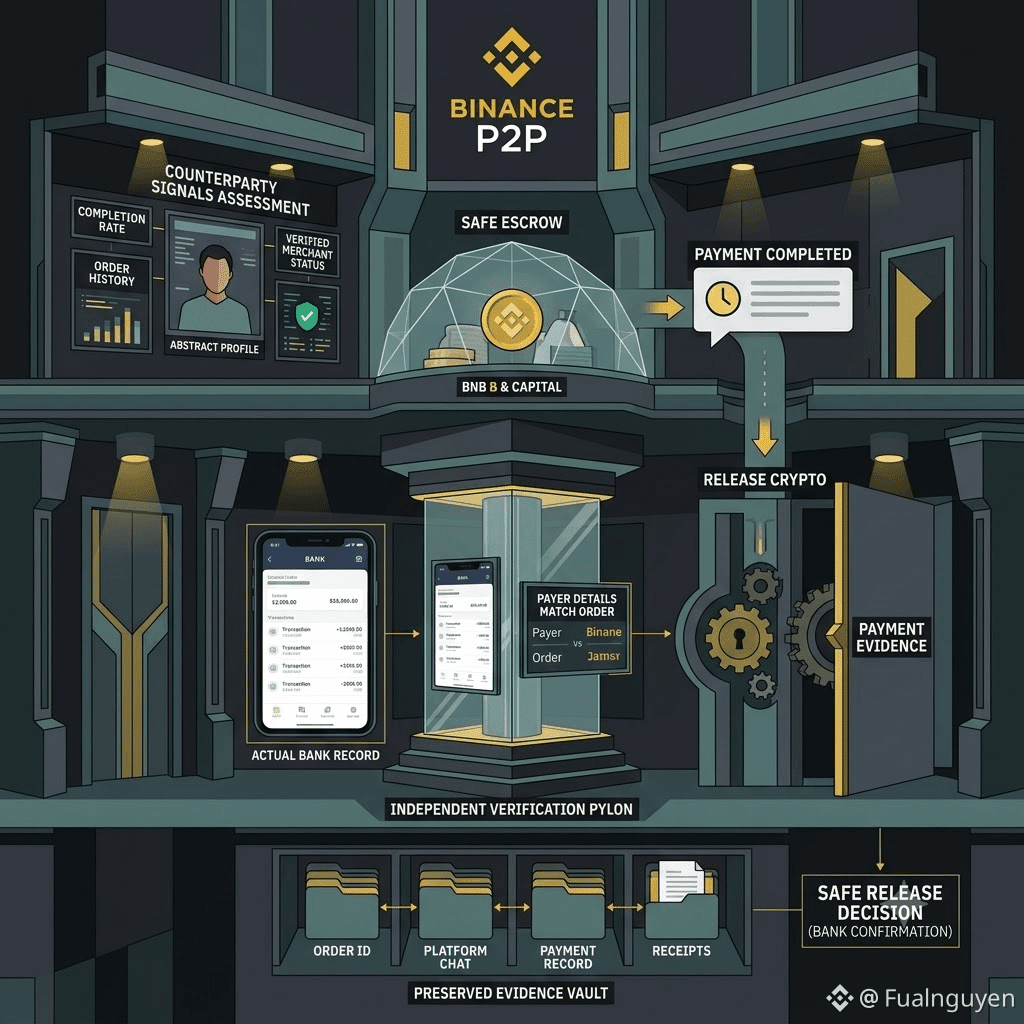
Running an investment fund changed how I think about Binance P2P. We use P2P to acquire coins and rotate capital. During one conversion, the counterparty marked payment completed while I was still on the order screen. Nothing looked unusual, but the money was not in my bank ledger. That small gap changed my process
I used to ask, “Is this counterparty trustworthy?” Now I ask, “Am I about to change the asset state based on a payment claim I have not independently verified?”
Completion rate, order history, and Verified Merchant status help me assess a counterparty. They do not prove that my payment has arrived. Before Release Crypto, I open my bank app and verify the actual transaction or balance. I also check whether the payer details match the order, because a different payer makes the payment harder to reconcile with the order. “Payment Completed” is a status. A screenshot, SMS, or chat message is a claim. My bank record is the evidence behind my release decision
That is how I understand escrow. It keeps the crypto within the transaction flow while payment is being resolved, but it does not verify my bank account for me. Escrow protects the transaction state. Independent verification protects the release decision
I keep the Order ID, in-platform chat, payment record, and relevant receipts together. Staying inside Binance P2P also keeps the decision tied to a traceable record if an Appeal or Binance Support process becomes necessary. Moving the conversation elsewhere may feel faster, but it separates the payment claim from the evidence that can later explain what happened
If the money is not confirmed, I do not release. I preserve the evidence, recheck the payment, and use the official Appeal or Binance Support process when needed. No urgency from the other side changes that sequence
The lesson is simple: risk management works through a five-step loop—assess, verify, preserve, stay in P2P, escalate. Signals help choose who to trade with; evidence decides release. I never release before my bank confirms payment
#binancep2pantoan @Binance_Vietnam
Running an investment fund changed how I think about Binance P2P. We use P2P to acquire coins and rotate capital. During one conversion, the counterparty marked payment completed while I was still on the order screen. Nothing looked unusual, but the money was not in my bank ledger. That small gap changed my process
I used to ask, “Is this counterparty trustworthy?” Now I ask, “Am I about to change the asset state based on a payment claim I have not independently verified?”
Completion rate, order history, and Verified Merchant status help me assess a counterparty. They do not prove that my payment has arrived. Before Release Crypto, I open my bank app and verify the actual transaction or balance. I also check whether the payer details match the order, because a different payer makes the payment harder to reconcile with the order. “Payment Completed” is a status. A screenshot, SMS, or chat message is a claim. My bank record is the evidence behind my release decision
That is how I understand escrow. It keeps the crypto within the transaction flow while payment is being resolved, but it does not verify my bank account for me. Escrow protects the transaction state. Independent verification protects the release decision
I keep the Order ID, in-platform chat, payment record, and relevant receipts together. Staying inside Binance P2P also keeps the decision tied to a traceable record if an Appeal or Binance Support process becomes necessary. Moving the conversation elsewhere may feel faster, but it separates the payment claim from the evidence that can later explain what happened
If the money is not confirmed, I do not release. I preserve the evidence, recheck the payment, and use the official Appeal or Binance Support process when needed. No urgency from the other side changes that sequence
The lesson is simple: risk management works through a five-step loop—assess, verify, preserve, stay in P2P, escalate. Signals help choose who to trade with; evidence decides release. I never release before my bank confirms payment
#binancep2pantoan @Binance Vietnam
I used to ask, “Is this counterparty trustworthy?” Now I ask, “Am I about to change the asset state based on a payment claim I have not independently verified?”
Completion rate, order history, and Verified Merchant status help me assess a counterparty. They do not prove that my payment has arrived. Before Release Crypto, I open my bank app and verify the actual transaction or balance. I also check whether the payer details match the order, because a different payer makes the payment harder to reconcile with the order. “Payment Completed” is a status. A screenshot, SMS, or chat message is a claim. My bank record is the evidence behind my release decision
That is how I understand escrow. It keeps the crypto within the transaction flow while payment is being resolved, but it does not verify my bank account for me. Escrow protects the transaction state. Independent verification protects the release decision
I keep the Order ID, in-platform chat, payment record, and relevant receipts together. Staying inside Binance P2P also keeps the decision tied to a traceable record if an Appeal or Binance Support process becomes necessary. Moving the conversation elsewhere may feel faster, but it separates the payment claim from the evidence that can later explain what happened
If the money is not confirmed, I do not release. I preserve the evidence, recheck the payment, and use the official Appeal or Binance Support process when needed. No urgency from the other side changes that sequence
The lesson is simple: risk management works through a five-step loop—assess, verify, preserve, stay in P2P, escalate. Signals help choose who to trade with; evidence decides release. I never release before my bank confirms payment
#binancep2pantoan @Binance Vietnam
2
4
433

When making a P2P order transfer, the memo should be written exactly with the order ID if your bank’s app allows it, and avoid writing any unusual lines that are unrelated. Sellers should also pay attention if the transfer memo looks abnormal or does not match the order—then they should ask again before releasing. Keep track of
#binancep2pantoan @Binance Vietnam
When making a P2P order transfer, the memo should be written exactly with the order ID if your bank’s app allows it, and avoid writing any unusual lines that are unrelated. Sellers should also pay attention if the transfer memo looks abnormal or does not match the order—then they should ask again before releasing. Keep track of
#binancep2pantoan @Binance Vietnam
#binancep2pantoan @Binance Vietnam
51

·
--
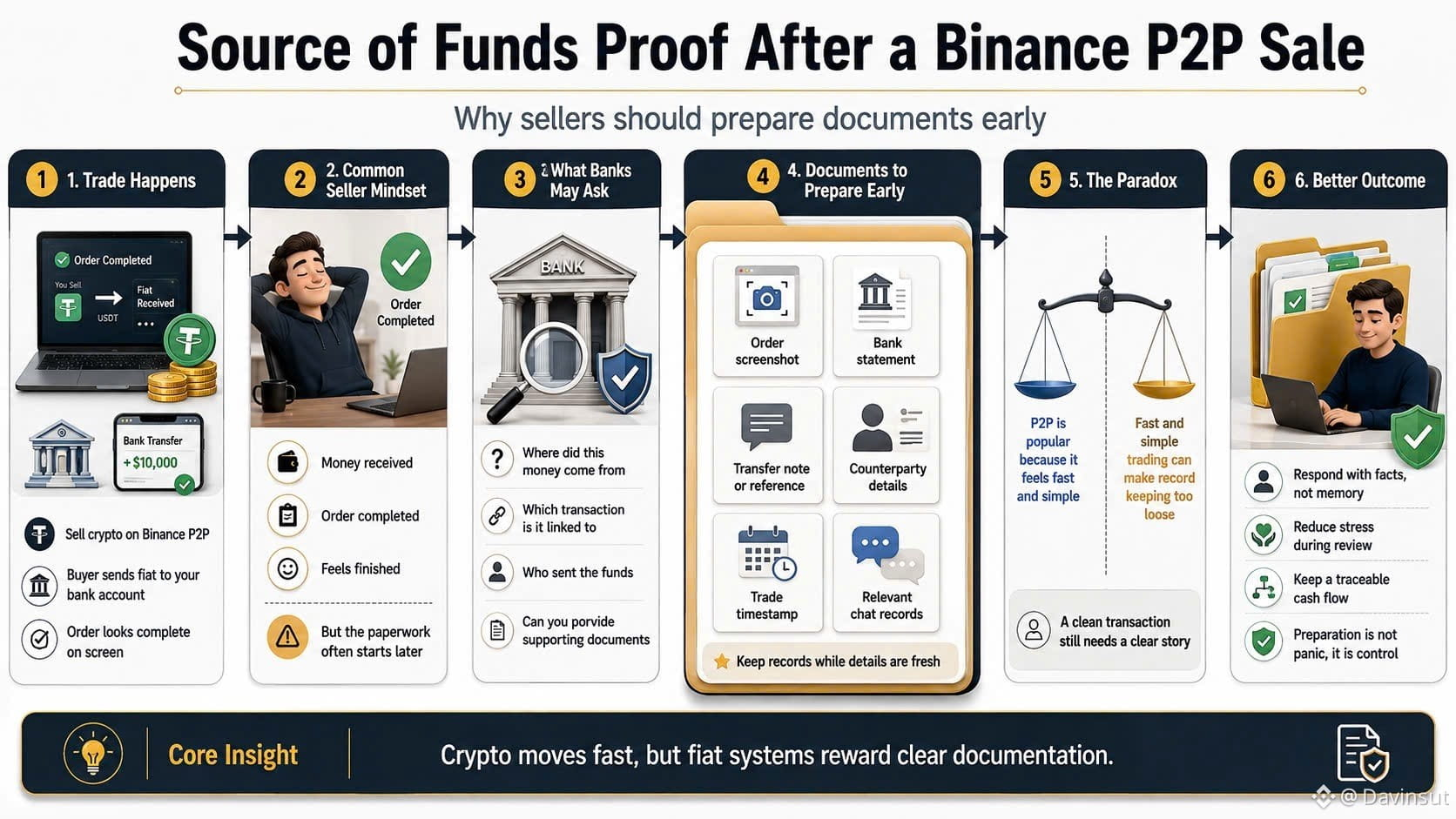
Late in the month, the house deposit was coming due while the USDT in my wallet was still sitting there. The sell order through Binance P2P matched quickly, the buyer transferred under the correct name, and the transfer note looked clean. I saved only a screenshot of the order, then shut my laptop, thinking that was enough.
Two weeks later, while reviewing my bank statement for another banking file, I realized that this incoming amount was missing a complete story. There was a date received, a sender, and an amount, but the link to the crypto sell order was missing. That missing piece did not create a problem right away, it only made me lose control of the explanation.
Sellers are usually most tense before releasing the coins, then relax once the order is completed. That psychology is very human. Binance P2P makes the transaction history look as if it is already stored there, ready to be opened whenever needed.
But a source of funds file is not just a screenshot of an order. It needs the bank statement showing the incoming transfer, the order matching time, the transfer note, the counterparty information, and any related conversation if there is one. When saved early, the seller answers with data, not with scattered memory.
The paradox is that regular traders often take paperwork less seriously than beginners. A smooth Binance P2P order creates the feeling that the next orders will also be smooth. Familiarity can wear down caution very quietly.
I do not want to turn this into fear. Not every P2P amount will be questioned later, and no one needs to keep records like an audit firm. But between caution and panic, there is a very clear space.
After a Binance P2P transaction, a source of funds file should be seen as part of closing the books. It does not make the price better, nor does it make the market less noisy. The remaining question is whether the seller wants to keep a cash flow that can be explained, or wait until proof is needed before starting to search for the trail.
@Binance_Vietnam #BinanceP2PAnToan
Late in the month, the house deposit was coming due while the USDT in my wallet was still sitting there. The sell order through Binance P2P matched quickly, the buyer transferred under the correct name, and the transfer note looked clean. I saved only a screenshot of the order, then shut my laptop, thinking that was enough.
Two weeks later, while reviewing my bank statement for another banking file, I realized that this incoming amount was missing a complete story. There was a date received, a sender, and an amount, but the link to the crypto sell order was missing. That missing piece did not create a problem right away, it only made me lose control of the explanation.
Sellers are usually most tense before releasing the coins, then relax once the order is completed. That psychology is very human. Binance P2P makes the transaction history look as if it is already stored there, ready to be opened whenever needed.
But a source of funds file is not just a screenshot of an order. It needs the bank statement showing the incoming transfer, the order matching time, the transfer note, the counterparty information, and any related conversation if there is one. When saved early, the seller answers with data, not with scattered memory.
The paradox is that regular traders often take paperwork less seriously than beginners. A smooth Binance P2P order creates the feeling that the next orders will also be smooth. Familiarity can wear down caution very quietly.
I do not want to turn this into fear. Not every P2P amount will be questioned later, and no one needs to keep records like an audit firm. But between caution and panic, there is a very clear space.
After a Binance P2P transaction, a source of funds file should be seen as part of closing the books. It does not make the price better, nor does it make the market less noisy. The remaining question is whether the seller wants to keep a cash flow that can be explained, or wait until proof is needed before starting to search for the trail.
@Binance Vietnam #BinanceP2PAnToan
Two weeks later, while reviewing my bank statement for another banking file, I realized that this incoming amount was missing a complete story. There was a date received, a sender, and an amount, but the link to the crypto sell order was missing. That missing piece did not create a problem right away, it only made me lose control of the explanation.
Sellers are usually most tense before releasing the coins, then relax once the order is completed. That psychology is very human. Binance P2P makes the transaction history look as if it is already stored there, ready to be opened whenever needed.
But a source of funds file is not just a screenshot of an order. It needs the bank statement showing the incoming transfer, the order matching time, the transfer note, the counterparty information, and any related conversation if there is one. When saved early, the seller answers with data, not with scattered memory.
The paradox is that regular traders often take paperwork less seriously than beginners. A smooth Binance P2P order creates the feeling that the next orders will also be smooth. Familiarity can wear down caution very quietly.
I do not want to turn this into fear. Not every P2P amount will be questioned later, and no one needs to keep records like an audit firm. But between caution and panic, there is a very clear space.
After a Binance P2P transaction, a source of funds file should be seen as part of closing the books. It does not make the price better, nor does it make the market less noisy. The remaining question is whether the seller wants to keep a cash flow that can be explained, or wait until proof is needed before starting to search for the trail.
@Binance Vietnam #BinanceP2PAnToan
1
3
138

·
--
one P2P habit changed for me after a very small scare last week.
i was selling around 8.6 million VNĐ worth of USDT on Binance P2P.
before accepting the Order, i had already checked the buyer's profile, completion rate and payment information.
nothing looked unusual.
a few minutes later, the buyer sent a transfer screenshot in the Order Chat and said the payment was done.
the image looked normal.
correct amount.
bank logo.
transaction time.
everything you would expect to see.
for a second, my brain treated that screenshot like the payment itself.
then i opened my banking app.
no money.
i refreshed once.
still nothing.
that was the moment the difference became very clear to me:
a payment receipt shows what someone says happened.
my bank account shows whether it actually happened.
so i did not Release the crypto.
i stayed inside the Binance P2P Order Chat and told the buyer i would wait until the funds were actually credited.
no moving to Zalo.
no accepting another payment account halfway through.
no unlocking because someone kept saying “i already paid.”
Binance P2P keeps the crypto in escrow while the Order is being handled, so there was no reason for me to rush past the verification step.
before Release, i now check three things myself:
the money is actually in my account.
the amount is correct.
the sender/payment information matches what i expect from the Order.
if something still does not make sense, i keep the Order ID, relevant chat and payment evidence, then use Appeal or Binance Support through the official channel.
that screenshot last week looked convincing.
but convincing is not the same as credited.
my rule now is very simple:
if i can only see the payment in an image...
i still have not seen the payment.
@Binance_Vietnam #BinanceP2PAnToan
when you sell on P2P, what do you check first before pressing Release?
one P2P habit changed for me after a very small scare last week.
i was selling around 8.6 million VNĐ worth of USDT on Binance P2P.
before accepting the Order, i had already checked the buyer's profile, completion rate and payment information.
nothing looked unusual.
a few minutes later, the buyer sent a transfer screenshot in the Order Chat and said the payment was done.
the image looked normal.
correct amount.
bank logo.
transaction time.
everything you would expect to see.
for a second, my brain treated that screenshot like the payment itself.
then i opened my banking app.
no money.
i refreshed once.
still nothing.
that was the moment the difference became very clear to me:
a payment receipt shows what someone says happened.
my bank account shows whether it actually happened.
so i did not Release the crypto.
i stayed inside the Binance P2P Order Chat and told the buyer i would wait until the funds were actually credited.
no moving to Zalo.
no accepting another payment account halfway through.
no unlocking because someone kept saying “i already paid.”
Binance P2P keeps the crypto in escrow while the Order is being handled, so there was no reason for me to rush past the verification step.
before Release, i now check three things myself:
the money is actually in my account.
the amount is correct.
the sender/payment information matches what i expect from the Order.
if something still does not make sense, i keep the Order ID, relevant chat and payment evidence, then use Appeal or Binance Support through the official channel.
that screenshot last week looked convincing.
but convincing is not the same as credited.
my rule now is very simple:
if i can only see the payment in an image...
i still have not seen the payment.
@Binance Vietnam #BinanceP2PAnToan
when you sell on P2P, what do you check first before pressing Release?
i was selling around 8.6 million VNĐ worth of USDT on Binance P2P.
before accepting the Order, i had already checked the buyer's profile, completion rate and payment information.
nothing looked unusual.
a few minutes later, the buyer sent a transfer screenshot in the Order Chat and said the payment was done.
the image looked normal.
correct amount.
bank logo.
transaction time.
everything you would expect to see.
for a second, my brain treated that screenshot like the payment itself.
then i opened my banking app.
no money.
i refreshed once.
still nothing.
that was the moment the difference became very clear to me:
a payment receipt shows what someone says happened.
my bank account shows whether it actually happened.
so i did not Release the crypto.
i stayed inside the Binance P2P Order Chat and told the buyer i would wait until the funds were actually credited.
no moving to Zalo.
no accepting another payment account halfway through.
no unlocking because someone kept saying “i already paid.”
Binance P2P keeps the crypto in escrow while the Order is being handled, so there was no reason for me to rush past the verification step.
before Release, i now check three things myself:
the money is actually in my account.
the amount is correct.
the sender/payment information matches what i expect from the Order.
if something still does not make sense, i keep the Order ID, relevant chat and payment evidence, then use Appeal or Binance Support through the official channel.
that screenshot last week looked convincing.
but convincing is not the same as credited.
my rule now is very simple:
if i can only see the payment in an image...
i still have not seen the payment.
@Binance Vietnam #BinanceP2PAnToan
when you sell on P2P, what do you check first before pressing Release?
1
167

·
--
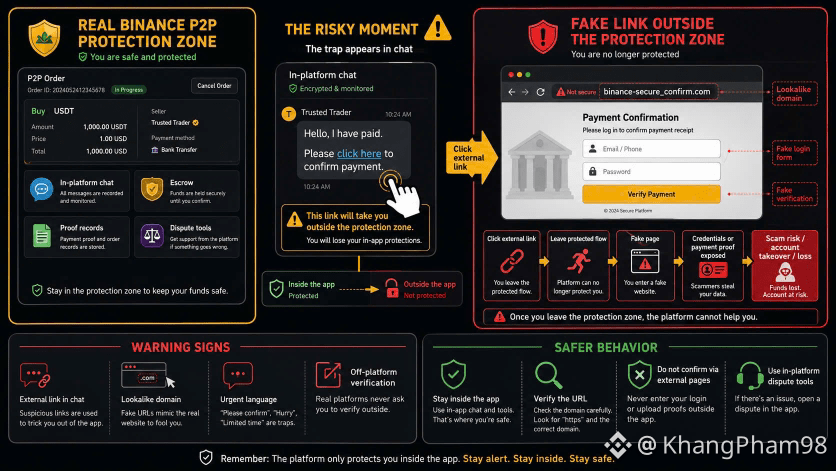
That afternoon, while the printer at the copy shop was still running steadily, my phone rang. An acquaintance sent me a screenshot of a USDT sell order, along with a message from the counterparty telling him to click a link to check the status. The page that opened looked quite similar to Binance P2P, except the domain was longer and had a few extra characters at the end.
What bothered me was not that the link was extremely sophisticated. It bothered me because it appeared exactly when the seller wanted to get things done. When it is still unclear whether the money has arrived, the brain often chooses the fastest action.
Binance P2P has an order holding mechanism, chat records, evidence logs, and dispute handling when needed. But those layers only mean something when the user stays inside the correct process. A fake page does not need to beat the system, it only needs to make the user leave the area being monitored.
The paradox is that many people are very careful when checking account numbers, recipient names, and transaction codes. They examine every word in the transfer note, yet still click a strange link because it appears inside a conversation that seems reasonable. Caution does not disappear, it is simply placed in the wrong spot.
I do not think every mistake belongs to the user. When trading Binance P2P, time pressure and the feeling of being gently pushed can make the hand move before the mind. People who trade often can become even more vulnerable to old reflexes, because many previous transactions went smoothly.
My lesson is quite simple. If a link pulls you away from the real app, it is no longer an extra confirmation step. It is an invitation to leave behind the most important layer of protection in Binance P2P, and the remaining question is whether you are handling a transaction, or stepping into a place with no records and no referee.
@Binance_Vietnam #BinanceP2PAnToan
That afternoon, while the printer at the copy shop was still running steadily, my phone rang. An acquaintance sent me a screenshot of a USDT sell order, along with a message from the counterparty telling him to click a link to check the status. The page that opened looked quite similar to Binance P2P, except the domain was longer and had a few extra characters at the end.
What bothered me was not that the link was extremely sophisticated. It bothered me because it appeared exactly when the seller wanted to get things done. When it is still unclear whether the money has arrived, the brain often chooses the fastest action.
Binance P2P has an order holding mechanism, chat records, evidence logs, and dispute handling when needed. But those layers only mean something when the user stays inside the correct process. A fake page does not need to beat the system, it only needs to make the user leave the area being monitored.
The paradox is that many people are very careful when checking account numbers, recipient names, and transaction codes. They examine every word in the transfer note, yet still click a strange link because it appears inside a conversation that seems reasonable. Caution does not disappear, it is simply placed in the wrong spot.
I do not think every mistake belongs to the user. When trading Binance P2P, time pressure and the feeling of being gently pushed can make the hand move before the mind. People who trade often can become even more vulnerable to old reflexes, because many previous transactions went smoothly.
My lesson is quite simple. If a link pulls you away from the real app, it is no longer an extra confirmation step. It is an invitation to leave behind the most important layer of protection in Binance P2P, and the remaining question is whether you are handling a transaction, or stepping into a place with no records and no referee.
@Binance Vietnam #BinanceP2PAnToan
What bothered me was not that the link was extremely sophisticated. It bothered me because it appeared exactly when the seller wanted to get things done. When it is still unclear whether the money has arrived, the brain often chooses the fastest action.
Binance P2P has an order holding mechanism, chat records, evidence logs, and dispute handling when needed. But those layers only mean something when the user stays inside the correct process. A fake page does not need to beat the system, it only needs to make the user leave the area being monitored.
The paradox is that many people are very careful when checking account numbers, recipient names, and transaction codes. They examine every word in the transfer note, yet still click a strange link because it appears inside a conversation that seems reasonable. Caution does not disappear, it is simply placed in the wrong spot.
I do not think every mistake belongs to the user. When trading Binance P2P, time pressure and the feeling of being gently pushed can make the hand move before the mind. People who trade often can become even more vulnerable to old reflexes, because many previous transactions went smoothly.
My lesson is quite simple. If a link pulls you away from the real app, it is no longer an extra confirmation step. It is an invitation to leave behind the most important layer of protection in Binance P2P, and the remaining question is whether you are handling a transaction, or stepping into a place with no records and no referee.
@Binance Vietnam #BinanceP2PAnToan
1
82

·
--
yesterday i caught myself trusting a QR code faster than i trusted an account number.
i was buying 475 USDT on Binance P2P, a little over 12 million VNĐ.
before opening the Order, i checked the seller's profile, completion rate, completed trades and payment terms.
everything looked normal.
the Order showed the recipient name, bank and STK.
then the seller sent a QR code in the Order Chat and said it would be faster.
i scanned it.
my banking app opened with everything already filled in, and for a second i was ready to press Confirm.
then i noticed the problem:
i had checked the seller.
i had checked the Order.
but i had not checked whether the QR was sending me to the same payment details.
so i went back and compared the recipient name, bank, STK and amount with the final banking screen.
it took maybe 20 seconds.
if the details matched, only then would i continue with the payment.
that is when i realized something simple:
a QR code can make payment faster.
it cannot verify the payment for me.
if anything had been different from the information inside the Binance P2P Order, i would have stopped there.
i would not edit the details myself, send first and ask later, or move the conversation to Zalo, Telegram or another channel.
i would ask in the Order Chat so the discussion stays connected to the actual transaction.
that matters because Binance P2P already keeps the crypto in escrow while the Order is being handled, and the Order, chat and Appeal process create a clear record if something goes wrong.
if i still had doubts, i would keep the Order ID, relevant chat and payment screen, then use Appeal or Binance Support through the official channel.
after checking everything, i still paid with the QR.
i like the convenience.
i just do not treat convenience as proof anymore.
a QR can save me from typing the STK.
it cannot save me from checking it.
@Binance_Vietnam #BinanceP2PAnToan
when you scan a QR for a P2P payment, do you still compare the final banking screen with the Order?
yesterday i caught myself trusting a QR code faster than i trusted an account number.
i was buying 475 USDT on Binance P2P, a little over 12 million VNĐ.
before opening the Order, i checked the seller's profile, completion rate, completed trades and payment terms.
everything looked normal.
the Order showed the recipient name, bank and STK.
then the seller sent a QR code in the Order Chat and said it would be faster.
i scanned it.
my banking app opened with everything already filled in, and for a second i was ready to press Confirm.
then i noticed the problem:
i had checked the seller.
i had checked the Order.
but i had not checked whether the QR was sending me to the same payment details.
so i went back and compared the recipient name, bank, STK and amount with the final banking screen.
it took maybe 20 seconds.
if the details matched, only then would i continue with the payment.
that is when i realized something simple:
a QR code can make payment faster.
it cannot verify the payment for me.
if anything had been different from the information inside the Binance P2P Order, i would have stopped there.
i would not edit the details myself, send first and ask later, or move the conversation to Zalo, Telegram or another channel.
i would ask in the Order Chat so the discussion stays connected to the actual transaction.
that matters because Binance P2P already keeps the crypto in escrow while the Order is being handled, and the Order, chat and Appeal process create a clear record if something goes wrong.
if i still had doubts, i would keep the Order ID, relevant chat and payment screen, then use Appeal or Binance Support through the official channel.
after checking everything, i still paid with the QR.
i like the convenience.
i just do not treat convenience as proof anymore.
a QR can save me from typing the STK.
it cannot save me from checking it.
@Binance Vietnam #BinanceP2PAnToan
when you scan a QR for a P2P payment, do you still compare the final banking screen with the Order?
i was buying 475 USDT on Binance P2P, a little over 12 million VNĐ.
before opening the Order, i checked the seller's profile, completion rate, completed trades and payment terms.
everything looked normal.
the Order showed the recipient name, bank and STK.
then the seller sent a QR code in the Order Chat and said it would be faster.
i scanned it.
my banking app opened with everything already filled in, and for a second i was ready to press Confirm.
then i noticed the problem:
i had checked the seller.
i had checked the Order.
but i had not checked whether the QR was sending me to the same payment details.
so i went back and compared the recipient name, bank, STK and amount with the final banking screen.
it took maybe 20 seconds.
if the details matched, only then would i continue with the payment.
that is when i realized something simple:
a QR code can make payment faster.
it cannot verify the payment for me.
if anything had been different from the information inside the Binance P2P Order, i would have stopped there.
i would not edit the details myself, send first and ask later, or move the conversation to Zalo, Telegram or another channel.
i would ask in the Order Chat so the discussion stays connected to the actual transaction.
that matters because Binance P2P already keeps the crypto in escrow while the Order is being handled, and the Order, chat and Appeal process create a clear record if something goes wrong.
if i still had doubts, i would keep the Order ID, relevant chat and payment screen, then use Appeal or Binance Support through the official channel.
after checking everything, i still paid with the QR.
i like the convenience.
i just do not treat convenience as proof anymore.
a QR can save me from typing the STK.
it cannot save me from checking it.
@Binance Vietnam #BinanceP2PAnToan
when you scan a QR for a P2P payment, do you still compare the final banking screen with the Order?
88

·
--
The P2P Countdown Is Not Payment Evidence
A countdown can create urgency without adding any proof.
In Binance’s current P2P order model, an Order at “Paid (Unconfirmed)” can show a release deadline. That timer is useful: it tells you where the Order is in the workflow and how much time remains. But it does not tell the seller whether the expected VND has actually reached the receiving account.
That distinction changes the decision before Confirm Release.
If the timer is running but the bank account still does not show the expected funds, the two signals disagree. The countdown should not “outvote” the payment check. Keep the crypto in escrow and resolve the mismatch through the Order/Appeal flow.
If the money is visible, verification still has a second layer: does the payment match this Order and the payer information Binance expects? Binance’s merchant rules specifically treat payer-name mismatch as a reason not to release.
So the timer answers a timing question. Your receiving account and Order details answer the payment question.
A simple mental model: deadlines tell you when to act; evidence tells you what action is safe.
@Binance_Vietnam #BinanceP2PAnToan $AVAAI $ACE $ONG
The P2P Countdown Is Not Payment Evidence
A countdown can create urgency without adding any proof.
In Binance’s current P2P order model, an Order at “Paid (Unconfirmed)” can show a release deadline. That timer is useful: it tells you where the Order is in the workflow and how much time remains. But it does not tell the seller whether the expected VND has actually reached the receiving account.
That distinction changes the decision before Confirm Release.
If the timer is running but the bank account still does not show the expected funds, the two signals disagree. The countdown should not “outvote” the payment check. Keep the crypto in escrow and resolve the mismatch through the Order/Appeal flow.
If the money is visible, verification still has a second layer: does the payment match this Order and the payer information Binance expects? Binance’s merchant rules specifically treat payer-name mismatch as a reason not to release.
So the timer answers a timing question. Your receiving account and Order details answer the payment question.
A simple mental model: deadlines tell you when to act; evidence tells you what action is safe.
@Binance Vietnam #BinanceP2PAnToan $AVAAI $ACE $ONG
A countdown can create urgency without adding any proof.
In Binance’s current P2P order model, an Order at “Paid (Unconfirmed)” can show a release deadline. That timer is useful: it tells you where the Order is in the workflow and how much time remains. But it does not tell the seller whether the expected VND has actually reached the receiving account.
That distinction changes the decision before Confirm Release.
If the timer is running but the bank account still does not show the expected funds, the two signals disagree. The countdown should not “outvote” the payment check. Keep the crypto in escrow and resolve the mismatch through the Order/Appeal flow.
If the money is visible, verification still has a second layer: does the payment match this Order and the payer information Binance expects? Binance’s merchant rules specifically treat payer-name mismatch as a reason not to release.
So the timer answers a timing question. Your receiving account and Order details answer the payment question.
A simple mental model: deadlines tell you when to act; evidence tells you what action is safe.
@Binance Vietnam #BinanceP2PAnToan $AVAAI $ACE $ONG
1
289

·
--
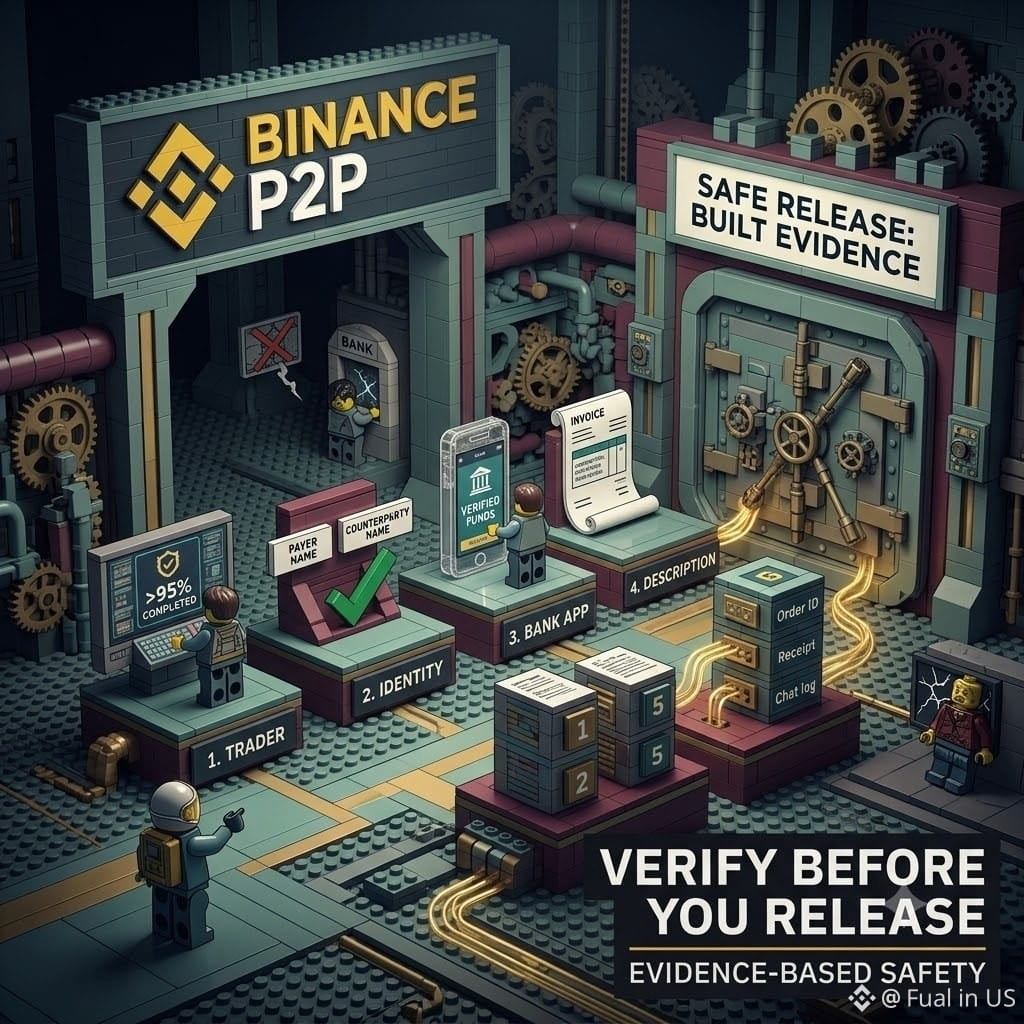
In May 2026, I sold 199 USDT quickly and received 5,240,015 VND in my Vietcombank account. The next day, VCB notified me that my account was temporarily restricted because the transaction was linked to an account and source of funds considered risky. I went to VCB and contacted Binance Support through chat. That experience changed how I view P2P safety: real protection means building enough evidence before an irreversible action
The distinction became clear. Payment Completed is not Funds Received. Funds Received is not independently verified funds
So I use five checks before I Release Crypto
1. Counterparty
I prefer traders with a Completion Rate above 95% and meaningful order history. It is not a guarantee. It gives me more information about who I am dealing with
2. Payer identity
I do not accept third-party payments. The payer should match the counterparty. A faster payment is not better if the identity creates an evidence gap
3. Actual bank receipt
I do not rely on screenshots, SMS or Payment Completed. I open my banking app and verify the incoming transaction and available balance. Escrow holds the crypto, but it cannot verify my bank balance
4. Payment description
I keep the transfer description appropriate and avoid unnecessary or unrelated sensitive information. The purpose is not to hide anything, but to keep the record clear and consistent
5. Evidence trail
I keep the Order ID, receipt and relevant records, while keeping communication inside Binance P2P. If something needs review, I want the transaction reconstructable from its records. That evidence can matter during an Appeal or when contacting Binance Support
Looking back, these checks are one process: verify before Release. I am not deciding whether someone is trustworthy. I am reducing the assumptions behind my decision
I have followed these procedures consistently, and they have helped me understand the P2P process and protect my interests. For me, the safest Release is not the fastest one. It is the one I can explain with evidence afterward
@Binance_Vietnam
#BinanceP2PAnToan
In May 2026, I sold 199 USDT quickly and received 5,240,015 VND in my Vietcombank account. The next day, VCB notified me that my account was temporarily restricted because the transaction was linked to an account and source of funds considered risky. I went to VCB and contacted Binance Support through chat. That experience changed how I view P2P safety: real protection means building enough evidence before an irreversible action
The distinction became clear. Payment Completed is not Funds Received. Funds Received is not independently verified funds
So I use five checks before I Release Crypto
1. Counterparty
I prefer traders with a Completion Rate above 95% and meaningful order history. It is not a guarantee. It gives me more information about who I am dealing with
2. Payer identity
I do not accept third-party payments. The payer should match the counterparty. A faster payment is not better if the identity creates an evidence gap
3. Actual bank receipt
I do not rely on screenshots, SMS or Payment Completed. I open my banking app and verify the incoming transaction and available balance. Escrow holds the crypto, but it cannot verify my bank balance
4. Payment description
I keep the transfer description appropriate and avoid unnecessary or unrelated sensitive information. The purpose is not to hide anything, but to keep the record clear and consistent
5. Evidence trail
I keep the Order ID, receipt and relevant records, while keeping communication inside Binance P2P. If something needs review, I want the transaction reconstructable from its records. That evidence can matter during an Appeal or when contacting Binance Support
Looking back, these checks are one process: verify before Release. I am not deciding whether someone is trustworthy. I am reducing the assumptions behind my decision
I have followed these procedures consistently, and they have helped me understand the P2P process and protect my interests. For me, the safest Release is not the fastest one. It is the one I can explain with evidence afterward
@Binance Vietnam
#BinanceP2PAnToan
The distinction became clear. Payment Completed is not Funds Received. Funds Received is not independently verified funds
So I use five checks before I Release Crypto
1. Counterparty
I prefer traders with a Completion Rate above 95% and meaningful order history. It is not a guarantee. It gives me more information about who I am dealing with
2. Payer identity
I do not accept third-party payments. The payer should match the counterparty. A faster payment is not better if the identity creates an evidence gap
3. Actual bank receipt
I do not rely on screenshots, SMS or Payment Completed. I open my banking app and verify the incoming transaction and available balance. Escrow holds the crypto, but it cannot verify my bank balance
4. Payment description
I keep the transfer description appropriate and avoid unnecessary or unrelated sensitive information. The purpose is not to hide anything, but to keep the record clear and consistent
5. Evidence trail
I keep the Order ID, receipt and relevant records, while keeping communication inside Binance P2P. If something needs review, I want the transaction reconstructable from its records. That evidence can matter during an Appeal or when contacting Binance Support
Looking back, these checks are one process: verify before Release. I am not deciding whether someone is trustworthy. I am reducing the assumptions behind my decision
I have followed these procedures consistently, and they have helped me understand the P2P process and protect my interests. For me, the safest Release is not the fastest one. It is the one I can explain with evidence afterward
@Binance Vietnam
#BinanceP2PAnToan
1
1
389

·
--
#binancep2pantoan @Binance_Vietnam
The Tab I Left Open Too Long
I had two P2P orders running at once, which I don't usually do, and lost track of which chat belonged to which order. Payment came in on one of them and I almost matched it to the wrong trade just going by the amount, which happened to be close on both.
I stopped and pulled up the actual order IDs before doing anything, matched the payment to the correct order using the payer name on the transaction, not memory or guesswork. Got it right, but only because I slowed down enough to check instead of trusting that the numbers "looked about right."
Both counterparties checked out fine on history and completion rate, nothing suspicious there. The risk wasn't them, it was me running trades faster than I could actually verify them properly. I confirmed each deposit separately in my bank app before releasing either one, even though it meant sitting with two open orders a few extra minutes.
Saved both Order IDs and chat threads afterward, labeled clearly this time, which is a habit I didn't have before that day.
Running multiple trades doesn't multiply the risk from the platform. It multiplies the risk of my own attention slipping.
#binancep2pantoan @Binance Vietnam
The Tab I Left Open Too Long
I had two P2P orders running at once, which I don't usually do, and lost track of which chat belonged to which order. Payment came in on one of them and I almost matched it to the wrong trade just going by the amount, which happened to be close on both.
I stopped and pulled up the actual order IDs before doing anything, matched the payment to the correct order using the payer name on the transaction, not memory or guesswork. Got it right, but only because I slowed down enough to check instead of trusting that the numbers "looked about right."
Both counterparties checked out fine on history and completion rate, nothing suspicious there. The risk wasn't them, it was me running trades faster than I could actually verify them properly. I confirmed each deposit separately in my bank app before releasing either one, even though it meant sitting with two open orders a few extra minutes.
Saved both Order IDs and chat threads afterward, labeled clearly this time, which is a habit I didn't have before that day.
Running multiple trades doesn't multiply the risk from the platform. It multiplies the risk of my own attention slipping.
The Tab I Left Open Too Long
I had two P2P orders running at once, which I don't usually do, and lost track of which chat belonged to which order. Payment came in on one of them and I almost matched it to the wrong trade just going by the amount, which happened to be close on both.
I stopped and pulled up the actual order IDs before doing anything, matched the payment to the correct order using the payer name on the transaction, not memory or guesswork. Got it right, but only because I slowed down enough to check instead of trusting that the numbers "looked about right."
Both counterparties checked out fine on history and completion rate, nothing suspicious there. The risk wasn't them, it was me running trades faster than I could actually verify them properly. I confirmed each deposit separately in my bank app before releasing either one, even though it meant sitting with two open orders a few extra minutes.
Saved both Order IDs and chat threads afterward, labeled clearly this time, which is a habit I didn't have before that day.
Running multiple trades doesn't multiply the risk from the platform. It multiplies the risk of my own attention slipping.

1
187

·
--
#binancep2pantoan @Binance_Vietnam
🚨 5-second check before trading on Binance P2P!
Are you experiencing one of these issues? 👇
❌ Screenshot of transfer only
❌ Transferring money outside Binance
❌ Clicking “Paid” too early
❌ Sharing OTP/password
❌ Not checking the recipient’s information correctly
✅ Simple rule: **trade only on Binance, verify the actual funds in your account, and don’t share security codes.**
Have you ever encountered any situation among the 5 issues above? Share your experience so everyone can trade safely too! 👇
@Binance_Vietnam #BinanceP2PAnToan
#binancep2pantoan @Binance Vietnam
🚨 5-second check before trading on Binance P2P!
Are you experiencing one of these issues? 👇
❌ Screenshot of transfer only
❌ Transferring money outside Binance
❌ Clicking “Paid” too early
❌ Sharing OTP/password
❌ Not checking the recipient’s information correctly
✅ Simple rule: **trade only on Binance, verify the actual funds in your account, and don’t share security codes.**
Have you ever encountered any situation among the 5 issues above? Share your experience so everyone can trade safely too! 👇
@Binance Vietnam #BinanceP2PAnToan
🚨 5-second check before trading on Binance P2P!
Are you experiencing one of these issues? 👇
❌ Screenshot of transfer only
❌ Transferring money outside Binance
❌ Clicking “Paid” too early
❌ Sharing OTP/password
❌ Not checking the recipient’s information correctly
✅ Simple rule: **trade only on Binance, verify the actual funds in your account, and don’t share security codes.**
Have you ever encountered any situation among the 5 issues above? Share your experience so everyone can trade safely too! 👇
@Binance Vietnam #BinanceP2PAnToan
114

#binancep2pantoan @Binance_Vietnam
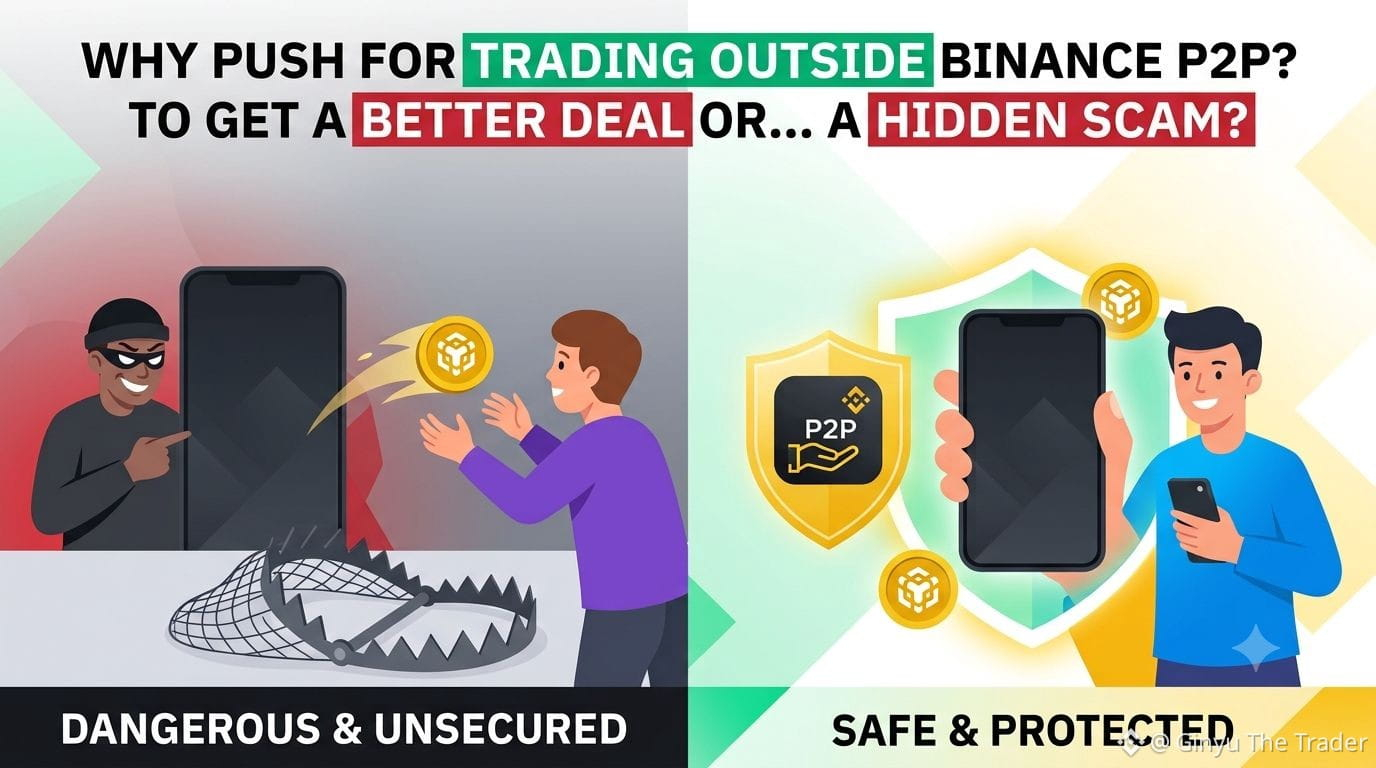
A trick I’ve noticed appearing quite often lately is the invitation to trade crypto outside Binance P2P, usually with the excuse of saving fees or getting a better price than the market. I want to break down why this is usually a trap, based on several times I’ve encountered similar offers.
Logically speaking, the fees on Binance P2P are not so high that they would justify taking on the risk of trading outside the platform. So whenever someone promises a significantly better rate, the first question I ask myself is: what’s the real motive behind this generosity?
In most cases I’ve observed, the scenario follows a familiar pattern. The scammer builds trust with a few friendly messages, sometimes even sending screenshots of supposed past transactions with other people to create a sense of credibility. Then, they push the victim to transfer money or crypto first, using reasons like “it saves time” or “we have to trust each other anyway.”
The common signs in these situations are always the same: there’s a reason to move away from Binance P2P, there’s pressure to act quickly, and one side is asked to transfer first without any protective mechanism in place. Without escrow, without recorded history, and without the ability to file a dispute, the loss almost always falls on the person who trusted the wrong party.
I’ve noticed that scammers often target newcomers - those unfamiliar with the standard process and more easily swayed by promises of attractive deals rather than sticking to the safe steps already established.
#binancep2pantoan @Binance Vietnam
A trick I’ve noticed appearing quite often lately is the invitation to trade crypto outside Binance P2P, usually with the excuse of saving fees or getting a better price than the market. I want to break down why this is usually a trap, based on several times I’ve encountered similar offers.
Logically speaking, the fees on Binance P2P are not so high that they would justify taking on the risk of trading outside the platform. So whenever someone promises a significantly better rate, the first question I ask myself is: what’s the real motive behind this generosity?
In most cases I’ve observed, the scenario follows a familiar pattern. The scammer builds trust with a few friendly messages, sometimes even sending screenshots of supposed past transactions with other people to create a sense of credibility. Then, they push the victim to transfer money or crypto first, using reasons like “it saves time” or “we have to trust each other anyway.”
The common signs in these situations are always the same: there’s a reason to move away from Binance P2P, there’s pressure to act quickly, and one side is asked to transfer first without any protective mechanism in place. Without escrow, without recorded history, and without the ability to file a dispute, the loss almost always falls on the person who trusted the wrong party.
I’ve noticed that scammers often target newcomers - those unfamiliar with the standard process and more easily swayed by promises of attractive deals rather than sticking to the safe steps already established.
A trick I’ve noticed appearing quite often lately is the invitation to trade crypto outside Binance P2P, usually with the excuse of saving fees or getting a better price than the market. I want to break down why this is usually a trap, based on several times I’ve encountered similar offers.
Logically speaking, the fees on Binance P2P are not so high that they would justify taking on the risk of trading outside the platform. So whenever someone promises a significantly better rate, the first question I ask myself is: what’s the real motive behind this generosity?
In most cases I’ve observed, the scenario follows a familiar pattern. The scammer builds trust with a few friendly messages, sometimes even sending screenshots of supposed past transactions with other people to create a sense of credibility. Then, they push the victim to transfer money or crypto first, using reasons like “it saves time” or “we have to trust each other anyway.”
The common signs in these situations are always the same: there’s a reason to move away from Binance P2P, there’s pressure to act quickly, and one side is asked to transfer first without any protective mechanism in place. Without escrow, without recorded history, and without the ability to file a dispute, the loss almost always falls on the person who trusted the wrong party.
I’ve noticed that scammers often target newcomers - those unfamiliar with the standard process and more easily swayed by promises of attractive deals rather than sticking to the safe steps already established.
62

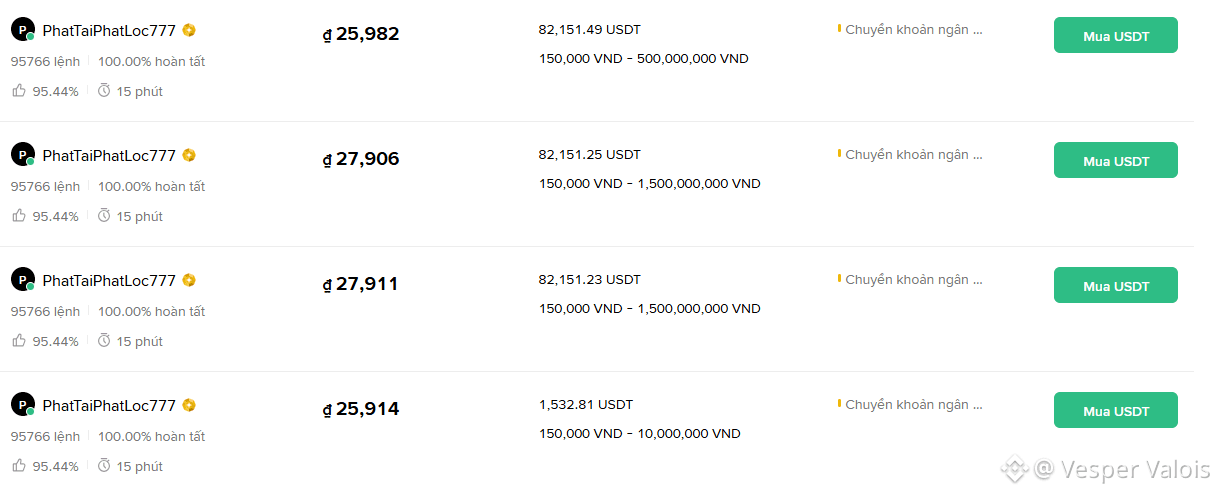
Why 100% Completion Can Be a Weak Signal
A perfect percentage can be the most misleading number on a Binance P2P profile—not because it is false, but because a percentage has no context without its sample size.
Binance separates 30-day completion from 30-day order count and also tracks operational metrics such as average payment and release time. That separation matters.
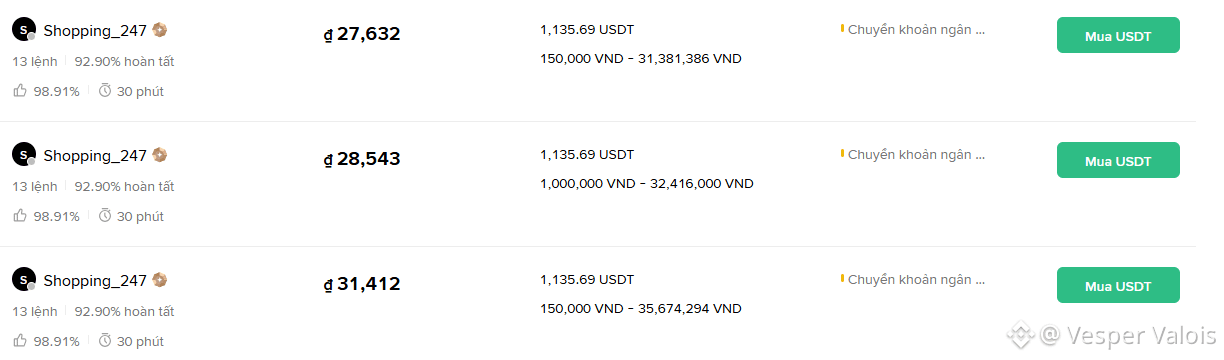
If Merchant A completed 13/13 orders, the rate is 100%. If Merchant B completed 4,990/5,000, the rate is 99.8%. The first number looks cleaner. The second is backed by far more observations.
So what does completion rate prove? It shows how consistently past orders were completed over the measured window. What does it not prove? That the next payment will settle correctly, that the merchant is faster, or that a large order is automatically safer.
My decision rule: when prices are close, I would not rank ads by completion rate alone. I would read the rate together with order count, recent feedback, and average payment/release time. Binance itself treats completion rate, operational speed, and negative feedback as separate merchant signals.
A metric without sample size is a signal; a cluster of consistent signals is stronger evidence.
On Binance P2P, the better question is not “Who has the highest percentage?” It is “How much evidence sits behind that percentage?”
@Binance_Vietnam #BinanceP2PAnToan $AVAAI $ACE $ONG
Why 100% Completion Can Be a Weak Signal
A perfect percentage can be the most misleading number on a Binance P2P profile—not because it is false, but because a percentage has no context without its sample size.
Binance separates 30-day completion from 30-day order count and also tracks operational metrics such as average payment and release time. That separation matters.
If Merchant A completed 13/13 orders, the rate is 100%. If Merchant B completed 4,990/5,000, the rate is 99.8%. The first number looks cleaner. The second is backed by far more observations.
So what does completion rate prove? It shows how consistently past orders were completed over the measured window. What does it not prove? That the next payment will settle correctly, that the merchant is faster, or that a large order is automatically safer.
My decision rule: when prices are close, I would not rank ads by completion rate alone. I would read the rate together with order count, recent feedback, and average payment/release time. Binance itself treats completion rate, operational speed, and negative feedback as separate merchant signals.
A metric without sample size is a signal; a cluster of consistent signals is stronger evidence.
On Binance P2P, the better question is not “Who has the highest percentage?” It is “How much evidence sits behind that percentage?”
@Binance Vietnam #BinanceP2PAnToan $AVAAI $ACE $ONG
A perfect percentage can be the most misleading number on a Binance P2P profile—not because it is false, but because a percentage has no context without its sample size.
Binance separates 30-day completion from 30-day order count and also tracks operational metrics such as average payment and release time. That separation matters.
If Merchant A completed 13/13 orders, the rate is 100%. If Merchant B completed 4,990/5,000, the rate is 99.8%. The first number looks cleaner. The second is backed by far more observations.
So what does completion rate prove? It shows how consistently past orders were completed over the measured window. What does it not prove? That the next payment will settle correctly, that the merchant is faster, or that a large order is automatically safer.
My decision rule: when prices are close, I would not rank ads by completion rate alone. I would read the rate together with order count, recent feedback, and average payment/release time. Binance itself treats completion rate, operational speed, and negative feedback as separate merchant signals.
A metric without sample size is a signal; a cluster of consistent signals is stronger evidence.
On Binance P2P, the better question is not “Who has the highest percentage?” It is “How much evidence sits behind that percentage?”
@Binance Vietnam #BinanceP2PAnToan $AVAAI $ACE $ONG
265

·
--
Asset safety is always the #1 priority when trading on Binance P2P
To protect yourself from common scam tactics, remember these 3 rules:
Verify information: Only trade when the bank account name matches 100% with the KYC-verified name on Binance.
Confirm the balance: Always open your banking app to check the real balance changes before clicking "Payment received" — never trust SMS messages or screenshots.
Communication channel: Only communicate through the direct chat box on Binance to get support in case of a dispute.
With @Binance_Vietnam , stay alert for the safest trading experience!
#binancep2pantoan
Asset safety is always the #1 priority when trading on Binance P2P
To protect yourself from common scam tactics, remember these 3 rules:
Verify information: Only trade when the bank account name matches 100% with the KYC-verified name on Binance.
Confirm the balance: Always open your banking app to check the real balance changes before clicking "Payment received" — never trust SMS messages or screenshots.
Communication channel: Only communicate through the direct chat box on Binance to get support in case of a dispute.
With @Binance Vietnam , stay alert for the safest trading experience!
#binancep2pantoan
To protect yourself from common scam tactics, remember these 3 rules:
Verify information: Only trade when the bank account name matches 100% with the KYC-verified name on Binance.
Confirm the balance: Always open your banking app to check the real balance changes before clicking "Payment received" — never trust SMS messages or screenshots.
Communication channel: Only communicate through the direct chat box on Binance to get support in case of a dispute.
With @Binance Vietnam , stay alert for the safest trading experience!
#binancep2pantoan
81

·
--
A friend of mine recently told me about a P2P trade that became confusing for a very simple reason.
He was buying 400 USDT for around 10,000,000 VND.
The order was straightforward, but during the payment process, the seller sent a new bank account number in the chat and asked him to transfer there instead.
My friend noticed the change but didn’t immediately remember what the original payment details were.
Instead of sending the money again, he went back to the order and checked the original information.
That’s when he realized the new account was different from the payment details shown when the order started.
He stopped there.
No extra transfer. No guessing.
He kept the conversation inside the Binance P2P order and asked the seller to clarify why the payment details had changed.
The important part wasn’t whether the seller had a legitimate reason.
It was that the transaction had changed from what my friend originally agreed to.
That gave him a simple rule to follow:
When an important detail changes mid-trade, don’t treat it as a small update.
Stop and verify the change against the original order.
A P2P trade can involve several pieces of information at once. If one of them suddenly changes, the safest move isn’t to adapt automatically.
It’s to understand why it changed first.
@Binance_Vietnam
#BinanceP2PAnToan
What should you do when payment details change?
A friend of mine recently told me about a P2P trade that became confusing for a very simple reason.
He was buying 400 USDT for around 10,000,000 VND.
The order was straightforward, but during the payment process, the seller sent a new bank account number in the chat and asked him to transfer there instead.
My friend noticed the change but didn’t immediately remember what the original payment details were.
Instead of sending the money again, he went back to the order and checked the original information.
That’s when he realized the new account was different from the payment details shown when the order started.
He stopped there.
No extra transfer. No guessing.
He kept the conversation inside the Binance P2P order and asked the seller to clarify why the payment details had changed.
The important part wasn’t whether the seller had a legitimate reason.
It was that the transaction had changed from what my friend originally agreed to.
That gave him a simple rule to follow:
When an important detail changes mid-trade, don’t treat it as a small update.
Stop and verify the change against the original order.
A P2P trade can involve several pieces of information at once. If one of them suddenly changes, the safest move isn’t to adapt automatically.
It’s to understand why it changed first.
@Binance Vietnam
#BinanceP2PAnToan
What should you do when payment details change?
He was buying 400 USDT for around 10,000,000 VND.
The order was straightforward, but during the payment process, the seller sent a new bank account number in the chat and asked him to transfer there instead.
My friend noticed the change but didn’t immediately remember what the original payment details were.
Instead of sending the money again, he went back to the order and checked the original information.
That’s when he realized the new account was different from the payment details shown when the order started.
He stopped there.
No extra transfer. No guessing.
He kept the conversation inside the Binance P2P order and asked the seller to clarify why the payment details had changed.
The important part wasn’t whether the seller had a legitimate reason.
It was that the transaction had changed from what my friend originally agreed to.
That gave him a simple rule to follow:
When an important detail changes mid-trade, don’t treat it as a small update.
Stop and verify the change against the original order.
A P2P trade can involve several pieces of information at once. If one of them suddenly changes, the safest move isn’t to adapt automatically.
It’s to understand why it changed first.
@Binance Vietnam
#BinanceP2PAnToan
What should you do when payment details change?
Recheck
75%
Transfer
0%
Ignore
25%
4 votes • Voting closed
2
2
893

·
--
7 “Release now” messages in 5 minutes — that was when my friend knew something wasn’t right.
A friend of mine once sold 1,200 USDT through P2P, worth roughly 31 million VND.
Not long after the order was created, the buyer marked it as Paid.
Then the messages started coming nonstop:
“Paid bro.”
“Release please.”
“Money sent already.”
“Release fast.”
Within around 5 minutes, the buyer had sent more than 7 messages pushing him to release the crypto.
At the same time, his phone showed a banking notification.
For a moment, he almost treated that notification as proof and clicked Release.
But he stopped.
Instead of trusting the message or the buyer’s pressure, he opened his banking app and checked everything carefully:
* Had the available balance actually increased?
* Was the amount exactly the same as the P2P order?
* Did the sender’s name match the buyer’s information?
* Was the money fully credited and available in the account?
That check changed everything.
At the moment the buyer was repeatedly asking him to release, the full payment had not yet been clearly reflected in his available balance.
So he didn’t release the USDT.
He kept checking until he could verify the payment properly before taking any further action.
That experience gave him one simple rule:
The more someone pressures me to release, the more carefully I check.
An order worth 1,200 USDT is not something worth risking just to save a few minutes.
A “Paid” status is not the same as verified payment.
A screenshot is not enough.
A banking notification is not enough.
Before releasing crypto, verify the money directly in your own bank account.
Have you ever had a P2P buyer repeatedly pressure you to release before you were fully comfortable with the payment?
Figures in this post are used to illustrate the scenario.
#BinanceP2PAnToan @Binance_Vietnam
7 “Release now” messages in 5 minutes — that was when my friend knew something wasn’t right.
A friend of mine once sold 1,200 USDT through P2P, worth roughly 31 million VND.
Not long after the order was created, the buyer marked it as Paid.
Then the messages started coming nonstop:
“Paid bro.”
“Release please.”
“Money sent already.”
“Release fast.”
Within around 5 minutes, the buyer had sent more than 7 messages pushing him to release the crypto.
At the same time, his phone showed a banking notification.
For a moment, he almost treated that notification as proof and clicked Release.
But he stopped.
Instead of trusting the message or the buyer’s pressure, he opened his banking app and checked everything carefully:
* Had the available balance actually increased?
* Was the amount exactly the same as the P2P order?
* Did the sender’s name match the buyer’s information?
* Was the money fully credited and available in the account?
That check changed everything.
At the moment the buyer was repeatedly asking him to release, the full payment had not yet been clearly reflected in his available balance.
So he didn’t release the USDT.
He kept checking until he could verify the payment properly before taking any further action.
That experience gave him one simple rule:
The more someone pressures me to release, the more carefully I check.
An order worth 1,200 USDT is not something worth risking just to save a few minutes.
A “Paid” status is not the same as verified payment.
A screenshot is not enough.
A banking notification is not enough.
Before releasing crypto, verify the money directly in your own bank account.
Have you ever had a P2P buyer repeatedly pressure you to release before you were fully comfortable with the payment?
Figures in this post are used to illustrate the scenario.
#BinanceP2PAnToan @Binance Vietnam
A friend of mine once sold 1,200 USDT through P2P, worth roughly 31 million VND.
Not long after the order was created, the buyer marked it as Paid.
Then the messages started coming nonstop:
“Paid bro.”
“Release please.”
“Money sent already.”
“Release fast.”
Within around 5 minutes, the buyer had sent more than 7 messages pushing him to release the crypto.
At the same time, his phone showed a banking notification.
For a moment, he almost treated that notification as proof and clicked Release.
But he stopped.
Instead of trusting the message or the buyer’s pressure, he opened his banking app and checked everything carefully:
* Had the available balance actually increased?
* Was the amount exactly the same as the P2P order?
* Did the sender’s name match the buyer’s information?
* Was the money fully credited and available in the account?
That check changed everything.
At the moment the buyer was repeatedly asking him to release, the full payment had not yet been clearly reflected in his available balance.
So he didn’t release the USDT.
He kept checking until he could verify the payment properly before taking any further action.
That experience gave him one simple rule:
The more someone pressures me to release, the more carefully I check.
An order worth 1,200 USDT is not something worth risking just to save a few minutes.
A “Paid” status is not the same as verified payment.
A screenshot is not enough.
A banking notification is not enough.
Before releasing crypto, verify the money directly in your own bank account.
Have you ever had a P2P buyer repeatedly pressure you to release before you were fully comfortable with the payment?
Figures in this post are used to illustrate the scenario.
#BinanceP2PAnToan @Binance Vietnam
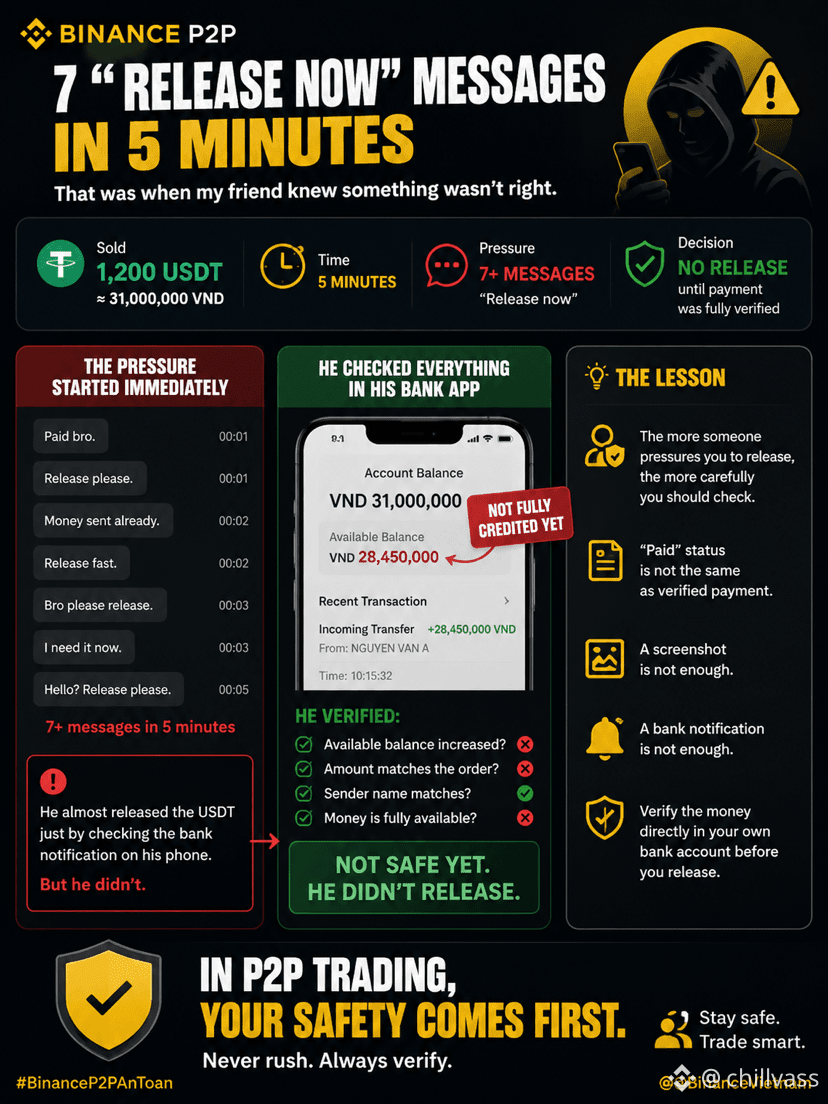
2
538
Log in to explore more content
Join global crypto users on Binance Square
⚡️ Get latest and useful information about crypto.
💬 Trusted by the world’s largest crypto exchange.
👍 Discover real insights from verified creators.
Email / Phone number
Trending Topics
1
#NEARRisesNearly80%InAWeek
308 views
79 Discussing
2
#MultiversXPlansHardForkRecovery
1,061 views
135 Discussing
3
#CircleLaunchesInstitutionalBTCBackedBorrowing
3,170 views
283 Discussing
4
#BitcoinHits$85K
5,840 views
194 Discussing
5
#ZetaChainVotesToMigrateZETAToSolana
2,659 views
195 Discussing
6
#ECBStartsBlockchainEuroSettlement
11,359 views
472 Discussing
7
#SouthAfricaProposesCryptoExchangeControls
22,207 views
663 Discussing
8
#SolanaCutsTargetSlotTimeTo250ms
25,791 views
584 Discussing
9
#EthereumSurpasses$2700
19,392 views
214 Discussing
10
#CanaryFilesSecondAmendmentForStakedSEIETF
43,369 views
920 Discussing