
#bip110forksignalingexpectedthisweekend
bip110forksignalingexpectedthisweekend
356,835 views
2,149 Discussing
Hot
Latest

·
--
Bullish
#bip110forksignalingexpectedthisweekend
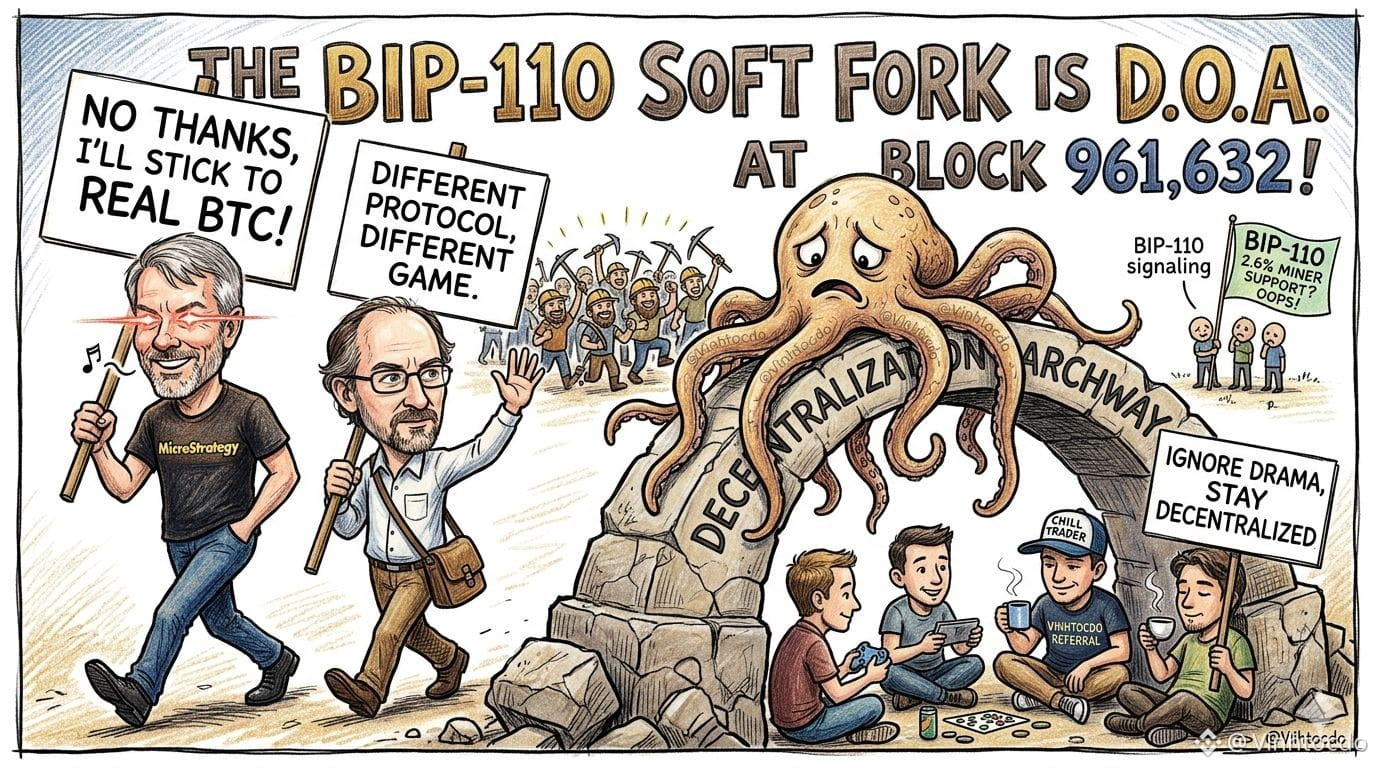
The controversial BIP-110 soft fork just hit block 961,632, but it’s completely dead on arrival. 💀
Some thought it would "clean up" BTC, but legends like Michael Saylor and Adam Back kopt out. Why? Because dictating what transactions are "valid" kills Bitcoin’s core superpower: decentralization! Miner support is sitting under 2.6%. Oops!
What should traders do? Chill, ignore the drama, and stay on the real decentralized chain. This is not financial advice! 🤫
New to Binance? Use my referral code VINHTOCDO to sign up.
#BitcoinSoftFork #Decentralization #BIP110 #VINHTOCDO
$BTC
{future}(BTCUSDT)
$ETH
{future}(ETHUSDT)
$BNB
{future}(BNBUSDT)
#bip110forksignalingexpectedthisweekend
The controversial BIP-110 soft fork just hit block 961,632, but it’s completely dead on arrival. 💀
Some thought it would "clean up" BTC, but legends like Michael Saylor and Adam Back kopt out. Why? Because dictating what transactions are "valid" kills Bitcoin’s core superpower: decentralization! Miner support is sitting under 2.6%. Oops!
What should traders do? Chill, ignore the drama, and stay on the real decentralized chain. This is not financial advice! 🤫
New to Binance? Use my referral code VINHTOCDO to sign up.
#BitcoinSoftFork #Decentralization #BIP110 #VINHTOCDO
$BTC
$ETH
$BNB
The controversial BIP-110 soft fork just hit block 961,632, but it’s completely dead on arrival. 💀
Some thought it would "clean up" BTC, but legends like Michael Saylor and Adam Back kopt out. Why? Because dictating what transactions are "valid" kills Bitcoin’s core superpower: decentralization! Miner support is sitting under 2.6%. Oops!
What should traders do? Chill, ignore the drama, and stay on the real decentralized chain. This is not financial advice! 🤫
New to Binance? Use my referral code VINHTOCDO to sign up.
#BitcoinSoftFork #Decentralization #BIP110 #VINHTOCDO
$BTC
$ETH
$BNB
6
1.1k

·
--
🚨 #BIP110ForkSignalingExpectedThisWeekend
$BTC
{future}(BTCUSDT)
Bitcoin hasn't had a consensus rule change since Taproot (Nov 2021). That changes this weekend — BIP-110's mandatory signaling window opens at block 961,632, with miner support at just 2.6%.
🔍 What it does: Restricts arbitrary data (Ordinals, BRC-20, Runes) in Bitcoin transactions for ~1 year, capping data pushes at 256 bytes.
⚠️ Real chain-split risk: Critics like Adam Back and Jameson Lopp call it censorship. With signaling stuck at 2.6% (needs 55%), a small breakaway chain is the likelier outcome.
📊 For institutional holders: BlackRock's IBIT ETF ($44.95B) will NOT claim any forked assets — only self-custody holders get that option.
📌 My take: This is a genuine test of Bitcoin's governance process, regardless of the outcome.
⚠️ Not financial advice. DYOR.
📌 New to Binance? Join: https://www.binance.com/register?ref=779682229
#bitcoin #BTC #BIP110 #BinanceSquare
🚨 #BIP110ForkSignalingExpectedThisWeekend
$BTC
Bitcoin hasn't had a consensus rule change since Taproot (Nov 2021). That changes this weekend — BIP-110's mandatory signaling window opens at block 961,632, with miner support at just 2.6%.
🔍 What it does: Restricts arbitrary data (Ordinals, BRC-20, Runes) in Bitcoin transactions for ~1 year, capping data pushes at 256 bytes.
⚠️ Real chain-split risk: Critics like Adam Back and Jameson Lopp call it censorship. With signaling stuck at 2.6% (needs 55%), a small breakaway chain is the likelier outcome.
📊 For institutional holders: BlackRock's IBIT ETF ($44.95B) will NOT claim any forked assets — only self-custody holders get that option.
📌 My take: This is a genuine test of Bitcoin's governance process, regardless of the outcome.
⚠️ Not financial advice. DYOR.
📌 New to Binance? Join: https://www.binance.com/register?ref=779682229
#bitcoin #BTC #BIP110 #BinanceSquare
$BTC
Bitcoin hasn't had a consensus rule change since Taproot (Nov 2021). That changes this weekend — BIP-110's mandatory signaling window opens at block 961,632, with miner support at just 2.6%.
🔍 What it does: Restricts arbitrary data (Ordinals, BRC-20, Runes) in Bitcoin transactions for ~1 year, capping data pushes at 256 bytes.
⚠️ Real chain-split risk: Critics like Adam Back and Jameson Lopp call it censorship. With signaling stuck at 2.6% (needs 55%), a small breakaway chain is the likelier outcome.
📊 For institutional holders: BlackRock's IBIT ETF ($44.95B) will NOT claim any forked assets — only self-custody holders get that option.
📌 My take: This is a genuine test of Bitcoin's governance process, regardless of the outcome.
⚠️ Not financial advice. DYOR.
📌 New to Binance? Join: https://www.binance.com/register?ref=779682229
#bitcoin #BTC #BIP110 #BinanceSquare
1
113

⚡ Strong updates on the horizon.. Should we start BIP-110 fork signals by the end of this week? 📉📈
The eyes of the Bitcoin community are turning toward the upcoming weekend as talk grows about expectations for the start of BIP-110 split signals! 🛡️ Such regulatory and technical milestones are turning points in the development and security path of digital currency networks.
💡 A question for all traders and analysts with us:
In your opinion, how will the markets respond to these new technical signals over the coming days, and are we facing major shifts in liquidity movement?
👇 Share your opinion and analysis in the comments, and don’t forget to hit the Follow button to always stay at the heart of the action and keep up with the latest market analyses first-hand! 🔔🚀
#BIP110ForkSignalingExpectedThisWeekend #Bitcoin #العملات_الرقمية #تداول #كريبتو #BIP110ForkSignalingExpectedThisWeekend
⚡ Strong updates on the horizon.. Should we start BIP-110 fork signals by the end of this week? 📉📈
The eyes of the Bitcoin community are turning toward the upcoming weekend as talk grows about expectations for the start of BIP-110 split signals! 🛡️ Such regulatory and technical milestones are turning points in the development and security path of digital currency networks.
💡 A question for all traders and analysts with us:
In your opinion, how will the markets respond to these new technical signals over the coming days, and are we facing major shifts in liquidity movement?
👇 Share your opinion and analysis in the comments, and don’t forget to hit the Follow button to always stay at the heart of the action and keep up with the latest market analyses first-hand! 🔔🚀
#BIP110ForkSignalingExpectedThisWeekend #Bitcoin #العملات_الرقمية #تداول #كريبتو #BIP110ForkSignalingExpectedThisWeekend
The eyes of the Bitcoin community are turning toward the upcoming weekend as talk grows about expectations for the start of BIP-110 split signals! 🛡️ Such regulatory and technical milestones are turning points in the development and security path of digital currency networks.
💡 A question for all traders and analysts with us:
In your opinion, how will the markets respond to these new technical signals over the coming days, and are we facing major shifts in liquidity movement?
👇 Share your opinion and analysis in the comments, and don’t forget to hit the Follow button to always stay at the heart of the action and keep up with the latest market analyses first-hand! 🔔🚀
#BIP110ForkSignalingExpectedThisWeekend #Bitcoin #العملات_الرقمية #تداول #كريبتو #BIP110ForkSignalingExpectedThisWeekend
53

·
--
#BIP110ForkSignalingExpectedThisWeekend
**🚨 Bitcoin BIP-110 Signaling Update**
Mandatory signaling for BIP-110 kicked off around block 961,632 this weekend (Aug 8–9), but miner support remains near 2.5–2.6% — far below the 55% needed for lock-in.
📌 Key points:
- No major mining pool (Foundry, AntPool, F2Pool) has signaled support
- BIP-110 carries no automatic replay protection, so moving coins carries risk if a split occurs
- The main Bitcoin chain (Core) continues unaffected — deposits/withdrawals on major exchanges remain normal
- No major exchange has publicly confirmed special measures yet, though some historically pause deposits/withdrawals briefly around contentious forks
⚠️ Not financial advice — always verify official exchange announcements before moving funds.
#Bitcoin #BIP110 #CryptoNews
#BIP110ForkSignalingExpectedThisWeekend
**🚨 Bitcoin BIP-110 Signaling Update**
Mandatory signaling for BIP-110 kicked off around block 961,632 this weekend (Aug 8–9), but miner support remains near 2.5–2.6% — far below the 55% needed for lock-in.
📌 Key points:
- No major mining pool (Foundry, AntPool, F2Pool) has signaled support
- BIP-110 carries no automatic replay protection, so moving coins carries risk if a split occurs
- The main Bitcoin chain (Core) continues unaffected — deposits/withdrawals on major exchanges remain normal
- No major exchange has publicly confirmed special measures yet, though some historically pause deposits/withdrawals briefly around contentious forks
⚠️ Not financial advice — always verify official exchange announcements before moving funds.
#Bitcoin #BIP110 #CryptoNews
**🚨 Bitcoin BIP-110 Signaling Update**
Mandatory signaling for BIP-110 kicked off around block 961,632 this weekend (Aug 8–9), but miner support remains near 2.5–2.6% — far below the 55% needed for lock-in.
📌 Key points:
- No major mining pool (Foundry, AntPool, F2Pool) has signaled support
- BIP-110 carries no automatic replay protection, so moving coins carries risk if a split occurs
- The main Bitcoin chain (Core) continues unaffected — deposits/withdrawals on major exchanges remain normal
- No major exchange has publicly confirmed special measures yet, though some historically pause deposits/withdrawals briefly around contentious forks
⚠️ Not financial advice — always verify official exchange announcements before moving funds.
#Bitcoin #BIP110 #CryptoNews
4
13

·
--
The quietest accumulation phases in crypto history almost always coincide with complex technical upgrades that the average retail investor is too terrified to understand. With the market Fear & Greed index sitting at a shaky 39, it is easy to let anxiety freeze your hands. Many traders end up panic-selling their positions into stablecoins like $USDT, only to watch the market rally once the technical dust settles.
Right now, the buzz around the BIP110 soft fork attempt is triggering that classic $BTC cycle anxiety. For those who survived the blocksize wars of 2017, this signaling phase feels incredibly familiar. A soft fork is essentially a backward-compatible upgrade, meaning it requires miner consensus rather than splitting the chain. When miners start signaling, the market gets jittery because it exposes the friction between developers and miners.
I remember watching people dump their bags during the SegWit signaling period, convinced the network was going to break. Instead, it paved the way for a historic run. While short-term traders are currently distracted chasing volatility in assets like $BICO, the veteran money is watching the node consensus. Technical upgrades do not kill networks; they strengthen them.
Are you holding through the signaling phase, or are you sitting in cash until the network consensus is locked in?
#BIP110SoftForkAttemptBegins #BIP110ForkSignalingExpectedThisWeekend
The quietest accumulation phases in crypto history almost always coincide with complex technical upgrades that the average retail investor is too terrified to understand. With the market Fear & Greed index sitting at a shaky 39, it is easy to let anxiety freeze your hands. Many traders end up panic-selling their positions into stablecoins like $USDT, only to watch the market rally once the technical dust settles.
Right now, the buzz around the BIP110 soft fork attempt is triggering that classic $BTC cycle anxiety. For those who survived the blocksize wars of 2017, this signaling phase feels incredibly familiar. A soft fork is essentially a backward-compatible upgrade, meaning it requires miner consensus rather than splitting the chain. When miners start signaling, the market gets jittery because it exposes the friction between developers and miners.
I remember watching people dump their bags during the SegWit signaling period, convinced the network was going to break. Instead, it paved the way for a historic run. While short-term traders are currently distracted chasing volatility in assets like $BICO , the veteran money is watching the node consensus. Technical upgrades do not kill networks; they strengthen them.
Are you holding through the signaling phase, or are you sitting in cash until the network consensus is locked in?
#BIP110SoftForkAttemptBegins #BIP110ForkSignalingExpectedThisWeekend
Right now, the buzz around the BIP110 soft fork attempt is triggering that classic $BTC cycle anxiety. For those who survived the blocksize wars of 2017, this signaling phase feels incredibly familiar. A soft fork is essentially a backward-compatible upgrade, meaning it requires miner consensus rather than splitting the chain. When miners start signaling, the market gets jittery because it exposes the friction between developers and miners.
I remember watching people dump their bags during the SegWit signaling period, convinced the network was going to break. Instead, it paved the way for a historic run. While short-term traders are currently distracted chasing volatility in assets like $BICO , the veteran money is watching the node consensus. Technical upgrades do not kill networks; they strengthen them.
Are you holding through the signaling phase, or are you sitting in cash until the network consensus is locked in?
#BIP110SoftForkAttemptBegins #BIP110ForkSignalingExpectedThisWeekend

110

Verified
🧠 #bip110forksignalingexpectedthisweekend | THE FUTURE OF BITCOIN IN DEBATE
Bitcoin is heading toward a decisive weekend. The activation signal for the BIP-110 fork is expected to begin, putting miners and the wider community in focus as support for the proposed protocol change starts to become clearer.
💡 WHAT EXACTLY IS HAPPENING?
BIP-110 is a Bitcoin improvement proposal that has become part of a broader debate about the network’s future.
The next signaling process is important because it can indicate more clearly where miners stand.
⛏️ If more miners signal support, momentum around the proposal can increase.
⚠️ If signaling remains weak, divided, or faces strong opposition, the proposal may have difficulty gaining broader acceptance.
📌 BUT THERE IS AN IMPORTANT DISTINCTION:
Signaling does NOT automatically mean that a fork will happen. It only gives network participants a way to communicate their position while the wider Bitcoin community continues debating the proposal and its possible consequences.
For traders, the story is worth following because the growing uncertainty around Bitcoin’s protocol may attract more attention — and potentially more volatility — for $BTC.
📊 Miners will be watched.
🧑💻 Developers will watch the debate.
🌐 The Bitcoin community will seek consensus.
₿ And traders will watch the market’s reaction.
This weekend could provide some of the clearest signals so far about the level of support around BIP-110.
The debate about Bitcoin’s protocol is entering a new phase — and signals may speak louder than headlines. 🟠🔥
#BTC #BitcoinMining #VIXFallsToJanuaryLow
$BTC
$SOL
$BICO
{future}(BICOUSDT)
{future}(SOLUSDT)
{future}(BTCUSDT)
🧠 #bip110forksignalingexpectedthisweekend | THE FUTURE OF BITCOIN IN DEBATE
Bitcoin is heading toward a decisive weekend. The activation signal for the BIP-110 fork is expected to begin, putting miners and the wider community in focus as support for the proposed protocol change starts to become clearer.
💡 WHAT EXACTLY IS HAPPENING?
BIP-110 is a Bitcoin improvement proposal that has become part of a broader debate about the network’s future.
The next signaling process is important because it can indicate more clearly where miners stand.
⛏️ If more miners signal support, momentum around the proposal can increase.
⚠️ If signaling remains weak, divided, or faces strong opposition, the proposal may have difficulty gaining broader acceptance.
📌 BUT THERE IS AN IMPORTANT DISTINCTION:
Signaling does NOT automatically mean that a fork will happen. It only gives network participants a way to communicate their position while the wider Bitcoin community continues debating the proposal and its possible consequences.
For traders, the story is worth following because the growing uncertainty around Bitcoin’s protocol may attract more attention — and potentially more volatility — for $BTC .
📊 Miners will be watched.
🧑💻 Developers will watch the debate.
🌐 The Bitcoin community will seek consensus.
₿ And traders will watch the market’s reaction.
This weekend could provide some of the clearest signals so far about the level of support around BIP-110.
The debate about Bitcoin’s protocol is entering a new phase — and signals may speak louder than headlines. 🟠🔥
#BTC #BitcoinMining #VIXFallsToJanuaryLow
$BTC
$SOL
$BICO
Bitcoin is heading toward a decisive weekend. The activation signal for the BIP-110 fork is expected to begin, putting miners and the wider community in focus as support for the proposed protocol change starts to become clearer.
💡 WHAT EXACTLY IS HAPPENING?
BIP-110 is a Bitcoin improvement proposal that has become part of a broader debate about the network’s future.
The next signaling process is important because it can indicate more clearly where miners stand.
⛏️ If more miners signal support, momentum around the proposal can increase.
⚠️ If signaling remains weak, divided, or faces strong opposition, the proposal may have difficulty gaining broader acceptance.
📌 BUT THERE IS AN IMPORTANT DISTINCTION:
Signaling does NOT automatically mean that a fork will happen. It only gives network participants a way to communicate their position while the wider Bitcoin community continues debating the proposal and its possible consequences.
For traders, the story is worth following because the growing uncertainty around Bitcoin’s protocol may attract more attention — and potentially more volatility — for $BTC .
📊 Miners will be watched.
🧑💻 Developers will watch the debate.
🌐 The Bitcoin community will seek consensus.
₿ And traders will watch the market’s reaction.
This weekend could provide some of the clearest signals so far about the level of support around BIP-110.
The debate about Bitcoin’s protocol is entering a new phase — and signals may speak louder than headlines. 🟠🔥
#BTC #BitcoinMining #VIXFallsToJanuaryLow
$BTC
$SOL
$BICO
3
5
11.9k

·
--
Bearish
Verified
#bip110forksignalingexpectedthisweekend
🚨 BIP-110 ENTERS A CRITICAL PHASE FOR BITCOIN
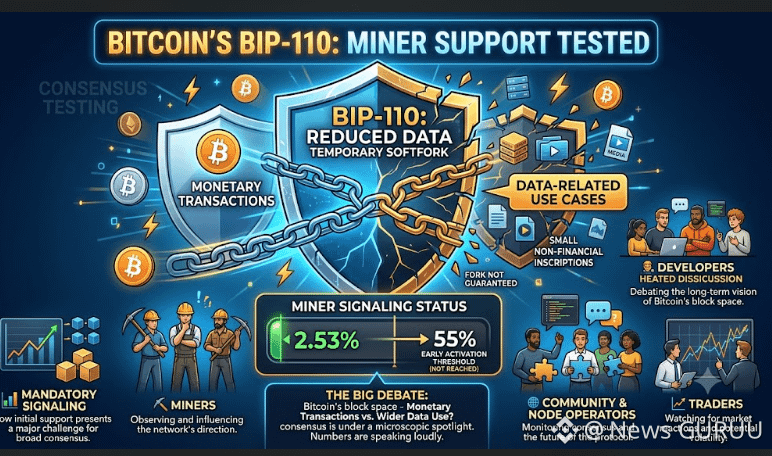
Bitcoin’s controversial BIP-110 is moving into mandatory signaling, putting miners and the wider community under the spotlight. The proposal would temporarily restrict certain forms of large arbitrary data storage on Bitcoin.
⛏️ The key issue is consensus. BIP-110 requires 55% signaling for early lock-in, while the mandatory phase is designed to push the deployment toward activation if earlier lock-in doesn’t occur.
📊 TRADING VIEW: SELL 📉
The contentious upgrade debate could increase short-term BTC volatility and risk sentiment. Watch miner signaling, network reaction, and BTC price closely.
❓ Will BIP-110 pressure BTC or strengthen Bitcoin long term? "CLICK ON THE BELOW YELLOW COIN TAG TO GO TO DESIRED TRADING PAGE TO GET BENEFIT TRADE"$BTC $SOL $BICO
#bitcoin #BIP110
{spot}(BICOUSDT)
{spot}(SOLUSDT)
{spot}(BTCUSDT)
#bip110forksignalingexpectedthisweekend
🚨 BIP-110 ENTERS A CRITICAL PHASE FOR BITCOIN
Bitcoin’s controversial BIP-110 is moving into mandatory signaling, putting miners and the wider community under the spotlight. The proposal would temporarily restrict certain forms of large arbitrary data storage on Bitcoin.
⛏️ The key issue is consensus. BIP-110 requires 55% signaling for early lock-in, while the mandatory phase is designed to push the deployment toward activation if earlier lock-in doesn’t occur.
📊 TRADING VIEW: SELL 📉
The contentious upgrade debate could increase short-term BTC volatility and risk sentiment. Watch miner signaling, network reaction, and BTC price closely.
❓ Will BIP-110 pressure BTC or strengthen Bitcoin long term? "CLICK ON THE BELOW YELLOW COIN TAG TO GO TO DESIRED TRADING PAGE TO GET BENEFIT TRADE"$BTC $SOL $BICO
#bitcoin #BIP110
🚨 BIP-110 ENTERS A CRITICAL PHASE FOR BITCOIN
Bitcoin’s controversial BIP-110 is moving into mandatory signaling, putting miners and the wider community under the spotlight. The proposal would temporarily restrict certain forms of large arbitrary data storage on Bitcoin.
⛏️ The key issue is consensus. BIP-110 requires 55% signaling for early lock-in, while the mandatory phase is designed to push the deployment toward activation if earlier lock-in doesn’t occur.
📊 TRADING VIEW: SELL 📉
The contentious upgrade debate could increase short-term BTC volatility and risk sentiment. Watch miner signaling, network reaction, and BTC price closely.
❓ Will BIP-110 pressure BTC or strengthen Bitcoin long term? "CLICK ON THE BELOW YELLOW COIN TAG TO GO TO DESIRED TRADING PAGE TO GET BENEFIT TRADE"$BTC $SOL $BICO
#bitcoin #BIP110
2
1.7k

CASSURE 🚨
The controversial Bitcoin BIP-110 fork made a surprising move: mining only two blocks before stopping.
The split chain inherited Bitcoin’s mining difficulty with minimal hashing power, resulting in blocks mined hours apart. This issue occurs because both chains currently accept the same transactions, creating uncertainty. Low hashing power is the main obstacle for BIP-110.
{future}(BTCUSDT)
Stay tuned for updates ⚡️!
$BTC $TUT $BMT
#BIP110ForkSignalingExpectedThisWeekend
CASSURE 🚨
The controversial Bitcoin BIP-110 fork made a surprising move: mining only two blocks before stopping.
The split chain inherited Bitcoin’s mining difficulty with minimal hashing power, resulting in blocks mined hours apart. This issue occurs because both chains currently accept the same transactions, creating uncertainty. Low hashing power is the main obstacle for BIP-110.
Stay tuned for updates ⚡️!
$BTC $TUT $BMT
#BIP110ForkSignalingExpectedThisWeekend
The controversial Bitcoin BIP-110 fork made a surprising move: mining only two blocks before stopping.
The split chain inherited Bitcoin’s mining difficulty with minimal hashing power, resulting in blocks mined hours apart. This issue occurs because both chains currently accept the same transactions, creating uncertainty. Low hashing power is the main obstacle for BIP-110.
Stay tuned for updates ⚡️!
$BTC $TUT $BMT
#BIP110ForkSignalingExpectedThisWeekend

35

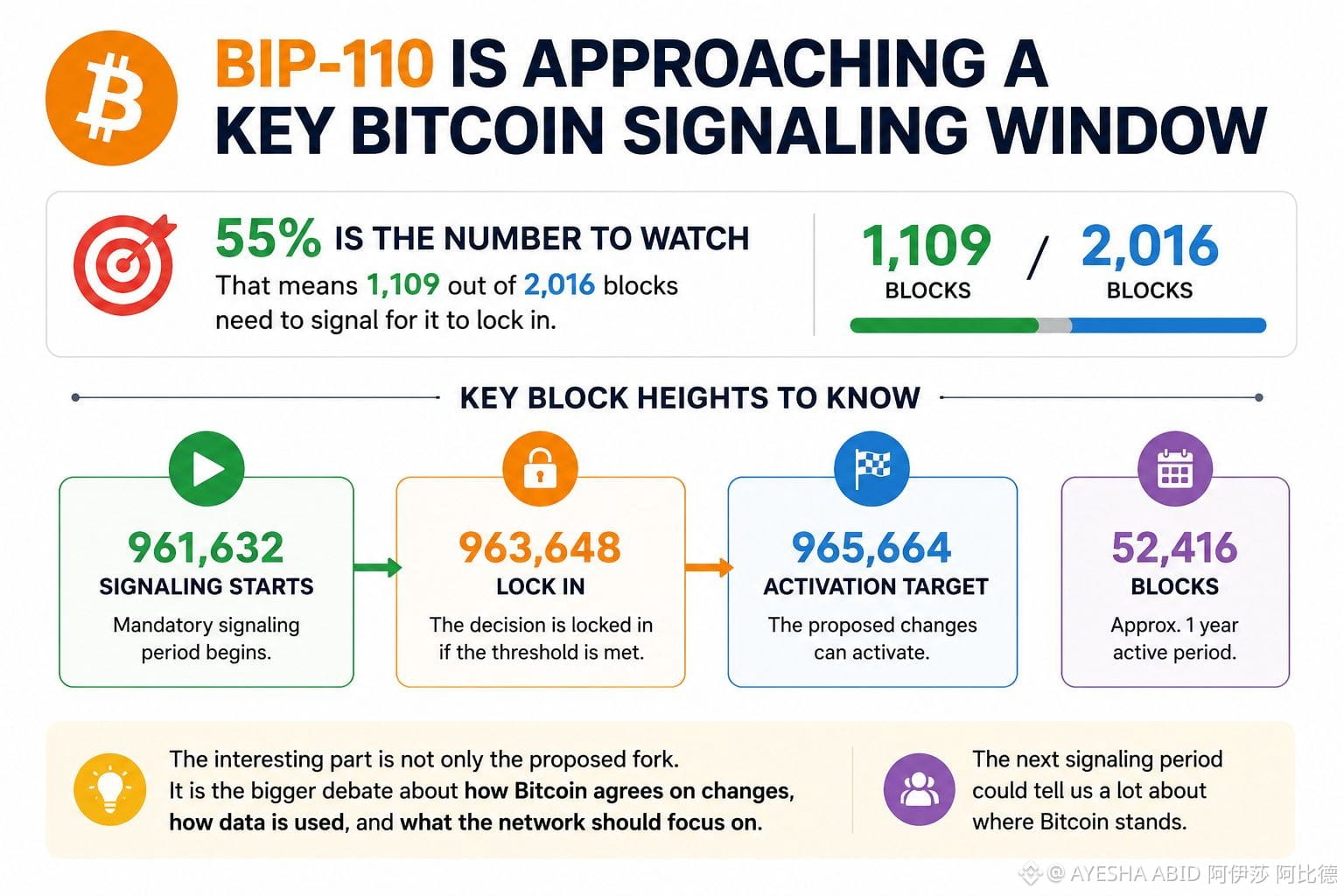
BIP 110 is coming to an important Bitcoin signaling stage, and 55% is the number to watch.
That means 1,109 out of 2,016 blocks need to signal for it to lock in.
Key block numbers:
• 961,632 signaling starts
• 963,648 lock in
• 965,664 activation target
The interesting part is not only the proposed fork. It is the bigger debate about how Bitcoin agrees on changes, how data is used, and what the network should focus on.
The next signaling period could tell us a lot about where Bitcoin stands.
$BTC #BIP110ForkSignalingExpectedThisWeekend
{future}(BTCUSDT)
BIP 110 is coming to an important Bitcoin signaling stage, and 55% is the number to watch.
That means 1,109 out of 2,016 blocks need to signal for it to lock in.
Key block numbers:
• 961,632 signaling starts
• 963,648 lock in
• 965,664 activation target
The interesting part is not only the proposed fork. It is the bigger debate about how Bitcoin agrees on changes, how data is used, and what the network should focus on.
The next signaling period could tell us a lot about where Bitcoin stands.
$BTC #BIP110ForkSignalingExpectedThisWeekend
That means 1,109 out of 2,016 blocks need to signal for it to lock in.
Key block numbers:
• 961,632 signaling starts
• 963,648 lock in
• 965,664 activation target
The interesting part is not only the proposed fork. It is the bigger debate about how Bitcoin agrees on changes, how data is used, and what the network should focus on.
The next signaling period could tell us a lot about where Bitcoin stands.
$BTC #BIP110ForkSignalingExpectedThisWeekend
3
5
559


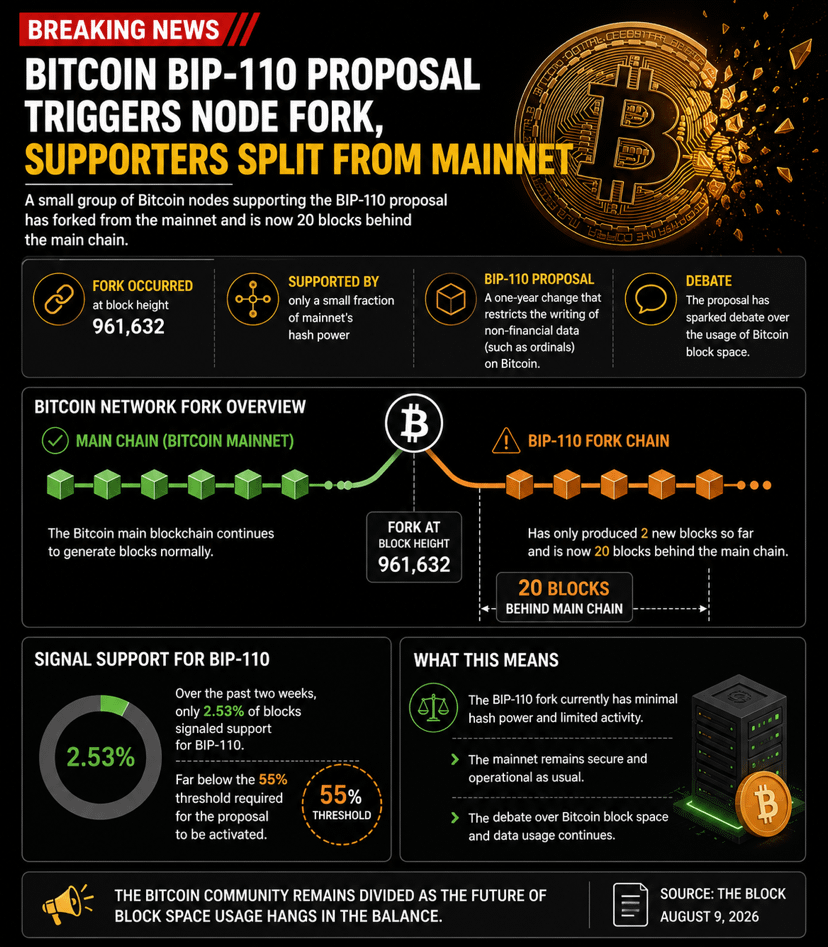
BIP 110 Fork Falls Behind as Bitcoin Mainnet Maintains Consensus
A small group of Bitcoin nodes backing the BIP 110 proposal has split from the main network, creating a separate chain that is struggling to keep pace with Bitcoin’s dominant consensus.
• The fork occurred at Bitcoin block height 961,632 after a subset of nodes activated BIP 110 rules.
• The alternative chain has produced only a handful of blocks and is currently around 20 blocks behind the Bitcoin main chain.
• BIP 110 seeks to limit non financial data stored on Bitcoin, including content associated with Ordinals and similar inscriptions.
• The proposal has reignited debate over how Bitcoin block space should be used and whether non monetary activity belongs on the network.
• Support remains limited, with only 2.53% of recent blocks signaling support well below the 55% activation threshold.
The event highlights a recurring reality in Bitcoin governance: proposals may generate intense discussion, but network consensus ultimately depends on miner participation, node adoption, and economic majority support. For now, Bitcoin’s main chain remains firmly in control, while the BIP 110 fork serves as a live test of how much backing restrictions on non financial data truly have within the ecosystem.
#BIP110ForkSignalingExpectedThisWeekend
#BIP110SoftForkAttemptBegins
$TUT $BEAT $BMT #cryptofirst21
BIP 110 Fork Falls Behind as Bitcoin Mainnet Maintains Consensus
A small group of Bitcoin nodes backing the BIP 110 proposal has split from the main network, creating a separate chain that is struggling to keep pace with Bitcoin’s dominant consensus.
• The fork occurred at Bitcoin block height 961,632 after a subset of nodes activated BIP 110 rules.
• The alternative chain has produced only a handful of blocks and is currently around 20 blocks behind the Bitcoin main chain.
• BIP 110 seeks to limit non financial data stored on Bitcoin, including content associated with Ordinals and similar inscriptions.
• The proposal has reignited debate over how Bitcoin block space should be used and whether non monetary activity belongs on the network.
• Support remains limited, with only 2.53% of recent blocks signaling support well below the 55% activation threshold.
The event highlights a recurring reality in Bitcoin governance: proposals may generate intense discussion, but network consensus ultimately depends on miner participation, node adoption, and economic majority support. For now, Bitcoin’s main chain remains firmly in control, while the BIP 110 fork serves as a live test of how much backing restrictions on non financial data truly have within the ecosystem.
#BIP110ForkSignalingExpectedThisWeekend
#BIP110SoftForkAttemptBegins
$TUT $BEAT $BMT #cryptofirst21
A small group of Bitcoin nodes backing the BIP 110 proposal has split from the main network, creating a separate chain that is struggling to keep pace with Bitcoin’s dominant consensus.
• The fork occurred at Bitcoin block height 961,632 after a subset of nodes activated BIP 110 rules.
• The alternative chain has produced only a handful of blocks and is currently around 20 blocks behind the Bitcoin main chain.
• BIP 110 seeks to limit non financial data stored on Bitcoin, including content associated with Ordinals and similar inscriptions.
• The proposal has reignited debate over how Bitcoin block space should be used and whether non monetary activity belongs on the network.
• Support remains limited, with only 2.53% of recent blocks signaling support well below the 55% activation threshold.
The event highlights a recurring reality in Bitcoin governance: proposals may generate intense discussion, but network consensus ultimately depends on miner participation, node adoption, and economic majority support. For now, Bitcoin’s main chain remains firmly in control, while the BIP 110 fork serves as a live test of how much backing restrictions on non financial data truly have within the ecosystem.
#BIP110ForkSignalingExpectedThisWeekend
#BIP110SoftForkAttemptBegins
$TUT $BEAT $BMT #cryptofirst21
2
415

·
--
Everyone thinks a blockchain fork means free coins and instant profits, but actually, the upcoming signaling phase is more like a construction zone that could trap your active transactions.
Many retail investors rush to move assets during network upgrades, only to get stuck with delayed transfers or lost gas fees when miners split their focus. It is easy to panic-sell into $USDT when the network seems temporarily congested.
Think of the BIP110 signaling like a vote on a new traffic law. Until the miners reach a consensus, the road rules are slightly confused. To protect your portfolio, keep these three warnings in mind. 1. Avoid sending large transactions during the peak signaling window because blocks might take longer to confirm if miners are divided. 2. Remember that soft forks do not create a new coin, so do not fall for scams promising free duplicate tokens. 3. Watch out for temporary price swings in $BTC as the market reacts to early voting data, which can trigger liquidations.
Are you planning to pause your on-chain activity until the signaling settles?
#BIP110ForkSignalingExpectedThisWeekend #BIP110SoftForkAttemptBegins
Everyone thinks a blockchain fork means free coins and instant profits, but actually, the upcoming signaling phase is more like a construction zone that could trap your active transactions.
Many retail investors rush to move assets during network upgrades, only to get stuck with delayed transfers or lost gas fees when miners split their focus. It is easy to panic-sell into $USDT when the network seems temporarily congested.
Think of the BIP110 signaling like a vote on a new traffic law. Until the miners reach a consensus, the road rules are slightly confused. To protect your portfolio, keep these three warnings in mind. 1. Avoid sending large transactions during the peak signaling window because blocks might take longer to confirm if miners are divided. 2. Remember that soft forks do not create a new coin, so do not fall for scams promising free duplicate tokens. 3. Watch out for temporary price swings in $BTC as the market reacts to early voting data, which can trigger liquidations.
Are you planning to pause your on-chain activity until the signaling settles?
#BIP110ForkSignalingExpectedThisWeekend #BIP110SoftForkAttemptBegins
Many retail investors rush to move assets during network upgrades, only to get stuck with delayed transfers or lost gas fees when miners split their focus. It is easy to panic-sell into $USDT when the network seems temporarily congested.
Think of the BIP110 signaling like a vote on a new traffic law. Until the miners reach a consensus, the road rules are slightly confused. To protect your portfolio, keep these three warnings in mind. 1. Avoid sending large transactions during the peak signaling window because blocks might take longer to confirm if miners are divided. 2. Remember that soft forks do not create a new coin, so do not fall for scams promising free duplicate tokens. 3. Watch out for temporary price swings in $BTC as the market reacts to early voting data, which can trigger liquidations.
Are you planning to pause your on-chain activity until the signaling settles?
#BIP110ForkSignalingExpectedThisWeekend #BIP110SoftForkAttemptBegins
91
·
--
Picture this: you wake up to find the network powering your biggest crypto holdings is undergoing a sudden upgrade, and the node operators are actively split on whether to accept it.
For most investors, technical jargon like soft forks and signaling periods just translates to anxiety about potential chain splits or sudden market volatility. It is hard to know whether to hold, hedge, or run for the exit when the underlying tech starts shifting under your feet.
We have seen this play out before. Back in 2017, the SegWit activation showed us how political and messy protocol upgrades can get, sending ripples of fear through the market. Now, the activation debate around BIP110 is testing the community's coordination limits once again. While soft forks are designed to be backward-compatible, they still require a delicate consensus dance among miners who are often motivated by short-term fees rather than long-term network health.
Compare this to how modern middleware protocols like $BICO handle upgrades through governance smart contracts. In those ecosystems, changes are voted on and executed without the risk of splitting the ledger. But for $BTC, the stakes are much higher because any minor bug in a soft fork could theoretically expose billions in capital. It is why the market is acting cautious, as traders brace for potential turbulence during the signaling phase.
Do you think the activation will go smoothly, or are we looking at another period of miner gridlock?
#BIP110SoftForkAttemptBegins #BIP110ForkSignalingExpectedThisWeekend
Picture this: you wake up to find the network powering your biggest crypto holdings is undergoing a sudden upgrade, and the node operators are actively split on whether to accept it.
For most investors, technical jargon like soft forks and signaling periods just translates to anxiety about potential chain splits or sudden market volatility. It is hard to know whether to hold, hedge, or run for the exit when the underlying tech starts shifting under your feet.
We have seen this play out before. Back in 2017, the SegWit activation showed us how political and messy protocol upgrades can get, sending ripples of fear through the market. Now, the activation debate around BIP110 is testing the community's coordination limits once again. While soft forks are designed to be backward-compatible, they still require a delicate consensus dance among miners who are often motivated by short-term fees rather than long-term network health.
Compare this to how modern middleware protocols like $BICO handle upgrades through governance smart contracts. In those ecosystems, changes are voted on and executed without the risk of splitting the ledger. But for $BTC , the stakes are much higher because any minor bug in a soft fork could theoretically expose billions in capital. It is why the market is acting cautious, as traders brace for potential turbulence during the signaling phase.
Do you think the activation will go smoothly, or are we looking at another period of miner gridlock?
#BIP110SoftForkAttemptBegins #BIP110ForkSignalingExpectedThisWeekend
For most investors, technical jargon like soft forks and signaling periods just translates to anxiety about potential chain splits or sudden market volatility. It is hard to know whether to hold, hedge, or run for the exit when the underlying tech starts shifting under your feet.
We have seen this play out before. Back in 2017, the SegWit activation showed us how political and messy protocol upgrades can get, sending ripples of fear through the market. Now, the activation debate around BIP110 is testing the community's coordination limits once again. While soft forks are designed to be backward-compatible, they still require a delicate consensus dance among miners who are often motivated by short-term fees rather than long-term network health.
Compare this to how modern middleware protocols like $BICO handle upgrades through governance smart contracts. In those ecosystems, changes are voted on and executed without the risk of splitting the ledger. But for $BTC , the stakes are much higher because any minor bug in a soft fork could theoretically expose billions in capital. It is why the market is acting cautious, as traders brace for potential turbulence during the signaling phase.
Do you think the activation will go smoothly, or are we looking at another period of miner gridlock?
#BIP110SoftForkAttemptBegins #BIP110ForkSignalingExpectedThisWeekend

152

·
--
Bullish
Verified
#bip110forksignalingexpectedthisweekend
Controversial BIP-110 soft fork just arrived in block 961,632, but it’s completely dead on arrival. 💀
Some thought it would improve/"clean up" BTC, but legends like Michael Saylor and Adam Back backed off/withdrew. Why? Because forcing what counts as "correct" transactions destroys Bitcoin’s core strength: decentralization! Miner support is under 2.6%. Oops!
What should traders do? Stay calm, ignore the drama, and stick to the truly decentralized chain. This is not financial advice! 🤫
Are you new to Binance? Use my referral code VINHTOCDO to sign up.
#BitcoinSoftFork #Decentralization #BIP110 #VINHTOCDO
$BTC
{future}(BTCUSDT)
BTCUSDT
#bip110forksignalingexpectedthisweekend
Controversial BIP-110 soft fork just arrived in block 961,632, but it’s completely dead on arrival. 💀
Some thought it would improve/"clean up" BTC, but legends like Michael Saylor and Adam Back backed off/withdrew. Why? Because forcing what counts as "correct" transactions destroys Bitcoin’s core strength: decentralization! Miner support is under 2.6%. Oops!
What should traders do? Stay calm, ignore the drama, and stick to the truly decentralized chain. This is not financial advice! 🤫
Are you new to Binance? Use my referral code VINHTOCDO to sign up.
#BitcoinSoftFork #Decentralization #BIP110 #VINHTOCDO
$BTC
BTCUSDT
Controversial BIP-110 soft fork just arrived in block 961,632, but it’s completely dead on arrival. 💀
Some thought it would improve/"clean up" BTC, but legends like Michael Saylor and Adam Back backed off/withdrew. Why? Because forcing what counts as "correct" transactions destroys Bitcoin’s core strength: decentralization! Miner support is under 2.6%. Oops!
What should traders do? Stay calm, ignore the drama, and stick to the truly decentralized chain. This is not financial advice! 🤫
Are you new to Binance? Use my referral code VINHTOCDO to sign up.
#BitcoinSoftFork #Decentralization #BIP110 #VINHTOCDO
$BTC
BTCUSDT

4
4.8k
·
--
Most traders think soft forks are completely safe because they are backward-compatible, but historical upgrades show that the transition period is actually when your funds are at the highest risk of getting stuck in limbo.
If you are trying to move assets during active signaling windows, you might find your transactions delayed or caught in a chain split. It is incredibly frustrating to watch your capital get locked up just because you wanted to chase a quick market move during a period of network instability.
Let's break down what is actually happening with this upgrade. When miners start signaling support, they are basically voting with their hash power. But if the activation threshold is reached and some nodes fail to upgrade in time, the network can experience temporary split-brain scenarios. This means a transaction you send on one version of the network might not be recognized by the other, leading to failed transfers or double-spend risks.
We have seen similar chaos during past upgrades where major services had to pause operations. If you are holding $BTC or moving $USDT to buy the dip, doing it right in the middle of a signaling deadline is like crossing a bridge while engineers are swapping out the support beams. It is usually much safer to just wait out the signaling window until consensus stabilizes.
Are you planning to pause your on-chain activity this weekend, or are you just going to trade through it?
#BIP110ForkSignalingExpectedThisWeekend #BIP110SoftForkAttemptBegins
Most traders think soft forks are completely safe because they are backward-compatible, but historical upgrades show that the transition period is actually when your funds are at the highest risk of getting stuck in limbo.
If you are trying to move assets during active signaling windows, you might find your transactions delayed or caught in a chain split. It is incredibly frustrating to watch your capital get locked up just because you wanted to chase a quick market move during a period of network instability.
Let's break down what is actually happening with this upgrade. When miners start signaling support, they are basically voting with their hash power. But if the activation threshold is reached and some nodes fail to upgrade in time, the network can experience temporary split-brain scenarios. This means a transaction you send on one version of the network might not be recognized by the other, leading to failed transfers or double-spend risks.
We have seen similar chaos during past upgrades where major services had to pause operations. If you are holding $BTC or moving $USDT to buy the dip, doing it right in the middle of a signaling deadline is like crossing a bridge while engineers are swapping out the support beams. It is usually much safer to just wait out the signaling window until consensus stabilizes.
Are you planning to pause your on-chain activity this weekend, or are you just going to trade through it?
#BIP110ForkSignalingExpectedThisWeekend #BIP110SoftForkAttemptBegins
If you are trying to move assets during active signaling windows, you might find your transactions delayed or caught in a chain split. It is incredibly frustrating to watch your capital get locked up just because you wanted to chase a quick market move during a period of network instability.
Let's break down what is actually happening with this upgrade. When miners start signaling support, they are basically voting with their hash power. But if the activation threshold is reached and some nodes fail to upgrade in time, the network can experience temporary split-brain scenarios. This means a transaction you send on one version of the network might not be recognized by the other, leading to failed transfers or double-spend risks.
We have seen similar chaos during past upgrades where major services had to pause operations. If you are holding $BTC or moving $USDT to buy the dip, doing it right in the middle of a signaling deadline is like crossing a bridge while engineers are swapping out the support beams. It is usually much safer to just wait out the signaling window until consensus stabilizes.
Are you planning to pause your on-chain activity this weekend, or are you just going to trade through it?
#BIP110ForkSignalingExpectedThisWeekend #BIP110SoftForkAttemptBegins

1
78

·
--
Verified
Article
BIP-110 fork signaling expected this weekend#bip110forksignalingexpectedthisweekend
Bitcoin is heading into a high-stakes “test weekend” as BIP-110 approaches its mandatory signaling period, with observers watching whether enough of the ecosystem coordinates to make the proposal move forward. Reports frame this as a rare moment where a smaller set of nodes could choose to reject blocks produced by the vast majority of miners if BIP-110 activation proceeds on their view of the rules.
What BIP-110 is
BIP-110 (also described as the “Reduced Data Temporary Soft Fork”) is a soft fork proposal intended to temporarily restrict certain non-monetary data carried in transactions, with the stated goal of reducing blockchain bloat and re-emphasizing “monetary use cases.” The signaling mechanism uses miners setting a specific bit.
In the latest overview tied to the approach companies should take, BIP-110 is described as entering a key stage where it becomes mandatory to signal at a specific height, then locks in later if conditions are met, and then activates new transaction rules on a subsequent height—each with projections that place the first “consequential” boundary around Aug. 9, 2026.
Why the weekend matters
The crux is that signaling ≠ immediate activation, and even if signaling is far below what many observers associate with a smooth upgrade, the proposal is user/node-activated in practice: nodes independently enforce the rules they run. That means a disagreement can materialize as a chain split if enforcing nodes follow one branch while the rest of the network follows another.
One analysis emphasizes that BIP-110 supporters argue the story shouldn’t be treated like a “miner referendum,” because coordination by nodes and economic actors is what ultimately matters once the upgrade’s rules come into effect.
What to watch during the signaling window
Commentary pieces and monitors commonly focus on a few observable signals:
Signaling levels from mining pools (e.g., whether the network reaches the proposal’s threshold)Whether enforcement nodes separate (i.e., whether rejection shows up in practice)Ecosystem responses—exchanges, custodians, and node operators lengthening settlement/confirmation procedures if a split becomes plausible
A live “monitor” exists to track the current signaling status and period progress, though it relies on client-side loading for real-time numbers.
The two big takeaways
The immediate question is whether enough actors converge on enforcing the BIP-110 rules to make the change stick in practice.The main operational risk scenario isn’t “BIP-110 signaling alone,” but a chain split where some nodes reject the dominant chain.
That “monitor the possibility of a split and adjust operational behavior” framing shows up directly in guidance-style analysis aimed at corporate Bitcoin users and infrastructure operators.
#BIP110SoftForkAttemptBegins
#BTC
#TrendingTopic
#signaladvisor
BIP-110 fork signaling expected this weekend
#bip110forksignalingexpectedthisweekend
Bitcoin is heading into a high-stakes “test weekend” as BIP-110 approaches its mandatory signaling period, with observers watching whether enough of the ecosystem coordinates to make the proposal move forward. Reports frame this as a rare moment where a smaller set of nodes could choose to reject blocks produced by the vast majority of miners if BIP-110 activation proceeds on their view of the rules.
What BIP-110 is
BIP-110 (also described as the “Reduced Data Temporary Soft Fork”) is a soft fork proposal intended to temporarily restrict certain non-monetary data carried in transactions, with the stated goal of reducing blockchain bloat and re-emphasizing “monetary use cases.” The signaling mechanism uses miners setting a specific bit.
In the latest overview tied to the approach companies should take, BIP-110 is described as entering a key stage where it becomes mandatory to signal at a specific height, then locks in later if conditions are met, and then activates new transaction rules on a subsequent height—each with projections that place the first “consequential” boundary around Aug. 9, 2026.
Why the weekend matters
The crux is that signaling ≠ immediate activation, and even if signaling is far below what many observers associate with a smooth upgrade, the proposal is user/node-activated in practice: nodes independently enforce the rules they run. That means a disagreement can materialize as a chain split if enforcing nodes follow one branch while the rest of the network follows another.
One analysis emphasizes that BIP-110 supporters argue the story shouldn’t be treated like a “miner referendum,” because coordination by nodes and economic actors is what ultimately matters once the upgrade’s rules come into effect.
What to watch during the signaling window
Commentary pieces and monitors commonly focus on a few observable signals:
Signaling levels from mining pools (e.g., whether the network reaches the proposal’s threshold)Whether enforcement nodes separate (i.e., whether rejection shows up in practice)Ecosystem responses—exchanges, custodians, and node operators lengthening settlement/confirmation procedures if a split becomes plausible
A live “monitor” exists to track the current signaling status and period progress, though it relies on client-side loading for real-time numbers.
The two big takeaways
The immediate question is whether enough actors converge on enforcing the BIP-110 rules to make the change stick in practice.The main operational risk scenario isn’t “BIP-110 signaling alone,” but a chain split where some nodes reject the dominant chain.
That “monitor the possibility of a split and adjust operational behavior” framing shows up directly in guidance-style analysis aimed at corporate Bitcoin users and infrastructure operators.
#BIP110SoftForkAttemptBegins
#BTC
#TrendingTopic
#signaladvisor
Bitcoin is heading into a high-stakes “test weekend” as BIP-110 approaches its mandatory signaling period, with observers watching whether enough of the ecosystem coordinates to make the proposal move forward. Reports frame this as a rare moment where a smaller set of nodes could choose to reject blocks produced by the vast majority of miners if BIP-110 activation proceeds on their view of the rules.
What BIP-110 is
BIP-110 (also described as the “Reduced Data Temporary Soft Fork”) is a soft fork proposal intended to temporarily restrict certain non-monetary data carried in transactions, with the stated goal of reducing blockchain bloat and re-emphasizing “monetary use cases.” The signaling mechanism uses miners setting a specific bit.
In the latest overview tied to the approach companies should take, BIP-110 is described as entering a key stage where it becomes mandatory to signal at a specific height, then locks in later if conditions are met, and then activates new transaction rules on a subsequent height—each with projections that place the first “consequential” boundary around Aug. 9, 2026.
Why the weekend matters
The crux is that signaling ≠ immediate activation, and even if signaling is far below what many observers associate with a smooth upgrade, the proposal is user/node-activated in practice: nodes independently enforce the rules they run. That means a disagreement can materialize as a chain split if enforcing nodes follow one branch while the rest of the network follows another.
One analysis emphasizes that BIP-110 supporters argue the story shouldn’t be treated like a “miner referendum,” because coordination by nodes and economic actors is what ultimately matters once the upgrade’s rules come into effect.
What to watch during the signaling window
Commentary pieces and monitors commonly focus on a few observable signals:
Signaling levels from mining pools (e.g., whether the network reaches the proposal’s threshold)Whether enforcement nodes separate (i.e., whether rejection shows up in practice)Ecosystem responses—exchanges, custodians, and node operators lengthening settlement/confirmation procedures if a split becomes plausible
A live “monitor” exists to track the current signaling status and period progress, though it relies on client-side loading for real-time numbers.
The two big takeaways
The immediate question is whether enough actors converge on enforcing the BIP-110 rules to make the change stick in practice.The main operational risk scenario isn’t “BIP-110 signaling alone,” but a chain split where some nodes reject the dominant chain.
That “monitor the possibility of a split and adjust operational behavior” framing shows up directly in guidance-style analysis aimed at corporate Bitcoin users and infrastructure operators.
#BIP110SoftForkAttemptBegins
#BTC
#TrendingTopic
#signaladvisor
4
1.3k

Article
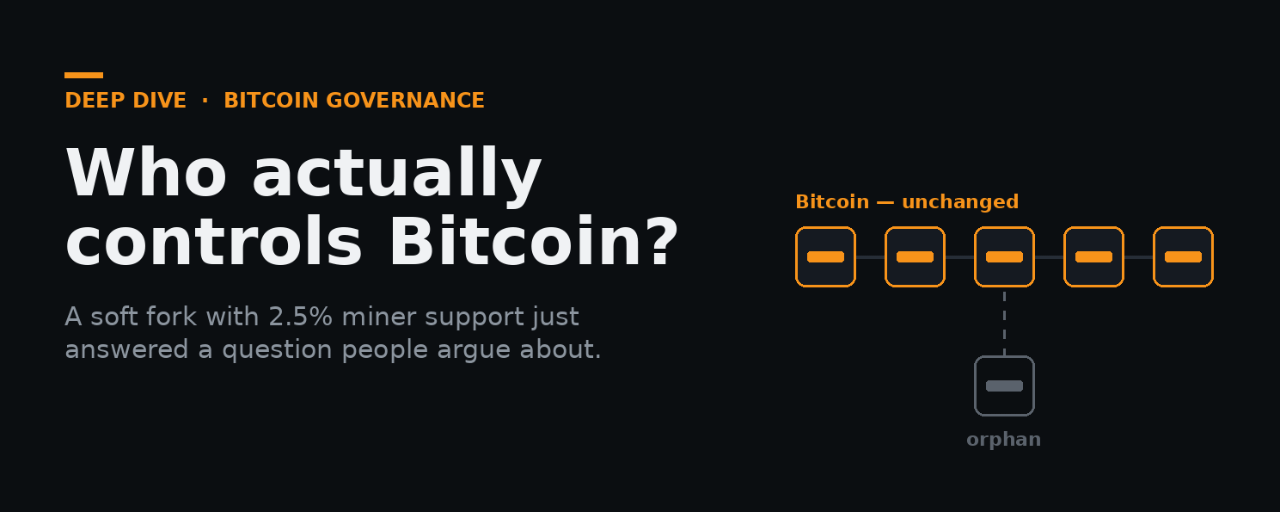
Who Actually Controls Bitcoin?A soft fork with 2.5% miner support just answered a question people argue about endlessly.
This weekend, a Bitcoin proposal most people had never heard of reached its activation block. It had the backing of roughly 2.5% of miners. By every headline metric, it should have been dead on arrival — and yet, technically, "it activated."
If that sounds contradictory, good. Untangling it tells you more about how Bitcoin actually works than any whitepaper will.
What BIP-110 was trying to do
BIP-110 — a temporary, data-limiting soft fork — set out to restrict the amount of non-financial data people can stuff into Bitcoin transactions: inscriptions, token protocols, oversized arbitrary data. The pitch from supporters is that a monetary network shouldn't slowly fill up with what they see as spam.
Two things matter here. First, it was controversial from the start: one camp calls the data bloat that degrades a payments network, the other calls filtering it censorship of otherwise-valid transactions — and a dangerous precedent. Second, it only ever shipped in one minority client, not in the reference software most of the network runs.
So before a single block was mined, this was already a proposal with narrow software reach and loud opposition.
The word doing all the work: "activation"
Here's where people get confused. At the activation height, nodes running the enforcing software begin rejecting blocks that don't signal for the new rule. That is real — but it's activation of the software, not activation of the network.
A rule only actually wins if the economic majority enforces it. Code running on a small fraction of nodes rejecting blocks doesn't change Bitcoin. It just means those specific nodes are now following a stricter rulebook than everyone else.
Who actually holds the power
It helps to separate three groups people constantly conflate:
Miners produce blocks and secure the chain — but they can't force a rule change. They follow whichever chain has value, because that's the chain that pays them. Their signaling is a preference, not a veto and not a mandate.
Nodes enforce the rules. Anyone can run one. They decide which blocks are valid by choosing which software to run.
The economic majority — exchanges, custodians, wallets, businesses, and ordinary users — decides which chain is worth anything. This is where real power lives.
Notice miners are not at the top of that list. A group of miners with no economic weight behind them doesn't fork Bitcoin. They just mine a chain nobody values.
Why 2.5% neither kills it nor saves it
This is the subtle part. BIP-110 was designed as a user-activated change, which means it was never trying to win miners in the first place. So the low signaling number isn't the failure people think it is — it's almost beside the point.
But that same design cuts the other way. Because it doesn't rely on miners, its fate rests entirely on the economic majority — and that's exactly where it's falling short. Node adoption is thin, no major exchange stands behind it, and several of the most prominent voices in the ecosystem are actively against it.
So the realistic outcome isn't "BIP-110 forks Bitcoin." It's that it either quietly fizzles, or it spins off a minority chain with almost no hashrate and no liquidity behind it. That's not a fork in any meaningful sense. It's an orphan.
This is the design working
It's worth sitting with what just happened: a change reached its activation moment, and the network simply kept producing blocks as if nothing occurred. No small group — not developers, not miners, not any foundation — could impose a rule the economic majority didn't want.
That's not a bug. That's the entire security model. Bitcoin's governance is deliberately slow, messy, and frustrating, because the friction is the point. Easy to change means easy to capture.
The honest counterpoint
I don't want to make this cleaner than it is. The data-limiting debate underneath BIP-110 is real and unresolved — the people worried about blockspace filling with non-financial data aren't cranks, and there are genuine costs to ignore on that side.
And user-activated mechanisms cut both ways. The same tool that lets ordinary users resist a bad change also lets a determined minority create real chaos, including temporary chain-split risk. "Working as designed" still leaves room for a period of genuine mess before things settle.
What to actually watch
If you take one practical thing from this: stop watching miner signaling. That's the loud number, not the deciding one.
Watch whether any real economic weight ever enforces this rule — a meaningful node share, a major exchange, a large custodian. If none does, the story is already over, no matter what any activation counter says.
The lesson that outlasts BIP-110 is simple. In Bitcoin, the metric everyone quotes is rarely the one that decides anything. Power sits with the people who assign value to the chain — and every few years, a proposal comes along to remind us of exactly that.
This was this year's reminder.
#SaylorHintsStrategyBitcoinBuy #BIP110SoftForkAttemptBegins #BIP110ForkSignalingExpectedThisWeekend $TUT $BMT
Who Actually Controls Bitcoin?
A soft fork with 2.5% miner support just answered a question people argue about endlessly.
This weekend, a Bitcoin proposal most people had never heard of reached its activation block. It had the backing of roughly 2.5% of miners. By every headline metric, it should have been dead on arrival — and yet, technically, "it activated."
If that sounds contradictory, good. Untangling it tells you more about how Bitcoin actually works than any whitepaper will.
What BIP-110 was trying to do
BIP-110 — a temporary, data-limiting soft fork — set out to restrict the amount of non-financial data people can stuff into Bitcoin transactions: inscriptions, token protocols, oversized arbitrary data. The pitch from supporters is that a monetary network shouldn't slowly fill up with what they see as spam.
Two things matter here. First, it was controversial from the start: one camp calls the data bloat that degrades a payments network, the other calls filtering it censorship of otherwise-valid transactions — and a dangerous precedent. Second, it only ever shipped in one minority client, not in the reference software most of the network runs.
So before a single block was mined, this was already a proposal with narrow software reach and loud opposition.
The word doing all the work: "activation"
Here's where people get confused. At the activation height, nodes running the enforcing software begin rejecting blocks that don't signal for the new rule. That is real — but it's activation of the software, not activation of the network.
A rule only actually wins if the economic majority enforces it. Code running on a small fraction of nodes rejecting blocks doesn't change Bitcoin. It just means those specific nodes are now following a stricter rulebook than everyone else.
Who actually holds the power
It helps to separate three groups people constantly conflate:
Miners produce blocks and secure the chain — but they can't force a rule change. They follow whichever chain has value, because that's the chain that pays them. Their signaling is a preference, not a veto and not a mandate.
Nodes enforce the rules. Anyone can run one. They decide which blocks are valid by choosing which software to run.
The economic majority — exchanges, custodians, wallets, businesses, and ordinary users — decides which chain is worth anything. This is where real power lives.
Notice miners are not at the top of that list. A group of miners with no economic weight behind them doesn't fork Bitcoin. They just mine a chain nobody values.
Why 2.5% neither kills it nor saves it
This is the subtle part. BIP-110 was designed as a user-activated change, which means it was never trying to win miners in the first place. So the low signaling number isn't the failure people think it is — it's almost beside the point.
But that same design cuts the other way. Because it doesn't rely on miners, its fate rests entirely on the economic majority — and that's exactly where it's falling short. Node adoption is thin, no major exchange stands behind it, and several of the most prominent voices in the ecosystem are actively against it.
So the realistic outcome isn't "BIP-110 forks Bitcoin." It's that it either quietly fizzles, or it spins off a minority chain with almost no hashrate and no liquidity behind it. That's not a fork in any meaningful sense. It's an orphan.
This is the design working
It's worth sitting with what just happened: a change reached its activation moment, and the network simply kept producing blocks as if nothing occurred. No small group — not developers, not miners, not any foundation — could impose a rule the economic majority didn't want.
That's not a bug. That's the entire security model. Bitcoin's governance is deliberately slow, messy, and frustrating, because the friction is the point. Easy to change means easy to capture.
The honest counterpoint
I don't want to make this cleaner than it is. The data-limiting debate underneath BIP-110 is real and unresolved — the people worried about blockspace filling with non-financial data aren't cranks, and there are genuine costs to ignore on that side.
And user-activated mechanisms cut both ways. The same tool that lets ordinary users resist a bad change also lets a determined minority create real chaos, including temporary chain-split risk. "Working as designed" still leaves room for a period of genuine mess before things settle.
What to actually watch
If you take one practical thing from this: stop watching miner signaling. That's the loud number, not the deciding one.
Watch whether any real economic weight ever enforces this rule — a meaningful node share, a major exchange, a large custodian. If none does, the story is already over, no matter what any activation counter says.
The lesson that outlasts BIP-110 is simple. In Bitcoin, the metric everyone quotes is rarely the one that decides anything. Power sits with the people who assign value to the chain — and every few years, a proposal comes along to remind us of exactly that.
This was this year's reminder.
#SaylorHintsStrategyBitcoinBuy #BIP110SoftForkAttemptBegins #BIP110ForkSignalingExpectedThisWeekend $TUT $BMT
This weekend, a Bitcoin proposal most people had never heard of reached its activation block. It had the backing of roughly 2.5% of miners. By every headline metric, it should have been dead on arrival — and yet, technically, "it activated."
If that sounds contradictory, good. Untangling it tells you more about how Bitcoin actually works than any whitepaper will.
What BIP-110 was trying to do
BIP-110 — a temporary, data-limiting soft fork — set out to restrict the amount of non-financial data people can stuff into Bitcoin transactions: inscriptions, token protocols, oversized arbitrary data. The pitch from supporters is that a monetary network shouldn't slowly fill up with what they see as spam.
Two things matter here. First, it was controversial from the start: one camp calls the data bloat that degrades a payments network, the other calls filtering it censorship of otherwise-valid transactions — and a dangerous precedent. Second, it only ever shipped in one minority client, not in the reference software most of the network runs.
So before a single block was mined, this was already a proposal with narrow software reach and loud opposition.
The word doing all the work: "activation"
Here's where people get confused. At the activation height, nodes running the enforcing software begin rejecting blocks that don't signal for the new rule. That is real — but it's activation of the software, not activation of the network.
A rule only actually wins if the economic majority enforces it. Code running on a small fraction of nodes rejecting blocks doesn't change Bitcoin. It just means those specific nodes are now following a stricter rulebook than everyone else.
Who actually holds the power
It helps to separate three groups people constantly conflate:
Miners produce blocks and secure the chain — but they can't force a rule change. They follow whichever chain has value, because that's the chain that pays them. Their signaling is a preference, not a veto and not a mandate.
Nodes enforce the rules. Anyone can run one. They decide which blocks are valid by choosing which software to run.
The economic majority — exchanges, custodians, wallets, businesses, and ordinary users — decides which chain is worth anything. This is where real power lives.
Notice miners are not at the top of that list. A group of miners with no economic weight behind them doesn't fork Bitcoin. They just mine a chain nobody values.
Why 2.5% neither kills it nor saves it
This is the subtle part. BIP-110 was designed as a user-activated change, which means it was never trying to win miners in the first place. So the low signaling number isn't the failure people think it is — it's almost beside the point.
But that same design cuts the other way. Because it doesn't rely on miners, its fate rests entirely on the economic majority — and that's exactly where it's falling short. Node adoption is thin, no major exchange stands behind it, and several of the most prominent voices in the ecosystem are actively against it.
So the realistic outcome isn't "BIP-110 forks Bitcoin." It's that it either quietly fizzles, or it spins off a minority chain with almost no hashrate and no liquidity behind it. That's not a fork in any meaningful sense. It's an orphan.
This is the design working
It's worth sitting with what just happened: a change reached its activation moment, and the network simply kept producing blocks as if nothing occurred. No small group — not developers, not miners, not any foundation — could impose a rule the economic majority didn't want.
That's not a bug. That's the entire security model. Bitcoin's governance is deliberately slow, messy, and frustrating, because the friction is the point. Easy to change means easy to capture.
The honest counterpoint
I don't want to make this cleaner than it is. The data-limiting debate underneath BIP-110 is real and unresolved — the people worried about blockspace filling with non-financial data aren't cranks, and there are genuine costs to ignore on that side.
And user-activated mechanisms cut both ways. The same tool that lets ordinary users resist a bad change also lets a determined minority create real chaos, including temporary chain-split risk. "Working as designed" still leaves room for a period of genuine mess before things settle.
What to actually watch
If you take one practical thing from this: stop watching miner signaling. That's the loud number, not the deciding one.
Watch whether any real economic weight ever enforces this rule — a meaningful node share, a major exchange, a large custodian. If none does, the story is already over, no matter what any activation counter says.
The lesson that outlasts BIP-110 is simple. In Bitcoin, the metric everyone quotes is rarely the one that decides anything. Power sits with the people who assign value to the chain — and every few years, a proposal comes along to remind us of exactly that.
This was this year's reminder.
#SaylorHintsStrategyBitcoinBuy #BIP110SoftForkAttemptBegins #BIP110ForkSignalingExpectedThisWeekend $TUT $BMT
1
156

·
--
Verified
Article
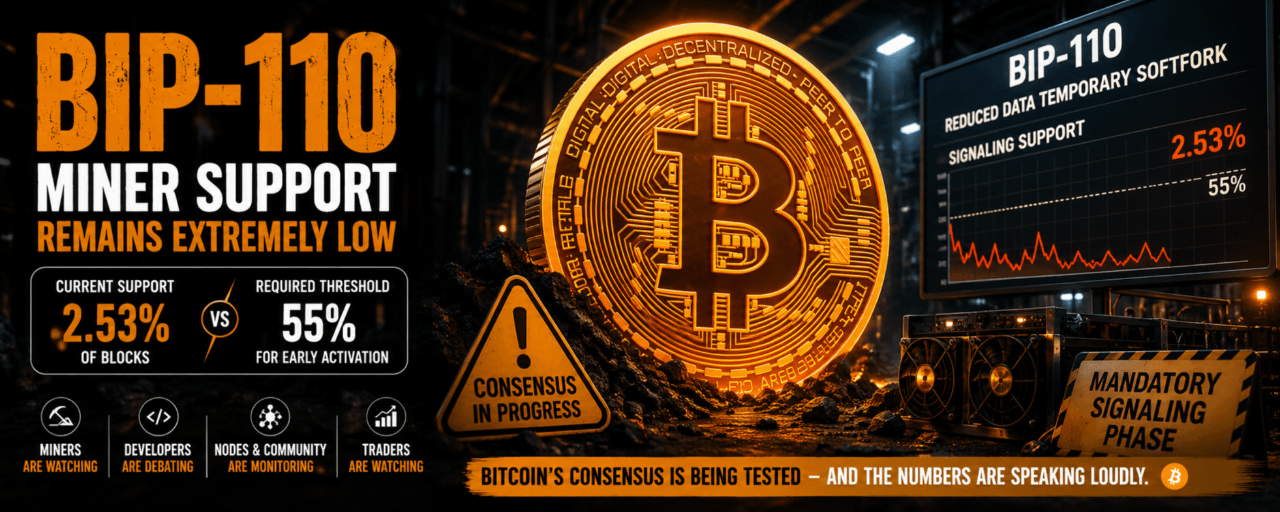
Bitcoin BIP-110: Miner Support Remains Extremely Low#bip110forksignalingexpectedthisweekend
Bitcoin’s controversial BIP-110 proposal has now entered its mandatory signaling phase, putting miners, developers and the wider Bitcoin community under the spotlight.
BIP-110 — officially called the “Reduced Data Temporary Softfork” — aims to temporarily restrict certain methods of embedding large amounts of non-financial data into Bitcoin transactions.
The key development is miner signaling.
📊 At the start of the mandatory signaling period, only around 2.53% of blocks were signaling support — far below the 55% threshold required for early activation.
This is important because signaling alone does not mean that Bitcoin will automatically fork. It is an indication of miner support for the proposed consensus change.
If support remains low, BIP-110 faces a major challenge in achieving broad network consensus. At the same time, the debate highlights a much bigger question for Bitcoin:
Should Bitcoin primarily remain focused on monetary transactions, or should its block space continue supporting wider data-related use cases?
⛏️ Miners are watching.
🧑💻 Developers are debating.
🌐 Node operators and the community are monitoring consensus.
📈 Traders are watching for any potential market reaction.
For $BTC, the immediate impact remains uncertain, but a contentious protocol debate can increase attention and short-term volatility around Bitcoin.
The next phase of BIP-110 will be closely watched — not because a fork is guaranteed, but because the signaling results could reveal just how much support the proposal actually has.
Bitcoin’s consensus is being tested — and the numbers are speaking loudly. 🟠🔥
#BIP110 #BTC #Bitcoin #BitcoinMining #CryptoNews #BitcoinUpdate #CryptoMarket #Blockchain
$BTC $SOL $BICO
{spot}(BICOUSDT)
{spot}(SOLUSDT)
{spot}(BTCUSDT)
Bitcoin BIP-110: Miner Support Remains Extremely Low
#bip110forksignalingexpectedthisweekend
Bitcoin’s controversial BIP-110 proposal has now entered its mandatory signaling phase, putting miners, developers and the wider Bitcoin community under the spotlight.
BIP-110 — officially called the “Reduced Data Temporary Softfork” — aims to temporarily restrict certain methods of embedding large amounts of non-financial data into Bitcoin transactions.
The key development is miner signaling.
📊 At the start of the mandatory signaling period, only around 2.53% of blocks were signaling support — far below the 55% threshold required for early activation.
This is important because signaling alone does not mean that Bitcoin will automatically fork. It is an indication of miner support for the proposed consensus change.
If support remains low, BIP-110 faces a major challenge in achieving broad network consensus. At the same time, the debate highlights a much bigger question for Bitcoin:
Should Bitcoin primarily remain focused on monetary transactions, or should its block space continue supporting wider data-related use cases?
⛏️ Miners are watching.
🧑💻 Developers are debating.
🌐 Node operators and the community are monitoring consensus.
📈 Traders are watching for any potential market reaction.
For $BTC , the immediate impact remains uncertain, but a contentious protocol debate can increase attention and short-term volatility around Bitcoin.
The next phase of BIP-110 will be closely watched — not because a fork is guaranteed, but because the signaling results could reveal just how much support the proposal actually has.
Bitcoin’s consensus is being tested — and the numbers are speaking loudly. 🟠🔥
#BIP110 #BTC #Bitcoin #BitcoinMining #CryptoNews #BitcoinUpdate #CryptoMarket #Blockchain
$BTC $SOL $BICO
Bitcoin’s controversial BIP-110 proposal has now entered its mandatory signaling phase, putting miners, developers and the wider Bitcoin community under the spotlight.
BIP-110 — officially called the “Reduced Data Temporary Softfork” — aims to temporarily restrict certain methods of embedding large amounts of non-financial data into Bitcoin transactions.
The key development is miner signaling.
📊 At the start of the mandatory signaling period, only around 2.53% of blocks were signaling support — far below the 55% threshold required for early activation.
This is important because signaling alone does not mean that Bitcoin will automatically fork. It is an indication of miner support for the proposed consensus change.
If support remains low, BIP-110 faces a major challenge in achieving broad network consensus. At the same time, the debate highlights a much bigger question for Bitcoin:
Should Bitcoin primarily remain focused on monetary transactions, or should its block space continue supporting wider data-related use cases?
⛏️ Miners are watching.
🧑💻 Developers are debating.
🌐 Node operators and the community are monitoring consensus.
📈 Traders are watching for any potential market reaction.
For $BTC , the immediate impact remains uncertain, but a contentious protocol debate can increase attention and short-term volatility around Bitcoin.
The next phase of BIP-110 will be closely watched — not because a fork is guaranteed, but because the signaling results could reveal just how much support the proposal actually has.
Bitcoin’s consensus is being tested — and the numbers are speaking loudly. 🟠🔥
#BIP110 #BTC #Bitcoin #BitcoinMining #CryptoNews #BitcoinUpdate #CryptoMarket #Blockchain
$BTC $SOL $BICO
4
1
9
14.6k

·
--
#BIP110ForkSignalingExpectedThisWeekend
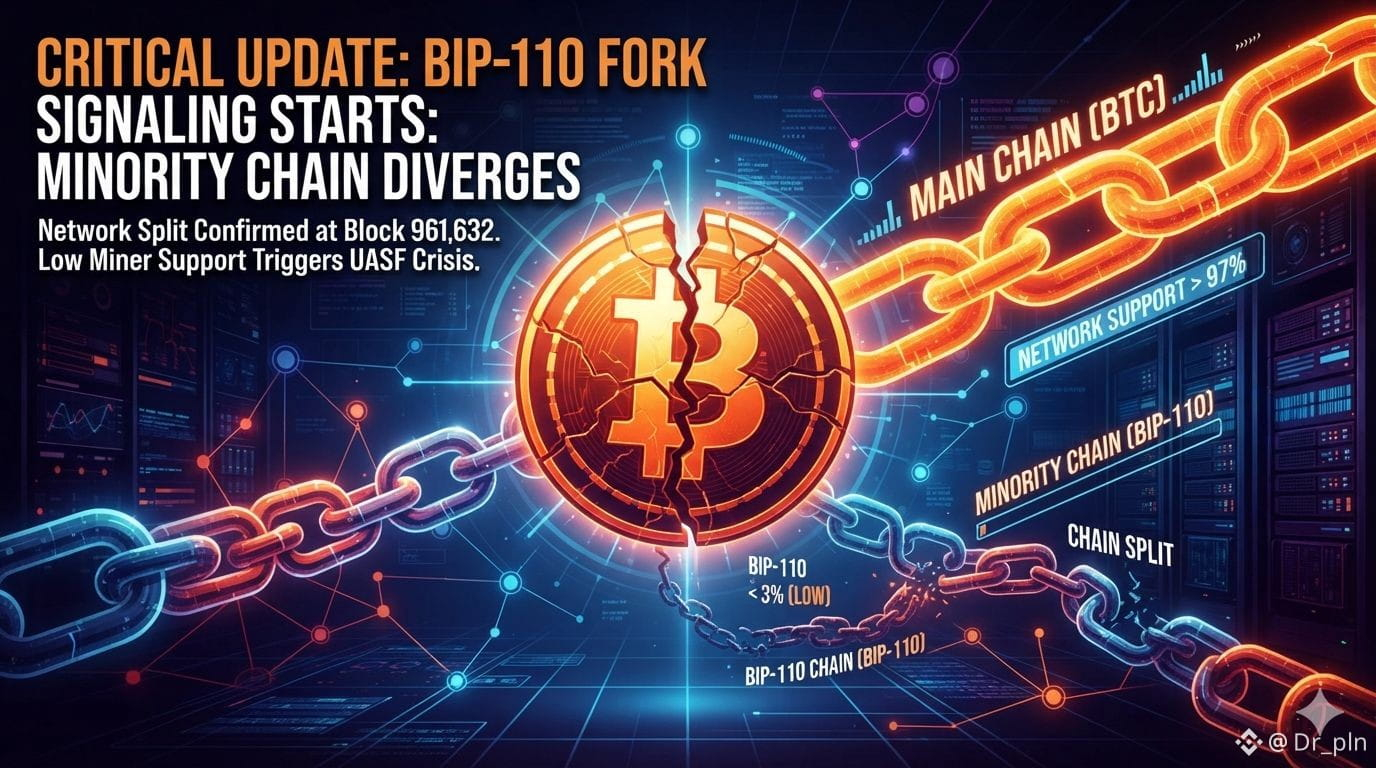
Phase signaling is officially under way this weekend after Bitcoin reached block 961,632 on Saturday night, August 8, 2026. This event triggers intense tension in the network because miner support is very low, at below 3%. This figure is far from the standard threshold of 55% required for peaceful activation.
Due to this lack of consensus, the Bitcoin network has experienced a minor chain split, in which nodes running the BIP-110 rules separate themselves after rejecting the first non-signaling block produced by the giant mining pool
$BTC $BNB $ETH
#BIP110ForkSignalingExpectedThisWeekend
Phase signaling is officially under way this weekend after Bitcoin reached block 961,632 on Saturday night, August 8, 2026. This event triggers intense tension in the network because miner support is very low, at below 3%. This figure is far from the standard threshold of 55% required for peaceful activation.
Due to this lack of consensus, the Bitcoin network has experienced a minor chain split, in which nodes running the BIP-110 rules separate themselves after rejecting the first non-signaling block produced by the giant mining pool
$BTC $BNB $ETH
Phase signaling is officially under way this weekend after Bitcoin reached block 961,632 on Saturday night, August 8, 2026. This event triggers intense tension in the network because miner support is very low, at below 3%. This figure is far from the standard threshold of 55% required for peaceful activation.
Due to this lack of consensus, the Bitcoin network has experienced a minor chain split, in which nodes running the BIP-110 rules separate themselves after rejecting the first non-signaling block produced by the giant mining pool
$BTC $BNB $ETH
20

·
--
Verified
#bip110forksignalingexpectedthisweekend
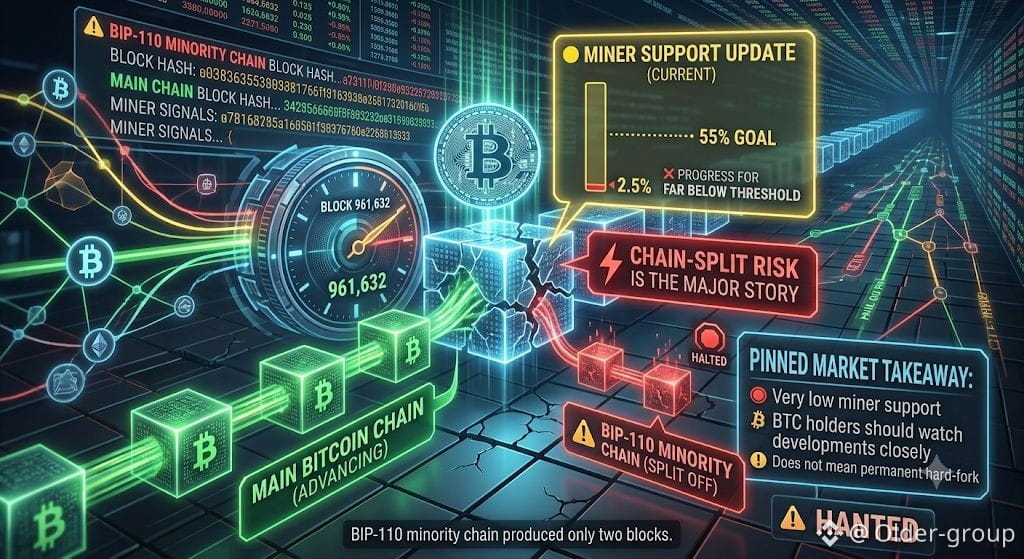
The BIP-110 signaling phase has already begun at Bitcoin block 961,632. Current miner support is only around 2.5%, far below the proposal's 55% threshold.
⚠️ Important: This is no longer just an expected weekend event. A minority BIP-110 chain has already split off, while the main Bitcoin chain continues to advance. Reports say the minority chain produced only two blocks before falling behind.
📌 Market takeaway:
🔴 Very low miner support ⚡ Chain-split risk is the major story ₿ BTC holders should watch developments closely ❗ This does not mean Bitcoin itself has permanently hard-forked
#Bitcoin #BTC #BIP110 #BitcoinFork $BTC $SOL $ETH
{spot}(ETHUSDT)
{spot}(SOLUSDT)
{spot}(BTCUSDT)
#bip110forksignalingexpectedthisweekend
The BIP-110 signaling phase has already begun at Bitcoin block 961,632. Current miner support is only around 2.5%, far below the proposal's 55% threshold.
⚠️ Important: This is no longer just an expected weekend event. A minority BIP-110 chain has already split off, while the main Bitcoin chain continues to advance. Reports say the minority chain produced only two blocks before falling behind.
📌 Market takeaway:
🔴 Very low miner support ⚡ Chain-split risk is the major story ₿ BTC holders should watch developments closely ❗ This does not mean Bitcoin itself has permanently hard-forked
#Bitcoin #BTC #BIP110 #BitcoinFork $BTC $SOL $ETH
The BIP-110 signaling phase has already begun at Bitcoin block 961,632. Current miner support is only around 2.5%, far below the proposal's 55% threshold.
⚠️ Important: This is no longer just an expected weekend event. A minority BIP-110 chain has already split off, while the main Bitcoin chain continues to advance. Reports say the minority chain produced only two blocks before falling behind.
📌 Market takeaway:
🔴 Very low miner support ⚡ Chain-split risk is the major story ₿ BTC holders should watch developments closely ❗ This does not mean Bitcoin itself has permanently hard-forked
#Bitcoin #BTC #BIP110 #BitcoinFork $BTC $SOL $ETH
4
2.6k

·
--
⚡️ BREAKING: Controversial Bitcoin BIP-110 Fork Crashing & Burning Hard! Only 2 Blocs Mined Before TOTAL FREEZE! 🔥
🚨 WHAT JUST HAPPENED?!
The hyper-controversial Bitcoin BIP-110 hard fork just pulled off one of the most embarrassing moves in crypto history! After launching with massive hype, the rogue chain literally STALLED OUT after mining a grand total of... JUST TWO BLOCS!
💥 THE FATAL MISTAKE: ACCIDENTAL DISASTER
How did it break so fast? Here is the brutal reality:
Massive Difficulty, ZERO Hashrate: The dissident chain inherited Bitcoin’s colossal mining difficulty, but launched with almost zero processing power. Result? Blocs taking HOURS AND HOURS to mine! ⏳
Transaction Chaos: Both chains are currently accepting the exact same transactions, creating absolute panic, confusion, and massive security risks across the market! ⚠️
Dead on Arrival: Without a massive injection of hashpower, this fork is completely paralyzed!
🔥 BOTTOM LINE:
BIP-110 tried to challenge the King, but forgot to bring the firepower. With virtually no hashpower backing it up, this fork is sitting in total gridlock!
WHAT DO YOU THINK ?
$BTC
{future}(BTCUSDT)
$TUT
{future}(TUTUSDT)
$IOTX
{future}(IOTXUSDT)
#BIP110ForkSignalingExpectedThisWeekend #BIP110SoftForkAttemptBegins #BinanceSquare
⚡️ BREAKING: Controversial Bitcoin BIP-110 Fork Crashing & Burning Hard! Only 2 Blocs Mined Before TOTAL FREEZE! 🔥
🚨 WHAT JUST HAPPENED?!
The hyper-controversial Bitcoin BIP-110 hard fork just pulled off one of the most embarrassing moves in crypto history! After launching with massive hype, the rogue chain literally STALLED OUT after mining a grand total of... JUST TWO BLOCS!
💥 THE FATAL MISTAKE: ACCIDENTAL DISASTER
How did it break so fast? Here is the brutal reality:
Massive Difficulty, ZERO Hashrate: The dissident chain inherited Bitcoin’s colossal mining difficulty, but launched with almost zero processing power. Result? Blocs taking HOURS AND HOURS to mine! ⏳
Transaction Chaos: Both chains are currently accepting the exact same transactions, creating absolute panic, confusion, and massive security risks across the market! ⚠️
Dead on Arrival: Without a massive injection of hashpower, this fork is completely paralyzed!
🔥 BOTTOM LINE:
BIP-110 tried to challenge the King, but forgot to bring the firepower. With virtually no hashpower backing it up, this fork is sitting in total gridlock!
WHAT DO YOU THINK ?
$BTC
$TUT
$IOTX
#BIP110ForkSignalingExpectedThisWeekend #BIP110SoftForkAttemptBegins #BinanceSquare
🚨 WHAT JUST HAPPENED?!
The hyper-controversial Bitcoin BIP-110 hard fork just pulled off one of the most embarrassing moves in crypto history! After launching with massive hype, the rogue chain literally STALLED OUT after mining a grand total of... JUST TWO BLOCS!
💥 THE FATAL MISTAKE: ACCIDENTAL DISASTER
How did it break so fast? Here is the brutal reality:
Massive Difficulty, ZERO Hashrate: The dissident chain inherited Bitcoin’s colossal mining difficulty, but launched with almost zero processing power. Result? Blocs taking HOURS AND HOURS to mine! ⏳
Transaction Chaos: Both chains are currently accepting the exact same transactions, creating absolute panic, confusion, and massive security risks across the market! ⚠️
Dead on Arrival: Without a massive injection of hashpower, this fork is completely paralyzed!
🔥 BOTTOM LINE:
BIP-110 tried to challenge the King, but forgot to bring the firepower. With virtually no hashpower backing it up, this fork is sitting in total gridlock!
WHAT DO YOU THINK ?
$BTC
$TUT
$IOTX
#BIP110ForkSignalingExpectedThisWeekend #BIP110SoftForkAttemptBegins #BinanceSquare
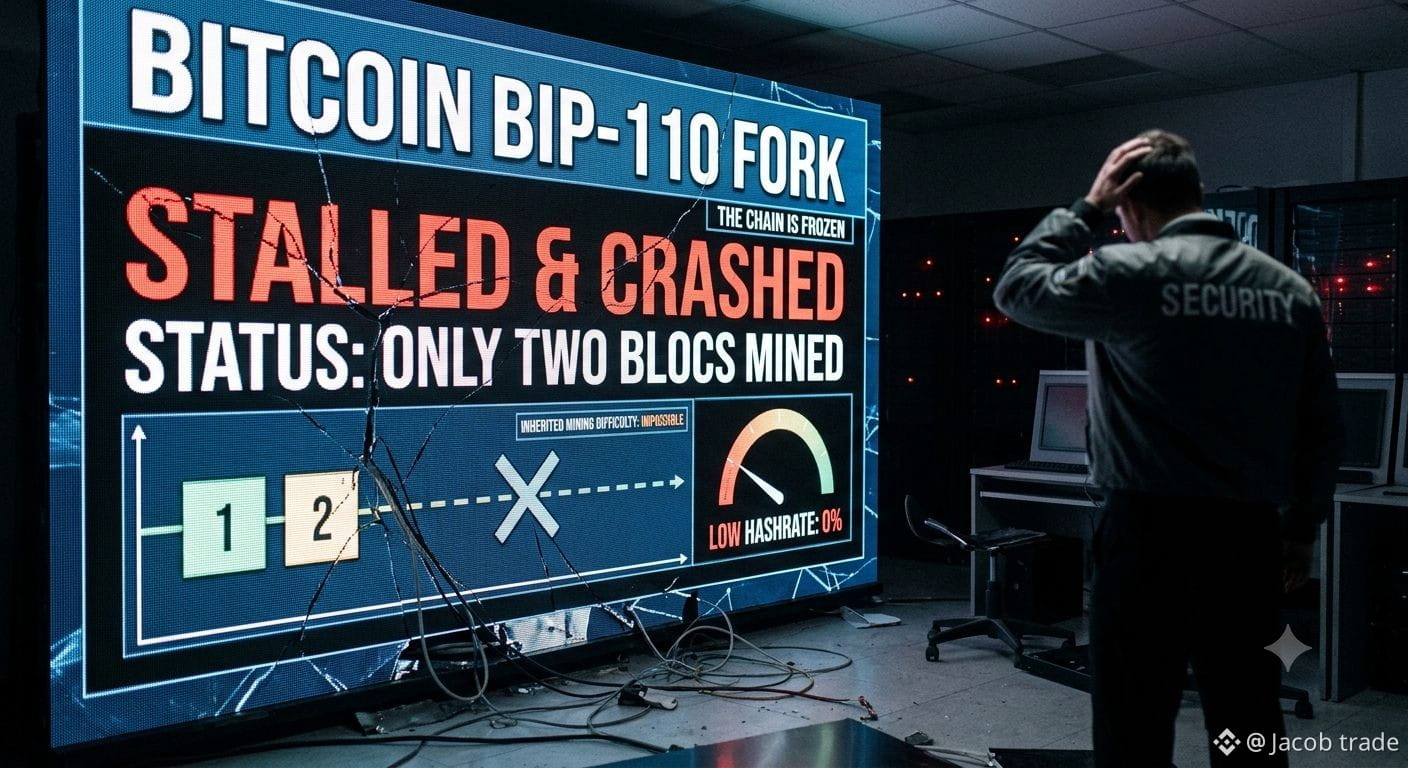
303
Log in to explore more content
Join global crypto users on Binance Square
⚡️ Get latest and useful information about crypto.
💬 Trusted by the world’s largest crypto exchange.
👍 Discover real insights from verified creators.
Email / Phone number
Trending Topics
1
#AIStocksWhatNext
868,187 views
6,557 Discussing
2
#BitcoinRejectedAt$87,300Twice
0 views
0 Discussing
3
#BCHJumps28%OnCMEFuturesListing
10,061 views
477 Discussing
4
#WallStreetEarningsRevisionsTurnBearish
6,798 views
354 Discussing
5
#DollarIndexReclaims101
5,508 views
293 Discussing
6
#21SharesLaunchesEuropesFirstZcashETP
40,400 views
1,087 Discussing
7
#CardanoJoinsX402PaymentStandard
25,247 views
781 Discussing
8
#BitcoinTops$87KAtEightMonthHigh
12,303 views
133 Discussing
9
#ZECBreaksAbove$1600AtRecordHigh
8,687 views
107 Discussing
10
#BitwiseNEARStakingETPAssetsTop$100M
40,473 views
107 Discussing