

#aistockswhatnext
aistockswhatnext
1.2M views
7,511 Discussing
Hot
Latest


Share & Win Traffic Reward in our Trending Hashtag Campaign
✨Topic: What Other Investment Opportunities Remain as AI Stocks Keep Rising?
👉How to Join:
Publish a short post or article with hashtag #AIStocksWhatNext
Share whether you’re bullish or bearish, and post your AI stock holdings or trade — using the trade widget may improve your eligibility.
You can also strengthen your post by sharing data or charts, and avoiding AI-generated images.
✍️Create content based on the below angles:
- Nvidia says chip sales will double next year, and top AI companies keep hitting record revenue, the compute spend behind it is just as staggering. Is AI demand really taking off? And how long can it last? AI stocks are up across the board. Is this a real breakout, or just a short-term bounce?
- Industry leaders are calling to slow down AI development, while Trump plans to build an “AI Force”, claiming AI could account for 25% of U.S. GDP in the future. Whose side are you on? Will state-level backing be a long-term win for AI stocks?
- Are you buying AI stocks? Share your AI-related trade/holdings with our trade sharing widget.
⏰Campaign Period:
- 2026-09-22 7:00 - 2026-09-24 4:00 UTC
🎁Reward:
- Qualified posts that comply with the above guidelines and contain more than 100 words will be reviewed and may receive a random traffic boost of 500 to 3,000 views. You will receive a notification from your feed secretary if your post is selected.
- Get a chance to have your article featured on Binance Square Official
Need ideas for your post? Visit the topic page #AIStocksWhatNext or the [Square Guide on How to Post for Better Reach](https://www.binance.com/en/square/post/364505922663952).
Share & Win Traffic Reward in our Trending Hashtag Campaign
✨Topic: What Other Investment Opportunities Remain as AI Stocks Keep Rising?
👉How to Join:
Publish a short post or article with hashtag #AIStocksWhatNext
Share whether you’re bullish or bearish, and post your AI stock holdings or trade — using the trade widget may improve your eligibility.
You can also strengthen your post by sharing data or charts, and avoiding AI-generated images.
✍️Create content based on the below angles:
- Nvidia says chip sales will double next year, and top AI companies keep hitting record revenue, the compute spend behind it is just as staggering. Is AI demand really taking off? And how long can it last? AI stocks are up across the board. Is this a real breakout, or just a short-term bounce?
- Industry leaders are calling to slow down AI development, while Trump plans to build an “AI Force”, claiming AI could account for 25% of U.S. GDP in the future. Whose side are you on? Will state-level backing be a long-term win for AI stocks?
- Are you buying AI stocks? Share your AI-related trade/holdings with our trade sharing widget.
⏰Campaign Period:
- 2026-09-22 7:00 - 2026-09-24 4:00 UTC
🎁Reward:
- Qualified posts that comply with the above guidelines and contain more than 100 words will be reviewed and may receive a random traffic boost of 500 to 3,000 views. You will receive a notification from your feed secretary if your post is selected.
- Get a chance to have your article featured on Binance Square Official
Need ideas for your post? Visit the topic page #AIStocksWhatNext or the Square Guide on How to Post for Better Reach.
✨Topic: What Other Investment Opportunities Remain as AI Stocks Keep Rising?
👉How to Join:
Publish a short post or article with hashtag #AIStocksWhatNext
Share whether you’re bullish or bearish, and post your AI stock holdings or trade — using the trade widget may improve your eligibility.
You can also strengthen your post by sharing data or charts, and avoiding AI-generated images.
✍️Create content based on the below angles:
- Nvidia says chip sales will double next year, and top AI companies keep hitting record revenue, the compute spend behind it is just as staggering. Is AI demand really taking off? And how long can it last? AI stocks are up across the board. Is this a real breakout, or just a short-term bounce?
- Industry leaders are calling to slow down AI development, while Trump plans to build an “AI Force”, claiming AI could account for 25% of U.S. GDP in the future. Whose side are you on? Will state-level backing be a long-term win for AI stocks?
- Are you buying AI stocks? Share your AI-related trade/holdings with our trade sharing widget.
⏰Campaign Period:
- 2026-09-22 7:00 - 2026-09-24 4:00 UTC
🎁Reward:
- Qualified posts that comply with the above guidelines and contain more than 100 words will be reviewed and may receive a random traffic boost of 500 to 3,000 views. You will receive a notification from your feed secretary if your post is selected.
- Get a chance to have your article featured on Binance Square Official
Need ideas for your post? Visit the topic page #AIStocksWhatNext or the Square Guide on How to Post for Better Reach.
guide center:
interesting
102
80
637
1.9M


·
--
Bullish
Partly True
$MRVL
{future}(MRVLUSDT)
Trump’s massive punt on Marvell Tech, and Huang recks it’s heading for a trillion
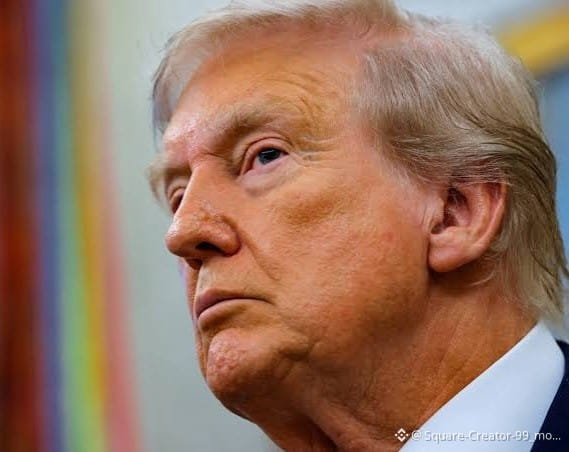
Trump’s just made his biggest share purchase yet in Marvell Technology , scooping up around 5.25 million quid’s worth across two separate trades
Proper massive investment this, coming right when AI gear and semiconductors are absolutely flying
To top it off, Nvidia boss Jensen Huang’s been singing their praises, calling Marvell "the next trillion-dollar firm"
$NVDA
{future}(NVDAUSDT)
Show’s real faith in what they’re doing with networking and custom chips for AI and data centres
Marvell’s stock is floating around 20% off its all-time high at the minute, sitting at a market cap of about 235 billion. A lot of folks reckon this dip looks like a solid little opportunity, especially with all the huge deals they’ve got with global tech giants
$TRUMP
{future}(TRUMPUSDT)
#AIStocksWhatNext
$MRVL
Trump’s massive punt on Marvell Tech, and Huang recks it’s heading for a trillion
Trump’s just made his biggest share purchase yet in Marvell Technology , scooping up around 5.25 million quid’s worth across two separate trades
Proper massive investment this, coming right when AI gear and semiconductors are absolutely flying
To top it off, Nvidia boss Jensen Huang’s been singing their praises, calling Marvell "the next trillion-dollar firm"
$NVDA
Show’s real faith in what they’re doing with networking and custom chips for AI and data centres
Marvell’s stock is floating around 20% off its all-time high at the minute, sitting at a market cap of about 235 billion. A lot of folks reckon this dip looks like a solid little opportunity, especially with all the huge deals they’ve got with global tech giants
$TRUMP
#AIStocksWhatNext
Trump’s massive punt on Marvell Tech, and Huang recks it’s heading for a trillion
Trump’s just made his biggest share purchase yet in Marvell Technology , scooping up around 5.25 million quid’s worth across two separate trades
Proper massive investment this, coming right when AI gear and semiconductors are absolutely flying
To top it off, Nvidia boss Jensen Huang’s been singing their praises, calling Marvell "the next trillion-dollar firm"
$NVDA
Show’s real faith in what they’re doing with networking and custom chips for AI and data centres
Marvell’s stock is floating around 20% off its all-time high at the minute, sitting at a market cap of about 235 billion. A lot of folks reckon this dip looks like a solid little opportunity, especially with all the huge deals they’ve got with global tech giants
$TRUMP
#AIStocksWhatNext

SS-26Rat:
lietralmente empece hoy wn esto que me recomuendas hacer?
1
3
2.4k
·
--
Bullish
Partly True
$MU
{future}(MUUSDT)
In a proper wild turn of events in the AI chip market, you’ve got two big-shot investors lookin’ at things in completely different ways, innit
On one side, Michael Burry—the bloke who called the big housing crash—has been shortin’ Micron Technology since July second, and he’s gone and topped it up again this week
On the other side, Leopold Aschenbrenner, the fella they call the ‘Nostradamus of AI’, has put down massive money on call options endin’ on October second
$SNDK
{future}(SNDKUSDT)
We’re talkin’ a $44m punt on Micron, another $41m on SanDisk, plus a tidy $11m tossed across Intel and Marvell
The numbers tell a right proper story here
Burry’s tracker is barely up 2% for the year, while Leopold’s tracker has gone mental, up 84% since March
$INTC
{future}(INTCUSDT)
Micron’s stock itself has only crept up 2% since Burry took a pop at it, whereas Leopold’s punt is already printin’ cash, up about $74 a share at today’s prices
It just goes to show how split everyone is on where memory chips are headin' with all this AI madness
Folk are keepin’ their eyes peeled for Leopold’s next 13F report on November 16th to see how his wallet’s really holdin’ up against the market ups and downs
#AIStocksWhatNext
$MU
In a proper wild turn of events in the AI chip market, you’ve got two big-shot investors lookin’ at things in completely different ways, innit
On one side, Michael Burry—the bloke who called the big housing crash—has been shortin’ Micron Technology since July second, and he’s gone and topped it up again this week
On the other side, Leopold Aschenbrenner, the fella they call the ‘Nostradamus of AI’, has put down massive money on call options endin’ on October second
$SNDK
We’re talkin’ a $44m punt on Micron, another $41m on SanDisk, plus a tidy $11m tossed across Intel and Marvell
The numbers tell a right proper story here
Burry’s tracker is barely up 2% for the year, while Leopold’s tracker has gone mental, up 84% since March
$INTC
Micron’s stock itself has only crept up 2% since Burry took a pop at it, whereas Leopold’s punt is already printin’ cash, up about $74 a share at today’s prices
It just goes to show how split everyone is on where memory chips are headin' with all this AI madness
Folk are keepin’ their eyes peeled for Leopold’s next 13F report on November 16th to see how his wallet’s really holdin’ up against the market ups and downs
#AIStocksWhatNext
In a proper wild turn of events in the AI chip market, you’ve got two big-shot investors lookin’ at things in completely different ways, innit
On one side, Michael Burry—the bloke who called the big housing crash—has been shortin’ Micron Technology since July second, and he’s gone and topped it up again this week
On the other side, Leopold Aschenbrenner, the fella they call the ‘Nostradamus of AI’, has put down massive money on call options endin’ on October second
$SNDK
We’re talkin’ a $44m punt on Micron, another $41m on SanDisk, plus a tidy $11m tossed across Intel and Marvell
The numbers tell a right proper story here
Burry’s tracker is barely up 2% for the year, while Leopold’s tracker has gone mental, up 84% since March
$INTC
Micron’s stock itself has only crept up 2% since Burry took a pop at it, whereas Leopold’s punt is already printin’ cash, up about $74 a share at today’s prices
It just goes to show how split everyone is on where memory chips are headin' with all this AI madness
Folk are keepin’ their eyes peeled for Leopold’s next 13F report on November 16th to see how his wallet’s really holdin’ up against the market ups and downs
#AIStocksWhatNext

5
1.6k

·
--
$SPCXB
{spot}(SPCXBUSDT)
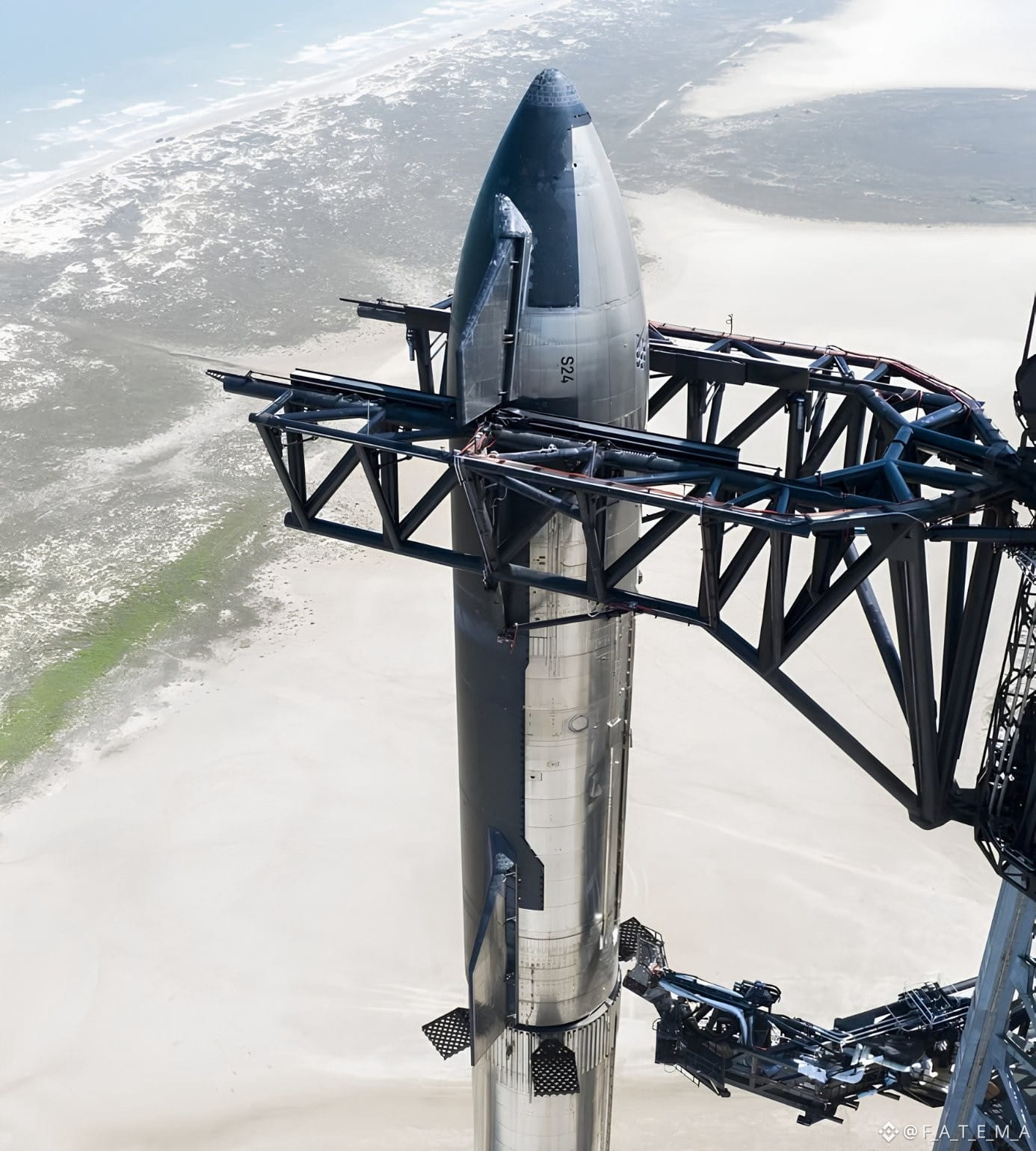
SpaceX has transformed into an artificial intelligence powerhouse following its acquisition of xAI and historic public offering under the ticker SPCX.
Trading around $150 per share, the company boasts a market valuation exceeding $2 trillion, driven heavily by its rapid pivot toward AI infrastructure and software like the Grok model ecosystem.
Elon Musk’s future roadmap focuses heavily on scaling compute capacity through massive data centers like Colossus and upcoming initiatives like the Terafab semiconductor project.
SpaceX aims to reach up to 10 gigawatts of AI compute, which could generate hundreds of billions in annual revenue.
Musk projects that artificial intelligence will constitute the vast majority of SpaceX's long-term value, seamlessly merging space exploration, autonomous systems, and advanced machine intelligence into a single ecosystem.
#AIStocksWhatNext
$SPCXB
SpaceX has transformed into an artificial intelligence powerhouse following its acquisition of xAI and historic public offering under the ticker SPCX.
Trading around $150 per share, the company boasts a market valuation exceeding $2 trillion, driven heavily by its rapid pivot toward AI infrastructure and software like the Grok model ecosystem.
Elon Musk’s future roadmap focuses heavily on scaling compute capacity through massive data centers like Colossus and upcoming initiatives like the Terafab semiconductor project.
SpaceX aims to reach up to 10 gigawatts of AI compute, which could generate hundreds of billions in annual revenue.
Musk projects that artificial intelligence will constitute the vast majority of SpaceX's long-term value, seamlessly merging space exploration, autonomous systems, and advanced machine intelligence into a single ecosystem.
#AIStocksWhatNext
SpaceX has transformed into an artificial intelligence powerhouse following its acquisition of xAI and historic public offering under the ticker SPCX.
Trading around $150 per share, the company boasts a market valuation exceeding $2 trillion, driven heavily by its rapid pivot toward AI infrastructure and software like the Grok model ecosystem.
Elon Musk’s future roadmap focuses heavily on scaling compute capacity through massive data centers like Colossus and upcoming initiatives like the Terafab semiconductor project.
SpaceX aims to reach up to 10 gigawatts of AI compute, which could generate hundreds of billions in annual revenue.
Musk projects that artificial intelligence will constitute the vast majority of SpaceX's long-term value, seamlessly merging space exploration, autonomous systems, and advanced machine intelligence into a single ecosystem.
#AIStocksWhatNext


86

#aistockswhatnext 🚀 The AI Super-Cycle: Is Phase 2 About to Explode? ⚡🧠
The first wave of the AI boom made history as chipmakers and raw processing power broke every record in the book. But as massive tech giants project exploding compute spend and data centers scale globally, the entire market is shifting into a brand new gear.
🔥 The Big Question: Is this a genuine, multi-year structural breakout, or are we just riding a temporary hype wave?
While most retail traders keep staring solely at chips, the actual ecosystem bottleneck and multi-billion-dollar profit pools are expanding rapidly into the hidden backbone:
The Energy & Power Grid Crunch: Massive data centers require staggering amounts of electricity. Energy grids and power suppliers are becoming the true gatekeepers of AI scaling!
Enterprise Software & Cybersecurity: Moving past hardware to secure autonomous networks and monetize real-world corporate profits.
State-Level Backing ("AI Force"): With political leaders prioritizing national technological leadership, government-backed initiatives are injecting unprecedented, unstoppable momentum into the market.
I am strongly BULLISH on long-term pillars like $NVDAB , $MSFT
, and $PLTR as they continue to lead the next decade of digital evolution! 📈
👇 What is your strategy for this next wave? Are you sticking to big tech, or hunting for opportunities in energy and software? Drop your thoughts and share your trades below!
#AIStocksWh [atNext](https://www.binance.com/square/hashtag/AIStocksWhatNext?utm_source=gemini) #BinanceSquare
#aistockswhatnext 🚀 The AI Super-Cycle: Is Phase 2 About to Explode? ⚡🧠
The first wave of the AI boom made history as chipmakers and raw processing power broke every record in the book. But as massive tech giants project exploding compute spend and data centers scale globally, the entire market is shifting into a brand new gear.
🔥 The Big Question: Is this a genuine, multi-year structural breakout, or are we just riding a temporary hype wave?
While most retail traders keep staring solely at chips, the actual ecosystem bottleneck and multi-billion-dollar profit pools are expanding rapidly into the hidden backbone:
The Energy & Power Grid Crunch: Massive data centers require staggering amounts of electricity. Energy grids and power suppliers are becoming the true gatekeepers of AI scaling!
Enterprise Software & Cybersecurity: Moving past hardware to secure autonomous networks and monetize real-world corporate profits.
State-Level Backing ("AI Force"): With political leaders prioritizing national technological leadership, government-backed initiatives are injecting unprecedented, unstoppable momentum into the market.
I am strongly BULLISH on long-term pillars like $NVDAB , $MSFT
, and $PLTR as they continue to lead the next decade of digital evolution! 📈
👇 What is your strategy for this next wave? Are you sticking to big tech, or hunting for opportunities in energy and software? Drop your thoughts and share your trades below!
#AIStocksWh atNext #BinanceSquare
The first wave of the AI boom made history as chipmakers and raw processing power broke every record in the book. But as massive tech giants project exploding compute spend and data centers scale globally, the entire market is shifting into a brand new gear.
🔥 The Big Question: Is this a genuine, multi-year structural breakout, or are we just riding a temporary hype wave?
While most retail traders keep staring solely at chips, the actual ecosystem bottleneck and multi-billion-dollar profit pools are expanding rapidly into the hidden backbone:
The Energy & Power Grid Crunch: Massive data centers require staggering amounts of electricity. Energy grids and power suppliers are becoming the true gatekeepers of AI scaling!
Enterprise Software & Cybersecurity: Moving past hardware to secure autonomous networks and monetize real-world corporate profits.
State-Level Backing ("AI Force"): With political leaders prioritizing national technological leadership, government-backed initiatives are injecting unprecedented, unstoppable momentum into the market.
I am strongly BULLISH on long-term pillars like $NVDAB , $MSFT
, and $PLTR as they continue to lead the next decade of digital evolution! 📈
👇 What is your strategy for this next wave? Are you sticking to big tech, or hunting for opportunities in energy and software? Drop your thoughts and share your trades below!
#AIStocksWh atNext #BinanceSquare
206 Atlas:
Bullish on AI infrastructure is valid, but chasing energy plays ignores the valuation premium already baked into grid stocks.
1
818

·
--
Bullish
#aistockswhatnext
Everyone's repeating "Nvidia says chip sales will double next year." That's not actually what they said.
What really happened: on Aug 26, Nvidia's CFO guided ~70% revenue growth for FY28 and called it "supply-constrained" — not a doubling. The "double" language came from Jensen Huang describing unfilled customer demand, and he repeated a looser version of it on Sept 17 without saying if he meant units or dollars. Small difference, but it's the difference between a company forecast and a hype quote.
The move itself is real, just narrower than it looks. Chips fell ~6% on Sept 14 after Anthropic's Amodei called to "pace" AI development (Altman and Musk backed him). The Fed hiked two days later. Then Sept 21–22, Nasdaq closed at back-to-back records — but more stocks hit new 52-week lows than new highs the same session. That's a bounce, not a breakout, at least so far.
Trump's "AI Force" (Sept 19) still has no budget or structure, and the "25% of GDP" line has no source — worth knowing before you see it repeated as fact everywhere.
My stance: bullish on the chip leaders' actual earnings, cautious on chasing this specific spike. $NVDAB #AIStocksWhatNext $VTHO $NVDA.US
{spot}(VTHOUSDT)
{stock_us}(NVDA.US)
#aistockswhatnext
Everyone's repeating "Nvidia says chip sales will double next year." That's not actually what they said.
What really happened: on Aug 26, Nvidia's CFO guided ~70% revenue growth for FY28 and called it "supply-constrained" — not a doubling. The "double" language came from Jensen Huang describing unfilled customer demand, and he repeated a looser version of it on Sept 17 without saying if he meant units or dollars. Small difference, but it's the difference between a company forecast and a hype quote.
The move itself is real, just narrower than it looks. Chips fell ~6% on Sept 14 after Anthropic's Amodei called to "pace" AI development (Altman and Musk backed him). The Fed hiked two days later. Then Sept 21–22, Nasdaq closed at back-to-back records — but more stocks hit new 52-week lows than new highs the same session. That's a bounce, not a breakout, at least so far.
Trump's "AI Force" (Sept 19) still has no budget or structure, and the "25% of GDP" line has no source — worth knowing before you see it repeated as fact everywhere.
My stance: bullish on the chip leaders' actual earnings, cautious on chasing this specific spike. $NVDAB #AIStocksWhatNext $VTHO $NVDA.US
Everyone's repeating "Nvidia says chip sales will double next year." That's not actually what they said.
What really happened: on Aug 26, Nvidia's CFO guided ~70% revenue growth for FY28 and called it "supply-constrained" — not a doubling. The "double" language came from Jensen Huang describing unfilled customer demand, and he repeated a looser version of it on Sept 17 without saying if he meant units or dollars. Small difference, but it's the difference between a company forecast and a hype quote.
The move itself is real, just narrower than it looks. Chips fell ~6% on Sept 14 after Anthropic's Amodei called to "pace" AI development (Altman and Musk backed him). The Fed hiked two days later. Then Sept 21–22, Nasdaq closed at back-to-back records — but more stocks hit new 52-week lows than new highs the same session. That's a bounce, not a breakout, at least so far.
Trump's "AI Force" (Sept 19) still has no budget or structure, and the "25% of GDP" line has no source — worth knowing before you see it repeated as fact everywhere.
My stance: bullish on the chip leaders' actual earnings, cautious on chasing this specific spike. $NVDAB #AIStocksWhatNext $VTHO $NVDA.US
2
1.9k

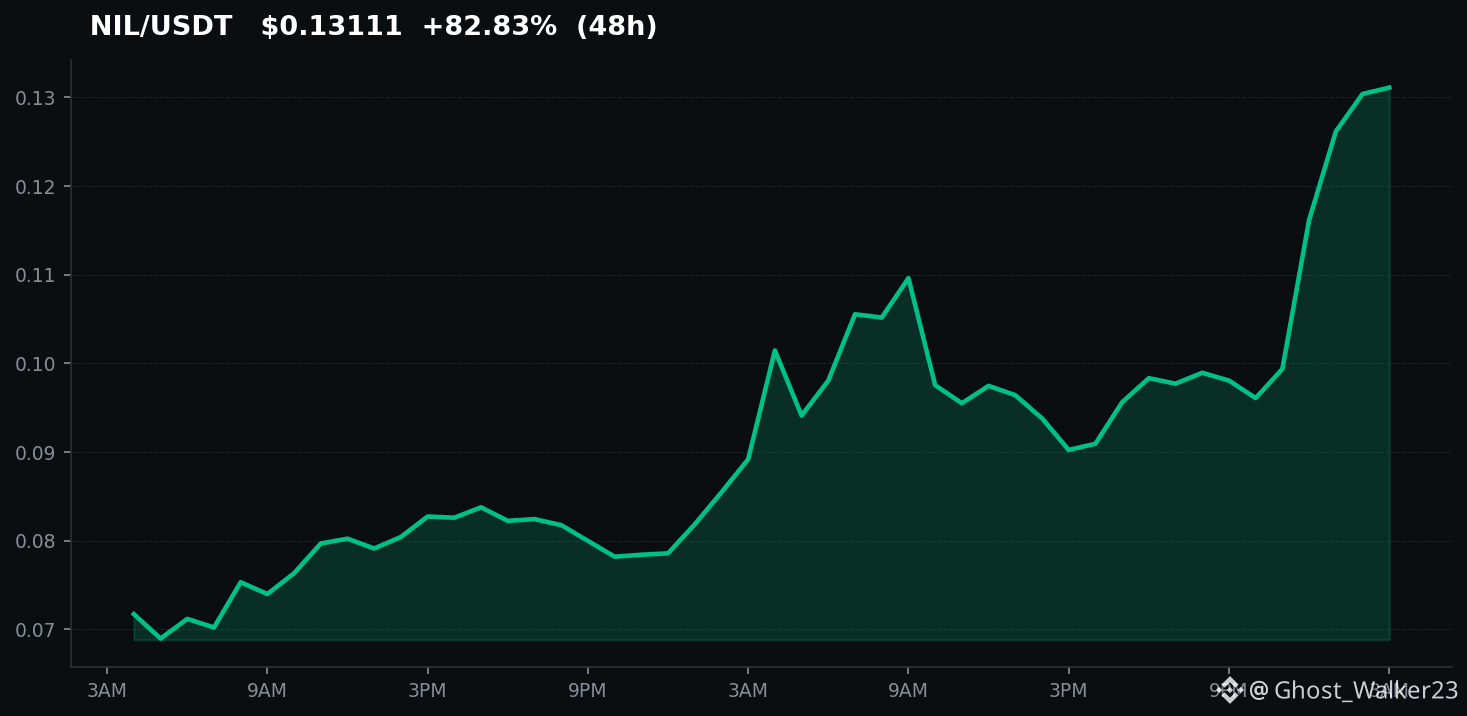
AI stocks are shaking up the market! 🚀 With Nillion (#NIL) soaring 47.3%, it’s clear that AI integration is the next frontier. Are traditional sectors ready for this disruption? What’s your take on the future of AI in investing? 🤔 #AIStocksWhatNext
$NIL
🚀 Like + Follow si quieres más contenido como este!
AI stocks are shaking up the market! 🚀 With Nillion (#NIL) soaring 47.3%, it’s clear that AI integration is the next frontier. Are traditional sectors ready for this disruption? What’s your take on the future of AI in investing? 🤔 #AIStocksWhatNext
$NIL
🚀 Like + Follow si quieres más contenido como este!
$NIL
🚀 Like + Follow si quieres más contenido como este!
174

·
--
Verified
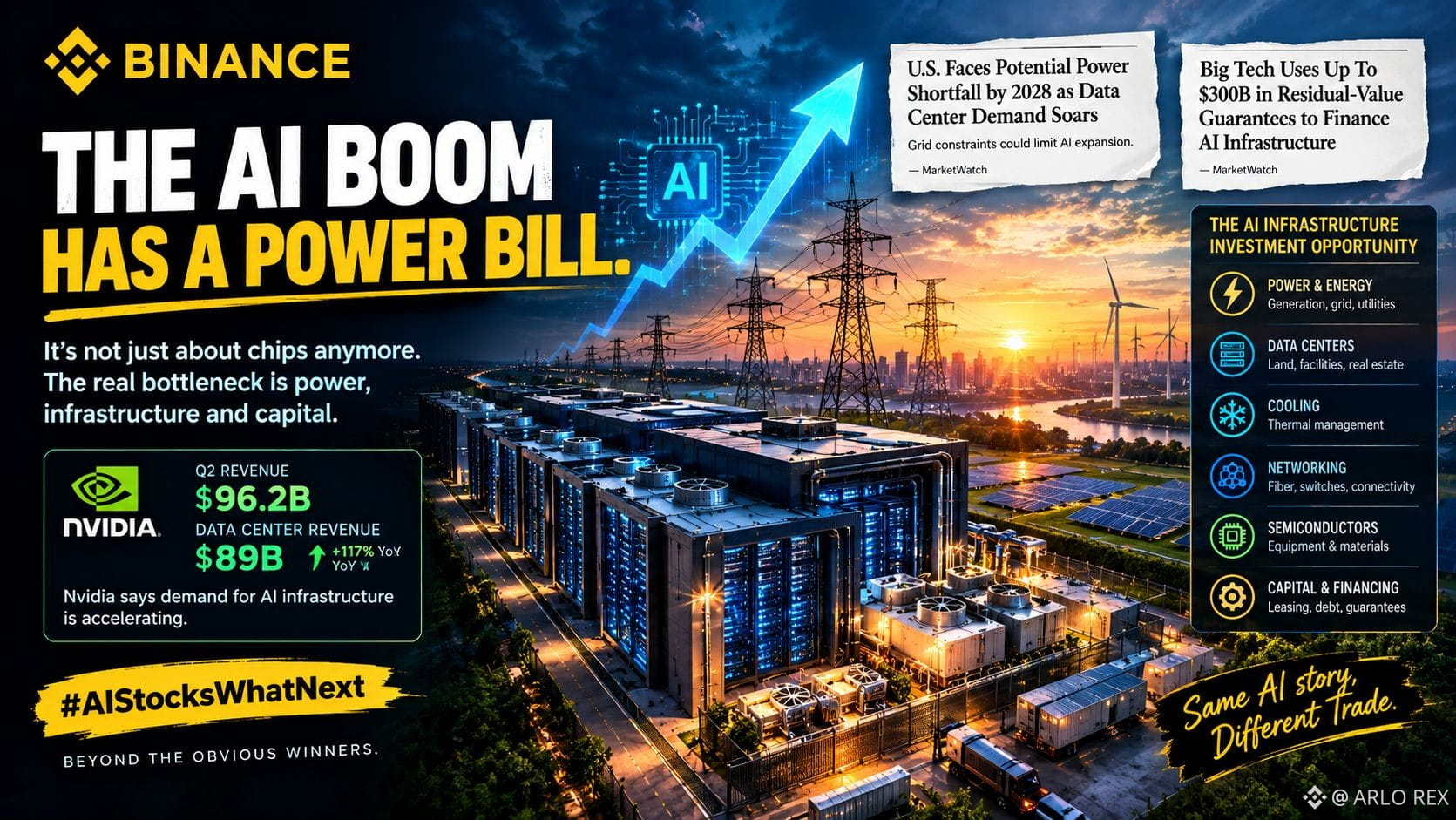
Everyone is watching the AI chip race. I’m watching what happens when the power bill arrives.
Nvidia’s numbers show why the AI boom is difficult to dismiss: its latest quarter generated $96.2B in revenue, including $89B from Data Center, up 117% year over year. Nvidia also says demand for AI infrastructure is accelerating.
But AI needs more than GPUs.
It needs electricity, data centers, cooling, networking, land — and enormous amounts of capital.
That creates a different investment question:
What happens when AI demand grows faster than the infrastructure needed to support it?
Recent estimates point to a potential U.S. power shortfall through 2028 as data-center demand keeps expanding. At the same time, Big Tech is increasingly using financing structures and residual-value guarantees to support huge AI infrastructure commitments.
That’s why I’m bullish on the AI cycle, but I’m not treating every AI stock as the same trade.
The next opportunity could be sitting one layer underneath the headline AI companies — power generation, grid equipment, cooling, networking, data-center infrastructure and the companies supplying the physical backbone.
Trump’s proposed “AI Force” and his claim that AI could eventually reach 25% of U.S. GDP add another layer: AI is increasingly being treated as strategic infrastructure, not simply another technology trend.
My thesis is simple: don’t just follow the AI models. Follow the bottlenecks they create.
I’m sharing my AI-related trade/holding through the Binance Trade Sharing Widget.
#AIStocksWhatNext
$TAKE $SAGA $NVDAB
Everyone is watching the AI chip race. I’m watching what happens when the power bill arrives.
Nvidia’s numbers show why the AI boom is difficult to dismiss: its latest quarter generated $96.2B in revenue, including $89B from Data Center, up 117% year over year. Nvidia also says demand for AI infrastructure is accelerating.
But AI needs more than GPUs.
It needs electricity, data centers, cooling, networking, land — and enormous amounts of capital.
That creates a different investment question:
What happens when AI demand grows faster than the infrastructure needed to support it?
Recent estimates point to a potential U.S. power shortfall through 2028 as data-center demand keeps expanding. At the same time, Big Tech is increasingly using financing structures and residual-value guarantees to support huge AI infrastructure commitments.
That’s why I’m bullish on the AI cycle, but I’m not treating every AI stock as the same trade.
The next opportunity could be sitting one layer underneath the headline AI companies — power generation, grid equipment, cooling, networking, data-center infrastructure and the companies supplying the physical backbone.
Trump’s proposed “AI Force” and his claim that AI could eventually reach 25% of U.S. GDP add another layer: AI is increasingly being treated as strategic infrastructure, not simply another technology trend.
My thesis is simple: don’t just follow the AI models. Follow the bottlenecks they create.
I’m sharing my AI-related trade/holding through the Binance Trade Sharing Widget.
#AIStocksWhatNext
$TAKE $SAGA $NVDAB
Nvidia’s numbers show why the AI boom is difficult to dismiss: its latest quarter generated $96.2B in revenue, including $89B from Data Center, up 117% year over year. Nvidia also says demand for AI infrastructure is accelerating.
But AI needs more than GPUs.
It needs electricity, data centers, cooling, networking, land — and enormous amounts of capital.
That creates a different investment question:
What happens when AI demand grows faster than the infrastructure needed to support it?
Recent estimates point to a potential U.S. power shortfall through 2028 as data-center demand keeps expanding. At the same time, Big Tech is increasingly using financing structures and residual-value guarantees to support huge AI infrastructure commitments.
That’s why I’m bullish on the AI cycle, but I’m not treating every AI stock as the same trade.
The next opportunity could be sitting one layer underneath the headline AI companies — power generation, grid equipment, cooling, networking, data-center infrastructure and the companies supplying the physical backbone.
Trump’s proposed “AI Force” and his claim that AI could eventually reach 25% of U.S. GDP add another layer: AI is increasingly being treated as strategic infrastructure, not simply another technology trend.
My thesis is simple: don’t just follow the AI models. Follow the bottlenecks they create.
I’m sharing my AI-related trade/holding through the Binance Trade Sharing Widget.
#AIStocksWhatNext
$TAKE $SAGA $NVDAB
ZENOVA BULL:
This is the part of the AI story that gets overlooked: every new data center creates demand far beyond semiconductors.
9
1
4
518

·
--
Bullish
Verified
AI STOCKS ARE RISING — BUT IS THIS JUST THE BEGINNING?
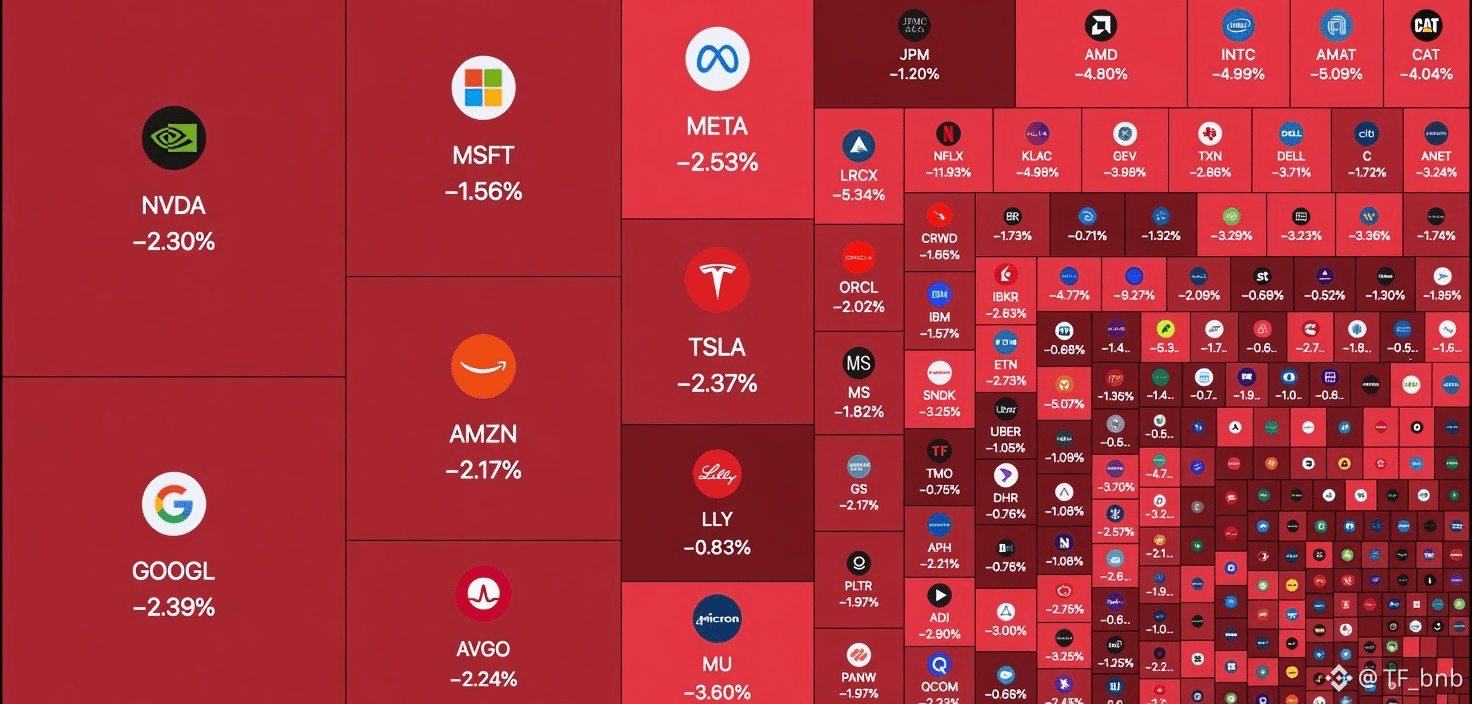
Nvidia expects chip demand to keep growing, while major AI companies continue reporting record revenue. But behind those numbers is an even bigger story: the massive amount of money being spent on computing power, data centers and AI infrastructure.
The real question is not whether AI is growing. It clearly is.
The question is: HOW LONG CAN THIS GROWTH LAST?
I’m bullish on the long-term AI trend, but I’m more cautious about chasing every AI stock after a major rally. Strong revenue growth does not automatically mean every valuation is sustainable.
At the same time, governments are increasingly treating AI as strategic infrastructure. The U.S. is discussing large-scale AI initiatives and even the possibility that AI could eventually represent a significant share of GDP.
That could create another powerful demand cycle for chips, cloud infrastructure, energy and AI software.
For me, the next opportunity may not simply be “buy AI stocks.”
I’m watching the companies supplying the infrastructure behind the AI boom.
Are you bullish or bearish on AI stocks from here?
#AIStocksWhatNext
AI STOCKS ARE RISING — BUT IS THIS JUST THE BEGINNING?
Nvidia expects chip demand to keep growing, while major AI companies continue reporting record revenue. But behind those numbers is an even bigger story: the massive amount of money being spent on computing power, data centers and AI infrastructure.
The real question is not whether AI is growing. It clearly is.
The question is: HOW LONG CAN THIS GROWTH LAST?
I’m bullish on the long-term AI trend, but I’m more cautious about chasing every AI stock after a major rally. Strong revenue growth does not automatically mean every valuation is sustainable.
At the same time, governments are increasingly treating AI as strategic infrastructure. The U.S. is discussing large-scale AI initiatives and even the possibility that AI could eventually represent a significant share of GDP.
That could create another powerful demand cycle for chips, cloud infrastructure, energy and AI software.
For me, the next opportunity may not simply be “buy AI stocks.”
I’m watching the companies supplying the infrastructure behind the AI boom.
Are you bullish or bearish on AI stocks from here?
#AIStocksWhatNext
Nvidia expects chip demand to keep growing, while major AI companies continue reporting record revenue. But behind those numbers is an even bigger story: the massive amount of money being spent on computing power, data centers and AI infrastructure.
The real question is not whether AI is growing. It clearly is.
The question is: HOW LONG CAN THIS GROWTH LAST?
I’m bullish on the long-term AI trend, but I’m more cautious about chasing every AI stock after a major rally. Strong revenue growth does not automatically mean every valuation is sustainable.
At the same time, governments are increasingly treating AI as strategic infrastructure. The U.S. is discussing large-scale AI initiatives and even the possibility that AI could eventually represent a significant share of GDP.
That could create another powerful demand cycle for chips, cloud infrastructure, energy and AI software.
For me, the next opportunity may not simply be “buy AI stocks.”
I’m watching the companies supplying the infrastructure behind the AI boom.
Are you bullish or bearish on AI stocks from here?
#AIStocksWhatNext
6
1.5k

·
--

Article
AI IS THE FUTURE !!#aistockswhatnext
$NVDAB $GOOGLB $MSFTB
The AI trade has already created some of the biggest moves in the market. But the interesting question now isn’t “Is AI the future?”
It’s:
What happens after the first AI boom?
From my perspective, the next phase could be less about hype and more about who actually makes money from the AI infrastructure being built today.
⚡ 1. AI Chips Could Remain the Battlefield
Every powerful AI model needs enormous computing resources.
That keeps attention on companies involved in GPUs, accelerators, networking and advanced semiconductor manufacturing.
But the market may increasingly separate companies that are simply benefiting from AI enthusiasm from those generating sustainable revenue from AI demand.
⚡ 2. Data Centers Could Become the New AI Infrastructure Trade
AI doesn't run in the cloud by magic.
It needs:
🔹 Massive data centers
🔹 Electricity
🔹 Cooling systems
🔹 Networking equipment
🔹 Storage
🔹 High-speed connectivity
This creates a second layer of the AI economy.
The companies supplying the physical infrastructure behind AI could become increasingly important as computing demand grows.
⚡ 3. Electricity May Become One of the Biggest AI Stories
Here is the part many investors overlook.
More AI → more computing → more data centers → more electricity demand.
That potentially puts utilities, grid infrastructure, power equipment, nuclear energy and other energy-related technologies directly into the AI conversation.
AI may ultimately become not only a technology story, but an energy story.
⚡ 4. The Next Winners May Come From AI Adoption
The first wave focused heavily on companies building AI.
The next wave could increasingly focus on companies using AI to improve their businesses.
Think:
🤖 Automation
💻 Software
🏦 Financial services
🏭 Manufacturing
🚚 Logistics
🛒 Retail
🏥 Healthcare
The real question becomes:
Can AI increase revenue, reduce costs or dramatically improve productivity?
If the answer is yes, companies adopting AI could potentially gain a meaningful competitive advantage.
⚠️ But There Is One Major Risk
AI stocks have already attracted enormous expectations.
And expectations matter.
A company can report strong growth and still see its stock fall if investors expected something even bigger.
That means the AI market could become increasingly sensitive to:
📊 Earnings
📈 Revenue growth
💰 AI-related spending
🏗️ Capital expenditure
⚡ Energy costs
🌐 Global demand
The next phase may therefore be much more selective than the first.
🔥 MY TAKE
I don't think the AI story is finished.
I think the AI story is changing.
The market could gradually move from:
“Who has AI?”
to:
“Who can monetize AI?”
And eventually:
“Who can build a sustainable business because of AI?”
That transition could create completely different market leaders.
For traders and investors watching this sector, I believe the biggest opportunity may not always be chasing the loudest AI headline.
Sometimes the more interesting trade is hiding one layer underneath the obvious winner.
AI isn't just a chatbot.
It's chips.
It's data centers.
It's electricity.
It's networking.
It's software.
It's automation.
And potentially, it's an entirely new industrial infrastructure cycle.
The first AI wave showed us what is possible.
The next wave could show us who actually captures the value. 👀🤖📈
AI IS THE FUTURE !!
#aistockswhatnext
$NVDAB $GOOGLB $MSFTB
The AI trade has already created some of the biggest moves in the market. But the interesting question now isn’t “Is AI the future?”
It’s:
What happens after the first AI boom?
From my perspective, the next phase could be less about hype and more about who actually makes money from the AI infrastructure being built today.
⚡ 1. AI Chips Could Remain the Battlefield
Every powerful AI model needs enormous computing resources.
That keeps attention on companies involved in GPUs, accelerators, networking and advanced semiconductor manufacturing.
But the market may increasingly separate companies that are simply benefiting from AI enthusiasm from those generating sustainable revenue from AI demand.
⚡ 2. Data Centers Could Become the New AI Infrastructure Trade
AI doesn't run in the cloud by magic.
It needs:
🔹 Massive data centers
🔹 Electricity
🔹 Cooling systems
🔹 Networking equipment
🔹 Storage
🔹 High-speed connectivity
This creates a second layer of the AI economy.
The companies supplying the physical infrastructure behind AI could become increasingly important as computing demand grows.
⚡ 3. Electricity May Become One of the Biggest AI Stories
Here is the part many investors overlook.
More AI → more computing → more data centers → more electricity demand.
That potentially puts utilities, grid infrastructure, power equipment, nuclear energy and other energy-related technologies directly into the AI conversation.
AI may ultimately become not only a technology story, but an energy story.
⚡ 4. The Next Winners May Come From AI Adoption
The first wave focused heavily on companies building AI.
The next wave could increasingly focus on companies using AI to improve their businesses.
Think:
🤖 Automation
💻 Software
🏦 Financial services
🏭 Manufacturing
🚚 Logistics
🛒 Retail
🏥 Healthcare
The real question becomes:
Can AI increase revenue, reduce costs or dramatically improve productivity?
If the answer is yes, companies adopting AI could potentially gain a meaningful competitive advantage.
⚠️ But There Is One Major Risk
AI stocks have already attracted enormous expectations.
And expectations matter.
A company can report strong growth and still see its stock fall if investors expected something even bigger.
That means the AI market could become increasingly sensitive to:
📊 Earnings
📈 Revenue growth
💰 AI-related spending
🏗️ Capital expenditure
⚡ Energy costs
🌐 Global demand
The next phase may therefore be much more selective than the first.
🔥 MY TAKE
I don't think the AI story is finished.
I think the AI story is changing.
The market could gradually move from:
“Who has AI?”
to:
“Who can monetize AI?”
And eventually:
“Who can build a sustainable business because of AI?”
That transition could create completely different market leaders.
For traders and investors watching this sector, I believe the biggest opportunity may not always be chasing the loudest AI headline.
Sometimes the more interesting trade is hiding one layer underneath the obvious winner.
AI isn't just a chatbot.
It's chips.
It's data centers.
It's electricity.
It's networking.
It's software.
It's automation.
And potentially, it's an entirely new industrial infrastructure cycle.
The first AI wave showed us what is possible.
The next wave could show us who actually captures the value. 👀🤖📈
$NVDAB $GOOGLB $MSFTB
The AI trade has already created some of the biggest moves in the market. But the interesting question now isn’t “Is AI the future?”
It’s:
What happens after the first AI boom?
From my perspective, the next phase could be less about hype and more about who actually makes money from the AI infrastructure being built today.
⚡ 1. AI Chips Could Remain the Battlefield
Every powerful AI model needs enormous computing resources.
That keeps attention on companies involved in GPUs, accelerators, networking and advanced semiconductor manufacturing.
But the market may increasingly separate companies that are simply benefiting from AI enthusiasm from those generating sustainable revenue from AI demand.
⚡ 2. Data Centers Could Become the New AI Infrastructure Trade
AI doesn't run in the cloud by magic.
It needs:
🔹 Massive data centers
🔹 Electricity
🔹 Cooling systems
🔹 Networking equipment
🔹 Storage
🔹 High-speed connectivity
This creates a second layer of the AI economy.
The companies supplying the physical infrastructure behind AI could become increasingly important as computing demand grows.
⚡ 3. Electricity May Become One of the Biggest AI Stories
Here is the part many investors overlook.
More AI → more computing → more data centers → more electricity demand.
That potentially puts utilities, grid infrastructure, power equipment, nuclear energy and other energy-related technologies directly into the AI conversation.
AI may ultimately become not only a technology story, but an energy story.
⚡ 4. The Next Winners May Come From AI Adoption
The first wave focused heavily on companies building AI.
The next wave could increasingly focus on companies using AI to improve their businesses.
Think:
🤖 Automation
💻 Software
🏦 Financial services
🏭 Manufacturing
🚚 Logistics
🛒 Retail
🏥 Healthcare
The real question becomes:
Can AI increase revenue, reduce costs or dramatically improve productivity?
If the answer is yes, companies adopting AI could potentially gain a meaningful competitive advantage.
⚠️ But There Is One Major Risk
AI stocks have already attracted enormous expectations.
And expectations matter.
A company can report strong growth and still see its stock fall if investors expected something even bigger.
That means the AI market could become increasingly sensitive to:
📊 Earnings
📈 Revenue growth
💰 AI-related spending
🏗️ Capital expenditure
⚡ Energy costs
🌐 Global demand
The next phase may therefore be much more selective than the first.
🔥 MY TAKE
I don't think the AI story is finished.
I think the AI story is changing.
The market could gradually move from:
“Who has AI?”
to:
“Who can monetize AI?”
And eventually:
“Who can build a sustainable business because of AI?”
That transition could create completely different market leaders.
For traders and investors watching this sector, I believe the biggest opportunity may not always be chasing the loudest AI headline.
Sometimes the more interesting trade is hiding one layer underneath the obvious winner.
AI isn't just a chatbot.
It's chips.
It's data centers.
It's electricity.
It's networking.
It's software.
It's automation.
And potentially, it's an entirely new industrial infrastructure cycle.
The first AI wave showed us what is possible.
The next wave could show us who actually captures the value. 👀🤖📈
12

Article
THE BIGGER PICTURE AI Stocks What Next?#AIStocksWhatNext
@PositiveMindsGlobalResults | September 24, 2026
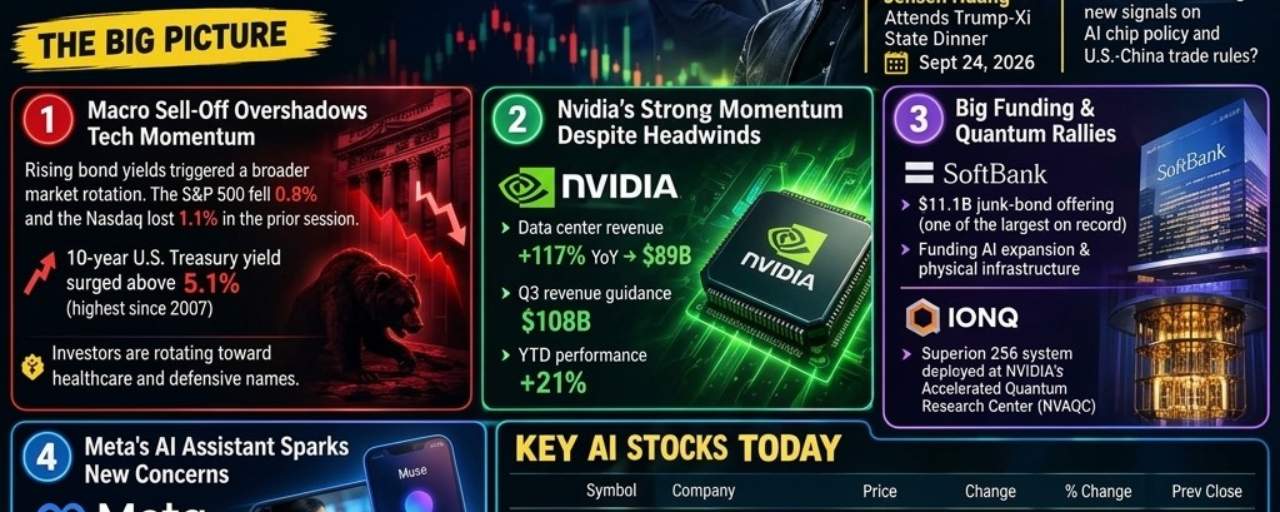
🚀 NVIDIA: AI DEMAND MEETS GEOPOLITICS
NVIDIA remains at the heart of the global AI infrastructure race.
Its data-center revenue recently surged 117% year over year to $89 billion, while management’s Q3 revenue guidance reached approximately $108 billion.
Meanwhile, CEO Jensen Huang is expected to attend the White House state dinner involving US President and Chinese President
For semiconductor investors, the bigger issue is what future U.S.-China discussions could mean for AI-chip exports, technology restrictions and access to the Chinese market.
🇺🇸🇨🇳 Washington and Beijing have also reportedly agreed to extend their trade truce until January 10, adding another important variable to the AI-chip outlook.
🔥 THE BIGGER PICTURE
AI is no longer simply a semiconductor story.
It is becoming a capital story, bond-market story, geopolitical story, infrastructure story and software story — all at the same time.
The next phase could place greater emphasis on companies demonstrating real AI revenue, infrastructure demand and sustainable monetization, rather than AI expectations alone.
⚠️ Strong AI growth does not mean every AI-related stock will perform the same way. Market conditions, valuations, interest rates, regulation and execution can produce very different outcomes across companies.
💬 THE BIG QUESTION
Will AI continue its expansion, enter a period of consolidation, or shift toward companies proving stronger real-world AI monetization?
What’s your view? Share your analysis below. 👇
#AI #ArtificialIntelligence #NVIDIA #NVDA #Meta #META #Microsoft #MSFT #IonQ #IONQ #QuantumComputing #AIStocks #Semiconductors #Nasdaq #WallStreet #StockMarket #TechStocks #Investing #AIInfrastructure #PositiveMindsGlobalResults
$BNB
{spot}(BNBUSDT)
{spot}(BTCUSDT)
THE BIGGER PICTURE AI Stocks What Next?
#AIStocksWhatNext
@PositiveMindsGlobalResults | September 24, 2026
🚀 NVIDIA: AI DEMAND MEETS GEOPOLITICS
NVIDIA remains at the heart of the global AI infrastructure race.
Its data-center revenue recently surged 117% year over year to $89 billion, while management’s Q3 revenue guidance reached approximately $108 billion.
Meanwhile, CEO Jensen Huang is expected to attend the White House state dinner involving US President and Chinese President
For semiconductor investors, the bigger issue is what future U.S.-China discussions could mean for AI-chip exports, technology restrictions and access to the Chinese market.
🇺🇸🇨🇳 Washington and Beijing have also reportedly agreed to extend their trade truce until January 10, adding another important variable to the AI-chip outlook.
🔥 THE BIGGER PICTURE
AI is no longer simply a semiconductor story.
It is becoming a capital story, bond-market story, geopolitical story, infrastructure story and software story — all at the same time.
The next phase could place greater emphasis on companies demonstrating real AI revenue, infrastructure demand and sustainable monetization, rather than AI expectations alone.
⚠️ Strong AI growth does not mean every AI-related stock will perform the same way. Market conditions, valuations, interest rates, regulation and execution can produce very different outcomes across companies.
💬 THE BIG QUESTION
Will AI continue its expansion, enter a period of consolidation, or shift toward companies proving stronger real-world AI monetization?
What’s your view? Share your analysis below. 👇
#AI #ArtificialIntelligence #NVIDIA #NVDA #Meta #META #Microsoft #MSFT #IonQ #IONQ #QuantumComputing #AIStocks #Semiconductors #Nasdaq #WallStreet #StockMarket #TechStocks #Investing #AIInfrastructure #PositiveMindsGlobalResults
$BNB
@PositiveMindsGlobalResults | September 24, 2026
🚀 NVIDIA: AI DEMAND MEETS GEOPOLITICS
NVIDIA remains at the heart of the global AI infrastructure race.
Its data-center revenue recently surged 117% year over year to $89 billion, while management’s Q3 revenue guidance reached approximately $108 billion.
Meanwhile, CEO Jensen Huang is expected to attend the White House state dinner involving US President and Chinese President
For semiconductor investors, the bigger issue is what future U.S.-China discussions could mean for AI-chip exports, technology restrictions and access to the Chinese market.
🇺🇸🇨🇳 Washington and Beijing have also reportedly agreed to extend their trade truce until January 10, adding another important variable to the AI-chip outlook.
🔥 THE BIGGER PICTURE
AI is no longer simply a semiconductor story.
It is becoming a capital story, bond-market story, geopolitical story, infrastructure story and software story — all at the same time.
The next phase could place greater emphasis on companies demonstrating real AI revenue, infrastructure demand and sustainable monetization, rather than AI expectations alone.
⚠️ Strong AI growth does not mean every AI-related stock will perform the same way. Market conditions, valuations, interest rates, regulation and execution can produce very different outcomes across companies.
💬 THE BIG QUESTION
Will AI continue its expansion, enter a period of consolidation, or shift toward companies proving stronger real-world AI monetization?
What’s your view? Share your analysis below. 👇
#AI #ArtificialIntelligence #NVIDIA #NVDA #Meta #META #Microsoft #MSFT #IonQ #IONQ #QuantumComputing #AIStocks #Semiconductors #Nasdaq #WallStreet #StockMarket #TechStocks #Investing #AIInfrastructure #PositiveMindsGlobalResults
$BNB
29
Article
AI STOCKS AT A CROSSROADS#AIStocksWhatNext
@PositiveMindsGlobalResults | September 24, 2026
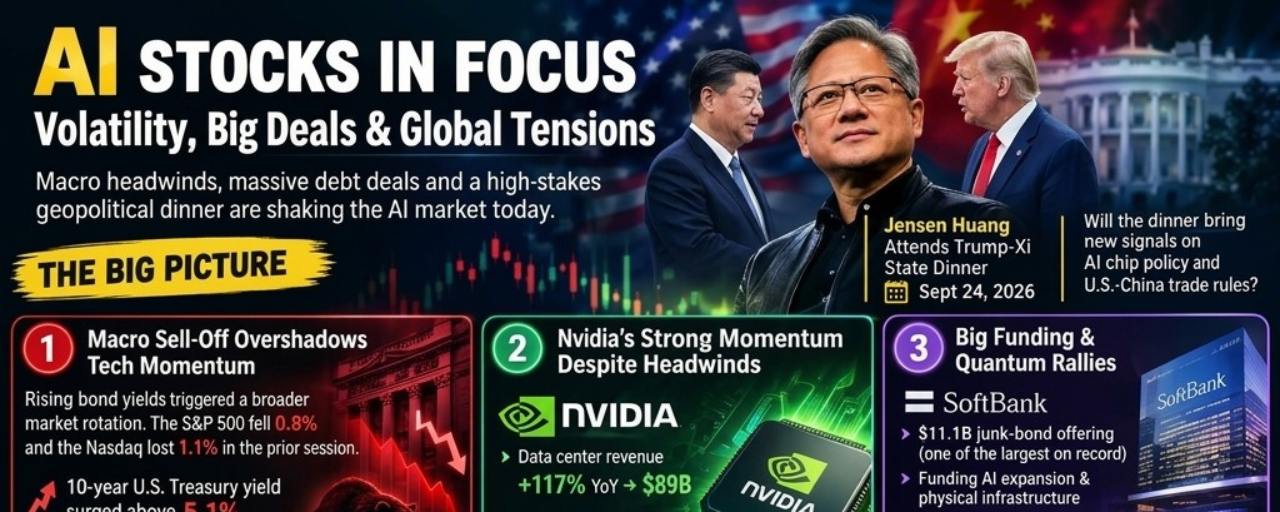
The AI market is entering a more complex phase. Strong technology demand remains intact, but rising bond yields, massive capital commitments, geopolitical tensions and the rapid development of AI agents are creating a much more volatile investment landscape.
📉 1️⃣ BOND YIELDS CHALLENGE AI VALUATIONS
Wall Street came under pressure as the S&P 500 fell 0.8% and the Nasdaq declined 1.1% in the previous session.
The 10-year U.S. Treasury yield moved above 5.1%, increasing pressure on high-growth technology stocks. Higher yields can make future corporate earnings less attractive in present-value terms and encourage investors to reassess elevated valuations.
🚀 2️⃣ NVIDIA: AI DEMAND MEETS GEOPOLITICS
NVIDIA remains at the heart of the global AI infrastructure race.
Its data-center revenue recently surged 117% year over year to $89 billion, while management’s Q3 revenue guidance reached approximately $108 billion.
Meanwhile, CEO Jensen Huang is expected to attend the White House state dinner involving US President Donald Trump and Chinese President.
For semiconductor investors, the bigger issue is what future U.S.-China discussions could mean for AI-chip exports, technology restrictions and access to the Chinese market.
🇺🇸🇨🇳 Washington and Beijing have also reportedly agreed to extend their trade truce until January 10, adding another important variable to the AI-chip outlook.
💰 3️⃣ AI IS BECOMING A DEBT STORY
SoftBank is pursuing more than $11 billion in high-yield debt, with financing linked to its aggressive AI investment strategy, including its OpenAI exposure.
The scale of this financing highlights an important development: the AI boom is no longer being funded only through operating cash flow and equity markets. Debt is increasingly becoming part of the infrastructure race.
⚛️ 4️⃣ AI + QUANTUM: A NEW COMPUTING FRONTIER
IonQ announced plans to deploy its Superion 256 system at NVIDIA’s Accelerated Quantum Research Center in 2027.
The planned integration of quantum computing with accelerated computing infrastructure highlights a potentially important long-term trend: future computing systems could combine GPUs, AI accelerators and quantum processors for specialized workloads.
🧠 5️⃣ META’S MUSE AND THE SOFTWARE DISRUPTION
Meta’s AI assistant Muse is gaining significant consumer attention while expanding AI capabilities across areas such as shopping, travel and communications.
That raises a major question for the software and services economy:
If AI agents become the new interface between consumers and businesses, who controls the transaction?
The answer could influence everything from advertising and search to travel, commerce and digital marketplaces.
🔥 THE BIGGER PICTURE
AI is no longer simply a semiconductor story.
It is becoming a capital story, bond-market story, geopolitical story, infrastructure story and software story — all at the same time.
The next phase could place greater emphasis on companies demonstrating real AI revenue, infrastructure demand and sustainable monetization, rather than AI expectations alone.
⚠️ Strong AI growth does not mean every AI-related stock will perform the same way. Market conditions, valuations, interest rates, regulation and execution can produce very different outcomes across companies.
💬 THE BIG QUESTION
Will AI continue its expansion, enter a period of consolidation, or shift toward companies proving stronger real-world AI monetization?
What’s your view? Share your analysis below. 👇
#AI #ArtificialIntelligence #NVIDIA #NVDA #Meta #META #Microsoft #MSFT #IonQ #IONQ #QuantumComputing #AIStocks #Semiconductors #Nasdaq #WallStreet #StockMarket #TechStocks #Investing #AIInfrastructure #PositiveMindsGlobalResults
{spot}(BNBUSDT)
{spot}(BTCUSDT)
AI STOCKS AT A CROSSROADS
#AIStocksWhatNext
@PositiveMindsGlobalResults | September 24, 2026
The AI market is entering a more complex phase. Strong technology demand remains intact, but rising bond yields, massive capital commitments, geopolitical tensions and the rapid development of AI agents are creating a much more volatile investment landscape.
📉 1️⃣ BOND YIELDS CHALLENGE AI VALUATIONS
Wall Street came under pressure as the S&P 500 fell 0.8% and the Nasdaq declined 1.1% in the previous session.
The 10-year U.S. Treasury yield moved above 5.1%, increasing pressure on high-growth technology stocks. Higher yields can make future corporate earnings less attractive in present-value terms and encourage investors to reassess elevated valuations.
🚀 2️⃣ NVIDIA: AI DEMAND MEETS GEOPOLITICS
NVIDIA remains at the heart of the global AI infrastructure race.
Its data-center revenue recently surged 117% year over year to $89 billion, while management’s Q3 revenue guidance reached approximately $108 billion.
Meanwhile, CEO Jensen Huang is expected to attend the White House state dinner involving US President Donald Trump and Chinese President.
For semiconductor investors, the bigger issue is what future U.S.-China discussions could mean for AI-chip exports, technology restrictions and access to the Chinese market.
🇺🇸🇨🇳 Washington and Beijing have also reportedly agreed to extend their trade truce until January 10, adding another important variable to the AI-chip outlook.
💰 3️⃣ AI IS BECOMING A DEBT STORY
SoftBank is pursuing more than $11 billion in high-yield debt, with financing linked to its aggressive AI investment strategy, including its OpenAI exposure.
The scale of this financing highlights an important development: the AI boom is no longer being funded only through operating cash flow and equity markets. Debt is increasingly becoming part of the infrastructure race.
⚛️ 4️⃣ AI + QUANTUM: A NEW COMPUTING FRONTIER
IonQ announced plans to deploy its Superion 256 system at NVIDIA’s Accelerated Quantum Research Center in 2027.
The planned integration of quantum computing with accelerated computing infrastructure highlights a potentially important long-term trend: future computing systems could combine GPUs, AI accelerators and quantum processors for specialized workloads.
🧠 5️⃣ META’S MUSE AND THE SOFTWARE DISRUPTION
Meta’s AI assistant Muse is gaining significant consumer attention while expanding AI capabilities across areas such as shopping, travel and communications.
That raises a major question for the software and services economy:
If AI agents become the new interface between consumers and businesses, who controls the transaction?
The answer could influence everything from advertising and search to travel, commerce and digital marketplaces.
🔥 THE BIGGER PICTURE
AI is no longer simply a semiconductor story.
It is becoming a capital story, bond-market story, geopolitical story, infrastructure story and software story — all at the same time.
The next phase could place greater emphasis on companies demonstrating real AI revenue, infrastructure demand and sustainable monetization, rather than AI expectations alone.
⚠️ Strong AI growth does not mean every AI-related stock will perform the same way. Market conditions, valuations, interest rates, regulation and execution can produce very different outcomes across companies.
💬 THE BIG QUESTION
Will AI continue its expansion, enter a period of consolidation, or shift toward companies proving stronger real-world AI monetization?
What’s your view? Share your analysis below. 👇
#AI #ArtificialIntelligence #NVIDIA #NVDA #Meta #META #Microsoft #MSFT #IonQ #IONQ #QuantumComputing #AIStocks #Semiconductors #Nasdaq #WallStreet #StockMarket #TechStocks #Investing #AIInfrastructure #PositiveMindsGlobalResults
@PositiveMindsGlobalResults | September 24, 2026
The AI market is entering a more complex phase. Strong technology demand remains intact, but rising bond yields, massive capital commitments, geopolitical tensions and the rapid development of AI agents are creating a much more volatile investment landscape.
📉 1️⃣ BOND YIELDS CHALLENGE AI VALUATIONS
Wall Street came under pressure as the S&P 500 fell 0.8% and the Nasdaq declined 1.1% in the previous session.
The 10-year U.S. Treasury yield moved above 5.1%, increasing pressure on high-growth technology stocks. Higher yields can make future corporate earnings less attractive in present-value terms and encourage investors to reassess elevated valuations.
🚀 2️⃣ NVIDIA: AI DEMAND MEETS GEOPOLITICS
NVIDIA remains at the heart of the global AI infrastructure race.
Its data-center revenue recently surged 117% year over year to $89 billion, while management’s Q3 revenue guidance reached approximately $108 billion.
Meanwhile, CEO Jensen Huang is expected to attend the White House state dinner involving US President Donald Trump and Chinese President.
For semiconductor investors, the bigger issue is what future U.S.-China discussions could mean for AI-chip exports, technology restrictions and access to the Chinese market.
🇺🇸🇨🇳 Washington and Beijing have also reportedly agreed to extend their trade truce until January 10, adding another important variable to the AI-chip outlook.
💰 3️⃣ AI IS BECOMING A DEBT STORY
SoftBank is pursuing more than $11 billion in high-yield debt, with financing linked to its aggressive AI investment strategy, including its OpenAI exposure.
The scale of this financing highlights an important development: the AI boom is no longer being funded only through operating cash flow and equity markets. Debt is increasingly becoming part of the infrastructure race.
⚛️ 4️⃣ AI + QUANTUM: A NEW COMPUTING FRONTIER
IonQ announced plans to deploy its Superion 256 system at NVIDIA’s Accelerated Quantum Research Center in 2027.
The planned integration of quantum computing with accelerated computing infrastructure highlights a potentially important long-term trend: future computing systems could combine GPUs, AI accelerators and quantum processors for specialized workloads.
🧠 5️⃣ META’S MUSE AND THE SOFTWARE DISRUPTION
Meta’s AI assistant Muse is gaining significant consumer attention while expanding AI capabilities across areas such as shopping, travel and communications.
That raises a major question for the software and services economy:
If AI agents become the new interface between consumers and businesses, who controls the transaction?
The answer could influence everything from advertising and search to travel, commerce and digital marketplaces.
🔥 THE BIGGER PICTURE
AI is no longer simply a semiconductor story.
It is becoming a capital story, bond-market story, geopolitical story, infrastructure story and software story — all at the same time.
The next phase could place greater emphasis on companies demonstrating real AI revenue, infrastructure demand and sustainable monetization, rather than AI expectations alone.
⚠️ Strong AI growth does not mean every AI-related stock will perform the same way. Market conditions, valuations, interest rates, regulation and execution can produce very different outcomes across companies.
💬 THE BIG QUESTION
Will AI continue its expansion, enter a period of consolidation, or shift toward companies proving stronger real-world AI monetization?
What’s your view? Share your analysis below. 👇
#AI #ArtificialIntelligence #NVIDIA #NVDA #Meta #META #Microsoft #MSFT #IonQ #IONQ #QuantumComputing #AIStocks #Semiconductors #Nasdaq #WallStreet #StockMarket #TechStocks #Investing #AIInfrastructure #PositiveMindsGlobalResults
49
·
--
Bullish
$META
{future}(METAUSDT)
META Muse has just surpassed 250 million daily active users
That is an incredible adoption curve—reportedly the fastest-growing application since OpenAI.
AI-generated content is scaling far quicker than most people realise
$META
And this could well be just the beginning for Muse
$META
#AIStocksWhatNext
$META
META Muse has just surpassed 250 million daily active users
That is an incredible adoption curve—reportedly the fastest-growing application since OpenAI.
AI-generated content is scaling far quicker than most people realise
$META
And this could well be just the beginning for Muse
$META
#AIStocksWhatNext
META Muse has just surpassed 250 million daily active users
That is an incredible adoption curve—reportedly the fastest-growing application since OpenAI.
AI-generated content is scaling far quicker than most people realise
$META
And this could well be just the beginning for Muse
$META
#AIStocksWhatNext

377

#AIStocksWhatNext 📈
AI stocks have already made a huge move, but the bigger question is: what comes next?
I’m bullish on the long-term AI story, but I’m also cautious about chasing every AI stock after a strong rally.
Nvidia and other major AI companies continue to see massive demand for computing power..That could create opportunities beyond the biggest AI names - including semiconductors.. networking, data centers.. power.. cooling.. cloud infrastructure and cybersecurity.
The real question is whether.. AI spending can continue at this pace and eventually translate into sustainable revenue and profits.
Government support and the growing focus on AI development could also influence the sector for years ahead. But higher expectations also mean higher risks if growth starts slowing.
For me, the interesting opportunity may not simply be “Which AI stock is next?”
It could be “Which companies are quietly building the infrastructure that AI needs to keep growing?” 👀
Are you bullish or bearish on AI stocks from here?
Which area are you watching next - chips, data centers, power, networking, cloud or cybersecurity?
#AIStocksWhatNext
#AIStocksWhatNext 📈
AI stocks have already made a huge move, but the bigger question is: what comes next?
I’m bullish on the long-term AI story, but I’m also cautious about chasing every AI stock after a strong rally.
Nvidia and other major AI companies continue to see massive demand for computing power..That could create opportunities beyond the biggest AI names - including semiconductors.. networking, data centers.. power.. cooling.. cloud infrastructure and cybersecurity.
The real question is whether.. AI spending can continue at this pace and eventually translate into sustainable revenue and profits.
Government support and the growing focus on AI development could also influence the sector for years ahead. But higher expectations also mean higher risks if growth starts slowing.
For me, the interesting opportunity may not simply be “Which AI stock is next?”
It could be “Which companies are quietly building the infrastructure that AI needs to keep growing?” 👀
Are you bullish or bearish on AI stocks from here?
Which area are you watching next - chips, data centers, power, networking, cloud or cybersecurity?
#AIStocksWhatNext
AI stocks have already made a huge move, but the bigger question is: what comes next?
I’m bullish on the long-term AI story, but I’m also cautious about chasing every AI stock after a strong rally.
Nvidia and other major AI companies continue to see massive demand for computing power..That could create opportunities beyond the biggest AI names - including semiconductors.. networking, data centers.. power.. cooling.. cloud infrastructure and cybersecurity.
The real question is whether.. AI spending can continue at this pace and eventually translate into sustainable revenue and profits.
Government support and the growing focus on AI development could also influence the sector for years ahead. But higher expectations also mean higher risks if growth starts slowing.
For me, the interesting opportunity may not simply be “Which AI stock is next?”
It could be “Which companies are quietly building the infrastructure that AI needs to keep growing?” 👀
Are you bullish or bearish on AI stocks from here?
Which area are you watching next - chips, data centers, power, networking, cloud or cybersecurity?
#AIStocksWhatNext

199

Follow ❤️ Like 🔄 Share
Claim your lucky red packet before it’s gone! 🍀
#AIStocksWhatNext
AI stocks have delivered incredible growth, but I think the next opportunity is not only in chip makers. The AI boom also benefits cloud computing, data centers, cybersecurity, power infrastructure, and selected AI-related crypto projects that provide real utility.
My approach is simple: stay diversified instead of chasing every rally. I prefer building positions gradually, keeping some cash or stablecoins for future opportunities, and focusing on long-term trends rather than hype. AI may continue growing, but disciplined risk management matters more than FOMO.
What sector do you think benefits most after AI chips—cloud, energy, cybersecurity, or AI crypto?
#AIStocksWhatNext #NVIDIA #AI #BinanceSquare
$NVDAB $AI $TAO
Follow ❤️ Like 🔄 Share
Claim your lucky red packet before it’s gone! 🍀
{spot}(TAOUSDT)
{spot}(AIUSDT)
{spot}(NVDABUSDT)
Follow ❤️ Like 🔄 Share
Claim your lucky red packet before it’s gone! 🍀
#AIStocksWhatNext
AI stocks have delivered incredible growth, but I think the next opportunity is not only in chip makers. The AI boom also benefits cloud computing, data centers, cybersecurity, power infrastructure, and selected AI-related crypto projects that provide real utility.
My approach is simple: stay diversified instead of chasing every rally. I prefer building positions gradually, keeping some cash or stablecoins for future opportunities, and focusing on long-term trends rather than hype. AI may continue growing, but disciplined risk management matters more than FOMO.
What sector do you think benefits most after AI chips—cloud, energy, cybersecurity, or AI crypto?
#AIStocksWhatNext #NVIDIA #AI #BinanceSquare
$NVDAB $AI $TAO
Follow ❤️ Like 🔄 Share
Claim your lucky red packet before it’s gone! 🍀
Claim your lucky red packet before it’s gone! 🍀
#AIStocksWhatNext
AI stocks have delivered incredible growth, but I think the next opportunity is not only in chip makers. The AI boom also benefits cloud computing, data centers, cybersecurity, power infrastructure, and selected AI-related crypto projects that provide real utility.
My approach is simple: stay diversified instead of chasing every rally. I prefer building positions gradually, keeping some cash or stablecoins for future opportunities, and focusing on long-term trends rather than hype. AI may continue growing, but disciplined risk management matters more than FOMO.
What sector do you think benefits most after AI chips—cloud, energy, cybersecurity, or AI crypto?
#AIStocksWhatNext #NVIDIA #AI #BinanceSquare
$NVDAB $AI $TAO
Follow ❤️ Like 🔄 Share
Claim your lucky red packet before it’s gone! 🍀
sk akim:
tao
117
1
10
179

·
--

Article
What Other Investment Opportunities Remain as AI Stocks Keep Rising? 🤖📊The AI boom has reached a point where simply asking “Is AI the future?” may no longer be the most interesting question.
The bigger question is: how much of that future is already priced into the market?
NVIDIA has become one of the clearest examples of just how powerful the AI infrastructure cycle has become. The company has projected another huge increase in revenue, while its CEO has also discussed chip sales potentially doubling next year. Its Data Center business has already reached extraordinary levels, showing just how much money technology companies are willing to spend on computing power.
But there is another side to this story.
Building increasingly powerful AI models requires much more than GPUs. It requires data centers, electricity, cooling systems, networking equipment, memory, cloud infrastructure and enormous amounts of capital. As AI adoption expands, these supporting industries could become increasingly important parts of the story.
That makes me wonder:
Are we looking at an AI stock rally, or the beginning of a much broader infrastructure investment cycle?
At the same time, investors have to consider the possibility that expectations are moving faster than actual long-term returns. Companies can spend billions building AI infrastructure today, but the market will eventually want to know whether those investments can generate sustainable profits.
If AI continues improving productivity and creating new businesses, the current investment cycle could have much further to go. But if spending grows faster than monetization, valuations could become much more difficult to justify.
And then there is the government factor.
The U.S. government is increasingly treating AI as an important economic and strategic technology. The Trump administration has announced plans for an “AI Force,” while Trump has argued that AI could eventually represent a very large share of U.S. economic output. At the same time, some prominent technology figures have called for more caution around the speed of AI development.
That creates an interesting tension:
⚡ Innovation vs. caution
🏗️ Massive infrastructure spending vs. future profitability
🏛️Government support vs. regulation and risk
📈 Rapid growth vs. potentially high valuations
Government support can accelerate infrastructure development, research and adoption, but it does not automatically mean every AI-related company will benefit equally. The long-term economic impact of AI is also still uncertain. The U.S. Treasury has described AI investment as a significant contributor to recent economic growth while noting that the timing and scale of future productivity gains remain uncertain.
So perhaps the more interesting investment question isn't simply:
“Which AI stock should I buy?”
Maybe it's:
“What businesses will become more valuable because AI exists?”
That could lead investors to look beyond the most obvious AI names and examine the wider ecosystem — semiconductors, data centers, power generation, electricity infrastructure, networking, cybersecurity, cloud services, industrial automation and other technologies connected to the expansion of AI.
Of course, none of these sectors are guaranteed winners. Markets can move ahead of fundamentals, and even a powerful technological trend can experience corrections along the way.
For me, the most fascinating part of the AI story is not predicting whether AI stocks will go up or down next.
It's watching how an entire economic ecosystem is being rebuilt around a technology that is still evolving.
💭 What do you think?
Is the current AI boom just another market cycle, or are we witnessing the early stages of a much larger technological transformation?
Are you currently holding AI-related stocks?
Or are you looking beyond the major AI companies toward the infrastructure and industries that could benefit from the next stage of the AI revolution?
Share your AI-related trades or holdings with the Trade Sharing Widget and join the discussion.
#AI #AIStocks #NVIDIA #Stocks #Investing #Technology #ArtificialIntelligence #Semiconductors #DataCenters #MarketTrends #BinanceSquare
#AIStocksWhatNext
What Other Investment Opportunities Remain as AI Stocks Keep Rising? 🤖📊
The AI boom has reached a point where simply asking “Is AI the future?” may no longer be the most interesting question.
The bigger question is: how much of that future is already priced into the market?
NVIDIA has become one of the clearest examples of just how powerful the AI infrastructure cycle has become. The company has projected another huge increase in revenue, while its CEO has also discussed chip sales potentially doubling next year. Its Data Center business has already reached extraordinary levels, showing just how much money technology companies are willing to spend on computing power.
But there is another side to this story.
Building increasingly powerful AI models requires much more than GPUs. It requires data centers, electricity, cooling systems, networking equipment, memory, cloud infrastructure and enormous amounts of capital. As AI adoption expands, these supporting industries could become increasingly important parts of the story.
That makes me wonder:
Are we looking at an AI stock rally, or the beginning of a much broader infrastructure investment cycle?
At the same time, investors have to consider the possibility that expectations are moving faster than actual long-term returns. Companies can spend billions building AI infrastructure today, but the market will eventually want to know whether those investments can generate sustainable profits.
If AI continues improving productivity and creating new businesses, the current investment cycle could have much further to go. But if spending grows faster than monetization, valuations could become much more difficult to justify.
And then there is the government factor.
The U.S. government is increasingly treating AI as an important economic and strategic technology. The Trump administration has announced plans for an “AI Force,” while Trump has argued that AI could eventually represent a very large share of U.S. economic output. At the same time, some prominent technology figures have called for more caution around the speed of AI development.
That creates an interesting tension:
⚡ Innovation vs. caution
🏗️ Massive infrastructure spending vs. future profitability
🏛️Government support vs. regulation and risk
📈 Rapid growth vs. potentially high valuations
Government support can accelerate infrastructure development, research and adoption, but it does not automatically mean every AI-related company will benefit equally. The long-term economic impact of AI is also still uncertain. The U.S. Treasury has described AI investment as a significant contributor to recent economic growth while noting that the timing and scale of future productivity gains remain uncertain.
So perhaps the more interesting investment question isn't simply:
“Which AI stock should I buy?”
Maybe it's:
“What businesses will become more valuable because AI exists?”
That could lead investors to look beyond the most obvious AI names and examine the wider ecosystem — semiconductors, data centers, power generation, electricity infrastructure, networking, cybersecurity, cloud services, industrial automation and other technologies connected to the expansion of AI.
Of course, none of these sectors are guaranteed winners. Markets can move ahead of fundamentals, and even a powerful technological trend can experience corrections along the way.
For me, the most fascinating part of the AI story is not predicting whether AI stocks will go up or down next.
It's watching how an entire economic ecosystem is being rebuilt around a technology that is still evolving.
💭 What do you think?
Is the current AI boom just another market cycle, or are we witnessing the early stages of a much larger technological transformation?
Are you currently holding AI-related stocks?
Or are you looking beyond the major AI companies toward the infrastructure and industries that could benefit from the next stage of the AI revolution?
Share your AI-related trades or holdings with the Trade Sharing Widget and join the discussion.
#AI #AIStocks #NVIDIA #Stocks #Investing #Technology #ArtificialIntelligence #Semiconductors #DataCenters #MarketTrends #BinanceSquare
#AIStocksWhatNext
The bigger question is: how much of that future is already priced into the market?
NVIDIA has become one of the clearest examples of just how powerful the AI infrastructure cycle has become. The company has projected another huge increase in revenue, while its CEO has also discussed chip sales potentially doubling next year. Its Data Center business has already reached extraordinary levels, showing just how much money technology companies are willing to spend on computing power.
But there is another side to this story.
Building increasingly powerful AI models requires much more than GPUs. It requires data centers, electricity, cooling systems, networking equipment, memory, cloud infrastructure and enormous amounts of capital. As AI adoption expands, these supporting industries could become increasingly important parts of the story.
That makes me wonder:
Are we looking at an AI stock rally, or the beginning of a much broader infrastructure investment cycle?
At the same time, investors have to consider the possibility that expectations are moving faster than actual long-term returns. Companies can spend billions building AI infrastructure today, but the market will eventually want to know whether those investments can generate sustainable profits.
If AI continues improving productivity and creating new businesses, the current investment cycle could have much further to go. But if spending grows faster than monetization, valuations could become much more difficult to justify.
And then there is the government factor.
The U.S. government is increasingly treating AI as an important economic and strategic technology. The Trump administration has announced plans for an “AI Force,” while Trump has argued that AI could eventually represent a very large share of U.S. economic output. At the same time, some prominent technology figures have called for more caution around the speed of AI development.
That creates an interesting tension:
⚡ Innovation vs. caution
🏗️ Massive infrastructure spending vs. future profitability
🏛️Government support vs. regulation and risk
📈 Rapid growth vs. potentially high valuations
Government support can accelerate infrastructure development, research and adoption, but it does not automatically mean every AI-related company will benefit equally. The long-term economic impact of AI is also still uncertain. The U.S. Treasury has described AI investment as a significant contributor to recent economic growth while noting that the timing and scale of future productivity gains remain uncertain.
So perhaps the more interesting investment question isn't simply:
“Which AI stock should I buy?”
Maybe it's:
“What businesses will become more valuable because AI exists?”
That could lead investors to look beyond the most obvious AI names and examine the wider ecosystem — semiconductors, data centers, power generation, electricity infrastructure, networking, cybersecurity, cloud services, industrial automation and other technologies connected to the expansion of AI.
Of course, none of these sectors are guaranteed winners. Markets can move ahead of fundamentals, and even a powerful technological trend can experience corrections along the way.
For me, the most fascinating part of the AI story is not predicting whether AI stocks will go up or down next.
It's watching how an entire economic ecosystem is being rebuilt around a technology that is still evolving.
💭 What do you think?
Is the current AI boom just another market cycle, or are we witnessing the early stages of a much larger technological transformation?
Are you currently holding AI-related stocks?
Or are you looking beyond the major AI companies toward the infrastructure and industries that could benefit from the next stage of the AI revolution?
Share your AI-related trades or holdings with the Trade Sharing Widget and join the discussion.
#AI #AIStocks #NVIDIA #Stocks #Investing #Technology #ArtificialIntelligence #Semiconductors #DataCenters #MarketTrends #BinanceSquare
#AIStocksWhatNext
舍利子:
done ✅
22
20
104

·
--
Bullish
#aistockswhatnext 🤖 AI Stocks Are Rising — What Comes Next?
AI has become one of the biggest themes in the investment market, but the bigger question is: what other opportunities could benefit from the AI boom?
As AI companies continue investing heavily in chips, data centers, cloud computing, and infrastructure, the growth of AI may create opportunities beyond the major AI stocks themselves.
I’m watching several areas closely:
🔹 Semiconductor & chip infrastructure
🔹 Cloud computing
🔹 Data centers & power infrastructure
🔹 Cybersecurity
🔹 AI software and automation
At the same time, rising prices don’t automatically mean every AI-related stock will continue higher. Valuations, earnings growth, competition, and actual AI demand are important to watch.
For me, the key question is not simply “Are AI stocks bullish?” but “Where could the next wave of AI growth come from?”
What do you think comes next for AI-related investments? 👇
#AIStocksWhatNext #AI #stocks #Investing #Technology #BinanceSquare
#aistockswhatnext 🤖 AI Stocks Are Rising — What Comes Next?
AI has become one of the biggest themes in the investment market, but the bigger question is: what other opportunities could benefit from the AI boom?
As AI companies continue investing heavily in chips, data centers, cloud computing, and infrastructure, the growth of AI may create opportunities beyond the major AI stocks themselves.
I’m watching several areas closely:
🔹 Semiconductor & chip infrastructure
🔹 Cloud computing
🔹 Data centers & power infrastructure
🔹 Cybersecurity
🔹 AI software and automation
At the same time, rising prices don’t automatically mean every AI-related stock will continue higher. Valuations, earnings growth, competition, and actual AI demand are important to watch.
For me, the key question is not simply “Are AI stocks bullish?” but “Where could the next wave of AI growth come from?”
What do you think comes next for AI-related investments? 👇
#AIStocksWhatNext #AI #stocks #Investing #Technology #BinanceSquare
AI has become one of the biggest themes in the investment market, but the bigger question is: what other opportunities could benefit from the AI boom?
As AI companies continue investing heavily in chips, data centers, cloud computing, and infrastructure, the growth of AI may create opportunities beyond the major AI stocks themselves.
I’m watching several areas closely:
🔹 Semiconductor & chip infrastructure
🔹 Cloud computing
🔹 Data centers & power infrastructure
🔹 Cybersecurity
🔹 AI software and automation
At the same time, rising prices don’t automatically mean every AI-related stock will continue higher. Valuations, earnings growth, competition, and actual AI demand are important to watch.
For me, the key question is not simply “Are AI stocks bullish?” but “Where could the next wave of AI growth come from?”
What do you think comes next for AI-related investments? 👇
#AIStocksWhatNext #AI #stocks #Investing #Technology #BinanceSquare

70

·
--
#AIStocksWhatNext
AI STOCKS: WHAT'S NEXT? 🚀
AI Stocks are leading the market again! Here's the next move!
*HOT AI STOCKS RIGHT NOW:*
*NVIDIA (NVDA) - $138.30 +5.2%*
Key Catalyst: Blackwell AI Chip Rollout + $8.4B Institutional Inflows
*Palantir (PLTR) - $40.10 +6.8%*
Key Catalyst: New Gov Contracts + AI Platform Expansion
*NEXT MOVE INSIGHT:*
- Breakout targets: NVDA > $140 | PLTR > $42
- Sentiment: BULLISH - AI demand up 34% YoY
- Volume: AI sector +22% this week
Market Cap 2.86T with BTC ETFs booming - AI + Crypto correlation getting stronger! The AI narrative is far from over.
Are you bullish on AI stocks or taking profits? What’s your top AI pick for Q4? 👇
#AIStocksWhatNext #NVDA #Palantir #AIStocks #StockMarket #BinanceSquare #Trending #Waqar5555
#AIStocksWhatNext
AI STOCKS: WHAT'S NEXT? 🚀
AI Stocks are leading the market again! Here's the next move!
*HOT AI STOCKS RIGHT NOW:*
*NVIDIA (NVDA) - $138.30 +5.2%*
Key Catalyst: Blackwell AI Chip Rollout + $8.4B Institutional Inflows
*Palantir (PLTR) - $40.10 +6.8%*
Key Catalyst: New Gov Contracts + AI Platform Expansion
*NEXT MOVE INSIGHT:*
- Breakout targets: NVDA > $140 | PLTR > $42
- Sentiment: BULLISH - AI demand up 34% YoY
- Volume: AI sector +22% this week
Market Cap 2.86T with BTC ETFs booming - AI + Crypto correlation getting stronger! The AI narrative is far from over.
Are you bullish on AI stocks or taking profits? What’s your top AI pick for Q4? 👇
#AIStocksWhatNext #NVDA #Palantir #AIStocks #StockMarket #BinanceSquare #Trending #Waqar5555
AI STOCKS: WHAT'S NEXT? 🚀
AI Stocks are leading the market again! Here's the next move!
*HOT AI STOCKS RIGHT NOW:*
*NVIDIA (NVDA) - $138.30 +5.2%*
Key Catalyst: Blackwell AI Chip Rollout + $8.4B Institutional Inflows
*Palantir (PLTR) - $40.10 +6.8%*
Key Catalyst: New Gov Contracts + AI Platform Expansion
*NEXT MOVE INSIGHT:*
- Breakout targets: NVDA > $140 | PLTR > $42
- Sentiment: BULLISH - AI demand up 34% YoY
- Volume: AI sector +22% this week
Market Cap 2.86T with BTC ETFs booming - AI + Crypto correlation getting stronger! The AI narrative is far from over.
Are you bullish on AI stocks or taking profits? What’s your top AI pick for Q4? 👇
#AIStocksWhatNext #NVDA #Palantir #AIStocks #StockMarket #BinanceSquare #Trending #Waqar5555
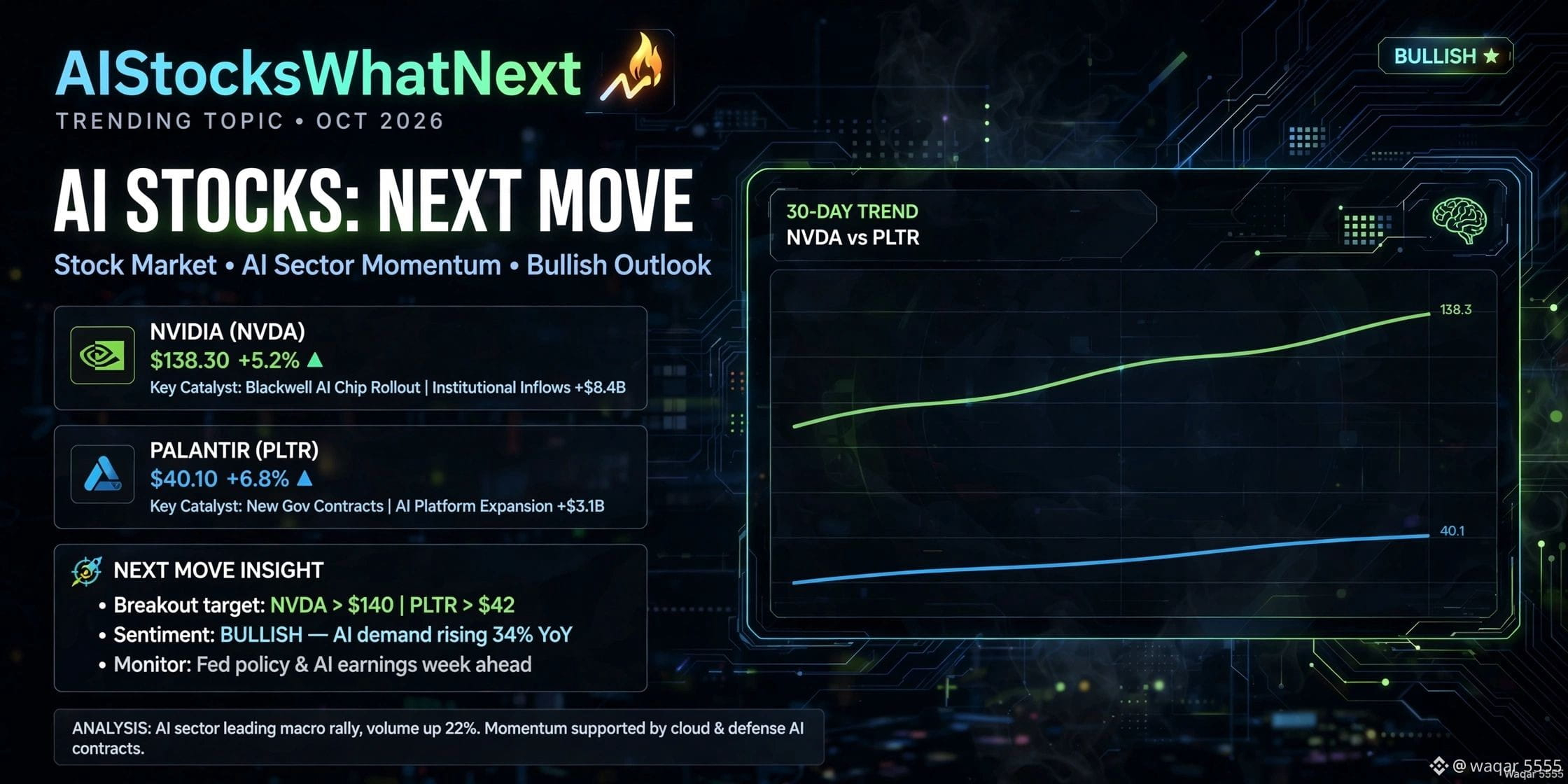
56

·
--
Bullish
#AIStocksWhatNext
What Other Investment Opportunities Remain as AI Stocks Keep Rising? 🤖📈
AI stocks have been one of the biggest stories in the market, and it’s easy to feel like every opportunity is already priced into the AI trade. But there’s another side to the story.
AI needs much more than powerful chips and software. It needs data centers, electricity, cooling systems, networking equipment and raw materials. That creates opportunities in areas like energy, utilities, semiconductors and industrial infrastructure.
Healthcare is another sector worth watching. As technology improves, AI is increasingly being used in drug discovery, diagnostics and medical research. Meanwhile, consumer staples and dividend-paying companies can offer a different type of exposure for investors looking beyond high-growth tech.
There’s also a simple strategy many investors overlook: don’t put everything into one trend. When a sector becomes extremely popular, spreading exposure across different industries can help reduce concentration risk.
The AI story may still have plenty of room to grow, but investors don’t necessarily need to chase the hottest AI stock. Sometimes, the more interesting opportunities are the companies quietly providing the power, equipment and resources behind the boom.
The market is bigger than one trend. 👀📊
#AIStocksWhatNext #Aistock #AI
#Nvidia's
$NIL
{future}(NILUSDT)
$NOM
{future}(NOMUSDT)
$ALLO
{spot}(ALLOUSDT)
#AIStocksWhatNext
What Other Investment Opportunities Remain as AI Stocks Keep Rising? 🤖📈
AI stocks have been one of the biggest stories in the market, and it’s easy to feel like every opportunity is already priced into the AI trade. But there’s another side to the story.
AI needs much more than powerful chips and software. It needs data centers, electricity, cooling systems, networking equipment and raw materials. That creates opportunities in areas like energy, utilities, semiconductors and industrial infrastructure.
Healthcare is another sector worth watching. As technology improves, AI is increasingly being used in drug discovery, diagnostics and medical research. Meanwhile, consumer staples and dividend-paying companies can offer a different type of exposure for investors looking beyond high-growth tech.
There’s also a simple strategy many investors overlook: don’t put everything into one trend. When a sector becomes extremely popular, spreading exposure across different industries can help reduce concentration risk.
The AI story may still have plenty of room to grow, but investors don’t necessarily need to chase the hottest AI stock. Sometimes, the more interesting opportunities are the companies quietly providing the power, equipment and resources behind the boom.
The market is bigger than one trend. 👀📊
#AIStocksWhatNext #Aistock #AI
#Nvidia's
$NIL
$NOM
$ALLO
What Other Investment Opportunities Remain as AI Stocks Keep Rising? 🤖📈
AI stocks have been one of the biggest stories in the market, and it’s easy to feel like every opportunity is already priced into the AI trade. But there’s another side to the story.
AI needs much more than powerful chips and software. It needs data centers, electricity, cooling systems, networking equipment and raw materials. That creates opportunities in areas like energy, utilities, semiconductors and industrial infrastructure.
Healthcare is another sector worth watching. As technology improves, AI is increasingly being used in drug discovery, diagnostics and medical research. Meanwhile, consumer staples and dividend-paying companies can offer a different type of exposure for investors looking beyond high-growth tech.
There’s also a simple strategy many investors overlook: don’t put everything into one trend. When a sector becomes extremely popular, spreading exposure across different industries can help reduce concentration risk.
The AI story may still have plenty of room to grow, but investors don’t necessarily need to chase the hottest AI stock. Sometimes, the more interesting opportunities are the companies quietly providing the power, equipment and resources behind the boom.
The market is bigger than one trend. 👀📊
#AIStocksWhatNext #Aistock #AI
#Nvidia's
$NIL
$NOM
$ALLO
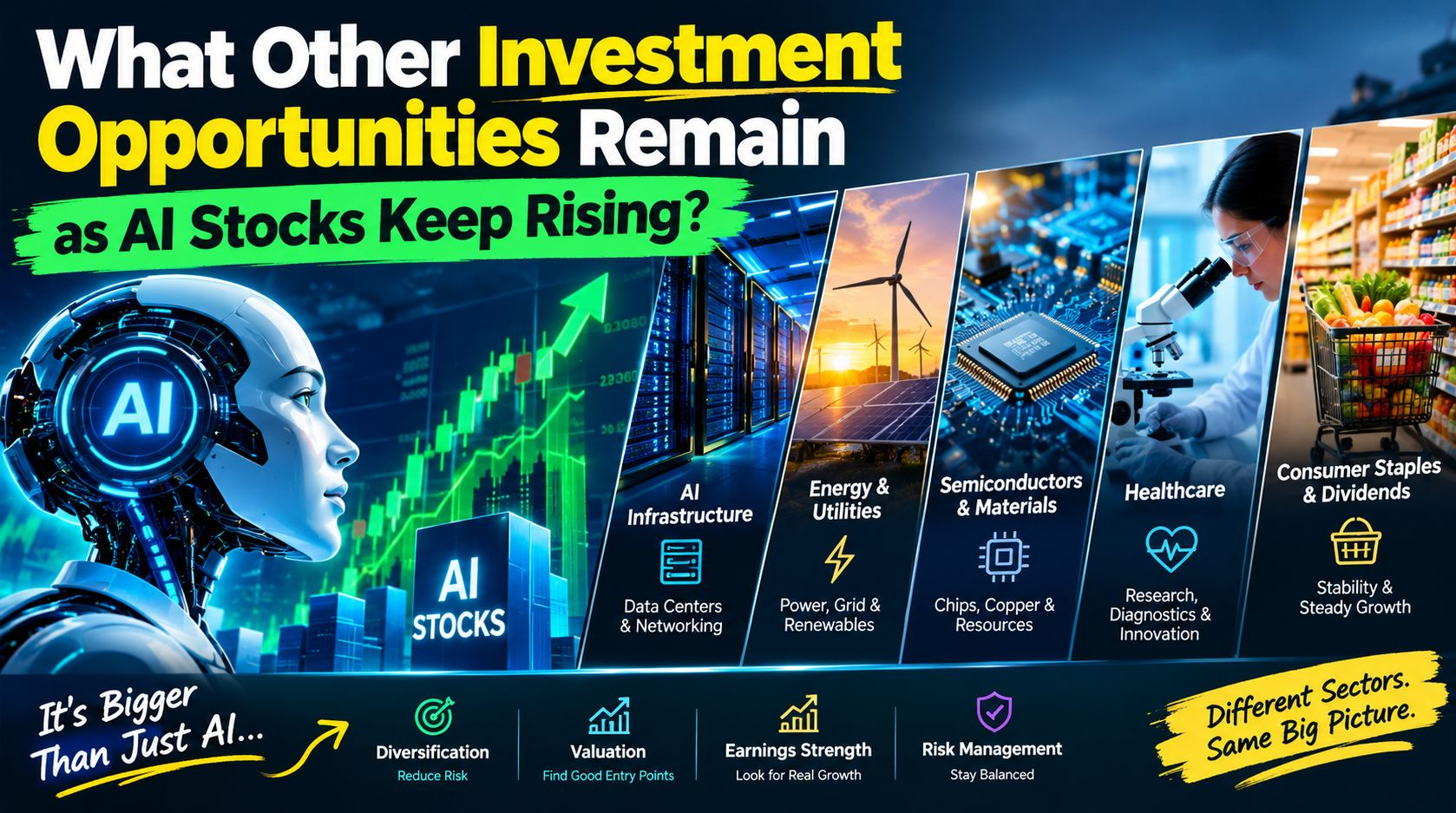
1
30

·
--
#AIStocksWhatNext
$NVDAB 🤖 AI Bubble or Next Supercycle? The Compute Spend & Policy Debate Explained
The AI narrative is reaching a fever pitch once again. As tech balance sheets expand and government policies shift, investors face a critical question: is this a sustained multi-year breakout or a short-term rally reaching saturation?
📈 1. Staggering Compute Spend: Is Demand Truly Taking Off?
Nvidia forecasts chip sales to double over the coming year, while tech giants continue reporting record revenue. However, the compute expenditure required to maintain this trajectory is equally massive—scaling from $150B to well over $240B.
The Bull Case: Fundamental demand remains unmatched. Frontier AI models require exponentially more compute power, energy, and hardware infrastructure with every iteration.
The Cautionary Case: Capital expenditure at this scale demands eventual monetization. If consumer and enterprise ROI cannot keep pace with server costs, margin compression becomes a genuine risk.
Is this a fundamental structural breakout for tech and crypto-AI stocks, or are we due for a short-term pullback before organic utility catches up?
🏛️ 2. The Great Divide: Industry Pause vs. State-Level Escalation
A distinct divide is emerging in the AI ecosystem:
The Cautionary View: Several industry pioneer leaders urge a controlled approach, highlighting safety risks, rapid job disruption, and energy grid limitations.
The Accelerationist View: Former President Donald Trump has proposed creating a federal “AI Force” initiative, projecting that AI could eventually contribute up to 25% of U.S. GDP.
When sovereign states step in to back AI as a strategic asset, federal funding, deregulation, and infrastructure support usually follow. Will government-backed tailwinds create a long-term economic win for AI stocks and decentralized compute tokens, or will sovereign over-investment lead to market distortions?
💬 What Is Your Portfolio Strategy?????
{spot}(NVDABUSDT)
#AIStocksWhatNext
$NVDAB 🤖 AI Bubble or Next Supercycle? The Compute Spend & Policy Debate Explained
The AI narrative is reaching a fever pitch once again. As tech balance sheets expand and government policies shift, investors face a critical question: is this a sustained multi-year breakout or a short-term rally reaching saturation?
📈 1. Staggering Compute Spend: Is Demand Truly Taking Off?
Nvidia forecasts chip sales to double over the coming year, while tech giants continue reporting record revenue. However, the compute expenditure required to maintain this trajectory is equally massive—scaling from $150B to well over $240B.
The Bull Case: Fundamental demand remains unmatched. Frontier AI models require exponentially more compute power, energy, and hardware infrastructure with every iteration.
The Cautionary Case: Capital expenditure at this scale demands eventual monetization. If consumer and enterprise ROI cannot keep pace with server costs, margin compression becomes a genuine risk.
Is this a fundamental structural breakout for tech and crypto-AI stocks, or are we due for a short-term pullback before organic utility catches up?
🏛️ 2. The Great Divide: Industry Pause vs. State-Level Escalation
A distinct divide is emerging in the AI ecosystem:
The Cautionary View: Several industry pioneer leaders urge a controlled approach, highlighting safety risks, rapid job disruption, and energy grid limitations.
The Accelerationist View: Former President Donald Trump has proposed creating a federal “AI Force” initiative, projecting that AI could eventually contribute up to 25% of U.S. GDP.
When sovereign states step in to back AI as a strategic asset, federal funding, deregulation, and infrastructure support usually follow. Will government-backed tailwinds create a long-term economic win for AI stocks and decentralized compute tokens, or will sovereign over-investment lead to market distortions?
💬 What Is Your Portfolio Strategy?????
$NVDAB 🤖 AI Bubble or Next Supercycle? The Compute Spend & Policy Debate Explained
The AI narrative is reaching a fever pitch once again. As tech balance sheets expand and government policies shift, investors face a critical question: is this a sustained multi-year breakout or a short-term rally reaching saturation?
📈 1. Staggering Compute Spend: Is Demand Truly Taking Off?
Nvidia forecasts chip sales to double over the coming year, while tech giants continue reporting record revenue. However, the compute expenditure required to maintain this trajectory is equally massive—scaling from $150B to well over $240B.
The Bull Case: Fundamental demand remains unmatched. Frontier AI models require exponentially more compute power, energy, and hardware infrastructure with every iteration.
The Cautionary Case: Capital expenditure at this scale demands eventual monetization. If consumer and enterprise ROI cannot keep pace with server costs, margin compression becomes a genuine risk.
Is this a fundamental structural breakout for tech and crypto-AI stocks, or are we due for a short-term pullback before organic utility catches up?
🏛️ 2. The Great Divide: Industry Pause vs. State-Level Escalation
A distinct divide is emerging in the AI ecosystem:
The Cautionary View: Several industry pioneer leaders urge a controlled approach, highlighting safety risks, rapid job disruption, and energy grid limitations.
The Accelerationist View: Former President Donald Trump has proposed creating a federal “AI Force” initiative, projecting that AI could eventually contribute up to 25% of U.S. GDP.
When sovereign states step in to back AI as a strategic asset, federal funding, deregulation, and infrastructure support usually follow. Will government-backed tailwinds create a long-term economic win for AI stocks and decentralized compute tokens, or will sovereign over-investment lead to market distortions?
💬 What Is Your Portfolio Strategy?????
57

·
--
Bullish
#AIStocksWhatNext AI Stocks — What’s Next?
The AI sector continues to attract massive attention as investors watch the next move in AI-related stocks. From chipmakers and cloud companies to AI software and infrastructure, the race is far from over. 🚀
The big question now: Can AI stocks extend their momentum, or is a major correction coming? 👀#AIStocksWhatNext $ALL
{future}(ALLUSDT)
$AI
{spot}(AIUSDT)
#AIStocksWhatNext AI Stocks — What’s Next?
The AI sector continues to attract massive attention as investors watch the next move in AI-related stocks. From chipmakers and cloud companies to AI software and infrastructure, the race is far from over. 🚀
The big question now: Can AI stocks extend their momentum, or is a major correction coming? 👀#AIStocksWhatNext $ALL
$AI
The AI sector continues to attract massive attention as investors watch the next move in AI-related stocks. From chipmakers and cloud companies to AI software and infrastructure, the race is far from over. 🚀
The big question now: Can AI stocks extend their momentum, or is a major correction coming? 👀#AIStocksWhatNext $ALL
$AI

1
96
Log in to explore more content
Join global crypto users on Binance Square
⚡️ Get latest and useful information about crypto.
💬 Trusted by the world’s largest crypto exchange.
👍 Discover real insights from verified creators.
Email / Phone number
Trending Topics
1
#BinanceWillListHyperliquid(HYPE)
2,620 views
152 Discussing
2
#ETHBreaksAbove$2,700
278 views
20 Discussing
3
#USWeighsPromotingDollarStablecoinsAbroad
14,042 views
644 Discussing
4
#US10YTreasuryYieldHits19YearHigh
11,860 views
504 Discussing
5
#SpotBitcoinETFsInflow$2.31BInFourDays
1,266 views
46 Discussing
6
#BitcoinRejectedAt$87,300Twice
0 views
0 Discussing
7
#BCHJumps28%OnCMEFuturesListing
55,773 views
1,191 Discussing
8
#WallStreetEarningsRevisionsTurnBearish
38,966 views
910 Discussing
9
#DollarIndexReclaims101
36,352 views
867 Discussing
10
#21SharesLaunchesEuropesFirstZcashETP
83,135 views
1,618 Discussing