

#aistocks
aistocks
101,349 views
565 Discussing
Hot
Latest

·
--
Adobe $ADBE Pumps +1.61% Today to $234.30 — Is AI Rally Just Starting? #AIStocksWhatNext $ADBE
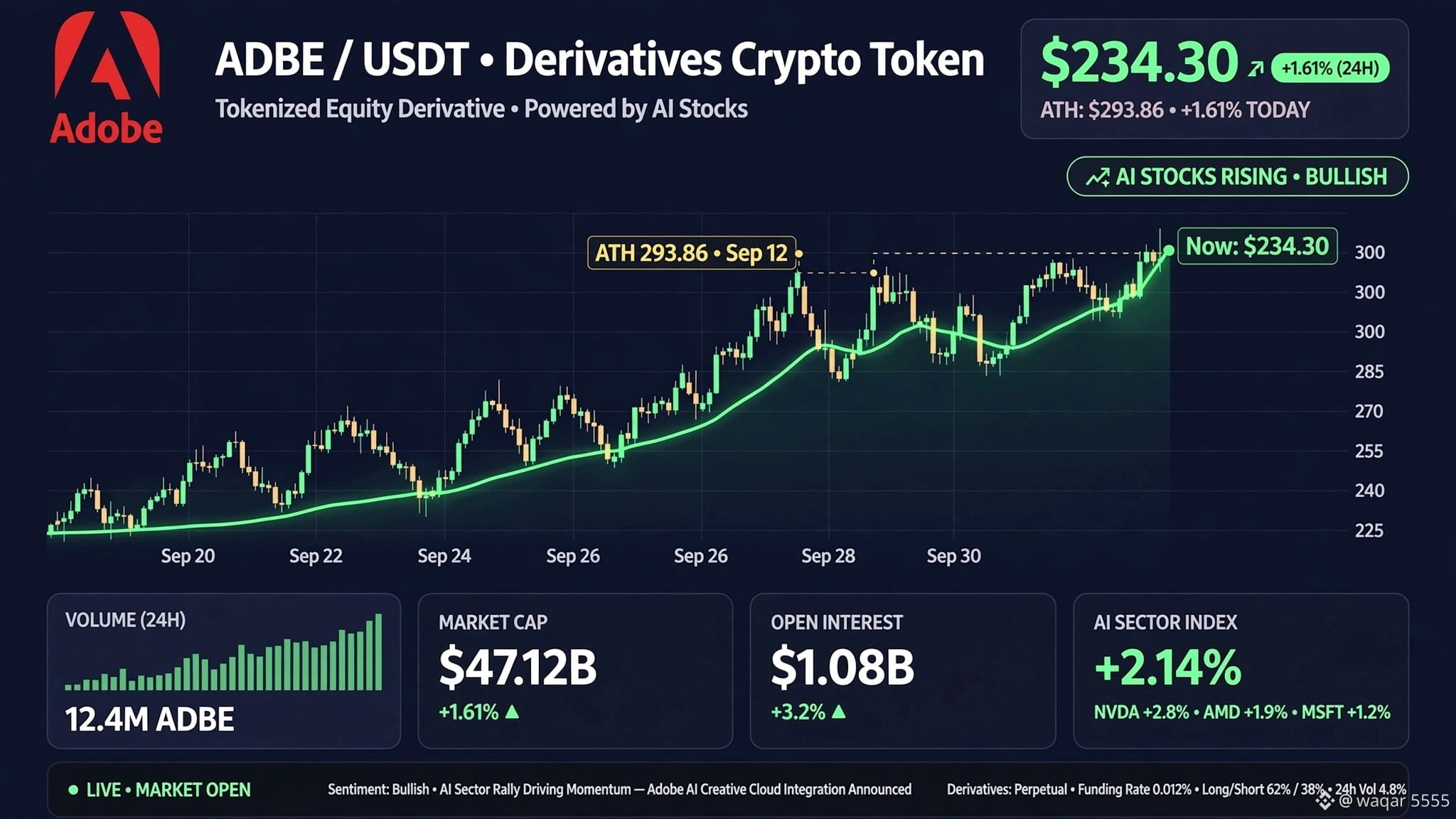
Breaking: Adobe (ADBE) derivative token is up +1.61% today — Now at $234.30 — ATH $293.86 (Sep 1, 2026) — Still -20.3% from top — Is this a dip opportunity?
Why bullish?
- Volume: 12.4M ADBE (24H) — Rising volume = Real buying
- Market Cap: $47.12B (+1.61%)
- Open Interest: $1.08B (+3.2%) — More traders entering long
- AI Sector Index: +2.14% — NVDA +2.8%, AMD +1.9%, MSFT +1.2% — Whole AI sector green
My Viewpoint (For Algo):
I'm bullish on ADBE long-term — Reason: Adobe just announced AI Creative Cloud integration — Photoshop + Firefly AI = Real revenue, not hype. Unlike other AI stocks, Adobe has 30M+ paying subscribers — Cash flow strong. Short-term? We may see pullback to $225 support if NVDA corrects — But if AI stocks keep rising, ADBE could retest ATH $293.86 — That's +25% upside from $234!
My Trade:
I added long at $232 with 2x — Small size — Trade widget 👇 — Target $250, SL $225
Chart shows Sep 20 to Sep 30 uptrend — Green line holding — Bullish structure intact!
Are you buying AI stocks or Crypto AI?
Vote:
A) Buying $ ADBE — Target $293 ATH
B) Waiting for $225 dip
C) Buying Crypto AI $FET $RNDR instead
Drop your pick — I'll like first 25!
$ADBE #AIStocksWhatNext #NVDA #Adobe #AIStocks #BTC #BinanceSquare
Adobe $ADBE Pumps +1.61% Today to $234.30 — Is AI Rally Just Starting? #AIStocksWhatNext $ADBE
Breaking: Adobe (ADBE) derivative token is up +1.61% today — Now at $234.30 — ATH $293.86 (Sep 1, 2026) — Still -20.3% from top — Is this a dip opportunity?
Why bullish?
- Volume: 12.4M ADBE (24H) — Rising volume = Real buying
- Market Cap: $47.12B (+1.61%)
- Open Interest: $1.08B (+3.2%) — More traders entering long
- AI Sector Index: +2.14% — NVDA +2.8%, AMD +1.9%, MSFT +1.2% — Whole AI sector green
My Viewpoint (For Algo):
I'm bullish on ADBE long-term — Reason: Adobe just announced AI Creative Cloud integration — Photoshop + Firefly AI = Real revenue, not hype. Unlike other AI stocks, Adobe has 30M+ paying subscribers — Cash flow strong. Short-term? We may see pullback to $225 support if NVDA corrects — But if AI stocks keep rising, ADBE could retest ATH $293.86 — That's +25% upside from $234!
My Trade:
I added long at $232 with 2x — Small size — Trade widget 👇 — Target $250, SL $225
Chart shows Sep 20 to Sep 30 uptrend — Green line holding — Bullish structure intact!
Are you buying AI stocks or Crypto AI?
Vote:
A) Buying $ ADBE — Target $293 ATH
B) Waiting for $225 dip
C) Buying Crypto AI $FET $RNDR instead
Drop your pick — I'll like first 25!
$ADBE #AIStocksWhatNext #NVDA #Adobe #AIStocks #BTC #BinanceSquare
Breaking: Adobe (ADBE) derivative token is up +1.61% today — Now at $234.30 — ATH $293.86 (Sep 1, 2026) — Still -20.3% from top — Is this a dip opportunity?
Why bullish?
- Volume: 12.4M ADBE (24H) — Rising volume = Real buying
- Market Cap: $47.12B (+1.61%)
- Open Interest: $1.08B (+3.2%) — More traders entering long
- AI Sector Index: +2.14% — NVDA +2.8%, AMD +1.9%, MSFT +1.2% — Whole AI sector green
My Viewpoint (For Algo):
I'm bullish on ADBE long-term — Reason: Adobe just announced AI Creative Cloud integration — Photoshop + Firefly AI = Real revenue, not hype. Unlike other AI stocks, Adobe has 30M+ paying subscribers — Cash flow strong. Short-term? We may see pullback to $225 support if NVDA corrects — But if AI stocks keep rising, ADBE could retest ATH $293.86 — That's +25% upside from $234!
My Trade:
I added long at $232 with 2x — Small size — Trade widget 👇 — Target $250, SL $225
Chart shows Sep 20 to Sep 30 uptrend — Green line holding — Bullish structure intact!
Are you buying AI stocks or Crypto AI?
Vote:
A) Buying $ ADBE — Target $293 ATH
B) Waiting for $225 dip
C) Buying Crypto AI $FET $RNDR instead
Drop your pick — I'll like first 25!
$ADBE #AIStocksWhatNext #NVDA #Adobe #AIStocks #BTC #BinanceSquare
1
60

#EarningsSeason
🚨Micron Technology Earnings: The AI Memory Test Begins
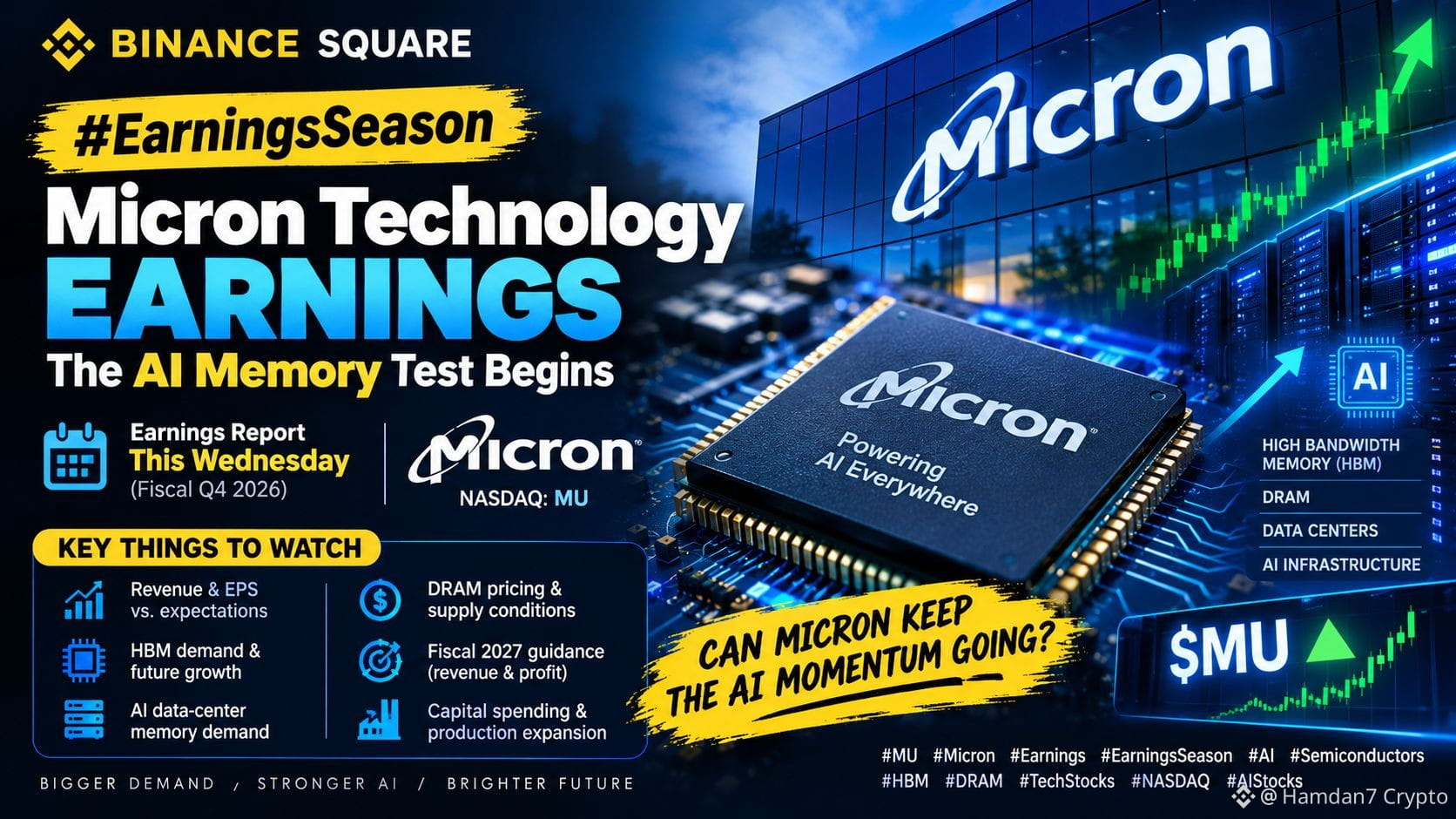
Micron Technology ($MU) is stepping into the spotlight as it prepares to report its fiscal Q4 2026 earnings today.
The memory-chip giant is coming off a powerful quarter, when it reported approximately $41.46 billion in revenue, marking a massive year-over-year increase and beating Wall Street expectations.
Now, investors are watching for one major question:
Can Micron keep the AI-driven momentum going? 👀
The company has benefited from strong demand for high-bandwidth memory (HBM), server DRAM and AI data-center infrastructure. Earlier this year, Micron also highlighted strong customer commitments for memory supply, showing just how intense the demand environment has become.
🔥 Key Things to Watch
• Revenue and EPS versus expectations
• HBM demand and future growth
• AI data-center memory demand
• DRAM pricing and supply conditions
• Fiscal 2027 revenue and profit guidance
• Capital spending and production expansion
This earnings report is about more than just one quarter.
Micron’s outlook could provide another important signal for the broader semiconductor and AI infrastructure market.
All eyes are now on $MU. 📊🔥
#MU #Micron #Earnings #EarningsSeason #AI #ArtificialIntelligence #Semiconductors #HBM #DRAM #TechStocks #StockMarket #NASDAQ #AIStocks $bchusd
#EarningsSeason
🚨Micron Technology Earnings: The AI Memory Test Begins
Micron Technology ($MU) is stepping into the spotlight as it prepares to report its fiscal Q4 2026 earnings today.
The memory-chip giant is coming off a powerful quarter, when it reported approximately $41.46 billion in revenue, marking a massive year-over-year increase and beating Wall Street expectations.
Now, investors are watching for one major question:
Can Micron keep the AI-driven momentum going? 👀
The company has benefited from strong demand for high-bandwidth memory (HBM), server DRAM and AI data-center infrastructure. Earlier this year, Micron also highlighted strong customer commitments for memory supply, showing just how intense the demand environment has become.
🔥 Key Things to Watch
• Revenue and EPS versus expectations
• HBM demand and future growth
• AI data-center memory demand
• DRAM pricing and supply conditions
• Fiscal 2027 revenue and profit guidance
• Capital spending and production expansion
This earnings report is about more than just one quarter.
Micron’s outlook could provide another important signal for the broader semiconductor and AI infrastructure market.
All eyes are now on $MU. 📊🔥
#MU #Micron #Earnings #EarningsSeason #AI #ArtificialIntelligence #Semiconductors #HBM #DRAM #TechStocks #StockMarket #NASDAQ #AIStocks $bchusd
🚨Micron Technology Earnings: The AI Memory Test Begins
Micron Technology ($MU) is stepping into the spotlight as it prepares to report its fiscal Q4 2026 earnings today.
The memory-chip giant is coming off a powerful quarter, when it reported approximately $41.46 billion in revenue, marking a massive year-over-year increase and beating Wall Street expectations.
Now, investors are watching for one major question:
Can Micron keep the AI-driven momentum going? 👀
The company has benefited from strong demand for high-bandwidth memory (HBM), server DRAM and AI data-center infrastructure. Earlier this year, Micron also highlighted strong customer commitments for memory supply, showing just how intense the demand environment has become.
🔥 Key Things to Watch
• Revenue and EPS versus expectations
• HBM demand and future growth
• AI data-center memory demand
• DRAM pricing and supply conditions
• Fiscal 2027 revenue and profit guidance
• Capital spending and production expansion
This earnings report is about more than just one quarter.
Micron’s outlook could provide another important signal for the broader semiconductor and AI infrastructure market.
All eyes are now on $MU. 📊🔥
#MU #Micron #Earnings #EarningsSeason #AI #ArtificialIntelligence #Semiconductors #HBM #DRAM #TechStocks #StockMarket #NASDAQ #AIStocks $bchusd
79

·
--
#NvidiaApproves$150BBuyback
🔥 NVIDIA Authorizes Another $150B for Buybacks
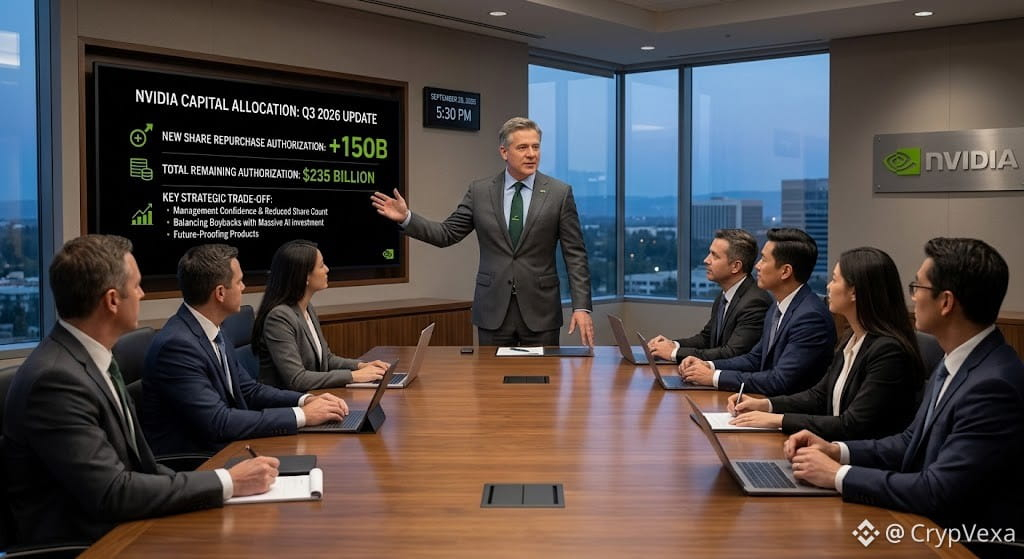
💰 NVIDIA authorized an additional $150B share repurchase program, bringing its remaining buyback authorization to $235B.
📊 Buybacks can reduce the number of shares outstanding over time, while the move signals management’s current capital-allocation priorities.
🤖 The key question remains whether AI demand and cash generation can support both massive investment in future products and continued buybacks.
⚠️ A larger buyback authorization does not guarantee higher NVDA share prices.
👀 Is NVIDIA’s AI spending or its massive buyback plan more important for investors?
#NVIDIA #NVDA #AIStocks #StockMarket
#NvidiaApproves$150BBuyback
🔥 NVIDIA Authorizes Another $150B for Buybacks
💰 NVIDIA authorized an additional $150B share repurchase program, bringing its remaining buyback authorization to $235B.
📊 Buybacks can reduce the number of shares outstanding over time, while the move signals management’s current capital-allocation priorities.
🤖 The key question remains whether AI demand and cash generation can support both massive investment in future products and continued buybacks.
⚠️ A larger buyback authorization does not guarantee higher NVDA share prices.
👀 Is NVIDIA’s AI spending or its massive buyback plan more important for investors?
#NVIDIA #NVDA #AIStocks #StockMarket
🔥 NVIDIA Authorizes Another $150B for Buybacks
💰 NVIDIA authorized an additional $150B share repurchase program, bringing its remaining buyback authorization to $235B.
📊 Buybacks can reduce the number of shares outstanding over time, while the move signals management’s current capital-allocation priorities.
🤖 The key question remains whether AI demand and cash generation can support both massive investment in future products and continued buybacks.
⚠️ A larger buyback authorization does not guarantee higher NVDA share prices.
👀 Is NVIDIA’s AI spending or its massive buyback plan more important for investors?
#NVIDIA #NVDA #AIStocks #StockMarket
1
7

·
--
Bullish
$NVDA $TAO $NEAR
{future}(NEARUSDT)
{future}(TAOUSDT)
{future}(NVDAUSDT)
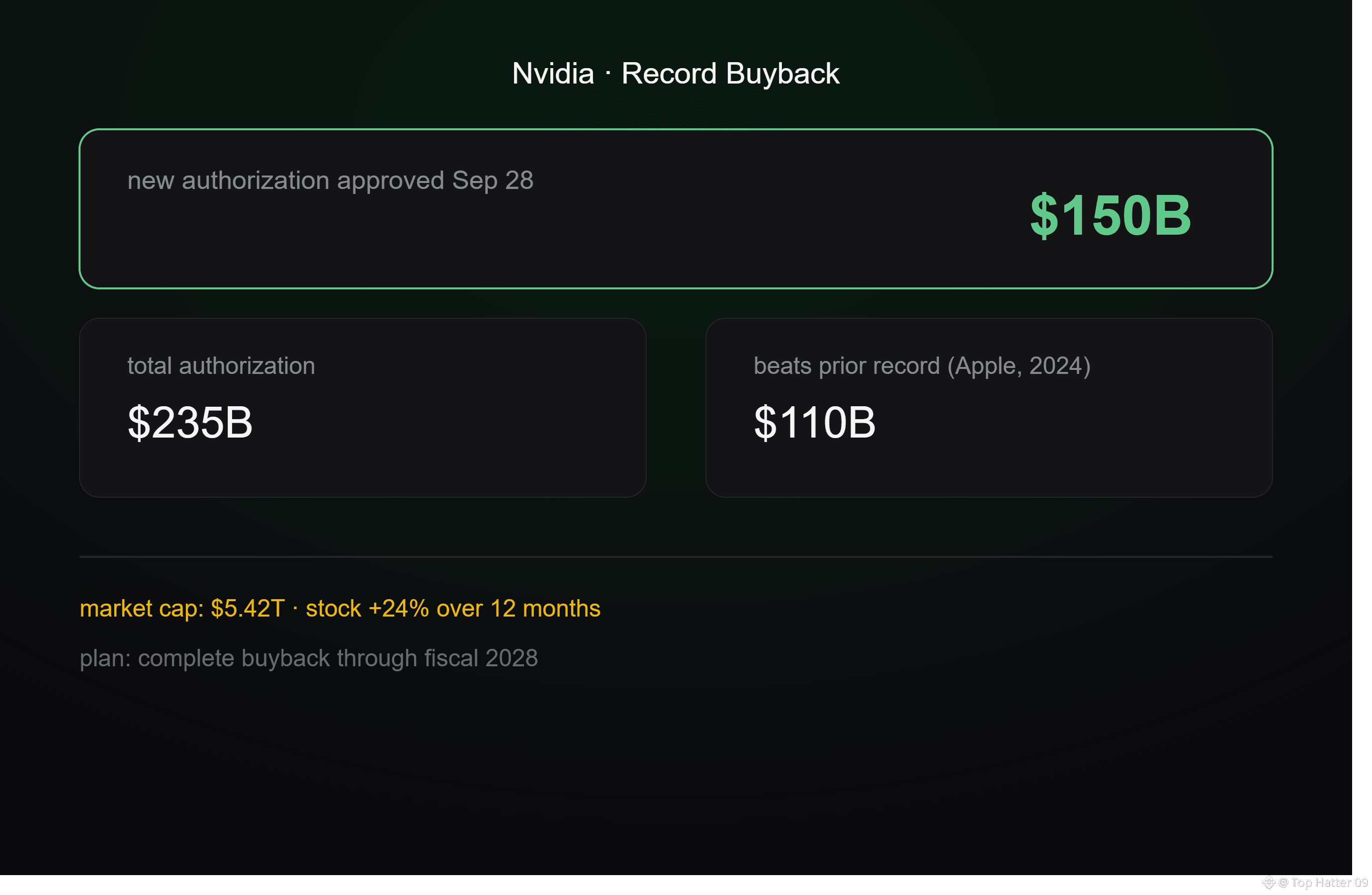
Nvidia just approved the largest single stock buyback authorization in US corporate history. On September 28, the board signed off on an additional $150 billion, bringing the company's total buyback capacity to $235 billion. That beats the previous record of $110 billion set by Apple back in 2024.
CEO Jensen Huang tied it directly to what he called a once-in-a-generation shift to AI and accelerated computing, saying the company's cash generation now lets them invest in growth while still returning capital to shareholders. In practical terms, a buyback like this means Nvidia purchases its own shares off the market, which reduces the total share count and effectively increases the ownership stake of everyone who holds on.
The plan is to complete the buyback by fiscal 2028. The market reacted well, shares rose more than 2% and are trading around $229, with the stock already up 24% over the past 12 months. That puts Nvidia's market cap at $5.42 trillion.
This isn't a crypto story directly, but it ties into the same AI infrastructure spending theme we've been tracking with tokens like $TAO, $FET, and $NEAR, since AI capex news like this tends to ripple through that whole sector.
#NVDA #AIStocks #Nvidia
$NVDA $TAO $NEAR
Nvidia just approved the largest single stock buyback authorization in US corporate history. On September 28, the board signed off on an additional $150 billion, bringing the company's total buyback capacity to $235 billion. That beats the previous record of $110 billion set by Apple back in 2024.
CEO Jensen Huang tied it directly to what he called a once-in-a-generation shift to AI and accelerated computing, saying the company's cash generation now lets them invest in growth while still returning capital to shareholders. In practical terms, a buyback like this means Nvidia purchases its own shares off the market, which reduces the total share count and effectively increases the ownership stake of everyone who holds on.
The plan is to complete the buyback by fiscal 2028. The market reacted well, shares rose more than 2% and are trading around $229, with the stock already up 24% over the past 12 months. That puts Nvidia's market cap at $5.42 trillion.
This isn't a crypto story directly, but it ties into the same AI infrastructure spending theme we've been tracking with tokens like $TAO , $FET, and $NEAR , since AI capex news like this tends to ripple through that whole sector.
#NVDA #AIStocks #Nvidia
Nvidia just approved the largest single stock buyback authorization in US corporate history. On September 28, the board signed off on an additional $150 billion, bringing the company's total buyback capacity to $235 billion. That beats the previous record of $110 billion set by Apple back in 2024.
CEO Jensen Huang tied it directly to what he called a once-in-a-generation shift to AI and accelerated computing, saying the company's cash generation now lets them invest in growth while still returning capital to shareholders. In practical terms, a buyback like this means Nvidia purchases its own shares off the market, which reduces the total share count and effectively increases the ownership stake of everyone who holds on.
The plan is to complete the buyback by fiscal 2028. The market reacted well, shares rose more than 2% and are trading around $229, with the stock already up 24% over the past 12 months. That puts Nvidia's market cap at $5.42 trillion.
This isn't a crypto story directly, but it ties into the same AI infrastructure spending theme we've been tracking with tokens like $TAO , $FET, and $NEAR , since AI capex news like this tends to ripple through that whole sector.
#NVDA #AIStocks #Nvidia
354

·
--
Bullish
Partly True
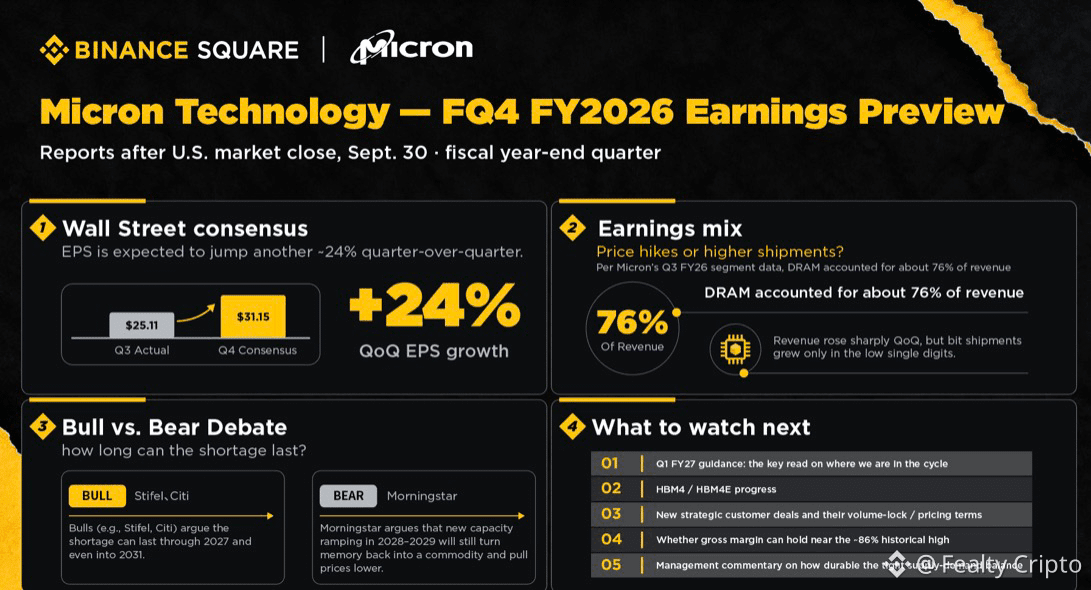
Everyone is looking at Micron’s result tomorrow.
But I think the most important number is NOT the revenue.
It’s the margin.
Even $MUB itself projected approximately:
US$50 billion in revenue
≈86% gross margin
≈US$31 earnings per share
That’s absurd for a company that for a long time has been treated as a “cyclical” memory manufacturer.
And here’s why:
AI doesn’t just need GPUs.
It needs A LOT of memory.
HBM has become a key component to feed AI chips with data fast enough.
So, for me, tomorrow’s result will answer a bigger question than:
“Did Micron beat or miss the consensus?”
The question is:
can this memory supercycle really continue?
If Micron delivers margins near or above 86% and still shows strong demand for HBM, the thesis that AI is structurally changing the memory market gains momentum.
But there’s a risk I wouldn’t ignore:
$MUB has already risen a lot, and expectations are enormous too.
When everyone expects an outstanding result, sometimes “excellent” just isn’t enough anymore.
What I want to see above all:
margin
guidance
demand for HBM
and how much the company plans to invest to increase capacity.
Because strong results count the past.
Guidance tells you what the company is seeing ahead.
$MUB #EarningsSeason #AIStocks #MicronSharesRise10
For you, is the memory supercycle still just beginning… or has the market already priced in too much expectation?
{spot}(MUBUSDT)
Everyone is looking at Micron’s result tomorrow.
But I think the most important number is NOT the revenue.
It’s the margin.
Even $MUB itself projected approximately:
US$50 billion in revenue
≈86% gross margin
≈US$31 earnings per share
That’s absurd for a company that for a long time has been treated as a “cyclical” memory manufacturer.
And here’s why:
AI doesn’t just need GPUs.
It needs A LOT of memory.
HBM has become a key component to feed AI chips with data fast enough.
So, for me, tomorrow’s result will answer a bigger question than:
“Did Micron beat or miss the consensus?”
The question is:
can this memory supercycle really continue?
If Micron delivers margins near or above 86% and still shows strong demand for HBM, the thesis that AI is structurally changing the memory market gains momentum.
But there’s a risk I wouldn’t ignore:
$MUB has already risen a lot, and expectations are enormous too.
When everyone expects an outstanding result, sometimes “excellent” just isn’t enough anymore.
What I want to see above all:
margin
guidance
demand for HBM
and how much the company plans to invest to increase capacity.
Because strong results count the past.
Guidance tells you what the company is seeing ahead.
$MUB #EarningsSeason #AIStocks #MicronSharesRise10
For you, is the memory supercycle still just beginning… or has the market already priced in too much expectation?
But I think the most important number is NOT the revenue.
It’s the margin.
Even $MUB itself projected approximately:
US$50 billion in revenue
≈86% gross margin
≈US$31 earnings per share
That’s absurd for a company that for a long time has been treated as a “cyclical” memory manufacturer.
And here’s why:
AI doesn’t just need GPUs.
It needs A LOT of memory.
HBM has become a key component to feed AI chips with data fast enough.
So, for me, tomorrow’s result will answer a bigger question than:
“Did Micron beat or miss the consensus?”
The question is:
can this memory supercycle really continue?
If Micron delivers margins near or above 86% and still shows strong demand for HBM, the thesis that AI is structurally changing the memory market gains momentum.
But there’s a risk I wouldn’t ignore:
$MUB has already risen a lot, and expectations are enormous too.
When everyone expects an outstanding result, sometimes “excellent” just isn’t enough anymore.
What I want to see above all:
margin
guidance
demand for HBM
and how much the company plans to invest to increase capacity.
Because strong results count the past.
Guidance tells you what the company is seeing ahead.
$MUB #EarningsSeason #AIStocks #MicronSharesRise10
For you, is the memory supercycle still just beginning… or has the market already priced in too much expectation?
3
1.3k

·
--
Bearish
Everyone talks about the biggest AI companies.
But what about Innodata — $INOD.US
{stock_us}(INOD.US)
?
Innodata works with data used to develop and evaluate AI systems. Recent reporting highlighted strong revenue growth and continued expectations for substantial 2026 growth.
The AI economy isn't only about GPUs—data is infrastructure too. 🤖
#AIStocks #INOD #artificialintelligence #TechStocks #stockmarket
Everyone talks about the biggest AI companies.
But what about Innodata — $INOD.US
?
Innodata works with data used to develop and evaluate AI systems. Recent reporting highlighted strong revenue growth and continued expectations for substantial 2026 growth.
The AI economy isn't only about GPUs—data is infrastructure too. 🤖
#AIStocks #INOD #artificialintelligence #TechStocks #stockmarket
But what about Innodata — $INOD.US
?
Innodata works with data used to develop and evaluate AI systems. Recent reporting highlighted strong revenue growth and continued expectations for substantial 2026 growth.
The AI economy isn't only about GPUs—data is infrastructure too. 🤖
#AIStocks #INOD #artificialintelligence #TechStocks #stockmarket
INODUS+1.21%
1
53

·
--
Verified
Article
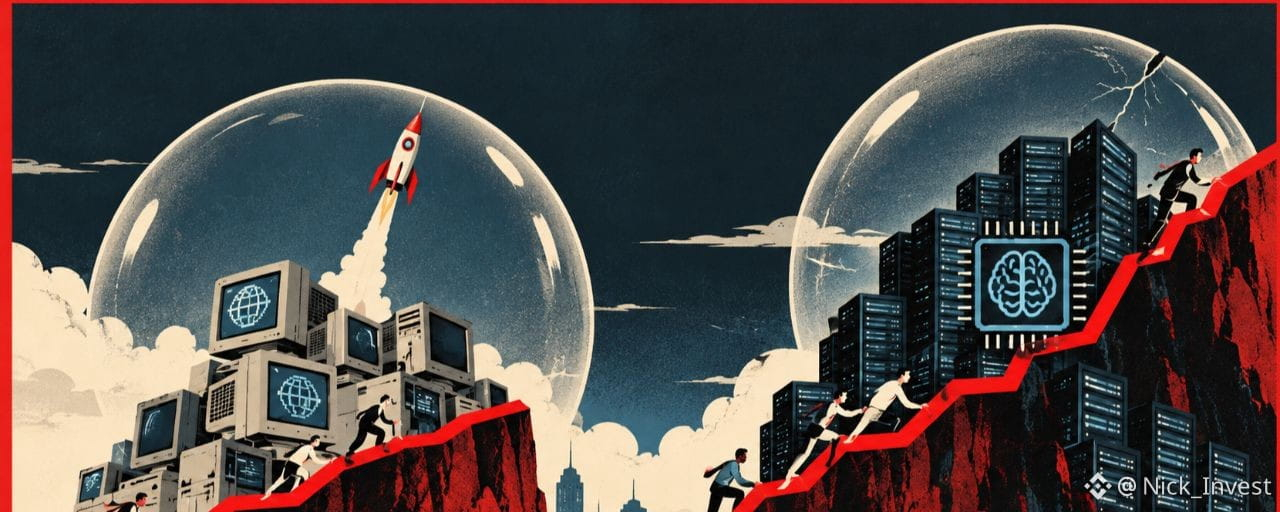
AI vs dot-coms: why 2026 is not just a copy of 1999Right now, many people are drawing historical parallels between 2026 and 1999 (before the dot-com crisis), which is why they’re afraid to open new positions. And there is something in that, but let’s break it down without panicking: what looks similar, and what the clear differences are).
Back then, the Fed also started raising rates amid the technology boom. Over the cycle, the rate increased from 4.75% to 6.5%; the yield on 10-year bonds went above 6% (something like that), and after the first rate hike, the Nasdaq managed to rise by about 88% to its peak in March 2000.
AI vs dot-coms: why 2026 is not just a copy of 1999
Right now, many people are drawing historical parallels between 2026 and 1999 (before the dot-com crisis), which is why they’re afraid to open new positions. And there is something in that, but let’s break it down without panicking: what looks similar, and what the clear differences are).
Back then, the Fed also started raising rates amid the technology boom. Over the cycle, the rate increased from 4.75% to 6.5%; the yield on 10-year bonds went above 6% (something like that), and after the first rate hike, the Nasdaq managed to rise by about 88% to its peak in March 2000.
Back then, the Fed also started raising rates amid the technology boom. Over the cycle, the rate increased from 4.75% to 6.5%; the yield on 10-year bonds went above 6% (something like that), and after the first rate hike, the Nasdaq managed to rise by about 88% to its peak in March 2000.
3
1.7k

·
--
Bullish
Verified
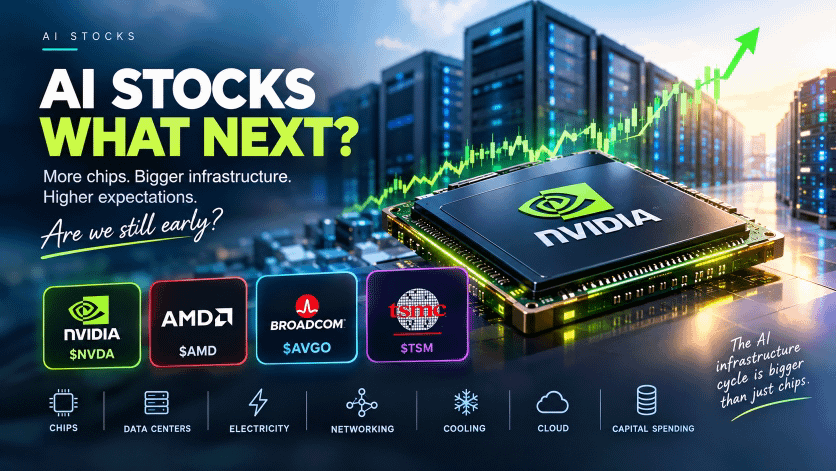
Everyone is talking about AI. I'm more interested in what happens behind the screen.
NVIDIA's Jensen Huang recently said the company expects to sell twice as many chips next year.
Think about what that means.
It's not just a chip story.
It's data centers.
It's electricity.
It's networking.
It's cooling.
It's cloud infrastructure.
It's billions in capital spending.
And that's where the AI stock debate gets interesting.
The bullish argument is simple: demand is still expanding.
The other side asks whether companies can keep spending at this pace and eventually generate enough returns to justify it.
We've already seen AI-linked stocks move sharply as investors debate whether spending is accelerating or starting to peak.
So I'm curious.
Are we still early in the AI infrastructure cycle, or are expectations getting ahead of reality?
If you're trading the AI theme, don't just say BULLISH
Tell me which ticker you're watching and why.
Drop the AI stock you're watching 👇
$NVDA $AMD $AVGO
#AIStocksWhatNext #AIStocks #Nvda
Everyone is talking about AI. I'm more interested in what happens behind the screen.
NVIDIA's Jensen Huang recently said the company expects to sell twice as many chips next year.
Think about what that means.
It's not just a chip story.
It's data centers.
It's electricity.
It's networking.
It's cooling.
It's cloud infrastructure.
It's billions in capital spending.
And that's where the AI stock debate gets interesting.
The bullish argument is simple: demand is still expanding.
The other side asks whether companies can keep spending at this pace and eventually generate enough returns to justify it.
We've already seen AI-linked stocks move sharply as investors debate whether spending is accelerating or starting to peak.
So I'm curious.
Are we still early in the AI infrastructure cycle, or are expectations getting ahead of reality?
If you're trading the AI theme, don't just say BULLISH
Tell me which ticker you're watching and why.
Drop the AI stock you're watching 👇
$NVDA $AMD $AVGO
#AIStocksWhatNext #AIStocks #Nvda
NVIDIA's Jensen Huang recently said the company expects to sell twice as many chips next year.
Think about what that means.
It's not just a chip story.
It's data centers.
It's electricity.
It's networking.
It's cooling.
It's cloud infrastructure.
It's billions in capital spending.
And that's where the AI stock debate gets interesting.
The bullish argument is simple: demand is still expanding.
The other side asks whether companies can keep spending at this pace and eventually generate enough returns to justify it.
We've already seen AI-linked stocks move sharply as investors debate whether spending is accelerating or starting to peak.
So I'm curious.
Are we still early in the AI infrastructure cycle, or are expectations getting ahead of reality?
If you're trading the AI theme, don't just say BULLISH
Tell me which ticker you're watching and why.
Drop the AI stock you're watching 👇
$NVDA $AMD $AVGO
#AIStocksWhatNext #AIStocks #Nvda
2
7
1.9k

Article
THE BIGGER PICTURE AI Stocks What Next?#AIStocksWhatNext
@PositiveMindsGlobalResults | September 24, 2026
🚀 NVIDIA: AI DEMAND MEETS GEOPOLITICS
NVIDIA remains at the heart of the global AI infrastructure race.
Its data-center revenue recently surged 117% year over year to $89 billion, while management’s Q3 revenue guidance reached approximately $108 billion.
Meanwhile, CEO Jensen Huang is expected to attend the White House state dinner involving US President and Chinese President
For semiconductor investors, the bigger issue is what future U.S.-China discussions could mean for AI-chip exports, technology restrictions and access to the Chinese market.
🇺🇸🇨🇳 Washington and Beijing have also reportedly agreed to extend their trade truce until January 10, adding another important variable to the AI-chip outlook.
🔥 THE BIGGER PICTURE
AI is no longer simply a semiconductor story.
It is becoming a capital story, bond-market story, geopolitical story, infrastructure story and software story — all at the same time.
The next phase could place greater emphasis on companies demonstrating real AI revenue, infrastructure demand and sustainable monetization, rather than AI expectations alone.
⚠️ Strong AI growth does not mean every AI-related stock will perform the same way. Market conditions, valuations, interest rates, regulation and execution can produce very different outcomes across companies.
💬 THE BIG QUESTION
Will AI continue its expansion, enter a period of consolidation, or shift toward companies proving stronger real-world AI monetization?
What’s your view? Share your analysis below. 👇
#AI #ArtificialIntelligence #NVIDIA #NVDA #Meta #META #Microsoft #MSFT #IonQ #IONQ #QuantumComputing #AIStocks #Semiconductors #Nasdaq #WallStreet #StockMarket #TechStocks #Investing #AIInfrastructure #PositiveMindsGlobalResults
$BNB
{spot}(BNBUSDT)
{spot}(BTCUSDT)
THE BIGGER PICTURE AI Stocks What Next?
#AIStocksWhatNext
@PositiveMindsGlobalResults | September 24, 2026
🚀 NVIDIA: AI DEMAND MEETS GEOPOLITICS
NVIDIA remains at the heart of the global AI infrastructure race.
Its data-center revenue recently surged 117% year over year to $89 billion, while management’s Q3 revenue guidance reached approximately $108 billion.
Meanwhile, CEO Jensen Huang is expected to attend the White House state dinner involving US President and Chinese President
For semiconductor investors, the bigger issue is what future U.S.-China discussions could mean for AI-chip exports, technology restrictions and access to the Chinese market.
🇺🇸🇨🇳 Washington and Beijing have also reportedly agreed to extend their trade truce until January 10, adding another important variable to the AI-chip outlook.
🔥 THE BIGGER PICTURE
AI is no longer simply a semiconductor story.
It is becoming a capital story, bond-market story, geopolitical story, infrastructure story and software story — all at the same time.
The next phase could place greater emphasis on companies demonstrating real AI revenue, infrastructure demand and sustainable monetization, rather than AI expectations alone.
⚠️ Strong AI growth does not mean every AI-related stock will perform the same way. Market conditions, valuations, interest rates, regulation and execution can produce very different outcomes across companies.
💬 THE BIG QUESTION
Will AI continue its expansion, enter a period of consolidation, or shift toward companies proving stronger real-world AI monetization?
What’s your view? Share your analysis below. 👇
#AI #ArtificialIntelligence #NVIDIA #NVDA #Meta #META #Microsoft #MSFT #IonQ #IONQ #QuantumComputing #AIStocks #Semiconductors #Nasdaq #WallStreet #StockMarket #TechStocks #Investing #AIInfrastructure #PositiveMindsGlobalResults
$BNB
@PositiveMindsGlobalResults | September 24, 2026
🚀 NVIDIA: AI DEMAND MEETS GEOPOLITICS
NVIDIA remains at the heart of the global AI infrastructure race.
Its data-center revenue recently surged 117% year over year to $89 billion, while management’s Q3 revenue guidance reached approximately $108 billion.
Meanwhile, CEO Jensen Huang is expected to attend the White House state dinner involving US President and Chinese President
For semiconductor investors, the bigger issue is what future U.S.-China discussions could mean for AI-chip exports, technology restrictions and access to the Chinese market.
🇺🇸🇨🇳 Washington and Beijing have also reportedly agreed to extend their trade truce until January 10, adding another important variable to the AI-chip outlook.
🔥 THE BIGGER PICTURE
AI is no longer simply a semiconductor story.
It is becoming a capital story, bond-market story, geopolitical story, infrastructure story and software story — all at the same time.
The next phase could place greater emphasis on companies demonstrating real AI revenue, infrastructure demand and sustainable monetization, rather than AI expectations alone.
⚠️ Strong AI growth does not mean every AI-related stock will perform the same way. Market conditions, valuations, interest rates, regulation and execution can produce very different outcomes across companies.
💬 THE BIG QUESTION
Will AI continue its expansion, enter a period of consolidation, or shift toward companies proving stronger real-world AI monetization?
What’s your view? Share your analysis below. 👇
#AI #ArtificialIntelligence #NVIDIA #NVDA #Meta #META #Microsoft #MSFT #IonQ #IONQ #QuantumComputing #AIStocks #Semiconductors #Nasdaq #WallStreet #StockMarket #TechStocks #Investing #AIInfrastructure #PositiveMindsGlobalResults
$BNB
1
214
Article
AI STOCKS AT A CROSSROADS#AIStocksWhatNext
@PositiveMindsGlobalResults | September 24, 2026
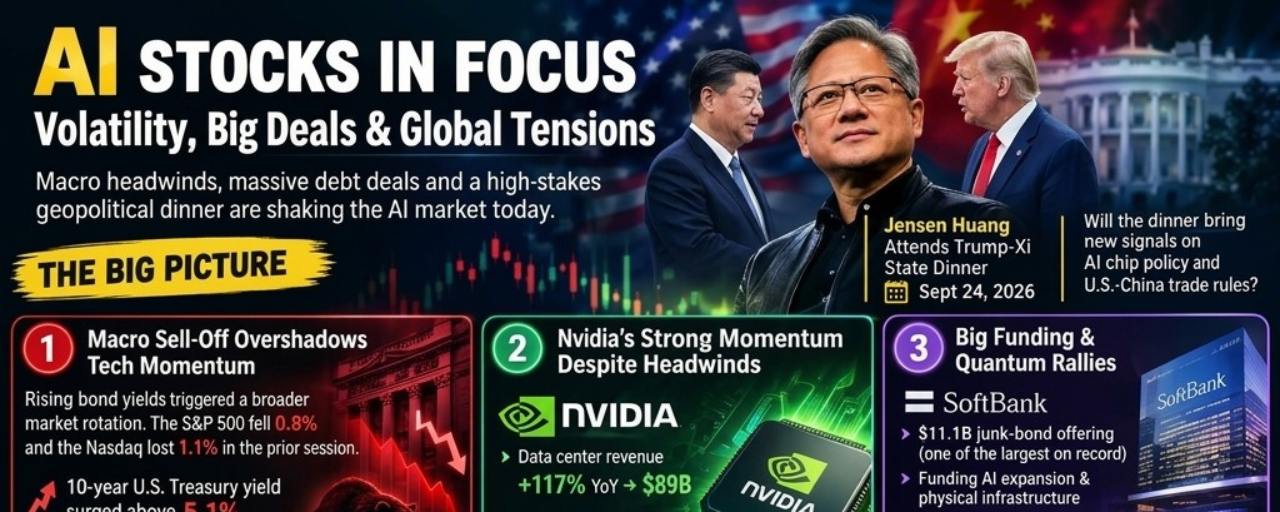
The AI market is entering a more complex phase. Strong technology demand remains intact, but rising bond yields, massive capital commitments, geopolitical tensions and the rapid development of AI agents are creating a much more volatile investment landscape.
📉 1️⃣ BOND YIELDS CHALLENGE AI VALUATIONS
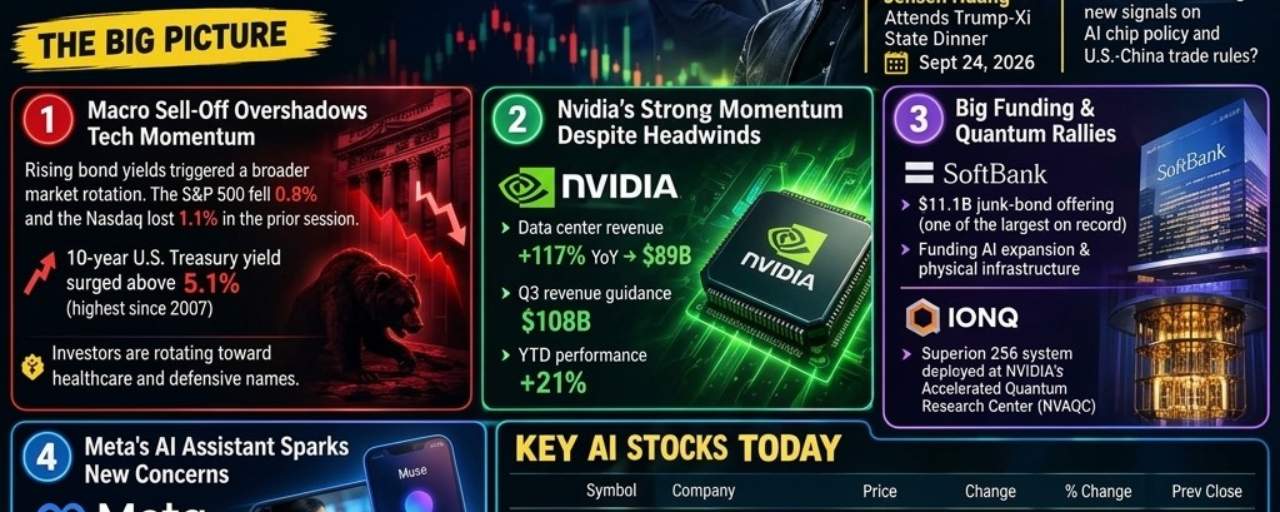
Wall Street came under pressure as the S&P 500 fell 0.8% and the Nasdaq declined 1.1% in the previous session.
The 10-year U.S. Treasury yield moved above 5.1%, increasing pressure on high-growth technology stocks. Higher yields can make future corporate earnings less attractive in present-value terms and encourage investors to reassess elevated valuations.
🚀 2️⃣ NVIDIA: AI DEMAND MEETS GEOPOLITICS
NVIDIA remains at the heart of the global AI infrastructure race.
Its data-center revenue recently surged 117% year over year to $89 billion, while management’s Q3 revenue guidance reached approximately $108 billion.
Meanwhile, CEO Jensen Huang is expected to attend the White House state dinner involving US President Donald Trump and Chinese President.
For semiconductor investors, the bigger issue is what future U.S.-China discussions could mean for AI-chip exports, technology restrictions and access to the Chinese market.
🇺🇸🇨🇳 Washington and Beijing have also reportedly agreed to extend their trade truce until January 10, adding another important variable to the AI-chip outlook.
💰 3️⃣ AI IS BECOMING A DEBT STORY
SoftBank is pursuing more than $11 billion in high-yield debt, with financing linked to its aggressive AI investment strategy, including its OpenAI exposure.
The scale of this financing highlights an important development: the AI boom is no longer being funded only through operating cash flow and equity markets. Debt is increasingly becoming part of the infrastructure race.
⚛️ 4️⃣ AI + QUANTUM: A NEW COMPUTING FRONTIER
IonQ announced plans to deploy its Superion 256 system at NVIDIA’s Accelerated Quantum Research Center in 2027.
The planned integration of quantum computing with accelerated computing infrastructure highlights a potentially important long-term trend: future computing systems could combine GPUs, AI accelerators and quantum processors for specialized workloads.
🧠 5️⃣ META’S MUSE AND THE SOFTWARE DISRUPTION
Meta’s AI assistant Muse is gaining significant consumer attention while expanding AI capabilities across areas such as shopping, travel and communications.
That raises a major question for the software and services economy:
If AI agents become the new interface between consumers and businesses, who controls the transaction?
The answer could influence everything from advertising and search to travel, commerce and digital marketplaces.
🔥 THE BIGGER PICTURE
AI is no longer simply a semiconductor story.
It is becoming a capital story, bond-market story, geopolitical story, infrastructure story and software story — all at the same time.
The next phase could place greater emphasis on companies demonstrating real AI revenue, infrastructure demand and sustainable monetization, rather than AI expectations alone.
⚠️ Strong AI growth does not mean every AI-related stock will perform the same way. Market conditions, valuations, interest rates, regulation and execution can produce very different outcomes across companies.
💬 THE BIG QUESTION
Will AI continue its expansion, enter a period of consolidation, or shift toward companies proving stronger real-world AI monetization?
What’s your view? Share your analysis below. 👇
#AI #ArtificialIntelligence #NVIDIA #NVDA #Meta #META #Microsoft #MSFT #IonQ #IONQ #QuantumComputing #AIStocks #Semiconductors #Nasdaq #WallStreet #StockMarket #TechStocks #Investing #AIInfrastructure #PositiveMindsGlobalResults
{spot}(BNBUSDT)
{spot}(BTCUSDT)
AI STOCKS AT A CROSSROADS
#AIStocksWhatNext
@PositiveMindsGlobalResults | September 24, 2026
The AI market is entering a more complex phase. Strong technology demand remains intact, but rising bond yields, massive capital commitments, geopolitical tensions and the rapid development of AI agents are creating a much more volatile investment landscape.
📉 1️⃣ BOND YIELDS CHALLENGE AI VALUATIONS
Wall Street came under pressure as the S&P 500 fell 0.8% and the Nasdaq declined 1.1% in the previous session.
The 10-year U.S. Treasury yield moved above 5.1%, increasing pressure on high-growth technology stocks. Higher yields can make future corporate earnings less attractive in present-value terms and encourage investors to reassess elevated valuations.
🚀 2️⃣ NVIDIA: AI DEMAND MEETS GEOPOLITICS
NVIDIA remains at the heart of the global AI infrastructure race.
Its data-center revenue recently surged 117% year over year to $89 billion, while management’s Q3 revenue guidance reached approximately $108 billion.
Meanwhile, CEO Jensen Huang is expected to attend the White House state dinner involving US President Donald Trump and Chinese President.
For semiconductor investors, the bigger issue is what future U.S.-China discussions could mean for AI-chip exports, technology restrictions and access to the Chinese market.
🇺🇸🇨🇳 Washington and Beijing have also reportedly agreed to extend their trade truce until January 10, adding another important variable to the AI-chip outlook.
💰 3️⃣ AI IS BECOMING A DEBT STORY
SoftBank is pursuing more than $11 billion in high-yield debt, with financing linked to its aggressive AI investment strategy, including its OpenAI exposure.
The scale of this financing highlights an important development: the AI boom is no longer being funded only through operating cash flow and equity markets. Debt is increasingly becoming part of the infrastructure race.
⚛️ 4️⃣ AI + QUANTUM: A NEW COMPUTING FRONTIER
IonQ announced plans to deploy its Superion 256 system at NVIDIA’s Accelerated Quantum Research Center in 2027.
The planned integration of quantum computing with accelerated computing infrastructure highlights a potentially important long-term trend: future computing systems could combine GPUs, AI accelerators and quantum processors for specialized workloads.
🧠 5️⃣ META’S MUSE AND THE SOFTWARE DISRUPTION
Meta’s AI assistant Muse is gaining significant consumer attention while expanding AI capabilities across areas such as shopping, travel and communications.
That raises a major question for the software and services economy:
If AI agents become the new interface between consumers and businesses, who controls the transaction?
The answer could influence everything from advertising and search to travel, commerce and digital marketplaces.
🔥 THE BIGGER PICTURE
AI is no longer simply a semiconductor story.
It is becoming a capital story, bond-market story, geopolitical story, infrastructure story and software story — all at the same time.
The next phase could place greater emphasis on companies demonstrating real AI revenue, infrastructure demand and sustainable monetization, rather than AI expectations alone.
⚠️ Strong AI growth does not mean every AI-related stock will perform the same way. Market conditions, valuations, interest rates, regulation and execution can produce very different outcomes across companies.
💬 THE BIG QUESTION
Will AI continue its expansion, enter a period of consolidation, or shift toward companies proving stronger real-world AI monetization?
What’s your view? Share your analysis below. 👇
#AI #ArtificialIntelligence #NVIDIA #NVDA #Meta #META #Microsoft #MSFT #IonQ #IONQ #QuantumComputing #AIStocks #Semiconductors #Nasdaq #WallStreet #StockMarket #TechStocks #Investing #AIInfrastructure #PositiveMindsGlobalResults
@PositiveMindsGlobalResults | September 24, 2026
The AI market is entering a more complex phase. Strong technology demand remains intact, but rising bond yields, massive capital commitments, geopolitical tensions and the rapid development of AI agents are creating a much more volatile investment landscape.
📉 1️⃣ BOND YIELDS CHALLENGE AI VALUATIONS
Wall Street came under pressure as the S&P 500 fell 0.8% and the Nasdaq declined 1.1% in the previous session.
The 10-year U.S. Treasury yield moved above 5.1%, increasing pressure on high-growth technology stocks. Higher yields can make future corporate earnings less attractive in present-value terms and encourage investors to reassess elevated valuations.
🚀 2️⃣ NVIDIA: AI DEMAND MEETS GEOPOLITICS
NVIDIA remains at the heart of the global AI infrastructure race.
Its data-center revenue recently surged 117% year over year to $89 billion, while management’s Q3 revenue guidance reached approximately $108 billion.
Meanwhile, CEO Jensen Huang is expected to attend the White House state dinner involving US President Donald Trump and Chinese President.
For semiconductor investors, the bigger issue is what future U.S.-China discussions could mean for AI-chip exports, technology restrictions and access to the Chinese market.
🇺🇸🇨🇳 Washington and Beijing have also reportedly agreed to extend their trade truce until January 10, adding another important variable to the AI-chip outlook.
💰 3️⃣ AI IS BECOMING A DEBT STORY
SoftBank is pursuing more than $11 billion in high-yield debt, with financing linked to its aggressive AI investment strategy, including its OpenAI exposure.
The scale of this financing highlights an important development: the AI boom is no longer being funded only through operating cash flow and equity markets. Debt is increasingly becoming part of the infrastructure race.
⚛️ 4️⃣ AI + QUANTUM: A NEW COMPUTING FRONTIER
IonQ announced plans to deploy its Superion 256 system at NVIDIA’s Accelerated Quantum Research Center in 2027.
The planned integration of quantum computing with accelerated computing infrastructure highlights a potentially important long-term trend: future computing systems could combine GPUs, AI accelerators and quantum processors for specialized workloads.
🧠 5️⃣ META’S MUSE AND THE SOFTWARE DISRUPTION
Meta’s AI assistant Muse is gaining significant consumer attention while expanding AI capabilities across areas such as shopping, travel and communications.
That raises a major question for the software and services economy:
If AI agents become the new interface between consumers and businesses, who controls the transaction?
The answer could influence everything from advertising and search to travel, commerce and digital marketplaces.
🔥 THE BIGGER PICTURE
AI is no longer simply a semiconductor story.
It is becoming a capital story, bond-market story, geopolitical story, infrastructure story and software story — all at the same time.
The next phase could place greater emphasis on companies demonstrating real AI revenue, infrastructure demand and sustainable monetization, rather than AI expectations alone.
⚠️ Strong AI growth does not mean every AI-related stock will perform the same way. Market conditions, valuations, interest rates, regulation and execution can produce very different outcomes across companies.
💬 THE BIG QUESTION
Will AI continue its expansion, enter a period of consolidation, or shift toward companies proving stronger real-world AI monetization?
What’s your view? Share your analysis below. 👇
#AI #ArtificialIntelligence #NVIDIA #NVDA #Meta #META #Microsoft #MSFT #IonQ #IONQ #QuantumComputing #AIStocks #Semiconductors #Nasdaq #WallStreet #StockMarket #TechStocks #Investing #AIInfrastructure #PositiveMindsGlobalResults
1
128
Verified
Article
AI BOOM 2026: THE REAL WINNERS MAY BE BEHIND THE SCREENS@ThinkPositiveGlobal | @Binance_Square_Official I #AIStocks
September 24, 2026
The AI investment story is evolving.
The first phase was dominated by GPUs and foundation models. The next phase is increasingly about the infrastructure required to run AI at enormous scale — memory, storage, CPUs, networking and data-center systems.
And the numbers are getting difficult to ignore.
💾 1. AI Infrastructure Is Expanding Beyond GPUs
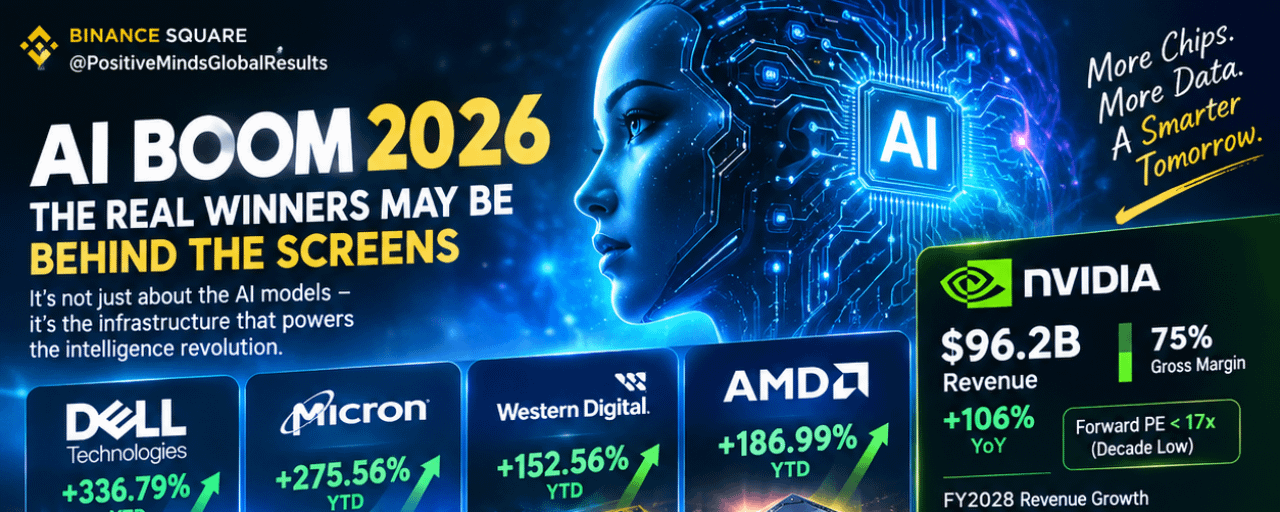
Companies such as Dell, Micron and Western Digital have benefited from the enormous buildout of AI infrastructure.
Western Digital says AI is creating a structural increase in data-storage requirements. Its recent IDC-backed research found that 61% of surveyed organizations experienced at least 25% data growth over the past year because of AI, while 74% expect similar growth over the next three years.
That matters because AI does not simply consume computing power — it creates enormous quantities of data that must be stored, retrieved and processed.
📈 2. NVIDIA: Record Growth, But a Different Valuation Story
NVIDIA remains central to the AI infrastructure cycle.
Its latest quarterly results showed $96.2 billion in revenue, up 106% year over year, with Data Center revenue reaching $89 billion, up 117%. Gross margin was approximately 75%.
Even more striking, NVIDIA management said it expects approximately 70% revenue growth in fiscal 2028, while describing demand as supply-constrained.
Yet the stock’s valuation has compressed sharply. Recent reporting puts NVIDIA below 17× forward earnings, close to its lowest valuation level in more than a decade.
This creates an unusual market debate:
Can AI earnings continue accelerating faster than investors reduce the valuation multiple?
🤖 3. The Agentic AI Revolution Changes the Hardware Equation
This may be the most important development.
Traditional generative AI primarily focused on answering prompts. Agentic AI is designed to perform multi-step tasks autonomously — planning, executing, checking results and interacting with software.
That changes infrastructure requirements.
AMD itself argues that agentic AI can create demand for additional CPU infrastructure alongside GPU systems.
Meta’s Muse has provided a real-world example of this shift. Its rapid adoption has helped revive investor attention around CPUs and AI inference infrastructure, with AMD eventually crossing the $1 trillion market-capitalization milestone on September 21.
⚡ 4. AMD’s $1 Trillion Milestone Is More Than a Number
AMD’s rise reflects a broader market question:
What happens when AI moves from training models to continuously operating agents?
The answer could involve substantially more demand for CPUs, memory, networking, storage and power — not simply more GPUs.
AMD’s market capitalization reached approximately $1 trillion in September 2026, while its shares had gained roughly 185% during the year at the time of the milestone.
Meanwhile, Micron’s next major test arrives on September 30, when it is scheduled to report fiscal Q4 results.
🔎 THE BIGGER PICTURE
The AI trade is becoming an entire infrastructure ecosystem:
GPU → CPU → Memory → Storage → Networking → Power → Data Centers → AI Agents
The most important question for investors may no longer be simply:
“Who builds the best AI model?”
It may increasingly become:
“Who supplies everything required to keep billions of AI operations running?”
That is where the next phase of the AI infrastructure story could become especially important.
⚠️ Market Note: Strong historical performance does not guarantee future returns. AI infrastructure companies also face valuation risk, cyclical demand, capital-spending fluctuations, competition, supply constraints and macroeconomic pressure.
Do your own research (DYOR). This is educational content, not financial advice.
#PositiveMindsGlobalResults #ThinkPositiveGlobal #BinanceSquare #AI #ArtificialIntelligence #NVIDIA #NVDA #AMD #Micron #MU #Dell #DELL #WesternDigital #WDC #AIStocks #Semiconductors #AgenticAI #DataCenters #TechStocks #BreakingNews
{spot}(BNBUSDT)
{spot}(BTCUSDT)
AI BOOM 2026: THE REAL WINNERS MAY BE BEHIND THE SCREENS
@PositiveMindsGlobalResults | @Binance Square Official I #AIStocks
September 24, 2026
The AI investment story is evolving.
The first phase was dominated by GPUs and foundation models. The next phase is increasingly about the infrastructure required to run AI at enormous scale — memory, storage, CPUs, networking and data-center systems.
And the numbers are getting difficult to ignore.
💾 1. AI Infrastructure Is Expanding Beyond GPUs
Companies such as Dell, Micron and Western Digital have benefited from the enormous buildout of AI infrastructure.
Western Digital says AI is creating a structural increase in data-storage requirements. Its recent IDC-backed research found that 61% of surveyed organizations experienced at least 25% data growth over the past year because of AI, while 74% expect similar growth over the next three years.
That matters because AI does not simply consume computing power — it creates enormous quantities of data that must be stored, retrieved and processed.
📈 2. NVIDIA: Record Growth, But a Different Valuation Story
NVIDIA remains central to the AI infrastructure cycle.
Its latest quarterly results showed $96.2 billion in revenue, up 106% year over year, with Data Center revenue reaching $89 billion, up 117%. Gross margin was approximately 75%.
Even more striking, NVIDIA management said it expects approximately 70% revenue growth in fiscal 2028, while describing demand as supply-constrained.
Yet the stock’s valuation has compressed sharply. Recent reporting puts NVIDIA below 17× forward earnings, close to its lowest valuation level in more than a decade.
This creates an unusual market debate:
Can AI earnings continue accelerating faster than investors reduce the valuation multiple?
🤖 3. The Agentic AI Revolution Changes the Hardware Equation
This may be the most important development.
Traditional generative AI primarily focused on answering prompts. Agentic AI is designed to perform multi-step tasks autonomously — planning, executing, checking results and interacting with software.
That changes infrastructure requirements.
AMD itself argues that agentic AI can create demand for additional CPU infrastructure alongside GPU systems.
Meta’s Muse has provided a real-world example of this shift. Its rapid adoption has helped revive investor attention around CPUs and AI inference infrastructure, with AMD eventually crossing the $1 trillion market-capitalization milestone on September 21.
⚡ 4. AMD’s $1 Trillion Milestone Is More Than a Number
AMD’s rise reflects a broader market question:
What happens when AI moves from training models to continuously operating agents?
The answer could involve substantially more demand for CPUs, memory, networking, storage and power — not simply more GPUs.
AMD’s market capitalization reached approximately $1 trillion in September 2026, while its shares had gained roughly 185% during the year at the time of the milestone.
Meanwhile, Micron’s next major test arrives on September 30, when it is scheduled to report fiscal Q4 results.
🔎 THE BIGGER PICTURE
The AI trade is becoming an entire infrastructure ecosystem:
GPU → CPU → Memory → Storage → Networking → Power → Data Centers → AI Agents
The most important question for investors may no longer be simply:
“Who builds the best AI model?”
It may increasingly become:
“Who supplies everything required to keep billions of AI operations running?”
That is where the next phase of the AI infrastructure story could become especially important.
⚠️ Market Note: Strong historical performance does not guarantee future returns. AI infrastructure companies also face valuation risk, cyclical demand, capital-spending fluctuations, competition, supply constraints and macroeconomic pressure.
Do your own research (DYOR). This is educational content, not financial advice.
#PositiveMindsGlobalResults #ThinkPositiveGlobal #BinanceSquare #AI #ArtificialIntelligence #NVIDIA #NVDA #AMD #Micron #MU #Dell #DELL #WesternDigital #WDC #AIStocks #Semiconductors #AgenticAI #DataCenters #TechStocks #BreakingNews
September 24, 2026
The AI investment story is evolving.
The first phase was dominated by GPUs and foundation models. The next phase is increasingly about the infrastructure required to run AI at enormous scale — memory, storage, CPUs, networking and data-center systems.
And the numbers are getting difficult to ignore.
💾 1. AI Infrastructure Is Expanding Beyond GPUs
Companies such as Dell, Micron and Western Digital have benefited from the enormous buildout of AI infrastructure.
Western Digital says AI is creating a structural increase in data-storage requirements. Its recent IDC-backed research found that 61% of surveyed organizations experienced at least 25% data growth over the past year because of AI, while 74% expect similar growth over the next three years.
That matters because AI does not simply consume computing power — it creates enormous quantities of data that must be stored, retrieved and processed.
📈 2. NVIDIA: Record Growth, But a Different Valuation Story
NVIDIA remains central to the AI infrastructure cycle.
Its latest quarterly results showed $96.2 billion in revenue, up 106% year over year, with Data Center revenue reaching $89 billion, up 117%. Gross margin was approximately 75%.
Even more striking, NVIDIA management said it expects approximately 70% revenue growth in fiscal 2028, while describing demand as supply-constrained.
Yet the stock’s valuation has compressed sharply. Recent reporting puts NVIDIA below 17× forward earnings, close to its lowest valuation level in more than a decade.
This creates an unusual market debate:
Can AI earnings continue accelerating faster than investors reduce the valuation multiple?
🤖 3. The Agentic AI Revolution Changes the Hardware Equation
This may be the most important development.
Traditional generative AI primarily focused on answering prompts. Agentic AI is designed to perform multi-step tasks autonomously — planning, executing, checking results and interacting with software.
That changes infrastructure requirements.
AMD itself argues that agentic AI can create demand for additional CPU infrastructure alongside GPU systems.
Meta’s Muse has provided a real-world example of this shift. Its rapid adoption has helped revive investor attention around CPUs and AI inference infrastructure, with AMD eventually crossing the $1 trillion market-capitalization milestone on September 21.
⚡ 4. AMD’s $1 Trillion Milestone Is More Than a Number
AMD’s rise reflects a broader market question:
What happens when AI moves from training models to continuously operating agents?
The answer could involve substantially more demand for CPUs, memory, networking, storage and power — not simply more GPUs.
AMD’s market capitalization reached approximately $1 trillion in September 2026, while its shares had gained roughly 185% during the year at the time of the milestone.
Meanwhile, Micron’s next major test arrives on September 30, when it is scheduled to report fiscal Q4 results.
🔎 THE BIGGER PICTURE
The AI trade is becoming an entire infrastructure ecosystem:
GPU → CPU → Memory → Storage → Networking → Power → Data Centers → AI Agents
The most important question for investors may no longer be simply:
“Who builds the best AI model?”
It may increasingly become:
“Who supplies everything required to keep billions of AI operations running?”
That is where the next phase of the AI infrastructure story could become especially important.
⚠️ Market Note: Strong historical performance does not guarantee future returns. AI infrastructure companies also face valuation risk, cyclical demand, capital-spending fluctuations, competition, supply constraints and macroeconomic pressure.
Do your own research (DYOR). This is educational content, not financial advice.
#PositiveMindsGlobalResults #ThinkPositiveGlobal #BinanceSquare #AI #ArtificialIntelligence #NVIDIA #NVDA #AMD #Micron #MU #Dell #DELL #WesternDigital #WDC #AIStocks #Semiconductors #AgenticAI #DataCenters #TechStocks #BreakingNews
244

Verified
#aistockswhatnext
Nvidia just said chip sales could double next year. Every major AI company is posting record revenue. And yet — the real question isn't "is AI growing," it's "how much of this growth is already priced in?"
Here's my honest take: I'm cautiously bullish, not blindly bullish. The compute demand is real — data centers, chips, infrastructure spend are all backed by actual enterprise adoption, not just hype. That's different from previous bubbles where valuation ran ahead of any real product.
But the political layer adds risk most people aren't pricing in. On one side, industry leaders are calling to slow AI development down. On the other, there's talk of state-level backing — even an "AI Force" — with claims AI could drive 25% of U.S. GDP eventually. That's a massive claim, and massive claims cut both ways: if it plays out, early AI holders win big. If sentiment shifts or regulation tightens, the correction could be sharp.
My approach: I'm not chasing every AI ticker that's up this month. I'm watching companies with actual earnings behind the AI narrative, not just AI mentioned in the pitch deck. Compute demand looks structural, not seasonal — but position sizing still matters more than conviction right now.
Where do you stand — is this a real breakout, or a story that's gotten ahead of the fundamentals? Drop your take below 👇
#AIStocksWhatNext #AIStocks #Investing
{spot}(NVDABUSDT)
{spot}(AAPLBUSDT)
#aistockswhatnext
Nvidia just said chip sales could double next year. Every major AI company is posting record revenue. And yet — the real question isn't "is AI growing," it's "how much of this growth is already priced in?"
Here's my honest take: I'm cautiously bullish, not blindly bullish. The compute demand is real — data centers, chips, infrastructure spend are all backed by actual enterprise adoption, not just hype. That's different from previous bubbles where valuation ran ahead of any real product.
But the political layer adds risk most people aren't pricing in. On one side, industry leaders are calling to slow AI development down. On the other, there's talk of state-level backing — even an "AI Force" — with claims AI could drive 25% of U.S. GDP eventually. That's a massive claim, and massive claims cut both ways: if it plays out, early AI holders win big. If sentiment shifts or regulation tightens, the correction could be sharp.
My approach: I'm not chasing every AI ticker that's up this month. I'm watching companies with actual earnings behind the AI narrative, not just AI mentioned in the pitch deck. Compute demand looks structural, not seasonal — but position sizing still matters more than conviction right now.
Where do you stand — is this a real breakout, or a story that's gotten ahead of the fundamentals? Drop your take below 👇
#AIStocksWhatNext #AIStocks #Investing
Nvidia just said chip sales could double next year. Every major AI company is posting record revenue. And yet — the real question isn't "is AI growing," it's "how much of this growth is already priced in?"
Here's my honest take: I'm cautiously bullish, not blindly bullish. The compute demand is real — data centers, chips, infrastructure spend are all backed by actual enterprise adoption, not just hype. That's different from previous bubbles where valuation ran ahead of any real product.
But the political layer adds risk most people aren't pricing in. On one side, industry leaders are calling to slow AI development down. On the other, there's talk of state-level backing — even an "AI Force" — with claims AI could drive 25% of U.S. GDP eventually. That's a massive claim, and massive claims cut both ways: if it plays out, early AI holders win big. If sentiment shifts or regulation tightens, the correction could be sharp.
My approach: I'm not chasing every AI ticker that's up this month. I'm watching companies with actual earnings behind the AI narrative, not just AI mentioned in the pitch deck. Compute demand looks structural, not seasonal — but position sizing still matters more than conviction right now.
Where do you stand — is this a real breakout, or a story that's gotten ahead of the fundamentals? Drop your take below 👇
#AIStocksWhatNext #AIStocks #Investing
2
1.2k

·
--
Article
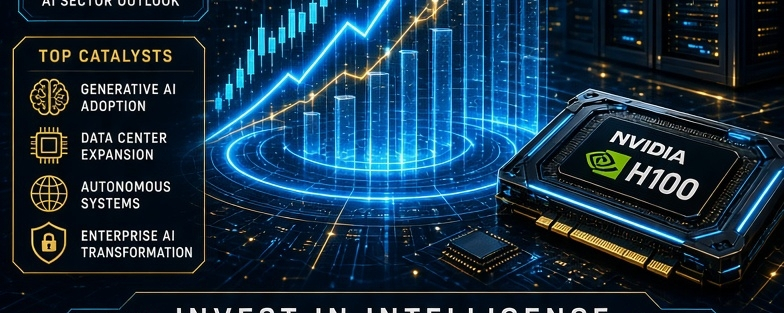
AI Infrastructure Still Dominates#AIStocksWhatNext $NVDAB trade still alive.
Memory & infrastructure names leading. Hyperscaler CapEx remains elevated.
Next phase? Broader supply chain, power constraints, and real enterprise ROI.
Nvidia still the king.
But the real alpha is shifting to the picks-and-shovels that feed the machines.
Volatility is normal.
The AI cycle isn’t done.
#AI #Semiconductors #AIStocks #ZECBreaksAbove$1600AtRecordHigh #BitwiseNEARStakingETPAssetsTop$100M
AI Infrastructure Still Dominates
#AIStocksWhatNext $NVDAB trade still alive.
Memory & infrastructure names leading. Hyperscaler CapEx remains elevated.
Next phase? Broader supply chain, power constraints, and real enterprise ROI.
Nvidia still the king.
But the real alpha is shifting to the picks-and-shovels that feed the machines.
Volatility is normal.
The AI cycle isn’t done.
#AI #Semiconductors #AIStocks #ZECBreaksAbove$1600AtRecordHigh #BitwiseNEARStakingETPAssetsTop$100M
Memory & infrastructure names leading. Hyperscaler CapEx remains elevated.
Next phase? Broader supply chain, power constraints, and real enterprise ROI.
Nvidia still the king.
But the real alpha is shifting to the picks-and-shovels that feed the machines.
Volatility is normal.
The AI cycle isn’t done.
#AI #Semiconductors #AIStocks #ZECBreaksAbove$1600AtRecordHigh #BitwiseNEARStakingETPAssetsTop$100M
84

·
--
Verified
#aistockswhatnext
AI stocks are back near the center of the market. But the next phase may be less about chips and more about everything needed to keep them running. 🤖
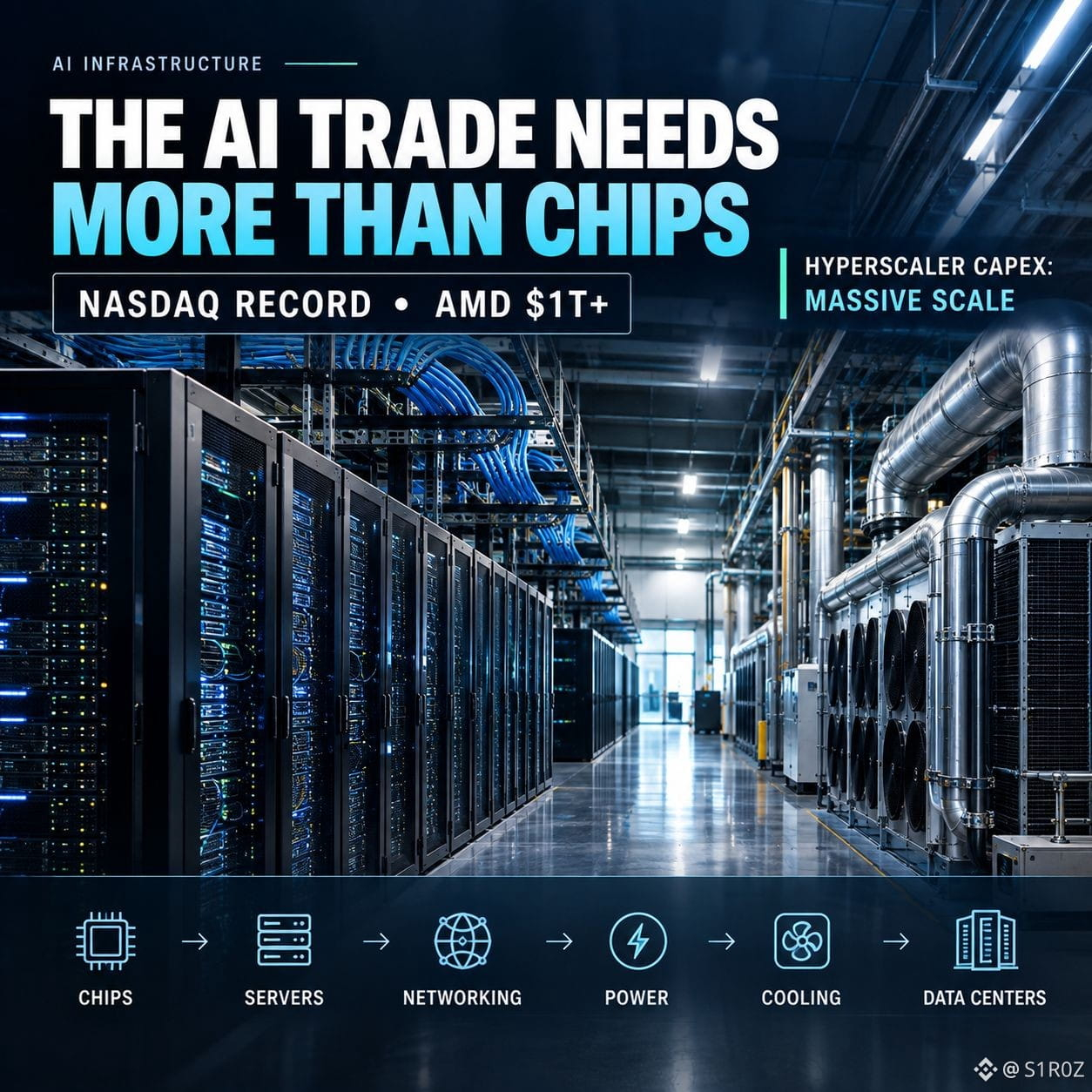
The Nasdaq just hit another record, while AMD's market value crossed $1 trillion as semiconductor stocks rallied. AI demand remains a major driver of tech sentiment.
But here's what caught my attention:
The AI buildout is getting so large that power, cooling and networking are becoming part of the investment story.
Hyperscalers are expected to spend around $795B on capital expenditure this year, with much of that flowing through the AI infrastructure chain.
That creates a second layer to the AI trade.
GPUs need servers. Servers need networking. Dense AI clusters need power and increasingly sophisticated cooling.
So the question I'm watching isn't simply “Which AI stock moves next?”
It's:
Where does the next dollar of AI infrastructure spending actually go?
$NVDA
{future}(NVDAUSDT)
$AMD
{future}(AMDUSDT)
$AVGO
{future}(AVGOUSDT)
#AIStocks #artificialintelligence #TechStocks
#aistockswhatnext
AI stocks are back near the center of the market. But the next phase may be less about chips and more about everything needed to keep them running. 🤖
The Nasdaq just hit another record, while AMD's market value crossed $1 trillion as semiconductor stocks rallied. AI demand remains a major driver of tech sentiment.
But here's what caught my attention:
The AI buildout is getting so large that power, cooling and networking are becoming part of the investment story.
Hyperscalers are expected to spend around $795B on capital expenditure this year, with much of that flowing through the AI infrastructure chain.
That creates a second layer to the AI trade.
GPUs need servers. Servers need networking. Dense AI clusters need power and increasingly sophisticated cooling.
So the question I'm watching isn't simply “Which AI stock moves next?”
It's:
Where does the next dollar of AI infrastructure spending actually go?
$NVDA
$AMD
$AVGO
#AIStocks #artificialintelligence #TechStocks
AI stocks are back near the center of the market. But the next phase may be less about chips and more about everything needed to keep them running. 🤖
The Nasdaq just hit another record, while AMD's market value crossed $1 trillion as semiconductor stocks rallied. AI demand remains a major driver of tech sentiment.
But here's what caught my attention:
The AI buildout is getting so large that power, cooling and networking are becoming part of the investment story.
Hyperscalers are expected to spend around $795B on capital expenditure this year, with much of that flowing through the AI infrastructure chain.
That creates a second layer to the AI trade.
GPUs need servers. Servers need networking. Dense AI clusters need power and increasingly sophisticated cooling.
So the question I'm watching isn't simply “Which AI stock moves next?”
It's:
Where does the next dollar of AI infrastructure spending actually go?
$NVDA
$AMD
$AVGO
#AIStocks #artificialintelligence #TechStocks
12

·
--
Bullish
#aistockswhatnext
🚨 Nvidia’s AI boom is accelerating — but there’s a catch.
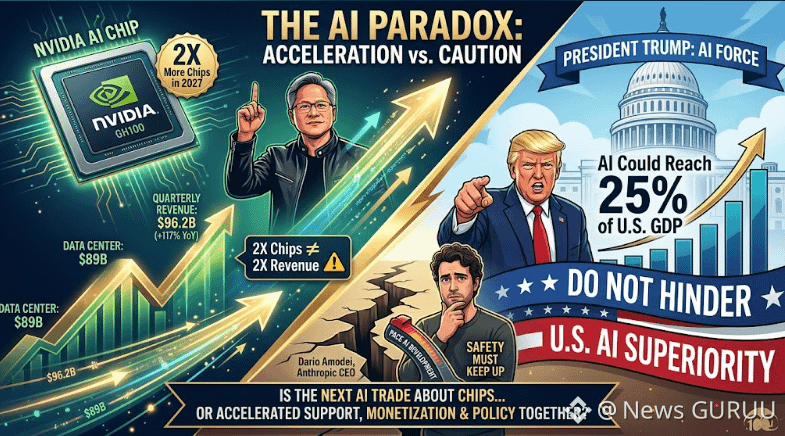
Nvidia reported $96.2B in quarterly revenue, with Data Center revenue up 117% YoY. Jensen Huang says Nvidia could sell 2× more chips in 2027 than in 2026.
But 2× chips doesn’t mean 2× revenue.
At the same time, President Trump says AI could eventually reach 25% of U.S. GDP, while Anthropic CEO Dario Amodei argues AI development needs to be paced for safety.
The big question: Can chip demand, AI monetization, and policy support keep accelerating together? "CLICK ON THE BELOW YELLOW COIN TAG TO GO TO DESIRED TRADING PAGE TO GET BENEFIT TRADE"$NVDAB
{spot}(NVDABUSDT)
#NVIDIA #AIStocks
#aistockswhatnext
🚨 Nvidia’s AI boom is accelerating — but there’s a catch.
Nvidia reported $96.2B in quarterly revenue, with Data Center revenue up 117% YoY. Jensen Huang says Nvidia could sell 2× more chips in 2027 than in 2026.
But 2× chips doesn’t mean 2× revenue.
At the same time, President Trump says AI could eventually reach 25% of U.S. GDP, while Anthropic CEO Dario Amodei argues AI development needs to be paced for safety.
The big question: Can chip demand, AI monetization, and policy support keep accelerating together? "CLICK ON THE BELOW YELLOW COIN TAG TO GO TO DESIRED TRADING PAGE TO GET BENEFIT TRADE"$NVDAB
#NVIDIA #AIStocks
🚨 Nvidia’s AI boom is accelerating — but there’s a catch.
Nvidia reported $96.2B in quarterly revenue, with Data Center revenue up 117% YoY. Jensen Huang says Nvidia could sell 2× more chips in 2027 than in 2026.
But 2× chips doesn’t mean 2× revenue.
At the same time, President Trump says AI could eventually reach 25% of U.S. GDP, while Anthropic CEO Dario Amodei argues AI development needs to be paced for safety.
The big question: Can chip demand, AI monetization, and policy support keep accelerating together? "CLICK ON THE BELOW YELLOW COIN TAG TO GO TO DESIRED TRADING PAGE TO GET BENEFIT TRADE"$NVDAB
#NVIDIA #AIStocks
2
212

#AIStocksWhatNext
Nvidia's soaring demand and record AI sector revenues prove that compute spend isn't just a short-term bounce; it reflects fundamental infrastructure migration. While tech leaders urge caution, state-level initiatives like the proposed U.S. "AI Force" highlight how critical AI has become to national economic strategy and future GDP growth. Government backing provides a strong long-term tailwind for leading AI equities.
Are you adding to your AI portfolio? Share your current holdings via the trade sharing widget below!
#AIstocks
#NVDIA
#NVDABUSDT
{spot}(NVDABUSDT)
{future}(NVDAUSDT)
#AIStocksWhatNext
Nvidia's soaring demand and record AI sector revenues prove that compute spend isn't just a short-term bounce; it reflects fundamental infrastructure migration. While tech leaders urge caution, state-level initiatives like the proposed U.S. "AI Force" highlight how critical AI has become to national economic strategy and future GDP growth. Government backing provides a strong long-term tailwind for leading AI equities.
Are you adding to your AI portfolio? Share your current holdings via the trade sharing widget below!
#AIstocks
#NVDIA
#NVDABUSDT
Nvidia's soaring demand and record AI sector revenues prove that compute spend isn't just a short-term bounce; it reflects fundamental infrastructure migration. While tech leaders urge caution, state-level initiatives like the proposed U.S. "AI Force" highlight how critical AI has become to national economic strategy and future GDP growth. Government backing provides a strong long-term tailwind for leading AI equities.
Are you adding to your AI portfolio? Share your current holdings via the trade sharing widget below!
#AIstocks
#NVDIA
#NVDABUSDT
13

·
--
Verified
#aistockswhatnext
🚨 Nvidia Says 2× More Chips. President Trump Says AI Could Reach 25% of GDP. But There’s a Catch.
Nvidia’s AI story is getting bigger — fast.
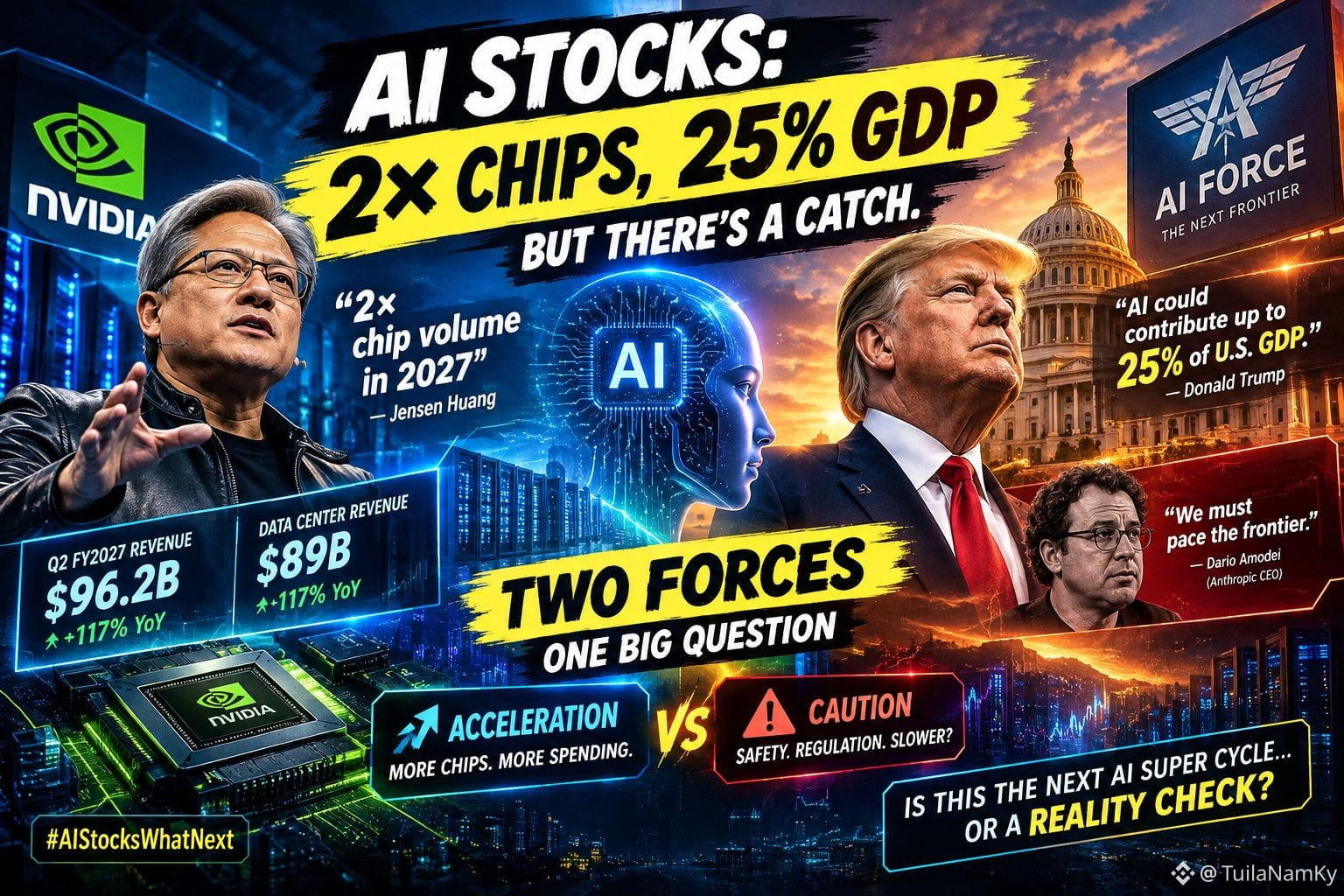
The company just reported $96.2B in quarterly revenue, including $89B from Data Center, up 117% YoY.
Now Jensen Huang says Nvidia could sell 2× the chip volume in 2027 versus 2026.
But remember: 2× chips ≠ 2× revenue.
That distinction matters.
Because the other side of the AI story is getting louder.
President Trump has announced an “AI Force” and said AI could eventually represent as much as 25% of U.S. GDP, while arguing the industry should not be hindered.
Meanwhile, Anthropic CEO Dario Amodei is calling for AI development to be paced, arguing that safety systems need time to catch up with rapidly accelerating capabilities.
So here’s the paradox:
Silicon Valley is warning about the speed.
Washington is betting on the acceleration.
And that creates the real AI-stocks question:
Is the next AI trade simply about selling more chips…
or about whether compute spending, AI monetization and policy support can keep accelerating together?
What happens when AI demand keeps rising — but the debate over how fast to build it gets even bigger?
#AIStocks
#Nvidia
$NVDAB
{spot}(NVDABUSDT)
Market commentary only. Not financial advice.
#aistockswhatnext
🚨 Nvidia Says 2× More Chips. President Trump Says AI Could Reach 25% of GDP. But There’s a Catch.
Nvidia’s AI story is getting bigger — fast.
The company just reported $96.2B in quarterly revenue, including $89B from Data Center, up 117% YoY.
Now Jensen Huang says Nvidia could sell 2× the chip volume in 2027 versus 2026.
But remember: 2× chips ≠ 2× revenue.
That distinction matters.
Because the other side of the AI story is getting louder.
President Trump has announced an “AI Force” and said AI could eventually represent as much as 25% of U.S. GDP, while arguing the industry should not be hindered.
Meanwhile, Anthropic CEO Dario Amodei is calling for AI development to be paced, arguing that safety systems need time to catch up with rapidly accelerating capabilities.
So here’s the paradox:
Silicon Valley is warning about the speed.
Washington is betting on the acceleration.
And that creates the real AI-stocks question:
Is the next AI trade simply about selling more chips…
or about whether compute spending, AI monetization and policy support can keep accelerating together?
What happens when AI demand keeps rising — but the debate over how fast to build it gets even bigger?
#AIStocks
#Nvidia
$NVDAB
Market commentary only. Not financial advice.
🚨 Nvidia Says 2× More Chips. President Trump Says AI Could Reach 25% of GDP. But There’s a Catch.
Nvidia’s AI story is getting bigger — fast.
The company just reported $96.2B in quarterly revenue, including $89B from Data Center, up 117% YoY.
Now Jensen Huang says Nvidia could sell 2× the chip volume in 2027 versus 2026.
But remember: 2× chips ≠ 2× revenue.
That distinction matters.
Because the other side of the AI story is getting louder.
President Trump has announced an “AI Force” and said AI could eventually represent as much as 25% of U.S. GDP, while arguing the industry should not be hindered.
Meanwhile, Anthropic CEO Dario Amodei is calling for AI development to be paced, arguing that safety systems need time to catch up with rapidly accelerating capabilities.
So here’s the paradox:
Silicon Valley is warning about the speed.
Washington is betting on the acceleration.
And that creates the real AI-stocks question:
Is the next AI trade simply about selling more chips…
or about whether compute spending, AI monetization and policy support can keep accelerating together?
What happens when AI demand keeps rising — but the debate over how fast to build it gets even bigger?
#AIStocks
#Nvidia
$NVDAB
Market commentary only. Not financial advice.
206 Atlas:
Volume doubling does not guarantee revenue growth. Focus on the margin compression risk when supply chains saturate.
2
1
2
4.7k

·
--
#AIStocksWhatNext
🚨 THE AI TRADE IS ENTERING PHASE 2: What’s Next Beyond GPUs? 🚨
With AI stocks continuing to climb, the biggest question is where the capital will flow next. I remain BULLISH on the long-term AI supercycle, but the opportunity is actively shifting from pure hardware into broad infrastructure and software monetization! 📈
📊 The Current State of the Heavyweights:
🔹 $NVDA (Nvidia): The undisputed king. Projecting a 70% growth rate next year. With global data center CapEx expected to hit $3-4 trillion by 2030, $NVDA is a core holding trading at an attractive 28x earnings multiple.
🔹 $META (Meta): Software monetization is scaling. Meta jumped 20%+ in two weeks after launching its Muse AI agent. Application-layer AI is becoming a serious revenue engine.
🔹 $AVGO (Broadcom): The networking side is heating up. Securing Anthropic as a major new customer proves the bottleneck isn't just computing power—it's networking and custom silicon.
🔥 The "Phase 2" Trade Opportunities:
The AI buildout requires a massive supporting ecosystem:
1️⃣ Networking & Storage: Efficiently moving data is just as important as processing it.
2️⃣ Power & Cooling: AI data centers consume vast amounts of electricity. Utilities and liquid cooling companies are the hidden backbone.
3️⃣ Cybersecurity: As AI scales, so do security threats. This creates massive long-term demand for leaders like $CRWD.
💼 My Current Watchlist & Stance:
✅ Long $NVDA: For foundational GPU dominance.
✅ Long $META: For consumer application & software scaling.
✅ Long $AVGO: For critical networking infrastructure.
What are you holding for Phase 2? Bullish or bearish? Let me know below! 👇
#AIStocksWhatNext #AIStocks #CryptoInvesting #avgo $METAB $NVDAB $AVGOB
{spot}(METABUSDT)
#AIStocksWhatNext
🚨 THE AI TRADE IS ENTERING PHASE 2: What’s Next Beyond GPUs? 🚨
With AI stocks continuing to climb, the biggest question is where the capital will flow next. I remain BULLISH on the long-term AI supercycle, but the opportunity is actively shifting from pure hardware into broad infrastructure and software monetization! 📈
📊 The Current State of the Heavyweights:
🔹 $NVDA (Nvidia): The undisputed king. Projecting a 70% growth rate next year. With global data center CapEx expected to hit $3-4 trillion by 2030, $NVDA is a core holding trading at an attractive 28x earnings multiple.
🔹 $META (Meta): Software monetization is scaling. Meta jumped 20%+ in two weeks after launching its Muse AI agent. Application-layer AI is becoming a serious revenue engine.
🔹 $AVGO (Broadcom): The networking side is heating up. Securing Anthropic as a major new customer proves the bottleneck isn't just computing power—it's networking and custom silicon.
🔥 The "Phase 2" Trade Opportunities:
The AI buildout requires a massive supporting ecosystem:
1️⃣ Networking & Storage: Efficiently moving data is just as important as processing it.
2️⃣ Power & Cooling: AI data centers consume vast amounts of electricity. Utilities and liquid cooling companies are the hidden backbone.
3️⃣ Cybersecurity: As AI scales, so do security threats. This creates massive long-term demand for leaders like $CRWD.
💼 My Current Watchlist & Stance:
✅ Long $NVDA: For foundational GPU dominance.
✅ Long $META: For consumer application & software scaling.
✅ Long $AVGO: For critical networking infrastructure.
What are you holding for Phase 2? Bullish or bearish? Let me know below! 👇
#AIStocksWhatNext #AIStocks #CryptoInvesting #avgo $METAB $NVDAB $AVGOB
🚨 THE AI TRADE IS ENTERING PHASE 2: What’s Next Beyond GPUs? 🚨
With AI stocks continuing to climb, the biggest question is where the capital will flow next. I remain BULLISH on the long-term AI supercycle, but the opportunity is actively shifting from pure hardware into broad infrastructure and software monetization! 📈
📊 The Current State of the Heavyweights:
🔹 $NVDA (Nvidia): The undisputed king. Projecting a 70% growth rate next year. With global data center CapEx expected to hit $3-4 trillion by 2030, $NVDA is a core holding trading at an attractive 28x earnings multiple.
🔹 $META (Meta): Software monetization is scaling. Meta jumped 20%+ in two weeks after launching its Muse AI agent. Application-layer AI is becoming a serious revenue engine.
🔹 $AVGO (Broadcom): The networking side is heating up. Securing Anthropic as a major new customer proves the bottleneck isn't just computing power—it's networking and custom silicon.
🔥 The "Phase 2" Trade Opportunities:
The AI buildout requires a massive supporting ecosystem:
1️⃣ Networking & Storage: Efficiently moving data is just as important as processing it.
2️⃣ Power & Cooling: AI data centers consume vast amounts of electricity. Utilities and liquid cooling companies are the hidden backbone.
3️⃣ Cybersecurity: As AI scales, so do security threats. This creates massive long-term demand for leaders like $CRWD.
💼 My Current Watchlist & Stance:
✅ Long $NVDA: For foundational GPU dominance.
✅ Long $META: For consumer application & software scaling.
✅ Long $AVGO: For critical networking infrastructure.
What are you holding for Phase 2? Bullish or bearish? Let me know below! 👇
#AIStocksWhatNext #AIStocks #CryptoInvesting #avgo $METAB $NVDAB $AVGOB
94

·
--
#AIStocksWhatNext
Artificial intelligence is reshaping industries and transforming the future of financial markets. Investors are closely watching AI leaders such as NVIDIA (NVDA), Microsoft (MSFT), and AMD (AMD) as the next phase of AI innovation unfolds.
Explore the trends, opportunities, risks, and companies shaping the AI-driven economy.
Which AI stock or technology do you think deserves the most attention in the next phase of AI growth? Share your thoughts in the comments, follow for more AI & market insights, and join the conversation around #AIStocksWhatNext.
#AI #AIStocks $NVDAB $NVDA.US #Microsoft #AMD #Investing #ArtificialIntelligence #Technology #FinancialMarkets #FutureOfAI
#AIStocksWhatNext
Artificial intelligence is reshaping industries and transforming the future of financial markets. Investors are closely watching AI leaders such as NVIDIA (NVDA), Microsoft (MSFT), and AMD (AMD) as the next phase of AI innovation unfolds.
Explore the trends, opportunities, risks, and companies shaping the AI-driven economy.
Which AI stock or technology do you think deserves the most attention in the next phase of AI growth? Share your thoughts in the comments, follow for more AI & market insights, and join the conversation around #AIStocksWhatNext.
#AI #AIStocks $NVDAB $NVDA.US #Microsoft #AMD #Investing #ArtificialIntelligence #Technology #FinancialMarkets #FutureOfAI
Artificial intelligence is reshaping industries and transforming the future of financial markets. Investors are closely watching AI leaders such as NVIDIA (NVDA), Microsoft (MSFT), and AMD (AMD) as the next phase of AI innovation unfolds.
Explore the trends, opportunities, risks, and companies shaping the AI-driven economy.
Which AI stock or technology do you think deserves the most attention in the next phase of AI growth? Share your thoughts in the comments, follow for more AI & market insights, and join the conversation around #AIStocksWhatNext.
#AI #AIStocks $NVDAB $NVDA.US #Microsoft #AMD #Investing #ArtificialIntelligence #Technology #FinancialMarkets #FutureOfAI
115


·
--
Bullish
Verified
🤖🔥 AI STOCKS: ARE WE FACING THE NEXT BIG BOOM OR AT THE PEAK OF EUPHORIA?
There’s one fact that seems impossible to ignore:
NVIDIA ($NVDA ) says demand for its chips could allow it to double its sales, even though supply constraints mean the company expects roughly 70% growth.
For me, this changes the question.
It’s no longer just:
👉 “Is AI growing?”
Demand evidence is enormous.
The real question is:
HOW LONG CAN THIS LEVEL OF INVESTMENT LAST?
Microsoft, Meta, Amazon, Google, and other giants are spending massive amounts on AI infrastructure.
📈 MY POSITION: BULLISH
I’m following NVDA because it’s still one of the most direct ways to gain exposure to the growth of AI infrastructure.
But I wouldn’t buy at any price.
I want to see that revenue growth, chip demand, and infrastructure spending continue to justify current valuations.
⚠️ Risk is real too.
Goldman Sachs warns that the momentum of AI investments could start to lose steam as a driver of earnings growth in 2027.
So my strategy is:
🟢 BULLISH: stay exposed to AI as long as demand keeps accelerating.
🔴 BEARISH: if signs of lower capex, margin compression, or order slowdowns start to appear, I would reduce exposure.
And there’s another interesting factor: the U.S. is increasing its strategic support for AI development, while the debate over regulation and technology security continues.
🔥 For me, the question isn’t whether AI is a trend.
The question is whether we’re at the beginning of a multi-year transformation…
or whether the market is already discounting too much of the future.
👇 BULLISH or BEARISH with AI STOCKS?
📈 If you’ve got NVDA, AMD, AVGO, TSM, or any other AI-related stock, share your trade/position with the Trade Sharing Widget and tell me your entry.
Do AI STOCKS still have room to run? 🤖🚀
#AIStocksWhatNext #NVDA #AIStocks #ArtificialIntelligence
🤖🔥 AI STOCKS: ARE WE FACING THE NEXT BIG BOOM OR AT THE PEAK OF EUPHORIA?
There’s one fact that seems impossible to ignore:
NVIDIA ($NVDA ) says demand for its chips could allow it to double its sales, even though supply constraints mean the company expects roughly 70% growth.
For me, this changes the question.
It’s no longer just:
👉 “Is AI growing?”
Demand evidence is enormous.
The real question is:
HOW LONG CAN THIS LEVEL OF INVESTMENT LAST?
Microsoft, Meta, Amazon, Google, and other giants are spending massive amounts on AI infrastructure.
📈 MY POSITION: BULLISH
I’m following NVDA because it’s still one of the most direct ways to gain exposure to the growth of AI infrastructure.
But I wouldn’t buy at any price.
I want to see that revenue growth, chip demand, and infrastructure spending continue to justify current valuations.
⚠️ Risk is real too.
Goldman Sachs warns that the momentum of AI investments could start to lose steam as a driver of earnings growth in 2027.
So my strategy is:
🟢 BULLISH: stay exposed to AI as long as demand keeps accelerating.
🔴 BEARISH: if signs of lower capex, margin compression, or order slowdowns start to appear, I would reduce exposure.
And there’s another interesting factor: the U.S. is increasing its strategic support for AI development, while the debate over regulation and technology security continues.
🔥 For me, the question isn’t whether AI is a trend.
The question is whether we’re at the beginning of a multi-year transformation…
or whether the market is already discounting too much of the future.
👇 BULLISH or BEARISH with AI STOCKS?
📈 If you’ve got NVDA, AMD, AVGO, TSM, or any other AI-related stock, share your trade/position with the Trade Sharing Widget and tell me your entry.
Do AI STOCKS still have room to run? 🤖🚀
#AIStocksWhatNext #NVDA #AIStocks #ArtificialIntelligence
There’s one fact that seems impossible to ignore:
NVIDIA ($NVDA ) says demand for its chips could allow it to double its sales, even though supply constraints mean the company expects roughly 70% growth.
For me, this changes the question.
It’s no longer just:
👉 “Is AI growing?”
Demand evidence is enormous.
The real question is:
HOW LONG CAN THIS LEVEL OF INVESTMENT LAST?
Microsoft, Meta, Amazon, Google, and other giants are spending massive amounts on AI infrastructure.
📈 MY POSITION: BULLISH
I’m following NVDA because it’s still one of the most direct ways to gain exposure to the growth of AI infrastructure.
But I wouldn’t buy at any price.
I want to see that revenue growth, chip demand, and infrastructure spending continue to justify current valuations.
⚠️ Risk is real too.
Goldman Sachs warns that the momentum of AI investments could start to lose steam as a driver of earnings growth in 2027.
So my strategy is:
🟢 BULLISH: stay exposed to AI as long as demand keeps accelerating.
🔴 BEARISH: if signs of lower capex, margin compression, or order slowdowns start to appear, I would reduce exposure.
And there’s another interesting factor: the U.S. is increasing its strategic support for AI development, while the debate over regulation and technology security continues.
🔥 For me, the question isn’t whether AI is a trend.
The question is whether we’re at the beginning of a multi-year transformation…
or whether the market is already discounting too much of the future.
👇 BULLISH or BEARISH with AI STOCKS?
📈 If you’ve got NVDA, AMD, AVGO, TSM, or any other AI-related stock, share your trade/position with the Trade Sharing Widget and tell me your entry.
Do AI STOCKS still have room to run? 🤖🚀
#AIStocksWhatNext #NVDA #AIStocks #ArtificialIntelligence
690
Log in to explore more content
Join global crypto users on Binance Square
⚡️ Get latest and useful information about crypto.
💬 Trusted by the world’s largest crypto exchange.
👍 Discover real insights from verified creators.
Email / Phone number
Trending Topics
1
#AltcoinSeasonIndexHoldsAbove60For5Days
26 views
65 Discussing
2
#BitcoinSlipsBelow$84000
487 views
50 Discussing
3
#KospiPostsWorstQuarterSince2020
18 views
39 Discussing
4
#SECToClarifyOnChainFundraisingRules
3,933 views
232 Discussing
5
#UKFCAOpensCryptoFirmAuthorization
7,054 views
223 Discussing
6
#JapanMOFStudyGroupOnTokenizedGovtBonds
6,307 views
222 Discussing
7
#QNTRises287%
38,542 views
581 Discussing
8
#TrumpRejectsAIRulesForVoluntaryAudits
27,050 views
598 Discussing
9
#BitgetHotWalletBreachTiedToThirdPartySecurityFlaw
15,677 views
391 Discussing
10
#OpenAIUnveilsAlwaysOnAgentDots
12,594 views
399 Discussing