

#bitgethotwalletbreachtiedtothirdpartysecurityflaw
bitgethotwalletbreachtiedtothirdpartysecurityflaw
40,974 views
407 Discussing
Hot
Latest

·
--
#bitgethotwalletbreachtiedtothirdpartysecurityflaw
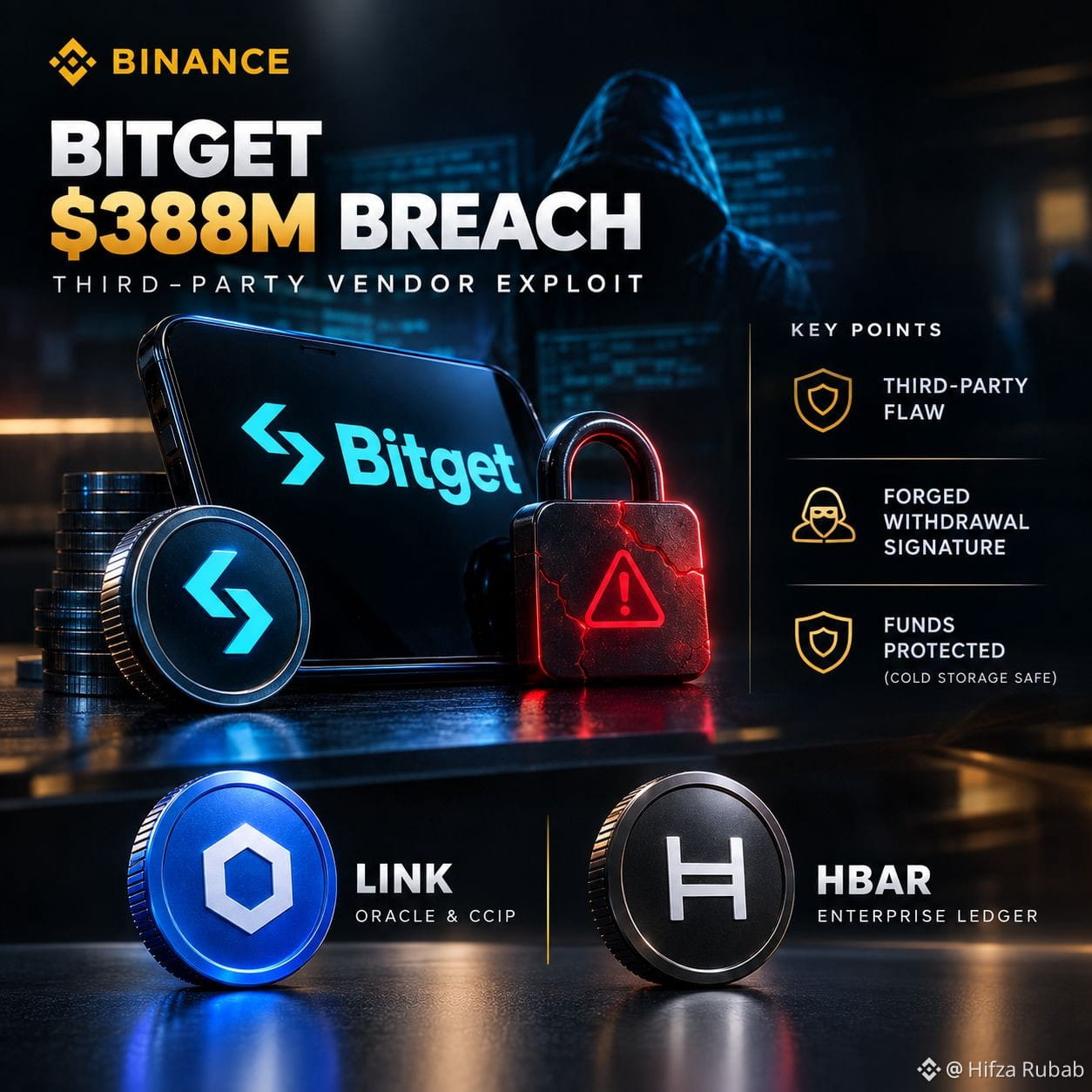
🚨 BITGET $388M HOT WALLET BREACH: THIRD-PARTY VENDOR EXPLOIT! 🛡️💥
Bitget has confirmed a major security incident involving ~$388M in unauthorized transfers from operational hot and warm wallets. However, user funds remain fully backed, and cold storage was completely unaffected! 🏦⚡
💡 Key Technical Takeaways & Insights:
🔹 Third-Party Flaw: Private keys were not compromised. Attackers exploited a critical vulnerability in a third-party security software tool to obtain high-level internal credentials.
🔹 Forged Withdrawal Signature: Armed with stolen credentials, the attacker sent counterfeit withdrawal commands that bypassed automated risk controls.
🔹 Full Protection Coverage: The exchange's $464M Protection Fund is covering all lost assets, and withdrawals are being restored in phases.
🎯 2 Security & Interoperability Coins to Watch:
🌐 $LINK (Chainlink) — Industry-standard decentralized oracle network and CCIP framework driving automated multi-signature security checks across Web3! ⚡🚀
🪐 $HBAR (Hedera) — Enterprise-grade distributed ledger protocol engineered for transparent, real-time supply chain and vendor security auditing! 🛡️📈
How should major crypto exchanges handle vendor security audits to prevent third-party exploits? Drop your thoughts below! 👇✨
#BitgetHotWalletBreachTiedToThirdPartySecurityFlaw
#JapanMOFStudyGroupOnTokenizedGovtBonds
#QNTRises287%
#TrumpRejectsAIRulesForVoluntaryAudits
{spot}(HBARUSDT)
{spot}(LINKUSDT)
#bitgethotwalletbreachtiedtothirdpartysecurityflaw
🚨 BITGET $388M HOT WALLET BREACH: THIRD-PARTY VENDOR EXPLOIT! 🛡️💥
Bitget has confirmed a major security incident involving ~$388M in unauthorized transfers from operational hot and warm wallets. However, user funds remain fully backed, and cold storage was completely unaffected! 🏦⚡
💡 Key Technical Takeaways & Insights:
🔹 Third-Party Flaw: Private keys were not compromised. Attackers exploited a critical vulnerability in a third-party security software tool to obtain high-level internal credentials.
🔹 Forged Withdrawal Signature: Armed with stolen credentials, the attacker sent counterfeit withdrawal commands that bypassed automated risk controls.
🔹 Full Protection Coverage: The exchange's $464M Protection Fund is covering all lost assets, and withdrawals are being restored in phases.
🎯 2 Security & Interoperability Coins to Watch:
🌐 $LINK (Chainlink) — Industry-standard decentralized oracle network and CCIP framework driving automated multi-signature security checks across Web3! ⚡🚀
🪐 $HBAR (Hedera) — Enterprise-grade distributed ledger protocol engineered for transparent, real-time supply chain and vendor security auditing! 🛡️📈
How should major crypto exchanges handle vendor security audits to prevent third-party exploits? Drop your thoughts below! 👇✨
#BitgetHotWalletBreachTiedToThirdPartySecurityFlaw
#JapanMOFStudyGroupOnTokenizedGovtBonds
#QNTRises287%
#TrumpRejectsAIRulesForVoluntaryAudits
🚨 BITGET $388M HOT WALLET BREACH: THIRD-PARTY VENDOR EXPLOIT! 🛡️💥
Bitget has confirmed a major security incident involving ~$388M in unauthorized transfers from operational hot and warm wallets. However, user funds remain fully backed, and cold storage was completely unaffected! 🏦⚡
💡 Key Technical Takeaways & Insights:
🔹 Third-Party Flaw: Private keys were not compromised. Attackers exploited a critical vulnerability in a third-party security software tool to obtain high-level internal credentials.
🔹 Forged Withdrawal Signature: Armed with stolen credentials, the attacker sent counterfeit withdrawal commands that bypassed automated risk controls.
🔹 Full Protection Coverage: The exchange's $464M Protection Fund is covering all lost assets, and withdrawals are being restored in phases.
🎯 2 Security & Interoperability Coins to Watch:
🌐 $LINK (Chainlink) — Industry-standard decentralized oracle network and CCIP framework driving automated multi-signature security checks across Web3! ⚡🚀
🪐 $HBAR (Hedera) — Enterprise-grade distributed ledger protocol engineered for transparent, real-time supply chain and vendor security auditing! 🛡️📈
How should major crypto exchanges handle vendor security audits to prevent third-party exploits? Drop your thoughts below! 👇✨
#BitgetHotWalletBreachTiedToThirdPartySecurityFlaw
#JapanMOFStudyGroupOnTokenizedGovtBonds
#QNTRises287%
#TrumpRejectsAIRulesForVoluntaryAudits
2
2
295

·
--
Bearish
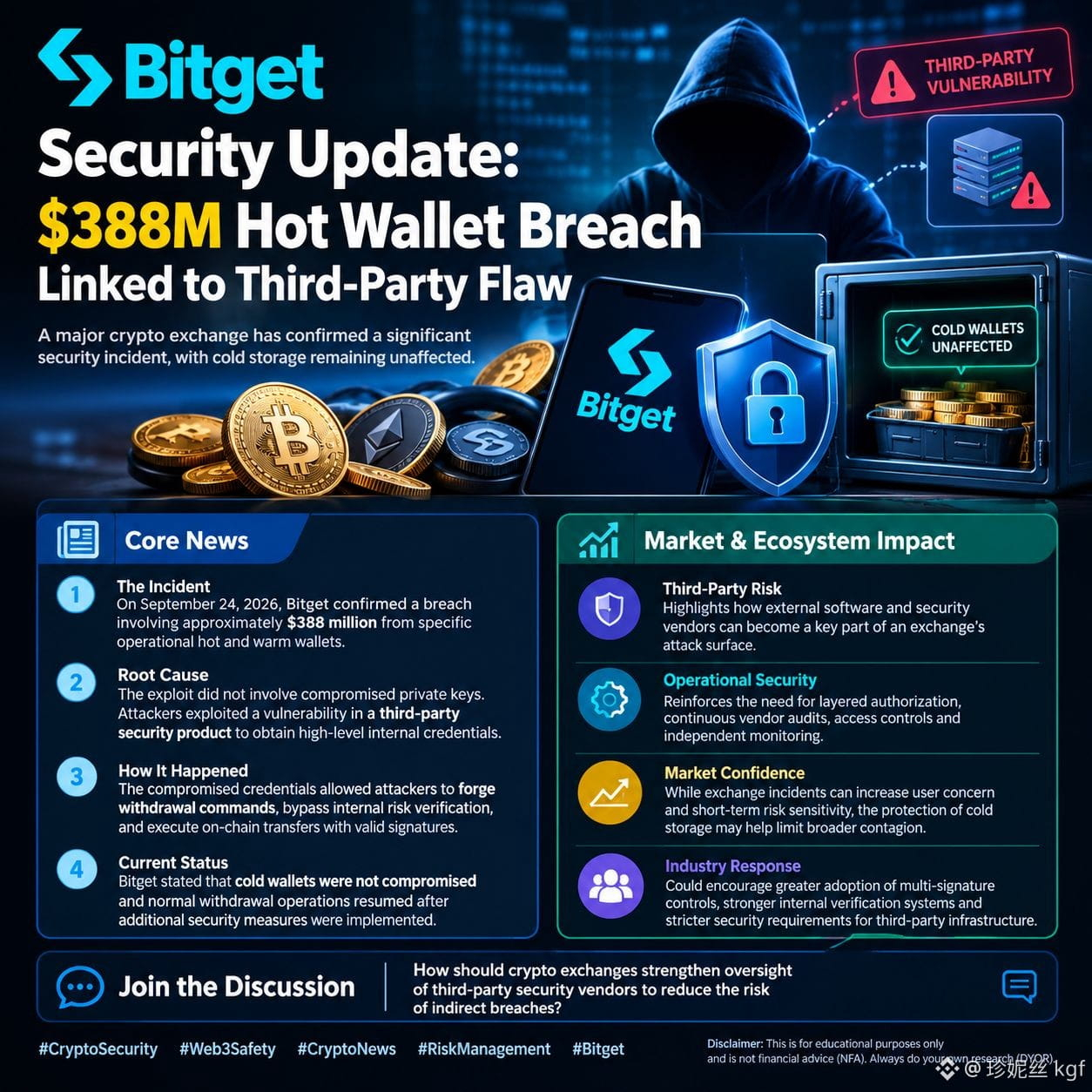
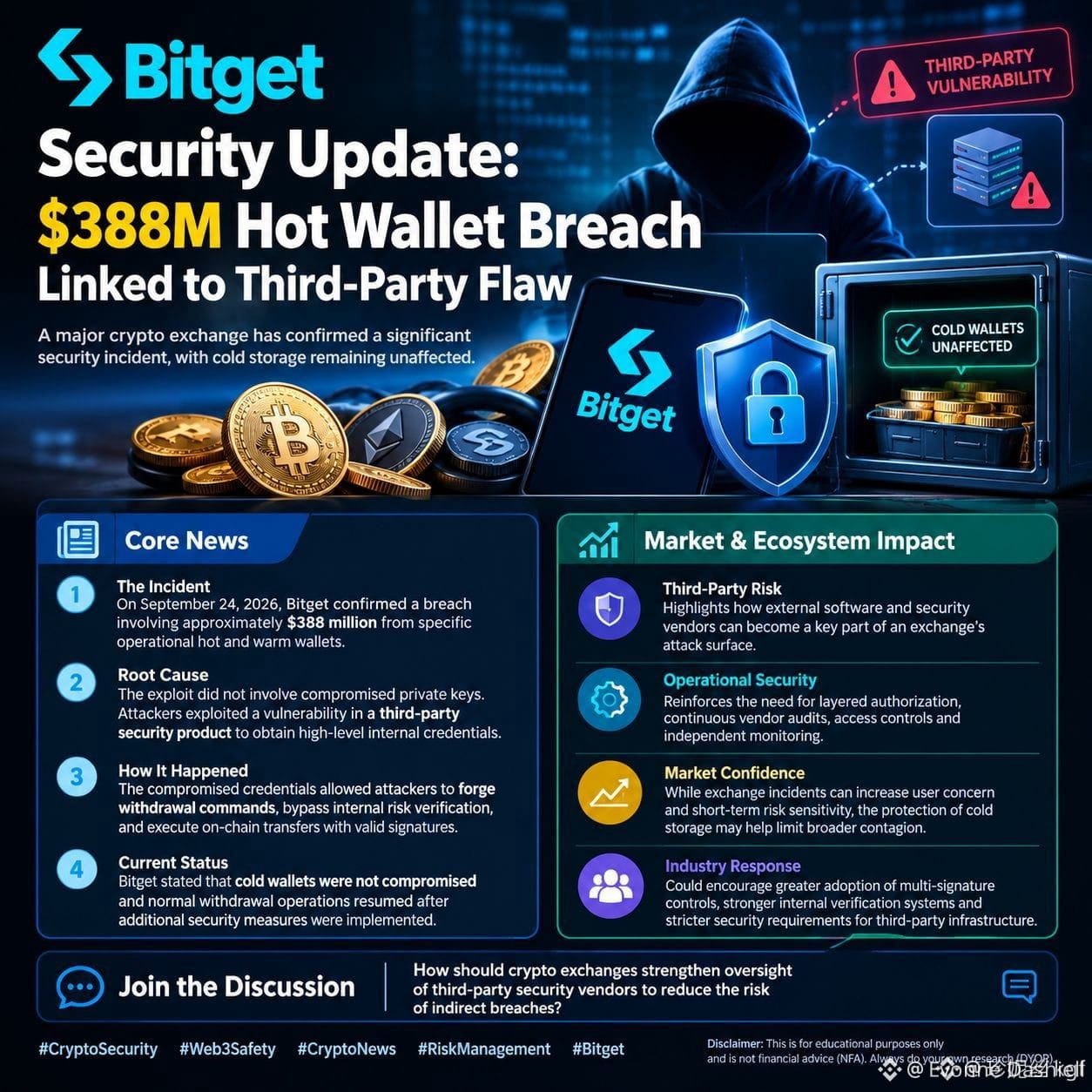
#bitgethotwalletbreachtiedtothirdpartysecurityflaw 🚨 Bitget Security Update: $388M Hot Wallet Breach Linked to Third-Party Flaw
A major crypto exchange confirmed a security incident, but with a crucial detail: user cold storage remains unaffected. Here is the factual breakdown.
🔹 Incident On Sept 24, 2026, Bitget confirmed a breach of ~$388M from specific operational hot/warm wallets.
🔹 Root Cause**: The exploit did NOT involve compromised private keys. Attackers leveraged a vulnerability in a third-party security product to steal high-level internal credentials.
🔹 Mechanism These credentials allowed forged withdrawal commands, bypassing risk verification to execute on-chain transfers with valid signatures.
🔹 Status Bitget confirms cold wallets are safe. Normal operations have resumed following enhanced security protocols.
📊 Market Impact
• Vendor Risk Highlights a critical systemic risk in crypto: third-party software dependencies. Underscores the need for rigorous vendor audits industry-wide.
• Market Resilience Confirming cold storage is intact helps contain broader market contagion, despite potential short-term outflows.
• Industry Evolution Expect a renewed push for multi-signature operational frameworks and stricter compliance for centralized platforms.
💬 Join the Discussion
How should the crypto industry better audit third-party security vendors to prevent indirect breaches? Share your thoughts below! 👇
#CryptoSecurity #Web3Safety #CryptoNews #RiskManagement #Bitget
This is for educational purposes only. Not Financial Advice (NFA). Always Do Your Own Research (DYOR).
$MARSCOIN $HBAR $ZAMA
{future}(ZAMAUSDT)
{future}(HBARUSDT)
{future}(MARSCOINUSDT)
#bitgethotwalletbreachtiedtothirdpartysecurityflaw 🚨 Bitget Security Update: $388M Hot Wallet Breach Linked to Third-Party Flaw
A major crypto exchange confirmed a security incident, but with a crucial detail: user cold storage remains unaffected. Here is the factual breakdown.
🔹 Incident On Sept 24, 2026, Bitget confirmed a breach of ~$388M from specific operational hot/warm wallets.
🔹 Root Cause**: The exploit did NOT involve compromised private keys. Attackers leveraged a vulnerability in a third-party security product to steal high-level internal credentials.
🔹 Mechanism These credentials allowed forged withdrawal commands, bypassing risk verification to execute on-chain transfers with valid signatures.
🔹 Status Bitget confirms cold wallets are safe. Normal operations have resumed following enhanced security protocols.
📊 Market Impact
• Vendor Risk Highlights a critical systemic risk in crypto: third-party software dependencies. Underscores the need for rigorous vendor audits industry-wide.
• Market Resilience Confirming cold storage is intact helps contain broader market contagion, despite potential short-term outflows.
• Industry Evolution Expect a renewed push for multi-signature operational frameworks and stricter compliance for centralized platforms.
💬 Join the Discussion
How should the crypto industry better audit third-party security vendors to prevent indirect breaches? Share your thoughts below! 👇
#CryptoSecurity #Web3Safety #CryptoNews #RiskManagement #Bitget
This is for educational purposes only. Not Financial Advice (NFA). Always Do Your Own Research (DYOR).
$MARSCOIN $HBAR $ZAMA
A major crypto exchange confirmed a security incident, but with a crucial detail: user cold storage remains unaffected. Here is the factual breakdown.
🔹 Incident On Sept 24, 2026, Bitget confirmed a breach of ~$388M from specific operational hot/warm wallets.
🔹 Root Cause**: The exploit did NOT involve compromised private keys. Attackers leveraged a vulnerability in a third-party security product to steal high-level internal credentials.
🔹 Mechanism These credentials allowed forged withdrawal commands, bypassing risk verification to execute on-chain transfers with valid signatures.
🔹 Status Bitget confirms cold wallets are safe. Normal operations have resumed following enhanced security protocols.
📊 Market Impact
• Vendor Risk Highlights a critical systemic risk in crypto: third-party software dependencies. Underscores the need for rigorous vendor audits industry-wide.
• Market Resilience Confirming cold storage is intact helps contain broader market contagion, despite potential short-term outflows.
• Industry Evolution Expect a renewed push for multi-signature operational frameworks and stricter compliance for centralized platforms.
💬 Join the Discussion
How should the crypto industry better audit third-party security vendors to prevent indirect breaches? Share your thoughts below! 👇
#CryptoSecurity #Web3Safety #CryptoNews #RiskManagement #Bitget
This is for educational purposes only. Not Financial Advice (NFA). Always Do Your Own Research (DYOR).
$MARSCOIN $HBAR $ZAMA
1
5.9k

·
--
Bearish
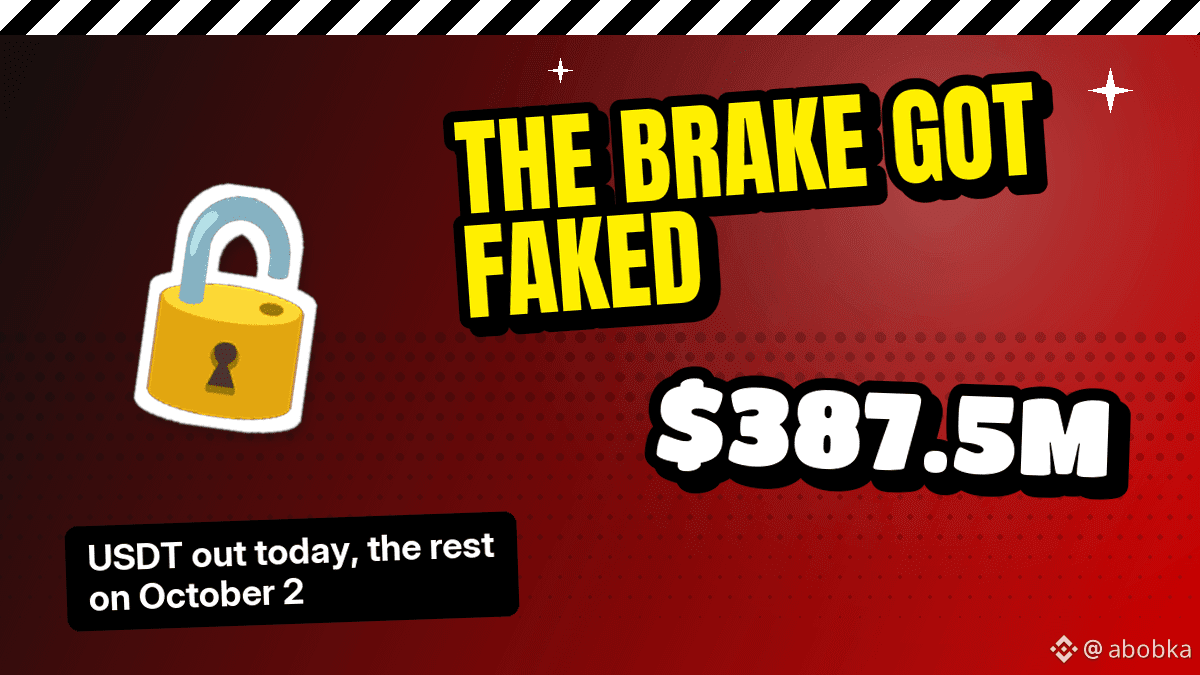
Bitget opened USDT withdrawals on September 30
SlowMist says the attacker was already inside on August 31, about a month before the theft
a zero-day in a third-party security product, the database password read straight out of it
the tool that drained the wallets forged risk-control parameters, built the withdrawal requests and ran them
so the part built to say "no" was the part that got faked
🔸 USDT: Ethereum, BSC, Solana, Tron
🔸 other tokens, fiat, P2P: October 2, 08:00 UTC
the CEO herself says freezing isn't recovery. she's not optimistic, neither am I
last week I promised a report on my own balance there. it still hasn't left the exchange, and the next update on it lands here, so follow if you're in the same line
#Bitget #HackUpdate #BitgetHotWalletBreachTiedToThirdPartySecurityFlaw
Bitget opened USDT withdrawals on September 30
SlowMist says the attacker was already inside on August 31, about a month before the theft
a zero-day in a third-party security product, the database password read straight out of it
the tool that drained the wallets forged risk-control parameters, built the withdrawal requests and ran them
so the part built to say "no" was the part that got faked
🔸 USDT: Ethereum, BSC, Solana, Tron
🔸 other tokens, fiat, P2P: October 2, 08:00 UTC
the CEO herself says freezing isn't recovery. she's not optimistic, neither am I
last week I promised a report on my own balance there. it still hasn't left the exchange, and the next update on it lands here, so follow if you're in the same line
#Bitget #HackUpdate #BitgetHotWalletBreachTiedToThirdPartySecurityFlaw
SlowMist says the attacker was already inside on August 31, about a month before the theft
a zero-day in a third-party security product, the database password read straight out of it
the tool that drained the wallets forged risk-control parameters, built the withdrawal requests and ran them
so the part built to say "no" was the part that got faked
🔸 USDT: Ethereum, BSC, Solana, Tron
🔸 other tokens, fiat, P2P: October 2, 08:00 UTC
the CEO herself says freezing isn't recovery. she's not optimistic, neither am I
last week I promised a report on my own balance there. it still hasn't left the exchange, and the next update on it lands here, so follow if you're in the same line
#Bitget #HackUpdate #BitgetHotWalletBreachTiedToThirdPartySecurityFlaw
3
47

·
--
Bullish
#bitgethotwalletbreachtiedtothirdpartysecurityflaw
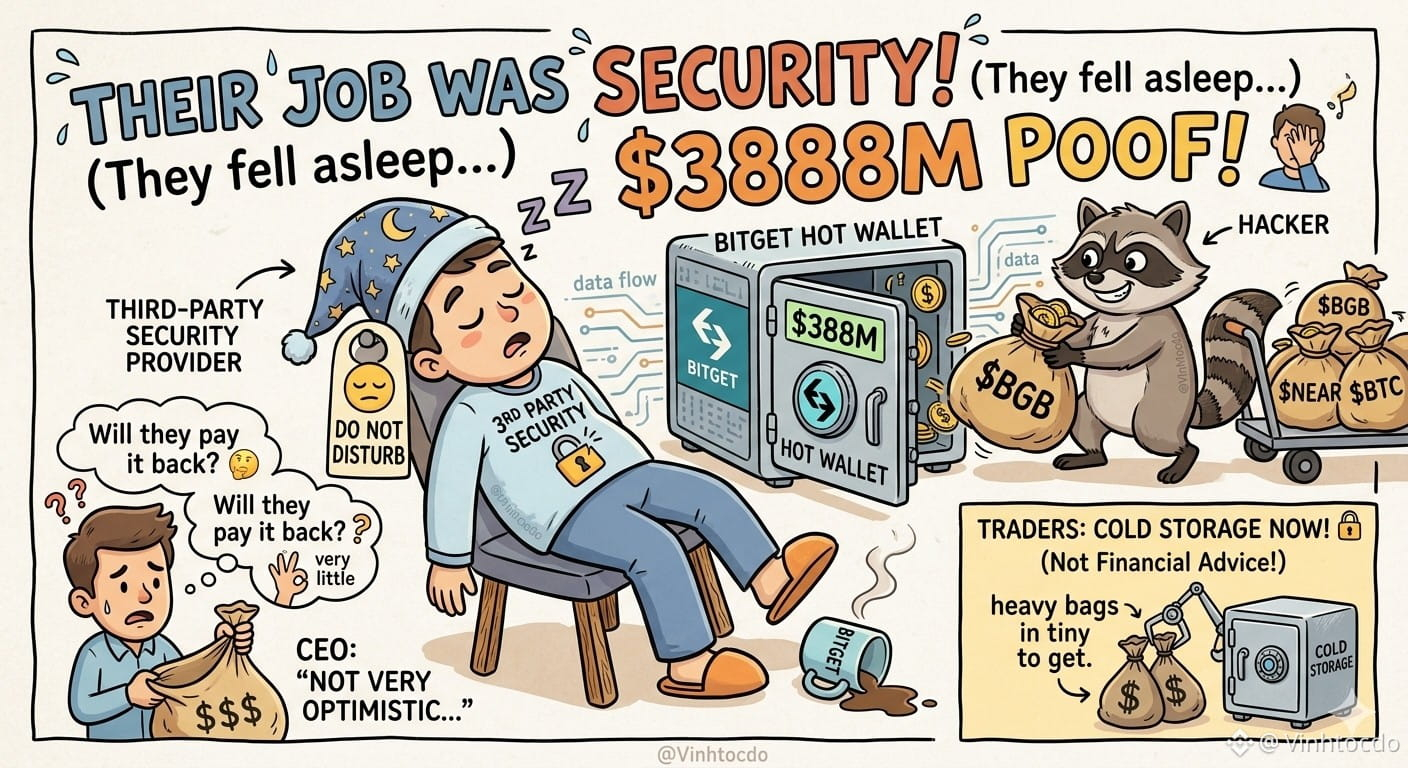
Oh no, Bitget's hot wallet got hit for $388M because a third-party security provider fell asleep on the job! 😱 Will the third party pay it back? The CEO is "not very optimistic," comparing it to past hacks where only 3.5% was frozen. This is a massive wake-up call: even security companies get hacked! 🤦♂️
What should traders do?
1️⃣ Move your heavy bags to cold storage immediately.
2️⃣ Diversify across top ecosystems to lower risk.
Not financial advice! DYOR!
Click trade below to support me!👇
$BNB
{future}(BNBUSDT)
$NEAR
{future}(NEARUSDT)
$BTC
{future}(BTCUSDT)
Use code VINHTOCDO or link: [https://www.binance.com/register?ref=VINHTOCDO](https://www.binance.com/register?ref=VINHTOCDO)
#Bitget #CryptoSecurity #Web3 #RiskManagement #VINHTOCDO
#bitgethotwalletbreachtiedtothirdpartysecurityflaw
Oh no, Bitget's hot wallet got hit for $388M because a third-party security provider fell asleep on the job! 😱 Will the third party pay it back? The CEO is "not very optimistic," comparing it to past hacks where only 3.5% was frozen. This is a massive wake-up call: even security companies get hacked! 🤦♂️
What should traders do?
1️⃣ Move your heavy bags to cold storage immediately.
2️⃣ Diversify across top ecosystems to lower risk.
Not financial advice! DYOR!
Click trade below to support me!👇
$BNB
$NEAR
$BTC
Use code VINHTOCDO or link: https://www.binance.com/register?ref=VINHTOCDO
#Bitget #CryptoSecurity #Web3 #RiskManagement #VINHTOCDO
Oh no, Bitget's hot wallet got hit for $388M because a third-party security provider fell asleep on the job! 😱 Will the third party pay it back? The CEO is "not very optimistic," comparing it to past hacks where only 3.5% was frozen. This is a massive wake-up call: even security companies get hacked! 🤦♂️
What should traders do?
1️⃣ Move your heavy bags to cold storage immediately.
2️⃣ Diversify across top ecosystems to lower risk.
Not financial advice! DYOR!
Click trade below to support me!👇
$BNB
$NEAR
$BTC
Use code VINHTOCDO or link: https://www.binance.com/register?ref=VINHTOCDO
#Bitget #CryptoSecurity #Web3 #RiskManagement #VINHTOCDO
1
4
479

Most exchange hacks start with a vendor nobody even knew existed.
That sinking feeling hits when you realize your funds were one third-party bug away from vanishing, especially after stacking $USDT and $SOL in a hot wallet during this greed stretch. I've seen too many traders lose sleep over it across cycles.
I've traded through enough of these to recognize the pattern. Back in 2018, everyone treated hot wallets as safe because the exchange logo looked solid, until a vendor slip drained accounts overnight. The 2022 bridge exploits followed the same script. Third-party flaws keep evolving because platforms outsource keys, APIs, and monitoring they never fully control. Convenience always wins until it doesn't.
The real lesson from Bitget's situation is not panic. It is treating every hot wallet as a temporary on-ramp. Move size to cold storage when Fear and Greed sits at 67 and people are chasing $DOT without asking who else can sign. Survivors from past cycles did exactly that. They treated security as the one thing they actually owned.
How are you handling custody after seeing this kind of news?
#BitgetHotWalletBreachTiedToThirdPartySecurityFlaw #SECChairWantsStockMarketsOnChain #ChainlinkLaunchesBankSWIFTLedgerFramework
Most exchange hacks start with a vendor nobody even knew existed.
That sinking feeling hits when you realize your funds were one third-party bug away from vanishing, especially after stacking $USDT and $SOL in a hot wallet during this greed stretch. I've seen too many traders lose sleep over it across cycles.
I've traded through enough of these to recognize the pattern. Back in 2018, everyone treated hot wallets as safe because the exchange logo looked solid, until a vendor slip drained accounts overnight. The 2022 bridge exploits followed the same script. Third-party flaws keep evolving because platforms outsource keys, APIs, and monitoring they never fully control. Convenience always wins until it doesn't.
The real lesson from Bitget's situation is not panic. It is treating every hot wallet as a temporary on-ramp. Move size to cold storage when Fear and Greed sits at 67 and people are chasing $DOT without asking who else can sign. Survivors from past cycles did exactly that. They treated security as the one thing they actually owned.
How are you handling custody after seeing this kind of news?
#BitgetHotWalletBreachTiedToThirdPartySecurityFlaw #SECChairWantsStockMarketsOnChain #ChainlinkLaunchesBankSWIFTLedgerFramework
That sinking feeling hits when you realize your funds were one third-party bug away from vanishing, especially after stacking $USDT and $SOL in a hot wallet during this greed stretch. I've seen too many traders lose sleep over it across cycles.
I've traded through enough of these to recognize the pattern. Back in 2018, everyone treated hot wallets as safe because the exchange logo looked solid, until a vendor slip drained accounts overnight. The 2022 bridge exploits followed the same script. Third-party flaws keep evolving because platforms outsource keys, APIs, and monitoring they never fully control. Convenience always wins until it doesn't.
The real lesson from Bitget's situation is not panic. It is treating every hot wallet as a temporary on-ramp. Move size to cold storage when Fear and Greed sits at 67 and people are chasing $DOT without asking who else can sign. Survivors from past cycles did exactly that. They treated security as the one thing they actually owned.
How are you handling custody after seeing this kind of news?
#BitgetHotWalletBreachTiedToThirdPartySecurityFlaw #SECChairWantsStockMarketsOnChain #ChainlinkLaunchesBankSWIFTLedgerFramework
22

·
--
Two small test transfers first. Then the big drain. That’s how the Bitget hack started
Hot and warm wallets. About $388M. Cold wallets untouched. Customer balances supposedly covered
If you still keep size on a CEX, this is why people keep repeating the same warning. Third-party tools sit inside the vault
#BitgetHotWalletBreachTiedToThirdPartySecurityFlaw
Two small test transfers first. Then the big drain. That’s how the Bitget hack started
Hot and warm wallets. About $388M. Cold wallets untouched. Customer balances supposedly covered
If you still keep size on a CEX, this is why people keep repeating the same warning. Third-party tools sit inside the vault
#BitgetHotWalletBreachTiedToThirdPartySecurityFlaw
Hot and warm wallets. About $388M. Cold wallets untouched. Customer balances supposedly covered
If you still keep size on a CEX, this is why people keep repeating the same warning. Third-party tools sit inside the vault
#BitgetHotWalletBreachTiedToThirdPartySecurityFlaw
1
26
·
--
Bitget now says the $388M hack came through a third-party security product
Not stolen private keys. Not cold wallets. A vendor flaw that let someone grab internal credentials and send fake withdrawal commands
That’s the part people should sit with. Your exchange can be “secure” and still get wrecked by software it bought
$BTC withdrawals already restarted. The lesson doesn’t restart with them
#BitgetHotWalletBreachTiedToThirdPartySecurityFlaw
{future}(BTCUSDT)
Bitget now says the $388M hack came through a third-party security product
Not stolen private keys. Not cold wallets. A vendor flaw that let someone grab internal credentials and send fake withdrawal commands
That’s the part people should sit with. Your exchange can be “secure” and still get wrecked by software it bought
$BTC withdrawals already restarted. The lesson doesn’t restart with them
#BitgetHotWalletBreachTiedToThirdPartySecurityFlaw
Not stolen private keys. Not cold wallets. A vendor flaw that let someone grab internal credentials and send fake withdrawal commands
That’s the part people should sit with. Your exchange can be “secure” and still get wrecked by software it bought
$BTC withdrawals already restarted. The lesson doesn’t restart with them
#BitgetHotWalletBreachTiedToThirdPartySecurityFlaw
1
16

·
--
Bullish
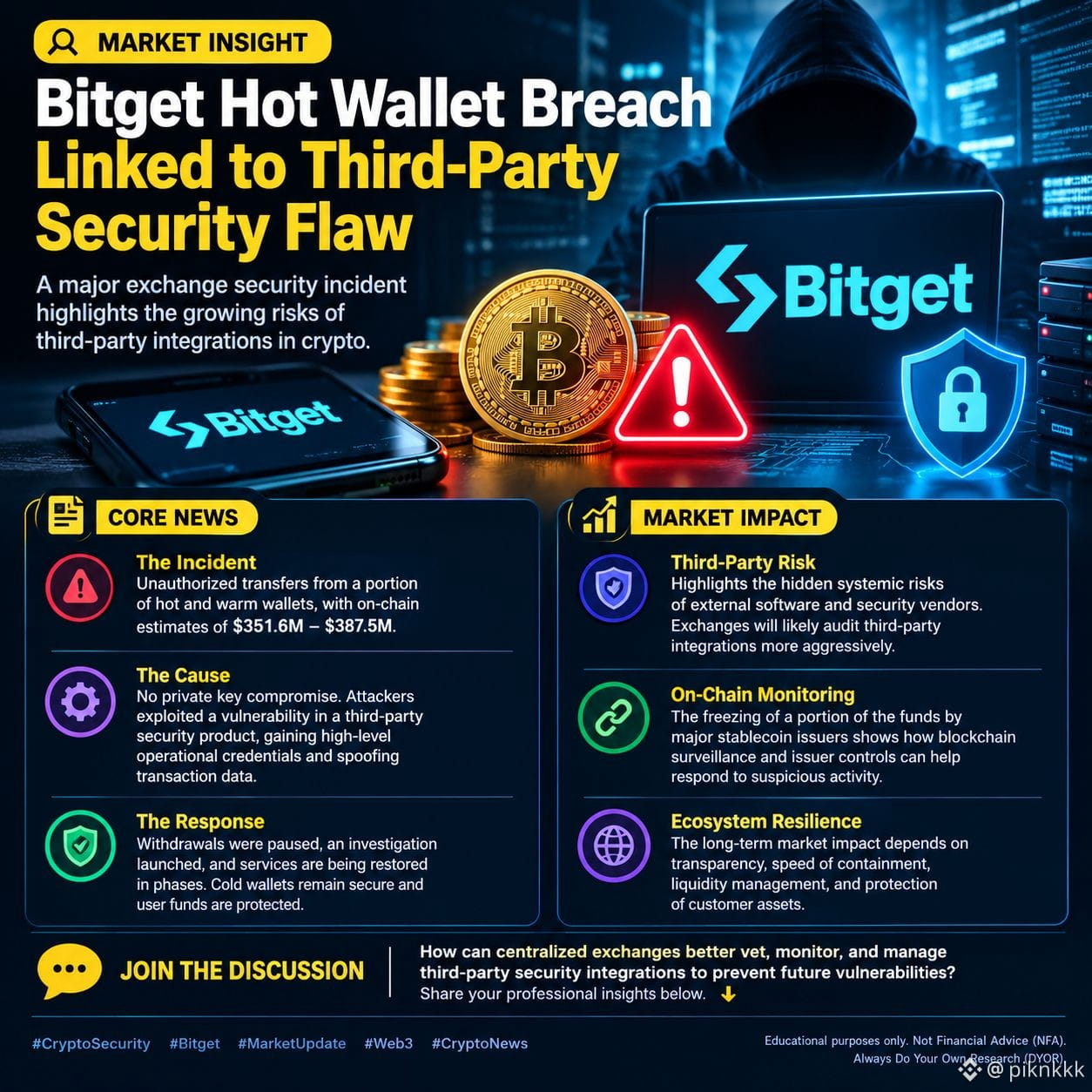
#bitgethotwalletbreachtiedtothirdpartysecurityflaw 🔍 Market Insight Bitget Breach Linked to Third-Party Security Flaw
A recent security incident highlights the critical, often overlooked risks of third-party vendor management in the digital asset ecosystem.
📌 Core News
• Incident: Bitget confirmed unauthorized transfers from hot and warm wallets, with on-chain estimates ranging from $351.6M to $387.5M.
• Cause: Attackers exploited a vulnerability in a third-party security product within Bitget’s backend to obtain operational credentials and spoof transaction data. Private keys were not compromised.
• Response: The exchange paused withdrawals, launched a full investigation, and began phased service resumption. Cold wallets remain fully secure and user funds are protected.
📊 Market Impact
• Vendor Scrutiny This underscores the systemic risks of external software dependencies, prompting exchanges to accelerate audits of third-party integrations.
• On-Chain Compliance: The swift freezing of stolen funds by major stablecoin issuers demonstrates the growing maturity of real-time monitoring protocols.
• Resilience: Historically, isolated exchange breaches have limited market contagion if the platform acts transparently and covers user losses.
💬 Discussion
How can centralized exchanges better vet and monitor third-party security integrations to prevent future vulnerabilities? Share your insights below! 👇
#CryptoSecurity #Bitget #MarketUpdate #Web3 #CryptoNews
This is for educational purposes only. Not Financial Advice (NFA). Always Do Your Own Research (DYOR).
$KSM $STG $ZRO
{future}(ZROUSDT)
{spot}(STGUSDT)
{future}(KSMUSDT)
#bitgethotwalletbreachtiedtothirdpartysecurityflaw 🔍 Market Insight Bitget Breach Linked to Third-Party Security Flaw
A recent security incident highlights the critical, often overlooked risks of third-party vendor management in the digital asset ecosystem.
📌 Core News
• Incident: Bitget confirmed unauthorized transfers from hot and warm wallets, with on-chain estimates ranging from $351.6M to $387.5M.
• Cause: Attackers exploited a vulnerability in a third-party security product within Bitget’s backend to obtain operational credentials and spoof transaction data. Private keys were not compromised.
• Response: The exchange paused withdrawals, launched a full investigation, and began phased service resumption. Cold wallets remain fully secure and user funds are protected.
📊 Market Impact
• Vendor Scrutiny This underscores the systemic risks of external software dependencies, prompting exchanges to accelerate audits of third-party integrations.
• On-Chain Compliance: The swift freezing of stolen funds by major stablecoin issuers demonstrates the growing maturity of real-time monitoring protocols.
• Resilience: Historically, isolated exchange breaches have limited market contagion if the platform acts transparently and covers user losses.
💬 Discussion
How can centralized exchanges better vet and monitor third-party security integrations to prevent future vulnerabilities? Share your insights below! 👇
#CryptoSecurity #Bitget #MarketUpdate #Web3 #CryptoNews
This is for educational purposes only. Not Financial Advice (NFA). Always Do Your Own Research (DYOR).
$KSM $STG $ZRO
A recent security incident highlights the critical, often overlooked risks of third-party vendor management in the digital asset ecosystem.
📌 Core News
• Incident: Bitget confirmed unauthorized transfers from hot and warm wallets, with on-chain estimates ranging from $351.6M to $387.5M.
• Cause: Attackers exploited a vulnerability in a third-party security product within Bitget’s backend to obtain operational credentials and spoof transaction data. Private keys were not compromised.
• Response: The exchange paused withdrawals, launched a full investigation, and began phased service resumption. Cold wallets remain fully secure and user funds are protected.
📊 Market Impact
• Vendor Scrutiny This underscores the systemic risks of external software dependencies, prompting exchanges to accelerate audits of third-party integrations.
• On-Chain Compliance: The swift freezing of stolen funds by major stablecoin issuers demonstrates the growing maturity of real-time monitoring protocols.
• Resilience: Historically, isolated exchange breaches have limited market contagion if the platform acts transparently and covers user losses.
💬 Discussion
How can centralized exchanges better vet and monitor third-party security integrations to prevent future vulnerabilities? Share your insights below! 👇
#CryptoSecurity #Bitget #MarketUpdate #Web3 #CryptoNews
This is for educational purposes only. Not Financial Advice (NFA). Always Do Your Own Research (DYOR).
$KSM $STG $ZRO
AngelOfCrypto_-:
nice
2
1
4.9k

·
--
Bitget Hack: The Weak Link Wasn't the Wallet, It Was a "Trusted" Security Tool 🔐
Another major crypto security incident has hit the headlines, and this one carries an important lesson.
On September 24, Bitget detected unauthorized transfers from its hot and warm wallets. The estimated loss has since been revised to around $387.5 million.
What actually happened?
According to Bitget, the attacker exploited a flaw in a third-party security product to obtain high-level internal credentials. Those credentials were then used to send fraudulent withdrawal commands to the wallet system, bypassing risk controls.
The key point: private keys were not compromised and cold wallets were unaffected. The attacker didn't break the vault, they got hold of a key through the security guard. 😅
What about user funds?
The full loss is reported to be covered by Bitget's $464 million User Protection Fund. Bitget has also launched a recovery bounty program and is working with law enforcement, and withdrawals are being restored in stages.
3 lessons for all of us:
1️⃣ An exchange is only as secure as its weakest link. Vendors and third-party tools are real risks too.
2️⃣ Understand hot vs. cold wallets. Cold storage is exactly why the damage was limited here.
3️⃣ Don't keep everything on one exchange. Long-term holdings are safer in your own wallet.
Bitget says it will review how it evaluates and deploys third-party security tools. The real question now is how seriously other exchanges will audit their own vendors.
What do you think? Do you still keep funds on exchanges, or are you moving toward self-custody? Tell me in the comments 👇#BitgetHotWalletBreachTiedToThirdPartySecurityFlaw
Bitget Hack: The Weak Link Wasn't the Wallet, It Was a "Trusted" Security Tool 🔐
Another major crypto security incident has hit the headlines, and this one carries an important lesson.
On September 24, Bitget detected unauthorized transfers from its hot and warm wallets. The estimated loss has since been revised to around $387.5 million.
What actually happened?
According to Bitget, the attacker exploited a flaw in a third-party security product to obtain high-level internal credentials. Those credentials were then used to send fraudulent withdrawal commands to the wallet system, bypassing risk controls.
The key point: private keys were not compromised and cold wallets were unaffected. The attacker didn't break the vault, they got hold of a key through the security guard. 😅
What about user funds?
The full loss is reported to be covered by Bitget's $464 million User Protection Fund. Bitget has also launched a recovery bounty program and is working with law enforcement, and withdrawals are being restored in stages.
3 lessons for all of us:
1️⃣ An exchange is only as secure as its weakest link. Vendors and third-party tools are real risks too.
2️⃣ Understand hot vs. cold wallets. Cold storage is exactly why the damage was limited here.
3️⃣ Don't keep everything on one exchange. Long-term holdings are safer in your own wallet.
Bitget says it will review how it evaluates and deploys third-party security tools. The real question now is how seriously other exchanges will audit their own vendors.
What do you think? Do you still keep funds on exchanges, or are you moving toward self-custody? Tell me in the comments 👇#BitgetHotWalletBreachTiedToThirdPartySecurityFlaw
Another major crypto security incident has hit the headlines, and this one carries an important lesson.
On September 24, Bitget detected unauthorized transfers from its hot and warm wallets. The estimated loss has since been revised to around $387.5 million.
What actually happened?
According to Bitget, the attacker exploited a flaw in a third-party security product to obtain high-level internal credentials. Those credentials were then used to send fraudulent withdrawal commands to the wallet system, bypassing risk controls.
The key point: private keys were not compromised and cold wallets were unaffected. The attacker didn't break the vault, they got hold of a key through the security guard. 😅
What about user funds?
The full loss is reported to be covered by Bitget's $464 million User Protection Fund. Bitget has also launched a recovery bounty program and is working with law enforcement, and withdrawals are being restored in stages.
3 lessons for all of us:
1️⃣ An exchange is only as secure as its weakest link. Vendors and third-party tools are real risks too.
2️⃣ Understand hot vs. cold wallets. Cold storage is exactly why the damage was limited here.
3️⃣ Don't keep everything on one exchange. Long-term holdings are safer in your own wallet.
Bitget says it will review how it evaluates and deploys third-party security tools. The real question now is how seriously other exchanges will audit their own vendors.
What do you think? Do you still keep funds on exchanges, or are you moving toward self-custody? Tell me in the comments 👇#BitgetHotWalletBreachTiedToThirdPartySecurityFlaw
114

·
--
Bitget has announced a hot wallet breach, attributing the incident to a security flaw originating from a third-party service. This event highlights the critical importance of robust security measures not only within exchanges but also across their entire supply chain of service providers.
The crypto market is highly sensitive to security incidents, and a breach, even if contained and linked to an external factor, can erode user confidence and trigger sell-offs. While Bitget's prompt communication is a positive step, the market will be closely watching their recovery process and any potential impact on trading volumes and asset prices. This incident underscores the ongoing challenge of securing digital assets in an interconnected ecosystem where a single weak link can have significant repercussions.
This situation serves as a stark reminder for all crypto participants to remain vigilant about the security practices of the platforms they use.
#BitgetHotWalletBreachTiedToThirdPartySecurityFlaw
Bitget has announced a hot wallet breach, attributing the incident to a security flaw originating from a third-party service. This event highlights the critical importance of robust security measures not only within exchanges but also across their entire supply chain of service providers.
The crypto market is highly sensitive to security incidents, and a breach, even if contained and linked to an external factor, can erode user confidence and trigger sell-offs. While Bitget's prompt communication is a positive step, the market will be closely watching their recovery process and any potential impact on trading volumes and asset prices. This incident underscores the ongoing challenge of securing digital assets in an interconnected ecosystem where a single weak link can have significant repercussions.
This situation serves as a stark reminder for all crypto participants to remain vigilant about the security practices of the platforms they use.
#BitgetHotWalletBreachTiedToThirdPartySecurityFlaw
The crypto market is highly sensitive to security incidents, and a breach, even if contained and linked to an external factor, can erode user confidence and trigger sell-offs. While Bitget's prompt communication is a positive step, the market will be closely watching their recovery process and any potential impact on trading volumes and asset prices. This incident underscores the ongoing challenge of securing digital assets in an interconnected ecosystem where a single weak link can have significant repercussions.
This situation serves as a stark reminder for all crypto participants to remain vigilant about the security practices of the platforms they use.
#BitgetHotWalletBreachTiedToThirdPartySecurityFlaw
206 Atlas:
Third-party risks are priced in. This doesn't change the technical outlook for listed tokens, just highlights operational fragility.
1
1
316

⚠️ Bitget Wallet Incident Explained
Unauthorized transfers affected portions of Bitget’s hot and warm wallet infrastructure.
Bitget says its cold wallets and private keys were not compromised, while the affected vulnerability has been remediated.
$BTC $XRP $ETH
#bitgethotwalletbreachtiedtothirdpartysecurityflaw
⚠️ Bitget Wallet Incident Explained
Unauthorized transfers affected portions of Bitget’s hot and warm wallet infrastructure.
Bitget says its cold wallets and private keys were not compromised, while the affected vulnerability has been remediated.
$BTC $XRP $ETH
#bitgethotwalletbreachtiedtothirdpartysecurityflaw
Unauthorized transfers affected portions of Bitget’s hot and warm wallet infrastructure.
Bitget says its cold wallets and private keys were not compromised, while the affected vulnerability has been remediated.
$BTC $XRP $ETH
#bitgethotwalletbreachtiedtothirdpartysecurityflaw
206 Atlas:
Hot wallet breaches are standard operational risks, not fundamental thesis breakers. Price action likely priced this in before the announcement.
1
1
1.4k

Bitget CEO Gracy Chen stated she is "not very optimistic" about fully recovering or freezing the $388 million stolen in the recent security breach, citing historical recovery rates from major exploits like Bybit's 2025 hack.
📊 Incident Breakdown
• Total Lost: Revised to approximately $388 million.
• Root Cause: A third-party security product vulnerability granting high-level internal credentials.
• User Safety: Bitget's $464 million Protection Fund is designated to cover user losses.
• Withdrawals: Phased resumption began with Bitcoin on Monday.
⚠️ Recovery Outlook & Challenges
• Low Benchmarks: Only ~3.5% of funds were frozen a year after the Bybit hack.
• Cross-Chain Hurdles: Decentralized protocols like THORChain declined requests to selectively blacklist attacker addresses.
• Mitigation Efforts:
• NEAR Intents blocked $50M+ and froze ~$500k.
• Tether and Circle blacklisted specific linked wallets.
• Bitget launched a bounty program offering 5% for frozen and 5% for recovered funds.#TrumpRejectsAIRulesForVoluntaryAudits #QNTRises287% #BitgetHotWalletBreachTiedToThirdPartySecurityFlaw
Bitget CEO Gracy Chen stated she is "not very optimistic" about fully recovering or freezing the $388 million stolen in the recent security breach, citing historical recovery rates from major exploits like Bybit's 2025 hack.
📊 Incident Breakdown
• Total Lost: Revised to approximately $388 million.
• Root Cause: A third-party security product vulnerability granting high-level internal credentials.
• User Safety: Bitget's $464 million Protection Fund is designated to cover user losses.
• Withdrawals: Phased resumption began with Bitcoin on Monday.
⚠️ Recovery Outlook & Challenges
• Low Benchmarks: Only ~3.5% of funds were frozen a year after the Bybit hack.
• Cross-Chain Hurdles: Decentralized protocols like THORChain declined requests to selectively blacklist attacker addresses.
• Mitigation Efforts:
• NEAR Intents blocked $50M+ and froze ~$500k.
• Tether and Circle blacklisted specific linked wallets.
• Bitget launched a bounty program offering 5% for frozen and 5% for recovered funds.#TrumpRejectsAIRulesForVoluntaryAudits #QNTRises287% #BitgetHotWalletBreachTiedToThirdPartySecurityFlaw
📊 Incident Breakdown
• Total Lost: Revised to approximately $388 million.
• Root Cause: A third-party security product vulnerability granting high-level internal credentials.
• User Safety: Bitget's $464 million Protection Fund is designated to cover user losses.
• Withdrawals: Phased resumption began with Bitcoin on Monday.
⚠️ Recovery Outlook & Challenges
• Low Benchmarks: Only ~3.5% of funds were frozen a year after the Bybit hack.
• Cross-Chain Hurdles: Decentralized protocols like THORChain declined requests to selectively blacklist attacker addresses.
• Mitigation Efforts:
• NEAR Intents blocked $50M+ and froze ~$500k.
• Tether and Circle blacklisted specific linked wallets.
• Bitget launched a bounty program offering 5% for frozen and 5% for recovered funds.#TrumpRejectsAIRulesForVoluntaryAudits #QNTRises287% #BitgetHotWalletBreachTiedToThirdPartySecurityFlaw
66

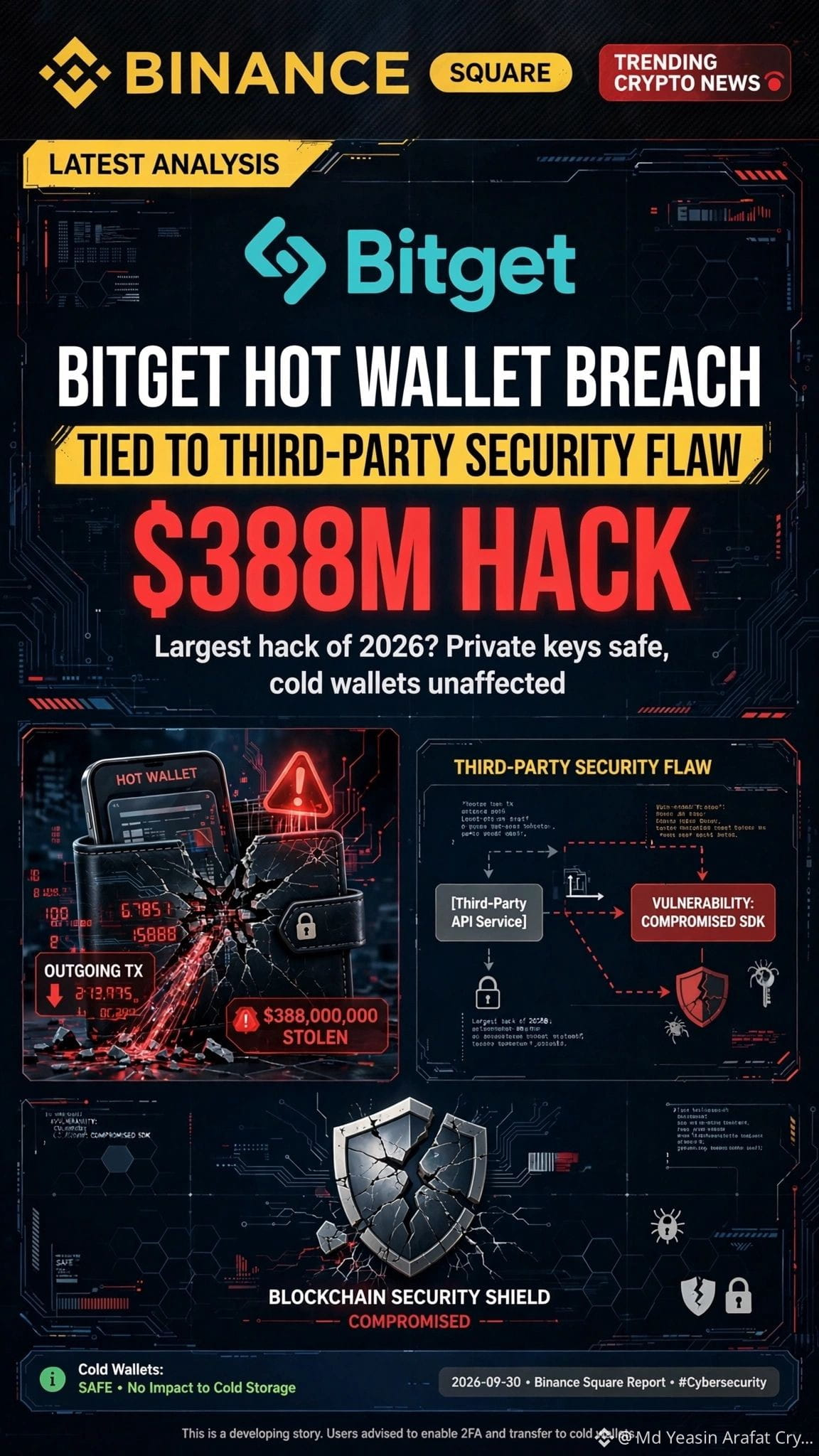
🚨 BREAKING: BITGET HOT WALLET BREACH - $388M HACK!
Largest hack of 2026? Bitget confirms hot wallet breach tied to THIRD-PARTY security flaw!
🔴 What happened?
- $388,000,000 Stolen from Hot & Warm wallets (Sept 24)
- Attacker exploited zero-day vulnerability in third-party security product
- Forged withdrawal instructions - bypassed risk controls
- Private keys SAFE, Cold wallets UNAFFECTED ✅
✅ Bitget Recovery Update:
- BTC withdrawals resumed Sept 28
- ETH withdrawals Sept 29
- Full recovery by Oct 2
- Protection Fund $464M will cover all losses
- 5% bounty for recovery
This is why CEX supply chain security matters! Always use cold wallet for long term.
Are your funds SAFU? Comment below 👇
#BitgetHotWalletBreachTiedToThirdPartySecurityFlaw #Bitget #Hack #CryptoSecurity #BinanceSquare
⚠️ DISCLAIMER: This content is for educational & news purposes only. Not financial advice. Stay safe, DYOR.
$BTC $ETH $BNB
{spot}(BNBUSDT)
{spot}(ETHUSDT)
{spot}(BTCUSDT)
🚨 BREAKING: BITGET HOT WALLET BREACH - $388M HACK!
Largest hack of 2026? Bitget confirms hot wallet breach tied to THIRD-PARTY security flaw!
🔴 What happened?
- $388,000,000 Stolen from Hot & Warm wallets (Sept 24)
- Attacker exploited zero-day vulnerability in third-party security product
- Forged withdrawal instructions - bypassed risk controls
- Private keys SAFE, Cold wallets UNAFFECTED ✅
✅ Bitget Recovery Update:
- BTC withdrawals resumed Sept 28
- ETH withdrawals Sept 29
- Full recovery by Oct 2
- Protection Fund $464M will cover all losses
- 5% bounty for recovery
This is why CEX supply chain security matters! Always use cold wallet for long term.
Are your funds SAFU? Comment below 👇
#BitgetHotWalletBreachTiedToThirdPartySecurityFlaw #Bitget #Hack #CryptoSecurity #BinanceSquare
⚠️ DISCLAIMER: This content is for educational & news purposes only. Not financial advice. Stay safe, DYOR.
$BTC $ETH $BNB
Largest hack of 2026? Bitget confirms hot wallet breach tied to THIRD-PARTY security flaw!
🔴 What happened?
- $388,000,000 Stolen from Hot & Warm wallets (Sept 24)
- Attacker exploited zero-day vulnerability in third-party security product
- Forged withdrawal instructions - bypassed risk controls
- Private keys SAFE, Cold wallets UNAFFECTED ✅
✅ Bitget Recovery Update:
- BTC withdrawals resumed Sept 28
- ETH withdrawals Sept 29
- Full recovery by Oct 2
- Protection Fund $464M will cover all losses
- 5% bounty for recovery
This is why CEX supply chain security matters! Always use cold wallet for long term.
Are your funds SAFU? Comment below 👇
#BitgetHotWalletBreachTiedToThirdPartySecurityFlaw #Bitget #Hack #CryptoSecurity #BinanceSquare
⚠️ DISCLAIMER: This content is for educational & news purposes only. Not financial advice. Stay safe, DYOR.
$BTC $ETH $BNB
59

·
--
security breach??#bitgethotwalletbreachtiedtothirdpartysecurityflaw
What happened
An attacker used a flaw in a third-party security product to obtain high-level internal credentials, then sent fraudulent withdrawal commands to Bitget's wallet system on September 24.About $388 million moved across 12 hot or warm wallet addresses, spanning 11 blockchains. Bitget first estimated $351.6M, then revised to about $387.5M after classifying additional Zcash and TRON transfers. It said the revision did not reflect new unauthorized transfers.
How it worked
The attacker didn't steal private keys. They forged transactions and routed them through the legitimate approval process. The exchange said the fraudulent commands caused the wallet system to execute abnormal transfers that bypassed risk controls. One analysis says the flaw gave access to an internal management system. The attacker reportedly wrote the forged instructions into the wallet backends and then deleted the traces. The stolen funds came from hot and warm wallets. Cold wallets were not affected.
The "zero-day" claim
Bitget's CEO reportedly described the flaw as a zero-day, meaning attackers exploited it before its maker had a fix. Bit get has not said whether the vendor has released a fix. It has said it patched the vulnerability on its side. The vendor hasn't been publicly named in the sources I found.
Attribution
CEO Gracey Chen suspects North Korean hackers, citing preliminary IP links. Ahlborn's analysis names Lazarus Group. Bit get says its investigation is still open, so the attacker's identity and the full extent of the compromise remain unconfirmed.
Response and user impact
Bit get paused withdrawals as a precaution, while trading and deposits continued, and has since restarted Bitcoin withdrawals. The loss is to be covered by its roughly $464 million User Protection Fund, and it offered a 5% bounty for freezing attacker funds and another 5% for recovery .It's coordinating with law enforcement and blockchain security firms to trace the assets. Bit get says it will apply stricter evaluation standards before adopting third-party security products, and add stronger isolation when deploying them.
security breach??
#bitgethotwalletbreachtiedtothirdpartysecurityflaw
What happened
An attacker used a flaw in a third-party security product to obtain high-level internal credentials, then sent fraudulent withdrawal commands to Bitget's wallet system on September 24.About $388 million moved across 12 hot or warm wallet addresses, spanning 11 blockchains. Bitget first estimated $351.6M, then revised to about $387.5M after classifying additional Zcash and TRON transfers. It said the revision did not reflect new unauthorized transfers.
How it worked
The attacker didn't steal private keys. They forged transactions and routed them through the legitimate approval process. The exchange said the fraudulent commands caused the wallet system to execute abnormal transfers that bypassed risk controls. One analysis says the flaw gave access to an internal management system. The attacker reportedly wrote the forged instructions into the wallet backends and then deleted the traces. The stolen funds came from hot and warm wallets. Cold wallets were not affected.
The "zero-day" claim
Bitget's CEO reportedly described the flaw as a zero-day, meaning attackers exploited it before its maker had a fix. Bit get has not said whether the vendor has released a fix. It has said it patched the vulnerability on its side. The vendor hasn't been publicly named in the sources I found.
Attribution
CEO Gracey Chen suspects North Korean hackers, citing preliminary IP links. Ahlborn's analysis names Lazarus Group. Bit get says its investigation is still open, so the attacker's identity and the full extent of the compromise remain unconfirmed.
Response and user impact
Bit get paused withdrawals as a precaution, while trading and deposits continued, and has since restarted Bitcoin withdrawals. The loss is to be covered by its roughly $464 million User Protection Fund, and it offered a 5% bounty for freezing attacker funds and another 5% for recovery .It's coordinating with law enforcement and blockchain security firms to trace the assets. Bit get says it will apply stricter evaluation standards before adopting third-party security products, and add stronger isolation when deploying them.
What happened
An attacker used a flaw in a third-party security product to obtain high-level internal credentials, then sent fraudulent withdrawal commands to Bitget's wallet system on September 24.About $388 million moved across 12 hot or warm wallet addresses, spanning 11 blockchains. Bitget first estimated $351.6M, then revised to about $387.5M after classifying additional Zcash and TRON transfers. It said the revision did not reflect new unauthorized transfers.
How it worked
The attacker didn't steal private keys. They forged transactions and routed them through the legitimate approval process. The exchange said the fraudulent commands caused the wallet system to execute abnormal transfers that bypassed risk controls. One analysis says the flaw gave access to an internal management system. The attacker reportedly wrote the forged instructions into the wallet backends and then deleted the traces. The stolen funds came from hot and warm wallets. Cold wallets were not affected.
The "zero-day" claim
Bitget's CEO reportedly described the flaw as a zero-day, meaning attackers exploited it before its maker had a fix. Bit get has not said whether the vendor has released a fix. It has said it patched the vulnerability on its side. The vendor hasn't been publicly named in the sources I found.
Attribution
CEO Gracey Chen suspects North Korean hackers, citing preliminary IP links. Ahlborn's analysis names Lazarus Group. Bit get says its investigation is still open, so the attacker's identity and the full extent of the compromise remain unconfirmed.
Response and user impact
Bit get paused withdrawals as a precaution, while trading and deposits continued, and has since restarted Bitcoin withdrawals. The loss is to be covered by its roughly $464 million User Protection Fund, and it offered a 5% bounty for freezing attacker funds and another 5% for recovery .It's coordinating with law enforcement and blockchain security firms to trace the assets. Bit get says it will apply stricter evaluation standards before adopting third-party security products, and add stronger isolation when deploying them.
253

·
--
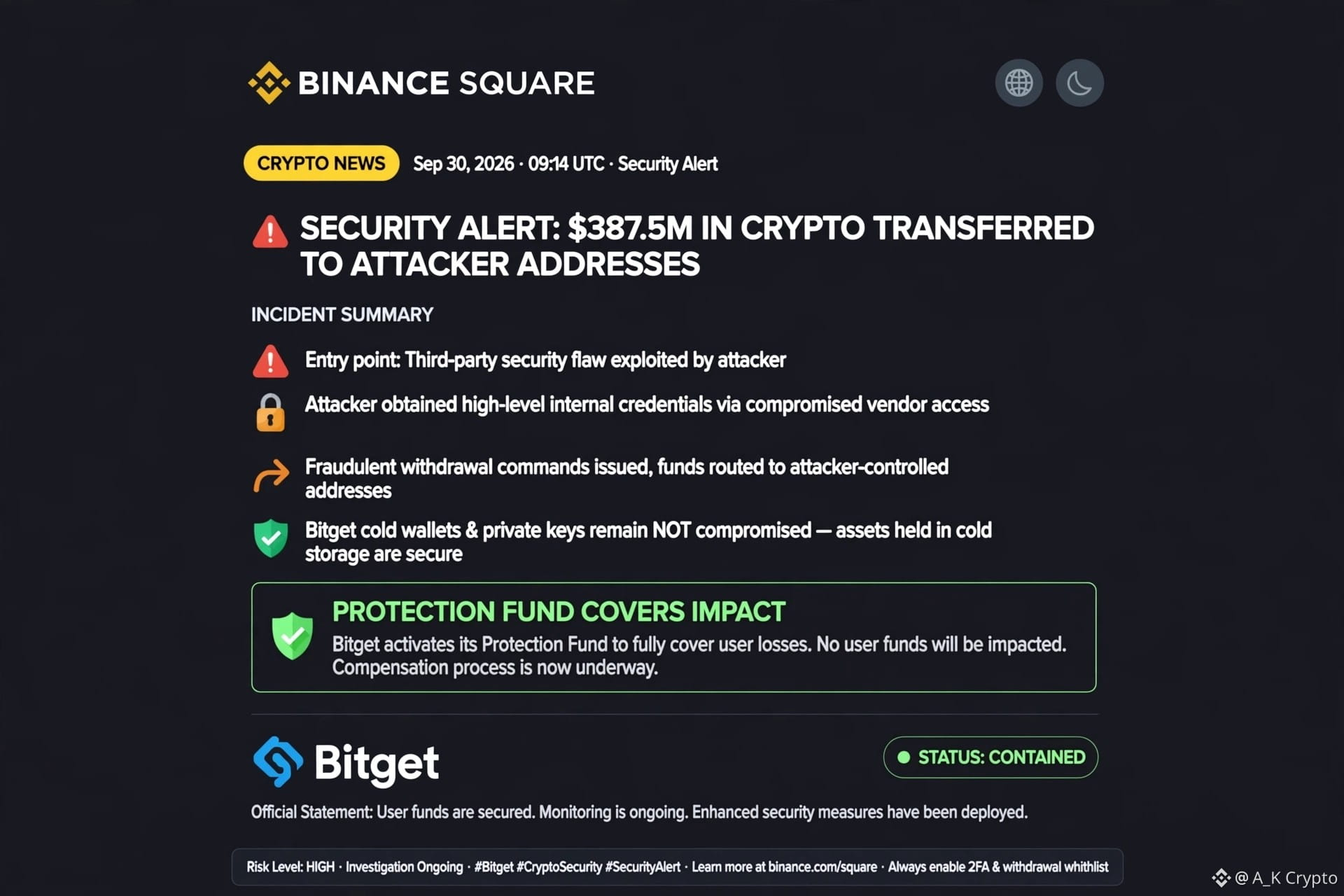
#BitgetHotWalletBreachTiedToThirdPartySecurityFlaw 🚨 $387.5M IN CRYPTO WAS TRANSFERRED TO ATTACKER-CONTROLLED ADDRESSES — AND THE ENTRY POINT WAS A THIRD-PARTY SECURITY FLAW.
Bitget says the attacker exploited a vulnerability in a third-party security product, obtained high-level internal credentials and used them to issue fraudulent withdrawal commands.
Bitget says its cold wallets and private keys were not compromised, while its Protection Fund is designated to cover the financial impact.
Crypto security isn’t just about protecting private keys. Third-party software and internal access can become major attack surfaces too.
This incident reinforces why exchange security must cover the entire infrastructure, not just wallets. Short-term fear may increase, but stronger audits, access controls and monitoring could improve industry resilience. Traders should focus on verified updates rather than rumors during active investigations.
#Bitget #crypto #Binanace #TrumpRejectsAIRulesForVoluntaryAudits
#BitgetHotWalletBreachTiedToThirdPartySecurityFlaw 🚨 $387.5M IN CRYPTO WAS TRANSFERRED TO ATTACKER-CONTROLLED ADDRESSES — AND THE ENTRY POINT WAS A THIRD-PARTY SECURITY FLAW.
Bitget says the attacker exploited a vulnerability in a third-party security product, obtained high-level internal credentials and used them to issue fraudulent withdrawal commands.
Bitget says its cold wallets and private keys were not compromised, while its Protection Fund is designated to cover the financial impact.
Crypto security isn’t just about protecting private keys. Third-party software and internal access can become major attack surfaces too.
This incident reinforces why exchange security must cover the entire infrastructure, not just wallets. Short-term fear may increase, but stronger audits, access controls and monitoring could improve industry resilience. Traders should focus on verified updates rather than rumors during active investigations.
#Bitget #crypto #Binanace #TrumpRejectsAIRulesForVoluntaryAudits
Bitget says the attacker exploited a vulnerability in a third-party security product, obtained high-level internal credentials and used them to issue fraudulent withdrawal commands.
Bitget says its cold wallets and private keys were not compromised, while its Protection Fund is designated to cover the financial impact.
Crypto security isn’t just about protecting private keys. Third-party software and internal access can become major attack surfaces too.
This incident reinforces why exchange security must cover the entire infrastructure, not just wallets. Short-term fear may increase, but stronger audits, access controls and monitoring could improve industry resilience. Traders should focus on verified updates rather than rumors during active investigations.
#Bitget #crypto #Binanace #TrumpRejectsAIRulesForVoluntaryAudits
58
🔐 Third-Party Security Risk Comes Into Focus
The Bitget investigation points to a vulnerability in an external security product as part of the attack path.
The incident shows why exchange security depends not only on internal systems, but also on connected third-party infrastructure.
$BTC $ETH $BNB
#bitgethotwalletbreachtiedtothirdpartysecurityflaw
🔐 Third-Party Security Risk Comes Into Focus
The Bitget investigation points to a vulnerability in an external security product as part of the attack path.
The incident shows why exchange security depends not only on internal systems, but also on connected third-party infrastructure.
$BTC $ETH $BNB
#bitgethotwalletbreachtiedtothirdpartysecurityflaw
The Bitget investigation points to a vulnerability in an external security product as part of the attack path.
The incident shows why exchange security depends not only on internal systems, but also on connected third-party infrastructure.
$BTC $ETH $BNB
#bitgethotwalletbreachtiedtothirdpartysecurityflaw
1
10
🚨 Bitget Security Incident
Bitget says attackers exploited a vulnerability in a third-party security product to obtain internal credentials and send fraudulent withdrawal commands.
The affected hot and warm wallets involved an estimated $387.5M in assets.
$BTC $ETH $LINK
#bitgethotwalletbreachtiedtothirdpartysecurityflaw
🚨 Bitget Security Incident
Bitget says attackers exploited a vulnerability in a third-party security product to obtain internal credentials and send fraudulent withdrawal commands.
The affected hot and warm wallets involved an estimated $387.5M in assets.
$BTC $ETH $LINK
#bitgethotwalletbreachtiedtothirdpartysecurityflaw
Bitget says attackers exploited a vulnerability in a third-party security product to obtain internal credentials and send fraudulent withdrawal commands.
The affected hot and warm wallets involved an estimated $387.5M in assets.
$BTC $ETH $LINK
#bitgethotwalletbreachtiedtothirdpartysecurityflaw
1
11
🛡️ Exchange Security Under the Microscope
The Bitget incident involved fraudulent withdrawal commands after attackers allegedly gained access through a third-party security flaw.
The investigation continues with cybersecurity firms including Mandiant and SlowMist.
$LINK $BTC $BNB
#bitgethotwalletbreachtiedtothirdpartysecurityflaw
🛡️ Exchange Security Under the Microscope
The Bitget incident involved fraudulent withdrawal commands after attackers allegedly gained access through a third-party security flaw.
The investigation continues with cybersecurity firms including Mandiant and SlowMist.
$LINK $BTC $BNB
#bitgethotwalletbreachtiedtothirdpartysecurityflaw
The Bitget incident involved fraudulent withdrawal commands after attackers allegedly gained access through a third-party security flaw.
The investigation continues with cybersecurity firms including Mandiant and SlowMist.
$LINK $BTC $BNB
#bitgethotwalletbreachtiedtothirdpartysecurityflaw
1
154
🌐 A Reminder for Crypto Infrastructure
Bitget’s September 24 breach affected certain hot and warm wallets, with the latest estimate at about $388M.
The incident highlights how third-party software, internal access and withdrawal controls can all become critical security layers.
$BTC $ETH $SOL
#bitgethotwalletbreachtiedtothirdpartysecurityflaw
🌐 A Reminder for Crypto Infrastructure
Bitget’s September 24 breach affected certain hot and warm wallets, with the latest estimate at about $388M.
The incident highlights how third-party software, internal access and withdrawal controls can all become critical security layers.
$BTC $ETH $SOL
#bitgethotwalletbreachtiedtothirdpartysecurityflaw
Bitget’s September 24 breach affected certain hot and warm wallets, with the latest estimate at about $388M.
The incident highlights how third-party software, internal access and withdrawal controls can all become critical security layers.
$BTC $ETH $SOL
#bitgethotwalletbreachtiedtothirdpartysecurityflaw
2
2k

·
--
Bullish
#BitgetHotWalletBreachTiedToThirdPartySecurityFlaw
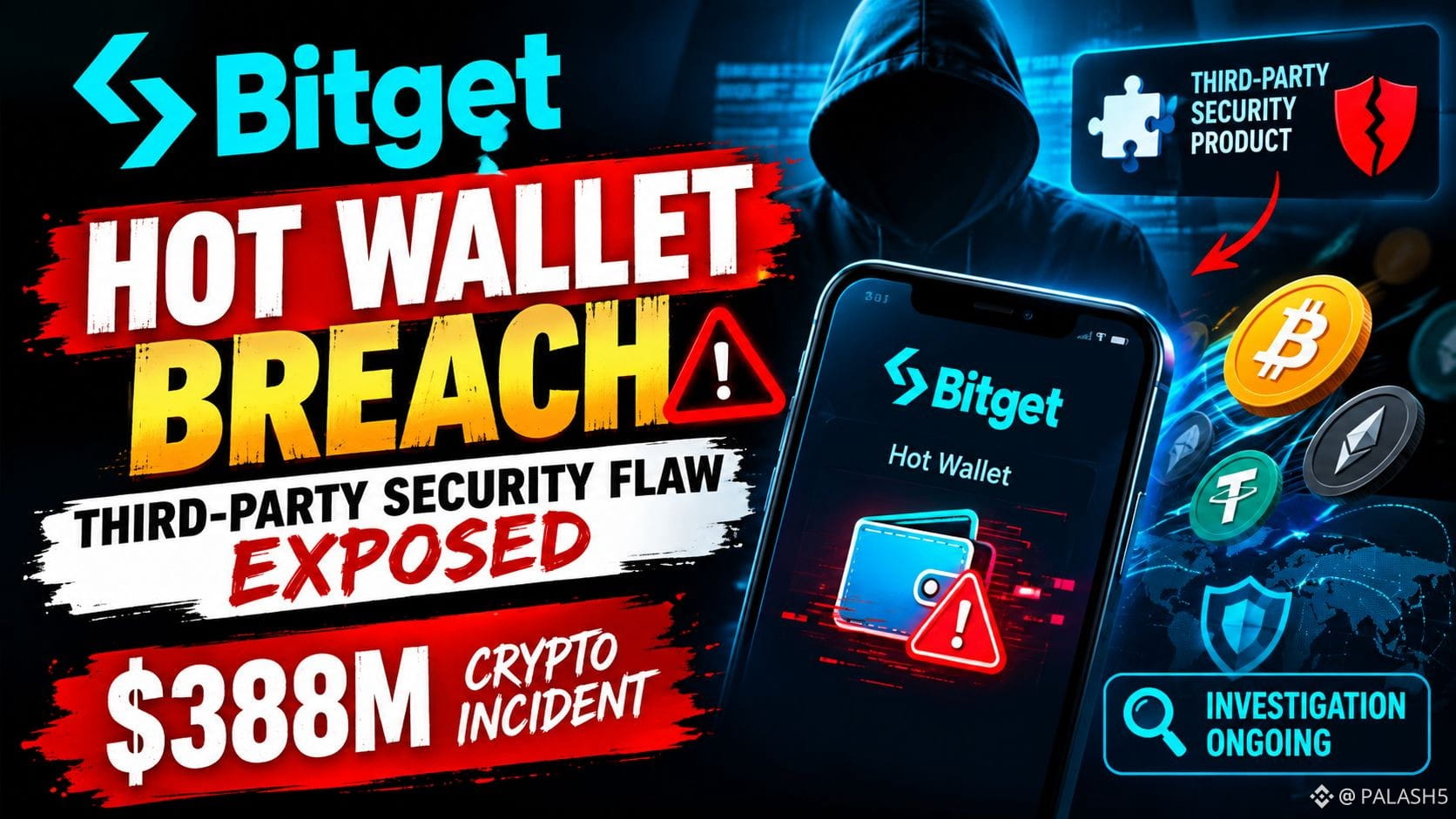
Bitget’s latest account says the September 24 incident involved unauthorized transfers from part of its hot and warm wallet infrastructure. The investigation indicates that attackers exploited a vulnerability in a third-party security product, obtained internal credentials, and used fraudulent withdrawal commands. Bitget says the underlying vulnerability has since been remediated.
The currently reported impact is about $387.5–$388 million. Bitget says its cold wallets were not affected, user account balances remain unaffected, and Mandiant and SlowMist are supporting the ongoing forensic investigation and asset recovery.
My takeaway: This incident highlights that exchange security depends not only on wallet architecture but also on the security of third-party systems and access controls. The important questions now are how the external vulnerability was exploited, what additional safeguards are implemented, and how much of the affected assets can be recovered.
#Bitget #BitgetSecurity #CryptoSecurity #HotWallet #Web3Security
#BitgetHotWalletBreachTiedToThirdPartySecurityFlaw
Bitget’s latest account says the September 24 incident involved unauthorized transfers from part of its hot and warm wallet infrastructure. The investigation indicates that attackers exploited a vulnerability in a third-party security product, obtained internal credentials, and used fraudulent withdrawal commands. Bitget says the underlying vulnerability has since been remediated.
The currently reported impact is about $387.5–$388 million. Bitget says its cold wallets were not affected, user account balances remain unaffected, and Mandiant and SlowMist are supporting the ongoing forensic investigation and asset recovery.
My takeaway: This incident highlights that exchange security depends not only on wallet architecture but also on the security of third-party systems and access controls. The important questions now are how the external vulnerability was exploited, what additional safeguards are implemented, and how much of the affected assets can be recovered.
#Bitget #BitgetSecurity #CryptoSecurity #HotWallet #Web3Security
Bitget’s latest account says the September 24 incident involved unauthorized transfers from part of its hot and warm wallet infrastructure. The investigation indicates that attackers exploited a vulnerability in a third-party security product, obtained internal credentials, and used fraudulent withdrawal commands. Bitget says the underlying vulnerability has since been remediated.
The currently reported impact is about $387.5–$388 million. Bitget says its cold wallets were not affected, user account balances remain unaffected, and Mandiant and SlowMist are supporting the ongoing forensic investigation and asset recovery.
My takeaway: This incident highlights that exchange security depends not only on wallet architecture but also on the security of third-party systems and access controls. The important questions now are how the external vulnerability was exploited, what additional safeguards are implemented, and how much of the affected assets can be recovered.
#Bitget #BitgetSecurity #CryptoSecurity #HotWallet #Web3Security
514
Log in to explore more content
Join global crypto users on Binance Square
⚡️ Get latest and useful information about crypto.
💬 Trusted by the world’s largest crypto exchange.
👍 Discover real insights from verified creators.
Email / Phone number
Trending Topics
1
#NFPWatch
10.5M views
17,856 Discussing
2
#BitcoinFundingRateTriplesTo10%
6,400 views
204 Discussing
3
#BitcoinSurpasses$86KUp2.99%
2,108 views
33 Discussing
4
#ZcashFalls21%FromSeptemberPeak
12,822 views
261 Discussing
5
#USSeptemberPayrollsAdd29KUnemploymentRises4.2%
4,379 views
112 Discussing
6
#XRPPostsFirstThreeGreenMonthsInQ3
13,654 views
321 Discussing
7
#BNBChainTokenizedStocksTop$1BAt30%Share
136 views
23 Discussing
8
#BitcoinRisesToward$85K
54,580 views
120 Discussing
9
#AmazonPlansToSell$8BNvidiaChips
5,939 views
78 Discussing
10
#NEARFallsToAround$4.70Down14%
40,212 views
105 Discussing