
#adpusprivateemployersadd86000jobsinoctober
adpusprivateemployersadd86000jobsinoctober
66,472 views
734 Discussing
Hot
Latest


·
--
Article
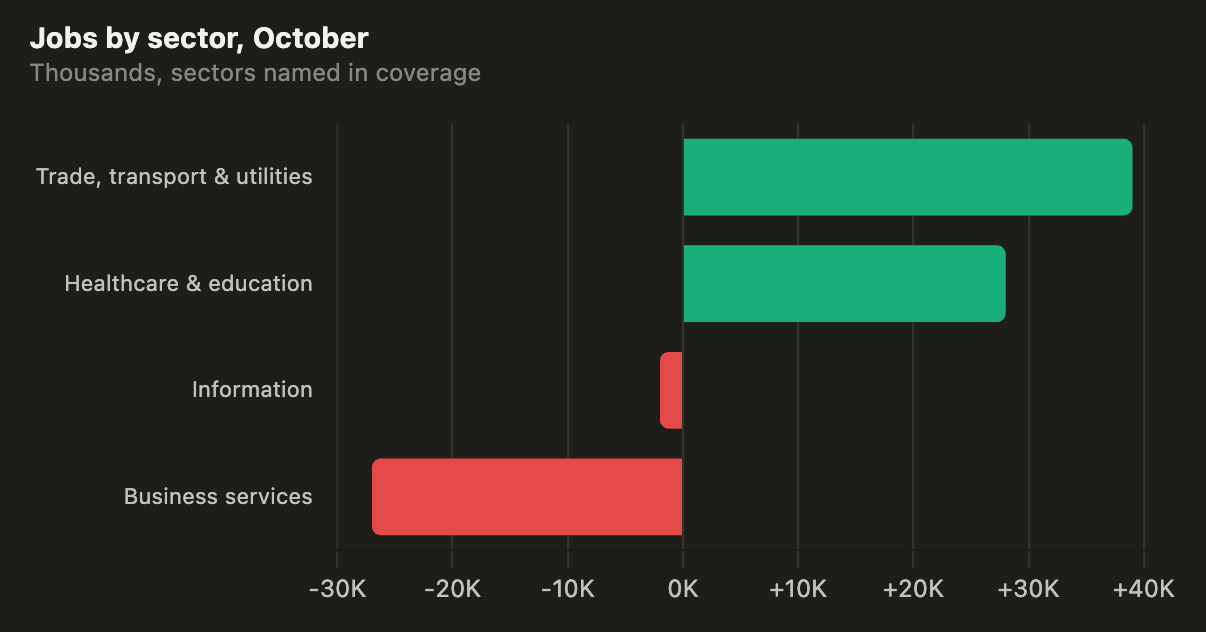
TradFi News | US Private Employers Add 86,000 Jobs in October, Beating Forecasts for a Second Straight Solid Month, ADP SaysUS private employers added 86,000 jobs in October, according to the ADP National Employment Report released on November 4. That beat the 69,000 forecast in a Reuters poll of economists and matched September’s gain, which was revised down to 86,000 from 90,000.“You have back-to-back, two consecutive straight months of pretty solid job growth,” ADP chief economist Nela Richardson said.Trade and Healthcare Drive HiringTrade, transportation and utilities added the most jobs, at 39,000. Healthcare and education added 28,000.Some white-collar sectors lost jobs. Business services shed 27,000 roles and information lost 2,000.Gross Pay Up 4.7%Base wages for private-sector workers rose 3.2%, according to ADP. Gross pay, which includes overtime and bonuses, rose 4.7%.Official Jobs Report Due FridayThe ADP report, developed with the Stanford Digital Economy Lab, covers only private-sector hiring. It comes ahead of the Bureau of Labor Statistics’ broader October jobs report on Friday, and Reuters notes that ADP has been a poor guide to the official private payrolls count.Economists polled by Reuters expect the official report to show:Nonfarm payrolls up 65,000 in October, after 29,000 in SeptemberPrivate payrolls up 64,000, after 46,000The unemployment rate unchanged at 4.2%Separate BLS data released Tuesday showed 1.06 job openings for every unemployed person in September, up from 1.02 in August.
TradFi News | US Private Employers Add 86,000 Jobs in October, Beating Forecasts for a Second Straight Solid Month, ADP Says
US private employers added 86,000 jobs in October, according to the ADP National Employment Report released on November 4. That beat the 69,000 forecast in a Reuters poll of economists and matched September’s gain, which was revised down to 86,000 from 90,000.“You have back-to-back, two consecutive straight months of pretty solid job growth,” ADP chief economist Nela Richardson said.Trade and Healthcare Drive HiringTrade, transportation and utilities added the most jobs, at 39,000. Healthcare and education added 28,000.Some white-collar sectors lost jobs. Business services shed 27,000 roles and information lost 2,000.Gross Pay Up 4.7%Base wages for private-sector workers rose 3.2%, according to ADP. Gross pay, which includes overtime and bonuses, rose 4.7%.Official Jobs Report Due FridayThe ADP report, developed with the Stanford Digital Economy Lab, covers only private-sector hiring. It comes ahead of the Bureau of Labor Statistics’ broader October jobs report on Friday, and Reuters notes that ADP has been a poor guide to the official private payrolls count.Economists polled by Reuters expect the official report to show:Nonfarm payrolls up 65,000 in October, after 29,000 in SeptemberPrivate payrolls up 64,000, after 46,000The unemployment rate unchanged at 4.2%Separate BLS data released Tuesday showed 1.06 job openings for every unemployed person in September, up from 1.02 in August.
晓梦:
10月美国私营部门加了86000个岗位,调查预期是69000,贸易运输和公用事业占了39000
12
1
29
20.9k

US PRIVATE EMPLOYERS ADD 86,000 JOBS! WILL STRONG LABOR DATA KEEP THE FED CAUTIOUS?🇺🇸 The US labor market is showing fresh signs of resilience, and crypto traders are watching closely.
According to ADP's October 2026 National Employment Report, private-sector employers added 86,000 jobs, beating the Reuters economist forecast of 69,000 and matching September's revised gain.
But the bigger question is what this means for Federal Reserve policy — and the next move in Bitcoin.
📊 OCTOBER JOBS REPORT: THE KEY NUMBERS
New private-sector jobs: +86,000September revised figure: +86,000 (previously 90,000)Reuters forecast: +69,000Base pay growth: +3.2% year over yearGross pay growth: +4.7% year over year
ADP's report uses anonymized payroll data covering more than 26 million private-sector employees, in collaboration with Stanford's Digital Economy Lab.
🏢 WHICH SECTORS LED THE HIRING?
Trade, transportation and utilities: +39,000Education and health services: +28,000Leisure and hospitality: +19,000Financial activities: +15,000Professional and business services: -27,000
The headline is positive, but the losses in professional and business services show that hiring remains uneven across the economy.
🏦 WHY THE FED IS IN FOCUS
Stronger employment can reduce pressure on the Federal Reserve to cut interest rates quickly.
If investors start pricing in fewer rate cuts, Treasury yields and the US dollar could strengthen — potentially creating short-term headwinds for Bitcoin and other risk assets.
However, one ADP report cannot determine the Fed's next move. Inflation, wage growth, unemployment, and the broader employment picture all matter.
🚨 THE NEXT BIG CATALYST: OFFICIAL NFP
The Bureau of Labor Statistics is scheduled to release its October employment report on November 6 at 8:30 a.m. ET.
Reuters' economist survey expects:
Total nonfarm payrolls: +65,000Private payrolls: +64,000Unemployment rate: 4.2%
Remember: ADP and BLS use different methodologies, and ADP has not always been a reliable predictor of the official payrolls figure.
₿ WHAT SHOULD BITCOIN TRADERS WATCH?
Stronger NFP: Could reinforce higher-for-longer rate expectations and put short-term pressure on risk assets.
Weaker NFP: Could revive expectations of monetary easing, potentially supporting crypto sentiment.
Mixed Could produce volatility as traders reassess the Fed's policy outlook.
🔥 MY TAKE: The 86K ADP result shows that private-sector hiring remains positive, but it does not settle the rate-cut debate. Friday's official jobs report is the next important test.
💬 Your prediction: Will today's NFP report push Bitcoin lower, or could a weaker employment number trigger a crypto rebound?
$ADP.US $BTC
#adpusprivateemployersadd86000jobsinoctober
{stock_us}(ADP.US)
{spot}(BTCUSDT)
US PRIVATE EMPLOYERS ADD 86,000 JOBS! WILL STRONG LABOR DATA KEEP THE FED CAUTIOUS?
🇺🇸 The US labor market is showing fresh signs of resilience, and crypto traders are watching closely.
According to ADP's October 2026 National Employment Report, private-sector employers added 86,000 jobs, beating the Reuters economist forecast of 69,000 and matching September's revised gain.
But the bigger question is what this means for Federal Reserve policy — and the next move in Bitcoin.
📊 OCTOBER JOBS REPORT: THE KEY NUMBERS
New private-sector jobs: +86,000September revised figure: +86,000 (previously 90,000)Reuters forecast: +69,000Base pay growth: +3.2% year over yearGross pay growth: +4.7% year over year
ADP's report uses anonymized payroll data covering more than 26 million private-sector employees, in collaboration with Stanford's Digital Economy Lab.
🏢 WHICH SECTORS LED THE HIRING?
Trade, transportation and utilities: +39,000Education and health services: +28,000Leisure and hospitality: +19,000Financial activities: +15,000Professional and business services: -27,000
The headline is positive, but the losses in professional and business services show that hiring remains uneven across the economy.
🏦 WHY THE FED IS IN FOCUS
Stronger employment can reduce pressure on the Federal Reserve to cut interest rates quickly.
If investors start pricing in fewer rate cuts, Treasury yields and the US dollar could strengthen — potentially creating short-term headwinds for Bitcoin and other risk assets.
However, one ADP report cannot determine the Fed's next move. Inflation, wage growth, unemployment, and the broader employment picture all matter.
🚨 THE NEXT BIG CATALYST: OFFICIAL NFP
The Bureau of Labor Statistics is scheduled to release its October employment report on November 6 at 8:30 a.m. ET.
Reuters' economist survey expects:
Total nonfarm payrolls: +65,000Private payrolls: +64,000Unemployment rate: 4.2%
Remember: ADP and BLS use different methodologies, and ADP has not always been a reliable predictor of the official payrolls figure.
₿ WHAT SHOULD BITCOIN TRADERS WATCH?
Stronger NFP: Could reinforce higher-for-longer rate expectations and put short-term pressure on risk assets.
Weaker NFP: Could revive expectations of monetary easing, potentially supporting crypto sentiment.
Mixed Could produce volatility as traders reassess the Fed's policy outlook.
🔥 MY TAKE: The 86K ADP result shows that private-sector hiring remains positive, but it does not settle the rate-cut debate. Friday's official jobs report is the next important test.
💬 Your prediction: Will today's NFP report push Bitcoin lower, or could a weaker employment number trigger a crypto rebound?
$ADP.US $BTC
#adpusprivateemployersadd86000jobsinoctober
BTC-6.42%
ADPUS-0.42%
1
731

·
--
Bearish
#adpusprivateemployersadd86000jobsinoctober
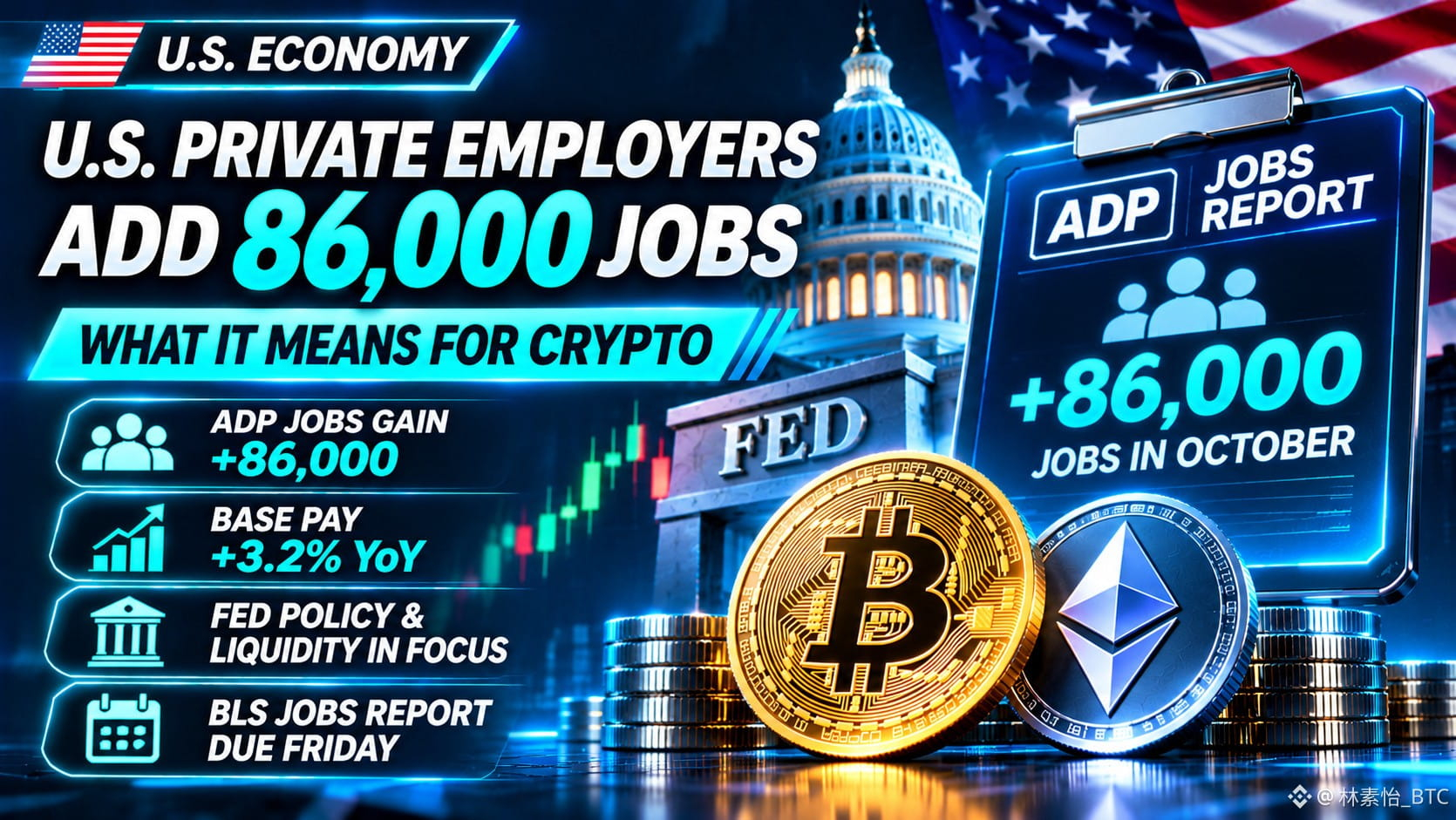
🚨 U.S. PRIVATE EMPLOYERS ADD 86,000 JOBS — WHAT IT MEANS FOR CRYPTO
U.S. private-sector employers added 86,000 jobs in October, according to ADP, matching September’s revised figure and beating economists’ expectations of around 69,000.
The data suggests the U.S. labor market remains relatively resilient. Service sectors led hiring, while professional and business services continued to weaken. Private-sector base pay also increased 3.2% year over year.
For crypto traders, the key issue is what this means for Fed policy and liquidity expectations. A stronger labor market can reduce pressure for aggressive monetary easing, which may limit the upside for risk assets such as Bitcoin and altcoins.
However, ADP is not always a reliable predictor of the official U.S. jobs report. Traders will therefore be watching Friday’s BLS employment data for confirmation before making stronger conclusions.
Bottom line: The jobs data is modestly stronger than expected, creating a slightly less dovish backdrop for crypto, but the BLS report remains the bigger market catalyst.
#Crypto #Bitcoin #Fed #USJobs
$MUU $RAM $KORU
{future}(KORUUSDT)
{future}(RAMUSDT)
{future}(MUUUSDT)
#adpusprivateemployersadd86000jobsinoctober
🚨 U.S. PRIVATE EMPLOYERS ADD 86,000 JOBS — WHAT IT MEANS FOR CRYPTO
U.S. private-sector employers added 86,000 jobs in October, according to ADP, matching September’s revised figure and beating economists’ expectations of around 69,000.
The data suggests the U.S. labor market remains relatively resilient. Service sectors led hiring, while professional and business services continued to weaken. Private-sector base pay also increased 3.2% year over year.
For crypto traders, the key issue is what this means for Fed policy and liquidity expectations. A stronger labor market can reduce pressure for aggressive monetary easing, which may limit the upside for risk assets such as Bitcoin and altcoins.
However, ADP is not always a reliable predictor of the official U.S. jobs report. Traders will therefore be watching Friday’s BLS employment data for confirmation before making stronger conclusions.
Bottom line: The jobs data is modestly stronger than expected, creating a slightly less dovish backdrop for crypto, but the BLS report remains the bigger market catalyst.
#Crypto #Bitcoin #Fed #USJobs
$MUU $RAM $KORU
596

🔥 US Labor Market Holds the Line! What It Means for Your Portfolio 🔥
The latest ADP National Employment Report just dropped, and the data is painting a highly specific picture of the broader economy. If you are trading risk assets, you need to pay attention to these underlying trends! 📊
Here is the October Breakdown:
✅ 86,000 Private Jobs Added: The labor market beat the ~69K expectations, proving the economy still has a steady pulse.
✅ Revisions Matter: September’s initial 90K print was revised downward to match October perfectly at 86K.
✅ The Sector Shake-up: It’s a tale of two economies. Service-providing industries (like trade, transportation, and healthcare) carried the entire weight by adding 82K jobs. Meanwhile, Professional and Business Services bled 27K jobs, marking its 3rd consecutive month of losses.
✅ Wage Growth: Base pay rose 3.2% year-over-year, while gross pay climbed a solid 4.7%.
How Does This Impact Crypto and Stocks? 🤔
A resilient jobs market paired with sticky wage growth complicates the Federal Reserve's next move. Since employment isn't crashing, aggressive rate cuts seem far less urgent.
For crypto, this means macro volatility is still on the menu. Steady overall hiring keeps consumer capital flowing (which is fundamentally bullish), but the uneven sector growth reveals underlying economic friction. If inflation fears creep back in due to wage growth, risk-on assets like Bitcoin could face short-term headwinds.
The main takeaway? The economy isn't breaking, but it is leaning heavily on just a few pillars.
👇 What is your strategy right now?
Do you think this data forces the Fed to keep rates tighter for longer, or are the cracks in professional services a red flag? Drop your thoughts below! 🗣️
$AKE
{future}(AKEUSDT)
$UAI
{future}(UAIUSDT)
$CYBER
{future}(CYBERUSDT)
#adpusprivateemployersadd86000jobsinoctober
🔥 US Labor Market Holds the Line! What It Means for Your Portfolio 🔥
The latest ADP National Employment Report just dropped, and the data is painting a highly specific picture of the broader economy. If you are trading risk assets, you need to pay attention to these underlying trends! 📊
Here is the October Breakdown:
✅ 86,000 Private Jobs Added: The labor market beat the ~69K expectations, proving the economy still has a steady pulse.
✅ Revisions Matter: September’s initial 90K print was revised downward to match October perfectly at 86K.
✅ The Sector Shake-up: It’s a tale of two economies. Service-providing industries (like trade, transportation, and healthcare) carried the entire weight by adding 82K jobs. Meanwhile, Professional and Business Services bled 27K jobs, marking its 3rd consecutive month of losses.
✅ Wage Growth: Base pay rose 3.2% year-over-year, while gross pay climbed a solid 4.7%.
How Does This Impact Crypto and Stocks? 🤔
A resilient jobs market paired with sticky wage growth complicates the Federal Reserve's next move. Since employment isn't crashing, aggressive rate cuts seem far less urgent.
For crypto, this means macro volatility is still on the menu. Steady overall hiring keeps consumer capital flowing (which is fundamentally bullish), but the uneven sector growth reveals underlying economic friction. If inflation fears creep back in due to wage growth, risk-on assets like Bitcoin could face short-term headwinds.
The main takeaway? The economy isn't breaking, but it is leaning heavily on just a few pillars.
👇 What is your strategy right now?
Do you think this data forces the Fed to keep rates tighter for longer, or are the cracks in professional services a red flag? Drop your thoughts below! 🗣️
$AKE
$UAI
$CYBER
#adpusprivateemployersadd86000jobsinoctober
1
1.3k
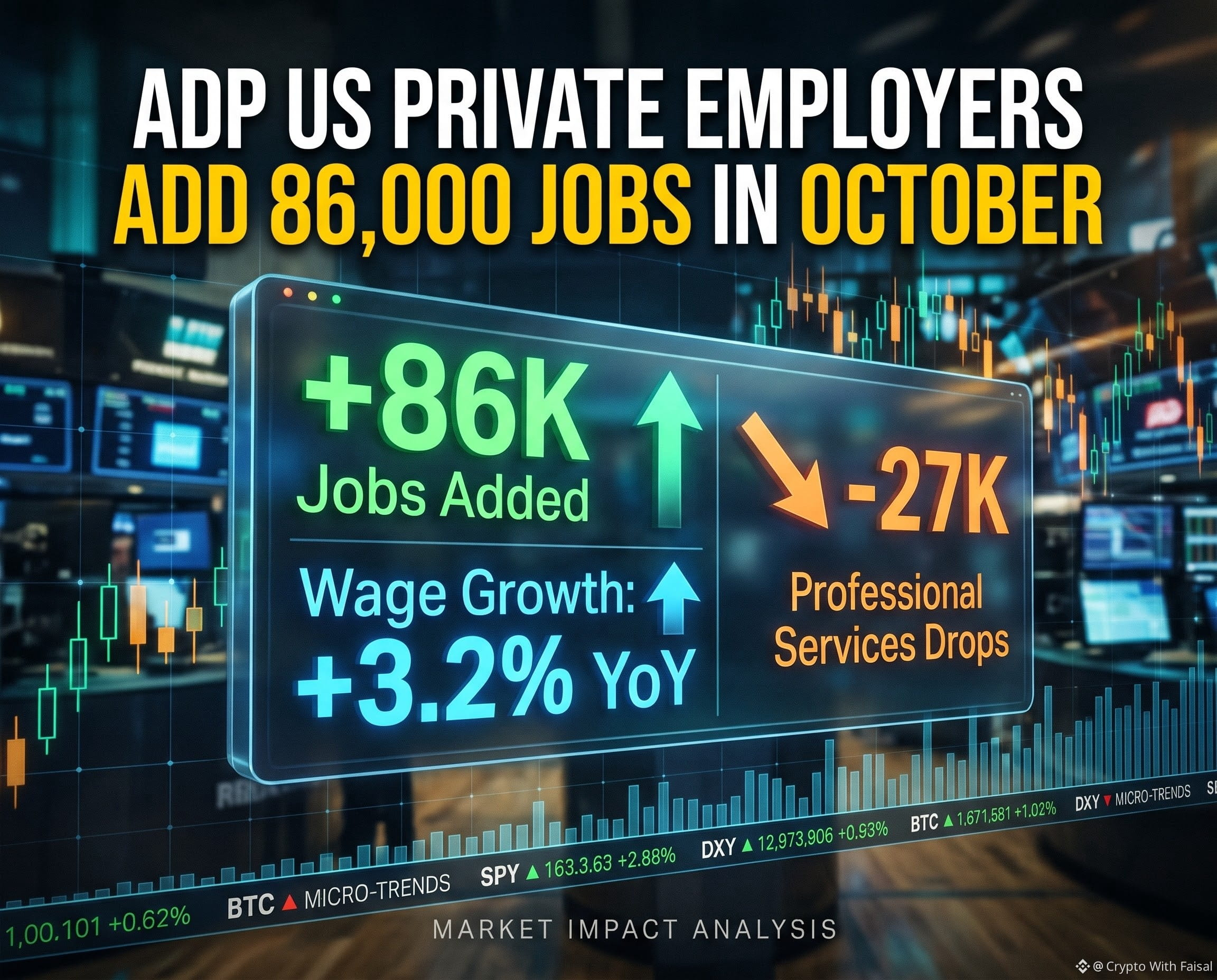
US JOBS DATA BEATS EXPECTATIONS! ADP ADDS 86,000 JOBS — WILL THE FED DELAY RATE CUTS?🇺🇸 The US private-sector labor market is showing resilience. ADP reported 86,000 new private-sector jobs in October, beating economists’ expectations and matching September’s revised figure.
📊 THE NUMBERS THAT MATTER
October ADP jobs: +86,000September revised: +86,000 (previously reported as 90,000)Reuters forecast: +69,000Dow Jones forecast: +75,000Base pay growth: +3.2% year over yearGross pay growth: +4.7% year over year
The report is based on anonymized payroll data covering more than 26 million private-sector employees, produced by ADP Research with Stanford’s Digital Economy Lab.
🏗️ WHICH INDUSTRIES ARE HIRING?
Construction added 13,000 jobs, while trade, transportation, and utilities led overall sector gains with 39,000 new positions.
Education and health services added 28,000 jobs, and leisure and hospitality gained 19,000.
But there are warning signs: professional and business services lost 27,000 jobs, marking their third consecutive month of declines.
⏳ THE NEXT BIG TEST: FRIDAY'S NFP REPORT
ADP is only a private-sector indicator. The official Bureau of Labor Statistics report also includes government employment, so the two figures can differ significantly.
Reuters' latest economist survey expects:
Total nonfarm payrolls: +65,000Private payrolls: +64,000Unemployment rate: 4.2%
The official October jobs report is scheduled for November 6 at 8:30 a.m. ET.
₿ WHY CRYPTO TRADERS SHOULD CARE
A stronger-than-expected labor market can reduce expectations for near-term Federal Reserve rate cuts, potentially putting pressure on risk assets such as Bitcoin.
However, the relationship is not automatic. Strong employment can also support economic confidence, while wage growth and inflation data will influence the Fed's decisions.
MY TAKE: The labor market is not showing an obvious collapse, but hiring remains uneven. Friday's NFP report could shift market expectations and trigger volatility across stocks and crypto.
👀 Are you positioning LONG or SHORT ahead of Friday's NFP release? Share your strategy below!
$ADP.US
#USJobs #NFP #PrivatePayrolls #FederalReserve #RateCuts #USAEconomy #adpusprivateemployersadd86000jobsinoctober
{stock_us}(ADP.US)
US JOBS DATA BEATS EXPECTATIONS! ADP ADDS 86,000 JOBS — WILL THE FED DELAY RATE CUTS?
🇺🇸 The US private-sector labor market is showing resilience. ADP reported 86,000 new private-sector jobs in October, beating economists’ expectations and matching September’s revised figure.
📊 THE NUMBERS THAT MATTER
October ADP jobs: +86,000September revised: +86,000 (previously reported as 90,000)Reuters forecast: +69,000Dow Jones forecast: +75,000Base pay growth: +3.2% year over yearGross pay growth: +4.7% year over year
The report is based on anonymized payroll data covering more than 26 million private-sector employees, produced by ADP Research with Stanford’s Digital Economy Lab.
🏗️ WHICH INDUSTRIES ARE HIRING?
Construction added 13,000 jobs, while trade, transportation, and utilities led overall sector gains with 39,000 new positions.
Education and health services added 28,000 jobs, and leisure and hospitality gained 19,000.
But there are warning signs: professional and business services lost 27,000 jobs, marking their third consecutive month of declines.
⏳ THE NEXT BIG TEST: FRIDAY'S NFP REPORT
ADP is only a private-sector indicator. The official Bureau of Labor Statistics report also includes government employment, so the two figures can differ significantly.
Reuters' latest economist survey expects:
Total nonfarm payrolls: +65,000Private payrolls: +64,000Unemployment rate: 4.2%
The official October jobs report is scheduled for November 6 at 8:30 a.m. ET.
₿ WHY CRYPTO TRADERS SHOULD CARE
A stronger-than-expected labor market can reduce expectations for near-term Federal Reserve rate cuts, potentially putting pressure on risk assets such as Bitcoin.
However, the relationship is not automatic. Strong employment can also support economic confidence, while wage growth and inflation data will influence the Fed's decisions.
MY TAKE: The labor market is not showing an obvious collapse, but hiring remains uneven. Friday's NFP report could shift market expectations and trigger volatility across stocks and crypto.
👀 Are you positioning LONG or SHORT ahead of Friday's NFP release? Share your strategy below!
$ADP.US
#USJobs #NFP #PrivatePayrolls #FederalReserve #RateCuts #USAEconomy #adpusprivateemployersadd86000jobsinoctober
ADPUS-0.42%
347

·
--
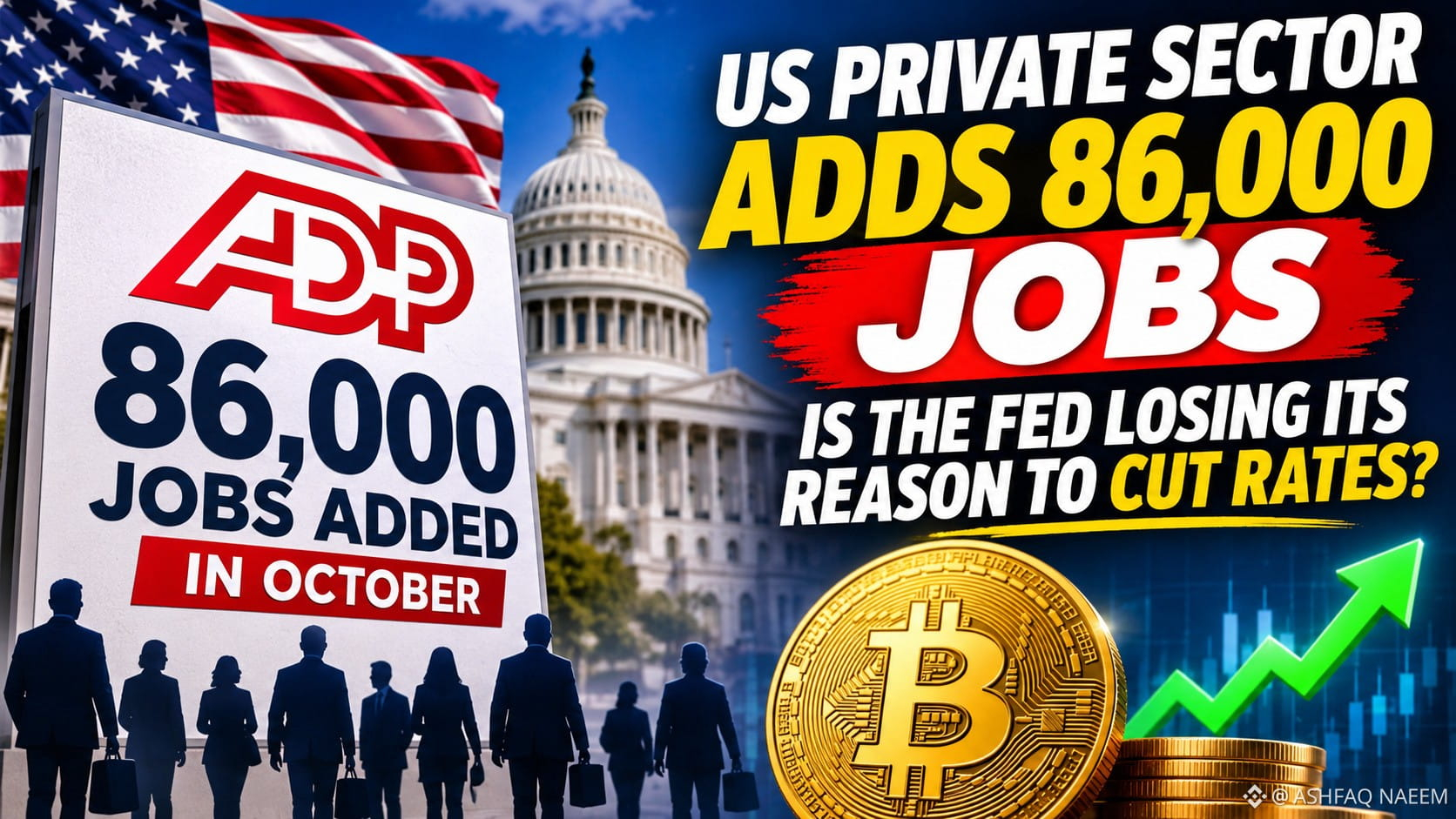
🔥 US PRIVATE SECTOR ADDS 86,000 JOBS — IS THE FED LOSING ITS REASON TO CUT RATES?
The US labor market is showing unexpected resilience, and the latest employment numbers could influence the Federal Reserve’s next policy decision.
According to ADP’s October 2026 National Employment Report, private-sector employers added **86,000 jobs**, beating economists’ expectations of approximately 69,000. This marks the second consecutive month of solid private-sector job growth.
📊 Here’s what stands out:
• Trade, transportation and utilities added 39,000 jobs
• Education and healthcare contributed 28,000 jobs
• Leisure and hospitality added 19,000 jobs
• Financial activities gained 15,000 jobs
• Professional and business services lost 27,000 jobs
Wage growth also remains important. Base pay increased 3.2% year over year, while gross pay rose 4.7%.
🚨 What does this mean for crypto?
Stronger employment can signal economic resilience, but it may also reduce pressure on the Federal Reserve to cut interest rates quickly. If markets begin pricing in fewer rate cuts, Treasury yields and the US dollar could strengthen, potentially creating short-term pressure on Bitcoin and other risk assets.
On the other hand, a healthy labor market can support consumer spending and broader economic confidence.
The important detail is that ADP data is not the official government employment report. Investors will also watch the upcoming Bureau of Labor Statistics report before drawing stronger conclusions about the labor market and Fed policy.
My take: The US economy is showing signs of resilience, but the combination of employment growth, wage pressure and inflation will determine how much room the Fed has to ease monetary policy.
👇 Your opinion matters: Will stronger US jobs data push Bitcoin lower by reducing rate-cut expectations, or will economic strength support the next crypto rally?
#adpusprivateemployersadd86000jobsinoctober $ADP.US $BTC
{spot}(BTCUSDT)
{stock_us}(ADP.US)
🔥 US PRIVATE SECTOR ADDS 86,000 JOBS — IS THE FED LOSING ITS REASON TO CUT RATES?
The US labor market is showing unexpected resilience, and the latest employment numbers could influence the Federal Reserve’s next policy decision.
According to ADP’s October 2026 National Employment Report, private-sector employers added **86,000 jobs**, beating economists’ expectations of approximately 69,000. This marks the second consecutive month of solid private-sector job growth.
📊 Here’s what stands out:
• Trade, transportation and utilities added 39,000 jobs
• Education and healthcare contributed 28,000 jobs
• Leisure and hospitality added 19,000 jobs
• Financial activities gained 15,000 jobs
• Professional and business services lost 27,000 jobs
Wage growth also remains important. Base pay increased 3.2% year over year, while gross pay rose 4.7%.
🚨 What does this mean for crypto?
Stronger employment can signal economic resilience, but it may also reduce pressure on the Federal Reserve to cut interest rates quickly. If markets begin pricing in fewer rate cuts, Treasury yields and the US dollar could strengthen, potentially creating short-term pressure on Bitcoin and other risk assets.
On the other hand, a healthy labor market can support consumer spending and broader economic confidence.
The important detail is that ADP data is not the official government employment report. Investors will also watch the upcoming Bureau of Labor Statistics report before drawing stronger conclusions about the labor market and Fed policy.
My take: The US economy is showing signs of resilience, but the combination of employment growth, wage pressure and inflation will determine how much room the Fed has to ease monetary policy.
👇 Your opinion matters: Will stronger US jobs data push Bitcoin lower by reducing rate-cut expectations, or will economic strength support the next crypto rally?
#adpusprivateemployersadd86000jobsinoctober $ADP.US $BTC
BTC-6.42%
ADPUS-0.42%
SpaVodka:
ADP at 86k puts all the weight on tomorrow's payrolls. Crypto already flinched today: BTC dropped about 1% in one hour this afternoon and high beta alts like JTO lost 2 to 3% in the same window. If NFP also comes in hot, cut odds shrink and that beta keeps working against longs. Not financial advice.
1
1
1.9k

·
--
Article
US Jobs Surprise: 86,000 New Jobs Challenge Fed Rate-Cut Expectations — What It Means for Bitcoin,What if stronger US employment turns out to be bad news for financial markets?
That is the question investors should be asking after the latest ADP employment report.
On November 4, 2026, ADP reported that US private-sector employers added 86,000 jobs in October, beating economists' expectations of approximately 69,000. It marked the second consecutive month of solid private-sector hiring.
At first glance, this is positive news for the American economy. But financial markets rarely react to economic data in isolation.
For investors, the bigger question is whether a resilient labour market will give the Federal Reserve another reason to keep interest rates elevated—and what that could mean for the dollar, global capital flows, equities and cryptocurrencies.
1. Why 86,000 Jobs Matter More Than the Headline
Employment is one of the key indicators influencing Federal Reserve policy.
A healthy labour market supports consumer spending, corporate revenues and economic growth. However, persistent hiring can also reduce the urgency for interest-rate cuts.
October's employment figures offer an interesting picture of the US economy.
According to ADP:
Trade, transportation and utilities added 39,000 jobs.
Education and health services added 28,000.
Leisure and hospitality added 19,000.
Financial activities added 15,000.
Professional and business services lost 27,000 jobs.
Natural resources and mining lost 8,000 jobs.
The numbers suggest that hiring remains relatively strong in consumer-facing and essential services, while some professional sectors continue to struggle.
That distinction matters. Investors should look at the quality and distribution of job growth, not simply the headline figure.
2. The Geopolitical Connection: Why Washington Matters to Global Markets
There is a historical reason why US economic data has such a powerful influence on international markets.
Since the Bretton Woods monetary system established the dollar's central role after World War II, the United States has remained at the heart of global finance. Although the original system ended in the early 1970s, the dollar retained its dominant position in international trade, financial reserves and cross-border transactions.
This gives US monetary policy an influence that extends far beyond American borders.
Now consider the geopolitical environment.
The US-Israeli war with Iran has increased uncertainty around energy supplies, regional security and international shipping. Any prolonged disruption could push energy prices higher, increase transportation costs and complicate the global inflation outlook.
Here is where the ADP report becomes particularly important.
If employment remains resilient while geopolitical tensions push energy prices higher, the Federal Reserve could face a difficult policy decision.
Strong employment could keep consumer demand elevated.
Higher energy prices could create additional inflation pressure.
Persistent inflation could delay interest-rate cuts.
Higher US yields could strengthen demand for dollar-denominated assets.
For global investors, this combination matters because it can change where institutional capital chooses to go.
3. Institutional Capital Flows: Where Could the Money Move?
Large investment institutions do not change their portfolios simply because one employment report beats expectations.
They look at expected returns, borrowing costs, liquidity and geopolitical risks.
However, stronger employment can influence their allocation decisions through several channels.
US Treasury Bonds: If investors expect interest rates to remain elevated, Treasury yields could rise. That makes government bonds more competitive against riskier investments.
US Dollar: Higher US yields can attract international capital, particularly when geopolitical uncertainty increases demand for relatively liquid and established assets.
Stock Market: Banks and selected consumer-facing companies may benefit from economic resilience. However, higher borrowing costs can put pressure on technology companies with expensive valuations.
Emerging Markets: A stronger dollar can increase the burden of dollar-denominated debt and make some emerging-market investments less attractive.
Cryptocurrency: When global liquidity becomes tighter, speculative assets often face additional pressure. Bitcoin and altcoins are not immune to this shift.
The important lesson is that capital does not necessarily leave the market. It changes direction according to risk, liquidity and expected returns.
4. Bitcoin and Crypto: Is Strong US Employment Bullish or Bearish?
This is where crypto investors need to be particularly careful.
A strong US labour market does not automatically mean Bitcoin will fall. The actual impact depends on how the Federal Reserve and financial markets interpret the data.
The bearish scenario
If strong employment contributes to higher Treasury yields and a stronger dollar, investors may reduce exposure to speculative assets.
That could create selling pressure on Bitcoin and, particularly, high-beta altcoins.
Smaller-cap cryptocurrencies could face even greater volatility because they generally depend more heavily on speculative capital and market liquidity.
The bullish scenario
There is another side to the story.
If employment remains healthy without accelerating inflation, the US economy could avoid a sharp slowdown.
That would support corporate earnings, consumer confidence and broader financial stability.
Under those conditions, institutional investors could maintain their exposure to risk assets, including selected cryptocurrencies.
For Bitcoin, the bigger question is whether economic resilience can coexist with stable liquidity conditions.
For Ethereum and altcoins, network activity, institutional demand, spot-market participation and sustainable capital inflows will remain important factors.
Traders should also monitor open interest, funding rates and liquidation levels rather than chasing sudden price movements.
5. What Investors Should Watch Before the Next Fed Decision
One important detail: ADP's employment report is not the official US Nonfarm Payrolls (NFP) report.
The two reports use different methodologies, and ADP's figures do not always accurately predict the government's employment data.
The October NFP report, scheduled for November 6, will therefore be an important next data point.
Investors should focus on three indicators:
1. Nonfarm Payrolls: Does official employment data confirm the resilience suggested by ADP?
2. Unemployment Rate: Is the labour market maintaining its strength, or are signs of weakness beginning to emerge?
3. Wage Growth: Are wages increasing at a pace that could make inflation more difficult to control?
These numbers could influence expectations for future Federal Reserve policy and create fresh volatility across global markets.
6. The Portfolio Logic: From Geopolitics to Your Investments
For ordinary investors, the connection between international politics and portfolio performance can be understood through a simple chain:
Geopolitical tensions → Energy prices → Inflation expectations → Federal Reserve policy → Treasury yields → US dollar → Global capital flows → Asset prices.
Each stage can influence the next.
If geopolitical tensions push energy prices higher and inflation remains persistent, the Fed may have less room to cut interest rates.
That could support the dollar and Treasury yields while putting pressure on emerging markets and speculative cryptocurrencies.
But if energy prices stabilise, inflation moderates and employment remains healthy, the market could move towards a more favourable environment for risk assets.
This is why investors should avoid making portfolio decisions based on a single headline.
7. Where Is the Investment Opportunity?
My assessment is that October's ADP report is positive for the US economic outlook, but it is not an automatic bullish signal for every financial asset.
There are three areas worth monitoring.
For stock investors: Watch Treasury yields, corporate earnings and valuation levels. Strong employment can support business activity, but expensive financing can limit stock-market upside.
For crypto investors: Pay close attention to the dollar index, real Treasury yields, institutional ETF flows, spot demand and derivatives positioning. These indicators can reveal whether capital is moving towards or away from crypto.
For long-term investors: Maintain diversification and adequate liquidity. Geopolitical developments can change market conditions faster than traditional economic indicators.
There is also a separate point for investors following $ADP.US (Automatic Data Processing).
ADP's employment report should not be confused with the company's own financial performance. Its stock valuation depends on factors such as revenue growth, client retention, operating margins and earnings expectations.
The employment data alone is not enough to establish an investment case for $ADP.US .
Final Take: The Real Signal Is Bigger Than 86,000 Jobs
The October employment report reinforces an important point: the US economy is showing resilience despite significant geopolitical uncertainty.
But stronger employment could also make it harder for the Federal Reserve to justify aggressive monetary easing, particularly if energy-related inflation risks persist.
For crypto investors, the next major signal may come from the relationship between employment, Treasury yields and global dollar liquidity.
Don't trade the headline. Understand the capital flows behind it.
That is how experienced investors distinguish between temporary market reactions and changes that could shape a longer-term trend.
Your Turn: What Do You Think?
Will stronger US employment and potentially higher Treasury yields create another liquidity challenge for Bitcoin and altcoins, or will economic resilience ultimately support institutional investment in crypto?
Share your market outlook in the comments. Is this report bullish or bearish for Bitcoin?
{stock_us}(ADP.US)
{spot}(ETHUSDT)
{spot}(BTCUSDT)
#ADPUSPrivateEmployersAdd86000JobsInOctober #ADPUSPrivateEmployersAdd86000JobsInOctober #ADP #Geopolitics #CryptoAnalysis #usa
US Jobs Surprise: 86,000 New Jobs Challenge Fed Rate-Cut Expectations — What It Means for Bitcoin,
What if stronger US employment turns out to be bad news for financial markets?
That is the question investors should be asking after the latest ADP employment report.
On November 4, 2026, ADP reported that US private-sector employers added 86,000 jobs in October, beating economists' expectations of approximately 69,000. It marked the second consecutive month of solid private-sector hiring.
At first glance, this is positive news for the American economy. But financial markets rarely react to economic data in isolation.
For investors, the bigger question is whether a resilient labour market will give the Federal Reserve another reason to keep interest rates elevated—and what that could mean for the dollar, global capital flows, equities and cryptocurrencies.
1. Why 86,000 Jobs Matter More Than the Headline
Employment is one of the key indicators influencing Federal Reserve policy.
A healthy labour market supports consumer spending, corporate revenues and economic growth. However, persistent hiring can also reduce the urgency for interest-rate cuts.
October's employment figures offer an interesting picture of the US economy.
According to ADP:
Trade, transportation and utilities added 39,000 jobs.
Education and health services added 28,000.
Leisure and hospitality added 19,000.
Financial activities added 15,000.
Professional and business services lost 27,000 jobs.
Natural resources and mining lost 8,000 jobs.
The numbers suggest that hiring remains relatively strong in consumer-facing and essential services, while some professional sectors continue to struggle.
That distinction matters. Investors should look at the quality and distribution of job growth, not simply the headline figure.
2. The Geopolitical Connection: Why Washington Matters to Global Markets
There is a historical reason why US economic data has such a powerful influence on international markets.
Since the Bretton Woods monetary system established the dollar's central role after World War II, the United States has remained at the heart of global finance. Although the original system ended in the early 1970s, the dollar retained its dominant position in international trade, financial reserves and cross-border transactions.
This gives US monetary policy an influence that extends far beyond American borders.
Now consider the geopolitical environment.
The US-Israeli war with Iran has increased uncertainty around energy supplies, regional security and international shipping. Any prolonged disruption could push energy prices higher, increase transportation costs and complicate the global inflation outlook.
Here is where the ADP report becomes particularly important.
If employment remains resilient while geopolitical tensions push energy prices higher, the Federal Reserve could face a difficult policy decision.
Strong employment could keep consumer demand elevated.
Higher energy prices could create additional inflation pressure.
Persistent inflation could delay interest-rate cuts.
Higher US yields could strengthen demand for dollar-denominated assets.
For global investors, this combination matters because it can change where institutional capital chooses to go.
3. Institutional Capital Flows: Where Could the Money Move?
Large investment institutions do not change their portfolios simply because one employment report beats expectations.
They look at expected returns, borrowing costs, liquidity and geopolitical risks.
However, stronger employment can influence their allocation decisions through several channels.
US Treasury Bonds: If investors expect interest rates to remain elevated, Treasury yields could rise. That makes government bonds more competitive against riskier investments.
US Dollar: Higher US yields can attract international capital, particularly when geopolitical uncertainty increases demand for relatively liquid and established assets.
Stock Market: Banks and selected consumer-facing companies may benefit from economic resilience. However, higher borrowing costs can put pressure on technology companies with expensive valuations.
Emerging Markets: A stronger dollar can increase the burden of dollar-denominated debt and make some emerging-market investments less attractive.
Cryptocurrency: When global liquidity becomes tighter, speculative assets often face additional pressure. Bitcoin and altcoins are not immune to this shift.
The important lesson is that capital does not necessarily leave the market. It changes direction according to risk, liquidity and expected returns.
4. Bitcoin and Crypto: Is Strong US Employment Bullish or Bearish?
This is where crypto investors need to be particularly careful.
A strong US labour market does not automatically mean Bitcoin will fall. The actual impact depends on how the Federal Reserve and financial markets interpret the data.
The bearish scenario
If strong employment contributes to higher Treasury yields and a stronger dollar, investors may reduce exposure to speculative assets.
That could create selling pressure on Bitcoin and, particularly, high-beta altcoins.
Smaller-cap cryptocurrencies could face even greater volatility because they generally depend more heavily on speculative capital and market liquidity.
The bullish scenario
There is another side to the story.
If employment remains healthy without accelerating inflation, the US economy could avoid a sharp slowdown.
That would support corporate earnings, consumer confidence and broader financial stability.
Under those conditions, institutional investors could maintain their exposure to risk assets, including selected cryptocurrencies.
For Bitcoin, the bigger question is whether economic resilience can coexist with stable liquidity conditions.
For Ethereum and altcoins, network activity, institutional demand, spot-market participation and sustainable capital inflows will remain important factors.
Traders should also monitor open interest, funding rates and liquidation levels rather than chasing sudden price movements.
5. What Investors Should Watch Before the Next Fed Decision
One important detail: ADP's employment report is not the official US Nonfarm Payrolls (NFP) report.
The two reports use different methodologies, and ADP's figures do not always accurately predict the government's employment data.
The October NFP report, scheduled for November 6, will therefore be an important next data point.
Investors should focus on three indicators:
1. Nonfarm Payrolls: Does official employment data confirm the resilience suggested by ADP?
2. Unemployment Rate: Is the labour market maintaining its strength, or are signs of weakness beginning to emerge?
3. Wage Growth: Are wages increasing at a pace that could make inflation more difficult to control?
These numbers could influence expectations for future Federal Reserve policy and create fresh volatility across global markets.
6. The Portfolio Logic: From Geopolitics to Your Investments
For ordinary investors, the connection between international politics and portfolio performance can be understood through a simple chain:
Geopolitical tensions → Energy prices → Inflation expectations → Federal Reserve policy → Treasury yields → US dollar → Global capital flows → Asset prices.
Each stage can influence the next.
If geopolitical tensions push energy prices higher and inflation remains persistent, the Fed may have less room to cut interest rates.
That could support the dollar and Treasury yields while putting pressure on emerging markets and speculative cryptocurrencies.
But if energy prices stabilise, inflation moderates and employment remains healthy, the market could move towards a more favourable environment for risk assets.
This is why investors should avoid making portfolio decisions based on a single headline.
7. Where Is the Investment Opportunity?
My assessment is that October's ADP report is positive for the US economic outlook, but it is not an automatic bullish signal for every financial asset.
There are three areas worth monitoring.
For stock investors: Watch Treasury yields, corporate earnings and valuation levels. Strong employment can support business activity, but expensive financing can limit stock-market upside.
For crypto investors: Pay close attention to the dollar index, real Treasury yields, institutional ETF flows, spot demand and derivatives positioning. These indicators can reveal whether capital is moving towards or away from crypto.
For long-term investors: Maintain diversification and adequate liquidity. Geopolitical developments can change market conditions faster than traditional economic indicators.
There is also a separate point for investors following $ADP.US (Automatic Data Processing).
ADP's employment report should not be confused with the company's own financial performance. Its stock valuation depends on factors such as revenue growth, client retention, operating margins and earnings expectations.
The employment data alone is not enough to establish an investment case for $ADP.US .
Final Take: The Real Signal Is Bigger Than 86,000 Jobs
The October employment report reinforces an important point: the US economy is showing resilience despite significant geopolitical uncertainty.
But stronger employment could also make it harder for the Federal Reserve to justify aggressive monetary easing, particularly if energy-related inflation risks persist.
For crypto investors, the next major signal may come from the relationship between employment, Treasury yields and global dollar liquidity.
Don't trade the headline. Understand the capital flows behind it.
That is how experienced investors distinguish between temporary market reactions and changes that could shape a longer-term trend.
Your Turn: What Do You Think?
Will stronger US employment and potentially higher Treasury yields create another liquidity challenge for Bitcoin and altcoins, or will economic resilience ultimately support institutional investment in crypto?
Share your market outlook in the comments. Is this report bullish or bearish for Bitcoin?
#ADPUSPrivateEmployersAdd86000JobsInOctober #ADPUSPrivateEmployersAdd86000JobsInOctober #ADP #Geopolitics #CryptoAnalysis #usa
1
332

·
--
Bullish
#ADPUSPrivateEmployersAdd86000JobsInOctober
🇺🇸 US Jobs Report – October 2026
In simple words:
US private companies created 86,000 new jobs.
Experts expected only 75,000 jobs.
So, the result was better than expected.
This shows the US job market is still strong.
Impact on Bitcoin:
Strong jobs can be negative for BTC because the US dollar may become stronger.
Weak jobs can be positive for BTC because interest-rate cuts may become more likely.
Bottom line
The jobs report is good for the US economy, but it could create some pressure on Bitcoin.
Watch the official US jobs report on November 6.
$BTC
{future}(BTCUSDT)
$USDS
{spot}(USDSUSDT)
#ADPUSPrivateEmployersAdd86000JobsInOctober
🇺🇸 US Jobs Report – October 2026
In simple words:
US private companies created 86,000 new jobs.
Experts expected only 75,000 jobs.
So, the result was better than expected.
This shows the US job market is still strong.
Impact on Bitcoin:
Strong jobs can be negative for BTC because the US dollar may become stronger.
Weak jobs can be positive for BTC because interest-rate cuts may become more likely.
Bottom line
The jobs report is good for the US economy, but it could create some pressure on Bitcoin.
Watch the official US jobs report on November 6.
$BTC
$USDS
15

#ADPUSPrivateEmployersAdd86000JobsInOctober
86,000 US Jobs Added in October — What Does It Mean for Bitcoin?
The US employment market delivered a stronger-than-expected signal in October, with private employers adding 86,000 jobs compared with economists' expectations of 69,000. While this suggests continued economic resilience, the bigger question is how the Federal Reserve will interpret the data. Stronger employment could reduce expectations of near-term interest-rate cuts, potentially supporting the US dollar and Treasury yields. For cryptocurrency investors, this matters because tighter financial conditions can reduce demand for riskier assets such as Bitcoin and altcoins. However, the employment picture is not entirely positive, as some business sectors continue to experience job losses.
Bitcoin traders are now watching the official US Nonfarm Payrolls report for further confirmation. Stronger-than-expected employment could create short-term selling pressure, while weaker figures could revive rate-cut expectations and improve sentiment across the crypto market. Neither outcome guarantees a particular Bitcoin price movement. Traders should monitor BTC trading volume, market liquidity, support and resistance levels, and the dollar's reaction before taking positions. The real opportunity may come from the market's reaction after the official data rather than the headline itself.
What is your prediction: Will US employment data push Bitcoin toward another correction, or trigger its next bullish rally?
#Bitcoin #CryptoMarket #ADPJobs
$BTC
{future}(BTCUSDT)
$ADP.US
{stock_us}(ADP.US)
#ADPUSPrivateEmployersAdd86000JobsInOctober
86,000 US Jobs Added in October — What Does It Mean for Bitcoin?
The US employment market delivered a stronger-than-expected signal in October, with private employers adding 86,000 jobs compared with economists' expectations of 69,000. While this suggests continued economic resilience, the bigger question is how the Federal Reserve will interpret the data. Stronger employment could reduce expectations of near-term interest-rate cuts, potentially supporting the US dollar and Treasury yields. For cryptocurrency investors, this matters because tighter financial conditions can reduce demand for riskier assets such as Bitcoin and altcoins. However, the employment picture is not entirely positive, as some business sectors continue to experience job losses.
Bitcoin traders are now watching the official US Nonfarm Payrolls report for further confirmation. Stronger-than-expected employment could create short-term selling pressure, while weaker figures could revive rate-cut expectations and improve sentiment across the crypto market. Neither outcome guarantees a particular Bitcoin price movement. Traders should monitor BTC trading volume, market liquidity, support and resistance levels, and the dollar's reaction before taking positions. The real opportunity may come from the market's reaction after the official data rather than the headline itself.
What is your prediction: Will US employment data push Bitcoin toward another correction, or trigger its next bullish rally?
#Bitcoin #CryptoMarket #ADPJobs
$BTC
$ADP.US
BTC-6.42%
ADPUS-0.42%
89

·
--
Bullish
#adpusprivateemployersadd86000jobsinoctober
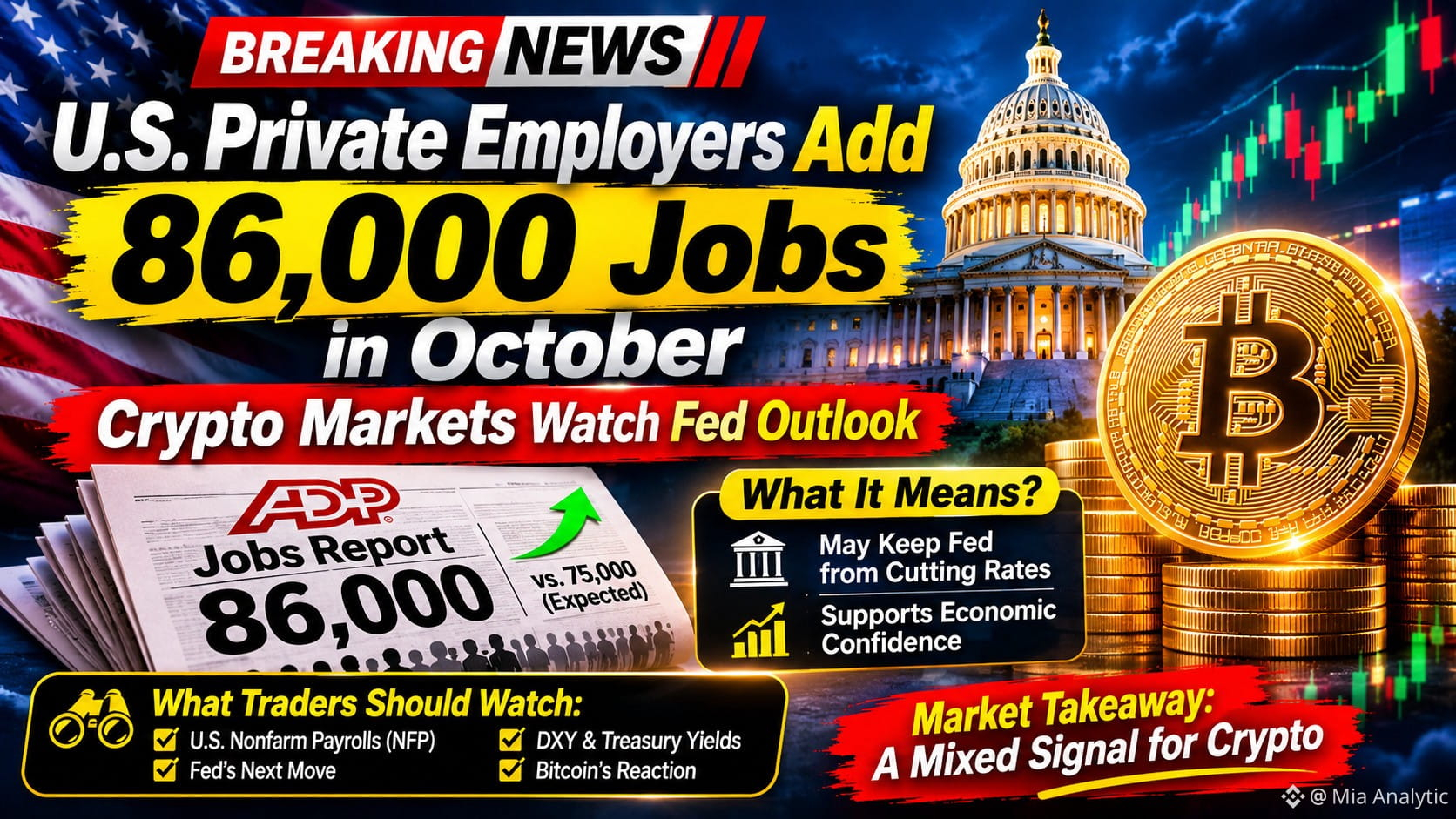
🇺🇸 U.S. Private Employers Add 86,000 Jobs in October — Crypto Markets Watch Fed Outlook
The U.S. labor market continues to show resilience, with private employers adding 86,000 jobs in October, according to the latest ADP employment report. The figure came in above market expectations of approximately 75,000 jobs.
📊 Why Does This Matter for Crypto?
Stronger employment data could give the Federal Reserve less reason to cut interest rates aggressively. If rates remain higher for longer, liquidity conditions could become less favorable for risk assets like Bitcoin and altcoins.
However, a stable labor market also supports economic confidence and reduces immediate recession concerns.
👀 What Traders Should Watch:
Upcoming U.S. Nonfarm Payrolls (NFP) data.
Federal Reserve interest-rate expectations.
U.S. Dollar Index (DXY) and Treasury yields.
Bitcoin's reaction to upcoming economic releases.
Market Takeaway: The jobs report presents a mixed signal for crypto. Strong employment supports economic stability, but it may also complicate expectations for monetary easing. Traders should watch the next economic releases before taking a directional position.
#Bitcoin #CryptoMarket #USEconomy #ADPEmployment
$CLANKER $INJ $BABY
{future}(BABYUSDT)
{future}(INJUSDT)
{future}(CLANKERUSDT)
#adpusprivateemployersadd86000jobsinoctober
🇺🇸 U.S. Private Employers Add 86,000 Jobs in October — Crypto Markets Watch Fed Outlook
The U.S. labor market continues to show resilience, with private employers adding 86,000 jobs in October, according to the latest ADP employment report. The figure came in above market expectations of approximately 75,000 jobs.
📊 Why Does This Matter for Crypto?
Stronger employment data could give the Federal Reserve less reason to cut interest rates aggressively. If rates remain higher for longer, liquidity conditions could become less favorable for risk assets like Bitcoin and altcoins.
However, a stable labor market also supports economic confidence and reduces immediate recession concerns.
👀 What Traders Should Watch:
Upcoming U.S. Nonfarm Payrolls (NFP) data.
Federal Reserve interest-rate expectations.
U.S. Dollar Index (DXY) and Treasury yields.
Bitcoin's reaction to upcoming economic releases.
Market Takeaway: The jobs report presents a mixed signal for crypto. Strong employment supports economic stability, but it may also complicate expectations for monetary easing. Traders should watch the next economic releases before taking a directional position.
#Bitcoin #CryptoMarket #USEconomy #ADPEmployment
$CLANKER $INJ $BABY
938

·
--
Bullish
#adpusprivateemployersadd86000jobsinoctober
🚨 U.S. PRIVATE EMPLOYERS ADDED 86,000 JOBS IN OCTOBER — WHAT IT MEANS FOR CRYPTO
U.S. private-sector employers added 86,000 jobs in October, according to ADP, matching September’s revised gain and coming in above most economist expectations.
The strength was concentrated in services, with trade, transportation and utilities adding 39,000 jobs, while education and health services added 28,000. However, professional and business services lost 27,000 jobs for a third consecutive month.
For crypto traders, the report sends a mixed but slightly supportive signal. A resilient labor market can support economic activity and risk appetite, but stronger employment can also reduce pressure for aggressive monetary easing. That makes the upcoming U.S. government jobs report particularly important for rate expectations and broader risk assets.
Bottom line: Labor conditions remain resilient, but the data is not strong enough by itself to establish a clear crypto trend. Traders will likely watch Friday’s official employment figures for confirmation.
#Crypto #Bitcoin #USJobs #Macro
$AIO $ARIA $FLUID
{future}(FLUIDUSDT)
{future}(ARIAUSDT)
{future}(AIOUSDT)
#adpusprivateemployersadd86000jobsinoctober
🚨 U.S. PRIVATE EMPLOYERS ADDED 86,000 JOBS IN OCTOBER — WHAT IT MEANS FOR CRYPTO
U.S. private-sector employers added 86,000 jobs in October, according to ADP, matching September’s revised gain and coming in above most economist expectations.
The strength was concentrated in services, with trade, transportation and utilities adding 39,000 jobs, while education and health services added 28,000. However, professional and business services lost 27,000 jobs for a third consecutive month.
For crypto traders, the report sends a mixed but slightly supportive signal. A resilient labor market can support economic activity and risk appetite, but stronger employment can also reduce pressure for aggressive monetary easing. That makes the upcoming U.S. government jobs report particularly important for rate expectations and broader risk assets.
Bottom line: Labor conditions remain resilient, but the data is not strong enough by itself to establish a clear crypto trend. Traders will likely watch Friday’s official employment figures for confirmation.
#Crypto #Bitcoin #USJobs #Macro
$AIO $ARIA $FLUID
51

·
--
#ADPUSPrivateEmployersAdd86000JobsInOctober
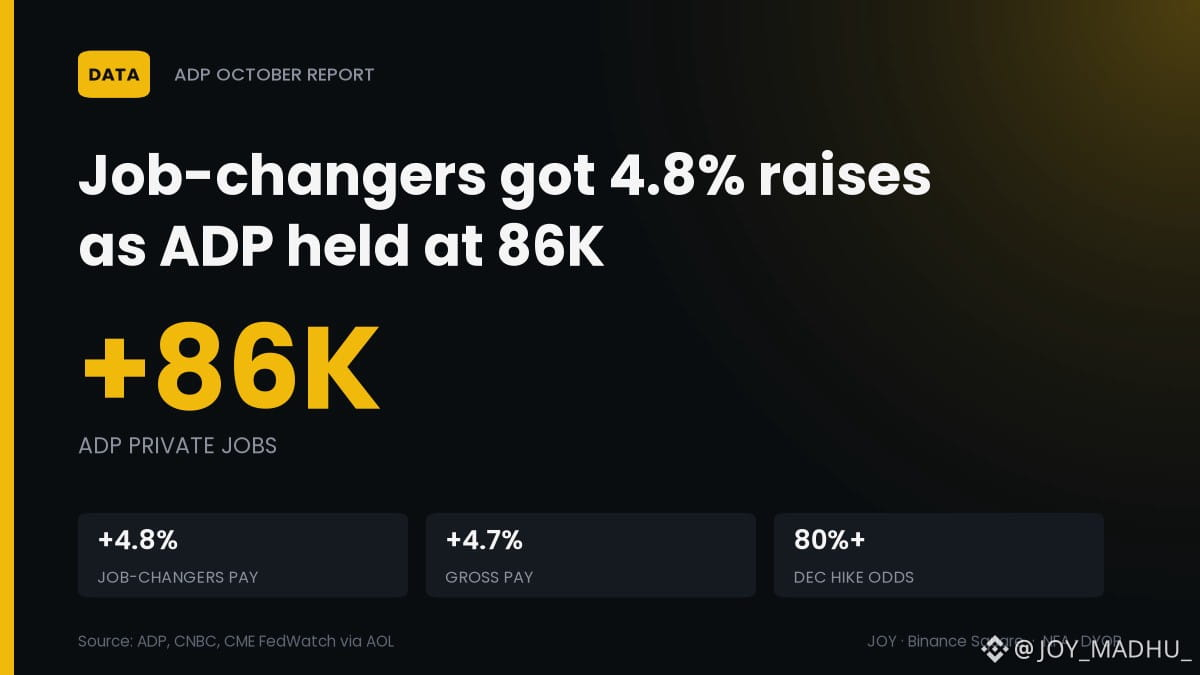
💰 Job-Changers Got 4.8% Raises While ADP Held at 86K
Hiring beat forecasts again, but pay is what keeps the Fed's hands busy.
📈 ADP +86K, a second straight 86K month, vs 67K-75K expected
💵 Job-changers' pay +4.8% a year; stayers +3%; gross pay +4.7%
🏦 CME FedWatch: December hike odds above 80%
📅 Official jobs report Friday 8:30 AM ET: ~59K-65K, jobless rate 4.2%
Why it matters: fast wage growth is the part of the data most likely to keep rate-hike bets alive.
December hike odds after Friday: stay above 80%, or fall below 70%? 👇
$BTC
#ADP #FedWatch #ADPUSPrivateEmployersAdd86000JobsInOctober
BTC-6.42%
ADPUS-0.42%
9

·
--
#adpusprivateemployersadd86000jobsinoctober
🚨🇺🇸 BREAKING: U.S. private employers added 86,000 jobs in October, beating expectations and signaling labor market resilience. 📈💼 Private hiring matched September's revised gain and came in above forecasts.
🔥 Key sectors leading growth: 🚚 Trade & Transportation 🏥 Health Services 🏨 Leisure & Hospitality
👀 The labor market isn't booming, but it's showing signs of stabilization.
📊 Bullish for risk assets if economic growth stays strong without overheating.
#ADP #JobsReport #Economy #Bitcoin #Crypto
By @ElCryptoBoy 🚀📈
87

·
--
Bullish
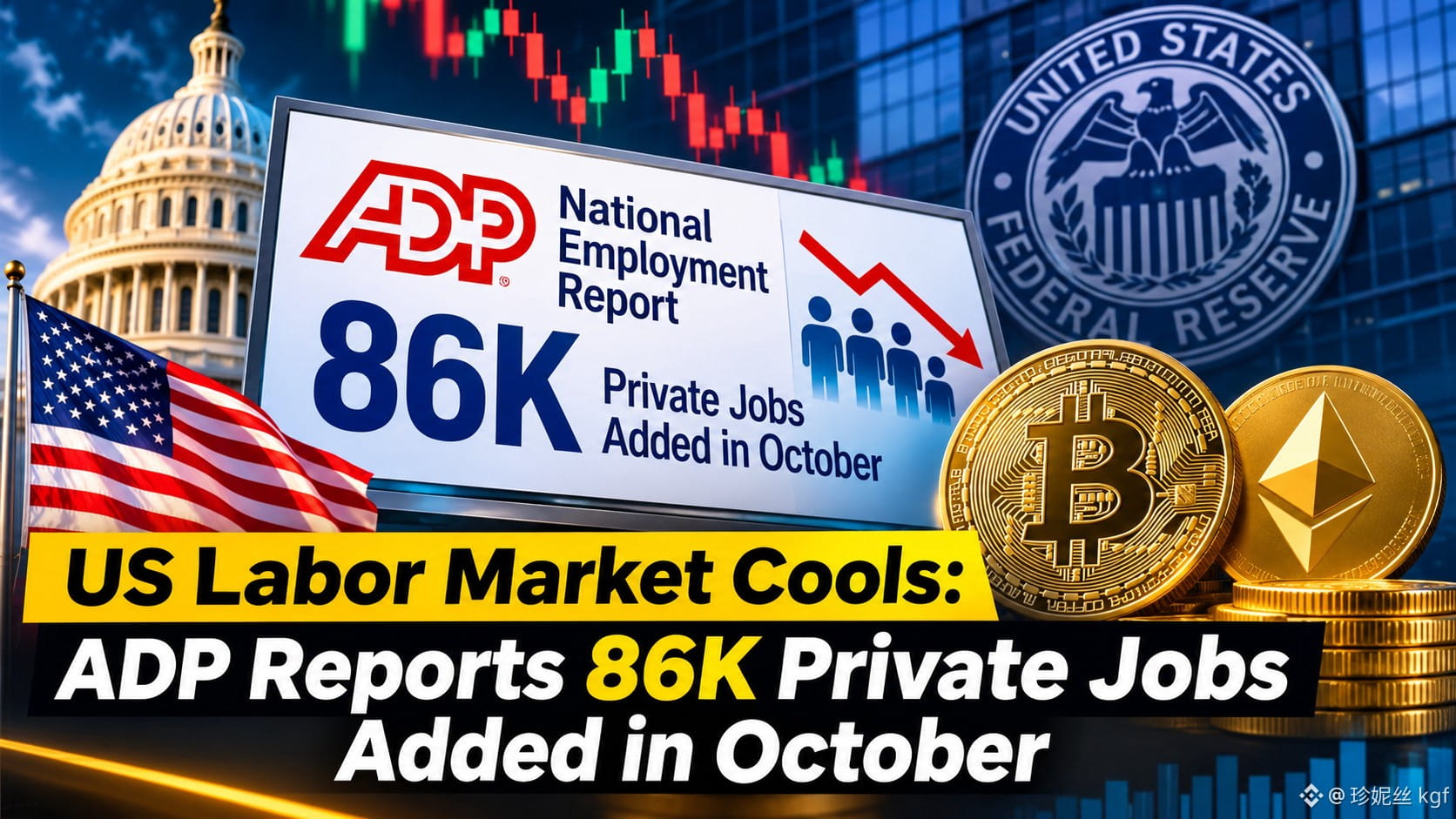
#adpusprivateemployersadd86000jobsinoctober 📊 US Labor Market Cools ADP Reports 86K Private Jobs Added in October
Macroeconomic data continues to be a primary driver of digital asset valuations. The latest US employment figures are signaling a potential shift in monetary policy expectations that crypto investors are watching closely.
📰 Core News
• The latest ADP National Employment Report indicates that US private employers added 86,000 jobs in October.
• This private-sector data serves as a crucial precursor to the official Bureau of Labor Statistics (BLS) Non-Farm Payrolls (NFP) report.
• The figures suggest a cooling labor market, a key metric monitored by global investors anticipating future Federal Reserve policy decisions.
📊 Market Impact
• Interest Rate Expectations A cooling labor market often increases market expectations for a more dovish Federal Reserve (potential rate cuts). Historically, increased liquidity and lower borrowing costs are favorable conditions for risk-on assets like Bitcoin and major altcoins.
• Short-Term Volatility Crypto markets may experience heightened volatility as traders position themselves ahead of the official NFP data release to confirm whether this cooling trend is sustained.
•Institutional Correlation As traditional finance continues to integrate with digital assets, crypto markets are increasingly pricing in macroeconomic indicators alongside native on-chain metrics.
Join the Discussion
How heavily do you weigh traditional macroeconomic indicators (like employment data or CPI) when evaluating your crypto market outlook? Share your strategy below! 👇
#Macroeconomics #CryptoMarket #Bitcoin #FederalReserve #CryptoAnalysis
This is for educational purposes only. Not Financial Advice (NFA). Always Do Your Own Research (DYOR).
$1000CAT $MRNAB $INJ
{future}(INJUSDT)
{spot}(MRNABUSDT)
{future}(1000CATUSDT)
#adpusprivateemployersadd86000jobsinoctober 📊 US Labor Market Cools ADP Reports 86K Private Jobs Added in October
Macroeconomic data continues to be a primary driver of digital asset valuations. The latest US employment figures are signaling a potential shift in monetary policy expectations that crypto investors are watching closely.
📰 Core News
• The latest ADP National Employment Report indicates that US private employers added 86,000 jobs in October.
• This private-sector data serves as a crucial precursor to the official Bureau of Labor Statistics (BLS) Non-Farm Payrolls (NFP) report.
• The figures suggest a cooling labor market, a key metric monitored by global investors anticipating future Federal Reserve policy decisions.
📊 Market Impact
• Interest Rate Expectations A cooling labor market often increases market expectations for a more dovish Federal Reserve (potential rate cuts). Historically, increased liquidity and lower borrowing costs are favorable conditions for risk-on assets like Bitcoin and major altcoins.
• Short-Term Volatility Crypto markets may experience heightened volatility as traders position themselves ahead of the official NFP data release to confirm whether this cooling trend is sustained.
•Institutional Correlation As traditional finance continues to integrate with digital assets, crypto markets are increasingly pricing in macroeconomic indicators alongside native on-chain metrics.
Join the Discussion
How heavily do you weigh traditional macroeconomic indicators (like employment data or CPI) when evaluating your crypto market outlook? Share your strategy below! 👇
#Macroeconomics #CryptoMarket #Bitcoin #FederalReserve #CryptoAnalysis
This is for educational purposes only. Not Financial Advice (NFA). Always Do Your Own Research (DYOR).
$1000CAT $MRNAB $INJ
391

#ADPUSPrivateEmployersAdd86K
🚨 THE MACRO EQUATION: ADP JOBS BEAT! 🚨
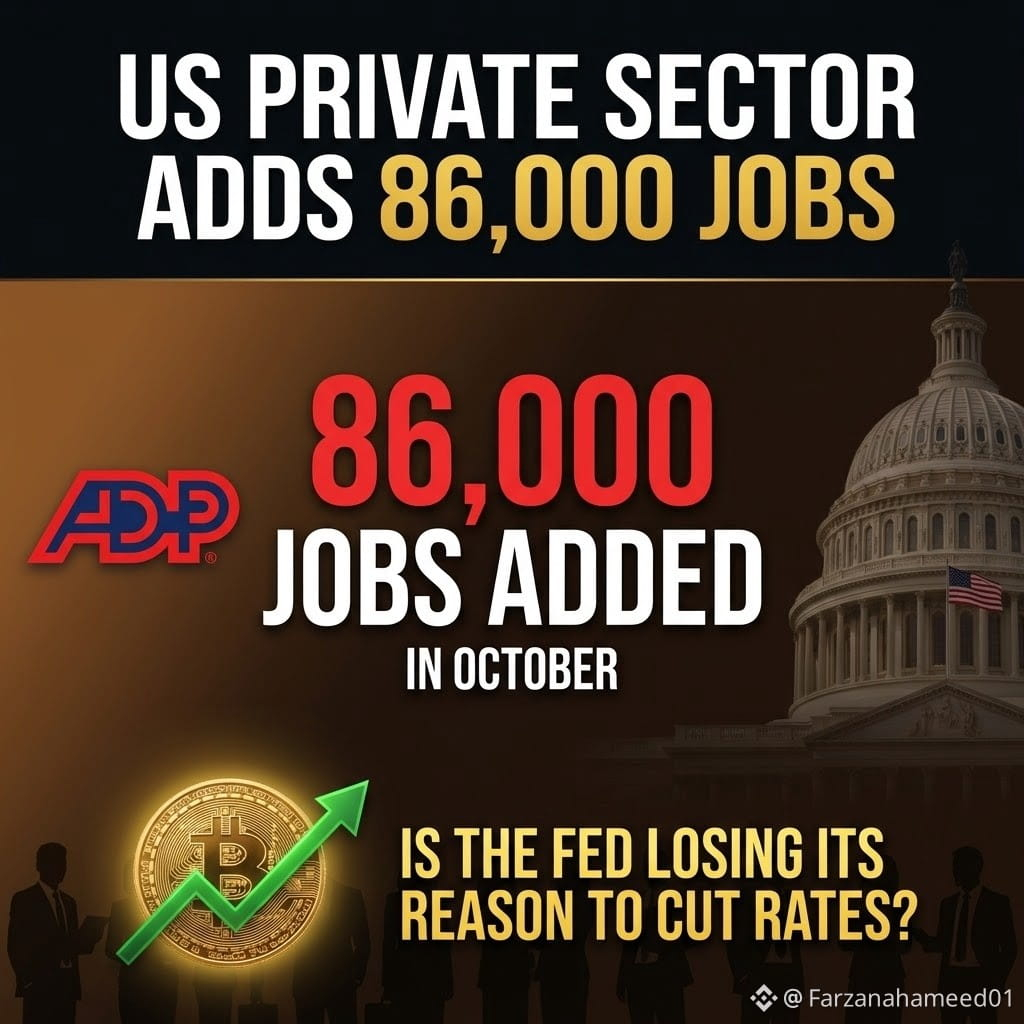
ADP US Private Employers Add 86,000 Jobs In October - Way Above Expectation!
📌 Quick Take:
🔥 Jobs Beat - 86,000 jobs added vs 69,000 expected - big beat!
💼 Service Sector Strong - service sector driving growth
💰 Wage Growth 3.2% - steady wage growth
💡 Real Impact - US labor market is still strong. central bank has no reason to cut rates fast. This is why Powell is cautious
🤖 Crypto Impact - Strong jobs = less rate cut hopes = short term pressure on $BTC but long term economic strength is bullish. BTC +1.73% already reacting
Your opinion matters: Will stronger US jobs data push Bitcoin lower by reducing rate cut expectations, or will economic strength support the next crypto rally? 💬👇
👀 Watching $BTC closely after this jobs data!
#ADPUSPrivateEmployersAdd86000JobsInOctober #BTCRebounds80K #BinanceReopensWithdrawalsForMoreAssets
5
40

·
--
ADP National Employment Report, Nov 4, 2026 - ADP Research + Stanford Digital Economy Lab. Based on payroll data of 26M+ US private-sector employees.
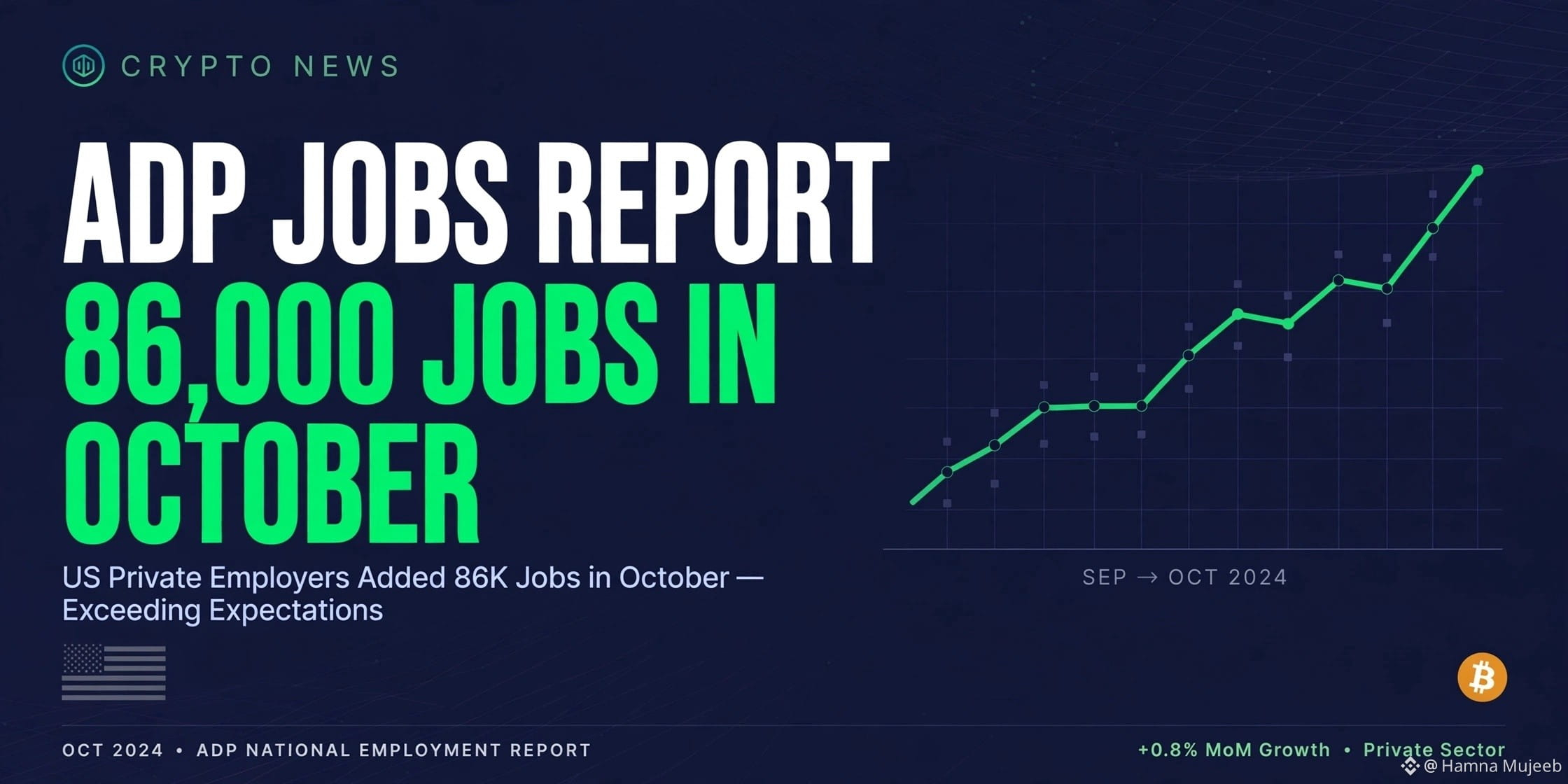
Private-sector employment increased by 86,000 jobs in October.
September revised from 90,000 to
86,000.
Service-providing: +82,000
Goods-producing: +4,000
By sector:
Trade, transportation, utilities: +39,000
Education and health services: +28,000
Leisure and hospitality: +19,000
Financial activities: +15,000
Professional and business services: -27,000
Pay:
Base pay: +3.2% YoY
Gross pay:+4.7% YoY
ADP Chief Economist Nela Richardson: "You have back-to-back, two consecutive straight months of pretty solid job growth."
Note: ADP covers private-sector only. It has historically been a poor predictor of the BLS official report. Official BLS October jobs report due Friday Nov 6, 8:30 AM ET.
#ADP #NFP #bitcoin
$BTC #EarningsSeason
#ADPUSPrivateEmployersAdd86000JobsInOctober
1
182

·
--
Verified
#adpusprivateemployersadd86000jobsinoctober
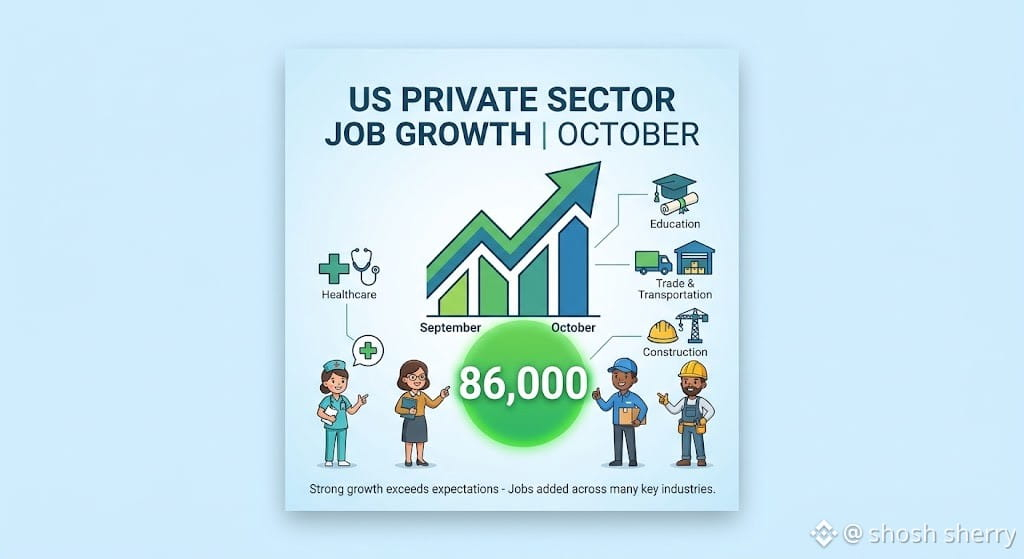
US private employers added 86,000 jobs in October. This growth was better than market expectations, matching the revised job growth numbers from September. Most of these new jobs came from the service sector, including healthcare, education, trade, and transportation. Construction also gained workers, while business and professional services saw job cuts. Overall, hiring remained steady across companies of all sizes, showing continued stability in the labor market.
$BTC $SOL $HEMI
{future}(HEMIUSDT)
{future}(SOLUSDT)
{future}(BTCUSDT)
#adpusprivateemployersadd86000jobsinoctober
US private employers added 86,000 jobs in October. This growth was better than market expectations, matching the revised job growth numbers from September. Most of these new jobs came from the service sector, including healthcare, education, trade, and transportation. Construction also gained workers, while business and professional services saw job cuts. Overall, hiring remained steady across companies of all sizes, showing continued stability in the labor market.
$BTC $SOL $HEMI
1k

·
--
$BTC | ADP's October print added 86,000 private jobs, and Bitcoin wobbled alongside Nasdaq futures within minutes. On the desk I watch that link before every US jobs week. ADP is a preview, not the verdict. Non-Farm Payrolls still lands days later and can contradict it. For Australians holding US share CFDs that week, the clock is the real risk. SatoshiMacro's own US stocks guide puts the regular session at 12:30am to 7:00am AEDT, hours most AU traders are asleep. ASIC's 5:1 leverage cap only limits position size, not gap risk. My read is ADP day rarely is the real move; NFP is. One honest limit worth sizing for: the 70 to 85 percent retail CFD loss rate ASIC discloses.
https://satoshimacro.com/guides/forex/trade-us-stocks-australia/?utm_source=binance_square&utm_medium=social&utm_campaign=autopilot_trend
#SatoshiMacro #ADPUSPrivateEmployersAdd86000JobsInOctober #USStocks #Bitcoin
https://satoshimacro.com/guides/forex/trade-us-stocks-australia/?utm_source=binance_square&utm_medium=social&utm_campaign=autopilot_trend
#SatoshiMacro #ADPUSPrivateEmployersAdd86000JobsInOctober #USStocks #Bitcoin
40

·
--
Bullish
#adpusprivateemployersadd86000jobsinoctober
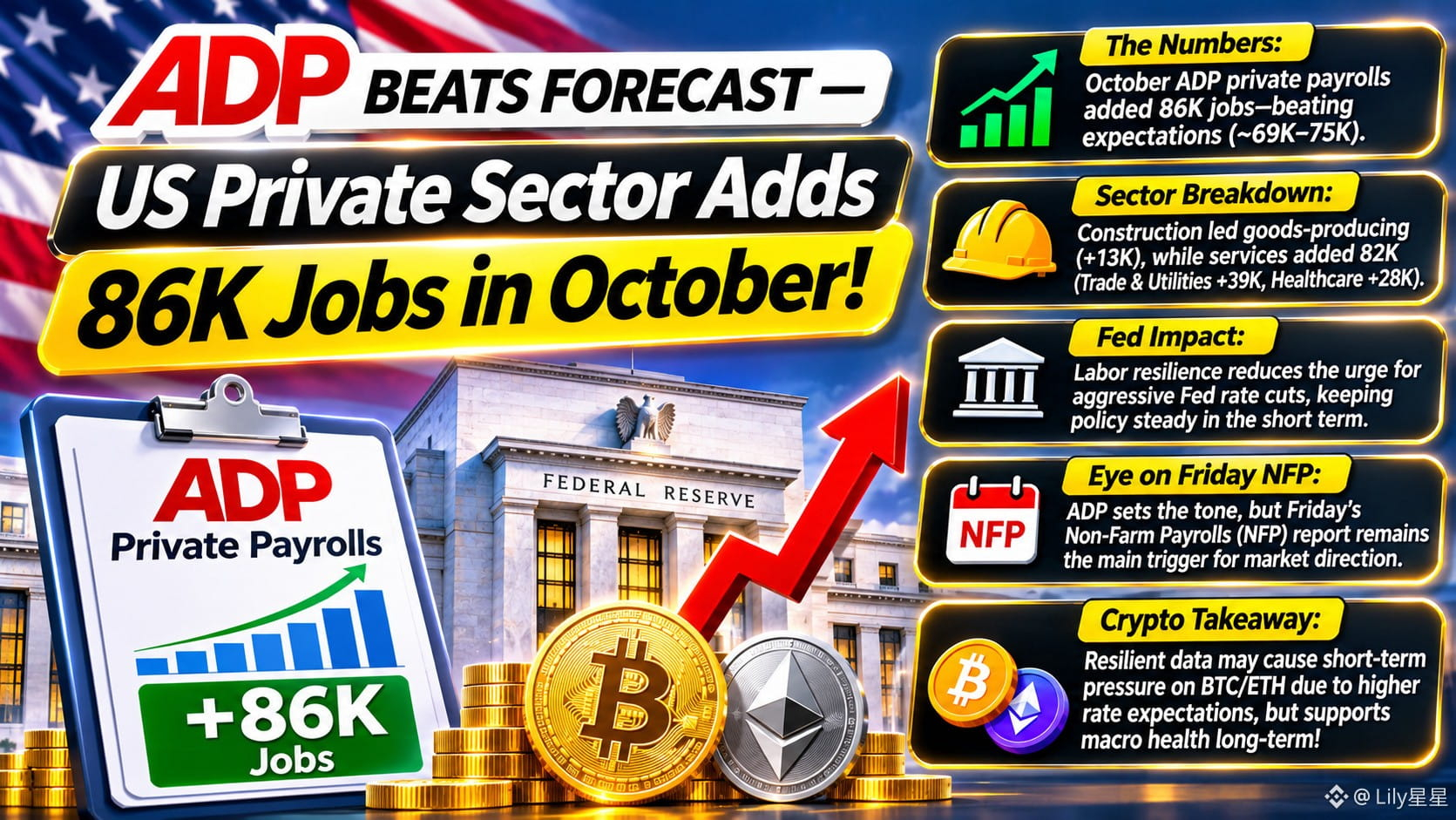
🚨 ADP BEATS FORECAST — US Private Sector Adds 86K Jobs in October! 🇺🇸
⚡ Key Highlights:
• 📊 The Numbers: October ADP private payrolls added 86K jobs—beating consensus expectations (~69K–75K) and matching September's revised 86K.
• 🏗️ Sector Breakdown: Construction led goods-producing (+13K), while services added 82K (led by Trade & Utilities +39K and Healthcare +28K).
• 🏦 Fed Impact: Labor resilience reduces the urge for aggressive Fed rate cuts, keeping policy steady in the short term.
• 🎯 Eye on Friday NFP: ADP sets the tone, but Friday’s Non-Farm Payrolls (NFP) report remains the main trigger for market direction and Fed rate cut odds.
• 📈 Crypto Takeaway: Resilient economic data may cause short-term pressure on BTC/ETH due to higher rate expectations, but supports macro health long-term! 🚀
$ADP.US
{stock_us}(ADP.US)
$BTC
{future}(BTCUSDT)
#ADP #BinanceReopensWithdrawalsForMoreAssets #BTCRebounds80K #NFP
#adpusprivateemployersadd86000jobsinoctober
🚨 ADP BEATS FORECAST — US Private Sector Adds 86K Jobs in October! 🇺🇸
⚡ Key Highlights:
• 📊 The Numbers: October ADP private payrolls added 86K jobs—beating consensus expectations (~69K–75K) and matching September's revised 86K.
• 🏗️ Sector Breakdown: Construction led goods-producing (+13K), while services added 82K (led by Trade & Utilities +39K and Healthcare +28K).
• 🏦 Fed Impact: Labor resilience reduces the urge for aggressive Fed rate cuts, keeping policy steady in the short term.
• 🎯 Eye on Friday NFP: ADP sets the tone, but Friday’s Non-Farm Payrolls (NFP) report remains the main trigger for market direction and Fed rate cut odds.
• 📈 Crypto Takeaway: Resilient economic data may cause short-term pressure on BTC/ETH due to higher rate expectations, but supports macro health long-term! 🚀
$ADP.US
$BTC
#ADP #BinanceReopensWithdrawalsForMoreAssets #BTCRebounds80K #NFP
BTC-6.42%
ADPUS-0.42%
1
424

·
--
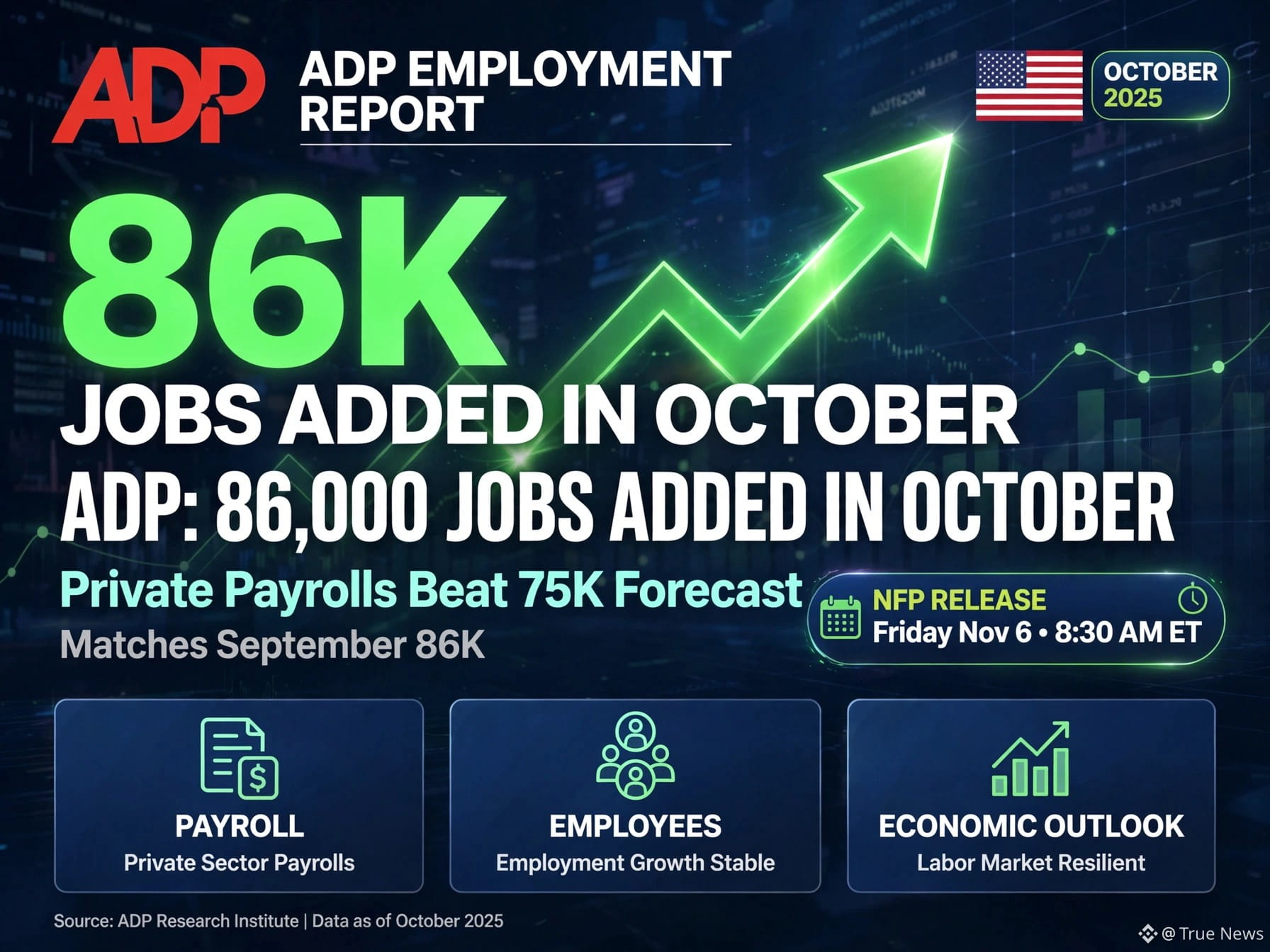
🇺🇸 BREAKING: ADP — US Private Employers Added 86,000 Jobs in October!
Private sector still hiring!
The Numbers (Just In Nov 4, 8:15 AM ET):
$ADP October: 86K Jobs — Exactly matches September's revised 86K (was 90K)Beat Forecast: 75K Expected (Dow Jones) / 69K (Reuters) = +15% BeatBased On: 26M Employees — Anonymized payroll data from ADP + Stanford Digital Economy LabLeader: Construction +13K — Only goods-producing industry to grow
What This Means For Crypto & Rate Cuts:
This is the warm-up for the BIG one — Official NFP Friday Nov 6, 8:30 AM ET.
$ADP says labor market is STABLE, not collapsing.
September was weak at 29K, but October private hiring held. If BLS NFP also beats 65K forecast on Friday, Fed will stay hawkish at 3.75%-4.00% — no December cut.
Hidden Insight: $ADP tracks private only. No government jobs. That's why it can differ from BLS. But 26M real payrolls don't lie — steady growth.
My Take: Labor resilient = Rate cuts delayed = Short-term pressure on BTC/ETH, but strong economy = long-term bullish. Friday NFP is the real trigger.
Are you positioning long or short into Friday NFP?
$ADP.US
{stock_us}(ADP.US)
#USJobs #NFP #PrivatePayrolls #FederalReserve #RateCuts #USAEconomy#adpusprivateemployersadd86000jobsinoctober
🇺🇸 BREAKING: ADP — US Private Employers Added 86,000 Jobs in October!
Private sector still hiring!
The Numbers (Just In Nov 4, 8:15 AM ET):
$ADP October: 86K Jobs — Exactly matches September's revised 86K (was 90K)Beat Forecast: 75K Expected (Dow Jones) / 69K (Reuters) = +15% BeatBased On: 26M Employees — Anonymized payroll data from ADP + Stanford Digital Economy LabLeader: Construction +13K — Only goods-producing industry to grow
What This Means For Crypto & Rate Cuts:
This is the warm-up for the BIG one — Official NFP Friday Nov 6, 8:30 AM ET.
$ADP says labor market is STABLE, not collapsing.
September was weak at 29K, but October private hiring held. If BLS NFP also beats 65K forecast on Friday, Fed will stay hawkish at 3.75%-4.00% — no December cut.
Hidden Insight: $ADP tracks private only. No government jobs. That's why it can differ from BLS. But 26M real payrolls don't lie — steady growth.
My Take: Labor resilient = Rate cuts delayed = Short-term pressure on BTC/ETH, but strong economy = long-term bullish. Friday NFP is the real trigger.
Are you positioning long or short into Friday NFP?
$ADP.US
#USJobs #NFP #PrivatePayrolls #FederalReserve #RateCuts #USAEconomy#adpusprivateemployersadd86000jobsinoctober
ADPUS-0.42%
2
1.3k

·
--
US private employers added 86,000 jobs in October, a significant slowdown from the previous month's revised figure. This data point often serves as a precursor to the official Bureau of Labor Statistics (BLS) jobs report, offering early insights into labor market strength. A weaker-than-expected job growth could influence Federal Reserve policy decisions regarding interest rates, potentially signaling a cooling economy. Investors will be closely watching how this impacts market sentiment and potential moves in assets like Bitcoin ($BTC) and Ethereum ($ETH) as they react to macroeconomic shifts.
This report suggests a potential moderation in hiring activity, which could lead to adjustments in market expectations for future economic performance. The cryptocurrency market, while volatile, often correlates with broader economic trends and investor risk appetite, which can be swayed by employment figures and subsequent monetary policy outlooks.
Disclaimer: This content is for informational purposes only and does not constitute investment advice.
#ADPUSPrivateEmployersAdd86000JobsInOctober
US private employers added 86,000 jobs in October, a significant slowdown from the previous month's revised figure. This data point often serves as a precursor to the official Bureau of Labor Statistics (BLS) jobs report, offering early insights into labor market strength. A weaker-than-expected job growth could influence Federal Reserve policy decisions regarding interest rates, potentially signaling a cooling economy. Investors will be closely watching how this impacts market sentiment and potential moves in assets like Bitcoin ($BTC ) and Ethereum ($ETH ) as they react to macroeconomic shifts.
This report suggests a potential moderation in hiring activity, which could lead to adjustments in market expectations for future economic performance. The cryptocurrency market, while volatile, often correlates with broader economic trends and investor risk appetite, which can be swayed by employment figures and subsequent monetary policy outlooks.
Disclaimer: This content is for informational purposes only and does not constitute investment advice.
#ADPUSPrivateEmployersAdd86000JobsInOctober

83
Log in to explore more content
Join global crypto users on Binance Square
⚡️ Get latest and useful information about crypto.
💬 Trusted by the world’s largest crypto exchange.
👍 Discover real insights from verified creators.
Email / Phone number
Trending Topics
1
#BinanceReopensWithdrawalsForMoreAssets
1M views
5,505 Discussing
2
#AnthropicIPOValuationDoubts
8,349 views
255 Discussing
3
#UkraineCentralBankOpposesCurrentCryptoAssetBill
0 views
0 Discussing
4
#CoreScientificExpectsToExitBitcoinMiningByYearEnd2026
0 views
0 Discussing
5
#USStocksSlipandCryptoMarketUnderBroadPressure
100,591 views
678 Discussing
6
#USStocksSufferSteepestRoutSince2020
17,080 views
133 Discussing
7
#StrategySTRCResumesIssuanceAfterOver170Days
49,921 views
670 Discussing
8
#Nasdaq100Tumbles6%
26,092 views
178 Discussing
9
#GreekParliamentPasses10%CryptoCapitalGainsTaxBill
2,099 views
82 Discussing
10
#KospiSlideTriggersCircuitBreaker
4,577 views
64 Discussing