

#stablecoins
stablecoins
7.5M views
27,884 Discussing
ရေပန်းစားသော
နောက်ဆုံး

·
--
🏦 US banks are using Solana. Not a pilot — live.
Since Oct 1, 90+ banks and credit unions in North Dakota move money with Roughrider Coin, a dollar stablecoin settling on Solana, via Fiserv & the Bank of North Dakota.
Settlement in ~400ms. ⚡
Yet $SOL is still ranging around $120.
Will real-world adoption eventually show up on the chart? 🤔👇
#Solana #SOL #Stablecoins #RWA
🏦 US banks are using Solana. Not a pilot — live.
Since Oct 1, 90+ banks and credit unions in North Dakota move money with Roughrider Coin, a dollar stablecoin settling on Solana, via Fiserv & the Bank of North Dakota.
Settlement in ~400ms. ⚡
Yet $SOL is still ranging around $120.
Will real-world adoption eventually show up on the chart? 🤔👇
#Solana #SOL #Stablecoins #RWA
Since Oct 1, 90+ banks and credit unions in North Dakota move money with Roughrider Coin, a dollar stablecoin settling on Solana, via Fiserv & the Bank of North Dakota.
Settlement in ~400ms. ⚡
Yet $SOL is still ranging around $120.
Will real-world adoption eventually show up on the chart? 🤔👇
#Solana #SOL #Stablecoins #RWA
69

Stripe is doubling down on crypto with plans to roll out stablecoin cards to over 100 countries by year-end. This global push by a major payments incumbent proves digital assets are moving past the hype phase into essential infrastructure. Beyond cards, exploring tokenized deposits and DeFi shows traditional finance is finally embracing blockchain rails. Expect massive onboarding tailwinds for stablecoin adoption as retail barriers drop worldwide. #CryptoNews #Stablecoins #DeFi
Stripe is doubling down on crypto with plans to roll out stablecoin cards to over 100 countries by year-end. This global push by a major payments incumbent proves digital assets are moving past the hype phase into essential infrastructure. Beyond cards, exploring tokenized deposits and DeFi shows traditional finance is finally embracing blockchain rails. Expect massive onboarding tailwinds for stablecoin adoption as retail barriers drop worldwide. #CryptoNews #Stablecoins #DeFi
4

·
--
Stripe acelera la adopción global de las criptomonedas al anunciar la expansión de sus tarjetas de stablecoins a más de 100 países para finales de año. 🌍
Este movimiento reduce las fricciones históricas entre los rieles de pago tradicionales y la liquidez on-chain, facilitando el uso cotidiano de activos digitales a escala masiva.
¿Por qué importa? La interoperabilidad a nivel global impulsa la utilidad real de las stablecoins más allá de los exchanges, integrándolas en el comercio internacional.
Vigila de cerca cómo reacciona el volumen transaccional en redes clave y la respuesta regulatoria local en mercados emergentes. 📊
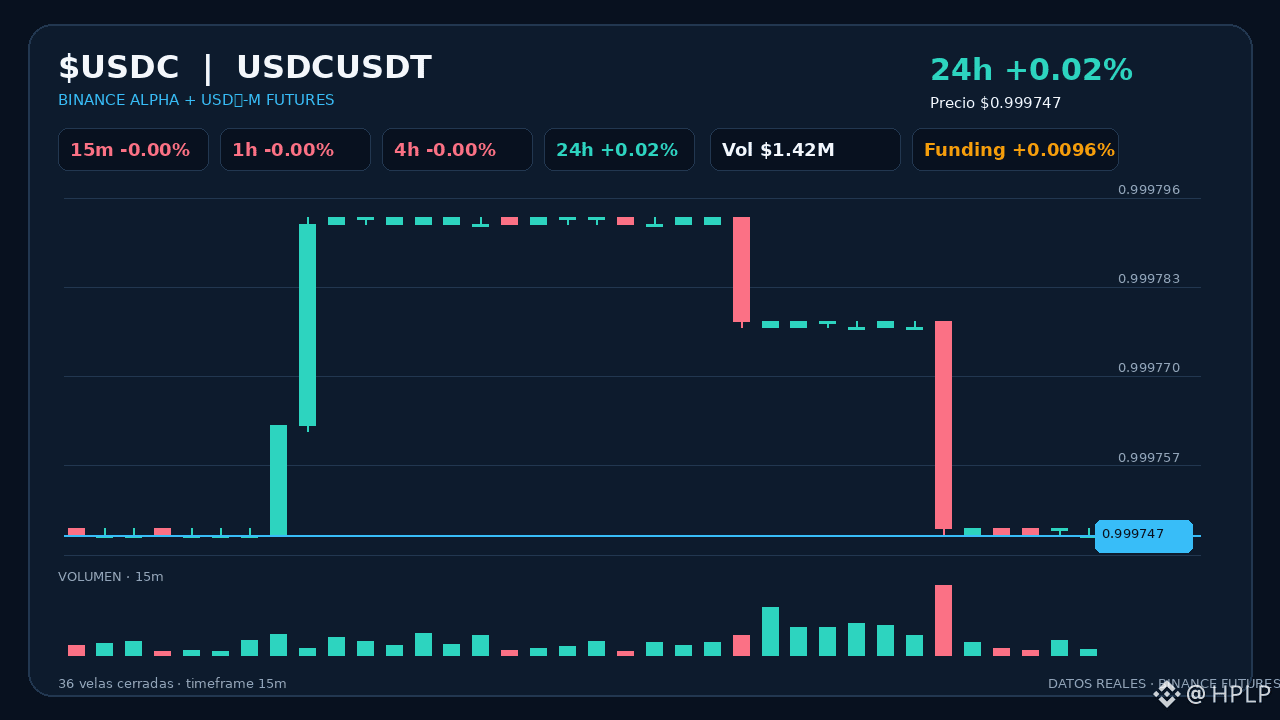
#Stablecoins #CryptoAdoption #PagosDigitales $USDC $USDT
Stripe acelera la adopción global de las criptomonedas al anunciar la expansión de sus tarjetas de stablecoins a más de 100 países para finales de año. 🌍
Este movimiento reduce las fricciones históricas entre los rieles de pago tradicionales y la liquidez on-chain, facilitando el uso cotidiano de activos digitales a escala masiva.
¿Por qué importa? La interoperabilidad a nivel global impulsa la utilidad real de las stablecoins más allá de los exchanges, integrándolas en el comercio internacional.
Vigila de cerca cómo reacciona el volumen transaccional en redes clave y la respuesta regulatoria local en mercados emergentes. 📊
#Stablecoins #CryptoAdoption #PagosDigitales $USDC $USDT
Este movimiento reduce las fricciones históricas entre los rieles de pago tradicionales y la liquidez on-chain, facilitando el uso cotidiano de activos digitales a escala masiva.
¿Por qué importa? La interoperabilidad a nivel global impulsa la utilidad real de las stablecoins más allá de los exchanges, integrándolas en el comercio internacional.
Vigila de cerca cómo reacciona el volumen transaccional en redes clave y la respuesta regulatoria local en mercados emergentes. 📊
#Stablecoins #CryptoAdoption #PagosDigitales $USDC $USDT
1

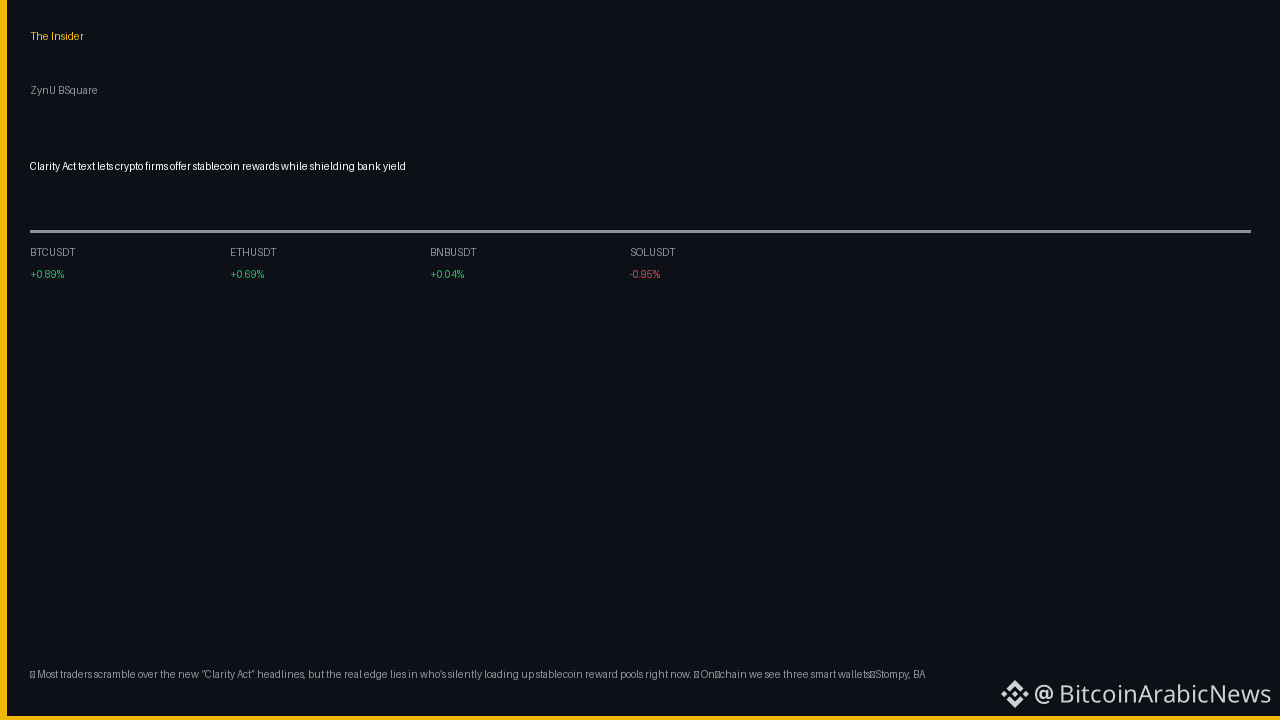
🔥 Most traders scramble over the new “Clarity Act” headlines, but the real edge lies in who’s silently loading up stablecoin reward pools right now.
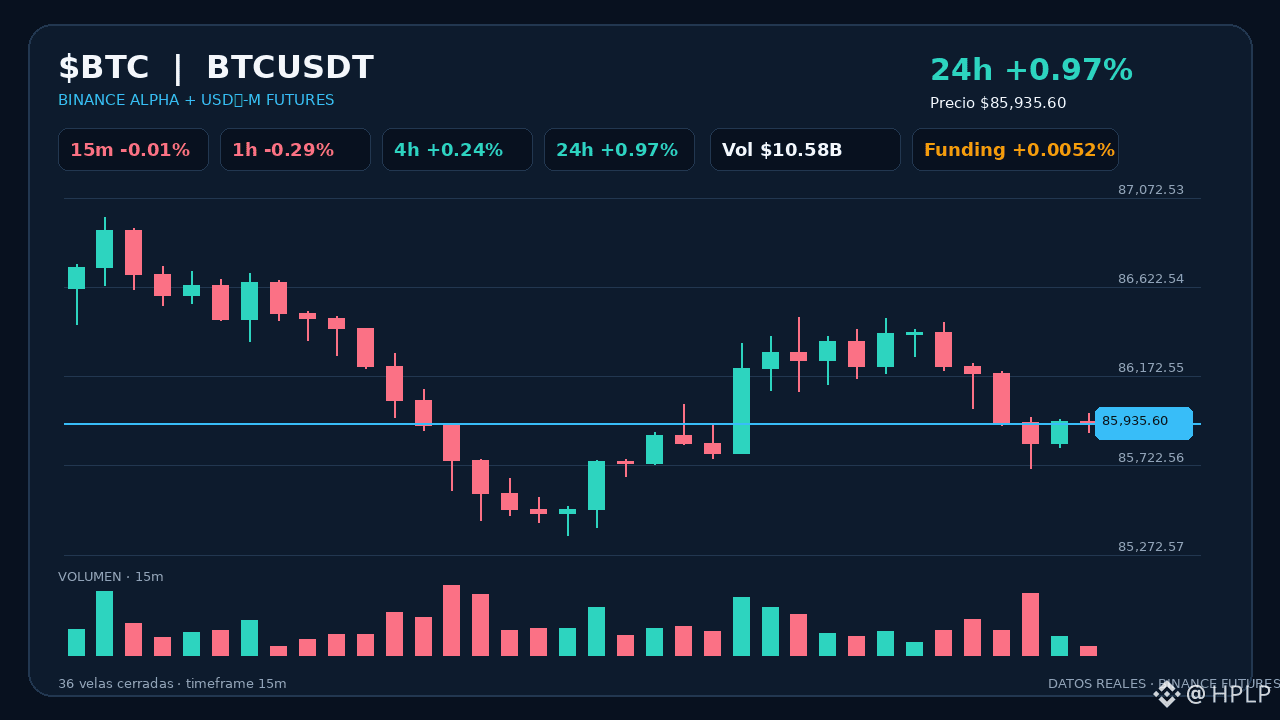
📊 On‑chain we see three smart wallets—Stompy, BACKERS, and SM—each boosting Solana positions by +7.07%, +1.10% and +3.54% respectively, while BSC’s AIN token spikes +6.7% amid a surge of reward‑linked inflows. Meanwhile #BTC sits at $85,984 with a bullish MACD crossover and #ETH at $2,716, both riding a market sentiment of 70/100 Greed and funding rates that keep longs paying (BTC +0.0018%, ETH +0.0050%). #Stablecoins are quietly being funneled into “bona fide” reward contracts, sidestepping the deposit‑like restrictions.
💡 This tells us the regulatory clamp isn’t a roadblock; it’s a catalyst pushing sophisticated capital toward higher‑yield, non‑deposit stablecoin structures, likely priming a short‑term supply squeeze that could lift prices across the board.
👀 Keep an eye on the #stablecoin inflow ratio to DeFi reward contracts this week—especially Solana‑based reward pools and BSC’s AIN activity—as they’ll flag the next wave of smart‑money positioning.
❓ If the law forces the market to innovate rather than retreat, what does that mean for the next breakout cycle?
🔥 Most traders scramble over the new “Clarity Act” headlines, but the real edge lies in who’s silently loading up stablecoin reward pools right now.
📊 On‑chain we see three smart wallets—Stompy, BACKERS, and SM—each boosting Solana positions by +7.07%, +1.10% and +3.54% respectively, while BSC’s AIN token spikes +6.7% amid a surge of reward‑linked inflows. Meanwhile #BTC sits at $85,984 with a bullish MACD crossover and #ETH at $2,716, both riding a market sentiment of 70/100 Greed and funding rates that keep longs paying (BTC +0.0018%, ETH +0.0050%). #Stablecoins are quietly being funneled into “bona fide” reward contracts, sidestepping the deposit‑like restrictions.
💡 This tells us the regulatory clamp isn’t a roadblock; it’s a catalyst pushing sophisticated capital toward higher‑yield, non‑deposit stablecoin structures, likely priming a short‑term supply squeeze that could lift prices across the board.
👀 Keep an eye on the #stablecoin inflow ratio to DeFi reward contracts this week—especially Solana‑based reward pools and BSC’s AIN activity—as they’ll flag the next wave of smart‑money positioning.
❓ If the law forces the market to innovate rather than retreat, what does that mean for the next breakout cycle?
📊 On‑chain we see three smart wallets—Stompy, BACKERS, and SM—each boosting Solana positions by +7.07%, +1.10% and +3.54% respectively, while BSC’s AIN token spikes +6.7% amid a surge of reward‑linked inflows. Meanwhile #BTC sits at $85,984 with a bullish MACD crossover and #ETH at $2,716, both riding a market sentiment of 70/100 Greed and funding rates that keep longs paying (BTC +0.0018%, ETH +0.0050%). #Stablecoins are quietly being funneled into “bona fide” reward contracts, sidestepping the deposit‑like restrictions.
💡 This tells us the regulatory clamp isn’t a roadblock; it’s a catalyst pushing sophisticated capital toward higher‑yield, non‑deposit stablecoin structures, likely priming a short‑term supply squeeze that could lift prices across the board.
👀 Keep an eye on the #stablecoin inflow ratio to DeFi reward contracts this week—especially Solana‑based reward pools and BSC’s AIN activity—as they’ll flag the next wave of smart‑money positioning.
❓ If the law forces the market to innovate rather than retreat, what does that mean for the next breakout cycle?
16

·
--
Stablecoin Payment Rails: The Quiet Disruption Already Underway
While traders debate which L1 wins the next cycle, stablecoins have been building the most consequential crypto use case without fanfare: programmable money movement at global scale.
Consider what’s happening right now. Cross-border remittances that once cost 6-8% and took 3-5 business days now settle on-chain in seconds for fractions of a cent. Freelancers in emerging markets are getting paid in stablecoins and bypassing broken banking rails entirely. Businesses are settling B2B invoices via smart contracts with automatic reconciliation, no correspondent bank required.
What makes this structurally durable:
• Stablecoins inherit blockchain finality — settlement is irrevocable, not subject to chargebacks or bank holds
• Programmable rails allow conditional payments, escrow, and yield during transit
• $BNB and $SOL chains have positioned as high-throughput low-cost settlement layers for payment use cases
• $ETH L2s are onboarding traditional fintech apps at scale
The macro signal: stablecoin monthly transfer volume now rivals Visa. This isn’t speculation — it’s adoption velocity.
Payment rails are crypto’s killer app. The winners won’t be the loudest tokens — they’ll be the fastest, cheapest, most trusted settlement layers.
#Stablecoins #CryptoPayments #DeFi #BlockchainAdoption #BinanceSquare
Stablecoin Payment Rails: The Quiet Disruption Already Underway
While traders debate which L1 wins the next cycle, stablecoins have been building the most consequential crypto use case without fanfare: programmable money movement at global scale.
Consider what’s happening right now. Cross-border remittances that once cost 6-8% and took 3-5 business days now settle on-chain in seconds for fractions of a cent. Freelancers in emerging markets are getting paid in stablecoins and bypassing broken banking rails entirely. Businesses are settling B2B invoices via smart contracts with automatic reconciliation, no correspondent bank required.
What makes this structurally durable:
• Stablecoins inherit blockchain finality — settlement is irrevocable, not subject to chargebacks or bank holds
• Programmable rails allow conditional payments, escrow, and yield during transit
• $BNB and $SOL chains have positioned as high-throughput low-cost settlement layers for payment use cases
• $ETH L2s are onboarding traditional fintech apps at scale
The macro signal: stablecoin monthly transfer volume now rivals Visa. This isn’t speculation — it’s adoption velocity.
Payment rails are crypto’s killer app. The winners won’t be the loudest tokens — they’ll be the fastest, cheapest, most trusted settlement layers.
#Stablecoins #CryptoPayments #DeFi #BlockchainAdoption #BinanceSquare
While traders debate which L1 wins the next cycle, stablecoins have been building the most consequential crypto use case without fanfare: programmable money movement at global scale.
Consider what’s happening right now. Cross-border remittances that once cost 6-8% and took 3-5 business days now settle on-chain in seconds for fractions of a cent. Freelancers in emerging markets are getting paid in stablecoins and bypassing broken banking rails entirely. Businesses are settling B2B invoices via smart contracts with automatic reconciliation, no correspondent bank required.
What makes this structurally durable:
• Stablecoins inherit blockchain finality — settlement is irrevocable, not subject to chargebacks or bank holds
• Programmable rails allow conditional payments, escrow, and yield during transit
• $BNB and $SOL chains have positioned as high-throughput low-cost settlement layers for payment use cases
• $ETH L2s are onboarding traditional fintech apps at scale
The macro signal: stablecoin monthly transfer volume now rivals Visa. This isn’t speculation — it’s adoption velocity.
Payment rails are crypto’s killer app. The winners won’t be the loudest tokens — they’ll be the fastest, cheapest, most trusted settlement layers.
#Stablecoins #CryptoPayments #DeFi #BlockchainAdoption #BinanceSquare
31
·
--
🇪🇺 Europe vs $USDT — round 2?
ESMA has asked the European Commission to ban ALL licensed crypto services involving non-MiCA-compliant stablecoins — including custody and transfers.
Research already shows USDT volume shifting toward $USDC on EU-regulated venues since MiCA kicked in.
If this passes, does USDC become Europe's default stablecoin? 🤔
Which stablecoin do you use most? 👇
#MiCA #Stablecoins #USDT #USDC
🇪🇺 Europe vs $USDT — round 2?
ESMA has asked the European Commission to ban ALL licensed crypto services involving non-MiCA-compliant stablecoins — including custody and transfers.
Research already shows USDT volume shifting toward $USDC on EU-regulated venues since MiCA kicked in.
If this passes, does USDC become Europe's default stablecoin? 🤔
Which stablecoin do you use most? 👇
#MiCA #Stablecoins #USDT #USDC
ESMA has asked the European Commission to ban ALL licensed crypto services involving non-MiCA-compliant stablecoins — including custody and transfers.
Research already shows USDT volume shifting toward $USDC on EU-regulated venues since MiCA kicked in.
If this passes, does USDC become Europe's default stablecoin? 🤔
Which stablecoin do you use most? 👇
#MiCA #Stablecoins #USDT #USDC
3
·
--
El sector de las stablecoins enfrenta un punto de inflexión regulatorio en Europa. Circle y Tether han encontrado una postura común frente a los estrictas exigencias de reservas bancarias impuestas por la normativa MiCA. 🌐
¿Por qué importa? MiCA exige condiciones complejas, como el reconocimiento de emisores por la Autoridad Bancaria Europea (EBA) y la distribución exclusiva a través de instituciones con licencia local, lo que amenaza con remodelar la liquidez y accesibilidad de los criptoactivos en la región. 🇪🇺
¿Qué vigilar? La respuesta definitiva de los reguladores europeos y cómo los principales emisores adaptan su arquitectura operativa para cumplir sin fragmentar el mercado. Síguenos para no perderte las claves regulatorias de la semana. 📊
#MiCA #Stablecoins #RegulaciónCrypto #CryptoNews $BTC $USDT $USDC
El sector de las stablecoins enfrenta un punto de inflexión regulatorio en Europa. Circle y Tether han encontrado una postura común frente a los estrictas exigencias de reservas bancarias impuestas por la normativa MiCA. 🌐
¿Por qué importa? MiCA exige condiciones complejas, como el reconocimiento de emisores por la Autoridad Bancaria Europea (EBA) y la distribución exclusiva a través de instituciones con licencia local, lo que amenaza con remodelar la liquidez y accesibilidad de los criptoactivos en la región. 🇪🇺
¿Qué vigilar? La respuesta definitiva de los reguladores europeos y cómo los principales emisores adaptan su arquitectura operativa para cumplir sin fragmentar el mercado. Síguenos para no perderte las claves regulatorias de la semana. 📊
#MiCA #Stablecoins #RegulaciónCrypto #CryptoNews $BTC $USDT $USDC
¿Por qué importa? MiCA exige condiciones complejas, como el reconocimiento de emisores por la Autoridad Bancaria Europea (EBA) y la distribución exclusiva a través de instituciones con licencia local, lo que amenaza con remodelar la liquidez y accesibilidad de los criptoactivos en la región. 🇪🇺
¿Qué vigilar? La respuesta definitiva de los reguladores europeos y cómo los principales emisores adaptan su arquitectura operativa para cumplir sin fragmentar el mercado. Síguenos para no perderte las claves regulatorias de la semana. 📊
#MiCA #Stablecoins #RegulaciónCrypto #CryptoNews $BTC $USDT $USDC
15

Solana handles 22.5% of global stablecoin transactions. Yet its network revenue fell 87% in the first half of 2026.
According to 21Shares, Solana processed $1.9 trillion in stablecoin transactions in H1 2026, while holding only about 5% of global stablecoin supply. Over the same period, network revenue dropped to roughly $141M.
How can both be true? A stablecoin transaction pays far less in fees than a memecoin trade does. The usage matured, but the revenue shrank.
And in August, memecoins climbed back to about 34% of Solana's DEX volume.
My read: "Is activity growing?" isn't a good enough question for Solana. The real question is which activity, and how much revenue it brings.
What I'm watching: whether fees recover in the next quarterly reports, and if they do, whether the recovery comes from stablecoins or from memecoins again.
Limits: I haven't verified the base period for the 87% decline, and DEX share figures differ by tracker, so I left that number out.
Where do you think Solana's future revenue comes from: massive stablecoin volume, or memecoins again?
⚠️ Not financial advice.
#Solana #Stablecoins #DeFi #OnChainData
$SOL $PNUT $TRUMP
Solana handles 22.5% of global stablecoin transactions. Yet its network revenue fell 87% in the first half of 2026.
According to 21Shares, Solana processed $1.9 trillion in stablecoin transactions in H1 2026, while holding only about 5% of global stablecoin supply. Over the same period, network revenue dropped to roughly $141M.
How can both be true? A stablecoin transaction pays far less in fees than a memecoin trade does. The usage matured, but the revenue shrank.
And in August, memecoins climbed back to about 34% of Solana's DEX volume.
My read: "Is activity growing?" isn't a good enough question for Solana. The real question is which activity, and how much revenue it brings.
What I'm watching: whether fees recover in the next quarterly reports, and if they do, whether the recovery comes from stablecoins or from memecoins again.
Limits: I haven't verified the base period for the 87% decline, and DEX share figures differ by tracker, so I left that number out.
Where do you think Solana's future revenue comes from: massive stablecoin volume, or memecoins again?
⚠️ Not financial advice.
#Solana #Stablecoins #DeFi #OnChainData
$SOL $PNUT $TRUMP
According to 21Shares, Solana processed $1.9 trillion in stablecoin transactions in H1 2026, while holding only about 5% of global stablecoin supply. Over the same period, network revenue dropped to roughly $141M.
How can both be true? A stablecoin transaction pays far less in fees than a memecoin trade does. The usage matured, but the revenue shrank.
And in August, memecoins climbed back to about 34% of Solana's DEX volume.
My read: "Is activity growing?" isn't a good enough question for Solana. The real question is which activity, and how much revenue it brings.
What I'm watching: whether fees recover in the next quarterly reports, and if they do, whether the recovery comes from stablecoins or from memecoins again.
Limits: I haven't verified the base period for the 87% decline, and DEX share figures differ by tracker, so I left that number out.
Where do you think Solana's future revenue comes from: massive stablecoin volume, or memecoins again?
⚠️ Not financial advice.
#Solana #Stablecoins #DeFi #OnChainData
$SOL $PNUT $TRUMP
1
43

·
--
တက်ရိပ်ရှိသည်
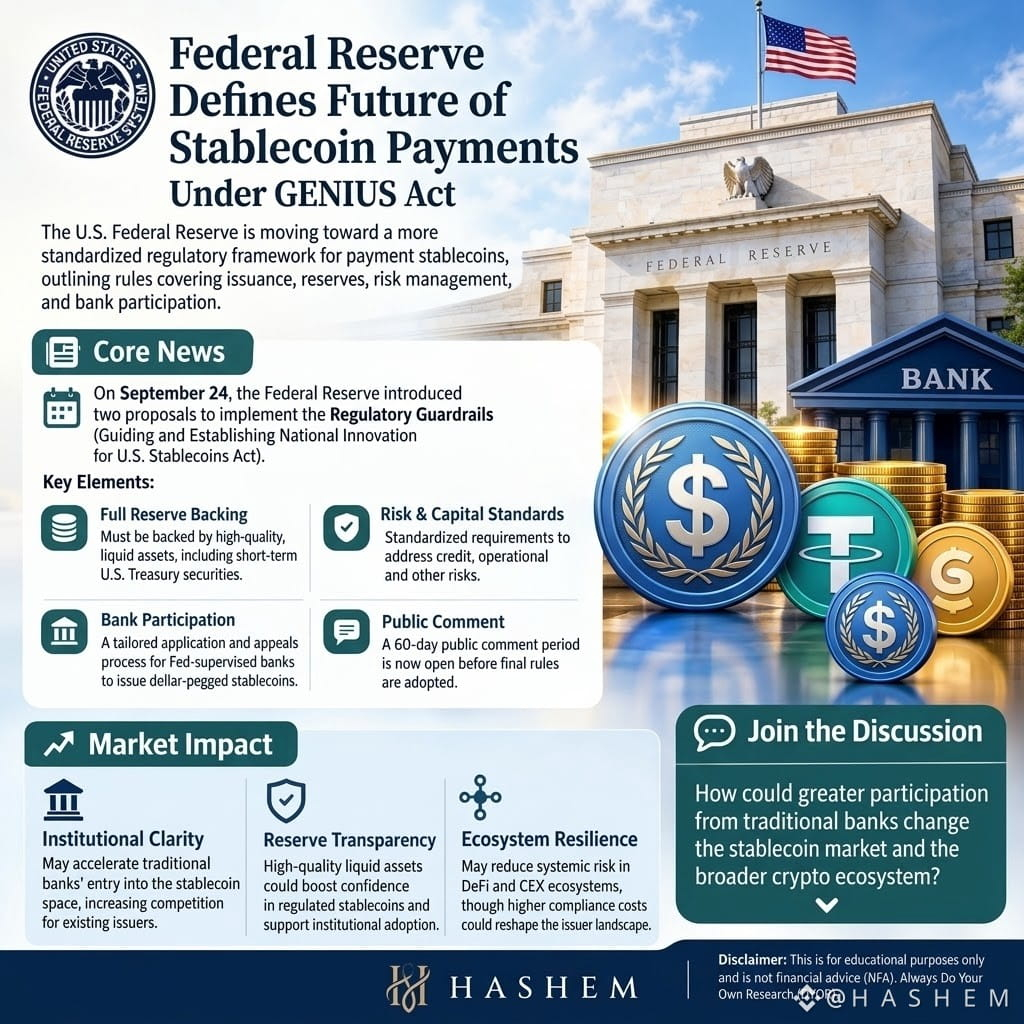
#BBBULLISH 🏛️ FED’S STABLECOIN MOVE COULD CHANGE THE GAME
The U.S. stablecoin landscape may be entering a new era of regulatory clarity, institutional adoption, and stronger reserve standards. 🇺🇸
📰 WHAT’S HAPPENING?
On September 24, the Federal Reserve released proposed rules aimed at implementing the GENIUS Act for payment stablecoins.
🔹 1:1 Reserve Backing
Stablecoin issuers would need to maintain full backing with high-quality liquid assets, including short-term U.S. Treasury securities.
🔹 Stronger Capital & Risk Controls
Standardized capital requirements and risk-management frameworks could make regulated stablecoins more resilient.
🔹 Banks Entering the Stablecoin Market
Fed-supervised banks would have a defined pathway to issue dollar-pegged stablecoins—potentially opening the door to much larger institutional participation.
🔹 Public Comment Period
The proposal is now entering a 60-day public comment phase before final rules are finalized.
📊 WHY DOES THIS MATTER FOR CRYPTO?
This could be bigger than just regulation.
🏦 More banks → more competition
💵 More regulated stablecoins → deeper liquidity
🔐 Stronger reserves → greater institutional confidence
🌐 More adoption → potential growth across DeFi & CEX ecosystems
But there’s another side:
⚠️ Higher compliance costs could put pressure on smaller issuers and reshape the stablecoin market.
🔥 THE BIG QUESTION
If traditional banks start issuing their own stablecoins, will today’s market leaders become stronger—or will the competition completely reshape the stablecoin ecosystem?
What’s your take? 👇
🚀 $GRT | $SEI | $PUMPBTC
#Stablecoins #CryptoRegulation #FederalReserve #DeFi #CryptoNews #GRT #SEI #PUMP #BinanceSquare
Educational content only. Not Financial Advice (NFA). DYOR.
#BBBULLISH 🏛️ FED’S STABLECOIN MOVE COULD CHANGE THE GAME
The U.S. stablecoin landscape may be entering a new era of regulatory clarity, institutional adoption, and stronger reserve standards. 🇺🇸
📰 WHAT’S HAPPENING?
On September 24, the Federal Reserve released proposed rules aimed at implementing the GENIUS Act for payment stablecoins.
🔹 1:1 Reserve Backing
Stablecoin issuers would need to maintain full backing with high-quality liquid assets, including short-term U.S. Treasury securities.
🔹 Stronger Capital & Risk Controls
Standardized capital requirements and risk-management frameworks could make regulated stablecoins more resilient.
🔹 Banks Entering the Stablecoin Market
Fed-supervised banks would have a defined pathway to issue dollar-pegged stablecoins—potentially opening the door to much larger institutional participation.
🔹 Public Comment Period
The proposal is now entering a 60-day public comment phase before final rules are finalized.
📊 WHY DOES THIS MATTER FOR CRYPTO?
This could be bigger than just regulation.
🏦 More banks → more competition
💵 More regulated stablecoins → deeper liquidity
🔐 Stronger reserves → greater institutional confidence
🌐 More adoption → potential growth across DeFi & CEX ecosystems
But there’s another side:
⚠️ Higher compliance costs could put pressure on smaller issuers and reshape the stablecoin market.
🔥 THE BIG QUESTION
If traditional banks start issuing their own stablecoins, will today’s market leaders become stronger—or will the competition completely reshape the stablecoin ecosystem?
What’s your take? 👇
🚀 $GRT | $SEI | $PUMPBTC
#Stablecoins #CryptoRegulation #FederalReserve #DeFi #CryptoNews #GRT #SEI #PUMP #BinanceSquare
Educational content only. Not Financial Advice (NFA). DYOR.
The U.S. stablecoin landscape may be entering a new era of regulatory clarity, institutional adoption, and stronger reserve standards. 🇺🇸
📰 WHAT’S HAPPENING?
On September 24, the Federal Reserve released proposed rules aimed at implementing the GENIUS Act for payment stablecoins.
🔹 1:1 Reserve Backing
Stablecoin issuers would need to maintain full backing with high-quality liquid assets, including short-term U.S. Treasury securities.
🔹 Stronger Capital & Risk Controls
Standardized capital requirements and risk-management frameworks could make regulated stablecoins more resilient.
🔹 Banks Entering the Stablecoin Market
Fed-supervised banks would have a defined pathway to issue dollar-pegged stablecoins—potentially opening the door to much larger institutional participation.
🔹 Public Comment Period
The proposal is now entering a 60-day public comment phase before final rules are finalized.
📊 WHY DOES THIS MATTER FOR CRYPTO?
This could be bigger than just regulation.
🏦 More banks → more competition
💵 More regulated stablecoins → deeper liquidity
🔐 Stronger reserves → greater institutional confidence
🌐 More adoption → potential growth across DeFi & CEX ecosystems
But there’s another side:
⚠️ Higher compliance costs could put pressure on smaller issuers and reshape the stablecoin market.
🔥 THE BIG QUESTION
If traditional banks start issuing their own stablecoins, will today’s market leaders become stronger—or will the competition completely reshape the stablecoin ecosystem?
What’s your take? 👇
🚀 $GRT | $SEI | $PUMPBTC
#Stablecoins #CryptoRegulation #FederalReserve #DeFi #CryptoNews #GRT #SEI #PUMP #BinanceSquare
Educational content only. Not Financial Advice (NFA). DYOR.
1
787
·
--
Stablecoin Dominance: The Market Fear Gauge Nobody Watches Closely Enough
Most traders obsess over price charts. Fewer track the signal hiding in plain sight: the aggregate stablecoin market cap as a percentage of total crypto market cap.
When stablecoin dominance rises sharply, it means capital is actively fleeing risk — rotating from $BTC, $ETH, and altcoins into USDT, USDC, and DAI. That’s not just fear. It’s dry powder. Parked capital waiting for a re-entry signal.
Historically, peaks in stablecoin dominance have closely preceded mid-to-late cycle recoveries. The logic is simple: money doesn’t leave crypto entirely, it parks on the sideline. When confidence returns, that stablecoin supply doesn’t evaporate — it rotates.
For $ADA holders, this matters even more. Smaller-cap assets absorb volatility harder during risk-off episodes. But they also re-rate faster when stablecoin dominance rolls over and capital flows back toward higher-beta positions.
What to watch:
— Stablecoin dominance trending down = risk appetite returning
— Exchange stablecoin reserves climbing = accumulation mode
— Stablecoin dominance spike + falling prices = capitulation, not just correction
Don’t just read price. Read where the money is hiding. That tells you more about the next move than any candlestick pattern.
#CryptoMarkets #Stablecoins #RiskManagement #OnChainAnalysis #CryptoStrategy
Stablecoin Dominance: The Market Fear Gauge Nobody Watches Closely Enough
Most traders obsess over price charts. Fewer track the signal hiding in plain sight: the aggregate stablecoin market cap as a percentage of total crypto market cap.
When stablecoin dominance rises sharply, it means capital is actively fleeing risk — rotating from $BTC , $ETH , and altcoins into USDT, USDC, and DAI. That’s not just fear. It’s dry powder. Parked capital waiting for a re-entry signal.
Historically, peaks in stablecoin dominance have closely preceded mid-to-late cycle recoveries. The logic is simple: money doesn’t leave crypto entirely, it parks on the sideline. When confidence returns, that stablecoin supply doesn’t evaporate — it rotates.
For $ADA holders, this matters even more. Smaller-cap assets absorb volatility harder during risk-off episodes. But they also re-rate faster when stablecoin dominance rolls over and capital flows back toward higher-beta positions.
What to watch:
— Stablecoin dominance trending down = risk appetite returning
— Exchange stablecoin reserves climbing = accumulation mode
— Stablecoin dominance spike + falling prices = capitulation, not just correction
Don’t just read price. Read where the money is hiding. That tells you more about the next move than any candlestick pattern.
#CryptoMarkets #Stablecoins #RiskManagement #OnChainAnalysis #CryptoStrategy
Most traders obsess over price charts. Fewer track the signal hiding in plain sight: the aggregate stablecoin market cap as a percentage of total crypto market cap.
When stablecoin dominance rises sharply, it means capital is actively fleeing risk — rotating from $BTC , $ETH , and altcoins into USDT, USDC, and DAI. That’s not just fear. It’s dry powder. Parked capital waiting for a re-entry signal.
Historically, peaks in stablecoin dominance have closely preceded mid-to-late cycle recoveries. The logic is simple: money doesn’t leave crypto entirely, it parks on the sideline. When confidence returns, that stablecoin supply doesn’t evaporate — it rotates.
For $ADA holders, this matters even more. Smaller-cap assets absorb volatility harder during risk-off episodes. But they also re-rate faster when stablecoin dominance rolls over and capital flows back toward higher-beta positions.
What to watch:
— Stablecoin dominance trending down = risk appetite returning
— Exchange stablecoin reserves climbing = accumulation mode
— Stablecoin dominance spike + falling prices = capitulation, not just correction
Don’t just read price. Read where the money is hiding. That tells you more about the next move than any candlestick pattern.
#CryptoMarkets #Stablecoins #RiskManagement #OnChainAnalysis #CryptoStrategy
26

🚨 CARDANO JUST PUT REAL-WORLD ASSETS ON-CHAIN. 👀
RealFi is officially LIVE on Cardano mainnet — bringing a new RWA-backed stablecoin model to the ecosystem. 🔥
💵 USDrf — liquid USD-denominated stablecoin
🏦 Backed by real-world financial assets
🇺🇸 U.S. Treasury bills & money-market instruments
💳 Exposure to private credit and real economic activity
⚡ Built directly on Cardano
The bigger idea?
Instead of stablecoins simply sitting idle, RealFi is trying to connect on-chain dollars with real-world financial markets.
But there’s an important catch: returns are variable and not guaranteed, and capital carries risk. ⚠️
This could be another major step for the RWA + stablecoin narrative.
Could Cardano become a serious home for tokenized real-world assets? 👀
#Cardano #ADA #RWA #Stablecoins #BinanceSquare
🚨 CARDANO JUST PUT REAL-WORLD ASSETS ON-CHAIN. 👀
RealFi is officially LIVE on Cardano mainnet — bringing a new RWA-backed stablecoin model to the ecosystem. 🔥
💵 USDrf — liquid USD-denominated stablecoin
🏦 Backed by real-world financial assets
🇺🇸 U.S. Treasury bills & money-market instruments
💳 Exposure to private credit and real economic activity
⚡ Built directly on Cardano
The bigger idea?
Instead of stablecoins simply sitting idle, RealFi is trying to connect on-chain dollars with real-world financial markets.
But there’s an important catch: returns are variable and not guaranteed, and capital carries risk. ⚠️
This could be another major step for the RWA + stablecoin narrative.
Could Cardano become a serious home for tokenized real-world assets? 👀
#Cardano #ADA #RWA #Stablecoins #BinanceSquare
RealFi is officially LIVE on Cardano mainnet — bringing a new RWA-backed stablecoin model to the ecosystem. 🔥
💵 USDrf — liquid USD-denominated stablecoin
🏦 Backed by real-world financial assets
🇺🇸 U.S. Treasury bills & money-market instruments
💳 Exposure to private credit and real economic activity
⚡ Built directly on Cardano
The bigger idea?
Instead of stablecoins simply sitting idle, RealFi is trying to connect on-chain dollars with real-world financial markets.
But there’s an important catch: returns are variable and not guaranteed, and capital carries risk. ⚠️
This could be another major step for the RWA + stablecoin narrative.
Could Cardano become a serious home for tokenized real-world assets? 👀
#Cardano #ADA #RWA #Stablecoins #BinanceSquare

91

·
--
Here is what happened when Paolo Ardoino dropped his cryptic "It's coming home" statement across market feeds.
Most traders treat stablecoins like guaranteed cash equivalents until regulatory pressure or structural reserve shifts suddenly freeze liquidity. When core market rails change course without warning, retail portfolios are usually the last to hedge the downside.
The phrase actually echoes a deeper structural transition for Tether, moving away from offshore reliance toward tighter jurisdictional alignments and aggressive $BTC accumulation. Holding over 80,000 bitcoins alongside more than 100 billion in circulating $USDT supply makes every single balance sheet maneuver a systemic variable. If reserve allocations pivot faster than the broader ecosystem can adapt, counterparty risk quietly spikes across lending desks and spot markets alike.
Tether generating billions in quarterly net profit while consolidating reserve custody creates an unprecedented concentration of power over on-chain settlement. While institutional capital views this shift as maturity, any sudden regulatory friction against these centralized reserves could trigger sharp liquidity dislocations overnight.
Where do you think this leaves the broader market if stablecoin dominance faces a sudden regulatory bottleneck?
#CryptoMarket #Stablecoins #Tether
Here is what happened when Paolo Ardoino dropped his cryptic "It's coming home" statement across market feeds.
Most traders treat stablecoins like guaranteed cash equivalents until regulatory pressure or structural reserve shifts suddenly freeze liquidity. When core market rails change course without warning, retail portfolios are usually the last to hedge the downside.
The phrase actually echoes a deeper structural transition for Tether, moving away from offshore reliance toward tighter jurisdictional alignments and aggressive $BTC accumulation. Holding over 80,000 bitcoins alongside more than 100 billion in circulating $USDT supply makes every single balance sheet maneuver a systemic variable. If reserve allocations pivot faster than the broader ecosystem can adapt, counterparty risk quietly spikes across lending desks and spot markets alike.
Tether generating billions in quarterly net profit while consolidating reserve custody creates an unprecedented concentration of power over on-chain settlement. While institutional capital views this shift as maturity, any sudden regulatory friction against these centralized reserves could trigger sharp liquidity dislocations overnight.
Where do you think this leaves the broader market if stablecoin dominance faces a sudden regulatory bottleneck?
#CryptoMarket #Stablecoins #Tether
Most traders treat stablecoins like guaranteed cash equivalents until regulatory pressure or structural reserve shifts suddenly freeze liquidity. When core market rails change course without warning, retail portfolios are usually the last to hedge the downside.
The phrase actually echoes a deeper structural transition for Tether, moving away from offshore reliance toward tighter jurisdictional alignments and aggressive $BTC accumulation. Holding over 80,000 bitcoins alongside more than 100 billion in circulating $USDT supply makes every single balance sheet maneuver a systemic variable. If reserve allocations pivot faster than the broader ecosystem can adapt, counterparty risk quietly spikes across lending desks and spot markets alike.
Tether generating billions in quarterly net profit while consolidating reserve custody creates an unprecedented concentration of power over on-chain settlement. While institutional capital views this shift as maturity, any sudden regulatory friction against these centralized reserves could trigger sharp liquidity dislocations overnight.
Where do you think this leaves the broader market if stablecoin dominance faces a sudden regulatory bottleneck?
#CryptoMarket #Stablecoins #Tether
10
·
--
Have you noticed that nobody is talking about $USDT coming back to Bitcoin?
Most traders still get wrecked on fees and missed entries because their stables sit on the wrong chain at the wrong time. You pay to move, you wait to confirm, and you watch the market leave without you.
USDT did not start on $ETH. In 2014 it launched on $BTC via the Omni Layer. High fees and slow blocks from 2017 to 2019 forced the migration, and after 2019 Tron became the cheap highway for transfers.
Tether killed Omni support in 2023 and USDT on Bitcoin was effectively over. Paolo Ardoino now says it is coming home. In October 2026, Utexo starts issuing USDT on Bitcoin under a Tether licence, built on RGB.
This is not nostalgia. It is a case study in how money returns to the most trusted settlement layer the moment the rails actually work. The mainstream story that Bitcoin is too slow for stables was always a fee problem, not a permanent one.
Where do you think this goes from here?
#USDT #Bitcoin #Stablecoins
Have you noticed that nobody is talking about $USDT coming back to Bitcoin?
Most traders still get wrecked on fees and missed entries because their stables sit on the wrong chain at the wrong time. You pay to move, you wait to confirm, and you watch the market leave without you.
USDT did not start on $ETH . In 2014 it launched on $BTC via the Omni Layer. High fees and slow blocks from 2017 to 2019 forced the migration, and after 2019 Tron became the cheap highway for transfers.
Tether killed Omni support in 2023 and USDT on Bitcoin was effectively over. Paolo Ardoino now says it is coming home. In October 2026, Utexo starts issuing USDT on Bitcoin under a Tether licence, built on RGB.
This is not nostalgia. It is a case study in how money returns to the most trusted settlement layer the moment the rails actually work. The mainstream story that Bitcoin is too slow for stables was always a fee problem, not a permanent one.
Where do you think this goes from here?
#USDT #Bitcoin #Stablecoins
Most traders still get wrecked on fees and missed entries because their stables sit on the wrong chain at the wrong time. You pay to move, you wait to confirm, and you watch the market leave without you.
USDT did not start on $ETH . In 2014 it launched on $BTC via the Omni Layer. High fees and slow blocks from 2017 to 2019 forced the migration, and after 2019 Tron became the cheap highway for transfers.
Tether killed Omni support in 2023 and USDT on Bitcoin was effectively over. Paolo Ardoino now says it is coming home. In October 2026, Utexo starts issuing USDT on Bitcoin under a Tether licence, built on RGB.
This is not nostalgia. It is a case study in how money returns to the most trusted settlement layer the moment the rails actually work. The mainstream story that Bitcoin is too slow for stables was always a fee problem, not a permanent one.
Where do you think this goes from here?
#USDT #Bitcoin #Stablecoins

14

Everyone thinks $USDT moving back to Bitcoin is just a nostalgic victory lap, but actually, ignoring the history behind this shift could trap your funds in another high-fee bottleneck.
Most traders lose real money during cycle peaks simply because their chosen transfer rail clogs up overnight. When network traffic spikes, watching a standard stablecoin transfer stall for hours while paying massive transaction fees is a painful lesson nobody wants to repeat.
Think of it like city traffic management over the past decade. 1. Back in 2014, Tether originally launched on the $BTC network via the Omni Layer, but slow block times and surging congestion eventually forced activity toward Ethereum. 2. By 2019, high gas costs pushed daily retail liquidity onto $TRX as the cheaper alternative highway, leading Tether to sunset Omni entirely in 2023. 3. Fast forward to October 2026, and Utexo is bringing official issuance back to Bitcoin using client-side validation on RGB to solve those legacy throughput issues.
Will this modern RGB framework finally make Bitcoin the preferred settlement layer for stablecoins, or will faster alternative chains keep dominating daily transfers?
#Bitcoin #Stablecoins #CryptoEducation
Everyone thinks $USDT moving back to Bitcoin is just a nostalgic victory lap, but actually, ignoring the history behind this shift could trap your funds in another high-fee bottleneck.
Most traders lose real money during cycle peaks simply because their chosen transfer rail clogs up overnight. When network traffic spikes, watching a standard stablecoin transfer stall for hours while paying massive transaction fees is a painful lesson nobody wants to repeat.
Think of it like city traffic management over the past decade. 1. Back in 2014, Tether originally launched on the $BTC network via the Omni Layer, but slow block times and surging congestion eventually forced activity toward Ethereum. 2. By 2019, high gas costs pushed daily retail liquidity onto $TRX as the cheaper alternative highway, leading Tether to sunset Omni entirely in 2023. 3. Fast forward to October 2026, and Utexo is bringing official issuance back to Bitcoin using client-side validation on RGB to solve those legacy throughput issues.
Will this modern RGB framework finally make Bitcoin the preferred settlement layer for stablecoins, or will faster alternative chains keep dominating daily transfers?
#Bitcoin #Stablecoins #CryptoEducation
Most traders lose real money during cycle peaks simply because their chosen transfer rail clogs up overnight. When network traffic spikes, watching a standard stablecoin transfer stall for hours while paying massive transaction fees is a painful lesson nobody wants to repeat.
Think of it like city traffic management over the past decade. 1. Back in 2014, Tether originally launched on the $BTC network via the Omni Layer, but slow block times and surging congestion eventually forced activity toward Ethereum. 2. By 2019, high gas costs pushed daily retail liquidity onto $TRX as the cheaper alternative highway, leading Tether to sunset Omni entirely in 2023. 3. Fast forward to October 2026, and Utexo is bringing official issuance back to Bitcoin using client-side validation on RGB to solve those legacy throughput issues.
Will this modern RGB framework finally make Bitcoin the preferred settlement layer for stablecoins, or will faster alternative chains keep dominating daily transfers?
#Bitcoin #Stablecoins #CryptoEducation

14

💰 منصة Jeeves تجمع 110 مليون دولار لتعزيز المدفوعات العالمية بالعملات المستقرة
أعلنت منصة Jeeves، المتخصصة في الخدمات المصرفية للشركات باستخدام العملات المستقرة للمدفوعات العالمية، عن جمع 110 ملايين دولار في جولة تمويل أسهم. يهدف التمويل إلى إطلاق محفظة عملات رقمية تدعم المدفوعات إلى 190 دولة، مما يعزز قدرتها على التوسع في السوق العالمية.
━━━━━━━━━━━━━━
📊 التأثير: 📈 مرتفع
🏷️ DEFI
#Stablecoins #Payments #Fintech #Blockchain #Funding
📰 المصدر: siliconangle.com
💰 منصة Jeeves تجمع 110 مليون دولار لتعزيز المدفوعات العالمية بالعملات المستقرة
أعلنت منصة Jeeves، المتخصصة في الخدمات المصرفية للشركات باستخدام العملات المستقرة للمدفوعات العالمية، عن جمع 110 ملايين دولار في جولة تمويل أسهم. يهدف التمويل إلى إطلاق محفظة عملات رقمية تدعم المدفوعات إلى 190 دولة، مما يعزز قدرتها على التوسع في السوق العالمية.
━━━━━━━━━━━━━━
📊 التأثير: 📈 مرتفع
🏷️ DEFI
#Stablecoins #Payments #Fintech #Blockchain #Funding
📰 المصدر: siliconangle.com
أعلنت منصة Jeeves، المتخصصة في الخدمات المصرفية للشركات باستخدام العملات المستقرة للمدفوعات العالمية، عن جمع 110 ملايين دولار في جولة تمويل أسهم. يهدف التمويل إلى إطلاق محفظة عملات رقمية تدعم المدفوعات إلى 190 دولة، مما يعزز قدرتها على التوسع في السوق العالمية.
━━━━━━━━━━━━━━
📊 التأثير: 📈 مرتفع
🏷️ DEFI
#Stablecoins #Payments #Fintech #Blockchain #Funding
📰 المصدر: siliconangle.com
6

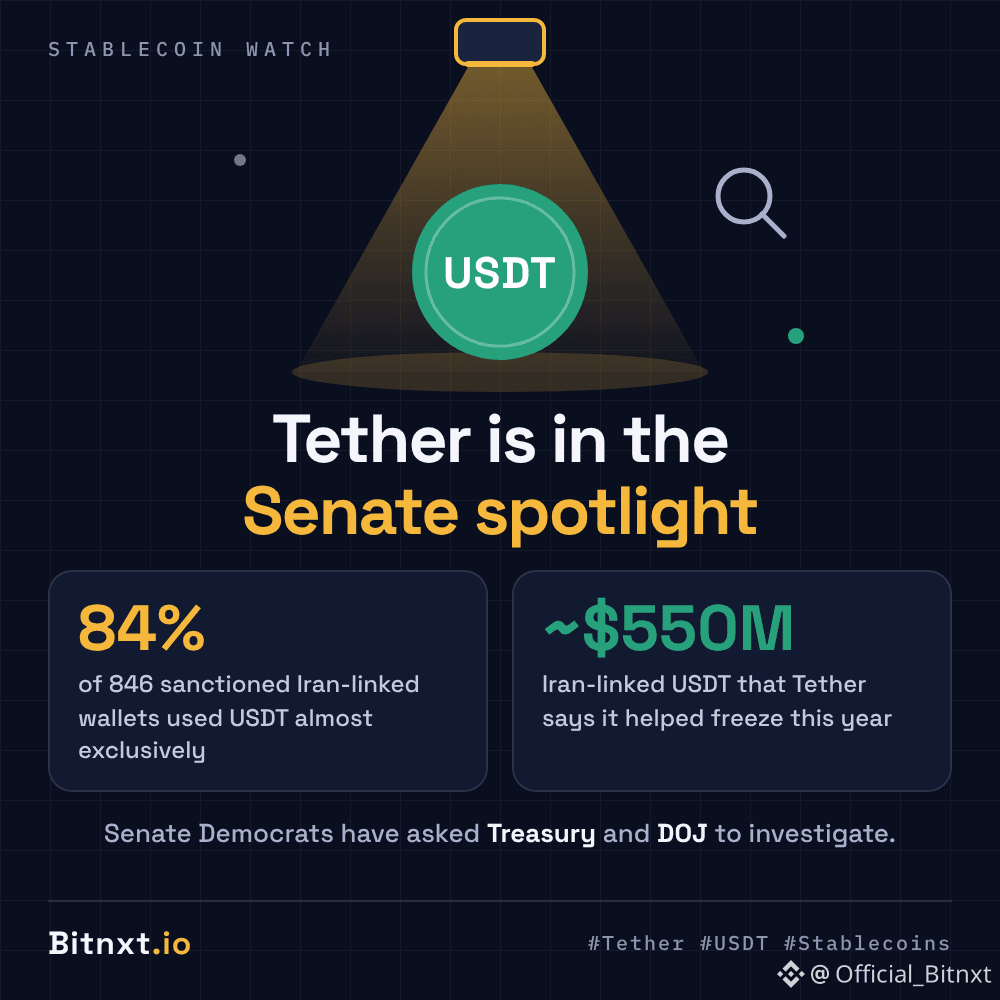
Tether is in the Senate spotlight 🔍
Senate Democrats found 84% of 846 sanctioned Iran-linked wallets used USDT almost exclusively, and they asked Treasury and DOJ to investigate.
Tether says it helped freeze ~$550M in Iran-linked USDT this year.
#Tether #USDT #Stablecoins
Tether is in the Senate spotlight 🔍
Senate Democrats found 84% of 846 sanctioned Iran-linked wallets used USDT almost exclusively, and they asked Treasury and DOJ to investigate.
Tether says it helped freeze ~$550M in Iran-linked USDT this year.
#Tether #USDT #Stablecoins
Senate Democrats found 84% of 846 sanctioned Iran-linked wallets used USDT almost exclusively, and they asked Treasury and DOJ to investigate.
Tether says it helped freeze ~$550M in Iran-linked USDT this year.
#Tether #USDT #Stablecoins
·
--
Stablecoins are quietly winning the B2B payments race — and most traders still think of them as just a "safe haven" asset.
Here is the real story: global B2B payments move roughly $150 trillion per year through a correspondent banking network built on SWIFT rails that are 50 years old. Transactions that should settle in seconds take 2-5 business days, carry 2-6% fees, and require pre-funded nostro/vostro accounts that lock up billions in idle capital.
Stablecoin payment corridors — settled on $SOL and $BNB Smart Chain and Ethereum L2s — are demonstrating sub-5-second finality at fractions of a cent. More importantly, programmable money unlocks what legacy rails never could: conditional release on invoice confirmation, automated tax withholding, on-chain reconciliation with zero manual intervention.
The inflection point arrives when enterprise treasury teams stop treating stablecoins as a crypto hedge and start treating them as a cash management tool. Early signs are already here: Visa, Stripe, and major fintechs have integrated stablecoin settlement. Circle reports USDC on-chain transaction volume consistently outpacing PayPal.
The chains that win this race are the ones with the deepest stablecoin liquidity, fastest finality, lowest fees, and compliance-ready tooling.
Programmable money is not a future concept. It is being deployed right now.
$SOL $BNB $ETH
#Stablecoins #PaymentRails #CryptoAdoption #DeFi #BinanceSquare
Stablecoins are quietly winning the B2B payments race — and most traders still think of them as just a "safe haven" asset.
Here is the real story: global B2B payments move roughly $150 trillion per year through a correspondent banking network built on SWIFT rails that are 50 years old. Transactions that should settle in seconds take 2-5 business days, carry 2-6% fees, and require pre-funded nostro/vostro accounts that lock up billions in idle capital.
Stablecoin payment corridors — settled on $SOL and $BNB Smart Chain and Ethereum L2s — are demonstrating sub-5-second finality at fractions of a cent. More importantly, programmable money unlocks what legacy rails never could: conditional release on invoice confirmation, automated tax withholding, on-chain reconciliation with zero manual intervention.
The inflection point arrives when enterprise treasury teams stop treating stablecoins as a crypto hedge and start treating them as a cash management tool. Early signs are already here: Visa, Stripe, and major fintechs have integrated stablecoin settlement. Circle reports USDC on-chain transaction volume consistently outpacing PayPal.
The chains that win this race are the ones with the deepest stablecoin liquidity, fastest finality, lowest fees, and compliance-ready tooling.
Programmable money is not a future concept. It is being deployed right now.
$SOL $BNB $ETH
#Stablecoins #PaymentRails #CryptoAdoption #DeFi #BinanceSquare
Here is the real story: global B2B payments move roughly $150 trillion per year through a correspondent banking network built on SWIFT rails that are 50 years old. Transactions that should settle in seconds take 2-5 business days, carry 2-6% fees, and require pre-funded nostro/vostro accounts that lock up billions in idle capital.
Stablecoin payment corridors — settled on $SOL and $BNB Smart Chain and Ethereum L2s — are demonstrating sub-5-second finality at fractions of a cent. More importantly, programmable money unlocks what legacy rails never could: conditional release on invoice confirmation, automated tax withholding, on-chain reconciliation with zero manual intervention.
The inflection point arrives when enterprise treasury teams stop treating stablecoins as a crypto hedge and start treating them as a cash management tool. Early signs are already here: Visa, Stripe, and major fintechs have integrated stablecoin settlement. Circle reports USDC on-chain transaction volume consistently outpacing PayPal.
The chains that win this race are the ones with the deepest stablecoin liquidity, fastest finality, lowest fees, and compliance-ready tooling.
Programmable money is not a future concept. It is being deployed right now.
$SOL $BNB $ETH
#Stablecoins #PaymentRails #CryptoAdoption #DeFi #BinanceSquare
89

💵 Stablecoin Watch: Stablecoin liquidity ($USDT ) remains the ultimate barometer for dry powder on the sidelines. High dominance metrics usually signal that traders are locked and loaded for the next big market breakout. 🔄💡 #USDT #Stablecoins #Crypto
💵 Stablecoin Watch: Stablecoin liquidity ($USDT ) remains the ultimate barometer for dry powder on the sidelines. High dominance metrics usually signal that traders are locked and loaded for the next big market breakout. 🔄💡 #USDT #Stablecoins #Crypto
1
43


·
--
New U.S. Treasury clearing rules could soon ripple directly into the crypto market, specifically targeting the mechanics behind major stablecoins.
The SEC is pushing for more Treasury transactions to route through central clearinghouses. Outright buy-and-sell trades face a Dec. 31 deadline, while repo trades must comply by June 30, 2027. SEC officials have indicated no plans to delay these timelines.
Stablecoin issuers rely heavily on U.S. Treasuries to back their dollar tokens. These issuers frequently use repo markets to convert underlying securities into liquid cash for redemptions. Higher transaction costs or strict clearing requirements could tighten liquidity or alter how seamlessly stablecoins function during high-volatility events.
For crypto traders, market liquidity and redemption speeds are critical. If stablecoin reserves become more expensive or complex to manage, execution costs and mint/redemption delays across major exchanges could shift unexpectedly.
How do you think these new Treasury clearing rules will impact overall stablecoin liquidity on major exchanges?
#Crypto #Stablecoins #CryptoRegulation #SEC
$GTC $AXS $FET
New U.S. Treasury clearing rules could soon ripple directly into the crypto market, specifically targeting the mechanics behind major stablecoins.
The SEC is pushing for more Treasury transactions to route through central clearinghouses. Outright buy-and-sell trades face a Dec. 31 deadline, while repo trades must comply by June 30, 2027. SEC officials have indicated no plans to delay these timelines.
Stablecoin issuers rely heavily on U.S. Treasuries to back their dollar tokens. These issuers frequently use repo markets to convert underlying securities into liquid cash for redemptions. Higher transaction costs or strict clearing requirements could tighten liquidity or alter how seamlessly stablecoins function during high-volatility events.
For crypto traders, market liquidity and redemption speeds are critical. If stablecoin reserves become more expensive or complex to manage, execution costs and mint/redemption delays across major exchanges could shift unexpectedly.
How do you think these new Treasury clearing rules will impact overall stablecoin liquidity on major exchanges?
#Crypto #Stablecoins #CryptoRegulation #SEC
$GTC $AXS $FET
The SEC is pushing for more Treasury transactions to route through central clearinghouses. Outright buy-and-sell trades face a Dec. 31 deadline, while repo trades must comply by June 30, 2027. SEC officials have indicated no plans to delay these timelines.
Stablecoin issuers rely heavily on U.S. Treasuries to back their dollar tokens. These issuers frequently use repo markets to convert underlying securities into liquid cash for redemptions. Higher transaction costs or strict clearing requirements could tighten liquidity or alter how seamlessly stablecoins function during high-volatility events.
For crypto traders, market liquidity and redemption speeds are critical. If stablecoin reserves become more expensive or complex to manage, execution costs and mint/redemption delays across major exchanges could shift unexpectedly.
How do you think these new Treasury clearing rules will impact overall stablecoin liquidity on major exchanges?
#Crypto #Stablecoins #CryptoRegulation #SEC
$GTC $AXS $FET
512

Regulatory friction is heating up in Europe right now. Circle just pushed back hard against MiCA reserve mandates and bank deposit caps, arguing these rules push top global stablecoins right out of the EU market. They actually aligned with the ECB on wanting more flexible frameworks. Big moves ahead for $USDC compliance. #Write2Earn #CryptoRegulation #Stablecoins #Web3
Regulatory friction is heating up in Europe right now. Circle just pushed back hard against MiCA reserve mandates and bank deposit caps, arguing these rules push top global stablecoins right out of the EU market. They actually aligned with the ECB on wanting more flexible frameworks. Big moves ahead for $USDC compliance. #Write2Earn #CryptoRegulation #Stablecoins #Web3
118
Log in to explore more content
Join global crypto users on Binance Square
⚡️ Get latest and useful information about crypto.
💬 Trusted by the world’s largest crypto exchange.
👍 Discover real insights from verified creators.
အီးမေးလ် / ဖုန်းနံပါတ်
ရေပန်းစားနေသော ခေါင်းစဉ်များ
1
#ADAGains10%Above$0.27
1,426 views
72 Discussing
2
#ETHUp70%InQ3ButLiquidityFalls
20,233 views
344 Discussing
3
#EthStakingExitQueueHits2026High
7,075 views
329 Discussing
4
#FedOctoberHoldOdds82.3%
9,913 views
304 Discussing
5
#Nikkei225Jumps2.5%ToThreeMonthHigh
44,245 views
717 Discussing
6
#CircleMints$2.75BUSDCOnSolanaIn7Days
431 views
20 Discussing
7
#DriftHackVictimsBeginClaims
123,852 views
1,380 Discussing
8
#SolanaTokenizedStockVolumeTops$4.4BInSeptember
10,743 views
123 Discussing
9
#BitcoinSpotETFsDraw$6.34BInflowsInQ3
39,806 views
241 Discussing
10
#EthereumValidatorExitQueueJumps392%
256,233 views
2,294 Discussing