

VINEVIDIVICI
123 Publications

VINEVIDIVICI
Signaler
Bloquer l’utilisateur
Ouvert au trading
Trade occasionnellement
1.3 mois
12 Suivis
3 Abonnés
101 J’aime
Publications
Portefeuille
Tous
Citations
Vidéos
·
--

Article
JPMorgan Sees Nearly 40% Upside, Cites Prediction Markets ‘Optionality’Genius Sports (GENI) stock is getting a fresh vote of confidence from Wall Street on Friday after JPMorgan initiated coverage with an 'Overweight' rating and an $8 price target, implying roughly 40% upside potential from Thursday’s close.
The call comes after a steep selloff in GENI stock this year, with the sports data and technology company positioning itself to benefit from the fast-growing prediction markets ecosystem now.
JPMorgan Sees Attractive Risk/Reward
JPMorgan analyst Samuel Nielsen said the stock's risk/reward looks positive following a 47% year-to-date decline, with Genius offering what JPMorgan called a 'scarce combo' of diversified above-market growth, improving profitability and an attractive valuation, according to The Fly.
GENI stock was up about 3% in premarket trading Friday morning at the time of writing, after closing Thursday at $5.80.
Prediction Markets Could Add Another Growth Layer
JPMorgan said Genius has 'optionality' from prediction markets that is not included in current analyst estimates, according to The Fly. The firm also pointed to the gap between Wall Street expectations and Genius Sports’ own targets. According to Investing.com, fiscal 2028 Street estimates are about 4% below Genius Sports' own targets
Genius has expanded its business into prediction markets through official sports-data, media and integrity services. On Aug. 5, the company announced a partnership with Kalshi under which Genius would provide official sports data, marketing, media and integrity services. The agreement covers real-time data across Kalshi's soccer portfolio, including the English Premier League, Serie A, Liga MX and other competitions.
Prediction.com Adds A Consumer Platform
On Sept. 17, Genius Sports-owned Legend launched Prediction.com, a consumer platform for discovering prediction markets and comparing equivalent event contracts across multiple platforms.
According to Genius, Prediction.com combines live sports data with prediction-market pricing and allows users to track changing probabilities and market information as events unfold. The company said the platform builds on Legend's existing consumer and comparison technology.
Q2 Results Show Revenue And EBITDA Growth
Genius Sports’ latest quarterly results showed continued growth in revenue and adjusted EBITDA. For the second quarter ended June 30, the company reported $195.5 million in revenue, up 64.7% from $118.7 million a year earlier. Adjusted EBITDA rose 54% to $52.6 million, compared with $34.2 million in the prior-year quarter
The company reported second-quarter adjusted EBITDA of $52.6 million versus its $45 million guidance, with an adjusted EBITDA margin of 26.9%. Genius said the margin reflected early synergies from the Legend acquisition, strong execution across the combined Media business and an incremental contribution from prediction markets.
Genius also raised its full-year 2026 guidance. The company now expects revenue of $1.005 billion-$1.025 billion and adjusted EBITDA of $285 million-$295 million, compared with its previous guidance of $990 million-$1.01 billion in revenue and $270 million-$280 million in adjusted EBITDA. The new outlook implies an adjusted EBITDA margin of approximately 28.6% at the midpoint, versus about 27.5% previously.
Retail View On GENI
Retail sentiment on Stocktwits for GENI turned 'neutral’' over the past 24 hours, though message volume was 'high’.
GENI stock has dropped over 46% year-to-date.
$GENI.US
#EBITDA #JPMorgan #prediction
{stock_us}(GENI.US)
JPMorgan Sees Nearly 40% Upside, Cites Prediction Markets ‘Optionality’
Genius Sports (GENI) stock is getting a fresh vote of confidence from Wall Street on Friday after JPMorgan initiated coverage with an 'Overweight' rating and an $8 price target, implying roughly 40% upside potential from Thursday’s close.
The call comes after a steep selloff in GENI stock this year, with the sports data and technology company positioning itself to benefit from the fast-growing prediction markets ecosystem now.
JPMorgan Sees Attractive Risk/Reward
JPMorgan analyst Samuel Nielsen said the stock's risk/reward looks positive following a 47% year-to-date decline, with Genius offering what JPMorgan called a 'scarce combo' of diversified above-market growth, improving profitability and an attractive valuation, according to The Fly.
GENI stock was up about 3% in premarket trading Friday morning at the time of writing, after closing Thursday at $5.80.
Prediction Markets Could Add Another Growth Layer
JPMorgan said Genius has 'optionality' from prediction markets that is not included in current analyst estimates, according to The Fly. The firm also pointed to the gap between Wall Street expectations and Genius Sports’ own targets. According to Investing.com, fiscal 2028 Street estimates are about 4% below Genius Sports' own targets
Genius has expanded its business into prediction markets through official sports-data, media and integrity services. On Aug. 5, the company announced a partnership with Kalshi under which Genius would provide official sports data, marketing, media and integrity services. The agreement covers real-time data across Kalshi's soccer portfolio, including the English Premier League, Serie A, Liga MX and other competitions.
Prediction.com Adds A Consumer Platform
On Sept. 17, Genius Sports-owned Legend launched Prediction.com, a consumer platform for discovering prediction markets and comparing equivalent event contracts across multiple platforms.
According to Genius, Prediction.com combines live sports data with prediction-market pricing and allows users to track changing probabilities and market information as events unfold. The company said the platform builds on Legend's existing consumer and comparison technology.
Q2 Results Show Revenue And EBITDA Growth
Genius Sports’ latest quarterly results showed continued growth in revenue and adjusted EBITDA. For the second quarter ended June 30, the company reported $195.5 million in revenue, up 64.7% from $118.7 million a year earlier. Adjusted EBITDA rose 54% to $52.6 million, compared with $34.2 million in the prior-year quarter
The company reported second-quarter adjusted EBITDA of $52.6 million versus its $45 million guidance, with an adjusted EBITDA margin of 26.9%. Genius said the margin reflected early synergies from the Legend acquisition, strong execution across the combined Media business and an incremental contribution from prediction markets.
Genius also raised its full-year 2026 guidance. The company now expects revenue of $1.005 billion-$1.025 billion and adjusted EBITDA of $285 million-$295 million, compared with its previous guidance of $990 million-$1.01 billion in revenue and $270 million-$280 million in adjusted EBITDA. The new outlook implies an adjusted EBITDA margin of approximately 28.6% at the midpoint, versus about 27.5% previously.
Retail View On GENI
Retail sentiment on Stocktwits for GENI turned 'neutral’' over the past 24 hours, though message volume was 'high’.
GENI stock has dropped over 46% year-to-date.
$GENI.US
#EBITDA #JPMorgan #prediction
The call comes after a steep selloff in GENI stock this year, with the sports data and technology company positioning itself to benefit from the fast-growing prediction markets ecosystem now.
JPMorgan Sees Attractive Risk/Reward
JPMorgan analyst Samuel Nielsen said the stock's risk/reward looks positive following a 47% year-to-date decline, with Genius offering what JPMorgan called a 'scarce combo' of diversified above-market growth, improving profitability and an attractive valuation, according to The Fly.
GENI stock was up about 3% in premarket trading Friday morning at the time of writing, after closing Thursday at $5.80.
Prediction Markets Could Add Another Growth Layer
JPMorgan said Genius has 'optionality' from prediction markets that is not included in current analyst estimates, according to The Fly. The firm also pointed to the gap between Wall Street expectations and Genius Sports’ own targets. According to Investing.com, fiscal 2028 Street estimates are about 4% below Genius Sports' own targets
Genius has expanded its business into prediction markets through official sports-data, media and integrity services. On Aug. 5, the company announced a partnership with Kalshi under which Genius would provide official sports data, marketing, media and integrity services. The agreement covers real-time data across Kalshi's soccer portfolio, including the English Premier League, Serie A, Liga MX and other competitions.
Prediction.com Adds A Consumer Platform
On Sept. 17, Genius Sports-owned Legend launched Prediction.com, a consumer platform for discovering prediction markets and comparing equivalent event contracts across multiple platforms.
According to Genius, Prediction.com combines live sports data with prediction-market pricing and allows users to track changing probabilities and market information as events unfold. The company said the platform builds on Legend's existing consumer and comparison technology.
Q2 Results Show Revenue And EBITDA Growth
Genius Sports’ latest quarterly results showed continued growth in revenue and adjusted EBITDA. For the second quarter ended June 30, the company reported $195.5 million in revenue, up 64.7% from $118.7 million a year earlier. Adjusted EBITDA rose 54% to $52.6 million, compared with $34.2 million in the prior-year quarter
The company reported second-quarter adjusted EBITDA of $52.6 million versus its $45 million guidance, with an adjusted EBITDA margin of 26.9%. Genius said the margin reflected early synergies from the Legend acquisition, strong execution across the combined Media business and an incremental contribution from prediction markets.
Genius also raised its full-year 2026 guidance. The company now expects revenue of $1.005 billion-$1.025 billion and adjusted EBITDA of $285 million-$295 million, compared with its previous guidance of $990 million-$1.01 billion in revenue and $270 million-$280 million in adjusted EBITDA. The new outlook implies an adjusted EBITDA margin of approximately 28.6% at the midpoint, versus about 27.5% previously.
Retail View On GENI
Retail sentiment on Stocktwits for GENI turned 'neutral’' over the past 24 hours, though message volume was 'high’.
GENI stock has dropped over 46% year-to-date.
$GENI.US
#EBITDA #JPMorgan #prediction
GENIUS+0,63%
50
·
--
The bond market is flashing a warning that bitcoin and U.S. stocks have yet to register.
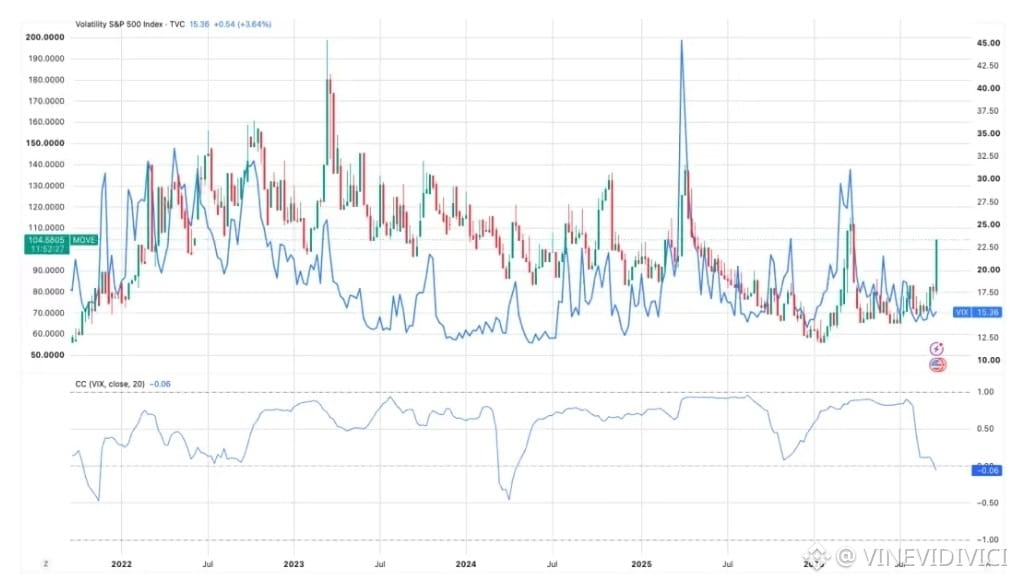
The MOVE index, which measures expected volatility in the U.S. Treasury market, has jumped from around 80 on Tuesday to 104 on Thursday, its highest level since March when it hit 199, according to data source CoinDesk
Volmex’s annualized 30-day bitcoin implied volatility index, BVIV, is subdued at around 37, close to its year-to-date low of 35. The index reflects bitcoin options traders’ expectations for price volatility over four weeks. Meanwhile, the Cboe VIX, which tracks expected volatility in the S&P 500, is hovering close to its year-to-date low of 14. Neither market is showing the same demand for volatility
The divergence points to underlying strength in bitcoin and stocks. Higher volatility in Treasury notes, which underpin global finance and credit creation, typically tightens financial conditions and disincentivizes risk-taking in financial markets.
The divergence comes as government bond yields climb globally. The war in the Middle East has driven oil and diesel prices higher, complicating the inflation outlook and raising questions about how much further central banks may need to tighten policy. The U.S. 10-year Treasury yield briefly hit 5.2% on Thursday before easing to 5.163%.
When MOVE was last around this level in March, the S&P 500 stood near 6,350. It has since risen to 7,704, up roughly 21%. However, bond traders are now paying considerably more for protection against swings in interest rates.
Over a 20-day window, the correlation between VIX and MOVE has slipped to −0.06, turning negative for the first time since April 2024, though that reading is close to zero. The correlation between BVIV and MOVE is more clearly negative at −0.37, one of its lowest readings in years. As bond volatility has risen, bitcoin’s expected volatility has remained near its yearly low
#S&P500 $MOVE #Cboe $VIV.US
{stock_us}(VIV.US)
#BTC☀
The bond market is flashing a warning that bitcoin and U.S. stocks have yet to register.
The MOVE index, which measures expected volatility in the U.S. Treasury market, has jumped from around 80 on Tuesday to 104 on Thursday, its highest level since March when it hit 199, according to data source CoinDesk
Volmex’s annualized 30-day bitcoin implied volatility index, BVIV, is subdued at around 37, close to its year-to-date low of 35. The index reflects bitcoin options traders’ expectations for price volatility over four weeks. Meanwhile, the Cboe VIX, which tracks expected volatility in the S&P 500, is hovering close to its year-to-date low of 14. Neither market is showing the same demand for volatility
The divergence points to underlying strength in bitcoin and stocks. Higher volatility in Treasury notes, which underpin global finance and credit creation, typically tightens financial conditions and disincentivizes risk-taking in financial markets.
The divergence comes as government bond yields climb globally. The war in the Middle East has driven oil and diesel prices higher, complicating the inflation outlook and raising questions about how much further central banks may need to tighten policy. The U.S. 10-year Treasury yield briefly hit 5.2% on Thursday before easing to 5.163%.
When MOVE was last around this level in March, the S&P 500 stood near 6,350. It has since risen to 7,704, up roughly 21%. However, bond traders are now paying considerably more for protection against swings in interest rates.
Over a 20-day window, the correlation between VIX and MOVE has slipped to −0.06, turning negative for the first time since April 2024, though that reading is close to zero. The correlation between BVIV and MOVE is more clearly negative at −0.37, one of its lowest readings in years. As bond volatility has risen, bitcoin’s expected volatility has remained near its yearly low
#S&P500 $MOVE #Cboe $VIV.US
#BTC☀
The MOVE index, which measures expected volatility in the U.S. Treasury market, has jumped from around 80 on Tuesday to 104 on Thursday, its highest level since March when it hit 199, according to data source CoinDesk
Volmex’s annualized 30-day bitcoin implied volatility index, BVIV, is subdued at around 37, close to its year-to-date low of 35. The index reflects bitcoin options traders’ expectations for price volatility over four weeks. Meanwhile, the Cboe VIX, which tracks expected volatility in the S&P 500, is hovering close to its year-to-date low of 14. Neither market is showing the same demand for volatility
The divergence points to underlying strength in bitcoin and stocks. Higher volatility in Treasury notes, which underpin global finance and credit creation, typically tightens financial conditions and disincentivizes risk-taking in financial markets.
The divergence comes as government bond yields climb globally. The war in the Middle East has driven oil and diesel prices higher, complicating the inflation outlook and raising questions about how much further central banks may need to tighten policy. The U.S. 10-year Treasury yield briefly hit 5.2% on Thursday before easing to 5.163%.
When MOVE was last around this level in March, the S&P 500 stood near 6,350. It has since risen to 7,704, up roughly 21%. However, bond traders are now paying considerably more for protection against swings in interest rates.
Over a 20-day window, the correlation between VIX and MOVE has slipped to −0.06, turning negative for the first time since April 2024, though that reading is close to zero. The correlation between BVIV and MOVE is more clearly negative at −0.37, one of its lowest readings in years. As bond volatility has risen, bitcoin’s expected volatility has remained near its yearly low
#S&P500 $MOVE #Cboe $VIV.US
#BTC☀
332
·
--

Article
Bitcoin holders are cashing out, just not the way they did at prior market topsBitcoin's
BTC$84,629.56
recent surge has some traders liquidating the coins to take profits on their holdings. But the pace of this operation is far slower than at prior market peaks, a positive sign for the market.
BTC has rallied by 44% to nearly $85,000 this quarter, its best performance since the final three months of 2024, according to CoinDesk data. The strong rise comes after three straight quarters of red ink
Naturally, some are taking profits, as evidenced by the net realized profit/loss metric. It records the dollar gains locked in when coins actually move on-chain at a price above the last price at which they changed hands.
Analysts treat that prior transfer as a cost basis: if a coin bought or last spent at $40,000 is later sent or sold at $84,000, the $44,000 difference is booked as realized profit.
Investors have recently realized $2.4 billion in profits after the price surge, according to data tracked by Bitfinex.
"BTC holders just realised $2.4bn in profits. At prior market tops, daily realized profits ran between $7bn and $10bn," Bitfinex said on X.
In the meantime, ETFs continue to attract money and have now registered a net inflow of $2.84 billion in six days. That's more than profits realized by holders. Further, ETFs are now up nearly $800 million in net inflows for the year.
Ether too is giving bullish signals. According to Bitfinex, around 410,000 ETH has come off exchanges in a month, while U.S. spot ether ETFs have attracted $680 million in investor money across four sessions. That is painting a bullish picture for the near term
As of this writing, bitcoin, ether and other majors did not show any signs of weakness in the wake of the $452 million Bitget hack.
In traditional markets, rallies in the Dollar Index and Treasury yields appear to have stalled for now, a relief for risk assets. However, oil volatility stays high amid confusing headlines related to the Iran war. Stay alert!
#Bitget #BitcoinETFs #ETHETFsApproved $BTC
{spot}(BTCUSDT)
Bitcoin holders are cashing out, just not the way they did at prior market tops
Bitcoin's
BTC$84,629.56
recent surge has some traders liquidating the coins to take profits on their holdings. But the pace of this operation is far slower than at prior market peaks, a positive sign for the market.
BTC has rallied by 44% to nearly $85,000 this quarter, its best performance since the final three months of 2024, according to CoinDesk data. The strong rise comes after three straight quarters of red ink
Naturally, some are taking profits, as evidenced by the net realized profit/loss metric. It records the dollar gains locked in when coins actually move on-chain at a price above the last price at which they changed hands.
Analysts treat that prior transfer as a cost basis: if a coin bought or last spent at $40,000 is later sent or sold at $84,000, the $44,000 difference is booked as realized profit.
Investors have recently realized $2.4 billion in profits after the price surge, according to data tracked by Bitfinex.
"BTC holders just realised $2.4bn in profits. At prior market tops, daily realized profits ran between $7bn and $10bn," Bitfinex said on X.
In the meantime, ETFs continue to attract money and have now registered a net inflow of $2.84 billion in six days. That's more than profits realized by holders. Further, ETFs are now up nearly $800 million in net inflows for the year.
Ether too is giving bullish signals. According to Bitfinex, around 410,000 ETH has come off exchanges in a month, while U.S. spot ether ETFs have attracted $680 million in investor money across four sessions. That is painting a bullish picture for the near term
As of this writing, bitcoin, ether and other majors did not show any signs of weakness in the wake of the $452 million Bitget hack.
In traditional markets, rallies in the Dollar Index and Treasury yields appear to have stalled for now, a relief for risk assets. However, oil volatility stays high amid confusing headlines related to the Iran war. Stay alert!
#Bitget #BitcoinETFs #ETHETFsApproved $BTC
BTC$84,629.56
recent surge has some traders liquidating the coins to take profits on their holdings. But the pace of this operation is far slower than at prior market peaks, a positive sign for the market.
BTC has rallied by 44% to nearly $85,000 this quarter, its best performance since the final three months of 2024, according to CoinDesk data. The strong rise comes after three straight quarters of red ink
Naturally, some are taking profits, as evidenced by the net realized profit/loss metric. It records the dollar gains locked in when coins actually move on-chain at a price above the last price at which they changed hands.
Analysts treat that prior transfer as a cost basis: if a coin bought or last spent at $40,000 is later sent or sold at $84,000, the $44,000 difference is booked as realized profit.
Investors have recently realized $2.4 billion in profits after the price surge, according to data tracked by Bitfinex.
"BTC holders just realised $2.4bn in profits. At prior market tops, daily realized profits ran between $7bn and $10bn," Bitfinex said on X.
In the meantime, ETFs continue to attract money and have now registered a net inflow of $2.84 billion in six days. That's more than profits realized by holders. Further, ETFs are now up nearly $800 million in net inflows for the year.
Ether too is giving bullish signals. According to Bitfinex, around 410,000 ETH has come off exchanges in a month, while U.S. spot ether ETFs have attracted $680 million in investor money across four sessions. That is painting a bullish picture for the near term
As of this writing, bitcoin, ether and other majors did not show any signs of weakness in the wake of the $452 million Bitget hack.
In traditional markets, rallies in the Dollar Index and Treasury yields appear to have stalled for now, a relief for risk assets. However, oil volatility stays high amid confusing headlines related to the Iran war. Stay alert!
#Bitget #BitcoinETFs #ETHETFsApproved $BTC
58
·
--
FxPro sees bitcoin's slide as a pause in the uptrend, even if it reaches $70,000
Bitcoin traded just above $84,000 on Friday, flat over 24 hours after falling below that level on Wednesday, CoinDesk data show. Most major tokens moved less than 2%. Smaller names did the running, with ONDO up 27% to about 54 cents and Quant up 39% to nearly $100.
Bonds found a floor in Asia. The 10-year Treasury yield slipped two basis points to 5.17% after jumping more than 20 basis points over the previous two sessions, and Brent fell 1% to about $105 a barrel on reports that Washington and Tehran are exploring a phased deal to reopen the Strait of Hormuz.
FxPro chief market analyst Alex Kuptsikevich reads bitcoin's drop as a stall short of the target technical traders had projected for the rally that began in mid-August.
"As with the overall market capitalisation, the leading cryptocurrency encountered resistance near a previously significant support level. However, BTC failed to complete the Fibonacci extension pattern to 161.8% of the impulse that began in mid-August in a single move. Despite the pullback, the ongoing, unfinished nature of the uptrend suggests it may be a temporary pause on the way up," he said in a note.
"It is worth remembering that in 2021, Bitcoin lost over 50% from its peak before reaching new highs. Similarly, today, a decline to $70K may be painful for short-term speculators, but it does not undermine the bullish outlook," he added.
Bitcoin heads into Friday's Deribit expiry below $85,000, the strike carrying one of the largest blocks of call options.
#fxpro
$ONDO
{future}(ONDOUSDT)
$QNT
{future}(QNTUSDT)
#QNTReversalSignal
#coincap
FxPro sees bitcoin's slide as a pause in the uptrend, even if it reaches $70,000
Bitcoin traded just above $84,000 on Friday, flat over 24 hours after falling below that level on Wednesday, CoinDesk data show. Most major tokens moved less than 2%. Smaller names did the running, with ONDO up 27% to about 54 cents and Quant up 39% to nearly $100.
Bonds found a floor in Asia. The 10-year Treasury yield slipped two basis points to 5.17% after jumping more than 20 basis points over the previous two sessions, and Brent fell 1% to about $105 a barrel on reports that Washington and Tehran are exploring a phased deal to reopen the Strait of Hormuz.
FxPro chief market analyst Alex Kuptsikevich reads bitcoin's drop as a stall short of the target technical traders had projected for the rally that began in mid-August.
"As with the overall market capitalisation, the leading cryptocurrency encountered resistance near a previously significant support level. However, BTC failed to complete the Fibonacci extension pattern to 161.8% of the impulse that began in mid-August in a single move. Despite the pullback, the ongoing, unfinished nature of the uptrend suggests it may be a temporary pause on the way up," he said in a note.
"It is worth remembering that in 2021, Bitcoin lost over 50% from its peak before reaching new highs. Similarly, today, a decline to $70K may be painful for short-term speculators, but it does not undermine the bullish outlook," he added.
Bitcoin heads into Friday's Deribit expiry below $85,000, the strike carrying one of the largest blocks of call options.
#fxpro
$ONDO
$QNT
#QNTReversalSignal
#coincap
Bitcoin traded just above $84,000 on Friday, flat over 24 hours after falling below that level on Wednesday, CoinDesk data show. Most major tokens moved less than 2%. Smaller names did the running, with ONDO up 27% to about 54 cents and Quant up 39% to nearly $100.
Bonds found a floor in Asia. The 10-year Treasury yield slipped two basis points to 5.17% after jumping more than 20 basis points over the previous two sessions, and Brent fell 1% to about $105 a barrel on reports that Washington and Tehran are exploring a phased deal to reopen the Strait of Hormuz.
FxPro chief market analyst Alex Kuptsikevich reads bitcoin's drop as a stall short of the target technical traders had projected for the rally that began in mid-August.
"As with the overall market capitalisation, the leading cryptocurrency encountered resistance near a previously significant support level. However, BTC failed to complete the Fibonacci extension pattern to 161.8% of the impulse that began in mid-August in a single move. Despite the pullback, the ongoing, unfinished nature of the uptrend suggests it may be a temporary pause on the way up," he said in a note.
"It is worth remembering that in 2021, Bitcoin lost over 50% from its peak before reaching new highs. Similarly, today, a decline to $70K may be painful for short-term speculators, but it does not undermine the bullish outlook," he added.
Bitcoin heads into Friday's Deribit expiry below $85,000, the strike carrying one of the largest blocks of call options.
#fxpro
$ONDO
$QNT
#QNTReversalSignal
#coincap
281
·
--
Goldman Sachs earned about $200 million in fees from Situational Awareness
According to the Financial Times, Goldman Sachs earned about $200 million in fees this year from Situational Awareness, the hedge fund founded by Leopold Aschenbrenner. The fund grew rapidly through leveraged bets on AI stocks, with assets peaking at around $30 billion.
A sell-off in AI stocks in mid-July forced a major unwind, including a large sale to Citadel. The fund subsequently shrank and reduced its leverage.
#GoldmanSachsFilesforBitcoinIncome $GSB
{spot}(GSBUSDT)
{stock_us}(GSBD.US)
Goldman Sachs earned about $200 million in fees from Situational Awareness
According to the Financial Times, Goldman Sachs earned about $200 million in fees this year from Situational Awareness, the hedge fund founded by Leopold Aschenbrenner. The fund grew rapidly through leveraged bets on AI stocks, with assets peaking at around $30 billion.
A sell-off in AI stocks in mid-July forced a major unwind, including a large sale to Citadel. The fund subsequently shrank and reduced its leverage.
#GoldmanSachsFilesforBitcoinIncome $GSB
According to the Financial Times, Goldman Sachs earned about $200 million in fees this year from Situational Awareness, the hedge fund founded by Leopold Aschenbrenner. The fund grew rapidly through leveraged bets on AI stocks, with assets peaking at around $30 billion.
A sell-off in AI stocks in mid-July forced a major unwind, including a large sale to Citadel. The fund subsequently shrank and reduced its leverage.
#GoldmanSachsFilesforBitcoinIncome $GSB
78
·
--

Article
FTSE 100 today: Stocks flat as
U.S.-Iran tension, U.S. Treasury
yields biteBritish stocks remained unchanged on Thursday as persistent Middle East tensions kept oil above $103 a barrel while surging U.S. Treasury yields continued to weigh on risk appetite across Europe
The FTSE 100 was up 0.02%, as of 03:22 ET (07:22 GMT). Germany’s DAX dropped 0.22% and France’s CAC 40 slipped 0.28%. Sterling held near flat at $1.3245, up 0.03%.
The U.S. 10-year Treasury yield held near its highest level since 2007, as stronger-than-expected business activity data fuelled bets that interest rates will stay elevated for longer.
EU leaders on Thursday morning welcomed Pakistan’s mediation role in the U.S.-Iran conflict, with European Council President Antonio Costa and European Commission President Ursula von der Leyen saying in separate posts on X they "thanked the prime minister for his initiative to mediate."
Iran’s Supreme National Security Council secretary Mohsen Rezaei said Tehran had relayed a five-day deadline for U.S. compliance, including lifting a naval blockade and unfreezing Iranian assets, through Qatari and Pakistani mediators.
Iran’s President Masoud Pezeshkian, addressing the UN General Assembly on Wednesday, said Tehran was "ready for dialogue and diplomacy … without accepting the language of force," one day after U.S. President Donald Trump threatened annihilation from the same podium.
The two sides held their first in-person talks in months via Qatari intermediaries on the UNGA sidelines.
Vessel traffic through the Strait of Hormuz remained well below average, with 10 commodity ships transiting on Wednesday against a 10-day moving average of approximately 17, preliminary Reuters shipping data showed.
U.S. aviation sanctions against Iran took full effect Wednesday, eliminating most Iranian flights to Turkey, the UAE and China, with Oman, Azerbaijan and Georgia also barring Iranian carriers.
U.S. Treasury Secretary Scott Bessent said the pressure campaign sought one of three outcomes: internal regime fracture, a popular uprising, or Iran agreeing to and honouring a deal.
Brent crude was up 0.15% at $103.17, while WTI rose 0.10% to $92.22. Gold futures for December settled at $4,318.17, down 0.01%, while spot gold fell 0.10% to $4,283.
UK round up
Halma raises FY2027 margin outlook on strong first half and portfolio gains
CVS Group revenue rises as Australia expansion and UK acquisition plans advance
Mitchells & Butlers sees fourth quarter sales growth and easing cost pressures
Raspberry Pi raises EBITDA outlook after first half revenue surges 90%
$XAU
{future}(XAUUSDT)
#CAC
$DAX.ETF
{etf_us}(DAX.ETF)
#MAB
FTSE 100 today: Stocks flat as U.S.-Iran tension, U.S. Treasury yields bite
British stocks remained unchanged on Thursday as persistent Middle East tensions kept oil above $103 a barrel while surging U.S. Treasury yields continued to weigh on risk appetite across Europe
The FTSE 100 was up 0.02%, as of 03:22 ET (07:22 GMT). Germany’s DAX dropped 0.22% and France’s CAC 40 slipped 0.28%. Sterling held near flat at $1.3245, up 0.03%.
The U.S. 10-year Treasury yield held near its highest level since 2007, as stronger-than-expected business activity data fuelled bets that interest rates will stay elevated for longer.
EU leaders on Thursday morning welcomed Pakistan’s mediation role in the U.S.-Iran conflict, with European Council President Antonio Costa and European Commission President Ursula von der Leyen saying in separate posts on X they "thanked the prime minister for his initiative to mediate."
Iran’s Supreme National Security Council secretary Mohsen Rezaei said Tehran had relayed a five-day deadline for U.S. compliance, including lifting a naval blockade and unfreezing Iranian assets, through Qatari and Pakistani mediators.
Iran’s President Masoud Pezeshkian, addressing the UN General Assembly on Wednesday, said Tehran was "ready for dialogue and diplomacy … without accepting the language of force," one day after U.S. President Donald Trump threatened annihilation from the same podium.
The two sides held their first in-person talks in months via Qatari intermediaries on the UNGA sidelines.
Vessel traffic through the Strait of Hormuz remained well below average, with 10 commodity ships transiting on Wednesday against a 10-day moving average of approximately 17, preliminary Reuters shipping data showed.
U.S. aviation sanctions against Iran took full effect Wednesday, eliminating most Iranian flights to Turkey, the UAE and China, with Oman, Azerbaijan and Georgia also barring Iranian carriers.
U.S. Treasury Secretary Scott Bessent said the pressure campaign sought one of three outcomes: internal regime fracture, a popular uprising, or Iran agreeing to and honouring a deal.
Brent crude was up 0.15% at $103.17, while WTI rose 0.10% to $92.22. Gold futures for December settled at $4,318.17, down 0.01%, while spot gold fell 0.10% to $4,283.
UK round up
Halma raises FY2027 margin outlook on strong first half and portfolio gains
CVS Group revenue rises as Australia expansion and UK acquisition plans advance
Mitchells & Butlers sees fourth quarter sales growth and easing cost pressures
Raspberry Pi raises EBITDA outlook after first half revenue surges 90%
$XAU
#CAC
$DAX.ETF
#MAB
The FTSE 100 was up 0.02%, as of 03:22 ET (07:22 GMT). Germany’s DAX dropped 0.22% and France’s CAC 40 slipped 0.28%. Sterling held near flat at $1.3245, up 0.03%.
The U.S. 10-year Treasury yield held near its highest level since 2007, as stronger-than-expected business activity data fuelled bets that interest rates will stay elevated for longer.
EU leaders on Thursday morning welcomed Pakistan’s mediation role in the U.S.-Iran conflict, with European Council President Antonio Costa and European Commission President Ursula von der Leyen saying in separate posts on X they "thanked the prime minister for his initiative to mediate."
Iran’s Supreme National Security Council secretary Mohsen Rezaei said Tehran had relayed a five-day deadline for U.S. compliance, including lifting a naval blockade and unfreezing Iranian assets, through Qatari and Pakistani mediators.
Iran’s President Masoud Pezeshkian, addressing the UN General Assembly on Wednesday, said Tehran was "ready for dialogue and diplomacy … without accepting the language of force," one day after U.S. President Donald Trump threatened annihilation from the same podium.
The two sides held their first in-person talks in months via Qatari intermediaries on the UNGA sidelines.
Vessel traffic through the Strait of Hormuz remained well below average, with 10 commodity ships transiting on Wednesday against a 10-day moving average of approximately 17, preliminary Reuters shipping data showed.
U.S. aviation sanctions against Iran took full effect Wednesday, eliminating most Iranian flights to Turkey, the UAE and China, with Oman, Azerbaijan and Georgia also barring Iranian carriers.
U.S. Treasury Secretary Scott Bessent said the pressure campaign sought one of three outcomes: internal regime fracture, a popular uprising, or Iran agreeing to and honouring a deal.
Brent crude was up 0.15% at $103.17, while WTI rose 0.10% to $92.22. Gold futures for December settled at $4,318.17, down 0.01%, while spot gold fell 0.10% to $4,283.
UK round up
Halma raises FY2027 margin outlook on strong first half and portfolio gains
CVS Group revenue rises as Australia expansion and UK acquisition plans advance
Mitchells & Butlers sees fourth quarter sales growth and easing cost pressures
Raspberry Pi raises EBITDA outlook after first half revenue surges 90%
$XAU
#CAC
$DAX.ETF
#MAB
XAU+1,20%
DAXETF+0,60%
6
·
--
LAS VEGAS - MGM Resorts International (NYSE:MGM) said today that People Incorporated has withdrawn its proposal to acquire the outstanding shares of the company that it does not already own, according to a press release statement.
People Incorporated submitted the acquisition proposal on June 1, 2026. A special committee of MGM Resorts’ Board of Directors participated in negotiations with People over the past several months. MGM Resorts will continue operating as a standalone company.
Paul Salem, Chairman of the MGM Resorts Board, said the board remains focused on the company’s operations in Las Vegas, regional properties, and BetMGM’s performance. He also cited the company’s international portfolio including MGM China and MGM Osaka.
MGM Resorts operates 30 hotel and gaming destinations globally. The company’s 50/50 venture BetMGM offers sports betting and online gaming in North America. The company’s subsidiary LV Lion Holding Limited provides sports betting and online gaming in Europe and Brazil. MGM Resorts is pursuing an integrated resort development in Japan.
The press release did not disclose the percentage of MGM Resorts shares currently owned by People Incorporated or the terms of the withdrawn proposal.
LAS VEGAS - MGM Resorts International (NYSE:MGM) said today that People Incorporated has withdrawn its proposal to acquire the outstanding shares of the company that it does not already own, according to a press release statement.
People Incorporated submitted the acquisition proposal on June 1, 2026. A special committee of MGM Resorts’ Board of Directors participated in negotiations with People over the past several months. MGM Resorts will continue operating as a standalone company.
Paul Salem, Chairman of the MGM Resorts Board, said the board remains focused on the company’s operations in Las Vegas, regional properties, and BetMGM’s performance. He also cited the company’s international portfolio including MGM China and MGM Osaka.
MGM Resorts operates 30 hotel and gaming destinations globally. The company’s 50/50 venture BetMGM offers sports betting and online gaming in North America. The company’s subsidiary LV Lion Holding Limited provides sports betting and online gaming in Europe and Brazil. MGM Resorts is pursuing an integrated resort development in Japan.
The press release did not disclose the percentage of MGM Resorts shares currently owned by People Incorporated or the terms of the withdrawn proposal.
People Incorporated submitted the acquisition proposal on June 1, 2026. A special committee of MGM Resorts’ Board of Directors participated in negotiations with People over the past several months. MGM Resorts will continue operating as a standalone company.
Paul Salem, Chairman of the MGM Resorts Board, said the board remains focused on the company’s operations in Las Vegas, regional properties, and BetMGM’s performance. He also cited the company’s international portfolio including MGM China and MGM Osaka.
MGM Resorts operates 30 hotel and gaming destinations globally. The company’s 50/50 venture BetMGM offers sports betting and online gaming in North America. The company’s subsidiary LV Lion Holding Limited provides sports betting and online gaming in Europe and Brazil. MGM Resorts is pursuing an integrated resort development in Japan.
The press release did not disclose the percentage of MGM Resorts shares currently owned by People Incorporated or the terms of the withdrawn proposal.
MGMUS+0,15%
47
·
--

Article
APP Stock Drops After Edgewater Says AppLovin Growth Has Stalled, Citi Sees Rapid Client ExpansionAppLovin (APP) shares dropped on Wednesday morning after Edgewater Research said the mobile advertising platform’s market-share expansion has effectively stalled, overshadowing bullish client-growth data from Citi earlier this week.
APP stock fell around 6% in morning trade and was among the top trending tickers on Stocktwits at the time of writing.
The sharp move comes just two days after Citi said AppLovin’s global e-commerce client base reached 13,105 through Sept. 18, up 5.1% from the prior week. According to TheFly, Citi described the growth as the fastest weekly expansion in five months and maintained a ‘Buy’ rating with a $600 price target.
Edgewater Flags AppLovin Growth Ceiling
In a note to investors cited by Investing.com, Edgewater analyst Joe Wittine offered a more cautious view Wednesday following fresh channel checks. He expects AppLovin’s fourth-quarter revenue to grow just 8% to 9% sequentially, suggesting growth could flatten after several quarters of rapid expansion.
Wittine said AppLovin’s share of wallet and share of voice are no longer consistently increasing from already industry-leading levels. “This is primarily the inevitable result of MAX’s share reaching a functional ceiling,” Wittine said, adding that competition is also increasingly compressing AppLovin’s net revenue spreads.
MAX is AppLovin’s core advertising network, which aggregates in-app advertising supply across mobile gaming and other applications.
How Is Retail Feeling About APP Stock?
Retail sentiment on Stocktwits around Applovin improved to ‘bullish’ from ‘neutral’ territory over the past day.
Some retail investors viewed the pullback as a potential dip-buying opportunity, while others focused on the longer-term growth question raised by Edgewater.
APP stock continued to trade near its 52-week low of around $297. The shares have fallen more than 50% this year.
$APP
#QQQM
$XLC.ETF
{etf_us}(XLC.ETF)
#AIQ
APP Stock Drops After Edgewater Says AppLovin Growth Has Stalled, Citi Sees Rapid Client Expansion
AppLovin (APP) shares dropped on Wednesday morning after Edgewater Research said the mobile advertising platform’s market-share expansion has effectively stalled, overshadowing bullish client-growth data from Citi earlier this week.
APP stock fell around 6% in morning trade and was among the top trending tickers on Stocktwits at the time of writing.
The sharp move comes just two days after Citi said AppLovin’s global e-commerce client base reached 13,105 through Sept. 18, up 5.1% from the prior week. According to TheFly, Citi described the growth as the fastest weekly expansion in five months and maintained a ‘Buy’ rating with a $600 price target.
Edgewater Flags AppLovin Growth Ceiling
In a note to investors cited by Investing.com, Edgewater analyst Joe Wittine offered a more cautious view Wednesday following fresh channel checks. He expects AppLovin’s fourth-quarter revenue to grow just 8% to 9% sequentially, suggesting growth could flatten after several quarters of rapid expansion.
Wittine said AppLovin’s share of wallet and share of voice are no longer consistently increasing from already industry-leading levels. “This is primarily the inevitable result of MAX’s share reaching a functional ceiling,” Wittine said, adding that competition is also increasingly compressing AppLovin’s net revenue spreads.
MAX is AppLovin’s core advertising network, which aggregates in-app advertising supply across mobile gaming and other applications.
How Is Retail Feeling About APP Stock?
Retail sentiment on Stocktwits around Applovin improved to ‘bullish’ from ‘neutral’ territory over the past day.
Some retail investors viewed the pullback as a potential dip-buying opportunity, while others focused on the longer-term growth question raised by Edgewater.
APP stock continued to trade near its 52-week low of around $297. The shares have fallen more than 50% this year.
$APP
#QQQM
$XLC.ETF
#AIQ
APP stock fell around 6% in morning trade and was among the top trending tickers on Stocktwits at the time of writing.
The sharp move comes just two days after Citi said AppLovin’s global e-commerce client base reached 13,105 through Sept. 18, up 5.1% from the prior week. According to TheFly, Citi described the growth as the fastest weekly expansion in five months and maintained a ‘Buy’ rating with a $600 price target.
Edgewater Flags AppLovin Growth Ceiling
In a note to investors cited by Investing.com, Edgewater analyst Joe Wittine offered a more cautious view Wednesday following fresh channel checks. He expects AppLovin’s fourth-quarter revenue to grow just 8% to 9% sequentially, suggesting growth could flatten after several quarters of rapid expansion.
Wittine said AppLovin’s share of wallet and share of voice are no longer consistently increasing from already industry-leading levels. “This is primarily the inevitable result of MAX’s share reaching a functional ceiling,” Wittine said, adding that competition is also increasingly compressing AppLovin’s net revenue spreads.
MAX is AppLovin’s core advertising network, which aggregates in-app advertising supply across mobile gaming and other applications.
How Is Retail Feeling About APP Stock?
Retail sentiment on Stocktwits around Applovin improved to ‘bullish’ from ‘neutral’ territory over the past day.
Some retail investors viewed the pullback as a potential dip-buying opportunity, while others focused on the longer-term growth question raised by Edgewater.
APP stock continued to trade near its 52-week low of around $297. The shares have fallen more than 50% this year.
$APP
#QQQM
$XLC.ETF
#AIQ
XLCETF+0,00%
APP-0,49%
3
117
·
--
Bernstein stated on Wednesday that investors should hold off on buying the recent selloff in U.S. defense stocks until after the November midterm elections, seeing the vote as a potential clearing event for the Analyst Douglas Harned noted defense shares have fallen sharply since the start of the war in Iran, swinging from a 15% premium to the S&P 500 in February, when President Donald Trump’s $1.5 trillion DoD budget proposal was in focus, to a 12% discount, as Congress struggles to complete a budget.
He had been skeptical the conflict would lift spending needs but said the stocks had still fallen further than expected.
“The budget is stalled,” wrote Harned, with neither the House nor Senate having passed an appropriations bill, and the House now in recess until after the midterms.
Bernstein warned that a continuing resolution through Dec. 11 would be more onerous than prior ones, effectively locking funding at 2026 levels and adding risk to growth areas such as tactical missiles and interceptors, where inventories are already low.
Harned pushed back on fears that Democratic wins would hurt defense spending, saying history does not bear that out, and expects the 2027 investment budget to rise more than 10%, a positive for the shares.
"We see the November 3rd elections as a clearing event and likely a good time to move into these stocks," he wrote.
For now, though, he is cautious, stating: "We see little urgency to buy US defense before November."
#S&P500
Bernstein stated on Wednesday that investors should hold off on buying the recent selloff in U.S. defense stocks until after the November midterm elections, seeing the vote as a potential clearing event for the Analyst Douglas Harned noted defense shares have fallen sharply since the start of the war in Iran, swinging from a 15% premium to the S&P 500 in February, when President Donald Trump’s $1.5 trillion DoD budget proposal was in focus, to a 12% discount, as Congress struggles to complete a budget.
He had been skeptical the conflict would lift spending needs but said the stocks had still fallen further than expected.
“The budget is stalled,” wrote Harned, with neither the House nor Senate having passed an appropriations bill, and the House now in recess until after the midterms.
Bernstein warned that a continuing resolution through Dec. 11 would be more onerous than prior ones, effectively locking funding at 2026 levels and adding risk to growth areas such as tactical missiles and interceptors, where inventories are already low.
Harned pushed back on fears that Democratic wins would hurt defense spending, saying history does not bear that out, and expects the 2027 investment budget to rise more than 10%, a positive for the shares.
"We see the November 3rd elections as a clearing event and likely a good time to move into these stocks," he wrote.
For now, though, he is cautious, stating: "We see little urgency to buy US defense before November."
#S&P500
He had been skeptical the conflict would lift spending needs but said the stocks had still fallen further than expected.
“The budget is stalled,” wrote Harned, with neither the House nor Senate having passed an appropriations bill, and the House now in recess until after the midterms.
Bernstein warned that a continuing resolution through Dec. 11 would be more onerous than prior ones, effectively locking funding at 2026 levels and adding risk to growth areas such as tactical missiles and interceptors, where inventories are already low.
Harned pushed back on fears that Democratic wins would hurt defense spending, saying history does not bear that out, and expects the 2027 investment budget to rise more than 10%, a positive for the shares.
"We see the November 3rd elections as a clearing event and likely a good time to move into these stocks," he wrote.
For now, though, he is cautious, stating: "We see little urgency to buy US defense before November."
#S&P500
1
52
·
--
Strive CEO Says Tokenized Stocks Won't Impact Bitcoin Treasury CompaniesShares of Strive (ASST) edged lower in the morning on Wednesday, amid broader market weakness, after CEO Matt Cole said tokenized stocks will not make Bitcoin (BTC) treasury companies obsolete.
Matt Cole explained on Bloomberg that the same is true of any company. "Why would you want to own dollars when you can own a company that tries to take dollars and earns more dollars?" he said.
Cole added that when people buy shares in digital asset treasuries, they end up with more Bitcoin than they could hold on their own. This will not change when the asset moves on-chain. “I think the question becomes: Do you trust the management team to actually deliver you more dollars if you're a normal company? More Bitcoin if you're a Bitcoin company?” Coles said, adding that tokenization cannot combat “a premium.”
A Bitcoin treasury company works the same way, Cole said. It takes in capital, buys Bitcoin, and tries to grow the Bitcoin behind each share.
'It Never Broke'
Cole said the digital asset treasury model held up through the bear market. Strive “never sold a single Bitcoin” and kept buying throughout, he said, adding that Strategy (MSTR) was also a net buyer over the period.
Strive has followed Strategy's playbook, raised capital through its Variable-Rate Series A Perpetual Preferred Stock (SATA) and used the proceeds to buy Bitcoin. Its holdings now stand above 26,000 BTC, and Strive falls under the top 10 public Bitcoin treasury companies, according to data from BitcoinTreasuries.net
Cole noted that timing and structure went wrong elsewhere. He said a wave of treasury companies launched “straight into the bear market” last year, and “some of them have bad debt terms.” Not all will succeed, he said, though he expected some of them to “surprise people.”
The Flywheel
Cole said SATA pays a 13% yield, distributed daily. If Bitcoin rises more than 13% a year, Strive structurally outperforms it, he said. That is what happened in 2026, according to Cole, with Strive returning over 100% while Bitcoin was roughly flat.
That math depended on Bitcoin. The token posted its strongest August since 2017 and hit an eight-month high of over $86,000 on Tuesday
Bitcoin’s price fell 2% over the past 24 hours, trading at around $84,600. The apex cryptocurrency remains over 33% below its all-time high.
On Stocktwits, retail sentiment around BTC remained in the ‘bullish’ zone, while chatter stayed at ‘normal’ levels over the past day.
ASST stock was down over 1% in morning trade. On Stocktwits, retail sentiment around ASST remained in the ‘bullish’ zone, accompanied by ‘high’ chatter levels over the past day.
The shares have gained over 50% in the past month and almost 94% year-to-date.
$BTC $ASST.US
{stock_us}(ASST.US)
$MSTR
{future}(MSTRUSDT)
#iwn #ASSX
Strive CEO Says Tokenized Stocks Won't Impact Bitcoin Treasury Companies
Shares of Strive (ASST) edged lower in the morning on Wednesday, amid broader market weakness, after CEO Matt Cole said tokenized stocks will not make Bitcoin (BTC) treasury companies obsolete.
Matt Cole explained on Bloomberg that the same is true of any company. "Why would you want to own dollars when you can own a company that tries to take dollars and earns more dollars?" he said.
Cole added that when people buy shares in digital asset treasuries, they end up with more Bitcoin than they could hold on their own. This will not change when the asset moves on-chain. “I think the question becomes: Do you trust the management team to actually deliver you more dollars if you're a normal company? More Bitcoin if you're a Bitcoin company?” Coles said, adding that tokenization cannot combat “a premium.”
A Bitcoin treasury company works the same way, Cole said. It takes in capital, buys Bitcoin, and tries to grow the Bitcoin behind each share.
'It Never Broke'
Cole said the digital asset treasury model held up through the bear market. Strive “never sold a single Bitcoin” and kept buying throughout, he said, adding that Strategy (MSTR) was also a net buyer over the period.
Strive has followed Strategy's playbook, raised capital through its Variable-Rate Series A Perpetual Preferred Stock (SATA) and used the proceeds to buy Bitcoin. Its holdings now stand above 26,000 BTC, and Strive falls under the top 10 public Bitcoin treasury companies, according to data from BitcoinTreasuries.net
Cole noted that timing and structure went wrong elsewhere. He said a wave of treasury companies launched “straight into the bear market” last year, and “some of them have bad debt terms.” Not all will succeed, he said, though he expected some of them to “surprise people.”
The Flywheel
Cole said SATA pays a 13% yield, distributed daily. If Bitcoin rises more than 13% a year, Strive structurally outperforms it, he said. That is what happened in 2026, according to Cole, with Strive returning over 100% while Bitcoin was roughly flat.
That math depended on Bitcoin. The token posted its strongest August since 2017 and hit an eight-month high of over $86,000 on Tuesday
Bitcoin’s price fell 2% over the past 24 hours, trading at around $84,600. The apex cryptocurrency remains over 33% below its all-time high.
On Stocktwits, retail sentiment around BTC remained in the ‘bullish’ zone, while chatter stayed at ‘normal’ levels over the past day.
ASST stock was down over 1% in morning trade. On Stocktwits, retail sentiment around ASST remained in the ‘bullish’ zone, accompanied by ‘high’ chatter levels over the past day.
The shares have gained over 50% in the past month and almost 94% year-to-date.
$BTC $ASST.US
$MSTR
#iwn #ASSX
Matt Cole explained on Bloomberg that the same is true of any company. "Why would you want to own dollars when you can own a company that tries to take dollars and earns more dollars?" he said.
Cole added that when people buy shares in digital asset treasuries, they end up with more Bitcoin than they could hold on their own. This will not change when the asset moves on-chain. “I think the question becomes: Do you trust the management team to actually deliver you more dollars if you're a normal company? More Bitcoin if you're a Bitcoin company?” Coles said, adding that tokenization cannot combat “a premium.”
A Bitcoin treasury company works the same way, Cole said. It takes in capital, buys Bitcoin, and tries to grow the Bitcoin behind each share.
'It Never Broke'
Cole said the digital asset treasury model held up through the bear market. Strive “never sold a single Bitcoin” and kept buying throughout, he said, adding that Strategy (MSTR) was also a net buyer over the period.
Strive has followed Strategy's playbook, raised capital through its Variable-Rate Series A Perpetual Preferred Stock (SATA) and used the proceeds to buy Bitcoin. Its holdings now stand above 26,000 BTC, and Strive falls under the top 10 public Bitcoin treasury companies, according to data from BitcoinTreasuries.net
Cole noted that timing and structure went wrong elsewhere. He said a wave of treasury companies launched “straight into the bear market” last year, and “some of them have bad debt terms.” Not all will succeed, he said, though he expected some of them to “surprise people.”
The Flywheel
Cole said SATA pays a 13% yield, distributed daily. If Bitcoin rises more than 13% a year, Strive structurally outperforms it, he said. That is what happened in 2026, according to Cole, with Strive returning over 100% while Bitcoin was roughly flat.
That math depended on Bitcoin. The token posted its strongest August since 2017 and hit an eight-month high of over $86,000 on Tuesday
Bitcoin’s price fell 2% over the past 24 hours, trading at around $84,600. The apex cryptocurrency remains over 33% below its all-time high.
On Stocktwits, retail sentiment around BTC remained in the ‘bullish’ zone, while chatter stayed at ‘normal’ levels over the past day.
ASST stock was down over 1% in morning trade. On Stocktwits, retail sentiment around ASST remained in the ‘bullish’ zone, accompanied by ‘high’ chatter levels over the past day.
The shares have gained over 50% in the past month and almost 94% year-to-date.
$BTC $ASST.US
$MSTR
#iwn #ASSX
1
256
·
--
Buy pullback in this Al optical stock:
MizuhoMizuho Securities analyst Vijay Rakesh presented a list of top favorites in the semiconductor sector for 2026. The list includes Nvidia, Broadcom and Lumentum Holdings, a company that supplies optical solutions for data centers, which is little known to a wide range of investors, MarketWatch writes. Lumentum's shares have quadrupled over the past year, outperforming both Nvidia and Broadcom.
What are Mizuho's arguments
The analyst noted that companies that make optical components for data centers, such as Lumentum, have room for serious growth as AI-focused data centers switch from copper to fiber optic connections for the sake of increased bandwidth. According to Rakesh, Lumentum's potential remains significant, especially amid demand from Google Cloud Platform and Amazon, . The vendor's share price has jumped 316.5% over the past year. 13 of 23 analysts tracking the stock recommend buying it, according to MarketWatch.
Nvidia and Broadcom, according to Mizuho estimates, will continue to grow due to increased capital expenditures of hyperscalers: in 2026, spending may jump by 32% - up to $540 billion. Additional drivers will be the widespread adoption of AI in the corporate environment and the improvement of neural network models, says the analyst.
Wall Street will be watching the new models closely to confirm that AI's laws of scaling, according to which systems improve as data and resources grow, still work, MarketWatch notes. OpenAI is expected to unveil its next model as early as the first quarter, and it will likely be one of the first models trained on Nvidia's new Blackwell platform, the publication emphasizes.
According to Rakesh, both companies have seen their products increase in energy efficiency by more than 50% from generation to generation, while the total cost of ownership of their AI processors has been steadily decreasing. This makes their solutions more attractive to enterprise customers, the analyst said.
In addition, he noted that he remains positive on Lam Research, which supplies semiconductor manufacturing equipment, as a "key market-leading player."
Market view
Mizuho analyst named AI gas pedal chips and equipment for their production, optical components, as well as memory chips as the most promising areas in the semiconductor sector, but he is cautious about the segments related to electric vehicles and automotive electronics, power semiconductors and analog chips, as well as the markets of personal computers and smartphones, CNBC reports .
"We see the potential for a strong first half of fiscal 2026 as spending on artificial intelligence, investment in chip manufacturing equipment and the growth cycle in the memory market are expected to remain robust. This will support capacity expansion at the largest and mid-sized cloud providers, as well as enterprise and government customers deploying servers for artificial intelligence," the analyst predicted. However, he does not rule out difficulties in the second half of the year and warns of the risk of increased volatility due to the launch of new products, including the Vera Rubin AI platform from Nvidia and solutions from AMD, as well as the possible impact of the midterm elections in the U.S. and in case of a slower reduction in interest rates by the Federal Reserve.
#NVIDIA
#ArtificialInteligence #broadcom
Buy pullback in this Al optical stock: Mizuho
Mizuho Securities analyst Vijay Rakesh presented a list of top favorites in the semiconductor sector for 2026. The list includes Nvidia, Broadcom and Lumentum Holdings, a company that supplies optical solutions for data centers, which is little known to a wide range of investors, MarketWatch writes. Lumentum's shares have quadrupled over the past year, outperforming both Nvidia and Broadcom.
What are Mizuho's arguments
The analyst noted that companies that make optical components for data centers, such as Lumentum, have room for serious growth as AI-focused data centers switch from copper to fiber optic connections for the sake of increased bandwidth. According to Rakesh, Lumentum's potential remains significant, especially amid demand from Google Cloud Platform and Amazon, . The vendor's share price has jumped 316.5% over the past year. 13 of 23 analysts tracking the stock recommend buying it, according to MarketWatch.
Nvidia and Broadcom, according to Mizuho estimates, will continue to grow due to increased capital expenditures of hyperscalers: in 2026, spending may jump by 32% - up to $540 billion. Additional drivers will be the widespread adoption of AI in the corporate environment and the improvement of neural network models, says the analyst.
Wall Street will be watching the new models closely to confirm that AI's laws of scaling, according to which systems improve as data and resources grow, still work, MarketWatch notes. OpenAI is expected to unveil its next model as early as the first quarter, and it will likely be one of the first models trained on Nvidia's new Blackwell platform, the publication emphasizes.
According to Rakesh, both companies have seen their products increase in energy efficiency by more than 50% from generation to generation, while the total cost of ownership of their AI processors has been steadily decreasing. This makes their solutions more attractive to enterprise customers, the analyst said.
In addition, he noted that he remains positive on Lam Research, which supplies semiconductor manufacturing equipment, as a "key market-leading player."
Market view
Mizuho analyst named AI gas pedal chips and equipment for their production, optical components, as well as memory chips as the most promising areas in the semiconductor sector, but he is cautious about the segments related to electric vehicles and automotive electronics, power semiconductors and analog chips, as well as the markets of personal computers and smartphones, CNBC reports .
"We see the potential for a strong first half of fiscal 2026 as spending on artificial intelligence, investment in chip manufacturing equipment and the growth cycle in the memory market are expected to remain robust. This will support capacity expansion at the largest and mid-sized cloud providers, as well as enterprise and government customers deploying servers for artificial intelligence," the analyst predicted. However, he does not rule out difficulties in the second half of the year and warns of the risk of increased volatility due to the launch of new products, including the Vera Rubin AI platform from Nvidia and solutions from AMD, as well as the possible impact of the midterm elections in the U.S. and in case of a slower reduction in interest rates by the Federal Reserve.
#NVIDIA
#ArtificialInteligence #broadcom
What are Mizuho's arguments
The analyst noted that companies that make optical components for data centers, such as Lumentum, have room for serious growth as AI-focused data centers switch from copper to fiber optic connections for the sake of increased bandwidth. According to Rakesh, Lumentum's potential remains significant, especially amid demand from Google Cloud Platform and Amazon, . The vendor's share price has jumped 316.5% over the past year. 13 of 23 analysts tracking the stock recommend buying it, according to MarketWatch.
Nvidia and Broadcom, according to Mizuho estimates, will continue to grow due to increased capital expenditures of hyperscalers: in 2026, spending may jump by 32% - up to $540 billion. Additional drivers will be the widespread adoption of AI in the corporate environment and the improvement of neural network models, says the analyst.
Wall Street will be watching the new models closely to confirm that AI's laws of scaling, according to which systems improve as data and resources grow, still work, MarketWatch notes. OpenAI is expected to unveil its next model as early as the first quarter, and it will likely be one of the first models trained on Nvidia's new Blackwell platform, the publication emphasizes.
According to Rakesh, both companies have seen their products increase in energy efficiency by more than 50% from generation to generation, while the total cost of ownership of their AI processors has been steadily decreasing. This makes their solutions more attractive to enterprise customers, the analyst said.
In addition, he noted that he remains positive on Lam Research, which supplies semiconductor manufacturing equipment, as a "key market-leading player."
Market view
Mizuho analyst named AI gas pedal chips and equipment for their production, optical components, as well as memory chips as the most promising areas in the semiconductor sector, but he is cautious about the segments related to electric vehicles and automotive electronics, power semiconductors and analog chips, as well as the markets of personal computers and smartphones, CNBC reports .
"We see the potential for a strong first half of fiscal 2026 as spending on artificial intelligence, investment in chip manufacturing equipment and the growth cycle in the memory market are expected to remain robust. This will support capacity expansion at the largest and mid-sized cloud providers, as well as enterprise and government customers deploying servers for artificial intelligence," the analyst predicted. However, he does not rule out difficulties in the second half of the year and warns of the risk of increased volatility due to the launch of new products, including the Vera Rubin AI platform from Nvidia and solutions from AMD, as well as the possible impact of the midterm elections in the U.S. and in case of a slower reduction in interest rates by the Federal Reserve.
#NVIDIA
#ArtificialInteligence #broadcom
82
·
--
The Commodity Futures Trading Commission released an advisory on Wednesday that will restrict most mention market event contracts. These contracts are tied to whether specific words are spoken or whether individuals attend particular events.
The CFTC issued a six-page advisory stating it presumes mention market contracts are susceptible to manipulation. Under the new guidance, issuers must prove these contracts are safe from manipulation before offering them.
Mention markets present heightened manipulation risks because certain individuals may know in advance whether the event will occur. Examples include contracts based on whether a specific phrase will be used on a podcast or during a televised event, as well as whether a specific person will attend an event.
The advisory stems from Core Principle 3, which requires Designated Contract Markets to only list event contracts that are not readily susceptible to manipulation.
The agency did not implement a complete ban on mention markets. Instead, it requires DCMs to rebut the presumption by demonstrating that independent obligations constrain controlling individuals, that the individual is not subject to external pressure, that independent verification of the event exists, and that robust trading rules, surveillance, and controls are in place.
The CFTC stated that because contract settlement may be controlled by a single individual, a small group, or persons with access to or influence over the individual whose words, attendance, or interaction determines settlement, its Division of Market Oversight staff may view mention markets as presumptively readily susceptible to manipulation.
$COINB
{spot}(COINBUSDT)
$HOODB
{spot}(HOODBUSDT)
#CFTC
The Commodity Futures Trading Commission released an advisory on Wednesday that will restrict most mention market event contracts. These contracts are tied to whether specific words are spoken or whether individuals attend particular events.
The CFTC issued a six-page advisory stating it presumes mention market contracts are susceptible to manipulation. Under the new guidance, issuers must prove these contracts are safe from manipulation before offering them.
Mention markets present heightened manipulation risks because certain individuals may know in advance whether the event will occur. Examples include contracts based on whether a specific phrase will be used on a podcast or during a televised event, as well as whether a specific person will attend an event.
The advisory stems from Core Principle 3, which requires Designated Contract Markets to only list event contracts that are not readily susceptible to manipulation.
The agency did not implement a complete ban on mention markets. Instead, it requires DCMs to rebut the presumption by demonstrating that independent obligations constrain controlling individuals, that the individual is not subject to external pressure, that independent verification of the event exists, and that robust trading rules, surveillance, and controls are in place.
The CFTC stated that because contract settlement may be controlled by a single individual, a small group, or persons with access to or influence over the individual whose words, attendance, or interaction determines settlement, its Division of Market Oversight staff may view mention markets as presumptively readily susceptible to manipulation.
$COINB
$HOODB
#CFTC
The CFTC issued a six-page advisory stating it presumes mention market contracts are susceptible to manipulation. Under the new guidance, issuers must prove these contracts are safe from manipulation before offering them.
Mention markets present heightened manipulation risks because certain individuals may know in advance whether the event will occur. Examples include contracts based on whether a specific phrase will be used on a podcast or during a televised event, as well as whether a specific person will attend an event.
The advisory stems from Core Principle 3, which requires Designated Contract Markets to only list event contracts that are not readily susceptible to manipulation.
The agency did not implement a complete ban on mention markets. Instead, it requires DCMs to rebut the presumption by demonstrating that independent obligations constrain controlling individuals, that the individual is not subject to external pressure, that independent verification of the event exists, and that robust trading rules, surveillance, and controls are in place.
The CFTC stated that because contract settlement may be controlled by a single individual, a small group, or persons with access to or influence over the individual whose words, attendance, or interaction determines settlement, its Division of Market Oversight staff may view mention markets as presumptively readily susceptible to manipulation.
$COINB
$HOODB
#CFTC
77
Connectez-vous pour découvrir plus de contenu
Rejoignez la communauté mondiale des adeptes de cryptomonnaies sur Binance Square
⚡️ Suviez les dernières informations importantes sur les cryptomonnaies.
💬 Jugé digne de confiance par la plus grande plateforme d’échange de cryptomonnaies au monde.
👍 Découvrez les connaissances que partagent les créateurs vérifiés.
Adresse e-mail/Nº de téléphone
Sujets d’actualité
OpenAIUnveilsAlwaysOnAgentDots
254 vues
35 mentions
#OpenAIUnveilsAlwaysOnAgentDots
🤖 OpenAI’s Always-On Dots: AI That Keeps Working
OpenAI has unveiled Dots, a new type of always-on AI agent designed to take responsibility for ongoing tasks instead of waiting for every individual prompt. Dots can work with connected apps, use their own cloud computer, and continue making progress between conversations.
The bigger shift is from “AI that answers” to “AI that acts.” A Dot can research, organize projects, monitor information, prepare work, and return results for the user to review. OpenAI also says users can control permissions and decide which actions require approval.
This could change how people interact with AI—but reliability, privacy, permissions, and human oversight remain important as agents become more autonomous.
Always-on AI is becoming a new computing model. The real question is: how much responsibility should we give an AI agent? 👀
#OpenAI #AgentDots #AI #AIAgents #ChatGPT #Tech
PALASH5
·0 mentions J’aime
·102 vues
ChainlinkLaunchesBankSWIFTLedgerFramework
1,234 vues
56 mentions
EarningsSeason
421,673 vues
3,200 mentions