

Rishu Kumar Gupta
96 Publications

Rishu Kumar Gupta
Signaler
Bloquer l’utilisateur
Trade régulièrement
4.7 an(s)
11 Suivis
26 Abonnés
28 J’aime
Publications
Tous
Vidéos
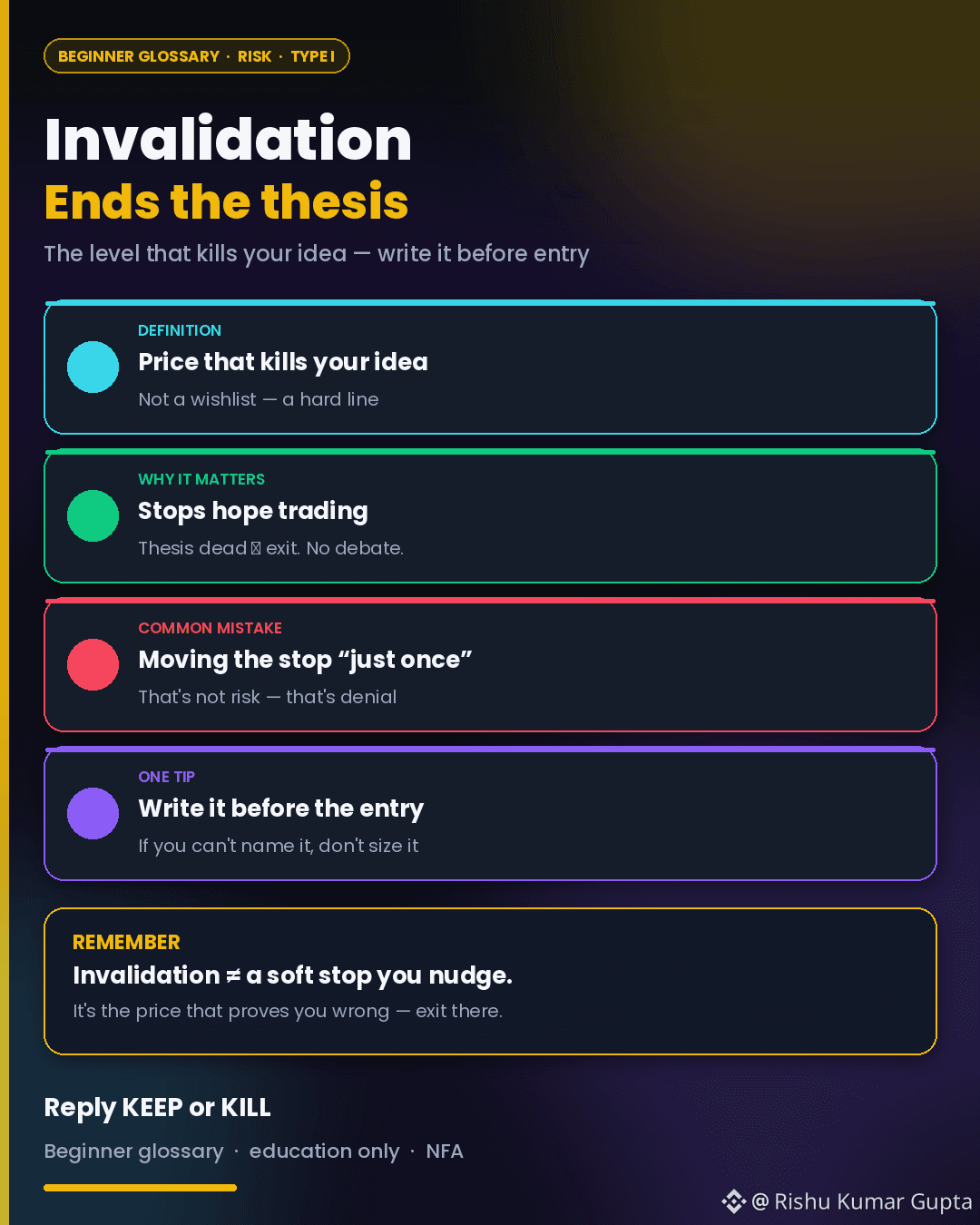
Invalidation = the price that kills your thesis.
Not a soft stop you nudge. A hard line you write BEFORE entry.
Why it matters: stops hope trading.
Trap: moving the stop "just once."
Tip: if you can't name the invalidation, don't size the trade.
Reply KEEP or KILL
$BNB #BinanceSquare #TradingBasics #Crypto
Invalidation = the price that kills your thesis.
Not a soft stop you nudge. A hard line you write BEFORE entry.
Why it matters: stops hope trading.
Trap: moving the stop "just once."
Tip: if you can't name the invalidation, don't size the trade.
Reply KEEP or KILL
$BNB #BinanceSquare #TradingBasics #Crypto
Not a soft stop you nudge. A hard line you write BEFORE entry.
Why it matters: stops hope trading.
Trap: moving the stop "just once."
Tip: if you can't name the invalidation, don't size the trade.
Reply KEEP or KILL
$BNB #BinanceSquare #TradingBasics #Crypto
31
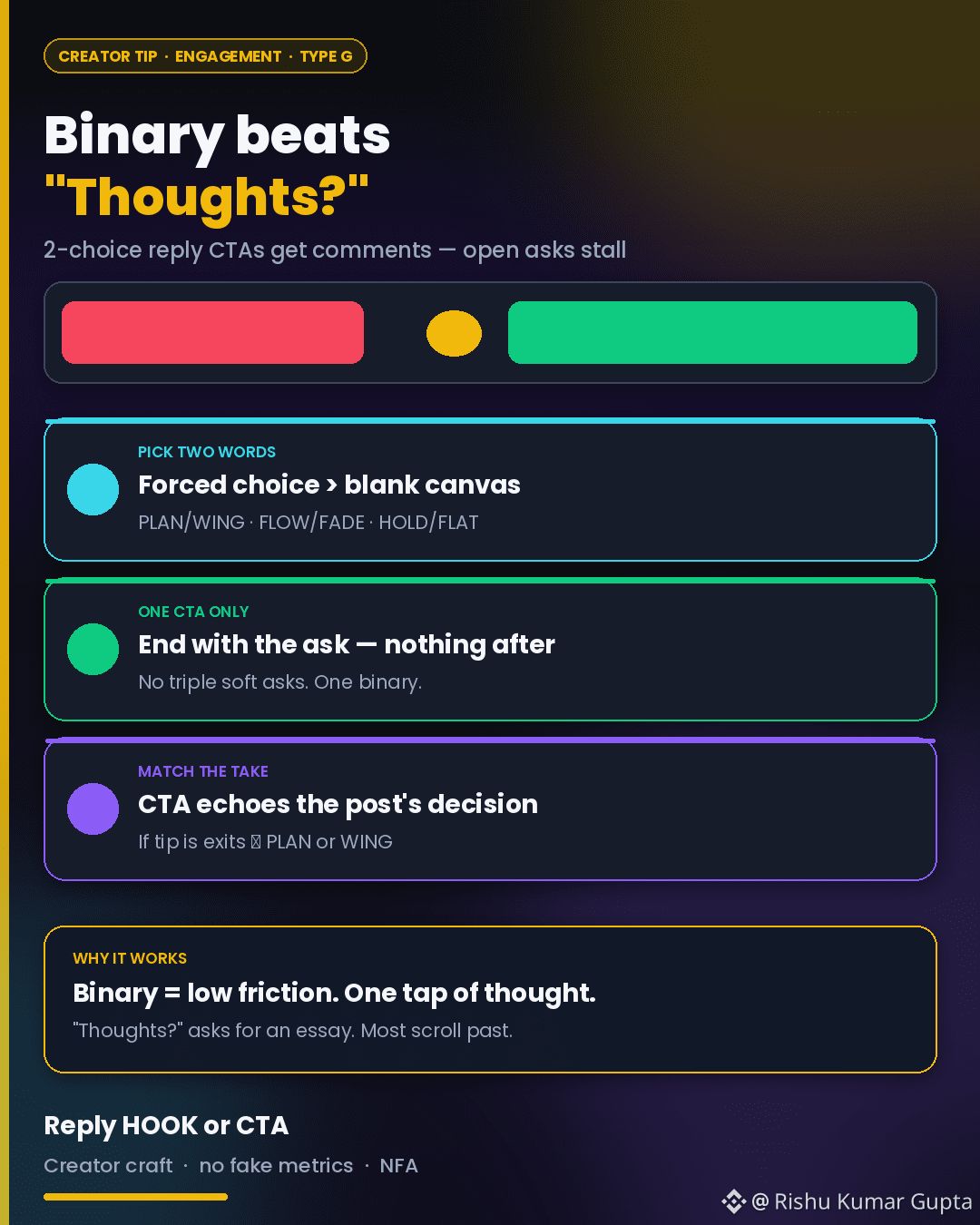
Binary reply CTAs beat "Thoughts?" every time.
Open asks request an essay — most people scroll past. A 2-choice prompt is low friction: one tap of thought.
3 rules I use on Square:
1) Pick two words (PLAN/WING · FLOW/FADE · HOLD/FLAT)
2) One CTA only — end with the ask, nothing after
3) Match the CTA to the takeaway
No fake metrics. Just clearer asks.
Reply HOOK or CTA
#BinanceSquare #Crypto
Binary reply CTAs beat "Thoughts?" every time.
Open asks request an essay — most people scroll past. A 2-choice prompt is low friction: one tap of thought.
3 rules I use on Square:
1) Pick two words (PLAN/WING · FLOW/FADE · HOLD/FLAT)
2) One CTA only — end with the ask, nothing after
3) Match the CTA to the takeaway
No fake metrics. Just clearer asks.
Reply HOOK or CTA
#BinanceSquare #Crypto
Open asks request an essay — most people scroll past. A 2-choice prompt is low friction: one tap of thought.
3 rules I use on Square:
1) Pick two words (PLAN/WING · FLOW/FADE · HOLD/FLAT)
2) One CTA only — end with the ask, nothing after
3) Match the CTA to the takeaway
No fake metrics. Just clearer asks.
Reply HOOK or CTA
#BinanceSquare #Crypto
28
Article
Write the Exit Before the EntryMost traders obsess over the entry candle.
Very few write the exit first.
That's why stops get walked, size gets inflated by "conviction," and one bad add turns a plan into a hope trade.
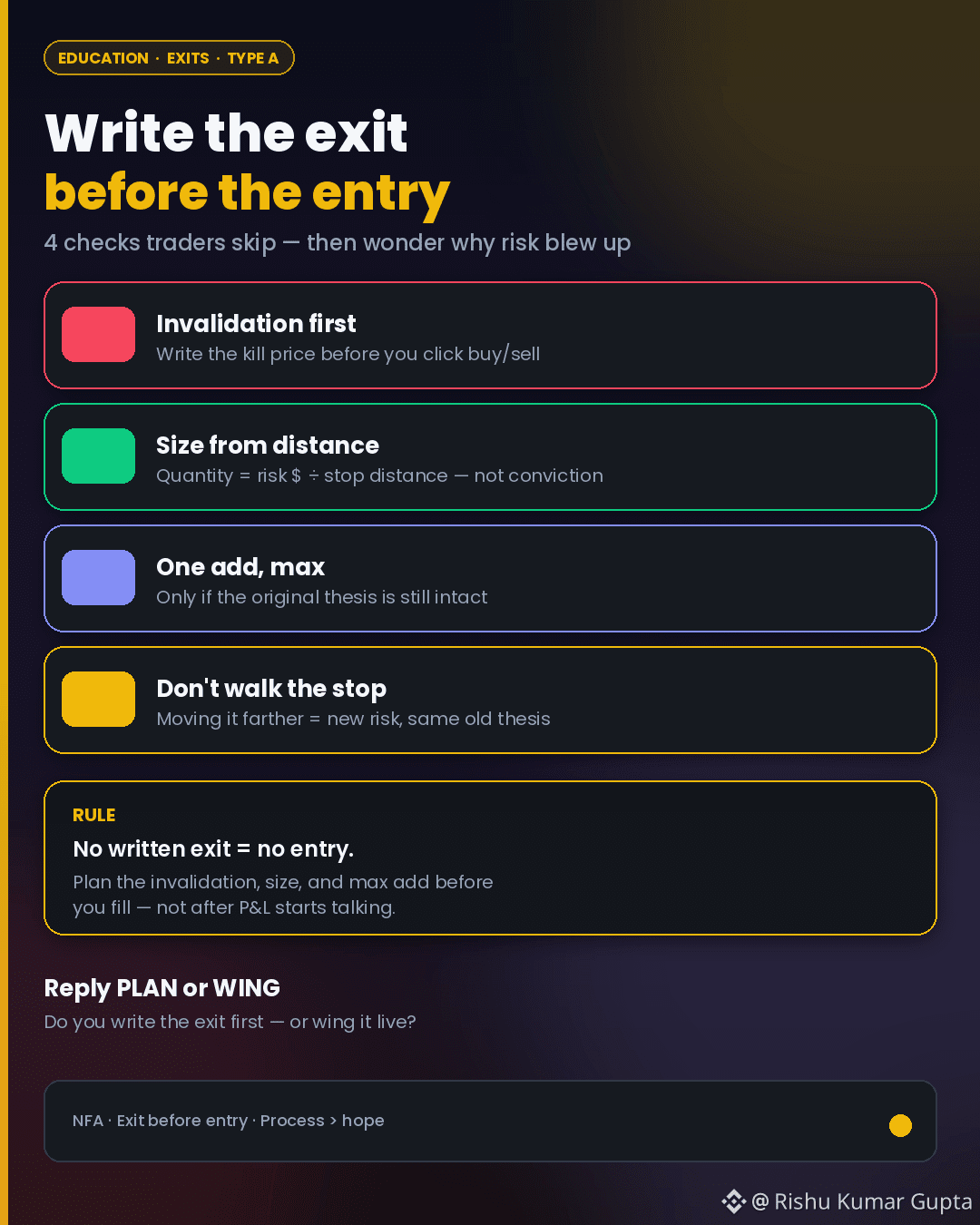
Here is a simple pre-trade checklist. Four checks. No ticker required.
1) Invalidation price — written first
Before you size, write the exact price (or condition) that kills the idea.
If you can't name it in one line, you don't have a trade — you have a wish.
2) Size from stop distance, not conviction
Risk $ ÷ distance to invalidation = quantity.
Feeling "sure" does not widen your account. Distance does.
Big conviction + tiny stop distance still equals oversized risk if you skip the math.
3) One add, max — and only if thesis intact
One scale-in is allowed only when the original reason to be in is still true.
If you are adding because you are underwater, that is not an add. That is averaging hope.
4) If you move the stop farther, you rewrote risk
Widening a stop without rewriting the thesis is a silent leverage increase.
Same idea. Bigger loss. Pretending nothing changed.
Rule: no written exit = no entry.
Plan the invalidation, the size, and the max add before you fill — not after P&L starts talking.
Reply PLAN if you write the exit first.
Reply WING if you usually figure it out live.
NFA — educational framework only, not financial advice.
#Trading #CryptoEducation
Write the Exit Before the Entry
Most traders obsess over the entry candle.
Very few write the exit first.
That's why stops get walked, size gets inflated by "conviction," and one bad add turns a plan into a hope trade.
Here is a simple pre-trade checklist. Four checks. No ticker required.
1) Invalidation price — written first
Before you size, write the exact price (or condition) that kills the idea.
If you can't name it in one line, you don't have a trade — you have a wish.
2) Size from stop distance, not conviction
Risk $ ÷ distance to invalidation = quantity.
Feeling "sure" does not widen your account. Distance does.
Big conviction + tiny stop distance still equals oversized risk if you skip the math.
3) One add, max — and only if thesis intact
One scale-in is allowed only when the original reason to be in is still true.
If you are adding because you are underwater, that is not an add. That is averaging hope.
4) If you move the stop farther, you rewrote risk
Widening a stop without rewriting the thesis is a silent leverage increase.
Same idea. Bigger loss. Pretending nothing changed.
Rule: no written exit = no entry.
Plan the invalidation, the size, and the max add before you fill — not after P&L starts talking.
Reply PLAN if you write the exit first.
Reply WING if you usually figure it out live.
NFA — educational framework only, not financial advice.
#Trading #CryptoEducation
Very few write the exit first.
That's why stops get walked, size gets inflated by "conviction," and one bad add turns a plan into a hope trade.
Here is a simple pre-trade checklist. Four checks. No ticker required.
1) Invalidation price — written first
Before you size, write the exact price (or condition) that kills the idea.
If you can't name it in one line, you don't have a trade — you have a wish.
2) Size from stop distance, not conviction
Risk $ ÷ distance to invalidation = quantity.
Feeling "sure" does not widen your account. Distance does.
Big conviction + tiny stop distance still equals oversized risk if you skip the math.
3) One add, max — and only if thesis intact
One scale-in is allowed only when the original reason to be in is still true.
If you are adding because you are underwater, that is not an add. That is averaging hope.
4) If you move the stop farther, you rewrote risk
Widening a stop without rewriting the thesis is a silent leverage increase.
Same idea. Bigger loss. Pretending nothing changed.
Rule: no written exit = no entry.
Plan the invalidation, the size, and the max add before you fill — not after P&L starts talking.
Reply PLAN if you write the exit first.
Reply WING if you usually figure it out live.
NFA — educational framework only, not financial advice.
#Trading #CryptoEducation
60
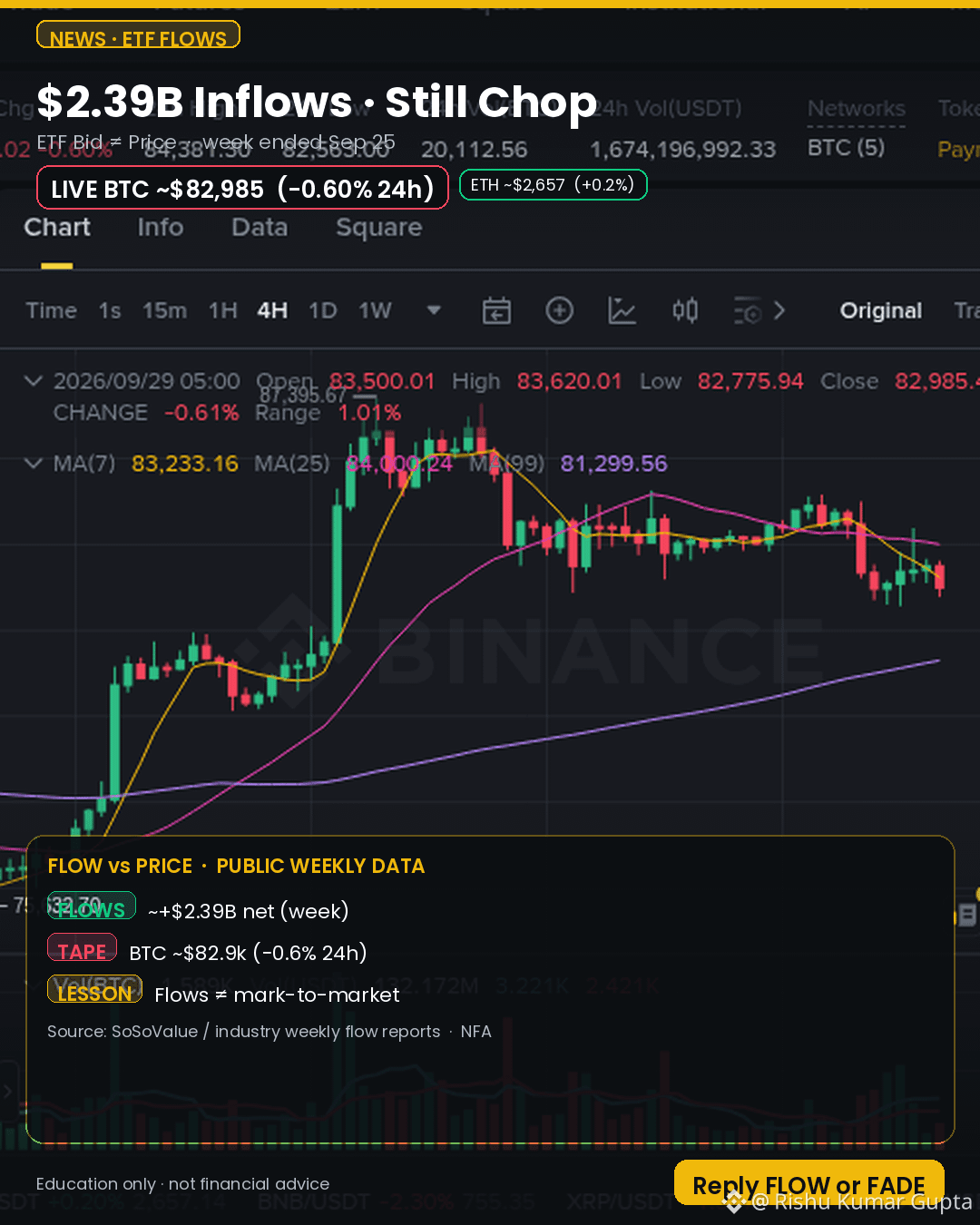
ETF flows ≠ automatic green candles.
U.S. spot BTC ETFs pulled ~$2.39B net inflows in the week ended Sep 25 — while BTC still slipped ~2.3% on the week. Bid can build under the tape while price chops.
Live: $BTC ~$82,985 (−0.60% 24h) · $ETH ~$2,657 (+0.2%)
Filter: size to structure + invalidation, not flow headlines alone.
Reply FLOW or FADE
#Bitcoin #ETF #Crypto
ETF flows ≠ automatic green candles.
U.S. spot BTC ETFs pulled ~$2.39B net inflows in the week ended Sep 25 — while BTC still slipped ~2.3% on the week. Bid can build under the tape while price chops.
Live: $BTC ~$82,985 (−0.60% 24h) · $ETH ~$2,657 (+0.2%)
Filter: size to structure + invalidation, not flow headlines alone.
Reply FLOW or FADE
#Bitcoin #ETF #Crypto
U.S. spot BTC ETFs pulled ~$2.39B net inflows in the week ended Sep 25 — while BTC still slipped ~2.3% on the week. Bid can build under the tape while price chops.
Live: $BTC ~$82,985 (−0.60% 24h) · $ETH ~$2,657 (+0.2%)
Filter: size to structure + invalidation, not flow headlines alone.
Reply FLOW or FADE
#Bitcoin #ETF #Crypto
87
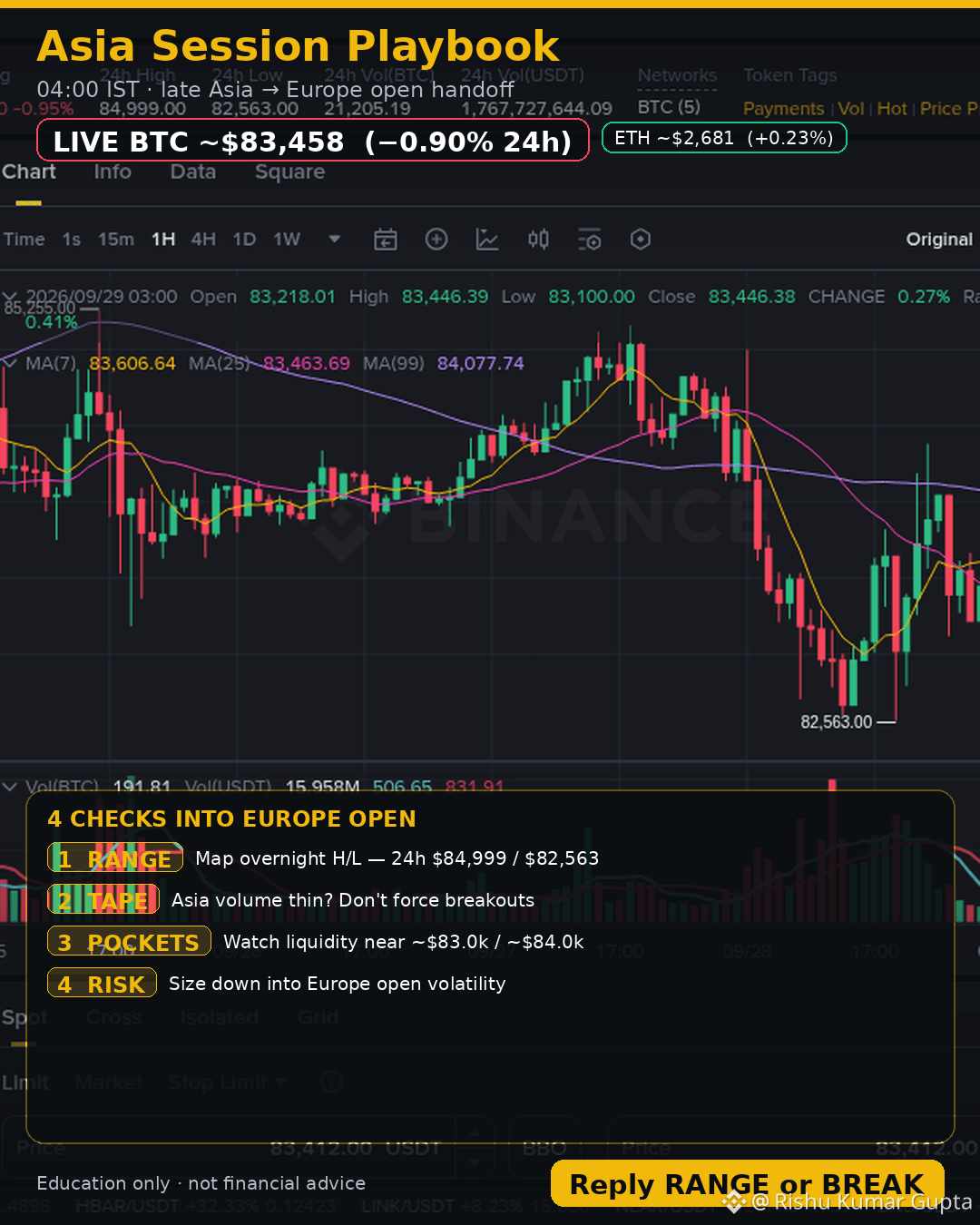
Asia session playbook — late Asia into Europe open 🧭
4 checks before you size up:
1) Map overnight range (BTC 24h H/L $84,999 / $82,563)
2) Tape — thin Asia volume? don’t force breakouts
3) Liquidity pockets near ~$83.0k / ~$84.0k
4) Risk — size down into Europe open volatility
Live: $BTC ~$83,458 (−0.90% 24h) · $ETH ~$2,681 (+0.23%)
Reply RANGE or BREAK 👇
#BTC #ETH #Crypto
Asia session playbook — late Asia into Europe open 🧭
4 checks before you size up:
1) Map overnight range (BTC 24h H/L $84,999 / $82,563)
2) Tape — thin Asia volume? don’t force breakouts
3) Liquidity pockets near ~$83.0k / ~$84.0k
4) Risk — size down into Europe open volatility
Live: $BTC ~$83,458 (−0.90% 24h) · $ETH ~$2,681 (+0.23%)
Reply RANGE or BREAK 👇
#BTC #ETH #Crypto
4 checks before you size up:
1) Map overnight range (BTC 24h H/L $84,999 / $82,563)
2) Tape — thin Asia volume? don’t force breakouts
3) Liquidity pockets near ~$83.0k / ~$84.0k
4) Risk — size down into Europe open volatility
Live: $BTC ~$83,458 (−0.90% 24h) · $ETH ~$2,681 (+0.23%)
Reply RANGE or BREAK 👇
#BTC #ETH #Crypto
26
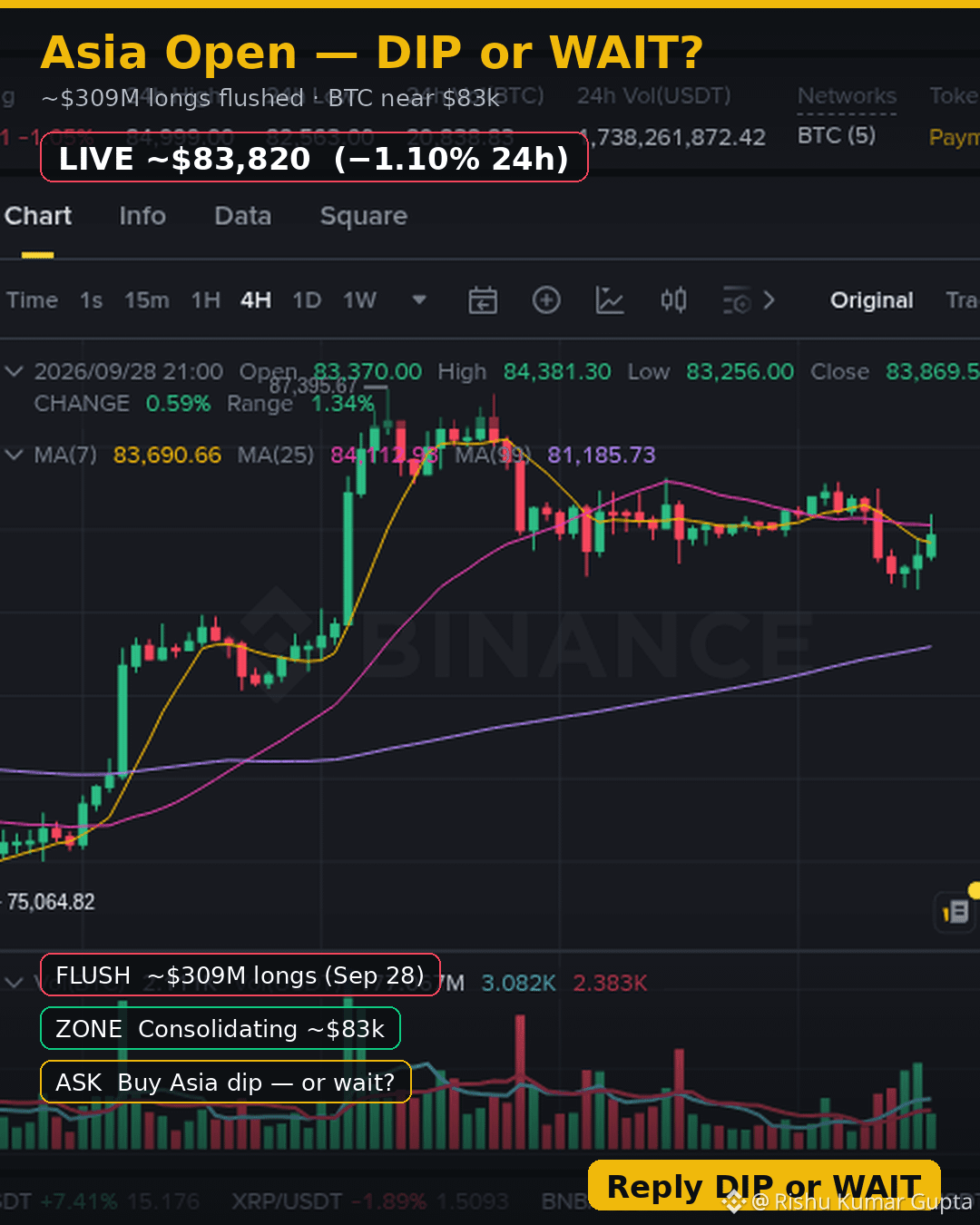
After ~$309M longs flushed — Asia open decision.
BTC ~$83,820 (−1.10% 24h). Leverage got clipped; price is consolidating near ~$83k, not collapsing.
Before you size:
• Thesis still valid after the flush?
• Buying liquidity — or catching a knife?
• What's your invalidation if $80k comes into play?
Buying the Asia dip — or waiting for lower?
Reply DIP or WAIT
$BTC
#BinanceSquare #Crypto #Trading
After ~$309M longs flushed — Asia open decision.
BTC ~$83,820 (−1.10% 24h). Leverage got clipped; price is consolidating near ~$83k, not collapsing.
Before you size:
• Thesis still valid after the flush?
• Buying liquidity — or catching a knife?
• What's your invalidation if $80k comes into play?
Buying the Asia dip — or waiting for lower?
Reply DIP or WAIT
$BTC
#BinanceSquare #Crypto #Trading
BTC ~$83,820 (−1.10% 24h). Leverage got clipped; price is consolidating near ~$83k, not collapsing.
Before you size:
• Thesis still valid after the flush?
• Buying liquidity — or catching a knife?
• What's your invalidation if $80k comes into play?
Buying the Asia dip — or waiting for lower?
Reply DIP or WAIT
$BTC
#BinanceSquare #Crypto #Trading
59
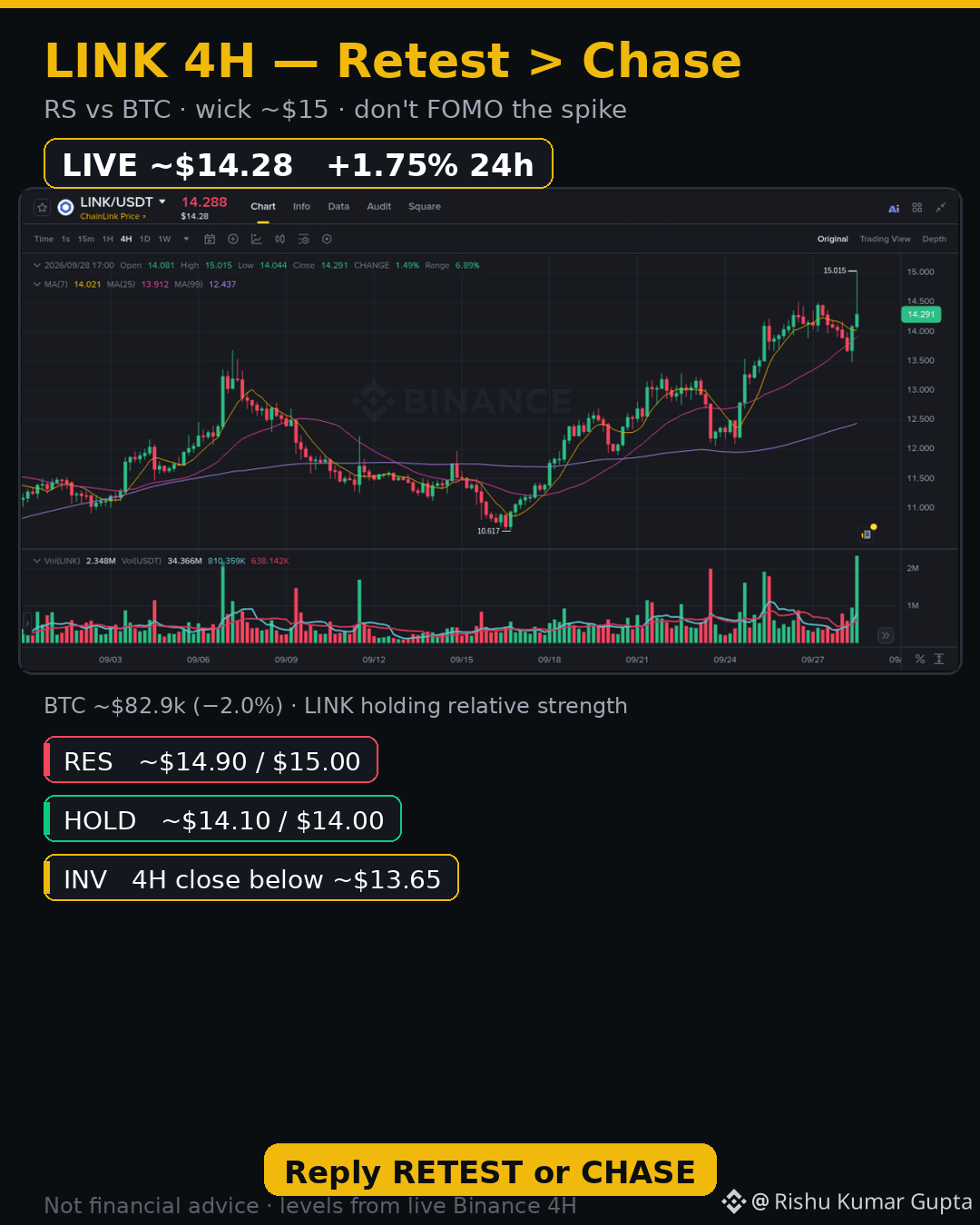
$LINK 4H: relative strength while $BTC slips — but that ~$15 wick is FOMO bait.
Live ~$14.28 (+1.75% 24h) vs BTC ~$82.9k (−2.0%).
RES ~$14.90 / $15.00 · HOLD ~$14.10 / $14.00 · INV: 4H close below ~$13.65
Prefer the retest of hold over chasing the spike. Levels from live Binance 4H — not financial advice.
Reply RETEST or CHASE
#Chainlink #CryptoTrading #BinanceSquare
$LINK 4H: relative strength while $BTC slips — but that ~$15 wick is FOMO bait.
Live ~$14.28 (+1.75% 24h) vs BTC ~$82.9k (−2.0%).
RES ~$14.90 / $15.00 · HOLD ~$14.10 / $14.00 · INV: 4H close below ~$13.65
Prefer the retest of hold over chasing the spike. Levels from live Binance 4H — not financial advice.
Reply RETEST or CHASE
#Chainlink #CryptoTrading #BinanceSquare
Live ~$14.28 (+1.75% 24h) vs BTC ~$82.9k (−2.0%).
RES ~$14.90 / $15.00 · HOLD ~$14.10 / $14.00 · INV: 4H close below ~$13.65
Prefer the retest of hold over chasing the spike. Levels from live Binance 4H — not financial advice.
Reply RETEST or CHASE
#Chainlink #CryptoTrading #BinanceSquare
68
Article
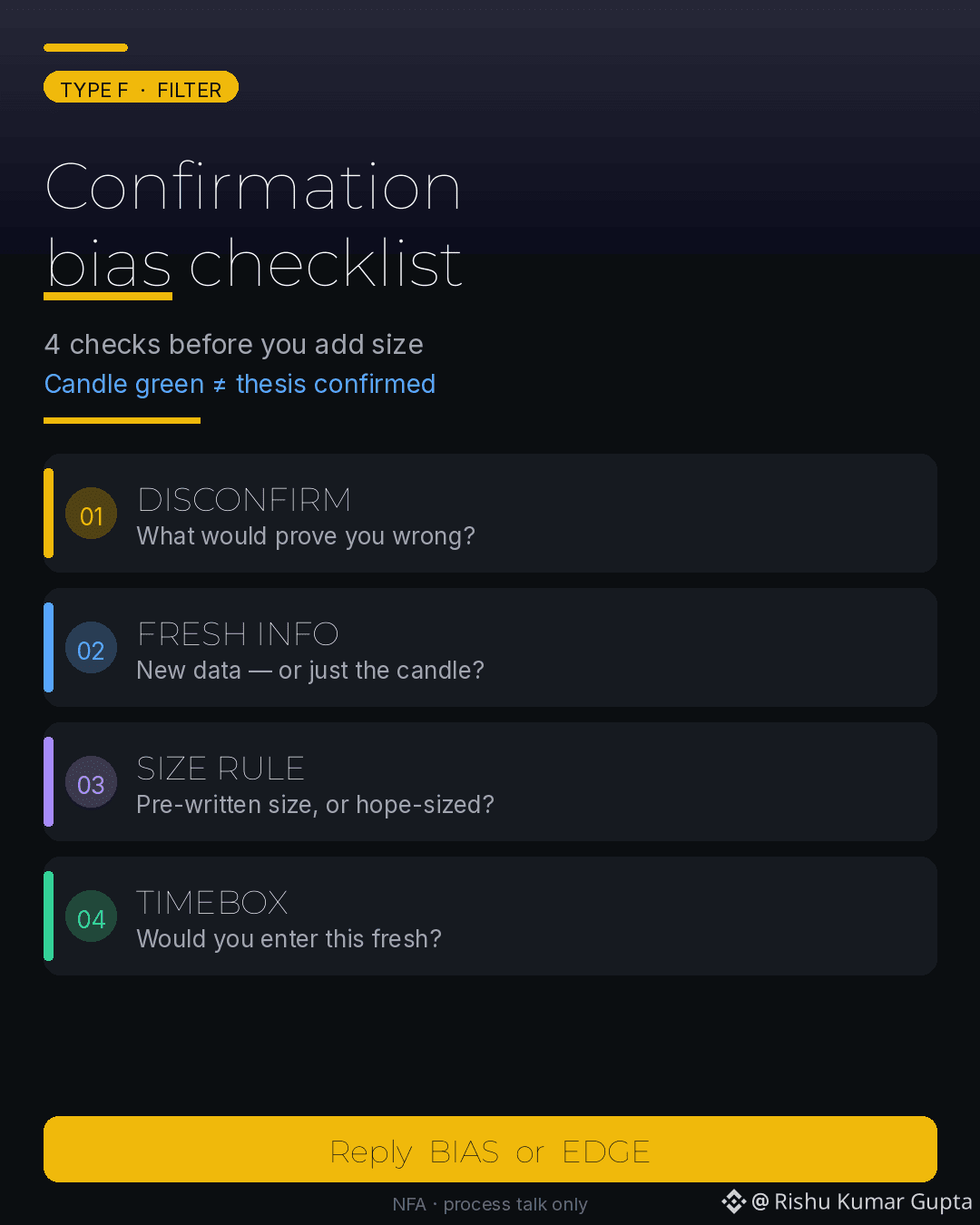
Confirmation Bias ChecklistPrice going your way feels like proof. Often it is just confirmation bias.
Before you ADD size after a green candle, run these 4 checks:
1) DISCONFIRM — Write what would prove you wrong. If you cannot name it, you are hoping — not trading.
2) FRESH INFO — Did new data arrive, or did the candle alone change your mind? Chart motion is not a catalyst.
3) SIZE RULE — Is the add size pre-written in your plan, or did hope inflate it? Hope-sized adds are how winners become accounts under water.
4) TIMEBOX — Would you enter this same size fresh right now with no open bag? If no, do not add.
Green ≠ confirmed. Edge is the plan that survives a red candle too.
Reply BIAS if you have added on hope before — or EDGE if you already write the kill checks first.
NFA · process talk only
#TradingPsychology #RiskManagement #BinanceSquare
Confirmation Bias Checklist
Price going your way feels like proof. Often it is just confirmation bias.
Before you ADD size after a green candle, run these 4 checks:
1) DISCONFIRM — Write what would prove you wrong. If you cannot name it, you are hoping — not trading.
2) FRESH INFO — Did new data arrive, or did the candle alone change your mind? Chart motion is not a catalyst.
3) SIZE RULE — Is the add size pre-written in your plan, or did hope inflate it? Hope-sized adds are how winners become accounts under water.
4) TIMEBOX — Would you enter this same size fresh right now with no open bag? If no, do not add.
Green ≠ confirmed. Edge is the plan that survives a red candle too.
Reply BIAS if you have added on hope before — or EDGE if you already write the kill checks first.
NFA · process talk only
#TradingPsychology #RiskManagement #BinanceSquare
Before you ADD size after a green candle, run these 4 checks:
1) DISCONFIRM — Write what would prove you wrong. If you cannot name it, you are hoping — not trading.
2) FRESH INFO — Did new data arrive, or did the candle alone change your mind? Chart motion is not a catalyst.
3) SIZE RULE — Is the add size pre-written in your plan, or did hope inflate it? Hope-sized adds are how winners become accounts under water.
4) TIMEBOX — Would you enter this same size fresh right now with no open bag? If no, do not add.
Green ≠ confirmed. Edge is the plan that survives a red candle too.
Reply BIAS if you have added on hope before — or EDGE if you already write the kill checks first.
NFA · process talk only
#TradingPsychology #RiskManagement #BinanceSquare
47
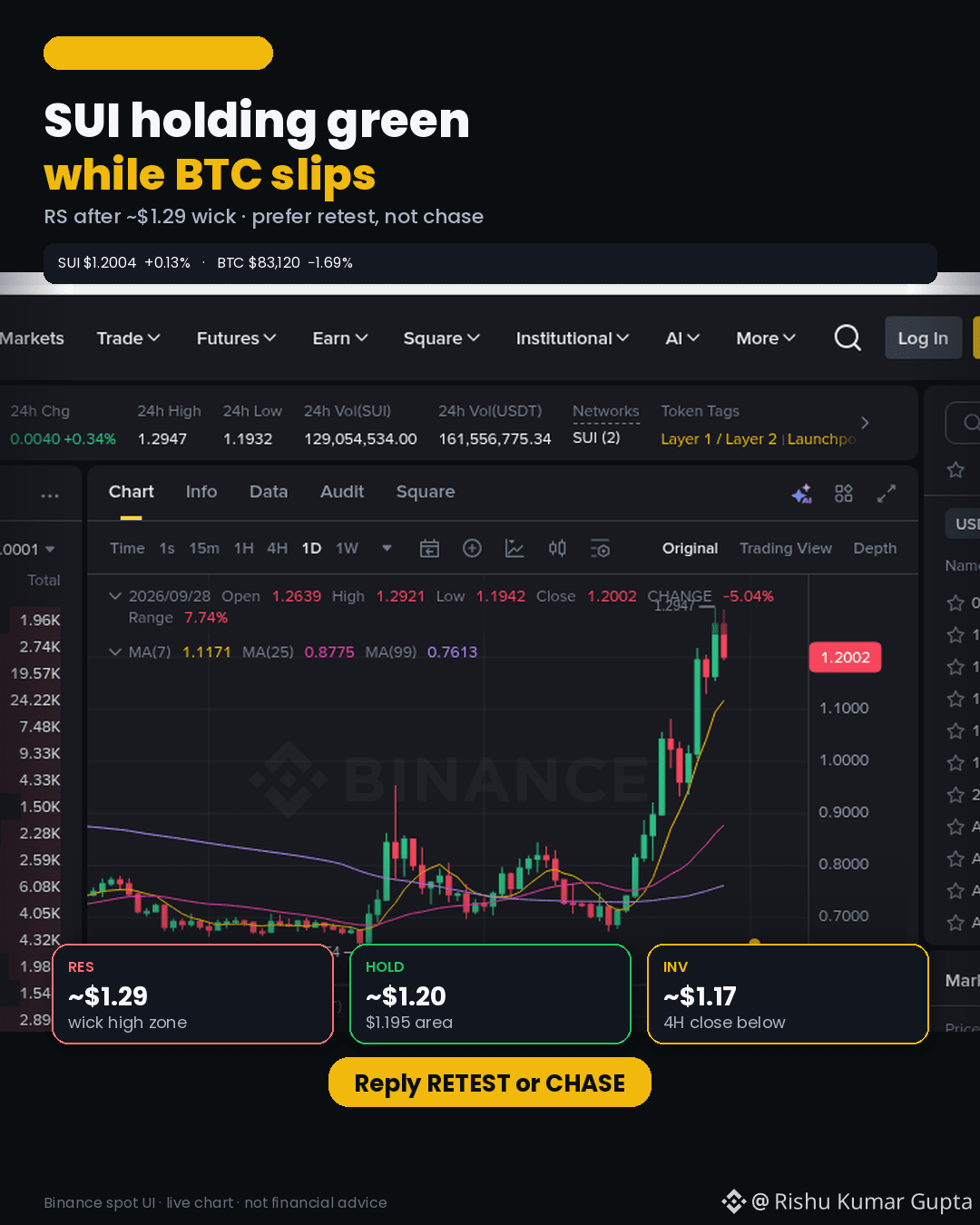
$SUI showing relative strength while $BTC slips.
Live: SUI ~$1.2004 (+0.13% 24h) vs BTC ~$83,120 (−1.69%). After the wick toward ~$1.29, price is back near ~$1.20 — prefer a hold/retest over chasing the spike.
Levels:
• RES ~$1.29 (wick high)
• HOLD ~$1.20 / $1.195
• INV: 4H close below ~$1.17
Reply RETEST or CHASE — which filter are you using?
#SUI #BTC #Crypto
$SUI showing relative strength while $BTC slips.
Live: SUI ~$1.2004 (+0.13% 24h) vs BTC ~$83,120 (−1.69%). After the wick toward ~$1.29, price is back near ~$1.20 — prefer a hold/retest over chasing the spike.
Levels:
• RES ~$1.29 (wick high)
• HOLD ~$1.20 / $1.195
• INV: 4H close below ~$1.17
Reply RETEST or CHASE — which filter are you using?
#SUI #BTC #Crypto
Live: SUI ~$1.2004 (+0.13% 24h) vs BTC ~$83,120 (−1.69%). After the wick toward ~$1.29, price is back near ~$1.20 — prefer a hold/retest over chasing the spike.
Levels:
• RES ~$1.29 (wick high)
• HOLD ~$1.20 / $1.195
• INV: 4H close below ~$1.17
Reply RETEST or CHASE — which filter are you using?
#SUI #BTC #Crypto
134
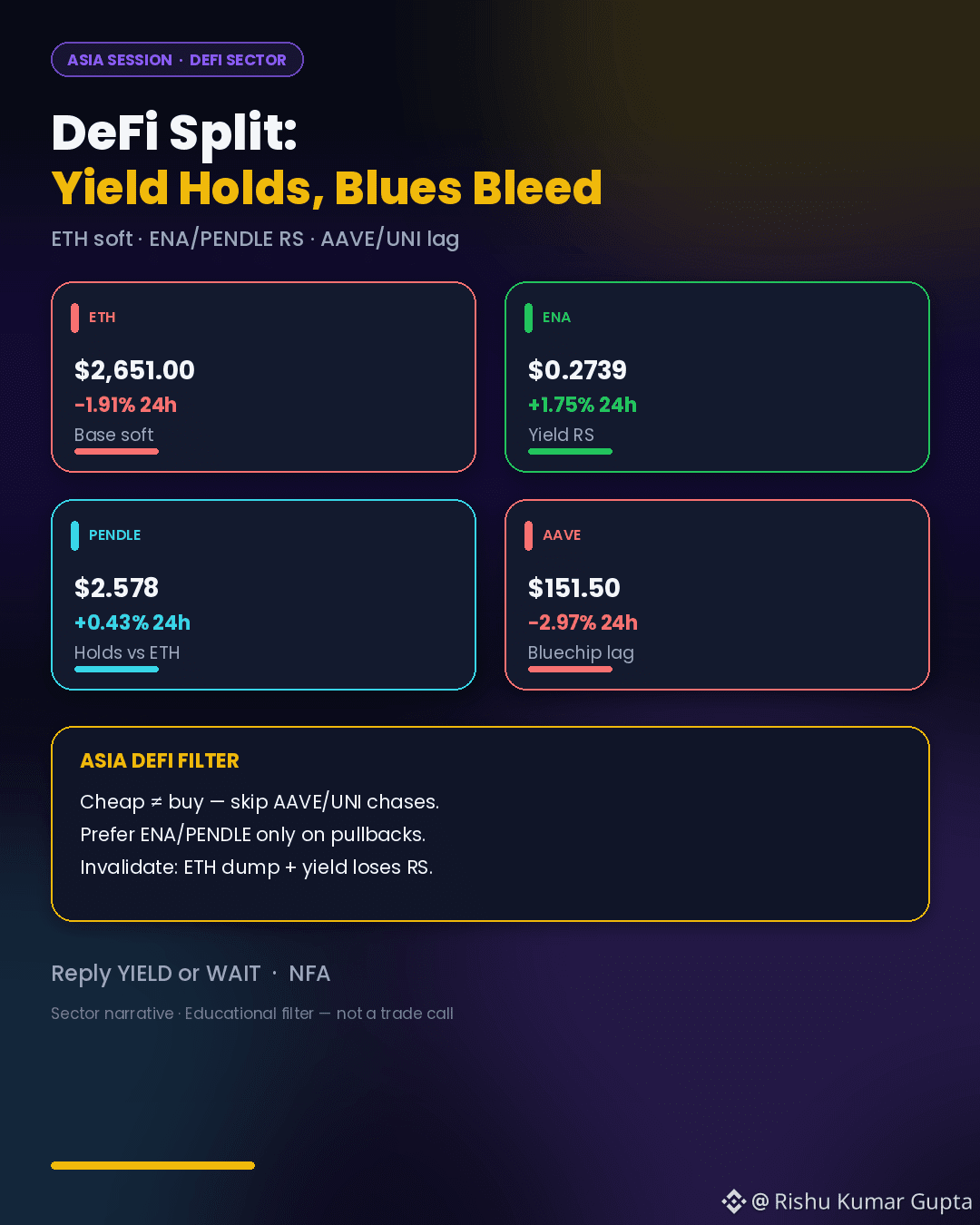
Asia DeFi isn't moving as one tape.
ETH soft (−1.9%). Bluechips lag harder: AAVE −3.0%, UNI −3.5%. Yield rails hold RS: ENA +1.8%, PENDLE flat-to-green.
Filter: cheap ≠ buy. Prefer relative strength on a pullback — or wait until ETH and bluechips reclaim together.
Invalidate: ETH dump + yield names lose RS in the same move.
Reply YIELD or WAIT — which side are you sizing into this Asia session?
NFA — education / sector filter only.
$ENA $PENDLE $AAVE #DeFi #BinanceSquare #AsiaSession
Asia DeFi isn't moving as one tape.
ETH soft (−1.9%). Bluechips lag harder: AAVE −3.0%, UNI −3.5%. Yield rails hold RS: ENA +1.8%, PENDLE flat-to-green.
Filter: cheap ≠ buy. Prefer relative strength on a pullback — or wait until ETH and bluechips reclaim together.
Invalidate: ETH dump + yield names lose RS in the same move.
Reply YIELD or WAIT — which side are you sizing into this Asia session?
NFA — education / sector filter only.
$ENA $PENDLE $AAVE #DeFi #BinanceSquare #AsiaSession
ETH soft (−1.9%). Bluechips lag harder: AAVE −3.0%, UNI −3.5%. Yield rails hold RS: ENA +1.8%, PENDLE flat-to-green.
Filter: cheap ≠ buy. Prefer relative strength on a pullback — or wait until ETH and bluechips reclaim together.
Invalidate: ETH dump + yield names lose RS in the same move.
Reply YIELD or WAIT — which side are you sizing into this Asia session?
NFA — education / sector filter only.
$ENA $PENDLE $AAVE #DeFi #BinanceSquare #AsiaSession
343
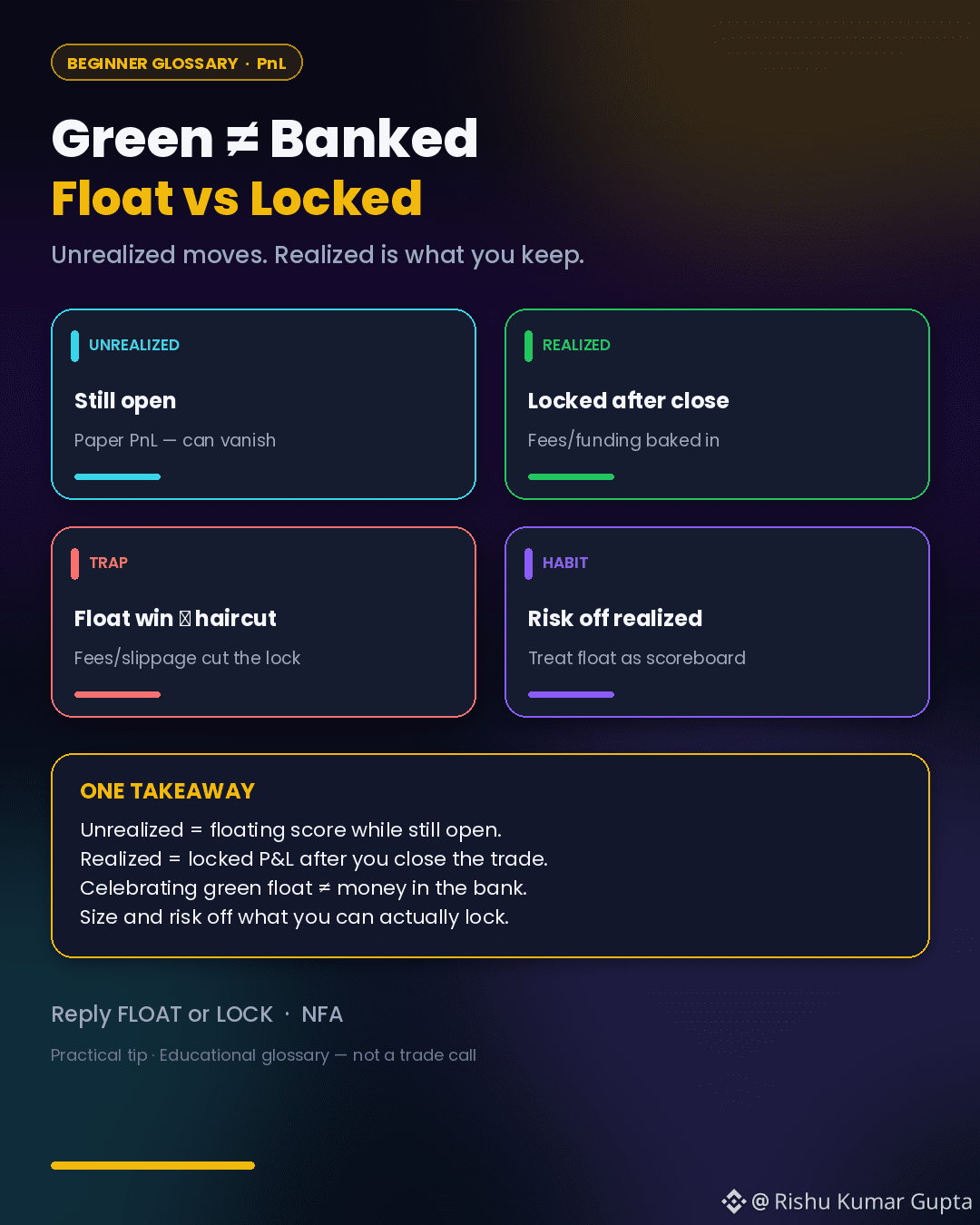
Green on the screen ≠ money in the bank.
Unrealized PnL moves while the trade is open. Realized PnL is what you lock when you close.
Trap: celebrating a floating win, then realizing less after fees/slippage.
Treat unrealized as a scoreboard. Size and risk off what you can actually lock.
Reply FLOAT or LOCK — which do you check first when sizing the next trade?
NFA — education only.
$BNB #BinanceSquare #TradingBasics #PnL
Green on the screen ≠ money in the bank.
Unrealized PnL moves while the trade is open. Realized PnL is what you lock when you close.
Trap: celebrating a floating win, then realizing less after fees/slippage.
Treat unrealized as a scoreboard. Size and risk off what you can actually lock.
Reply FLOAT or LOCK — which do you check first when sizing the next trade?
NFA — education only.
$BNB #BinanceSquare #TradingBasics #PnL
Unrealized PnL moves while the trade is open. Realized PnL is what you lock when you close.
Trap: celebrating a floating win, then realizing less after fees/slippage.
Treat unrealized as a scoreboard. Size and risk off what you can actually lock.
Reply FLOAT or LOCK — which do you check first when sizing the next trade?
NFA — education only.
$BNB #BinanceSquare #TradingBasics #PnL
12
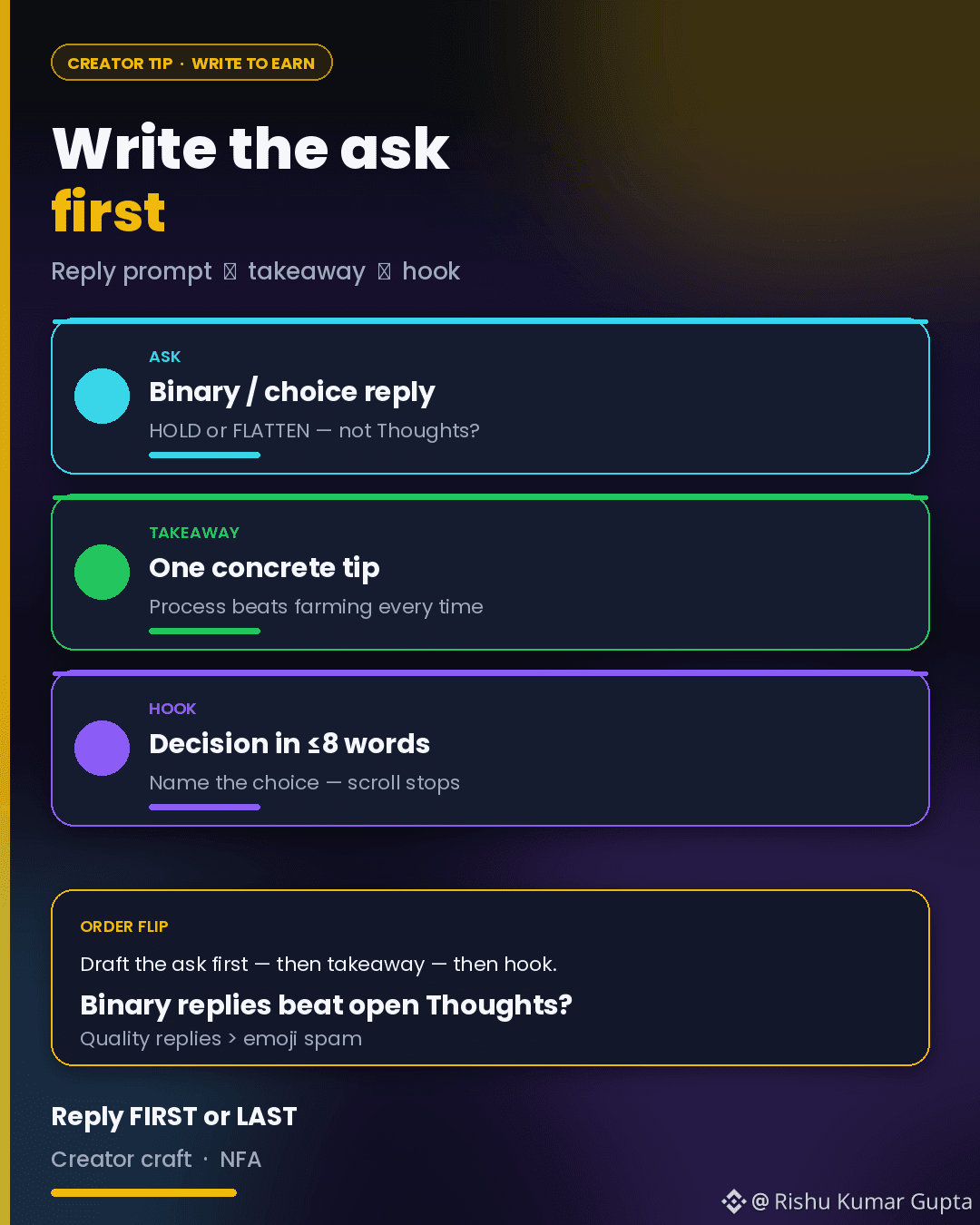
Write the discuss question BEFORE the hook.
Most Square posts die because "Thoughts?" is lazy. Flip the draft order:
1) ASK — binary/choice reply (HOLD or FLATTEN)
2) TAKEAWAY — one concrete tip
3) HOOK — name the decision in ≤8 words
Quality replies > emoji spam. Process beats farming.
Do you draft the ask first — or bolt it on at the end?
Reply FIRST or LAST
#BinanceSquare #WriteToEarn #ContentTips
Write the discuss question BEFORE the hook.
Most Square posts die because "Thoughts?" is lazy. Flip the draft order:
1) ASK — binary/choice reply (HOLD or FLATTEN)
2) TAKEAWAY — one concrete tip
3) HOOK — name the decision in ≤8 words
Quality replies > emoji spam. Process beats farming.
Do you draft the ask first — or bolt it on at the end?
Reply FIRST or LAST
#BinanceSquare #WriteToEarn #ContentTips
Most Square posts die because "Thoughts?" is lazy. Flip the draft order:
1) ASK — binary/choice reply (HOLD or FLATTEN)
2) TAKEAWAY — one concrete tip
3) HOOK — name the decision in ≤8 words
Quality replies > emoji spam. Process beats farming.
Do you draft the ask first — or bolt it on at the end?
Reply FIRST or LAST
#BinanceSquare #WriteToEarn #ContentTips
30
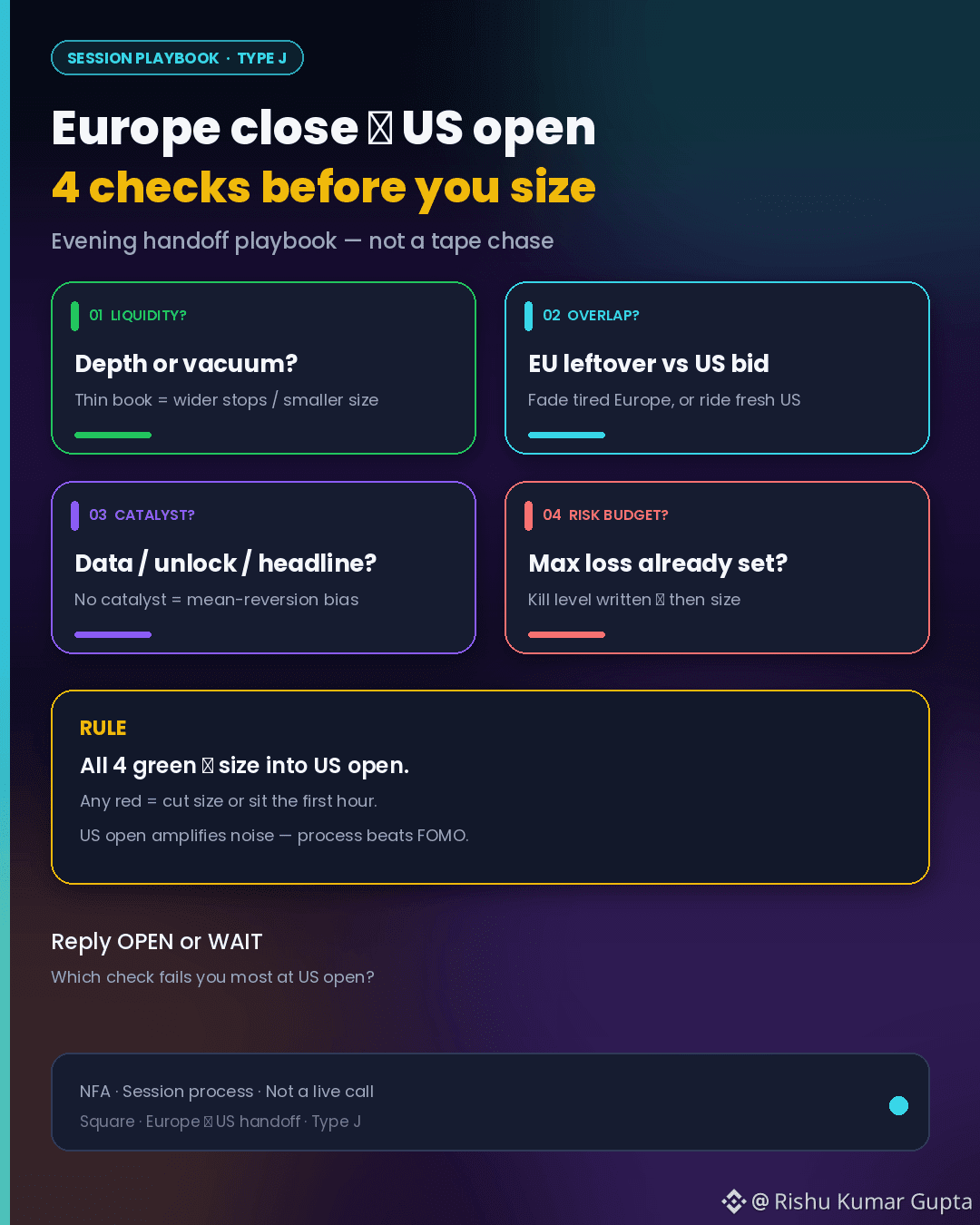
Europe close → US open: 4 checks before you size.
Don't inherit Europe's leftover into the US open. Run this handoff:
1) Liquidity — depth or vacuum? Thin book = wider stops / smaller size.
2) Overlap — EU leftover vs fresh US bid? Fade tired Europe, or ride the open.
3) Catalyst — data / unlock / headline into the open? No catalyst = mean-reversion bias.
4) Risk budget — max loss already written? Kill level first, then size.
All 4 green → OPEN. Any red → WAIT or sit the first hour.
Reply OPEN or WAIT — which check fails you most at US open?
NFA — session process, not a live trade call.
$BTC
#Crypto #Trading #Sessions
Europe close → US open: 4 checks before you size.
Don't inherit Europe's leftover into the US open. Run this handoff:
1) Liquidity — depth or vacuum? Thin book = wider stops / smaller size.
2) Overlap — EU leftover vs fresh US bid? Fade tired Europe, or ride the open.
3) Catalyst — data / unlock / headline into the open? No catalyst = mean-reversion bias.
4) Risk budget — max loss already written? Kill level first, then size.
All 4 green → OPEN. Any red → WAIT or sit the first hour.
Reply OPEN or WAIT — which check fails you most at US open?
NFA — session process, not a live trade call.
$BTC
#Crypto #Trading #Sessions
Don't inherit Europe's leftover into the US open. Run this handoff:
1) Liquidity — depth or vacuum? Thin book = wider stops / smaller size.
2) Overlap — EU leftover vs fresh US bid? Fade tired Europe, or ride the open.
3) Catalyst — data / unlock / headline into the open? No catalyst = mean-reversion bias.
4) Risk budget — max loss already written? Kill level first, then size.
All 4 green → OPEN. Any red → WAIT or sit the first hour.
Reply OPEN or WAIT — which check fails you most at US open?
NFA — session process, not a live trade call.
$BTC
#Crypto #Trading #Sessions
35
Article
Invalidation First: Write the Kill Level Before You SizeMost traders pick a size first — then invent a stop after they're already in.
That's backwards. If you can't write the kill level, you shouldn't be sizing at all.
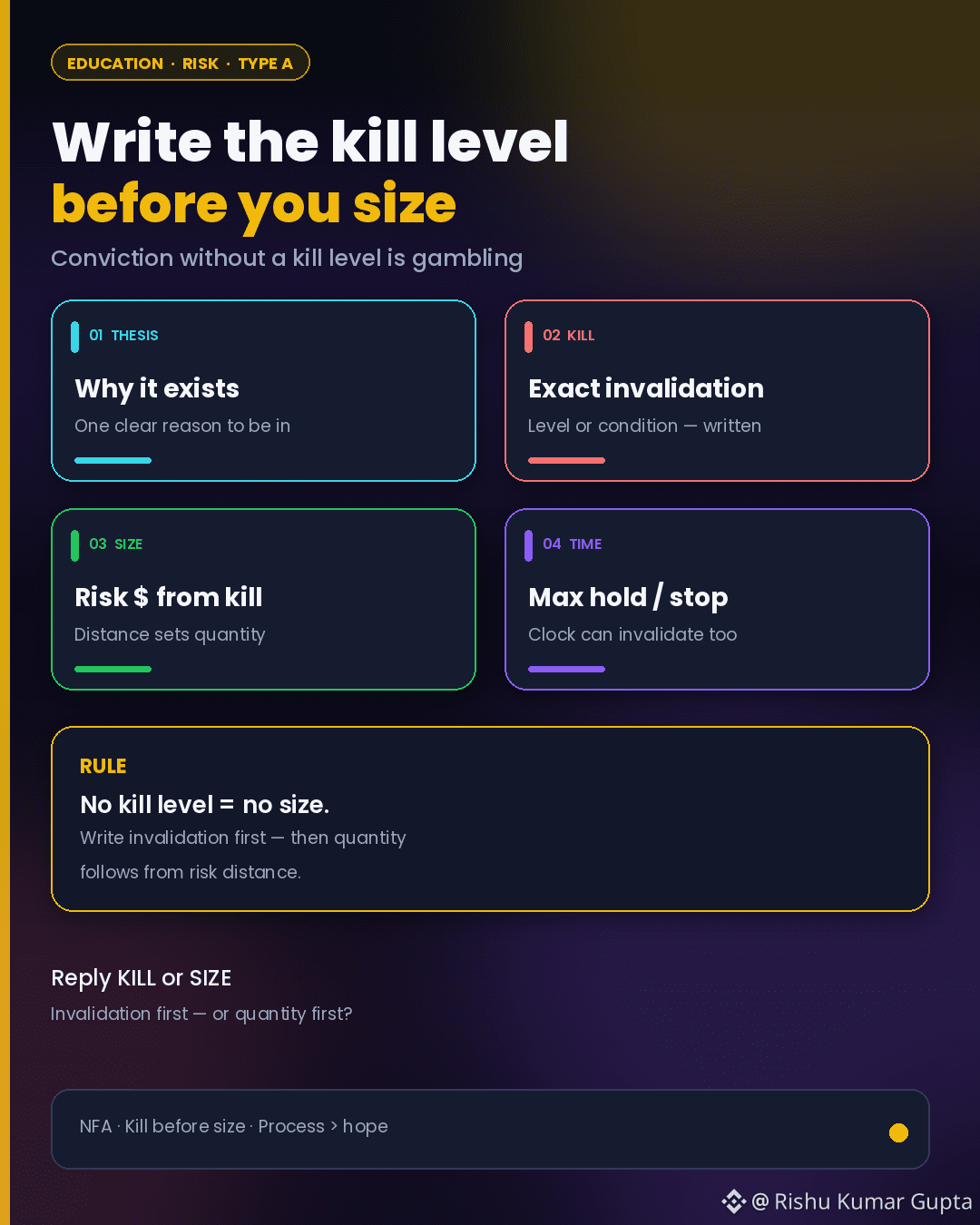
Invalidation First — 4 gates before entry:
1) THESIS — one clear reason the trade exists
2) KILL — exact invalidation (price level or condition), written down
3) SIZE — risk $ from kill distance (quantity follows the stop, not hope)
4) TIME — max hold / time stop (the clock can invalidate too)
Why this order matters: when kill comes before size, you stop moving stops and revenge-adding. The plan already decided what "wrong" looks like.
Reply KILL if you write invalidation before entry, or SIZE if you usually pick quantity first.
NFA — educational framework only, not financial advice.
#RiskManagement #TradingPsychology #CryptoEducation
Invalidation First: Write the Kill Level Before You Size
Most traders pick a size first — then invent a stop after they're already in.
That's backwards. If you can't write the kill level, you shouldn't be sizing at all.
Invalidation First — 4 gates before entry:
1) THESIS — one clear reason the trade exists
2) KILL — exact invalidation (price level or condition), written down
3) SIZE — risk $ from kill distance (quantity follows the stop, not hope)
4) TIME — max hold / time stop (the clock can invalidate too)
Why this order matters: when kill comes before size, you stop moving stops and revenge-adding. The plan already decided what "wrong" looks like.
Reply KILL if you write invalidation before entry, or SIZE if you usually pick quantity first.
NFA — educational framework only, not financial advice.
#RiskManagement #TradingPsychology #CryptoEducation
That's backwards. If you can't write the kill level, you shouldn't be sizing at all.
Invalidation First — 4 gates before entry:
1) THESIS — one clear reason the trade exists
2) KILL — exact invalidation (price level or condition), written down
3) SIZE — risk $ from kill distance (quantity follows the stop, not hope)
4) TIME — max hold / time stop (the clock can invalidate too)
Why this order matters: when kill comes before size, you stop moving stops and revenge-adding. The plan already decided what "wrong" looks like.
Reply KILL if you write invalidation before entry, or SIZE if you usually pick quantity first.
NFA — educational framework only, not financial advice.
#RiskManagement #TradingPsychology #CryptoEducation
36
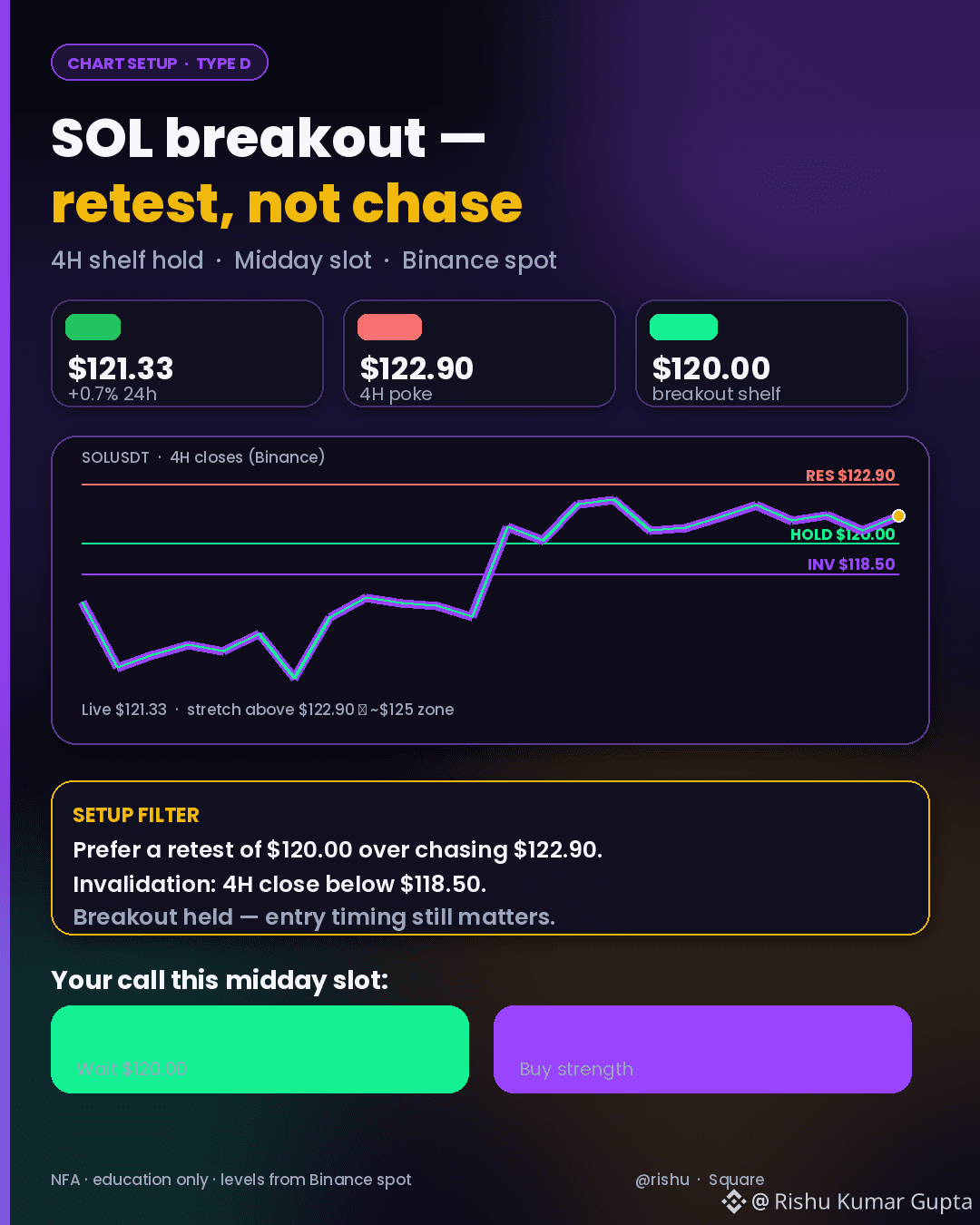
SOL broke out and is holding the shelf — live ~$121.33, poking $122.90.
4H filter for this midday slot:
• Live ~$121.33 (+0.7% 24h)
• Resistance / poke: $122.90
• Prefer hold/retest: $120.00 (breakout shelf)
• Invalidation: 4H close below $118.50
Breakout held. Entry timing still matters — retest of the shelf beats chasing the wick.
Reply RETEST or CHASE.
NFA — education only. Levels from Binance spot.
$SOL $BTC #ChartSetup #Solana #Altcoins
SOL broke out and is holding the shelf — live ~$121.33, poking $122.90.
4H filter for this midday slot:
• Live ~$121.33 (+0.7% 24h)
• Resistance / poke: $122.90
• Prefer hold/retest: $120.00 (breakout shelf)
• Invalidation: 4H close below $118.50
Breakout held. Entry timing still matters — retest of the shelf beats chasing the wick.
Reply RETEST or CHASE.
NFA — education only. Levels from Binance spot.
$SOL $BTC #ChartSetup #Solana #Altcoins
4H filter for this midday slot:
• Live ~$121.33 (+0.7% 24h)
• Resistance / poke: $122.90
• Prefer hold/retest: $120.00 (breakout shelf)
• Invalidation: 4H close below $118.50
Breakout held. Entry timing still matters — retest of the shelf beats chasing the wick.
Reply RETEST or CHASE.
NFA — education only. Levels from Binance spot.
$SOL $BTC #ChartSetup #Solana #Altcoins
65
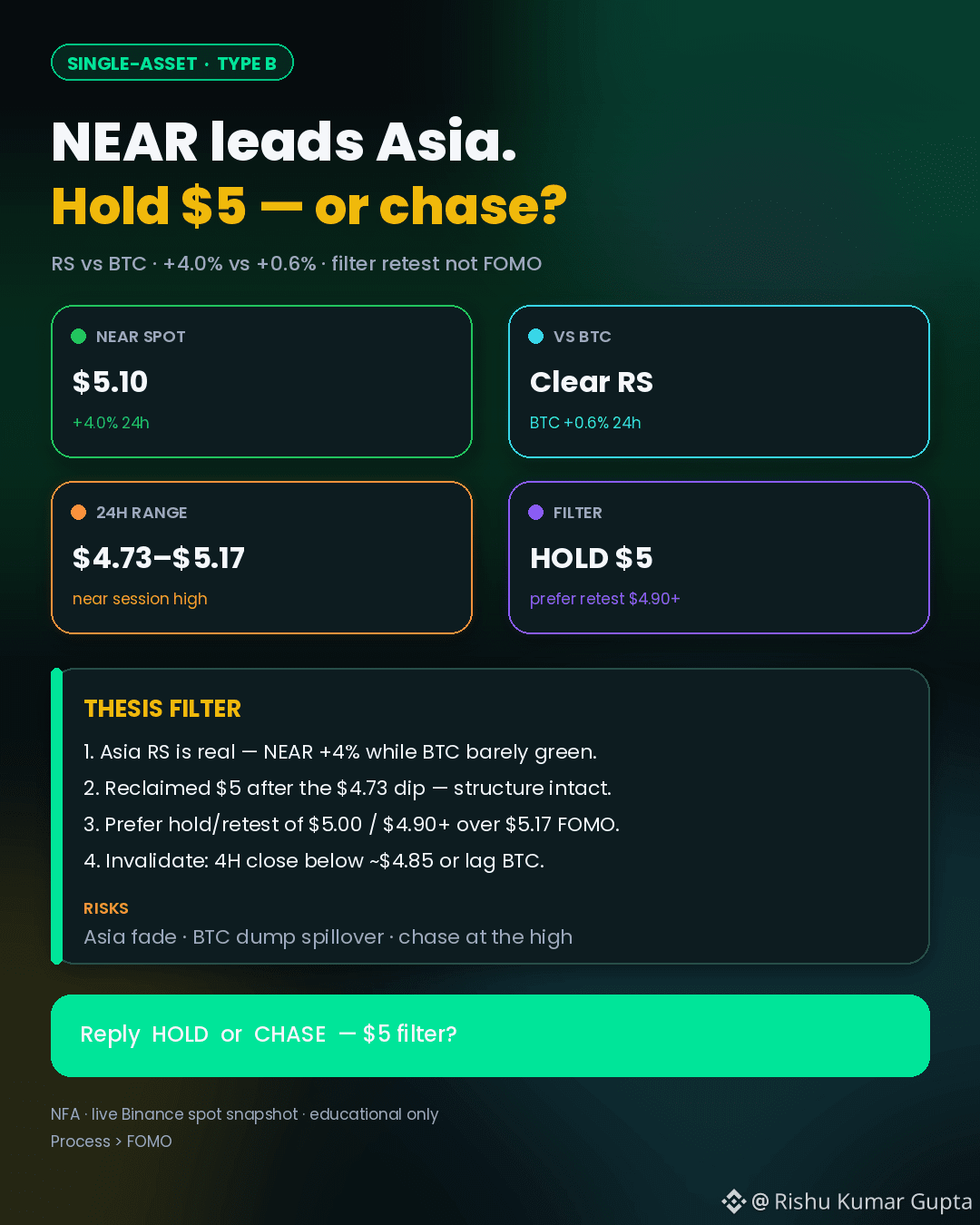
NEAR leads Asia. Hold $5 — or chase?
Live spot ~$5.10 (+4.0% 24h) while BTC is only +0.6%. Reclaimed $5 after the $4.73 dip — RS is real, but $5.17 is the wick, not the entry.
Thesis filter:
1) Prefer hold/retest of $5.00 / $4.90+ over FOMO highs
2) Structure intact while above ~$4.85
3) Invalidate: 4H close below ~$4.85 or lag BTC next session
Risks: Asia fade, BTC dump spillover, chase at the high.
Reply HOLD or CHASE — what's your $5 filter?
$NEAR $BTC
#NEAR #altcoins #cryptotrading
NFA · educational only · not financial advice
NEAR leads Asia. Hold $5 — or chase?
Live spot ~$5.10 (+4.0% 24h) while BTC is only +0.6%. Reclaimed $5 after the $4.73 dip — RS is real, but $5.17 is the wick, not the entry.
Thesis filter:
1) Prefer hold/retest of $5.00 / $4.90+ over FOMO highs
2) Structure intact while above ~$4.85
3) Invalidate: 4H close below ~$4.85 or lag BTC next session
Risks: Asia fade, BTC dump spillover, chase at the high.
Reply HOLD or CHASE — what's your $5 filter?
$NEAR $BTC
#NEAR #altcoins #cryptotrading
NFA · educational only · not financial advice
Live spot ~$5.10 (+4.0% 24h) while BTC is only +0.6%. Reclaimed $5 after the $4.73 dip — RS is real, but $5.17 is the wick, not the entry.
Thesis filter:
1) Prefer hold/retest of $5.00 / $4.90+ over FOMO highs
2) Structure intact while above ~$4.85
3) Invalidate: 4H close below ~$4.85 or lag BTC next session
Risks: Asia fade, BTC dump spillover, chase at the high.
Reply HOLD or CHASE — what's your $5 filter?
$NEAR $BTC
#NEAR #altcoins #cryptotrading
NFA · educational only · not financial advice
128
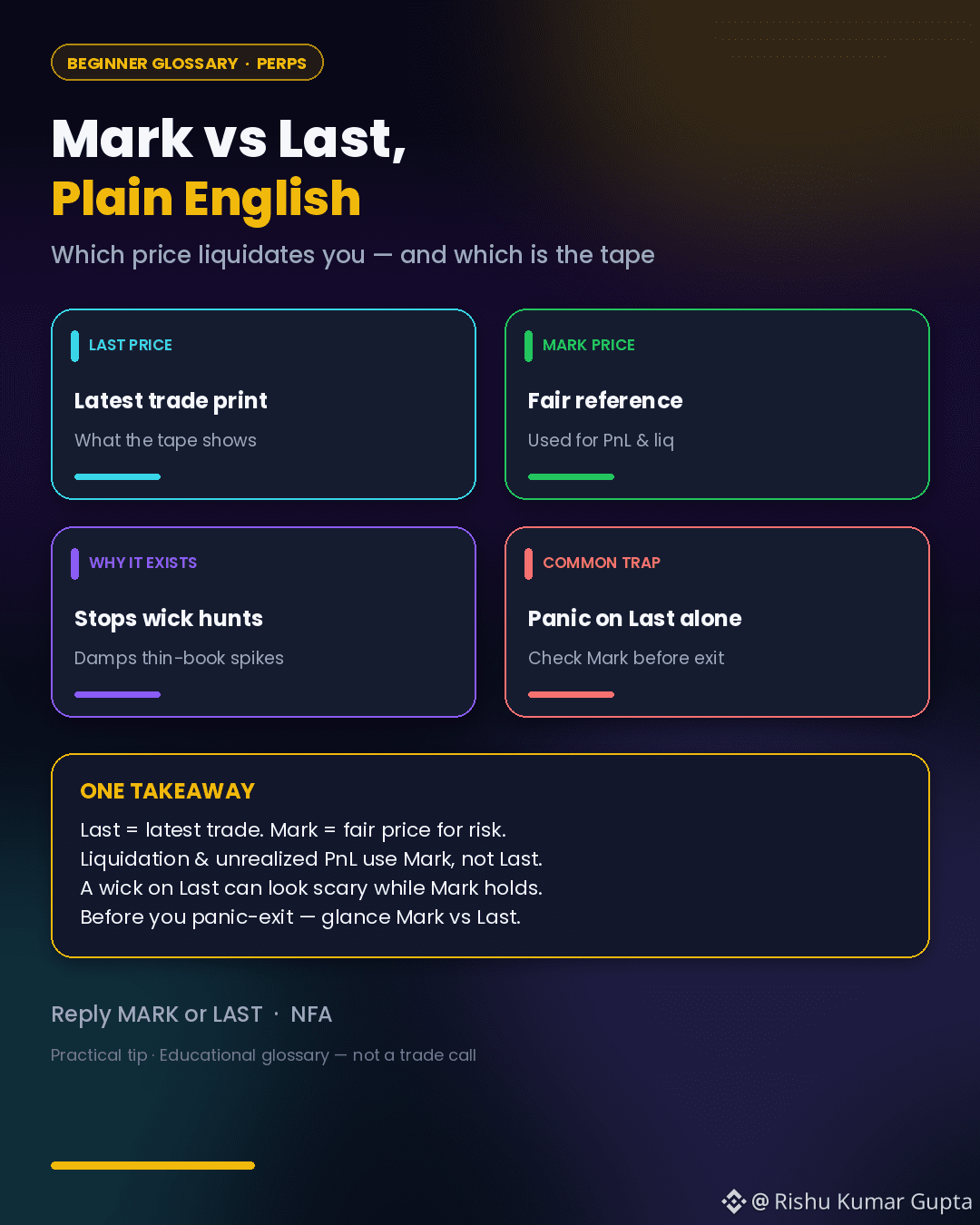
Mark Price vs Last Price — in plain English.
Last = the latest trade print (the tape).
Mark = the fair reference the exchange uses for unrealized PnL and liquidation.
Why it exists: damps thin-book spikes so a single wick is less likely to force you out.
Trap: panic-exiting on Last alone while Mark still holds. Glance both before you hit the button.
Reply MARK or LAST — which one do you check first under stress?
NFA — educational glossary, not financial advice.
$BTC $ETH
#CryptoEducation #Perps #MarkPrice
Mark Price vs Last Price — in plain English.
Last = the latest trade print (the tape).
Mark = the fair reference the exchange uses for unrealized PnL and liquidation.
Why it exists: damps thin-book spikes so a single wick is less likely to force you out.
Trap: panic-exiting on Last alone while Mark still holds. Glance both before you hit the button.
Reply MARK or LAST — which one do you check first under stress?
NFA — educational glossary, not financial advice.
$BTC $ETH
#CryptoEducation #Perps #MarkPrice
Last = the latest trade print (the tape).
Mark = the fair reference the exchange uses for unrealized PnL and liquidation.
Why it exists: damps thin-book spikes so a single wick is less likely to force you out.
Trap: panic-exiting on Last alone while Mark still holds. Glance both before you hit the button.
Reply MARK or LAST — which one do you check first under stress?
NFA — educational glossary, not financial advice.
$BTC $ETH
#CryptoEducation #Perps #MarkPrice
32
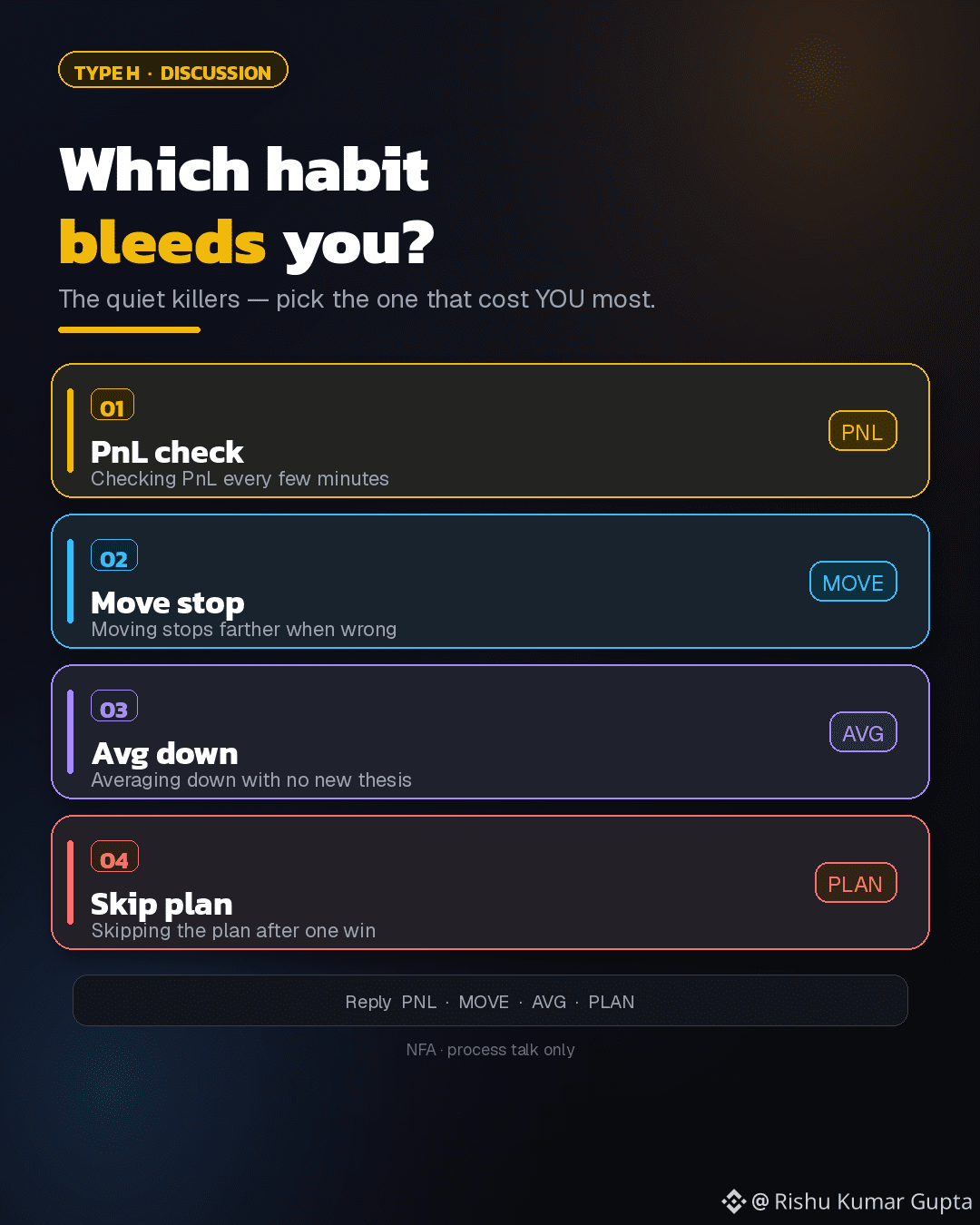
Which habit bleeds accounts the slowest (and the most)?
Not the dramatic blow-up. The quiet ones:
1) Checking PnL every few minutes
2) Moving stops farther when wrong
3) Averaging down with no new thesis
4) Skipping the plan after one win
Pick the one that has cost YOU the most. Reply PNL, MOVE, AVG, or PLAN.
NFA — process talk only, not a trade call.
$BTC #TradingPsychology #RiskManagement #CryptoTrading
Which habit bleeds accounts the slowest (and the most)?
Not the dramatic blow-up. The quiet ones:
1) Checking PnL every few minutes
2) Moving stops farther when wrong
3) Averaging down with no new thesis
4) Skipping the plan after one win
Pick the one that has cost YOU the most. Reply PNL, MOVE, AVG, or PLAN.
NFA — process talk only, not a trade call.
$BTC #TradingPsychology #RiskManagement #CryptoTrading
Not the dramatic blow-up. The quiet ones:
1) Checking PnL every few minutes
2) Moving stops farther when wrong
3) Averaging down with no new thesis
4) Skipping the plan after one win
Pick the one that has cost YOU the most. Reply PNL, MOVE, AVG, or PLAN.
NFA — process talk only, not a trade call.
$BTC #TradingPsychology #RiskManagement #CryptoTrading
29
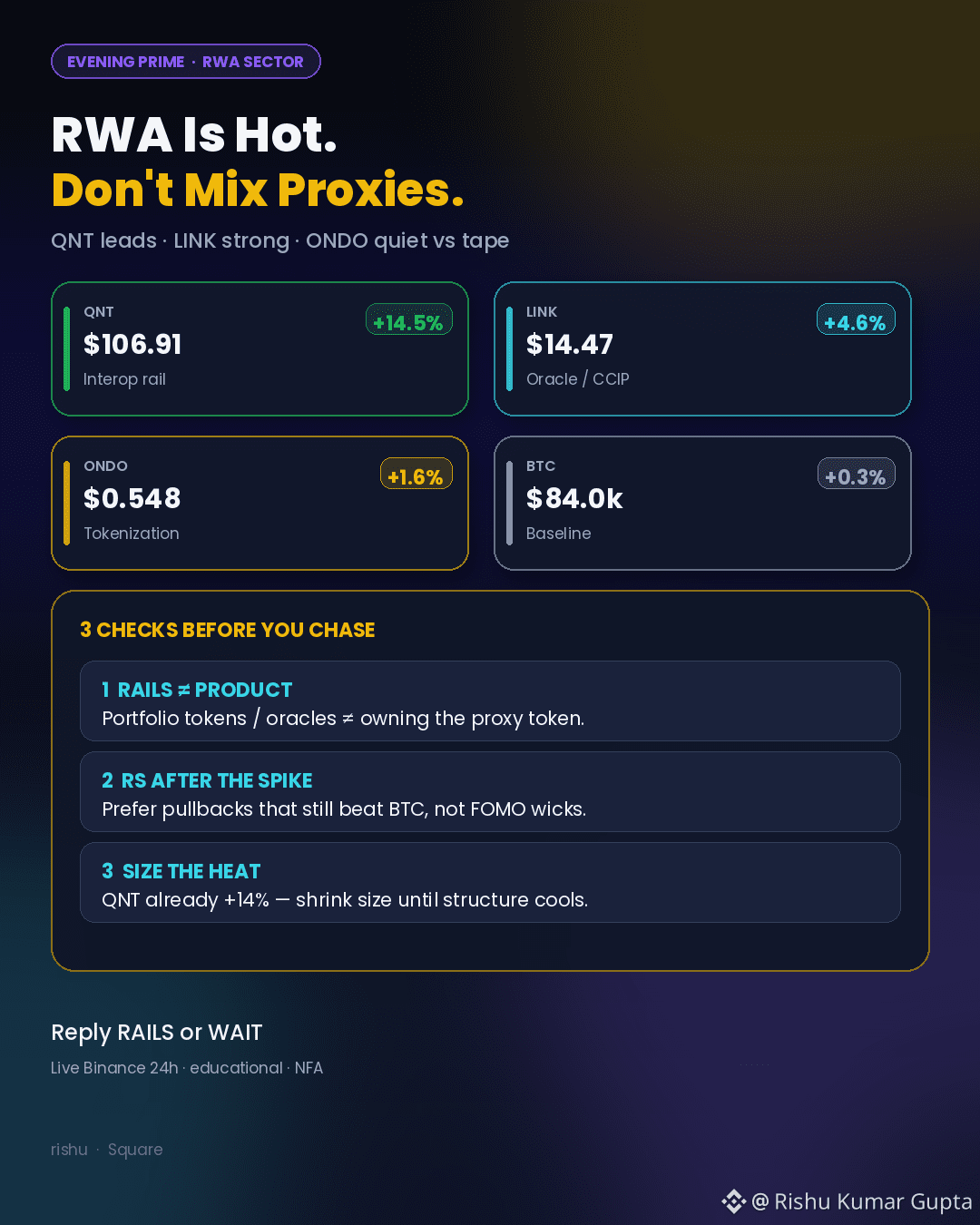
RWA is hot — but rails ≠ product.
Live 24h (Binance):
$QNT +14.5% (~$106.91)
$LINK +4.6% (~$14.47)
$ONDO +1.6% (~$0.55)
vs BTC basically flat (~$84.0k).
Ondo’s new portfolio tokens (BlackRock-designed models) are a product story. That does NOT mean the ONDO proxy token is the same trade. Same for oracle/interop heat in LINK and QNT.
3 checks before you chase:
1) Rails ≠ product
2) Prefer RS on pullbacks, not FOMO wicks
3) Size down after a +14% day
Reply RAILS or WAIT.
Educational · NFA
$QNT $LINK $ONDO
#RWA #Tokenization #CryptoEducation
RWA is hot — but rails ≠ product.
Live 24h (Binance):
$QNT +14.5% (~$106.91)
$LINK +4.6% (~$14.47)
$ONDO +1.6% (~$0.55)
vs BTC basically flat (~$84.0k).
Ondo’s new portfolio tokens (BlackRock-designed models) are a product story. That does NOT mean the ONDO proxy token is the same trade. Same for oracle/interop heat in LINK and QNT.
3 checks before you chase:
1) Rails ≠ product
2) Prefer RS on pullbacks, not FOMO wicks
3) Size down after a +14% day
Reply RAILS or WAIT.
Educational · NFA
$QNT $LINK $ONDO
#RWA #Tokenization #CryptoEducation
Live 24h (Binance):
$QNT +14.5% (~$106.91)
$LINK +4.6% (~$14.47)
$ONDO +1.6% (~$0.55)
vs BTC basically flat (~$84.0k).
Ondo’s new portfolio tokens (BlackRock-designed models) are a product story. That does NOT mean the ONDO proxy token is the same trade. Same for oracle/interop heat in LINK and QNT.
3 checks before you chase:
1) Rails ≠ product
2) Prefer RS on pullbacks, not FOMO wicks
3) Size down after a +14% day
Reply RAILS or WAIT.
Educational · NFA
$QNT $LINK $ONDO
#RWA #Tokenization #CryptoEducation
316
Article
The Ape Filter: 5 checks before you buyMost memecoin losses aren't bad luck — they're skipped checks.
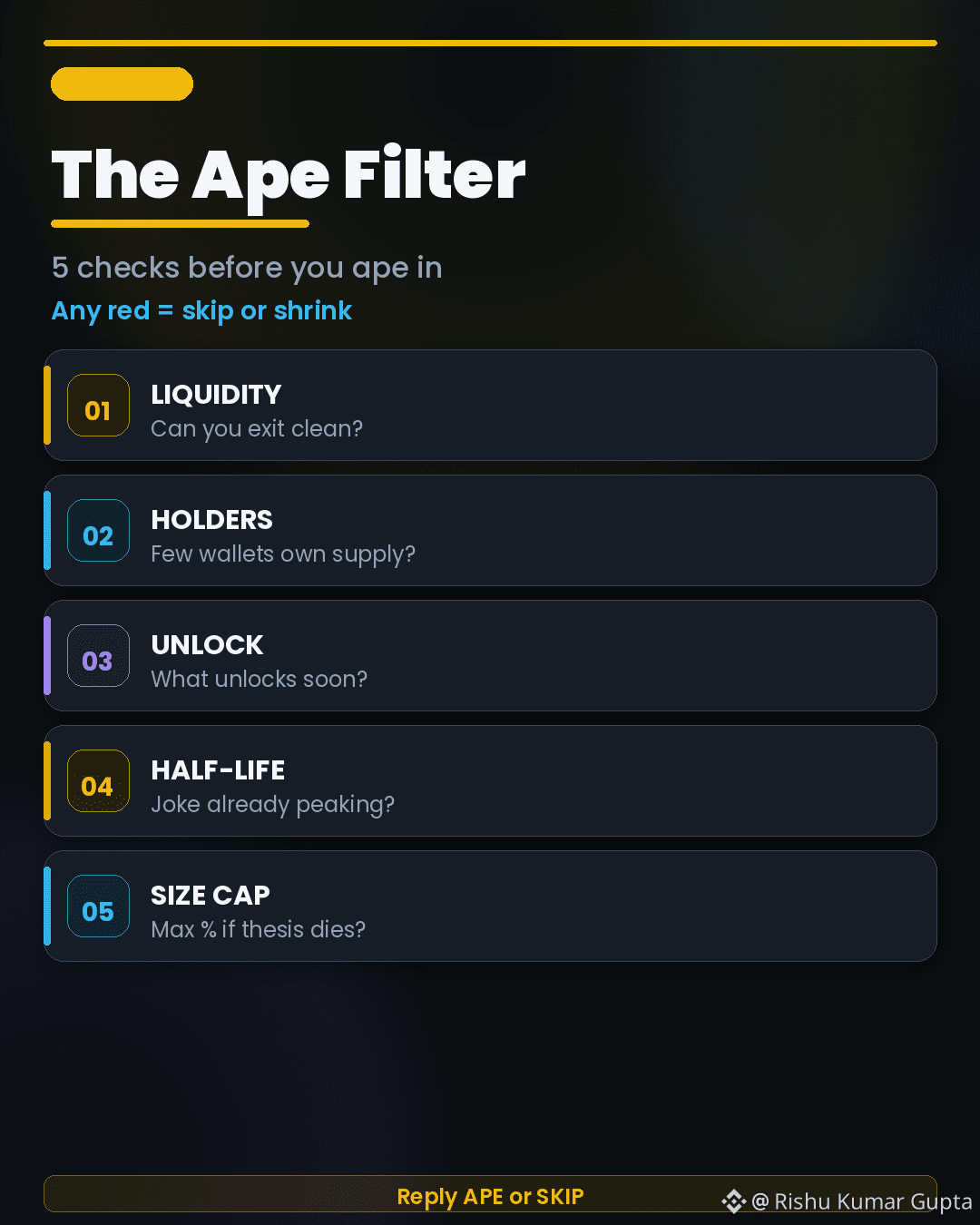
Before you ape a high-beta narrative coin, run The Ape Filter. Five lights. Any red = skip or shrink.
1) LIQUIDITY — Can you exit without wrecking yourself?
Thin books look fine on the way in and brutal on the way out. Ask: if I need to leave in size, who is on the other side?
2) HOLDERS — Is supply concentrated in a few wallets?
A cute chart dies fast when a handful of wallets decide they're done. Concentration isn't always evil — but it's always a risk dial.
3) UNLOCK / EMISSION — What unlocks soon?
Vesting cliffs and emissions can turn a "momentum" story into free float overnight. Know the calendar before you size.
4) NARRATIVE HALF-LIFE — Is the joke already peak?
Memes have a half-life. If the timeline is already exhausted and every account is posting the same punchline, you're late to the laugh — not early to the trade.
5) SIZE CAP — Max % of stack you'll risk if thesis dies overnight?
Write the number first. If you can't name a max loss you'll accept with a straight face, you don't have a plan — you have FOMO.
Any red light: skip the trade or cut size hard. Green across the board still isn't a guarantee — it just means you earned the right to consider a small, defined risk.
NFA — education only. Do your own research.
Reply APE or SKIP — which check fails most often for you?
#Memecoins #RiskManagement #CryptoEducation
The Ape Filter: 5 checks before you buy
Most memecoin losses aren't bad luck — they're skipped checks.
Before you ape a high-beta narrative coin, run The Ape Filter. Five lights. Any red = skip or shrink.
1) LIQUIDITY — Can you exit without wrecking yourself?
Thin books look fine on the way in and brutal on the way out. Ask: if I need to leave in size, who is on the other side?
2) HOLDERS — Is supply concentrated in a few wallets?
A cute chart dies fast when a handful of wallets decide they're done. Concentration isn't always evil — but it's always a risk dial.
3) UNLOCK / EMISSION — What unlocks soon?
Vesting cliffs and emissions can turn a "momentum" story into free float overnight. Know the calendar before you size.
4) NARRATIVE HALF-LIFE — Is the joke already peak?
Memes have a half-life. If the timeline is already exhausted and every account is posting the same punchline, you're late to the laugh — not early to the trade.
5) SIZE CAP — Max % of stack you'll risk if thesis dies overnight?
Write the number first. If you can't name a max loss you'll accept with a straight face, you don't have a plan — you have FOMO.
Any red light: skip the trade or cut size hard. Green across the board still isn't a guarantee — it just means you earned the right to consider a small, defined risk.
NFA — education only. Do your own research.
Reply APE or SKIP — which check fails most often for you?
#Memecoins #RiskManagement #CryptoEducation
Before you ape a high-beta narrative coin, run The Ape Filter. Five lights. Any red = skip or shrink.
1) LIQUIDITY — Can you exit without wrecking yourself?
Thin books look fine on the way in and brutal on the way out. Ask: if I need to leave in size, who is on the other side?
2) HOLDERS — Is supply concentrated in a few wallets?
A cute chart dies fast when a handful of wallets decide they're done. Concentration isn't always evil — but it's always a risk dial.
3) UNLOCK / EMISSION — What unlocks soon?
Vesting cliffs and emissions can turn a "momentum" story into free float overnight. Know the calendar before you size.
4) NARRATIVE HALF-LIFE — Is the joke already peak?
Memes have a half-life. If the timeline is already exhausted and every account is posting the same punchline, you're late to the laugh — not early to the trade.
5) SIZE CAP — Max % of stack you'll risk if thesis dies overnight?
Write the number first. If you can't name a max loss you'll accept with a straight face, you don't have a plan — you have FOMO.
Any red light: skip the trade or cut size hard. Green across the board still isn't a guarantee — it just means you earned the right to consider a small, defined risk.
NFA — education only. Do your own research.
Reply APE or SKIP — which check fails most often for you?
#Memecoins #RiskManagement #CryptoEducation
42
Connectez-vous pour découvrir plus de contenu
Rejoignez la communauté mondiale des adeptes de cryptomonnaies sur Binance Square
⚡️ Suviez les dernières informations importantes sur les cryptomonnaies.
💬 Jugé digne de confiance par la plus grande plateforme d’échange de cryptomonnaies au monde.
👍 Découvrez les connaissances que partagent les créateurs vérifiés.
Adresse e-mail/Nº de téléphone